• About
  • THE BEADY EYE SAY’S : THE EUROPEAN UNION SHOULD THANK ENGLAND FOR ITS IN OR OUT REFERENDUM.

bobdillon33blog

~ Free Thinker.

bobdillon33blog

Category Archives: TRACKING TECHNOLOGY.

THE BEADY EYE ASK’S: THESE DAYS WHAT CAN WE BELIEVE IN ?

21 Thursday Dec 2023

Posted by bobdillon33@gmail.com in #whatif.com, 2023 the year of disconnection., A Constitution for the Earth., Advertising, Advertising industry, Algorithms., Artificial Intelligence.,  Attention economy, Capitalism, CAPITALISM IS INCOMPATIBLE IN THE FIGHT AGAINST CLIMATE CHANGE., Carbon Emissions., Civilization., Climate Change., Collective stupidity., Consciousness., Cry for help., Dehumanization., Democracy, Digital age., DIGITAL DICTATORSHIP., Digital Friendship., Disconnection., Discrimination., Earth, Emergency powers., Enegery, Environment, Face Recognition., Facebook, Fake News., Fourth Industrial Revolution., Freedom of Speech, Freedom of the Press., Google, Google Knowledge., GPS-Tracking., Green Energy., Happy Christmas from the Beady eye., Honesty., How to do it., Human Collective Stupidity., HUMAN INTELLIGENCE, Human values., Humanity., Imagination., Inequality, INTELLIGENCE., IS DATA DESTORYING THE WORLD?, James Webb Telescope, Life., MISINFORMATION., Modern Day Communication., Modern Day Democracy., Modern day life., Modern Day Slavery., Monetization of nature, Our Common Values., PAIN AND SUFFERING IN LIFE, Political lying., Political Trust, Politics., Populism., Post - truth politics., Profiteering., Purpose of life., Real life experience's, Reality., Renewable Energy., Robot citizenship., Social Media, Social Media Regulation., Society, State of the world, Sustaniability, Technology, Technology v Humanity, Telling the truth., The common good., The essence of our humanity., The Future, The Internet., THE NEW NORM., The Obvious., The pursuit of profit., The state of the World., The world to day., THE WORLD YOU LIVE IN., THIS IS THE STATE OF THE WORLD.  , TRACKING TECHNOLOGY., Truth, Truthfulness., Twitter, Unanswered Questions., Universal values., VALUES, We can leave a legacy worthwhile., What is shaping our world., WHAT IS TRUTH, Where's the Global Outrage., World Leaders, World Organisations., World Politics

≈ Comments Off on THE BEADY EYE ASK’S: THESE DAYS WHAT CAN WE BELIEVE IN ?

Tags

bible, god, philosophy, Religion., Science

( Fifteen minute read)

The last post this year, have a peaceful Christmas.

This post is a follow up to the post, ( What is life, What does it mean to be alive). It is also an attempt to argue for as many preposterous positions as possible in the shortest space of time possible.

That there are no options other than accepting that life is objectively meaningful or not meaningful at all.

Science requires proof, religious belief requires faith.

So let’s get God and Gods out of the way.

.Could quantum physics help explain a God that could be in two places at once? (Credit: Nasa)

If you believe in God, then the idea of God being bound by the laws of physics is nonsense, because God can do everything, even travel faster than light. If you don’t believe in God, then the question is equally nonsensical, because there isn’t a God and nothing can travel faster than light.

Perhaps the question is really one for agnostics, who don’t know whether there is a God.

The idea that God might be “bound” by the laws of physics – which also govern chemistry and biology might not be so far stretched that the James Webb telescope might discover him or her. Whether it does or does not, if it did discovered life on another planet and the human race realizes that its long loneliness in time and space may be over — the possibility we’re no longer alone in the universe is where scientific empiricism and religious faith intersect, with NO true answer?.

Could any answer help us prove whether or not God exists, not on your nanny.

If God wasn’t able to break the laws of physics, she or he arguably wouldn’t be as powerful as you’d expect a supreme being to be. But if he or she could, why haven’t we seen any evidence of the laws of physics ever being broken in the Universe?

If there is a God who created the entire universe and ALL of its laws of physics, does God follow God’s own laws? Or can God supersede his own laws, such as travelling faster than the speed of light and thus being able to be in two different places at the same time?

Let’s consider whether God can be in more than one place at the same time.

(According to quantum mechanics, particles are by definition in a mix of different states until you actually measure them.)

There is something faster than the speed of light after all: Quantum information.

This doesn’t prove or disprove God, but it can help us think of God in physical terms – maybe as a shower of entangled particles, transferring quantum information back and forth, and so occupying many places at the same time? Even many universes at the same time?

But is it true?

A few years ago, a group of physicists posited that particles called tachyons travelled above light speed. Fortunately, their existence as real particles is deemed highly unlikely. If they did exist, they would have an imaginary mass and the fabric of space and time would become distorted – leading to violations of causality (and possibly a headache for God).

(This in itself does not say anything at all about God. It merely reinforces the knowledge that light travels very fast indeed.)

We can calculate that light has travelled roughly 1.3 x 10 x 23 (1.3 times 10 to the power 23) km in the 13.8 billion years of the Universe’s existence. Or rather, the observable Universe’s existence.

The Universe is expanding at a rate of approximately 70km/s per Mpc (1 Mpc = 1 Megaparsec or roughly 30 billion billion kilometres), so current estimates suggest that the distance to the edge of the universe is 46 billion light years. As time goes on, the volume of space increases, and light has to travel for longer to reach us.

We cannot observe or see across the entirety of the Universe that has grown since the Big Bang because insufficient time has passed for light from the first fractions of a second to reach us. Some argue that we therefore cannot be sure whether the laws of physics could be broken in other cosmic regions – perhaps they are just local, accidental laws. And that leads us on to something even bigger than the Universe.

But if inflation could happen once, why not many times?

We know from experiments that quantum fluctuations can give rise to pairs of particles suddenly coming into existence, only to disappear moments later. And if such fluctuations can produce particles, why not entire atoms or universes? It’s been suggested that, during the period of chaotic inflation, not everything was happening at the same rate – quantum fluctuations in the expansion could have produced bubbles that blew up to become universes in their own right.

How come all the physical laws and parameters in the universe happen to have the values that allowed stars, planets and ultimately life to develop?

We shouldn’t be surprised to see biofriendly physical laws – they after all produced us, so what else would we see? Some theists, however, argue it points to the existence of a God creating favourable conditions.

But God isn’t a valid scientific explanation.

We can’t disprove the idea that a God may have created the multiverse.

No matter what is believable or not, things can appear from nowhere and disappear to nowhere.

If you find this hard to swallow, what follows will make you choke.

First there is panpsychism, the idea that “consciousness pervades the universe and is a fundamental feature of it.

Even particles are never compelled to do anything, but are rather disposed, from their own nature, to respond rationally to their experience. That the universe is conscious and is acting towards a purpose of realising the full potential of its consciousness.

The radicalism of this “teleological cosmopsychism” is made clear by its implication that “during the first split second of time, the universe fine-tuned itself in order to allow for the emergence of life billions of years in the future”. To do this, “the universe must in some sense have been aware of this future possibility”.

That the universe itself has a built-in purpose, the disappointingly vague goal of which is “rational matter achieving a higher realisation of its nature.

The laws of physics are just right for conscious life to evolve that it can’t have been an accident.

It is hard to see why the universe’s purpose should give our lives one. Indeed, to believe one plays an infinitesimally small part in the unfolding of a cosmic master plan makes each human life look insignificant.

The basic question about our place in the Universe is one that may be answered by scientific investigations.

What are the next steps to finding life elsewhere?

Today’s telescopes can look at many stars and tell if they have one or more orbiting planets. Even more, they can determine if the planets are the right distance away from the star to have liquid water, the key ingredient to life as we know it.

NEXT:How to Choose Which Social Media Platforms to Use

We live in a time of political fury and hardening cultural divides. But if there is one thing on which virtually everyone is agreed, it is that the news and information we receive is biased. Much of the outrage that floods social media, occasionally leaking into opinion columns and broadcast interviews, is not simply a reaction to events themselves, but to the way in which they are reported and framed that are the problem.

This mentality now with the help of technological advances in communication spans the entire political spectrum and pervades societies around the world twisting our basic understanding of reality to our own ends.

This is not as simple as distrust.

The appearance of digital platforms, smartphones and the ubiquitous surveillance have enable to usher in a new public mood that is instinctively suspicious of anyone claiming to describe reality in a fair and objective fashion. Which will end in a Trumpian refusal to accept any mainstream or official account of the world with people become increasingly dependent on their own experiences and their own beliefs about how the world really works.

The crisis of democracy and of truth are one and the same:

Individuals are increasingly suspicious of the “official” stories they are being told, and expect to witness things for themselves.

How exactly do we distinguish this critical mentality from that of the conspiracy theorist, who is convinced that they alone have seen through the official version of events? Or to turn the question around, how might it be possible to recognise the most flagrant cases of bias in the behaviour of reporters and experts, but nevertheless to accept that what they say is often a reasonable depiction of the world?

It is tempting to blame the internet, populists or foreign trolls for flooding our otherwise rational society with lies.

But this underestimates the scale of the technological and philosophical transformations that are under way. The single biggest change in our public sphere is that we now have an unimaginable excess of news and content, where once we had scarcity. The explosion of information available to us is making it harder, not easier, to achieve consensus on truth.

As the quantity of information increases, the need to pick out bite-size pieces of content rises accordingly.

In this radically sceptical age, questions of where to look, what to focus on and who to trust are ones that we increasingly seek to answer for ourselves, without the help of intermediaries. This is a liberation of sorts, but it is also at the heart of our deteriorating confidence in public institutions.

There is now a self-sustaining information ecosystem becoming a serious public health problem across the world, aided by the online circulation of conspiracy theories and pseudo-science. However the panic surrounding echo chambers and so-called filter bubbles is largely groundless.

What, then, has to changed?

The key thing is that the elites of government and the media have lost their monopoly over the provision of information, but retain their prominence in the public eye.

And digital platforms now provide a public space to identify and rake over the flaws, biases and falsehoods of mainstream institutions.

The result is an increasingly sceptical citizenry, each seeking to manage their media diet, checking up on individual journalists in order to resist the pernicious influence of the establishment.

The problem we face is not, then, that certain people are oblivious to the “mainstream media”, or are victims of fake news, but that we are all seeking to see through the veneer of facts and information provided to us by public institutions.

Facts and official reports are no longer the end of the story.

The truth is now threatened by a radically different system, which is transforming the nature of empirical evidence and memory. One term for this is “big data”, which highlights the exponential growth in the quantity of data that societies create, thanks to digital technologies.

The reason there is so much data today is that more and more of our social lives are mediated digitally. Internet browsers, smartphones, social media platforms, smart cards and every other smart interface record every move we make. Whether or not we are conscious of it, we are constantly leaving traces of our activities, no matter how trivial.

But it is not the escalating quantity of data that constitutes the radical change.

Something altogether new has occurred that distinguishes today’s society from previous epochs.

In the past, recording devices were principally trained upon events that were already acknowledged as important.

Things no longer need to be judged “important” to be captured.

Consciously, we photograph events and record experiences regardless of their importance. Unconsciously, we leave a trace of our behaviour every time we swipe a smart card, address Amazon’s Alexa or touch our phone.

For the first time in human history, recording now happens by default, and the question of significance is addressed separately.

This shift has prompted an unrealistic set of expectations regarding possibilities for human knowledge.

When everything is being recorded, our knowledge of the world no longer needs to be mediated by professionals, experts, institutions and theories. Data can simply “speak for itself”. This is a fantasy of a truth unpolluted by any deliberate human intervention – the ultimate in scientific objectivity.

From this perspective, every controversy can in principle be settled thanks to the vast trove of data – CCTV, records of digital activity and so on – now available to us. Reality in its totality is being recorded, and reporters and officials look dismally compromised by comparison.

It is often a single image that seems to capture the truth of an event, only now there are cameras everywhere.

No matter how many times it is disproven, the notion that “the camera doesn’t lie” has a peculiar hold over our imaginations. In a society of blanket CCTV and smartphones, there are more cameras than people, and the torrent of data adds to the sense that the truth is somewhere amid the deluge, ignored by mainstream accounts.

The central demand of this newly sceptical public is “so show me”.

The rise of blanket surveillance technologies has paradoxical effects, raising expectations for objective knowledge to unrealistic levels, and then provoking fury when those in the public eye do not meet them.

Surely, in this age of mass data capture, the truth will become undeniable.

On the other hand, as the quantity of data becomes overwhelming – greater than human intelligence can comprehend – our ability to agree on the nature of reality seems to be declining. Once everything is, in principle, recordable, disputes heat up regarding what counts as significant in the first place.

What we are discovering is that, once the limitations on data capture are removed, there are escalating opportunities for conflict over the nature of reality.

Remember AI does not exist in a vacuum, its employment can and is discriminating against communities, powered by vast amounts of energy,  producing CO2 emissions.

Lastly the Advertising Industry.The impact of COVID-19 on the advertising industry - Passionate In ...

These day it seems that it has free rain to claim anything.

Like them or loathe them, advertisements are everywhere and they’re worsening not just the climate crisis, and ecological damage by promoting sustainability in consumption and inequality. Presenting a fake, idealised world that papers over an often brutal reality.

But advertising in one sense is even more dangerous, because it is so pervasive, sophisticated in its techniques and harder to see through. When hundreds of millions of people have desires for more and more stuff and for more and more services and experiences, that really adds up and puts a strain on the Earth.

The toll of disasters propelled by climate change in 2023 can be tallied with numbers — thousands of people dead, millions of others who lost jobs, homes and hope, and tens of billions of dollars sheared off economies. But numbers can’t reflect the way climate change is experienced — the intensity, the insecurity and the inequality that people on Earth are now living.

In every place that climate change makes its mark, inequality is made worse.

How are we going to protect the truth:

It goes without saying that spiritual beliefs will protect themselves. Lies, propaganda and fake news however is the challenge for our age.

Working out who to trust and who not to believe has been a facet of human life since our ancestors began living in complex societies. Politics has always bred those who will mislead to get ahead.

With news sources splintering and falsehoods spreading widely online, can anything be done?

Check Google.

Welcome to the world of “alternative facts”. It is a bewildering maze of claim and counterclaim, where hoaxes spread with frightening speed on social media and spark angry backlashes from people who take what they read at face value.

It is an environment where the mainstream media is accused of peddling “fake news” by the most powerful man in the world.

Voters are seemingly misled by the very politicians they elected and even scientific research – long considered a reliable basis for decisions – is dismissed as having little value.

Without a common starting point – a set of facts that people with otherwise different viewpoints can agree on – it will be hard to address any of the problems that the world now faces. The threat posed by the spread of misinformation should not be underestimated.

Some warn that “fake news” threatens the democratic process itself.

A survey conducted by the Pew Research Center towards the end of last year found that 64% of American adults said made-up news stories were causing confusion about the basic facts of current issues and events.

How we control the dissemination of things that seem to be untrue. We need a new way to decide what is trustworthy.

Take Wikipedia itself – which can be edited by anyone but uses teams of volunteer editors to weed out inaccuracies – is far from perfect.

These platforms and their like are simply in it for the money.

Last year, links to websites masquerading as reputable sources started appearing on social media sites like Facebook.

Stories about the Pope endorsing Donald Trump’s candidacy and Hillary Clinton being indicted for crimes related to her email scandal were shared widely despite being completely made up. The ability to share them widely on social media means a slice of the advertising revenue that comes from clicks.

Truth is no longer dictated by authorities, but is networked by peers. For every fact there is a counterfact. All those counterfacts and facts look identical online, which is confusing to most people.

Information spreads around the world in seconds, with the potential to reach billions of people. But it can also be dismissed with a flick of the finger. What we choose to engage with is self-reinforcing and we get shown more of the same. It results in an exaggerated “echo chamber” effect.

The challenge here is how to burst these bubbles.

One approach that has been tried is to challenge facts and claims when they appear on social media. Organisations like Full Fact, for example, look at persistent claims made by politicians or in the media, and try to correct them. (The BBC also has its own fact-checking unit, called Reality Check.)

This approach doesn’t work on social media because the audiences were largely disjointed.

Even when a correction reached a lot of people and a rumour reached a lot of people, they were usually not the same people. The problem is, corrections do not spread very well. This lack of overlap is a specific challenge when it comes to political issues.

On Facebook political bodies can put something out, pay for advertising, put it in front of millions of people, yet it is hard for those not being targeted to know they have done that. They can target people based on how old they are, where they live, what skin colour they have, what gender they are.

We shouldn’t think of social media as just peer-to-peer communication – it is also the most powerful advertising platform there has ever been. We have never had a time when it has been so easy to advertise to millions of people and not have the other millions of us notice.

Twitter and Facebook both insist they have strict rules on what can be advertised and particularly on political advertising. Regardless, the use of social media adverts in politics can have a major impact.

We need some transparency about who is using social media advertising when they are in election campaigns and referendum campaigns. We need watchdogs that will go around and say, ‘Hang on, this doesn’t stack up’ and ask for the record to be corrected.

We need Platforms to ensure that people have read content before sharing it to develop standards.

Google says it is working on ways to improve its algorithms so they take accuracy into account when displaying search results. “Judging which pages on the web best answer a query is a challenging problem and we don’t always get it right,”

The challenge is going to be writing tools that can check specific types of claims.

Built a fact-checker app that could sit in a browser and use Watson’s language skills to scan the page and give a percentage likelihood of whether it was true.

This idea of helping break through the isolated information bubbles that many of us now live in, comes up again and again.

By presenting people with accurate facts it should be possible to at least get a debate going.

There is a large proportion of the population living in what we would regard as an alternative reality.  By suggesting things to people that are outside their comfort zone but not so far outside they would never look at it you can keep people from self-radicalising in these bubbles.

There are understandable fears about powerful internet companies filtering what people see.

We should think about adding layers of credibility to sources. We need to tag and structure quality content in effective ways.

But what if people don’t agree with official sources of information at all?

This is a problem that governments around the world are facing as the public views what they tell them with increasing scepticism. There is an unwillingness to bend one’s mind around facts that don’t agree with one’s own viewpoint.

The first stage in that is crowdsourcing facts.  So before you have a debate, you come up with the commonly accepted facts that people can debate from.

Technology may help to solve this grand challenge of our age, but it is time for a little more self-awareness too.

In the end the world needs a new Independent Organisation to examine all technology against human values. Future war will be fought on Face recognition.

To certify and hold the original programs of all technology.

Have I been trained by robbery its manter when it comes to algorithms.

The whole goal of the transition is not to allow a handful of Westerners to peacefully go through life in a Tesla, a world in flames; it is to allow humanity – and the rest of biodiversity – to live decently.

All human comments appreciated. All like clicks and abuse chucked in the bin.

Contact: bobdillon33@gmail.com

Share this:

  • Click to share on WhatsApp (Opens in new window) WhatsApp
  • More
  • Click to share on Pocket (Opens in new window) Pocket
  • Click to share on Mastodon (Opens in new window) Mastodon

THE BEADY EYE SAY’S: IT’S FAR TO LATE TO CONTROL AI.

01 Saturday Apr 2023

Posted by bobdillon33@gmail.com in 2023 the year of disconnection., Artificial Intelligence., Dehumanization., Democracy., Digital age., DIGITAL DICTATORSHIP., Disaster Capitalism., Fake News., Fourth Industrial Revolution., How to do it., Human Collective Stupidity., Human Exploration., Human values., Humanity., Inequality, Life., Modern day life., Modern day Slavery, Our Common Values., Post - truth politics., Purpose of life., Reality., Robot citizenship., Social Media Regulation., State of the world, Sustaniability, Technology v Humanity, Technology., The essence of our humanity., The Future, The Internet., The metaverse., The Obvious., The state of the World., The world to day., TRACKING TECHNOLOGY., Unanswered Questions., VALUES, VIRTUAL REALITY., What is shaping our world., WHAT IS TRUTH, What Needs to change in the World

≈ Comments Off on THE BEADY EYE SAY’S: IT’S FAR TO LATE TO CONTROL AI.

( Six minute read)

Why?

Because the change is already taking place.

Because,  There are now more cell phones in the world than people. There were less than 7% of the world on online in 2000, today over half the global population has access to the internet.

Because, technology has already radically transformed our societies and our daily lives, from smartphones to social media and healthcare. Technology touches nearly everything we do.

Because, your voice, your image, your race, your shopping habits, your health, your movement’s, your viewing habits, your voting, your financial standing, your criminal record, your interests, your decision making, down to what you are eating, not forgetting your sex life is and has being harvest for free.

All can be and are being faked.

Because, virtual interactions offers enticing financial opportunities for big businesses and digitalized Governments.

——-

Excessive use of technology can do more harm than good, and we should bear this in mind before we rush into digitizing our lives.

When all areas of human activity get rapidly digitized, it’s easy to become desensitized to the importance of innovations and advancements for the overall progress of society. Though it may be tough to predict which advancements technology would bring next, some innovations are already changing our beliefs about the world around us.

The coming generations will be living in a mixture of reality and the metaverse. Using headsets to create a  3D avatar – a representation of themselves –  to enter a virtual world connecting all sorts of digital environments. Perhaps when they go online shopping, they will be able too try on digital clothes first, and then order them to arrive in the real world.

A virtual economy of inequality.  Nowhere does the intersection of technology, enterprises and individuals hold greater opportunity than in the metaverse.

If it happens at all – will be fought among tech giants for the next decade, or maybe even longer.

———-

The Metaverse doesn’t exist – at least not yet, but there no way of predicting how people will react to it, or how it will be used.

( Everything transformed into line of code, augmenting reality by superimposing a computer-generated image on a user’s view of the real world. You have an experience while wearing another person’s body and you get to walk a mile in that person’s shoes.)

The next generation of the internet has the power to reshape the way that businesses and consumers engage, transact, socialize, work and learn together exploring the world on their own terms.

As of today, there isn’t anything that could legitimately be identified as a metaverse. The metaverse is essentially a massive, interconnected network of virtual spaces,

A better question might be:

What could become the metaverse?

Something that people would have considered magic just a few decades ago is now gaining popularity in business, gaming, and team building.

The combination of augmented, virtual and mixed reality – will play an important role.

The distinction between being offline and online will be much harder to delineate. So we either end up in a situation where it’s complete chaos and everyone’s allowed to do everything and you know, there’s racism, sexism, abuse and all that kind of stuff, or there’s incredibly tight moderation and no one’s allowed to do anything.

Wearable screens and gesture-based computing, other recent innovations, are predicted to soon substitute the usual PC and phone screens.

A red-haired woman wears the Oculus Quest 2 headset in white, holding two controllers

——-

Robots, another buzzword in today’s business world, have already replaced humans in some workplaces — robotic arms work at assembly or packing lines. Flying cars will soon address the issue of limited ground space and long traffic jams.

Clearly, technology by itself is neither good nor bad. It is only the way and extent to which we use it that matters.

It is indisputable that thanks to technology, we get a chance to live a life our predecessors could not even dream about.

But do all tech advancements bring sole good to our lives?

Or, maybe, the impact of tech innovations is quite ambiguous.

We are all at the mercy of machine learning algorithms, that are non transparent, non accountable, and non regulated.

So we have an open letter from those on High in the Tec world,  advocating that the brakes should be applied to the creation of new tech that generates falsehood’s. You dont have to be a Tech genius to know that this is not going to happen.

My advice is.

To protect oneself.

Every person should have a secret verification word in order to authenticate the caller and a symbol to be used in all texts and emails, that if not present in any communication received or sent,  marks it as False.

——–

All of which begs the question: just why is the 21st century so dystopian?

A few years ago, you might have thought: this is just a phase. It’ll pass. But it’s not. If anything, it’s getting worse, and it feels like it’s here to stay.

When I say “it”, or “dystopia,” you might wonder exactly, precisely what I mean. What I mean is very simple though. How many crises do we face? More than I can easily count. Let’s try to list them all, though we’ll run out of sanity and room before we finish, for sure. Finances? Total crisis, incomes falling around the world, debt levels soaring. Infrastructure? Mega-crisis, unless you think the infrastructure we have survives this century, let alone this decade. Social systems? Everywhere from France to Britain to America — crisis. People’s…minds? Crisis, especially in young people, depression and anxiety and suicide rates soaring. Then there are the big ones: climate change and mass extinction, not to mention politics , which has taken a notably…fascist…turn, again.

All of this is what scholars have begun to call The age of Polycrises.  And in it, the better question isn’t: “what’s in crisis?

It’s: what isn’t?

Like I said, the list above is a mere brief beginning. Migration and refugees? Another one. Peace and democracy? Yup, in crisis.

How about upward mobility? Check. Faith and confidence in institutions? Super crisis. Take a look at any element of society or the world, and chances are, it’s in crisis. How about inequality? Shocking levels of crisis.

This is why the 21st century feels so dystopian.

It’s not really a “feeling,” though that’s the way it’s often made out to be by media. It’s an empirical reality. Scholars have begun to conceptualize the 21st century as a “Polycrisis” for a reason, which is that the dystopia is real.

So when media, bigwigs, wannabe intellectuals and so forth, make all this out to be exaggeration, hyperbole, imply that you are the fainting Victorian bride in the room, because, hey, Tucker!! Everything’s Great!!…they’re completely wrong. And that needs to be said. It’s a form of denialism at this point, because…

The next part is about cause and effect. We need, as a civilization and a world, to figure out what’s causing all this, so we can begin to undo it. But if all we do is deny it…then, my friends, our gooses are well and cooked.  It’s fascism on a dying planet, in different bitter and poisonous flavours, maybe.

ITS NOW AGI. ( Artificial General Intelligence) Already it is transforming every walk of life.

AI is not a futuristic vision, but rather something that is here today and being integrated with and deployed into a variety of sectors.

There are numerous examples where AI already is making an impact on the world and augmenting human capabilities in significant ways. This includes fields such as finance, national security, health care, criminal justice, transportation, and smart cities, digital education, decision making, democracy’s.

Artificial intelligence algorithms are designed to make decisions, often using real-time data. They are unlike passive machines that are capable only of mechanical or predetermined responses. Using sensors, digital data, or remote inputs, they combine information from a variety of different sources, analyse the material instantly, and act on the insights derived from those data. With massive improvements in storage systems, processing speeds, and analytic techniques, they are capable of tremendous sophistication in analysis and decision making.

———-

These software systems “make decisions which normally require [a] human level of expertise” and help people anticipate problems or deal with issues as they come up. As such, they operate in an intentional, intelligent, and adaptive manner

AI generally is undertaken in conjunction with machine learning and data analytics. Machine learning takes data and looks for underlying trends. If it spots something that is relevant for a practical problem, software designers can take that knowledge and use it to analyse specific issues. All that is required are data that are sufficiently robust that algorithms can discern useful patterns. Data can come in the form of digital information, satellite imagery, visual information, text, or unstructured data.

AI systems have the ability to learn and adapt as they make decisions. In the transportation area, for example, semi-autonomous vehicles have tools that let drivers and vehicles know about upcoming congestion, potholes, highway construction, or other possible traffic impediments. Vehicles can take advantage of the experience of other vehicles on the road, without human involvement, and the entire corpus of their achieved “experience” is immediately and fully transferable to other similarly configured vehicles. Their advanced algorithms, sensors, and cameras incorporate experience in current operations, and use dashboards and visual displays to present information in real time so human drivers are able to make sense of ongoing traffic and vehicular conditions. And in the case of fully autonomous vehicles, advanced systems can completely control the car or truck, and make all the navigational decisions.

If we don’t want to end up as deglazed digital citizens here’s what should be done.

  • Regulate broad AI principles rather than specific algorithms,
  • Take bias complaints seriously so AI does not replicate historic injustice, unfairness, or discrimination in data or algorithms,
  • Maintain mechanisms for human oversight and control, and
  • Penalize malicious AI behaviour and promote cybersecurity.

All human comments appreciated. All like clicks and abuse chucked in the bin.

Contact: bobdillon33@gmail.com

Share this:

  • Click to share on WhatsApp (Opens in new window) WhatsApp
  • More
  • Click to share on Pocket (Opens in new window) Pocket
  • Click to share on Mastodon (Opens in new window) Mastodon

THE BEADY EYE ASKS; WHEN ARE WE GOING TO WAKE UP TO THE POWER OF PERSONALIZE TECHNOLOGY THAT IS CREATING AN OPEN AIR (INVISABLE) PRISON – WHERE THE FUTURE IS NO LONGER THE FUTURE?

12 Saturday Nov 2022

Posted by bobdillon33@gmail.com in 2022: The year we need to change., Artificial Intelligence., Biometric technology., Climate Change., Dehumanization., Digital age., DIGITAL DICTATORSHIP., Evolution., Facial Recognition., Fake News., GPS-Tracking., Human Exploration., HUMAN INTELLIGENCE, Human values., Humanity., Life., Modern day life., Our Common Values., Privatization, Purpose of life., Social Media, Social Media Regulation., Society, Speed of technology., State of the world, Technology, Technology v Humanity, The cloud., The common good., The essence of our humanity., The Future, The Obvious., The state of the World., THE WORLD YOU LIVE IN., THIS IS THE STATE OF THE WORLD.  , TRACKING TECHNOLOGY., Unanswered Questions., Universal values., VALUES, What is shaping our world., WHAT IS TRUTH, What Needs to change in the World, Where's the Global Outrage.

≈ Comments Off on THE BEADY EYE ASKS; WHEN ARE WE GOING TO WAKE UP TO THE POWER OF PERSONALIZE TECHNOLOGY THAT IS CREATING AN OPEN AIR (INVISABLE) PRISON – WHERE THE FUTURE IS NO LONGER THE FUTURE?

Tags

Algorithms., Artificial Intelligence., Capitalism and Greed, Climate change, Personalized technology, Technology, The Future of Mankind, Visions of the future.

( Ten minute read)

Technology is here to stay and we are supposedly on an unstoppable path towards driverless vehicles, fully automated internet-connected “smart homes”, and godlike artificial intelligence, when if fact we are on a path to the oblivion of our private lives.

As society is moving away from social interactions we take these technologies for granted and lose sight of reality.

So when are we going to wake up to the the pitfalls of personalized technologies that are targeting our lives, and what it is all ready doing, to what is left of what are supposed to be democratic societies.

It is difficult to manage the awesome power that is embedded in today’s technology however should we just sit back and let it exploited us with unregulated profit seeking algorithms and unauthorised data collection.

Its never to late to start asking questions.

We are so used to hearing that technological progress is smooth and inevitable these days, that it just seems like common sense.

However this idea may not be unrelated to the fact that the people who promote personalized technology are mainly the people with a large financial interest in the adoption of new technology -Facebook-Twitter-Google-Apple- LinkedIn – Instagram – Snapchat – Pinterest – Reddit and the rest.

Today, a plethora of personalization software tools, including AI and machine learning algorithms that are destroying individualism.

Just as our past futures need not be dead to us, our present future, with our reliance on devices, are becoming habitual, and if  not already could be compulsory.

There’s is no app for that.

On a social level, the two dimensional world of the flat screen does not support the development of communication.

It’s just sad that people really don’t even have to use their brains anymore. If you don’t use it, you lose it.

It is estimated that as much as 93% of communication is non-verbal, leaving only 7% to the words themselves.

( Not much less alarming, and far closer, is the moment when “deep fakes” – computer-generated pictures and video – become indistinguishable from the real thing.) People who buy into this garbage is being taken for such a ride every month.

The vast majority of people were simply never given the choice to accept the trade-off between personalized technology for profit or technology for the common good. For example tracking due the Covid Pandemic against tracking for profits.

Not convinced?

It is now increasingly clear that many, if we had understood what was at risk, would have never agreed to tracking Apps.

For example, back in 2018, Amazon filed a patent that would allow its Echo device to detect when someone is ill from the change in their voice, nasal tones, and stuffed nose. When synced with Amazon’s website personalization engine, this is invaluable information to make personalized recommendations for cold medicine, recipes, etc.  It allow them to achieve 1:1 personalization like never before. 

 Mobile devices themselves are truly turning people into mindless zombies and simpletons with personalized technology turning into the enemy. Yet most people are too blind to see it.  89% of businesses are investing in personalization.

I.E.  Target the right person, at the right time, with the right offer. Analysing every aspect of the customer journey, companies can incorporate real-time dynamic pop-ups.

 Here’s a fraction of the stats showing the power and importance of personalization:

80% of consumers are more likely to purchase from a brand that provides personalized experiences.

The idea of greater convergence and connectivity between personal electronics is correct. One only has to look at the smartphone that trigger customised adverts or programme your phone based on where you are.  A company could tie itself to the Apple ecosystem, using an API to acquire data captured by each user’s Watch device into its own cloud-based system.

———————————-

As society pressures leaders for a more environmentally-friendly agenda the world of 2050 will be unimaginably different in many ways –  other than climate change.

Carbon management solutions will be an integral part of emission reductions.

For that, real-time measurement, abatement, and offset integration will help ensure companies not only talk the talk but also walk the walk and transparently meet their net-zero targets. Setting a target is just the first step; the second is to understand and quantify the real emission baseline into measurable units.  This can only be achieved with massive data collection. and analyzation

———————————–

The amount of information we share shared on social media networks is phenomenal.

A media company is now any company that helps pass information across the globe.  Before mobile technology, you had to search through a dictionary to understand the meaning of a word. Now you can look words up in a dictionary app or quickly search the Internet. Communication has even evolved beyond mobile devices and personal computers. We can now send messages through tablets, voice assistants, smartwatches, and more. That’s right. Your fridge needs a Facebook account. It can e-mail you when your shopping time comes around with what all groceries you need to buy.

So one can see so clearly that society is not going to stop moving away from using technology as our primary communication methods, but here is a word of advice do not rely heavily on technology to live your lives, learn skills.  Your life is yours to control.  Because without them, you will struggle to move on as a society.

It is said that by 2050, “computational machines will have surpassed the processing power of all the living human brains on Earth.

It is said that a AI – a machine that can do everything a human can do – will arrive, they think it’s about 50/50 whether it will be before 2050.

By this time if we dont tackle climate change the cloud will have absorbed the thinking of the many dead brain on Earth.

If we assume that transcendentally brilliant artificial minds won’t be along to save or destroy us, and live according to that outlook, then what is the worst that could happen – we build a better world for nothing?

It is said that AGI will develop. If it does, every other prediction we could make is moot, and this story, and perhaps humanity as we know it, will be forgotten.

With the destruction of genuine human interaction you know, that technology will  happen anyway, so I predict that we will see a lasting cooperation between the human race and the computational machines of the future.

However we are mow just beginning to see the down side to all of this  technology.

Technology has changed how we entertain ourselves, meet each other, and consume all types of media.

We might be walking around with biometric healthcare data chips on your clothes, in a world in which mega scale injections of sulphur dioxide into the stratosphere turn the heavens a milky-white, and a whole generation never sees a clear blue sky, in order to reflect more of the sun’s rays and pause the greenhouse effect. Artificial intelligence brains simply cannot cope with change and unpredictable events such as the climate change will create, whole cities that are abandoned and populations relocated, to avoid the worst effects we can’t prevent. We all need to work together to survive.

Society used to be able to make a long-term plan, now it is driven by data with its chaotic effect on our lives shows no sign of abating, it is at least predictably unpredictable.

We need a cultural change in values, to enable more deliberate decision-making.

Future technology is sure to transform our lives in unbelievable ways, but how among us wants to live a life based on private data collected – by the fridge – the smart TV – your clothes – your mobile devices -whether you looked left or right – how many shits you had a day- face recognition – what emotions you had at looking at an emoji- what your are eating, reading, saying- what twitters you like or don’t,- where you were, where you going – all analysed by an invisible algorithm that has no oversight, or conscious.

Unfortunately, there’s not much we can do with this information and data except hope that people come to realize it needs to be regulated.

The changes in the world over the next 30 years, wont be down to technology nor will they be online, thanks to climate change they will metalize mostly through low-cost smartphones receiving increasingly ubiquitous cellular connections as the world fights for resources that are necessary for life.

Remember when people used to sleep and dream at night?

Now all we do is zone out in front of a computer screen all night. It’s time to unplug from all this craziness and go back to nature.

Nature does not spy on itself , in order to evolve. PRISM -- It's the end of the Internet as we know it

All human comments appreciated. All like clicks and abuse chucked in the bin.

Contact: bobdillon33@gmail,com

Share this:

  • Click to share on WhatsApp (Opens in new window) WhatsApp
  • More
  • Click to share on Pocket (Opens in new window) Pocket
  • Click to share on Mastodon (Opens in new window) Mastodon

THE BEADY EYE SAYS. WE ARE CREATING A DANGEROUS DIGITAL INVISABLE WORLD?

20 Thursday Jan 2022

Posted by bobdillon33@gmail.com in #whatif.com, 2022: The year we need to change., Algorithms., Artificial Intelligence., Civilization., Dehumanization., Digital age., DIGITAL DICTATORSHIP., Digital Friendship., Fourth Industrial Revolution., Human Collective Stupidity., Human values., Humanity., Modern day life., Modern day Slavery, Our Common Values., Post-Covid-19, Robot citizenship., Speed of technology., Technology, Technology v Humanity, The common good., The essence of our humanity., The Internet., THE NEW NORM., The Obvious., The pursuit of profit., The world to day., THE WORLD YOU LIVE IN., TRACKING TECHNOLOGY., Unanswered Questions., WHAT IS TRUTH, What Needs to change in the World, Where's the Global Outrage.

≈ Comments Off on THE BEADY EYE SAYS. WE ARE CREATING A DANGEROUS DIGITAL INVISABLE WORLD?

Tags

Capitalism vs. the Climate., Digital Citizen?, DIGITAL DICTATORSHIP., Digital Invisibility., Technology, The Future of Mankind, Visions of the future.


( Fifteen-minute read) 

We all know that there is an invisible world and that today it is undeniably digital.

This invisible world is becoming both powerful and dangerous leading to digitalizing without a system of oversight of the way we operate in the world, resulting in not just hidden powers but a decoupling between human rights and democracy.

On one hand, digital democracy, or eDemocracy, uses the internet, social media, and technology to improve our democratic systems of governance. 

On the other with our electronic overlords, ( Smartphones, Pads, Apple watches, TV, Web Services), this world of invisibility is been driven by non-accountable, non-transparent commerce, operating profit-seeking algorithms, with self-learning data collection codes, that no one comprehends.

As our day-to-day lives are increasingly immersed in technology, it is easy to lose perspective on things that matter. 

The capitalist world of profit and power is disappearing underground.

New technologies – from social media and GPS systems to artificial intelligence and digital twins – make the planet we inhabit unrecognizable from even 20 years ago and it’s only going to get faster, changing how we live.

The rise of the sharing economy, online marketplaces, and digital platforms are shattering old barriers and reducing the distances between industries, societies, and places, all of which are without adequate regulations are vanishing from scrutiny and accountability. 

                             ——————

While it’s true that today, leaders need to deal with unprecedented changes and an unpredictable and challenging future due to the Fourth Industrial Revolution, Climate change, and the covid pandemic they need to be more agile, to deal with sudden changes and challenges that any one of these will bring.  

Why?

Because the status quo as the inertia of past success can be crippling for the future.

The paradox of leadership lies in staying focused on the present, while also visualizing the future and creating a roadmap to reach it.

This is a major problem requiring Statmanship on a global scale.

                                —————–  

Why is all of this happening now?

What’s interesting about this question is, there’s no answer to that question.

What I think is so true about that is, with technology even nonconformists are conforming.

Why?

Because these days it’s difficult to not see how real the invisible world is affecting our lives and the systems that govern life.

Today, with the covid pandemic’s we see it is very rare that you find someone that’s not influenced by anyone else.

You don’t have to be a digital native to behave like one.

It’s the invisible world we want to connect with in order to maintain the magic in life.

Why?

Because a world without emotions will be a sterile world.

Yes, the invisible world is real.

It is the limited life of a limited mind.

Increasingly, this limited value is delivered through new cross-sector, outcome-based propositions, rather than traditional sector-specific products and services.

We have all experienced trying to get to speak to a human to solve a problem with a service – press one press two – listen to music – you inquiry- will be answered – press 3 if – till you give up.

If you can spell it you can’t enter it. A society that is dependent on technology can create inequality.

                                           ————-

To stop this invisible world people must take ownership of things as the digital world is not about technology, but people.

At a time when geopolitical tensions are on the rise are at their highest level this century.  And this turbulence is escalating.  Even nuclear non-proliferation can no longer be taken for granted.

At the same time, we see trade and technological conflicts that fracture world markets, undermine growth and widen inequalities.

And all the while, our planet is on fire.  The climate crisis rages on.

With Climate Change, we are risking a ‘great fracture’ between world powers, each with their own internet and AI strategy, as well as dominant currency, trade, and financial rules, and contradictory geopolitical and military views.

With dwindling natural resources, an unstable world climate, viruses on the rampart, not to mention the effects of pandemics on world trade, inequality, the world does not need politicians that do not think of the next election but statesmen of the next generation.      

 It is crucial to ensuring a united world.

Those yet to be connected remain cut off from the benefits of this new era and remain further behind. People need money to access the internet and buy the latest devices.

By 2050 there will be 9 billion people to feed, clothe, transport, employ and educate.

Maybe that’s not really bad when you think of what’s coming next. You couldn’t call it a fully digital world yet. It’s not even close.

However, there’s room to dream about building the world we want, instead of the one we’re turning into. 

As we pursue unlimited growth, our limitless consumption threatens to crowd out everything else on Earth. We are warming the climate, overspending our financial resources, requiring more fresh water than we have, increasing income inequality, diminishing other species, and triggering shockwaves whenever we can’t cope with a problem. Billions are committed to a growth-driven world economy.

Our world is full of screens. We keep them in our hands, purses, and pockets, next to our beds while we sleep, and surround ourselves with screens on our desks and countertops. Our TV sets are morphing into interactive screens as we put them online so they display everything for free.

What if that networked system brought everyone the world’s best services, resources, and knowledge-based on what we do, as a normal part of everyday life?

                                           ————————

The top-down approach is no longer sustainable in the Economic/ Power/ or Democracy Capital Accountability. Leadership needs to be vigilant and create a long-term sustainable value proposition for all stakeholders.

The same technologies are giving rise to new business models, with organizations using digital to create and monetize new forms of value. Disruptions in the digital world occur at a phenomenal rate.

They have the power to impact the way entire industries operate reshaping entire industries with profit-seeking algorithms.

Although giving up your data was once an afterthought when gaining access to the newest internet services such as Facebook there aren’t many great options available to limit what is seen and known about you online.

YOU BECOME A DIGITAL FORM OF YOURSELF IN THE VIRTUAL WORLD OF THE INTERNET.  

How do we define what a digital human is?

Worthless, a form of entertainment to have conversations with yourself without being able to show emotion and behavior as a real human. 

So, is the invisible world the real world?

Hard to say, but I think it’s what makes the visible world worth living in.

When someone dies, the essence of that being merely inhabited that form – the life within the form was always invisible.

Digital leaders will have the power to shape the future of our world.

When we want to believe, there is still time to interrupt the announced disappearances of so many plant and animal species which, if we are not careful, will lead to our own end.

This situation cannot go on. It is our common duty to avoid it.

While risks intersect and technologies develop quickly, too often our institutions for governing international security remain reactive and slow-moving.

ALL HUMAN COMMENTS ARE APPRECIATED. ALL LIKE CLICKS AND ABUSE CHUCKED IN THE BIN.

Go back

Your message has been sent

Warning
Warning
Warning
Warning

Warning.

Share this:

  • Click to share on WhatsApp (Opens in new window) WhatsApp
  • More
  • Click to share on Pocket (Opens in new window) Pocket
  • Click to share on Mastodon (Opens in new window) Mastodon

THE BEADY EYE ASKS. IS SLAVERY DEAD? NOT BY A LONG SHOT, WE ENTERING A NEW WORLD OF SLAVERY.

20 Saturday Nov 2021

Posted by bobdillon33@gmail.com in 2021. The year for change., Algorithms., Artificial Intelligence., Covid - Passports., Dehumanization., Digital age., DIGITAL DICTATORSHIP., Human values., Humanity., Modern day Slavery, Modern Day Slavery., Our Common Values., Post-Covid-19, Reality., Robot citizenship., Technology v Humanity, The Future, THE NEW NORM., The Obvious., The state of the World., The world to day., THE WORLD YOU LIVE IN., TRACKING TECHNOLOGY., Unanswered Questions., Vaccines., What Needs to change in the World, Where's the Global Outrage.

≈ Comments Off on THE BEADY EYE ASKS. IS SLAVERY DEAD? NOT BY A LONG SHOT, WE ENTERING A NEW WORLD OF SLAVERY.

Tags

Algorithms trade., Algorithms., Artificial Intelligence., Modern day Slavery, Technology, The Future of Mankind, Visions of the future.


(Twenty-minute read) 

NOT BY A LONG SHOT.

When you hear the word slavery, it conjures images of shackles, mistreated people of color, forced to work.

This image was once a true, vivid picture;

However, the term slavery has broadened, and now slavery comes with many more definitions creating a new image for the vile term slavery.

THERE IS A NEW, MODERN, INVISIBLE SLAVERY THAT ENSLAVES PEOPLE AND THEY DON’T EVEN KNOW IT ! !! AND MOST OF US CHOSE THIS FORM OF SLAVERY. 

This new strain is much more virulent and deadly adding hundreds of thousands of new slaves to the mix every minute of the day  – Algorithms Slavery. A hidden world programming its self. 

Slaves are cheap these days.

There are an estimated as high as 45.8 million people in modern slavery around the world. More than in the 18th century at the height of the transatlantic slave trade. 

Simply knowing the statistic that 45.8 million individuals are enslaved in our world is not enough to put an end to the malpractice of modern-day slavery.

We all can and should play a part in the international advocacy for the freedom and rights of all, not only as fellow human beings but also as concerned community leaders and consumers in the global economy.

They’re the step-by-step instructions working quietly behind the scenes of everyday life; in internet search engines, satnavs, air traffic control, and food delivery services.

Companies and governments increasingly rely upon algorithms to make decisions that affect people’s lives and livelihoods – from loan approvals to recruiting, legal sentencing, and college admissions – from internet search results to product recommendations, dating matches, and what content goes up on our social media feeds. 

Slavery today includes:

10 million children.

24.9 million people in forced labor.

15.4 million people in forced marriage.

4.8 million people in forced sexual exploitation.

Human trafficking and slavery are the fastest-growing illegal activities in the world today. 

Keep the National Human Trafficking Resource Center’s 24/7 confidential hotline handy.

Saving this number in your contacts and using it whenever suspicious of having seen a victim of human trafficking is one of the easiest and most effective ways to aid law enforcement officials in uncovering exploitation, bringing traffickers to justice, and victims to freedom and restoration.

                                                ——————

Algorithms have been rising fast and saturating our modern world.

We should not take the path of least resistance by sitting in judgment on the past while ignoring the injustices of our day.

Most algorithms in the world today are created and managed by for-profit companies, and many businesses regard their algorithms as highly valuable forms of intellectual property that must remain in a “black box.”

Every time a site is opened we are confronted with an Agreement Templates a choice to Agree or not.  Many websites prompt you to agree to their terms of use before you can register on the website or even use it.

There are two different types of website agreements: browsewrap and clickwrap.

A browsewrap agreement is connected to the main page of the product by a hyperlink. The hyperlink leads to another webpage that will have the terms and conditions of the agreement detailed.

A clickwrap agreement is designed to ensure that the user has a chance to see the terms of use and they must also actively agree to the terms in order to agree. (This one is more legally binding.) 

But are not transparent as they do not reveal the source code, inputs, and outputs of the algorithm that is running the site. 

Without this transparency, the question is how can they be legally binding. 

Specifically, machine learning algorithms – and deep learning algorithms in particular – are usually built on just a few hundred lines of code. The algorithm’s logic is mostly learned from training data and is rarely reflected in its source code. Which is to say, some of today’s best-performing algorithms are often the most opaque.

This is the new form of slavery.  Now being promoted by track and trace, with the current Coivid pandemic digital certifications that no one knows how or who will control, the data that they are now producing and in the future. 

 It suggests that technical transparency – must become law.

Essentially such laws would mandate that users be able to demand the data behind the algorithmic decisions made for them, including in recommendation systems, credit, and insurance risk systems, advertising programs, and social networks.

In doing so, it tackles “intentional concealment” by corporations.

But it doesn’t address the technical challenges associated with transparency in modern algorithms. Here, a movement called explainable AI (xAI) might be helpful.

However, this approach merely shifts the burden of belief from the algorithm itself to the regulators.

In the world of data analytics, it’s frequently assumed that more data is better.

But I firmly believe that the resistance to getting vaccinated is founded on this dilemma of trust.

Risk management, data itself is often a source of liability. That’s beginning to hold true for artificial intelligence as well.

All human comments are appreciated. All like clicks and abuse chucked in the bin.

Go back

Your message has been sent

Warning
Warning
Warning
Warning

Warning.


Share this:

  • Click to share on WhatsApp (Opens in new window) WhatsApp
  • More
  • Click to share on Pocket (Opens in new window) Pocket
  • Click to share on Mastodon (Opens in new window) Mastodon

THE BEADY EYE SAYS. THE FUTURE ISN’T SOMETHING THAT SHOWS UP FULLY FORMED.

02 Thursday Sep 2021

Posted by bobdillon33@gmail.com in 2021. The year for change., A Constitution for the Earth., Algorithms., Artificial Intelligence., Big Data., Dehumanization., DIGITAL DICTATORSHIP., Evolution, Fourth Industrial Revolution., Human Collective Stupidity., HUMAN INTELLIGENCE, Human values., Inequality, Modern day life., Modern day Slavery, Our Common Values., POST COVID-19., Purpose of life., Robot citizenship., Speed of technology., Survival., Technology v Humanity, The common good., The essence of our humanity., The Future, The Obvious., The state of the World., The world to day., THE WORLD YOU LIVE IN., TRACKING TECHNOLOGY., Unanswered Questions., VALUES, We can leave a legacy worthwhile., WHAT IS TRUTH, What Needs to change in the World, Where's the Global Outrage., World Leaders, World Organisations.

≈ Comments Off on THE BEADY EYE SAYS. THE FUTURE ISN’T SOMETHING THAT SHOWS UP FULLY FORMED.

Tags

Algorithms trade., Algorithms., Artificial Intelligence., Big Brother., Big Data, Colonization., Community cohesion, Digital Citizen?, Digital Colonization., Digital Divide., Globalization, Inequility, Technology, The Future of Mankind, Visions of the future.


( Seven-minute read) 

I don’t know if like me you are getting sick to death of hearing and reading the following phrases: 

WE NEED TO. WE VALUE YOUR PRIVACY, WHAT LESSON SHOULD WE LEARN. LET ME BE VERY CLEAR. 110 PERCENT.  ETC.

Unfortunately, we treat the future like a distant colonial outpost devoid of people where we can dump ecological degradation, technological risk, nuclear waste, and the public debt, and that we feel at liberty to plunder as we please. 

If you have a young child, she or he will likely talk to computers — naturally, as he or she does with you — for the rest of his or her life and the computer will not need to or learn lessons.  

We are standing on the precipice of life-altering technologies, but unable to break free from a continuous cycle of surprise and fear because we can’t come together to address collectively the existing problems not to mention what is awaiting us all down the road.

Global warming is the greatest existential challenge of our age, requiring massive societal changes to mitigate and adapt to it.

However, there is another threat that is being ignored to our peril.  

With politicians (the vast majority of whom do not have any background in science or technology) unable to look past the next election, making important policy decisions with little regard to how they will affect the planet and country 20, 50, or 100 years from now.

This is why Governments need to set up a Department for the Future, depoliticized technology and science. 

The citizens of tomorrow are granted no rights. There are no government departments or world organization bodies to represent their concerns or potential views on decisions today that will undoubtedly affect their lives.  

Representative – democracy systematically ignores the interest of future people. 

The world is presently experiencing a new form of colonization not by wars but by Digital Data, combined with climate change.   The Digital Divide: A Technological Generation Gap

This colonization is presently happing between China and the USA.


                                               —————–

The “Digital Divide,” is the gulf between those with access to both the necessary technology and the information accessible with it and those who do not.

The immediate concern is that those with the technology will acquire the necessary skills for the twenty-first century and those without will not, further widening the economic chasm between the lower-income strata and those who manage the data.

Technology has an obsoleting impact on those without the proper skills and, with the speed at which the technology changes, it is very difficult – near impossible for some – to keep current. 

This will become even more of a concern when the wealthier private and public school systems began to acquire personal computer networks and internet connections while schools in poorer neighborhoods will not.

Those who grow up with technology assimilate it into themselves;

“WE value your Privacy “

                                   —————————

There will constantly be new tools – the cloud, big data, location analysis, etc. – and ones of which we have not yet heard.

In A Data-Driven World, it will be too late unless we establish an organization

that can understand the context of all Future interactions. 

Those who do not embrace them may be ambushed by them and by a younger generation pushing them out the door.Shutterstock

When it comes to Robots. 

The Three Laws are:

  1. A robot may not injure a human being or, through inaction, allow a human being to come to harm.
  2. A robot must obey the orders given to it by human beings, except where such orders would conflict with the First Law.
  3. A robot must protect its own existence as long as such protection does not conflict with the First or Second Laws.

By Isaac Asimov in his 1942 short story “Runaround.” 

All human comments are appreciated. All like clicks and abuse chucked in the

bin.

Go back

Your message has been sent

Warning
Warning
Warning
Warning

Warning.


Share this:

  • Click to share on WhatsApp (Opens in new window) WhatsApp
  • More
  • Click to share on Pocket (Opens in new window) Pocket
  • Click to share on Mastodon (Opens in new window) Mastodon

THE BEADY EYE ASKS. WHEN WILL WE EVER LEARN THAT THERE IS NO SUCH THING AS FREEDOM ? WE ARE NOT FREE AND NEVER WILL BE. .

22 Saturday May 2021

Posted by bobdillon33@gmail.com in 2021. The year for change., Algorithms., Artificial Intelligence., Big Data., Dehumanization., Digital age., DIGITAL DICTATORSHIP., Facebook, Fourth Industrial Revolution., Freedom, Human values., Humanity., Life., Modern day life., Modern day Slavery, Pandemic, Reality., Robot citizenship., Survival., Technology v Humanity, The essence of our humanity., The Future, The Internet., The Obvious., The world to day., THE WORLD YOU LIVE IN., THIS IS THE STATE OF THE WORLD.  , TRACKING TECHNOLOGY., Unanswered Questions., VALUES, We can leave a legacy worthwhile., What Needs to change in the World, Where's the Global Outrage.

≈ Comments Off on THE BEADY EYE ASKS. WHEN WILL WE EVER LEARN THAT THERE IS NO SUCH THING AS FREEDOM ? WE ARE NOT FREE AND NEVER WILL BE. .

Tags

Freedom, Human rights, Technological rights.

(Twelve-minute read) 

People think they’re free, but in reality, they don’t even understand freedom.

To live a free life, you must first be free.

Rousseau notes that the real mystery of freedom is how we can be in chains and still regard ourselves as free (Rousseau: 181).

And Kant’s argument provides us with a formidable justification for assuming that freedom is the necessary and indispensable condition of human existence given that man has the capacity to act upon the commands of reason: that is the categorical imperative.

If the will is subject to extraneous circumstances or influences it ceases to express itself freely in our actions. In this scheme of things, freedom can only be preserved if the moral laws that individuals endorse and accept as their guidance are such that they can accept them voluntarily (Kant: 57-58).

Just how true in the world of Algorithms, Data collection, Social Media, Search Platforms, Track and Trace, Potential Covid Passports, Smartphones with around-the-clock electronic surveillance to name just a few, remains to be seeing.     

In fact, there is no such thing as freedom. 

Is there a statement more likely to provoke consternation from people than to submit that there is no such thing as freedom?

I think not.

The modern political theory holds that “freedom” is something available to all but in the technology world and post-pandemic world, there is no such thing as freedom in the absolute sense since everyone views freedom differently.

Can you remember who you were before the world told you who you should be?

The dictionary definition of freedom is; The power or right to act, speak or think as one wants without hindrance or restraint and the power to determine action without restraint.

In other words, we have full control over the things that we choose to do.

This is simply not true.

A democratic constitution will not state that each of us is free, what it says is that we have the right to certain freedoms which the constitution is supposed to protect.  

We are simply part of a system of rules that gives us certain rights referred to as freedoms.

So what have we got? 

  • Free means that we freely make the choices we make and are thus are morally responsible for our choices. In addition, we may be held legally accountable for the choices we make.
  • Or does it mean I am stronger than you, so I will retain my freedoms at your expense by the use of force?

There is no such thing as “freedom” because it can’t be defined objectively.

Why? 

Because too many people in the world live with the constraints of poverty, poor access to health care and education, and a structural lack of opportunity.

None of us were representation or were participants in the writing of the rules of the social contract of the Internet.

In the face of such a common reality, is it reasonable to speak of free will as a tool to change lives?

At the most, we might be able to argue that in such circumstances a person is constrained but not determined.

We are free to stop eating but we are not free to stop breathing.

                                             ————–

The truth is that our rights, beliefs, and actions are determined by our biology, neurology, life context, nature, experiences, and interpretation of our experiences.

In psychological terms, free will means that we understand the history of our determinedness; how we have come to be what we are. 

However, the scope of your individual rights has one primary limit: it ends where the rights of another begin.

Apply that universally and you have the basis for all rights.

Instead of using the word “freedom” as an entity all in itself (which does not exist) should we be using rights?

Each culture defines rights differently based on the ethos of the various cultures.

“Rights” are simply arbitrary policies set up by individual societies to meet the needs of the citizens. Different people and different individuals differ on what they believe is a right.

Again, a subjective phrase depending on what is morally right.

It is my belief, and it is a belief shared by many, that these are rights that should be observed, and that the infringement upon these rights of any entity, whether it be government or individual, should be stopped.

So rights are freedoms with the caveat that it’s morally correct to collect Data without our express permission to do so in the first place. A Liberty which is taken for granted.

Take  “Liberty” an abstract word that doesn’t have an absolute definition.

The word simply means whatever it is accepted to mean even if one’s man’s desired Liberty is perceived as infringing on another man’s Liberty.

Freedom, use to be the ability to legally do or think anything that does not infringe upon the rights of another human being whether or not the action or thought is popular or under a certain prevailing viewpoint.

Freedom does happen, in the brain but one’s perception of freedom changes when one can not see the freedom one owns. So freedom these days still exists though it may seem as though it is not all that it is cracked up to be.

Not any longer. To access platforms one has to agree with an untransparent Algorithm that runs that platform.  

Is this morally wrong? 

How do you define “morally wrong” when everyone has a different moral belief?

The problem is that data collection is now the holy grail and the fewer people in a country feel they have been severely limited in their freedom, the less free the country is as a whole.

“Freedom is nothing left to lose”

The current Pandemic has and is highlighting how freedoms that are taken for granted can be reversed. 

As long as the masses do what the elite tells them to do, then they are free.

What then is freedom? 

The power to live as one wishes. – Marcus Tullius Cicero.

The moment we let go is the moment we find freedom. – Rebekah Stephenson.

Freedom is never voluntarily given by the oppressor; it must be demanded by the oppressed. – Martin Luther King.

Most people do not really want freedom, because freedom assumes responsibility and most people are afraid of that. – Sigmund Freud.

Freedom is the power to choose our own chains. – Jean Jacques Rousseau.

It’s only after we’ve lost everything that we’re free to do anything. – Tyler Durden.

Money doesn’t buy you freedom, but freedom cannot be achieved without money either. Money doesn’t work for you, you work for money – you’re a slave for money.

                                          __________________

The role of the internet and social media offered the possibility of retrieving a common space and a way for people to share and connect and to be free. 

It was a chance to build an economy that wasn’t based purely on the extraction of resources and capital.

But that’s not what happened.

Instead, digital technology is used to double down on industrialism and it has evolved in everything from the spread of terrorist propaganda to the rise of authoritarianism.

At some point, technology ceased to be a tool to help us get what we want and instead became the only thing we actually want.

Technology is everywhere, and we’re all more or less dependent upon it — so how do we escape the pitfalls?

We’re talking about algorithms here. They live with us, even if we don’t see them.

We stopped using technology and it started using us.

We’re all hostage to our technologies, or we’re simply at the mercy of this system.

We’re being steamrolled by our devices, and the result is a kind of emotional slavery turning crucial decisions about people’s lives over to machines to translate the data into action.

We now live in a consumer democracy that restricts human connection and stokes “whatever appetites guarantee the greatest profit.”

Algorithms are behind the digital services that we consult daily. They are modifying the opinion of their users based on their psychological profiles and they are increasingly being extended to all businesses.

Take a platform like Facebook, and Facebook is using data from your past to dump you into a statistical bucket. Once they know what bucket you’re in, they do everything to keep you in that bucket and to make you behave in ways that are more consistent with all the things about that bucket.

The lifeblood of data science is turning what left of our identity into  “filtered freedom”  “predictive algorithms freedom”  “governance algorithm” “risk reports algorithms, Google search algorithms,  all effectively destroying human autonomy.

With a growing dependence on automated systems that are taking humans and transparency out of the process?

Where are our digital rights? 

How to confront the use of algorithms.

George Orwell once predicted that those who control the information hold the power.

This is more true today than it ever was!

How do you win against a computer that is built to stop you?

How do you stop something that predetermines your fate? 

There must be total and full transparency with all algorithms subject to auditable accountability. 

I can’t control other people, but I can control my choices.  

One of the things we need to make really clear about algorithms — is that they are hand-tailored to a particular decision.

Kant notes that man may come to approve of various rules of social co-operation for a variety of reasons, some of them ethically more obscure than others.

Algorithms are not just doing our thinking for us they are fucking up the world.

AI algorithms are worthless without a dataset to work on.

Because of this, the usefulness of an AI algorithm is intrinsically tied to the availability of high-quality data. In this regard, AI algorithms are fundamentally different from other types of software, whose code is valuable on its own without any additional data.

This is why you see companies like IBM buying Weather Channel’s data operations not because it wanted to know if it’s going to rain, but because climate change is going to be the number-one factor driving global GDP the data will allowing it to do everything from predicting winter energy demand to forecasting crop yields.

Google, Facebook, and others hold similar advantages in their respective areas, possessing vast quantities of consumer and social-media data that can be used to train highly valuable AI tasks, from sentiment analysis for marketing to object-recognition for photos to natural language processing for user interfaces.

For AI tech companies with large treasure troves of data, the sky is the limit, and rest assured it is not to stimulate broad societal benefits but to cash in on your freedoms.

Freedom is to remember your humanity what you do with what’s been done to you.  

All human comments appreciated. All like clicks and abuse chucked in the bin.

Go back

Your message has been sent

Warning
Warning
Warning
Warning

Warning.


Share this:

  • Click to share on WhatsApp (Opens in new window) WhatsApp
  • More
  • Click to share on Pocket (Opens in new window) Pocket
  • Click to share on Mastodon (Opens in new window) Mastodon

THE BEADY EYE SAYS: ITS TO LATE TOO REGULATE ARTIFICAL INTELLIGENCE – SO WHAT IF ANYTHING CAN BE DONE?

18 Thursday Feb 2021

Posted by bobdillon33@gmail.com in #whatif.com, 2021. The year for change., Algorithms., Artificial Intelligence., Big Data., COVID-19, Dehumanization., Digital age., DIGITAL DICTATORSHIP., Digital Friendship., Disconnection., Emotions., Face Recognition., Facebook, Fake News., Fourth Industrial Revolution., Google, Inequality, Lock Down., Modern day life., Modern day Slavery, POST COVID-19., Quantum computers., Reality., Robot citizenship., Social Media, Social Media Regulation., Technology, Technology v Humanity, The common good., The essence of our humanity., The Future, The Obvious., The pursuit of profit., The state of the World., The world to day., THE WORLD YOU LIVE IN., THIS IS THE STATE OF THE WORLD.  , TRACKING TECHNOLOGY., Twitter, Unanswered Questions., VALUES, We can leave a legacy worthwhile., WHAT IS TRUTH, What Needs to change in the World, Where's the Global Outrage.

≈ Comments Off on THE BEADY EYE SAYS: ITS TO LATE TOO REGULATE ARTIFICAL INTELLIGENCE – SO WHAT IF ANYTHING CAN BE DONE?

Tags

Algorithms trade., Algorithms., Artificial Intelligence., Capitalism and Greed, Globalization, Government, Inequility, Post-Covid-19, Technology, The Future of Mankind, Visions of the future.

  ( A Thirty-minute read)  Do you have a right to believe what you want? Yes, of course, but we now live in an Algorithmic driven world that is blurring the boundaries and amplifying the social tensions that are festering under the surface.  The problem is that we are allowing the building of technologies, that are making consequential decisions about people’s lives. AI is shaping people’s lives on a daily basis, but it’s an open question whether AI will become a trusted advisor or even a corrupting force.

It’s not COVID-19 that will kill us all its Profit-seeking algorithms.

However, here in this post, my main concern is whether the AI techniques will develop into quantum algorithms that will be totally out of control.  If artificial general intelligence is on the not too distant horizon, surely we should be ensuring that it is not owned by anyone corporation and that at its core it respects our core values. To achieve this we cannot surely let wealth be concentrated in fewer and fewer hands, or to be let to the marketplace, or any world organization that is not totally transparent and self-financing. We therefore as a matter of grave urgency need a new world organization that vets all technology, and algorithms. (See previous posts) As long as the ALGORITHMS don’t go to war with each other and cause something even more difficult to diagnose than a crash on the stock markets they are safe is as naive as saying ” It’s going to be Great.” AlGORITHMS are increasingly in charge of a world that is precious to us all. Basically, we’re entering the era of machines controlling everything. If we want to create new different societies with human dignity for all we need to do something about it. The difficulty of predicting the future is not just a cliche, it’s a basic fact of our existence. Part of the hypothesis of Singularity is that this difficulty is just going to get worse and worse. Yes, creating AGI ( Artificial General Intelligence) is a big and difficult goal, but according to known science, it is almost surely an achievable one. However, there are sound though not absolutely confident arguments that it may well be achievable within our lifetimes. If artificial general intelligence is on the not too distant horizon, surely we should be ensuring that it is not owned by anyone corporation and that at its core it respects our core values. If we think in months we focus on immediate problems such as the present-day wars, the Covid crisis, the Donald Trumps, the economy, if we think in decades, climate, growing inequality, the loss of jobs to automation are all presenting dangers. But if we look at life in total, science is converging on data processing and AI that is developing itself with algorithms. When intelligence is approached in an incremental manner, with strict reliance on interfacing to the real world through perception and action, reliance on representation disappears. It won’t be long before we will not be unable to distinguish the real world from the virtual world. Since there is only one real world and there can be infinite virtual worlds the probability that you will inhabit this sole world is zero.  So it won’t matter whether computers will be conscious or not. Is starting to feel like it’s every man for himself, Is possible that right now, a global crisis is upon us, Without even knowing… And the virus may not be the biggest threat, but the crisis that follows, Everyday goods that keep us alive will be gone, I’m talking, food, freshwater, medicine, clothes, fuel… Intelligence is decoupling from consciousness and soon rather than later it will be consigned to Google, Facebook, Twitter, Smartphones, and the like to make decisions that are not possible to reverse.  You might think that the above is stupid but it won’t be long before we will be witnessing the most unequal societies in history.                                  —————————— We humans will soon be living with robots that process data without any subjective experiences or consciousness or moral opprobrium. As we watch robots, autonomous vehicles, artificial intelligence machines, and the like slowly (and sometimes rapidly) permeate our world, it’s not hard to imagine them going from permeating to taking over. Algorithms are increasingly determining our collective future. It will only matter what they think about you. We are already halfway towards a world where algorithms run everything. This is why many of the issues raised in this post will require close monitoring, to ensure that the oversight of machine learning-driven algorithms continues to strike an appropriate and safe balance between recognizing the benefits (for healthcare and other public services, for example, and for innovation in the private sector) and the risks (for privacy and consent, data security and any unacceptable impacts on individuals).                                     —————————— WHAT CAN GOVERNMENTS DO?  Please regulate AI, this is too dangerous. Given the international nature of digital innovation, governments, should establish audits of algorithms, introducing certification of algorithms, and charging ethics boards with oversight of algorithmic decisions. Why? They are bringing big changes in their wake. From better medical diagnoses to driverless cars, and within central governments where there are opportunities to make public services more effective and achieve long-term cost savings. However, the Government should produce, publish, and maintain a list of where algorithms with significant impacts are being used within the Central Government, along with projects underway or planned for public service algorithms, to aid not just private sector involvement but also transparency. Governments should not just simply accept what the developers of algorithms offer in return for data access. To this end, Governments should be at the forefront of the creation of a “statutory building code”, which describes mandatory safety and quality requirements for digital platforms. Social networks should be required by law to release details of their algorithms and core functions to trusted researchers, in order for the technology to be vetted. This Law should enable the enforcement of, 
  • forcing social networks to disclose in the news feed why content has been recommended to a user.
  • limiting the use of micro-targeting advertising messages.
  • making it illegal to exclude people from content on the basis of race or religion, such as hiding a spare room advert from people of color.
  • banning the use of so-called dark patterns – user interfaces designed to confuse or frustrate the user, such as making it hard to delete your account.
  • labeling the accounts of state-controlled news organizations.
  • limiting how many times messages can be forwarded to large groups, as Facebook does on WhatsApp.
If we took the premise that people should have a lawful right to be manipulated and deceived, we wouldn’t have rules on fraud or undue influence.                                 ———————————– To days Algorithms and where we are. As data accumulates, even more so now with Covid- 19 track and trace, and now working from home we have more centralized data depositories and large centralized AI models that work off centralized or decentralized data. How does the concentration of power affect this balance that impinges on individual liberty? Our democratic institutions and public discourse are underpinned by an assumption that we can at least agree on things that are true. Facebook, Twitter, and YouTube create algorithms that promote and highlight information. That is an active engineering decision. Regardless of whether Facebook, Twitter profits from hate or not, it is a harmful by-product of the current design and there are social harms that come from this business model. Platforms that monetize user engagement have a duty to their users to make at least a minimum effort to prevent clearly identified harms. We have to focus on the responsibility of platforms. Because people are being manipulated with objectively false information, there has to be some kind of accountability for platforms. Currently, these platforms are not neutral environments they have no common understanding that there are certain things that are manifestly true with algorithms making decisions about what people see or do not see. In most Western democracies, you do have the freedom of speech. But freedom of speech is not an entitlement to reach. You are free to say what you want, within the confines of hate speech, libel law, and so on. But you are not entitled to have your voice artificially amplified by technology. The way Facebook and other platforms approach this problem is: We’ll wait and see and figure out a problem when it emerges. Every other industry has to have minimum safety standards and consider the risks that could be posed to people, through risk mitigation and prevention. There are right now some objectively disprovable things spreading quite rapidly on Facebook. For example, that Covid does not exist and that the vaccine is actually to control the minds of people. These are all things that are manifestly untrue, and you can prove that. However, algorithms are much more prevalent than that- the Apple Face ID algorithm decides whether you are who you say you are. Algorithms limit people’s worldview, which can allow large population groups to be easily controlled. Social Media algorithms tuned to your desires and want’s ensures that everything on your feed will be of interest to you without you knowing what data these algorithms use and what they aim for. Conclusion.  We are already living with large AI platforms that are monopolizing the fruits of globalization with billions being left behind. With us accepting this as if natural.
  • It will be too late when we are asking ourselves. What’s more valuable – intelligence or consciousness? Then ask yourselves what happens to society, politics, and daily life when non-conscious but highly intelligent algorithms know us better than we know ourselves?
  • Whatever view one takes on artificial intelligence ethics. You can rest assured that we will see far more nut cases blowing themselves up, far more wars over finite resources, with vast movements of people.
We have to remember that self-regulation is not the same as having no regulation. Of course, the loudest arguments for and against something often have one thing in common. They are often made by people with no desire to compromise or understand the other side. I think self-regulation, in and of itself contemplates people in power, deciding how they will act. We have to accept from history that we cannot possibly predict all adverse consequences of technology and that’s because it is not just technology that has adverse consequences, but the context in which is applied, It is impossible to regulate AI while thinking about all of its potential adverse consequences.  The seeds for harm at the design stage, or at the development stage, or at the deployment stage. We don’t have to wait for the technology to become an application before we think of regulating it effectively.  There is a need to strengthen specific provisions to safeguard individual liberty and community rights when it comes to inferred data. There is a need to balance the trade-offs between the utility of AI and protecting privacy and data.  Self-regulation within the AI industry may not be enough since it may not solve the massive differential between the people developing the technology and the people affected by it. Machine learning is the next step that they are aiming for, with the algorithms deciding the input and output completely. Inherent political and economic power hierarchies between the state and citizens and within the private sector need to be addressed because the promise of globalization is a lie when it comes to AI and prosperity for all. Algorithms are being used in an ever-growing number of areas, in ever-increasing ways, however, like humans, they can produce bias in their results, even if unintentional. We are all becoming redundant with biotechnology becoming only available to the riches of us. I don’t think that AI per se can be regulated because today it is AI, tomorrow it will be Augmented Reality or Virtual Reality, and the day after tomorrow it may be something that we can’t even think of right now. So it is important to have checks and balances in the use and access to AI that go beyond just technological means. Why? Because they are also moving into areas where the benefits to those applying them may not be matched by the benefits to those subject to their ‘decisions’—in some aspects of the criminal justice system, for example. However, technology companies are not all the same, and nor is technology the only part of the media ecosystem. It is essential to ensure a whole society response to tackle these important issues. You could require algorithms to have a trigger TO SHUT OF – to stop misinformation or terrorist groups using social media as a recruiting platform. BUT who defines what counts as misinformation? It is no longer possible for humans to fact-check so the only course of action is a world Independent Universal Algorithm that is designed to establish fairness.  While “fairness” is much vaguer than “life or death,” I believe it can – and should – be built into all AI using their algorithm. Therefore every Social network should display a correction to every single person who was exposed to misinformation if independent fact-checkers identify a story as false. (Google’s search algorithm is more closely guarded than classified secret documents with  Google Algorithm’s that now owns most of the largest data sets in the world stored in its cloud.)                                        ——————– We now have algorithms fighting with each other for supremacy on the market, prey on other algorithms in order to blunder the world exchanges for profit to such an extent that they now effectively in control of capitalism.  Take for instance, when someone says algorithmic trading, it covers a vast subject not just buying and selling large volumes of shares automatically at very high speeds by unsupervised learning algorithms. There are four major types of trading algorithms.  There are:
  • Execution algorithms
  • Behavior exploitative algorithms
  • Scalping algorithms
  • Predictive algorithms
Transparency must be a key underpinning for algorithm accountability. Why? Because it will make it easier for the decisions produced by algorithms to be explained.  (The ‘right to explanation’ is a key part of achieving accountability and tackling the ethical implications around AI.) We are only on the outskirts of mind science that presently knows little about how the mind works never mind consciousness.  We have no idea how a collection of electric brain signals creates subjective experiences however we are conscious of our dreams. 99% of our bodily activities take place without any conscious feelings. As neuroscientists acquired more and more data about the workings of the brain, cognitive sciences, and their stated purpose is to combine the data from numerous disciplines so as better to understand such diverse phenomena as perception, language, reasoning, and consciousness. Even so, the subjective essence of “what it means” to be conscious remains an issue that is very difficult to address scientifically. To really understand what is meant by the cognitive neurosciences, one must recall that until the late 1960s, the various fields of brain research were still tightly compartmentalized. Brain scientists specialized in fields such as neuroanatomy, neurohistology, neuroembryology, or neurochemistry. Nobody was yet working with the full range of investigative methods available, but eventually, the very complexity of the subject at hand-made that a necessity. The first problem that arises when examining consciousness is that a conscious experience is truly accessible only to the person who is experiencing it. Despite the vast knowledge we have gained in the field of mathematics and computer science, none of the data processing systems we have created needs subjective experiences in order to function. None feel pain, pleasure, anger, or love. These emotions are vanishing into algorithms that are or will have an effect on how we see the world but also how we live in it.   If not address now all moral and political values will disappear, turning consciousness into a kind of mental pollution. After all, computers have no minds. Take images on Instagram they can affect mental health and body image.  You might say so what that has always been the case. And you would be right up to now but because of Covid-19 government has given themselves wide-ranging powers to collect and analyze data, without adequate safeguards. If we are not careful they will have no notion of self, existing only in the present unaware of the past or future, and therefore will be unable to consciously plan for future eventualities. Unconscious algorithms in our brains rather than conscious images in a mind. If you are using a smartphone, it indirectly means that you are enjoying the AI knowingly or unknowingly. It cannot be modified unknowingly or can’t get disfigured or breakdown in a hostile environment. We should not be regulating technology but Artificial Intelligence. It is so complicated in behavior we need to be regulated it at the data level. In lots of regulated domains, there is this notion of post-market surveillance, which is where the developer bears the responsibility of how the technology developed by them is going to be used. As William Shakespeare wrote in – As you Like it.   ” All the world is a stage, and all the men and women merely players, they have their exits and entrances. ”   Sadly with AI, Machine Learning Algorithms no one knows or for that matter will ever know when they enter or exit. Probably like AI learning is actually an ongoing process that takes place throughout all of life. It’s the process of moving information from out there — to here. Unfortunately with the brain, has its own set of rules by which it learns best, unlike AI, the information doesn’t always stick. Together, we have a lot to learn. Humanity is in contact with humanity.   All human comments appreciated. All like clicks and abuse chucked in the cloud bin.  
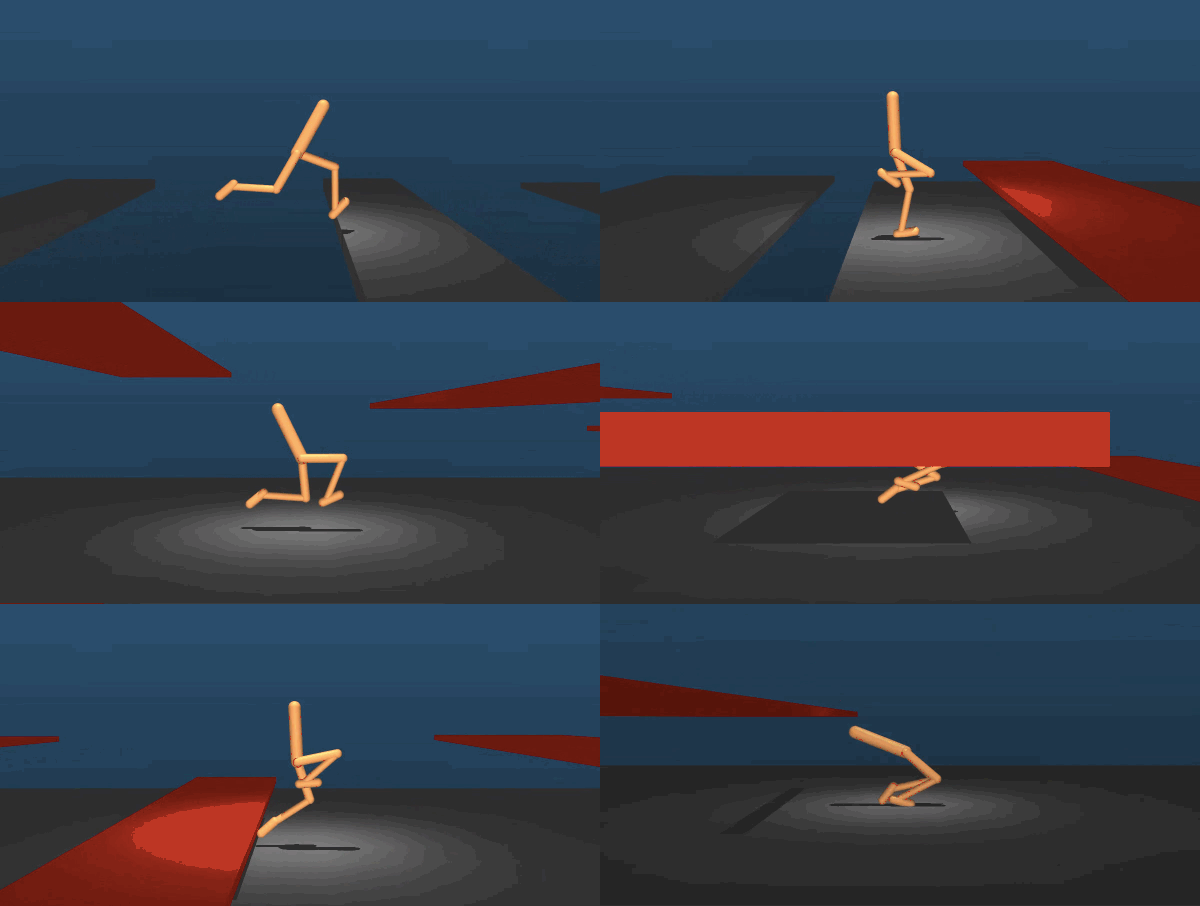


Go back

Your message has been sent

Warning
Warning
Warning
Warning

Warning.

                                              social media oligarchy where the richest participants are allowed to spread dangerous                  .                

Share this:

  • Click to share on WhatsApp (Opens in new window) WhatsApp
  • More
  • Click to share on Pocket (Opens in new window) Pocket
  • Click to share on Mastodon (Opens in new window) Mastodon

THE BEADY EYE SAY’S YOU CAN’T FIGHT THE POWER YOU DON’T SEE.

01 Sunday Nov 2020

Posted by bobdillon33@gmail.com in 2020: The year we need to change., Algorithms., Artificial Intelligence., COVID-19, Democracy, Digital age., DIGITAL DICTATORSHIP., Facial Recognition., Fourth Industrial Revolution., GPS-Tracking., Honesty., Human values., Humanity., Inequality, International solidarity., Life., Modern day Slavery, Our Common Values., POST COVID-19., Reality., Technology v Humanity, Technology., The common good., The essence of our humanity., The Obvious., The pursuit of profit., The state of the World., The world to day., Tracking apps., TRACKING TECHNOLOGY., Truth, Truthfulness., Twitter, Unanswered Questions., We can leave a legacy worthwhile., WHAT IS TRUTH, What Needs to change in the World, Where's the Global Outrage., World Organisations., World Politics

≈ Comments Off on THE BEADY EYE SAY’S YOU CAN’T FIGHT THE POWER YOU DON’T SEE.

Tags

Algorithms trade., Algorithms., Artificial Intelligence., Big Data, Capitalism and Greed, Coronavirus (COVID-19), Democracy, Inequility, Technology, The Future of Mankind, Visions of the future.


(Five-minute read) 

The present Covid-19 Pandemic might be warping our sense of reality however there is another pandemic that is shaping and will shape our future reality.

We – in many ways, things are way better than they were thanks to technology.

We can work from anywhere because we have the Internet and we have Zoom and all of those platforms.

If you are able to say technology, on the whole, has done well, it probably means you’re in a fairly privileged position.

There’s still a huge digital divide.

Even – there are billions of people who don’t have access to the Internet. 


On paper, algorithms sound like the pinnacle of efficiency, but as they’ve become more ubiquitous, there’s a difference between potential and reality both must be separate for the survival of democracy and the forthcoming distribution and administration of any covid-19 vaccine worldwide.  

 The reality is that Algorithms will be used to distribute and decide who will get the Covid-19 vaccination.

When it arrives algorithms will continue to reflect the biases that it has been and is being trained into machines that are learning a representation of the world that is skewed.

Some will say that Data is neutral. It’s just numbers. It’s just data but the past dwells within our algorithms and the flaws that are in our technology are what’s the algorithm’s information it’s taking in.

I am not just talking about the U.S. presidential election in a few day’s time.

We have already seen artificial intelligence being used in voting or politics how they extend beyond the realm of computer vision.

If we’re defining success by how it’s looked like in the past and the past has been one where men like Donal trump were given an opportunity to Twitt falsehoods, spreading them with the aid of Facebook and others it’s no wonder who gets hired or fired?

Do you get that loan? Do you get insurance? Do you and I pay the same price for the same product purchased on the same platform?

Automating inequality.

Before a human looks at your resume, it gets vetted by algorithms written by software engineers who are involved in the system (without changing the system itself he the engineer is still going to reproduce algorithmic bias and algorithmic harms.)

Any sorts of algorithmic tools that are intended to be used, again, have to be verified for nondiscrimination before it’s even adopted.

We now have an AI system – right? – that can classify skin cancer as well as the top dermatologists but to change society to change what AI is learning in order to create what can be realized is going to be trusted into our lives by the inevitable economic depression.

So a Covid-19 vaccine is going to transfer real power into the world of Data and we can’t fight the power you don’t see, you don’t know about.

All human comments appreciated. All like clicks and abuse chucked in the bin.

Go back

Your message has been sent

Warning
Warning
Warning
Warning

Warning.


Share this:

  • Click to share on WhatsApp (Opens in new window) WhatsApp
  • More
  • Click to share on Pocket (Opens in new window) Pocket
  • Click to share on Mastodon (Opens in new window) Mastodon

THE BEADY EYE ASK’S. IS IT NOT TIME FOR THE ADVERSTISING INDUSTRY TO BE CURTAILED.

05 Monday Oct 2020

Posted by bobdillon33@gmail.com in #whatif.com, 2020: The year we need to change., Advertising, Advertising industry, Big Data., COVID-19, Digital age., Disconnection., How to do it., Human values., POST COVID-19., Purchasing Power., Sustaniability, Technology v Humanity, The common good., The essence of our humanity., The Obvious., The pursuit of profit., The state of the World., The world to day., TRACKING TECHNOLOGY., Unanswered Questions., VALUES, We can leave a legacy worthwhile., WHAT IS TRUTH, What Needs to change in the World

≈ Comments Off on THE BEADY EYE ASK’S. IS IT NOT TIME FOR THE ADVERSTISING INDUSTRY TO BE CURTAILED.

Tags

Advertising industry


(Twelve-minute read) 

The coronavirus pandemic has caused a considerable drop in advertising spending however life in the time of coronavirus is increasingly a life lived online which has led to an acceleration of digital adoption and e-commerce.

Our current regulations governing advertising are no longer enough to ensure protection against aggressive sales techniques, false or deceptive ad messages, as well as intentionally incomplete information. The Sale of Goods Act of 1979 under which all advertised goods must match the description advertised on them is out of date. 

In today’s digital era, conventional marketing dictums no longer hold true.

In a nutshell, ‘Everything for everyone, customized’

The very nature of what this industry is about should with the current difficulties facing the world be questioned.

Clearly, there should be a line separating the private from the public, the free from the controlled.

But who should be in charge of drawing this line?  Facebook, Twitter, Apple, Microsoft, Apps, or Laws to curtail the advertising industry from promoting consumerism for the sake of profit.

Just like any other industry, advertising needs regulation.

On one side, we live in free-market times, which means that each product or brand, no matter how big or small, has the right to be noticed but not the right to piggyback on fear – On the other side, not all products and services are equal. Some are neutral, while others might have a negative effect on our health, safety, and overall well-being-  such as gambling- fast food -obesity – cleaning products – damage to ecosystems. 

  1. We realize that advertising should be regulated.
  2. We admit that proper regulation can only be implemented on a state level.
  3. We are as concerned about government data collection as we are with data collection by marketing agencies and brands.

What is mind-blowing is that even with so many organizations, laws, and regulations designed to control the quality of advertising, some brands manage to get around ad regulations using legal loopholes.

You only have to look at BIo it now applies to everything down to sardines in tins. 

It would be an understatement to say that advertising regulation is complex but is it not time with what the world is facing to force it to rethink and stop pigging backing on the problems we all now face.

These days, when massive data breaches have become the new norm just imaging what is going to happen when the advertising media get their hands on promoting a vaccine against COVID -19.

Ad regulations should specify which forms of data collection and tracking are been used in order to consider what is legal and which Ad be banned. As the need for this form of regulation emerges international regulations such as GDPR come into play. The primary goal of such documents is to limit/control the power of ad tech companies, marketing agencies, and brands trying to make the most out of user data.

If not mass, untargeted broadcasting will become passé and data will be at the heart of marketing strategy.

New tracking and data collection technologies make us all more vulnerable and unprotected than ever before.

For instance, if there were no advertising regulations put in place, we will fall victim to the whims of marketers, quickly and inevitably, once and for all.

Brands will use complex combinations of personal data, location data, and environment data to target their customers with the right message at the right time on the right device.

These days, everything changes in a heartbeat. With new technologies, advertising can be as personalized as we allow it to be –  voice marketing.

In the modern ‘attention economy’ where consumer attention is divided across more devices, applications, and formats than ever before, only engaging and relevant ads will command consumer attention.

Advertisers are adapting by following consumers, which means prioritizing digital advertising. The online environment is favorable for “direct response” campaigns – those encouraging quick purchases by consumers.. and technological innovation continuously redefines the landscape of advertising. 

This new era has placed new demands upon marketers. AI and machine learning bring massive benefits to marketing. Digital advertising technology is changing rapidly. New communication technology –including social media, wearables, virtual reality — is turning the advertising industry upside down.

One could argue that many elements of human behavior are going to change permanently and there will be increasing complexity in consumer purchasing decisions but this will not stop advertising from exploration and delivering targeted ads.   

If we want real transformation all companies must find new ways of brand-building by using advertising to create awareness of climate change, pollution, racism, slave labor, etc.  In forests of inaccurate data we can’t make sense of or dark caves of illusory tech that yield no light at the end of the tunnel.

With more and more highly specific marketing there is still a lot to be done in this regard both on national and international levels. – greater transparency in the value chain is required.

A few examples: 

Switzerland: Although the local ad space is small, it is worth our attention. According to Swiss law, advertising lotteries and games of chance are strictly prohibited. In Switzerland, it is illegal to promote pharmaceutical products under prescription in any publicly available media. Health-related and nutritional claims for foods are only permitted if they deliver exactly what they promise.

China: The Chinese advertising market is the second-largest in the world and one of the most interesting in terms of ad control. For instance, brands can be fined up to $157,000 for using statements such as “the best,” “the most,” or similar phrases in their marketing campaigns. Another fascinating fact is that children under 10 are not allowed to endorse or promote within Chinese ads (even if it’s an advertisement for toys!)

Chile: Under Chilean law, it is not allowed to advertise products that are high in calories, sugar, sodium, and saturated fats to children under the age of 14. Brands producing the above-mentioned foods cannot be marketed in schools and are illegal to use in cartoons or toys for promotional purposes.

Ireland: According to advertising regulations in Ireland, any ads that target children under 18 cannot include celebrities. Foods that are high in sodium, sugar, or fats are completely banned from advertising on channels where at least half of the audience is under 18 years old.

All human comments appreciated. All like clicks and abuse chucked in the bin.

Go back

Your message has been sent

Warning
Warning
Warning
Warning

Warning.


Share this:

  • Click to share on WhatsApp (Opens in new window) WhatsApp
  • More
  • Click to share on Pocket (Opens in new window) Pocket
  • Click to share on Mastodon (Opens in new window) Mastodon
← Older posts
Newer posts →

All comments and contributions much appreciated

  • THE BEADY EYE SAYS TRUST IS DISAPPEARING THANKS TO OUR INABILITY TO RELATE TO EACH OTHER. December 19, 2025
  • THE BEADY EYE SAYS. THE WORLD NEEDS PEOPLE GOVERNMENT NOT MONEY GOVERNMENTS. December 18, 2025
  • THE BEADY EYE ASKS WHAT ARE WE THE SAME GOING TO DO TO STOP THE WORLD BEING FUCK UP FOR PROFIT BY RIPOFF MERCHANT. December 17, 2025
  • THE BEADY EYE CHRISTMAS GREETING. December 16, 2025
  • THE BEADY EYE SAYS. TO THE NEXT GENERATION TO LIVE A LIFE WORTH WHILE YOU MUST CREATE MEMORIES. December 16, 2025

Archives

  • December 2025
  • November 2025
  • October 2025
  • September 2025
  • August 2025
  • July 2025
  • June 2025
  • May 2025
  • February 2025
  • January 2025
  • December 2024
  • November 2024
  • October 2024
  • September 2024
  • August 2024
  • July 2024
  • June 2024
  • May 2024
  • April 2024
  • March 2024
  • February 2024
  • January 2024
  • December 2023
  • October 2023
  • September 2023
  • August 2023
  • July 2023
  • June 2023
  • May 2023
  • April 2023
  • March 2023
  • February 2023
  • January 2023
  • December 2022
  • November 2022
  • October 2022
  • September 2022
  • August 2022
  • July 2022
  • June 2022
  • May 2022
  • April 2022
  • March 2022
  • February 2022
  • January 2022
  • December 2021
  • November 2021
  • October 2021
  • September 2021
  • August 2021
  • July 2021
  • June 2021
  • May 2021
  • April 2021
  • March 2021
  • February 2021
  • January 2021
  • December 2020
  • November 2020
  • October 2020
  • September 2020
  • August 2020
  • July 2020
  • June 2020
  • May 2020
  • April 2020
  • March 2020
  • February 2020
  • January 2020
  • December 2019
  • November 2019
  • October 2019
  • September 2019
  • August 2019
  • July 2019
  • June 2019
  • May 2019
  • April 2019
  • March 2019
  • February 2019
  • January 2019
  • December 2018
  • November 2018
  • October 2018
  • September 2018
  • August 2018
  • July 2018
  • June 2018
  • May 2018
  • April 2018
  • March 2018
  • February 2018
  • January 2018
  • December 2017
  • November 2017
  • October 2017
  • September 2017
  • August 2017
  • July 2017
  • June 2017
  • May 2017
  • April 2017
  • March 2017
  • February 2017
  • January 2017
  • December 2016
  • November 2016
  • October 2016
  • September 2016
  • August 2016
  • July 2016
  • June 2016
  • May 2016
  • April 2016
  • March 2016
  • February 2016
  • January 2016
  • December 2015
  • November 2015
  • October 2015
  • September 2015
  • August 2015
  • July 2015
  • June 2015
  • May 2015
  • April 2015
  • March 2015
  • February 2015
  • January 2015
  • December 2014
  • November 2014
  • October 2014
  • September 2014
  • August 2014
  • July 2014
  • June 2014
  • May 2014
  • April 2014
  • March 2014
  • February 2014
  • January 2014
  • December 2013
  • November 2013
  • October 2013

Talk to me.

Jason Lawrence's avatarJason Lawrence on THE BEADY EYE ASK’S: WIT…
benmadigan's avatarbenmadigan on THE BEADY EYE ASK’S: WHA…
bobdillon33@gmail.com's avatarbobdillon33@gmail.co… on THE BEADY EYE SAYS: WELCOME TO…
Ernest Harben's avatarOG on THE BEADY EYE SAYS: WELCOME TO…
benmadigan's avatarbenmadigan on THE BEADY EYE SAY’S. ONC…

7/7

Moulin de Labarde 46300
Gourdon Lot France
0565416842
Before 6pm.

My Blog; THE BEADY EYE.

My Blog; THE BEADY EYE.
bobdillon33@gmail.com

bobdillon33@gmail.com

Free Thinker.

View Full Profile →

Follow bobdillon33blog on WordPress.com

Blog Stats

  • 94,154 hits

Blogs I Follow

  • unnecessary news from earth
  • The Invictus Soul
  • WordPress.com News
  • WestDeltaGirl's Blog
  • The PPJ Gazette
Follow bobdillon33blog on WordPress.com

The Beady Eye.

The Beady Eye.
Follow bobdillon33blog on WordPress.com

Create a free website or blog at WordPress.com.

unnecessary news from earth

WITH MIGO

The Invictus Soul

The only thing worse than being 'blind' is having a Sight but no Vision

WordPress.com News

The latest news on WordPress.com and the WordPress community.

WestDeltaGirl's Blog

Sharing vegetarian and vegan recipes and food ideas

The PPJ Gazette

PPJ Gazette copyright ©

Privacy & Cookies: This site uses cookies. By continuing to use this website, you agree to their use.
To find out more, including how to control cookies, see here: Cookie Policy
  • Subscribe Subscribed
    • bobdillon33blog
    • Join 223 other subscribers
    • Already have a WordPress.com account? Log in now.
    • bobdillon33blog
    • Subscribe Subscribed
    • Sign up
    • Log in
    • Report this content
    • View site in Reader
    • Manage subscriptions
    • Collapse this bar