• About
  • THE BEADY EYE SAY’S : THE EUROPEAN UNION SHOULD THANK ENGLAND FOR ITS IN OR OUT REFERENDUM.

bobdillon33blog

~ Free Thinker.

bobdillon33blog

Category Archives: Universal values.

THE BEADY EYE ASKS: WHAT DOES THE WORD WE (IN TODAY’S WORLD OF AI) MEAN. IT CERTAINLY DOES NOT MEAN IT’S ON ME, IT’S ON YOU, IT’S ON US.

20 Saturday Jan 2024

Posted by bobdillon33@gmail.com in #whatif.com, 2024 the year of disconnection, Algorithms., Artificial Intelligence., Civilization., Cry for help., Dehumanization., DIGITAL DICTATORSHIP., Disconnection., Donald Trump., Erasing history., Extermination., Human Collective Stupidity., Human values., Humanity., IS DATA DESTORYING THE WORLD?, Israel and Palestine, Israeli-Palestinian conflict, Life., MISINFORMATION., Palestinian- Israel., Post - truth politics., Purpose of life., Reality., Religious Beliefs., State of the world, Technology, Technology v Humanity, The cost of war., The essence of our humanity., THE ISRAELI- PALESTINIAN PROBLEM., The Obvious., The state of the World., The world to day., THE WORLD YOU LIVE IN., THIS IS THE STATE OF THE WORLD.  , Truth, Universal values., War, Wars, We can leave a legacy worthwhile., WHAT IS TRUTH, What Needs to change in the World, Where's the Global Outrage., World Organisations., World Politics

≈ Comments Off on THE BEADY EYE ASKS: WHAT DOES THE WORD WE (IN TODAY’S WORLD OF AI) MEAN. IT CERTAINLY DOES NOT MEAN IT’S ON ME, IT’S ON YOU, IT’S ON US.

Tags

AI, Artificial Intelligence., god, Israel, Technology

(Five minute read)

Those of us who still want to live lives that we consider human, the word we is becoming a dangerous word.

In a world run by artificial intelligence, a world of disequilibrium and it is equilibrium, the assumption of equilibrium has to be explained. So it is quite wrong to start from we, because first we must understand the processes that lead to the social construction of this ‘we’ and to the constitution of our combined voice, that are now unbalanced, unstable by we who are without faces.

These AI voice, are becoming the crisis of not just capitalism but democracy.

For example:  Donald Trump a refusal to accept the truth of the untrue, a refusal to accept closure now running to take office.

We cannot start by pretending to stand outside the dissonance of our own experience, for to do so would be a lie.

A refusal to accept the inevitability of increasing inequality, misery, exploitation and violence is lacking due to the uses of AI.

———————-

To start in the third person is not a neutral starting point.

The ‘we’ of our starting point is very much a question rather than an answer.

It affirms the social character, but poses the nature of that sociality as a question.

The merit of starting with a ‘we’ rather than with an ‘it’ is that we are then openly confronted with the question that must underlie any theoretical assertion, but which is rarely addressed: who are we that make the assertion?

The fact that ‘we’ and our conception of ‘we’ are product of a whole history of the subjection of the subject changes nothing.

For the moment, this ‘we’ of ours is a confused ‘we”I’ already presupposes an individualisation, a claim to individuality in thoughts and feelings, whereas the act of writing or reading is based on the assumption of some sort of community, however contradictory or confused.

It is just that the negative situation in which we exist leaves us no option: to live, to think, is to negate in whatever way we can the negativeness of our existence.

What we feel is not necessarily correct, but it is a starting point to be respected and criticised, not just to be put aside in favour of objectivity.

The dissonance is not an external ‘us’ against ‘the world, inevitably it is a dissonance that reaches into us as well, that divides us against ourselves.

——————-

Society is, but it exists in an arc of tension towards that which is not, or is not yet.

To look at the web objectively, from the outside – we see all as blurred movement, that are predicting the downfall of the world, while accepting that there is nothing we can do about it.

Our refusal to accept, tells us nothing of the future, nor does it depend for its validity on any particular outcome.

How then do we change the world without taking power?

For example:

The problem with armed struggle, is that it accepts from the beginning that it is necessary to adopt the methods of the enemy in order to defeat the enemy, but even in the unlikely event of military victory, it is capitalist social relations that have triumphed.  #Israel v Palestine.

How many children have died needlessly since I started to write THIS POST?  How many since you began to read it?

We all know that Palestinians in Gaza, the West Bank and Israel all live under various regimes of organized discrimination and oppression, much of which makes life nearly unlivable. The reflexive identification with Israel, by both US and the UK obscures the fuller picture of what’s happening between Israel and the Palestinians.

What exactly counts as a provocation?

Not, apparently, the large number of settlers, more than 800 by one media account, who stormed the al-Aqsa mosque compound on 5 October. Not the 248 Palestinians killed by Israeli forces or settlers between 1 January and 4 October of this year. Not the denial of Palestinian human rights and national aspirations for decades. Not the thousands currently losing their lives.

To be considered a political being you must at the very least be considered a human being.

Who gets to count as human?

We are fighting human animals and we are acting accordingly,” Israel’s defense minister Yoav Gallant said. Human animals?

How can such language and an announced policy of collective punishment against all the residents of Gaza be seen by Israel’s supporters in the United States or elsewhere as defensible?

Let’s be clear: Gallant’s language is not the rhetoric of deterrence. It’s the language of genocide which WE are condoning.

WHAT ATTEMPTS HAVE THERE BEEN TO MAKE PEACE?

Two-state solution:

An agreement that would create a state for the Palestinians in the West Bank and Gaza Strip alongside Israel. Israel has said a Palestinian state must be demilitarised so as not to threaten its security. Now inconceivable. 

Today about 5.6 million Palestinian refugees – mainly descendants of those who fled in 1948 – live in Jordan, Lebanon, Syria, the Israeli-occupied West Bank and Gaza. About half of registered refugees remain stateless, according to the Palestinian foreign ministry, many living in crowded camps.

What continues to be astounding is that a regime recognised under international law as the occupying power, and as one that many human rights groups agree is imposing a system of apartheid, is trusted to relay information about its own atrocities.

The Israeli regime continues to dehumanise Palestinians as part of its tactic to sow seeds of doubt on their testimonies and to justify the atrocities it is committing.

The only solution ( put forward by the BEADY EYE is one Federal state with a written constitution. See previous post) 

I have seen images and videos that will haunt me forever.

The reality is that Palestinians have been dehumanised to such an extent, that even when they hold up their murdered children in front of cameras and display them to the world, there are those who will still say they are responsible for their own children’s deaths. But make no mistake, what we are seeing in Gaza is an unfolding genocide and Palestinians are showing the world what it looks like in real time.

Yet despite the plethora of pictures, videos and testimonies we the International Community have not thrown Israel our of the United Nations.

With a US presidential election looming, and with few signs that the Israeli conflict will ebb away any time soon, evangelicals could find themselves in a position of significant power in the near future.

This is what they are saying.

“To the terrorists who have chosen this fight, hear this, what you do to Israel, god will do to you. Despite today’s weeping, joy will come because he [god] who watches over Israel neither slumbers nor sleeps,”

In keeping with Christian Just War tradition, we also affirm the legitimacy of Israel’s right to respond against those who have initiated these attacks as Romans 13 grants governments the power to bear the sword against those who commit such evil acts against innocent life.”

“What will come soon [is] the antichrist and his seven year empire that will be destroyed in the battle of armageddon. Then Jesus Christ will set up his throne in the city of Jerusalem. He will establish a kingdom that will never end,” Hagee said.

Hagee, despite having a long history of antisemitism – he has suggested Jews brought persecution upon themselves by upsetting God and called Hitler a “half-breed Jew” – founded Christians United for Israel in 2006.

CUFI, (Christians United for Israel,) whose founder believes the presence of Jews in Israel is a precursor to Jesus Christ returning to Earth, God forbid he does because we the International Community are condemned to hell if he and it exists.

Finally:

Those who survive will grow up sad, fearful, guilty, angry, alienated and looking for vengeance – or at least, judging by past experience, many of them will. They will ask who killed their brothers and sisters, their parents, their friends, and why they did it. They will ask what the world did to stop the killing.

All human comments appreciated. All like clicks and abue chucked in the bin.

Contact: bobdillon33@gmail.com

Share this:

  • Share on WhatsApp (Opens in new window) WhatsApp
  • More
  • Share on Pocket (Opens in new window) Pocket
  • Share on Mastodon (Opens in new window) Mastodon

THE BEADY EYE SAY’S: OUT OF NO WHERE, OUR WORLD IS TURNED UPSIDE DOWN.

15 Monday Jan 2024

Posted by bobdillon33@gmail.com in #whatif.com, A Constitution for the Earth., Artificial Intelligence.,  Attention economy, Brexit., Capitalism, CAPITALISM IS INCOMPATIBLE IN THE FIGHT AGAINST CLIMATE CHANGE., Civilization., Collective stupidity., Cry for help., Digital age., Disaster Capitalism., Disasters., Disconnection., Environment, Fourth Industrial Revolution., Honesty., How to do it., Human Collective Stupidity., HUMAN INTELLIGENCE, Human values., Inequality., Inflation, Inflation., International solidarity., Modern day life., Our Common Values., PAIN AND SUFFERING IN LIFE, Populism., Poverty, Reality., Renewable Energy., Social Media, State of the world, Sustaniability, Technology, Technology v Humanity, The common good., The essence of our humanity., The new year 2024, The Obvious., The state of the World., The world to day., THE WORLD YOU LIVE IN., THIS IS THE STATE OF THE WORLD.  , Truth, Unanswered Questions., Universal values., Universal Basic Income, VALUES, We can leave a legacy worthwhile., What is shaping our world., WHAT IS TRUTH, What Needs to change in the World, Where's the Global Outrage., World Leaders, World Organisations., World Politics, World View.

≈ Comments Off on THE BEADY EYE SAY’S: OUT OF NO WHERE, OUR WORLD IS TURNED UPSIDE DOWN.

Tags

Algorithms., Artificial Intelligence., Capitalism and Greed, Capitalism vs. the Climate., Climate change, Distribution of wealth, Environment, Government, Inequility, news, politics, Technology, The Future of Mankind, Visions of the future.

( Five minute read)

A global pandemic killing millions of people and forcing entire countries into lockdown.

Then inflation takes off and (not unrelated) one country invades another and the resulting war affects us all.

Whoa! Where on Earth did all that come from?

We have to think about how we got here.

As if we don’t know its all wrapped up in one word   Inequality.Black placard with 'one world' written on it.

The cost of things average people must buy—healthcare, education, housing—tends to have risen more than wages did over the last two decades. Rising inequality across income, race and gender all demand urgent attention. It needs to made clear to leaders that in 2024 their citizens are expecting them to raise their ambition for humanity and deliver bold agreements to tackle poverty, inequality and climate change.

Government’s policy making will need to become more innovative to address such challenges other wise we going to have a left behind technological societies. We’re going to see, unfortunately, more technological unemployment. We’re going to have to think very carefully in political terms and in social terms about the implications of further automation.

Individual responsibility will play a role, too, in areas such as climate change.

To ignore the issue of inequality culture will need to adjust in terms of revisiting some of our values.

—————–

To start thinking outside of the box. We may have to consider very seriously ideas such as a universal basic income.

There are just over 7 billion people living on the planet today, spread between 196 (recognized) countries. Within each of these countries are groups of people with different ethnic backgrounds, different religious beliefs, different political beliefs. It’s because of these differences, you could argue, that the world is plagued by conflict.

Unfortunately, the future isn’t talking. It’s just coming, like it or not and we as individuals need to take ownership of this.

I dont know about you but I realized long ago that globalization was on its last legs. I also realize this isn’t pleasant to think about. Western economies have become knowledge based. This means Marx’s three factors of production (land, labor, capital) now have a fourth.

Politics as a social contract between a sovereign and citizens is no longer working. Each individual’s share of sovereignty, and therefore their freedom, diminishes as the social contract includes more people.

Power now resides with those best able to organize knowledge turning politicians into basically middlemen, bring a shift to direct democracy, with popular social media protests swamping sprawling governments.

We must do more to assertively channel technology to support progress and protect people and the planet.

As we entered the the 2020s it is clear that we are far from unlocking the potential of technology for our toughest challenges. We stand at a critical juncture to put these technologies to work in a responsible way for people and the planet.

Technology and political trends are aligning against mega-powers like the US and China.

How do we reconcile that with democracy in countries with millions of citizens?

Not with “America Alone” ” Brexit” or any other forms of isolation, which are highly problematic, as they are based on anxiety and insecurity, so inevitably create discord and division.

This is obvious to anyone with a brain looking at climate change – trade – wars – inequality – technology’s – and ideologies of I am all right Jack.

—————————

Historically, political regimes tend not to last more than a few centuries.

I’m not sure we can. Some things are so horrible, you don’t want to think about them.

  • Today’s great powers have little choice but to spend their way to political stability, which is unsustainable, and/or try to control knowledge, which is difficult.
  • Nor do we have any elder statesmen or nationally unifying figures whom everyone respects, much less agrees with. This will make our various problems worse.
  • Ownership rights mean little without a government to protect them and courts to settle disputes.
  • This world we now inhabit wasn’t always fit for human’s nothing requires it to remain so. At some point, it will develop into something else. When and how that will happen, we don’t know yet. But we know it will.
  • We haven’t even talked about climate change. Issues like climate change will create further exacerbations on conflicts, and new forms of technological and cyber warfare could threaten countries’ elections and manipulate populations.

In the last two years: 90% of the data in the world was created.

Now it is up  – technology companies large and small, industry, policy-makers, citizens and consumers alike – to use this power for good, before we run out of time. Now is the opportunity for leaders to step up into this new wave of opportunity and expectation.

We are the first generation to know we’re destroying the world, and we could be the last that can do anything about it. Our leaders are not on track to deliver. We need to ensure we hold our politicians accountable.

Food production is a major driver of wildlife extinction. We need to make wasting our resources unacceptable in all aspects of our life. We can all do more to be more conscious about what we buy, and where we buy it from.

We can and must end poverty and hunger, in all their forms and dimensions by addressing the underlying complex issues of fragility, conflict, and displacement and the looming threat of climate change.

The challenges facing the world are complex and intertwined and require complex solutions.

Another word is about to enter our collective dictionaries: permacrisis. What we do between now and 2030 will determine whether we as a collective species are intelligent or just dumm machines

Solutions to climate change and biodiversity loss won’t come from any one sector: they’ll come from governments, finance, business and civil society.

We’re analyzing satellite images but unable to see the picture that we all live on the same planet.

Like most of us, we are brought up to think in terms of countries with borders and different nationalities.

In some cases, there are natural borders formed by sea or mountains, but often borders between nations are simply abstractions, imaginary boundaries established by agreement or conflict.

How then do we explain nationalism? Why do humans separate themselves into groups and take on different national identities? Maybe different groups are helpful in terms of organisation, but that doesn’t explain why we feel different. Or why different nations compete and fight with one another.

When people are made to feel insecure and anxious, they tend to become more concerned with nationalism, status and success. Poverty and economic instability often lead to increased nationalism and to ethnic conflict.

The world in general does not have a sense of group identity.

If a terrorist’s biggest weapon is terror, climate change is going to inflict terror beyond belief.

Tsunami’s. Earthquake’s, Hurricane’s, Flood’s, War’s

We must shift 85% of the world’s energy supply to non-fossil fuel sources, not grant more oil exploration licences.  Our economies depend on healthy, supportive natural systems.

A more sustainable path is possible. But we need to rally individuals, governments, companies and communities around the world to take action with us over the next decade.

It’s impossible to override the fundamental interconnectedness of the human race.

People from all around the world need to take a stand a citizen’s movement using the NEW BEADY EYE HASHTAG:   #movebeyonditwiththebeadyeye

All human comments appreciated. All like clicks and abuse chucked in the bin.

Contact bobdillon33@gmail.com

Share this:

  • Share on WhatsApp (Opens in new window) WhatsApp
  • More
  • Share on Pocket (Opens in new window) Pocket
  • Share on Mastodon (Opens in new window) Mastodon

THE BEADY EYE ASK’S: THESE DAYS WHAT CAN WE BELIEVE IN ?

21 Thursday Dec 2023

Posted by bobdillon33@gmail.com in #whatif.com, 2023 the year of disconnection., A Constitution for the Earth., Advertising, Advertising industry, Algorithms., Artificial Intelligence.,  Attention economy, Capitalism, CAPITALISM IS INCOMPATIBLE IN THE FIGHT AGAINST CLIMATE CHANGE., Carbon Emissions., Civilization., Climate Change., Collective stupidity., Consciousness., Cry for help., Dehumanization., Democracy, Digital age., DIGITAL DICTATORSHIP., Digital Friendship., Disconnection., Discrimination., Earth, Emergency powers., Enegery, Environment, Face Recognition., Facebook, Fake News., Fourth Industrial Revolution., Freedom of Speech, Freedom of the Press., Google, Google Knowledge., GPS-Tracking., Green Energy., Happy Christmas from the Beady eye., Honesty., How to do it., Human Collective Stupidity., HUMAN INTELLIGENCE, Human values., Humanity., Imagination., Inequality, INTELLIGENCE., IS DATA DESTORYING THE WORLD?, James Webb Telescope, Life., MISINFORMATION., Modern Day Communication., Modern Day Democracy., Modern day life., Modern Day Slavery., Monetization of nature, Our Common Values., PAIN AND SUFFERING IN LIFE, Political lying., Political Trust, Politics., Populism., Post - truth politics., Profiteering., Purpose of life., Real life experience's, Reality., Renewable Energy., Robot citizenship., Social Media, Social Media Regulation., Society, State of the world, Sustaniability, Technology, Technology v Humanity, Telling the truth., The common good., The essence of our humanity., The Future, The Internet., THE NEW NORM., The Obvious., The pursuit of profit., The state of the World., The world to day., THE WORLD YOU LIVE IN., THIS IS THE STATE OF THE WORLD.  , TRACKING TECHNOLOGY., Truth, Truthfulness., Twitter, Unanswered Questions., Universal values., VALUES, We can leave a legacy worthwhile., What is shaping our world., WHAT IS TRUTH, Where's the Global Outrage., World Leaders, World Organisations., World Politics

≈ Comments Off on THE BEADY EYE ASK’S: THESE DAYS WHAT CAN WE BELIEVE IN ?

Tags

bible, god, philosophy, Religion., Science

( Fifteen minute read)

The last post this year, have a peaceful Christmas.

This post is a follow up to the post, ( What is life, What does it mean to be alive). It is also an attempt to argue for as many preposterous positions as possible in the shortest space of time possible.

That there are no options other than accepting that life is objectively meaningful or not meaningful at all.

Science requires proof, religious belief requires faith.

So let’s get God and Gods out of the way.

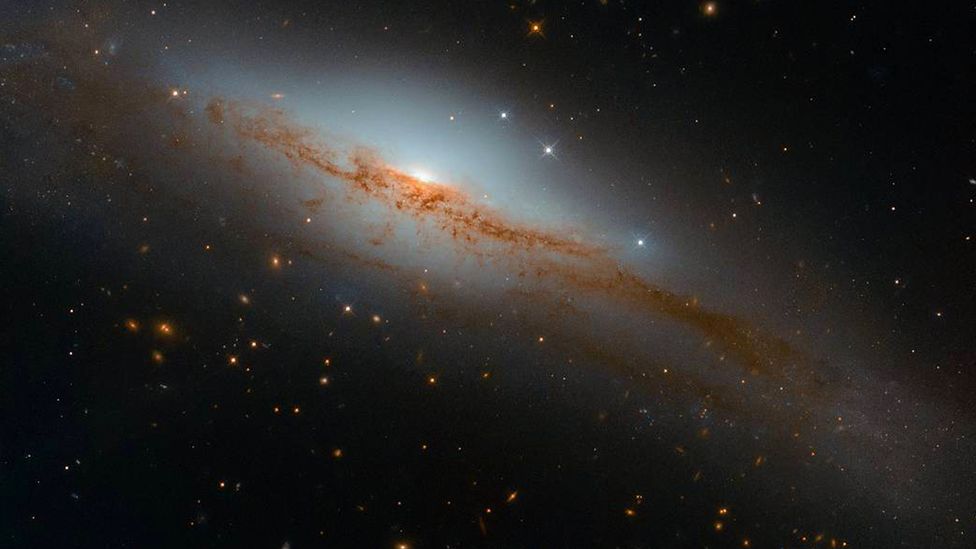
.Could quantum physics help explain a God that could be in two places at once? (Credit: Nasa)
If you believe in God, then the idea of God being bound by the laws of physics is nonsense, because God can do everything, even travel faster than light. If you don’t believe in God, then the question is equally nonsensical, because there isn’t a God and nothing can travel faster than light.

Perhaps the question is really one for agnostics, who don’t know whether there is a God.

The idea that God might be “bound” by the laws of physics – which also govern chemistry and biology might not be so far stretched that the James Webb telescope might discover him or her. Whether it does or does not, if it did discovered life on another planet and the human race realizes that its long loneliness in time and space may be over — the possibility we’re no longer alone in the universe is where scientific empiricism and religious faith intersect, with NO true answer?.

Could any answer help us prove whether or not God exists, not on your nanny.

If God wasn’t able to break the laws of physics, she or he arguably wouldn’t be as powerful as you’d expect a supreme being to be. But if he or she could, why haven’t we seen any evidence of the laws of physics ever being broken in the Universe?

If there is a God who created the entire universe and ALL of its laws of physics, does God follow God’s own laws? Or can God supersede his own laws, such as travelling faster than the speed of light and thus being able to be in two different places at the same time?

Let’s consider whether God can be in more than one place at the same time.

(According to quantum mechanics, particles are by definition in a mix of different states until you actually measure them.)

There is something faster than the speed of light after all: Quantum information.

This doesn’t prove or disprove God, but it can help us think of God in physical terms – maybe as a shower of entangled particles, transferring quantum information back and forth, and so occupying many places at the same time? Even many universes at the same time?

But is it true?

A few years ago, a group of physicists posited that particles called tachyons travelled above light speed. Fortunately, their existence as real particles is deemed highly unlikely. If they did exist, they would have an imaginary mass and the fabric of space and time would become distorted – leading to violations of causality (and possibly a headache for God).

(This in itself does not say anything at all about God. It merely reinforces the knowledge that light travels very fast indeed.)

We can calculate that light has travelled roughly 1.3 x 10 x 23 (1.3 times 10 to the power 23) km in the 13.8 billion years of the Universe’s existence. Or rather, the observable Universe’s existence.

The Universe is expanding at a rate of approximately 70km/s per Mpc (1 Mpc = 1 Megaparsec or roughly 30 billion billion kilometres), so current estimates suggest that the distance to the edge of the universe is 46 billion light years. As time goes on, the volume of space increases, and light has to travel for longer to reach us.

We cannot observe or see across the entirety of the Universe that has grown since the Big Bang because insufficient time has passed for light from the first fractions of a second to reach us. Some argue that we therefore cannot be sure whether the laws of physics could be broken in other cosmic regions – perhaps they are just local, accidental laws. And that leads us on to something even bigger than the Universe.

But if inflation could happen once, why not many times?

We know from experiments that quantum fluctuations can give rise to pairs of particles suddenly coming into existence, only to disappear moments later. And if such fluctuations can produce particles, why not entire atoms or universes? It’s been suggested that, during the period of chaotic inflation, not everything was happening at the same rate – quantum fluctuations in the expansion could have produced bubbles that blew up to become universes in their own right.

How come all the physical laws and parameters in the universe happen to have the values that allowed stars, planets and ultimately life to develop?

We shouldn’t be surprised to see biofriendly physical laws – they after all produced us, so what else would we see? Some theists, however, argue it points to the existence of a God creating favourable conditions.

But God isn’t a valid scientific explanation.

We can’t disprove the idea that a God may have created the multiverse.

No matter what is believable or not, things can appear from nowhere and disappear to nowhere.

If you find this hard to swallow, what follows will make you choke.

First there is panpsychism, the idea that “consciousness pervades the universe and is a fundamental feature of it.

Even particles are never compelled to do anything, but are rather disposed, from their own nature, to respond rationally to their experience. That the universe is conscious and is acting towards a purpose of realising the full potential of its consciousness.

The radicalism of this “teleological cosmopsychism” is made clear by its implication that “during the first split second of time, the universe fine-tuned itself in order to allow for the emergence of life billions of years in the future”. To do this, “the universe must in some sense have been aware of this future possibility”.

That the universe itself has a built-in purpose, the disappointingly vague goal of which is “rational matter achieving a higher realisation of its nature.

The laws of physics are just right for conscious life to evolve that it can’t have been an accident.

It is hard to see why the universe’s purpose should give our lives one. Indeed, to believe one plays an infinitesimally small part in the unfolding of a cosmic master plan makes each human life look insignificant.

The basic question about our place in the Universe is one that may be answered by scientific investigations.

What are the next steps to finding life elsewhere?

Today’s telescopes can look at many stars and tell if they have one or more orbiting planets. Even more, they can determine if the planets are the right distance away from the star to have liquid water, the key ingredient to life as we know it.

NEXT:How to Choose Which Social Media Platforms to Use

We live in a time of political fury and hardening cultural divides. But if there is one thing on which virtually everyone is agreed, it is that the news and information we receive is biased. Much of the outrage that floods social media, occasionally leaking into opinion columns and broadcast interviews, is not simply a reaction to events themselves, but to the way in which they are reported and framed that are the problem.

This mentality now with the help of technological advances in communication spans the entire political spectrum and pervades societies around the world twisting our basic understanding of reality to our own ends.

This is not as simple as distrust.

The appearance of digital platforms, smartphones and the ubiquitous surveillance have enable to usher in a new public mood that is instinctively suspicious of anyone claiming to describe reality in a fair and objective fashion. Which will end in a Trumpian refusal to accept any mainstream or official account of the world with people become increasingly dependent on their own experiences and their own beliefs about how the world really works.

The crisis of democracy and of truth are one and the same:

Individuals are increasingly suspicious of the “official” stories they are being told, and expect to witness things for themselves.

How exactly do we distinguish this critical mentality from that of the conspiracy theorist, who is convinced that they alone have seen through the official version of events? Or to turn the question around, how might it be possible to recognise the most flagrant cases of bias in the behaviour of reporters and experts, but nevertheless to accept that what they say is often a reasonable depiction of the world?

It is tempting to blame the internet, populists or foreign trolls for flooding our otherwise rational society with lies.

But this underestimates the scale of the technological and philosophical transformations that are under way. The single biggest change in our public sphere is that we now have an unimaginable excess of news and content, where once we had scarcity. The explosion of information available to us is making it harder, not easier, to achieve consensus on truth.

As the quantity of information increases, the need to pick out bite-size pieces of content rises accordingly.

In this radically sceptical age, questions of where to look, what to focus on and who to trust are ones that we increasingly seek to answer for ourselves, without the help of intermediaries. This is a liberation of sorts, but it is also at the heart of our deteriorating confidence in public institutions.

There is now a self-sustaining information ecosystem becoming a serious public health problem across the world, aided by the online circulation of conspiracy theories and pseudo-science. However the panic surrounding echo chambers and so-called filter bubbles is largely groundless.

What, then, has to changed?

The key thing is that the elites of government and the media have lost their monopoly over the provision of information, but retain their prominence in the public eye.

And digital platforms now provide a public space to identify and rake over the flaws, biases and falsehoods of mainstream institutions.

The result is an increasingly sceptical citizenry, each seeking to manage their media diet, checking up on individual journalists in order to resist the pernicious influence of the establishment.

The problem we face is not, then, that certain people are oblivious to the “mainstream media”, or are victims of fake news, but that we are all seeking to see through the veneer of facts and information provided to us by public institutions.

Facts and official reports are no longer the end of the story.

The truth is now threatened by a radically different system, which is transforming the nature of empirical evidence and memory. One term for this is “big data”, which highlights the exponential growth in the quantity of data that societies create, thanks to digital technologies.

The reason there is so much data today is that more and more of our social lives are mediated digitally. Internet browsers, smartphones, social media platforms, smart cards and every other smart interface record every move we make. Whether or not we are conscious of it, we are constantly leaving traces of our activities, no matter how trivial.

But it is not the escalating quantity of data that constitutes the radical change.

Something altogether new has occurred that distinguishes today’s society from previous epochs.

In the past, recording devices were principally trained upon events that were already acknowledged as important.

Things no longer need to be judged “important” to be captured.

Consciously, we photograph events and record experiences regardless of their importance. Unconsciously, we leave a trace of our behaviour every time we swipe a smart card, address Amazon’s Alexa or touch our phone.

For the first time in human history, recording now happens by default, and the question of significance is addressed separately.

This shift has prompted an unrealistic set of expectations regarding possibilities for human knowledge.

When everything is being recorded, our knowledge of the world no longer needs to be mediated by professionals, experts, institutions and theories. Data can simply “speak for itself”. This is a fantasy of a truth unpolluted by any deliberate human intervention – the ultimate in scientific objectivity.

From this perspective, every controversy can in principle be settled thanks to the vast trove of data – CCTV, records of digital activity and so on – now available to us. Reality in its totality is being recorded, and reporters and officials look dismally compromised by comparison.

It is often a single image that seems to capture the truth of an event, only now there are cameras everywhere.

No matter how many times it is disproven, the notion that “the camera doesn’t lie” has a peculiar hold over our imaginations. In a society of blanket CCTV and smartphones, there are more cameras than people, and the torrent of data adds to the sense that the truth is somewhere amid the deluge, ignored by mainstream accounts.

The central demand of this newly sceptical public is “so show me”.

The rise of blanket surveillance technologies has paradoxical effects, raising expectations for objective knowledge to unrealistic levels, and then provoking fury when those in the public eye do not meet them.

Surely, in this age of mass data capture, the truth will become undeniable.

On the other hand, as the quantity of data becomes overwhelming – greater than human intelligence can comprehend – our ability to agree on the nature of reality seems to be declining. Once everything is, in principle, recordable, disputes heat up regarding what counts as significant in the first place.

What we are discovering is that, once the limitations on data capture are removed, there are escalating opportunities for conflict over the nature of reality.

Remember AI does not exist in a vacuum, its employment can and is discriminating against communities, powered by vast amounts of energy,  producing CO2 emissions.

Lastly the Advertising Industry.The impact of COVID-19 on the advertising industry - Passionate In ...

These day it seems that it has free rain to claim anything.

Like them or loathe them, advertisements are everywhere and they’re worsening not just the climate crisis, and ecological damage by promoting sustainability in consumption and inequality. Presenting a fake, idealised world that papers over an often brutal reality.

But advertising in one sense is even more dangerous, because it is so pervasive, sophisticated in its techniques and harder to see through. When hundreds of millions of people have desires for more and more stuff and for more and more services and experiences, that really adds up and puts a strain on the Earth.

The toll of disasters propelled by climate change in 2023 can be tallied with numbers — thousands of people dead, millions of others who lost jobs, homes and hope, and tens of billions of dollars sheared off economies. But numbers can’t reflect the way climate change is experienced — the intensity, the insecurity and the inequality that people on Earth are now living.

In every place that climate change makes its mark, inequality is made worse.

How are we going to protect the truth:

It goes without saying that spiritual beliefs will protect themselves. Lies, propaganda and fake news however is the challenge for our age.

Working out who to trust and who not to believe has been a facet of human life since our ancestors began living in complex societies. Politics has always bred those who will mislead to get ahead.

With news sources splintering and falsehoods spreading widely online, can anything be done?

Check Google.

Welcome to the world of “alternative facts”. It is a bewildering maze of claim and counterclaim, where hoaxes spread with frightening speed on social media and spark angry backlashes from people who take what they read at face value.

It is an environment where the mainstream media is accused of peddling “fake news” by the most powerful man in the world.

Voters are seemingly misled by the very politicians they elected and even scientific research – long considered a reliable basis for decisions – is dismissed as having little value.

Without a common starting point – a set of facts that people with otherwise different viewpoints can agree on – it will be hard to address any of the problems that the world now faces. The threat posed by the spread of misinformation should not be underestimated.

Some warn that “fake news” threatens the democratic process itself.

A survey conducted by the Pew Research Center towards the end of last year found that 64% of American adults said made-up news stories were causing confusion about the basic facts of current issues and events.

How we control the dissemination of things that seem to be untrue. We need a new way to decide what is trustworthy.

Take Wikipedia itself – which can be edited by anyone but uses teams of volunteer editors to weed out inaccuracies – is far from perfect.

These platforms and their like are simply in it for the money.

Last year, links to websites masquerading as reputable sources started appearing on social media sites like Facebook.

Stories about the Pope endorsing Donald Trump’s candidacy and Hillary Clinton being indicted for crimes related to her email scandal were shared widely despite being completely made up. The ability to share them widely on social media means a slice of the advertising revenue that comes from clicks.

Truth is no longer dictated by authorities, but is networked by peers. For every fact there is a counterfact. All those counterfacts and facts look identical online, which is confusing to most people.

Information spreads around the world in seconds, with the potential to reach billions of people. But it can also be dismissed with a flick of the finger. What we choose to engage with is self-reinforcing and we get shown more of the same. It results in an exaggerated “echo chamber” effect.

The challenge here is how to burst these bubbles.

One approach that has been tried is to challenge facts and claims when they appear on social media. Organisations like Full Fact, for example, look at persistent claims made by politicians or in the media, and try to correct them. (The BBC also has its own fact-checking unit, called Reality Check.)

This approach doesn’t work on social media because the audiences were largely disjointed.

Even when a correction reached a lot of people and a rumour reached a lot of people, they were usually not the same people. The problem is, corrections do not spread very well. This lack of overlap is a specific challenge when it comes to political issues.

On Facebook political bodies can put something out, pay for advertising, put it in front of millions of people, yet it is hard for those not being targeted to know they have done that. They can target people based on how old they are, where they live, what skin colour they have, what gender they are.

We shouldn’t think of social media as just peer-to-peer communication – it is also the most powerful advertising platform there has ever been. We have never had a time when it has been so easy to advertise to millions of people and not have the other millions of us notice.

Twitter and Facebook both insist they have strict rules on what can be advertised and particularly on political advertising. Regardless, the use of social media adverts in politics can have a major impact.

We need some transparency about who is using social media advertising when they are in election campaigns and referendum campaigns. We need watchdogs that will go around and say, ‘Hang on, this doesn’t stack up’ and ask for the record to be corrected.

We need Platforms to ensure that people have read content before sharing it to develop standards.

Google says it is working on ways to improve its algorithms so they take accuracy into account when displaying search results. “Judging which pages on the web best answer a query is a challenging problem and we don’t always get it right,”

The challenge is going to be writing tools that can check specific types of claims.

Built a fact-checker app that could sit in a browser and use Watson’s language skills to scan the page and give a percentage likelihood of whether it was true.

This idea of helping break through the isolated information bubbles that many of us now live in, comes up again and again.

By presenting people with accurate facts it should be possible to at least get a debate going.

There is a large proportion of the population living in what we would regard as an alternative reality.  By suggesting things to people that are outside their comfort zone but not so far outside they would never look at it you can keep people from self-radicalising in these bubbles.

There are understandable fears about powerful internet companies filtering what people see.

We should think about adding layers of credibility to sources. We need to tag and structure quality content in effective ways.

But what if people don’t agree with official sources of information at all?

This is a problem that governments around the world are facing as the public views what they tell them with increasing scepticism. There is an unwillingness to bend one’s mind around facts that don’t agree with one’s own viewpoint.

The first stage in that is crowdsourcing facts.  So before you have a debate, you come up with the commonly accepted facts that people can debate from.

Technology may help to solve this grand challenge of our age, but it is time for a little more self-awareness too.

In the end the world needs a new Independent Organisation to examine all technology against human values. Future war will be fought on Face recognition.

To certify and hold the original programs of all technology.

Have I been trained by robbery its manter when it comes to algorithms.

The whole goal of the transition is not to allow a handful of Westerners to peacefully go through life in a Tesla, a world in flames; it is to allow humanity – and the rest of biodiversity – to live decently.

All human comments appreciated. All like clicks and abuse chucked in the bin.

Contact: bobdillon33@gmail.com

Share this:

  • Share on WhatsApp (Opens in new window) WhatsApp
  • More
  • Share on Pocket (Opens in new window) Pocket
  • Share on Mastodon (Opens in new window) Mastodon

THE BEADY EYE ASK’S : ARE OUR LIVES GOING TO BE RULED BY ALGORITHMS.

20 Saturday May 2023

Posted by bobdillon33@gmail.com in 2023 the year of disconnection., Algorithms., Artificial Intelligence., Big Data., Communication., Dehumanization., Democracy, Digital age., DIGITAL DICTATORSHIP., Digital Friendship., Disconnection., Fourth Industrial Revolution., Human Collective Stupidity., Human values., Humanity., Imagination., IS DATA DESTORYING THE WORLD?, Modern Day Democracy., Our Common Values., Purpose of life., Reality., Social Media Regulation., State of the world, Technology, Technology v Humanity, The Obvious., The state of the World., The world to day., THE WORLD YOU LIVE IN., THIS IS THE STATE OF THE WORLD.  , Tracking apps., Unanswered Questions., Universal values., We can leave a legacy worthwhile., What is shaping our world., What Needs to change in the World

≈ Comments Off on THE BEADY EYE ASK’S : ARE OUR LIVES GOING TO BE RULED BY ALGORITHMS.

Tags

Algorithms., Artificial Intelligence., The Future of Mankind, Visions of the future.

( Ten minute read) 

I am sure that unless you have being living on another planet it is becoming more and more obvious that the manner you live your life is being manipulate and influence by technologies.

So its worth pausing to ask why the use of AI for algorithm-informed decision is desirable, and hence worth our collective effort to think through and get right.

A huge amount of our lives – from what appears in our social media feeds to what route our sat-nav tells us to take – is influenced by algorithms. Email knows where to go thanks to algorithms. Smartphone apps are nothing but algorithms. Computer and video games are algorithmic storytelling.  Online dating and book-recommendation and travel websites would not function without algorithms.

Artificial intelligence (AI) is naught but algorithms.

The material people see on social media is brought to them by algorithms. In fact, everything people see and do on the web is a product of algorithms. Algorithms are also at play, with most financial transactions today accomplished by algorithms. Algorithms help gadgets respond to voice commands, recognize faces, sort photos and build and drive cars. Hacking, cyberattacks and cryptographic code-breaking exploit algorithms.

Algorithms are aimed at optimizing everything.

Self-learning and self-programming algorithms are now emerging, so it is possible that in the future algorithms will write many if not most algorithms.

Yes they can save lives, make things easier and conquer chaos, but when it comes both the commercial/ social world, there are many good reasons to question the use of Algorithms.

Why? 

They can put too much control in the hands of corporations and governments, perpetuate bias, create filter bubbles, cut choices, creativity and serendipity, while exploiting not just of you, but the very resources of our planet for short-term profits, destroying what left of democracy societies, turning warfare into face recognition, stimulating inequality, invading our private lives, determining our futures without any legal restrictions or transparency, or recourse.

The rapid evolution of AI and AI agents embedded in systems and devices in the Internet of Things will lead to hyper-stalking, influencing and shaping of voters, and hyper-personalized ads, and will create new ways to misrepresent reality and perpetuate falsehoods.

———

As they are self learning, the problem is who or what is creating them, who owns these algorithms and what if there should be any controls in their usage.

Lets ask some questions that need to be ask now not later concerning them. 

1) The outcomes the algorithm intended to make possible (and whether they are ethical)

2) The algorithm’s function.

3) The algorithm’s limitations and biases.

4) The actions that will be taken to mitigate the algorithm’s limitations and biases.

5) The layer of accountability and transparency that will be put in place around it.

There is no debate about the need for algorithms in scientific research – such as discovering new drugs to tackle new or old diseases/ pandemics, space travel, etc. 

Out side of these needs the promise of AI is that we could have evidence-based decision making in the field:

Helping frontline workers make more informed decisions in the moments when it matters most, based on an intelligent analysis of what is known to work. If used thoughtfully and with care, algorithms could provide evidence-based policymaking, but they will fail to achieve much if poor decisions are taken at the front.

However, it’s all well and good for politicians and policymakers to use evidence at a macro level when designing a policy but the real effectiveness of each public sector organisation is now the sum total of thousands of little decisions made by algorithms each and every day.

First (to repeat a point made above), with new technologies we may need to set a higher bar initially in order to build confidence and test the real risks and benefits before we adopt a more relaxed approach. Put simply, we need time to see in what ways using AI is, in fact, the same or different to traditional decision making processes.

The second concerns accountability. For reasons that may not be entirely rational, we tend to prefer a human-made decision. The process that a person follows in their head may be flawed and biased, but we feel we have a point of accountability and recourse which does not exist (at least not automatically) with a machine.

The third is that some forms of algorithmic decision making could end up being truly game-changing in terms of the complexity of the decision making process. Just as some financial analysts eventually failed to understand the CDOs they had collectively created before 2008, it might be too hard to trace back how a given decision was reached when unlimited amounts of data contribute to its output.

The fourth is the potential scale at which decisions could be deployed. One of the chief benefits of technology is its ability to roll out solutions at massive scale. By the same trait it can also cause damage at scale.

 In all of this it’s important to remember that while progress isn’t guaranteed transformational progress on a global scale normally takes time, generations even, to achieve but we pulled it off in less than a decade and spent another decade pushing the limits of what was possible with a computer and an Internet connection and, unfortunately, we are beginning running into limits pretty quickly such as.

No one wants to accept that the incredible technological ride we’ve enjoyed for the past half-century is coming to an end, but unless algorithms are found that can provide a shortcut around this rate of growth, we have to look beyond the classical computer if we are to maintain our current pace of technological progress.

A silicon computer chip is a physical material, so it is governed by the laws of physics, chemistry, and engineering.

After miniaturizing the transistor on an integrated circuit to a nanoscopic scale, transistors just can’t keep getting smaller every two years. With billions of electronic components etched into a solid, square wafer of silicon no more than 2 inches wide, you could count the number of atoms that make up the individual transistors.

So the era of classical computing is coming to an end, with scientists anticipating the arrival of quantum computing designing ambitious quantum algorithms that tackle maths greatest challenges an Algorithm for everything.

———–

Algorithms may be deployed without any human oversight leading to actions that could cause harm and which lack any accountability.

The issues the public sector deals with tend to be messy and complicated, requiring ethical judgements as well as quantitative assessments. Those decisions in turn can have significant impacts on individuals’ lives. We should therefore primarily be aiming for intelligent use of algorithm-informed decision making by humans.

If we are to have a ‘human in the loop’, it’s not ok for the public sector to become littered with algorithmic black boxes whose operations are essentially unknowable to those expected to use them.

As with all ‘smart’ new technologies, we need to ensure algorithmic decision making tools are not deployed in dumb processes, or create any expectation that we diminish the professionalism with which they are used.

Algorithms could help remove or reduce the impact of these flaws.


So where are we.

At the moment modern algorithms are some of the most important solutions to problems currently powering the world’s most widely used systems.

Here are a few. They form the foundation on which data structures and more advanced algorithms are built.

Google’s PageRank algorithm is a great place to start, since it helped turn Google into the internet giant it is today.

The PageRank algorithm so thoroughly established Google’s dominance as the only search engine that mattered that the word Google officially became a verb less than eight years after the company was founded. Even though PageRank is now only one of about 200 measures Google uses to rank a web page for a given query, this algorithm is still an essential driving force behind its search engine.

The Key Exchange Encryption algorithm does the seemingly impo

Backpropagation through a neural network is one of the most important algorithms invented in the last 50 years.

Neural networks operate by feeding input data into a network of nodes which have connections to the next layer of nodes, and different weights associated with these connections which determines whether to pass the information it receives through that connection to the next layer of nodes. When the information passed through the various so-called “hidden” layers of the network and comes to the output layer, these are usually different choices about what the neural network believes the input was. If it was fed an image of a dog, it might have the options dog, cat, mouse, and human infant. It will have a probability for each of these and the highest probability is chosen as the answer.

Without backpropagation, deep-learning neural networks wouldn’t work, and without these neural networks, we wouldn’t have the rapid advances in artificial intelligence that we’ve seen in the last decade.

Routing Protocol Algorithm (LSRPA) are the two most essential algorithms we use every day as they efficiently route data.

The two most widely used by the Internet, the Distance-Vector Routing Protocol Algorithm (DVRPA) and the Link-State traffic between the billions of connected networks that make up the Internet.

Compression is everywhere, and it is essential to the efficient transmission and storage of information.

Its made possible by establishing a single, shared mathematical secret between two parties, who don’t even know each other, and is used to encrypt the data as well as decrypt it, all over a public network and without anyone else being able to figure out the secret.

Searches and Sorts are a special form of algorithm in that there are many very different techniques used to sort a data set or to search for a specific value within one, and no single one is better than another all of the time. The quicksort algorithm might be better than the merge sort algorithm if memory is a factor, but if memory is not an issue, merge sort can sometimes be faster;

One of the most widely used algorithms in the world, but in that 20 minutes in 1959, Dijkstra enabled everything from GPS routing on our phones, to signal routing through telecommunication networks, and any number of time-sensitive logistics challenges like shipping a package across country. As a search algorithm, Dijkstra’s Shortest Path stands out more than the others just for the enormity of the technology that relies on it.

——–

At the moment there are relatively few instances where algorithms should be deployed without any human oversight or ability to intervene before the action resulting from the algorithm is initiated.

The assumptions on which an algorithm is based may be broadly correct, but in areas of any complexity (and which public sector contexts aren’t complex?) they will at best be incomplete.

Why?

Because the code of algorithms may be unviewable in systems that are proprietary or outsourced.

Even if viewable, the code may be essentially uncheckable if it’s highly complex; where the code continuously changes based on live data; or where the use of neural networks means that there is no single ‘point of decision making’ to view.

Virtually all algorithms contain some limitations and biases, based on the limitations and biases of the data on which they are trained.

 Though there is currently much debate about the biases and limitations of artificial intelligence, there are well known biases and limitations in human reasoning, too. The entire field of behavioural science exists precisely because humans are not perfectly rational creatures but have predictable biases in their thinking.

Some are calling this the Age of Algorithms and predicting that the future of algorithms is tied to machine learning and deep learning that will get better and better at an ever-faster pace. There is something on the other side of the classical-post-classical divide, it’s likely to be far more massive than it looks from over here, and any prediction about what we’ll find once we pass through it is as good as anyone else’s.

It is entirely possible that before we see any of this, humanity will end up bombing itself into a new dark age that takes thousands of years to recover from.

The entire field of theoretical computer science is all about trying to find the most efficient algorithm for a given problem. The essential job of a theoretical computer scientist is to find efficient algorithms for problems and the most difficult of these problems aren’t just academic; they are at the very core of some of the most challenging real world scenarios that play out every day.

Quantum computing is a subject that a lot of people, myself included, have gotten wrong in the past and there are those who caution against putting too much faith in a quantum computer’s ability to free us from the computational dead end we’re stuck in.

The most critical of these is the problem of optimization:

How do we find the best solution to a problem when we have a seemingly infinite number of possible solutions?

While it can be fun to speculate about specific advances, what will ultimately matter much more than any one advance will be the synergies produced by these different advances working together.

Synergies are famously greater than the sum of their parts, but what does that mean when your parts are blockchain, 5G networks, quantum computers, and advanced artificial intelligence?

DNA computing, however, harnesses these amino acids’ ability to build and assemble itself into long strands of DNA.

It’s why we can say that quantum computing won’t just be transformative, humanity is genuinely approaching nothing short of a technological event horizon.

Quantum computers will only give you a single output, either a value or a resulting quantum state, so their utility solving problems with exponential or factorial time complexity will depend entirely on the algorithm used.

One inefficient algorithm could have kneecapped the Internet before it really got going.

It is now oblivious that there is no going back.

The question now is there anyway of curtailing their power.

This can now only be achieved with the creation of an open source platform where the users control their data rather than it being used and mined.  (The uses can sell their data if the want.)

This platform must be owned by the public, and compete against the existing platforms like face book, twitter, what’s App, etc,   protected by an algorithm that protects the common values of all our lives – the truth. 

Of course it could be designed by using existing algorithms which would defeat its purpose. 

It would be an open net-work of people a kind of planetary mind that has to always be funding biosphere-friendly activities.

A safe harbour perhaps called the New horizon.   A digital United nations where the voices of cooperation could be heard.   

So if by any chance there is a human genius designer out there that could make such a platform he might change the future of all our digitalized lives for the better.   

All human comments appreciated. All like clicks and abuse chucked in the bin.

Contact: bobdillon33@gmail.com  


Share this:

  • Share on WhatsApp (Opens in new window) WhatsApp
  • More
  • Share on Pocket (Opens in new window) Pocket
  • Share on Mastodon (Opens in new window) Mastodon

THE BEADY EYE SAY’S . THE ADVERTISING INDUSTRY MUST BE BROUGHT TO HEAL WITH NEW LAWS TO REDUCE CONSUMPTION.

25 Tuesday Apr 2023

Posted by bobdillon33@gmail.com in #whatif.com, 2023 the year of disconnection., Advertising, Advertising industry,  Attention economy, Capitalism, CO2 emissions, Cry for help., Desensitization., Environment, How to do it., Human values., Modern day life., Profiteering., State of the world, Sustaniability, Telling the truth., The common good., The Obvious., The pursuit of profit., The world to day., Unanswered Questions., Universal values., VALUES, What is shaping our world., Where's the Global Outrage.

≈ Comments Off on THE BEADY EYE SAY’S . THE ADVERTISING INDUSTRY MUST BE BROUGHT TO HEAL WITH NEW LAWS TO REDUCE CONSUMPTION.

( Seven minute read)

It is crystal clear that consumption is a major donator to the problems of both the environment and all of us are now facing. There is consistent evidence that exposure to marketing for unhealthy commodities – for example advertising for alcohol or food and drinks high in fat, salt, or sugar – is associated with consumption, including among children and young people.

To confront the climate emergency, the amount we consume needs to drop dramatically. Yet every day we’re told by the advertising industry to consume more.

The purpose of advertising is to boost revenue, gain an advantage over competitors, and build brand awareness, so it latch on to what ever is topical – Climate change – Energy – Sustainability – Cost of living etc.

Now with technology it has billion-dollar persuasion machines, promoting not quality of life but rather quantity of stuff.

It’s woven into our personal communications whenever we use social media platforms. In public spaces, where we have little choice over where we look, adverts are invasive, appearing without our consent, with the trend towards digital billboards only exposes us ever more.

Its so prevalent as to be invisible but with an effect no less insidious than air pollution.

We all have a role to play — from making sustainable choices to help safeguard the ocean and our environment, to urging world and business leaders to take the urgent, widespread, and ambitious action needed to tackle climate change and protect the planet.

———

This is an industry capable of quickly shifting global public opinion, with the power to change hearts, minds and behaviour resulting in action, potentially on a global scale and also with profound and rapid effect.

It must be made to take responsibility for consumption, instead of continuing to drive the high carbon lifestyles and hyper-consumption that is killing us.

If we were to introduce new laws restricting marketing agencies from taking work from clients who aren’t actively reducing their own contributions to climate change, earning money from high carbon clients, the sort of companies from whom the investment community is increasingly divesting; promoting unnecessary and over-consumption, these companies  would eventually be forced to match their green advertising slogans with real green investment.

The questions for the advertising industry would become what are our obligations to tackle climate change i.e. how might we have contributed to climate change and how do we stop doing so, and what are our opportunities i.e. where can we make a positive contribution to the issue?

What other than laws will forced  it to rethink their strategies so the industry will go through a transition period, to discover a purpose beyond profit?

In fact, many would argue that the move to “doing well by doing good” will only become truly mainstream when the corporate social responsibility agenda and the growth agenda become one and the same.

There is no reason that governments could not introduce restricted areas and venues where the advertising of consumption is not allowed.

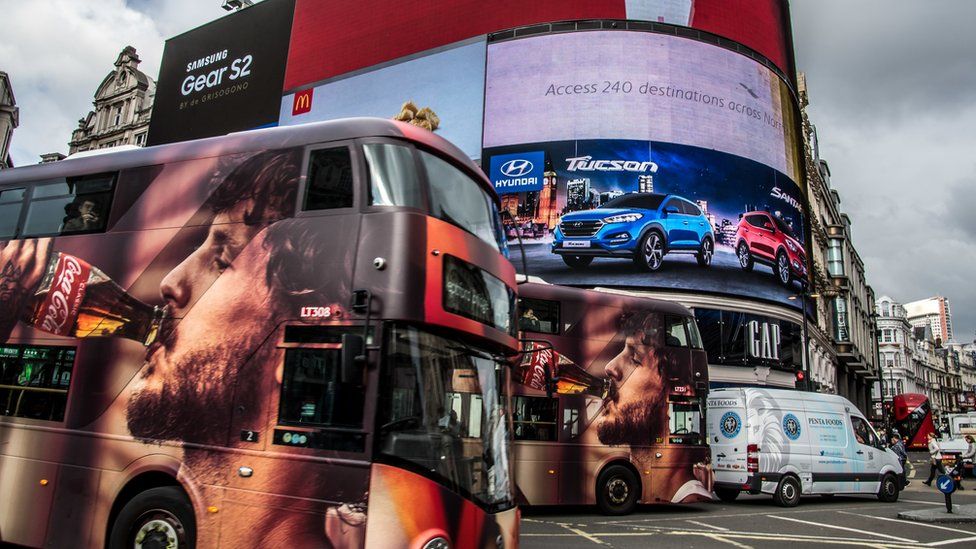
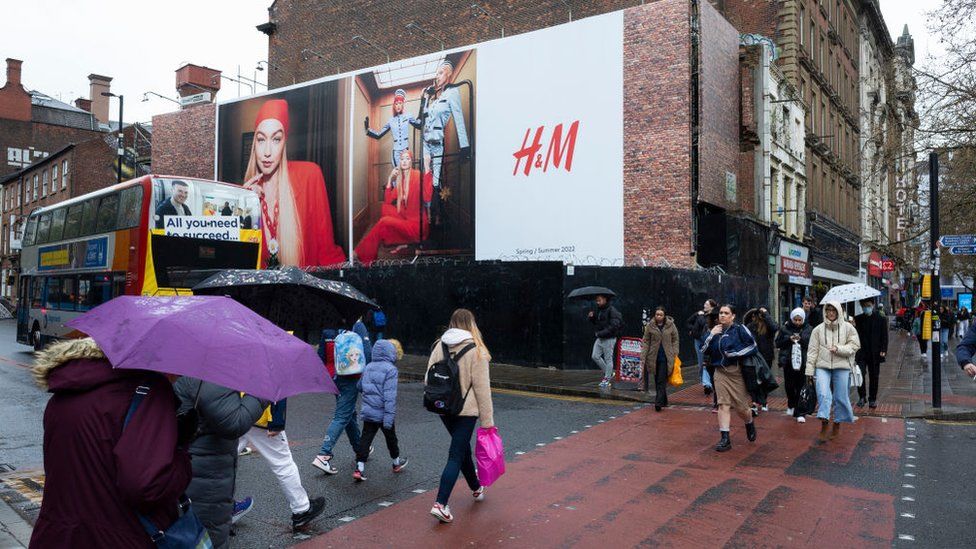
Buses covered in advertising at London's Piccadilly CircusA billboard advert in Manchester

For example:  Sporting events, Natural Reserves/ Public Park’s, Billboards and bus stops, Out door digital advertising.

We could stop television programming being sponsored by consumption  – Eat now.

Of course in a free society, businesses have the right to advertise their wares, and individual citizens are not the helpless brainless automatons that advertising industry’s considers them to be.

All advertising plays a crucial role in brand competition, drives product innovation, and fuels economic growth but would we not rather see community ads and art than have multi-billion companies putting logos and images everywhere?

If they are allowed to get the message out, the public has a right to reply to those ads.

We don’t want our city’s children bombarded with animated advertising on TV screens in the street.

Critically, the more that people prioritise materialistic values and goals, the less they embrace positive attitudes towards the environment – and the more likely they are to behave in damaging ways. If you think this is a fanciful aim, then you might need to think again with the state the world is in.

We’re in a place where major behaviour change is required.

To question the legitimacy of corporate outdoor adverting and draw attention to the impact they can have on social issues, mental health, wellbeing, the climate, and the communication of public space where governments are too inert/broke/ill-intentioned/in thrall to vested interests to take effective action.

Business leaders must increasingly look beyond short-term profitability to address the pressing need to reduce emissions.

——

.The advertising industry is in a very different place to where it was a year ago.

Where, how, and when you advertise will constantly change with the times. That’s one thing we can count on.

Culture has always defined marketing and brand marketers have a lot of power to dictate.

The rise of the internet, computers, and mobile devices only provided more platforms for video ads to appear. It’s probably still going to be one of the most important advertising trends in the next 5 years.

We have our hands on the levers of behaviour change, but in an era in which attention is often only ever partial, puncturing the collective consumer inertia with a complex message is no easy feat.

We spend every day thinking of ways to change people’s behaviours,

These skills are the ones needed more than ever by the world to halt the human causes of climate change.

——–

Advertising has always evolved with the technology at hand. This includes tracking of clicked links, customer behaviour, purchase history, survey responses, and more.

Marketers can then use that information to create custom messages or content that’ll match the target audiences’ interests.

Finding out which people to show a particular ad to and the right time to show them is crucial in the world of smartphones

Next step, profit.

——-

In a cut-throat and viciously competitive market, pioneering new technology can have a major impact on the effectiveness of advertising campaigns.

Another big use of mobile advertising is through games.

A lot of mobile games are created with the format of being able to purchase resources with real-world money.

This means that ads will now be geared towards targeting real people through emails and other registered user data. With more information available, marketers can provide customers with a better offer that’ll most likely translate into sales.

Social advertising is the use of Facebook, LinkedIn, Instagram, Twitter, and other social media platforms for advertising potentials.

The format itself is undergoing rapid transformation because most people watch for content and not for production quality.

Data collection and cookies naturally have poor public perception, often being viewed as encroaching on private information and stealing data, with ads following consumers around the internet.

Now, these apps aren’t just for sending messages and emoji cause it’s also a place to find advertisements relevant to users.

As the climate crisis bites

————

We need new metrics and measurement tools – and new bonus and remuneration systems to underpin our value systems, not just legislation against high-carbon advertising, focusing on fossil fuel companies, petrol- and diesel-engine cars and aviation.

Because, marketing has been transformed by digital speed, relevance and reach of advertising campaigns.

Because, overconsumption in general, encouraged by advertising, has a climate and ecological impact.

Because, programmatic advertising uses AI to automatically buy ads that can target audiences more specifically. ( Programmatic advertising is a combination of big data processing, technical skills, and automation.)

Because, advertising works by getting under your radar, introducing new ideas without bothering your conscious mind.

Because, contextual advertising is a form of targeted advertising where site content and keywords are analyzed in real time to determine their suitability for a brand’s message.

Because, children are now at the mercy of so-called “surveillance advertising”. It is estimated that by the time a child turns 13, ad-tech firms would have gathered 72m data points on them. The more data collected from an early age, the easier it is for advertisers to turn young children into consumer targets.


A transformation of marketing is underway as we spend more time on our mobiles, tablets and laptops. The real-time conversations brands have with people as they interact with websites and mobile apps has changed the nature of marketing

We know that advertising is a key engine of the economy. There are visual images and marketing messages that have insinuated themselves into the nervous systems of humans.

There’s a long way to go and a lot to be done. The ad business, with strategy tools and processes that were for the most part developed in the 60s to accommodate the advent of commercial TV, is a lot closer to where it started the journey than where it needs to get to.

Let’s create a movement and band together to save the planet in a non-branded or political way.

New checks and balances need to accommodate the natural concerns of councils and residents around climate, air pollution, environmental light pollution, the “attention economy”, mental health and the dominance of non-consensual adverts in public spaces.

I’m sure most advertisers and agencies would rather work on solving this global crisis, and if we can use just 5% of the industry’s time toward this initiative.

It isn’t clickbait that is needed but a genuine concern for the fate of the planet or a cynical hunch that doing the right thing will drive growth and profit – if the improved behaviour is real.

I believe that would lead to greater satisfaction, retention and more.

Break the Silence and comment.

All human comments appreciated. All like clicks and abuse chucked in the bin.

Contact; bobdillon33@gmail.com

Share this:

  • Share on WhatsApp (Opens in new window) WhatsApp
  • More
  • Share on Pocket (Opens in new window) Pocket
  • Share on Mastodon (Opens in new window) Mastodon

THE BEADY EYE ASKS; WHEN ARE WE GOING TO WAKE UP TO THE POWER OF PERSONALIZE TECHNOLOGY THAT IS CREATING AN OPEN AIR (INVISABLE) PRISON – WHERE THE FUTURE IS NO LONGER THE FUTURE?

12 Saturday Nov 2022

Posted by bobdillon33@gmail.com in 2022: The year we need to change., Artificial Intelligence., Biometric technology., Climate Change., Dehumanization., Digital age., DIGITAL DICTATORSHIP., Evolution., Facial Recognition., Fake News., GPS-Tracking., Human Exploration., HUMAN INTELLIGENCE, Human values., Humanity., Life., Modern day life., Our Common Values., Privatization, Purpose of life., Social Media, Social Media Regulation., Society, Speed of technology., State of the world, Technology, Technology v Humanity, The cloud., The common good., The essence of our humanity., The Future, The Obvious., The state of the World., THE WORLD YOU LIVE IN., THIS IS THE STATE OF THE WORLD.  , TRACKING TECHNOLOGY., Unanswered Questions., Universal values., VALUES, What is shaping our world., WHAT IS TRUTH, What Needs to change in the World, Where's the Global Outrage.

≈ Comments Off on THE BEADY EYE ASKS; WHEN ARE WE GOING TO WAKE UP TO THE POWER OF PERSONALIZE TECHNOLOGY THAT IS CREATING AN OPEN AIR (INVISABLE) PRISON – WHERE THE FUTURE IS NO LONGER THE FUTURE?

Tags

Algorithms., Artificial Intelligence., Capitalism and Greed, Climate change, Personalized technology, Technology, The Future of Mankind, Visions of the future.

( Ten minute read)

Technology is here to stay and we are supposedly on an unstoppable path towards driverless vehicles, fully automated internet-connected “smart homes”, and godlike artificial intelligence, when if fact we are on a path to the oblivion of our private lives.

As society is moving away from social interactions we take these technologies for granted and lose sight of reality.

So when are we going to wake up to the the pitfalls of personalized technologies that are targeting our lives, and what it is all ready doing, to what is left of what are supposed to be democratic societies.

It is difficult to manage the awesome power that is embedded in today’s technology however should we just sit back and let it exploited us with unregulated profit seeking algorithms and unauthorised data collection.

Its never to late to start asking questions.

We are so used to hearing that technological progress is smooth and inevitable these days, that it just seems like common sense.

However this idea may not be unrelated to the fact that the people who promote personalized technology are mainly the people with a large financial interest in the adoption of new technology -Facebook-Twitter-Google-Apple- LinkedIn – Instagram – Snapchat – Pinterest – Reddit and the rest.

Today, a plethora of personalization software tools, including AI and machine learning algorithms that are destroying individualism.

Just as our past futures need not be dead to us, our present future, with our reliance on devices, are becoming habitual, and if  not already could be compulsory.

There’s is no app for that.

On a social level, the two dimensional world of the flat screen does not support the development of communication.

It’s just sad that people really don’t even have to use their brains anymore. If you don’t use it, you lose it.

It is estimated that as much as 93% of communication is non-verbal, leaving only 7% to the words themselves.

( Not much less alarming, and far closer, is the moment when “deep fakes” – computer-generated pictures and video – become indistinguishable from the real thing.) People who buy into this garbage is being taken for such a ride every month.

The vast majority of people were simply never given the choice to accept the trade-off between personalized technology for profit or technology for the common good. For example tracking due the Covid Pandemic against tracking for profits.

Not convinced?

It is now increasingly clear that many, if we had understood what was at risk, would have never agreed to tracking Apps.

For example, back in 2018, Amazon filed a patent that would allow its Echo device to detect when someone is ill from the change in their voice, nasal tones, and stuffed nose. When synced with Amazon’s website personalization engine, this is invaluable information to make personalized recommendations for cold medicine, recipes, etc.  It allow them to achieve 1:1 personalization like never before. 

 Mobile devices themselves are truly turning people into mindless zombies and simpletons with personalized technology turning into the enemy. Yet most people are too blind to see it.  89% of businesses are investing in personalization.

I.E.  Target the right person, at the right time, with the right offer. Analysing every aspect of the customer journey, companies can incorporate real-time dynamic pop-ups.

 Here’s a fraction of the stats showing the power and importance of personalization:

80% of consumers are more likely to purchase from a brand that provides personalized experiences.

The idea of greater convergence and connectivity between personal electronics is correct. One only has to look at the smartphone that trigger customised adverts or programme your phone based on where you are.  A company could tie itself to the Apple ecosystem, using an API to acquire data captured by each user’s Watch device into its own cloud-based system.

———————————-

As society pressures leaders for a more environmentally-friendly agenda the world of 2050 will be unimaginably different in many ways –  other than climate change.

Carbon management solutions will be an integral part of emission reductions.

For that, real-time measurement, abatement, and offset integration will help ensure companies not only talk the talk but also walk the walk and transparently meet their net-zero targets. Setting a target is just the first step; the second is to understand and quantify the real emission baseline into measurable units.  This can only be achieved with massive data collection. and analyzation

———————————–

The amount of information we share shared on social media networks is phenomenal.

A media company is now any company that helps pass information across the globe.  Before mobile technology, you had to search through a dictionary to understand the meaning of a word. Now you can look words up in a dictionary app or quickly search the Internet. Communication has even evolved beyond mobile devices and personal computers. We can now send messages through tablets, voice assistants, smartwatches, and more. That’s right. Your fridge needs a Facebook account. It can e-mail you when your shopping time comes around with what all groceries you need to buy.

So one can see so clearly that society is not going to stop moving away from using technology as our primary communication methods, but here is a word of advice do not rely heavily on technology to live your lives, learn skills.  Your life is yours to control.  Because without them, you will struggle to move on as a society.

It is said that by 2050, “computational machines will have surpassed the processing power of all the living human brains on Earth.

It is said that a AI – a machine that can do everything a human can do – will arrive, they think it’s about 50/50 whether it will be before 2050.

By this time if we dont tackle climate change the cloud will have absorbed the thinking of the many dead brain on Earth.

If we assume that transcendentally brilliant artificial minds won’t be along to save or destroy us, and live according to that outlook, then what is the worst that could happen – we build a better world for nothing?

It is said that AGI will develop. If it does, every other prediction we could make is moot, and this story, and perhaps humanity as we know it, will be forgotten.

With the destruction of genuine human interaction you know, that technology will  happen anyway, so I predict that we will see a lasting cooperation between the human race and the computational machines of the future.

However we are mow just beginning to see the down side to all of this  technology.

Technology has changed how we entertain ourselves, meet each other, and consume all types of media.

We might be walking around with biometric healthcare data chips on your clothes, in a world in which mega scale injections of sulphur dioxide into the stratosphere turn the heavens a milky-white, and a whole generation never sees a clear blue sky, in order to reflect more of the sun’s rays and pause the greenhouse effect. Artificial intelligence brains simply cannot cope with change and unpredictable events such as the climate change will create, whole cities that are abandoned and populations relocated, to avoid the worst effects we can’t prevent. We all need to work together to survive.

Society used to be able to make a long-term plan, now it is driven by data with its chaotic effect on our lives shows no sign of abating, it is at least predictably unpredictable.

We need a cultural change in values, to enable more deliberate decision-making.

Future technology is sure to transform our lives in unbelievable ways, but how among us wants to live a life based on private data collected – by the fridge – the smart TV – your clothes – your mobile devices -whether you looked left or right – how many shits you had a day- face recognition – what emotions you had at looking at an emoji- what your are eating, reading, saying- what twitters you like or don’t,- where you were, where you going – all analysed by an invisible algorithm that has no oversight, or conscious.

Unfortunately, there’s not much we can do with this information and data except hope that people come to realize it needs to be regulated.

The changes in the world over the next 30 years, wont be down to technology nor will they be online, thanks to climate change they will metalize mostly through low-cost smartphones receiving increasingly ubiquitous cellular connections as the world fights for resources that are necessary for life.

Remember when people used to sleep and dream at night?

Now all we do is zone out in front of a computer screen all night. It’s time to unplug from all this craziness and go back to nature.

Nature does not spy on itself , in order to evolve. PRISM -- It's the end of the Internet as we know it

All human comments appreciated. All like clicks and abuse chucked in the bin.

Contact: bobdillon33@gmail,com

Share this:

  • Share on WhatsApp (Opens in new window) WhatsApp
  • More
  • Share on Pocket (Opens in new window) Pocket
  • Share on Mastodon (Opens in new window) Mastodon

THE BEADY EYE ASK’S. WHO OWNS ENGLAND AND IS IT GOING DOWN THE PAN?

04 Sunday Sep 2022

Posted by bobdillon33@gmail.com in #whatif.com, 2022: The year we need to change., British Culture., Climate Change., England in five years., England's future., England., English General Election., European Union., EU_UK relations for the foreseeable future., How to do it., Human values., Life., Modern day life., Modern day Slavery, Money in Politics., Our Common Values., Political Trust, Politics., Privatization, Profiteering., Robot citizenship., Russia / Ukraine ., Stimulus package., The common good., The Obvious., The pursuit of profit., The UK Class system., Universal values., We can leave a legacy worthwhile., WHAT IS TRUTH

≈ Comments Off on THE BEADY EYE ASK’S. WHO OWNS ENGLAND AND IS IT GOING DOWN THE PAN?

Tags

Capitalism vs. the Climate., Climate change, Distribution of wealth, England., Visions of the future.

( Ten minute read)

This is a country that sold is nations assets to private enterprises – energy, water, rail, etc, (In the ideology of Maggie Thatcher, shop till you drop), believing that the free market would give its citizens the best deal.

The massive privatisations of public assets undertaken by Mrs Thatcher and subsequent Tory governments since the 1980s now with the help of multilabel other world problems have come home to roost.

Below are a few examples of this.

[ARM Holdings, one the key British companies for research and innovation in electronics, was sold off in 2017 for £24bn to the Japanese company Softbank.

Amazon, a US corporation, now dominates retail in the UK.

Apple has shifted its tax liability in the UK to Ireland.

The key national airports in the UK – Heathrow and Gatwick – are both in foreign ownership.

Liverpool, Glasgow and Great Yarmouth ports are owned by Deutsche Bank. Felixstowe, is owned by one of Asia’s richest men and incorporated in the Cayman Islands.

Even Associated British Ports, which manages many UK ports, is owned by the Singapore foreign reserve fund and Kuwait’s sovereign wealth fund and registered offshore in Jersey.

Waterstones, the only surviving national book chain in UK, is also Russian owned.

Facebook and Twitter are now the main source of news for most British people despite its biases and its inadequate constraints on the dissemination of fake news. Both of these companies are effectively unregulated despite their critical social media roles, and both make enormous sums of money from advertising that goes untaxed.

The NHS, which is thought of as the great British innovation, is also increasingly being infiltrated by American health providers. Social care Southern Cross purchased by Blackstone, a US company.

Boots, which has 2,500 shops in the UK acquired by private equity in 2007, asset stripped and saw its HQ moved to Switzerland to avoid UK taxes. It is now wholly owned by the giant US pharmacy chain Walgreens.]

What are the common elements in the above?

With London becoming the global centre of such transactions because of weak regulatory systems, especially in respect of privatised utilities, it has been price gouging at the expense of consumers in the UK.

It is now clear that some at least of the purchasers of domestic assets have used the opportunity to launder illegally acquired money.  Russian millionaires had a field day.

We are now looking at a country that recently spent nearly $8 billion building two new large, conventionally-fuelled aircraft carriers, spending between £72.1bn and £80.4bn, on a high-speed rail HS2 to save thirty minutes traveling time, while its people can’t afford their energy bills, to feed themselves, to house themselves, or afford the cost of a rail ticket.

A country that turned its back on the biggest market on its door step the EU with £25bn left to pay by 2057.

A country that in the first year of the pandemic, from April 2020 to 2021,  borrowed £299bn, the highest figure since records began in 1946, to save it economy more than its people with, the cost of Government measures announced so far range from about £310 to £410 billion.

Most of this extra money was spent on public services (such as the NHS), and support for businesses.

In the space of 15 months, from March 2020, the three main Covid loan schemes – bounce back, CBILS and a scheme for larger loans, CLBILS – handed out nearly £80bn to businesses with fraud losses estimated at £4.9bn at the end of March, money the government is unlikely to ever recover.

The UK government wasted hundreds of millions of pounds of taxpayers’ money on poor quality and unusable personal protective equipment (PPE) while leaving frontline workers insufficiently protected from covid-19. The decision to prioritise hospitals meant that social care providers were left exposed by the lack of PPE contributing significantly to deaths in care homes in the first wave.

Among the government deals was a contract with a jeweller worth £70.5m (€80.5m; $97.6m) to buy sterile gowns. It also signed contracts for millions of face masks, which were not usable in the NHS because they had the wrong type of fixing.

The question of whether greater investments in health care in non-crisis times may have reduced the level of emergency funding needed to respond effectively to the pandemic warrants important reflection.


Money

Now with more money going out and less coming in, the English government has only one option – to borrow.

When a government spends more than it collects, it runs an annual budget deficit. The level of the national debt in the UK equates to 108% of national output (GDP) and the average amount of debt owed per person in the UK to day is ten thousand pounds.

This is a country that sold it soul to consumerism,  which is still spending millions on football with millions of lotto funds spent to win medals, with a homicide rate was 11.7 per million population, while small businesses and charities are going bust.

Like most of Europe it is in a downward spiral economically, with inflation and energy cost mounting ( due in part to the Russian invasion of the Ukraine,) and will have to borrow another £200bn by the end of the year.

 Its’ no wonders it is going down the Pan.

————————

 In the back ground there are other reason for its troubles–  its class system, its colonial history, its antiquated education system, its benefits system, its first past the post election system, to mention a few.

Its colonial past making it a very ethnically diverse nation,( People born outside of the UK account for 10% of the UK’s population.)

It has lost its once dominance as an empirical power in the world.

Once a rich country the crimes of your past are catching-up with you.

Britain was the world’s largest market for transportation of human lives, bowing to the new citadel whose tentacles reached out into great swathes of colonial wealth – and steadily drank it dry until the slave trade was finally banned by an act of parliament.  The arrogance and greed of your masters could not go unnoticed – could not pass-by unatoned for.  Nor could the pacifistic stance taken by the greater populous when confronted with such frequent acts of national and international vandalism.

Like most of us it has now become enslaved to the smart phone.

Now a country of digitalized citizens, with short term ambitions, in desperate need of a written constitution.

Why?

Despite considerable social change, and strong policy intervention, it still have some way to go to address equality of opportunity and racism.

—————————-

In the next few days the Conservative party will elect a new leader to take control of the country, without a general election.

He or she is facing social, unrest, as the UK economy is now too weak for sharp spending cuts due to the recent financial crisis, and Covid  pandemic, it is now currently facing serious issues in terms of cutting its unemployment rate and reducing its national debt.

Not to mention other current issues such as immigration, internal ethnic relationship, internal security, economic recovery, and Britain’s relationship with the EU all acting as major blocks to the progress of the British society.

Whatever the next British government may be, these are the issues that party has to address and solve. 

Modern British society has to find ways to deal with these crucial issues in order to move towards a brighter future.

So who owns the country?

Private no right of way sign

Behind this simple question lies England’s oldest and best-kept secret. It’s a secret that goes back to the Domesday Book – and an issue that goes to the heart of many of the biggest problems the country face to day.

Central government owns more than 16 million square metres of property and land across the UK – six times the area of the City of London. There are over 97,000 properties owned by foreign firms in England and Wales.

Collectively, the Royal family owns 180,550 acres of land, or roughly 282 square miles with an elite of less than 1% of the population owning half of England with a few thousand dukes, baronets and City bankers now owning far more land than all of Middle England put together.

As Mark Twain once said, “buy land: they’re not making it anymore” – and in England, its scarcity has made it so sought-after that land values have increased fivefold since 1995.

Just over 400 hectares (1,000 acres) of central London’s super-prime real estate belongs to the Crown, the Church, and four wealthy aristocratic estates.

Over 200,000 hectares (500,000 acres) of the English uplands are tied up in huge grouse-moor estates owned by around 150 people. The Duke of Northumberland, whose family lineage stretches back to Domesday, owns 40,468 hectares (100,000 acres) – a tenth of his home county.

Corporations own around 18% of England and Wales.

The Crown Estate owns London’s Regent Street, including the freehold for Apple’s flagship UK store, from which the Crown collects more rent than from all its agricultural land.

The National Trust owns around a fifth of the Lake District National Park in Cumbria.

The Duchy of Cornwall owns London’s Oval Cricket Ground, Maiden Castle in Dorset (above) and Ham Hill in Somerset.

Paternoster Square in the City of London, home of the London Stock Exchange, is owned by the Church Commissioners.

The Crown still owns the freehold OF the Houses of Parliament.

The housing crisis hasn’t been caused by a sudden rise in the price of bricks and mortar, but rather in the value of the land on which homes are built.

The vast gap in living standards between the precariat and the executive class are all to some extent the result of increased foreign ownership of almost everything that continue to call ‘British’.


There is hope, however to be fair few countries will escape the fever that’s upon this world – Climate change.

A fever for which the only cure is the unconditional metamorphosis of man himself, washed through and through, cleansed of that reckless hubris which has brought us to this tipping point of all of us having to live without the all gentle arts that nature had so diligently taught us.

The tide is turning upon mankind. Now it is our turn to be on the receiving end.

In the coming years Climate Change will make the cost of living we see to day ingenuous, compared to what is in store.

No man or woman can turn his or hers back for long upon her simmering powers.

When it comes to climate no man can lay claim to having pacified and sold her soul – because passivity was not on her agenda, and her soul was never for sale. And those who sought to profit from her bounty will soon leave empty handed; for that time, prophesied of old, has finally come. And yes, nature it is that once again rises up in defiance of all attempts to bring her under the control of those who would use and abuse her for their private wealth and make of her a platform for staging their profit driven foreign wars.

Not even the vicious technologically engineered destruction of our climate can suppress the rising winds of change that are upon this scarred and battered jewel called Earth. It can only increase their velocity.

The result is only too obvious with unstable work, often poorly paid, and increasingly inadequate to support a family. It is unsurprising therefore that there has been a sharp increase in poverty much of it in families in full-time work.

Prepare yourselves for the deluge – a great cleansing is upon the island; a cleansing that will jolt befuddled minds into memories of great stories of other eras, when lands were not swallowed by mighty acts of nature.

You were so proud to turn away from nature and forge your industrial steel into the wheels of the brave new world of mass consumerism  you new face a heavy price for its blinkered, stubborn occupants, who for so long turned a blind eye on deeper truths and refused to look upon the blood encrusted pages of your colonial history.

Oh England, my England, so where is your soul today?

————————

At this point you may well be asking what if anything can be done?

The master Conservative plan is levelling up. The big idea for post – Brexit Britain.

It identifies six capitals: physical capital (i.e. infrastructure and housing), human capital (skills and health), intangible capital (ideas and innovations), financial capital (business finance), social capital (community and public trust), and institutional capital  (local leadership).

The plan comes at a defining moment but it will fail to devolve enough power and money.

Why?

Because the places that have an abundance are now in a virtuous circle, where the different capitals reinforce one another.

Because is not matched by the scale of investment or the proposed solutions. Missing are a clear set of mechanisms that break the vicious cycles in places that are lacking in the six capitals.

Because this work has to be done at the local level because places face different challenges and have different growth potential.

Because if there is going to any levelling up is going to happen centrally from Whitehall.

Because the existing system for distributing money is highly complex  inequality will be aggravated and come to the forefront in the next general election.

Levelling up is a scatter gun approach for votes and it is on this feeling that the Government’s future electoral hopes hang.

IN THE END HERE IS THE BEADY EYE’S ADVICE TO WHO EVER GETS INTO POWER.

APART FROM A WRITTEN CONSTITUTION,  MAKE EDUCATION FREE AND BRING BACK A YEAR OF NATIONAL SERVICE TO TEACH THE VALUES THAT ARE NECESSARY AND FUNDEMENTAL TO THE FONDATIONS OF ANY NATION.  PUT THE PEOPLE FIRST NOT THE GDP.

All human comments appreciated. All like clicks and abuse chucked in the bin..

Contact: bobdillon33@gmail.com

.

Share this:

  • Share on WhatsApp (Opens in new window) WhatsApp
  • More
  • Share on Pocket (Opens in new window) Pocket
  • Share on Mastodon (Opens in new window) Mastodon

THE BEADY EYE ASKS. WHAT IN TODAYS WORLD IS THE VALUE OF A HUMAN LIFE?

23 Tuesday Aug 2022

Posted by bobdillon33@gmail.com in 2022: The year we need to change., Algorithms.,  Attention economy, Capitalism, Civilization., Dehumanization., Fourth Industrial Revolution., Human Collective Stupidity., Human Exploration., Inequality, Life., Modern day life., Modern day Slavery, Money in Politics., Our Common Values., Profiteering., State of the world, Technology v Humanity, Telling the truth., The common good., The Obvious., The state of the World., The world to day., THE WORLD YOU LIVE IN., Unanswered Questions., Universal values., VALUES, What is shaping our world., What Needs to change in the World, World Economy.

≈ Comments Off on THE BEADY EYE ASKS. WHAT IN TODAYS WORLD IS THE VALUE OF A HUMAN LIFE?

Tags

Algorithms., Capitalism and Greed, Distribution of wealth, The Future of Mankind, Visions of the future.

( Five minute read)

A profoundly ethical issue.

“What makes a life worth living?” “What is a life worth? ” are both questions that nobody can answer and should perhaps remain unanswered.

These questions once came pre-answered—by culture, by religion, by tradition—but these days, because of capitalism we each have to ask and answer for ourselves, with an answer not in poetic words or any words but an answer in pounds and pence or dollars and cents.

The “real question today is not when human life begins, but, what is the value of human life?”

The task of valuing life has many competing truths with no simple answer.

“Price tags are being continuously placed on our lives. If we care about equity, we need to ensure that the science behind these estimates is not oversold and that fairness is always a consideration when cost-benefit analysis is performed.”

Howard Steven Friedman

Valuing some lives more than others seems logical and natural to many of us.

We value human life in a way that assumes we possess a sacred something.

Aristotle concluded that we should value human life, due to our inherent capacity for reason.

So what reasons can we give for calling human life valuable?

The question’s complexity resides in the fact that how we arrive at a price tag on human life says a great deal about our priorities. A lot of the value we attribute to human life comes from religion. However, when you remove religion, what philosophical arguments are left?

This is were it gets tricky.

The philosopher’s job is not to accept the assumed inheritance of our forebears.

Do we determine the value of a human life based on the value we place on our lives in private decisions, and do we accept policy choices that puts future generations at risk.

Do we continue to value human life, especially above and beyond animals? If you value rationality, why is that? And does rationality, alone, bestow value on a human life?

How should we proceed?

We teach each generation that human life is valuable beyond all else.

.Is this good enough today?

Government officials are supposed to put numbers on the pros and cons of these questions but how to assess the value of a human life in financial terms is riddled with conundrum based on our behaviour which has no common denominators to adjust our assessment of a life’s value based on its quality or the probability of death?

How much should we pay today to prevent an event that would result in the loss of ten billion human lives in 50 years?    Climate Change.

So, how much is a life worth?

It seems so inhumane to put a monetary value our modern sentiments tell us that costs should not dictate life-and-death decisions. But those modern sentiments do not fit our modern experience.

We know that not all lives are valued by society equally.

Over the past four centuries, generations of black people have asked the question: What is a black life worth?

The summation of historical facts and statistical data clearly shows that the prices of black bodies in America are worth more imprisoned, enslaved, and dead than educated.

Here in Europe depending on all sorts of assumptions arisen by the Covid pandemic and now the war in the Ukraine there are a lots of conversations (right now) that seem to pit economics against life and health.

The result is the cost of living is mounting day on day while its value is descending but don’t worry your value is being look after by  the invisible hand of the market  run algorithms is giving your value the finger.

Unfortunately GDP distribution issue are now surfacing, like where is the GDP growth actually coming from?  Who’s losing income?  Does it increase equity in society?

How much a person is willing to accept to risk their own life – Climate change.

In the end the answer is my life is worth everything to me.

How much money do you get for losing a limb? It depends on where you live.

How much body parts worth workers compensation 4

Foot note . What’s wrong with killing people?

Abortion kills babies, and its advocates are loudly telling us the value they place on human life.

The idea is that we can best understand what life is worth by first understanding what death means.

All human comments appreciate. All abuse and like clicks chucked in the bin.

Contact:  bobdillon33@gmail.com

Share this:

  • Share on WhatsApp (Opens in new window) WhatsApp
  • More
  • Share on Pocket (Opens in new window) Pocket
  • Share on Mastodon (Opens in new window) Mastodon

THE BEADY EYE SAYS. WE ARE NOW ENETERING A PERIOD WITHOUT THE ABILITY TO TRULEY EXPERENCE WHAT WE ALREADY HAVE..

28 Saturday May 2022

Posted by bobdillon33@gmail.com in 2022: The year we need to change., Artificial Intelligence., Communication., Desensitization., Digital age., DIGITAL DICTATORSHIP., Digital Friendship., Disconnection., Freedom of Speech, Future Education., Google Knowledge., HUMAN INTELLIGENCE, Human values., Humanity., Imagination., INTELLIGENCE., Life., MISINFORMATION., Modern day life., Modern day Slavery, Our Common Values., Purpose of life., Real life experience's, Robot citizenship., Social Media, Social Media Regulation., State of the world, Technology v Humanity, The common good., The essence of our humanity., The Obvious., The state of the World., The world to day., THE WORLD YOU LIVE IN., THIS IS THE STATE OF THE WORLD.  , Unanswered Questions., Universal values., VIRTUAL REALITY., We can leave a legacy worthwhile., What Needs to change in the World, Where's the Global Outrage.

≈ Comments Off on THE BEADY EYE SAYS. WE ARE NOW ENETERING A PERIOD WITHOUT THE ABILITY TO TRULEY EXPERENCE WHAT WE ALREADY HAVE..

Tags

Experience's, Social Media, The Future of Mankind, Visions of the future.


Ten minutes read.

AS YOU KNOW IT IS NOT POSSIBLE TO EXPERIENCE EVERYTHING LIFE HAS TO OFFER. EVEN IF IT WAS POSSIBLE THERE ARE MANY EXPERIENCES WE WOULD WISH TO AVOID AT ALL COSTS.

SUCH AS THE LATEST MASS KILLINGS IN TEXAS, THE CURRENT WARS, POVERTY, BEING BURIED ALIVE, RAPED, JAILED FOR LIFE, CANCER, AND GOING BLIND NOT TO MENTION A SELECTION OF DISEASES. 

The list is endless, but there is another aspect of the matter.

Every genuine experience has an active side that changes to some degree the objective conditions under which experiences are had and I believe that experiences are the basis upon which society progresses.

Experience does not go on simply inside a person they influence the formation of attitudes of desire and purpose, but they do not define a society as either developed or civilized.

However, it is experience alone that guides decisive action through hands-on. They teach you how to apply learnings to produce favorable outcomes regardless of any concepts you might have learned.

In a world that values differentiation more than anything else, experience lets you craft your own story while the rest of the people stick to an old and obsolete script.

Experience gives you access to a huge network of people who have been there and done that but the most valuable contribution of experience comes from the self-awareness it gives you.

Experience vs education is a constant battle.

A mixture of experience and education is the best. But the stats beg to differ.

                             ************************

Across the globe, mobile devices dominate in terms of total minutes spent online. As a result influence, Social media. It is now being used in ways that shape politics, business, world culture, education, careers, innovation, and more to rewire human society. 

Because social networks feed off interactions among people, they become more powerful as they grow. Enabled people of all ages to just google things, not actually try to remember or memorize information.

The phones have become our masters. It was intended to make our lives easier in terms of communication, now it has become an extension of our hands.

Unregulated Social media is promoting social ills.

LIVING IN SYSTEMS THAT ARE PREVENTING US FROM BECOMING WHO WE TRULY ARE. WE ARE LOSING OUR INDIVIDUAL AND COLLECTIVE CULTURE LIVING IN A WORLD WHERE EXPERIENCING REAL LIFE IS BECOMING VIRTUALLY IMPOSSIBLE. Where Most Needed

 As a result, the real problems of the world are being ignored. 

Increased visibility of issues has shifted the balance of power from the hands of a few to the masses but this awareness is not translating into real change because people are given options that absolve them from the responsibility to act. Injustice is one of the biggest issues in today’s society, there are many consequences.

Technology is anything that makes life simpler but the cellphone as a branch of technology is destroying us.

We need to think much deeper and critically to be certain that we have the authority over our own lives. When you’re not in a room with someone, it can be hard to express your personality and how you could fit into a new environment.

Let’s start with a few quotes.  

“Without sensibility, no object would be given to us, and without understanding, none would be thought. Thoughts without content are empty, intuitions without concepts are blind”.

“Experience arises together with theoretical assumptions, not before them, and an experience without theory is just as incomprehensible as is (allegedly) a theory without experience.”
Paul Karl Feyerabend, Against Method pg 151. Against Method (1975)

“Experience by itself teaches nothing…Without theory, experience has no meaning. Without theory, one has no questions to ask. Hence without theory, there is no learning.”
W. Edwards Deming, The New Economics for Industry, Government, Education (1993)

Experience is simply the name we give our mistakes. Oscar Wild

                              ******************************

There is so much more to life than what you experience right now.

Here are a few reasons why you should value experience over education. 

Experiencing’ attaches itself to nothing while at the same time being everything.

Experiencing’ does not get concerned about not remembering. ‘Experiencing’ has no need to remember.

Experiencing’ holds nothing yet is aware deeply of everything.

When we realize there is nothing to capture we relax in the awareness of just ‘experiencing’. 

Experiencing ‘experiencing’ is the Fullness. When ‘It’ Is all here where else could we go?!

Answering interview questions with no experience can be a daunting prospect.

Everyone has to start somewhere in a world where doing is highly valued. It’s one of the most well-known conundrums of the career world. No experience, no job. No job, no experience.

EVIDENCE THAT OUR CULTURE IS IN DECLINE.

This becomes obvious to those who are willing to actually travel the world learning about the cultures of others.  They gain a more reliable picture of life as it is lived.

The most important thing that one can do to rise above the insanity of this world, is to be willing to get educated by those who have zero financial interest in their taking their stand for what they believe.

Just because you don’t have ‘direct’ experience, it doesn’t mean you don’t have anything to offer.

It’s been said that information is power. Without a means of distributing information, people cannot harness its power. Ultimately, sharing is about getting people to see and respond to content. 

Birds of a feather tend to hang out in the same ponds. And the best way to prove you’re a duck is to spend as much time as possible in the right pond.

History does not lie – it is just that the masses do not know their history.

There is a line by Verlaine that I will not remember again.
There is a street nearby that is off-limits to my feet.
There is a mirror that has seen me for the last time.
There is a door I have closed until the end of the world.
Among the books in my library (I’m looking at them now)
Are some I will never open.
This summer I will be fifty years old.
Death is using me up, relentlessly.
—from Inscriptions (Montevideo, 1923) by Julio Platero Haedo

Where are?

Stormzy wore a flat jacket in (2019) at Glastonbury, and Abba appeared digitally yesterday.

What are days for?
Days are where we live.
They come, they wake us
Time and time over. Larkin 

All human comments are appreciated. All like clicks and abuse chucked into the bin.

← Back

Thank you for your response. ✨


Share this:

  • Share on WhatsApp (Opens in new window) WhatsApp
  • More
  • Share on Pocket (Opens in new window) Pocket
  • Share on Mastodon (Opens in new window) Mastodon

THE BEADY EYE ASKS: IS THERE ANYTHING THAT IS ACCEPTED UNIVERSALLY?

03 Sunday Apr 2022

Posted by bobdillon33@gmail.com in #whatif.com, 2022: The year we need to change., Universal values.

≈ Comments Off on THE BEADY EYE ASKS: IS THERE ANYTHING THAT IS ACCEPTED UNIVERSALLY?

Tags

The Future of Mankind, Universal values., Visions of the future.

(Twenty-minute read) 

YOU MIGHT THINK THAT IN OUR ONGOING EVOLUTION THAT THIS IS A VERY BASIC QUESTION.

Because value creation is the starting point for all businesses, successful or not, it’s a fundamental concept to understand. 

Value is created through an irreversible process that gives a resource’s ‘order’ greater usefulness to other humans.

Under this definition, almost any activity can be value-producing, and under our Capitalist system, all businesses must create value, and as a result, we have all become products.

But the commoditized of humans into products is not a pathway to success.

In the real world outside of economic theory, a value is considered universal when it goes beyond laws and beliefs; it is considered to have the same meaning for all people and does not vary according to society.

 I don’t think plunder of finite resources counts as value creation. 

UNDERSTANDING THAT THERE IS NO POINT TO LIFE IF WE ARE UNABLE TO UNDERSTAND – THAT THERE CAN BE NO LIFE WITHOUT THE EARTH WE ALL LIVE ON.

This is universally true in all cultures at all times, but achieving this – REMAINS ELUSIVE.

This has led me to stop and ask myself, “What has happened to universal values?

Are there no issues, no beliefs, and no values that people everywhere can agree on?

Is there really no commonly shared right or wrong?”

Because we live in a world where every issue is multi-faceted, where every issue has advocates and detractors, where positive outcomes for some are viewed as negative outcomes for others.

                                               —————– 

Universal values ​​are believed to be the basis of human integrity, but their definition and existence remain concepts widely discussed in psychology, political science, and philosophy.

The idea of ‘human rights is not universal – it is essentially the product of 17th and 18th-century European thought.

Even the idea of ‘rights’ does not necessarily exist in every society or advanced civilization.

A human right is ‘natural’ in that everyone owns them, not because they are subject to any particular system of law or religious or political administration. They can be asserted against individuals, but they express the political objective: that governments must respect, protect and promote them. That so if answered by any of the above you would be hard-pressed to get a straight answer because values interact with each other.

The problem is that any universal values clash in their representation by the breadth of goals, wisdom, social justice, equality between humans, and a world of peace, harmony, and beauty.  All are open to wide interpretations.

The first is that a large number of human beings, under different living conditions and subjected to different beliefs, find a certain human characteristic as valuable. In that case, the characteristic in question would then be called a universal value.

This is the reason that there is no universal acceptance of universal values and this is reflected in the nonunity of nature, the protection of the environment, and the harmony of each person with himself.

Universal values cannot remain constant or change because they haven’t been defined.

                                          ———————–

Besides being alive, what are universally accepted human values that define ‘a good life’? 

The list includes  “Love”, “truth”, “justice”, “freedom”, “unity”, “tolerance”, “responsibility”, and “respect for life. ” 

According to the Oxford Dictionary values are something that deserves esteem for itself, which has intrinsic merit. 

There is no ultimate truth and all things are relative, so everything requires debate and decision.

If universally accepted values exist, do they remain constant or do they change over time?

There is no answer to the question. 

In fact, cultural relativism is a belief that opposes the existence of universal values; proposes that a value can not be universal because it is perceived differently in each culture. All the religions of the world attempt to give meaning and definition to life.

However, it is our conscience that convinces us there is something wrong with suffering, starvation, rape, pain, and evil, and it makes us aware that love, generosity, compassion, and peace are positive things for which we should strive.

In fact, the very laws of science are founded on the existence of absolute truth.

If there are no absolutes that define reality but all scientific study must by necessity be founded upon the belief that there are objective realities existing in the world and these realities can be discovered and proven. Without absolutes, what would there be to study? How could one know that the findings of science are real?

Based on cognitive function and life experience, human values dictate how individuals live, their preferences, priorities, principles, and behavior (Debbarma 2014; Hanel, Litzellachner, and Maio 2018).

So what are human values from the 20th century to date?

What is universal is the phrase ” What we need is ”  not  “what we want.”

There can be no douth with the use of smartphones/social media is changing values to  “situational ethics,” the belief that what is right or wrong is relative to the situation.

As cultures evolve and societies develop, people’s ways of thinking about good and evil are transforming and the nature of this transformation is a matter of speculation.

Human values themselves have transformed into social values that are shared and respected by society members, serve as guidance for individual expectations, and help to manage differences in harmony (for example cultural, political inclination, spiritual, and belief differences) in a peaceful way (Tsirogianni and Gaskell 2011).

Is repetition in mass media shaping our cultures into increasingly censorious-driven societies?

The way we tend to think about matters of right and wrong is different now from how we once did and, if the trends are to be believed, how we will in the future.

                                            ——————-

Today, our political order faces new threats, Changing patterns of language use over time may reveal alterations in how people have made sense of their world and themselves.

Take the modern consciousness of war in terms of our values suggesting ideas of moral virtue are becoming less culturally salient.

The notions of logical truth, a priori truth, and necessary truth are disappearing in the frequency of a set of virtue words such as “conscience”, “honesty” and “kindness” over the 20th century.

A necessary truth is what happens to be the case and could not fail to be the case.

A contingent truth is what happens to be the case but could fail to be the
case. An a priori truth is what is known, independently of any empirical input, to
be the case, while an a posteriori truth is what is known to be the case only given
some antecedent empirical knowledge

In deciding what to count as a truth of logic, another criterion that comes to
mind is that truths of logic should obey the rule of necessitation.

As it turns out, it is very hard to think of universally accepted ideas about what the generic properties of logical truths are or should be. 

Most of these words showed a significant decline in popularity so that many people forget

                               ___________________

In the end, ownership has a lot to do with value. 

Why do some of us take ownership of the state of the world and others don’t?

By creating a disparity between who takes action and who doesn’t, we’re creating a small subset of entitled people and a larger, more insensitive world

Because we are not connected, we don’t give and empathize naturally.

Creating this sense of ownership, connection, empathy, and compassion should not be left to chance, but should be bred into all of us through the education system and how we raise our children.

our attention on the wrong problems and drives us to the wrong answers, taking our politics down rabbit holes that do nothing to help us.

If all of us could feel connected to just one other person in the world, to our immediate environment, or to the food we eat, this domino effect has the power to transform everything.

How do we think about value that’s created, but never monetized?

We all must buy into what is left of the earth, to stop wars, climate change, and inequality. 

We need to open up our views on value so revenue is the measure of value creation — not profit.

In order to do achieve this, we create a perpetual World aid fund by placing a 0.005% commission on all economic activities that are profit for profit’s sake. (see previous Posts)

At the same time, we allow all of us to invest in our future with Green Bonds (see previous posts)

Software and related services dominate more and more of value creation but do not connect us to the planet we live on.  

If we feel connected to the earth big structural changes can and do happen if not rest assured we will be paying for the values of life.

In the meantime, a different approach to news reporting – one that emphasizes the ways people cooperate to solve problems – would have a tonic effect.

Value creation in the future will be based on economies of creativity which is Universal. 

All human comments are appreciated. All like clicks and abuse chucked in the bin.

← Back

Thank you for your response. ✨


Share this:

  • Share on WhatsApp (Opens in new window) WhatsApp
  • More
  • Share on Pocket (Opens in new window) Pocket
  • Share on Mastodon (Opens in new window) Mastodon
Newer posts →

All comments and contributions much appreciated

  • THE BEADY EYE SAYS. ANY OTHER PERSON WOULD BE ARRESTED. February 1, 2026
  • THE BEADY EYE SAYS FROM THE RESURRECTION OF JESUS TO THE PRESENT DAY THE HISTORICAL RECORD OF OUR WORLD IS MORE THAN HORRIBLE. February 1, 2026
  • THE BEADY EYE SAYS: THE WORLD WE LIVE IN IS BECOMING MORE AND MORE UNKNOWN. January 31, 2026
  • THE BEADY ASK. IN THIS WORLD OF FRICTIONS IS THERE ANY DECENCY LEFT ? January 29, 2026
  • THE BEADY EYE ASKS ARE WE WITH ARTIFICIAL INTELLIGENCE LOOSING THE MEANING OF OUR LIVES? January 27, 2026

Archives

  • February 2026
  • January 2026
  • December 2025
  • November 2025
  • October 2025
  • September 2025
  • August 2025
  • July 2025
  • June 2025
  • May 2025
  • February 2025
  • January 2025
  • December 2024
  • November 2024
  • October 2024
  • September 2024
  • August 2024
  • July 2024
  • June 2024
  • May 2024
  • April 2024
  • March 2024
  • February 2024
  • January 2024
  • December 2023
  • October 2023
  • September 2023
  • August 2023
  • July 2023
  • June 2023
  • May 2023
  • April 2023
  • March 2023
  • February 2023
  • January 2023
  • December 2022
  • November 2022
  • October 2022
  • September 2022
  • August 2022
  • July 2022
  • June 2022
  • May 2022
  • April 2022
  • March 2022
  • February 2022
  • January 2022
  • December 2021
  • November 2021
  • October 2021
  • September 2021
  • August 2021
  • July 2021
  • June 2021
  • May 2021
  • April 2021
  • March 2021
  • February 2021
  • January 2021
  • December 2020
  • November 2020
  • October 2020
  • September 2020
  • August 2020
  • July 2020
  • June 2020
  • May 2020
  • April 2020
  • March 2020
  • February 2020
  • January 2020
  • December 2019
  • November 2019
  • October 2019
  • September 2019
  • August 2019
  • July 2019
  • June 2019
  • May 2019
  • April 2019
  • March 2019
  • February 2019
  • January 2019
  • December 2018
  • November 2018
  • October 2018
  • September 2018
  • August 2018
  • July 2018
  • June 2018
  • May 2018
  • April 2018
  • March 2018
  • February 2018
  • January 2018
  • December 2017
  • November 2017
  • October 2017
  • September 2017
  • August 2017
  • July 2017
  • June 2017
  • May 2017
  • April 2017
  • March 2017
  • February 2017
  • January 2017
  • December 2016
  • November 2016
  • October 2016
  • September 2016
  • August 2016
  • July 2016
  • June 2016
  • May 2016
  • April 2016
  • March 2016
  • February 2016
  • January 2016
  • December 2015
  • November 2015
  • October 2015
  • September 2015
  • August 2015
  • July 2015
  • June 2015
  • May 2015
  • April 2015
  • March 2015
  • February 2015
  • January 2015
  • December 2014
  • November 2014
  • October 2014
  • September 2014
  • August 2014
  • July 2014
  • June 2014
  • May 2014
  • April 2014
  • March 2014
  • February 2014
  • January 2014
  • December 2013
  • November 2013
  • October 2013

Talk to me.

Jason Lawrence's avatarJason Lawrence on THE BEADY EYE ASK’S: WIT…
benmadigan's avatarbenmadigan on THE BEADY EYE ASK’S: WHA…
bobdillon33@gmail.com's avatarbobdillon33@gmail.co… on THE BEADY EYE SAYS: WELCOME TO…
Ernest Harben's avatarOG on THE BEADY EYE SAYS: WELCOME TO…
benmadigan's avatarbenmadigan on THE BEADY EYE SAY’S. ONC…

7/7

Moulin de Labarde 46300
Gourdon Lot France
0565416842
Before 6pm.

My Blog; THE BEADY EYE.

My Blog; THE BEADY EYE.
bobdillon33@gmail.com

bobdillon33@gmail.com

Free Thinker.

View Full Profile →

Follow bobdillon33blog on WordPress.com

Blog Stats

  • 95,075 hits

Blogs I Follow

  • unnecessary news from earth
  • The Invictus Soul
  • WordPress.com News
  • WestDeltaGirl's Blog
  • The PPJ Gazette
Follow bobdillon33blog on WordPress.com

The Beady Eye.

The Beady Eye.
Follow bobdillon33blog on WordPress.com

Blog at WordPress.com.

unnecessary news from earth

WITH MIGO

The Invictus Soul

The only thing worse than being 'blind' is having a Sight but no Vision

WordPress.com News

The latest news on WordPress.com and the WordPress community.

WestDeltaGirl's Blog

Sharing vegetarian and vegan recipes and food ideas

The PPJ Gazette

PPJ Gazette copyright ©

Privacy & Cookies: This site uses cookies. By continuing to use this website, you agree to their use.
To find out more, including how to control cookies, see here: Cookie Policy
  • Subscribe Subscribed
    • bobdillon33blog
    • Join 222 other subscribers
    • Already have a WordPress.com account? Log in now.
    • bobdillon33blog
    • Subscribe Subscribed
    • Sign up
    • Log in
    • Report this content
    • View site in Reader
    • Manage subscriptions
    • Collapse this bar