• About
  • THE BEADY EYE SAY’S : THE EUROPEAN UNION SHOULD THANK ENGLAND FOR ITS IN OR OUT REFERENDUM.

bobdillon33blog

~ Free Thinker.

bobdillon33blog

Category Archives:  Attention economy

THE BEADY SAYS; ENTERTAINMENT IS NOW BEYOND THE PALE. WHAT CONSITUTES ENTERTAINMENT? WHERE DO WE DRAW THE LINE? IS THERE ANY LINE TO BE DRAWEN?

19 Friday Apr 2024

Posted by bobdillon33@gmail.com in 2024 the year of disconnection, Artificial Intelligence.,  Attention economy, Uncategorized

≈ Comments Off on THE BEADY SAYS; ENTERTAINMENT IS NOW BEYOND THE PALE. WHAT CONSITUTES ENTERTAINMENT? WHERE DO WE DRAW THE LINE? IS THERE ANY LINE TO BE DRAWEN?

Tags

Attention economy, ENTERTAINMENT, lifestyle, movies, news, pop-culture

( Ten minute read)

Even as violence is a concept that has long accompanied humanity, it is no easy task to make sense of what it is, or how it is exercised.

Ancient Romans flocked to carnage in the Colosseum.

Even the most brutal acts committed by our ancient ancestors pale in comparison to the organized assaults countries have executed in the last century alone.

Ongoing wars and human right violations suggest that we are living in one of the most vicious times in history.

The relationship between violent media and real-world violence has been the subject of extensive debate and considerable academic research, yet the core question is far from answered.

Portrayals of violence can manufacture our consent with government policies, encourage us to endorse the legitimacy of state power and state violence, and help determine who are “worthy victims”.

Results from the two studies suggest that socialization models of media violence may be inadequate to our understanding of the interaction between media and consumer behaviour at least in regard to serious violence.

Our media outlets from News to Gaming – Movies – Net flicks – Social Media – are saturated with violence.

More than 100 million people watched the gory Netflix show, Squid Game.

Hellblade: Senua’s Sacrifice wins Game Beyond entertainment.

This is a bit like benign masochism, the enjoyment of aversive, painful experiences in a safe context.

Whether or not screen violence is bad for us has been extensively studied and there are reasons to reconsider how much we like watching violence per se.

For example, violence creates tension and suspense, which may be what people find appealing. Another possibility is that it is action, not violence, which people enjoy. That it is violence being deemed off-limits that makes it appealing. It may be that it is justified punishment, rather than violence, that we enjoy watching.

All this suggests that media companies may be giving us violence that many of us don’t want or need.

—————–

We should hence consider what other corporate, political or ideological pressures may be encouraging onscreen violence globally causing us to become disconnected with reality.

Movies lie about the real impact of violence on the human body – with almost 90% of violent actions showing no realistic physical consequences to the victim.

The west won the world not by the superiority of its ideas … but rather by its superiority in applying organised violence.

————-

The question of how humans came to be domesticated — at the will of a deity, independently, as some sort of evolved trait — has plagued philosophers and scientists for hundreds of years.

It is tempting to try to answer this question by invoking biology and genetics, arguing that humanity is wired to be violent.

Whether humans will ever live in a violent-free, as digital technologies—such as social media platforms—become increasingly central to our daily existence they have become essential components in how violence is enacted and experienced. Indeed, as access to and use of social media continue to expand across the world so does the violence enacted through these digital platforms become more common.

For proof of that, just turn on your TV to the evening news and watch murder in all its forms.

What lies behind these episodes. Perhaps, some have argued, our intelligence and systems of culture, such as laws and social norms, are all that are holding that innate violence in check.

How good and evil may have come to co-exist in our unique species. Are humans, by nature, good or evil? The question has split opinions since people began philosophising. We have a low propensity for impulsive aggression, and a high propensity for premeditated aggression.

It raises a deeper question: Why did such an unusual combination of virtue and violence evolve?

A deeper understanding of how and why violence emerges, or doesn’t, might help us achieve a less violent future—or at least one in which we can better comprehend and manage our violence.

41% of people in the United States of America have suffered online harassment, from physical threats (14%) and sexual harassment (11%) to name-calling (31%).

But violence in digital environments is not only expanding, it is also becoming more complex as the evolving affordances, structures, and cultures of contemporary digital environments increase their scale, speed, reach, and visibility (Backe et al., 2018).

For instance, violence on social media is found in the new ways cultural and informational wars are enacted and deployed in the United States filled with school shootings and mugging and terrorist attacks and wars.

——————–

It is a widespread phenomenon that directly or indirectly affects many aspects of our lives.

Nonetheless, digital manifestations of violence are often thought to be less “real,” “serious,” or “harmful” than those enacted face-to-face (Dunn, 2021).

Capitalism is a dirty word for many intellectuals but there are a number of studies showing that open economies and free trade are negatively correlated with genocide and war.

Warfare provides people with a semblance of psychological positivity in oppressed societies where other outlets are lacking.

Any stable, lasting peace depends on creating societies with a richness of opportunity and variety that can meet human needs. The fact that so many societies throughout the world fail to do this makes our future prospects of peace look very bleak.

War and other destructive capabilities are merely the flip side of the same uniquely human faculty that has enabled us to coexist peacefully, to innovate, to travel in space and shape our world.

The evolution of entertainment into a global landscape signifies a world where cultural boundaries blur, and creativity knows no limits. In today’s interconnected world, the entertainment industry has expanded its reach, influencing and captivating audiences worldwide with diverse content and experiences.

Entertainment has transcended geographical boundaries, morphing into a global phenomenon that unites people across cultures, languages, and continents.

Social media is cursed with pervasive and impactful harmful content. Can we imagine addressing only part of this violence without considering the rest?

Can we continue to feign not to see that all of these forms of violence mutually reinforce one another.

Film and television have long been seen as legitimate and powerful means to educate, inspire and empower wider society. To deliver a transformational experience beyond pure entertainment – whether that is to raise awareness through empathy and emotional impact, to engage with real world problems, or to make the world a better place.

The prevalence of war, not just its persistence, could now be our future.

The past two years have seen the most conflicts of any time since the end of the Second World War.

(The list encompasses not just the wars in Gaza and Ukraine, but hostilities between Armenia and Azerbaijan in Nagorno-Karabakh, Serbian military measures against Kosovo, fighting in Eastern Congo, complete turmoil in Sudan since April, and a fragile cease-fire in Tigray that Ethiopia seems poised to break at any time. Syria and Yemen have not exactly been quiet during this period, and gangs and cartels continuously menace governments, including those in Haiti and Mexico. All of this comes on top of the prospect of a major war breaking out in East Asia, such as by China invading the island of Taiwan.)

What happens when a smart TV becomes too smart for its own good?

The answer, it seems, is more intrusive advertisements.

Reaching beyond video to monopolise the attention of audiences in the home TV violence increases aggression and social anxiety, cultivates a “mean view” of the world, and negatively impacts real-world behaviour.

We are exposed to social media violence just by being there.

The amount of violent content has helped normalise aggression. The reality is that social media platforms have got a lot to answer for. In practically every situation where we’ve seen violence happen there has been some sort of connection with an online platform in some form.

Why are these social media platforms not being held to account?

Why are we so scared of asking really difficult questions and why are these social media platforms not putting more money back in the communities that are being affected by violence?

We don’t fully know the impact of social media.

But social media and the fact that something that is say in passing becomes written down, causes what might have been nothing to become something.

For most violence isn’t at all normal, but there is a proportion whose lives are far too full of violence because of inequality and poverty.

The key driver of violence.

————

But what about games?

As our younger industry matures, what role should games play in reflecting and commenting on the world around us?

Already we have a number of implications that will define the future shape of the online entertainment market. As society seeks answers in the media they trust, streaming devices are now everywhere, pouring news into social media 7/7

People in entertainment, tries to make something for everyone/to make the most profit instead of making what they want, so personality and quality takes a hit.

There is definitely a cultural degradation taking place.

Violence is an almost ubiquitous phenomenon in contemporary digital environments.

Games beyond entertainment.

The advent of video games raise new questions about the potential impact of media violence, since the video game player is an active participant rather than merely a viewer. Video games that involve assuming the roles of aggressors or soldiers offer players the opportunity to be “virtual perpetrators.”

Rewarding players for successfully carrying out violent behaviour.

Online gaming communities, esports tournaments, and multiplayer platforms enable players worldwide to engage, compete, and connect in virtual worlds. Digital platforms have revolutionized entertainment accessibility. Social media influencers transcend borders, shaping entertainment trends and culture on a global scale, such as cultural sensitivities, censorship, and legal barriers that can hinder the free flow of content across borders.

There are fewer empirical studies of video game violence than other forms of media violence. Still, several meta-analytic reviews have reported negative effects of exposure to violence in video games. 

Content matters. much of the research into video game violence has failed to control for other variables such as mental health and family life, which may have impacted the results.

Given that effects on individual users may differ widely, policy discussion should be more focused on “more pressing” issues that influence violence in society such as poverty or mental health.

Rest assured that entertainment will need to master new forms of interactive entertainment — whether in video games, sports betting or the more social and communications-based services that thrive on smartphones — to keep audiences hooked.

There was no such thing as YouTube its their Tube.

U Tube now has a  War Channel created to appeal military enthusiasts around the world; offering viewers hours of programming on the American Civil war, WWI, WWII, Vietnam, Afghanistan, Iraq, Israel, Ukraine and all.

————————-

Why are people less imaginative?

Because we all have the internet and other high-information sources that fill in the gaps for us.

Story telling, character-building, authenticity, and originality have all gone out the window, as entertainment has become largely an industry as opposed to a genuine creative outlet.

Game makers have the opportunity – and responsibility – to offer their players an appropriate and powerful means to get close to challenging issues or subject matter.

Games are brilliant at engendering empathy by allowing you to experience the life of other people first hand. As game makers and storytellers we have the ability to take our audiences to places they haven’t been or to feel things they have yet to experience.Soldiers with rifles walking on a leafy hill, with tanks in the background. As the Ukraine war enters its second year, Tufts experts weight alternative endings—and the possibility it won’t be resolved any time soon.

There’s the possibility of vertical escalation—meaning that Russia would use more advanced weapons, including nuclear weapons—on the battlefield. And there is the possibility of horizontal escalation, the war spilling over to other countries.

What if anything can be done?

Here are a few key recommendations, which includes improve regulations and legislation for social media companies, greater responsibility so tech companies are held accountable for inaction, and for young people to be involved in panels that are consulted on tackling online harms and the development of games, new content and online spaces.

Legislation in relation to social media platforms is needed, but it is one aspect in an array of required measures, including education, the need to address social inequalities, the need for transparency by companies, by governments who should be constantly aware of how fake violence on our screens serves real violence in our world.

Why?

Because exposure to media violence can desensitize people to violence in the real world.

Yes, its true that  for some people, watching violence in the media becomes enjoyable and does not result in the anxious arousal that would be expected from seeing such imagery , but society as a whole is another question.

An average American youth will witness 200,000 violent acts on television before age

18. 46% of television violence occurs in cartoons.

———–

The prevalence and impact of violence portrayed in media and entertainment and the near-ubiquitous portrayals of violence in various forms of media must remained a topic of intense scrutiny.

Fear is what, anxiety and depression, wars, domestic violence, relationship breakdowns, child abuse, terrorism, mass shootings, self-harm and all forms of violence towards oneself and others have in common.

All comments appreciated. All like clicks and abuse chucked in the bin

Contact: bobdillon33@gmail.com
Share this:

  • Click to share on WhatsApp (Opens in new window) WhatsApp
  • More
  • Click to share on Pocket (Opens in new window) Pocket
  • Click to share on Mastodon (Opens in new window) Mastodon

THE BEADY EYE SAY’S: OUT OF NO WHERE, OUR WORLD IS TURNED UPSIDE DOWN.

15 Monday Jan 2024

Posted by bobdillon33@gmail.com in #whatif.com, A Constitution for the Earth., Artificial Intelligence.,  Attention economy, Brexit., Capitalism, CAPITALISM IS INCOMPATIBLE IN THE FIGHT AGAINST CLIMATE CHANGE., Civilization., Collective stupidity., Cry for help., Digital age., Disaster Capitalism., Disasters., Disconnection., Environment, Fourth Industrial Revolution., Honesty., How to do it., Human Collective Stupidity., HUMAN INTELLIGENCE, Human values., Inequality., Inflation, Inflation., International solidarity., Modern day life., Our Common Values., PAIN AND SUFFERING IN LIFE, Populism., Poverty, Reality., Renewable Energy., Social Media, State of the world, Sustaniability, Technology, Technology v Humanity, The common good., The essence of our humanity., The new year 2024, The Obvious., The state of the World., The world to day., THE WORLD YOU LIVE IN., THIS IS THE STATE OF THE WORLD.  , Truth, Unanswered Questions., Universal values., Universal Basic Income, VALUES, We can leave a legacy worthwhile., What is shaping our world., WHAT IS TRUTH, What Needs to change in the World, Where's the Global Outrage., World Leaders, World Organisations., World Politics, World View.

≈ Comments Off on THE BEADY EYE SAY’S: OUT OF NO WHERE, OUR WORLD IS TURNED UPSIDE DOWN.

Tags

Algorithms., Artificial Intelligence., Capitalism and Greed, Capitalism vs. the Climate., Climate change, Distribution of wealth, Environment, Government, Inequility, news, politics, Technology, The Future of Mankind, Visions of the future.

( Five minute read)

A global pandemic killing millions of people and forcing entire countries into lockdown.

Then inflation takes off and (not unrelated) one country invades another and the resulting war affects us all.

Whoa! Where on Earth did all that come from?

We have to think about how we got here.

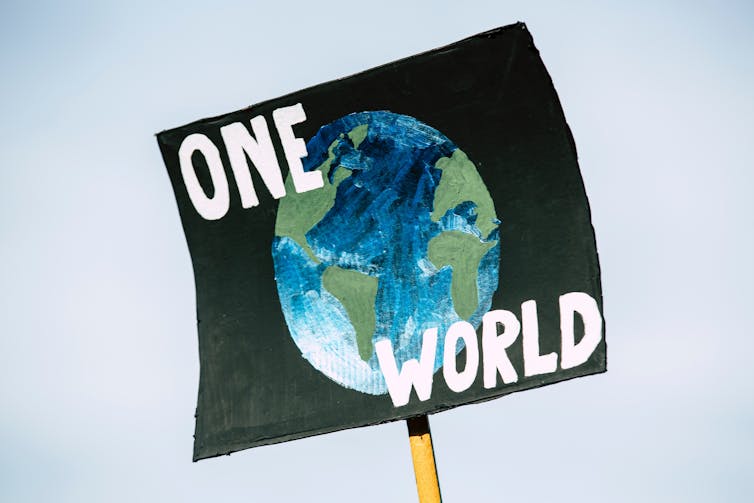
As if we don’t know its all wrapped up in one word   Inequality.Black placard with 'one world' written on it.

The cost of things average people must buy—healthcare, education, housing—tends to have risen more than wages did over the last two decades. Rising inequality across income, race and gender all demand urgent attention. It needs to made clear to leaders that in 2024 their citizens are expecting them to raise their ambition for humanity and deliver bold agreements to tackle poverty, inequality and climate change.

Government’s policy making will need to become more innovative to address such challenges other wise we going to have a left behind technological societies. We’re going to see, unfortunately, more technological unemployment. We’re going to have to think very carefully in political terms and in social terms about the implications of further automation.

Individual responsibility will play a role, too, in areas such as climate change.

To ignore the issue of inequality culture will need to adjust in terms of revisiting some of our values.

—————–

To start thinking outside of the box. We may have to consider very seriously ideas such as a universal basic income.

There are just over 7 billion people living on the planet today, spread between 196 (recognized) countries. Within each of these countries are groups of people with different ethnic backgrounds, different religious beliefs, different political beliefs. It’s because of these differences, you could argue, that the world is plagued by conflict.

Unfortunately, the future isn’t talking. It’s just coming, like it or not and we as individuals need to take ownership of this.

I dont know about you but I realized long ago that globalization was on its last legs. I also realize this isn’t pleasant to think about. Western economies have become knowledge based. This means Marx’s three factors of production (land, labor, capital) now have a fourth.

Politics as a social contract between a sovereign and citizens is no longer working. Each individual’s share of sovereignty, and therefore their freedom, diminishes as the social contract includes more people.

Power now resides with those best able to organize knowledge turning politicians into basically middlemen, bring a shift to direct democracy, with popular social media protests swamping sprawling governments.

We must do more to assertively channel technology to support progress and protect people and the planet.

As we entered the the 2020s it is clear that we are far from unlocking the potential of technology for our toughest challenges. We stand at a critical juncture to put these technologies to work in a responsible way for people and the planet.

Technology and political trends are aligning against mega-powers like the US and China.

How do we reconcile that with democracy in countries with millions of citizens?

Not with “America Alone” ” Brexit” or any other forms of isolation, which are highly problematic, as they are based on anxiety and insecurity, so inevitably create discord and division.

This is obvious to anyone with a brain looking at climate change – trade – wars – inequality – technology’s – and ideologies of I am all right Jack.

—————————

Historically, political regimes tend not to last more than a few centuries.

I’m not sure we can. Some things are so horrible, you don’t want to think about them.

  • Today’s great powers have little choice but to spend their way to political stability, which is unsustainable, and/or try to control knowledge, which is difficult.
  • Nor do we have any elder statesmen or nationally unifying figures whom everyone respects, much less agrees with. This will make our various problems worse.
  • Ownership rights mean little without a government to protect them and courts to settle disputes.
  • This world we now inhabit wasn’t always fit for human’s nothing requires it to remain so. At some point, it will develop into something else. When and how that will happen, we don’t know yet. But we know it will.
  • We haven’t even talked about climate change. Issues like climate change will create further exacerbations on conflicts, and new forms of technological and cyber warfare could threaten countries’ elections and manipulate populations.

In the last two years: 90% of the data in the world was created.

Now it is up  – technology companies large and small, industry, policy-makers, citizens and consumers alike – to use this power for good, before we run out of time. Now is the opportunity for leaders to step up into this new wave of opportunity and expectation.

We are the first generation to know we’re destroying the world, and we could be the last that can do anything about it. Our leaders are not on track to deliver. We need to ensure we hold our politicians accountable.

Food production is a major driver of wildlife extinction. We need to make wasting our resources unacceptable in all aspects of our life. We can all do more to be more conscious about what we buy, and where we buy it from.

We can and must end poverty and hunger, in all their forms and dimensions by addressing the underlying complex issues of fragility, conflict, and displacement and the looming threat of climate change.

The challenges facing the world are complex and intertwined and require complex solutions.

Another word is about to enter our collective dictionaries: permacrisis. What we do between now and 2030 will determine whether we as a collective species are intelligent or just dumm machines

Solutions to climate change and biodiversity loss won’t come from any one sector: they’ll come from governments, finance, business and civil society.

We’re analyzing satellite images but unable to see the picture that we all live on the same planet.

Like most of us, we are brought up to think in terms of countries with borders and different nationalities.

In some cases, there are natural borders formed by sea or mountains, but often borders between nations are simply abstractions, imaginary boundaries established by agreement or conflict.

How then do we explain nationalism? Why do humans separate themselves into groups and take on different national identities? Maybe different groups are helpful in terms of organisation, but that doesn’t explain why we feel different. Or why different nations compete and fight with one another.

When people are made to feel insecure and anxious, they tend to become more concerned with nationalism, status and success. Poverty and economic instability often lead to increased nationalism and to ethnic conflict.

The world in general does not have a sense of group identity.

If a terrorist’s biggest weapon is terror, climate change is going to inflict terror beyond belief.

Tsunami’s. Earthquake’s, Hurricane’s, Flood’s, War’s

We must shift 85% of the world’s energy supply to non-fossil fuel sources, not grant more oil exploration licences.  Our economies depend on healthy, supportive natural systems.

A more sustainable path is possible. But we need to rally individuals, governments, companies and communities around the world to take action with us over the next decade.

It’s impossible to override the fundamental interconnectedness of the human race.

People from all around the world need to take a stand a citizen’s movement using the NEW BEADY EYE HASHTAG:   #movebeyonditwiththebeadyeye

All human comments appreciated. All like clicks and abuse chucked in the bin.

Contact bobdillon33@gmail.com

Share this:

  • Click to share on WhatsApp (Opens in new window) WhatsApp
  • More
  • Click to share on Pocket (Opens in new window) Pocket
  • Click to share on Mastodon (Opens in new window) Mastodon

THE BEADY EYE ASK’S: THESE DAYS WHAT CAN WE BELIEVE IN ?

21 Thursday Dec 2023

Posted by bobdillon33@gmail.com in #whatif.com, 2023 the year of disconnection., A Constitution for the Earth., Advertising, Advertising industry, Algorithms., Artificial Intelligence.,  Attention economy, Capitalism, CAPITALISM IS INCOMPATIBLE IN THE FIGHT AGAINST CLIMATE CHANGE., Carbon Emissions., Civilization., Climate Change., Collective stupidity., Consciousness., Cry for help., Dehumanization., Democracy, Digital age., DIGITAL DICTATORSHIP., Digital Friendship., Disconnection., Discrimination., Earth, Emergency powers., Enegery, Environment, Face Recognition., Facebook, Fake News., Fourth Industrial Revolution., Freedom of Speech, Freedom of the Press., Google, Google Knowledge., GPS-Tracking., Green Energy., Happy Christmas from the Beady eye., Honesty., How to do it., Human Collective Stupidity., HUMAN INTELLIGENCE, Human values., Humanity., Imagination., Inequality, INTELLIGENCE., IS DATA DESTORYING THE WORLD?, James Webb Telescope, Life., MISINFORMATION., Modern Day Communication., Modern Day Democracy., Modern day life., Modern Day Slavery., Monetization of nature, Our Common Values., PAIN AND SUFFERING IN LIFE, Political lying., Political Trust, Politics., Populism., Post - truth politics., Profiteering., Purpose of life., Real life experience's, Reality., Renewable Energy., Robot citizenship., Social Media, Social Media Regulation., Society, State of the world, Sustaniability, Technology, Technology v Humanity, Telling the truth., The common good., The essence of our humanity., The Future, The Internet., THE NEW NORM., The Obvious., The pursuit of profit., The state of the World., The world to day., THE WORLD YOU LIVE IN., THIS IS THE STATE OF THE WORLD.  , TRACKING TECHNOLOGY., Truth, Truthfulness., Twitter, Unanswered Questions., Universal values., VALUES, We can leave a legacy worthwhile., What is shaping our world., WHAT IS TRUTH, Where's the Global Outrage., World Leaders, World Organisations., World Politics

≈ Comments Off on THE BEADY EYE ASK’S: THESE DAYS WHAT CAN WE BELIEVE IN ?

Tags

bible, god, philosophy, Religion., Science

( Fifteen minute read)

The last post this year, have a peaceful Christmas.

This post is a follow up to the post, ( What is life, What does it mean to be alive). It is also an attempt to argue for as many preposterous positions as possible in the shortest space of time possible.

That there are no options other than accepting that life is objectively meaningful or not meaningful at all.

Science requires proof, religious belief requires faith.

So let’s get God and Gods out of the way.

.Could quantum physics help explain a God that could be in two places at once? (Credit: Nasa)

If you believe in God, then the idea of God being bound by the laws of physics is nonsense, because God can do everything, even travel faster than light. If you don’t believe in God, then the question is equally nonsensical, because there isn’t a God and nothing can travel faster than light.

Perhaps the question is really one for agnostics, who don’t know whether there is a God.

The idea that God might be “bound” by the laws of physics – which also govern chemistry and biology might not be so far stretched that the James Webb telescope might discover him or her. Whether it does or does not, if it did discovered life on another planet and the human race realizes that its long loneliness in time and space may be over — the possibility we’re no longer alone in the universe is where scientific empiricism and religious faith intersect, with NO true answer?.

Could any answer help us prove whether or not God exists, not on your nanny.

If God wasn’t able to break the laws of physics, she or he arguably wouldn’t be as powerful as you’d expect a supreme being to be. But if he or she could, why haven’t we seen any evidence of the laws of physics ever being broken in the Universe?

If there is a God who created the entire universe and ALL of its laws of physics, does God follow God’s own laws? Or can God supersede his own laws, such as travelling faster than the speed of light and thus being able to be in two different places at the same time?

Let’s consider whether God can be in more than one place at the same time.

(According to quantum mechanics, particles are by definition in a mix of different states until you actually measure them.)

There is something faster than the speed of light after all: Quantum information.

This doesn’t prove or disprove God, but it can help us think of God in physical terms – maybe as a shower of entangled particles, transferring quantum information back and forth, and so occupying many places at the same time? Even many universes at the same time?

But is it true?

A few years ago, a group of physicists posited that particles called tachyons travelled above light speed. Fortunately, their existence as real particles is deemed highly unlikely. If they did exist, they would have an imaginary mass and the fabric of space and time would become distorted – leading to violations of causality (and possibly a headache for God).

(This in itself does not say anything at all about God. It merely reinforces the knowledge that light travels very fast indeed.)

We can calculate that light has travelled roughly 1.3 x 10 x 23 (1.3 times 10 to the power 23) km in the 13.8 billion years of the Universe’s existence. Or rather, the observable Universe’s existence.

The Universe is expanding at a rate of approximately 70km/s per Mpc (1 Mpc = 1 Megaparsec or roughly 30 billion billion kilometres), so current estimates suggest that the distance to the edge of the universe is 46 billion light years. As time goes on, the volume of space increases, and light has to travel for longer to reach us.

We cannot observe or see across the entirety of the Universe that has grown since the Big Bang because insufficient time has passed for light from the first fractions of a second to reach us. Some argue that we therefore cannot be sure whether the laws of physics could be broken in other cosmic regions – perhaps they are just local, accidental laws. And that leads us on to something even bigger than the Universe.

But if inflation could happen once, why not many times?

We know from experiments that quantum fluctuations can give rise to pairs of particles suddenly coming into existence, only to disappear moments later. And if such fluctuations can produce particles, why not entire atoms or universes? It’s been suggested that, during the period of chaotic inflation, not everything was happening at the same rate – quantum fluctuations in the expansion could have produced bubbles that blew up to become universes in their own right.

How come all the physical laws and parameters in the universe happen to have the values that allowed stars, planets and ultimately life to develop?

We shouldn’t be surprised to see biofriendly physical laws – they after all produced us, so what else would we see? Some theists, however, argue it points to the existence of a God creating favourable conditions.

But God isn’t a valid scientific explanation.

We can’t disprove the idea that a God may have created the multiverse.

No matter what is believable or not, things can appear from nowhere and disappear to nowhere.

If you find this hard to swallow, what follows will make you choke.

First there is panpsychism, the idea that “consciousness pervades the universe and is a fundamental feature of it.

Even particles are never compelled to do anything, but are rather disposed, from their own nature, to respond rationally to their experience. That the universe is conscious and is acting towards a purpose of realising the full potential of its consciousness.

The radicalism of this “teleological cosmopsychism” is made clear by its implication that “during the first split second of time, the universe fine-tuned itself in order to allow for the emergence of life billions of years in the future”. To do this, “the universe must in some sense have been aware of this future possibility”.

That the universe itself has a built-in purpose, the disappointingly vague goal of which is “rational matter achieving a higher realisation of its nature.

The laws of physics are just right for conscious life to evolve that it can’t have been an accident.

It is hard to see why the universe’s purpose should give our lives one. Indeed, to believe one plays an infinitesimally small part in the unfolding of a cosmic master plan makes each human life look insignificant.

The basic question about our place in the Universe is one that may be answered by scientific investigations.

What are the next steps to finding life elsewhere?

Today’s telescopes can look at many stars and tell if they have one or more orbiting planets. Even more, they can determine if the planets are the right distance away from the star to have liquid water, the key ingredient to life as we know it.

NEXT:How to Choose Which Social Media Platforms to Use

We live in a time of political fury and hardening cultural divides. But if there is one thing on which virtually everyone is agreed, it is that the news and information we receive is biased. Much of the outrage that floods social media, occasionally leaking into opinion columns and broadcast interviews, is not simply a reaction to events themselves, but to the way in which they are reported and framed that are the problem.

This mentality now with the help of technological advances in communication spans the entire political spectrum and pervades societies around the world twisting our basic understanding of reality to our own ends.

This is not as simple as distrust.

The appearance of digital platforms, smartphones and the ubiquitous surveillance have enable to usher in a new public mood that is instinctively suspicious of anyone claiming to describe reality in a fair and objective fashion. Which will end in a Trumpian refusal to accept any mainstream or official account of the world with people become increasingly dependent on their own experiences and their own beliefs about how the world really works.

The crisis of democracy and of truth are one and the same:

Individuals are increasingly suspicious of the “official” stories they are being told, and expect to witness things for themselves.

How exactly do we distinguish this critical mentality from that of the conspiracy theorist, who is convinced that they alone have seen through the official version of events? Or to turn the question around, how might it be possible to recognise the most flagrant cases of bias in the behaviour of reporters and experts, but nevertheless to accept that what they say is often a reasonable depiction of the world?

It is tempting to blame the internet, populists or foreign trolls for flooding our otherwise rational society with lies.

But this underestimates the scale of the technological and philosophical transformations that are under way. The single biggest change in our public sphere is that we now have an unimaginable excess of news and content, where once we had scarcity. The explosion of information available to us is making it harder, not easier, to achieve consensus on truth.

As the quantity of information increases, the need to pick out bite-size pieces of content rises accordingly.

In this radically sceptical age, questions of where to look, what to focus on and who to trust are ones that we increasingly seek to answer for ourselves, without the help of intermediaries. This is a liberation of sorts, but it is also at the heart of our deteriorating confidence in public institutions.

There is now a self-sustaining information ecosystem becoming a serious public health problem across the world, aided by the online circulation of conspiracy theories and pseudo-science. However the panic surrounding echo chambers and so-called filter bubbles is largely groundless.

What, then, has to changed?

The key thing is that the elites of government and the media have lost their monopoly over the provision of information, but retain their prominence in the public eye.

And digital platforms now provide a public space to identify and rake over the flaws, biases and falsehoods of mainstream institutions.

The result is an increasingly sceptical citizenry, each seeking to manage their media diet, checking up on individual journalists in order to resist the pernicious influence of the establishment.

The problem we face is not, then, that certain people are oblivious to the “mainstream media”, or are victims of fake news, but that we are all seeking to see through the veneer of facts and information provided to us by public institutions.

Facts and official reports are no longer the end of the story.

The truth is now threatened by a radically different system, which is transforming the nature of empirical evidence and memory. One term for this is “big data”, which highlights the exponential growth in the quantity of data that societies create, thanks to digital technologies.

The reason there is so much data today is that more and more of our social lives are mediated digitally. Internet browsers, smartphones, social media platforms, smart cards and every other smart interface record every move we make. Whether or not we are conscious of it, we are constantly leaving traces of our activities, no matter how trivial.

But it is not the escalating quantity of data that constitutes the radical change.

Something altogether new has occurred that distinguishes today’s society from previous epochs.

In the past, recording devices were principally trained upon events that were already acknowledged as important.

Things no longer need to be judged “important” to be captured.

Consciously, we photograph events and record experiences regardless of their importance. Unconsciously, we leave a trace of our behaviour every time we swipe a smart card, address Amazon’s Alexa or touch our phone.

For the first time in human history, recording now happens by default, and the question of significance is addressed separately.

This shift has prompted an unrealistic set of expectations regarding possibilities for human knowledge.

When everything is being recorded, our knowledge of the world no longer needs to be mediated by professionals, experts, institutions and theories. Data can simply “speak for itself”. This is a fantasy of a truth unpolluted by any deliberate human intervention – the ultimate in scientific objectivity.

From this perspective, every controversy can in principle be settled thanks to the vast trove of data – CCTV, records of digital activity and so on – now available to us. Reality in its totality is being recorded, and reporters and officials look dismally compromised by comparison.

It is often a single image that seems to capture the truth of an event, only now there are cameras everywhere.

No matter how many times it is disproven, the notion that “the camera doesn’t lie” has a peculiar hold over our imaginations. In a society of blanket CCTV and smartphones, there are more cameras than people, and the torrent of data adds to the sense that the truth is somewhere amid the deluge, ignored by mainstream accounts.

The central demand of this newly sceptical public is “so show me”.

The rise of blanket surveillance technologies has paradoxical effects, raising expectations for objective knowledge to unrealistic levels, and then provoking fury when those in the public eye do not meet them.

Surely, in this age of mass data capture, the truth will become undeniable.

On the other hand, as the quantity of data becomes overwhelming – greater than human intelligence can comprehend – our ability to agree on the nature of reality seems to be declining. Once everything is, in principle, recordable, disputes heat up regarding what counts as significant in the first place.

What we are discovering is that, once the limitations on data capture are removed, there are escalating opportunities for conflict over the nature of reality.

Remember AI does not exist in a vacuum, its employment can and is discriminating against communities, powered by vast amounts of energy,  producing CO2 emissions.

Lastly the Advertising Industry.The impact of COVID-19 on the advertising industry - Passionate In ...

These day it seems that it has free rain to claim anything.

Like them or loathe them, advertisements are everywhere and they’re worsening not just the climate crisis, and ecological damage by promoting sustainability in consumption and inequality. Presenting a fake, idealised world that papers over an often brutal reality.

But advertising in one sense is even more dangerous, because it is so pervasive, sophisticated in its techniques and harder to see through. When hundreds of millions of people have desires for more and more stuff and for more and more services and experiences, that really adds up and puts a strain on the Earth.

The toll of disasters propelled by climate change in 2023 can be tallied with numbers — thousands of people dead, millions of others who lost jobs, homes and hope, and tens of billions of dollars sheared off economies. But numbers can’t reflect the way climate change is experienced — the intensity, the insecurity and the inequality that people on Earth are now living.

In every place that climate change makes its mark, inequality is made worse.

How are we going to protect the truth:

It goes without saying that spiritual beliefs will protect themselves. Lies, propaganda and fake news however is the challenge for our age.

Working out who to trust and who not to believe has been a facet of human life since our ancestors began living in complex societies. Politics has always bred those who will mislead to get ahead.

With news sources splintering and falsehoods spreading widely online, can anything be done?

Check Google.

Welcome to the world of “alternative facts”. It is a bewildering maze of claim and counterclaim, where hoaxes spread with frightening speed on social media and spark angry backlashes from people who take what they read at face value.

It is an environment where the mainstream media is accused of peddling “fake news” by the most powerful man in the world.

Voters are seemingly misled by the very politicians they elected and even scientific research – long considered a reliable basis for decisions – is dismissed as having little value.

Without a common starting point – a set of facts that people with otherwise different viewpoints can agree on – it will be hard to address any of the problems that the world now faces. The threat posed by the spread of misinformation should not be underestimated.

Some warn that “fake news” threatens the democratic process itself.

A survey conducted by the Pew Research Center towards the end of last year found that 64% of American adults said made-up news stories were causing confusion about the basic facts of current issues and events.

How we control the dissemination of things that seem to be untrue. We need a new way to decide what is trustworthy.

Take Wikipedia itself – which can be edited by anyone but uses teams of volunteer editors to weed out inaccuracies – is far from perfect.

These platforms and their like are simply in it for the money.

Last year, links to websites masquerading as reputable sources started appearing on social media sites like Facebook.

Stories about the Pope endorsing Donald Trump’s candidacy and Hillary Clinton being indicted for crimes related to her email scandal were shared widely despite being completely made up. The ability to share them widely on social media means a slice of the advertising revenue that comes from clicks.

Truth is no longer dictated by authorities, but is networked by peers. For every fact there is a counterfact. All those counterfacts and facts look identical online, which is confusing to most people.

Information spreads around the world in seconds, with the potential to reach billions of people. But it can also be dismissed with a flick of the finger. What we choose to engage with is self-reinforcing and we get shown more of the same. It results in an exaggerated “echo chamber” effect.

The challenge here is how to burst these bubbles.

One approach that has been tried is to challenge facts and claims when they appear on social media. Organisations like Full Fact, for example, look at persistent claims made by politicians or in the media, and try to correct them. (The BBC also has its own fact-checking unit, called Reality Check.)

This approach doesn’t work on social media because the audiences were largely disjointed.

Even when a correction reached a lot of people and a rumour reached a lot of people, they were usually not the same people. The problem is, corrections do not spread very well. This lack of overlap is a specific challenge when it comes to political issues.

On Facebook political bodies can put something out, pay for advertising, put it in front of millions of people, yet it is hard for those not being targeted to know they have done that. They can target people based on how old they are, where they live, what skin colour they have, what gender they are.

We shouldn’t think of social media as just peer-to-peer communication – it is also the most powerful advertising platform there has ever been. We have never had a time when it has been so easy to advertise to millions of people and not have the other millions of us notice.

Twitter and Facebook both insist they have strict rules on what can be advertised and particularly on political advertising. Regardless, the use of social media adverts in politics can have a major impact.

We need some transparency about who is using social media advertising when they are in election campaigns and referendum campaigns. We need watchdogs that will go around and say, ‘Hang on, this doesn’t stack up’ and ask for the record to be corrected.

We need Platforms to ensure that people have read content before sharing it to develop standards.

Google says it is working on ways to improve its algorithms so they take accuracy into account when displaying search results. “Judging which pages on the web best answer a query is a challenging problem and we don’t always get it right,”

The challenge is going to be writing tools that can check specific types of claims.

Built a fact-checker app that could sit in a browser and use Watson’s language skills to scan the page and give a percentage likelihood of whether it was true.

This idea of helping break through the isolated information bubbles that many of us now live in, comes up again and again.

By presenting people with accurate facts it should be possible to at least get a debate going.

There is a large proportion of the population living in what we would regard as an alternative reality.  By suggesting things to people that are outside their comfort zone but not so far outside they would never look at it you can keep people from self-radicalising in these bubbles.

There are understandable fears about powerful internet companies filtering what people see.

We should think about adding layers of credibility to sources. We need to tag and structure quality content in effective ways.

But what if people don’t agree with official sources of information at all?

This is a problem that governments around the world are facing as the public views what they tell them with increasing scepticism. There is an unwillingness to bend one’s mind around facts that don’t agree with one’s own viewpoint.

The first stage in that is crowdsourcing facts.  So before you have a debate, you come up with the commonly accepted facts that people can debate from.

Technology may help to solve this grand challenge of our age, but it is time for a little more self-awareness too.

In the end the world needs a new Independent Organisation to examine all technology against human values. Future war will be fought on Face recognition.

To certify and hold the original programs of all technology.

Have I been trained by robbery its manter when it comes to algorithms.

The whole goal of the transition is not to allow a handful of Westerners to peacefully go through life in a Tesla, a world in flames; it is to allow humanity – and the rest of biodiversity – to live decently.

All human comments appreciated. All like clicks and abuse chucked in the bin.

Contact: bobdillon33@gmail.com

Share this:

  • Click to share on WhatsApp (Opens in new window) WhatsApp
  • More
  • Click to share on Pocket (Opens in new window) Pocket
  • Click to share on Mastodon (Opens in new window) Mastodon

THE BEADY EYE SAY’S . THE ADVERTISING INDUSTRY MUST BE BROUGHT TO HEAL WITH NEW LAWS TO REDUCE CONSUMPTION.

25 Tuesday Apr 2023

Posted by bobdillon33@gmail.com in #whatif.com, 2023 the year of disconnection., Advertising, Advertising industry,  Attention economy, Capitalism, CO2 emissions, Cry for help., Desensitization., Environment, How to do it., Human values., Modern day life., Profiteering., State of the world, Sustaniability, Telling the truth., The common good., The Obvious., The pursuit of profit., The world to day., Unanswered Questions., Universal values., VALUES, What is shaping our world., Where's the Global Outrage.

≈ Comments Off on THE BEADY EYE SAY’S . THE ADVERTISING INDUSTRY MUST BE BROUGHT TO HEAL WITH NEW LAWS TO REDUCE CONSUMPTION.

( Seven minute read)

It is crystal clear that consumption is a major donator to the problems of both the environment and all of us are now facing. There is consistent evidence that exposure to marketing for unhealthy commodities – for example advertising for alcohol or food and drinks high in fat, salt, or sugar – is associated with consumption, including among children and young people.

To confront the climate emergency, the amount we consume needs to drop dramatically. Yet every day we’re told by the advertising industry to consume more.

The purpose of advertising is to boost revenue, gain an advantage over competitors, and build brand awareness, so it latch on to what ever is topical – Climate change – Energy – Sustainability – Cost of living etc.

Now with technology it has billion-dollar persuasion machines, promoting not quality of life but rather quantity of stuff.

It’s woven into our personal communications whenever we use social media platforms. In public spaces, where we have little choice over where we look, adverts are invasive, appearing without our consent, with the trend towards digital billboards only exposes us ever more.

Its so prevalent as to be invisible but with an effect no less insidious than air pollution.

We all have a role to play — from making sustainable choices to help safeguard the ocean and our environment, to urging world and business leaders to take the urgent, widespread, and ambitious action needed to tackle climate change and protect the planet.

———

This is an industry capable of quickly shifting global public opinion, with the power to change hearts, minds and behaviour resulting in action, potentially on a global scale and also with profound and rapid effect.

It must be made to take responsibility for consumption, instead of continuing to drive the high carbon lifestyles and hyper-consumption that is killing us.

If we were to introduce new laws restricting marketing agencies from taking work from clients who aren’t actively reducing their own contributions to climate change, earning money from high carbon clients, the sort of companies from whom the investment community is increasingly divesting; promoting unnecessary and over-consumption, these companies  would eventually be forced to match their green advertising slogans with real green investment.

The questions for the advertising industry would become what are our obligations to tackle climate change i.e. how might we have contributed to climate change and how do we stop doing so, and what are our opportunities i.e. where can we make a positive contribution to the issue?

What other than laws will forced  it to rethink their strategies so the industry will go through a transition period, to discover a purpose beyond profit?

In fact, many would argue that the move to “doing well by doing good” will only become truly mainstream when the corporate social responsibility agenda and the growth agenda become one and the same.

There is no reason that governments could not introduce restricted areas and venues where the advertising of consumption is not allowed.

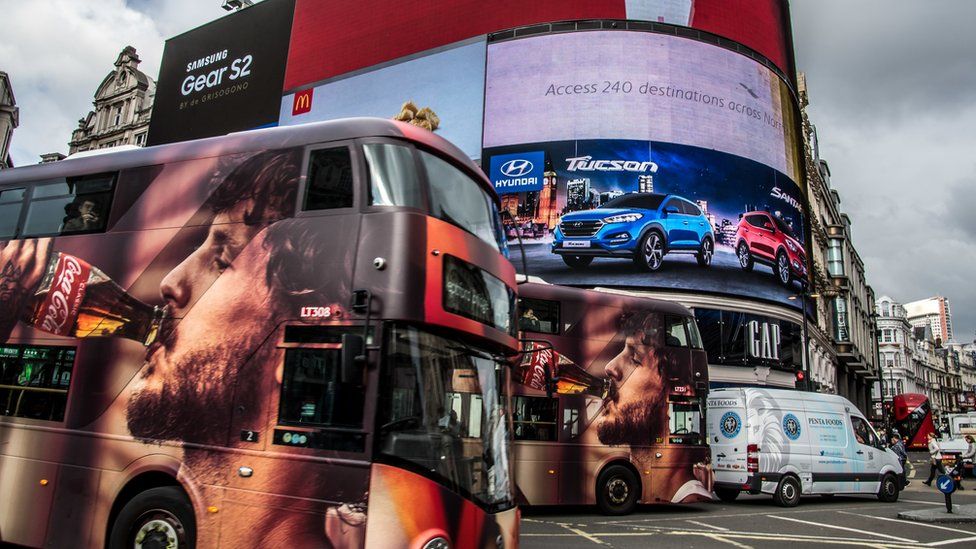
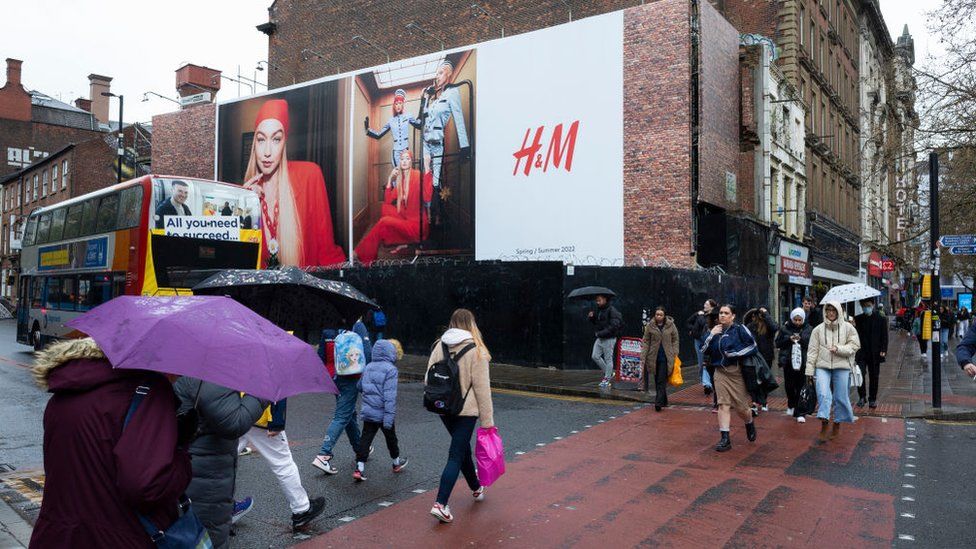
Buses covered in advertising at London's Piccadilly CircusA billboard advert in Manchester

For example:  Sporting events, Natural Reserves/ Public Park’s, Billboards and bus stops, Out door digital advertising.

We could stop television programming being sponsored by consumption  – Eat now.

Of course in a free society, businesses have the right to advertise their wares, and individual citizens are not the helpless brainless automatons that advertising industry’s considers them to be.

All advertising plays a crucial role in brand competition, drives product innovation, and fuels economic growth but would we not rather see community ads and art than have multi-billion companies putting logos and images everywhere?

If they are allowed to get the message out, the public has a right to reply to those ads.

We don’t want our city’s children bombarded with animated advertising on TV screens in the street.

Critically, the more that people prioritise materialistic values and goals, the less they embrace positive attitudes towards the environment – and the more likely they are to behave in damaging ways. If you think this is a fanciful aim, then you might need to think again with the state the world is in.

We’re in a place where major behaviour change is required.

To question the legitimacy of corporate outdoor adverting and draw attention to the impact they can have on social issues, mental health, wellbeing, the climate, and the communication of public space where governments are too inert/broke/ill-intentioned/in thrall to vested interests to take effective action.

Business leaders must increasingly look beyond short-term profitability to address the pressing need to reduce emissions.

——

.The advertising industry is in a very different place to where it was a year ago.

Where, how, and when you advertise will constantly change with the times. That’s one thing we can count on.

Culture has always defined marketing and brand marketers have a lot of power to dictate.

The rise of the internet, computers, and mobile devices only provided more platforms for video ads to appear. It’s probably still going to be one of the most important advertising trends in the next 5 years.

We have our hands on the levers of behaviour change, but in an era in which attention is often only ever partial, puncturing the collective consumer inertia with a complex message is no easy feat.

We spend every day thinking of ways to change people’s behaviours,

These skills are the ones needed more than ever by the world to halt the human causes of climate change.

——–

Advertising has always evolved with the technology at hand. This includes tracking of clicked links, customer behaviour, purchase history, survey responses, and more.

Marketers can then use that information to create custom messages or content that’ll match the target audiences’ interests.

Finding out which people to show a particular ad to and the right time to show them is crucial in the world of smartphones

Next step, profit.

——-

In a cut-throat and viciously competitive market, pioneering new technology can have a major impact on the effectiveness of advertising campaigns.

Another big use of mobile advertising is through games.

A lot of mobile games are created with the format of being able to purchase resources with real-world money.

This means that ads will now be geared towards targeting real people through emails and other registered user data. With more information available, marketers can provide customers with a better offer that’ll most likely translate into sales.

Social advertising is the use of Facebook, LinkedIn, Instagram, Twitter, and other social media platforms for advertising potentials.

The format itself is undergoing rapid transformation because most people watch for content and not for production quality.

Data collection and cookies naturally have poor public perception, often being viewed as encroaching on private information and stealing data, with ads following consumers around the internet.

Now, these apps aren’t just for sending messages and emoji cause it’s also a place to find advertisements relevant to users.

As the climate crisis bites

————

We need new metrics and measurement tools – and new bonus and remuneration systems to underpin our value systems, not just legislation against high-carbon advertising, focusing on fossil fuel companies, petrol- and diesel-engine cars and aviation.

Because, marketing has been transformed by digital speed, relevance and reach of advertising campaigns.

Because, overconsumption in general, encouraged by advertising, has a climate and ecological impact.

Because, programmatic advertising uses AI to automatically buy ads that can target audiences more specifically. ( Programmatic advertising is a combination of big data processing, technical skills, and automation.)

Because, advertising works by getting under your radar, introducing new ideas without bothering your conscious mind.

Because, contextual advertising is a form of targeted advertising where site content and keywords are analyzed in real time to determine their suitability for a brand’s message.

Because, children are now at the mercy of so-called “surveillance advertising”. It is estimated that by the time a child turns 13, ad-tech firms would have gathered 72m data points on them. The more data collected from an early age, the easier it is for advertisers to turn young children into consumer targets.


A transformation of marketing is underway as we spend more time on our mobiles, tablets and laptops. The real-time conversations brands have with people as they interact with websites and mobile apps has changed the nature of marketing

We know that advertising is a key engine of the economy. There are visual images and marketing messages that have insinuated themselves into the nervous systems of humans.

There’s a long way to go and a lot to be done. The ad business, with strategy tools and processes that were for the most part developed in the 60s to accommodate the advent of commercial TV, is a lot closer to where it started the journey than where it needs to get to.

Let’s create a movement and band together to save the planet in a non-branded or political way.

New checks and balances need to accommodate the natural concerns of councils and residents around climate, air pollution, environmental light pollution, the “attention economy”, mental health and the dominance of non-consensual adverts in public spaces.

I’m sure most advertisers and agencies would rather work on solving this global crisis, and if we can use just 5% of the industry’s time toward this initiative.

It isn’t clickbait that is needed but a genuine concern for the fate of the planet or a cynical hunch that doing the right thing will drive growth and profit – if the improved behaviour is real.

I believe that would lead to greater satisfaction, retention and more.

Break the Silence and comment.

All human comments appreciated. All like clicks and abuse chucked in the bin.

Contact; bobdillon33@gmail.com

Share this:

  • Click to share on WhatsApp (Opens in new window) WhatsApp
  • More
  • Click to share on Pocket (Opens in new window) Pocket
  • Click to share on Mastodon (Opens in new window) Mastodon

THE BEADY EYE ASKS. WHAT IN TODAYS WORLD IS THE VALUE OF A HUMAN LIFE?

23 Tuesday Aug 2022

Posted by bobdillon33@gmail.com in 2022: The year we need to change., Algorithms.,  Attention economy, Capitalism, Civilization., Dehumanization., Fourth Industrial Revolution., Human Collective Stupidity., Human Exploration., Inequality, Life., Modern day life., Modern day Slavery, Money in Politics., Our Common Values., Profiteering., State of the world, Technology v Humanity, Telling the truth., The common good., The Obvious., The state of the World., The world to day., THE WORLD YOU LIVE IN., Unanswered Questions., Universal values., VALUES, What is shaping our world., What Needs to change in the World, World Economy.

≈ Comments Off on THE BEADY EYE ASKS. WHAT IN TODAYS WORLD IS THE VALUE OF A HUMAN LIFE?

Tags

Algorithms., Capitalism and Greed, Distribution of wealth, The Future of Mankind, Visions of the future.

( Five minute read)

A profoundly ethical issue.

“What makes a life worth living?” “What is a life worth? ” are both questions that nobody can answer and should perhaps remain unanswered.

These questions once came pre-answered—by culture, by religion, by tradition—but these days, because of capitalism we each have to ask and answer for ourselves, with an answer not in poetic words or any words but an answer in pounds and pence or dollars and cents.

The “real question today is not when human life begins, but, what is the value of human life?”

The task of valuing life has many competing truths with no simple answer.

“Price tags are being continuously placed on our lives. If we care about equity, we need to ensure that the science behind these estimates is not oversold and that fairness is always a consideration when cost-benefit analysis is performed.”

Howard Steven Friedman

Valuing some lives more than others seems logical and natural to many of us.

We value human life in a way that assumes we possess a sacred something.

Aristotle concluded that we should value human life, due to our inherent capacity for reason.

So what reasons can we give for calling human life valuable?

The question’s complexity resides in the fact that how we arrive at a price tag on human life says a great deal about our priorities. A lot of the value we attribute to human life comes from religion. However, when you remove religion, what philosophical arguments are left?

This is were it gets tricky.

The philosopher’s job is not to accept the assumed inheritance of our forebears.

Do we determine the value of a human life based on the value we place on our lives in private decisions, and do we accept policy choices that puts future generations at risk.

Do we continue to value human life, especially above and beyond animals? If you value rationality, why is that? And does rationality, alone, bestow value on a human life?

How should we proceed?

We teach each generation that human life is valuable beyond all else.

.Is this good enough today?

Government officials are supposed to put numbers on the pros and cons of these questions but how to assess the value of a human life in financial terms is riddled with conundrum based on our behaviour which has no common denominators to adjust our assessment of a life’s value based on its quality or the probability of death?

How much should we pay today to prevent an event that would result in the loss of ten billion human lives in 50 years?    Climate Change.

So, how much is a life worth?

It seems so inhumane to put a monetary value our modern sentiments tell us that costs should not dictate life-and-death decisions. But those modern sentiments do not fit our modern experience.

We know that not all lives are valued by society equally.

Over the past four centuries, generations of black people have asked the question: What is a black life worth?

The summation of historical facts and statistical data clearly shows that the prices of black bodies in America are worth more imprisoned, enslaved, and dead than educated.

Here in Europe depending on all sorts of assumptions arisen by the Covid pandemic and now the war in the Ukraine there are a lots of conversations (right now) that seem to pit economics against life and health.

The result is the cost of living is mounting day on day while its value is descending but don’t worry your value is being look after by  the invisible hand of the market  run algorithms is giving your value the finger.

Unfortunately GDP distribution issue are now surfacing, like where is the GDP growth actually coming from?  Who’s losing income?  Does it increase equity in society?

How much a person is willing to accept to risk their own life – Climate change.

In the end the answer is my life is worth everything to me.

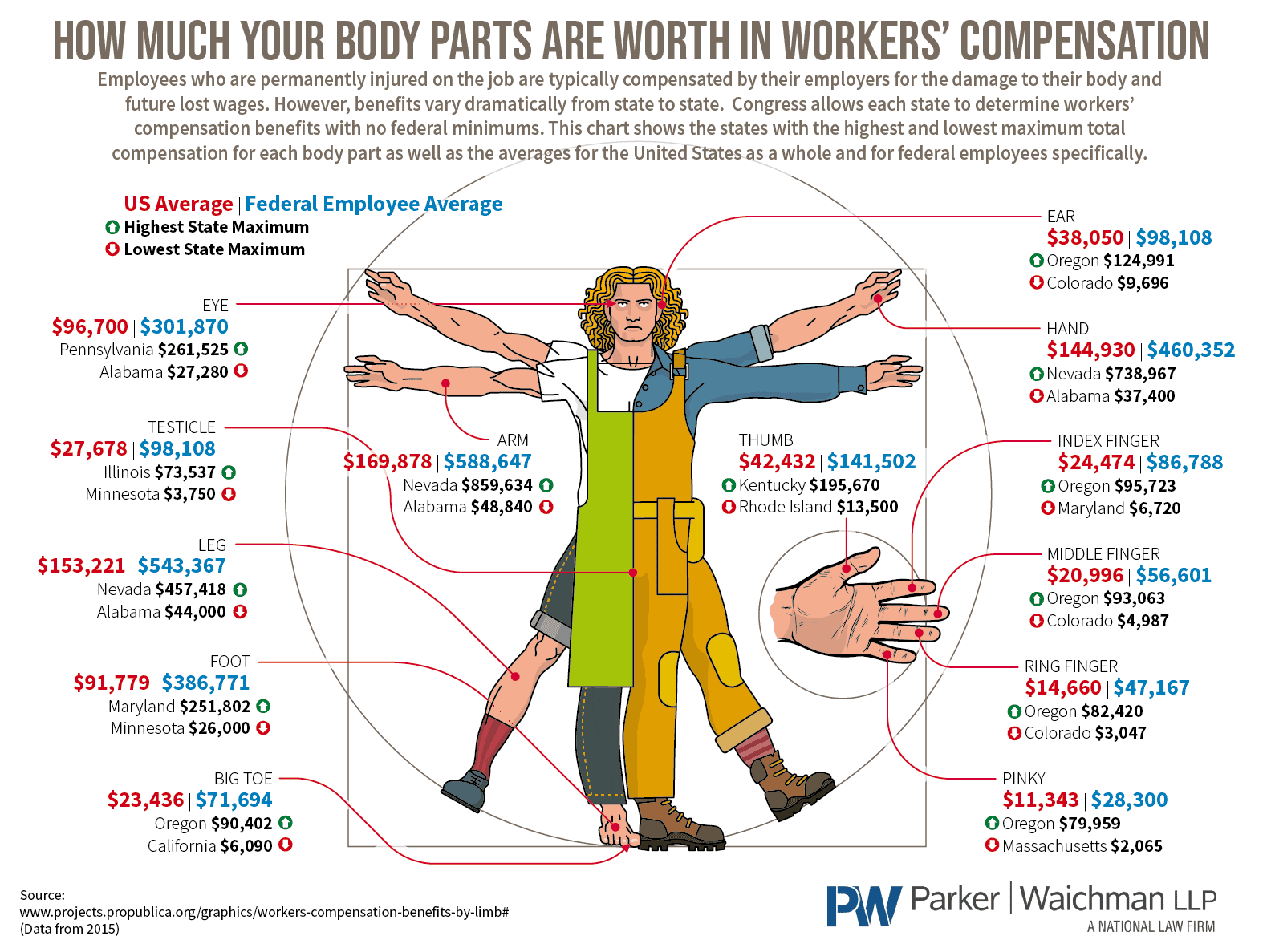
How much money do you get for losing a limb? It depends on where you live.

How much body parts worth workers compensation 4

Foot note . What’s wrong with killing people?

Abortion kills babies, and its advocates are loudly telling us the value they place on human life.

The idea is that we can best understand what life is worth by first understanding what death means.

All human comments appreciate. All abuse and like clicks chucked in the bin.

Contact:  bobdillon33@gmail.com

Share this:

  • Click to share on WhatsApp (Opens in new window) WhatsApp
  • More
  • Click to share on Pocket (Opens in new window) Pocket
  • Click to share on Mastodon (Opens in new window) Mastodon

THE BEADY EYE ASKS. WHY ARE WE SO BLIND TO WHAT IS HAPPING IN THE WORLD.

16 Saturday Oct 2021

Posted by bobdillon33@gmail.com in 2021. The year for change., Artificial Intelligence.,  Attention economy, Big Data., Communication., Dehumanization., Digital age., DIGITAL DICTATORSHIP., Evolution, HUMAN INTELLIGENCE, Human values., Humanity., Life., MISINFORMATION., Modern day life., Our Common Values., POST COVID-19., Purpose of life., Reality., Survival., Sustaniability, Technology v Humanity, Technology., The common good., The essence of our humanity., The Internet., The state of the World., The world to day., THE WORLD YOU LIVE IN., THIS IS THE STATE OF THE WORLD.  , Unanswered Questions., VALUES, We can leave a legacy worthwhile., What Needs to change in the World, Where's the Global Outrage.

≈ Comments Off on THE BEADY EYE ASKS. WHY ARE WE SO BLIND TO WHAT IS HAPPING IN THE WORLD.

Tags

Algorithms., Artificial Intelligence., Capitalism vs. the Climate., Extinction, Internet, SMART PHONE WORLD, The Future of Mankind, Visions of the future.

( Seven-minute read) 

What if you woke up tomorrow and everything you had thought was true was a deception?

A deception formed by people that stood to profit from your ignorance. Not just on one small area but every facet of your existence.

Would you want to know? Or, would you be content with the life you had before you discovered the truth? Could you close your eyes and act as if nothing ever happened?

What if you could see the ways that you have been deceived and the way that those that came before you were made to believe a lie? How valuable would the truth become? Would it make you change your habits? your routines? the way you talk or think or speak? Would it impact you or would you brush it off and carry on with business as usual?

What if after waking up you decided to respond to that truth?

What if you started studying history and world events and, like a string of pearls, events were no longer random but contained a sequence? What if that sequence was repeating? What if while studying these events they began to seem familiar?

None so Blind2.jpg


We live in an age in which intersecting crises are being lifted to a global scale, with unseen levels of inequality, environmental degradation, and climate destabilization, as well as new surges in populism, conflict, economic uncertainty, and mounting public health threats with Covid. 

All are crises that are slowly tipping the balance, questioning our business-as-usual economic model of the past decades, and requiring us to rethink our next steps.

There is an entire media world around us, that we’re completely fine with THAT FEEDS US FOR THE MOST PART SHIT AS ENTERTAINMENT. 

There is an advertising industry that is turning climate change into products to sell.

Bio this Bio that. Shop to save the world.

Our lives are taken over by technology – smartphones, Ipads, Apps. This menace is seen in the increased addiction of internet users to social media and other internet products; and the exploitation of internet users by internet companies.

The internet and social media are like a two-faced coin; one side is good and the other is bad. These inventions are now abused and used against our existence and survival.

The internet and computers are daily changing our lives and improving efficiency, almost taking over our lives with some sectors where technology is taking over how we live and do business.

Emails and social media platforms have changed communication, both individually and business-wise.

Financial transactions and business deals are now completed in a matter of seconds.

The idea of constantly visiting a doctor for medical checks is almost becoming obsolete with the invention of the wearable.

Robots are increasing the efficiency of manufacturing processes.

                                         ——————-

The Zombie Apocalypse May Not Be How You Originally Envisioned, it’s time to give ourselves a reality check. 

We are shells of who we may have been because instead of looking around and experiencing the life we are dependent upon a lit-up screen.

We are lacking socialization; instead of talking to and spending time with other people, we are getting all our information from the Internet.

The Internet is an amazing resource, but there are some things it cannot teach or give you.

It cannot teach you the value of spending time with friends and family, or how to live life to the fullest by being present in the current moment. You never know just how many opportunities and experiences pass you by because you are looking down at your screen.

Each generation is becoming more and more dependent, and no longer sustain skills that were once deemed necessary. We have lost social skills, manners, and expect everything to be delivered to us as fast as the Internet does

We are all so distracted by our phones that we have not fully noticed the zombie apocalypse that is happening right in front of us.

Technology is a beautiful thing, but if we cannot learn how to use it responsibly and in moderation, our future may not be as bright as the screens we are holding.

                                                ———–

The important thing people need to realize.

The chances are, you’re probably reading this on your phone right now.

Maybe you saw it while you were scrolling through Facebook, or maybe you came across it while making random Google searches. The point is, you used some sort of technology to be able to access this article.

Nowadays, people use technology as a filler.

Try to remember what life was like before you were attached to technology by the hip.

I bet you spent your time doing totally different things than you currently are doing.

Maybe you used to read actual books, go outside and enjoy the weather, spend quality time with your family or communicate with people through handwritten letters rather than emails and text messages.

The reality is that our lives have completely changed.

But is it for the better, or worse?

The basis of democracy is the idea that people of sound judgment, wisdom, and morality should be chosen to lead the government, make decisions for the masses, and direct the force of the state/government. 

“The state is the great fiction by which everyone endeavors to live at the expense of everyone else.” Frederic Bastiat 

A divided people are easier to rule. 

Governments act in multiple ways to seduce us into their service.

For the masses, this is done through the illusion of welfare and public spending in which the state first robs us through taxation and then bribes us into supporting it by giving us a percentage of the stolen funds back in the forms of government welfare programs. 

All human comments are appreciated. All like clicks and abuse chucked in the bin. 

Go back

Your message has been sent

Warning
Warning
Warning
Warning

Warning.


Share this:

  • Click to share on WhatsApp (Opens in new window) WhatsApp
  • More
  • Click to share on Pocket (Opens in new window) Pocket
  • Click to share on Mastodon (Opens in new window) Mastodon

THE BEADY EYE ASKS. IS THE WORLD SPINNING OUT OF CONTROL ?

10 Friday Sep 2021

Posted by bobdillon33@gmail.com in #whatif.com, 2021. The year for change.,  Attention economy, Human Collective Stupidity., Human values., Humanity., Inequality, Olympic circus., OLYMPICS GAMES., Our Common Values., Poverty, Religion., Religious Beliefs., Sustaniability, Technology v Humanity, The common good., The essence of our humanity., The Obvious., The state of the World., The world to day., THE WORLD YOU LIVE IN., THIS IS THE STATE OF THE WORLD.  , Truth, Unanswered Questions., We can leave a legacy worthwhile., What Needs to change in the World, Where's the Global Outrage.

≈ Comments Off on THE BEADY EYE ASKS. IS THE WORLD SPINNING OUT OF CONTROL ?

Tags

 Attention economy


(Twenty-minute read) 


To quote:

Stephen Hawking

“Ever since the dawn of civilization, people have not been content to see

events as unconnected and inexplicable. They have craved an understanding

of the underlying order in the world. Today we still yearn to know why we are

here and where we came from. Humanity’s deepest desire for knowledge is

justification enough for our continuing quest. And our goal is nothing less

than a complete description of the universe we live in.”

                                               —————–

Humans have – over time – developed a vast global network of social structures which

collectively organize the functioning of the entire species. 

But we remain unable to live in harmony either with each other and with nature, so we

all understand that on some levels that the world is spinning out of control and there’s

nothing we can do about it.

Why?

Because we have created a living system of greed/profit/ inequality/ and religious

beliefs that are now all but un-reversible and that will follow us where ever we go.

It has been the way of the world ever since the dawn of man that he who dominates is the one who controls.

About 85 percent of the world’s population identifies with a religious group.

Religion and humankind have gone hand in hand ever since the concept of a being and still, the fight for supremacy goes on:

Christianity, Daoism, Confucianism, Judaism, Buddhis, ISLAM, Santería, Hinduism, Vodou, Yoruba Religion, Cambomblé.

“When religion ruled the world it was called the Dark Ages”. 

“If you think it doesn’t still rule the world you’re kidding yourself.”

From fundamentalist terrorists to gay civil rights it seems religion still dictates people’s beliefs and therefore the laws that are put into place the world over.

Religions create unity, yes but they also create Separatism which we are becoming painfully aware that.

Although our religions gave us a starting place for thinking about how our world functions, they no longer serve us in that process; and in fact, have left a trail of destruction in their historic path.

The goal of Islam is to rule the entire world and submit all of mankind to the faith of Islam. The goal of Christianity was and still is similar without the need for Jihads.   

People need to stop using religion as a crutch for their conscience.

                                              ————

Back to the world spinning out of control.

It is not that the world itself is all of suddenly spinning on its axis, it is us who are still unable to live with each other in a sustainable respectful manner that is spinning out of control.  

However, those of us who recently watched the Para Olympics and the closing ceremony in Japan surely realize that the world we live in is connected in more ways than one.

By now, we’re all familiar with the tech world circle-jerk about how we’re connecting the planet and the world is getting smaller and we’re all becoming one big kumbaya global community and how this is amazing because starving babies in Mozambique and Suriname can each have their own iPad, and blah, blah, blah, the internet is cool.

On the other hand, we have also witnessed the tragedies of current wars affecting the world and people in the future.

People will probably point to the 9/11 terrorist attacks as the inflection point where the US began its slow descent from global dominance.

That the American Dream is now essentially just another form of what psychologists call “The Just World Hypothesis.”American Dream Homeless Man

                                           ————————

Don’t get me wrong, the rise of the internet and social media has accelerated social progress in many ways.

By nearly every objective measure, the world is a better place than it has ever been in modern history.

So why doesn’t it feel that way?

Could it be that a transition of power is soon to happen?

It is an old saying that knowledge is power and if so our world is rapidly becoming a world driven by the power of data. 

Every two days now we create as much information as we did from the dawn of civilization up until  2021.  That’s something like five exabytes of data.

While technology is neutral, people are not ready for what’s coming.

Technology might be giving a chance for humans to maintain their presence but without education that imparts knowledge, it is inevitable, that those who indirectly or directly have the data will control power in the world. 

                                          ———————-

This is both good and bad.

Because outrageous news and information spread faster and further than any other form of information, dominating our daily attention. 

On the one hand, we become aware of some of the grossest injustices in our society as soon as they happen. On the other hand, all we hear about are the grossest injustices in our society as soon as they happen.

The sickest and most grotesque finds its way to the top of the nation’s consciousness, dominating our attention and the news cycle, dividing and recruiting us into its ever more polarized camps.

But the world isn’t worse.

It’s just that we’re more aware of all of the bad things than ever before.

Cameras, the internet, and most importantly, social media. This is what’s new.

                                         ———————-

In the attention economy, people are rewarded for extremism.

Thomas Davenport, a professor and former researcher at McKinsey and Accenture, wrote a book called Attention Economy in 2001.

In it, he wrote “As the theory of the economics of attention, user’s attention is a scarce resource that multiple information competes for. With the development of the Internet, especially the explosion of online social media, netizens (online citizens) receive redundant messages from various online channels such as Facebook, Twitter, and online forums, which results in extremely severe information overload problem”

So in the attention economy, anyone trying to connect with an audience must treat the user’s time as the ultimate resource.

For example: 

The idea is that many products work together so people never have to leave the ecosystem because it has everything you need.

  • Google has the Google Chromebook so your whole computing experience can exist solely on their hardware and software (5).
  • Facebook is developing its own internet around the world so that when people log on they are not on the general internet as we enjoy in the US but a special internet fully contained in Facebook(6).
  • Apple’s suite of products entails all devices, the cloud, and is building an ecosystem for your body and health as it looks to capture biological data and use ResearchKit to improve medical insights via iPhone and Apple Watch(7).
  • Amazon is now in our home with Alexa. Alexa is part of the Amazon Attention Ecosystems, listening all time ready to give us what we need in exchange for attention.
  • They all act like private markets allowing companies to bring people into their ecosystems where all the transactions happen in their private worlds.

Attention in technology is the currency in the double-sided marketplace of consumer products.

The seller gives access to technologies (apps, social media, digital products) in exchange for the buyer (users/people) spends their time and attention to access products.

Everyone online seems to solicit our attention, how do we decide who to give it to?

People have a limited amount of attention to spend and as attempts are made to control the spending of attention a person’s willpower diminishes.

So should we be asking  “Are products giving enough in return for the attention they take?” Should all tech companies be paying us for the data they collect and sell rather than we value your privacy or this site contains cookies. 

While social media platforms and TV stations are rewarded for indulging their worst biases and stoking other people’s worst fears. They are rewarded for portraying the world as a place that is burning to the ground, whether it’s because of the Taliban, or police violence, or Islamic terrorism, or low interest rates. 

And this constant awareness of every fault and flaw of our humanity, combined with an inundation of doomsayers and narcissistic nihilists commanding our attention space, is what is causing this constant feeling of a chaotic and insecure world that doesn’t actually exist. 

We are going crazy?

Each one of us, individually, capsized in the flood of negativity, we are ready to burn down the very structures on which the most successful civilizations in human history have been built. Exaggerating all that is wrong and minimizing all that is right.

It’s for this reason that I’ve started to remove myself from digesting news and information through social media. Nothing will replace face-to-face interaction.

Ever since the dawn of time; this has never been more true than today no!

                                       ————————

Freedom can only exist when you are willing to tolerate views that oppose your own when you’re willing to give up some of your desires for the sake of a safe and healthy community when you’re willing to compromise and accept that sometimes things don’t go your way and that’s fine.

In a weird sense, true freedom doesn’t exist.

Because the only way for human rights to persist is for everyone to collectively agree to accept that things don’t have to go their way 100% of the time.

A free and functioning democracy demands a populace that can sustain discomfort, that can tolerate dissatisfaction, that can be charitable and forgiving of groups whose views stand in contrast to one’s own, and most importantly, that can remain unswayed in the face of some violent threat.

In a culture where your worth as a human being is tied to your level of socioeconomic success, this can’t be achieved. 

By the time you reach adolescence, you are subjected to live’s first traumas and failures. You recognize that the world isn’t fair. Things go wrong sometimes. Bad things happen to good people and vice versa. And in many ways, you’re not as great as you had always thought or believed.

Other teenagers, particularly teenagers who are pampered and learn most of what they know about the world through TV or the internet, don’t handle it so well.

The world doesn’t conform to their small-minded belief system and instead of blaming the belief system, they blame the world. And that blaming doesn’t turn out well for anybody.

That things are not just. That we cannot fully control our destiny.

The question is how well we will adapt and mature to this new reality.

Will we accept it and modify our ethos to match the 21st century?

Or will we become petulant and angry and scapegoat the cognitive dissonance of our national consciousness away?

Viewing every opportunity in front of you as something you’re going to fail at before you even try. This is because you have low self-esteem and your attitude and beliefs are only going to perpetuate it.

It’s time to let go and rise above the outdated and cruel exploits of our past that we inherited from our ancestors, and realize that the early misinterpretations of our world do not have to define the future of humanity.

It has long ceased to amaze me what humans are capable of doing to each other, but working together makes anything possible. 

We have reached a time in our history where the misunderstandings of the past must be reconciled and the truth about the origins of our early beliefs must be revealed.

It’s time that our world’s religions face the tragic horrors of their past and make honest progression towards love and kindness for all of humanity.

Finally: 

The present state of the planet is not going to change because all of a sudden we are all beating our chests chanting Maya cupula May cupula. 

It is not going to change because we all agreed it has to be in a forthcoming Climate change conference. It is not going to change because we wish it to do so. 

Actions are the only way it has any hope of changing.  These are enormous and will take years if not decades to achieve.

But here is one action that could be achieved in your lifetime.   

As we witness in both the Para Olympics and the Olympics competition is a gift and as a gift, it is given unconditionally, with nothing expected in return.

Although the Olympics and the Para Olympics shine a light on what is best in humanity’s endeavors, it suffers from the backdrop of a world full of poverty, inequality, and the like. With countries spending millions to host the games or allocating funds to win gold medals when these funds could be used to alleviate foodbanks, social care, health care, etc.  

This unnecessary enormous cost of staging the games could be wiped out if the Olympic Games were permanently held in the country of their origins Greece.  

There is no reason that the countries of the world could not build a permanent Olympic stadium in Greece. 

Such a move would save 3.6 million tonnes of carbon dioxide equivalent (CO2e) = equal to the annual emissions from about a million cars.

Even setting aside the carbon footprint question it would scrap the bigger-is-better ethos that cities still cling to when they find themselves on the global stage. Which in most cases up to now leave behind multipurpose, venues that become useless eyesores after the games conclude.

We need a radical rethink of how the games are run if we want them to be compatible with our definition of sustainability. 

The green games for a blue planet could be established permanently In Greece.   

How do we get to net-zero emissions?

This question will define the global economy for the next century.

All human comments are appreciated. All like clicks and abuse chucked in the bin

Go back

Your message has been sent

Warning
Warning
Warning
Warning

Warning.


Share this:

  • Click to share on WhatsApp (Opens in new window) WhatsApp
  • More
  • Click to share on Pocket (Opens in new window) Pocket
  • Click to share on Mastodon (Opens in new window) Mastodon

All comments and contributions much appreciated

  • THE BEADY EYE SAYS TRUST IS DISAPPEARING THANKS TO OUR INABILITY TO RELATE TO EACH OTHER. December 19, 2025
  • THE BEADY EYE SAYS. THE WORLD NEEDS PEOPLE GOVERNMENT NOT MONEY GOVERNMENTS. December 18, 2025
  • THE BEADY EYE ASKS WHAT ARE WE THE SAME GOING TO DO TO STOP THE WORLD BEING FUCK UP FOR PROFIT BY RIPOFF MERCHANT. December 17, 2025
  • THE BEADY EYE CHRISTMAS GREETING. December 16, 2025
  • THE BEADY EYE SAYS. TO THE NEXT GENERATION TO LIVE A LIFE WORTH WHILE YOU MUST CREATE MEMORIES. December 16, 2025

Archives

  • December 2025
  • November 2025
  • October 2025
  • September 2025
  • August 2025
  • July 2025
  • June 2025
  • May 2025
  • February 2025
  • January 2025
  • December 2024
  • November 2024
  • October 2024
  • September 2024
  • August 2024
  • July 2024
  • June 2024
  • May 2024
  • April 2024
  • March 2024
  • February 2024
  • January 2024
  • December 2023
  • October 2023
  • September 2023
  • August 2023
  • July 2023
  • June 2023
  • May 2023
  • April 2023
  • March 2023
  • February 2023
  • January 2023
  • December 2022
  • November 2022
  • October 2022
  • September 2022
  • August 2022
  • July 2022
  • June 2022
  • May 2022
  • April 2022
  • March 2022
  • February 2022
  • January 2022
  • December 2021
  • November 2021
  • October 2021
  • September 2021
  • August 2021
  • July 2021
  • June 2021
  • May 2021
  • April 2021
  • March 2021
  • February 2021
  • January 2021
  • December 2020
  • November 2020
  • October 2020
  • September 2020
  • August 2020
  • July 2020
  • June 2020
  • May 2020
  • April 2020
  • March 2020
  • February 2020
  • January 2020
  • December 2019
  • November 2019
  • October 2019
  • September 2019
  • August 2019
  • July 2019
  • June 2019
  • May 2019
  • April 2019
  • March 2019
  • February 2019
  • January 2019
  • December 2018
  • November 2018
  • October 2018
  • September 2018
  • August 2018
  • July 2018
  • June 2018
  • May 2018
  • April 2018
  • March 2018
  • February 2018
  • January 2018
  • December 2017
  • November 2017
  • October 2017
  • September 2017
  • August 2017
  • July 2017
  • June 2017
  • May 2017
  • April 2017
  • March 2017
  • February 2017
  • January 2017
  • December 2016
  • November 2016
  • October 2016
  • September 2016
  • August 2016
  • July 2016
  • June 2016
  • May 2016
  • April 2016
  • March 2016
  • February 2016
  • January 2016
  • December 2015
  • November 2015
  • October 2015
  • September 2015
  • August 2015
  • July 2015
  • June 2015
  • May 2015
  • April 2015
  • March 2015
  • February 2015
  • January 2015
  • December 2014
  • November 2014
  • October 2014
  • September 2014
  • August 2014
  • July 2014
  • June 2014
  • May 2014
  • April 2014
  • March 2014
  • February 2014
  • January 2014
  • December 2013
  • November 2013
  • October 2013

Talk to me.

Jason Lawrence's avatarJason Lawrence on THE BEADY EYE ASK’S: WIT…
benmadigan's avatarbenmadigan on THE BEADY EYE ASK’S: WHA…
bobdillon33@gmail.com's avatarbobdillon33@gmail.co… on THE BEADY EYE SAYS: WELCOME TO…
Ernest Harben's avatarOG on THE BEADY EYE SAYS: WELCOME TO…
benmadigan's avatarbenmadigan on THE BEADY EYE SAY’S. ONC…

7/7

Moulin de Labarde 46300
Gourdon Lot France
0565416842
Before 6pm.

My Blog; THE BEADY EYE.

My Blog; THE BEADY EYE.
bobdillon33@gmail.com

bobdillon33@gmail.com

Free Thinker.

View Full Profile →

Follow bobdillon33blog on WordPress.com

Blog Stats

  • 94,154 hits

Blogs I Follow

  • unnecessary news from earth
  • The Invictus Soul
  • WordPress.com News
  • WestDeltaGirl's Blog
  • The PPJ Gazette
Follow bobdillon33blog on WordPress.com

The Beady Eye.

The Beady Eye.
Follow bobdillon33blog on WordPress.com

Create a free website or blog at WordPress.com.

unnecessary news from earth

WITH MIGO

The Invictus Soul

The only thing worse than being 'blind' is having a Sight but no Vision

WordPress.com News

The latest news on WordPress.com and the WordPress community.

WestDeltaGirl's Blog

Sharing vegetarian and vegan recipes and food ideas

The PPJ Gazette

PPJ Gazette copyright ©

Privacy & Cookies: This site uses cookies. By continuing to use this website, you agree to their use.
To find out more, including how to control cookies, see here: Cookie Policy
  • Subscribe Subscribed
    • bobdillon33blog
    • Join 223 other subscribers
    • Already have a WordPress.com account? Log in now.
    • bobdillon33blog
    • Subscribe Subscribed
    • Sign up
    • Log in
    • Report this content
    • View site in Reader
    • Manage subscriptions
    • Collapse this bar