• About
  • THE BEADY EYE SAY’S : THE EUROPEAN UNION SHOULD THANK ENGLAND FOR ITS IN OR OUT REFERENDUM.

bobdillon33blog

~ Free Thinker.

bobdillon33blog

Tag Archives: Science

THE BEADY EYE ASKS: IN THIS NEW WORLD OF ALGORITHMIC TECHNOLOGY WHAT IS INFORMATION?

19 Thursday Sep 2024

Posted by bobdillon33@gmail.com in Uncategorized

≈ Comments Off on THE BEADY EYE ASKS: IN THIS NEW WORLD OF ALGORITHMIC TECHNOLOGY WHAT IS INFORMATION?

Tags

AI, Algorithms Democracy., Algorithms trade., Algorithms., Artificial Intelligence., Big Data, Capitalism and Greed, Capitalism vs. the Climate., Climate change, Climate Change Solution's., Democracy, Humanity, Inequility, Life, Politics of the Future, Power of Social Media, Science, SMART PHONE WORLD, Social Media, Social networking, Social world, Sustainability, Technological revolution, Technology, Technology versus Humanity, The Future of Mankind, THE UNITED NATIONS, Truth, United Nations, Visions of the future.

(Five minute read.)

The short answer is power.

It’s certainly not the truth.

In a world where we are supposed to able to communicate, we are so saturated with information and bombarded with advertising we are no longer able to distinguish what is false and what is true.

Truth is usually the opposite to a false statement. Another words in accord with reality or facts.

We have a thing called Social Media which is destroying the very thing it claims to be – Social.

Far from bringing people together it’s is driving them apart with artificial predictive data gathering turning us into products.

Consider the risks.

While world leaders sit around a table passing worthless resolutions.

Exploding pagers /mobile phones with fake news becoming a major propaganda tool to launch cyber attacks.

To contaminate the air or water with drones.

It’s now or never we hold the owners of Algorithms to total transparency and legal responsibility.

It’s now or never we stop all wars and concentrate our collective actions to stop climate change.

It’s now or never we start to legislate for a transfer into living alongside non biological life forms.

It’s now or never that we learn that time it’s self is not just a forwarding of now but encompassed the past and the future all together in space time.

It’s now or never we ensure that all AI recognise our collective human values.

It’s now or never we put genuine value on all life.

It’s now or never Democracy cleanse its self up with long term solutions to world hunger/ poverty/ insecurity/ inequality/ racism/ living wage/ sustainable.

It’s now or never.

All human comments appreciated. All like clicks and abuse chucked in the bin.

Contact: bobdillon33@gmail.com

Share this:

  • Click to share on WhatsApp (Opens in new window) WhatsApp
  • More
  • Click to share on Pocket (Opens in new window) Pocket
  • Click to share on Mastodon (Opens in new window) Mastodon

THE BEADY EYE ASK’S: SHOULD WE BE BOTHERED WITH TIME ?

12 Friday Apr 2024

Posted by bobdillon33@gmail.com in #whatif.com, Time, Time., WHY IS TIME SO CONTROVERSIAL?

≈ Comments Off on THE BEADY EYE ASK’S: SHOULD WE BE BOTHERED WITH TIME ?

Tags

Cosmology, Gravity., Physics., relativity, Science

( Twelve minute read)

“No man ever steps in the same river twice, for it’s not the same river and he’s not the same man.’

Heraclitus.

At first glance, this quote may seem perplexing, but it carries profound meaning and significance. Essentially, Heraclitus is asserting that both the river and the person are in a perpetual state of change, making it impossible for any encounter to be exactly repeated.

This idea challenges our perception of constancy and emphasizes the dynamic nature of life. The straightforward interpretation of this quote suggests that every moment is unique and cannot be replicated.

It serves as a reminder to appreciate the present moment, as it will never be replicated exactly the same way again. It teaches us to embrace change, appreciate the uniqueness of each moment, and acknowledge the continuous evolution of ourselves and the world.

So does time exist or not.

It’s is imperative in our understanding of the universe and our place in it, is weird. It is an illusion. The experience of time is actively created by our minds. The way we experience time in our minds is never going to match up with the latest discoveries in physics.

Nothing exists in any permanent or fixed sense. Life is a dance between our lived experience of which time is a fulcrum and the reality of existence that we are essentially empty of anything solid or permanent.

Since time immemorial (with no start or finish)  There is no time like now.

Your time is up.

Just what that means no one knows.

————–

Writing this post would in itself be a waste of my time if the cosmos was that simple.

I believe we have only just scratched the surface of the universal laws of physics; the universe is anything but simple, or is it so simple that our brains cannot grape hole of it’s existence.

There may in fact be something to this crazy notion that the nature of the universe could be turned on its head should the fundamental quantity of time be transformed into another dimension of space.

If you travelled at near light speed for ten earth years and returned to earth very soon for you ,you would need older people and relate to them in a present. Would it follow that time does not exist?

Consider the following scenario:

  • I get in a spaceship, and travel really close to the speed of light for a while, and then come back.
  • A lot of time has passed on the Earth, but since I was traveling so fast, I only experienced a few years passing.
  • So, my friends on Earth are dead, whereas I’m only a few years older.

But what I’m having trouble wrapping my head around, is why is it them that’s dead, and not me?

After all, given what I understand about relativity, it’s just as fair to say that my spaceship stayed still, and it was actually the Earth that travelled really fast and then came back to my ship.

In that scenario though, the Earth being the fast-moving ship, and my ship being the stationary body, wouldn’t it be that I am dead, and everyone on the Earth is just a few years older?

But the earth and the space travellers aren’t symmetric — an easy way to see this is that one of them spent a lot of energy (the rocket fuel, say) to make this situation happen, and one of them didn’t.

To add on to this, lets say the man on Earth got on his own second spaceship and eventually caught up close to the first spaceship and is approaching the same speed as the first spaceship. Relative to the second spaceship, would the increased energy of the first spaceship gradually lower down to it’s energy at rest up until they become the exact speed?

If you trawled through Space time where would you end up?  In a web of invisibility,  an eternity of  mush.

How can this be ?.

The simple answer is that because you are the traveller and therefore have to slow down, stop, accelerate in the opposite direction and come back again.

So this would mean that energy increases as speed increases.

Since time immemorial has no start or speed, it does not exist, either as space time or any other time you wish to define.


Because it appears that the theory of relativity and Quantum can not live together. The two theories are fundamentally incompatible with each other.

This has resulted in two leading “quantized” theories of general relativity— string theory and loop quantum gravity—and now a new theory called the “postquantum theory of classical gravity, that attempt to bridge the gap between these two worlds.

This theory challenges the idea that Einstein’s general theory of relativity needs to be “quantized” at all, and posits that the discrepancy between quantum mechanics and general relatively can instead be explained by unpredictable “wobbles” in spacetime.

Jonathan Oppenheim posits that spacetime isn’t quantum at all, but classical. The only differences, he claims, is that that spacetime “wobbles” randomly, rather than being uniform.“

So it’s important to understand how this contradiction is resolved.

  • The exact nature of the conflict is controversial, scientists generally agree these theories need to be replaced with a new, more general theory.

Although quantum mechanics and general relatively help explain the universe—at both small and cosmic scales. If spacetime doesn’t have a quantum nature, then there must be random fluctuations in the curvature of spacetime which have a particular signature that can be verified experimentally.

So we know we need a new physical theory to explain the universe, and that this theory might not feature time. Suppose such a theory turns out to be correct.

FOR ME THERE IS NO SUCH THING A SPACE TIME THAT CURVES SPACE TIME, IT DOES NOT EXIST WITHIN THE CONTEXT OF GRAVITY – GRAVATIOLAL PULL IS A FORCE.  

The different gravitational pulls would force a quantum interaction that behaved as classical relativism would—the particle in less gravity would move with less constraint than the one in stronger gravity.

A person walking beneath a large clock swinging from a rope.

Does time exist?  No its man made.

Our entire lives are built around time.

Managing in a world without time seems positively disastrous.

We plan for the future, in light of what we know about the past.

We hold people morally accountable for their past actions, with an eye to reprimanding them later on.

We believe ourselves to be agents (entities that can take action) in part because we can plan to act in a way that will bring about changes in the future. But what’s the point of acting to bring about a change in the future when, in a very real sense, there is no future to act for? What’s the point of punishing someone for a past action, when there is no past and so, apparently, no such action?

We have no idea how time might be “made out of” something more fundamental than motion – distance

or duration for example ( which all need time unlike existence)

Our naïve perception of its flow doesn’t correspond to physical reality. Physics without time’.

The malleability of space and time mean that two events occurring far apart might even happen in one order when viewed by one observer, and in the opposite order when viewed by another.

Time does not exist at any level in nature there is only “now.”

Existence is at anytime, here to day, gone to morrow.

Time and space themselves really only manifest out of their interactions and the web of causality between them. We cannot know the positions and speeds of all the particles in the Universe. If we could, there would be no entropy, and no unravelling of time.

The discovery that time does not exist would bring, not the entire world to a grinding halt but entire universe.

Like all prisoners doing time the whole world would suck.

——————

Knowledge will always be limited by the limit of the knowledge at any particular time no matter how they may take that knowledge and project theories about our world, the universe and existence itself.

Because all knowledge would exist in that moment is time therefore gravity.

If time does exist then it is in that place in-between those moments of change – causation gravity.

After all time is change and change happens with each moment of time.

Don’t worry: even if time doesn’t exist, our lives will go on as usual.

If we are questioning the reality of time than are we also not questioning the reality of astrophysics and with it the age of the universe along with the age of our solar systems and planet and all that goes with that right up to evolution and with it no doubt homo-sapiens and our existence on this planet and in this universe.

If you were to zoom in to space-time, you would see that time doesn’t advance into the future continuously but in quick little tick-tick-ticks of a discrete clock.

If we accept the premise that “time” is simply a metric we use to measure changes in mass and energy relative to space, it’s hardly a revelation. Stuff keeps moving around and thermodynamics keeps working as it ought.

Whether neurophysiology has a quantum level function from which consciousness emerges,

Time to make a cup of tea.

I feel there’s a slippery slope going on here.

If it’s possible to determine the age of the universe to 13.8 billion years there’s obviously a ‘before’ and ‘after’. This implies ‘time’ Mass and momentum require the concept of spacetime as they are aligned to those dimensions. There is no such thing as perfect stillness so there has to be time.

Energy is the source of gravity, not mass.

Time (and space) emerge, as does mass and momentum as light and vacuum energy had an inner/outer product event which either destroys matter to create light (and vacuum energy) or it removes light (and vacuum energy) to make matter and antimatter pairs.

And this if all matter must be made equally with antimatter (in parallel universes) something “imaginary” must be keeping them apart. Without time (and space) there is no duality, no separation of real and imaginary, no existence at all.

Big bang and black hole singularities are just curvatures we can’t see beyond, they are not the beginning or end of anything, Technically we are in a black hole. Time is only relevant to the person measuring it.

How can we detect something which by definition is not temporally connected to us and only interacts with our universe through gravity or curvature of light and vacuum energy.

Perhaps is rotation is what gives us the “flow of time” turbulence caused by the rotation and resistance.

So for matter and spacetime we can see, there is no before the big bang, but for the energy that made it (which is timeless) it definitely was.

————————–

The Amondawa tribe in the Amazon, for example, has no word for “time”

Much of Aboriginal philosophy resonates. Much of it doesn’t.

Same with Siddhartha Guatama’s philosophy.

This is precisely why time is such a difficult concept to pin down. As a result, memories are directed only toward the past.  Time has no direction.New Scientist Default Image

In the world of atoms, the laws of quantum mechanics are detached from time: they work either forwards or backwards, clockwise or counter-clockwise; they have no preferred direction.

In as much as humans cannot transcend time. We are travelling in time at 300 million meters per second. Light travels at 3 x 10⁸ m/s but we’re not light, apparently. The speed of light joins space and time

So unless we can come up with a good account of how time emerges, it is not clear we can simply assume time exists.

——————-

The separation of present, past and future are not clumsy constructs.

What is more to the point is what is “exist”?

To appreciate all time at once is another matter. Any associated reality would be one that transcends time. The ‘all time at once’ is the apparent oxymoron to be unravelled.

Just like atoms, we can’t see time, but only look at them.

If time might not exist, we would still have causality, the notion that one thing causes another thing to come after it.

It is doubtful that we can ever perceive a time-less cosmos.

The differing gravitational force on the moon, and potentially other factors, change how time unfolds relative to how it is perceived on Earth. The same clock that we have on Earth would move at a different rate on the moon and the moon is only  238,855 miles (384,400 km) away.

Finally:  Its time to rap this post up.   Time is simplicity.  Its either dark matter or gravity. Time will tell.

After all, the fact is that the existence of time cannot be falsified, or its non-existence proven.

Once we understand the quantum universe better we may be able to dispense with the concept of time as an archaic and misleading concept. Virtual time will will have no boundaries dissolving as we past in time.

Exploring the possibility is what science is all about.

In all probability we will continue to use our clocks to measure out time just as we continue to use the terms sunrise and sunset even though we know that is not what in fact happens. It will all make sense in time, as our memories are set in authentic time.

Ironically an ancient Chinese philosophy encompassed the notion of the universe including both all of space and all of time.

All human comments appreciated. All like clicks and abuse chucked in the bin.

Contact: bobdillon33@gmail.com

Share this:

  • Click to share on WhatsApp (Opens in new window) WhatsApp
  • More
  • Click to share on Pocket (Opens in new window) Pocket
  • Click to share on Mastodon (Opens in new window) Mastodon

THE BEADY EYE LOOKS AT: OUR CURRENT THEORIES ON THE BIG BANG. THE COMPLEXITY OF WHICH IS YET TO BE ANSWERED.

05 Friday Apr 2024

Posted by bobdillon33@gmail.com in 2024 the year of disconnection

≈ Comments Off on THE BEADY EYE LOOKS AT: OUR CURRENT THEORIES ON THE BIG BANG. THE COMPLEXITY OF WHICH IS YET TO BE ANSWERED.

Tags

art, Physics., Science, THE BIG BANG, The Big Bang Theory

( Twenty minute read)

In the beginning, there was an infinitely dense, tiny ball of matter. Then, it all went bang, giving rise to the atoms, molecules, stars and galaxies we see today. Even earlier, this thinking goes, at some point our entire universe — all the stars, all the galaxies, all the everything — was the size of a peach and had a temperature of over a quadrillion degrees. For decades this explanation, the amazingly fantastical story, holds up of the creation of the Universe and to all current observations.

The problem is that the physics that we use to understand the early universe (a wonderfully complicated mishmash of general relativity and high-energy particle physics) can take us only so far before breaking down.

Taken at face value,

This tells us that at one point, the universe was crammed into an infinitely tiny, infinitely dense point. This is obviously absurd, and what it really tells us is that we need new physics to solve this problem — our current toolkit just isn’t good enough. We need some new physics, something that is capable of handling gravity and the other forces, combined, at ultrahigh energies.

What we know as the Big Bang was sparked by something else happening before it — the Big Bang was not a beginning, but one part of a larger process. In other words, the complicated (and, admittedly, poorly understood) physics of this critical epoch may indeed allow for a radically revised view of our time and place in the cosmos.

—————–

I am neither a Scientist or a Quantum professor so what follows is what I have learned while researching this post. It is for some Einstein out there to answer the questions.

It is quite obvious that the Universe has not existed forever. It was born.  Out of time.  An entity cannot appear out of nothing and time has no entity while space and light do, even if they are expanding or traveling. A God as an entity is an other matter.

A universe popping into existence out of nothing is so bonkers. A detonation occurs in one place and shrapnel flies into the void.

In the Big Bang, there was no centre and no pre-existing void, so it didn’t happen at any ‘location’. Space itself popped into existence and began expanding everywhere at once, before time was invented.

But what is time? Does it exist? is the past present and the future all one and the same.?

——————-

Time is familiar to everyone, yet it’s hard to define and understand.

Science, philosophy, religion, and the arts have different definitions of time, but the system of measuring it is relatively consistent. It is not something we can see, touch, or taste, but we can measure its passage. But if a system is unchanging, it is not timeless.

The question of why time is irreversible is one of the biggest unresolved questions in science.

As far as the universe is concerned, time had a beginning. The starting point was 13.799 billion years ago when the Big Bang occurred.

If the universe is considered to be an isolated system, its entropy (degree of disorder) can never decrease. In other words, the universe cannot return to exactly the same state in which it was at an earlier point.

Time cannot move backward.

The “grandfather paradox” is a classic example. According to the paradox, if you travel back in time and kill your grandfather before your mother or father was born, you could prevent your own birth.

Many physicists believe time travel to the past is impossible, but there are solutions to a temporal paradox, such as traveling between parallel universes or branch points.

Will time end?

The answer to this question is unknown. Time does not actually exist. “Time is just an illusion.” Is this really true? Is time just a figment of our imagination?

It makes no appearance in physical science except…” What does that mean?

Indeed, this question borders the realm of metaphysics and ontology (the philosophy of existence) as much as it does on the strictly empirical questions about time that physics is well-equipped to address.

Time is all over the place in physics.

Is it a ‘quantum’ thing?

Quantum things are fundamentally unpredictable, appearing randomly, all over the inflationary vacuum, parts of it ‘decayed’ into ordinary, everyday vacuum. Think of tiny bubbles forming in a vast ocean.

In each bubble, the inflationary vacuum disappeared, but its enormous energy had to go somewhere.

It went into creating matter and heating it. It went into creating a Big Bang. Our Big Bang Universe is merely one such bubble among a possible infinity of other Big Bang universes in the ever-expanding inflationary vacuum!

————–

The twin pillars of modern physics are Einstein’s General Relativity and Quantum theory.

The laws of quantum theory permit this to pop into existence out of nothing.

The former reigns supreme in the large-scale Universe, while the latter orchestrates the small-scale world of atoms and their constituents. They have resisted a merger, which is a problem because, in the Big Bang, the Universe was small.

It is essential to unite Einstein’s theory with quantum theory.

  • And there’s another phenomenon called quantum superposition. This principle of quantum mechanics suggests that particles can exist in two separate locations at once. This really hinges on what is meant by “to be in two positions”.
  • According to standard QM, when a particle is observed to be in a particular place, it is there and nowhere else. Before the observation, however, the particle’s position may not be definite, i.e., it’s not at a particular place at all.

———————

There isn’t any wave particle duality because an electron isn’t a particle and it isn’t a wave. Instead it’s an excitation in a quantum field. The electron field can interact in ways that look like a particle and it can interact in ways that look like a wave, but that doesn’t mean it is a particle or is a wave.

The fundamental basis of QM is assuming that energy comes in discrete quantities rather than a continuum. There’s no obvious, intuitive reason for this, necessarily… but the results that come out of QM are spectacular- in that they are extremely well supported by experiments.

“Why is energy discrete rather than continuous?”

Physics is a parallel world of tricky mathematical models, fine tuned in order to reproduce the behaviour of reality, but it is not the reality itself.  It may sound obvious, but for many people it isn’t so.

Nobody really knows what an electron is completely.

What an electron is and what an electron can behave are different concepts to be clarified.

It’s my opinion! By the way particle is point, but wave is a function to describe all the possible locations of the particle. Electron particle cannot appear at two different points but you can find it through your interaction experiment setup.

Particles can be in two (or more) places at the same time.

This is not yet a proof that quantum mechanics hold for large objects.

For example, there is not yet a quantum mechanical theory of gravity.

In 2005, the Hubble Space Telescope revealed more than 10,000 galaxies and led astronomers to estimate there must be 200 billion galaxies in the observable universe, and 50 billion trillion stars.

Where did it all come from?

The religious explanation is that a supernatural causal agent call God brought all matter, energy, space and time into existence? God who was speaking spoke from outside of time.

If the universe has a beginning, that means there’s got to be some kind of beginner; It’s a beginner beyond space and time, and that looks too much like the God of the Bible.

In the beginning God created the heavens and the earth” accurately describe what science has discovered?

Why is that proof that God created everything, first of all that God exists and that then he actually created all of this?

The Big Bang model is the idea that the universe is traceable back to a beginning.

Not just a beginning of matter and energy, but a beginning of matter, energy, space and time. And how the universe continuously expands from that beginning, and expands at the just right rate to make life possible and even advanced life possible at this moment in the universe.

This flash called the Big Bang is generated by the sudden annihilation of all anti-matter in the universe.

A delicate balance of a billion and one particles to every billion anti-particles guarantees the existence of matter in the later universe. And it also guarantees the possibility of life.

From the creation event, protons, neutrons, anti-protons, anti-neutrons decompose into even more fundamental particles called quarks.

But the universe is too hot and too dense even for quarks to exist and too compressed for light to be possible.

After the creation event the universe was too hot for atoms to exist. Electrons could not orbit around nuclei. Because the universe was nothing but charged particles, an amorphous glow is all that appears. The universe would be so hot that protons and neutrons can’t stick together. All atomic nuclei fall apart.

——————-

The universe therefore must have a beginning and, hence, a beginner beyond space and time; there must be an actual beginning of time; That means no matter what you speculate about the universe, as long as it expands on average you are stuck with this beginner beyond matter, energy, space and time.

—————

We’ve got two easy proofs that any lay person can appreciate that the universe indeed must have this singular beginning of matter, energy, space and time.

So what are we to make of all the observations that the entire universe appears to have been meticulously designed for humans?

And astronomer George Greenstein in his book, The Symbiotic Universe, expressed these thoughts:

“As we survey all the evidence, the thought insistently arises that some supernatural agency must be involved. Is it possible that suddenly, without intending to, we have stumbled upon scientific proof of the existence of a Supreme Being? Was it God who stepped in and so providentially crafted the cosmos for our benefit?”

Stephen Hawking concedes, “It would be very difficult to explain why the universe should have begun in just this way except as the act of a God who intended to create beings like us.”

The probability of all these known parameters randomly coming together would be one chance in 10215, a probably so incredibly tiny that statistically speaking, it’s impossible. And this probability is becoming even more remote with every new scientific discovery.

Such a high degree of design demonstrates that this entity of a god must be a personal being with an amazing creativity, wisdom, power, care and love to a degree far beyond human capabilities. He has fine tuned the Milky Way galaxy, the solar system, and planet earth so that spiritual life can be fused with physical life in this one small place for one brief span on our time line.

Millions of galaxy clusters fill the universe, each containing thousands of galaxies, adding up to ten billion trillion stars. That’s ten with 21 zeros after it.

We needed all of those stars for some reasons, alright?

This enormity is essential to life’s existence. If the number of stars in the observable universe were any greater or any fewer, life would be impossible. If there were fewer stars in the observable cosmos, nuclear fusion would be so inefficient that the only elements to form would be hydrogen and helium. With more stars in the universe, all the elements would be heavier than iron. No carbon, no nitrogen, no oxygen.

Only in a cosmos with a finely-tuned mass of stars can the life-essential elements be produced.

So it turns out, the vast reaches of the cosmos are not a big waste of space, energy, matter and time.

If energy cannot be created or destroyed, where does it come from?

Many scientists believe that the total energy of the universe is zero. Hence, no energy needed to be “created” when the universe came into existence.

As Stephen Hawking explained, when you pull two objects apart, you need to expend energy to overcome the gravity that pulls them together. As it takes positive energy to separate them, gravity must be negative energy. If that theory is correct, then there was never any need to create energy or matter – they cancel each other out. That implies that the big bang could have started as a simple statistical fluctuation.

Additionally, many galaxies appear to lack sufficient mass to be held together by gravity and should have been torn apart long ago.

So, what is causing these unknown phenomena? Dark matter, which makes up 85% of total matter in the universe, is a hypothetical type of matter that responsible for the way galaxies are organized.

Our universe is therefore the result of a quantum fluctuation. Particles routinely pop into and out of existence.

Take the sun as an example.

Its nuclear fusion reactions turn matter (think of it as concentrated energy) into visible sunlight and other forms of energy. The sunlight hits a green leaf on Earth and the solar energy is now transferred into a chemical energy store as oxygen is separated from carbon dioxide and water, leaving carbohydrate in the leaf.

We eat the leaf and breathe in the oxygen.

The respiration reaction in our muscle cells allows the energy to be used to move our arm as we hammer in a nail. The arm, nail, hammer and the air absorb the sound, get hot and radiate infrared heat to outer space.

So the energy concentrated in the original hydrogen atoms in the sun is now scattered into the universe. Low-grade and almost useless, but still the same amount we started with.

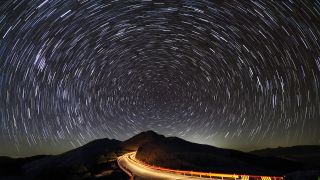
Finally my conclusion’s.Space-time: Long exposure star trail image taken at Hehuan Mountain, Taiwan.

For some thing to come into existence from nothing is impossible even a black hole has to start with some thing and disappear into some thing. What that is Space time  In physics, spacetime is any mathematical model that fuses the three dimensions of space and the one dimension of time into a single four-dimensional continuum. From Wikipedia.

According to the best of current physical theories, space-time explains the unusual relativistic effects that arise from traveling near the speed of light as well as the motion of massive objects in the universe.

So its some thing that travel’s faster than the speed of light depended on its state of motion – warped spacetime!

Light was known to be an electromagnetic phenomenon, but it did not obey the same laws of mechanics as matter.

Henceforth space by itself, and time by itself, are doomed to fade away into mere shadows, and only a kind of union of the two will preserve an independent reality.

Weight arises due to the warping of time, rather than space. What this means in practice is that gravity on earth is “equivalent” to acceleration mostly in the sense that clocks on the surface run more slowly than clocks in outer space.

If one goes beyond classical physics and into modern quantum field theory, then questions of absolute versus relational spacetime are rendered anachronistic by the fact that even “empty space” is populated by matter in the form of virtual particles, zero-point fields and more.schwinger effect

You can’t get something for nothing. In the quantum realm, something really can emerge from nothing.

As long as you have empty space — the ultimate in physical nothingness — simply manipulating it in the right way will inevitably cause something to emerge. Take a meson and try to rip the quark away from the antiquark, and a new set of particle-antiparticle pairs will get pulled out of the empty space between them an electromagnetic fields where many properties of all physical systems are conserved: where things cannot be created or destroyed. In theory, a strong enough electromagnetic field can rip particles and antiparticles out of the vacuum itself, even without any initial particles or antiparticles at all.

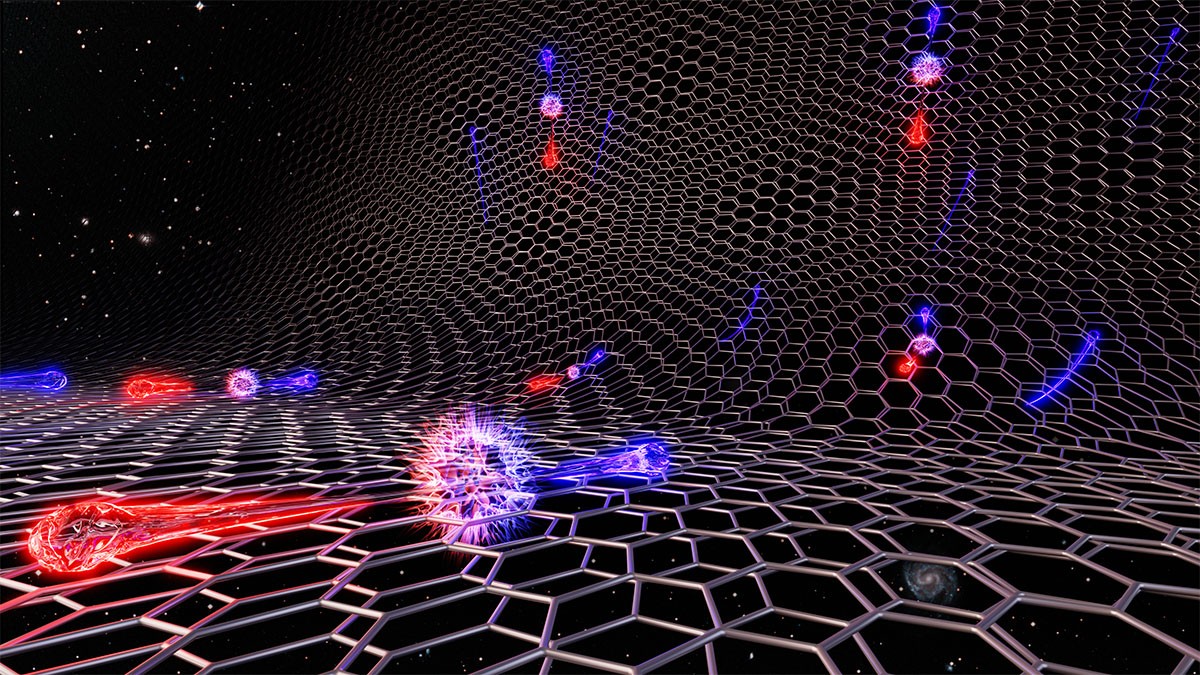
In early 2022, strong enough electric fields were created in a simple laboratory setup leveraging the unique properties of graphene, enabling the spontaneous creation of particle-antiparticle pairs from nothing at all. The prediction that this should be possible is 70 years old: dating back to one of the founders of quantum field theory.

In the Universe we inhabit, it’s truly impossible to create “nothing” in any sort of satisfactory way. Everything that exists, down at a fundamental level, can be decomposed into individual entities — quanta — that cannot be broken down further. If you take all of them away, however, the “empty space” that remains isn’t quite empty in many physical senses the quantum fields remain. Just as we cannot take the laws of physics away from the Universe, we cannot take the quantum fields that permeate the Universe away from it. No matter how far away we move any sources of matter, there are two long-range forces whose effects will still remain: electromagnetism and gravitation. Even if you create a perfect vacuum, devoid of all particles and antiparticles of all types, where the electric and magnetic fields are zero, there’s clearly something that’s present in this region of what a physicist might call, from a physical perspective, “maximum nothingness.”

Space cannot be “entirely emptied”  As to where is came from. Clearly, we exist, as do the stars and galaxies we see, so something must have created more matter than antimatter, making the Universe we know possible. It seems like an impossibility. On one hand, there is no known way, given the particles and their interactions in the Universe, to make more matter than antimatter. On the other hand, everything we see is definitely made of matter and not antimatter.

Doesn’t it matter. The fact that we exist and are made of matter is indisputable; the question of why our Universe contains something (matter) instead of nothing (from an equal mix of matter and antimatter) is one that must have an answer.

When it does, one of the greatest mysteries in all of existence will finally have a solution.

Therefore as Max Beerbolm said: ” Besides Dr Einstein there are only two men who can claim to have grasped the Theory of Relativity I cannot claim to be either of these.  The attempt to conceive Infinity has always been quite arduous enough for me. But to imagine the absence of it ; to feel perhaps we and all the stars beyond or ken are somehow cosily ( thought awfully) closed in by curtain curves beyond which is nothing; and to convince myself, by the way, that this exterior is not ( in virtue of being nothing) something and there fore …. but I lose the thread.”

All human comments appreciated. All like clicks and abuse chucked in the bin.

Contact: bobdillon33@gmail.com

Share this:

  • Click to share on WhatsApp (Opens in new window) WhatsApp
  • More
  • Click to share on Pocket (Opens in new window) Pocket
  • Click to share on Mastodon (Opens in new window) Mastodon

THE BEADY EYE ASK’S: IF YOU HAD A CHOICE WHAT SORT OF WORLD WOULD YOU LIVE IN?

13 Tuesday Feb 2024

Posted by bobdillon33@gmail.com in 2024 the year of disconnection, Artificial Intelligence., Civilization., Collective stupidity., CULTURES COLLIDE, Disaster Capitalism., Earth, Earth from Space., Environment, Human Collective Stupidity., HUMAN INTELLIGENCE, Human values., Humanity., Our Common Values., Reality., Space Exploration., Sustaniability, Technology v Humanity, The Future, The Obvious., The world to day., THE WORLD YOU LIVE IN., THIS IS THE STATE OF THE WORLD.  , War, Wars, What is shaping our world., WHAT IS TRUTH, What Needs to change in the World, Where's the Global Outrage.

≈ Comments Off on THE BEADY EYE ASK’S: IF YOU HAD A CHOICE WHAT SORT OF WORLD WOULD YOU LIVE IN?

Tags

blog, History., politics, Science, Technology, The Future of Mankind, Visions of the future.

( Five minute read)

On July the 20th this year it will be fifty five years since one of us stood on another planet. Since then only 24 people have seen the whole of Earth. Achived with less computer power that is now in our phone’s.

In those fiftyfive years we have had fifty-five active conflicts. Eight of these 55 conflicts were classified as wars.

This is the world we got.

21st Century
  • Vietnam War (1962 – 1973
  • Persian Gulf War (1991)
  • War in Afghanistan (2001)
  • Operation Pillar of Defence (2012)
  • War in Iraq (2011)
  • 2014 Gaza War (2014)
  • Russian Annexation of Crimea (2014)
  • War in Donbas (2014-present)
  • Yemeni Civil War (2015-present)
  • Turkish coup d’état attempt (2016)
  • 2021 Israel-Palestine crisis (2021)
  • Russian Invasion of Ukraine (2022)

We are truly living in a very unique time in the history of our civilization, facing several simultaneous challenges and converging crises:

Because the world is a cauldron where dozens of cultures, religions and ideologies mix with each other, which always leads to a conflict. We are all born of frailty and error.

A deteriorating environment, a very unequal distribution of dwindling resources, widespread poverty, wars, climate change, oppression of many peoples, and dissatisfaction with life even in those countries with a surplus of material wealth.

What can we do about it?

The answer to such question is certainly not simple, and you will not find it in any textbook.

All these problems and converging crises are systemic.

For the most part these crises we humans have brought upon ourselves over the course of many centuries by our attitudes towards each other and towards Nature, and by the concepts we have developed regarding who we are and the very purpose of our being here — in other words, our worldview.

The 20th century revolution of technologies that permits long distance travel and instant communication across the world has brought all cultures closer together, making us more aware than ever of the many diverse spiritual-cultural traditions that have flourished for millennia as intricate, elaborate meta-solutions to the challenges and opportunities of living in a particular place.

Now we are challenged to integrate the wealth of knowledge and capability that this remarkable period has brought us into a new narrative of interbeing — a synthesis of ancient wisdom of our interconnectedness and interdependence with modern science and technology.

We now have a choice to make!

Either we move into a new phase in the evoloution of consciouness and a new ear of life on planet Earth, or we will witness the unraveling of the web of life and the immature end of our species and much of the community of life along with us. 

The time to make this choice is now!

It starts with a fundamental shift in our dominant worldview. It is time to grow up!

A world with less gravity and more humanity.

Where people get what they deserve rather than deserve what they get.
Where there is a God for everyone and no one God is better than other.
Where an empty stomach is an alien concept.
Where mind is held high and heart is held higher.

Where people are immaterialistic.
Where people think logically, question and reason everything without blindly following anything or be superstitious.

Where people respect each other and not judge others for their actions.
Where one should treat others as one would like others to treat oneself.

History shows us that none of the above is possible without AI augmentation of human intelligence to enshrin values of beauty, agency, and individuality. by benevolent, incorruptible agencies that are beyond human intelligence.

The era of Artificial Intelligence is here. AI has already started.

AI is not a living being that has been primed by billions of years of evolution to participate in the battle for the survival of the fittest, as animals are, and as we are. It is math – code – computers, built by people, owned by people, used by people, controlled by people.

Its true that AI doesn’t have goals of its own, but its influnce on our lives is endangering the very meaning of life and  instead of us embracing a worldview based on facts, it will cause us to lose our ability to focus on the things that threaten us most.

Understanding what “we” want is among the biggest challenges facing AI.

It is very difficult to encode human values in a programming language, but the problem is made more difficult by the fact that we as humanity do not agree on common values, and even parts we do agree on change with time. The question then becomes how do we aligne AI with Human values.

Whose human values?

Ah, that’s where things get tricky.

A major change is coming, over unknown timescales but across every segment of society, and the people playing a part in that transition have a huge responsibility and opportunity to shape it for the best.

So here are some of the questions we should be asking.

What does it mean to you to have artificial intelligence aligned with your own life goals and aspirations?

How can it be aligned with you and everyone else in the world at the same time?

How do we ensure that one person’s version of an ideal AI doesn’t make your life more difficult?

How do we go about agreeing on human values, and how can we ensure that AI understands these values?

If you have a personal AI assistant, how should it be programmed to behave?

If we have AI more involved in things like medicine or policing or education, what should that look like?

What else should we, as a society, be asking?

Globally, humankind must think about the kind of future we want to have.

The recently articulated United Nations Sustainable Development Goals (SDGs) offer a good starting point, but these goals are merely the preconditions necessary for survival and flourishing, so they are not
enough. A further step is needed to determine our common goals as a civilization, and more
philosophically, the purpose of human existence, and how AI will fit into it.

Generative AI is not hype.

Instead, it acts at a scale so large that it will transform how we interact with technology itself.  It will far outpace what we’ve seen so far today.

AI has been used to help sequence RNA for vaccines and model human speech, technologies that rely on model- and algorithm-based machine learning and increasingly focus on perception, reasoning and generalization.

If we reach a point where AI is able to understand our languages, AI systems would be able to read and understand everything ever written. In the mean time rest assured that we will continue to fight wars against each other, as we have done since day until the end of time, or at least Earth’s time which is in about 5.4 billion years.

All human comments appriciated. All like clicks and abuse chucked in the bin.

Contact: bobdillon33@gmail.com

Share this:

  • Click to share on WhatsApp (Opens in new window) WhatsApp
  • More
  • Click to share on Pocket (Opens in new window) Pocket
  • Click to share on Mastodon (Opens in new window) Mastodon

THE BEADY EYE ASK’S: THESE DAYS WHAT CAN WE BELIEVE IN ?

21 Thursday Dec 2023

Posted by bobdillon33@gmail.com in #whatif.com, 2023 the year of disconnection., A Constitution for the Earth., Advertising, Advertising industry, Algorithms., Artificial Intelligence.,  Attention economy, Capitalism, CAPITALISM IS INCOMPATIBLE IN THE FIGHT AGAINST CLIMATE CHANGE., Carbon Emissions., Civilization., Climate Change., Collective stupidity., Consciousness., Cry for help., Dehumanization., Democracy, Digital age., DIGITAL DICTATORSHIP., Digital Friendship., Disconnection., Discrimination., Earth, Emergency powers., Enegery, Environment, Face Recognition., Facebook, Fake News., Fourth Industrial Revolution., Freedom of Speech, Freedom of the Press., Google, Google Knowledge., GPS-Tracking., Green Energy., Happy Christmas from the Beady eye., Honesty., How to do it., Human Collective Stupidity., HUMAN INTELLIGENCE, Human values., Humanity., Imagination., Inequality, INTELLIGENCE., IS DATA DESTORYING THE WORLD?, James Webb Telescope, Life., MISINFORMATION., Modern Day Communication., Modern Day Democracy., Modern day life., Modern Day Slavery., Monetization of nature, Our Common Values., PAIN AND SUFFERING IN LIFE, Political lying., Political Trust, Politics., Populism., Post - truth politics., Profiteering., Purpose of life., Real life experience's, Reality., Renewable Energy., Robot citizenship., Social Media, Social Media Regulation., Society, State of the world, Sustaniability, Technology, Technology v Humanity, Telling the truth., The common good., The essence of our humanity., The Future, The Internet., THE NEW NORM., The Obvious., The pursuit of profit., The state of the World., The world to day., THE WORLD YOU LIVE IN., THIS IS THE STATE OF THE WORLD.  , TRACKING TECHNOLOGY., Truth, Truthfulness., Twitter, Unanswered Questions., Universal values., VALUES, We can leave a legacy worthwhile., What is shaping our world., WHAT IS TRUTH, Where's the Global Outrage., World Leaders, World Organisations., World Politics

≈ Comments Off on THE BEADY EYE ASK’S: THESE DAYS WHAT CAN WE BELIEVE IN ?

Tags

bible, god, philosophy, Religion., Science

( Fifteen minute read)

The last post this year, have a peaceful Christmas.

This post is a follow up to the post, ( What is life, What does it mean to be alive). It is also an attempt to argue for as many preposterous positions as possible in the shortest space of time possible.

That there are no options other than accepting that life is objectively meaningful or not meaningful at all.

Science requires proof, religious belief requires faith.

So let’s get God and Gods out of the way.

.Could quantum physics help explain a God that could be in two places at once? (Credit: Nasa)
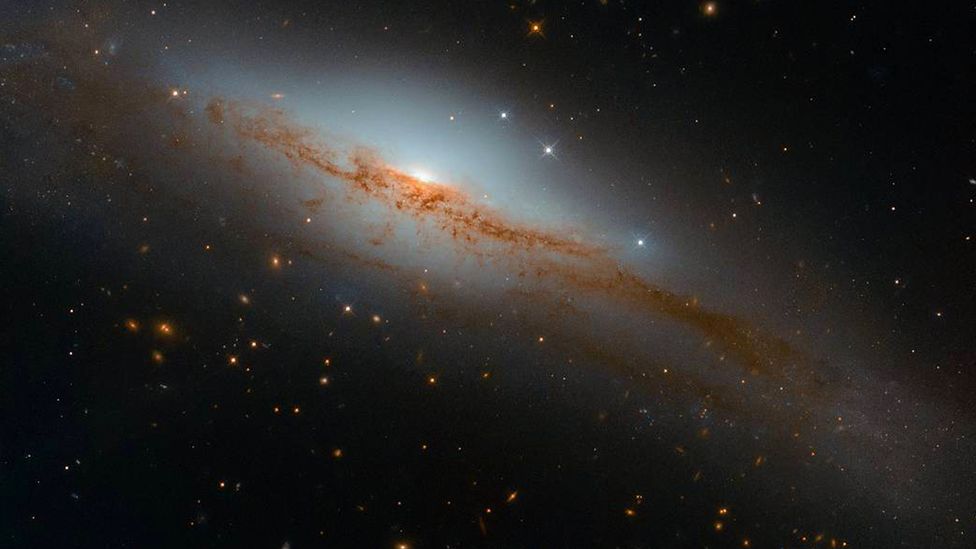
If you believe in God, then the idea of God being bound by the laws of physics is nonsense, because God can do everything, even travel faster than light. If you don’t believe in God, then the question is equally nonsensical, because there isn’t a God and nothing can travel faster than light.

Perhaps the question is really one for agnostics, who don’t know whether there is a God.

The idea that God might be “bound” by the laws of physics – which also govern chemistry and biology might not be so far stretched that the James Webb telescope might discover him or her. Whether it does or does not, if it did discovered life on another planet and the human race realizes that its long loneliness in time and space may be over — the possibility we’re no longer alone in the universe is where scientific empiricism and religious faith intersect, with NO true answer?.

Could any answer help us prove whether or not God exists, not on your nanny.

If God wasn’t able to break the laws of physics, she or he arguably wouldn’t be as powerful as you’d expect a supreme being to be. But if he or she could, why haven’t we seen any evidence of the laws of physics ever being broken in the Universe?

If there is a God who created the entire universe and ALL of its laws of physics, does God follow God’s own laws? Or can God supersede his own laws, such as travelling faster than the speed of light and thus being able to be in two different places at the same time?

Let’s consider whether God can be in more than one place at the same time.

(According to quantum mechanics, particles are by definition in a mix of different states until you actually measure them.)

There is something faster than the speed of light after all: Quantum information.

This doesn’t prove or disprove God, but it can help us think of God in physical terms – maybe as a shower of entangled particles, transferring quantum information back and forth, and so occupying many places at the same time? Even many universes at the same time?

But is it true?

A few years ago, a group of physicists posited that particles called tachyons travelled above light speed. Fortunately, their existence as real particles is deemed highly unlikely. If they did exist, they would have an imaginary mass and the fabric of space and time would become distorted – leading to violations of causality (and possibly a headache for God).

(This in itself does not say anything at all about God. It merely reinforces the knowledge that light travels very fast indeed.)

We can calculate that light has travelled roughly 1.3 x 10 x 23 (1.3 times 10 to the power 23) km in the 13.8 billion years of the Universe’s existence. Or rather, the observable Universe’s existence.

The Universe is expanding at a rate of approximately 70km/s per Mpc (1 Mpc = 1 Megaparsec or roughly 30 billion billion kilometres), so current estimates suggest that the distance to the edge of the universe is 46 billion light years. As time goes on, the volume of space increases, and light has to travel for longer to reach us.

We cannot observe or see across the entirety of the Universe that has grown since the Big Bang because insufficient time has passed for light from the first fractions of a second to reach us. Some argue that we therefore cannot be sure whether the laws of physics could be broken in other cosmic regions – perhaps they are just local, accidental laws. And that leads us on to something even bigger than the Universe.

But if inflation could happen once, why not many times?

We know from experiments that quantum fluctuations can give rise to pairs of particles suddenly coming into existence, only to disappear moments later. And if such fluctuations can produce particles, why not entire atoms or universes? It’s been suggested that, during the period of chaotic inflation, not everything was happening at the same rate – quantum fluctuations in the expansion could have produced bubbles that blew up to become universes in their own right.

How come all the physical laws and parameters in the universe happen to have the values that allowed stars, planets and ultimately life to develop?

We shouldn’t be surprised to see biofriendly physical laws – they after all produced us, so what else would we see? Some theists, however, argue it points to the existence of a God creating favourable conditions.

But God isn’t a valid scientific explanation.

We can’t disprove the idea that a God may have created the multiverse.

No matter what is believable or not, things can appear from nowhere and disappear to nowhere.

If you find this hard to swallow, what follows will make you choke.

First there is panpsychism, the idea that “consciousness pervades the universe and is a fundamental feature of it.

Even particles are never compelled to do anything, but are rather disposed, from their own nature, to respond rationally to their experience. That the universe is conscious and is acting towards a purpose of realising the full potential of its consciousness.

The radicalism of this “teleological cosmopsychism” is made clear by its implication that “during the first split second of time, the universe fine-tuned itself in order to allow for the emergence of life billions of years in the future”. To do this, “the universe must in some sense have been aware of this future possibility”.

That the universe itself has a built-in purpose, the disappointingly vague goal of which is “rational matter achieving a higher realisation of its nature.

The laws of physics are just right for conscious life to evolve that it can’t have been an accident.

It is hard to see why the universe’s purpose should give our lives one. Indeed, to believe one plays an infinitesimally small part in the unfolding of a cosmic master plan makes each human life look insignificant.

The basic question about our place in the Universe is one that may be answered by scientific investigations.

What are the next steps to finding life elsewhere?

Today’s telescopes can look at many stars and tell if they have one or more orbiting planets. Even more, they can determine if the planets are the right distance away from the star to have liquid water, the key ingredient to life as we know it.

NEXT:How to Choose Which Social Media Platforms to Use

We live in a time of political fury and hardening cultural divides. But if there is one thing on which virtually everyone is agreed, it is that the news and information we receive is biased. Much of the outrage that floods social media, occasionally leaking into opinion columns and broadcast interviews, is not simply a reaction to events themselves, but to the way in which they are reported and framed that are the problem.

This mentality now with the help of technological advances in communication spans the entire political spectrum and pervades societies around the world twisting our basic understanding of reality to our own ends.

This is not as simple as distrust.

The appearance of digital platforms, smartphones and the ubiquitous surveillance have enable to usher in a new public mood that is instinctively suspicious of anyone claiming to describe reality in a fair and objective fashion. Which will end in a Trumpian refusal to accept any mainstream or official account of the world with people become increasingly dependent on their own experiences and their own beliefs about how the world really works.

The crisis of democracy and of truth are one and the same:

Individuals are increasingly suspicious of the “official” stories they are being told, and expect to witness things for themselves.

How exactly do we distinguish this critical mentality from that of the conspiracy theorist, who is convinced that they alone have seen through the official version of events? Or to turn the question around, how might it be possible to recognise the most flagrant cases of bias in the behaviour of reporters and experts, but nevertheless to accept that what they say is often a reasonable depiction of the world?

It is tempting to blame the internet, populists or foreign trolls for flooding our otherwise rational society with lies.

But this underestimates the scale of the technological and philosophical transformations that are under way. The single biggest change in our public sphere is that we now have an unimaginable excess of news and content, where once we had scarcity. The explosion of information available to us is making it harder, not easier, to achieve consensus on truth.

As the quantity of information increases, the need to pick out bite-size pieces of content rises accordingly.

In this radically sceptical age, questions of where to look, what to focus on and who to trust are ones that we increasingly seek to answer for ourselves, without the help of intermediaries. This is a liberation of sorts, but it is also at the heart of our deteriorating confidence in public institutions.

There is now a self-sustaining information ecosystem becoming a serious public health problem across the world, aided by the online circulation of conspiracy theories and pseudo-science. However the panic surrounding echo chambers and so-called filter bubbles is largely groundless.

What, then, has to changed?

The key thing is that the elites of government and the media have lost their monopoly over the provision of information, but retain their prominence in the public eye.

And digital platforms now provide a public space to identify and rake over the flaws, biases and falsehoods of mainstream institutions.

The result is an increasingly sceptical citizenry, each seeking to manage their media diet, checking up on individual journalists in order to resist the pernicious influence of the establishment.

The problem we face is not, then, that certain people are oblivious to the “mainstream media”, or are victims of fake news, but that we are all seeking to see through the veneer of facts and information provided to us by public institutions.

Facts and official reports are no longer the end of the story.

The truth is now threatened by a radically different system, which is transforming the nature of empirical evidence and memory. One term for this is “big data”, which highlights the exponential growth in the quantity of data that societies create, thanks to digital technologies.

The reason there is so much data today is that more and more of our social lives are mediated digitally. Internet browsers, smartphones, social media platforms, smart cards and every other smart interface record every move we make. Whether or not we are conscious of it, we are constantly leaving traces of our activities, no matter how trivial.

But it is not the escalating quantity of data that constitutes the radical change.

Something altogether new has occurred that distinguishes today’s society from previous epochs.

In the past, recording devices were principally trained upon events that were already acknowledged as important.

Things no longer need to be judged “important” to be captured.

Consciously, we photograph events and record experiences regardless of their importance. Unconsciously, we leave a trace of our behaviour every time we swipe a smart card, address Amazon’s Alexa or touch our phone.

For the first time in human history, recording now happens by default, and the question of significance is addressed separately.

This shift has prompted an unrealistic set of expectations regarding possibilities for human knowledge.

When everything is being recorded, our knowledge of the world no longer needs to be mediated by professionals, experts, institutions and theories. Data can simply “speak for itself”. This is a fantasy of a truth unpolluted by any deliberate human intervention – the ultimate in scientific objectivity.

From this perspective, every controversy can in principle be settled thanks to the vast trove of data – CCTV, records of digital activity and so on – now available to us. Reality in its totality is being recorded, and reporters and officials look dismally compromised by comparison.

It is often a single image that seems to capture the truth of an event, only now there are cameras everywhere.

No matter how many times it is disproven, the notion that “the camera doesn’t lie” has a peculiar hold over our imaginations. In a society of blanket CCTV and smartphones, there are more cameras than people, and the torrent of data adds to the sense that the truth is somewhere amid the deluge, ignored by mainstream accounts.

The central demand of this newly sceptical public is “so show me”.

The rise of blanket surveillance technologies has paradoxical effects, raising expectations for objective knowledge to unrealistic levels, and then provoking fury when those in the public eye do not meet them.

Surely, in this age of mass data capture, the truth will become undeniable.

On the other hand, as the quantity of data becomes overwhelming – greater than human intelligence can comprehend – our ability to agree on the nature of reality seems to be declining. Once everything is, in principle, recordable, disputes heat up regarding what counts as significant in the first place.

What we are discovering is that, once the limitations on data capture are removed, there are escalating opportunities for conflict over the nature of reality.

Remember AI does not exist in a vacuum, its employment can and is discriminating against communities, powered by vast amounts of energy,  producing CO2 emissions.

Lastly the Advertising Industry.The impact of COVID-19 on the advertising industry - Passionate In ...

These day it seems that it has free rain to claim anything.

Like them or loathe them, advertisements are everywhere and they’re worsening not just the climate crisis, and ecological damage by promoting sustainability in consumption and inequality. Presenting a fake, idealised world that papers over an often brutal reality.

But advertising in one sense is even more dangerous, because it is so pervasive, sophisticated in its techniques and harder to see through. When hundreds of millions of people have desires for more and more stuff and for more and more services and experiences, that really adds up and puts a strain on the Earth.

The toll of disasters propelled by climate change in 2023 can be tallied with numbers — thousands of people dead, millions of others who lost jobs, homes and hope, and tens of billions of dollars sheared off economies. But numbers can’t reflect the way climate change is experienced — the intensity, the insecurity and the inequality that people on Earth are now living.

In every place that climate change makes its mark, inequality is made worse.

How are we going to protect the truth:

It goes without saying that spiritual beliefs will protect themselves. Lies, propaganda and fake news however is the challenge for our age.

Working out who to trust and who not to believe has been a facet of human life since our ancestors began living in complex societies. Politics has always bred those who will mislead to get ahead.

With news sources splintering and falsehoods spreading widely online, can anything be done?

Check Google.

Welcome to the world of “alternative facts”. It is a bewildering maze of claim and counterclaim, where hoaxes spread with frightening speed on social media and spark angry backlashes from people who take what they read at face value.

It is an environment where the mainstream media is accused of peddling “fake news” by the most powerful man in the world.

Voters are seemingly misled by the very politicians they elected and even scientific research – long considered a reliable basis for decisions – is dismissed as having little value.

Without a common starting point – a set of facts that people with otherwise different viewpoints can agree on – it will be hard to address any of the problems that the world now faces. The threat posed by the spread of misinformation should not be underestimated.

Some warn that “fake news” threatens the democratic process itself.

A survey conducted by the Pew Research Center towards the end of last year found that 64% of American adults said made-up news stories were causing confusion about the basic facts of current issues and events.

How we control the dissemination of things that seem to be untrue. We need a new way to decide what is trustworthy.

Take Wikipedia itself – which can be edited by anyone but uses teams of volunteer editors to weed out inaccuracies – is far from perfect.

These platforms and their like are simply in it for the money.

Last year, links to websites masquerading as reputable sources started appearing on social media sites like Facebook.

Stories about the Pope endorsing Donald Trump’s candidacy and Hillary Clinton being indicted for crimes related to her email scandal were shared widely despite being completely made up. The ability to share them widely on social media means a slice of the advertising revenue that comes from clicks.

Truth is no longer dictated by authorities, but is networked by peers. For every fact there is a counterfact. All those counterfacts and facts look identical online, which is confusing to most people.

Information spreads around the world in seconds, with the potential to reach billions of people. But it can also be dismissed with a flick of the finger. What we choose to engage with is self-reinforcing and we get shown more of the same. It results in an exaggerated “echo chamber” effect.

The challenge here is how to burst these bubbles.

One approach that has been tried is to challenge facts and claims when they appear on social media. Organisations like Full Fact, for example, look at persistent claims made by politicians or in the media, and try to correct them. (The BBC also has its own fact-checking unit, called Reality Check.)

This approach doesn’t work on social media because the audiences were largely disjointed.

Even when a correction reached a lot of people and a rumour reached a lot of people, they were usually not the same people. The problem is, corrections do not spread very well. This lack of overlap is a specific challenge when it comes to political issues.

On Facebook political bodies can put something out, pay for advertising, put it in front of millions of people, yet it is hard for those not being targeted to know they have done that. They can target people based on how old they are, where they live, what skin colour they have, what gender they are.

We shouldn’t think of social media as just peer-to-peer communication – it is also the most powerful advertising platform there has ever been. We have never had a time when it has been so easy to advertise to millions of people and not have the other millions of us notice.

Twitter and Facebook both insist they have strict rules on what can be advertised and particularly on political advertising. Regardless, the use of social media adverts in politics can have a major impact.

We need some transparency about who is using social media advertising when they are in election campaigns and referendum campaigns. We need watchdogs that will go around and say, ‘Hang on, this doesn’t stack up’ and ask for the record to be corrected.

We need Platforms to ensure that people have read content before sharing it to develop standards.

Google says it is working on ways to improve its algorithms so they take accuracy into account when displaying search results. “Judging which pages on the web best answer a query is a challenging problem and we don’t always get it right,”

The challenge is going to be writing tools that can check specific types of claims.

Built a fact-checker app that could sit in a browser and use Watson’s language skills to scan the page and give a percentage likelihood of whether it was true.

This idea of helping break through the isolated information bubbles that many of us now live in, comes up again and again.

By presenting people with accurate facts it should be possible to at least get a debate going.

There is a large proportion of the population living in what we would regard as an alternative reality.  By suggesting things to people that are outside their comfort zone but not so far outside they would never look at it you can keep people from self-radicalising in these bubbles.

There are understandable fears about powerful internet companies filtering what people see.

We should think about adding layers of credibility to sources. We need to tag and structure quality content in effective ways.

But what if people don’t agree with official sources of information at all?

This is a problem that governments around the world are facing as the public views what they tell them with increasing scepticism. There is an unwillingness to bend one’s mind around facts that don’t agree with one’s own viewpoint.

The first stage in that is crowdsourcing facts.  So before you have a debate, you come up with the commonly accepted facts that people can debate from.

Technology may help to solve this grand challenge of our age, but it is time for a little more self-awareness too.

In the end the world needs a new Independent Organisation to examine all technology against human values. Future war will be fought on Face recognition.

To certify and hold the original programs of all technology.

Have I been trained by robbery its manter when it comes to algorithms.

The whole goal of the transition is not to allow a handful of Westerners to peacefully go through life in a Tesla, a world in flames; it is to allow humanity – and the rest of biodiversity – to live decently.

All human comments appreciated. All like clicks and abuse chucked in the bin.

Contact: bobdillon33@gmail.com

Share this:

  • Click to share on WhatsApp (Opens in new window) WhatsApp
  • More
  • Click to share on Pocket (Opens in new window) Pocket
  • Click to share on Mastodon (Opens in new window) Mastodon

THE BEADY EYE ASK’S: What is life? What does it mean to be alive?

19 Tuesday Dec 2023

Posted by bobdillon33@gmail.com in Uncategorized

≈ Comments Off on THE BEADY EYE ASK’S: What is life? What does it mean to be alive?

Tags

Consciousness., neuroscience, philosophy, Science, spirituality

( Eight minutes read)

The quest to understand life and its purpose has been around as long as we have.

Today the same question persists:    What does it mean to be fully alive?

With the arrival of machine learning/artificial intelligence we are becoming disposable products – here to day, gone tomorrow. Therefore most essential existential drive is to understand the meaning of our own existence, that relates to all of us – rich or poor – left hemisphere – right hemisphere.

This with what the world is now facing, there are no questions more important or pressing ( now and or in the not so distant future), than the above for the whole planet.

It is one of those philosophical questions that can never be answered definitively.

However the conspiracy of greed, in all its forms, is not sustainable for any lifeform, whether it is alive or not.

——————

Life is short and time moves fast. Your life is not a dress rehearsal – make it count.

There is simply no room for belief in a spiritual realm, or in a scientific view of reality. Period.

No matter what we put in a test tube nothing is going to crawl out alive, it would simply be another kind of physical property.

We defined biology as the branch of science concerned with the study of living things, or organisms.

That definition is pretty straightforward. However, it opens the door to more difficult—and more interesting—questions:

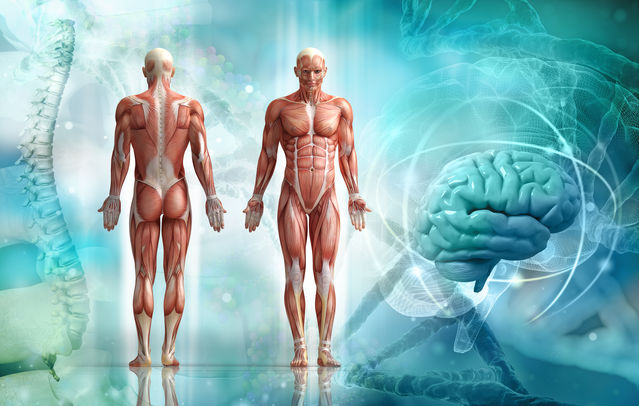
adimas | AdobeStock

LET’S START.

Do you have to be conscious to be alive.  No. It actually isn’t as cut and dry as you think it is. Where does consciousness come from? And how do our brains create it?

We don’t have a great scientific definition of consciousness, and philosophical definitions are disputed, but in almost every conception it has something to do with an ongoing awareness of events beyond the raw computation of their properties and immediate selection of an action.

It might depend on what we mean exactly by consciousness (cognitive/representational abilities? Qualitative experience?) and also by “living” (autonomous subsistence? Self replication? Lineage with biological organisms on earth?).

All evidence is that brains generate consciousness.

Only living matter is susceptible of consciousness, but not all living things have a consciousness in the sense that we employ. Rudimentary life forms such as worms, bacteria, virus, do have a primitive form of consciousness even though they can hardly be said to be “conscious”.

Consciousness results from the antagonistic relativization between biological matter and physical matter. Somehow, within each of our brains, the combined activity of billions of neurons, each one a tiny biological machine, is giving rise to a conscious experience. And not just any conscious experience, your conscious experience, right here, right now.

One of the most compelling aspects of the mystery of consciousness is the nature of self.

Is consciousness possible without self-consciousness? And if so, would it still matter so much?

To understanding consciousness it immediately becomes apparent that like all other biological phenomena and like life itself, it must have evolved in gradations.

People have long pondered what consciousness actually is. What do we even mean by consciousness?

How can a purely physical thing feel like something? Surely consciousness is some kind of otherness?

Perhaps consciousness is an as-yet undiscovered fundamental property of the universe, or is it God himself.

So how far back in evolutionary history should we go to look for the origins of consciousness?

All the way back. Nearly four billion years. Long before animals had brains, or even a nervous system. Back to simple single-celled organisms like bacteria. Back to the origin of life itself.

This is not to suggest that simple unicellular organisms possessed consciousness, or even a modicum of it. Not consciousness, but its building blocks:

The origins of life will never be found.  Nor will we ever be able to create it.

Consciousness probably evolved as a way for organisms to go far beyond responding merely reflexively to stimuli—to be able to respond more flexibly, and in a more delayed and planned manner.

Thoughts and feelings seem ethereal, untethered from anything physical.

Self-awareness seems like a phenomenon utterly divorced from anything that could possibly be produced by cells comprised of physical particles. How the same material particles that comprise inanimate matter could be arranged in such a way as to make something alive, without adding that special, mysterious nonmaterial essence. Let alone how inanimate matter could organize itself in such clever and intricate ways through entirely unguided, spontaneous processes.

—————–

Now, in the present century, science is turning its attention to decoding the enigma of consciousness.

Without a shadow of a doubt there is no aspect of the mind that is not entirely the product of, and utterly dependent on, the physical brain. Disruption, disassembly or enhancement of brain circuitry (subtle or major) can radically alter any aspect of the mind.

And yet the mystery of how exactly the brain produces consciousness has remained unexplained.

When does consciousness begin in development? Does it emerge at birth, or is it present even in the womb?

We don’t yet know exactly how consciousness emerges, and very many intriguing mysteries remain.

About six minutes after the heart stops, and the blood supply to the brain is interrupted, the brain essentially dies. Then, deterioration reaches a point of no return and core consciousness – our ability to feel that we are here and now, and to recognise that thoughts we have are own own – is lost.

The moment the brain loses its exquisitely synchronized organization, consciousness is lost.

If that breakdown of physical processes is irreversible, consciousness is permanently extinguished, and the unique organization of matter that constituted that individual’s personhood, self or essence ceases to exist.

Everything that lives dies.  Is this true?  Yes  You only live once. No living thing know when living a life ends.

Indeed, the denial of death is the raison d’être of most religions.

The idea of life after death makes complete sense to our intuitions, and that’s not the only reason why the belief comes so naturally to people.

Because we associate ourselves with our body and we know bodies die this is true, but the distinction between past, present and future is only a stubbornly persistent illusion.

Do you believe that your mind, personality, or self is an essence that exists independent of your physical brain?

Do you think of you as a spirit or soul, temporarily constrained and residing in the organ that is your brain—an immortal consciousness merely housed in your earthly body?

———————

Death has never been popular, especially when it is seen as the final and utter cessation of being.

The prospect’s tolerability increases only when it is reframed as a mere passage to a heavenly paradise filled with all manner of delights—all the more so for those who are suffering or disadvantaged in this life.

It all depend on the observer.

What you see could not be present without your consciousness.

Your eyes are not portals to the world. Everything you see and experience right now‚ even your body, is a whirl of information occurring in your mind so you could live a life without been conscious that you are alive.

So how can a particle change its behavior depending on whether you watch it or not?

Our mind and its knowledge is the only thing that determines how they behave.

The answer is simple, reality is a process that involves your consciousness.

A particle’s exact location and momentum can’t be known at the same time.

So why should it matter to a particle what you decide to measure?

How can pairs of entangled particles be instantaneously connected on opposite sides of the galaxy as if space and time don’t exist?

In 2002, scientists showed that particles of light “photons” knew, in advance,what their distant twins would do in the future.

There are an infinite number of universes and everything that could possibly happen occurs in some universe. Death and Life does not exist in any real sense in these scenarios. All possible universes exist simultaneously, regardless of what happens in any of them.

When we die, we do so not in the random billiard-ball-matrix but in the inescapable-life-matrix. Life has a non-linear dimensionality; it’s like a perennial flower that returns to bloom in the multiverse.

Of course, we live in the same world. But critics claim this behavior is limited to the microscopic world. But this ‘two-world’ view (that is, one set of physical laws for small objects, and another for the rest of the universe including us) has no basis in reason and is being challenged in laboratories around the world.

Until we recognize the universe in our heads, attempts to understand reality will remain a road to nowhere.

————————–

You are alive, and so am I.

The tree’s outside my window.

However, snow falling from the clouds is not alive, or is it

The computer you’re using to read this article is not alive, and neither is a chair or table. The parts of a chair that are made of wood were once alive, but they aren’t any longer. If you were to burn the wood in a fire, the fire would not be alive either, or is it.

How can we tell that one thing is alive and another is not?

As I have said it’s surprisingly hard to come up with a precise definition of life.

Many definitions of life are operational definitions—they allow us to separate living things from nonliving ones, but they don’t actually pin down what life is. To make this separation, we must come up with a list of properties that are, as a group, uniquely characteristic of living organisms.

All living organisms are made up of one or more cells, which are considered the fundamental units of life

Humans—are made up of many cells.

Life depends on an enormous number of interlocking chemical reactions. Living things must use energy and consume nutrients to carry out the chemical reactions that sustain life.

Living organisms regulate their internal environment to maintain the relatively narrow range of conditions needed for cell function.

For instance, your body temperature needs to be kept relatively close to 98.6. This maintenance of a stable internal environment, even in the face of a changing external environment IS ESSENTIAL.

Living organisms show “irritability,” meaning that they respond to stimuli or changes in their environment.

Living organisms can reproduce themselves to create new organisms. Sperm and egg cells containing half of their genetic information, and these cells fuse to form a new individual with a full genetic set. You yourself started out as a single cell and now have tens of trillions of cells in your body.

Unicellular organisms may migrate toward a source of nutrients or away from a noxious chemical.

———————-

Populations of living organisms can undergo evolution, meaning that the genetic makeup of a population may change over time, for instance the basic building blocks of everyday life that have been obliterated in many areas of the Gaza Strip as the Israeli bombardment following Hamas’ deadly 7 October attacks stretches into its third month, will result in an state of unsecure Israel for decades to come.

You might well ask what can I do to change life. The answer is simple – Give and you will receive.

I was not alive in 1066 or 1492 or 1865 or 1920, so I have no way to judge any time except the time I experienced myself. I don’t think anyone can really pass judgment on any time which they did not experience for themselves, without seriously romanticising, or conversely vilifying that time.

I submit that the “golden years” for any generation, or individual, are the years right before you are forced to confront the realities of keeping yourself alive by yourself.

I am a 60th youth. so I could dream about being a part of the changes needed to make the world a better place, without being jaded by the realities of the roadblocks set up to prevent any of these changes from maturing.

We must come alive to be alive.  The best time to be alive is today, this moment, right now.

We have some big challenges facing us, like climate change, growing socioeconomic disparity, and threats of an erosion of rights and on going wars. “Yes, we have challenges galore … but those challenges spark imagination, creativity, courage and cooperation (if we are smart enough to rise to the occasion).

It is a battle, but it is possible to win.

That’s a problem because when we act instead of being, we aren’t living in the fullest sense.

————————–

GET OFF YOUR SMARTPHONE.

Engage with the world around you and learning as much as possible.  don’t take things for granted or perceive life casually. Being fully alive means being open to all the possibilities of your existence and exploring every part of yourself until you find what…

“Wealth is the ability to fully experience life,” Henry David Thoreau said.  Wrong.  You need an awakened brain to see life.

To rap this post up we could ask how and what has changed to living one life.

It can be made complicated or simple as the Malthusian trap in 1751 when we allowed machines to think,
– the AI trap.
What about future.
Will a Robot’s develop their own consciousness. 
Here, we ought to be concerned not just about the power that new forms of artificial intelligence are
gaining over us, but also about whether and when we need to take an ethical stance toward them.
With each new advance in our understanding comes a new sense of wonder and a new ability to see
ourselves as less apart from — and more a part of — the rest of nature. 
Our conscious experiences are part of nature just as our bodies are, just as our world is. 
“To live is the rarest thing in the world. Most people just exist,” Oscar Wilde said.

All human comments appreciated.  All like clicks and abuse chucked in the bin.

Contact: bobdillon33@gmail.com

Share this:

  • Click to share on WhatsApp (Opens in new window) WhatsApp
  • More
  • Click to share on Pocket (Opens in new window) Pocket
  • Click to share on Mastodon (Opens in new window) Mastodon

THE BEADY EYE SAYS: NO ONE HAS EVER REALLY SEEN AN ATOM.

16 Thursday Mar 2017

Posted by bobdillon33@gmail.com in Scientific., The Atom., Unanswered Questions.

≈ Comments Off on THE BEADY EYE SAYS: NO ONE HAS EVER REALLY SEEN AN ATOM.

Tags

Science, Science and the Atom., The Future of Mankind

( A Fifteen minute read with a lot of head scratching)

Let me from the off state that I am no Scientist, so don’t expect this post to make much sense, what you read here comes from the following unanswerable questions.

1.Why did the big bang happen?
2. Why does something called energy, space and time exist in the first place?
3. Why do bodies follow a gravitational law that is proportional to their masses and not the square of their masses????
4. Why does the zero point energy exist in Quantum systems even at Zero Kelvin, when all is supposed to be static at rest (zero energy)?

None of which I am going to attempt to answer.

It’s sufficient to say that everything you see around you, from your own body to the planet you’re standing on and the stars in the sky, are made of atoms but no one has ever really seen an atom.

As you know, An atom has 3 subatomic particles called electrons, protons, and neutrons. The exception to this rule is the hydrogen atom which only has 1 proton and 1 electron.Résultat de recherche d'images pour "pictures of space eye"

What I am interested in is where in the first place did they come from.

We have seen so much evidence of their existence that most of us believe in them.

It is estimated that the there are between 1078 to 1082 atoms in the known, observable universe.

In layman’s terms, that works out to between ten quadrillion vigintillion and one-hundred thousand quadrillion vigintillion atoms. This estimate accounts only for the observable universe which reaches 46 billion light years in any direction, and is based on where the expansion of space has taken the most distant objects observed.

It appears that they were not formed during the initial development of our universe (sometimes called the big bang) but were formed afterwards in large stars by synthesising more complex atoms.

Stars evolved after the Big Bang.

Density fluctuations left over from the big bang could have evolved into the first stars. These stars altered the dynamics of the cosmos by heating and ionizing the surrounding gases. The earliest stars also produced and dispersed the first heavy elements, paving the way for the eventual formation of solar systems like our own.

The big bang also produced hydrogen and helium, but most of the heavier elements are created only by the thermonuclear fusion reactions in stars, so they would not have been present before the first stars had formed.

What this means for the atom is anyone guess other than before the big bang there we no atoms. 

If they were not around, what were large stars made of?

Were they just collection of energy released by the Big Bang?

If so.

What was holding the energy together to form stars that are estimated to have been between 100 and 250 times as massive as the sun.

According to Hernquist Dark matter provided the first gravitational impetus for hydrogen and helium gas to start clumping together. The gas began releasing energy as it condensed, forming molecules from atoms, which further cooled the clump and allowed for even greater condensing.

So is it dark matter (Dark Matter the putative elementary particles that are believed to make up about 90 percent of the universe’s mass) or gravity or the small-scale density fluctuations—clumps in the primordial soup that created the atom.

But it seems to me if there were no atoms in the first place none of the above appears possible.

It might seem that star formation is a problem that has been solved.

But nothing could be further from the truth. We don’t really know how the very first stars were actually formed. We need to go back to the drawing board because our present understanding of this subject is still primitive.

Jason Silva who likes to articulate the theory that everyone and everything on earth contains minuscule star particles. In other words we are made of star stuff, atoms from the stars, is pie in the sky.

Cosmic dust forged inside stars turned into interstellar dust — dust formed by the deaths of an earlier generation of stars a key building block in the formation of stars, planets and complex molecules; but in the early Universe — before the first generations of stars died out — it was scarce.

Neutral Atoms did not come from the stars, stars came from electrically charged atoms.

The chemical and physical properties of an atom change as ions are created. When two ions with opposite charges come into contact, they are attracted to each other. They may begin to share electrons in either covalent or electrovalent bonds.

Here is a picture of exploding star.Credit: ESA/Hubble & NASA, Acknowledgement: Judy Schmidt


Credit: NASA/ESA/HEIC/Hubble Heritage Team.

So, all life on Earth and the atoms in our bodies were created in the furnace of now-long-dead stars.

Is this true?  It seem to me to be very dubious.

Pretty much everything we know about atoms is indirect evidence.

The physics which works here is the same physics which works elsewhere. If this were not the case, physics would somehow be a local phenomenon, which simply seems wrong. It is not true that everything in Solar system is build of atoms.

Light is not made up of atoms.

We’re probably looking for the wrong thing in the wrong place as there’s no point of reference in our universe.

Atoms are themselves made of subatomic particles which in turn are made of sub-sub-atomic particles. In fact no scientist worth its salt can claim that we and everything in the universe made up of Atoms.

There is no experimental confirmation about structure of universe.

Who told us everything was made up of atoms?

Democritus came up with the idea that something could be cut into its smallest piece and it would still be the same object. He was also the first person to write the word atom down. He came up with an idea, but it took 2,400 years before anyone figured out that he was right!

Or did they?

Current hypotheses suggest that four-fifths of the universe’s mass consists of a mysterious material that scientists can’t observe directly, which researchers call dark matter.  The substance makes itself known by the way galaxies rotate and bend light around them, suggesting those celestial structures have more mass than observers can see.

We don’t yet know what dark matter is.

The Universe is enormous and our planet is but a small, pale blue dot that makes up a fraction of the matter in our Universe. The rest is something else, a material that nobody on Earth has ever seen.

Fritz Zwicky came up with the term  “dark” matter.” He was some crazy theorist who couldn’t get his forces to add up, and so invented an entire new form of matter.

Astronomers now believe that dark matter has been fundamental in creating the Universe as we know it. There is a lot of it: about 25% of the Universe. Billions of dark matter particles pass through us every second.

Atoms are the smallest pieces of matter; they are made of particles (protons and electrons). When atoms are grouped together, these groups are called molecules.

While atoms are the tiniest bits of matter, they are made of the sub-atomic building blocks of matter—protons and electrons—revolving around a nucleus. The “atomic number” of an element, as seen on a periodic chart, refers to the number of protons contained in one atom of that element.

Confusingly, it’s sometimes said that dark matter makes up about 80% of all the matter in the Universe. That’s because only 30% of the Universe is made up of matter, and most of it is dark matter. The rest is energy. Dark matter is the skeleton on which ordinary matter hangs. Billions of dark matter particles pass through us every second.

We only know about a small fraction of the matter in the Universe. The rest is a mysterious substance known only as dark matter.

Now the most popular suggestion is that dark matter is made of a new kind of particle, predicted by theory but never detected. They are called WIMPs: Weakly Interacting Massive Particles. When these particles hit anything they pass straight through.

WIMPs have a lot of mass, although they are not necessarily large.

“WIMP” is just a catchphrase, and could include many different types of particles.

Below is a picture of Dark matter. (Credit: Yannick Mellier/IAP/SPL)Dark matter (red), light (yellow) and galaxies (blue) (Credit: Yannick Mellier/IAP/SPL)

Where is it?

At this point you may be throwing your arms up in frustration. “First they decided there’s all this invisible matter, now they’ve decided it’s made of some new kind of stuff that they can’t detect!

Dark matter doesn’t exist at all. We’re back where we were.

The challenge is to find dark matter when we don’t know what we’re looking for.

Instead, the laws of gravity as we know them must be wrong, and that’s why galaxies behave so oddly. This idea is called MOND, short for “Modified Newtonian Dynamics”.

The problem, says Massey, is that the MOND supporters have not come up with a viable alternative to dark matter: their ideas can’t explain the data.

Dark matter particles usually pass through normal matter. But the sheer number of them means that, very occasionally, some will collide with the nucleus of an atom.

This collision should create gamma rays: extremely high-energy light. On these rare occasions, “dark matter can shine,”

Here is one (Credit: NASA Goddard/A. Mellinger, CMU/T. Linden, University of Chicago)

In 2014, using data from NASA’s powerful Fermi telescope,researchers claimed to have detected the gamma rays from these collisions. They found an area of our Milky Way galaxy that seems to be glowing with gamma rays, possibly from dark matter.  But the jury is still out on whether the gamma rays are really from dark matter. They could also have come from energetic stars called pulsars, or from collapsing stars.

As well as colliding with normal matter, dark matter might occasionally bump into itself, and there’s a way to see that too.

Although we can’t see it directly, dark matter does do one thing to give itself away.

It bends the light that passes through it.

Is there two types of dark matter one interacting with other?

So a second way of detecting dark matter would be to create it first. Physicists hope to do just that using particle colliders, like the Large Hadron Collide in Geneva, Switzerland.

If the LHC does create some dark matter, it would not actually register on its detectors.

If WIMPs do make up the dark matter and they discover them at the LHC then we are in with a good chance of working out what the dark matter in the Universe is composed of.

How much of an atom is empty space?  Very nearly all of it.

The space inside the atom is just that, empty space, i.e. vacuum.

Vacuum, by definition, is the absence of matter. Matter, of course, is something that has mass and occupies space, it’s really a space with very little matter in it.

Many modern devices (like the integrated circuit chips that make everything from cars to computers work), have to be fabricated in a vacuum.

Even outer space, which is considered a vacuum and has less matter in it than anything mankind can reproduce, still has some atoms bouncing around.

Here is my top ten list of “Things That Are Not Matter”:

1. Light 2. Sound 3. Heat 4. Energy 5. Gravity 6. Time 7. A Rainbow 8. Love

9. Happiness 10. A really good joke

When two atoms approach each other, their electron shells push back at each other, despite the fact that each atom’s net charge is 0. This is a very useful feature of nature. It makes our lives a lot easier.

When you sit on a chair, you are not really touching it. You see, every atom is surrounded by a shell of electrons.

If atoms push away from each other, why doesn’t the entire universe just blow away from itself? The answer is that some, actually most atoms’ electron shells are not full.

Electrons really do go back and forth between atoms and they do so pretty fast.

Electrons tend to be kind of mobile, which is also a very nice feature of nature, since without it your walkman would not work. Once both atoms’ outer shells are full due to this electron sharing, they go back to their usual repulsive behavior.

This, by the way, is how we get molecules and the secret to understanding Chemistry. It’s all about the electrons!. It describe the nature of atoms.

We are much more than what we perceive ourselves to be, and it’s time we begin to see ourselves in that light.

The atom has no physical structure, we have no physical structure, physical things really don’t have any physical structure! Atoms are made out of invisible energy, not tangible matter.

It’s quite the conundrum, isn’t it?

Not really, when you enter the world of Quantum it’s totally bonkers.

With quantum physics.

One of these potential revelations is that “the observer creates the reality.”

As observers, we are personally involved with the creation of our own reality.

We are all energy, radiating our own unique energy signature.

Feelings, thoughts and emotions play a vital role, quantum physics helps us see the significance of how we all feel. If all of us are in a peaceful loving state inside, it will no doubt impact the external world around us, and influence how others feel as well.

At our subatomic level, does the vibrational frequency change the manifestation of physical reality? If so, in what way?

We know that when an atom changes its state, it absorbs or emits electromagnetic frequencies, which are responsible for changing its state.

Do different states of emotion, perception and feelings result in different electromagnetic frequencies? Yes! This has been proven.

If we are made of atoms, then a scientist studying atoms is actually a group of atoms studying themselves.

The relationship between physical things and mental/spiritual ones is a huge one in philosophy.

Anyone who wants to invent a new theory of gravity has to go one better than Einstein and explain everything he was able to explain, and also account for the dark matter.

Yes, cosmology is really weird.Résultat de recherche d'images pour "pictures of the universe and planets"

Some day humanity might have sufficient knowledge and tools to truly understand the origin of the universe, but currently we’re only a tiny baby step closer than when “Let there be light” was written.

Philosophically, no matter what you want to believe about the beginning of things, you need to get comfortable with the idea of infinity. Either infinite time, or an infinite deity that exists outside of time; really, both accomplish the same thing by explaining how things exist, and neither can be proven or disproven.

All we know is that there is something infinite going on and if energy couldn’t have been created, then there were no Universe in the first place.

Most of our Universe is still a black box, its secrets waiting to be unlocked.

How a dark, featureless universe formed the brilliant panoply of objects that now give us light and life remains very much a mystery.

Does it matter that there are things in this universe humans are not meant to understand.

All comments welcome. All like clicks chucked into dark matter.

Go back

Your message has been sent

Warning
Warning
Warning
Warning

Warning.


Share this:

  • Click to share on WhatsApp (Opens in new window) WhatsApp
  • More
  • Click to share on Pocket (Opens in new window) Pocket
  • Click to share on Mastodon (Opens in new window) Mastodon

Is man going to recreate himself?

25 Saturday Apr 2015

Posted by bobdillon33@gmail.com in The Future

≈ Comments Off on Is man going to recreate himself?

Tags

Genetic code, Genetic engineering, Human genome project, Human societies, Science

Determination of the entire DNA sequence contained in the human genome will not answer the question:

What is a human?


Geneticists will not be able to look at a person’s DNA sequence and predict everything about the appearance and characteristics of that person. Even if geneticists can identify segments of DNA as genes, the vast majority of the genes they discover still will have unknown functions.

In addition, many human traits such as body stature and intelligence result from multiple genes, and the exact number of genes that might contribute to such a trait is not obvious, nor are the ways in which those genes interact.

An individual’s genetic make-up greatly contributes to the type of person he or she is, but environmental variables such as diet, education, climate, family values, and access to health care also play a considerable role in determining an individual’s characteristics.

Before I go any further I have to declare that this subject is away beyond me, so if there is any one who has gone to the trouble of reading this far please feel free to contribute. All I can say if we do recreate ourselves I hope we do a better job than the first time around.

The increased understanding of the human genome is driven largely by rapid advances in technology. And the single most profound advance has been in the cost and the speed of sequencing.

The chromosomes of a sperm or egg contain about 3 billion base pairs, so a body cell has 6 billion. The whole set of base pairs in a gamete is the genome.

I don’t think it is possible to know all of the future effects of the human genome project, because people are coming up with new ways to use the information all the time.

Of course, the farther we peer into the future, the cloudier is our vision.

And it has a Scary side.

You will have read recently that scientists in China are editing the genetic code in human embryos.

So What wrong with that?

Is this unethical and will it be used to further the goals of those who wish to become ‘ creators’ in their own eyes.

Science has struggled to understand the mysteries of “less-than-human” beings since the late 1400s when the Spanish Inquisition first formalized state persecution of Jews and Muslims. And while the horrors of Nazi Germany exposed fatal flaws in science’s quest to build the master race, the ethical dilemmas posed by the science of eugenics are far from behind us.

While I understand that there are or will be many benefits to man from genetic engineering this is another step to manipulation for enhancing.

So are we on the threshold of modifying our own germ line and take control of our genetic destiny.?

The genetic engineering of humans — tools more powerful than a Nazi’s wildest dreams is unlocking life’s code.

The prospect of creating heritable modified genes and manufacturing designer babies that are more intelligent and beautiful than their peers is unthinkable for some.

But you would be naive to think that is wont happen . The potential for profit, in terms of both cash and the welfare of humanity, is almost limitless.

Understanding the genome will undoubtedly be the most important achievement of the 21st century, and perhaps of all time.

People looking back 50 years from now will consider medicine a barbaric, random process. If the promise of genomics is fulfilled, it will transform the lives of everyone.

It will spark many complex questions both ethical and not.

Human societies are not inferior or superior to one another but they could become so in not the so distant future.

The sequence of the human genome will underpin bio medical research for decades:

Genetic testing is not only a medical procedure. It is also a way of creating social categories that will be discriminated against based on their genetics, never mind race or religion.  Genetic discrimination” will be on our heads.

Is sequencing the human genome an intellectually appropriate project for biologists?”

How close actually are we to personalized medicine?

When will we begin to see the benefits of the Human Genome Project?

To Date the genomic mapping of humans can even be used to track the migration of humans from Africa over 50,000 years ago, as well as unlock the evolutionary timeline of the origin of man.

Genomics will be used to create better crops, better meat, more sophisticated robotics, new materials, and even whole new forms of life.

However in man the things which are not measurable are more important than those which are measurable.

Because of the ethical issues that it raises and the potential that it has to change human reproduction, and ultimately human society, it is crucial that we start to establish the boundaries of this science before the technology advances even farther.

On the other hand.

If man is to colonize the vastness of the Universe he will have to be recreated.

Go back

Your message has been sent

Warning
Warning
Warning
Warning

Warning.


Share this:

  • Click to share on WhatsApp (Opens in new window) WhatsApp
  • More
  • Click to share on Pocket (Opens in new window) Pocket
  • Click to share on Mastodon (Opens in new window) Mastodon

All comments and contributions much appreciated

  • THE BEADY EYE SAYS TRUST IS DISAPPEARING THANKS TO OUR INABILITY TO RELATE TO EACH OTHER. December 19, 2025
  • THE BEADY EYE SAYS. THE WORLD NEEDS PEOPLE GOVERNMENT NOT MONEY GOVERNMENTS. December 18, 2025
  • THE BEADY EYE ASKS WHAT ARE WE THE SAME GOING TO DO TO STOP THE WORLD BEING FUCK UP FOR PROFIT BY RIPOFF MERCHANT. December 17, 2025
  • THE BEADY EYE CHRISTMAS GREETING. December 16, 2025
  • THE BEADY EYE SAYS. TO THE NEXT GENERATION TO LIVE A LIFE WORTH WHILE YOU MUST CREATE MEMORIES. December 16, 2025

Archives

  • December 2025
  • November 2025
  • October 2025
  • September 2025
  • August 2025
  • July 2025
  • June 2025
  • May 2025
  • February 2025
  • January 2025
  • December 2024
  • November 2024
  • October 2024
  • September 2024
  • August 2024
  • July 2024
  • June 2024
  • May 2024
  • April 2024
  • March 2024
  • February 2024
  • January 2024
  • December 2023
  • October 2023
  • September 2023
  • August 2023
  • July 2023
  • June 2023
  • May 2023
  • April 2023
  • March 2023
  • February 2023
  • January 2023
  • December 2022
  • November 2022
  • October 2022
  • September 2022
  • August 2022
  • July 2022
  • June 2022
  • May 2022
  • April 2022
  • March 2022
  • February 2022
  • January 2022
  • December 2021
  • November 2021
  • October 2021
  • September 2021
  • August 2021
  • July 2021
  • June 2021
  • May 2021
  • April 2021
  • March 2021
  • February 2021
  • January 2021
  • December 2020
  • November 2020
  • October 2020
  • September 2020
  • August 2020
  • July 2020
  • June 2020
  • May 2020
  • April 2020
  • March 2020
  • February 2020
  • January 2020
  • December 2019
  • November 2019
  • October 2019
  • September 2019
  • August 2019
  • July 2019
  • June 2019
  • May 2019
  • April 2019
  • March 2019
  • February 2019
  • January 2019
  • December 2018
  • November 2018
  • October 2018
  • September 2018
  • August 2018
  • July 2018
  • June 2018
  • May 2018
  • April 2018
  • March 2018
  • February 2018
  • January 2018
  • December 2017
  • November 2017
  • October 2017
  • September 2017
  • August 2017
  • July 2017
  • June 2017
  • May 2017
  • April 2017
  • March 2017
  • February 2017
  • January 2017
  • December 2016
  • November 2016
  • October 2016
  • September 2016
  • August 2016
  • July 2016
  • June 2016
  • May 2016
  • April 2016
  • March 2016
  • February 2016
  • January 2016
  • December 2015
  • November 2015
  • October 2015
  • September 2015
  • August 2015
  • July 2015
  • June 2015
  • May 2015
  • April 2015
  • March 2015
  • February 2015
  • January 2015
  • December 2014
  • November 2014
  • October 2014
  • September 2014
  • August 2014
  • July 2014
  • June 2014
  • May 2014
  • April 2014
  • March 2014
  • February 2014
  • January 2014
  • December 2013
  • November 2013
  • October 2013

Talk to me.

Jason Lawrence's avatarJason Lawrence on THE BEADY EYE ASK’S: WIT…
benmadigan's avatarbenmadigan on THE BEADY EYE ASK’S: WHA…
bobdillon33@gmail.com's avatarbobdillon33@gmail.co… on THE BEADY EYE SAYS: WELCOME TO…
Ernest Harben's avatarOG on THE BEADY EYE SAYS: WELCOME TO…
benmadigan's avatarbenmadigan on THE BEADY EYE SAY’S. ONC…

7/7

Moulin de Labarde 46300
Gourdon Lot France
0565416842
Before 6pm.

My Blog; THE BEADY EYE.

My Blog; THE BEADY EYE.
bobdillon33@gmail.com

bobdillon33@gmail.com

Free Thinker.

View Full Profile →

Follow bobdillon33blog on WordPress.com

Blog Stats

  • 94,154 hits

Blogs I Follow

  • unnecessary news from earth
  • The Invictus Soul
  • WordPress.com News
  • WestDeltaGirl's Blog
  • The PPJ Gazette
Follow bobdillon33blog on WordPress.com

The Beady Eye.

The Beady Eye.
Follow bobdillon33blog on WordPress.com

Blog at WordPress.com.

unnecessary news from earth

WITH MIGO

The Invictus Soul

The only thing worse than being 'blind' is having a Sight but no Vision

WordPress.com News

The latest news on WordPress.com and the WordPress community.

WestDeltaGirl's Blog

Sharing vegetarian and vegan recipes and food ideas

The PPJ Gazette

PPJ Gazette copyright ©

Privacy & Cookies: This site uses cookies. By continuing to use this website, you agree to their use.
To find out more, including how to control cookies, see here: Cookie Policy
  • Subscribe Subscribed
    • bobdillon33blog
    • Join 223 other subscribers
    • Already have a WordPress.com account? Log in now.
    • bobdillon33blog
    • Subscribe Subscribed
    • Sign up
    • Log in
    • Report this content
    • View site in Reader
    • Manage subscriptions
    • Collapse this bar