• About
  • THE BEADY EYE SAY’S : THE EUROPEAN UNION SHOULD THANK ENGLAND FOR ITS IN OR OUT REFERENDUM.

bobdillon33blog

~ Free Thinker.

bobdillon33blog

Category Archives: Reality.

THE BEADY EYE SAY’S: #DOWNLOAD THE APP AND KISS YOUR ASS GOODBYE.

19 Friday Jan 2024

Posted by bobdillon33@gmail.com in 2024 the year of disconnection, Algorithms., Artificial Intelligence., IS DATA DESTORYING THE WORLD?, Our Common Values., Purpose of life., Reality., Robot citizenship., Speed of technology., State of the world, Technology, Technology v Humanity, Technology's, Technology., Telling the truth., The common good., The essence of our humanity., The Future, The metaverse., The new year 2024, The Obvious., The state of the World., The world to day., THE WORLD YOU LIVE IN., THIS IS THE STATE OF THE WORLD.  , TRACKING TECHNOLOGY., VALUES, We can leave a legacy worthwhile., What is shaping our world., WHAT IS TRUTH, What Needs to change in the World, Where's the Global Outrage.

≈ Comments Off on THE BEADY EYE SAY’S: #DOWNLOAD THE APP AND KISS YOUR ASS GOODBYE.

Tags

AI, Algorithms., Artificial Intelligence., data-science, Machine learning., Technology, The Future of Mankind, Visions of the future.

( Six minute read)

How many times have you heard someone say “There’s an app for that.”

Every time you pick up your smartphone, you’re summoning algorithms.

They have become a core part of modern society.

They’re used in all kinds of processes, on and offline, from helping value your home to teaching your robot vacuum to steer clear of your dog’s poop. They’ve increasingly been entrusted with life-altering decisions, such as helping decide who to arrest, who to elect amd who should be released from jail, and who’s is approved for a home loan.

Recent years have seen a spate of innovations in algorithmic processing, from the arrival of powerful language models like GPT-3, to the proliferation of facial recognition technology in commercial and consumer apps. At their heart, they work out what you’re interested in and then give you more of it – using as many data points as they can get their hands on, and they aren’t just on our phones:

At this point, they are responsible for making decisions about pretty much every aspect of our lives.

The consequences can be disastrous and will be, because with AI they are creating themselves. It’s not that the worker gets replaced by just a robot or a machine, but to somebody else who knows how to use AI.

While we can interrogate our own decisions, those made by machines have become increasingly enigmatic.

They can amplify harmful biases that lead to discriminatory decisions or unfair outcomes that reinforce inequalities. They can be used to mislead consumers and distort competition. Further, the opaque and complex nature by which they collect and process large volumes of personal data can put people’s privacy rights in jeopardy.

Currently there are little or no rules/Laws for how companies can or can’t use algorithms in general, or those that harness AI in particular.

Adaptive algorithms have been linked to terrorist attacks and beneficial social movements.

So it’s not to far fetched to say:  That personalised AI is driving people toward self-reinforcing echo chambers of extremism, or to advocate that it is possible that someone could ask AI to create a virus, or an alternative to money.

Where is this all going to end up?

A conscious robot faking emotions – like Sorrow – Joy – Sadness – Pain- and the rest, that wants to bond with you.

———————————

It all depends on what you think consciousness is.

Yes a robot could be a thousand time more intelligent than a human, with the question becoming in essence, does any kind of subjective experiences become a consciousness experience. If so the subjective feeling of consciousness is an illusion created by brain processes, that a machine replicates and such a process would be conscious in the way that we are.

At the moment machines with minds are mainstays of science fiction.

Indeed, the concept of a machine with a subjective experience of the world and a first-person view of itself goes against the grain of mainstream AI research. It collides with questions about the nature of consciousness and self—things we still don’t entirely understand.

Even imagining such a machine’s existence raises serious ethical questions that we may never be able to answer. What rights would such a being have, and how might we safeguard them?

It is a machine that thinks and believes it has consciousness how we would know if one were conscious.

Perhaps you can understand, in principle, how the machine is processing information and there are who  are confirmable with that. However an important feature of a learning machine is that its teacher will often be very largely ignorant of quite what is going on inside and has no way of knowing if conscious exists.

And yet, while conscious machines may still be mythical, their very possibility shapes how we think about the machines we are building today.

Can machines think?

——————-

They’re used for everything from recognizing your voice face listening to your heart, arranging your life.

All kinds of things can be algorithms, and they’re not confined to computers with the impact of potential new legislation to limit the influence of algorithms on our lives remaining unclear.

There’s often little more than a basic explanation from tech companies on how their algorithmic systems work and what they’re used for. Take Meta, the company formerly known as Facebook, has come under scrutiny for tweaking its algorithms in a way that helped incentivize more negative content on the world’s largest social network.

Laws for algorithmic transparency are necessary before specific usages and applications of AI can be regulated.  When it comes to addressing these risks, regulators have a variety of options available, such as producing instructive guidance, undertaking enforcement activity and, where necessary, issuing financial penalties for unlawful conduct and mandating new practices.

We need to force large Internet companies such as Google, Meta, TikTok and others to “give users the option to engage with a platform without being manipulated by algorithms driven by user-specific data in order to shape and manipulate users’ experiences — and give consumers the choice to flip it on or off.

It will inevitably affect others such as Spotify and Netflix that depend deeply on algorithmically-driven curation.

We live in an unfair world, so any model you make is going to be unfair in one way or another.

For example, there have been concerns about whether the data going into facial-recognition technology can make the algorithm racist, not to mention what makes military drones to kill.

—————

Going forward there are a number of potential areas we could focus on, and, of these, transparency and fairness have been shown to be particularly significant.

Artificial Intelligence as a Driving Force for the Economy and Society and Wars.

In some cases this lack of transparency may make it more difficult for people to exercise their rights – including those under the GDPR. It may also mean algorithmic systems face insufficient scrutiny in some areas (for example from the public, the media and researchers).The 10 Most Important AI Trends For 2024 Everyone Must Be Ready For Now

While legislators scratch their heads over-regulating it,the speed at which artificial intelligence (AI) evolves and integrates into our lives is only going to increase in 2024. Legislators have never been great at keeping pace with technology, but the obviously game-changing nature of AI is starting to make them sit up and take note.

The next generation of generative AI tools will go far beyond the chatbots and image generators becoming more powerful.  We will start to see them embedded into creative platforms and productivity tools, such as generative design tools and voice synthesizers.

Being able to tell the difference between the real and the computer-generated will become an increasingly valuable tool in the critical skills toolbox!

AI ethicists will be increasingly in demand as businesses seem to demonstrate that they are adhering to ethical standards and deploying appropriate safeguards.

95 percent of customer service leaders expect their customers will be served by AI bots at some point in the next three years. Doctors will use it to assist them in writing up patient notes or medical images. Coders will use it to speed up writing software and to test and debug their output.

40% of employment globally is exposed to AI, which rises to 60% in advanced economies.

An example is Adobe’s integration of generative AI into its Firefly design tools, trained entirely on proprietary data, to alleviate fears that copyright and ownership could be a problem in the future.

Quantum computing – capable of massively speeding up certain calculation-heavy compute workloads – is increasingly being found to have applications in AI.

AI can solve really hard, aspirational problems, that people maybe are not capable of solving” such as health, agriculture and climate change,

We need to bridge the gap between AI’s potential and its practical application and whether technology would affect what it means to be human.

They are already creating a two tier world, of the have and have not, driving inequality to a deep human value of authenticity and presence.

Will new technologies lead us, or are they already leading us and our children to confuse virtual communities and human connection for the real thing?

Generative AI presents a future where creativity and technology are more closely linked than ever before. If they do, then we may lose something precious about what it means to be human.

How can we ensure equal access to the technology?

If we look to A.I. as a happiness provider, we will only create a greater imbalance than we already have.

If AI Algorithms run the world there will be no time off.

Humans are now hackable animals, so AI might save us from ourselves.

AI will become the only thing that understands these embedded systems is scary.

General AI may completely up-end even the contemplation of reason. Not only will “resistance be futile”, it could become inconceivable for a dumbfounded majority.

One thing is certain, in about a hundred years we will have an idea of what makes us different and more intelligent than computers, but dont worry, AI has the potential to change education and the way we learn.

All human comments appreciated. All like clicks and abuse chucked in the bin.

Contact; bobdillon33@gmail.com

Share this:

  • Click to share on WhatsApp (Opens in new window) WhatsApp
  • More
  • Click to share on Pocket (Opens in new window) Pocket
  • Click to share on Mastodon (Opens in new window) Mastodon

THE BEADY EYE SAY’S: OUT OF NO WHERE, OUR WORLD IS TURNED UPSIDE DOWN.

15 Monday Jan 2024

Posted by bobdillon33@gmail.com in #whatif.com, A Constitution for the Earth., Artificial Intelligence.,  Attention economy, Brexit., Capitalism, CAPITALISM IS INCOMPATIBLE IN THE FIGHT AGAINST CLIMATE CHANGE., Civilization., Collective stupidity., Cry for help., Digital age., Disaster Capitalism., Disasters., Disconnection., Environment, Fourth Industrial Revolution., Honesty., How to do it., Human Collective Stupidity., HUMAN INTELLIGENCE, Human values., Inequality., Inflation, Inflation., International solidarity., Modern day life., Our Common Values., PAIN AND SUFFERING IN LIFE, Populism., Poverty, Reality., Renewable Energy., Social Media, State of the world, Sustaniability, Technology, Technology v Humanity, The common good., The essence of our humanity., The new year 2024, The Obvious., The state of the World., The world to day., THE WORLD YOU LIVE IN., THIS IS THE STATE OF THE WORLD.  , Truth, Unanswered Questions., Universal values., Universal Basic Income, VALUES, We can leave a legacy worthwhile., What is shaping our world., WHAT IS TRUTH, What Needs to change in the World, Where's the Global Outrage., World Leaders, World Organisations., World Politics, World View.

≈ Comments Off on THE BEADY EYE SAY’S: OUT OF NO WHERE, OUR WORLD IS TURNED UPSIDE DOWN.

Tags

Algorithms., Artificial Intelligence., Capitalism and Greed, Capitalism vs. the Climate., Climate change, Distribution of wealth, Environment, Government, Inequility, news, politics, Technology, The Future of Mankind, Visions of the future.

( Five minute read)

A global pandemic killing millions of people and forcing entire countries into lockdown.

Then inflation takes off and (not unrelated) one country invades another and the resulting war affects us all.

Whoa! Where on Earth did all that come from?

We have to think about how we got here.

As if we don’t know its all wrapped up in one word   Inequality.Black placard with 'one world' written on it.

The cost of things average people must buy—healthcare, education, housing—tends to have risen more than wages did over the last two decades. Rising inequality across income, race and gender all demand urgent attention. It needs to made clear to leaders that in 2024 their citizens are expecting them to raise their ambition for humanity and deliver bold agreements to tackle poverty, inequality and climate change.

Government’s policy making will need to become more innovative to address such challenges other wise we going to have a left behind technological societies. We’re going to see, unfortunately, more technological unemployment. We’re going to have to think very carefully in political terms and in social terms about the implications of further automation.

Individual responsibility will play a role, too, in areas such as climate change.

To ignore the issue of inequality culture will need to adjust in terms of revisiting some of our values.

—————–

To start thinking outside of the box. We may have to consider very seriously ideas such as a universal basic income.

There are just over 7 billion people living on the planet today, spread between 196 (recognized) countries. Within each of these countries are groups of people with different ethnic backgrounds, different religious beliefs, different political beliefs. It’s because of these differences, you could argue, that the world is plagued by conflict.

Unfortunately, the future isn’t talking. It’s just coming, like it or not and we as individuals need to take ownership of this.

I dont know about you but I realized long ago that globalization was on its last legs. I also realize this isn’t pleasant to think about. Western economies have become knowledge based. This means Marx’s three factors of production (land, labor, capital) now have a fourth.

Politics as a social contract between a sovereign and citizens is no longer working. Each individual’s share of sovereignty, and therefore their freedom, diminishes as the social contract includes more people.

Power now resides with those best able to organize knowledge turning politicians into basically middlemen, bring a shift to direct democracy, with popular social media protests swamping sprawling governments.

We must do more to assertively channel technology to support progress and protect people and the planet.

As we entered the the 2020s it is clear that we are far from unlocking the potential of technology for our toughest challenges. We stand at a critical juncture to put these technologies to work in a responsible way for people and the planet.

Technology and political trends are aligning against mega-powers like the US and China.

How do we reconcile that with democracy in countries with millions of citizens?

Not with “America Alone” ” Brexit” or any other forms of isolation, which are highly problematic, as they are based on anxiety and insecurity, so inevitably create discord and division.

This is obvious to anyone with a brain looking at climate change – trade – wars – inequality – technology’s – and ideologies of I am all right Jack.

—————————

Historically, political regimes tend not to last more than a few centuries.

I’m not sure we can. Some things are so horrible, you don’t want to think about them.

  • Today’s great powers have little choice but to spend their way to political stability, which is unsustainable, and/or try to control knowledge, which is difficult.
  • Nor do we have any elder statesmen or nationally unifying figures whom everyone respects, much less agrees with. This will make our various problems worse.
  • Ownership rights mean little without a government to protect them and courts to settle disputes.
  • This world we now inhabit wasn’t always fit for human’s nothing requires it to remain so. At some point, it will develop into something else. When and how that will happen, we don’t know yet. But we know it will.
  • We haven’t even talked about climate change. Issues like climate change will create further exacerbations on conflicts, and new forms of technological and cyber warfare could threaten countries’ elections and manipulate populations.

In the last two years: 90% of the data in the world was created.

Now it is up  – technology companies large and small, industry, policy-makers, citizens and consumers alike – to use this power for good, before we run out of time. Now is the opportunity for leaders to step up into this new wave of opportunity and expectation.

We are the first generation to know we’re destroying the world, and we could be the last that can do anything about it. Our leaders are not on track to deliver. We need to ensure we hold our politicians accountable.

Food production is a major driver of wildlife extinction. We need to make wasting our resources unacceptable in all aspects of our life. We can all do more to be more conscious about what we buy, and where we buy it from.

We can and must end poverty and hunger, in all their forms and dimensions by addressing the underlying complex issues of fragility, conflict, and displacement and the looming threat of climate change.

The challenges facing the world are complex and intertwined and require complex solutions.

Another word is about to enter our collective dictionaries: permacrisis. What we do between now and 2030 will determine whether we as a collective species are intelligent or just dumm machines

Solutions to climate change and biodiversity loss won’t come from any one sector: they’ll come from governments, finance, business and civil society.

We’re analyzing satellite images but unable to see the picture that we all live on the same planet.

Like most of us, we are brought up to think in terms of countries with borders and different nationalities.

In some cases, there are natural borders formed by sea or mountains, but often borders between nations are simply abstractions, imaginary boundaries established by agreement or conflict.

How then do we explain nationalism? Why do humans separate themselves into groups and take on different national identities? Maybe different groups are helpful in terms of organisation, but that doesn’t explain why we feel different. Or why different nations compete and fight with one another.

When people are made to feel insecure and anxious, they tend to become more concerned with nationalism, status and success. Poverty and economic instability often lead to increased nationalism and to ethnic conflict.

The world in general does not have a sense of group identity.

If a terrorist’s biggest weapon is terror, climate change is going to inflict terror beyond belief.

Tsunami’s. Earthquake’s, Hurricane’s, Flood’s, War’s

We must shift 85% of the world’s energy supply to non-fossil fuel sources, not grant more oil exploration licences.  Our economies depend on healthy, supportive natural systems.

A more sustainable path is possible. But we need to rally individuals, governments, companies and communities around the world to take action with us over the next decade.

It’s impossible to override the fundamental interconnectedness of the human race.

People from all around the world need to take a stand a citizen’s movement using the NEW BEADY EYE HASHTAG:   #movebeyonditwiththebeadyeye

All human comments appreciated. All like clicks and abuse chucked in the bin.

Contact bobdillon33@gmail.com

Share this:

  • Click to share on WhatsApp (Opens in new window) WhatsApp
  • More
  • Click to share on Pocket (Opens in new window) Pocket
  • Click to share on Mastodon (Opens in new window) Mastodon

THE BEADY ASKS: WHAT SHOULD OUR VIEWS ON THE CURRENT WAR BETWEEN ISRAEL AND PALESTINE BE? AFTER ALL WAR IS WAR.

29 Friday Dec 2023

Posted by bobdillon33@gmail.com in Civilization., Collective stupidity., Cruelty., Cry for help., CULTURES COLLIDE, Dehumanization., Disconnection., Erasing history., Extremism., Freedom, Freedom of Speech, How to do it., Human values., Humanity., International solidarity., Israel and Palestine, Israeli-Palestinian conflict, Militarism., Modern day Slavery, PAIN AND SUFFERING IN LIFE, Palestinian- Israel., Reality., Refugees., Religious Beliefs., Russia / Ukraine ., State of the world, Survival., Telling the truth., Terrorism., The common good., The cost of war., THE ISRAELI- PALESTINIAN PROBLEM., The Obvious., The state of the World., The Ukraine., The world to day., THE WORLD YOU LIVE IN., THIS IS THE STATE OF THE WORLD.  , Truth, Unanswered Questions., Uncategorized, Violence, War, War Crimes., We can leave a legacy worthwhile., WHAT IS TRUTH, What Needs to change in the World, Where's the Global Outrage., World Cup., World Leaders, World Organisations., World Politics

≈ Comments Off on THE BEADY ASKS: WHAT SHOULD OUR VIEWS ON THE CURRENT WAR BETWEEN ISRAEL AND PALESTINE BE? AFTER ALL WAR IS WAR.

Tags

hamas, Israel, news, palestine, palestinians, The Future of Mankind, Visions of the future.

( FIVE MINUTE READ)

The world today looks very different from the way it appeared thirty years ago.

It is one thing to express your opinion, it is another to do so in a way that actually puts a stumbling block in the way of others.

It’s okay to want to find ways of expressing some nuance.

Not about the wickedness of what’s happened. Not about the horror at loss of life. Not about the fact Hamas are terrorists, committed to the total destruction of the Jewish state.

But about where (like all war’s) is this war going before it ends as all wars eventually do.

Bright trails of rockets fired towards Israel from the Gaza strip, lighting up the orange night sky

How do you draw the line between retaliation and self-defence?

What proportion of vengeance is acceptable?

Is sending hundreds of thousands of troops into Gaza wise?

Is cutting off water and electricity act of justice?

These are complex questions.

Palestine is not a country. That’s the whole point.

Palestinians in Gaza, the West Bank and Israel all live under various regimes of organized discrimination and oppression, much of which makes life nearly unlivable. But in terms of what happens now, and how the response plays itself out, there might well be room for nuance but first and foremost, we must unequivocally condemn the Hamas attacks for what they were. Any attempt to justify these actions is morally indefensible, and we must firmly oppose the arguments of those who seek to rationalise them.

However the line between punishing evil and revenge can be a fine one, but it’s an important one.

For example, I think Hamas are freedom fighters, turned into terrorists by the west and their recent barbaric acts.

————–

Let’s distinguish between those questions on which we can be clear.

The conflict and tensions in the Middle East are complex and deep rooted.

Let’s be equally honest about the complexity of this situation and not white wash away the sins of either side.

There is no Biblical justification to what Israel is doing.

There is not Promised Land anymore.

Why?

Because the events are and were unavoidably, part of a 80 year long story of modern times.

A further episode of horror. Israel – using unprecedented violence on a largely defenseless and penned-in population, in part to cover for its own fatal mistakes and embarrassment.

You might even think that Palestinians are the ones colonizing the land of Israel, no less. And you probably believe that Israel, which holds ultimate control over the lives of 5 million Palestinians in the West Bank and Gaza and yet denies them the right to vote in Israeli elections, is a democracy.

WAR IS WAR.

NO INTERNATIONAL LAWS or INTERNATIONAL COMMUNITY WILL CHANGE THAT NO MATTER WHERE A WAR IS OR TAKING PLACE.

The one thing war and bloodshed do for us is leave us longing for a new world.

Palestinians always act while Israel only reacts.

(It is amazing that such a poorly trained and equipped group of Palestinians from Gaza could overcome the best intelligence in the world found in Israel. The Israelis were caught napping and their response is influenced by this.)

It is not appropriate to see Hamas as separate from the Palestinian people.

It is a fundamentalist political group, supported originally by Israel, that responded to the secularism and corruption of the Fatah dominated Palestinian Authority.

Whilst we may disagree about what is proportionate. What Hamas have done is wicked, “unprovoked”

What exactly counts as a provocation?

Not the 248 Palestinians killed by Israeli forces or settlers between 1 January and 4 October of last year.

Not the denial of Palestinian human rights and national aspirations for decades.

Israel have human rights, as do other nations, but there are terrorists on both sides, including those in power currently in Israel. Mutually dependent on each other for survival. Yet neither can win.

The Palestinians will remain. They cannot be eliminated. Israel too will continue to exist.

There are roughly 14.5 million Palestinians in the world, according to a 2023 estimate from the Palestinian Central Bureau of Statistics, the vast majority of whom are Sunni Muslims, though a significant minority is Christian. Over 5 million live in the West Bank and the Gaza Strip, and another 2 million in Israel. The remaining population lives elsewhere, mostly as refugees, with the largest communities in Jordan, Lebanon and Syria.

As of 2019, about 5.6 million Palestinians were considered refugees by the United Nations because they or their forebears were displaced by wars with Israel.

Today Palestinians are a minority. 1.8 million Palestinians form around 20.8 percent of Israel’s population. They’re not equal. One dominates while the other is dominated. One colonizes. The other is colonized.

Desperate western attachment to morally bankrupt double standards bears a large portion of the blame for this and the resulting wars that have plagued the region.

———–

The future is full of unnecessary and horrific bloodshed all around.

There is and has been wrongdoing and bad decisions on both sides.

Calling out either one, does no good.

Was the land stolen from Arabs living in the British Protective of Palestine. The land was granted them by an UN charter.

Unfortunately the “land without people for a people without land” was flawed as there were people on that land and that was stolen from them.

We are ignoring the painful context. 

If we once again ignore the big picture, then all this will just keep happening.

————————–

THAT THERE IS NO DENYING (BEING LIVE STREAMED IN FRONT OF THE WORLD.) This new outbreak is turning into a Genocide.

SHOULD THE UNITED NATIONS NOW EXPEL ISRAEL? ( LIKE IT DID WITH SOUTH AFRICA DURING ITS APARTHEID.)

SHOULD INTERNATIONAL SPORT AND CULTURAL ORGANISATIONS &  COMMERCIAL CORPORATIONS NOW BOYCOTT ISRAEL, WITH TARGETS BOYCOTTS. TO AVOID BEING COMPLACENT AND TARNISHED WITH A GENOCIDE?

SHOULD THERE BE A LARGE DE VESTMENT OF INVESTMENTS IN ISRAEL?

SHOULD THERE BE A MILITARY EMBARGO?

SHOULD AS 83% OF IDRSAI TO DAY SUPPORT ETHNIC CLEANSING ISRAEL BE BAN IN COMPETING IN THE OLYMPICS, THE WORLD CUP AND ALL OTHER SPORTING EVENTS.

————

EVEN WHEN ALL OF THIS COMES TO A STOP THE ROOT CAUSE WILL NOT JUST DISAPPEAR FROM THE MAP.

WE MUST APPLY PRESSURE AND NOT BE COMPLICITY.

WE MUST NOT ALLOW GOVERNMENTS TO CLOSE DOWN OR UNDERMINE ANY FREEDOM OF EXPRESSION OR SPEECH SUPPORTING A CEASEFIRE AND POLITICAL SETTLEMENT.

ISRAEL DOES NOT REPRESENT ALL JEWS ETHNICS. CLEANNESS IS A JEWS VALUE NOT GENOCIDE.

HERE ARE A FEW COLLECTIVE ACTIONS THAT WE ALL CAN APPLY.

Boycott:

Hewlett Packard helps run the biometric ID system that Israel uses to restrict Palestinian movement.

Siemens is complicit in apartheid Israel’s illegal settlement enterprise through its planned construction of the EuroAsia Interconnector

Soda Steam is actively complicit in Israel’s policy of displacing the indigenous Bedouin-Palestinian citizens of Israel in the Naqab (Negev).

AXA invests in Israeli banks, which finance the theft of Palestinian land and natural resources

Sabra hummus is a joint venture between PepsiCo and the Strauss Group, an Israeli food company that provides financial support to the Israeli army.

A barcode starting with 729 usually indicates a product of Israel. ( But this is not always reliable.)

Palestinian refugees have long claimed that international law guarantees them the right to return to their homes, citing U.N. General Assembly resolution 194, adopted in December, 1948, which states that refugees wishing to return to their homes and live at peace with their neighbours should be permitted to do so at the earliest practicable date.

For its part, Israel largely considers this claim a non-starter, fearing that the return of millions of Palestinians is neither feasible nor just and would demographically overwhelm the country, erasing its Jewish character.

Sadly, 2023 has been a violent one on the global stage.

Many proposals have been put forward for how the current conflicts could, or should, be brought to a close. All will involve concessions that will effectively appease one side or the other without tackling their underlying cause.

The unanimous conclusion rest on a common belief: That wars should, and usually do, end in negotiation and compromise.

The first problem is that they don’t.

It is true that the majority of wars do not end in absolute victory. Ceasefire, armistice and stalemate terminate most conflicts, even if the ‘peace’ is infirm or short-lived.

The second problem lies in the fatalistic quality of many arguments ruling out the pursuit or even possibility of defeat. The third deficiency of arguments to ‘settle now’ is their reliance on false analogies. The fourth and greatest problem is a failure to take account of the character of this war and the outlook of a systemic adversary viscerally hostile to the ‘collective West’ and the international order it claims to uphold.

Negotiation, compromise and reconciliation are undertaken with new regimes only after old regimes are defeated and removed.

This war might not meet legal definitions of genocide, but the barbarism and the serial war crimes that have taken place – material, cultural and now ecological – have not been witnessed in Europe since the Second World War. The war is being waged on an industrial scale OF DESTRUCTION.  

Western policy must be underpinned by a long-term strategy – political, military and industrial – based on a sustainable definition of victory, not on a search for negotiation with an adversary whose minimal terms flatly contradict Western interests.

Outlier events cannot be ruled out.

The only way I can foresee either the Ukraine War or the Palestinian Israeli War possibly ending is a change in leadership with new agreed compliant political federation regime installed.

THERE WILL BE WITH CLIMATE CHANGE MANY WARS TO FOLLOW.

Wars of the 21st century will be fought over something quite different: climate change, and the shortages of water and food that will come from it. If you look deeply at the source of future conflicts, I think you’ll see a basic resource conflict at the bottom of it all.

All human comments appreciated. All like and abuse chucked in the bin.

Contact: bobdillon33@gmail.com

Share this:

  • Click to share on WhatsApp (Opens in new window) WhatsApp
  • More
  • Click to share on Pocket (Opens in new window) Pocket
  • Click to share on Mastodon (Opens in new window) Mastodon

THE BEADY EYE ASK’S: THESE DAYS WHAT CAN WE BELIEVE IN ?

21 Thursday Dec 2023

Posted by bobdillon33@gmail.com in #whatif.com, 2023 the year of disconnection., A Constitution for the Earth., Advertising, Advertising industry, Algorithms., Artificial Intelligence.,  Attention economy, Capitalism, CAPITALISM IS INCOMPATIBLE IN THE FIGHT AGAINST CLIMATE CHANGE., Carbon Emissions., Civilization., Climate Change., Collective stupidity., Consciousness., Cry for help., Dehumanization., Democracy, Digital age., DIGITAL DICTATORSHIP., Digital Friendship., Disconnection., Discrimination., Earth, Emergency powers., Enegery, Environment, Face Recognition., Facebook, Fake News., Fourth Industrial Revolution., Freedom of Speech, Freedom of the Press., Google, Google Knowledge., GPS-Tracking., Green Energy., Happy Christmas from the Beady eye., Honesty., How to do it., Human Collective Stupidity., HUMAN INTELLIGENCE, Human values., Humanity., Imagination., Inequality, INTELLIGENCE., IS DATA DESTORYING THE WORLD?, James Webb Telescope, Life., MISINFORMATION., Modern Day Communication., Modern Day Democracy., Modern day life., Modern Day Slavery., Monetization of nature, Our Common Values., PAIN AND SUFFERING IN LIFE, Political lying., Political Trust, Politics., Populism., Post - truth politics., Profiteering., Purpose of life., Real life experience's, Reality., Renewable Energy., Robot citizenship., Social Media, Social Media Regulation., Society, State of the world, Sustaniability, Technology, Technology v Humanity, Telling the truth., The common good., The essence of our humanity., The Future, The Internet., THE NEW NORM., The Obvious., The pursuit of profit., The state of the World., The world to day., THE WORLD YOU LIVE IN., THIS IS THE STATE OF THE WORLD.  , TRACKING TECHNOLOGY., Truth, Truthfulness., Twitter, Unanswered Questions., Universal values., VALUES, We can leave a legacy worthwhile., What is shaping our world., WHAT IS TRUTH, Where's the Global Outrage., World Leaders, World Organisations., World Politics

≈ Comments Off on THE BEADY EYE ASK’S: THESE DAYS WHAT CAN WE BELIEVE IN ?

Tags

bible, god, philosophy, Religion., Science

( Fifteen minute read)

The last post this year, have a peaceful Christmas.

This post is a follow up to the post, ( What is life, What does it mean to be alive). It is also an attempt to argue for as many preposterous positions as possible in the shortest space of time possible.

That there are no options other than accepting that life is objectively meaningful or not meaningful at all.

Science requires proof, religious belief requires faith.

So let’s get God and Gods out of the way.

.Could quantum physics help explain a God that could be in two places at once? (Credit: Nasa)

If you believe in God, then the idea of God being bound by the laws of physics is nonsense, because God can do everything, even travel faster than light. If you don’t believe in God, then the question is equally nonsensical, because there isn’t a God and nothing can travel faster than light.

Perhaps the question is really one for agnostics, who don’t know whether there is a God.

The idea that God might be “bound” by the laws of physics – which also govern chemistry and biology might not be so far stretched that the James Webb telescope might discover him or her. Whether it does or does not, if it did discovered life on another planet and the human race realizes that its long loneliness in time and space may be over — the possibility we’re no longer alone in the universe is where scientific empiricism and religious faith intersect, with NO true answer?.

Could any answer help us prove whether or not God exists, not on your nanny.

If God wasn’t able to break the laws of physics, she or he arguably wouldn’t be as powerful as you’d expect a supreme being to be. But if he or she could, why haven’t we seen any evidence of the laws of physics ever being broken in the Universe?

If there is a God who created the entire universe and ALL of its laws of physics, does God follow God’s own laws? Or can God supersede his own laws, such as travelling faster than the speed of light and thus being able to be in two different places at the same time?

Let’s consider whether God can be in more than one place at the same time.

(According to quantum mechanics, particles are by definition in a mix of different states until you actually measure them.)

There is something faster than the speed of light after all: Quantum information.

This doesn’t prove or disprove God, but it can help us think of God in physical terms – maybe as a shower of entangled particles, transferring quantum information back and forth, and so occupying many places at the same time? Even many universes at the same time?

But is it true?

A few years ago, a group of physicists posited that particles called tachyons travelled above light speed. Fortunately, their existence as real particles is deemed highly unlikely. If they did exist, they would have an imaginary mass and the fabric of space and time would become distorted – leading to violations of causality (and possibly a headache for God).

(This in itself does not say anything at all about God. It merely reinforces the knowledge that light travels very fast indeed.)

We can calculate that light has travelled roughly 1.3 x 10 x 23 (1.3 times 10 to the power 23) km in the 13.8 billion years of the Universe’s existence. Or rather, the observable Universe’s existence.

The Universe is expanding at a rate of approximately 70km/s per Mpc (1 Mpc = 1 Megaparsec or roughly 30 billion billion kilometres), so current estimates suggest that the distance to the edge of the universe is 46 billion light years. As time goes on, the volume of space increases, and light has to travel for longer to reach us.

We cannot observe or see across the entirety of the Universe that has grown since the Big Bang because insufficient time has passed for light from the first fractions of a second to reach us. Some argue that we therefore cannot be sure whether the laws of physics could be broken in other cosmic regions – perhaps they are just local, accidental laws. And that leads us on to something even bigger than the Universe.

But if inflation could happen once, why not many times?

We know from experiments that quantum fluctuations can give rise to pairs of particles suddenly coming into existence, only to disappear moments later. And if such fluctuations can produce particles, why not entire atoms or universes? It’s been suggested that, during the period of chaotic inflation, not everything was happening at the same rate – quantum fluctuations in the expansion could have produced bubbles that blew up to become universes in their own right.

How come all the physical laws and parameters in the universe happen to have the values that allowed stars, planets and ultimately life to develop?

We shouldn’t be surprised to see biofriendly physical laws – they after all produced us, so what else would we see? Some theists, however, argue it points to the existence of a God creating favourable conditions.

But God isn’t a valid scientific explanation.

We can’t disprove the idea that a God may have created the multiverse.

No matter what is believable or not, things can appear from nowhere and disappear to nowhere.

If you find this hard to swallow, what follows will make you choke.

First there is panpsychism, the idea that “consciousness pervades the universe and is a fundamental feature of it.

Even particles are never compelled to do anything, but are rather disposed, from their own nature, to respond rationally to their experience. That the universe is conscious and is acting towards a purpose of realising the full potential of its consciousness.

The radicalism of this “teleological cosmopsychism” is made clear by its implication that “during the first split second of time, the universe fine-tuned itself in order to allow for the emergence of life billions of years in the future”. To do this, “the universe must in some sense have been aware of this future possibility”.

That the universe itself has a built-in purpose, the disappointingly vague goal of which is “rational matter achieving a higher realisation of its nature.

The laws of physics are just right for conscious life to evolve that it can’t have been an accident.

It is hard to see why the universe’s purpose should give our lives one. Indeed, to believe one plays an infinitesimally small part in the unfolding of a cosmic master plan makes each human life look insignificant.

The basic question about our place in the Universe is one that may be answered by scientific investigations.

What are the next steps to finding life elsewhere?

Today’s telescopes can look at many stars and tell if they have one or more orbiting planets. Even more, they can determine if the planets are the right distance away from the star to have liquid water, the key ingredient to life as we know it.

NEXT:How to Choose Which Social Media Platforms to Use

We live in a time of political fury and hardening cultural divides. But if there is one thing on which virtually everyone is agreed, it is that the news and information we receive is biased. Much of the outrage that floods social media, occasionally leaking into opinion columns and broadcast interviews, is not simply a reaction to events themselves, but to the way in which they are reported and framed that are the problem.

This mentality now with the help of technological advances in communication spans the entire political spectrum and pervades societies around the world twisting our basic understanding of reality to our own ends.

This is not as simple as distrust.

The appearance of digital platforms, smartphones and the ubiquitous surveillance have enable to usher in a new public mood that is instinctively suspicious of anyone claiming to describe reality in a fair and objective fashion. Which will end in a Trumpian refusal to accept any mainstream or official account of the world with people become increasingly dependent on their own experiences and their own beliefs about how the world really works.

The crisis of democracy and of truth are one and the same:

Individuals are increasingly suspicious of the “official” stories they are being told, and expect to witness things for themselves.

How exactly do we distinguish this critical mentality from that of the conspiracy theorist, who is convinced that they alone have seen through the official version of events? Or to turn the question around, how might it be possible to recognise the most flagrant cases of bias in the behaviour of reporters and experts, but nevertheless to accept that what they say is often a reasonable depiction of the world?

It is tempting to blame the internet, populists or foreign trolls for flooding our otherwise rational society with lies.

But this underestimates the scale of the technological and philosophical transformations that are under way. The single biggest change in our public sphere is that we now have an unimaginable excess of news and content, where once we had scarcity. The explosion of information available to us is making it harder, not easier, to achieve consensus on truth.

As the quantity of information increases, the need to pick out bite-size pieces of content rises accordingly.

In this radically sceptical age, questions of where to look, what to focus on and who to trust are ones that we increasingly seek to answer for ourselves, without the help of intermediaries. This is a liberation of sorts, but it is also at the heart of our deteriorating confidence in public institutions.

There is now a self-sustaining information ecosystem becoming a serious public health problem across the world, aided by the online circulation of conspiracy theories and pseudo-science. However the panic surrounding echo chambers and so-called filter bubbles is largely groundless.

What, then, has to changed?

The key thing is that the elites of government and the media have lost their monopoly over the provision of information, but retain their prominence in the public eye.

And digital platforms now provide a public space to identify and rake over the flaws, biases and falsehoods of mainstream institutions.

The result is an increasingly sceptical citizenry, each seeking to manage their media diet, checking up on individual journalists in order to resist the pernicious influence of the establishment.

The problem we face is not, then, that certain people are oblivious to the “mainstream media”, or are victims of fake news, but that we are all seeking to see through the veneer of facts and information provided to us by public institutions.

Facts and official reports are no longer the end of the story.

The truth is now threatened by a radically different system, which is transforming the nature of empirical evidence and memory. One term for this is “big data”, which highlights the exponential growth in the quantity of data that societies create, thanks to digital technologies.

The reason there is so much data today is that more and more of our social lives are mediated digitally. Internet browsers, smartphones, social media platforms, smart cards and every other smart interface record every move we make. Whether or not we are conscious of it, we are constantly leaving traces of our activities, no matter how trivial.

But it is not the escalating quantity of data that constitutes the radical change.

Something altogether new has occurred that distinguishes today’s society from previous epochs.

In the past, recording devices were principally trained upon events that were already acknowledged as important.

Things no longer need to be judged “important” to be captured.

Consciously, we photograph events and record experiences regardless of their importance. Unconsciously, we leave a trace of our behaviour every time we swipe a smart card, address Amazon’s Alexa or touch our phone.

For the first time in human history, recording now happens by default, and the question of significance is addressed separately.

This shift has prompted an unrealistic set of expectations regarding possibilities for human knowledge.

When everything is being recorded, our knowledge of the world no longer needs to be mediated by professionals, experts, institutions and theories. Data can simply “speak for itself”. This is a fantasy of a truth unpolluted by any deliberate human intervention – the ultimate in scientific objectivity.

From this perspective, every controversy can in principle be settled thanks to the vast trove of data – CCTV, records of digital activity and so on – now available to us. Reality in its totality is being recorded, and reporters and officials look dismally compromised by comparison.

It is often a single image that seems to capture the truth of an event, only now there are cameras everywhere.

No matter how many times it is disproven, the notion that “the camera doesn’t lie” has a peculiar hold over our imaginations. In a society of blanket CCTV and smartphones, there are more cameras than people, and the torrent of data adds to the sense that the truth is somewhere amid the deluge, ignored by mainstream accounts.

The central demand of this newly sceptical public is “so show me”.

The rise of blanket surveillance technologies has paradoxical effects, raising expectations for objective knowledge to unrealistic levels, and then provoking fury when those in the public eye do not meet them.

Surely, in this age of mass data capture, the truth will become undeniable.

On the other hand, as the quantity of data becomes overwhelming – greater than human intelligence can comprehend – our ability to agree on the nature of reality seems to be declining. Once everything is, in principle, recordable, disputes heat up regarding what counts as significant in the first place.

What we are discovering is that, once the limitations on data capture are removed, there are escalating opportunities for conflict over the nature of reality.

Remember AI does not exist in a vacuum, its employment can and is discriminating against communities, powered by vast amounts of energy,  producing CO2 emissions.

Lastly the Advertising Industry.The impact of COVID-19 on the advertising industry - Passionate In ...

These day it seems that it has free rain to claim anything.

Like them or loathe them, advertisements are everywhere and they’re worsening not just the climate crisis, and ecological damage by promoting sustainability in consumption and inequality. Presenting a fake, idealised world that papers over an often brutal reality.

But advertising in one sense is even more dangerous, because it is so pervasive, sophisticated in its techniques and harder to see through. When hundreds of millions of people have desires for more and more stuff and for more and more services and experiences, that really adds up and puts a strain on the Earth.

The toll of disasters propelled by climate change in 2023 can be tallied with numbers — thousands of people dead, millions of others who lost jobs, homes and hope, and tens of billions of dollars sheared off economies. But numbers can’t reflect the way climate change is experienced — the intensity, the insecurity and the inequality that people on Earth are now living.

In every place that climate change makes its mark, inequality is made worse.

How are we going to protect the truth:

It goes without saying that spiritual beliefs will protect themselves. Lies, propaganda and fake news however is the challenge for our age.

Working out who to trust and who not to believe has been a facet of human life since our ancestors began living in complex societies. Politics has always bred those who will mislead to get ahead.

With news sources splintering and falsehoods spreading widely online, can anything be done?

Check Google.

Welcome to the world of “alternative facts”. It is a bewildering maze of claim and counterclaim, where hoaxes spread with frightening speed on social media and spark angry backlashes from people who take what they read at face value.

It is an environment where the mainstream media is accused of peddling “fake news” by the most powerful man in the world.

Voters are seemingly misled by the very politicians they elected and even scientific research – long considered a reliable basis for decisions – is dismissed as having little value.

Without a common starting point – a set of facts that people with otherwise different viewpoints can agree on – it will be hard to address any of the problems that the world now faces. The threat posed by the spread of misinformation should not be underestimated.

Some warn that “fake news” threatens the democratic process itself.

A survey conducted by the Pew Research Center towards the end of last year found that 64% of American adults said made-up news stories were causing confusion about the basic facts of current issues and events.

How we control the dissemination of things that seem to be untrue. We need a new way to decide what is trustworthy.

Take Wikipedia itself – which can be edited by anyone but uses teams of volunteer editors to weed out inaccuracies – is far from perfect.

These platforms and their like are simply in it for the money.

Last year, links to websites masquerading as reputable sources started appearing on social media sites like Facebook.

Stories about the Pope endorsing Donald Trump’s candidacy and Hillary Clinton being indicted for crimes related to her email scandal were shared widely despite being completely made up. The ability to share them widely on social media means a slice of the advertising revenue that comes from clicks.

Truth is no longer dictated by authorities, but is networked by peers. For every fact there is a counterfact. All those counterfacts and facts look identical online, which is confusing to most people.

Information spreads around the world in seconds, with the potential to reach billions of people. But it can also be dismissed with a flick of the finger. What we choose to engage with is self-reinforcing and we get shown more of the same. It results in an exaggerated “echo chamber” effect.

The challenge here is how to burst these bubbles.

One approach that has been tried is to challenge facts and claims when they appear on social media. Organisations like Full Fact, for example, look at persistent claims made by politicians or in the media, and try to correct them. (The BBC also has its own fact-checking unit, called Reality Check.)

This approach doesn’t work on social media because the audiences were largely disjointed.

Even when a correction reached a lot of people and a rumour reached a lot of people, they were usually not the same people. The problem is, corrections do not spread very well. This lack of overlap is a specific challenge when it comes to political issues.

On Facebook political bodies can put something out, pay for advertising, put it in front of millions of people, yet it is hard for those not being targeted to know they have done that. They can target people based on how old they are, where they live, what skin colour they have, what gender they are.

We shouldn’t think of social media as just peer-to-peer communication – it is also the most powerful advertising platform there has ever been. We have never had a time when it has been so easy to advertise to millions of people and not have the other millions of us notice.

Twitter and Facebook both insist they have strict rules on what can be advertised and particularly on political advertising. Regardless, the use of social media adverts in politics can have a major impact.

We need some transparency about who is using social media advertising when they are in election campaigns and referendum campaigns. We need watchdogs that will go around and say, ‘Hang on, this doesn’t stack up’ and ask for the record to be corrected.

We need Platforms to ensure that people have read content before sharing it to develop standards.

Google says it is working on ways to improve its algorithms so they take accuracy into account when displaying search results. “Judging which pages on the web best answer a query is a challenging problem and we don’t always get it right,”

The challenge is going to be writing tools that can check specific types of claims.

Built a fact-checker app that could sit in a browser and use Watson’s language skills to scan the page and give a percentage likelihood of whether it was true.

This idea of helping break through the isolated information bubbles that many of us now live in, comes up again and again.

By presenting people with accurate facts it should be possible to at least get a debate going.

There is a large proportion of the population living in what we would regard as an alternative reality.  By suggesting things to people that are outside their comfort zone but not so far outside they would never look at it you can keep people from self-radicalising in these bubbles.

There are understandable fears about powerful internet companies filtering what people see.

We should think about adding layers of credibility to sources. We need to tag and structure quality content in effective ways.

But what if people don’t agree with official sources of information at all?

This is a problem that governments around the world are facing as the public views what they tell them with increasing scepticism. There is an unwillingness to bend one’s mind around facts that don’t agree with one’s own viewpoint.

The first stage in that is crowdsourcing facts.  So before you have a debate, you come up with the commonly accepted facts that people can debate from.

Technology may help to solve this grand challenge of our age, but it is time for a little more self-awareness too.

In the end the world needs a new Independent Organisation to examine all technology against human values. Future war will be fought on Face recognition.

To certify and hold the original programs of all technology.

Have I been trained by robbery its manter when it comes to algorithms.

The whole goal of the transition is not to allow a handful of Westerners to peacefully go through life in a Tesla, a world in flames; it is to allow humanity – and the rest of biodiversity – to live decently.

All human comments appreciated. All like clicks and abuse chucked in the bin.

Contact: bobdillon33@gmail.com

Share this:

  • Click to share on WhatsApp (Opens in new window) WhatsApp
  • More
  • Click to share on Pocket (Opens in new window) Pocket
  • Click to share on Mastodon (Opens in new window) Mastodon

THE BEADY EYE ASK’S. WILL CLIMATE CHANGE LEAD TO MORE WARS?

08 Tuesday Aug 2023

Posted by bobdillon33@gmail.com in 2023 the year of disconnection., Arms Trade., Carbon Emissions., Climate Change., Climate refugees., CO2 emissions, Collective stupidity., Fourth Industrial Revolution., Human Collective Stupidity., HUMAN INTELLIGENCE, Human values., Humanity., Israeli-Palestinian conflict, Life., Migrants/Refugees., Militarism., MISINFORMATION., Mr Putin., Natural World Disasters, Northern Ireland., PAIN AND SUFFERING IN LIFE, Palestinian- Israel., Reality., RUSSIA/ UKRAINE/ US/ NATO/ EU, State of the world, Survival., Sustaniability, Telling the truth., The common good., The cost of war., The essence of our humanity., The Obvious., The state of the World., The world to day., THE WORLD YOU LIVE IN., THIS IS THE STATE OF THE WORLD.  , Ukraine/ Russia., Unanswered Questions., VALUES, War., Wars, What Needs to change in the World, Where's the Global Outrage., World Organisations.

≈ Comments Off on THE BEADY EYE ASK’S. WILL CLIMATE CHANGE LEAD TO MORE WARS?

Tags

Capitalism vs. the Climate., The Future of Mankind, Visions of the future.

( Six minute read)

It’s one of the most important questions of the 21st century:

You always have a higher potential for violent conflict when the survival conditions of groups of people are threatened.  This is a very basic principle.

Will climate change provide the extra spark that pushes two otherwise peaceful nations into war?

The obvious answer is yes.

You can see this when you look at events that are already happening, like land conflicts due to desertification, or various resource conflicts around the world.

There are currently 27 ongoing conflicts worldwide. A quarter of the entire global population lives in conflict-affected areas. This year, it is estimated that at least 274 million people will need humanitarian assistance. But it’s important to remember that the causal links between climate and conflict are rarely direct.

However there has always been an empirical connection between violence and climate change which has persists across 12,000 years of human history.

We now  live on a planet expecting changes to temperature or rainfall in the coming decades—which will come faster and stronger than the many natural climate changes of the past.

This is the situation the world finds itself in today.

Conflict is on the rise. Millions are displaced. International law is disregarded with impunity, as criminal and terrorist networks profit from the division and violence.

The reasons for the outbreak of conflict range from territorial disputes and regional tensions, to corruption and dwindling resources due to climate change.

Take the Syrian war for example.

Nearly 11 years after it started, the Syrian refugee crisis remains the largest displacement crisis worldwide (13.2 million, including 6.6 million refugees and more than 6 million internally displaced people). At least 2 million people are living in tented camps with limited access to basic services.

Lasting more than 60 years, the conflict in Myanmar (previously called Burma) remains the longest ongoing civil war in the world.

The cost of war is almost unfathomable with conflicts driving 80% of humanitarian needs.

In 2016, the cost of conflict globally stood at an astonishing $14 trillion. That’s enough to end world hunger 42 times over.

For the seventh year in a row, global military spending is increasing, exceeding trillions’ for the first time.

Just imagine what the world could do with that money if conflicts were to end worldwide.

——-

If you’re looking for the causes of climate change, it’s us—the overconsuming, fossil-fuel-burning North and West.

If you want to get serious about climate change, worrying about the small-scale details of conflicts in Africa is missing the point.  It’s us.

Twentieth-century wars were fought over land, religion, and economics. But the wars of the 21st century will be fought over something quite different: climate change, and the shortages of water and food that will come from it with mass migration leading to social disruption and potentially violent conflict.

I think this will become more apparent over the next decade or so. You can see it already in Europe.

I suspect we’re going to see more nativism, more xenophobia, and more talk of building walls on our borders.

If you look deeply at the source of future conflicts, I think you’ll see a basic resource conflict at the bottom of it all.

The thin veneer of civilization.

‘ Overwhelmed by the disaster, people could not see what was to become of them and started losing respect for laws of god and man alike,” Thucydides wrote.

Do we have the institutions, the structures, the systems of cooperation we need to deal with this problem?

I don’t think we have an existing structure of peacekeeping that can hold up under these conditions — or at least I’m not encouraged by what we’ve seen so far.

Can Western democratic society, which is built on a system of limitless growth and productivity, change its destructive relationship with nature?

No, modern liberal democratic societies are successful at improving the lives and freedoms of people who live in them but the problem is that their systems are based on the exploitation of nature and our environment, and we’re sort of trapped in this paradigm.

Climate change is a threat multiplier, which means it amplifies problems already facing the world.

Stressors such as poverty, political instability, and crime are magnified by increased droughts, floods, or heat waves. Of the 25 countries deemed most vulnerable to climate change, 14 are mired in conflict.

The climate crisis is altering the nature and severity of humanitarian crises.

As the world gets hotter, mayhem could spread.

Humanitarian organizations are already struggling to respond and will not be able to meet exponentially growing needs resulting from unmitigated climate change.

I think one of the things that clearly exacerbates matters is when the issues become politicized.

It’s going to take a combination of both personal action and systemic change to combat climate change. One is not a substitute for the other, and doing one without the other won’t solve the issues we face.

How civilized will we remain?

Climate change will be a small hole through which we glimpsed what always lies below the thin crust we lay across the seething magma of nature, including human nature.

Recycle. Fly less. Eat less meat.

These are some of the ways that we’ve been told can slow climate change.

But the inordinate emphasis on individual behaviour is the result of a marketing campaign that has succeeded in placing the responsibility for fixing climate change squarely on the shoulders of individuals.

With immensely powerful vested interests aligned in defence of the fossil fuel status quo, the societal tipping point won’t happen without the active participation of citizens everywhere aiding in the collective push forward.

While humongous industries continue to shirk responsibility, lobbying against change and top-down regulation. Nothing decivilizes more quickly and surely than war.

All human comments appreciated. All like clicks and abuse chucked in the bin.

Contact: bobdillon33@gmail.com
So watch the video, learn the facts, and form your own conclusions.

. https://youtu.be/RnWoFJmqCF8

Share this:

  • Click to share on WhatsApp (Opens in new window) WhatsApp
  • More
  • Click to share on Pocket (Opens in new window) Pocket
  • Click to share on Mastodon (Opens in new window) Mastodon

THE BEADY EYE SAY’S. WHEN IT COMES TO CLIMATE CHANGE WE NEED TO CUT OUT THE VERBAL BULL SHIT.

23 Sunday Jul 2023

Posted by bobdillon33@gmail.com in #whatif.com, 2023 the year of disconnection., A solution to Climate change., Carbon Emissions., Civilization., Climate Change., Collective stupidity., Cop 29, Enegery, Environment, Green Energy., HUMAN ABILITIES., Humanity., Life., Reality., Renewable Energy., State of the world, Sustaniability, Telling the truth., The common good., The state of the World., The world to day., THE WORLD YOU LIVE IN., Truthfulness., Unanswered Questions., WHAT IS TRUTH, What Needs to change in the World, Where's the Global Outrage.

≈ Comments Off on THE BEADY EYE SAY’S. WHEN IT COMES TO CLIMATE CHANGE WE NEED TO CUT OUT THE VERBAL BULL SHIT.

Tags

Climate change, Cop 29, The Future of Mankind, Visions of the future.

( Six minute read)

Although we have been raising public awareness on climate change for years, this is not enough.

Despite the effects of climate change becoming more and more obvious, big polluting corporations – the ones responsible for the majority of carbon emissions – continue to carry on drilling for and burning fossil fuels.

Climate change is happening now, and it’s the most serious threat to life on our planet.

The global temperature increases day by day with much of Southern Europe and Northern Africa already in the grips of back-to-back heatwaves, which have caused wildfires and broken temperature records.

We all know that this warming causes harmful impacts such as the melting of Arctic sea ice, more severe weather events like heatwaves, floods and hurricanes, rising sea levels, spread of disease and the acidification of the ocean.

To date we have had around 26 global conferences  resulting in agreements and promises, with insufficient actions to make any material changes to global temperatures rising.


Unless greenhouse gas emissions and global temperature are reduced within years, the world will face demanding consequences.

While every fraction of a degree making climate tipping points more likely the next UN Climate Change Conference will convene from 30 November to 12 December 2023 in Dubai, United Arab Emirates (UAE).

With signs that some climate tipping points are already approaching / irreversible we will witness once more the who’s the how’s and where while the melting of polar glaciers and sea ice, die-back of the Amazon rainforest and coral reef extinction are all on the edge of tipping over into a feedback loop of self-destruction, whereby their decline itself becomes a source of warming.

We can’t be sure exactly when tipping becomes inevitable.

Because of war in the Ukrain (which is affecting the world food supply) the climate targets will become looser and looser, higher and higher with world governments doing even less in the future.

We don’t have the policies in place, we don’t have the financing in place to reach any of the goals required.

Seven million people are already being killed by climate change around the world – as many as those killed by Covid. Yet progress by world governments has been achingly slow.  it’s never been more important to demand that our leaders act.

Current policies are “totally inadequate” and you may rest assured that world leaders will once again make a “terrible mistake” in prioritising inflation, the pandemic and the Ukraine war over the climate.

We need concrete solutions to make it less uncomplicated to achieve any goals.

The world cannot be at  “positive tipping point” in the fight against climate change without addressing the lack of financing. ( See previous posts)

There are signs that some climate tipping points are already approaching, according to new research.

Many commitments to reduce carbon emissions have been set, but few are binding and targets are often missed.

Climate change isn’t just a scientific problem or a political challenge its a distribution of wealth problem including technologies such as artificial intelligence.

It’s easy to feel overwhelmed, and to feel that climate change is too big to solve. It can be challenging to wrap your head around such a complex issue, These impacts are severe and far-reaching – both now and into the future – with no sign of slowing down unless drastic action is taken.

To work, all of these solutions need strong international cooperation between governments and businesses, including the most polluting sectors.

Many of the world’s biggest challenges, from poverty to wildlife extinction, are made more difficult by climate change.

But we already have the answers, now it’s a question of making them happen.

Mitigating greenhouse gas emissions requires changes in many areas, namely buildings, transportation, and the energy industry.

Governments want to be re-elected, and  businesses can’t survive without customers. Demanding action from them is a powerful way to make change happen.

Transitioning to a sustainable future comes with a massive price tag, but it isn’t always clear who should foot the bill – or how the money should be spent.

Developing countries will increasingly be stuck with debts to pay for their climate solutions.In the US, the value placed on the social cost of carbon has fluctuated in recent years, with far-reaching effects (Credit: Getty Images)

We are now facing an important crossroads. Make profit out of climate change or see it as a one-off, last-chance opportunity – to restructure economies at the pace and scale that climate science requires by integrating climate action into the economic recovery.

As the impacts of climate change add up, economists are trying to figure out what the true cost of a tonne of carbon really is. ” The most important figure you’ve never heard of”

It is basically a complete denial of climate science that underpinned the social cost of carbon.

Such as the cost of adapting to sea-level rise, or how increased temperatures affect labour productivity, and how crop yields will be affected. The impacts of climate change will be felt over many hundreds of years, whereas cutting emissions costs money now. A high discount rate suggests those alive today are worth more than future generations, whereas a low one suggests the opposite.

It defines how much society should pay to avert future damages caused by climate change. It also accounts for the impact that today’s emissions will have on future generations.

Instead of making assumptions about issues such as the relationship between temperature and human wellbeing at some abstract point in the future, there is now a lot of real-life data.  If we pass certain climate tipping points, such as thawing permafrost and ice sheet disintegration, the runaway damage caused will increase the social cost of carbon. It will certainly affect the actions that people undertake.

It’s overwhelmingly accepted that climate change is a very significant threat to humanity.

We probably underestimated the consequences but every small step we take as individuals contributes.

So why not demand solar panel’s be put on every roof, free of costs, or that villages build solar farm to supply greed energy to their inhabitants, instead of military spending that will be worthless in the fight against rising tempts.

By financing renewable energy, “smart grid” technologies and other green innovations, of course things do not suddenly stabilise at 2030, but at the very least its a concrete step in the right direction.

All human comments appreciated. All like clicks and abuse chucked in the bin

Contact: bobdillon33@gmail.com

Share this:

  • Click to share on WhatsApp (Opens in new window) WhatsApp
  • More
  • Click to share on Pocket (Opens in new window) Pocket
  • Click to share on Mastodon (Opens in new window) Mastodon

THE BEADY EYE ASK’S : ARE OUR LIVES GOING TO BE RULED BY ALGORITHMS.

20 Saturday May 2023

Posted by bobdillon33@gmail.com in 2023 the year of disconnection., Algorithms., Artificial Intelligence., Big Data., Communication., Dehumanization., Democracy, Digital age., DIGITAL DICTATORSHIP., Digital Friendship., Disconnection., Fourth Industrial Revolution., Human Collective Stupidity., Human values., Humanity., Imagination., IS DATA DESTORYING THE WORLD?, Modern Day Democracy., Our Common Values., Purpose of life., Reality., Social Media Regulation., State of the world, Technology, Technology v Humanity, The Obvious., The state of the World., The world to day., THE WORLD YOU LIVE IN., THIS IS THE STATE OF THE WORLD.  , Tracking apps., Unanswered Questions., Universal values., We can leave a legacy worthwhile., What is shaping our world., What Needs to change in the World

≈ Comments Off on THE BEADY EYE ASK’S : ARE OUR LIVES GOING TO BE RULED BY ALGORITHMS.

Tags

Algorithms., Artificial Intelligence., The Future of Mankind, Visions of the future.

( Ten minute read) 

I am sure that unless you have being living on another planet it is becoming more and more obvious that the manner you live your life is being manipulate and influence by technologies.

So its worth pausing to ask why the use of AI for algorithm-informed decision is desirable, and hence worth our collective effort to think through and get right.

A huge amount of our lives – from what appears in our social media feeds to what route our sat-nav tells us to take – is influenced by algorithms. Email knows where to go thanks to algorithms. Smartphone apps are nothing but algorithms. Computer and video games are algorithmic storytelling.  Online dating and book-recommendation and travel websites would not function without algorithms.

Artificial intelligence (AI) is naught but algorithms.

The material people see on social media is brought to them by algorithms. In fact, everything people see and do on the web is a product of algorithms. Algorithms are also at play, with most financial transactions today accomplished by algorithms. Algorithms help gadgets respond to voice commands, recognize faces, sort photos and build and drive cars. Hacking, cyberattacks and cryptographic code-breaking exploit algorithms.

Algorithms are aimed at optimizing everything.

Self-learning and self-programming algorithms are now emerging, so it is possible that in the future algorithms will write many if not most algorithms.

Yes they can save lives, make things easier and conquer chaos, but when it comes both the commercial/ social world, there are many good reasons to question the use of Algorithms.

Why? 

They can put too much control in the hands of corporations and governments, perpetuate bias, create filter bubbles, cut choices, creativity and serendipity, while exploiting not just of you, but the very resources of our planet for short-term profits, destroying what left of democracy societies, turning warfare into face recognition, stimulating inequality, invading our private lives, determining our futures without any legal restrictions or transparency, or recourse.

The rapid evolution of AI and AI agents embedded in systems and devices in the Internet of Things will lead to hyper-stalking, influencing and shaping of voters, and hyper-personalized ads, and will create new ways to misrepresent reality and perpetuate falsehoods.

———

As they are self learning, the problem is who or what is creating them, who owns these algorithms and what if there should be any controls in their usage.

Lets ask some questions that need to be ask now not later concerning them. 

1) The outcomes the algorithm intended to make possible (and whether they are ethical)

2) The algorithm’s function.

3) The algorithm’s limitations and biases.

4) The actions that will be taken to mitigate the algorithm’s limitations and biases.

5) The layer of accountability and transparency that will be put in place around it.

There is no debate about the need for algorithms in scientific research – such as discovering new drugs to tackle new or old diseases/ pandemics, space travel, etc. 

Out side of these needs the promise of AI is that we could have evidence-based decision making in the field:

Helping frontline workers make more informed decisions in the moments when it matters most, based on an intelligent analysis of what is known to work. If used thoughtfully and with care, algorithms could provide evidence-based policymaking, but they will fail to achieve much if poor decisions are taken at the front.

However, it’s all well and good for politicians and policymakers to use evidence at a macro level when designing a policy but the real effectiveness of each public sector organisation is now the sum total of thousands of little decisions made by algorithms each and every day.

First (to repeat a point made above), with new technologies we may need to set a higher bar initially in order to build confidence and test the real risks and benefits before we adopt a more relaxed approach. Put simply, we need time to see in what ways using AI is, in fact, the same or different to traditional decision making processes.

The second concerns accountability. For reasons that may not be entirely rational, we tend to prefer a human-made decision. The process that a person follows in their head may be flawed and biased, but we feel we have a point of accountability and recourse which does not exist (at least not automatically) with a machine.

The third is that some forms of algorithmic decision making could end up being truly game-changing in terms of the complexity of the decision making process. Just as some financial analysts eventually failed to understand the CDOs they had collectively created before 2008, it might be too hard to trace back how a given decision was reached when unlimited amounts of data contribute to its output.

The fourth is the potential scale at which decisions could be deployed. One of the chief benefits of technology is its ability to roll out solutions at massive scale. By the same trait it can also cause damage at scale.

 In all of this it’s important to remember that while progress isn’t guaranteed transformational progress on a global scale normally takes time, generations even, to achieve but we pulled it off in less than a decade and spent another decade pushing the limits of what was possible with a computer and an Internet connection and, unfortunately, we are beginning running into limits pretty quickly such as.

No one wants to accept that the incredible technological ride we’ve enjoyed for the past half-century is coming to an end, but unless algorithms are found that can provide a shortcut around this rate of growth, we have to look beyond the classical computer if we are to maintain our current pace of technological progress.

A silicon computer chip is a physical material, so it is governed by the laws of physics, chemistry, and engineering.

After miniaturizing the transistor on an integrated circuit to a nanoscopic scale, transistors just can’t keep getting smaller every two years. With billions of electronic components etched into a solid, square wafer of silicon no more than 2 inches wide, you could count the number of atoms that make up the individual transistors.

So the era of classical computing is coming to an end, with scientists anticipating the arrival of quantum computing designing ambitious quantum algorithms that tackle maths greatest challenges an Algorithm for everything.

———–

Algorithms may be deployed without any human oversight leading to actions that could cause harm and which lack any accountability.

The issues the public sector deals with tend to be messy and complicated, requiring ethical judgements as well as quantitative assessments. Those decisions in turn can have significant impacts on individuals’ lives. We should therefore primarily be aiming for intelligent use of algorithm-informed decision making by humans.

If we are to have a ‘human in the loop’, it’s not ok for the public sector to become littered with algorithmic black boxes whose operations are essentially unknowable to those expected to use them.

As with all ‘smart’ new technologies, we need to ensure algorithmic decision making tools are not deployed in dumb processes, or create any expectation that we diminish the professionalism with which they are used.

Algorithms could help remove or reduce the impact of these flaws.


So where are we.

At the moment modern algorithms are some of the most important solutions to problems currently powering the world’s most widely used systems.

Here are a few. They form the foundation on which data structures and more advanced algorithms are built.

Google’s PageRank algorithm is a great place to start, since it helped turn Google into the internet giant it is today.

The PageRank algorithm so thoroughly established Google’s dominance as the only search engine that mattered that the word Google officially became a verb less than eight years after the company was founded. Even though PageRank is now only one of about 200 measures Google uses to rank a web page for a given query, this algorithm is still an essential driving force behind its search engine.

The Key Exchange Encryption algorithm does the seemingly impo

Backpropagation through a neural network is one of the most important algorithms invented in the last 50 years.

Neural networks operate by feeding input data into a network of nodes which have connections to the next layer of nodes, and different weights associated with these connections which determines whether to pass the information it receives through that connection to the next layer of nodes. When the information passed through the various so-called “hidden” layers of the network and comes to the output layer, these are usually different choices about what the neural network believes the input was. If it was fed an image of a dog, it might have the options dog, cat, mouse, and human infant. It will have a probability for each of these and the highest probability is chosen as the answer.

Without backpropagation, deep-learning neural networks wouldn’t work, and without these neural networks, we wouldn’t have the rapid advances in artificial intelligence that we’ve seen in the last decade.

Routing Protocol Algorithm (LSRPA) are the two most essential algorithms we use every day as they efficiently route data.

The two most widely used by the Internet, the Distance-Vector Routing Protocol Algorithm (DVRPA) and the Link-State traffic between the billions of connected networks that make up the Internet.

Compression is everywhere, and it is essential to the efficient transmission and storage of information.

Its made possible by establishing a single, shared mathematical secret between two parties, who don’t even know each other, and is used to encrypt the data as well as decrypt it, all over a public network and without anyone else being able to figure out the secret.

Searches and Sorts are a special form of algorithm in that there are many very different techniques used to sort a data set or to search for a specific value within one, and no single one is better than another all of the time. The quicksort algorithm might be better than the merge sort algorithm if memory is a factor, but if memory is not an issue, merge sort can sometimes be faster;

One of the most widely used algorithms in the world, but in that 20 minutes in 1959, Dijkstra enabled everything from GPS routing on our phones, to signal routing through telecommunication networks, and any number of time-sensitive logistics challenges like shipping a package across country. As a search algorithm, Dijkstra’s Shortest Path stands out more than the others just for the enormity of the technology that relies on it.

——–

At the moment there are relatively few instances where algorithms should be deployed without any human oversight or ability to intervene before the action resulting from the algorithm is initiated.

The assumptions on which an algorithm is based may be broadly correct, but in areas of any complexity (and which public sector contexts aren’t complex?) they will at best be incomplete.

Why?

Because the code of algorithms may be unviewable in systems that are proprietary or outsourced.

Even if viewable, the code may be essentially uncheckable if it’s highly complex; where the code continuously changes based on live data; or where the use of neural networks means that there is no single ‘point of decision making’ to view.

Virtually all algorithms contain some limitations and biases, based on the limitations and biases of the data on which they are trained.

 Though there is currently much debate about the biases and limitations of artificial intelligence, there are well known biases and limitations in human reasoning, too. The entire field of behavioural science exists precisely because humans are not perfectly rational creatures but have predictable biases in their thinking.

Some are calling this the Age of Algorithms and predicting that the future of algorithms is tied to machine learning and deep learning that will get better and better at an ever-faster pace. There is something on the other side of the classical-post-classical divide, it’s likely to be far more massive than it looks from over here, and any prediction about what we’ll find once we pass through it is as good as anyone else’s.

It is entirely possible that before we see any of this, humanity will end up bombing itself into a new dark age that takes thousands of years to recover from.

The entire field of theoretical computer science is all about trying to find the most efficient algorithm for a given problem. The essential job of a theoretical computer scientist is to find efficient algorithms for problems and the most difficult of these problems aren’t just academic; they are at the very core of some of the most challenging real world scenarios that play out every day.

Quantum computing is a subject that a lot of people, myself included, have gotten wrong in the past and there are those who caution against putting too much faith in a quantum computer’s ability to free us from the computational dead end we’re stuck in.

The most critical of these is the problem of optimization:

How do we find the best solution to a problem when we have a seemingly infinite number of possible solutions?

While it can be fun to speculate about specific advances, what will ultimately matter much more than any one advance will be the synergies produced by these different advances working together.

Synergies are famously greater than the sum of their parts, but what does that mean when your parts are blockchain, 5G networks, quantum computers, and advanced artificial intelligence?

DNA computing, however, harnesses these amino acids’ ability to build and assemble itself into long strands of DNA.

It’s why we can say that quantum computing won’t just be transformative, humanity is genuinely approaching nothing short of a technological event horizon.

Quantum computers will only give you a single output, either a value or a resulting quantum state, so their utility solving problems with exponential or factorial time complexity will depend entirely on the algorithm used.

One inefficient algorithm could have kneecapped the Internet before it really got going.

It is now oblivious that there is no going back.

The question now is there anyway of curtailing their power.

This can now only be achieved with the creation of an open source platform where the users control their data rather than it being used and mined.  (The uses can sell their data if the want.)

This platform must be owned by the public, and compete against the existing platforms like face book, twitter, what’s App, etc,   protected by an algorithm that protects the common values of all our lives – the truth. 

Of course it could be designed by using existing algorithms which would defeat its purpose. 

It would be an open net-work of people a kind of planetary mind that has to always be funding biosphere-friendly activities.

A safe harbour perhaps called the New horizon.   A digital United nations where the voices of cooperation could be heard.   

So if by any chance there is a human genius designer out there that could make such a platform he might change the future of all our digitalized lives for the better.   

All human comments appreciated. All like clicks and abuse chucked in the bin.

Contact: bobdillon33@gmail.com  
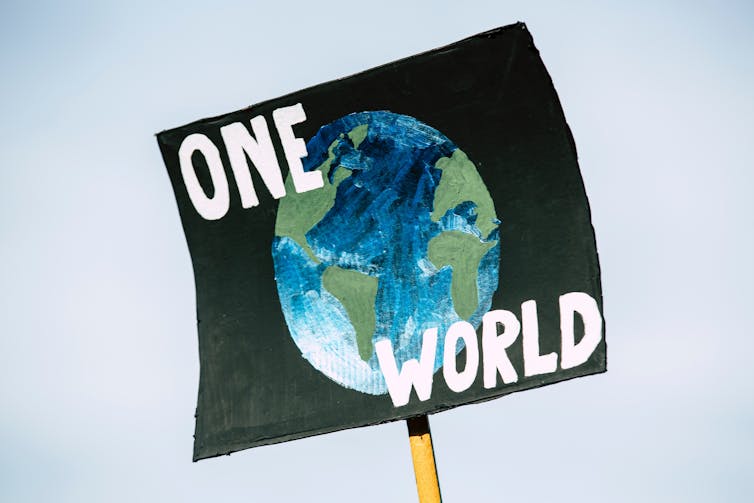


Share this:

  • Click to share on WhatsApp (Opens in new window) WhatsApp
  • More
  • Click to share on Pocket (Opens in new window) Pocket
  • Click to share on Mastodon (Opens in new window) Mastodon

THE BEADY EYE SAY’S: IT’S FAR TO LATE TO CONTROL AI.

01 Saturday Apr 2023

Posted by bobdillon33@gmail.com in 2023 the year of disconnection., Artificial Intelligence., Dehumanization., Democracy., Digital age., DIGITAL DICTATORSHIP., Disaster Capitalism., Fake News., Fourth Industrial Revolution., How to do it., Human Collective Stupidity., Human Exploration., Human values., Humanity., Inequality, Life., Modern day life., Modern day Slavery, Our Common Values., Post - truth politics., Purpose of life., Reality., Robot citizenship., Social Media Regulation., State of the world, Sustaniability, Technology v Humanity, Technology., The essence of our humanity., The Future, The Internet., The metaverse., The Obvious., The state of the World., The world to day., TRACKING TECHNOLOGY., Unanswered Questions., VALUES, VIRTUAL REALITY., What is shaping our world., WHAT IS TRUTH, What Needs to change in the World

≈ Comments Off on THE BEADY EYE SAY’S: IT’S FAR TO LATE TO CONTROL AI.

( Six minute read)

Why?

Because the change is already taking place.

Because,  There are now more cell phones in the world than people. There were less than 7% of the world on online in 2000, today over half the global population has access to the internet.

Because, technology has already radically transformed our societies and our daily lives, from smartphones to social media and healthcare. Technology touches nearly everything we do.

Because, your voice, your image, your race, your shopping habits, your health, your movement’s, your viewing habits, your voting, your financial standing, your criminal record, your interests, your decision making, down to what you are eating, not forgetting your sex life is and has being harvest for free.

All can be and are being faked.

Because, virtual interactions offers enticing financial opportunities for big businesses and digitalized Governments.

——-

Excessive use of technology can do more harm than good, and we should bear this in mind before we rush into digitizing our lives.

When all areas of human activity get rapidly digitized, it’s easy to become desensitized to the importance of innovations and advancements for the overall progress of society. Though it may be tough to predict which advancements technology would bring next, some innovations are already changing our beliefs about the world around us.

The coming generations will be living in a mixture of reality and the metaverse. Using headsets to create a  3D avatar – a representation of themselves –  to enter a virtual world connecting all sorts of digital environments. Perhaps when they go online shopping, they will be able too try on digital clothes first, and then order them to arrive in the real world.

A virtual economy of inequality.  Nowhere does the intersection of technology, enterprises and individuals hold greater opportunity than in the metaverse.

If it happens at all – will be fought among tech giants for the next decade, or maybe even longer.

———-

The Metaverse doesn’t exist – at least not yet, but there no way of predicting how people will react to it, or how it will be used.

( Everything transformed into line of code, augmenting reality by superimposing a computer-generated image on a user’s view of the real world. You have an experience while wearing another person’s body and you get to walk a mile in that person’s shoes.)

The next generation of the internet has the power to reshape the way that businesses and consumers engage, transact, socialize, work and learn together exploring the world on their own terms.

As of today, there isn’t anything that could legitimately be identified as a metaverse. The metaverse is essentially a massive, interconnected network of virtual spaces,

A better question might be:

What could become the metaverse?

Something that people would have considered magic just a few decades ago is now gaining popularity in business, gaming, and team building.

The combination of augmented, virtual and mixed reality – will play an important role.

The distinction between being offline and online will be much harder to delineate. So we either end up in a situation where it’s complete chaos and everyone’s allowed to do everything and you know, there’s racism, sexism, abuse and all that kind of stuff, or there’s incredibly tight moderation and no one’s allowed to do anything.

Wearable screens and gesture-based computing, other recent innovations, are predicted to soon substitute the usual PC and phone screens.

A red-haired woman wears the Oculus Quest 2 headset in white, holding two controllers

——-

Robots, another buzzword in today’s business world, have already replaced humans in some workplaces — robotic arms work at assembly or packing lines. Flying cars will soon address the issue of limited ground space and long traffic jams.

Clearly, technology by itself is neither good nor bad. It is only the way and extent to which we use it that matters.

It is indisputable that thanks to technology, we get a chance to live a life our predecessors could not even dream about.

But do all tech advancements bring sole good to our lives?

Or, maybe, the impact of tech innovations is quite ambiguous.

We are all at the mercy of machine learning algorithms, that are non transparent, non accountable, and non regulated.

So we have an open letter from those on High in the Tec world,  advocating that the brakes should be applied to the creation of new tech that generates falsehood’s. You dont have to be a Tech genius to know that this is not going to happen.

My advice is.

To protect oneself.

Every person should have a secret verification word in order to authenticate the caller and a symbol to be used in all texts and emails, that if not present in any communication received or sent,  marks it as False.

——–

All of which begs the question: just why is the 21st century so dystopian?

A few years ago, you might have thought: this is just a phase. It’ll pass. But it’s not. If anything, it’s getting worse, and it feels like it’s here to stay.

When I say “it”, or “dystopia,” you might wonder exactly, precisely what I mean. What I mean is very simple though. How many crises do we face? More than I can easily count. Let’s try to list them all, though we’ll run out of sanity and room before we finish, for sure. Finances? Total crisis, incomes falling around the world, debt levels soaring. Infrastructure? Mega-crisis, unless you think the infrastructure we have survives this century, let alone this decade. Social systems? Everywhere from France to Britain to America — crisis. People’s…minds? Crisis, especially in young people, depression and anxiety and suicide rates soaring. Then there are the big ones: climate change and mass extinction, not to mention politics , which has taken a notably…fascist…turn, again.

All of this is what scholars have begun to call The age of Polycrises.  And in it, the better question isn’t: “what’s in crisis?

It’s: what isn’t?

Like I said, the list above is a mere brief beginning. Migration and refugees? Another one. Peace and democracy? Yup, in crisis.

How about upward mobility? Check. Faith and confidence in institutions? Super crisis. Take a look at any element of society or the world, and chances are, it’s in crisis. How about inequality? Shocking levels of crisis.

This is why the 21st century feels so dystopian.

It’s not really a “feeling,” though that’s the way it’s often made out to be by media. It’s an empirical reality. Scholars have begun to conceptualize the 21st century as a “Polycrisis” for a reason, which is that the dystopia is real.

So when media, bigwigs, wannabe intellectuals and so forth, make all this out to be exaggeration, hyperbole, imply that you are the fainting Victorian bride in the room, because, hey, Tucker!! Everything’s Great!!…they’re completely wrong. And that needs to be said. It’s a form of denialism at this point, because…

The next part is about cause and effect. We need, as a civilization and a world, to figure out what’s causing all this, so we can begin to undo it. But if all we do is deny it…then, my friends, our gooses are well and cooked.  It’s fascism on a dying planet, in different bitter and poisonous flavours, maybe.

ITS NOW AGI. ( Artificial General Intelligence) Already it is transforming every walk of life.

AI is not a futuristic vision, but rather something that is here today and being integrated with and deployed into a variety of sectors.

There are numerous examples where AI already is making an impact on the world and augmenting human capabilities in significant ways. This includes fields such as finance, national security, health care, criminal justice, transportation, and smart cities, digital education, decision making, democracy’s.

Artificial intelligence algorithms are designed to make decisions, often using real-time data. They are unlike passive machines that are capable only of mechanical or predetermined responses. Using sensors, digital data, or remote inputs, they combine information from a variety of different sources, analyse the material instantly, and act on the insights derived from those data. With massive improvements in storage systems, processing speeds, and analytic techniques, they are capable of tremendous sophistication in analysis and decision making.

———-

These software systems “make decisions which normally require [a] human level of expertise” and help people anticipate problems or deal with issues as they come up. As such, they operate in an intentional, intelligent, and adaptive manner

AI generally is undertaken in conjunction with machine learning and data analytics. Machine learning takes data and looks for underlying trends. If it spots something that is relevant for a practical problem, software designers can take that knowledge and use it to analyse specific issues. All that is required are data that are sufficiently robust that algorithms can discern useful patterns. Data can come in the form of digital information, satellite imagery, visual information, text, or unstructured data.

AI systems have the ability to learn and adapt as they make decisions. In the transportation area, for example, semi-autonomous vehicles have tools that let drivers and vehicles know about upcoming congestion, potholes, highway construction, or other possible traffic impediments. Vehicles can take advantage of the experience of other vehicles on the road, without human involvement, and the entire corpus of their achieved “experience” is immediately and fully transferable to other similarly configured vehicles. Their advanced algorithms, sensors, and cameras incorporate experience in current operations, and use dashboards and visual displays to present information in real time so human drivers are able to make sense of ongoing traffic and vehicular conditions. And in the case of fully autonomous vehicles, advanced systems can completely control the car or truck, and make all the navigational decisions.

If we don’t want to end up as deglazed digital citizens here’s what should be done.

  • Regulate broad AI principles rather than specific algorithms,
  • Take bias complaints seriously so AI does not replicate historic injustice, unfairness, or discrimination in data or algorithms,
  • Maintain mechanisms for human oversight and control, and
  • Penalize malicious AI behaviour and promote cybersecurity.

All human comments appreciated. All like clicks and abuse chucked in the bin.

Contact: bobdillon33@gmail.com

Share this:

  • Click to share on WhatsApp (Opens in new window) WhatsApp
  • More
  • Click to share on Pocket (Opens in new window) Pocket
  • Click to share on Mastodon (Opens in new window) Mastodon

THE BEADY EYE SAY’S. CIVILIZATION WITH CLIMATE CHANGE WILL BE A VERY THIN VENEER.

21 Tuesday Mar 2023

Posted by bobdillon33@gmail.com in Climate Change., CO2 emissions, Dehumanization., Environment, Green Energy., Human Collective Stupidity., Human values., Life., Reality., State of the world, Telling the truth., The common good., The Future, The Obvious., The state of the World., Truth, Unanswered Questions., What is shaping our world., WHAT IS TRUTH, What Needs to change in the World, Where's the Global Outrage.

≈ Comments Off on THE BEADY EYE SAY’S. CIVILIZATION WITH CLIMATE CHANGE WILL BE A VERY THIN VENEER.

Tags

Capitalism and Greed, Capitalism vs. the Climate., Climate change, The Future of Mankind, Visions of the future.

.( Twenty minute read) 

There are no words to describe the present state of our world.

Here below is a recent picture from Australia, it more than adequately does the job. Millions of dead fish float were seen floating on the Lower Darling in Far west NSW.

A thousand fish per square metre (caused “severe deoxygenation”)

We seen conflict raging for decades across the world, as if war is always and forever an ordinary routine, limited to developing third world nations, however wars are no longer something visited upon impoverished and remote populations. With the Coming Climate Change we ent seeing nothing yet when it comes to wars.

IT IS THE DEFINING ISSUE OF OUR TIMES, WITH PROFOUND CONSEQUENCES, FOR THE FOOD CHAIN, ENGERY  DISEASES, DWINDELING RESOURSE AND FUTURE WARS.

To date we have had summit after summit with countries promising to reduce their carbon emission at varying degrees and rates of time, with 60% not in the west returning home, PROBALY THINKING WHY SHOULD THEY BE CARRYING THE CAN WHEN ITS IS THE COUNTRIES IN THE WEST THAT CAUSED THE PROBLEM IN THE FIRST PLACE.

Vermillion Cliffs at Paria Canyon Wilderness in Arizona

We are already in a pivotal moment in deciding our planets future, which requires significant societal changes to mitigate it.

Why?

Because our current global political economy solves problems through business as usual growth, wasting precious time to effectively reduce emissions to prevent human suffering and ecological system collapse at an unimaginable scale.

Because we are unable to put the common good in front of short term profit.

Although we have been raising public awareness on climate change for years, this is not enough; the global temperature increases day by day.  Unless greenhouse gas emissions and global temperature are reduced within years, the world will face demanding consequences.

Because the fragility of life as we know it, will be shattered by Climate change.

——–

Most human beings have an almost infinite capacity for taking things for granted. What we fail to remember is that we ourselves live in the very world we do not seem to care what happens to.

We do not realise is that with each day that passes without any action, the number of natural resources available also decreases significantly.

Take the Fashion Industry’s for example.

10,000 litres of water are used to produce just one kilogram of cotton.

WITH OVER 5 BILLIONS PAIRS OF JEANS PRODUCED A YEAR  – 60 PAIRS A SECOND USING – 1000 LITERS OF WATER PER PAIR = A MIND BLOWING WASTE OF WATER. 

The average jeans collection needs 36,250 litres of water. Hoodies and sweatshirts need 23,450 litres. T-shirts and shirts require 15,000 litres, while our undergarments combined use 45,950 litres of water. The average person drinks 691 litres of water per year.

This means that our jeans collection has used 52.5 years of drinking water for one person.

The next time you put on your best threads, think about the environmental cost of your outfit — you may just be dripping wet.


——

” We are now entering in the politics of eternity and the politics of inevitability.”

How is the Earth going to survive, if the only species it has the chance to lean on, turn their back to it?

Climate is the envelope within which all other environmental conditions and processes important to human well-being must function. ANY TIPPING POINT COULD opened the floodgates.

Inevitability politicians portray history as a journey from savagery to civilization and assume this trend will continue to their desired outcome.

We have witnessed in the past 30 years the degradation of liberal democracy, the spread of Islamic terror across borders, and the resilience of the illiberal Chinese political system.

Up to now very form of society has been based, on the antagonism of oppressing and oppressed classes…This is why Capitalism combined with democracy has provided the perfect balance for governance, and as a consequence took root in most countries.

The liberal arrogance shown at the end of the 20th century paved the way for the blowback of the 21st.

Liberals failed to confront the innate inequality of the post-war international order so liberal inevitability politics sealed its own fate. By failing to address the problems of the now rapidly collapsing global order, and those who are committed to democracy and strong institutions have spent this century trying to pick up the pieces.Vladimir Putin sits angrily at desk

Where eternity politics is best on display currently is in the Russian narrative on their invasion of Ukraine.

To the Russian eternity politician, the West is simply repeating its century-old tactic to assault Russian values and Russia’s greatness, as they did in the Crimean War, Great Northern War, or any other conflict they may pick.

But the eternity politician makes the same mistake as the inevitability politicians, they remove agency from individuals and movements with personalized beliefs, motivations, and tactics.

Herein lies the problem with both the politics of inevitability and the politics of eternity:

They ignore the fact that developments in the political and social conscience of individuals and societies determine history, not the other way around.

As an entire nation of people is stripped of its agency the war in Ukraine is boiling down into a proxy war between two great powers. However, what cannot be done is to create a single coherent narrative about the historical past, the political present, and the prospective future, because of the simple fact that human beings do not have omniscience.

We cannot possibly isolate the individuals and communities that shape historical development. We cannot aggregate history, and we should not try. Revolutions did occur in China and in Russia (along with many other places), regimes committed atrocities with impunity, as everything they did was in service of the righteous and inevitable world revolution, just as the dogma told them.

The most dangerous facet of the politics of eternity and politics of inevitability is not the gross oversimplification of history they embody, but rather the societal implications they necessitate.

In the case of liberal capitalist democracies, it leads to a small group of wealthy individuals amassing such great control that it threatens the very institutions liberals revere as eternal.

For the Marxist, it leads to the justification of mass arrest, disenfranchisement , and slaughter in the name of an inevitable world revolution that will never arrive. And for the nationalist, it means a constant paranoid struggle for dominance against their neighbours, no matter the cost.

So with the arrival of the Internet /Social media / The smartphone, are we in an “intellectual coma.” left with a form of Capitalism that is no longer working.

In denying historicism, we shouldn’t deny that progress is possible, rather we should accept that progress is not pre-determined, and relies on all of us as active participants to truly make history.

Climate change with out a doubt will lead to social disruption and potentially violent conflict.

I shudder to think about this impromptu utterances.

———-

Earth on psychiatrist's couch.


It’s not that difficult to see that, says mass migration, it will provoke more conflict in the world.

Our tribalism will become more apparent over the next decade or so. Social Media reflects this with the pervasive mentality in western journalism of normalizing tragedy in parts of the world, such as the Middle East, Africa, south Asia, and Latin America, Syria, Afghanistan, Ukraine, your name it and it is perversely turned into entertainment.

Everything will have to adapt to the changing times.

As culture change, so does the way we consume it – all digital and virtual viewing merging into a digital and physical worlds with  interactions changing into an endless cycle of content discovery, co-creation and sharing, which will deepen the emotional impact of content or by- pass it completely. This extends beyond our screens and newspapers and easily bleeds and blends into politics.

Righteous outrage immediately mounted online.

Xenophobia is an efficient tool to keep people divided. Colonial powers knew this early on. By separating people based on superficial characteristics, such as skin colour, and then assigning qualities to these features (such as being civilized vs. barbarian, or intelligent vs. backward), people started to believe that they were different from each other based on these highly unscientific classifications. To eradicate racism, we must become aware that our ancestors invented the notion of race for self-fulfilling reasons rooted in unscientific assumptions.

The question becomes how we classify people as strangers. This changes over time. Therefore, the classification of people as strangers is culturally constructed, with racism being one of its many forms.

Race and racism were non-existent during most of human history. To be human has always meant one thing -to be civilised. One was not born human. One had to become human.

Racism is a recently invented classification system that triggers xenophobia.

——-

After demonizing and abusing refugees, especially Muslim and African refugees, for years., now if one does not look like a refugee the chances of being excepted anywhere is almost zero.

You can see it already in Europe.

I suspect we’re going to see more nativism, more xenophobia, and more talk of building walls on our borders. Neighbour helping neighbour is a dying falsify.

Very concept of providing refuge is not and should not be based on factors such as physical proximity or skin colour.

The idea of granting asylum, of providing someone with a life free from political persecution, must never be founded on anything but helping innocent people who need protection. That’s where the core principle of asylum is located. If not we are showing ourselves as giving up on civilization and opting for barbarism instead.

On the one hand, there is something to be said about the idea of mankind as a group defined, beyond gender, race, or class, by a characteristic shared by all humans.

The history of the idea of human nature since the 5th century BC represents the history of Western violence and domination. It bears witness to some of the deepest conflicts and divisions the earth has seen.

The West identifies capitalism, liberalism and democracy as markers of civilisation and progress against Islamic fundamentalism, theocratic rule, and what it irresponsibly calls ‘the Muslim world’.

——–

These things exist with or without climate change, but the effects of climate change — migration in particular — will exacerbate them and help fuel reactionary movements around the world.

Ideology will always be a surface-level justification for conflict — people come up with narratives to justify whatever they’re doing in the political world. But if you look deeply at the source of future conflicts, I think you’ll see a basic resource conflict at the bottom of it all.

We can say with some confidence that climate change will render huge parts of the world less hospitable to human beings, and that as a consequence, humans will have to change how and where they live.

Are we prepared?   NO!

Do we have the institutions, the structures, the systems of cooperation we need to deal with this problem?  NO!

Have we existing structure of peacekeeping that can hold up under these conditions?   NO!

Can Western democratic society, which is built on a system of limitless growth and productivity, change its destructive relationship with nature?  NO!

Modern liberal democratic societies are successful at improving the lives and freedoms of people who live in them. The problem is that these systems are based on the exploitation of nature and our environment, and we’re sort of trapped in this paradigm.

The lessons for those of who lived through the coronavirus pandemic today, it that Civilization is a very thin veneer. That your well-being as individuals really depends on the flourishing of the greater society.

Why?

Because under even slight amounts of pressure, that social contract starts to break down, and [when] people lose that veneer … that can be very dangerous. If a pandemic finds a society that is fractured, where there is distrust, where the public health system is neglected or in decay … that is going to be revealed, as it was with profiteers during the pandemic “willing to make money off human misery”

——–

Putting the pandemic into perspective as a terrible episode, but nonetheless just one episode, in a much longer story. This however  is not an option when it comes to Climate Change. Overwhelmed by the disaster, people will see what our system of Capitalism has become.

I think one of the things that is clearly exacerbating matters is when the issue is what we’d call politicized.

With technology and social media we humans – we become the stories that we tell ourselves. Our stories are never just stories. They are self-fulfilling prophecies.

That’s because we tend to use history, which is at its heart the study of surprises, as a guide to the future. This should however not stop us from aiming to better understand the future: the knowledge gained through planning is crucial to the selection of appropriate actions as future events unfold. We don’t know the answer, but we can at least ask useful questions and catalyze the conversation!

It’s important to remember that technology is often value-neutral: it’s what we do with it day in, day out that defines whether we are dealing with the “next big thing”.

Is there a way to think of the human being beyond the opposition between the ‘civilized’ and the ‘barbarian’?

Or is such an idea of mankind yet to be invented?


Watch and weep.

All human comments appreciated. All like clicks and abuse chucked in the bin.

Contact: bobdillon33@gmail.com

Share this:

  • Click to share on WhatsApp (Opens in new window) WhatsApp
  • More
  • Click to share on Pocket (Opens in new window) Pocket
  • Click to share on Mastodon (Opens in new window) Mastodon

THE BEADY EYE SAY’S. TO SECURE A FUTURE ALL OF US MUST FIGHT THE RIGHT WAR RIGHT NOW.

19 Wednesday Oct 2022

Posted by bobdillon33@gmail.com in 2022: The year we need to change., Climate Change., Disconnection., Earth, Education., Energy, Environment, Evolution, Extermination., Human Collective Stupidity., Human Exploration., Human values., Humanity., Life., Modern day life., Natural World Disasters, Nuclear power., Our Common Values., Profiteering., Purpose of life., Real life experience's, Reality., Renewable Energy., State of the world, Sustaniability, Technology v Humanity, The common good., The essence of our humanity., The Future, The Obvious., The state of the World., THE WORLD YOU LIVE IN., THIS IS THE STATE OF THE WORLD.  , Truth, Unanswered Questions., Uncategorized, VALUES, We can leave a legacy worthwhile., What is shaping our world., WHAT IS TRUTH, What Needs to change in the World, Where's the Global Outrage.

≈ Comments Off on THE BEADY EYE SAY’S. TO SECURE A FUTURE ALL OF US MUST FIGHT THE RIGHT WAR RIGHT NOW.

Tags

Capitalism vs. the Climate., Climate change, The Future of Mankind, Visions of the future.

If humanity wants to hope to contain global warming below 1.5°C – Governments must close the gap between net zero rhetoric and reality.

There can be no more hiding, and no more denying deluding yourself with a lot of greenwashing.

Political leaders, blinded by capital and powerful private interests, have long decided Earth is a small price to pay for the yachts, mansions, private jets and record profits of the one percent.

In Glasgow at the COP26 climate conference we watched as world leaders came up with new excuses, symbolic targets and new ways to silence the progressive voices who opposed them.

Global heating is supercharging extreme weather at an astonishing speed, this life-altering issue which we are NOW all witnessing daily – Somalia, Nigeria, Pakistan, is not getting the urgency and attention it demands.

Exploitation and development of new oil and gas fields must stop this year.

If governments are serious about the climate crisis, there can be no new investments in oil, gas and coal, from now – from this year.

It’s Now or Never.

A huge part can be done with existing technologies.

These technologies can and will create billions of jobs to drive a sustainable world, but it remains a fight of David against Goliath, because of how we measure our well being.

How we evaluate what we are doing needs to change.

GDP is a totally numbers-driven index that does not produce the true picture.

There are growing calls to find GDP alternatives to measure countries’ wealth and welfare.

GDP can’t accurately represent the wealth of a country when it ignores how money is divvied up.

Considering GDP alone, a rich country where 10% of the population controls 75% of the wealth (looking at you, United States) may rank higher than a poorer country with a more even distribution of wealth.

One of GDP’s biggest flaws is that it counts tragedies as economic bonuses. If a hurricane or tornado hits and a country spends millions of dollars rebuilding, those expenses boost GDP, even though people lost their homes, jobs, and lives.

GDP ignores many crucial ways to measure the wealth of a country: clean air, health, life span, gender equality, opportunity, education, and more. This is understandable – GDP wasn’t developed to rank countries’ welfare, but simply to measure money as the world recovered from the Great Depression.

Of course GDP cant be replaced over night, but it can be complemented by a Thriving Places Index (TPI) and this index could easily be expanded to other parts of the world.

TPI’s primary focuses are sustainability, equality, and local conditions. Unlike GDP, this index measures equality by investigating how evenly distributed life expectancy and wellbeing are across a country.

Interestingly, the U.N. encourages nations to use it alongside their gross national income data. They say that it can help governments assess national policy by “asking how two countries with the same level of GNI per capita can end up with different human development outcomes.”

By factoring in the ecological footprint, inequality, wellbeing, and life expectancy of a country, it provides a simple but rounded glance at the wealth of a country.

This alone will not however solve the problems that are now on the horizon.

We must implement measurements by monetising environmental damage factors to help countries better understand exactly where they stand environmentally.

The Green GDP is a noble effort to factor in the cost of climate change in a way that people whose focus is money can appreciate. While subjective data can immediately turn some financially conservative parties off, putting a number on the impact of environmental negligence could potentially hit home.

Our Profit driven societies focused too much on an idea that futuristic technologies will save the world from climate chaos, rather than focusing on what can be done today. If cuts to carbon are left to the future and not made in this decade, it will be too late to stay within the 1.5C limit.

What are the crucial new technologies in development for combatting Climate Change?

Clean energy is perhaps the biggest issue to tackle.

Convert carbon dioxide into a usable energy source using sunlight.

There are numerous projects trying to achieve this, but most of the hydrogen used today is extracted from natural gas NG00, -3.93% in a process that emits carbon dioxide as well as the more-fleeting, but more-potent, methane.

Electrical transport and advanced batteries?

Particularly for use in electric vehicles; hydrogen; and carbon capture appears to be the miracle solution to reduce the heavy ecological impact of transport. This technology is not all green under the hood. Even before having driven a single kilometre, the electric vehicle has emissions almost twice as high as those of a thermal vehicle.

Big data has big implications in creating awareness about the consequences of climate change but it’s harvesting with the use of non transparent and unregulated algorithms.

Crowdsourcing for environmental solutions by gathering journalists, scientists, technologists, and people passionate about sustainability is creating a new wave of environmentalism.

Mobile apps such as Oroeco is an app that tracks your carbon footprint by placing a carbon value on everything you buy, eat, and do. However most Apps are profit seeking and like Big data they remain un -transparent and unregulated.

Interactive maps really drive home the point of climate change.

All of these technologies use microchips in order to operate and these are made from rare finite resources.

For the first time, a mining company is preparing to mine the seabed to collect rocks rich in metals for the batteries of electric cars. A practice that promises to destroy ecosystems that are still unexplored and that could constitute a ticking “climate bomb”. Poisoning of fresh water reserves, artificialization and loss of biodiversity, toxicity for humans, radioactive pollution, occupation of agricultural land… The extraction and transformation of raw materials are much more polluting than for the fossil car.

In the end here is where we are.

Some of the highlights included a prediction of violent conflicts and civil wars, extreme poverty and the loss of several points of gross domestic product in some developing nations, mass extinctions, and an intense, regular pattern of natural disasters.

The average decline of the species analysed was 68% in 2020, and 60% in 2018, revealing an accelerating collapse of biodiversity around the world. “We can tell ourselves that 1% is not much, but losing 1% in two years is absolutely colossal. The mere fact that this index is not improving is a disaster in itself

Taking into account a global population rise of about 2 billion people, as well as the need to supply electricity to 785 million people who do not have access to it, and clean cooking to the 2.6 billion people who currently lack it there is no more time for multinationals to obtain justice.

Governments must fine them.

Instead we see governments like the UK licensing new oil and gas fields in the North Sea and has also mooted a new coalmine for coking coal alongside introducing fracking.

Instead we see Energy being use a a weapon of war.

We all know what is necessary for life however in the age of instant gratification, we have little appreciation of where it all come from and we remain unwilling to pay for a future that only exists on the planet we all inhabit.

A large-scale nuclear war would, by all scientific projections, be a planetary disaster of the highest order.

A large -scale climate event would be far worse. Here to day gone to morrow against watch our demise over a few generations.

So every one of us must engage now. ( See previous posts as how this can be achieved)

The simplest thing you can do is educate others.

Tell people there are other ways to measure a country’s wealth.

All human comments appreciated. All like clicks and abuse chucked in the bin.

Contact: bobdillo33@bobdillon33

Share this:

  • Click to share on WhatsApp (Opens in new window) WhatsApp
  • More
  • Click to share on Pocket (Opens in new window) Pocket
  • Click to share on Mastodon (Opens in new window) Mastodon
← Older posts
Newer posts →

All comments and contributions much appreciated

  • THE BEADY EYE ASKS: HOW MUCH LONGER IS THE WORLD GOING TO TOLERATE THE PLUNDERING OF USA? January 10, 2026
  • THE BEADY EYE SAYS WARS USE TO BE MAN AGAINST MAN, NO LONGER. WAR IS NOW DRONE AGAINST DRONE. January 9, 2026
  • THE BEADY EYE SAYS. WE HAVE SURROUND THE EARTH WITH SATELLITES. HERE TO DAY GONE TO MORROW. January 9, 2026
  • THE BEADY EYE SAYS GOVERNANCE IS BECOMING MORE BY REALITY TV, ALGO January 9, 2026
  • THE BEADY EYE SAYS. DONALD TRUMP IS EXPOSING THE WEAKEST OF OUR WORLD ORGANISATIONS January 7, 2026

Archives

  • January 2026
  • December 2025
  • November 2025
  • October 2025
  • September 2025
  • August 2025
  • July 2025
  • June 2025
  • May 2025
  • February 2025
  • January 2025
  • December 2024
  • November 2024
  • October 2024
  • September 2024
  • August 2024
  • July 2024
  • June 2024
  • May 2024
  • April 2024
  • March 2024
  • February 2024
  • January 2024
  • December 2023
  • October 2023
  • September 2023
  • August 2023
  • July 2023
  • June 2023
  • May 2023
  • April 2023
  • March 2023
  • February 2023
  • January 2023
  • December 2022
  • November 2022
  • October 2022
  • September 2022
  • August 2022
  • July 2022
  • June 2022
  • May 2022
  • April 2022
  • March 2022
  • February 2022
  • January 2022
  • December 2021
  • November 2021
  • October 2021
  • September 2021
  • August 2021
  • July 2021
  • June 2021
  • May 2021
  • April 2021
  • March 2021
  • February 2021
  • January 2021
  • December 2020
  • November 2020
  • October 2020
  • September 2020
  • August 2020
  • July 2020
  • June 2020
  • May 2020
  • April 2020
  • March 2020
  • February 2020
  • January 2020
  • December 2019
  • November 2019
  • October 2019
  • September 2019
  • August 2019
  • July 2019
  • June 2019
  • May 2019
  • April 2019
  • March 2019
  • February 2019
  • January 2019
  • December 2018
  • November 2018
  • October 2018
  • September 2018
  • August 2018
  • July 2018
  • June 2018
  • May 2018
  • April 2018
  • March 2018
  • February 2018
  • January 2018
  • December 2017
  • November 2017
  • October 2017
  • September 2017
  • August 2017
  • July 2017
  • June 2017
  • May 2017
  • April 2017
  • March 2017
  • February 2017
  • January 2017
  • December 2016
  • November 2016
  • October 2016
  • September 2016
  • August 2016
  • July 2016
  • June 2016
  • May 2016
  • April 2016
  • March 2016
  • February 2016
  • January 2016
  • December 2015
  • November 2015
  • October 2015
  • September 2015
  • August 2015
  • July 2015
  • June 2015
  • May 2015
  • April 2015
  • March 2015
  • February 2015
  • January 2015
  • December 2014
  • November 2014
  • October 2014
  • September 2014
  • August 2014
  • July 2014
  • June 2014
  • May 2014
  • April 2014
  • March 2014
  • February 2014
  • January 2014
  • December 2013
  • November 2013
  • October 2013

Talk to me.

Jason Lawrence's avatarJason Lawrence on THE BEADY EYE ASK’S: WIT…
benmadigan's avatarbenmadigan on THE BEADY EYE ASK’S: WHA…
bobdillon33@gmail.com's avatarbobdillon33@gmail.co… on THE BEADY EYE SAYS: WELCOME TO…
Ernest Harben's avatarOG on THE BEADY EYE SAYS: WELCOME TO…
benmadigan's avatarbenmadigan on THE BEADY EYE SAY’S. ONC…

7/7

Moulin de Labarde 46300
Gourdon Lot France
0565416842
Before 6pm.

My Blog; THE BEADY EYE.

My Blog; THE BEADY EYE.
bobdillon33@gmail.com

bobdillon33@gmail.com

Free Thinker.

View Full Profile →

Follow bobdillon33blog on WordPress.com

Blog Stats

  • 94,520 hits

Blogs I Follow

  • unnecessary news from earth
  • The Invictus Soul
  • WordPress.com News
  • WestDeltaGirl's Blog
  • The PPJ Gazette
Follow bobdillon33blog on WordPress.com

The Beady Eye.

The Beady Eye.
Follow bobdillon33blog on WordPress.com

Blog at WordPress.com.

unnecessary news from earth

WITH MIGO

The Invictus Soul

The only thing worse than being 'blind' is having a Sight but no Vision

WordPress.com News

The latest news on WordPress.com and the WordPress community.

WestDeltaGirl's Blog

Sharing vegetarian and vegan recipes and food ideas

The PPJ Gazette

PPJ Gazette copyright ©

Privacy & Cookies: This site uses cookies. By continuing to use this website, you agree to their use.
To find out more, including how to control cookies, see here: Cookie Policy
  • Subscribe Subscribed
    • bobdillon33blog
    • Join 223 other subscribers
    • Already have a WordPress.com account? Log in now.
    • bobdillon33blog
    • Subscribe Subscribed
    • Sign up
    • Log in
    • Report this content
    • View site in Reader
    • Manage subscriptions
    • Collapse this bar
 

Loading Comments...
 

You must be logged in to post a comment.