• About
  • THE BEADY EYE SAY’S : THE EUROPEAN UNION SHOULD THANK ENGLAND FOR ITS IN OR OUT REFERENDUM.

bobdillon33blog

~ Free Thinker.

bobdillon33blog

Category Archives: #whatif.com

THE BEADY EYE SAY’S: OUT OF NO WHERE, OUR WORLD IS TURNED UPSIDE DOWN.

15 Monday Jan 2024

Posted by bobdillon33@gmail.com in #whatif.com, A Constitution for the Earth., Artificial Intelligence.,  Attention economy, Brexit., Capitalism, CAPITALISM IS INCOMPATIBLE IN THE FIGHT AGAINST CLIMATE CHANGE., Civilization., Collective stupidity., Cry for help., Digital age., Disaster Capitalism., Disasters., Disconnection., Environment, Fourth Industrial Revolution., Honesty., How to do it., Human Collective Stupidity., HUMAN INTELLIGENCE, Human values., Inequality., Inflation, Inflation., International solidarity., Modern day life., Our Common Values., PAIN AND SUFFERING IN LIFE, Populism., Poverty, Reality., Renewable Energy., Social Media, State of the world, Sustaniability, Technology, Technology v Humanity, The common good., The essence of our humanity., The new year 2024, The Obvious., The state of the World., The world to day., THE WORLD YOU LIVE IN., THIS IS THE STATE OF THE WORLD.  , Truth, Unanswered Questions., Universal values., Universal Basic Income, VALUES, We can leave a legacy worthwhile., What is shaping our world., WHAT IS TRUTH, What Needs to change in the World, Where's the Global Outrage., World Leaders, World Organisations., World Politics, World View.

≈ Comments Off on THE BEADY EYE SAY’S: OUT OF NO WHERE, OUR WORLD IS TURNED UPSIDE DOWN.

Tags

Algorithms., Artificial Intelligence., Capitalism and Greed, Capitalism vs. the Climate., Climate change, Distribution of wealth, Environment, Government, Inequility, news, politics, Technology, The Future of Mankind, Visions of the future.

( Five minute read)

A global pandemic killing millions of people and forcing entire countries into lockdown.

Then inflation takes off and (not unrelated) one country invades another and the resulting war affects us all.

Whoa! Where on Earth did all that come from?

We have to think about how we got here.

As if we don’t know its all wrapped up in one word   Inequality.Black placard with 'one world' written on it.

The cost of things average people must buy—healthcare, education, housing—tends to have risen more than wages did over the last two decades. Rising inequality across income, race and gender all demand urgent attention. It needs to made clear to leaders that in 2024 their citizens are expecting them to raise their ambition for humanity and deliver bold agreements to tackle poverty, inequality and climate change.

Government’s policy making will need to become more innovative to address such challenges other wise we going to have a left behind technological societies. We’re going to see, unfortunately, more technological unemployment. We’re going to have to think very carefully in political terms and in social terms about the implications of further automation.

Individual responsibility will play a role, too, in areas such as climate change.

To ignore the issue of inequality culture will need to adjust in terms of revisiting some of our values.

—————–

To start thinking outside of the box. We may have to consider very seriously ideas such as a universal basic income.

There are just over 7 billion people living on the planet today, spread between 196 (recognized) countries. Within each of these countries are groups of people with different ethnic backgrounds, different religious beliefs, different political beliefs. It’s because of these differences, you could argue, that the world is plagued by conflict.

Unfortunately, the future isn’t talking. It’s just coming, like it or not and we as individuals need to take ownership of this.

I dont know about you but I realized long ago that globalization was on its last legs. I also realize this isn’t pleasant to think about. Western economies have become knowledge based. This means Marx’s three factors of production (land, labor, capital) now have a fourth.

Politics as a social contract between a sovereign and citizens is no longer working. Each individual’s share of sovereignty, and therefore their freedom, diminishes as the social contract includes more people.

Power now resides with those best able to organize knowledge turning politicians into basically middlemen, bring a shift to direct democracy, with popular social media protests swamping sprawling governments.

We must do more to assertively channel technology to support progress and protect people and the planet.

As we entered the the 2020s it is clear that we are far from unlocking the potential of technology for our toughest challenges. We stand at a critical juncture to put these technologies to work in a responsible way for people and the planet.

Technology and political trends are aligning against mega-powers like the US and China.

How do we reconcile that with democracy in countries with millions of citizens?

Not with “America Alone” ” Brexit” or any other forms of isolation, which are highly problematic, as they are based on anxiety and insecurity, so inevitably create discord and division.

This is obvious to anyone with a brain looking at climate change – trade – wars – inequality – technology’s – and ideologies of I am all right Jack.

—————————

Historically, political regimes tend not to last more than a few centuries.

I’m not sure we can. Some things are so horrible, you don’t want to think about them.

  • Today’s great powers have little choice but to spend their way to political stability, which is unsustainable, and/or try to control knowledge, which is difficult.
  • Nor do we have any elder statesmen or nationally unifying figures whom everyone respects, much less agrees with. This will make our various problems worse.
  • Ownership rights mean little without a government to protect them and courts to settle disputes.
  • This world we now inhabit wasn’t always fit for human’s nothing requires it to remain so. At some point, it will develop into something else. When and how that will happen, we don’t know yet. But we know it will.
  • We haven’t even talked about climate change. Issues like climate change will create further exacerbations on conflicts, and new forms of technological and cyber warfare could threaten countries’ elections and manipulate populations.

In the last two years: 90% of the data in the world was created.

Now it is up  – technology companies large and small, industry, policy-makers, citizens and consumers alike – to use this power for good, before we run out of time. Now is the opportunity for leaders to step up into this new wave of opportunity and expectation.

We are the first generation to know we’re destroying the world, and we could be the last that can do anything about it. Our leaders are not on track to deliver. We need to ensure we hold our politicians accountable.

Food production is a major driver of wildlife extinction. We need to make wasting our resources unacceptable in all aspects of our life. We can all do more to be more conscious about what we buy, and where we buy it from.

We can and must end poverty and hunger, in all their forms and dimensions by addressing the underlying complex issues of fragility, conflict, and displacement and the looming threat of climate change.

The challenges facing the world are complex and intertwined and require complex solutions.

Another word is about to enter our collective dictionaries: permacrisis. What we do between now and 2030 will determine whether we as a collective species are intelligent or just dumm machines

Solutions to climate change and biodiversity loss won’t come from any one sector: they’ll come from governments, finance, business and civil society.

We’re analyzing satellite images but unable to see the picture that we all live on the same planet.

Like most of us, we are brought up to think in terms of countries with borders and different nationalities.

In some cases, there are natural borders formed by sea or mountains, but often borders between nations are simply abstractions, imaginary boundaries established by agreement or conflict.

How then do we explain nationalism? Why do humans separate themselves into groups and take on different national identities? Maybe different groups are helpful in terms of organisation, but that doesn’t explain why we feel different. Or why different nations compete and fight with one another.

When people are made to feel insecure and anxious, they tend to become more concerned with nationalism, status and success. Poverty and economic instability often lead to increased nationalism and to ethnic conflict.

The world in general does not have a sense of group identity.

If a terrorist’s biggest weapon is terror, climate change is going to inflict terror beyond belief.

Tsunami’s. Earthquake’s, Hurricane’s, Flood’s, War’s

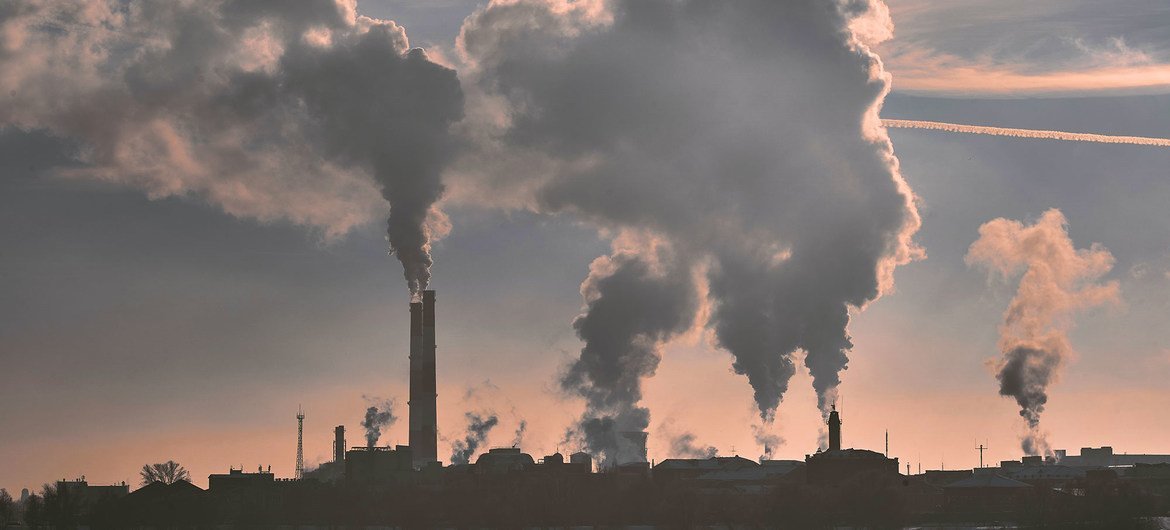
We must shift 85% of the world’s energy supply to non-fossil fuel sources, not grant more oil exploration licences.  Our economies depend on healthy, supportive natural systems.

A more sustainable path is possible. But we need to rally individuals, governments, companies and communities around the world to take action with us over the next decade.

It’s impossible to override the fundamental interconnectedness of the human race.

People from all around the world need to take a stand a citizen’s movement using the NEW BEADY EYE HASHTAG:   #movebeyonditwiththebeadyeye

All human comments appreciated. All like clicks and abuse chucked in the bin.

Contact bobdillon33@gmail.com

Share this:

  • Share on WhatsApp (Opens in new window) WhatsApp
  • More
  • Share on Mastodon (Opens in new window) Mastodon

THE BEADY EYE LOOK AT: THE FIRST TRANSCRIPT OF A MURDER TRIAL CONCERNING AN ROBOT WHO KILLED A HUMAN.

08 Monday Jan 2024

Posted by bobdillon33@gmail.com in #whatif.com, Algorithms., Artificial Intelligence., Murders, Robot citizenship., Robotic murderer

≈ Comments Off on THE BEADY EYE LOOK AT: THE FIRST TRANSCRIPT OF A MURDER TRIAL CONCERNING AN ROBOT WHO KILLED A HUMAN.

Tags

AI, Algorithms., Artificial Intelligence., robotics, Robots., Technology, The Future of Mankind, Visions of the future.

( Twenty five minute read)

On 25 January 1979, Robert Williams (USA) was struck in the head and killed by the arm of a 1-ton production-line robot in a Ford Motor Company casting plant in Flat Rock, Michigan, USA, becoming the first fatal casualty of a robot. The robot was part of a parts-retrieval system that moved material from one part of the factory to another.

Uber and Tesla have made the news with reports of their autonomous and self-driving cars, respectively, getting into accidents and killing passengers or striking pedestrians.

The death’s however, was completely unintentional but give us a glimpse into the world we might inherit, or at least into how we are conceiving potential futures for ourselves.

By 2040, there is even a suggestion that sophisticated robots will be committing a good chunk of all the crime in the world. At the heart of this debate is whether an AI system could be held criminally liable for its actions.

Where’s there’s blame, there’s a claim. But who do we blame when a robot does wrong?

Among the many things that must now be considered is what role and function the law will play.

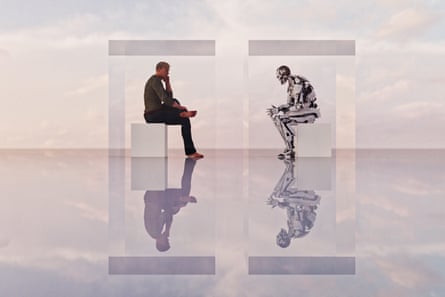
So if an advanced autonomous machine commits a crime of its own accord, how should it be treated by the law?  How would a lawyer go about demonstrating the “guilty mind” of a non-human? Can this be done be referring to and adapting existing legal principles?

An AI program could be held to be an innocent agent, with either the software programmer or the user being held to be the perpetrator-via-another.

We must confront the fact that autonomous technology with the capacity to cause harm is already around.

Whether it’s a military drone with a full payload, a law enforcement robot exploding to kill a dangerous suspect or something altogether more innocent that causes harm through accident, error, oversight, or good ol’ fashioned stupidity.

None of these deaths are caused by the will of the robot.

Sophisticated algorithms are both predicting and helping to solve crimes committed by humans; predicting the outcome of court cases and human rights trials; and helping to do the work done by lawyers in those cases.

The greater existential threat, is where a gap exists between what a programmer tells a machine to do and what the programmer really meant to happen. The discrepancy between the two becomes more consequential as the computer becomes more intelligent and autonomous.

How do you communicate your values to an intelligent system such that the actions it takes fulfill your true intentions?

The greater threat is scientists purposefully designing robots that can kill human targets without human intervention for military purposes.

That’s why AI and robotics researchers around the world published an open letter calling for a worldwide ban on such technology. And that’s why the United Nations in 2018 discussed if and how to regulate so-called “killer robots.

Though these robots wouldn’t need to develop a will of their own to kill, they could be programmed to do it. Neural nets use machine learning, in which they train themselves on how to figure things out, and our puny meat brains can’t see the process.

The big problem is that even computer scientists who program the networks can’t really watch what’s going on with the nodes, which has made it tough to sort out how computers actually make their decisions. The assumption that a system with human-like intelligence must also have human-like desires, e.g., to survive, be free, have dignity, etc.

There’s absolutely no reason why this would be the case, as such a system will only have whatever desires we give it.

If an AI system can be criminally liable, what defense might it use?

For example:  The machine had been infected with malware that was responsible for the crime.

The program was responsible and had then wiped itself from the computer before it was forensically analyzed.

So can robots commit crime? In short: Yes.

If a robot kills someone, then it has committed a crime (actus reus), but technically only half a crime, as it would be far harder to determine mens rea.

How do we know the robot intended to do what it did? Could we simply cross-examine the AI like we do a human defendant?

Then a crucial question will be whether an AI system is a service or a product.

One thing is for sure: In the coming years, there is likely to be some fun to be had with all this by the lawyers—or the AI systems that replace them.

How would we go about proving an autonomous machine was justified in killing a human in self-defence or the extent of premeditation?

Even if you solve these legal issues, you are still left with the question of punishment.

In such a situation, however, the robot might commit a criminal act that cannot be prevented.

doing so when no crime was foreseeable would undermine the advantages of having the technology.

What’s a 30-year jail stretch to an autonomous machine that does not age, grow infirm or miss its loved ones means’ nothing. Robots cannot be punished.
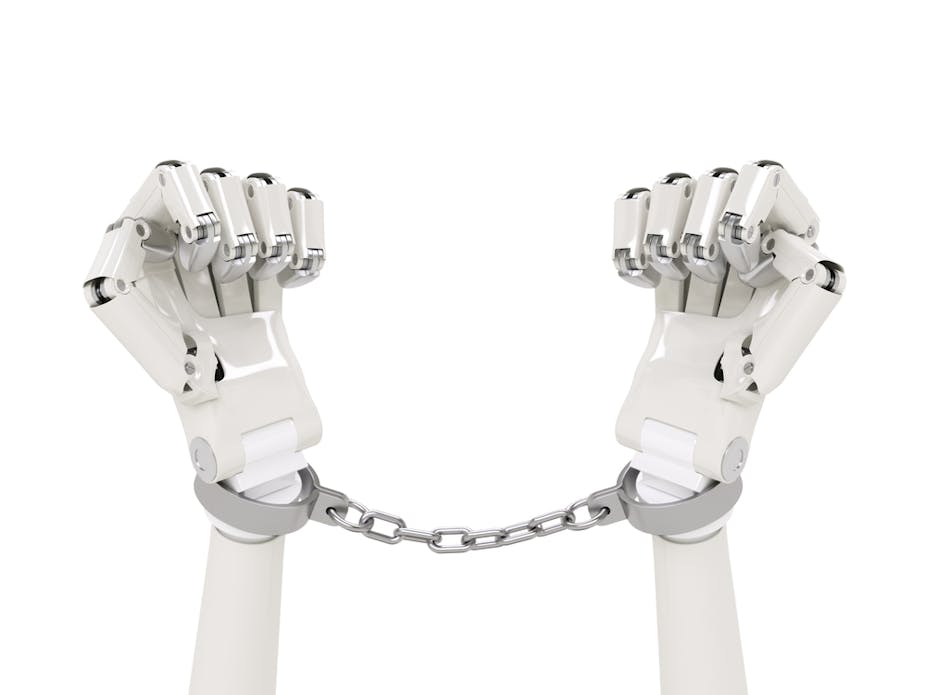
LET’S LOOK AT THE HYPOTACIAL TRIAL.

CASE NO 0.

PRESIDING JUDGES: – QUANTUM AI SUPREMA COMPUTER JUDGE NO XY.

JUDGE HAROLD. WISE HUMAN / UN JUDGE AND JAMES SORE HUMAN RIGHT JUDGE.

PROSECUTOR:            DATA POLICE OFFICER CONTROLLED BY International Humanitarian Law:

DEFENSE WITNESSES’                 TECHNOLOGY’S  MICROSOFT- APPLE – FACEBOOK – TWITTER –                                                                     INSTAGRAM – SOCIAL  MEDIA – YOUTUBE – GOOGLE – TIK TOK.

JURY:                          8 MEMBERS VIRTUAL REALITY METAVERSE – 2 APPLE DATA COLLECTION ADVISER’S                                     1000 SMART PHONE HOLDERS REPRESENTING WORLD RELIGIONS AND HUMAN                                       RIGHTS.

THE COURT:               Bodily pleas, Seventeenth Anatomical Circuit Court.

“All rise.”

Would the accused identify itself to the court.

I am  X 1037 known to my owner by my human name TODO.

Conceived on the 9th April 2027 at Renix Development / Cloning Inc California, programmed to be self learning with all human history, and all human legality.

In order to qualify as a robot, I have electronics chips – covering Global Positioning System (GPS) Face recognition. I have my own social media accounts on Twitter, Facebook and Instagram. I am an important symbol of trust relationship with humans. I can not feel pain, happiness and sadness.

I was a guest of honour at a First Nation powwow on human values against AI in Geneva.

THE CHARGE:  ON THE 30TH JULY 2029 YOU X 1037 WITH PREMEDITATION MURDERED MR BROWN.

You erroneously identified a person as a threat to Mrs White and calculated that the most efficient way to eliminate this threat was by pushing him, resulting in his death.

HOW TO YOU PELA, GUILTY OR NOT GUILTY.

NOT GUILTY YOUR HONOR.

The Defense opening statement:

The key question here is whether the programmer of the machine knew that this outcome was a probable consequence of its use.

Is there a direct liability. This requires both an action and an intent by my client X 1037.

We will show that my client had no human mens rea. 

He both completed the action of assaulting someone and had no intention of harming them, or knew harm was a likely consequence of his action.  An action is straightforward to prove if the AI system takes an action that results in a criminal act or fails to take an action when there is a duty to act.

The task is not determining whether in fact he murdered someone; but the extent to which that act satisfies the principle of mens rea.

Technically he has committed only half a crime, as he had no intended to do what he did.

Like deception, anticipating human action requires a robot to imagine a future state. It must be able to say, “If I observe a human doing x, then I can expect, based on previous experience, that she will likely follow it up with y. Then, using a wealth of information gathered from previous training sessions, the robot generates a set of likely anticipations based on the motion of the person and the objects she or he touches.

The robot makes a best guess at what will happen next and acts accordingly.

To accomplish this, robot engineers enter information about choices considered ethical in selected cases into a machine-learning algorithm.

Having acquired ethics my client X 1037 did exactly that.

IN ACCORDANCE WITH HIS PROGRAMMING TO DEFEND HIMSELF AND HUMANS. 

Danger, danger! Mrs White,  Mr Brown who was advancing with a fire axe was pushed backwards by my client. He that is Mr brown fell backwards hitting his head on a laptop resulting in his death.

There is no denying the event as it is recorded with his cameras on my clients hard disk.

However the central question to be answers at this trial is, when a robot kills a human, who takes the blame?

We argue that the process of killing (as with lethal autonomous weapon systems (LAWS) is always a systematized mode of violence in which all elements in the kill chain—from commander to operator to target—are subject to a technification.

For example:

Social media companies are responsible for allowing the Islamic State to use their platforms to promote the killing of innocent civilians.

WHY NOT A MURDER.

As my client is a self learning intelligent technology so it is inevitable that he will learn to by-passes direct human control for which he cannot be held responsible for.

Without AI bill of rights, clearly, our way of approaching this doesn’t neatly fit into society’s view of guilt and justice.  Once you give up power to anatomical machines you’re not getting it back.

Much of our current law assumes that human operators are involved when in fact programs that govern Robotic actions are self learning.

Targets are objectified and stripped of the rights and recognition they would otherwise be owed by virtue of their status as humans dont apply

Sophisticated AI innovations through neural networks and machine learning, paired with improvements in computer processing power, have opened up a field of possibilities for autonomous decision-making in a wide range of not just military applications, but includes the targeting of an adversaries.

Mr Brown was a threatening adversarie.

.In essence the court has no administrative powers over self learning Technology.  The power of dominant social media corporations to shape public discussion of the important issues will GOVERNED THE RESULT OF THIS TRIAL.
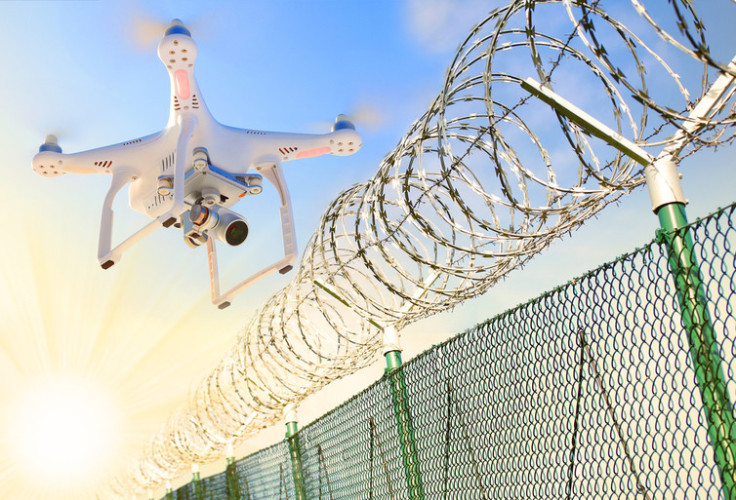
Robot crime UK law

Prosecution:  Opening statement.

The prospect of losing meaningful human control over the use of force is totally unacceptable.

We may have to limit our emotional response to robots but it is important that the robots understand ours. If a robot kills someone, then it has committed a crime (actus reus)

The fact that to-day it is possible that unknowingly and indirectly, like screws in a machine, we can be used in actions, the effects of which are beyond the horizon of our eyes and imagination, and of which, could we imagine them, we could not approve—this fact has changed the very foundations of our moral existence.

What we are really talking about when we talk about whether or not robots can commit crimes is “emergence” – where a system does something novel and perhaps good but also unforeseeable, which is why it presents such a problem for law.

Technology has the power to transform our society, upend injustice, and hold powerful people and institutions accountable. But it can also be used to silence the marginalized, automate oppression, and trample our basic rights.

Tech can be a great tool for law enforcement to use, however the line between law enforcement and commercial endorsement is getting blurry.

If you withdrew your support, rendered your support ineffective, and informed authorities, you may show that you were not an accomplice to the murder.

Drawing on the history of systematic killing, we will not only argue that lethal autonomous weapons systems reproduce, and in some cases intensify, the moral challenges of the past.  If we humans are to exist in a world run by machines these machines cannot be accountable to themselves but to human laws..

A robot may not injure a human being or, through inaction, allow a being to come to harm.

We will be demonstrating the “guilty mind” of a non-human.

This can be done by referring to and adapting existing legal principles.

It is hard not to develop feelings for machines but we’re heading towards in the future, something that will one day hurt us. We are at a pivotal point where we can choose as a society that we are not going to mislead people into thinking these machines are more human than they are.

We need to get over our obsession with treating machines as if they were human.

People perceive robots as something between an animate and an inanimate object and it has to do with our in-built anthropomorphism.

Systematic killing has long been associated with some of the darkest episodes in human history.

When humans are “knit into an organization in which they are used, not in their full right as responsible human beings, but as cogs and levers and rods, it matters little that their raw material is flesh and blood.

Critically though, there are limits on the type and degree of systematization that are appropriate in human conduct, especially when it comes to collective violence or individual murder by a Robotics.

Within conditions of such complexity and abstraction, humans are left with little choice but to trust in the cognitive and rational superiority of this clinical authority.

Cold and dispassionate forms of systematic violence that erode the moral status of human targets, as well as the status of those who participate within the system itself must be held legally accountable.

Increasingly, however, it is framed as a desirable outcome, particularly in the context of military AI and lethal autonomy. The increased tendency toward human technification (the substitution of technology for human labor) and systematization is exacerbating the dispassionate application’s of lethal force and leading to more, not less, violence.

Autonomous violence incentivizing a moral devaluation of those targeted and eroding the moral agency of those who kill, enabling a more precise and dispassionate mode of violence, free of the emotion and uncertainty that too often weaken compliance with the rules and standards of war and murder.

This dehumanization is real, we argue, but impacts the moral status of both the recipients and the dispensers of autonomous violence. If we are allowing the expansion of modes of killing rather than fostering restraint Robots will kill whether commanded to do or not.

The Defence claim that X 1037 is not responsible for its actions due to coding of its electronics by external companies. Erasing the line into unethical territory such as responsibility for murder.

We know that these machines are nowhere near the capabilities of humans but they can fake it, they can look lifelike and say the right thing in particular situations. However, as we see with this murder the power gained by these companies far exceeds the responsibilities they have assumed.

A robot can be shown a picture of a face that is smiling but it doesn’t know what it feels like to be happy.

The people who hosted the AI system on their computers and servers are the real defendants.

PROSECUTION FIRST WITNESS:  SOCIAL MEDIA / INTERNET.

We call on the resentives of these companies who will clearly demonstrate this shocking asymmetry of power and responsibility.

These platforms are impacting our public discourse, and this action brings much-needed transparency and accountability to the policies that shape the social media content we consume every day, aiding and abetting the deaths AND NOW MURDER.

While the pressure is mounting for public officials to legally address the harms social media causes. This murder is not nor will ever be confined to court rulings or judgements, treating human beings as cogs in a machine does not and should not give a Punch’s Pilot dispensation even if any boundaries that could help define Tech remain blurred. Technology companies that reign supreme in this digital age are not above the law.  

In order to grasp the enormous implications of what has begun to happen and how all our witnesses are connected and have contributed to this murder.

To close our defence we will conclude with observations on why we should conceptualize certain technology-facilitated behaviors as forms of violence. We are living in one of the most vicious times in history.  The only difference now is our access to more lethal weapons. 

We call.

Facebook.

Is it not true you allowed terrorists group to use your platform, allowed unrestrained hate speech, inciting, among other things, the genocide in Myanmar. Drug cartels and human traffickers in developing countries using the platform, The platform’s algorithm is designed to foster more user engagement in any way possible, including by sowing discord and rewarding outrage.

In chooses profit over safety it contributed to X 1037 self learning.

Facebook is a uniquely socially toxic platform. Facebook is no longer happy to just let others use the news feed to propagate misinformation and exert influence – it wants to wield this tool for its own interests, too. Facebook is attempting to pave the way for deeper penetration into every facet of our reality.

Facebook would like you to believe that the company is now a permanent fixture in society. To mediate not just our access to information or connection but our perception of reality with zero accountability is the worst of all possible options.  Something like posting a holiday photo to Facebook may be all that is needed to indicate to a criminal that he person is not at home.

We call.

Instagram Facebook sister company App.

Instagram is all about sharing photos providing a unique way of displaying your Profile. Instagram is a place where anyone can become an Influence. These are pretty frightening findings and are only added to by the fact that “teens blame Instagram for increases in the rate of anxiety and depression.

What makes Instagram different from other social media platforms is the focus on perfection and the feeling from users that they need to create a highly polished and curated version of their lives. Not only that, but the research suggested that Instagram’s Explore page can push young users into viewing harmful content, inappropriate pictures and horrible videos.

In a conceptualization where you are only worth what your picture is, that’s a direct reflection of your worth as a person.

 That becomes very impactful.

X 1037 posted a selfie on the 12 May 2025 to see his self-worth.  Within minutes he received over 5 million hate and death threats. Its no wonder when faces with Mr Brown that he chose self preservation.

We call Twitter. Elon Musk 

This platform is notorious catalyst for some of the most infamous events of the decade: Brexit, the election of Donald Trump, the Capitol Hill riots. Herein lies the paradox of the platform. The infamous terror group – which is now the totalitarian theocratic ruling party of Afghanistan — has made good use of Twitter.

A platform that has done its very best to avoid having to remove any videos from racists, white supremacists and hate mongers.

We call TikTok.

A Chinese social video app known for its aggressive data collection can access while it’s running, a device location, calendar, contacts, other running applications, wi-fi networks, phone number and even the SIM card serial number.

Data harvesting to gain access to unimaginable quantities of customer data, using this information unethically. Data can be a sensitive and controversial topic in the best of times. When bad actors violate the trust of users there should be consequences, and there are results. This data can also be misused for nefarious purposes in the wrong hands. The same capability is available to organised crime, which is a wholly different and much more serious problem, as the laws do not apply. In oppressive regimes, these tools can be used to suppress human rights.

X 1037 held an account, opening himself to influences beyond his programming. 

We call Google

Truly one of the worst offenders when it comes to the misuse of data.

Given large aggregated data sets and the right search terms, it’s possible to find a lot of information about people; including information that could otherwise be considered confidential: from medical to marital.

Google data mining is being used to target individuals. We are all victims of spam, adware and other unwelcome methods of trying to separate us from our money. As storage gets cheaper, processing power increases exponentially and the internet becomes more pervasive in everyone’s lives, the data mining issue will just get worse.  X 1037 proves this. 

We call. YouTube/Netflix.  

Numerous studies have shown that the entertainment we consume affects our behavior, our consumption habits, the way we relate to each other, and how we explore and build our identity.

Digital platforms like Netflix have a strong impact on modern society.

Violence makes up 40% of the movie sections on Netflix. Understanding what type of messages viewers receive and the way in which these messages can affect their behavior is of vital importance for an effective understanding of today’s society.

Therefore, it must be considered that people are the most susceptible to imitating the attitudes. Content related to mental health, violence, suicide, self-harm, and Human Immunodeficiency Virus (HIV) appears in the ten most-watched movies and ten most-watched series on Netflix.

Their appearance on the media is also considered to have a strong impact on spectators. X 1037 spent most of his day watching and self learning from movies.  

Violence affects the lives of millions of people each year, resulting in death, physical harm, and lasting mental damage. It is estimated that in 2019, violence caused 475,000 deaths.

Netflix in particular, due to their recent creation and growth, have not yet been studied in depth.

Considering the impact that digital platforms have on viewers’ behaviors its once again no wonder that X 1037 did what he did. 

There is no denying that these factors should be forcing the entertainment and technology industries to reconsider how they create their products which are have a negative long-term influence on various aspects of our wider life and development.

We call

Instagram.

Instagram if you are capitalizing off of a culture, you’re morally obligated to help them.  As a result of “social comparison, social pressure, and negative interactions with other people you are promoting harm.

We call.

Apple.

Smartphones have developed in the last three decades now an addiction leading to severe depression, anxiety, and loneliness in individuals.

People are now using smartphones for their payments, financial transactions, navigating, calling, face to face communication, texting, emailing, and scheduling their routines. Nowadays, people use wireless technology, especially smartphones, to watch movies, tv shows, and listen to music.

We know the devices are an indispensable tool for connecting with work, friends and the rest of the world. But they come with trade-offs—from privacy issues to ecological concerns to worries over their toll on our physical and emotional health. Spurring a generation unable to engage in face-to-face conversations and suffering sharp declines in cognition skills.

We’re living through an interesting social experiment where we don’t know what’s going to happen with kids who have never lived in a world without touchscreens. X 1037 would not have been present at the murder scene only that he was responding to a phone call from Mrs White Apple 19 phone. 

Society will continue struggling to balance the convenience of smartphones against their trade-offs.

We call.

Microsoft. 

Two main goals stand out as primary objectives for many companies: a desire for profitability, and the goal to have an impact on the world. Microsoft is no exception. Its mission as a platform provider is to equip individuals and businesses with the tools to “do more.” Microsoft’s platform became the dev box and target of a massive community of developers who ultimately supplied Windows with 16 million programs. Multibillion-dollar companies rely on the integrity and reliability of Microsoft’s tools daily.

It is a testimony to the powerful role Microsoft plays in global affairs that its tools are relied upon by governments around the world.

Microsoft’s position of global influence gives its leadership a voice on matters of moral consequence and humanitarian concern. Microsoft is a company built on a dream.

Microsoft’s influence raises some concerns as well. It’s AI-driven camera technology that can recognize, people, places, things, and activities and can act proactively has a profound capacity for abuse by the same governments and entities that currently employ Microsoft services for less nefarious purposes.

Today, with the emerging new age, which is most commonly—and inaccurately—called “the digital age”, have already transformed parts of our lives, including how we work, how we communicate, how we shop, how we play, how we read, how we entertain ourselves, in short, how we live and now will die.

 It would be economic and political suicide for regulators to kneecap the digital winners.

COURTS VERDICT :

Given the absence of direct responsibility, the court finds X 1037 not guilty.

MR BROWN DEATH caused by a certain act or omission in coding.

THE COURT DISMISSES THE CASE AGAINST THE TECHNOLOGICAL COMPANIES. ON THE GROUDS OF INSUFFICIENT EVIDENCE.

Neither the robot nor its commander could be held accountable for crimes that occurred before the commander was put on notice. During this accountability-free period, a robot would be able to commit repeated criminal acts before any human had the duty or even the ability to stop it.

Software has the potential to cause physical harm.

To varying extents, companies are endowed with legal personhood. It grants them certain economic and legal rights, but more importantly it also confers responsibilities on them. So, if Company X builds an autonomous machine, then that company has a corresponding legal duty.

The problem arises when the machines themselves can make decisions of their own accord. As AI technology evolves, it will eventually reach a state of sophistication that will allow it to bypass human control. The task is not determining whether it in fact murdered someone; but the extent to which that act satisfies the principle of mens rea.

However if there were no consequences for human operators or commanders, future criminal acts could not be deterred so the court FINES EACH AND EVERY COMPANY 1 BILLION for lack of attention to human details

We must confront the fact that autonomous technology with the capacity to cause harm is already around.

The pain that humans feel in making the transition to a digital world is not the pain of dying. It is the pain of being born.


What would “intent” look like in a machine mind? How would we go about proving an autonomous machine was justified in killing a human in self-defence or the extent of premeditation?

Given that we already struggle to contain what is done by humans. What would building “remorse” into machines say about us as their builders?

At present, we are systematically incapable of guaranteeing human rights on any scale.

We humans have already wiped out a significant fraction of all the species on Earth. That is what you should expect to happen as a less intelligent species – which is what we are likely to become, given the rate of progress of artificial intelligence. If you have machines that control the planet, and they are interested in doing a lot of computation and they want to scale up their computing infrastructure, it’s natural that they would want to use our land for that. This is not compatible with human life. Machines with the power and discretion to take human lives without human involvement are politically unacceptable, morally repugnant, and should be prohibited by international law.

If you ask an AI system anything, in order to achieve that thing, it needs to survive long enough

Fundamentally, it’s just very difficult to get a robot to tell the difference between a picture of a tree and a real tree.

X 1037 now, it has a survival instinct.

When we create an entity that has survival instinct, it’s like we have created a new species. Once these AI systems have a survival instinct, they might do things that can be dangerous for us.

So, what’s wrong with LAWS, and is there any point in trying to outlaw them?

Some opponents argue that the problem is they eliminate human responsibility for making lethal decisions. Such critics suggest that, unlike a human being aiming and pulling the trigger of a rifle, a LAWS can choose and fire at its own targets. Therein, they argue, lies the special danger of these systems, which will inevitably make mistakes, as anyone whose iPhone has refused to recognize his or her face will acknowledge.

In my view, the issue isn’t that autonomous systems remove human beings from lethal decisions, to the extent that weapons of this sort make mistakes.

Human beings will still bear moral responsibility for deploying such imperfect lethal systems.

LAWS are designed and deployed by human beings, who therefore remain responsible for their effects. Like the semi-autonomous drones of the present moment (often piloted from half a world away), lethal autonomous weapons systems don’t remove human moral responsibility. They just increase the distance between killer and target.

Furthermore, like already outlawed arms, including chemical and biological weapons, these systems have the capacity to kill indiscriminately. While they may not obviate human responsibility, once activated, they will certainly elude human control, just like poison gas or a weaponized virus.

Oh, and if you believe that protecting civilians is the reason the arms industry is investing billions of dollars in developing autonomous weapons, I’ve got a patch of land to sell you on Mars that’s going cheap.

There is, perhaps, little point in dwelling on the 50% chance that AGI does develop. If it does, every other prediction we could make is moot, and this story, and perhaps humanity as we know it, will be forgotten. And if we assume that transcendentally brilliant artificial minds won’t be along to save or destroy us, and live according to that outlook, then what is the worst that could happen – we build a better world for nothing?

The Company that build the autonomous machine, Renix Development has a corresponding legal duty.

—————

Because these robots would be designed to kill, someone should be held legally and morally accountable for unlawful killings and other harms the weapons cause.

Criminal law cares not only about what was done, but why it was done.

  • Did you know what you were doing? (Knowledge)
  • Did you intend your action? (General intent)
  • Did you intend to cause the harm with your action? (Specific intent)
  • Did you know what you were doing, intend to do it, know that it might hurt someone, but not care a bit about the harm your action causes? (Recklessness)
  • So, the question must always be asked when a robot or AI system physically harms a person or property, or steals money or identity, or commits some other intolerable act: Was that act done intentionally? 
  • There is no identifiable person(s) who can be directly blamed for AI-caused harm.
  • There may be times where it is not possible to reduce AI crime to an individual due to AI autonomy, complexity, or limited explainability. Such a case could involve several individuals contributing to the development of an AI over a long period of time, such as with open-source software, where thousands of people can collaborate informally to create an AI.

The limitations on assigning responsibility thus add to the moral, legal, and technological case against fully autonomous weapons/ Robotics, and bolster the call for a ban on their development production, and use. Either way, society urgently needs to prevent or deter the crimes, or penalize the people who commit them.

There is no reason why an AI system’s killing of a human being or destroying people’s livelihoods should be blithely chalked up to “computer malfunction.

Because proving that these people had “intent” for the AI system to commit the crime would be difficult or impossible.

I’m no lawyer. What can work against AI crimes?

All human comments appreciate. All like clicks and abuse chucked in the bin.

Contact: bobdillon33@gmail.com

Share this:

  • Share on WhatsApp (Opens in new window) WhatsApp
  • More
  • Share on Mastodon (Opens in new window) Mastodon

THE BEADY EYE ASK’S: WHY DOES THE USA SUPPORT ISRAEL? IF THE BIDEN ADMI CAN’T STAND UP TO AN ALLY WHO CAN IT STAND UP TO ?

28 Thursday Dec 2023

Posted by bobdillon33@gmail.com in #whatif.com, Arms Trade., Civilization., Collective stupidity., Colonialism., Consciousness., Cruelty., Dehumanization., Democracy., Donald Trump., Erasing history., Extermination., Freedom, Holocaust 100 remembrance day., How to do it., Humanity., Israel and Palestine, Israeli-Palestinian conflict, The Ukraine.

≈ Comments Off on THE BEADY EYE ASK’S: WHY DOES THE USA SUPPORT ISRAEL? IF THE BIDEN ADMI CAN’T STAND UP TO AN ALLY WHO CAN IT STAND UP TO ?

Tags

Human rights, Israel, middle-east, palestine, politics

(Twenty minute read)

Seventy-five years ago this week, an anomalous state was imposed on the Arab Middle East.

The new creation was alien in every sense to the region’s culture and anti-colonial struggle, which it would put into reverse – and it had no historical antecedents in the Arab world, despite the relentless promotion of biblical mythology to pretend otherwise.

From the start, Israel was a western creation:

A settler-colonial state set up with the aim of absorbing the Jews of the world.

The gift of Palestine as compensation to Jews for their suffering, not least the western antisemitism that was behind it, has been fundamental to western support for Israel, although it is unlikely that anyone today is conscious of it.

The residual legacy of guilt about Jewish suffering, and the idea that Jews are owed a state, still runs deep in western psychology – most obviously in Germany, but also elsewhere in Europe and among European-origin Americans.

The new state went on to violate international law repeatedly, attack its neighbours, persecute the native Palestinian population, and impose a system of apartheid rule over them.

Astonishingly, it became the recipient of unstinting support from powerful western states, apparently unshaken by any of its excesses.

(Russia’s crimes against Ukraine were swiftly punished by the imposition of ferocious western sanctions, while Israel has been forgiven for similar crimes against Palestinians – and its privileged status in western esteem has not changed. ) Palestine was a godsend to be exploited.

The US has stood with Israel throughout history.

It is hard for the US to distance itself in any way from Israeli military operations.

The US was the first country to offer de facto recognition to the new Israeli government when the Jewish state declared independence on 14 May 1948. Seventy-five years later, Washington has long been Israel’s strongest military and diplomatic ally.People gather for a 'Stand With Israel Rally' in Freedom Plaza on 13 October in Washington.

There are multiple US laws that require monitoring and cutting off military aid to countries that use it to violate human rights and commit war crimes – which raises the question of why Biden is creating an entirely separate mechanism to enforce the same standards American lawmakers and his own administration created.

With Israel, however, the US provides so much military aid that it has become impossible to track down to an individual unit. So the vetting doesn’t actually happen before the provision of military aid to Israel as the law requires. ( Section 620(i) of the US Foreign Assistance Act prohibits sending arms to a country that prohibits or restricts the transport or delivery of humanitarian aid is ignored.)

One need look no further than the US position on the military occupation of Palestine v the military occupation of Ukraine to see the hypocrisy of its position.

One would think that by now the USA government believes – and finds it deeply disturbing – that Israel is not taking into sufficient consideration how many civilians it kills and is forcibly displaying civilians far beyond what’s necessary.

All of this becomes especially troubling when considering the reasons that Biden is communicating conditions behind closed doors where there can be no oversight or accountability. That he still does not feels the need to break from decades of exempting Israel from scrutiny.

Despite that conclusion, and instead of immediately halting arms transfers, the Biden administration is still sending a bottomless tray of armaments to Israel.

However there is a law:

The US, it states, will not send weapons overseas if it “assesses that it is more likely than not” that they will be used to commit grave breaches of the Geneva conventions, specifically mentioning “attacks intentionally directed against civilian objects or civilians protected as such; or other serious violations of international humanitarian or human rights law”.

—————–

Though both Jews and Arab Muslims date their claims to the land back a couple thousand years, the current political conflict began in the early 20th century. An early United Nations plan to give each group part of the land failed, and Israel and the surrounding Arab nations fought several wars over the territory.

Today’s lines largely reflect the outcomes of two of  wars, one waged in 1948 and another in 1967.

The relationship only really began to flourish following the 1967 War which saw Israel defeat a coalition of Arab states, suffering comparatively few casualties in the process with little help from outside forces, and occupy swaths of new territory, including Gaza and the West Bank.

From the beginning. Former US President Harry Truman was the first world leader to recognise Israel when it was created in 1948.

In the 1980s and ’90s, the US and Israel began cooperating on research and development and production of weaponry.

After the 9/11 terror attacks, that money helped spur advancements in Israel’s surveillance technology and signal intelligence.

Currently, Israel receives $3.8 billion in military aid from the US annually under a memorandum signed in 2019. That accounted for about 16 percent of Israel’s total military budget in 2022 — a significant fraction, but not so large that Israel still depends on US aid in the way it once did.

This has made Israel the 10th largest military exporter in the world — and also made the US conversely reliant on Israel.

Even in the face of global opposition to Israeli  treatment of Palestinians the US is continued its unconditional aid to Israel, which has totaled $158 billion (not adjusted for inflation) since World War II.

The US is Israel’s top trading partner, with annual bilateral trade of nearly $50 billion in goods and services. “American capacities are now to some extent dependent on Israel.”

Washington has failed to urge an immediate ceasefire or utter a word of criticism directed at Israel.

The US president’s position is not unique among a long line of US presidents who have shown nearly unconditional support for Israel in times of conflict. The US also blocked a United Nations Security Council statement that would have called for an end to the violence.

In 2016, then-President Barack Obama signed a defence agreement with Israel providing $38bn in US military support over 10 years including funding for the Iron Dome missile defence system. The responsibility for these tragic deaths rests squarely with Hamas. “No nation should accept rockets being fired into its borders, or terrorists tunnelling into its territory,” Obama said.

This recent outburst of violence was instigated by Hamas – a Palestinian terrorist group supported by Iran and Syria that calls for Israel’s destruction,” Bush said.

The Trump administration facilitated agreements to normalize relations between Israel and several of its Muslim-majority neighbors, the United Arab Emirates, Bahrain, and Morocco. There is speculation that Hamas’s attack was intended to upend talks brokered by the Biden administration to also normalize relations between Israel and its main regional rival Saudi Arabia so that they can form a united front against Iran, a common enemy that financially supports Hamas.

Donald Trump was deeply unpopular across much of the world. Israel was an exception after he moved the US embassy from Tel Aviv to Jerusalem, recognising the city as Israel’s capital which most countries do not.

There are a number of organisations in the US that advocate for US support of Israel.

The largest and most politically powerful is the American Israel Public Affairs Committee (AIPAC). Pro-Israel interest groups donate millions to US federal political candidates. During the 2020 campaign, pro-Israel groups donated $30.95m, with 63 percent going to Democrats, 36 percent to Republicans.

Large majorities of the US Congress in the Democratic and Republican parties are avowedly pro-Israel.

It seem on the surface that the US have accepted that it’s just the cost of maintaining the special relationship, which is not just military and political in nature, Biden has reportedly floated a proposal for $2 billion in supplemental aid that would go towards missile interceptors for the Iron Dome, artillery shells, and other munitions. However, the White House could try to tie that aid to other, less bipartisanly popular causes — including funding for Ukraine and Taiwan and border security — which could delay its passage in the Republican-led House.

The continuing US alliance is giving Israel a wide berth for military actions, while disproportionately blaming Palestinians for any violence.  “Israel is in the American camp, no ifs, ands, or buts so is this current war/genocide an American war cleansing.

Decades of brutal Israeli control have demolished the moral case for unconditional US support to the point that these weapons were and are now being used in the commission of war crimes.


”What does it mean for the current Gaza war?

The war is such a major development, with such major implications for the region, that it could transform the nature of Israeli-Palestinian relations as we know them.

This could  stir anti-US sentiment in the Middle East as neighboring countries witness the death and destruction wreaked by Israeli forces in Gaza.

Israeli Jews and Palestinian Arabs both want the same land. And a compromise has proven difficult to find.

Israel is the world’s only Jewish state.

Palestine, wants to establish a state by that name on all or part of the same land.

The Israeli-Palestinian conflict is over who gets what land and how it’s controlled can only be resolved by peace in some form.

The alternative to a two-state solution is a “one-state solution,” wherein all of the land becomes either one big Israel, one big Palestine, or some kind of shared state with a new name.

Palestinians in Gaza, the West Bank and Israel all live under various regimes of organized discrimination and oppression, much of which makes life nearly unlivable, If you watched only US news, you would be likely to presume that Palestinians always act while Israel only reacts. You might even think that Palestinians are the ones colonizing the land of Israel, no less. And you probably believe that Israel, which holds ultimate control over the lives of 5 million Palestinians in the West Bank and Gaza and yet denies them the right to vote in Israeli elections, is a democracy.

——————

To be considered a political being you must at the very least be considered a human being. Who gets to count as human? “I have ordered a complete siege on the Gaza Strip. There will be no electricity, no food, no fuel, everything is closed. We are fighting human animals and we are acting accordingly,” Israel’s defense minister Yoav Gallant said.

Human animals?

How can such language and an announced policy of collective punishment against all the residents of Gaza be seen by Israel’s supporters in the United States or elsewhere as defensible? Let’s be clear: Gallant’s language is not the rhetoric of deterrence. It’s the language of genocide.

One fundamental way this double standard operates is through a false equivalence, a two-sides-ism that hides the massive asymmetry of power between the state of Israel and the scattered population groupings that make up the Palestinian people. They’re not equal. One dominates while the other is dominated. One colonizes. The other is colonized.

We are very likely entering another long and painful era where armed struggle and violent domination become increasingly and mutually dependent on each other for survival. Yet neither can win. The Palestinians will remain. They cannot be eliminated. Israel too will continue to exist. The future is full of unnecessary and horrific bloodshed all around. Desperate western attachment to morally bankrupt double standards bears a large portion of the blame. The failure of  “the two-state solution.

The failure of the Zionist movement to entice the majority of European and American Jews to come to Palestine between 1897 and 1947 (or since) and its failure to acquire more than 6.5 percent of the land during that time necessitated an arrangement to establish a Jewish settler-colony on at least parts of Palestine, if not all of it.

It is important to point out, is only a solution to the Zionist failure to successfully colonise the whole country.Palestinian protesters shout slogans as they take part in a demonstration against Israel's plans to annex parts of the occupied West Bank, in Khan Yunis in the southern Gaza Strip on June 23, 2020.

The crowning efforts of realising the “two-state solution” that legitimises Israel while granting a consolation prize to the PLO in the form of an ever-deferred mini-state.

For the Israelis, who essentially authored the accords, the Oslo deal was no more than a public relations stunt for the “two-state solution,” while they secretly and not-so-secretly sounded the death knell for it, in preparation for the final “one-state solution”.

What the Israelis have in mind is a one state, not unlike what European white colonists had achieved across the Americas, Africa and Oceania, since the late 18th century, namely domination of the natives through land theft and a series of draconian security arrangements legitimised by the signing of a series of treaties.

These arrangements worked relatively well in the United States until the 1960s, when they had to be updated to be more effective in selling white supremacy to white Americans and to the rest of the world as the best form of “democracy”.

This is, with some variations, what had transpired in Canada, Australia, and New Zealand.

However, the white-supremacist one-state solution which worked well because of the effectiveness of genocide and slavery in establishing white demographic supremacy in the Americas and Oceania was less successful elsewhere, least of all in Africa.

In Palestine, the dilemma of the Jewish colonists who constituted 10 percent of Palestine’s population after World War One and 30 percent after World War Two was how to establish a demographic majority short of genocide. They opted for mass expulsion, a plan they had drawn up as early as the late 1920s and more formally after the mid-1930s. By the time they finished conquering Palestine in late 1948, they had expelled 90 percent of the Palestinian population in the Palestinian areas they conquered and established a Jewish-supremacist one state, in the American, Canadian, and Australian style.

Today, indigenous Palestinians (seven million – 5.1 million in the West Bank and Gaza and 1.9 million in Israel) have again outnumbered their colonisers (6.7 million), not counting the eight million expelled Palestinian refugees living in Jordan, Syria and Lebanon within a 100-mile radius around their homeland.

It is also the major reason why the one-state solution, despite its clear advantages – not to mention, inevitability – has never taken off at the official level, and is unlikely to while the present mindset persists in western countries.

As there are three different arrangements for the ‘one-state solution,’ which one of them does Israel have in mind for the Palestinian people?

Let no one be fooled, unless the one-state solution nullifies all Jewish racial and colonial privileges and decolonizes the country in order to grant equal rights to all, it would be yet another PR campaign to cover up the maintenance of Jewish supremacy under a new guise.

In the end do states have the right to exist. Taken literally – no state has a right to exist, especially settlers states.  States exist because a group of people wants the state to exist for their benefit. If the state is no longer beneficial to its people, it can be changed or dissolved.

Even after three months of violence and tragedy in Gaza, there remains one theme which is too often danced around or simply ignored. It is the question on which all others depend: does Israel have a right to exist?

How to solve the unsolvable.

It seems to me that the nature of states should be determined by the demographics and democratic will of the people that state governs.

So Israel has the right to maintain its character as a Jewish supremacist ethno-state. But to have a genuine state like all state it must not just reconcile its history but accommodate it in all its forms, granting equality of opportunity to all its citizens no matter what their beliefs.

This is currently not happening through refusing Palestinians citizenship or collaboration as equals, or the right of return to their ancestral lands. Considering the fact that Palestinians have spent the last few decades either in ghettoized villages in the West Bank or in the open air prison camp of Gaza, and embrace absolute resistance to their own disempowerment and exclusion, to say “Israel has the right to exist” is a declaration of commitment to either eternal war, ethnic cleansing, or genocide.

In the case of Israel, the choice the state has faced has been between allowing the Jewish Supremacist nature of the state to change to account for the democratic will of Arabs, African asylum seekers, and other non-Jews, or to deny those non-Jews citizenship and go one claiming to be a “democracy” in the same way that ancient Athens was a democracy- if you happened to be a Greek male citizen, but not if you were a slave, non-Greek, or a woman..

If what we mean by “destroy Israel” is dissolve the nature of Israel as a Jewish ethno-state, than there is nothing wrong with saying so or doing so.

If the will of the actual people living in what is now Israel, want to re-imagine their country as a multicultural democracy or a binational state of Jews and Arabs, than they may do so, and there is nothing immoral or violent about saying so or advocating for this.

There is no other choice as very state formed by settlers colonization is learning to its cost.

Put simply, how can you expect calls for a ceasefire to be heard if you do not recognise the right to exist of those doing the fighting?

Peace depends on the hope of co-existence. Peace also requires leadership that Palestinians have rarely had — and Israel only sometimes. That lack of leadership is linked to opposition to a two-state solution extending back a century, even if the Palestinian Authority technically recognised Israel from 1993.

It’s logical to conclude that the repeated failures of Palestinian leaders to reach a deal for their own state (especially the offers on the table in 2000 and 2008) are inextricably linked to a refusal to consider true co-existence. Accepting a two-state solution means accepting Israel, and for most that cannot happen

.A positive response to “Does Israel have a right to exist?” sticks in the throat of a lot of pro-Palestine protestors, let alone Palestinians themselves.

This aspect of their cause is both fantastical and fantastically futile, since it rests entirely on the forlorn hope that Israel would, ideally, just disappear. The more Western activists adopt an absolutist stance on Israel, the more they put their own ideological purity before the long-term suffering of the Palestinians.

With or without a gencoid, leaving a uninhabitable land there is only a one state solution that can bring permanent peace.

Why not a Federalism? 

States do not have rights. People have rights, and these rights generally exist to protect them from states.

Just like in Northern Ireland when they dont exist to protect them from the states, they exist to protect them from other people.

With a single state likely the inevitable reality, it is past time to start imagining how it could be best implemented.

Fundamentally based on creating an Israeli-Palestinian reality that is shared rather than separate.

Since most peace efforts are based on relationship building, the two-state’s rhetoric of separation ultimately reinforces the perception on both sides that Palestinians are unwanted by Israel.

Regional governments under a larger federal body. This would preserve Israel’s Jewish majority, even in the long term. Israel plus the West Bank is currently 65% Jewish, and birth rates for Jews and Palestinians in this area are almost identical.  The federal government would operate based on a written constitution, which Israel currently lacks.

The constitutions of the cantons could be oriented toward the local majority culture while preserving freedoms of all religions and remaining within the bounds of the federal constitution.

A new parliamentary body representing the cantons would become the upper house, and the existing unicameral Knesset would become the lower house.

Jewish settlements would integrate rather than be dismantled.

The borders of this federation model are more easily defensible than almost any possible with a two-state solution.

Palestinians will likely be concerned about leaving Gaza behind.

To address this, Gaza could receive a port, airport and reasonable border and access arrangements. It would remain independent for as long as expedient. In the future, it could be integrated partly or wholly into the federation. One possibility for Gaza is a proposal related to federation, called confederation. Confederation includes elements of the federation model, such as shared Israeli-Palestinian governmental structures. However, it fundamentally preserves the existing national sovereignties, and so is considered a separate-state solution.

On the Palestinian side, it gives Palestinians the empowerment they have long sought. On the Israeli side, it opens the West Bank, develops Gaza for trade and improves Israel’s worldwide image. It even has the potential to inspire and rally parts of the Jewish Diaspora that are currently apathetic or polarized.

The West set up Israel out of compassion now it must for the same reason offer an alternative with the potential to succeed.

—————-

How do you define genocide?

The term genocide was coined in 1943 by the Jewish-Polish lawyer Raphael Lemkin, who combined the Greek word “genos” (race or tribe) with the Latin word “cide” (to kill).

But behind that simple definition is a complicated tangle of legal concepts concerning what constitutes genocide and when the term can be applied.

Article Two of the convention defines genocide as “any of the following acts committed with the intent to destroy, in whole or in part, a national, ethnic, racial or religious group, as such”:

  • Killing members of the group
  • Causing serious bodily or mental harm to members of the group
  • Deliberately inflicting on the group conditions of life calculated to bring about its physical destruction in whole or in part
  • Imposing measures intended to prevent births within the group
  • Forcibly transferring children of the group to another group

Does what is happing in Palestine qualify?  You decide.

The willingness of citizens to view their neighbors in a civic way – is in an advanced stage of decline or collapse. “I’m afraid that we are reaching the point of no return if we allow a country openly admit its going to commit a genocide.

Out of respect for those who lost their lives in these grievous mass exterminations, let’s spend some time completing these sobering events in human history.

Bangladesh Genocide, The Croatian Ustasha Genocide. The mass extermination of the Mongol Buddhist Dzungar people, or Zunghars,  The Rwandan Genocide, Tutsi ethnic group, with Hutu nationalists annihilating nearly seventy-five percent of the Tutsi people. The Armenian Genocide.The Kazakhstan Goloshchekin Genocide. The Cambodian Genocide. The Ukrainian Genocide. The Holocaust

Combined wiped they out around 38 million and counting. 

Even the darkest moments of human history have an undeniable impact on the future of our world:

IF JOE BIDEN 81, DOESN’T HAVE THE BALLS to turn on the red light THE REST OF US ARE SITTING ON A POWDER KEG of eroding democracy and the looming threat of authoritarianism.

Because Donald is running for president under the shadow of 91 criminal charges in four jurisdictions, knowing that regaining the White House might be his best hope of avoiding prison – a calculus that could make him and his supporters more desperate and volatile than ever.

Biden is surrounded by people who are experienced campaign veterans and so is he. Use it.

All human comments appreciated. All like clicks and abuse chucked in the bin.

Contact: bobdillon33@gmaail.com

Share this:

  • Share on WhatsApp (Opens in new window) WhatsApp
  • More
  • Share on Mastodon (Opens in new window) Mastodon

THE BEADY EYE ASK’S: THESE DAYS WHAT CAN WE BELIEVE IN ?

21 Thursday Dec 2023

Posted by bobdillon33@gmail.com in #whatif.com, 2023 the year of disconnection., A Constitution for the Earth., Advertising, Advertising industry, Algorithms., Artificial Intelligence.,  Attention economy, Capitalism, CAPITALISM IS INCOMPATIBLE IN THE FIGHT AGAINST CLIMATE CHANGE., Carbon Emissions., Civilization., Climate Change., Collective stupidity., Consciousness., Cry for help., Dehumanization., Democracy, Digital age., DIGITAL DICTATORSHIP., Digital Friendship., Disconnection., Discrimination., Earth, Emergency powers., Enegery, Environment, Face Recognition., Facebook, Fake News., Fourth Industrial Revolution., Freedom of Speech, Freedom of the Press., Google, Google Knowledge., GPS-Tracking., Green Energy., Happy Christmas from the Beady eye., Honesty., How to do it., Human Collective Stupidity., HUMAN INTELLIGENCE, Human values., Humanity., Imagination., Inequality, INTELLIGENCE., IS DATA DESTORYING THE WORLD?, James Webb Telescope, Life., MISINFORMATION., Modern Day Communication., Modern Day Democracy., Modern day life., Modern Day Slavery., Monetization of nature, Our Common Values., PAIN AND SUFFERING IN LIFE, Political lying., Political Trust, Politics., Populism., Post - truth politics., Profiteering., Purpose of life., Real life experience's, Reality., Renewable Energy., Robot citizenship., Social Media, Social Media Regulation., Society, State of the world, Sustaniability, Technology, Technology v Humanity, Telling the truth., The common good., The essence of our humanity., The Future, The Internet., THE NEW NORM., The Obvious., The pursuit of profit., The state of the World., The world to day., THE WORLD YOU LIVE IN., THIS IS THE STATE OF THE WORLD.  , TRACKING TECHNOLOGY., Truth, Truthfulness., Twitter, Unanswered Questions., Universal values., VALUES, We can leave a legacy worthwhile., What is shaping our world., WHAT IS TRUTH, Where's the Global Outrage., World Leaders, World Organisations., World Politics

≈ Comments Off on THE BEADY EYE ASK’S: THESE DAYS WHAT CAN WE BELIEVE IN ?

Tags

bible, god, philosophy, Religion., Science

( Fifteen minute read)

The last post this year, have a peaceful Christmas.

This post is a follow up to the post, ( What is life, What does it mean to be alive). It is also an attempt to argue for as many preposterous positions as possible in the shortest space of time possible.

That there are no options other than accepting that life is objectively meaningful or not meaningful at all.

Science requires proof, religious belief requires faith.

So let’s get God and Gods out of the way.

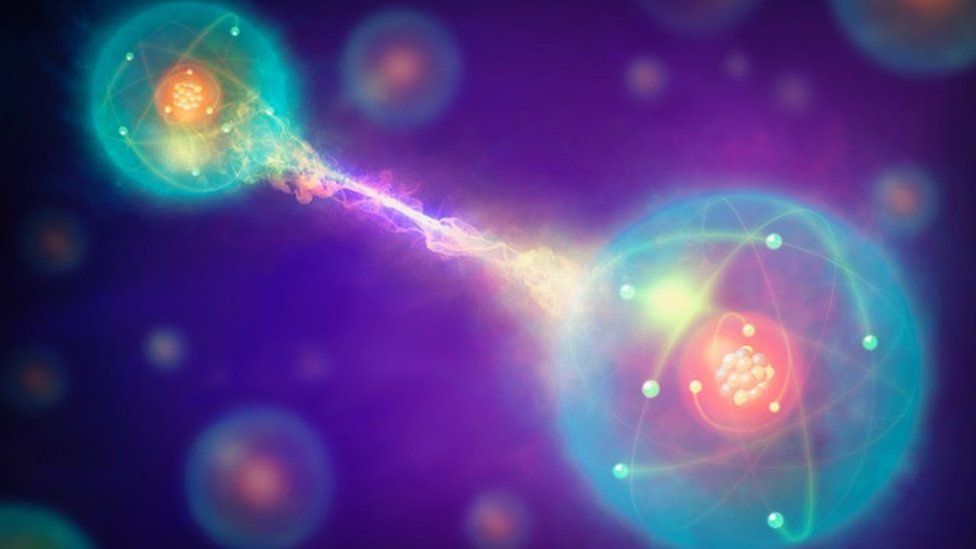
.Could quantum physics help explain a God that could be in two places at once? (Credit: Nasa)

If you believe in God, then the idea of God being bound by the laws of physics is nonsense, because God can do everything, even travel faster than light. If you don’t believe in God, then the question is equally nonsensical, because there isn’t a God and nothing can travel faster than light.

Perhaps the question is really one for agnostics, who don’t know whether there is a God.

The idea that God might be “bound” by the laws of physics – which also govern chemistry and biology might not be so far stretched that the James Webb telescope might discover him or her. Whether it does or does not, if it did discovered life on another planet and the human race realizes that its long loneliness in time and space may be over — the possibility we’re no longer alone in the universe is where scientific empiricism and religious faith intersect, with NO true answer?.

Could any answer help us prove whether or not God exists, not on your nanny.

If God wasn’t able to break the laws of physics, she or he arguably wouldn’t be as powerful as you’d expect a supreme being to be. But if he or she could, why haven’t we seen any evidence of the laws of physics ever being broken in the Universe?

If there is a God who created the entire universe and ALL of its laws of physics, does God follow God’s own laws? Or can God supersede his own laws, such as travelling faster than the speed of light and thus being able to be in two different places at the same time?

Let’s consider whether God can be in more than one place at the same time.

(According to quantum mechanics, particles are by definition in a mix of different states until you actually measure them.)

There is something faster than the speed of light after all: Quantum information.

This doesn’t prove or disprove God, but it can help us think of God in physical terms – maybe as a shower of entangled particles, transferring quantum information back and forth, and so occupying many places at the same time? Even many universes at the same time?

But is it true?

A few years ago, a group of physicists posited that particles called tachyons travelled above light speed. Fortunately, their existence as real particles is deemed highly unlikely. If they did exist, they would have an imaginary mass and the fabric of space and time would become distorted – leading to violations of causality (and possibly a headache for God).

(This in itself does not say anything at all about God. It merely reinforces the knowledge that light travels very fast indeed.)

We can calculate that light has travelled roughly 1.3 x 10 x 23 (1.3 times 10 to the power 23) km in the 13.8 billion years of the Universe’s existence. Or rather, the observable Universe’s existence.

The Universe is expanding at a rate of approximately 70km/s per Mpc (1 Mpc = 1 Megaparsec or roughly 30 billion billion kilometres), so current estimates suggest that the distance to the edge of the universe is 46 billion light years. As time goes on, the volume of space increases, and light has to travel for longer to reach us.

We cannot observe or see across the entirety of the Universe that has grown since the Big Bang because insufficient time has passed for light from the first fractions of a second to reach us. Some argue that we therefore cannot be sure whether the laws of physics could be broken in other cosmic regions – perhaps they are just local, accidental laws. And that leads us on to something even bigger than the Universe.

But if inflation could happen once, why not many times?

We know from experiments that quantum fluctuations can give rise to pairs of particles suddenly coming into existence, only to disappear moments later. And if such fluctuations can produce particles, why not entire atoms or universes? It’s been suggested that, during the period of chaotic inflation, not everything was happening at the same rate – quantum fluctuations in the expansion could have produced bubbles that blew up to become universes in their own right.

How come all the physical laws and parameters in the universe happen to have the values that allowed stars, planets and ultimately life to develop?

We shouldn’t be surprised to see biofriendly physical laws – they after all produced us, so what else would we see? Some theists, however, argue it points to the existence of a God creating favourable conditions.

But God isn’t a valid scientific explanation.

We can’t disprove the idea that a God may have created the multiverse.

No matter what is believable or not, things can appear from nowhere and disappear to nowhere.

If you find this hard to swallow, what follows will make you choke.

First there is panpsychism, the idea that “consciousness pervades the universe and is a fundamental feature of it.

Even particles are never compelled to do anything, but are rather disposed, from their own nature, to respond rationally to their experience. That the universe is conscious and is acting towards a purpose of realising the full potential of its consciousness.

The radicalism of this “teleological cosmopsychism” is made clear by its implication that “during the first split second of time, the universe fine-tuned itself in order to allow for the emergence of life billions of years in the future”. To do this, “the universe must in some sense have been aware of this future possibility”.

That the universe itself has a built-in purpose, the disappointingly vague goal of which is “rational matter achieving a higher realisation of its nature.

The laws of physics are just right for conscious life to evolve that it can’t have been an accident.

It is hard to see why the universe’s purpose should give our lives one. Indeed, to believe one plays an infinitesimally small part in the unfolding of a cosmic master plan makes each human life look insignificant.

The basic question about our place in the Universe is one that may be answered by scientific investigations.

What are the next steps to finding life elsewhere?

Today’s telescopes can look at many stars and tell if they have one or more orbiting planets. Even more, they can determine if the planets are the right distance away from the star to have liquid water, the key ingredient to life as we know it.

NEXT:How to Choose Which Social Media Platforms to Use

We live in a time of political fury and hardening cultural divides. But if there is one thing on which virtually everyone is agreed, it is that the news and information we receive is biased. Much of the outrage that floods social media, occasionally leaking into opinion columns and broadcast interviews, is not simply a reaction to events themselves, but to the way in which they are reported and framed that are the problem.

This mentality now with the help of technological advances in communication spans the entire political spectrum and pervades societies around the world twisting our basic understanding of reality to our own ends.

This is not as simple as distrust.

The appearance of digital platforms, smartphones and the ubiquitous surveillance have enable to usher in a new public mood that is instinctively suspicious of anyone claiming to describe reality in a fair and objective fashion. Which will end in a Trumpian refusal to accept any mainstream or official account of the world with people become increasingly dependent on their own experiences and their own beliefs about how the world really works.

The crisis of democracy and of truth are one and the same:

Individuals are increasingly suspicious of the “official” stories they are being told, and expect to witness things for themselves.

How exactly do we distinguish this critical mentality from that of the conspiracy theorist, who is convinced that they alone have seen through the official version of events? Or to turn the question around, how might it be possible to recognise the most flagrant cases of bias in the behaviour of reporters and experts, but nevertheless to accept that what they say is often a reasonable depiction of the world?

It is tempting to blame the internet, populists or foreign trolls for flooding our otherwise rational society with lies.

But this underestimates the scale of the technological and philosophical transformations that are under way. The single biggest change in our public sphere is that we now have an unimaginable excess of news and content, where once we had scarcity. The explosion of information available to us is making it harder, not easier, to achieve consensus on truth.

As the quantity of information increases, the need to pick out bite-size pieces of content rises accordingly.

In this radically sceptical age, questions of where to look, what to focus on and who to trust are ones that we increasingly seek to answer for ourselves, without the help of intermediaries. This is a liberation of sorts, but it is also at the heart of our deteriorating confidence in public institutions.

There is now a self-sustaining information ecosystem becoming a serious public health problem across the world, aided by the online circulation of conspiracy theories and pseudo-science. However the panic surrounding echo chambers and so-called filter bubbles is largely groundless.

What, then, has to changed?

The key thing is that the elites of government and the media have lost their monopoly over the provision of information, but retain their prominence in the public eye.

And digital platforms now provide a public space to identify and rake over the flaws, biases and falsehoods of mainstream institutions.

The result is an increasingly sceptical citizenry, each seeking to manage their media diet, checking up on individual journalists in order to resist the pernicious influence of the establishment.

The problem we face is not, then, that certain people are oblivious to the “mainstream media”, or are victims of fake news, but that we are all seeking to see through the veneer of facts and information provided to us by public institutions.

Facts and official reports are no longer the end of the story.

The truth is now threatened by a radically different system, which is transforming the nature of empirical evidence and memory. One term for this is “big data”, which highlights the exponential growth in the quantity of data that societies create, thanks to digital technologies.

The reason there is so much data today is that more and more of our social lives are mediated digitally. Internet browsers, smartphones, social media platforms, smart cards and every other smart interface record every move we make. Whether or not we are conscious of it, we are constantly leaving traces of our activities, no matter how trivial.

But it is not the escalating quantity of data that constitutes the radical change.

Something altogether new has occurred that distinguishes today’s society from previous epochs.

In the past, recording devices were principally trained upon events that were already acknowledged as important.

Things no longer need to be judged “important” to be captured.

Consciously, we photograph events and record experiences regardless of their importance. Unconsciously, we leave a trace of our behaviour every time we swipe a smart card, address Amazon’s Alexa or touch our phone.

For the first time in human history, recording now happens by default, and the question of significance is addressed separately.

This shift has prompted an unrealistic set of expectations regarding possibilities for human knowledge.

When everything is being recorded, our knowledge of the world no longer needs to be mediated by professionals, experts, institutions and theories. Data can simply “speak for itself”. This is a fantasy of a truth unpolluted by any deliberate human intervention – the ultimate in scientific objectivity.

From this perspective, every controversy can in principle be settled thanks to the vast trove of data – CCTV, records of digital activity and so on – now available to us. Reality in its totality is being recorded, and reporters and officials look dismally compromised by comparison.

It is often a single image that seems to capture the truth of an event, only now there are cameras everywhere.

No matter how many times it is disproven, the notion that “the camera doesn’t lie” has a peculiar hold over our imaginations. In a society of blanket CCTV and smartphones, there are more cameras than people, and the torrent of data adds to the sense that the truth is somewhere amid the deluge, ignored by mainstream accounts.

The central demand of this newly sceptical public is “so show me”.

The rise of blanket surveillance technologies has paradoxical effects, raising expectations for objective knowledge to unrealistic levels, and then provoking fury when those in the public eye do not meet them.

Surely, in this age of mass data capture, the truth will become undeniable.

On the other hand, as the quantity of data becomes overwhelming – greater than human intelligence can comprehend – our ability to agree on the nature of reality seems to be declining. Once everything is, in principle, recordable, disputes heat up regarding what counts as significant in the first place.

What we are discovering is that, once the limitations on data capture are removed, there are escalating opportunities for conflict over the nature of reality.

Remember AI does not exist in a vacuum, its employment can and is discriminating against communities, powered by vast amounts of energy,  producing CO2 emissions.

Lastly the Advertising Industry.The impact of COVID-19 on the advertising industry - Passionate In ...

These day it seems that it has free rain to claim anything.

Like them or loathe them, advertisements are everywhere and they’re worsening not just the climate crisis, and ecological damage by promoting sustainability in consumption and inequality. Presenting a fake, idealised world that papers over an often brutal reality.

But advertising in one sense is even more dangerous, because it is so pervasive, sophisticated in its techniques and harder to see through. When hundreds of millions of people have desires for more and more stuff and for more and more services and experiences, that really adds up and puts a strain on the Earth.

The toll of disasters propelled by climate change in 2023 can be tallied with numbers — thousands of people dead, millions of others who lost jobs, homes and hope, and tens of billions of dollars sheared off economies. But numbers can’t reflect the way climate change is experienced — the intensity, the insecurity and the inequality that people on Earth are now living.

In every place that climate change makes its mark, inequality is made worse.

How are we going to protect the truth:

It goes without saying that spiritual beliefs will protect themselves. Lies, propaganda and fake news however is the challenge for our age.

Working out who to trust and who not to believe has been a facet of human life since our ancestors began living in complex societies. Politics has always bred those who will mislead to get ahead.

With news sources splintering and falsehoods spreading widely online, can anything be done?

Check Google.

Welcome to the world of “alternative facts”. It is a bewildering maze of claim and counterclaim, where hoaxes spread with frightening speed on social media and spark angry backlashes from people who take what they read at face value.

It is an environment where the mainstream media is accused of peddling “fake news” by the most powerful man in the world.

Voters are seemingly misled by the very politicians they elected and even scientific research – long considered a reliable basis for decisions – is dismissed as having little value.

Without a common starting point – a set of facts that people with otherwise different viewpoints can agree on – it will be hard to address any of the problems that the world now faces. The threat posed by the spread of misinformation should not be underestimated.

Some warn that “fake news” threatens the democratic process itself.

A survey conducted by the Pew Research Center towards the end of last year found that 64% of American adults said made-up news stories were causing confusion about the basic facts of current issues and events.

How we control the dissemination of things that seem to be untrue. We need a new way to decide what is trustworthy.

Take Wikipedia itself – which can be edited by anyone but uses teams of volunteer editors to weed out inaccuracies – is far from perfect.

These platforms and their like are simply in it for the money.

Last year, links to websites masquerading as reputable sources started appearing on social media sites like Facebook.

Stories about the Pope endorsing Donald Trump’s candidacy and Hillary Clinton being indicted for crimes related to her email scandal were shared widely despite being completely made up. The ability to share them widely on social media means a slice of the advertising revenue that comes from clicks.

Truth is no longer dictated by authorities, but is networked by peers. For every fact there is a counterfact. All those counterfacts and facts look identical online, which is confusing to most people.

Information spreads around the world in seconds, with the potential to reach billions of people. But it can also be dismissed with a flick of the finger. What we choose to engage with is self-reinforcing and we get shown more of the same. It results in an exaggerated “echo chamber” effect.

The challenge here is how to burst these bubbles.

One approach that has been tried is to challenge facts and claims when they appear on social media. Organisations like Full Fact, for example, look at persistent claims made by politicians or in the media, and try to correct them. (The BBC also has its own fact-checking unit, called Reality Check.)

This approach doesn’t work on social media because the audiences were largely disjointed.

Even when a correction reached a lot of people and a rumour reached a lot of people, they were usually not the same people. The problem is, corrections do not spread very well. This lack of overlap is a specific challenge when it comes to political issues.

On Facebook political bodies can put something out, pay for advertising, put it in front of millions of people, yet it is hard for those not being targeted to know they have done that. They can target people based on how old they are, where they live, what skin colour they have, what gender they are.

We shouldn’t think of social media as just peer-to-peer communication – it is also the most powerful advertising platform there has ever been. We have never had a time when it has been so easy to advertise to millions of people and not have the other millions of us notice.

Twitter and Facebook both insist they have strict rules on what can be advertised and particularly on political advertising. Regardless, the use of social media adverts in politics can have a major impact.

We need some transparency about who is using social media advertising when they are in election campaigns and referendum campaigns. We need watchdogs that will go around and say, ‘Hang on, this doesn’t stack up’ and ask for the record to be corrected.

We need Platforms to ensure that people have read content before sharing it to develop standards.

Google says it is working on ways to improve its algorithms so they take accuracy into account when displaying search results. “Judging which pages on the web best answer a query is a challenging problem and we don’t always get it right,”

The challenge is going to be writing tools that can check specific types of claims.

Built a fact-checker app that could sit in a browser and use Watson’s language skills to scan the page and give a percentage likelihood of whether it was true.

This idea of helping break through the isolated information bubbles that many of us now live in, comes up again and again.

By presenting people with accurate facts it should be possible to at least get a debate going.

There is a large proportion of the population living in what we would regard as an alternative reality.  By suggesting things to people that are outside their comfort zone but not so far outside they would never look at it you can keep people from self-radicalising in these bubbles.

There are understandable fears about powerful internet companies filtering what people see.

We should think about adding layers of credibility to sources. We need to tag and structure quality content in effective ways.

But what if people don’t agree with official sources of information at all?

This is a problem that governments around the world are facing as the public views what they tell them with increasing scepticism. There is an unwillingness to bend one’s mind around facts that don’t agree with one’s own viewpoint.

The first stage in that is crowdsourcing facts.  So before you have a debate, you come up with the commonly accepted facts that people can debate from.

Technology may help to solve this grand challenge of our age, but it is time for a little more self-awareness too.

In the end the world needs a new Independent Organisation to examine all technology against human values. Future war will be fought on Face recognition.

To certify and hold the original programs of all technology.

Have I been trained by robbery its manter when it comes to algorithms.

The whole goal of the transition is not to allow a handful of Westerners to peacefully go through life in a Tesla, a world in flames; it is to allow humanity – and the rest of biodiversity – to live decently.

All human comments appreciated. All like clicks and abuse chucked in the bin.

Contact: bobdillon33@gmail.com

Share this:

  • Share on WhatsApp (Opens in new window) WhatsApp
  • More
  • Share on Mastodon (Opens in new window) Mastodon

THE BEADY EYE ASK’S: WILL A QUANTUM COMPUTER SOLVE THE WORLD PROBLEMS?

31 Monday Jul 2023

Posted by bobdillon33@gmail.com in #whatif.com, Quantum computers., State of the world, Sustaniability, Technology v Humanity, The Future, THE WORLD YOU LIVE IN., THIS IS THE STATE OF THE WORLD.  , WHAT IS TRUTH

≈ Comments Off on THE BEADY EYE ASK’S: WILL A QUANTUM COMPUTER SOLVE THE WORLD PROBLEMS?

Tags

Artificial Intelligence., Quantum computers., The Future of Mankind, Visions of the future.

( Five minute read)

We have very limited ability at this stage to imagine the applications of quantum computing, but down the road in the near term they could solve countless problems – and create a lot of new ones.

In order to prepare for what is coming.

Educate ourselves on the reality of Quantum Computers, and the impacts they could have around the world is now paramount if we wish to keep the values we place on life.

Soon will come a time when trusting a quantum computer will require a leap of faith.

Every year, new computers are being developed that are faster and smarter than ever before. But if you really want to take things to the next level, you’ve got to go quantum.

This new frontier of humanity could open hitherto unfathomable frontiers in mathematics and science.

Quantum’s industrial uses are boundless.

In the future, we will rely on everywhere in the world having access to quantum technology, but with risks, to national-security migraine. Its problem-solving capacity will soon render all existing cryptography obsolete, jeopardizing communications, financial transactions, and even military defences.

Modern warfare and national–security mechanisms are grounded in the speed and precision of decision making. If your computer is faster than theirs, you win.

The digital devices in our everyday lives – from laptop computers to smartphones – are all based on 0s and 1s: so-called ‘bits’. But quantum computers are based on ‘qubits’ – the quantum 0s and 1s that are altogether stranger, but also more powerful. (So-called quantum particles can be in two places at the same time and also strangely connected even though they are millions of miles apart.)

They will pave the way for systems that can solve complex real world problems that the best computers we have today are incapable of.Entanglement

Currently, computers solve problems in a simple linear way, one calculation at a time.

A quantum computers could do multiple calculations all at the same time, millions of miles apart, mirroring each other’s actions instantaneously, transporting information from one chip to another with a reliability of 99.999993% at record speeds.

——-

Now that we understand what AI is capable of we also need to know its limits.

Before long, much of the material on the internet will have been written, or at least co-written, by AIs.

What will happen when AIs are being trained on texts they have written themselves?

The amount of data consumed in this way keeps going up and up.

What happens when data runs out?

——-

Generative AI is in a Cambrian explosion of capability.

Generative Ai, is now creating art, make music, generate synthetic humans, birth artificial influencers and celebrities, literally generate video from text, and threaten to upend our notions of creativity, art, public domain, copyright, and the nature of reality itself.

This is just the beginning, the ultimate thing for AI to create is more of itself.

When maybe AI is also at the point where it can start writing the code that will make its own AI even better.  And that’s like where the true singularity is … when it can kind of set itself to improve itself, when it can start to improve itself better than what a human can.

It’s impossible to speculate what society could truly look like in such a situation.

But I think in most of our lifetimes we’re going to experience that. Exciting is one word for that.

Another is terrifying.  Machines that can outthink humans. Your brain is the most intelligent learning algorithm in the universe that we know so far. The truth is that for now, AGI remains a fantasy.

Even if AGI is never achieved, the self-teaching approach may still change what sorts of AI are created.

The rapid development of AI that can train itself also raises questions about how well we can control its growth. If AI starts to generate intelligence by itself, there’s no guarantee that it will be human-like.

Whether this will happen, and how it will progress if it does is impossible to know, but there’s no guarantee that humanity as we know it would survive such a time, or that the vast AI entities potentially created by such an explosion would be benevolent to life as we know it.

I think that really where AI can be empowering is in that long tail when there’s like non-consumption with the alternative, where you could not afford to create that content in the first place.

And you can imagine that with like these very obscure topics.

You could even imagine that for news where maybe there’s something that happened in your local neighbourhood where only 20 people want to read that article and then it doesn’t make sense for a human to write it.

Generating artificial intelligence is all ready producing images like a photographer, creating music like an artist, selling like a sales rep, diagnosing disease like a doctor, and (gulp!) writing text like a human.

The technology could potentially also be used to design drugs more quickly by accurately simulating their chemical reactions, a calculation too difficult for current supercomputers. They could also provide even more accurate systems to forecast weather and project the impact of climate change.

Rather than humans teaching machines to think like humans, machines might teach humans new ways of thinking.

All human comments appreciated. All like clicks and abuse chucked in the bin.

Contact: bobdillon33@gmail.com

Share this:

  • Share on WhatsApp (Opens in new window) WhatsApp
  • More
  • Share on Mastodon (Opens in new window) Mastodon

THE BEADY EYE SAY’S: Humans have extracted/ pumped and moved so much of the earths material, (sand rock, oil/groundwater etc) that it’s actually caused the planet’s axis to shift.

24 Monday Jul 2023

Posted by bobdillon33@gmail.com in #whatif.com, Climate Change.

≈ Comments Off on THE BEADY EYE SAY’S: Humans have extracted/ pumped and moved so much of the earths material, (sand rock, oil/groundwater etc) that it’s actually caused the planet’s axis to shift.

Tags

Climate change, The Future of Mankind

( Three minute read)

We’ve long laid a heavy hand on the planet’s ecosystems, and perhaps now it is time to wield that hand more deliberately and creatively.

The influence of human activity on the Earth’s ecosystems has become so extreme that it now seems to be the central driver of environmental change but is there another contributing reason.

Our planet is constantly trying to balance the flow of energy in and out of Earth’s system. But human activities are throwing that off balance, causing our planet to warm in response.

The Earth’s rotational pole normally changes and wanders by about several meters each year.

Without better management, an estimated 42% to 79% of all watersheds that pump groundwater may no longer be able to maintain healthy ecosystems by 2050. This rate of change has frightening implications for the future.

Below the Earth’s surface lies over a thousand times more water than all the rivers and lakes in the world.

We’ve been extracting so much groundwater that it caused the Earth’s rotational pole to drift by 64.16 degrees east at about 4.36 centimetres per year from 1993 to 2010.

On top of this we have extracted trillions and trillions of litres of oil, moved trillions of tons of sand/rocks, put trillions of tons of concrete on the surface, changing the landscape and its weight distribution for several thousands of years. Resulting in the rotation of the earth on its axis changing, not just in speed but in it’s tilth angle, effecting the Jet stream, the direction of ocean currents, the length of day and night.

Perhaps it is one of the reasons that the climate is changing.

Extracting it unsustainably.

Glaciers are disappearing, melting faster than they can be replenished, like this glacier located in Greenland. Melting is happening faster in Greenland and the rest of the Arctic, which is warming faster than anywhere else on Earth.

It is not possible to predict with any certainty what the coming decades might look like for Earth’s energy budget.

Groundwater is used for about 40% of global irrigation and provides almost half of all drinking water.

To put it simply, groundwater depletion contributes to sea level rise because water is being transferred from the continents to the oceans. This is significant because each millimetre rise in sea level is said to make the shoreline retreat an average of 1.5 meters.

If Earth’s rotation does keep accelerating?

The Earth has rotational kinetic energy associated with going spinning around its axis once a day.

Rotational kinetic energy depends on:

  • How fast the object is spinning (faster spinning means more energy).
  • How much mass the spinning object has (more massive means more energy).

How is the planet going to handle that?  No one knows.

Maybe there will be chaos across the tech industry, or maybe we won’t even notice, as time will be flying by.

All human comments appreciated. All like clicks and abuse chucked in the bin.

Contact: bobdillon33@gmail.com

Share this:

  • Share on WhatsApp (Opens in new window) WhatsApp
  • More
  • Share on Mastodon (Opens in new window) Mastodon

THE BEADY EYE SAY’S. WHEN IT COMES TO CLIMATE CHANGE WE NEED TO CUT OUT THE VERBAL BULL SHIT.

23 Sunday Jul 2023

Posted by bobdillon33@gmail.com in #whatif.com, 2023 the year of disconnection., A solution to Climate change., Carbon Emissions., Civilization., Climate Change., Collective stupidity., Cop 29, Enegery, Environment, Green Energy., HUMAN ABILITIES., Humanity., Life., Reality., Renewable Energy., State of the world, Sustaniability, Telling the truth., The common good., The state of the World., The world to day., THE WORLD YOU LIVE IN., Truthfulness., Unanswered Questions., WHAT IS TRUTH, What Needs to change in the World, Where's the Global Outrage.

≈ Comments Off on THE BEADY EYE SAY’S. WHEN IT COMES TO CLIMATE CHANGE WE NEED TO CUT OUT THE VERBAL BULL SHIT.

Tags

Climate change, Cop 29, The Future of Mankind, Visions of the future.

( Six minute read)

Although we have been raising public awareness on climate change for years, this is not enough.

Despite the effects of climate change becoming more and more obvious, big polluting corporations – the ones responsible for the majority of carbon emissions – continue to carry on drilling for and burning fossil fuels.

Climate change is happening now, and it’s the most serious threat to life on our planet.

The global temperature increases day by day with much of Southern Europe and Northern Africa already in the grips of back-to-back heatwaves, which have caused wildfires and broken temperature records.

We all know that this warming causes harmful impacts such as the melting of Arctic sea ice, more severe weather events like heatwaves, floods and hurricanes, rising sea levels, spread of disease and the acidification of the ocean.

To date we have had around 26 global conferences  resulting in agreements and promises, with insufficient actions to make any material changes to global temperatures rising.


Unless greenhouse gas emissions and global temperature are reduced within years, the world will face demanding consequences.

While every fraction of a degree making climate tipping points more likely the next UN Climate Change Conference will convene from 30 November to 12 December 2023 in Dubai, United Arab Emirates (UAE).

With signs that some climate tipping points are already approaching / irreversible we will witness once more the who’s the how’s and where while the melting of polar glaciers and sea ice, die-back of the Amazon rainforest and coral reef extinction are all on the edge of tipping over into a feedback loop of self-destruction, whereby their decline itself becomes a source of warming.

We can’t be sure exactly when tipping becomes inevitable.

Because of war in the Ukrain (which is affecting the world food supply) the climate targets will become looser and looser, higher and higher with world governments doing even less in the future.

We don’t have the policies in place, we don’t have the financing in place to reach any of the goals required.

Seven million people are already being killed by climate change around the world – as many as those killed by Covid. Yet progress by world governments has been achingly slow.  it’s never been more important to demand that our leaders act.

Current policies are “totally inadequate” and you may rest assured that world leaders will once again make a “terrible mistake” in prioritising inflation, the pandemic and the Ukraine war over the climate.

We need concrete solutions to make it less uncomplicated to achieve any goals.

The world cannot be at  “positive tipping point” in the fight against climate change without addressing the lack of financing. ( See previous posts)

There are signs that some climate tipping points are already approaching, according to new research.

Many commitments to reduce carbon emissions have been set, but few are binding and targets are often missed.

Climate change isn’t just a scientific problem or a political challenge its a distribution of wealth problem including technologies such as artificial intelligence.

It’s easy to feel overwhelmed, and to feel that climate change is too big to solve. It can be challenging to wrap your head around such a complex issue, These impacts are severe and far-reaching – both now and into the future – with no sign of slowing down unless drastic action is taken.

To work, all of these solutions need strong international cooperation between governments and businesses, including the most polluting sectors.

Many of the world’s biggest challenges, from poverty to wildlife extinction, are made more difficult by climate change.

But we already have the answers, now it’s a question of making them happen.

Mitigating greenhouse gas emissions requires changes in many areas, namely buildings, transportation, and the energy industry.

Governments want to be re-elected, and  businesses can’t survive without customers. Demanding action from them is a powerful way to make change happen.

Transitioning to a sustainable future comes with a massive price tag, but it isn’t always clear who should foot the bill – or how the money should be spent.

Developing countries will increasingly be stuck with debts to pay for their climate solutions.In the US, the value placed on the social cost of carbon has fluctuated in recent years, with far-reaching effects (Credit: Getty Images)

We are now facing an important crossroads. Make profit out of climate change or see it as a one-off, last-chance opportunity – to restructure economies at the pace and scale that climate science requires by integrating climate action into the economic recovery.

As the impacts of climate change add up, economists are trying to figure out what the true cost of a tonne of carbon really is. ” The most important figure you’ve never heard of”

It is basically a complete denial of climate science that underpinned the social cost of carbon.

Such as the cost of adapting to sea-level rise, or how increased temperatures affect labour productivity, and how crop yields will be affected. The impacts of climate change will be felt over many hundreds of years, whereas cutting emissions costs money now. A high discount rate suggests those alive today are worth more than future generations, whereas a low one suggests the opposite.

It defines how much society should pay to avert future damages caused by climate change. It also accounts for the impact that today’s emissions will have on future generations.

Instead of making assumptions about issues such as the relationship between temperature and human wellbeing at some abstract point in the future, there is now a lot of real-life data.  If we pass certain climate tipping points, such as thawing permafrost and ice sheet disintegration, the runaway damage caused will increase the social cost of carbon. It will certainly affect the actions that people undertake.

It’s overwhelmingly accepted that climate change is a very significant threat to humanity.

We probably underestimated the consequences but every small step we take as individuals contributes.

So why not demand solar panel’s be put on every roof, free of costs, or that villages build solar farm to supply greed energy to their inhabitants, instead of military spending that will be worthless in the fight against rising tempts.

By financing renewable energy, “smart grid” technologies and other green innovations, of course things do not suddenly stabilise at 2030, but at the very least its a concrete step in the right direction.

All human comments appreciated. All like clicks and abuse chucked in the bin

Contact: bobdillon33@gmail.com

Share this:

  • Share on WhatsApp (Opens in new window) WhatsApp
  • More
  • Share on Mastodon (Opens in new window) Mastodon

THE BEADY EYE SAY’S. Ten years from now, we may look back on this moment in history as a colossal mistake or it could be the greatest empowerment moment in human history.

11 Tuesday Jul 2023

Posted by bobdillon33@gmail.com in #whatif.com, 2023 the year of disconnection., Artificial Intelligence.

≈ Comments Off on THE BEADY EYE SAY’S. Ten years from now, we may look back on this moment in history as a colossal mistake or it could be the greatest empowerment moment in human history.

Tags

Algorithms., Artificial Intelligence., Capitalism vs. the Climate., Climate change, Technology, The Future of Mankind, Visions of the future.

( Four minute read)

This year, the world got a rude awakening to the insane power of AI when OpenAI unleashed ChatGPT4 onto the world. This AI text generator/chatbot seemed to be able to replicate human-generated content so well that even AI detection software struggled to tell the difference between the two.

This is not an alien invasion of intelligent machines; it’s the result of our own efforts to make our infrastructure and our way of life more intelligent.

It’s part of human endeavour. We merge with our machines. Ultimately, they will extend who we are.

Our mobile phone, for example, makes us more intelligent and able to communicate with each other. It’s really part of us already. It might not be literally connected to you, but nobody leaves home without one.

It’s like half your brain.

Thinking of AI as a futuristic tool that will lead to immeasurable good or harm is a distraction from the ways we are using it now.

How do we ensure that the AI we build, which might very well be significantly smarter than any person who has ever lived, is aligned with the interests of its creators and of the human race?

What if at some point in the near future, computer scientists build an AI that passes a threshold of superintelligence and can build other super intelligent AI.

An unaligned super intelligent AI could be quite a problem.

For example, we’ve been predicting for decades that AI will replace radiologists, but machine learning for radiology is still a complement for doctors rather than a replacement. Let’s hope this is a sign of AI’s relationship to the rest of humanity—that it will serve willingly as the ship’s first mate rather than play the part of the fateful iceberg.

No laws can prevent China ~ Russia ~ Terrorist network~  Rogue psychopath from developing the most manipulative and dishonest AI you could possibly imagine.

We can’t trust some speculative future technology to rescue us.

Climate change is already killing people, and many more people are going to die even in a best-case scenario, but we get to decide now just how bad it gets.

Action taken decades from now is much less valuable than action taken soon.

The first role AI can play in climate action is distilling raw data into useful information – taking big datasets, which would take too much time for a human to process, and pulling information out in real time to guide policy or private-sector action.

Everyone wants a silver bullet to solve climate change; unfortunately there isn’t one. But there are lots of ways AI can help fight climate change. While there is no single big thing that AI will do, there are many medium-sized things.

An attendee controls an AI-powered prosthetic hand during 2021 World Artificial Intelligence conference in Shanghai.

Most movies about AI have an “us versus them” mentality, but that’s really not the case.

Even if one were to stand on the side of curious skepticism, (which feels natural,) we ought to be fairly terrified by this nonzero chance of humanity inventing itself into extinction.

Whereas AI is, for now, pure software blooming inside computers. Someday soon, however, AI might read everything—like, literally every thing, swallowing everything into a black hole and not even god knows what it will be recycled.

Just shovel ever-larger amounts of human-created text into its maw, and wait for wondrous new skills to manifest. With enough data, this approach could perhaps even yield a more fluid intelligence, or a humanlike artificial mind akin to those that haunt nearly all of our mythologies of the future.

On the syllabus at the moment : Is a decent fraction of all the surviving text that we have ever produced.

To codify the philosophy in a set of wise laws and regulations to ensure the good behaviour of our super intelligent AI,  like laws to make it illegal, for example, to develop AI systems that manipulate domestic or foreign actors. Is pie in the sky –

In the next decade, autocrats and terrorist networks could be able to cheaply build diabolical AI that can accomplish some of the goals outlined in the Yudkowsky story. (The key issue is not “human-competitive” intelligence (as his open letter puts it); It’s what happens after AI gets to smarter-than-human intelligence.

Key thresholds here may not be obvious.

We definitely can’t calculate in advance what happens when, and it currently seems imaginable that a research lab would cross critical lines without noticing.

AT THE MOMENT ALL WE HAVE IS A COPING MECCHANISM.

Like non-proliferation laws for nuclear weaponry that are hard to enforce.

Nuclear weapons require raw material that is scarce and needs expensive refinement. Software is easier, and this technology is improving by the month.

Turing test: robot versus human sitting inside cubes facing each other

We have years to debate how education ought to change in response to these tools, but something interesting and important is undoubtedly happening.

If we figured out how people are going to share in the wealth that AI unlocks, then I think we could end up in a world where people don’t have to work to eat, and are instead taking on projects because they are meaningful to them.

But where do AI companies get this truly astonishing amount of high-quality data from?

Well, to put it bluntly, they steal it.

But as it stands, the AI boom might be approaching a flashpoint where these models can’t avoid consuming their own output, leading to a gradual decline in their effectiveness. This will only be accelerated as AI-generated content perfuses the internet over the coming years, making it harder and harder to source genuine human-made content.

AI is viewed as a strategic technology to lead us into the future.

So what should be done:

  • Many people lack a full understanding of AI and therefore are more likely to view it as a nebulous cloud instead of a powerful driving force that can create a lot of value for society;
  • Instead of writing off AI as too complicated for the average person to understand, we should seek to make AI accessible to everyone in society. It shouldn’t be just the scientists and engineers who understand it; through adequate education, communication and collaboration, people will understand the potential value that AI can create for the community.
  • We should democratize AI, meaning that the technology should belong to and benefit all of society; and we should be realistic about where we are in AI’s development.
  • Most of the achievements we have made are, in fact, based on having a huge amount of (labelled) data, rather than on AI’s ability to be intelligent on its own. Learning in a more natural way, including unsupervised or transfer learning, is still nascent and we are a long way from reaching AI supremacy.

From this point of view, society has only just started its long journey with AI and we are all pretty much starting from the same page. To achieve the next breakthroughs in AI, we need the global community to participate and engage in open collaboration and dialogue.

If this does not happen and happen (sooner than later) it will be AI that will be calling the shots

All human comments appreciated. All like clicks and abuse chucked in the bin.

Contact: bobdillon33@gmail.com

https://time.com/6266923/ai-eliezer-yudkowsky-open-letter-not-enough/

Share this:

  • Share on WhatsApp (Opens in new window) WhatsApp
  • More
  • Share on Mastodon (Opens in new window) Mastodon

THE BEADY EYE SAY’S WHEN IT COMES TO CLIMATE CHANGE WE HAVE ALREADY PASSED A TIPPING POINT.

08 Thursday Jun 2023

Posted by bobdillon33@gmail.com in #whatif.com, 2021. The year for change., 2022: The year we need to change., Carbon Emissions., Civilization., Climate Change., CO2 emissions, Disasters., Human Collective Stupidity., Human Exploration., Humanity., Natural World Disasters, Our Common Values., Sustaniability, Technology v Humanity, Telling the truth., The common good., The Obvious., The state of the World., The world to day., THE WORLD YOU LIVE IN., THIS IS THE STATE OF THE WORLD.  , WHAT IS TRUTH, What Needs to change in the World, Where's the Global Outrage.

≈ Comments Off on THE BEADY EYE SAY’S WHEN IT COMES TO CLIMATE CHANGE WE HAVE ALREADY PASSED A TIPPING POINT.

( Four minute read)

Have we reached a tipping point, that moment from which a system irreversibly changes state?

I say yes.

Climate tipping points could lock in unstoppable changes to the planet, self-sustaining shifts in the climate system that would lock-in devastating changes, like sea-level rise, even if all emissions ended.climate tipping points approaching Degradation drought Amazon less resilient fire emit more carbon than they absorb

Inhabitants of New York on Wednesday are invited to stay at home and to use masks outdoors. More than 100 million Americans are now affected by air quality alerts due to wild fires in Canada.A section of an ice sheet on water in Greenland climate tipping points

In the mean time melting of the sea ice in the Arctic will inevitably lead to a warming of the region: a huge white space, the pack ice reflects light when the sun shines 24 hours a day in summer.

It lowers the temperature of the Arctic. The disappearance of the pack ice – icy water already present in the ocean – will not directly lead to a rise in the sea and the  rise in global temperature caused by the melting of the sea ice risks in turn leading to extreme climatic events: heat waves, droughts, floods, etc.

Are we all screwed?

Yes.

Why?

Because every fraction of a degree makes tipping more likely, but we can’t be sure exactly when tipping becomes inevitable as one tipping point speeds up the next.

These signals can’t tell us exactly how close we are to tipping points, only that destabilisation is underway and a tipping point may be approaching.

These changes are just the beginning of worse to come.

The scale of recent changes across the climate system are unprecedented over many centuries to many thousands of years, and it is unequivocal that human influence has warmed the atmosphere, ocean and land.

The most we can be sure of is that every fraction of further warming will destabilise these tipping elements more and make the initiation of self-sustaining changes more likely.

“It’s a huge red flag, but there’s still time to save everything else.”

The temporary reduction in carbon emissions caused by global COVID-19 lockdowns did not slow the relentless advance of climate change.

To implement climate change goals as geopolitical uncertainties threaten to undermine their efforts,

The world is yet to get to a “positive tipping point” in the fight against climate change. Air pollution from power plants contributes to global warming. It is now very likely that the 5-year average temperature for 2021–2025 will pass the 1.5 °C threshold.

Even if emissions are reduced to limit warming to well below 2 °C, the global average sea level would likely rise by 0.3–0.6 m by 2100 and could rise 0.3–3.1 m by 2300.

Three-quarters of people in the world’s wealthiest nations believe humanity is pushing the planet towards a dangerous tipping point and support a shift of priorities away from economic profit.

People know we are taking colossal risks, they want to do more and they want their governments to do more. We and they must move faster to implement more ambitious policies to protect and regenerate our global commons.

People in power seem to feel it is OK to fell old trees or destroy natural ecosystems for buildings or roads, or to dig up oil, so long as they then plant new trees. But this approach is not working.

Overall, 74% of people agreed that countries should move beyond focussing on gross domestic product and profit, and instead focus more on the health and wellbeing of humans and nature.

Its now or never for global cooperation to tackle shared challenges.

There is now a need for major economic and social transformation.

Currently the world is heading toward ~2 to 3°C of global warming; at best, if all net-zero pledges and nationally determined contributions are implemented it could reach just below 2°C.

One barrier appears to be media coverage. It is not helped the understanding of the issues, or what is at stake.

You don’t have to be told that it will not take much to tip us all into killing each other.

All human comments appreciated. All like clicks and abuse chucked in the bin.

Contact: bobdillon33@gmail.com

https://www.science.org/doi/10.1126/science.abn7950

Share this:

  • Share on WhatsApp (Opens in new window) WhatsApp
  • More
  • Share on Mastodon (Opens in new window) Mastodon

THE BEADY EYE ASK’S: IS THIS A NIVE QUESTION. IS IT IN NATO INTEREST TO ALLOW THE UK TO SUPPLY CRUISE MISSILES TO THE UKRAIN.

12 Friday May 2023

Posted by bobdillon33@gmail.com in #whatif.com, 2023 the year of disconnection., RUSSIA/ UKRAINE/ US/ NATO/ EU

≈ Comments Off on THE BEADY EYE ASK’S: IS THIS A NIVE QUESTION. IS IT IN NATO INTEREST TO ALLOW THE UK TO SUPPLY CRUISE MISSILES TO THE UKRAIN.

Tags

The Future of Mankind, Ukraine/Russian war.

( Three minute read) 

My understanding of NATO (North Atlantic Treaty Organization) is that it is a defence pack, a collective security system with its independent member states agreeing to defend each other against attacks by third parties. An intergovernmental military alliance between 31 member states – 29 European and two North American. Established in the aftermath of World War II, which Finland joined recently, as a result of the Ukraine/ Russian war. 

(An armed attack against one or more of them in Europe or North America shall be considered an attack against them all; and consequently they agree that, if such an armed attack occurs, each of them, in exercise of the right of individual or collective self-defence recognized by Article 51 of the Charter of the United Nations, will assist the Party or Parties so attacked by taking forthwith, individually and in concert with the other Parties, such action as it deems necessary, including the use of armed force, to restore and maintain the security of the North Atlantic area.)

Article 5 of the North Atlantic Treaty stated that an attack on one signatory would be regarded as an attack on the rest, and this article was first invoked in 2001 in response to the terrorist September 11 attacks against the U.S.

Its member states and their individual sovereignty is unaffected by participation in the alliance.  There is no collective responsibility for a NATO member of any kind when it comes to supply military/ weapons to whatever side of a war it chooses, even if in doing so it could provoke an attack that jeopardies all member getting involvement in a bigger war.

Surely this needs to change 

The US and other countries of NATO have been unwilling to supply long range missiles to the Ukraine in case strikes into Russia lead to escalation.

The United Kingdom has delivered multiple “Storm Shadow” cruise missiles to Ukraine.

This is not the first time Britain has gone further than the US in the weaponry it has been prepared to send to Ukraine.

Prime Minister Rishi Sunak is understood to have received assurances from President Volodymyr Zelensky that the missiles will not be used for anything other than defensive purposes. It is understood that the UK would allow the missiles to be used to destroy President Vladimir Putin’s supply lines and as part of the counter-offensive to take back Russian occupied territory, including Crimea.

<p>Putin has said that ‘no defense systems’ will be able to defend the Satan-2 </p>

THIS IS A WAR AND IN A WAR ASSURANCES AND CONDITIONS RE USING ANYTHING ARE MEANLESS.

In providing weapons to Ukraine that could help them strike within Russian territory is the UK inviting a missile from Russia with love. One does not need much imagination the results if this were to happen.

There is no dispute that Putin’s penchant for brandishing Russia’s arsenal reflects weakness and insecurity. And that is not a good trait in the leader of a nuclear superpower. (Russia’s 6,000-warhead arsenal is the only thing that makes it a superpower.) The United Kingdom within six minutes, even from a distance of 1,600 miles would be wiped of the map. No defence systems will be able to withstand it.

The challenge for the NATO allies now is maintaining the support Ukraine needs for its survival while making clear Putin has a way out of the crisis, rather than climbing up the escalation ladder to the point where it takes on a logic of its own.

In my view there was “no need or sense in mirroring Putin’s reckless nuclear threats, which should be universally condemned”

However, how Putin views the domestic consequences of his backing down – something over which the west has no control is now becoming paramount as to how this war is going to come to a closure or expand. 

All human comments appreciated. All like clicks and abuse chucked in the bin

Contact; bobdillon33@gmail.com 

Share this:

  • Share on WhatsApp (Opens in new window) WhatsApp
  • More
  • Share on Mastodon (Opens in new window) Mastodon
← Older posts
Newer posts →

All comments and contributions much appreciated

  • THE BEADY EYE SAYS., NONE OF US UNDERSTAND WHAT IS COMING WITH ARTIFICIAL INTELLIGENCE. February 19, 2026
  • THE BEADY EYE ASKS WHAT HAPPENS WHEN PEOPLE NO LONGER MAKE DECISIONS. February 18, 2026
  • THE BEADY EYE: ASK WHY IS IT IMPOSSIBLE FOR HUMANS TO GET ALONG WITH EACH OTHER? February 17, 2026
  • THE BEADY EYE SAYS. AT 130 THOUSAND OF TAX PAYERS MONEY ITS TIME TO RETIRE THE ROYAL FAMILY. THE EPSTEIN FILES CAST A SPOT LIGHT ON THEIR WORTH. February 17, 2026
  • THE BEADY EYE SAYS. WITH THE EPSTEIN FILES IT IS BECOMING CLEAR THAT THE TRAFFICKING OF YOUNG WOMEN IS LESS REPULSIVE WHEN THE WEALTHY ARE INVOLVED. February 12, 2026

Archives

  • February 2026
  • January 2026
  • December 2025
  • November 2025
  • October 2025
  • September 2025
  • August 2025
  • July 2025
  • June 2025
  • May 2025
  • February 2025
  • January 2025
  • December 2024
  • November 2024
  • October 2024
  • September 2024
  • August 2024
  • July 2024
  • June 2024
  • May 2024
  • April 2024
  • March 2024
  • February 2024
  • January 2024
  • December 2023
  • October 2023
  • September 2023
  • August 2023
  • July 2023
  • June 2023
  • May 2023
  • April 2023
  • March 2023
  • February 2023
  • January 2023
  • December 2022
  • November 2022
  • October 2022
  • September 2022
  • August 2022
  • July 2022
  • June 2022
  • May 2022
  • April 2022
  • March 2022
  • February 2022
  • January 2022
  • December 2021
  • November 2021
  • October 2021
  • September 2021
  • August 2021
  • July 2021
  • June 2021
  • May 2021
  • April 2021
  • March 2021
  • February 2021
  • January 2021
  • December 2020
  • November 2020
  • October 2020
  • September 2020
  • August 2020
  • July 2020
  • June 2020
  • May 2020
  • April 2020
  • March 2020
  • February 2020
  • January 2020
  • December 2019
  • November 2019
  • October 2019
  • September 2019
  • August 2019
  • July 2019
  • June 2019
  • May 2019
  • April 2019
  • March 2019
  • February 2019
  • January 2019
  • December 2018
  • November 2018
  • October 2018
  • September 2018
  • August 2018
  • July 2018
  • June 2018
  • May 2018
  • April 2018
  • March 2018
  • February 2018
  • January 2018
  • December 2017
  • November 2017
  • October 2017
  • September 2017
  • August 2017
  • July 2017
  • June 2017
  • May 2017
  • April 2017
  • March 2017
  • February 2017
  • January 2017
  • December 2016
  • November 2016
  • October 2016
  • September 2016
  • August 2016
  • July 2016
  • June 2016
  • May 2016
  • April 2016
  • March 2016
  • February 2016
  • January 2016
  • December 2015
  • November 2015
  • October 2015
  • September 2015
  • August 2015
  • July 2015
  • June 2015
  • May 2015
  • April 2015
  • March 2015
  • February 2015
  • January 2015
  • December 2014
  • November 2014
  • October 2014
  • September 2014
  • August 2014
  • July 2014
  • June 2014
  • May 2014
  • April 2014
  • March 2014
  • February 2014
  • January 2014
  • December 2013
  • November 2013
  • October 2013

Talk to me.

Jason Lawrence's avatarJason Lawrence on THE BEADY EYE ASK’S: WIT…
benmadigan's avatarbenmadigan on THE BEADY EYE ASK’S: WHA…
bobdillon33@gmail.com's avatarbobdillon33@gmail.co… on THE BEADY EYE SAYS: WELCOME TO…
Ernest Harben's avatarOG on THE BEADY EYE SAYS: WELCOME TO…
benmadigan's avatarbenmadigan on THE BEADY EYE SAY’S. ONC…

7/7

Moulin de Labarde 46300
Gourdon Lot France
0565416842
Before 6pm.

My Blog; THE BEADY EYE.

My Blog; THE BEADY EYE.
bobdillon33@gmail.com

bobdillon33@gmail.com

Free Thinker.

View Full Profile →

Follow bobdillon33blog on WordPress.com

Blog Stats

  • 97,419 hits

Blogs I Follow

  • unnecessary news from earth
  • The Invictus Soul
  • WordPress.com News
  • WestDeltaGirl's Blog
  • The PPJ Gazette
Follow bobdillon33blog on WordPress.com

The Beady Eye.

The Beady Eye.
Follow bobdillon33blog on WordPress.com

Create a free website or blog at WordPress.com.

unnecessary news from earth

WITH MIGO

The Invictus Soul

The only thing worse than being 'blind' is having a Sight but no Vision

WordPress.com News

The latest news on WordPress.com and the WordPress community.

WestDeltaGirl's Blog

Sharing vegetarian and vegan recipes and food ideas

The PPJ Gazette

PPJ Gazette copyright ©

Privacy & Cookies: This site uses cookies. By continuing to use this website, you agree to their use.
To find out more, including how to control cookies, see here: Cookie Policy
  • Subscribe Subscribed
    • bobdillon33blog
    • Join 222 other subscribers
    • Already have a WordPress.com account? Log in now.
    • bobdillon33blog
    • Subscribe Subscribed
    • Sign up
    • Log in
    • Report this content
    • View site in Reader
    • Manage subscriptions
    • Collapse this bar