At a time when the world is changing more quickly than ever before, we need a new vocabulary to help us grasp what’s happening.
I’m not sure that THE WORDS WE HAVE AT PRESENT TO DESCRIBE OUR WORLD hold anymore in the world-wide ‘web’ of meaning, we now inhabit (or are trapped in), with its exponentially increasing complexities.
Amid the whirlwind of our changing times, in which even the new language gurus cannot tell us where we’re going, there must be some universal value that can define us other than stupidity being digitalized.
Humanity is a blip in geologic history:
With social media words are just kind of disintegrate before your eyes or become a meaningless string of letters.
Like the word need which has become some kind of a fatigue sound, falling prey to semantic satiations, losing meaning for the listener, who then perceives the speech as repeated meaningless sounds.
Need is now repeated so much, that it is now as indistinct as the packages of generic Wal-Mart string cheese.
Take the language of politics, for example, it is becoming increasingly blurred.
Right and left, conservative and progressive, traditional and modern — these words have become so calcified that we often get lost in the labyrinth of ambiguity.
If words created the world, then words can also enrich or impoverish it, sanctify or demonize it.
Language is rich in words and meaning, but it can also become petrified while reality creatively evolves around it.
The power of words is such that they can spark a war or bring about peace. Everything begins with language.
So then, what does “artificial intelligence” actually mean (to use the latest buzzwords)?
Even the brainy scientists don’t really understand it. If so, what just happened to you is nothing new.
These days we have the capacity to look billions of years into the past but it seems that we can’t see beyond our own very noses, or hear, when it comes to the planet.
It used to be said that to name something is to begin understanding it but the veneer of linguistic facility of AI is not the same as actually comprehending human language.
AI has burst out of its academic bubble into the real world, and its lack of understanding of that world can have real and sometimes devastating consequences.
It might be possible to write down all the unwritten facts, rules and assumptions required for understanding text but not language. We let machines learn to understand language on their own, simply by ingesting vast amounts of written text and learning to predict words.
But has GPT-3 — trained on text from thousands of websites, books and encyclopaedia’s — transcended Watson’s veneer? Does it really understand the language it generates and ostensibly reasons about?
The crux of the problem, in my view, is that understanding language requires understanding the world, and a machine exposed only to language cannot gain such an understanding.
Humans rely on innate, pre-linguistic core knowledge of space, time and many other essential properties of the world in order to learn and understand language. If we want machines to similarly master human language, we will need to first endow them with the primordial principles humans are born with.
Machines that can genuinely comprehend what “it” refers to in a sentence, and everything else that understanding “it” entails.
——–
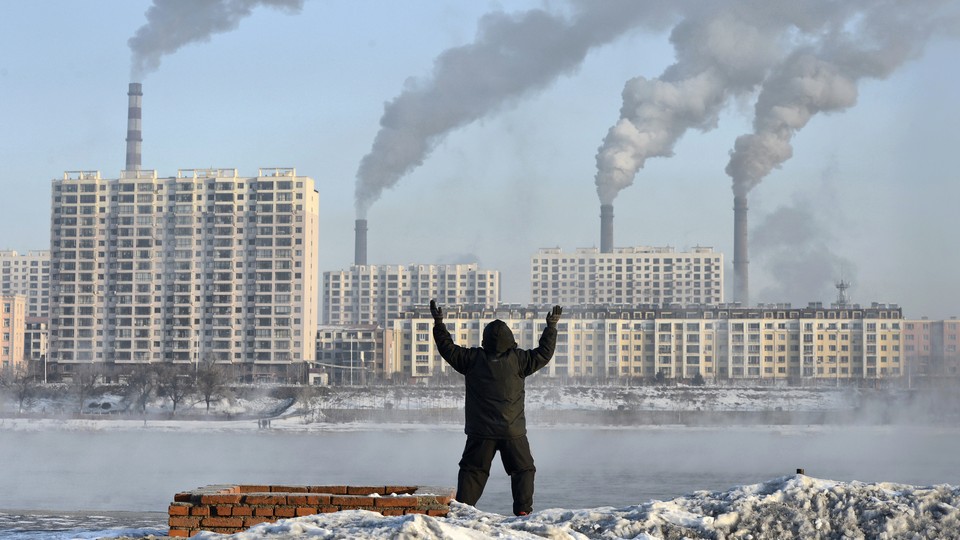
The world faces four main challenges: climate change, mistrust of leaders, increased geopolitical tension, and the dark side of the technological revolution. (Which is digitizing not just our imagination of our future’s by plundering the finite resources of the planet for profit.)
1) Climate change is the defining issue of our time,” It represents an “existential threat” to humankind. “The planet will not be destroyed. What will be destroyed is our capacity to live on the planet.
2) People believe that the fruits of globalization are not being fairly distributed. Seven in 10 people in the world live in countries where inequality is growing.
3) Increased geopolitical tensions are further exacerbated by weaknesses in institutions. For example, the UN Security Council’s “inability to take decisions” or to enforce the ones they do take, such as the arms embargo.
4) Artificial Intelligence that is owned by corporations are unbalancing the values that are common to us all. Turning Democracy into AI Totalitarianism Democratic Societies with mass surveillance.
Because in the age of the internet and super-connectivity, all of these things, like face recognition have been raised to sophisticated arts ( Clear View ) that, instead of being forced on us, have quietly colonised our lives.
In times past, when frustrating circumstances demanded new ways of expressing what it means to be alive here a few for present day use.
The internet/cyberspace is wonderful, because it gives people the freedom to augment or totally change their identities, and this is a marvellous new dawn for human expression, a new step in human evolution. Nah, it’s a false dawn, because the internet is essentially a libertarian arena, and as such an amoral one (lots of ‘freedoms’ but with no attendant social obligations); it is a new jungle where we must watch our backs and struggle for survival, surely a backward step in evolution.
- The term ‘hyperobject’ was coined by the academic Timothy Morton, and it refers to phenomena that are so large and so far beyond the human frame of reference that they are not susceptible to reason but to AI.
- Immigration. The realisation that racism never really went away, it just camouflaged its fundamental failure of empathy as tolerance – this is a contention of the Black Lives Matter movement. The term is now making the short jump to other second- (eg LGBT) and third- (eg feminism) phase civil rights movements equally lulled by the illusion of tolerance. The goal is to go beyond feeling tolerated to being fully accepted and welcomed.
3. Deletion. This word is likely to be bandied about much more frequently in the decades ahead, as social media users realise that the websites they are on are not merely neutral ‘platforms’ for ‘social interaction’ but more like a kind of flypaper to which people and all of their personal data stick. Moreover, these websites are specifically designed to be addictive –
4) Global capitalism is, by its unjust and shambolic nature, going to experience crashes of increasing severity throughout the 21st Century, leaving us all to survive with growing desperation amidst its wreckage.
5. Shadow banking. Nobody knows how large this sector is, but current estimates put shadow banking at (£124 trillion) and OTC transactions at (£412 trillion), or roughly twice and six-and-a-half times the GDP of the entire Earth, respectively. Both sectors were of course heavily involved in creating the 2008 crash, and both have remained almost unaltered since then.
6. Attention crisis. The fact that no one can take their eyes off their smartphones – James Williams writes that “the liberation of human attention may be the defining moral and political struggle of our time”. Our minds are being rewired for commercial purposes. His argument that the social contract, the idea of human rights, should be extended to cyberspace is gaining traction.
Was the creation of the internet not supposed to be the dawn of a technological and informational utopia? Even its father, Tim Berners-Lee, the inventor of the world wide web, is convinced it is failing us.
7. Post-human. It seems that history has caught up with us, for our identities now extend into cyberspace in many ways, we no longer merely rely on our brain cells but now store much of our knowledge in technological clouds that function as extensions of our minds, and we live with the corresponding hardware in such intimacy (in the form of portable devices that are linked to our minds and even metabolisms in many ways) that it sometimes feels like we are only a few steps away from being ‘cyborgs’ in the true sense of the term. Gender, though, is still a problem.
8. Masculinity. There was a time when you’d ask a man what masculinity was and his response would be something like ‘not feminine’ (pejorative) and ‘not queer’ (pejorative). Note all the negativity.
These days it is increasingly a good thing to be a woman (new, broad definition) and to be queer (new, broad definition). Both are eating away at the old territory occupied by masculinity, according to writers such as Hanna Rosin, Cordelia Fine or Grayson Perry. What’s left is something of a void, aka ‘the crisis of masculinity’.
The challenge ahead for men is to formulate what they are, and want to be, rather than what they aren’t. How to open up this frontier?
I have a suggestion. For generations feminists and queer activists have been fighting to draw attention to masculinity’s toxic side-effects. At long last, mainstream men seem on the verge of accepting that there is a problem. It remains for us all to take this a step further, and work to understand how this toxicity has also been poisoning men on the inside.
9. Generation Why? It applies to anyone born in the digital age.
To roughly clarify our terms here: Baby Boomers are the generation born after World War Two and before 1965; Generation X (Douglas Coupland) the cohort born between the mid-1960s and 1980; Generation Y (Millennials) includes people born between 1980-ish and 2000; Generation Z (Post-Millennials) is anyone born after 2000. These categories don’t really have global reach, but they are evocative as metaphors.
The gist of Smith’s argument is that Facebook and its like are reductive: they cut us down to size and reprogrammed us to suit their own ends, which are advertising and selling things – exploitation. “Five-hundred million sentient people entrapped in the recent careless thoughts of a Harvard sophomore,” she calls it.
Smith was writing a few years ago; the number of Facebook users has now passed 2 billion. Generations Y and Z have led lives saturated by the internet, by social media platforms and apps, which have claimed to make life complete and have all of the answers all of the time. Is this paraphernalia worthy of them? Are they content to be trapped in the reveries of Zuckerberg and the like? No. There are detectable tremors of disaffection and radicalisation. I suspect that as more and more post-millennials reach voting age, Generation Why may be giving us some loud answers.
10. The new weird An emerging genre of speculative, ‘post-human’ writing that blurs genre boundaries and conventions, pushes humanity and human-centred reason from the centre to the margins, and generally poses questions that may not be answerable in any terms we can understand (hence the ‘weird’). In the present era, where potent advertising and PR forces are doing everything in their power to make truth irrelevant and directly hack our minds, and where politicians no longer seem to acknowledge the existence of facts, the word has sinister new applications.
The COVID-19 pandemic is a tragic reminder of how deeply connected we are. There is a clear and urgent need for concrete multilateral solutions, based on common action across borders for the good of all humanity, starting with extend beyond national governments, to include more participation from local authorities, civil society, business leaders and others.
How close we are to destroying our world with dangerous technologies of our own making.
No one country can tackle the problem’s on their own no matter how large their population, how strong their economy or how feared their military.
Everyone sees change everywhere, and I think it’s important to figure out where are we going to be five to 10 years from now.
We’re going to see more automation. We’re going to see, unfortunately, more technological unemployment.
I don’t think they will be able to ignore the issue of inequality. We’re seeing social tensions and all sorts of frictions proliferate. The sooner we start tackling it, the better. We really need to start thinking outside of the box.
In the end it back to that word Need:
We need to be less wasteful. We need to economize our resources. We need to be more pro-environment in our own behaviour as consumers.
Let’s replace it with Yugen.
“We can either save our world or condemn humanity to a hellish future.”
All human comments appreciated. All like clicks and abuse chucked in the bin.
Contact: bobdillon33@gmail.com




 bobdillon33blog