• About
  • THE BEADY EYE SAY’S : THE EUROPEAN UNION SHOULD THANK ENGLAND FOR ITS IN OR OUT REFERENDUM.

bobdillon33blog

~ Free Thinker.

bobdillon33blog

Category Archives: The Obvious.

THE BEADY EYE LOOK’S AT THE IMPLICATIONS OF NON REGULATED FACIAL RECOGNITION TECHNOLOGY.

11 Monday Nov 2019

Posted by bobdillon33@gmail.com in Artificial Intelligence., Facial Recognition., Technology, The cloud., The common good., The essence of our humanity., The Obvious., The world to day., Unanswered Questions., WHAT IS TRUTH, What Needs to change in the World, Where's the Global Outrage., World Politics

≈ Comments Off on THE BEADY EYE LOOK’S AT THE IMPLICATIONS OF NON REGULATED FACIAL RECOGNITION TECHNOLOGY.

Tags

Face Recognition technology.


(Twenty-minute read)

Advanced technology no longer stands apart from society; it is becoming deeply infused in our personal and professional lives.

Perhaps as much as any advance, facial recognition raises a critical question: what role do we want this type of technology to play in everyday society?

The issues relating to facial recognition go well beyond questions of bias themselves, raising critical questions about our fundamental freedoms.

You might not think it but we are in the midst of a facial recognition technology race.

Imagine a government tracking everywhere you walked over the past month without your permission or knowledge.

Imagine a database of everyone who attended a political rally that constitutes the very essence of free speech.

Imagine the stores of a shopping mall using facial recognition to share information with each other about each shelf that you browse and the product you buy, without asking you first.

Imagine an inability to protest your government.  What if health insurance providers can track how often you eat at Burger King.

There is no shortage of tragic scenarios when such technology becomes ingrained in our society. It has vast potential to enslave society.

There could be dire consequences for citizens around the world.

So will facial recognition become part of everyday life?

This technology is actively being tested all around the world and it will only keep improving.

Presently smartphones utilize sensors and accelerometers to track our every behaviour, understanding exactly when we wake up in the morning, where our offices are, where we shop for groceries, what our interests are and how we spend our time.

We are willingly giving up our personal information that these “free” services offer, then turn around and sell for profit, all for a split-second hit of dopamine when someone “likes” a picture we post on Facebook.

Facial recognition surveillance is powerful not only because it is highly accurate, but also because of how discreet the set up is. You don’t realize when it’s surveilling you or your family. It runs in the shadows creating no noises, you don’t’ walk through any detectors, you don’t sign anything, and you don’t press your fingertips against a pad.

It just happens.

Increasingly it will define the decade ahead.

It can’t be left to tech companies to limit the way government agencies use facial recognition and other technology. Facial recognition technology raises issues that go to the heart of fundamental human rights.

Protections like privacy and freedom of expression.

So let me ask you.

  • Should law enforcement use of facial recognition be subject to human oversight and controls, including restrictions on the use of unaided facial recognition technology as evidence of an individual’s guilt or innocence of a crime?
  • Similarly, should we ensure there are civilian oversight and accountability for the use of facial recognition as part of governmental national security technology practices?
  • What types of legal measures can prevent the use of facial recognition for racial profiling and other violations of rights while still permitting the beneficial uses of the technology?
  • Should the use of facial recognition by public authorities or others be subject to minimum performance levels on accuracy?
  • Should the law require that retailers post visible notice of their use of facial recognition technology in public spaces?
  • Should the law require that companies obtain prior consent before collecting individuals’ images for facial recognition? If so, in what situations and places should this apply? And what is the appropriate way to ask for and obtain such consent?
  • Should we ensure that individuals have the right to know what photos have been collected and stored that have been identified with their names and faces?
  • Should we create processes that afford legal rights to individuals who believe they have been misidentified by a facial recognition system?

The questions listed above – and no doubt others – will become important public policy issues around the world, requiring active engagement by governments, academics, tech companies and civil society internationally.

Issues relating to facial recognition go well beyond the borders of Countries.

Given the global nature of the technology itself, there likely will also be a growing need for interaction and even coordination between national regulators across borders.

  • The need for government leadership does not absolve technology companies of our own ethical responsibilities.
  • The future is not simple. We, therefore, need a principled approach for facial recognition technology, embodied in law, that outlasts a single administration or the important political issues of a moment.
  • As in so many times in the past, we need to ensure that new inventions serve our democratic freedoms pursuant to the rule of law. Given the global sweep of this technology, we’ll need to address these issues internationally, in no small part by working with and relying upon many other respected voices. We will all need to work together, and we look forward to doing our part.

It’s apparent that other new technologies will raise similar issues in the future.

This makes it even more important that we use this moment to get the direction right.

Public authorities may rely on flawed or biased technological approaches to decide who to track, investigate or even arrest for a crime.

Governments may monitor the exercise of political and other public activities in ways that conflict with longstanding expectations in democratic societies, chilling citizens’ willingness to turn out for political events and undermining our core freedoms of assembly and expression.

Similarly, companies may use facial recognition to make decisions without human intervention that affect our eligibility for credit, jobs or purchases.

All these scenarios raise important questions of privacy, free speech, freedom of association and even life and liberty.

If we don’t stop or regulate it now, it will be more difficult to reel in after it’s already deployed on every lamppost.

The government needs to play an important role in regulating facial recognition technology.

As a general principle, it seems more sensible to ask an elected government to regulate companies than to ask unelected companies to regulate such a government.

After all, even if one or several tech companies alter their practices, problems will remain if others do not. There will always be debates about the details, and the details matter greatly.

The surveillance data can be deeper and more extensive than any of us understand, “trade a little of your privacy and we’ll keep you safer” motto.

You could say that education is the crux to this resistance and once society recognizes the overwhelming benefits offered as a result of facial recognition we will be able to move past the mental hurdles.

But the ability to use the cloud to connect all this data and facial recognition technology with live cameras that capture images of people’s faces and seek to identify them – in more places and in real-time will lead to a gender and racial bias developing because some facial recognition technology will not like you at the moment of recognition.

Facial recognition will require the public and private sectors alike to step up – and to act as the General Data Protection Regulation in the European Union.

It seems especially important to pursue thoughtful government regulation of facial recognition technology, given its broad societal ramifications and potential for abuse.

Today’s advanced facial recognition in the 21st century comes along with deep learning.

The algorithm compares different facial features as against an image encompassed within a database. It calculates facial parameters such as mouth, nose, eyes, lips and their relative intensity.

So smile.  You might see what is under the  – A human.

We’re Being Blinded to the Danger of Facial Recognition. A perpetual lineup.

If we don’t implement legal restrictions on face recognition, the future looks

like a Chinese-style surveillance state, one that violates our right to privacy,

our right to anonymity in public, and our right to free speech.

All human comments appreciated. All like clicks and abuse chucked in the bin.

← Back

Thank you for your response. ✨

Share this:

  • Share on WhatsApp (Opens in new window) WhatsApp
  • More
  • Share on Mastodon (Opens in new window) Mastodon

THE BEADY EYE ASK’S: HAS FRIENDSHIP CHANGE. WHAT IS FRIENDSHIP THESE DAYS?

08 Friday Nov 2019

Posted by bobdillon33@gmail.com in 2019: The Year of Disconnection., Artificial Intelligence., Communication., Digital Friendship., Education, Emotions., Facebook, Happiness., Humanity., Life., Modern day life., Reality., Social Media, Technology, The Obvious., The world to day., Unanswered Questions., WHAT IS TRUTH, What Needs to change in the World

≈ Comments Off on THE BEADY EYE ASK’S: HAS FRIENDSHIP CHANGE. WHAT IS FRIENDSHIP THESE DAYS?

Tags

Artificial Intelligence., Digital friendships, Social Media, The Future of Mankind, Visions of the future.


(Twenty-minute read)

The dawning of the digital age has not just changed communication, facilitating individual and group interaction in previously unimaginable ways it has fundamentally changed human relationships, or more specifically, the establishment of fraternity amongst people?

The internet has made it so you don’t need to physically see people feel close to them.

I miss those days of pre-digital friendship.

Thirty years ago we asked what we would use computers for.

children-1149671_640

Facebook. Twitter. SecondLife. “Smart” phones. Robotic pets. Robotic lovers.

Now the question is what don’t we use them for.

Technology promises to let us do anything from anywhere with anyone and the introduction of social media platforms has changed the “friendship playing field”.

The way friendships are played out in the digital world is changing how young people express themselves, how they define ‘good’ friendships and interact with each other.

Now, through technology, we create, navigate, and perform our emotional lives.

In a surprising twist, relentless connection leads to a new solitude.

We turn to new technology to fill the void, but as technology ramps up, our emotional lives ramp down. At the threshold of “the robotic moment,” our devices prompt us to recall that we have human purposes and, perhaps, to rediscover what they are.

The huge role that technology plays in supporting young people’s friendships, with over half (55%) saying they interact online with their closest friends several times an hour and 63% saying they are closer to their friends because of the internet.

The basic components of friendship USE TO BE interdependence and voluntary participation but technology is now embedded throughout our relationships.

So the question is.  Has friendship changed because technology changed it? Or both?

The popular platforms 8-17-year-olds are using to chat to their friends on a daily basis are YouTube (41%), WhatsApp (32%), Snapchat (29%), Instagram (27%) and Facebook or Facebook Messenger (26%)

Technology provides an important way for them to support their peers who are going through difficult times with Social media providing a vehicle of self-promotion, a means of fixing an idea of yourself in the social sphere, without people actually knowing you at all.

Has it made friendship less personal, less connective, less real?

The distinction in the online world is that the effort it takes to present ourselves in a certain way is much less.

Not to mention the fact that technology has allowed us to maintain friendships that might have otherwise waned when time, distance, and the constant demands of parenting take hold.

The lines between real friendships and fleeting acquaintances have become

blurred in the virtual world, not just but also because of many Social media

users showcase more than 1000 friends on their profiles, while the realistic

maximum number of people we are able to maintain relationships with lies at

150 people.

Our brains are just not wired to cope with.

——————

True friendships are hallmarked by each member’s desire to engage with the other – it’s about a mutual interest in one another’s experiences and thoughts, as well as a sense of ‘belongingness’ and connection, there’s no telling when and where a friendship will develop.

The cornerstone of friendship isn’t the public nature of the relationship, but the private connection of it and that private uniqueness hasn’t been eliminated; it just looks different now.

The Internet is undoubtedly an invaluable link between people separated by distance. But this link must be built on a stronger foundation of intimacy and familiarity and a balance of online and offline interactions will pave the way to better relationships in the world.

We “met” through a mutual friend on Twitter.

(Posts Tagged With friendship in the digital age,

 “I wish I had stayed in touch with my friends.” is number five.)

Sexual online meetings themselves may be a replacement for deeper longings in couples. It may be an extension of particular needs not being met within the relationship.

They find that the relationship to their primary partner is more undervalued than in the past and that traditional definitions of intimacy are vaguer. They explain that couples who once experienced a secure relationship now struggle with the new –often ambiguous– rubrics surrounding agreed-upon Internet conduct.

Young people also need to be empowered to take control of their digital wellbeing, by recognising their emotions and the way that their use of digital technology can impact on their self-esteem and mood so that they are able to implement strategies to achieve a healthy relationship with technology.

Social exclusion can have just as much of a damaging impact on young
people but may not be easy to detect and manage in digital spaces.

Facebook has completely redefined the definition of a friend.

It wont be long before we could be seeing the following.

“We’d like to say a big ‘thank you’ every time you recommend a friend to us by rewarding you with a retail shopping voucher £250 will be paid for a friend.

Two in five adults (40%) first look at their phone within five minutes of waking up, climbing to 65% of those aged under 35. Similarly, 37% of adults check their phones five minutes before lights out, again rising to 60% of under-35s.

The average amount of time spent online on a smartphone is 2 hours 28 minutes a day. This rises to 3 hours 14 minutes among 18-24s.

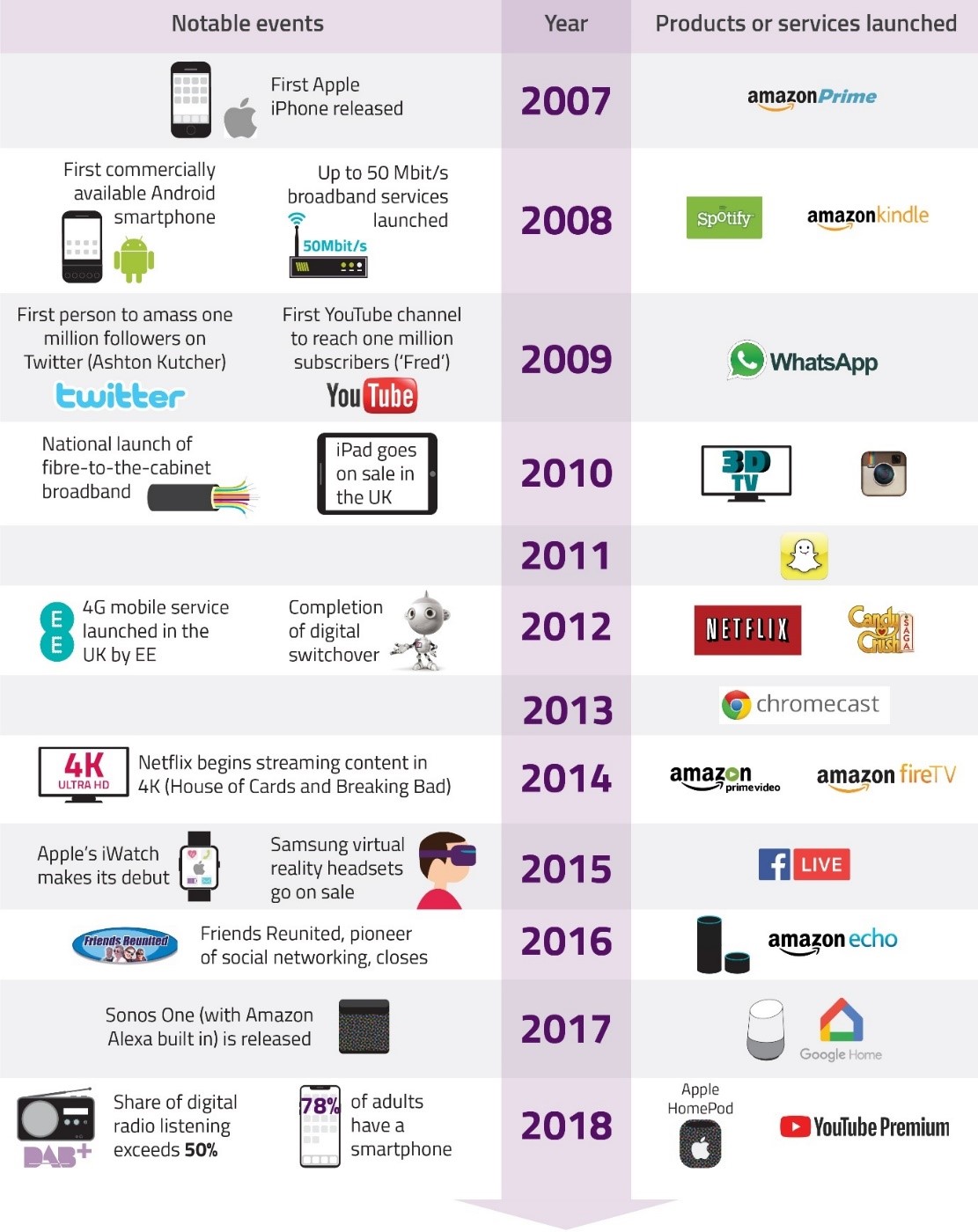
A decade of change in digital communications.

Infographic timeline showing notable events and products or services launched between 2007 and 2018. 2007: first iPhone released; Amazon Prime launched. 2008: first Android smartphone; up to 50 Mbit/s broadband launched; Spotify and Amazon Kindle launched. 2009: Ashton Kutcher becomes first person to amass one million followers; YouTubers Fred becomes first to reach one million subscribers; WhatsApp launched. 2010: National launch of fibre-to-the-cabinet broadband; iPad goes on sale in the UK; 3DTV and Instagram launched. 2011: Snapchat launched. 2012: 4G mobile service launched in UK by EE; completion of digital switchover; Netflix and Candy Crush launched. 2013: Chromecast launched. 2014: Netflix begins streaming content in 4K; Amazon Prime Video and FireTV launched. 2015: Apple iWatch makes debut; Samsung VR headsets on sale; Facebook Live launched. 2016: Friends Reunited, pioner of social networking, closes; Amazon Echo launched. 2017: Sonos (with Amazon Alexa built in) released; Google Home launched. 2018: Share of digital radio listening exceeds 50%; 78% of adults have a smartphone; Apple HomePod and YouTube Premium launched.

It is said that in the course of a normal life one is lucky to have a handfull of friends.

Now its social mobile, analytics, and cloud all want to be your friend.

When we think about social, the key is to consider why social is happening, rather than think of it as just a set of tools.

For example, Facebook, Twitter, and so on are tools, but why people use them is much more important. The same was true with the internet when we first started using that — that was a tool, but what it did to the lives of normal people in terms of access to information, increased freedom, etc., was much more important.

Mobile is a similar shape to social in that it’s the why as to why people use mobile devices as opposed to anything structural about the devices themselves.

The idea behind big data is that you can derive understanding about behaviour through statistical analysis of clumps of data. You can then take that understanding and implement some form of control to either get more of what you want, or get less of what you don’t want.

Finally, we come to the cloud.  This is really about how companies buy. There are all sorts of reasons to like outsourcing IT functions to the cloud, whether it’s just outsourcing compute power into a load of servers that you run as if they were your own, or buying functionality on an SaaS basis ( Software as a service)

Is cloud necessary for digital?

To an extent, it likely does not. However, as a fashion/trend, it’s clearly important, and a lot of the tools and services involved in digital are unlocked as part of a cloud-based approach, hence it’s likely important.

It’s a sociological change, rather than a technical one.

You can see that by the fact that this is generally all about the “why” this is happening — why are customers using social, why are they using mobile, why big data is showing the trends that it is, why are companies able to buy and use consumer products, and why is running systems in the cloud easier.

Because they all your Friend without you knowing and couldn’t care less who or how they share that friendship with or what they do with it.  Google it.

All human comments appreciated. All like clicks and abuse chucked in the bin.

← Back

Thank you for your response. ✨


Share this:

  • Share on WhatsApp (Opens in new window) WhatsApp
  • More
  • Share on Mastodon (Opens in new window) Mastodon

THE BEADY EYE ASK’S: ARE PROFIT SEEKING ALGORITHMS BUILDING A DIGITAL POORHOUSE, AUTOMATING INEQUALITY WHILE HURTING THE MOST VULNERABLE.

03 Sunday Nov 2019

Posted by bobdillon33@gmail.com in Algorithms., Artificial Intelligence., Capitalism, Fourth Industrial Revolution., Humanity., Inequality, Modern day life., Our Common Values., Poverty, Reality., Technology, The common good., The Future, The Obvious., The state of the World., The world to day., Unanswered Questions., WHAT IS TRUTH, What Needs to change in the World, Where's the Global Outrage.

≈ Comments Off on THE BEADY EYE ASK’S: ARE PROFIT SEEKING ALGORITHMS BUILDING A DIGITAL POORHOUSE, AUTOMATING INEQUALITY WHILE HURTING THE MOST VULNERABLE.

Tags

Algorithms., Artificial Intelligence., Big Data, Capitalism and Greed, Distribution of wealth, Greed, Inequility, Technology, Visions of the future.

(Twenty-minute read)

Should we worry about the rise of artificial intelligence or celebrate it?

Both is the answer.

We all inhabit this new regime of digital data but we don’t all inhabit it in the same way and the pursuit of rapid growth by way of technology won’t solve the huge challenges we face.

A more honest, humane approach is the answer.

If you believe the hype, technology is going to help us end global poverty, that’s easier said than done in a world where most product innovations are geared toward the rich.

The prospect of billions rising up from poverty with nothing more than gadgets is indeed a fanciful notion. This is because poverty is entirely a man-made creation. Capitalism is driven by greed, generating a power structure, which moves wealth disproportionately into the hands of the few.

But why are our societies becoming increasingly unequal, and what can we (or should we) do about it?A homeless man outside Victoria Station in London.

Forget where science ends and ideology begins it is the mechanisms behind the persistence of poverty that counts.

Technology cannot solve the problem of economic disparity.

We often believe that our digital decision-making tools, like algorithms or artificial intelligence or integrated databases, are more objective and more neutral than human beings.

Totally false.

We are building not just ill-conceived mathematical models now micromanage the economy, from advertising to prisons but also hiding the profit of multinational companies in the cloud.

We are building:  A DIGITAL POOR HOUSE.

Even though we live in a hyperconnected world we are watching inequality exploding as we walk past people on the street looking at our smartphones.

The spreading of these kinds of systems is now way beyond just the public service systems that they’re in now. For example, high-frequency trading algorithms that run 99.9% of the world stock exchanges are plundering not just finite resources they are jeopardising our peaceful existence.

Feel free to ignore the weight of the evidence that is now becoming crystal-clear, so stark, that the trade-off of the growth of the economy and the survival of the planet are now intertwined. So we have to go into a mode where we are first educating the people about what’s causing this inequality and acknowledging that technology is part of that cost, and then society has to decide how to proceed.

Deep cultural and political changes are needed in order to think through these technologies in order to get to better systems.

This should apply to all technology – nanotechnology, biotech.

I also really believe we need to stop using these systems to avoid some of the most pressing moral and political dilemmas of our time, which is not just poverty but racism.

Unfortunately, we have Profit-seeking Algorithms that have no moral or ethical bases.

Algorithms — a set of steps computers follow to accomplish a task — are used in our daily digital lives to do everything from making airline reservations to searching the web. They are also increasingly being used in public services, such as systems that decide which homeless person gets housing.

AI with faceless algorithms is worsening the effects and concentrating the power of the wealthy. They are likely to dramatically increase income disparity, perhaps more so than other technologies that have come about recently.

Digital innovation in the form of profit-seeking algorithms that it’s not just going to be benefitting a small fraction of the world’s population, or just a few large corporations. is reinforcing, rather than improving, inequality.

Institutions have embraced digital technologies they are outsourcing the decision to a machine to cut costs avoiding the human costs. They say, “We have this incredible overwhelming need. We don’t have enough resources, so we have to use these systems to make these incredibly difficult decisions.”

If all the resources are automated, then who actually controls the automation?

Is it every one or is it a few select people?

My great fear with these systems is we’re actually using them as a kind of empathy override, meaning that we are struggling with questions that are almost impossible for human beings to make.

We’re smuggling moral and political assumptions into them about who should share in prosperity.

There’s already an expectation that people will be forced to trade one of their human rights, like their information or their privacy, for another human right.

The economic prosperity created by AI should be shared broadly, to benefit all of humanity otherwise they will lead to an even greater disparity between the wealthy and the rest of the world.

If AI takes away people’s jobs and only leaves wealth in the hands of those people owning the robots, then that’s going to exacerbate some trends that are already happening.

People now with “predictive data” have real concerns about informed consent. About how their data is being shared, whether it’s legal and whether it’s morally right.

Why?

Because it is impossible to work out why the algorithms had gone against them, or to find a human caseworker to override the decision.

How can we change the societal mindset that currently discourages a greater sharing of wealth? Or is that even a change we should consider?

We’re using these technologies to avoid important political decisions. Exacerbating the divides between the developed and developing world, and the haves and have nots in our society.

The change will only occur when policymakers and voters understand the true scale of the problem. This is hard when we live in an era that likes to celebrate digitisation — and where the elites are usually shielded from the consequences of those algorithms.

Restoring human dignity to its central place has the potential to set off a profound rethinking of economic priorities and the ways in which societies care for their members, particularly when they are in need. If enough of us want to change the status quo for good, then with our collective creativity, with our hunger to solve really hard problems, we will find technology an incredibly powerful tool in our arsenal.

Technology can move commodities (food, jobs, wealth) from areas of surplus supply to regions with under-served markets.

Technology can only help us if we chose to make the best use of it.

Computing has long been perceived to be a culture-free zone — this needs to change.

Today more people have access to a cell phone than a toilet.

I use that metaphor specifically because I think that these systems, although we talk about them often as disruptors, are really more intensifiers and amplifiers of processes that have been with us for a long time, at least since the 1800s.

At a time of unprecedented global challenges platforms like Google Facebook, Twitter and there like must be made to use the power of their platforms to stop the DIGITAL POOR HOUSE instead of hoarding profits with profit-seeking algorithms.

If not because bias has been a historical norm, it because us the users of your platform will develop self-defence.

So, next time if you think AI is not affecting you, take out your smartphone.

If Twitter’s not your choice of poison, maybe it’s Facebook or Instagram, or Snapchat or any of the myriad of social media apps out there they are all affecting your decisions and our lifestyles every day.

They are all tailored according to what we are likely to respond to. specifically designed to attract the attention of its members – and so inevitably to confirm them in their opinions and prejudices,  with several extra bills to pay in order to remain a normal citizen. 

Its a ‘mean’ not the ultimate solution.

AI has become so successful in determining our interests and serving us ads that the global digital ad industry has crossed trillions.

artificial intelligence concept Stock Photo - 90948450

All human comments appreciated. All like clicks and abuse chucked in the bin.
← Back

Thank you for your response. ✨


Share this:

  • Share on WhatsApp (Opens in new window) WhatsApp
  • More
  • Share on Mastodon (Opens in new window) Mastodon

THE BEADY EYE SAY’S: PERPETUAL GROWTH IS COMING TO AN END.

26 Saturday Oct 2019

Posted by bobdillon33@gmail.com in 2019: The Year of Disconnection., Enegery, Environment, Evolution, Fresh Water., Humanity., Inequality, Life., Modern day life., Our Common Values., Reality., Sustaniability, Technology, The common good., The essence of our humanity., The Obvious., The state of the World., The world to day., Unanswered Questions., WHAT IS TRUTH, What Needs to change in the World, Where's the Global Outrage.

≈ Comments Off on THE BEADY EYE SAY’S: PERPETUAL GROWTH IS COMING TO AN END.


( Seven-minute read)

Economics is not an unbiased academic discipline, it’s an ideology. Furthermore, economics is based on the false premise that perpetual growth is achievable.

Can economic growth be sustainably achieved?

Finite resources make perpetual growth theoretically impossible. No amount of technological breakthrough or creative accounting can counter that physical fact.

Is economic growth desirable?

The short answer appears to be no.

Exponential growth will eventually take you to impossible places.

Unfortunately, we live in a world of capitalists that thrive on the great Myth of Perpetual Growth, endless growth, ad infinitum, forever, till the end of time.

It seems as though we are damned if we grow and damned if we don’t.

We’ve now with Algorithms for profit sake got to a position where there’s nothing to keep us in check – so we have to do it ourselves.

It’s a waiting game now – to see if we can learn to behave differently to bacteria in a petri dish before it’s too late and we kill our host.

It’s not worth the risk.

Ecology and economics have to be intertwined, or we’re in serious trouble.

It’s time we all get our head out of the smartphone and become smart.

We can have debates about what we’re going to do about this and that, but if you can’t see the reason in the core of what I am saying, we’ll be having two very different conversations.

There is little point in arguing any longer whether Neoliberalism is to blame for damaging ecology beyond its ability to support us. It has lead to the inevitable collision between an insatiable economic model and a finite planet whose resources are stretched to the hilt.

The perception of the need for perpetual economic growth is a fraud and this assumption creates massive risk when reaching the limits of our natural systems.

With a world population nearly at 7 billion people, the implication for economic growth seems obvious as we cannot assume that the status quo will hold in a changing climatic environment. Reaching the earth’s resource limit is inevitable if it is not already occurring.

However changing our society’s behaviours cannot be achieved through some overseeing organization.

Perpetual growth has been ingrained through exposure to intensive branding and marketing by the very corporations who provide jobs and economic growth, and round and round we go…… Enacting such dramatic change through a highly centralized governing structure that dictates appropriate resource use, population levels, and actively redistributes wealth is a hard sell even in dire times.

As a result, we cannot continue consuming more and more water, spewing out more and more carbon dioxide and burning more and more coal.

In the past 22 years, half of all of the oil ever burned has been burned.

At present, the global population is increasing by 83 million people annually and we are already consuming natural resources as if we have “1.5 Earths.”

If every person used as many resources as the average North American, more than four Earths would be required to sustain the total rate of consumption. Other words if everyone lived like the average American, the Earth could sustain only 1.7 billion people — a quarter of today’s population.

27 billion people will inhabit the planet by the end of the century and hidden in every calorie of food eaten are 10 calories of fossil fuels.

Technology can lead to greater efficiencies, it requires energy — it does not create it.

Water is obviously a key component of human life. It is also vital to energy, industry, agriculture and livestock.

With all of this in mind, it’s time to abandon the perpetual growth economic model and move instead to a model that stresses conservation, efficiency, recycling and renewability. Clearly, the world is on an unsustainable path and, by definition, anything that is unsustainable won’t last.

Above all else, we must redefine the quality of life as something other than just having “more.” The goal should be to simply have enough. Our quality of life should not be measured by “stuff,” but instead by the things that make life rich; our relationships, our hobbies, our work and our passions.

GDP merely measures what people are willing to pay for, which is not necessarily connected to the use of energy, or any other physical resource.

The world will be confronting shortages of hydrocarbons, metals, water and fertilizer, which will dramatically affect global agriculture. The latter is critical.

So why are we unable to change direction.

Because of the threat, transnational organizations have over the nation-state.

Because no one is willing to bear the costs.

Because of the amount of power capital has over labour.

As it stands, nearly half the world’s population — more than 3 billion people — lives on roughly $2 per day.

The solution is to get profit for profit sake to pay:

By introducing a World Aid commission of 0.05% on all High-frequency trading, on all sovereign wealth funds acquisitions on all foreign exchange transaction over $50,000, on all gambling and lottos wins creating a perpetual world aid fund.

By issuing United Nation Green Deal non-trading Bond.

By the introduction of a World Day of non-consumerism Advertising.

By building non atomised Societies that are attached geographical – belonging not defined by competition.

By eating together one a week.

The question is how do we communicate this obvious message, in the face of corporate control of the media, and increasingly academia, science and the political system?

All human comments appreciated. All like clicks and abuse chucked in the bin.

← Back

Thank you for your response. ✨

Share this:

  • Share on WhatsApp (Opens in new window) WhatsApp
  • More
  • Share on Mastodon (Opens in new window) Mastodon

THE BEADY EYE ASK’S: SHOULD WE BE GIVING AWAY OUR PERSONAL DATA FOR FREE.

15 Tuesday Oct 2019

Posted by bobdillon33@gmail.com in Algorithms., Big Data., DIGITAL DICTATORSHIP., Face Recognition., Fourth Industrial Revolution., Google Knowledge., Modern Day Communication., Modern Day Democracy., Our Common Values., Robot citizenship., Technology, The common good., The essence of our humanity., The Internet., The Obvious., The state of the World., The world to day., Unanswered Questions., WHAT IS TRUTH, What Needs to change in the World, Where's the Global Outrage., WiFi communication.

≈ Comments Off on THE BEADY EYE ASK’S: SHOULD WE BE GIVING AWAY OUR PERSONAL DATA FOR FREE.

Tags

Algorithms trade., Algorithms., Artificial Intelligence., Big Data, Click World., Internet, Privacy boundaries., SMART PHONE WORLD, Technology, The Future of Mankind, Visions of the future., Wireless information.


(Six-minute read)


Is it time we started to demand that if you use my personal data it’ill cost you because I am worth it.

We all make a trade-off between security and convenience, but there is a crucial difference between security in the old-fashioned physical domain, and security today.

Security is done digitally with algorithms exploiting and analysing your very mood.

In this digital lifestyle, it is nearly impossible to take part in the web world without leaving a trail behind.

Personal privacy is dead.

How to Protect Yourself From Mobile Data Collection


We have no clear sight into this world, and we have few sound intuitions into what is safe and what is flimsy – let alone what is ethical and what is creepy.

We are left operating on blind, ignorant, misplaced trust; meanwhile, all around us, without our even noticing, choices are being made.

With the increasing ownership of mobiles, marketing companies now have unlimited access to our personal data. Every site one opens has an agreement form to be ticked with terms and conditions that are all but unreadable on small screens.

It’s not a choice between privacy or innovation, it is the erosion of legally ensured fundamental privacy rights interfacing with apps.

Nuggets of personal information that seem trivial, individually, can now be aggregated, indexed and processed.

When this happens, simple pieces of computer code can produce insights and intrusions that creep us out or even do us harm. But most of us haven’t noticed yet.

Since there’s no real remedy, giving away our most sensitive and valuable data, for free, to global giants, with completely uncertain future costs, is a decision of dramatic consequence.

iCloud and Google+ have your intimate photos; Transport companies know where your travelcard has been; Yahoo holds every email you’ve ever written and we trust these people to respect our privacy.

You only have to be sloppy once, for your privacy to be compromised.

With your Facebook profile linked, I could research your interests before approaching you.

Put in someone’s username from Twitter, or Flickr and Creepy will churn through every photo hosting service it knows, trying to find every picture they’ve ever posted.

Cameras – especially phone cameras – often store the location where the picture was taken in the picture data. Creepy grabs all this geolocation data and puts pins on a map for you.

Then comes an even bigger new horizon.

We are entering an age of wireless information. The information you didn’t know you were leaking.

Maybe the first time you used a new app.

Every device with Wi-Fi has a unique “MAC address”, which is broadcast constantly as long as wireless networking is switched on.

Many shops and shopping centres, for example, now use multiple Wi-Fi sensors, monitoring the strength of connections, to triangulate your position, and track how you walk around the shop. By matching the signal to the security video, they get to know what you look like. If you give an email address in order to use the free in-store Wi-Fi, they have that too.

Once aggregated, these individual fragments of information can be processed and combined, and the resulting data can give away more about our character than our intuitions are able to spot.

When I realised that I’m traced over much wider spaces from one part of town to another I asked myself what is the point in giving you information away when you could franchise it out and get something back in return.

Public debate on the topic remains severely stunted.

Through the current trends in the globalization of technology is in the knowledge society, we have to start asking where is the world moving to?

The concepts and applications of biocomputing, medical informatics, anthropocentric computing, high-performance computing, technological diffusion, predictive analysis tools, genetic algorithms, and cultural informatics all in new or little known fields of information technology.

Many organisations create, store, or purchase information that links individuals’ identities to other data. Those who can access and analyse this personal data profiles can take deep insights into an individual’s life.

A law-abiding citizen might say “I have nothing to conceal.” This is a misconception.

In any debate, negotiation or competitive situation, it is an advantage to know about the other party’s position in order to achieve one’s own desired outcome.

Data brokers – buy and combine data from various sources (online and offline) to deliver information on exactly defined target groups to their customers.

“Click-world” merchants know a lot more about their clients’ private and financial habits than the individual knows about the merchant company or its competitors.

You, therefore, could not be blamed for asking -given the increasing bargaining position of merchants, is the consumer still getting a good deal?

It would be interesting to know how good a deal consumers get when they exchange their data for free-of-charge online services.How to Protect Yourself From Mobile Data Collection

Data has become an economic good for which the “producer” is usually not remunerated.

Data privacy is a matter of choice and individuals should have the right to decide if a company can collect information on them.

Is there a solution:

Of course if you Google it what you will get will be all sorts of advice such as, avoid cookies, use the VPN or disabling the location tracking in your devices and use Browsers that don’t track your activities.

It’s tempting to just play ostrich and put our heads under the sand however data collection is affecting and will affect your life.

This is why we must preserve the right of individuals to know what kind of information is being collected and what is being done with that information.

You could say that the most valuable thing on your computer or network is the data you create. After all, that data is the reason for having the computer and network in the first place.

The first thing to understand is that there is very little that can “prove” that any company (whether an individual, government entity, corporation, etc.) is engaged in safe or adequate data handling processes.

Therefore :

We must retain the right to define our own privacy boundaries and then advocate for those boundaries before invasions in our daily lives become out of control and irreversible.

All human comments appreciated. All like clicks and abuse chucked in the bin.

← Back

Thank you for your response. ✨


Share this:

  • Share on WhatsApp (Opens in new window) WhatsApp
  • More
  • Share on Mastodon (Opens in new window) Mastodon

THE BEADY EYE ASK’S; IS THE NEW GREEN DEAL PRIMARILY A PETTY-BOURGEOIS ATTEMPT TO RESCUE CAPITALISM BY THE METHODS OF SOCIAL REFORMISTS UNDER THE CLOAK OF CLIMATE CHANGE?

09 Wednesday Oct 2019

Posted by bobdillon33@gmail.com in 2019: The Year of Disconnection., Climate Change., Democracy, DIGITAL DICTATORSHIP., Environment, European Union., Fake News., Fourth Industrial Revolution., Inequality, Modern Day Democracy., Modern day life., Our Common Values., Politics., Populism., Post - truth politics., Purchasing Power., Social Media, Sustaniability, Technology, The common good., The essence of our humanity., The Internet., The Obvious., The world to day., Twitter, Unanswered Questions., Wealth., WHAT IS TRUTH, What needs to change in European Union., World Politics

≈ Comments Off on THE BEADY EYE ASK’S; IS THE NEW GREEN DEAL PRIMARILY A PETTY-BOURGEOIS ATTEMPT TO RESCUE CAPITALISM BY THE METHODS OF SOCIAL REFORMISTS UNDER THE CLOAK OF CLIMATE CHANGE?

Tags

Capitalism and Greed, Climate change, Democracy, Distribution of wealth, Environment, European Union, Greed, Inequility, SMART PHONE WORLD, Social Media, Technology


(Twenty-minute read) 

In politics, nothing happens by accident.

These days in the higher ethylene of the political world it seems you must be an accomplished liar and not a far-seeing planner to be successful.

With the advent of social media people’s day-to-day exposure to political discussion and disagreement has increased dramatically.

However what is worrying is that technology in the form of social media, the smartphone is continuing to create a contemporary problem that large sections of the public want ‘democracy’ but without the ‘politics.

As a result, were are seeing fake news driving populist politics that has no longterm objectives. 

There is nothing new about fake news it has been prevalent down the ages but the days when a lot of us believe that many of the major world events that are shaping our destinies occur because somebody or somebodies have planned them that way are all but disappeared.

However, with the media making very little effort to explain political decisions, rather than just jumping on any perceived gaffe or conflict ‘democracy’ remains an incredibly positive notion. 

With the public no longer thinking about the world within the silos of government departments governments need to engage people in solutions rather than top-down ‘vote for us and we’ll provide the answers.

Younger people don’t just copy their parents’ tribal loyalties. Voting is more like shopping, with preferences changing on a quim of twitter on social media.  

Unfortunately, our present-day political system has not yet caught up, it offers limited choice. What happens in between elections is for all attentive purposes driven by the smartphone that are monitored by unregulated algorithms owned by you know who.

What is been ignored is that this digital space in all its diversity represents a huge opportunity with the power to engage people in new ways. Online participation in local decision-making is one possibility. This would involve citizens outside election time-.

So we need to understand all the ways people behave and respond in the digital space and set clear and realistic goals for what they hope to accomplish.

However, people are now becoming slow and slower to engage with the internet due to the lack of security/ privacy/and a source of truth.

Why?

Because Capitalism is spending billion on digital marketing each year, and for good reason. Digital media has enormous power to reach and influence people. Over 2 billion people—about one-third of the global population—now access the Internet.

We all know if we are to avoid extinction due to climate change which poses real risks to our collective future we need a green energy transformation.

The problem is that behind a veneer of objectivity, Capitalism as always sees an opportunity to make a profit – Carbon Credits for instance, with more and more consumerism products being promoted as good for the environment 

With all the political goodwill the transfer to low carbon emission can only be achieved by offering citizens a means to get involved other than protesting.

How can this be done?

We must allow people to exercise democratic control over their money, finance, working conditions and environment ie De-politicising decision-making by limiting capitalism’s worst failing- profit for profit sake.

To have authentic democracy!

Citizens must be afforded the opportunity to get involved not just politically, but financially by creating Green Energy European Bonds that cannot be traded.  

These bonds will allow citizens to regain control over unaccountable ‘technocrats’, complicit politicians and shadowy institutions.

They can be sold like lotto tickets. Forging a common agenda.

Emancipating citizens from all levels of government from bureaucratic and corporate power. Allowing direct investment into shared, green prosperity.

Politics has never been popular and never will be:

The more disengaged, the less likely that political parties will deliver. 

We’re able to measure things in a way that we’ve never been able to measure them before. So why not measure the wealth of a nation by the financial investment support it gets from its citizen’s. Rather than encompassing every possible thing that can go under the rubric of “green.

I suppose my goal here is to propose something vague enough that no one will object to it.

Have you wondered how you got to where you are today?

Greed.

Is technology taking control of our lives or our destiny?

Yes.  We’ve ditched reality.

The very data on which we measure the economy is disconnected from

the reality, with political leaders using high soaring” words “which often

imbibe emptiness.

Communication and leadership are key elements in elections these days

but you can’t sell a bad product, can you? 

All human comments appreciated. All like clicks and abuse chucked in the bin. 

← Back

Thank you for your response. ✨


Share this:

  • Share on WhatsApp (Opens in new window) WhatsApp
  • More
  • Share on Mastodon (Opens in new window) Mastodon

THE BEADY EYE SAY’S. WE MUST REIN IN THE TECH GIANTS BEFORE ITS TOO LATE.

20 Friday Sep 2019

Posted by bobdillon33@gmail.com in #whatif.com, 2019: The Year of Disconnection., Algorithms., Capitalism, Democracy, DIGITAL DICTATORSHIP., Fourth Industrial Revolution., Google, Modern day life., Our Common Values., Purchasing Power., Reality., Social Media., Technology, The common good., The essence of our humanity., The Obvious., The state of the World., The world to day., Wealth., WHAT IS TRUTH, What Needs to change in the World, Where's the Global Outrage.

≈ Comments Off on THE BEADY EYE SAY’S. WE MUST REIN IN THE TECH GIANTS BEFORE ITS TOO LATE.

Tags

Algorithms., Capitalism, Capitalism vs. the Climate., Globalization, Greed, Inequility, Technology, The Future of Mankind, Visions of the future.


( Fifteen-minute read) 

WHY?

These days we are allowing Google, Amazon, Apple, and Facebook do whatever the hell they want. The US sees them as winner-takes-all markets as the law of the capitalist jungle; the EU sees them as an intrinsic threat to consumers.

Because four companies dominate our daily lives unlike any other in human history: Amazon, Apple, Facebook, and Google. They have aggregated more economic value and influence than nearly any other commercial entity in history.

Because the concentration of wealth leads to concentration of power. Their massive size and unchecked power have and are throttling competitive markets and are keeping the economy from doing its job—namely, to promote a vibrant democracy.

Because all of them have managed to preserve their monopoly-like powers without heavy regulation. 

Because they have effectively ripped the heart out of the journalism, publishing, music, and entertainment industries but, even worse, they are demolishing the ranks of both corporate middle-management and entry-level service jobs and crushed commercial real estate and retail shopping malls, all for the enrichment of a very few.

Because they’re tracking your movements — or, even better, getting you to track yourselves for them, whether it’s “checking in” on Facebook or leaving your cell phone switched on while you travel (and who doesn’t?).

Because as we have seen the harvesting of the personal data use for political purposes.

Because the amount of money they generate, and the volume of content they accumulate, most of it provided voluntarily by you, for free, is stupefying.

Because with the coming of 5G technology they will have  too much power over our economy, our society, and our democracy.

Because using black-box algorithms to surface content to users they will have control over the way we use the Internet.

Because they are exploiting their monopoly power to stifle competition; they are spreading fake news; their fantastically rich owners portray themselves as right-on yet go to a great deal of trouble to minimise their corporate tax bills; they are ripping the heart out of communities through the closure of brick-and-mortar retailers.

Because social media is an increasingly key part of how we communicate. Yet legally, nothing stops Facebook from simply banning users from its platform, for any reason it wishes.

Because we’re heading for an Orwellian nightmare the shape of which is just now becoming apparent with climate change is being turned into a product. 

Because this isn’t just abstract concern about what could possibly happen in the future – market power of this magnitude isn’t unprecedented.

Because with a sprawling array of loosely related businesses under one roof they are becoming worldwide conglomerates.

Because no one or any company is now going to penetrate online shopping or the search market.

Google, Amazon, and Facebook are colossal companies. Together they make up almost 10% of the S&P 500. Together, they have a market capitalization of the GDP of France.

These are the 3rd-, 4th-, and 6th-largest companies on earth. Combined, they are worth over $2 trillion. And they’ve grown 470%, 175%, and 95% over the past five years.

Because they will take our choices away.

Because they’ve bulldozed competition, used our private information for profit, and tilted the playing field against everyone else.

Because country and companies that dominate technology will gain more power with time and 5G technology, gene editing, nanotechnology, creating what only can be called a profitable circle of global oligopolies.

Because they will soon be introducing their own cyber currencies.

Because our existing computers can’t even scratch the surface of what quantum computers will be able to do via the cloud quantum computers will. Those who own this technology will make supremacy an arbitrary goal.

Such computing power will change the way we do business and the security we have in place to safeguard data, how we fight disease and invent new materials, and solve health and climate problems.

Just like humans, artificial intelligence machines powered by the insights from quantum commercialising technology computers that will learn from experience and self-correct.

They’ll be able to use quantum simulations to design entirely new molecules for use in medicine making it possible for chemists to determine viable drug options quicker. Instead of troubleshooting issues bit by bit as we do now with classical computers, they will allow for a person’s genes to be sequenced and analyzed much more rapidly tackling the entire problem at once.

How do they do it?

By creating what we now perceive to be free platforms run by algorithms.  

( To Big Tech, you’re not the customer, you’re the product they’re selling to others:)

Google offers a vast bounty of free services in order to maximize its data collection and optimize its advertising capabilities. Similarly, Amazon is credibly accused of hurting suppliers, hurting competitors, and even hurting its own employees — but nobody can deny that it’s a cheap and convenient way to shop for a staggering array of things.

Amazon is keeping tabs on you, monitoring your purchases, pushing other products on you and, in the form of the hideous Alexa, listening in on you while you sleep. Throw in the electronic snooping of Facebook, Google and your iPhone.

We know the problems; they’re easy to diagnose, however shaping the solutions is going to be more difficult.

So what if anything can be achieved to restrain their coming power?

The difficulty lies in defining what the real harmful effect is of these companies and establishing a causal link between their creation, their products, behaviour, and trends such as populism, depression, and manipulation. The contribution to society of these companies’ products is not as black and white as some would like them to be. 

We’re heading down an entirely new field of physics, and by its very nature, there will be discoveries, innovations and solutions we have never dreamed of yet.

However we’re living in a capitalists world we should be empowering people to choose where to sell their information, personal data so it would no longer be monopolised by the tech giants.

Competition authorities need to move beyond a reliance on prices towards an analysis of the impact of takeovers and mergers on societal welfare.

As we grapple with how best to protect ourselves against the risks of new, disruptive technologies, policymakers need to understand the roles that ethics and law can and should play. 

If human rights are at risk, and existing law is found wanting, we may need new, legally enforceable rights and mechanisms to grapple with emerging technologies. Citizens should not need to rely on the “ethical conscience” of tech companies to know their fundamental rights are protected. Ethics are laudable—but sometimes they are not enough.

At their core, Google’s mission “to organize the world’s information and make it universally accessible and useful” and while Facebook’s goal was to “give people the power to build community and bring the world closer together” are both truly admirable and few people would disagree with them but ethical promises made by tech companies are not good enough.

Instead of adding value to our societies, Facebook,  Twitter, Amazon, Netflix, Google, Microsoft, Apple have sucked the data out of us.

They or at least their free platforms which have become essential to daily life should be regulated as public utilities.

Failing to do so risks a backlash which will be bad for everyone.

Why? 

Because there is one indisputable fact.

In front of every great fortune lies a great crime, Immense wealth translates automatically into environmental impacts regardless of the intentions of those who possess it. 

All human comments appreciated. All like clicks and abuse chucked in the bin.

← Back

Thank you for your response. ✨


Google does the same by using algorithms to decide what comes up on an internet search. They hardly pay any taxes and their business practices and technology will help crush industries and companies left and right.


 “platform utility.” A platform utility would be barred from owning any of the participants on the platform.


Share this:

  • Share on WhatsApp (Opens in new window) WhatsApp
  • More
  • Share on Mastodon (Opens in new window) Mastodon

THE BEADY EYE LOOKS AT MODERN DAY POLITICS.

02 Monday Sep 2019

Posted by bobdillon33@gmail.com in 2019: The Year of Disconnection., Algorithms., Brexit v EU - Negotiations., Brexit., Dehumanization., Democracy, DIGITAL DICTATORSHIP., Elections/ Voting, England., English parliamentary proceedings., European Elections., European Union., First past the post., Modern Day Communication., Modern Day Democracy., Our Common Values., Political voting systems., Politics., Populism., Post - truth politics., Social Media, The essence of our humanity., The Obvious., The world to day., Unanswered Questions., WHAT IS TRUTH, What needs to change in European Union., What Needs to change in the World, World Leaders, World Organisations., World Politics

≈ Comments Off on THE BEADY EYE LOOKS AT MODERN DAY POLITICS.

Tags

Algorithms., Brexit v EU - Negotiations., Democracy, Forthcoming Brexit Negotiations., Modern Day Democracy., Social Media


(Five-minute read) 

My vote makes no difference is plausibly a part of the modern-day phenomenon of algorithm analyse voting that has lead to both the election of Donal Trump and Boris Jonhson.

It is resulting in the loss or deliberate yielding up of decision-making power by national governments to other organisations with Social media platforms both domestic and international— Like Facebook, Twitter,  etc. 

Combine this with Ngo’s, quangos, the law courts, business corporations, central banks, the E.U., the International Monetary Fund, the World Trade Organization and its no wonder that many are no longer content as voters to be the foot soldiers of a social or religious bloc.

They want to make a difference individually and although in a mass democracy this may lead to inevitable frustration, few would want to return to a time of extreme political polarisation or digital dictatorship. 

The symptoms of short term popularism driven by social media platforms and the smartphone are leading to a no-deal Brexit are the same worldwide. 

Denunciations of the system, citizen disengagement from mainstream parties, electoral volatility and/or apathy, the rise of dissenting movements that appeal to large numbers who are, or feel themselves to be, disfranchised or ignored by an establishment dominated by uncontrollable and often faceless forces are replacing old political systems. 

Hence the perception that parties and politicians are no longer willing or able to represent their voters, that they are “all the same” and that politics has become an irrelevant smokescreen for the machinations of special interests and lobby groups.

When relatively few people are losing out—these changes may not seem to matter much. They may even seem desirable: “pooling of sovereignty,” removal of political interference from civil society, increasing checks on the executive by domestic and international courts, subsidiarity in decision-making, encouragement of inward investment, and so on.

This creates a political and administrative burden that can neither manage nor surrender—a great cause of popular discontent.

Not so, of course, when things suddenly go wrong.

One has only to look at England:

A combination of capitalism and socialism in a highly centralized system without a nationally elected government makes England today a very unusual place.

This oddity has opened up a constitutional free-for-all.

However, national identity, not administrative or economic efficiency, is the core of both devolution and independence— and the rest is window-dressing with the past affecting us all in more complex and deep-seated ways than in countries that have experienced violent historic ruptures.

Community loyalties, however deep-rooted, are not permanent.

Whatever happens in England, there will remain the question of how to govern a big, growing, diverse, crowded, and increasingly self-conscious England.

All human comments appreciated. All like clicks and abuse chucked in the bin.

← Back

Thank you for your response. ✨


Share this:

  • Share on WhatsApp (Opens in new window) WhatsApp
  • More
  • Share on Mastodon (Opens in new window) Mastodon

THE BEADY EYE LOOKS AT BORIS JOHNSON RIGHT HAND MAN DOMINIC CUMMING’S.

31 Saturday Aug 2019

Posted by bobdillon33@gmail.com in Articular 50., Brexit Language., Brexit Party., Brexit v EU - Negotiations., Brexit., English parliamentary proceedings., First past the post., Heredity Monarchy., Political voting systems., Populism., Reality., The Obvious., Unanswered Questions., WHAT IS TRUTH

≈ Comments Off on THE BEADY EYE LOOKS AT BORIS JOHNSON RIGHT HAND MAN DOMINIC CUMMING’S.

Tags

Brexit v EU - Negotiations., Brexit., Mr Cumming's., Mr Johnson., No-deal Brexit., The Future of the UK., THE UK Parliament:, UK General Election., UK’s membership of the EU.


(Eighteen-minute read)

Dominic Cummings’ writings are a window into the world of the special adviser now shaping Johnson’s premiership, Brexit and the U.K.’s future.

He is described as the back-office mastermind to Johnson’s front-of-house showman during the EU referendum campaign.

Politicians don’t get to choose which votes they respect. That’s the critical issue.

Dominic Cummings

We all know that politicians are surrounded by people who are long on views but short on actionable advice. Very many people in politics have opinions, hardly any have plans.

So is Cumming’s merely the latest in a long line of geniuses to run things for the Conservatives in 10 Downing Street?

There is one thing for certain Britain is now being hurtled along by a manic fantasist and a Machiavellian aide – neither of whom was actually elected by the people – in their helter-skelter, do-or-die dash to be rid of the unelected Brussels technocrats they are shaping the Britain of the future with more than a hint of Trumpian logic.

.

As an online writer, Mr Cumming’s is a believer in the military principle of Auftragstaktik — the idea that leadership means giving subordinates a crystal-clear strategic goal. He describes himself as “not a Tory, libertarian, ‘populist’ or anything else” never missing an opportunity to apply the lessons of science to political decision-making.

Donald Trump said that Boris Johnson is the “right man for the job” for delivering Brexit.

He obviously does not know the English version of  Mr Cumming’s but who could blame him as almost no one is on his level.

The whole discussion on Brexit is so full of empty epithets and silly name-calling, lie piled onto lie… claptrap on claptrap…Almost nothing can be taken at face value. Almost everything is a damned lie.

Mr Jonhson and his right-hand man Cumming’s are now set on undermining authentic community self-help organizations with money for fake government services, and eventually, they will undermine private industry with regulations, minimum wages, taxes, with rules and tariffs that small, low-cost, marginal businesses can’t afford.

The European Union might well have its core value in Peace but it also created a market who’s purpose was not just trading but to protect the public by preventing politicians from bankrupting the nation.

If England falls out of the European Union without a deal never before in the history of the UK will its economy see little growth at such a high cost?

Dominic Cummings was found to be in contempt of Parliament earlier this year for refusing to give evidence to MPs investigating ‘fake news’.

While working for then Education Secretary, Michael Gove a few weeks prior to leaving his post as Special Advisor, he published a 251-page manifesto explaining why Gove had got almost every policy wrong.

As recently as last month, he wrote a 10,000-word blog post calling for a Whitehall ‘revolution’. He has also criticised the “Kafka-esque” influence of senior Civil Servants on elected politicians, as it limits the potential for immediate reform.

To successfully leave on the 31st October, Boris Johnson will have to override the house of commons, and with Cummings as his advisor, it’s plausible he may just do it.

Cummings and his leader Mr Johnson are now seeking to close the bunker Parliament and limit its range of discussion.

Mr Dominic Cummings is a restless risk-taker.David Levenson/Getty Images

Even if England gets rid of Boris, et al, what of the future over and above the impact of Brexit?

Will we see more of this “First Past the Post” democratic deficit leading to a bunch of narcissistic liars, or total incompetents, running the country on behalf of a minority of voters?

The Church of England is inseparable from the development of the English nation, monarchy, language, people, culture and more: they have co-evolved for five centuries. Until recently, to be Church of England was simply to be born English.

Where is its voice?

To put it another way, the legacy of King Henry VIII and his determination to assert English independence in both politics and religion (which were hardly separable in his time) seems perversely durable and stubborn to this day.

With Brexit fast approaching, reliable information is now crucial before a coup d’état by an unelected Prime Minister.

Oscar Wilde’s famous comment:-

“There are two kinds of tragedy. One is not getting what you want. The other is getting it”.

If Mr Johnston refused to step down in a no-confidence vote scenario England is not looking at a deal or no deal but it is looking at   “the gravest constitutional crisis since the Civil War.

Surely its time for a written constitution.

All human comments appreciated. All like clicks and abuse chucked in the bin.
← Back

Thank you for your response. ✨


Share this:

  • Share on WhatsApp (Opens in new window) WhatsApp
  • More
  • Share on Mastodon (Opens in new window) Mastodon

THE BEADY EYE ASK’S: THESE DAY’S IS THERE ANYTHING SUCH AS POLITICAL SCIENCE.

30 Friday Aug 2019

Posted by bobdillon33@gmail.com in Artificial Intelligence., Democracy, DIGITAL DICTATORSHIP., Elections/ Voting, England EU Referendum IN or Out., European Elections 2019, Fake News., HUMAN INTELLIGENCE, Humanity., Life., Modern day life., Our Common Values., Politics., Populism., Post - truth politics., Reality., Robot citizenship., Social Media, The common good., The essence of our humanity., The Future, The Obvious., The world to day., Unanswered Questions., WHAT IS TRUTH, What needs to change in European Union.

≈ Comments Off on THE BEADY EYE ASK’S: THESE DAY’S IS THERE ANYTHING SUCH AS POLITICAL SCIENCE.

Tags

Algorithms., Brexit v EU - Negotiations., Capitalism vs. the Climate., Democracy, European Union, Social Media


( Twenty-minute read)


Call it what you want:

Political Science,  Political theory, Comparative Politics, International Relations, Political Methodology. It all leaves you scratching your head and wondering what is Political Science exactly?

Political Science is a social science that focuses on government institutions and political behaviour, but how exactly did it come about?

When one watches gatherings such as the G7/8 of world leader one would have to ask where are we going.

Every major media outlet has a political scientist on call to commentate about likely voter reactions to the candidates’ stances on hot-button issues.

The behavioural models that political scientists create can practically forecast the outcome of an election before a single vote has been cast.

However in the 21st, it means “democracy”, is the crowd-sourcing of politics run by algorithms.

So political science is governed by five myths:

That it is possible to study politicsn> That it is scientific > That it is possible to study politics separated off from economics, sociology, psychology and history > That the state in our democratic capitalist society is politically neutral, that is available as a set of institutions and mechanisms to whatever group wins the election > That political science, as a discipline, advances the cause of democracy.

For me it is “superficial and trivial”, and that concept formation and development is “little more than hair-splitting and jargon”

These days we are told if something can’t be measured, then that’s not it, and if an event didn’t happen twice, then it didn’t happen.

One way or the other all the more interesting questions falling outside the bounds of scientific investigation, the internet age is gradually forcing itself upon our leaders but it is unlikely to make them reconnect with voters “less because they see the light, and more because they are beginning to feel the heat”.

For all the talk about politics, political science has never decided what exactly it should study.

The result is that many trivial matters receive an inordinate amount of attention and many important ones go untreated like climate change.

In short, political science seems to have turned around the order in which any person not trained in the discipline would try to answer the questions.

We will soon learn that political science is not about the real world but only about those features of the world that can be studied by methods deemed to be scientific.

“What should I study?” and “How should I study it?”.

What has political science found out about the political sphere that we didn’t know before, or that isn’t abysmally trivial?

It makes even the worst real-world inequalities acceptable (not worth bothering about) by rendering them irrelevant to the task at hand. Guess to whose benefit?

Few things are more important to the legitimation of capitalist rule than the assurance given by political science that the dictatorship of the capitalist class in which we live is really a democratic state of the whole people.

If political science really wishes to advance the cause of democracy (as one of the myths of our discipline already has it doing), we should help people understand that the main barrier to democracy today is capitalism.

Given the importance of the capitalist context for everything that goes on inside it, this is also a first step toward making our research truly scientific, that is capable of uncovering how the state and politics really work, and how—with the democratization of undemocratic capitalist relations of production, distribution and exchange—they might yet come to work for everyone.

Now here is a non-trivial agenda worthy of political science that aspires to advance the cause of democracy through the use of scientific

The rational choice carries the miniaturization of political science one step further by dismissing what people actually do politically and concentrating on their decisions to do it,

We see news reports, headlines in the papers and if one checks the details you find that the headlines are misleading or half-truths.

I accept that all news, in whatever medium, is subject to some editorial bias but the days of reporting the facts dispassionately are gone due to social media.

Take Brexit for example:

Parties that had strong collective identities are now falling asunder all being lead by popularism into political cul-de-sacs. The loyalty and cohesion of political parties now depend much more on short term smartphone mass memberships.

The results are tragi-comedy modernisation and public mistrusted.

This is what motivated the In or Out referendum not an understanding of the long term consequences.

Annexing subjects like the European Union affects all lives in countless ways –

I don’t think that any political science predicted a Party without power or fame the Brexit Party. It now represents a piece of evidence about how the ground is shifting.

Thus to ask today, in the middle of Mitteleuropa, where political science has been heading is also to ask whether the new beginnings of the discipline in Eastern Europe should or should not follow the path entered by our “big brother,”

The digital revolution will do to grand planners in the West what the collapse of Communism did to socialist planners in the old Soviet bloc”.

THE PROBLEM IS:

Are we somehow going to see sense and see through the lies?

How have rampant inequalities shaped electoral campaigns and promises?

We don’t need political science to say that global climate change is real.

If you don’t believe it you’re anti-facts.

THE ONLY SOLUTION IS, to open up politics with the right of “recall” against MPs with whom constituents were dissatisfied.

All human comments appreciated. All like clicks and abuse chucked in the bin.

← Back

Thank you for your response. ✨


Share this:

  • Share on WhatsApp (Opens in new window) WhatsApp
  • More
  • Share on Mastodon (Opens in new window) Mastodon
← Older posts
Newer posts →

All comments and contributions much appreciated

  • THE BEADY EYE SAYS. EQUALITY, FAIRNESS, JUSTICE ARE INDIVISIBLE CONCEPTS IF ARE ANYTHING. March 18, 2026
  • THE BEADY EYE SAYS. IT DOES MATTER WHAT YOU THINK ABOUT WAR WHETHER ITS JUSTIFIED OR NOT. March 17, 2026
  • THE BEADY EYE ASKS HOW ARE WE TO MAINTAIN HUMAN DIGNITY IN A WORLD DOMINATED BY TECHNOLOGY. March 15, 2026
  • THE BEADY EYE SAYS THANKS TO CURRENT TECHNOLOGIES WE ARE UNABLE TO BELIEVE ANYTHING WE SEE OR HEAR? March 15, 2026
  • THE BEADY EYE SAYS LET’S PUT THE IRAN/ ISRAEL/ USA WAR IN CONTEX. March 12, 2026

Archives

  • March 2026
  • February 2026
  • January 2026
  • December 2025
  • November 2025
  • October 2025
  • September 2025
  • August 2025
  • July 2025
  • June 2025
  • May 2025
  • February 2025
  • January 2025
  • December 2024
  • November 2024
  • October 2024
  • September 2024
  • August 2024
  • July 2024
  • June 2024
  • May 2024
  • April 2024
  • March 2024
  • February 2024
  • January 2024
  • December 2023
  • October 2023
  • September 2023
  • August 2023
  • July 2023
  • June 2023
  • May 2023
  • April 2023
  • March 2023
  • February 2023
  • January 2023
  • December 2022
  • November 2022
  • October 2022
  • September 2022
  • August 2022
  • July 2022
  • June 2022
  • May 2022
  • April 2022
  • March 2022
  • February 2022
  • January 2022
  • December 2021
  • November 2021
  • October 2021
  • September 2021
  • August 2021
  • July 2021
  • June 2021
  • May 2021
  • April 2021
  • March 2021
  • February 2021
  • January 2021
  • December 2020
  • November 2020
  • October 2020
  • September 2020
  • August 2020
  • July 2020
  • June 2020
  • May 2020
  • April 2020
  • March 2020
  • February 2020
  • January 2020
  • December 2019
  • November 2019
  • October 2019
  • September 2019
  • August 2019
  • July 2019
  • June 2019
  • May 2019
  • April 2019
  • March 2019
  • February 2019
  • January 2019
  • December 2018
  • November 2018
  • October 2018
  • September 2018
  • August 2018
  • July 2018
  • June 2018
  • May 2018
  • April 2018
  • March 2018
  • February 2018
  • January 2018
  • December 2017
  • November 2017
  • October 2017
  • September 2017
  • August 2017
  • July 2017
  • June 2017
  • May 2017
  • April 2017
  • March 2017
  • February 2017
  • January 2017
  • December 2016
  • November 2016
  • October 2016
  • September 2016
  • August 2016
  • July 2016
  • June 2016
  • May 2016
  • April 2016
  • March 2016
  • February 2016
  • January 2016
  • December 2015
  • November 2015
  • October 2015
  • September 2015
  • August 2015
  • July 2015
  • June 2015
  • May 2015
  • April 2015
  • March 2015
  • February 2015
  • January 2015
  • December 2014
  • November 2014
  • October 2014
  • September 2014
  • August 2014
  • July 2014
  • June 2014
  • May 2014
  • April 2014
  • March 2014
  • February 2014
  • January 2014
  • December 2013
  • November 2013
  • October 2013

Talk to me.

Jason Lawrence's avatarJason Lawrence on THE BEADY EYE ASK’S: WIT…
benmadigan's avatarbenmadigan on THE BEADY EYE ASK’S: WHA…
bobdillon33@gmail.com's avatarbobdillon33@gmail.co… on THE BEADY EYE SAYS: WELCOME TO…
Ernest Harben's avatarOG on THE BEADY EYE SAYS: WELCOME TO…
benmadigan's avatarbenmadigan on THE BEADY EYE SAY’S. ONC…

7/7

Moulin de Labarde 46300
Gourdon Lot France
0565416842
Before 6pm.

My Blog; THE BEADY EYE.

My Blog; THE BEADY EYE.
bobdillon33@gmail.com

bobdillon33@gmail.com

Free Thinker.

View Full Profile →

Follow bobdillon33blog on WordPress.com

Blog Stats

  • 97,811 hits

Blogs I Follow

  • unnecessary news from earth
  • The Invictus Soul
  • WordPress.com News
  • WestDeltaGirl's Blog
  • The PPJ Gazette
Follow bobdillon33blog on WordPress.com

The Beady Eye.

The Beady Eye.
Follow bobdillon33blog on WordPress.com

Blog at WordPress.com.

unnecessary news from earth

WITH MIGO

The Invictus Soul

The only thing worse than being 'blind' is having a Sight but no Vision

WordPress.com News

The latest news on WordPress.com and the WordPress community.

WestDeltaGirl's Blog

Sharing vegetarian and vegan recipes and food ideas

The PPJ Gazette

PPJ Gazette copyright ©

Privacy & Cookies: This site uses cookies. By continuing to use this website, you agree to their use.
To find out more, including how to control cookies, see here: Cookie Policy
  • Subscribe Subscribed
    • bobdillon33blog
    • Join 222 other subscribers
    • Already have a WordPress.com account? Log in now.
    • bobdillon33blog
    • Subscribe Subscribed
    • Sign up
    • Log in
    • Report this content
    • View site in Reader
    • Manage subscriptions
    • Collapse this bar