We are the first generation to know we’re destroying the world, and we could be the last that can do anything about it.
SO AS IF YOU DON’T ALREADY KNOW WHAT NEEDS TO CHANGE HERE IS YOUR CHANCE TO DO SOMETHING ABOUT IT.
We need to recognize that everything we do, every step we take, every sentence we write, every word we speak—or don’t speak—counts. Nothing is trivial.
Take personal responsibility.
We need to use social media – this is one of the most effective ways to get brands to listen to you, so tell them that you want a change.
Why?
Because, unfortunately, the politicians who dominate the world stage are, depressingly, mostly cut from the old cloth, and the leadership challenges they face, are particularly complex and will require different skills — notably a clearer vision among leaders of organisation’s shared purpose.
Because the digital revolution is far from over the pace of change only seems to be quickening when in fact it is causing isolation.
Because, we are allowing non-regulated large technology platforms to become too powerful, using their size to dominate markets and we are not paying enough attention to how the tools they create can be used for ill – like device addictions, as we drown in notifications and false news feed posts.
Because there is an increasing imperative for all of us to respond to climate change. Which will and is challenging our lives developing on a daily bases right in front of our eyes into our biggest need to act as one.
How can any of this be achieved?
How will the changing political, economic and environmental landscapes shape the world?
Don’t get caught up in the how of things. Don’t wait for things to be right in order to begin.
Because in our age of tectonic geopolitical shifts, “alternative facts,” and conflicting narratives, our routine everyday life is losing sight of our true goals and aspirations.
Because with the rise of short-sighted populism we will solve nothing, other than feeding the great unwashed with short term gratification.
We need to write a piece of software that eliminated malware, viruses and all of that crap.
We need to show our political leaders that they want to change, to understand our common humanity.
We need to try to put yourself into another person’s headspace and accept people for who they are and what their beliefs are.
We need to collaborate and push for policies that complement both sides of the political spectrum.
We need to make wasting our resources unacceptable in all aspects of our life. Every product we buy has an environmental footprint and could end up in a landfill. The impact of plastic pollution on our oceans is becoming increasingly clear, having drastic impacts on marine life.
We need to be more conscious about what we buy, and where we buy it from. Living a less consumerist lifestyle can benefit you and our planet.
We need to use our purchasing power and make sure our money is going towards positive change.
We need to realize that what we eat contributes around a quarter of global greenhouse gas emissions and is responsible for almost 60% of global biodiversity loss.
We need to be supporting eco-friendly products.
We need to try to waste as little food as possible, and compost the organic waste we can’t eat.
We need to make education free for all. Start educating not for profit but for a better understanding of what is the common values of life.
We need to stop asking the world’s smartest scientists to find us more time and to reverse gravity’s effect on our lives.
We need to stop killing each other. Countries start wars and people die and more people are in poverty.
We need to create out of profit for profit sake a World Aid fund with perpetual funding. (See previous posts) A new nonprofit called Carbon Offsets to alleviate address Climate change and Poverty.
We need to realize that all significant change throughout history has occurred not because of nations, armies, governments and certainly not committees. They happened as a result of the courage and commitment of individuals. Believe that you can and will make a difference.
The genesis for change is awareness so I need to stop.
This year will not only be another opportunity for the leading minds in media in all its forms to highlight consumption for consumption sake.
However, if they wanted to spread a message that helps us all they would ban advertising that promotes consumption for consumption sake/profit.
Feel free to add your priorities. With rapid innovations in technology and open access to data its no longer “wait and see.” We need to stop the huge feeling of apathy.
The coming year, let alone the next decade looks unpredictable.
All human comments appreciated. All like clicks and abuse chucked in the bin.
So information may very well come to succeed capital as a central theoretical concept for political and social philosophy.
The retrieval systems of the future are not going to retrieve facts but points of view.
However, the weakness of databases is that they let you retrieve facts, while the strength of our culture over the past several hundred years has been our ability to take on multiple points of view.
The question is, will new technologies speed the collapse of closed societies and favour the spread of open ones. The information revolution empowers individuals, favours open societies, and portends a worldwide triumph for democracy—may not hold up as times change.
The revolution in global communications will forces all nations to reconsider traditional ways of thinking about national sovereignty.
We are witnessing this happing already with the rise of popularism – Election of Donal Trump and Boris Johnston, but the tools that a society uses to create and maintain itself are as central to human life as a hive is to bee life. However, mere tools aren’t enough. The tools are simply a way of channelling existing motivation.
The influence in the information age is indeed proving to revolve around symbolic politics and media-savvy — the ‘soft power’ aspects of influence.
The information revolution may well enable hybrid systems to take the form that does not fit standard distinctions between democracy and totalitarianism. In these systems, part of the populace may be empowered to act more democratically than ever, but other parts may be subjected to new techniques of surveillance and control.
Technology with algorithms are leading to new hybrid amalgams of democratic and authoritarian tendencies, often in the same country, like China that is building a vast new sensory apparatus for watching what is happening in their own societies and around the world.
The new revolution in communications makes possible both an intense degree of centralization of power if the society decides to use it in that way, and large decentralization because of the multiplicity, diversity, and cheapness of the modes of communication.
Of all the uses to which the new technologies are being put, this may become one of the most important for the future of the state and its relationship to society.
So are we beginning to see the end of democracy and the beginning of Cyberocracy?
Crime and terrorism are impelling new installations for watching cityscapes, monitoring communications, and mapping potential hotspots, but sensor networks are also being deployed for early warning and rapid response regarding many other concerns — disease outbreaks, forest protection.
However, the existence of democracy does not assure that the new technology will strengthen democratic tendencies and be used as a force for good rather than evil.
The new technology may be a double-edged sword even in a democracy.
To this end, far from favouring democracy or totalitarianism, Cyberocracy may facilitate more advanced forms of both. It seems as likely to foster further divergence as convergence, and divergence has been as much the historical rule as convergence.
Citizens’ concerns about top-down surveillance may be countered by bottom-up “sousveillance” (or inverse surveillance), particularly if individuals wear personal devices for detecting and recording what is occurring in their vicinity.
One way or the other Cyberocracy will be a product of the information revolution, and it may slowly but radically affect who rules, how and why. That is, information and its control will become a dominant source of power, as a natural next step in political evolution.
Surplus information or monopoly information that is concentrated, guarded, and exploited for privileged economic and political purposes could and WILL most likely lead to Governance by social media platforms owned by Microsoft/ Apple/ Google/ Facebook/ Twitter.
When we change the way we communicate, we change society.
The structure may be more open, the process more fluid, and the conventions redefined; but a hierarchy must still exist.
The history of previous technologies demonstrates that early in the life of new technology, people are likely to emphasize the efficiency effects and underestimate or overlook potential social system effects.
The information revolution is fostering more open and closed systems; more decentralization and centralization; more inclusionary and exclusionary communities; more privacy and surveillance; more freedom and authority; more democracy and new forms of totalitarianism.
The major impact will probably be felt in terms of the organization and behaviour of the modern bureaucratic state.
The hierarchical structuring of bureaucracies into offices, departments, and lines of authority may confound the flow of information that may be needed to deal with complex issues in today’s increasingly interconnected world.
Bureaucracy depends on going through channels and keeping the information in bounds; in contrast, Cyberocracy may place a premium on gaining information from any source, public or private. Technocracy emphasizes ‘hard’ quantitative and econometric skills, like programming and budgeting methodologies; in contrast, a Cyberocracy may bring a new emphasis on ‘soft’ symbolic, cultural, and psychological dimensions of policymaking and public opinion.
Why will any of this happen?
Because the actual practice of freedom that we see emerging from the networked environment allows people to reach across national or social boundaries, across space and political division. It allows people to solve problems together in new associations that are outside the boundaries of formal, legal-political association.
As Cyberocracy develops, will governments become flatter, less hierarchical, more decentralized, with different kinds of middle-level officials and offices?
Some may, but many may not. Governments [particularly repressive regimes] may not have the organizational flexibility and options that corporations have.
So where are we?
Future trends:
The advanced societies are developing new sensory apparatuses that people have barely begun to understand and use;
A network-based social sector is emerging, distinct from the traditional public and private sectors. Consisting largely of NGOs and NPOs, its rise is leading to a re-balancing of state, market, and civil-society forces;
New modes of multiorganizational collaboration are taking shape, and progress toward networked governance is occurring;
This may lead to the emergence of the nexus-state as a successor to the nation-state.
We now have communications tools that are flexible enough to match our social capabilities, and we are witnessing the rise of new ways of coordination activities that take advantage of that change.
Civil society stands to gain the most from the rise of networks since policy problems have become so complex and intractable, crossing so many jurisdictions and involving so many actors, that governments should evolve beyond the traditional bureaucratic model of the state.
There is no doubt that the evolution of network forms of organization and related doctrines, strategies, and technologies will attract government policymakers, business leaders, and civil society actors to create myriad new mechanisms for communication, coordination, and collaboration spanning all levels of governance.
However, states, not to mention societies as a whole, cannot endure without hierarchies.
In the information-age government may well undergo ‘reinventing’ and be made flatter, more networked, decentralized, etc.—but it will still have a hierarchy at its core.” As the state relinquished the control of commercial activities to private companies, both the nation and the state became stronger. Likewise, as the social sector expands and activities are transferred to it, the state should again emerge with a new kind of strength, even though it loses some scope in some areas.
A central understanding of the big picture that enhances the management of complexity is now needed more than ever.
All human comments appreciated. All like clicks and abuse chucked in the bin.
≈ Comments Off on THE BEADY EYE ASK’S: Thinking ahead to 5 years from now, do you think Britain’s decision to leave the EU will have had a positive or negative impact on the UK?
Of course, as with all hypothetical questions, there is no correct answer.
Whether it will be a liberal One Nation Tory party, ongoing coalition governments or the Labour party that will be the political beneficiary is not yet sure.
However, looking at the present state of England against the problems facing the world one would have to say the horizon is far from looking bright.
The longer-term questions about the UK’s relationship with the EU will still need to be addressed no matter what the result of the current general election.
This very question itself will pale in comparison to the coming nexus environmental and energy problems facing us all.
Even if one was to ignore climate change it is truly impossible to overstate the havoc—financial, social, cultural—that could be brought about by peak oil if sufficient renewable energy is not in place to make up for declines in fossil fuels.
By the middle of the next decade or so, we will either all be starving, and fighting wars over resources, or our global food supply will have changed radically.
The bitter reality is that it will probably be a mixture of both.
The one thing we can be sure of is this:
No matter how wacky the predictions we make today, they will look tame in the strange light of the future. From the web to wildlife, the economy to nanotechnology, politics to sport, will see technological change on an astonishing scale.
All this assumes that environmental catastrophe doesn’t drive us into caves.
With over 60% of global GDP will be digitized by 2022 it is a total waste of time for countries such as the UK to attempted to pull up the drawbridge, to increase national production and reducing reliance on imports. These world-changing technologies are already creating more interconnected, interdependent and rapid business networks.
How far beggar-my-neighbour competitive devaluations and protection will develop due to a hard Brexit is hard to predict, but protectionist trends are there for all to see.
The question is, will Britain outside the EU be a more global, more deregulated, more free-trading country five years from now.
Presently nearly half of the UK’s total trade is with EU countries.
Leaving the biggest free trade area with over 500 million consumers won’t be cheap no matter what the divorce bill is. The EU has 53 trade deals worldwide the UK has zero.
The consequent rebalancing of the British economy will therefore take years and more than likely create a food underclass.
WHY?
Because it is as yet unclear when the UK will have the legal authority to begin negotiations; when the UK will leave the EU customs union; and what the trade arrangements between the UK and the EU will be after that point.
It is therefore difficult to see how third countries could engage seriously with the UK until these decisions have been taken. In addition, there are significant obstacles to meaningful trade deals with most of the countries.
The world will be more complicated even if these projections assume an orderly exit from the EU.
Only when we stand together can we secure our prosperity in a competitive world as the distinction between the country, town, will blur, with Artifical intelligence not to mention sea levels rising.
Why?
Because if I’d been writing this five years ago, it would have been all about technology: the internet, the fragmentation of media, mobile phones, social tools allowing consumers to regain power at the expense of corporations, all that sort of stuff but artificial intelligence is proving itself an unexpectedly difficult problem.
To describe EXACTLY what they will be doing in 1,820 days never mind that a second financial crisis in the 2010s – probably sooner than later – that will prove not just to be the remaking of Britain but the whole of the EU.
All human comments appreciated. All like clicks and abuse chucked in the bin.
Everyone sees the world in different ways however the greatest innovations of man are found in the most simple things:
Starting with Fire, Language, Tools, and Wheel writing has been the sole reason that mankind has been able to accumulate knowledge.
Since then the use of our inventions have taken us a long way, they’ve allowed us to land on the moon, travel over oceans, and even eliminate major health threats with various medicines.
You could not be blamed for asking what was actually gained by landing on the moon — a handful of rocks and a game of low-gravity golf — was of virtually no value and yet the act of the journey was invaluable beyond all measure as it personified our continuing evolution.
The same is true with technology today.
The development of it is mind-blowing but its application is almost entirely mindless – profit-seeking algorithms and weaponized drones.
Setting aside why do we exist and what is the purpose of life? (These are hard questions that demand answers) it is what we have not achieved that will be judged by future generations.
Karl Marx once famously observed that capitalism carried within it the seeds of its own destruction but he was wrong. It’s not capitalism that’s the problem, it’s people.
The human race ended the 20th century in pretty good shape, at least comparatively speaking.
The first half of the 1900s was almost certainly the most bloody and brutal phase of humanity’s existence.
Now we have all the information in the world yet it has made us only more ideological and more ignorant; we have access to limitless opinions yet we seek to criminalise those who don’t agree with us. We are so advanced and yet so backward, so cynical and yet so stupid, that we can no longer even agree on what constitutes a fact.
Welcome to the 21st century.
Consider the internet itself, probably the most revolutionary invention in the history of humankind. Its potential to share information thus to accelerate the advancement of science and keep the world running in the event of a catastrophic disaster — the purpose for which it was first intended — is all but limitless.
And what do we use it for most? Porn.
Consider the smartphone, the match to the powder keg of the worldwide web. Almost everyone in every half-developed part of the world, even people living on the streets, has a device more powerful than supercomputers that once took up whole buildings. We can access virtually any image, any idea, any information from anywhere in the world.
And what do we overwhelmingly use it for? Taking pictures of ourselves.
Let’s look at medical technology — the smartest minds on the planet developing machines and medicines that keep the average person today alive for longer than was once ever dreamt of.
And what is the result?
We are fatter and lazier than ever, resulting in spiralling hospital costs that will send most Western governments broke in a matter of decades. It was once said that the only two certainties in life were death and taxes and yet now we are defying death and there aren’t enough taxes to pay for it.
We are too dumb to even know when to die.
It may well be impossible to connect a full chronological series of species, leading to Homo sapiens, but over millions of years of evolution, we’ve picked up some less than ideal characteristics.
Why? Because of greed.
It will take the efforts of several scientific disciplines and sophisticated technology, probably over many years, to discover the underlying nature of our mental faculties, their neurological basis, and their development over time.
And it’s fair to say that we have little idea of what we’ll evolve to in the future, but there is one thing for certain, evolution is about adapting to your environment – Weaponized drones, Climate change, Algorithms.
Algorithms that are feeding Social media, are stripping us of a collective understanding of what is going on in the world.
People like to blame fake news on Facebook, and that is true enough.
But the far greater truth is far worse than that. Neither fake news nor Facebook emerged like Athena fully-formed from nothing. They were made by us. By us and for us and of us.
While the positive uses for technology are endless I marvel as I read Asimov to see the way in which he foresaw the ethical conundrum in which we now find ourselves embroiled.
Of course, when they (the future generations) look at our achievements the one thing they will not be able to comprehend is why we have not been able to stop killing each other.
Weaponized drones are now more acceptable than land mines, cluster bombs, or chemical weapons.
It might be argued that this would be a way of sparing human beings who could stay comfortably at home and let our intelligent machines do the fighting for us. If some of them were destroyed — well, they are only machines. This approach to warfare would be particularly useful if we had such machines and the enemy didn’t.
Just like those tried at Nuremberg who attempted to wash their hands of mass killings we have now developed weaponized drones to kill, with a Punches Pilot immunity, that is violating all existing international law.
So humans through the use of technology may eventually reach a point where they can force evolution upon themselves.
Perhaps the result (if we are not already wiped out by Nuclear or a Weather bomb) will be that we’re no longer subject to the driving force of evolution – but unnatural selection by drones.
Now the question is, how accurate is this statement?
Is technological progress actually taking us backwards?
Are we advancing ourselves to death? At what point do many deaths become too many deaths?
This is the first problem with technology.
If it is accurate, we’re already screwed.
Of course, none of this is important given the glacial pace of evolutionary change, we probably won’t have to worry about that for thousands of years.
Wrong.
We’ve come to believe that, with enough information, human behaviour is predictable.
But number-crunching algorithms are leading us perilously wrong. There’s something unsettling in the idea that, amid the vagaries of choice, chance, and circumstance, mathematics can tell us something about what it is to be human.
Who we are together, as a collective entity?
Despite the grand promises of Big Data, uncertainty remains so abundant that specific human lives remain boundlessly unpredictable. The more data that are collected, cross-referenced, and searched for correlations, the easier it becomes to reach false conclusions.
It might be true that in large groups, the natural variability among human beings cancels, however, if we end up with algorithms setting thresholds extremely unlikely outcomes are bound to arise eventually.
The gift is not a technology to enable us to realise evolution for the cruel being it is, but giving mankind the intelligence and tools to exclude ourselves from the other species on the planet and take a step back to interpret for ourselves where we as a race are going?
Leaving the brutality of evolution behind is not a gift given to us by evolution.
We have evolved to the point whereby we stand on the threshold of controlling our genetic and ultimately evolutionary destiny. Unfortunately, the problem with humans is, whenever we encounter a problem we have evolved to the point where we think that we can overcome it with technology.
Advances in technology, medicine and culture mean it isn’t just the fittest who get to pass their genes on to the next generation.
External aids could be entirely responsible for our survival.
All of this relies on earth’s natural resources which are supposedly gonna be gone by 2050!
The problems in this world are manmade therefore man can solve them.
The sad truth is that we have Governments and World Organisations that pay lip service when the real debate is a knowledge- and research-based exchange of argument and counterargument that should be focused at the analysis of a specific question, our survival.
Passion and competition, yes, but, more than anything else, debate is an exercise in critical thinking! The human brain, being a machine striving for maximum efficiency, typically remembers where information is stored, rather than the information itself.
Technology has already affected the way our memory works.
AI. After all, natural evolution wouldn’t be able to mould and program devices to a point of sophistication that may lead to sentience, but we may be able to and maybe at that point even though its not natural, it is an evolution born of natural origins and most likely would go on to create newer better versions of itself.
In theory, humans are exercising their judgement in the process, but in reality, the computer system is viewed as too “smart” to be second-guessed by a human being.
So . . . what do we need to be more afraid of?
Robots with a compulsion to out-think humans? or humans that are afraid to second-guess the robots?
We must confront an urgent problem related to technology: the automation of “pre-emptive violence” – front-loaded with a bias to kill, with little impetus to contradict that bias.
At present drones are the most devastating driving forces for terrorism and destabilization around the world.
So are we at the peak of human evolution?
Certainly not. Certainly not as long as there are humans, there will be human evolution.
We are not even close to the peak of evolution.
Just look at wthat werecently found > The Higgs Boson, Mapped the Human Genome, Cloned a sheep, built the International Space Station, discovery the Double Helix Structure of DNA, Split the Atom, invented the Internet, we’re revisiting the theories of Relativity with Quantum Mechanics.
We have Created Nuclear Weapons, the Periodic Table of the Elements, Created the Internet Developed Vaccines, Created Music, Created Photography, Flight, Electronic Devices, Traveled to the Moon, Eradicated Small Pox, Created the Television, Discovered Mathematics, Invented the Printing Press, The Phone, Discovery and Control of Electricity, Cars, Invented Zero, Created of United Nations, Discovered World is Round.
AND STILL, WE ARE UNABLE TO ACT TOGETHER.
Why?
Because you know the downfall of civilisation has really passed the point of no return when even a rich white guy can’t get anything done.
Humans are the only organism that can alter their environment to suit them (instead of the other way around)
Finally, people must take into account that nature will commence exerting its own controls LONG BEFORE the human race has reached the point where it can step off the evolutionary treadmill.
With our increasing reliance on technology – and in particular machinery – to do our dirty (but muscle-enhancing) work. The less each generation depends on physical strength, the more likely it is that the whole species will grow weaker to the point of stagnation.
As evolution relies on the survival of the fittest, evolution itself will evolve everything else in all our lives will be transitory and every other artificial intelligent goodwill application will become visionary.
Only when we’ll be able to repair and augment our children’s DNA. Then we really will have triumphed over evolution. Race” will no longer be an issue. Perhaps we will stop killing each other.
Yet we’ve got our problems. A lot of them but the very things we invented to sustain us will destroy us.
The exact nature of our evolutionary relationships with the planet and AI will be the subject of debate for the foreseeable future.
It doesn’t matter if we’re uncovering evidence for climate change or deciding whether a drug has an effect: the concept is identical.
By setting an arbitrary threshold, and agreeing that anything beyond that point gives you grounds for suspicion with greed this is the evolutionary path we are setting our selves.
Mentally the world appears to be de-evolving with smartphones and social media platforms.
All human comments appreciated. All like clicks chucked in the bin.
Never mind standing on the moon here are some depressing reality about your planet Earth.
We live in a world of trillions of living organisms and billions of humans and few millions of other species.
There are over 35 major conflicts going on in the world today.
There are nearly 210 million orphans in the world.
More than 500 million small arms and light weapons are in circulation around the world.
There are approximately 30,000 nuclear warheads in the world today.
Current global military spending is approximately $800 billion per year; more than the total annual income of the poorest 45% of the global population.
Genocide and other mass murders killed more people in the 20th century than all wars combined.
AND THAT JUST FOR OPENERS.
35% of the world’s people live in countries in which basic political rights and civil liberties are denied (such as freedom of speech, religion, press, fair trials, democratic political processes, etc).
Over 100 million people live in slums.
1 billion people – 1/3rd of the world’s labour force, are unemployed or underemployed.
Cows earns more than 1.2 billion of the world’s poorest people.
An estimated 27 million people are enslaved around the world, including an estimated 20 million people held in bonded labour (forced to work in order to pay off a debt, also known as ‘debt bondage’).
At least 700,000 people annually, and up to 2 million, mostly women and children, are victims of human trafficking worldwide (a modern form of slavery — bought, sold, transported and held against their will in slave-like conditions)..
About 246 million, or 1 out of 6, children ages 5 to 17 worldwide are involved in child labor
3 billion of the world’s people (one-half) live in ‘poverty’ (living on less than $2 per day). 1.3 billion people live in ‘absolute’ or ‘extreme poverty’ (living on less than $1 per day). Both in rich countries and poor, a staggering 30-50% of all food produced rots away uneaten.
By 2025, at least 3.5 billion people or nearly 2/3rd’s of the world’s population will face water scarcity. More than 2.2 million people, mostly children, die each year from water related diseases.
The richest 1% of the world’s people earned as much income as the bottom 57% (2.7 billion people) The top 5% of the world’s people earn more income than the bottom 80%. One fourth of humanity lives without electricity.
The wealth of the world’s 7.1 million millionaires ($27 trillion) equals the total combined annual income of the entire planet.
The combined wealth of the world’s richest 300 individuals is equal to the total annual income of 45% of the world’s population.
The world’s 3 wealthiest families have a combined wealth equal to the annual income of 600 million of the world’s people. The wealthiest one-fifth of the world’s population receive an average income that is 75 times greater than the poorest one-fifth.
Half of the forests that originally covered 46% of the Earth’s land surface are gone.
Between 10 and 20 percent of all species will be driven to extinction in the next 20 to 50 years.
Almost a quarter of the world’s mammal species will face extinction within 30 years. Up to 47% of the world’s plant species are at risk of extinction.
60% of the world’s coral reefs, which contain up to one-fourth of all marine species, could be lost in the next 20-40 years.
Land degradation threaten nearly one-quarter of the land surface of the globe.
An estimated 40-80 million people have been forcibly evicted and displaced from their lands to make way for the construction of large dams,
Global warming is expected to increase the Earth’s temperature by 3C (5.4F) in the next 100 years.
While we witness the horrific events that are occurring within our society and world today now with a blink of an eye, our world is constantly changing, for the good, but also for the worst.
With technology, we are losing sight of what is important.
We have begun to categorize people based on how they act, what they wear, their political party, their skin color, where they live and so many other factors.
We are always forgetting ourselves until someone wakes up to remind us of who we really are. Humans?
The world was always beautiful. It’s only becoming lesser and lesser.
There is only this world, only this single reality, and its shared by everybody, everyday… Not created.
Were economically and morally bankrupt.
THIS IS THE WORLD WE LIVE IN.
The world has no one society. Surely its time we started to vote with our eyes not our ears.
Advanced technology no longer stands apart from society; it is becoming deeply infused in our personal and professional lives.
Perhaps as much as any advance, facial recognition raises a critical question: what role do we want this type of technology to play in everyday society?
The issues relating to facial recognition go well beyond questions of bias themselves, raising critical questions about our fundamental freedoms.
You might not think it but we are in the midst of a facial recognition technology race.
Imagine a government tracking everywhere you walked over the past month without your permission or knowledge.
Imagine a database of everyone who attended a political rally that constitutes the very essence of free speech.
Imagine the stores of a shopping mall using facial recognition to share information with each other about each shelf that you browse and the product you buy, without asking you first.
Imagine an inability to protest your government. What if health insurance providers can track how often you eat at Burger King.
There is no shortage of tragic scenarios when such technology becomes ingrained in our society. It has vast potential to enslave society.
There could be dire consequences for citizens around the world.
So will facial recognition become part of everyday life?
This technology is actively being tested all around the world and it will only keep improving.
Presently smartphones utilize sensors and accelerometers to track our every behaviour, understanding exactly when we wake up in the morning, where our offices are, where we shop for groceries, what our interests are and how we spend our time.
We are willingly giving up our personal information that these “free” services offer, then turn around and sell for profit, all for a split-second hit of dopamine when someone “likes” a picture we post on Facebook.
Facial recognition surveillance is powerful not only because it is highly accurate, but also because of how discreet the set up is. You don’t realize when it’s surveilling you or your family. It runs in the shadows creating no noises, you don’t’ walk through any detectors, you don’t sign anything, and you don’t press your fingertips against a pad.
It just happens.
Increasingly it will define the decade ahead.
It can’t be left to tech companies to limit the way government agencies use facial recognition and other technology. Facial recognition technology raises issues that go to the heart of fundamental human rights.
Protections like privacy and freedom of expression.
So let me ask you.
Should law enforcement use of facial recognition be subject to human oversight and controls, including restrictions on the use of unaided facial recognition technology as evidence of an individual’s guilt or innocence of a crime?
Similarly, should we ensure there are civilian oversight and accountability for the use of facial recognition as part of governmental national security technology practices?
What types of legal measures can prevent the use of facial recognition for racial profiling and other violations of rights while still permitting the beneficial uses of the technology?
Should the use of facial recognition by public authorities or others be subject to minimum performance levels on accuracy?
Should the law require that retailers post visible notice of their use of facial recognition technology in public spaces?
Should the law require that companies obtain prior consent before collecting individuals’ images for facial recognition? If so, in what situations and places should this apply? And what is the appropriate way to ask for and obtain such consent?
Should we ensure that individuals have the right to know what photos have been collected and stored that have been identified with their names and faces?
Should we create processes that afford legal rights to individuals who believe they have been misidentified by a facial recognition system?
The questions listed above – and no doubt others – will become important public policy issues around the world, requiring active engagement by governments, academics, tech companies and civil society internationally.
Issues relating to facial recognition go well beyond the borders of Countries.
Given the global nature of the technology itself, there likely will also be a growing need for interaction and even coordination between national regulators across borders.
The need for government leadership does not absolve technology companies of our own ethical responsibilities.
The future is not simple. We, therefore, need a principled approach for facial recognition technology, embodied in law, that outlasts a single administration or the important political issues of a moment.
As in so many times in the past, we need to ensure that new inventions serve our democratic freedoms pursuant to the rule of law. Given the global sweep of this technology, we’ll need to address these issues internationally, in no small part by working with and relying upon many other respected voices. We will all need to work together, and we look forward to doing our part.
It’s apparent that other new technologies will raise similar issues in the future.
This makes it even more important that we use this moment to get the direction right.
Public authorities may rely on flawed or biased technological approaches to decide who to track, investigate or even arrest for a crime.
Governments may monitor the exercise of political and other public activities in ways that conflict with longstanding expectations in democratic societies, chilling citizens’ willingness to turn out for political events and undermining our core freedoms of assembly and expression.
Similarly, companies may use facial recognition to make decisions without human intervention that affect our eligibility for credit, jobs or purchases.
All these scenarios raise important questions of privacy, free speech, freedom of association and even life and liberty.
If we don’t stop or regulate it now, it will be more difficult to reel in after it’s already deployed on every lamppost.
The government needs to play an important role in regulating facial recognition technology.
As a general principle, it seems more sensible to ask an elected government to regulate companies than to ask unelected companies to regulate such a government.
After all, even if one or several tech companies alter their practices, problems will remain if others do not. There will always be debates about the details, and the details matter greatly.
The surveillance data can be deeper and more extensive than any of us understand, “trade a little of your privacy and we’ll keep you safer” motto.
You could say that education is the crux to this resistance and once society recognizes the overwhelming benefits offered as a result of facial recognition we will be able to move past the mental hurdles.
But the ability to use the cloud to connect all this data and facial recognition technology with live cameras that capture images of people’s faces and seek to identify them – in more places and in real-time will lead to a gender and racial bias developing because some facial recognition technology will not like you at the moment of recognition.
Facial recognition will require the public and private sectors alike to step up – and to act as the General Data Protection Regulation in the European Union.
It seems especially important to pursue thoughtful government regulation of facial recognition technology, given its broad societal ramifications and potential for abuse.
Today’s advanced facial recognition in the 21st century comes along with deep learning.
The algorithm compares different facial features as against an image encompassed within a database. It calculates facial parameters such as mouth, nose, eyes, lips and their relative intensity.
So smile. You might see what is under the – A human.
We’re Being Blinded to the Danger of Facial Recognition. A perpetual lineup.
If we don’t implement legal restrictions on face recognition, the future looks
like a Chinese-style surveillance state, one that violates our right to privacy,
our right to anonymity in public, and our right to free speech.
All human comments appreciated. All like clicks and abuse chucked in the bin.
The dawning of the digital age has not just changed communication, facilitating individual and group interaction in previously unimaginable ways it has fundamentally changed human relationships, or more specifically, the establishment of fraternity amongst people?
The internet has made it so you don’t need to physically see people feel close to them.
I miss those days of pre-digital friendship.
Thirty years ago we asked what we would use computers for.
Technology promises to let us do anything from anywhere with anyone and the introduction of social media platforms has changed the “friendship playing field”.
The way friendships are played out in the digital world is changing how young people express themselves, how they define ‘good’ friendships and interact with each other.
Now, through technology, we create, navigate, and perform our emotional lives.
In a surprising twist, relentless connection leads to a new solitude.
We turn to new technology to fill the void, but as technology ramps up, our emotional lives ramp down. At the threshold of “the robotic moment,” our devices prompt us to recall that we have human purposes and, perhaps, to rediscover what they are.
The huge role that technology plays in supporting young people’s friendships, with over half (55%) saying they interact online with their closest friends several times an hour and 63% saying they are closer to their friends because of the internet.
The basic components of friendship USE TO BE interdependence and voluntary participation but technology is now embedded throughout our relationships.
So the question is. Has friendship changed because technology changed it? Or both?
The popular platforms 8-17-year-olds are using to chat to their friends on a daily basis are YouTube (41%), WhatsApp (32%), Snapchat (29%), Instagram (27%) and Facebook or Facebook Messenger (26%)
Technology provides an important way for them to support their peers who are going through difficult times with Social media providing a vehicle of self-promotion, a means of fixing an idea of yourself in the social sphere, without people actually knowing you at all.
Has it made friendship less personal, less connective, less real?
The distinction in the online world is that the effort it takes to present ourselves in a certain way is much less.
Not to mention the fact that technology has allowed us to maintain friendships that might have otherwise waned when time, distance, and the constant demands of parenting take hold.
The lines between real friendships and fleeting acquaintances have become
blurred in the virtual world, not just but also because of many Social media
users showcase more than 1000 friends on their profiles, while the realistic
maximum number of people we are able to maintain relationships with lies at
150 people.
Our brains are just not wired to cope with.
——————
True friendships are hallmarked by each member’s desire to engage with the other – it’s about a mutual interest in one another’s experiences and thoughts, as well as a sense of ‘belongingness’ and connection, there’s no telling when and where a friendship will develop.
The cornerstone of friendship isn’t the public nature of the relationship, but the private connection of it and that private uniqueness hasn’t been eliminated; it just looks different now.
The Internet is undoubtedly an invaluable link between people separated by distance. But this link must be built on a stronger foundation of intimacy and familiarity and a balance of online and offline interactions will pave the way to better relationships in the world.
We “met” through a mutual friend on Twitter.
(Posts Tagged With friendship in the digital age,
“I wish I had stayed in touch with my friends.” is number five.)
Sexual online meetings themselves may be a replacement for deeper longings in couples. It may be an extension of particular needs not being met within the relationship.
They find that the relationship to their primary partner is more undervalued than in the past and that traditional definitions of intimacy are vaguer. They explain that couples who once experienced a secure relationship now struggle with the new –often ambiguous– rubrics surrounding agreed-upon Internet conduct.
Young people also need to be empowered to take control of their digital wellbeing, by recognising their emotions and the way that their use of digital technology can impact on their self-esteem and mood so that they are able to implement strategies to achieve a healthy relationship with technology.
Social exclusion can have just as much of a damaging impact on young
people but may not be easy to detect and manage in digital spaces.
Facebook has completely redefined the definition of a friend.
It wont be long before we could be seeing the following.
“We’d like to say a big ‘thank you’ every time you recommend a friend to us by rewarding you with a retail shopping voucher £250 will be paid for a friend.
Two in five adults (40%) first look at their phone within five minutes of waking up, climbing to 65% of those aged under 35. Similarly, 37% of adults check their phones five minutes before lights out, again rising to 60% of under-35s.
The average amount of time spent online on a smartphone is 2 hours 28 minutes a day. This rises to 3 hours 14 minutes among 18-24s.
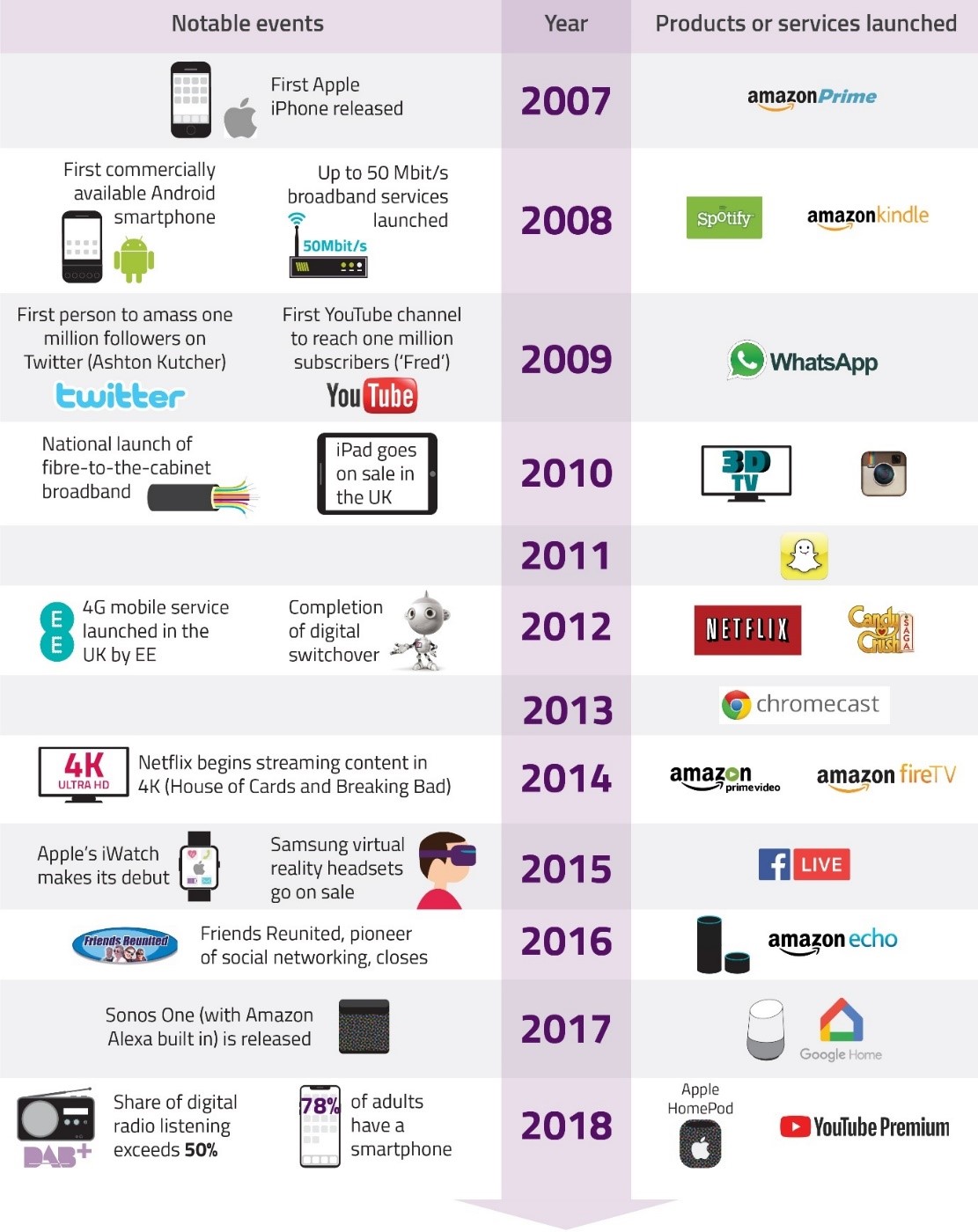
A decade of change in digital communications.
It is said that in the course of a normal life one is lucky to have a handfull of friends.
Now its social mobile, analytics, and cloud all want to be your friend.
When we think about social, the key is to consider why social is happening, rather than think of it as just a set of tools.
For example, Facebook, Twitter, and so on are tools, but why people use them is much more important. The same was true with the internet when we first started using that — that was a tool, but what it did to the lives of normal people in terms of access to information, increased freedom, etc., was much more important.
Mobile is a similar shape to social in that it’s the why as to why people use mobile devices as opposed to anything structural about the devices themselves.
The idea behind big data is that you can derive understanding about behaviour through statistical analysis of clumps of data. You can then take that understanding and implement some form of control to either get more of what you want, or get less of what you don’t want.
Finally, we come to the cloud. This is really about how companies buy. There are all sorts of reasons to like outsourcing IT functions to the cloud, whether it’s just outsourcing compute power into a load of servers that you run as if they were your own, or buying functionality on an SaaS basis ( Software as a service)
Is cloud necessary for digital?
To an extent, it likely does not. However, as a fashion/trend, it’s clearly important, and a lot of the tools and services involved in digital are unlocked as part of a cloud-based approach, hence it’s likely important.
It’s a sociological change, rather than a technical one.
You can see that by the fact that this is generally all about the “why” this is happening — why are customers using social, why are they using mobile, why big data is showing the trends that it is, why are companies able to buy and use consumer products, and why is running systems in the cloud easier.
Because they all your Friend without you knowing and couldn’t care less who or how they share that friendship with or what they do with it. Google it.
All human comments appreciated. All like clicks and abuse chucked in the bin.
The Internet is an incredibly spectacular thing, and only now — after so many years — we are understanding its power.
In spite (and many times because of) all the social media and internet news, we tend to have a skewed view of the world around us.
But there is one thing that is certain.
It has given rise to highly profitable digital platform monopolies, ‘superstar firms’ which are able to use aggregation and analysis of data to make supernormal profits which are disappearing into the cloud.
But what’s really happening in the global economy?
These multi-conglomerations dominate not just the current digital markets but future ones in artificial intelligence and machine learning, with workforces which are relatively small proportional to value-added, putting downward pressure on labour’s share of income.
It is becoming easier and cheaper to replace human work by increasingly
capable robots and artificial intelligence, this automation will accentuate existing trends in the capital and labour shares.
Whatever the future path of the global economy, with growing automation in
the economies of the world substituting capital for labour more and more
of the wealthiest fortunes are held almost exclusively in financial assets.
—-
We’re not just entering into a period of severe distress with climate change
we are also entering a period of a new uneven distribution of capital
ownership that is now the driver of inequality.
It’s a “new, harsh reality”, ( from weapons of mass destruction, water crises, large-scale involuntary migration and severe energy price shock, extreme weather events, failure of climate change mitigation and adaptation, interstate conflict with regional consequences and major natural catastrophes) that the spending power of governments is dimensioning.
Most of us haven’t quite realized there is something extraordinary happening.
Isn’t it absurd that we, 7 billion of us living on the same planet, have grown further apart from each other? Everything is going through change and that most of us are unaware of that.
What sense does it make to turn your back on the thousands, maybe millions, of people living around you in the same city on the same planet in poverty?
You might be lead to believe that the Internet is taking down mass control and the small are no longer speechless. This might well be true when it comes to the rising failure of climate change mitigation and adaptation or if you look at the Arab Spring, Brexit, and the people’s climate revolution/ pollution.
But its not true when one looks at how and by whom the economy of the world that is driven by growth at all costs.
Why?
Because the natural resources industry is owned by sovereignty wealth funds with financial instability around the world as the net result.
But don’t panic.
With Climate change and Ai, and with all of us exchanging half-truths civilisation is in for a rough ride.
However, technological crises have yet to impact economies or securities in a systemic way.
Which panic button to press?
The only category not to feature in the above harsh realities is algorithm profit from profit technological that is spreading inequalities between individuals and families, between countries, generations and genders, as well as between people from different ethnicities and class backgrounds.
Normally revenue, as you know, is generated by profit/taxes but most revenue sources are already accounted for in government budgeting except the supernormal profits made by in no particular order – Apple, Google, Microsoft, Facebook, Cisco Systems, Intel, to mention just a few.
It’s sometimes hard to fathom the sheer scope of profits made by the world’s most profitable companies.
1. Saudi Aramco: $304.04 M daily – Earns $1 M in 4.7 minutes
2. Apple: $163.1 M daily – Earns $1 M in 8.8 minutes
3. Industrial & Commercial Bank of China: $123.29 M daily – Earns $1M in 11.7 minutes
4. Samsung Electronics: $109.3 M daily – Earns $1 M in 13.2 minutes
5. China Construction Bank: $105.48 M daily – Earns $1 M in 13.7 minutes
6. JPMorgan Chase & Co.: $88.97 M daily – Earns $1 M in 16.2 minutes
7. Alphabet: $84.21 M daily – Earns $1 M in 17.1 minutes
8. Agricultural Bank of China: $83.99 M daily – Earns $1 M in 17.1 minutes
9. Bank of America Corp.: $77.12 M daily – Earns $1 M in 18.7 minutes
10. Bank of China: $74.59 M daily – Earns $1 M in 19.3 minutes
and these are not Sovereign Wealth Funds.
They exist somewhere between the murky grey of return-maximizing, mega-cap asset managers, and clandestine government agencies quietly used to further sovereign agendas.
It is estimated that SWFs combined to hold more than $7.4 trillion in AUM, (Assets under management) representing approximately 6% of global assets under institutional management.
And you wonder with government print trillions to stimulate sagging economies why the world is and still is in a state of meltdown not just climate-wise but capitalistic wise.
We now have both the EU and the UK floating the idea of establishing Citizens wealth funds.
The trouble is that existing wealth funds have already bought up most of the world. Latecomers like THE UK/EU will have nothing to invest in other than technologies that produce profits.
The character of a sovereign wealth fund depends on its purpose and is shaped by how it is capitalised and governed, how it invests its funds and how returns are spent.
A Sovereign Wealth Fund is a state-owned investment vehicle established to channel balance of payments surpluses, official foreign currency operations, proceeds of privatizations, government transfer payments, fiscal surpluses, and/or receipts from resource exports, into global investments on behalf of sovereigns and in the advance of goals that are not transparent.
Economic theory wise, it is important to understand that SWFs form part of their respective country’s total national capital base, where total national capitalis defined as the total combination of net financial assets, total physical capital stock (e.g., real estate, machines, infrastructure), unexploited environment, human capital, and unexploited natural resources.
Commodity SWFs are financed from the proceeds of non-renewable commodity exports (oil, gas, precious metals), which grow the AUM base in times of high prices but destabilize their source economies and budgets in times of low. Non-commodity funds, on the other hand, are typically financed from currency reserves or current account surpluses, driven by corporate or household saving rates.
They were once the mainstays of the global investment landscape.
Despite is name the era of neoliberalism was far from liberal.
We are now experiencing the political consequences of this great deception with the rise of popularism.
This blog has been suggesting for some time the setting up of a perpetual funded World Aid fund by applying a 0.05% commission on all profit for profit sake seeking financial activities. ( See previous posts)
All human comments appreciated. All like clicks and abuse chucked in the bin.
≈ Comments Off on THE BEADY EYE ASK’S: ARE PROFIT SEEKING ALGORITHMS BUILDING A DIGITAL POORHOUSE, AUTOMATING INEQUALITY WHILE HURTING THE MOST VULNERABLE.
Should we worry about the rise of artificial intelligence or celebrate it?
Both is the answer.
We all inhabit this new regime of digital data but we don’t all inhabit it in the same way and the pursuit of rapid growth by way of technology won’t solve the huge challenges we face.
A more honest, humane approach is the answer.
If you believe the hype, technology is going to help us end global poverty, that’s easier said than done in a world where most product innovations are geared toward the rich.
The prospect of billions rising up from poverty with nothing more than gadgets is indeed a fanciful notion. This is because poverty is entirely a man-made creation. Capitalism is driven by greed, generating a power structure, which moves wealth disproportionately into the hands of the few.
But why are our societies becoming increasingly unequal, and what can we (or should we) do about it?
Forget where science ends and ideology begins it is the mechanisms behind the persistence of poverty that counts.
Technology cannot solve the problem of economic disparity.
We often believe that our digital decision-making tools, like algorithms or artificial intelligence or integrated databases, are more objective and more neutral than human beings.
Totally false.
We are building not just ill-conceived mathematical models now micromanage the economy, from advertising to prisons but also hiding the profit of multinational companies in the cloud.
We are building: A DIGITAL POOR HOUSE.
Even though we live in a hyperconnected world we are watching inequality exploding as we walk past people on the street looking at our smartphones.
The spreading of these kinds of systems is now way beyond just the public service systems that they’re in now. For example, high-frequency trading algorithms that run 99.9% of the world stock exchanges are plundering not just finite resources they are jeopardising our peaceful existence.
Feel free to ignore the weight of the evidence that is now becoming crystal-clear, so stark, that the trade-off of the growth of the economy and the survival of the planet are now intertwined. So we have to go into a mode where we are first educating the people about what’s causing this inequality and acknowledging that technology is part of that cost, and then society has to decide how to proceed.
Deep cultural and political changes are needed in order to think through these technologies in order to get to better systems.
This should apply to all technology – nanotechnology, biotech.
I also really believe we need to stop using these systems to avoid some of the most pressing moral and political dilemmas of our time, which is not just poverty but racism.
Unfortunately, we have Profit-seeking Algorithms that have no moral or ethical bases.
Algorithms — a set of steps computers follow to accomplish a task — are used in our daily digital lives to do everything from making airline reservations to searching the web. They are also increasingly being used in public services, such as systems that decide which homeless person gets housing.
AI with faceless algorithms is worsening the effects and concentrating the power of the wealthy. They are likely to dramatically increase income disparity, perhaps more so than other technologies that have come about recently.
Digital innovation in the form of profit-seeking algorithms that it’s not just going to be benefitting a small fraction of the world’s population, or just a few large corporations. is reinforcing, rather than improving, inequality.
Institutions have embraced digital technologies they are outsourcing the decision to a machine to cut costs avoiding the human costs. They say, “We have this incredible overwhelming need. We don’t have enough resources, so we have to use these systems to make these incredibly difficult decisions.”
If all the resources are automated, then who actually controls the automation?
Is it every one or is it a few select people?
My great fear with these systems is we’re actually using them as a kind of empathy override, meaning that we are struggling with questions that are almost impossible for human beings to make.
We’re smuggling moral and political assumptions into them about who should share in prosperity.
There’s already an expectation that people will be forced to trade one of their human rights, like their information or their privacy, for another human right.
The economic prosperity created by AI should be shared broadly, to benefit all of humanity otherwise they will lead to an even greater disparity between the wealthy and the rest of the world.
If AI takes away people’s jobs and only leaves wealth in the hands of those people owning the robots, then that’s going to exacerbate some trends that are already happening.
People now with “predictive data” have real concerns about informed consent. About how their data is being shared, whether it’s legal and whether it’s morally right.
Why?
Because it is impossible to work out why the algorithms had gone against them, or to find a human caseworker to override the decision.
How can we change the societal mindset that currently discourages a greater sharing of wealth? Or is that even a change we should consider?
We’re using these technologies to avoid important political decisions. Exacerbating the divides between the developed and developing world, and the haves and have nots in our society.
The change will only occur when policymakers and voters understand the true scale of the problem. This is hard when we live in an era that likes to celebrate digitisation — and where the elites are usually shielded from the consequences of those algorithms.
Restoring human dignity to its central place has the potential to set off a profound rethinking of economic priorities and the ways in which societies care for their members, particularly when they are in need. If enough of us want to change the status quo for good, then with our collective creativity, with our hunger to solve really hard problems, we will find technology an incredibly powerful tool in our arsenal.
Technology can move commodities (food, jobs, wealth) from areas of surplus supply to regions with under-served markets.
Technology can only help us if we chose to make the best use of it.
Computing has long been perceived to be a culture-free zone — this needs to change.
Today more people have access to a cell phone than a toilet.
I use that metaphor specifically because I think that these systems, although we talk about them often as disruptors, are really more intensifiers and amplifiers of processes that have been with us for a long time, at least since the 1800s.
At a time of unprecedented global challenges platforms like Google Facebook, Twitter and there like must be made to use the power of their platforms to stop the DIGITAL POOR HOUSE instead of hoarding profits with profit-seeking algorithms.
If not because bias has been a historical norm, it because us the users of your platform will develop self-defence.
So, next time if you think AI is not affecting you, take out your smartphone.
If Twitter’s not your choice of poison, maybe it’s Facebook or Instagram, or Snapchat or any of the myriad of social media apps out there they are all affecting your decisions and our lifestyles every day.
They are all tailored according to what we are likely to respond to. specifically designed to attract the attention of its members – and so inevitably to confirm them in their opinions and prejudices, with several extra bills to pay in order to remain a normal citizen.
Its a ‘mean’ not the ultimate solution.
AI has become so successful in determining our interests and serving us ads that the global digital ad industry has crossed trillions.
All human comments appreciated. All like clicks and abuse chucked in the bin.
≈ Comments Off on THE BEADY EYE SAY’S: PERPETUAL GROWTH IS COMING TO AN END.
( Seven-minute read)
Economics is not an unbiased academic discipline, it’s an ideology. Furthermore, economics is based on the false premise that perpetual growth is achievable.
Can economic growth be sustainably achieved?
Finite resources make perpetual growth theoretically impossible. No amount of technological breakthrough or creative accounting can counter that physical fact.
Is economic growth desirable?
The short answer appears to be no.
Exponential growth will eventually take you to impossible places.
Unfortunately, we live in a world of capitalists that thrive on the great Myth of Perpetual Growth, endless growth, ad infinitum, forever, till the end of time.
It seems as though we are damned if we grow and damned if we don’t.
We’ve now with Algorithms for profit sake got to a position where there’s nothing to keep us in check – so we have to do it ourselves.
It’s a waiting game now – to see if we can learn to behave differently to bacteria in a petri dish before it’s too late and we kill our host.
It’s not worth the risk.
Ecology and economics have to be intertwined, or we’re in serious trouble.
It’s time we all get our head out of the smartphone and become smart.
We can have debates about what we’re going to do about this and that, but if you can’t see the reason in the core of what I am saying, we’ll be having two very different conversations.
There is little point in arguing any longer whether Neoliberalism is to blame for damaging ecology beyond its ability to support us. It has lead to the inevitable collision between an insatiable economic model and a finite planet whose resources are stretched to the hilt.
The perception of the need for perpetual economic growth is a fraud and this assumption creates massive risk when reaching the limits of our natural systems.
With a world population nearly at 7 billion people, the implication for economic growth seems obvious as we cannot assume that the status quo will hold in a changing climatic environment. Reaching the earth’s resource limit is inevitable if it is not already occurring.
However changing our society’s behaviours cannot be achieved through some overseeing organization.
Perpetual growth has been ingrained through exposure to intensive branding and marketing by the very corporations who provide jobs and economic growth, and round and round we go…… Enacting such dramatic change through a highly centralized governing structure that dictates appropriate resource use, population levels, and actively redistributes wealth is a hard sell even in dire times.
As a result, we cannot continue consuming more and more water, spewing out more and more carbon dioxide and burning more and more coal.
In the past 22 years, half of all of the oil ever burned has been burned.
At present, the global population is increasing by 83 million people annually and we are already consuming natural resources as if we have “1.5 Earths.”
If every person used as many resources as the average North American, more than four Earths would be required to sustain the total rate of consumption. Other words if everyone lived like the average American, the Earth could sustain only 1.7 billion people — a quarter of today’s population.
27 billion people will inhabit the planet by the end of the century and hidden in every calorie of food eaten are 10 calories of fossil fuels.
Technology can lead to greater efficiencies, it requires energy — it does not create it.
Water is obviously a key component of human life. It is also vital to energy, industry, agriculture and livestock.
With all of this in mind, it’s time to abandon the perpetual growth economic model and move instead to a model that stresses conservation, efficiency, recycling and renewability. Clearly, the world is on an unsustainable path and, by definition, anything that is unsustainable won’t last.
Above all else, we must redefine the quality of life as something other than just having “more.” The goal should be to simply have enough. Our quality of life should not be measured by “stuff,” but instead by the things that make life rich; our relationships, our hobbies, our work and our passions.
GDP merely measures what people are willing to pay for, which is not necessarily connected to the use of energy, or any other physical resource.
The world will be confronting shortages of hydrocarbons, metals, water and fertilizer, which will dramatically affect global agriculture. The latter is critical.
So why are we unable to change direction.
Because of the threat, transnational organizations have over the nation-state.
Because no one is willing to bear the costs.
Because of the amount of power capital has over labour.
As it stands, nearly half the world’s population — more than 3 billion people — lives on roughly $2 per day.
The solution is to get profit for profit sake to pay:
By introducing a World Aid commission of 0.05% on all High-frequency trading, on all sovereign wealth funds acquisitions on all foreign exchange transaction over $50,000, on all gambling and lottos wins creating a perpetual world aid fund.
By issuing United Nation Green Deal non-trading Bond.
By the introduction of a World Day of non-consumerism Advertising.
By building non atomised Societies that are attached geographical – belonging not defined by competition.
By eating together one a week.
The question is how do we communicate this obvious message, in the face of corporate control of the media, and increasingly academia, science and the political system?
All human comments appreciated. All like clicks and abuse chucked in the bin.














 bobdillon33blog