The drift toward authoritarianism rarely announces itself with a bang; it begins long before the public recognizes the danger.
It begins with language: the slow, deliberate reclassification of fellow citizens as lesser, suspect, or dangerous.
Once a government convinces people that some among them are unworthy of rights or empathy, the rest becomes frighteningly easy.
Authoritarian systems rarely begin with mass repression. They begin by redefining who counts as a threat.
In any situation, friction can never be eliminated, one can only increase or decrease the friction between two surfaces, or situations.
Friction does not depend on the area of contact, but in a world without friction it would quickly become a homogenous blob of elemental particles.
However in this post I am not talking about friction in its physical state, but friction between humans in the coming world of technology algorithms.
When earth is viewed from space there are no countries, we have carved them out of ideologies and blood.
The understanding of the human condition has been a mystery for millions of years. However if we started promoting understanding of environmental sustainability, empathy, and conflict resolution through education, we can cultivate a culture of peace from a young age and change direction to a caring world.
This has been true up now.
To day we have decisions been taken and made by machines, with no human understanding. So it’s essential that we have transparency if society is to be ruled by technology.
Humans Should Be in Control:
Algorithms should be tools that assist humans, not replace them entirely.
—————————
Futurists have long debated the arrival of the singularity, when human and artificial intelligence will merge.
Some form of merger is inevitable and it is taking place right now.
Of course, this “Brave New World” of a hybrid AI-human existence brings with it a plethora of issues both political and personal.
What will humans do for jobs? Could we possibly live forever? Would that change the very idea of what it means to be human?
As long as we have countries it is inevitable that we will have friction. This is why the world needs a strong United Nations.
Authoritarian systems rarely begin with mass repression. They begin by redefining who counts as a threat. And that is precisely what we are witnessing now.
When administrations label their critics as victims of “evil,” “radicalized,” or part of a “terrorist network,” it is not engaging in politics.
It is engaging in dehumanization.
History shows that once a government normalizes this language, the slide accelerates.
The state becomes both narrator and arbiter of reality. Citizens become suspects. Violence becomes self‑defense. Democracy becomes optional.
The danger we face is not only the violence we see in the world.
It is the narrative that follows: That is the moment when democracies falter. It is the moment when the government stops speaking about its citizens as citizens.
Or we can recognize what history makes plain: once a government convinces the public that some people are enemies, it rarely stops there.
It’s time that the super wealthy were exposed. Thankfully Mr Donald Trump is doing just that.
All human comments appreciated. All like clicks and abuse chucked in the bin.
AFTER THOUSANDS OF YEARS OF EVOLUTION) HERE IS THE WORLD YOU NOW HAVE.
A world with 8 billion of us, with rampant inequalities of opportunity, that is on the threshold EXTINCTION.
Why?
Because we put Growth of GDP higher than the true values that govern life – Fresh Air – Fresh water – Fresh food.
You would think by now that we would all realise that the protection of environment is paramount to our survival.
We know it, but we are unwilling to pay for it.
The risk that we may be on the path to extinction rises daly.
LETS START WITH. With climate change.
We all by now should be aware that the Earth is getting warmer and warmer due to our emissions of Co2.
Every year
Every year, countries who have joined the United Nations Framework Convention on Climate Change (UNFCCC) meet to measure progress and negotiate multilateral responses to climate change. Today there are 198 Parties to the Convention.
COPs are crucial in bringing governments together while also mobilizing the private sector, civil society, industry and individuals to tackle the climate crisis.
However to date they achieve little to stop us using fossil fuels to generate energy.
Their main achievement is to turn the climate into a trading product.
One of the main stumbling blocks is who will finance the necessary conversion to green energy.
This problem as I have suggested in previous blogs. Can be solved with a world aid commission of 0.05% ( see previous blogs)
TURKEY will host the next Cop.
————————-
Next we have rampant non regulated Artificial Intelligence algorithms, they are filling our media with false information/ videos, plundering the world for short term profit etc.
However rapid progress in AI is arousing fear as well as excitement.
Why?
Because should we automate away all the jobs, including the fulfilling ones?
Should we develop non-human minds that might eventually outnumber, outsmart…and replace us?
Should we risk loss of control of our civilisation?
These are some of the questions yet to be answered.
Just as Prometheus brought fire to mankind, AI offers us unprecedented knowledge and the opportunity to revolutionize every field.
Sophisticated scams are on the rise, powered by advanced chatbots that can convincingly imitate human dialogue. Deepfakes blur the line between reality and fiction, threatening the very foundations of social trust.
Manipulation and propaganda pose even greater dangers when algorithms personalize content to the point that fakes appear real, subtly shaping opinions and decisions.
AI could become a modern oracle—pouring expertise and insights into problems where human progress is slow.
AI can be a living bank of ideas, connecting theories and data across generations, illuminating the path of science.
This is the vision I believe in:
AI as a tireless partner in research—analyzing, organizing, and sharing knowledge “like a river in flood,”
However what we got is a world drive by western data with power resting more and more with platforms that are monopolistic
Our world is now full of falsehoods, videos games promoting violence, and TV dummy games for money.
Cannabis- Induced ‘Scromiting’ Is on the Rise.
Education is shallow, not addressing AI and its consequences to society.
AI Governance is for all intensive purposes non existent.
The EU AI Act emerges as a pivotal legislation as it tries to regulate a technology that is rapidly advancing in its capabilities lately – and with it potential risks and harms.
That’s why I suggested a counter-cultural choice:
We put all conversations and support in the hands of real people.
We use AI solely to optimize our software—improving and refining the code behind our products—so we can maintain high standards without sacrificing the irreplaceable value of human contact and genuine interaction.
At the moment we are being sold everything as AI.
Maybe you’ve wondered: shouldn’t technology serve people, not replace them?
All human comments appreciated. All like clicks and abuse chucked in the bin.
The current set of problems facing the world is exposing as never before just how fragile we humans are.
We are facing three major challenges ( over which we have no control) CLIMATE CHANGE and ARTIFICIAL-INTELLIGENCE + SOCIAL MEDIA
The question is do we want to live or just exist in a world run by a few wealthy people.
These days it appears that we don’t want to hold powerful people to account.
They get a headline and thats it.
Take for example.
Prince Andrew who thought his privilege position would protect him till he became Andy.
Or
George Michel former US senator who played a critical role in Northern Ireland’s peace process once described his friendship with convicted sex offender Jeffrey Epstein as a “blessing”.
He is now an old codger, but age should not excuse his crimes.
Donald Dump has gone to great lengths to sweep the whole Epstine thing under the carpet.
Epstine died by suicide.
———————-
The fragility of humans was especially shown in the two world wars.
A prime example would be the 7th Panzer Division brutality (that should never be forgotten ) as it made its way to Normandy, massacring all that stood in its way.
Or the recent brutal force of Israel retaliation. Committing a Genocide in response to an attack that killed around 1000 it has wiped out 60,000 Palestines, as the world watched it do so with impunity.
Humanity had always been fragile and will remain so till it learns to live in peace.
In order to make any difference we have to change the way we protect our shared human values. Somehow we must place them beyond the reach of ourselves where they are protected against any technological advances, wars etc.
Ukraine Russia war which is now four years old.
This can only be achieved with universal agreement to tackle, control what is self evident.
Climate change is self evident. Humanity must choose profit or a liveable planet
Artificial intelligence is less self evident. Digital slavery or freedom.
Social Media is evidence in abundance. False information or the truth.
All human comments appreciate. All like clicks and abuse chucked in the bin.
The major of problems with Algorithms is just who owns them.
Who is responsible when something goes wrong.
A machine driven by a code that humans invented remains within the current laws of defending or prosecution.
But once a machine becomes conscious it steps out of any human made laws into a legal void.
Currently there are no legal requirements to declare either an owner or their usages.
The question is :,
If the machine is capable of being responsible for its own actions, is the original coder of the machine removed from any legitimate legal obligation, as the machine is now capable of making it’s own decisions without any further human interventions.
What is the point of having laws that govern a machine if it has no emotions, no sense of fear, no sense of anything biological, no laws will protect anything that comes in contact.
So how does one go about setting rules and regulations for conscientious machinery ?
What if such machine were to kill a human there is no human law that could be applied that would have any impact, or effect.
There is only one way.
That way is that all conscious AI no matter what form it or they take must have like all hospital beds an alarm button within its. A fail safe code that can be activated to turn it off
The password to this function comes with its purchase and there is a legal requirement that it is held on your mobile phone in a designated file called AI Emergency.
You might think this is over the top.
I say if we humans want to have any resiliency or control over future AI we must be able to shut down the power that is running any AI machine.
While one of us out of 11 goes hungry every day, we currently building data centres using so much water to keep them cool that there will be nothing left to drink.
There leadership for you.
All human comments appreciated. All like clicks and abuse chucked in the bin.
There are I suppose three main questions to ask oneself when it comes to what is life for?
One.: Why bother living it?
Two: Who or what gives it to you in the first instance?
You could say your parents, but that’s not right, as you can receive it outside you parents from any organically union.
Three: What is its purpose?
To Answer these questions is virtually impossible. The best attempts at doing so are contained in SAPIENS & NEXUS.
There is no single people’s in the world.
It has taken centuries to establish the species called human and as you know life is full of them killing each other for thousands of years and reasons.
However we are now fast approaching a mix of organic life and artificial life.
Apart from procreation it seems up to now our main purpose in life is ti advance humanity by making discoveries in order to share life highs and lows with those who are living one this very moment in time.
However with this non – organic artificial life approaching fast this is going to change.
Why?
Because there is no doubt that the meaning of life is going to evolve as we discover our universe.
Where life comes from no one knows.
This is probably the main reason we have religions believes.
We all however know life is not forever, so why do we waste it persuading trivia pleaser.
Is there something that awaits us that we haven’t discovered as yet.
All human groups on earth to this point have developed as organic organisms so the meaning of life has also evolved organically not Artificially.
Of course if one was not able to be conscious of life, there would be no life.
This will not be so when we have robots.
There exists will be all about who is in charge of the on and off switch.
And you can rest assured that will be the main purpose of what they will consider life to be.
All human comments appreciated. All like clicks and abuse chucked in the bin.
Life has no meaning but each of us has meaning and we bring it to life.
Life is what separates living things from everything else serving humanity.
“Whatever we are, whatever we make of ourselves, is all we will ever have—and that, in its profound simplicity, is the meaning of life.” Philip Appleman
“Love is our true destiny. We do not find the meaning of life by ourselves alone – we find it with another.” Thomas Merton
“The meaning of life is not to survive but to die.”
It would be fair to say that Scientists, Philosophers, and religions have spent millennia pondering what it is that makes something alive. In a very literal sense, we do not yet have a meaning for life.
In fact, there are currently over 100 definitions of life.
For instance Nasa ” A self-sustaining chemical system capable of Darwinian evolution.”
However the classic borderline case of life is a virus – it’s inert as long as it does not encounter a cell.
So the decision as to what is alive or dead is where the cut-off point lies with a virus.
A virus carries DNA and RNA the blueprint for life. They, therefore, exist between the boards of chemistry and life.
What about life as we do not know it.
It seems obvious that at some level all we see about ourselves, living or otherwise, is merely a manifestation of chemical reactions and the laws of physics.
The chemical reactions occurring for the universe’s first few billion years led inexorably to our teeming world, yet no one would describe them as life. But so what?
The creation of artificial life is now a fully-fledged branch of science creating new organisms that so far no one has assembled together into a functioning synthetic life form.
If this was to happen it would redefine what we presently understand or didn’t understand by life.
We need to get away from our current concept as AI increasingly shapes the human experience, how does this change what it means to be human?
Humanity is in the process of losing something significant.
Algorithms could soon—if they don’t already—have a better idea about what is alive or dead.
As they become more and more predictable, the creatures inhabiting the increasingly AI-mediated world will become less and less like us.
So to find a working definition for ‘life’ seems to me to have little practical value.
It is estimated that there are 1031 virus particles in the oceans – they vastly outnumber all other organisms on the planet.
Viruses are the most common biological entities on Earth.
Experts estimate there are around 10,000,000,000,000,000,000,000,000,000,000 of them, and if they were all lined up they would stretch from one side of the galaxy to the other alive or not, viruses are doing rather well!
I would argue that the only satisfactory definition of life, lies in the most critical property of genetic heredity: independent evolution.
All human comments appreciated. All like clicks and abuse chucked in the bin.
The Dead Sea will be almost completely dried up, nearly half of the Amazon rainforest will have been deforested, wildfires will spread like, umm, wildfire, and the polar ice caps will be only 60 per cent the size they are now.
Wars will involve not only land and sea but space. Superhurricanes will become a regular occurrence.
Should you be worried, of course not AI/Algorithms are here to guide you.
AI-related advancements have grown from strength to strength in the last decade.
Right now there are people coming up with new algorithms by applying evolutionary techniques to the vast amounts of big data via genetic programming to find optimisations and improve your life in different fields.
The amount of data we have available to us now means that we can no longer think in discrete terms. This is what big data forces us to do.
It forces us to take a step back, an abstract step back to find a way to cope with the tidal wave of data flooding our systems. With big data, we are looking for patterns that match the data and algorithms are enabling us to find patterns via clustering, classification, machine learning and any other number of new techniques.
To find the patterns you or I cannot see. They create the code we need to do this and give birth to learner algorithms that can be used to create new algorithms.
So do you remember a time, initially, when it was possible to pass on all knowledge through the form of dialogue from generation to generation, parent to child, teacher to student? Indeed, the character of Socrates in Plato’s “Phaedrus” worried that this technological shift to writing and books was a much poorer medium than dialogue and would diminish our ability to develop true wisdom and knowledge.
Needless to say that I don’t think Socrates would have been a fan of Social Media or TV.
The machine learning algorithms have become like a hammer at the hands of data scientists. Everything looks like a nail to be hit upon.
In due process, the wrong application or overkill of machine learning will cause disenchantment among people when it does not deliver value.
It will be a self-inflicted ‘AI Winter’.
So here is what your day at 70th might be.
Welcome to the world of permanent change—a world defined not by heavy industrial machines that are modified infrequently, but by software that is always in flux.
Algorithms are everywhere. They decide what results you see in an internet search, and what adverts appear next to them. They choose which friends you hear from on social networks. They fix prices for air tickets and home loans. They may decide if you’re a valid target for the intelligence services. They may even decide if you have the right to vote.
7.30 am
Personalised Health Algorithm report.
Sleep pattern good. Anxiety normal, deficient in vitamin C. Sperm count normal.
Results of body scan sent health network.
7.35 am
House Management Algorithm Report.
Temperature 65c. House secure. Windows/ Doors closed Catflap open. Heating off. Green Energy usage 2.3 Kwh per minute. (Advertisement to change provider.) Shower running, Water flow and temperature adjusted, shower head hight adjusted. House Natural light adjusted. Confirmation that smartphone and I pad fully charges. Robotic housemaid programmed.
Refrigerators will be seamlessly integrated with online supermarkets, so a new tub of peanut butter will be on its way to your door by drone delivery before you even finish the last one.
8.45 am. Appointments Algorithm.
Virtual reality appointment with a local doctor.
Voice mails and emails and the calendar check.
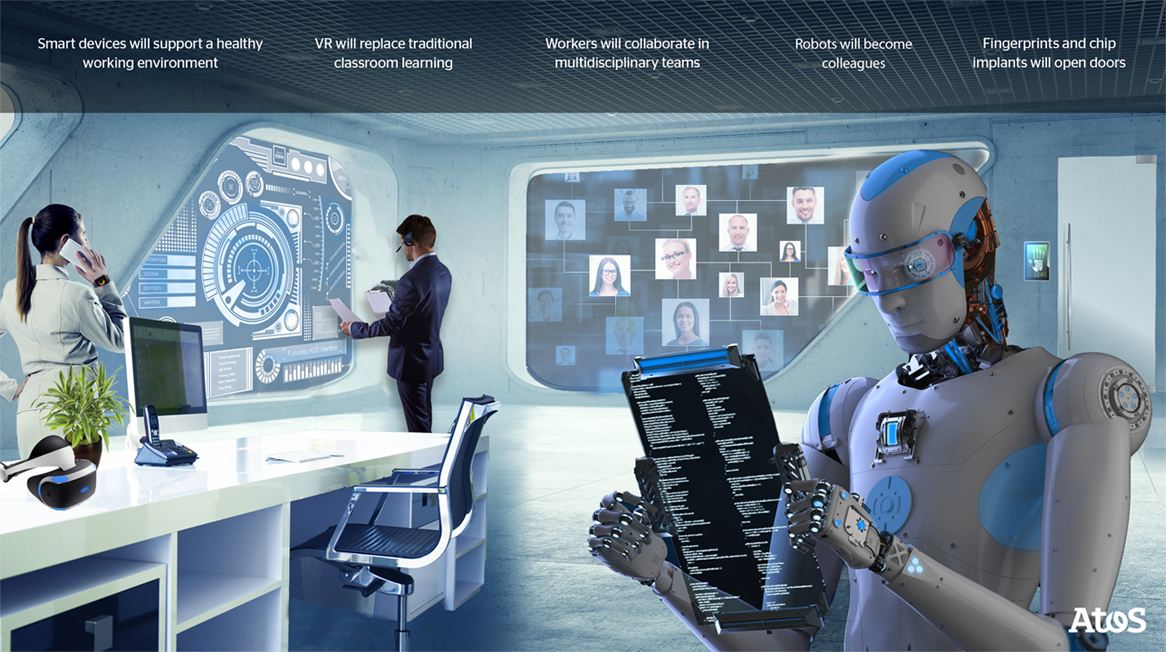
A device in your head might eliminate the need for a computer screen by projecting images (from a Skype meeting, a video game, or whatever) directly into your field of vision from within. It checks
9 am.
Personalised Financial Algorithm.
Balance of credit cards and bank accounts including citizen credit /loyalty points. Value of shares/ pension fund updated.
10 am. Still in your Dressing gown.
11 am. The self-drive car starts. Seats automatically shift and rearrange themselves to provide maximum comfort. Personalised News and Weather Algorithm gives a report. The car books parking spot places order for coffee. Over coffee, you rent out a robot in Dublin and have it do the legwork for your forthcoming visiting – hotels.
12 pm.
Hologram of your boss in your living room.
1 pm.
Virtual work meeting to discuss the solitary nature of remote work.
Face-to-face meeting arranged.
2 pm. Home. Lunch delivered.
3 pm. Sporting activity with a virtual coach.
5 pm. Home
7 30 pm.
Discuss and view the Dubin robot walk around containing video and audio report.
Dinner delivered. Six quests. The home management algorithm rearranges the furniture.
8 30 pm
Virtual helmets on for some after-dinner entertainment.
10 pm
Ask Alixia to shut the house down not before you answer Alixia question to score points and a chance to win — Cash- Holiday- Dinner for two- a discount on Amazon- e bay- or a spot of online gambling.
———
The fourth industrial revolution is not simply an opportunity. It matters what kind of opportunity is for whom and under what terms.
We need to start thinking about algorithms.
The core issue here is of course who will own the basic infrastructure of our future which is going to be effect all sectors of society.
They are not just for mathematicians or academics. There are algorithms all around us and you don’t need to know how to code to use them or understand them.
We need to better understand them to better understand, and control, our own futures. To achieve this we need to better understand how these algorithms work and how to tailor them to suit our needs. Otherwise, we will be unable to fully unlock the potential of this abstract transition because machine learning automates automation itself.
The new digital economy, akin to learning to read, has obscured our view of algorithms. Algorithms are increasingly part of our everyday lives, from recommending our films to filtering our news and finding our partners.
Building a solid foundation now for governance for AI the need to use AI responsibly
and to consider the broader reaching implications of this transformational technology’s use.
The world population will be over 9 billion with the majority of people will live in cities.
So here are a few questions at 30 you might want to consider.
How does the software we use influence what we express and imagine?
Shall we continue to accept the decisions made for us by algorithms if we don’t know how they operate?
What does it mean to be a citizen of a software society?
These and many other important questions are waiting to be analyzed.
If we reduce each complex system to a one-page description of its algorithm, will we capture enough of software behaviour?
Or will the nuances of particular decisions made by software in every particular case be lost?
You don’t need a therapist; they need an algorithm.
We may never really grasp the alienness of algorithms. But that doesn’t mean we can’t learn to live with them.
Unfortunately, their decisions can run counter to our ideas of fairness. Algorithms don’t see humans the same way other humans do.
What are we doing about confronting any of this – Nothing much.
So its no wonder that people start to worry about what’s left for human beings to do.
All human comments appreciated. All like clicks and abuse chucked in the bin.
In this forthcoming age of technology, WE SHOULD NOW BE QUESTIONING what will be the point of life if we are not living it alone with free will.
Some like me are critical of technology, holding that it leads to alienation from nature, environmental destruction, the mechanization of human life, and the loss of human freedom.
Technology represents the knowledge of modern humanity, which seeks to control all of nature, including human nature.
As Martin Heidegger has forewarned, “The will to mastery becomes all the more urgent the more technology threatens to slip from human control” it will become the master over and destructive of what is.
The ongoing convergence between science fiction and real-life technological advances makes it easy to imagine ‘the digital age’ as an era of conflict between human and bits of intelligence.
Machines are becoming stunningly adept at making decisions for us on the basis of vast amounts of data – and getting better at this at an equally stunning rate.
It’s precisely because our present machines can neither think nor feel that THE ABOVE QUESTION matters.
We call them “smart” and marvel at their powers; we paint pictures of a world in which they, not we, are determining what we do and how.
We can’t help ourselves: we see purpose, autonomy, and intent everywhere.
Machine efficiency is a very poor model indeed for understanding ourselves; and cutting people out of every possible loop – the better to assure speed, profit, protection or military success – is a poor model for a future in which humans and machines equally maximize their capabilities.
When I think about the future of human-machine interactions, and the ways in which our ideas and identities do not simply belong to us anymore the crowd in the cloud is becoming a stream of shared consciousness.
So digital technologies challenge us once again to ask what place we occupy in the universe: what it means to be creatures of language, self-awareness, and rationality. What will be the point of life?
Unfortunately, our conceptual lens is being warped by technology. Why? because death is always in the background. It makes a mockery of everything we do.
In asking what it means to be human, we are prone to think of ourselves as individual, rational minds, and to describe our relationships with and through technology on this basis: as isolated “users” whose agency and freedom are a matter of skills and reasoned options; as task-performers who are existentially threatened by any more efficient agent.
We have little in common with our creations – and a nasty habit of blaming them for things we are doing to ourselves.
Our machines may not yet be alive, nor yet conscious, but the evolutionary pressures surrounding them are every bit as intense as in nature and with few of its constraints.
Life is now, however, it is impossible to get to now never mind the future.
So what is now? Is it just our conscious.
The future is just another thought arising now, and the past is just a memory.
Reality according to quantum physics only exists when it is observed by something that is conscious. But what is an observer? It is not necessarily a human.
Is reality just information?
Information is meaning in the form of symbolism or code, and code can represent itself.
However, information then needs meaning and meaning requires choice which is subjective to perception so something else which is conscious, which then needs time and time effects itself both in the past and the future to produce reality – life, so reality is its own creator with on alternative.
We have a very limited and confused view of what is going on.
How can we create lives that a truly worth living?
If we wish to build not only better machines, but better relationships with and through machines, we need to start talking far more richly about the qualities of these relationships; how precisely our thoughts and feelings and biases operate; and what it means to aim beyond efficiency at lives worth living.
What does a successful collaboration between humans mediated by technology look like? Our creations are certain to grow far beyond our current comprehension:
Indeed, the paradoxical and perhaps troubling state of being “recorded live”, might be one answer to the question of what it means to be human in the current digital world.
Are we all just 3d quasi-crystals or tetrahedra or pixelated reality called the E8 Lattice.
If wisdom is the art of living, of existing, participation in human life is fundamental (Spiegelberg, 1965, 426).
It might be that through our engagement with the actuality of human life, encountering and pursuing the art of living, we might circumvent the trappings that perceive, in modern science and technology, the soteriological temptation of overcoming contingency and infinitude by means of rational inquiry and technological powers.
By such an exercise, humanity might learn not simply to be the handmaid of modern scientific progress and technological promise. Rather, humanity might learn to work against such things. This work, however, ought not to be done in opposition, as a competing exercise of power; but for the redemption of a broken world, or a broken person, which has been encountered,
The redirection of technology will be no easy task.
Contemporary technology is so tightly tied to industry, government, and the structures of economic power that changes in direction will be difficult to achieve. As the critics of technology recognize, the person who tries to work for change within the existing order may be absorbed by the establishment.
But the welfare of humankind requires a creative technology that is economically productive, ecologically sound, socially just, and personally fulfilling.
Each generation lays the ground for the next, ours is ensuring that the voice of the coming generation will be lost in the algorithms of the future.
All human comments appreciated. All like clicks chucked in the bin.
If you look at the direction the world is going in life itself is about to break out of organic life into to nonorganic life.
If you were expecting some kind of warning when computers finally get smarter than us, then think again.
In reality, our electronic overlords are already taking control, and they are doing it in a far more subtle way than science fiction would have us believe.
Another word we will have different biological classes of people with new types of gods with new tec religions that produce new bodies, brains, and minds.
There will be no more going to heaven.
It is these invisible computations that increasingly control how we interact with our electronic world. There will be new stories, new thinking to match the new technologies.
Algorithms will be the new form of Communism.
These days we die not because it is in our DNA or Genes but because of Techo problems.
Calico a Google subsidiary is a research and development company whose mission is to harness advanced technologies to increase our understanding of the biology that controls lifespan.
Its ambition is to solve the problem of human health/death.
It’s all being done right before our eyes.
Algorithms can now detect personalities via human language conversation.
What’s next? Will WW3 be launched via algorithm?
Perhaps not but inequality will be the norm with Fundamentalism gone.
The power of algorithms has spread far beyond Wall Street and now touches all of us–starting with today’s young innovators.
Algorithms are doing a lot more than automating stock trades.
Most people don’t know that there are algorithms that decide how customer service calls get routed or how customer service requests will be treated. When people call these big companies like their health insurer or telecom company, they’re actually being categorized, sliced, diced and parsed by a bot.
It’s incredible to think that the words someone chooses on a given morning will forever change how that company treats him or her.
These algorithms don’t just affect people involved in computer science.
No-one would doubt that Google system has made searching a whole lot easier, but at what price? As algorithms spread their influence beyond machines to shape the raw landscape around them, it might be time to work out exactly how much they know and whether we still have time to tame them.
Algorithm change because they know they’re getting gamed.
Algorithms are aimed at optimizing everything.
They can save lives, make things easier and conquer chaos but are they putting too much control in the hands of corporations and governments, perpetuate bias, create filter bubbles, cut choices, creativity, and serendipity, and could result in greater unemployment.
How far Google’s data-crunching algorithm go in harvesting our personal data and shaping the web will be the Story of the Future and because our brains are becoming more and more reliant on the internet for memory
The Google story could well be the god of the future.
All human comments appreciated. All like clicks chucked in the bin.
IT’S A LONG, hard road to understanding the human brain so I have no intention of explaining yours to you here in detail.
Other than to say your brain has a critical function to sort out what you should remember and not remember. To determine what is true, it must know what is false.
Believing, interpreting, responding to environmental clues, or guessing is literally what a brain does.
Is your brain you.? If not who are you.
If a person is not a brain, and a brain is not the thing that perceives, thinks, interprets, feels, desires, decides, and so on we all have serious implications for the future.
Are the mind and the brain one? or is it the mind that tells the brain what it wants or is the mind a product of mere brain activity.
Another words what you see is not really there; it is what your brain believes is there . . . your brain makes the best interpretation it can . In order to explain (interpret) a visual scene, the brain must represent it first, and then explain it to its self to store in your mind.
We perceive and understand only what our brains represent.
To make sense of the tangle of neurons that makes the human experience human, is as complicated as to why you are here in the first instance.
To understand how the brain works you need one in the first place. It does not however help to explain the electrical pulses that tells a neuron to fire. Never mind how billions firing together. Your brain contains about 100 billion nerve cells, or neurons, each of which can communicate with thousands of other brain cells.
The good news is that humanity is poised to crack open the mysteries of the human brain not the mind.
For the moment the brain remains mysterious, it allows us to convert information into myriad forms to serve infinitely diverse ends.
The fields of your mind extend far beyond your brains they are hidden from view and not capable of being inspected. Whatever in your brain is buried deep within the recesses of your mind.
The quest for immortality has inspired humankind since the dawn of civilization. So will understanding the workings of the brain bring us a step closer.
Neurosciences assume that the brain has a wide variety of capacities: the brain interprets and stores information, recognizes symbols, analyzes, thinks, believes, knows, designs computers, determines what is true, paints pictures, deciphers images, analyzes, prioritizes, learns, understands, remembers, and makes decisions of the mind.
However, if I am my brain, and every atom in my brain (or body) is replaced every seven years or so, then I must become someone else every seven years.
There is no need to suppose that all the laws of nature sprang into being fully formed at the moment of the Big Bang, like a kind of cosmic Napoleonic code, or that they exist in a metaphysical realm beyond time and space.
The brain has been designed to change. Or is memory inherent in nature.
Are we capable of transferring thoughts from one brain to another.
Telepathy is normal not paranormal, natural not supernatural, and is also common between people, especially people who know each other well.
Mental activity are not confined to the insides of our heads. They extend far beyond our brain though intention and attention.
Non biological mine’s.
At our current stage of technological development, we have neither sufficiently powerful hardware nor the requisite software to create conscious minds in computers or robot.
Your Brain gives you the ability to combine and recombine different types of knowledge and information in order to gain new understanding; the ability to apply the solution for one problem to a new and different situation; the ability to create and easily understand symbolic representation of computation and sensory input; and the ability to detach modes of thought from raw sensory and perceptual input.
So what happens when it is introduced to Virtual reality or interface technology or drones contextual technology, or open communication.
We are entering the next Age of Biological Engineering evolving cellular engineering and molecular imaging.
What is the most powerful technology on Earth? Biology is Technology:
Hundreds of companies are now attempting to leverage the manufacturing and computational paradigms of biology.
By gaining control over biological systems and their biochemical pathways — and designing new pathways by rewriting the DNA “software” in cells — synthetic biologists are ushering in the “Biological Age,” creating substances with not only superior electrical, optical, and mechanical properties, but with properties that we have never seen before in man-made materials:
If you don’t believe me that Biology is Technology:
Have a look.
In the dark forest of our current ignorance, nothing captures the imagination like the possibility of creating a machine that is conscious and exhibits the same higher mental abilities as humans.
Biological systems have the ability to do things that no human-made machine or chemistry can begin to approach: the ability to replicate, to learn, to scale from one to billions, to adapt, and to evolve.
Computers today are so advanced that some contain as many connections as exist in the human brain — ten trillion of them. They can also operate at much higher speeds than the brain. What was once purely science fiction is now approaching the possibility of science fact.
A double edge sword the second machine age is going to replace our brains.
Can advanced robots or computers be moral persons? The term “moral person” refers to a being that has moral rights, such as the right not to be harmed, the right of free movement, and the right of free expression.
So let me ask you a question is it the end of moors law. (Moore’s Law is a computing term which originated around 1970; the simplified version of this law states that processor speeds, or overall processing power for computers will double every two years.) Once transistors can be created as small as atomic particles, then there will be no more room for growth.
Do we have a responsibility to future generations of humans that might be adversely affected by the creation of menacing robots? Should we stop our research into artificial intelligence right now before we create something that we cannot control?
To answer these questions, it those seems odd to speculate about building a mind from electronic scraps when we have so little clarity about the nature of our own conscious minds.
The human body is divided into many different parts called organs. All of the parts are controlled by an organ call the brain.
The cerebellum the forebrain, midbrain, and hindbrain.
No other organ is like the brain and all other organs would be unable to function without the brain which by the way weighs about three pounds.
The brain is known as the “final frontier” of science; It is the nut that is toughest to crack but contains a vast wealth of information, a veritable treasure trove of knowledge that can enrich our understanding of human nature.
The problem with artificial life acquiring consciousness in the form of experience of self is that if gives artificial life autonomy. Consciousness is a loophole out of programming, whether it is genetic (humans) or cybernetic (computers).
When we solve the hard problem of consciousness, then we can create machines with brains any time before that is brainless.
A machine without moral rules that should be embedded into the programming of all superior robots; one of these is that a robot should never harm a human.
We’ll be uploading our entire MINDS to computers by 2045 and our bodies will be replaced by machines within 90 years, Google expert claims. This singularity is also referred to as digital immortality because brains and a person’s intelligence will be digitally stored forever, even after they die.
But even if Einstein’s brain were intact enough to be plumbed with the tools of modern science, we might have to remain agnostic about the source of his brilliance.
Brain games have not yet fulfilled their promises of improved brain fitness.
How should we construe the relation of a person (soul) to his body or of his mind to his brain? To realize that conceptual clarity contributes to understanding what is known, and to clarity in the formulations concerning what is not known. A person is self-conscious and not brain-conscious, and needs no knowledge of the brain to function.
The brain, no doubt, makes it possible for us (not the brain!), to sense, perceive, think, reason, believe, feel, learn, know, understand, remember, and decide, and hopefully, to change our minds about how we think and talk about a person and the brain.
If not we are left with the following out of date Thesis.
Thesis 1: “The brain, as understood by neuroscience, is a piece of matter tingling with electrochemical activity” (Tallis 2009, p. 4).
Thesis 2: “The mind is what the brain does, and the brain is a causal machine . . . The ‘user illusion,’ nevertheless, is that a decision is created independently of neuronal causes, by one’s very own ‘act of will’” (Churchland 2005).
Thesis 3: “When the brain receives new sensory input from the world in the present, it generates a hypothesis based on what it knows from the past to guide recognition and action in the immediate future. This is how people learn” (Barrett and Bar 2009, p. 1325).
Thesis 4: “We can only understand categories of reality [for example, sound, color, taste, motion, action] and their regularities and interrelationships if our brains are capable of representing these categories . . . [W]e perceive and understand only what our brains represent” (Farah and Heberlein 2007, p. 40).
Thesis 5: Information (such as symbols, letters) is analyzed by and stored in the brain (Thompson and Harrub 2004a, p. 2), and the brain prioritizes information, deciphers images, and remembers (Martin 2013).
Thesis 6: “You are your brain” (Greene and Cohen 2004, p. 1779)
PS: Nothing of what I have said about your brain should be construed as in anyway a devaluing of your brain.
We are dualists who have two ways of looking at the world: With or without a Brain. However I would however suggest that you start using yours if you want a sustainable world.






 bobdillon33blog