• About
  • THE BEADY EYE SAY’S : THE EUROPEAN UNION SHOULD THANK ENGLAND FOR ITS IN OR OUT REFERENDUM.

bobdillon33blog

~ Free Thinker.

bobdillon33blog

Category Archives: Robot citizenship.

THE BEADY EYE SAY’S : WE KNOW THE RIGHT WAY TO GO BUT WHY IS IT SO HARD? IS IT BECAUSE IMAGINATION IS DISAPPEARING.

09 Saturday May 2020

Posted by bobdillon33@gmail.com in 2020: The year we need to change., Big Data., COVID-19, Dehumanization., Digital age., DIGITAL DICTATORSHIP., Digital Friendship., Disconnection., Economic Depression., Emergency powers., Fourth Industrial Revolution., Freedom, GPS-Tracking., HUMAN INTELLIGENCE, Human values., Humanity., Imagination., Inequality, Innovation., Modern day life., Modern day Slavery, Our Common Values., POST COVID-19., Reality., Robot citizenship., Sustaniability, Technology, Technology v Humanity, The essence of our humanity., The Future, The Obvious., The state of the World., The world to day., Tracking apps., TRACKING TECHNOLOGY., Unanswered Questions., VALUES, We can leave a legacy worthwhile., WHAT IS TRUTH, What Needs to change in the World, Where's the Global Outrage.

≈ Comments Off on THE BEADY EYE SAY’S : WE KNOW THE RIGHT WAY TO GO BUT WHY IS IT SO HARD? IS IT BECAUSE IMAGINATION IS DISAPPEARING.

Tags

Algorithms., Artificial Intelligence., CORONA VIRUS., Coronavirus (COVID-19), Imagination., Legacy worthwhile., The Future of Mankind, Visions of the future.

(Twenty-minute read) 

If ever there was a need for imagination when this pandemic is over or is eventually under control, hopefully, imagination is going to play a massive role in redesigning not just our societies but the way we live and die on this planet.

The responses to the COVID-19 pandemic are simply the amplification of the dynamic that drives other social and ecological crises.

If we have learned anything from Covid-19 is that global problems require global solutions, whether it is a pandemic, hunger, or access to quality education, reversing climate change, poverty, and inequality, you name it.

Imagination allows us to engage in thinking about alternatives and there is no doubt that we will need some radical changes.

Here I am referring to creative imagination the role it plays in our thinking.

The key point is that in using a term such as ‘imagining’, I am not just referring to some mental activity, but also evaluating that activity in some way, with all its relations and ramifications.

So here is your chance to submit you imagine creative ideas.

(All human comments appreciated. All like clicks and abuse get chucked in the bin) 

Where to start? 

Unfortunately, this pandemic is a present-day dystopia.

It’s not the stuff of science fiction set in some distant future or on another planet it’s damage is ongoing and will only get worse as it continues.

To understand the “real world” one has to experience it not imagine it.

At the moment there is a lot of rhetoric about using a tracking App to monitor the spread of COVID_19. In other words, unregulated squealing Apps (that are owned by private corporations) that Id people that have or had the virus. 

 We recently celebrated VE day that won us freedom at the cost of millions of lives. 

In my view, such a tracking proposition is not far removed from what the Nazis did in identify Jews by marking them with a yellow star. 

It is imperative that we in their honor that we now don’t rubbish there sacrifice by becoming Data slaves. 

(As I have said in the previous post, to ensure tracking does not outlive the effort against COVID-19. Both the technology and related policies and procedures should ensure the deletion of data when there is no longer a need to hold it.)

When people feel that their phones are antagonistic rather than helpful, they will just turn location functions off or turn their phones off entirely.

Imagine living under a Chines automatism system run by a Donal Dump.

Such techniques violate some of the core values of liberal democratic regimes.)

Up to now, we thought that Capitalist Globalization was the bee’s knees when in fact it increased inequalities and undermined democracy.

Now we realize that ecological transition IS more than NECESSARY with a bottom-up economy to protect the world and not the top-down begging world we have a the moment.  

However, the big problem remains the same.

How to distribute the gains of any economy. and now the losses.  

Technology will treat people as units and as such the relentless growth and accumulation of wealth and power for the few, will continue to grow. 

Cutting-edge technologies are now powered by artificial intelligence and are fundamentally shifting the distribution of power between people who provide data and entities that can make sense and use of these data.

It will become a battle between protecting individual rights and confronting an existential threat to our collective right to health, to a basic living wage. 

Of course, all of this data helps epidemiologists model the movement and the future of the virus but beyond the privacy and data rights, there are questions of biases and discrimination built into the algorithms that power the technology. 

Machines will never be made to think like people.

We have for decades underpaid the people that we now call essential workers as interchangeable units.

Currently, the AI field is mostly controlled by corporate interests. 

As global COVID-19 cases continue to rise, the unmatched connectivity that defines our era serves as both bane and blessing. 

Let’s ask the question one more time, in taking advantage of big data to create databases to track and predict infectious risk, should we be enforcing social- distancing by squealing on each other?

If you are at risk, the odds change rapidly, you become in favor of sharing or donating data.

There’s really no way to stop the movement of microbes and we need to realize that now our citizens really need to realize that.

Mapping potential carriers with big data notwithstanding privacy concerns, analysis of personal, travel, and other data like clinical data allow accurate predictive modeling.

Imagine if we created a society where everything is predicted and determined by big data. Its presence depends on “symbolic function”, the ability to pretend that one object is another thing entirely.

It will be a massive mistake.

So is technology an imaginary friend or foe?

Will we lose that human touch?

There’s no doubt that the coronavirus pandemic has changed daily life.

But what changes will last? How will we live when it’s all over? 

Even now, when we’re seeing a massive, rapid change in most walks of life — inspired by a push in science or technology, or nudged by a freak, global health emergency — it’s hard to find sound prophecy. And that’s despite access to mountains of data.

Who would have imagined that global consumerism could be crushed by the wheels of its own industry … quite so suddenly.

But perhaps this is the kind of tipping point that we secretly crave — a slowing of society.

Many people will struggle to deal with an increasing rate of change and, as a result, suffer a social or personal shock. Whether we survive the shock depends on how well we adapt.

What complicates things is that no two societies are ever fully the same.

We’re seeing that friction today, between so-called “forces” and “anti-forces.” The push and pull of people and places adapting this way or that way. But it’s nigh impossible to predict how much of that change, and its effect on daily life, will remain, and how much — or what — will change back.

Whatever happens, it won’t be on a massive scale because our regular behavior will start to reemerge.

Who will benefit more?

We might discover that work is not really part of your life or something you like to do, but something you must do exactly seven hours and 42 minutes a day. And then your real life starts.

This Pandemic will not be a ‘one-off’ event. 

Now is the time to start investing in spare capacity, in people and equipment, to cope with such events. 

( See post on setting up World Aid Depots)  

We must envision a path that allows humans to flourish by asking: how can we protect people financially, should widespread technological unemployment happen even sooner than we anticipated?

A realization among some that the dominant ways of knowing and organizing, which characterize our modern techno-industrial cultures, cannot handle the realities of living, complex, relational, human, and non-human systems.

This may help bring into focus the need to update the conceptual foundations of our cultures.

But can tech solve everything?

That raises the question of whether privacy isn’t just a cultural construct.

If your health depended on it, wouldn’t you share your data willingly?

So we need to say goodbye to our concepts of data security.

Data security is something for healthy people.

On the other hand fear of infection is limiting “in-person” interactions, forcing us deeper into an “increasingly chilling use of online systems and all-electronic communication.

Change depends on how we see ourselves as individuals and groups living through the now.

The internet might just be facilitating.

But it’s still about the real world and a reminder that you can’t eat anything on your computer screen.

In the next Pandemic and the forthcoming Depression, there will be nowhere to hide” from economic collapse in our networked world. 

Take video conferencing.

It’s fine as an exception, but as a rule, it fails to fully translate subtle forms of communication — body language below the head and shoulders. All sound is normalized, mics get muted, along with nervous hands or a lost, downward gaze.

In the end, previous pandemics have profoundly re-shaped society and despite huge advances in medical knowledge, we are once again forced to respond in much the same ways as we did to previous pandemics.

Until a worldwide vaccine we’re really back to what our ancestors would have had in terms of dealing with this kind of disease – just stay away from each other in an effort to slow down its spread.

What we’re doing now is keeping it running at any cost.

However, it is obvious that the right path in tackling both COVID-19 and climate change is much easier if you reduce nonessential economic activity.

There is now an opportunity to change course, the earth must be respected.

So imagination without reality is the osmotic membrane between matter and mind, the antechamber between outside and inside, the free zone between the laws of nature and the requirements of reason.

Without, it indicates a lack of commitment to the truth or existence of what is thought of by the person or persons who invented big data. Thinking of something that is not present to the senses without commitment to its truth or falsity a Digital prison. 

Up to now, we live in a world of the short-term profit-driven corporate world, with the support of the trillion-dollar advertising industry and complicit governments who have fetishized economic growth.

If technology dominates us, not only is the whole struggle to imagine a world of equal opportunities betrayed but the opportunity is lost.

So it’ll only be when it’s all over that we’ll have the luxury of telling the story as a neatly bound series of logical events.

The impacts we’ll see from this is going to be far greater than what happened before. Whether imagery is a form of imagination, and whether supposition is a form of imagination as quick as you can imagine there is a depression of historic proportions coming.

Imagination makes our world an even more spectacular place.

We imagine even when we don’t think that we are imagining.

Everything that humans have achieved has started with the glimmer of imagination.

It is, in sum, the pivotal power in which are centered those mediating, elevating, transforming functions that are so indispensable to the cognitive process that philosophers are reluctant to press them very closely.

Why does it seem to diminish over time for all but the most creative among us?

My own ability to imagine up a story or new world seems far weaker than it used to be. Or is it?

It fails to exclude such things as remembering.

We can leave a legacy worthwhile.   So comment. 

← Back

Thank you for your response. ✨


Share this:

  • Share on WhatsApp (Opens in new window) WhatsApp
  • More
  • Share on Mastodon (Opens in new window) Mastodon

THE BEADY EYE ASK’S: SHOULD WE ALLOW GPS TRACKING FOR THE COMMON GOOD TO DEFEAT COVID-19

19 Sunday Apr 2020

Posted by bobdillon33@gmail.com in #whatif.com, 2020: The year we need to change., Algorithms., Big Data., CORONA VIRUS., COVID-19, Digital age., DIGITAL DICTATORSHIP., Emergency powers., Freedom, Google, GPS-Tracking., Human values., Lock Down., Modern day life., Our Common Values., Political Trust, Reality., Robot citizenship., Technology v Humanity, The common good., The essence of our humanity., The Obvious., The state of the World., The world to day., Unanswered Questions., VALUES, WHAT IS TRUTH, What Needs to change in the World, Where's the Global Outrage.

≈ Comments Off on THE BEADY EYE ASK’S: SHOULD WE ALLOW GPS TRACKING FOR THE COMMON GOOD TO DEFEAT COVID-19

Tags

Big Data, Coronavirus (COVID-19), posdt, Post-Covid-19, SMART PHONE WORLD, The Future of Mankind, Visions of the future.


(Ten-minute read)

Emergency powers have a tendency to kindle emergencies.

Granted most of these powers adopted by countries to stop the spread of the coronavirus are needed.

At the moment we are not concerned and willing to give up liberties that were won by the sacrifice of millions of lives before us for the common good.

We also know that in order that contact tracing could be more effective if it wasn’t voluntary. But it is vital, that our governments, that these powers (granted to governments during times of crisis) do not continue once COVID-19 is over.

The COVID-19 pandemic is barely four months old and there is no doubt that when it is over that “big data” will present new challenges as well as opportunities.

The threat of a disease as a “pretense” to justify authoritarian impulses to amass power and that technology can be used as a tool in that process could create a Big Data surveillance machine.

One present-day example comes from South Korea, which introduced an electronic system that sends out an automatic alert to people living nearby a known COVID-19 case.

Or Chinese authorities that are using software to sort citizens into color-coded categories — red, yellow, green — corresponding to their level of risk for having the virus.

Or for instance what if Google introduces a smartphone App that monitors social distancing. It will know your whereabouts down to 2 meters -7/7.

Or Governments introduce GPS to track the movements of citizens without their consent to prohibit gatherings of other 250 people. But what if the governor used that measure to stop a rival’s political rally?

But more importantly, if consumers don’t trust a smartphone-based tracking system, they can simply leave their phones at home. That would render the technology useless.

Even if voluntary it might provide people with a false sense of security if they don’t get an alert. Those who have opted out of tracking might be walking around with COVID-19 and infecting others without ever being picked up with the system.

Just think about it.

The potential in using new technology for public health surveillance to get ahead of an infectious disease outbreak must be tempting, so-called contact tracing,

There is a real danger that we could end up creating a society of untouchables. (The former name for any member of a wide range of low-caste Hindu groups and any person outside the caste system.)

Moreover, unless public health officials are involved, there’s potential to “game” the system by falsely claiming a person has the virus when they haven’t tested positive for it. That could lead to other harms, like a business intentionally undermining a rival or a political party suppressing participation.

A terror attack and a pandemic are vastly different, but both present opportunities for governments and the private sector to take on new powers in the name of keeping citizens safe.

The September 11th terror attacks led to the Patriot Act, in the USA, which gave the federal government vast new investigative powers that it claimed were necessary for the fight against terrorism.

During the HIV crises in many cases, public health officials would notify an HIV patient’s past sexual partners that they may have been in contact with somebody who had the disease, but never identified or named them.

One of the big issues at the time was the idea of doctors reporting the names of HIV patients to the states. Some states refused to accept name-based reporting so for years because they feared that it would discourage people from getting tested.

Public health and privacy rights do not need to be in opposition.

Good public health must respect civil liberties, and anything that advances human rights and civil liberties would advance public health.

So we are going to be faced with the rights of Individual freedoms against collectivism. 

The behaviors that define individualism may also enhance the likelihood of pathogen transmission, and thus may be functionally maladaptive under conditions in which pathogens are highly prevalent.

By contrast, the behaviors that define collectivism may function in the service of anti-pathogen defense, and thus be especially adaptive under conditions of high pathogen prevalence.

The question is which one will we choose or will we have a choice when all this is over.

An open-air prison-like the Gaza Strip or Equality among all. 

All human comments appreciated. All like clicks and abuse chucked in the bin.

← Back

Thank you for your response. ✨


.


.


Share this:

  • Share on WhatsApp (Opens in new window) WhatsApp
  • More
  • Share on Mastodon (Opens in new window) Mastodon

Gallery

THE BEADY EYE ASK’S. WILL THE WORLD BE EVER A SAFE PLACE.

05 Sunday Apr 2020

Posted by bobdillon33@gmail.com in 2020: The year we need to change., Artificial Intelligence., Biotechnology., Capitalism, CORONA VIRUS., COVID-19, Dehumanization., Democracy, Digital age., Disasters., Disconnection., Environment, Evolution, Fake News., Fourth Industrial Revolution., HUMAN INTELLIGENCE, Human values., Humanity., Inequality., International solidarity., Life., Lock Down., Modern Day Democracy., Modern day life., Nanotechnology, Pandemic, Political Trust, Post - truth politics., Reality., Robot citizenship., Social Media, Survival., Sustaniability, Technologically Enabled Genetics., Technology v Humanity, Technology., The common good., The essence of our humanity., The Future, The Internet., The Obvious., The pursuit of profit., The state of the World., The world to day., Unanswered Questions., VALUES, WHAT IS TRUTH, What Needs to change in the World, Where's the Global Outrage., World Aid., World Economy., World Leaders, World Organisations., World Politics, World Trade Organisation

≈ Comments Off on THE BEADY EYE ASK’S. WILL THE WORLD BE EVER A SAFE PLACE.

    (Thirty-minute lockdown read )  My previous post asked the question of what skills will be needed to rebuild …

Continue reading →

THE BEADY SAY’S: TO ANCHOR OUR UNDERSTANDING OF THE CONSEQUENCES OF THE CORONA VIRUS THE FREEDOM OF THE PRESS IS AND WILL BE VITAL.

27 Friday Mar 2020

Posted by bobdillon33@gmail.com in 2020: The year we need to change., Communication., CORONA VIRUS., COVID-19, Democracy, DIGITAL DICTATORSHIP., Disconnection., Fake News., Freedom of the Press., Honesty., Human values., International solidarity., Life., Lock Down., Modern Day Communication., Modern day life., Our Common Values., Political Trust, Post - truth politics., Reality., Robot citizenship., Technology v Humanity, Telling the truth., The common good., The essence of our humanity., The Future, The Internet., The Obvious., The state of the World., The world to day., Truth, Truthfulness., Unanswered Questions., VALUES, What Needs to change in the World, World Leaders, World Politics

≈ Comments Off on THE BEADY SAY’S: TO ANCHOR OUR UNDERSTANDING OF THE CONSEQUENCES OF THE CORONA VIRUS THE FREEDOM OF THE PRESS IS AND WILL BE VITAL.

Tags

Freedom of expression, Freedom of the Press., The press.


(Four-minute read) 


At the moment rightly so we are all preoccupied with the consequences of our own individual lives and all indicator point to world disaster on a scale not seen by most of us. 

However, if and when we return to a semblance of normal the freedom of the press will be in jeopardy when the blame game starts, which is inevitable. 

Why will it be?

Because the present pandemic marks the emergence of a new model of watchdog function, one that is neither purely networked nor purely traditional but is rather a mutualistic interaction between the two.

What globalization, technological integration and the general flattening of the world have done is to super empower individuals to such a degree that they can actually challenge any hierarchy—from a global bank to a nation-state—as individuals.

The fear that the decentralized network, with its capacity to empower individuals to challenge their governments or global banks, is not a democracy, but could lead to anarchy.

But the alternative is to give the government a veto over what its citizens are allowed to know.

There should be relentless exposure of politician or businessman, every evil practice, whether in politics, business, or social life if we are to change the world for a better future.

False news forces us to ask how comfortable we are with the actual shape of democratization created by the Internet. It circumvents the social and organizational
frameworks of traditional media, which played a large role in framing the
balance between freedom and responsibility of the press.

Many of the problems can be laid at the feet of the Internet—fragmentation of the audience and polarization of viewpoints.

We cannot afford as a polity to create classes of privileged speakers and
press agencies, and underclasses of networked information producers whose products we take into the public sphere when convenient, but whom we treat as susceptible to suppression when their publications become less palatable.

Doing so would severely undermine the quality of our public discourse.

The risk is that the government will support its preferred media models and that the
incumbent mass media players will, in turn, vilify and denigrate the newer
models in ways that make them more vulnerable to attack and shore up the
the privileged position of those incumbents in their role as a more reliable ally watchdog.

Clarifying that the freedom of the press extends to “every sort of publication which affords a vehicle of information and opinion” and that liberty of the press is the right of the lonely pamphleteer and individual bloggers. 

Social distancing must not be allowed to turn into ruling distancing.

 Long live WikiLeaks. 

An uncomfortable fact is that a free press in a democracy can be messy at the best of times with governments around the world underestimated the coronavirus the political exploitation of the outbreak is now a reality. 

Capturing the treatment of television is less comprehensive as it is a visual medium.


All human comments appreciated. All like clicks and abuse chucked in the bin.

← Back

Thank you for your response. ✨


Share this:

  • Share on WhatsApp (Opens in new window) WhatsApp
  • More
  • Share on Mastodon (Opens in new window) Mastodon

THE BEADY EYE ASK’S. WILL THE WORLD EVER BE ABLE TO ACT AS ONE?

26 Wednesday Feb 2020

Posted by bobdillon33@gmail.com in 2020: The year we need to change., Algorithms., Artificial Intelligence., Climate Change., Dehumanization., Digital age., DIGITAL DICTATORSHIP., Disconnection., Environment, Fourth Industrial Revolution., Google, Human values., Humanity., Life., Our Common Values., Reality., Robot citizenship., Sustaniability, Technology, Technology v Humanity, The cloud., The common good., The essence of our humanity., The Future, The Obvious., The state of the World., The world to day., Unanswered Questions., WHAT IS TRUTH, What Needs to change in the World, Where's the Global Outrage.

≈ Comments Off on THE BEADY EYE ASK’S. WILL THE WORLD EVER BE ABLE TO ACT AS ONE?

Tags

Algorithms., Artificial Intelligence., Big Data, Capitalism vs. the Climate., Climate change, Extinction, Technology, The Future of Mankind, Visions of the future.


Twenty-five minute read.

If humanity stopped fighting and competing against one another; if we bound together in a common cause, we could accomplish spectacular things.

Not true.

We would basically become mindless drones of no culture because it’d all just be one culture with no distinct forms.

If this were to become a reality, Ummm how would govern it.

China’s premier Wen Jiabao put forward the following equation in a speech: “Internet + Internet of Things = Wisdom of the Earth.”

How wrong he was, however, by 2025 there will be 1 trillion networked devices worldwide in the consumer and industrial sectors combined.

He should have said, “Internet + Internet of Things = Becoming what we do not think? Because people are truly not that intelligent.

In our houses cars and factories, we’re surrounded by tiny, intelligent devices that capture data about how we live and what we do. Now they are beginning to talk to one another. Soon we’ll be able to choreograph them to respond to our needs, solve our problems, even save our lives.

Intelligent things all around us, coordinating their activities.

Coffee pots that talk to alarm clocks. Thermostats that talk to motion sensors. Factory machines that talk to the power grid and to boxes of raw material.

We might be seeing the dawn of an era when the most mundane items in our lives can talk wirelessly among themselves, performing tasks on command, giving us data we’ve never had before? This intelligence once locked in our devices will flow into the universe of physical objects.

We are already struggling to name this emerging phenomenon.

Some have called it the Internet of Things or the Internet of Everything or the Industrial Internet—despite the fact that most of these devices aren’t actually on the Internet directly but instead communicate through simple wireless protocols.

Others are calling it the Sensor Revolution.

I call it the Programmable Profitable in a World of profit-seeking algorithms.

It’s the fact that once we get enough of these objects onto our networks, they’re no longer one-off novelties or data sources but instead become a coherent system, a vast ensemble that can be choreographed, a body that can dance in the era of the cloud and apps and the walled garden— of Google, Apple, etc, which connotes a peer-to-peer system in which each node will not be equally empowered.

These connected objects will act more like a swarm of drones, a distributed legion of bots, far-flung and sometimes even hidden from view but nevertheless coordinated as if they were a single giant machine, relying on one another, coordinating their actions to carry out simple tasks without any human intervention.

So the world will act as one. Or will it?

Once we get there, that system will transform the world of everyday objects into a design­able environment, a playground for coders and engineers.

It will change the whole way we think about the division between the virtual and the physical putting intelligence from the cloud into everything we touch.

Call it “smart exploration.” 

The rises of the smartphone have supplied us with a natural way to communicate with those smart objects. So far they include watches, heart rate monitors, and even some new Nike shoes. Smartphone making payments to merchants wirelessly instead of swiping a card, and some billboards are using the protocol to beam content to passersby who ask for it. As a way to sell more products and services—particularly Big Data–style analysis—to their large corporate customers.

The yoking together of two or more smart objects—is the trickiest, because it represents the vertiginous shift from analysis, the mere harvesting of helpful data, to real automation.

In my view no matter how thoroughly we might use data to fine-tune our lives and businesses, it’s scary to take any decisions out of human hands.

It can be hard to imagine the automation you might someday want or even need, in your daily life. There are all sorts of adjustments you make over the course of any given day that is reducible to simple if-then relationships.

Facebook, which has famously described the underlying data it owns as a social graph—the knowledge of who is connected to whom and how.

Would you want to automate all of these relationships?

A world where every one of us would have a sensor on us. “Presence” tags—low-energy radio IDs that sit on our keychains or belt loops and announce our location, verify our identity.

This is the principle behind Square Wallet and a number of other nascent payment systems, including ones from PayPal and Google. (When you walk into a participating store today, Square can let the cashier know you’re there; you pay simply by giving your name.)

A tracking tool that monitors not just your pet’s movements, but your movements.

GPS reliably know our location within 100 feet, give or take, and that knowledge has and is transforming our lives immeasurably: turn-by-turn driving directions, local restaurant recommendations, location-based dating apps, and so on.

With presence technology, Google has already the potential to know our location absolutely, down to a foot or even a few inches. That means knowing not merely which bar your friend is at but which couch she’s sitting on if you walk through the door.

It means receiving a coupon for a grocery item on the endcap at the moment you walk by.

Think about a liquor cabinet that auto-populated your shopping list based on the levels in the bottles—but also locked automatically if your stock portfolio dropped more than 3 per cent.

Think about a home medical monitoring system that didn’t just feedback data from diabetic patients but adjusted the treatment regimen as the data demanded.

Think about how much more intelligent your sprinklers could be if they responded to the weather report as well as to historical patterns of soil moisture and rainfall.

It does not stop just there think about applications on top of these connected objects.

This means not just tying together the behaviour of two or more objects—like the sprinkler and the moisture sensor—but creating complex interrelationships that also tie in outside data sources and analytics. 

Plugged into that information, your system wouldn’t just know how much water is in the soil it could predict how much there will be, based on whether it’s going to rain or the sun will be baking hot that day.

It means walking through an art museum and having your phone interpret the paintings as you pause in front of them.

This simple link—between a tag on us and a tag in the world—stands to become the culmination of the location revolution, delivering on all the promises it hasn’t quite fulfilled yet. A simple link—between a tag on us and a tag in the world—will complete the location revolution.

The treasure that it digs up could be considerable.

This is obviously true for retailers:

It’s a future where the intelligence once locked in our devices will now flow into the universe of physical objects. Users and developers can share their simple if-then apps and, in the case of more complex relationships, make money off of apps, just like in the mobile marketplaces.

Processing it all in the cloud in a language unheard of.

On Google Maps, you can now navigate inside certain airports and stores, with Wi-Fi triangulation helping out your GPS. 

And according to a mobile couponing firm called Koupon Media, some 80 per cent of customers who buy gas at one major convenience-store chain never walk inside the store, so presence-based coupons could make a huge impact on the bottom line.

But it’s also true for our everyday lives. Have you ever lost an object in your house and dreamed that you could just type a search for it, as you would for a wayward document on your hard drive? With location stickers, that seemingly impossible desire has become a reality:

A startup called StickNFind Technologies already sells these quarter-sized devices for $25 apiece.

Think about a thermostat app pulling in readings from any other device on that platform—motion sensors that might say which room you’re in, presence tags that identify individual family members (with different temperature preferences)—as well as outside data sources like weather or variable power price.

An even more natural category for apps is security. It locks itself up, shuts down the lights and thermostat, and activates an alarm system complete with siren, flashing lights, and auto-notifications, and notifications with an on-call platoon of off-duty cops all coordinated through the Smart­Things.

This, finally, is the Programmable World, the point at which the full power of developers, entrepreneurs, and venture capitalists are brought to bear on the realm of physical objects—improving it, customizing it, and groping toward new business plans for it that we haven’t dreamed of yet. Indeed, it will marshal all the forces that made the Internet so transformational and put them to work on virtually everything around us.

However, there are obviously some pitfalls lurking in this future of connected objects.

As a sanity check.

Our fears about malicious hackers preying on our email and bank accounts via the cloud might pale in comparison to how we’ll feel about those same miscreants pwning our garage doors and bathroom light fixtures.

The mysterious Stuxnet and Flame exploits have raised the issue of industrial security in the era of connected devices.

Vanity Fair recently detailed nightmare scenarios in which hackers could hit connected objects, from our high tech cars (university researchers have figured out how to exploit an OnStar-type system to cause havoc in a vehicle) to our utility “smart meters” (which collect patterns of energy use that can reveal a great deal about our activities at home) to even our pacemakers.

The idea of animating the inanimate, of compelling the physical world to do our bidding, has been a staple of science fiction for half a century or more.

No, the main existential threat to the Programmable World is the considerably more mundane issue of power. Every sensor still needs a power source, which in most cases right now means a battery; low-energy protocols allow those batteries to last a long time, even a few years, but eventually, they’ll need to be replaced.

Just as with social networking, the privacy concerns of a sensor-­connected world will be fast outweighed by the strange pleasures of residing in a hyperconnected world.

A bigger concern, perhaps, is simple privacy. Just because we’ve finally warmed up to oversharing in the virtual world doesn’t mean we’ll be comfortable doing the same in the physical world, as all our interactions with objects capture more and more data about where we are and what we’re doing. iStock_000049614472Medium1

What’s coming is ubiquitous connectivity that will accelerate how people collaborate, share, learn, gather, do business, and exchange knowledge.

There will one day be universal access to all human knowledge by everyone on the planet.
So based on our collective knowledge, will we be able to act as one.
How will you use global connectivity to enhance our lives?
We automatically sort people into “like us” or “not like us.”
We are currently in a new era, combating mass species extinction and climate change with a Virus Pandemic all bring humans and the natural world together as one. 
Humanity as a whole needs to be united if we are to preserve what’s left on Earth.
One in three of the population of earth died in the Black Death, they had no idea why it was happening.
As a result, they had no responsibility, because they didn’t know.
Our problem is that we do know, and therefore, we have absolute responsibility.
We have only a very small window and if we don’t use that window in the next 10 years, not the next thirty or fifty years connectivity will be the least of our worries.
In November this year, the world will descend on Scotland, and states from across the globe will be given a choice between cooperating or continuing as they have until now.Toxic-leaders

All human comments appreciated. All like clicks and abuse chucken in the bin.

← Back

Thank you for your response. ✨

Share this:

  • Share on WhatsApp (Opens in new window) WhatsApp
  • More
  • Share on Mastodon (Opens in new window) Mastodon

THE BEADY EYE ASK’S: IS THE CLASS SYSTEM GOING TO BE EVENTUALLY REPLACED BY BIOLOGICAL STATUS

11 Tuesday Feb 2020

Posted by bobdillon33@gmail.com in #whatif.com, 2020: The year we need to change., Algorithms., Artificial Intelligence., Biotechnology., Cellular Biology, Climate Change., Dehumanization., Evolution, Fourth Industrial Revolution., Genetics., HUMAN INTELLIGENCE, Human values., Humanity., Life., Nanotechnology, Natural selection., Our Common Values., Reality., Robot citizenship., Sustaniability, Technology, The common good., The Future, The Obvious., The state of the World., The world to day., Unanswered Questions., WHAT IS TRUTH, What Needs to change in the World, Where's the Global Outrage.

≈ Comments Off on THE BEADY EYE ASK’S: IS THE CLASS SYSTEM GOING TO BE EVENTUALLY REPLACED BY BIOLOGICAL STATUS

Tags

Evolution, Nano biotechnology, Natural selection., Separate species


(Fifteen-minute read) 

We may die out as a species for one reason or another, but evolution is inevitable so there will be a change in the future. We are not done evolving yet, so it begs the question of what could Homo sapiens really become – and what is forever beyond our reach?

We were fish once, and now we eat fish for dinner!

Humankind has come a long way from a single cell floating in the ocean waters, we have managed to become the multi-cellular wonders of nature that we are today.

However, evolution doesn’t have a direction, it’s confined are of this ecosystem called Earth which decides in the long run which direction if any it goes in. 

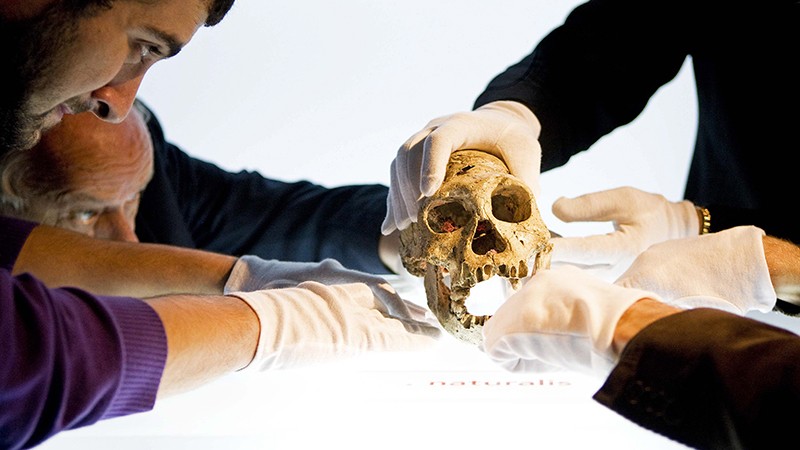
Skull D2700 discovered in 2001 at Dmanisi in Georgia is held by museum staff as they prepare it for an exhibition in Netherlands

Future humans might be very different from people today but not in the way science fiction movies would lead you to think.

Combining knowledge of our past with current trends, we are entering a new phase in human evolutionary history—one that makes the future less predictable and more interesting than ever before.

SO THE FIRST THING TO APPRECIATE IS THAT:

Evolution and natural selection are not the same things.

Evolution refers to the relationship between a species (a breeding population) and its ever-changing environment. Evolution does not concern what individuals may think it is the gradual genetic change of a species over time.

Natural selection is the phenomenon that rewards certain advantageous traits and punishes others through better or worse survival or reproduction. Medical science and public health measures have enabled the developed world to escape most natural selection.  

Right now most of us are the sacrificial generation.

In nature, natural selection is the most powerful evolutionary force, but other factors may take over when technology grants a second chance to those who would have died. 

Consequently, even with a complete lack of natural selection, it doesn’t mean that humans will not evolve. It is a selective force that clearly has shaped human evolution in recent centuries and may still be doing so today with the Coronavirus.

 With the Viruses, natural selection may not be “over for humans.”

This set aside we are more than likely going to have to adapt to climate change’s, to technologies like Biotechnology involving living systems and organisms to develop or make products.

Technology is already affecting the way our memory works and humans may eventually reach a point where they can force evolution upon themselves through the use of technology.Will our descendants be cyborgs? © Daniel Haug/Getty

We now have genetic samples of complete genomes from humans around the world, and with geneticists are getting a better understanding of genetic variation and how it’s structured in a human population environmental factors are no longer the driving force for evolutionary change.

We’ve all heard of designer babies, perhaps in the future, it may be seen as unethical not to change certain genes.

The human race will one day split into two separate species one more advanced than the other.

Races, as normally understood, would still be a thing, but with two separate species that will probably still call themselves human, even if they are technically different from those before them.

Of course, we don’t know this for sure but consider it’s not really a biological question anymore, it’s a technological question it is not beyond conceptuality that humans will not evolve into a single, ubiquitous ethnic group.

However, there is also a risk that current society collapses and some new society arises with ideas of eugenesy or breading races of superhumans and slaves.

One species with hi-tech machine implants, growable limbs and cameras for eyes even with different facial features and skin colour and external aids entirely responsible for survival.

A collective thought consciousness. Thought could be converted into instant gratification, and consequences to misusing it controlled by AI.

Computers will punish you! 

The human brain, being a machine striving for maximum efficiency, typically remembers where information is stored, rather than the information itself but as technology becomes more and more advanced, our brains will adapt in order to maximize efficiency – perhaps to the detriment of our memory.

Nanomachines would be part of the human form.

People could download their being into a computer system and be a part of the AI collective.

We will no longer operate within the confines of survival of the fittest. 

There is still going to be selection but artificial selection, so its no surprise that much technological advancement is currently aimed at the human body.

Up to now, sexual selection has defined evolutionary paths.

This will become less and less with gene editing with many of our internal functions becoming obsolete and what we might see is differentiation along lines where people live.

And what about space?

If humans do end up colonising Mars, what would we evolve to look like?

With the lower gravity, the muscles of our bodies could change the structure. Should we spend too long as galactic explorers, it’s likely that we’d eventually lose most of our muscle mass?

“What once use to be a magic flute will become a water carrier.”

So if we survive climate change humans will not evolve just for reproduction.

Whether it is genetically enhanced humans, bionic men, or uploaded beings, technology and its advancement with our decisions will shape the future of Earth and its inhabitants, including ourselves.

It will certainly be shaping human development. Bio to Artificial transmission with no inoculations.

Google Brain / Health or Microsoft Health vaults.

However, the future might be a lot slower than we think. It will take thousands of years for us to develop technologies that allow us to colonize the solar system.

If we do manage to move to other worlds, it’s likely that we’ll need to adapt to them using a combination of genetic engineering and technology.

All these changes may mean that Homo sapiens will speciate, or evolve into multiple new species. It will mean that our progeny have survived, even if they are nothing like us.

If we consumed most of the planet’s resources in doing so that is not evolution; that is the road to extinction.

CNBC Tech: Apple Watch  2

All human comments appreciated. All like clicks chucked in the bin 

← Back

Thank you for your response. ✨


Share this:

  • Share on WhatsApp (Opens in new window) WhatsApp
  • More
  • Share on Mastodon (Opens in new window) Mastodon

THE BEADY EYE LOOK’S AT POPULISM. WHAT EXACTLY IS IT?

08 Saturday Feb 2020

Posted by bobdillon33@gmail.com in 2020: The year we need to change., Algorithms., Artificial Intelligence., Capitalism, Communication., Democracy, Digital age., Disconnection., Human values., Humanity., Inequality, Modern Day Democracy., Modern day life., Our Common Values., Political Trust, Politics., Populism., Post - truth politics., Reality., Robot citizenship., Social Media, Technology, The common good., The far-right., The Obvious., The state of the World., The world to day., Unanswered Questions., WHAT IS TRUTH, What needs to change in European Union., What Needs to change in the World, Where's the Global Outrage., World Politics

≈ Comments Off on THE BEADY EYE LOOK’S AT POPULISM. WHAT EXACTLY IS IT?

Tags

Liberal democracy., not the few.”, Populism., Populists., Post - truth politics., The “many


(Eighteen-minute read)

The word came from the “prairie populists”, a 1890s movement of US farmers who supported more robust regulation of capitalism.

“But no one is clear what it is.”

We can’t really talk about populism without talking about our conflicting conceptions of democracy – and the question of what it truly means for citizens to be sovereign.

So is it an ideologically portable way of looking at politics as a forum for opposition between “people” and “elites”?

Or is it simply part of what it means to do politics?

Or is it a lens for looking at our politics?

Or a mode of talking about politics, rather than a set of beliefs?

Or is it an emerging political movement driven by technology, spread by social media, the smartphone and ruled by algorithms.

There is one thing for certain populism is inherent to democracy.

So it would be in the first place a massive mistake, considering the hollow, undemocratic mess we are in, with algorithms making decisions about our collective fate – outside the reach of politics, to ignore its power.

If one looks at the state of liberal democracy today it is becoming more and more a sham.  A nice-sounding set of universal principles that, in practice, end up functioning as smokescreens to normalise the exploitations and inequities of our capitalist system.

Nothing can stay depoliticised forever. The questions of populism would have little urgency were it not for the widespread agreement about the shortcomings of the political status quo: About the abyss between the shining ideals of equality and responsive government implied by our talk about democracy and the tarnished reality of life on the ground.

Populism is supposed to explain: Brexit, Trump, Viktor Orbán’s takeover of Hungary, the rise of Jair Bolsonaro in Brazil, even Putin.

However, neither Trump nor Brexit should be regarded primarily as populist phenomena.

His election and Brexit shows that every status quo – however sturdy – is only temporary, and can always be challenged by a movement that seeks to replace it with something new.

Populists consider themselves as victims of economic exploitation, anti-austerity movements – such as Podemos in Spain, Syriza in Greece, and Occupy these movements are obviously animated by a sense of opposition.

From this perspective, populism is just another word for real politics.

On the other hand, what most people knew about these parties, at first, was that they were openly nativist and racist. They talked about “real” citizens of their countries, and fixated on the issue of national and ethnic “purity,” demonising immigrants and minorities.

But I say that there are no real populists in politics – just people, attitudes and movements that the political centre misunderstands and fears.

The question of populism, then, is always the question of what kind of democracy we want.

The only inherent connection between rightwing and leftwing populist movements is that both embrace the same fundamental truth about democracy: that it is an ever-shifting contest over how the default “we” of politics is defined and redefined, of which no one definition can be guaranteed to last.

When populism appears in the media, which it does more and more often now, it is typically presented without explanation, as if everyone can already define it.

It sounded less alarming than “extreme right” or “radical right”.

It will always live in the shadow of the muddled media and political discourse and there can no longer be any doubt that we are going through a populist moment, so which type of populist you want to be.

A liberal democracy populism that is forced by rightwing populism to make good on its promises of equality. That needs to reacquaint with the need to construct a democratic “we” – a people – around their demand to protect liberal institutions and procedures, in opposition to radical rightwing parties who are happy to see them discarded.

Liberal democracy, in this context, has almost nothing to do with contemporary distinctions between left and right. It refers, instead, to the idea that government should facilitate pluralistic coexistence by balancing the never fully attainable ideal of popular sovereignty with institutions that enshrine the rule of law and civil rights, which cannot easily be overturned by a political majority.

or

A populism that can never be disentangled from the concept’s pejorative baggage.  An ideology runs the risk of making effective and worthwhile political strategies seem irresponsible, even dangerously promoting nativisms and short term gains.

Obviously, there are leftwing and rightwing populisms both are motivated not by passion for populism’s core ideas, but by other ideological factors best described as a fuzzy blanket to camouflage nastier nativism.

We are now living through a time when familiar webs connecting citizens, ideologies and political parties are, if not falling apart, at least beginning to loosen and shift and old theories of populism that defined it specifically as rightwing, racist or anti-immigrant is insufficiently wide to describe these new developments in populist politics.

It seems to me that Populists deal in “simplicity,” in “glib, facile solutions” while liberal leaders have been “oblivious” to the sufferings of their people.

So why are the traditional parties of the left in the western world being defeated?

Because the other side doesn’t play fair any more with conflict an inescapable and defining feature of political life.

The juvenile incapacity of both to bring their preferences to the political arena and engage in the complex give-and-take of rational compromise is with Social Media now fraught with a political examination and association accusation and assassination.

With the impersonal forces, of “globalisation” and “technological change voters are deciding that mainstream political parties have done nothing for their static incomes or disappearing jobs or sense of national decline these past two decades.

The “many, not the few.”

Populism is a new, consensus-smashing thing that is now secondary to nativism. Ultimately, they are disputes about which types of politics make us suspicious, and why.

To conclude that the two camps are simply talking past each other would be to miss the extent to which they are in agreement –and what, taken together, they tell us about the current political moment.

We can never know exactly where democracy is going to take us – not this time, nor the next, nor the time after that, but political parties must come to terms that the elephant in the room is that we no longer vote once every five years we vote on Social media ever five minutes.

Unless politics is not achievable, or rewarding, it obviously is sowing the long-term seeds for discontent.

It’s great to see politicians with Twitter accounts but there’s only so much you can do with that. Online participation in local decision-making is possible.

Failing to practice what you preach has ethical and political costs. E-voting is the next step.

Here below is what they are voting on and its not Fifty Shades of Grey Popularism.


Capitalist greed has and is poisoning political life.

Unregulated Algorithms will ensure it continues to do so.  Combined with the new realities of the portability of populism’s ideological movements spread by social media it is no wonder that liberal democracy is crumbling around the world.

To keep up with algorithms and their lavishly detailed position papers, their leaders,  Google, Facebook, Twitter, Apple, Mircosoft, and their inc have little personal sympathy any longer with the travails of working people.

We can only hope that the fear of populism on the left will enable the victory of populism of the right.

All human comments appreciated. All like clicks and abuse chucked in the bin.

← Back

Thank you for your response. ✨

Share this:

  • Share on WhatsApp (Opens in new window) WhatsApp
  • More
  • Share on Mastodon (Opens in new window) Mastodon

THE BEADY EYE ASK’S: WHY IS IT THAT WE ARE ALLOWING ALGORITHMS TO RUN OUR LIVES.

28 Tuesday Jan 2020

Posted by bobdillon33@gmail.com in 2020: The year we need to change., Algorithms., Artificial Intelligence., Climate Change., Digital age., DIGITAL DICTATORSHIP., Evolution, Fourth Industrial Revolution., HUMAN INTELLIGENCE, Human values., Humanity., Inequality, Innovation., Modern day life., Post - truth politics., Reality., Robot citizenship., Sustaniability, Technology, The common good., The Future, The Internet., The Obvious., The state of the World., The world to day., Unanswered Questions., WHAT IS TRUTH, What Needs to change in the World, Where's the Global Outrage., WiFi communication.

≈ Comments Off on THE BEADY EYE ASK’S: WHY IS IT THAT WE ARE ALLOWING ALGORITHMS TO RUN OUR LIVES.

Tags

Algorithms trade., Algorithms., Artificial Intelligence., Big Data, Distribution of wealth, Inequility, Technology, The Future of Mankind, Visions of the future.

(Twenty-minute read)

Technology is getting increasingly personal.

With algorithms becoming the masters of social media are we all just becoming clickbait?

Devices are providing immediate information about our health and about what we see, where we go and where we have been.

Our lives are being shaken to their very core.

With 5G technology what we experienced at the moment will pale in comparison to the vast array of possibilities carried under its belt by this new generation of wireless connectivity, which is being built over the foundations of the previous one.

It will allow millions of devices to be connected simultaneously.

All stakeholders – business, government, society and individuals – will have to work together to adjust so these technologies and rapid changes are harnessed for the development of all, not just profit.

Swathes of the globe will be left behind.

Regardless it is no longer just about repetitive factory jobs rather an increase in inequality globally.

It is not only a moral imperative to ensure that such a scenario does not happen as it will pose a risk to global stability through channels such as global inequality, but migration also flows, and even geopolitical relations and security.

We already live in a world that has been profoundly altered by the Fourth Industrial Revolution. Yet there is not much debate on the likely size of the impact.

Why?

Because there are such divergent views it is difficult to measure.

But within the next decade, it is expected that more than a trillion sensors will be connected to the internet. By 2024, more than half of home internet traffic will be used by appliances and devices that are connected to internet platforms.

With almost everything connected, it will transform how we live never mind how we do business.

If there is no trusted institution to regulate it we can kiss our arses.

Now is the time to make sure it is changed for the better.

The internet of things will create huge amounts of data, raising concerns over who will own it and how it will be stored. And what about the possibility that your home or car could be hacked?

The internet is great for ideas, but ultimately, the things that will amaze you are not on your computer screen.

Artificial Intelligence may well invent new life forms but if we as humans do not contrive and manage global acceptable ethical parameters for all its forms – (bioengineering, gene editing, nanotechnology, and the algorithms) that run them we are more than idiots.

As Yuval Noah Harari says in his most recent book ( 21 Lessons for the 21st Century) ” There is no such thing as ‘Christian economics’, ‘Muslim economics’ or ‘Hindu economics’ ” but there will be Algorithms economics run by big brother. 

The digital age has brought us access to so much information in just a few clicks of the mouse button or the remote control everything from the news, Tv programmes with the internet becoming somewhat glorifying sensationalism rather than giving us the truth.

The question is.

Are the technologies that surround us tools that we can identify, grasp and consciously use to improve our lives?

Or are they more than that:

Powerful objects and enablers that influence our perception of the world, change our behaviour and affect what it means to be human?

What can we do?

The Second Industrial Revolution and the Third Industrial Revolution have lead us to this revolution the Fourth Industrial Revolution which can be described as the advent of “cyber-physical systems” involving entirely new capabilities for people and machines.

Unlike previous revolutions, it is not the world as a whole that will see any of its benefits or disadvantages it is individuals and groups that could win – or lose – a lot.

Unfortunately, expanded connectivity does not necessarily lead to expanded or more diverse worldviews it will be the opposite with our increased reliance on digital markets.

At the moment it’s just not very evenly distributed nor will it be.

At best we can moan about it and hope that climate change shifts our reliance on biomass as primary sources of energy.

Back to Clickbait.

The issue with clickbait is that the reader or site visitor is being manipulated into clicking something that is misleading.

Clickbait is not one-dimensional. Each time you run a Google search, scan your passport, make an online purchase or tweet, you are leaving a data trail behind that can be analysed and monetized.

Most clickbait links forward a user to a page that requires payment, registration or a series of pages that help drive views for a specific site.

It can also point to any web content that is aimed at generating online advertising revenue.

We’re all guilty of being gullible of clicking links online but Clickbait websites are notorious for spreading misinformation and creating controversy in the name of generating hits.

Have you not ever felt that you’re being played as dumb individuals whenever you watch the news or scroll through a media site?

Thanks to supercomputers and algorithms, we can make sense of massive amounts of data in real-time. Computers are already making decisions based on this information, and in less than 10 years computer processors are expected to reach the processing power of the human brain. A convergence of the digital, physical and biological spheres challenging our notion of what it means to be human.

Today, 43% of the world’s population is connected to the internet, mostly in developed countries.

Cooperation is “the only thing that will redeem mankind”.

We can use the Fourth Industrial Revolution to lift humanity into a new collective and moral consciousness based on a shared sense of destiny, and that’s until 6G comes along or living robots.

All human comments appreciated. All like clicks and abuse chucked in the bin.

← Back

Thank you for your response. ✨

Share this:

  • Share on WhatsApp (Opens in new window) WhatsApp
  • More
  • Share on Mastodon (Opens in new window) Mastodon

THE BEADY EYE ASK’S. WHY IS THE OBVIOUS SO DIFFICULT TO RECOGNIZE?

20 Monday Jan 2020

Posted by bobdillon33@gmail.com in #whatif.com, 2020: The year we need to change., Algorithms., Artificial Intelligence., Digital age., Facebook, Fourth Industrial Revolution., Google, HUMAN INTELLIGENCE, Human values., Humanity., Life., Modern day life., Nanotechnology, Our Common Values., Post - truth politics., Reality., Robot citizenship., Social Media, Sustaniability, Technology, The common good., The essence of our humanity., The Future, The Obvious., The world to day., Unanswered Questions., WHAT IS TRUTH, What Needs to change in the World, Where's the Global Outrage., World Organisations., World Politics

≈ Comments Off on THE BEADY EYE ASK’S. WHY IS THE OBVIOUS SO DIFFICULT TO RECOGNIZE?

Tags

Algorithms., “Crises” facing humanity., Common sense., The Obvious.


(Twelve-minute read) 

We live in a world where the obvious cannot be addressed.

Each and every aspect of our daily lives, work, relationships are somehow influenced or mediated by technology today, not only as individuals but collectives.

It makes one wonder about the sheer volume of ignorance which not only allows the same problems to persist decade after decade but to even get worse.

It is obvious that our very sustainability is under threat but we remain “Oblivious”

Why? 

Consider the paradoxical and strategic implications of the fact that people do not perceive things being too small or too big, too far away or too close, too wide or too narrow, too unimportant or too important for us, too slow and gradual or too sudden and fast, always present or usually absent, too often repeated or not often enough to be remarked, too general, complicated and abstract or too simple, too respectable or too unworthy, too familiar or too alien, too similar or too different too few or too many… Imagine the practical implications of such blindness!

Some of the biggest things around us dissolve into background scene, too huge to count and seemingly too big to fail.

To defeat this blindness we must ask what exactly is obvious? Why? obvious to whom? To me? to you? To everybody? Everywhere? All the time? 

Decisions about technology should not be irreversibly delegated to technocrats, corporations and tech monopolies. 

We think unknowingly with other people’s thoughts.

The conclusion is that our senses and memories cheat us, our common sense is no good and our judgement false.

It is self-evident that basic assumptions are the riverbeds of our thoughts, the compass of our judgment and choices and our actions; most of them we inherited from trusted people and from authorities, they look inherent, seem to be there from eternity, as if out of sight, so that we would not question them.

This is now leading to a ready-made thinking world of algorithms used by Facebook- Utube – Google – Smartphones -Twitter -and Social media. An invisible prison of social media where it is easier to observe other people’s basic assumptions than yours; particularly when they are dissimilar with yours; then, other people have not yet grown into your culture may be useful to detect your unquestionable beliefs; especially very different people coming from somewhere else; or you, visiting somewhere else.

I do not see much good in convincing people not to trust their own mind; we must instead accept and work around this “blindness” without moving our life into monasteries at the feet of gurus or into laboratories at the feet of the experts of the day.

After a while, you don’t notice. They become references.

The Right to an Algorithmic Opt-Out…

How to notice, by ourselves, the obvious turned imperceptible? How to detect it, how to discern it from the merely neutral “obvious” background? How to evaluate the importance and potential of change of something so evident that it escapes your attention?  How to wake up to it? How to seek and get help? How to help other people to do the same? What to do when people cannot or do not want to see the obvious? How to awaken people?

The question is still “How to open my eyes when they are open already?”

The intelligent reason should visit its basic assumptions, regularly; but it doesn’t.

Our worst enemy in discerning the obvious is a certainty, to be convinced that we know it all and that the obvious is obvious for us.

The obvious is best disguised into itself. One obvious hide another.

How banal to say that the obvious is that which is right in front of us, readily accessible to our observation, to our senses or being credible knowledge we have!

With commercial profit-seeking algorithms, this hidden price of selective blindness and thus freedom diminished.

if you repeat slogans endlessly they will become obvious for you (even some false ones), and you will end up believing them.

The most amazing for me is to observe how we only apprehend things fit to our size and relative to us. We do not grasp the incommensurable, out of proportion with us, with which we have no common standard of measurement: the trillions of billions.

Because of compression, we have become an incredibly stupid species.

The obvious known comes alive for us to do something about it only when understanding turns it into a personal image, vivid and simple enough to be of our size; otherwise, we stay paralysed and dumb. 

Perhaps it because our body believes that big things don’t move and unmoving things are harmless. 

Perhaps its because we are weak, unable to face them and we allow our judgment to slumber; we do not see what we do not wish to see, hoping that it will go away or solve itself.

Perhaps only when understood does the evidence become awareness, we are able to respond to, so that we would do something because of what it means. 

Perhaps figuring out that the elusive 20th-century social contract is gone, is too enormous for us. Therefore we will go on like cattle to the slaughterhouse. 

Why is this becoming true? 

Because as Wittgenstein, Ludwig, Philosophical Investigations states. 

“The aspects of things that are most important for us are hidden because of their simplicity and familiarity. (One is unable to notice something because it is always before one’s eyes.) The real foundations of their inquiry do not strike people at all. Unless that fact has at some time struck them. And this means: we fail to be struck by what, once seen, is most striking and most powerful.”

Only by understanding how and when common sense fails can we improve how we plan for the future. 

Then, question and challenge the obvious at the root: “Why exactly it must be so? Why it is impossible? Who says so? Where is it necessary or impossible? Only here or everywhere? Really?! For whom; for you or for the entire humanity? With what means? At what size? Within what frame of time? Forever? Which pieces in this puzzle would, if changed, make the impossible possible and the necessary less so? Maybe you or somebody else, somewhere else, with different means have other self-evidence. 

Where it will end?

Either there will be a technological or psychological breakthrough or we will see worldwide degradation like we’ve never seen before.

Old labels often obscure the obvious. 


I’d like to state the obvious:

Problem-solving is the only thing in life that holds value. Anything that isn’t a solution to a problem is pure excess.

The truth is that the world is not a democracy. We don’t all decide what is best – only a select few do.

We are egocentric through and through – but creating a lasting, meaningful change feeds our egos like nothing else.

Unfortunately, creating change takes time, patience and perseverance.

It appears that for every one step we take forward as a global community, we end up taking two steps backwards.

Every problem in the world is a function that is processed in an environment, on a platform with certain bounds, certain rules, and certain major players.

As far as I can see, life has little certain purpose. If there is a real reason for it, then we have to accept that we simply don’t know the reason.

However, don’t give up until you have to – until there is a better, more logical option.

Big ideas can change the world, can’t they?

Of course, we don’t know. Nobody does. It is really about what we want to happen and whether we go out there and make it happen.

Will we be able to shift direction to avoid the worst impacts of climate change?

Yes.

We face risks, called existential risks, that threaten to wipe out humanity.

These risks are not just for big disasters, but for the disasters that could end history.

Nuclear war.

Climate Change.

Bioengineered pandemic.

Superintelligence.

Nanotechnology.

Inequality. 

Unknown unknowns.

Anyone of them might mean that value itself becomes absent from the universe.

In doing so we will get the economy back on its feet again and re-orientate our financial institutions so that they cannot place the world in a similar situation to what we experienced in 2008.

In the daily hubbub of current “crises” facing humanity, we forget about the many generations we hope are yet to come.

All human comments appreciated. All like clicks and abuse chucked in the bin.

← Back

Thank you for your response. ✨


Share this:

  • Share on WhatsApp (Opens in new window) WhatsApp
  • More
  • Share on Mastodon (Opens in new window) Mastodon

THE BEADY EYE SAYS; SO YOU ARE NOW 30 BY THE TIME YOU ARE 70 HERE IS WHAT A DAY IN YOUR LIFE WILL LOOK LIKE.

10 Friday Jan 2020

Posted by bobdillon33@gmail.com in 2020: The year we need to change., Algorithms., Artificial Intelligence., Communication., Dehumanization., Digital age., DIGITAL DICTATORSHIP., Digital Friendship., Evolution, Fourth Industrial Revolution., HUMAN INTELLIGENCE, Humanity., Life., Modern day life., Our Common Values., Reality., Robot citizenship., Social Media, Sustaniability, Technology, The common good., The essence of our humanity., The Future, The Obvious., The state of the World., The world to day., Unanswered Questions., WHAT IS TRUTH, What Needs to change in the World, Where's the Global Outrage.

≈ Comments Off on THE BEADY EYE SAYS; SO YOU ARE NOW 30 BY THE TIME YOU ARE 70 HERE IS WHAT A DAY IN YOUR LIFE WILL LOOK LIKE.

Tags

0.05% Aid Commission, Age of Uncertainty, AI, AI systems., Algorithms., Artificial Intelligence., Artificial life.

(Twenty-minute read)

The Dead Sea will be almost completely dried up, nearly half of the Amazon rainforest will have been deforested, wildfires will spread like, umm, wildfire, and the polar ice caps will be only 60 per cent the size they are now.

Wars will involve not only land and sea but space. Superhurricanes will become a regular occurrence.

Should you be worried, of course not AI/Algorithms are here to guide you.

AI-related advancements have grown from strength to strength in the last decade.

Right now there are people coming up with new algorithms by applying evolutionary techniques to the vast amounts of big data via genetic programming to find optimisations and improve your life in different fields.

The amount of data we have available to us now means that we can no longer think in discrete terms. This is what big data forces us to do.

It forces us to take a step back, an abstract step back to find a way to cope with the tidal wave of data flooding our systems. With big data, we are looking for patterns that match the data and algorithms are enabling us to find patterns via clustering, classification, machine learning and any other number of new techniques.

To find the patterns you or I cannot see. They create the code we need to do this and give birth to learner algorithms that can be used to create new algorithms.

So do you remember a time, initially, when it was possible to pass on all knowledge through the form of dialogue from generation to generation, parent to child, teacher to student?  Indeed, the character of Socrates in Plato’s “Phaedrus” worried that this technological shift to writing and books was a much poorer medium than dialogue and would diminish our ability to develop true wisdom and knowledge.

Needless to say that I don’t think Socrates would have been a fan of Social Media or TV.

The machine learning algorithms have become like a hammer at the hands of data scientists. Everything looks like a nail to be hit upon.

In due process, the wrong application or overkill of machine learning will cause disenchantment among people when it does not deliver value.

It will be a self-inflicted  ‘AI Winter’.

So here is what your day at 70th might be.

Welcome to the world of permanent change—a world defined not by heavy industrial machines that are modified infrequently, but by software that is always in flux.

Algorithms are everywhere. They decide what results you see in an internet search, and what adverts appear next to them. They choose which friends you hear from on social networks. They fix prices for air tickets and home loans. They may decide if you’re a valid target for the intelligence services. They may even decide if you have the right to vote.

7.30 am 

Personalised Health Algorithm report.

Sleep pattern good. Anxiety normal, deficient in vitamin C. Sperm count normal.

Results of body scan sent health network.

7.35 am

House Management Algorithm Report.

Temperature 65c. House secure. Windows/ Doors closed Catflap open. Heating off. Green Energy usage 2.3 Kwh per minute. (Advertisement to change provider.) Shower running, Water flow and temperature adjusted, shower head hight adjusted. House Natural light adjusted. Confirmation that smartphone and I pad fully charges. Robotic housemaid programmed.

8 am.

Personalised Shopping/Provisions Algorithm report.

Refrigerators will be seamlessly integrated with online supermarkets, so a new tub of peanut butter will be on its way to your door by drone delivery before you even finish the last one.

8.45 am. Appointments Algorithm.

Virtual reality appointment with a local doctor.

Voice mails and emails and the calendar check.

A device in your head might eliminate the need for a computer screen by projecting images (from a Skype meeting, a video game, or whatever) directly into your field of vision from within. It checks

9 am.

Personalised Financial Algorithm.

Balance of credit cards and bank accounts including citizen credit /loyalty points. Value of shares/ pension fund updated.

10 am. Still in your Dressing gown.

11 am.  The self-drive car starts. Seats automatically shift and rearrange themselves to provide maximum comfort. Personalised News and Weather Algorithm gives a report. The car books parking spot places order for coffee. Over coffee, you rent out a robot in Dublin and have it do the legwork for your forthcoming visiting – hotels.

12 pm.

Hologram of your boss in your living room.

1 pm.

Virtual work meeting to discuss the solitary nature of remote work.

Face-to-face meeting arranged.


2 pm. Home. Lunch delivered.

3 pm. Sporting activity with a virtual coach.

5 pm. Home

7 30 pm.

Discuss and view the Dubin robot walk around containing video and audio report. 

Dinner delivered. Six quests. The home management algorithm rearranges the furniture.

8 30 pm

Virtual helmets on for some after-dinner entertainment.

10 pm 

Ask Alixia to shut the house down not before you answer Alixia question to score points and a chance to win — Cash- Holiday- Dinner for two- a discount on Amazon- e bay- or a spot of online gambling.

                                                       ———

The fourth industrial revolution is not simply an opportunity. It matters what kind of opportunity is for whom and under what terms.

We need to start thinking about algorithms.

The core issue here is of course who will own the basic infrastructure of our future which is going to be effect all sectors of society.

They are not just for mathematicians or academics. There are algorithms all around us and you don’t need to know how to code to use them or understand them.

We need to better understand them to better understand, and control, our own futures. To achieve this we need to better understand how these algorithms work and how to tailor them to suit our needs. Otherwise, we will be unable to fully unlock the potential of this abstract transition because machine learning automates automation itself.

The new digital economy, akin to learning to read, has obscured our view of algorithms. Algorithms are increasingly part of our everyday lives, from recommending our films to filtering our news and finding our partners.

Building a solid foundation now for governance for AI the need to use AI responsibly
and to consider the broader reaching implications of this transformational technology’s use.

The world population will be over 9 billion with the majority of people will live in cities.

So here are a few questions at 30 you might want to consider.

How does the software we use influence what we express and imagine?

Shall we continue to accept the decisions made for us by algorithms if we don’t know how they operate?

What does it mean to be a citizen of a software society?

These and many other important questions are waiting to be analyzed.

If we reduce each complex system to a one-page description of its algorithm, will we capture enough of software behaviour?

Or will the nuances of particular decisions made by software in every particular case be lost?

You don’t need a therapist; they need an algorithm.

We may never really grasp the alienness of algorithms. But that doesn’t mean we can’t learn to live with them.

Unfortunately, their decisions can run counter to our ideas of fairness. Algorithms don’t see humans the same way other humans do.

What are we doing about confronting any of this –  Nothing much.

So its no wonder that people start to worry about what’s left for human beings to do.

All human comments appreciated. All like clicks and abuse chucked in the bin.

← Back

Thank you for your response. ✨

Share this:

  • Share on WhatsApp (Opens in new window) WhatsApp
  • More
  • Share on Mastodon (Opens in new window) Mastodon
← Older posts
Newer posts →

All comments and contributions much appreciated

  • THE BEADY EYE ASKS HOW ARE WE TO MAINTAIN HUMAN DIGNITY IN A WORLD DOMINATED BY TECHNOLOGY. March 15, 2026
  • THE BEADY EYE SAYS THANKS TO CURRENT TECHNOLOGIES WE ARE UNABLE TO BELIEVE ANYTHING WE SEE OR HEAR? March 15, 2026
  • THE BEADY EYE SAYS LET’S PUT THE IRAN/ ISRAEL/ USA WAR IN CONTEX. March 12, 2026
  • THE BEADY EYE SAYS THIS IS HOW TO HANDLE THE CATASTROPHIC CASCADE OF OLD AGE. March 12, 2026
  • THE BEADY EYE ASKS ARE THESE THREE LAWS SUGGEST IN ISAAC ASIMOV’S SCIENCE FICTION WRITINGS. March 10, 2026

Archives

  • March 2026
  • February 2026
  • January 2026
  • December 2025
  • November 2025
  • October 2025
  • September 2025
  • August 2025
  • July 2025
  • June 2025
  • May 2025
  • February 2025
  • January 2025
  • December 2024
  • November 2024
  • October 2024
  • September 2024
  • August 2024
  • July 2024
  • June 2024
  • May 2024
  • April 2024
  • March 2024
  • February 2024
  • January 2024
  • December 2023
  • October 2023
  • September 2023
  • August 2023
  • July 2023
  • June 2023
  • May 2023
  • April 2023
  • March 2023
  • February 2023
  • January 2023
  • December 2022
  • November 2022
  • October 2022
  • September 2022
  • August 2022
  • July 2022
  • June 2022
  • May 2022
  • April 2022
  • March 2022
  • February 2022
  • January 2022
  • December 2021
  • November 2021
  • October 2021
  • September 2021
  • August 2021
  • July 2021
  • June 2021
  • May 2021
  • April 2021
  • March 2021
  • February 2021
  • January 2021
  • December 2020
  • November 2020
  • October 2020
  • September 2020
  • August 2020
  • July 2020
  • June 2020
  • May 2020
  • April 2020
  • March 2020
  • February 2020
  • January 2020
  • December 2019
  • November 2019
  • October 2019
  • September 2019
  • August 2019
  • July 2019
  • June 2019
  • May 2019
  • April 2019
  • March 2019
  • February 2019
  • January 2019
  • December 2018
  • November 2018
  • October 2018
  • September 2018
  • August 2018
  • July 2018
  • June 2018
  • May 2018
  • April 2018
  • March 2018
  • February 2018
  • January 2018
  • December 2017
  • November 2017
  • October 2017
  • September 2017
  • August 2017
  • July 2017
  • June 2017
  • May 2017
  • April 2017
  • March 2017
  • February 2017
  • January 2017
  • December 2016
  • November 2016
  • October 2016
  • September 2016
  • August 2016
  • July 2016
  • June 2016
  • May 2016
  • April 2016
  • March 2016
  • February 2016
  • January 2016
  • December 2015
  • November 2015
  • October 2015
  • September 2015
  • August 2015
  • July 2015
  • June 2015
  • May 2015
  • April 2015
  • March 2015
  • February 2015
  • January 2015
  • December 2014
  • November 2014
  • October 2014
  • September 2014
  • August 2014
  • July 2014
  • June 2014
  • May 2014
  • April 2014
  • March 2014
  • February 2014
  • January 2014
  • December 2013
  • November 2013
  • October 2013

Talk to me.

Jason Lawrence's avatarJason Lawrence on THE BEADY EYE ASK’S: WIT…
benmadigan's avatarbenmadigan on THE BEADY EYE ASK’S: WHA…
bobdillon33@gmail.com's avatarbobdillon33@gmail.co… on THE BEADY EYE SAYS: WELCOME TO…
Ernest Harben's avatarOG on THE BEADY EYE SAYS: WELCOME TO…
benmadigan's avatarbenmadigan on THE BEADY EYE SAY’S. ONC…

7/7

Moulin de Labarde 46300
Gourdon Lot France
0565416842
Before 6pm.

My Blog; THE BEADY EYE.

My Blog; THE BEADY EYE.
bobdillon33@gmail.com

bobdillon33@gmail.com

Free Thinker.

View Full Profile →

Follow bobdillon33blog on WordPress.com

Blog Stats

  • 97,787 hits

Blogs I Follow

  • unnecessary news from earth
  • The Invictus Soul
  • WordPress.com News
  • WestDeltaGirl's Blog
  • The PPJ Gazette
Follow bobdillon33blog on WordPress.com

The Beady Eye.

The Beady Eye.
Follow bobdillon33blog on WordPress.com

Blog at WordPress.com.

unnecessary news from earth

WITH MIGO

The Invictus Soul

The only thing worse than being 'blind' is having a Sight but no Vision

WordPress.com News

The latest news on WordPress.com and the WordPress community.

WestDeltaGirl's Blog

Sharing vegetarian and vegan recipes and food ideas

The PPJ Gazette

PPJ Gazette copyright ©

Privacy & Cookies: This site uses cookies. By continuing to use this website, you agree to their use.
To find out more, including how to control cookies, see here: Cookie Policy
  • Subscribe Subscribed
    • bobdillon33blog
    • Join 222 other subscribers
    • Already have a WordPress.com account? Log in now.
    • bobdillon33blog
    • Subscribe Subscribed
    • Sign up
    • Log in
    • Report this content
    • View site in Reader
    • Manage subscriptions
    • Collapse this bar