• About
  • THE BEADY EYE SAY’S : THE EUROPEAN UNION SHOULD THANK ENGLAND FOR ITS IN OR OUT REFERENDUM.

bobdillon33blog

~ Free Thinker.

bobdillon33blog

Category Archives: Climate Change.

THE BEADY EYE SAY’S: IN CASE YOU ARE WONDERING THIS IS WHERE THE WORLD IS GOING.

02 Thursday Mar 2023

Posted by bobdillon33@gmail.com in 2023 the year of disconnection., Artificial Intelligence., Civilization., Climate Change.

≈ Comments Off on THE BEADY EYE SAY’S: IN CASE YOU ARE WONDERING THIS IS WHERE THE WORLD IS GOING.

Tags

Algorithms., Capitalism and Greed, Technology, The Future of Mankind, Visions of the future.

( Thirty five minute read)

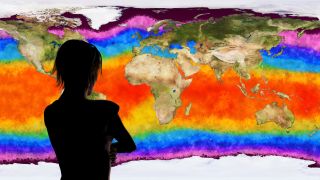
We all want to know the future.New Scientist Default Image

Unfortunately, the future isn’t talking. It’s just coming, like it or not being able to see the future might not play to our advantage.

Let’s not kid ourselves: Everything we think we know now is just an approximation to something we haven’t yet found out.

To imagine and think about the future, is a risky task that frequently ends up in an incomplete, subjective, sometimes vacuous exercise that, normally, faces a number of heated discussions.

Thinking about the future requires imagination and also rigour so we must guard against the temptation to choose a favourite future and prepare for it alone.

In a world where shocks like pandemics and extreme weather events owing to climate change, social unrest and political polarization are expected to be more frequent, we cannot afford to be caught off guard again.

Let’s look at some of the areas that are and will cause everything from wars to radical changes.

—–

Every day, we use a wide variety of automated systems that collect and process data. Such “algorithmic processing” is ubiquitous and often beneficial, underpinning many of the products and services we use in everyday life.

This is why we now need to thoroughly understand what’s at stake and what we can (and cannot) do … today.

Otherwise it is an ill wind for the next 60/100 years.

But what does the future hold for ordinary mortals, and how will we adapt to it?

We have been searching the universe for signs that we are not alone. So far, we have found nothing.

Given our genome and the physiological, anatomical and mental landscapes it conjures, what could Homo sapiens really become – and what is forever beyond our reach?

It’s hard to know what to fear the most.

Even our own existence is no longer certain.

Threats loom from many possible directions: a giant asteroid strike, global warming, a new plague, or nanomachines going rogue and turning everything into grey goo or the dreaded self inflicted nuclear wipe out.   However we look at it, the future appears bleak.


Where is all of this leading us?

What we do now set the foundations for a future.

The chaos theory taught us that the future behaviour of any physical system is extraordinarily sensitive to small changes – the flap of a butterfly’s wings can set off a hurricane, as the saying goes.

Computers simulations of future reality of a world are already producing ever more accurate predictions of what is to come, showing us that we are under immense stress, environmentally, economically and politically instabilities.

There is no God that’s is going to change the direction we on or save humanity from self destruction, its in our hands

—–

ENGERY: FUSION POWER.

We already live in a world powered by nuclear fusion. Unfortunately the reactor is 150 million kilometres away and we haven’t worked out an efficient way to tap it directly. So we burn its fossilised energy – coal, oil and gas – which is slowly boiling the planet alive, like a frog in a pan of water.

Fusion would largely free us from fossil fuels, delivering clean and extremely cheap energy in almost unlimited quantities.

Or would it? Fusion power would certainly be cleaner than burning fossil fuels, but it …Fusion works on the principle that energy can be released by forcing together atomic nuclei rather than by splitting them, as in the case of the fission reactions that drive existing nuclear power stations.

Sadly it won’t help in our battle to lessen the effects of climate change.

Why?

Because there’s huge uncertainty about when fusion power will be ready for commercialisation. One estimate suggests maybe 20 years. Then fusion would need to scale up, which would mean a delay of perhaps another few decades. Fusion is not a solution to get us to 2050 net zero. This is a solution to power society in the second half of this century.

—–

THE INTERNET/ ARTIFICAL INTELLIGENCE/ SELF LEARNING ALGORITHMS/ROBOTS.

Billions of dollars continue to be funnelled into AI research. And stunning advances are being made but at what future cost.

Are we at the point in time at which machine intelligence starts to take off, and a new more intelligent species starts to inhabit Earth?

Synthetic life would make the point in a way the wider world could not ignore. Moreover, creating it in the lab would prove that the origin of life is a relatively low hurdle, increasing the odds that we might find life.


POWER.

Neither physical strength nor access to capital are sufficient for economic success. Power now resides with those best able to organize knowledge. The internet has eliminated “middlemen” in most industries, removing a great deal of corruption but replacing it with profit seeking Algorithms that are widely used increasing the inequality gaps.

——

WARS.
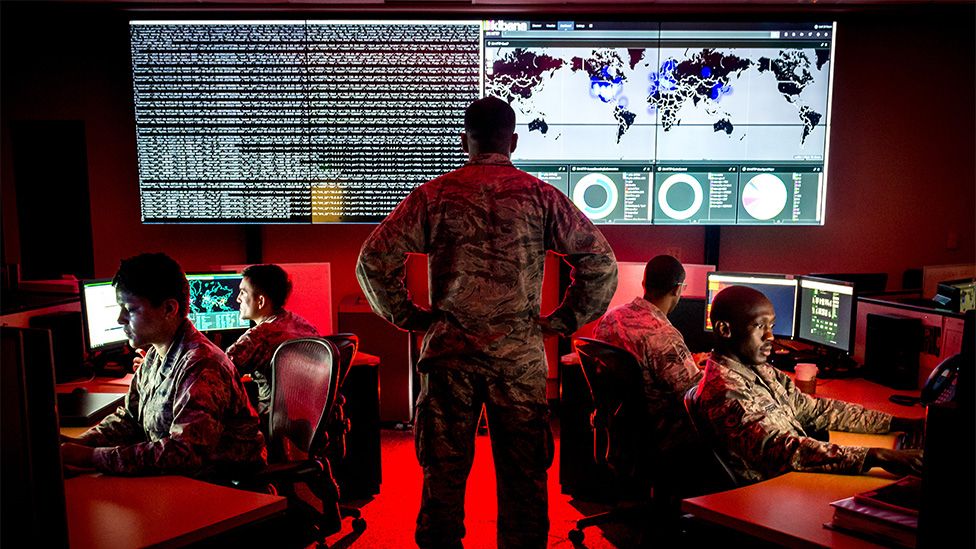
Personnel with the 175th Cyberspace Operations Group conduct cyber operations at Warfield Air National Guard Base, Middle River, Maryland, US, 2017

What does future warfare look like?

It’s here already.

Up goes digital technology, artificial intelligence and cyber. Down goes the money for more traditional hardware and troop numbers.

The present war in the Ukraine is the laboratory for machine learning decision killing, with autonomy in weapons systems –  precision guided munitions. (Autonomous weapon system: A weapon system that, once activated, can select and engage targets without further intervention by a human operator.) This includes human-supervised autonomous weapon systems that are designed to allow human operators to override operation of the weapon system, but can select and engage targets without further human input after activation.

(AI)-enabled lethal autonomous weapons in Ukraine, might make new types of autonomous weapons desirable.

There is still no internationally agreed upon definition of autonomous weapons or lethal autonomous weapons.

‘Fire and forget’ 

Many of the aspects of a major conflict between the West and say, Russia or China, have already been developed, rehearsed and deployed.

—-

A triptych image showing from left to right: a firefighter in front of a fire; dry, cracked ground; and a hurricane near Florida, U.S.

CLIMATE CHANGE.

Global climate change is not a future problem with some of the changes now irreversible over the next hundreds to thousands of years.

The severity of effects caused by climate change will depend on the path of future human activities.

Climate models predict that Earth’s global average temperature will rise an additional 4° C (7.2° F) during the 21st Century if greenhouse gas levels continue to rise at present levels. A warmer average global temperature will cause the water cycle to “speed up” due to a higher rate of evaporation. Which means we are looking at a future with much more rain and snow, and a higher risk of flooding to some regions. Changes in precipitation will not be evenly distributed.

Over the past 100 years, mountain glaciers in all areas of the world have decreased in size and so has the amount of permafrost in the Arctic. Greenland’s ice sheet is melting faster, too. The amount of sea ice (frozen seawater) floating in the Arctic Ocean and around Antarctica is expected to decrease. Already the summer thickness of sea ice in the Arctic is about half of what it was in 1950. Arctic sea ice is melting more rapidly than the Antarctic sea ice. Melting ice may lead to changes in ocean circulation, too. Although there is some uncertainty about the amount of melt, summer in the Arctic Ocean will likely be ice-free by the end of the century.

Abrupt changes are also possible as the climate warms.

Earth Will Continue to Warm and the Effects Will Be Profound.

The consequences of any of them are so severe, and the fact that we cannot retreat from them once they’ve been set in motion is so problematic, that we must keep them in mind when evaluating the overall risks associated with climate change.

—–

IMMIGRANT’S /REFUGEE’S

History—particularly migration history—has shown time and again, that large population movements are often a result of single, hard-to-predict events such as large economic or political shocks.

Imagining migration’s future is urgent, especially now, when we are witnessing the highest movement of people in modern history, which is presented in a political context with strong populist and nationalist overtones, peppered with growing inequality in and between countries; in addition to an environmental crisis and a growing interconnection and proliferation of information that is usually deliberately distorted.

In today’s acts rests the seed of what we will harvest tomorrow. What we do today with and for the migrants will define not only their future but also ours.

We will always struggle to anticipate key changes in migration flows but that it’s more important to set up systems that can deal with different alternative outcomes and adjust flexibly. Most Western countries no longer openly support or defend the universality of human rights. Most countries apply “multilateralism à la carte”, that is, they participate only in multilateral agreements that strictly benefit their national interest.

Migration control systems collapsed because the international community failed to develop multilateral migration governance regimes. The international protection system has ended up being irrelevant. Many people are moving, the number of displaced people has increased dramatically as well as the number of refugees – The Trojan horses.

Immigration isn’t a new phenomenon, but with the effects of the future climate the scale and variety of countries from which people are moving will be greater than ever.

The idea that you have to learn a foreign language to make yourself understood in your own country is no longer a probability.

We now have immigration from everywhere in the world.

Very few people have issues with genuinely high skilled migrants coming over to work as doctors or scientists. The anxieties are always around mass immigration of low skilled labour (and in particularly about those from diametrically opposed cultures with completely different norms and values). As for the ageing populations thing, replacing your population with younger migrants from different cultures does technically solve the ageing population problem but then you end up with a completely different culture and country…

What ever you think, it’s becoming more difficult to do the old-style identity politics where you found a particular group and did what they wanted.  Effectively assimilating people from the Muslim world looks to be a particular difficult.

Nearly all nations are mongrels

—-

EDUCATION.

By imagining alternative futures for education we can better think through the outcomes, develop agile and responsive systems
and plan for future shocks .We have already integrated much of our life into our smartphones, watches and digital personal
assistants in a way that would have been unthinkable even a decade ago.
The underlying question is: to what extent are our current spaces, people, time and technology in schooling helping or hindering
our vision?
It would involve re-envisioning the spaces where learning takes place. Schools could disappear altogether.
ALGORITHMIC SYSTEMS.

Brute force algorithm: This is the most common type in which we devise a solution by exploring all the possible scenarios.

Greedy algorithm: In this, we make a decision by considering the local (immediate) best option and assume it as a global optimal.

Divide and conquer algorithm: This type of algorithm will divide the main problem into sub-problems and then would solve them individually.

Backtracking algorithm: This is a modified form of Brute Force in which we backtrack to the previous decision to obtain the desired goal.

Randomized algorithm: As the name suggests, in this algorithm, we make random choices or select randomly generated numbers.

Dynamic programming algorithm: This is an advanced algorithm in which we remember the choices we made in the past and apply them in future scenarios.

Recursive algorithm: This follows a loop, in which we follow a pattern of the possible cases to obtain a solution.

90.72% of people in the world cell phone owners. Algorithms are everywhere.
Algorithmic systems, particularly modern Machine Learning (ML) approaches, pose significant risks if deployed and managed
without due care. They can amplify harmful biases that lead to discriminatory decisions or unfair outcomes that reinforce
inequalities.
They can be used to mislead consumers and distort competition. Further, the opaque and complex nature by which
they collect and process large volumes of personal data can put people’s privacy rights in jeopardy. 
Now more than ever it is vital that we understand and articulate the nature and severity of these risks.
Those procuring and/or using algorithms often know little about their origins and limitations
There is a lack of visibility and transparency in algorithmic processing, which can undermine accountability.
They are already being woven into many digital products and services.
Algorithmic processing is already leading to society-wide harms making automated decisions that can potentially vary the cost of,
or even deny an individual’s access to, a product, service, opportunity or benefit.  
For example, using live facial recognition at a stadium on matchday could impact rights relating to
freedom of assembly, or track an individual’s behaviour online, which may infringe their right to privacy.
At the moment there is very little transparently in providing information about how and where algorithmic processing takes place
or how they are deployed, such as the protocols and procedures that govern there use, whether they are overseen by a human
operator, and whether there are any mechanisms through which people can seek redress. The number of players involved in
algorithmic supply chains is leading to confusion over who is accountable for their proper development and use.
As the number of use cases for algorithmic processing grows, so too will the number of questions concerning the impact of
algorithmic processing on society.
Already there are many gaps in our knowledge of this technology, with myths and misconceptions commonplace.
They are the TikTok erosion of human values for profit, that will become the full individual personalization of content and
pedagogy (enabled by cutting-edge technology, using body information, facial expressions or neural signals) for commercial
platforms to rival Government’s.  
——
BIOENGINEERING.  
In a world of mounting inequalities, the question of who benefits and misses out from bioengineering advances looms large. 
Unfortunately, we don’t have space here to talk about all the effects in the future concerning Bioengineering. 
Artificial organs or limbs, the genetic synthesis of new organisms, gene editing, the computerized simulation of surgery, medical imaging technology and tissue/organ regeneration.
Like any other technology, bioengineering has damaging potential, whether it be through misuse, weaponization or accidents.
This risk can create significant threats with large potential consequences to public health, privacy or to environmental safety.
Foreseeing the impacts of bioengineering technologies is urgently needed.
All these issues have implications for academics, policymakers and the general public and range from neuronal probes for human enhancement to carbon sequestration.
These issues will not unfold in isolation:
Biotechnological discoveries are increasingly facilitated by automated and roboticides, private ‘cloud labs’.
The effects on biodiversity and ecosystems have not been fully studied.
Protein engineering and machine learning, leading to the creation of novel compounds within the industry (e.g. new catalysts for un-natural reactions) and medical applications (e.g. selectively destroying damaged tissue which is key for some diseases).
These newly created proteins have the potential to be used as weapons due to their high lethality.
Healthcare is facing a tug of war between democratization and elite therapies.
Plant strains which sequester carbon more effectively, rapidly and can even aid solar photovoltaics (the production of electricity from light) and light-sustained biomanufacturing.
Due to political unrest and the spread of fake news, citizens are scared about this approach and protest against it.
These issues will shape the future of bioengineering and must shape modern discussions about its political, societal and economic impact. This is now a very complicated question with no foreseeable answer.

To answer we have to think about how we got here in the first place. Of course “The herd” might not want to think about something like this.

DEMOCRACY.                                                                  ———–

Our democracy is in crisis. Many institutions of our government are dysfunctional and getting worse.

Our politics have become alarmingly acrimonious;

Technology is enriching some and leaving the vast majority behind.

Democracy, has never been without profound flaws, cannot be taken for granted. Trust in political institutions – including the electoral process itself – are at an all-time low. Societies the world over are experiencing a strong backlash to a system of government that has largely been the hallmark of developed nations for generations

We don’t know where it’s heading as politicians are now basically middlemen to Social media which is changing the way people viewed their political leaders as under constant pressure promoted by populist as a result all decomacies are now “flawed” and exposed to the vulnerability of pure democracy to the tyranny of the majority

We don’t know how serious it is.  So, what’s going on?

What’s behind the erosion of a political system that’s guided the world’s most developed economies for decades?

GREED.

As a result government’s are becoming more and more soulless, in failing to talk about the things that mattered to people.

With political parties running away from talking about the issues that matter to people.

When people feel threatened, either physically – by terrorism, say – or economically, they tend to be more receptive to authoritarian populist appeals and more willing to give up certain freedoms. When people are saying they can’t stomach any more immigration, when they don’t know if they’re going to be able to retire or what kind of jobs their kids are going to get, the political elite needs to listen and adapt or things are going to unravel.

Some may argue that this is because governments no longer feel like they are “of the people, by the people, for the people.

Maybe we are going to have some shocking lessons about the durability of democracy.

Non-democratic states have many forms, like China’s meritocratic system – in which government officials are not elected by the public, but appointed and promoted according to their competence and performance – should not be dismissed outright.

A democratic system can live with corruption because corrupt leaders can be voted out of power, at least in theory. But in a meritocratic system, corruption is an existential threat. Elections are a safety valve that isn’t available in China so the government is not subject to the electoral cycle and can focus on its policies while the West has tried to export democracy not only at the point of a gun, but also by imposing legislation. The whole idea is wrong in principle because democracy is not ours to dispense.

The US and Western Europe have we hope  abandoned most of their ambitions for regime change around the world.

So looking inwards may be no bad thing. If the West wants to promote democracy then they should do it by example.

How do we reconcile that with democracy millions of citizens?

Hence, the knowledge revolution should bring a shift to direct democracy, but those who benefit from the current structure are fighting this transition. This is the source of much angst around the world, including the current wave of popular protests.

Smaller political entities should find the evolution toward direct democracy easier to achieve than big, sprawling governments.
Today’s great powers have little choice but to spend their way to political stability, which is unsustainable, and/or try to control knowledge, which is difficult.

Each individual’s share of sovereignty, and therefore their freedom, diminishes as the social contract includes more people.

So, other things being equal, smaller countries would be freer and more democratic than larger ones.

I’m not sure we can. It worked pretty well for a long time but maybe, as population grows.

FINALLY THE LANDS WE NOW INHABIT COULD DISSAPEAR IN MORE WAYS THAN ONE.  
Rising seas could affect three times more people by 2050 than previously thought, some 150 million people are now living on land
that will be below the high-tide line by mid-century. Defensive measures can go only so far. We know that it’s coming.

The math is catching up to us – the amount of Co2 – the number of refugees / immigrants, the inequality gap, the numbers dying in wars~ natural disasters, the erosion of democracy, trust.

We need to know in plain English and without hype or hysteria of  technologies ,social media, or selective algorithms news, only then will we begin to understand what’s coming and how to begin preparing yourself.

impossible to know everything about a quantum system such as an atom.

President Vladimir Putin cast the confrontation with the West over the Ukraine war as an existential battle for the survival of Russia and the Russian people – and said he was forced to take into account NATO’s nuclear capabilities.

Putin is increasingly presenting the war as a make-or-break moment in Russian history – and saying that he believes the very future of Russia and its people is in peril. “In today’s conditions, when all the leading NATO countries have declared their main goal as inflicting a strategic defeat on us, so that our people suffer as they say, how can we ignore their nuclear capabilities in these conditions?” Putin said.

completely unaware of the relentless pressure that’s building right now.

wasn’t always the United States. Nothing requires it to remain so. At some point, it will develop into something else.

THE COST OF THINGS.

Globalization vs. Regionalization, US-centric vs China-centric.

Modern Western economies have become knowledge based.

Technology and political trends are aligning against mega-powers like the US and China.

The West is beset with widening wealth gaps, shrinking middle classes and fractured societies.

There is only one country that has got it right Norway.

This small Scandinavian country of 5 million people does things differently.

It has the lowest income inequality in the world, helped by a mix of policies that support education and innovation. It also channels the world’s largest sovereign wealth fund, which manages its oil and gas revenues, into long-term economic planning.

Norway does not have a statutory minimum wage, but 70% of its workers are covered by collective agreements which specify wage floors. Furthermore, 54% of paid workers are members of unions. The government has prioritised education as a means to diversify its economy and foster higher and more inclusive growth.

The Norwegian state heavily subsidies childcare, capping fees and using means-testing so that places are affordable, although some parents report difficulty in finding an available place. Norway has provided for 49 weeks of parental leave at full pay (or 59 weeks at 80% of earnings). Additionally, mothers and fathers must take at least 14 weeks off each after the birth of a child.

Currently some 98% of its energy comes from renewable sources, mainly hydropower.

While Norway is more fortunate than most, it does offer some valuable lessons to policy-makers from other parts of the world.
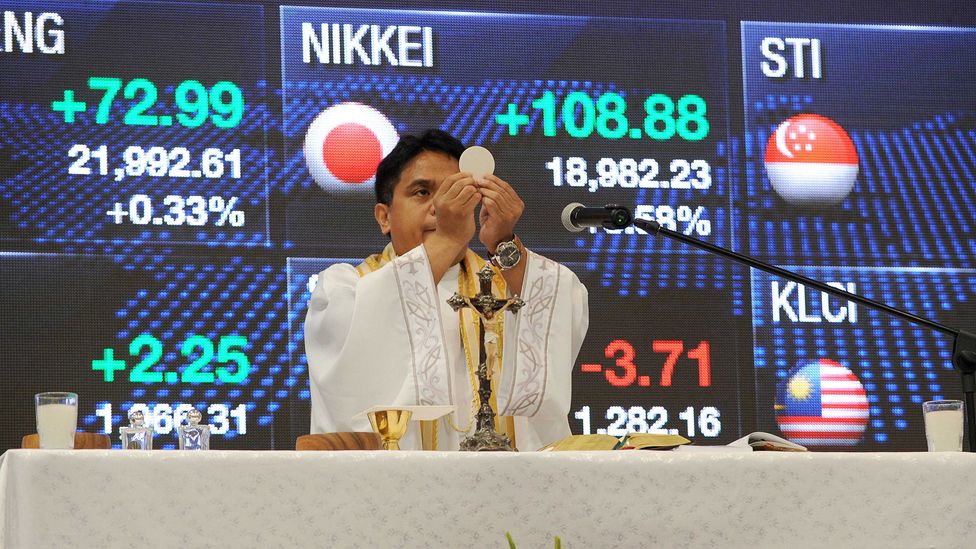
A Roman Catholic priest officiates mass on the first day of trading at the Philippine Stock Exchange in Manila (Credit: Getty Images)

TOMORROW’S GODS.  

Religions never do really die.

We take it for granted that religions are born, grow and die – but we are also oddly blind to that reality.

When we recognise a faith, we treat its teachings and traditions as timeless and sacrosanct. And when a religion dies, it becomes a myth, and its claim to sacred truth expires. If you believe your faith has arrived at ultimate truth, you might reject the idea that it will change at all. But if history is any guide, no matter how deeply held our beliefs may be today, they are likely in time to be transformed or transferred as they pass to our descendants – or simply to fade away.

As our civilisation and its technologies become increasingly complex, could entirely new forms of worship emerge?

We might expect the form that religion takes to follow the function it plays in a particular society –  that different societies will invent the particular gods they need.

The future of religion is that it has no future.

Perhaps with the march of science it  is leading to the “disenchantment” of society so supernatural answers to the big questions will be no longer felt to be needed. We also need to be careful when interpreting what people mean by “no religion”. “Nones” may be disinterested in organised religion, but that doesn’t mean they are militantly atheist. Accordingly, there are very many ways of being an unbeliever. The acid test, as true for neopagans as for transhumanists, is whether people make significant changes to their lives consistent with their stated faith.

People have started constructing faiths of their own. Consider the “Witnesses of Climatology”, a fledgling “religion” invented to foster greater commitment to action on climate change.

In fact, recognition is a complex issue worldwide, particularly since there is no widely accepted definition of religion even in academic circles.

A supercomputer is turned on and asked: is there a God? Now there is, comes the reply.

All human comments appreciated. All like clicks and abuse chucked in the bin. Please keep comments respectful. Use plain English for our global readership and avoid using phrasing that could be misinterpreted as offensive.

Contact: bobdillon33@gmail.com

Share this:

  • Share on WhatsApp (Opens in new window) WhatsApp
  • More
  • Share on Pocket (Opens in new window) Pocket
  • Share on Mastodon (Opens in new window) Mastodon

THE BEADY EYE ASK’S. CAN WE GET A GRIP BEFORE ITS TOO LATE? BECAUSE THE FUTURE IS NOT FOR THE FAINT OF HEART — OR THE POOR.

23 Thursday Feb 2023

Posted by bobdillon33@gmail.com in #whatif.com, 2023 the year of disconnection., Artificial Intelligence., Capitalism, Civilization., Climate Change.

≈ Comments Off on THE BEADY EYE ASK’S. CAN WE GET A GRIP BEFORE ITS TOO LATE? BECAUSE THE FUTURE IS NOT FOR THE FAINT OF HEART — OR THE POOR.

Tags

Artificial Intelligence., Capitalism and Greed, Capitalism vs. the Climate., Climate change, Distribution of wealth, Technology, The Future of Mankind, Visions of the future.

(Seventeen minute read)

It seems to be easier for us today to imagine the thoroughgoing deterioration of the earth and of nature than the breakdown of late capitalism; perhaps that is due to some weakness in our imaginations.” — Frederic Jameson, The Seeds of Time

The stakes facing our generation are much more than they first seem, because our actions might have the potential to bring about a far better world, or cut it short.

The shifting meaning of “capitalism,” and how societies hide their downside with culture.

We’re unclear on what “capitalism” is supposed to be.

  • From the proletarians, nothing is to be feared.
  • Left to themselves, they will continue from generation to generation and from century to century, working, breeding, and dying, not only without any impulse to rebel but without the power of grasping that the world could be other than it is.” — George Orwell, Nineteen Eighty-Four

———————————–

Rather than us asking questions of this world, this world asks questions of us.

We need to listen to the world in new ways and hear the fundamental questions that it askes us.

WITH  CLIMATE CHANGE –  WARS – AI – INEQULITY. –  UNITED NATIONS

ALL AT THIS VERY M0MENT ARE ASKING:  DO WE WISH TO CONTINUE TO EXIST? 

Might it be, then, that we have trouble imagining the end of capitalism because we think capitalism is great, and we’d fear that any alternative would be worse?

It is not we who are permitted to ask about the meaning of life — it is life that asks the questions, directs questions at us… our whole act of being is nothing more than responding to — of being responsible toward — life.

Have we been indoctrinated so that we subscribe to an ideology or a myth of capitalism?

All are questing, just what are our values.

We have an easier time imagining an apocalyptic death of the planet than capitalism being surpassed by a superior economic system, promoting equality.

Do we trust in capitalism on what are effectively theological grounds, so that the specious neoliberal arguments in capitalism’s favour are so many superfluous rationalizations?

Will AI Have a Soul? And does it even matter? Everybody uses the internet, but nobody trusts it.

The recent state of the world certainly hasn’t helped.

Even if capitalism is justifiable, it doesn’t follow that those who benefit from that system should be unable even to imagine a better kind of economy.

Neoliberals will say that we can imagine an alternative to capitalism, after all, namely the communist one that failed in the Soviet Union. But that, too, is a red herring since the question is whether we can imagine improvements to capitalism, not worse economies.

Likely, you find your smartphone handy, but that doesn’t mean you can’t imagine improvements to it. You’d prefer to keep your phone, of course, and you may even be addicted to social media. But science fiction is replete with re-imagined technologies. For instance, we could miniaturize smartphones and hardwire them into the brain.

Science doesn’t demonstrate that the quantity of life matters more than its quality, nor can science show which qualities of life should matter more than others.

  •                                                        ——————————-

How do I get people to do what I want them to do?

Unfortunately there are collective forms of self-deception.

Individuals, of course, can prevent themselves from reckoning with unwanted truths, in that they can underestimate obstacles, confabulate, procrastinate, and so on, unable to realize the meaning of the present moment.

“You can get everything in life that you want if you’ll just help enough other people get what they want.”

Give and you will receive.

Maybe there are social mechanisms that operate in an analogous fashion, protecting whole populations by steering them towards the party line. The analogue of the individual ego, or of the conscious self, might be the upper class that dictates mass media narratives, such as by instilling neoliberal values via Ivy League education, as Thomas Frank explains.

Societies have worldviews called “cultures,” along with institutions that enforce their biases.

Once large, sedentary societies emerged in history, so too did mechanisms for managing mass opinion. Religion was one such device, but we can speak more neutrally about “ideologies,” as Karl Marx did, to account for how we may protect capitalism, too, with myths and collective fallacies.

If you’re looking for signs of such capitalist myths, have a look at advertising, at how thousands of misleading slogans and manipulative, hyperbolic messages stream through everyone’s consciousness on a daily basis.

In the boom-and-bust cycle in which government spending alone can stabilize.

Capitalism is in runaway mode and must be curtailed.

————————————–

The recent pandemic, natural disasters, wars, all shine a light on the inequality that exist and have existed since time immortal.

If we want a world worth living in and on, we must make profit contribute to PROTECTING  all the essential values of life, not the pockets of the few.

Whether it’s turning promises on climate change into action, rebuilding trust in the financial system, or connecting the world to the internet.

OUR COLLECTIVE RESPONSIBILITY MUST BE TO REPAIRING THE DAMAGE OF CENTURIES OF GREED.

To achieve these objectives we will need to address a host of issues, with more than common sense but with trillions and trillions pumped into removing and protecting before the planet becomes uninhabitable.

_________________________

The Earth’s average land temperature has warmed nearly 1°C in the past 50 years as a result of human activity, global greenhouse gas emissions have grown by nearly 80% since 1970, and atmospheric concentrations of the major greenhouse gases are at their highest level in 800,000 years. We’re already seeing and feeling the impacts of climate change with weather events such as droughts and storms becoming more frequent and intense, and changing rainfall patterns.

By 2050, the world must feed 9 billion people. Yet the demand for food will be 60% greater than it is today. Despite huge gains in global economic output, there is evidence that our current social, political and economic systems are exacerbating inequalities, rather than reducing them. Rising income inequality is the cause of economic and social ills, ranging from low consumption to social and political unrest, and is damaging to our future well-being. More than 61 million jobs have been lost since the start of the global economic crisis in 2008, leaving more than 200 million people unemployed globally.

To function efficiently, the system needs to re-establish trust.

The internet is changing the way we live, work, produce and consume. With such extensive reach, digital technologies cannot help but disrupt many of our existing models of business and government. We are entering the age of the Fourth Industrial Revolution, a technological transformation driven by a ubiquitous and mobile internet. The challenge is to manage this seismic change in a way that promotes the long-term health and stability of the internet. Within the next decade, it is expected that more than a trillion sensors will be connected to the internet.

By 2025, 10% of people are expected to be wearing clothes connected to the internet and the first implantable mobile phone is expected to be sold.

Equality between men and women in all aspects of life, from access to health and education to political power and earning potential, is fundamental to whether and how societies thrive.

The growth of the digital economy, the rise of the service sector and the spread of international production networks have all been game-changers for international trade. Despite fundamental changes in the way business is done across borders, international regulations and agreements have not evolved at the same speed. In addition, negotiations to reach a new global trade agreement have stalled. There is a pressing need to reform the global trade framework.

Investing for the long term is vital for economic growth and social well-being, serious challenges to global health remain.

The number of people on the planet is set to rise to 9.7 billion in 2050 with 2 billion aged over 60. To cope with this huge demographic shift and build a global healthcare system that is fit for the future, the world needs to address these challenges now.

In short, the most pressing problems are those where people can have the greatest impact by working on them.

As we explained in the previous article, this means problems that are not only big, but also neglected and solvable. The more neglected and solvable, the further extra effort will go. And this means they’re not the problems that first come to mind.

First, future generations matter, but they can’t vote, they can’t buy things, and they can’t stand up for their interests. This means our system neglects them. You can see this in the global failure to come to an international agreement to tackle climate change that actually works..

We can’t so easily visualise suffering that will happen in the future. Future generations rely on our goodwill, and even that is hard to muster.

 We all know where the Solutions are to be found – in how wealth is distributed.

We should go beyond the focus on reducing the global poverty rate to below 3% and strive to ensure that all countries and all people can share in the benefits of economic development. Nearly half of the world’s population currently lives in poverty.  2/3 of the population in low-income countries is under 25 years old.

The world is facing multiple converging crises — growing food insecurity, rising fuel prices, economic instability, and the climate crisis — and they are all hitting poor countries the hardest. With 349 million people across 79 countries facing acute food insecurity, this is the worst food crisis in decades. While COVID-19, climate change, and conflict have been major drivers, political action has also fallen short.

Poverty entails more than the lack of income and productive resources to ensure sustainable livelihoods. Its manifestations include hunger and malnutrition, limited access to education and other basic services, social discrimination and exclusion, as well as the lack of participation in decision-making.

And we still wonder why the world we live in is going down the tube.

It is quite obvious that there is no point in been rich without giving – the power to solve some of the most pressing global challenges is not to be found in the words of the United Nations Declaration to end poverty in all its forms everywhere is Goal 1 of the UN’s Sustainable Development Goals.

Why?

Because it has to beg for funds to implement any of its aspirations.

What is needed is a preputial Fund to create a World Aid system with clout.

HERE IS HOW THIS CAN BE ACHIVED.

We now live in a world driven by technology – Apps for this and Apps that – Smartphone – Algorithms running world stock market, plundering everything for the sake of profit.

Why not introduce a World Aid commission algorithm to collect  0.05% on all activities that produce profit for profit sake.

This funding could be delivered by non repayable grants prioritising adaptation re climate change, vetted projects to reduce poverty, food sustainability, environment protection, etc ( Unlike The International Monetary Fund (IMF)  the lender of last resort.

All human comments appreciated. All like clicks and abuse chucked in the bin.

Contact: bobdillon33@gmail.com

Share this:

  • Share on WhatsApp (Opens in new window) WhatsApp
  • More
  • Share on Pocket (Opens in new window) Pocket
  • Share on Mastodon (Opens in new window) Mastodon

THE BEADY EYE: HIGHLIGHTS ANOTHER KILLER OF THE PLANET – MOBILE PHONES.

25 Wednesday Jan 2023

Posted by bobdillon33@gmail.com in 2023 the year of disconnection., A solution to Climate change., Artificial Intelligence., Carbon Emissions., Climate Change.

≈ Comments Off on THE BEADY EYE: HIGHLIGHTS ANOTHER KILLER OF THE PLANET – MOBILE PHONES.

Tags

Capitalism vs. the Climate., The Future of Mankind, Visions of the future.

( Four minute read)

I realize that restricting technology might be an unrealistic demand to impose on the up and coming generation but Smartphones are killing the planet faster than anyone expected.

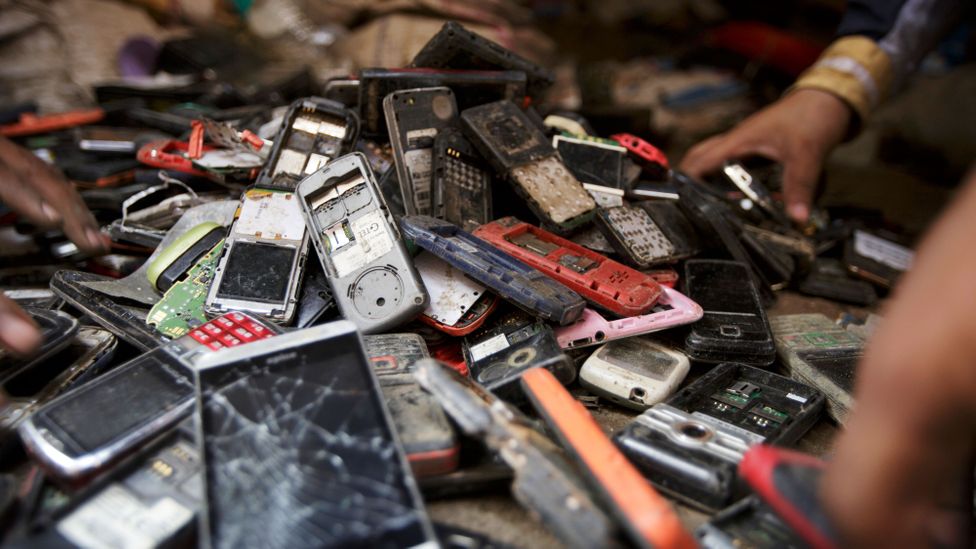
Electronic waste is a huge problem around the globe.

The worst-case scenario is that electronic trash winds up in unregulated or mismanaged heaps, slowly leaking corrosive chemicals into the soil and water table.How much gold is in your phone? (Credit: Getty Images)

All phones require 16 of the 17 rare-earth metals.

This is more than just an amusing detail about the device that never leaves your side.

Suddenly your smartphone is looking a lot more valuable than you might think. Pocket-sized vaults of precious metals and rare earths.

A typical iPhone is estimated to house around 0.034g of gold, 0.34g of silver, 0.015g of palladium and less than one-thousandth of a gram of platinum. It also contains the less valuable but still significant aluminium (25g) and copper (around 15g).

One tonne of iPhones would deliver 300 times more gold than a tonne of gold ore and 6.5 times more silver than a tonne of silver ore.

One million mobile phones could deliver nearly 16 tonnes of copper, 350kg of silver, 34kg of gold and 15kg of palladium.

And that’s just the start.

Smartphones also contain a range of rare earth elements – elements that are actually plentiful in the Earth’s crust but extremely difficult to mine and extract economically – including yttrium, lanthanum, terbium, neodymium, gadolinium and praseodymium.

Despite the recycling programs run by Apple and others, currently less than 1% of smartphones are being recycled.

With an estimated of 3.6 billion using smartphones tech’s carbon footprint is beyond what any one designer, one company, or even one government regulator can contain. Those 3.6 billion smartphone users upgrade to a new phone roughly every 11 months.

That’s because every Google search, every Facebook refresh, and every dumb Tweet we post requires a computer somewhere to calculate it all in the cloud.

Smartphone consumes as much energy as using an existing phone for an entire decade. That means buying one new phone takes as much energy as recharging and operating a smartphone for an entire decade.

But that is not the main problem. It is the building a new smartphone–and specifically, mining the rare materials inside them–represents 85% to 95% of the device’s total CO2 emissions for two years.

Even as the world shifts away from giant tower PCs toward tiny, energy-sipping phones, the overall environmental impact of technology is only getting worse. They’re more or less disposable.

Whereas ICT represented 1% of the carbon footprint in 2007, it’s already about tripled, and is on its way to exceed 14% by 2040.

That’s half as large as the carbon impact of the entire transportation industry.

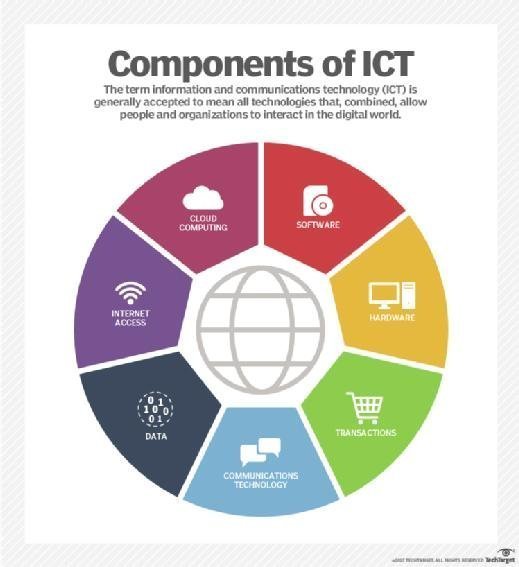
The list of ICT components is exhaustive, and it continues to grow. ICT’s importance to economic development and business growth has been so monumental, in fact, that it’s credited with ushering in what many have labelled the Fourth Industrial Revolution.Components of ICT

The overall largest culprit with regards to CO2 emissions belongs to servers and data centres themselves, which will represent 45% of ICT emissions by 2020. Although there is no single, universal definition of ICT, the term is generally accepted to mean all devices, networking components, applications and systems that combined allow people and organizations (i.e., businesses, non-profit agencies, governments and criminal enterprises) to interact in the digital world.

Mobile apps actually reinforce our need for these 24/7 servers in a self-perpetuating energy-hogging cycle. More phones require more servers. And with all this wireless information in the cloud, of course we’re going to buy more phones capable of running even better apps.

The future will only get more dire if the internet of things takes off and many more devices are hitting up the cloud for data.

Wearable devices, to home appliances, and even cars, trucks and airplanes. If this trend continues . . . one can only wonder on the additional load these devices will have on the networking and data centre infrastructures, in addition to the incremental energy consumption incurred by their production.

The average teen spends about two and a half hours a day on electronic devices.

What can be done?

Recognising that changing consumer behaviour is probably the least viable option, we need to come up with something better.

Governments should pass a law that requires all companies manufacturing these deceives to make a cash refund payment to encourage the return of the devices for recycling.  which could make it the ultimate cottage industry,

The internet is omniscient, our phones omnipotent, and together they demand and are destroying our values however there is life beyond the phone, but experiencing its richness requires mindfulness and discipline.

All human comments appreciate. All like clicks and abuse chucked in the bin.

Contact: bobdillon33@gmail.com
Share this:

  • Share on WhatsApp (Opens in new window) WhatsApp
  • More
  • Share on Pocket (Opens in new window) Pocket
  • Share on Mastodon (Opens in new window) Mastodon

THE BEADY EYE ANALYSIS THE OUTCOME OF COP27.

23 Wednesday Nov 2022

Posted by bobdillon33@gmail.com in Climate Change., Uncategorized

≈ Comments Off on THE BEADY EYE ANALYSIS THE OUTCOME OF COP27.

Tags

Capitalism and Greed, Capitalism vs. the Climate., Climate change

( Four minute read)

ONCE MORE ITS A JOKE.

Carbon budgets and climate catastrophe will not wait for the 2050 ‘net-zero’ goals of governments around the world because climate does not warm in a gradual and linear fashion, but with tripping feedback loops that will lead to rapidly escalating effects. There can be no more hiding, and no more denying.An illuminated sign in the plenary hall at the COP27 climate conference in Sharm el-Sheikh, Egypt, on Nov. 7.

Cop 27 concluded with a historic decision to establish and operationalize a loss and damage fund.

Now comes the difficult part – the fund must be set up, and filled with cash. There is no agreement yet on how the finance should be provided and where it should come from.

In fact, the agreement that emerged from Sharm el-Sheikh barely improved on the Glasgow Climate Pact.

More than 100 Heads of State and Governments, over 35,000 participants took twelve  days to produce a ten paged Sharm el-Sheikh Implementation Plan document full of – Encourages, Recognizes, Invites, Notes, Highlights,  Calls on, Urges ,Expresses serious concern,  Affirms , Welcomes the establishment, with no actually plan to solve the problem of global warming, rather than just paying for the destruction caused by it.

The demands for climate reparations from wealthy countries are so absurd, so unscientific, and so offensive to natural justice that it is difficult to know where the criticism should begin.

First, the claims are rooted in indignation rather than science.

Developing countries have been seeking financial assistance for loss and damage – money needed to rescue and rebuild the physical and social infrastructure of countries devastated by extreme weather – for nearly three decades.

Secondly of the $100bn a year rich countries promised they would receive from 2020 – a promise still not fulfilled – only about $20bn goes to adaptation.

Finally achieving agreement on a fund is a major milestone. Now comes the difficult part – the fund must be set up, and filled with cash. There is no agreement yet on how the finance should be provided and where it should come from.

Reform of the kind widely discussed at Cop27 could involve a recapitalisation of the development banks to allow them to provide far more assistance to the developing world.

Nicholas Stern, a climate economist and peer, has calculated the developing world will need $2.4tn (£2tn) a year from 2030. But this is only about 5% more than the investment they would require anyway, much of which would go into high-carbon infrastructure. The World Bank could provide about half of those funds, he estimates.

On the mean time the effects of human-caused global warming are happening now, are irreversible for people alive today, and will worsen as long as humans add greenhouse gases to the atmosphere.A triptych image showing from left to right: a firefighter in front of a fire; dry, cracked ground; and a hurricane near Florida, U.S.

Heat-trapping greenhouse gases are already having widespread effects on the environment: glaciers and ice sheets are shrinking, river and lake ice is breaking up earlier, plant and animal geographic ranges are shifting, and plants and trees are blooming sooner.

Increasing magnitudes of warming increase the likelihood of severe, pervasive, and irreversible impacts.

With such a huge crisis facing the entire planet, the international response should be swift and decisive. Yet progress by world governments has been achingly slow. Many commitments to reduce carbon emissions have been set, but few are binding and targets are often missed.

We all know what is needed – instead of leprechauns  pots of gold at the end of the rainbow  Keep fossil fuels in the ground. Invest in renewable energy. Switch to sustainable transport. Improve farming. Restore nature. Protect forests. Protect the oceans. Reduce how much people consume. Reduce plastic.

All human comments appreciated. All like clicks and abuse chucked in the bin.

Contact : bobdillon33@gamil.com

Share this:

  • Share on WhatsApp (Opens in new window) WhatsApp
  • More
  • Share on Pocket (Opens in new window) Pocket
  • Share on Mastodon (Opens in new window) Mastodon

THE BEADY EYE SAY’S. 1.5 CELSIUS IS NOT AN OBJECTIVE BUT A LIMIT.

14 Monday Nov 2022

Posted by bobdillon33@gmail.com in #whatif.com, A solution to Climate change., Climate Change., COP27., HUMAN ABILITIES.

≈ Comments Off on THE BEADY EYE SAY’S. 1.5 CELSIUS IS NOT AN OBJECTIVE BUT A LIMIT.

Tags

A world Aid Fund, Algorithms., Capitalism and Greed, Capitalism vs. the Climate., The Future of Mankind


( Four minute read)

We are 1.1 degrees Celsius above pre-industrial levels now.

1.5 degrees C is not a cliff; civilization does not automatically expire if temperatures exceed that threshold.

Humanity has nearly all the knowledge and tools needed to limit temperature rise to 1.5 degrees C.

The challenges are not primarily technological; they are political and economic.

What are these challenges?

World economy, which currently relies on fossil fuels for 80% of its energy, from collapsing in the process, the demand for these fuels must be radically reduced.

A major reason the world’s forests are felled at such catastrophic rates is to grow more food products, especially beef, soy, and palm oil.

Climate greenwashing that is, rhetorical promises by governments, corporations, or banks that claim to solve the crisis but may or may not measure up in practice.

The concept of “net zero emissions” demands special attention.

“Net zero”  is not necessarily a dodge, but offsets have a spotty record of achievement.

Many net-zero commitments by governments and businesses cite 2050 as the year when net zero will be reached. Indeed, roughly 80% of the world economy is now covered by commitments of net zero by 2050.

However “Net zero ”at the moment means giving a country or company that reduce emissions ( not to absolute zero;) rather, some emissions will continue, but they will be “offset” by countervailing measures that extract carbon from the atmosphere so the net result is zero emissions.

Promising that emissions will end by 2050 is easy for today’s politicians and corporate leaders, but that goal is only reachable if actual emissions fall by half in the next decade. Climate delay is just as lethal, precisely because 40 years of failing to act has left zero time for further delay.

2050 is far enough off that bold claims might seem possible, but those claims are only credible if they include real (i.e., non-offsets), substantial emissions reductions during the next 10 years, so whether such commitments carry an action plan that credibly cuts emissions in half by 2030 we will have to wait and see. 

Why is that humanity waited so long to start the job.

No one wants to pay or to carry the can.

Money is at the heart of the climate emergency and its solutions.

At the moment, the world’s governments provide roughly $5.9 trillion a year in subsidies for fossil fuels, according to the International Monetary Fund. Meanwhile, the vast majority of governments’ stimulus spending to revive Covid-battered economies has reinforced the fossil fuel status quo rather than boosted the zero-carbon activities needed for a climate-safe future.

The challenge going forward is to halt spending that harms the climate and redirect spending to actions that help it.

This requires leaving most of fossil fuel reserves in the ground. But those reserves were (and still are) counted as wealth in the stock holdings of investors; leaving them unburned would render trillions of dollars of invested wealth worthless.

The main reason we waited so long is that some very rich and powerful economic and political interests knew climate action would interfere with their profits and privilege.

Fossil fuel companies now face dozens of lawsuits from governments and civil society groups demanding compensation for the climate damages the companies’ lying helped cause.

As the extreme weather in recent years has shown, climate impacts are punishing even after “only” 1.1 degrees C of temperature rise. This is especially so for the roughly two billion people who live in the (usually poorer) countries most vulnerable to climate change. Temperatures and impacts are bound to increase in the years ahead, if only because humanity can’t halt emissions overnight. Hence, the need for what climate experts call “adaptation”: actions to reduce one’s vulnerability to the impacts of climate change. Adaptation has never gotten the attention mitigation gets, perhaps because it was assumed, wrongly, that the rich could adapt relatively easily to rising temperatures

Now that smart money is abandoning fossil fuels, two big questions are coming into focus: How much of the rest of the market will follow the same course? And will enough of the money that’s leaving fossil fuels now flow to the technologies and practices needed to defuse the climate emergency?

The key is what governments will do to encourage private banks and investors to stop funding climate destruction and instead finance climate solutions.

Finally:  In the end we will all pay.

So here is a suggestion.

Rather than begging;

Why not create a perpetual World Aid Fund, funded by all of us, which is both transparent and fair and above corruption. 

How could this be achieved:

Instead of private bankers, central banks, country governments etc,  making financial promises they underwrite the issue and interest returns on  (Non Tradable)  GREEN BONDS that are eligible to enter a Lotto style monthly draw.   

These Bonds could be purchased on line from 5 euros (with no interest) to 500 euros and up paying x% amount of interest. 

In the meantime we have the technology to place 0.05% on all economic activities that are for Profit sake only.  Example Profit Seeking Algorithms, Currency transactions over $50,000 , Sovereign Wealth Funds Acquisition, Gambling, etc. 

Who would Control the Distribute these funds: 

The United Nations out side any Veto influence. 

What would the funds to use for.  Sustainability Projects. Green energy transformation, Reduction of inequality. 

Who would monitor there effects:  The Earth. 

All human comments appreciated. All like clicks and abuse chucked in the bin.

Contact. bobdillon33@gmail.com.     


Share this:

  • Share on WhatsApp (Opens in new window) WhatsApp
  • More
  • Share on Pocket (Opens in new window) Pocket
  • Share on Mastodon (Opens in new window) Mastodon

THE BEADY EYE ASKS; WHEN ARE WE GOING TO WAKE UP TO THE POWER OF PERSONALIZE TECHNOLOGY THAT IS CREATING AN OPEN AIR (INVISABLE) PRISON – WHERE THE FUTURE IS NO LONGER THE FUTURE?

12 Saturday Nov 2022

Posted by bobdillon33@gmail.com in 2022: The year we need to change., Artificial Intelligence., Biometric technology., Climate Change., Dehumanization., Digital age., DIGITAL DICTATORSHIP., Evolution., Facial Recognition., Fake News., GPS-Tracking., Human Exploration., HUMAN INTELLIGENCE, Human values., Humanity., Life., Modern day life., Our Common Values., Privatization, Purpose of life., Social Media, Social Media Regulation., Society, Speed of technology., State of the world, Technology, Technology v Humanity, The cloud., The common good., The essence of our humanity., The Future, The Obvious., The state of the World., THE WORLD YOU LIVE IN., THIS IS THE STATE OF THE WORLD.  , TRACKING TECHNOLOGY., Unanswered Questions., Universal values., VALUES, What is shaping our world., WHAT IS TRUTH, What Needs to change in the World, Where's the Global Outrage.

≈ Comments Off on THE BEADY EYE ASKS; WHEN ARE WE GOING TO WAKE UP TO THE POWER OF PERSONALIZE TECHNOLOGY THAT IS CREATING AN OPEN AIR (INVISABLE) PRISON – WHERE THE FUTURE IS NO LONGER THE FUTURE?

Tags

Algorithms., Artificial Intelligence., Capitalism and Greed, Climate change, Personalized technology, Technology, The Future of Mankind, Visions of the future.

( Ten minute read)

Technology is here to stay and we are supposedly on an unstoppable path towards driverless vehicles, fully automated internet-connected “smart homes”, and godlike artificial intelligence, when if fact we are on a path to the oblivion of our private lives.

As society is moving away from social interactions we take these technologies for granted and lose sight of reality.

So when are we going to wake up to the the pitfalls of personalized technologies that are targeting our lives, and what it is all ready doing, to what is left of what are supposed to be democratic societies.

It is difficult to manage the awesome power that is embedded in today’s technology however should we just sit back and let it exploited us with unregulated profit seeking algorithms and unauthorised data collection.

Its never to late to start asking questions.

We are so used to hearing that technological progress is smooth and inevitable these days, that it just seems like common sense.

However this idea may not be unrelated to the fact that the people who promote personalized technology are mainly the people with a large financial interest in the adoption of new technology -Facebook-Twitter-Google-Apple- LinkedIn – Instagram – Snapchat – Pinterest – Reddit and the rest.

Today, a plethora of personalization software tools, including AI and machine learning algorithms that are destroying individualism.

Just as our past futures need not be dead to us, our present future, with our reliance on devices, are becoming habitual, and if  not already could be compulsory.

There’s is no app for that.

On a social level, the two dimensional world of the flat screen does not support the development of communication.

It’s just sad that people really don’t even have to use their brains anymore. If you don’t use it, you lose it.

It is estimated that as much as 93% of communication is non-verbal, leaving only 7% to the words themselves.

( Not much less alarming, and far closer, is the moment when “deep fakes” – computer-generated pictures and video – become indistinguishable from the real thing.) People who buy into this garbage is being taken for such a ride every month.

The vast majority of people were simply never given the choice to accept the trade-off between personalized technology for profit or technology for the common good. For example tracking due the Covid Pandemic against tracking for profits.

Not convinced?

It is now increasingly clear that many, if we had understood what was at risk, would have never agreed to tracking Apps.

For example, back in 2018, Amazon filed a patent that would allow its Echo device to detect when someone is ill from the change in their voice, nasal tones, and stuffed nose. When synced with Amazon’s website personalization engine, this is invaluable information to make personalized recommendations for cold medicine, recipes, etc.  It allow them to achieve 1:1 personalization like never before. 

 Mobile devices themselves are truly turning people into mindless zombies and simpletons with personalized technology turning into the enemy. Yet most people are too blind to see it.  89% of businesses are investing in personalization.

I.E.  Target the right person, at the right time, with the right offer. Analysing every aspect of the customer journey, companies can incorporate real-time dynamic pop-ups.

 Here’s a fraction of the stats showing the power and importance of personalization:

80% of consumers are more likely to purchase from a brand that provides personalized experiences.

The idea of greater convergence and connectivity between personal electronics is correct. One only has to look at the smartphone that trigger customised adverts or programme your phone based on where you are.  A company could tie itself to the Apple ecosystem, using an API to acquire data captured by each user’s Watch device into its own cloud-based system.

———————————-

As society pressures leaders for a more environmentally-friendly agenda the world of 2050 will be unimaginably different in many ways –  other than climate change.

Carbon management solutions will be an integral part of emission reductions.

For that, real-time measurement, abatement, and offset integration will help ensure companies not only talk the talk but also walk the walk and transparently meet their net-zero targets. Setting a target is just the first step; the second is to understand and quantify the real emission baseline into measurable units.  This can only be achieved with massive data collection. and analyzation

———————————–

The amount of information we share shared on social media networks is phenomenal.

A media company is now any company that helps pass information across the globe.  Before mobile technology, you had to search through a dictionary to understand the meaning of a word. Now you can look words up in a dictionary app or quickly search the Internet. Communication has even evolved beyond mobile devices and personal computers. We can now send messages through tablets, voice assistants, smartwatches, and more. That’s right. Your fridge needs a Facebook account. It can e-mail you when your shopping time comes around with what all groceries you need to buy.

So one can see so clearly that society is not going to stop moving away from using technology as our primary communication methods, but here is a word of advice do not rely heavily on technology to live your lives, learn skills.  Your life is yours to control.  Because without them, you will struggle to move on as a society.

It is said that by 2050, “computational machines will have surpassed the processing power of all the living human brains on Earth.

It is said that a AI – a machine that can do everything a human can do – will arrive, they think it’s about 50/50 whether it will be before 2050.

By this time if we dont tackle climate change the cloud will have absorbed the thinking of the many dead brain on Earth.

If we assume that transcendentally brilliant artificial minds won’t be along to save or destroy us, and live according to that outlook, then what is the worst that could happen – we build a better world for nothing?

It is said that AGI will develop. If it does, every other prediction we could make is moot, and this story, and perhaps humanity as we know it, will be forgotten.

With the destruction of genuine human interaction you know, that technology will  happen anyway, so I predict that we will see a lasting cooperation between the human race and the computational machines of the future.

However we are mow just beginning to see the down side to all of this  technology.

Technology has changed how we entertain ourselves, meet each other, and consume all types of media.

We might be walking around with biometric healthcare data chips on your clothes, in a world in which mega scale injections of sulphur dioxide into the stratosphere turn the heavens a milky-white, and a whole generation never sees a clear blue sky, in order to reflect more of the sun’s rays and pause the greenhouse effect. Artificial intelligence brains simply cannot cope with change and unpredictable events such as the climate change will create, whole cities that are abandoned and populations relocated, to avoid the worst effects we can’t prevent. We all need to work together to survive.

Society used to be able to make a long-term plan, now it is driven by data with its chaotic effect on our lives shows no sign of abating, it is at least predictably unpredictable.

We need a cultural change in values, to enable more deliberate decision-making.

Future technology is sure to transform our lives in unbelievable ways, but how among us wants to live a life based on private data collected – by the fridge – the smart TV – your clothes – your mobile devices -whether you looked left or right – how many shits you had a day- face recognition – what emotions you had at looking at an emoji- what your are eating, reading, saying- what twitters you like or don’t,- where you were, where you going – all analysed by an invisible algorithm that has no oversight, or conscious.

Unfortunately, there’s not much we can do with this information and data except hope that people come to realize it needs to be regulated.

The changes in the world over the next 30 years, wont be down to technology nor will they be online, thanks to climate change they will metalize mostly through low-cost smartphones receiving increasingly ubiquitous cellular connections as the world fights for resources that are necessary for life.

Remember when people used to sleep and dream at night?

Now all we do is zone out in front of a computer screen all night. It’s time to unplug from all this craziness and go back to nature.

Nature does not spy on itself , in order to evolve. PRISM -- It's the end of the Internet as we know it

All human comments appreciated. All like clicks and abuse chucked in the bin.

Contact: bobdillon33@gmail,com

Share this:

  • Share on WhatsApp (Opens in new window) WhatsApp
  • More
  • Share on Pocket (Opens in new window) Pocket
  • Share on Mastodon (Opens in new window) Mastodon

THE BEADY EYE’S. OPEN LETTER TO THE DELEGATES OF THE NEXT COP-OUT CLIMATE CHANGE CONFERENCE IN EGYPT.

28 Friday Oct 2022

Posted by bobdillon33@gmail.com in 2022: The year we need to change., Beady Eyes: Open Letters., Climate Change., Open Letter., Uncategorized

≈ Comments Off on THE BEADY EYE’S. OPEN LETTER TO THE DELEGATES OF THE NEXT COP-OUT CLIMATE CHANGE CONFERENCE IN EGYPT.

Tags

Capitalism vs. the Climate., NEXT COP-OUT CLIMATE CHANGE CONFERENCE IN EGYPT, OPEN LETTER, The Future of Mankind

Dear Delegate,

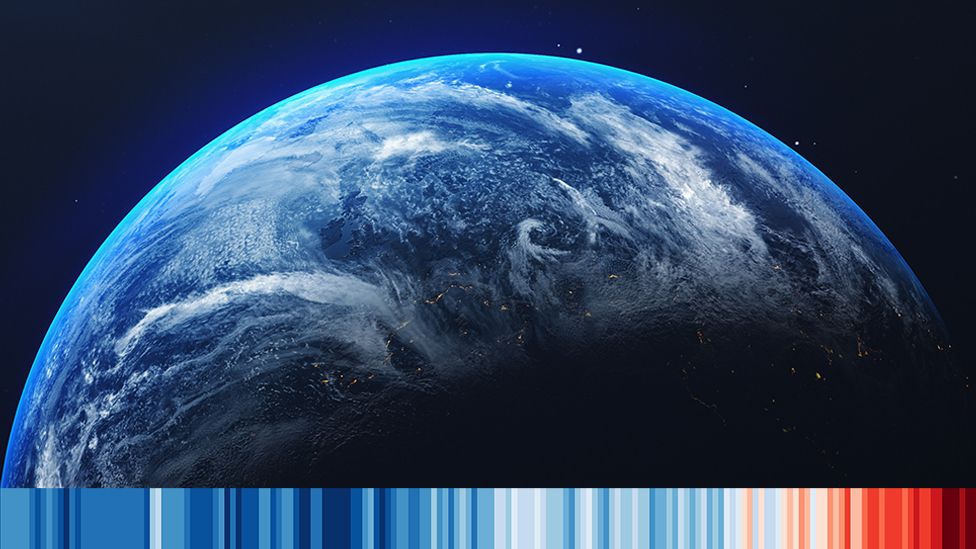
When it comes to climate change the verbal diarrhoea,    must be stopped. Picture of the Earth

Is is no longer up to scientists to bear the mental burden on the climate?

No, it’s up to the decision-makers, and the more action levers we have, the stronger this charge must be.

It’s now a race against time and it is critical that business leaders and states embrace it.

“States are in the process of bending the emissions curve downwards.” but their reduction must be much (much) more radical.

Nearly half of humanity is living in the danger zone – now.

Many ecosystems are at the point of no return – now.

Unchecked carbon pollution is forcing the world’s most vulnerable on a frog march to destruction – now.”

Half measures are no longer an option.

Secretary General António Guterres

“This is the defining issue of our time, nobody has the right to sacrifice international action on climate change for any reason,”

Its just over 100 days since the UN climate action summit in Glasgow, COP26, and no doubt you have seen the second in a series of three reports from the the UN’s top climate scientists, a damning indictment of failed global leadership on climate.

Prioritise climate or face catastrophe.

The world is now about 1.2C warmer than it was in the 19th Century – and the amount of CO2 in the atmosphere has risen by 50%.

Scientists believe at least 550 species could be lost this century if action is not taken.

Current global problems such as inflation, Russia’s invasion of Ukraine and the high prices of energy and food are distracting governments, but the core problem remains the same no one wants to pay.

This is the main problem no one wants to pay.

Climate finance is critical to addressing climate change because large-scale investments are required to significantly reduce emissions, notably in sectors that emit large quantities of greenhouse gases. Climate finance is equally important for adaptation, for which significant financial resources will be similarly required to allow societies and economies to adapt to the adverse effects and reduce the impacts of climate change.

Developing nations are calling for payments for “loss and damage” – the impacts faced now.

An option for making payments was excluded from the Bonn climate talks, after pushback from wealthier nations who feared they would be forced to pay compensation for decades.

Financial institutions might be  taking an increasing number of mitigation actions to prepare for a low-carbon future, the biggest investment opportunity of this generation but financial system governance bodies need to incentivize opportunities to invest in adaptation and resilience.

There are many papers of reference on this subject, most are so complicated that one would need a life time to read them.

Mobilizing all sources of finance toward adaptation and resilience requires all of us to have the opportunity to invest, because  there are limitations on public balance sheets to finance the level of investment needed to meet adaptation and resilience needs.

Integrating climate considerations—both risks and opportunities—will be fundamentally important for aligning the financial system toward low-carbon, climate-resilient investments, and ensuring there is at least as much attention given to investment in adaptation and resilience as to mitigation.

Promoting greater use of blended finance approaches will drive  Finance Today for the Climate Resilient Society of Tomorrow.

So here again are a few suggestion to spread the cost, to create a preputial fund to tackle the problem in both fair and transparent way.

APPLY A 0.05%  WORLD AID COMMISSION ON ALL TRANSACTIONS THAT ARE FOR PROFIT FOR PROFIT SAKE.

IE.  ALL FOREGINE EXCHANGE TRANSACTIONS OVER 50,000$, ON ALL SOVEREIGHTY WEALTH FUNDS ACQUISITIONS ,  ALL GAMBLING WINS OVER 500$.

THE UNITED NATIONS TO ISSUE GREEN BOND ON THE STOCK MARKET WITH GUARANTEED RETURNS BACK BY THE CENTRAL BANKS OF THE WORLD . THESE BONDS ARE ALSO ELIGIBLE FOR  ENTER TO A LOTTO TYPE WEEKLY  DRAW.

Currently, 17 million people are estimated to be facing food insecurity in east Africa because of drought.

Some scientists believe world leaders have left it too late and no matter what is agreed at COP27, 1.5C will not be achieved.

Instead of slowing down the decarbonization of the global economy, now is the time to accelerate the energy transition to a renewable energy future, declaring fossil fuels a “dead end for our planet, for humanity, and yes, for economies,” and calling for developed countries, multilateral Development Banks, private financiers, and others to form coalitions to help major emerging economies end the use of  verbal green.

We need to tackle the issue in a less confrontational way. Either everybody wins, or everybody losses.

It’s not so much that climate will end the human race or life on earth as we know it.

The result will be mass migration, wars, and barbarism.

All human support appreciated. All like clicks and abuse chucked in the bin.

Contact: bobdillon33@gmail’com

Share this:

  • Share on WhatsApp (Opens in new window) WhatsApp
  • More
  • Share on Pocket (Opens in new window) Pocket
  • Share on Mastodon (Opens in new window) Mastodon

THE BEADY EYE SAY’S. THEY THE TORIES ARE LAUGHING ALL THE WAY TO THE BANK.

23 Sunday Oct 2022

Posted by bobdillon33@gmail.com in 2022: The year we need to change., Brexit., England departure from the EU., England in five years., England's future., ENGLAND'S SNAP ELECTION, England., Inflation., The cost of the Tories., Uncategorized

≈ Comments Off on THE BEADY EYE SAY’S. THEY THE TORIES ARE LAUGHING ALL THE WAY TO THE BANK.

(Seven minute read)

On a annual salary of £115,000  and expenses Liz Trust lasted less than fifty days in office.

She can walk away with £19,000 in severance pay plus her expenses.

Tony Blair and John Major also received the annual salary of £115,000 pounds.

Gordon Brown £114, 800. David Cameron £111,400.

Theresa May a sitting MP can claim a parliament staffing budget of £35,000 on top of the annual  salary.

So what does it all cost?

The Gravy House of the Lords.

800 members/ peer costing £30,000 per member at a total cost of around £117.4 million.

They are entitled to £323 pounds a day just for signing into the Chamber.

Houses Of Parliament Wallpapers - Wallpaper Cave

The Poor House the Common’s.

The total spend of members of parliament was £132.5 million in the 2020-21.

The average cost of an MP was £203,880 in 2020-21, a 29.2 per cent increase.

The Royal House. Buckingham Palace.

It cost the taxpayer a mire £103 million ( 2021-22)

————————

The Tories are throwing away any right to claim that they are the careful custodians of the public’s money.

The inglorious history of their follies are crying out with horror at the cost, crying with laughter at the sheer stupidity of so many bad decisions. They are now making a very strong bid to be the most blunder-prone regime of the modern era.

The net cost of the bank bailouts—once you factor in money recouped by the government—was £27 billion. Separate figures from the National Audit Office (NAO) in 2018 estimated the sum spent to stabilise the banks to be £133 billion.

Most of the trade deals with non-EU countries that the UK has signed have been small in their economic effect, and have merely been “rolled over” from identical ones when we were an EU member.

The impression was that there would be no downside. We would thrive outside Europe’s bureaucracy which was strangling our companies with red tape. The huge benefits of the single market – trading freely across borders, with common standards – were never highlighted.

Two new carriers that has attracted criticism over its £6.2bn cost more than £2bn over the original estimate.

The latest estimate of the cost of HS2 has spiralled to between £72bn and £98bn.

Then came the dispute over the Northern Ireland protocol, an issue that so infuriated the EU it has refused to ratify Britain’s associate membership of the €95bn scheme.

The final cost of the Tories is that 70% of economic turnover was international before Brexit. It went from 70% to 50% to 30%,  it would be twice the size if it were not for Brexit.

Then came Covid which compounded Brexit’s disruption to British government, while Boris Johnson’s cavalier approach to leadership and to constitutional norms puts stresses and strains on all of its institutions. The books on the history of Covid-19 will show the ways in which money was blown in such spectacular style. It was a vast pyrotechnic display of borrowed moola such as we’ll surely never see repeated. Much of it, in the UK, as with other countries, was spent without apparent constraint.

Furlough – or the Coronavirus Job Retention Scheme, to give it a name – cost a staggering £70bn.

The fiscal year 2020-21 was the first one in which government spending in the UK surpassed a trillion pounds, reaching £1096bn. That was a one-year increase of 23.5%.

The Chancellor of the Exchequer, Kwasi Kwarteng, said:

“Economic growth isn’t some academic term with no connection to the real world. It means more jobs, higher pay and more money to fund public services, like schools and the NHS.

Leave the Tories in power and the results will speak for themselves.

The north-south divide has now least 85 years.

The UK has higher levels of regional inequality than any other large wealthy country.

Levelling up like Boris it is absolutely miles away. It would cost  hundreds of billions of pounds over decades if done properly. its

Nothing more than rhetoric in a country up to its neck in Debt.

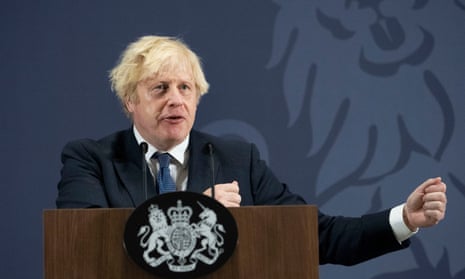
The cost of Boris Johnson’s ‘levelling up’: £2tn.

A drop in the ocean of inflation.

Boris Johnson said at the UK Battery Industrialisation Centre in Coventry that regional inequalities are an ‘outrage’

All human comments appreciated. All like clicks and abuse chucked in the bin

Contact: bobdillon33@gmail,com

Share this:

  • Share on WhatsApp (Opens in new window) WhatsApp
  • More
  • Share on Pocket (Opens in new window) Pocket
  • Share on Mastodon (Opens in new window) Mastodon

THE BEADY EYE SAY’S. TO SECURE A FUTURE ALL OF US MUST FIGHT THE RIGHT WAR RIGHT NOW.

19 Wednesday Oct 2022

Posted by bobdillon33@gmail.com in 2022: The year we need to change., Climate Change., Disconnection., Earth, Education., Energy, Environment, Evolution, Extermination., Human Collective Stupidity., Human Exploration., Human values., Humanity., Life., Modern day life., Natural World Disasters, Nuclear power., Our Common Values., Profiteering., Purpose of life., Real life experience's, Reality., Renewable Energy., State of the world, Sustaniability, Technology v Humanity, The common good., The essence of our humanity., The Future, The Obvious., The state of the World., THE WORLD YOU LIVE IN., THIS IS THE STATE OF THE WORLD.  , Truth, Unanswered Questions., Uncategorized, VALUES, We can leave a legacy worthwhile., What is shaping our world., WHAT IS TRUTH, What Needs to change in the World, Where's the Global Outrage.

≈ Comments Off on THE BEADY EYE SAY’S. TO SECURE A FUTURE ALL OF US MUST FIGHT THE RIGHT WAR RIGHT NOW.

Tags

Capitalism vs. the Climate., Climate change, The Future of Mankind, Visions of the future.

If humanity wants to hope to contain global warming below 1.5°C – Governments must close the gap between net zero rhetoric and reality.

There can be no more hiding, and no more denying deluding yourself with a lot of greenwashing.

Political leaders, blinded by capital and powerful private interests, have long decided Earth is a small price to pay for the yachts, mansions, private jets and record profits of the one percent.

In Glasgow at the COP26 climate conference we watched as world leaders came up with new excuses, symbolic targets and new ways to silence the progressive voices who opposed them.

Global heating is supercharging extreme weather at an astonishing speed, this life-altering issue which we are NOW all witnessing daily – Somalia, Nigeria, Pakistan, is not getting the urgency and attention it demands.

Exploitation and development of new oil and gas fields must stop this year.

If governments are serious about the climate crisis, there can be no new investments in oil, gas and coal, from now – from this year.

It’s Now or Never.

A huge part can be done with existing technologies.

These technologies can and will create billions of jobs to drive a sustainable world, but it remains a fight of David against Goliath, because of how we measure our well being.

How we evaluate what we are doing needs to change.

GDP is a totally numbers-driven index that does not produce the true picture.

There are growing calls to find GDP alternatives to measure countries’ wealth and welfare.

GDP can’t accurately represent the wealth of a country when it ignores how money is divvied up.

Considering GDP alone, a rich country where 10% of the population controls 75% of the wealth (looking at you, United States) may rank higher than a poorer country with a more even distribution of wealth.

One of GDP’s biggest flaws is that it counts tragedies as economic bonuses. If a hurricane or tornado hits and a country spends millions of dollars rebuilding, those expenses boost GDP, even though people lost their homes, jobs, and lives.

GDP ignores many crucial ways to measure the wealth of a country: clean air, health, life span, gender equality, opportunity, education, and more. This is understandable – GDP wasn’t developed to rank countries’ welfare, but simply to measure money as the world recovered from the Great Depression.

Of course GDP cant be replaced over night, but it can be complemented by a Thriving Places Index (TPI) and this index could easily be expanded to other parts of the world.

TPI’s primary focuses are sustainability, equality, and local conditions. Unlike GDP, this index measures equality by investigating how evenly distributed life expectancy and wellbeing are across a country.

Interestingly, the U.N. encourages nations to use it alongside their gross national income data. They say that it can help governments assess national policy by “asking how two countries with the same level of GNI per capita can end up with different human development outcomes.”

By factoring in the ecological footprint, inequality, wellbeing, and life expectancy of a country, it provides a simple but rounded glance at the wealth of a country.

This alone will not however solve the problems that are now on the horizon.

We must implement measurements by monetising environmental damage factors to help countries better understand exactly where they stand environmentally.

The Green GDP is a noble effort to factor in the cost of climate change in a way that people whose focus is money can appreciate. While subjective data can immediately turn some financially conservative parties off, putting a number on the impact of environmental negligence could potentially hit home.

Our Profit driven societies focused too much on an idea that futuristic technologies will save the world from climate chaos, rather than focusing on what can be done today. If cuts to carbon are left to the future and not made in this decade, it will be too late to stay within the 1.5C limit.

What are the crucial new technologies in development for combatting Climate Change?

Clean energy is perhaps the biggest issue to tackle.

Convert carbon dioxide into a usable energy source using sunlight.

There are numerous projects trying to achieve this, but most of the hydrogen used today is extracted from natural gas NG00, -3.93% in a process that emits carbon dioxide as well as the more-fleeting, but more-potent, methane.

Electrical transport and advanced batteries?

Particularly for use in electric vehicles; hydrogen; and carbon capture appears to be the miracle solution to reduce the heavy ecological impact of transport. This technology is not all green under the hood. Even before having driven a single kilometre, the electric vehicle has emissions almost twice as high as those of a thermal vehicle.

Big data has big implications in creating awareness about the consequences of climate change but it’s harvesting with the use of non transparent and unregulated algorithms.

Crowdsourcing for environmental solutions by gathering journalists, scientists, technologists, and people passionate about sustainability is creating a new wave of environmentalism.

Mobile apps such as Oroeco is an app that tracks your carbon footprint by placing a carbon value on everything you buy, eat, and do. However most Apps are profit seeking and like Big data they remain un -transparent and unregulated.

Interactive maps really drive home the point of climate change.

All of these technologies use microchips in order to operate and these are made from rare finite resources.

For the first time, a mining company is preparing to mine the seabed to collect rocks rich in metals for the batteries of electric cars. A practice that promises to destroy ecosystems that are still unexplored and that could constitute a ticking “climate bomb”. Poisoning of fresh water reserves, artificialization and loss of biodiversity, toxicity for humans, radioactive pollution, occupation of agricultural land… The extraction and transformation of raw materials are much more polluting than for the fossil car.

In the end here is where we are.

Some of the highlights included a prediction of violent conflicts and civil wars, extreme poverty and the loss of several points of gross domestic product in some developing nations, mass extinctions, and an intense, regular pattern of natural disasters.

The average decline of the species analysed was 68% in 2020, and 60% in 2018, revealing an accelerating collapse of biodiversity around the world. “We can tell ourselves that 1% is not much, but losing 1% in two years is absolutely colossal. The mere fact that this index is not improving is a disaster in itself

Taking into account a global population rise of about 2 billion people, as well as the need to supply electricity to 785 million people who do not have access to it, and clean cooking to the 2.6 billion people who currently lack it there is no more time for multinationals to obtain justice.

Governments must fine them.

Instead we see governments like the UK licensing new oil and gas fields in the North Sea and has also mooted a new coalmine for coking coal alongside introducing fracking.

Instead we see Energy being use a a weapon of war.

We all know what is necessary for life however in the age of instant gratification, we have little appreciation of where it all come from and we remain unwilling to pay for a future that only exists on the planet we all inhabit.

A large-scale nuclear war would, by all scientific projections, be a planetary disaster of the highest order.

A large -scale climate event would be far worse. Here to day gone to morrow against watch our demise over a few generations.

So every one of us must engage now. ( See previous posts as how this can be achieved)

The simplest thing you can do is educate others.

Tell people there are other ways to measure a country’s wealth.

All human comments appreciated. All like clicks and abuse chucked in the bin.

Contact: bobdillo33@bobdillon33

Share this:

  • Share on WhatsApp (Opens in new window) WhatsApp
  • More
  • Share on Pocket (Opens in new window) Pocket
  • Share on Mastodon (Opens in new window) Mastodon

THE BEADY EYE HAS A FEW QUESTIONS FOR YOU. OUR FINITE EARTH CANNOT FULFILL THE RESOURCES – PROFIGATE DREAMS OF SO MANY PEOPLE.

17 Saturday Sep 2022

Posted by bobdillon33@gmail.com in #whatif.com, 2022: The year we need to change., Inflation.

≈ Comments Off on THE BEADY EYE HAS A FEW QUESTIONS FOR YOU. OUR FINITE EARTH CANNOT FULFILL THE RESOURCES – PROFIGATE DREAMS OF SO MANY PEOPLE.

Tags

Algorithms., Capitalism and Greed, Capitalism vs. the Climate., Climate change, The Future of Mankind, Visions of the future.

Ten minute read.

THE MAIN QUESTION IS WHERE WILL THE CURVE OF EARTHS TEMPERATURE INFLATIONS TAKE US FROM HERE?

Right now the scientific consensus is that the population of the world will reach a peak some time later this century. The world population is projected to reach 10.4 billion people sometime in the 2080s and remain there until 2100, according to the United Nations Population Division.A 3D illustration of a woman watching a climate change simulation of Earth.

How many people can the earth support?  What is it carrying capacity?

When it comes to carrying capacity, it’s a matter of mode of production, mode of consumption, who has access to what and how.

Not all human activities have to be environmentally costly but the future of the world population is driven by a mixture of survival and reproduction. As a result more and more countries, once they reach a certain stage of socioeconomic cultural development, tend to converge towards about two children [per couple] or fewer.

In 1679, Antoni van Leeuwenhoek, a scientist and inventor of the microscope, predicted that Earth could support 13.4 billion people.

From 1930 to 1974, the Earth‘s population doubled again, in just 44 years.

Everybody knows that environmental changes, such as pollution or disease, and climate change can increase or decrease a habitat’s carrying capacity but there is little consensus in how many Homo sapiens our planet can support.

But is the human population expected to continue growing at this rate?

Is there an upper limit to how many humans our planet can support?

Before the twentieth century no one ever lived through a doubling of the entire human population and the enormity of this and our predicament is now prevenient in climate change.

For instance, natural constraints include food scarcity and inhospitable environments.

If the Earth System gets into the region of chaotic behaviour, we will lose all hope of somehow fixing the problem. The result will be the inflationary economic paradigm itself will be the long term disaster.

If we want to affect how many people planet Earth can support, we will need to decide how many people want Jaguars with four wheels and how many want jaguars with four legs.

————————-

Here is a broad sketch of what is in store and where we’re heading. if we don’t curtail climate change and our unchecked use of fossil fuels.

Where is Earth’s climate headed?

That depends significantly on exactly what our activity is over the next few decades.

For example, the human population can only grow so large and can only have so many carbon-emitting activities; and pollution will eventually degrade the environment. At some point in the future, carbon output will reach a maximum limit.

In the worst cases, the researchers found that Earth’s climate leads to chaos. True, mathematical chaos. In a chaotic system, there is no equilibrium and no repeatable patterns. A chaotic climate would have seasons that change wildly from decade to decade (or even year to year). Above a certain critical threshold temperature for Earth’s atmosphere, a feedback cycle can kick in where a chaotic result would become unavoidable. There are some signs that we may have already passed that tipping point, but it’s not too late to avert climate disaster.

We are now entering a new phase, one driven by human activity. As humans pump more carbon into the atmosphere, we are creating a new Anthropocene era, a period of human-influenced climate systems, something our planet has never experienced before.

We will see mass migration, with one war after another for resources.

Animals can keep giving birth, increasing their numbers, but they reach a limit when they consume all the food in their environment (or their predators get too hungry and consume them). Put another way, climate change impacts might not directly cause humans to go extinct, but it could lead to events that seriously endanger hundreds of millions, if not billions, of lives.

There’s no reason to exaggerate the climate threat. The truth is bad enough, and reason enough to take dramatic action because today, we live in a global, interconnected civilization, so there’s is every reason to believe our species will not survive its collapse.

Despite massive landscapes and endless blue, our planet is limited in its resources and capabilities to support its inhabitants. According to the Global Footprint Network, “Humanity uses the equivalent of 1.5 planets to provide the resources we use and absorb our waste.

It now takes the Earth one year and six months to regenerate what we use in a year.

All over the world we are witnessing the effects of using more resources than the Earth can provide in the form of diminishing forest cover, disappearing coral reefs, collapsing fisheries, biodiversity decline, increasing greenhouse gases, depleting fresh water systems, acidifying oceans, disease, famine, mass migrations, depleting arable land, resource conflicts and wars, just to name some of the more noticeable effects.

So we are left to cope with limited resources or pursue unconventional methods, which can create a disproportionate impact on the poor, and the ones that can are finding that even the furthest and deepest corners of the Earth are being exploited, leaving fewer and fewer resources for future generations.

A sustainable future cannot be achieved without conserving biological diversity – animal and plant species, their habitats and their genes – not only for nature itself, but also for all  people who depend on.

Our moral obligation is to support both ourselves and our planet. it.

Our old solutions – which address only environmental conservation or short-term human gains – are no longer enough.

We need innovative approaches to guide our civilization toward a sustainable future and the only way this can be done  this requires a substantial behavioural modification of the most impactful species on Earth—humans.

I think it is becoming increasingly important for us to be conscious of our consumption. If we can see through products on the shelves, and understand that human labour, sacrifice and resources have gone into anything and everything we consume, we can begin to empathize with and work for the well-being of populations around the world.

Technology is distancing our relationship from global issues, often perceived as too large to concern our own respective lives.

How can we begin this personalization in the midst of a global crisis of endless dimensions and stakeholders?

We can begin by making profit seeking algorithms be transparent. By removing all media advertising that prompts consumption. By focused efforts and productivity within our own communities. By fostering the rights and access to medical care universally.

Finally. Government should enable individuals to see their own capabilities in organizing and protecting the environment, instead of simply reporting on the problems. Media coverage, literature, and written discussion in any capacity should lean towards a definitive—within scientific bounds—attribution of our existing catastrophes to our own actions. We must try to stray from merely stating that a given problem exists, and rather begin our discussions and postulations with the probable causes of that problem.

By getting communities, urban or rural, to visualize and feel the influence of their actions on water, soil, and air would be to enliven a group solely based on protecting and preserving life itself. We must work to re-associate with the resources of the environment that have long been exploited, and communicate across a global spectrum regarding how we have and will succeed in creating a sustainable future existence.

All human comments appreciated. All like clicks and abuse chucked in the bin

Contact: bobdillon33@gmail.com

A photo of a male Neanderthal replicate at the​ Natural​ History​ Museum, London.

Share this:

  • Share on WhatsApp (Opens in new window) WhatsApp
  • More
  • Share on Pocket (Opens in new window) Pocket
  • Share on Mastodon (Opens in new window) Mastodon
← Older posts
Newer posts →

All comments and contributions much appreciated

  • THE BEADY EYE SAYS. ANY OTHER PERSON WOULD BE ARRESTED. February 1, 2026
  • THE BEADY EYE SAYS FROM THE RESURRECTION OF JESUS TO THE PRESENT DAY THE HISTORICAL RECORD OF OUR WORLD IS MORE THAN HORRIBLE. February 1, 2026
  • THE BEADY EYE SAYS: THE WORLD WE LIVE IN IS BECOMING MORE AND MORE UNKNOWN. January 31, 2026
  • THE BEADY ASK. IN THIS WORLD OF FRICTIONS IS THERE ANY DECENCY LEFT ? January 29, 2026
  • THE BEADY EYE ASKS ARE WE WITH ARTIFICIAL INTELLIGENCE LOOSING THE MEANING OF OUR LIVES? January 27, 2026

Archives

  • February 2026
  • January 2026
  • December 2025
  • November 2025
  • October 2025
  • September 2025
  • August 2025
  • July 2025
  • June 2025
  • May 2025
  • February 2025
  • January 2025
  • December 2024
  • November 2024
  • October 2024
  • September 2024
  • August 2024
  • July 2024
  • June 2024
  • May 2024
  • April 2024
  • March 2024
  • February 2024
  • January 2024
  • December 2023
  • October 2023
  • September 2023
  • August 2023
  • July 2023
  • June 2023
  • May 2023
  • April 2023
  • March 2023
  • February 2023
  • January 2023
  • December 2022
  • November 2022
  • October 2022
  • September 2022
  • August 2022
  • July 2022
  • June 2022
  • May 2022
  • April 2022
  • March 2022
  • February 2022
  • January 2022
  • December 2021
  • November 2021
  • October 2021
  • September 2021
  • August 2021
  • July 2021
  • June 2021
  • May 2021
  • April 2021
  • March 2021
  • February 2021
  • January 2021
  • December 2020
  • November 2020
  • October 2020
  • September 2020
  • August 2020
  • July 2020
  • June 2020
  • May 2020
  • April 2020
  • March 2020
  • February 2020
  • January 2020
  • December 2019
  • November 2019
  • October 2019
  • September 2019
  • August 2019
  • July 2019
  • June 2019
  • May 2019
  • April 2019
  • March 2019
  • February 2019
  • January 2019
  • December 2018
  • November 2018
  • October 2018
  • September 2018
  • August 2018
  • July 2018
  • June 2018
  • May 2018
  • April 2018
  • March 2018
  • February 2018
  • January 2018
  • December 2017
  • November 2017
  • October 2017
  • September 2017
  • August 2017
  • July 2017
  • June 2017
  • May 2017
  • April 2017
  • March 2017
  • February 2017
  • January 2017
  • December 2016
  • November 2016
  • October 2016
  • September 2016
  • August 2016
  • July 2016
  • June 2016
  • May 2016
  • April 2016
  • March 2016
  • February 2016
  • January 2016
  • December 2015
  • November 2015
  • October 2015
  • September 2015
  • August 2015
  • July 2015
  • June 2015
  • May 2015
  • April 2015
  • March 2015
  • February 2015
  • January 2015
  • December 2014
  • November 2014
  • October 2014
  • September 2014
  • August 2014
  • July 2014
  • June 2014
  • May 2014
  • April 2014
  • March 2014
  • February 2014
  • January 2014
  • December 2013
  • November 2013
  • October 2013

Talk to me.

Jason Lawrence's avatarJason Lawrence on THE BEADY EYE ASK’S: WIT…
benmadigan's avatarbenmadigan on THE BEADY EYE ASK’S: WHA…
bobdillon33@gmail.com's avatarbobdillon33@gmail.co… on THE BEADY EYE SAYS: WELCOME TO…
Ernest Harben's avatarOG on THE BEADY EYE SAYS: WELCOME TO…
benmadigan's avatarbenmadigan on THE BEADY EYE SAY’S. ONC…

7/7

Moulin de Labarde 46300
Gourdon Lot France
0565416842
Before 6pm.

My Blog; THE BEADY EYE.

My Blog; THE BEADY EYE.
bobdillon33@gmail.com

bobdillon33@gmail.com

Free Thinker.

View Full Profile →

Follow bobdillon33blog on WordPress.com

Blog Stats

  • 95,082 hits

Blogs I Follow

  • unnecessary news from earth
  • The Invictus Soul
  • WordPress.com News
  • WestDeltaGirl's Blog
  • The PPJ Gazette
Follow bobdillon33blog on WordPress.com

The Beady Eye.

The Beady Eye.
Follow bobdillon33blog on WordPress.com

Create a free website or blog at WordPress.com.

unnecessary news from earth

WITH MIGO

The Invictus Soul

The only thing worse than being 'blind' is having a Sight but no Vision

WordPress.com News

The latest news on WordPress.com and the WordPress community.

WestDeltaGirl's Blog

Sharing vegetarian and vegan recipes and food ideas

The PPJ Gazette

PPJ Gazette copyright ©

Privacy & Cookies: This site uses cookies. By continuing to use this website, you agree to their use.
To find out more, including how to control cookies, see here: Cookie Policy
  • Subscribe Subscribed
    • bobdillon33blog
    • Join 222 other subscribers
    • Already have a WordPress.com account? Log in now.
    • bobdillon33blog
    • Subscribe Subscribed
    • Sign up
    • Log in
    • Report this content
    • View site in Reader
    • Manage subscriptions
    • Collapse this bar
 

Loading Comments...
 

You must be logged in to post a comment.