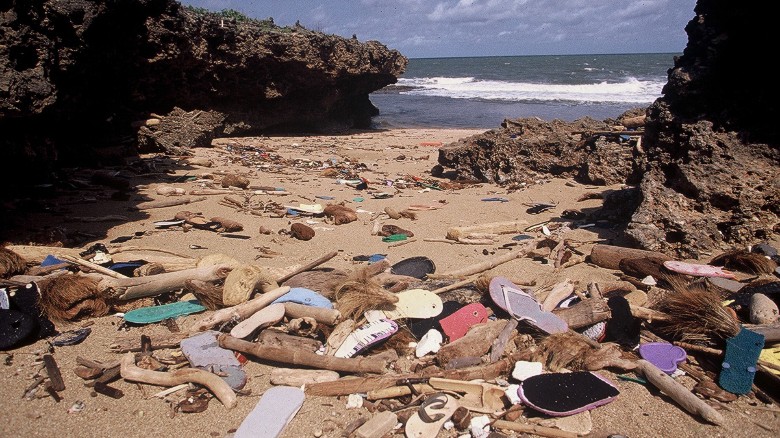
Each day, consumers purchase cheaply made flip-flops, and each day these flip-flops are thrown away — discarded in a landfill or dumped in the ocean. It’s a classic case of wasteful manufacturing.
The flip-flop and sandal industry have not been immune to the calamity of overproduction.
Millions of discarded flip flops posing a huge hazard to ocean life
The average lifespan of a flip flop is two years.
Tons of them are washing up on coast all over the world.
According to one estimate by 2050, there could be more plastic than fish in the seas by weight. Flip flops contribute approximately 90 tons a year.
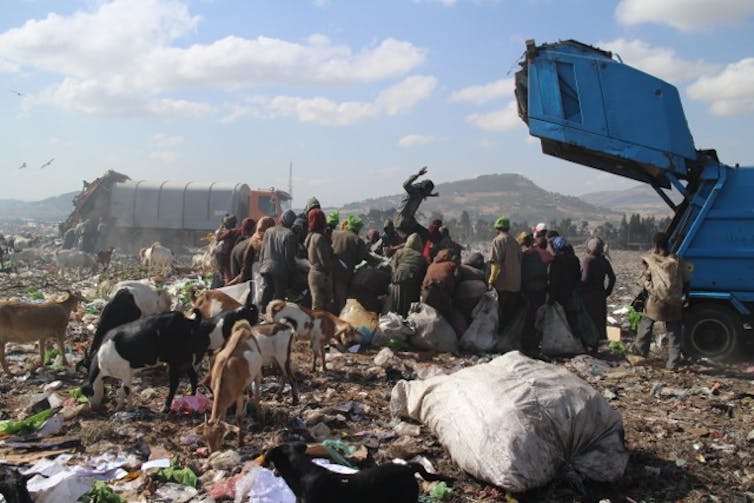
Before they reach the ocean they’re already a problem polluting freshwater ending up in landfills with no hope of biodegrading.
We don’t actually know how much rubbish there is in our oceans. But we know that most of it is plastic and that much of this is not visible to the naked eye.
It’s microplastic, which comes from emissions from our treatment plants or from larger pieces of plastic that have been decomposed by the sunlight or ground into smaller pieces by wave action. These minuscule particles, less than five millimetres in size, can be eaten by plankton, which is eaten by fish.
Produced from plastic foam that contains DDT, PCBs and flame retardants they’re upcycled and travel thousands of kilometres absorbing environmental toxins which they transfer to the island shores.
Three billion petroleum-based flip-flops are produced annually, eventually ending up as non-biodegradable trash.
It may be a while before this technology finds its way to three billion people’s feet.
22 billion water bottles are thrown away every year.
The history of flip-flops can be said to be quite long.
Ancient Egyptian murals on tombs and temples show flip-flops were worn around 4,000 B.C.
As early as thousands of years ago, humans used animal skins or all available materials to wrap them around the soles of the feet.
They come in all disguises – “jandals” “thongs” “plakkies” “zories” “clam diggers” “slippers” “crocs” “zori”.
Billions of them are made every year, often in small factories in China. Flip-flop sales rise with the world population. As one billion people globally still walk barefoot, they are the first step into the world of shoes across the global south.
They also tell stories of how globalisation actually works on the ground.
Garbage is not just inert discarded material, but an active agent in making the future.
We live in an energy-based world. Fossil fuels are burned to produce electricity, which powers the factory in which the plastic is made. Plastic is very important for the economy to grow because in today world it is used in each and every place from cars till rockets.
Take a flip flob for example.
The flip flop is one of globalisation’s darker stories connecting smugglers, disposable workers, garbage pickers and the poorest of consumers.
Their story begins in the hydrocarbon economy – in the oilfields of the Middle East. From crude oil are made into little plastic pellets. The plastic pellets are bought by millions of small and medium-sized flip-flop factories throughout the world in production clusters where labour is cheap.
Like all products, they have a massive carbon footprint in setting up its Manufacture – materials- energy -etc.
Bought online they probably started there life in China transported either by air or sea – Package – reflown and then driven to the buyer.
We humans need to think about how we manage our rubbish. It’s not only about people on the other side of the earth, but it’s also about ourselves.
We need to stop buying unrecyclable items.
All human comments appreciated. All like clicking and abuse chucked in the bin.
Because we have not yet grasped the enormity of what is happing.
Why?
Because there are so many dimensions to the climate problem – natural science, social science, policy etc.
It’s all jolly well to say that human-induced climate change is widely regarded as one of the greatest – if not the greatest – moral challenges of the 21st century. Not merely does it raise numerous ethical issues, but many of these are profoundly difficult and take us to the limits of our moral imagination.
Moreover, the ethical dilemmas posed by climate change arise at multiple levels – for citizens, scientists, policymakers, organisations, companies, nation-states and the international community – and traverse many different areas of moral inquiry.
If we go on ignoring climate change there will be a social collapse not because the world is getting warmer but because we will be unable to feed ourselves.
There might well be a growing realisation by the public that the weather is changing but in the scientific community, there is a growing realisation that we are rapidly approaching if not already reaching tipping point.
The distribution of seasonal mean temperature anomalies has shifted toward higher temperatures and the range of anomalies has increased.
If existing feedbacks change because the climate changes, or if new feedbacks like permafrost or methane hydrates become relevant, 2C rise will not be the bottom of the range. Add in the extra warming arising from the loss of ice and you have temperatures rises away above.
You don’t have to be a climate scientist to agree that these anomalies are a consequence of global warming because their likelihood in the absence of global warming is exceedingly small.
It is not possible to continue with unstainable capitalist profit which is destroying itself by ignoring science.
Here are the questions yet to be answered.
What is the nature and extent of our responsibilities to future generations?
What is the value of individual species and ecosystems, and how should we value the possible extinction of millions of species?
How should we make decisions in the face of uncertainty, including the possibility of catastrophic and irreversible damage to our planet?
What criteria should be used to determine the appropriate targets for the
stabilisation of greenhouse gas concentrations in the atmosphere?
Who should pay for the inevitable costs of climate change mitigation and adaptation, and to what extent, if at all, should those who suffer the negative impacts of climate change be compensated?
How should the international community respond if certain sovereign states block effective global action or refuse to contribute fairly to the collective effort?
The above are also the reasons that we will be unable to act as one.
Capitalism unsustainable policies for profit ensure this. No one wants to bear the cost.
So there is only one solution to make a profit for profit sake pay.
A world aid commission of 0.05% on all profit. ( See previous posts)
All human comments appreciated. All like clicking and abuse chucked in the bin.
With all our technology and communication tools one would think by now that the messages being sent by Earth in the form of climate change would be ringing alarm bells all around the world.
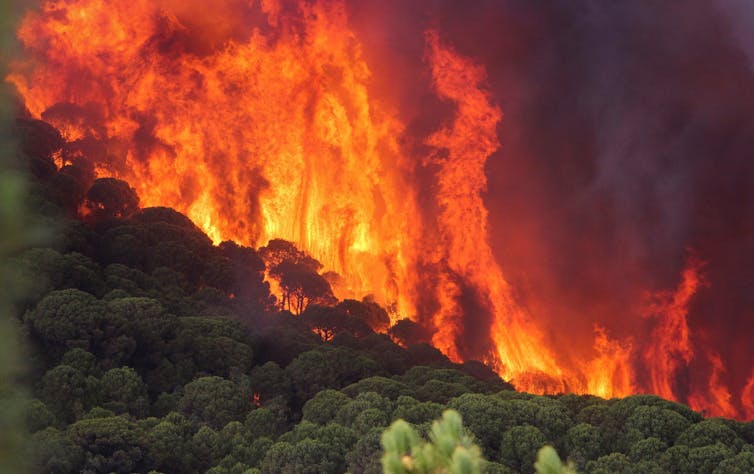
Unfortunately, our existential anxiety is still not fueled by a burning planet.
We have many world leaders, but no leadership.
Yes, the world is better off when leaders act in their nations’ best interests and it is hard to argue that we’re not in a time of crises. Civilisation is best served when leaders also act in the best interest of their region and that of the community of nations.
That requires leadership.
The reality of climate change is now staring us all in the face but we are unable to take collective action.
We all have different views on today’s reality, but when our world and civilization has been viewed as it truly is, nothing could be more disgusting than what pathetic human rule has done to our entire world population.
The UN remains an indispensable world forum to coordinate policies, voice grievances, and even take collective action. But the effectiveness of the world body is determined only by the efficacy of the leaders of its member states, notably those permanent residents of the UN Security Council – the world’s government.
Unfortunately, they preach that which they don’t practise, cause tensions, and create more problems than they solve.
Therefore seeing just how much civilization all around this world has been suffering so badly in many different ways through pollution, genocide, violence, GMO, pharmaceuticals, human trafficking, slavery, torture, and now natural worldwide disasters, you would be right to say the chances of global cooperation to tackle Climate change is impossible.
When all that any individual can really see is all the pain, suffering, and the many difficulties upon billions; all they really want most out of their own life is the way to help all on this earth by taking control but the chances of replacing greed with common sense are zero. As human beings in a messed up world, all that we can do is live day by day with hope for better tomorrows.
This is the reason why we just do not hear the truth that the world is at a pivotal point.
The Earth is a beautiful machine without consciousness hence it will react without any self-monitoring ability.
The old world order is no more, but there’s no new world order either. The confusion allows all to blame all, and in the process, everyone escapes accountability for their lack of international responsibility.
Climate change might sound unbelievable but it is not a false alarm.
It is never wise to underestimate the ingenuity of Mother Nature and I am sure that there is no one doubts that the future will still have unpleasant biological surprises in store.
It seems a sensible precaution, therefore, to start taking action before the climate is wreaking havoc on the human race.
We cannot be sure that anything our primitive species ever designed would be effective against Climate change.
History is full of nightmares, some natural some man-made.
We might have peace of mind before whatever inescapable doom awaits us ( in not the so distant future) Accepting that it is an impossibility to get humanity to act as one we need a country to lead by example.
As there is no good worldwide for the benefit of our entire population, but rather only misleading lies in every direction what better country than Ireland the land of forty shades of green.
WHY NOT CALL A WORLD CONFERENCE:
Every human being has a relationship with plastic but unfortunately not ever one has a relationship with nature that is now facing a crisis that requires once again International recognition of the Unity of the Globe.
This is where Ireland has a moral duty to call on all nations of the world to attend a Unity of the global conference, in the Emerald Isle.
For every participant in attendance, Ireland will plant a tree to offset their travelling carbon footprint.
The Paris Climate change conference achieved shallow unbinding promises.
The clock is ticking until the next US election starting in November 2020 with the winner inaugurated on Wednesday, January 20, 2021.
Just think of the influence of such a world meeting would have on the election of new USA president and its policies re Climate Change.
If you want to leave a legacy to be remembered by other than the backstop/Brexit what better opportunity to promote the Green.
This gathering should have not just world leaders but leading Industrials, representatives from world organisations and the young that are going to inherit the earth.
Its sole purpose is to present the facts from all side and recognize the need for the world to act as one and achieve a just climate change program that is binding and fully financed – a moon landing moment.
The venue could be at Croke Park.
We are now in need of universal laws of logic and we have to assemble them in such a way that at least one of them work.
There is no more room or time for the Blame game.
All human comments appreciated. All like clicks and abuse chucked in the bin.
AND NOW HAVE TO SOLVE OUR PROBLEMS WITH STONE AGE RULES.
WE CAN CALCULATE WHEN WE NEED TO BE DONE AND IT’S FRIGHTING WHATEVER WAY YOU LOOK AT IT.
IT’S ONLY US THAT CAN DESTROY THE CLIMATE OR CHANGE HUMAN BEHAVIOUR ENOUGH TO STOP IT.
We must now face the inevitable that long before Voyager Two sents back its last message it is most likely that there will be on here to hear it.
It’s happening everywhere, you can see it and you can feel it but for the most part, it is the invisible that will change first. Environmental change, Human factors, Economic effects and Political effects.
But, wait! There are people who are convinced that such a thing will never happen. Our ingenuity, they say, it is more than able to take care of that situation.
Without a habitable planet, we’re not destroying the world, we’re destroying ourselves.
There are six factors that make earth the habitable planet that it is now: water, temperature, atmosphere, energy, biogenic compounds and distance from the sun.
THERE IS NO POINT talking about it, writing, protesting, crying, the price has to paid now not in the distant future.
The change that is to come when we are the past will not suffice.
THERE IS NO POINT WAITING TO SEE WHAT WILL HAPPEN.
THERE IS NO POINT IN PARIS CLIMATE AGREEMENTS WHICH CANNOT BE INFORCED OR PAID FOR.
THERE IS NO POINT DECLARING AN EMERGENCY ON DEAF USA /CHINA/ RUSSIAN/ INDIA, EARS.
THERE IS NO POINT ASKING THE CAPITALIST SYSTEM TO CHANGE OR PAY FOR THE DAMAGE DONE.
These ecosystem services are taken for granted and their willful obliteration proceeds at an ever-accelerating pace, despite ample evidence that we are committing suicide.
THERE IS NO POINT RELYING ON TECHNOLOGY TO RECTIFY THE PROBLEMS.
THERE IS NO POINT IN PRAYING TO WHATEVER GOD OR GODS YOU BELIEVE IN.
THERE IS NO POINT RECYCLING PLASTIC BY BURNING FOSSIL FUELS.
We now pretend that returning to plant carbon that is produced in annual cycles will somehow replace the geological carbon sources produced over eons.
THERE IS NO POINT planting trees, virtue will not be rewarded.
THERE IS EVERY POINT TO TACKLE INEQUALITY.
Scarcity of resources that can be alleviated only by market-based solutions.
Unfortunately for all Earthlings of whatever religious persuasion, the pristine lakes, rivers and streams, clean beaches, thriving forests, living oceans and seas, and fertile unspoiled land, cannot be “produced” by more regulations or by less.
Despite recycling efforts, almost 9 million tons of plastic end up in our oceans.
To deliver biofuels that would displace all fossil fuels, as well as food, we would have to manufacture and colonize six extra Earth-like planets.
I submit to you that this is the grandest of the many delusions that have ripped through human cultures over the millennia.
So here is a blog to read that tell the truth.
( “In order for us to maintain our way of living, we must, in a broad sense, tell lies to each other, and especially to ourselves. It is not necessary that the lies be particularly believable. The lies act as barriers to truth. These barriers to truth are necessary because without them many deplorable acts would become impossibilities. Truth must be at all costs avoided.
When we do allow self-evident truths to percolate past our defences and into our consciousness, they are treated like so many hand grenades rolling across the dance floor of an improbably macabre dance party. We try to stay out of harm’s way, afraid that they will go off, shatter our delusions, and leave us exposed to what we have done to ourselves and to the world, expose us as the hollow people we have become.
And so we avoid these truths, these self-evident truths, and continue the dance of world destruction.” Derrick Jensen, A Language Older Than Words, Context Books, New York, 2000, Silencing, page 2.
People all across the world are scared, angry and disoriented, and their governments routinely fail to explain the very basics of what is going on. Why is that?
Perhaps for the first time in modern western democracy, our leaders and leading intellectuals are relying in an essential way on keeping people confused. This puts us on the opposite side of the moon from the attitudes of John Locke, Jean-Jacques Rousseau, Voltaire, Thomas Jefferson, Benjamin Franklin, Thomas Paine, and so on, who did their best to explain their thinking clearly to all. When these great men lived, the Earth surely seemed infinite, but she is very small today.
Here is the kicker: To pretend nowadays that the Earth is infinite, as most of us effectively do, and is capable of feeding our runaway economy ad infinitum requires some serious self-delusion.
In fairness to our leaders, they lie and we eagerly consume their lies, because otherwise, we would have to change from within, and for most people change is genetically impossible. Generally, we leave change to political campaign slogans which so obviously lies that we do not have to do anything.
So, this is how it goes. Someone lies about an economic recovery which is just around the corner; someone else lies about the banks that must be saved at any cost with our money because they are too big to fail; and yet somebody else professes that converting over half of our fossil-fuel driven food to a fossil-driven biofuel is good for all. And we all listen to these empty lies and eagerly try to believe them, for what else we can do. That is a good question, isn’t it: What else can we do? Can you think about a thing or two you could change on your own?
How far do we need to step outside of the current system of lies that are fact to most?
Not that far, it turns out. All we need to do is to admit that the Earth is finite, her resources are finite, and the current global economic system cannot grow. In Europe, Japan, and the U.S., the respective economic systems have already reached the maximum attainable complexity and must undergo deep simplifications.
My Conclusions
“ “Maturity,” Bokonon tells us, is “bitter disappointment for which no remedy exists, unless laughter can be said to remedy anything.” ”Kurt Vonnegut, Cat’s Cradle, Chapter 88, page 198.
More of the tropical forest has been burned alive and a new oil palm or soybean plantation is born. This plantation will produce biodiesel or feed for Chinese livestock. The good environmentalists will observe that the carbon footprint of the clean biodiesel produced on this plantation is negligible. The good marketers will say that a free-market solution is used to develop an idle resource in a third-world country. I say that everybody lies to cover this self-evident crime, but the living Earth is diminished further, in exchange for 10 – 20 years of someone’s illegal cash profits, most likely financed with a World Bank loan. After that, the polluted, depleted, and eroded-away land will be abandoned, and the plantation will take over another area of the forest. And so on, until we run out of the forest.
I am mature alright, and I laugh a lot, but this is what I must say through tears: The Earth is not in a state of “environmental crisis” that would imply a temporary condition amenable to remediation. Because of too many people, who consume too much and produce too many things using messy technologies, the Earth is in the state of chronic environmental degradation which shows signs of acceleration, not abating. There are no global solutions, but there are ever more deleterious designs on what is left of the environmental services of the planet. One such big design involves the production of biofuels in the tropics, and Europe and the United States of America are deeply implicated.
We want to avoid the outcome of Cat’s Cradle: All life on Earth being exterminated by superior science. Thus, we need to step out of the bounds of our current systems thinking and look from the outside on the false security of our complex societies. Perhaps then we will be able to see more clearly where this continuing environmental degradation leads us and do something.
It is safe to say that my difficult and unpleasant suggestions will not be heard by mainstream journalists and politicians on the left or the right. But what is bound to happen then? My natural laughter freezes when I think about the consequences of stumbling along, while also knowing that exactly nothing will happen until it is way-way too late“.)
Most people don’t realize What happens to our heat-trapping fossil fuel emissions after we release them, … will continue to expand even though Earth’s atmosphere has begun to recover.
A human can live for only 5 minutes without air, 3 days without water, and 30 days without food.
If you want to live now is the time for Profit Capitalism to be made to pay. ( See previous posts on a World Aid
With Climate change now becoming a by-product of consumerism we will unfortunately all end up as products of our cultures.
There is no second world that any of us are going to to visit.
All human comments appreciated. All like clicks and abuse chucked in the bin.
Twenty years ago, in 1999, the world was a completely different place than it is today.
Why?
Because we are creating a much more difficult world. A populist World.
A world no matter where you go you can’t get off the grid.
Post a 2009 photo of yourself next to a recent one, to show how much you’ve changed.
Millions have and are criticised for being – among other things – narcissistic, ageist and sometimes a bit sexist.
Each generation brings new social issues to the forefront.
Although 1999 might not feel that far away sometimes when you think about how much the world has changed since then, it feels like it happened a million years ago.
You now get updates from the president of the United States on Twitter.
In 1998, the world global population was sitting at 5.9 billion Fast forward 20 years, and the world’s population is estimated at 7.6 billion.
Twenty years ago, less than half of the world’s population lived in urban areas, today 55% of people live in urban areas.
It’s hard to imagine a world without the internet today, but that wasn’t the case 20 years ago.
The internet has transformed virtually every aspect of our lives, from the way we communicate to how we consume news, shop, navigate, and entertain ourselves.
In 1998 a little company called Google was born then came Facebook.
Today, more than two-thirds of all Americans are on Facebook, the most popular social media platform, and in three years there are estimated to be more than 3 billion social media users overall around the world.
The first cell phone was created in 1973.
Today, you can talk on the phone and use the internet at the same time.
For many people, the “Phone” feature has become one of the least-used features. But in the future, phones could make another drastic change. The World Economic Forum thinks that the first implantable phones will become commercially available by 2024.
It wasn’t until after the Twin Towers fell in New York due to the attacks on 9/11 (in 2001) that terrorism became a much more real threat.
The September 11, 2001 attacks led to resentment toward Arabs and Muslims in the Western world that arguably hasn’t subsided in the years since. The attacks also gave way to wars in Iraq and Afghanistan — the latter of which is still ongoing.
On 17 December 2010, a Tunisian street vendor called Mohamed Bouazizi refused to pay a bribe to local officials, so had his fruit and vegetable cart confiscated as a result. Faced with an unforgiving bureaucratic process, he set himself on fire.
This act, less than 10 years ago, was the catalyst for what was later known as the Arab Spring – a wave of protests across the Middle East and North Africa that, in some cases, led to bloody civil wars and a refugee crisis that saw a record number of people forced from their homes.
Yemen, where a three-year civil war has led to the world’s worst humanitarian crisis today.
Today, mass shootings are happening on a much more regular basis in the US and terror attacks around the world are commonplace.
After the financial crash trust in financial institutions has never been lower.
Self-driving cars are on the thresh hold of reality.
2018 was when the world really woke up to the reality of plastic pollution as well as climate change. Scientists calculate that about 10m tonnes of plastic waste ends up in the oceans every year – and that some of that can take hundreds of years to biodegrade.
The biggest change today for all is that Climate change is becoming a grim reality.
The planet’s average surface temperature has risen by about 0.9C since the late 19th century – and about a third of that has happened in the last decade.
Almost 200 governments will meet in Paris in late 2015 to try to agree on a deal to limit global warming to avert floods, droughts, heatwaves and rising sea levels blamed on rising emissions of greenhouse gases.
THE CENTRAL CONTRADICTION of climate change is that it is at once the most epic problem that our species has ever faced yet it is largely invisible to the average human.
The implications are shocking but something more subtle will also unfold:
As the climate changes, humans might adapt to some extent, and move, but animals and ecosystems won’t be able to in that short time period.
It’s these indirect impacts on natural and agricultural systems that will cause the collapse of society, countries, our ability to live. Given the magnitude and rate of these changes, If you don’t have a good idea of what’s coming, it’s hard to mitigate against the threat.
What we are talking about here is average climate, not the weather.
The problem is that climate systems are monumentally complex, and impenetrable datasets do little to change our understanding of climate change. It becomes psychologically distant.
But it is here, and it’s already wreaking havoc.
Though we’re starting to feel the effects of climate change, those effects are not dramatic enough on a day-to-day basis to convince the majority. Unfortunately, scare tactics don’t work to change people’s beliefs and behaviour.
If the problem was that bad, wouldn’t we be putting effort into solving it?
If there’s nothing you can do about it, you disconnect, you disengage.
In fact, the election of Donald Trump — who’s called climate change a “hoax” and said on Twitter that climate change isn’t real because it’s cold out.
So, what can be done to make even more people care about climate change? To motivate people to take action, it’s important to connect climate change to something tangible, like air pollution and health problems.
We will not be returning to what it was.
We live in “MarketWorld” now governed by algorithms.
These entities aren’t doing anything good; There’s still no real alternative to our profit-driven economy.
A better world is just one time-management app, one brilliant entrepreneur.
No matter what, if we emit CO2, we are hurting future generations.
By the end of this century, some parts of the world could face as many as six climate-related crises at the same time
We as humans don’t feel the pain of people who are far away or far into the future.
However, the costs of inaction greatly outweigh the costs of taking action. The dire the situation is for humanity, unprintable here.
All human comments appreciated. All like clicks and abuse chucked in the bin.
We all accept that in a thousand trillion years from now when what left of the Universe that the human species and all others will not exist.
So there is no need to worry nor will there be any need to worry in 6 billion years that the earth will be fried by the sun.
Or in 50 years or perhaps in twelve years our human footprint is predicted to make most if not all the earth unlivable dehumanizing us all.
We have all witnessed today the consequences of dehumanization, ISIS, Rwanda Genocide, Extermination of Jews by the Nazis but it is wrong to assume cruelty comes from dehumanization it’s not the whole picture we often fold to the social pressures of our environment.
Since the dawn of humanity, we are all capable of it in one form or another and there is no doubing that it will follow us into space.
Wars, Famines, Genocides, Religious bigotry, Racial discrimination, Mass killings you name it and you could have participated in that, and that’s the ugly truth.
The conclusion is that almost anyone is capable of committing staggering atrocities under the right circumstances as we don’t behave in stressful situations the way we think we would or the way we would like to.
Military service relies on dehumanization so people are able to do terrible things to other people only after having dehumanized them.
Acknowledging other people’s humanity won’t solve our problems.
We need a culture less obsessed with power and honour and more concerned with mindfulness and dignity.
If you were able to realize that Jews, Blacks, Gays, Muslims, were people just like you, then evil might disappear but brutality would still prevail within all.
Take white supremacists they know about the humanity of Jews and black people and whoever else they’re discriminating against — and it terrifies them.
One of their slogans is, “You will not replace us.” Think of what that means.
That’s not what you chant if you thought they were roaches or subhuman. That’s what you chant at people you’re really worried about, people who you think are a threat to your status and way of life.
So cruelty isn’t an accident or an aberration, but something central to who and what we are. This is reflected in the psychological appetites we have, like an appetite to punish those we think have done wrong.
Dehumanization is real and terrible.
We all know what is wrong with the world we live in – inequality.
As long as human civilization continues to be dominated and is disfigured by capitalism we will see one atrocity after and other.
Such as.
There are over 35 major conflicts going on in the world today.
35% of the world’s people live in countries in which basic political rights and civil liberties are denied (such as freedom of speech, religion, press, fair trials, democratic political processes, etc).
20 million people held in bonded labour.
Up to 2 million, mostly woman and children, are victims of human trafficking worldwide.
Why are human beings so cruel to each other? And how do we justify acts of sheer inhumanity?
60 per cent of mammal species are not known to kill one another at all.
The simple answer is that it’s in our genes.
One could rattle on forever on the subject and get nowhere but because of the effects of Climate Change to come in the next 12 to 50 years, we are going to see humanity test to breaking point.
However evolutionary history is not a total straitjacket we can build a more pacific less cruel society if we wish.
Climate change is going to intensify our efforts to solve the world’s most serious and pervasive problems. With all our technological advances both climate change and cruelty will be intimately linked.
Who will decide upon areas to be saved?
On what criteria. By the general appearance or what are the main ecosystems in them.
When it comes to murderous tendencies, humans really are exceptional.
Success will be hard won, mostly because there will be no single path to saving, room for reefs, forests, and other keystone habitats given the huge diversity of cultures, political systems, geographic situations and stages of development in human communities from the inhabitable fringes of the poles to the Equator.
We can’t save ourselves without saving the very ecosystems we all rely on.
A moral abyss.
Humanity is a juggernaut which is essentially mindless presently displaying a combination of ignorance and despair.
With the building toward a stabilizing earth’s climate will see cruelty on a global scale.
The range of threats is dizzyingly varied.
But there are many pathways to solutions, we have no need to surrender to nihilism.
The causes—human population growth, habitat loss, climate change—are complex and interlocking, fueling each other in an ever faster destructive spiral.
We are still at the beginning of a potential mass socialist movement, not a Consumerism, not Communism but an era in need of citizens attachment, with a vested interest in our future — a priceless opportunity we cannot afford to waste.
(See the previous post on Citizens Bonds)
This could be an era, in which value is extended to saving the rest of nature. Knowing it, preserving it, studying it, understanding it, cherishing it, and holding on until we know what the hell we’re doing.
I think that, for the most part, people who do terrible things are just like us. They’ve just gone astray in certain specific ways.
So why worry?
The human populations of the plante is incapable of recognizing the cruelty it inflicts on all forms of life till it s to late.
All human comments much appreciated. All like clicks and abuse chucked in the bin.
The international community is a phrase used in geopolitics and international relations to refer to a broad group of people and governments of the world. It slips off the tongue of BBC correspondents and newsreaders as if it is just good old plain common sense.
The international society thinks this … believes that … is concerned about.
HOW OFTEN HAVE WE HEARD COUNTRIES APPEALING TO THE INTERNATIONAL COMMUNITY.
Are they wasting their breath?
If you were to asked me I would say that activists, politicians and commentators often use the term in calling for action to be taken in order to deflect their own countries dismal response.
We all know what is meant by the term ‘international community’, don’t we?
It’s the west, of course, nothing more, nothing less.
Just look at the global issue of climate change which could not be more International which urgently requires a common strategy with binding targets that must be defined on a planetary scale. The central driver of climate change risk is mainstream economic (development) models which aspire to carbon-intensive industrialization.
It is speculated that our global interconnectedness, instead of (only) making us more resilient, makes us more vulnerable to global catastrophe.
Solving climate change will take a global effort not an international effort.
Take Aviation pollution alone it is forecasted to triple by 2050 if there are no global policy measures are agreed.
The Earth can not appeal to an International community but our world in whichno individual, and no country, exists in isolation, is now facing perhaps its final disaster.
The involvement of Muslim countries – and from contrasting traditions to those of the Arab world – would be most valuable.
It would also represent a most welcome redefinition of the “international community.
Take China for example:
In fact, the Chinese have their own definition of “international community” to counter what they see as a western-dominated and defined international community.
Take Lebanon, for example:
What did the beloved “international community” think:
Take War-torn Syria, for example:
It is one country where there are sharply divided views between the West on the one side and China and Russia on the other.
Take India, or Latin America, or Africa, or South East Asia?
What do they think?
We are never told. Nobody bothered to find out.
Take Brexit.
Everyone seems to have someone, perhaps some group of people, on whom he or she looks down or whom he or she considers inferior. That is why, for example, the west finds it almost impossible to win votes on many issues in the UN general assembly.
If we are brutally honest with yourself it comes from sheer ignorance.
There is no international community. There is merely a group of states motivated by self-interest.
The international community is a mythical joke.
There will never be one that is worthy of respect rather than a cheap joke.
What we got is a digital dictatorship in its infancy. A world run by Algorithms mostly for profit.
What is needed is an global awaking.
All Human comments appreciated. All like clicks and abuse chucked in the bin.
We live in a world where consumerism is more important than needs.
It overshadows all of our human activities moving desires to the forefront of any aspirations of democracy.
One can ask how has this happened?
The answer is staring us in the face there is no need to look further than free-market capitalism which has married itself to democracy.
Edward Bernay’s its creator (with the help of President Roosevelt, and his uncle Fraud applied the propaganda of war to the propaganda of peace) at the World Fair in 1893 consecrated the marriage of passive consumerism with the market by Public relations, thus engineering the consent of the masses.
As a result of to this day, we are unable to make decisions on a rational base.
So what!
Just look at the state of the world today. The fourth Industrial revolution.
It makes for dismal reading.
There have been over 250 major wars in the world since World War II.
There are over 35 major conflicts going on in the world today.
There are approximately 30,000 nuclear warheads in the world today.
Current global military spending is approximately $800 billion per year; more than the total annual income of the poorest 45% of the global population.
An estimated 27 million people are enslaved around the world, including an estimated
20 million people held in bonded labour1 billion people – 1/3rd of the world’s labour force, is unemployed or underemployed. At least 700,000 people annually, and up to 2 million, mostly women and children, are victims of human trafficking worldwide (a modern form of slavery.) About 246 million, or 1 out of 6, children ages 5 to 17 worldwide are involved in child labour.
Worldwide, a quarter of all women are raped during their lifetime.
Torture occurred in 125 countries.
There are over 45 million refugees and internally displaced people in the world.
800 million people lack access to basic healthcare. 17 million people, including 11 million children, die every year from easily preventable diseases and malnutrition.
800 million people are hungry or malnourished. Nearly 160 million children are malnourished worldwide. 11 million people die every year from hunger and malnutrition.
2.4 billion people lack access to proper sanitation.
Over 100 million people live in slums.
275 million children never attend or complete primary school education. 870 million of the world’s adults are illiterate.
The richest 1% of the world’s people earned as much income as the bottom 57%.
The wealth of the world’s 7.1 million millionaires ($27 trillion) equals the total combined annual income of the entire planet.
Africa alone spends four times more on repaying its debts than it spends on health care.
Half of the forests that originally covered 46% of the Earth’s land surface are gone.
Between 10 and 20 per cent of all species will be driven to extinction in the next 20 to 50 years. Up to 47% of the world’s plant species are at risk of extinction.
60% of the world’s coral reefs will be gone.
Desertification and land degradation threaten nearly one-quarter of the land surface of the globe. Over 250 million people are directly affected by desertification, and one billion people are at risk.
Global warming is expected to increase the Earth’s temperature by 3C (5.4F) in the next 100 years, without reaching a tipping point – resulting in multiple adverse effects on the environment and human society, including widespread species loss, ecosystem damage, flooding of populated human settlements, and increased natural disasters.
All of this is only the tip of the iceberg.
The scale and nature of the world’s problems demand a full response; and the need for more unification and intensification of efforts to solve the world’s most serious and pervasive problems.
What are we doing about it since 1893?
Poured trillions in to aid to created debt.
Manufactured a financial crash.
In each country, the tendency is to blame “our” history, “our” populists, “our” media, “our” institutions, “our” lousy politicians.
When we discuss “politics”, we refer to what goes on inside sovereign states; everything else is “foreign affairs” or “international relations” – even in this era of global financial and technological integration.
its inability to withstand countervailing 21st-century forces, and its calamitous loss of influence over human circumstance.
Turning products into environmental false benefits with the loss of control over money flows.
Watching on as democracy being digitised. After decades of globalisation, our political system has become obsolete by introducing anxious volatility into the bastion of European stability.
Allowing unregulated algorithms to plunder the world for profit.
Turn a blind eye 65 million refugees – a “new normal”
Even if we wanted to restore what we once had, that moment is gone.
But to acknowledge this is to acknowledge not just the end of politics itself the end of life. Global capital and technology will rule us without any kind of democratic consultation, as naturally and indubitably as the rising oceans.
If we wish to rediscover a sense of political purpose in our era of global finance, big data, mass migration and ecological upheaval, we have to imagine political forms capable of operating at that same scale.
There is every reason to believe that the next stage of the techno-financial revolution will be even more disastrous for national political authority.
Big data companies (Google, Facebook etc) have already assumed many functions previously associated with the state, from cartography to surveillance.
With them taking over the management of all life and resources – this is a more likely vision for the future than any fantasy of a return to social democracy.
The assault on political authority is not a merely “economic” or “technological” event. It is an epochal upheaval.
What if anything can be done.
It is clear to me and by now should be clear to all of us that Capitalism is going underground. Today’s great engines of wealth creation are distributed in such a way as to elude national taxation systems (94% of Apple’s cash reserves are held offshore; this $250bn is greater than the combined foreign reserves of the British government and the Bank of England), which is diminishing all nation-states, materially and symbolically.
It is clear to me that the nation state’s rigid monopoly on political life is becoming increasingly unviable.
It is clear to me that oppressed national minorities must be given a legal mechanism to appeal over the heads of their own governments.
It is clear to me that the United Nations is effectively a gossip shope with vetos and is in needs of reform.
It is clear to me we need to find new conceptions of citizenship. Why, because the essential horizons of life on this planet are already determined at birth.(see previous posts)
It is clear to me that if democracy is supposed to give voters some control over their own conditions, for instance, should a US election not involve most people on earth?
It is clear to me that we are spending trillion trying to get off the earth when we should be spending trillions to try to stay on what is left of the earth.
It is clear to me that everything is linked.
It is time to think about how that capacity might be built.
It is time to wake up, to be conscious and take the needed steps to make a change. Stop pretending like you don’t know. Stop thinking its not going to happen in your lifetime. It will affect you and most of all your children and grandchildren. Do you still want to remain passive or pretend it’s not your problem?
What is clear to you?
They say a picture is worth a thousand words so I leave you with this video.
On viewing it.
It is beyone clear that our future generations will not thank us for their inheritance.
All human comments appreciated. All like clicks and abuse chucked in the bin.
We are rapidly approaching the era of ubiquitous surveillance, a time when virtually every aspect of our lives will be monitored. Leaving us vulnerable to all manner of manipulation and persuasion.
The goal is to automate us’: welcome to the age of surveillance
capitalism.
Google, Facebook Amazon, U Tube, Supermarket Loyalty Card,
Credit card spending, you name it and it is creating the
surveillance data and we continue to ignore the most vital data
that we are alive and can do something about climate change.
It’s impossible to take a long view of what’s happening.
SHOULD WE BE WORRIED?
While most of us think that we are dealing merely with algorithmic inscrutability, in fact what confronts us is the latest phase in capitalism’s long evolution – from the making of products, to mass production, to managerial capitalism, to services, to financial capitalism, and now to the exploitation of behavioural predictions covertly derived from the surveillance of users.
During all this surveillance some elements of our world will change beyond recognition while others will stay reassuringly (or disappointingly) familiar.
Some innovations we might not notice, while others will knock us sideways, changing our lives forever.
For example The use of biometric recognition devices to ensure the identity of a person.
Three things, however, are certain: technology will get smaller, smarter and cheaper while Climate change will cost TRILLIONS by the end of the century.
Perhaps there’s a technological barrier that can’t be surmounted, such as artificial superintelligence or weaponized nanotechnology but Global warming will no doubt disproportionately hurt the poor, broadly undermine human health, damage infrastructure, limit the availability of water, alter coastlines, and boost costs in industries from farming, to fisheries and energy production.
How different might life be 20 years from now?
I would bet you that it probably will be much like it is today.
Unfortunately, GDP is still viewed as a prerequisite to achieving global goals, even though it can’t stand for everything.
Food, clean water, good education and infrastructure, all these things need money to support so it’s inevitable and sad that climate change will become a product for profit.
However, the effects of Surveillance and Climate Change are going to be felt for hundreds, and possibly thousands, of years to come.
“A large fraction of climate change is largely irreversible on human time scales.”
Climate change and variability (e.g. increasing water scarcity), mounting / unresolved conflicts and refugee crises, increasing global inequalities which seem irreversible, and the questionable performance of the global economy (which is still very linked to increasing resource use) will still rule the roost.
Many people do not know what it really amounts to, either due to unreliable sources or deliberate misinformation, which has led to a series of myths about climate change.
First, it is important to be clear that climate change cannot now be avoided.
Climate change presents perhaps the most profound challenge ever to have confronted human social, political, and economic systems.
One of the central social, political, and economic questions of the century is: how then do we act?
It will present one of the most profound challenges to the way we understand human responses.
National governments are embedded in market economies that constrain what they can do.
We first have to get past controversies over cost estimates and distributions. (See previous posts: World Aid Commission Of 0.050% )
Activists think that the key here is simply getting the public to understand the facts by providing information.
The public should not, however, be understood as simply mass publics, which are problematic when it comes to mastering complex issues simply by virtue of their mass nature.
Increasingly, justice frameworks are being used in the development of climate policy strategies and as such, national governments can deploy this discourse when it suits their interests to do so. So developing countries can point to the history of fossil fuel use on which developed countries built their economies, such that fairness demands that it is the developing countries that should shoulder the burden of mitigation.
The response on the part of the wealthy countries is that for most of this history, their governments had no awareness that what they were doing could change the climate, and so ought not to be held uniquely responsible for future mitigation.
Dealing with major climate change issues has however never been a part of the core priorities of any government.
Governments acted swiftly and with the expenditure of vast sums of money in response to the global financial crisis in 2008–9. They have never shown anything like this urgency or willingness to spend on any environmental issue.
To date, very few national governments look at all like decarbonizing their economy or redesigning energy systems to reverse the growth in energy consumption.
This is why it is necessary to reframe the effects of climate change to where the government might involve recognition of the security dimension of climate change. Climate change can threaten the security of populations and vital systems, even in some cases threaten the sovereign integrity of states.
BUT: Neither coordinated collective action nor discursive reframings can stop at the national level.
Even if this was achieved Climate change involves a complex global set of both causal practices and felt impacts, and as such requires coherent global action—or, at a minimum, coordination across some critical mass of global players.
Like the heading to this post state:
Perhaps we need to think in very different terms about the coordination of a global response.
The Western Antarctic Ice Sheet has already gone into an unstoppable decline.
Currents that transport heat within the oceans will be disrupted.
Ocean acidification will continue to rise, with unknown effects on marine life.
Thawing permafrost and sea beds will release methane, a greenhouse gas.
Droughts predicted to be the worst in 1,000 years will trigger vegetation changes and wildfires, releasing carbon.
Species unable to adapt quickly to a changing climate will go extinct.
Coastal communities will be submerged, creating a humanitarian crisis.
Thankfully, we’re not completely out of options yet.
There is little point if we as the data is implying that the world is warming planting trees or hoping that some future technology is going to solve the effects of climate change.
We are all riding on the one big blue ball together, and no matter what happens we will be finally all be confronted (Thanks to climate change with our societal problems.)
Millions of voters will no longer cast their ballots based on emotional cues, defying their own clear self-interest or reason that has created a society that is consumed with looking out for yourself first.
So here are a few things that you can do now.
Reduce the emissions that are warming the world the fastest.
Vote Diem 25 in the forthcoming European Elections.
Lobby your Television Stations to include a least once a week a weather report on Climate change.
Use your buying power to stop purchasing products with Palm Oil or products wrapped in plastic or are transported from on side of the world to the other.
Support local products.
Demand from your government free education.
Protect our privacy at all costs (It won’t be easy to fix because it requires us to tackle the essence of the problem – the logic of accumulation implicit in surveillance capitalism. That means that self-regulation is a nonstarter.
Digital technology is separating the citizens in all societies into two groups: the watchers and the watched and it will become increasingly disruptive throughout this century and beyond with profound consequences for democracy because the asymmetry of knowledge translates into asymmetries of power.
Governments know this.
Whereas most democratic societies have at least some degree of oversight of state surveillance, we currently have almost no regulatory oversight of its privatised counterpart. This is intolerable now while climate change will be intolerable in the near future.
The fourth Industrial revolution will be the last. In effect, we are forcing future generations to retroactively subsidize our decision not to increase energy efficiency and move to cleaner fuels.
The warmer it gets, the less productive a country’s economy will likely be. Perhaps more concerning, however, is what could happen in a world where climate change is allowed to continue unmitigated.
All human comments appreciated. All like clicks and abuse chucked in the bin.
WE WILL BE TALKING ABOUT WHY WE CAN’T FIX THE PLANET.
At the moment we are basically being sold three misapprehensions concerning the scale of the threat of climate change.
The deadlines aren’t the problem. It’s our failure to heed them.
Remember, we are being told that carbon pollution needs to be cut in half in just 11 years. And to zero by mid-century.
The speed of change. The matter of sea level rise. The matter of air pollution.
There is little about what it would mean for public health. The lack of fresh water or food.
We’ll just invent our way out of the problem.
In reality, what’s stopping us is political inertia, which means the solution is political action.
The relationship between climate change and economic growth, climate change and conflict are not appreciated or understood or explained.
Only when you and others experience this future threat in the present (rather than something that is still a generation away) will it have enough motivational force to get you to engage in actions that take more effort today.
2% is an abstract concept and simply does not motivate people to act as forcefully as a specific one does.
On the path that we’re on now, climate threats are not taken as seriously because so much of it feels abstract or distant.
WE MIGHT NOT GET THERE AS SOON AS 2030.
BUT THE PATH THAT WE ARE NOW ON WILL DEFINITELY GET US THERE BY 2050.
THERE IS A LOT TO LOOK FORWARD TO BEFORE THEN AND IT WILL BE IMPOSSIBLE TO IGNORE IN A HOSTILE WORLD.
It is now becoming quite obvious that we’re not going to get below 2 degrees, and we’re on track for something like 4 by the end of the century. I don’t think that any climate scientists would argue with any of that.
We’re marching into a completely unprecedented environment. And we simply don’t know what it will look like or how it will impact us.
It’s not a matter of whether climate change is here or not, or whether we’ve crossed a threshold or not. Every upward tick of temperature will make things worse, and so we can avoid suffering by reducing it as much as possible.
Collective human action will determine the climate of the future.
Acting on climate change represents a trade-off between short-term and long-term benefits. It will transform the way that we relate to one another, our politics, etc.
WHAT IS NEEDED IS meaningful global action than was generated in Paris in 2015 and 2016.
The corporate world must now be made by law and economic incentives to align with climate action whether it like it or not.
Why?
Because Capitalist productivity the most powerful source of economic and social advancement is now with Artificial Intelligence becoming financialised.
( Financialization is profit margin growth without labour productivity growth.)
Of course, this will not happen as it will turn Climate change into profit for profit sake. We are beginning to see this already with the treatment Television is giving to the subject.
Therefore as I have advocated in previous posts Profit for profit sake can be made to contribute to resolving and paying the cost of reducing world emissions.
A world aid commission of 0.005% on all profit-seeking algorithms, on all high-frequency stock trading, on all sovereignty wealth fund accusations, on all foreign exchange transactions over $50.000, on all lotto winnings worldwide, on all sports winnings.
This will create a perpetual world aid fund that can be granted with no strings attached, other than total transparency to support all projects to reduce our carbon footprint worldwide.
It can be achieved with the click of a button.
All human comments and suggestions much appreciated. All like clicks and abuse chucked in the bin.



/cdn.vox-cdn.com/uploads/chorus_image/image/63313672/GettyImages_1060130714.0.jpg)





 bobdillon33blog