• About
  • THE BEADY EYE SAY’S : THE EUROPEAN UNION SHOULD THANK ENGLAND FOR ITS IN OR OUT REFERENDUM.

bobdillon33blog

~ Free Thinker.

bobdillon33blog

Tag Archives: Climate change

THE BEADY EYE SAY’S WE ARE TURNING INTO FOOLS WHEN IT COMES TO CLIMATE CHANGE, NOT TO MENTION TECHNOLOGY AND GENETIC ENGINEERING

29 Tuesday Aug 2023

Posted by bobdillon33@gmail.com in 2023 the year of disconnection., Climate Change., HUMAN ABILITIES., Human Collective Stupidity., Human Exploration., HUMAN INTELLIGENCE, Human values., Humanity., IS DATA DESTORYING THE WORLD?, Technologically Enabled Genetics., Technology, Technology v Humanity, Telling the truth., The common good., The essence of our humanity., THE NEW NORM., The pursuit of profit., The state of the World., THE WORLD YOU LIVE IN., THIS IS THE STATE OF THE WORLD.  

≈ Comments Off on THE BEADY EYE SAY’S WE ARE TURNING INTO FOOLS WHEN IT COMES TO CLIMATE CHANGE, NOT TO MENTION TECHNOLOGY AND GENETIC ENGINEERING

Tags

Algorithms., Capitalism and Greed, Capitalism vs. the Climate., Climate change, Distribution of wealth, Inequility, Technology, The Future of Mankind, Visions of the future.

( Five minute read) 

Like me today, many of us are being constantly bombarded by facts, figures and narratives that tell us our days on earth are numbered, that it’s our fault and that it’s also largely out of our control.

Our problem is that capitalism is designed to squeeze every last cent out of this planet until there is nothing left. We can either fool ourselves about that until it kills us, or we can change it.

Like many horror stories, this one features a main character full of futile determination to maintain a sense of normalcy even as the ominous signs of doom become ever more impossible to ignore.

We can chuckle knowing that the monster is going to come for our designated protectors.

We stop chuckling knowing that it’s coming for all of us next.

Homo sapiens rose above the lesser animals thanks to our ability to wield logic and reason, yet we have somehow gotten ourselves to a place where the knowledge of what is driving all these wildfires and floods is not enough to enable us to do anything meaningful to stop it.

As overwhelming and omnipresent as the climate crisis is, it is not the core issue.

The core issue is capitalism.

Capitalism’s unfettered pursuit of economic growth is what caused climate change, and capitalism’s inability to reckon with externalities – the economic term for a cost that falls onto third parties – is what is preventing us from solving climate change.

It is easy to imagine that a real live existential threat to our way of life would prompt any society to assume war footing and marshal everything it has to fight for survival. Unfortunately, this response only takes hold in actual war situations, where the threat is “other people that we can shoot and kill in glorious fashion”.

When the threat comes not from enemy people, but from our own nature, we find it much harder to rise to the occasion.

Where is the glory in recognizing the folly of our own greed and profligacy? Leaders are not elected on such things. We want leaders who will give us more, leading us ever onwards, upwards and into the grave.

The G20 is a perfect model of our collective failure to build institutions capable of coping with deep, long-term, existential problems that cannot be solved by building more weapons.

On the one hand, the head of the United Nations says that there is no way for the world to meet its 1.5C warming goal without the leadership of the G20 that claims to be bailing out humanity’s sinking ship with one hand while contributing billons of tons of carbon to the atmosphere by subsidising in the past five years $3.3tn to fossil fuel production and consumption.

—————–

It is not good to be too pessimistic on climate change, because we must maintain the belief that we can win this battle if we are to have any hope at all. That said, it sure does seem like we’re screwed.

We’re being led to believe that the society we’ve built has to ‘collapse’ if we’re to save the world.

We’re presented with a binary choice — save the planet and live a miserable existence, or accept that some populations (plant, animal, human) will have to act as collateral damage to ensure a quality of life that vaguely resembles our current one.

This whole thing of it being ‘a trade-off’ or ‘tough choices’ is based on our current lifestyle being awesome and the future being a kind of worthy ascetic hardship.

The message is that all the things you rely on to keep us safe are no longer part of a viable future fit for everyone. The sense is that when these things disappear, life will be unbearable. That we’re going to turn on each other

.It’s almost like our lives are being engineered this way.

Cuts to benefits, dismantling of free healthcare, with Government openly allowing the majority of wealth to be passed on to those who are already most wealthy.

—————-

We haven’t got a hope of addressing complex problems or creating a future fit for everyone.

Given the challenge we’re facing — one that’s complex, systemic and long-term, if we carry on acting from this place we’re going to really screw it up.

Climate change and the destruction of our ecosystems seem to be the result of persistent, rampant over-consumption. This is because our modern society is a consumer society.

It’s based on one simple idea: that consuming will meet your needs.

Others things we think are harmless serve to numb us: Netflix boxsets, smartphones, profit seeking algorithms, masquerade as the answer, but they are really just part of the same system — insurance policies, private healthcare and the multi-billion dollar ‘wellness’ industry.

New industries pop up to give us what we want without the guilt — sustainably sourced, vegan, fair-trade — but even aside from the minefield that is working out whether it’s really ‘sustainable’, it’s still built on the same system. A system built on a disconnection from your needs, that can never leave you satisfied with who you are and the world around you.

None of these things can or will ever meet our unmet needs for love, connection or trust in the world, so we continue consuming, throwing more things into the bottomless pit inside.

We seem to be more unhappy than ever before. More physically and mentally ill. More divided than ever. More stressed about our impact on the world.

Social media is a form of disconnection from ourselves that leads to the disconnection from each other that in turn leads to disconnection from our environment — which is the only thing that has enabled us to create the extractive, destructive system we have in place.

Given all this, ‘conscious consumerism’ and ‘green new deals’ will never offer the solution we need, if they are built on the fundamental idea of citizen is as consumer, working to earn, earning to spend, spending to consume etc.

I think the fundamental answer lies instead in rebuilding our lives around connection.

Recognise that if you would love other people to live in a certain way or see the world from a different perspective, this is only going to happen if others sense you’re not judging them to be wrong.

People are slowly but steadily finding that their real needs are met more consistently in self-awareness and relationship than they are in quick fix consumption.

We can’t all join a five-day protest and we’re not all ready to sit in a circle and talk about our feelings but that’s not what’s being asked of us.

Indeed, climate change itself is the ultimate negative externality: fossil-fuel companies and assorted polluting corporations and their investors get all the benefits, and the rest of the world pays the price.

Now the entire globe finds itself trapped in the gruesome logic of capitalism, where it is perfectly rational for the rich to continue doing something that is destroying the earth, as long as the profits they reap will allow them to insulate themselves from the consequences.

The path we are on, still, is not one that leads to a happy ending.

Rather, it is one that leads to the last billionaire standing on dry land blasting off in his private rocket as the rest of us drown in rising seas.

We talk about tipping points when it comes to the climate, but the real tipping point has long passed.

Its called inequality.

A strict definition of capitalism is a society where capital is privately owned, and workers are paid wages by private firms. Essentially it is a society with minimal government intervention and resources are distributed according to the outcome of free markets.

A looser definition of capitalism is a situation where business is left to the free market, but the government intervene in many areas of the economy like business regulation, health care and education.

In practice, using this definition of capitalism – most modern economies are essentially capitalist because it is the free market that dominates in the production and distribution of scarce resources.

Therefore, you can say the potential of reward makes inequality an essential ingredient of capitalism.

Therefore, capitalists with access to private property can ‘exploit’ their monopoly power to make a much higher profit than other people in society. Therefore those who inherit capital can enjoy high income even without any effort.

To redress some of the inequalities of capitalist society.

Regulate monopoly power, provide free education, so everyone has access to education and equality of opportunity.

  • Capitalism is unconcerned about equity. It is argued that inequality is essential to encourage innovation and economic development.
  • Socialism is concerned with redistributing resources from the rich to the poor. This is to ensure everyone has both equal opportunities and in some forms of socialism – equal outcomes.

Aspects of Democratic socialism

  • Advocates nationalisation of key industries (often the natural monopolies, like electricity, water)
  • Prices set by the market mechanism, except public goods, such as health and education.
  • Provision of a welfare state to provide income redistribution
  • Support for trade unions in wage bargaining
  • Use of minimum wages and universal income to raise low-income wages
  • Progressive tax and provision of public services. For example, marginal income tax rates of 70%. Tax on wealth.

There is no reason that Democratic socialism can not operate in a Capital society that is disappearing into the world of Profit seeking algorithms. 

For anyone still unsure that big, important things are now broken, several new titles paint a convincing portrait of grossly unsustainable inequality, corrupt political processes, and a looming crisis—much of it stemming from a financial system that for 40 years or so has prioritized short-term profit over all else and systematically removed any checks on its own worst impulses in pursuit of that goal. 

The single most important step is re-empowering governments, to start putting out the inferno.

All Human comments appreciated. All like clicks and abuse chucked in the bin.

Contact: bobdilllon33@gmail.com   

Share this:

  • Share on WhatsApp (Opens in new window) WhatsApp
  • More
  • Share on Mastodon (Opens in new window) Mastodon

THE BEADY EYE SAY’S: WE ARE STILL A LONG WAY FROM ANY WORLD UNDERSTANDING OF THE CONSQUENCES OF CLIMATE CHANGE.

23 Wednesday Aug 2023

Posted by bobdillon33@gmail.com in 2023 the year of disconnection., A Constitution for the Earth., Carbon Emissions., Climate Change.

≈ Comments Off on THE BEADY EYE SAY’S: WE ARE STILL A LONG WAY FROM ANY WORLD UNDERSTANDING OF THE CONSQUENCES OF CLIMATE CHANGE.

Tags

Capitalism vs. the Climate., Climate change, The Future of Mankind, Visions of the future.

(Twelve minute read)

Understanding the many challenges facing our world isn’t easy, but surely it should be easy to understand that we all survive only because of ecosystems that provide us with life.

The picture is bleak.

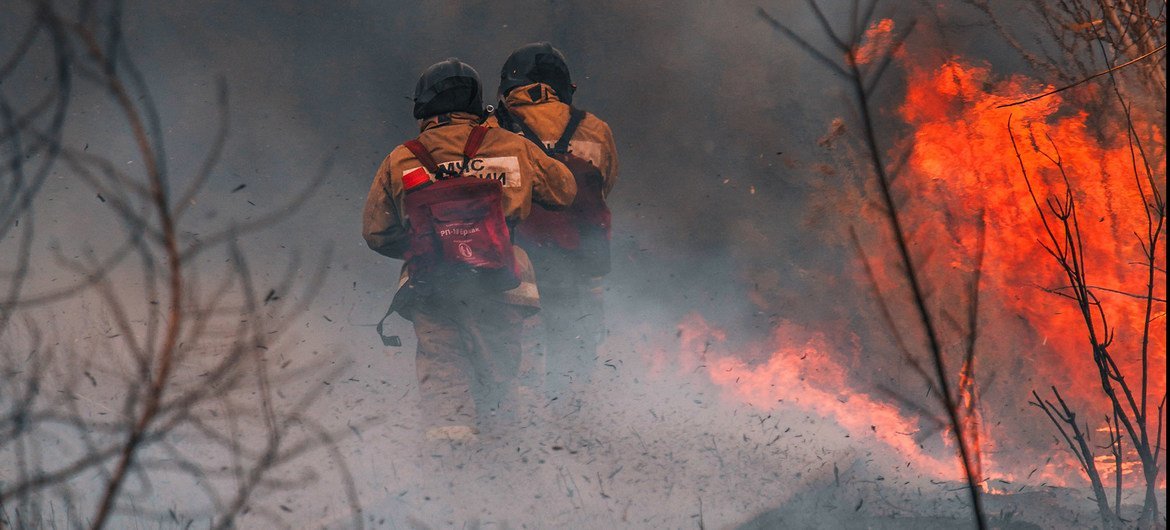
  Climate change increases the risk of hot, dry weather that is likely to fuel wildfires.

The chief reason is that the world has no history of dealing with such a difficult problem, nor the institutions to do so. The harm done by climate change is not visited on the people, or the generations, that have the best chance of acting against it. Those who suffer most harm are and will be predominantly poor and in poor countries.

The rising global temperatures are already fuelling devastating extreme weather events around the world, with escalating impacts on economies and societies and fulling future wars.

What many don’t realise about the warming of the present Earth, is that once we pass a certain threshold, physics takes over, where multiple earth systems march past the point of no return.

We don’t understand the non-linear effects.

There’s are referred to tipping points, best described as domino pieces waiting to topple in only one direction to the end.

Tipping points we thought might happen well into the future are already underway.

It has been clear for decades that the Earth’s climate is changing.

Although positive things have started to happen, even if all countries commit to achieve net zero emissions by the middle of this century its too late to reverse.

Global climate change is not a future problem. Some changes (such as droughts, wildfires, and extreme rainfall) are happening faster than scientists previously assessed.

While natural drivers will modulate human-caused changes, especially at regional levels and in the near term, they will have little effect on long-term global warming, reversal is beyond reach.

We really are out of time,

The scale of recent changes across the climate system are unprecedented over many centuries to many thousands of years, and will not be reverse by any technology.

We cannot wait for decades to act, we have to start acting.

————

Already in this decade.

Concentrations of the major greenhouse gases – carbon dioxide (CO2), methane (CH4) and nitrous oxide (N2 O) continued to increase. The difference between where emissions are heading and where science indicate they should be in 2030 is as large as ever.

The lifetime of carbon dioxide is so long, one year anomaly in emissions doesn’t change the big picture.

The truth is before our very eyes, in the prism of social media videos of burning wild fires, flooding, immigration, food shortages, you name it and it is happing.

It’s hard to understand that there will be a fresh water crisis when some countries are flooding.

It’s hard to appreciate the Arctic ice is disappearing when the winter is filled with stories of extreme weather events.

We don’t know what’s going to happen to the Antarctic glacier, where we have the biggest mass of ice worldwide and in the worst case, we could see up to two meters of sea level rise by the end of this century if the melting of the Antarctic glacier happens in a speedier manner.

Tree planting isn’t enough.

Its hard to believe that 80% of all insect have died – no bees no pollination – no food.

Its hard to believe that our oceans alone are absorbing the heat equivalent of five Hiroshima atomic bombs dropping into the water every second.

Is hard to believe that we are in the process of unmoored ourselves from our past, as if we have transplanted ourselves onto another planet.

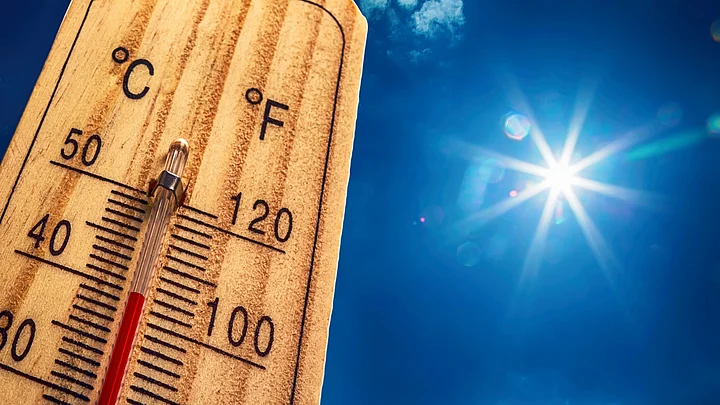
Its hard to believe that there will be  ( Severe heatwave historically expected once a decade) heatwaves will happening every other year at 2C.

There is no huge chasm after a 2c rise, we are tumbling down a painful, worsening rocky slope rather than about to suddenly hit a sheer cliff edge – nearly one in 10 vertebrate animals and almost one in five plants will lose half of their habitat.

Its beyond belief that by most standards the world’s governments are currently failing to avert a grim fate with the fingerprint of climate change on recent extreme weather is quite clear to one and all.

The evidence is irrefutable.

We do know that the global average sea level will likely rise, putting the homes of 200 million below sea level in 70 years.

Around 216 million people, mostly from developing countries, will be forced to flee these impacts by 2050 unless radical action is taken. The frequency of heavy precipitation events, will start to climb, nearly doubling the historical norm once it heats up by 2C. Globally, extreme crop drought events that previously occurred once a decade on average will more than double in their frequency at 2C of temperature rise.

A 16-year-old child swims in the flooded area of Aberao village in Kiribati. The Pacific island is one of the countries worst affected by sea-level rise.

Extreme sea level events that previously occurred once in 100 years could happen every year by the end of this century.

Changes to the ocean, including warming, more frequent marine heatwaves, ocean acidification, and reduced oxygen levels, affect both ocean ecosystems and the people that rely on them, and they will continue throughout at least the rest of this century.

It won’t be just about temperature.

The consequences will devastate economies, infrastructure and political stability.

			A fire rages in Brazil's rainforest, near Maranhao at night.

For example, climate change is intensifying the natural production of water – the water cycle. This brings more intense rainfall and associated flooding, as well as more intense drought in many regions.

The alarm bells are deafening.

The past 20 years there has been a 53·7% increase in heat-related mortality in people older than 65 years.

A chilling number of Earth’s other denizens, including 40 percent of all amphibians known to science (about 3,200 species) is under threat. Climate change, pollution, deforestation, overfishing, development, and invasive species are putting biodiversity in peril.

At least 155 million people, 2.3 times as many as live in the UK, were pushed into acute food insecurity in 2020 due to extreme weather,

In 2019, atmospheric CO2 concentrations were higher than at any time in at least 2 million years, and concentrations of methane and nitrous oxide were higher than at any time in the last 800,000 years.

The loss of the West Antarctic ice sheet and the Amazon rainforest, or extensive thawing of permafrost, as well as other key components of the climate system, are considered “tipping points” because they can cross critical thresholds, and then abruptly and irreversibly change.

Every fractional rise in temperature increases the risk of triggering one of 30 major tipping points. With just 1 degree C of current warming, nine of these are now thought to be beginning to tip. The Earth’s climate and ecological systems are deeply intertwined. A substantial change in one will affect others. Different tipping points are beginning to slowly crash into each other.

Arctic warming, along with melting of Greenland’s ice sheet, is driving fresh water into the North Atlantic, which could have contributed to a recent 15 percent slowdown of the Atlantic Meridional Overturning Circulation (AMOC) in the Atlantic Ocean. Those ocean currents drive heat from the tropics and are responsible for the relative warmth of the Northern Hemisphere.

We shouldn’t be discounting the legacy we’re leaving to future generations, no matter how far they are in the future.”

It is unclear when most of the tipping points will kick in, and the risk of those cascading into an irreversible global tipping point with tremendous impacts on human civilisation warrants a declaration of a planetary climate emergency.

No amount of economic cost-benefit analysis is going to help us now that we face an existential threat to civilization.

The risks posed by climate tipping points are not part of any economic analysis of climate policies, there there’s also a social tipping points, a broad societal awareness tipping point that will cause a stampede of migration.

Its hard to believe that we are just going to sit back and just watch.

It can be hard not to be despondent, so blinkered.

No wonder public opinion is not sending stronger signals to politicians that more urgent action is required.

How is it that we can have such strong emotional attachments when looking at nature, claim to love and appreciate it, yet be so indifferent to the destructive impact our way of living has on it?

We tend to be motivated by relatively short-term concerns. This may partly explain why we are so slow to accept what is happening. However if scientific knowledge about nature (which is what the natural sciences seek to produce) relies so heavily on producing facts which have been purified of their social, political, cultural and historical baggage, then when this baggage suddenly becomes visible, it causes anxiety and disbelief.

What if permafrost melting or flooding cuts off critical roads used by supply chains? What if storms knock out the world’s leading computer chip factory? What happens once half of the world is exposed to disease-carrying mosquitos?

The changes required are now so vast that many countries, companies, governments struggle to even articulate them.

Reaching a net-zero world will entail “wholesale transformation” in both infrastructure and how things are done. If business leaders truly grasped the seriousness of this crisis, they would immediately pivot their entire business models and resources toward scaling climate solutions full stop.

No matter what we do now, it’s too late to avoid climate change.

Perhaps most concerning of all is the fact that even if emissions of all greenhouse gases ceased entirely tomorrow, any warming would still persist for many centuries.

Countries will still remain umbilically connected to fossil fuels, subsidizing oil, coal and gas to the tune of around $11m every single minute. By the end of this year the world will have burned through 86% of the carbon “budget” that would allow us just a coin flip’s chance of staying below 1.5C.

Realistically what can be done ?

We know that every decision – every oil drilling lease, every acre of the Amazon rainforest torched for livestock pasture, every new gas or electrical -guzzling SUV that rolls onto the road – will decide how far we tumble down the hill.

To achieve anything requires a massive change in the Capitalist systems, away from GDP to Sustainability and Greed energy, benefiting not just the earth but all that live on it surface.

This will require the creation of a perpetual fund of trillions ( see previous posts) allowing every person to invest in a green future, closing the gap in inequality.

Such a fund could be distributed by non-repayable grants by the United nations under new UN blockchain plate form, with all country governments setting their own blockchain plate forms.

Each block is connected to the ones before and after it. Each additional block strengthens the verification of the previous block and hence the entire blockchain. This renders the blockchain tamper-evident, delivering the key strength of immutability. The result is newfound trust and transparency, because members share a single view of the truth, you can see all details of a transaction end to end.

Place a ban on all advertising that does not prompt sustainability.

Close all stock exchanges trading in Co2 as a product.

Cutting emissions tomorrow is better than the day after.

In the end the truth is that we live in a world of I am all right jack.

Not until our hair is burning and our tongues are hanging out, with our smartphone melted to our ears will we eventfully blame ourselves.

All human comments appreciated. All like clicks and abuse chucked in the bin.

Contact: bobdillon33@gmail.com

Share this:

  • Share on WhatsApp (Opens in new window) WhatsApp
  • More
  • Share on Mastodon (Opens in new window) Mastodon

THE BEADY EYE SAY’S. THE FIRST OF OUR CURRENT CHALLENGES WITH CLIMATE CHANGE IS TO ADMIT THAT WE WILL NOT STOP IT.

10 Thursday Aug 2023

Posted by bobdillon33@gmail.com in 2023 the year of disconnection., Climate Change.

≈ Comments Off on THE BEADY EYE SAY’S. THE FIRST OF OUR CURRENT CHALLENGES WITH CLIMATE CHANGE IS TO ADMIT THAT WE WILL NOT STOP IT.

Tags

Capitalism and Greed, Capitalism vs. the Climate., Climate change, The Future of Mankind, Visions of the future.

( Fourteen minute read)

Why is this so ?

We lack the collective will to address climate change because of the way our brains have evolved over the last two million years..

As individuals, we know what we can do about climate change. But addressing the issue also requires collective action on a scale that exceeds our evolutionary capacities. The larger the group, the more challenging it gets.

We know that climate change is happening, but cognitive biases that ensure our initial survival make it difficult to address, complex, long-term challenges that now threaten our existence, like climate change.

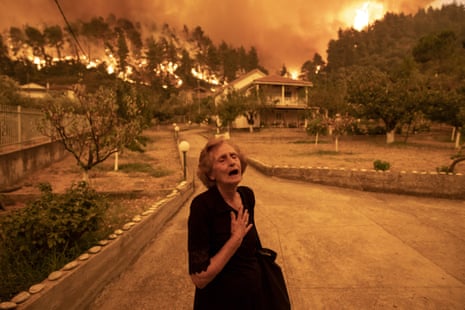
They impede our ability to take action, now hamstringing our ability to respond to what could be the largest crisis humanity has ever created or had to face. An older lady clasps her chest and shouts while fires rage in the background behind a large house in Greece

Prevention is no longer an option.

The natural systems that regulate climate on the planet are already changing, and ecosystems that support us are shifting under our feet, undermining many of the ecological foundations of our ability to provide for basic needs.

Clearly, one of the key challenges is going to be how the burden is distributed, and how we respond to the vulnerability of people to climatic shifts and adjustments – from drought and floods, to health issues ranging from disease to heatstroke, to food security, to environmental migrations.

And, of course, our actions now – given the delay between emissions and impact – will harm people in the future. So our responsibilities of justice now extend over vast stretches of geography and time.

We will be a climate-challenged society for the foreseeable future, immersed in a long age of adaptation.

But that information hasn’t been enough to change our behaviours on a scale great enough to stop climate change. And a big part of the reason is our own evolution.

The same behaviours that once helped us survive are, today, working against us. We imagine we live in a rational, enlightened society. In such a place, experts would identify issues to be addressed, and goals to be reached, in response to our creation of climate change. Scientific knowledge would be respected and accepted (after peer review, of course), and policy would be fashioned in response.

Ignoring climate change in the short term has benefits both to individuals and to organizations.

Climate change is a nonlinear problem.

When a function increases slowly at first and then accelerates, though, that causes problems, because people extrapolate that function linearly,  without obvious consequences until suddenly there is a significant problem.

Many effects of climate change are distant from most people.

People conceptualize things that are psychologically distant from them (in time, space, or social distance) more abstractly than things that are psychologically close. When there are weather disasters that are probably a reflection of climate change (like wildfires or extreme storms), they tend to happen far away from where most people live.

As a result, most people are not forced to grapple with the specifics of climate change, but rather can treat it as an abstract concept.

Abstract concepts simply don’t motivate people to act as forcefully as specific ones do.

Only when you and me and others experience this future threat in the present (rather than something that is still a generation away) will it have enough motivational force to get us to engage in actions that take more effort today.

Consider what you’d be willing to forgo today knowing that in one generation there will be serious, catastrophic consequences because of inaction.

Ultimately, we have to be willing to be explicit about the values we are acting on.

If we choose to enrich our lives in the present at the cost of the quality of life of future generations, that is a choice of values that we rarely like to make explicitly. We have to be willing to look in the mirror and say that we are willing to live our lives selfishly, without regard to the lives of our children and grandchildren.

And if we are not willing to own that selfish value, then we have to make a change in our behaviour today.

WHEN THE LAST INSECT DISSAPEARS SO DOES OUR FOOD CHAIN.

Why People Aren’t Motivated to Address Climate Change.

Even more challenging, however, is the reality that our emissions undermine the environments of vulnerable people elsewhere:

Unfortunately, climate change involves a combination of factors that make it hard for people to get motivated.

In the case of climate change, there are sceptics who argue that it is not certain that the influence of human activity on climate will have the dire consequences that some experts have projected.

People are much better with obvious threats like that nasty dog at the door than they are with threats that escalate quickly and nonlinearly.

Now we have entered a new era in the human relationship with climate change, with a variety of broad and different challenges.

So how might we begin to address the challenges of climate justice?

We may be dealing with an issue with a level of complexity that human beings are simply not capable of addressing. Climate change will certainly challenge our adaptive abilities more than anything else the species has faced.

It will demand multi-scale, widely-distributed, networked, flexible, anticipatory, and adaptive responses on the part of governments from the global down to the local.

Climate change will require a radical re-thinking of the very nature of governance, and the adoption of new forms

We are capable of changing our currently destructive relationship with the rest of nature.

Key here is the reality that, in bringing climate change upon ourselves, we have demonstrated that the very construction of how we immerse ourselves in the natural world, and how we provide for our basic needs, is simply not working.

In fact, our relationship with nature is undermining the lives we’ve constructed.

Our continued refusal to recognise ourselves as animals embedded in ecosystems has resulted in the undermining of those systems that sustain us.

That’s our key problem, our central challenge.

Many groups and movements are rethinking and restructuring the ways we interact with the natural world as we provide for our basic needs – around sustainable energy, local food security, and even crafting and making. These new materialist movements offer alternative ways of relating to the nonhuman systems that sustain us, and illustrate the possibility of redesigning and restructuring our everyday lives based in our immersion in natural systems. After 30 years of failing in our response to climate change, we may yet demonstrate that human beings still have the capacity to adapt.

The good news is that our biological evolution hasn’t just hindered us from addressing the challenge of climate change. It’s also equipped us with capacities to overcome them. How we communicate about climate change influences how we respond.

All human comments much appreciated. All like clicks and abuse chucked in the bin.

Contact: bobdillon33@gmail.com

Share this:

  • Share on WhatsApp (Opens in new window) WhatsApp
  • More
  • Share on Mastodon (Opens in new window) Mastodon

THE BEADY EYE SAY’S: WHEN IT COMES TO CLIMATE CHANGE THE ENTIRE INTERNATIONAL COMMUNITY NOW ACCEPT THE PHYSICAL SCIENCE BASIS FOR CLIMATE CHANGE.

29 Saturday Jul 2023

Posted by bobdillon33@gmail.com in Climate Change.

≈ Comments Off on THE BEADY EYE SAY’S: WHEN IT COMES TO CLIMATE CHANGE THE ENTIRE INTERNATIONAL COMMUNITY NOW ACCEPT THE PHYSICAL SCIENCE BASIS FOR CLIMATE CHANGE.

Tags

Capitalism vs. the Climate., Climate change, The Future of Mankind, Visions of the future.

( Seven minute read)

Scientists have made climate change appear difficult but it’s not difficult to understand.

All living things respond to climate and changes in the climate, even if these changes are subtle and temporary. Our own experience of climate throughout our lifetimes, along with scientific records, also proves that climate change is happening. Weather is simply the set of atmospheric conditions at one location at one limited period of time. Climate, however, involves the average condition of the atmosphere over a long period of time (such as across a few decades or more) at a given location.

At timescales of thousands of years beyond human lifetimes, climate responds to the precession (slow rotation or “wobble”) of Earth’s axis, the planet’s tilt (obliquity), and the changes to the elliptical shape (eccentricity) of Earth’s orbit.

These phenomena interact with one another to determine the amount of sunlight (and thus solar heating) different parts of Earth’s surface receive during different seasons of the year.

Global and regional climates are changing too quickly for many forms of life to adapt and survive.

But this is not the whole story.

There is unequivocal evidence that Earth is warming at an unprecedented rate. Human activity is the principal cause.

Earth’s climate is on a path to warm beyond the range of what has been experienced over the past millions of years.

The range of uncertainty for the warming along the current emissions path is wide enough to encompass massively disruptive consequences to societies and ecosystems: as global temperatures rise, there is a real risk, however small, that one or more critical parts of the Earth’s climate system will experience abrupt, unpredictable and potentially irreversible changes. Disturbingly, scientists do not know how much warming is required to trigger such changes to the climate system.

When people are confronted with a difficult problem, they tend to disengage. In addition to that, beginning in the mid-eighties, Big Oil began a concerted campaign to sow doubt in the public’s mind; is the climate really changing, or is this just more variations in the weather?

The current warming is happening at a rate not seen in the past 10,000 years. It is undeniable that human activities have produced the atmospheric gases that have trapped more of the Sun’s energy in the Earth system. This extra energy has warmed the atmosphere, ocean, and land, and widespread and rapid changes in the atmosphere, ocean, cryosphere, and biosphere have occurred.

Most of the warming occurred in the past 40 years, with the seven most recent years being the warmest. The years 2016 and 2020 are tied for the warmest year on record.

This is why our planet is in trouble.

Why are our leaders, in government and industry, not telling us the truth about climate change?

The answer is simple:

Because they can’t. What is happening to the climate is bad news, and bad news does not get votes, or increase profits.

There is no need to inflate the magnitude of what is happening. It is time for us all to face the “cruel truth” that has been overlooked for too long.

The reality is confronting enough. If humans put too much carbon back in the atmosphere, there’s only one thing that can happen. The Earth will get hotter, maybe too hot.

It is not possible for modern man to combust fossil fuels, put the carbon back in the atmosphere, and still expect the current lifestyle to continue.

In order to counteract climate misinformation.

1200 'Scientists' Claim That Climate Change Is Not Real. Here's The Truth

The list of records broken is itself unprecedented.

200 million people in the world, more than three times the UK population, will live below the tideline by the end of this century if levels continue to rise.

In the Hollywood blockbuster ‘The Day After Tomorrow’, ocean currents around the world stop as a result of global warming, triggering a new Ice Age on Earth. That may have been science fiction but scientists say the terrifying prophecy could soon become a reality.

The heat in the northern Atlantic Ocean has now pushed beyond what climate models predicted. The Atlantic Ocean current which drives the Gulf Stream could collapse at ‘any time’ from 2025 thanks to climate change.

A study published this week gives a further insight into what this might mean.

It suggests the climate system known as the Atlantic Meridional Overturning Circulation could shut down faster than previously thought – by about 2050, or possibly as soon as this decade – if emissions are not cut soon. The risk of an earlier ocean circulation breakdown has increased, with potentially disastrous and rapid ramifications for temperatures, rainfall and sea level rise. Similarly, the amount of sea ice around Antarctica continues to be far below previous record lows.

The Atlantic Meridional Overturning Circulation last collapsed 12,000 years ago.

The Gulf Stream system could collapse as soon as 2025, the impact would be devastating. Such a scenario is ’95 per cent certain.

This is not actually worse than we expected. It is the brutal reality of what scientists told us would happen.

Heat waves kill more people than fires, floods and cyclones. A study found extreme heat killed more than 61,000 in Europe alone last year.

Imagine the headlines if we knew about that in real time.

Human emissions are permanently adding the equivalent of an El Niño to the global system every five to 10 years.

The good news from scientists is that rapid action can still make a significant difference and limit future damage.

It would mean ruling a line under new fossil fuel developments where there are alternatives – that is, virtually all of them – and taking a war-footing approach that genuinely prioritised accelerating the transition that every major scientific body and government agrees is necessary.

It wouldn’t mean pretending the gas industry is a climate solution, or that nuclear energy is a serious climate solution. Nor is carbon capture and storage on track to be more than a niche technology, and paying for carbon offsets can’t justify fossil fuel use.

It would mean leaders acting as though they could persuade the public of what’s required, rather than living in fear of how they might respond.

Polls suggest a majority in many countries are open to action. Now’s our chance.

Alternatively, politicians could continue not delivering on the commitments made in Paris eight years ago and wait for another month as devastating as July 2023 before doing more. One thing we can say with confidence: It is likely to come around soon enough.

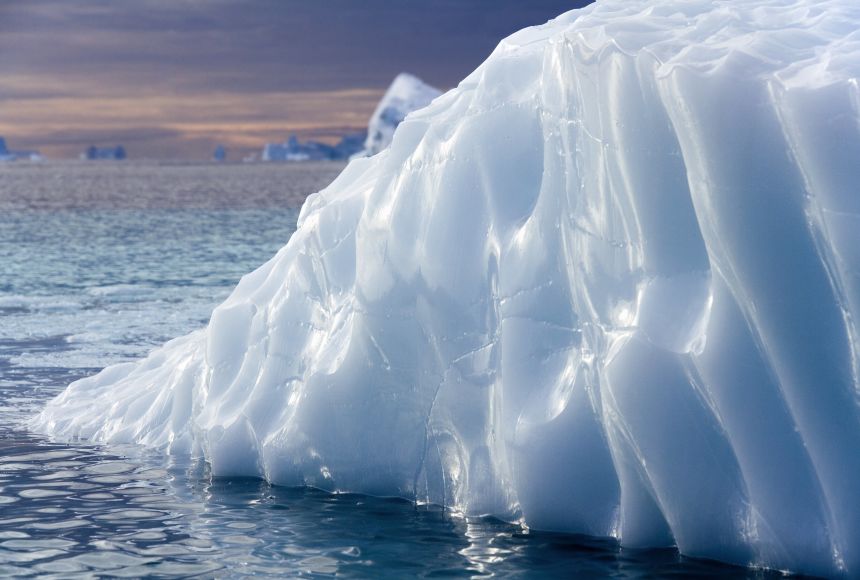
America’s Independence Day was celebrated on July 4th. That is the same day the Earth’s temperature was hotter than it has been at any time in history.Sea ice melts from white into turquoise pools off Baffin Island, Nunavut, Canada. Between 1979 and ...

I don’t think it’s going to be anything that we can do as man to influence that to any great degree.

But I will tell you, again, looking at the past 4,000 or 5,000 years of human history, there’s a strong correlation between the rise and fall of temperature and the rise and fall of civilizations. And it’s just opposite of what we’re being told.

Going forward, who are you going to believe?

One only has to look at both major parties in the UK, currently diluting their plans to combat the climate crisis.

It’s hard to believe (due to politicians chopping and changing of their views and actions) that a new oil field ( Rosebank) where operation emission alone (not counting any emissions from burning the oil and gas it is likely to produce) – are likely to reach 5.6m tonnes of carbon dioxide, driving a coach and horses through any climate commitments.

Are there really people at the top of either of the main parties calling for abandonment of green policies.

You can bet your nannie that there are.

It is not my role to tell people what they should do or must believe about the rising threat of climate change but the consequences will devastate economies, infrastructure and political stability. We face risks of abrupt, unpredictable and potentially irreversible changes, and responding now will lower the risk and cost of taking action.

The verbal is over.

Its time to pour trillions/ trillions into providing non repayable grants before the lights go out.

( See previous posts. Placing 0.05% World Aid commission on all activities that are not sustainable )

All human comments appreciated. All like clicks and abuse chucked in the bin)

Contact: bobdillon33@gmail.com

Share this:

  • Share on WhatsApp (Opens in new window) WhatsApp
  • More
  • Share on Mastodon (Opens in new window) Mastodon

THE BEADY EYE SAY’S: Humans have extracted/ pumped and moved so much of the earths material, (sand rock, oil/groundwater etc) that it’s actually caused the planet’s axis to shift.

24 Monday Jul 2023

Posted by bobdillon33@gmail.com in #whatif.com, Climate Change.

≈ Comments Off on THE BEADY EYE SAY’S: Humans have extracted/ pumped and moved so much of the earths material, (sand rock, oil/groundwater etc) that it’s actually caused the planet’s axis to shift.

Tags

Climate change, The Future of Mankind

( Three minute read)

We’ve long laid a heavy hand on the planet’s ecosystems, and perhaps now it is time to wield that hand more deliberately and creatively.

The influence of human activity on the Earth’s ecosystems has become so extreme that it now seems to be the central driver of environmental change but is there another contributing reason.

Our planet is constantly trying to balance the flow of energy in and out of Earth’s system. But human activities are throwing that off balance, causing our planet to warm in response.

The Earth’s rotational pole normally changes and wanders by about several meters each year.

Without better management, an estimated 42% to 79% of all watersheds that pump groundwater may no longer be able to maintain healthy ecosystems by 2050. This rate of change has frightening implications for the future.

Below the Earth’s surface lies over a thousand times more water than all the rivers and lakes in the world.

We’ve been extracting so much groundwater that it caused the Earth’s rotational pole to drift by 64.16 degrees east at about 4.36 centimetres per year from 1993 to 2010.

On top of this we have extracted trillions and trillions of litres of oil, moved trillions of tons of sand/rocks, put trillions of tons of concrete on the surface, changing the landscape and its weight distribution for several thousands of years. Resulting in the rotation of the earth on its axis changing, not just in speed but in it’s tilth angle, effecting the Jet stream, the direction of ocean currents, the length of day and night.

Perhaps it is one of the reasons that the climate is changing.

Extracting it unsustainably.

Glaciers are disappearing, melting faster than they can be replenished, like this glacier located in Greenland. Melting is happening faster in Greenland and the rest of the Arctic, which is warming faster than anywhere else on Earth.

It is not possible to predict with any certainty what the coming decades might look like for Earth’s energy budget.

Groundwater is used for about 40% of global irrigation and provides almost half of all drinking water.

To put it simply, groundwater depletion contributes to sea level rise because water is being transferred from the continents to the oceans. This is significant because each millimetre rise in sea level is said to make the shoreline retreat an average of 1.5 meters.

If Earth’s rotation does keep accelerating?

The Earth has rotational kinetic energy associated with going spinning around its axis once a day.

Rotational kinetic energy depends on:

  • How fast the object is spinning (faster spinning means more energy).
  • How much mass the spinning object has (more massive means more energy).

How is the planet going to handle that?  No one knows.

Maybe there will be chaos across the tech industry, or maybe we won’t even notice, as time will be flying by.

All human comments appreciated. All like clicks and abuse chucked in the bin.

Contact: bobdillon33@gmail.com

Share this:

  • Share on WhatsApp (Opens in new window) WhatsApp
  • More
  • Share on Mastodon (Opens in new window) Mastodon

THE BEADY EYE SAY’S. WHEN IT COMES TO CLIMATE CHANGE WE NEED TO CUT OUT THE VERBAL BULL SHIT.

23 Sunday Jul 2023

Posted by bobdillon33@gmail.com in #whatif.com, 2023 the year of disconnection., A solution to Climate change., Carbon Emissions., Civilization., Climate Change., Collective stupidity., Cop 29, Enegery, Environment, Green Energy., HUMAN ABILITIES., Humanity., Life., Reality., Renewable Energy., State of the world, Sustaniability, Telling the truth., The common good., The state of the World., The world to day., THE WORLD YOU LIVE IN., Truthfulness., Unanswered Questions., WHAT IS TRUTH, What Needs to change in the World, Where's the Global Outrage.

≈ Comments Off on THE BEADY EYE SAY’S. WHEN IT COMES TO CLIMATE CHANGE WE NEED TO CUT OUT THE VERBAL BULL SHIT.

Tags

Climate change, Cop 29, The Future of Mankind, Visions of the future.

( Six minute read)

Although we have been raising public awareness on climate change for years, this is not enough.

Despite the effects of climate change becoming more and more obvious, big polluting corporations – the ones responsible for the majority of carbon emissions – continue to carry on drilling for and burning fossil fuels.

Climate change is happening now, and it’s the most serious threat to life on our planet.

The global temperature increases day by day with much of Southern Europe and Northern Africa already in the grips of back-to-back heatwaves, which have caused wildfires and broken temperature records.

We all know that this warming causes harmful impacts such as the melting of Arctic sea ice, more severe weather events like heatwaves, floods and hurricanes, rising sea levels, spread of disease and the acidification of the ocean.

To date we have had around 26 global conferences  resulting in agreements and promises, with insufficient actions to make any material changes to global temperatures rising.


Unless greenhouse gas emissions and global temperature are reduced within years, the world will face demanding consequences.

While every fraction of a degree making climate tipping points more likely the next UN Climate Change Conference will convene from 30 November to 12 December 2023 in Dubai, United Arab Emirates (UAE).

With signs that some climate tipping points are already approaching / irreversible we will witness once more the who’s the how’s and where while the melting of polar glaciers and sea ice, die-back of the Amazon rainforest and coral reef extinction are all on the edge of tipping over into a feedback loop of self-destruction, whereby their decline itself becomes a source of warming.

We can’t be sure exactly when tipping becomes inevitable.

Because of war in the Ukrain (which is affecting the world food supply) the climate targets will become looser and looser, higher and higher with world governments doing even less in the future.

We don’t have the policies in place, we don’t have the financing in place to reach any of the goals required.

Seven million people are already being killed by climate change around the world – as many as those killed by Covid. Yet progress by world governments has been achingly slow.  it’s never been more important to demand that our leaders act.

Current policies are “totally inadequate” and you may rest assured that world leaders will once again make a “terrible mistake” in prioritising inflation, the pandemic and the Ukraine war over the climate.

We need concrete solutions to make it less uncomplicated to achieve any goals.

The world cannot be at  “positive tipping point” in the fight against climate change without addressing the lack of financing. ( See previous posts)

There are signs that some climate tipping points are already approaching, according to new research.

Many commitments to reduce carbon emissions have been set, but few are binding and targets are often missed.

Climate change isn’t just a scientific problem or a political challenge its a distribution of wealth problem including technologies such as artificial intelligence.

It’s easy to feel overwhelmed, and to feel that climate change is too big to solve. It can be challenging to wrap your head around such a complex issue, These impacts are severe and far-reaching – both now and into the future – with no sign of slowing down unless drastic action is taken.

To work, all of these solutions need strong international cooperation between governments and businesses, including the most polluting sectors.

Many of the world’s biggest challenges, from poverty to wildlife extinction, are made more difficult by climate change.

But we already have the answers, now it’s a question of making them happen.

Mitigating greenhouse gas emissions requires changes in many areas, namely buildings, transportation, and the energy industry.

Governments want to be re-elected, and  businesses can’t survive without customers. Demanding action from them is a powerful way to make change happen.

Transitioning to a sustainable future comes with a massive price tag, but it isn’t always clear who should foot the bill – or how the money should be spent.

Developing countries will increasingly be stuck with debts to pay for their climate solutions.In the US, the value placed on the social cost of carbon has fluctuated in recent years, with far-reaching effects (Credit: Getty Images)

We are now facing an important crossroads. Make profit out of climate change or see it as a one-off, last-chance opportunity – to restructure economies at the pace and scale that climate science requires by integrating climate action into the economic recovery.

As the impacts of climate change add up, economists are trying to figure out what the true cost of a tonne of carbon really is. ” The most important figure you’ve never heard of”

It is basically a complete denial of climate science that underpinned the social cost of carbon.

Such as the cost of adapting to sea-level rise, or how increased temperatures affect labour productivity, and how crop yields will be affected. The impacts of climate change will be felt over many hundreds of years, whereas cutting emissions costs money now. A high discount rate suggests those alive today are worth more than future generations, whereas a low one suggests the opposite.

It defines how much society should pay to avert future damages caused by climate change. It also accounts for the impact that today’s emissions will have on future generations.

Instead of making assumptions about issues such as the relationship between temperature and human wellbeing at some abstract point in the future, there is now a lot of real-life data.  If we pass certain climate tipping points, such as thawing permafrost and ice sheet disintegration, the runaway damage caused will increase the social cost of carbon. It will certainly affect the actions that people undertake.

It’s overwhelmingly accepted that climate change is a very significant threat to humanity.

We probably underestimated the consequences but every small step we take as individuals contributes.

So why not demand solar panel’s be put on every roof, free of costs, or that villages build solar farm to supply greed energy to their inhabitants, instead of military spending that will be worthless in the fight against rising tempts.

By financing renewable energy, “smart grid” technologies and other green innovations, of course things do not suddenly stabilise at 2030, but at the very least its a concrete step in the right direction.

All human comments appreciated. All like clicks and abuse chucked in the bin

Contact: bobdillon33@gmail.com

Share this:

  • Share on WhatsApp (Opens in new window) WhatsApp
  • More
  • Share on Mastodon (Opens in new window) Mastodon

THE BEADY EYE SAY’S: Misaligned or confused and conflated goals of an AI will be a significant concern of the future.

21 Friday Jul 2023

Posted by bobdillon33@gmail.com in 2023 the year of disconnection., Collective stupidity.

≈ Comments Off on THE BEADY EYE SAY’S: Misaligned or confused and conflated goals of an AI will be a significant concern of the future.

Tags

Artificial Intelligence., Capitalism and Greed, Climate change, The Future of Mankind, Visions of the future.

( Fourteen minute read)

The biggest problem of our world today is not artificial intelligence but natural stupidity!

When it comes to climate change – profit seeking algorithms – and the Military race to send atomist drone killers into the battle field –  Welcome to the perplexing world of collective stupidity!

The Trump campaign and Brexit – where we all woke up the next day astounded that “this could happen” are both prime examples of campaigns that leaned heavily on the emotions of anxiety, fear and tribalism. and collective stupidly.

Since then, there has been much unpacking of “what happened” and talk about “it could only have been “stupid” people” who could have voted that way.

But is this true?

Yes, profound lapses in logic can plague even the smartest mind.

There are intelligent people who are stupid. So why the paradox? Stupidity is not a lack of IQ.

Unconscious emotions drive our decisions –  Intuitive feelings gave us an evolutionary advantage in caveman days, a survival way of dealing with information overload; and can still play a useful role as we on the precipice of a critical moment with AI.

All over the world, we are in the midst of a great shift. The data revolution has given way to the analytics movement. Press our emotional buttons and our judgement is derailed. Hence the temptation to choose the first solution that comes to mind, even if obviously flawed.

It seems that nothing encourages stupidity more than group culture.

An uncritical dependence on set rules often leads to absurd decisions, the-way-we-do-things-here, often not being the most intelligent way.

And the more intelligent someone is, the more disastrous the results of their stupidity.

 ————–

With generative AI technologies data-driven insights are reshaping outcomes without needing to write code, becoming truly intrusive, enabling decision-makers, analysts, data scientists and developers to collaborate and develop analytical insights in real time.

SO, WHAT CAN WE DO TO PROTECT OURSELVES FROM DOING STUPID THINGS?

Knowledge of our foolish nature, can help us escape its grasp.

We can step outside the group of Google algorithms knowledge to question where we are at and going.

and revert to culture-thinking that relies on that “everyone knows the true”

Stupidity is all around us. As long as there have been humans there has been human stupidity,

. —————

Over the past decade, we’ve seen the volume of data available to decision-makers grow exponentially.

In this intelligence era, it’s no longer about how much data one company can generate, it’s about how they use it. Corporate leaders, academics, policymakers, and countless others are looking for ways to harness generative AI technology, which has the potential to transform the way we learn, work, and more.

Generative AI is evolving quickly, but to truly get the most benefits from this ground breaking technology, you need to manage the wide array of risks.

Why?

Because generative AI is so powerful and easy to use, it’s poised to change what is real and what is not.

Unlike earlier disruptions, the reality of the generative AI race is already looking out of control. 

This could be the first “disruptive” new tech in a long time built and controlled largely by giants in the tech world which could entrench, rather than shake up, the status quo.

Right now, only a handful of companies — including Google, Meta, Amazon and Microsoft (through their $10 billion investment in Open-air) — are responsible for the world’s leading large language models.

So what can policymakers do about AI?

Is there a way to prevent the hottest new technology from simply cementing the power of the tech giants? 

Virtual worlds should not become walled gardens. 

It is abundantly clear that leaving it to the market to decide how these powerful technologies are used, and by whom, is a very risky proposition.

———

For decades, many of the great scientific and philosophical minds had conceived of creating collective intelligence in the form of a globally connected space to pool our knowledge.

Social Media -Smart phones – are digitalizing citizens and their resulting emergent behaviour.

This is a phenomenon that occurs in complex adaptive systems. In such systems, simple components interact in such a way that the whole becomes greater than the sum of its parts.

Our collective intelligence has now become what can only be referred to as our collective stupidity.

————-

The Dark Side — Collective Stupidity.

Collective stupidity can be perplexing and is often harmless.

How is it possible that a group of smart individuals can sometimes make decisions so perplexing, it feels like the intelligence just evaporated?

How does collective stupidity happen?

Are we are better off by not underestimating the effects of this phenomenon?

A system based on generating clicks and interactions has created an environment for the outlandish and bizarre to flourish, with expertise falling by the wayside.

Broad, anonymous social networks breed collective stupidity.

Top Social Media Statistics And Trends Of 2023

In 2023, an estimated 4.9 billion people use social media across the world this number is expected to jump to approximately 5.85 billion users by 2027.

The driving force.  The increasing global adoption of 5G technology.

These staggering numbers aren’t just statistics, either. They highlight the expansive influence and potential of social media platforms. Right now, 1.9 billion daily users access Facebook’s platform, Twitter has gained 319 new users per minute in 2020, while 500 hours of video are uploaded to YouTube in the same amount of time. Millions of businesses around the world rely on Facebook to connect with people.

The recent new platform Threads Meta’s new social network, had 100 million sign ups in its first five days.

With this much content being generated, how can experts possibly stand out from the crowd?

By emulating the human ability to forget some of the data, psychological AIs will transform algorithmic accuracy.

Machine learning, on the other hand, typically takes a different path: It sees reasoning as a categorization task with a fixed set of predetermined labels. It views the world as a fixed space of possibilities, enumerating and weighing them all.

Social media networks are not very sociable these days. Feeds are algorithmic, which means you see whatever the apps want to show you.

All this has eroded public confidence.

——–

We all have intelligence and expertise to offer, even if the internet leaves us feeling isolated at times.

With so much misguided thought and active disinformation online, it has become difficult for people with insight worth sharing to do so. Behind the anonymity of the web, anyone can claim to be an expert. When everybody is an expert, nobody is.

With online communities, the relationship between experts and their audience becomes a two-way street.

Many of the issues we throw billions of dollars at and attempt to solve with technology could be easily achieved if we were able to better utilize our collective intelligence.

Technology is the means, not the end; its potential is massive, but not as great as our own.

So we wildly overestimate our access to our own mind.

In essence, the same emergent behaviour that typically helps the group survive sometimes leads to collective stupidity and death.

The Internet gave us the ability to connect with people on a global scale.

But its click-baiting algorithms and lack of regulation also brought with them chaos. As social media came to dominate the landscape, it made using the internet for the purpose of collective intelligence increasingly difficult.

You see, with stupidity, or stupid people for that matter, protesting or reasoning doesn’t really work. This is mainly because of their strong prejudice. They simply disbelieve any facts or reasoning we provide. In most cases, they either simply deny the arguments. And if they can’t, then they call them trivial exceptions.

People are often made stupid under certain circumstances. Maybe they allow this to happen to themselves. It is a group phenomenon.

The nature of stupidity has its roots deep in the subconscious. It is largely driven by the fundamental mechanics of our experience. following the herd. It is arguably the most prominent one, and mostly it does make sense. If the information is lacking, doing what others are doing is probably the best bet. But this doesn’t work all the time.

In fact, herd behaviour is among the pre-eminent causes of stupidity.

It is not that intellect suddenly fails. But people are deprived of inner independence, so they give up autonomous positions under the overwhelming impact. We always feel that we are dealing with slogans, signs, buzzwords, and not with the real person. As if they are under the spell of someone or something.

As this happens, we are also creating (unknowingly) various risks to our socio-economic structure, civilization in general, and to some extent, for the human species.

Species-level risks are not evident yet; However, the other two, socio-economic and civilization level risks, are significant enough to be ignored.

So far, several significant building blocks have been developed and are in progress. When we stitch them together, AI’s capability will increase multifold, which should be a more significant concern for us.

It takes the already tiny amount of time we have to change our ways, and save the planet, and practically cuts it in half.

We have less than 27 years to get our collective act together and reshape how our entire civilisation operates. And I’m not sure if we can do that… The more concerning part is about the risks that we have not thought of yet. We may not be able to avoid all of them, but we can understand them to address them.

Our over-enthusiasm for new technologies has somehow colluded our quality expectations. So much so that we have almost stopped demanding the right quality solutions. We are so fond of this newness that we are ignoring flaws in new technologies.

The problem with these low-quality solutions is that subpar techs’ flaws do not surface until it is too late!

In many cases, the damage is already done and maybe be irreversible.

Misalignment between our goals and the machine’s goals could be dangerous. It is easier to correct a team of humans; doing that with a rampant machine could be a very tricky and arduous task.

Achieving a level of alignment with human-level common sense is quite tricky for a computerized system. Without having any balanced approach like a scorecard, this may not be achievable.

Technology is an answer to the “how” of the strategy, but without having the right “why” and “what” in place, it can do more damage than good. When AI systems do not know why, there will always be a lurking risk of discrimination, bias, or an illogical outcome.

Weapon systems equipped with AI are the most vulnerable to the right AI in wrong hand problems and therefore have the greatest risks. The Russian /Ukrain war is now the labourite of drone warfare. The possibility of AI systems being used to overpower others by some group or a country is a significant risk.

Overall, the right AI’s risk in the wrong hands is one of the critical challenges and warrants substantial attention to avoid it.

Extending AI and automation beyond logical limits could potentially alter our perception of what humans can do.

We still value human interaction, communication skills, emotional intelligence, and several other qualities in humans. What happens when an AI app takes over? What happened to AI doing mundane tasks and leaving time for us to do what we like and love?

The most important thing in artificial intelligence isn’t the fancy algorithms.

Let’s assume the worst case and we have a general purpose AI – that can do everything a human can.

What would happen?

Waiting for smartphone app to tell us what to do next and how we might be feeling now!

The enormous power carried by the grey matter in our heads may become blunt and eventually useless if we never exercise it, turning it into just some slush. The old saying, “use it or lose it,” is explicitly applicable in this case. Half knowledge is more dangerous than ignorance!

Trust me, a lot can happen in 24 hours. The lesson here is – in times like this, the first principles-based thinking is your best bet.

Our problem is that on one side, we have intelligent people, who are full of doubts, and on the other, we have stupid people full of confidence. Stupidity is not an intellectual failing, it’s a moral failing. And it happens because we believe only in feelings and not in facts or truthfulness

When we see and hear all this, we wonder if there is any antidote? If there is any way to stop this from happening?

The ultimate test of a moral society is the kind of world that it leaves to its children.

So the question now is, “How are we going to fight this AI pandemic?”

We will finally recognize that more computing power makes machines faster, not smarter.

If a problem is too difficult for a machine, it is we who will have to adapt to its limited abilities.

There is already a frustrating struggle for humans and machines to understand one another in natural language. Soon, we will live in a world where, regardless of your programming abilities, the main limitations are simply curiosity and imagination.

The Garland Test, inspired by dialog from the movie, is passed when a person feels that a machine has consciousness, even though they know it is a machine.

Will computers pass the Garland Test in 2023? I doubt it. But what I can predict is that claims like this will be made, resulting in yet more cycles of hype, confusion, and distraction from the many problems that even present-day AI is giving rise to.

This will force us to reconsider how our behaviours today might influence digital versions of ourselves set to outlive us.

Faced with this prospect of virtual immortality, 2023 will be the year we broaden our definition of what it means to live forever, a moral question that will fundamentally change how we live our day-to-day lives, but also what it means to be immortal stupid.

We tend to think we are the be all and end all—but we’re not. The sooner we can realize that the natural world goes its way, not our way, the better.”  “I hope as a consequence that the needs and wonder and importance of the natural world are seen. We tend to think we are the be all and end all—but we’re not.

We’re both the victims and benefactors, and the sooner we can realize that the natural world goes its way, not our way, the better.” Sir David Attenborough.

All human comments appreciated. All like clicks and abuse chucked in the bin.

Contact: bobdillon33@gmail,com

Share this:

  • Share on WhatsApp (Opens in new window) WhatsApp
  • More
  • Share on Mastodon (Opens in new window) Mastodon

THE BEADY EYE SAY’S: THERE IS NO MORE ROOM FOR OPTIMISM WHEN IT COME TO REVERTING CLIMATE CHANGE.

18 Tuesday Jul 2023

Posted by bobdillon33@gmail.com in Climate Change.

≈ Comments Off on THE BEADY EYE SAY’S: THERE IS NO MORE ROOM FOR OPTIMISM WHEN IT COME TO REVERTING CLIMATE CHANGE.

Tags

Capitalism vs. the Climate., Climate change, Climate Change Solution's., global climate change, NEXT COP-OUT CLIMATE CHANGE CONFERENCE IN EGYPT, Reality of Climate Change, The cost of Climate Change., The Future of Mankind, Visions of the future.

(Five minute read)

The truth is.

Limiting the damage requires rapid, radical change to the way the world works.

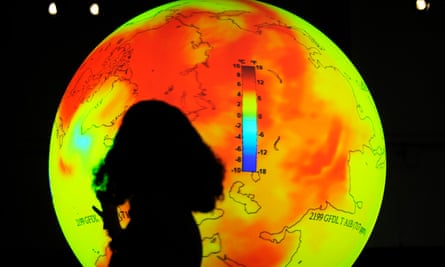
A scientist standing in front of a globe delivers a speech at Cop in Copenhagen, 15 December 2009.

In this post I will lay out the true case for pessimism and the true case for (cautious) optimism.

“Is there hope?” is just a malformed question.

It mistakes the nature of the problem.

The atmosphere is steadily warming. Things are going to get worse for humanity the more it warms.

But there’s nothing magic about 2 degrees. It doesn’t mark a line between not-screwed and screwed.

We have some choice in how screwed we are, and that choice will remain open to us no matter how hot it gets.

Even if temperature rise exceeds 2 degrees, the basic structure of the challenge will remain the same.

It will still be warming. It will still get worse for humanity the more it warms. Two degrees will be bad, but three would be worse, four worse than that, and five worse still.

When temperatures reach 60c photosynthesis stops working and the need for sustainability becomes more urgent, not less. At that point, we will be flirting with non-trivial tail risks of species-threatening — or at least civilization-threatening — effects.

In sum:

Humanity faces the urgent imperative to reduce greenhouse gas emissions, then eliminate them, and then go “net carbon negative,” i.e., absorb and sequester more carbon from the atmosphere than it emits.

It will face that imperative for several generations to come, no matter what the temperature is.

What are the reasonable odds that the current international regime, the one that will likely be in charge for the next dozen crucial years, will reduce global carbon emissions enough to hit the 2 degree target?

Can we restrain and channel our collective development in a sustainable direction.    NO

For any hope of hitting 2 degrees, global emissions must peak and begin rapidly falling within the next dozen years. And they must continue rapidly falling until humanity goes net carbon negative sometime around mid-century or shortly thereafter.

That means developed countries must go negative earlier, to allow for a slower and more difficult shift in developing countries.

Accomplishing that would require immediate, bold, sustained, coordinated action. And, well … look around. Look at how things are going. Look at who is running things. Look at the established economic regimes of the last half-century.  Is this likely to happen, not on your nelly

As Enno Schröder and Servaas Storm of Delft University write in their blunt and unsettling recent paper, “the required degree and speed with which we have to decarbonize our economies and improve energy efficiency are quite difficult to imagine within the context of our present socioeconomic system.”

The dominant climate-economic models used to generate scenarios showing how to hit the 2 degree target produce a few key common outcomes.

One is that they require an extraordinary amount of energy efficiency. The bulk of the reduction in demand for fossil fuels through 2040 or so, in most successful 2 degree scenarios, is accomplished by reduction in overall energy demand. It is only around 2040 that displacement of fossil fuel energy by zero-carbon energy takes over as the dominant driver of fossil fuel reductions.

For centuries now, the growth of economies has been tightly coupled with rising energy demand and rising greenhouse gas emissions — a one-to-one correlation, more or less.

In recent years, however, several countries have seen their economies grow faster than their emissions.

The world’s current economies are not capable of the emission reductions required to limit temperature rise to 2 degrees. If world leaders insist on maintaining historical rates of economic growth, and there are no step-change advances in technology, hitting that target requires a rate of reduction in carbon intensity for which there is simply no precedent.

Despite all the recent hype about decoupling, there’s no historical evidence that current economies are decoupling at anything close to the rate required.

In fact, it’s worth noting that the vast majority of scenarios used by climate policymakers take continued economic growth as an unquestioned premise. And they also accept that historical technology improvement rates will hold in the future. The question they basically answer: “How much can we reduce emissions while continuing to grow our economies at historical rates, with technology developing at historical rates?”

Put simply, if we are determined to maintain the economic status quo, we cannot possibly mitigate climate change, so we must turn to adapting to it.

We have to come to terms with the impossibility of material, social, and political progress as a universal promise: life is going to be worse for most people in the 21st century in all these dimensions.

The political consequences of this are hard to predict.

The choice is radicalism today or disaster tomorrow, and from all signs, humanity is choosing the latter.

The fight to decarbonize and eventually go carbon negative will last beyond the lifetime of anyone reading this post. That is true no matter how high the temperature rises. The stakes will always be enormous; time will always be short; there will never be an excuse to stop fighting.

All of this needs collective action and a strong directional thrust which ‘markets’ or ‘private agents’ alone are unable to provide.

But rapid change is not just possible in technology. It is also possible in politics.

In both domains, there are “tipping points” after which change accelerates, rendering the once implausible inevitable.

We are rarely able to predict those tipping points.

Relying on them can seem like hoping for miracles. But our history is replete with miraculously rapid changes. They have happened; they can happen again. And the more we envision them, and work toward them, the more likely they become.

What other choice is there?

It will take close to half a million years before a ton of CO2 emitted today from burning fossil fuels is completely removed from the atmosphere naturally.

The world militaries contribution to green house gases ( and I am guessing ) alone is bigger than the economic out put of the whole of the African.

It has been 30 years since the Rio summit, when a global system was set up that would bring countries together on a regular basis to try to solve the climate crises.

The ink was hardly dry on the Glasgow pact when the world began to change in ways potentially disastrous for hopes of tackling the climate crisis. Energy and food price rises mean that governments face a cost of living and energy security crisis, with some threatening to respond by returning to fossil fuels, including coal.

Despite pledges made at climate summit the world is still nowhere near its goals on limiting global temperature rise. The next summit will be on different as no one wants to carry the financial can. 

(In previous post I have suggested the establishment of a Perpetual green fund by placing 0.05% commission on all activities that are not sustainable.) This could spread the cost of tackling the climate crises Fairley.   

We don’t have time to have unquestioned assumptions.  

The real truth is that the earth in its billion of years of existence ( with our without us) has gone through many climate change disasters and survived.

We on the other had only need a further temperature rise to join a log list of extinction.  

All human comments appreciated. All like clicks and abuse chucked in the bin

Contact: bobdillon33@gmail.com

.

Share this:

  • Share on WhatsApp (Opens in new window) WhatsApp
  • More
  • Share on Mastodon (Opens in new window) Mastodon

THE BEADY EYE SAY’S. Ten years from now, we may look back on this moment in history as a colossal mistake or it could be the greatest empowerment moment in human history.

11 Tuesday Jul 2023

Posted by bobdillon33@gmail.com in #whatif.com, 2023 the year of disconnection., Artificial Intelligence.

≈ Comments Off on THE BEADY EYE SAY’S. Ten years from now, we may look back on this moment in history as a colossal mistake or it could be the greatest empowerment moment in human history.

Tags

Algorithms., Artificial Intelligence., Capitalism vs. the Climate., Climate change, Technology, The Future of Mankind, Visions of the future.

( Four minute read)

This year, the world got a rude awakening to the insane power of AI when OpenAI unleashed ChatGPT4 onto the world. This AI text generator/chatbot seemed to be able to replicate human-generated content so well that even AI detection software struggled to tell the difference between the two.

This is not an alien invasion of intelligent machines; it’s the result of our own efforts to make our infrastructure and our way of life more intelligent.

It’s part of human endeavour. We merge with our machines. Ultimately, they will extend who we are.

Our mobile phone, for example, makes us more intelligent and able to communicate with each other. It’s really part of us already. It might not be literally connected to you, but nobody leaves home without one.

It’s like half your brain.

Thinking of AI as a futuristic tool that will lead to immeasurable good or harm is a distraction from the ways we are using it now.

How do we ensure that the AI we build, which might very well be significantly smarter than any person who has ever lived, is aligned with the interests of its creators and of the human race?

What if at some point in the near future, computer scientists build an AI that passes a threshold of superintelligence and can build other super intelligent AI.

An unaligned super intelligent AI could be quite a problem.

For example, we’ve been predicting for decades that AI will replace radiologists, but machine learning for radiology is still a complement for doctors rather than a replacement. Let’s hope this is a sign of AI’s relationship to the rest of humanity—that it will serve willingly as the ship’s first mate rather than play the part of the fateful iceberg.

No laws can prevent China ~ Russia ~ Terrorist network~  Rogue psychopath from developing the most manipulative and dishonest AI you could possibly imagine.

We can’t trust some speculative future technology to rescue us.

Climate change is already killing people, and many more people are going to die even in a best-case scenario, but we get to decide now just how bad it gets.

Action taken decades from now is much less valuable than action taken soon.

The first role AI can play in climate action is distilling raw data into useful information – taking big datasets, which would take too much time for a human to process, and pulling information out in real time to guide policy or private-sector action.

Everyone wants a silver bullet to solve climate change; unfortunately there isn’t one. But there are lots of ways AI can help fight climate change. While there is no single big thing that AI will do, there are many medium-sized things.

An attendee controls an AI-powered prosthetic hand during 2021 World Artificial Intelligence conference in Shanghai.

Most movies about AI have an “us versus them” mentality, but that’s really not the case.

Even if one were to stand on the side of curious skepticism, (which feels natural,) we ought to be fairly terrified by this nonzero chance of humanity inventing itself into extinction.

Whereas AI is, for now, pure software blooming inside computers. Someday soon, however, AI might read everything—like, literally every thing, swallowing everything into a black hole and not even god knows what it will be recycled.

Just shovel ever-larger amounts of human-created text into its maw, and wait for wondrous new skills to manifest. With enough data, this approach could perhaps even yield a more fluid intelligence, or a humanlike artificial mind akin to those that haunt nearly all of our mythologies of the future.

On the syllabus at the moment : Is a decent fraction of all the surviving text that we have ever produced.

To codify the philosophy in a set of wise laws and regulations to ensure the good behaviour of our super intelligent AI,  like laws to make it illegal, for example, to develop AI systems that manipulate domestic or foreign actors. Is pie in the sky –

In the next decade, autocrats and terrorist networks could be able to cheaply build diabolical AI that can accomplish some of the goals outlined in the Yudkowsky story. (The key issue is not “human-competitive” intelligence (as his open letter puts it); It’s what happens after AI gets to smarter-than-human intelligence.

Key thresholds here may not be obvious.

We definitely can’t calculate in advance what happens when, and it currently seems imaginable that a research lab would cross critical lines without noticing.

AT THE MOMENT ALL WE HAVE IS A COPING MECCHANISM.

Like non-proliferation laws for nuclear weaponry that are hard to enforce.

Nuclear weapons require raw material that is scarce and needs expensive refinement. Software is easier, and this technology is improving by the month.

Turing test: robot versus human sitting inside cubes facing each other

We have years to debate how education ought to change in response to these tools, but something interesting and important is undoubtedly happening.

If we figured out how people are going to share in the wealth that AI unlocks, then I think we could end up in a world where people don’t have to work to eat, and are instead taking on projects because they are meaningful to them.

But where do AI companies get this truly astonishing amount of high-quality data from?

Well, to put it bluntly, they steal it.

But as it stands, the AI boom might be approaching a flashpoint where these models can’t avoid consuming their own output, leading to a gradual decline in their effectiveness. This will only be accelerated as AI-generated content perfuses the internet over the coming years, making it harder and harder to source genuine human-made content.

AI is viewed as a strategic technology to lead us into the future.

So what should be done:

  • Many people lack a full understanding of AI and therefore are more likely to view it as a nebulous cloud instead of a powerful driving force that can create a lot of value for society;
  • Instead of writing off AI as too complicated for the average person to understand, we should seek to make AI accessible to everyone in society. It shouldn’t be just the scientists and engineers who understand it; through adequate education, communication and collaboration, people will understand the potential value that AI can create for the community.
  • We should democratize AI, meaning that the technology should belong to and benefit all of society; and we should be realistic about where we are in AI’s development.
  • Most of the achievements we have made are, in fact, based on having a huge amount of (labelled) data, rather than on AI’s ability to be intelligent on its own. Learning in a more natural way, including unsupervised or transfer learning, is still nascent and we are a long way from reaching AI supremacy.

From this point of view, society has only just started its long journey with AI and we are all pretty much starting from the same page. To achieve the next breakthroughs in AI, we need the global community to participate and engage in open collaboration and dialogue.

If this does not happen and happen (sooner than later) it will be AI that will be calling the shots

All human comments appreciated. All like clicks and abuse chucked in the bin.

Contact: bobdillon33@gmail.com

https://time.com/6266923/ai-eliezer-yudkowsky-open-letter-not-enough/

Share this:

  • Share on WhatsApp (Opens in new window) WhatsApp
  • More
  • Share on Mastodon (Opens in new window) Mastodon

THE BEADY EYE SAY’S: IT BEGGARS BELIEF AND IS BEYOND PATHETIC THAT WE ARE UNABLE TO FULLY UNDERSTAND THERE WILL BE NO FUTURE WITHOUT NATURE AND IT’S BIODIVERSITY.

16 Sunday Apr 2023

Posted by bobdillon33@gmail.com in 2023 the year of disconnection., Climate Change., State of the world, Survival., Sustaniability, Telling the truth., The common good., The essence of our humanity., The Future, The Obvious., The world to day., THE WORLD YOU LIVE IN., THIS IS THE STATE OF THE WORLD.  , Truth, Unanswered Questions., VALUES, We can leave a legacy worthwhile., Where's the Global Outrage., World Leaders, World Politics

≈ Comments Off on THE BEADY EYE SAY’S: IT BEGGARS BELIEF AND IS BEYOND PATHETIC THAT WE ARE UNABLE TO FULLY UNDERSTAND THERE WILL BE NO FUTURE WITHOUT NATURE AND IT’S BIODIVERSITY.

Tags

Capitalism and Greed, Capitalism vs. the Climate., Climate change, The Future of Mankind

( Twenty-six minute read)

We have heard all of this over and over, but it is impossible to get serious about climate change, because it has been turned into a product to be traded.

The very words Climate Change, Global warming, Biodiversity, Sea levels, Natural disasters, Droughts, Melting  ice, the list goes on and on as a result they are falling on deaf ears. For example  “sustainable development”: a phrase at which many people quietly glaze over and switch off.  Or “Global warming” is another of those deceptive phrases. It doesn’t sound that threatening.

So if words like “climate change” and “global warming” have become a turn-off for most ordinary people, maybe we should change the words.  Perhaps we should talk instead about what those things actually mean:

Killer weather, a world under water, and a mortgaged future.

We have been told for over three decades of the dangers of allowing the planet to warm.

We all know this and we know that it’s urgent. The world listened, but it didn’t hear. The world listened, but it didn’t act strongly enough. It hasn’t been enough to change our behaviours on a scale great enough to stop climate change.

As a result, climate change is a problem that is here, now. Nobody is safe. And it is getting worse faster and faster, till one tipping point is reached causing a rolling coaster of from here to eternity.

There are many tipping points to choose from.

Here is mind. The Arctic Ocean’s ice cover melts.

This is a feedback loop with teeth.

Back in the 50s it was more than ten meters thick, reflecting as much as 3% of the sun’s incoming light back into space.

That light is now heating the Oceans of the Arctic and the Antarctic, both becoming the fastest places on Earth with rising temperatures. Which means a greater and greater release of permafrost carbon and methane, 20 times stronger than Co2.

The Arctic permafrost contains as much methane as all the Earth’s cattle could create over the next six centuries.

If released this fart would push the Earth into an irreversible tipping point at which point the sea level would be 110 meters higher than at present, with the global temperatures 5/6 degrees Celsius higher. At that point civilisation would be over.

One would think that such a scenario would be sufficient to make all of us pay attention but not so.

Why?

A big part of the reason is our own evolution. The same behaviours that once helped us survive are, today, working against us.

We lack the collective will to address climate change, because of the way our brains have evolved. We have evolved to pay attention to immediate threats. We overestimate threats that are less likely but easier to remember, like terrorism, and underestimate more complex threats, like climate change. Too much information can confuse our brains, leading us to inaction or poor choices that can place us in harm’s way.

Our brains evolved to filter information rapidly and focus on what is most immediately essential to our survival and reproduction.

In our modern reality it’s causing errors in rational decision-making, known as cognitive biases. “Cognitive biases that ensured our initial survival make it difficult to address complex, long-term challenges that now threaten our existence, like climate change.

  • Hyperbolic discounting. This is our perception that the present is more important than the future. Throughout most of our evolution it was more advantageous to focus on what might kill us or eat us now, not later. This bias now impedes our ability to take action to address more distant-feeling, slower and complex challenges. While we may understand what needs to be done to address climate change, it’s hard for us to see how the sacrifices required for generations existing beyond this short time span are worth it.

Families carry water during a drought in Ethiopia; temperature rise already has altered weather and water systems in profound ways (Credit: Creative Commons)

  • To address the issue of climate change it requires collective action on a scale that exceeds our evolutionary capacities.
  • The larger the group, the more challenging it gets.

The future value is the value of it at some time in the future. The farther into the future we look, the fuzzier our view, but there will be no future unless we invest trillions and trillions into sustainability.

On a warming planet, no one is safe.

The air you breathe, the water you drink and the food you eat all rely on biodiversity.

Unfortunately, we have created a world where an asset from a business perspective, has no value unless it can produce cash flows in the future. The difference in value between the future and the present is created by discounting the future back to the present using a discount factor, which is a function of time that is running out right in front of our eyes.

The world’s ecosystems are capital assets that up to now have escaped valuation and have therefore been mismanaged.

Now they are being bought by rich privateers, together with financial instruments and institutional arrangements that will allow individuals to capture the value of ecosystem assets.  For example, Sovereignty Wealth Funds.  They buy environmental protection, but only by liquidating natural capital (for example, prairies, forests, fisheries) to generate the funds; even “information” economies are built in proportion to such liquidation. The reinvestment in natural capital never equals the amount liquidated because of procedural inefficiency and profit-taking.

—–

The process of valuation in the short term might lead to profoundly favourable effects on the stock market, but the decision of how much to spend now to avert climate changes hinges on assessing how much it is worth to us now to prevent that future damage.

Since most of us would prefer money now, over money later, economists typically figure that we’re willing to spend only less than a dollar now to prevent a dollar’s worth of damage in a year, or in a decade.

The percentage less is called the “social discount rate.”

This implies that we either accept an assumption that many argue is economically unjustified (a near-zero social discount rate), or conclude that we should just accept climate change without much of a fight. (A third alternative is perhaps even less appealing to economists: accepting that their calculations simply can’t illuminate the question.)

We’re much happier to have good stuff now than later, so our short-term discount rate is high.

But we hardly distinguish between goods in the pretty far future and goods in the very far future, so our discount rate in the future is far lower to manage the essentials to life.

Now more than ever we must use the power of the law to fight those who would harm our communities, our climate, and the natural world we value so deeply.

We have an International criminal court, why not use it to fine this lot of polluters.

Peabody Energy

Company summary: Coal company
Based in: Missouri, United States
Founded: 1883
Emissions per capita: 2,231,818 tonnes – or, 449,057 return flights from London to Sydney.

Kuwait Petroleum Corporation

Company summary: Petroleum company
Based in: Kuwait City, Kuwait
Founded: 1980
Emissions per capita: 2,133,248 tonnes – or, 445,354 return flights from London to Sydney

ConocoPhillips

Company summary: Crude oil and natural gas
Based in: Texas, United States
Founded: 1875
Emissions per capita: 1,464,423 tonnes – or, 305,725 return flights from London to Sydney

Chevron

Company summary: Oil and gas company
Based in: California, United States
Founded: 1879
Emissions per capita: 900,218 tonnes – or, 187,936 return flights from London to Sydney

Saudi Aramco

Company summary: Petroleum and natural gas company
Based in: Dhahran, Saudi Arabia
Founded: 1933
Emissions per capita: 750,126 tonnes – or, 150,930 return flights from London to Sydney

ExxonMobil

Company summary: Oil and gas company
Based in: Texas, United States
Founded: 1999
Emissions per capita: 559,412 tonnes – or, 116,787 return flights from London to Sydney

BP

Company summary: Oil and gas company
Based in: London, United Kingdom
Founded: 1909
Emissions per capita: 485,306 tonnes – or, 97,647 return flights from London to Sydney

National Iranian Oil Company (NIOC)

Company summary: Government-owned national oil and natural gas company
Based in: Tehran, Iran
Founded: 1948
Emissions per capita: 407,542 tonnes – or, 82,000 return flights from London to Sydney

Royal Dutch Shell

Company summary: Oil and gas company
Based in: The Hague, Netherlands
Founded: 1907
Emissions per capita: 384,939 tonnes – or, 77,452 return flights from London to Sydney.

Chevron topped the list of the eight investor-owned corporations, followed closely by Exxon, BP and Shell. Together these four global businesses are behind more than 10% of the world’s carbon emissions since 1965. The worst offenders are investor-owned companies that are household names around the world and spend billions of pounds on lobbying governments and portraying themselves as environmentally responsible.

The top plastic polluting companies

Company Examples of products             Number of countries plastic was found in Pieces of plastic found
Coca-Cola       Coca-Cola, Fanta, Sprite                                            51                                              13,834
Pepsico            Pepsi, Lays, Doritos                                                  43                                              5,155
Nestlé              Nescafé, Kit Kat, Nestea                                           37                                              8,633
Unilever          Persil, Cornetto, Sunsilk                                            37                                              5,558
Mondeléz International  Oreo, Cadbury, Milka                                34                                                1,171
Mars              Mars bars, M&Ms, Snickers                                      32                                                  678
P&G              Tampax, Pantene, Ariel                                              29                                              3,535
Philip Morris International  Parliament, Merit, Marlboro               28                                                2,593
Colgate Palmolive  Colgate Palmolive                                           24                                              5,991
Colgate, Ajax, Palmolive
Perfetti          Mentos, Chupa Chups, Fruittella                             24                                                465

It’s important to remember that, as a consumer, you do have the power to change the future of these polluting companies. As more people switch to renewable energy, cut down on plastic, and live a little more sustainably, these polluting companies will have no choice but to change their habits to stay on trend.


Economists develop new methods to quantify the trade-off between spending now and spending later.

To figure out how much we should spend fighting climate change, economists have some questions for you:

The health of the planet may hinge on the answers.

Most economic analyses of climate change have concluded that we should be spending only small amounts to combat climate change now, ramping up slowly over time. This conclusion mystifies most climate scientists, who argue that immediate action is the only way to forestall dreadful consequences. And at the heart of the disagreement are these very questions, about the value of future generations’ welfare in monetary terms.

The worst consequences of climate change are likely to unfold only over decades or centuries — in other words, in our children’s or grandchildren’s or great-great-great-great-great-grandchildren’s lifetimes, not ours.

The higher the price payed, also equates with a higher level of risk, which generates a higher discount and lowers the present value of any action.  The higher the level of risk is represented as beta in the capital asset pricing model, means a higher discount, which lowers the present value of  nature.

Discounting is the primary factor used in pricing a stream of tomorrow’s crises. .

By reiterating the importance of the world’s natural capital to the human prospect, the next step, is to focus on stabilizing the scale of human economy.  This requires taking on the advertising industry that is promoting consumption. It should be illegal to advertise any product that is not sustainable in their manufacture. Put restrictions on all advertising that is in contradiction to health of not just us, but the earth.  It has become a voracious top predator across the entire globe.

—

Biodiversity?

It is the variety of life on Earth, in all its forms and all its interactions. Bio means living, and diversity is the variety of life on earth. It represents different relationships (like ecological, cultural, or evolutionary) between several types of organisms on this planet. All living beings on from human beings to the tiny creatures like microbes combined to form Biodiversity.

Starting with genes, then individual species, then communities of creatures and finally entire ecosystems, such as forests or coral reefs, where life interplays with the physical environment. These myriad interactions have made Earth habitable for billions of years.

Wildlife is not something you watch on television. The reality is that the air you breathe, the water you drink and the food you eat all ultimately rely on biodiversity.

It represents the knowledge learned by evolving species over millions of years about how to survive through the vastly varying environmental conditions Earth has experienced. We all interdependent with one another. Hence each species plays an essential role to boost ecosystem productivity.

Some examples are obvious: without plants there would be no oxygen and without bees to pollinate there would be no fruit or nuts.

Humans and our livestock now consume 25-40% of the planet’s entire “primary production”, i.e. the energy captured by plants on which all biodiversity depends.

The intricate jigsaw of life, constructed over hundreds of millions of years, has been thrown into disarray in the last 10,000 years by humans relocating species around the world. These invasive species can devastate ecosystems that have never developed defences – from rats devouring albatross chicks in their nests to snakehead fish decimating native species.

If money is a measure, the services provided by ecosystems are estimated to be worth trillions of dollars – double the world’s GDP. Biodiversity loss in Europe alone costs the continent about 3% of its GDP, or €450m (£400m), a year.

From an aesthetic point of view, every one of the millions of species is unique, a natural work of art that cannot be recreated once lost. “Each higher organism is richer in information than a Caravaggio painting, a Bach fugue, or any other great work,”

The extinction rate of species is now thought to be about 1,000 times higher than before humans dominated the planet, which may be even faster than the losses after a giant meteorite wiped out the dinosaurs 65m years ago. The sixth mass extinction in geological history has already begun, according to some scientists.

The results are scary.

Humans can’t have power over nature in nature.

—–

Despite the fact that natural resources are limited and take millions of years in the formation, the human is exploiting them for their endless greed and comfort.

Species extinction provides a clear but narrow window on the destruction of biodiversity.

The huge global biodiversity losses now becoming apparent represent a crisis equalling – or quite possibly surpassing – climate change.

Billions of individual populations have been lost all over the planet, with the number of animals living on Earth having plunged by half since 1970. Abandoning the normally sober tone of scientific papers, researchers call the massive loss of wildlife a “biological annihilation” representing a “frightening assault on the foundations of human civilisation”.

Humans may lack gills but that has not protected marine life. The situation is no better – and perhaps even less understood – in the two-thirds of the planet covered by oceans. Seafood is the critical source of protein for more than 2.5 billion people but rampant overfishing has caused catches to fall steadily since their peak in 1996 and now more than half the ocean is industrially fished.

Even much-loathed parasites are important. One-third could be wiped out by climate change, making them among the most threatened groups on Earth. But scientists warn this could destabilise ecosystems, unleashing unpredictable invasions of surviving parasites into new areas.

Today, 75% of the world’s food comes from just a dozen crops and five animal species, leaving supplies very vulnerable to pests or disease that can sweep through large areas of monocultures. Add in the falling yields expected from climate change, and the world’s growing global population faces a food problem.

Locating the tipping point that moves biodiversity loss into ecological collapse is an urgent priority. This being the only living world we are ever likely to know, let us join to make the most of it.

Could the loss of biodiversity be a greater threat to humanity than climate change?

Yes – nothing on Earth is experiencing more dramatic change at the hands of human activity.

Changes to the climate are reversible, even if that takes centuries or millennia.

That call is more urgent than ever. Our posterity is running out of chances.

But once species become extinct, particularly those unknown to science, there’s no going back. To put the matter as concisely as possible, biological diversity is unique in the evenness of its importance to both developed and developing countries is beyond any technical advances.

To spread technical capability where it is most needed, arrangements can be made to retain specimens within the countries of their origin while training nationals to assume leadership in systematics and the related scientific disciplines. Science is the best way to establish links with other cultures because it is concerned not with ideology but with nature and humanity’s relation to nature.

Cognitive biases that ensured our initial survival now make it difficult to address long-term challenges that threaten our existence, like climate change.

It is already clear enough that the missing ingredient is political will.

For example

Recognising the power of small groups.

Humans are more likely to change behaviour when challenges are framed positively, instead of negatively. In other words, how we communicate about climate change influences how we respond.  To get people to act, we need to make the issue feel direct and personal by focusing the issue locally, pointing both to local impacts and local solutions: Like moving one’s city to 100% renewable energy.

The key is having a large-scale, organised effort – but one supported and understood by hundreds of smaller groups and communities.

It’s true that no other species has evolved to create such a large-scale problem – but no other species has evolved with such an extraordinary capacity to solve it, either.  If academia, business, government, and citizens act together toward this common goal, we can create a pollution-free energy system; form a prosperous, adaptable and resilient society; keep human, animal, and plant life flourishing; and create a better world for ourselves and generations to come.

We can’t undo the mistakes of the past. But this generation of political and business leaders, this generation of conscious citizens, can make things right. This generation can make the systemic changes that will stop the planet warming, help everyone adapt to the new conditions and create a world of peace, prosperity and equity.

The world is now experiencing the early effects of climate change.

The overall effect of inadequate actions to reduce greenhouse gas emissions is creating a human rights catastrophe, and the costs of these climate change related disasters are already enormous. The Colorado river in the USA is drying up, the ice shelf is the Antarctic is melting, the glaciers in the Himalayas are melting five time faster. Somali is no the threshold of a Famine.

—–

If we don’t act, who will?

We have evolved to be able to stop human-induced climate change. Now we must act.

The risk that without intervention we could cross a threshold leading to runaway climate change. An inconvenient truth.

To save natural resources and to bring a change we have to change our habits that exploit our natural resources and directly or indirectly.

If you could ask one question of Global Leader.

What is the main motivation of your leadership?

Which competencies do you see as instrumental to develop in global leaders in order for them to thrive in this new world?

The key to multicultural leadership is in understanding the difference between intent and impact, as well as engaging in supportive interactions that cultivate a nurturing environment.

Sitting in Davis/ G20  ivory tower’s ONE cannot develop global mindset.

“The secret to success is sincerity. Learn to fake that, and you’ve got it made.”

Feel free to add your question.

All human comments appreciated. All like clicks and abuse chucked in the bin.

Contact: bobdillon33@gmail.com

Share this:

  • Share on WhatsApp (Opens in new window) WhatsApp
  • More
  • Share on Mastodon (Opens in new window) Mastodon
← Older posts
Newer posts →

All comments and contributions much appreciated

  • THE BEADY EYE ASKS. JUST WHY IS IT WHEN A MAN OR WOMAN PUTS ON A UNIFORM THEY THINK THEY HAVE POWER? August 11, 2026
  • THE BEADY EYE SAYS. HUMANITY WILL HAVE TO REDEFINE ITSELF. August 10, 2026
  • THE BEADY EYE: SAYS WE ARE AT THE TURNING POINT WHEN WE MUST ASK OURSELVES WHO IS GOING TO RULE WHO? August 9, 2026
  • THE BEADY EYE ASKS. IS THERE ONE AMERICAN THAT CAN TELL ME WHAT THE FUCK HAS HAPPENED TO AMERICA. August 9, 2026
  • THE BEADY EYE SAYS. HERE IS THE TRUTH ABOUT THE WORLD YOU LIVE ON AND IN. August 8, 2026

Archives

  • August 2026
  • July 2026
  • June 2026
  • May 2026
  • April 2026
  • March 2026
  • February 2026
  • January 2026
  • December 2025
  • November 2025
  • October 2025
  • September 2025
  • August 2025
  • July 2025
  • June 2025
  • May 2025
  • February 2025
  • January 2025
  • December 2024
  • November 2024
  • October 2024
  • September 2024
  • August 2024
  • July 2024
  • June 2024
  • May 2024
  • April 2024
  • March 2024
  • February 2024
  • January 2024
  • December 2023
  • October 2023
  • September 2023
  • August 2023
  • July 2023
  • June 2023
  • May 2023
  • April 2023
  • March 2023
  • February 2023
  • January 2023
  • December 2022
  • November 2022
  • October 2022
  • September 2022
  • August 2022
  • July 2022
  • June 2022
  • May 2022
  • April 2022
  • March 2022
  • February 2022
  • January 2022
  • December 2021
  • November 2021
  • October 2021
  • September 2021
  • August 2021
  • July 2021
  • June 2021
  • May 2021
  • April 2021
  • March 2021
  • February 2021
  • January 2021
  • December 2020
  • November 2020
  • October 2020
  • September 2020
  • August 2020
  • July 2020
  • June 2020
  • May 2020
  • April 2020
  • March 2020
  • February 2020
  • January 2020
  • December 2019
  • November 2019
  • October 2019
  • September 2019
  • August 2019
  • July 2019
  • June 2019
  • May 2019
  • April 2019
  • March 2019
  • February 2019
  • January 2019
  • December 2018
  • November 2018
  • October 2018
  • September 2018
  • August 2018
  • July 2018
  • June 2018
  • May 2018
  • April 2018
  • March 2018
  • February 2018
  • January 2018
  • December 2017
  • November 2017
  • October 2017
  • September 2017
  • August 2017
  • July 2017
  • June 2017
  • May 2017
  • April 2017
  • March 2017
  • February 2017
  • January 2017
  • December 2016
  • November 2016
  • October 2016
  • September 2016
  • August 2016
  • July 2016
  • June 2016
  • May 2016
  • April 2016
  • March 2016
  • February 2016
  • January 2016
  • December 2015
  • November 2015
  • October 2015
  • September 2015
  • August 2015
  • July 2015
  • June 2015
  • May 2015
  • April 2015
  • March 2015
  • February 2015
  • January 2015
  • December 2014
  • November 2014
  • October 2014
  • September 2014
  • August 2014
  • July 2014
  • June 2014
  • May 2014
  • April 2014
  • March 2014
  • February 2014
  • January 2014
  • December 2013
  • November 2013
  • October 2013

Talk to me.

benmadigan's avatarbenmadigan on THE BEADY EYE LOOKS AT THE EXP…
Jason Lawrence's avatarJason Lawrence on THE BEADY EYE ASK’S: WIT…
benmadigan's avatarbenmadigan on THE BEADY EYE ASK’S: WHA…
bobdillon33@gmail.com's avatarbobdillon33@gmail.co… on THE BEADY EYE SAYS: WELCOME TO…
Ernie's avatarOG on THE BEADY EYE SAYS: WELCOME TO…

7/7

Moulin de Labarde 46300
Gourdon Lot France
0565416842
Before 6pm.

My Blog; THE BEADY EYE.

My Blog; THE BEADY EYE.
bobdillon33@gmail.com

bobdillon33@gmail.com

Free Thinker.

View Full Profile →

Follow bobdillon33blog on WordPress.com

Blog Stats

  • 103,304 hits

Blogs I Follow

  • unnecessary news from earth
  • The Invictus Soul
  • WestDeltaGirl's Blog
  • The PPJ Gazette
Follow bobdillon33blog on WordPress.com

The Beady Eye.

The Beady Eye.
Follow bobdillon33blog on WordPress.com

Blog at WordPress.com.

unnecessary news from earth

WITH MIGO

The Invictus Soul

The only thing worse than being 'blind' is having a Sight but no Vision

WestDeltaGirl's Blog

Sharing vegetarian and vegan recipes and food ideas

The PPJ Gazette

PPJ Gazette copyright ©

Privacy & Cookies: This site uses cookies. By continuing to use this website, you agree to their use.
To find out more, including how to control cookies, see here: Cookie Policy
  • Subscribe Subscribed
    • bobdillon33blog
    • Join 222 other subscribers
    • Already have a WordPress.com account? Log in now.
    • bobdillon33blog
    • Subscribe Subscribed
    • Sign up
    • Log in
    • Report this content
    • View site in Reader
    • Manage subscriptions
    • Collapse this bar