• About
  • THE BEADY EYE SAY’S : THE EUROPEAN UNION SHOULD THANK ENGLAND FOR ITS IN OR OUT REFERENDUM.

bobdillon33blog

~ Free Thinker.

bobdillon33blog

Tag Archives: Algorithms.

THE BEADY ASK’S THE QUESTION TO WHICH THERE IS NO ANSWER: WHERE IS THE WORLD GOING?

11 Saturday Jul 2020

Posted by bobdillon33@gmail.com in #whatif.com, 2020: The year we need to change., A Constitution for the Earth., Artificial Intelligence., Capitalism, Climate Change., COVID-19, Digital age., Disconnection., Economic Depression., Environment, Fourth Industrial Revolution., G20., G7., GDP., How to do it., Human values., Humanity., Inequality., Life., Micro v Macro Economics., Modern day Slavery, Our Common Values., POST COVID-19., Reality., Sustaniability, Technology v Humanity, The common good., The current state of our oceans., The essence of our humanity., The Future, The Obvious., The pursuit of profit., The state of the World., The world to day., Trade Agreements., Unanswered Questions., VALUES, We can leave a legacy worthwhile., Wealth., WHAT IS TRUTH, What Needs to change in the World, Where's the Global Outrage., World Economic Depression., World Economy.

≈ Comments Off on THE BEADY ASK’S THE QUESTION TO WHICH THERE IS NO ANSWER: WHERE IS THE WORLD GOING?

Tags

Algorithms., Artificial Intelligence., Capitalism and Greed, Capitalism vs. the Climate., Distribution of wealth, Inequility, The Future of Mankind, Visions of the future.

(Twenty-minute read) 

The answer lies basically in this question -why is it that governments can afford a fighter plane, but teachers need to hold a bake sale to buy school supplies.

Understanding how the balance of payments work is key to understanding the monetary leverage that one country holds over another. Based on the modern method of money creation, the functionality of the balance of payments is really a zero-sum game.

Wealth used to be defined as the accumulation of human time and labor.

This is why human time and labor are consolidated under ideologies (eg. Socialism, democracy, communism, etc.), which are framed with borders around cultures, religions, and historical significance. Time and labor are consolidated as a measure of GDP.

World GDP can now be considered the measurement by which human time and labor are used to manage the debt which is a product of the money creation process.

As Yanis Varoufakis says ” It is pointless to continue to do macroeconomics analysts focusing on a single country”  “It is not any more trading volumes or fiscal data it is the ebb and flow of financial capital”

There was or there is no need for the Coronavirus to expose still more flaws in economic structures. Inequality is to be seen in foodbanks, people sleeping on the street, the color of your skin, not least the increasing precarity of work, owing to the rise of the gig economy and a decades-long deterioration of workers’ bargaining power.

A Clap will not save nine, but thanks to Covid-19 the bastions of global Capitalism are on hold.  

There has never being a more important time to effect change to Capitalism.

So will or can we use the current state of emergency to start building a more inclusive and sustainable economy.  

If we don’t, we will stand no chance against the major crisis – an increasingly uninhabitable planet – and all the smaller crises that will come with it in the years and decades ahead.

Capitalism is facing at least three major crises.

A pandemic-induced health crisis that is rapidly igniting an economic crisis with yet unknown consequences for financial stability and all of this is playing out against the backdrop of a climate crisis that cannot be addressed by “business as usual.”

The COVID-19 crisis is exacerbating all these problems with governments playing a leading role, in delivering immediate solutions in the short term. However, the solutions are still not designed in such a way as to serve the public interest over the long term, and therefore they will not lay the foundation for a robust and inclusive recovery.

With reports on the seriousness of the coronavirus evolving each day if not each hour, the eyes of commerce are on epidemiology.

The effort to develop a COVID-19 vaccine could become yet another one-way relationship in which corporations reap massive profits by selling back to the public a product that was born of taxpayer-funded research.

The ongoing coronavirus crises are forcing governments to cash out in order to keep businesses, workers, and their economies afloat, but extending loans to businesses at a time when private debt is already historically high. Flooded the world with liquidity without directing it toward good long term investment opportunities like renewable green energy will result in the money ended up back in a financial sector that was (and remains) unfit for purpose.

The ability of companies to service any of this debt is debatable never mind the economies of countries.   

This time, rescue measures absolutely must come with conditions attached, bailouts should be designed to steer larger companies but to reward value creation instead of value extraction, preventing share buybacks, and encouraging investment in sustainable growth and a reduced carbon footprint.

It was the high private debt that caused the global financial crisis in 2008. The result of this has been to erode the very public-sector institutions that we need to overcome crises like the coronavirus pandemic.

On top of these self-inflicted wounds, an overly “financialized” business sector has been siphoning value out of the economy by rewarding shareholders through stock-buyback schemes.

If one really looks at Capitalism at its basic modeling – its beating heart is profit for profit sake.

To day’s Capitalist Economics is set up with this mantra, not to serve people’s needs, or to protect the environment, or to spread the rewards, rather to enslave people to the world of consumption- produce something at the lowest cost to produce the highest profit.     

Apart from the tragic human consequences of the COVID-19 coronavirus epidemic, the economic uncertainty it has sparked will likely cost the global economy trillions in 2020, the UN’s trade and development agency, UNCTAD, said on Monday.

What is clear is that if politics and trade wars emerged as uncertainties in recent years, now a third leg in the stool holding up global confidence has suddenly gone wobbly.

It is also clear this is going to be a slow-rolling, highly consequential event, that has all the ingredients required for internal strife in many countries.

It is clear that if we keep exploiting wildlife and destroying our ecosystems, then we can expect to see a steady stream of these diseases jumping from animals to humans in the years ahead.

It is clear that we need to invest in ending the over-exploitation of wildlife and other natural resources, farming sustainably, reversing land degradation, and protecting ecosystem health. 

It is clear that the virus is already robbing the world of carbon reduction and it’s only a matter of time before climate change dwarfs the impact of COVID-19.

It is clear that all country’s fates are intertwined.

It is clear that if there is some message here, it’s that this is totally predictable other than without proper oversight, that AI may replicate or even exacerbate human bias and discrimination, cause potential job displacement, and lead to other unintended and harmful consequences.

It is clear given the growing importance of this powerful technology, AI regulation should not be designed in a haphazard manner. As governments struggle to keep up with the unprecedented speed and scale of technological change, companies are facing a crisis of trust amid the growing “techlash” and are increasingly being called on to self‑regulate the technology they are developing and deploying.

It is clear despite vast efforts worldwide to address the symptoms of the coronavirus pandemic, the root causes have been largely ignored, to rebalance the needs of people, the planet, and animals.

It is clear that there’s a lot still to learn about the virus – and therefore how extensive its impact on the global economy could become. Some of the most basic aspects of the virus remain unknown. It all depends on the eventual scale of the epidemic, and at any given point, no one has been able to say whether it has peaked. We don’t know whether it will burn out, like SARS, or come back seasonally like the flu.

It is clear that the impact on markets not to mention human behavior is far from normal never mind the new normal. We are operating in the uncharted territory and the stark reality is that we as a species are unable to act as one. 

It is clear that the last thing we need to hear from brands is that we all in this together. They are simply trying to remain relevant and in demand. They need to rethink engagement data-driven empathy no longer cuts the ice. 

It is clear that Humanity must become the killer app.

It is clear that we’re living in a world of transparency and in such a world inequality cannot be tolerated.

It is clear that nowadays, it is no longer enough for a business to figure out how it was going to turn a profit. The social goals of the business – are not mere “add-ons or marketing ploys” they must be “part of the DNA of the business.”

It is clear that an unregulated algorithm-driven world will put its riches into the hands of the few. 

The problem that we have is not globalization it is a lack of global governance, a lack of means to address global issues.

To solve social problems such as pollution, poor nutrition, and poverty, climate change, you name it there is only one solution.

At the end of Yanis Varoufakis, The Combination That Changed Capitalism Forever, he promotes the establishment of what he calls a political movement that he calls a progressive international movement that is globally and act like activists locally by using purchasing power, he also puts forward a vision of Capitalism where there is no stock exchange, replaced by private ownership and Greene every bonds backed by treasuries.

The green energy bonds are a must So the young generation is able to buy into the process that creates their destiny. 

Purchasing power as an economic power to effect change, unfortunately, is visible and like all things that are visible will not work due to greed, cultural differences, etc.     

THE SOLUTION MUST BE INVISIBLE AND APPLICABLE WORLDWIDE.  

To create a perpetual ongoing fund that spread the cost fairly to tackle climate change and inequalities worldwide. 

Make a profit for profit sake pay by placing a 0.005% commission on all, Hight frequency trading, on all foreign exchange transactions over £50 thousand, on all sovereign fund acquisitions, on all gambling and world lottos, on all consumption advertising, on all dividend payments.   

Profit for a Purpose- with-Purpose.

Nearly a third of the world’s oceans and land areas could be placed under environmental protections without harming the global economy.

You cannot put a price tag on nature, but a recent independent report, commissioned by the Campaign for Nature charity, found about $140bn (£110bn) a year would be required by 2030 to place 30% of land and sea under protection.

Achieving the target of 30% protection would lead to increased economic output of between $64bn and $454bn a year.

The benefits to humanity are incalculable and the cost of inaction is unthinkable. 

To younger generations, the state of the planet is even more alarming but if they
don’t get their proveable faces out of their smartphones and their fingers out of where the light shines we all going to witness horrors unimaginable. 

It is clear that a coalition of old folks in the establishment won’t cut it.

All our efforts have to be inclusive, integrating all stakeholders, the earth and all that live, grow, and die on it.

All human comments appreciated. All like clicks and abuse chucked in the bin.

← Back

Thank you for your response. ✨


Share this:

  • Share on WhatsApp (Opens in new window) WhatsApp
  • More
  • Share on Mastodon (Opens in new window) Mastodon

THE BEADY EYE SAY’S : WE KNOW THE RIGHT WAY TO GO BUT WHY IS IT SO HARD? IS IT BECAUSE IMAGINATION IS DISAPPEARING.

09 Saturday May 2020

Posted by bobdillon33@gmail.com in 2020: The year we need to change., Big Data., COVID-19, Dehumanization., Digital age., DIGITAL DICTATORSHIP., Digital Friendship., Disconnection., Economic Depression., Emergency powers., Fourth Industrial Revolution., Freedom, GPS-Tracking., HUMAN INTELLIGENCE, Human values., Humanity., Imagination., Inequality, Innovation., Modern day life., Modern day Slavery, Our Common Values., POST COVID-19., Reality., Robot citizenship., Sustaniability, Technology, Technology v Humanity, The essence of our humanity., The Future, The Obvious., The state of the World., The world to day., Tracking apps., TRACKING TECHNOLOGY., Unanswered Questions., VALUES, We can leave a legacy worthwhile., WHAT IS TRUTH, What Needs to change in the World, Where's the Global Outrage.

≈ Comments Off on THE BEADY EYE SAY’S : WE KNOW THE RIGHT WAY TO GO BUT WHY IS IT SO HARD? IS IT BECAUSE IMAGINATION IS DISAPPEARING.

Tags

Algorithms., Artificial Intelligence., CORONA VIRUS., Coronavirus (COVID-19), Imagination., Legacy worthwhile., The Future of Mankind, Visions of the future.

(Twenty-minute read) 

If ever there was a need for imagination when this pandemic is over or is eventually under control, hopefully, imagination is going to play a massive role in redesigning not just our societies but the way we live and die on this planet.

The responses to the COVID-19 pandemic are simply the amplification of the dynamic that drives other social and ecological crises.

If we have learned anything from Covid-19 is that global problems require global solutions, whether it is a pandemic, hunger, or access to quality education, reversing climate change, poverty, and inequality, you name it.

Imagination allows us to engage in thinking about alternatives and there is no doubt that we will need some radical changes.

Here I am referring to creative imagination the role it plays in our thinking.

The key point is that in using a term such as ‘imagining’, I am not just referring to some mental activity, but also evaluating that activity in some way, with all its relations and ramifications.

So here is your chance to submit you imagine creative ideas.

(All human comments appreciated. All like clicks and abuse get chucked in the bin) 

Where to start? 

Unfortunately, this pandemic is a present-day dystopia.

It’s not the stuff of science fiction set in some distant future or on another planet it’s damage is ongoing and will only get worse as it continues.

To understand the “real world” one has to experience it not imagine it.

At the moment there is a lot of rhetoric about using a tracking App to monitor the spread of COVID_19. In other words, unregulated squealing Apps (that are owned by private corporations) that Id people that have or had the virus. 

 We recently celebrated VE day that won us freedom at the cost of millions of lives. 

In my view, such a tracking proposition is not far removed from what the Nazis did in identify Jews by marking them with a yellow star. 

It is imperative that we in their honor that we now don’t rubbish there sacrifice by becoming Data slaves. 

(As I have said in the previous post, to ensure tracking does not outlive the effort against COVID-19. Both the technology and related policies and procedures should ensure the deletion of data when there is no longer a need to hold it.)

When people feel that their phones are antagonistic rather than helpful, they will just turn location functions off or turn their phones off entirely.

Imagine living under a Chines automatism system run by a Donal Dump.

Such techniques violate some of the core values of liberal democratic regimes.)

Up to now, we thought that Capitalist Globalization was the bee’s knees when in fact it increased inequalities and undermined democracy.

Now we realize that ecological transition IS more than NECESSARY with a bottom-up economy to protect the world and not the top-down begging world we have a the moment.  

However, the big problem remains the same.

How to distribute the gains of any economy. and now the losses.  

Technology will treat people as units and as such the relentless growth and accumulation of wealth and power for the few, will continue to grow. 

Cutting-edge technologies are now powered by artificial intelligence and are fundamentally shifting the distribution of power between people who provide data and entities that can make sense and use of these data.

It will become a battle between protecting individual rights and confronting an existential threat to our collective right to health, to a basic living wage. 

Of course, all of this data helps epidemiologists model the movement and the future of the virus but beyond the privacy and data rights, there are questions of biases and discrimination built into the algorithms that power the technology. 

Machines will never be made to think like people.

We have for decades underpaid the people that we now call essential workers as interchangeable units.

Currently, the AI field is mostly controlled by corporate interests. 

As global COVID-19 cases continue to rise, the unmatched connectivity that defines our era serves as both bane and blessing. 

Let’s ask the question one more time, in taking advantage of big data to create databases to track and predict infectious risk, should we be enforcing social- distancing by squealing on each other?

If you are at risk, the odds change rapidly, you become in favor of sharing or donating data.

There’s really no way to stop the movement of microbes and we need to realize that now our citizens really need to realize that.

Mapping potential carriers with big data notwithstanding privacy concerns, analysis of personal, travel, and other data like clinical data allow accurate predictive modeling.

Imagine if we created a society where everything is predicted and determined by big data. Its presence depends on “symbolic function”, the ability to pretend that one object is another thing entirely.

It will be a massive mistake.

So is technology an imaginary friend or foe?

Will we lose that human touch?

There’s no doubt that the coronavirus pandemic has changed daily life.

But what changes will last? How will we live when it’s all over? 

Even now, when we’re seeing a massive, rapid change in most walks of life — inspired by a push in science or technology, or nudged by a freak, global health emergency — it’s hard to find sound prophecy. And that’s despite access to mountains of data.

Who would have imagined that global consumerism could be crushed by the wheels of its own industry … quite so suddenly.

But perhaps this is the kind of tipping point that we secretly crave — a slowing of society.

Many people will struggle to deal with an increasing rate of change and, as a result, suffer a social or personal shock. Whether we survive the shock depends on how well we adapt.

What complicates things is that no two societies are ever fully the same.

We’re seeing that friction today, between so-called “forces” and “anti-forces.” The push and pull of people and places adapting this way or that way. But it’s nigh impossible to predict how much of that change, and its effect on daily life, will remain, and how much — or what — will change back.

Whatever happens, it won’t be on a massive scale because our regular behavior will start to reemerge.

Who will benefit more?

We might discover that work is not really part of your life or something you like to do, but something you must do exactly seven hours and 42 minutes a day. And then your real life starts.

This Pandemic will not be a ‘one-off’ event. 

Now is the time to start investing in spare capacity, in people and equipment, to cope with such events. 

( See post on setting up World Aid Depots)  

We must envision a path that allows humans to flourish by asking: how can we protect people financially, should widespread technological unemployment happen even sooner than we anticipated?

A realization among some that the dominant ways of knowing and organizing, which characterize our modern techno-industrial cultures, cannot handle the realities of living, complex, relational, human, and non-human systems.

This may help bring into focus the need to update the conceptual foundations of our cultures.

But can tech solve everything?

That raises the question of whether privacy isn’t just a cultural construct.

If your health depended on it, wouldn’t you share your data willingly?

So we need to say goodbye to our concepts of data security.

Data security is something for healthy people.

On the other hand fear of infection is limiting “in-person” interactions, forcing us deeper into an “increasingly chilling use of online systems and all-electronic communication.

Change depends on how we see ourselves as individuals and groups living through the now.

The internet might just be facilitating.

But it’s still about the real world and a reminder that you can’t eat anything on your computer screen.

In the next Pandemic and the forthcoming Depression, there will be nowhere to hide” from economic collapse in our networked world. 

Take video conferencing.

It’s fine as an exception, but as a rule, it fails to fully translate subtle forms of communication — body language below the head and shoulders. All sound is normalized, mics get muted, along with nervous hands or a lost, downward gaze.

In the end, previous pandemics have profoundly re-shaped society and despite huge advances in medical knowledge, we are once again forced to respond in much the same ways as we did to previous pandemics.

Until a worldwide vaccine we’re really back to what our ancestors would have had in terms of dealing with this kind of disease – just stay away from each other in an effort to slow down its spread.

What we’re doing now is keeping it running at any cost.

However, it is obvious that the right path in tackling both COVID-19 and climate change is much easier if you reduce nonessential economic activity.

There is now an opportunity to change course, the earth must be respected.

So imagination without reality is the osmotic membrane between matter and mind, the antechamber between outside and inside, the free zone between the laws of nature and the requirements of reason.

Without, it indicates a lack of commitment to the truth or existence of what is thought of by the person or persons who invented big data. Thinking of something that is not present to the senses without commitment to its truth or falsity a Digital prison. 

Up to now, we live in a world of the short-term profit-driven corporate world, with the support of the trillion-dollar advertising industry and complicit governments who have fetishized economic growth.

If technology dominates us, not only is the whole struggle to imagine a world of equal opportunities betrayed but the opportunity is lost.

So it’ll only be when it’s all over that we’ll have the luxury of telling the story as a neatly bound series of logical events.

The impacts we’ll see from this is going to be far greater than what happened before. Whether imagery is a form of imagination, and whether supposition is a form of imagination as quick as you can imagine there is a depression of historic proportions coming.

Imagination makes our world an even more spectacular place.

We imagine even when we don’t think that we are imagining.

Everything that humans have achieved has started with the glimmer of imagination.

It is, in sum, the pivotal power in which are centered those mediating, elevating, transforming functions that are so indispensable to the cognitive process that philosophers are reluctant to press them very closely.

Why does it seem to diminish over time for all but the most creative among us?

My own ability to imagine up a story or new world seems far weaker than it used to be. Or is it?

It fails to exclude such things as remembering.

We can leave a legacy worthwhile.   So comment. 

← Back

Thank you for your response. ✨


Share this:

  • Share on WhatsApp (Opens in new window) WhatsApp
  • More
  • Share on Mastodon (Opens in new window) Mastodon

THE BEADY EYE SAYS: EVERYBODY SHOULD WATCH THE BELOW VIDEOS, BECAUSE THE INTRODUCTION OF TRACKING UNDER THE CLOAK OF PREVENTING THE SPREAD OF COVID-19 WILL TURN INTO MORE THAN WHAT YOU THINK.

05 Tuesday May 2020

Posted by bobdillon33@gmail.com in 2020: The year we need to change., Artificial Intelligence., Big Data., CORONA VIRUS., COVID-19, Digital age., DIGITAL DICTATORSHIP., Fourth Industrial Revolution., GPS-Tracking., Human values., Modern day Slavery, Our Common Values., Political Trust, Post-Covid-19, Reality., Survival., Technology v Humanity, The common good., The Obvious., The state of the World., The world to day., TRACKING TECHNOLOGY., Unanswered Questions., VALUES, WHAT IS TRUTH, What Needs to change in the World, WiFi communication., World Economy., World Leaders

≈ Comments Off on THE BEADY EYE SAYS: EVERYBODY SHOULD WATCH THE BELOW VIDEOS, BECAUSE THE INTRODUCTION OF TRACKING UNDER THE CLOAK OF PREVENTING THE SPREAD OF COVID-19 WILL TURN INTO MORE THAN WHAT YOU THINK.

Tags

Algorithms., Artificial Intelligence., Capitalism and Greed, CORONA VIRUS., Coronavirus (COVID-19), Technology, The Future of Mankind, TRACKING., Visions of the future.


(Two-minute depressing read)

This is a very dangerous situation.

With the economies melting all around the world, countries nearing bankruptcy, the world is becoming ripe for a one-world currency, controlled by unregulated AI tracking.

We are still living as if nothing is going to happen and losing sight of what is important.

If we are not vigilant COVID -19 is going to turn us all into trackable slaves with no recourse as to who, what, or how, any of this collected information is used.

We have been so conditioned by television, the internet, smartphone, magazines, billboards, etc, we are inclined to just take things for granted.

Of course, we still have a right to our own opinions. 

However, with a blink of an eye, our world is changing.

Are we about to see the end of the covetous age when people thought about ME, ME, ME!.

Because tracking data is going to create a world of the Have and Have not.

Why?

Whatever about you I don’t want to live in a world of Social Stratification. In a society that is categorized into groups of people depending on whether they are COVID_19 free or not.

IT IS BAD ENOUGH AS IT IS WITH RACISM, RELIGIOUS BIGOTRY, WALL BUILDING, ETC.

We have for years listened to the current rhetoric that deals with wealth alone creating preconceived notions surrounding those of lower socioeconomic class.

We hear about wealth inequality, and lawmakers push policies designed to redistribute wealth, usually by increasing taxes on the successful to support programs for those that have less. Redistributing that wealth doesn’t help solve the issue because it destroys the very thing you are trying to preserve, the focus should be the equality of ability and opportunity. 

The 1 percent vs. the 99 percent.

Either way, the theme is simple: Someone has something, and others don’t. 

All of this is going to get worse if we allow unregulated tracking which will result in a world where everyone is afraid of commitment.

With the coming, economic depression I don’t want to live in a world of ignorance before the Next Pandemic arrives. 

What is needed is more transparency not less so we can know that the second coming is ‘at the door.’

So what if anything should we be doing. What is needed is a de stimulating package to secure the future. 

We should as it is obvious to be reducing greenhouse gas emissions.

We should be preparing for the impacts of climate change.

We should be restoring the vitality of natural systems

We should be increasing local, regional, and national self-sufficiency.

We should be developing a circular economy.

We should be more socially responsible.

We should be all working together. 

We should be achieving all of them at the same time.

We should not have a mindset of we’ll do whatever it takes. 

We should not allow the introduction of unregulated tracking. 

I can hear you saying that we are all already tracked. 

This is true and perhaps a well-designed tool could offer public health benefits, but a poorly designed one could pose unnecessary and significant risks to privacy, civil rights, and civil liberties. 

For there to be trust.

The tool must protect privacy, be voluntary, and store data on an individual’s device rather than in a centralized repository.

Even then there will still need to be strict policies to mitigate against overreach and abuse.

The data should not be used for purposes other than public health — not for advertising and especially not for any punitive or law enforcement purposes.

Rather than identify the people who own the phones, apps based on the protocol could use identifiers that cannot easily be traced back to phone owners. 

Then how does the tool define an epidemiologically relevant “contact”?

The public needs to know if it is a good technological approximation of what public health professionals believe is a concern. Otherwise, the tool could be collecting far more personal information than is warranted by the crisis or could cause too many false alarms.

Another issue is whether phone users control when to submit their proximity logs for publication to the exposure database.

Also, when users share their proximity logs, what will they reveal?

Both the technology and related policies and procedures should ensure the deletion of data when there is no longer a need to hold it. To ensure tracking does not outlive the effort against COVID-19.

When people feel that their phones are antagonistic rather than helpful, they will just turn location functions off or turn their phones off entirely.

In the coming weeks and months, we are going to see a push to reopen the economy — an effort that will rely heavily on public health measures that include contact tracing.

Obviously, you’d have absolutely no civil liberties, freedoms, or powers, if you are deceased.

The COVID-19, however, has set in motion a paradigm shift in how nations prioritize and conceptualize personal freedom. So if the virus weren’t scary enough, its potential ramifications for privacy and civil liberties make it even scarier.

We all live here because Earth is the only planet known to humans that sustain life.

The signs of the end are prevalent.

I think it’s time that more people open their eyes to the problems of our society and acknowledge that we do, in fact, have a problem.

Yet these impacts will be trivial compared to the likely economic and social disruption if we continue to destroy the environment.

Short term thinking is prevailing. The sort of thinking that will condemn us to a very risky future. 

← Back

Thank you for your response. ✨

Share this:

  • Share on WhatsApp (Opens in new window) WhatsApp
  • More
  • Share on Mastodon (Opens in new window) Mastodon

THE BEADY EYE’S: HOW TO SURVIVE THE COMING ECONOMIC DEPRESSION.

30 Thursday Apr 2020

Posted by bobdillon33@gmail.com in #whatif.com, 2020: The year we need to change., Economic Depression., How to do it., POST COVID-19.

≈ Comments Off on THE BEADY EYE’S: HOW TO SURVIVE THE COMING ECONOMIC DEPRESSION.

Tags

Algorithms., Coronavirus (COVID-19), Economic Depression., Economic realities, How to do it., Post-Covid-19, The Future of Mankind


(Two-minute read)

Ok, This post is to encourage suggestions as to the best practices 

That last the Great Depression lasted for 10 years so you will have plenty of time to add your suggestions.

Since the start of the COVID-19 pandemic, countries have poured funds into saving their economies.

You don’t need a Bachelor’s in Economics, to know that where the demand goes out the window so does the supply. Just watch the Unsustanianle Advertising Industry desperately trying to create demand. It would not surprise me before long if they will be promoting Bio corona free recycled paper to wipe your troubles away.  

At the intersection of social science and mathematics is economics, the science of money.

COVID-19 is exposing the weakness of money and the lack of attention to what should have been valued in the first place to make social science with the result that the great lockdown is now on course to turn into the great slump. 

So here are 10 steps to personally take to prepare for a deflationary depression. 

  1. Don’t sign up for a tracking App unless it is 1000% transparent.
  2. Don’t trust the banking system. Don’t think bank runs can’t happen- they can. “Cash is king” as average joes like you and I will not be able to depend on credit to get the things we need.
  3. Gain some control over the necessities of your own existence if you can afford it.
  4. Be prepared to work with others as that will give you far greater scope for resilience and security. Form buying clubs. Growing Coops.Independent food security as much as possible.
  5. Be worth more to your employer than he is paying you.
  6. Look after your health!
  7.  Hold no debt (for most people this means renting)
  8. If possible Pay off your debt and do not take on a new debt no matter how low-interest rates may appear to be. 
  9. Instead of focusing on debt and credit, pay attention to your liquid assets.
  10. If times get tough, you’re gonna want like-minded people to work, trade, and barter with. Don’t rely too much on internet “prepper groups.” Instead, you’re going to turn to family members and friends you already know and trust. Invest in relationships with people who actually live near you and will be able to physically lend a helping hand when you need it.

(Deflation, for those of you who don’t know, is the phenomenon when prices for goods and services get lower and lower and lower during a given period of time.) Much worse than inflation because debts, in real terms, become far harder to pay off.

All contributions appreciated. All like clicks and abuse chucked in the bin.

← Back

Thank you for your response. ✨


Share this:

  • Share on WhatsApp (Opens in new window) WhatsApp
  • More
  • Share on Mastodon (Opens in new window) Mastodon

THE BEADY EYE SAYS: AT THE MOMENT THERE IS A LOT OF HYPE THAT AFTER THE CORONA VIRUS PANDEMIC IS OVER THE WORLD WILL HAVE CHANGED.

29 Wednesday Apr 2020

Posted by bobdillon33@gmail.com in #whatif.com, 2020: The year we need to change., CORONA VIRUS., COVID-19, Emergency powers., Fourth Industrial Revolution., GPS-Tracking., Human values., Inequality., Lock Down., Modern day life., Modern day Slavery, Pandemic, Post - truth politics., Post-Covid-19, Reality., Sustaniability, Technology v Humanity, The common good., The essence of our humanity., The Obvious., The pursuit of profit., The state of the World., The world to day., Unanswered Questions., VALUES, WHAT IS TRUTH, What Needs to change in the World, World Politics

≈ Comments Off on THE BEADY EYE SAYS: AT THE MOMENT THERE IS A LOT OF HYPE THAT AFTER THE CORONA VIRUS PANDEMIC IS OVER THE WORLD WILL HAVE CHANGED.

Tags

Algorithms., Artificial Intelligence., Capitalism vs. the Climate., Climate change, Community cohesion, CORONA VIRUS., Coronavirus (COVID-19), Distribution of wealth, Inequility, Post-Covid-19, Technology, The Future of Mankind, Visions of the future.


(Fifteen-minute read) 

Obviously, where will we be in six months, a year, 10 years from now is unknown but what Covid-19 is throwing into sharp relief is just how false our beliefs about markets are. 

We all know what is needed and one could compose a list as long as your arm but all are connected to where and what we live on the Earth.

In the face of Covid-19, this has never been more obvious.

“We’re all in this together and nobody has a clear answer to a way out.”

However, when all of this is over together in lockdown will become more than an appropriate word in more ways than we might like.  

As with sheep, it is easier to control a flock when they are enclosed. 

There is a chance that the herd scenario will be the most dangerous scenario, with profound implications for all. 

Big untransparent data is a minefield to the civil liberties we enjoy at the moment.

We won’t be clapping when the freedom of choice disappears. 

So as responses to the virus evolve, how might our economic futures develop?

The main fact exposed in our societies by COVID-19 is that so many people work pointless jobs because, they make lots of money we have lots of consultants, huge advertising industry and a massive financial sector. Meanwhile, we have a crisis in health and social care, where people are often forced out of useful jobs they enjoy because these jobs don’t pay them enough to live.

In a society where exchange value is the guiding principle of the economy, the basic goods of life are mainly available through markets. This means you have to buy them, and to buy them you need an income, which comes from a job.

In other words, people are compelled to work in pointless jobs.

This is partly why so many countries were so ill-prepared to respond to Covid-19.

There are a number of possible futures, all dependent on how governments and society respond to coronavirus and its economic aftermath.

So, will, we take the opportunity of prioritization of one type of value over others.

(This dynamic has played a large part in driving global responses to Covid-19.)

First, it is quite hard to make money from many of the most essential societal services.

The best-paid jobs only exist to facilitate exchanges: to make money. They serve a no wider purpose to society.

We need a very different kind of economics if we are to build socially just and ecologically sound futures.Civil liberties under attack during COVID-19

From an economic perspective, there are four possible futures:

Descent into barbarism, robust state capitalism, radical state socialism, or a transformation into a big society built on mutual aid run by unregulated AI. 

If we want to be more resilient to pandemics in the future (and to avoid the worst of climate change) we need a system capable of scaling back production in a way that doesn’t mean loss of livelihood or our civil liberties. 

From the economic point of view, this has to be is a Green sustainable Economy because the challenge of producing less is also central to tackling climate change.

(Coronavirus, like climate change, is partly a problem of our economic structure. Although both appear to be “environmental” or “natural” problems, they are socially driven.)

From an individual point of view, the solutions are not so clear.

Should we give up our liberties for the common good?

When faced with a complete lack of evidence about a tracking policy’s long term effects crisis situations afford the state the opportunity to stretch its power into areas of life that were before beyond its reach.

Politics is plagued by a do-something bias and this question is unanswerable because we cannot know how much the forcible suppression of civil society will cost and we won’t know the benefits.

The actions of governments if not reversed when the pandemic is over or under control to date if not reversed are of magnitude more dangerous than this virus.

Thinking critically we are now confronted nonetheless with the question of who gets to make such a decision on tracking, the government on a compulsory law backed bases or the individual on a voluntary base.  

It’s a social theory question, not a medical one: how does a comparatively tiny group of people at the top of government acquire the right to make this call for all other people. How could anyone or any group attain to such a power?

This leads us to some troubling questions.

For example, What kinds of communicable diseases function to void one’s right to free movement? How deadly does the disease have to be? How contagious? 

It is not worth giving up for a problem that has existed even before our time.

After giving up this right, what other rights will follow?

Where will be the balance? Do we become mindless government slaves?

Where is the line between where our right to choose is more important than the government’s right to impose their standards on us? Even if it’s for our own good?

Governments don’t give us our rights. Our rights are ours.

If we let freedom and liberty slip away a little at a time, then we are a people who don’t deserve to be free.

Just as the government has a duty to serve us, we as a people have a duty to defend our freedom and to understand and appreciate the rewards of being a free and open society. If we as a people fail in our duty to protect our freedom, then we no longer deserve to be a free people.

Once you give up even just a little, it is unlikely you will ever get them back. The individual is all that matters when it is you.

Philosopher Bertrand Russell wrote, “Neither a man nor a crowd nor a nation can be trusted to act humanely or to think sanely under the influence of great fear.”

These times of crisis are when we must be vigilant, guarding our rights and liberties, watchful of overreach, as transparency of who, what, and how we are governed will disappear into big data run by algorithms that learn from each other owned by god only knows.   

Will the world change as we are told?  Will the draconian laws revert?  

Will this happen?

More than likely not to all three.  

Why?

Because we are in a capitalist system that cannot or is unable to manage greed, inequality, and profit for profit sake.

Because businesses, of course, want to be able to meet demand when the economy picks back up again. But, if things start to look really bad, then they won’t. So, more people lose their jobs or fear to lose their jobs. So they buy less. And the whole cycle starts again, and we spiral into an economic depression.

Because we are now facing a serious recession if not a global depression.

Our modern generations have lost so much of the sensibility, practicality, frugality, and “know-how.”  Very few of us alive today have experienced an economic depression.

The fan is spinning and something very brown is beginning to hit the economies of the world at some point they will be unable to sustain themself.…so be preemptive.

Preparing for that eventuality now is really the only way to be ready when we will actually need to be much more self-reliant for our food.

A full-on economic collapse isn’t simply a disaster threat we should look out for, if you can’t appreciate what you have, you’ll never be content even if you exceed every goal you set for yourself.

Initially, chaos will reign but people will start banding together and not spending money. Debt will become a dirty word. You can’t eat money or your smartphone so start digging your garden. Get your village to open communal gardens.

Before you throw something away as it could be re-purposed.

The prescription for solving this is simple – the government spends, and it spends until people start consuming and working again. 

However, it is my belief that this type of intervention won’t work here because we don’t want the economy to recover (at least, not immediately). 

Businesses exist to make a profit. If they can’t produce, they can’t sell things. This means they won’t make profits, which means they are less able to employ you. 

What is needed is an “anti-wartime” economy and a massive scaling back of production.

A key task for us all is demanding that emerging social forms come from an ethic that values care, life, and democracy. The central political task in this time of crisis is living and (virtually) organizing around those values.

Yes, climate change is caused by certain gases absorbing heat. But that’s a very shallow explanation. To really understand climate change, we need to understand the social reasons that keep us emitting greenhouse gases.

The dominant idea of the current system we live in is that “exchange value” is the same thing as “use value” and currently, the primary aim of the global economy is to facilitate exchanges of money. 

However, Governments are now providing people with an income in order to stop them from going to work reducing people’s dependence on a wage to be able to live.

This is viewed both by the market and governments as a temporary necessity to keep their economic where-with-all to deliver a good quality of life, so it must be protected. 

The market will always return to normal after short periods of crisis.

We do not have the right “mindset” in order to adopt the protection of life as the guiding principle of our economy. The use of profits as the primary way of organizing an economy can only continue if it is used to remove inequality on all fronts.

If it delivers a good quality of life, for all so it must be protected.

Barbarism is the future if we continue to rely on exchange value as our guiding principle and yet refuse to extend support to those who get locked out of markets by illness or unemployment.

It describes a situation that we have not yet seen.

Citizens no longer rely on employers as intermediaries between them and the basic materials of life.

We must be careful to avoid authoritarianism and massive austerity after the pandemic has peaked that will only consolidate wealth into tracking apps.

We can expect the lure of tracking citizens to infect politicians. The ideals of democracy will be surrendered to the relative security of authoritarianism. 

Likewise with Covid-19. Yes, the direct cause is the virus. But managing its effects requires us to understand human behavior and its wider economic context.

It is hard to believe but there was a time when computers didn’t control every aspect of the world, just like it is hard to believe that the world survived before electricity.

Nowadays it is hard for most to believe that people lived without cellphones.

I believe that sooner or later we will be facing a Greater Depression. While I certainly ‘hope’ not, logic is telling me that it is inevitable.

I do believe when things change, people will change also because it will become necessary. 

Which of the overwhelming number of urgent global issues should I focus my attention on first? 

Maybe you can’t save the world, but you can save your backyard.

Imagine what would happen if we all did the same?

Rather than waiting for the elected leaders to listen to your concerns, the quickest and most effective way of making a difference is to do it yourself.

All human comments appreciated. All like clicks and abuse chucked in the bin. 


← Back

Thank you for your response. ✨


Share this:

  • Share on WhatsApp (Opens in new window) WhatsApp
  • More
  • Share on Mastodon (Opens in new window) Mastodon

THE BEADY EYE ASKS. ARE WE LOOSING OUR WORKING MEMORY OR IS GOOGLE DESTROYING THEM.

23 Thursday Apr 2020

Posted by bobdillon33@gmail.com in #whatif.com, 2020: The year we need to change., Algorithms., Artificial Intelligence., Big Data., Climate Change., CORONA VIRUS., COVID-19, Digital age., DIGITAL DICTATORSHIP., Disasters., Disconnection., Environment, Google, Google it., Google Knowledge., HUMAN INTELLIGENCE, Human values., Humanity., International solidarity., Life., Lock Down., Modern day life., Our Common Values., Pandemic, Post-Covid-19, Reality., Survival., Sustaniability, Technology, Technology v Humanity, The common good., The essence of our humanity., The Future, The Internet., The Obvious., The state of the World., The world to day., Unanswered Questions., VALUES, WHAT IS TRUTH, What Needs to change in the World, Where's the Global Outrage.

≈ Comments Off on THE BEADY EYE ASKS. ARE WE LOOSING OUR WORKING MEMORY OR IS GOOGLE DESTROYING THEM.

Tags

Algorithms., Artificial Intelligence., Big Data, Capitalism vs. the Climate., CORONA VIRUS., Coronavirus (COVID-19), Extinction, Global warming, SMART PHONE WORLD, Technology, The Future of Mankind, Visions of the future.


(Twenty-minute read) 

Post COVID-19 this will become a question that we will all have to ask yourselves. 

Coronavirus came after a series of wake-up calls.

Perhaps the COVID-19 outbreak is the wake-up call the world needs to get people accustomed to the fact that because of climate change, we all now need to change our lifestyles to protect our lives. 

The COVID-19 outbreak should be a wake-up call that the economic and social costs of climate change will likely be so catastrophic – potentially many times worse than what we’re currently witnessing – that as a nation and the community of nations, we can’t afford not to take massive measures to combat and mitigate the dangers.

Confronting climate change will take a global effort far beyond any that’s been on the table so far, and far beyond the voluntary commitments in the Paris Climate accord.

We don’t yet know how long the COVID-19 outbreak will last, how many people will get sick or die, or the ultimate cost to global wealth and to people’s jobs and homes.

However, it seems obvious to say that, if we can transform the economy for a virus, we can also do so to prevent climate change.

Acres of column inches have already been written about how the Coronavirus is going to change our economies, politics, and societies forever. 

We can choose to prioritize something – in this case, human life – above the maximization of profit and even our individual freedom.

Unchecked, climate change will wreak far greater damage on our ability to live safe, profitable, happy, and free lives than COVID-19.

Despite the brief dip in emissions due to COVID-19, there is a risk that the pandemic – which is likely to dominate politics for months or even years to come – will overshadow environmental concerns. 

Mortimer Adler Said ” To regard anyone except yourself as responsible for your judgment is to be a slave, not a free man. It is this fact that the liberal arts acquire their name.”

For most of human history, the only other reliable sources of information were other people.

We are becoming symbiotic with our computer tools, growing into interconnected systems that remember less by knowing information than by knowing where the information can be found. If we know that a fact is only a Google away, then we’re not going to waste precious synaptic space on it. Better to let a server remember.

Or is it?

Feel like you’re losing grip of your memory. Google it.

Every time we recall a memory we also remake it, subtly tweaking the neuronal details. (This is why the more we remember something, the less accurate the memory becomes.) Although we like to think of our memories as being immutable impressions, somehow separate from the act of remembering them, they aren’t.

A memory is only as real as the last time you remembered it.

The brain has no interest immaculate recall – it’s only interested in the past to the extent it helps us make sense of the future.

By having memories that constantly change, we ensure that the memories stored inside our mental file cabinets are most relevant.

Although our memories always feel true – as a literal recording of the past – they’re mostly not, since they’re always being edited and bent by what we think now. And now. And now. 

And this is where the internet comes in. One of the virtues of transactive memory is that it acts like a fact-check, helping ensure we don’t all descend into selfish solipsism. ( Solipsism: The theory that the self is the only thing that can be known and verified)

By sharing and comparing our memories, we can ensure that we still have some facts in common, that we all haven’t disappeared down the private rabbit hole of our own reconsolidations.

I don’t think it’s a sign that technology is rotting our cortex – I think it shows that we’re wise enough to outsource a skill we’re not very good at.

Because while the web enables all sorts of other biases – it lets us filter news, for instance, to confirm what we already believe – the use of the web as a vessel of transactive memory is mostly virtuous. We save hard drive space for what matters, while at the same time improving the accuracy of recall.

But if a fact stored externally were the same as a memory of that fact stored in our mind, then the loss of internal memory wouldn’t much matter.

External storage and biological memory are not the same things.

When we form, or “consolidate,” a personal memory, we also form associations between that memory and other memories that are unique to ourselves and also indispensable to the development of deep, conceptual knowledge.

The associations, moreover, continue to change with time, as we learn more and experience more.

The essence of personal memory is not the discrete facts or experiences we store in our mind but “the cohesion” which ties all those facts and experiences together.

What is the self but the unique pattern of that cohesion?

Our over-reliance on google and the smartphone search engines is destroying our memories – ‘digital amnesia’. 

Google in its very nature is making us stupid, making us more likely to recall where the facts are rather than the facts themselves.

We hold the answers to just about all of life’s questions in our palms today. But that means our brains are feeling free to take some R & R.

If you have no working memory, you can have no longterm memory and you understand very little.

The growing reliance on the world wide web for fact-checking is rotting our memories.

We off-load memories to the cloud just as readily as we would to a family member, friend, or lover.

Almost all information today is readily available through a quick internet search. It may be that the internet is taking the place not just of other people as external sources of memory but also of our own cognitive faculties becoming an extension of our own intelligence, rather than a separate tool.

At this point, you might be asking why is any of this important.

Indeed, As the specter of creeping authoritarianism – as emergency disaster measures become normalized, or even permanent – it should be at the forefront of our minds. 

Because the consequences of COVID-19 will reorder society in a dramatic way, and this combined with climate change we are witnessing a tipping point as to how the world is going to work.

Unfortunately, we constructed a world that could not be more suited to a Pandemic – density everywhere- inward rural migration and now Data harvesting.

We can expect greater efforts to digitally capture and record our behavior in urban areas – and fiercer debates over the power such surveillance hands to corporations and states.

One consequence of coronavirus could be an entrenchment of exclusionary political narratives, calling for new borders to be placed around urban communities – overseen by leaders who have the legal and technological capacity, and the political will, to build them.

In other words an intensification of digital infrastructure in our cities to track the spread of COVID-19 using “big data” analysis to anticipate where transmission clusters will emerge next.

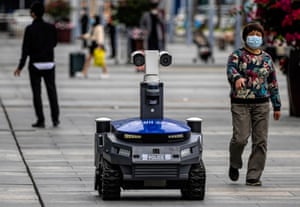
A police security robot drives on the high-speed railway station platform in Shenzhen, Guangdong province. The device, which patrols public places, warns people when they are not wearing masks, checks their body temperature and identity.

This much is certain:

Just as this disease has shattered lives, disrupted markets and exposed the competence (or lack thereof) of governments, it will lead to permanent shifts in political and economic power in ways that will become apparent only later.

It will be a time of contradictions.

Internationally, many issues that appeared pressing prior to the pandemic will likely recede in prominence once the world begins its recovery. All non-coronavirus issues will be pushed aside.

Not only because of a shared experience but also because of the mutual assistance that will be required at the same time, democracies must prevent the emergence of a big brother-style intrusion into the personal sphere by the security apparatus.

Such a thing can only occur in the absence of massive civilian oversight.

Many countries will set up committees of inquiry to find out why they and their healthcare systems were caught unprepared, humanity is destined to return to its old self after the adjustment period ends. And that, on balance, is a good thing.

Coronavirus will not end globalization, but it will change it by disrupting our lives and causing painful tragedy —it may introduce a new acceptance of unpredictability into our thinking.

This is certainly not the last time that we’re going to have these kinds of disease eruptions if we deny, delude, and delay on climate change.

We know what to do to halt climate change, we just have to do it.

Our current sense of risk — such as when it is safe to cross a road — is insufficient to deal with threats that are so dire they must be minimized; we need a complete rethink.

If we don’t we will have unregulated algorithms run the world.

How much of life can now be conducted digitally?

If we can accept canceled flights, closed schools, postponed sporting fixtures now, perhaps we can accept restraints in the future.

If we can rely on international co-operation now, perhaps we can summon the same spirit again.

At some point, a nudge will be required. If the shock of coronavirus disruption isn’t enough for us to recalibrate, what will be? 

Our Memories!

We have to recognize there will be other pandemics and be better prepared. We must also recognize that climate change is a deeper and bigger threat that doesn’t go away, and is just as urgent.

All human comments appreciated. All like clicks and abuse chucked in the bin.


← Back

Thank you for your response. ✨


get inscribed into our biological memory banks. 


Share this:

  • Share on WhatsApp (Opens in new window) WhatsApp
  • More
  • Share on Mastodon (Opens in new window) Mastodon

THE BEADY EYE SAY’S: HERE IS YOUR CHANCE. WE HAVE THE UNIVERSAL DECLARATION OF HUMAN RIGHTS.

08 Wednesday Apr 2020

Posted by bobdillon33@gmail.com in #whatif.com, 2020: The year we need to change., A Constitution for the Earth., Civilization., COVID-19, Evolution, Fourth Industrial Revolution., HUMAN INTELLIGENCE, Human values., Humanity., Inequality, Life., Modern day life., Our Common Values., Reality., Survival., Sustaniability, Technology v Humanity, The common good., The essence of our humanity., The Obvious., The pursuit of profit., The state of the World., The world to day., Unanswered Questions., United Nations, VALUES, WHAT IS TRUTH, What Needs to change in the World, Where's the Global Outrage., World Economy., World Leaders, World Organisations., World Politics

≈ Comments Off on THE BEADY EYE SAY’S: HERE IS YOUR CHANCE. WE HAVE THE UNIVERSAL DECLARATION OF HUMAN RIGHTS.

Tags

Algorithms., Artificial Intelligence., Capitalism and Greed, Capitalism vs. the Climate., Climate change, CONSTITUTION FOR THE EARTH., Earth, Environment, Extinction, Globalization, Inequility, Technology, The Future of Mankind, United Nations, Visions of the future., World aid commission


(Twenty minutes read to change the world)

NOW IS THE TIME TO WRITE A CONSTITUTION FOR THE PLANET THAT WE ALL LIVE ON – THE EARTH.

We can observe our Planet from space, but many of us are still not able to see it as a unique and precious miracle of life.

Why a Constitution?

Because most of the declarations like the universal declaration of human rights or the US constitution do not, constitute viable instructions for change: they are rather moral discussion papers, containing much wishful thinking, or a list of flaws people are perceived to commit in their relation to Nature.

Because neither human beings nor culture is independent self-sufficient existences – they are dependent on the Earth.

Only the Earth can be thought of as a relatively independent existence within the Universe.

They depend on the health and prosperity of the biotic assembly that constitutes our Planet.

Because there will be no exit strategy without a healthy Earth.

The relationship between man and Earth up to now has been exploited for profit.

All noble sentiments and efforts to understand and resolve the current crisis while ignoring the splitting of the planet into two opposing systems – Culture and Nature – are doomed to failure.

The currently prevailing anthropocentric vision of the world is incorrect, not only in its details and in its specific arguments, but also in its deepest underlying principles – in short, in its entirety.

Culture is not a continuation of natural evolution by different means.

Culture is an artificial system opposing Nature.

If it were set as Nature is in biophilia, life-reverencing format, then Culture’s self-activity would grow in a desirable way.

Culture would respect Nature and both systems would co-operate at a new level.

Our world is not only surrounded by junk it is full of junk.

———————————————————————————————-

HERE: IS A DRAFT EARTH’S CONSTITUTION.

Feel free to add.

Article I

The Earth

  1. The Earth is the natural home to all of its interdependent live beings. It cannot belong to any biological species, not even to the human species. Humans, the founders of Culture, must not ravage the Earth to the detriment of themselves or of any other living beings.
  2. The Earth represents the highest value for both our species and for human Culture. It constitutes the oldest, broadest and most powerful creative activity, the unique planetary subjectivity. We have to defend its right to evolution, and its right to maintain a planet-wide balance between animate and inanimate systems.
  3. Our Culture must not expand further, neither at the expense of the natural diversity of the planet nor at the expense of human health.
  4. As a system superordinate both to humans and to their artificial Culture, the Earth is sovereign and our elected and controlled institutions must become its defenders and advocates.
  5. We commit ourselves to halting the decline, destruction, and pollution of Earth’s natural existence and, to that effect, also to advancing the recognition of a system of human responsibility, including effective and deterrent sanctions against those who fail to respect this Constitution.

Article II

Humans

  1. Human beings are not the immediate cause of the current environmental crisis. The root cause of the crisis is the systemic conflict between the artificial cultural orderliness and the natural orderliness of the Earth.
  2. Humanity is not responsible for the Earth. It is responsible for Culture, its product, which has divided the Earth into two mutually opposing systems: the Cultural and the Natural. It is the paramount task of law, politics, and science in the coming period of life-reverencing – biophilia – Culture to reconcile Culture with Nature.
  3. The human species subjectivity is restricted by the superior subjectivity of the Earth. All persons and government authorities are obliged to respect this wider subjectivity, protect the diversity and unity of the biosphere and sparingly use the inanimate products of the Earth.
  4. We hereby declare that the human species can only be biologically congruent with natural existence – not with artificial cultural existence. We acknowledge that anything that is good for the Earth is good for human beings as well.
  5. All legal systems must protect and enforce the natural orderliness of the Earth.

Article III

Culture

  1. Culture is an artificial system with its own internal, intrinsic information, and that is intellectual culture. A change in the orientation and contents of the intellectual culture, including values, knowledge, and precepts, is a prerequisite of the biophilia transformation of Culture.
  2. Culture, which is a human creation, is neither a continuation of the evolution of Nature nor a process in its improvement. It is an artificial and temporary construct, which is dependent on mass, energy, and information coming from Nature. It is a structure incongruent with the biological structure of human beings and it will cease to exist after the demise of humankind.
  3. The Culture system’s growth marginalizes and exterminates live systems and breaks up the natural structures of the Earth. Should the evolution of the Culture system’s continue, it must abandon the predatory orientation and adopt a position of a humble integration into the superior evolution of our planet.
  4. It has been political entities – States – that have made the ravaging of Nature possible, since these States have, directly or indirectly, supported the development of the predatory entrepreneurship and unrestricted extension of both materials- and energy-intensive consumer techniques. These States, therefore, bear the main responsibility for the current crisis of civilization.
  5. All States must be obliged to take steps towards a state of sustainable co-operation between Culture and the Earth. They are charged with the task of changing the predatory spiritual paradigm of Culture, starting the process of adopting biophile laws and spreading knowledge about the need for reconciliation between Culture and Nature.

Article 1V

Technology.

1. New innovations and uses of technology will be an active and integral part of the
international development story going forward. Developing a deeper understanding of how technology can impact development will better prepare everyone for the future, and help all of us drive it in new and positive directions.

2. The link between technology and governance is critical to consider in a better
understanding of how technology could be developed and deployed. The distinction between “developed” and “developing” nations should no longer apply.

3. Strong global cooperation on a range of issues drives technological
breakthroughs that combat disease, climate change, and energy shortages.

4. Governance, in turn, will play a major role in determining what technologies
are developed and who those technologies are intended, and able, to benefit.

5. Transparency allows states to glean insights from massive datasets to vastly improve the management and allocation of financial and environmental resources.

6. All technology must carry a world-recognized seal of safety verifying the authenticity of anything.

——————————————————————————————-

But no one was prepared for a world in which large-scale catastrophes would occur with such breathtaking frequency. Not surprisingly, the coronavirus pandemic has put enormous pressure on an already overstressed global economy.

Most nation-states could no longer afford their locked-in costs, let alone respond to increased citizen demands for more security, more healthcare coverage, more social programs and services, and more infrastructure repair.

So yes I can hear you saying this will never happen.

How would such a constitution be ratified, by who, at what cost, who will pay?

It can be ratified in the United Nations, passed at the next global climate summit, the cost of not doing so outweighs any alternative, and it can be paid for fairly by placing a world aid commission on all activities that are for-profit sake. ( see the previous post on world aid commission)

As you have seen, each of the scenarios, if it were to unfold, would call for different strategies and have different implications for how a range of organizations will work and relate to changes in technology. But no matter what the world might emerge, there are real choices to be made about what areas and goals to address and how to drive success toward particular objectives.

“Biodiversity is the totality of all inherited variation in the life forms of Earth, of which we are one species. We study and save it to our great benefit. We ignore and degrade it to our great peril.” Wilson, Edward O.

All comments and contributions welcome. All like clicks and abuse chucked in the bin.

← Back

Thank you for your response. ✨

Share this:

  • Share on WhatsApp (Opens in new window) WhatsApp
  • More
  • Share on Mastodon (Opens in new window) Mastodon

THE BEADY EYE SAY’S: ARE WE NOW REAPING THE REWARDS OF PROFIT FOR-PROFIT SAKE?

30 Monday Mar 2020

Posted by bobdillon33@gmail.com in 2020: The year we need to change., Algorithms., Artificial Intelligence., CORONA VIRUS., COVID-19, Evolution, Fourth Industrial Revolution., Human values., Humanity., Inequality, Life., Modern day life., Our Common Values., Reality., Survival., Sustaniability, Technology, Technology v Humanity, The common good., The essence of our humanity., The Obvious., The pursuit of profit., The state of the World., The world to day., Truth, Unanswered Questions., Universal Basic Income ., VALUES, Wealth., WHAT IS TRUTH, What Needs to change in the World, Where's the Global Outrage., World Economy.

≈ Comments Off on THE BEADY EYE SAY’S: ARE WE NOW REAPING THE REWARDS OF PROFIT FOR-PROFIT SAKE?

Tags

Algorithms., Artificial Intelligence., Capitalism and Greed, Capitalism vs. the Climate., Corona Pandemic., Coronavirus (COVID-19), Earth, Environment, Greed, Inequility, Technology, Visions of the future.


(Five-minute read) 

First, let me state the obvious.

The Covid-19 doesn’t just call our bluff it is questing the way we allow our society to be run. 

It is bringing into sharp relief what some of us have always known to be true. Our current way of living must end.

Capitalism and the culture of hierarchy that props it up is now extremely screwed up. 

The story of Capitalism up to now has been selling your labour so you don’t end up on the streets.

We should not behave to exist this way.

We come into this world kicking and screaming for our own needs while our birth’s, and our eventual departure’s, have all been turned into a product by capitalism to generate profit. We leave silent.

We live in a world where nearly everything has some kind of cost and the increased workforce automation is suggesting that things will keep getting worse.

What is considered valuable by man or the people of this world are of little or no value when one is confronted by a virus (which unfortunately some of us are witnessing this very minute) that does not discriminate any grounds.  

Money, wealth, riches, gold, property, power and so on are either transitory, fading or can be destroyed in the blink of an eye and are of no value in the long term.

In the past few years, the money markets have fallen in a heap with the global financial crisis and the value of money becoming very shaky. The same can be said of shares, property and other investments. And this is nothing new for the economic cycle goes through boom and bust every seven to ten years making fortunes at one time and destroying them at other times.

However, men believe that wealth gives you the power to be able to rise above the problems and issues of the world.

How wrong he is.

The coronavirus is not the only virus we have to confront we also have to confront capitalism and the world that sustains it.

Climate Change was not enough to make the world pause.

The challenge man faces is that we think only of the here and now.

We now have a moment to consider what a rapid response to the climate emergency would look like – how we build a society that completely transforms our social order towards something that is in equilibrium with the biosphere and gives to each according to their needs.  

But will more sustainable capitalism emerge from Covid-19 highly unlikely as the protection of private interest over public interest remains the same?  

What the coronavirus has and is showing is that our cheapskate governments can provide far more in social programmes than they have. 

While none of us can predict the future let’s hope that this time the penny drops. 

The risks of Covid – 19 are now but the risks of climate change with the clock ticking needs us to wake up before the alarm goes off. 

It’s not science, not protest, that will save the planet. Science alerted us to global warming but understand the nature of the world is crucial to dealing with it. 

Everything has a function and our function is to fit into our world and not divorce ourselves from nature.

With the age of technology and its Algorithms working themselves into everything relentless, enabling profits to disappear far from the trickle-down effect the coronavirus is revealing heroes and villains across the world.

The markets might be paralysed with numerous industries entering a state of suspended animation the environment is getting a recovery period.

Covid -19  is showing us that on the horizon, capitalism in its current form threatens value. It is built on the premise of instant gratification.

Many businesses today are aware of this failing in mankind and play to it to great effect encouraging us to insure ourselves against the cost of living and dying but we are now trading for time and for eternity.

The corona-virus is certainly a much greater reward than the fleeting pleasures of this life.

The new WFH world that emerges from this will be intriguing – Universal Basic Income.

All human comments appreciated

← Back

Thank you for your response. ✨

. All like clicks and abuse chucked in the bin. 


Share this:

  • Share on WhatsApp (Opens in new window) WhatsApp
  • More
  • Share on Mastodon (Opens in new window) Mastodon

THE BEADY EYE ASK’S. WILL THE WORLD EVER BE ABLE TO ACT AS ONE?

26 Wednesday Feb 2020

Posted by bobdillon33@gmail.com in 2020: The year we need to change., Algorithms., Artificial Intelligence., Climate Change., Dehumanization., Digital age., DIGITAL DICTATORSHIP., Disconnection., Environment, Fourth Industrial Revolution., Google, Human values., Humanity., Life., Our Common Values., Reality., Robot citizenship., Sustaniability, Technology, Technology v Humanity, The cloud., The common good., The essence of our humanity., The Future, The Obvious., The state of the World., The world to day., Unanswered Questions., WHAT IS TRUTH, What Needs to change in the World, Where's the Global Outrage.

≈ Comments Off on THE BEADY EYE ASK’S. WILL THE WORLD EVER BE ABLE TO ACT AS ONE?

Tags

Algorithms., Artificial Intelligence., Big Data, Capitalism vs. the Climate., Climate change, Extinction, Technology, The Future of Mankind, Visions of the future.


Twenty-five minute read.

If humanity stopped fighting and competing against one another; if we bound together in a common cause, we could accomplish spectacular things.

Not true.

We would basically become mindless drones of no culture because it’d all just be one culture with no distinct forms.

If this were to become a reality, Ummm how would govern it.

China’s premier Wen Jiabao put forward the following equation in a speech: “Internet + Internet of Things = Wisdom of the Earth.”

How wrong he was, however, by 2025 there will be 1 trillion networked devices worldwide in the consumer and industrial sectors combined.

He should have said, “Internet + Internet of Things = Becoming what we do not think? Because people are truly not that intelligent.

In our houses cars and factories, we’re surrounded by tiny, intelligent devices that capture data about how we live and what we do. Now they are beginning to talk to one another. Soon we’ll be able to choreograph them to respond to our needs, solve our problems, even save our lives.

Intelligent things all around us, coordinating their activities.

Coffee pots that talk to alarm clocks. Thermostats that talk to motion sensors. Factory machines that talk to the power grid and to boxes of raw material.

We might be seeing the dawn of an era when the most mundane items in our lives can talk wirelessly among themselves, performing tasks on command, giving us data we’ve never had before? This intelligence once locked in our devices will flow into the universe of physical objects.

We are already struggling to name this emerging phenomenon.

Some have called it the Internet of Things or the Internet of Everything or the Industrial Internet—despite the fact that most of these devices aren’t actually on the Internet directly but instead communicate through simple wireless protocols.

Others are calling it the Sensor Revolution.

I call it the Programmable Profitable in a World of profit-seeking algorithms.

It’s the fact that once we get enough of these objects onto our networks, they’re no longer one-off novelties or data sources but instead become a coherent system, a vast ensemble that can be choreographed, a body that can dance in the era of the cloud and apps and the walled garden— of Google, Apple, etc, which connotes a peer-to-peer system in which each node will not be equally empowered.

These connected objects will act more like a swarm of drones, a distributed legion of bots, far-flung and sometimes even hidden from view but nevertheless coordinated as if they were a single giant machine, relying on one another, coordinating their actions to carry out simple tasks without any human intervention.

So the world will act as one. Or will it?

Once we get there, that system will transform the world of everyday objects into a design­able environment, a playground for coders and engineers.

It will change the whole way we think about the division between the virtual and the physical putting intelligence from the cloud into everything we touch.

Call it “smart exploration.” 

The rises of the smartphone have supplied us with a natural way to communicate with those smart objects. So far they include watches, heart rate monitors, and even some new Nike shoes. Smartphone making payments to merchants wirelessly instead of swiping a card, and some billboards are using the protocol to beam content to passersby who ask for it. As a way to sell more products and services—particularly Big Data–style analysis—to their large corporate customers.

The yoking together of two or more smart objects—is the trickiest, because it represents the vertiginous shift from analysis, the mere harvesting of helpful data, to real automation.

In my view no matter how thoroughly we might use data to fine-tune our lives and businesses, it’s scary to take any decisions out of human hands.

It can be hard to imagine the automation you might someday want or even need, in your daily life. There are all sorts of adjustments you make over the course of any given day that is reducible to simple if-then relationships.

Facebook, which has famously described the underlying data it owns as a social graph—the knowledge of who is connected to whom and how.

Would you want to automate all of these relationships?

A world where every one of us would have a sensor on us. “Presence” tags—low-energy radio IDs that sit on our keychains or belt loops and announce our location, verify our identity.

This is the principle behind Square Wallet and a number of other nascent payment systems, including ones from PayPal and Google. (When you walk into a participating store today, Square can let the cashier know you’re there; you pay simply by giving your name.)

A tracking tool that monitors not just your pet’s movements, but your movements.

GPS reliably know our location within 100 feet, give or take, and that knowledge has and is transforming our lives immeasurably: turn-by-turn driving directions, local restaurant recommendations, location-based dating apps, and so on.

With presence technology, Google has already the potential to know our location absolutely, down to a foot or even a few inches. That means knowing not merely which bar your friend is at but which couch she’s sitting on if you walk through the door.

It means receiving a coupon for a grocery item on the endcap at the moment you walk by.

Think about a liquor cabinet that auto-populated your shopping list based on the levels in the bottles—but also locked automatically if your stock portfolio dropped more than 3 per cent.

Think about a home medical monitoring system that didn’t just feedback data from diabetic patients but adjusted the treatment regimen as the data demanded.

Think about how much more intelligent your sprinklers could be if they responded to the weather report as well as to historical patterns of soil moisture and rainfall.

It does not stop just there think about applications on top of these connected objects.

This means not just tying together the behaviour of two or more objects—like the sprinkler and the moisture sensor—but creating complex interrelationships that also tie in outside data sources and analytics. 

Plugged into that information, your system wouldn’t just know how much water is in the soil it could predict how much there will be, based on whether it’s going to rain or the sun will be baking hot that day.

It means walking through an art museum and having your phone interpret the paintings as you pause in front of them.

This simple link—between a tag on us and a tag in the world—stands to become the culmination of the location revolution, delivering on all the promises it hasn’t quite fulfilled yet. A simple link—between a tag on us and a tag in the world—will complete the location revolution.

The treasure that it digs up could be considerable.

This is obviously true for retailers:

It’s a future where the intelligence once locked in our devices will now flow into the universe of physical objects. Users and developers can share their simple if-then apps and, in the case of more complex relationships, make money off of apps, just like in the mobile marketplaces.

Processing it all in the cloud in a language unheard of.

On Google Maps, you can now navigate inside certain airports and stores, with Wi-Fi triangulation helping out your GPS. 

And according to a mobile couponing firm called Koupon Media, some 80 per cent of customers who buy gas at one major convenience-store chain never walk inside the store, so presence-based coupons could make a huge impact on the bottom line.

But it’s also true for our everyday lives. Have you ever lost an object in your house and dreamed that you could just type a search for it, as you would for a wayward document on your hard drive? With location stickers, that seemingly impossible desire has become a reality:

A startup called StickNFind Technologies already sells these quarter-sized devices for $25 apiece.

Think about a thermostat app pulling in readings from any other device on that platform—motion sensors that might say which room you’re in, presence tags that identify individual family members (with different temperature preferences)—as well as outside data sources like weather or variable power price.

An even more natural category for apps is security. It locks itself up, shuts down the lights and thermostat, and activates an alarm system complete with siren, flashing lights, and auto-notifications, and notifications with an on-call platoon of off-duty cops all coordinated through the Smart­Things.

This, finally, is the Programmable World, the point at which the full power of developers, entrepreneurs, and venture capitalists are brought to bear on the realm of physical objects—improving it, customizing it, and groping toward new business plans for it that we haven’t dreamed of yet. Indeed, it will marshal all the forces that made the Internet so transformational and put them to work on virtually everything around us.

However, there are obviously some pitfalls lurking in this future of connected objects.

As a sanity check.

Our fears about malicious hackers preying on our email and bank accounts via the cloud might pale in comparison to how we’ll feel about those same miscreants pwning our garage doors and bathroom light fixtures.

The mysterious Stuxnet and Flame exploits have raised the issue of industrial security in the era of connected devices.

Vanity Fair recently detailed nightmare scenarios in which hackers could hit connected objects, from our high tech cars (university researchers have figured out how to exploit an OnStar-type system to cause havoc in a vehicle) to our utility “smart meters” (which collect patterns of energy use that can reveal a great deal about our activities at home) to even our pacemakers.

The idea of animating the inanimate, of compelling the physical world to do our bidding, has been a staple of science fiction for half a century or more.

No, the main existential threat to the Programmable World is the considerably more mundane issue of power. Every sensor still needs a power source, which in most cases right now means a battery; low-energy protocols allow those batteries to last a long time, even a few years, but eventually, they’ll need to be replaced.

Just as with social networking, the privacy concerns of a sensor-­connected world will be fast outweighed by the strange pleasures of residing in a hyperconnected world.

A bigger concern, perhaps, is simple privacy. Just because we’ve finally warmed up to oversharing in the virtual world doesn’t mean we’ll be comfortable doing the same in the physical world, as all our interactions with objects capture more and more data about where we are and what we’re doing. iStock_000049614472Medium1

What’s coming is ubiquitous connectivity that will accelerate how people collaborate, share, learn, gather, do business, and exchange knowledge.

There will one day be universal access to all human knowledge by everyone on the planet.
So based on our collective knowledge, will we be able to act as one.
How will you use global connectivity to enhance our lives?
We automatically sort people into “like us” or “not like us.”
We are currently in a new era, combating mass species extinction and climate change with a Virus Pandemic all bring humans and the natural world together as one. 
Humanity as a whole needs to be united if we are to preserve what’s left on Earth.
One in three of the population of earth died in the Black Death, they had no idea why it was happening.
As a result, they had no responsibility, because they didn’t know.
Our problem is that we do know, and therefore, we have absolute responsibility.
We have only a very small window and if we don’t use that window in the next 10 years, not the next thirty or fifty years connectivity will be the least of our worries.
In November this year, the world will descend on Scotland, and states from across the globe will be given a choice between cooperating or continuing as they have until now.Toxic-leaders

All human comments appreciated. All like clicks and abuse chucken in the bin.

← Back

Thank you for your response. ✨

Share this:

  • Share on WhatsApp (Opens in new window) WhatsApp
  • More
  • Share on Mastodon (Opens in new window) Mastodon

THE BEADY EYE SAY’S; HERE ARE THE BIG QUESTIONS THAT ARE YET TO COME WHEN IT COMES TO TECHNOLOGY.

19 Wednesday Feb 2020

Posted by bobdillon33@gmail.com in #whatif.com, 2020: The year we need to change., Algorithms., Artificial Intelligence., Big Data., Digital age., DIGITAL DICTATORSHIP., Digital Friendship., Fourth Industrial Revolution., Google, Google it., Google Knowledge., Human values., Humanity., Life., Modern day life., Our Common Values., Reality., Sustaniability, Technology, Technology v Humanity, The common good., The Future, The Obvious., The state of the World., The world to day., Unanswered Questions., War, WHAT IS TRUTH, What Needs to change in the World, Where's the Global Outrage., World Leaders

≈ Comments Off on THE BEADY EYE SAY’S; HERE ARE THE BIG QUESTIONS THAT ARE YET TO COME WHEN IT COMES TO TECHNOLOGY.

Tags

Algorithms trade., Algorithms., Artificial Intelligence., Big Data, Capitalism and Greed, Distribution of wealth, Inequility, Technology, The Future of Mankind, Visions of the future.


Thirty-minute read.

Who owns what?  What’s our purpose in life?  What are the values that we believe in? How do we think and make decisions?  What do we mean by work?  Can our work ever have true meaning unless it is to serve others?

What will help us all think deeply about the questions we need to ask and answer?

Climate change or technology.

However, for many of us, the answers to these questions differ in our working lives, compared with our personal lives, with family, friends and neighbours.

Were a ruling elite like Google to impose a command-and-control, fear-driven culture in which power is abused and the outcomes are social and economic misery for the vast majority?

Our reaction, if we are to go by what is now observable, will be So what? Now what?

MAKING sure companies compete fairly is a tricky business. The firms being regulated know far more about their business than those doing the regulating;

“Artificial intelligence is the future, not only for Russia but for all of humankind.” Says Putin. “Whatever country comes to dominate this technology will be the “ruler of the world.”

His rhetoric is entirely appropriate. Automation and digitalization have already had a radical effect on international systems and structures.

Technology can easily be referred to as the scientific knowledge to the practical problems we are experiencing in the world today.

On the other hand, its core strategy is to gobble up market share with profit-seeking algorithms.

Our environments are all so full of technology to the point that most of the time we take it for granted.

So are we all becoming personified idiots?

Technology has a great impact on all the fundamental aspects of all our cultures including laws and how they are enforced, language, art, health care, mobility, education and religion.

The obvious problem with all of this is that countries will not own or be in control of the technologies.negative effects of technology

While we all sit back and accept the benefits technology it also brings manipulation on a  worldwide scale with our future in the hands of only a handful of corporations and the vast amount of people that are okay with that.

It’s hard to argue against innovation. It’s hard to argue against greater choice, more convenience and lower prices.

One way or the other it is also hard to underestimate the fundamentally different rules that Google /Amazon/ Facebook/ Apple/ Baidu play by.

Hiding behind forked rhetoric that the data they collect does no harm as it is anonymous.

You do not need to know who you are. It is enough to know what you consume, your habits, your tastes, and where you are, through the IP address, the GPS of the mobile, or your Google account. Your name, or your phone number, is not important to sell you things.

Blurring the borders of privacy. Replacing real-life communication.

And on top of it, violent games and videos killing empathy and bring destruction into an individual’s life. Plagiarism and cheating are increase while analysis and critical thinking decline, ending up in social isolation.

(We now have a new perverse sexual harassment of Cyber flashing which is not against any law. Why? Because our laws cannot keep up with the speed of change)

Commercial technology like Smartphones, I pads, Home Alexa/Echo and there like is about creating another consumer touchpoint for their robust ecosystem of e-commerce, services, and media taking advantage of less sophisticated consumers and trick them into consuming items for short-term satisfaction and long-term pain.

Originally created to serve faithfully to humanity, digital devices are revealing their harmful impact on our lives.

We should all be careful what we wish for.

There’s an argument made by big corporations for each country to charge corporations the lowest possible tax rate, to loosen environmental regulations down to zero, and to eliminate employee protections. All so that a country’s commodity producers can be the cheapest ones.

The voice market war has only just begun.

The contenders:

Amazon-Echo v Google-Alexa.amazon-echo-google-home

Once they figure out how to improve their recommendations and push more people to make regular household purchases via voice it will lead to an explosion in voice-based shopping.

Google already has one of the most valuable brands in the world.

Google maps have virtually no meaningful rival.  Gmail…Google basically controls our handheld existence.

Google controls your life, literally, even if it costs you to believe it.

Google trackers have been found on 75% of the top million websites.

When you search on Google, they keep your search history forever.

Google is a company that offers almost all its products for free because the money is earned by selling the data it collects with those products, to advertisers and companies.

Last year Google made over $161 billion in total revenues.

As it is the premier search engine in the U.S., Europe, and many developing countries Google has the tools to control much of the world.

That’s just Google then you have Amazon.

With around 225 million customers around the world, Amazon wants to deliver everything you want to your doorstep, including Foods anywhere in the world. ( 300 items a second) These days half of all product searches start on Amazon.

Our lust for cheap, discounted goods delivered to our doors promptly and efficiently has a price.

Amazon has done a lot of good for consumers by expanding choice, making shopping far more convenient and by delivering extraordinary product value.

Yet, we can’t–and shouldn’t–ignore the profound effect that Amazon is having on just about every corner of the retail world they set their sights on.

Amazon is selling its facial recognition technology, known as Rekognition, to law enforcement agencies.

First and foremost, Amazon isn’t required by its investors to make any real money.

For us the Great unwashed there’s always the opportunity to cut a corner, sacrifice lifestyle quality and suck it up as they race to grab a little more market share.

With their algorithms, they tell you what restaurants you have to eat in, choose your music, label your photos associating them with each family member or friend that appears in them, pay for your purchases, suggest the movies you should see, and the apps that may interest you.

When in fact the searches we do, what websites we visit, what products we look at, where are we, your medical history, your political beliefs, your associations with others your employment prospects, everything from the womb to the grave is collected and analyzed

Before I hear you calling me a hypocrite I also have used Amazon.

If this scenario prevails, would this be really the way information is supposed to be organized?

In short, does the fact that an algorithm is able to provide more relevant information than a human justify this scenario?

These big brands platforms are more powerful than governments. They’re wealthier. If they were countries, they would be pretty large economies. They’re multinational and the global financial situation allows them to ship money all over the world.

Can we do anything to make a difference?

We need to be supporting the development of an efficient circular economy.

Why?

Because sustainability is an unstoppable force.

Let’s not race to the bottom.

Country’s population size will become less important for national power as small countries that develop a significant edge in AI technology will move far above their weight.

Ultimately, however, winning and losing will not be determined by which country gains the most growth through AI. It will be determined by how the entire global community chooses to leverage AI — as a tool of war or as a tool of progress.

They can eliminate rules protecting clean water, air or consumer safety, but they will always find a way to be cheaper or more brutal than you.

We all assume that Google, Facebook, Amazon, Apple, are spying our activity and up to now advertiser is not interested in your name when they are it will be too late and the winner will be Inequality.

So what does all this mean and what are we all going to do about it when we’ve stopped talking about it?

Once you start to connect all the invisible dots together the impact on society will, in the end, be down to the people that use the technology they have to be responsible for it and if they use it irresponsibly they have to be held accountable.

A Footnote:

For me, there is little point in Jeff Bezos setting up an Earth fund when Amazon is one of the biggest promoters of pollution. Pretending to be a do-gooder.

The brown box doesn’t begin to address the larger issue: Each year in the United States alone thrown paper in the trash that represents approximately 640 million trees or roughly 915,000 acres of forest land.

Amazon ships an average of 608 million packages each year, which equates to (an estimated) 1,600,000 packages a day.

Then when we talk about energy consumption, we’re talking about the sources of energy that generate our power: oil, coal, natural gas and alternatives like solar, wind, hydropower and biofuels.

How much electricity they use and the bill is, god only knows, so its no wonder that they have contracts with oil and gas companies.

Now consider that people conduct over 1,6 billion searches per day, and you get a massive energy footprint of roughly 12.5 million watts.

Is e-commerce reducing or increasing our carbon footprint?

Google’s worldwide operations, collectively worldwide use about 2.26 million megawatt-hours per year to power its global data centre operations, which is equivalent to the power necessary to sustain 200,000 homes.

In 2018 Google generated 39.12 billion dollars earnings out of which it paid 243 Million a day in electricity.

This is only an educated guess.

The link between global warming and energy demands is obvious. Surely both of these players should be investing in Green energy.

There’s a deafening silence from pundits and elites and columnists and politicians on our joint self-destruction.

They are simply going on pretending it isn’t happening.

We don’t, as societies or cultures, value learning or knowledge or magnanimity or great and noble things, anymore.

The average person has become a tiny microcosm of the aspirations and norms of elites. We’re the only people on earth who thwart our own social progress, over and over again — and cheer about it.

We are caught in a death spiral now. A vicious cycle from which there is probably no escape. The average person is too poor to fund the very things — the only things — which can offer him a better life:

The result is that a whole society grows poorer and poorer.

Unable to invest in themselves or one another, people’s only real way out is to fight each other for self-preservation, by taking away their neighbour’s rights, privileges, and opportunities — instead of being able to give any new ones to anyone.

Though it’s too late to escape for them, let us hope our governments regulate their algorithms for profit sake.

All human comments appreciated. All like clicks chucked in the bin.

← Back

Thank you for your response. ✨


.


Share this:

  • Share on WhatsApp (Opens in new window) WhatsApp
  • More
  • Share on Mastodon (Opens in new window) Mastodon
← Older posts
Newer posts →

All comments and contributions much appreciated

  • THE BEADY EYE ASKS. ARE YOU A MEAT PROXIE? August 28, 2026
  • THE BEADY EYE SAYS BEFORE ITS TOO LATE WE MUST BUILD A GLOBAL FRIENDLY FUTURE. August 21, 2026
  • THE BEADY EYE SAYS. August 20, 2026
  • THE BEADY EYE SAYS: YOUR BELIEFS DON’T COME FROM OBJECT REALITY—— THEY ARE STORIES YOUR MIND CONSTRUCTS, FEELS INTO, AND THEN DEFENDS AS TRUTH. August 15, 2026
  • THE BEADY EYE SAYS. THERE IS OFTEN TALK ABOUT HUMAN RIGHTS, BUT IT IS ALSO NECESSARY TO TALK OF THE TRUTH AND RIGHTS OF HUMANITY. August 14, 2026

Archives

  • August 2026
  • July 2026
  • June 2026
  • May 2026
  • April 2026
  • March 2026
  • February 2026
  • January 2026
  • December 2025
  • November 2025
  • October 2025
  • September 2025
  • August 2025
  • July 2025
  • June 2025
  • May 2025
  • February 2025
  • January 2025
  • December 2024
  • November 2024
  • October 2024
  • September 2024
  • August 2024
  • July 2024
  • June 2024
  • May 2024
  • April 2024
  • March 2024
  • February 2024
  • January 2024
  • December 2023
  • October 2023
  • September 2023
  • August 2023
  • July 2023
  • June 2023
  • May 2023
  • April 2023
  • March 2023
  • February 2023
  • January 2023
  • December 2022
  • November 2022
  • October 2022
  • September 2022
  • August 2022
  • July 2022
  • June 2022
  • May 2022
  • April 2022
  • March 2022
  • February 2022
  • January 2022
  • December 2021
  • November 2021
  • October 2021
  • September 2021
  • August 2021
  • July 2021
  • June 2021
  • May 2021
  • April 2021
  • March 2021
  • February 2021
  • January 2021
  • December 2020
  • November 2020
  • October 2020
  • September 2020
  • August 2020
  • July 2020
  • June 2020
  • May 2020
  • April 2020
  • March 2020
  • February 2020
  • January 2020
  • December 2019
  • November 2019
  • October 2019
  • September 2019
  • August 2019
  • July 2019
  • June 2019
  • May 2019
  • April 2019
  • March 2019
  • February 2019
  • January 2019
  • December 2018
  • November 2018
  • October 2018
  • September 2018
  • August 2018
  • July 2018
  • June 2018
  • May 2018
  • April 2018
  • March 2018
  • February 2018
  • January 2018
  • December 2017
  • November 2017
  • October 2017
  • September 2017
  • August 2017
  • July 2017
  • June 2017
  • May 2017
  • April 2017
  • March 2017
  • February 2017
  • January 2017
  • December 2016
  • November 2016
  • October 2016
  • September 2016
  • August 2016
  • July 2016
  • June 2016
  • May 2016
  • April 2016
  • March 2016
  • February 2016
  • January 2016
  • December 2015
  • November 2015
  • October 2015
  • September 2015
  • August 2015
  • July 2015
  • June 2015
  • May 2015
  • April 2015
  • March 2015
  • February 2015
  • January 2015
  • December 2014
  • November 2014
  • October 2014
  • September 2014
  • August 2014
  • July 2014
  • June 2014
  • May 2014
  • April 2014
  • March 2014
  • February 2014
  • January 2014
  • December 2013
  • November 2013
  • October 2013

Talk to me.

benmadigan's avatarbenmadigan on THE BEADY EYE LOOKS AT THE EXP…
Jason Lawrence's avatarJason Lawrence on THE BEADY EYE ASK’S: WIT…
benmadigan's avatarbenmadigan on THE BEADY EYE ASK’S: WHA…
bobdillon33@gmail.com's avatarbobdillon33@gmail.co… on THE BEADY EYE SAYS: WELCOME TO…
Ernie's avatarOG on THE BEADY EYE SAYS: WELCOME TO…

7/7

Moulin de Labarde 46300
Gourdon Lot France
0565416842
Before 6pm.

My Blog; THE BEADY EYE.

My Blog; THE BEADY EYE.
bobdillon33@gmail.com

bobdillon33@gmail.com

Free Thinker.

View Full Profile →

Follow bobdillon33blog on WordPress.com

Blog Stats

  • 103,925 hits

Blogs I Follow

  • unnecessary news from earth
  • The Invictus Soul
  • WestDeltaGirl's Blog
  • The PPJ Gazette
Follow bobdillon33blog on WordPress.com

The Beady Eye.

The Beady Eye.
Follow bobdillon33blog on WordPress.com

Create a free website or blog at WordPress.com.

unnecessary news from earth

WITH MIGO

The Invictus Soul

The only thing worse than being 'blind' is having a Sight but no Vision

WestDeltaGirl's Blog

Sharing vegetarian and vegan recipes and food ideas

The PPJ Gazette

PPJ Gazette copyright ©

Privacy & Cookies: This site uses cookies. By continuing to use this website, you agree to their use.
To find out more, including how to control cookies, see here: Cookie Policy
  • Subscribe Subscribed
    • bobdillon33blog
    • Join 222 other subscribers
    • Already have a WordPress.com account? Log in now.
    • bobdillon33blog
    • Subscribe Subscribed
    • Sign up
    • Log in
    • Report this content
    • View site in Reader
    • Manage subscriptions
    • Collapse this bar