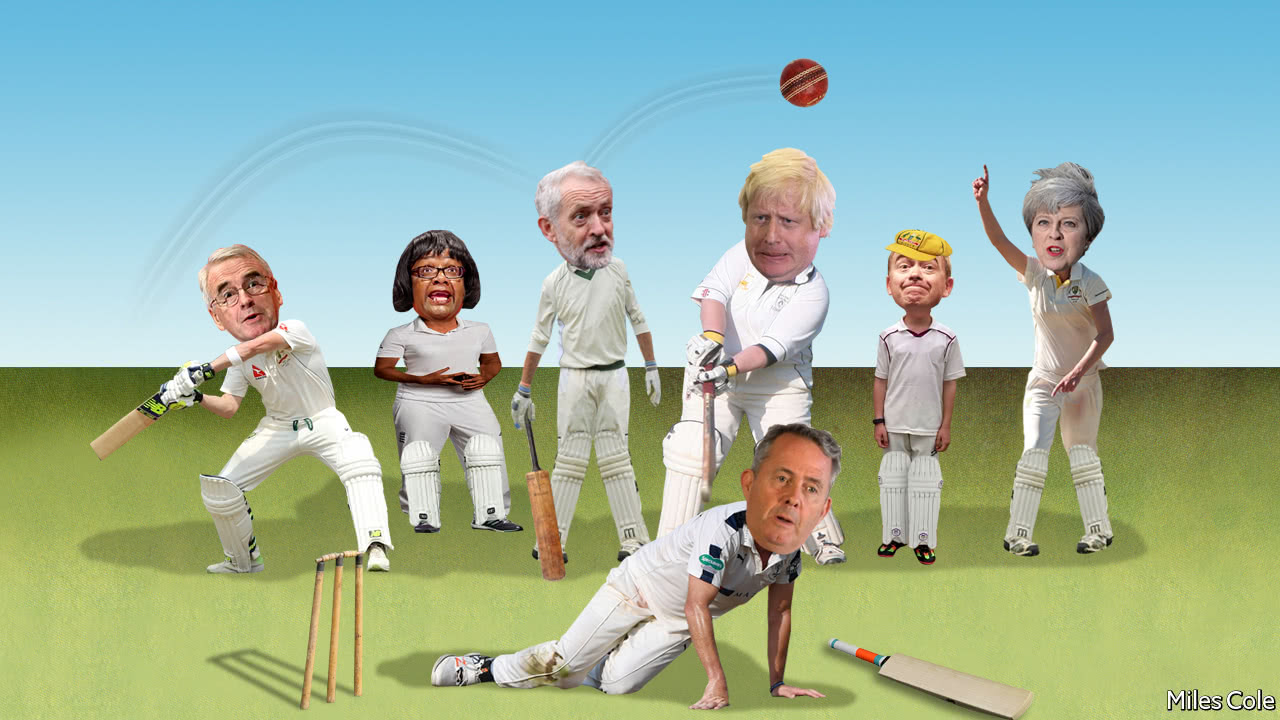
THE BEADY EYE ASK’S. WOULD SOMEONE IN THE EUROPEAN COMMISSION EXPLAIN WHY IT SHOULD NOT TURN DOWN A FURTHER EXTENSIONS.

Tags

, ,

(Seven-minute read)

CORRECT ME IF I AM WRONG.

The endless political crisis in which the United Kingdom has been sinking for nearly three years invites us to consider Brexit as the most pathetic example of a democratic accident that we have seen for a long time.

Britain’s 43-year marriage with the European Union (and its predecessors) could be about to come to a spectacular end which is perhaps emblematic of a nation without a written constitution.

A travesty of democracy.UK Independence Party leader Nigel Farage stands on a campaign bus for Brexit.

Theresa May is now ( by just one vote), legally obliged to seek an extension to article 50 and avoid a no-deal Brexit.

Does it really matter?

YES. 

BECAUSE IF THERE IS NO EXTENSION AND IT IS LAW TO AVOID A NO DEAL THERE IS ONE ONE OPTION LEFT AND THAT IS TO REVOKE ARTICLE 50.

BRITAIN STAY IN THE EUROPEAN UNION.

Britain would then participate in the EUROPEAN UNION ELECTIONS  as a full member and would introduce MPs. The British would then take part in the decisions concerning the program and the composition of the new European Commission and the budgetary framework until 2027.

Then we are now looking at a Brexit which could trigger the break up of the UK either by organizing a new peoples ballot or a general election.

However, voting is not compulsory.

So it might all come down to how many people actually bother to turn up and vote.

In the meantime, we have a member state introducing a Settlement Scheme to allow European citizens to continue living in the UK after 30 June 2021.

(If your application is successful, you’ll get either settled or pre-settled status)

EU citizens in England are to becoming second rate English citizens with their right to call Britain their home under threat.

It’s hardly surprising that England is a deeply troubled country when it had to hold a debate on whether the Europe flag should disappear from public buildings.

I find it extremely disturbing that the English Government had to debate a motion whether to ban the flying of the European Flag commemorating the 12 tribes of Israel, the 12 apostles, the 12 labours of Hercules and the 12 months of the year. They are a symbol of universal perfection and the flag is supposed to be a symbol of peace in Europe.

I ALSO FIND IT BEYOND COMPREHENSION THAT A MEMBER STATE AFTER A REFERENDUM THAT WAS WON BY LESS THAN 4%  (almost 900,000 live in the EU alone were only allowed to vote if they were registered on the electoral lists in the United Kingdom.) WAS DRIVEN BY LIES, HELD BY A PRIMINSTER TO PLACATE EUROSCEPTICS IN HIS PARTY,  WAS NOT LEGALLY BINDING TILL ARTICLE 50 WAS IMPLEMENTED WITHOUT OUT ANY PLANNING SHOULD NOW BE ALLOWED TO DESTROY THE ECONOMY OF A FELLOW MEMBER STATE IRELAND.

The above asks the questions about the future of the country and its purpose; where it is heading.

Can a simple majority of the votes cast (corresponding to a minority of the electorate as a whole) commit the future of future generations to its present concerns?

In a sense, we have not seen anything yet: the ratification of the withdrawal treaty, if it goes well, would mark the beginning of the process. As soon as the divorce agreement is implemented.

In fact, the Brexit could upset the political landscape in Europe traditionally dominated by two mastodont parties. Extremists are becoming increasingly important not just in the Conservative Party and the Labor Party but in the forthcoming European Elections.

But a lot of water needs to go under London Bridge and wind blow in Brussels before it is possible to create a world of peace and reconciliation, to tread ever more softly on our planet.

The tragedy of the present time is precisely that such an aspiration seems to be the exception and that anger or passion are infinitely more widespread than reason and argument in the streets of London or Paris, as on social networks.

In a chaotic world driven by technology surely there is only one democratic route and that is to revoke article 50, pause think.

All human comments appreciated. All like clicks and abuse chucked in the bin.

← Back

Thank you for your response. ✨


,


it could ultimately take up to a decade.


Could the UK come crawling back?

Technically, yes.


Britain will never get a better EU deal than it has right now

it is useless to prolong the discussions to infinity,


THE BEADY EYE LOOKS AT DIGITAL DICTATORSHIP.

Tags

, , , , , , , , ,


(Fifteen-minute read)

“As algorithms push humans out of the job market, wealth and power might become concentrated in the hands of the tiny elite that owns the all-powerful algorithms, creating unprecedented social and political inequality.”  Yuval Noah Harari.

Is he right?

Thanks to digital data, the state is able to have visibility on its population but is unable to govern concretely. Indeed, how can effective public policies be put in place if we can not quantify the objectives to be achieved according to the realities already observed?Résultat de recherche d'images pour "social credit system"

The crucial problem isn’t creating new jobs. The crucial problem is creating new jobs that humans perform better than algorithms.

Consequently, by 2050 a new class of people might emerge – the useless class. People who are not just unemployed, but unemployable.

Technology is never the main driver of social progress. Technology is only an amplifier of human conditions.

Why then, do we keep hoping that technology will solve our greatest social ills?

Technology has done nothing to turn the tide of rising poverty and inequality.

Yuval Noah Harari sees the problem clearly, “The most important question in 21st-century economics may well be: What should we do with all the superfluous people, once we have highly intelligent non-conscious algorithms that can do almost everything better than humans?”

Software is eating the world.  More and more major businesses and industries are being run on software and delivered as online services.

Most of what people learn in school or in college will probably be irrelevant by the time they are 40 or 50.

We need to change what we value. If we don’t our political and economic systems will simply stop attaching much value to humans. Even in an age of amazing technology, social progress depends on human changes that gadgets just can’t deliver.

What should we do?

We can’t move from the world we have to the world you want without a total paradigm shift

But what is the truth? What about reality?

Do we really want to live in a world in which billions of people are immersed in fantasies, pursuing make-believe goals and obeying imaginary laws?

Well, like it or not, that’s the world we have been living in for thousands of years already.

In order to move forward, we need to embrace technology both as a means of production and a method for producing new roles while not allowing code itself to push us into oblivion.Photo of a large monitor in a busy intersection showing images of a suspect.

The world may well be becoming more equal with more technology however rather than transferring wealth from the middle-class to the tech elite it does not distribute wealth universally.

This can only be achieved by moving to Universal assets ownership.

A Universal basic salary will only fuel consumption. 

I think most people really do want to believe that they’re contributing to the world in some way, but consumption without a purpose will indeed lead to creating a whole class of flunkies that essentially exist to improve the lives of actual rich people.

Of course, I can hear that Universal Asset ownership is a Socialist idea. But in a world that is now driven by the technology of detachment, we must find a way of engaging in sharing responsibility and rewards.

Sure there are plenty of ways to contribute to society, other than ownership, but, if we are to act as one people, we must be free to decide how and want to contribute.

Returning to the Question of DIGITAL DICTATORSHIP.

I think most people do not want Google to answer their questions. They want Google to tell them what they will have to do next.

If the hegemony of Google is to be demonstrated, we must also understand that the company is filling digital governance that states are struggling to reclaim.

We’ve been taught for the last 30 to 40 years that imagination has no place in politics or economics, but that, too, is bullshit.

So here is a solution.

The trove of data generated by every digital citizen should not be held by governments or companies but by citizens themselves.

If not the digital companion whispering to our ears the next stage will be delimiting the good of the bad.

We already have social-style scores, anyone who has shopped online with eBay has a rating on shipping times and communication. There is a lot of data being collected with little protection, and no algorithmic transparency about how it’s analysed to spit out a score or ranking.

I am not advocating here China’s social credit system which is a vast plan to monitor citizens, judging citizens’ behaviour and trustworthiness. The potential for abuse is enormous. The Social Credit System is in large part a direct response to a collapse in public confidence in government officials and others in positions of authority. Résultat de recherche d'images pour "social credit system"

I am advocating a system of social credits to reward projects that reduce climate change, social inequality and that promotes free education. 

Why not use human wisdom, not machines, to move our world forward.

Democracy as we know it will not survive the Forth Technological Revolution unless we all have a stake in it other than the vote.

Looking at the state of the world the idea of a ‘useless class’ might feel abstract to most of us at the moment and will remain so until we use our buying power as our voting power to effect change.

Right now we’ve got upside down democracy where every decision has been made globally, behind closed doors by corporations. If the people see no point in a democracy, because it seems to have no relevance to their everyday lives and the situation in which they live them, they will not do anything to defend it or take part in its processes.

With Universal Asset ownership business can become part of the solution,
not part of the problem.

That’s a project we can all get behind.

All human comments appreciated. All like clicks and abuse chucked in the bin.

← Back

Thank you for your response. ✨


Who actually is the useless class?


THE BEADY EYE ASK’S: WHAT IS THE VALUE OF A HUMAN TO DAY ?

Tags

, , , , , , , , , ,


( Seven minuter read)

At the best of times, money is a touchy subject but when it comes to putting a value on a human there is a vast array of circumstances that all boil down to pain and pleasure.

Whatever rest assured with the Forth Industrial Revolution and Climate change we are going to learn the real value of human life. Résultat de recherche d'images pour "can we put a monetary value on ourselves" Should the value of life be variable depending on age?  UTILITARIANISM.

Have you been thinking about putting yourself up for sale lately?

Ever wonder how much money you could get on the open human market?

Money is merely an arbitrary store of value, wars and natural disasters bear witness to this fact.

In a system where capitalism is a prime determinant of value, how can we preserve what we truly value as humans, what matters to us beyond money?

No matter where we stand on the socioeconomic ladder, the future of the “normal life” doesn’t look good.

CAN WE DO ANYTHING?

Humanity is more important than money — it’s time for capitalism to get an

upgrade.

So how can we change capitalism so that it focuses on what humans really

want and need?

There have been many different forms of capitalist economies ever since money was invented around 5,000 years ago. The current form of institutional capitalism and corporatism is just the latest of many different versions with the current revolution in technology promoting another form of materialism, by and large, is a psychological trap.

Profit-seeking algorithms recognise that money is inherently neutral that it is merely a vessel for the exchange of experience between two people. Its value only becomes realized when it’s put into motion.

Technology will not be the key which frees us from this precipitous world.

Most people these days aren’t even conscious of what they’re using to determine their self-worth.

No matter how much you own, how much you buy, how much you earn, the disease of more never goes away- just look at the current state of the world.

Old-style protection of nature for its own sake has badly failed to stop the destruction of habitats and the dwindling of species. It has failed largely because philosophical and scientific arguments rarely trump profits and the promise of jobs.

In one of my recent post, I addressed the power of your back pocket – buying power as a means of effecting change. It needs to be supported by Social Credits. (See below)

Instead of having our humanity subverted to serve the marketplace, capitalism has to be made to serve human ends and goals.

Of course some time ago it dawned on someone that, by making it possible for people to buy and sell natures services, we could save the world and turn a profit at the same time. The industrial revolution of the nineteenth century. Nature by capital.

(Sorry, did I say nature? We don’t call it that any more. It is now called natural capital. Ecological processes are called ecosystem services because, of course, they exist only to serve us. Hills, forests, rivers: these are terribly out-dated terms. They are now called green infrastructure. Biodiversity and habitats? Not at all à la mode my dear. We now call them asset classes in an ecosystems market. I am not making any of this up. These are the names we now give to the natural world.)

WHAT IS NEEDED NOW IS FOR SOMEONE TO REALISE THAT:

1. Humanity is more important than money.
2. The unit of an economy is each person, not each dollar.
3. Markets exist to serve our common goals and values.

True wealth occurs when the way we spend our money is not simply compensating for how we earn it. The welfare of a nation or the world can… scarcely be inferred from a measurement of GDP.

The real value of money begins when we look beyond it and see ourselves as better, as more valuable, than it is.

Rarely will the money to be made by protecting nature match the money to be made by destroying it.

I’m talking about the development of what could be called the Natural Capital Agenda: the pricing, valuation, monetisation, financialisation of nature in the name of saving it by Social Credits.

They could put a stop to the risk of a progressive “privatisation” and “commodification” of nature.

We’re staring at trillion-dollar problems in the world with climate change, that is about to speed up and we need commensurate solutions.

One of the main problems is engaging the population of a country or countries to part take in the need to effect change.

We can harness the country’s ingenuity and energy to improve millions of lives if we could just create a way to monetize and measure goals by Social Credits.

People could buy them or win them.

For Example:

What if governments and world corporations were to introduced 100 million SCs to reduce obesity levels.

What if governments were to reward green energy projects with SCs.

What if governments were to use SCs to replace pensions/ treasury bonds.

What if countries used SCs to reflect fair trade.

What if education and reduction of inequality were promoted by SCs.

To protect the world from the despoilation and degradation which have done it so much harm. After all, it is not most environmentalists who have misunderstood the realities that come with ‘growth’ a finite Earth, but most economists.

Forget what society tells you about what it means to have succeeded, and endeavour to create your own definition of success based on those human qualities and virtues that you value most.

We are fundamentally empathetic creatures in an evolutionary process that started with blood ties, then tribes, religion, and currently nations but could extend to humans as one, then to creatures, plants and finally our planet.

The adage that money makes the world go round is the saddest reality of life.

“We can’t solve problems by using the same kind of thinking we used when we created them.”

Is the first generation of digital natives and sharing is their norm, could it be that collaborative consumption rather than consumer capitalism will be their norm?

If so, what will the next generation bring?

Time is the one resource all of us use to have, but it’s also painfully finite in nature. You can’t bank it — all you can do is invest it wisely.

Money is fluid.  Therefore, money is a reflection of the owner’s values and intentions.

We all have some sort of measuring stick that we use to determine our value as a human being.

Put another way, if we have access to all we need, would we need money?

all human comments appreciated. All like clicks and abuse chucked in the bin.

← Back

Thank you for your response. ✨


THE BEADY EYE ASK’S: COULD SOME ONE PLEASE TELL ME IF THE UK CRASHES OUT OF THE EU WITHOUT A DEAL HOW CAN THE BORDER BETWEEN IRELAND AND NORTHERN IRELAND BE ANYTHING OTHER THAN A HARD BORDER.

Tags

, ,


(Two-minute read)

FACT:

Britain’s oldest problem and Brexit’s biggest obstacle.The information leaflets say that avoiding a hard border remains a priority for the Government “in all circumstances”. Photographer: Bryn Colton/Bloomberg

FACT:

Without a deal, the inner-Irish Border would become an outer EU barrier.

FACT:

The Irish Government faces the ultimate political Catch-22 dilemma:

How to simultaneously meet its EU treaty obligations to police an outer border of the bloc with its Belfast Agreement promise to respect the open Border.

Ireland becomes a victim of the law of unintended consequences.

A no-deal Brexit – vaporised the backstop and forces a hard border.

In the immediate wake of a no-deal, the UK has said that it will allow goods to enter the North from the Republic tariff-free and avoid the need for any Border checks.

However, this does not look like a sustainable long-term position. It now seems that the outstanding backstop questions will be pushed into talks on the future EU-UK relationship.

This will put huge pressure on businesses in the North and would also appear to be in contravention of World Trade Organisation rules.

The bottom line is that, barring an arrangement similar to the backstop coming into place, some controls at or near the Irish Border look inevitable after a no-deal Brexit.

Many argue that technological solutions – drones and suchlike – will do the trick.

This is farcical:

You only eliminate physical checks between two territories separated by a border when they share a customs union and have broad regulatory alignment.

Everything else is infrastructure.

Otherwise, the EU might insist on checking goods entering from Ireland through continental ports, making Ireland second-class members of the EU single market, with a potentially huge economic cost.

The reality is that no amount of economic modelling can capture the unquantifiable human and psychological costs of the return of a hard border.

Brexiteers tell us that the customs union and the single market have nothing to do with the Good Friday agreement.

The nearly 21-year-old, consent-based international peace deal that placed the constitutional destiny of the divided communities of Northern Ireland – 56% of whom voted to remain in 2016 – in our own hands.

They are wrong.

Of course, lurking in the long tall grass of the Good Friday Agreement an international treaty is a United Ireland.

Those who signed up called it the Good Friday Agreement, those forced reluctantly to accept its terms still call it the Belfast Agreement. However, the key elements were a mutual renunciation of violation with the assurance that Northern Ireland would remain part of the UK as long as the majority of its citizens wanted it to – but could in principle become part of a United Ireland if a majority desired it in the future.

This is the apocalyptical nightmare of the DUP.

On Brexit day whenever it arrives Britain will immediately be excluded from hundreds of treaties and agreements signed by the EU.

Leave the European Union without a deal would mean denouncing an International Treaty marking another step in Englands long and troubled history with its European neighbours.

Divorce or not, Europe will continue to have a huge influence over British politics and society – history has a few lessons for us here.

If Europe made Britain, then Britain also made Europe.

The solution is a long extension – resulting in a new Commission and an English Government that represent all of its people.

All human comments appreciated. All like clicks and abuse chucked in the bin.

← Back

Thank you for your response. ✨


THE BEADY EYE ASK’S : ARE THE ENGLISH PEOPLE NOW GOING TO REALIZE THAT THEY ARE NOT REPRESENTED BY FIRST PAST THE POST.

Tags

,


( A two-minute read)

This blog has addressed the need for British politics to come into the 21 Century.

Debates about liberty and sovereignty of the democratically elected parliament are now been brought into sharp relief.

Image associée

It is time to replace the Magna Carter the English charter of 1215 document with a proper foundation document that could and would rectify glaring defects in contemporary British structures.

A modern-day written constitution would formalise more clearly the relationship between its citizens who are this day serfs to the crown.

IT WOULD SPELL OUT THE AMBIGUOUS RELATIONSHIP BETWEEN GOVERNMENT AND PARLEMENT.

It would, in particular, modernise the capricious 19th-century electoral system that unfailing reproduces an unrepresentative House of Commons.

For Example in 2015 David Camron on an overall majority with just 37% of the overall vote.  Hardly a popular mandate for conservative rule.

The existence of safe seats partly explains the relatively low turnout seen in many UK General Elections. The majority of seats in UK Westminster constituencies are safe seats, due to the requirement for only a simple majority. This is bad for pluralist democracy and clearly undermines any attempt to develop a genuine multi-party culture.

It creates complacent MPs with ‘jobs for life’ who are free to take voters for granted.

The first-past-the-post system has long served up such certainties: in 12 of the 17 general elections since 1950, fewer than one in 10 seats shifted from one party to another. Some have remained firmly in one party’s control for more than a century.

Whatever Brexit brings both the European Union and England need to wake up the needs of its citizens to be involved and represented.

All human comments appreciated. Al like clicks and abuse chucked in the bin.

← Back

Thank you for your response. ✨


THE BEADY EYE SAY’S. A LONG BREXIT EXTENSION MAKES SENSE.

Tags

,


(Three-minute read)

March 29 was supposed to be Brexit Day. Oops. Now it will be April 12, or May 22, or sometime in December, or perhaps in 2020 or—increasingly plausible if not yet entirely likely—never.

England is now the Land of False Hope and Former Glory.

You wanted in, but wanted to keep your own money; you paid less rent, but wanted to stay “special.” Fine.Résultat de recherche d'images pour "pictures of brexit cartoon"

Unions are all about compromise, and we wanted things to work with you but now we both have Brexit purgatory.

Without Britain, the EU “project” is ever more a matter for pessimism.

WHY?

A lot.

May’s humiliating retreat from Brexit will send a troubling message to populist parties across Europe. Just as the Brexit referendum initially fueled populist rhetoric in France, Italy, and Germany about breaking up the euro or weakening EU institutions, Brexit’s embarrassing setbacks are likely to have the opposite effect. After all, if Europe’s best-performing economy, most stable democracy, and the strongest military power cannot cope with leaving the EU, what hope can there be for similar initiatives in France or Italy?

What is needed for both the EU and England is a long extension to allow both the European elections with a general election in England.

How this extension comes about – whether because of a new prime minister or a general election or a second referendum or a vote in Parliament to erase all of May’s “red lines” which prevented her negotiating a Norwegian-style associate membership of the EU – is impossible to predict.

It is also not very important to allow the election of a new European Commission without the contamination of Brexit if any future Trade deal is to be negotiated.

Because once the promise of unfettered national sovereignty combined with integration in the global economy is revealed as a delusion, the most likely scenario will become an endless sequence of “temporary” transition arrangements which will solve nothing.

Because British voters probably will realize that any such semi-detached arrangement, far from enabling the UK painlessly to “take back control,” would involve high economic costs and a reduction in national sovereignty.

Because as this understanding sinks in, the Brexiteer ardour will dissipate, politicians seeking re-election will be forced to focus again on the domestic issues of economic, social, and regional policy that largely motivated the 2016 referendum protest – and one way or another Britain will decide to remain in the EU.

Because the reality is that political conditions are sure to stabilize once the period for renegotiating the UK-EU relationship is extended again from the new, very soft, April 12 deadline until the end of the year or beyond.

Because it would then become an important but subsidiary issue for the country to agree on a credible mechanism for setting aside a referendum that decided to make two plus two equal five.

But what has this to do with Brexit?

Because the blame game will extend far beyond Westminster and the list of suspects will be long.

All human comments appreciated. All like clicks and abuse chucked in the bin.

← Back

Thank you for your response. ✨


THE BEADY EYE SAY’S: WAKE UP BRITANNIA THIS IS WHO THE DUP ARE.

Tags

, , , ,


(Seven-minute read)

If you asked the question who are the DUP to the English public I would say 80%  would not be able to answer the question.

If you asked the question in Ireland 90% would answer a Northern Ireland Unionist Party out of date that is based in bigotry antie catholic and united Ireland rhetoric. Citing the territorial claims in the Irish constitution, which the party viewed as illegal and a threat to the security and religious freedom of Protestants in Northern Ireland.  

Democratic Unionist Party (DUP), Who is the DUP? A brief history of UK parliament’s new kingmaker

A “theocon” grouping whose ideas are unusual in today’s western Europe. To an American, especially from the deep South, the party would seem much more familiar.

You might call it a mixture of old-time religion and secular nativism.

The party is the creation of firebrand Protestant Evangelical Minister Ian Paisley.

Reverend Paisley also founded the Free Presbyterian Church of Ulster and was characterized by his entrenched Unionist views and his hostile opposition to the Catholic Church. Paisley helped found the Ulster Protestant Volunteers.

In 1969 members were involved, along with the UVF, in exploding a number of bombs they hoped would be blamed on the IRA (who had not begun their bombings), provoking a Protestant backlash and bringing down the Unionist government of Northern Ireland, seen by them and Paisley as having gone soft on Catholics.

Founded in 1971 by a hard-line faction of the UUP ( Ulster Unionist Party) which was at the centre of a bloody sectarian divide during Northern Ireland’s Troubles – a conflict involving rival paramilitary groups and the British Army which claimed more than 4,000 lives, 50,000 injured, and an estimated 40,000 bereaved or traumatized over 30 years.

In 1975 the DUP contested elections as part of the United Ulster Unionist Council (UUUC) alliance, which rejected the notion of sharing power with the nationalist (and largely Roman Catholic).

Core to the identity of the DUP is its representation as a party that guarantees to act as a firewall against Irish unity.

The DUP boycotted the talks when Sinn Féin was admitted in 1997. The product of the talks, the 1998 Good Friday Agreement (Belfast Agreement) on steps leading to a new power-sharing government in Northern Ireland, was rejected by the DUP, which denounced the new Northern Ireland Assembly as a dilution of British sovereignty and objected to the inclusion of Sinn Féin in the Assembly and the new executive body.

There is now a growing question about the influence of the DUP and its opposition to the Good Friday/Belfast Agreement.

In the snap election for the British House of Commons that Conservative Prime Minister Theresa May called for June 2017, the DUP added two seats to bring its representation in Westminster to 10 seats.

May then courted the support of the DUP so that she could form a minority government relying on the DUP’s 10 votes on crucial issues to push her party over the 326-vote threshold for a majority.

After securing the promise of £1 billion in extra funding for Northern Ireland over the next two years, on June 26, 2017, the DUP agreed to provide “confidence and supply” support for May’s government.

The DUP staunchly supports union with Britain.

The sense of political identity currently offered by the DUP leadership reflects a change of emphasis away from cultural unionism towards an agenda drawing on more civic understandings of politics.

However, it has blocked efforts to pass a Climate Change Act in Northern Ireland, as well as having a history of supporting creationism and blocking legislation on the legalisation of abortion and gay marriage.

It is the only political party in Ireland to support Brexit.

The DUP induced a political crisis in Northern Ireland through a “green energy” scheme. The final cost to the taxpayer for this fiasco is expected to be upwards of £400 million.

The party is opposed to abortion and gay marriage, but it goes further than that.

Members of the party have described LGBT people as “disgusting” and an “abomination”.

The DUP traditionally avoided all contact with the Irish government.

Nigel Dodds and Arlene Foster, DUP deputy leader and leader

Yet Arlene Foster is the political figure who holds in her hands the future of Brexit.

Her beliefs were forged in the bloody years of Northern Ireland: her father was shot in the head and she escaped an attack on her school bus.

Almost everything you need to know about the DUP and Brexit can be gauged from its name, with the emphasis on “unionist”.

To the DUP, the backstop represented its worst fears come to life:

But ultimately, what does the party want from Brexit?

First of all, the DUP has said it still wants the UK to leave the EU with a deal – but it must be one that treats Northern Ireland no differently from the rest of the UK.

It is hard to imagine a group less suited to this crucial role.

A political NI party of narrow-minded, intransigent bigots who care nothing for the wider interests who relish in a political mindset of ransom and provincialism that was is probably still is attached to the Ulster Volunteer Force.

The party is continually in denial about reality. Representing just 36% of the last General election in NI that voted to remain.

A party that has been spoonfed English taxpayers cash, including a 1 billion, to support England departure from the EU.

Wake up Britain!

All human comments appreciated. All like clicks and abuse chucked in the bin.

← Back

Thank you for your response. ✨


THE BEADY EYE SAY’S: ITS TIME FOR THE SOCIAL SECTOR TO MOVE BEYOND THE US-VERSUS THEM.

Tags

, , , , , , , ,


(Twelve-minute read)

There is no point at shaking our fists at corporations whose drive is to maximize profits at the expense of communities.

The world is changing faster than ever before with levels of social inequality spiralling out of control, with most of the world’s problems resulting from this, in one way or another.

The story we have been telling ourselves about our origins is wrong and perpetuates the idea of inevitable social inequality.

There is a fundamental problem with this narrative.

It isn’t true.

Civilization meant many bad things (wars, taxes, bureaucracy, patriarchy, slavery…) but also made possible written literature, science, philosophy, and most other great human achievements.

Civilization’ does not come as a package.

Unfortunately most see civilization from their smartphones and TV sets hence inequality, as a tragic necessity.

Once we learn to throw off our conceptual shackles and perceive what’s really there one can imagine overthrowing capitalism or breaking the power of the state, but it’s very difficult to imagine eliminating ‘inequality’.

In fact, it’s not obvious that doing so would even mean since people are not all the same and nobody would particularly want them to be.

Against a background of limited resources GDP growth is still seen as the ultimate political ambition.

‘Inequality’ is a way of framing social problems appropriate to technocratic reformers, the kind of people who assume from the outset that any real vision of social transformation has long since been taken off the political table.

With billions of people hyper-connected to each other in an unprecedented global network, it allows for an almost instantaneous and frictionless spread of new ideas and innovations. Combine this connectedness with rapidly changing demographics, shifting values and attitudes, growing political uncertainty, and exponential advances in technology, and it’s clear the next decade is setting up to be one of historic transformation.

The tech invasion has already taken over retail and advertising – and now invading forces have their eyes set on healthcare, finance, manufacturing, and education, banking.

It is time we turn the page on an approach to “the economy” under which communities are passive recipients, relegated to react to its ups and downs.

If we really want to understand how it first became acceptable for some to turn wealth into power, and for others to end up being told their needs and lives don’t count, it is here that we should look.

For instance, almost everyone nowadays insists that participatory democracy, or social equality, can work in a small community or activist group, but cannot possibly ‘scale up’ to anything like a city, a region, or a nation-state.

But the evidence before our eyes, if we choose to look at it, suggests the opposite.

Popolourism or people power can take many forms depending on what kind of change you’re looking to achieve and who has the power to make that change happen — whether it’s a government, company, community or individual.

There are many ways to influence governments and politicians, all of which can shift laws, policies and regulations.

Governmental and political structures are complex and vary widely across the globe and local laws can restrict the ability of organisations to engage in politics but there is one universal power that we have not yet tapped into.Résultat de recherche d'images pour "purchasing power pictures"

That is the power of Purchase Power.

The social sector has focused for years on government as its mechanism for change, but it’s business that has the biggest potential impacts on the social and environmental crises of our time.

Some of the deepest challenges facing our democracy have to do with the interaction between money and politics.

Yet civically minded citizens have limited options: call your MP, join a one-off protest action, donate to our advocacy organization. Too often, the options posed don’t translate into tangible benefits for one’s own community.

By making every purchase a civic opportunity, we can put communities back behind the wheel of their own economic destiny.

If we really want to see change when we open up our wallets to purchase the necessities and extra goodies in our lives, we should be more conscious of what or who we are supporting.

Purchasing power is social impact power.

With purchasing power, we can help business leaders to deliver social benefits while also meeting their bottom line, creating local markets that reward those who do.

People, given a path that does not set them back economically, will make choices as consumers that do good for their world. And, just as important, business leaders will as well.

By pooling our purchasing power, people and communities can do more than gain access to services they want at lower cost; they can unlock the ability of business–and I believe, whole market sectors–to be drivers of social good.

I believe people and communities have a more powerful tool in where what, and when they use their purchasing power.  For creating social benefits they care about, one that requires no sacrifice but instead aligns with their own economic interest as consumers:

Collective purchasing power.

Just imagine if the money we routinely spend on food, clothes, gifts, and even indulgences were turned into an untapped superpower to force change.

We’re at a moment of crisis in Communities–especially low-income neighbourhoods–are no longer being meaningfully engaged by the global economy, income inequality has never been higher, and our expulsion of finite fossil fuels into the atmosphere has us all on a crash course for disaster.

Although no generation behaves the same as the last.

How can we jumpstart a new, clean economy that truly lifts up those who need it most?

As new technologies are created at a faster and faster pace – and as they are adopted at record speeds by markets – it’s fair to say that the future is coming at a breakneck speed.

The definition of wealth itself is taking on a new meaning, with millennials leading a charge towards sustainable investing rather than being entirely focused on monetary return.

Global warming is here.

Humanity has dallied so long that avoiding the worst impacts will now require extremely sharp emissions cuts and the hotter it gets, the harder it gets to adapt.

THE TECH TO PULL CARBON OUT OF THE ATMOSPHERE IS STILL UNPROVEN.

The world has now amassed $247 trillion in debt, including $63 trillion borrowed by central governments: How we view money – and how that perception evolves over time – is an underlying factor that influences our future.

The population tidal wave in the coming decades will completely reshape the global economy. Rapid urbanization will translate into the growth of megacities, holding upwards of 50 million people.

While Amazon and Apple are worth over $1 trillion, Jeff Bezos has a $100+ billion fortune, and the current bull market is the longest in modern history at 10 years.

WITH MORE AND MORE PROFIT SEEKING ALGORITHMS THE FORCES BEHIND CHANGE ARE NOT ALWAYS EVIDENT TO THE NAKED EYE.

We now seem to be trapped in a trade paradox in which politicians give lip service to free trade, but often take action in the opposite direction.

Underrepresented populations have enormous influence as consumers.

Here are a few suggestions for conscious consumerisms.

Why not follow Bogota the Capital of a poor country and ban cars from our city centre on Sundays.

With the speed at which technology now moves, expect our energy infrastructure and delivery systems to evolve at an even more blistering pace than we’ve experienced before.

Why not allow and assist communities to set up there own solar farms.

Why not lobby Apple with there RECENTLY ANNOUNCED new credit card to allocate the cash back to charities.

Why not designate one day of the year as a world day of no online purchases.

Why not promote public asset ownership.

Why not apply a 0.05% world aid commission on all High-Frequency trading, on all Sovergen wealth fund accusations, on all foreign exchange transactions over 50,000 $, on all Lotto wins to create a perpetual World Aid fund.

Why not ask people outside Super Markets not to buy products that are housed in non-recyclable plastic.

There are many facets of change that will impact our shared future.

For community-driven economic transformation, someone has to pay for all of this change, and it is still going to be us in the form of targeted advertising.

So let advertising in all its forms Pay.

The wealth landscape is not all just about billionaires and massive companies – it is changing in other interesting ways as well.

The full impact of Millennials purchasing power and brand preferences will come into full effect in 2020 when their purchasing power is projected to reach $1.4 trillion.

Eventually, our descendants will be unrecognizable.

In our consumer culture what will have an immediate beneficial effect is a bottom-up approach through purchasing power which hurts the bottom line.

Finally. I am not the first or will I be the last to recognise the above.

Portable Purchasing Power

Today’s mobile advertising industry is growing exponentially. More devices

mean more sales, more opportunities to force change with what, where, and

how you buy.

Image associée

The world we want is in our hands. Buy the changes you want to see. 

All human comments appreciated. All like clicks and abuse chucked in the bin.

← Back

Thank you for your response. ✨


,


THE BEADY EYE SAY’S: FIRST-PAST-THE-POST-IS AN ARCHAIC SYSTEM. MOST OF THE WORLD HAS MOVED ON.

Tags

, , ,


(Three-minute read)

In or out England is now facing an uncertain constitutional future.Résultat de recherche d'images pour "First-past-the-post is a voting system that consistently and unpredictably skews election results in ways few can predict until the votes have been counted."

There is no doubt that the language of Brexit has contributed ( see the previous post) but the voting system has also made a major contribution.

First-past-the-post is a voting system that consistently and unpredictably skews election results in ways few can predict until the votes have been counted.

First Past the Post’s is an old colonial voting system?

Canada, the U.S. and the UK are the last countries hanging on to first-past-the-post – and even the UK uses proportional systems for its devolved assemblies.

One of the most common laments about electoral reform is that politicians will never change the system that elected them.

More than half of Uk voters live in constituencies where the result is a foregone conclusion. Living in a “safe seat” makes voting feel especially futile.

In most elections with first-past-the-post, about half the voters cast a ballot which elects no-one and has no impact on the election result.

It certainly does not encourage people to turn out and vote.

With Brexit. The adhesive that binds parties together under first past the post is diluting

When one party has 100% of the power with 39% of the vote, there’s no need to take anyone else’s views into account – even when voters want them to do just that.

With proportional representation, no matter what party you support or where you live, your vote counts. Politicians know they must pay attention to every voter and every riding!

With proportional representation, parties must work together. Cooperation between parties in a coalition or other cooperative agreement – shared credit and shared accountability – becomes the norm.

With proportional representation, you vote for what you truly believe in.

Brexit is the first step in fixing politics at the centre, to reform the electoral system.

Politics, they say, “is dominated by the far-left and the far-right”.

Decision-making is easier for big parties when it rests with a small group of strategists whose main job is to cater to their party’s base of voters and make their party look good.

English two main parties have good reason to fear transition to proportional representation, but not necessarily for the reasons often cited.

Why?

Because proportional representation substantially increases the number of parties overall. It would challenge their monopoly on political power in Westminster.

It would reduce their ideology to an argument about their side being better than the other.

It would enable people to vote for parties that more closely represent their own views, without the fear that this party will not be accordingly represented in Parliament.

It takes us away from binary choices and towards a system that is based on power-sharing and compromise.

Look closely and what could be the embryonic beginnings of a new party are there but with the first past, the post electoral system makes it difficult for new parties to win seats in general elections.

Sometimes first-past-the-post even produces a “wrong winner” election – when one party receives more popular support, but another party gets to govern with a majority!

Bolstered by a two-party system that discourages fluidity of ideology and legitimises binary decision-making. This enables the two main parties to clash in a partisan manner that is unrepresentative of a diverse country and makes complex issues such as leaving the European Union more difficult to resolve.

Many proportional representation systems mean you’ll have more than one candidate of the same party to choose from.

This means voters can ensure the candidates from each party get elected, and those that aren’t responsive to voters aren’t re-elected.

Ask any Algorithm. The current event in English Parlement renders First Past the post wrong.

All human comments appreciated. All like clicks and abuse chucked in the bin.
← Back

Thank you for your response. ✨


THE BEADY EYE ASK’S. HAS THE LANGUAGE OF BRIXIT GOT US TO WHERE WE ARE TODAY?

Tags

, ,


( Five Minute read)

LANGUAGE IS the soundtracks of our lives.

Speaking only one language is still perceived as both the norm and the ideal for an allegedly well-functioning society.

Perhaps it is proving to be the opposite in the case of Brexit.Résultat de recherche d'images pour "pictures of brexit language"

Language is more than just code by which we communicate, it is related to social and political knowledge, and access to power structures.

Up to now the myth of one nation, one national language, one national culture – which was at the heart of the ideal of the nation-state in the 19th and 20th centuries – perpetuates the master narrative of national homogeneity.

These attitudes silence the contributions that new multilingual citizens make to economic growth, social cohesion or artistic production.

A different approach is urgently needed, one that moves away from multilingualism as deficit and towards a recognition of linguistic and cultural diversity as a creative engine of civic participation and social well-being.

In an age where politicians and pressure groups alike act on the advice of communications consultants, it seems that a new term is introduced into the debate every few weeks and repeated ad infinitum, if not ad nauseam.

“People’s vote”, “leave means to leave”, “cliff-edge Brexit”, “managed no deal” “backstop” – shout the phrase of the day loud enough and often enough and voters might just remember it at the ballot box.

Rarely is there any space or inclination to look at what these slogans actually entail.

Like all these phrases, “a managed no deal” is not just meaningless spin. It may be a contradiction in terms, but it still has specific functions in the public discourse on Brexit. It serves to allay fears, allows for a positive variation on the journey metaphor and introduces a new option into the debate. Whether that option is realistic, however, is another question.

Linguistic relativity is the idea that language, which most people agree originates in and expresses human thought, can feedback to thinking, influencing thought in return.

The language that you hear gives you a vocabulary for discussing the world, and that vocabulary, by producing simulations, gives you habits of mind.

Encountering language about other groups of people can lead to a skewed view of reality. It may well be that having different words means having differently structured minds. But then, given that every mind on earth is unique and distinct, this is not really a game changer.

Language diversity has played a key role in shaping the interactions of human groups and the history of our species, and yet we know surprisingly little about the factors shaping this diversity.

“Hard Brexit”, “soft Brexit”, “Norway plus”, “Canada plus” These metaphor have shaped much of the discussion on Brexit.

You could be forgiven for being confused about the options available for Britain as it leaves the EU. One phrase in particular, though, is worth investigating further: “a managed no-deal Brexit”.

On the face of it, it seems a contradiction in terms. After all, isn’t no deal about the UK crashing out of the EU or going over a cliff edge? How could such a sudden and disastrous event be managed?

There is more to the phrase “managed no deal” though.

If we look back at the Leave and Remain campaigns, both consistently sought to evoke the emotions of voters. Leave aimed to trigger both negative and positive feelings – frustration with being restricted by the EU, fear of uncontrolled immigration, and pride in a “Global Britain”. The Remain campaign appealed overwhelmingly to fears about the UK’s economic future outside of the EU.

Two-and-a-half years on, it is no deal that is being presented as a frightening prospect. And the way to overcome the fear of what could happen is to control or manage future events.

The notion of control was central to the Leave campaign.

After triggering fears about the perceived threat posed by immigrants, and frustration about a seeming lack of power as an EU member state, the same campaign provided the solution to such negative feelings: take back control of British laws, borders and money by leaving the EU.

The idea of managing a no-deal scenario follows a similar pattern, except that the fears that need to be quelled in this case have been evoked by those rejecting a no-deal scenario.

Today our species collectively speak over 7,000 distinct languages. 2,464 of these are endangered. Just 23 languages dominate among these 7,097 and are spoken by over half of the world’s population, one is related to the backstop Irish.

Undoubtedly, a wide variety of social and environmental factors and processes have contributed to the patterns in language diversity we see across the globe.

The degree to which different environmental, social and geographic variables correlate to language is evident to all with Brexit.

Why is it that humans speak so many languages? And why are they so unevenly spread across the planet?Résultat de recherche d'images pour "pictures of brexit language"

The European Union is proud of its linguistic diversity, making translation a right. It is the largest translation organisation in the world. EU staff use English for most scientific publications, business channels and international relations. However, this is where the problem starts.

It would be quite ironic that the unofficial international language of business would not be official in the EU because of a lack of English-speaking volunteer countries. And there are only two: The Republic of Ireland and Malta. Ireland has already named Irish as its national language. What a turn of history it would be for the Irish to rescue the English language.

Brexit with have an undeniable effect on Europe as we know it. The social, financial and cultural impact it will have is hard to predict.

One thing we do know is, based on both speculation by EU officials and the regulations of the EU itself, is that the English language will be effect by Article 50. Unless a vote is carried out by the members of the European Union this could be the very end of the English language.

I leave you with- BEIDH TU ANN.

All human comments appreciated. All like clicks and abuse chucked in the bin.

← Back

Thank you for your response. ✨