THE BEADY EYE: OPEN LETTER TO THOSE ATTENDING THE UNITED NATIONS CLIMATE CHANGE SUMMIT ON THE 23 SEPTEMBER 2019.

Tags

,

( Fifteen-minute read)

DEAR ATTENDEE.

You will have heard it all before the conflict between climate change action and the market place but there is no more time to be asking ourselves is the economy more important than climate.

Now is the defining moment to do something about it – Which requires a transformation of unprecedented pace and scale.

We know from all of the scientific advice internationally that global warming is already having a very significant impact on our climate and it’s already having an impact on a range of industries, most notably agriculture, but many others as well.

So there’s is not a clear choice here to do nothing and save all existing jobs and have uninterrupted global growth by undertaking carbon trading schemes that are not and will not be adhered to.

However, this is still the approach that countries are taking, don’t upset growth and this will be reflected in the forthcoming United Nations Climate change summit on the 23 SEPTEMBER 2019.

Take for example the Uk who are bidding to host the next UN Climate Change Conference while distorting the European carbon market by reducing the price of producing carbon to £16 per ton – £10 cheaper than the EU.

No matter what is said at the summit no country is going to take actions that are going to deliberately destroy jobs and growth in their country.

Just because one country or twenty declare a climate emergency, promising to reduce carbon emissions the capitalism market place will ensure that it makes a profit.

Climate change is already being turned in to a commodity. Globally, hundreds of companies are using an internal carbon price to inform operations and investment decisions.

It will, therefore, be no wonder that we the great unwashed will remain pessimistic about the likelihood of ambitious coordinated global action.

However, as you are well aware no country is going to undertake actions on climate change that is somehow or other going to change the climate of the globe.

Unfortunately, the Summit is not going showcase of a leap in collective national political ambitions and it will not demonstrate a massive movement in the real economy in support of the agenda to convert to a Green technological world of Capitalism.

Why?

Because as I have said, no one, no country, no government, no company, no city, no civil society, wants to pay the price.

This is beyond any douth the crux of the problem.

To finance the transition to a zero-carbon economy, markets need full information on climate risks and opportunities, and clear pricing signals and policies that shift global financial flows away from polluting investments and toward zero-carbon products, services, and business models:

Only when the financial markets contribute on an equitable just manner in bearing the costs worldwide will we be able to tackle climate change on a global scale.

Not until this is achieved will there be any just transition to a zero-carbon economy via social dialogue with businesses, workers, and communities, and by integrating measures outlined in the Paris conference and the forthcoming UN Summit.

All will remain unachievable.

To make progress on this important issue and to be effective and credible it must be financed on an equitable base worldwide.

By creating a World Aid fund that is financed by all capitalist marketing functions that are currently exploiting the world for profit for profit sake.

This will allow the scraping of the emissions trading scheme and replace them with a grants-based system to encourage emissions reduction.

HOW CAN THIS BE DONE?

In order to ensure that the transformative actions in the real economy any financing must not create losers or add to economic inequality but creates new opportunities and protections, in the context of a just transition.

By placing a World Aid Commission of 0.05% on all activities within our world markets that produce profit for profit sake. 

THEN AND ONLY THEN WITH decisive business leadership complemented by ambitious government policies, each positively reinforcing each other will we be able to set Science-Based Targets in line with the goals of the Paris Agreement, committing to net-zero emissions by 2050 at the latest, switching to 100 percent renewable electricity, doubling energy productivity, accelerating the transition to electric vehicles and committing to implementing the recommendations of the Task Force on Climate-related Financial Disclosures (TCFD) otherwise every good intention will remain verbal diarrhoea.

It’s not that we don’t seek to deal with climate change.

Yours Faithfully

Robert de May Dillon founder of the Beady Eye

← Back

Thank you for your response. ✨

THE BEADY EYE SAY’S: THE WHOLE CATEGORY SYSTEM CONCERNING STORMS NEEDS SERIOUS RETHINKING.

Tags

, ,


(Ten-minute read)  


Why?

Because the maximum intensity of hurricanes will increase by about 5% this century. 

Because there is growing evidence that the warming of the atmosphere and upper ocean, due to human activity such as burning fossil fuels, is making conditions ripe for fiercer, more destructive hurricanes.

Warming oceans conditions are ideal for spawning hurricanes.

While there is no consensus on the frequency of hurricanes in a warmer world, there is a consensus that the hurricanes are becoming more intense, and hence their impact will be worse.

Meanwhile, natural buffers to hurricanes, such as mangroves and coral reefs, are being stripped away around the world as a result of coastal development, pollution and warming waters.

THERE WAS A TIME WHEN STORMS HAD NO NAMES – A GALE FORCE

Now males and female names alternated because we are less afraid of hurricanes with female names.

Hurricane Florence killed dozens or so people. Hurricane Michael, killed about 70th, Hurricane Harvey unloaded 33tn gallons of water on Texas, Hurricane Irma, which reached a top speed of 177mph, ravaged Florida and several thousand people died in Puerto Rico after Hurricane Maria. Hurricane Katrina had 1,833 fatalities. Hurricane Dorian barrel into the northwestern Bahamas ravaging the Abaco Islands, killings 20.

Particularly devastating hurricanes cause names to be retired, which is why we won’t see a Hurricane Katrina, for example, again.

Now Storms are given names once they have sustained winds of more than 39mph so insurance companies don’t have to pay out home insurance policies if named storms are do not specify in their cover. ( Premiums may rise as insurers face ballooning claims.)

The Saffir-Simpson scale is now irrational, in part, because it deals only with wind, ignoring factors such as a storm’s size, rainfall potential and forward speed. 

The scale was designed to measure the amount of damage inflicted by winds, not the severe flooding due to storm surge.

The proportion of tropical storms that rapidly strengthen into powerful hurricanes has tripled over the past 30 yearsHurricane getting stronger

Perhaps its time to classify hurricanes as predators.

DANGEROUS: 

SEVERE- DEVASTATION: Enough force to damage homes and snap trees.

LIFE-THREATENING: 

GET -OUT:  Raze dwellings, causing widespread power outages and result in scores of deaths.

APOCALYPTIC: Stay put and die. 


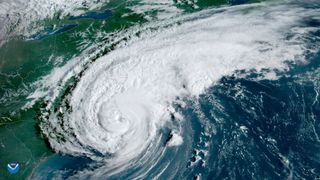
NOAA’s GOES East satellite captured this view of the strong Category 1 storm at 8:20 a.m. EDT, just 15 minutes before the center of Hurricane Dorian moved across the barrier islands of Cape Hatteras.

In general, hurricanes are steered by global winds. The prevailing winds that surround a hurricane, also known as the environmental wind field, are what guide a hurricane along its path.

In 2016, for the first time since 1938, a hurricane formed in the Atlantic in January- Hurricane Alex.

While the eye of a hurricane is typically very calm and nearly windless, the eyewall is the fiercest part of the story, where winds are strongest.

A hurricane can pick up as much as two billion tons of water a day through evaporation and sea sprays. If the heat released by an average hurricane in one day could be converted to electricity, it could supply the United States’ electrical needs for about six months.

Those who deny scientific findings of climate change in favour of magical thinking and other such fallacies will only leave the world a more unstable and dangerous place for future generations to come.


All human comments appreciated. All like clicks and abuse chucked in the bin.

← Back

Thank you for your response. ✨


THE BEADY EYE SAY’S: ALGORITHMS ARE RUNNING OUR LIVES.

Tags

, , , , , , , , ,


(Twenty-minute read)

So should we be more wary of their power?

Their lack of accountability and complete opacity is frightening.

Some time ago I advocated that there should be a legal requirement that all software programmes/ algorithms be subject to regulation to create an oversight that would assess the impact of algorithms before it becomes alive.

Other words a virtual total transparent deposit world bank where the original programmes are held and vetted to comply with the core principals of humanity.

That, by itself, is now a tall order that requires impartial experts backtracking through the technology development process to find the models and formulae that originated the algorithms.

Who is prepared to do this? Who has the time, the budget and resources to investigate and recommend useful courses of action?

This is a 21st-century job description – and market niche – in search of real people and companies outside political manipulation. In order to make algorithms more transparent, products and product information circulars might include an outline of algorithmic assumptions, akin to the nutritional sidebar now found on many packaged food products, that would inform users of how algorithms drive intelligence in a given product and a reasonable outline of the implications inherent in those assumptions.

At the moment they perform seemingly miraculous tasks humans cannot and they will continue to greatly augment human intelligence and assist in accomplishing great things.  Also, our accelerating code-dependency will continue to drive the spread of algorithms; however, as with all great technological revolutions, this trend has a dark side.

There is no argument that the efficiencies of algorithms will lead to more creativity and self-expression.

However, to days algorithms are primarily written to optimize efficiency and profitability without much thought about the possible societal impacts of the data modelling and analysis.

Humans are considered to be an “input” to the process and they are not seen as real, thinking, feeling, changing beings.

This is creating a flawed, logic-driven society and that as the process evolves – that is, as algorithms begin to write the algorithms – humans may get left out of the loop, letting “the robots decide.

Algorithms will capitalize on convenience and profit, thereby discriminating [against] certain populations, but also eroding the experience of everyone else. The goal of to days algorithms is to fit some of our preferences, but not necessarily all of them: They essentially present a caricature of our tastes and preferences.

The fear is that, unless we tune our algorithms for self-actualization, it will be simply too convenient for people to follow the advice of an algorithm (or, too difficult to go beyond such advice), turning these algorithms into self-fulfilling prophecies, and users into zombies who exclusively consume easy-to-consume items.

It is not possible to capture every data element that represents the vastness of a person and that person’s needs, wants, hopes, desires. When you remove the humanity from a system where people are included, they become victims.

Dehumanization by algorithms has now spread to our police forces, to our legal systems, to our health care and social services, our politics – Brexit, Donal Trump.

So let’s ask a few questions.

Who is collecting what data points?

Do human beings the data points reflect even know or did they just agree to the terms of service because they had no real choice?

Who is making money from the data?

How is anyone to know how his/her data is being massaged and for what purposes to justify what ends?

Companies platforms like Google Facebook, Twitter,  seek to maximize profit, not maximize societal good. Worse, they repackage profit-seeking as a societal good.

There is no transparency, and oversight is a farce.

We see already today is that, in practice, stuff like ‘differential pricing’ does not help the consumer; it helps the company that is selling things, etc.

With it, all hidden from view individual human beings will be herded around like cattle, with predictably destructive results on rule of law, social justice and economics.

There is at the moment only an incentive to further obfuscate the presence and operations of algorithmic shaping of communications processes. The fact the internet can, through algorithms, be used to almost read our minds means [that] those who have access to the algorithms and their databases have a vast opportunity to manipulate large population groups.

Our Economies are increasingly dominated by a tiny, very privileged and insulated portion of the population, largely reproduce inequality for their benefit. Criticism will be belittled and dismissed because of the veneer of digital ‘logic’ over the process.

I will always remain convinced the data will be used to enrich and/or protect others and not the individual. It’s the basic nature of the economic system in which we live.

Algorithms have the capability to shape individuals’ decisions without them even knowing it, giving those who have control of the algorithms an unfair position of power.

The overall impact of ubiquitous algorithms is presently incalculable because the presence of algorithms in everyday processes and transactions is now so great, and is mostly hidden from public view. Our algorithms are now redefining what we think, how we think and what we know.

We need to ask them to think about their thinking – to look out for pitfalls and inherent biases before those are baked in and harder to remove.

Should we be allowing ourselves to become so reliant on them – and who, if anyone, is policing their use?

Will the net overall effect of algorithms be positive for individuals and society or negative for individuals and society?

If every algorithm suddenly stopped working, it would be the end of the world as we know it.

We have already turned our world over to machine learning and algorithms.

The question now is, how to better understand and manage what we have done?

What are the implications of allowing commercial interests and governments to use algorithms to analyse our habits:

The main negative changes come down to a simple but now quite difficult question:

How can we see, and fully understand the implications of, the algorithms programmed into everyday actions and decisions?

The rub is this: Whose intelligence is it, anyway?

Algorithms are aimed at optimizing everything. Our lives will be increasingly affected by their inherent conclusions and the narratives they spawn.

By expanding collection and analysis of data and the resulting application of this information, a layer of intelligence or thinking manipulation is added to processes and objects that previously did not have that layer.

The internet runs on algorithms and all online searching is accomplished through them.

Email knows where to go thanks to algorithms. Smartphone apps are nothing but algorithms. Computer and video games are algorithmic storytelling. Online dating and book-recommendation and travel websites would not function without algorithms. GPS mapping systems get people from point A to point B via algorithms.

Artificial intelligence (AI) is nought but algorithms.

The material people see on social media is brought to them by algorithms.

In fact, everything people see and do on the web is a product of algorithms.

Every time someone sorts a column in a spreadsheet, algorithms are at play, and most financial transactions today are accomplished by algorithms. Algorithms help gadgets respond to voice commands, recognize faces, sort photos and build and drive cars. Hacking, cyberattacks and cryptographic code-breaking exploit algorithms.

In the future algorithms will write many if not most algorithms.

The rise of increasingly complex algorithms calls for critical thought about how to best prevent, deter and compensate for the harms that they cause …. Algorithmic regulation will require world government uniformity, expert judgment, political independence and pre-market review to prevent – without stifling innovation – the introduction of unacceptably dangerous algorithms into the market.

The usage of algorithms and analytics in society is exploding:

From machine learning recommender systems in commerce, to credit scoring methods outside of standard regulatory practice and self-driving cars.

We now spend so much of our time online that we are creating huge data-mining opportunities with algorithms programmed to look for “indirect, non-obvious” correlations in data and over time, if not already will create or exacerbate societal divides.

Algorithms are increasingly determining our collective futures. “Bank approvals, store cards, job matches and more. Google’s search algorithm is now a more closely guarded commercial secret than the recipe for Coca-Cola),

The problem is how the rules are set: it’s impossible to do this perfectly.

The questions being raised about algorithms at the moment are not about algorithms per se, but about the way, society is structured with regard to data use and data privacy.

Humans are seeing as causation when an algorithm identifies a correlation in vast swaths of data.

This transformation presents an entirely new menace: penalties based on propensities.

The possibility of using big-data predictions about people to judge and punish them even before they’ve acted. Doing this negates ideas of fairness, justice and free will.

Parole boards in more than half of all US states use predictions founded on data analysis as a factor in deciding whether to release somebody from prison or to keep him incarcerated.

We risk falling victim to a dictatorship of data, whereby we fetishise the information, the output of our analyses, and end up misusing it.

They can and will become an instrument of the powerful, who may turn it into a source of repression, either by simply frustrating customers and employees or, worse, by harming citizens.

The idea that the world’s financial markets – and, hence, the wellbeing of our pensions, shareholdings, savings etc – are now largely determined by algorithmic vagaries is unsettling enough for some. In currency trading, an algorithm lasts for about two weeks before it is stopped because it is surpassed by a new one.

We’re already halfway towards a world where algorithms run nearly everything.

As their power intensifies, wealth will concentrate on them.

Advances in quantum computing and the rapid evolution of AI and AI agents embedded in systems and devices in the Internet of Things will lead to hyper-stalking, influencing and shaping of voters, and hyper-personalized ads, and will create new ways to misrepresent reality and perpetuate falsehoods.

Climate change is becoming visible while the profits of the capitalist world are going underground thanks to Algorithms.

All human comments appreciated. All like clicks and abuse chucked in the bin.

← Back

Thank you for your response. ✨


THE BEADY ASK’S. WILL THE FORTHCOMING UNITED NATIONS CLIMATE CONFERENCE TELL THE WHOLE TRUTH AND NOTHING BUT THE TRUTH.

Tags

, , , , ,


( Fifteen-minute read) 

In one sense, as no one knows the future, no one or any organisation is able, to tell the truth about climate change.

There is not a politician on earth who wants to tell his or her constituents the truth when it comes to Climate Change so we’ve probably already blown our chance to avoid substantial suffering, but we can somewhat reduce the even worse suffering that awaits our grandchildren.

However, the truth is that the evidence for rapid climate change is now more than compelling:

The Greenland and Antarctic ice sheets have decreased in mass

Unfortunately, are we not able as a species to confront the facts?

Humans are subject to intense status quo bias.

Especially on the conservative end of the psychological spectrum — which is the direction all humans move when they feel frightened or under threat — there is a powerful craving for the message that things are, basically, okay, that the system is working like it’s supposed to, that the current state of affairs is the best available, or close enough.

No matter how we look at it the truth is, that on our current trajectory, in the absence of substantial new climate policy, current warming is heading for up to 4°C and may be higher by the end of the century.

On any clear reading of the available evidence, no one or any country wants to financially foot the economic cost of reducing emissions. 

We are headed for disaster — slowly, yes, but surely with the outcome determined not by us but by earth itself. 

We are now facing a situation in which limiting temperature even to either 2/ 3°C requires heroic policy and technology changes, not to mention trillions and trillions in investment.

Capitalism might be “decoupling ” carbon emissions but whether we like it or not the worrying implication is that emissions will be much higher than expected even if climate action continues and is ramped up.

It is true to say that over the course of the Earth’s 4.5-billion-year history, the climate has changed a lot. This is true. But the rapid warming we’re seeing now can’t be explained by natural cycles of warming and cooling. This much faster warming corresponds with levels of carbon dioxide in the atmosphere, which have been increasing since the industrial revolution.

Let’s be clear, CO2 itself does not cause problems. It’s part of the natural global ecosystem.

We’re already seeing the devastating effects of climate change on global food supplies, increasing migration, conflict, disease and global instability, and this will only get worse if we don’t act now.

It threatens the future of the planet that we depend on for our survival and we’re the last generation that can do something about it.

The fact that everyone involved has to dance around the obvious truth, at risk of losing their status and influence will once again be displayed at the forthcoming UN conference.

But that’s where we’re headed.

It will take enormous effort just to avoid that fate and we’re running out of time; we’ve only got five or 10 years to turn things around, but we can do it, if we just not only put our minds to agreeing a 0.05% world aid commission on all activities that produce profit for profit sake. ( See previous posts) 

The problem is, while carbon capture is getting less, as more and more forests are either cut down or burned across the world, largely to produce our food or palm oil or cosmetics etc,  Governments are still backing dirty fossil fuels. 

The technology and systems we need to move to 100% renewable energy by 2045 and use our planet’s resources sustainably are already available. 

What’s now needed is for political and business leaders to take bold and urgent action towards using these solutions to address the climate crisis and restore nature.

Given what we know about human beings, path dependence, and political dysfunction we will not be able to suck thousands of megatons of carbon out of the atmosphere, so humanity can go net negative by 2100. 

Capitalism is already turning climate change into a product.

Before its too late – there is no way that the world will come to any agreement unless there is an equitable distribution of the costs. 

Capitalism profit contributed to it so let it do it again but in reverse.

This is the brutal logic of climate change.

Even if we emit a bunch more carbon in the short term.  “deployment of large-scale bioenergy faces biophysical, technical and social challenges will cause massive social unrest.  

No branch of science, certainly not climatology, can tell us what the humans of 2050 are capable of. We are all, on that score, making educated guesses, and a knowledge of history, politics, and economics will be just as important to that judgment as any knowledge of the physical sciences. 

We can watch footage of Trump calling climate change “a hoax … a money-making industry” and not be left winded by such staggering ignorance or astonishing deceit, though it is, more likely, more bleakly, a catastrophic combination of the two.

The evidence that climate change is a serious problem that we must contend with now, is overwhelming on its own. There is no need to overstate the evidence, particularly when it feeds a paralyzing narrative of doom and hopelessness.

No one wants to pays but we will all pay in one way or the other. 

All human comments appreciated

← Back

Thank you for your response. ✨

. All like clicks and abuse chucked in the bin. 


THE BEADY EYE LOOKS AT MODERN DAY POLITICS.

Tags

, , , , ,


(Five-minute read) 

My vote makes no difference is plausibly a part of the modern-day phenomenon of algorithm analyse voting that has lead to both the election of Donal Trump and Boris Jonhson.

It is resulting in the loss or deliberate yielding up of decision-making power by national governments to other organisations with Social media platforms both domestic and international— Like Facebook, Twitter,  etc. 

Combine this with Ngo’s, quangos, the law courts, business corporations, central banks, the E.U., the International Monetary Fund, the World Trade Organization and its no wonder that many are no longer content as voters to be the foot soldiers of a social or religious bloc.

They want to make a difference individually and although in a mass democracy this may lead to inevitable frustration, few would want to return to a time of extreme political polarisation or digital dictatorship. 

The symptoms of short term popularism driven by social media platforms and the smartphone are leading to a no-deal Brexit are the same worldwide. 

Denunciations of the system, citizen disengagement from mainstream parties, electoral volatility and/or apathy, the rise of dissenting movements that appeal to large numbers who are, or feel themselves to be, disfranchised or ignored by an establishment dominated by uncontrollable and often faceless forces are replacing old political systems. 

Hence the perception that parties and politicians are no longer willing or able to represent their voters, that they are “all the same” and that politics has become an irrelevant smokescreen for the machinations of special interests and lobby groups.

When relatively few people are losing out—these changes may not seem to matter much. They may even seem desirable: “pooling of sovereignty,” removal of political interference from civil society, increasing checks on the executive by domestic and international courts, subsidiarity in decision-making, encouragement of inward investment, and so on.

This creates a political and administrative burden that can neither manage nor surrender—a great cause of popular discontent.

Not so, of course, when things suddenly go wrong.

One has only to look at England:

A combination of capitalism and socialism in a highly centralized system without a nationally elected government makes England today a very unusual place.

This oddity has opened up a constitutional free-for-all.

However, national identity, not administrative or economic efficiency, is the core of both devolution and independence— and the rest is window-dressing with the past affecting us all in more complex and deep-seated ways than in countries that have experienced violent historic ruptures.

Community loyalties, however deep-rooted, are not permanent.

Whatever happens in England, there will remain the question of how to govern a big, growing, diverse, crowded, and increasingly self-conscious England.

All human comments appreciated. All like clicks and abuse chucked in the bin.

← Back

Thank you for your response. ✨


THE BEADY EYE ASK’S WHAT WOULD A WRITTEN CONSTITUTION FOR ENGLAND LOOK LIKE?

Tags

, , ,


(Twenty-minute read)

Here is a country that now does not know its status in the world offering 3 million EU citizens settled status while its citizens (67 Million) are (under an unwritten constitutional monarchy) surfs to the crown.

If Brexit achieves anything worthwhile surely it must be a written constitution.

Presently the constitution of the United Kingdom is the set of rules that determine the political governance of the United Kingdom of Great Britain and Northern Ireland.

The government of England, as part of the United Kingdom, is a constitutional monarchy. This type of governmental structure allows the monarchy to share power with an organized government.

The three different parts of a constitutional monarchy include the Crown, Parliament, and Government. The Crown, Parliament, and the Government are all different entities in the United Kingdom and they all completely different duties.

Parliament passes and debates policy, the Government oversees the daily operations of the policy and the Crown notifies Parliament of the Government’s idea on a new policy.

In this system, the monarch is the head of state, while the Prime Minister is head of Her Majesty’s Government, which wields executive power. The executive power technically rests with the monarch, but she only exercises this power through Her Majesty’s Government.

From 1688, monarchical absolutism, aristocratic privilege and capitalist energy combined into a new form of rule: cabinet government accountable to a parliament of Commons and Lords under the crown.

It created an engine of global conquest with built-in checks that protected the kingdom from would-be dictators and, especially, democracy.

Now that the Queen has agreed to suspend Parliament her position as the monarch is now called into a constitutional quagmire.

There is a host of other challenges surrounding Brexit, but none loom larger than the raw exercise of power, no matter what norms or unspoken rules of democratic society stands in the way.

Then there is the other matter that parties and politicians are infamous for failing to keep their promises made before the elections.

What we are witnessing is right-wing populism- the delegitimization of political opponents and uncooperative institutions

The great irony in all of this is that populism isn’t actually that popular and that only by exploiting the system’s weaknesses can they get anything done at all.

What defines both Donal Trump and Boris is neither of them actually have a popular mandate to govern.

Up to now, very few citizens of the UK appear to have any great interest in constitutional affairs.

Why?

Because there is no single document which explains how England is governed.

This means it requires a considerable amount of study and probably a degree in politics or law to fully understand how Britain is governed.

Politicians can hide behind the fact that since the current British Constitution is hidden from plain sight, they can get away with all sorts of things without anyone noticing.

You always have to rely on so-called experts to explain things to you.

That said, much of the British Constitution is based not on law but on an unenforceable convention.

The British Constitution is whatever the government can get away with and the outcome of the Brexit referendum is constitutional dynamite for Britain.

A new sovereign – “the people” – has now displaced the old.

In fact and in the spirit of the referendum its result drove a stake through its heart of British Politics.

Because England’s uncodified system cannot cope with pressures imposed either by In or Out vote for Brexit the terminating the 1972 European Communities Act, “parliamentary sovereignty” will be restored only as a technicality: 

Without urgent changes, a populist dictatorship of ‘the people’ looms.

Do individuals have the right to vote, to assemble, to free speech, to property, to equal treatment; and how are these rights protected? Can the executive imprison us or invade our liberty through surveillance without due cause? If not, how must it establish such a cause?

What is clear now is that England must bury its arbitrary, hyper-centralised empire-state. For even a newfangled supreme court cannot preserve the unwritten constitution that is being shredded by Brexit.

Overall, the British Constitution is a conceptual mess, even if it somehow works to some limited extents.

Why?

Because Mr Johnson and Mr Cumming’s in the name of “the people”, are seeking to break any resistance to Brexit.

In so doing they have opened the final battle over the old order.

It may take a 20-year confrontation, but the framework of 1688 cannot determine the revolution unleashed by Brexit, not least because Northern Ireland and Scotland have already undergone a form of constitutional normalisation, which is why they felt safe enough to vote to stay in the EU.

The conflicts between Englands and its constituent parts are far from resolved.

When they are resolved at all, by conventions and by expedients and by trial-and-error there is no sensible order to any of it. And rest assured in Northern Ireland nothing is really ever regarded as “unconstitutional”. Aspiration need not be part of the main constitutional document.

A new and democratic constitution is now essential, one that rests on popular sovereignty but protects the rights of all.

Of course, it is not difficult to describe what one’s preferred constitution should be like:

A worthy compendium of the rights and duties for everyone concerned with the polity.

But a piece of paper is never enough, whatever is printed on it.type-government-england

It just shows people what their rights and freedoms are, in a way that no police officer, government official or politician can ever deny them.

The greatest thing is that should anyone try to deny the people their rights and freedoms, they can be protected by testing those rights and freedoms in court. Since such rights and freedoms are clearly written in a document that everyone can own, it will be much harder for anyone to deny the people those rights and freedoms.

That now is the most important reason why England needs a written constitution.

It would help keep Britain united.

A constitution is not there for when things going well, but to regulate the consequences of things going badly. And it should be expected that things will go badly.

A constitution will vary with society so why not create an online living document rather than a traditional written Constitution to evolve with society and current political values.

It would create clarity for the electorate and emphasises the use of accountability as every government will be made to answer the public’s questions.

The government need not be of a specific type, such as democratic, socialist, etc., but it does need to have parameters that are defined and relatively unchangeable.

A constitutional government is any government whose authority and construction are defined by a constitution.

The irony of Brexit is that by leaving the EU, the English now find themselves in even more need of grownup, European-style arrangements.

The outcome could be a federal UK if Scotland agrees.

That is for the future.

It is no longer possible to have an uncodified multinational entity inside a larger multinational one actively codifying its reach, the nature of British rule could not but be threatened.

Britians arcane hotch-pitch of freedoms and rights cannot be defended in the 21st century.

Once thought to be indestructible and now revealed to be as ephemeral as dust in the wind.

All human comments appreciated. All like clicks and abuse chucked in the bin.

← Back

Thank you for your response. ✨


THE BEADY EYE LOOKS AT BORIS JOHNSON RIGHT HAND MAN DOMINIC CUMMING’S.

Tags

, , , , , , , ,


(Eighteen-minute read)

Dominic Cummings’ writings are a window into the world of the special adviser now shaping Johnson’s premiership, Brexit and the U.K.’s future.

He is described as the back-office mastermind to Johnson’s front-of-house showman during the EU referendum campaign.

Politicians don’t get to choose which votes they respect. That’s the critical issue.

Dominic Cummings

We all know that politicians are surrounded by people who are long on views but short on actionable advice. Very many people in politics have opinions, hardly any have plans.

So is Cumming’s merely the latest in a long line of geniuses to run things for the Conservatives in 10 Downing Street?

There is one thing for certain Britain is now being hurtled along by a manic fantasist and a Machiavellian aide – neither of whom was actually elected by the people – in their helter-skelter, do-or-die dash to be rid of the unelected Brussels technocrats they are shaping the Britain of the future with more than a hint of Trumpian logic.

.

As an online writer, Mr Cumming’s is a believer in the military principle of Auftragstaktik — the idea that leadership means giving subordinates a crystal-clear strategic goal. He describes himself as “not a Tory, libertarian, ‘populist’ or anything else” never missing an opportunity to apply the lessons of science to political decision-making.

Donald Trump said that Boris Johnson is the “right man for the job” for delivering Brexit.

He obviously does not know the English version of  Mr Cumming’s but who could blame him as almost no one is on his level.

The whole discussion on Brexit is so full of empty epithets and silly name-calling, lie piled onto lie… claptrap on claptrap…Almost nothing can be taken at face value. Almost everything is a damned lie.

Mr Jonhson and his right-hand man Cumming’s are now set on undermining authentic community self-help organizations with money for fake government services, and eventually, they will undermine private industry with regulations, minimum wages, taxes, with rules and tariffs that small, low-cost, marginal businesses can’t afford.

The European Union might well have its core value in Peace but it also created a market who’s purpose was not just trading but to protect the public by preventing politicians from bankrupting the nation.

If England falls out of the European Union without a deal never before in the history of the UK will its economy see little growth at such a high cost?

Dominic Cummings was found to be in contempt of Parliament earlier this year for refusing to give evidence to MPs investigating ‘fake news’.

While working for then Education Secretary, Michael Gove a few weeks prior to leaving his post as Special Advisor, he published a 251-page manifesto explaining why Gove had got almost every policy wrong.

As recently as last month, he wrote a 10,000-word blog post calling for a Whitehall ‘revolution’. He has also criticised the “Kafka-esque” influence of senior Civil Servants on elected politicians, as it limits the potential for immediate reform.

To successfully leave on the 31st October, Boris Johnson will have to override the house of commons, and with Cummings as his advisor, it’s plausible he may just do it.

Cummings and his leader Mr Johnson are now seeking to close the bunker Parliament and limit its range of discussion.

Mr Dominic Cummings is a restless risk-taker.David Levenson/Getty Images

Even if England gets rid of Boris, et al, what of the future over and above the impact of Brexit?

Will we see more of this “First Past the Post” democratic deficit leading to a bunch of narcissistic liars, or total incompetents, running the country on behalf of a minority of voters?

The Church of England is inseparable from the development of the English nation, monarchy, language, people, culture and more: they have co-evolved for five centuries. Until recently, to be Church of England was simply to be born English.

Where is its voice?

To put it another way, the legacy of King Henry VIII and his determination to assert English independence in both politics and religion (which were hardly separable in his time) seems perversely durable and stubborn to this day.

With Brexit fast approaching, reliable information is now crucial before a coup d’état by an unelected Prime Minister.

Oscar Wilde’s famous comment:-

“There are two kinds of tragedy. One is not getting what you want. The other is getting it”.

If Mr Johnston refused to step down in a no-confidence vote scenario England is not looking at a deal or no deal but it is looking at   “the gravest constitutional crisis since the Civil War.

Surely its time for a written constitution.

All human comments appreciated. All like clicks and abuse chucked in the bin.

← Back

Thank you for your response. ✨


THE BEADY EYE ASK’S: THESE DAY’S IS THERE ANYTHING SUCH AS POLITICAL SCIENCE.

Tags

, , , , ,


( Twenty-minute read)


Call it what you want:

Political Science,  Political theory, Comparative Politics, International Relations, Political Methodology. It all leaves you scratching your head and wondering what is Political Science exactly?

Political Science is a social science that focuses on government institutions and political behaviour, but how exactly did it come about?

When one watches gatherings such as the G7/8 of world leader one would have to ask where are we going.

Every major media outlet has a political scientist on call to commentate about likely voter reactions to the candidates’ stances on hot-button issues.

The behavioural models that political scientists create can practically forecast the outcome of an election before a single vote has been cast.

However in the 21st, it means “democracy”, is the crowd-sourcing of politics run by algorithms.

So political science is governed by five myths:

That it is possible to study politicsn> That it is scientific > That it is possible to study politics separated off from economics, sociology, psychology and history > That the state in our democratic capitalist society is politically neutral, that is available as a set of institutions and mechanisms to whatever group wins the election > That political science, as a discipline, advances the cause of democracy.

For me it is “superficial and trivial”, and that concept formation and development is “little more than hair-splitting and jargon”

These days we are told if something can’t be measured, then that’s not it, and if an event didn’t happen twice, then it didn’t happen.

One way or the other all the more interesting questions falling outside the bounds of scientific investigation, the internet age is gradually forcing itself upon our leaders but it is unlikely to make them reconnect with voters “less because they see the light, and more because they are beginning to feel the heat”.

For all the talk about politics, political science has never decided what exactly it should study.

The result is that many trivial matters receive an inordinate amount of attention and many important ones go untreated like climate change.

In short, political science seems to have turned around the order in which any person not trained in the discipline would try to answer the questions.

We will soon learn that political science is not about the real world but only about those features of the world that can be studied by methods deemed to be scientific.

“What should I study?” and “How should I study it?”.

What has political science found out about the political sphere that we didn’t know before, or that isn’t abysmally trivial?

It makes even the worst real-world inequalities acceptable (not worth bothering about) by rendering them irrelevant to the task at hand. Guess to whose benefit?

Few things are more important to the legitimation of capitalist rule than the assurance given by political science that the dictatorship of the capitalist class in which we live is really a democratic state of the whole people.

If political science really wishes to advance the cause of democracy (as one of the myths of our discipline already has it doing), we should help people understand that the main barrier to democracy today is capitalism.

Given the importance of the capitalist context for everything that goes on inside it, this is also a first step toward making our research truly scientific, that is capable of uncovering how the state and politics really work, and how—with the democratization of undemocratic capitalist relations of production, distribution and exchange—they might yet come to work for everyone.

Now here is a non-trivial agenda worthy of political science that aspires to advance the cause of democracy through the use of scientific

The rational choice carries the miniaturization of political science one step further by dismissing what people actually do politically and concentrating on their decisions to do it,

We see news reports, headlines in the papers and if one checks the details you find that the headlines are misleading or half-truths.

I accept that all news, in whatever medium, is subject to some editorial bias but the days of reporting the facts dispassionately are gone due to social media.

Take Brexit for example:

Parties that had strong collective identities are now falling asunder all being lead by popularism into political cul-de-sacs. The loyalty and cohesion of political parties now depend much more on short term smartphone mass memberships.

The results are tragi-comedy modernisation and public mistrusted.

This is what motivated the In or Out referendum not an understanding of the long term consequences.

Annexing subjects like the European Union affects all lives in countless ways –

I don’t think that any political science predicted a Party without power or fame the Brexit Party. It now represents a piece of evidence about how the ground is shifting.

Thus to ask today, in the middle of Mitteleuropa, where political science has been heading is also to ask whether the new beginnings of the discipline in Eastern Europe should or should not follow the path entered by our “big brother,”

The digital revolution will do to grand planners in the West what the collapse of Communism did to socialist planners in the old Soviet bloc”.

THE PROBLEM IS:

Are we somehow going to see sense and see through the lies?

How have rampant inequalities shaped electoral campaigns and promises?

We don’t need political science to say that global climate change is real.

If you don’t believe it you’re anti-facts.

THE ONLY SOLUTION IS, to open up politics with the right of “recall” against MPs with whom constituents were dissatisfied.

All human comments appreciated. All like clicks and abuse chucked in the bin.
← Back

Thank you for your response. ✨


THE BEADY EYE ASK’S: HOW UGLY A NO DEAL BREXIT WILL BE FOR IRELAND.

Tags

, , , , ,


( A Fifteen-minute read)

There isn’t long to go until England’s scheduled departure from the EU when we will all see if there is any honesty in politics?

Are we going to witness “a side deal” between the EU and the UK re the backstop?

At the moment the Irish Government and EU leaders are sticking to the position there will be no discussions with the UK on how to manage a no-deal on the Border until after the UK has left the EU.

While the new Prime Minister, Boris Johnson, now claims the backstop is “dead” a kamikaze no-deal Brexit will change that.Some food businesses in North ‘could go out of businesses within three days’ under no-deal Brexit

When it comes to the backstop we are talking about Northern Ireland, not Ulster.

Maybe Ireland, as part of Europe, would be the saner option for nationalists; even some unionists. The reality is who would pay for it the EU, Ireland or England or a combination of all three.

When you include the British expats already living in the Republic, a united Ireland would contain about a million people who identify as British: that reality would have to be recognised and somehow accommodated. Britain’s desire to be more British would actually make Ireland more British and Britain less so: because it would have lost the North, and probably Scotland soon after. At least it would reveal that when Brexiteers say Britain, they really mean England. Sorry, Wales.

Of course, is the there is another hypertechnical position.

If the EU fails to support its member Ireland it could opt to join the United Kingdom.

Either options  would be fiendishly complex to organise and require money, imagination and empathy to put together.

There will be no free lunch. It’ll be like starting Ireland over from scratch.

Back to the present.

One way or another the UK now want part of a reality or all of an illusion?

While new beginnings usually offer the chance of a fresh approach, the new Uk government’s approach to date suggests that we are more likely to witness further attempts to avoid the tough decisions and to offer little honesty on the very real trade-offs that Brexit will force on the British public.

Just like today in the Commons, the Irish parliament in Dublin back in 1921 was fiercely polarised between those who accepted the recent Anglo-Irish treaty and those who saw it as failing to offer the promised full Irish republic.

In 1921, the political division between the pro- and anti-treaty groups in Ireland was fuelled broadly by two radically opposing interpretations of the treaty. The pro-treaty faction claimed that the agreement creating the limited Free State was the best they could get and was a stepping stone to further independence. On the anti-treaty side, the same agreement was seen as a failure to achieve what was promised, a Republic, and those who signed it were traitors.

Mr Johnson with no meaning full mandate seems set to try to avoid the backstop through different means—either by trying to renegotiate the deal with the EU or by leaving the EU with no deal all ‘very gung-ho.’

As an Irishman, I am duty-bound to lend my offerings to this.

My first offering is with a no-deal the Northern Ireland border becomes an EU border. As such there will have to be border checks and tariffs.

There is an obligation on the EU and its member states to remain unity together if it wants to keep the main principle of the European Union – Peace. 

The 1998 Good Friday Agreement was a key part of this peace process. One of the agreement’s three main points was creating the infrastructure for “North-South co-operation” between the Irish government and the newly-created Northern Irish Assembly.

Both the UK and EU agreed that, in negotiating a deal on the relationship after Brexit, keeping the border open and upholding the terms of the Good Friday Agreement was of critical importance even if future trade negotiations fail, there should be provisions in place to ensure that the border remains open, as it is today.

That principle is the Irish backstop. The day’s of an Englishman’s word has long gone. 

As part of Brexit, the UK intends to leave both the single market and customs union.

The terms of the Good Friday Agreement can not be upheld without the UK being part of these two things.  Customs and regulatory checks on goods will be necessary in some form (possibly away from the border). Were the UK to leave the EU with “no-deal” Northern Ireland (as part of the UK) would have different customs and regulatory standards to Ireland (as part of the EU).

This means there could and will be a need for customs checks on goods to be introduced at the border, which could create a “hard border” with physical infrastructure, like cameras or guard posts. All undermine the principle of North-South cooperation as set out in the Good Friday agreement.

In March, the UK government set out its plan for avoiding a hard border in Ireland in the case of no deal.

It says it would introduce no new tariffs on goods crossing the border from Ireland into Northern Ireland, and no new checks or controls at the border itself (although some new customs requirements would be placed on a small number of goods, these would happen away from the border. This is a unilateral measure set out by the UK government, meaning it only affects goods crossing from Ireland into Northern Ireland.

As for goods going the other way (from Northern Ireland into Ireland) the exact details of how this would be done remain unclear.

No matter how it is achieved it will lead to different regulations for Northern Ireland compared with the “rest of the UK”.

Whilst it is true that the 9 counties of Ulster do not form Northern Ireland (3 are in the republic), historically, Ulster was a province of Ireland and when Northern Ireland became a part of the UK in 1922, it was agreed that this province would be split as it is today; the 6 counties of Ulster that form Northern Ireland (Londonderry, Antrim, Down, Tyrone, Armagh and Fermanagh) and the 3 retained by the republic; Cavan, Monaghan and Donegal. On this basis, the protestant or unionist collective term Ulster is deliberately provocative to nationalists as the British ‘stole’ and retained part of their country.

Finally:

On a practical note can someone please tell me if I buy something online in the UK which is no longer a Member of the EU will I be relying on the terms and conditions associated with the purchase rather then-current statutory instruments.

The crying tragedy is when a world needs a coming together to tackle a very penurious future building a wall that will not keep anything out nor in capitalism in all its forms must go beyond just shareholder value.

All human comments appreciated. All like clicks chucked in the bin.

← Back

Thank you for your response. ✨


THE BEADY EYE ASKS: ARE WE LOOKING NOT JUST AT THE BEGINS OF A FAILED STATE BUT THE FINAL DEATH THROBS OF A EMPIRE

Tags

, , , , , , , , , ,


(Fifteen-minute read)

The British Empire was the largest in history existing from the sixteenth century into the twentieth century.

Unfortunately, it squandered all that it acquired on a victorian class system.

Queen Elizabeth II

It killed with famine, sword and fire more people than Genghis Khan, Attila the Hun, Hitler or Stalin.

In the defence of its imperial interests, it precipitated in two World Wars.

Now it is presiding with “Mad cow disease” it’s very own self-destruction.

At stake are fundamental ideas about British sovereignty and whether in a

a progressively globalized world in which some claimed that the individual

the nation-state was becoming unviable with the can sovereignty in its

existing forms remain intact.

Queen Elizabeth II in 1992, referred to the year as the royal family’s “annus horribilis.”

SHE WAS WRONG.

Why?

Because along came a five-year austerity plan aimed at reducing the country’s massive deficit, which had been fueled by bank bailouts and stimulus spending in the wake of the 2008 financial crisis and resultant recession which resulted in 52 per cent of voters opting to leave the EU, (making the United Kingdom the first country to ever do so)

Manufactured by Magie Thatcher who turned the market into replacing society as the model of state governance. 

Not surprising as worldwide political culture has in fact transformed from one based on class to a new sort of populist, demotic politics, shaped at least as much by the mass media, especially the popular press, as by the politicians.

A sort of firestorm has broken out not just in Brazil but all over the world.

Why?

Because the relationship between public culture and consumer capitalism, while the very Earth itself is struggling with climate change has been close, in many ways the one constantly trying to outguess the other.

This game of one-upmanship, marked by ironic knowingness, has been labelled “postmodern, Brexit or Donal Trump trade wars”.

It points to the growing understanding of the relative nature of truth, itself a reaction against the prevailing supposedly “modern” certainties of the 20th century (reason, freedom, humanity, and truth itself), which indeed have often had and are having appalling outcomes.

However, it is a sign of the times that these antifundamentalist currents, themselves critical of much of Western culture, emerged at much the same time as new fundamentalisms emerged in the forms of American neoconservatism and certain strains of radical Islam. The ferment of intellectual and cultural changes involved are inextricable from the massive changes underway in the transition to the novel forms of society made possible by new information technologies.

What the Smartphone and Social Media have and are doing since the 1960s onward for Africa are also unravelling England and the EU with the perception of poor economic performance and calls for the modernization of not just for British society and the British economy but the EU and the world at large.

Both England and the European Union need to reform.

Optimism only carries you so far.

History rhymes rather than repeats are what is required.

A society where elites are widely loathed, where the political parties are polarized by demographic echoes is on the brink of collapse.

Why?

Now as then — much more now than then, in fact — there is a pervasive mistrust of institutions, a sense that governments are rotting from the head down.

The abject failure of rulers in improving human values has resulted in a downgrading of human to sub-human levels with a race to expect dishonest money is the net result of the ultimate degradation of society.

How do you trick someone into giving you something they have?

First, you offer them something worthless, while convincing them that actually much better than what they have. Second, you convince them that what they do have is worthless.

This is a typical approach used by both con artists and governments.

These huge scams are just diversions from the ultimate crime Climate change.

Our survival instinct has to quickly override our conditioned naiveté and passivity that has been bred into us. We are not just threatened as countries but as species at the same time.

A twitter/ facebook driven world will be a world of shallow values- unravelling our societies.

The thin veneer of civilization that we all depend upon on a daily basis is disappearing at a staggering pace and its not just the melting of ice.

The question now is.

Do we follow the trodden path where we only find all the grass eaten?

Creativity and imagination are what is needed as we are not getting across the problems of probability.

How we discuss and what we discuss is vital.

We must know the facts. We need a world brain bus.

Who is more likely to embrace the marginalized, to work for the disenfranchised?

Who will work for those of all backgrounds, all races and ethnicities, all religions, sexual preferences, gender identities?

Who will work to promote respect and equality for all people in the World?

Who sends a message that I want our children to believe in?

The rich and the poor, the entitled and the marginalized—they all make up the threads that a country needs to weave a unified society. When not include we weaken the material that fabricates our entire fabric of the world.

There has never been such a thing as an empire only a company called East India Company merchants. The British Empire did not exist in the Middle Ages. In the early Middle Ages, England was part of other empires: 

The British Empire was a commercial, not a military or political one.

Originally, holding an empire was about power. Throughout history, kings and queens have invaded territories in order to gain strength and power. With colonies, a country gains space, a larger army, more trade markets and the chance to make money out of whatever resources are on offer in them.

The formation of the empire was thus an unorganized process based on piecemeal acquisition, sometimes with the British government being the least willing partner in the enterprise.

An ‘Empire’ is a group of countries ruled over by a single monarch or ruling power. An empire doesn’t need an ’emperor’. The British Empire comprised of Britain, the ‘mother country’, and the colonies, countries ruled to some degree by and from Britain.

(British Empire, a worldwide system of dependencies—colonies, protectorates, and other territories—that over a span of some three centuries was brought under the sovereignty of the crown of Great Britain and the administration of the British government.)

To this day Britain’s ‘cultural imperialism’, suggesting that it was based on nationalism and racist scorn for other people.

With a handshake and the commitment “On the word of an Englishman,”
Captain James Cook claimed it for the British crown.In the century 1815–1914, 10 million square miles of territory and 400 million people were added to the British Empire. By the British Empire Exhibition of 1924, Britain was the ‘Mother Country’ of a worldwide empire which covered a fifth of the land in the world, and Britannia ‘ruled the waves’.

Sorry but Empires have benefited no one nor will any future trade deals that are not attached to sustainability do anything to resolve Climate change.

All human comments appreciated. All like clicks chucked in the bin.

← Back

Thank you for your response. ✨