THE BEADY EYE ASKS . IS ENGLAND STILL A COUNTRY FULL OF RACISIM?

Tags

, , , , , ,


(Eighteen-minute read) 

After more than three centuries of deliberate, systematic race-based exclusion, the political system that had intentionally disenfranchised black people continues to do so, yet in less overt ways. Simply by allowing political systems to work as they are designed – to grant advantages to white people and to put people of color at various disadvantages is no longer acceptable. 

However, Racism never goes away, it just adapts. This is why reverse racism is an erroneous concept.

There is no such thing as a race-neutral policy, every policy is producing or sustaining either racial inequity or equity between racial groups.
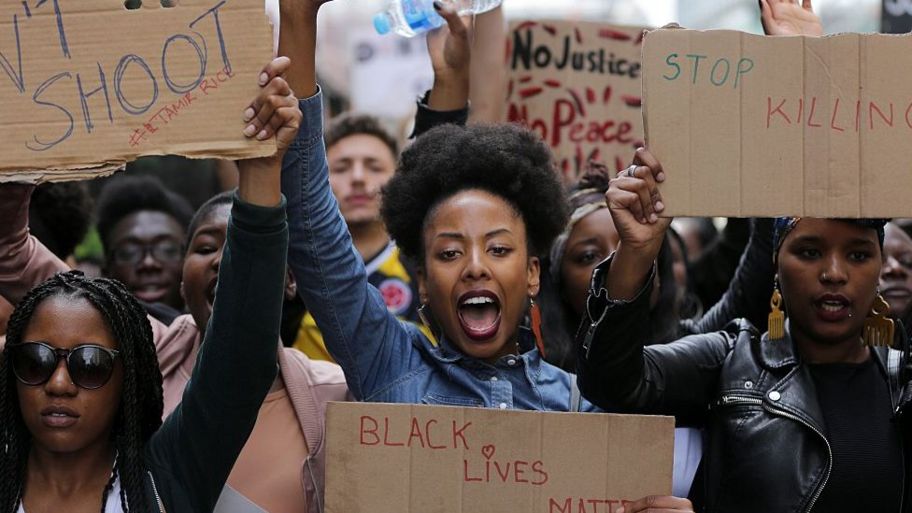
Black-lives-matter-protest.

Race intertwines with sex and class in a sticky web of exploitation and oppression but nobody is born racist.

                                         ——————-

The problem with this question is that immigration cannot be discussed properly because anyone who wants to raise the subject is labeled bigoted or racist — even if they’re talking about white Poles/ Romains, Irish, or second-generation English. 

When seeking to get a picture of the inequality and social injustice’s it is starkly evident that major ethnic and racial inequalities are still the problem in many countries. 

To have any meaningful discussion about racism, discrimination, or prejudice one must first understand the difference between them even though they are all intertwined.   

Prejudice refers to irrational or unjustifiable negative emotions or evaluations toward persons from other social groups. Prejudice comes from the words ‘to judge before.  It is forming an unfavorable opinion or feeling about a person or a group of people, without a full examination of the situation. In theory, it is possible for somebody to be prejudiced without anybody else knowing about it. You can’t help but be prejudiced. 

Discrimination refers to inappropriate treatment of people because of their actual or perceived group membership and may include both overt and covert behaviors, including microaggressions, or indirect or subtle behaviors (e.g., comments) that reflect negative attitudes or beliefs about a non-majority group. Discrimination is racism made real. It should never be tolerated.

Racism refers to prejudice or discrimination against individuals or groups based on beliefs about one’s own racial superiority or the belief that race reflects inherent differences in attributes and capabilities.

Racism is the basis for social stratification and differential treatment that advantage the dominant group. It can take many forms, including explicit racial prejudice and discrimination by individuals and institutions as well as structural or environmental racism in policies or practices that foster discrimination and mutually reinforcing social inequalities (e.g., attendance policies that favor a majority group).

Racism can also take the form of unconscious beliefs, stereotypes, and attitudes toward racial groups in the form of implicit bias. 

Other forms of racism are modern symbolic racism in which individuals deny the continued existence of racial inequality while contributing to discrimination and aversive racism through ingroup favoritism for the dominant racial group.

Prejudice and discrimination harm all people but racism is more than just personal biases it is systemic and white people can’t experience racism because they aren’t systemically oppressed.

When it comes to the idea of reverse racism, people are talking about prejudice, not racism.

                                   —————————

Britain, perhaps ironically through her Empire, has become a multi-ethnic state but unfortunately, like most countries that were founded on the sweat of immigrants, its INSTITUTIONS ARE STILL FULL OF RACISM / DISCRIMINATION. ( True of many countries) 

Racism is now such a charged subject in Britain that even outside observers feel they have a right to offer hyperbolic comments about the state of the nation.  

The danger with crying racism at every turn is that it conceals real problems. 

A belief that innate differences make some groups inherently superior to others is generally taken to be the core idea of racism. Britain to this very day personifies this belief with a class system everyone in the UK fits into whether one likes it or not.

The class system’s residue is here to stay. 

The long-term unemployed, homeless, etc. Low-level unskilled or semi-skilled workers, “Chav,”  “Champagne socialists” Middle-class white-collar workers, Toffs  “old money” which means they have been rich for a long time, Aristocrats “Blue-blooded,” the royal family and those with titles, such as lords or barons, fall into this group. 

Explaining the British class system is a hard thing to do even for a Brit. One reason for this is that moving from one class to another is increasingly possible, but the complication is that there are some unwritten rules that mean you can be considered upper class by some people and not by others!

So the class system is alive and kicking in the UK but in today’s society, it doesn’t have the same status as it once did but a substantial minority of the British public subscribe to some form of racist belief an entire kaleidoscope of words exists to refer to foreigners.

If you are a foreigner (black or not) arriving into the country with a label of Refugee, Asylum seeker, Immigrant. Alien, Undocumented, Outsider, it envokes to me, anti-immigrant rhetoric, setting up us and them sort of divide immediately on arrival.

Social class is clearly no longer neatly defined by occupation. So while Britain is looking out for the old bigotry, new ones creep in. ‘Culturalism ’ What the current class system changes into next very much depends on what we do, or don’t do.

The problems, now, in short, are not about race: they are fundamentally social and economic, better seen in terms of social class and economic inequality than in racial terms. 

Perhaps if the overall wealth of the nation was used to introduce a basic income rather than a living wage or leveling up the divides between us and them could narrow and we might in the future be valued more by what we contribute to society, not by how much we take out.

                                     ————————-

So where are we?

Of course, the battle for survival will take the presidency.  

Nations across the world face a vast array of issues and problems, from defense to societal issues and climate change. All of which could be argued to be just as pressing of an issue as the others, so with so much to juggle, what should their focus be?

We are facing the real possibility that the climate crisis could steal the chance at a better tomorrow from people all over the world. 

Immigration has already become a pressing issue across Europe in recent years, as people flee from conflict and unrest in other parts of the globe, add climate change and war in Ukraine and it won’t be who or what color is coming but how many.   

Band-aid solutions must be replaced with a focus on tackling the root causes of systemic racism along with the structural causes of racial inequality within education, employment, and self-responsibility. 

                                        —————————-

In England’s case, the departure from the EU was fuelled by posters like the above that resulted in the middle class fearing losing their privilege voting to leave. We can only institute change when people understand the conversation around racism and prejudice. When white people realize their prejudice holds power that keeps minorities oppressed, they can then work to change the system we live in.

It is now raising its ugly head in Sport, in Policing, in Politics, in every fabric of its economy – Leveling up.

This can be intentional, or not. 

Of course, atrocities were committed by whites in the name of the British Empire, but is that all its white forbears contributed? Did they bequeath no benefits to the world, including to black people?

There is no simple answer to either of these questions. 

Even the charge of colonial guilt is hopelessly one-sided.

The British spread their might but did not share their knowledge.

In England’s case, the abiding poison of white privilege is the rectitude of racism that still remains in its class structure that is the problem. Of course, there are systemic and institutional factors in play here and they must always be kept in sight.

Britain remains a racist country and there is only one remedy for racism that some claim to be an even more lethal virus than Covid: whites must admit guilt, offer an apology, and make amends. But there are other things that affect blacks and whites alike: things such as luck or an individual’s own behavior and sense of responsibility and so on.

 Are we at risk of getting things dangerously out of proportion?

‘Pound Shop Enoch Powell’ is an unsettling reality. 

Legislation has long been on the statute book outlawing racial discrimination for which blacks themselves have no responsibility. Racism is terrible, but I would like racists to feel comfortable expressing their prejudice so we can identify them and be forewarned. 

Unfortunately, Britain has much to show for 150 years of global dominance-  Gibraltar, the Falkland Islands, Bermuda. The Empire has gone back to being a small island nation taking the knee in more ways than one. The reality of Britain’s post-Brexit standing, alone in Europe is beginning to become clear.

They talk tough but look pathetic.

All human comments are appreciated. All like clicks and abuse chucked in the bin.

← Back

Thank you for your response. ✨

THE BEADY EYE ASKS WHEN IT COMES TO ART IN ALL ITS FORMS WHAT SHOULD WE BE ALLOWED TO SEE OR NOT TO SEE?

Tags

, ,


( Seven-minute read) 

Statues also considered art can be seen as a way to celebrate, remember, and tell the stories of culturally or historically significant people. However, they are marks of history or recognition of good deeds and bad – or both.

Our relationship to a statue normalizes the past for better or worse, in doing so their (statues or monuments) power ebbs and flows.

We live in uncertain times, but all around us, historical forces that have always shaped our lives have now become visible.  

This is the blindness of everyday life.  

Facts matter and the protests are, at the bottom, about facts – the historical truth of colonialism, slavery, and patriarchy, and the contemporary truth of the people they still marginalize.

Some argue that statues are an important ‘window’ into the past as they reflect who – and what – was important at the time they were built.

I can remember when Nelson was blown sky-high by the IRA in 1966 followed by Wellington.

Fast-forward to 2022.

The wars in Iraq, Afghanistan, and Syria have displaced nearly 20 million people, part of the largest refugee crisis in modern history. The top 1% of people now own half of the global wealth, while the bottom 70% account for less than 3%.

The past few years have seen a recession, with the steady breakdown of international norms, the rise of illiberal democracy and re-entrenchment of authoritarian regimes, and the emergence of rightwing populism in the west, leading to the self-inflicted wounds of Brexit and the Trump presidency.

Meanwhile, the world faces a new existential crisis: climate change. The impact of decades of unchecked growth is now undeniable, with rising temperatures and quickening cycles of natural disasters that threaten new calamities every day.

Suddenly life feels overdetermined, shaped by forces larger than any individual, community, or nation.

Little by little, we begin to connect the inequality of the present to the past and this is why statues, buildings, and street signs have become flashpoints because they embody the tension between two worldviews of having and not having.  

Virtually all western cities are monuments to colonialism.

Either they were superimposed on earlier indigenous settlements (New York), founded to support the trade in slaves and natural resources (Cape Town), or substantially built with capital extracted from the colonies (pretty much any major European city).

Removing a few of the most egregious statues will not, as some people fear, erase the histories of these places, nor diminish the cultural heritage their residents are, for better and worse, heir to.

So what are we allowed to see, hear, and what if anything can be done? 

We can modify statues to recognize historical truths and to perform a kind of apology, but that’s as far as agonism goes. Given the now impossible-to-ignore continuity between the misdeeds of the past and the conditions people face in the present, this feels insufficient.

Erasing history and arguing that people in the past can’t be judged by attitudes today – statues should be preserved because they teach people about the past, even if it is seen as unpleasant now.

I am of the opinion that new plaques should be added which explain why the person is controversial, reflecting both the good and bad things they did.

Everyone agrees as society’s values change, reconciliation can’t just be about the past it must be forward-looking by reflecting a country’s diverse population which were and still are traditionally focused on white men.

Beliefs or views held by the figures when they were alive will not be erased by removing statues to museums.

The question now is.

Does the plaque justify that the statue should stay in place?

The statues were built to honor and enforce white supremacist views, and the intent or damaging effect has not been erased by time.

Monuments to men who advocated cruelty and barbarism of any kind to achieve are a grotesque affront to moderne the day cultures of mixed societies.   

Their statues pay homage to hate, not heritage.

We don’t want to leave this so that people looking back in 50 years will say: you know, they took the statues down, why didn’t they do something about racism?”

Finally here are a few examples to chew over.  

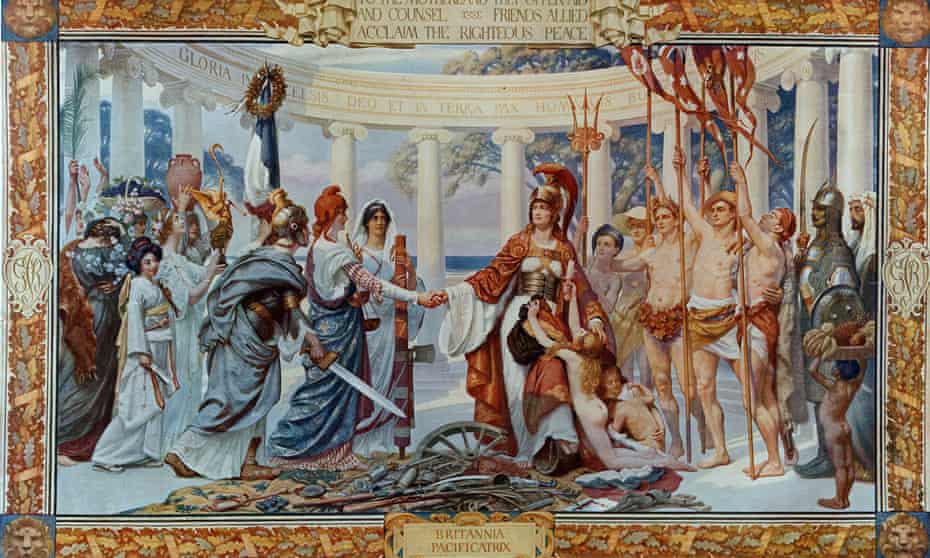
The UK The Foreign Office has a painting.  The picture shows the racial world of Britannia is ordered.

The superior Anglo-Saxons show their naked bodies, but cover their loins, subordinate races, such as Indian and Arab, are fully clothed, and the ‘least’ of races, the African, is still a naked infant.

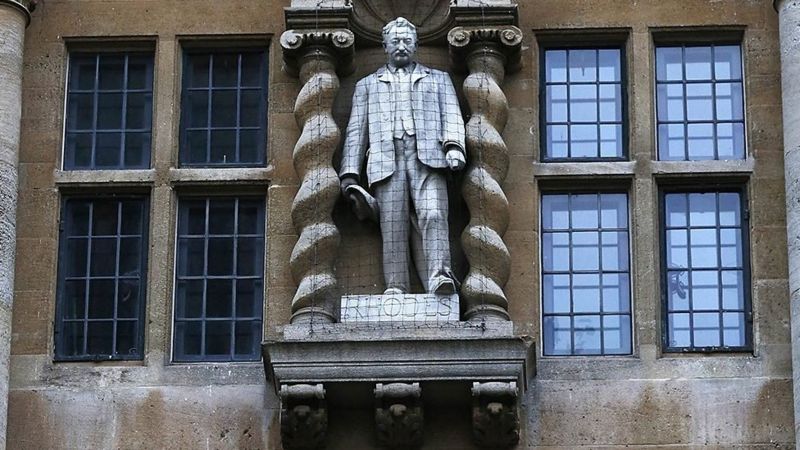
Here we have a racial meta-narrative clearly imprinted on the body. Mural by Sigismund Goetze British imperialist Cecil Rhodes statue is above the entrance to Oriel College, on Oxford High Street.

Is his non-removal an  “act of institutional racism”?  

The statue of Cecil Rhodes

He was a slave trader in the 17th century (the 1600s) and part of a group called the Royal African Company, which transported about 80,000 men, women, and children as slaves from Africa to the Americas.

The Statue now has the below plaque.  Plaque

The plaque directs readers to the college’s website and an article entitled “Contextualisation of the Rhodes Legacy”.

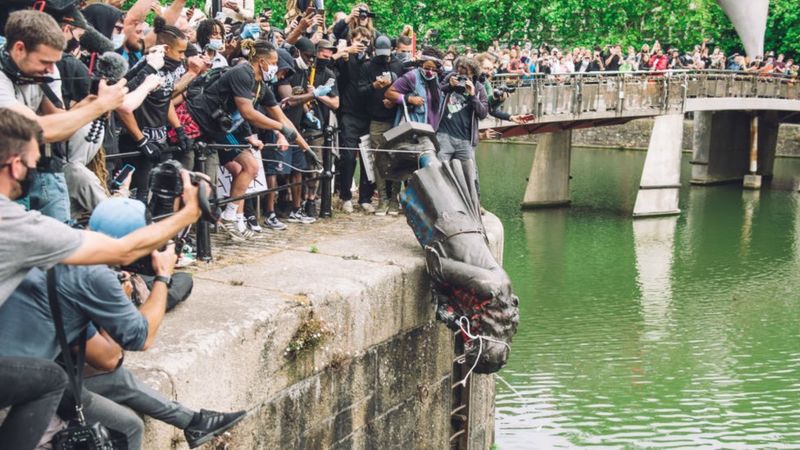
Edward Colston:  Slave trader.

He was a slave trader in the 17th century (the 1600s) and part of a group called the Royal African Company, which transported about 80,000 men, women, and children as slaves from Africa to the Americas.

It made him very rich and when he died in 1721, he left a lot of money to charities and good causes.

edward-colstan-statue.

We cannot weigh morally significant achievements against serious wrongdoing in order to justify public statutes of wrongdoers. In my view governments have a duty to condemn and repudiate serious wrongdoing that is incompatible with retaining public statues of historical figures who perpetrated serious rights violations.

All human comments are appreciated. All like clicks and abuse chucked in the bin.

← Back

Thank you for your response. ✨


THE BEADY EYE ASKS. WHY DOES RACISM EXIST?

Tags

, , ,


( Seven-minute read) 

You might think that this is a peculiar question but last year as far as global tragedies are concerned has been quite the year, with the Covid pandemic shining a light on how just fragile and unequal we all are.

Because most of us do not experience racism, it’s particularly important that we understand what racism is and learn how to be anti-racist.

More than 5 million people worldwide have died from the viral disease so far. At the same time, many companies have made a lot of money during the pandemic by selling personal protective equipment, tests, therapies, and vaccines.

With world governments borrowing billions just 2.5% of the 6.4 billion vaccine doses administered globally have been given in Africa, despite accounting for 17% of the world’s population.


                                 Why does racism persist in the modern world?

Because the term race was born after scientists classified the different systems such as Americans, Europeans, Africans, and Asians as systems that were called races. Meaning that race was what identified people and therefore located them in a different position in society.

The psychological study of racism can be summed up in one word:  Evolving.

Early psychological theories of racism justified the domination of one race over another because of Charles Darwin’s concept of survival of the fittest.

To illustrate.  The creation of a race has fostered inequality and discrimination for a long time and it has influenced how we relate to each other as humans. This is what racism means and where its routes start and the reason why it still exists today in the modern world and that has changed societies, molded several economies, laws, and social institutions.

“Race” is said to be a complex term that historically defined and changed every single individual’s position and destiny forever but what exactly do people count as racist these days? 

2020 brought the rise of Black Lives Matter protests that made people aware that even other people of color do not tend to experience racism as violently as Black people do.

Let’s look at racist beliefs first.

Because white people aren’t negatively impacted personally by racism the most vocal “anti-racist” voices are sheltered people who don’t actually understand anything about other ethnicities other than what disingenuous media personalities feed them.

It is important to recognize that it is much more multifaceted and systemic. It exists within systems, organizations, and cultures. In this way, racism is embedded in the reality of everyday life. 

What is the structure of racism? Why is racism so insidious?

In reality, our institutions are not so far removed from the years of colonialism, slavery, and segregation, and racism is still ignored, condoned, or even actively supported in many facets of life.

Ignoring racism doesn’t make it go away. Rather, it perpetuates it, effectively shutting down the possibility of moving forward by not having important conversations about the problems and possible solutions.

For too long, racism has been relegated to the past or reduced to individual beliefs and actions.

Because we don’t realize how much prejudice and stereotyping are going on beneath the level of awareness. It’s unconscious, implicit bias and can be looked at in one of two ways 

The first is prejudice, discrimination, or antagonism directed against a person or people on the basis of their membership of a particular racial or ethnic group, typically one that is a minority or marginalized which is how the Oxford dictionary describes it.

The second stereotyping point of view is racism as a belief that behavior, preferences, and capabilities are related to a person’s race or ethnic background.

On the other hand, we have the oppressors who are brainwashed to believe that all members of a certain race are inferior and undesirable. The oppressed on the other hand are taught to believe that every individual from the oppressing group views them with the same disdain.

It even affected civilizations and ethnicities that no longer exist.

For example, racism in the USA and England goes way back to their founding years in the form of slavery. These days the toxic attitudes towards minority groups prevail in both countries with the social and political aspects of the discrimination. This can be seen everywhere from workplace prejudice and disproportionate incarceration prevalence to racial profiling and mistreatment by law enforcement officers.

The perpetrators and antagonism of racial discrimination are in the wrong no matter what justifications they may have. Unfortunately, racism is with us and will stay for the foreseeable future.

Why?   

Part of the challenge to fighting racism is that in the modern world it boils down to being intertwined into the everyday culture. Therefore is not addressed by countries. Any racial intent behind policies being pushed to punish racial groups is refuted

However, given the nature of the matter, individual changes in attitude and perspective will be a lot more effective than any laws will ever be.

We might have been fooling ourselves with the sense that all this was going away—and it’s not. When the economic picture gets more negative, that tends to be associated with more prejudice toward outgroups.

All cultures have a hierarchy that leads to discrimination so undoing our own racism isn’t a quick task—it’s a lifelong journey. For us to finally win the war on racism we have to make it a personal fight to make opportunities equally available. 

All human comments are appreciated. All like clicks chucked in the bin.

← Back

Thank you for your response. ✨

THE BEADY EYE SAYS. WITH THE UKRAINE GLOBAL BRITIAN IS A JOKE.

Tags


(Fifteen-minute read)

The military-industrial complex and its clients, seem to have decided that the next place we need to go and kill people (or at least sell weapons to help others kill people) is Ukraine, assuming that Russia decides to slice off a section of its former province.

However, misfortunes of geographical fate do not mean that we should wander into conflict.

Now is not the time for more foreign and military adventurism and yet another pointless war just to expand NATO to the Russian border. ( How near do you have to be to fire a rocket?)

In fact, it boggles the mind that European powers are not standing firm against such an escalation considering they have the most to lose from a war in Europe.

It is high time to reject warmongering and embrace appeasement; yes appeasement; mutual strategic appeasement to avoid another devastating European war and dreadful world crisis.

Fortunately very few of us alive today have ever experienced the horrors of war, it is turned into entertainment by Hollowood and Net flicks. 

Perhaps this is the reason that most of us are silent and not shouting.

                            ———————–

The pace of change in an ever more challenging global environment inevitably has a significant impact on how the powers of the world influence and protect their national interests.

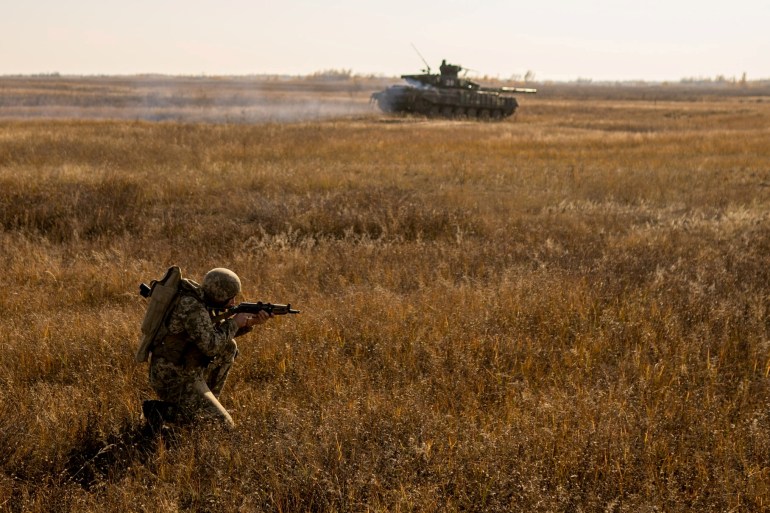
Armed forces britain

The UK Government is using the phrase ‘Global Britain’ since the EU referendum in 2016 to summarise its post-Brexit foreign policy.

Let me tell you that it is a cynical attempt to distract from the state of the UK since it left the EU. 

If you believe everything written in the mainstream press in Britain or heard on the airwaves, you would no doubt think that Russia is on course for either an all-out invasion or a coup d’etat in Ukraine.

Boris Johnson has just touched down in Ukraine is whipping up hysteria around the ‘threat’ of a Russian invasion of Ukraine. – presumably to single-handedly avert the impending ‘catastrophic invasion’. He will not tolerate Russia’s ‘destabilizing activity.

Putin is shitting in his pants in case he gets an invitation to a drinks party in no 10.  

We have all heard the Boris lies – and know the imperialist interests that hide behind them.

Unfortunately England no longer a member of the European Union and now thinks that is it is once more a Global Power. Global Britain’ was dreamt up as a way of underlining that Brexit did not mean insularity.

Mr. Johnson needs to consider whether it really makes sense to create a grouping of democracies without engaging closely with the EU, whether some of those he is inviting really merit the label ‘democracy,’ and, indeed, what balance he wishes to strike between sanctioning and engaging with China.

It is hard to believe, that he repeatedly called for a free trade agreement with China.

With one of the highest numbers of death from covid his leadership of the country, is hinging in part on setting an example at home and this is not a UK Government that has, as yet, shown an aptitude for thinking beyond the short term. 

It is obvious to all that Britain/Uk ( Whatever it is now called- The four Ununited Nations) with its departure from the EU signaled a lessening of international ambition and commitment. Its economic recovery from both the pandemic and from Brexit, and its ability to retain its unity in the face of separatist challenges are far bigger political problems than selling arms to Ukraine and then sending British soldiers to be killed by the very arms it sold in the first place. 

                                        ——————-  

To deliver on the rhetoric of a Global Britain, the Government will need to make hard choices and to show evidence of clarity and long-term vision that, to date, have been rather notable by their absence.

All the while, Ukraine looks at Britain with confusion and consternation, with officials in Kyiv distancing themselves from the alarmist picture being spun by Washington and its obedient allies.

You would think that after two world wars, Vietnam/ Afghanistan not to mention the numerous other wars in progress, we would all understand that wars are easy to start, costing young lives, for nothing to change other than the reassess of the warring nation’s place in the world.

Global Britain is now the UK government’s mantra for its post-Brexit foreign policy which involves thinking and acting globally but the UK is regarded by most Americans as a kind of historic theme park that helps tourism.

 Beyond the slogan, what is now it’s global standing.

On the military front, British threats are just farcical. Britain could make all the sound and fury it likes, and it would signify nothing.

Obviously, the countries with the most influence are those with military power and it depends on the range and depth of bilateral and regional relationships. Militarily, Great Britain is less than great.

Boris Johnson not surprisingly is supposed to be cutting the British army to 72,500 soldiers by 2025, its lowest level for 300 years. By 2026 the Royal Navy will be down from 13 to 10 frigates. There has been a huge shift in emphasis from conventional forces to cutting-edge warfare, with investment in drones and laser weapons.

It is often said that the first casualty of war is truth.

While this is nothing new the press has once again wasted no time in greasing the wheels of war.

The truth is, there is no appetite for war. The idea that you can invade a country is for those that want to commit Harry Carrie.  

Putin’s maneuver has already brought relative success, forcing NATO and the US to the negotiating table for discussion of Russia’s demands.

It is not in Russia’s interests to invade. An all-out invasion would prove disastrous for Putin and his oligarchical regime.

But why let such facts spoil a good story?

When it comes to Global Britain there are few better distractions than banging the drum about war.

As an increasingly irrelevant world power, Britain is relegated to playing the role of faithful sidekick and loyal accomplice to the interests of US imperialism – a ‘special relationship’ which more resembles the way a poodle looks wistfully to its master. 

For a recent example of this flag-waving rabble, the UK’s evacuation from Afghanistan – in step with the US – was utter humiliation.

British imperialism – now a third-rate power; a veritable pygmy in terms of world relations – was (and still is) in no position to give any credence to being a world power.  So Boris is making no serious commitments that he will actually ever need to honor.

Such people have pitifully short memories, it seems, as this is precisely the sort of rhetoric that preceded NATO’s road to ruin in Afghanistan, Iraq, Libya, and many other countries.

But the real question is as always. Should the world standby and watch as one nation invades another. 

The truth is that there is no answer to this question as wars lead to new wars.   

In the 350 years since the Eternal Peace Treaty (actual name) was signed in 1686, Ukraine has been either a vassal state or province of Russia. Ukraine has been independent only since 1991, and that independence happened only as a consequence of the United States and its allies winning the Cold War.

Ukraine will continue to be a hotbed of chaos and division, as long as it is ruled by a rotten capitalist oligarchy; crushed between the interests of competing for capitalist nations.

Is this what is worth fighting for. I would say No. 

War always costs more than you expect. Hostility takes over every facet of your accustomed life. It worms and digs its way into each tiny crevice, spreading, ripping, and shredding everything that is familiar. Eventually, fighting congeals and reforms itself into a living, breathing reality that consumes everything you knew.

All human comments are appreciated. All like clicks and abuse chucked in the bin.
← Back

Thank you for your response. ✨


THE BEADY EYE SAYS. WE NEED TO CHANGE OUR WORLD INSTITUTION AND NATIONAL AMBITIONS IN ORDER TO ACHIVE WORTHWHILE MISSION TARGETS.

Tags

, , , , ,

(Five-minute read) 

THIS POST IS FOR ALL THOSE CHINLESS WONDERS WHO BELIEVE IN PROFIT FOR THEMSELVES. 

It’s no longer good enough to measure the overall wealth of a nation whilst glossing over inequality or consequential environmental degradation.

Why? 

Because it is quite apparent that capitalism is stuck while the longer-term future has been transformed by the pandemic and climate change.

It has no answers to a host of problems, including disease, inequality, the digital divide, and, perhaps most blatantly, the environmental crisis the biggest problems of our time.

Rethinking the role of government nationally and in the international economy is now reaching critical a point – to put public purpose first and solve the problems that matter to people – are now the central questions for humanity.

It is imperative that responding to the climate and nature emergency is integrated across all economic activity, with an explicit commitment to moving to a more circular and resource-efficient economy.

The capacities and role of government within the economy and society,  above all need to recover a sense of public purpose in order to reshape the economic development to invests in people and businesses drive prosperity, and reduce inequality.

Our economic well-being is without any doubt tied to our environmental, cultural, and social well-being.

One can say this till we are blue in the face but the Covid crisis has removed any doubt about the fundamental role of the foundational economy in the well-being of a nation. (This is the part of the economy which could not be shut down as it provides the infrastructure of everyday life)

So investing in social care, childcare, housing, energy, low carbon, and digital connectivity not only addresses the foundational needs of civilized life but can offer meaningful and rewarding careers and be harnessed for economic development.

A holistic approach to the economy, recognizing its potential for harm as well as good, demands a holistic way to measure progress.

None of the above is possible unless we find a way of committing to long-term projects that are both politically and financially sound.  

Our problem is that governments are subjected to short electrical terms in office so long-term objectives are not a priority. While the electoral population pays ever-increasing taxes either to fund a project or rectify a mistake, (without any real commitment to the project in the first place) other than a general election and a new manifesto of verbal diarrhea can deserving projects be fulfilled to completion?

What if we were to introduce legal mission statements that could not be changed till achieved,  ‘magnet projects’ funded not by taxation but by voluntary participation in the form of willing support in allowing citizens to support projects by buying sustainable green bonds with guaranteed returns and Loto style financial monthly prizes.

If we are to genuinely tackle the problems that we have created lets us genuinely participate by putting our money where our mouths are.   

       Too often overlooked in economic development.

You also might be led to believe that monetary activism is financial triage against world economic collapse but ask yourself what kind of political creatures are money printing spawning.

What we are seeing is the economy going online with businesses and organizations in receipt of public funding far from being totally transparent with online profit-seeking algorithms that are now driving a hidden non-paying tax economy. 

The pandemic points forward to realizing that our economic models are not dealing with the growth of inequalities.   

Money must be made to serve the people not the other way around social value 

Imagine a society where everyone can have an equal say in the issues that concern them. Above all, a world, in which all the people own and share the wealth that we need in order to live. These would be enormously exciting times because, at long last, human society will have evolved to the position of being able to tackle effectively the challenges facing the modern world.

So here is your chance to contribute by suggesting your solutions or improving on the above suggestion of Mission Economics.

All human comments are appreciated. All like clicks and abuse chucked in the bin.

← Back

Thank you for your response. ✨


THE BEADY EYE ASKS. WHY IS IT AFTER YONKS OF EVELOUTION THAT WE ARE STILL FIGHTING EACH OTHER?

Tags

, ,


(Fifteen-minute read)

This post is so the world remembers the Holocaust, its victims, and those of other attempted acts of genocide throughout history. The Holocaust was one of the most unimaginable crimes in human history, resulting in the deaths of an estimated six million Jewish people.

                                             —————–

I am of the mindset that there is more to this question than just debate itself. One has only to look at the state of the world to see that we have not and will not stop killing each other. 

Since time memorial it has not changed nor will it.

Climate Change with all its pending consequences is going to lead to conflicts all over the world but it might allow us to develop an ” Objective hatred” in which the hate objects are not a human scapegoat but something impersonal like poverty, disease oppression, or natural disasters to turn our destructive energy to creative use.     

It’s not if climate change is going to peel back the layers underlying so many contemporary issues in today’s society, science, and religion, and specifically, creation vs. evolution, ( that hovers very near the surface of the teaching of evolution)

Combined the consequences of climate change with profit-seeking technologies that are already fueling INEQUALITY beyond what we know now and we are looking at a world that no one wants to see. 

Thanks to Hollywood, Smart TV, SmartPhone, and Social Media platforms all containing graphics pictures of killings we are evolving as desensitized humans.

If so, where are we going?

                                    —————

The changes with technology unlike evolution will not be gradual.

“Exciting”, maybe or, indeed, even noticed.

Are we Evolving?

The short answer is “Yes,” we’re still evolving, in different directions but not in ways that excite most people.

Might we be on the verge of a different type of evolution, in which our technological prowess further integrates our biology with machine-like intelligence, processing, and mechanical capabilities? 

We’re sick of hearing “Why are there still monkeys?”

Will evolution be a change in the frequency of genes in populations or will it be with personal genetic engineering?

Then we have another situation with a larger variety of different versions of our species, all still being enslaved by technology.    

Our brain size might increase but it remains pretty useless in stopping wars.

Might the time be at hand in the next few centuries where we create our replacements altogether morphed by our technologies. Something along the lines of hard drives that expand our brains, connectivity to a hive mind, Borg-like capabilities, machine augmentation of our senses, and the like…so that our evolution shifts from natural forces in the environment to digitalized enhancement.   

For many, the Darwinian view of life – a panorama of brutal struggle and constant change is the reason for all the killing. 

When Darwin’s theory of evolution was first published in the late 1800s, it covered only biological evolution. What is profound is that the more complete scientific evolutionary story really only started to come together in the last 50 years!

You cannot change one factor without changing another. 

Evolution and Creation are essentially creative processes they are no longer separate things in themselves.

Therefore in the first place, it would appear now, with gene editing augmentation and technological advances we will indeed survive only to morph into a digitalized species with all that is good and bad, still fighting each other. 

“Nature has shrugged off countless species in the history of the earth, and she will shrug off Homo sapiens with no more concern than any of the rest.” –Louis B. Ziegler

It leaves us with the grand existential question of what meaning it all has for us.Reaper, Grim, Death, Scythe, Dead

Humans are killing the planet and all its inhabitants.

Why?  For what purpose?

Will future population growth along with economic development will be humanity’s fatal flaws, bringing about “unprecedented levels of extinction risk?

The answer is that there is overwhelming evidence that habitat loss and fragmentation, over-exploitation of biological resources, pollution, species invasions, and climate change have increased rates of global species extinctions to levels that are much higher than those observed in the fossil record.

If humans are supposed to be conscious and loving, why do we cause and allow such hideous suffering to happen in our society, including the killing of other fellow humans?

If we are at least partially preprogrammed by evolution to kill our own, what can be done (if anything)? 

Why do we kill each other at all?

The reasons are innumerable. 

Beliefs, love, jealousy, pride, guilt, revenge, mercy killing, honor killing, drugs (altered states), delusion, self-defense, economic gain, suicide, justice, power, psychopathy, and sport… and all in the name of personal gain, nationality (war), religion, sect, caste, creed or gender.

We want something to change as a result of our actions.

Humans have evolved with a propensity to kill one another that is six times higher than the average mammal. (Maybe, we are beginning to recognize we can feel empathy and feel the urge to take action when the subjects of injustice are not human and need somebody to channel their survival urge.)

However, the level of lethal violence has changed through human history and can be associated with changes in the socio-political organization of human populations.

Most sane humans, if given the choice, will not kill their fellow man.

                                           —————

In a world in profound transformation. We have to find alternative activities to give that sense of feeling alive of belonging and purpose. 

The fact that so many societies throughout the world fail to offer equality makes our future prospects of peace look very bleak. 

If these needs are unsatisfied and there is an obvious enemy or oppressor to direst them towards then warfare is almost inevitable.

Instead of focusing on abstract, boring, cold data projects such as The Ocean Cleanup show how huge multilateral issues no government wants to deal with, such as plastic polluting the oceans, can be tackled by building systems that accelerate inequality.

While society provides a hero system that allows us to believe that we transcend death by participating in something of lasting worth the history of life on Earth is a history of extinction and ecological failures, but it is also a story of the formation of new forms.

The best we can hope for society at large is that the mass of unconscious individuals might develop a moral equivalent to war.

No prediction by any expert can tell us whether we will prosper or perish but at what cost do we purchase the assurance that we are heroic? 

Expect no miracle cure. 

All human comments are appreciated. All like clicks and abuse chucked in the bin.

← Back

Thank you for your response. ✨


THE BEADY EYE SAYS. TEMPERATURES ARE RISING AND VERY FEW OF US SEEM TO RELISE WHAT IT MEANS.

Tags

, ,


( Five-minute read) ) 

A shift of a single degree is barely perceptible to human skin, but it’s not human skin we’re talking about. It’s the planet, and an average increase of one degree across its entire surface means huge changes in climatic extremes.

Even if greenhouse emissions stopped overnight the concentrations already in the atmosphere would still mean a global rise of between 0.5 and 1C.

Air temperatures on Earth have been rising since the Industrial Revolution with the average global temperature on Earth having increased by at least 1.1° Celsius (1.9° Fahrenheit) since 1880. Keeping records began in 1880. 

A one-degree global change is significant because it takes a vast amount of heat to warm all of the oceans. In the past, a one- to two-degree drop was all it took to plunge the Earth into the Little Ice Age.

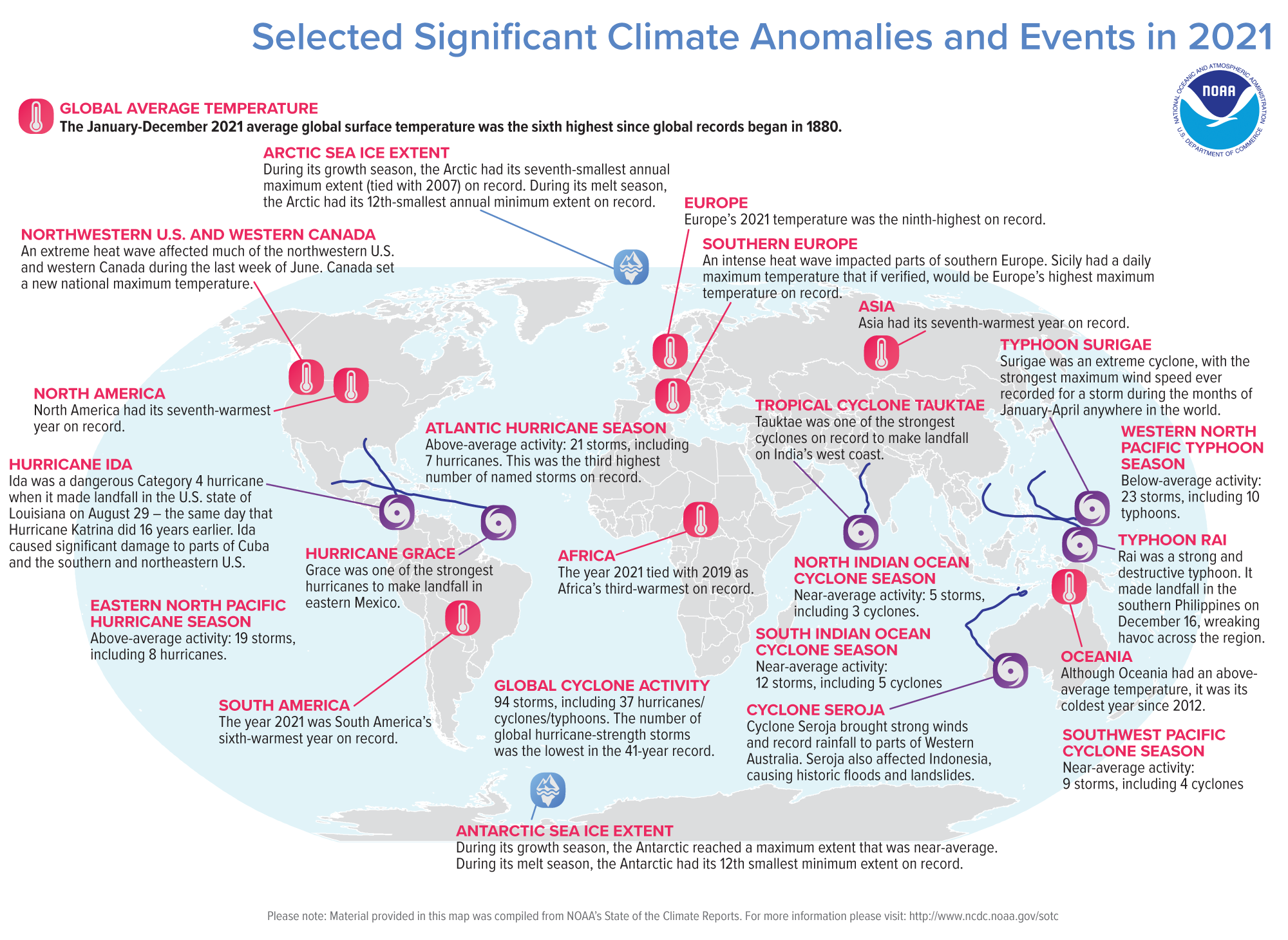
The year 2021 had an above-average global tropical cyclone activity with a total of 94 named storms. Snow cover was 9.39 million square miles and the seventh-smallest annual snow cover extent in the 1967-2021 record, with the average temperature across global surfaces 1.51°F (0.84°C) above the 20th-century average.

2021, the sixth warmest year on record. Nine of the ten hottest years or records have occurred in the past decade.

The upper-ocean heat content, which addresses the amount of heat stored in the 0-2000 meters depth of the ocean, was a record high in 2021.

December 2021 also marked the 24th consecutive December with a below-average sea ice extent.

The year 2021 was South America’s sixth warmest year on record at 1.09°C (1.96°F) above average. The year 2021 also marks North America’s 25th consecutive year with temperatures, at least nominally, above average.

The year 2021 was Europe’s ninth warmest year on record at 1.28°C (2.30°F) above average.

Africa had its third-warmest year (tying with 2019) in the 112-year record.

Asia had its seventh warmest year on record.

Oceania had an above-average temperature.   /monitoring-content/sotc/global/extremes/extremes-202113.png

It is irrefutable that we are now looking down the barrel of a Climate Gun. 

Mountains are starting to come apart. Polar ice is melting. Greenland will tip into irreversible melt once global temperatures rise past a mere 1.2C.

At the current rate, the whole Greenland ice sheet would vanish within 140 years.

Miami would disappear, as would most of Manhattan. Central London would be flooded. Bangkok, Bombay, and Shanghai would lose most of their area. In all, half of humanity would have to move to higher ground.

Everywhere, ecosystems will unravel. By the time global temperatures reach two degrees of warming in 2050, more than a third of all living species will face extinction.

Beyond two degrees, however, preventing mass starvation will be as easy as halting the cycles of the moon. First millions, then billions, of people will face an increasingly tough battle to survive. In the two-degree hotter world, nobody will think of taking Mediterranean holidays.

In this kind of heat, the death of the Amazon is as inevitable as the melting of Greenland.

Once the veneer of civilization had been torn away a three-degree increase in global temperature the end of the world is nigh.

BETWEEN THREE AND FOUR DEGREES OF WARMING

It would throw the carbon cycle into reverse. Instead of absorbing carbon dioxide, vegetation and soils start to release it. So much carbon pours into the atmosphere that it pumps up atmospheric concentrations by 250 parts per million by 2100.

The stream of refugees will now include those fleeing from coasts to safer interiors. Both poles are certain to melt, causing an eventual rise of 50 meters. Ice sheets have vanished.

We are looking now at an entirely different planet.

Globalism in the five-degree world will break down into something more like parochialism. Customers will have nothing to buy because producers will have nothing to sell. With no possibility of international aid, migrants will have to force their way into the few remaining habitable enclaves and fight for survival.

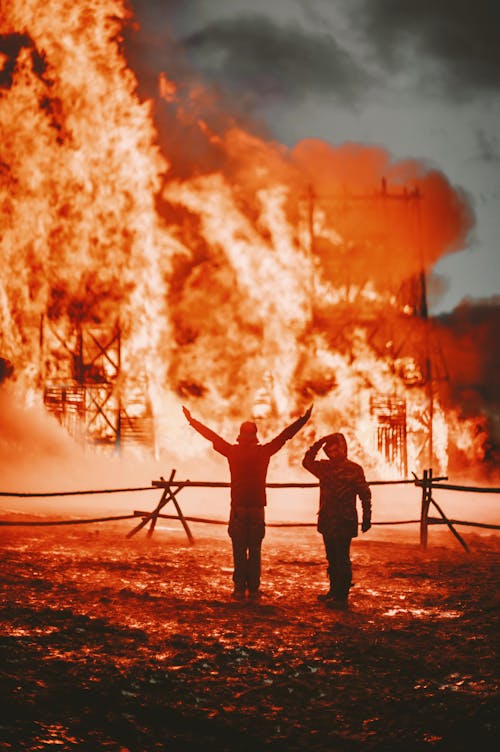
At the same time, as the ozone layer came under assault, we would feel the sun’s rays burning into our skin, and the first cell mutations would be triggering outbreaks of cancer among anyone who survived.Faceless firemen by building on fire

One more Degree.

It is not too difficult to imagine the ultimate nightmare, with oceanic methane eruptions near large population centers wiping out billions of people – perhaps in days. All the remaining forests burning, and the corpses of people, livestock, and wildlife piling up in every continent, the six-degree world would be a harsh penalty indeed for the mundane crime of burning fossil energy.

The maximum temperatures a human body can stand without dying or suffering severe consequences is 100 F (38 C) but surviving requires continuous fluid intake. 

As we look forward to 2022, it’s clear that ambitious net-zero targets pose a myriad of difficulties. As it stands, emissions across the world are not declining.

We can’t afford to wait and hope that the world will stop using fossil fuels in time, it won’t. Because the fragility of our food systems and their dependency on fossil fuels is intrinsically linked with an increasing loss of biodiversity. 

We need more than a polluter pays principle so that people who cause damage are financially responsible for their actions.

The reality is that no one wants to suffer the financial costs that affect the changes required to make a difference. 

Here below is a suggestion to address this problem.

https://bobdillon33blog.com/2022/01/10/the-beady-eye-says-we-all-want-it-but-no-one-want-to-pay-for-it/

All human comments are appreciated. All like clicks and abuse chucked in the bin.

← Back

Thank you for your response. ✨

THE BEADY EYE ASKS. WHY HAS RUSSIA COME TO FEAR THE UKRAINE

Tags


(Five-minute read) 

Here we are once more on the brink of another war with Ukraine as the host venue.

After World War II, the western part of Ukraine merged into the Ukrainian Soviet Socialist Republic, and the whole country became a part of the Soviet Union with it gaining its independence in 1991, following the dissolution of the Soviet Union.

Since then Hostilities have simmered for years.

So, what is at the heart of the conflict that has been going on for more than seven years?

Ukraine went through two revolutions in 2005 and 2014, both times rejecting Russia’s supremacy and seeking a path to join the European Union and NATO.

                                      ———————-

Amid growing concerns, we now have Russia poised to invade Ukraine, with conflicting news reporting as to what is happening and who is to blame.

As we live in such a fucked up world it’s a wonder that any of us exist so you could not be blamed if you are at a loss.   

Is it Nato or Russia?

In Putin’s reality, Russia is encircled and under threat and is required to defend itself from Nato. As Putin sees it, only the threat of war can reopen a conversation that, to many in the West, has long felt like settled history: the expansion of nato eastward, the denial of a Russian veto on questions of regional security, and the underlying sense that Russia lost the Cold War.

So Ukraine presents an opportunity for Russia, once and for all, to reassert its geopolitical relevance. If Ukraine joins nato or is drawn into a de-facto military alliance with it, then Putin’s project has failed; if Ukraine is kept from doing so, Putin has fulfilled his historical role.

The reality is whatever the ultimate composition of Russia’s forces, their ability to overwhelm the Ukrainian military is not in doubt. Once such a sizable military force is in place, it is enviable that it comes to exert its own influence on events.

Russia is now calling on Nato states to formally retract a 2008 pledge that the alliance would one day admit Ukraine and Georgia, promise not to deploy certain weapons systems to states near Russia, and refrain from military drills and maneuvers near Russia’s borders.

Even if the U.S. and other Nato members were ready to negotiate on these strategic questions, there is no realistic scenario in which significant progress, much less a formal agreement, could be made in the compressed timeline that Russia seems to be demanding.

This means that, in the end, the West will cave so as to stave off a war it doesn’t want.

After all, a Russian-Ukrainian war is a lose-lose for Western states: either they look feckless if they do nothing and Ukraine is defeated, or they feel compelled to intervene, risking a wider war with Russia that no one has the stomach for.

                                —————

All of this is raising concerns that Europe may again be beset by war.

NATO was established 66 years ago today, on April 4, 1949, since then it has reinvented itself becoming a military pact against Russia undertaking to arm all the nations around Russia.

Sixty-six years later NATO still exists, as many have argued, for no good reason to counteract threats that are either imagined or which only exist because NATO itself exists. Or worse, to lend legitimacy to the geopolitical whims of its only beneficiary. 

There is no treaty obligation to defend Ukraine, which is not a NATO member, so some of the toughest decisions could fall on the European Union.

So where are we?

While the UN these days rarely serves anyone well, NATO serves U.S. interests.

If Putin is seeking to restore dialogue with the West, especially the US, the amassing an army next to Ukraine has worked already.

It’s time for a face-to-face between Putin and Biden. 

Since 2018, the U.S. has sold hundreds of anti-tank Javelin missiles to Ukraine. Last March, the Pentagon announced a hundred-and-twenty-five-million-dollar military-aid package, which included armored patrol boats.

In November, Ukraine signed a treaty with the United Kingdom that would allow it to buy British warships and missiles.

Given all that weaponry, what would keep Nato armies from establishing bases?

The issue is not so much Ukraine but the underlying principle:

If a military alliance seeks to expand, it has to consider the interests of those who are opposed.

Russia, in other words, can’t be expected to remain a passive observer of actions that it believes violate its core security concerns. 

All human comments are appreciated. All like clicks and abuse chucked in the bin

← Back

Thank you for your response. ✨


THE BEADY EYE SAYS. WE ARE CREATING A DANGEROUS DIGITAL INVISABLE WORLD?

Tags

, , , , , ,


( Fifteen-minute read) 

We all know that there is an invisible world and that today it is undeniably digital.

This invisible world is becoming both powerful and dangerous leading to digitalizing without a system of oversight of the way we operate in the world, resulting in not just hidden powers but a decoupling between human rights and democracy.

On one hand, digital democracy, or eDemocracy, uses the internet, social media, and technology to improve our democratic systems of governance. 

On the other with our electronic overlords, ( Smartphones, Pads, Apple watches, TV, Web Services), this world of invisibility is been driven by non-accountable, non-transparent commerce, operating profit-seeking algorithms, with self-learning data collection codes, that no one comprehends.

As our day-to-day lives are increasingly immersed in technology, it is easy to lose perspective on things that matter. 

The capitalist world of profit and power is disappearing underground.

New technologies – from social media and GPS systems to artificial intelligence and digital twins – make the planet we inhabit unrecognizable from even 20 years ago and it’s only going to get faster, changing how we live.

The rise of the sharing economy, online marketplaces, and digital platforms are shattering old barriers and reducing the distances between industries, societies, and places, all of which are without adequate regulations are vanishing from scrutiny and accountability. 

                             ——————

While it’s true that today, leaders need to deal with unprecedented changes and an unpredictable and challenging future due to the Fourth Industrial Revolution, Climate change, and the covid pandemic they need to be more agile, to deal with sudden changes and challenges that any one of these will bring.  

Why?

Because the status quo as the inertia of past success can be crippling for the future.

The paradox of leadership lies in staying focused on the present, while also visualizing the future and creating a roadmap to reach it.

This is a major problem requiring Statmanship on a global scale.

                                —————–  

Why is all of this happening now?

What’s interesting about this question is, there’s no answer to that question.

What I think is so true about that is, with technology even nonconformists are conforming.

Why?

Because these days it’s difficult to not see how real the invisible world is affecting our lives and the systems that govern life.

Today, with the covid pandemic’s we see it is very rare that you find someone that’s not influenced by anyone else.

You don’t have to be a digital native to behave like one.

It’s the invisible world we want to connect with in order to maintain the magic in life.

Why?

Because a world without emotions will be a sterile world.

Yes, the invisible world is real.

It is the limited life of a limited mind.

Increasingly, this limited value is delivered through new cross-sector, outcome-based propositions, rather than traditional sector-specific products and services.

We have all experienced trying to get to speak to a human to solve a problem with a service – press one press two – listen to music – you inquiry- will be answered – press 3 if – till you give up.

If you can spell it you can’t enter it. A society that is dependent on technology can create inequality.

                                           ————-

To stop this invisible world people must take ownership of things as the digital world is not about technology, but people.

At a time when geopolitical tensions are on the rise are at their highest level this century.  And this turbulence is escalating.  Even nuclear non-proliferation can no longer be taken for granted.

At the same time, we see trade and technological conflicts that fracture world markets, undermine growth and widen inequalities.

And all the while, our planet is on fire.  The climate crisis rages on.

With Climate Change, we are risking a ‘great fracture’ between world powers, each with their own internet and AI strategy, as well as dominant currency, trade, and financial rules, and contradictory geopolitical and military views.

With dwindling natural resources, an unstable world climate, viruses on the rampart, not to mention the effects of pandemics on world trade, inequality, the world does not need politicians that do not think of the next election but statesmen of the next generation.      

 It is crucial to ensuring a united world.

Those yet to be connected remain cut off from the benefits of this new era and remain further behind. People need money to access the internet and buy the latest devices.

By 2050 there will be 9 billion people to feed, clothe, transport, employ and educate.

Maybe that’s not really bad when you think of what’s coming next. You couldn’t call it a fully digital world yet. It’s not even close.

However, there’s room to dream about building the world we want, instead of the one we’re turning into. 

As we pursue unlimited growth, our limitless consumption threatens to crowd out everything else on Earth. We are warming the climate, overspending our financial resources, requiring more fresh water than we have, increasing income inequality, diminishing other species, and triggering shockwaves whenever we can’t cope with a problem. Billions are committed to a growth-driven world economy.

Our world is full of screens. We keep them in our hands, purses, and pockets, next to our beds while we sleep, and surround ourselves with screens on our desks and countertops. Our TV sets are morphing into interactive screens as we put them online so they display everything for free.

What if that networked system brought everyone the world’s best services, resources, and knowledge-based on what we do, as a normal part of everyday life?

                                           ————————

The top-down approach is no longer sustainable in the Economic/ Power/ or Democracy Capital Accountability. Leadership needs to be vigilant and create a long-term sustainable value proposition for all stakeholders.

The same technologies are giving rise to new business models, with organizations using digital to create and monetize new forms of value. Disruptions in the digital world occur at a phenomenal rate.

They have the power to impact the way entire industries operate reshaping entire industries with profit-seeking algorithms.

Although giving up your data was once an afterthought when gaining access to the newest internet services such as Facebook there aren’t many great options available to limit what is seen and known about you online.

YOU BECOME A DIGITAL FORM OF YOURSELF IN THE VIRTUAL WORLD OF THE INTERNET.  

How do we define what a digital human is?

Worthless, a form of entertainment to have conversations with yourself without being able to show emotion and behavior as a real human. 

So, is the invisible world the real world?

Hard to say, but I think it’s what makes the visible world worth living in.

When someone dies, the essence of that being merely inhabited that form – the life within the form was always invisible.

Digital leaders will have the power to shape the future of our world.

When we want to believe, there is still time to interrupt the announced disappearances of so many plant and animal species which, if we are not careful, will lead to our own end.

This situation cannot go on. It is our common duty to avoid it.

While risks intersect and technologies develop quickly, too often our institutions for governing international security remain reactive and slow-moving.

ALL HUMAN COMMENTS ARE APPRECIATED. ALL LIKE CLICKS AND ABUSE CHUCKED IN THE BIN.

← Back

Thank you for your response. ✨

THE BEADY EYE ASKS; IS ONLINE BANKING ALL THAT ITS CRACKED UP TO BE ?

Tags

(Three-minute read) 

Online banking usage has seen a surge during the pandemic. Banks all over the world have started closing the doors of their physical branches. Further to this, the adoption of wearable payment devices has seen an increase, and experts predict the market value of wearable payment tech to grow at a compound annual rate of 29.8% between 2021 and 2028.Person Holding Black and White Bag

With this growing shift in digital banking habits, banks need to keep their product offerings relevant.

They need to stop playing this game of digital transformation charades and recognize that what they call ” Digital transformation ” may be beneficial in their institution’s short-term performance, but it’s isn’t very transformational when it comes to the reality of not knowing their customers. 

Like many organizations, they are now operating behind a maze of impersonalized mechanizes that require pressing and rendering numbers to listen to music while your phone bill sours to be connected to a nonnamed person in India or Pakistan, in contactless solutions that take days.

In other words, when a problem occurs with an account more often than a personal contact you are faced with the escalation of the problem than a de-escalation.   

Security is one of the most significant challenges for online banking marketers because of the inherent concerns that are traditionally associated with banking online. Although banking systems are designed to be virtually impenetrable, cyberattacks and fraudulent activity are still a reality.

Mobile browsers and apps account for 71% of fraudulent bank transactions.

No matter how sophisticated the tech, bank servers are still prone to both intentional and accidental downtime so you are well-advised to have an alternative. 

Security and technical concerns are all major challenges of online banking that marketers must reconcile to succeed in this field.

The benefits of having a personal relationship with your bank are often overlooked, as navigating challenging banking scenarios can often be made easier by the involvement of bankers. Having an in-person banking relationship can help customers compare their options and find solutions tailored to their needs, something which isn’t as easily achievable through self-service.

Marketers can strive for this blend by letting their customers know how to access real people, but also by ensuring that their digital banking experience is streamlined and easy to understand. This will help keep customers as informed as possible in both the digital and physical banking environment. 

The number one reason consumers abandon online banking is NOT JUST THE AMOUNT INFORMATION THAT IS REQUESTED ON OPENING AN ACCOUNT BUT THE AMOUNT OF TIME AND EXPENSE IT TAKE TO CORRECT AN MISTAKE. 

All Human comments are appreciated. All like clicks and abuse chucked in the bin.

← Back

Thank you for your response. ✨