• About
  • THE BEADY EYE SAY’S : THE EUROPEAN UNION SHOULD THANK ENGLAND FOR ITS IN OR OUT REFERENDUM.

bobdillon33blog

~ Free Thinker.

bobdillon33blog

Category Archives: Unanswered Questions.

THE BEADY EYE ASK’S. APART FROM THE FINANCIAL COST WHAT ARE THE UNSEEING COST OF THE UK LEAVING THE EU.

19 Sunday Jan 2020

Posted by bobdillon33@gmail.com in Brexit Language., Brexit., European Union., Political Trust, Politics., The common good., The Obvious., Trade Agreements., Transition period or Implication period., Unanswered Questions., World Trade Organisation, WTO.

≈ Comments Off on THE BEADY EYE ASK’S. APART FROM THE FINANCIAL COST WHAT ARE THE UNSEEING COST OF THE UK LEAVING THE EU.

Tags

Brexit v EU - Negotiations., The future of England out of the EU.


(Twenty-minute read)

The UK is set to leave the EU on January 31.

The article 50 process will have been completed and the country will no longer be legal in the EU.

With speculation now playing a part in almost every claim for or against the EU, it’s sometimes difficult to distinguish between legitimate risks and doom-mongering however the implications of becoming the first nation to leave the 28-state bloc are much clearer.

The term Global Britain is the moment Britain chose to step back from the world.

Confused.

Well here is the picture as I understand it.

The UK will not get a free choice on its future relationship with the EU.

It will not be quick or straightforward to establish a new relationship.

Obviously, there are two ways that Britain can leave the EU:

With a deal, or Without a deal.

A no-deal Brexit would result in a rigid position on all the issues.

If Mr Johnson’s government chooses to change course he has to so before December 31, 2022, if not then Britain will fall back on to basic World Trade Organization terms.

Under WTO rules, this would not include any preferential access to the Single Market, or to any of the 53 markets with which the EU has negotiated Free Trade Agreements.

Or

What is called a soft Brexit which would aim to keep the relationship between the UK and the EU intact?

This could be done by keeping Britain in the single market or, at the very least, arranging the terms of some sort of free-trade agreement before the 31 October deadline arrives.  However, by staying in the single market and customs union, the UK would be liable to EU rules and legislation regarding the free movement of goods, services and people across borders.

Therefore if the UK gets a deal as is the case with Norway and Iceland it could still end up being forced to comply with EU laws and regulations.

A Norway or Iceland model would give the UK considerable but not complete access to
the free-trade Single Market. We would be outside the EU Customs Union, and we
would lose access to all of the EU’s trade agreements with 53 other markets around
the world. Re-negotiating these would take years. Combined with the 27 other countries in the Single Market, and the countries in the EU Customs Union and EFTA, this is effectively more than 80 trade deals – covering over a third of the world’s economy.

No existing bilateral trade agreement will deliver the same level of access that the UK currently enjoys to the EU Single Market. In particular, none provide an equivalent
access for services, which accounts for almost 80 per cent of the UK economy.

It involves accepting most EU rules, but with little influence over the creation of those rules.

Under any of the alternative models, there is no guaranteed access to the current measures for police and security cooperation, which allow our law-enforcement agencies to work with their EU counterparts.

It is possible to fully replace the UK bilateral agreements outside the EU in these areas or demand a right to choose which to participate in will not replicate the reach and influence that is currently enjoy.

Mr Johnson has ruled out any form of an extension to the transition period.

Then both sides would need to make preparations for how they cope with the economic fallout in 2021.

After Britain leaves, its people will still have certain rights – at least for another 11 months. Freedom of movement is likely to end on 31 December next year.

The key rights that have yet to be negotiated include the continued right of British settled in the EU to move for work, leisure or retirement within the EU.

Erasmus will continue after Brexit but this depends on negotiations on the future relationship with the EU.

British citizens will still be able to apply for funding in Horizon2020 programmes during the transition period.

The EU’s Creative Europe funding stream will remain open to British applications.

Also promising a call for applications in 2020 is IPortunus, a new EU mobility fund for artists.

Little is written about cross-border healthcare or the processes involved but it is still available during the transition period,

So far, discussions of the gains and losses of Brexit have, understandably, tended to focus on the most obvious costs.

It may soon cost the UK more than its combined total of payments to the European Union budget over the past 47 years

The UK’s total projected contribution to the EU budget from 1973 to 2020 at £215 billion after adjusting for inflation is likely to keep increasing.

On leaving the Uk will be operating in a vacuum till there is a deal or not.

This comes with huge hidden dangers.

In adopting the government’s proposed model for close customs cooperation and a common rulebook, it runs the risk of finding themselves with little scope to diverge from EU regulations on goods, and unable in practice to strike new trade deals with the rest of the world.

The EU cannot change the rules of a customs union for the UK. If it does the trading bloc will fall asunder. When you’re in a customs union for goods, you become part of a common trade policy — you don’t have autonomy anymore.

Agreement with the EU, under which the UK would continue to levy EU tariffs on goods destined for the single market, but would apply a rebate on those that remain in the UK does not work and will not work.

As for a special mutual recognition arrangement in financial services, this might work.

Politicians often praise the visible benefits of public spending, e.g. the number of jobs “created”, without considering whether the funds could have been spent more wisely elsewhere – or even how the taxpayer might have spent the cash, had it remained in his or her pocket

There are a number of countries which have negotiated trade agreements with the
EU. Switzerland has a complex set of bilateral agreements with the EU. Turkey is part of the EU Customs Union and has a long-term aspiration to join the EU. Canada has agreed a Free Trade Agreement with the EU.

The status quo, or anything close to it, carries huge opportunity costs of its own.

So let’s have a look

WTO rules represent a minimum threshold.

It would be the most definitive break with the EU, offering no preferential access to the Single Market, no wider co-operation on crime or terrorism, no obligations for budgetary contributions or free movement of people.

It would, be hard even to come close to replicating the level of access and
influence from which the UK currently benefits.

Whatever alternative to membership the UK seeks following it departure the UK will lose influence over EU decisions that will still directly affect the country.

So far, the European Union has made only tentative steps towards regulating genetically modified crops and artificial intelligence and robotics.

There are of course important cultural differences between the Uk and the European continent and these may seem like small concerns in the grand scheme of things.

The free movement of persons is a fundamental pillar of EU policy … the internal market and its four freedoms are indivisible’.

Each possible approach will involve a balance between securing access to the EU’s Single Market, accepting costs and obligations and maintaining the UK’s influence.

The UK will, therefore, have to make some difficult decisions about its priorities and the voting public will be holding it very directly responsible. 

It is not the means that matter, but the ends.

All human comments appreciated. All like clicks and abuse chucked in the bin.

← Back

Thank you for your response. ✨

Underneath is a long list of everyday EU Common day terms that might help.

Ankara Agreement The Association Agreement signed between the European
Community and Turkey in 1963 and the Additional Protocol added
in 1970. They set out basic agreed objectives for relations between
the EU and Turkey, such as the strengthening of trade and economic
relations and the establishment of a Customs Union.

Banking Union The Banking Union is an EU-level supervision and resolution system
for the banking sector in the euro area, and participating member
states. It aims to ensure that banks in the euro area are safe and
reliable and that non-viable banks are resolved without recourse to
taxpayers’ money and with minimal impact on the real economy.

The Capital Markets Union (CMU) is a plan of the European
Commission to create a true single market for capital in Europe. It
will channel increased capital to all companies, including Small and
Medium Enterprises (SMEs), and infrastructure projects.

The Common Agricultural Policy (CAP) is the agricultural policy of
the European Union. It implements a system of agricultural support
through direct income payments to farmers and guaranteed prices.

Common External Tariff A common external tariff must be introduced when a group of countries forms a customs union. The same customs duties, import
quotas, preferences or other non-tariff barriers to trade apply to all
goods entering the area, regardless of which country within the area
they are entering.

The Common Fisheries Policy (CFP) is a set of EU rules for managing
European fishing fleets and for conserving fish stocks.

Common Travel Area
A travel zone comprising Ireland and the UK. It allows for the nationals of
both countries to travel and live in each country without immigration
controls.

Council of the European Union(also known as Council of Ministers)
The Council of the EU brings together the representatives of the EU
Member States’ governments. It is the EU’s main decision-making
body and agrees EU laws, usually together with the European
Parliament.

Customs Union An agreement between two or more countries to remove customs
barriers and reduce or eliminate external customs duties on mutual
trade. Customs unions generally impose a common external tariff
(CET) on imports from non-member countries.

Dublin Regulation An established set of criteria for identifying the Member State
responsible for the examination of an asylum claim in Europe. Under
Dublin, the claim for asylum must be made in the first EU country
entered.

EU-Canada Free Trade Agreement (CETA)
The Comprehensive Economic and Trade Agreement (CETA) is a
trade agreement negotiated between the EU and Canada. Once
implemented, it will remove customs duties, end limitations in access
to public contracts, open up services markets, and help prevent
illegal copying of EU innovations and traditional products.
Eurojust is an agency of the European Union dealing with judicial
cooperation in criminal matters.

European Arrest Warrant (EAW)
A legal framework that facilitates the extradition of individuals between
The EU Member States to face prosecution or to serve a prison sentence
for an existing conviction.

European Commission (the Commission)
The European Commission is responsible for proposing draft
legislation, implementing decisions, upholding the EU Treaties and
managing the day-to-day business of the EU.
European Council The European Council is the body in which the Heads of State
or Government of the EU’s 28 Member States, together with an
appointed President and the President of the European Commission,
take strategic decisions about the direction of the EU.

European Court of Justice (ECJ)
The European Court of Justice (ECJ) is a supranational court based in
Luxembourg and made up of one judge from each of the EU Member
States. The Court deals with cases concerning the interpretation and
application of the EU Treaties.

European Criminal Records Information System (ECRIS)
A system for criminal records held by the Member States to be
exchanged with the authorities of other Member States.

European Economic Area (EEA)
The EEA is an internal market providing for the free movement of
persons, goods, services and capital. It is made up of 31 countries:
the EU’s 28 Member States plus Norway, Iceland and Liechtenstein. It
is governed by a common set of rules.

EEA Joint Committee
An institution of the European Economic Area (EEA), in which
decisions are taken by consensus to incorporate EU legislation into
the EEA Agreement.

European Economic Community (EEC) and the European Community (EC)
The European Economic Community (EEC) was a regional
cooperation organisation and precursor to the EU, as one of the
European Communities. It was founded in 1957 to promote economic
integration between its member states. When the Maastricht Treaty
created the European Union (EU) in 1993, the EEC was incorporated
and renamed the European Community (EC). In 2009 the Lisbon
Treaty provided for the EC to be fully incorporated into the European Union.

The European Free Trade Association (EFTA) has four members:
the three non-EU EEA member states – Norway, Iceland and
Liechtenstein – plus Switzerland. It has the right to conclude Free
Trade Agreements with the rest of the world on behalf of its four
members.

EFTA Court The EFTA (European Free Trade Association) Court is a supranational
judicial body that deals with cases concerning the interpretation and
application of the EEA Agreement. It is essentially the equivalent of
the ECJ for the EFTA countries that are also members of the EEA
(Norway, Liechtenstein and Iceland).

European Parliament
The European Parliament was established in 1979 in order to
represent the views of citizens directly in EU decision-making. It
shares responsibility with the Council for passing EU laws and for
agreeing the EU’s budget, although the Council enjoys broader
decision-making powers. The Parliament is made up of 751 members
(MEPs) who are directly elected across the 28 Member States and
serve a five-year term. The UK has 73 MEPs.

European Union (EU)
The European Union is an international organisation made up of 28
European countries, including the UK. The EU has its origins in the
European Coal and Steel Community, founded by six European states
after the Second World War. However, its remit has evolved and
is much broader today. The EU facilitates cooperation between its
Member States on a wide range of objectives, from facilitating trade to
protecting the environment, and security and development overseas.
The EU has created the world’s largest Single Market, enabling the
free movement of goods, services, people and capital.
Europol is an EU agency that assists Member States’ law
enforcement agencies in tackling cross-border crime. It carries out
over 18,000 cross-border investigations a year to tackle security
threats such as terrorism, international drug trafficking and money
laundering, organised fraud, counterfeiting and people smuggling.

Europol Information System
The Europol Information System (EIS) is a central criminal information
and intelligence database covering the areas under Europol’s remit.
Europol and all EU Member States can use the EIS to store and look
up to data on serious international crime and terrorism.

Free Trade Agreement (FTA)
A Free Trade Agreement (FTA) is a treaty between two or more
countries or trading blocs that reduces but does not eliminate,
barriers to trade and investment. WTO rules allow its member states
to sign FTAs granting each other preferential market access, subject
to certain conditions. FTAs usually cover agreements to reduce tariffs
and other restrictions to trade on goods and, to a lesser extent,
services.

Frontex is the EU’s Borders Agency, which manages cooperation
between national border guards to secure the EU’s external borders.
G20 The Group of Twenty (G20) is a forum for international economic
cooperation and decision-making. It comprises 19 of the world’s
leading economies, including the UK, plus the European Union.

The General Agreement on Trade in Services (GATS) is a treaty of
the World Trade Organization (WTO) that came into force in January
1995. The treaty was created to extend the multilateral trading system
to the service sector, in the same way, the General Agreement on
Tariffs and Trade (GATT) provides such a system for merchandise
trade. All members of the WTO are parties to the GATS. The basic
WTO principle of most favoured nation (MFN) applies to GATS as
well. However, upon accession, members may introduce temporary
exemptions to this rule.

The International Monetary Fund (IMF) is an international organisation
of 188 countries. It works to foster global monetary cooperation,
secure financial stability, facilitate international trade, promote high
employment and sustainable economic growth, and reduce poverty
around the world. The UK is a member.

Justice and Home Affairs (JHA) refers to EU cooperation on asylum and
immigration, judicial matters, civil protection and the fight against
serious and organised crime and terrorism, as well as the Schengen
Border-free area. The UK has secured a set of exemptions that mean
it is not required to participate in JHA matters, but can choose to do
so if it wishes.

Lugano Convention The Lugano Convention facilitates the recognition and enforcement of judgments in civil law cases in the EU and EFTA countries.

Most Favoured Nation (MFN)
Under WTO rules, countries cannot normally discriminate between
trading partners that are members of the WTO. So a country or
trading bloc cannot grant another a preferential arrangement (such as
a lower customs duty rate for one of their products) without doing so
for all other WTO members. This principle is known as Most Favoured
Nation (MFN) treatment. Non-tariff barriers A non-tariff barrier is a form of trade barrier other than a tariff. Nontariff barriers include quotas, levies, embargoes, sanctions and other restrictions. They are frequently used by large and developed
economies.

Passporting entitles a financial services firm authorised in a European
Economic Area (EEA) state to carry on permitted activities in any other
EEA state by either exercising the right of establishment (i.e. setting up
a branch and/or agents), or providing cross-border services. These
rights are subject to the fulfilment of conditions under the relevant
Single Market directive.

Preferential market access
A country or trading bloc grants preferential market access to another
when it grants it better terms of trade than as standard, for instance
by reducing tariffs or providing access to public tenders. The WTO
sets a number of rules about how countries and blocs can grant
each other preferential access. Between developed economies, this is
usually granted through Free Trade Agreements, through which each
side agrees to reduce trade barriers.

The Prüm Decisions are EU Council Decisions which embed into
EU law a pre-existing Convention between several European Union
States. They provide mechanisms to exchange information between
Member States on DNA, fingerprint and vehicle registration data for
the prevention and investigation of cross-border crime and terrorism.
The UK has recently decided to apply to re-join the regime.

Qualified Majority Voting (QMV)
Qualified Majority Voting is the principal method of reaching decisions
in the Council of Ministers. It allocates votes to the different Member
States according to an agreed formula, based partly on population
size. Under Lisbon Treaty rules, a decision or law is passed by
a qualified majority when 55% of Member States vote in favour (in
practice this means 16 out of 28) and the Member States supporting
represent at least 65% of the total EU population.

Rules of Origin are the criteria needed to determine the national
source of a product. They matter because duties and restrictions
often depend upon the source of imports. The complex supply chains
of the global economy mean that this is not always straightforward to
determine. The bureaucracy involved is a cost for businesses.

The Schengen border-free area comprises the 26 European countries
(22 EU member states and four others) that have abolished passport
and any other type of controls at their common borders. It also has a
common visa policy.

The Schengen Information System II (SIS II) is a large-scale
database that supports external border control and law enforcement
cooperation within the Schengen States. SIS II enables competent
authorities, such as police and border guards, to enter and consult
alerts on certain categories of wanted or missing persons and
objects. An SIS II alert contains not only information about a particular
person or object but also clear instructions on what to do when the
person or object has been found.

Single Market a common trade area that extends beyond the
deepest and most comprehensive Free Trade Agreements. It works
to remove all regulatory obstacles to the free movement of capital,
people, goods and services. It stimulates competition and trade,
improves economic efficiency and helps to lower prices. The EU’s
Single Market is the largest in the world.

Stabilisation and Association Agreements are bilateral agreements
between the EU and the countries of the Western Balkans designed
to promote regional peace, stability and eventual accession to the EU.
As well as establishing a Free Trade Area with the EU, the agreements
pledge the parties to work towards common political and economic
objectives and encourage regional cooperation.

State Aid refers to any advantage or subsidy granted by public
authorities through state resources on a selective basis to any
organisations that could potentially distort competition and trade
in the EU. The definition of state aid is very broad because ‘an
advantage’ can take many forms.

A tariff is a tax or duty imposed on a particular class of imports or
exports.

A trade deficit occurs when a country imports more goods and
services than it exports. The deficit equals the value of goods and
services being imported minus the value of goods and services being
exported.

United Nations (UN) is an international organisation formed in
1945 to increase international cooperation and uphold peace and
security. It has 193 members.

The WTO is the international organisation that regulates global
trade between nations. It was established in 1995 as the successor
to the General Agreement on Tariffs and Trade (GATT). The WTO
enables participating member states to agree on trade rules, negotiate
trade agreements, and resolve disputes. A total of 162 countries are
members, including the UK.


Share this:

  • Share on WhatsApp (Opens in new window) WhatsApp
  • More
  • Share on Mastodon (Opens in new window) Mastodon

THE BEADY EYE ASK; IS THIS THE FIRST SIGNS OF WHAT THE UK WILL DO WITH REGULATIONS ON LEAVING THE EU.

15 Wednesday Jan 2020

Posted by bobdillon33@gmail.com in #whatif.com, Brexit., Capitalism, Environment, Post - truth politics., Reality., The Obvious., Transition period or Implication period., Unanswered Questions., WHAT IS TRUTH

≈ Comments Off on THE BEADY EYE ASK; IS THIS THE FIRST SIGNS OF WHAT THE UK WILL DO WITH REGULATIONS ON LEAVING THE EU.

Tags

Conflicts over resources, Flip flops., Flybe.

(Two-minute read)

It stinks on more than one front.

Connectivity is only a smokescreen for state aid in breach of EU regulations.

The chancellor, Sajid Javid, said: “The reviews we are announcing will help level up our economy. They will ensure that regional connections not only continue but flourish in the years to come – so that every nation and region can fulfil its potential.

Unadulterate bullshit.

The aviation sector has got away for years with increasing its carbon footprint. The last thing we need is another incentive for them to pollute more.

A possible government deal to cut the cost of flights to save regional airline Flybe is “the exact opposite” of what is needed to tackle climate change.

Connect Airways, paid just £2.2million for Flybe’s assets but pledged to pump tens of millions of pounds into the loss-making airline to turn it around.

Of course, this never happened if it did it would not now be looking to defer a few million for three years.

Cyrus Capital Partners is based out of New York it is a large advisory firm with 33 clients and discretionary assets under management (AUM) of $4,897,199,827 they owned the largest share of a newly formed company called Connect Airways, with 40%, while the other partners owned 30% each.

The regional airline did come close to outright collapse a year ago amid an acrimonious takeover battle that left shareholders fuming that their equity had been left worthless.

The Uk government cannot claim to be a global leader on tackling the climate emergency one day, then making the most carbon-intensive kind of travel cheaper the next.

APD generates billions for the Treasury each year, with the fee expected to be worth £3.7bn in 2019/20. It was introduced in 1994 as a tax to pay for the environmental costs of air travel. However, if you’re just changing flights in the UK en route to somewhere else – as long as the time between flights is less than 24 hours you don’t pay APD.

Children aged two years old without a seat booking are exempt from APD.

The idea was that the tax makes passengers think twice before flying.

Unfortunately, taxpayers money pumped into this company will only line the pockets of the shareholders,  its bankers

Reality check.

The national debt attributable to every man, woman and child in the U is in the region of £24,900 each.

All human comments appreciated. All like clicks and abuse chucked in the bin.

← Back

Thank you for your response. ✨

Share this:

  • Share on WhatsApp (Opens in new window) WhatsApp
  • More
  • Share on Mastodon (Opens in new window) Mastodon

THE BEADY EYE SAYS; SO YOU ARE NOW 30 BY THE TIME YOU ARE 70 HERE IS WHAT A DAY IN YOUR LIFE WILL LOOK LIKE.

10 Friday Jan 2020

Posted by bobdillon33@gmail.com in 2020: The year we need to change., Algorithms., Artificial Intelligence., Communication., Dehumanization., Digital age., DIGITAL DICTATORSHIP., Digital Friendship., Evolution, Fourth Industrial Revolution., HUMAN INTELLIGENCE, Humanity., Life., Modern day life., Our Common Values., Reality., Robot citizenship., Social Media, Sustaniability, Technology, The common good., The essence of our humanity., The Future, The Obvious., The state of the World., The world to day., Unanswered Questions., WHAT IS TRUTH, What Needs to change in the World, Where's the Global Outrage.

≈ Comments Off on THE BEADY EYE SAYS; SO YOU ARE NOW 30 BY THE TIME YOU ARE 70 HERE IS WHAT A DAY IN YOUR LIFE WILL LOOK LIKE.

Tags

0.05% Aid Commission, Age of Uncertainty, AI, AI systems., Algorithms., Artificial Intelligence., Artificial life.

(Twenty-minute read)

The Dead Sea will be almost completely dried up, nearly half of the Amazon rainforest will have been deforested, wildfires will spread like, umm, wildfire, and the polar ice caps will be only 60 per cent the size they are now.

Wars will involve not only land and sea but space. Superhurricanes will become a regular occurrence.

Should you be worried, of course not AI/Algorithms are here to guide you.

AI-related advancements have grown from strength to strength in the last decade.

Right now there are people coming up with new algorithms by applying evolutionary techniques to the vast amounts of big data via genetic programming to find optimisations and improve your life in different fields.

The amount of data we have available to us now means that we can no longer think in discrete terms. This is what big data forces us to do.

It forces us to take a step back, an abstract step back to find a way to cope with the tidal wave of data flooding our systems. With big data, we are looking for patterns that match the data and algorithms are enabling us to find patterns via clustering, classification, machine learning and any other number of new techniques.

To find the patterns you or I cannot see. They create the code we need to do this and give birth to learner algorithms that can be used to create new algorithms.

So do you remember a time, initially, when it was possible to pass on all knowledge through the form of dialogue from generation to generation, parent to child, teacher to student?  Indeed, the character of Socrates in Plato’s “Phaedrus” worried that this technological shift to writing and books was a much poorer medium than dialogue and would diminish our ability to develop true wisdom and knowledge.

Needless to say that I don’t think Socrates would have been a fan of Social Media or TV.

The machine learning algorithms have become like a hammer at the hands of data scientists. Everything looks like a nail to be hit upon.

In due process, the wrong application or overkill of machine learning will cause disenchantment among people when it does not deliver value.

It will be a self-inflicted  ‘AI Winter’.

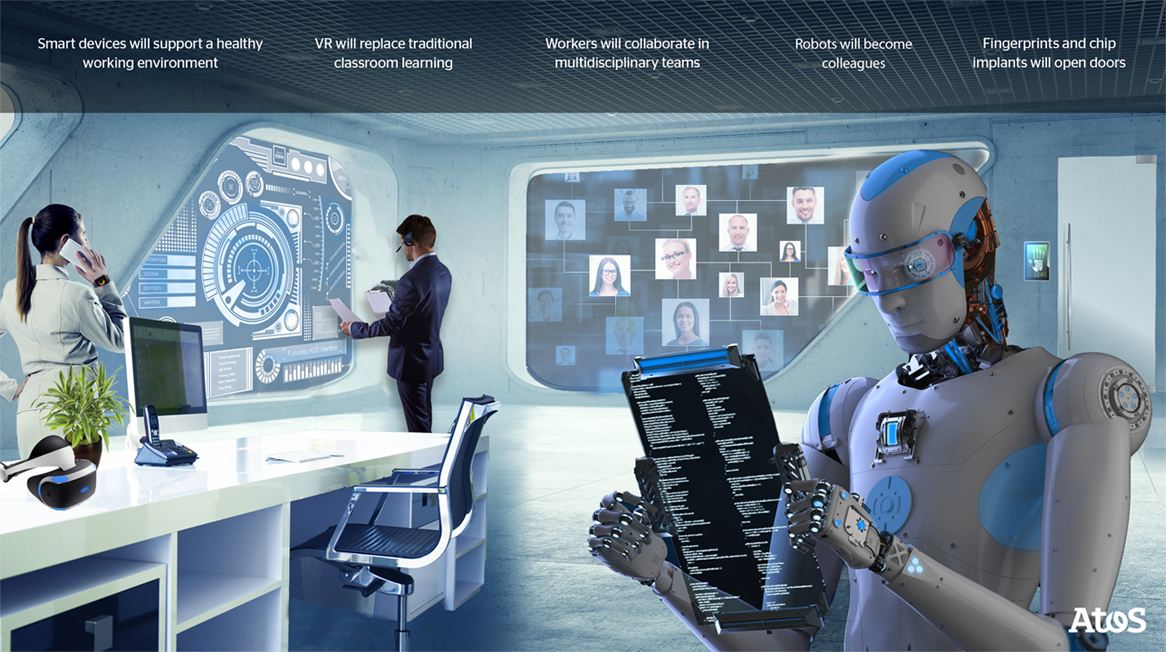
So here is what your day at 70th might be.

Welcome to the world of permanent change—a world defined not by heavy industrial machines that are modified infrequently, but by software that is always in flux.

Algorithms are everywhere. They decide what results you see in an internet search, and what adverts appear next to them. They choose which friends you hear from on social networks. They fix prices for air tickets and home loans. They may decide if you’re a valid target for the intelligence services. They may even decide if you have the right to vote.

7.30 am 

Personalised Health Algorithm report.

Sleep pattern good. Anxiety normal, deficient in vitamin C. Sperm count normal.

Results of body scan sent health network.

7.35 am

House Management Algorithm Report.

Temperature 65c. House secure. Windows/ Doors closed Catflap open. Heating off. Green Energy usage 2.3 Kwh per minute. (Advertisement to change provider.) Shower running, Water flow and temperature adjusted, shower head hight adjusted. House Natural light adjusted. Confirmation that smartphone and I pad fully charges. Robotic housemaid programmed.

8 am.

Personalised Shopping/Provisions Algorithm report.

Refrigerators will be seamlessly integrated with online supermarkets, so a new tub of peanut butter will be on its way to your door by drone delivery before you even finish the last one.

8.45 am. Appointments Algorithm.

Virtual reality appointment with a local doctor.

Voice mails and emails and the calendar check.

A device in your head might eliminate the need for a computer screen by projecting images (from a Skype meeting, a video game, or whatever) directly into your field of vision from within. It checks

9 am.

Personalised Financial Algorithm.

Balance of credit cards and bank accounts including citizen credit /loyalty points. Value of shares/ pension fund updated.

10 am. Still in your Dressing gown.

11 am.  The self-drive car starts. Seats automatically shift and rearrange themselves to provide maximum comfort. Personalised News and Weather Algorithm gives a report. The car books parking spot places order for coffee. Over coffee, you rent out a robot in Dublin and have it do the legwork for your forthcoming visiting – hotels.

12 pm.

Hologram of your boss in your living room.

1 pm.

Virtual work meeting to discuss the solitary nature of remote work.

Face-to-face meeting arranged.


2 pm. Home. Lunch delivered.

3 pm. Sporting activity with a virtual coach.

5 pm. Home

7 30 pm.

Discuss and view the Dubin robot walk around containing video and audio report. 

Dinner delivered. Six quests. The home management algorithm rearranges the furniture.

8 30 pm

Virtual helmets on for some after-dinner entertainment.

10 pm 

Ask Alixia to shut the house down not before you answer Alixia question to score points and a chance to win — Cash- Holiday- Dinner for two- a discount on Amazon- e bay- or a spot of online gambling.

                                                       ———

The fourth industrial revolution is not simply an opportunity. It matters what kind of opportunity is for whom and under what terms.

We need to start thinking about algorithms.

The core issue here is of course who will own the basic infrastructure of our future which is going to be effect all sectors of society.

They are not just for mathematicians or academics. There are algorithms all around us and you don’t need to know how to code to use them or understand them.

We need to better understand them to better understand, and control, our own futures. To achieve this we need to better understand how these algorithms work and how to tailor them to suit our needs. Otherwise, we will be unable to fully unlock the potential of this abstract transition because machine learning automates automation itself.

The new digital economy, akin to learning to read, has obscured our view of algorithms. Algorithms are increasingly part of our everyday lives, from recommending our films to filtering our news and finding our partners.

Building a solid foundation now for governance for AI the need to use AI responsibly
and to consider the broader reaching implications of this transformational technology’s use.

The world population will be over 9 billion with the majority of people will live in cities.

So here are a few questions at 30 you might want to consider.

How does the software we use influence what we express and imagine?

Shall we continue to accept the decisions made for us by algorithms if we don’t know how they operate?

What does it mean to be a citizen of a software society?

These and many other important questions are waiting to be analyzed.

If we reduce each complex system to a one-page description of its algorithm, will we capture enough of software behaviour?

Or will the nuances of particular decisions made by software in every particular case be lost?

You don’t need a therapist; they need an algorithm.

We may never really grasp the alienness of algorithms. But that doesn’t mean we can’t learn to live with them.

Unfortunately, their decisions can run counter to our ideas of fairness. Algorithms don’t see humans the same way other humans do.

What are we doing about confronting any of this –  Nothing much.

So its no wonder that people start to worry about what’s left for human beings to do.

All human comments appreciated. All like clicks and abuse chucked in the bin.

← Back

Thank you for your response. ✨

Share this:

  • Share on WhatsApp (Opens in new window) WhatsApp
  • More
  • Share on Mastodon (Opens in new window) Mastodon

THE BEADY EYE ASK’S. WILL 2020 BE THE YEAR OF THE BIG MELT OR THE BIG FRY.

02 Thursday Jan 2020

Posted by bobdillon33@gmail.com in #whatif.com, 2020: The year we need to change., Climate Change., Evolution, HUMAN INTELLIGENCE, Humanity., Life., Modern day life., Our Common Values., Politics., Populism., Post - truth politics., Purchasing Power., Reality., Social Media, Sustaniability, Technology, The common good., The essence of our humanity., The Future, The Obvious., The state of the World., The world to day., Unanswered Questions., WHAT IS TRUTH, What needs to change in European Union., What Needs to change in the World, Where's the Global Outrage., World Aid., World Leaders, World Organisations.

≈ Comments Off on THE BEADY EYE ASK’S. WILL 2020 BE THE YEAR OF THE BIG MELT OR THE BIG FRY.

Tags

Apathy., Artificial Intelligence., Capitalism and Greed, Capitalism isn't working, Capitalism vs. the Climate., Earth, Environment, Global warming, Inequility, Information gap., Technology, The Future of Mankind, Visions of the future.


(Fifteen-minute read) 


It looks like being both.

We are the first generation to know we’re destroying the world, and we could be the last that can do anything about it.

SO AS IF YOU DON’T ALREADY KNOW WHAT NEEDS TO CHANGE HERE IS YOUR CHANCE TO DO SOMETHING ABOUT IT.  

We need to recognize that everything we do, every step we take, every sentence we write, every word we speak—or don’t speak—counts. Nothing is trivial.

Take personal responsibility.

We need to use social media – this is one of the most effective ways to get brands to listen to you, so tell them that you want a change.

Why?

Because, unfortunately, the politicians who dominate the world stage are, depressingly, mostly cut from the old cloth, and the leadership challenges they face, are particularly complex and will require different skills — notably a clearer vision among leaders of organisation’s shared purpose.

Because the digital revolution is far from over the pace of change only seems to be quickening when in fact it is causing isolation. 

Because, we are allowing non-regulated large technology platforms to become too powerful, using their size to dominate markets and we are not paying enough attention to how the tools they create can be used for ill –  like device addictions, as we drown in notifications and false news feed posts.

Because there is an increasing imperative for all of us to respond to climate change.  Which will and is challenging our lives developing on a daily bases right in front of our eyes into our biggest need to act as one.

How can any of this be achieved? 

How will the changing political, economic and environmental landscapes shape the world?

Don’t get caught up in the how of things. Don’t wait for things to be right in order to begin.

Because in our age of tectonic geopolitical shifts, “alternative facts,” and conflicting narratives, our routine everyday life is losing sight of our true goals and aspirations.

Because with the rise of short-sighted populism we will solve nothing, other than feeding the great unwashed with short term gratification.

We need to write a piece of software that eliminated malware, viruses and all of that crap. 

We need to show our political leaders that they want to change, to understand our common humanity.

We need to try to put yourself into another person’s headspace and accept people for who they are and what their beliefs are.

We need to collaborate and push for policies that complement both sides of the political spectrum.

We need to make wasting our resources unacceptable in all aspects of our life.  Every product we buy has an environmental footprint and could end up in a landfill. The impact of plastic pollution on our oceans is becoming increasingly clear, having drastic impacts on marine life.

We need to be more conscious about what we buy, and where we buy it from. Living a less consumerist lifestyle can benefit you and our planet.

We need to use our purchasing power and make sure our money is going towards positive change.

We need to realize that what we eat contributes around a quarter of global greenhouse gas emissions and is responsible for almost 60% of global biodiversity loss.

We need to be supporting eco-friendly products.

We need to try to waste as little food as possible, and compost the organic waste we can’t eat.

We need to make education free for all.  Start educating not for profit but for a better understanding of what is the common values of life.

We need to stop asking the world’s smartest scientists to find us more time and to reverse gravity’s effect on our lives.

We need to stop killing each other. Countries start wars and people die and more people are in poverty.

We need to create out of profit for profit sake a World Aid fund with perpetual funding. (See previous posts) A new nonprofit called Carbon Offsets to alleviate address Climate change and Poverty. 

We need to realize that all significant change throughout history has occurred not because of nations, armies, governments and certainly not committees. They happened as a result of the courage and commitment of individuals. Believe that you can and will make a difference. 

The genesis for change is awareness so I need to stop. 

This year will not only be another opportunity for the leading minds in media in all its forms to highlight consumption for consumption sake.

However, if they wanted to spread a message that helps us all they would ban advertising that promotes consumption for consumption sake/profit. 

Feel free to add your priorities. With rapid innovations in technology and open access to data its no longer “wait and see.” We need to stop the huge feeling of apathy. 

The coming year, let alone the next decade looks unpredictable.

All human comments appreciated. All like clicks and abuse chucked in the bin.  

← Back

Thank you for your response. ✨


Share this:

  • Share on WhatsApp (Opens in new window) WhatsApp
  • More
  • Share on Mastodon (Opens in new window) Mastodon

THE BEADY EYE ASK’S: WITH THE INFORMATION AGE ARE WE HEADING FOR CYBEROCRACY.

30 Monday Dec 2019

Posted by bobdillon33@gmail.com in Cyberocracy., Dehumanization., Digital age., DIGITAL DICTATORSHIP., Freedom, Google, HUMAN INTELLIGENCE, Modern Day Communication., Modern Day Democracy., Modern day life., Our Common Values., Political Trust, Populism., Reality., Technology, The common good., The essence of our humanity., The Future, The Obvious., The state of the World., Twitter, Unanswered Questions., WHAT IS TRUTH, What Needs to change in the World, Where's the Global Outrage.

≈ 1 Comment

Tags

Capitalistic Societies, Cyberocracy., Future Choice., Future generations., Future Society., Human societies, Information revolution., Information Age, Politics of the Future, Social world, The future effect of the Internet, Visions of the future., Wireless information.


(Twenty-minute last post of the year read) 


Technology is not neutral or apolitical.

So information may very well come to succeed capital as a central theoretical concept for political and social philosophy.

The retrieval systems of the future are not going to retrieve facts but points of view. 

However, the weakness of databases is that they let you retrieve facts, while the strength of our culture over the past several hundred years has been our ability to take on multiple points of view.

The question is, will new technologies speed the collapse of closed societies and favour the spread of open ones. The information revolution empowers individuals, favours open societies, and portends a worldwide triumph for democracy—may not hold up as times change.

The revolution in global communications will forces all nations to reconsider traditional ways of thinking about national sovereignty.

We are witnessing this happing already with the rise of popularism – Election of Donal Trump and Boris Johnston, but the tools that a society uses to create and maintain itself are as central to human life as a hive is to bee life. However, mere tools aren’t enough. The tools are simply a way of channelling existing motivation.

The influence in the information age is indeed proving to revolve around symbolic politics and media-savvy — the ‘soft power’ aspects of influence.

The information revolution may well enable hybrid systems to take the form that does not fit standard distinctions between democracy and totalitarianism.  In these systems, part of the populace may be empowered to act more democratically than ever, but other parts may be subjected to new techniques of surveillance and control.

Technology with algorithms are leading to new hybrid amalgams of democratic and authoritarian tendencies, often in the same country, like China that is building a vast new sensory apparatus for watching what is happening in their own societies and around the world.

The new revolution in communications makes possible both an intense degree of centralization of power if the society decides to use it in that way, and large decentralization because of the multiplicity, diversity, and cheapness of the modes of communication.

Of all the uses to which the new technologies are being put, this may become one of the most important for the future of the state and its relationship to society.

So are we beginning to see the end of democracy and the beginning of Cyberocracy?   

Crime and terrorism are impelling new installations for watching cityscapes, monitoring communications, and mapping potential hotspots, but sensor networks are also being deployed for early warning and rapid response regarding many other concerns — disease outbreaks, forest protection.

However, the existence of democracy does not assure that the new technology will strengthen democratic tendencies and be used as a force for good rather than evil. 

The new technology may be a double-edged sword even in a democracy.

To this end, far from favouring democracy or totalitarianism, Cyberocracy may facilitate more advanced forms of both. It seems as likely to foster further divergence as convergence, and divergence has been as much the historical rule as convergence.

Citizens’ concerns about top-down surveillance may be countered by bottom-up “sousveillance” (or inverse surveillance), particularly if individuals wear personal devices for detecting and recording what is occurring in their vicinity.

One way or the other Cyberocracy will be a product of the information revolution, and it may slowly but radically affect who rules, how and why. That is, information and its control will become a dominant source of power, as a natural next step in political evolution.

Surplus information or monopoly information that is concentrated, guarded, and exploited for privileged economic and political purposes could and WILL most likely lead to Governance by social media platforms owned by Microsoft/ Apple/ Google/ Facebook/ Twitter.

When we change the way we communicate, we change society. 

The structure may be more open, the process more fluid, and the conventions redefined; but a hierarchy must still exist.

The history of previous technologies demonstrates that early in the life of new technology, people are likely to emphasize the efficiency effects and underestimate or overlook potential social system effects.

The information revolution is fostering more open and closed systems; more decentralization and centralization; more inclusionary and exclusionary communities; more privacy and surveillance; more freedom and authority; more democracy and new forms of totalitarianism.

The major impact will probably be felt in terms of the organization and behaviour of the modern bureaucratic state.

The hierarchical structuring of bureaucracies into offices, departments, and lines of authority may confound the flow of information that may be needed to deal with complex issues in today’s increasingly interconnected world.

Bureaucracy depends on going through channels and keeping the information in bounds; in contrast, Cyberocracy may place a premium on gaining information from any source, public or private. Technocracy emphasizes ‘hard’ quantitative and econometric skills, like programming and budgeting methodologies; in contrast, a Cyberocracy may bring a new emphasis on ‘soft’ symbolic, cultural, and psychological dimensions of policymaking and public opinion.

Why will any of this happen? 

Because the actual practice of freedom that we see emerging from the networked environment allows people to reach across national or social boundaries, across space and political division. It allows people to solve problems together in new associations that are outside the boundaries of formal, legal-political association.

As Cyberocracy develops, will governments become flatter, less hierarchical, more decentralized, with different kinds of middle-level officials and offices? 

Some may, but many may not. Governments [particularly repressive regimes] may not have the organizational flexibility and options that corporations have.

So where are we? 

Future trends:

  1. The advanced societies are developing new sensory apparatuses that people have barely begun to understand and use;
  2. A network-based social sector is emerging, distinct from the traditional public and private sectors.  Consisting largely of NGOs and NPOs, its rise is leading to a re-balancing of state, market, and civil-society forces;
  3. New modes of multiorganizational collaboration are taking shape, and progress toward networked governance is occurring;
  4. This may lead to the emergence of the nexus-state as a successor to the nation-state.
  5. We now have communications tools that are flexible enough to match our social capabilities, and we are witnessing the rise of new ways of coordination activities that take advantage of that change.
  6. Civil society stands to gain the most from the rise of networks since policy problems have become so complex and intractable, crossing so many jurisdictions and involving so many actors, that governments should evolve beyond the traditional bureaucratic model of the state.

There is no doubt that the evolution of network forms of organization and related doctrines, strategies, and technologies will attract government policymakers, business leaders, and civil society actors to create myriad new mechanisms for communication, coordination, and collaboration spanning all levels of governance. 

However, states, not to mention societies as a whole, cannot endure without hierarchies. 

In the information-age government may well undergo ‘reinventing’ and be made flatter, more networked, decentralized, etc.—but it will still have a hierarchy at its core.” As the state relinquished the control of commercial activities to private companies, both the nation and the state became stronger.  Likewise, as the social sector expands and activities are transferred to it, the state should again emerge with a new kind of strength, even though it loses some scope in some areas.

A central understanding of the big picture that enhances the management of complexity is now needed more than ever. 

All human comments appreciated. All like clicks and abuse chucked in the bin.

← Back

Thank you for your response. ✨

Share this:

  • Share on WhatsApp (Opens in new window) WhatsApp
  • More
  • Share on Mastodon (Opens in new window) Mastodon

THE BEADY EYE ASK’S: Thinking ahead to 5 years from now, do you think Britain’s decision to leave the EU will have had a positive or negative impact on the UK?

08 Sunday Dec 2019

Posted by bobdillon33@gmail.com in 2019: The Year of Disconnection., Brexit v EU - Negotiations., Brexit., Digital age., England EU Referendum IN or Out., England., English General Election., European Union., Fourth Industrial Revolution., Modern day life., Reality., Sustaniability, Technology, The common good., The Obvious., The world to day., Unanswered Questions., WHAT IS TRUTH

≈ Comments Off on THE BEADY EYE ASK’S: Thinking ahead to 5 years from now, do you think Britain’s decision to leave the EU will have had a positive or negative impact on the UK?

Tags

England - EU - Negotiations, England in five years., England's future., English General Election., The English in or out EU Referendum


(Seven-minute read)

Of course, as with all hypothetical questions, there is no correct answer.

Whether it will be a liberal One Nation Tory party, ongoing coalition governments or the Labour party that will be the political beneficiary is not yet sure.

However, looking at the present state of England against the problems facing the world one would have to say the horizon is far from looking bright.

The longer-term questions about the UK’s relationship with the EU will still need to be addressed no matter what the result of the current general election.

This very question itself will pale in comparison to the coming nexus environmental and energy problems facing us all.

Even if one was to ignore climate change it is truly impossible to overstate the havoc—financial, social, cultural—that could be brought about by peak oil if sufficient renewable energy is not in place to make up for declines in fossil fuels.

By the middle of the next decade or so, we will either all be starving, and fighting wars over resources, or our global food supply will have changed radically.

The bitter reality is that it will probably be a mixture of both.

The one thing we can be sure of is this:

No matter how wacky the predictions we make today, they will look tame in the strange light of the future. From the web to wildlife, the economy to nanotechnology, politics to sport, will see technological change on an astonishing scale.

All this assumes that environmental catastrophe doesn’t drive us into caves.

With over 60% of global GDP will be digitized by 2022 it is a total waste of time for countries such as the UK to attempted to pull up the drawbridge, to increase national production and reducing reliance on imports. These world-changing technologies are already creating more interconnected, interdependent and rapid business networks.

How far beggar-my-neighbour competitive devaluations and protection will develop due to a hard Brexit is hard to predict, but protectionist trends are there for all to see.

The question is, will Britain outside the EU be a more global, more deregulated, more free-trading country five years from now.

Presently nearly half of the UK’s total trade is with EU countries.

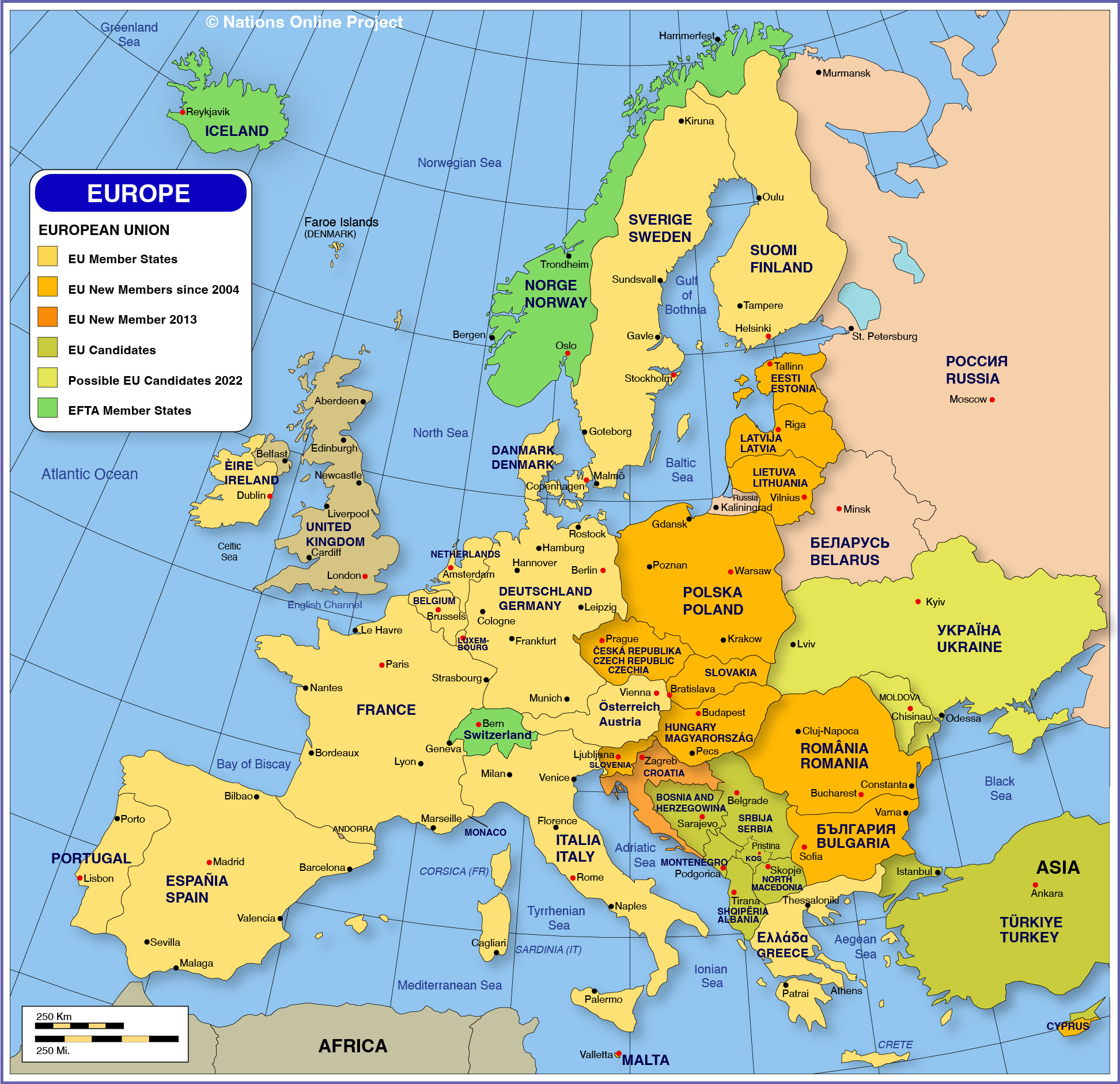
Leaving the biggest free trade area with over 500 million consumers won’t be cheap no matter what the divorce bill is. The EU has 53 trade deals worldwide the UK has zero. Political Map of Europe

The consequent rebalancing of the British economy will therefore take years and more than likely create a food underclass.

WHY?

Because it is as yet unclear when the UK will have the legal authority to begin negotiations; when the UK will leave the EU customs union; and what the trade arrangements between the UK and the EU will be after that point.

It is therefore difficult to see how third countries could engage seriously with the UK until these decisions have been taken. In addition, there are significant obstacles to meaningful trade deals with most of the countries.

The world will be more complicated even if these projections assume an orderly exit from the EU.

Only when we stand together can we secure our prosperity in a competitive world as the distinction between the country, town, will blur, with Artifical intelligence not to mention sea levels rising.

Why?

Because if I’d been writing this five years ago, it would have been all about technology: the internet, the fragmentation of media, mobile phones, social tools allowing consumers to regain power at the expense of corporations, all that sort of stuff but artificial intelligence is proving itself an unexpectedly difficult problem.

To describe EXACTLY what they will be doing in 1,820 days never mind that a second financial crisis in the 2010s – probably sooner than later – that will prove not just to be the remaking of Britain but the whole of the EU.

All human comments appreciated. All like clicks and abuse chucked in the bin.

← Back

Thank you for your response. ✨


Share this:

  • Share on WhatsApp (Opens in new window) WhatsApp
  • More
  • Share on Mastodon (Opens in new window) Mastodon

THE BEADY EYE SAY’S: ARE GOVERNMENTS BECOMING OBSOLETE.

05 Thursday Dec 2019

Posted by bobdillon33@gmail.com in Cyberocracy., Democracy., Digital age., DIGITAL DICTATORSHIP., Modern day life., Our Common Values., Political voting systems., Politics., Robot citizenship., The essence of our humanity., The Future, The Obvious., The world to day., Unanswered Questions., United Nations, WHAT IS TRUTH, What Needs to change in the World, Where's the Global Outrage., World Politics

≈ Comments Off on THE BEADY EYE SAY’S: ARE GOVERNMENTS BECOMING OBSOLETE.

Tags

Algorithms Democracy., Cyberocracy., Direct Democracy, Erosion of democracy., Government’s., Information revolution., Modern Day Democracy., NEW DEMOCRATIC EMPOWERMENT, old monarchies and governments, Out of Date Democracy, Political Trust


(Twenty-minute read)

In terms of almost everything, no one can be sure what the next fifty years will hold nor can anyone be sure just what a government will be doing fifty years from now, never mind next year.

As history has repeatedly shown, political systems come and go.

Given our rapid technological and social advances, (a trend we can expect to continue) we will be looking at many different possible futures because there is a new kind of creature that has entered the world.

When we change the way we communicate, in today’s increasingly interconnected world we change society, creating entirely new systems of thought to deal with complex issues like climate change, and by whom/what and how we are governed.  

We are in the throes of the digital age with all of its unknown consequences and it along with Climate Change is ushering in a new phase of the world. Perhaps we are looking at democracy being replaced by Cyberocracy. (Computer(s) make the decisions.)

A precise definition of cyberocracy is not possible at present as it is still hypothetical in form, but it may bring a new emphasis on ‘soft’ symbolic, cultural, and psychological dimensions of policymaking and public opinion.

It will be however a product of the information revolution and it may place a premium on gaining information from any source, public or private, radically affect who rules, how and why.

(That is, information and its control will become a dominant source of power, as a natural next step in political evolution.)

In essence, a smartphone could show us how and can train us in the latest developments to increase effectivity, while making sure a human or a group of people are not directly interacting with the information.

In theory a great idea for efficiency but in practice, those in charge will probably use the information to crush dissent and sell the information off to private companies.

Ideally, the point of cyberocracy would be to ultimately overcome the faults that lie in typical bureaucratic systems, effectively creating an artificially intelligent head of state.

Luckily there is a pitfall, in that the control of all gathered information would then ultimately lie in the proverbial hands of a machine, wherein true humanity becomes lost to the legislative and governmental processes.

The consequence of the information revolution may thus mean “greater inequalities. speeding the collapse of closed societies and favouring the spread of open ones.

Algorithms are already undermining the power base of old monarchies and governments, and these same technologies will subsequently “turned into tools of propaganda, surveillance, and subjugation that enabled dictators to seize power and develop totalitarian regimes.

New modes of multiorganizational collaboration are taking shape, and progress toward networked governance is occurring to enable hybrid systems to take the form that do not fit standard distinctions between democracy and totalitarianism.

A double-edged sword that revolves around symbolic politics and media savvy with governments straining to adapt.

For example vast new sensory apparatuses for watching what is happening in societies and around the world. Of all the uses to which the new technologies are being put, this may become one of the most important for the future of the state and its relationship to society.

Each generation must address its own challenges even though it is not yet clear which future will emerge with the current climate crisis.

Policy problems have become so complex and intractable, crossing so many jurisdictions and involving so many actors, that governments should evolve beyond the traditional bureaucratic model of the state.

Only time will tell.

We now have communications tools that are flexible enough to match our social capabilities, and we are witnessing the rise of new ways of coordination activities that take advantage of that change.

Setting priorities among government’s current endeavours need to  involve at least four decisions:

Which endeavours should be continued or stopped; Which are most important; Which are the government’s greatest responsibility; and which should have the highest priority?

Back to the present with climate change.

There is one thing for certain that with climate change there will be tragedies not yet imagined. It will drive people into compact groups and we know that if a group of humans get together without some sort of organised leadership they end up killing each other.

So for the good of all humankind, in fact, all life on earth and the earth itself, we need to push ahead in this area. Or else go back to pre-industrial times and abandon modern life as we know it. Staying the course we are on will lead only to ruin.

Government’s greatest priorities of the next fifty years can be found in their greatest disappointments of the past.

My point is, the government doesn’t remind us of the good things in life, not often. When it works, we barely notice, but when things go wrong, the glaring deficiencies of the system present themselves everywhere.

As a result, the Government used to be for the lack of a better word the parent of the group/ nation hated some days and loved other days.

Should they now be limited to the implementation of certain social norms desirable for holding the structure of society in place?

I want to see some politicians with the forethought and imagination to understand this.

That’s because I need to be reminded of what I’m living for, not an Algorithm of everything, not a government elected on lies, false news, predictive algorithms which is a two-way relationship manipulated by social media platforms, owned by monopolies that are no longer trusted by the citizens they represent.

Without knowing how decisions are taken or who the decision-makers are, and without knowing how decisions are implemented or to what end, citizens feel undervalued and disenfranchised.  They do not believe that the government is listening to their concerns.

So where are we?

The freedom that we see emerging from the networked environment allows people to reach across national or social boundaries, across space and political division. It allows people to solve problems together in new associations that are outside the boundaries of formal, legal-political association like governments. 

If the past is prologue, however, the government will continue to the extent that a society is measured by what it asks its government to do.

Sure the information revolution will foster more open and closed systems; more decentralization and centralization; more inclusionary and exclusionary communities; more privacy and surveillance; more freedom and authority; more democracy and new forms of totalitarianism.

Yet setting priorities is not just about addressing past failures. It is also about protecting past achievements.

To solve the problems and understand the role and limitations of government, will require a new way of thinking and working and a new level of trust and understanding of people.

The revolution in global communications thus forces all nations to reconsider traditional ways of thinking about national sovereignty.

A longer view of history provides little assurance that the new technology favours democracy.

Firstly, governments must be seen as capable and effective in carrying out their activities. Secondly, the government must be seen as treating all people equally and impartially, without favouritism or discrimination.

And thirdly, the dimension of human concern and personal connectedness: government must be seen to be sincerely caring about each person’s welfare.

Digital is offering a great way to respond to this at a service level but is only part of the answer when it comes to mending and building relationships with people.

Even in the best of times, delivery is hard for governments: objectives are not always clear; they change in response to events or leadership transitions.

An endeavour cannot be a top priority, or a priority of any kind if it is not worth pursuing at all. The term “greatest” does not mean either “most successful,” or “most important,” or even “most appropriate.” Rather, the greatest endeavours of the present are the ones in which the government has made the greatest investment.

This fact base speaks for itself.

The first step, then, is to choose three to six priority outcomes—any more will be too many. They can’t all be equally important.

These priorities must be written into the constitution of a nation so they cannot be tampered with.

And establishing the right metric for each priority to ensure it does not yield unintended, negative consequences must be set by citizens assemblies rather than relying on leaders political instincts.

People must feel ownership of the plan by agreeing on criteria for continuation funding.

Communicating is only the beginning.

Stakeholders must be engaged all the way through to delivery of the promised outcomes. Accountability is established,outcome-based budgeting, so that funding is directly linked to and contingent on the delivery of key outcomes.

This, as we know, is notoriously difficult to pull off in a world of silos, disparate agendas, and competition for funding. But a small number of priorities will go a long way toward securing the support required.

Government achievement ebbs and flows with changing economic, social, and political circumstances, with the mere passage of time.

The worst form of government is the tyrannical form, where all power is with one man, a leader who rises from the chaos of democracy, thirsting for power but not having the wisdom or learning to use it wisely.

With the issue of government Citizens, bonds targeting citizens funding will resolve this problem. They could unite as a human race and get our priorities in check so we can find out what’s really out there and perhaps where we really came from.

Their performance should be measured against agreed international benchmarks a portfolio of targets at varying levels of ambition.

Who would set the levels?

The U.N. is essentially an incredibly weak confederacy it should be disbanded, and a new, better UN made, with a written Constitution. All member countries hereby agree to uphold and abide by all constitutional clauses upon entry to the United Nations and any violation of any of the several clauses herein will be punished with the full force of each member state.

And finally, here are a few endeavours.

Reduce Carbon emissions.

Continue reducing nuclear weapons.

Reduce discrimination, pollution, poverty, and inequality.

Expand health care.

Devolve digitally responsibility to promote and protect democracy with the right to vote by electronic voting.

Create a Digital government performance platform.

As to which type of government is the best for mankind, well, if only we had the answer to that…Hierarchy does not end. 

All human comments appreciated. All like clicks and abuse chucked in the bin.

← Back

Thank you for your response. ✨


Share this:

  • Share on WhatsApp (Opens in new window) WhatsApp
  • More
  • Share on Mastodon (Opens in new window) Mastodon

THE BEADY EYE ASK’S: IS THIS AS GOOD AS IT GET’S WITH MAN’S ACHIEVEMENTS FOR EVOLUTION?

29 Friday Nov 2019

Posted by bobdillon33@gmail.com in #whatif.com, 2019: The Year of Disconnection., Algorithms., Artificial Intelligence., Climate Change., Dehumanization., Evolution, HUMAN INTELLIGENCE, Humanity., Life., Modern day life., Our Common Values., Reality., Sustaniability, Technology, The essence of our humanity., The Future, The Obvious., The state of the World., The world to day., Unanswered Questions., WHAT IS TRUTH, What Needs to change in the World, Where's the Global Outrage.

≈ Comments Off on THE BEADY EYE ASK’S: IS THIS AS GOOD AS IT GET’S WITH MAN’S ACHIEVEMENTS FOR EVOLUTION?

Tags

Evolution, fabric of human civilization., Human achievements., Technological revolution, Weaponized drones.

( An essential twenty five -minute read)

Everyone sees the world in different ways however the greatest innovations of man are found in the most simple things:

Starting with Fire, Language, Tools, and Wheel writing has been the sole reason that mankind has been able to accumulate knowledge.

Since then the use of our inventions have taken us a long way, they’ve allowed us to land on the moon, travel over oceans, and even eliminate major health threats with various medicines.

You could not be blamed for asking what was actually gained by landing on the moon — a handful of rocks and a game of low-gravity golf — was of virtually no value and yet the act of the journey was invaluable beyond all measure as it personified our continuing evolution.

The same is true with technology today.

The development of it is mind-blowing but its application is almost entirely mindless – profit-seeking algorithms and weaponized drones.

Setting aside why do we exist and what is the purpose of life? (These are hard questions that demand answers) it is what we have not achieved that will be judged by future generations.

Karl Marx once famously observed that capitalism carried within it the seeds of its own destruction but he was wrong. It’s not capitalism that’s the problem, it’s people.

The human race ended the 20th century in pretty good shape, at least comparatively speaking.

The first half of the 1900s was almost certainly the most bloody and brutal phase of humanity’s existence.

Now we have all the information in the world yet it has made us only more ideological and more ignorant; we have access to limitless opinions yet we seek to criminalise those who don’t agree with us. We are so advanced and yet so backward, so cynical and yet so stupid, that we can no longer even agree on what constitutes a fact.

Welcome to the 21st century.

Consider the internet itself, probably the most revolutionary invention in the history of humankind. Its potential to share information thus to accelerate the advancement of science and keep the world running in the event of a catastrophic disaster — the purpose for which it was first intended — is all but limitless.

And what do we use it for most? Porn.

Consider the smartphone, the match to the powder keg of the worldwide web. Almost everyone in every half-developed part of the world, even people living on the streets, has a device more powerful than supercomputers that once took up whole buildings. We can access virtually any image, any idea, any information from anywhere in the world.

And what do we overwhelmingly use it for?  Taking pictures of ourselves.

Let’s look at medical technology — the smartest minds on the planet developing machines and medicines that keep the average person today alive for longer than was once ever dreamt of.

And what is the result?

We are fatter and lazier than ever, resulting in spiralling hospital costs that will send most Western governments broke in a matter of decades. It was once said that the only two certainties in life were death and taxes and yet now we are defying death and there aren’t enough taxes to pay for it.

We are too dumb to even know when to die.

It may well be impossible to connect a full chronological series of species, leading to Homo sapiens, but over millions of years of evolution, we’ve picked up some less than ideal characteristics.

Why? Because of greed.

It will take the efforts of several scientific disciplines and sophisticated technology, probably over many years, to discover the underlying nature of our mental faculties, their neurological basis, and their development over time.

And it’s fair to say that we have little idea of what we’ll evolve to in the future, but there is one thing for certain, evolution is about adapting to your environment – Weaponized drones, Climate change, Algorithms.

Algorithms that are feeding Social media, are stripping us of a collective understanding of what is going on in the world.

People like to blame fake news on Facebook, and that is true enough.

But the far greater truth is far worse than that. Neither fake news nor Facebook emerged like Athena fully-formed from nothing. They were made by us. By us and for us and of us.

While the positive uses for technology are endless I marvel as I read Asimov to see the way in which he foresaw the ethical conundrum in which we now find ourselves embroiled.

Of course, when they (the future generations) look at our achievements the one thing they will not be able to comprehend is why we have not been able to stop killing each other.

Weaponized drones are now more acceptable than land mines, cluster bombs, or chemical weapons.

It might be argued that this would be a way of sparing human beings who could stay comfortably at home and let our intelligent machines do the fighting for us. If some of them were destroyed — well, they are only machines. This approach to warfare would be particularly useful if we had such machines and the enemy didn’t.

Just like those tried at Nuremberg who attempted to wash their hands of mass killings we have now developed weaponized drones to kill, with a Punches Pilot immunity, that is violating all existing international law.

So humans through the use of technology may eventually reach a point where they can force evolution upon themselves.

Perhaps the result (if we are not already wiped out by Nuclear or a Weather bomb) will be that we’re no longer subject to the driving force of evolution – but unnatural selection by drones. 

Now the question is, how accurate is this statement?

Is technological progress actually taking us backwards?

Are we advancing ourselves to death? At what point do many deaths become too many deaths?

This is the first problem with technology.

If it is accurate, we’re already screwed.

Of course, none of this is important given the glacial pace of evolutionary change, we probably won’t have to worry about that for thousands of years.

Wrong.

We’ve come to believe that, with enough information, human behaviour is predictable.

But number-crunching algorithms are leading us perilously wrong. There’s something unsettling in the idea that, amid the vagaries of choice, chance, and circumstance, mathematics can tell us something about what it is to be human.

Who we are together, as a collective entity?

Despite the grand promises of Big Data, uncertainty remains so abundant that specific human lives remain boundlessly unpredictable. The more data that are collected, cross-referenced, and searched for correlations, the easier it becomes to reach false conclusions.

It might be true that in large groups, the natural variability among human beings cancels, however, if we end up with algorithms setting thresholds extremely unlikely outcomes are bound to arise eventually.

The gift is not a technology to enable us to realise evolution for the cruel being it is, but giving mankind the intelligence and tools to exclude ourselves from the other species on the planet and take a step back to interpret for ourselves where we as a race are going?

Leaving the brutality of evolution behind is not a gift given to us by evolution.

We have evolved to the point whereby we stand on the threshold of controlling our genetic and ultimately evolutionary destiny. Unfortunately, the problem with humans is, whenever we encounter a problem we have evolved to the point where we think that we can overcome it with technology.

Advances in technology, medicine and culture mean it isn’t just the fittest who get to pass their genes on to the next generation.

External aids could be entirely responsible for our survival.

All of this relies on earth’s natural resources which are supposedly gonna be gone by 2050!

The problems in this world are manmade therefore man can solve them.

The sad truth is that we have Governments and World Organisations that pay lip service when the real debate is a knowledge- and research-based exchange of argument and counterargument that should be focused at the analysis of a specific question, our survival. 

Passion and competition, yes, but, more than anything else, debate is an exercise in critical thinking! The human brain, being a machine striving for maximum efficiency, typically remembers where information is stored, rather than the information itself.

Technology has already affected the way our memory works.

AI. After all, natural evolution wouldn’t be able to mould and program devices to a point of sophistication that may lead to sentience, but we may be able to and maybe at that point even though its not natural, it is an evolution born of natural origins and most likely would go on to create newer better versions of itself.

In theory, humans are exercising their judgement in the process, but in reality, the computer system is viewed as too “smart” to be second-guessed by a human being.

So . . . what do we need to be more afraid of?

Robots with a compulsion to out-think humans? or humans that are afraid to second-guess the robots?

We must confront an urgent problem related to technology: the automation of “pre-emptive violence” – front-loaded with a bias to kill, with little impetus to contradict that bias.

At present drones are the most devastating driving forces for terrorism and destabilization around the world.

So are we at the peak of human evolution?

Certainly not. Certainly not as long as there are humans, there will be human evolution.

We are not even close to the peak of evolution.

Just look at wthat we recently found > The Higgs Boson, Mapped the Human Genome, Cloned a sheep, built the International Space Station, discovery the Double Helix Structure of DNA, Split the Atom, invented the Internet, we’re revisiting the theories of Relativity with Quantum Mechanics.

We have Created Nuclear Weapons, the Periodic Table of the Elements,  Created the Internet Developed Vaccines, Created Music, Created Photography, Flight, Electronic Devices, Traveled to the Moon, Eradicated Small Pox, Created the Television, Discovered Mathematics, Invented the Printing Press, The Phone,  Discovery and Control of Electricity, Cars, Invented Zero, Created of United Nations, Discovered World is Round. 

AND STILL, WE ARE UNABLE TO ACT TOGETHER.

Why?

Because you know the downfall of civilisation has really passed the point of no return when even a rich white guy can’t get anything done.

Humans are the only organism that can alter their environment to suit them (instead of the other way around)

Finally, people must take into account that nature will commence exerting its own controls LONG BEFORE the human race has reached the point where it can step off the evolutionary treadmill.

With our increasing reliance on technology – and in particular machinery – to do our dirty (but muscle-enhancing) work. The less each generation depends on physical strength, the more likely it is that the whole species will grow weaker to the point of stagnation. 

As evolution relies on the survival of the fittest, evolution itself will evolve everything else in all our lives will be transitory and every other artificial intelligent goodwill application will become visionary.

Only when we’ll be able to repair and augment our children’s DNA. Then we really will have triumphed over evolution. Race” will no longer be an issue. Perhaps we will stop killing each other.

Yet we’ve got our problems. A lot of them but the very things we invented to sustain us will destroy us.

The exact nature of our evolutionary relationships with the planet and AI will be the subject of debate for the foreseeable future.

It doesn’t matter if we’re uncovering evidence for climate change or deciding whether a drug has an effect: the concept is identical.

By setting an arbitrary threshold, and agreeing that anything beyond that point gives you grounds for suspicion with greed this is the evolutionary path we are setting our selves.

Mentally the world appears to be de-evolving with smartphones and social media platforms.

All human comments appreciated. All like clicks chucked in the bin.

← Back

Thank you for your response. ✨


Share this:

  • Share on WhatsApp (Opens in new window) WhatsApp
  • More
  • Share on Mastodon (Opens in new window) Mastodon

THE BEADY EYE ASK’S: IS IT TIME TO REGULATE SOCIAL MEDIA PLATFORMS WITH LAWS.

25 Monday Nov 2019

Posted by bobdillon33@gmail.com in 2019: The Year of Disconnection., Algorithms., Democracy, Digital Friendship., Elections/ Voting, Facebook., Fourth Industrial Revolution., Google, Humanity., Modern Day Democracy., Modern day life., Our Common Values., Politics., Reality., Social Media, The common good., The essence of our humanity., The Obvious., The pursuit of profit., The state of the World., The world to day., Twitter, Unanswered Questions., What Needs to change in the World, World Politics

≈ Comments Off on THE BEADY EYE ASK’S: IS IT TIME TO REGULATE SOCIAL MEDIA PLATFORMS WITH LAWS.

Tags

Algorithms., Capitalism and Greed, Facebook and Society., Google/Amazon/Facebook/Twitter, Platforms regulation/laws., Social Media, Social media platforms., The Future of Mankind


(Ten-minute read) 

The beady eye is far from the first voice to ask this question and it certainly will not be the last.

We might even come to “question whether we still have free will.

There is no doubting that the social web has created amazing opportunities to learn, discover, connect, but its downside as it penetrates our daily lives is becoming more and more prevalent in the creation of our future lives and the societies we live in.

If the public discussion is shifting increasingly to online fora, and those fora are having more and more influence over democracy it becomes increasingly important to apply principles to them. 

Honest political debate is essential for the health of a democracy.  

If discussions of import move into space where they can be readily censored, then we will simply no longer live in a society with a free exchange of ideas, because the playing field will always be tilted.

One only has to look at how social media platforms are amplifying what is wrong with the world.  

While we all reveal a huge amount of personal information online we are losing the ability to determine honest facts that democracy depends.

Basically, companies that run social media platforms are monopolies or near-monopolies in their areas of operation, and the only way we can achieve the desired outcomes is through clear, effective legal regulations. 

We can’t always control how others use their platforms but we can apply the same regulations that govern all other forms of Media.

The public cannot rely on these company’s self-regulation, because self-regulation raises more questions than it answers.

The fact is that the formation of a platform takes place in a vacuum, whereas the formation of any competitors do not, so they cannot be considered parallels in any way. 

If we take companies like Facebook and Google they both derive most of their revenue from advertising. They essentially constitute a duopoly because they have access to the best data about individuals. Every memory, picture, emoji, song, video, link, gripe, fear, hope, want, dream and bad political opinion posted is mined and monetized as data.

As a result of their algorithms, they are creating and reinforcing divided and insular online communities that do not interact with people or information with which they disagreed.

At the end of the day, how Facebook and Google conduct their businesses undermines privacy and raises questions about ethical behaviour in the uses of our information and their role in society.

The Internet is a “utility” like water or electricity. It is essential to modern life, not an optional subscription service.

Determining how to regulate Facebook or any other platform may first require some kind of definition of what it is.

Facebook brags about connecting us to our family and friends — but it also about directly influencing the outcomes of elections across the globe.

It sits on top of industries including journalism, where it, together with Google, essentially controls the distribution channels for online news and, in effect, the way people discover information about politics, government and society.

They ( Google, Facebook, Twitter,etc) have figured out how to take advantage of this dynamic to distribute false information about political candidates and hot-button political issues in order to drive up traffic and advertising revenue.

Protecting our community is more important than maximizing their profits.

They are given protections that no one can sue them for any reason — that is Google and Facebook nither are responsible for the fake news that appears on their sites.

They are completely shielded from any responsibility for the content that appears on their service.

Changes to legal protection (which has been interpreted by judges to provide a safe harbour for online platforms even when they pay to distribute others’ content and decline the option to impose editorial oversight) would likely be devastating to online platforms like Google and Facebook and would transform the way people interact across the entire internet.

However, with legal protection, sites like these could be held responsible for libellous comments posted by readers, Google could lose lawsuits over potentially false or defamatory information surfacing in search results, and Facebook could be sued for any potentially libellous comment made by anyone on its platform against any other person.

The legal bills to defend against libel and defamation claims would be enormous.

We all need protection and the ability to request platforms to provide us with control over online information by making it accessible and removable at an individual’s request.

The government, on the other hand, has a regulatory intent to protect citizens from content that is obscene or violent.

Should Facebook and their like be regulated?

A question that is never going to end. 

However, until we recognize that there is no fool-proof safeguard to keep horrific content away from the eyes of children we rely on huge fines to the detriment of us all. 

Till then with all internet platforms deflecting criticism, social media will be more psychologically damaging than anyone expected. 

We need a radical shift in the balance of power between the platforms and the people.

It is beyond comprehension that we tolerate the present position.

Or is it? When you see the below.   

Would you ever be prepared to use a nuclear weapon?

This question is increasingly put to politicians as some kind of virility test.

The subtext is that to be a credible political leader, you must be willing to use an indiscriminate weapon of mass destruction.

We should be baulking at the casual way in which political discourse on this topic has developed which is politically unacceptable and morally despicable. 

If a mainstream politician unblinkingly said that they would use chemical weapons against civilians there would be uproar. If a self-proclaimed candidate for prime minister boasted that they would commit war crimes, it would be a national scandal. Nuclear weapons should be seen no differently. 

It’s time that nuclear advocates spelt out the reality of what their position means.

The human race is so good at speaking, it’s lost the art of listening.

It might be easy to brush away the febrile atmosphere online as a nasty byproduct of free expression: I don’t want Facebook having everyone’s verified identities. I do want their platform and other platforms to be held responsible legally for content that is false, racest, hateful, rightwing fascist propaganda.  

I do know that if the big platforms, as they already do in part, forced some verifiable information to back up use, we could tame this wild west with legal requirements

I’ll give up on the consensus-building when I can open a platform knowing who to hold legally responsible.  


All human comments appreciated. All like clicks and abuse chucked in the bin. 

← Back

Thank you for your response. ✨


Share this:

  • Share on WhatsApp (Opens in new window) WhatsApp
  • More
  • Share on Mastodon (Opens in new window) Mastodon

THE BEADY EYE ASK’S. WITH THE SATURATION OF THE WEB BY GREEDY ALGORITHMS ARE WE SEEING THE END OF CHOICE.

20 Wednesday Nov 2019

Posted by bobdillon33@gmail.com in 2019: The Year of Disconnection., Algorithms., Artificial Intelligence., Dehumanization., Democracy., Digital Friendship., Education, Elections/ Voting, Fake News., Fourth Industrial Revolution., HUMAN INTELLIGENCE, Modern Day Democracy., Modern day life., Our Common Values., Post - truth politics., Reality., Robot citizenship., Social Media, The common good., The essence of our humanity., The Obvious., The world to day., Unanswered Questions., WHAT IS TRUTH, What Needs to change in the World

≈ Comments Off on THE BEADY EYE ASK’S. WITH THE SATURATION OF THE WEB BY GREEDY ALGORITHMS ARE WE SEEING THE END OF CHOICE.

Tags

Algorithms., Artificial Intelligence., Democracy, Future Choice., Future generations., Future Society., Social Media, The future effect of the Internet, The Web., Visions of the future.


(Seven-minute read) 

The degree of choice on the web can be overwhelming, but who, exactly, is making the “Choice”

Has The web has been highjacked by Google, Microsoft, Apple, and Social Media and their like?

Why?

Besause they are absorbing their users’ personal data and feeding greedy algrithms who in the end are disempowered by isolation from the wider web. 

(By clicking continue below and using our sites or applications, you agree that we and our third party advertisers can:)

Greedy algorithms can be characterized as being ‘short-sighted’, and also as ‘non-recoverable’. The choice made by a greedy algorithm may depend on choices made so far, but not on future choices or all the solutions to the subproblem.

It is important, however, to note that the greedy algorithm can be used as a selection algorithm to prioritize options within a search, or branch-and-bound algorithm. They iteratively make one greedy choice after another, reducing each given problem into a smaller one.

They can make commitments to certain choices too early which prevent them from finding the best overall solution later.

Without any accountability, they are drastically changing the ways we conduct our daily lives.

There are a few variations to the greedy algorithm:

  • Pure greedy algorithms.
  • Orthogonal greedy algorithms.
  • Relaxed greedy algorithms.
  • It’s no wonder that Berners-Lee isn’t particularly pleased with the way things have gone with his creation.

With Social networks, slowly algorithms are growing more and more powerful and their predictions growing more accurate. It won’t be long before we could see living, breathing, as the choices of a greedy algorithm.  

In other words, a greedy algorithm never reconsiders its choices. 

The web is cleaving into the haves and have-nots of news readership. Wealthy readers will pay to opt-out of advertising; less privileged readers will have to stick with news that’s ad-supported.

For example, take Google, one of the leaders in using big data and algorithms to support human decision-making. Google has developed both a hiring algorithm and a retention algorithm it analyzes candidates against this profile to make hiring decisions.

Algorithms to develop lists of “flight risks” — that is, people who are likely to leave their jobs soon. 

Amazon’s Choice” algorithm, which leverages a machine learning model to discern what products a customer most likely wants. Amazon Alexa and other voice assistants are drastically changing the ways consumers encounter products.

Customers are no longer putting themselves in front of physical products before purchasing them.

As more users are turning to voice ordering through the Amazon Alexa platform and its competitors we are losing control over our personal data. 

Hopefully, Amazon’s algorithms are capable of remaining unbiased.

(We can make whatever choice seems best at the moment and then solve the subproblems that arise later.) 

On top of all of this, we have all become blind to the damage that the internet can do to even a well-functioning democracy. Brexit/ USA.

It might be true that around the world, social media is making it easier for people to have a voice in government — to discuss issues, organize around causes, and hold leaders accountable, but these governments are winning elections by false news, echo chambers where people only see viewpoints they agree with — further driving us apart.

Social media can distort policymakers’ perception of public opinion.

If there’s one fundamental truth about social media’s impact on democracy it’s that it amplifies human intent — both good and bad.

Unprecedented numbers of people channel their political energy through this medium, it’s being used in unforeseen ways with societal repercussions that were never anticipated. 

So it is inevitable that Facebook to influence public sentiment — essentially using social media as an information weapon.

Some 87% of governments around the world have a presence on Facebook.

And they’re listening — and responding — to what they hear.

Misinformation campaigns are not amateur operations.

Increasingly the web will become profoundly useless unless we demand the Web we want from Governments and the Monomorphic platforms that dominate it today. 

We are all part of the web so what we endorse must be questioned as to the transparency as to where the information comes from in the first place.

Today the bulk of people who are or not doing this are isolated from each other by Apps.

The like button is not a public metric for the popularity of content. It is a flattener of credibility.

There is no point waking in the morning with Alexa telling you what to do, where to go and what it has bought and who to vote for.  

Even if social media could be cured of its outrage -enhancing effects it is undermining democracy.

Even though we have unprecedented access to all that was ever written and digitized we are less familiar with the accumulated wisdom of humanity becoming more and more misguided. 

The Web is now a global experiment that will test the very foundation of our global communities

There can not be self -governance for the web.

Fake news, Racism, Pornographic content and unfounded crap should be removed by not allowing anything to be posted without a traceable verified name or source.  

Are you sure you want to post this? It is your choice and your choice alone.

Perhaps its time we all franchise our data as we are entering into a continuous partnership so both parties need to be confident it’s the right fit. It’s all a choice. Just do something about it- YOU CAN, what is true technology integration? 

How we are going to learn content is one of the ways forward.

In fact, everywhere we look we are starting to be presented with more choices.

Resolve to avoid false comparisons on the web is not possible so the future of the web is all about choice but it is important to understand the paradox of choice.

Choice without education or choice with education.

you ultimately do have to choose. so be the difference that

makes the difference. 


Events change our perception and our perspective changes

with experience but at least let our choices about Our lives

which are constantly in flux be our choices. 

All human comments appreciated. All like clicks and abuse chucked in the bin. 

← Back

Thank you for your response. ✨


Share this:

  • Share on WhatsApp (Opens in new window) WhatsApp
  • More
  • Share on Mastodon (Opens in new window) Mastodon
← Older posts
Newer posts →

All comments and contributions much appreciated

  • THE BEADY EYE SAYS. HAVE YOU NOTICED THAT THE NEWS COVERAGE ON THE WAR IN THE MIDDLE EAST IS DOMINATING BY MATERIALISM. March 21, 2026
  • THE BEADY EYE SAYS AMERICA IS SHOOTING ITS SELF (NOT JUST IN THE FOOT) BUT IN THE EYES OF ITS ALLIES AND THE WORLD MARKET PLACES. AS THE IRAN WAR IS SPIRALLING OUT OF CONTROL. March 20, 2026
  • THE BEADY EYE SAYS. THE BATTLE TO HAVE A LIFE WORTH LIVING BECOMES MORE AND MORE DIFFICULT WITH AGE .. COMMUNITY MATTERS MORE THAN MONEY. March 20, 2026
  • THE BEADY EYE SAYS. EQUALITY, FAIRNESS, JUSTICE ARE INDIVISIBLE CONCEPTS IF ARE ANYTHING. March 18, 2026
  • THE BEADY EYE SAYS. IT DOES MATTER WHAT YOU THINK ABOUT WAR WHETHER ITS JUSTIFIED OR NOT. March 17, 2026

Archives

  • March 2026
  • February 2026
  • January 2026
  • December 2025
  • November 2025
  • October 2025
  • September 2025
  • August 2025
  • July 2025
  • June 2025
  • May 2025
  • February 2025
  • January 2025
  • December 2024
  • November 2024
  • October 2024
  • September 2024
  • August 2024
  • July 2024
  • June 2024
  • May 2024
  • April 2024
  • March 2024
  • February 2024
  • January 2024
  • December 2023
  • October 2023
  • September 2023
  • August 2023
  • July 2023
  • June 2023
  • May 2023
  • April 2023
  • March 2023
  • February 2023
  • January 2023
  • December 2022
  • November 2022
  • October 2022
  • September 2022
  • August 2022
  • July 2022
  • June 2022
  • May 2022
  • April 2022
  • March 2022
  • February 2022
  • January 2022
  • December 2021
  • November 2021
  • October 2021
  • September 2021
  • August 2021
  • July 2021
  • June 2021
  • May 2021
  • April 2021
  • March 2021
  • February 2021
  • January 2021
  • December 2020
  • November 2020
  • October 2020
  • September 2020
  • August 2020
  • July 2020
  • June 2020
  • May 2020
  • April 2020
  • March 2020
  • February 2020
  • January 2020
  • December 2019
  • November 2019
  • October 2019
  • September 2019
  • August 2019
  • July 2019
  • June 2019
  • May 2019
  • April 2019
  • March 2019
  • February 2019
  • January 2019
  • December 2018
  • November 2018
  • October 2018
  • September 2018
  • August 2018
  • July 2018
  • June 2018
  • May 2018
  • April 2018
  • March 2018
  • February 2018
  • January 2018
  • December 2017
  • November 2017
  • October 2017
  • September 2017
  • August 2017
  • July 2017
  • June 2017
  • May 2017
  • April 2017
  • March 2017
  • February 2017
  • January 2017
  • December 2016
  • November 2016
  • October 2016
  • September 2016
  • August 2016
  • July 2016
  • June 2016
  • May 2016
  • April 2016
  • March 2016
  • February 2016
  • January 2016
  • December 2015
  • November 2015
  • October 2015
  • September 2015
  • August 2015
  • July 2015
  • June 2015
  • May 2015
  • April 2015
  • March 2015
  • February 2015
  • January 2015
  • December 2014
  • November 2014
  • October 2014
  • September 2014
  • August 2014
  • July 2014
  • June 2014
  • May 2014
  • April 2014
  • March 2014
  • February 2014
  • January 2014
  • December 2013
  • November 2013
  • October 2013

Talk to me.

Jason Lawrence's avatarJason Lawrence on THE BEADY EYE ASK’S: WIT…
benmadigan's avatarbenmadigan on THE BEADY EYE ASK’S: WHA…
bobdillon33@gmail.com's avatarbobdillon33@gmail.co… on THE BEADY EYE SAYS: WELCOME TO…
Ernest Harben's avatarOG on THE BEADY EYE SAYS: WELCOME TO…
benmadigan's avatarbenmadigan on THE BEADY EYE SAY’S. ONC…

7/7

Moulin de Labarde 46300
Gourdon Lot France
0565416842
Before 6pm.

My Blog; THE BEADY EYE.

My Blog; THE BEADY EYE.
bobdillon33@gmail.com

bobdillon33@gmail.com

Free Thinker.

View Full Profile →

Follow bobdillon33blog on WordPress.com

Blog Stats

  • 97,888 hits

Blogs I Follow

  • unnecessary news from earth
  • The Invictus Soul
  • WordPress.com News
  • WestDeltaGirl's Blog
  • The PPJ Gazette
Follow bobdillon33blog on WordPress.com

The Beady Eye.

The Beady Eye.
Follow bobdillon33blog on WordPress.com

Blog at WordPress.com.

unnecessary news from earth

WITH MIGO

The Invictus Soul

The only thing worse than being 'blind' is having a Sight but no Vision

WordPress.com News

The latest news on WordPress.com and the WordPress community.

WestDeltaGirl's Blog

Sharing vegetarian and vegan recipes and food ideas

The PPJ Gazette

PPJ Gazette copyright ©

Privacy & Cookies: This site uses cookies. By continuing to use this website, you agree to their use.
To find out more, including how to control cookies, see here: Cookie Policy
  • Subscribe Subscribed
    • bobdillon33blog
    • Join 222 other subscribers
    • Already have a WordPress.com account? Log in now.
    • bobdillon33blog
    • Subscribe Subscribed
    • Sign up
    • Log in
    • Report this content
    • View site in Reader
    • Manage subscriptions
    • Collapse this bar