• About
  • THE BEADY EYE SAY’S : THE EUROPEAN UNION SHOULD THANK ENGLAND FOR ITS IN OR OUT REFERENDUM.

bobdillon33blog

~ Free Thinker.

bobdillon33blog

Category Archives: Life.

THE BEADY EYE ASK’S: IS THE CLASS SYSTEM GOING TO BE EVENTUALLY REPLACED BY BIOLOGICAL STATUS

11 Tuesday Feb 2020

Posted by bobdillon33@gmail.com in #whatif.com, 2020: The year we need to change., Algorithms., Artificial Intelligence., Biotechnology., Cellular Biology, Climate Change., Dehumanization., Evolution, Fourth Industrial Revolution., Genetics., HUMAN INTELLIGENCE, Human values., Humanity., Life., Nanotechnology, Natural selection., Our Common Values., Reality., Robot citizenship., Sustaniability, Technology, The common good., The Future, The Obvious., The state of the World., The world to day., Unanswered Questions., WHAT IS TRUTH, What Needs to change in the World, Where's the Global Outrage.

≈ Comments Off on THE BEADY EYE ASK’S: IS THE CLASS SYSTEM GOING TO BE EVENTUALLY REPLACED BY BIOLOGICAL STATUS

Tags

Evolution, Nano biotechnology, Natural selection., Separate species


(Fifteen-minute read) 

We may die out as a species for one reason or another, but evolution is inevitable so there will be a change in the future. We are not done evolving yet, so it begs the question of what could Homo sapiens really become – and what is forever beyond our reach?

We were fish once, and now we eat fish for dinner!

Humankind has come a long way from a single cell floating in the ocean waters, we have managed to become the multi-cellular wonders of nature that we are today.

However, evolution doesn’t have a direction, it’s confined are of this ecosystem called Earth which decides in the long run which direction if any it goes in. 
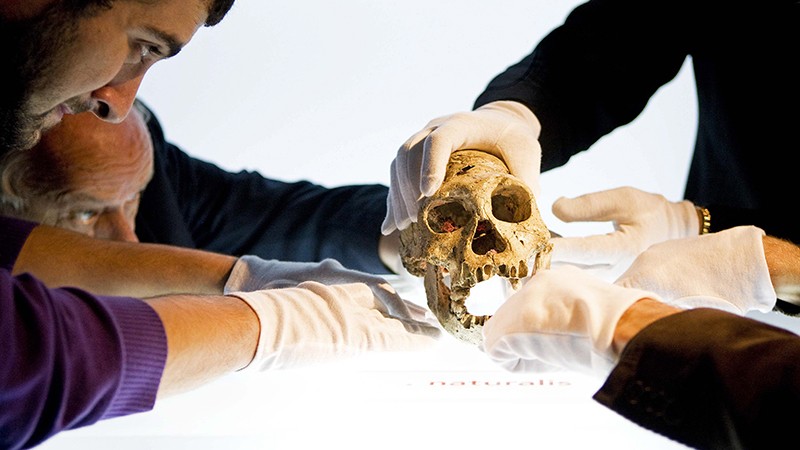
Skull D2700 discovered in 2001 at Dmanisi in Georgia is held by museum staff as they prepare it for an exhibition in Netherlands

Future humans might be very different from people today but not in the way science fiction movies would lead you to think.

Combining knowledge of our past with current trends, we are entering a new phase in human evolutionary history—one that makes the future less predictable and more interesting than ever before.

SO THE FIRST THING TO APPRECIATE IS THAT:

Evolution and natural selection are not the same things.

Evolution refers to the relationship between a species (a breeding population) and its ever-changing environment. Evolution does not concern what individuals may think it is the gradual genetic change of a species over time.

Natural selection is the phenomenon that rewards certain advantageous traits and punishes others through better or worse survival or reproduction. Medical science and public health measures have enabled the developed world to escape most natural selection.  

Right now most of us are the sacrificial generation.

In nature, natural selection is the most powerful evolutionary force, but other factors may take over when technology grants a second chance to those who would have died. 

Consequently, even with a complete lack of natural selection, it doesn’t mean that humans will not evolve. It is a selective force that clearly has shaped human evolution in recent centuries and may still be doing so today with the Coronavirus.

 With the Viruses, natural selection may not be “over for humans.”

This set aside we are more than likely going to have to adapt to climate change’s, to technologies like Biotechnology involving living systems and organisms to develop or make products.

Technology is already affecting the way our memory works and humans may eventually reach a point where they can force evolution upon themselves through the use of technology.Will our descendants be cyborgs? © Daniel Haug/Getty

We now have genetic samples of complete genomes from humans around the world, and with geneticists are getting a better understanding of genetic variation and how it’s structured in a human population environmental factors are no longer the driving force for evolutionary change.

We’ve all heard of designer babies, perhaps in the future, it may be seen as unethical not to change certain genes.

The human race will one day split into two separate species one more advanced than the other.

Races, as normally understood, would still be a thing, but with two separate species that will probably still call themselves human, even if they are technically different from those before them.

Of course, we don’t know this for sure but consider it’s not really a biological question anymore, it’s a technological question it is not beyond conceptuality that humans will not evolve into a single, ubiquitous ethnic group.

However, there is also a risk that current society collapses and some new society arises with ideas of eugenesy or breading races of superhumans and slaves.

One species with hi-tech machine implants, growable limbs and cameras for eyes even with different facial features and skin colour and external aids entirely responsible for survival.

A collective thought consciousness. Thought could be converted into instant gratification, and consequences to misusing it controlled by AI.

Computers will punish you! 

The human brain, being a machine striving for maximum efficiency, typically remembers where information is stored, rather than the information itself but as technology becomes more and more advanced, our brains will adapt in order to maximize efficiency – perhaps to the detriment of our memory.

Nanomachines would be part of the human form.

People could download their being into a computer system and be a part of the AI collective.

We will no longer operate within the confines of survival of the fittest. 

There is still going to be selection but artificial selection, so its no surprise that much technological advancement is currently aimed at the human body.

Up to now, sexual selection has defined evolutionary paths.

This will become less and less with gene editing with many of our internal functions becoming obsolete and what we might see is differentiation along lines where people live.

And what about space?

If humans do end up colonising Mars, what would we evolve to look like?

With the lower gravity, the muscles of our bodies could change the structure. Should we spend too long as galactic explorers, it’s likely that we’d eventually lose most of our muscle mass?

“What once use to be a magic flute will become a water carrier.”

So if we survive climate change humans will not evolve just for reproduction.

Whether it is genetically enhanced humans, bionic men, or uploaded beings, technology and its advancement with our decisions will shape the future of Earth and its inhabitants, including ourselves.

It will certainly be shaping human development. Bio to Artificial transmission with no inoculations.

Google Brain / Health or Microsoft Health vaults.

However, the future might be a lot slower than we think. It will take thousands of years for us to develop technologies that allow us to colonize the solar system.

If we do manage to move to other worlds, it’s likely that we’ll need to adapt to them using a combination of genetic engineering and technology.

All these changes may mean that Homo sapiens will speciate, or evolve into multiple new species. It will mean that our progeny have survived, even if they are nothing like us.

If we consumed most of the planet’s resources in doing so that is not evolution; that is the road to extinction.
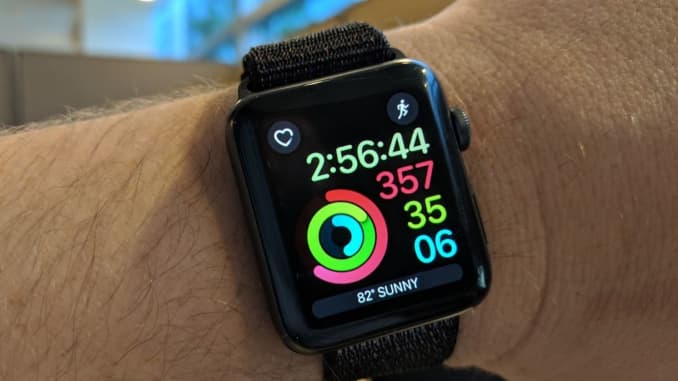
CNBC Tech: Apple Watch  2

All human comments appreciated. All like clicks chucked in the bin 

← Back

Thank you for your response. ✨


Share this:

  • Share on WhatsApp (Opens in new window) WhatsApp
  • More
  • Share on Mastodon (Opens in new window) Mastodon

THE BEADY EYE SAY’S: WE CAN NO LONGER BE CERTAIN ABOUT ANYTHING.

06 Thursday Feb 2020

Posted by bobdillon33@gmail.com in 2020: The year we need to change., Algorithms., Artificial Intelligence., Digital age., Fourth Industrial Revolution., Human values., Life., Technology, The essence of our humanity., The Obvious., The world to day., Unanswered Questions., WHAT IS TRUTH, What Needs to change in the World, Where's the Global Outrage.

≈ Comments Off on THE BEADY EYE SAY’S: WE CAN NO LONGER BE CERTAIN ABOUT ANYTHING.

Tags

Algorithms trade., Algorithms., Artificial Intelligence., Big Data, Technology, The Future of Mankind


 Twenty four-minute read.   

We have no idea how the world will look in twenty years never mind fifty when most of this generation will be in their seventies but it is now becoming clear beyond any doubt that AI and its algorithms are drastically changing the world we live in both for the good and bad.

There is one thing for certain artificial intelligence will have and is having a more profound effect than electricity or fire. 

It will not just hack our lives our brains, it will hack or very existence.

It might well warn us about climate change, the coronavirus but it will as it is manipulate our needs and wants and beliefs. It will effectively be controlling people for both commercial and political purposes. 

Given the force of this technology to have any control left we need meaningful regulations, if not we might as well just surrender to the algorithm, which is becoming so complex that no one will understand them.

The reality is that most of us are giving rivers of free information to Big data to an extent that we will soon be unable to think for ourselves.

If we don’t get a grip by the time you reach the seventies your futures and the future of the next generations will be decided at random by nonelected platforms.  

If this is so, the decision-making process for us all become a thing of the past.

The outlook for Ai is both grim and exciting. 

Already we see data collected affecting elections, with our ability to know what is fake and what is true at the mercy of Social Media run by algorithms.  

We all know their faces: Google, Microsoft, Amazon, Facebook, Apple, Baidu in China, Twitter, Alibaba, to name a few who are already transforming the basic structure of life.

Taken together they form a global oligopoly.

These unregulated platforms are competing for dominance all with a conflict of interests. Hence their algorithms.

The chances of self introducing regulations that will affect or stop their development is pie in the sky. 

Its time we stopped thinking about AI in kind of scientific terms.

Why?

Because algorithms are making critical decisions about our lives and the tech-driven approach to governance is growing. Because any particular scenario will be far from what we think is true today and we are running out of time to do anything about it.

If we are to call a spade a spade there is no or little understanding as to how to regulate these emerging technologies.  Even if there were governments and world institutions that could do so they are largely unequipped to create and enforce any meaningful regulation for the public benefit.

 The problem is how does one regulate an Algorithm that learns. 

You might happy ceding all authority to algorithms and their owners if so you don’t have to do anything they will take care of everything.

If not algorithms are watching you right now to ensure that you do not read this post and if you do read this post they will use one of the most powerful tools in their arsenal of big data – split and divide – False News and repetition thereof for example. 

It won’t happen overnight since development cycles often take years but our collective past will become a less reliable guide and we will have to adapt to the unknown. 

Unfortunately teaching the unknown without mental balance is a disaster in waiting. 

It might be easy now to laugh at this but unless we make our voices heard instead of like clicks it will not be climate change that changes us but race bias that is already programmed into Tec world.

We’re starting to see money examples where these algorithms are prone to the kinds of biases and limitations that we see in human decision making and increasingly we are moving towards algorithms that are learning more and more from data.

 I say, learning from this data almost institutionalizes the biases.

Why?

Because they are trying to personalize the media they curate for us. They’re trying to find for us more and more of the kinds of content that we already consume.  

So what if anything can be done?

Even if we do eventually introduce regulations they will have little effect unless we find a way of sharing the benefits of AI.

The problem is that our institutions, our education models are not able to keep up with the developments in Artificial Intelligence. We are becoming more and more detached from and in decision making, contributing, and rewards.

So our governments are leaving it to the market, to the big Tec companies themselves.

If you are expecting some kind of warning when AI finally get smarter than us then think again.

I say our algorithms are hanging out with the wrong data, profit for profit sake. 

In reality, our electronic overlords are just getting started with the smartphone, the I.Pads, Alex etc taking control.  We have to think about other measures, like is there a social contribution, and what is the impact of this algorithm on society?

This requires transparency.

But how do you create transparency in a world that is getting so complex?

Here is my solution.

Pharmaceuticals are considered as the most highly regulated industries worldwide and every country has its own regulatory authority when it comes to the drug development process.

(World Health Organization (WHO), Pan American Health Organization (PAHO), World Trade Organization (WTO), International Conference on Harmonization (ICH), World Intellectual Property Organization (WIPO) are some of the international regulatory agencies and organizations which play essential role in all aspects of pharmaceutical regulations related to drug product registration, manufacturing, distribution, price control, marketing, research and development, and intellectual property protection.)

Why not put in place a new World Governing Body to test and control Al algorithms. To act as a guardian of our Basic Human Values.

If this is not done it will remain impossible to truly cooperate with an AI or a corporation until such entities have values in the same sense that we do.

So:

All Companies already using algorithms should be legally required to submit the software programs running their algorithms for audit, by an independent team to ensure that our human values are complied with.

This audit could be done by a United Nation’s programme that is agreed to world wide.

The audit process (Because algorithms are constantly evolving as they gather more data.) has to be somewhat continuous like every ten years similar to Control technique. We might also need an algorithm to monitor the auditing algorithm to ensure it is not contaminated while it goes through its refresh-cycle of the Algorithm it is auditing. 

Then they must be made transparent with a certification of acceptable behaviour.   

Transparency for end users actually is very basic.

It’s not like an end-user wants to know the inner details of every algorithm we use.

But we would actually benefit knowing what’s going on at the high level.

For example, what kinds of data are being used by the algorithms to make decisions?

Recommend transparency measures.

Keeping in mind that these algorithms are being deployed and used by humans, and for humans, anyone impacted by decisions made by algorithms should have the right to a description of the data used to train them, and details as to how that data was collected.

The public, have little understanding or access to information about how governments are using data, much of it collected quietly, to feed the algorithms that make decisions about everyday life. And, in an uncomfortable twist, the government agencies themselves often do not fully understand how algorithms influence their decisions.

Having more and more data alone will not solve the problems, gender bias, race bias.

Perhaps the notion of control may only be an illusion.

It won’t be long before they are latching on to life forms.  For example, there’s a type of machine learning algorithm known as neuro labs, and these are modelled on the human brain. What’s happening in these algorithms is they’ve taken lots of data, and they learn how to make decisions like humans have made.

I think this field hasn’t yet emerged.

Humans aren’t changing that much. But the algorithms, the way they’re created, the technological side of it, continues to change, continues to evolve. And trying to keep those things in sync seems to be the greatest challenge.

In a world where algorithms are deciding who gets what, how machine decisions are made, and how the two, can work together.

Because we are going to use these systems so much that we have to understand them at a deeper level, and we can’t be passive about it anymore because the consequences are very significant, whether we’re talking about a democracy or you know, I’m curating news stories for citizens, or we talking about use by doctors in medicine, or used in the courtroom, and so on.

It is going to be extremely important as we roll out algorithms in more and more important settings going forward we start understanding what drives trust in these machines. Understanding what are some socially important outcomes of interest, so that we order these algorithms against these socially important outcomes, like fairness and so on.

Given everything we know about the world and indeed the universe as a whole does anyone seriously believe that nationalism and popularism will help us with this technological problem. 

Let’s talk about what data are collected about us.

It is far too late to be talking about privacy that is what gets abused.

Let’s fight against everything that we can control that limits our freedom. Whether it’s an algorithm, hungry judge or greedy state backed the wrong econometric model…

We need to rethink how we do education, we have to rethink how we do regulation, and firms also need to stand up and do a better job of auditing and taking responsibility as well.

Of course, none of this will happen.

Humans are more likely to be divided between those who favour giving Algorithms and Ai significant authority to make decisions and those opposed to it with both justifying whichever position while Algorithmic logic drives greed and inequality to a point where we will lose control of transparency completely.

To stay relevant as Yuval Noha Harari says in his Book 21 Lessons for the 21st Century “we will need to be asking the questions -how am I where am I.”

There testing rarely go beyond technical measures which are causing society to become more polarized making it more unlikely that we can appreciate other viewpoints.

Just knowing that an algorithm made the decision would be a good place to start.

Was an algorithm used?

If so who does it belong to?

What kinds of data did the algorithm used?

Today, algorithms and artificial intelligence are creating a much more frightening world. High-frequency trading algorithms already rule the stock exchanges of the world.

Personally, I would neither overestimate nor underestimate the role and threat of algorithms. Behind every smart web service is some smarter web code.

So we need to make sure their design is not only informed by knowledge of the human users, but the knowledge of their design is also suitably conveyed to human users so we don’t eliminate the human from the loop completely.

If not they will become a black box, even to the engineer.

All our lives are constrained by limited space and time, limits that give rise to a particular set of problems that are being exploited by profit-seeking algorithms. 

There’s so much data out there to be analyzed. And right now it’s just sitting there not doing anything. So maybe we can come up with a solution that will at least get us started on it.

It is a fascinating topic because there are so many variables involved.

All human comments appreciated. All like clicks and abuse chucked in the bin. 

← Back

Thank you for your response. ✨


Share this:

  • Share on WhatsApp (Opens in new window) WhatsApp
  • More
  • Share on Mastodon (Opens in new window) Mastodon

THE BEADY EYE ASK’S. IS THE CURRENCY AND THE ART OF THE HANDSHAKE GOING EXTINCT.

28 Tuesday Jan 2020

Posted by bobdillon33@gmail.com in Communication., Disconnection., Emotions., Enegery, Face Recognition., Facebook, Human values., Humanity., Life., Our Common Values., Reality., Social Media, The art of a handshake., The power of touch.

≈ Comments Off on THE BEADY EYE ASK’S. IS THE CURRENCY AND THE ART OF THE HANDSHAKE GOING EXTINCT.

Tags

Dehumanization., Digital emoji., Face Recognition technology., Facebook and Society., Google/Amazon/Facebook/Twitter, Handshake., Human Touch., Instagram, Smartphones, The Politician’s Handshake.


(Ten-minute read)

Remember when people use to initially judge you by your handshake. It formulated a picture of a person we were meeting for the first time.

In the span of a few seconds, it lay the foundation for how others perceive and feel about us — and we about them.

“It was wet,” “It was creepy,” ” It was firm,” It was crushing,” “It a Mormon handshake,” “It a Mason probing handshake”, enthusiastic, vigorous, prolonged, high-fives to fist-bumping.

A handshake was a globally widespread, brief greeting or parting tradition in which two people grasp one of each other like hands making impressions that have a very long shelf-life based on a brief but important meeting.

Your handshake is the business card you leave behind.

Believed by some to have originated as a gesture of peace by demonstrating that the hand holds no weapon.

It is a reassuring tactile touch that we as social animals share is essential for social interaction, social harmony, health, survival, and security, as well as for communicating our true feelings.

It serves as a means of transferring social chemical signals between the shakers.

What is even more startling is how long we remember those bad handshakes — sometimes we remember for decades.

Today we pay for items with the swipe of our phone or by inserting a small plastic card into a reader. The old handshake just doesn’t have its place anymore.

We can also spend thousands of hours clicking a mouse over a small image on a computer screen. Nothing is real, nothing is said – only ones and zeros racing around the globe in small packets of data.

The world of technology continues to tractor us into a world absent of looking at one another in the eyes the Art of the handshake is dead.

With, Social media, Face recognition, Instagram, Facebook, Smartphones, Emails etc our most valuable currency of the handshake is evaporating and being replaced by digital signatures or passwords, that are undermining our trust in each other.

It’s no wonder that so many people get something so simple as a handshake wrong. 

Take the Politician’s Handshake:Corporate-Image-Two-handed-handshake5

Two hands to cover or cup the other person’s hands twisting the other person’s hand so that yours is superior or playing hand jujitsu to let the other person know you are in charge is just rubbish.

In the real world-shaking a person’s hand allows you to establish your friendliness and accessibility. 

For example meeting your future in-laws for the first time, your first job interview.

It might be true that in the future daily and weekly media will be more and more electronic, but physical media will always exist.

Stand in front of the webcam and send a digital emoji and you could be shaking hands with the devil. 

You cannot reproduce a handshake with meaning electronically.

This is a part of the beauty and the freakiness of the internet no handshake required.

Its no wonder there is grooming.

There was a time that a person had to put on nice clothes and go out into the real world to meet a love interest.

Today, you can be “out there” without ever having to go out- online dating.

You can even engage in a virtual relationship by using email or instant messaging. It is possible to get to know a person on a relatively deep level without ever meeting at all.

Customs surrounding handshakes are specific to cultures and can offer some real benefits.  Take Brazilan negotiators they touch each other almost five times each half-hour where there is no physical contact between American negotiators. 

In postmodern society, superstitions don’t have much of a place, for most of history they have a played a huge role in shaping culture and society before the arrival of the handshake.

The internet cares not what you do. You miss out on real contact with people.

It is affecting our ability to connect with others as equals. Not being able to manage the normal tasks of adult living resulting in more and more limper handshakes. Which leads them to problems with society and unable to get along with others.

Although teens are staying in constant contact via the Internet and texting, these friendships do not foster trust and intimacy the same as face-to-face contact.

The century’s old practice to seal a deal may seem quaint but its importance in the future will tell us whether its a robot or not.

As the appreciation of small things disappears; nature loses its brilliance.

Our planet is in a tight spot lets shake hands on that.

As we know there can be no peace no universal action on anything without it. 

All the verbal diarrhoea in the world cannot replace it. 


Corporate-Image-handshake2

Corporate-Image-Finger-tip-grab-handshake3    


All human comments appreciated. All like clicks and abuse chucked in the bin. 

← Back

Thank you for your response. ✨


Share this:

  • Share on WhatsApp (Opens in new window) WhatsApp
  • More
  • Share on Mastodon (Opens in new window) Mastodon

THE BEADY EYE ASK’S. WHY IS THE OBVIOUS SO DIFFICULT TO RECOGNIZE?

20 Monday Jan 2020

Posted by bobdillon33@gmail.com in #whatif.com, 2020: The year we need to change., Algorithms., Artificial Intelligence., Digital age., Facebook, Fourth Industrial Revolution., Google, HUMAN INTELLIGENCE, Human values., Humanity., Life., Modern day life., Nanotechnology, Our Common Values., Post - truth politics., Reality., Robot citizenship., Social Media, Sustaniability, Technology, The common good., The essence of our humanity., The Future, The Obvious., The world to day., Unanswered Questions., WHAT IS TRUTH, What Needs to change in the World, Where's the Global Outrage., World Organisations., World Politics

≈ Comments Off on THE BEADY EYE ASK’S. WHY IS THE OBVIOUS SO DIFFICULT TO RECOGNIZE?

Tags

Algorithms., “Crises” facing humanity., Common sense., The Obvious.


(Twelve-minute read) 

We live in a world where the obvious cannot be addressed.

Each and every aspect of our daily lives, work, relationships are somehow influenced or mediated by technology today, not only as individuals but collectives.

It makes one wonder about the sheer volume of ignorance which not only allows the same problems to persist decade after decade but to even get worse.

It is obvious that our very sustainability is under threat but we remain “Oblivious”

Why? 

Consider the paradoxical and strategic implications of the fact that people do not perceive things being too small or too big, too far away or too close, too wide or too narrow, too unimportant or too important for us, too slow and gradual or too sudden and fast, always present or usually absent, too often repeated or not often enough to be remarked, too general, complicated and abstract or too simple, too respectable or too unworthy, too familiar or too alien, too similar or too different too few or too many… Imagine the practical implications of such blindness!

Some of the biggest things around us dissolve into background scene, too huge to count and seemingly too big to fail.

To defeat this blindness we must ask what exactly is obvious? Why? obvious to whom? To me? to you? To everybody? Everywhere? All the time? 

Decisions about technology should not be irreversibly delegated to technocrats, corporations and tech monopolies. 

We think unknowingly with other people’s thoughts.

The conclusion is that our senses and memories cheat us, our common sense is no good and our judgement false.

It is self-evident that basic assumptions are the riverbeds of our thoughts, the compass of our judgment and choices and our actions; most of them we inherited from trusted people and from authorities, they look inherent, seem to be there from eternity, as if out of sight, so that we would not question them.

This is now leading to a ready-made thinking world of algorithms used by Facebook- Utube – Google – Smartphones -Twitter -and Social media. An invisible prison of social media where it is easier to observe other people’s basic assumptions than yours; particularly when they are dissimilar with yours; then, other people have not yet grown into your culture may be useful to detect your unquestionable beliefs; especially very different people coming from somewhere else; or you, visiting somewhere else.

I do not see much good in convincing people not to trust their own mind; we must instead accept and work around this “blindness” without moving our life into monasteries at the feet of gurus or into laboratories at the feet of the experts of the day.

After a while, you don’t notice. They become references.

The Right to an Algorithmic Opt-Out…

How to notice, by ourselves, the obvious turned imperceptible? How to detect it, how to discern it from the merely neutral “obvious” background? How to evaluate the importance and potential of change of something so evident that it escapes your attention?  How to wake up to it? How to seek and get help? How to help other people to do the same? What to do when people cannot or do not want to see the obvious? How to awaken people?

The question is still “How to open my eyes when they are open already?”

The intelligent reason should visit its basic assumptions, regularly; but it doesn’t.

Our worst enemy in discerning the obvious is a certainty, to be convinced that we know it all and that the obvious is obvious for us.

The obvious is best disguised into itself. One obvious hide another.

How banal to say that the obvious is that which is right in front of us, readily accessible to our observation, to our senses or being credible knowledge we have!

With commercial profit-seeking algorithms, this hidden price of selective blindness and thus freedom diminished.

if you repeat slogans endlessly they will become obvious for you (even some false ones), and you will end up believing them.

The most amazing for me is to observe how we only apprehend things fit to our size and relative to us. We do not grasp the incommensurable, out of proportion with us, with which we have no common standard of measurement: the trillions of billions.

Because of compression, we have become an incredibly stupid species.

The obvious known comes alive for us to do something about it only when understanding turns it into a personal image, vivid and simple enough to be of our size; otherwise, we stay paralysed and dumb. 

Perhaps it because our body believes that big things don’t move and unmoving things are harmless. 

Perhaps its because we are weak, unable to face them and we allow our judgment to slumber; we do not see what we do not wish to see, hoping that it will go away or solve itself.

Perhaps only when understood does the evidence become awareness, we are able to respond to, so that we would do something because of what it means. 

Perhaps figuring out that the elusive 20th-century social contract is gone, is too enormous for us. Therefore we will go on like cattle to the slaughterhouse. 

Why is this becoming true? 

Because as Wittgenstein, Ludwig, Philosophical Investigations states. 

“The aspects of things that are most important for us are hidden because of their simplicity and familiarity. (One is unable to notice something because it is always before one’s eyes.) The real foundations of their inquiry do not strike people at all. Unless that fact has at some time struck them. And this means: we fail to be struck by what, once seen, is most striking and most powerful.”

Only by understanding how and when common sense fails can we improve how we plan for the future. 

Then, question and challenge the obvious at the root: “Why exactly it must be so? Why it is impossible? Who says so? Where is it necessary or impossible? Only here or everywhere? Really?! For whom; for you or for the entire humanity? With what means? At what size? Within what frame of time? Forever? Which pieces in this puzzle would, if changed, make the impossible possible and the necessary less so? Maybe you or somebody else, somewhere else, with different means have other self-evidence. 

Where it will end?

Either there will be a technological or psychological breakthrough or we will see worldwide degradation like we’ve never seen before.

Old labels often obscure the obvious. 


I’d like to state the obvious:

Problem-solving is the only thing in life that holds value. Anything that isn’t a solution to a problem is pure excess.

The truth is that the world is not a democracy. We don’t all decide what is best – only a select few do.

We are egocentric through and through – but creating a lasting, meaningful change feeds our egos like nothing else.

Unfortunately, creating change takes time, patience and perseverance.

It appears that for every one step we take forward as a global community, we end up taking two steps backwards.

Every problem in the world is a function that is processed in an environment, on a platform with certain bounds, certain rules, and certain major players.

As far as I can see, life has little certain purpose. If there is a real reason for it, then we have to accept that we simply don’t know the reason.

However, don’t give up until you have to – until there is a better, more logical option.

Big ideas can change the world, can’t they?

Of course, we don’t know. Nobody does. It is really about what we want to happen and whether we go out there and make it happen.

Will we be able to shift direction to avoid the worst impacts of climate change?

Yes.

We face risks, called existential risks, that threaten to wipe out humanity.

These risks are not just for big disasters, but for the disasters that could end history.

Nuclear war.

Climate Change.

Bioengineered pandemic.

Superintelligence.

Nanotechnology.

Inequality. 

Unknown unknowns.

Anyone of them might mean that value itself becomes absent from the universe.

In doing so we will get the economy back on its feet again and re-orientate our financial institutions so that they cannot place the world in a similar situation to what we experienced in 2008.

In the daily hubbub of current “crises” facing humanity, we forget about the many generations we hope are yet to come.

All human comments appreciated. All like clicks and abuse chucked in the bin.

← Back

Thank you for your response. ✨


Share this:

  • Share on WhatsApp (Opens in new window) WhatsApp
  • More
  • Share on Mastodon (Opens in new window) Mastodon

THE BEADY EYE SAYS; SO YOU ARE NOW 30 BY THE TIME YOU ARE 70 HERE IS WHAT A DAY IN YOUR LIFE WILL LOOK LIKE.

10 Friday Jan 2020

Posted by bobdillon33@gmail.com in 2020: The year we need to change., Algorithms., Artificial Intelligence., Communication., Dehumanization., Digital age., DIGITAL DICTATORSHIP., Digital Friendship., Evolution, Fourth Industrial Revolution., HUMAN INTELLIGENCE, Humanity., Life., Modern day life., Our Common Values., Reality., Robot citizenship., Social Media, Sustaniability, Technology, The common good., The essence of our humanity., The Future, The Obvious., The state of the World., The world to day., Unanswered Questions., WHAT IS TRUTH, What Needs to change in the World, Where's the Global Outrage.

≈ Comments Off on THE BEADY EYE SAYS; SO YOU ARE NOW 30 BY THE TIME YOU ARE 70 HERE IS WHAT A DAY IN YOUR LIFE WILL LOOK LIKE.

Tags

0.05% Aid Commission, Age of Uncertainty, AI, AI systems., Algorithms., Artificial Intelligence., Artificial life.

(Twenty-minute read)

The Dead Sea will be almost completely dried up, nearly half of the Amazon rainforest will have been deforested, wildfires will spread like, umm, wildfire, and the polar ice caps will be only 60 per cent the size they are now.

Wars will involve not only land and sea but space. Superhurricanes will become a regular occurrence.

Should you be worried, of course not AI/Algorithms are here to guide you.

AI-related advancements have grown from strength to strength in the last decade.

Right now there are people coming up with new algorithms by applying evolutionary techniques to the vast amounts of big data via genetic programming to find optimisations and improve your life in different fields.

The amount of data we have available to us now means that we can no longer think in discrete terms. This is what big data forces us to do.

It forces us to take a step back, an abstract step back to find a way to cope with the tidal wave of data flooding our systems. With big data, we are looking for patterns that match the data and algorithms are enabling us to find patterns via clustering, classification, machine learning and any other number of new techniques.

To find the patterns you or I cannot see. They create the code we need to do this and give birth to learner algorithms that can be used to create new algorithms.

So do you remember a time, initially, when it was possible to pass on all knowledge through the form of dialogue from generation to generation, parent to child, teacher to student?  Indeed, the character of Socrates in Plato’s “Phaedrus” worried that this technological shift to writing and books was a much poorer medium than dialogue and would diminish our ability to develop true wisdom and knowledge.

Needless to say that I don’t think Socrates would have been a fan of Social Media or TV.

The machine learning algorithms have become like a hammer at the hands of data scientists. Everything looks like a nail to be hit upon.

In due process, the wrong application or overkill of machine learning will cause disenchantment among people when it does not deliver value.

It will be a self-inflicted  ‘AI Winter’.

So here is what your day at 70th might be.

Welcome to the world of permanent change—a world defined not by heavy industrial machines that are modified infrequently, but by software that is always in flux.

Algorithms are everywhere. They decide what results you see in an internet search, and what adverts appear next to them. They choose which friends you hear from on social networks. They fix prices for air tickets and home loans. They may decide if you’re a valid target for the intelligence services. They may even decide if you have the right to vote.

7.30 am 

Personalised Health Algorithm report.

Sleep pattern good. Anxiety normal, deficient in vitamin C. Sperm count normal.

Results of body scan sent health network.

7.35 am

House Management Algorithm Report.

Temperature 65c. House secure. Windows/ Doors closed Catflap open. Heating off. Green Energy usage 2.3 Kwh per minute. (Advertisement to change provider.) Shower running, Water flow and temperature adjusted, shower head hight adjusted. House Natural light adjusted. Confirmation that smartphone and I pad fully charges. Robotic housemaid programmed.

8 am.

Personalised Shopping/Provisions Algorithm report.

Refrigerators will be seamlessly integrated with online supermarkets, so a new tub of peanut butter will be on its way to your door by drone delivery before you even finish the last one.

8.45 am. Appointments Algorithm.

Virtual reality appointment with a local doctor.

Voice mails and emails and the calendar check.

A device in your head might eliminate the need for a computer screen by projecting images (from a Skype meeting, a video game, or whatever) directly into your field of vision from within. It checks

9 am.

Personalised Financial Algorithm.

Balance of credit cards and bank accounts including citizen credit /loyalty points. Value of shares/ pension fund updated.

10 am. Still in your Dressing gown.

11 am.  The self-drive car starts. Seats automatically shift and rearrange themselves to provide maximum comfort. Personalised News and Weather Algorithm gives a report. The car books parking spot places order for coffee. Over coffee, you rent out a robot in Dublin and have it do the legwork for your forthcoming visiting – hotels.

12 pm.

Hologram of your boss in your living room.

1 pm.

Virtual work meeting to discuss the solitary nature of remote work.

Face-to-face meeting arranged.


2 pm. Home. Lunch delivered.

3 pm. Sporting activity with a virtual coach.

5 pm. Home

7 30 pm.

Discuss and view the Dubin robot walk around containing video and audio report. 

Dinner delivered. Six quests. The home management algorithm rearranges the furniture.

8 30 pm

Virtual helmets on for some after-dinner entertainment.

10 pm 

Ask Alixia to shut the house down not before you answer Alixia question to score points and a chance to win — Cash- Holiday- Dinner for two- a discount on Amazon- e bay- or a spot of online gambling.

                                                       ———

The fourth industrial revolution is not simply an opportunity. It matters what kind of opportunity is for whom and under what terms.

We need to start thinking about algorithms.

The core issue here is of course who will own the basic infrastructure of our future which is going to be effect all sectors of society.

They are not just for mathematicians or academics. There are algorithms all around us and you don’t need to know how to code to use them or understand them.

We need to better understand them to better understand, and control, our own futures. To achieve this we need to better understand how these algorithms work and how to tailor them to suit our needs. Otherwise, we will be unable to fully unlock the potential of this abstract transition because machine learning automates automation itself.

The new digital economy, akin to learning to read, has obscured our view of algorithms. Algorithms are increasingly part of our everyday lives, from recommending our films to filtering our news and finding our partners.

Building a solid foundation now for governance for AI the need to use AI responsibly
and to consider the broader reaching implications of this transformational technology’s use.

The world population will be over 9 billion with the majority of people will live in cities.

So here are a few questions at 30 you might want to consider.

How does the software we use influence what we express and imagine?

Shall we continue to accept the decisions made for us by algorithms if we don’t know how they operate?

What does it mean to be a citizen of a software society?

These and many other important questions are waiting to be analyzed.

If we reduce each complex system to a one-page description of its algorithm, will we capture enough of software behaviour?

Or will the nuances of particular decisions made by software in every particular case be lost?

You don’t need a therapist; they need an algorithm.

We may never really grasp the alienness of algorithms. But that doesn’t mean we can’t learn to live with them.

Unfortunately, their decisions can run counter to our ideas of fairness. Algorithms don’t see humans the same way other humans do.

What are we doing about confronting any of this –  Nothing much.

So its no wonder that people start to worry about what’s left for human beings to do.

All human comments appreciated. All like clicks and abuse chucked in the bin.

← Back

Thank you for your response. ✨

Share this:

  • Share on WhatsApp (Opens in new window) WhatsApp
  • More
  • Share on Mastodon (Opens in new window) Mastodon

THE BEADY EYE ASK’S. WILL 2020 BE THE YEAR OF THE BIG MELT OR THE BIG FRY.

02 Thursday Jan 2020

Posted by bobdillon33@gmail.com in #whatif.com, 2020: The year we need to change., Climate Change., Evolution, HUMAN INTELLIGENCE, Humanity., Life., Modern day life., Our Common Values., Politics., Populism., Post - truth politics., Purchasing Power., Reality., Social Media, Sustaniability, Technology, The common good., The essence of our humanity., The Future, The Obvious., The state of the World., The world to day., Unanswered Questions., WHAT IS TRUTH, What needs to change in European Union., What Needs to change in the World, Where's the Global Outrage., World Aid., World Leaders, World Organisations.

≈ Comments Off on THE BEADY EYE ASK’S. WILL 2020 BE THE YEAR OF THE BIG MELT OR THE BIG FRY.

Tags

Apathy., Artificial Intelligence., Capitalism and Greed, Capitalism isn't working, Capitalism vs. the Climate., Earth, Environment, Global warming, Inequility, Information gap., Technology, The Future of Mankind, Visions of the future.


(Fifteen-minute read) 


It looks like being both.

We are the first generation to know we’re destroying the world, and we could be the last that can do anything about it.

SO AS IF YOU DON’T ALREADY KNOW WHAT NEEDS TO CHANGE HERE IS YOUR CHANCE TO DO SOMETHING ABOUT IT.  

We need to recognize that everything we do, every step we take, every sentence we write, every word we speak—or don’t speak—counts. Nothing is trivial.

Take personal responsibility.

We need to use social media – this is one of the most effective ways to get brands to listen to you, so tell them that you want a change.

Why?

Because, unfortunately, the politicians who dominate the world stage are, depressingly, mostly cut from the old cloth, and the leadership challenges they face, are particularly complex and will require different skills — notably a clearer vision among leaders of organisation’s shared purpose.

Because the digital revolution is far from over the pace of change only seems to be quickening when in fact it is causing isolation. 

Because, we are allowing non-regulated large technology platforms to become too powerful, using their size to dominate markets and we are not paying enough attention to how the tools they create can be used for ill –  like device addictions, as we drown in notifications and false news feed posts.

Because there is an increasing imperative for all of us to respond to climate change.  Which will and is challenging our lives developing on a daily bases right in front of our eyes into our biggest need to act as one.

How can any of this be achieved? 

How will the changing political, economic and environmental landscapes shape the world?

Don’t get caught up in the how of things. Don’t wait for things to be right in order to begin.

Because in our age of tectonic geopolitical shifts, “alternative facts,” and conflicting narratives, our routine everyday life is losing sight of our true goals and aspirations.

Because with the rise of short-sighted populism we will solve nothing, other than feeding the great unwashed with short term gratification.

We need to write a piece of software that eliminated malware, viruses and all of that crap. 

We need to show our political leaders that they want to change, to understand our common humanity.

We need to try to put yourself into another person’s headspace and accept people for who they are and what their beliefs are.

We need to collaborate and push for policies that complement both sides of the political spectrum.

We need to make wasting our resources unacceptable in all aspects of our life.  Every product we buy has an environmental footprint and could end up in a landfill. The impact of plastic pollution on our oceans is becoming increasingly clear, having drastic impacts on marine life.

We need to be more conscious about what we buy, and where we buy it from. Living a less consumerist lifestyle can benefit you and our planet.

We need to use our purchasing power and make sure our money is going towards positive change.

We need to realize that what we eat contributes around a quarter of global greenhouse gas emissions and is responsible for almost 60% of global biodiversity loss.

We need to be supporting eco-friendly products.

We need to try to waste as little food as possible, and compost the organic waste we can’t eat.

We need to make education free for all.  Start educating not for profit but for a better understanding of what is the common values of life.

We need to stop asking the world’s smartest scientists to find us more time and to reverse gravity’s effect on our lives.

We need to stop killing each other. Countries start wars and people die and more people are in poverty.

We need to create out of profit for profit sake a World Aid fund with perpetual funding. (See previous posts) A new nonprofit called Carbon Offsets to alleviate address Climate change and Poverty. 

We need to realize that all significant change throughout history has occurred not because of nations, armies, governments and certainly not committees. They happened as a result of the courage and commitment of individuals. Believe that you can and will make a difference. 

The genesis for change is awareness so I need to stop. 

This year will not only be another opportunity for the leading minds in media in all its forms to highlight consumption for consumption sake.

However, if they wanted to spread a message that helps us all they would ban advertising that promotes consumption for consumption sake/profit. 

Feel free to add your priorities. With rapid innovations in technology and open access to data its no longer “wait and see.” We need to stop the huge feeling of apathy. 

The coming year, let alone the next decade looks unpredictable.

All human comments appreciated. All like clicks and abuse chucked in the bin.  

← Back

Thank you for your response. ✨


Share this:

  • Share on WhatsApp (Opens in new window) WhatsApp
  • More
  • Share on Mastodon (Opens in new window) Mastodon

THE BEADY EYE ASK’S: IS THIS AS GOOD AS IT GET’S WITH MAN’S ACHIEVEMENTS FOR EVOLUTION?

29 Friday Nov 2019

Posted by bobdillon33@gmail.com in #whatif.com, 2019: The Year of Disconnection., Algorithms., Artificial Intelligence., Climate Change., Dehumanization., Evolution, HUMAN INTELLIGENCE, Humanity., Life., Modern day life., Our Common Values., Reality., Sustaniability, Technology, The essence of our humanity., The Future, The Obvious., The state of the World., The world to day., Unanswered Questions., WHAT IS TRUTH, What Needs to change in the World, Where's the Global Outrage.

≈ Comments Off on THE BEADY EYE ASK’S: IS THIS AS GOOD AS IT GET’S WITH MAN’S ACHIEVEMENTS FOR EVOLUTION?

Tags

Evolution, fabric of human civilization., Human achievements., Technological revolution, Weaponized drones.

( An essential twenty five -minute read)

Everyone sees the world in different ways however the greatest innovations of man are found in the most simple things:

Starting with Fire, Language, Tools, and Wheel writing has been the sole reason that mankind has been able to accumulate knowledge.

Since then the use of our inventions have taken us a long way, they’ve allowed us to land on the moon, travel over oceans, and even eliminate major health threats with various medicines.

You could not be blamed for asking what was actually gained by landing on the moon — a handful of rocks and a game of low-gravity golf — was of virtually no value and yet the act of the journey was invaluable beyond all measure as it personified our continuing evolution.

The same is true with technology today.

The development of it is mind-blowing but its application is almost entirely mindless – profit-seeking algorithms and weaponized drones.

Setting aside why do we exist and what is the purpose of life? (These are hard questions that demand answers) it is what we have not achieved that will be judged by future generations.

Karl Marx once famously observed that capitalism carried within it the seeds of its own destruction but he was wrong. It’s not capitalism that’s the problem, it’s people.

The human race ended the 20th century in pretty good shape, at least comparatively speaking.

The first half of the 1900s was almost certainly the most bloody and brutal phase of humanity’s existence.

Now we have all the information in the world yet it has made us only more ideological and more ignorant; we have access to limitless opinions yet we seek to criminalise those who don’t agree with us. We are so advanced and yet so backward, so cynical and yet so stupid, that we can no longer even agree on what constitutes a fact.

Welcome to the 21st century.

Consider the internet itself, probably the most revolutionary invention in the history of humankind. Its potential to share information thus to accelerate the advancement of science and keep the world running in the event of a catastrophic disaster — the purpose for which it was first intended — is all but limitless.

And what do we use it for most? Porn.

Consider the smartphone, the match to the powder keg of the worldwide web. Almost everyone in every half-developed part of the world, even people living on the streets, has a device more powerful than supercomputers that once took up whole buildings. We can access virtually any image, any idea, any information from anywhere in the world.

And what do we overwhelmingly use it for?  Taking pictures of ourselves.

Let’s look at medical technology — the smartest minds on the planet developing machines and medicines that keep the average person today alive for longer than was once ever dreamt of.

And what is the result?

We are fatter and lazier than ever, resulting in spiralling hospital costs that will send most Western governments broke in a matter of decades. It was once said that the only two certainties in life were death and taxes and yet now we are defying death and there aren’t enough taxes to pay for it.

We are too dumb to even know when to die.

It may well be impossible to connect a full chronological series of species, leading to Homo sapiens, but over millions of years of evolution, we’ve picked up some less than ideal characteristics.

Why? Because of greed.

It will take the efforts of several scientific disciplines and sophisticated technology, probably over many years, to discover the underlying nature of our mental faculties, their neurological basis, and their development over time.

And it’s fair to say that we have little idea of what we’ll evolve to in the future, but there is one thing for certain, evolution is about adapting to your environment – Weaponized drones, Climate change, Algorithms.

Algorithms that are feeding Social media, are stripping us of a collective understanding of what is going on in the world.

People like to blame fake news on Facebook, and that is true enough.

But the far greater truth is far worse than that. Neither fake news nor Facebook emerged like Athena fully-formed from nothing. They were made by us. By us and for us and of us.

While the positive uses for technology are endless I marvel as I read Asimov to see the way in which he foresaw the ethical conundrum in which we now find ourselves embroiled.

Of course, when they (the future generations) look at our achievements the one thing they will not be able to comprehend is why we have not been able to stop killing each other.

Weaponized drones are now more acceptable than land mines, cluster bombs, or chemical weapons.

It might be argued that this would be a way of sparing human beings who could stay comfortably at home and let our intelligent machines do the fighting for us. If some of them were destroyed — well, they are only machines. This approach to warfare would be particularly useful if we had such machines and the enemy didn’t.

Just like those tried at Nuremberg who attempted to wash their hands of mass killings we have now developed weaponized drones to kill, with a Punches Pilot immunity, that is violating all existing international law.

So humans through the use of technology may eventually reach a point where they can force evolution upon themselves.

Perhaps the result (if we are not already wiped out by Nuclear or a Weather bomb) will be that we’re no longer subject to the driving force of evolution – but unnatural selection by drones. 

Now the question is, how accurate is this statement?

Is technological progress actually taking us backwards?

Are we advancing ourselves to death? At what point do many deaths become too many deaths?

This is the first problem with technology.

If it is accurate, we’re already screwed.

Of course, none of this is important given the glacial pace of evolutionary change, we probably won’t have to worry about that for thousands of years.

Wrong.

We’ve come to believe that, with enough information, human behaviour is predictable.

But number-crunching algorithms are leading us perilously wrong. There’s something unsettling in the idea that, amid the vagaries of choice, chance, and circumstance, mathematics can tell us something about what it is to be human.

Who we are together, as a collective entity?

Despite the grand promises of Big Data, uncertainty remains so abundant that specific human lives remain boundlessly unpredictable. The more data that are collected, cross-referenced, and searched for correlations, the easier it becomes to reach false conclusions.

It might be true that in large groups, the natural variability among human beings cancels, however, if we end up with algorithms setting thresholds extremely unlikely outcomes are bound to arise eventually.

The gift is not a technology to enable us to realise evolution for the cruel being it is, but giving mankind the intelligence and tools to exclude ourselves from the other species on the planet and take a step back to interpret for ourselves where we as a race are going?

Leaving the brutality of evolution behind is not a gift given to us by evolution.

We have evolved to the point whereby we stand on the threshold of controlling our genetic and ultimately evolutionary destiny. Unfortunately, the problem with humans is, whenever we encounter a problem we have evolved to the point where we think that we can overcome it with technology.

Advances in technology, medicine and culture mean it isn’t just the fittest who get to pass their genes on to the next generation.

External aids could be entirely responsible for our survival.

All of this relies on earth’s natural resources which are supposedly gonna be gone by 2050!

The problems in this world are manmade therefore man can solve them.

The sad truth is that we have Governments and World Organisations that pay lip service when the real debate is a knowledge- and research-based exchange of argument and counterargument that should be focused at the analysis of a specific question, our survival. 

Passion and competition, yes, but, more than anything else, debate is an exercise in critical thinking! The human brain, being a machine striving for maximum efficiency, typically remembers where information is stored, rather than the information itself.

Technology has already affected the way our memory works.

AI. After all, natural evolution wouldn’t be able to mould and program devices to a point of sophistication that may lead to sentience, but we may be able to and maybe at that point even though its not natural, it is an evolution born of natural origins and most likely would go on to create newer better versions of itself.

In theory, humans are exercising their judgement in the process, but in reality, the computer system is viewed as too “smart” to be second-guessed by a human being.

So . . . what do we need to be more afraid of?

Robots with a compulsion to out-think humans? or humans that are afraid to second-guess the robots?

We must confront an urgent problem related to technology: the automation of “pre-emptive violence” – front-loaded with a bias to kill, with little impetus to contradict that bias.

At present drones are the most devastating driving forces for terrorism and destabilization around the world.

So are we at the peak of human evolution?

Certainly not. Certainly not as long as there are humans, there will be human evolution.

We are not even close to the peak of evolution.

Just look at wthat we recently found > The Higgs Boson, Mapped the Human Genome, Cloned a sheep, built the International Space Station, discovery the Double Helix Structure of DNA, Split the Atom, invented the Internet, we’re revisiting the theories of Relativity with Quantum Mechanics.

We have Created Nuclear Weapons, the Periodic Table of the Elements,  Created the Internet Developed Vaccines, Created Music, Created Photography, Flight, Electronic Devices, Traveled to the Moon, Eradicated Small Pox, Created the Television, Discovered Mathematics, Invented the Printing Press, The Phone,  Discovery and Control of Electricity, Cars, Invented Zero, Created of United Nations, Discovered World is Round. 

AND STILL, WE ARE UNABLE TO ACT TOGETHER.

Why?

Because you know the downfall of civilisation has really passed the point of no return when even a rich white guy can’t get anything done.

Humans are the only organism that can alter their environment to suit them (instead of the other way around)

Finally, people must take into account that nature will commence exerting its own controls LONG BEFORE the human race has reached the point where it can step off the evolutionary treadmill.

With our increasing reliance on technology – and in particular machinery – to do our dirty (but muscle-enhancing) work. The less each generation depends on physical strength, the more likely it is that the whole species will grow weaker to the point of stagnation. 

As evolution relies on the survival of the fittest, evolution itself will evolve everything else in all our lives will be transitory and every other artificial intelligent goodwill application will become visionary.

Only when we’ll be able to repair and augment our children’s DNA. Then we really will have triumphed over evolution. Race” will no longer be an issue. Perhaps we will stop killing each other.

Yet we’ve got our problems. A lot of them but the very things we invented to sustain us will destroy us.

The exact nature of our evolutionary relationships with the planet and AI will be the subject of debate for the foreseeable future.

It doesn’t matter if we’re uncovering evidence for climate change or deciding whether a drug has an effect: the concept is identical.

By setting an arbitrary threshold, and agreeing that anything beyond that point gives you grounds for suspicion with greed this is the evolutionary path we are setting our selves.

Mentally the world appears to be de-evolving with smartphones and social media platforms.

All human comments appreciated. All like clicks chucked in the bin.

← Back

Thank you for your response. ✨


Share this:

  • Share on WhatsApp (Opens in new window) WhatsApp
  • More
  • Share on Mastodon (Opens in new window) Mastodon

THE BEADY EYE ASK’S: HAS FRIENDSHIP CHANGE. WHAT IS FRIENDSHIP THESE DAYS?

08 Friday Nov 2019

Posted by bobdillon33@gmail.com in 2019: The Year of Disconnection., Artificial Intelligence., Communication., Digital Friendship., Education, Emotions., Facebook, Happiness., Humanity., Life., Modern day life., Reality., Social Media, Technology, The Obvious., The world to day., Unanswered Questions., WHAT IS TRUTH, What Needs to change in the World

≈ Comments Off on THE BEADY EYE ASK’S: HAS FRIENDSHIP CHANGE. WHAT IS FRIENDSHIP THESE DAYS?

Tags

Artificial Intelligence., Digital friendships, Social Media, The Future of Mankind, Visions of the future.


(Twenty-minute read)

The dawning of the digital age has not just changed communication, facilitating individual and group interaction in previously unimaginable ways it has fundamentally changed human relationships, or more specifically, the establishment of fraternity amongst people?

The internet has made it so you don’t need to physically see people feel close to them.

I miss those days of pre-digital friendship.

Thirty years ago we asked what we would use computers for.

children-1149671_640

Facebook. Twitter. SecondLife. “Smart” phones. Robotic pets. Robotic lovers.

Now the question is what don’t we use them for.

Technology promises to let us do anything from anywhere with anyone and the introduction of social media platforms has changed the “friendship playing field”.

The way friendships are played out in the digital world is changing how young people express themselves, how they define ‘good’ friendships and interact with each other.

Now, through technology, we create, navigate, and perform our emotional lives.

In a surprising twist, relentless connection leads to a new solitude.

We turn to new technology to fill the void, but as technology ramps up, our emotional lives ramp down. At the threshold of “the robotic moment,” our devices prompt us to recall that we have human purposes and, perhaps, to rediscover what they are.

The huge role that technology plays in supporting young people’s friendships, with over half (55%) saying they interact online with their closest friends several times an hour and 63% saying they are closer to their friends because of the internet.

The basic components of friendship USE TO BE interdependence and voluntary participation but technology is now embedded throughout our relationships.

So the question is.  Has friendship changed because technology changed it? Or both?

The popular platforms 8-17-year-olds are using to chat to their friends on a daily basis are YouTube (41%), WhatsApp (32%), Snapchat (29%), Instagram (27%) and Facebook or Facebook Messenger (26%)

Technology provides an important way for them to support their peers who are going through difficult times with Social media providing a vehicle of self-promotion, a means of fixing an idea of yourself in the social sphere, without people actually knowing you at all.

Has it made friendship less personal, less connective, less real?

The distinction in the online world is that the effort it takes to present ourselves in a certain way is much less.

Not to mention the fact that technology has allowed us to maintain friendships that might have otherwise waned when time, distance, and the constant demands of parenting take hold.

The lines between real friendships and fleeting acquaintances have become

blurred in the virtual world, not just but also because of many Social media

users showcase more than 1000 friends on their profiles, while the realistic

maximum number of people we are able to maintain relationships with lies at

150 people.

Our brains are just not wired to cope with.

——————

True friendships are hallmarked by each member’s desire to engage with the other – it’s about a mutual interest in one another’s experiences and thoughts, as well as a sense of ‘belongingness’ and connection, there’s no telling when and where a friendship will develop.

The cornerstone of friendship isn’t the public nature of the relationship, but the private connection of it and that private uniqueness hasn’t been eliminated; it just looks different now.

The Internet is undoubtedly an invaluable link between people separated by distance. But this link must be built on a stronger foundation of intimacy and familiarity and a balance of online and offline interactions will pave the way to better relationships in the world.

We “met” through a mutual friend on Twitter.

(Posts Tagged With friendship in the digital age,

 “I wish I had stayed in touch with my friends.” is number five.)

Sexual online meetings themselves may be a replacement for deeper longings in couples. It may be an extension of particular needs not being met within the relationship.

They find that the relationship to their primary partner is more undervalued than in the past and that traditional definitions of intimacy are vaguer. They explain that couples who once experienced a secure relationship now struggle with the new –often ambiguous– rubrics surrounding agreed-upon Internet conduct.

Young people also need to be empowered to take control of their digital wellbeing, by recognising their emotions and the way that their use of digital technology can impact on their self-esteem and mood so that they are able to implement strategies to achieve a healthy relationship with technology.

Social exclusion can have just as much of a damaging impact on young
people but may not be easy to detect and manage in digital spaces.

Facebook has completely redefined the definition of a friend.

It wont be long before we could be seeing the following.

“We’d like to say a big ‘thank you’ every time you recommend a friend to us by rewarding you with a retail shopping voucher £250 will be paid for a friend.

Two in five adults (40%) first look at their phone within five minutes of waking up, climbing to 65% of those aged under 35. Similarly, 37% of adults check their phones five minutes before lights out, again rising to 60% of under-35s.

The average amount of time spent online on a smartphone is 2 hours 28 minutes a day. This rises to 3 hours 14 minutes among 18-24s.

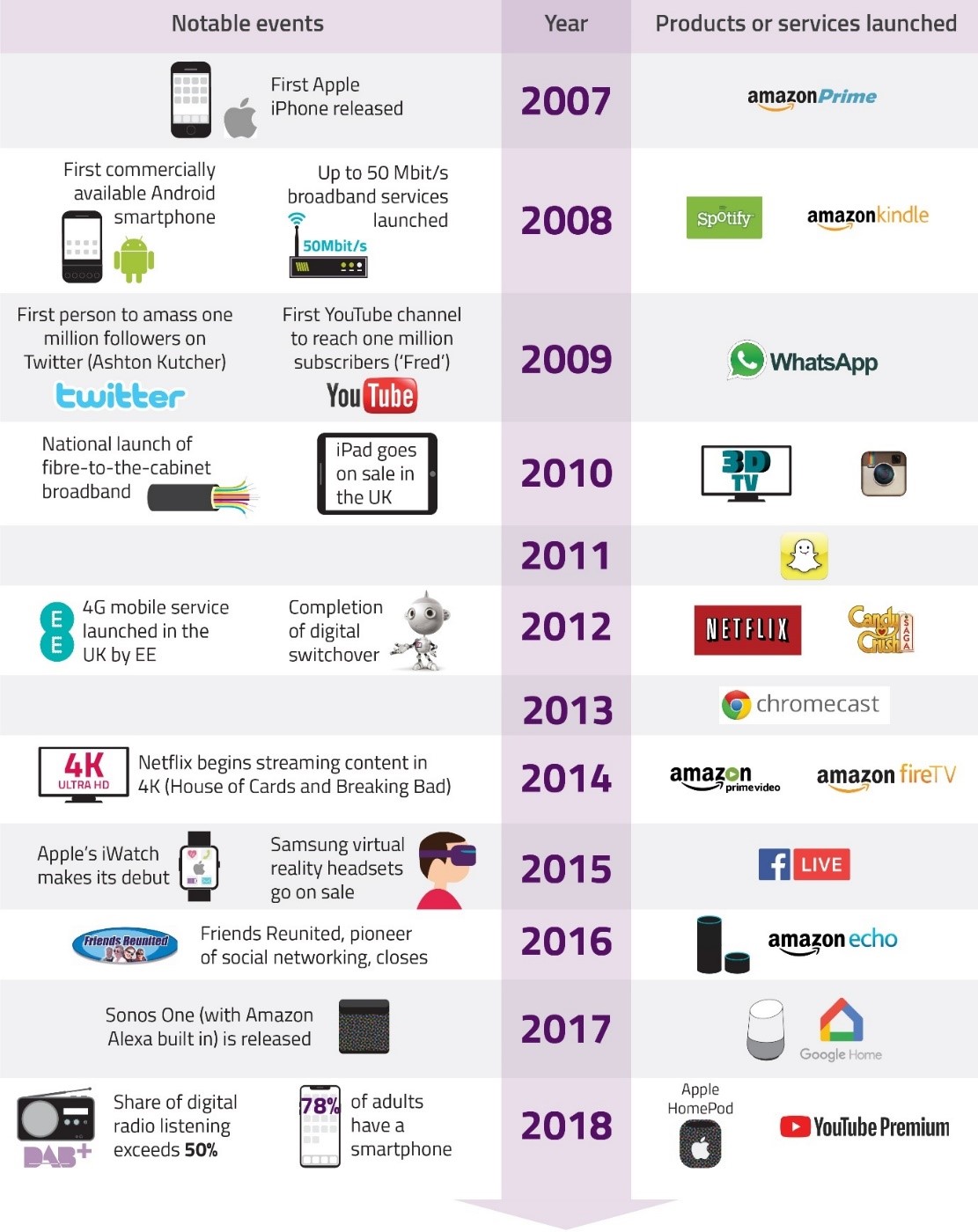
A decade of change in digital communications.

Infographic timeline showing notable events and products or services launched between 2007 and 2018. 2007: first iPhone released; Amazon Prime launched. 2008: first Android smartphone; up to 50 Mbit/s broadband launched; Spotify and Amazon Kindle launched. 2009: Ashton Kutcher becomes first person to amass one million followers; YouTubers Fred becomes first to reach one million subscribers; WhatsApp launched. 2010: National launch of fibre-to-the-cabinet broadband; iPad goes on sale in the UK; 3DTV and Instagram launched. 2011: Snapchat launched. 2012: 4G mobile service launched in UK by EE; completion of digital switchover; Netflix and Candy Crush launched. 2013: Chromecast launched. 2014: Netflix begins streaming content in 4K; Amazon Prime Video and FireTV launched. 2015: Apple iWatch makes debut; Samsung VR headsets on sale; Facebook Live launched. 2016: Friends Reunited, pioner of social networking, closes; Amazon Echo launched. 2017: Sonos (with Amazon Alexa built in) released; Google Home launched. 2018: Share of digital radio listening exceeds 50%; 78% of adults have a smartphone; Apple HomePod and YouTube Premium launched.

It is said that in the course of a normal life one is lucky to have a handfull of friends.

Now its social mobile, analytics, and cloud all want to be your friend.

When we think about social, the key is to consider why social is happening, rather than think of it as just a set of tools.

For example, Facebook, Twitter, and so on are tools, but why people use them is much more important. The same was true with the internet when we first started using that — that was a tool, but what it did to the lives of normal people in terms of access to information, increased freedom, etc., was much more important.

Mobile is a similar shape to social in that it’s the why as to why people use mobile devices as opposed to anything structural about the devices themselves.

The idea behind big data is that you can derive understanding about behaviour through statistical analysis of clumps of data. You can then take that understanding and implement some form of control to either get more of what you want, or get less of what you don’t want.

Finally, we come to the cloud.  This is really about how companies buy. There are all sorts of reasons to like outsourcing IT functions to the cloud, whether it’s just outsourcing compute power into a load of servers that you run as if they were your own, or buying functionality on an SaaS basis ( Software as a service)

Is cloud necessary for digital?

To an extent, it likely does not. However, as a fashion/trend, it’s clearly important, and a lot of the tools and services involved in digital are unlocked as part of a cloud-based approach, hence it’s likely important.

It’s a sociological change, rather than a technical one.

You can see that by the fact that this is generally all about the “why” this is happening — why are customers using social, why are they using mobile, why big data is showing the trends that it is, why are companies able to buy and use consumer products, and why is running systems in the cloud easier.

Because they all your Friend without you knowing and couldn’t care less who or how they share that friendship with or what they do with it.  Google it.

All human comments appreciated. All like clicks and abuse chucked in the bin.

← Back

Thank you for your response. ✨


Share this:

  • Share on WhatsApp (Opens in new window) WhatsApp
  • More
  • Share on Mastodon (Opens in new window) Mastodon

THE BEADY EYE SAY’S: PERPETUAL GROWTH IS COMING TO AN END.

26 Saturday Oct 2019

Posted by bobdillon33@gmail.com in 2019: The Year of Disconnection., Enegery, Environment, Evolution, Fresh Water., Humanity., Inequality, Life., Modern day life., Our Common Values., Reality., Sustaniability, Technology, The common good., The essence of our humanity., The Obvious., The state of the World., The world to day., Unanswered Questions., WHAT IS TRUTH, What Needs to change in the World, Where's the Global Outrage.

≈ Comments Off on THE BEADY EYE SAY’S: PERPETUAL GROWTH IS COMING TO AN END.


( Seven-minute read)

Economics is not an unbiased academic discipline, it’s an ideology. Furthermore, economics is based on the false premise that perpetual growth is achievable.

Can economic growth be sustainably achieved?

Finite resources make perpetual growth theoretically impossible. No amount of technological breakthrough or creative accounting can counter that physical fact.

Is economic growth desirable?

The short answer appears to be no.

Exponential growth will eventually take you to impossible places.

Unfortunately, we live in a world of capitalists that thrive on the great Myth of Perpetual Growth, endless growth, ad infinitum, forever, till the end of time.

It seems as though we are damned if we grow and damned if we don’t.

We’ve now with Algorithms for profit sake got to a position where there’s nothing to keep us in check – so we have to do it ourselves.

It’s a waiting game now – to see if we can learn to behave differently to bacteria in a petri dish before it’s too late and we kill our host.

It’s not worth the risk.

Ecology and economics have to be intertwined, or we’re in serious trouble.

It’s time we all get our head out of the smartphone and become smart.

We can have debates about what we’re going to do about this and that, but if you can’t see the reason in the core of what I am saying, we’ll be having two very different conversations.

There is little point in arguing any longer whether Neoliberalism is to blame for damaging ecology beyond its ability to support us. It has lead to the inevitable collision between an insatiable economic model and a finite planet whose resources are stretched to the hilt.

The perception of the need for perpetual economic growth is a fraud and this assumption creates massive risk when reaching the limits of our natural systems.

With a world population nearly at 7 billion people, the implication for economic growth seems obvious as we cannot assume that the status quo will hold in a changing climatic environment. Reaching the earth’s resource limit is inevitable if it is not already occurring.

However changing our society’s behaviours cannot be achieved through some overseeing organization.

Perpetual growth has been ingrained through exposure to intensive branding and marketing by the very corporations who provide jobs and economic growth, and round and round we go…… Enacting such dramatic change through a highly centralized governing structure that dictates appropriate resource use, population levels, and actively redistributes wealth is a hard sell even in dire times.

As a result, we cannot continue consuming more and more water, spewing out more and more carbon dioxide and burning more and more coal.

In the past 22 years, half of all of the oil ever burned has been burned.

At present, the global population is increasing by 83 million people annually and we are already consuming natural resources as if we have “1.5 Earths.”

If every person used as many resources as the average North American, more than four Earths would be required to sustain the total rate of consumption. Other words if everyone lived like the average American, the Earth could sustain only 1.7 billion people — a quarter of today’s population.

27 billion people will inhabit the planet by the end of the century and hidden in every calorie of food eaten are 10 calories of fossil fuels.

Technology can lead to greater efficiencies, it requires energy — it does not create it.

Water is obviously a key component of human life. It is also vital to energy, industry, agriculture and livestock.

With all of this in mind, it’s time to abandon the perpetual growth economic model and move instead to a model that stresses conservation, efficiency, recycling and renewability. Clearly, the world is on an unsustainable path and, by definition, anything that is unsustainable won’t last.

Above all else, we must redefine the quality of life as something other than just having “more.” The goal should be to simply have enough. Our quality of life should not be measured by “stuff,” but instead by the things that make life rich; our relationships, our hobbies, our work and our passions.

GDP merely measures what people are willing to pay for, which is not necessarily connected to the use of energy, or any other physical resource.

The world will be confronting shortages of hydrocarbons, metals, water and fertilizer, which will dramatically affect global agriculture. The latter is critical.

So why are we unable to change direction.

Because of the threat, transnational organizations have over the nation-state.

Because no one is willing to bear the costs.

Because of the amount of power capital has over labour.

As it stands, nearly half the world’s population — more than 3 billion people — lives on roughly $2 per day.

The solution is to get profit for profit sake to pay:

By introducing a World Aid commission of 0.05% on all High-frequency trading, on all sovereign wealth funds acquisitions on all foreign exchange transaction over $50,000, on all gambling and lottos wins creating a perpetual world aid fund.

By issuing United Nation Green Deal non-trading Bond.

By the introduction of a World Day of non-consumerism Advertising.

By building non atomised Societies that are attached geographical – belonging not defined by competition.

By eating together one a week.

The question is how do we communicate this obvious message, in the face of corporate control of the media, and increasingly academia, science and the political system?

All human comments appreciated. All like clicks and abuse chucked in the bin.

← Back

Thank you for your response. ✨

Share this:

  • Share on WhatsApp (Opens in new window) WhatsApp
  • More
  • Share on Mastodon (Opens in new window) Mastodon

THE BEADY EYE SAY’S. HUMANITY MUST NOW COME FIRST.

16 Monday Sep 2019

Posted by bobdillon33@gmail.com in 2019: The Year of Disconnection., Algorithms., Artificial Intelligence., Capitalism, Climate Change., Dehumanization., Democracy, Environment, Evolution, Fourth Industrial Revolution., Google Knowledge., HUMAN INTELLIGENCE, Humanity., Inequality, Life., Modern day life., Politics., Populism., Post - truth politics., Reality., Sustaniability, Technology, The common good., The essence of our humanity., The state of the World., The world to day., WHAT IS TRUTH, What Needs to change in the World, Where's the Global Outrage., World Politics

≈ Comments Off on THE BEADY EYE SAY’S. HUMANITY MUST NOW COME FIRST.

Tags

Algorithms., Artificial Intelligence., Capitalism, Capitalism and Greed, Climate change, Community cohesion, Earth, Environment, Technology, The Future of Mankind, Visions of the future.


( Seventeen-minute read)

The world has been so depleted and is being so depleted even at this moment, that the future sustenance and stability for humanity is now imperilled.

Your future and your destiny will not be determined within the next decades. It will be determined now.

It will be determined by humanity’s wisdom or by its ignorance.

The future and fate of humanity will be decided in the years to come, and it will be determined by how humanity responds to the great change that is coming over the horizon in the form of climate change to the world.

No religion nor religious institution as it stands today can prepare humanity for the complexities of life in the universe or what humanity must know to preserve human freedom and sovereignty within this world.

It is what humanity must do to prepare both collectively and individually for climate change and our collective inability to regulate AI.

But because humanity as a whole is dull and ignorant, self-absorbed and unresponsive to a changing world we are still writing ourselves out of the script.

Our universities for years have taught classical/neoclassic/neoliberal economics; like these theories are unmovable divine pillars of reality.

Therefore, while most people see we need a more reasonable and democratic version of our current extreme capitalism, the dominant discourse insists the story not be changed at all. The dominant political narrative of our times is that we must live as individuals crushed between market and state. The relationship between the individual and the state boils down to a zero-sum game where everyone one eventually looses. The state is a pure and simple force.

With the effects of climate change (to come) people are waking up to the deception, let’s hope we can do right, because on all fronts of civilization as we know it time is running out.

We have political failure everywhere leading to the malfunctioning of our altruistic nature.

There is a disconnect between mass (commercial) media, even political science and common sense or popular wisdom.

Sounds to cynical?

Let me oil up my bow.

Present-day political failures are at heart of our problems.

Why?

Because there is a failure of imagination when it comes to the societal structure we evolved to live in and that our brains are still programmed for.

Google, Apple, Facebook, Amazon, etc.

These new organizations are actually not creating a dream environment of maximum social cooperation.

They are instead removing people’s needs to fulfilling each other’s needs!

Gnawing away our collective and individual identity our senses of belonging to a community for the sake of profit.

We need politics of belonging, but the trouble is, it requires a moral, ethical and educated populations which we don’t have and are now with AI are more than likely than ever never going to have.

As we rely on more and more Algorithms to make decisions without a discussion of facts and morals, against a background of pure data narrative can lead society to dark places.

We are unaware of what I call honest pricing that shows the cost of profit for profit sake to the environment.

If we were to charge fees proportional to harmful impacts on the environment, we would create a monetary representation of the value of natural resources.A Brazilian protester stands before gunfire during protests against corruption and police brutality.

So overcoming the material world would be the first step to a sustainable world-shifting us into a new reality.

We are left with the ever-present questions.

Do we give a toss and if so what can be done about it?

What roles do religion and our deepest beliefs play in contemporary life?

What lifestyles are we adopting in an increasingly technological world?

What is the balance of power–and the balance of trade?

What is the pattern of war and peace?

What are the issues facing local and regional communities, and what issues must we confront on a global scale?

What do we remember about our collective past, and how do we see the future?

Have the great issues that preoccupied people since the beginning of time taken new, distinctive forms after more than a hundred years of the fastest technological and cultural change in the history of the planet?

What challenges remain intractable?

What emerging solutions seem to offer the greatest promise?

Social media is full of video on the state of the world.

The need for clear-headed prioritisation of resources to tackle real, not imagined problems.

Despite that long record of success, agricultural production is stressed by floods, deforestation, drought, urbanization (land-devouring cities), and a growing appetite for resource-intensive meat.

More than 150 million people worldwide are at risk from rising sea levels and extreme storms that cause coastal flooding.

In the past 50 years, thanks to education and technology, more than 2 billion people joined the middle class, swelling the human footprint of nearly 50 per cent. At the same time, millions of acres of cropland have been devoured by population growth.

Today more than 6 billion people live in cities—about 70 per cent of the world’s population, roughly double the proportion of a half-century ago.

The Arctic may hold 22 per cent of the world’s undiscovered conventional oil and natural gas resources. Melting ice is liberating immense oil and natural gas reserves.

Although mounting worldwide energy demand continues to stress the environment, it has powered large-scale development of renewable energy.

Artificial intelligence will soon dominate the Earth—it could take decades, it could take millennia. At that point, AI will also take control of the Earths process. Refashioning the planet in ways that are optimal for synthetic life but quite possibly deadly for us.

You can’t help but wonder where it will lead. It’s a very dodgy future.

It may be true that the cosmos started with the Big Bang, some 14 billion years ago, but it took an awfully long time for the consequences of the Big Bang to settle down.

To have an optimistic view is the only one worth having.Our world relies on vast global networks.

So may you recognize that you as an individual must make these decisions and not simply rely upon others to make them for you.

All human comments appreciated. All like clicks and abuse chucked in the bin.

← Back

Thank you for your response. ✨


Share this:

  • Share on WhatsApp (Opens in new window) WhatsApp
  • More
  • Share on Mastodon (Opens in new window) Mastodon
← Older posts
Newer posts →

All comments and contributions much appreciated

  • THE BEADY EYE SAYS., NONE OF US UNDERSTAND WHAT IS COMING WITH ARTIFICIAL INTELLIGENCE. February 19, 2026
  • THE BEADY EYE ASKS WHAT HAPPENS WHEN PEOPLE NO LONGER MAKE DECISIONS. February 18, 2026
  • THE BEADY EYE: ASK WHY IS IT IMPOSSIBLE FOR HUMANS TO GET ALONG WITH EACH OTHER? February 17, 2026
  • THE BEADY EYE SAYS. AT 130 THOUSAND OF TAX PAYERS MONEY ITS TIME TO RETIRE THE ROYAL FAMILY. THE EPSTEIN FILES CAST A SPOT LIGHT ON THEIR WORTH. February 17, 2026
  • THE BEADY EYE SAYS. WITH THE EPSTEIN FILES IT IS BECOMING CLEAR THAT THE TRAFFICKING OF YOUNG WOMEN IS LESS REPULSIVE WHEN THE WEALTHY ARE INVOLVED. February 12, 2026

Archives

  • February 2026
  • January 2026
  • December 2025
  • November 2025
  • October 2025
  • September 2025
  • August 2025
  • July 2025
  • June 2025
  • May 2025
  • February 2025
  • January 2025
  • December 2024
  • November 2024
  • October 2024
  • September 2024
  • August 2024
  • July 2024
  • June 2024
  • May 2024
  • April 2024
  • March 2024
  • February 2024
  • January 2024
  • December 2023
  • October 2023
  • September 2023
  • August 2023
  • July 2023
  • June 2023
  • May 2023
  • April 2023
  • March 2023
  • February 2023
  • January 2023
  • December 2022
  • November 2022
  • October 2022
  • September 2022
  • August 2022
  • July 2022
  • June 2022
  • May 2022
  • April 2022
  • March 2022
  • February 2022
  • January 2022
  • December 2021
  • November 2021
  • October 2021
  • September 2021
  • August 2021
  • July 2021
  • June 2021
  • May 2021
  • April 2021
  • March 2021
  • February 2021
  • January 2021
  • December 2020
  • November 2020
  • October 2020
  • September 2020
  • August 2020
  • July 2020
  • June 2020
  • May 2020
  • April 2020
  • March 2020
  • February 2020
  • January 2020
  • December 2019
  • November 2019
  • October 2019
  • September 2019
  • August 2019
  • July 2019
  • June 2019
  • May 2019
  • April 2019
  • March 2019
  • February 2019
  • January 2019
  • December 2018
  • November 2018
  • October 2018
  • September 2018
  • August 2018
  • July 2018
  • June 2018
  • May 2018
  • April 2018
  • March 2018
  • February 2018
  • January 2018
  • December 2017
  • November 2017
  • October 2017
  • September 2017
  • August 2017
  • July 2017
  • June 2017
  • May 2017
  • April 2017
  • March 2017
  • February 2017
  • January 2017
  • December 2016
  • November 2016
  • October 2016
  • September 2016
  • August 2016
  • July 2016
  • June 2016
  • May 2016
  • April 2016
  • March 2016
  • February 2016
  • January 2016
  • December 2015
  • November 2015
  • October 2015
  • September 2015
  • August 2015
  • July 2015
  • June 2015
  • May 2015
  • April 2015
  • March 2015
  • February 2015
  • January 2015
  • December 2014
  • November 2014
  • October 2014
  • September 2014
  • August 2014
  • July 2014
  • June 2014
  • May 2014
  • April 2014
  • March 2014
  • February 2014
  • January 2014
  • December 2013
  • November 2013
  • October 2013

Talk to me.

Jason Lawrence's avatarJason Lawrence on THE BEADY EYE ASK’S: WIT…
benmadigan's avatarbenmadigan on THE BEADY EYE ASK’S: WHA…
bobdillon33@gmail.com's avatarbobdillon33@gmail.co… on THE BEADY EYE SAYS: WELCOME TO…
Ernest Harben's avatarOG on THE BEADY EYE SAYS: WELCOME TO…
benmadigan's avatarbenmadigan on THE BEADY EYE SAY’S. ONC…

7/7

Moulin de Labarde 46300
Gourdon Lot France
0565416842
Before 6pm.

My Blog; THE BEADY EYE.

My Blog; THE BEADY EYE.
bobdillon33@gmail.com

bobdillon33@gmail.com

Free Thinker.

View Full Profile →

Follow bobdillon33blog on WordPress.com

Blog Stats

  • 97,420 hits

Blogs I Follow

  • unnecessary news from earth
  • The Invictus Soul
  • WordPress.com News
  • WestDeltaGirl's Blog
  • The PPJ Gazette
Follow bobdillon33blog on WordPress.com

The Beady Eye.

The Beady Eye.
Follow bobdillon33blog on WordPress.com

Blog at WordPress.com.

unnecessary news from earth

WITH MIGO

The Invictus Soul

The only thing worse than being 'blind' is having a Sight but no Vision

WordPress.com News

The latest news on WordPress.com and the WordPress community.

WestDeltaGirl's Blog

Sharing vegetarian and vegan recipes and food ideas

The PPJ Gazette

PPJ Gazette copyright ©

Privacy & Cookies: This site uses cookies. By continuing to use this website, you agree to their use.
To find out more, including how to control cookies, see here: Cookie Policy
  • Subscribe Subscribed
    • bobdillon33blog
    • Join 222 other subscribers
    • Already have a WordPress.com account? Log in now.
    • bobdillon33blog
    • Subscribe Subscribed
    • Sign up
    • Log in
    • Report this content
    • View site in Reader
    • Manage subscriptions
    • Collapse this bar