( Five minute read)
We have the spectral of Mr Antony J. Blinken the Secretary of State for the USA (the largest and once the most powerful military country in the world) running around the middle east unable to call for a cease fire in the current war Israel/Palestine.
Why?
Because, President Joe Biden’s promise for the US to “stand with Israel” continues a special relationship that dates back to 1948, when President Harry Truman became the first world leader to recognize the Jewish state, moments after its creation.
Even before 7 October, support for Israel among American Jews – who constitute the world’s second largest Jewish population after Israel – was shifting. At this point, more Americans, but not a majority, think Israel’s response has been appropriate.
The idea that of all nations in the world, Israel alone doesn’t have the right to respond in self-defense, of course is wrong, but as the saying goes two wrongs don’t make a right.
The question is why does the US support a country that is committing a genocide.
I believe this is because americans learned very few details about the role of racist violence in American history. They are not always familiar with the often coded language and imagery of antisemitism.
The answer lies in its history.
The USA is a country founded on immigration, so it has historical roots of support for Israel.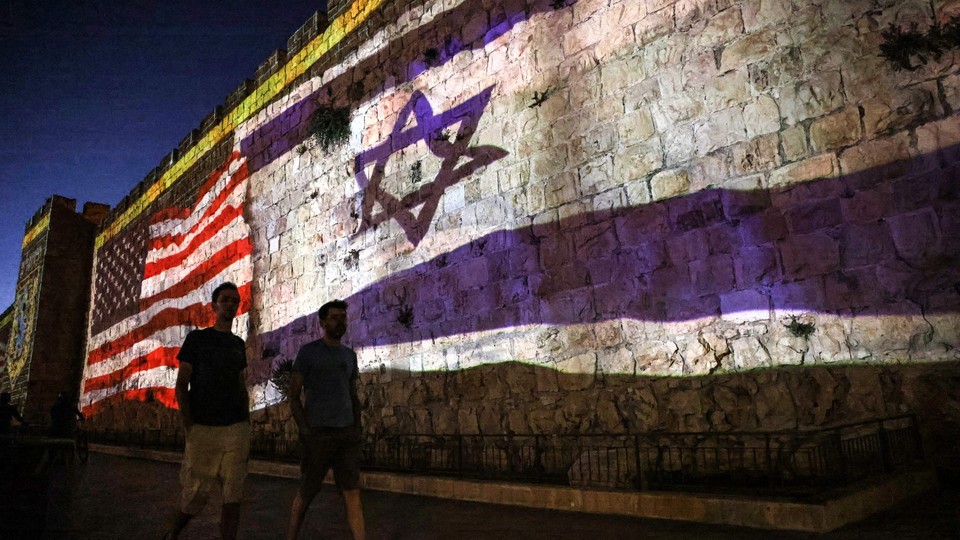
In our current age of unapologetic racism and resurgent authoritarianism, for dismantlers of democracy, there is no better exemplar than a Genocide.
The mechanics of Hitler’s rise are a particularly example.
Hitler had no blueprint for the Holocaust.
Nazis took inspiration from American racism of the late nineteenth and early twentieth centuries.
He was a student of history and admired America’s rapid industrialization and growth, which he attributed to a vast, diverse continental empire and agricultural base. So Hitler’s plan was for Germany to emulate the United States.
What possessed a society of seemingly, sane, educated and cultured people to implement a policy of barbarism and depraved violence upon the Jews of Europe during World War II?
Hitler’s understanding of how the American republic came to industrialize and prosper through expulsion of indigenous people and, especially, through the institution of slavery, which is now understood to have been central to America’s economic development.
First by seizing large tracts of productive land by pushing the indigenous populations out. If those natives could not be pushed out, they were to be killed. And then slave labor was to be employed to produce the food necessary to support industrialization and militarization, just as the United States had done.
When Hitler praised American restrictions on naturalization, he had in mind the Immigration Act of 1924, which imposed national quotas and barred most Asian people altogether.
Commodification and suffering and forced labor of African-Americans is what made the United States powerful and rich.
Nazi ideology also embraced virulent European anti-semitism.
The kind of genocidal hatred that erupted in Germany had been seen before and has been seen since.
Why?
First, the very application of the term “genocide” is applied too slowly and cautiously when atrocities happen. Second, the international community fails to act effectively against genocides. Third, too few perpetrators are actually convicted of their crimes.
Seventy years after the UN Convention, genocide remains ever present in our global society. Now consider that only three have been legally recognised – and led to trials – under the convention:
The world watched in apparent indifference. Rwanda in 1994, Bosnia (and the 1995 Srebrenica massacre), and Cambodia under the 1975-9 Pol Pot regime. The widespread killing and displacement of Yazidi by IS and Rohingya in Myanmar and Darfur, are ongoing.
Add the Indonesian genocide of 1965-66 and the Guatemalan genocide of 1981-83, the Kurds in 1988-91 in Iraq, and by West Pakistan forces against Bangladeshis in 1971, the Tamils in Sri Lanka between 1983 and 2009, not to mention the Australia’s “stolen generations”, the Irish Famine that might fall under the UN definition is frighteningly long.
The US, for example, famously never officially recognised the 1915 Armenian genocide as one.
Only by stripping away its national regalia and comprehending its essential human form do we have any hope of vanquishing genocide.
———————-
The “tyranny of hindsight”—the lordly perspective that reduces a complex, contingent sequence of events to an irreversible progression.
So Hitler’s model was in fact the U.S.A.
It goes without saying that he was an extreme narcissist lacking in empathy. a loner.
He had a Jewish grandfather; that he had encephalitis; that he contracted syphilis from a Jewish prostitute; that he blamed a Jewish doctor for his mother’s death; that he was missing a testicle;
Hundreds of thousands of Americans died fighting Nazi Germany. Still, bigotry toward Jews persisted, even toward Holocaust survivors.
These chilling points of contact are little more than footnotes to the history of Nazism.
But they tell us rather more about modern America.
Since Trump entered politics, he has repeatedly been compared to Hitler, not least by neo-Nazis.
What is worth pondering is how a demagogue of Hitler’s malign skill might more effectively exploit flaws in American democracy. He would certainly have at his disposal craven right-wing politicians who are worthy heirs to Hindenburg, He would also have millions of citizens who acquiesce in inconceivably potent networks of corporate surveillance and control.
The above however is not the only reason as such, it is only fair to my American readers to point out.
We certainly live in a VUVA world; Volatile, Uncertain, Complex and Ambiguous.
Undoubtedly our world is becoming increasingly digital and there is a blurring between the digital and non-digital world.
The excesses of social media and the impact that this has on people’s psychological wellbeing needs to be addressed. (I think that psychology; understanding of people, their behaviour and how the mind functions, will be increasingly important.)
Desensitization is an unsettling phenomenon which stems from individuals refusing or being unable to react to or express emotion towards a certain situation. Through the click of a button on our device, we distance ourselves from the serious happenings of society.
Ours is a forgetful age. In an era of instant news, amnesia is baked in. And amnesia has consequences.
While it is vital to be aware of current events and their impacts, like the war in Ukraine and the current Israeli/Palestinian war, both are purposeless if we aren’t able to understand these events and empathize with the people involved.
We spend much of our lives on devices that are designed to need replacing every three years, accessing social media platforms that amplify the sense of a continuous present and an absent past. Everything feels unexpected, as if it is coming out of nowhere. Developments appear unconnected to the past, and indeed to each other. In the absence of a plausible historical narrative, people retreat into tribalism or conspiracy theories (perhaps both) to help them make sense of the pace of change.
The vast majority of people in human history have not shared our views of work, family, government, religion, sex, identity, or morality, no matter how universal or self-evident we may think they are.
They expose vulnerabilities in the national consciousness that:
All men are equally entitled to the free exercise of religion, according to the dictates of conscience.
With one in every ten people in Gava now killed the future of further any peace efforts with Arab nations could now be in doubt, as Israel continues to bomb the Gaza Strip in its effort to punish Hamas.
——————–
Finally:
The spread of white-supremacist propaganda on the Internet. YouTube is a superb vehicle for the circulation of such content, its algorithms guiding users toward ever more inflammatory material.
Given its billion or so users, YouTube may be one of the most powerful radicalizing instruments of the 21st century.
The internet is a breeding ground for loners who have a “vague notion of being reserved for something else. Suicide bomber, Mass killer, may attempt to turn metaphor into reality.
He might be out there now, cloaked by the blue light of a computer screen, ready, waiting.
For me, this digital and data analytically world emphasises the important of social connections and networks. There will be a need for collaboration and for different ways of working.
Part of this will be reflected in the changing power dynamics. Organisations may operate in different ways. This includes social change, climate, and the balance that we want in our lives, simply because the repetition can be overwhelming. When things occur again and again, we become too-familiar with the situation, thus not treating it as important, unable to put intense situations into perspective.
Which inclines us to fawn over the future, and either patronize the past or ignore it altogether.
To sum up, as Albert Einstein said ‘learn from yesterday, live for today, hope for tomorrow.
The important thing is not to stop questioning. A person who never made a mistake, never tried anything new.
The question is, are we happy to live in a world that deliberately creates destitution for some?
Our technology does not help us here.
Now as ever, great-power politics will drive events, and international rivalries will be decided by the relative capacities of the competitors.
Memory, in contrast, should generate humility:
The acknowledgment of our past, with all its strengths and weaknesses, and the recognition that the reason we have the moral convictions we do, and the material advantages we do, is because of our ancestors.
As James Baldwin relentlessly pointed out, we are our history.
All human comments appreciated. All like clicks and abuse chucked in the bin.
Contact: bobdillon33@gmail.com


 bobdillon33blog
You must be logged in to post a comment.