We now live in a world where artificial intelligence can write, think, plan, and even “coach” us.
From the convenience of asking a chatbot for career advice to using an app to decide what to eat, we’re slowly letting machines do more of our thinking for us.
We risk weakening one of the most important muscles we have — the mind.
When leaders stop thinking critically — when we let algorithms make the hard calls — we risk losing not only our judgment, but our humanity.
AI was built to assist, not replace human wisdom.
Yet too many leaders now lean on it to decide who to hire, how to discipline, or when to cut costs — without the nuance of empathy, context, or culture that human judgment brings.
Algorithms can’t feel tension in a room.
They can’t read the hesitation behind a “yes” or sense when burnout is brewing.
They only process what’s been programmed, and they reflect the bias, pressure, or short-term thinking of those inputs.
The result?
Decisions that may look efficient on paper but erode trust, morale, and belonging in practice.
When people feel reduced to data points, they disengage.
AI was designed to augment human intelligence, not replace it.
Yet many are falling into the trap of letting AI decideinstead of assist.
When we accept every answer as truth because it’s well-written or “sounds right,” we lose our ability to question, discern, and connect dots on our own.
This slow erosion of independent thought doesn’t just affect our intellect; it seeps into our mental health.
When we remove that process — when we let algorithms choose our news, our diets, or our next move — we dull our emotional intelligence and intuition.
The very skills that create confidence, resilience, and creativity begin to fade.
Outsourcing your mind disconnects you from your inner voice — the quiet knowing that guides you toward balance and purpose.
When that intuition is replaced with the “certainty” of technology, we begin to doubt ourselves and lose alignment with what is authentically right for us.
Why is all this happening?
Because.
We elected leaders and government that are only interested in the performance of economic growth.
Algorithms ensure that we are distracted 7/7 with social media full of rubbish and lies.
Our education system are now totally out of date no longer teaching the reasoning.
When citizens stop participating the game is over.
If we don’t get a grip on ARTIFICIAL INTELLIGENCE our live become absurd.
All human comments appreciated. All like clicks and abuse chucked in the bin.
Well the crude Europeans in the name of GOD sacked its holy places in Jerusalem, stole Islam’s science, its mathematics, its art to bring about their Renaissance, rose to dominate most of the rest of the globe, and then scooped up the majority of Muslims into their European empires.
September 11 committed by a tiny minority of extremist misfits that killed over 300 people resulted in the Taliban been turfed out of power in Afghanistan with Saddam Hudson somehow replacing bin Laden as the most evil man of history.
Causing a pre- emotive war to get rid of him and his alleged weapons of mass destruction in Iraq occurred with no weapons of mass destruction only a pathetic man with a beard hiding in a hole.
Since then it seems the world has changed into isolation with Russia trying to take advantage of its disunity to grab the Ukraine back by force into is empire.
The more one reflects on what really matters in human existence the more you become alienated from a culture that is obsessed with materialism.
These days we barely have time to absorb one event before ten others replace it.
Society is now governed by Social Media which is incapable of expressing any critical thinking to tackle the real problems facing all of us in a world that needs to unite to have any hope against CLIMATE CHANGE or ARTIFICIAL INTELLIGENCE.
It’s now or never that we need to come together, not isolation, not Donald Dump, nor Mr Putin, nor most of the Islam I am all right Jack world, while we watch inequality expand across the globe.
Insh’ Allah might descend a religious philosophy in one word however ever I prefer the word bolloxed.
All human comments appreciated. All like clicks and abuse chucked in the bin.
Answering this question is not as straightforward as it might appear.
We can ask, what am I? What is this place? And how am I related to it?
We have a record of history, moral behavior, economics, political and social institutions.
Is it to be human is to be one of us?
This begs the question of the class of creatures to which “us” refers.
In deciding that all and only Homo sapiens are humans, one is expressing a preference about where the boundary separating humans from non-humans should be drawn, rather than discovering where such a boundary lays.
We’re probably unique in our ability to investigate the future, imagine outcomes, and display images in our minds.
In fact, one could know everything there is to know biologically about a human, but still not know what is unique to humanity now, what will be unique about humanity in the future, and what is important about humanity.
Why?
Because the steady growth of computing power and sheer reality-describing data will eventually give scientists an unprecedented understanding of biological systems, including the human body, and the ability to hack it in ways that may ultimately defy death.
All of this will lead to a point at which our tools are so proficient at making themselves that more-human-intelligences emerge, and this change is now so accelerated that we can barely make sense of it.
Cells might be persuaded to develop new collective goals and assume shapes totally unlike those that normally develop from an embryo.
A new type of creature—one “defined by what it does rather than to what it belongs to developmentally and evolutionarily.
————- What will the future mean for us, for our relationships with other people, for our hopes and strivings?
When we look at how ordinary people have used the term “human” and its equivalents across cultures and throughout the span of history, we discover that often (maybe even typically) members of other species are explicitly excluded from the category of the human.
For example, Nazis considered Jews to be non-human creatures.
Generally, in wars, soldiers give nicknames to the enemy to dehumanize them.
And another example is provided by the seemingly interminable debate about the moral permissibility of abortion, which almost always turns on the question of whether the embryo is a human being.
But if we think of the human as an indexical expression – a term that gets its content from the context in which it is uttered – a very different picture emerges.
When we describe others as human, we are saying that they are members of our own kind or, more precisely, members of our own natural kind. ie natural kinds are to contrast them with artificial kinds.
If ‘human’ means ‘my own natural kind,’ then referring to a being as human boils down to the assertion that the other is a member of the natural kind that the speaker believes herself to be.
However, when it comes down to it, human beings have nothing special but our highly evolved brains that do something that other species can’t:
We remember, but so do elephants.
So our inquisitive, reflective, pondering minds are forced to wrestle with some big questions in one way or another.
We have cultures and ways of transmitting information, and I guess we may come to realize that it is just us in the future.
Rest assured humans will need humans to be human and the planet we presently call Earth will remain the only place that this is achievable.
You may be certain that AI will want to use satellites to look inside other cultures and will eventually create a human geography information system that uses satellite imagery as the baseline and overlays the satellite maps with datasets and other detailed information covering history, culture, education, economy, religion, weather, and political landscapes.
————-
Who gave EARTH its name? No one knows.
Earth is the only one in our solar system that does not come from Greco-Roman mythology. All of the other planets were named after Greek and Roman gods and goddesses.
Also, there is no particular Homo sapiens individual that researchers recognize as the specimen that gave Homo sapiens its name.
Self-awareness is in its infancy with Artificial intelligence, and the identity and authenticity of an individual in this melted world ahead will be daunting as we don’t yet understand who we are.
Undoubtedly, in the case of humans, we are more creative than any other animals currently alive or pre-human descendants with the same genes, but the problem with evaluating creativity in extinct species is that you can’t talk to them.
———–
We don’t know everything about our own species—but we keep learning more as we are rendering a new world with new opportunities and perspectives that will either go in two directions.
Either we harness technology to human values or technology is turning us into products for exploration.
Presently to live a human life which in essence is determined by an accident of birth is becoming more and more expensive so that ordinary people simply cannot afford to be born.
Moreover, we can scarcely go a day without using inventions and innovations that were once the stuff of science fiction. Cell phones, flat-screen TVs, airbags and antilock brakes, CT scans, digital video players, portable computers, and, of course, the World Wide Web were completely unavailable a few decades ago.
But of course, in a future world where accidents of birth and the fortunes of good genes are even more critical determinants of success than they are now, inequalities that persist will be especially galling.
Because social and positional inequalities already distort existing measures of income and wealth, many seemingly clean-cut economic debates are more intractable than one would imagine. And of course, social anxieties over the unavoidable differences will become even more troubling, the less we can constructively address these issues.
Even if biology could somehow be conquered to the point that genetic good fortune could be parceled out equally to all, the minor differences that remained would loom ever larger.
Whether you view such an eventuality as desirable or irrelevant, more of our intellectual effort should be devoted to this future scenario. Not simply because we are heading there, but in many ways, because parts of that world are already here.
Even today, we routinely exaggerate the extent of material inequality and make foolish comparisons between different time periods and between countries at different levels of development. This does not mean that inequality has disappeared, or that it is unimportant
And as COVID-19 pulls the rugout from under economic growth, money will have so much power that it with AI will control society.
As the need for money grows, so does the greed of it.
Ever since money was introduced as a value to exchange goods, every action that we take exacts a cost and produces consequences and none will be bigger than climate change.
In the economy of the future where knowledge is the most valuable commodity, a person or a country will have to offer more than just money.
Money should never be the master of anyone it is a tool to be used to accomplish the things you want in life.
Even if money does not buy happiness, raising as many people as possible to a middling level of prosperity (an important first step to endure day-to-day economic agony of inequality we are still creating a recipe, not just for disaster but exiting this world.
People are waking up to a story that was already there.
This Recipe for the human stew we are in.
Viruses have been on the planet for millions of years, much longer than Homo sapiens. After a year COVID has infected more than 115 million people and caused over 2.5 million deaths, with over half a million in the US alone.
The world population of 8 billion is doubling every 61 years with 55 percent of us living in urban areas or cities, which is set to rise to 68 percent over the coming decades. Currently, Cities house more than half of the world’s population and are expected to see another 2.5 billion new residents by 2050.
Cities consume over two-thirds of the world’s energy and account for more than 70% of global CO2 emissions.China’s co2 emission exceeded those of all developing countries. 14 gigatons, 25% of global emissions.
Producing enough food to feed the world includes raising large numbers of animals in close quarters, and they represent breeding grounds for viruses and infectious agents that can jump to humans. The spillover from animals to humans is closely linked to environmental change such as Climate change.
60% of all Mammals are livestock. Unsustainable.
80 % of all birds are Poultry. Unsustainable.
83% of wild animals are exterminated along with 50% of plants.
Because of selective breeding, future generations of selectively bred plants and animals will all share very similar genes which will reduce variation perfect for future Pandemics.
Mix all of this with Profit for Profit sake and we got a recipe for the future that will rise quicker than you can say I am all right Jack.
And I’m not saying we should go back and live like nomads. But when you put it all together — population pressure, urbanization, agricultural practices, deforestation, high mobility . . . and then climate change is going to make all these things worse.
Whatever the next event will be — and we know there’ll be another event — it’s already out there. A wake-up call is an understatement.
The Dominant role that humanity now plays on Earth – is unsustainable and we must have pandemic memory, even if we want to forget the past year.
What if anything can be done to reverse centuries of mismanagement?
The future of automation is only possible with the Internet of Things (IoT), the hub of collected data where devices interconnect. To get the most from automation, it’s essential to look beyond convenience toward efficiency.
416.2 terawatt-hours of electricity are used by data centers equaling 1% of world energy.
There is now a great urgency for the world to convert to green energy but solar panels and wind farm electrical cars are not the solutions unless they all operate on Hydrofusion. Yet commercial electricity generation from fusion still remains a goal rather than a reality and it’s a solid bet that it will not arrive on the grid before the 2030s and it will be expensive.
We are left with our whole system of living that requires radical structural change away from profit to beneficial sustainability.
This change requires giving the means to Humans to live their lives with dignity while protecting what is left of our planet.
There are other, more ethical ways to provide social services.
At the moment we have sales taxes, gasoline taxes, poll taxes, food taxes (yes, they tax what you need to survive), sin taxes (cigarettes, alcohol, gambling), “fat taxes” (taxes on unhealthy foods), housing taxes, Social Security taxes, payroll taxes, and income taxes…taxes galore! All harm the poor more than they do the rich. And of course, we have the income tax, which is a progressive tax, a tax that affects the rich more than the poor.
What if we had a cutoff point where at a certain income you pay no taxes, and those below that income get money back from the government. A Universal income.
This alone would be revolutionary for the poor and working-class! Coupled with the removal of all regressive taxes, it would be even better.
Instead of using hundreds of billions to fund programs like Social Security and free medical care, food banks, those who would require those programs would probably just be able to afford most of what they need anyway!
The demands for all goods would skyrocket as people now have free money to put into the market.
On top of this, all education including University should be made free.
If we want humans to protect, the ecosystem we have to make it more profitable to protect than destroy. Pay them to protect it.
To do this see previous posts – A 00.05% World Aid commission.
All human comments are appreciated. All like clicks and abuse chucked in the bin.
This is a vast subject which is not possible to address in an 800-word blog.
However, values role’s in our lives and their importance is not always fully understood.
Values are the things that are important to us, the foundation of our lives.
What I am interested in here is exploring the influence of technology and its advancement and how it now relates to the modification of cultural values.
Technology commonly exerts a strong influence on daily practices, changing the way values are carried out with each new development.
Will this in the end ‘kill’ our social cohesion and will groups of people be left out? Or will our social interaction become extensive and will our relationships get better? Are there any common values left?
These are all questions that can’t be answered yet and can only be answered in the future.
Technology is all around us.
It is so pervasive in our everyday life that it is impossible to get away from it.
It has become almost invisible so that most of us don’t know how to interact in the real world or with our environment, but it is how humans are using technology that is so devastating our common values.
Before COVID-19 we were already isolating ourselves from physical contact with smartphones.
The virus has pushed us further apart with social distancing, online education, and social platforms replacing almost all forms of entertainment.
Are we connected better nowadays with social media, or are we worse off?’
One of the aspects of culture and values is social interaction between people. How we behave to one another and in which way we do that. Social media has taken a big role in our social interaction. We no longer have to speak to a person to know what they are doing. We just look on twitter of Facebook.
Social media and smartphones both are turning us into non-empathic couch potatoes and it is this passive use of technology that is the reason technology is ruining not just our values but humanity itself.
With the arrival of COVID-19 ( His “epidemic”) technology isn’t allowing the young generation to truly embrace our humanity while creating a gap between generations.
The real connection such as visual and emotional expressions aren’t shown anymore, because we are looking at a computerized display. This way messages could be understood differently than they should be, because they don’t get to know the real meaning behind the message.
If Facebook was a country, it would be the world’s 3rd largest country in terms of population.
Now is the opportunity to realize this and that we must use technology as a tool, not reality.
Our overbearing dependence on technology can be detrimental to society.
It is not the be-all and end-all of everything. Everyone is entitled to their own values, attitudes, and beliefs.
For example. From the outside, the cultural values of a group can often be difficult to understand.
In India, 80% of the population practices the Hindu religion. For the believers of this religion, the figure of the cow is venerated and should not be sacrificed. In western culture, this is a strange cultural value, since cows are a source of food and not of worship.
or
Some people may see great value in saving the world’s rainforests. However, a person who relies on the logging of a forest for their job may not place the same value on the forest as a person who wants to save it.
——————————————————————————————-
Before the coronavirus crisis exploded and confronted us with a life-and-death threat to every corner of our planet those who worked in what could be called taken for granted jobs we not valued neither in money terms or the essential services they provided to us all.
As a result, society discovered new heroes.
Times of crisis bring out the best in us. Superficial concerns fall away and we rediscover what really matters: Our values.
Now that the Pandemic in the western world is coming under control (we hope) and the murder of a colored man in the USA our worldwide values which have been honed by decades of biased history are coming under the spotlight, not just our personal views but societies as a whole.
BUT WHAT ARE THOSE VALUES AND HAVE DUG DOWN TO CORE VALUES AND WILL WE PUT THEM INTO ACTION?
It is easy to compile a list of personnel values and at the same time aspire to universal values of peace, human dignity, equal human rights, and freedom values.
They are at the core of our being. They are our motivators, our drivers, the passion in our hearts, the reason we do the things we do and feel the way we feel. They help us to make better choices in life, develop healthy patterns of behavior, and form and maintain meaningful personal relationships.
They are the compass guiding everything we do – our choices and our actions.
So, if we want to change the world for the better, then we have to change our own behaviors.
Living by your personal values sounds easy—at least in theory. Your values, after all, are simply the things that are important to you in life, so it should be natural to live by them.
Here are some more questions to get you started:
What’s important to you in life?
If you could have any career, without worrying about money or other practical constraints, what would you do?
When you’re reading news stories, what sort of story or behavior tends to inspire you?
What type of story or behavior makes you angry?
What do you want to change about the world or about yourself?
What are you most proud of?
When were you the happiest?
Think about our most important values and to act on them.
Living your values is about more than the big, long-term goals, however, it’s also about the small, day-to-day decisions. Putting them into action each and every day will have a powerful impact on our own wellbeing, the wellbeing of the groups and communities we belong to, and the wellbeing of the whole world.
The passive use of Technology is the reason technology is ruining ourHumanity.
Why is technology ruining humanity?
The only reason people do things is that life gives them the opportunity to do so. Which by extent, whether they know it or not, implies that people value their life.
Behind every use of technology is a person, as behind every murder, there is also a person.
We are about to pass through a long and very painful period of adjustment which is fraught with danger at the cost of permanently reducing human beings and many other living organisms to engineered products and mere cogs in the social machine.
As the noose of technological enslavement tightens on humanity will our values have any value?
They say that innovations in technology can save the world and is extending democracy. I say that it is concentrating even more power in the hands of a tiny elite.
Personal Values are formulated by a variety of influences, environmental influences including upbringing, religion, friends, family, peers, and, education not by algorithms, virtual reality.
Until we get better at using technology as a tool I think we’re cooked, we’re going to continue to extinct species and we’re going to continue to dig the hole deeper of the whole eco-social crisis.
If you just hold your cell phone for 30 seconds and think backward through its production you have the entire techno-industrial culture wrapped up there.
You can’t have a smartphone an I pad or use Social media without everything that goes with it. You see mining, transportation, manufacturing, computers, high-speed communications, satellite communications, it’s all there, you see and it’s that techno-industrial culture that’s destroying the world.
The only way we’ll be able to responsibly harness the fruits that technology bears are with a renewed attitude of cooperation and care for the most vulnerable among us.
Technology has given us the tools to reshape how we live in the world; if it also changes the way we interact with our neighbors, it can be transformational.
Technology can inspire progressive social policies. When 62 billionaires have as much wealth as the bottom half of the world’s population, it’s clear that political principles are skewed toward the influential in business.
Overall, technology has the potential to reduce suffering, fight disease, and level the playing field for the poor if we use it as a tool, not as values.
Values are immensely powerful!
We know that human history is full of hideous, horrible acts, but it is important it explains why things are the way thy are. The problem is that is it not taught in schools without warts so no one gets a free pass.
History is the past it cannot be changed.
But mature humans don’t live in the past and we need to start seeing each other as fellow humans. If we do so maybe we can start addressing the real cause of inequality in our societies which is our present economic systems.
However, you don’t have to go into the future to see what is happing. In the last forty years, we have wiped out 40% of our wildlife, acidified our oceans, pumped CO2 into the atmosphere, destroyed vast regions for livestock, ignored world natural disasters all for the sake of short term profits.
If we don’t have a fucking healthy biodiversity-ecosystem there will be no need for profits or values.
With world economies, slowly reopening, I won’t hold my breath as it is easier to keep viewing thinks as black and white and profit for profit sake, not Clickbait.
We all deserve to be treated as human beings of worth.
However because values are culture-bound, what’s good for one culture may be (and often is) deemed an abomination by another.
Herein lies the ultimate irresolvable dilemma.
Culture gives us prescriptions for appropriate conduct. When judging values, we should not speak in terms of right or wrong, black or white rather we should look at competing values in terms of better and worse.
Who’s to say what my values will be in 2030?
When I hear competing values shouted by a person from a different culture than mine, I hope to take a deep breath, realize that he/she is simply expressing a deep need they have, and then perhaps I can share my values and needs without fostering judgment, evaluations of their character, or moralistic analysis.
In the end, compassionate dialogue changes live, not right/wrong judgment, or taking the keen.
All comments valued. All like clicks and abuse chucked in the bin.
Answering this question is not as straightforward as it might appear.
There are billions of us alive all consciousness of each other but unable to explain why.
Perhaps this is why religions were created.
Consciousness is everything people experience.
However, there are different levels of consciousness and they can be related to other global changes in conscious level. All are private and inaccessible to observers.
(Conscious level (how conscious one is) and conscious content (what one is conscious of) are related to each other.)
So at what is a structure complex enough to become conscious.
Why am I human instead of a particle?
If we are particles we are no longer dealing with a purely material theory of consciousness because the source of the conscious particles cannot itself be material.
Its source requires an immaterial intervention.
I will return to consciousness later in the post.
The role that technology plays in human life is becoming an increasingly urgent question not just in tackling climate change but what will be considered in the future to be human.
Where we’re headed and what it will mean for humanity is a question seldom discussed.
Bioelectric implants, genetic modification packages, the ability to tamper with our very biology — there won’t be enough time to adjust or to reassess who we are and what it means to be human.
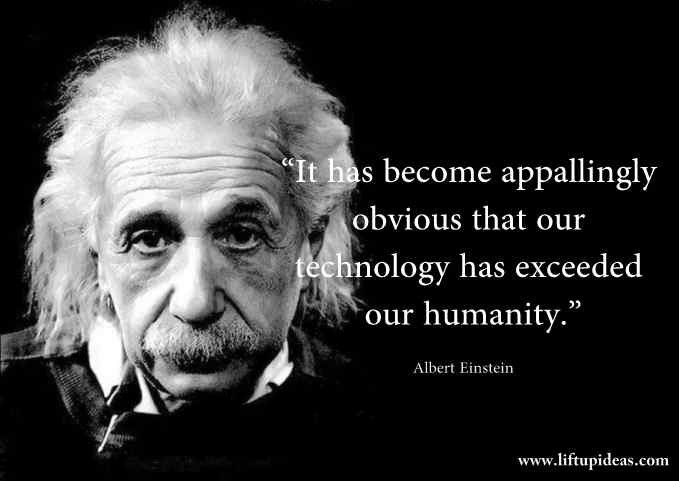
Our technology is developing so much faster than our culture and our institutions, and the gap between these things can only grow so far before society becomes dangerously unstable.
It’s hard to really know what we are becoming because so many of these changes are unforeseen or unpredictable.
At the moment computers and robots interact with the world without being conscious.
Are we at risk or are we becoming semi-machines who are like the marionettes of our own moment-to-moment experiences?
We’re losing our ability to be in the world in a way that isn’t mediated by some electronic appendage.
The more we live through screens, the more we are living in a narrow bandwidth, an abstract world that’s increasingly artificial the more we are becoming non-human.
The virtual world might be safe and controllable, but it’s not rich and unpredictable in the way the real world is.
What is all this doing to our habits, to our cultural sense of who we are?
With synthetic biology, which is basically human beings redesigning their biological structure we are distant to lose our connection to reality altogether.
Why?
Because it’s about us modifying our very genetic code which is extremely dangerous if it’s not controlled and safeguarded.
Intelligence is the most powerful instrument around.
If you’re embodying that kind of intelligence in increasingly sophisticated machines we will be coming to depend on them more and more over time.
(What worries me is that we’re headed in the direction of building AI technologies that are at the human level and, eventually, far beyond that.)
If AI becomes so intelligent that they can perform an infinite variety of tasks across domains of activity. We’ll continue to make them smarter and more capable and more powerful until we reach a point at which they start to learn on their own and start to modify themselves. Once that happens, they’ll be fully unpredictable — and then who the hell knows what happens next.
Any fool on the street can tell you that with nanotechnology, artificial intelligence, machine learning, bioengineering, brain implants, quantum computers, algorithms, robots that technology is changing at a whiplash-inducing pace.
So because there is no widely accepted theory about what happens in the brain to make consciousness possible what is it about being human that really matters?
Back to look at Consciousness.
Nothing has authority over it but is it what makes us human.
Nothing is above it. Nothing rules it.
Since everything exists within it, it does not exist within anything.
Since it is not dependent on anything, it is eternal, it is outside of realms of being and time.
In fact, consciousness actually exists independently and outside of the brain as an inherent property of the universe itself like dark matter and dark energy or gravity. It is not dependent on anything. No one can envision it. No one can comprehend it. Neither physical nor unphysical it is beyond knowledge.
It simply apprehends itself.
The brain does not create or produce consciousness; rather, it filters it.
This implies a very real and direct connection between the brain, human consciousness and the existence of the Universe — that they are fundamentally inseparable at the quantum level.
Consciousness permeates reality.
Rather than being just a unique feature of human subjective experience, it’s the foundation of the universe, present in every particle and all physical matter.
Who or what counts as human?
It’s well-known that the Nazis considered Jews to be non-human creatures.
All the questions we currently face can be traced to this, larger, underlying question. What is Human?
If one says that all and onlyHomo sapiensare humans, one is expressing a preference about where the boundary separating humans from non-humans should be drawn.
What sort of evidence can settle the question?
There’s something about us that is the opposite of artificial. It’s the opposite of something made.
This raises the below questions.
What genetic engineering stuff promises to bring down the line is human beings who are tailored to particular purposes, either by themselves over time or by other human beings.
We becoming products or commodities, and products or commodities are subordinated to particular functions or purposes.
All the values that give our lives meaning are at risk.
What becomes of autonomy? What becomes of free will?
All these questions are on the table.
By the year 2500, people will not need to be exactly like they are now so it stands to reason that semi humans will break the bonds that hold our present-day society together. They will shatter our sense of identity so quickly that it creates a kind of existential chaos.
So what are these technologies adding to the human experience and, more importantly, what are they subtracting from the human experience?
We live in a world of wonder and mystery, and the more we discover, the more there seems to be to find out but should we be more worried about the world we’re creating?
The artificial kind of worlds.
.This post is compliments of the FRIGHTLY SORRY<SORRY<SORRY. CLUB.
All human reverberation comments appreciated. All like clicks and abuse chucked in the bin.
The conventional evolutionary lineage is a simple one:shambling simian stands upright, evolves into bipedal hairy brute, then slouching hairy brute with hand Axe and finally into hairless human with Smart Phone.
If you have opened this post I wont pay you the disrespect of not knowing the Darwin & Human evolution theory but did you know that he saw his first Ape at London Zoo.
So before we go any further there is no point in reading this post with a closed Darwin mind. The evidence is so sparse that people are free to frame a favorite hypothesis about what it was that made humans different.
To have a chance of understanding evolution we must think in much larger units of time and possibilities than those that we use to define our lives.
Lets ask some questions.
For instance,
Can we say what direction human evolution will take in the future?
Are we generically engineered or did we really descend from Apes.?
Why do we still only use 10% of our brain power.?
Do we have a natural place on earth?
We are all supposed to be connected, to what?
To what extend did our humans forebears interbreed with their closest relatives?
How did humans get from thinking about food-gathering strategies to thinking about taxonomy, tax-avoidance and Twitter?
Did early humans start to develop even bigger brains because they became increasingly efficient endurance runners that could get to a carcass before the hyenas and vultures, and strip away a nourishing meal of meat, fat and marrow?
Did humans begin to stand upright by taking to the water – and to nourish bigger brains with high-protein deliveries of fish and shellfish?
Somehow, out of this million-year-mix of food, fear and hunter-gatherer companionship in Africa, complex language emerged.
The African chimpanzee is an endangered species, down to perhaps 150,000, while the human population is about to tip seven billion. What was it that we left behind in those two Chromosomes?
Our speciesof humans first began to evolve nearly200,000 years ago in association with technologies not unlike those of the early Neanderthals.
There is no reliable evidence of modern humans elsewhere in the Old World until 60,000-40,000 years ago, during a short temperate period in the midst of the last ice age.
Some of them migrated out of Africa into the rest of the Old World replacing all of the Neanderthals and other late archaic humans, beginning around 60,000-40,000 years ago or somewhat earlier.
So current data suggest that modernhumans evolved from archaic humans primarily in East Africa. Supporters of this model believe that the ultimate common ancestor of all modern people was an early Homo erectus in Africa who lived at least 1.8 million years ago.
Our DNA now says we appeared some 200,50 thousand years ago not 1.8 million.
So the first modern humans did evolve in Africa, but when they migrated into other regions they did not simply replace existing human populations. Rather, they interbred to a limited degree with late archaic humans resulting in hybrid populations.
If so why to we have 46 Chromosomes while Apes have 48. Where did other two go?
It is further suggested that since then there was sufficient gene flow between Europe, Africa, and Asia to prevent long-term reproductive isolation and the subsequent evolution of distinct regional species. It is argued that intermittent contact between people of these distant areas would have kept the human line a single species at any one time. However, regional varieties, or subspecies, of humans are expected to have existed.
It is now clear that early Homo sapiens, or modern humans, did not come after the Neanderthals but were their contemporaries. However, it is likely that both modern humans and Neanderthals descended from Homo Heidelbergensis or Homo Rhodesiensis.
Evolution Of Man – What is it?
The modern theory concerning the evolution of man proposes that humans and apes derive from an ape like ancestor that lived on earth a few million years ago.
The theory states that man, through a combination of environmental and genetic factors, emerged as species to produce the variety of ethnicities seen today, while modern apes evolved on a separate evolutionary pathway. Nevertheless, a closer examination of the evidence reveals evolution to be increasingly less scientific and more reliant upon beliefs, not proof.
The Running man Theory:
Six million years ago our ancestors began walking on two feet. In that six million years the foot evolved from the flat-footed knuckle walking like that of a chimpanzee, to what it is today, an arched foot perfect for upright, high-speed running.
Scientists now know the missing link for what enabled humans to survive through periods that many other species went extinct, it’s called Persistence Hunting. And the human body perfected the equipment for such high endurance running:
Humans are primates Theory.
Physical and genetic similarities show that the modern human species,Homo sapiens, has a very close relationship to another group of primate species, the apes. Humans and the great apes (large apes) of Africa — chimpanzees (including bonobos, or so-called “pygmy chimpanzees”) and gorillas — share a common ancestor that lived between 8 and 6 million years ago.
Humans first evolved in Africa, and much of human evolution occurred on that continent. The fossils of early humans who lived between 6 and 2 million years ago come entirely from Africa. At one point in human history, around 40,000 years ago, modern humans must have shared the planet with at least four other human cousins:
The DNA Theory.
Evolution occurs when there is change in the genetic material — the chemical molecule, DNA — which is inherited from the parents, and especially in the proportions of different genes in a population.
Genes represent the segments of DNA that provide the chemical code for producing proteins. Information contained in the DNA can change by a process known as mutation. The way particular genes are expressed – that is, how they influence the body or behavior of an organism — can also change.
Genes affect how the body and behavior of an organism develop during its life, and this is why genetically inherited characteristics can influence the likelihood of an organism’s survival and reproduction.
Our most common male ancestor, ‘Adam’, has finally got his original birth date – and its 9,000 years earlier than scientists believed.
UK researchers claim that ‘Adam’ walked the earth 209,000 years ago, contradicting a recent study that suggested the Y chromosome predated humanity.
Adam’ walked the Earth between 120,000 and 156,000 years ago, much earlier than previously believed.
Their findings put ‘Adam’ within the time frame of his other half ‘Eve’, the genetic maternal ancestor of mankind.
Here is worth mentioning. The Big Bang Theory. Life not Us.
A concept which seeks to explain the origin of the universe, claiming that billions of years ago all the matter and energy in the universe was condensed into a particle no bigger than a pin-head.
No one knows where it came from and why for some unknown reason it exploded.
So there you have it without the Religious Theories, thank God.




/cdn.vox-cdn.com/uploads/chorus_image/image/58784929/641190830.0.jpg)


 bobdillon33blog