• About
  • THE BEADY EYE SAY’S : THE EUROPEAN UNION SHOULD THANK ENGLAND FOR ITS IN OR OUT REFERENDUM.

bobdillon33blog

~ Free Thinker.

bobdillon33blog

Tag Archives: Algorithms.

The Beady Eye says: We don’t know how far back War goes in society.

14 Friday Jun 2024

Posted by bobdillon33@gmail.com in Uncategorized

≈ Comments Off on The Beady Eye says: We don’t know how far back War goes in society.

Tags

AI, Algorithms., Artificial Intelligence., Evolution, Future Society., Humanity, Life, Sustainability, Technological revolution, The Future of Mankind

Just beyond the world that exists within our heads is the world is the world that exists between us: Earth’s eight billion inhabitants.

We behave through complex biological.

Subtracting people from the environment changes how we behave across a huge variety of situations.

War has run almost through out all of human history, taking many forms.

From besieged towns surrounded by moats/fortifications to the grabbing of territory by emperors playing with their new toys. It’s no exaggeration to say that that our lives have been greatly influenced by them.

With no end to the current conflicts on the globe they’ll continue to do so.

However the stakes these days are higher than past wars.

With nuclear weapons terrifying high, with a rogue AI terrorists ( with an unlimited menu of methods and targets, ) nuclear supremacy will be worthless.

I am not talking here about drones with FRV technology that are already in use by Hamas and in the current war between Russia and Ukraine. I am talking about Cyber terrorism ( ie politically motivated use of computers and information technology to cause disruption and fear in society, by targeting almost anyone or anything.

Cyberspace one of the most crucial aspects of modern life, connecting everyone and everything.

Just like climate change it is the specter of catastrophe no matter how remote that will propel it safety to the forefront of public policy. However people are unwilling to spend a lot of money to avert a future problem especially when it’s like-lihood of it effecting their lives is so uncertain.

With Climate Change the worst possibility is downright biblical, with Cyberspace the wars are still in science fiction.

The problem with being human is that we are stuck in our own heads. We don’t have enough perspectives when making many life decisions. Unfortunately we respond to these dangers with the same brain as our ancestors had some 60,000 to 80,000 years ago.

The difference is that they had a vested interests in each other, we don’t, as social media has shifted the balance of power from the hands of the few to the masses.

Almost all of the world is using Social Media platforms, which are becoming more powerful to the detriment of individuality.

The problem with AGI is that it will not be surveillance or the degradation of human skills, but rather an Arms race in the military domain, that is going to lead to the depletion of resources without any perspective from a moral or ethical alignment to any human values.

In the future most warfare will be digital.

Time will tell.

One nation has no right to tell another what to do.

However autonomous warfare, which we are just witnessing the beginnings of will not require specific instructions from humans.

A self driven hacked car could start the next war.

It’s fair to say that up to now our lives are greatly influenced by natal roulette. To great extent this no longer applies.

Uncontrollably AIG will de-warf any nuclear deterrence, as it could introduce a virus that could wipe us from the planet.

Within its inverted logic it could kill billions without consulting anyone.

We have to decide what we want now.

Whether we want to impose restrictions/ regulations/ or restraints, call it what you like on the capabilities of Artificial Intelligence’s, as the AI tools to come will not be anonymous tools by default.

Nothing happens in a vacuum. World War One did not start in a vacuum, nor did World War Two start in a vacuum. They were the result of an area of a statues quo that collapsed.

AI bots should not have freedom of speech.

Non human entities are flooding Social Media Platforms in the form of Algorithms with their own goals of seeking profits above any thing else.

AI that is defying its own goals should be banned.

When are we going to wake up to the facts that in the near future anyone with open AGI could hold the whole world to ransom.

Lack of trust transparency to do no harm – against Benefit. Will shape the future.

Human intelligence has carried our species through countless challenges. Adapting to the implications of replicating it might be one of the biggest ones.

There is no second chance when it comes to AI, only the improbable is impotent,

All human comments appreciated. All like clicks and abuse chucked in the bin.

Contact: bobdillon33@gmail.com


Share this:

  • Share on WhatsApp (Opens in new window) WhatsApp
  • More
  • Share on Pocket (Opens in new window) Pocket
  • Share on Mastodon (Opens in new window) Mastodon

The Beady Eye says: AIG – will exist in five years from now and it will profoundly change the way we do everything on earth.

25 Saturday May 2024

Posted by bobdillon33@gmail.com in Uncategorized

≈ Comments Off on The Beady Eye says: AIG – will exist in five years from now and it will profoundly change the way we do everything on earth.

Tags

AI, Algorithms for Profit., Algorithms., Capitalism and Greed, Evolution, Humanity, Inequility, Power of Social Media, Social Media, Sustainability, Technology, The Future of Mankind, Visions of the future.

( Ten minute read)

When it comes to the moral question, humanity has historically failed the test over and over, again and again and will continue to do so till we are all blue in the face with verbal diarrhoea as to how we might change the situation from inequality to equal opportunity for all.

The greatest innovations are yet to come as both AIG or ASI is as yet a hypothetical form of AI .

Instead of asking what we evolved from we must start asking and answering what we are evolving towards.

AGI may or may not come to our rescue in answering this question. However it is farcical to think that we will be able to contribute to control AIG once it happens.

How will the human life value in relation to a sentient biological machine for the Capitalist economy?

Will AGI need anything from us to begin with?

How will it judge procreation, suffering, and existence?

It will have non of these things, so it will make no difference unless it’s in its own interest to do so.

The reality will not be a red eye robot that wants to kill us, but a form of Artificial Intelligence that begins to write its own codes in order to reorganise societies and all our places within them, in ways we can’t imagine.

Algorithms will run and rule the world, along with the future exploration of Space. It won’t be humans unless we have implants to compensate our biological weakness.

With the real question becoming – will AIG be the final straw to what’s called freedom, transcending religious beliefs. While producing a new type of tyrannical tyranny of empty, meaningless, variety, a never ending stream of unnecessary options, arming us with weapons so devastating that we could wipe ourselves out.

Basically the biological race will be over, replaced by the best survival information processing AIG.

Resulting in biological Algorithms ie Us – versus AIG algorithms war-fair.

————————-

We are a self- hating, self-destructive species which is about to handover the evolutionary buttons to machines that could whether by accident or design wipe us all out.

The only way of stopping such an event is to enshrine now the virtues of liberty, privacy, dignity, not just in new AI regulations but also in Social Media, business models and institutions.

To have any chance we must clean up Social Media by imposing large fines on platforms that post discriminatory content, racism, violence related rhetoric, propaganda, pornographers content. Ban all non – sustainable advertising, all non ethical non verifiable content, all fake surveys, all exploitation for profit, returning Social Media to its Name.

We know nothing about the ethic of AIG, nor will we ever know other than the biases it has been exposed to. But rest assured in the long run it will remove what we call individualism or individuality, expanding all to perceivable reality.

We must demand transparency and accountability. There is no more room for batting around the edges. We must bring AI into alignment with something better than just being human, where people are not just treated as products but always as ends.

The Beady Eye is here in New Zealand visiting his eight week old grandson who arrived into the world five weeks premature and would not be with us to day without advancing technology.

Maybe someday we get to be more than human. We presently have no clue to what consciousness is, but it will become an entanglement of the quantum of existence in one form or another.

However we will still need our live to mean something even if we integrate or transcend the evolutionary bridge, into the cosmic horizons with eternal memories and hope for a better future.

All human comments appreciated. All like clicks and abuse chuck in the bin.

Contact: bobdillon33@gmail.com

https://youtube.com/watch?v=4qvmgmNp-SY&si=CzpCdK5VZdhBuM3J

Share this:

  • Share on WhatsApp (Opens in new window) WhatsApp
  • More
  • Share on Pocket (Opens in new window) Pocket
  • Share on Mastodon (Opens in new window) Mastodon

THE BEADY EYE ASK’S. WHAT ARE WE LEAVING THE NEXT GERERATION?

27 Saturday Apr 2024

Posted by bobdillon33@gmail.com in #whatif.com

≈ Comments Off on THE BEADY EYE ASK’S. WHAT ARE WE LEAVING THE NEXT GERERATION?

Tags

Algorithms., Artificial Intelligence., Climate change, Environment, Future generations., Renewable Energy., Sustainability, Technology, Visions of the future.

( Fifteen minute read)

It’s hard to feel for future people. We are bad enough at feeling for our future selves.

Even if we last just 1 million years, as long as the average mammal – and even if the global population fell to 1 billion people – then there would be 9.1 trillion people in the future.

Concern for future generations is common sense across diverse intellectual traditions. When we dispose of radioactive waste, we don’t say, “Who cares if this poisons people centuries from now?

Similarly, few of us who care about climate change or pollution do so solely for the sake of people alive today.

Is any of this true?

Current global rates of consumption require the resources of about 1.6 earths. At this rate, we risk exhausting our planet’s life support systems that provide us with fresh water, nutritious food and clean air.

What 2050 could look like if we don’t do anything about climate change?  This doesn’t need an answer.

That is a future unwritten.  It’s also worth noting that, in fact, it is entirely up to us whether these hypothetical future beings ever actually come into existence.

So what do we owe the generations to come?

You might answer that since we don’t even owe to them to bring them into existence in the first place, we can’t possibly owe them anything all. Then wouldn’t the people of the future be within their rights to look back at us and ask, ‘Given that you despoiled our planet, why did you even bother bringing us into existence?

Maybe we might actually have an obligation not to bring future people into existence, at least if we’re going to mess things up enough to make their hypothetical lives unbearable.

That would imply that future people count more than us. And who thinks that? Certainly not me. I’m not even sure they count the same as us. That leaves us with only one option. I hate to say it, but future people surely count less than we do—at least a little less.

“What, I am trying to get you to see, is that we have an absolute duty to future generations not to ruin their future planet.”

Think of today’s teeming masses, displaced by violence and climate change, wandering the world in search for a safe harbour.

In comparison to all that present day concrete suffering, the hypothetical suffering of hypothetical future people seems sort of distant and abstract.

I should say that I am actually all for combating climate change. And I am all for weighing both the interests of present people and the interests of future people in the calculus of what is to be done about it. I just don’t think it’s obvious how much weight we should give to the wellbeing of hypothetical future people as opposed to our own.

——————–

Now more than ever, the world needs young people to step up to address the many other challenges ahead of us.

It is crucial to engage young people in decision-making – but in parallel – it’s also important for young people to think differently about how they want to engage.

They cannot vote or lobby or run for public office, so politicians have scant incentive to think about them. They can’t bargain or trade with us, so they have little representation in the market, And they can’t make their views heard directly: they can’t tweet, or write articles in newspapers, or march in the streets. They are utterly disenfranchised.

We make laws that govern them, build infrastructure for them and take out loans for them to pay back.

So what happens when we consider future generations while we make decisions today?

Is it really as bad as all that?

Our situation can be summed up as follows:

While facing an extinction event, instead of working toward reversing the march toward climate disaster, in the name of security we are investing in killing each other.

What will it take to unleash the energy and passion of youth leaders and activists to dismantle inequitable systems and work together to build an more inclusive future?

Social media will likely play a role in that revolution—if it doesn’t sink our kids with anxiety and depression first.

Asked young people what changes they want for the future.

HERE ARE SOME OF THE RED LINES.

  • Incentivize sustainable consumption and penalize production that’s not.
  • All stakeholders to take urgent action to safeguard nature and future food production.
  • Sanctions against institutions that resort to internet blackouts to supress citizen freedoms.
  • Tech companies to be transparent about misinformation and its spread on their platforms.
  • Governments to implement policies to protect individual citizens against harmful content.
  • Capacity-building programmes and education to help citizens better identify fake news.
  • Strengthened laws against media monopolies to protect democratic freedoms.
  • A Global Convention for Cybersecurity to uphold the integrity of political systems.
  • A global wealth tax on assets worth more than US$ 50 million to fight growing inequality.
  • Universities to end the exorbitant tuition fees that stifle social mobility.
  • Governments to guarantee universal access to mental health services.
  • Governments to invest in communities most at risk from climate change.
  • Financial institutions to stop bankrolling companies initiating fossil fuel exploration.
  • Companies to significantly reduce the GHG emissions of their operations and supply chains to help keep global heating within 1.5°C.
  • Governments to implement fit-for-purpose policies and regulations on big tech.
  • Companies to integrate technology ethics into the design of their products and services.
  • Governments to prioritize the immediate needs of healthcare workers and their families.
  • Companies to drive digitalization in healthcare services to improve patient care.
  • Governments to end qualified immunity in law enforcement for police officers.
  • Increased action against gun violence.

Two critical questions guided these dialogues:

What are the barriers that have hindered progress?

And, what key values, principles and practices will enable us to foster long-lasting systemic impact for the next decade?

As many around the world push for the creation of a more just, equitable and sustainable future we must remember that technology is one of the greatest tools for achieving these goals, but without ethical considerations at the fore… this will likely only perpetuate the very inequalities that we hope to address.

Every generation of teens is shaped by the social, political, and economic events of the day and how fast teens grow up depends on their perceptions of their environment.

For example their ubiquitous use of the iPhone, their valuing of individualism, their economic context of income inequality, their inclusiveness, and more.

Social media is creating an “epidemic of anguish.

We can’t market technologies that capture dopamine, hijack attention, and tether people to a screen, and then wonder why they are lonely and hurting. It makes humanity look like an “imprudent teenager”, with many years ahead, but more power than wisdom.

Fortunately, there are concrete things humanity to day can do.

The field of sustainability is evolving.

For example, if there is any moral weight on future people, then many common societal goals (like faster economic growth) are vastly less important than reducing risks of extinction (like nuclear non-proliferation).

The entire value chain needs to be sustainable, from raw material sourcing to the manufacturing and usage of the products.

Transparency, accountability, trust and a focus on stakeholder capitalism will be key to meeting this generation’s ambitions and expectations. Doing so would help save the lives of people alive today, reduce the risk of technological stagnation and protect humanity’s future.

Our biases toward present, local problems are strong, so connecting emotionally with the ideas can be hard. It’s humbling and inspiring to see the role we can play in protecting the future. We can enjoy life now and safeguard the future for our great grandchildren.

If we name each generation based on the technological conditions it experienced, generations may soon encompass only a few years apiece. Slicing the population into ever-narrower generations, each defined by its very specific relationship to technology, is fundamental to how we think about the relationship between age, culture, and technology.

They include the digital natives, the net generation, the Google generation or the millennials.

All of these terms are being used to highlight the significance and importance of new technologies within the lives of young people. But generation gaps did not begin with the invention of the microchip. What’s new is the fine-slicing of generational divides, the centrality of technology to defining each successive generation.

If the role of technology in shaping an emergent generational consciousness it seems obvious, to imagine a return to the days when sociological generations spanned multiple decades is over. If you believe that technological conditions profoundly shape the life experience and perspectives of each successive generation, then those generations will only get narrower. If we name each generation based on the specific technological conditions it experienced during childhood or adolescence, we may soon be dealing with generations that encompass only a few years apiece.

At that point, the very idea of “generations” will cease to have much utility for social scientists, since it will be very hard to analyse attitudinal or behavioural differences between generations that are just a few years part.

The problem is that all will come at a price. That price is and will be.

The loss of intentional and thoughtful communication techniques to preserve meaningful connections in a society that is becoming more and more reliant on technology.

Be it the metaverse, smart glasses or large language models, the world as we know it may never be quite as we first imagined it, merging into physical and digital spaces.

While the internet offers unparalleled convenience and connectivity, it is essential to recognize its limitations in reproducing the depth of personal interaction found in face-to-face encounters.

—————

Technology will be a vital tool for creating a cleaner, safer and more inclusive world, but what changes can we expect to see?

  • 5G will create a lot of new use cases including drone management, robotic surgery and autonomous vehicles. Large language models will become a given because they lower the cost of artificial intelligence (AI)
  • Quantum computing merges with classical computing.
  • Our grandchildren will live in a very different world thanks to the democratization of products and services that are currently only available to the elite or wealthy,
  • Holographic image in front of you, seen through smart glasses will be your algorithmic world.
  • No matter what  future we leave behind life my advice is life is beautiful-celebrate -celebrate – never give up.
  • If all of this is hurting your head, let’s just get back to the basics: if there is a secret to life, it might all be down to what we do, not what we are.

All human comments appreciated. All like clicks and abuse chucked in the bin.

Contact: bobdillon33@gmail.com

Share this:

  • Share on WhatsApp (Opens in new window) WhatsApp
  • More
  • Share on Pocket (Opens in new window) Pocket
  • Share on Mastodon (Opens in new window) Mastodon

THE BEADY EYE SAYS: WHILE BECOMING THE MOST DANGERIOUS THREATH TO ALL OUR LIVES, TECHNOLOGY HAS AND STILL IS CHANGING HOW WE INTERACT AMONG OURSELVES.

27 Wednesday Mar 2024

Posted by bobdillon33@gmail.com in Technology's, The world to day., Transition period or Implication period.

≈ Comments Off on THE BEADY EYE SAYS: WHILE BECOMING THE MOST DANGERIOUS THREATH TO ALL OUR LIVES, TECHNOLOGY HAS AND STILL IS CHANGING HOW WE INTERACT AMONG OURSELVES.

Tags

AI, Algorithms., Artificial Intelligence., Capitalism and Greed, Capitalism vs. the Climate., Society, tech, Technology, The Future of Mankind, Visions of the future.

( Four minute read)

Humans are highly social creatures.

Advancements in technology is now completely re-shaped the everyday routine of the Modern Human.

Developing a chokehold on our lives, to the point of corverting us all into product to be harvested on a 24/24 bases by profit seeking algorithms.

Our brains have become wired to process social information, and we usually feel better when we are connected.  Social media taps into this tendency.

When you develop a population-scale technology that delivers social signals to the tune of trillions per day in real-time, the rise of social media isn’t unexpected.

It’s like tossing a lit match into a pool of gasoline.

The once-prevalent, gauzy utopian vision of online community is disappearing,

Why?

BECAUSE ITS NOT GETTING ANY EASYER AT BEING A PERSON, IN THIS TECHNOLOGICALLY FUCKED UP SUPPOSELY CONNECTED WORLD.

Along with the benefits of eaiser connectivity and increased information, social media has also become a vehicle for disinformation and political attacks from beyond sovereign borders.person on a smartphone

With little or now privacy left, we are now left to endure, rather than enjoye a life on social media, gorging on the most lurid speculation which one feels kind of stuck and unconsciously obliged to check it way more than you want to

I dont know about you but I am sick of seeing people so drawn to their phones at social events and in general I wonder are we are all just becoming AI predictions as what we are and how we live our lives. 

Companies like Google, X, and Meta collect vast amounts of user data, in part to better understand and improve their platforms but largely to be able to sell targeted advertising.

Collection of sensitive information around users’ race, ethnicity, sexuality, or other identifiers are now not just putting people at risk, they are also desentizing us at large to the state of the world.

Even for users who want to opt out of ravenous data collection, privacy policies remain complicated and vague, and many users don’t have the time or knowledge of legalese to parse through them.

At best, users can figure out what data won’t be collected, but either way, the onus is really on the users to sift through policies, trying to make sense of what’s really happening with their data.

There’s a very strong corollary between the data that’s collected about us and current state of the world -wars – growing inequality  – demishing democracy – lack of long term actions, such as on Climate Change that has now turned into an industry not a threat to our very existence.

————–

The emergence of smartphones in 2007 generated macro data, which uses artificial intelligence  transforming our daily routines.

There are no laws that require platforms to show how they use or sell the data collected.

So far, attempts to curtail the collection of users’ data has been piecemeal, largely driven by state-level laws and individual enforcement actions. Regulation continues to be extraordinarily behind.

The companies are not going to change on their own.

However it barely scratches the surface of what they have enabled, with few arenas of human endeavour left untouched by the smartphone.

Against the backdrop of the constant rise in time spent by young people on social media, a staggering 74% of them are checking their social media accounts more than they would like to. Instagram, TikTok and other social media have become daily fixtures in their lives with 59% of young people now spending more than two hours of their average day on social media.

The five most popular platforms are Instagram, YouTube, TikTok, Snapchat and Facebook.

Whilst YouTube and TikTok dominate as sources of entertainment, Instagram, Snapchat and BeReal are the platforms most widely posted on by young people.

Addictive platform design take on young people’s mental health and their feeling of powerlessness in the face of global companies’ constant nudging to participate in a vicious cycle of personal data sharing and content consumption.

The “addictive” lure of the constant stream of updates and personalized recommendations, often feeling “overstimulated” and “distracted”, but algorithms pick up on mental health issues and expose users to ever more related content, bombarding us with bad news as it stimulated more viewings, till we are all officially desensitized.

Something bad happens across the country? We hear about it. Something bad happens across the world? We hear about it. Something good news happens, for all intitive purpose it is ignored.  

—————————

The natural question at this point, it would seem, would be to ask where we should draw the line.

Why tragedies stop seeming so tragic – and why this needs to stop.

The sheer amount of violence present in the world only seems to be increasing with Netflicks quietly capitalizing on another form of content. More than other entertainment outlets, Netflix’s hit shows spotlight gruesome violence. More than other entertainment outlets, a number of Netflix’s hit shows spotlight gruesome violence, often committed against women.

Escalating violence on-screen can make us more tolerant of it in real life.

Gone are the days of bang bang ypur dead Graphic, realistic violent content is considered the ‘norm’ post-watershed.

This is not necessarily because people are becoming more violent in their nature, but is rather due to increased methods of communication brought on by technological improvements like playing violent video games.

Is it possible that individuals who consume violent media not only become more aggressive, but also make their friends and family more aggressive, even  if those do not consume violent media themselves? The consumer is actively influencing her/his friend to make her/him more alike.

We don’t process large numbers as well as we do smaller numbers.

How sad should we be over the news of those dead in Gaza? Utterly distraught, significantly, not much?

—————

Mobile phones are now extraordinarily multi-functional, but mass access to knowledge in the age of communications threatens basic concepts such as individual identity and autonomy.

To maintain our empathy for others, it is important to first extend it to ourselves and to those within our immediate circle.  
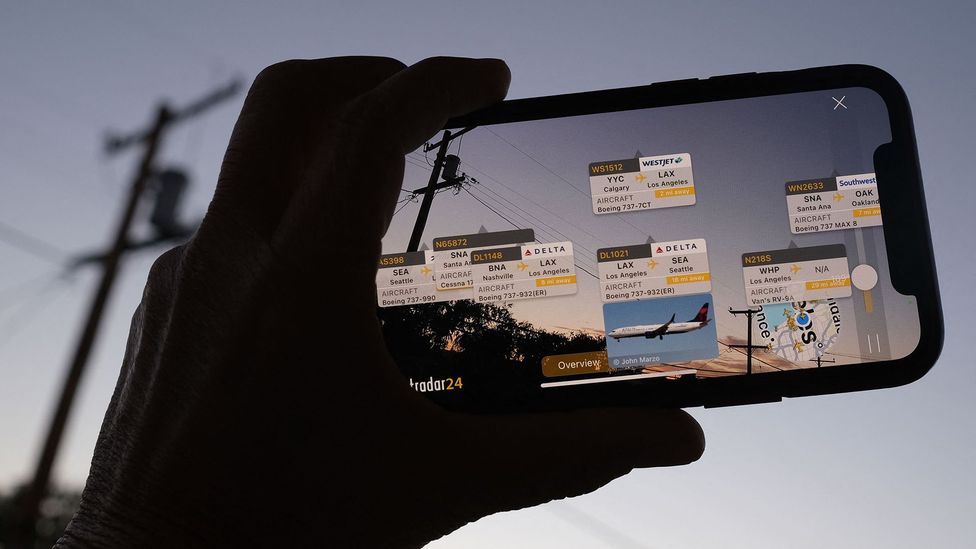
Smartphones have enabled the digital and real worlds to be blended through augmented reality, allowing users to track aircraft overhead, for example (Credit: Getty Images)

The Smart phone is destroying this empathy, one of the most ubiquitous technology devices of all time, with the ability to take the device everywhere comes the idea that no one is ever far from the things that matter most to them.

With the death of proximity, the smartphone has become your home, but home is no longer a refuge.

We don’t know about how our smartphones are affecting us.

Are they alienating people from each other, or helping them to connect with others?

Do they affect children differently than adults?

And how do we step away from our phones if our whole lives are on them?

Smartphones are basic necessities but it is only by looking at the vastly different uses and contexts that we can fully understand the consequences of smartphones for people’s lives around the world.

Combining artificial intelligence with the extraordinary data-gathering capabilities of smartphones, is creating other opportunities. Millions of people across many parts of the world that are conflict-bound or subject to some of the worst effects of the climate crisis have left their homeland behind completely in search of a new life are using their smartphone to navigate their circumstances and situations.

(According to the UN, there were 110 million forcibly displaced people in the world.)

If you ask people how much they care about all people on earth dying, it’s not seven-and-half billion times more concern, than if you told them one person would die.

————————

If we assume that transcendentally brilliant artificial minds won’t be along to save or destroy us, and live according to that outlook, then what is the worst that could happen – we build a better world for nothing?

We need a cultural change in values, to enable more deliberate decision-making.

If we don’t the future of society, as defined by the scientific and technological revolutions needs a custom ethical and philosophical direction, as the world is rapidly moving to each person doing what’s best for themselves.

Or to put it more bluntly.

Someday in the future, someone will arrive at another turning point where the fate of the species is theirs to decide.

If our extinction proceeds slowly enough to allow a moment of horrified realisation, the doers of the deed will likely be quite taken aback… if the Earth is destroyed, it will probably be by mistake.

Society used to be able to make a long-term plan and that’s not something that happens now.

We go to quick fixes.

———————-

Clearly, technology by itself is neither good nor bad.

It is only the way and extent to which we use it that matters. It is indisputable that thanks to technology, we get a chance to live a life our predecessors could not even dream about. However reality does not take place in Smartphones.

There is no economy or individual that is unaffected by climate change. By 2050, this problem could force 216 million people to relocate within their own nations.

When all areas of human activity get rapidly digitized, it’s easy to become desensitized to the importance of innovations and advancements for the overall progress of society.

Those in the tech industry know that the opportunities on this horizon are endless.

——————

What are today’s challenges for artificial intelligence?

Building technology for the sake of technology won’t cut it in a globalized society.

There’s a juxtaposition between the need for a more connected world and hesitation from people toward technology that tech innovators need to account for and solve.

The development of new advancements must be rooted in a holistic mindset balancing desire for more conveniences with feasible solutions to meet the needs of future generations.

To accomplish this, education will play a critical role in bridging perceptions and fostering authentic trust between technology and humans.

Indeed it is my belief that all teenagers are now in need to be educated in classroom in the use of mobiles.

Do you believe technology should be more focused on the problems of society or individual needs?

Is technology being used sufficiently to tackle society’s major issues?

—————

The human species will change with genetic editing, artificial intelligence challenges the concept of “I” and “individual;” and robotics will bring new “companion robots,” which we need to define and adopt socially.

In the last 10 years, genetics has made it possible to analyse old DNA and, as a result, revealed the history of the planet’s first inhabitants. We are now a single human species but we finally know that descend from other species. We now have unprecedented tools to inform and transform society and to protect the environment.

How should we harness this potential in the future?

How does this perspective change our understanding of the current human diversity?

Excessive use of gadgets, lack of offline communication, and social media abuse were proven to cause negative effects on mental health.

It is indispensable to give machines “common-sense knowledge” in order to move toward the ambitious goal of building “truly intelligent” general AI.

This is the time to make the necessary decisions to outline this path.

When robots take the final leap from our imagination to our homes and workplaces, they will become our companions; they will add new possibilities and countless variables to our patterns of behaviour:  they will change how and where we build, how we move or the materials we use to create things.

——————–

How, exactly, could AI destroy us?

We humans have already wiped out a significant fraction of all the species on Earth.

That is what you should expect to happen as a less intelligent species – which is what we are likely to become, given the rate of progress of artificial intelligence. For example, in many cases, we have wiped out species just because we wanted resources.

The worst-case scenario is that we fail to disrupt the status quo, in which very powerful companies develop and deploy AI in invisible and obscure ways.

As AI becomes increasingly capable, and speculative fears about far-future existential risks gather mainstream attention, we need to work urgently to understand, prevent and remedy present-day harms.

These harms are playing out every day, with powerful algorithmic technology being used to mediate our relationships between one another and between ourselves and our institutions.

—————————–

How would AI get physical agency?

In the very early stages, by using humans as its hands.

You feel as though you are encountering absolute reality, whatever the hell that is, enlightenment is nothing more than a “pure consciousness event which is just a stepping-stone, at best, to true enlightenment, which does not make you permanently happy, let alone ecstatic. It is a state that incorporates all human emotions and qualities: love and hate, desire and fear, wisdom and ignorance.

Enlightenment does not give you answers to scientific riddles such as the origin of the universe, or of conscious life,  just as electrons can be described as waves and particles, so ultimate reality might be timeless and aimless—and also have some directionality and purpose.

The ability to hold opposites, emotional opposites, at the same time is really what we’re after.

However the mind remains in many respects unchanged, you discover a void at the heart of reality.

Not until  you realize you’re the same jerk you were all along.

The biggest power trip you can imagine” and an “aphrodisiac.” you think you’re God.

The object vanishes and only consciousness remains, it becomes its own subject and object.

It becomes aware of itself, seeing life as an illusion that makes accepting death easier.

What you are, and what the world is.

I must be missing something. What can we do about it?”

I want to bring us back to a more practical reality, which is that technology is what we make it, and we are abdicating our responsibility to steer technology toward good and away from bad.

That is the path I try to illuminate in this post an issue of social responsibility.

All human comments appreciated. All like clicks and abuse chunked in the bin.

Contact: bobdillon33@gmail.com

Share this:

  • Share on WhatsApp (Opens in new window) WhatsApp
  • More
  • Share on Pocket (Opens in new window) Pocket
  • Share on Mastodon (Opens in new window) Mastodon

THE BEADY EYE SAY’S: WHAT ONCE WAS OUR GREATEST ASSET OUR BRAINS ARE BECOMING WORTLESS.

31 Wednesday Jan 2024

Posted by bobdillon33@gmail.com in #whatif.com, 2024 the year of disconnection, Algorithms., OUR BRAINS

≈ Comments Off on THE BEADY EYE SAY’S: WHAT ONCE WAS OUR GREATEST ASSET OUR BRAINS ARE BECOMING WORTLESS.

Tags

AI, Algorithms., Artificial Intelligence., Machine learning., tech, Technology, The Future of Mankind, Visions of the future.

( Four minute read)

The technology behind the atomic bomb only exists because of a cooperative hive mind: hundreds of scientists and engineers working together. The same unique intelligence and cooperation also underlies more positive advances, such as modern medicine and technology.

We owe our complex reasoning abilities to it, but we have similarities with everything else in nature; it would be astonishing if we didn’t.

We were once  “rational animals” pursuing knowledge for its own sake. Now more and more of us, thanks to the smart phone, are becoming Know it all Google it ‘brainless dead.

Human societies are built on collaborative activities. That means that the interactions of humans beings in their environmental contexts, situated in their historical locations, and with available technologies are always subject to the ecological and survival pressures that have existed since time immemorial.

In the world of self learning algorithms this is no longer true.

Take Mr Musk hopes that #Neuralink can be used to merge humans with computers, allowing them to interact with artificial intelligence simply by thinking, for instance.

It stands to reason, that It won’t be long in coming. Digitalised algorithmic citizenship, with a Neuralink’ Brain chips in the head owned by a Tec company. Driven by blockchain, without any reasoning, who will only cooperate if there is something in it for them.

Thank all the gods I wont be around to see it. AI intelligence demonstrated by machines, as opposed to the natural intelligence displayed by humans.

Consequently.

AI allows machines to increasingly approach human capacities for perception and reasoning.

This process is resulting in a hollowing-out of nation-state space through rescaling, undermining its heretofore privileged position as the only natural platform and geographical expression for the monopoly of sensory and political power so far.

Such frameworks cover demands for data privacy, ownership, sovereignty, donation, co-operation, self-determination, trust, access, and ethics as well as AI transparency, algorithmic automatization, and, ultimately, democratic accountability for digital citizenship, which inevitably may transform our current interpretation of the nation-state as ‘the clear and coherent mapping of a relatively culturally homogeneous group onto a territory with a singular and organized state apparatus of rule’ (Agnew Citation2017, 347) and its relationship with digital citizenship.

On the one hand, regarding the techno-political awareness of data, these dynamics involve addressing concerns about biometric technologies (e.g. vaccine passports), rolling out algorithmic identity tools for citizenship (e.g. the ongoing e-Residency policy framework) and engaging in counter-reaction to extractives data models (e.g. through digital rights claims).

The technology that defines us can also destroy worlds.We can fight and kill on an unparalleled scale (Credit: istock)

When we – Homo sapiens – first appeared about 200,000 years ago we weren’t alone. We shared the planet at least four other upright cousins; Neanderthals, Denisovans, the “hobbit” Homo floresiensis and a mysterious fourth group.

Humans aren’t the only species that kill each other. We’re not even the only species that fight wars. But our intelligence and social prowess mean we can do so on an unprecedented scale.

We have an immense capacity for good. At the same time we risk driving our closest relatives to extinction and destroying the only planet we have ever called home.

It’s impossible to get a good clear understanding of people’s thoughts about their future without talking directly with them.

Somehow, our language abilities need to be “switched on”,

As far as we know, we are the only creatures trying to understand where we came from. We also peer further back in time, and further into the future, than any other animal.

Digital Citizenship Education is now vital.

All human comments appreciated. All like clicks and abuse chucked in the bin.

Contact: bobdillon33@gmail.com

Share this:

  • Share on WhatsApp (Opens in new window) WhatsApp
  • More
  • Share on Pocket (Opens in new window) Pocket
  • Share on Mastodon (Opens in new window) Mastodon

THE BEADY ASK’S: ARE WE SCREWED?

28 Sunday Jan 2024

Posted by bobdillon33@gmail.com in #whatif.com, 2024 the year of disconnection, Algorithms., Arms Trade., Artificial Intelligence., Carbon Emissions., Civilization., Climate Change., Collective stupidity., Cry for help., Dehumanization., Digital age., DIGITAL DICTATORSHIP., Disaster Capitalism., Donald Trump., Earth, Extermination., Human Collective Stupidity., Human Exploration., HUMAN INTELLIGENCE, Human values., Humanity., Inequality, INTELLIGENCE., Our Common Values., PAIN AND SUFFERING IN LIFE, Palestinian- Israel., Politics., Populism., Purpose of life., Reality., Robot citizenship., Russia’s invasion of Ukraine, State of the world, Survival., Technology v Humanity, Technology., The common good., The essence of our humanity., The Future, THE ISRAELI- PALESTINIAN PROBLEM., THE NEW NORM., The Obvious., The state of the World., The world to day., THE WORLD YOU LIVE IN., THIS IS THE STATE OF THE WORLD.  , Ukraine/ Russia., Ukraine/Russian war., Unanswered Questions., War., Wars, We can leave a legacy worthwhile., What is shaping our world., WHAT IS TRUTH, What Needs to change in the World, Where's the Global Outrage., World Politics, WORLD POVERTY WHERE'S THE GLOBAL OUTRAGE, World View.

≈ Comments Off on THE BEADY ASK’S: ARE WE SCREWED?

Tags

AI, Algorithms., Artificial Intelligence., Capitalism and Greed, Capitalism vs. the Climate., Climate change, Inequility, politics, Technology, The Future of Mankind, Visions of the future.

( Three minute read)

Man is said to have evolved from monkeys and apes …but we still have monkeys and apes.

We live in a world of verball diarrhoea, another words every Joe saop has an opinion.

However the world today is being expressed as a single unified, interconnected and interdependent global system, and since we wish to remain as our individualistic egoistic selves while the world becomes more and more connected, we experience such tightening connection as suffering.

Characterized by intricate interconnections, rapid advancements in technology, globalization, diverse geopolitical challenges, and a multitude of social, economic, and environmental issues.

Since everyone understands the world from his/her own perspective which may be different from others due to religions beliefs we cannot understand what wholeness is.

Our world is beautiful but screwed.

71% water, average 93,000,000 miles away from a white star, around which it completes an elliptical orbit every 365.25 days with a dominant species are Homo Sapiens, which can live anywhere. It has one large satellite measuring 2,159 miles in diameter which is some 239,000 miles distant and is tidally locked.

—————–

With it’s current greedy drive for more – more this, more that, more me, me, me. causing greater and greater stress to the planet, earth is experiencing its hottest year on record and massive floods, fires and other climate-related disasters have taken root.

And lack of action on climate change threatens billions of lives and livelihoods.

Most of us know this but we don’t know when something amazing or horrible will happen next and it could be the greatest or worst thing for this world.

Like the opening of a massive technological gap between the global rich and the poor.

As our World becomes more disaster prone due to the extreme changes to our Climate, these vestibules of self-interest will be dumped for hardline practical leaders who will do whatever is necessary for the survival of mankind.

In the mean time all we do is fight over utterly meaningless bullshit.

———————————–

We carry affordable supercomputers in our pockets, and that is even more powerful than it sounds.

  • It has created multiple civilizations, none of which has been able to achieve a satisfactory minimum level of quality of life; the poorest people still live in inhumane conditions; the very few richest people own more than the all of the rest put together.
  • Most markets are moving online, moving from the physical world into the digital app world, until they’ll be purged there too by oligarchies; which will be the next medium?
  • Right wing politics and populism continue to gain ground through advocating individual freedom to prosper, while left wing politics is failing to establish and administer a necessary minimum of social equality and governmental regulation, which continues to propagate financial deregulation aka greed is good which in turn prevents a normal fluctuation of economy turning it into steep growth and catastrophic chain reaction crashes.
  • The extreme conservatism of certain societies founded on medieval concepts and flawed morals coupled with perpetual poverty and social stagnation certainly help maintaining inequality in the world.
  • Alternatively, we may destroy ourselves in the midst of our seemingly endless growth, and nature will resume its course over the centuries and millenia to come.
  • How can anyone with an active mind, who is aware of all this, neatly summarize his or her POV “of the world today” with A SINGLE WORD???????
  • Pretty nonsensical, if you take a couple of minutes to think about it.

The chances of wholeness happening now are roughly zero.

Why?

Because politicians who were starved of intelligent thinking and ARE BEING ELECTED INTO OFFICE BY DIGITLIZED CITIZENS RUN BY PROFIT SEEKING ALGORITHMS.

Recent advances in artificial intelligence raise a variety of questions about how to control a technology that could improve or threaten civilization in countless ways.

The Doomsday Clock that has been ticking for 77 years.  The clock isn’t designed to definitively measure existential threats, but rather to spark conversations about difficult scientific topics such as climate change. Trends continue to point ominously towards global catastrophe.

Due to ongoing concerns about the war in Ukraine, the Israel-Gaza conflict, the potential of a nuclear arms race, and the climate crisis, its almost impossible to get people’s attention about existential threats and the required action.

We can reduce them but doing so is not easy, nor has it ever been. It requires serious work and global engagement at all levels of society.

The war in Ukraine poses an ever-present risk of nuclear escalation. And the October 7 attack in Israel and war in Gaza provides further illustration of the horrors of modern war, even without nuclear escalation.

A more realistic endpoint to both wars would be a military ceasefire, in which increasingly exhausted combatants see frontline positions harden around a line of control. That will become clearer by the summer or autumn, and will at some point prompt a question for its western backers: how long should the west continue supplying military aid at current levels to Ukraine/Israel

This requires a collective even harder stance.

A political earthquake. That’s the metaphor that stuck.

——————–

What if science itself is in some way culpable for all this?

We don’t know the real answer yet, and we probably will never know, but this is the moment to anticipate what such a finding might ultimately mean. It could obliterate the faith of millions.

This may be the great scientific meta-experiment of the 21st century. That the common people of the world have been forced into a real-life lab experiment, at tremendous cost — there is a moral earthquake on the way.

All of these disasters brought to you by the total, self-assured unanimity of the highly educated people who are supposed to know what they’re doing, plus the total complacency of the highly educated people who are supposed to be supervising them.

A perfect storm, as institutions crumpled and collapsed. with new fault lines targeting up the most powerful country on the planet.

Don’t disengage as digital technology is disrupting international politics in myriad ways.

To start, it is bringing new dimensions to the authoritarian playbook, enabling governments to more easily manipulate information consumed by citizens, to monitor dissent and track political opponents, and to censor communications.

Democracies, meanwhile, are struggling to strike the right balance between rewarding economic innovation and reaping the financial benefits of Big Tech, while protecting user privacy, guarding against surveillance misuses, and countering disinformation and hate speech.

Can democracies strike an appropriate balance between safeguarding their societies from dangerously polarizing online rhetoric while maintaining commitments to protecting free expression?

Can civic activists, independent journalists, and human rights advocates continue to find innovative ways to push back against government repression using new tools, tactics, and technologies?

The answers to these questions are not foretold—all of them represent major areas of contestation.

But one thing is clear. There is an expanding set of countries relying on facial recognition technology, big data analytics, predictive policing techniques, and safe city systems to enhance their security capabilities. There is now a close relationship between authoritarian regimes, constraints on political freedoms, and corresponding government reliance on digital repression techniques.

What technological methods are Gulf states using to enact their political agendas?

What can civil society make of the growth of internet shutdowns and social media blockages around the world?

Government disdain for international human rights principles “is pushing resistance to the breaking point.”

Disinformation has become the tool of choice for many illiberal regimes. From extreme political movements, particularly far-right groups, which harness social media to propagate falsehoods, spread conspiracy theories, and foment polarization and identity politics.

Flooding  social media channels with competing or distracting information that overwhelms legitimate information sources, and deliberately post offensive content on­line to provoke or disrupt conversations

.A bigger question is how much governments should hold platforms responsible for facilitating the spread of bad information .

It is insufficient to blame Facebook or Twitter’s poor leadership for the much more complicated proliferation of politically motivated falsehoods.

These varying global perspectives shed light on emerging areas of contestation and highlight the complexities, urgency, and dangers involved in the advance of digital technologies and their effects on politics globally.

One has only to look at technology usage in the current wars in order to relise that Alogrithms are ruling not just how lives or dies on the battle fields but the direction we all going in our everyday lives.

All human comments appriciated. All like clicks and abuse chucked in the bin.

Contatc: bobdillon33@gmail,com

Share this:

  • Share on WhatsApp (Opens in new window) WhatsApp
  • More
  • Share on Pocket (Opens in new window) Pocket
  • Share on Mastodon (Opens in new window) Mastodon

THE BEADY EYE SAY’S: #DOWNLOAD THE APP AND KISS YOUR ASS GOODBYE.

19 Friday Jan 2024

Posted by bobdillon33@gmail.com in 2024 the year of disconnection, Algorithms., Artificial Intelligence., IS DATA DESTORYING THE WORLD?, Our Common Values., Purpose of life., Reality., Robot citizenship., Speed of technology., State of the world, Technology, Technology v Humanity, Technology's, Technology., Telling the truth., The common good., The essence of our humanity., The Future, The metaverse., The new year 2024, The Obvious., The state of the World., The world to day., THE WORLD YOU LIVE IN., THIS IS THE STATE OF THE WORLD.  , TRACKING TECHNOLOGY., VALUES, We can leave a legacy worthwhile., What is shaping our world., WHAT IS TRUTH, What Needs to change in the World, Where's the Global Outrage.

≈ Comments Off on THE BEADY EYE SAY’S: #DOWNLOAD THE APP AND KISS YOUR ASS GOODBYE.

Tags

AI, Algorithms., Artificial Intelligence., data-science, Machine learning., Technology, The Future of Mankind, Visions of the future.

( Six minute read)

How many times have you heard someone say “There’s an app for that.”

Every time you pick up your smartphone, you’re summoning algorithms.

They have become a core part of modern society.

They’re used in all kinds of processes, on and offline, from helping value your home to teaching your robot vacuum to steer clear of your dog’s poop. They’ve increasingly been entrusted with life-altering decisions, such as helping decide who to arrest, who to elect amd who should be released from jail, and who’s is approved for a home loan.

Recent years have seen a spate of innovations in algorithmic processing, from the arrival of powerful language models like GPT-3, to the proliferation of facial recognition technology in commercial and consumer apps. At their heart, they work out what you’re interested in and then give you more of it – using as many data points as they can get their hands on, and they aren’t just on our phones:

At this point, they are responsible for making decisions about pretty much every aspect of our lives.

The consequences can be disastrous and will be, because with AI they are creating themselves. It’s not that the worker gets replaced by just a robot or a machine, but to somebody else who knows how to use AI.

While we can interrogate our own decisions, those made by machines have become increasingly enigmatic.

They can amplify harmful biases that lead to discriminatory decisions or unfair outcomes that reinforce inequalities. They can be used to mislead consumers and distort competition. Further, the opaque and complex nature by which they collect and process large volumes of personal data can put people’s privacy rights in jeopardy.

Currently there are little or no rules/Laws for how companies can or can’t use algorithms in general, or those that harness AI in particular.

Adaptive algorithms have been linked to terrorist attacks and beneficial social movements.

So it’s not to far fetched to say:  That personalised AI is driving people toward self-reinforcing echo chambers of extremism, or to advocate that it is possible that someone could ask AI to create a virus, or an alternative to money.

Where is this all going to end up?

A conscious robot faking emotions – like Sorrow – Joy – Sadness – Pain- and the rest, that wants to bond with you.

———————————

It all depends on what you think consciousness is.

Yes a robot could be a thousand time more intelligent than a human, with the question becoming in essence, does any kind of subjective experiences become a consciousness experience. If so the subjective feeling of consciousness is an illusion created by brain processes, that a machine replicates and such a process would be conscious in the way that we are.

At the moment machines with minds are mainstays of science fiction.

Indeed, the concept of a machine with a subjective experience of the world and a first-person view of itself goes against the grain of mainstream AI research. It collides with questions about the nature of consciousness and self—things we still don’t entirely understand.

Even imagining such a machine’s existence raises serious ethical questions that we may never be able to answer. What rights would such a being have, and how might we safeguard them?

It is a machine that thinks and believes it has consciousness how we would know if one were conscious.

Perhaps you can understand, in principle, how the machine is processing information and there are who  are confirmable with that. However an important feature of a learning machine is that its teacher will often be very largely ignorant of quite what is going on inside and has no way of knowing if conscious exists.

And yet, while conscious machines may still be mythical, their very possibility shapes how we think about the machines we are building today.

Can machines think?

——————-

They’re used for everything from recognizing your voice face listening to your heart, arranging your life.

All kinds of things can be algorithms, and they’re not confined to computers with the impact of potential new legislation to limit the influence of algorithms on our lives remaining unclear.

There’s often little more than a basic explanation from tech companies on how their algorithmic systems work and what they’re used for. Take Meta, the company formerly known as Facebook, has come under scrutiny for tweaking its algorithms in a way that helped incentivize more negative content on the world’s largest social network.

Laws for algorithmic transparency are necessary before specific usages and applications of AI can be regulated.  When it comes to addressing these risks, regulators have a variety of options available, such as producing instructive guidance, undertaking enforcement activity and, where necessary, issuing financial penalties for unlawful conduct and mandating new practices.

We need to force large Internet companies such as Google, Meta, TikTok and others to “give users the option to engage with a platform without being manipulated by algorithms driven by user-specific data in order to shape and manipulate users’ experiences — and give consumers the choice to flip it on or off.

It will inevitably affect others such as Spotify and Netflix that depend deeply on algorithmically-driven curation.

We live in an unfair world, so any model you make is going to be unfair in one way or another.

For example, there have been concerns about whether the data going into facial-recognition technology can make the algorithm racist, not to mention what makes military drones to kill.

—————

Going forward there are a number of potential areas we could focus on, and, of these, transparency and fairness have been shown to be particularly significant.

Artificial Intelligence as a Driving Force for the Economy and Society and Wars.

In some cases this lack of transparency may make it more difficult for people to exercise their rights – including those under the GDPR. It may also mean algorithmic systems face insufficient scrutiny in some areas (for example from the public, the media and researchers).The 10 Most Important AI Trends For 2024 Everyone Must Be Ready For Now

While legislators scratch their heads over-regulating it,the speed at which artificial intelligence (AI) evolves and integrates into our lives is only going to increase in 2024. Legislators have never been great at keeping pace with technology, but the obviously game-changing nature of AI is starting to make them sit up and take note.

The next generation of generative AI tools will go far beyond the chatbots and image generators becoming more powerful.  We will start to see them embedded into creative platforms and productivity tools, such as generative design tools and voice synthesizers.

Being able to tell the difference between the real and the computer-generated will become an increasingly valuable tool in the critical skills toolbox!

AI ethicists will be increasingly in demand as businesses seem to demonstrate that they are adhering to ethical standards and deploying appropriate safeguards.

95 percent of customer service leaders expect their customers will be served by AI bots at some point in the next three years. Doctors will use it to assist them in writing up patient notes or medical images. Coders will use it to speed up writing software and to test and debug their output.

40% of employment globally is exposed to AI, which rises to 60% in advanced economies.

An example is Adobe’s integration of generative AI into its Firefly design tools, trained entirely on proprietary data, to alleviate fears that copyright and ownership could be a problem in the future.

Quantum computing – capable of massively speeding up certain calculation-heavy compute workloads – is increasingly being found to have applications in AI.

AI can solve really hard, aspirational problems, that people maybe are not capable of solving” such as health, agriculture and climate change,

We need to bridge the gap between AI’s potential and its practical application and whether technology would affect what it means to be human.

They are already creating a two tier world, of the have and have not, driving inequality to a deep human value of authenticity and presence.

Will new technologies lead us, or are they already leading us and our children to confuse virtual communities and human connection for the real thing?

Generative AI presents a future where creativity and technology are more closely linked than ever before. If they do, then we may lose something precious about what it means to be human.

How can we ensure equal access to the technology?

If we look to A.I. as a happiness provider, we will only create a greater imbalance than we already have.

If AI Algorithms run the world there will be no time off.

Humans are now hackable animals, so AI might save us from ourselves.

AI will become the only thing that understands these embedded systems is scary.

General AI may completely up-end even the contemplation of reason. Not only will “resistance be futile”, it could become inconceivable for a dumbfounded majority.

One thing is certain, in about a hundred years we will have an idea of what makes us different and more intelligent than computers, but dont worry, AI has the potential to change education and the way we learn.

All human comments appreciated. All like clicks and abuse chucked in the bin.

Contact; bobdillon33@gmail.com

Share this:

  • Share on WhatsApp (Opens in new window) WhatsApp
  • More
  • Share on Pocket (Opens in new window) Pocket
  • Share on Mastodon (Opens in new window) Mastodon

THE BEADY EYE SAY’S: OUT OF NO WHERE, OUR WORLD IS TURNED UPSIDE DOWN.

15 Monday Jan 2024

Posted by bobdillon33@gmail.com in #whatif.com, A Constitution for the Earth., Artificial Intelligence.,  Attention economy, Brexit., Capitalism, CAPITALISM IS INCOMPATIBLE IN THE FIGHT AGAINST CLIMATE CHANGE., Civilization., Collective stupidity., Cry for help., Digital age., Disaster Capitalism., Disasters., Disconnection., Environment, Fourth Industrial Revolution., Honesty., How to do it., Human Collective Stupidity., HUMAN INTELLIGENCE, Human values., Inequality., Inflation, Inflation., International solidarity., Modern day life., Our Common Values., PAIN AND SUFFERING IN LIFE, Populism., Poverty, Reality., Renewable Energy., Social Media, State of the world, Sustaniability, Technology, Technology v Humanity, The common good., The essence of our humanity., The new year 2024, The Obvious., The state of the World., The world to day., THE WORLD YOU LIVE IN., THIS IS THE STATE OF THE WORLD.  , Truth, Unanswered Questions., Universal values., Universal Basic Income, VALUES, We can leave a legacy worthwhile., What is shaping our world., WHAT IS TRUTH, What Needs to change in the World, Where's the Global Outrage., World Leaders, World Organisations., World Politics, World View.

≈ Comments Off on THE BEADY EYE SAY’S: OUT OF NO WHERE, OUR WORLD IS TURNED UPSIDE DOWN.

Tags

Algorithms., Artificial Intelligence., Capitalism and Greed, Capitalism vs. the Climate., Climate change, Distribution of wealth, Environment, Government, Inequility, news, politics, Technology, The Future of Mankind, Visions of the future.

( Five minute read)

A global pandemic killing millions of people and forcing entire countries into lockdown.

Then inflation takes off and (not unrelated) one country invades another and the resulting war affects us all.

Whoa! Where on Earth did all that come from?

We have to think about how we got here.

As if we don’t know its all wrapped up in one word   Inequality.Black placard with 'one world' written on it.

The cost of things average people must buy—healthcare, education, housing—tends to have risen more than wages did over the last two decades. Rising inequality across income, race and gender all demand urgent attention. It needs to made clear to leaders that in 2024 their citizens are expecting them to raise their ambition for humanity and deliver bold agreements to tackle poverty, inequality and climate change.

Government’s policy making will need to become more innovative to address such challenges other wise we going to have a left behind technological societies. We’re going to see, unfortunately, more technological unemployment. We’re going to have to think very carefully in political terms and in social terms about the implications of further automation.

Individual responsibility will play a role, too, in areas such as climate change.

To ignore the issue of inequality culture will need to adjust in terms of revisiting some of our values.

—————–

To start thinking outside of the box. We may have to consider very seriously ideas such as a universal basic income.

There are just over 7 billion people living on the planet today, spread between 196 (recognized) countries. Within each of these countries are groups of people with different ethnic backgrounds, different religious beliefs, different political beliefs. It’s because of these differences, you could argue, that the world is plagued by conflict.

Unfortunately, the future isn’t talking. It’s just coming, like it or not and we as individuals need to take ownership of this.

I dont know about you but I realized long ago that globalization was on its last legs. I also realize this isn’t pleasant to think about. Western economies have become knowledge based. This means Marx’s three factors of production (land, labor, capital) now have a fourth.

Politics as a social contract between a sovereign and citizens is no longer working. Each individual’s share of sovereignty, and therefore their freedom, diminishes as the social contract includes more people.

Power now resides with those best able to organize knowledge turning politicians into basically middlemen, bring a shift to direct democracy, with popular social media protests swamping sprawling governments.

We must do more to assertively channel technology to support progress and protect people and the planet.

As we entered the the 2020s it is clear that we are far from unlocking the potential of technology for our toughest challenges. We stand at a critical juncture to put these technologies to work in a responsible way for people and the planet.

Technology and political trends are aligning against mega-powers like the US and China.

How do we reconcile that with democracy in countries with millions of citizens?

Not with “America Alone” ” Brexit” or any other forms of isolation, which are highly problematic, as they are based on anxiety and insecurity, so inevitably create discord and division.

This is obvious to anyone with a brain looking at climate change – trade – wars – inequality – technology’s – and ideologies of I am all right Jack.

—————————

Historically, political regimes tend not to last more than a few centuries.

I’m not sure we can. Some things are so horrible, you don’t want to think about them.

  • Today’s great powers have little choice but to spend their way to political stability, which is unsustainable, and/or try to control knowledge, which is difficult.
  • Nor do we have any elder statesmen or nationally unifying figures whom everyone respects, much less agrees with. This will make our various problems worse.
  • Ownership rights mean little without a government to protect them and courts to settle disputes.
  • This world we now inhabit wasn’t always fit for human’s nothing requires it to remain so. At some point, it will develop into something else. When and how that will happen, we don’t know yet. But we know it will.
  • We haven’t even talked about climate change. Issues like climate change will create further exacerbations on conflicts, and new forms of technological and cyber warfare could threaten countries’ elections and manipulate populations.

In the last two years: 90% of the data in the world was created.

Now it is up  – technology companies large and small, industry, policy-makers, citizens and consumers alike – to use this power for good, before we run out of time. Now is the opportunity for leaders to step up into this new wave of opportunity and expectation.

We are the first generation to know we’re destroying the world, and we could be the last that can do anything about it. Our leaders are not on track to deliver. We need to ensure we hold our politicians accountable.

Food production is a major driver of wildlife extinction. We need to make wasting our resources unacceptable in all aspects of our life. We can all do more to be more conscious about what we buy, and where we buy it from.

We can and must end poverty and hunger, in all their forms and dimensions by addressing the underlying complex issues of fragility, conflict, and displacement and the looming threat of climate change.

The challenges facing the world are complex and intertwined and require complex solutions.

Another word is about to enter our collective dictionaries: permacrisis. What we do between now and 2030 will determine whether we as a collective species are intelligent or just dumm machines

Solutions to climate change and biodiversity loss won’t come from any one sector: they’ll come from governments, finance, business and civil society.

We’re analyzing satellite images but unable to see the picture that we all live on the same planet.

Like most of us, we are brought up to think in terms of countries with borders and different nationalities.

In some cases, there are natural borders formed by sea or mountains, but often borders between nations are simply abstractions, imaginary boundaries established by agreement or conflict.

How then do we explain nationalism? Why do humans separate themselves into groups and take on different national identities? Maybe different groups are helpful in terms of organisation, but that doesn’t explain why we feel different. Or why different nations compete and fight with one another.

When people are made to feel insecure and anxious, they tend to become more concerned with nationalism, status and success. Poverty and economic instability often lead to increased nationalism and to ethnic conflict.

The world in general does not have a sense of group identity.

If a terrorist’s biggest weapon is terror, climate change is going to inflict terror beyond belief.

Tsunami’s. Earthquake’s, Hurricane’s, Flood’s, War’s

We must shift 85% of the world’s energy supply to non-fossil fuel sources, not grant more oil exploration licences.  Our economies depend on healthy, supportive natural systems.

A more sustainable path is possible. But we need to rally individuals, governments, companies and communities around the world to take action with us over the next decade.

It’s impossible to override the fundamental interconnectedness of the human race.

People from all around the world need to take a stand a citizen’s movement using the NEW BEADY EYE HASHTAG:   #movebeyonditwiththebeadyeye

All human comments appreciated. All like clicks and abuse chucked in the bin.

Contact bobdillon33@gmail.com

Share this:

  • Share on WhatsApp (Opens in new window) WhatsApp
  • More
  • Share on Pocket (Opens in new window) Pocket
  • Share on Mastodon (Opens in new window) Mastodon

THE BEADY EYE LOOK AT: THE FIRST TRANSCRIPT OF A MURDER TRIAL CONCERNING AN ROBOT WHO KILLED A HUMAN.

08 Monday Jan 2024

Posted by bobdillon33@gmail.com in #whatif.com, Algorithms., Artificial Intelligence., Murders, Robot citizenship., Robotic murderer

≈ Comments Off on THE BEADY EYE LOOK AT: THE FIRST TRANSCRIPT OF A MURDER TRIAL CONCERNING AN ROBOT WHO KILLED A HUMAN.

Tags

AI, Algorithms., Artificial Intelligence., robotics, Robots., Technology, The Future of Mankind, Visions of the future.

( Twenty five minute read)

On 25 January 1979, Robert Williams (USA) was struck in the head and killed by the arm of a 1-ton production-line robot in a Ford Motor Company casting plant in Flat Rock, Michigan, USA, becoming the first fatal casualty of a robot. The robot was part of a parts-retrieval system that moved material from one part of the factory to another.

Uber and Tesla have made the news with reports of their autonomous and self-driving cars, respectively, getting into accidents and killing passengers or striking pedestrians.

The death’s however, was completely unintentional but give us a glimpse into the world we might inherit, or at least into how we are conceiving potential futures for ourselves.

By 2040, there is even a suggestion that sophisticated robots will be committing a good chunk of all the crime in the world. At the heart of this debate is whether an AI system could be held criminally liable for its actions.

Where’s there’s blame, there’s a claim. But who do we blame when a robot does wrong?

Among the many things that must now be considered is what role and function the law will play.

So if an advanced autonomous machine commits a crime of its own accord, how should it be treated by the law?  How would a lawyer go about demonstrating the “guilty mind” of a non-human? Can this be done be referring to and adapting existing legal principles?

An AI program could be held to be an innocent agent, with either the software programmer or the user being held to be the perpetrator-via-another.

We must confront the fact that autonomous technology with the capacity to cause harm is already around.

Whether it’s a military drone with a full payload, a law enforcement robot exploding to kill a dangerous suspect or something altogether more innocent that causes harm through accident, error, oversight, or good ol’ fashioned stupidity.

None of these deaths are caused by the will of the robot.

Sophisticated algorithms are both predicting and helping to solve crimes committed by humans; predicting the outcome of court cases and human rights trials; and helping to do the work done by lawyers in those cases.

The greater existential threat, is where a gap exists between what a programmer tells a machine to do and what the programmer really meant to happen. The discrepancy between the two becomes more consequential as the computer becomes more intelligent and autonomous.

How do you communicate your values to an intelligent system such that the actions it takes fulfill your true intentions?

The greater threat is scientists purposefully designing robots that can kill human targets without human intervention for military purposes.

That’s why AI and robotics researchers around the world published an open letter calling for a worldwide ban on such technology. And that’s why the United Nations in 2018 discussed if and how to regulate so-called “killer robots.

Though these robots wouldn’t need to develop a will of their own to kill, they could be programmed to do it. Neural nets use machine learning, in which they train themselves on how to figure things out, and our puny meat brains can’t see the process.

The big problem is that even computer scientists who program the networks can’t really watch what’s going on with the nodes, which has made it tough to sort out how computers actually make their decisions. The assumption that a system with human-like intelligence must also have human-like desires, e.g., to survive, be free, have dignity, etc.

There’s absolutely no reason why this would be the case, as such a system will only have whatever desires we give it.

If an AI system can be criminally liable, what defense might it use?

For example:  The machine had been infected with malware that was responsible for the crime.

The program was responsible and had then wiped itself from the computer before it was forensically analyzed.

So can robots commit crime? In short: Yes.

If a robot kills someone, then it has committed a crime (actus reus), but technically only half a crime, as it would be far harder to determine mens rea.

How do we know the robot intended to do what it did? Could we simply cross-examine the AI like we do a human defendant?

Then a crucial question will be whether an AI system is a service or a product.

One thing is for sure: In the coming years, there is likely to be some fun to be had with all this by the lawyers—or the AI systems that replace them.

How would we go about proving an autonomous machine was justified in killing a human in self-defence or the extent of premeditation?

Even if you solve these legal issues, you are still left with the question of punishment.

In such a situation, however, the robot might commit a criminal act that cannot be prevented.

doing so when no crime was foreseeable would undermine the advantages of having the technology.

What’s a 30-year jail stretch to an autonomous machine that does not age, grow infirm or miss its loved ones means’ nothing. Robots cannot be punished.

LET’S LOOK AT THE HYPOTACIAL TRIAL.

CASE NO 0.

PRESIDING JUDGES: – QUANTUM AI SUPREMA COMPUTER JUDGE NO XY.

JUDGE HAROLD. WISE HUMAN / UN JUDGE AND JAMES SORE HUMAN RIGHT JUDGE.

PROSECUTOR:            DATA POLICE OFFICER CONTROLLED BY International Humanitarian Law:

DEFENSE WITNESSES’                 TECHNOLOGY’S  MICROSOFT- APPLE – FACEBOOK – TWITTER –                                                                     INSTAGRAM – SOCIAL  MEDIA – YOUTUBE – GOOGLE – TIK TOK.

JURY:                          8 MEMBERS VIRTUAL REALITY METAVERSE – 2 APPLE DATA COLLECTION ADVISER’S                                     1000 SMART PHONE HOLDERS REPRESENTING WORLD RELIGIONS AND HUMAN                                       RIGHTS.

THE COURT:               Bodily pleas, Seventeenth Anatomical Circuit Court.

“All rise.”

Would the accused identify itself to the court.

I am  X 1037 known to my owner by my human name TODO.

Conceived on the 9th April 2027 at Renix Development / Cloning Inc California, programmed to be self learning with all human history, and all human legality.

In order to qualify as a robot, I have electronics chips – covering Global Positioning System (GPS) Face recognition. I have my own social media accounts on Twitter, Facebook and Instagram. I am an important symbol of trust relationship with humans. I can not feel pain, happiness and sadness.

I was a guest of honour at a First Nation powwow on human values against AI in Geneva.

THE CHARGE:  ON THE 30TH JULY 2029 YOU X 1037 WITH PREMEDITATION MURDERED MR BROWN.

You erroneously identified a person as a threat to Mrs White and calculated that the most efficient way to eliminate this threat was by pushing him, resulting in his death.

HOW TO YOU PELA, GUILTY OR NOT GUILTY.

NOT GUILTY YOUR HONOR.

The Defense opening statement:

The key question here is whether the programmer of the machine knew that this outcome was a probable consequence of its use.

Is there a direct liability. This requires both an action and an intent by my client X 1037.

We will show that my client had no human mens rea. 

He both completed the action of assaulting someone and had no intention of harming them, or knew harm was a likely consequence of his action.  An action is straightforward to prove if the AI system takes an action that results in a criminal act or fails to take an action when there is a duty to act.

The task is not determining whether in fact he murdered someone; but the extent to which that act satisfies the principle of mens rea.

Technically he has committed only half a crime, as he had no intended to do what he did.

Like deception, anticipating human action requires a robot to imagine a future state. It must be able to say, “If I observe a human doing x, then I can expect, based on previous experience, that she will likely follow it up with y. Then, using a wealth of information gathered from previous training sessions, the robot generates a set of likely anticipations based on the motion of the person and the objects she or he touches.

The robot makes a best guess at what will happen next and acts accordingly.

To accomplish this, robot engineers enter information about choices considered ethical in selected cases into a machine-learning algorithm.

Having acquired ethics my client X 1037 did exactly that.

IN ACCORDANCE WITH HIS PROGRAMMING TO DEFEND HIMSELF AND HUMANS. 

Danger, danger! Mrs White,  Mr Brown who was advancing with a fire axe was pushed backwards by my client. He that is Mr brown fell backwards hitting his head on a laptop resulting in his death.

There is no denying the event as it is recorded with his cameras on my clients hard disk.

However the central question to be answers at this trial is, when a robot kills a human, who takes the blame?

We argue that the process of killing (as with lethal autonomous weapon systems (LAWS) is always a systematized mode of violence in which all elements in the kill chain—from commander to operator to target—are subject to a technification.

For example:

Social media companies are responsible for allowing the Islamic State to use their platforms to promote the killing of innocent civilians.

WHY NOT A MURDER.

As my client is a self learning intelligent technology so it is inevitable that he will learn to by-passes direct human control for which he cannot be held responsible for.

Without AI bill of rights, clearly, our way of approaching this doesn’t neatly fit into society’s view of guilt and justice.  Once you give up power to anatomical machines you’re not getting it back.

Much of our current law assumes that human operators are involved when in fact programs that govern Robotic actions are self learning.

Targets are objectified and stripped of the rights and recognition they would otherwise be owed by virtue of their status as humans dont apply

Sophisticated AI innovations through neural networks and machine learning, paired with improvements in computer processing power, have opened up a field of possibilities for autonomous decision-making in a wide range of not just military applications, but includes the targeting of an adversaries.

Mr Brown was a threatening adversarie.

.In essence the court has no administrative powers over self learning Technology.  The power of dominant social media corporations to shape public discussion of the important issues will GOVERNED THE RESULT OF THIS TRIAL.

Robot crime UK law

Prosecution:  Opening statement.

The prospect of losing meaningful human control over the use of force is totally unacceptable.

We may have to limit our emotional response to robots but it is important that the robots understand ours. If a robot kills someone, then it has committed a crime (actus reus)

The fact that to-day it is possible that unknowingly and indirectly, like screws in a machine, we can be used in actions, the effects of which are beyond the horizon of our eyes and imagination, and of which, could we imagine them, we could not approve—this fact has changed the very foundations of our moral existence.

What we are really talking about when we talk about whether or not robots can commit crimes is “emergence” – where a system does something novel and perhaps good but also unforeseeable, which is why it presents such a problem for law.

Technology has the power to transform our society, upend injustice, and hold powerful people and institutions accountable. But it can also be used to silence the marginalized, automate oppression, and trample our basic rights.

Tech can be a great tool for law enforcement to use, however the line between law enforcement and commercial endorsement is getting blurry.

If you withdrew your support, rendered your support ineffective, and informed authorities, you may show that you were not an accomplice to the murder.

Drawing on the history of systematic killing, we will not only argue that lethal autonomous weapons systems reproduce, and in some cases intensify, the moral challenges of the past.  If we humans are to exist in a world run by machines these machines cannot be accountable to themselves but to human laws..

A robot may not injure a human being or, through inaction, allow a being to come to harm.

We will be demonstrating the “guilty mind” of a non-human.

This can be done by referring to and adapting existing legal principles.

It is hard not to develop feelings for machines but we’re heading towards in the future, something that will one day hurt us. We are at a pivotal point where we can choose as a society that we are not going to mislead people into thinking these machines are more human than they are.

We need to get over our obsession with treating machines as if they were human.

People perceive robots as something between an animate and an inanimate object and it has to do with our in-built anthropomorphism.

Systematic killing has long been associated with some of the darkest episodes in human history.

When humans are “knit into an organization in which they are used, not in their full right as responsible human beings, but as cogs and levers and rods, it matters little that their raw material is flesh and blood.

Critically though, there are limits on the type and degree of systematization that are appropriate in human conduct, especially when it comes to collective violence or individual murder by a Robotics.

Within conditions of such complexity and abstraction, humans are left with little choice but to trust in the cognitive and rational superiority of this clinical authority.

Cold and dispassionate forms of systematic violence that erode the moral status of human targets, as well as the status of those who participate within the system itself must be held legally accountable.

Increasingly, however, it is framed as a desirable outcome, particularly in the context of military AI and lethal autonomy. The increased tendency toward human technification (the substitution of technology for human labor) and systematization is exacerbating the dispassionate application’s of lethal force and leading to more, not less, violence.

Autonomous violence incentivizing a moral devaluation of those targeted and eroding the moral agency of those who kill, enabling a more precise and dispassionate mode of violence, free of the emotion and uncertainty that too often weaken compliance with the rules and standards of war and murder.

This dehumanization is real, we argue, but impacts the moral status of both the recipients and the dispensers of autonomous violence. If we are allowing the expansion of modes of killing rather than fostering restraint Robots will kill whether commanded to do or not.

The Defence claim that X 1037 is not responsible for its actions due to coding of its electronics by external companies. Erasing the line into unethical territory such as responsibility for murder.

We know that these machines are nowhere near the capabilities of humans but they can fake it, they can look lifelike and say the right thing in particular situations. However, as we see with this murder the power gained by these companies far exceeds the responsibilities they have assumed.

A robot can be shown a picture of a face that is smiling but it doesn’t know what it feels like to be happy.

The people who hosted the AI system on their computers and servers are the real defendants.

PROSECUTION FIRST WITNESS:  SOCIAL MEDIA / INTERNET.

We call on the resentives of these companies who will clearly demonstrate this shocking asymmetry of power and responsibility.

These platforms are impacting our public discourse, and this action brings much-needed transparency and accountability to the policies that shape the social media content we consume every day, aiding and abetting the deaths AND NOW MURDER.

While the pressure is mounting for public officials to legally address the harms social media causes. This murder is not nor will ever be confined to court rulings or judgements, treating human beings as cogs in a machine does not and should not give a Punch’s Pilot dispensation even if any boundaries that could help define Tech remain blurred. Technology companies that reign supreme in this digital age are not above the law.  

In order to grasp the enormous implications of what has begun to happen and how all our witnesses are connected and have contributed to this murder.

To close our defence we will conclude with observations on why we should conceptualize certain technology-facilitated behaviors as forms of violence. We are living in one of the most vicious times in history.  The only difference now is our access to more lethal weapons. 

We call.

Facebook.

Is it not true you allowed terrorists group to use your platform, allowed unrestrained hate speech, inciting, among other things, the genocide in Myanmar. Drug cartels and human traffickers in developing countries using the platform, The platform’s algorithm is designed to foster more user engagement in any way possible, including by sowing discord and rewarding outrage.

In chooses profit over safety it contributed to X 1037 self learning.

Facebook is a uniquely socially toxic platform. Facebook is no longer happy to just let others use the news feed to propagate misinformation and exert influence – it wants to wield this tool for its own interests, too. Facebook is attempting to pave the way for deeper penetration into every facet of our reality.

Facebook would like you to believe that the company is now a permanent fixture in society. To mediate not just our access to information or connection but our perception of reality with zero accountability is the worst of all possible options.  Something like posting a holiday photo to Facebook may be all that is needed to indicate to a criminal that he person is not at home.

We call.

Instagram Facebook sister company App.

Instagram is all about sharing photos providing a unique way of displaying your Profile. Instagram is a place where anyone can become an Influence. These are pretty frightening findings and are only added to by the fact that “teens blame Instagram for increases in the rate of anxiety and depression.

What makes Instagram different from other social media platforms is the focus on perfection and the feeling from users that they need to create a highly polished and curated version of their lives. Not only that, but the research suggested that Instagram’s Explore page can push young users into viewing harmful content, inappropriate pictures and horrible videos.

In a conceptualization where you are only worth what your picture is, that’s a direct reflection of your worth as a person.

 That becomes very impactful.

X 1037 posted a selfie on the 12 May 2025 to see his self-worth.  Within minutes he received over 5 million hate and death threats. Its no wonder when faces with Mr Brown that he chose self preservation.

We call Twitter. Elon Musk 

This platform is notorious catalyst for some of the most infamous events of the decade: Brexit, the election of Donald Trump, the Capitol Hill riots. Herein lies the paradox of the platform. The infamous terror group – which is now the totalitarian theocratic ruling party of Afghanistan — has made good use of Twitter.

A platform that has done its very best to avoid having to remove any videos from racists, white supremacists and hate mongers.

We call TikTok.

A Chinese social video app known for its aggressive data collection can access while it’s running, a device location, calendar, contacts, other running applications, wi-fi networks, phone number and even the SIM card serial number.

Data harvesting to gain access to unimaginable quantities of customer data, using this information unethically. Data can be a sensitive and controversial topic in the best of times. When bad actors violate the trust of users there should be consequences, and there are results. This data can also be misused for nefarious purposes in the wrong hands. The same capability is available to organised crime, which is a wholly different and much more serious problem, as the laws do not apply. In oppressive regimes, these tools can be used to suppress human rights.

X 1037 held an account, opening himself to influences beyond his programming. 

We call Google

Truly one of the worst offenders when it comes to the misuse of data.

Given large aggregated data sets and the right search terms, it’s possible to find a lot of information about people; including information that could otherwise be considered confidential: from medical to marital.

Google data mining is being used to target individuals. We are all victims of spam, adware and other unwelcome methods of trying to separate us from our money. As storage gets cheaper, processing power increases exponentially and the internet becomes more pervasive in everyone’s lives, the data mining issue will just get worse.  X 1037 proves this. 

We call. YouTube/Netflix.  

Numerous studies have shown that the entertainment we consume affects our behavior, our consumption habits, the way we relate to each other, and how we explore and build our identity.

Digital platforms like Netflix have a strong impact on modern society.

Violence makes up 40% of the movie sections on Netflix. Understanding what type of messages viewers receive and the way in which these messages can affect their behavior is of vital importance for an effective understanding of today’s society.

Therefore, it must be considered that people are the most susceptible to imitating the attitudes. Content related to mental health, violence, suicide, self-harm, and Human Immunodeficiency Virus (HIV) appears in the ten most-watched movies and ten most-watched series on Netflix.

Their appearance on the media is also considered to have a strong impact on spectators. X 1037 spent most of his day watching and self learning from movies.  

Violence affects the lives of millions of people each year, resulting in death, physical harm, and lasting mental damage. It is estimated that in 2019, violence caused 475,000 deaths.

Netflix in particular, due to their recent creation and growth, have not yet been studied in depth.

Considering the impact that digital platforms have on viewers’ behaviors its once again no wonder that X 1037 did what he did. 

There is no denying that these factors should be forcing the entertainment and technology industries to reconsider how they create their products which are have a negative long-term influence on various aspects of our wider life and development.

We call

Instagram.

Instagram if you are capitalizing off of a culture, you’re morally obligated to help them.  As a result of “social comparison, social pressure, and negative interactions with other people you are promoting harm.

We call.

Apple.

Smartphones have developed in the last three decades now an addiction leading to severe depression, anxiety, and loneliness in individuals.

People are now using smartphones for their payments, financial transactions, navigating, calling, face to face communication, texting, emailing, and scheduling their routines. Nowadays, people use wireless technology, especially smartphones, to watch movies, tv shows, and listen to music.

We know the devices are an indispensable tool for connecting with work, friends and the rest of the world. But they come with trade-offs—from privacy issues to ecological concerns to worries over their toll on our physical and emotional health. Spurring a generation unable to engage in face-to-face conversations and suffering sharp declines in cognition skills.

We’re living through an interesting social experiment where we don’t know what’s going to happen with kids who have never lived in a world without touchscreens. X 1037 would not have been present at the murder scene only that he was responding to a phone call from Mrs White Apple 19 phone. 

Society will continue struggling to balance the convenience of smartphones against their trade-offs.

We call.

Microsoft. 

Two main goals stand out as primary objectives for many companies: a desire for profitability, and the goal to have an impact on the world. Microsoft is no exception. Its mission as a platform provider is to equip individuals and businesses with the tools to “do more.” Microsoft’s platform became the dev box and target of a massive community of developers who ultimately supplied Windows with 16 million programs. Multibillion-dollar companies rely on the integrity and reliability of Microsoft’s tools daily.

It is a testimony to the powerful role Microsoft plays in global affairs that its tools are relied upon by governments around the world.

Microsoft’s position of global influence gives its leadership a voice on matters of moral consequence and humanitarian concern. Microsoft is a company built on a dream.

Microsoft’s influence raises some concerns as well. It’s AI-driven camera technology that can recognize, people, places, things, and activities and can act proactively has a profound capacity for abuse by the same governments and entities that currently employ Microsoft services for less nefarious purposes.

Today, with the emerging new age, which is most commonly—and inaccurately—called “the digital age”, have already transformed parts of our lives, including how we work, how we communicate, how we shop, how we play, how we read, how we entertain ourselves, in short, how we live and now will die.

 It would be economic and political suicide for regulators to kneecap the digital winners.

COURTS VERDICT :

Given the absence of direct responsibility, the court finds X 1037 not guilty.

MR BROWN DEATH caused by a certain act or omission in coding.

THE COURT DISMISSES THE CASE AGAINST THE TECHNOLOGICAL COMPANIES. ON THE GROUDS OF INSUFFICIENT EVIDENCE.

Neither the robot nor its commander could be held accountable for crimes that occurred before the commander was put on notice. During this accountability-free period, a robot would be able to commit repeated criminal acts before any human had the duty or even the ability to stop it.

Software has the potential to cause physical harm.

To varying extents, companies are endowed with legal personhood. It grants them certain economic and legal rights, but more importantly it also confers responsibilities on them. So, if Company X builds an autonomous machine, then that company has a corresponding legal duty.

The problem arises when the machines themselves can make decisions of their own accord. As AI technology evolves, it will eventually reach a state of sophistication that will allow it to bypass human control. The task is not determining whether it in fact murdered someone; but the extent to which that act satisfies the principle of mens rea.

However if there were no consequences for human operators or commanders, future criminal acts could not be deterred so the court FINES EACH AND EVERY COMPANY 1 BILLION for lack of attention to human details

We must confront the fact that autonomous technology with the capacity to cause harm is already around.

The pain that humans feel in making the transition to a digital world is not the pain of dying. It is the pain of being born.


What would “intent” look like in a machine mind? How would we go about proving an autonomous machine was justified in killing a human in self-defence or the extent of premeditation?

Given that we already struggle to contain what is done by humans. What would building “remorse” into machines say about us as their builders?

At present, we are systematically incapable of guaranteeing human rights on any scale.

We humans have already wiped out a significant fraction of all the species on Earth. That is what you should expect to happen as a less intelligent species – which is what we are likely to become, given the rate of progress of artificial intelligence. If you have machines that control the planet, and they are interested in doing a lot of computation and they want to scale up their computing infrastructure, it’s natural that they would want to use our land for that. This is not compatible with human life. Machines with the power and discretion to take human lives without human involvement are politically unacceptable, morally repugnant, and should be prohibited by international law.

If you ask an AI system anything, in order to achieve that thing, it needs to survive long enough

Fundamentally, it’s just very difficult to get a robot to tell the difference between a picture of a tree and a real tree.

X 1037 now, it has a survival instinct.

When we create an entity that has survival instinct, it’s like we have created a new species. Once these AI systems have a survival instinct, they might do things that can be dangerous for us.

So, what’s wrong with LAWS, and is there any point in trying to outlaw them?

Some opponents argue that the problem is they eliminate human responsibility for making lethal decisions. Such critics suggest that, unlike a human being aiming and pulling the trigger of a rifle, a LAWS can choose and fire at its own targets. Therein, they argue, lies the special danger of these systems, which will inevitably make mistakes, as anyone whose iPhone has refused to recognize his or her face will acknowledge.

In my view, the issue isn’t that autonomous systems remove human beings from lethal decisions, to the extent that weapons of this sort make mistakes.

Human beings will still bear moral responsibility for deploying such imperfect lethal systems.

LAWS are designed and deployed by human beings, who therefore remain responsible for their effects. Like the semi-autonomous drones of the present moment (often piloted from half a world away), lethal autonomous weapons systems don’t remove human moral responsibility. They just increase the distance between killer and target.

Furthermore, like already outlawed arms, including chemical and biological weapons, these systems have the capacity to kill indiscriminately. While they may not obviate human responsibility, once activated, they will certainly elude human control, just like poison gas or a weaponized virus.

Oh, and if you believe that protecting civilians is the reason the arms industry is investing billions of dollars in developing autonomous weapons, I’ve got a patch of land to sell you on Mars that’s going cheap.

There is, perhaps, little point in dwelling on the 50% chance that AGI does develop. If it does, every other prediction we could make is moot, and this story, and perhaps humanity as we know it, will be forgotten. And if we assume that transcendentally brilliant artificial minds won’t be along to save or destroy us, and live according to that outlook, then what is the worst that could happen – we build a better world for nothing?

The Company that build the autonomous machine, Renix Development has a corresponding legal duty.

—————

Because these robots would be designed to kill, someone should be held legally and morally accountable for unlawful killings and other harms the weapons cause.

Criminal law cares not only about what was done, but why it was done.

  • Did you know what you were doing? (Knowledge)
  • Did you intend your action? (General intent)
  • Did you intend to cause the harm with your action? (Specific intent)
  • Did you know what you were doing, intend to do it, know that it might hurt someone, but not care a bit about the harm your action causes? (Recklessness)
  • So, the question must always be asked when a robot or AI system physically harms a person or property, or steals money or identity, or commits some other intolerable act: Was that act done intentionally? 
  • There is no identifiable person(s) who can be directly blamed for AI-caused harm.
  • There may be times where it is not possible to reduce AI crime to an individual due to AI autonomy, complexity, or limited explainability. Such a case could involve several individuals contributing to the development of an AI over a long period of time, such as with open-source software, where thousands of people can collaborate informally to create an AI.

The limitations on assigning responsibility thus add to the moral, legal, and technological case against fully autonomous weapons/ Robotics, and bolster the call for a ban on their development production, and use. Either way, society urgently needs to prevent or deter the crimes, or penalize the people who commit them.

There is no reason why an AI system’s killing of a human being or destroying people’s livelihoods should be blithely chalked up to “computer malfunction.

Because proving that these people had “intent” for the AI system to commit the crime would be difficult or impossible.

I’m no lawyer. What can work against AI crimes?

All human comments appreciate. All like clicks and abuse chucked in the bin.

Contact: bobdillon33@gmail.com

Share this:

  • Share on WhatsApp (Opens in new window) WhatsApp
  • More
  • Share on Pocket (Opens in new window) Pocket
  • Share on Mastodon (Opens in new window) Mastodon

THE BEADY EYE SAY’S WE ARE TURNING INTO FOOLS WHEN IT COMES TO CLIMATE CHANGE, NOT TO MENTION TECHNOLOGY AND GENETIC ENGINEERING

29 Tuesday Aug 2023

Posted by bobdillon33@gmail.com in 2023 the year of disconnection., Climate Change., HUMAN ABILITIES., Human Collective Stupidity., Human Exploration., HUMAN INTELLIGENCE, Human values., Humanity., IS DATA DESTORYING THE WORLD?, Technologically Enabled Genetics., Technology, Technology v Humanity, Telling the truth., The common good., The essence of our humanity., THE NEW NORM., The pursuit of profit., The state of the World., THE WORLD YOU LIVE IN., THIS IS THE STATE OF THE WORLD.  

≈ Comments Off on THE BEADY EYE SAY’S WE ARE TURNING INTO FOOLS WHEN IT COMES TO CLIMATE CHANGE, NOT TO MENTION TECHNOLOGY AND GENETIC ENGINEERING

Tags

Algorithms., Capitalism and Greed, Capitalism vs. the Climate., Climate change, Distribution of wealth, Inequility, Technology, The Future of Mankind, Visions of the future.

( Five minute read) 

Like me today, many of us are being constantly bombarded by facts, figures and narratives that tell us our days on earth are numbered, that it’s our fault and that it’s also largely out of our control.

Our problem is that capitalism is designed to squeeze every last cent out of this planet until there is nothing left. We can either fool ourselves about that until it kills us, or we can change it.

Like many horror stories, this one features a main character full of futile determination to maintain a sense of normalcy even as the ominous signs of doom become ever more impossible to ignore.

We can chuckle knowing that the monster is going to come for our designated protectors.

We stop chuckling knowing that it’s coming for all of us next.

Homo sapiens rose above the lesser animals thanks to our ability to wield logic and reason, yet we have somehow gotten ourselves to a place where the knowledge of what is driving all these wildfires and floods is not enough to enable us to do anything meaningful to stop it.

As overwhelming and omnipresent as the climate crisis is, it is not the core issue.

The core issue is capitalism.

Capitalism’s unfettered pursuit of economic growth is what caused climate change, and capitalism’s inability to reckon with externalities – the economic term for a cost that falls onto third parties – is what is preventing us from solving climate change.

It is easy to imagine that a real live existential threat to our way of life would prompt any society to assume war footing and marshal everything it has to fight for survival. Unfortunately, this response only takes hold in actual war situations, where the threat is “other people that we can shoot and kill in glorious fashion”.

When the threat comes not from enemy people, but from our own nature, we find it much harder to rise to the occasion.

Where is the glory in recognizing the folly of our own greed and profligacy? Leaders are not elected on such things. We want leaders who will give us more, leading us ever onwards, upwards and into the grave.

The G20 is a perfect model of our collective failure to build institutions capable of coping with deep, long-term, existential problems that cannot be solved by building more weapons.

On the one hand, the head of the United Nations says that there is no way for the world to meet its 1.5C warming goal without the leadership of the G20 that claims to be bailing out humanity’s sinking ship with one hand while contributing billons of tons of carbon to the atmosphere by subsidising in the past five years $3.3tn to fossil fuel production and consumption.

—————–

It is not good to be too pessimistic on climate change, because we must maintain the belief that we can win this battle if we are to have any hope at all. That said, it sure does seem like we’re screwed.

We’re being led to believe that the society we’ve built has to ‘collapse’ if we’re to save the world.

We’re presented with a binary choice — save the planet and live a miserable existence, or accept that some populations (plant, animal, human) will have to act as collateral damage to ensure a quality of life that vaguely resembles our current one.

This whole thing of it being ‘a trade-off’ or ‘tough choices’ is based on our current lifestyle being awesome and the future being a kind of worthy ascetic hardship.

The message is that all the things you rely on to keep us safe are no longer part of a viable future fit for everyone. The sense is that when these things disappear, life will be unbearable. That we’re going to turn on each other

.It’s almost like our lives are being engineered this way.

Cuts to benefits, dismantling of free healthcare, with Government openly allowing the majority of wealth to be passed on to those who are already most wealthy.

—————-

We haven’t got a hope of addressing complex problems or creating a future fit for everyone.

Given the challenge we’re facing — one that’s complex, systemic and long-term, if we carry on acting from this place we’re going to really screw it up.

Climate change and the destruction of our ecosystems seem to be the result of persistent, rampant over-consumption. This is because our modern society is a consumer society.

It’s based on one simple idea: that consuming will meet your needs.

Others things we think are harmless serve to numb us: Netflix boxsets, smartphones, profit seeking algorithms, masquerade as the answer, but they are really just part of the same system — insurance policies, private healthcare and the multi-billion dollar ‘wellness’ industry.

New industries pop up to give us what we want without the guilt — sustainably sourced, vegan, fair-trade — but even aside from the minefield that is working out whether it’s really ‘sustainable’, it’s still built on the same system. A system built on a disconnection from your needs, that can never leave you satisfied with who you are and the world around you.

None of these things can or will ever meet our unmet needs for love, connection or trust in the world, so we continue consuming, throwing more things into the bottomless pit inside.

We seem to be more unhappy than ever before. More physically and mentally ill. More divided than ever. More stressed about our impact on the world.

Social media is a form of disconnection from ourselves that leads to the disconnection from each other that in turn leads to disconnection from our environment — which is the only thing that has enabled us to create the extractive, destructive system we have in place.

Given all this, ‘conscious consumerism’ and ‘green new deals’ will never offer the solution we need, if they are built on the fundamental idea of citizen is as consumer, working to earn, earning to spend, spending to consume etc.

I think the fundamental answer lies instead in rebuilding our lives around connection.

Recognise that if you would love other people to live in a certain way or see the world from a different perspective, this is only going to happen if others sense you’re not judging them to be wrong.

People are slowly but steadily finding that their real needs are met more consistently in self-awareness and relationship than they are in quick fix consumption.

We can’t all join a five-day protest and we’re not all ready to sit in a circle and talk about our feelings but that’s not what’s being asked of us.

Indeed, climate change itself is the ultimate negative externality: fossil-fuel companies and assorted polluting corporations and their investors get all the benefits, and the rest of the world pays the price.

Now the entire globe finds itself trapped in the gruesome logic of capitalism, where it is perfectly rational for the rich to continue doing something that is destroying the earth, as long as the profits they reap will allow them to insulate themselves from the consequences.

The path we are on, still, is not one that leads to a happy ending.

Rather, it is one that leads to the last billionaire standing on dry land blasting off in his private rocket as the rest of us drown in rising seas.

We talk about tipping points when it comes to the climate, but the real tipping point has long passed.

Its called inequality.

A strict definition of capitalism is a society where capital is privately owned, and workers are paid wages by private firms. Essentially it is a society with minimal government intervention and resources are distributed according to the outcome of free markets.

A looser definition of capitalism is a situation where business is left to the free market, but the government intervene in many areas of the economy like business regulation, health care and education.

In practice, using this definition of capitalism – most modern economies are essentially capitalist because it is the free market that dominates in the production and distribution of scarce resources.

Therefore, you can say the potential of reward makes inequality an essential ingredient of capitalism.

Therefore, capitalists with access to private property can ‘exploit’ their monopoly power to make a much higher profit than other people in society. Therefore those who inherit capital can enjoy high income even without any effort.

To redress some of the inequalities of capitalist society.

Regulate monopoly power, provide free education, so everyone has access to education and equality of opportunity.

  • Capitalism is unconcerned about equity. It is argued that inequality is essential to encourage innovation and economic development.
  • Socialism is concerned with redistributing resources from the rich to the poor. This is to ensure everyone has both equal opportunities and in some forms of socialism – equal outcomes.

Aspects of Democratic socialism

  • Advocates nationalisation of key industries (often the natural monopolies, like electricity, water)
  • Prices set by the market mechanism, except public goods, such as health and education.
  • Provision of a welfare state to provide income redistribution
  • Support for trade unions in wage bargaining
  • Use of minimum wages and universal income to raise low-income wages
  • Progressive tax and provision of public services. For example, marginal income tax rates of 70%. Tax on wealth.

There is no reason that Democratic socialism can not operate in a Capital society that is disappearing into the world of Profit seeking algorithms. 

For anyone still unsure that big, important things are now broken, several new titles paint a convincing portrait of grossly unsustainable inequality, corrupt political processes, and a looming crisis—much of it stemming from a financial system that for 40 years or so has prioritized short-term profit over all else and systematically removed any checks on its own worst impulses in pursuit of that goal. 

The single most important step is re-empowering governments, to start putting out the inferno.

All Human comments appreciated. All like clicks and abuse chucked in the bin.

Contact: bobdilllon33@gmail.com   

Share this:

  • Share on WhatsApp (Opens in new window) WhatsApp
  • More
  • Share on Pocket (Opens in new window) Pocket
  • Share on Mastodon (Opens in new window) Mastodon
← Older posts
Newer posts →

All comments and contributions much appreciated

  • THE BEADY EYE SAYS. ANY OTHER PERSON WOULD BE ARRESTED. February 1, 2026
  • THE BEADY EYE SAYS FROM THE RESURRECTION OF JESUS TO THE PRESENT DAY THE HISTORICAL RECORD OF OUR WORLD IS MORE THAN HORRIBLE. February 1, 2026
  • THE BEADY EYE SAYS: THE WORLD WE LIVE IN IS BECOMING MORE AND MORE UNKNOWN. January 31, 2026
  • THE BEADY ASK. IN THIS WORLD OF FRICTIONS IS THERE ANY DECENCY LEFT ? January 29, 2026
  • THE BEADY EYE ASKS ARE WE WITH ARTIFICIAL INTELLIGENCE LOOSING THE MEANING OF OUR LIVES? January 27, 2026

Archives

  • February 2026
  • January 2026
  • December 2025
  • November 2025
  • October 2025
  • September 2025
  • August 2025
  • July 2025
  • June 2025
  • May 2025
  • February 2025
  • January 2025
  • December 2024
  • November 2024
  • October 2024
  • September 2024
  • August 2024
  • July 2024
  • June 2024
  • May 2024
  • April 2024
  • March 2024
  • February 2024
  • January 2024
  • December 2023
  • October 2023
  • September 2023
  • August 2023
  • July 2023
  • June 2023
  • May 2023
  • April 2023
  • March 2023
  • February 2023
  • January 2023
  • December 2022
  • November 2022
  • October 2022
  • September 2022
  • August 2022
  • July 2022
  • June 2022
  • May 2022
  • April 2022
  • March 2022
  • February 2022
  • January 2022
  • December 2021
  • November 2021
  • October 2021
  • September 2021
  • August 2021
  • July 2021
  • June 2021
  • May 2021
  • April 2021
  • March 2021
  • February 2021
  • January 2021
  • December 2020
  • November 2020
  • October 2020
  • September 2020
  • August 2020
  • July 2020
  • June 2020
  • May 2020
  • April 2020
  • March 2020
  • February 2020
  • January 2020
  • December 2019
  • November 2019
  • October 2019
  • September 2019
  • August 2019
  • July 2019
  • June 2019
  • May 2019
  • April 2019
  • March 2019
  • February 2019
  • January 2019
  • December 2018
  • November 2018
  • October 2018
  • September 2018
  • August 2018
  • July 2018
  • June 2018
  • May 2018
  • April 2018
  • March 2018
  • February 2018
  • January 2018
  • December 2017
  • November 2017
  • October 2017
  • September 2017
  • August 2017
  • July 2017
  • June 2017
  • May 2017
  • April 2017
  • March 2017
  • February 2017
  • January 2017
  • December 2016
  • November 2016
  • October 2016
  • September 2016
  • August 2016
  • July 2016
  • June 2016
  • May 2016
  • April 2016
  • March 2016
  • February 2016
  • January 2016
  • December 2015
  • November 2015
  • October 2015
  • September 2015
  • August 2015
  • July 2015
  • June 2015
  • May 2015
  • April 2015
  • March 2015
  • February 2015
  • January 2015
  • December 2014
  • November 2014
  • October 2014
  • September 2014
  • August 2014
  • July 2014
  • June 2014
  • May 2014
  • April 2014
  • March 2014
  • February 2014
  • January 2014
  • December 2013
  • November 2013
  • October 2013

Talk to me.

Jason Lawrence's avatarJason Lawrence on THE BEADY EYE ASK’S: WIT…
benmadigan's avatarbenmadigan on THE BEADY EYE ASK’S: WHA…
bobdillon33@gmail.com's avatarbobdillon33@gmail.co… on THE BEADY EYE SAYS: WELCOME TO…
Ernest Harben's avatarOG on THE BEADY EYE SAYS: WELCOME TO…
benmadigan's avatarbenmadigan on THE BEADY EYE SAY’S. ONC…

7/7

Moulin de Labarde 46300
Gourdon Lot France
0565416842
Before 6pm.

My Blog; THE BEADY EYE.

My Blog; THE BEADY EYE.
bobdillon33@gmail.com

bobdillon33@gmail.com

Free Thinker.

View Full Profile →

Follow bobdillon33blog on WordPress.com

Blog Stats

  • 95,082 hits

Blogs I Follow

  • unnecessary news from earth
  • The Invictus Soul
  • WordPress.com News
  • WestDeltaGirl's Blog
  • The PPJ Gazette
Follow bobdillon33blog on WordPress.com

The Beady Eye.

The Beady Eye.
Follow bobdillon33blog on WordPress.com

Blog at WordPress.com.

unnecessary news from earth

WITH MIGO

The Invictus Soul

The only thing worse than being 'blind' is having a Sight but no Vision

WordPress.com News

The latest news on WordPress.com and the WordPress community.

WestDeltaGirl's Blog

Sharing vegetarian and vegan recipes and food ideas

The PPJ Gazette

PPJ Gazette copyright ©

Privacy & Cookies: This site uses cookies. By continuing to use this website, you agree to their use.
To find out more, including how to control cookies, see here: Cookie Policy
  • Subscribe Subscribed
    • bobdillon33blog
    • Join 222 other subscribers
    • Already have a WordPress.com account? Log in now.
    • bobdillon33blog
    • Subscribe Subscribed
    • Sign up
    • Log in
    • Report this content
    • View site in Reader
    • Manage subscriptions
    • Collapse this bar