THE BEADY EYE: SAY’S MRS MAY IS NOW THE LEADER OF A NEW TERRORIST GROUP: THE TORY/ DUP COALITION.


( A two-minute read)

The idea that the DUP IS NOW IN POWER in Westminster WITH MRS TERRORIST MAY should worry us all.

With strong historical links with Loyalist paramilitary groups Mrs May AND HER new-found friends SHOULD BE ON THE TOP OF THE ENGLISH TERRORIST SUSPECTS LIST. Résultat de recherche d'images pour "pictures of the  dup"

Specifically, the terrorist group Ulster Resistance was founded by a collection of people who went on to be prominent DUP politicians. Peter Robinson, for example, who was DUP leader and Northern Ireland’s first minister until last year, was an active member of Ulster Resistance.

One of the things the group did was collaborate with other terrorist organisations such as the Ulster Volunteer Force to smuggle arms into the UK, including RPG rocket launchers.

The Tories to end an election campaign which they spent attacking Corbyn for his alleged links to former Northern Irish terrorists by going into coalition with a party founded by former Northern Irish terrorists is a deep irony.

The DUP also fights hard against women’s right to choose to have an abortion, making them the biggest pro-forced pregnancy party in the UK. The results in Northern Ireland are utterly grim for the many women each year who need an abortion

They are climate change deniers, using their role in government in Northern Ireland to set up a subsidy scheme for biofuels, which gave those who bought into it more money than they had to pay out. The Northern Irish exchequer ended up paying out around half a billion pounds to those who knew about the scheme, leading to a scandal known as ‘cash for ash’, and a major investigation into whether DUP staff and supporters personally benefitted.

They have fought to stop equal marriage, making Northern Ireland the only part of this archipelago without equal relationship rights.

The party backed Brexit.

We don’t know what the DUP will demand from the Tories in exchange for supporting them but if the Queen had any decency she would have shown the door of Buckingham palace to Mrs May and her new friends before she sells arms to the IRA.

THE REVERENT Ian Paisley must be chuckling in his grave.


Résultat de recherche d'images pour "pictures of the  dup"

← Back

Thank you for your response. ✨

THE BEADY EYE SAY’S: THE NEW TYPE OF NON- CONSCIOUS INTELLIGENCE DRIVEN BY NON-CONSCIOUS ALGORITHMS IS GOING TO DESTROY WHAT IS LEFT OF DECENCY IN THE WORLD. (Guest post an unknown source.)

Featured

Tags

, ,


( A six-minute read)

The idea that humans will always have a unique ability beyond the reach of non-conscious algorithms is just wishful thinking.

The fact is, as time goes by it will be easier and easier to replace humans with computer algorithms, not because they are getting smarter and smarter but because humans are professionalising.

One would have to say are we all such naive bonkers that we are going to allow algorithms dictate our lives.Résultat de recherche d'images pour "pictures of algorithms"

The answer so far appears to be yes. We are going to become militarily and economically useless.

Technical difficulties or political objections might slow down the algorithmic invasion of the job market but while the systems might need humans, it will not need individuals.

These systems will make most of the important decisions depriving individuals of their authority and freedom.

They are already assembling humans into dividuals ie. humans are becoming an assemblage of many different algorithms lacking a single inner voice or a single self.

Its time we realized that if we continue down this path allowing large corporations platforms to introduce algorithms willy nilly with no overall vetting as to whether they comply with our values we will be replacing the voter, the consumer, and the beholder.

The Al algorithm will know best, will always be right, and beauty will be in the calculation of the algorithm. Individualism will collapse and authority will shift from individual humans to autonomous networks.

People will not see themselves as individuals but as collections of biochemical mechanisms that are constantly monitored and guided by a network of electronic algorithms.

We are already crossing the line. Most of us use Apps without any thought whatsoever.

Résultat de recherche d'images pour "pictures of algorithms"

You might say that every age has its organizing principles.

The nineteenth century had the novel, and the twentieth had TV; in our more modern times, they come and go more quickly than ever—on Web 1.0 it was the website, for example, and a few years later, for 2.0, it was the app.

And now, another shift is underway:

Today’s organizing principle is the algorithm. (Though you could productively argue that our new lingua franca will either be artificial intelligence or virtual reality.)

Algorithms rule the modern world, silent workhorses aligning data sets and systematizing the world. They’re everywhere, in everything, and you wouldn’t know unless you looked. For some of the most powerful companies in the world—Google, Facebook, etc.—they’re also closely held secrets, the most valuable intellectual property a company owns. 

Perhaps it is naïve to believe algorithms should be neutral? but it’s also deceptive to advance the illusion that Facebook and the algorithms that power it are bias-free.

They are not neutral.

Facebook is intended to be the home of what the world is talking about. Their business model depends on it, even if that’s an impossible goal. As such, with now well over a billion users, and still growing, it’s worth asking:

What role should Facebook play in shaping public discourse? And just how transparent should it be?

After all, Facebook is mind-boggling massive.

It accounts for a huge portion of traffic directed to news sites; small tweaks in its own feed algorithm can have serious consequences for media companies’ bottom lines.

What can be done? ( See previous posts)

Evolution will continue and will need to do so if we humans are to exist.

We therefore should welcome all technology that enhances our chances of this existence in as far that it equates to human values.

All Algorithms that violate these values for the sake of profit or power should be destroyed.

After all if humans have no soul and if thoughts, emotions, and sensations are just biochemical algorithms why can’t biology account for all the vagaries of human societies.?

If Donald Trump is the best that twitter Algorithms can produce it appears to me that there is a long way to go and it’s not too late to change course.

Résultat de recherche d'images pour "pictures of the beauty of the earth"

All human comments appreciated. All like algorithms clicks chucked in the bin.

← Back

Thank you for your response. ✨


THE BEADY EYE SAY’S: Ever bomb, bullet, death of a loved one gives birth to a potential Terrorist.

Tags

, ,

( A seven minute read)

When it comes to putting a finger on the reasons for Extremism Terrorism we can all cite, 9/11, Iraq, Syria, the Lebanon, Yemen, Pakistan, indeed the list is endless.

Résultat de recherche d'images pour "pictures of extremism"

We all also know that terrorism roots are hidden the shadows of history. Pathways to terrorism are in fact a politicisation of violence.

Ever bomb, bullet, death of a loved one gives birth to a potential Terrorist, however equally important are the social psychological or psycho-social causes of extremism.

Hundreds of millions have been invested in counter-terrorism policies and
interventions.  Yet more than 12 years after the September 11 attacks, there is widespread recognition that governments still find it challenging to measure the effectiveness of their counter terrorism work and to learn from it.

For what it is worth here is my simplistic overview of what causes people to turn to act of unadulterated Barbarism along with a few suggestions to countermand them.

Terrorism research has indicated that neither poverty nor socio-economic deprivation are direct root causes of terrorism. The idea that radicalization causes terrorism is perhaps the greatest myth alive today in terrorism research … The overwhelming majority of people who hold radical beliefs do not engage in violence. And there is increasing evidence that people who engage in terrorism don’t necessarily hold radical beliefs.

This appears to point to that it is very significant to understand why certain individuals develop radical tendencies while others do not.

The underlying reason for extremist aggression is the natural response to frustration. This frustration acting in concert and symbiotically with the violent nature of people has become a real threat to state survival and social solidarity.

Emphasising only one possible cause of terrorism and extremism is all about politics.

With the government calling on police officers, intelligence agents, community workers and even teachers to voice ‘early signs’ of radicalization, it is crucial to understand what radicalization really is – and what causes it.

What we need instead is a sincere effort to actually think about and solve the problem of violent extremism. Governments should “stop being brainwashed by the notion of ‘radicalisation’. There is no such thing. Some people when they’re young acquire extreme views; many of them just grow out of them.

The real reasons are much more complicated.

There are many reasons behind why an average person may do something harmful to an innocent person while seeing it as a good deed.

These reasons are multi-dimensional and to explain them in simple, tip-of-the iceberg terms will only add to the confusion, rather than bring meaningful understanding.

Put generally, a few of these reasons are the world’s lack of a moderate, moral and fair role model, in addition to a lack of access to proper education in many places, lack of basic resources for many people, too much repression, autocratic rulers, closed-minded and egocentric leaders, personality factors, family upbringing, a tarnished sense of pride, among many others.

There is much less chance of any young person becoming radicalized if they have not viewed their life through a prism of discrimination or deprivation, have not seen particular events, such as the Iraq war, as requiring a direct and personal response and have not joined groups with violent ideologies and aims.

Individual socio-psychological factors, include grievances and emotions such as: alienation and exclusion; anger and frustration; grievance and a strong sense of injustice; feelings of humiliation; rigid binary thinking; a tendency to misinterpret situations; conspiracy theories; a sense of victimhood; personal vulnerabilities; counter-cultural elements.

These are contributed to by : Social factors, Political factors, Ideological/religious factors Culture and identity crisis, Trauma and other trigger mechanisms, Group dynamics Radicalizers/groomers. Social media.

Hatred spreads hatred only, a dull and meaningless life fuels this hate.

It is no secret that most people who engage in terrorist violence today come from marginalised neighborhoods or ghettos.

Violent extremism is an extension of radicalization from a relatively benign expression of a viewpoint to the use of violence to achieve a particular goal.

What can be done to make a difference?

All of those countries that sell arms to promote their economies should be crying wolf, they should be a shamed and have sanctions placed on them.

The police and relevant agencies might require closer relationships in the future with companies such as Facebook and Google to assist them in identifying red flags for vulnerable individuals.  However, what needs to be clear as well is that Internet Service Provider (ISP) are not watchdogs in the service of the government’s.

The ISP needs to focus on online content and messaging, rather than exploring how the internet is used by individuals in the process of their radicalization. As society increasingly embraces the internet, so opportunities for those wishing to use it for terrorism have grown. Résultat de recherche d'images pour "pictures of extremism"

There is an assumption that the internet plays a part in some individuals’ radicalization… but [there are] no large-scale studies showing this to actually be the case or measuring the extent of the internet’s role in such processes.

Theology remains the prevalent scapegoat for extremism, but each human is an independent moral agent and must be judged for their own actions and choices.

At the end, targeting extremism is about targeting ideas more than individuals.

On a global scale, radicalisation and extremism have led people to travel to conflict zones to fight in foreign wars. If they were not effects on the way out they will certainly be by the time they wish to return. Different individuals have different motivations for engaging in such behaviour, making it hard to pinpoint exactly when alarm bells should sound for family, friends or authorities.

Effective counter-radicalization programs must be inclusive of local minority
communities and their leaders. Top-down policies are unlikely to succeed.

Radicalization and violent extremism will continue to be issues of concern, but to those that have lost love one it is too late to introduce Prevent strategy. They have only consolation, to honor their pain and loss by forgiveness, not by turning the other cheek but by grasping and living their lives to the full, adding there voices to hope and love, as an extremist does not think this way.

Overall, the more virtue a person uses to bring unconditional good to this world, the more he has climbed up the ladder of humanity.

There is no denying that Judaism, Christianity and Islam contain in their sacred books verses and chapters that are distasteful, awkward, unpleasant, and (especially from our modern point-of-view) morally dubious. Not only scholars of religion, but all those who attempt to take those scriptures seriously, are forced to grapple with those issues.

I think that blaming the texts themselves is somewhat misleading—especially since the vast majority of these religions’ adherents show no inclination to act out the troubling content of their own faiths’ sacred texts.

Forming the mind and shaping the heart:

These, I believe, are two simple but equally necessary approaches which are incumbent upon all of us, to help stem the tide of radicalization—not by circumventing our sacred texts, but by delving into them more profoundly, in ways that offer greater benefit for everyone.

The Question is:

How can democracy respond to extremism without undermining its own democratic credentials?

Harmony and Tolerance have to be earned by affording opportunity to all, not inequalities or diluting Human Rights laws.

Terrorism is a strategy of weakness that is hoping to provoke their enemies into overreacting. In essence terrorism is a show that is designed to capture our imaginations, and make us feel as if we are sliding back into medieval chaos.

In most cases the overreaction to terrorism poses a far greater threat to our security than the terrorists themselves.

They may provoke us but in the end it will depend on our reactions.

With the coming era of Artificial Intelligence inequality is going to contribute to our disturbed world far beyond terrorism if we don’t vet all AI Algorithms to ensure they comply to our human values. ( See previous posts) 


Résultat de recherche d'images pour "pictures of extremism"

All comments Appreciated. All like clicks chucked in the bin.

← Back

Thank you for your response. ✨


THE BEADY EYE PUTS: A SPOTLIGHT ON WHAT NEEDS TO BE REFORMED IN THE EUROPEAN UNION.

Tags


( A eighth minute read)

We all know that the Union is in need of reform, but what exactly are we talking about.

Nobody would seriously argue that the EU doesn’t need to evolve, to do so it must fundamental reform.

It has not delivered the prosperity and growth it promised; the euro has turned out to be part of the problem rather than the solution; the EU’s share of world GDP is set to fall sharply. Moreover, no one is clear what the EU is for, or how ever closer union can be matched with expanding borders and huge disparities of income and culture. The European Union project has been rocked by a series of scandals

Here are a few reforms that are blatantly obvious and need  implementation to save millions of euros.  

The First Reform:

According to a report from the EU’s own internal Audit Service (IAS) an estimated £4.5 billion of the EU’s annual budget is wasted each year. The administrative budget of the IAS totals €18.77 m in 2016 and €19.22 m in 2017.

Although the Commission remains responsible for the implementation of the EU budget, the actual management and control of EU funds and programmes is delegated to Member State authorities, which select beneficiaries and distribute funds.

Cohesion policy accounts for 37 % of spending from the EU budget and is to be some 350 billion euro for each of the periods 2007-2013 and 2014-2020.

It is the Member States’ responsibility to detect, correct and prevent errors in the first instance.

Better regulation is a pressing problem.

Next:

It is time that the blatant absurdity and farce of the EU travelling circus, that requires the moving nearly four thousand trunks of documents between Luxembourg and Strasbourg ever month – stops.

It is perhaps the most outlandish of the European Union’s excesses; a £130 million travelling circus that once a month sees the European Parliament decamp from Belgium to France.

The problem is simple:

The French government, which has a power of veto, will not budge.

The French insist on maintaining Strasbourg’s role because of the substantial amount of money the travelling circus brings to the region. Its status is set in stone under a European treaty signed in 1992,  which can only be revoked should all member states agree it. 

In all, the EU admits that the monthly Strasbourg sitting, which lasts just four days, costs an additional £93 million a year.

A recent study by the European Parliament shows that €103 million (£85 million) could be saved each year if all European Parliament operations were transferred from Strasbourg to Brussels.

It is beyond comprehension that this state of affairs is tolerated.

If Emmanuel Macron France’s new youngest ever president, who says the country had chosen “hope” and promising to relaunch the flagging European Union doing away with this gross misuse of EU funds would show he is serious.

Next: 

MEP’s > “gravy train” salaries and perks.

MEP perks receive free haircuts and 52 gallons of petrol a month.

Maltese MPs get 240 litres of petrol a month.

Two Conservative UK  MEPs have each pocketed over £1 million in taxpayer salary and expenses payments in just five years.  Both men receive a salary of £76,292 a year, plus £2,670 in pension contributions.

Over five years, on top of this figure, Mr Ashworth claimed: £181,705 for subsistence; £164,627 in travel expenses; £222,560 in UK office allowances and £116,000 for his wife’s salary between 2010 and 2014, when the practice was banned.

Mr Karim claimed the same salary and pension contribution package as well as: £159,858 in subsistence allowance; £189,420 in travel expenses and £289,038 in UK office costs.

Both men also have offices provided in Brussels. Both men took home over £1 million over the five-year period, over £200,000 a year.

Nigel Farage claimed over £15,000 in expenses to pay for his bodyguards. The EU has been billed for their services, which include arranging food and drink. One bill for just five events came to almost £60,000, covered by expenses paid to Mr Farage’s Europe of Freedom and Direct Democracy group, which receives £2.5million a year in EU funding. 

French MEPs earn 740% more than average French citizen Lavish, expenses and allowances – entitlements that are worth over £415,000 a year each. 

As well as staff allowances, MEPs are able to earn up to £91,000 a year in “daily subsistence” and “general expenditure” expenses without having to provide any receipts or proof of expenditure. MEPs still vote on their own salaries and perks.

The EU pay divide

The “subsistence allowance” or “per diem” of £258 is paid in cash without any proof of expenditure, when MEPs sign an attendance register in Brussels or the Strasbourg seat of the parliament.

The annual cost of a MEP sitting in the EU assembly is £1.79 million each a year. The European Parliament, with 766 MEPs, cost £1.3 billion in 2012.

Here is the breakdown of an MEP salary:

[The standard monthly payment for all MEPs is 7,957 euros (£6,537). MEPs also get a flat-rate monthly allowance of 4,299 euros to cover office expenses, such as office rent, phone bills and computer equipment.

In addition, MEPs can claim for travel related to their official duties in Brussels and Strasbourg. In the past they could claim for an expensive flexible economy class flight even if they flew low-fare. But under the new rules they have to submit their ticket (which can be business class on air, or first class on rail) and will be reimbursed for what they paid.

A separate annual travel allowance – 4,243 euros maximum – covers official trips to other destinations. And they can claim for up to 24 return journeys in their home country.

MEPs also get a daily subsistence allowance – now 304 euros – for attendance at parliamentary sessions. It is intended to cover things like hotel bills and meals.

And they are entitled to reimbursement of two-thirds of their medical expenses.]

Then there are the 28 EU Commissioners, all of them on a basic salary of

€20 666 per month.

Jean-Claude Juncker, 61, President of the European Commission  Salary: £245,629 plus a residential allowance of £36,844 and a monthly expense allowance of £1,135. Pension of £52,500 for life from age 65.

The salaries and allowances of the MEPs of the 27 EU states now total £137 million.

The figure is almost ten times higher than the average EU wage of £18,617 a year.

But this does not include the cost of the £217,000 office allowance available to each MEP.

The receipt-free allowances system must stop. 

Next reform:  Is the Euro.Résultat de recherche d'images pour "pictures of Euro"

Only by changing the eurozone’s rules and institutions can the euro be made to work.

To achieve the more radical – but necessary – reforms for the Euro, a new treaty will be required.

A major priority for this new treaty would be to create a single fiscal authority for the euro area and to change the ECB’s mandate, so that it could become a full lender of last resort in extreme circumstances.

Euro area citizens need to be given a real choice between continued fragmentation (which leaves the euro exposed to structural weaknesses and recurrent crises), and greater integration (which pools more sovereignty at the same time as it strengthens the governance of EMU).

Abandoning the convergence criteria, which require deficits to be less than 3% of GDP.

Change the mandate of the European Central Bank, which focuses only on inflation, unlike the US Federal Reserve, which takes into account employment, growth, and stability as well.

Lastly, the high rates of unemployment in many euro-area countries are a source of concern. Reforms to harmonize employment protection legislation and integrate outsiders in the labour market should be implemented.

The EU employs more than 55,000 staff from its 28 member states. The majority work for the European Commission which employs about 33,000 officials, temporary staff, contract staff, and special advisers.

Last Reform:Image associée

It is no good just taking the standard nation-based model of representative democracy and applying it to the unique contours of European governance

‘Democracy’ explicitly recognises that the EU lacks a coherent, unified ‘people’, and should therefore encourage the participation of separate ‘peoples’ within the European structure.

If the EU is truly a democracy then the best way of closing the gap between citizens and institutions is to empower the demoi. Finding new ways for the national public to discuss, engage with and interact with the EU is the best way of enhancing their role. To do so, the European Parliament should be made more representative, but by increasing the role of citizens and national parliamentarians in the EU structures the EU can be made more open to bottom-up influence.

Multiple levels of engagement should be created so as to give citizens the maximum capability to engage with the EU’s structures. Such a structure would not be perfect. No democratic structure is. But it remains the best way of creating a more democratic European Union. Make European structures more open to national influence; and give citizens a more direct involvement in EU policymaking.

All comments appreciated. All like clicks chucked in the bin.

← Back

Thank you for your response. ✨

https://youtu.be/PZz3dXCG3Oo?list=PLO1bi4VeyTW7iLDXBKYxh_rG_ovxGkihz

THE BEADY EYE SAY’S: THAT’S TRUMPED IT FOR ME.

Tags

, , , , , , , ,


( A four-minute read)

Climate change is real and so are its effects, despite what Trump and his 22 Republican senators might stubbornly, short-sighted and nonsensical choose to believe.

Indeed, that climate change is real and caused by human activity is no longer an issue up for debate. That time has long passed.

It’s true that the train may be out of the station when it comes to avoiding climate change altogether, but we can still attempt to mitigate and alleviate the worst of the effects.Résultat de recherche d'images pour "pictures of climate change"

The fact that an agreement was achieved was a breakthrough. Never before have 195 countries agreed to some form of emissions reductions, even if they aren’t exactly binding.

On Thursday, President Donald Trump announced he was pulling United States out of the agreement, which means the US would join Syria and Nicaragua as the only nations that did not agree to the pact. Even Palestine and North Korea signed it.

In that context, Trump’s decision to pull out of the Paris Agreement, the most promising global initiative addressing climate change, seems like a big deal. And it is, but not because his decision to withdraw will catapult us toward assured and quick global demise.

It is perhaps the best thing that could happen for the future of the agreement and, by side effect, the planet. After all, the accord is largely a voluntary gentleman’s agreement.

Trump’s decision might actually have a positive effect on the future of climate negotiations, freeing world leaders to pull together a stronger agreement that forces greater action.

It sends the message that the agreement is more about symbolism than action. Despite all of the fanfare that went on at the time, it seems that there are currently only 3 European Union countries pursuing climate policies that put them in line with the agreements made at the Paris Climate Change Talks.

The great majority of countries want to rig the law with loopholes so they can continue business as usual.

Some of the primary  loopholes in question, are the use of higher baselines for measuring CO2 emissions reductions and a greater use of forestry credits (tree planting as an offset). Also, 9 member states “want to exploit the ETS’s huge surplus of 100 million allowances, worth an expected €2 billion, to help them meet their emissions obligations on paper.”

In effect, the U.S. risks becoming an unreliable country run by an administration that explicitly prioritizes corporate greed, short-termism, isolationism and nepotism over science, reason, growth and global sustainable prosperity.

The response to such a senseless act by the Trump administration should be a renewed and strengthened international commitment to combat climate change and the maintenance of a global climate governance regime that will be effective in keeping global warming below the critical 2 degrees Celsius.

This will never be achieved.

Why ?

Because man down through the age has demonstrated that he is incapable of cooperate with each other in large groups.

The modern deal offers power provided we renounce our belief in a great cosmic plan that gives meaning to life. On an individual level we are inspired to constantly increase our income and our standard of living. Greed comes easily to humans.

Don’t worry,  The ecological meltdown is going to be great.Image associée

God like technology has it downside, like how or what is going to control these structures as traditional political structures can no longer process the data fast enough to produce meaningful visions.

We live in a world full of small interest groups and ruthless billionaires, we becoming chips enabled and manipulated by algorithms.

An international fund to help countries transition to green economies and cope with climate change will have an expected $100 billion US dollars per year. So far, only $62 billion US dollars has been gathered.

The whole thing will end in gridlock.

The climate change narrative is beginning to change.

There is only one way to stop climate change and that is to place a world aid commission of 0.05% on all transactions that exploit us and the world for profit sake.

For Example:  High Frequency Trading, Sovereign Wealth Fund Acquisitions, Foreign Exchange Transactions over 50,000$, World Lotteries etc.

This will create a perpetual funded world aid fund to address climate change and the inequality that drives it.

Failure to act—or worse, acting to exacerbate—climate change could have lasting implications for the entire planet. The world has already burned more than two-thirds of the carbon that is expected to raise global temperatures by 2 degrees celsius (the previous target)–a catastrophic threshold.

If developing nations followed similar development trajectories as the US, for instance, then there would be no possibility for keeping climate change under control.

Emissions targets will never be legally binding, but report cards and updated promises are binding. No penalties will be given out for countries who fail to meet targets.

← Back

Thank you for your response. ✨


THE BEADY EYE SAYS: ROLL UP ROLL UP WE ARE ABOUT TO WITNESS THE BIGGEST MONEY FIGHT EVER SEEN. BREXIT IS EUROPE’S LAST CHANCE.

Tags

, , , ,

( This is a good thirty minute read.)

The weigh in:

In the blue corner we have England wearing sterling.  In the green corner we have the EU wearing euro.

Regardless of whether you like the sport this fight will be contested across social media keeping the audience at a safe distance while making sure that the fighters don’t withdraw/run away from the fight before it is finished.

Round One:

Put simply, Article 50 gives the 27 continuing member states predominant power.

That comes partly from the fact that, according to Paragraph 4 of Article 50, the withdrawing state no longer counts as a member of the European Council for the purpose of the negotiations.  But mainly it comes from the guillotine imposed by the two-year deadline and the requirement for unanimity to extend that deadline.

Clause 4 says that after a country has decided to leave, the other EU members will decide the terms—and the country leaving cannot be in the ring in those discussions.

Britain depends on the EU for half of its exports, while Britain accounts for only one-sixth of Europe’s.  For Britain, this means any deal would be better than none at all. Keeping substantial access to the single market and having strict immigration controls are mutually exclusive for the EU: achieving both is highly unrealistic.

After a lot of shadow boxing T May with a reduced mandate and new shoes dances around the ring avoiding the total financial obligations, which are understood by the EU to be around €100 billion gross, according to an FT estimate.

But add on the negotiations fees etc and Britain is facing a £140 billion (7.5% of GDP) or the equivalent of £300 million a week over eight years.

May said repeatedly that Britain could walk away without a deal and be fine. Instead, a painless exit without a cliff-like effect on trade is only possible with a transitional arrangement. To obtain that, the UK will likely have to pay the €60 billion it owes from its past years of membership, as well as a membership fee for access to the single market.

The EU knows that  the UK is economically more dependent on the EU; 44% of its exports go there and 48% of its foreign investment comes from them.

This is not to mention the potential damage from a loss of passporting rights to the services sector, which makes up for around 79% of UK GDP.

Hence  the UK may try to act tough at the start of fight but eventually will have to compromise to avoid bigger economic fall-outs.

Round Two:

The EU Commission said citizens in the process of acquiring EU rights (such as permanent residency in another country in the bloc) should be allowed to finish doing so, and that the U.K. will be liable for certain financial payments, such as the salaries of British teachers at schools for the children of EU officials, until 2021.

Round Three:

The U.K. remains under the jurisdiction of the European Court of Justice while all pending cases are completed, and the U.K. would not immediately receive upon departure all the capital it has supplied to the European Investment Bank.

The U.K. is a 16 percent shareholder in the EIB and has €39.2 billion locked up in the institution, which often funds projects with a 20- to 30-year timeline. The U.K.’s liabilities should be “decreased in line with the amortization of the EIB portfolio outstanding at the time of United Kingdom withdrawal,” the Commission said.

Round Four:

Any cherry-picking punches are totally against the rules.  “Until it leaves the Union, the United Kingdom remains a full member of the EU, subject to all rights and obligations set out in the Treaties and under EU law.

Round Five:

United Kingdom will be kept separate from ongoing Union business, and shall not interfere with its progress.

The Council states that an agreement on a future relationship between the EU and the UK can only be concluded once the UK effectively leaves the EU and becomes a third country. When the United Kingdom officially leaves the European Union in March 2019, it will still be entangled in the EU’s financial and legal systems for years.

While the terms of divorce can be agreed with a majority vote, the terms of future EU-UK trade relations are very likely to need a unanimous vote.

The deal must be agreed by all 27 remaining countries in the EU. Individual countries can’t veto a treaty governing the UK’s withdrawal from the EU, but could veto a treaty establishing Britain’s new relationship with the EU. It would go ahead if it were approved by 20 of the 27 remaining EU countries, so long as they also represent 65% of the EU population.

Most of the EU’s free trade agreements require a unanimous vote of all EU governments and ratification by all member countries. That’s because they tend to be ‘mixed agreements’, meaning that they cover some ground that the EU doesn’t have power over. That said, it’s possible for the EU to negotiate a trade agreement that can’t be vetoed, depending on what’s in it.

That implies two major agreements: one on the logistics of divorce, and another on trade. (More treaties might be necessary on other issues, like security.)

Round Six:

Compulsory standing count.

Theresa May’s vision is blurred. Polarizing public opinion against the EU and immigration and away from domestic issues was an easy political win.

An independent and truly global United Kingdom without a new customs agreement. Agreements between the EU and third countries or international organisations, for example on trade, would also cease to apply to the withdrawing state, and it would thus need to negotiate alternative arrangements.

Round Seven:

The UK could change its mind about withdrawing from the EU even after triggering the formal process of leaving under Article 50.

Article 50 doesn’t say whether or not a country can change its mind, so it’s arguable either way. Some eminent lawyers think that it can, but there are also those – especially within the EU itself – who argue that once a country has triggered Article 50 it can’t then abort the process without permission.

It would be perfectly possible for the UK to revoke its decision to quit. That Article 50 is silent on the matter of revocation does not mean that a change of direction would be illegal under EU law.

The place this point might be argued, and ultimately resolved, is the EU court in Luxembourg. It’s possible that the UK courts will refer the question to EU judges as part of the ongoing litigation over the role of Parliament in triggering Article 50.

Round eight:

If there’s no turning back from an EU exit once Article 50 is triggered, there would be no point in voting on the terms of a new agreement verses continued membership.

The choice would instead be to take the deal on offer, or reject it and exit with no long-term deal at all.

Round ten:

In the end while us tax payers lose billions, the Lawyers win hands down.

Round eleven:

No deal:

Round twelve:

In their attempt to create a fairer and more equal country, Britons sought to sever ties from what they saw as a weakened partner. The reality is that Brexit will likely make Britain weaker and, ironically, is making the EU stronger.

The irony is that by running away from a European Union they thought was about to fall apart, Brexiteers have instead made it stronger.

Voters in France and the Netherlands are rejecting populism, and politicians in Brussels and Berlin have switched gears towards reforms and pro-EU spending measures.

Round thirteen:

The composition of the EU institutions changes as of the day the withdrawal takes effect, with members from the withdrawing state losing their seats in the various institutions and bodies, although transitional arrangements might be required for the period immediately after that date.

Review of the fight by social media: 

The debts accumulated by the governments of the U.S., Japan, Europe and dozens of other countries constitute a gigantic mortgage on the next two or three generations, as yet unborn.

The Euro corner>Résultat de recherche d'images pour "pictures of the euro"

As it marks its 60th birthday, the European Union is in poor shape. It needs more flexibility to rejuvenate itself.

However, citizens’ trust in the EU has decreased in line with that for national authorities. Around a third of citizens trust the EU today, when about half of Europeans did so ten years ago.

The latest economic and political developments in Europe are a wake-up call for our political leaders to take swifter action in order to strengthen the foundations of our Union.

The deteriorating geopolitical environment makes matters worse. Turmoil and war across the Middle East and in north Africa were one big cause of the surge in migrant inflows.

It is dying financially, with all the debt bankrupting governments, businesses and individuals. It is sinking economically, weighted down with stifling regulations and taxes. It is being strangled demographically, with birth rates far below replacement and the refugee crisis, which saw 1.2 million people coming to Europe in 2015 will only worsen with climate change and current conflicts.

Given the challenges facing the union, the one-size-fits-all model muddling through may no longer be the safest option. Brexit could yet be copied by another member, leading to the slow collapse of the union. A multi-speed Europe or multi-tier Europe could begin to undo the EU.

Few of the 27 EU member countries that will remain after Brexit favour much deeper political and economic integration.

These 27 are integrated into the EU in many different ways: all are in the single market, 26 in the banking union, 21 in Schengen, a different 21 in NATO and 19 in the euro, to list just few examples.

The European continent is home not just to the 28 EU members but 48 countries in all. Those outside the EU aspire to special relations with the club, and some belong to bits of it already.

To cap it all, America’s new president, Donald Trump, has shown himself hostile not just to multilateral free trade and Muslim immigrants but intermittently to the EU, praising Britain’s decision to leave and urging others to follow.

Turkey’s president, Recep Tayyip Erdogan, is turning his back on a club that seems to have rejected his membership aspirations, and is spurning its democratic values as well.

By 2018, around a third of the world’s population will be use social media networks. These trends will only accelerate and continue to change the way democracy works and the way the EU evolves.

A big reason for this is the politics in EU member countries which make it doubly important for Europe to gets to grips with a profound digitisation of society. The EU covers four million square kilometres in which there are 500 million citizens. It is the world’s largest single market with second most used currency. However Europe’s place in the world is shrinking, as other parts of the world grow.

In 1900, Europe accounted for around 25% of global population. By 2060, it will account for less than 5%.

Europe’s economic power is also expected to wane in relative terms, accounting for much less than 20% of the world’s GDP in 2030, down from around 22% today.

Too often, the discussion on Europe’s future has been boiled down to a binary choice between more or less Europe. New global powers are emerging as old ones face new realities and there is none older than England that has voted to leave.

There is also a mismatch between expectations and the EU’s capacity to meet them. The EU approach is misleading and simplistic, for too many> the EU fell short of their expectations as it struggled with its worst financial, economic and social crisis in post-war history. If it is to survive the EU must embrace greater differentiation not closer union or face potential disintegration.

That leaves the second type of response, which is to muddle through. After all, the euro and migration crises seem to be past their worst. Excessive austerity may have done great harm, but outside Greece it is largely over. The single market, perhaps the union’s greatest achievement, has survived the financial crisis and can surely weather Brexit. Domestic security co-operation on terrorism and crime is closer than ever. In foreign policy, EU countries have displayed commendable unity over sanctions on Russia, and have been vital in striking a nuclear deal with Iran.

At the moment more than 80% support the EU’s four founding freedoms.

These might have being the foundations to the EU but there is no getting away from the fact that money was in more ways than one crucial from the very start of the European project.

70% of euro area citizens support the common currency.

The euro zone is now a partial banking union, with a centralised bail-out fund and a European Central Bank (ECB) prepared to act as a lender of last resort.

As economies improve and this year’s tricky elections are negotiated, the union will somehow manage to keep going. If EU leaders want to negotiate revised membership (and all do say they want the UK to stay in), they could do so.

Sterling corner>Résultat de recherche d'images pour "pictures of the pound"

Britain’s richest and privately educated citizens account for 7% of the population yet makes up two-thirds of judges and around half of journalists and members of parliament, according to a government report. Meanwhile, the Child Poverty Action Group estimates that 3.9 million children live in poverty.

The UK ranks second in the developed world for inequality, after the US.

Brexit will not change that, nor will it make Britain more united:

The English patient was sick long before the divorce from Europe.

With an economy focused on finance and services, and highly dependent on foreign investment, the idea of creating a “truly global Britain” isolated from its closest trading partner is economic la-la land.

Brexit is a symptom of Britain’s deeply rooted economic imbalances: a growth model too concentrated on finance and services and dependent on foreign goods, human and financial capital; record-high social and wealth inequality; a lack of investment in infrastructure and education; and monetary and fiscal policies that have helped create a property bubble and excess household debt.

Brexit will not fix the shortfalls of the Anglo-American growth engine, which ran on credit and rising asset prices over the past few decades, disregarding rising inequality, a lack of inclusive access to education and declining social mobility.

General observations :

Article 50 makes life very difficult for any country wishing to withdraw from EU membership.  You might think this deliberate and take it as yet another symptom of perfidious Brussels.  But we should remember that the English Government and parliament signed up to it.

However the design of the euro suffered from two big defects that still haunt the single currency. The euro, in short, remains a troubled currency, with question-marks over both its membership and its direction. There is general agreement that it needs further integration, but disagreement about how to go about it.

The EU’s Institutions, built up over six decades, are not ideally suited to responding flexibly to challenges such as the single currency, migration or foreign and security policy. The European Parliament needs greater legitimacy to influence the European Commission is much more than a civil service; it is the guardian of the treaties, the originator of almost all legislation and the sole executor of the EU’s budget while suffering from having too many commissioners. (28, one per member country)

Terrorist attacks have struck at the heart of cities in the EU last year and will continue to do so while NATO continues to provide hard security for most EU countries.

Europe cannot be naïve and has to take care of its own security. There is no point any longer being a “soft power.

Finally:

The Horizon 2020, in Europe is the world’s biggest multinational research programme.

Maybe there are some things that could be done for the people of Europe that are not directly related to selling stuff?. Real efficiency comes from rethinking systems of bureaucracy from the ground up, not just using less paper.

The greatest task today is to consolidate the free world around Western values, not just interests,””digitizing” and “decarbonising” the economy.

Perhaps the idea of a Continental Partnership.  Might suit the UK.

Such a partnership could offer non-EU countries partial membership of the single market without full free movement of labour, and also create a system of decision-making that gave them an informal say (but no formal vote) in rule-making.

Perhaps this is the winning blow.

In all fights the promoters set the venue not the result.

England would do well to remember that it is not the EU who promoted this fight.

All comments appreciated. All like clicks chucked out of the ring.

Résultat de recherche d'images pour "pictures of boxing gloves"

← Back

Thank you for your response. ✨


THE BEADY EYE ASKS: HOW ARE WE GOING TO DEAL WITH ROBOTS THAT HAVE NO CONSCIOUSNESS.

Tags

, , , ,


( A seven minute read)

When we think about the future our horizons are constrained by present day ideologies and social systems.

For instance Democracy encourages us to believe in a democratic future with globalised capitalism.

If we think in months we focus on immediate problems such as the present day wars, the refugee crisis, the Donald Trumps, the economy, if we think in decades, the climate, the growing inequality, the loss of jobs to automation.

But if we look at life in total, science is converging on data processing and AI that is developing itself with algorithms, (which we are losing control over.)

Intelligence is decoupling from consciousness and soon rather than later it will be consigned to Google, Facebook, Twitter, Smartphones and the like.

You might think that the above question is stupid but it won’t be long before we will be witnessing the most unequal societies in history.

We humans will soon be living with robots that process data without any subjective experiences or consciousness or moral opprobrium.

They will have no notion of self, existing only in the present unaware of the past or future and therefore will be unable to consciously plan for future eventualities. Unconscious algorithms in their brains rather than conscious images in a mind.

We are already living with large AI platforms that are monopolizing the fruits of globalisation with billions being left behind.

With us accepting this as if natural.

The promise of globalisation is a lie, when it comes to AI and prosperity for all. We are all becoming redundant with biotechnology becoming only available to the riches of us.

You might say so what that has always been the case. And you would be right up to now.

Take for instance, when someone says algorithmic trading, it covers a vast subject not just buying and selling large volumes of shares automatically at very high speeds by unsupervised learning algorithms.

They are fighting with each other for supremacy on the market, prey on other algorithms in order to blunder the world exchanges for profit to such an extent that they now effectively in control of capitalism.  

There are four major types of trading algorithms.  There are:

  • Execution algorithms
  • Behavior exploitative algorithms
  • Scalping algorithms
  • Predictive algorithms.

or look at Google an Algorithm’s company that now owns most of the largest data sets in the world stored in its cloud.

It will be too late when we are asking ourselves. What’s more valuable – intelligence or consciousness?

Then ask yourselves what happens to society, politics, and daily life when non-conscious but highly intelligent algorithms know us better than we know ourselves?

Whatever view one takes on artificial Intelligence ethics. You can rest assured that we will see far more nut cases blowing themselves up, far more wars over finite resources, with vast movements of people.

We are only on the outskirts of mind science that presently knows little about how the mind works never mind consciousness.  We have no idea how a collection of electric brain signals creates subjective experiences however we are conscious of our dreams.Résultat de recherche d'images pour "pictures of consciousness"

99% of our bodily activities take place without any conscious feelings.

The first problem that arises when examining consciousness is that a conscious experience is truly accessible only to the person who is experiencing it. Despite the vast knowledge we have gained in the field of mathematics and computer science, none of the data processing systems we have created needs subjective experiences in order to function.

None feel pain, pleasure, anger or love.

These emotions are vanishing into algorithms that are having an effect on how we see the world but also how we live in it.  If not address now all moral and political value will disappear, turning consciousness into a kind of mental pollution. After all computers have no minds.

When intelligence is approached in an incremental manner, with strict reliance on interfacing to the real world through perception and action, reliance on representation disappears. It won’t be long before we will not be unable to distinguish the real world from the virtual world.

Since there is only one real world and there can be infinite virtual worlds the probability that you will inhabit this sole world is zero. So it won’t matter whether computers will be conscious or not.

It will only matter what they think about you.Résultat de recherche d'images pour "pictures of consciousness"

As neuroscientists acquired more and more data about the workings of the brain, cognitive sciences, and their stated purpose is to combine the data from numerous disciplines so as better to understand such diverse phenomena as perception, language, reasoning, and consciousness.

Even so, the subjective essence of “what it means” to be conscious remains an issue that is very difficult to address scientifically.

To really understand what is meant by the cognitive neurosciences, one must recall that until the late 1960s, the various fields of brain research were still tightly compartmentalized.

Brain scientists specialized in fields such as neuroanatomy, neurohistology, neuroembryology, or neurochemistry. Nobody was yet working with the full range of investigative methods available, but eventually, the very complexity of the subject at hand-made that a necessity.

Today, the neurosciences include disciplines such as neurophysiology (the functioning of the neurons), neuroanatomy (the anatomical structure of the nervous system), neurology (the clinical effects of pathologies of the nervous system), neuropsychology (the clinical effects of pathologies of the nervous system on cognition and emotions), and neuroendocrinology (the relations between the nervous system and the hormonal system), and research centres tend to house several such disciplines under the same roof in order to encourage ongoing exchanges and joint publications.

Cybernetics is tells us, life is both a system and information, whereas a machine is a system that feeds on information.

If you cut the power to a computer, it will no longer be able to use the information supplied to it, but it will still be a computer, ready to work again when the power comes back on. But if you cut off a plant’s sunlight or an animal’s food, it will quickly become an inert body and start to decompose. Its structure coincides with the energy that feeds it and that it transforms or, more precisely, informs.

Because cybernetics is so closely linked with the concepts of structures and levels of organization, this new science quickly turned into artificial intelligence which is turning creativity a fundamental feature of human intelligence into mundane like button clicking.

Creativity is not a special “faculty”, nor a psychological property confined to a tiny elite. Rather, it is a feature of human intelligence in general. It is grounded in everyday capacities such as the association of ideas, reminding, perception, analogical thinking, searching a structured problem-space, and reflective self-criticism. It involves not only a cognitive dimension (the generation of new ideas) but also motivation and emotion, and is closely linked to cultural context and personality factors.

Current AI models of creativity focus primarily on the cognitive dimension of intelligence called short term pleasure.

At the moment an algorithm is nothing else than an extremely formalised set of beliefs translated into routines.

The ultimate vindication of AI-creativity would be a program that generated novel ideas which initially perplexed or even repelled us, but which was able to persuade us that they were indeed valuable.

We are a very long way from that.

However my main concern is whether the AI techniques will develop into quantum algorithms totally out of control.

The difficulty of predicting the future is not just a cliche’, it’s a basic fact of our existence. Part of the hypothesis of the Singularity is that this difficulty is just going to get worse and worse.

Yes, creating AGI is a big and difficult goal, but according to known science it is almost surely an achievable one. There are sound though not absolutely confident arguments that it may well be achievable within our lifetimes.

If Artificial general intelligence is on the not too distant horizon, surely we should be insuring that it is not owned by any one corporation and that at its core it respects our core values.

To achieve this we cannot surely let wealth to be concentrated in fewer and fewer hands, or to be let to the market place, or any world organisation that is not totally transparent and self financing.

We therefore as a matter of grave urgency need a new world organization that vets all technology, algorithms. (See previous posts)

As long as the algos don’t go to war with each other and cause something even more difficult to diagnose than a crash on the stock markets they are safe is as naive as saying ” It’s going to be Great.”Résultat de recherche d'images pour "pictures of artificial intelligence"Algos are increasingly in charge of a world that is precious to us all. Basically we’re entering the era of the machines controlling everything.

If we want to create new different societies with human dignity for all  we need to do something about it.

All comments appreciated, all like clicks chucked in the bin.

← Back

Thank you for your response. ✨

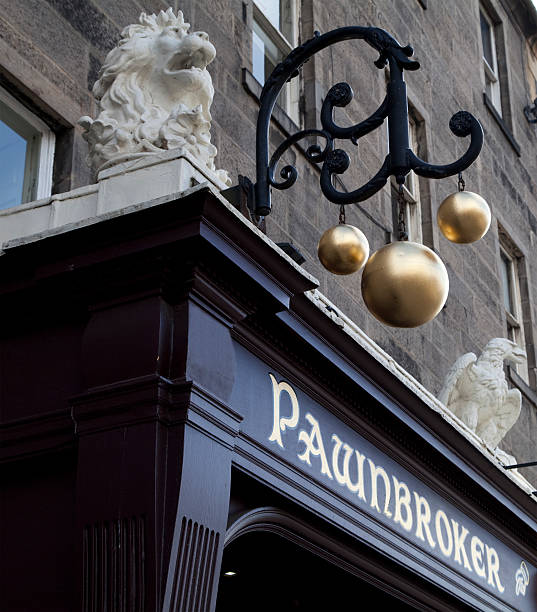
THE BEADY EYE SAYS: BRITAIN IS SLEEPWALKING TOWARDS AN EU EXIT THAT WILL PUT IT IN THE PAWN SHOP OF EUROPE.


( A Twenty minute read that hopefully will provoke some intelligent comments)

Thursday 23 June, 2016. The UK  decided whether to leave or remain in the European Union. Leave won by 51.9% to 48.1%. The referendum turnout was 71.8%, with more than 30 million people voting out of 46 million that are registered electors in the UK.Résultat de recherche d'images pour "pixture of pawn shop symbol"The UK is now scheduled to leave on Friday, 29 March 2019. (It can be extended if all 28 EU members agree.)

A country that shared both good and bad with the rest of the world is about to enter the pawn shop up to its neck in hock.

A country that was built by immigration, each new wave slightly altering the cultural fabric, but they more or less assimilated into the culture itself, changing it slightly, enhancing it, but more or less adopting the culture at large, till the Referendum.

A country that is now on a course of deliberate self-mutilation with a vastly diminished presence on the international stage that bears the “emblem of a country in retreat.” No sensible person could disagree with that verdict.

The UK national debt grows at a rate of £5,170 per second!

The truth however is much worse, factoring in all liabilities including state and public sector pensions, the real national debt is closer to £4.8 trillion, some £78,000 for every person in the UK.


Putting this into perspective:

Britain has a crunched economy, an out-of-control deficit and plenty of social problems.

The enormous figure above (which is equal to 80 per cent of Britain’s output), is treble the combined national debts of Greece, Spain, Portugal and Ireland. Future payments to retired teachers, police officers and NHS staff will cost taxpayers £1.1trillion, or £1,100 billion.

It would be true to say that Britain has been broke over the whole second half of the 20th century.

The liabilities that have been built up for future generations, won’t float way on two new Aircraft but they could disappear with Trident.

What is the cost of running Trident day to day?

About 1% of government spending on social security and tax credits in 2015/16, or the amount spent on the NHS every week.

UK should not be spending possibly £40bn on a programme that is designed for uncertainty and indeed that an “uncertain future threat environment” may mean no threats arise and so £40bn would have been spent unnecessarily.

Extending the life of the current Trident missiles into the early 2060s will cost around £250 million.

Keeping the current Trident submarines in operation until 2028, four years longer than planned, is also expected to cost between £1.2 and £1.4 billion.

£6.2bn project aircraft carrier HMS Queen Elizabeth first conceived in the 1998 defence review at a third of the cost. HMS Prince of Wales

A strike carrier largely of French-designed which is supposed to project power around the world. For a broken nation that has perhaps not yet lost its appetite for making its voice heard far across the seas. Current cost estimates for the Carrier Strike force – including the ships and jets – up to March 2021 are a whopping £14.3bn.

You have to ask is this is what it should be spending its hard taxpayer money on.


The other day we witness tactics by the Conservative Party manifesto to convince a jaded electorate that Mrs May if elected is  a “modernizer,” who with a compassionate Conservative Party, will facilitate any benevolence to help vulnerable people provided they pay for it in the long run.

The new obligation of British citizenship is to volunteer and donate (regardless of the ability to do so) in order to help vulnerable people change their ways.

“Big Society” agenda was and still is a deep-seated belief that the welfare state has run its course—Résultat de recherche d'images pour "is england broken"

What happens if there is a different government after the general

election?

Bolstered by the strategic deployment of ignorance, which encourages all who encounter the screen to view society through its behavioural filters of family breakdown, out-of-wedlock childbirth, worklessness, dependency, anti-social behaviour, personal responsibility, addiction, and teenage pregnancies., with a murder a day Brexit will still go ahead but in a whole new reality of the likely breakup of the United Kingdom and the failure of its economy.

Combined this with drastic and punitive welfare reforms arguably constitute the centrepiece of a severe fiscal austerity package, where possibilities for a redistributive path are drowned out by the rhetoric of “welfare dependent troubled families, immigrants,  Brexit ” is causing society to crumble at the margins.

All deflecting the reality of a Britain teetering on bankruptcy which is creating a troubling relationship between (mis)information and state power.

The common denominator here is the key: The hallmark of the Thatcher revolution was that society did not exist (“there is no such thing as society”),

Could there be a second referendum? Not likely.

The effects of leaving the EU will be felt for many years to come.

Apart from market meltdown with serious negative consequences for people’s’ livelihoods and savings, foreign trade, a key part of the British economy, plus financial services will be badly damaged.

Nine of the largest 20 SWFs in the world have offices in London.

You would be foolish to think that they will not follow the money.

Before World War One, Britain was the world’s economic superpower. With rapid growth and a vast empire, the country enjoyed significant levels of wealth and resources which it has squandered, by turning shopping into a sport and sport into an expensive occupation.

Resulting in more people in the UK are now either overweight or obese than at any other time in the past three decades. A million patients visit the NHS every 36 hours and over the past decade, the number of people attending A&E has risen 25 per cent. Obesity is responsible for about one in ten deaths in Britain and costs the NHS £5.1 billion a year.

With the number of people 75 or older up by 89 per cent since the mid 1970s. As long-term illnesses affect more people – as of 2013, there were 3.2 million people with diabetes – that’s expected to increase to four million within the decade. Budgets, meanwhile, are all but flat, and in 2013-2014 the NHS ran a £471 million deficit.

Britain will experience the deepest recession in its history perhaps deeper than in 1920/21 after the first world war.Theresa May personally reassured the chief of Gibraltar the UK was committed to them

WHY?

Britain is now in caught two situation.

Yes it  can secure new trade agreements but they take years to secure.

X colonial countries like New Zealand cut off from the supply of British goods have been forced to build up their own industries so they were no longer reliant on Britain, instead directly competing with her.

The Conservative Party pledged to create a number of U.K. sovereign wealth funds, known as Future Britain funds, to back British infrastructure and the economy. This a central part of our long-term plan for Britain.

(It is expected that early funds will be created out of revenues from shale gas extraction, dormant assets and the receipts of sale of some private assets, said the manifesto.)

If ordinary Britons do not follow in the footsteps of the Greeks and demand a degree of democratic control over and local benefit from these wealth funds the capital in these fund will not be truly citizens wealth.

But shouldn’t the UK still fear going the way of Greece – losing control of the public finances – and then, after a delay, being savagely punished by the markets?

It is not “broken” yet, nor will it ever be when it can print money.

If the UK were in a tight corner it can simply print the funds required to avoid outright default.

Bank of England pumps £5bn into firms and £20bn into banks to keep interest rates down, which are now on the rise.

If stakes in state-backed banks – including Northern Rock, Royal Bank of Scotland and Lloyd’s Banking Group – were sold at current market prices, they would generate a loss of £13.5 billion.

God only knows what they will be worth on Exit.

Can this story be squared with the facts?

Perhaps, when one looks at who owns Britain.

In a country where 432 people own half the private rural land, a looped and windowed democratic cloak barely covers the corrupt old body of the nation.

Peaceful protesters can still be arrested under the 1361 Justices of the Peace Act.  The Royal Mines Act 1424 gives the crown the right to all the gold and silver in Scotland.  The Remembrancer of the City of London sits behind the Speaker’s chair in the House of Commons to protect the entitlements of a corporation that pre-dates the Norman conquest.

Farm subsidies, ensure that every household in Britain hands £245 a year to the richest people in the land. The single farm payment system, under which landowners are paid by the hectare, is a reinstatement of a medieval levy called feudal aid, a tax the vassals had to pay to their lords.

Walk into any mairie in France or ayuntamiento in Spain and you will be shown the cadastral registers on request, on which all the land and its owners are named.  Try to do the same in Britain, and you will find a full cadastral map available at the local library that can be photocopied for a price. But it was made in 1840.

So Britain is still essentially a feudal nation and for centuries, it has been a welfare state for patrimonial capital.

There are very few common asset like land, water, minerals, knowledge, scientific research and software over which a community has shared and equal rights. At the moment most of these assets have been enclosed: seized by either the state or private interests and treated as any other form of capital.

Resulting in the UK being one of China’s favourite places to invest with only one motivation straightforward – profit.

Here is a few Sovereign Wealth funds assets in the UK.

Qatar and Dubai between them own about a third of the London Stock Exchange.

The government of Singapore has built up a 3% stake in British Land.

Dubai International Capital (DIC) has invested money in building stakes in UK companies, including Travelodge and the London Eye.

In 2012, CIC’s $410bn sovereign wealth fund, bought an 8.68 per cent stake in Thames Water, the water network that serves London.

Singapore’s sovereign wealth fund GIC £48.5m deal to invest in a development owned by FTSE 100 retail property group Hammerson.

50% of the Watermark development, which includes a cinema and restaurant complex in Southampton to the Singapore state investor.

State-owned Qatar Airways is the biggest shareholder in IAG, the parent company of British Airways.

Qatar Holdings also already owns 20% of Heathrow Airport.

Harrods: Owned by Qatar Holdings.

The Shard: 95% owned by Qatar’s sovereign wealth fund.

The Olympic Village: Owned by Qatari Diar, property investment company owned by QIA.

Chelsea Barracks: Owned by Qatari Diar.

Sainsbury’s: 26% owned by Qatar.

The new nuclear power plant at Hinkley Point,  It will cost more than $22 billion to build and bring online. And it isn’t clear that the EPR technology is viable. One-third of the costs, the Chinese state-run company China General Nuclear Power Corporation will take about one-third ownership in the project. (A subsidiary of E.D.F. owns the rest.)

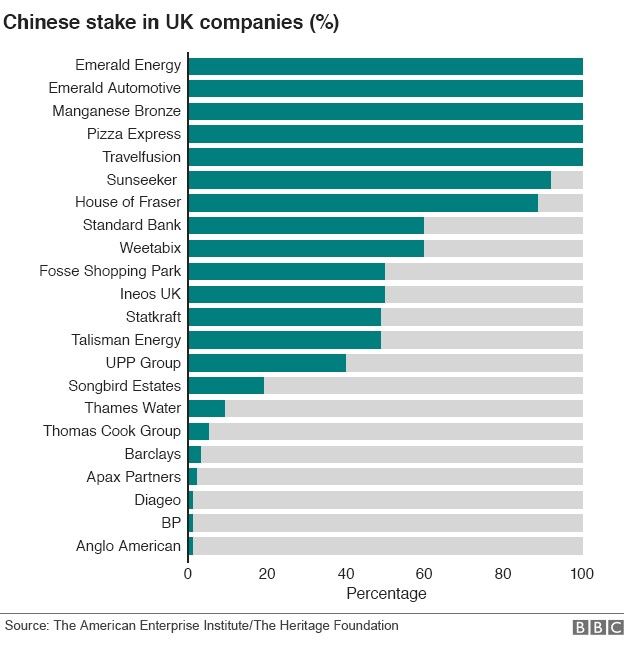
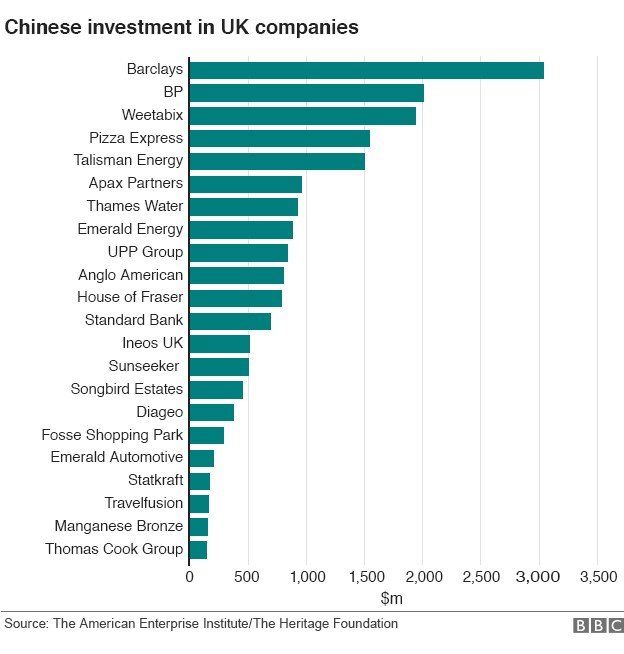
Indeed three of the world’s 10 biggest sovereign wealth funds are Chinese, together holding more than $1.5tn (£988 bn) in assets. Barclays bank – all $3bn of it. BP, $2bn.Pizza Express, House of Fraser, Weetabix and Sunseeker yachts.

Chinese investments in UK companies (%)            Chinese investments in UK companies


Norway’s oil fund is the world’s largest sovereign wealth fund and is worth > $760bn. According to a report in the FT in 2013, it owns on average about 2.5% of every listed European company

Despite recent budget hype about renewing the infrastructure, which is owned more and more by SWFs the market alone cannot meet England needs, nor can the state.

A passionate European, like myself, one can only feel a deep sense of shame at the narcissism and ignorance that have brought England to this place where it is treating to walk away from the EU without paying its bills.

Similar values alone cannot sustain the UK-US relationship.

So can one talk of business as usual?

However slavishly governments grovel to corporate world what jumps out today, to put it crudely, is that jobs and manufacturing rely on being able to sell competitively.

Governments, each government, is beholden to look after its own interest, first.

The ideals and aspirations of its people desperately searching for an identity will not be served by waving the magic wand of leaving the EU and the problems goes away. It won’t come true. Even if England rippes the EU to pieces.

The combination of domestic constraints, changes of leaders, and the increasing complexity of the international community makes these bilateral or multilateral partnerships less efficient than before.

If the UK leaves the European Union without having reached any agreement after two years, it will be a disaster for both sides.

The challenge is to wrap up the Brexit negotiations quickly.

London should not hold the EU hostage, and the EU should not use Britain’s impending exit from the bloc as an excuse to continue muddling through.

Either way, the wisest course might be to discount anything said in the next few weeks, ahead of the UK’s vote on June 8, and wait for the dust to settle afterward.

The UK has been missing-in-action over the past few years, and will be for a few more years to come, as it’s important that they repair the damage internally first, as that’s the most important priority for them at present.

It would be idiotic to claim that Britain is perfect unfortunately it is running out of puff. Farm jobs have mostly gone already. Service and care work, where hope for some appeared to lie, will be threatened by a further wave of automation, as service robots – commercial and domestic – takeover.Résultat de recherche d'images pour "pictures of the uk"

Here is the true reality:

We are all promised unending growth on a finite planet. In a world crashing into environmental limits and the mass destruction of jobs – are as irrelevant in the 21st Century as the neoliberal prescriptions that caused the financial crisis.

The impacts of information technology go way beyond simple automation: it is likely to destroy the very basis of the market economy and the relationship between work and wages.

There’s a point at which further complexity delivers diminishing returns; society is then overwhelmed by its demands and breaks down.

The world is facing the combination of automation, complexity and climate change is dangerous in ways we haven’t even begun to grasp.

England may be right to leave the EU for the wrong reasons.

At the expense of both competition and democracy, withdrawal will not, “bring jobs and industry back to English shores. The social, environmental and economic crises we all face requires a complete reappraisal of the way we all live and work.

Governments across the world are making promises they cannot keep.

The failure by mainstream political parties to produce a new and persuasive economic narrative, that does not rely on sustaining impossible levels of growth and generating illusory jobs, provides a marvellous opening for demagogues everywhere.

In the absence of a new vision, their failure to materialise will mean only one thing: something or someone must be found to blame.

As people become angrier and more alienated; as the complexity and connectivity of global systems becomes ever harder to manage; as institutions like the European Union collapse and as climate change renders parts of the world uninhabitable, forcing hundreds of millions of people from their homes, the net of blame will be cast ever wider.

A complete reframing of economic life is needed not “just” to suppress the existential risk that climate change presents (a risk marked by a 20°C anomaly reported in the Arctic Ocean while I was writing this article), but other existential threats as well – including war.

Today’s governments, whether they are run by Trump or May or Merkel, lack the courage and imagination even to open this conversation.

It is left to others to conceive of a more plausible vision than trying to magic back the good old days. The task for all those who love this world and fear for our children is to imagine a different future, rather than another past.

Only God knows why we obsess about all this so negatively when stupidity consists in waiting to come to a conclusion.

All very depressing. Is a strong and stable Conservative Party seriously the limits of British people imaginations. I hope not.

As the recent repulsive attack in Manchester shows. Only by coporation can we all live a life. No Aircrafts or Tridents can stop such a horrible lost of life.

← Back

Thank you for your response. ✨


THE BEADY EYE SAYS: WE ARE WELL ON THE WAY TO LIVING IN A KIND OF DIGITAL PRISON FOR OUR THINKING.

Tags


( A twenty-minute read)

THIS IS A BIG SUBJECT AND IT IS NOW QUITE EVIDENT THAT IT IS ONE OF THE MOST URGENT SUBJECTS YET TO BE ADDRESSED IN THE WORLD WE LIVE IN.

HOW DO WE BALANCE OR NEED FOR ARTIFICIAL INTELLIGENCE TO RUN THE WORLD WITH OUR FREEDOMS TO LIVE OUR LIVES.Blake saw the world in a grain of sand, and eternity in an hour.

More and more of us are seeing the world in a digital footprint, controlled by algorithms and the click of a mouse.

We need to rethink the objectives of Artificial Intelligence.Financial charts
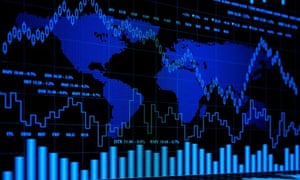
Today, algorithms know pretty well what we do, what we think and how we feel—possibly even better than our friends and family or even ourselves.

In fact, we are being remotely controlled ever more successfully.

The digital revolution is in full swing.

How will it change our world?

Every minute we produce hundreds of thousands of Google searches and Facebook posts.

The amount of data we produce doubles every year. In other words: in 2016 we produced as much data as in the entire history of humankind through 2015.

We are in the middle of a technological upheaval that will transform the way society is organized.

Data Mining. Heuristic Algorithms, Genetic Algorithms that promote “survival of the fittest” Police officers guided by algorithms, Filters that elect governments and Trumps, Drones that decide who, when, and where to kill.

It is estimated that in 10 years’ time there will be 150 billion networked measuring sensors, 20 times more than people on Earth. Then, the amount of data will double every 12 hours.

Many companies are already trying to turn this Big Data into Big Money.Image may contain: one or more people

Artificial intelligence is no longer programmed line by line, but is now capable of learning, thereby continuously developing itself.

Algorithms can now recognize handwritten language and patterns almost as well as humans and even complete some tasks better than them.

Today 70% of all financial transactions are performed by algorithms.

All of this has not just got radical economic consequences in the coming 10 to 20 years around half of today’s jobs will be threatened by algorithms.

40% of today’s top 500 companies will have vanished in a decade.

We need to know more about what technology is doing and how we are going to control its use before it is too late.

We need  to harness algorithms that contribute nothing to the world except exploitation for profit.

People may interpret technology in our time to be primarily about smartphones, social media, GPS, and the plethora of electronic gadgets that have become popular in the last decade.

But technology is a bigger subject than that.

The most common definitions of technology typical of some modern dictionaries run along the lines of defining it as applying scientific knowledge for practical ends.

So a smartphone is a piece of technology because it is an application of electrical circuit theory, electromagnetic field theory, computer science and such for the practical purpose of communication.

Technology can also refer to a body of knowledge and techniques used to build things. Technology enables us to make the stuff of our imagination real—at least partially. Technology itself does not tell us what to do. We use technology to bring our imagination to life. Technology lets us do and achieve more than is otherwise possible.

As a whole, technology is subservient to our collective desires. 

The above may be true in its original sense, but should we allow ourselves to become so reliant on them – and who, if anyone, is policing their use. (Google’s search algorithm is now a more closely guarded commercial secret than the recipe for Coca-Cola)

If you ask me nobody has a perfect definition of technology. This is common to all definitions of technology.

The supreme value of all this technology is information resulting in increasing amounts of personal information being collected.

Where is all  of this information being stored and by whom?‘

The unpalatable truth is the Cloud owned by monopolies, under term of agreement that  “Nobody reads.

Amazon has 11 cloud regions across the world.  Amazon.com’s cloud is so vast and complex that it basically operates the largest computer on the planet. Amazon Web Services has a 27 percent share of the global cloud infrastructure market, followed by Microsoft at around 10 percent, and then IBM and Google.

There are two types of data that are stored in the many clouds that presently exist. The first category is the data that is created by the user before uploading it in the cloud and the other category is data that is created on the cloud platform itself.

Data that is produced prior to any upload into a cloud platform may be governed by the appropriate copyright laws depending on the cloud server while the data that is generated after storage brings about a whole new dimension of ownership.

To date, there are no regulations set for cloud computing (which by the way is unstoppable) and all that has partial governance over the cloud providers are the local set rules.

Do you have a Yahoo e-mail account? Maybe a Gmail account? Do you put up pictures on Flickr? Perhaps you’ve started keeping your schedule online. If so, then you are using cloud computing — that’s what tech companies call it when people work and store information on the Internet.

Are you plagued by suggestions because you looked at something on E Bay or pressed the like button Flipboard, or opened a link on U Tube, or bought on Amazon, or posted on Facebook, or twitted.  They are all governed by nudging Algorithms.

In the end it all boils down to whoever owns the capital will benefit as robots and artificial intelligence inevitably replace not just jobs, but the way we live our lives.Résultat de recherche d'images pour "pictures of AI"

So the obvious question is whether all this rapid advances in automation and digital technology is provoking social upheaval by eliminating the livelihoods of many people, even as they produce great wealth for others?

The Answer is an undoubtedly (with us all losing visibility as to what can be done about it)  <  YES >  Or Yes > it is, but in the future far more people need to “own the robots. Machines are tools, and if their ownership is more widely shared, the majority of people could use them to boost their productivity and increase both their earnings, their leisure and understanding of the world they live in.

If only a favored segment of the population gets a chance to enjoy the advantage of ‘intelligence amplification,’ the network may exaggerate the discontinuity in the spectrum of intellectual opportunity.

We at the beginning of an economic transformation that is unique in history, wonderful for what it could do in bringing us better medicine, services, and products, but devastating for those not in a position to reap the financial benefits, the medical benefits, educational benefits etc. 

In other words, it would be smart to temper our expectations about the future possibilities of machine intelligence.

The reality is that governments worldwide are corralled by staggering debt, and with rapidly depleting income tax sources due to automation, the question becomes….Who will foot the bill!

When I say this I am saying that more and more computer-guided automation is creeping into everything from manufacturing to decision-making. We are at this moment, and for the past many years, having the wool pulled purposefully over our eyes by government itself regarding the disappearance of jobs and how we fund future public services.

If you believe that the rapid advance of technology could eliminate the need for most workers, government  policies do little to directly address that scenario. While we are in the early stages of a transition from the failing old system to a new one, it’s impossible to accurately predict the effects of future advances.

It is particularly difficult to isolate the specific impact of technology from that of, say, globalization, economic growth, access to education, and tax policies.

The future of autonomous machines designed to feed humanity is real and technological disruption is beginning to quietly transform many aspects of the millenary agricultural industry.

But advances in technology offer one plausible, albeit partial, cost saving to governments unshackling nations from the staggering costs of civil servants.

Will robots and software replace most human workers?

It is obvious that they will.

Take Agriculture for instance. The Agri Tech revolution is already under way, data and analysis the market for robots and drones for agriculture runs 3,000 million dollars annually. Triple to 10,000 million in 2022 and double again in 2026.

How do you assess just how specific technologies like these will affect the total number of jobs in the economy?

No one knows the answer.

In a globalized, increasingly automated economy, what can we do about this?

Wholesale reform is needed—far beyond the usual prescriptions of raising the minimum wage and spending more on education.

If advances in technology are playing a role in increasing inequality, the effects are not inevitable, and they can be altered by government, business, and consumer decisions.

The reality however is that none of the above will make a difference.

All this Technology and yet we humans have not learned to treat each other decently.

With the aid of a smart phone and app, we now have greater opportunities to stop rising income inequality by providing fairer access to quality education and training programs for people throughout their careers and lives in order to relate to the real world around us. Otherwise the world will face a new social eruption.

One thing is clear:

The solution is not to hold back on innovation, but we have a new problem to innovate around:  The way in which we organize the economy and society will have to change fundamentally.

Today, Singapore is seen as a perfect example of a data-controlled society. What started as a program to protect its citizens from terrorism has ended up influencing economic and immigration policy, the property market and school curricula. China is taking a similar route.Image associée

Every Chinese citizen will receive a so-called ”Citizen Score”, which will determine under what conditions they may get loans, jobs, or travel visa to other countries. This kind of individual monitoring would include people’s Internet surfing and the behavior of their social contacts.

It is also increasingly clear that we are all in the focus of institutional surveillance.

The more is known about us, the less likely our choices are to be free and not predetermined by others.

But it won’t stop there.

Some software platforms are moving towards “persuasive computing.” In the future, using sophisticated manipulation technologies, these platforms will be able to steer us through entire courses of action, be it for the execution of complex work processes or to generate free content for Internet platforms, from which corporations earn billions.

The trend goes from programming computers to programming people.

Regardless of this, criminals, terrorists and extremists will try to manage to take control of the digital magic wand sooner or later—perhaps even without us noticing. Almost all companies and institutions have already been hacked.

A further problem arises when adequate transparency and democratic control are lacking: Search algorithms and recommendation systems will be more than influential:

Companies can bid on certain combinations of words to gain more favourable results. Governments are probably able to influence the outcomes too. During elections, they might nudge undecided voters towards supporting them—a manipulation that would be hard to detect. Therefore, whoever controls this technology can win elections—by nudging themselves to power. This causes social polarization, resulting in the formation of separate groups that no longer understand each other and find themselves increasingly at conflict with one another.

Personalized information can unintentionally destroy social cohesion, so that political compromises become almost impossible. The fact that manipulative methods change the way we make our decisions. They override the otherwise relevant cultural and social cues.

At least temporarily.

The result is a fragmentation, possibly even a disintegration, of society.

In summary, the large-scale use of manipulative methods could cause serious social damage, including the brutalization of behavior in the digital world.

Who should be held responsible for this?

But which laws, if any, might be violated?

First of all, it is clear that manipulative technologies restrict the freedom of choice. If the remote control of our behaviour worked perfectly, we would essentially be digital slaves, because we would only execute decisions that were actually made by others before.

The right of individual self-development can only be exercised by those who have control over their lives, which presupposes informational self-determination. This is about nothing less than our most important constitutional rights. A democracy cannot work well unless those rights are respected. If they are constrained, this undermines our society and the state.

Last but not least there is the question of the legality of personalized pricing. It is questionable, because it could be a misuse of insider information.

We urgently need to impose high standards, especially scientific quality criteria and a code of conduct similar to the Hippocratic Oath to all Technology in particular to Algorithms. If not our thinking, our freedom, our democracy is being hacked for the sake of profit.

It is already clear that the problems of the world have not decreased despite the recent flood of data and the use of personalized information—on the contrary!  World peace with the rise in inequality is fragile. States and terrorists are preparing for cyber warfare.

Furthermore, there is a danger that the manipulation of decisions by powerful algorithms undermines the basis of “collective intelligence,” which can flexibly adapt to the challenges of our complex world.

For collective intelligence to work, information searches and decision-making by individuals must occur independently.

If our judgments and decisions are predetermined by algorithms, however, this truly leads to a brainwashing of the people. Intelligent beings are downgraded to mere receivers of commands, who automatically respond to stimuli.

It’s the next step that we need to keep an eye on.

Advances in quantum computing and the rapid evolution of AI and AI agents embedded in systems and devices in the Internet of Things will lead to hyper-stalking, influencing and shaping of voters, and hyper-personalized ads, all creating new ways to misrepresent reality and perpetuate falsehoods.

The long-term change in the climate will lead to the greatest loss of species since the extinction of dinosaurs the long-term changes to human thought will achieve the same result. Cyber-crime is estimated to cause an annual loss of 3 trillion dollars.
Image associée


This the Age of Algorithms and predicting that the future of algorithms is tied to machine learning and deep learning that will get better and better at an ever-faster pace.  The greedy algorithms are well on the way to advancing  Post-truth politics in many parts of the world.

They put too much control in the hands of corporations and governments, perpetuate bias, create filter bubbles, cut choices, creativity and serendipity, and will result in greater unemployment As society becomes more wedded to technology.

It’s important to consider the formulas that govern our data. 

“It is not too soon for social debate on how the fruits of an AI-

dominated economy should be shared.”

← Back

Thank you for your response. ✨

blob:https%3A//www.wired.com/e1f642f0-407b-473e-8deb-66563c6c99e9


THE BEADY EYE ASKS: WHAT IS THE TRUTH WHEN IT COMES TO ENERGY.

Tags

, , , , ,

( A Six minute read)

It’s easy to pick the dominant environmental issue of the last decade. It has been the issue of climate change and what—if anything—the countries of the world can do to limit, or reduce, carbon dioxide emissions.

It took hundreds of millions of years to create the world’s oil reserves.

It took less than a century before oil became the commodity on which world power turned and it was little more than a century before fears were raised that we would run out of oil.

Day in, day out, human beings are dependent upon it more than any other resource—and yet most rarely think about it.

For instance, most plastics are derived from oil. The medications taken by millions of people requires oil to produce.

Today, producing, distributing, refining and retailing oil is the single largest industry, in terms of value, on earth!  Yet, like most, you probably give little if any thought to the black liquid.

So the world needs to come to a common understanding that:

  1. The alternative energy is not mature enough to replace fossil sources any time soon.
  2. Energy security means a diversified and balanced portfolio inclusive of every bit of resource, fossil as well as renewables, just to meet the projected demand. No single form of energy will be able to entirely replace it.
  3. Real “green” energy is easier said than done.
  4. Gold and Oil are the commodities most heavily invested in by Hedge Funds.

Now consider.

Oil is a nonrenewable, finite resource.

What if there were no more oil?

What if the lifeblood of modern civilization stopped flowing?

The global economy would collapse in a heap of ruin—and fast! Life as we know it would come to an end. All the everyday items made from oil would no longer be produced. Virtually all transport would stop, and so would nearly all manufacturing. Scores of millions would be unemployed. Millions in colder climates would freeze. Food production would come to a grinding halt. Scores of millions would starve to death because 99.99…% of people don’t have the faintest grasp of the historical technology required to revert to a pre-oil era.

So where there used to be a strong link between economic growth and the increasing demand for oil, is that link now being broken by alternative energy sources.

Many are touting a number of alternative forms of energy as potential replacements to oil.

The key rationale for reducing petroleum consumption lies in the fact that the market price does not account for its full social cost: the negative externalities or consequences associated with petroleum use-such as greenhouse gas emissions and national security issues-are not incorporated in the market prices.

But is all of this true.Résultat de recherche d'images pour "biofuels images"

Biofuels: Corn-based ethanol.

A biofuel-gasoline mixture is already being used in many automobiles. Making biofuels requires large amounts of land. If these fuels were to become the “new oil,” nations would face a choice between growing crops for food and growing crops for fuel, as there is not enough cultivable land on earth to satisfy man’s need for both.

More carbon dioxide is actually released through biofuels than gasoline.

Résultat de recherche d'images pour ":Hydrogen fuel cells:"

Hydrogen is a non-polluting alternative fuel. Hydrogen fuel cells directly convert the chemical energy in hydrogen to electricity and release water and useful heat as by-products. Hydrogen fuel cells are pollution-free and have greater efficiency than traditional combustion technology.

The most abundant element in the universe but, it does not occur naturally as a gas in the Earth it is quite expensive to produce.

The systems used for delivering gasoline from refineries to gasoline stations cannot be used for hydrogen.

NASA is the primary user of hydrogen resources for its space program.

Hydrogen fuel cell vehicles are currently very expensive than conventional vehicles or any hybrids.

Résultat de recherche d'images pour "Nuclear energy :"

Is efficient and clean, but the more reactors that are in use around the world, the more likely a nuclear disaster will occur.

Nuclear fusion: Résultat de recherche d'images pour "what is nuclear fusion"

Is an atomic reaction in which multiple atoms combine to create a single, more massive atom. The long allure of nuclear fusion is simple: clean, safe, limitless energy for a world that will soon house 10bn energy-hungry citizens. But despite 60 years of research and billions of dollars, the results to date are also simple: it has not delivered.

The world record for fusion power – 16MW – was set in 1997 at the JET reactor in the UK. The longest fusion run – six minutes and 30 seconds – was achieved at France’s Tore Supra in 2003.

The world needs to know if this technology is available or not.

Solar and wind power:

Résultat de recherche d'images pour "Solar and wind power:images"

Are unlikely to produce enough energy to match that of oil.

New motor technologies:

Electric or Fuel cell cars to expensive.

So where are with energy.

Here’s the bottom line:

Renewables will remain niche players in the global energy mix for decades to come. The past—and the foreseeable future—still belong to hydrocarbons. And we can expect natural gas, the cleanest of the hydrocarbons, to garner a bigger share of the global energy pie in the near term and in the long-term.

Most alternative technologies rely on rare earths for efficiency.

However, the radioactive waste produced by rare earths mining process makes oil sands look like a green energy. This overlooked (or ignored) fact just now received some attention due to the sudden shortage caused by China’s embargo and export quotas on rare earths.

It Will Take 131 Years To Replace Oil, And We’ve Only Got 10.

Carbon dioxide emissions will continue rising because hundreds of millions of people are transitioning to a modern lifestyle, complete with cars, TVs, and other manufactured goods.

Renewable sources like wind and solar have their virtues, but they cannot compare with hydrocarbons when it comes to economics. If renewable sources of energy were dramatically cheaper than hydrocarbons, then perhaps we could be more optimistic about their ability to capture a larger part of the global energy mix. But even if that were true, a wholesale change in our energy mix will take a long time.

There is one thing all energy transitions have in common: they are prolonged affairs that take decades to accomplish.

If petroleum didn’t exist, we’d have to invent it. Nothing else comes close to oil when it comes to energy density, ease of handling, flexibility, convenience, cost, or scale. Electric vehicles may be the celebrity car du jour, but modern batteries are only slightly better than the ones that Thomas Edison developed. Gasoline has 80 times the energy density of the best lithium-ion batteries.

The entire global economic foundation is still built upon oil.

However China and India are among those facing major problems with urban air pollution.

We can talk about wind, solar, geothermal, hydrogen, and lots of other forms of energy production. But the question that too few people are willing to ask is this one: Where, how, will we find the energy equivalent of 25 Saudi Arabia’s and have it all be carbon-free?

The hard reality is that we won’t.

We need a simpler measure for global energy use, which now totals about 241 million barrels of oil equivalent per day. That sum is almost impossible to comprehend, but try thinking of it this way: It’s approximately equal to the total daily oil output of 29 Saudi Arabia’s.

Furthermore, over the past decade alone, global energy consumption has increased by about 27 percent, or six Saudi Arabia’s. Nearly all of that new energy came from hydrocarbons.

Scientists and policymakers can claim that carbon dioxide is bad but here is no urgency for an accelerated shift to a non-fossil fuel world: The supply of fossil fuels is adequate for generations to come; new energies are not qualitatively superior; and their production will not be substantially cheaper.

The supply chain required to run a modern society is oil.

The inability to lubricate moving parts to have no power the Internet and most technological development based on it (the “Internet of Things”) would cease to exist.

Most world currencies would collapse. Over 90% of

U.S. dollars exist electronically;

with no electricity to power the computers that track

these financial transactions and balances, most

records of ownership would be unavailable for the

foreseeable future.

Within a couple of weeks all the food in the cities would

be exhausted. Mass unemployment,

all the trees will probably be chopped down to

make coal to make energy.


Energy is too important for its development to continue in such a random manner. Thus society seems to be caught in a dilemma unlike anything experienced in the last few centuries.

Despite many claims to the contrary—from oil and gas advocates on the one hand and solar advocates on the other—THERE IS  no easy solution to these issues.

If any resolution to these problems is possible it is probable that it would have to come at least as much from an adjustment of society’s aspirations for increased material affluence and an increase in willingness to share as from technology.

Unfortunately recent political events do not leave us with great optimism that such changes in societal values will be forthcoming. With Donald Trump the debate over whether climate change is for real, and why it might be happening, has not gone away.

It’s less clear than ever how much oil is left but thanks to technology and changing climate change which is pushing car manufacturers towards more hybrid and electric cars, is seen as less of a threat than even ten years ago.

All comments appreciated. All like clicks chucked in the bin.

← Back

Thank you for your response. ✨