• About
  • THE BEADY EYE SAY’S : THE EUROPEAN UNION SHOULD THANK ENGLAND FOR ITS IN OR OUT REFERENDUM.

bobdillon33blog

~ Free Thinker.

bobdillon33blog

Category Archives: Transition period or Implication period.

THE BEADY ASK’S NEW ZEALAND WHAT KIND OF COUNTRY DOES IT WANT TO BE?

28 Thursday Nov 2024

Posted by bobdillon33@gmail.com in #whatif.com, 2024 the year of disconnection, A Constitution for the Earth., Afghan War., Dehumanization., Democracy, Digital age., DIGITAL DICTATORSHIP., Donald Trump Presidency., Donald Trump., How to do it., Human Collective Stupidity., Human values., Life., Money in Politics., Norther Ireland, Political lying., Political voting systems., Politics., Populism., Post - truth politics., REPRESENTIVE DEMOCRACY, Robot citizenship., Social Media., State of the world, Technology v Humanity, Telling the truth., The art of a handshake., The common good., The essence of our humanity., The Obvious., The state of the World., THE WORLD YOU LIVE IN., THIS IS THE STATE OF THE WORLD.  , Transition period or Implication period., Unanswered Questions., VALUES, We can leave a legacy worthwhile., What is shaping our world., WHAT IS TRUTH, What Needs to change in the World, WiFi communication., World Politics

≈ Comments Off on THE BEADY ASK’S NEW ZEALAND WHAT KIND OF COUNTRY DOES IT WANT TO BE?

Tags

Algorithms Democracy., Algorithms for Profit., Capitalism and Greed, Current world problems, Democracy, European leaders, Greed, Humanity, New Zealand, Out of Date Democracy, politics, Power of Social Media, Social Media, Technology versus Humanity, The Future of Mankind

( Fifteen minute read)

With Artificial Intelligence this is a question that all countries are going to have to address within the next ten to twenty years.

For New Zealand this question is arriving in more ways than one simply question.

Grappling to this day with an agreement that dates back to 1840 (which was ment to be a partnership between the British crown and the indigenous Maori, not the other way around) New Zealand find itself politically in no man’s land.

The Maori signed a treaty written in both English and the Maori language called the Waitangi.

The current Treaty Principles Bill debate reveals a fundamental constitutional reality:

NEW ZEALAND existence is based on an imperial treaty and this treaty predates the emergence of its parliamentary democracy.

The treaty needs to be understood in the context of the age of revolution and an emerging imperial era in which European empires negotiated many treaties with each other and indigenous peoples.

So the treaty to day needs to be read in its immediate New Zealand context and British constitution history, which is based on the Magna Carta dated 1215. ( The English constitution has never been written in a single document.)

The Waitangi treaty like all British treaties points to the English notions of empire, with imbedded privilege in a graduated social hierarchy of mutual obligations- noblesse obliged.

Therefore it cannot be squashed into a later democratic paradigm of individuals with equal citizenship as the Act Party’s Bill might prefer it was.

The truth if faced, is that the treaty arose in a completely different context from the present, but still is the foundation to New Zealand constitutional arrangements with the crown. This is the position and will remain so till New Zealand stand on its own two feet and its people are no longer surf to an unelected monarchy.

This means that the treaty principles are tied to their historical foundations.

You could say that treaty settlement have done much to re-establish tribal collective identities but they do not have the right to exhaust the ongoing treaty based rights of the indigenous people- Maori who were a free people.

(Democracy itself is a Johnny come lately on the global stage, not more than a few centuries back old.) It remains the best way to co- ordinate a multi- ethnic society, but it must reflect local agreement and histories.

While New Zealand retains King Charles as head of state the British government has ongoing obligations to the indigenous peoples on which its authority is based.

Edmund Burke’s 1790 conservative policies sum up the position New Zealand finds itself in.

Society is indeed a contract… it becomes a partnership not only between those who are alive, but between those who are living and those who are dead and those who are yet to be born.

Of course New Zealand has moved on since 1840. However we all know forget the past and the present makes on sense.

We all know that stupidity is more dangerous than malice treaties. They cause civil wars, apartheid, and genocides.

Because of the very nature of treaties they lead to race politics.

Millions have died because of treaties, millions have lived because of treaties.

New Zealand problem is not who owns what land, rather race politics is and continues to divide the country.

This is also the problem with North Ireland.

A land that was taken forcibly by the English in return for a peace treaty that caused a civil war, the establishment of a apartheid state with years of killings and a new recent treaty call Good Friday. (Written in English and not Gaelic the language of the original inhabitants.)

If there’s no written constitution that enshrined equality, every decade that passes the meaning of treaties change.

This is why the need for a written constitution is paramount to interpreting any agreement/treaty.

We have and are entering a new era of digital information and Laws and the way we use them with Artificial Intelligence are developing a style of their own.

People have to be with in hearing range of each other firstly to have any agreements.

In order to unify any people/nation in the world of artificial intelligence’s there will have to be a citizen equal act against any platform, digital citizenship, algorithms greed/ profit and climate change mitigation taking precedence over the vote.

The only way to have a large-scale political conversation among diverse groups of people is to set out the terms and conditions in an agreed constitution.

The key misconception here is that we equate elections to democratic outcomes but a liberal democratic citizenship with Artificial Intelligence can only be achieved with an Equal Citizenship Act that is enshrined in a written constitution.

It could be said that Democracy is at a tipping points. Yes democracy governments are messy. They have so many demands on them that their elected members are not in touch with reality.

Whether his is true or not social media is distracting and distancing us from the real problems, giving rise to populism.

History is full of examples as to what happens when the Democratic process brakes down.

New Zealand with all its faults / beauty / expenses remains one of the best countries to settle in, and it must do everything possible to remain so by not becoming another Hong Kong abandon by the British Empire it must establish its independence internationally.

All human comments appreciated. All like clicks and abuse chucked in the bin.

Contact: bobdillon33@gmail.com

Share this:

  • Click to share on WhatsApp (Opens in new window) WhatsApp
  • More
  • Click to share on Pocket (Opens in new window) Pocket
  • Click to share on Mastodon (Opens in new window) Mastodon

THE BEADY EYE SAYS: WHILE BECOMING THE MOST DANGERIOUS THREATH TO ALL OUR LIVES, TECHNOLOGY HAS AND STILL IS CHANGING HOW WE INTERACT AMONG OURSELVES.

27 Wednesday Mar 2024

Posted by bobdillon33@gmail.com in Technology's, The world to day., Transition period or Implication period.

≈ Comments Off on THE BEADY EYE SAYS: WHILE BECOMING THE MOST DANGERIOUS THREATH TO ALL OUR LIVES, TECHNOLOGY HAS AND STILL IS CHANGING HOW WE INTERACT AMONG OURSELVES.

Tags

AI, Algorithms., Artificial Intelligence., Capitalism and Greed, Capitalism vs. the Climate., Society, tech, Technology, The Future of Mankind, Visions of the future.

( Four minute read)

Humans are highly social creatures.

Advancements in technology is now completely re-shaped the everyday routine of the Modern Human.

Developing a chokehold on our lives, to the point of corverting us all into product to be harvested on a 24/24 bases by profit seeking algorithms.

Our brains have become wired to process social information, and we usually feel better when we are connected.  Social media taps into this tendency.

When you develop a population-scale technology that delivers social signals to the tune of trillions per day in real-time, the rise of social media isn’t unexpected.

It’s like tossing a lit match into a pool of gasoline.

The once-prevalent, gauzy utopian vision of online community is disappearing,

Why?

BECAUSE ITS NOT GETTING ANY EASYER AT BEING A PERSON, IN THIS TECHNOLOGICALLY FUCKED UP SUPPOSELY CONNECTED WORLD.

Along with the benefits of eaiser connectivity and increased information, social media has also become a vehicle for disinformation and political attacks from beyond sovereign borders.person on a smartphone

With little or now privacy left, we are now left to endure, rather than enjoye a life on social media, gorging on the most lurid speculation which one feels kind of stuck and unconsciously obliged to check it way more than you want to

I dont know about you but I am sick of seeing people so drawn to their phones at social events and in general I wonder are we are all just becoming AI predictions as what we are and how we live our lives. 

Companies like Google, X, and Meta collect vast amounts of user data, in part to better understand and improve their platforms but largely to be able to sell targeted advertising.

Collection of sensitive information around users’ race, ethnicity, sexuality, or other identifiers are now not just putting people at risk, they are also desentizing us at large to the state of the world.

Even for users who want to opt out of ravenous data collection, privacy policies remain complicated and vague, and many users don’t have the time or knowledge of legalese to parse through them.

At best, users can figure out what data won’t be collected, but either way, the onus is really on the users to sift through policies, trying to make sense of what’s really happening with their data.

There’s a very strong corollary between the data that’s collected about us and current state of the world -wars – growing inequality  – demishing democracy – lack of long term actions, such as on Climate Change that has now turned into an industry not a threat to our very existence.

————–

The emergence of smartphones in 2007 generated macro data, which uses artificial intelligence  transforming our daily routines.

There are no laws that require platforms to show how they use or sell the data collected.

So far, attempts to curtail the collection of users’ data has been piecemeal, largely driven by state-level laws and individual enforcement actions. Regulation continues to be extraordinarily behind.

The companies are not going to change on their own.

However it barely scratches the surface of what they have enabled, with few arenas of human endeavour left untouched by the smartphone.

Against the backdrop of the constant rise in time spent by young people on social media, a staggering 74% of them are checking their social media accounts more than they would like to. Instagram, TikTok and other social media have become daily fixtures in their lives with 59% of young people now spending more than two hours of their average day on social media.

The five most popular platforms are Instagram, YouTube, TikTok, Snapchat and Facebook.

Whilst YouTube and TikTok dominate as sources of entertainment, Instagram, Snapchat and BeReal are the platforms most widely posted on by young people.

Addictive platform design take on young people’s mental health and their feeling of powerlessness in the face of global companies’ constant nudging to participate in a vicious cycle of personal data sharing and content consumption.

The “addictive” lure of the constant stream of updates and personalized recommendations, often feeling “overstimulated” and “distracted”, but algorithms pick up on mental health issues and expose users to ever more related content, bombarding us with bad news as it stimulated more viewings, till we are all officially desensitized.

Something bad happens across the country? We hear about it. Something bad happens across the world? We hear about it. Something good news happens, for all intitive purpose it is ignored.  

—————————

The natural question at this point, it would seem, would be to ask where we should draw the line.

Why tragedies stop seeming so tragic – and why this needs to stop.

The sheer amount of violence present in the world only seems to be increasing with Netflicks quietly capitalizing on another form of content. More than other entertainment outlets, Netflix’s hit shows spotlight gruesome violence. More than other entertainment outlets, a number of Netflix’s hit shows spotlight gruesome violence, often committed against women.

Escalating violence on-screen can make us more tolerant of it in real life.

Gone are the days of bang bang ypur dead Graphic, realistic violent content is considered the ‘norm’ post-watershed.

This is not necessarily because people are becoming more violent in their nature, but is rather due to increased methods of communication brought on by technological improvements like playing violent video games.

Is it possible that individuals who consume violent media not only become more aggressive, but also make their friends and family more aggressive, even  if those do not consume violent media themselves? The consumer is actively influencing her/his friend to make her/him more alike.

We don’t process large numbers as well as we do smaller numbers.

How sad should we be over the news of those dead in Gaza? Utterly distraught, significantly, not much?

—————

Mobile phones are now extraordinarily multi-functional, but mass access to knowledge in the age of communications threatens basic concepts such as individual identity and autonomy.

To maintain our empathy for others, it is important to first extend it to ourselves and to those within our immediate circle.  

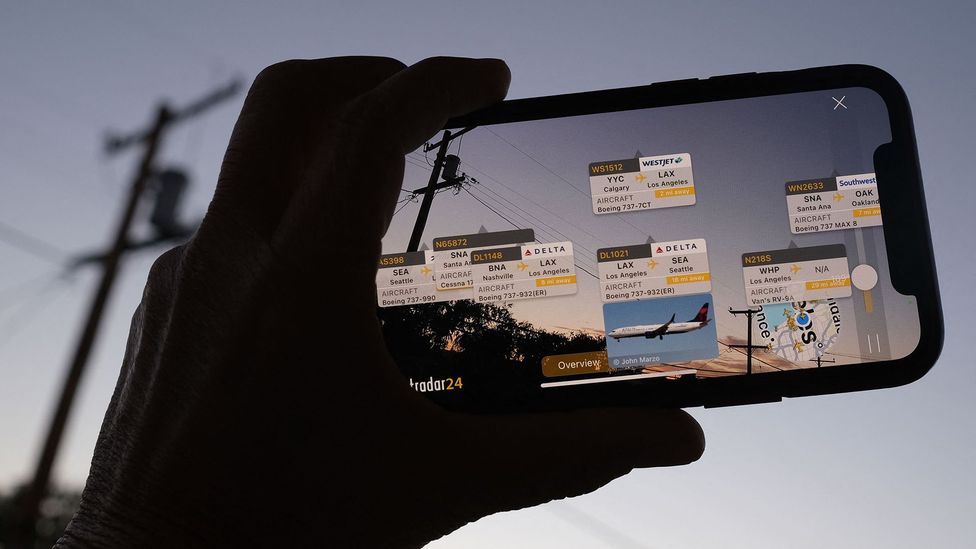
Smartphones have enabled the digital and real worlds to be blended through augmented reality, allowing users to track aircraft overhead, for example (Credit: Getty Images)

The Smart phone is destroying this empathy, one of the most ubiquitous technology devices of all time, with the ability to take the device everywhere comes the idea that no one is ever far from the things that matter most to them.

With the death of proximity, the smartphone has become your home, but home is no longer a refuge.

We don’t know about how our smartphones are affecting us.

Are they alienating people from each other, or helping them to connect with others?

Do they affect children differently than adults?

And how do we step away from our phones if our whole lives are on them?

Smartphones are basic necessities but it is only by looking at the vastly different uses and contexts that we can fully understand the consequences of smartphones for people’s lives around the world.

Combining artificial intelligence with the extraordinary data-gathering capabilities of smartphones, is creating other opportunities. Millions of people across many parts of the world that are conflict-bound or subject to some of the worst effects of the climate crisis have left their homeland behind completely in search of a new life are using their smartphone to navigate their circumstances and situations.

(According to the UN, there were 110 million forcibly displaced people in the world.)

If you ask people how much they care about all people on earth dying, it’s not seven-and-half billion times more concern, than if you told them one person would die.

————————

If we assume that transcendentally brilliant artificial minds won’t be along to save or destroy us, and live according to that outlook, then what is the worst that could happen – we build a better world for nothing?

We need a cultural change in values, to enable more deliberate decision-making.

If we don’t the future of society, as defined by the scientific and technological revolutions needs a custom ethical and philosophical direction, as the world is rapidly moving to each person doing what’s best for themselves.

Or to put it more bluntly.

Someday in the future, someone will arrive at another turning point where the fate of the species is theirs to decide.

If our extinction proceeds slowly enough to allow a moment of horrified realisation, the doers of the deed will likely be quite taken aback… if the Earth is destroyed, it will probably be by mistake.

Society used to be able to make a long-term plan and that’s not something that happens now.

We go to quick fixes.

———————-

Clearly, technology by itself is neither good nor bad.

It is only the way and extent to which we use it that matters. It is indisputable that thanks to technology, we get a chance to live a life our predecessors could not even dream about. However reality does not take place in Smartphones.

There is no economy or individual that is unaffected by climate change. By 2050, this problem could force 216 million people to relocate within their own nations.

When all areas of human activity get rapidly digitized, it’s easy to become desensitized to the importance of innovations and advancements for the overall progress of society.

Those in the tech industry know that the opportunities on this horizon are endless.

——————

What are today’s challenges for artificial intelligence?

Building technology for the sake of technology won’t cut it in a globalized society.

There’s a juxtaposition between the need for a more connected world and hesitation from people toward technology that tech innovators need to account for and solve.

The development of new advancements must be rooted in a holistic mindset balancing desire for more conveniences with feasible solutions to meet the needs of future generations.

To accomplish this, education will play a critical role in bridging perceptions and fostering authentic trust between technology and humans.

Indeed it is my belief that all teenagers are now in need to be educated in classroom in the use of mobiles.

Do you believe technology should be more focused on the problems of society or individual needs?

Is technology being used sufficiently to tackle society’s major issues?

—————

The human species will change with genetic editing, artificial intelligence challenges the concept of “I” and “individual;” and robotics will bring new “companion robots,” which we need to define and adopt socially.

In the last 10 years, genetics has made it possible to analyse old DNA and, as a result, revealed the history of the planet’s first inhabitants. We are now a single human species but we finally know that descend from other species. We now have unprecedented tools to inform and transform society and to protect the environment.

How should we harness this potential in the future?

How does this perspective change our understanding of the current human diversity?

Excessive use of gadgets, lack of offline communication, and social media abuse were proven to cause negative effects on mental health.

It is indispensable to give machines “common-sense knowledge” in order to move toward the ambitious goal of building “truly intelligent” general AI.

This is the time to make the necessary decisions to outline this path.

When robots take the final leap from our imagination to our homes and workplaces, they will become our companions; they will add new possibilities and countless variables to our patterns of behaviour:  they will change how and where we build, how we move or the materials we use to create things.

——————–

How, exactly, could AI destroy us?

We humans have already wiped out a significant fraction of all the species on Earth.

That is what you should expect to happen as a less intelligent species – which is what we are likely to become, given the rate of progress of artificial intelligence. For example, in many cases, we have wiped out species just because we wanted resources.

The worst-case scenario is that we fail to disrupt the status quo, in which very powerful companies develop and deploy AI in invisible and obscure ways.

As AI becomes increasingly capable, and speculative fears about far-future existential risks gather mainstream attention, we need to work urgently to understand, prevent and remedy present-day harms.

These harms are playing out every day, with powerful algorithmic technology being used to mediate our relationships between one another and between ourselves and our institutions.

—————————–

How would AI get physical agency?

In the very early stages, by using humans as its hands.

You feel as though you are encountering absolute reality, whatever the hell that is, enlightenment is nothing more than a “pure consciousness event which is just a stepping-stone, at best, to true enlightenment, which does not make you permanently happy, let alone ecstatic. It is a state that incorporates all human emotions and qualities: love and hate, desire and fear, wisdom and ignorance.

Enlightenment does not give you answers to scientific riddles such as the origin of the universe, or of conscious life,  just as electrons can be described as waves and particles, so ultimate reality might be timeless and aimless—and also have some directionality and purpose.

The ability to hold opposites, emotional opposites, at the same time is really what we’re after.

However the mind remains in many respects unchanged, you discover a void at the heart of reality.

Not until  you realize you’re the same jerk you were all along.

The biggest power trip you can imagine” and an “aphrodisiac.” you think you’re God.

The object vanishes and only consciousness remains, it becomes its own subject and object.

It becomes aware of itself, seeing life as an illusion that makes accepting death easier.

What you are, and what the world is.

I must be missing something. What can we do about it?”

I want to bring us back to a more practical reality, which is that technology is what we make it, and we are abdicating our responsibility to steer technology toward good and away from bad.

That is the path I try to illuminate in this post an issue of social responsibility.

All human comments appreciated. All like clicks and abuse chunked in the bin.

Contact: bobdillon33@gmail.com

Share this:

  • Click to share on WhatsApp (Opens in new window) WhatsApp
  • More
  • Click to share on Pocket (Opens in new window) Pocket
  • Click to share on Mastodon (Opens in new window) Mastodon

THE BEADY EYE SAYS. 2022 WILL BE THE YEAR OF DIASTER CAPITALISM.

31 Friday Dec 2021

Posted by bobdillon33@gmail.com in #whatif.com, 2022: The year we need to change., Climate Change., Digital age., Disaster Capitalism., Disasters., Environment, Extermination., Fourth Industrial Revolution., How to do it., Human Collective Stupidity., HUMAN INTELLIGENCE, Humanity., Imagination., Inequality., Life., Money in Politics., Natural World Disasters, Our Common Values., POST COVID-19., Privatization, Purpose of life., Survival., Sustaniability, Technology v Humanity, The common good., The essence of our humanity., THE NEW NORM., The Obvious., The pursuit of profit., The state of the World., The world to day., THIS IS THE STATE OF THE WORLD.  , Transition period or Implication period., Unanswered Questions., We can leave a legacy worthwhile., Wealth., What Needs to change in the World, Where's the Global Outrage., World Aid., World Economy., World Leaders, World Organisations., World Politics

≈ Comments Off on THE BEADY EYE SAYS. 2022 WILL BE THE YEAR OF DIASTER CAPITALISM.

Tags

Capitalism and Greed, Capitalism vs. the Climate., Climate change, Coronavirus (COVID-19), Distribution of wealth, Extinction, Global warming, Post-Covid-19, The Future of Mankind, World aid commission


( Fifteen-minute read) 

When I first started looking at disaster capitalism, it was in the context of warfare and counter-terrorism, now it’s privatized exploitation of  Pandemics and Climate Change. 

During a major crisis, regular people are understandably focused on the everyday challenges of surviving. They rarely can also worry about private industries pushing local policy proposals that might negatively impact their lives never mind cashing in on Pandemics and Climate change.

Pandemics might be avoidable in the future but what is unavoidable is a Future Climate that stands to send more unprecedented emergencies, inconsistency, and destruction our way.

(Though it’s still feasible to prevent the planet from becoming completely uninhabitable, saying its crunch time is a massive understatement.)

They both provide the very conditions that give rise to disaster capitalism, which is developing more frequently with more companies and wealthy ‘Philanthropists’ seeing both as a growth sector, not to mention Sovernity Wealth Funds which are investing in everything from drinking water to you name it.

Why? 

Because they stand to make substantial financial returns for their beneficiaries and if managed properly could be contributing to sustainable development in a meaningful way. However, a deeper understanding of the drivers and influences of investor organizations is required to mobilize their capital effectively. 

Globally, sovereign wealth funds (SWFs) are a major source of capital that has the potential to invest for the long term in sectors that desperately need it. While Philanthropists donations usually only represent 0.05% of the billion accumulated.

(A fraction of the spoils of neoliberal tech capitalism, in the name of generosity, do not try to address the problems of wealth inequality which is created by a social and an economic system that allowed those spoils to accrue in the first place. They are small contributions to a large problem that were created by the success of the industry he or she is involved in.)

List of Top 8 World's biggest Philanthropists in 2021                                ————————-

Let’s put a magnifying Glass Philanthrocapitalism.

Philanthropy serves to legitimize capitalism, as well as to extend it further and further into all domains of social, cultural, and political activity.

Now don’t get me wrong.

Their donations are welcome, however, they are not the simple act of generosity they pretend to be. In this greedy world, it is good to see wealthy individuals repaying to help fix problems that their companies have often caused in the first place.

The risk of philanthrocapitalism is a takeover of charity by business interests, such that generosity to others is appropriated into the overarching dominance of the CEO model of society and its corporate institutions.

Today, large organizations can amass significant economic and political power, on a global scale, and essentially, what we are witnessing is the transfer of responsibility for public goods and services from democratic institutions to the wealthy, to be administered by an executive class.

When this happens what we witness is, on one hand, is exploitative of labor practices or corporate malpractice being swept under the carpet while the donator is accruing significant commercial, tax, free publicity, and political benefits.

Democracy is sacrificed on that altar of executive-style empowerment. 

The nature of this apparent charity should be openly questioned from the outset.

Because this reformulation of generosity – in which it is no longer considered incompatible with control and self-interest – is a hallmark of the “CEO society”: A society where the values associated with corporate leadership are applied to all dimensions of human endeavor.

What it does suggest, however, is that when it comes to giving, the CEO approach is one in which there is no apparent incompatibility between being generous, seeking to retain control over what is given, and the expectation of reaping benefits in return.

  What can be done?

As historian Mikkel Thorup explains, philanthrocapitalism rests on the claim that “capitalist mechanisms are superior to all others (especially the state) when it comes to not only creating economic but also human progress, and that the market and market actors are or should be made the prime creators of the good society”.

Now take Climate change which is going to take trillions to combat.

As global warming augments cycles of fire, flood, hurricanes, and viral mutations, we learn to live in anticipation, from emergency to emergency, sometimes even before the deaths have occurred.

Disaster capitalism and philanthrocapitalism will not work to revert the outcomes of Climate Change nor will technology, the unloving God. 

Why? 

Because Capitalism has turns everything including us into a product to be traded, resulting in most of the wealth in the world now owned by 1% of its population. 

Before ( not too long ago ) there were Markets now we have Market Societies thanks to the buying of shares and trading them, complements of the British Indian Company.  So a society that is organized around the principle that companies should not be prevented from making things that kill people must also accept as ‘normal’ that many people will die in large numbers from these things.

 But what makes something a disaster?

Certainly what makes a disaster is when the victim is humanly itself.

From epidemiological forecasters to genetic epidemiologists and computational and zoonosis biologists — are the new oracles upon whose prophecies financial markets rise and fall but the awaiting climate disaster will expose a world characterized by gross inequality that is getting worse and worse, year by year.

From the perspective of disaster capitalism, we might say that what makes COVID-19 a disaster is its arrival in woefully underinsured countries, unhealthy populations.

If we had a healthier population, would COVID-19 be considered a disaster? Possibly or perhaps not. To be sure, the virus is deadly, but like other disasters, the actual arrival of COVID-19 magnifies pre-existing vulnerability in ways that also figure in the calculus of disaster capitalism.

The uneven way the climate crisis will continue to impact certain countries. If private interests are already prepped to engage in disaster capitalism, those devoted to building a better world should be prepared with alternatives.

There is no such thing as a ‘natural disaster.’ There is also no such thing as a natural or certain response. But there is preparedness.

THE PROBLEM IS THAT WITH CAPITALISM IT IS UNABLE TO TACKLE SITUATIONS THAT ARE NOT TRADABLE.

As money materialized from fresh air the essentials for life will be traded – freshwater- energy- food- healthcare – education – data – etc. 

We must arm ourselves with knowledge, and laws that ensure transparency. 

What we have at the moment is the transfer of power to technology which we know sweet fuck all about with no regulations. 

Unrivaled power.

One only has to look at Jeff Bezos, the Bransons, the Mark Zuckerberg’s, Apple, Google, etc.

We all work for one or the other for free while they entertain themselves blasting off to space with friends and worthless actors in giant phallic symbols of power. 

However, the real story will unpack differently long before anyone lives on another planet. It will be how our mental well-being – is impacting every facet of our lives.

The total mortality from COVID-19 on a global scale is as yet unknown, but we have been thinking of it as a disaster for weeks now.

What exactly is the disaster, then?

Pandemics have become a dominant framework through which government and financial resources are mobilized in Global Health.

There’s been a lot of dithering about whether or not COVID-19 is a disaster, meanwhile, inequality is growing, and both corporations and the wealthy find ways to avoid the taxes that the rest of us pay.

There is the virus, and then there is the societal reaction of bringing our entire fiscal and economic infrastructure to a near-complete standstill.

Morbid diseases that persist as chronic forms for years but eventually kill more people to seem less like disasters.

It’s not a moment to sort of sit on the sidelines and hope for the best.

We all appreciate with the current pandemic that some are making hay while the sun shines, at our expense. Unfortunately, there is little point in getting the Jabs, to extend your time on earth if the earth itself is dying and what remains is been turned into trading products.

You’ve got to fight for your vision of for-profit corporate solutions that may succeed in creating company profits but ultimately fail in terms of democracy, fairness, and justice.

Conclusion:  

To address the problems with greed and power create, we must create equality and this can not be done in a Profit-seeking Capitalist way of trading our way out of the pending disasters.  Wall Street will never close.  

So here is an idea that might help.

Non-Trading Capitalism.  

Green non-tradable bonds to be issued online at a global scale, with guaranteed percentage returns, with a yearly prize draw.

Or

Place a 0.05% World Aid Commission on all tradable financial instruments. (see previous posts) 

Either of the above could be implemented with the click of a switch ensuring a perpetual source of disaster non-profitable funding. 

Both would create trillions and allow fairness and involvement of us all.

It is perhaps worth remembering that capitalism, like its alternatives, is an adaptation to circumstances. It is not a virtue, not a standard for judgment, not a measure of right or nobility. It’s just another ‘ism’

All human comments are appreciated. All like clicks and abuse chucked in the bin.

Go back

Your message has been sent

Warning
Warning
Warning
Warning

Warning.


Share this:

  • Click to share on WhatsApp (Opens in new window) WhatsApp
  • More
  • Click to share on Pocket (Opens in new window) Pocket
  • Click to share on Mastodon (Opens in new window) Mastodon

THE BEADY EYE ASK’S. APART FROM THE FINANCIAL COST WHAT ARE THE UNSEEING COST OF THE UK LEAVING THE EU.

19 Sunday Jan 2020

Posted by bobdillon33@gmail.com in Brexit Language., Brexit., European Union., Political Trust, Politics., The common good., The Obvious., Trade Agreements., Transition period or Implication period., Unanswered Questions., World Trade Organisation, WTO.

≈ Comments Off on THE BEADY EYE ASK’S. APART FROM THE FINANCIAL COST WHAT ARE THE UNSEEING COST OF THE UK LEAVING THE EU.

Tags

Brexit v EU - Negotiations., The future of England out of the EU.


(Twenty-minute read)

The UK is set to leave the EU on January 31.

The article 50 process will have been completed and the country will no longer be legal in the EU.

With speculation now playing a part in almost every claim for or against the EU, it’s sometimes difficult to distinguish between legitimate risks and doom-mongering however the implications of becoming the first nation to leave the 28-state bloc are much clearer.

The term Global Britain is the moment Britain chose to step back from the world.

Confused.

Well here is the picture as I understand it.

The UK will not get a free choice on its future relationship with the EU.

It will not be quick or straightforward to establish a new relationship.

Obviously, there are two ways that Britain can leave the EU:

With a deal, or Without a deal.

A no-deal Brexit would result in a rigid position on all the issues.

If Mr Johnson’s government chooses to change course he has to so before December 31, 2022, if not then Britain will fall back on to basic World Trade Organization terms.

Under WTO rules, this would not include any preferential access to the Single Market, or to any of the 53 markets with which the EU has negotiated Free Trade Agreements.

Or

What is called a soft Brexit which would aim to keep the relationship between the UK and the EU intact?

This could be done by keeping Britain in the single market or, at the very least, arranging the terms of some sort of free-trade agreement before the 31 October deadline arrives.  However, by staying in the single market and customs union, the UK would be liable to EU rules and legislation regarding the free movement of goods, services and people across borders.

Therefore if the UK gets a deal as is the case with Norway and Iceland it could still end up being forced to comply with EU laws and regulations.

A Norway or Iceland model would give the UK considerable but not complete access to
the free-trade Single Market. We would be outside the EU Customs Union, and we
would lose access to all of the EU’s trade agreements with 53 other markets around
the world. Re-negotiating these would take years. Combined with the 27 other countries in the Single Market, and the countries in the EU Customs Union and EFTA, this is effectively more than 80 trade deals – covering over a third of the world’s economy.

No existing bilateral trade agreement will deliver the same level of access that the UK currently enjoys to the EU Single Market. In particular, none provide an equivalent
access for services, which accounts for almost 80 per cent of the UK economy.

It involves accepting most EU rules, but with little influence over the creation of those rules.

Under any of the alternative models, there is no guaranteed access to the current measures for police and security cooperation, which allow our law-enforcement agencies to work with their EU counterparts.

It is possible to fully replace the UK bilateral agreements outside the EU in these areas or demand a right to choose which to participate in will not replicate the reach and influence that is currently enjoy.

Mr Johnson has ruled out any form of an extension to the transition period.

Then both sides would need to make preparations for how they cope with the economic fallout in 2021.

After Britain leaves, its people will still have certain rights – at least for another 11 months. Freedom of movement is likely to end on 31 December next year.

The key rights that have yet to be negotiated include the continued right of British settled in the EU to move for work, leisure or retirement within the EU.

Erasmus will continue after Brexit but this depends on negotiations on the future relationship with the EU.

British citizens will still be able to apply for funding in Horizon2020 programmes during the transition period.

The EU’s Creative Europe funding stream will remain open to British applications.

Also promising a call for applications in 2020 is IPortunus, a new EU mobility fund for artists.

Little is written about cross-border healthcare or the processes involved but it is still available during the transition period,

So far, discussions of the gains and losses of Brexit have, understandably, tended to focus on the most obvious costs.

It may soon cost the UK more than its combined total of payments to the European Union budget over the past 47 years

The UK’s total projected contribution to the EU budget from 1973 to 2020 at £215 billion after adjusting for inflation is likely to keep increasing.

On leaving the Uk will be operating in a vacuum till there is a deal or not.

This comes with huge hidden dangers.

In adopting the government’s proposed model for close customs cooperation and a common rulebook, it runs the risk of finding themselves with little scope to diverge from EU regulations on goods, and unable in practice to strike new trade deals with the rest of the world.

The EU cannot change the rules of a customs union for the UK. If it does the trading bloc will fall asunder. When you’re in a customs union for goods, you become part of a common trade policy — you don’t have autonomy anymore.

Agreement with the EU, under which the UK would continue to levy EU tariffs on goods destined for the single market, but would apply a rebate on those that remain in the UK does not work and will not work.

As for a special mutual recognition arrangement in financial services, this might work.

Politicians often praise the visible benefits of public spending, e.g. the number of jobs “created”, without considering whether the funds could have been spent more wisely elsewhere – or even how the taxpayer might have spent the cash, had it remained in his or her pocket

There are a number of countries which have negotiated trade agreements with the
EU. Switzerland has a complex set of bilateral agreements with the EU. Turkey is part of the EU Customs Union and has a long-term aspiration to join the EU. Canada has agreed a Free Trade Agreement with the EU.

The status quo, or anything close to it, carries huge opportunity costs of its own.

So let’s have a look

WTO rules represent a minimum threshold.

It would be the most definitive break with the EU, offering no preferential access to the Single Market, no wider co-operation on crime or terrorism, no obligations for budgetary contributions or free movement of people.

It would, be hard even to come close to replicating the level of access and
influence from which the UK currently benefits.

Whatever alternative to membership the UK seeks following it departure the UK will lose influence over EU decisions that will still directly affect the country.

So far, the European Union has made only tentative steps towards regulating genetically modified crops and artificial intelligence and robotics.

There are of course important cultural differences between the Uk and the European continent and these may seem like small concerns in the grand scheme of things.

The free movement of persons is a fundamental pillar of EU policy … the internal market and its four freedoms are indivisible’.

Each possible approach will involve a balance between securing access to the EU’s Single Market, accepting costs and obligations and maintaining the UK’s influence.

The UK will, therefore, have to make some difficult decisions about its priorities and the voting public will be holding it very directly responsible. 

It is not the means that matter, but the ends.

All human comments appreciated. All like clicks and abuse chucked in the bin.

Go back

Your message has been sent

Warning
Warning
Warning
Warning

Warning.

Underneath is a long list of everyday EU Common day terms that might help.

Ankara Agreement The Association Agreement signed between the European
Community and Turkey in 1963 and the Additional Protocol added
in 1970. They set out basic agreed objectives for relations between
the EU and Turkey, such as the strengthening of trade and economic
relations and the establishment of a Customs Union.

Banking Union The Banking Union is an EU-level supervision and resolution system
for the banking sector in the euro area, and participating member
states. It aims to ensure that banks in the euro area are safe and
reliable and that non-viable banks are resolved without recourse to
taxpayers’ money and with minimal impact on the real economy.

The Capital Markets Union (CMU) is a plan of the European
Commission to create a true single market for capital in Europe. It
will channel increased capital to all companies, including Small and
Medium Enterprises (SMEs), and infrastructure projects.

The Common Agricultural Policy (CAP) is the agricultural policy of
the European Union. It implements a system of agricultural support
through direct income payments to farmers and guaranteed prices.

Common External Tariff A common external tariff must be introduced when a group of countries forms a customs union. The same customs duties, import
quotas, preferences or other non-tariff barriers to trade apply to all
goods entering the area, regardless of which country within the area
they are entering.

The Common Fisheries Policy (CFP) is a set of EU rules for managing
European fishing fleets and for conserving fish stocks.

Common Travel Area
A travel zone comprising Ireland and the UK. It allows for the nationals of
both countries to travel and live in each country without immigration
controls.

Council of the European Union(also known as Council of Ministers)
The Council of the EU brings together the representatives of the EU
Member States’ governments. It is the EU’s main decision-making
body and agrees EU laws, usually together with the European
Parliament.

Customs Union An agreement between two or more countries to remove customs
barriers and reduce or eliminate external customs duties on mutual
trade. Customs unions generally impose a common external tariff
(CET) on imports from non-member countries.

Dublin Regulation An established set of criteria for identifying the Member State
responsible for the examination of an asylum claim in Europe. Under
Dublin, the claim for asylum must be made in the first EU country
entered.

EU-Canada Free Trade Agreement (CETA)
The Comprehensive Economic and Trade Agreement (CETA) is a
trade agreement negotiated between the EU and Canada. Once
implemented, it will remove customs duties, end limitations in access
to public contracts, open up services markets, and help prevent
illegal copying of EU innovations and traditional products.
Eurojust is an agency of the European Union dealing with judicial
cooperation in criminal matters.

European Arrest Warrant (EAW)
A legal framework that facilitates the extradition of individuals between
The EU Member States to face prosecution or to serve a prison sentence
for an existing conviction.

European Commission (the Commission)
The European Commission is responsible for proposing draft
legislation, implementing decisions, upholding the EU Treaties and
managing the day-to-day business of the EU.
European Council The European Council is the body in which the Heads of State
or Government of the EU’s 28 Member States, together with an
appointed President and the President of the European Commission,
take strategic decisions about the direction of the EU.

European Court of Justice (ECJ)
The European Court of Justice (ECJ) is a supranational court based in
Luxembourg and made up of one judge from each of the EU Member
States. The Court deals with cases concerning the interpretation and
application of the EU Treaties.

European Criminal Records Information System (ECRIS)
A system for criminal records held by the Member States to be
exchanged with the authorities of other Member States.

European Economic Area (EEA)
The EEA is an internal market providing for the free movement of
persons, goods, services and capital. It is made up of 31 countries:
the EU’s 28 Member States plus Norway, Iceland and Liechtenstein. It
is governed by a common set of rules.

EEA Joint Committee
An institution of the European Economic Area (EEA), in which
decisions are taken by consensus to incorporate EU legislation into
the EEA Agreement.

European Economic Community (EEC) and the European Community (EC)
The European Economic Community (EEC) was a regional
cooperation organisation and precursor to the EU, as one of the
European Communities. It was founded in 1957 to promote economic
integration between its member states. When the Maastricht Treaty
created the European Union (EU) in 1993, the EEC was incorporated
and renamed the European Community (EC). In 2009 the Lisbon
Treaty provided for the EC to be fully incorporated into the European Union.

The European Free Trade Association (EFTA) has four members:
the three non-EU EEA member states – Norway, Iceland and
Liechtenstein – plus Switzerland. It has the right to conclude Free
Trade Agreements with the rest of the world on behalf of its four
members.

EFTA Court The EFTA (European Free Trade Association) Court is a supranational
judicial body that deals with cases concerning the interpretation and
application of the EEA Agreement. It is essentially the equivalent of
the ECJ for the EFTA countries that are also members of the EEA
(Norway, Liechtenstein and Iceland).

European Parliament
The European Parliament was established in 1979 in order to
represent the views of citizens directly in EU decision-making. It
shares responsibility with the Council for passing EU laws and for
agreeing the EU’s budget, although the Council enjoys broader
decision-making powers. The Parliament is made up of 751 members
(MEPs) who are directly elected across the 28 Member States and
serve a five-year term. The UK has 73 MEPs.

European Union (EU)
The European Union is an international organisation made up of 28
European countries, including the UK. The EU has its origins in the
European Coal and Steel Community, founded by six European states
after the Second World War. However, its remit has evolved and
is much broader today. The EU facilitates cooperation between its
Member States on a wide range of objectives, from facilitating trade to
protecting the environment, and security and development overseas.
The EU has created the world’s largest Single Market, enabling the
free movement of goods, services, people and capital.
Europol is an EU agency that assists Member States’ law
enforcement agencies in tackling cross-border crime. It carries out
over 18,000 cross-border investigations a year to tackle security
threats such as terrorism, international drug trafficking and money
laundering, organised fraud, counterfeiting and people smuggling.

Europol Information System
The Europol Information System (EIS) is a central criminal information
and intelligence database covering the areas under Europol’s remit.
Europol and all EU Member States can use the EIS to store and look
up to data on serious international crime and terrorism.

Free Trade Agreement (FTA)
A Free Trade Agreement (FTA) is a treaty between two or more
countries or trading blocs that reduces but does not eliminate,
barriers to trade and investment. WTO rules allow its member states
to sign FTAs granting each other preferential market access, subject
to certain conditions. FTAs usually cover agreements to reduce tariffs
and other restrictions to trade on goods and, to a lesser extent,
services.

Frontex is the EU’s Borders Agency, which manages cooperation
between national border guards to secure the EU’s external borders.
G20 The Group of Twenty (G20) is a forum for international economic
cooperation and decision-making. It comprises 19 of the world’s
leading economies, including the UK, plus the European Union.

The General Agreement on Trade in Services (GATS) is a treaty of
the World Trade Organization (WTO) that came into force in January
1995. The treaty was created to extend the multilateral trading system
to the service sector, in the same way, the General Agreement on
Tariffs and Trade (GATT) provides such a system for merchandise
trade. All members of the WTO are parties to the GATS. The basic
WTO principle of most favoured nation (MFN) applies to GATS as
well. However, upon accession, members may introduce temporary
exemptions to this rule.

The International Monetary Fund (IMF) is an international organisation
of 188 countries. It works to foster global monetary cooperation,
secure financial stability, facilitate international trade, promote high
employment and sustainable economic growth, and reduce poverty
around the world. The UK is a member.

Justice and Home Affairs (JHA) refers to EU cooperation on asylum and
immigration, judicial matters, civil protection and the fight against
serious and organised crime and terrorism, as well as the Schengen
Border-free area. The UK has secured a set of exemptions that mean
it is not required to participate in JHA matters, but can choose to do
so if it wishes.

Lugano Convention The Lugano Convention facilitates the recognition and enforcement of judgments in civil law cases in the EU and EFTA countries.

Most Favoured Nation (MFN)
Under WTO rules, countries cannot normally discriminate between
trading partners that are members of the WTO. So a country or
trading bloc cannot grant another a preferential arrangement (such as
a lower customs duty rate for one of their products) without doing so
for all other WTO members. This principle is known as Most Favoured
Nation (MFN) treatment. Non-tariff barriers A non-tariff barrier is a form of trade barrier other than a tariff. Nontariff barriers include quotas, levies, embargoes, sanctions and other restrictions. They are frequently used by large and developed
economies.

Passporting entitles a financial services firm authorised in a European
Economic Area (EEA) state to carry on permitted activities in any other
EEA state by either exercising the right of establishment (i.e. setting up
a branch and/or agents), or providing cross-border services. These
rights are subject to the fulfilment of conditions under the relevant
Single Market directive.

Preferential market access
A country or trading bloc grants preferential market access to another
when it grants it better terms of trade than as standard, for instance
by reducing tariffs or providing access to public tenders. The WTO
sets a number of rules about how countries and blocs can grant
each other preferential access. Between developed economies, this is
usually granted through Free Trade Agreements, through which each
side agrees to reduce trade barriers.

The Prüm Decisions are EU Council Decisions which embed into
EU law a pre-existing Convention between several European Union
States. They provide mechanisms to exchange information between
Member States on DNA, fingerprint and vehicle registration data for
the prevention and investigation of cross-border crime and terrorism.
The UK has recently decided to apply to re-join the regime.

Qualified Majority Voting (QMV)
Qualified Majority Voting is the principal method of reaching decisions
in the Council of Ministers. It allocates votes to the different Member
States according to an agreed formula, based partly on population
size. Under Lisbon Treaty rules, a decision or law is passed by
a qualified majority when 55% of Member States vote in favour (in
practice this means 16 out of 28) and the Member States supporting
represent at least 65% of the total EU population.

Rules of Origin are the criteria needed to determine the national
source of a product. They matter because duties and restrictions
often depend upon the source of imports. The complex supply chains
of the global economy mean that this is not always straightforward to
determine. The bureaucracy involved is a cost for businesses.

The Schengen border-free area comprises the 26 European countries
(22 EU member states and four others) that have abolished passport
and any other type of controls at their common borders. It also has a
common visa policy.

The Schengen Information System II (SIS II) is a large-scale
database that supports external border control and law enforcement
cooperation within the Schengen States. SIS II enables competent
authorities, such as police and border guards, to enter and consult
alerts on certain categories of wanted or missing persons and
objects. An SIS II alert contains not only information about a particular
person or object but also clear instructions on what to do when the
person or object has been found.

Single Market a common trade area that extends beyond the
deepest and most comprehensive Free Trade Agreements. It works
to remove all regulatory obstacles to the free movement of capital,
people, goods and services. It stimulates competition and trade,
improves economic efficiency and helps to lower prices. The EU’s
Single Market is the largest in the world.

Stabilisation and Association Agreements are bilateral agreements
between the EU and the countries of the Western Balkans designed
to promote regional peace, stability and eventual accession to the EU.
As well as establishing a Free Trade Area with the EU, the agreements
pledge the parties to work towards common political and economic
objectives and encourage regional cooperation.

State Aid refers to any advantage or subsidy granted by public
authorities through state resources on a selective basis to any
organisations that could potentially distort competition and trade
in the EU. The definition of state aid is very broad because ‘an
advantage’ can take many forms.

A tariff is a tax or duty imposed on a particular class of imports or
exports.

A trade deficit occurs when a country imports more goods and
services than it exports. The deficit equals the value of goods and
services being imported minus the value of goods and services being
exported.

United Nations (UN) is an international organisation formed in
1945 to increase international cooperation and uphold peace and
security. It has 193 members.

The WTO is the international organisation that regulates global
trade between nations. It was established in 1995 as the successor
to the General Agreement on Tariffs and Trade (GATT). The WTO
enables participating member states to agree on trade rules, negotiate
trade agreements, and resolve disputes. A total of 162 countries are
members, including the UK.


 

Share this:

  • Click to share on WhatsApp (Opens in new window) WhatsApp
  • More
  • Click to share on Pocket (Opens in new window) Pocket
  • Click to share on Mastodon (Opens in new window) Mastodon

THE BEADY EYE ASK; IS THIS THE FIRST SIGNS OF WHAT THE UK WILL DO WITH REGULATIONS ON LEAVING THE EU.

15 Wednesday Jan 2020

Posted by bobdillon33@gmail.com in #whatif.com, Brexit., Capitalism, Environment, Post - truth politics., Reality., The Obvious., Transition period or Implication period., Unanswered Questions., WHAT IS TRUTH

≈ Comments Off on THE BEADY EYE ASK; IS THIS THE FIRST SIGNS OF WHAT THE UK WILL DO WITH REGULATIONS ON LEAVING THE EU.

Tags

Conflicts over resources, Flip flops., Flybe.

(Two-minute read)

It stinks on more than one front.

Connectivity is only a smokescreen for state aid in breach of EU regulations.

The chancellor, Sajid Javid, said: “The reviews we are announcing will help level up our economy. They will ensure that regional connections not only continue but flourish in the years to come – so that every nation and region can fulfil its potential.

Unadulterate bullshit.

The aviation sector has got away for years with increasing its carbon footprint. The last thing we need is another incentive for them to pollute more.

A possible government deal to cut the cost of flights to save regional airline Flybe is “the exact opposite” of what is needed to tackle climate change.

Connect Airways, paid just £2.2million for Flybe’s assets but pledged to pump tens of millions of pounds into the loss-making airline to turn it around.

Of course, this never happened if it did it would not now be looking to defer a few million for three years.

Cyrus Capital Partners is based out of New York it is a large advisory firm with 33 clients and discretionary assets under management (AUM) of $4,897,199,827 they owned the largest share of a newly formed company called Connect Airways, with 40%, while the other partners owned 30% each.

The regional airline did come close to outright collapse a year ago amid an acrimonious takeover battle that left shareholders fuming that their equity had been left worthless.

The Uk government cannot claim to be a global leader on tackling the climate emergency one day, then making the most carbon-intensive kind of travel cheaper the next.

APD generates billions for the Treasury each year, with the fee expected to be worth £3.7bn in 2019/20. It was introduced in 1994 as a tax to pay for the environmental costs of air travel. However, if you’re just changing flights in the UK en route to somewhere else – as long as the time between flights is less than 24 hours you don’t pay APD.

Children aged two years old without a seat booking are exempt from APD.

The idea was that the tax makes passengers think twice before flying.

Unfortunately, taxpayers money pumped into this company will only line the pockets of the shareholders,  its bankers

Reality check.

The national debt attributable to every man, woman and child in the U is in the region of £24,900 each.

All human comments appreciated. All like clicks and abuse chucked in the bin.

Go back

Your message has been sent

Warning
Warning
Warning
Warning

Warning.

Share this:

  • Click to share on WhatsApp (Opens in new window) WhatsApp
  • More
  • Click to share on Pocket (Opens in new window) Pocket
  • Click to share on Mastodon (Opens in new window) Mastodon

THE BEADY EYE ASK’S. WHAT EFFECTS IF ANY SHOULD BREXIT HAVE ON THE EUROPEAN ELECTIONS IN MARCH.

13 Sunday Jan 2019

Posted by bobdillon33@gmail.com in Brexit v EU - Negotiations., Brexit., England EU Referendum IN or Out., European Union., Modern day life., Our Common Values., Post - truth politics., Reality., Social Media, The common good., The Euro, Transition period or Implication period., Unanswered Questions., What needs to change in European Union.

≈ Comments Off on THE BEADY EYE ASK’S. WHAT EFFECTS IF ANY SHOULD BREXIT HAVE ON THE EUROPEAN ELECTIONS IN MARCH.

Tags

Brexit v EU - Negotiations., Brexit., Elections in the European Union 2019, European Commission., European leaders, European Union, Europeans


( Twelve-minute read)

The Brexit referendum has and is demonstrating that the EU is not an irrevocable project.

It is now an internal power struggle while the EU _was_ an attempt to ensure peace and prosperity over the west part of the continent instead of the “costly” wars and colonial economics.

However, as the days go bye it is becoming more and more apparent that the EU is not for the people of Europe as a whole.Résultat de recherche d'images pour "pictures of european union elections"

Brexit for all its reasons is an example that is now shining a light on the forthcoming European Elections. Especially on the pros and cons of is there a future as separated national states or the Union.

Why?

Because Brexit’s main players have failed to comprehend the true significance of the European Union, bringer of peace.

Probably they intentionally refused to understand it in order to carry forth their destructive policies without qualms, hoping to reap the fruits in national elections.

But what is actually happening is that it is bringing England and their voters into a state of isolation, coupled with political and economic problems that are currently afflicting the United Kingdom it might be no longer a Union.

There is no doubting that Brexit will negatively affect the European Union, and its Member States, and its citizens, but the EU will be compensated by having gotten rid of a reluctant member that constantly hindered every effort aimed at the necessary, logical development of the integration process.

This is no fault of the in or out voters, rather it is playing out the falsehoods spread by Social media that appeal to nationalism rules & will, which in the current set up of the European Union will trump the forced solidarity of Brussels. 

No one can “force solidarity” upon you. Nor can a currency forge deeper integration. 

Only collective suicide can do so.

So are the up and coming elections going to deeper disunity than unity?

The results of the European elections will constitute the grounds for the renewal of EU institutions and of its leadership. It then remains to be seen to what extent Europeans would have a political interest in mitigating the psychological impact of this Brexit chaos on European citizens.

At the end of all this madness, what is the EU going to look like?

On May 23 to 26 the citizens of 27 Member States will be called to renew the European Parliament. Then it is the turn of the formation of the new EU Commission. A busy timetable marked by growing anti-European movements and by the possibility of citizens’ mobilization.

If England requests an extension of article 50 it will extend into the period of Europes own elections thus linking the absurd ongoing spectacle in the British Parliament- which will lead to all of us witnessing the consequences of anti-European, nationalistic propaganda based on lies and slander against the European project.

So Europe will be in a quandary.

It cannot be seen unwilling to offer an extension, nor can it risk a Brexit bush fire by an extension of  Article 50 over four months. 

The current crisis that Europeans are both observing and undergoing is nothing but the readjustment of a project that no longer serves the needs of the day properly, and therefore needs renovation.

The last thing it needs is squabbling noncooperative English second peoples referendum or general election influencing its own elections which will have more than ample pitfalls of their own. 

The Union is a rule-based union > if it is perceived to modify its rules without open democratic transparency it can only blame itself for its disintegration.

The Union might be only sixty odd years old but its history of breaking rules.

A confederation is based on trickle-down authority. The ultimate power lies in the individual states. It has no effective powers to prevent its own member states from violating its core values of respect for democracy, fundamental rights, and the rule of law.

Take Hungary, for example. Here is a member state casually flouting basic democratic norms and human rights, swiftly evolving into an authoritarian nightmare, with absolutely no meaningful consequences. The country’s parliament has not just passed a law making claims for asylum almost impossible:

Take Poland, for example. Authoritarian Poland is making an utter mockery of the EU’s stated commitment to democracy and human rights.

Defining appropriate institutions to regulate and mediate between economic and social forces is a global and not just European challenge, but its achievement may appear too far out of reach.

The EU is buffeted by multiple crises, from Brexit to the assumption of power of a Eurosceptic Italian government.

But its acceptance of its own member states succumbing to authoritarianism may prove its greatest existential threat of all.

One of the biggest problems with the EU is not how the politicians are “elected”, but how can you get rid of them when they fail to perform.

For many reasons, (addressed in previous posts) I think the EU project is fundamentally flawed.  That those who “run” the EU are not subjected to a democratic election is scandalous.

Integration is what has given Europe its strength in economic globalization, and this integration will play a huge part in Europe’s survival in the age of political globalization. They cannot be tarnished by concession to England just for the sake of the Market.

Closer integration will have to include services but also the huge market for training and skills. It will comprise an energy union, just as it will have to comprise a proper “market” for people. This market will include not just the now-endangered EU principle of free movement in the EU. It will also include its flip side, a properly regulated shared “market” for immigrants.

What seems impossible today will have to come, no matter how much nationalist sentiments stand against it.

The EU serves a purpose, and its workings and its setup will have to be adapted as this purpose changes. Again and again.

How can this be achieved?

Fundamentally, the EU either serves the needs of the day or it gets into a crisis.

A more open decision-making process might have a positive effect on public interest in democracy at the EU level but it will not unity because it is becoming more and more evident that the single market with all its rules is more important than the citizens.

The dominant dividing line of the new parliament will become a contest between politicians who want to find common EU-level solutions to current challenges and those who favour safeguarding and reaffirming national sovereignty.

So I predict a Europe in which values will be handled closer to the lowest common denominator than to the great ideals that Europe wants to stand for.

This will be a source of never-ending tension, but it will prove less costly than becoming divided over maximalist morals only to lose out in the harsh world of political globalization.

The peoples of Europe will no longer integrate because they feel love for the idea of an integrated Europe—if ever they did. Integration will come only when the pain is really massive. And it is massive only in some policy fields, not in all. And it will remain so until the European Union affords a direct opportunity to its citizens to invest in EU that brings a reward with that investment. ( See the previous Post)

The politics of fear by building electoral platforms based on liberal principles, pointing out the big challenges surrounding technology and climate change, and showing that migration is just one issue among many.

There is no real hope for EU federalists because the Union relies on a global order that the Europeans are unable to guarantee. The direction of integration is more diffuse now than in the past.

However, the quest for political order on a planet that has outgrown its merely regional structure might have the chance to make a difference.

So with the European elections this time it’s not enough to hope for a better future: this time each and every one of us must take responsibility for it too.

Artificial intelligence has been confined to the lab for so long that it is hard sometimes to recognise that it is now an actual technology that we use without thinking. The EU is right to try to harness it.

Voting, on the other hand, has not been around for a long time, it now needs more thinking than ever.

After a woeful five years, this is perhaps last chance for the EU to prove it can regain the initiative. The stakes have never been higher, and the EU needs someone who is confident, can communicate and represents the people.

The EU needs a serious person at the helm, and it cannot afford to leave the choice to an obscure process that has so far failed to find the best person for the job.

The ‘technocratic’ rhetoric of economists and central bankers convinced most people that there is no feasible alternative to (financial) market logic, to fiscal austerity, low wages, flexible labour markets and independent central banks.

This way, establishment economics has constrained (and continues to constrain) political choices, stripping electorates of their autonomy in political and moral judgement.

This is a dangerous game since the only way disenfranchised electorates can express their anger, anxiety and powerlessness is by choosing self-defined. Résultat de recherche d'images pour "pictures of european fascism"

The tragedy of Brexit powered by Farage & all doesn’t have any real solutions.

All human comments appreciated. All abuse or like clicks chucked in the bin.

Go back

Your message has been sent

Warning
Warning
Warning
Warning

Warning.


.


Share this:

  • Click to share on WhatsApp (Opens in new window) WhatsApp
  • More
  • Click to share on Pocket (Opens in new window) Pocket
  • Click to share on Mastodon (Opens in new window) Mastodon

THE BEADY EYE SAY’S: HERE IS WHAT WE ALL HAVE TO LOOK FORWARD TO ON THE 29TH MARCH 2019.

08 Wednesday Aug 2018

Posted by bobdillon33@gmail.com in Articular 50., Brexit v EU - Negotiations., Brexit., England EU Referendum IN or Out., England., Our Common Values., Politics., Populism., Technology, The common good., The Obvious., Trade Agreements., Transition period or Implication period., Unanswered Questions., What needs to change in European Union.

≈ Comments Off on THE BEADY EYE SAY’S: HERE IS WHAT WE ALL HAVE TO LOOK FORWARD TO ON THE 29TH MARCH 2019.

Tags

Brexit v EU - Negotiations., European Union


( A FIVE MINUTE READ)

DEAL OR NO DEAL BREXIT HAPPENS AT 11PM UK TIME ON FRIDAY 29 MARCH 2019.Résultat de recherche d'images pour "pictures of brexit"

WHAT WILL HAPPEN THEN?

As it has never been done before, I predict chaos, LEADING TO ONE OF THE BIGGEST POLITICAL COCK-UPS EVER WITNESS.

JUST LISTEN TO THE LEADER OF UKIP A WEEK OR SO AGO TELLING THE EU THAT IT WAS CREATED BY THE NAZIS.

I AM ALL IN FAVOR OF FREEDOM OF SPEECH.  LONG MAY HE CONTINUE TO ENHANCE THE PROSPECTS OF A DEAL ALONG WITH ALL THE OTHER IMBECILES WHO SHOULD HAVE THEIR EU PENSIONS CANCELLED.

So it would be more than naive to think that all will be honky dory after the 29th March next year.

JUST THINK how the implication of UK or EU citizens will be handled – recent arrivals. 

Will either have the same rights as those who came before?

What will the result of the house of commons and lords vote be on the deal?

The original referendum to leave is not legally binding and any withdrawal agreements will have to ratified by the UK Parliament.

Then there is the question of Subsidies.  An average of 55% of farm income comes from the EU’s reviled common agriculture policy – known as the CAP – and its subsidies. Losing these will cut swaths through agriculture and the landscape. The amount of its food that Britain grows is currently 60% and falling – in a world with ever more insecure food supplies: we are nine meals from empty supermarket shelves. Farming is small but with food processing makes up 13% of GDP, an industry bigger than cars and aerospace put together.

Then there is the question of visa-free travel.

The current EHIC card will become useless.

AT THE MOMENT THERE IS NO NEW MECHANISM FOR SETTLING DISPUTES

WHAT WILL HAPPEN INSIDE THE EUROPEAN COURT OF HUMAN RIGHTS WHICH IS NOT AN EU INSTITUTION.

GET THE TWENTY-SEVEN REMAINING COUNTRIES TO AGREE TO A DEAL NEVER MIND RATIFY IT WHILE THEIR ECONOMIES ARE LOCKED INTO THE EURO, AND RUN MORE AND MORE BY ARTIFICIAL INTELLIGENCE –  IS PIE IN THE SKY.

THERE CAN ONLY BE ONE SOLUTION IF STERLING IS TO STAY FREE – NO DEAL – TRANSITION  YES.

ALL OF THIS IS ONLY THE TIP OF THE ICEBERG.

I CLOSE OFF THIS POST WITH THESE THOUGHTS.

THERE IS NO PLAUSIBLE WAY TO GET FROM A NO DEAL TO CANCELLING BREXIT – AS THE EU WOULD HAVE TO AGREE ON WILLINGNESS TO DO SO.

ONE WAY OR THE OTHER NEW UK ELECTIONS WILL FOLLOW ADMID WORSENING MAYHEM AND GOVERNMENTAL PARALYSIS.

THERE WILL NEVER BE A COMMON RULE BOOK AFTER BRITAIN HAS LEFT.

WHY? BECAUSE THE UK WILL HAVE NO PART IN AMENDING ANY RULES.

God only knows what the financial costs will be as the break up will go on for years with all calculations subject to exchange rates.

All human comments appreciated. All like clicks chucked in the bin.

Go back

Your message has been sent

Warning
Warning
Warning
Warning

Warning.


Share this:

  • Click to share on WhatsApp (Opens in new window) WhatsApp
  • More
  • Click to share on Pocket (Opens in new window) Pocket
  • Click to share on Mastodon (Opens in new window) Mastodon

THE BEADY EYE SAY’S: THE BREXIT NEGOTIATIONS​ HAVE LITTLE TO DO WITH LOOKING AFTER UK CITIZENS.

24 Tuesday Jul 2018

Posted by bobdillon33@gmail.com in Brexit v EU - Negotiations., Brexit., England EU Referendum IN or Out., HUMAN INTELLIGENCE, Post - truth politics., The common good., Trade Agreements., Transition period or Implication period., Unanswered Questions.

≈ Comments Off on THE BEADY EYE SAY’S: THE BREXIT NEGOTIATIONS​ HAVE LITTLE TO DO WITH LOOKING AFTER UK CITIZENS.

Tags

Brexit v EU - Negotiations., European Union, Truth

( A THREE MINUTE READ)

The UK has consistently armed many of the most brutal and authoritarian regimes in the world.

WITH IT’S RECENT BREXIT RHETORIC IT WOULD NOW APPEAR THAT IT CAN’T WAIT TO OPT OUT OF THE EU NATIONAL ARMS EXPORT LICENSING CRITERIA. Résultat de recherche d'images pour "PICTURES OF THE NEW BREXIT MINISTER"

UK arms manufacturers have exported almost £5bn worth of weapons to countries that are judged to have repressive regimes in the 22 months since the Conservative party won the last election. Out of 49 countries that are classed as “not free” by Freedom House, the independent organization that promotes democracy, 36 have bought British-made weapons under the current government.

Even when Saudi’s massive order book is stripped out, arms exports to repressive regimes have almost doubled since the Tory government was elected: orders to such countries, excluding Saudi, amount to almost £1.2bn, compared with £680m in the 22 months before the election.

Following the referendum on leaving the European Union, the Defence & Security Organisation, the government body that promotes arms manufacturers to overseas buyers, was moved from UK Trade & Investment to the Department for International Trade.

SETTING THE ARMS TRADE ASIDE THE UK SINCE JOINING THE EUROPEAN UNION (WHETHER IT HAS BEEN A NET CONTRIBUTOR OR NOT)  HAS NEVER ENGAGED WITH THE OVERRIDING ASPIRATION OF THE EU – PEACE.

With just three months to go to the October deadline, we are now witnessing the new UK Brexit chief Dominic Raab threating to renege on paying the Uk legal exit payments.

TO WALK AWAY FROM THE BREXIT DIVORCE WILL BRAKE INTERNATIONAL LAW.

THE AMOUNT OF £39 BILLION IS NOT A GRATUITY PAYMENT IT IS A LEGAL LIABILITY.

It represents liabilities to contribute towards pensions to public servants, agreed contributions to joint research and development programmes. It represents binding liabilities that in total are estimated to be £87bn. The EU has agreed to refund $48 bn,  this includes the refund of the UK’s share of the ECB.

Saying that the UK can walk away from its commitments is once more deceiving the people of England.

Do so and there will definitely be NO DEAL ANYWHERE IN THE WORLD other than with the 36 who have bought British-made weapons.

It will then be time to change the national anthem from God save the Queen to God Save The People.

There will be no transition period.

Trade with the EU will be under the World Trade Organisation (WTO) rules. (Immediate customs and regulatory checks, tariffs.)

Sterling will fall- Inflation- unemployment- disruption at ports and airports- prices of consumer good to rise.

Mr Raab claims that the EU,s economy will be worse off.

Get real the EU27 economy is ten to eleven time the size of the UK’s.

With a no deal, the peoples legal status as citizens on both sides will become illegal immigrants as any rights agreed do not apply.

You can rest assured that nobody will ever try to leave the EU in the near future.

Dominic Raab name is derived from an Old-German personal name, which meant “raven.”

PERHAPS HE IS WELL NAMED TO REPRESENT A RAVEN MAD UK that thinks that the EU owes them a deal, on non – negotiated terms to leave. 

 All human comments appreciated. All like clicks chucked in the bin.

Go back

Your message has been sent

Warning
Warning
Warning
Warning

Warning.


Share this:

  • Click to share on WhatsApp (Opens in new window) WhatsApp
  • More
  • Click to share on Pocket (Opens in new window) Pocket
  • Click to share on Mastodon (Opens in new window) Mastodon

THE BEADY EYE SAY’S: ITS NOW OR NEVER FOR ENGLAND WITH OR WITHOUT A TRANSITION OR IMPLICATION PERIOD.

23 Friday Feb 2018

Posted by bobdillon33@gmail.com in Brexit v EU - Negotiations., Transition period or Implication period.

≈ Comments Off on THE BEADY EYE SAY’S: ITS NOW OR NEVER FOR ENGLAND WITH OR WITHOUT A TRANSITION OR IMPLICATION PERIOD.

Tags

Brexit v EU - Negotiations., Transition period or Implication period.

( A one-minute read)

The UK government wants the EU to give it a transition period even if talks on the future relationship break down. This would prevent Britain from crashing out in March 2019 with no arrangements in place.

But what does transition really mean?

A change or passage from one state or stage to another. This is true for both parties.

A change of one subject to another in discourse.

A period of time during which something changes from one state or stage to another.

A change that results in a change of physical properties.

A change of public opinion or political sentiment.

A change of nature, purpose, or function of something.

The very word conjures up the word disagreement.

For this reason, alone there should be no transition period.

An implication period of the final agreement is the only route to follow.

A two-year transition will result in further destabilization unless agreed under EU terms with the final deal to be sent off to the EU Parliament for ratification.

Europe is already in a catatonic state, and only a shock on a grand scale can force the more visionary of its leaders to act to save it.

Résultat de recherche d'images pour "pictures of transition"


Résultat de recherche d'images pour "pictures of transition"

This is what is exactly what will happen if the EU agrees to a transition or implication period on completion of its negotiations re England’s departure.

Unfortunately, England has completely forgotten that it is not the European Union wanting to leave England.

However, your sacrifice for the European common good could achieve European reform  – though it could also result in the disappearance of the United Kingdom itself, with the possibility of Scotland and even Northern Ireland seeking independence.

England has no idea of what it wants now nor when it entered the EU and it never will till it sheds the shadows of the Empire.

All human comments appreciated. All like clicks cucked in the bin.

Go back

Your message has been sent

Warning
Warning
Warning
Warning

Warning.


Share this:

  • Click to share on WhatsApp (Opens in new window) WhatsApp
  • More
  • Click to share on Pocket (Opens in new window) Pocket
  • Click to share on Mastodon (Opens in new window) Mastodon

All comments and contributions much appreciated

  • THE BEADY EYE SAYS TRUST IS DISAPPEARING THANKS TO OUR INABILITY TO RELATE TO EACH OTHER. December 19, 2025
  • THE BEADY EYE SAYS. THE WORLD NEEDS PEOPLE GOVERNMENT NOT MONEY GOVERNMENTS. December 18, 2025
  • THE BEADY EYE ASKS WHAT ARE WE THE SAME GOING TO DO TO STOP THE WORLD BEING FUCK UP FOR PROFIT BY RIPOFF MERCHANT. December 17, 2025
  • THE BEADY EYE CHRISTMAS GREETING. December 16, 2025
  • THE BEADY EYE SAYS. TO THE NEXT GENERATION TO LIVE A LIFE WORTH WHILE YOU MUST CREATE MEMORIES. December 16, 2025

Archives

  • December 2025
  • November 2025
  • October 2025
  • September 2025
  • August 2025
  • July 2025
  • June 2025
  • May 2025
  • February 2025
  • January 2025
  • December 2024
  • November 2024
  • October 2024
  • September 2024
  • August 2024
  • July 2024
  • June 2024
  • May 2024
  • April 2024
  • March 2024
  • February 2024
  • January 2024
  • December 2023
  • October 2023
  • September 2023
  • August 2023
  • July 2023
  • June 2023
  • May 2023
  • April 2023
  • March 2023
  • February 2023
  • January 2023
  • December 2022
  • November 2022
  • October 2022
  • September 2022
  • August 2022
  • July 2022
  • June 2022
  • May 2022
  • April 2022
  • March 2022
  • February 2022
  • January 2022
  • December 2021
  • November 2021
  • October 2021
  • September 2021
  • August 2021
  • July 2021
  • June 2021
  • May 2021
  • April 2021
  • March 2021
  • February 2021
  • January 2021
  • December 2020
  • November 2020
  • October 2020
  • September 2020
  • August 2020
  • July 2020
  • June 2020
  • May 2020
  • April 2020
  • March 2020
  • February 2020
  • January 2020
  • December 2019
  • November 2019
  • October 2019
  • September 2019
  • August 2019
  • July 2019
  • June 2019
  • May 2019
  • April 2019
  • March 2019
  • February 2019
  • January 2019
  • December 2018
  • November 2018
  • October 2018
  • September 2018
  • August 2018
  • July 2018
  • June 2018
  • May 2018
  • April 2018
  • March 2018
  • February 2018
  • January 2018
  • December 2017
  • November 2017
  • October 2017
  • September 2017
  • August 2017
  • July 2017
  • June 2017
  • May 2017
  • April 2017
  • March 2017
  • February 2017
  • January 2017
  • December 2016
  • November 2016
  • October 2016
  • September 2016
  • August 2016
  • July 2016
  • June 2016
  • May 2016
  • April 2016
  • March 2016
  • February 2016
  • January 2016
  • December 2015
  • November 2015
  • October 2015
  • September 2015
  • August 2015
  • July 2015
  • June 2015
  • May 2015
  • April 2015
  • March 2015
  • February 2015
  • January 2015
  • December 2014
  • November 2014
  • October 2014
  • September 2014
  • August 2014
  • July 2014
  • June 2014
  • May 2014
  • April 2014
  • March 2014
  • February 2014
  • January 2014
  • December 2013
  • November 2013
  • October 2013

Talk to me.

Jason Lawrence's avatarJason Lawrence on THE BEADY EYE ASK’S: WIT…
benmadigan's avatarbenmadigan on THE BEADY EYE ASK’S: WHA…
bobdillon33@gmail.com's avatarbobdillon33@gmail.co… on THE BEADY EYE SAYS: WELCOME TO…
Ernest Harben's avatarOG on THE BEADY EYE SAYS: WELCOME TO…
benmadigan's avatarbenmadigan on THE BEADY EYE SAY’S. ONC…

7/7

Moulin de Labarde 46300
Gourdon Lot France
0565416842
Before 6pm.

My Blog; THE BEADY EYE.

My Blog; THE BEADY EYE.
bobdillon33@gmail.com

bobdillon33@gmail.com

Free Thinker.

View Full Profile →

Follow bobdillon33blog on WordPress.com

Blog Stats

  • 94,154 hits

Blogs I Follow

  • unnecessary news from earth
  • The Invictus Soul
  • WordPress.com News
  • WestDeltaGirl's Blog
  • The PPJ Gazette
Follow bobdillon33blog on WordPress.com

The Beady Eye.

The Beady Eye.
Follow bobdillon33blog on WordPress.com

Blog at WordPress.com.

unnecessary news from earth

WITH MIGO

The Invictus Soul

The only thing worse than being 'blind' is having a Sight but no Vision

WordPress.com News

The latest news on WordPress.com and the WordPress community.

WestDeltaGirl's Blog

Sharing vegetarian and vegan recipes and food ideas

The PPJ Gazette

PPJ Gazette copyright ©

Privacy & Cookies: This site uses cookies. By continuing to use this website, you agree to their use.
To find out more, including how to control cookies, see here: Cookie Policy
  • Subscribe Subscribed
    • bobdillon33blog
    • Join 223 other subscribers
    • Already have a WordPress.com account? Log in now.
    • bobdillon33blog
    • Subscribe Subscribed
    • Sign up
    • Log in
    • Report this content
    • View site in Reader
    • Manage subscriptions
    • Collapse this bar