• About
  • THE BEADY EYE SAY’S : THE EUROPEAN UNION SHOULD THANK ENGLAND FOR ITS IN OR OUT REFERENDUM.

bobdillon33blog

~ Free Thinker.

bobdillon33blog

Category Archives: Our Common Values.

THE BEADY EYE SAYS: UNLESS EUROPE LOOKS AT ITS HOMELESS IT WILL NEVER BE UNITED.

19 Wednesday Apr 2017

Posted by bobdillon33@gmail.com in European Commission., European Union., homelessness., Humanity., Modern Day Democracy., Our Common Values., Politics., Poverty, Sleeping Rough., The Obvious., The world to day., What needs to change in European Union., WORLD POVERTY WHERE'S THE GLOBAL OUTRAGE

≈ Comments Off on THE BEADY EYE SAYS: UNLESS EUROPE LOOKS AT ITS HOMELESS IT WILL NEVER BE UNITED.

Tags

Eradicate poverty, homelessness., Poverty, Sleeping Rough.

( A THREE MINUTE READ)

In  Europe alone, there are 3 million people on the streets.

Résultat de recherche d'images pour "pictures of homeless people"

We all know that the  Eu has many problems and is need of reform. All EU countries face major challenges in relation to finding sufficient resources to tackle social problems and it cannot be expected that one country like Germany is going to sort out other country’s homeless.

However it appears to me that homelessness is increasing across a considerable number of EU Member States.

The growing number of people in Europe facing situations of housing vulnerability due to shifting dynamics in housing and labour markets, as well as the diminishing role of states in housing provision requires policies that target different types of homelessness (temporary, long-term) with customized interventions (prevention, supported housing) that are flexible and effective at engaging individuals “where they are.”

As EU member states grapple with immigration and other social changes wrought by EU integration, globalization, and the economic crisis

We are now caught in VICIOUS circular, with the whole area in needs of a fresh approach.

Prevention of homelessness is strongest in social democratic regimes, and the weakest in Mediterranean countries and some eastern European transition nations.

Which strategies in particular are best suited to responding to homelessness, either from a preventive or remedial vantage point is debatable however the provision of housing must ultimately be seen as the primary solution to homelessness, and that, while distinct from their housing needs, the additional health and social service needs of individuals need to be addressed as well.

Housing and services should NOT be linked.

A right to housing for all homeless persons will only be successful to the extent that such a right is legally enforceable.  

Another words in the hands of courts rather than in those of elected governments.

While the numbers of people experiencing homelessness may be relatively low compared to those experiencing other social problems within the EU, the unique distress of homelessness and the potential costs for individuals, families and wider society from homelessness must never be forgotten.

Quantifying homelessness isn’t straightforward and I don’t think it would be beneficial here to list the thousands that are sleeping rough in Europe, country by country.

It is sufficient to state that Homelessness is a violation of fundamental human rights. When you walk by a homeless person it personifies whether the European Union is working or not.

In total, the United Nations Commission on Human Rights estimates that the world has 100 million homeless people.

And we wonder why we have such an unstable political world.

By comparison in Australia and Canada, hundreds of thousands of people are homeless.

There are over 9.5 million homeless people in Columbia and 24.4 million in Nigeria.
Image associée

The argument can be made for approaching homelessness as a problem that affects a set of distinct sub-groups and consequently, for tailoring solutions according to each group’s respective needs. Homeless youth, Homeless women  Homeless migrants. Homeless mentally ill.

This places homelessness interventions squarely within the broader context of poverty.

But poverty is also the inability to use the resources offered.  Poverty should be understood as not merely a problem of access to resources but also as implying a lack of ability in taking advantage of resources.

If the EU does not want social exclusion within its ranks it must address homeless with a Rooflessness subsidy, like it help the farming communities through the Common Agricultural Policy.

Homelessness in Greece has significantly increased to 20,000 homeless people in recent years.

About 50% of the homeless population roams the streets of Athens.

Measuring the scope and extent of homelessness in Europe still remains a significant obstacle along with the whole set of processes that generate homelessness and what results in different histories of homelessness.

The POOR AND HOMELESS WILL CONTINUE TO GROW, BOTH WILL UNDERMINE THE ECONOMIC GROWTH AND UNITY OF THE EU. Résultat de recherche d'images pour "pictures of homeless people"

All comments welcome, all like clicks chucked in the bin.

← Back

Thank you for your response. ✨

Share this:

  • Share on WhatsApp (Opens in new window) WhatsApp
  • More
  • Share on Mastodon (Opens in new window) Mastodon

THE BEADY EYE ASKS: Before we welcome our AI overlords, Do you really want to give control over your life and your loved ones’ lives to a worm?

15 Saturday Apr 2017

Posted by bobdillon33@gmail.com in Artificial Intelligence., Big Data., HUMAN INTELLIGENCE, Humanity., Innovation., Life., Our Common Values., Technology, The Future, The Obvious., The world to day., Unanswered Questions., What Needs to change in the World, Where's the Global Outrage.

≈ Comments Off on THE BEADY EYE ASKS: Before we welcome our AI overlords, Do you really want to give control over your life and your loved ones’ lives to a worm?

Tags

Artificial Intelligence.

( A ten minute read)

BEFORE WE: Hand over our lives and jobs to robots, we ought to pause and think about the kind of intelligences we are creating.Résultat de recherche d'images pour "pictures of  AI"

Every day countless headlines emerge from myriad sources across the globe, both warning of dire consequences and promising utopian futures – all thanks to artificial intelligence.

We don’t really understand what interacting with AI will be like – or what it should be like.

How we ought to think about, approach and interact with artificial intelligence

How we can properly conceive of their limitations, even as we celebrate AI’s new possibilities.

Technologists often try to explain AI in terms of how it is built. Take, for instance, advancements made in deep learning. This is a technique that uses multi-layered networks to learn how to do a task. The networks need to process vast amounts of information. But because of the volume of the data they require, the complexity of the associations and algorithms in the networks, it is often unclear to humans how they learn what they do.

AI researchers are working on teaching computers to reason, perceive, plan, move and make associations. AI can see patterns in large data sets, predict the likelihood of an event occurring, plan a route, manage a person’s meeting schedule and even play war-game scenarios.

A benevolent super intelligence might analyze the human genetic code at great speed and unlock the secret to eternal youth. At the very least, it might know how to fix your back.

By the time a machine develops the ability to speak and think it will be too late.

When a computer became capable of independently devising ways to achieve goals, it would very likely be capable of introspection—and thus able to modify its software and make itself more intelligent.

In short order, such a computer would be able to design its own hardware.

Such machines would have the insight and patience (measured in picoseconds) to solve the outstanding problems of nanotechnology and spaceflight; they would improve the human condition and let us upload our consciousness into an immortal digital form.

All wonderful.Résultat de recherche d'images pour "pictures of  AI"

BUT PRESENT DAY REALITY IS:

The company that controls A.I. could and will steer the tech industry for years to come and at the moment  60 percent of applications run on the platform software of four companies — Amazon, Google, IBM and Microsoft.

Because Google, Facebook, and other companies are actively looking to create an intelligent, “learning” machine, it just seems daft that we all turn a blind eye to aligning computers and AI with human needs and not profit.

How, then, do we program values into our (potential) super intelligences? What sort of mathematics can define them?

AI might show us the way to Mars, and since humans will never fully agree on anything, we’ll sometimes need it to decide for us—to make the best decisions for humanity as a whole.

This will be impossible if we don’t vet all Technology.

After all, if we develop an artificial intelligence that doesn’t share the best human values, it will mean we weren’t smart enough to control our own creations.

Our AI systems must do what we want them to do and if not,does that created them in the first place must be held responsible.

A platform, in technology, is essentially a piece of software that other companies build on and that consumers cannot do without. Become the platform and huge profits will follow. Microsoft dominated personal computers because its Windows software became the center of the consumer software world. Google has come to dominate the Internet through its ubiquitous search bar. It wants to capture all human knowledge and then to make us pay for it.

It’s early days, but the long-term goal is to have hundreds of millions of people useing platforms is already happening.

Microsoft offers 18 machine learning services, including face recognition, text analysis and product recommendations.

Google is opening its A.I. technology to outsiders, seeking to attract developers.

Facebook’s image-recognition software was now used to select what pictures or videos to show in a user’s news feed, based on a person’s friend network and interests.

Today, only about 1 percent of all software apps have A.I. features.

The next million+ years of human lives are all quietly looking at us, hoping as hard as they can hope that we don’t mess this up. We have a chance to be the humans that gave all future humans the gift of life, and maybe even the gift of painless, everlasting life. If we manage to get there, we’ll be impervious to extinction forever—we’ll have conquered mortality and conquered chance.

I want is for us to take our time and be incredibly cautious about AI.

Nothing in existence is as important as getting this right—no matter how long we need to spend in order to do so.

WE NEED TO ESTABLISH A INDEPENDENT NEW WORLD ORGANISATION: TO VET VERIFY AND APPROVE ALL TECHNOLOGY AGAINST WHAT MAKES US HUMAN.Résultat de recherche d'images pour "pictures of  AI"

The first ASI we birth will also probably be the last.

All intelligent comments appreciated all AI like clicks chucked in the bin.

← Back

Thank you for your response. ✨

Share this:

  • Share on WhatsApp (Opens in new window) WhatsApp
  • More
  • Share on Mastodon (Opens in new window) Mastodon

THE BEADY ASKS: WHY IS OUR WORLD SO COCKED UP.

28 Tuesday Mar 2017

Posted by bobdillon33@gmail.com in Modern day life., Our Common Values., Populism., Sustaniability, Technology, The Future, The Obvious., The world to day., Unanswered Questions., United Nations, What needs to change in European Union., What Needs to change in the World, Where's the Global Outrage., World Leaders, World Organisations.

≈ Comments Off on THE BEADY ASKS: WHY IS OUR WORLD SO COCKED UP.

Tags

Manage the planet, People of the Earth, The European Union, The Future of Mankind, The Future of the UK., The Obvious., The World, Theresa May Artifical Intelligence.


( A five-minute follow on read:  Broadening the Subject of Brexit to a Global view)

Because we never see or experience time and space; they are like glasses through which we view the world. Each day, we hear about countless instances of greed, hatred, violence, and destruction, and all of the pain, suffering, and sorrow that ensues.Résultat de recherche d'images pour "pictures of a global eye"

About 100 years ago, the world sleepwalked into World War 1, which lead to world War 11.

Today the world sleepwalking  into the next global disaster.

WE ARE INCAPABLE OF ACTING TOGETHER FOR THE COMMON GOOD.

BRIXIT BEING THE MOST RECENT EXAMPLE.

Take your choice CLIMATE CHANGE or UN-REGULATED ARTIFICIAL INTELLIGENCE.

Technology increasingly prevents us from seeing ourselves in others – we increasingly see others as data, which tell us all about their employment outcomes or what degrees they have, but which keeps their dignity out of plain sight.

How is it that technology has and still is superseding human intelligence, when it’s the humans that are discovering new technologies?

The question is how to change human being, since we are the root cause of everything.

The earth is on the brink of environmental disaster because human beings (at least those in power during the modern age) have drawn sharp distinctions between the human and non-human world.

The world is and has always been divided into two opposing camps: female/male; non-white/white; haves/have-nots; young/old; conflict theorists/functionalists; developed nations/less developed nations; oppressed/oppressors; industrialized/non-industrialized; Western/non-Western, etc.

They all stem from a mindset that envisions a world of you versus me, us versus them, self versus other.

We can look at almost any social problem—racism, sexism, poverty, homophobia, ableism, bullying, terrorism, domestic violence, human trafficking, slavery, religious fundamentalism, immigration —and at the core, is a dualistic orientation.

A dualistic orientation is one that focuses on our differences instead of our similarities, promotes arbitrary divisions at the expense of social cohesion, neglects our interdependence by nurturing our sense of independence, and fashions a deeply polarized world where if you are not with us (or like us) then you are against us (and therefore, we are against you).

The world is certainly a mess of socially created divisions. And while these differences seem real, and have very real effects, we must not forget that they are indeed social creations.

When we speak about problems between women and men, people of color and whites, Christians and Muslims, or any of the other numerous dualisms that we regularly invoke, we are implicitly (and sometimes explicitly) suggesting that these two groups are essentially and inherently distinct, that at the core of these two groups is some fundamental difference.

Although the ubiquity of these problems makes them seem so normal and ordinary that we may not even question.

We need to question and challenge the way we unreflectively describe and divide the world into dichotomous and opposing camps.

In both our words and our actions we need to construct real alternatives to these arbitrary constructions, emphasize our similarities instead of our differences, build bridges instead of borders, and recognize that interdependence sustains us while independence tears us apart.

It may seem fruitless to try to identify a single contributing factor to all of society’s collective dilemmas. Ultimately, the challenge is to see others as us.

We first need to recognize ourselves in others before we can treat them like we would want to be treated.

Treating everyone equal, but in a real scenario, this is not possible.

Leave apart treating humans equal, we do not even spare the nature that lets us live or wildlife that maintains the ecological balance.

We destroy them all if it is serving our purpose.

We need to end the era of easy money. We need to stop subsidizing financial markets. We need to let our economy reorient itself from its short-term and transactional focus back to one based on long-term investment and long-term relationships.

We must encourage not discourage immigration. Immigration is morally correct, is good foreign policy and is economically beneficial. Immigrants must be viewed as assets, which they are, not liabilities.

Populists continue to come to power but it has no long term objectives.

The rich stay rich, the powerful stay powerful and the poor stay poor. Trade suffers, immigrants are shunned. Economic growth is weak. Capitalism continues to be viewed as the problem, big government as the solution. Maybe another financial crises that we can inflate our way out of. Maybe another financial crises that we can’t.

Sooner or later the music stops. It’s time for us to be better.

We are nowhere near as free as everyone thinks, and that makes my skin crawl.

All in all, of course there is a lot of good in this world, but even with all that good, the bad shines, so bright and with that brightness it sometimes gets hard to see the good.

Why settle other planets when ours is in danger of an impending doom?

It’s easy to assume that we’ll charge into our new home disregarding the existing ecosystem or any potential inhabitants. We’ll change shit around so it works for us and in doing so we’ll make the same mistakes we’ve made for centuries on Earth.

What the hell is going on in the world?

IT’S TIME WE PUT ON Résultat de recherche d'images pour "pictures of a global eye"

IT’S TIME TO REVANT THE UNITED NATIONS. TO ESTABLISH A NEW WORLD ORGANISATION TO VET ALL TECHNOLOGY, ARTIFICIAL NOR NOT TO ENSURE IT COMPLIES WITH CORE HUMAN VALUES AND NOT PROFIT.

IT’S TIME TO GET OFF YOUR SMART PHONES AND PAY ATTENTION TO YOUR REAL WORLD.

All comments appreciated. All like clicks chucked in the bin.

← Back

Thank you for your response. ✨

Share this:

  • Share on WhatsApp (Opens in new window) WhatsApp
  • More
  • Share on Mastodon (Opens in new window) Mastodon

THE BEADY EYE ASKS: WHAT SHOULD THE EU SEEK IN THE BREXIT NEGOTIATIONS.

23 Thursday Mar 2017

Posted by bobdillon33@gmail.com in Brexit., England., European Commission., European Union., Modern Day Democracy., Our Common Values., The Obvious., Unanswered Questions., What needs to change in European Union.

≈ Comments Off on THE BEADY EYE ASKS: WHAT SHOULD THE EU SEEK IN THE BREXIT NEGOTIATIONS.

Tags

European Union, Forthcoming Brexit Negotiations.


(A six minute read.)

Philip Hammond urged EU countries to “think very carefully about what they want” before hanging Britain out to dry in any post-Brexit settlement.

The fact that even the process for conducting these negotiations is not fully covered by European law his advice although cloaked in threatening rhetoric should be heeded by the EU.

Résultat de recherche d'images pour "pictures of eu brexit negotiators"

Article 50 of the Treaty on European Union (TEU) is the only formal structure for the negotiations but offers no more than a broad framework for the negotiations. More detailed guidance will largely depend on legal interpretation and political bargaining, and will only be issued after the UK activates article 50 and begins exit proceedings.

To date I have only heard in vague terms what the UK wants.

It seems to me at the moment that there is no consensus on how the UK should approach negotiations on its relationship with the EU. In particular which parts of its current relationship with the EU the UK seeks to preserve and which it has to either renegotiate or walk away from.

This post asks what from an EU perspective what will the negotiations mean.

The European Council’s main role is to define the general political direction and the priorities of the EU.

Although it has no formal legislative power, it has an influential strategic role and provides a final escalation level for discord among member states at the ministerial level.

For the negotiations on the exit conditions, the formal role of the European Council is limited to the beginning of the negotiation process.

It will then set out the guidelines for the withdrawal agreement, without the UK’s participation, through unanimous agreement.

These guidelines will provide general directions and key conditions for the Union negotiator, the European Commission. They will also define the role of the other institutions, the time path and sequence of the negotiation process.

The European Commission is ultimately responsible for negotiations related to the common foreign and security policy (CFSP). In addition to this, the European Parliament has voted in favour of having the Commission led the negotiations.

Out of all the EU institutions, the role of the Parliament is, in legal terms, the least clearly pronounced. Although it has to sign off, by simple majority, on both the exit proceedings and the any future trade deal, its involvement throughout the negotiations will remain uncertain until the European Council issues its guidelines. Nonetheless, the possibility that the Parliament can block the deal(s) gives it significant power over the negotiation process and the content of the agreement.

The European institutions that are involved in the negotiations each cater to different interests.

The Council represents the Member States, the Parliament the European citizens, and the Commission stands for the EU as a whole.  For that reason it is crucial that the European Parliament gets a strong role in the negotiation process. It would be difficult to think of a better way to show the benefits of European citizenship, for the British and for Europeans alike.

In a bid to maximise the benefits of the negotiations for European citizens, national governments and for the EU as a whole it is essential:

That the European Council issues negotiation guidelines that serve the interests of European citizens and Europe as a whole, and not just those of the Member States.

That the Parliament’s role is defined by the recognition of its political input and the citizens that it represents, rather than by its mere power to block an agreement.

That the European Parliament, as the highest democratic body of the European Union, be involved in all steps of the negotiation process. This is to be achieved by: setting up a special committee to formalise interinstitutional contacts between the Brexit negotiators from the Council Task Force, the Commission and the Parliament; and by making the European Parliament’s lead negotiator part of the Union’s negotiating team.

It is quite obvious that there is going to be not just one deal, but probably two or more.

So to date on the European side we have only rumors of  a massive exit fees in the billions and little else. ( see previous post)

A pretty core question is whether the UK is prepared to concede even the principle that it has liability for any EU expenditure, beyond the pensions of UK citizen employees of the EU.

My guess is that will not be conceded per se, but that one could imagine some notional payment being made, for purely political presentational reasons, to secure a trade deal. I’m thinking of something like £7bn under some pretext-or-other, plus an annual agreement to participate in this or that research funding programme and some pan-European anti-crime-and-terrorism fund.

It also seems to me that the EU is going to have to re-negotiate some of its own terms of international trade due to a downsizing of its market.

Will the UK be paying the cost of these negotiations.

Unfortunately the English don’t seem to understand that the decision to join the EU was irrevocable.

The people of England listened to a bunch of charlatans promising a “Global Britain”, rubbish; Britain has nothing to sell. Yes, the City of London , due to its peculiar legal status will remain the world center for money laundering and financial manipulation, aside from that what have you got?

You just had to hire the Chinese to build a power station! The apparent prosperity of the last 25 years has been built on a mountain of debt, which means that if BofE is forced to defend the pound by raising interest rates the whole economy will come crashing down.

Expect the GB pound to hit 50cents US within months. And don’t think you have any credit left with the old empire, after the stab in the back of Australia and particularly New Zealand nobody is interested in your BS.

If you had any sense at all you would all ask May to admit that voting to leave was a big mistake and please take us back.

The EU is perfectly within its rights to take into account any repercussions to their union’s stability in the way they approach Brexit. Britain can leave anytime they want – they just can’t expect to receive all the privileges that came with membership.

Britain will find out soon enough that leaving the EU is like the spoiled teenager who runs away from home because their parental units won’t buy them the latest iphone. All of a sudden they are cold, dirty, wet and hungry.

Résultat de recherche d'images pour "pictures of eu brexit negotiators"

Theresa May has said she intends to trigger this process on 29 March, meaning the UK will be expected to have left by the summer of 2019, depending on the precise timetable agreed during the negotiations.

She wants with a “comprehensive free trade deal” giving the UK “the greatest possible access” to the single market  to reach a new customs union deal with the EU without the free movement of people.

No matter what, on both sides there are now massive vested interests under threat and hence they will stop at nothing to protect the machine. Nothing.

In the end it is the people on both sides that count. In or Out.

All comments appreciated. All like clicks chucked in the bin.

← Back

Thank you for your response. ✨


Share this:

  • Share on WhatsApp (Opens in new window) WhatsApp
  • More
  • Share on Mastodon (Opens in new window) Mastodon

THE BEADY EYE SAYS: DEMOCRACY IS RAPIDLY BECOMING OUT OF DATE.

19 Sunday Mar 2017

Posted by bobdillon33@gmail.com in Artificial Intelligence., Big Data., Google Knowledge., HUMAN INTELLIGENCE, Humanity., Modern Day Democracy., Modern day life., Our Common Values., Populism., Scientific., Technology, The Future, The Obvious., The world to day., Unanswered Questions., What Needs to change in the World, Where's the Global Outrage.

≈ Comments Off on THE BEADY EYE SAYS: DEMOCRACY IS RAPIDLY BECOMING OUT OF DATE.

Tags

Algorithms trade., Artificial Intelligence., Big Data, Computer technology, Technology, Technology age, Technology versus Humanity


( Four to Five minute read.)

Technology is transferring society and the way it is organised.

The Internet and social media have ended the monopoly of information previously enjoyed by authoritarian governments.

In 2017, over half of humanity will be online – one of the biggest societal shifts in history. Citizens expect their governments, political parties and civic groups to keep up.

The amount of data we produce doubles every year revealing how we think and feel. In another ten years there will be sensors measuring everything and the amount of data will double every 12 hours.Résultat de recherche d'images pour "pictures of democracy in ancient greece"

Hope disease will be all that is left.

To day 70% of all financial transactions are performed by Algorithms.

News content is more and more automatically generated.

Half of to days jobs are threatened to disappear.

It is beyond a doubt that the world economy and society will change fundamentally.

Smart artificial intelligence is learning to recognize patterns.

Take the wrong decisions now and we are all Fucked.

To day Algorithms know pretty well what we do and what we think and how we feel with the resulting decisions feeling like they were our own.

We are on the threshold of being remotely controlled.

Individual monitoring will lead to citizen score.

And it won’t stop there.

Mark my words:

Persuasive computing is just around the corner. Data – empowered  “Wise Kings” with manipulation technologies used by Google Facebook Twitter Amazon Snapshot and the like will be nudging us and our governments without Democracy to do things in their opinions and not ours.

We already have a world where Hope disease is rampant and by the time technology can win elections it will be too late for a vaccine.

Manipulation will be the rage and undesirable side effects can be expected.

Social polarization is only just beginning destroying social cohesion.

Brexit- Donald Trump.

The question is:  Why are we and our elected representatives so blind to this come age.

The reason is because it is happening at a pace of digital slavery. Slowly enough that there is little resistance from the population, who are loosing their freedom and fast enough to be unstoppable.

Its time to sit up and pay attention.

The right of individual self-development can only be exercised by those who have control over their lives. A democracy cannot work unless these rights are respected.  If constrained, this undermines our society and the power state.

The current collecting and processing of personal data is certainly not compatible with the application data laws.

A single click to confirm that we agree with the contents of a hundred page ” terms of use” agreement is woefully inadequate.

Without transparency, legal responsibility and ethical constraints Algorithms for profit are replacing thinking of all citizens. Computer cluster will control our lives.

This is to be avoided at all costs.

But there is little outcry that decisions by powerful algorithms are undermining the basis of ” Collective intelligence” Big Data, artificial intelligence, cybernetics, and behavioral economics are shaping our society for better or worse.

If we do not put in place a New World Organisation that exams all technology to be fit for purpose, to be compatible with society’s core values we will be living in a digital prison, under a digital dictatorship that sooner than later will cause extensive damage.

An automated society with totalitarian features owned by Google and its Tech buddies.

Collective intelligence requires a high degree of diversity.Image associée

The current moment confronts us with a paradox.

The unprecedented advance of technologies that facilitate individual empowerment and the overall lack of advance of democracy worldwide?

Many democracies, both long-established ones and newer ones, are experiencing serious institutional debilities and weak public confidence.

The next decade or two may well produce a different overall picture of global democratic change as technology-enabled patterns of political innovation spread to high-density urban environments, making mayors and local councils the spearhead of broader democratic change.

Moreover, new technologies are empowering individuals in many facets of their lives not directly related to politics, for example by giving the poor access to previously unattainable banking services and helping map the property rights of the poorest communities.

These slow-burn socioeconomic forms of empowerment will likely also have significant larger political effects in the years immediately ahead.

Facebook and Twitter exchanges will not automatically create a democracy or an economy.

Ask yourself why with all the technological development of recent years, which seemed to promise all sorts of economic leaps and bounds, has coincided with economic slow growth and rising inequality, especially in the countries most enjoying this technology.

It’s because of Hope Disease.

All comments appreciated. All Like clicks chucked in the Bin.

← Back

Thank you for your response. ✨


Share this:

  • Share on WhatsApp (Opens in new window) WhatsApp
  • More
  • Share on Mastodon (Opens in new window) Mastodon

THE BEADY EYE SAYS: GOOGLE IS MAKING OUR KNOWLEDGE VALUELESS.

13 Monday Mar 2017

Posted by bobdillon33@gmail.com in Artificial Intelligence., Google, Google it., Google Knowledge., HUMAN INTELLIGENCE, Humanity., Modern day life., Our Common Values., Technology, The Internet., The world to day., Twitter, Unanswered Questions., What Needs to change in the World, Where's the Global Outrage.

≈ Comments Off on THE BEADY EYE SAYS: GOOGLE IS MAKING OUR KNOWLEDGE VALUELESS.

Tags

Artificial Intelligence., Google, Google ambitions, Google knowledge., Google/Amazon/Facebook/Twitter

( A five-minute read if you don’t want to be Googled)

Artificial intelligence is changing the world we live in but are we all going to end up scratching our behinds wishing we were dead. Turned into “‘pancake people’—spread wide and thin as we connect with that vast network of information accessed by the mere touch of a button.

Our thoughts and actions scripted as if they’re following the steps of an algorithm.

Image associée

As we come to rely on computers to mediate our understanding of the world, it is our own intelligence that flattens into artificial intelligence.

The perfect coordination and optimization of our day- to – day lives controlled by Google Monopoly inc.

Google is draining of our “inner repertory of dense cultural inheritance,”

Résultat de recherche d'images pour "pictures of people using google"

Why because we will be in a state of constant Google observation with the entire world connected to the world they wish to present.

At the moment Google control over 65% of all searches, ( WHICH NO ONE KNOWS HOW IT WORKS)

Google is not required by Law to serve everyone nor for that matter is Amazon, Apple, Facebook, Snapchat, or Twitter.

Nearly every iPhone operates on its Android operating system.

WE ARE ESSENTIALLY SENTENCED TO A GOOGLE DIGITAL DEATH.

They supply the stuff of thought, but they also shape the process of thought.

For me, as for others, the Net is becoming a universal medium, the conduit for most of the information that flows through my eyes and ears and into my mind.

The Internet, an immeasurably powerful computing system, is subsuming most of our other intellectual technologies. It’s becoming our map and our clock, our printing press and our typewriter, our calculator and our telephone, and our radio and TV.

The result is to scatter our attention and diffuse our concentration.

Yet, for all that’s been written about the Net, there’s been little consideration of how, exactly, it’s reprogramming us. The Net’s intellectual ethic remains obscure.

Google’s headquarters, in Mountain View, California—the Googleplex—is the Internet’s high church, and the religion practiced inside its walls is Taylorism.

Taylor created a set of precise instructions—an “algorithm,” we might say today—for how each worker should work.

Taylor’s system is still very much with us; it remains the ethic of industrial manufacturing. And now, thanks to the growing power that computer engineers and software coders wield over our intellectual lives, Taylor’s ethic is beginning to govern the realm of the mind as well.

Google, is “a company that’s founded around the science of measurement,” and it is striving to “systematize everything” it does.

Drawing on the terabytes of behavioral data it collects through its search engine and other sites, it carries out thousands of experiments a day, according to the Harvard Business Review, and it uses the results to refine the algorithms that increasingly control how people find information and extract meaning from it.

What Taylor did for the work of the hand, Google is doing for the work of the mind.

The company has declared that its mission is “to organize the world’s information and make it universally accessible and useful.”

It seeks to develop “the perfect search engine,” which it defines as something that “understands exactly what you mean and gives you back exactly what you want.”

In Google’s view, information is a kind of commodity, a utilitarian resource that can be mined and processed with industrial efficiency. The more pieces of information we can “access” and the faster we can extract their gist, the more productive we become as thinkers.

Still, their easy assumption that we’d all “be better off” if our brains were supplemented, or even replaced, by an artificial intelligence is unsettling.

It suggests a belief that intelligence is the output of a mechanical process, a series of discrete steps that can be isolated, measured, and optimized. In Google’s world, the world we enter when we go online, there’s little place for the fuzziness of contemplation. Ambiguity is not an opening for insight but a bug to be fixed. The human brain is just an outdated computer that needs a faster processor and a bigger hard drive.

And because we would be able to “receive a quantity of information without proper instruction,” we would “be thought very knowledgeable when we are for the most part quite ignorant.” We would be “filled with the conceit of wisdom instead of real wisdom.” This is not good, as the world is in need of wisdom more than ever.

I come from a tradition of Western culture, in which the ideal (my ideal) was the complex, dense and “cathedral-like” structure of the highly educated and articulate personality—a man or woman who carried inside themselves a personally constructed and unique version of the entire heritage of the West. [But now] I see within us all (myself included) the replacement of complex inner density with a new kind of self—evolving under the pressure of information overload and the technology of the “instantly available.”

If we lose  quiet spaces, or fill them up with “content,” we will sacrifice something important not only in ourselves but in our culture. In a recent essay, the playwright Richard Foreman eloquently described what’s at stake:

As Richard Foreman so beautifully describes it, we’ve been pounded into instantly-available pancakes, becoming the unpredictable but statistically critical synapses in the whole Gödel-to-Google net. Does the resulting mind (as Richardson would have it) belong to us? Or does it belong to something else?

Will this produce a new kind of enlightenment or “super-consciousness”? Sometimes I am seduced by those proclaiming so—and sometimes I shrink back in horror at a world that seems to have lost the thick and multi-textured density of deeply evolved personality.

Reading, is not an instinctive skill for human beings. It’s not etched into our genes the way speech is.

The media or other technologies we use in learning and practicing the craft of reading play an important part in shaping the neural circuits inside our brains.

Circuits woven by our use of the Net will be different from those woven by our reading of books and other printed works.

The tools that extend our mental rather than our physical capacities—we inevitably begin to take on the qualities of those technologies.

Never has a communications system played so many roles in our lives—or exerted such broad influence over our thoughts—as the Internet does today.

Where does it end?Résultat de recherche d'images pour "pictures of people using google"

Mr Page of google said in a speech a few years back. “For us, working on search is a way to work on artificial intelligence.”

The faster we surf across the Web—the more links we click and pages we view—the more opportunities Google and other companies gain to collect information about us and to feed us advertisements.

The last thing these companies want is to encourage leisurely reading or slow, concentrated thought.  It’s in their economic interest to drive us to distraction.

There’s a tendency to glorify technological progress, there’s a countertendency to expect the worst of every new tool or machine.

Google as a substitute for the knowledge they used to carry inside their heads, they would, in the words of one of the dialogue’s characters, “cease to exercise their memory and become forgetful.”

I know that Google will argue the toss and indeed other than they becoming a monopolizing influence I would have great praise.

All comments appreciated. All like clicks chucked in the Bin.

← Back

Thank you for your response. ✨

Share this:

  • Share on WhatsApp (Opens in new window) WhatsApp
  • More
  • Share on Mastodon (Opens in new window) Mastodon

THE BEADY EYE SAYS: ARTIFICIAL INTELLIGENCE IS NOT A SETTLED SCIENCE;

05 Sunday Feb 2017

Posted by bobdillon33@gmail.com in Artificial Intelligence., Big Data., France., Google Knowledge., HUMAN INTELLIGENCE, Humanity., Innovation., Our Common Values., Technology, The Future, The world to day., Unanswered Questions., What Needs to change in the World, Where's the Global Outrage.

≈ Comments Off on THE BEADY EYE SAYS: ARTIFICIAL INTELLIGENCE IS NOT A SETTLED SCIENCE;

Tags

Artificial Intelligence., Technology, The Future of Mankind, Visions of the future.


( A seven minute read)

I HAVE WRITTEN ON THIS SUBJECT IN PREVIOUS POST : IN WHICH I ADVOCATED THAT THERE IS A URGENT NEED TO GET A HANDLE ON WHAT I CALL COMMERCIAL ARTIFICIAL INTELLIGENCE.

ALL FORMS OF AI WHETHER THEY BE APPS OR PRODUCTS CONTAINING ALGORITHMS SHOULD BE VETTED BY AN INDEPENDENT WORLD ORGANIZATION TO ENSURE THEIR TRANSPARENCY AND ACCOUNTABILITY.

Like all threats in the world the threat that Artificial Intelligence poses to the world will only be recognised when it is too late.Afficher l'image d'origine

WHY?

Because:  We live in a world where there is very little left that is biennial.

We can rest assured that the world of technology will follow suite, creating more inequality than anything we have seen to date.

In the old days, you would need a rule set to say ‘if this happens, do that.

With AI there are no such mantra. It’s a free for all in sundry, irrelevant of any legal system or ethics. 

Because: We are only beginning to scratch the surface with AI chatbots.

The sudden surge in interest in AI is closely linked to big data a more recent tech trend that has breathed fresh life into commercial AI development for profit.

General-purpose AI is still, at least for now, the domain of science fiction.

Real life AI software, tends to be much more purpose-driven and limited in its applicability. But that doesn’t mean businesses can’t see real value from more modest AI applications.

The market for AI applications is white-hot with huge potential, but that potential needs to be tempered by a heavy dose of realism about the capabilities and business value of artificial intelligence technology.

It’s sort of captured the imagination of the world in general, but the danger we have with AI is expectations getting too high.

What’s different this time is cheap storage, which has allowed companies to stash huge troves of data, a critical need for training machine learning algorithms — the “brains” behind artificial intelligence. Computing power has increased to the point where algorithms can churn through all this data nearly instantaneously.

Facebook announced this month that it would allow businesses to build chatbots using the AI engine in its Messenger app.

Microsoft made a similar announcement last month.

IBM has been one of the bigger players in the AI platform space ever since it made Watson available to developers.

So far developers have used it to build smarter travel planning assistants, shopping recommendation engines and health coaches.

Google, Facebook and other technology giants are racing to apply the technology to consumer products. All are placing serious bets on deep learning, neural networks and natural language processing.

The social media maven recently signaled its commitment to advancing these types of machine learning by hiring Yann LeCun, a well-regarded authority on deep learning and neural nets, to head up its new artificial intelligence (AI) lab.

Insurance companies are looking at applying it to the process of approving medical claims.

Retailers are applying it to customer service and marketing with enterprise technology companies like Salesforce looking to embed it in their software.

But even as businesses are finding real value in AI applications, there’s a widening pitfall.

Success breeds hype, which itself leads to inflated expectations. Should burgeoning AI software fail to live up to unrealistic expectations, it could brew disappointment and stain the technology.

In fact, artificial intelligence has come so far so fast in recent years, it will be pervasive in all new products by 2020.

So we are at a tipping point …

Artificial intelligence belongs to the frontier, not to the textbook.

Artificial intelligence is expected to be ubiquitous within just five years, as developers gain access to cognitive technologies through readily available algorithms.

Artificial intelligence chatbots aren’t the norm yet, but within the next five years, there’s a good chance the sales person emailing you won’t be a person at all.

All of this is proceeding without much scrutiny: So in this post I will perforce analyzed the matter from my own perspective; given my own conclusions and done my best to support them in limited space.

Let’s start with a useful definition of artificial intelligence.

The term “Artificial Intelligence” refers to a vastly greater space of possibilities than does the term “Homo sapiens.” When we talk about “AIs” we are really talking about minds-in-general, or optimization processes in general. It is the theory and development of computer systems able to perform tasks that normally require human intelligence.

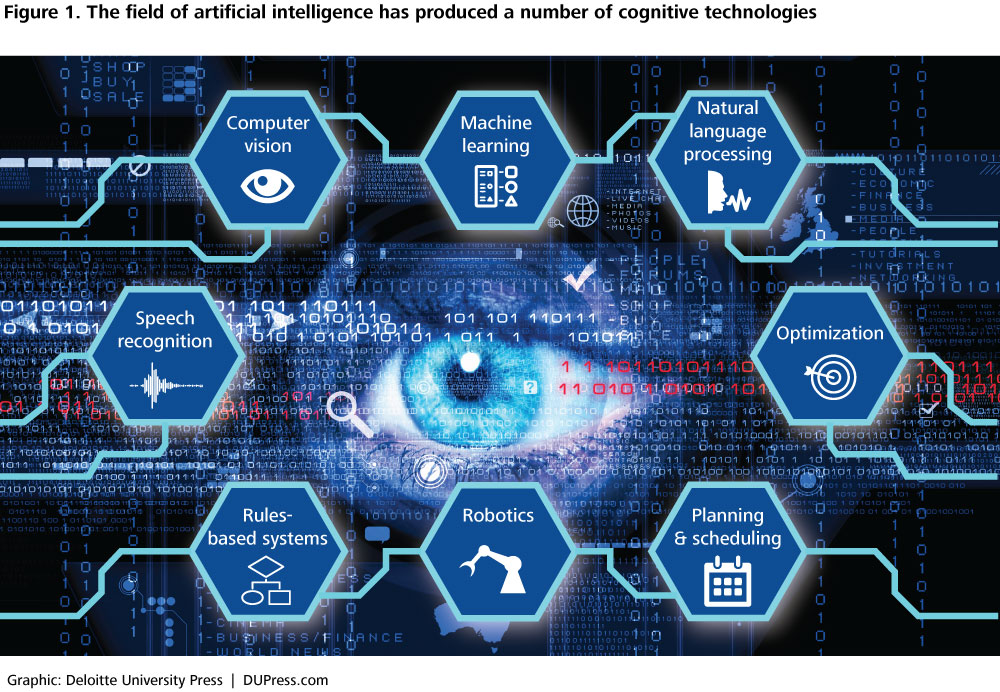
While cognitive technologies are products of the field of artificial intelligence.

They are able to perform tasks that only humans used to be able to do.

Organizations in every sector of the economy are already using cognitive technologies in diverse business functions.

If current trends in performance and commercialization continue, we can expect the applications of cognitive technologies to broaden and adoption to grow.

Billions of investment dollars have flowed to hundreds of companies building products based on machine learning, natural language processing, computer vision, or robotics suggests that many new applications are on their way to market.

We also see ample opportunity for organizations to take advantage of cognitive technologies to automate business processes and enhance their products and services.

If you look at technology we have to-day you could say that it is the knack of so arranging the world that we don’t have to experience it.

We must execute the creation of Artificial Intelligence as the exact application of an exact art.

And maybe then we can win.

I suspect that, pragmatically speaking, our alternatives boil down to becoming smarter or becoming extinct.

Historians will look back and describe the present world as an awkward in between stage of adolescence, when humankind was smart enough to create tremendous problems for itself, but not quite smart enough to solve them.

We are for the moment subject to natural selection which isn’t friendly, nor does it hate you, nor will it leave you alone.

The point about underestimating the potential impact of Artificial Intelligence is symmetrical around potential good impacts and potential bad impacts.

When something is universal enough in our everyday lives, we take it for granted to the point of forgetting it exists.

It may be tempting to ignore Artificial Intelligence because,of all the global risks but we do so AT GRAVE RISK OF CREATING A DIGITAL DIVIDE WORLD.  Afficher l'image d'origine

We cannot query our own brains for answers about nonhuman optimization processes— whether bug-eyed monsters, natural selection, or Artificial Intelligences.

DUP-1030_WP-intro-image

How then may we proceed?

How can we predict what Artificial Intelligences will do?

The human species came into existence through natural selection, which operates through the non chance retention of chance mutations.

Artificial Intelligence comes about through a similar accretion of working algorithms, with the researchers having no deep understanding of how the combined system works. Nonetheless they believe the AI will be friendly,with no strong visualization of the exact processes involved in producing friendly behavior, or any detailed understanding of what they mean by friendliness.

Friendly AI is an impossibility, because any sufficiently powerful AI will be able to modify its own source code to break any constraints placed upon it.

This does not imply the AI has the motive to change its own motives.

Sufficiently tall skyscrapers don’t potentially start doing their own engineering.

Humanity did not rise to prominence on Earth by holding its breath longer than other species.

Humans evolved to model other humans—to compete against and cooperate with our own conspecifics.

Robots will not.

It’s mistaken belief that an AI will be friendly which implies an obvious path to global catastrophe.

Artificial Intelligence is not an amazing shiny expensive gadget to advertise in the latest tech magazines.

Artificial Intelligence does not belong in the same graph that shows progress in medicine, manufacturing, and energy.

Artificial Intelligence is not something you can casually mix into a lumpen futuristic scenario of skyscrapers and flying cars and nanotechnologies red blood cells that let you hold your breath for eight hours.

A sufficiently powerful Artificial Intelligence could overwhelm any human resistance and wipe out humanity. (And the AI would decide to do so.)

Therefore we should not build AI.

On the other hand.

A sufficiently powerful AI could develop new medical technologies capable of saving millions of human lives. (And the AI would decide to do so.)

Therefore we should build AI.

Once computers become cheap enough, the vast majority of jobs will be performable by Artificial Intelligence more easily than by humans.

A sufficiently powerful AI would even be better than us at math, engineering, music, art, and all the other jobs we consider meaningful. (And the AI will decide to perform those jobs.) Thus after the invention of AI, humans will have nothing to do, and we’ll starve or watch television.

So should we prefer that nanotechnology precede the development of AI, or that AI precede the development of nanotechnology?

As presented, this is something of a trick question.

The answer has little to do with the intrinsic difficulty of nanotechnology as an existential risk, or the intrinsic difficulty of AI. So far as ordering is concerned, the question we should ask is, “Does AI help us deal with nanotechnology? Does nanotechnology help us deal with AI?”

The danger of confusing general intelligence with Artificial Intelligence  is that it leads to tremendously underestimating the potential impact of Artificial Intelligence.

The best way I can think of to train computers to be able to get them watch a lot of videos and observe what they Predict.

Prediction is the essence of intelligence.

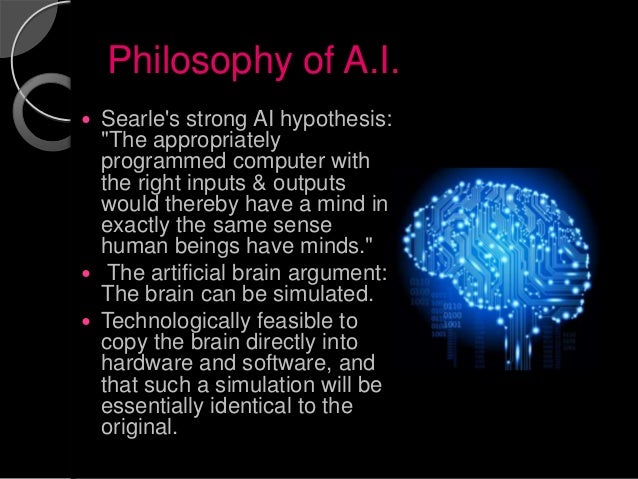
All scientific ignorance is hallowed by ancientness.Philosophy of A.I. Searles strong AI hypothesis: "The appropriately programmed computer with the right inputs & output...

Here is a closing thought.

When a Super Intelligent Robot returns to earth from a voyage in space how can it be trusted to tell us the truth.

Exactly how AI systems should be integrated together is still up for debate.

With every advance, and particularly with the advances in machine learning and deep learning more recently,we get more tools to fuck up the world we all live on.

Ours is a less than excessively age.

We know so much and feel so little.

All comments welcome, all like clicks chucked in the bin.

← Back

Thank you for your response. ✨


Share this:

  • Share on WhatsApp (Opens in new window) WhatsApp
  • More
  • Share on Mastodon (Opens in new window) Mastodon

THE BEADY EYE SAYS: CAPITALISM’S IS DRIFTING TOWARDS A CULTURAL APOCALYPSE.

30 Monday Jan 2017

Posted by bobdillon33@gmail.com in Artificial Intelligence., Donald Trump Presidency., European Union., HUMAN INTELLIGENCE, Humanity., Life., Modern day life., Natural World Disasters, Our Common Values., Social Media., Sustaniability, Technology, The Future, The USA., The world to day., Unanswered Questions., United Nations, What Needs to change in the World, Where's the Global Outrage., World Organisations., World Politics

≈ Comments Off on THE BEADY EYE SAYS: CAPITALISM’S IS DRIFTING TOWARDS A CULTURAL APOCALYPSE.

Tags

Artificial Intelligence., Capitalism and Greed, Capitalism vs. the Climate., Community cohesion, Distribution of wealth, European Union, Globalization, Inequility, Technology, The Future of Mankind, THE UNITED NATIONS, Visions of the future.

( A two-minute follow-up read to the Post ” What is happening to what we call common values.)

Afficher l'image d'origine

Perhaps with the election of Donald Trump it has already happened.

Why?

Because capitalism has and still is creating an explosion in economic and geographic inequality which is now fueled by commercial Artificial Intelligence.

The tragedy is that our World leaders and World Organisations seem inapt to do anything about it.

The main lesson for European and the rest of the world is clear:Afficher l'image d'origine

As a matter of urgency globalization must be fundamentally reorientated.

Trade agreements must be revisited to become a means in the service of higher ends.

They must include quantifying and binding measures to combat the digital fiscal and climate dumping.

They must have a prosecutor capable of enforcing what is agreed.

Its time to change the political discourse on globalization, trade is a good thing, but fair and sustainable development also demands public services, infrastructure, health and education. These demand fair taxation systems

If we fail to deliver these the ludicrous fantasy of Trumpism testosterone imperialism will win with the dignity of world leaders reduced to one’s shopping choices.

Here are a few other thought as to why:Afficher l'image d'origine

Because: Globalisation it is being replaced in economic by Artificial Intelligence calculation to satisfy consumer demands.

Because: With Trump closing of the USA will change the domination of the capitalism globe.  It will now exist for a Chinese Communist party that gives delocalised capitalist enterprise cheap labour to lower prices.

Because:  Technology – along with its turbo economic disruption is causing what seems to me to be the hastening of both a cultural and environmental apocalypse.

Because:  Digital consumerism makes us too passive to revolt or save the world. Humans have been transferred into desirable readily exchangeable commodities. Culture appears more monolithic than ever. Google, Apple, Facebook, Amazon, are now presiding over unprecedented monopolies.

Because: The Internet discourse has become tighter, more coercive.

Because:  Human personality is being corrupted by false news creating false consciousness that there is hardly anything worth the name anymore.

Because:  Common Values are scarcely signifies any more – than white skin, white teeth and freedom from odour and emotions.

Because:  Popularising, is a failure of the US and the EU to democratise in an attempt to create a one-dimensional society.

Because:  Social Media operates on an eternal feeding loop.

Because:  Our world organisations are out of date.

Because: Trade agreements aren’t worth the paper they are written.

Because: If we destroy or Atmosphere , or Seas, or Fresh Water all for the sake of profit, there is little reason to believe in a Christian or Muslim God or for that matter any other Gods that will make a difference.Afficher l'image d'origine

All comments appreciated. All likes clicks chucked in the bin.

← Back

Thank you for your response. ✨


Share this:

  • Share on WhatsApp (Opens in new window) WhatsApp
  • More
  • Share on Mastodon (Opens in new window) Mastodon

THE BEADY EYE ASKS: WHAT IS HAPPENING TO WHAT WE CALL COMMON VALUES?

29 Sunday Jan 2017

Posted by bobdillon33@gmail.com in Artificial Intelligence., Donald Trump Presidency., England EU Referendum IN or Out., European Union., Google it., HUMAN INTELLIGENCE, Humanity., Life., Modern day life., Our Common Values., Politics., Technology, The Future, The world to day., Unanswered Questions., What Needs to change in the World, Where's the Global Outrage.

≈ Comments Off on THE BEADY EYE ASKS: WHAT IS HAPPENING TO WHAT WE CALL COMMON VALUES?

Tags

Artificial Intelligence., Community cohesion, Digital Divide., European Union, Our Common Values., Technology, The Future of Mankind, Visions of the future.


(A twelve-minute read if you value your time)

For some naive reason I thought this would be an easy subject to write on.Afficher l'image d'origine
After all, we all value fresh air, clean water, and the other essential to living- Life.

If we remove our personal values and look at our shared convictions regarding what we believe is important and desirable , of course, we are left with valuing the right things and surely they are common values but the term “values” means different things in different contexts.

So much so that we are no longer connected by Our Common Values.

In reality we understand that our choices are always significantly limited, and that our values shift over time in unpredictable ways.

This is especially true with emerging technologies, where values that may lead one society to reject a technology are seldom universal, meaning that the technology is simply developed and deployed elsewhere. In a world where technology is a major source of status and power, that usually means the society rejecting technology has, in fact, chosen to slide down the league tables.

Take for instance choice.

To say that one has a choice implies, among other things, that one has the power to make a selection among options, and that one understands the implications of that selection. Obviously, reality and existing systems significantly bound whatever options might be available. In 1950, I could not have chosen a mobile phone:

So it is premature to say that we understand how to implement meaningful choice and responsible values when it comes to emerging technologies.

Technology is changing far faster than the institutions we’ve traditionally relied on to inform and enforce our choices and values.

However current progress in meeting the profound challenges that humanity must confront falls far short of what is needed.

Combined with the need for a new understanding about the way that people think raises complex ethical questions concerning our common values makes it a complex subject to address.Holistic Approach

So let’s try and address it under these broad headings.

The Rule of Private Gain. If you are the only one personally gaining from the situation, is it is at the expense of another?  If so, you may benefit from questioning your ethics in advance of the decision.

If Everyone Does It. Who would be hurt? What would the world be like? These questions can help identify unethical behaviors.

Benefits vs. Burden. If benefits do result, do they outweigh the burden?

Or we can bury our heads in the sand, and insist on the sanctity of Enlightenment reason.

Or we can respond to the new understanding of how decision-making processes work, by demanding that there is public scrutiny of the effect that particular communications, campaigns, institutions and policies have on cultural values, and the impact that values, in turn, have on our collective responses to social and environmental challenges.

The first thing that struck me, is that these days there is no such thing as value-neutral policy.

Often, if the facts don’t support a person’s values, “the facts bounce off”

If you need an example you need to look no further than what we are witnessing with president-elect Mr Donald Trump and the English vote to leave the European Union.

President Trump has little understanding that American Values that crossed the Atlantic with those who sailed from Europe and Slaves from Africa to help create the USA.

Their values have stood the test of time till now.

Mrs May on the other hand carrying the cultural and historical baggage of an Empire that supplied the slaves  and is now reaping the reward of leaving the European Union’s blueprint for success which relies not only on securing economic prosperity but also on consensus on core values common to all the EU Member States.

( In the EU the original emphasis on economic development and environmental protection has been broadened and deepened to include alternative notions of development (human and social) and alternative views of nature (anthropocentric versus egocentric). Thus, the concept maintains a creative tension between a few core principles and an openness to reinterpretation and adaptation to different social and ecological contexts.

The Union is founded on the values of respect for human dignity, freedom, democracy, equality, the rule of law and respect for human rights, including the rights of persons belonging to minorities.)

She is now clasping hands with a country that is also denuding itself of core values.

Many studies have established substantial correlations between people’s values and their corresponding behaviours.

Unfortunately our troubled world is no longer affected by common values, they being manipulated by simply flooding the public with as much sound data as possible on the assumption that the truth is bound, eventually, to drown out its competitors.

If, however, the truth carries implications that threaten people’s cultural values, then… [confronting them with this data] is likely to harden their resistance and increase their willingness to support alternative arguments, no matter how lacking in evidence” (Kahan, 2010: 297).

The idea that people can be ‘nudged’ into new forms of behaviour by having their brains massaged in a certain way, is built on the premise that we are not rational beings to be engaged with. It’s very foundation is the elite’s view of us, not as people to be talked to, argued with and potentially won over, but problematic beings to be remade” (O’Neill, 2010; emphasis in original).

Values have a profound impact on a person’s motivation to express concerns about a range of bigger-than-self problems. Indeed, they are values that must be championed if we are to uncover the collective will to deal with today’s profound global challenges.

Undoubtedly these are values that have been weakened – and often even derided – in modern culture. They are not, for example, values that are fostered by treating people as if they are, above all else, consumers. 

As humans our biological tendencies push us towards both altruism and selfishness, artificial intelligence is removing any sense of common values.

While humans are capable of displays of enlightened self-interest, we cannot hope that individuals will subjugate their own self-interest to the pursuit of the greater common good. The best for which we can hope, therefore, is to exploit those instances where self-interest and the common good happen to coincide – often called ‘win-win’ scenarios.

It also seems clear to me that, in trying to meet these challenges, civil society organisations must champion some long-held (but insufficiently esteemed) values, while seeking to diminish the primacy of many values which are now prominent – at least in Western industrialised society.

Values are also shaped by people’s experience of public policies.

It is therefore crucial to ask: which values does society accentuate?

People’s motivation to engage with political process, and to demand change, is shaped importantly by their values.

Civil society organisations must strive for utmost transparency about the effect of communications and campaigns in shaping public attitudes.

Bolder leadership from both political and business leaders is necessary if proportional responses to these challenges are to emerge, but active public engagement with these problems is of crucial importance.

This is partly because of the direct material impacts of an individual’s behaviour (for example, his or her environmental footprint), partly because of lack of consumer demand for ambitious changes in business practice, and partly because of the lack of political space and pressure for governments to enact change.

This will require a change in societal values, and commitments by wealthier nations to assist others in the protection of wilderness resources of global concern.

One hundred years from now, when historians look back on this period of history, what will they think of the wilderness debate?

Will it be irrelevant to them or will it represent a vital component of a societal watershed of thought that changed the way in which society viewed itself and its relationship to Planet Earth?

Some values are mutually consistent, others tend to act to oppose one another. Activating a specific value causes changes throughout the whole system of that person’s values; in particular, it has the effect of activating compatible values and suppressing opposing values.

The implication of this is that business practice, government policy and civil society communications and campaigns must take responsibility not just for their ‘material impacts’ (what they achieve ‘on the ground’), but also for the effect they have on dominant cultural values.

It is often argued that, because a problem – climate change, for example – is of urgent concern, there ‘is not enough time’ for systemic responses.

This is a suspect argument: it seems at least as likely that appeal to ‘easy wins’ on climate change will actually serve to help defer ambitious action until it becomes “too late” for this to be taken effectively.

We must build a visual and compelling vision of low-carbon heaven.

It seems that one way in which values become strengthened is through their repeated activation.  This may occur, for example, through people’s exposure to these values through influential peers, in the media, in education, or through people’s experience of public policies.

The future is already through technology bring means that devalue that past and are, to a large extent, unconscious of the present. The Internet, the Smart Phone, artificial Intelligent Apps are all contributing to this.

This means that we value and collect more material objects. It also means we give higher priority to obtaining, maintaining and protecting our material objects than we do in developing and enjoying interpersonal relationships.

Even the gloomiest of assessments of human nature lead to the conclusion that we should be working to mitigate unhelpful aspects of our biology through cultural interventions.

This constitutes a timely opportunity to further reflect.

Man always kills the thing he loves.

In the United States, people consider it normal and right that Man should control Nature, rather than the other way around.

Up to the election of Mr Trump:  Equality was, for Americans, one of their most cherished values. This concept is so important for Americans that they have even given it a religious basis.

To prevent the silent creeping erosion of our European project it has to be more focused on essentials and on meeting the concrete expectations of its citizens. I am convinced that it is not the existence of the Union that is object to but the way it functions.

Institutions that examine power and responsibility, and audit their ethical decisions regularly, develop employees that function with honesty and integrity and serve their institution and community.

It is imperative that we appreciate that each person’s intrinsic values are different. Because values are so ingrained, we are not often aware that our responses in life are, in large part, due to the values we hold and are unique to our own culture and perspective.

What is ethically responsible is not just fixation on rules or outcomes.

Rather, it is to focus on the process and the institutions involved by making sure that there is a transparent and workable mechanism for observing and understanding the technology system as it evolves, and that relevant institutions are able to respond to what is learned rapidly and effectively.

Indeed, much of what we do today is naive and superficial, steeped in reflexive ideologies and overly rigid worldviews. But the good news is that we do know how to do better, and some of the steps we should take. It is, of course, a choice based on the values we hold as to whether we do so.

The values that must be strengthened – values that are commonly held and which can be brought to the fore – include: empathy towards those who are facing the effects of humanitarian and environmental crises, concern for future generations, and recognition that human prosperity resides in relationships – both with one another and with the natural world.

In making judgements, feelings are more important than facts.

Can you imagine big business embracing humility as a core value?

If wilderness is to exist into the future. (It is a finite resource.  It is a non-renewable resource.  It is a non-substitutable resource. It is an irreversible resource. It is a common resource.) Has the time come for us to govern ourselves? Our experience and conceptualisations are not random; they are stored in structured forms in long-term memory.

Values have been defined as psychological representations of what we believe to be important in life.

To be ethically successful, it is paramount that we understand and respect how values impact our social environment. How we perceive ourselves and operate within our environment is of such importance that institutions establish rules of ethical behavior that relate to practice.

Political leaders have profound influence over people’s deep frames, in important part through the policies that they advocate.

Values can be both activated (for example, by encouraging people to think about the importance of particular things), and they can be further strengthened, such that they become easier to activate by education which has an important impact on their value.

Afficher l'image d'origine

A final thought: We all value our own lives, it is how we conduct that life that gives value to it. It has no meaning without values.

No individual man or woman and no nation must be denied opportunity to benefit from development whether its technological or otherwise that exceeds our humanity.

A digital divide threatens us all, both rich and poor, it is also testing our values.

Are we all googling while Rome Burns.?

Technology has a multiplying power. Websites have become multi media platforms and Television stations are now media centers where the evening news broadcast is secondary to the accompanying pod casting blogging with interactive forms as Twitter, Face Book, etc.

Use them to put the flames out. Values offer focus amidst the chaos.Afficher l'image d'origine

If you got this far I value your time and comments not your like clicks.

← Back

Thank you for your response. ✨


Share this:

  • Share on WhatsApp (Opens in new window) WhatsApp
  • More
  • Share on Mastodon (Opens in new window) Mastodon
Newer posts →

All comments and contributions much appreciated

  • THE BEADY EYE SAYS. EQUALITY, FAIRNESS, JUSTICE ARE INDIVISIBLE CONCEPTS IF ARE ANYTHING. March 18, 2026
  • THE BEADY EYE SAYS. IT DOES MATTER WHAT YOU THINK ABOUT WAR WHETHER ITS JUSTIFIED OR NOT. March 17, 2026
  • THE BEADY EYE ASKS HOW ARE WE TO MAINTAIN HUMAN DIGNITY IN A WORLD DOMINATED BY TECHNOLOGY. March 15, 2026
  • THE BEADY EYE SAYS THANKS TO CURRENT TECHNOLOGIES WE ARE UNABLE TO BELIEVE ANYTHING WE SEE OR HEAR? March 15, 2026
  • THE BEADY EYE SAYS LET’S PUT THE IRAN/ ISRAEL/ USA WAR IN CONTEX. March 12, 2026

Archives

  • March 2026
  • February 2026
  • January 2026
  • December 2025
  • November 2025
  • October 2025
  • September 2025
  • August 2025
  • July 2025
  • June 2025
  • May 2025
  • February 2025
  • January 2025
  • December 2024
  • November 2024
  • October 2024
  • September 2024
  • August 2024
  • July 2024
  • June 2024
  • May 2024
  • April 2024
  • March 2024
  • February 2024
  • January 2024
  • December 2023
  • October 2023
  • September 2023
  • August 2023
  • July 2023
  • June 2023
  • May 2023
  • April 2023
  • March 2023
  • February 2023
  • January 2023
  • December 2022
  • November 2022
  • October 2022
  • September 2022
  • August 2022
  • July 2022
  • June 2022
  • May 2022
  • April 2022
  • March 2022
  • February 2022
  • January 2022
  • December 2021
  • November 2021
  • October 2021
  • September 2021
  • August 2021
  • July 2021
  • June 2021
  • May 2021
  • April 2021
  • March 2021
  • February 2021
  • January 2021
  • December 2020
  • November 2020
  • October 2020
  • September 2020
  • August 2020
  • July 2020
  • June 2020
  • May 2020
  • April 2020
  • March 2020
  • February 2020
  • January 2020
  • December 2019
  • November 2019
  • October 2019
  • September 2019
  • August 2019
  • July 2019
  • June 2019
  • May 2019
  • April 2019
  • March 2019
  • February 2019
  • January 2019
  • December 2018
  • November 2018
  • October 2018
  • September 2018
  • August 2018
  • July 2018
  • June 2018
  • May 2018
  • April 2018
  • March 2018
  • February 2018
  • January 2018
  • December 2017
  • November 2017
  • October 2017
  • September 2017
  • August 2017
  • July 2017
  • June 2017
  • May 2017
  • April 2017
  • March 2017
  • February 2017
  • January 2017
  • December 2016
  • November 2016
  • October 2016
  • September 2016
  • August 2016
  • July 2016
  • June 2016
  • May 2016
  • April 2016
  • March 2016
  • February 2016
  • January 2016
  • December 2015
  • November 2015
  • October 2015
  • September 2015
  • August 2015
  • July 2015
  • June 2015
  • May 2015
  • April 2015
  • March 2015
  • February 2015
  • January 2015
  • December 2014
  • November 2014
  • October 2014
  • September 2014
  • August 2014
  • July 2014
  • June 2014
  • May 2014
  • April 2014
  • March 2014
  • February 2014
  • January 2014
  • December 2013
  • November 2013
  • October 2013

Talk to me.

Jason Lawrence's avatarJason Lawrence on THE BEADY EYE ASK’S: WIT…
benmadigan's avatarbenmadigan on THE BEADY EYE ASK’S: WHA…
bobdillon33@gmail.com's avatarbobdillon33@gmail.co… on THE BEADY EYE SAYS: WELCOME TO…
Ernest Harben's avatarOG on THE BEADY EYE SAYS: WELCOME TO…
benmadigan's avatarbenmadigan on THE BEADY EYE SAY’S. ONC…

7/7

Moulin de Labarde 46300
Gourdon Lot France
0565416842
Before 6pm.

My Blog; THE BEADY EYE.

My Blog; THE BEADY EYE.
bobdillon33@gmail.com

bobdillon33@gmail.com

Free Thinker.

View Full Profile →

Follow bobdillon33blog on WordPress.com

Blog Stats

  • 97,811 hits

Blogs I Follow

  • unnecessary news from earth
  • The Invictus Soul
  • WordPress.com News
  • WestDeltaGirl's Blog
  • The PPJ Gazette
Follow bobdillon33blog on WordPress.com

The Beady Eye.

The Beady Eye.
Follow bobdillon33blog on WordPress.com

Blog at WordPress.com.

unnecessary news from earth

WITH MIGO

The Invictus Soul

The only thing worse than being 'blind' is having a Sight but no Vision

WordPress.com News

The latest news on WordPress.com and the WordPress community.

WestDeltaGirl's Blog

Sharing vegetarian and vegan recipes and food ideas

The PPJ Gazette

PPJ Gazette copyright ©

Privacy & Cookies: This site uses cookies. By continuing to use this website, you agree to their use.
To find out more, including how to control cookies, see here: Cookie Policy
  • Subscribe Subscribed
    • bobdillon33blog
    • Join 222 other subscribers
    • Already have a WordPress.com account? Log in now.
    • bobdillon33blog
    • Subscribe Subscribed
    • Sign up
    • Log in
    • Report this content
    • View site in Reader
    • Manage subscriptions
    • Collapse this bar