• About
  • THE BEADY EYE SAY’S : THE EUROPEAN UNION SHOULD THANK ENGLAND FOR ITS IN OR OUT REFERENDUM.

bobdillon33blog

~ Free Thinker.

bobdillon33blog

Author Archives: bobdillon33@gmail.com

THE BEADY EYE ASK’S: WITH SO MANY WARS IN THE WORLD WHY IS ENGLAND TURNING ITS BACK ON THE ASPIRATION OF A UNITED PEACEFUL EUROPE. DO YOU KNOW HOW MANY CURRENT WARS WE HAVE IN THE WORLD.

25 Thursday Jan 2018

Posted by bobdillon33@gmail.com in War.

≈ Comments Off on THE BEADY EYE ASK’S: WITH SO MANY WARS IN THE WORLD WHY IS ENGLAND TURNING ITS BACK ON THE ASPIRATION OF A UNITED PEACEFUL EUROPE. DO YOU KNOW HOW MANY CURRENT WARS WE HAVE IN THE WORLD.

Tags

Current world problems, Future wars, War, World conflicts., World Wars.


( A Fifteen Minute read)

As you read this, there are more than 40 conflicts unfolding in countries around the world. You could not be blamed for thinking that most of the world is in conflict.

They all seem to overflow into one great swam of human misery that occupy our News on a daily basis.

These days wars are more to do with identity based in historical, geographical, political, social, cultural and economic realities.

The EU endeavors to appease these differences, however the European Community needs to stop worry about protecting yesterday’s accomplishments rather than facing tomorrow’s challenges.

THIS IS HIGHLIGHTED BY ENGLAND PENDING DEPARTURE LEADING TO THE   QUESTION:

DOES A DEFINABLE, IF NASCENT EUROPEAN IDENTITY EXIST OR IS IT LIKE ALL OTHERS.

It should come as no great surprise that most EU citizens regard themselves as belonging within a number of culturally defined groups and do not normally feel that these overlapping identities are incompatible. 

As we are now witnessing with England’s departure and the divide between northern Europe and the Southern Europe.

The critical moments that lead to war are those when one or more identities take precedence over the others. So the objective of the EU must be to reach a stage at which regional, national, European and other identities are regarded as compatible rather than competitive.

This stage has not yet been reached and it may be argued that reaching this plateau is the major challenge which the Union faces in the next century.

It is extremely difficult to construct a European cultural project which embraces both the differences in European cultures and their common roots but in a world now driven more and more by technology that must be the objective, not isolation. 

Europe is by far the most peaceful region in the world. Yet the continent is not immune to war – Britain, France, Belgium and others are heavily involved in external conflict in the Middle East, and face a growing threat to peace from international terrorism.

It is not inevitable that the logic of unity and interdependence will prevail and there is a consequent danger of a return to a dangerously fragmented Europe with potentially devastating consequences.

So given all the dire warnings from either side about the security of Europe if Britain leaves the EU, does the IEP foresee a change in the region’s fortunes in the event of Brexit?

In the short-term it’s unlikely to have an effect.

The longer-term ramifications, more for Britain than for [the rest of] Europe, would probably depend on what the economic outcome of a British exit would be. If there’s a further deterioration in the economy in England we may well witness an increase in violence.

This is a country that is full of places of worship that are thronged with glorification of war, saturated with historical blood, building two new aircraft carriers, while its people are on trolleys in hospitals.

Leaving the EU for all the wrong reasons, expecting to retain all the advantages of being in the EU but none of the responsibilities and costs.

A self-inflicted position.

At the moment they have the best trade deal possible – the best one imaginable – which is a customs union and access to the European Single Market and the European Economic Area.

The sites covers every ongoing conflict around the world, from Colombia to the Ogaden, from Kashmir to Western Sahara. Pictured, North Korean soldiers march and shout slogans during a military parade marking the 105th birth anniversary of country's founding father, Kim Il Sung in Pyongyang, North Korea April 15, 2017.

We are now further away from world peace than at any time in the past 10 years – and it’s creating a global ‘peace inequality’ gap.

There are now just 10 countries which can be considered truly at peace – in other words, not engaged in any conflicts either internally or externally, completely free from conflict.

The lack of a solution to the refugee crisis and an increase in deaths from major terrorist incidents have all contributed to the world being less peaceful in 2016.

Many of the conflicts  don’t get the media or policy attention of the wars in Iraq, Syria, Afghanistan or Ukraine, and they may not have the same geopolitical or economic importance.

All wars need arms so who is supplying the arms:

Fueling the deadly conflicts for profit.

War kills. And war sells.

Where do nations from every corner of the planet look when they want to increase their arsenals?

Ten countries are responsible for the vast majority of all major arms exports, accounting for 90 percent of global sales with the United States, the world’s largest arms dealers.

The world’s top six major arms exporters are the United States, Britain, Russia, Germany, France and China. Together, they account for 74 percent of the total volume of exports.

Sales are in the region of $31.bn

If you don’t believe me here below is a link to interactive map.

The map is part of a series of articles from IRIN around the concept of forgotten wars.is an interactive map of the current conflicts in the world.

http://www.irinnews.org/feature/2015/07/30/mapped-worlds-conflicts (@irinnews)

It examines the root causes, human cost and potential for peace of conflicts in Myanmar, Casamance, South Kordofan, southern Thailand, and Mindanao in the Philippines.

The map marks each conflict with a red dot.

It is sized to represent how long the battle has been going on,  with the

larger dots representing those that have lasted the longest.

To see more about each conflict, click on the dot.

This brings up a fact box explaining the nature of the conflict, when it began and how many deaths have resulted from it.

Syria has been embroiled in civil war, that is also the biggest and most complex proxy war the world has witnessed.

Mexico’s drug war, fueled by 54 ruthless cartels lust for territory, cash, power and violence has slaughtered as many as 85,000 people since 2006.

Mali, AL-Qaeda took root in the country’s north. Around 4,000 people have been killed in Mali since 2012.

Afghanistan, Taliban and IS.

Iraq, the 2003 US-led Iraq war killed up to a million Iraqis, gave birth to Islamic State.

The conflicts in Afghanistan and Iraq have been going for well over a decade, then it spilled into Syria in 2011, and afterwards into Libya and Yemen.

Yemen, AL-Qaeda and IS have fighters in Yemen, over 7,600 people have been killed in the past two years.

Pakistan, since the 9/11 outrage in 2001, war has been raging between the Taliban, IS.

Lebanon, Nearly a quarter of Lebanon’s population is made up of Syrian refugees and sectarian division has risen as IS battles with the Shia militant group Hezbollah.

Libya, 35,000 people have been killed since the Arab Spring uprising.

Democratic Republic Of Congo, more than 70 groups are fighting despite the presence of 20,000 UN troops.

Somalia, Al-Shabaab had 9,000 fighters in Somalia. IS has a foothold in Somalia and is trying to recruit Al-Shabaab fighters.

India,a fragile ceasefire since 2003 with Kashmir, but still exchange fire across the contested border.

South Sudan, over 50,000 people have been killed and more than 1.6 million displaced since war broke out in 2013. It has raged for more than 60 years.

Egypt, at war against Islamist militants in the Sinai.

Central African Republic, 6,000 people have been killed in the Central African Republic, with 25 per cent of the 4.6 million population displaced.

Ukraine, Russia annexed Crimea in 2014.

Nigeria, 50,000 people have died in the war between regime forces and Islamic State-affiliates Boko Haram.

Israel -Palestine, has forced tens of thousands of Arabs from homes in land grabs.

Turkey, fighting the Kurdish Workers Party the PKK, is hostile to the Kurdish Democratic Unity Party’s armed wing, the YPG, but has good relations with the Kurdish Peshmerga of Northern Iraq. The Turkish and Syrian Kurds are fighting IS and others in Syria but are against the Turkish government.

Potential Wars:

North Korea, technically, it has never stopped being at war with the South since 1953.

East China sea, South China Sea. 

Will any end soon. Not likely.


This autocracy must stop.

The shelf-life of weapons is often longer than the governments and situations they were sold to.

Britain – is now the world’s second largest arms exporter after America – around 120,000 people are employed in weapons dealing.

Two-thirds of UK weapons have been sold to Middle Eastern countries.

If Europe is to escape the cauldron of fragmentation and national strife our shared bonds of European identity must be more broadly defined, given concrete expression and have the flexibility necessary to create an outward-looking and self-confident union of people’s.

The logic of global socio-economic interdependence that spells integration and the logic of ethnicity and nationality that demands separation both apply.

If England leaves the EU without a satisfactory solution to the Irish Border it could reignite one of the longest conflicts in the world going back 700 years.

To make the Irish less Irish backfired once and it will again.

With the coming Climate Change, doubts about the science are being replaced by doubts about the motives of scientists and their political supporters.

Once this kind of cynicism takes hold, is there any hope for the truth?

Climate change deniers argue they are only trying to discover the truth.

We should all be sceptical about that.

No Technology, No Artificial Intelligence, No inequality adjustment, No Frontiers, No Nuclear weapons, No alliances, not anything is going to stop migration.

Where will the next War be?

It will be between the countries relying on the Nile for power and water.

The toll of decades-long conflicts – from Colombia to the Ogaden, from Kashmir to Western Sahara – will be just as devastating for the people who do not live there.

All of the above presupposes that the development of Europe’s cultural identity is a worthy and attainable goal. 

Europe, when you think about it, is a pretty small place. Jump on a plane in London and you can be all the way across the continent, in big old Russia, within just a few hours.

Europe stresses the importance of a continuing dialogue between the present and the past.

All human comments appreciated. All like clicks chucked in the bin.

← Back

Thank you for your response. ✨


Share this:

  • Share on WhatsApp (Opens in new window) WhatsApp
  • More
  • Share on Mastodon (Opens in new window) Mastodon

THE BEADY EYE OPEN LETTER TO MRS THERESA MAY PRIME MINSTER OF ENGLAND. IT’S TIME FOR ENGLAND TO TAKE THE BLINKERS OFF

22 Monday Jan 2018

Posted by bobdillon33@gmail.com in Brexit v EU - Negotiations.

≈ Comments Off on THE BEADY EYE OPEN LETTER TO MRS THERESA MAY PRIME MINSTER OF ENGLAND. IT’S TIME FOR ENGLAND TO TAKE THE BLINKERS OFF

Tags

Brexit v EU - Negotiations.

Re – Seeds of fantasy Read:Résultat de recherche d'images pour "pictures of brexit"

Dear Mrs May.

As I understand it your stated aim for the continuing Brexit negotiations is to secure the exact same economic benefits that England now enjoy’s in the EU.

I regret to inform you that you and your Government is labouring under the misapprehension that it will be able to secure a free trade agreement (FTA) outside of the single market that not only covers goods (like the FTA Canada has with the EU) but most services too.

It almost unheard of to have a FTA – one that sits outside of the single market. Because it would have to be approved by 42 regional and national Parliaments in the EU and domestic political objections in other states would stand in the way.

The FTA Canada has with the EU took seven years to negotiate.

You can only have this if you remain in the single market.

Perhaps it is time for you and Government to refresh your thinking on what is the Single Market.

( The single market provides for tariff-free trade between EU countries and a common framework of rules including employment rights, competition policy, consumer and environment protections. EU countries come together through the customs union and apply the same tariffs to goods from outside the union. Non-EU countries participate in both bodies and doing so is the best way of retaining the benefits of EU membership while being outside the EU.)

You will not be able to enjoy these economic benefits outside of the single market and the customs union. Yet you and your ministers keep insisting otherwise.

The reality is if the EU give England any special arrangements, other third countries with whom they have agreements will demand the same too.

For example, just in case you were not paying attention.

Norway has already warned that giving into UK demands for a special trade deal allowing different UK sectors to participate in the single market without being part of it would force Norway to rip up its own agreement with the EU.  Not to Mention Ireland.

It is sad as the reality of Brexit becomes clear, to see such a great country unable to change its mind.

You and your ministers keep talking about the desire for a “deep and special partnership” and a “bespoke” UK deal.

Unfortunately time is running out to set out what you believe that bespoke agreement would look like because your Cabinet cannot agree on it.

It is time to do the right thing.

To request in the forthcoming negotiations a stay of execution for a period of six, seven years that will allow your government in the House of Commons an opportunity to debate among yourselves what kind of arrangements is wanted between the European Union and the United Kingdom.

I believe you made a profound mistake in pressing the Article 50 button without working out so many of these details, now there is simply not sufficient time to agree a properly bespoke deal.

While I fully appreciate you inherited the situation if you want to stay in power you should be in the long run open to the electorate to take a different view on whether you and the Government should press on with this process.

A moratorium might salvage the wreckage that is coming out of the Article 50 process and allow you to enjoy the Bayeux Tapestry and weave a country that works for everybody.

Yours Sincerely Anglophil.

← Back

Thank you for your response. ✨


The only way Britain can is for Mrs May to do the right thing – by Britain and by Europe – to stop these negotiations and simply.

Share this:

  • Share on WhatsApp (Opens in new window) WhatsApp
  • More
  • Share on Mastodon (Opens in new window) Mastodon

THE BEADY EYE SAY’S: ENDING WORLD POVERTY IS AN UNREALISTIC GOAL. l’

21 Sunday Jan 2018

Posted by bobdillon33@gmail.com in World Aid., World Leaders, World Organisations., WORLD POVERTY WHERE'S THE GLOBAL OUTRAGE

≈ Comments Off on THE BEADY EYE SAY’S: ENDING WORLD POVERTY IS AN UNREALISTIC GOAL. l’

Tags

Artificial Intelligence., Capitalism and Greed, Eradicate poverty, Inequalities of opportunity, Inequility, Poverty reduction, SMART PHONE WORLD, Solutions to Poverty, Solve World Poverty., The Future of Mankind, Visions of the future., world poverty


( A twelve-minute read that could be the answer to Poverty)

You don’t have to be Einstein to recognize that inequality in all its forms is what wrong with our world. It haunts every minute of our lives no matter who you are, however  ‘Ending world poverty is an unrealistic goal’Résultat de recherche d'images pour "pictures of poverty around the world"

It is policy not aid which matters most in today’s world.

Why?

Because the politics of inequality in the future will be as important as the economics of the Future.

Relative poverty is unpreventable without tackling inequalities. 

The aspirations of delivering a world where the quality of education, healthcare and national infrastructure available to every person is sufficient to bestow on them meaningful hope and ambition is hopefully the aim of “development”.  I emphasize the word hopeful.

In a world in which a billion people live on $1.26 a day, with climate immigration increasing and technology Algorithms blundering the world’s wealth.

We’re going to have to realize sooner than later that if we are to avoid or end violent conflicts ( That these days has inequality as their triggers) there is only one course to follow and that is to spread the wealth of the world fairly.

Poverty is a perception – it is a status which is bestowed on people who have relatively little – even in societies of plenty. Just look at the prevailing political view on aid to middle-income countries that contain hundreds of millions of desperately poor people.

We all know that the chances of ending poverty altogether are zero.

It would potentially cost some of the world’s biggest businesses billions and would need to be agreed by a group of world leaders who, if they all went out to dinner, would be sat around the table with their calculators out arguing about how to split the bill.

In a world driven by Greed, Advertising, and now more and more by filtered Social Media, we are becoming increasingly desensitized to the blight of others.

For those working in organisations that are dependent on official development assistance, it is hard to talk about ending their dependency, but the 21st century demands the challenge is not ducked.

Too much negativity and accusation of not making any progress with aid money. Comments like Shit Holes, which imply that aid is no longer necessary are undermining our Aid agencies, which are becoming an increasingly endangered species.

So if we accept that we won’t be satisfied if we overcome absolute poverty, where do we go next?

The closer we get to ending extreme poverty, the harder it is going to be to do it.

Imagine how different the world would be if the focus of aid spending was not “ending $1.25 dollar a day poverty” but “creating a fairer and more equitable world”.

Relative poverty will always exist and it should always be at the forefront of efforts to improve our world because it demands more than the bare minimum solution, or Asshole Trumps.

Decisions taken on tax regimes, remittance flows and trade concessions are now not the fastest route to assist poor countries in their development. Inequality is at the root of the reasons why.Résultat de recherche d'images pour "pictures of poverty around the world"

So in this world of inequalities is there any way of assisting development in a meaningful way.

Gadgets like tablets, smartphones and not-so-smart phones are multiplying five times faster than we are, with our population growing at a rate of about two people per second, or 1.2% annually.

The world is home to 7.2 billion gadgets, and they’re multiplying five times faster than we are.

The Mobile phone has done more for Africa than all Aid. No other technology has impacted us like the mobile phone.

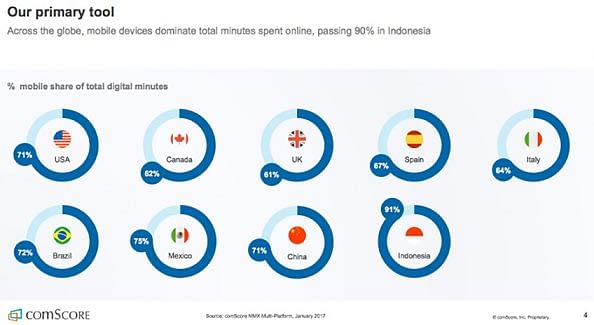
The number of mobile phone users in the world is expected to pass the five billion mark by 2019. In 2016, an estimated 62.9 percent of the population worldwide already owned a mobile phone.

The mobile phone penetration is forecasted to continue to grow, rounding up to 67 percent by 2019.

By 2019, China is expected to reach almost 1.5 billion mobile connections and India almost 1.1 billion.

The number of smart phone users worldwide is expected to grow by one billion in a time span of five years.

It’s not that every person in the world has a mobile device, far from it; more than half of the population don’t have a mobile phone.

There are around 250 million machine-to-machine connections.

That may only be a fraction of the total number of mobile connections, but it was enough to knock us people off our perch in the man vs machine superiority stakes.

Just imaging what would happen if we were to equip everyone in the world (of voting age) with a mobile phone that could receive a basic income on a monthly basis.

Each phone with its unique pin.

With a phone that supplies a basic income we would witnessing a transformation in the way people relate to their governments.

A game-changer.

Not just a safer way to store money, but to reduce the need for Aid, to cut out corruption, to empower the poor, to eradicate inequality, to encourage closing the digital divide with the rest of the world. To give a sense of a future, information, opportunity and choice. To lift young people are currently trapped in poverty, often exacerbated by the need to contribute to their family incomes.

Explosive growth in mobile broadband use across continents would improve transparency and give a voice to citizens.

They would have a major economic, social and political impact.

So instead of the World Bank, the IMF, the Warren Buffets, the Bill Gates, the Mark Zckerbergs, the UN, Oxfam, the WTO, technology has the potential to lift people out of poverty.

There is no reason that a mobile money basic income could not be achieved with the application of a world aid commission of 0.05%. ( See previous posts)

Applying such a commission:  (On all profit seeking Algorithms, on all High Frequency Trading, on all Foreign Exchange Transactions over $50,000, on all Sovereign Wealth Funds acquisitions, to mention just a few of the existing Capitalist instruments that are solely designed for Profit.) would create a perpetual Fund of trillions.

Traditional banking is out of reach for many people in rural areas of developing countries, but mobile is bringing people into the financial system in droves. Financial inclusion, starting with a humble savings account, enables people to start businesses, invest in education and weather bad times.

Mobile still has hurdles to jump before it can reach all the lives of people most in need of the technology: Namely, reliable, affordable energy and comprehensive network coverage.  However you can rest assured if aid was directed to placing a communication satellite in orbit to service Africa or Latin America cell, phone use could help developing the countries within these Continents to plan electrical infrastructure.

There are in the world already a enough used mobile phones to supply most of Africa ( Pop. 1,273,903, 985)

Unfortunately there seems to be a major barrier to people turning in their old phones to be recycled.

To give a couple of examples, a recent survey found that 63% of Canadians have an unused phone at home. And in the UK alone, people are holding on to an estimated 76.8 million unused phones.

If your used phone is a very recent model, you may want to consider sending it in to Fairphone’s recycling program.

So Technology presents as opportunity to articulate a broader and more sustainable vision.

It is essential that we take it.

Poverty shouldn’t be a Catch 22 but in reality, for some, it is.

All human comments and suggestions much appreciated. All like clicks chucked in the bin.

← Back

Thank you for your response. ✨


Share this:

  • Share on WhatsApp (Opens in new window) WhatsApp
  • More
  • Share on Mastodon (Opens in new window) Mastodon

THE BEADY ASK’S: WHERE DO YOU THINK POVERTY CAME FROM AND WHERE IS IT GOING TO END UP.

19 Friday Jan 2018

Posted by bobdillon33@gmail.com in Poverty

≈ Comments Off on THE BEADY ASK’S: WHERE DO YOU THINK POVERTY CAME FROM AND WHERE IS IT GOING TO END UP.

Tags

abject poverty, Capitalism and Greed, Eradicate poverty, Extreme poverty, Solve World Poverty., Technology, The Future of Mankind, Visions of the future., World aid commission, world poverty


( A twenty-minute read if you want a world worth living in)

Most of us were taught that poverty started with the Industrial Revolution.

For the most part this is true but it did not happen in the isolation of the British Empire.

This story is powerful in its simplicity but if we rewind to about 1500 people living in South America, India, and Asia were much better off than Europeans. In fact Europe was just emerging from the dark ages.

China and India controlled most if not nearly all the world economy.

The Question is how did this change and why?

I put it down to Christopher Columbus and shoddy geographical calculations.

On his second outing in the Caribbean he was looking for gold and as a result the Spanish invasion killed must of the islands inhabitants. Then came a bloke named Cortes who ripped off the Aztec of Mexico,followed by Pizarro yet another Spanish conquistador with an unquenchable thirst for gold.

A total of over  185,000 kilograms of gold and 100 million kilograms of silver were pilfer from Latin America and pumped into Spain and then used to pay for Spanish war and debts.

(A 100 million kilograms of silver invested back then @ 5% would amount to $165 trillion to-day. More than double the world’s total GDP to-day)

This wealth allowed Europe to grow its economic wealth beyond the China or India.

The result was Europeans outsourced its labour into wars and colonization reducing the population of the rest of the world by slavery, epidemic diseases and massacres while enjoying the rich life.

(  Free Slavery labour benefited the USA Colonies by over 222.5 million hours)  Britain pay compensation of over £20m to slave owners equivalent to £300 million to-day which tell us nothing of the total value they produced.

The Silver was turned into cotton and sugar and spices. Cotton being the key raw material for the European Industrial Revolution.

The Surviving slaves got nothing.

Indeed without the slave colonies of the New world there would have being no market for the Industrial goods.

You could say that the above is rather a simplistic explanation but development in Africa and Latin America was effectively stolen by Europe.

So where are we to-day.

  • Almost half the world — over 3 billion people — live on less than $2.50 a day.
  • The GDP (Gross Domestic Product) of the 41 Heavily Indebted Poor Countries (567 million people) is less than the wealth of the world’s 7 richest people combined.
  • Nearly a billion people entered the 21st century unable to read a book or sign their names.
  • Less than one per cent of what the world spent every year on weapons was needed to put every child into school by the year 2000 and yet it didn’t happen.
  • 1 billion children live in poverty (1 in 2 children in the world). 640 million live without adequate shelter, 400 million have no access to safe water, 270 million have no access to health services. 10.6 million died in 2003 before they reached the age of 5 (or roughly 29,000 children per day).

Poverty is the state for the majority of the world’s people and nations. Why is this?

Behind the increasing interconnectedness promised by globalization and technology are global decisions, policies, and practices.

Formulated by the rich and powerful.

These can be leaders of rich countries or other global actors such as multinational corporations, institutions, and influential people.

As a result, in the global context, a few get wealthy while the majority struggle.

The poorest are also typically marginalized from society and have little representation or voice in public and political debates, making it even harder to escape poverty.

The amount the world spends on military, financial bailouts and other areas that benefit the wealthy, compared to the amount spent to address the daily crisis of poverty and related problems are often staggering.

To attract investment, poor countries enter a spiraling race to the bottom to see who can provide lower standards, reduced wages and cheaper resources.

This has increased poverty and inequality for most people. It also forms a backbone to what we today call globalization. As a result, it maintains the historic unequal rules of trade.

Now we are looking at a new form of Poverty currently being created by a few monopolies. I call it Algorithm Poverty.

Around the world, in rich or poor nations, poverty has always been present. In most nations today, inequality—the gap between the rich and the poor—is quite high and often widening.

The causes are numerous, including a lack of individual responsibility, bad government policy, exploitation by people and businesses with power and influence, or some combination of these and other factors.

Inequality will affect social cohesion and lead to problems such as increasing crime and violence. Almost half the world—over three billion people—live on less than $2.50 a day and at least 80% of humanity lives on less than $10 a day:Résultat de recherche d'images pour "pictures of poverty in america 2016"

And we wonder why the world is in a state of chaos.

Around 21,000 children die every day around the world. World hunger is a terrible symptom of world poverty.

Food aid (when not for emergency relief) can actually be very destructive on the economy of the recipient nation.

Free, subsidized, or cheap food, below market prices undercuts local farmers, who cannot compete and are driven out of jobs and into poverty, further slanting the market share of the larger producers such as those from the US and Europe.

Poverty leads to hunger. There are many inter-related issues causing hunger. They include land rights and ownership, diversion of land use to non-productive use, increasing emphasis on export-oriented agriculture, inefficient agricultural practices, war, famine, drought, over-fishing, poor crop yields, etc.

Solving world hunger in the conventional sense (of providing/growing more food etc) will not tackle poverty that leads to hunger in the first place.

Further, there is a risk of continuing the poverty and dependency without realizing it, because the act of attempting to provide more food etc can appear so altruistic in motive.

To solve world hunger in the long run, poverty alleviation is required.

For the first time in our history Technology offers us a chance to distribute the world’s wealth fairly.

Without Trade agreements, Aid, Repayment, Corruption, Power Brokering by NGOs, United Nations Begging, Bureaucratic interference, or any other hidden agendas.

It could be both implemented and funded by the very Algorithms that are going to spread poverty. ( See previous Posts)

It requires the large capitalist monopoly platforms to supply a free basic mobile phone to every person register as citizen of a country world-wide.

On registration the people would be allocated a pin number.

This pin would allow them to access a monthly Basic non repayable no strings attached Income payment.

There is no other way of ensuring that our world can fight poverty and climate change.

Most of the causes of hunger are found in global politics.

People are hungry not because the population is growing so fast that food is becoming scarce, but because people cannot afford it.

The number of people overweight or obese is now rivaling the number of people suffering from hunger around the world.

Its time to get off our fat asses and share our wealth not push it around to create more wealth.Résultat de recherche d'images pour "pictures of poverty in america 2016"

Résultat de recherche d'images pour "pictures of poverty in america 2016"

If you want a world worth something in the future now is the time to start creating it. Solve                                             World Poverty once and

For all.

It can be done with the press of a button.

All human comments appreciated. All like clicks chucked in the bin.

← Back

Thank you for your response. ✨


Share this:

  • Share on WhatsApp (Opens in new window) WhatsApp
  • More
  • Share on Mastodon (Opens in new window) Mastodon

THE BEADY ASKS: HAS ENGLAND SOLD OFF ALL OF IT’S INHERITED SILVERWARE AND IS NOW SET FOR BANKRUPTCY 

18 Thursday Jan 2018

Posted by bobdillon33@gmail.com in Brexit v EU - Negotiations., Brexit.

≈ Comments Off on THE BEADY ASKS: HAS ENGLAND SOLD OFF ALL OF IT’S INHERITED SILVERWARE AND IS NOW SET FOR BANKRUPTCY 

Tags

Brexit v EU - Negotiations.

( A three minute read)

Brexit negotiations are about to restart and we just witness the collapse of one of the UK biggest private companies.

Although few people yet realize it, the UK is bankrupt:Notes and coins.

The Government cannot pay its debts nor will it be able to pay for its departure from the EU unless it get an extended transition period, even then it will be on HP terms.

Unfortunately, the Government’s official debt is not the real problem:

The Government’s ‘official’ debt is only a small percentage of its true debt exposure. The official debt is merely the tip of a very large hidden iceberg.

The Government’s true debt is the present value of all the commitments it has entered into, on the expectation that these commitments will be paid for by future taxpayers.

One recent estimate suggested that a UK citizen born in 2011 will inherit, on birth, a debt of perhaps £200,000, and it could easily be much more.

It is simply inconceivable that debts on this scale will be paid off in full.

Nor will they be.

These were not debts that youngsters freely took on, but obligations incurred on their behalf in many cases before they were even born.

The moral question of course is:

At what point does the debt become so large that future children will be born into a new form of slavery, entering the world shackled by the debts of their forbears?

The whole political system is creating a huge intergenerational Ponzi scheme, passing the buck from one generation to the next, until the whole rotten system inevitably collapses under its accumulated weight.

With the collapse of Carillion the government is losing all control of its finances and will once again end up printing money to pay off its debts, so leading to hyperinflation and economic collapse.

the actions are both immoral and reckless with crippling liabilities on top of the national debt, two-thirds of which is made up of “unsustainable” public sector retirement monies.

Overall, the real cost of debt to every man, woman and child in the UK is £53,822 each or over a £100,00 if you are graduating University student.

Since the global financial crisis erupted in 2007. The Bank Of England  has pumped £445bn electronic money into the economy, by what is called quantitative easing programme

 Public sector pensions are a ticking debt bomb with around £1.3trillion needed to cover 93 per cent of the benefits that are currently unfunded.

Britain ‘set for BANKRUPTCY amid £1.85 trillion of hidden debt’

Future generations will inherit a bankrupt country, with two new worthless aircraft carriers, an unusable nuclear deterrent, a high-speed rail system going nowhere, a health service in tatters, a broken up UK, a State funereal that going to cost millions, a pound that worth toilet paper, etc

Make no mistake about it: The country is bankrupt.

Benefits across the board will be cut, massively: the government will renege big-time on many of its commitments, breaking its health, pensions and other promises on a huge scale.

The social and economic consequences don’t bear thinking about.

The cost of Brexit by now should be apparent with a loss of £350m a week to the UK economy.

If you asked me Brexit is far from inevitable.

The collective failure of the English to understand that in a world driven by technology there is no such thing as Sovereign.

The whole fabric of England is at the moment jeopardize.

There are still fifteen months until Britain departs.

I am convinced that the British people provided they are provided with a credible and ambitious social plan that recognizes that the balance of advantages lies in continued EU Membership.

Through humility and what is called cop on.  A new settlement addressing Britain’s inequalities and the EU need to reform can be achieved. Résultat de recherche d'images pour "pictures of brexit"

I can hear the outs saying look at Greece.

The Greek government, which faces more debt repayment deadlines this summer, said it was hoping for a “positive conclusion” to the protracted review of its bailout programme. It has lost more than 25% of its GDP – the biggest downturn to be experienced by an advanced western economy in peacetime – since its financial collapse seven years ago.

So England can rest assured that Brexit will have ‘Grexit’ for company. A debt payment of €7 billion is due in July.

Or Greece could just default out of the euro zone.

Stranger things have happened: Before the term “Brexit” was invented, “Grexit” was the far better-known word — and the more plausible scenario.

All Human comments appreciated. All like clicks chucked in the bin.

← Back

Thank you for your response. ✨


Share this:

  • Share on WhatsApp (Opens in new window) WhatsApp
  • More
  • Share on Mastodon (Opens in new window) Mastodon

A BEADY EYE WARNING: Named Storms Affect Your Insurance Coverage.

17 Wednesday Jan 2018

Posted by bobdillon33@gmail.com in Insurance policies and claims

≈ Comments Off on A BEADY EYE WARNING: Named Storms Affect Your Insurance Coverage.

Tags

Claims., Insurance., Named Storms.


( A ONE MINUTE READ THAT COULD SAVE YOU FROM BEING OUT OF POCKET)

We all know how difficult it is to claim on Insurance policy. Résultat de recherche d'images pour "pictures of insurance claims"

Anthropogenic climate change is rapidly blurring what used to be a factually and rationally supportable distinction between “natural” and “man-made” weather events.

While people have been naming major storms for hundreds of years to days STORMS ARE NOT JUST NAMED TO FACILITATE WEATHER FORECASTERS BUT TO ALLOW INSURANCE COMPANIES TO DEFAULT ON PAYMENTS.

It makes little legal or logical sense to attribute costly and otherwise detrimental weather events to “superior forces” or “God” to which we now know that we mankind have contributed to a very large extent.

The interface between weather problems and contract law, currently established law is not good law. It is becoming archaic and does not match on-the-ground reality.

Everyone including contracting parties must pay heed in order to better protect themselves both practically and legally from the realities of an increasingly volatile climate.

“Extreme” weather has become the new normal.

Previously considered to be inexplicable and unpredictable “acts of God,” such weather can no longer reasonably be said to be so. The use of such phrases as “act of God” or “force majeure” in boilerplate or closely drafted agreements is not and should not be dispositive.

So if God is not in control who is?

Many insurers use this term in their buildings and contents insurance clauses. It refers to an unpredictable, large-scale event that couldn’t have been planned for – such as lightning, a tornado, an earthquake etc.

Severe weather events have vast financial implications for private parties and government entities alike. Thus, the time has come to rethink the doctrine of
impracticability in contract law in relation to weather-related problems.

The insurance sector are paying heed to the effects of climate change and extreme weather on their business performances, by introducing deductible clauses in insurance policies related to Named Storms.

As insurance policies may vary, please check your own policy for language specific to your covered property.

“We will not pay for loss, damage or expense caused directly or indirectly by or resulting from a named tropical storm or hurricane to a property located in a county listed above. Such loss, damage and expense are excluded regardless of any other cause or event that contributes to or aggravates the loss, damage or expense, whether concurrently or in any sequence to the loss.”

An insurer can charge a higher deductible than normal once a weather event becomes a named storm. There is no “usual” anymore when it comes to assessing the risks associated with “extreme”weather events.Hurricane Katrina on August 28, 2005. Image Credit: NASA.

If you are in an area where your property policy excludes coverage for Named Storm, your agent can typically either add Named Storm coverage or may set up a separate policy specifically for that peril.

This naming of storms does not just apply to Home Insurance.

TRAVEL INSURANCE.

Depending on the type of coverage you want, once a storm has been named you’ll be limited to the types of plans and the protection offered, especially plans with cancellation coverage.

Climate change is real and is already affecting humankind as well as our natural surroundings.

They are acts of man.

According to the World Meteorological Organization (WMO), it is easier for people to remember names than numbers and technical terms.

This is not as straightforward as you think.

Ironically if the storm is not named defining a storm can be difficult.

Your insurer will want to see that a storm actually damaged your property and also whether the weather conditions constituted a storm.

Get clued in, not rip off.  Get named Storm cover.

← Back

Thank you for your response. ✨


Share this:

  • Share on WhatsApp (Opens in new window) WhatsApp
  • More
  • Share on Mastodon (Opens in new window) Mastodon

THE BEADY EYE ASKS: IT IS NOT TIME THAT WE TACKLED THE INEQUALITY PARASITE THAT IS AND HAS FOR CENTURIES TORN OUR WORLD APART.

16 Tuesday Jan 2018

Posted by bobdillon33@gmail.com in Universal Basic Income

≈ Comments Off on THE BEADY EYE ASKS: IT IS NOT TIME THAT WE TACKLED THE INEQUALITY PARASITE THAT IS AND HAS FOR CENTURIES TORN OUR WORLD APART.

Tags

Universal Basic Income


( An Eighteen minute read)

You could describe the history of the world in four words ” Kill or be Killed”

If we were honest looking at the state of our planet to-day we would be forced to recognize that we humans have achieved little with what we call democracy or any other political system other than inequality.

Government by the people for the people and of the people is now with the arrival of AI daily becoming a farce.  There is no longer any need to justify or backup a statement or make a speech on a subject. As any constructive counter arguments are prejudiced with a Twit. We are living in a cult of smart Algorithms running our Smart Phones to ensure we only hear what we like in order to ensure our loyalty and profits.

As a result masses of the world population are excluded and marginalized: without work, without any opportunity or means of escaping other than migration.

While our world output is blundered by High Frequency Trading Algorithms on Wall street, and other World Stock exchanges for profit, with the continuing cost of environmental destruction, technology is creating a new structural inequality.

The United nations has poured millions into resolving poverty, wars, environmental protection, summits, it has achieve little other than passing resolutions that fall on deaf ears.

So I ask you, is it not time if we want a world worth living on that we change tack, too reach higher.

In a post-scarcity world why hold back wealth from people just because they can’t provide labor inputs just to create wealth, if we do not offer realistic alternatives, we legitimize the exclusion of the long-term unemployed from the society

At the moment due to the fear of AI replacing what we call work, on any day in New Zealand, 1 Million working aged people are not working, that is 40% of all
workers. In England, the non-workers are about 50%, in the USA the non-workers are 51%, in Spain with a much higher unemployment rate there would be more than 60% not working.

Can we now say that the system is broken?

Inequality in all its forms cannot be cured by Individual Countries, Organisations, Wars, or the begging bowel. Nor will Globalization, Free Trade deals, Nuclear weapons, Education, G8 to G10 summits, and their like have much effect.

But with technology there is an opportunity to take the parasite Greed, (profit for profit sake) that resides in all of us, head on.

While the discussion on the possible implications of the digital economy for labour continues unabated, there is only one way to achieve genuine progress and that is a Universal Basic Income for one and all.

Will a UBI bring more people back into meaningful employment?

Now I know that many will disagree with the following, but if we are to tackle the global gridlock, the world problems we must make Corporate Capitalism pay its fair share.

This share must be perpetual and distributed transparently fairly without any political votes, or repayment. It would distribute the fruits of technological advancement fairly.

The question is would it work: A Universal Basic Income.

Résultat de recherche d'images pour "pictures of basic income"

Could such a policy be implemented not to mention be affordable?

It seems clear that at the technological level, new digital technologies and artificial intelligence makes implementation possible.

Where would the money come from?

By putting an International Wealth Tax or what I like to call  a 05% World Aid commission:

On all High Frequency Trading, on all Sovereignty Wealth Funds acquisitions, an all Foreign Exchange transactions over $ 50,000, on all Search Engines Platforms, on all Twits, on all Facebook Posts, on all Dividends, on all Robotic produced products/ services on all Prize money/ Gambling, Vat, Negative interest rates earnings from Investments, decrease in Military spending  Etc to mention just a few.

This will create a Perpetual Fund of trillions.

Out of which all receive a non repayable Basic income, reduced bureaucracy,while moving towards less conditional social security.

Briefly here is why I think the answer is yes:

1) People will have money to spend – and they will be spending it.
2) Businesses will be busy, and needing to employ more staff.
3) New GST/VAT registered businesses will be starting up as people offer services to each other. Worldwide, people will be catering to the overseas visitor’s market.
4) Smaller communities will be self-supporting retaining their youth in meaningful
employment.
5) Cities will be greatly enriched and new jobs will arrive to cover the increased demand placed on these production centers.

I say, that if economic growth continues, it will bring about ecological disaster. But if economic growth stops (or declines substantially, or the economy contracts), there will be high unemployment and rising inequality.

Whatever we do it will be better than doing nothing. A basic income affords some economic security in a process fraught with uncertainties.

In a world that has succeeded in the globalization of financial assets while keeping political rights enclosed to territories, we need to build new models of democratic governance that enable humanity to collaborate and address pressing global issues. To avoid catastrophic effects of global warming, including sea level rise, increasing droughts, more severe storms, species extinctions, climate refugees and other social consequences of climate change, it is necessary to keep global warming below 2 degrees Centigrade (2C).

The current global average is 5 tons per person.

It might be seen as part of a compact we make with each other, to make sure no one falls below the floor, in exchange for willingness to commit to a decades-long process of transition

To date there have being several Countries trying what is called a Basic income.

Further experiments are necessary to get further data and reports to underscore the significant impact of basic income both to the individual and to the society as a whole and how to initiate and eventually implement a universal basic income in any country.

Show the people what a basic income means to them and let the world decide.

Basic income is by definition fairly simple, but complex and deep in terms of necessity, legitimacy, and direction.Résultat de recherche d'images pour "pictures of basic income"

A technologically advanced society can enter agreements of mutual cooperation
without falling back to the means of coercion and violence.

History teaches that money means power and power means votes but the next Silicon Valley is not in a far away land or on any land at all, but a new frontier of the internet itself rising as the one true open, free and sovereign network of peers.

“What happened to the governments?” I inquired. “It is
said that they gradually fell into disuse. Elections were
called, wars were declared, taxes were levied, fortunes
were confiscated, arrests were ordered, and attempts
were made at imposing censorship — but no one on the
planet paid any attention. The press stopped publishing
pieces by those it called its ‘contributors,’ and also
publishing their obituaries. Politicians had to find honest
work; some became comedians, some witch doctors —
some excelled at those occupations…”
J.L. Borges, Utopia of a Tired Man. Writer (1899–1986).

AND FINALLY:

I WOULD SAY;

That every individual and every organisation involved in the Basic Income debate should ask what they mean by the terms that they employ, and should seek the greatest possible clarity, including clarity over any unstated assumptions lying hidden behind the stated definitions; Some state that the Basic Income will be a right of citizenship, or of legal residence, and others might be taken to assume this.

When that is fully fleshed out, it is not dystopian at all. Business as Usual brings us to dystopia.

Degrowth is a readjustment of priorities, consuming less, but living better.

Any politician running on the platform of reducing economic growth is likely to lose without implementing a Basic Income.

Universal Basic Income may be our only way out.

It will eliminate poverty and reduce inequality, with dignity and security for all

• Save capitalism, as technology substitutes for human labor and reduces wage income/purchasing power

• Encourage entrepreneurship, life-long learning, creative and caring work, and civic engagement

However there is one great problem with a Universal Basic Income ( apart from who gets what) is that if it is going to work it has to be implemented on a global scale.

If not it will only contribute to more Inequality and mass migration to get into the country that has such a system.

All human comments and suggestions appreciated. All like clicks chucked in the bin.

← Back

Thank you for your response. ✨


Share this:

  • Share on WhatsApp (Opens in new window) WhatsApp
  • More
  • Share on Mastodon (Opens in new window) Mastodon

THE BEADY EYE SAYS: THE WORLD OF WORK IS IN A STATE OF FLUX.

14 Sunday Jan 2018

Posted by bobdillon33@gmail.com in 2018: The Year of Disconnection., Capitalism, Democracy, Freedom, Happiness., Innovation., Life., Modern Day Democracy., Our Common Values., Politics., Sustaniability, Technology, The common good., The essence of our humanity., The Future, The Obvious., The world to day., Wealth., What Needs to change in the World, Where's the Global Outrage., World Leaders, World Politics

≈ Comments Off on THE BEADY EYE SAYS: THE WORLD OF WORK IS IN A STATE OF FLUX.

Tags

Artificial Intelligence., Business and Economy, Capitalism, Distribution of wealth, Greed, Inequility, Visions of the future.


( A Sixteen minute read)

How much stuff do we really need to lead a normal life?

Not as much as you might think.

Automation, digital platforms, and other innovations are changing the fundamental nature of work.

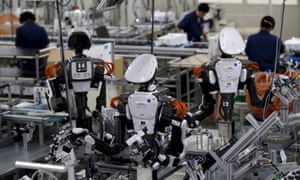
You could say that: The world of work is in a state of flux.Humanoid robots work side by side with employees in the assembly line at a factory in Kazo, Japan.

There is growing polarization of labor-market opportunities between high- and low-skill jobs, unemployment and underemployment especially among young people, stagnating incomes for a large proportion of households, and income inequality.

However the field of robotics promises to be the most profoundly disruptive technological shift since the industrial revolution.

The development of automation enabled by technologies including robotics and artificial intelligence brings the promise of higher productivity (and with productivity, economic growth), increased efficiencies, safety, and convenience. But these technologies also raise difficult questions about the broader impact of automation on jobs, skills, wages, and the nature of work itself.

Somehow, we believe our livelihoods will be safe. They’re not:

Every commercial sector will be affected by robotic automation in the next several years. We have yet to reach the full potential of digitization across the global economy.

More than half the world’s population is still offline.

Greater interaction will raise productivity but require different and often higher skills, new technology interfaces, different wage models in some cases, and different types of investments by businesses and workers to acquire skills.

In a recent report, the World Economic Forum predicted that robotic automation will result in the net loss of more than 5m jobs across 15 developed nations by 2020, a conservative estimate. 40–50% of all jobs will be taken by robots in the next twenty years.

By 2025, average salaries in the robotics sector will increase by at least 60% – yet more than one-third of the available jobs in robotics will remain vacant due to shortages of skilled workers.

Developments in motion control, sensor technologies, and artificial intelligence will inevitably give rise to an entirely new class of robots aimed primarily at consumer markets. For example  “Create Your Taste” kiosk – an automated touch-screen system that allows customers to create their own burgers without interacting with another human being.

The thing is: we’ve heard this all before. Time and time again, we underestimate capitalism’s extraordinary ability to come up with new meaningless jobs. (It’s 37% in the UK right now, but it could be 50%, 60% or even 100% in the future.)

Unless we update our ideas about what ‘work’ even is. The rise in the total of those employed is governed by Parkinson’s Law, and much the same whether the volume of work, were to increase, diminish or even disappear.

Labor which was once the capital of working men will be longer true.

Again: it’s not about the technology, it’s about the choices we make as a society.

When it comes to universal basic income: we don’t have to wait for the robots. We are more than rich enough to do it right now – in fact, we should have done it forty years ago!

Technology is not destiny, education is.

Everything depends on the choices that we make as a society.

If history is any precedent, we already know the answer.

MOST OF US ARE NOW SURROUNDED WITH A PORTION- DISTORTED EMBARRASSMENT OF NOT JUST FOOD BUT GOVERNMENT SIZE.

Guest Blog: Downsizing for Public Health

It’s time for taxpayers to remind themselves just how much the cost of government to run us is..

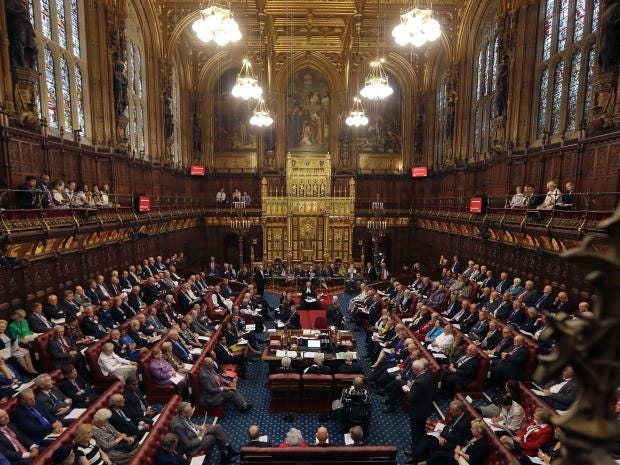
Let’s take the cost of running the UK as an example.Résultat de recherche d'images pour "pictures of house of parliament in london"

The House of Commons with 650 Mbps at £76,000 pa costing the tax payer £156 million a year.

Add in the £6.4m pa given to opposition parties (Short Money), and support items like IT, and the overall total for each MP goes up to £242,000 pa.

But that’s only part of the bill: we also need to add in the costs of running the Commons itself.  According to the HoC Administration Resource Accounts 2006-07, those costs total £210m, which is a further £325,000 per MP.

Oops I nearly forgot the gold-plated final salary pension guaranteed by taxpayers.

The official cost of MPs’ pensions is under 12 per cent of their salary, after 11 per cent contributions from MPs themselves. This adds up to total pay and pension for an MP of £85,000 (their £76,000 salary and £9,000 pension).

So with 650 MPs, that means each one costs us £85,000 pa in salary, pension contributions and employment taxes. Those troublesome “staffing allowances” cost us an additional £57.9m pa- £90,000 for each MP. Then there’s incidental expenses, additional cost allowances, and travel expenses, totaling a further £30.7m (£48,000 each).

Then you have 814 unelected Peers in the House of Lords at £83,000 pa. Costing the tax payer £67,932,000 a year plus £462,510 in tax-free expenses. Members can claim £300 or £150 for every day they attend the House and undertake parliamentary work. The dining rooms and bars are all subsidised by the taxpayer.

Baroness Smith of Gilmorehill, who has claimed £220,000 of expenses over her 27 year career on the red benches, has never spoken in a debate.

The total cost of members’ allowances and travel is around £20 million per annum.

So reducing the size of the House by about 250 members would represent a significant saving to the taxpayer.

Then you have the Civil Service 418,343, (316,792 full-time and 101,551 part-time.)  Gross annual earnings (excluding overtime or one-off bonuses) for Civil Service employees is around £25,350, pa.

You dont have to ask why people are lying on the floors of hospital corridors.

————————————————————————————————-

‘What do you do when there is nothing left to do?’

What should a government faced with an unmanageable level of unemployment do when conventional policy has failed to resolve the issue?’

Perhaps then a seemingly radical solution, such as universal basic income (UBI), becomes plausible. Universal Basic Income (UBI), a form of social security paid to individuals, not households. It is paid to everyone.

It would give individuals the freedom to say ‘yes’ to jobs. Individuals will not have to do that which they do not wish to do. Fewer people will engage in menial and unsatisfying work. Employers may be forced to increase the wages for underpaid or unpaid jobs.

UBI creates a floor (minimum level) on the income distribution curve, alleviates poverty, and gives bargaining power to the ones who have it least.

Forgetting about work for a moment (if you can), think about what you should do when your physiological needs are no longer a concern. If you’ve had a passion at the back of your mind then you might finally pursue it. If, on the other hand, you’ve passed life going from one kind of busy to another, then you might have missed opportunities to reflect and figure out what you would like to be doing. The cost of failure may have been too high if it meant putting you or your family’s livelihood at risk.

Assuming UBI ensures a basic livelihood for everyone in a community, do these citizens have a duty to give back by working? Do individuals have a duty to accept paid, available employment?

I would say Yes: Individuals should have a duty to do something, providing it is socially beneficial. There was something about people helping each other for its own sake that makes for a good society. A society is not well-functioning if it’s members are not interested in actively improving each other’s well-being.

Caring for the those who cannot care for themselves (such as the elderly, children and disabled). One could volunteer for various causes they care about, whether they be social, environmental, tech-related or so on.

Your recognition that you have alleviated the suffering of others might make you feel like you have done something meaningful.

UBI provides the opportunity for you to try contributing to your community in different ways. This freedom lets you find a way to contribute that is most satisfying for yourself.

It would remove fear replacing it with dignity.

UBI would also reduce the cost of citizens relying on the state for assistance.

There are many pending environmental crises hanging over us, but human wastefulness can be avoided. Can you imagine a world of 7.6 billion people no longer struggling for food or shelter and now focused on bettering the world for their children? That’s universal basic income. That’s a legacy we can all leave.

So why is it not being done?

Because it would downsize our consumerism lifestyle and remove inequality.

There is nothing more powerful than an idea whose time has come.

I can hear you saying where will the money come from?

Vat, Negative Interest rates, Earnings from investments, Decreasing militry spending, Sovereign wealth funds, etc.

It would ensure that the distribution of the fruits of technology advancement are distributed fairly. 

As Jeremy Howard said: ” In a post-scarcity world , why hold back wealth from people just because they can’t provide labor inputs just to create wealth.”

All human comments and suggestions appreciated. All like clicks chucked in the bin>

← Back

Thank you for your response. ✨


Share this:

  • Share on WhatsApp (Opens in new window) WhatsApp
  • More
  • Share on Mastodon (Opens in new window) Mastodon

THE BEADY EYE ASK’S. WHERE IT THE TRUTH TO BE FOUND? CERTAINLY NOT ON SOCIAL MEDIA.

12 Friday Jan 2018

Posted by bobdillon33@gmail.com in Communication., Fake News., Google, Social Media, Technology, The world to day., Twitter, Unanswered Questions., What Needs to change in the World, Where's the Global Outrage., World Organisations.

≈ Comments Off on THE BEADY EYE ASK’S. WHERE IT THE TRUTH TO BE FOUND? CERTAINLY NOT ON SOCIAL MEDIA.

Tags

Democracy, Internet, Power of Social Media, SMART PHONE WORLD, Social Media, Social networking, Social world


( A Fifteen minute read)

The internet has loosened our collective grasp on the truth.

It is a fact of the internet that ( with a new social media user, every 15 seconds,) every click, every view and every sign-up is recorded somewhere.

So what exactly is Social Media:Résultat de recherche d'images pour "pictures of social media"

Is it a term relating to gatherings of people that prefer to exist in groups?

Or

Is it the dustbin of idle world gossip.

Not on your Nelly> With billions of people glued to Facebook, Whats App, We Chat, Instagram, Twitter, Weibo and other popular services, social media has become an increasingly powerful cultural and political force, to the point that its effects are now beginning to alter the course of global events.

This is what it is to-day:

Social networks earned an estimated $8.3 billion from advertising in 2015.

  • A 2011 study by AOL/Nielsen showed that 27 million pieces of content were shared every day, and today 3.2 billion images are shared each day.
  • On WordPress alone, 91.8 million blog posts are published every month.
  • It’s estimated that video will account for 74% of all online traffic in 2017.
  • Google processes 100 billion searches a month.
  • 91.47% of all internet searches are carried out by Google.
  • 60% of Google’s searches come from mobile devices.
  • To carry out all these searches, Google’s data centre uses 0.01% of worldwide electricity, although it hopes to cut its energy use by 15% using AI.
  • By 2014, Google had indexed over 130,000,000,000,000 (130 trillion) web pages.

    social sites

    Facebook statistics

    • Facebook adds 500,000 new users every day; 6 new profiles every second.
    • 79% of all online US adults use Facebook.
    • 76% of Facebook users check it every day.
    • The average (mean) number of friends is 155.
    • Half of internet users who do not use Facebook themselves live with someone who does.
    • Of those, 24% say that they look at posts or photos on that person’s account.
    • There are an estimated 270 million fake Facebook profiles.
    • The most popular page is Facebook’s main page with 204.7m likes. The most liked non-Facebook owned page is Christiano Ronaldo’s with 122.6m.
    • There are 60 million active business pages on Facebook.
    • Facebook has 5 million active advertisers on the platform.
    • Facebook accounts for 53.1% of social logins made by consumers to sign into the apps and websites of publishers and brands.

    Twitter statistics

    • 500 million people visit Twitter each month without logging in.
    • There is a total of 1.3 billion accounts, but only 328 million are active,
    • Of those, 44% made an account and left before ever sending a Tweet.
    • The average Twitter user has 707 followers.
    • But 391 million accounts have no followers at all.
    • There are 500 million Tweets sent each day. That’s 6,000 Tweets every second.
    • Twitter’s top 5 markets (countries) account for 50% of all Tweets.
    • It took 3 years, 2 months and 1 day to go from the first Tweet to the billionth.
    • 65.8% of US companies with 100+ employees use Twitter for marketing.
    • 77% of Twitter users feel more positive about a brand when their Tweet has been replied to.

    graph

    You tube statistics

    • 300 hours of video are uploaded to You tube every minute.
    • People now watch 1 billion hours of YouTube videos every day.
    • More than half of YouTube views come from mobile devices.
    • The average mobile viewing session lasts more than 40 minutes.
    • The user submitted video with the most views is the video for Luis Fonsi’s song ‘Despacito’ with 4.36 billion views.
    • YouTube sees around 1,148bn mobile video views per day.
    • In 2014, the most searched term was music. The second was Minecraft.
    • 9% of U.S small businesses use Youtube.
    • You can navigate YouTube in a total of 76 different languages (covering 95% of the Internet population).

    Instagram statistics

    • There are 800 million Monthly Active Users on Instagram.
    • Over 95 million photos are uploaded each day.
    • There are 4.2 billion Instagram Likes per day.
    • More than 40 billion photos have been shared so far.
    • 90 percent of Instagram users are younger than 35.
    • When Instagram introduced videos, more than 5 million were shared in 24 hours.
    • Pizza is the most popular Instagrammed food, behind sushi and steak.
    • 24% of US teens cite Instagram as their favourite social network.

    data chalkboard image

    Pinterest statistics

    • Pinterest has 200 million active users each month.
    • 31% of all online US citizens use the platform.
    • 67% of Pinterest users are under 40-years-old.
    • The best time to Pin is Saturday from 8pm-11pm.
    • In 2014, male audience grew 41% and their average time spent on Pinterest tripled to more than 75 minutes per visitor.

    LinkedIn statistics

    • LinkedIn has 500 million members.
    • 106 million of those access the site on a monthly basis.
    • More than 1 million members have published content on LinkedIn.
    • The average CEO has 930 LinkedIn connections.
    • Over 3 million companies have created LinkedIn accounts.
    • But only 17% of US small businesses use LinkedIn.

    Snapchat Statistics

    • Snapchat has 178m active daily users.
    • 60% of them are under 25.
    • In 2016, $90m was spent on Snapchat ads.
    • 47% of US teens think it’s better than Facebook, while 24% think it’s better than Instagram.

    That’s your fill of social media statistics for now, with just a tiny fraction of the weird and wonderful stats and facts available out there.

    It’s easy to get dragged into the drama and other negative aspects of social media.

    Social media is built for polarisation and extremes.

The basic engagement mechanisms of popular social media sites like Facebook drive people to think and communicate in ever more extreme ways.

Social media is a collective term for all the websites and online services that are erasing national borders and distances.

Social networks are helping to fundamentally rewire human society.

They are used to spread information about dramatic events or to warn others about risky routes. When refugees reach a new country, they can also use social media to contact their fellow countrymen who are already there and find out about things like permits, authorities they can turn to or what things cost.

They have subsumed and gutted mainstream media.

They have undone traditional political advantages like fund-raising and access to advertising.

They are destabilizing and replacing old-line institutions and established ways of doing things, including political parties, transnational organizations and longstanding, unspoken social prohibitions against blatant expressions of racism and xenophobia.

They are helping to create surprisingly influential social organizations among once-marginalized groups. For Example : Brexiters in Britain to ISIS in the Middle East to the hacker collectives of Eastern Europe and Russia.

Each network in its own way is now wielding previously unthinkable power, resulting in unpredictable, sometimes destabilizing geopolitical spasms.

Through this new technology, people are now empowered to express their grievances and to follow people they see as echoing their grievances.

THE QUESTION IS:

IS SOCIAL MEDIA NOW THE JUDGE AND JURY AND THOSE THAT RUN ITS ALGORITHMS ARE NOW THE REAL WORLD POWER BROKERS.

If it wasn’t for social media, I don’t see TRUMP AS PRESIDENT OF THE US.

This has to be the scariest ACHIEVEMENT about Facebook/ Twitter.

Not that Facebook may be full of lies (a problem that could potentially be fixed), but that its scope gives it real power to change history in bold, unpredictable ways.

But that’s where we are.

It’s time to start recognizing that social networks actually are becoming the world-shattering forces that their boosters long promised they would be — and to be unnerved, rather than exhilarated, by the huge social changes they could uncork.

This should come as no surprise.

Facebook and Twitter have become the new TV, where businesses can’t control their messaging as they once were able to do with TV ads.

In a way, we are now living through a kind of bizarro version of the utopia that some in tech once envisioned would be unleashed by social media.

Online campaigns directed at GOVERNMENTS OR FOR THAT MATTER AGAINST BRANDS can be a lot more effective than writing. Pay-to-play strategy by letting posts run and gain organic traction before boosting them.

Efforts to fight this dismaying trend are obviously worth pursuing, but is it time to give our due to the new political activism – Social Media. The king of communication.

As it becomes increasingly commercialised there is a risk that people – particularly young people – will see social media content as being politically and commercially independent.

What it means to get caught in a Twitter storm. Facts tell, but stories sell.

In actual fact, the very opposite is true.

When you sign up for Facebook, you also accept a business model that can use information about what you do and how you feel, for example in marketing.

One terrifying example is how the terrorist group ISIS uses social media to recruit new supporters. Potential ISIS fighters can be invited to join private Facebook groups where they are put into contact with individuals who are active in Syria.

However if used in a responsible manner it s also a new tool for democracy.

More people can express their views and form opinions. There are also examples of individuals who have quickly succeeded in raising large sums of money for those in need.

The Impotence of Social Media is in its nucleus accumbens. 

People tend to follow the behavior of the group.” If other people have liked a post, new viewers will be more likely to like it too. And that popularity can feed on itself, changing their behavior to try to get social approval, respond to headlines without any in-debt knowledge of what the headline refers to. 

A single ‘like’ can make a social-media post more popular.

Many social media sites share more of the higher-ranked — or more popular — posts. As a result, “people are more likely to see what others have positively rated,”  what’s in those photos is socially acceptable.

Skip pictures with few likes.

Likes can have a subtle but significant effect on how teens interact with friends online.

The important take-home message here, is that Social media shapes how we perceive the world around us.

When people express themselves through social media, they communicate collectively.

Members of social media communities direct raw emotions into particular interests. These audiences show their interest and approval by liking, sharing and commenting. And those mechanisms drive future social media behavior all driven by algorithms that drive participation and attention-getting in social media, the addictive “gamification” aspects such as likes and shares, invariably favoured the odd and unusual.

What are the results?

How polarised and divided nations are becoming.

The smartphones and web applications were increasing people’s

passions while also driving them to polarising extremes.

Political figures around the world are more polarised.

Language is more crude.

Sharing is becoming competitive, pushing participants to one-up each other.

Where Facebook or Twitter (viewed on mobile devices) has become for many people the sole source of news. Article will have a MUCH higher chance of converting to a sale!

You’ve engaged them, you’ve educated them, you’ve entertained them with social networks. (Communities of people (or animals) that are interrelated owing to the way they relate to each other.)

In humans, this can involve sharing details of their life and interests on Twitter or Facebook, or perhaps belonging to the same sports team, religious group or school.

I rest my case.

The functions of social media have transformed into something we have never anticipated.

Social media has transformed into political tools, increased global awareness, and offered a quicker way to spread information.

People have the power to abuse social platforms like Facebook and Twitter to promote radical ideas. So what.

Once you gag people’s right to speak freely, you place a mental shackle on the subconscious mind.

If you want to influence others to act upon what you have to say, treat social media communications with the same degree of importance as those that are face-to-face.

Social media to a great extent is a reflection of life. Without education for the sake acquiring knowledge the mind looks for it else where.

All human comments appreciated. All like clicks chucked in the bin.
← Back

Thank you for your response. ✨


Share this:

  • Share on WhatsApp (Opens in new window) WhatsApp
  • More
  • Share on Mastodon (Opens in new window) Mastodon

THE BEADY EYE SAY’S: BY 2025, WE WILL BE IF NOT ALREADY LIVING IN A WORLD THAT IS RUN BY GOOGLE.

02 Tuesday Jan 2018

Posted by bobdillon33@gmail.com in 2018: The Year of Disconnection., Algorithms., Artificial Intelligence., Big Data., Evolution., Facebook, Fourth Industrial Revolution., Google Knowledge., Humanity., Innovation., Life., Our Common Values., Poverty, Privatization, Social Media, Sustaniability, Technology, The cloud., The common good., The Future, The Obvious., The world to day., Twitter, Unanswered Questions., United Nations, What Needs to change in the World, Where's the Global Outrage.

≈ Comments Off on THE BEADY EYE SAY’S: BY 2025, WE WILL BE IF NOT ALREADY LIVING IN A WORLD THAT IS RUN BY GOOGLE.

Tags

Artificial Intelligence., Big Data, Distribution of wealth, Globalization, Greed, Inequility, Technology, The Future of Mankind, Visions of the future.


( A twenty-one minute Brain storming read)

I have posted on this subject before with little reaction.

There is often an implicit connection between discourses of the future and notions of technology, so that if we see a television programme with a title such as Click or Tomorrow’s World we expect that the topic will be technology.Résultat de recherche d'images pour "pictures of technology in the future"

The single most astonishing point about technologies is that they can move from being emblematic of an almost unreachable future to becoming so taken for granted that it feels like a personal slight when they do not work.

In this way technology in and of itself becomes a symbol of being modern is one of the reasons it becomes expressive of, rather than distinct from, cultural values.

Perhaps this is the reason that the relationship between social media and the conceptualisation of the future is still blurred and will remain so.

New technology does not just change the manner in which people go about their everyday lives: It also facilitates our imagination of the future.

All the above speak to a new, imagined future that strives towards idealism. However within the vast field of technology the consequences of AI there are a few devices and algorithms that will battle it out over the next twenty odd years for supremacy.

Will it be Smartphones, or Smart Wearable or Cryptocurrency that will augment reality.

All need software in the form of algorithms to run.

AI algorithms will make the physical and digital world interchangeable.

Practically every non- iPhone smartphone relies on an Android operating system?

One way or the other we are entering an age where life stops giving us things and starts taking them away.

Not surprising.

So it’s not Social media technology platforms like Facebook or Twitter and the others ( that talks a lot about connectivity but not accountability) that will change the world but the power of ever where at once.

That requires total knowledge on all aspects of life.

Google or should I say the Google Cloud is trying to achieve this. Résultat de recherche d'images pour "pictures of google"

Which is possibly both the best and the worst thing that could happen.

So let’s look at a few of the top combats in the world of technology in no particular order.

( Obviously it would take page after page to give a comprehensive insight so I am only going to give a few lines to each.)

 Microsoft Corporation:(LinkedIn -Skype – Mojang – Yammer- Hotmail)

 It operates through the following segments:

Productivity and Business Processes, Intelligent Cloud, and More Personal Computing.

  • Market Cap As of May 2017
  • $507.5 Billion

     Microsoft could be worth $1 trillion by 2020 — if not sooner. It is moving further and further into a digital landscape for everything from movies, music, books, games and software.

Twitter: Owned mostly by Venture Capitalist:

An online breaking news and social networking service. Using Twitter bots, (live streaming video.) With 450 million monthly active users it is ranked the eleventh most visited website. It has mobile apps for iPhone, iPad, Android, Windows 10, Windows Phone,BlackBerry, and Nokia S40.

Capable of influencing public opinion about culture, products and political agendas by automatically generating mass amounts of tweets through imitating human communication. World leaders and their diplomats have taken note of Twitter’s rapid expansion and have been increasingly utilizing Twitter diplomacy. Television programs use it to amplify their programs.

It could become the emergency communication system for track epidemics or sensor for automatic response to natural disasters.

Amazon:

The largest Internet retailer in the world. The company is now worth more than $560 billion. Electronic commerce and cloud computing company.

Amazon announced that it would acquire Whole Foods, a high-end supermarket chain with over 400 stores, for $13.4 billion.

eBay Inc: (PayPal) 

There are now literally millions of items bought and sold every day on eBay, all over the world. For every $100 spent online worldwide, it is estimated that $14 is spent on eBay. What’s more, eBay doesn’t care who you are, where you live, or what you look like:

The race is on to control mobile payments and the upside remains enormous:

Apple:(Shazam – Emagic- Siri – Beats Electronics – Next Inc.- Novauris-PrimeSense -The Bottom Line – Invest in Yourself.)

Quarterly revenue of $52.6 billion 2017.

Today, Apple leads the world in innovation with iPhone, iPad, Mac, Apple Watch and Apple TV. Apple’s four software platforms — iOS, macOS, watchOS and tvOS.

Facebook:(Whats App and Instagram Oculus VR.) 

A publicly traded company worth more than $500 billion.

More than two billion monthly users. It is developing a new social platform in virtual reality called Facebook Spaces, which it believes will form the foundation for the future of communication.

Tencent and Alibaba: aren’t far from the half-trillion dollar mark either.

These are the main contenders as we know them to-day

—————————————————————————————

So the Question is:

Which one if any of the above will be the top dog by 2025.

Will it be : ( All knowledge, All Gossip, All purchases, All Apps/ Software)

At this point you will have noticed that I have left out the company mentioned in Title of this posting.

While in the future devices may be more ubiquitous in all corners
of the globe, inequality will therefore remain in terms of the services
available in certain locations and the lack of attention paid to the needs
and desires of certain populations.

Companies like Amazon and Google will be fighting to lock you into one voice ecosystem. You may have to declare your allegiance for Alexa, Siri, Cortana or Google Assistant.

One could say that:

Amazon represents de-socialising of commerce. Face book represents self ego. Twitter represents myths and gossip. Apple represents profit. E bay represents selling and buying of stuff,  Google represents doming down.

All are represented on Social Media which is being used in ways that shape politics, business, world culture, education, careers, innovation, and more.

Social media applications such as Facebook, Twitter and YouTube have increasingly been adopted by politicians, political activists and social movements as a means to engage, organize and communicate with citizens.

So is the power and the winner going to be Social Media which is owned by the Internet.

I think Not.

In short, one consequence of this prediction is that the very idea of ‘social media’ might gradually disappear; instead we simply have an increasingly diverse set of media and increasingly sophisticated exploitation of the possibilities these media have created, including other trends such as obtaining information, sharing information or making communication more visual.

Social media is slowly killing real activism and replacing it with ‘slacktivism, and we all know where that might lead us.  Awareness is not translating into real change. Support is limited to pressing the ‘Like’ button or sharing content which absolve them from responsibility to act.

The role of social media as symbolic of the future may already be in decline.

“The election of Donald J. Trump is perhaps the starkest illustration yet that across the planet, social networks are helping to fundamentally rewire human society.”

The one I left out, with 65% of all online searches –  is Google.

Google has expanded far beyond its original claim to fame as a search engine.

Google and their competitor platforms are programming the world for profit. The reach of this technology giant is so vast it is hard to imagine an area of modern life it has not touched.

Alphabet owns Google, as well as many other companies. However, Google itself owns companies.

Google has reorganized itself into multiple companies, separating its core Internet business from several of its most ambitious projects while continuing to run all of these operations under a new umbrella company called Alphabet.

Google owns more than 200 companies, including those involved in robotics, mapping, video broadcasting, telecommunications and advertising.

Simply put, the company has been visionary in recognizing the income potential for information products.

Their profit seeking algorithms ensuring that every recommendation, from whether you should buy this or that, stay here or there, fly or drive, connect to this or that, live or die, will earn them a few cents.

By 2025 all will be connected to the Cloud.  With one winner.Résultat de recherche d'images pour "pictures of technology in the future"

The Google Monopoly.

Once a Google client always a Google client.

How do you stop using Google?

Already impossible.

Move and your G Mail becomes blocked mail.

Say anything on you website that smacks about google, you site gets flooded with google ads.

It is becoming more and more difficult for anyone to extricate themselves from the clutches of any of its platforms as deactivating means little or nothing.

Social media apps ensure you are still engaged and if they don’t work your friends and family smartphones are searching for you nonstop supplying little hits of dopamine. ( Someone likes you photo or you are mentioned in their contact.  It’s a social validation feedback loop..exploiting a vulnerability in humans psychology.)

Will Social Media destroy or rain back Google dominance?

The whole Social media thing is turning into an addictive cancer effecting our brains and tearing our emotions and attentiveness a sunder which in turn is encouraging self-segregation and exacerbating social divides.

Every facet of our life is touched or being integrated by the social media today.

In this sense social media has become an instrument of democratic renewal.

On the other hand it is evident that this uncensored and unmonitored medium of communication is exposing us all to a gradual breakdown of social cohesion and the destruction of our traditional value systems.

Though the advantages of social media are emphasized quite often, as opposed to its negative aspects which are very rarely discussed.

I feel that this will change in the coming years.

All said, social media is here to stay. The power of social media is exponential. Numbers tell the story.

Just as difficult as forecasting the future is knowing the present.

After all not everything moves over time to become more functional
or efficient.


It is obviously going to be hard to predict the future for something as
dynamic as social media. How can we know what social media has already become for oil workers in Alaska, tribal people in Amazonia and the nouveau riche of Moscow?

Unless we take responsibility to ensure that our understanding of social media and its impacts are constantly evaluated with what’s happening in the world. Once we appreciate that knowing social media is not an exercise in delineating the properties of a set of platforms, but rather of acknowledging what the world has already turned these into, by way of content, the immensity of the problem is revealed.

So it will be important to continue monitoring and exploring the extent to which collective action is individualised through social media use.

= Can the use of social media for campaigning help to bring about genuine and lasting empowerment; or does it serve largely to re-inforce pre-existing relationships?

=  Is social media a means of building dialogue and consensus in diverse communities or does its use encourage increased fragmentation or, alternatively, a homogeneity of interests?

=  Can meaningful impact measures be developed that can be used by small, under-resourced organisations at local level (or indeed within larger voluntary organisations)?

Social media is seen in much of the literature as a means of promoting dialogue beyond the mainstream media. Voluntary and community groups have been criticized, however, for using social media as little more than a means of broadcasting.

Why might this be the case – and does it matter?

Social media expands our capacity but, it does not change our
essential humanity.

It is used to repair the rupture sustained by separated transnational families or for overcoming previously frustrated desires to share photographs more easily.

It allows couples living in different countries who ‘sort of’ live together online;

Soon, however, things move on to new realms.

Should a clear relationship be expected between the (apparently empowering) use of social media in mobilizing large national and global movements, and its use at the micro-political neighborhood level.

An increasing number of social media platforms can be aligned with the diversity of the social groups to which we might want to relate.

Social media however  has little impact on the overall outcomes in terms of empowerment, equalities or social justice.

However powerful and important the advent of social media has become, it would be hard to place it ahead of the impact and significance of smartphones, within which social media platforms may often be seen as just another kind of app.Résultat de recherche d'images pour "pictures of technology in the future"

It is smartphones that facilitate social media’s importance as a mix of polymedia, making clear the range of media possibilities as they lie side by side within one easily accessible device.

It is the Smartphone that drives social media input and out put.

Will that will be the One Winner, changing our sense of collective memory, creating a new form or combination of internal and external faculties for retaining information.

As Smartphones become smarter, they may well accelerate the dissolving of social media into this wider array of communicative possibilities.

The increasing ubiquity of the smart phone is the catalyst for more general usage of social media. Recognizing that this may not necessarily impact on any other aspect of inequality should not prevent us from recognizing that there is in one aspect an increasing and significant equality:

The more individuals live within culturally imposed constraints on communication, the more a new technology may mean that what was previously forbidden now becomes possible.

This fluid mix of communicative forms suits the way users flow between activities such as talking, gaming, texting, masturbating, learning and purchasing. The social connection is more important than how well a platform meets their needs.

Comparative anthropology creates particular varieties of knowledge of both breadth and depth. What makes these essential within the context of our complex modern world, however, is that these are forms of understanding based on empathy.

Merely having a smart phone provides a significant change with respect to the capacities of its owner.

——

What happens to our online materials at death.

Résultat de recherche d'images pour "pictures of technology in the future"

Finally:  Capitalism can never be ethical.

There are no laws requiring Google to be fair.

If we don’t open our eyes soon technology ( whether it’s Google, Twitter, Facebook, Amazon Inc or some equivalent service)  is going to F—k us all from some Cloud or other that is just over the horizon.

Just look at the annual release of new smartphones.

Of course there are other things in the long tall grass waiting to caught us by the short and hairy and most have being around for yonks. War, Natural Disasters, Greed, Inequality and the like.

My advice is to beware of the man with a smartphone. Because knowledge is not knowledge until someone else knows that one knows.

Google it.

All human comments much appreciated. All like clicks chucked in the bin.

← Back

Thank you for your response. ✨


Share this:

  • Share on WhatsApp (Opens in new window) WhatsApp
  • More
  • Share on Mastodon (Opens in new window) Mastodon
← Older posts
Newer posts →

All comments and contributions much appreciated

  • THE BEADY EYE SAYS. OUR HUMAN ANALYTIC CAPACITY IS ALMOST USELESS. October 5, 2026
  • THE BEADY EYE SAYS DEMOCRACY IS BREAKING DOWN. October 4, 2026
  • THE BEADY EYE SAYS DECISIONS ABOUT AI ARE BEING MADE BY A SMALL GROUP OF COMPANIES. October 4, 2026
  • THE BEADY EYE ASKED HAVE WE COME A LONG WAY FROM RUBBING A STICK BETWEEN OUR HANDS TO CREATE FIRE. October 2, 2026
  • THE BEADY EYE SAYS: WE FUNDAMENTALLY MISSING OR UNDERSTANDING WHAT WE HAVE INVENTED WHEN IT COMES TO ARTIFICIAL INTELLIGENCE. October 2, 2026

Archives

  • October 2026
  • September 2026
  • August 2026
  • July 2026
  • June 2026
  • May 2026
  • April 2026
  • March 2026
  • February 2026
  • January 2026
  • December 2025
  • November 2025
  • October 2025
  • September 2025
  • August 2025
  • July 2025
  • June 2025
  • May 2025
  • February 2025
  • January 2025
  • December 2024
  • November 2024
  • October 2024
  • September 2024
  • August 2024
  • July 2024
  • June 2024
  • May 2024
  • April 2024
  • March 2024
  • February 2024
  • January 2024
  • December 2023
  • October 2023
  • September 2023
  • August 2023
  • July 2023
  • June 2023
  • May 2023
  • April 2023
  • March 2023
  • February 2023
  • January 2023
  • December 2022
  • November 2022
  • October 2022
  • September 2022
  • August 2022
  • July 2022
  • June 2022
  • May 2022
  • April 2022
  • March 2022
  • February 2022
  • January 2022
  • December 2021
  • November 2021
  • October 2021
  • September 2021
  • August 2021
  • July 2021
  • June 2021
  • May 2021
  • April 2021
  • March 2021
  • February 2021
  • January 2021
  • December 2020
  • November 2020
  • October 2020
  • September 2020
  • August 2020
  • July 2020
  • June 2020
  • May 2020
  • April 2020
  • March 2020
  • February 2020
  • January 2020
  • December 2019
  • November 2019
  • October 2019
  • September 2019
  • August 2019
  • July 2019
  • June 2019
  • May 2019
  • April 2019
  • March 2019
  • February 2019
  • January 2019
  • December 2018
  • November 2018
  • October 2018
  • September 2018
  • August 2018
  • July 2018
  • June 2018
  • May 2018
  • April 2018
  • March 2018
  • February 2018
  • January 2018
  • December 2017
  • November 2017
  • October 2017
  • September 2017
  • August 2017
  • July 2017
  • June 2017
  • May 2017
  • April 2017
  • March 2017
  • February 2017
  • January 2017
  • December 2016
  • November 2016
  • October 2016
  • September 2016
  • August 2016
  • July 2016
  • June 2016
  • May 2016
  • April 2016
  • March 2016
  • February 2016
  • January 2016
  • December 2015
  • November 2015
  • October 2015
  • September 2015
  • August 2015
  • July 2015
  • June 2015
  • May 2015
  • April 2015
  • March 2015
  • February 2015
  • January 2015
  • December 2014
  • November 2014
  • October 2014
  • September 2014
  • August 2014
  • July 2014
  • June 2014
  • May 2014
  • April 2014
  • March 2014
  • February 2014
  • January 2014
  • December 2013
  • November 2013
  • October 2013

Talk to me.

benmadigan's avatarbenmadigan on THE BEADY EYE LOOKS AT THE EXP…
Jason Lawrence's avatarJason Lawrence on THE BEADY EYE ASK’S: WIT…
benmadigan's avatarbenmadigan on THE BEADY EYE ASK’S: WHA…
bobdillon33@gmail.com's avatarbobdillon33@gmail.co… on THE BEADY EYE SAYS: WELCOME TO…
Ernie's avatarOG on THE BEADY EYE SAYS: WELCOME TO…

7/7

Moulin de Labarde 46300
Gourdon Lot France
0565416842
Before 6pm.

My Blog; THE BEADY EYE.

My Blog; THE BEADY EYE.
bobdillon33@gmail.com

bobdillon33@gmail.com

Free Thinker.

View Full Profile →

Follow bobdillon33blog on WordPress.com

Blog Stats

  • 105,434 hits

Blogs I Follow

  • unnecessary news from earth
  • The Invictus Soul
  • WestDeltaGirl's Blog
  • The PPJ Gazette
Follow bobdillon33blog on WordPress.com

The Beady Eye.

The Beady Eye.
Follow bobdillon33blog on WordPress.com

Blog at WordPress.com.

unnecessary news from earth

WITH MIGO

The Invictus Soul

The only thing worse than being 'blind' is having a Sight but no Vision

WestDeltaGirl's Blog

Sharing vegetarian and vegan recipes and food ideas

The PPJ Gazette

PPJ Gazette copyright ©

Privacy & Cookies: This site uses cookies. By continuing to use this website, you agree to their use.
To find out more, including how to control cookies, see here: Cookie Policy
  • Subscribe Subscribed
    bobdillon33blog
    Join 222 other subscribers

    Have a WordPress.com account? Log in now.

  • bobdillon33blog
    View site in Reader
    Manage subscriptionsSign upLog in
    Report this content
    Collapse this bar
Loading Comments...

You must be logged in to post a comment.