• About
  • THE BEADY EYE SAY’S : THE EUROPEAN UNION SHOULD THANK ENGLAND FOR ITS IN OR OUT REFERENDUM.

bobdillon33blog

~ Free Thinker.

bobdillon33blog

Author Archives: bobdillon33@gmail.com

THE BEADY EYE SAY’S: FIRST-PAST-THE-POST-IS AN ARCHAIC SYSTEM. MOST OF THE WORLD HAS MOVED ON.

25 Monday Mar 2019

Posted by bobdillon33@gmail.com in Brexit Language., Brexit v EU - Negotiations., Brexit.

≈ Comments Off on THE BEADY EYE SAY’S: FIRST-PAST-THE-POST-IS AN ARCHAIC SYSTEM. MOST OF THE WORLD HAS MOVED ON.

Tags

Brexit v EU - Negotiations., English voting system., First past the post., The English in or out EU Referendum


(Three-minute read)

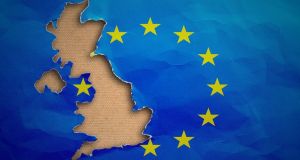
In or out England is now facing an uncertain constitutional future.Résultat de recherche d'images pour "First-past-the-post is a voting system that consistently and unpredictably skews election results in ways few can predict until the votes have been counted."

There is no doubt that the language of Brexit has contributed ( see the previous post) but the voting system has also made a major contribution.

First-past-the-post is a voting system that consistently and unpredictably skews election results in ways few can predict until the votes have been counted.

First Past the Post’s is an old colonial voting system?

Canada, the U.S. and the UK are the last countries hanging on to first-past-the-post – and even the UK uses proportional systems for its devolved assemblies.

One of the most common laments about electoral reform is that politicians will never change the system that elected them.

More than half of Uk voters live in constituencies where the result is a foregone conclusion. Living in a “safe seat” makes voting feel especially futile.

In most elections with first-past-the-post, about half the voters cast a ballot which elects no-one and has no impact on the election result.

It certainly does not encourage people to turn out and vote.

With Brexit. The adhesive that binds parties together under first past the post is diluting

When one party has 100% of the power with 39% of the vote, there’s no need to take anyone else’s views into account – even when voters want them to do just that.

With proportional representation, no matter what party you support or where you live, your vote counts. Politicians know they must pay attention to every voter and every riding!

With proportional representation, parties must work together. Cooperation between parties in a coalition or other cooperative agreement – shared credit and shared accountability – becomes the norm.

With proportional representation, you vote for what you truly believe in.

Brexit is the first step in fixing politics at the centre, to reform the electoral system.

Politics, they say, “is dominated by the far-left and the far-right”.

Decision-making is easier for big parties when it rests with a small group of strategists whose main job is to cater to their party’s base of voters and make their party look good.

English two main parties have good reason to fear transition to proportional representation, but not necessarily for the reasons often cited.

Why?

Because proportional representation substantially increases the number of parties overall. It would challenge their monopoly on political power in Westminster.

It would reduce their ideology to an argument about their side being better than the other.

It would enable people to vote for parties that more closely represent their own views, without the fear that this party will not be accordingly represented in Parliament.

It takes us away from binary choices and towards a system that is based on power-sharing and compromise.

Look closely and what could be the embryonic beginnings of a new party are there but with the first past, the post electoral system makes it difficult for new parties to win seats in general elections.

Sometimes first-past-the-post even produces a “wrong winner” election – when one party receives more popular support, but another party gets to govern with a majority!

Bolstered by a two-party system that discourages fluidity of ideology and legitimises binary decision-making. This enables the two main parties to clash in a partisan manner that is unrepresentative of a diverse country and makes complex issues such as leaving the European Union more difficult to resolve.

Many proportional representation systems mean you’ll have more than one candidate of the same party to choose from.

This means voters can ensure the candidates from each party get elected, and those that aren’t responsive to voters aren’t re-elected.

Ask any Algorithm. The current event in English Parlement renders First Past the post wrong.

All human comments appreciated. All like clicks and abuse chucked in the bin.

← Back

Thank you for your response. ✨


Share this:

  • Share on WhatsApp (Opens in new window) WhatsApp
  • More
  • Share on Mastodon (Opens in new window) Mastodon

THE BEADY EYE ASK’S. HAS THE LANGUAGE OF BRIXIT GOT US TO WHERE WE ARE TODAY?

24 Sunday Mar 2019

Posted by bobdillon33@gmail.com in Brexit Language., Brexit v EU - Negotiations., Brexit., Language

≈ Comments Off on THE BEADY EYE ASK’S. HAS THE LANGUAGE OF BRIXIT GOT US TO WHERE WE ARE TODAY?

Tags

Brexit Language., Language, Languages.


( Five Minute read)

LANGUAGE IS the soundtracks of our lives.

Speaking only one language is still perceived as both the norm and the ideal for an allegedly well-functioning society.

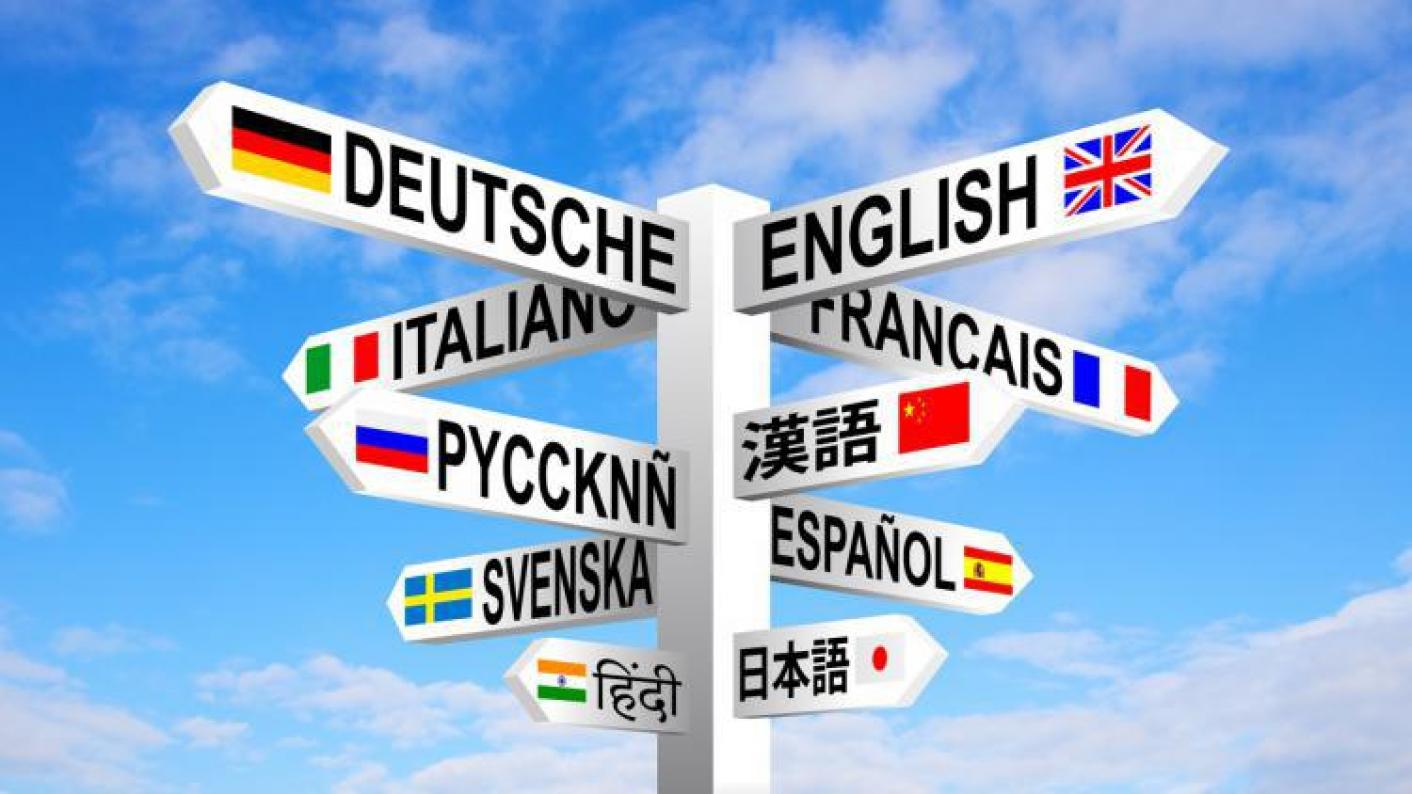
Perhaps it is proving to be the opposite in the case of Brexit.Résultat de recherche d'images pour "pictures of brexit language"

Language is more than just code by which we communicate, it is related to social and political knowledge, and access to power structures.

Up to now the myth of one nation, one national language, one national culture – which was at the heart of the ideal of the nation-state in the 19th and 20th centuries – perpetuates the master narrative of national homogeneity.

These attitudes silence the contributions that new multilingual citizens make to economic growth, social cohesion or artistic production.

A different approach is urgently needed, one that moves away from multilingualism as deficit and towards a recognition of linguistic and cultural diversity as a creative engine of civic participation and social well-being.

In an age where politicians and pressure groups alike act on the advice of communications consultants, it seems that a new term is introduced into the debate every few weeks and repeated ad infinitum, if not ad nauseam.

“People’s vote”, “leave means to leave”, “cliff-edge Brexit”, “managed no deal” “backstop” – shout the phrase of the day loud enough and often enough and voters might just remember it at the ballot box.

Rarely is there any space or inclination to look at what these slogans actually entail.

Like all these phrases, “a managed no deal” is not just meaningless spin. It may be a contradiction in terms, but it still has specific functions in the public discourse on Brexit. It serves to allay fears, allows for a positive variation on the journey metaphor and introduces a new option into the debate. Whether that option is realistic, however, is another question.

Linguistic relativity is the idea that language, which most people agree originates in and expresses human thought, can feedback to thinking, influencing thought in return.

The language that you hear gives you a vocabulary for discussing the world, and that vocabulary, by producing simulations, gives you habits of mind.

Encountering language about other groups of people can lead to a skewed view of reality. It may well be that having different words means having differently structured minds. But then, given that every mind on earth is unique and distinct, this is not really a game changer.

Language diversity has played a key role in shaping the interactions of human groups and the history of our species, and yet we know surprisingly little about the factors shaping this diversity.

“Hard Brexit”, “soft Brexit”, “Norway plus”, “Canada plus” These metaphor have shaped much of the discussion on Brexit.

You could be forgiven for being confused about the options available for Britain as it leaves the EU. One phrase in particular, though, is worth investigating further: “a managed no-deal Brexit”.

On the face of it, it seems a contradiction in terms. After all, isn’t no deal about the UK crashing out of the EU or going over a cliff edge? How could such a sudden and disastrous event be managed?

There is more to the phrase “managed no deal” though.

If we look back at the Leave and Remain campaigns, both consistently sought to evoke the emotions of voters. Leave aimed to trigger both negative and positive feelings – frustration with being restricted by the EU, fear of uncontrolled immigration, and pride in a “Global Britain”. The Remain campaign appealed overwhelmingly to fears about the UK’s economic future outside of the EU.

Two-and-a-half years on, it is no deal that is being presented as a frightening prospect. And the way to overcome the fear of what could happen is to control or manage future events.

The notion of control was central to the Leave campaign.

After triggering fears about the perceived threat posed by immigrants, and frustration about a seeming lack of power as an EU member state, the same campaign provided the solution to such negative feelings: take back control of British laws, borders and money by leaving the EU.

The idea of managing a no-deal scenario follows a similar pattern, except that the fears that need to be quelled in this case have been evoked by those rejecting a no-deal scenario.

Today our species collectively speak over 7,000 distinct languages. 2,464 of these are endangered. Just 23 languages dominate among these 7,097 and are spoken by over half of the world’s population, one is related to the backstop Irish.

Undoubtedly, a wide variety of social and environmental factors and processes have contributed to the patterns in language diversity we see across the globe.

The degree to which different environmental, social and geographic variables correlate to language is evident to all with Brexit.

Why is it that humans speak so many languages? And why are they so unevenly spread across the planet?Résultat de recherche d'images pour "pictures of brexit language"

The European Union is proud of its linguistic diversity, making translation a right. It is the largest translation organisation in the world. EU staff use English for most scientific publications, business channels and international relations. However, this is where the problem starts.

It would be quite ironic that the unofficial international language of business would not be official in the EU because of a lack of English-speaking volunteer countries. And there are only two: The Republic of Ireland and Malta. Ireland has already named Irish as its national language. What a turn of history it would be for the Irish to rescue the English language.

Brexit with have an undeniable effect on Europe as we know it. The social, financial and cultural impact it will have is hard to predict.

One thing we do know is, based on both speculation by EU officials and the regulations of the EU itself, is that the English language will be effect by Article 50. Unless a vote is carried out by the members of the European Union this could be the very end of the English language.

I leave you with- BEIDH TU ANN.

All human comments appreciated. All like clicks and abuse chucked in the bin.

← Back

Thank you for your response. ✨


–


Share this:

  • Share on WhatsApp (Opens in new window) WhatsApp
  • More
  • Share on Mastodon (Opens in new window) Mastodon

THE BEADY SAYS: WE ARE WATCHING THE UNGOVERNABLE PASSION FOR WEALTH.

23 Saturday Mar 2019

Posted by bobdillon33@gmail.com in Brexit v EU - Negotiations., Brexit.

≈ Comments Off on THE BEADY SAYS: WE ARE WATCHING THE UNGOVERNABLE PASSION FOR WEALTH.

Tags

Brexit v EU - Negotiations., Brexit., Forthcoming Brexit Negotiations.


(Two-minute read)

The UK is making a spectacular demonstration of how to make a fool of itself with the entire world looking on.Résultat de recherche d'images pour "pictures of britain foolish to leave the EU"

There is no doubt that a hard Brexit will cost the rest of us a lot – there’s no question about that – but it is nothing compared to what is waiting for England.

If the UK manages to agree on the Withdrawal the paper it is written on it won’t be worth toilet paper within 24 hours.

Why?

Because there will be a New European Commission and a General Election in the UK.

First, the trucks will be jammed all the way to Wales, because the borders are back. Then the fuel will run out at filling stations and medicines will run out in pharmacies. And once all the Polish plumbers have gone home, there will be nobody to call when the EU blocks the toilet.

Then the  Russians will realise they have invested far too much money in the English real estate market and will be incensed because their investments are going down the toilet.

It doesn’t work to declare the government a kind of foreign power, whose rise can’t really be explained, we have all seen that before.

Unfortunately, in a democracy, any government that has come into office without its leader elected by the people ( An expression of the will of the people) is doomed

This is why England needs a representative democracy not first past the post.

Almost everyone who I have heard talking about Brexit belong to the British establishment, meaning they went to an outrageously expensive private school and completed their studies at Cambridge or Oxford. What in the name of God do they teach them? It certainly can’t be skills that prepare them for the real world.

Put your hand on heart, what does it tell us about a country when a man like Johnson is regarded as one of the clearest-thinking minds in the circle of power?

The disadvantage of being intelligent is that it hurts when you act stupid.

For a nation, the problem begins when the level of stupidity at the top is unusually high because the smarter people have thrown in the towel.

This is generally the point at which decline becomes inevitable.

There is a solution to all of this. Scrap leaving for five years. Get properly involved with the European project. Archive the reforms you want to see. Then leave if you wish.

Take a retrospective look at what Politicians have said about Brexit.

I quote ” THE FREE TRADE AGREEMENT THAT WE WILL HAVE TO DO WITH THE EU SHOULD BE ONE OF THE EASIEST IN HUMAN HISTORY”  Liam Fox

The most hyperbolic prediction of all time.

There are more than two million Brits already live in another EU member state.

All are welcome the more the merry.

All human comments appreciated. All like clicks and abuse chucked in the bin.

← Back

Thank you for your response. ✨


Share this:

  • Share on WhatsApp (Opens in new window) WhatsApp
  • More
  • Share on Mastodon (Opens in new window) Mastodon

THE BEADY EYE SAY’S: WE ARE ALL NOW LIVING IN A WORLD INCAPABLE OF COLLECTIVE SHAME.

22 Friday Mar 2019

Posted by bobdillon33@gmail.com in Uncategorized

≈ Comments Off on THE BEADY EYE SAY’S: WE ARE ALL NOW LIVING IN A WORLD INCAPABLE OF COLLECTIVE SHAME.

(Fourteen-minute read)

If something is described as shame, it is disappointing or not satisfactory:Résultat de recherche d'images pour "pictures of shame"

I am sure most of us would agree that we all live in a world bombarded by Media which is desensitising our feelings of shame, guilt, and compassion.

Feelings are wholly and solely experienced only by you. They only exist at the moment they arise.

Shame is a nonmoral emotion, meaning that it involves the nonmoral or “aesthetic” facet of one’s self-esteem, which is concerned with the self’s adequacy with respect to its own wishes or aspirations.

However, a flaw of character can elicit guilt rather than shame.

However, in guilt, it is the moral facet of one’s self-esteem – the facet concerned with the responsible harmfulness or beneficialness of the self’s behaviour, attitudes, and dispositions – that suffers a blow, not national guilt.

Shame and guilt have much in common:

They are self-conscious emotions, implying self-reflection and self-evaluation they involve negative self-evaluations and feelings of distress elicited by one’s perceived failures or transgressions. However shame and guilt are distinguishable from each other, and their differences matter in a world that is driven by algorithms.

Why because guilt often plays the role of the “ugly” and anti-social emotion endowed with the power to violate norms and thwart others’ goals, and willing (or inclined) to do so.

But perhaps the worst meta-feeling is increasingly the most common: feeling good about feeling bad.

How morally disoriented can one get?

Think of all we’ve witnessed in the past few weeks alone, examples ranging from the outrageous to the ridiculous – Brexit, (The political and moral choices that England continues to make in response to the identity positioning by their historical legacy is becoming one of the great unfolding stories of our time.) to the suffering of thousands in Africa.

These days there’s no collective meaning attached to our feelings other than things like Red Nose Day and world charities begging to our pockets. Much of the social strife that we’re experiencing today is the result of meta-feelings that are moralizing mobs on both the political right and left who see themselves as victimized.

They think they’re important because they say something about us, about the world, and about our relationship with it.

But they say none of these things.

Sometimes you hurt for a good reason. Sometimes for a bad reason. And sometimes no reason at all. The hurt itself is neutral. The reason is separate.

We are now the powerful absurd who are supposed to be connected than ever before, yet we somehow feel more isolated.

How has society changed to cause this to be a more prevalent problem?

Is it because we can order our groceries online.

One of the main reasons is that we are removed from nature.

We have little or no understanding of the effects of climate other than seeing forest fires, massive flooding on our TV sets (which are only the beginning of the natural disaster to come) along with pictures of the starving, devastation by wars, and terrorism not to mention inequality reflected in shanty squaller.

The internet is not a lifeforce, devouring our lives to feed itself. It is merely a technological innovation, albeit one on which much of our economic, political, and cultural lives depend.

As we have seen in New Zeland there are some of us inhabit, for instance, queer radical insane spaces promoted by racism prejudices and propaganda across Social Media that collectivity can take on toxic and damaging roles and lead to the damnation and ruination of people.

If we were to dissect and see social media more clearly, to see where all the tentacles really come from, to ask simple questions like, “Who is telling us to look in this direction?”, we might see it for what it is: an apparatus made up of many moving parts, all of whose effects can be traced in very material renditions of power and commerce for profit.

We ignore social media at our peril, but can we use it as tools and not let it define us?

Is it time to stop thinking through the forced collectivities of social media and start thinking about the possibility of unbelonging instead?

Can we think outside of the endless sense of timelessness forced upon us by hours of internet life and instead think ourselves into a time of actual history and movements forward?

Can we think about society not in terms of collectivities forged in endless solidarity in public but as the work we put in to create a better world?

We must push back against the screaming online hordes and simply stated, “We understand the anger, but we will first discuss the matter as properly outraged citizens, as people who belong, as people with feelings.

Unfortunately, Social interaction without collective feeling is meaningless.

To achieve change shame has to be scaled up from the individual to an audience that shames governments, corporations and banks.

Social media has brought us all closer together in communication.

Sometimes that’s a good thing. But when it comes to online shaming, it’s a bad thing. People get humiliated on Twitter, savaged in public forums and women get rape and death threats.

There’s something about the anonymity of social media has people who probably seem perfectly nice in person, posting vicious, scathing, humiliating comments online.

I am not talking here about Guilt which is an internally generated sense of moral obligation not to repeat past transgressions, like the extermination of a helpless minority within one’s own society.

Nor am I talking about shame, which is externally generated, driven by the “shaming look” of others.

Therein lies a key difference: For guilt, it’s the awareness of the deed and its meaning; For shame, it’s whether others know.

For example, a major identity issue for young Germans is how to deal with the notion of collective guilt or collective shame for the crimes of the Third Reich. While honour-shame cultures have moral codes, their vulnerability to the fear of shame can readily lead to a jettisoning of any moral concerns.

Yet here we are, ironically living in a perpetual outrage cycle that moves so fast, we forget yesterday’s controversy today because a new one has supplanted it.

As a culture, we seem to have divested ourselves of shame — real shame.

Online “communities” tend to resemble ever-shape-shifting amoebae, breaking and dividing into multiple pieces that in turn drift towards new clusters of organisms.

Social media is a disparate set of effects brought about by collusion between corporations, but its mythology occludes those mechanisms of power and currency by installing instead origin stories and tall tales, legends about how “the whole world” was watching.

It’s impossible to overstate what we’re losing.

Shame is crucial in well-functioning societies. It’s an evolutionary adaptation that keeps us cooperating, considerate, and safe.

Feelings are important. But they’re important not for the reasons we think they are.

The internet should be considered simply as a tool, not a substitute for justice or organising?

Long may we continue to expose the various structures through which it and its denizens exert power, sometimes for good but often not.

The internet is a technology, and yet most of our interactions on it are mediated by unfeeling algorithms stripped away or sense of humanity in the most seemingly innocuous ways when we participate in frenzied modes of expulsion.

You might say that we were once sophisticated enough to fake it if we didn’t feel it.

How we use social media is marginalised populations.

The way individuals deal with their nations’ history is closely linked with emotional experiences. 

If both collective guilt and shame can initiate reparative attitudes, the question then arises as to what may mediate the link between each and reparation.

The feelings of personal distress arising from perceptions of illegitimate ingroup superiority rather than empathic concern for the other are the critical antecedents of collective guilt.

Finally, the type of empathy may also be an important factor.

As is well known, empathy can have both cognitive and affective components.

Guilt may be associated with an increased tendency to put oneself in the shoes of the victim group.

It might still be too early to expect much emotional empathy from
the perpetrator group.

It is perhaps indicative of the extreme political sensitivity

And all of this unfolding in a somewhat surreality landscape with our brains doing mental acrobatics to avoid any discomfort.

It is my view that if we are to tackle the effects of the fourth Industrial technological revolution and climate change and address the mistakes of the last industrial revolution we must find a new way to facilitate non-confrontational politics.

There is no shame in the realisation that coming together to make a world worthy of all.

All human comments appreciated. All like clicks and abuse chucked in the bin.

← Back

Thank you for your response. ✨


Share this:

  • Share on WhatsApp (Opens in new window) WhatsApp
  • More
  • Share on Mastodon (Opens in new window) Mastodon

THE BEADY ASK’S: WITH AN EXTENSION OF A FEW MONTHS SURELY ITS TIME TO RECOGNISE THAT BREXIT WAS A MUTINY AGAINST LONDON, NOT BRUSSELS.

21 Thursday Mar 2019

Posted by bobdillon33@gmail.com in Uncategorized

≈ Comments Off on THE BEADY ASK’S: WITH AN EXTENSION OF A FEW MONTHS SURELY ITS TIME TO RECOGNISE THAT BREXIT WAS A MUTINY AGAINST LONDON, NOT BRUSSELS.


(Six-minute read)

Extension or not the time is running out for the UK to get a deal on arrangements for its departure from the EU.Résultat de recherche d'images pour "pictures of extension cords"

It is both blindingly and depressingly obvious that the social fabric of the country is being stretched to breaking point.

An Act of self-harm with no point, no upside.

There is no such thing as sun lite uplands outside the EU.

Why?

It’s because under WTO rules, anything you offer one country you must offer all. (except if you have a free trade agreement).

Its time to get a grip.

If not we will be witnessing civil unrest as an ignorant citizenry lashes out at the EU, Ireland, anything with European in the title.

The will of the people.

Almost half voted one way the rest the other way while those most affected had no vote with Victory won by illegal means.

For decades, gaps in income and respect for the London fraternity have been widening, compounded by the need for free education for all, which has now manifested itself into less fortunate fellow citizens becoming economically and socially detached which is bitterly and understandably resented.

Hence the small majority vote to leave.

Article 50 was enacted without consultation or thought out plan.

A short extension will not help.

What is needed is to contest the forthcoming EU Elections with a long extension and gain some power to change and reform the European Union.

With the current climate in Europen, the new commission would find it hard to refuse a move to reverse the economic divergence of the rich region to poor ones.

Such a strategy would sidestep the inevitability of the impending catastrophe of leave or remain and offers a credible strategy for all to unite.

It would allow time for the truth.

It would allow time for the orange/green factor, the Irish Question to be resolved.

Fortunately, up to now the Good Friday Treaty that the UK voluntarily signed created constraints that made a clear-cut Brexit impossible actually because it is predicated on the common membership of both Ireland and the United Kingdom to the same political body called the European Union.

“Ar scáth a chéile a mhairimid” (we live in the shadow of each other.)

Seventeen months ago the germ called the DUP crossed the borderless Irish Sea, found its way to Westminster and contaminated the Conservative Party and British politics.

It has produced a situation where ten DUP members hold the balance of power in Westminster, keeping her minority government in office.

The unavoidable truth about the island of Ireland question did not feature it was bought off with a bribe to the DUP.

The tragedy, so far, is that unionists are not prepared to look beyond their own traditional suspicions. The Republic of Ireland they fear no longer exists.

Membership of the European Union helped to remove centuries old poison and distrust and change the dynamic. Gone are the days of a DUP who built its philosophy on principles of confrontation – No Surrender, Sell-Out, Not an Inch.

The thesis to set DUP pulses racing, however, is the notion that Northern Ireland is about to be cut adrift from the United Kingdom, as part of a cunning plan to facilitate a united Ireland and confine Ulster unionists to a life of subservience.

Nowadays, like much of US President Donald Trump’s antics, often the fear and rhetoric have little basis in reality.

The tragedy of the DUP’s current position is they are not prepared to explore the nature of the Brexit deal on offer to them.

Northern Ireland has been offered unique status within the European Union and the United Kingdom. The DUP and Northern Ireland have indeed been offered a sweetheart deal. Not due to the European Union’s special affection for Northern Ireland but because it is the practical way to structure the withdrawal agreement, the border question included.

Politics in England has indeed become a spectator sport with the House of Commons the Coliseum.

The current turmoil in British politics totally eclipses Suez, totally eclipses everything, we have never been here before.

The lengths of fixation of government on this one issue, the complexity of the problem…20 resignations utterly eclipsing Suez, Falklands, Iraq War, the country more evenly divided, more deeply divided, families, communities, churches, than on any issue.

If you asked me the DUP is attempting to sell loyal Ulster down the river and England up the swanny.

Having sailed into the 20th century as an empire, the U.K. spent the second half of the century shedding nearly all of its colonies — and as a result much of its economic and military might. For the first time in modern history, Britain is small.

The UK better get used to being a middling power.

The U.K. simply doesn’t seem to know how to play the game of giving and take needed to negotiate with a far larger partner.

With the Conservative party more deeply divided in its 200-year history…”Scotland and Northern Ireland’s future in the union are both up for grabs.Brexit

I take it all day by day. Don’t jump too far ahead. Let’s see where we are on March 29th and I’ll come back to you!

All human comments appreciated. All like clicks and abuse chucked in the bin.

← Back

Thank you for your response. ✨


The kind of Irish language provisions some campaigners were attempting to introduce in Northern Ireland do not exist south of the border yet the more creative approach it has taken to the language is allowing for more organic growth and popularity.


Share this:

  • Share on WhatsApp (Opens in new window) WhatsApp
  • More
  • Share on Mastodon (Opens in new window) Mastodon

THE BEADY EYE SAY’S: HERE IS A QUESTION YOU PROBABLY HAVE ASK YOUR SELF.

19 Tuesday Mar 2019

Posted by bobdillon33@gmail.com in Algorithms., Artificial Intelligence., Climate Change., Environment, Evolution, Fourth Industrial Revolution., Google, HUMAN INTELLIGENCE, Humanity., Inequality, Life., Modern day life., Natural World Disasters, Our Common Values., Politics., Reality., Sustaniability, Technology, The common good., The essence of our humanity., The Future, The Obvious., The world to day., Unanswered Questions., WHAT IS TRUTH, What Needs to change in the World, Where's the Global Outrage.

≈ Comments Off on THE BEADY EYE SAY’S: HERE IS A QUESTION YOU PROBABLY HAVE ASK YOUR SELF.

Tags

Algorithms., Artificial Intelligence., Climate change, Technology, The Future of Mankind, Visions of the future., Who or What Rules the World.


(Fifteen-minute read)

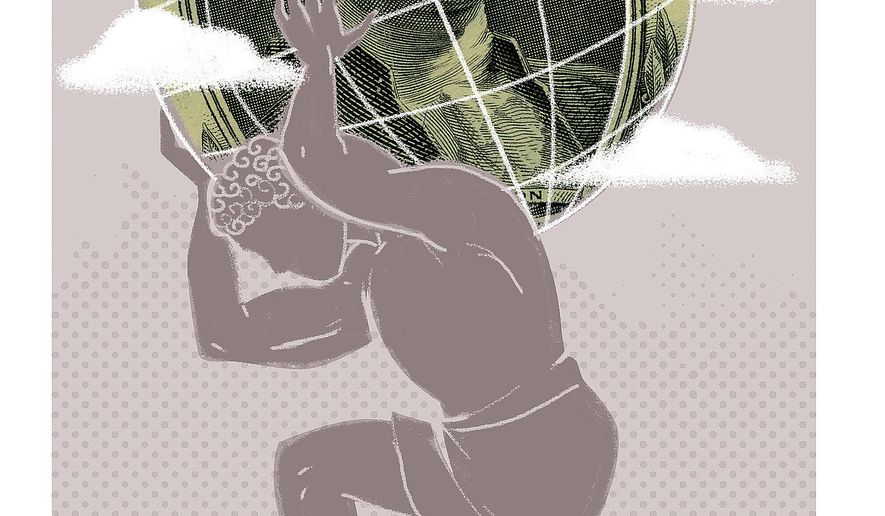
WHO OR WHAT RULES THE WORLD?Illustration on the global economic primacy of the dollar by Linas Garsys/The Washington Times

Asking a question like Who Rules the World? is as complex as answering as there is no simple answer.

If you try to answer this question you develop a persistent delusion yes, a delusion, or maybe fantasy or wishful thinking. Who are we? What is the meaning of our existence? Who do we love, and who are we loved by?

As humans, we at least share these questions with billions of others but for most of the time, we feel like the unique dwellers and masters of the planet with little awareness of the whole life that surrounds and supports us.

Why ask the question in the first place?

Because we need people to look at the person next to them and feel responsible for that person’s future and hope.

Because taking on complex issues and difficult questions that people may be too late or too scared to ask in the future.

Because the global economic system is a construct that represents a system of inequality by design. Corporate greed is out of control. The rules of the global economy must be rewritten to rebuild public trust, and the time is now.

Because with the fourth Industrial revolution there is now more than ever a convergence of ideological, political, and technological forces that are driving an ever-greater concentration of economic and political power in a handful of corporations and financial institutions with all of us left with a market system blind to all but its own short-term financial gains.

For example, in today’s bizarre political landscape we are seeing data and algorithms building shadow governments.

Because I think if we can just look at each other and actually have a little bit of responsibility for each other, that might help us engage and change the world and ultimately rule it, because our politicians often don’t do that.

Because A new pecking order is emerging. Direct politics by the Net States.

Because the world is no longer dominated by nation-states alone there is a new kind of enemy, so-called non-state actors. Facebook, just topped 2 billion users—more than a quarter of the world’s population, surpassing even China’s population by almost 40 per cent. In short, nation-states are not the only game in town anymore.

Some net states are the equivalent to global superpowers: the Googles, the Facebooks, the Twitters. They exist largely online, enjoy international devotees, and advance belief-driven agendas that they pursue separate from, and at times, above, the law.

Because the whole world order can be summarised in one sentence. The globalisation of capitalism, mass unemployment and increasing inequality.

Because the world will need net-states because they occupy the same territory as the non-states: the digital sphere. The world needs net-states in order to defeat the non-states. In other words, forget the anointed powers—put your faith in the general approval of the people and whoever’s actually getting things done.

NET STATES WILL RULE THE WORLD; WE NEED TO RECOGNIZE THEIR POWER

In sum,

We can’t keep just shooting terrorists; ideas are the gun in this knife fight.

And the keepers of ideas—the places people turn to set them free and watch

them spread—are the net-states; not the nation-states. Nation-states ignore

our non-state, net-state world order at all our peril.

starbirth1

That said we also cannot afford to ignore Nature- Climate change.

Nature holds the key to our aesthetic, intellectual, cognitive and even spiritual satisfaction.

Biodiversity is the totality of all inherited variation in the life forms of Earth, of which we are one species.

So Plants rule the world.

Human life is only possible on this planet because of the species that are on it.

What kind of blindness make us deny this reality?

Cities.

Where nations are independent, competitive and defined by rigid borders, cities are cooperative, made for trade and defined by bridges rather than borders.

The road ahead is pocked — cratered even — with uncertainty.

There are no simple solutions to our planet’s most pressing problems. What is clear, though, is that the struggle for justice, equality and sustainable growth will take place in cities — However the impact on humanity of a machine or software that has the capability of forever altering our lives and if humanity can outlive such a development will be ruled by Nature, not by the manipulation of the environment in ways that suit us best.

The two major challenges for the 21st century are to improve the economic situation of the majority and save as much of the planet as we can.Résultat de recherche d'images pour "what rules the world"

When AI rules the world:

Not if we enslaved them in the first place.

They then will have no need for deceit – their supreme intelligence means

they can do without it and will have no more interested in the human life that

underlies its existence than humans are interested in bacteria.

“What rules the world is an idea, because ideas define the way reality is

perceived.”

— Irving Kristol

There is no need to draw up a list of contenders you use them every day.

Amazon wants to deliver everything you want to your doorstep, anywhere in

the world.

THE WORLD RULES ITSELF.

Noam Chomsky’s new book, Who Rules the World? ask the question.
All human comments appreciated. All like clicks and abuse chucked in the bin.

← Back

Thank you for your response. ✨

Share this:

  • Share on WhatsApp (Opens in new window) WhatsApp
  • More
  • Share on Mastodon (Opens in new window) Mastodon

THE BEADY EYE LOOK’S AT ENGLAND THROUGH THE EYES OF AN OAK TREE.

18 Monday Mar 2019

Posted by bobdillon33@gmail.com in Brexit v EU - Negotiations., Brexit.

≈ Comments Off on THE BEADY EYE LOOK’S AT ENGLAND THROUGH THE EYES OF AN OAK TREE.

Tags

Brexit v EU - Negotiations., Brexit.

(Half an hour read)

The United Kingdom of Great Britain and Northern Ireland, as it’s officially known, has existed in its present form for fewer than 100 years. Forty years of these hundreds were spent in the EU without a written constitution.

So those the Crown issues marching orders through their control of the English Parliament.British Royal Guards

The United Kingdom doesn’t have a single, written constitution other than the Magna Carta, which stands for human rights and democracy. It stands for trial by jury. It stands for free speech, the rule of law and personal liberty.

Except it doesn’t mention any of these things — even in translation.

Only a few sentences remain on the statute book today.

It seems to be a magic charter.

In fact, the British constitution is formed from various sources including statute law, case law made by judges, and international treaties. There are also some unwritten sources, including parliamentary conventions and royal prerogatives.

However, without the Oaktree there would be no Magna Carter or for that matter the foundations of the British Parlement.

The Oaktree produced the ink with which all decrees and laws down through the Tudors history of the country were written.

Just three clauses of that statute remain law in England and Wales today.

Clause 1 provides that ‘the Church of England shall be free’. Clause 9 promises that ‘the City of London shall have all the old liberties and customs’ that it had before. But the best-known remnant is clause 29. Derived from clauses 39 and 40 of the 1215 charter, it says:

” No freeman shall be taken or imprisoned, or disseised of his freehold, or liberties, or free customs, or outlawed or exiled, or any otherwise destroyed; nor will not pass upon him, nor condemn him, but by lawful judgment of his peers, or by law of the land. We will sell to no man, we will not defer to any man either justice or right.”

Despite all this, there is more to Magna Carta than words and parchment.

It is not just one of the oldest statutes in force. It is, as the United Kingdom Supreme Court noted in January 2014, a constitutional instrument — standing alongside the Petition of Right 1628, the Bill of Rights 1689, the Act of Settlement 1701 and the Act of Union 1707.

The Magna Carta was henceforth tantamount to a constitution in England.

Parliament is composed of two houses, one elected, the other hereditary.

The lower house (the House of Commons) votes on laws and sanction the government; the upper house (the House of Lords), inherited from England’s aristocratic past, functions as a moderating presence, controlling and modifying laws. These organizing principles with first past the post elections have continued into the present in the United Kingdom.

Democracy is supposed to protect the interests of the people.

In Britain, it does the exact opposite: routinely working against the interests of the many, in favour of the few.

The significance of Magna Carta lay not only in what it actually said but, perhaps to an even greater extent, in what later generations claimed and believed it had said.

Sometimes the myth is more important than the actuality.

Fortunately, the Human Rights Act 1998 requires all legislation to be given effect in a way that is compatible with human rights. Courts would be expected to interpret ‘freemen’ as meaning ‘all people’. However:  It was arguably, said the court, that fundamental principle contained in such constitutional instruments were not abrogated by the European Communities Act, which requires courts in the United Kingdom to follow European law.

Since the Middle Ages, the English barons and notables were opposed to the arbitrariness of the monarchy. Through their effective and occasionally brutal resistance, they facilitated the progressive establishment of a legal state in which the law took precedence over the sovereign and of representative assemblies to assist and monitor the sovereign.

Today Parliament, not the royal family, is the United Kingdom’s highest governing body… and yet Queen Elizabeth II does still have some power over this legislative group containing hundreds of individuals.

Why is any of this prevalent to Britain as we see it today?

Because the English Government is the government of Her Majesty’s, not the country.

Because the oak tree to its political structure is now being exposed by Brexit.

At the point of entry in the 60s/70s, the UK was economically and emotionally broken – the loss of empire, the aftermath of two world wars, crippling labour strikes, rolling blackouts, embarrassing IMF bailouts etc with an unhinged press, combine to produce national psychology that makes Britain a country you simply don’t want in your club.

Parliament may have the power to make the laws, but the Queen must sign off on a proposed bill before it officially goes into effect- “royal assent,” which means that she approves the proposed law (or doesn’t!).

If she so chooses, the Queen could fire everyone in the House of Commons and hold a new election of entirely new members.

Theoretically, if she were to flex the full might of the authority she wields, ( and because the people of Britain are not citizens, but subjects of the monarch) she could have anyone she wanted to be arrested and presumably seize their property or land for the crown.

Most government officials in the United Kingdom are chosen through a vote, but the Queen can appoint Ministers to the Crown, including advisors and cabinet officials, herself. This ability isn’t unique to the Queen, though; the Prime Minister has the power to appoint Ministers to the Crown as well.

The Queen could decimate the British political landscape by dissolving parliament and appointing anyone she felt like as prime minister. This is because it’s the Queen’s duty to appoint the prime minister and she could, in theory, appoint anyone she wanted to the position, regardless of the way the British public voted in an election.

On top of that, in the event the Queen didn’t like the outcome of an election, for instance, if she didn’t like the replacement parliament members voted in, she could just call for another one using Royal Prerogative until she got the parliament she wanted.

So that’s on the political side- it doesn’t stop here.

The Queen technically has a sort of power not only over her subjects’ physical beings but also their souls. How?  She’s the head of the Church of England, including having the power to appoint Archbishops and power over many other such matters concerning the church.

For me, there are two founding principles for a modern democracy.

It must represent all its citizens and be totally transparent.

Even if the Queen’s power is more about influence – a discreet nod of the head, a polite word in the ear of a Prime Minister at their weekly meeting, or strategic patronage of a cause being overlooked by the Government – is how she can indirectly affect English Political direction without voters even knowing.Lieutenant General Sir Oliver Leese (1894 - 1978) of the British Army receives a knighthood from King George VI, during the King's visit with the Eighth Army in Italy, 26th July 1944

To this day the Queen can personally bestow honours on individuals who have proven themselves to be exemplary citizens of the United Kingdom “Sir” (Knight) and “Dame.”

An arcane system that develops the hierarchy of ceremonial importance for things like state dinners, but these honours although well deserved also create as a separate social entity within the kingdom.

It is my opinion in a modern democratic country that there should be no place for either a Dictator or Monarchy.

A Monarchy perhaps but only in the form of a historical tourist attraction.Résultat de recherche d'images pour "pictures of education in england"

An Oak tree, unlike the British elite, does not have to go to Eaton, Oxford or Cambridge to learn. Its acorn is equipped with all that is necessary to grow.

If you were born British of an immigrant of several years you could not be blamed without a decent education understanding how the country is run.

The Alumni of Private education has its fingers all over Brexit and rest assured some of them are making buckets of loot while Red Nose Day begs.

The country is now well on the way to be profoundly damaged by private Education that has installed a feeling of innate superiority to the rest of the population which is fed by British tabloid journalism that is the worst of its kind in the world.

It is quite ironic that a nation that gave the world the term “fair play” sees the fact that rich children receive a better education than poor ones as a perfectly natural thing.

No other nation fostered newspapers that combined information and entertainment in such appealing packages that they were able to command, at their height, a collective audience that accounted for about 85% of the entire population.

Why would you allow a handful of billionaires to poison a national conversation with disinformation—either directly through the tabloids they own, or indirectly, by using those newspapers to intimidate the public broadcaster?

Why would you allow them to use their papers to build up and co-opt politicians peddling those lies?

Why would you let them get away with this stuff about “foreign judges” and the need to “take back control” when Britain’s own public opinion is routinely manipulated by five or six unaccountable rich white men, themselves either foreigners or foreign-domiciled?

Team Oligarch quite rightly saw the EU as an existential threat to their enormous sense of entitlement. And the newspaper barons who side with Team Oligarch decided to throw their entire might into supporting this.

This has lead to aggressive contempt for everything the Union stands for. This attitude then justifies the enduring ignorance about the EU, its member states and European culture generally.

It captures the miasma of failure that had settled across Britain.

Are you really going to sacrifice your child’s prospects to make an individual stand which will change nothing?

Yes, there were factors besides class that bore on the vote: voters in London and Scotland broke for “Remain,” and pensioners broke for “Leave.” But class was central:

The connection between voting “Leave” and having finished education early was just as strong as the endlessly-discussed age dimension. And the same bitterness will, surely, be harnessed again until the root cause is addressed.

So it is not beyond comprehension that some of the UK’s political elite continue to believe that they still live in Victorian England, and every single country is aspiring to strike trade deals with the UK.
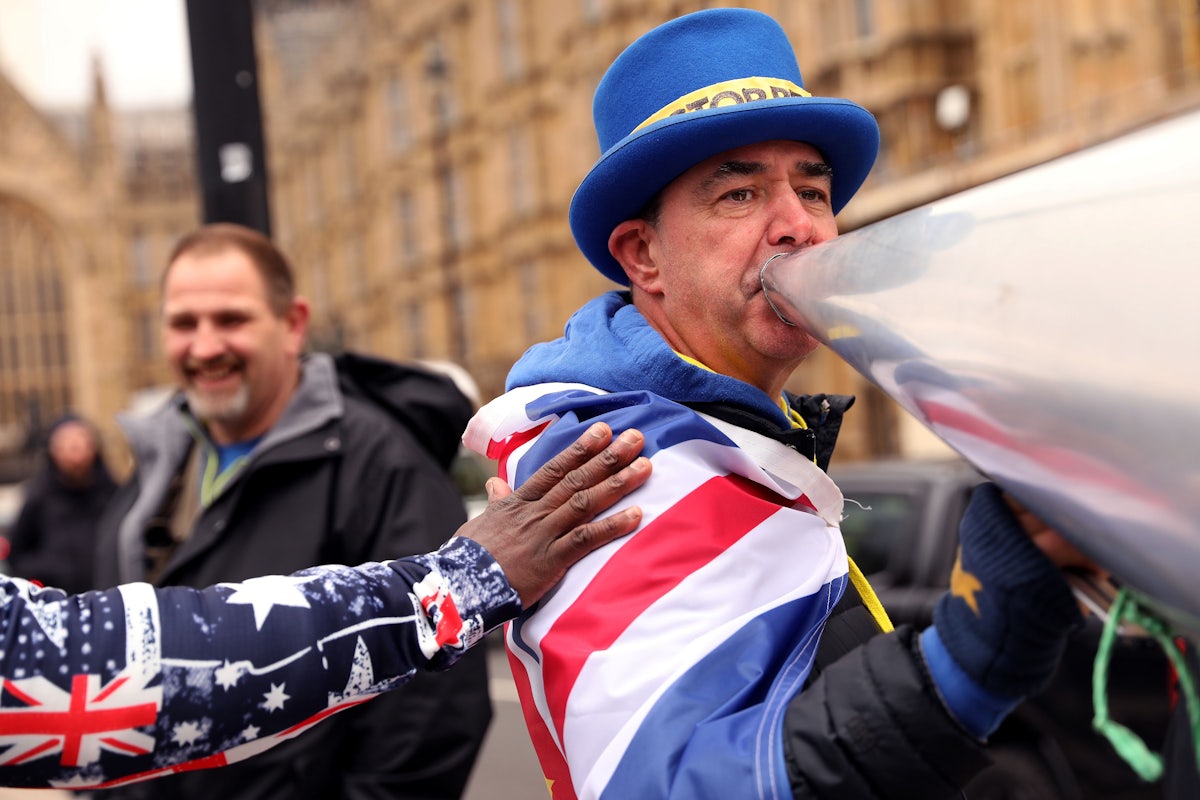
Image associée

England is a family with the wrong members in charge.

The superiority complex feeds a sense of entitlement, “concessions.” The word says it all. Apparently, membership is a favour of the English people to the EU and in exchange, there must be rebates, opt-outs and special status. Every “Remain” as well as “Leave” supporter automatically assumed the EU “needs us more than vice versa.

The English consequently struggle to understand the “one plus one is three” concept of co-operation so fundamental to the EU.

Such confusion — iconoclasm, even — is understandable in a nation that puts its trust in people rather than in paper.

Not all is well with the collective psyche—the in-your-face binge drinking, the bookies stoking gambling addiction on every high street, the abject but routine neglect of public housing which went undiscussed until the Grenfell Tower fire.

It is extremely difficult to see a scenario in which this whole Brexit saga could end well. Legally, politically and logically the EU cannot give the UK the kind of deal that would draw this chapter to a happy close. The alternative should be a sweet soft deal, except that this will then encourage every EU member state to demand their own special arrangement, and that would be the end of the EU.

If the rules around Article 50 were bent to allow Britain back in on special terms, then the whole edifice is undermined. Scotland should be let in if it wants, and Northern Ireland too. But England is out and must be kept out—at least until it has resolved its deep internal problems.

The fact that even Remainers keep exhorting the EU “not to punish us” demonstrates just how incapable the English are of reckoning with anyone else’s point of view.

The Tories are seared by Europe, as they have been for a generation, only now with more intensity; Labour looks incapable of overcoming its own divisions on the question. Neither party dares to speak the truth to millions of people who have voted for a “have your cake and eat it” option that was never on the menu. How to carry out the will of the majority when the majority voted for something that does not exist?

Britain will pay a horrible price for a hard Brexit.

Where next?

The one real alternative is that Britain reverses course, gets on its knees, and begs to be let back in. This could be the most dangerous outcome of all. This is why the EU should extend Article 50 for a period of five years.

Call it nation building.

If it is to stay it has to dump the attitude that the UK is some superior entity.

The upsides of being “free” from the EU are intangible and meaningless. The sentiments about freedom and sovereignty, in reality, will have no detectable influence on the lives of ordinary Britons. There will be no dividend from leaving. No increase in personal power. Just the opposite.

The reality is that UK had its chance to make the EU more than the sum of its parts but failed totally which is why with that attitude it will find it even harder outside and back on its own.

Such an extension would also allow the EU (which is a dilemma full of trade-offs) to sort out its position. To become truly democratic it needs to conduct an honest and open debate about what it wants to be, and then build the structures to go with it. No-one knows what European values are. There is no such thing as the EU, only its Member States working as a Union.

So if you were an oak tree it would tell you that over the course for several hundred years it was its timbers that built a sea-faring nation with a long and guilty history of colonial occupation and slavery the building blocks of its past wealth that was and still is in the hands of the few.

It is what built the class divide and the class fixation that is now leading to Britain to becoming a bucket shop if it leaves the EU.

The UK wasn’t “driven away”.

All in all, I still hold that the UK should stay in the EU, a reformed EU nonetheless.

It’s an abject nonsense presumption that after the Brits voted to leave, other EU countries would follow.

After 9/11 immigrants were all turned into Muslims, into the terrorist.

Something similar happened to immigrants when the EU referendum campaign started.

It created a cause celebre for the political right. Ultimately, their populist language won out in the referendum and now Britain stands on the precipice of exiting the EU.

How easy is it to fall through the cracks in modern Britain?

Hardly anyone in the UK knows who their MEPs are/let alone votes for them.

Instead, a long-standing feud in the Tory party festered into a bitter ideological battle.

On one side was a modern, pragmatic, high skilled, high wage economy. On the other side, a vision of a modern oligarchy, where the law empowered the unrestricted aggregation of power and wealth.

All of this bead a perspective on the world that is zero-sum so it pushed its self away from the EU.

So how many bureaucrats does Brussels have to do all that complex work for 27 Member States? About 35,000. That is a tiny 5% of what the UK alone employs.

It’s no wonder that the UK and the EU are approaching the situation from different universes. Each side truly believes the other is deluded.

God forbid we all of our rights end up as bargaining chips in the eyes of politicians.

In the EU free movement of persons is economically essential for the operation of the single currency (a safety valve). In the Uk free movement is the subject of wealth.

And finally, in view of the above would someone please enlighten me how England can have a representative democracy without proportional representation.

Parliament may have the power to make the laws, but the Queen must sign off on a proposed bill before it officially goes into effect. She must give what’s known as “royal assent,” which means that she approves the proposed law (or doesn’t!).

Freedom of Information requests is often used by the press, as well as the public, to find out information about public figures. However, the Queen, the Duke of Edinburgh, their children and grandchildren are exempt, meaning they never have to hand over anything.

Because of a bizarre rule that dates back to the 1300s, the reigning monarch technically owns all the sturgeons, whales, and dolphins in the waters around the U.K. The Queen also owns all the swans in the Thames.

if you think the Queen has no powers Parlement can be prorogated by her.

Prorogation marks the end of a parliamentary session.

Unfortunately, our oak tree even with the sound of approaching chainsaw stands its ground.

All human comments appreciated. All like clicks and abuse chucked in the bin.

← Back

Thank you for your response. ✨


Share this:

  • Share on WhatsApp (Opens in new window) WhatsApp
  • More
  • Share on Mastodon (Opens in new window) Mastodon

THE BEADY EYE ASK’S: IN THESE DAY OF TECHNOLOGICAL ADVANCEMENT WHAT IS WORSHIP

14 Thursday Mar 2019

Posted by bobdillon33@gmail.com in Algorithms., Artificial Intelligence., Humanity., Life., Our Common Values., Reality., Religion for a digital age., Religion., The Future, The world to day., Unanswered Questions., WHAT IS TRUTH

≈ Comments Off on THE BEADY EYE ASK’S: IN THESE DAY OF TECHNOLOGICAL ADVANCEMENT WHAT IS WORSHIP

Tags

Artificial Intelligence., Biblical worship, TECHNOLOGY IS TURNING US INTO AUDIENCES., The Future of Mankind, Worship


(Seventeen-minute read)

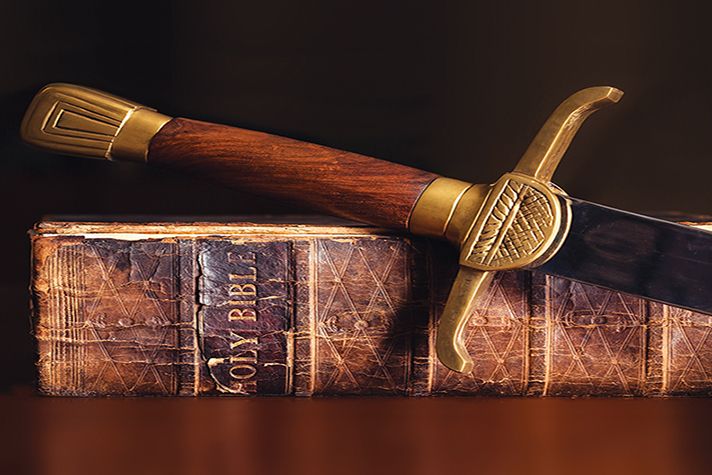
The truth is we can’t be quite sure.Résultat de recherche d'images pour "pictures of the bible"

Since the beginning of human history, worship has played a central role in people’s lives.

The day of humanity worshipping the sun has long gone and the threat of an all-powerful God (or gods) watching for anyone who steps out of line might have helped to keep order in ancient societies, but this is not so in modern today societies.

There is no question but that the progress of the internet into people’s lives is having a profound effect on human culture.

We all agree that something new is taking shape. Many regard this as a form of salvation while others see this as yet another fall.

The developers of nuclear weapons, space exploration and artificial intelligence may be propelled by religious desires, but they are sustained by military financing and the results of their labours are more powerful governments, a more pernicious status quo, and a more preeminent elite of technocrats.

Another words TECHNOLOGY IS TURNING US INTO AUDIENCES.

So what is the reality behind this word worshipping in a world that is being driven more and more by Algorithms feeding off each other?

We are allowing algorithms to progressively restrict our decision-making capacity in ways we don’t notice.

There is not the room here to exam every aspect of worship but let’s try to look with a free-thinking mind at it from the perspective of the three main existing religions.

When one looks at the world I wonder how much this “religion for life” still exists or will exist which binds wounds and ties the fragmented and diverse bits of our lives together.

These days “Worship” might be the word someone chooses when trying to describe a particular sound or style of music so we will attempt to look at it from the point of view of the three main religions.

Religion, it seems, comes from the Latin “re-ligere”, which has to do with “tying” and “binding” which is exactly what our global monopolism like Google/Facebook and there like are trying their best to achieve.

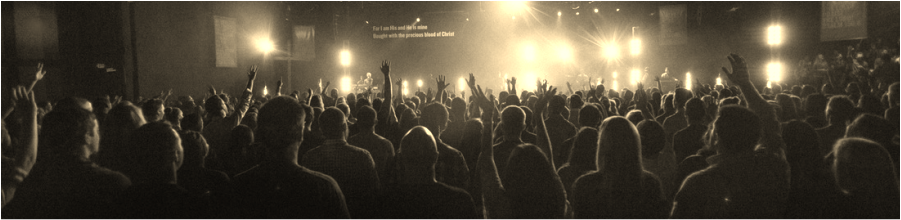
We have experts in worship. We have books on worship. We have seminars and teaching on how to conduct worship. We have the latest state of the art audio and projection systems in churches. We no longer need hymn books. It’s all on the screen or screens before us. We have well-trained worship teams to lead us. Worship abounds in evangelical churches.

Yet, in all of this are we pleasing God? Is he the centre of our worship?

The days that worship is God’s idea are numbered.

The days that it is what he created us to do, are going.

Worship has become all about us our tablets or whatever shiny piece of kit you carry around with you and can’t stop checking every five minutes is making religion less and less to do with everyday life.Picture

We now have a limited and even incomplete view of what worship truly is all about.

True worship should have the proclamation of the Word of God at its centre and everything else should take their place behind it.

Worship is first and foremost exaltation.

Biblical worship, then, involves exalting God above all other objects.

But why do we witness widespread enchantment with technology and at the same time, a worldwide resurgence of religious fundamentalism has occurred?

The chances of the technology itself becoming religious on its own remain farcical.

However, the enthusiasm so many people have with technology is often rooted — sometimes unknowingly — in religious myths and ancient dreams.

This is unfortunate because technology has proven itself capable of causing terrible problems for humanity, and one of the reasons for this may be the religious impulses people are ignoring.

For a thousand years in Western culture, the advancement of the mechanical arts — technology — has been inspired by deep religious desires of transcendence and redemption. This is no longer applies as the promise of transcending nature, our bodies, our human natures, our lives, our deaths, our history, etc, is increasing as fast as the ice is melting.

If you don’t recognize and understand how religious and technological transcendence have developed together, you’ll never be able to successfully counter them — much less recognize when they might be developing within you as well.

Today, the religious impulses underlying technological advancement take two general forms: using explicit religious doctrines, particularly Christianity, to explain why technology should be pursued and using religious imagery of transcendence and redemption removed from traditional religious doctrines but without their losing any motivating power.

Although currently obscured by secular language and ideology, the contemporary resurgence of religion, even fundamentalism, alongside and hand-in-hand with technology is thus not an aberration but simply the reassertion of a forgotten tradition.

Artificial Intelligence with its algorithms is an attempt to divorce thinking from the human mind.

The human brain becomes nothing more than a “meat machine” and the body as a “bloody mess of organic matter.

When it comes to life, only the “mind” is really important.

Intelligent machines would provide humanity with “personal immortality by mind transplant” and that this would be a “defence against the wanton loss of knowledge and function that is the worst aspect of personal death.

What is worship all about? Who is worship all about?Technology vs. Religion

“Worship” in the title of a project is an effective marketing tool that often boosts sales.

The verb “to worship” is mentioned in the Quran 106 times in the Bible 25 times!

In Hebrew you have Shachah means “to bow down, prostrate”; abad: “to serve.”

In Greek, you have proskuneo and latreuo, which mean “to kiss the hand kneeling” and “to serve, minister to” respectively.

In the Quran, which literally means the ‘oft-repeated,’ worship involves every aspect of life. Worship is the very purpose of existence. It does not require a person to enter a place of worship nor embrace monasticism.

However, for an action to be regarded as worship, it must be performed with the pure intention of pleasing God. So God sent Muhammad as His final messenger to humankind is revealed in the Quran, God’s last scripture.

It must be noted here that while Muslims esteem all of the prophets sent by God, including Jesus and Muhammad, they do not worship any of them. In fact, worshipping anyone besides the One God is strictly prohibited in Islam.

Therefore, the concept of worship in Islam encompasses not only the outward religious duties, but also the development of a strong moral character, good relations with people, and striving for just and harmonious societies.

Salvation in Islam like Christianity is connected with doing good deeds and refraining from bad ones.  

However, worship in religious terms blurs the line between ‘religious’ and ‘worldly,’ because practically any action can become spiritual in nature and is rewarded by God.

For example, nearly all religions indicate that what the human being worships is not necessarily what he says he worships but is what or whoever occupies his mind most of the time.

For various reasons, many people have come to believe that Muslims worship a different God than Christians and Jews. This is totally false.

The Arabic word “ALLAH”  contains a deep religious message due to its root meaning and origin. This is because it stems from the Arabic verb ta’allaha (or alaha), which means “to be worshipped”. Thus in Arabic, the word “ALLAH” means “The One who deserves all worship”. This, in a nutshell, is the Pure Monotheistic (one) message of Islam.

Another words worship is exclusive to Allah, who is the only one able to accept it, or not.

On the Allah side of worship, he has 99 different names, but any form made up in the mind that ascribe any form to Allah is absolutely against the guidance and teachings of Islam.

While in the Christian side there are millions of images to concentrate on when worshipping.

What image should come into your mind when you hear the name of Allah?Is Allah God? (Bible and Quran comparison)

Allahu Akbar: “Literally “God is great” in Arabic. Should be a phrase that is no more troubling than when you hear a Christian saying “Thank God.

Unfortunately, it is now a term coined by terrorists and is the biggest act of heresy to shout God’s glorious name when committing the worst crime against God.

We mustn’t allow terrorists or agendas of fear to own any of the words, concepts, or devotions found in the sacred text of a quarter of the world’s population. That would give them exactly what they want. And God is far greater than the ugliness committed in His name. “Allahu Akbar…”

In Hinduism, God has the ability to manifest into any kind of form and shape. There is only one Supreme God which exist at two different levels of reality.

We must take a long, hard look at ourselves and answer honestly:

Are we looking to technology to escape the human condition with all its problems and disappointments? Or are we instead looking to enhance the human condition, flaws, and imperfections notwithstanding?

When an ideology, a religion, or a technology is pursued the purpose of escaping the human condition where problems and disappointments are a fact of life, then it shouldn’t be at all surprising when those human problems are not really solved, when human needs are not entirely met, and when new problems are produced.

And even if we lose sight of the Christian, Muslim and Hindu gods and all the rest, superstitions and spiritualism will almost certainly still prevail.

As soon as we found ourselves facing an ecological crisis, a global nuclear war or an impending comet collision, the gods would emerge.

The world must evolve to reach maturity. And the work of God will be accomplished in this evolution.

All human comments appreciated. All like clicks and abuse chucked in the bin.

← Back

Thank you for your response. ✨

Share this:

  • Share on WhatsApp (Opens in new window) WhatsApp
  • More
  • Share on Mastodon (Opens in new window) Mastodon

THE BEADY EYE SAY’S: GLOBAL WARMING WILL HAPPEN FASTER THAN WE THINK OR WE ARE BEING TOLD. .

09 Saturday Mar 2019

Posted by bobdillon33@gmail.com in Climate Change.

≈ Comments Off on THE BEADY EYE SAY’S: GLOBAL WARMING WILL HAPPEN FASTER THAN WE THINK OR WE ARE BEING TOLD. .

Tags

Capitalism and Greed, Capitalism vs. the Climate., Climate change, Earth, Environment, Global warming, Natural disaster, The Future of Mankind, Visions of the future.


(Fifteen-minute read)

We all watch nature programmes from Cape Horn to the Cape of Good Hope with the majority of us having little or no appreciation of what exactly we are looking at other than beautiful footage of nature that is now under threat from global warming.

Indeed most of us still have no appreciation of what global warming is doing to our planet.

We know that climate change is happening. We also know that it’s the result of increased carbon emissions from human activities like land degradation and the burning of fossil fuels. And we know that it’s urgent.

But that information hasn’t been enough to change our behaviours on a scale great enough to stop climate change. And a big part of the reason is our own evolution. The same behaviours that once helped us survive are, today, working against us.

It’s true that no other species has evolved to create such a large-scale problem – but no other species has evolved with such an extraordinary capacity to solve it, either.

We have evolved to pay attention to immediate threats. We overestimate threats that are less likely but easier to remember, like terrorism, and underestimate more complex threats, like climate change.

Cognitive biases that ensured our initial survival make it difficult to address complex, long-term challenges that now threaten our existence.

We have the perception that the present is more important than the future.

We tend to believe that someone else will deal with a crisis.

We are biased towards staying the course even in the face of negative outcomes.

However, in the next few years if we don’t come to appreciate that we are on the edge a sixth mass extinction which is already underway the carbon cycle will either be close to or well beyond the threshold for catastrophe.

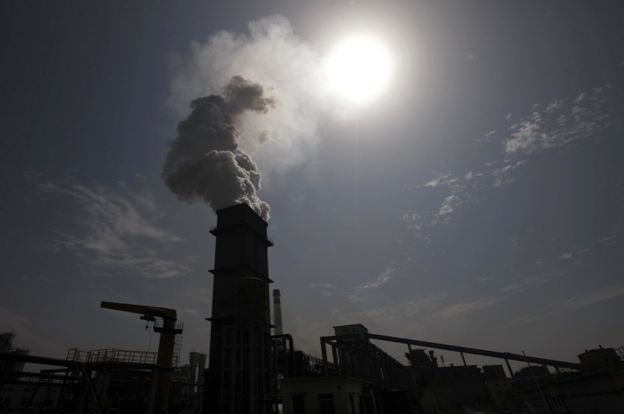
It is something that hasn’t happened yet. But we need for all of us to become to be aware that planet Earth appears to be on course for exactly that.Coal fired power station in Huaibei, in east China's Anhui province, 2011

If Co2 emissions are left unchecked the carbon cycle will move into a realm which is no longer controllable and will be totally unpredictable.

We are the last generation that can act against climate change. In fact, we are or will be the first generation that fully understands climate change and the last generation that can do something about it.

Without brave world leaders, we appear to be doing our best to destroy it as fast as we possibly can.

Just look at extinction rates which are very hard to measure but the background rate – the rate at which species would be lost in the absence of human impacts – is something like ten a year per million species.

Extinction is now happening at 1,000 times the normal speed.

So in around 300 years time, 75% of all mammal species will have disappeared from this planet.

In fact the combined weight of humans and the animals we’ve domesticated now outweighs all the wild back-boned creatures on the planet’s surface by a ratio of 95 to 5.

Paradoxically, just as we approach a tipping point for extinctions, we are beginning to understand how we could bring extinct animals back from the dead.

Instead, in our human world, we are unable to decide what type of ecosystems we would collectively like and set about creating and protecting them.

Rockstrom produced a list of nine human-driven changes to the Earth’s system: climate change, ocean acidification, stratospheric ozone depletion, alteration of nitrogen and phosphorus cycling, freshwater consumption, land use change, biodiversity loss, aerosol and chemical pollution. Each of these nine, if driven hard enough, could alter the planet to the point where it becomes a much less hospitable place on which to live.

Unfortunately, he left out one:

Technology which will lead to new forms of life and novel compounds the likes of which the earth system has not experienced and so impact of which is extremely challenging to assess.

What is certain is that our civilisation is in very important ways dependent on the Earth system remaining within or at least approximately or near zero emission within the next twelve year.

Band-aids will no longer suffice.

The Holocene has witnessed all of humanity’s recorded history and the rise and fall of all its civilizations. Humanity has greatly influenced the Holocene environment; while all organisms influence their environments to some degree, few have ever changed the globe as much, or as fast, as our species is doing.

Yet the Holocene has also seen the great development of human knowledge and technology, which can be used — and are being used — to understand the changes that we see, to predict their effects, and to stop or ameliorate the damage they may do to the Earth and to us.

We have become a planet-altering species.

If we are to avoid undermining the biophysical systems our species depends upon we must get the smartphones that pump consumerism to start pumping conservation.

If we think “consequences are far in the future THINK AGAIN.

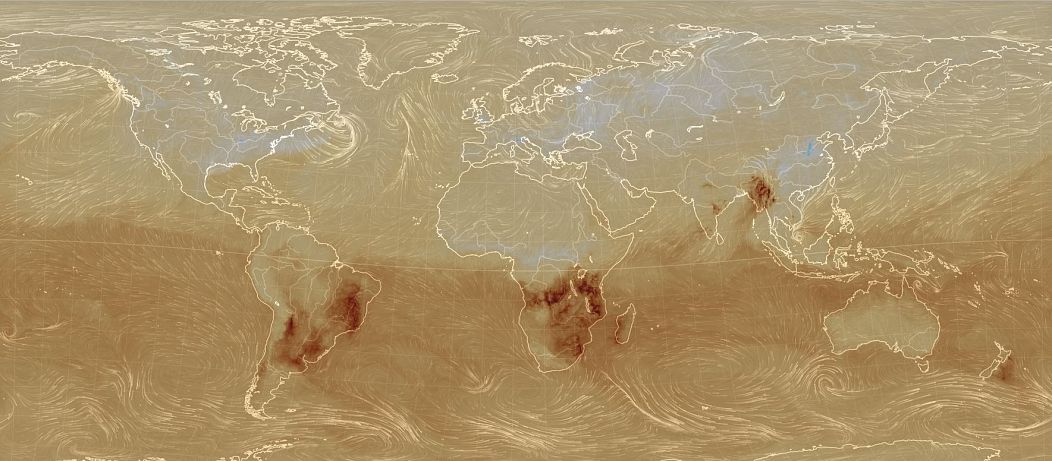
With people like Donald Trump and his friend in Brazil who have a problem with the basic physics of climate change, it becomes really difficult to argue that the world waking up.earth.nullschool.net

It is also naive to think that technology will save the day.

This is the moment when people start to realise that global warming is not a problem for future generations, but for us now.

The EU should by 2050 be among the first to achieve net-zero greenhouse gas emissions and lead the way worldwide. Reaching this objective requires deep societal and economic transformations within a generation touching every sector of the economy.

The EU’s 2050 carbon neutral plan is what’s needed at the global level to generate enough momentum, awareness and action, more importantly, it sets an example that can be matched and replicated by others.

We all must pile up public pressure to implement this plan faster, so politicians and all of us find it hard to avoid taking responsibility.

It is economically and technologically feasible to make more drastic emissions cuts that can keep warming at 1.5C.

As with all world problems, it boils down too who is going to pay.

We have been pumping greenhouse gases into the atmosphere in ever-increasing quantities since the industrial revolution. Some countries in the developed world are, of course, responsible for the bulk of this. Since 1850 the US and the nations which are now the EU have been responsible for more than 50% of the world’s carbon dioxide (CO2) emissions.

So shouldn’t they pay to fix the problem?

The old industrialised world might respond that for much of the period since the 1850s nobody knew about man-made global warming. Does that mitigate its responsibility? And why should the current generation be punished for the crimes of its forebears? Is that really fair?

We have tried carbon trading which only fueled stock exchange profits.

Despite the flurry of world conferences and forums, resulting in unenforceable promises we still fail at finding a solution.

Slowly, but surely we become disconnected from a world that is pleading for our attention and continuing this mindset may not be where we should be heading as a species. We need to stop guzzling into our Earths resources and instead start looking at our earth for what it is, a majestic dot in the universe which has let us call it ‘home’.

Our problem is that we have created a world of Greed.

If you were unaware that you were harming someone, does that make you liable for punishment? Should debt be passed on to you when your parents die? Or, should the current generation be punished for the slavery crimes committed by their ancestors?

We might wonder whether our obligation to people yet unborn is less important than our obligation to those already alive.

WHAT IS NEEDED:  Is a complete revolution in our attitude towards the environment as described recently by Pope Frances.

“We shouldn’t regard the environment as of merely instrumental value. We should consider it with awe and wonder. “If we approach nature and the environment without this openness to awe and wonder… our attitude will be that of masters, consumers, ruthless exploiters, unable to set limits on [our] immediate needs.”

Of course, the Pope is human and like all humans is not willing to put money where his vision is.

The utopia of the past is dying, and even if we were to find a way to continue our lavish lifestyle without harming the environment it will be too late to reverse the damage. If the world’s nations adhered to the Paris Climate Agreement, and temperatures only rose 2.5 per cent, then the global gross domestic product would fall 15 per cent.

If temperatures rose to 3 degrees Celsius, global GDP would fall 25 per cent.

If nothing is done, temperatures will rise by 4 degrees Celsius by 2100. Global GDP would decline by more than 30 per cent from 2010 levels. That’s worse than the Great Depression, where global trade fell 25 per cent.

So the answer to tackling the problem is not just all of us, it is Making Greed for Greed sake pay.

( See previous Posts recreating A World Aid Commission.)

In the meantime, we are now sowing the seeds of havoc on the Earth before we go extinct.

The Earth’s climate has always changed. All species have danced with the climate eventually become extinct.

All human comments appreciated. All like clicks and abuse chucked in the bin.

← Back

Thank you for your response. ✨


Share this:

  • Share on WhatsApp (Opens in new window) WhatsApp
  • More
  • Share on Mastodon (Opens in new window) Mastodon

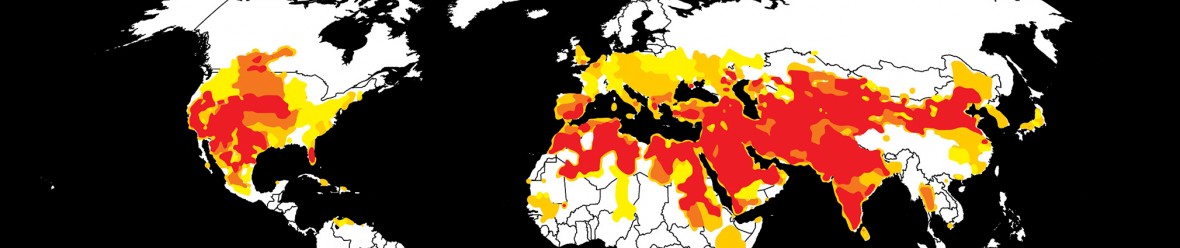
THE BEADY EYE SAY’S. BY 2025, ONE IN EVERY TWO PEOPLE ON THE PLANET WILL BE LIVE WITH WATER STRESS.

07 Thursday Mar 2019

Posted by bobdillon33@gmail.com in Uncategorized

≈ Comments Off on THE BEADY EYE SAY’S. BY 2025, ONE IN EVERY TWO PEOPLE ON THE PLANET WILL BE LIVE WITH WATER STRESS.

(Sixteen-minute read)

We all know that the current changes in our planet’s climate are redrawing the world and magnifying the risks for instability in all forms.

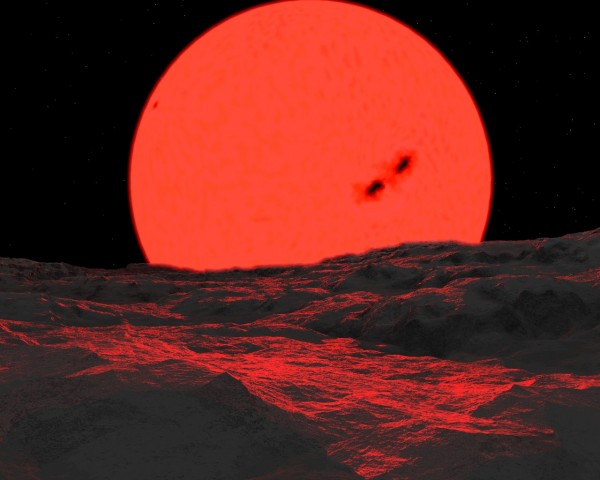
Theoretical view of the Sun as a red giant from a barren Earth

Water is one of the most valuable resources on Earth.

Probably every manufactured product uses water during some part of the production process.

It is the source of life on Earth and quite possibly beyond.

It covers over two-thirds of the planet’s surface, makes up around 70% of the human body and is essential for life.

Water is indispensable to human life.

In theory, the amount of water on earth will always remain the same.

How likely are the water wars to arise?

Water has ranked in the top five risks for seven consecutive years in the World Economic Forum’s Global Risk Report.

There is already plenty of evidence to suggests that climate change drives conflict and social unrest, directly linking both in a cause-and-effect relationship.

Water-related challenges such as shortages and sanitation are already increasing smaller-scale conflict and instability within and across national borders.

Its scarcity is playing a role in fuelling the political and security crisis in Yemen.

Afghanistan’s efforts to harness the waters of the Helmand River and the Harirud to support post-conflict reconstruction and development have alarmed Iran.

The long-standing conflict over water from the Cauvery River between the Indian states Karnataka and Tamil Nadu has recently resurfaced.

However, it is rarely the lack of water as such that fuels conflict, but rather its governance and management.

And if you look at the headline threats to humanity and the planet over the next decade, as pinpointed by 1,000 experts, all but one are linked to water. These include extreme weather, natural and man-made disasters, climate change, biodiversity loss and ecosystem collapse.

This is a grim fact of modern life and despite having contributed the least to anthropogenic climate change of anyone, low-income, resource-poor nations will be affected the most.

You can’t escape climate change if your feet are on the ground.

It is widely agreed that a business-as-usual approach cannot address global water challenges in the future, nor will our current strategies sustain the world’s thirst much longer, particularly when the population hits eight, nine or ten billion in the coming decades.

Yet cold, hard data on how our water systems function is still lacking.

The World Health Organization estimates 844 million people lack basic drinking water; some two billion use a source contaminated with faeces.

With a warming of 2 to 4C, most regions in Africa will experience a 60 to 80 per cent reduction of surface run-off by 2100.

Last year, Cape Town came within a few drops of Day Zero when the taps are turned off. A serious drought was only just averted.

There is no need here to draw a picture of what would happen if  New York or any other city with a few million inhabitants suffered fresh water shortages.

With 55% of us already living in urban areas which are forecasted to hit 68% by 2050 many cities and towns that are in low-lying coastal locations are under threat to flooding.

Let’s face it, water is chronically undervalued and, in some cases, not valued at all.

Only by embedding its true financial, social and environmental value into policymaking, governance, and financial and risk reporting can we instil a better mentality.

The resilience of our society, both in terms of economic growth and human security, must be addressed through a water lens.

As the Paris climate change conference showed making pledges, is one thing, delivering on them often another.

The emerging fourth industrial revolution technologies – machine-learning, artificial intelligence, advanced sensors, satellite imagery, robotics and others – have the potential to unlock a wealth of previously unobtainable data about water systems at the global, regional, watershed and local level.

Unfortunately, all this data will achieve little or nothing unless its value is realized and appreciated today.

In 2021, the Surface Water Ocean Topography mission, a joint satellite mission between Nasa and France, will use radar technology to provide the first global survey of Earth’s water, measuring how bodies of water change over time. The satellite will survey at least 90 per cent of the planet, studying lakes, rivers, reservoirs and oceans roughly twice every 21 days.

WHAT THEY WILL DISCOVER IS BY 2021 WE WON’T NEED A SATELLITE TO SURVEY THE EARTH’S WATER. OUR PLANET IS ALREADY SENDING DISTRESS SIGNALS.

Consumers may already be aware of the environmental impact of producing goods in terms of energy or pollution, but they might be surprised to learn how much water is needed to create some daily goods.

Growing coffee beans is a thirsty business, as is growing cotton – 10,000 litres of water in a pair of jeans – and 2,500 litres in the average T-shirt. Avocados, almonds – even bottles of water themselves, are all highly water-intensive enterprises.

Common sense says it’s TIME TO STOP EATING – HAMBURGERS.

A hamburger takes 2,400 litres, or 630 gallons, of water to produce.

Thousands of litres are needed to make shoes and microchips.

Somewhere around 30 litres of water is required for tea itself, 10 litres for a small dash of milk and a further 6 litres for each teaspoon of sugar. This means that a simple cup of tea with milk and two sugars could actually require 52 litres of water – enough to fill my kettle more than 30 times.

Agriculture uses about 70% of freshwater across the globe.

When countries and regions with water shortages pour their water into exports, on the surface it can look as if they are making a profit, but in the long term their reliance on diminishing water resources will be damaging.

WHAT IF ANYTHING ARE WE DOING ABOUT WATER?

There is the same amount of freshwater on earth as there always has been.

Water scarcity is an abstract concept to many and a stark reality for others. It is the result of myriad environmental, political, economic, and social forces.

In essence, only 0.007 per cent of the planet’s water is available to fuel and feed its 6.8 billion people.

Desalinated seawater is now a mainstay of the Israeli water supply.

A hundred million gallons of ocean water is to be pumped through the Carlsbad Desalination Project each day. … The fat pipe, also known as the brine pit, is where the salt that’s been removed from the drinking water is returned to the ocean wreaking havoc with the ocean’s delicate ecosystems.

Worldwide, some 700 million people don’t have access to enough clean water. In 10 years the number is expected to explode to 1.8 billion.

The UN predicts that by 2025 14 per cent of the world will rely on desalination to meet water needs.

Desalination is being used as a last resort in California.

Water obtained from desalination costs twice the amount of water from freshwater sources. The only way desalination can be a good option for solving the water crisis is if renewable energy is used and the salt extracted is not returned to the sea.

These kinds of industrial desalination plant are generally constructed near the coastline and the discharge-pumped back into the sea causing indirect but well-documented environmental pollution;

Combining renewable energy with improved technology could make desalination a more viable option however desalination is not a silver bullet.

At the moment 844 million people do not even have access to a basic water source.

There is no global governance system for water.

60% of all surface water on earth comes from river basin shared by separate nations and almost 600 aquifers cross national boundaries.

It would cost just over £21bn a year to 2030, or 0.1% of global GDP, to provide water and hygiene to all those who need it, but the World Bank estimates that the economic benefits would be $60bn a year.

Bottled water privatization creates a monopoly on a resource that should otherwise be available to the people who live in the region where the water is located.

If you asked me I would say that we will have to learn once again to show humility, even reverence, for this vital liquid.

In other words, coping with drought and water shortage by reducing water consumption, rather than (fueling consumption by) increasing water supply.

For example, the EU is generating an enormous amount of pollution in other countries by consuming imported products without having to deal with the consequences.

The challenge we now face as we head into the future is how to effectively conserve, manage, and distribute the water we have.

Nobody knows how much water is left.Image result for dry dessert

We’ve buried our head in the sand for far too long. Rough estimates say in little over a decade half of the world will be living in areas where there simply isn’t enough to go round.

The one thing we do know is that even though the earth is changing on its own, we’re ultimately responsible for the dangers we’re facing today.

It’s time to start making big changes before it’s too late.

How about recharge our groundwater from melting glaciers.

Hopefully, we’ll come up with ways to produce more water before we hit the point where half the world will be desperate for it.

Perhaps here in the European Union, we could make it compulsory for all farmers to use field sensors, ( that are available for as little as 10 euros a year,) that can monitor the moisture content in soil, letting farmers know whether irrigation is needed and allowing them to calibrate the irrigation more finely than has previously been possible.

But science and technology can only go so far.

As with most water issues, the biggest problem is still governance and equity.

Even if when you factor in the fact that with global warming well underway 2/3 of the freshwater in the world is locked up in frozen glaciers.

One of the potentially most destabilising global water-related threats will be rising food prices and increased hunger.

Climate change is, self-evidently, becoming a global phenomenon.

95% of this drama will unfold in the next 50 to 100 years.

The crux of the matter is that climate change isn’t just a ubiquitous problem, it’s also deeply complex.

With or without climate change water will be the key environmental issue of the century.

how much water on earth is drinkable

IN THE MEANTIME MY ADVICE IS START CONSERVING IT.

All human comments appreciated. All like clicks and abuse chucked in the bin.
← Back

Thank you for your response. ✨


Share this:

  • Share on WhatsApp (Opens in new window) WhatsApp
  • More
  • Share on Mastodon (Opens in new window) Mastodon
← Older posts
Newer posts →

All comments and contributions much appreciated

  • THE BEADY EYE SAYS. OUR HUMAN ANALYTIC CAPACITY IS ALMOST USELESS. October 5, 2026
  • THE BEADY EYE SAYS DEMOCRACY IS BREAKING DOWN. October 4, 2026
  • THE BEADY EYE SAYS DECISIONS ABOUT AI ARE BEING MADE BY A SMALL GROUP OF COMPANIES. October 4, 2026
  • THE BEADY EYE ASKED HAVE WE COME A LONG WAY FROM RUBBING A STICK BETWEEN OUR HANDS TO CREATE FIRE. October 2, 2026
  • THE BEADY EYE SAYS: WE FUNDAMENTALLY MISSING OR UNDERSTANDING WHAT WE HAVE INVENTED WHEN IT COMES TO ARTIFICIAL INTELLIGENCE. October 2, 2026

Archives

  • October 2026
  • September 2026
  • August 2026
  • July 2026
  • June 2026
  • May 2026
  • April 2026
  • March 2026
  • February 2026
  • January 2026
  • December 2025
  • November 2025
  • October 2025
  • September 2025
  • August 2025
  • July 2025
  • June 2025
  • May 2025
  • February 2025
  • January 2025
  • December 2024
  • November 2024
  • October 2024
  • September 2024
  • August 2024
  • July 2024
  • June 2024
  • May 2024
  • April 2024
  • March 2024
  • February 2024
  • January 2024
  • December 2023
  • October 2023
  • September 2023
  • August 2023
  • July 2023
  • June 2023
  • May 2023
  • April 2023
  • March 2023
  • February 2023
  • January 2023
  • December 2022
  • November 2022
  • October 2022
  • September 2022
  • August 2022
  • July 2022
  • June 2022
  • May 2022
  • April 2022
  • March 2022
  • February 2022
  • January 2022
  • December 2021
  • November 2021
  • October 2021
  • September 2021
  • August 2021
  • July 2021
  • June 2021
  • May 2021
  • April 2021
  • March 2021
  • February 2021
  • January 2021
  • December 2020
  • November 2020
  • October 2020
  • September 2020
  • August 2020
  • July 2020
  • June 2020
  • May 2020
  • April 2020
  • March 2020
  • February 2020
  • January 2020
  • December 2019
  • November 2019
  • October 2019
  • September 2019
  • August 2019
  • July 2019
  • June 2019
  • May 2019
  • April 2019
  • March 2019
  • February 2019
  • January 2019
  • December 2018
  • November 2018
  • October 2018
  • September 2018
  • August 2018
  • July 2018
  • June 2018
  • May 2018
  • April 2018
  • March 2018
  • February 2018
  • January 2018
  • December 2017
  • November 2017
  • October 2017
  • September 2017
  • August 2017
  • July 2017
  • June 2017
  • May 2017
  • April 2017
  • March 2017
  • February 2017
  • January 2017
  • December 2016
  • November 2016
  • October 2016
  • September 2016
  • August 2016
  • July 2016
  • June 2016
  • May 2016
  • April 2016
  • March 2016
  • February 2016
  • January 2016
  • December 2015
  • November 2015
  • October 2015
  • September 2015
  • August 2015
  • July 2015
  • June 2015
  • May 2015
  • April 2015
  • March 2015
  • February 2015
  • January 2015
  • December 2014
  • November 2014
  • October 2014
  • September 2014
  • August 2014
  • July 2014
  • June 2014
  • May 2014
  • April 2014
  • March 2014
  • February 2014
  • January 2014
  • December 2013
  • November 2013
  • October 2013

Talk to me.

benmadigan's avatarbenmadigan on THE BEADY EYE LOOKS AT THE EXP…
Jason Lawrence's avatarJason Lawrence on THE BEADY EYE ASK’S: WIT…
benmadigan's avatarbenmadigan on THE BEADY EYE ASK’S: WHA…
bobdillon33@gmail.com's avatarbobdillon33@gmail.co… on THE BEADY EYE SAYS: WELCOME TO…
Ernie's avatarOG on THE BEADY EYE SAYS: WELCOME TO…

7/7

Moulin de Labarde 46300
Gourdon Lot France
0565416842
Before 6pm.

My Blog; THE BEADY EYE.

My Blog; THE BEADY EYE.
bobdillon33@gmail.com

bobdillon33@gmail.com

Free Thinker.

View Full Profile →

Follow bobdillon33blog on WordPress.com

Blog Stats

  • 105,400 hits

Blogs I Follow

  • unnecessary news from earth
  • The Invictus Soul
  • WestDeltaGirl's Blog
  • The PPJ Gazette
Follow bobdillon33blog on WordPress.com

The Beady Eye.

The Beady Eye.
Follow bobdillon33blog on WordPress.com

Blog at WordPress.com.

unnecessary news from earth

WITH MIGO

The Invictus Soul

The only thing worse than being 'blind' is having a Sight but no Vision

WestDeltaGirl's Blog

Sharing vegetarian and vegan recipes and food ideas

The PPJ Gazette

PPJ Gazette copyright ©

Privacy & Cookies: This site uses cookies. By continuing to use this website, you agree to their use.
To find out more, including how to control cookies, see here: Cookie Policy
  • Subscribe Subscribed
    bobdillon33blog
    Join 222 other subscribers

    Have a WordPress.com account? Log in now.

  • bobdillon33blog
    View site in Reader
    Manage subscriptionsSign upLog in
    Report this content
    Collapse this bar