THE BEADY EYE ASK’S: ARE WE WITH TECHNOLOGY RISKING LOSING EVEN MORE THAN WE THINK?  WE  ARE NO LONGER AT AN AGE TO POSTPONE ANYTHING.

( Seventeen minute read)

As our technological prowess has increased, so has our ability to transform landscapes and the planet.

Up to now the defining trait of the human species has been our tendency to shape our environment and surroundings to suit us.

Today we can divert entire rivers, reclaim land from the oceans, chop down swathes of forest, level mountainsides and build new ones as we constantly seek to improve the physical world around us.

However isn’t it clear that our actions are taking a toll on the health of our planet, in the guise of climate change, the destruction of habitats, the loss of species and pollution. Attempts to resurrect species that have gone extinct or use gene-editing technologies to create artificial life are examples of this.

Right now, we’re in this era of stopgaps.

Society used to be able to make a long-term plan: people built long-term infrastructure and thought a bit further out.

That’s not something that happens now: We go to quick fixes, when we need a cultural change in values.

To enable more deliberate decision-making, if we focus on trying to make the world  better rather than simply protecting what remains of the natural world are we just turning our species with algorithms into an senility of greed, paying lips service to what is really happing

The way we talk about climate change can impact the solutions we develop. We can’t solve any problems, especially at the global scale, if we don’t talk about the problem and the best way to address it.

I think this is because of people do not wanting to talk about it as they are incapable of imaging just like a nuclear war the concepts of a world unliveable, because they don’t have the body of knowledge, and it would need 20 or 30 years to develop it. “Humans are a very flawed species.”

So the world of 2050 will be unimaginably different in many ways, even if we can safely assume people will still generally have two arms, two legs and an unpleasant smell if they don’t wash for long periods of time.

Right about mid-century means it will be a crunch point: Climate change will be really apparent.

However over the past couple of years new AI tools have emerged that threaten the survival of human civilisation from an unexpected direction. For example, AI has gained some remarkable abilities to manipulate and generate language, whether with words, sounds or images. AI has thereby hacked the operating system of our civilisation.

Language is the stuff almost all human culture is made of. Human rights, for example, aren’t inscribed in our DNA.


Let’s look at the present scenario with the Climate.

Why all the silence about climate change?

Why isn’t this topic filling our conversations, the way a tsunami would, or a major earthquake?

I ask again, why are not more people crying out?

Some of the smartest people think we will not be able to act in time, that we will continue to delay until we can’t stem the rising waters, the droughts, the refugees, the failed states, the wars fought over precious resources like arable land, food, water.

If we have no hope of having a better world, then it becomes a more divided world.

Let me suggest some of the reasons.

Continued efforts that largely focus on persuading people about the realities of climate change “is going to be wasted money, wasted effort, wasted air. It sometimes seems as though climate change conversations can be divided into two narratives: People are either overly optimistic about solutions — or claim it’s “too late” to act.

Will enough human beings actually undertake any of the necessary actions?

Climate change is a complex problem and proposing “simplistic, all-encompassing grand solutions” is not the answer.

We have to focus on where most emissions are and focus on reducing that as quickly as possible. Its not possible for any one person to be capable of single-handedly creating major change. Individual action should be seen as part of an ecosystem of change that requires systemic level changes. Social solutions that address inequities and environmental justice issues “need to go hand-in-hand” with discussions about physical or economic solutions to climate change.

A key component of talking about climate issues revolves around making climate solutions equitable.

If we just addressed the question from the standpoint of, ‘Climate change is here, we have to reduce greenhouse gases,’ but don’t talk about how we do that, then you end up with communities being presented with what we call false solutions or our legislature being presented with false solutions.

THE CLIMATE  IS NOW IN THE PROCESS OF CHANGING NOT JUST WHERE WE WILL LIVE, BUT HOW WE LIVE.

The specifics of what will change are not for this piece, but the human response very much is. humanity, in time, reaches net zero when it comes to emissions.

In that scenario, we will live in a world where plant proteins replace meat in everyday consumption, where electrically powered networked mass transit reaches into the suburbs and beyond, a world of video-conferencing and remote attendance steadily chipping away at business flights. A world in which mega scale injections of sulphur dioxide into the stratosphere turn the heavens a milky-white, and a whole generation never sees a clear blue sky, in order to reflect more of the sun’s rays and pause the greenhouse effect.

It is one in which we turn on gigantic processing plants that do nothing but extract carbon dioxide from the air and pump it underground into disused oil wells. It is one in which whole cities are abandoned and populations relocated to avoid the worst effects we can’t prevent.

We need everyone to be a climate communicator and not just rely on one or two people or not just scientists because we’re going to be living with this problem for a long time.

——-

So what are the key ideas and designs that could influence the world of tomorrow?

(Look, it can’t all be high-tech. There is also this way of looking at it.)

There is, perhaps, little point in dwelling on the 50% chance that AGI does develop.

If it does, every other prediction we could make is moot, and this story, and perhaps humanity as we know it, will be forgotten.

And if we assume that transcendentally brilliant artificial minds won’t be along to save or destroy us, and live according to that outlook, then what is the worst that could happen – we build a better world for nothing?

How ever if we are guessing the future from simple trend lines, there is another one that we need to acknowledge:

The engineering of any possible transition that can avert catastrophic climate breakdown must be paramount in the minds of governments actions because there are not enough rare earth metals for wind turbines and all the other hardware we will need for renewable energy which means eight billion people will go to hell.

We all know this.

However what we see are countries governments offering billions in sub’s to attract the manufacture of batteries for electrical cars. The producing the average 60kWh battery alone generates nine tonnes of CO2.

In fact, the batteries that power electric vehicles may also be their Achilles heel.

These manufacturing companies will go broke in the long term.

Well, fair enough, but questions arise when we dig into the inner layers of electrical vehicles and see how sustainable their components are. They already have a significant environmental impacts, ranging from the mining for materials and the water and energy used in making new batteries and vehicles, through to the hazardous waste from discarded batteries.

So even though EVs may help reduce carbon dioxide (CO2) emissions over their lifetime, the battery that powers them starts its life laden with a large environmental footprint.

In about 2025, when millions of EV batteries reach the end of their initial life cycles, a streamlined recycling process will be needed.

A plug-in hybrid has a battery and an electric motor, are made from advanced materials to reduce its weight but it also has a petrol or diesel engine. At a stroke, the efficiencies of one are cancelled out by the inefficiencies of the other. Not even a 30-mile electric-only touring range can fix that.

The reason all manufacturers currently use lithium is that it provides a lighter battery that lasts longer. That gives the car greater range without recharging, and it make possible a much lighter car. In other words, lithium batteries are cheaper.

You can’t tinker with an electric car as you can a conventional one because you’ll very likely be electrocuted.

——–
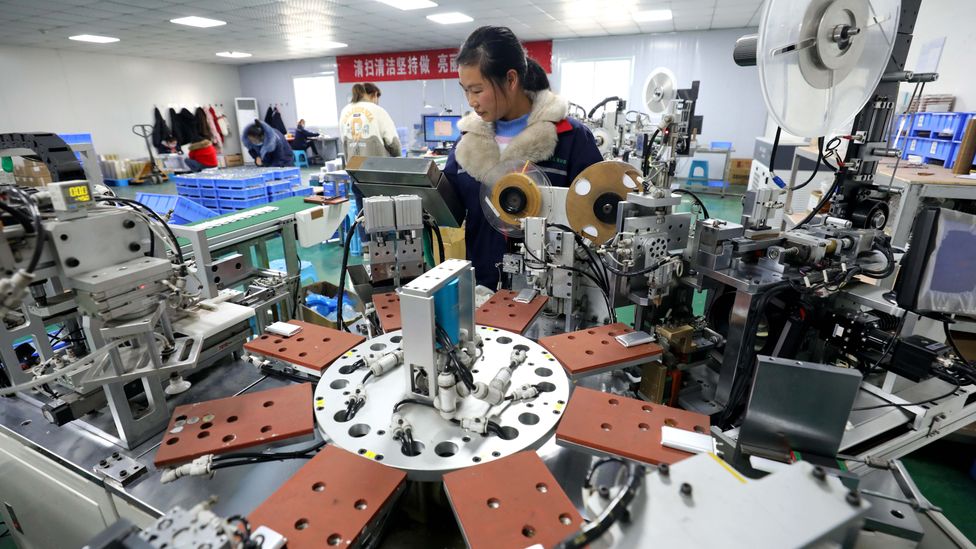
Lithium batteries are more internally complex than lead-acid batteries, composed of many carefully assembled parts (Credit: Getty Images)

In the age of electrification, we take rechargeable batteries for granted. From phones and laptops to hi-tech cameras.

The main use of rare earth metals now is for screens, smart phones, games consoles, electronics and laptop computers. You can have a phone, a computer or a screen without rare earth metals. – these batteries have one thing in common. They’re all made of lithium and it costs more to recycle them than to mine more lithium to make new ones.

Lithium is a metal used in almost all electric vehicle batteries today. About half of global production of lithium currently goes to electric vehicles. And in future we will need to increase the production of electric vehicles from hundreds or thousands to hundreds of millions. That will require vast amounts of lithium.

In South America, huge lithium reserves are using up water by the gallon, causing devastating water-related conflicts among locals. Most of the known deposits of lithium rich brine are in the arid highlands where Bolivia, Chile and Argentina come together. It is also mined from hard rock in China or the United States where a whopping 2.2 million litres of water is needed to produce one ton of lithium. The mining is also toxic, because large amounts of acid are used in the processing.

The result is that ancestral homelands become unliveable.

That’s not to mention that the world’s oceans contain an estimated 180 billion tons of lithium. But it’s diluted.

Lithium is not the most environmentally friendly chemical element we could be using. The transition to green energy does not have to be powered by destructive and poisonous mineral extraction.

More important, batteries do not have to be made out of lithium. The way forward is hydrogen fuel cells.

We can no longer treat the batteries as disposable.

Similar arguments apply to rare earth metals.

It is not possible now to tell what metals will be needed for which industries in ten years’ time.

There are several different kinds of rare earth metals, each with different properties. They are widely used, in small amounts, in wind turbines, car batteries and much other technology necessary for climate change.

It is often said that this rarity is an obstacle to decarbonizing the world.  This is not quite right.

Right now most rare earth metals are mined in China. There is nothing special about the geology of China.  Most of them could be mined in the United States, or a range of other countries.


Next we have AI. 

There is no doubt that if AI is used for the benefit of humanity it could able us to conquer many of our problems, like new medical treatments diseases, exploring the universe and beyond, addressing inequality etc, the list is endless with our own very extinction at the end.

With self learning algorithm’s, killings drones and the internet far more entrenched now, with its chaotic effect on our lives showing no sign of abating, its far too late for regulation.  It is at least predictably unpredictable and has to be harnessed by International laws before it develops its own fee will. 

Technology really has made great leaps and bounds in the past 16 years, nowhere more clearly than AI  hidden behind all its hype is data hoarding which can be misguided or well-intentioned, but it’s always bad for the environment.

Take the I Cloud the great AI techno rubbish dump of data. Pumping 5.8 million tonnes of CO2 into the atmosphere this year as a result of storing unnecessary ‘dark data’ – this translates to more emissions than 80 individual countries. 

Its no wonder the cost of energy is going up.

90% of what’s stored in the Cloud is undulating rubbish produced by social media weapon – the Smart Phone.

(After half a century of single-purpose consumer electronics, it was difficult to perceive how all-encompassing a single device like the smartphone could become.)

Smartphone penetration in the west is now as high as it looks likely to go, with a loss of privacy that is going to be very difficult for people that haven’t figured out how to deal with that. However the world changes over the next 30 years, won’t be as a result of more Britons or Americans getting phones.

Computational machines will have surpassed the processing power of all the living human brains on Earth. The cloud will also have absorbed the thinking of the many dead brains on Earth, too – and we all need to work together to survive.

So I predict that we will see a lasting cooperation between the human race and the computational machines of the future, as to which sets the playing field is still up for grabs.  

——

Is there any other way people live their lives?

Artificial intelligence brains simply cannot cope with change and unpredictable events.

The complexity and ambivalence of people’s relationship with daily mobility is decreasing with services and shopping going online  Here, commuting is seen simultaneously as a tiresome burden, but also as a key source of interaction with the wider world which is important in sustaining people’s sense of daily balance.

Furthermore, ‘compensatory mobilities’ emerge as a widespread practice which helps people retain aspects they miss about commuting while working from home. This practice, underscores the intrinsic enjoyment associated with being on the move, and is important for unravelling the potential impacts of working from home on people’s mobility carbon footprint.

Understanding experiences of a less mobile life under COVID-19 offers insights into the taken-for-granted meanings of mobility in daily life, and into new opportunities for low-carbon mobility transitions associated with working from home.

Perhaps if we were to consider turning our villages and towns, districts of our cities, into green spaces, surrounded with local businesses. WE COULD RETURN TO LIVING WITHOUT THE NEED TO COMMUTE FROM OR TO SUPERMARKETS THAT SUCK THE SOUL OUT OF TOWN CENTERS FOR PROFIT.

WE MIGHT DISCOVER NEW EXPERIENCES AND ROUTINES THAT HOLD OUR DAILY LIFE TOGETHER AND MAKE IT PLEASANT, RATHER THAN BEING DRIVEN BY ALGOTHRIMS.

The bottom line is that Western Civilization, as we know it is unsustainable, because everything about Capitalism is built around economic growth and continuous accrual of increasing wealth, while despising those who fail to win a growing stake.

All for brief moments of superficial comfort that are considered vital for happiness.

It is too late to stop our climate from getting worse, no matter what we do, and it is highly unlikely we

 
shall avoid human extinction if we dont start questioning just how far beyond the planet’s resources we
 
are already extended.
 
The overwhelming challenges are: end livestock farming , stop burning fossil fuels, stop felling the rain
 
forests trees & avoid other GHG emissions.
 
Proposed solutions:
 
Nuclear fusion, Nuclear fission, Green hydrogen, Wind farms, Solar panels, Hydropower, Plant a trillion
 
trees & maybe I’ve missed some.
 
In order for any possible solutions to be successful it would require the world’s powerful people
 
( Politicians, farming organization leaders, investors, corporate leaders etc.,) to come together, speedily, to
 
tackle these challenges, and in the short amount of time to “contributing to a community that maintains
 
quality of life with enhanced social connectivity and minimal emissions.
 
Our species is hard-wired to pay attention to the present.
 
We are more motivated by our emotions than by rationality, more by the moment than by the future.
 
So we tend to pay attention to current problems, both personal and civic, and put climate change out of
 
our minds.
 
We have contribute to this with technology disempower ourselves, truncated ourselves from nature.
 
As a matter of fact, government and business are in an unholy alliance that often stalls social change,
 
including the desperately needed change in our emissions rate.
 
We can’t count on them to lead.
 
People are overwhelmed by the enormity of the problem, coupled with the lack of political will,
 
worldwide, so they distract themselves from their fear and grief, and just get on with their everyday lives.
 
Human nature will mean I am asking too much and that as a result: Human extinction is unavoidable.
 
We have to try.
 
We cannot let the worst happen without giving our very best effort. Our very sense of decency and
 
morality compels us.
 
History will have to record that the greatest tragedy of this period of social transition was not the strident clamour of the bad people, but the appalling silence of the good people.” 
 
Morales was unable to nationalize corporations. To transform society, we must begin by transforming
 
the media .
 
All human comments appreciated. All like clicks and abuse chucked in the bin.
 
Contact: bobdillon33@gmail.com

THE BEADY EYE ASK’S : ARE OUR LIVES GOING TO BE RULED BY ALGORITHMS.

Tags

, , ,

( Ten minute read) 

I am sure that unless you have being living on another planet it is becoming more and more obvious that the manner you live your life is being manipulate and influence by technologies.

So its worth pausing to ask why the use of AI for algorithm-informed decision is desirable, and hence worth our collective effort to think through and get right.

A huge amount of our lives – from what appears in our social media feeds to what route our sat-nav tells us to take – is influenced by algorithms. Email knows where to go thanks to algorithms. Smartphone apps are nothing but algorithms. Computer and video games are algorithmic storytelling.  Online dating and book-recommendation and travel websites would not function without algorithms.

Artificial intelligence (AI) is naught but algorithms.

The material people see on social media is brought to them by algorithms. In fact, everything people see and do on the web is a product of algorithms. Algorithms are also at play, with most financial transactions today accomplished by algorithms. Algorithms help gadgets respond to voice commands, recognize faces, sort photos and build and drive cars. Hacking, cyberattacks and cryptographic code-breaking exploit algorithms.

Algorithms are aimed at optimizing everything.

Self-learning and self-programming algorithms are now emerging, so it is possible that in the future algorithms will write many if not most algorithms.

Yes they can save lives, make things easier and conquer chaos, but when it comes both the commercial/ social world, there are many good reasons to question the use of Algorithms.

Why? 

They can put too much control in the hands of corporations and governments, perpetuate bias, create filter bubbles, cut choices, creativity and serendipity, while exploiting not just of you, but the very resources of our planet for short-term profits, destroying what left of democracy societies, turning warfare into face recognition, stimulating inequality, invading our private lives, determining our futures without any legal restrictions or transparency, or recourse.

The rapid evolution of AI and AI agents embedded in systems and devices in the Internet of Things will lead to hyper-stalking, influencing and shaping of voters, and hyper-personalized ads, and will create new ways to misrepresent reality and perpetuate falsehoods.

———

As they are self learning, the problem is who or what is creating them, who owns these algorithms and what if there should be any controls in their usage.

Lets ask some questions that need to be ask now not later concerning them. 

1) The outcomes the algorithm intended to make possible (and whether they are ethical)

2) The algorithm’s function.

3) The algorithm’s limitations and biases.

4) The actions that will be taken to mitigate the algorithm’s limitations and biases.

5) The layer of accountability and transparency that will be put in place around it.

There is no debate about the need for algorithms in scientific research – such as discovering new drugs to tackle new or old diseases/ pandemics, space travel, etc. 

Out side of these needs the promise of AI is that we could have evidence-based decision making in the field:

Helping frontline workers make more informed decisions in the moments when it matters most, based on an intelligent analysis of what is known to work. If used thoughtfully and with care, algorithms could provide evidence-based policymaking, but they will fail to achieve much if poor decisions are taken at the front.

However, it’s all well and good for politicians and policymakers to use evidence at a macro level when designing a policy but the real effectiveness of each public sector organisation is now the sum total of thousands of little decisions made by algorithms each and every day.

First (to repeat a point made above), with new technologies we may need to set a higher bar initially in order to build confidence and test the real risks and benefits before we adopt a more relaxed approach. Put simply, we need time to see in what ways using AI is, in fact, the same or different to traditional decision making processes.

The second concerns accountability. For reasons that may not be entirely rational, we tend to prefer a human-made decision. The process that a person follows in their head may be flawed and biased, but we feel we have a point of accountability and recourse which does not exist (at least not automatically) with a machine.

The third is that some forms of algorithmic decision making could end up being truly game-changing in terms of the complexity of the decision making process. Just as some financial analysts eventually failed to understand the CDOs they had collectively created before 2008, it might be too hard to trace back how a given decision was reached when unlimited amounts of data contribute to its output.

The fourth is the potential scale at which decisions could be deployed. One of the chief benefits of technology is its ability to roll out solutions at massive scale. By the same trait it can also cause damage at scale.

 In all of this it’s important to remember that while progress isn’t guaranteed transformational progress on a global scale normally takes time, generations even, to achieve but we pulled it off in less than a decade and spent another decade pushing the limits of what was possible with a computer and an Internet connection and, unfortunately, we are beginning running into limits pretty quickly such as.

No one wants to accept that the incredible technological ride we’ve enjoyed for the past half-century is coming to an end, but unless algorithms are found that can provide a shortcut around this rate of growth, we have to look beyond the classical computer if we are to maintain our current pace of technological progress.

A silicon computer chip is a physical material, so it is governed by the laws of physics, chemistry, and engineering.

After miniaturizing the transistor on an integrated circuit to a nanoscopic scale, transistors just can’t keep getting smaller every two years. With billions of electronic components etched into a solid, square wafer of silicon no more than 2 inches wide, you could count the number of atoms that make up the individual transistors.

So the era of classical computing is coming to an end, with scientists anticipating the arrival of quantum computing designing ambitious quantum algorithms that tackle maths greatest challenges an Algorithm for everything.

———–

Algorithms may be deployed without any human oversight leading to actions that could cause harm and which lack any accountability.

The issues the public sector deals with tend to be messy and complicated, requiring ethical judgements as well as quantitative assessments. Those decisions in turn can have significant impacts on individuals’ lives. We should therefore primarily be aiming for intelligent use of algorithm-informed decision making by humans.

If we are to have a ‘human in the loop’, it’s not ok for the public sector to become littered with algorithmic black boxes whose operations are essentially unknowable to those expected to use them.

As with all ‘smart’ new technologies, we need to ensure algorithmic decision making tools are not deployed in dumb processes, or create any expectation that we diminish the professionalism with which they are used.

Algorithms could help remove or reduce the impact of these flaws.


So where are we.

At the moment modern algorithms are some of the most important solutions to problems currently powering the world’s most widely used systems.

Here are a few. They form the foundation on which data structures and more advanced algorithms are built.

Google’s PageRank algorithm is a great place to start, since it helped turn Google into the internet giant it is today.

The PageRank algorithm so thoroughly established Google’s dominance as the only search engine that mattered that the word Google officially became a verb less than eight years after the company was founded. Even though PageRank is now only one of about 200 measures Google uses to rank a web page for a given query, this algorithm is still an essential driving force behind its search engine.

The Key Exchange Encryption algorithm does the seemingly impo

Backpropagation through a neural network is one of the most important algorithms invented in the last 50 years.

Neural networks operate by feeding input data into a network of nodes which have connections to the next layer of nodes, and different weights associated with these connections which determines whether to pass the information it receives through that connection to the next layer of nodes. When the information passed through the various so-called “hidden” layers of the network and comes to the output layer, these are usually different choices about what the neural network believes the input was. If it was fed an image of a dog, it might have the options dog, cat, mouse, and human infant. It will have a probability for each of these and the highest probability is chosen as the answer.

Without backpropagation, deep-learning neural networks wouldn’t work, and without these neural networks, we wouldn’t have the rapid advances in artificial intelligence that we’ve seen in the last decade.

Routing Protocol Algorithm (LSRPA) are the two most essential algorithms we use every day as they efficiently route data.

The two most widely used by the Internet, the Distance-Vector Routing Protocol Algorithm (DVRPA) and the Link-State traffic between the billions of connected networks that make up the Internet.

Compression is everywhere, and it is essential to the efficient transmission and storage of information.

Its made possible by establishing a single, shared mathematical secret between two parties, who don’t even know each other, and is used to encrypt the data as well as decrypt it, all over a public network and without anyone else being able to figure out the secret.

Searches and Sorts are a special form of algorithm in that there are many very different techniques used to sort a data set or to search for a specific value within one, and no single one is better than another all of the time. The quicksort algorithm might be better than the merge sort algorithm if memory is a factor, but if memory is not an issue, merge sort can sometimes be faster;

One of the most widely used algorithms in the world, but in that 20 minutes in 1959, Dijkstra enabled everything from GPS routing on our phones, to signal routing through telecommunication networks, and any number of time-sensitive logistics challenges like shipping a package across country. As a search algorithmDijkstra’s Shortest Path stands out more than the others just for the enormity of the technology that relies on it.

——–

At the moment there are relatively few instances where algorithms should be deployed without any human oversight or ability to intervene before the action resulting from the algorithm is initiated.

The assumptions on which an algorithm is based may be broadly correct, but in areas of any complexity (and which public sector contexts aren’t complex?) they will at best be incomplete.

Why?

Because the code of algorithms may be unviewable in systems that are proprietary or outsourced.

Even if viewable, the code may be essentially uncheckable if it’s highly complex; where the code continuously changes based on live data; or where the use of neural networks means that there is no single ‘point of decision making’ to view.

Virtually all algorithms contain some limitations and biases, based on the limitations and biases of the data on which they are trained.

 Though there is currently much debate about the biases and limitations of artificial intelligence, there are well known biases and limitations in human reasoning, too. The entire field of behavioural science exists precisely because humans are not perfectly rational creatures but have predictable biases in their thinking.

Some are calling this the Age of Algorithms and predicting that the future of algorithms is tied to machine learning and deep learning that will get better and better at an ever-faster pace. There is something on the other side of the classical-post-classical divide, it’s likely to be far more massive than it looks from over here, and any prediction about what we’ll find once we pass through it is as good as anyone else’s.

It is entirely possible that before we see any of this, humanity will end up bombing itself into a new dark age that takes thousands of years to recover from.

The entire field of theoretical computer science is all about trying to find the most efficient algorithm for a given problem. The essential job of a theoretical computer scientist is to find efficient algorithms for problems and the most difficult of these problems aren’t just academic; they are at the very core of some of the most challenging real world scenarios that play out every day.

Quantum computing is a subject that a lot of people, myself included, have gotten wrong in the past and there are those who caution against putting too much faith in a quantum computer’s ability to free us from the computational dead end we’re stuck in.

The most critical of these is the problem of optimization:

How do we find the best solution to a problem when we have a seemingly infinite number of possible solutions?

While it can be fun to speculate about specific advances, what will ultimately matter much more than any one advance will be the synergies produced by these different advances working together.

Synergies are famously greater than the sum of their parts, but what does that mean when your parts are blockchain, 5G networks, quantum computers, and advanced artificial intelligence?

DNA computing, however, harnesses these amino acids’ ability to build and assemble itself into long strands of DNA.

It’s why we can say that quantum computing won’t just be transformative, humanity is genuinely approaching nothing short of a technological event horizon.

Quantum computers will only give you a single output, either a value or a resulting quantum state, so their utility solving problems with exponential or factorial time complexity will depend entirely on the algorithm used.

One inefficient algorithm could have kneecapped the Internet before it really got going.

It is now oblivious that there is no going back.

The question now is there anyway of curtailing their power.

This can now only be achieved with the creation of an open source platform where the users control their data rather than it being used and mined.  (The uses can sell their data if the want.)

This platform must be owned by the public, and compete against the existing platforms like face book, twitter, what’s App, etc,   protected by an algorithm that protects the common values of all our lives – the truth. 

Of course it could be designed by using existing algorithms which would defeat its purpose. 

It would be an open net-work of people a kind of planetary mind that has to always be funding biosphere-friendly activities.

A safe harbour perhaps called the New horizon.   A digital United nations where the voices of cooperation could be heard.   

So if by any chance there is a human genius designer out there that could make such a platform he might change the future of all our digitalized lives for the better.   

All human comments appreciated. All like clicks and abuse chucked in the bin.

Contact: bobdillon33@gmail.com  


THE BEADY EYE ASK’S: IS THIS A NIVE QUESTION. IS IT IN NATO INTEREST TO ALLOW THE UK TO SUPPLY CRUISE MISSILES TO THE UKRAIN.

Tags

,

( Three minute read) 

My understanding of NATO (North Atlantic Treaty Organization) is that it is a defence pack, a collective security system with its independent member states agreeing to defend each other against attacks by third parties. An intergovernmental military alliance between 31 member states – 29 European and two North American. Established in the aftermath of World War II, which Finland joined recently, as a result of the Ukraine/ Russian war. 

(An armed attack against one or more of them in Europe or North America shall be considered an attack against them all; and consequently they agree that, if such an armed attack occurs, each of them, in exercise of the right of individual or collective self-defence recognized by Article 51 of the Charter of the United Nations, will assist the Party or Parties so attacked by taking forthwith, individually and in concert with the other Parties, such action as it deems necessary, including the use of armed force, to restore and maintain the security of the North Atlantic area.)

Article 5 of the North Atlantic Treaty stated that an attack on one signatory would be regarded as an attack on the rest, and this article was first invoked in 2001 in response to the terrorist September 11 attacks against the U.S.

Its member states and their individual sovereignty is unaffected by participation in the alliance.  There is no collective responsibility for a NATO member of any kind when it comes to supply military/ weapons to whatever side of a war it chooses, even if in doing so it could provoke an attack that jeopardies all member getting involvement in a bigger war.

Surely this needs to change 

The US and other countries of NATO have been unwilling to supply long range missiles to the Ukraine in case strikes into Russia lead to escalation.

The United Kingdom has delivered multiple “Storm Shadow” cruise missiles to Ukraine.

This is not the first time Britain has gone further than the US in the weaponry it has been prepared to send to Ukraine.

Prime Minister Rishi Sunak is understood to have received assurances from President Volodymyr Zelensky that the missiles will not be used for anything other than defensive purposes. It is understood that the UK would allow the missiles to be used to destroy President Vladimir Putin’s supply lines and as part of the counter-offensive to take back Russian occupied territory, including Crimea.

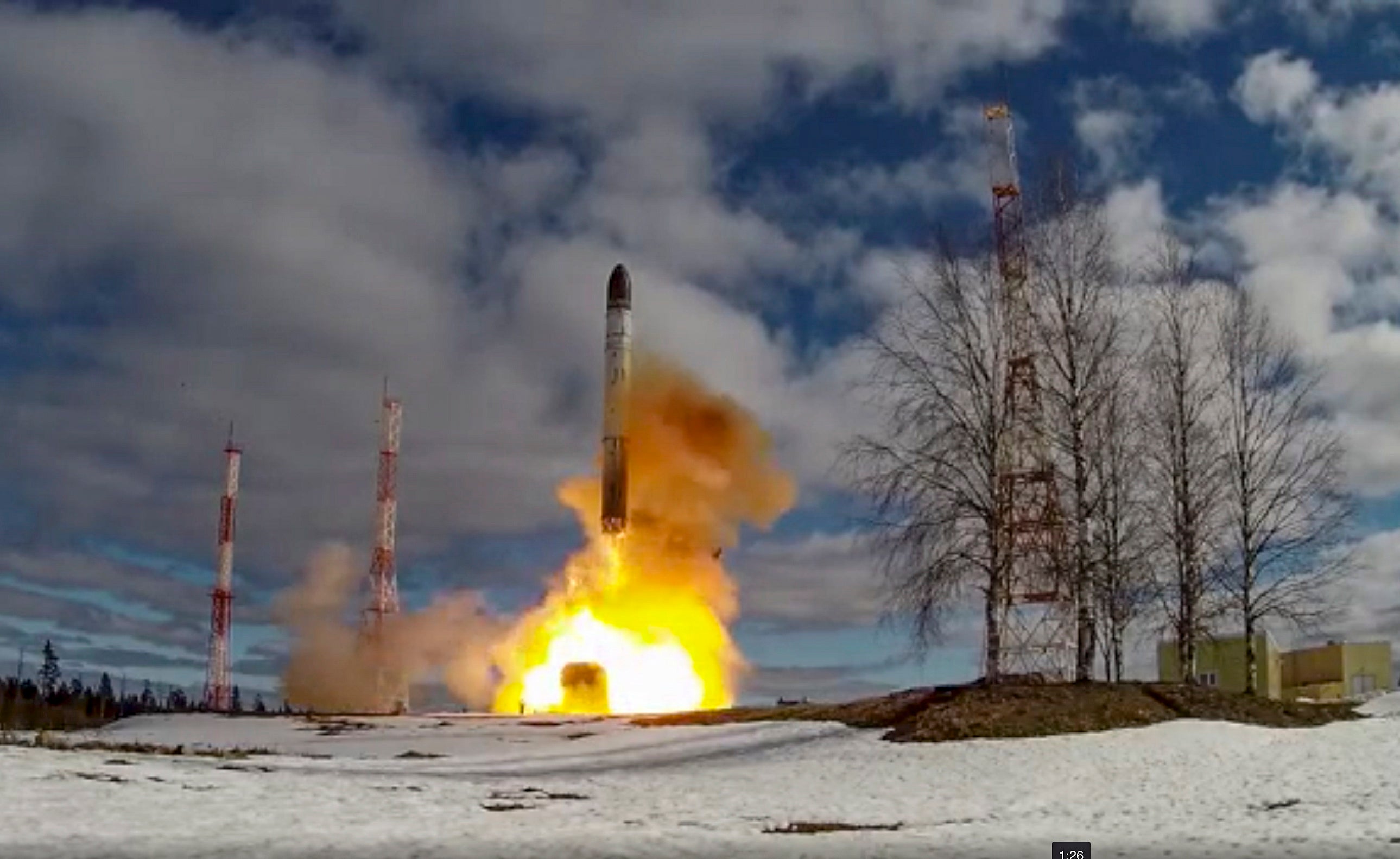
<p>Putin has said that ‘no defense systems’ will be able to defend the Satan-2 </p>

THIS IS A WAR AND IN A WAR ASSURANCES AND CONDITIONS RE USING ANYTHING ARE MEANLESS.

In providing weapons to Ukraine that could help them strike within Russian territory is the UK inviting a missile from Russia with love. One does not need much imagination the results if this were to happen.

There is no dispute that Putin’s penchant for brandishing Russia’s arsenal reflects weakness and insecurity. And that is not a good trait in the leader of a nuclear superpower. (Russia’s 6,000-warhead arsenal is the only thing that makes it a superpower.) The United Kingdom within six minutes, even from a distance of 1,600 miles would be wiped of the map. No defence systems will be able to withstand it.

The challenge for the NATO allies now is maintaining the support Ukraine needs for its survival while making clear Putin has a way out of the crisis, rather than climbing up the escalation ladder to the point where it takes on a logic of its own.

In my view there was “no need or sense in mirroring Putin’s reckless nuclear threats, which should be universally condemned

However, how Putin views the domestic consequences of his backing down – something over which the west has no control is now becoming paramount as to how this war is going to come to a closure or expand. 

All human comments appreciated. All like clicks and abuse chucked in the bin

Contact; bobdillon33@gmail.com 

THE BEADY EYE ASK’S: WHAT IS A CORNATION? HAS IT ANY RELEVANCE IN TODAY’S WORLD WITHOUT HMS BRITIANNIA?

Tags

(Five minute read)

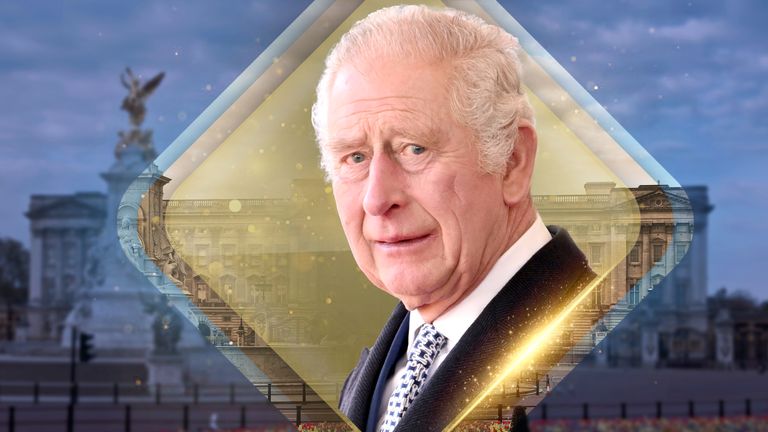
The word coronation means the act or occasion of crowning – putting a crown on the monarch’s head, formally confirming his role as head of state. An occasion for pageantry but it is also a solemn religious ceremony. The pomp and circumstance of the ceremony itself are also a reminder of a time when Britain was the most powerful nation in the world.

A celebration of one man, a trillion billion millionaire taking a job that he has not earned rather by the accident of birth.

Celebrating an institution that has long drawn global fascination. In the age of streaming and social media it’s a spectacle that echoes medieval times, intended to show the king’s authority was derived from God.

There is no legal requirement for a coronation. Charles became the King as soon as Queen Elizabeth died and strictly speaking he doesn’t need a coronation ceremony.

Some argue that it’s grotesque to spend millions on pomp and pageantry amid a cost-of-living crisis that has brought 10% inflation, driven thousands to food banks, and triggered months of strikes by nurses, teachers, and other workers seeking higher pay.

Of all the European monarchies, the UK is the only one that still has a religious coronation ceremony.

Charles's coronation takes place in May

Does King Charles need to do anything to be the monarch?

Not really as it is continuous historical tradition dated back over a thousand years representing England.

On his way to be crowned this week, King Charles III  travelled by gilded coach through streets swathed in red, white, and blue Union flags – and pass a warning from history. At Trafalgar Square stands a large bronze statue of King Charles I, the 17th-century monarch deposed by Parliament and executed in 1649.

There will be no shortage of regalia at the coronation, with thousands of diamonds and kilos of gold shimmering through the service.

The solid gold crown, weighing 2.23kg (almost 5lbs), is worn by a monarch only once, at the moment of coronation.

On the way out of Westminster Abbey, the newly crowned King Charles will wear the Imperial State Crown, which is set with 2,868 diamonds.

The new sovereign is required to make three statutory oaths: the Scottish oath, to uphold the Presbyterian Church of Scotland; the accession declaration oath, to be a true and faithful protestant; and the coronation oath, which includes promising to uphold the rights and privileges of the Church of England.

Here are some of the sacred objects you might have spotted
• Two royal maces
• Three swords, representing mercy, spiritual justice and temporal justice
• The great sword of state, symbolising the sovereign’s royal authority
• St Edward’s staff, dating from 1661
• Spurs, representing knighthood and chivalry
• The jewelled sword of offering, dating from 1820
• The armillas, gold bracelets representing sincerity and wisdom
• The sovereign’s orb, representing Christian sovereignty
• The coronation ring, representing kingly dignity
• Sceptre with the cross, symbolising the sovereign’s temporal power under the cross
• Sceptre with dove – or rod of equity and mercy – symbolising the sovereign’s spiritual role.

The Question of the Monarch being relevant in a world that has moved on from the invention of the wheel to landing on the moon is whether Britain still needs this antiquated institution or if it should become a republic with an elected head of state. A system where power and patronage is based entirely on a hereditary monarchy is unfair and goes against democracy.

One constantly hears that the King must never be involved in politics, but that is in direct contradiction of his continuing duties such as signing all legislation (including the order to prorogue parliament) and delivering the Kings speech.

Because you can’t hold King Charles and his family to account at the ballot box, there’s nothing to stop the Royals abusing their privilege, misusing their influence or simply wasting money. At present it is permitted to vet and influence any proposed legislation that may impinge on the monarchy’s interests.

The British monarchy is therefore essentially self-serving. It should simply be redefined and limited the function of the Royal Family to a ceremonial tourist role.

Indeed with the Royals combined wealth there is every reason that they should carry the expense of its existence and not the nation.

——

So here is a suggestion.

To keep the monarchy relevant and beneficial.  King Charles along with the nation and his serfs playing the Lotto should buy back HMS Britannia.

It would give a voice to the crown, repair the isolation of Brexit, create hundreds of jobs, and keep a visible attachment to the commonwealth, give a moral authority that comes with having been crowned if not elected using soft power to address world problems.  

Make her sea worthy, fit for a king.

Surely these days no one should be forced to be a head of state simply because their mother or father was also trapped in this role of silent service.

All human comments appreciated. All like clicks and abuse chucked in the bin.

Contact: bobdillon33@gmail.com

THE BEADY EYE SAYS. WHEN IT COMES TO TECHNOLOGY THE JACK IS OUT OF THE BOX AND IT’S MAKING A PIGS MICKEY OUT OF THE WORLD WE LIVE IN.

( Twenty minute read)

ADVANCING MORE RAPIDLY THAN ANY OTHER INNOVATION IN OUR HISTORY THE PROBLEMS WITH TECHOLOGY ARE BECOMING CLEARER BY THE DAY.  

The sociological/psychological fallout of AI is not decades away: right here, right now, we are watching in slow-motion the major meltdown of our shared sense of reality.

The discovery that AI can treat language as probability, and from there on, most anything as a “language” of sorts:

DNA sequences, yep, robotics and motoric learning, yes actually, music, definitively, generation and recognition of images and sounds, yes, hacking and cryptography, also yes, persuasion, yes of course…

It is that’s term or concept of Augmented Intelligence which implies a replacement of human intelligence that is becoming less threatening than the admittedly ominous-sounding ‘artificial intelligence’.  It will be increasingly hard to know what is real and what is not. It will be hard to resist manipulation and persuasion. It will be hard to know where we begin and the agency of the machine ends.

It will be increasingly hard not to lose our minds as our shared sense of self and reality (our sociality, which we rely upon for our sanity) fractures. The scale and effect of this fact, in its sociological and psychological ramifications (not to mention economic and political ones) is in itself a rollercoaster ride of Nietzschean proportions.

Even if we remain agnostic about Nick Bostrom’s existential risk superintelligence general AI, we can be fairly certain that we have a sociological moment of impact starting more or less yesterday.

There’s just no way new capacities of this magnitude come about with this kind of speed, and then everything just goes back to normal. For all we know, normal might never happen again.

——-

By definition, the word symbiosis is a term commonly used in biology to describe the relationship between two different organisms that live together in close association, and both partners benefit from the relationship.

TO A CERTAIN EXTENT THIS IS WHAT IS HAPPENING WITH THE APPLICATION OF TECHNOLOGY TO OUR LIVES, AS MANY PROBLEMS SIMPLY CANNOT BE FROMULATED OR RESOLVED WITHOUT THE HELP OF COMPUTERS.

AN OTHER WORDS:

The computers should be acting as a “serving agent,” providing the human with the information they needed to make informed decisions.

Recognized that the human mind have limitations, such as limited memory capacity and the inability to perform complex calculations quickly. Computers, on the other hand, have almost unlimited memory capacity and perform calculations at incredible speeds. By working together, humans and computers could overcome each other’s limitations and achieve a level of productivity that was not possible before.

Computers are now responsible for performing complex computations and storing vast amounts of information, while humans are be removed from making judgements and decisions based on the information provided by the computer.

One of the main objectives with the growing scale and complexity of information processing tasks of human-computer symbiosis is to bring the computer effectively into the formative parts of technical problems.

‘The question is not ‘What is the answer?’ The question is ‘What is the question?

THAT QUESTION BECOMES.   CAN WE LIVE DIGTILIZED LIVES?

Nowadays, many intelligent systems work in a symbiotic relationship with humans.

For example,

Every time we rate a movie on Netflix, we are helping artificial intelligence understand our behaviour and in the future recommend movies based on our preferences.

In the financial industry, computers are widely used to process large amounts of data in real-time, identify trading patterns, and make accurate predictions. Financial analysts rely on computational analysis to buy and sell stocks or make risky financial moves.

The market place, and its movements, which affect global economies are run by Algorithms for profit.

In the e-commerce sites we use, AI can make inferences and anticipate some tasks based on our shopping lists and recommend products. This is also a symbiotic and collaborative relationship.

Grammarly is another example of how the symbiosis between humans and computers is being utilized in the writing field. Through its AI technology, the tool is capable of suggesting real-time grammatical and spelling corrections, and the user’s experience when using it can contribute to the evolution of their ability to improve their vocabulary, as the tool offers suggestions for synonyms and more suitable word choices.

There are hundreds of other examples, but in order to build computational systems that adapt to human needs, we also need to understand how these intelligent systems work and execute tasks, and this is increasingly becoming impossible with machine learning.

Looking at the current context, the human-computer symbiosis becomes increasingly important as interactions between humans and machines become more frequent and complex, enabling users to interact with technology in a natural way.

As our interaction with intelligent systems increases every day, the principles of human-computer symbiosis are also central to living a life.


Defining the term “Augmented Intelligence” can be quite challenging since there are many definitions.

Different researchers and practitioners tend to define it in their own unique way.

I define it as the erosion of our ability to reason for ourselves.

AI-enabled frontier technologies are helping to save lives, diagnose diseases and extend life expectancy. In education, virtual learning environments and distance learning have opened up programmes to students who would otherwise be excluded. Public services are also becoming more accessible and accountable through blockchain-powered systems, and less bureaucratically burdensome as a result of AI assistance. Big data can also support more responsive and accurate policies and programmes.

The use of algorithms can replicate and even amplify human and systemic bias where they function on the basis of data which is not adequately diverse. Lack of diversity in the technology sector can mean that this challenge is not adequately addressed.

Today, digital technologies such as data pooling and AI are used to track and diagnose issues in agriculture, health, and the environment, or to perform daily tasks such as navigating traffic or paying a bill.

They can be used to defend and exercise human rights – but they can also be used to violate them, for example, by monitoring our movements, purchases, conversations and behaviours. Governments and businesses increasingly have the tools to mine and exploit data for financial and other purposes.

Data-powered technology has the potential to empower individuals, improve human welfare, and promote universal rights, depending on the type of protections put in place.

Social media connects almost half of the entire global population.

It enables people to make their voices heard and to talk to people across the world in real time. However, it can also reinforce prejudices and sow discord, by giving hate speech and misinformation a platform, or by amplifying echo chambers.

How to manage these developments is the subject of much discussion – nationally and internationally – at a time when geopolitical tensions are on the rise. This war of information is becoming so important that it can influence democracy and the opinion of people before the vote in an election for instance.

We’re now on the verge, as a society, of appropriately recognizing the need to respect privacy in our Web 2.0 world.A man with freedom taped over his mouth.

In a world where everyone has an opinion and, more importantly, where everyone has the ability, if they choose, to share it with the rest of the world, one person’s hate speech can sometimes be another’s right to free speech.

Social media companies need to take “more responsibility” for what is on their platforms. There has to be a reckoning for what social media is making available [online].

IRELAND IS THE FIRST COUNTRY TO ADDRESS THE ABOVE.

As things stand in Ireland, hate speech is defined as any communication in public intended or likely to be threatening or abusive, and likely to stir up hatred against a person due to their race, colour, nationality, religion, ethnicity, Traveller origins, and/or sexual orientation. The proposed law will also make it an offence to deny or trivialise genocide. It will define a hate crime as any criminal offence which is perceived by the victim, or any other person, to have been motivated by prejudice.

The new legislation will criminalise any intentional or reckless communication or behaviour that is likely to incite violence or hatred against a person or persons because they are associated with a protected characteristic. The penalty for this offence will be up to five years’ imprisonment.

The provisions of the new legislation have been crafted to ensure that they will capture hate speech in an online context.

THIS IS THE FIRST SMALL STEP IN THE RIGHT DIRECTION TO COMBAT UNREGULATED TECHNOLOGY.

For most of the past decade, public concerns about digital technology have focused on the potential abuse of personal data.

This debate is NOW entering a new phase.

As companies increasingly embed artificial intelligence in their products, services, processes, and decision-making, attention is shifting to how data is used by the software—particularly by complex, evolving algorithms that might diagnose a cancer, drive a car, or approve a loan.

The problem crops up in many other guises:

For instance, in ubiquitous online advertisement algorithms, which may target viewers by race, religion, or gender.

Software used by leading hospitals exhibit significant racial bias to prioritize recipients of kidney transplants discriminated against Black patients.

In dealing with biased outcomes, regulators have mostly fallen back on standard antidiscrimination legislation.

That’s workable as long as there are people who can be held responsible for problematic decisions. But with AI increasingly in the mix, individual accountability is undermined.

Some algorithms make or affect decisions with direct and important consequences on people’s lives.

They diagnose medical conditions, for instance, screen candidates for jobs, approve home loans, or recommend jail sentences. In such circumstances it may be wise to avoid using AI or at least subordinate it to human judgment. Using AI could therefore increase human decision-makers’ accountability, which might make people likely to defer to the algorithms more often than they should.

The degree of trust in AI varies with the kind of decisions it’s used for. When a task is perceived as relatively mechanical and bounded—think optimizing a timetable or analysing images—software is regarded as at least as trustworthy as humans.

But when decisions are thought to be subjective or the variables change (as in legal sentencing, where offenders’ extenuating circumstances may differ), human judgment is trusted more, in part because of people’s capacity for empathy. This suggests that companies need to communicate very carefully about the specific nature and scope of decisions they’re applying AI to and why it’s preferable to human judgment in those situations. For example, in machine diagnoses of medical scans, people can easily accept the advantage that software trained on billions of well-defined data points has over humans, who can process only a few thousand.

On the other hand, applying AI to make a diagnosis regarding mental health, where factors may be behavioural, hard to define, and case-specific, would probably be inappropriate. It’s difficult for people to accept that machines can process highly contextual situations. And even when the critical variables have been accurately identified, the way they differ across populations often isn’t fully understood—which brings us to the next factor.

An algorithm may not be fair across all geographies and markets.

Just like human judgment, AI isn’t infallible. Algorithms will inevitably make some unfair—or even unsafe—decisions.

The right…to obtain an explanation of the decision reached” by algorithms, MUST BE ENSHRINNED IN LAW.

But what does it mean to get an explanation for automated decisions, for which our knowledge of cause and effect is often incomplete?

Should we require—and can we even expect—AI to explain its decisions?

However, most people lack the advanced skills in mathematics or computer science needed to understand, let alone determine whether the relationships specified in it are appropriate. And in the case of machine learning—where AI software creates algorithms to describe apparent relationships between variables in the training data—flaws or biases in that data, not the algorithm, may be the ultimate cause of any problem.

If AI starts to listen to us and adapt to our every move, we can only “win” by mirroring it, and being equally attentive to it, even to the point of treating this wild piece of silicon clockwork as though it were alive.

Because, in the end, when we don’t know where we begin and AI ends, then AI is essentially as alive as anything.

AI can only exist because it feeds on human civilization and knowledge coded into text and other digestible data — but humans are in turn subjected to the power of AI, and thus deeply reshaped by it, because AI coordinates more data than we can and knows, well, us. The AI soon knows us better than we can know it, or even know ourselves.

If we seek relational proportionality and resonance across the AI-humanity axis, we must of course also feed this intra-action with socially proportional perspectives, i.e. with social justice.

Our very civilizational sanity and survival depend upon balancing the informational diet of the AI, so that it can itself produce emergent patterns that resonate through and across societies… But the Internet is roughly as skewed and distorted as the power relations of global humanity at large.

It acts on the whole with great efficiency and speed, but it cannot speak for the whole.

What you can expect is increasing dissonance, a spiralling insanity, as the “human-AI-AI-human intra-action” system disconnects from the rest of reality, from the larger scheme that contains the actual multiplicity of the world’s perspectives.

If we don’t want to spiral into virtual madness with real social consequences, we need to balance out the reality projected into the digital realm: the encoded information. It mean’s that AI itself must be used to more proportionally and correctly represent the lives, experiences, and embodied — or intellectual — knowledge of the world.

In short, if we apply the AI to balancing out human-perspectives-as-projected-onto-the-web-as-data, not only can we get a more just and sane society; we can also help to retain an AI that remains on the sane and just side in the first place.

Or, yet more succinctly: A sane AI is also a social justice AI, but one that dodges the traps of present-day social justice and intersectionality discourses.

Let me underscore: If we fail to do this, we instead unleash AI powers that widen social gaps and fracture knowledge systems into different continents where people become entirely unable to comprehend one another, leading to social and psychological decay.

If we want a world that is not driven by digitalization ,THE TIME IS NOW TO DO SOME THING ABOUT IT.

All human comments appreciated. All like clicks and abuse chucked in the bin.

Contact: bobdillon33@gmail.com

THE BEADY EYE ASK’S: IS OUR BIOLOGICAL REASONING BEING REPLACED BY DIGITAL REASONING.

Tags

, , , ,

(Ten minute read)

We all know that massive changes need to be made to the way we all live on the planet, due to climate change.

However most of us are not aware of the effects that artificial intelligence in having on our lives.

This post looks at our changing understanding of ourselves, due digitalized reasoning, which is turning us into digitalized

citizens, relying more on and more on digitalized reasoning for all aspects of living.

Does it help us understand what is going on? Or to work out what we can do about it?

It could be said that the climate is beyond our control,  but AI remains within the realms of control.

Is this true?

It is true that the human race is in grave danger of stupidity re climate change which if not addressed globally could cause our extinction.

We know that using technology alone will not solve climate change, but it is necessary to gather information about what is happing to the planet, while our lives are monitored in minute detail by algorithms for profit.

There are many reasons why this is happing and the consequences of it will be far reaching and perhaps as dangerous if not more than what the climate is and will be bringing.

——–

While biology reasoning usually starts with an observation leading to a logical problem-solving with deductive conclusions

usually reliable, provided the premises are true.

Digital AI reasoning on the other hand is a cycle rather than any logically straight line.

It is the result of one go-round becomes feedback that improves the next round of question asking to ask machine

learning, with all programs and algorithms learning the result instantly.

Example  One Drone to the next. One high-frequency trade to the next. One bank loan to the next. One human to the next.

Another words.

Digital Reasoning, is combining artificial intelligence and machine learning with all the biases program’s in the code in the first place without any supervision oversight, or global regulation

It combined volumes of data in real-time to remove the propose a hypothesis, to make a new hypothesis without conclusively prove that it’s correct.  An iterative process of inductive reasoning extracts a likely (but not certain) premise from specific and limited observations. There is data, and then conclusions are drawn from the data; this is called inductive logic/ reasoning. 

Inductive reasoning does not guarantee that the conclusion will be true.

In inductive inference, we go from the specific to the general. We make many observations, discern a pattern, make a generalization, and infer an explanation or a theory.

In other words, there is nothing that makes a guess ‘educated’ other than the learning program.

The differences between deductive reasoning and inductive reasoning.

Deductive reasoning is a top-down approach, while inductive reasoning is a bottom-up approach.

Inductive reasoning is used in a number of different ways, each serving a different purpose:

We use inductive reasoning in everyday life to build our understanding of the world.

Inductive reasoning, or inductive logic, is a type of reasoning that involves drawing a general conclusion from a set of specific observations. Some people think of inductive reasoning as “bottom-up” logic the  one logic exercise we do nearly every day, though we’re scarcely aware of it. We take tiny things we’ve seen or read and draw general principles from them—an act known as inductive reasoning.

Inductive reasoning also underpins the scientific method: scientists gather data through observation and experiment, make hypotheses based on that data, and then test those theories further. That middle step—making hypotheses—is an inductive inference, and they wouldn’t get very far without it.

Inductive reasoning is also called a hypothesis-generating approach, because you start with specific observations and build toward a theory. It’s an exploratory method that’s often applied before deductive research.

Finally, despite the potential for weak conclusions, an inductive argument is also the main type of reasoning in academic life.

Deductive reasoning is a logical approach where you progress from general ideas to specific conclusions. It’s often contrasted with inductive reasoning, where you start with specific observations and form general conclusions.

Deductive reasoning is used to reach a logical and true conclusion. In deductive reasoning, you’ll often make an argument for a certain idea. You make an inference, or come to a conclusion, by applying different premises. Due to its reliance on inference, deductive reasoning is at high risk for research biases, particularly confirmation bias and other types of cognitive bias like belief bias.

In deductive reasoning, you start with general ideas and work toward specific conclusions through inferences. Based on theories, you form a hypothesis. Using empirical observations, you test that hypothesis using inferential statistics and form a conclusion.

In practice, most research projects involve both inductive and deductive methods.

However it can be tempting to seek out or prefer information that supports your inferences or ideas, with inbuilt bias creeping into  research. Patients have a better chance of surviving, banks can ensure their employees are meeting the highest standards of conduct, and law enforcement can protect the most vulnerable citizens in our society.

However, there are important distinctions that separate these two pathways to a logical conclusion of what Digitized reasoning is going to do or replace human reasoning.

First there is no debate that Computers have done amazing calculations for us, but they have never solved a hard problem on their own.

The problem is the communication barrier between the language of humans and the language of computers.

A programmer can code in all the rules, or axioms, and then ask if a particular conjecture follows those rules. The computer then does all the work. Does it  explain its work.  No. 

All that calculating happens within the machine, and to human eyes it would look like a long string of 0s and 1s. It’s impossible to scan the proof and follow the reasoning, because it looks like a pile of random data. “No human will ever look at that proof and be able to say, ‘I get it.’ They operate in a kind of black box and just spit out an answer.

 Machine proofs may not be as mysterious as they appear.  Maybe they should be made to explain. 

I can see it becoming standard practice that if you want your paper/ codes/ algorithm to be accepted, you have to get it past an automatic checker – re transparency because efforts at the forefront of the field today aim to blend learning with reasoning.

After all, if the machines continue to improve, and they have access to vast amounts of data, they should become very good at doing the fun parts, too. “They will learn how to do their own prompts.”

company will enable customers to spot risks before they happen, maximize the scalability of supervision teams, and uncover strategic insights from large

The Limits of Reason.

Neural networks are able to develop an artificial style of intuition, leverage communications data to spot risks before they happen, and identify new insights to drive fresh growth initiatives, creating a large divide between firms investing to harvest data-driven insights and leverage data to manage risk, and those who are falling behind.

This will bear out in earnings and share prices in the years to come.

The challenge of automating reasoning in computer proofs as a subset of a much bigger field:

Natural language processing, which involves pattern recognition in the usage of words and sentences. (Pattern recognition is also the driving idea behind computer vision, the object of Szegedy’s previous project at Google.)

Like other groups, his team wants theorem provers that can find and explain useful proofs. He envisions a future in which theorem provers replace human referees at major journals.

Josef Urban thinks that the marriage of deductive and inductive reasoning required for proofs can be achieved through this kind of combined approach. His group has built theorem provers guided by machine learning tools, which allow computers to learn on their own through experience. Over the last few years, they’ve explored the use of neural networks — layers of computations that help machines process information through a rough approximation of our brain’s neuronal activity. In July, his group reported on new conjectures generated by a neural network trained on theorem-proving data.

Harris disagrees. He doesn’t think computer provers are necessary, or that they will inevitably “make human mathematicians obsolete.” If computer scientists are ever able to program a kind of synthetic intuition, he says, it still won’t rival that of humans.

“Even if computers understand, they don’t understand in a human way.”

I say the current Ukraine Russian war is the labourite of AI reasoning this war with all its consequence is telling us that AI should never be allowed near nuclear weapons or….dangerous pathogens.

An inductive argument is one that reasons in the opposite direction from deduction.

Given some specific cases, what can be inferred about the underlying general rule?

The reasoning process follows the same steps as in deduction.

The difference is the conclusions: an inductive argument is not a proof, but rather a probalistic inference.

When scholars use statistical evidence to test a hypothesis, they are using inductive logic.

The main objective of statistics is to test a hypothesis. A hypothesis is a falsifiable claim that requires verification.

  • Most progress in science, engineering, medicine, and technology is the result of hypothesis testing.

When a computer uses statistical evidence to test a hypothesis it’s assumption may or may not be true. To prove something is correct, we first need to take reciprocal of it and then try to prove that reciprocal is wrong which ultimately proves something is correct.

Finally this post has been written or generated by a human reasoning, that see the dangers of losing that reasoning to Digital reasoning of Enterprise Spock.

All human comments appreciated. All like clicks and abuse chucked in the bin.

Contact: bobdillon33@gmail.com

THE BEADY EYE ASKS: DOES ENGLAND NEED A CORNATION?

Tags

( Ten minute read)

Before answering this question I am not a Royalist fan.

King Charles III’s Coronation will take place on Saturday 6 May 2023.

It formalises the monarch’s role as the head of the Church of England and marks the transfer of their title and powers.

However, it is not actually necessary for the monarch to be crowned to become King, Edward VIII reigned without a coronation – and Charles automatically became King the moment Queen Elizabeth II died.

This coronation it’s about privilege and everything that a multi-faith, multi-ethnic Britain isn’t about.

European monarchies got rid of coronations long ago.  The British ceremony is the only remaining event of its type in Europe.

The idea that one man, who by accident of birth, is being anointed and set above the rest, who is unelected, and doesn’t represent Britain religiously or ethnically, jars badly.

It is an state affair, littered with curiosities: which means the government controls the guest list.

A medieval oath, holy oil poured on to a 12th Century spoon, and a 700-year-old chair housing a stone that supposedly roared when it recognised the rightful monarch.

850 community representatives have been invited to the ceremony in recognition of their charitable contributions. More than 6,000 armed forces members will take part, making it the largest military ceremonial operation in 70 years.

The Coronation will be paid for by the UK government. Clearly it won’t be cost-free.

St Edward's Crown

In an uncertain world where leaders break international rules of law all the time,  all of this sounds like something from a bygone age, it is.

It has no constitutional value, ( not that England has a written constitute.) but has remained much the same for more than 1,000 years. The monarchy’s legitimacy is based on tradition and continuity, any meaningful change would require a major overhaul, like disestablishment of the Church of England or a referendum on the monarchy.

In the coming days, there will be endless commentators ready to declare that the coronation makes them “proud to be British”, while anyone who criticises any aspect of it will be accused of “hating their country”

While standing beside the 700-year-old Coronation Chair, the monarch is presented to those gathered in the Abbey by the Archbishop of Canterbury. The congregation shouts “God Save the King!” and trumpets sound. The sovereign swears to uphold the law and the Church of England. (The UK’s religious landscape for example has “changed beyond all recognition” since the last coronation in 1953)

A gold cloth is held over the chair to conceal the King from view. The Archbishop of Canterbury anoints the King’s hands, breast and head with holy oil made according to a secret recipe, but known to contain ambergris, orange flowers, roses, jasmine and cinnamon.( It’s an Anglican ceremony and the anointing is essential to that as the conferment of God’s grace on the monarch.)

The sovereign is presented with items including the Royal Orb, representing religious and moral authority; the Sceptre, representing power; and the Sovereign’s Sceptre, a rod of gold topped with a white enamelled dove, a symbol of justice and mercy.

Finally, the Archbishop places the solid gold, 17th Century St Edward’s Crown on the King’s head. (That crown contains the Cullinan II diamond, sometimes called the Second Star of Africa. It was given to Edward VII on his 66th birthday by the government of the Transvaal – a former British crown colony – in what is now South Africa. The other controversial stone is the Koh-i-Noor, which is part of the Queen Mother’s coronation crown. It is one of the largest-cut diamonds in the world. India, Pakistan, Afghanistan and Iran have all made claims to it.)

The King leaves the Coronation Chair and moves to the throne. Peers kneel before the monarch to pay homage. The Queen Consort will then be anointed in the same way and crowned.

The Coronation Procession is also expected to be more modest than Queen Elizabeth’s furnal procession which had 16,000 participants, and took 45 minutes to pass any stationary point on the 7km (4.3 miles) route at cost estimated to be 6/7 million.

The Queen Mother’s in 2002 reportedly cost £5.4m.

Clearly Charles coronation won’t be cost-free with an estimate of 100 million. ( Two for the price of one)

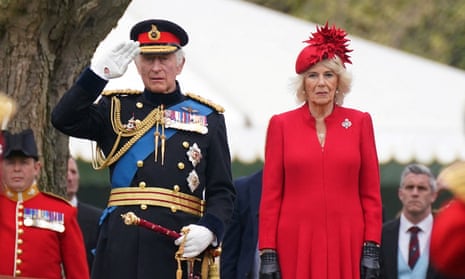
———King Charles and Camilla at a military standards ceremony at Buckingham Palace on 27 April 2023.

The coronation is the King’s chance to plug into the power of the past and shape his future.

The royals seem to prefer ad hoc philanthropy to actually funding public services with an event that is literally about deference to hereditary privilege. (The £1bn Duchy of Cornwall estate – previously inherited by Charles and recently passed on to Prince William – is not liable for either corporation tax or capital gains tax.) 

Charles notably didn’t pay a single penny of inheritance tax on the fortune the late Queen left him last year (the jewellery alone was estimated to be worth at least £533m), though he has “volunteered” to pay income tax, as he also did on the duchy estate.

Volunteering” to pay tax feels a little like a wanted criminal “volunteering” to hand himself over to the authorities. It doesn’t seem to be something you typically get a choice in.

It is inevitable that many Britons will view the coronation with a more gimlet eye this time around. Many in the country are more focused on navigating a cost-of-living crisis than celebrating a dysfunctional royal family.

Now, England is a competitive society, based on people who’ve earned their position through achievement.  Many Britons, viewed it mostly as a welcome holiday.

He’s inheriting a crown that has been shaken by events over the last five years.

Perhaps he might make a jester to the state of the nation  (The Firm or Monarch PLC is worth an astounding $28 billion at least.) and reimburse the tax payer.  A man whose car collection alone is estimated to be worth more than £6m asking the rest of us to celebrate his kingship by helping out at the local food bank feels, shall we say, a little “let them eat quiche”.

Perhaps in order to have a voice he will buy back HMS Britannia. The “soft power” of the monarchy cannot be underestimated.

Finally:

Can a modern nation call itself democratic if it retains an unelected head of state? Is a growing reliance on charity a point of celebration or shame?  Does sanitising the existence of royalty normalise wider inequality? 

In the end in a world run more and more by Artificial Intelligence, monarchies seem to be purposeless antiquated relics, anachronisms that ought to eventually give way to republics.

To understand why, it is important to consider the merits of monarchy objectively without resorting to the tautology that countries ought to be democracies because they ought to be democracies.

Here are the benefits of a Monarchs in the 21st century.

Monarchs can rise above politics in the way an elected head of state cannot. Monarchs represent the whole country in a way democratically elected leaders cannot and do not. The choice for the highest political position in a monarchy cannot be influenced by and in a sense beholden to money, the media, or a political party.

Monarchs are especially important in multi-ethnic countries.

The existence of a monarch makes it difficult to radically or totally alter a country’s politics. Monarchies have the gravitas and prestige to make last-resort, hard, and necessary decisions — decisions that nobody else can make.

Monarchies are repositories of tradition and continuity in ever changing times.

Most monarchies rule within some sort of constitutional or traditional framework which constrains and institutionalizes their powers.  

 Since anyone, regardless of their personality or interests, can by accident of birth become a monarch, all types of people may become rulers in such a system.

Today’s heirs are educated from birth for their future role and live in the full glare of the media their entire lives.

The pomp and pageantry attracts million in tourist revenue and no place does it better than the land of King Arthur and the knight of the round table. As in previous centuries, monarchy will continue to show itself to be an important and beneficial political institution wherever it still survives.

As a diamond-encrusted crown is placed on the king’s head, your packed local homeless shelter is desperate for help. Don’t you feel proud to be British?

The Beady Eye wishes him and his wife all the best on the 6th May.

Long may the Monarchs exist providing they are solely a tourist attraction that pay for themselves.

All human comments appreciated. All like clicks and abuse chucked in the bin

Contact: bobdillon33@gmail.com

THE BEADY EYE SAY’S . THE ADVERTISING INDUSTRY MUST BE BROUGHT TO HEAL WITH NEW LAWS TO REDUCE CONSUMPTION.

( Seven minute read)

It is crystal clear that consumption is a major donator to the problems of both the environment and all of us are now facing. There is consistent evidence that exposure to marketing for unhealthy commodities – for example advertising for alcohol or food and drinks high in fat, salt, or sugar – is associated with consumption, including among children and young people.

To confront the climate emergency, the amount we consume needs to drop dramatically. Yet every day we’re told by the advertising industry to consume more.

The purpose of advertising is to boost revenue, gain an advantage over competitors, and build brand awareness, so it latch on to what ever is topical – Climate change – Energy – Sustainability – Cost of living etc.

Now with technology it has billion-dollar persuasion machines, promoting not quality of life but rather quantity of stuff.

It’s woven into our personal communications whenever we use social media platforms. In public spaces, where we have little choice over where we look, adverts are invasive, appearing without our consent, with the trend towards digital billboards only exposes us ever more.

Its so prevalent as to be invisible but with an effect no less insidious than air pollution.

We all have a role to play — from making sustainable choices to help safeguard the ocean and our environment, to urging world and business leaders to take the urgent, widespread, and ambitious action needed to tackle climate change and protect the planet.

———

This is an industry capable of quickly shifting global public opinion, with the power to change hearts, minds and behaviour resulting in action, potentially on a global scale and also with profound and rapid effect.

It must be made to take responsibility for consumption, instead of continuing to drive the high carbon lifestyles and hyper-consumption that is killing us.

If we were to introduce new laws restricting marketing agencies from taking work from clients who aren’t actively reducing their own contributions to climate change, earning money from high carbon clients, the sort of companies from whom the investment community is increasingly divesting; promoting unnecessary and over-consumption, these companies  would eventually be forced to match their green advertising slogans with real green investment.

The questions for the advertising industry would become what are our obligations to tackle climate change i.e. how might we have contributed to climate change and how do we stop doing so, and what are our opportunities i.e. where can we make a positive contribution to the issue?

What other than laws will forced  it to rethink their strategies so the industry will go through a transition period, to discover a purpose beyond profit?

In fact, many would argue that the move to “doing well by doing good” will only become truly mainstream when the corporate social responsibility agenda and the growth agenda become one and the same.

There is no reason that governments could not introduce restricted areas and venues where the advertising of consumption is not allowed.

Buses covered in advertising at London's Piccadilly CircusA billboard advert in Manchester

For example:  Sporting events, Natural Reserves/ Public Park’s, Billboards and bus stops, Out door digital advertising.

We could stop television programming being sponsored by consumption  – Eat now.

Of course in a free society, businesses have the right to advertise their wares, and individual citizens are not the helpless brainless automatons that advertising industry’s considers them to be.

All advertising plays a crucial role in brand competition, drives product innovation, and fuels economic growth but would we not rather see community ads and art than have multi-billion companies putting logos and images everywhere?

If they are allowed to get the message out, the public has a right to reply to those ads.

We don’t want our city’s children bombarded with animated advertising on TV screens in the street.

Critically, the more that people prioritise materialistic values and goals, the less they embrace positive attitudes towards the environment – and the more likely they are to behave in damaging ways. If you think this is a fanciful aim, then you might need to think again with the state the world is in.

We’re in a place where major behaviour change is required.

To question the legitimacy of corporate outdoor adverting and draw attention to the impact they can have on social issues, mental health, wellbeing, the climate, and the communication of public space where governments are too inert/broke/ill-intentioned/in thrall to vested interests to take effective action.

Business leaders must increasingly look beyond short-term profitability to address the pressing need to reduce emissions.

——

.The advertising industry is in a very different place to where it was a year ago.

Where, how, and when you advertise will constantly change with the times. That’s one thing we can count on.

Culture has always defined marketing and brand marketers have a lot of power to dictate.

The rise of the internet, computers, and mobile devices only provided more platforms for video ads to appear. It’s probably still going to be one of the most important advertising trends in the next 5 years.

We have our hands on the levers of behaviour change, but in an era in which attention is often only ever partial, puncturing the collective consumer inertia with a complex message is no easy feat.

We spend every day thinking of ways to change people’s behaviours,

These skills are the ones needed more than ever by the world to halt the human causes of climate change.

——–

Advertising has always evolved with the technology at hand. This includes tracking of clicked links, customer behaviour, purchase history, survey responses, and more.

Marketers can then use that information to create custom messages or content that’ll match the target audiences’ interests.

Finding out which people to show a particular ad to and the right time to show them is crucial in the world of smartphones

Next step, profit.

——-

In a cut-throat and viciously competitive market, pioneering new technology can have a major impact on the effectiveness of advertising campaigns.

Another big use of mobile advertising is through games.

A lot of mobile games are created with the format of being able to purchase resources with real-world money.

This means that ads will now be geared towards targeting real people through emails and other registered user data. With more information available, marketers can provide customers with a better offer that’ll most likely translate into sales.

Social advertising is the use of Facebook, LinkedIn, Instagram, Twitter, and other social media platforms for advertising potentials.

The format itself is undergoing rapid transformation because most people watch for content and not for production quality.

Data collection and cookies naturally have poor public perception, often being viewed as encroaching on private information and stealing data, with ads following consumers around the internet.

Now, these apps aren’t just for sending messages and emoji cause it’s also a place to find advertisements relevant to users.

As the climate crisis bites

————

We need new metrics and measurement tools – and new bonus and remuneration systems to underpin our value systems, not just legislation against high-carbon advertising, focusing on fossil fuel companies, petrol- and diesel-engine cars and aviation.

Because, marketing has been transformed by digital speed, relevance and reach of advertising campaigns.

Because, overconsumption in general, encouraged by advertising, has a climate and ecological impact.

Because, programmatic advertising uses AI to automatically buy ads that can target audiences more specifically. ( Programmatic advertising is a combination of big data processing, technical skills, and automation.)

Because, advertising works by getting under your radar, introducing new ideas without bothering your conscious mind.

Because, contextual advertising is a form of targeted advertising where site content and keywords are analyzed in real time to determine their suitability for a brand’s message.

Because, children are now at the mercy of so-called “surveillance advertising”. It is estimated that by the time a child turns 13, ad-tech firms would have gathered 72m data points on them. The more data collected from an early age, the easier it is for advertisers to turn young children into consumer targets.


A transformation of marketing is underway as we spend more time on our mobiles, tablets and laptops. The real-time conversations brands have with people as they interact with websites and mobile apps has changed the nature of marketing

We know that advertising is a key engine of the economy. There are visual images and marketing messages that have insinuated themselves into the nervous systems of humans.

There’s a long way to go and a lot to be done. The ad business, with strategy tools and processes that were for the most part developed in the 60s to accommodate the advent of commercial TV, is a lot closer to where it started the journey than where it needs to get to.

Let’s create a movement and band together to save the planet in a non-branded or political way.

New checks and balances need to accommodate the natural concerns of councils and residents around climate, air pollution, environmental light pollution, the “attention economy”, mental health and the dominance of non-consensual adverts in public spaces.

I’m sure most advertisers and agencies would rather work on solving this global crisis, and if we can use just 5% of the industry’s time toward this initiative.

It isn’t clickbait that is needed but a genuine concern for the fate of the planet or a cynical hunch that doing the right thing will drive growth and profit – if the improved behaviour is real.

I believe that would lead to greater satisfaction, retention and more.

Break the Silence and comment.

All human comments appreciated. All like clicks and abuse chucked in the bin.

Contact; bobdillon33@gmail.com

THE BEADY EYE SAY’S: IT’S TIME TO REMOVE THE BLINKERS WHEN IT COMES TO ARTIFICIAL INTELLIGENCE.

Tags

, ,

( Three minute read)

Yes.  Artificial Intelligence will most likely be needed to help us solve a lot of the big challenges facing society today, be that health, cures for diseases, climate change, etc.  It is already predicting the shape of every protein in the human body.

However, in my mind it is deeply wrong that a small group of people ( under the skin of private technology enterprises) without any democratic oversight are making decisions with potentially to affect every life on earth.

Its time to take our blinkers off and let the world have a say in what they are doing.

Why?

Because a three-letter acronym ( God like AI)  doesn’t capture the enormity of what Artificial General Intelligence (AIG) will represent, or do. This would be a force beyond our control or understanding and one that will usher in the obsolescence or destruction of the p

The Beady Eye has been bleating on about this and profit seeking algorithms, now for some considerable time, but from the number of comments on the subject it seems not many of us give a hoot for the need for transparencies, regulations, and overall safeties when it comes to technology. So we are running to the finishing line without any understanding of what on the other side.

Since the arrival of the internet/smart phone one only has to look at the state of the Planet to realise that we have gone training – AI ALGORITHMS / TECHNOLOGY TO GENERATE TEXTS/ RECONGISING EVEREYDAY IMAGES/  GENERATING REALISTIC PHOTOS/ AND REPLICATION OF VOICES, BY FEEDING THEM WITH THE ENTIRE INTERNET STRIP-MINING THE LIFEWORLD. (The focus on games and chatbots is sheltering people from the more serious implications of this work.)

The world already has many existential threats, but the threat posed by AIG is the number one risk of this century, with an engineered biological pathogen a close second. The potential for scams and misinformation is significant.

An God like super intelligent machine would be light out for all of us.

So the question is.

Why are these organisation racing to create God like AI ?

Is it that it gives an illusion of illimitable power.

For now the race is being driven by markets, with the Ukraine war the labourite of cyber wars, making private investment not the only driving force but nations also contributing to this contest.

If we put the wrong objects into a super intelligent machine we are bound to lose.

Unlike the human brain that grows large Ai systems are quite different.

They grow themselves with machine learning and their capabilities jump sharply.

We don’t yet full understand how they work and cannot demonstrate likely out comes in advance.

The present harms and AI/AIG are not mutually exclusive and overlap in important ways.

One of the most challenging aspects of thinking about this topic is working out which precedents we can draw on.

WE ARE NOT POWERLESS TO SLOW DOWN THIS RACE.

If we can get our governments to ask under oath about the timeline for developing God’s like AIG. To demand under law a complete record of the safety tests with evidence of understand how the system works, to ensure their aliment with our common values, we might save humanity, before we humans are cut out of the loop.

Unfortunately economics has not been flexible enough to take on this obvious truth  The whole field and discipline of economics, by which we plan and justify what we do as a society, is simply riddled with absences, contradictions, logical flaws, and most important of all, false axioms and false gaols.

All human comments appreciated. All like clicks and abuse chucked in the bin.

Contact: bobdillon33@gmail.com

THE BEADY EYE SAY’S: IT BEGGARS BELIEF AND IS BEYOND PATHETIC THAT WE ARE UNABLE TO FULLY UNDERSTAND THERE WILL BE NO FUTURE WITHOUT NATURE AND IT’S BIODIVERSITY.

Tags

, , ,

( Twenty-six minute read)

We have heard all of this over and over, but it is impossible to get serious about climate change, because it has been turned into a product to be traded.

The very words Climate Change, Global warming, Biodiversity, Sea levels, Natural disasters, Droughts, Melting  ice, the list goes on and on as a result they are falling on deaf ears. For example  “sustainable development”: a phrase at which many people quietly glaze over and switch off.  Or “Global warming” is another of those deceptive phrases. It doesn’t sound that threatening.

So if words like “climate change” and “global warming” have become a turn-off for most ordinary people, maybe we should change the words.  Perhaps we should talk instead about what those things actually mean:

Killer weather, a world under water, and a mortgaged future.

We have been told for over three decades of the dangers of allowing the planet to warm.

We all know this and we know that it’s urgent. The world listened, but it didn’t hear. The world listened, but it didn’t act strongly enough. It hasn’t been enough to change our behaviours on a scale great enough to stop climate change.

As a result, climate change is a problem that is here, now. Nobody is safe. And it is getting worse faster and faster, till one tipping point is reached causing a rolling coaster of from here to eternity.

There are many tipping points to choose from.

Here is mind. The Arctic Ocean’s ice cover melts.

This is a feedback loop with teeth.

Back in the 50s it was more than ten meters thick, reflecting as much as 3% of the sun’s incoming light back into space.

That light is now heating the Oceans of the Arctic and the Antarctic, both becoming the fastest places on Earth with rising temperatures. Which means a greater and greater release of permafrost carbon and methane, 20 times stronger than Co2.

The Arctic permafrost contains as much methane as all the Earth’s cattle could create over the next six centuries.

If released this fart would push the Earth into an irreversible tipping point at which point the sea level would be 110 meters higher than at present, with the global temperatures 5/6 degrees Celsius higher. At that point civilisation would be over.

One would think that such a scenario would be sufficient to make all of us pay attention but not so.

Why?

A big part of the reason is our own evolution. The same behaviours that once helped us survive are, today, working against us.

We lack the collective will to address climate change, because of the way our brains have evolved. We have evolved to pay attention to immediate threats. We overestimate threats that are less likely but easier to remember, like terrorism, and underestimate more complex threats, like climate change. Too much information can confuse our brains, leading us to inaction or poor choices that can place us in harm’s way.

Our brains evolved to filter information rapidly and focus on what is most immediately essential to our survival and reproduction.

In our modern reality it’s causing errors in rational decision-making, known as cognitive biases. “Cognitive biases that ensured our initial survival make it difficult to address complex, long-term challenges that now threaten our existence, like climate change.

  • Hyperbolic discounting. This is our perception that the present is more important than the future. Throughout most of our evolution it was more advantageous to focus on what might kill us or eat us now, not later. This bias now impedes our ability to take action to address more distant-feeling, slower and complex challenges. While we may understand what needs to be done to address climate change, it’s hard for us to see how the sacrifices required for generations existing beyond this short time span are worth it.

Families carry water during a drought in Ethiopia; temperature rise already has altered weather and water systems in profound ways (Credit: Creative Commons)

  • To address the issue of climate change it requires collective action on a scale that exceeds our evolutionary capacities.
  • The larger the group, the more challenging it gets.

The future value is the value of it at some time in the future. The farther into the future we look, the fuzzier our view, but there will be no future unless we invest trillions and trillions into sustainability.

On a warming planet, no one is safe.

The air you breathe, the water you drink and the food you eat all rely on biodiversity.

Unfortunately, we have created a world where an asset from a business perspective, has no value unless it can produce cash flows in the future. The difference in value between the future and the present is created by discounting the future back to the present using a discount factor, which is a function of time that is running out right in front of our eyes.

The world’s ecosystems are capital assets that up to now have escaped valuation and have therefore been mismanaged.

Now they are being bought by rich privateers, together with financial instruments and institutional arrangements that will allow individuals to capture the value of ecosystem assets.  For example, Sovereignty Wealth Funds.  They buy environmental protection, but only by liquidating natural capital (for example, prairies, forests, fisheries) to generate the funds; even “information” economies are built in proportion to such liquidation. The reinvestment in natural capital never equals the amount liquidated because of procedural inefficiency and profit-taking.

—–

The process of valuation in the short term might lead to profoundly favourable effects on the stock market, but the decision of how much to spend now to avert climate changes hinges on assessing how much it is worth to us now to prevent that future damage.

Since most of us would prefer money now, over money later, economists typically figure that we’re willing to spend only less than a dollar now to prevent a dollar’s worth of damage in a year, or in a decade.

The percentage less is called the “social discount rate.”

This implies that we either accept an assumption that many argue is economically unjustified (a near-zero social discount rate), or conclude that we should just accept climate change without much of a fight. (A third alternative is perhaps even less appealing to economists: accepting that their calculations simply can’t illuminate the question.)

We’re much happier to have good stuff now than later, so our short-term discount rate is high.

But we hardly distinguish between goods in the pretty far future and goods in the very far future, so our discount rate in the future is far lower to manage the essentials to life.

Now more than ever we must use the power of the law to fight those who would harm our communities, our climate, and the natural world we value so deeply.

We have an International criminal court, why not use it to fine this lot of polluters.

Peabody Energy

Company summary: Coal company
Based in: Missouri, United States
Founded: 1883
Emissions per capita: 2,231,818 tonnes – or, 449,057 return flights from London to Sydney.

Kuwait Petroleum Corporation

Company summary: Petroleum company
Based in: Kuwait City, Kuwait
Founded: 1980
Emissions per capita: 2,133,248 tonnes – or, 445,354 return flights from London to Sydney

ConocoPhillips

Company summary: Crude oil and natural gas
Based in: Texas, United States
Founded: 1875
Emissions per capita: 1,464,423 tonnes – or, 305,725 return flights from London to Sydney

Chevron

Company summary: Oil and gas company
Based in: California, United States
Founded: 1879
Emissions per capita: 900,218 tonnes – or, 187,936 return flights from London to Sydney

Saudi Aramco

Company summary: Petroleum and natural gas company
Based in: Dhahran, Saudi Arabia
Founded: 1933
Emissions per capita: 750,126 tonnes – or, 150,930 return flights from London to Sydney

ExxonMobil

Company summary: Oil and gas company
Based in: Texas, United States
Founded: 1999
Emissions per capita: 559,412 tonnes – or, 116,787 return flights from London to Sydney

BP

Company summary: Oil and gas company
Based in: London, United Kingdom
Founded: 1909
Emissions per capita: 485,306 tonnes – or, 97,647 return flights from London to Sydney

National Iranian Oil Company (NIOC)

Company summary: Government-owned national oil and natural gas company
Based in: Tehran, Iran
Founded: 1948
Emissions per capita: 407,542 tonnes – or, 82,000 return flights from London to Sydney

Royal Dutch Shell

Company summary: Oil and gas company
Based in: The Hague, Netherlands
Founded: 1907
Emissions per capita: 384,939 tonnes – or, 77,452 return flights from London to Sydney.

Chevron topped the list of the eight investor-owned corporations, followed closely by Exxon, BP and Shell. Together these four global businesses are behind more than 10% of the world’s carbon emissions since 1965. The worst offenders are investor-owned companies that are household names around the world and spend billions of pounds on lobbying governments and portraying themselves as environmentally responsible.

The top plastic polluting companies

Company Examples of products             Number of countries plastic was found in Pieces of plastic found
Coca-Cola       Coca-Cola, Fanta, Sprite                                            51                                              13,834
Pepsico            Pepsi, Lays, Doritos                                                  43                                              5,155
Nestlé              Nescafé, Kit Kat, Nestea                                           37                                              8,633
Unilever          Persil, Cornetto, Sunsilk                                            37                                              5,558
Mondeléz International  Oreo, Cadbury, Milka                                34                                                1,171
Mars              Mars bars, M&Ms, Snickers                                      32                                                  678
P&G              Tampax, Pantene, Ariel                                              29                                              3,535
Philip Morris International  Parliament, Merit, Marlboro               28                                                2,593
Colgate Palmolive  Colgate Palmolive                                           24                                              5,991
Colgate, Ajax, Palmolive
Perfetti          Mentos, Chupa Chups, Fruittella                             24                                                465

It’s important to remember that, as a consumer, you do have the power to change the future of these polluting companies. As more people switch to renewable energy, cut down on plastic, and live a little more sustainably, these polluting companies will have no choice but to change their habits to stay on trend.


Economists develop new methods to quantify the trade-off between spending now and spending later.

To figure out how much we should spend fighting climate change, economists have some questions for you:

The health of the planet may hinge on the answers.

Most economic analyses of climate change have concluded that we should be spending only small amounts to combat climate change now, ramping up slowly over time. This conclusion mystifies most climate scientists, who argue that immediate action is the only way to forestall dreadful consequences. And at the heart of the disagreement are these very questions, about the value of future generations’ welfare in monetary terms.

The worst consequences of climate change are likely to unfold only over decades or centuries — in other words, in our children’s or grandchildren’s or great-great-great-great-great-grandchildren’s lifetimes, not ours.

The higher the price payed, also equates with a higher level of risk, which generates a higher discount and lowers the present value of any action.  The higher the level of risk is represented as beta in the capital asset pricing model, means a higher discount, which lowers the present value of  nature.

Discounting is the primary factor used in pricing a stream of tomorrow’s crises. .

By reiterating the importance of the world’s natural capital to the human prospect, the next step, is to focus on stabilizing the scale of human economy.  This requires taking on the advertising industry that is promoting consumption. It should be illegal to advertise any product that is not sustainable in their manufacture. Put restrictions on all advertising that is in contradiction to health of not just us, but the earth.  It has become a voracious top predator across the entire globe.

Biodiversity?

It is the variety of life on Earth, in all its forms and all its interactions. Bio means living, and diversity is the variety of life on earth. It represents different relationships (like ecological, cultural, or evolutionary) between several types of organisms on this planet. All living beings on from human beings to the tiny creatures like microbes combined to form Biodiversity.

Starting with genes, then individual species, then communities of creatures and finally entire ecosystems, such as forests or coral reefs, where life interplays with the physical environment. These myriad interactions have made Earth habitable for billions of years.

Wildlife is not something you watch on television. The reality is that the air you breathe, the water you drink and the food you eat all ultimately rely on biodiversity.

It represents the knowledge learned by evolving species over millions of years about how to survive through the vastly varying environmental conditions Earth has experienced. We all interdependent with one another. Hence each species plays an essential role to boost ecosystem productivity.

Some examples are obvious: without plants there would be no oxygen and without bees to pollinate there would be no fruit or nuts.

Humans and our livestock now consume 25-40% of the planet’s entire “primary production”, i.e. the energy captured by plants on which all biodiversity depends.

The intricate jigsaw of life, constructed over hundreds of millions of years, has been thrown into disarray in the last 10,000 years by humans relocating species around the world. These invasive species can devastate ecosystems that have never developed defences – from rats devouring albatross chicks in their nests to snakehead fish decimating native species.

If money is a measure, the services provided by ecosystems are estimated to be worth trillions of dollars – double the world’s GDP. Biodiversity loss in Europe alone costs the continent about 3% of its GDP, or €450m (£400m), a year.

From an aesthetic point of view, every one of the millions of species is unique, a natural work of art that cannot be recreated once lost. “Each higher organism is richer in information than a Caravaggio painting, a Bach fugue, or any other great work,”

The extinction rate of species is now thought to be about 1,000 times higher than before humans dominated the planet, which may be even faster than the losses after a giant meteorite wiped out the dinosaurs 65m years ago. The sixth mass extinction in geological history has already begun, according to some scientists.

The results are scary.

Humans can’t have power over nature in nature.

—–

Despite the fact that natural resources are limited and take millions of years in the formation, the human is exploiting them for their endless greed and comfort.

Species extinction provides a clear but narrow window on the destruction of biodiversity.

The huge global biodiversity losses now becoming apparent represent a crisis equalling – or quite possibly surpassing – climate change.

Billions of individual populations have been lost all over the planet, with the number of animals living on Earth having plunged by half since 1970. Abandoning the normally sober tone of scientific papers, researchers call the massive loss of wildlife a “biological annihilation” representing a “frightening assault on the foundations of human civilisation”.

Humans may lack gills but that has not protected marine life. The situation is no better – and perhaps even less understood – in the two-thirds of the planet covered by oceans. Seafood is the critical source of protein for more than 2.5 billion people but rampant overfishing has caused catches to fall steadily since their peak in 1996 and now more than half the ocean is industrially fished.

Even much-loathed parasites are important. One-third could be wiped out by climate change, making them among the most threatened groups on Earth. But scientists warn this could destabilise ecosystems, unleashing unpredictable invasions of surviving parasites into new areas.

Today, 75% of the world’s food comes from just a dozen crops and five animal species, leaving supplies very vulnerable to pests or disease that can sweep through large areas of monocultures. Add in the falling yields expected from climate change, and the world’s growing global population faces a food problem.

Locating the tipping point that moves biodiversity loss into ecological collapse is an urgent priority. This being the only living world we are ever likely to know, let us join to make the most of it.

Could the loss of biodiversity be a greater threat to humanity than climate change?

Yes – nothing on Earth is experiencing more dramatic change at the hands of human activity.

Changes to the climate are reversible, even if that takes centuries or millennia.

That call is more urgent than ever. Our posterity is running out of chances.

But once species become extinct, particularly those unknown to science, there’s no going back. To put the matter as concisely as possible, biological diversity is unique in the evenness of its importance to both developed and developing countries is beyond any technical advances.

To spread technical capability where it is most needed, arrangements can be made to retain specimens within the countries of their origin while training nationals to assume leadership in systematics and the related scientific disciplines. Science is the best way to establish links with other cultures because it is concerned not with ideology but with nature and humanity’s relation to nature.

Cognitive biases that ensured our initial survival now make it difficult to address long-term challenges that threaten our existence, like climate change.

It is already clear enough that the missing ingredient is political will.

For example

Recognising the power of small groups.

Humans are more likely to change behaviour when challenges are framed positively, instead of negatively. In other words, how we communicate about climate change influences how we respond.  To get people to act, we need to make the issue feel direct and personal by focusing the issue locally, pointing both to local impacts and local solutions: Like moving one’s city to 100% renewable energy.

The key is having a large-scale, organised effort – but one supported and understood by hundreds of smaller groups and communities.

It’s true that no other species has evolved to create such a large-scale problem – but no other species has evolved with such an extraordinary capacity to solve it, either.  If academia, business, government, and citizens act together toward this common goal, we can create a pollution-free energy system; form a prosperous, adaptable and resilient society; keep human, animal, and plant life flourishing; and create a better world for ourselves and generations to come.

We can’t undo the mistakes of the past. But this generation of political and business leaders, this generation of conscious citizens, can make things right. This generation can make the systemic changes that will stop the planet warming, help everyone adapt to the new conditions and create a world of peace, prosperity and equity.

The world is now experiencing the early effects of climate change.

The overall effect of inadequate actions to reduce greenhouse gas emissions is creating a human rights catastrophe, and the costs of these climate change related disasters are already enormous. The Colorado river in the USA is drying up, the ice shelf is the Antarctic is melting, the glaciers in the Himalayas are melting five time faster. Somali is no the threshold of a Famine.

—–

If we don’t act, who will?

We have evolved to be able to stop human-induced climate change. Now we must act.

The risk that without intervention we could cross a threshold leading to runaway climate change. An inconvenient truth.

To save natural resources and to bring a change we have to change our habits that exploit our natural resources and directly or indirectly.

If you could ask one question of Global Leader.

What is the main motivation of your leadership?

Which competencies do you see as instrumental to develop in global leaders in order for them to thrive in this new world?

The key to multicultural leadership is in understanding the difference between intent and impact, as well as engaging in supportive interactions that cultivate a nurturing environment.

Sitting in Davis/ G20  ivory tower’s ONE cannot develop global mindset.

“The secret to success is sincerity. Learn to fake that, and you’ve got it made.”

Feel free to add your question.

All human comments appreciated. All like clicks and abuse chucked in the bin.

Contact: bobdillon33@gmail.com