• About
  • THE BEADY EYE SAY’S : THE EUROPEAN UNION SHOULD THANK ENGLAND FOR ITS IN OR OUT REFERENDUM.

bobdillon33blog

~ Free Thinker.

bobdillon33blog

Category Archives: Big Data.

THE BEADY EYE SAY’S; HERE ARE THE BIG QUESTIONS THAT ARE YET TO COME WHEN IT COMES TO TECHNOLOGY.

19 Wednesday Feb 2020

Posted by bobdillon33@gmail.com in #whatif.com, 2020: The year we need to change., Algorithms., Artificial Intelligence., Big Data., Digital age., DIGITAL DICTATORSHIP., Digital Friendship., Fourth Industrial Revolution., Google, Google it., Google Knowledge., Human values., Humanity., Life., Modern day life., Our Common Values., Reality., Sustaniability, Technology, Technology v Humanity, The common good., The Future, The Obvious., The state of the World., The world to day., Unanswered Questions., War, WHAT IS TRUTH, What Needs to change in the World, Where's the Global Outrage., World Leaders

≈ Comments Off on THE BEADY EYE SAY’S; HERE ARE THE BIG QUESTIONS THAT ARE YET TO COME WHEN IT COMES TO TECHNOLOGY.

Tags

Algorithms trade., Algorithms., Artificial Intelligence., Big Data, Capitalism and Greed, Distribution of wealth, Inequility, Technology, The Future of Mankind, Visions of the future.


Thirty-minute read.

Who owns what?  What’s our purpose in life?  What are the values that we believe in? How do we think and make decisions?  What do we mean by work?  Can our work ever have true meaning unless it is to serve others?

What will help us all think deeply about the questions we need to ask and answer?

Climate change or technology.

However, for many of us, the answers to these questions differ in our working lives, compared with our personal lives, with family, friends and neighbours.

Were a ruling elite like Google to impose a command-and-control, fear-driven culture in which power is abused and the outcomes are social and economic misery for the vast majority?

Our reaction, if we are to go by what is now observable, will be So what? Now what?

MAKING sure companies compete fairly is a tricky business. The firms being regulated know far more about their business than those doing the regulating;

“Artificial intelligence is the future, not only for Russia but for all of humankind.” Says Putin. “Whatever country comes to dominate this technology will be the “ruler of the world.”

His rhetoric is entirely appropriate. Automation and digitalization have already had a radical effect on international systems and structures.

Technology can easily be referred to as the scientific knowledge to the practical problems we are experiencing in the world today.

On the other hand, its core strategy is to gobble up market share with profit-seeking algorithms.

Our environments are all so full of technology to the point that most of the time we take it for granted.

So are we all becoming personified idiots?

Technology has a great impact on all the fundamental aspects of all our cultures including laws and how they are enforced, language, art, health care, mobility, education and religion.

The obvious problem with all of this is that countries will not own or be in control of the technologies.negative effects of technology

While we all sit back and accept the benefits technology it also brings manipulation on a  worldwide scale with our future in the hands of only a handful of corporations and the vast amount of people that are okay with that.

It’s hard to argue against innovation. It’s hard to argue against greater choice, more convenience and lower prices.

One way or the other it is also hard to underestimate the fundamentally different rules that Google /Amazon/ Facebook/ Apple/ Baidu play by.

Hiding behind forked rhetoric that the data they collect does no harm as it is anonymous.

You do not need to know who you are. It is enough to know what you consume, your habits, your tastes, and where you are, through the IP address, the GPS of the mobile, or your Google account. Your name, or your phone number, is not important to sell you things.

Blurring the borders of privacy. Replacing real-life communication.

And on top of it, violent games and videos killing empathy and bring destruction into an individual’s life. Plagiarism and cheating are increase while analysis and critical thinking decline, ending up in social isolation.

(We now have a new perverse sexual harassment of Cyber flashing which is not against any law. Why? Because our laws cannot keep up with the speed of change)

Commercial technology like Smartphones, I pads, Home Alexa/Echo and there like is about creating another consumer touchpoint for their robust ecosystem of e-commerce, services, and media taking advantage of less sophisticated consumers and trick them into consuming items for short-term satisfaction and long-term pain.

Originally created to serve faithfully to humanity, digital devices are revealing their harmful impact on our lives.

We should all be careful what we wish for.

There’s an argument made by big corporations for each country to charge corporations the lowest possible tax rate, to loosen environmental regulations down to zero, and to eliminate employee protections. All so that a country’s commodity producers can be the cheapest ones.

The voice market war has only just begun.

The contenders:

Amazon-Echo v Google-Alexa.amazon-echo-google-home
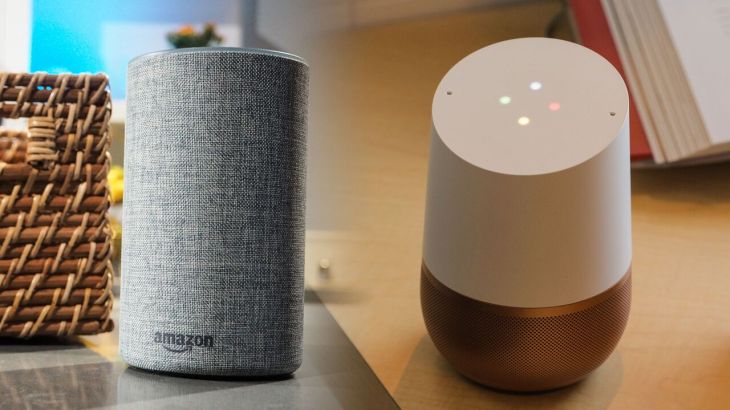
Once they figure out how to improve their recommendations and push more people to make regular household purchases via voice it will lead to an explosion in voice-based shopping.

Google already has one of the most valuable brands in the world.

Google maps have virtually no meaningful rival.  Gmail…Google basically controls our handheld existence.

Google controls your life, literally, even if it costs you to believe it.

Google trackers have been found on 75% of the top million websites.

When you search on Google, they keep your search history forever.

Google is a company that offers almost all its products for free because the money is earned by selling the data it collects with those products, to advertisers and companies.

Last year Google made over $161 billion in total revenues.

As it is the premier search engine in the U.S., Europe, and many developing countries Google has the tools to control much of the world.

That’s just Google then you have Amazon.

With around 225 million customers around the world, Amazon wants to deliver everything you want to your doorstep, including Foods anywhere in the world. ( 300 items a second) These days half of all product searches start on Amazon.

Our lust for cheap, discounted goods delivered to our doors promptly and efficiently has a price.

Amazon has done a lot of good for consumers by expanding choice, making shopping far more convenient and by delivering extraordinary product value.

Yet, we can’t–and shouldn’t–ignore the profound effect that Amazon is having on just about every corner of the retail world they set their sights on.

Amazon is selling its facial recognition technology, known as Rekognition, to law enforcement agencies.

First and foremost, Amazon isn’t required by its investors to make any real money.

For us the Great unwashed there’s always the opportunity to cut a corner, sacrifice lifestyle quality and suck it up as they race to grab a little more market share.

With their algorithms, they tell you what restaurants you have to eat in, choose your music, label your photos associating them with each family member or friend that appears in them, pay for your purchases, suggest the movies you should see, and the apps that may interest you.

When in fact the searches we do, what websites we visit, what products we look at, where are we, your medical history, your political beliefs, your associations with others your employment prospects, everything from the womb to the grave is collected and analyzed

Before I hear you calling me a hypocrite I also have used Amazon.

If this scenario prevails, would this be really the way information is supposed to be organized?

In short, does the fact that an algorithm is able to provide more relevant information than a human justify this scenario?

These big brands platforms are more powerful than governments. They’re wealthier. If they were countries, they would be pretty large economies. They’re multinational and the global financial situation allows them to ship money all over the world.

Can we do anything to make a difference?

We need to be supporting the development of an efficient circular economy.

Why?

Because sustainability is an unstoppable force.

Let’s not race to the bottom.

Country’s population size will become less important for national power as small countries that develop a significant edge in AI technology will move far above their weight.

Ultimately, however, winning and losing will not be determined by which country gains the most growth through AI. It will be determined by how the entire global community chooses to leverage AI — as a tool of war or as a tool of progress.

They can eliminate rules protecting clean water, air or consumer safety, but they will always find a way to be cheaper or more brutal than you.

We all assume that Google, Facebook, Amazon, Apple, are spying our activity and up to now advertiser is not interested in your name when they are it will be too late and the winner will be Inequality.

So what does all this mean and what are we all going to do about it when we’ve stopped talking about it?

Once you start to connect all the invisible dots together the impact on society will, in the end, be down to the people that use the technology they have to be responsible for it and if they use it irresponsibly they have to be held accountable.

A Footnote:

For me, there is little point in Jeff Bezos setting up an Earth fund when Amazon is one of the biggest promoters of pollution. Pretending to be a do-gooder.

The brown box doesn’t begin to address the larger issue: Each year in the United States alone thrown paper in the trash that represents approximately 640 million trees or roughly 915,000 acres of forest land.

Amazon ships an average of 608 million packages each year, which equates to (an estimated) 1,600,000 packages a day.

Then when we talk about energy consumption, we’re talking about the sources of energy that generate our power: oil, coal, natural gas and alternatives like solar, wind, hydropower and biofuels.

How much electricity they use and the bill is, god only knows, so its no wonder that they have contracts with oil and gas companies.

Now consider that people conduct over 1,6 billion searches per day, and you get a massive energy footprint of roughly 12.5 million watts.

Is e-commerce reducing or increasing our carbon footprint?

Google’s worldwide operations, collectively worldwide use about 2.26 million megawatt-hours per year to power its global data centre operations, which is equivalent to the power necessary to sustain 200,000 homes.

In 2018 Google generated 39.12 billion dollars earnings out of which it paid 243 Million a day in electricity.

This is only an educated guess.

The link between global warming and energy demands is obvious. Surely both of these players should be investing in Green energy.

There’s a deafening silence from pundits and elites and columnists and politicians on our joint self-destruction.

They are simply going on pretending it isn’t happening.

We don’t, as societies or cultures, value learning or knowledge or magnanimity or great and noble things, anymore.

The average person has become a tiny microcosm of the aspirations and norms of elites. We’re the only people on earth who thwart our own social progress, over and over again — and cheer about it.

We are caught in a death spiral now. A vicious cycle from which there is probably no escape. The average person is too poor to fund the very things — the only things — which can offer him a better life:

The result is that a whole society grows poorer and poorer.

Unable to invest in themselves or one another, people’s only real way out is to fight each other for self-preservation, by taking away their neighbour’s rights, privileges, and opportunities — instead of being able to give any new ones to anyone.

Though it’s too late to escape for them, let us hope our governments regulate their algorithms for profit sake.

All human comments appreciated. All like clicks chucked in the bin.

Go back

Your message has been sent

Warning
Warning
Warning
Warning

Warning.


.


Share this:

  • Click to share on WhatsApp (Opens in new window) WhatsApp
  • More
  • Click to share on Pocket (Opens in new window) Pocket
  • Click to share on Mastodon (Opens in new window) Mastodon

THE BEADY EYE ASK’S: SHOULD WE BE GIVING AWAY OUR PERSONAL DATA FOR FREE.

15 Tuesday Oct 2019

Posted by bobdillon33@gmail.com in Algorithms., Big Data., DIGITAL DICTATORSHIP., Face Recognition., Fourth Industrial Revolution., Google Knowledge., Modern Day Communication., Modern Day Democracy., Our Common Values., Robot citizenship., Technology, The common good., The essence of our humanity., The Internet., The Obvious., The state of the World., The world to day., Unanswered Questions., WHAT IS TRUTH, What Needs to change in the World, Where's the Global Outrage., WiFi communication.

≈ Comments Off on THE BEADY EYE ASK’S: SHOULD WE BE GIVING AWAY OUR PERSONAL DATA FOR FREE.

Tags

Algorithms trade., Algorithms., Artificial Intelligence., Big Data, Click World., Internet, Privacy boundaries., SMART PHONE WORLD, Technology, The Future of Mankind, Visions of the future., Wireless information.


(Six-minute read)


Is it time we started to demand that if you use my personal data it’ill cost you because I am worth it.

We all make a trade-off between security and convenience, but there is a crucial difference between security in the old-fashioned physical domain, and security today.

Security is done digitally with algorithms exploiting and analysing your very mood.

In this digital lifestyle, it is nearly impossible to take part in the web world without leaving a trail behind.

Personal privacy is dead.

How to Protect Yourself From Mobile Data Collection


We have no clear sight into this world, and we have few sound intuitions into what is safe and what is flimsy – let alone what is ethical and what is creepy.

We are left operating on blind, ignorant, misplaced trust; meanwhile, all around us, without our even noticing, choices are being made.

With the increasing ownership of mobiles, marketing companies now have unlimited access to our personal data. Every site one opens has an agreement form to be ticked with terms and conditions that are all but unreadable on small screens.

It’s not a choice between privacy or innovation, it is the erosion of legally ensured fundamental privacy rights interfacing with apps.

Nuggets of personal information that seem trivial, individually, can now be aggregated, indexed and processed.

When this happens, simple pieces of computer code can produce insights and intrusions that creep us out or even do us harm. But most of us haven’t noticed yet.

Since there’s no real remedy, giving away our most sensitive and valuable data, for free, to global giants, with completely uncertain future costs, is a decision of dramatic consequence.

iCloud and Google+ have your intimate photos; Transport companies know where your travelcard has been; Yahoo holds every email you’ve ever written and we trust these people to respect our privacy.

You only have to be sloppy once, for your privacy to be compromised.

With your Facebook profile linked, I could research your interests before approaching you.

Put in someone’s username from Twitter, or Flickr and Creepy will churn through every photo hosting service it knows, trying to find every picture they’ve ever posted.

Cameras – especially phone cameras – often store the location where the picture was taken in the picture data. Creepy grabs all this geolocation data and puts pins on a map for you.

Then comes an even bigger new horizon.

We are entering an age of wireless information. The information you didn’t know you were leaking.

Maybe the first time you used a new app.

Every device with Wi-Fi has a unique “MAC address”, which is broadcast constantly as long as wireless networking is switched on.

Many shops and shopping centres, for example, now use multiple Wi-Fi sensors, monitoring the strength of connections, to triangulate your position, and track how you walk around the shop. By matching the signal to the security video, they get to know what you look like. If you give an email address in order to use the free in-store Wi-Fi, they have that too.

Once aggregated, these individual fragments of information can be processed and combined, and the resulting data can give away more about our character than our intuitions are able to spot.

When I realised that I’m traced over much wider spaces from one part of town to another I asked myself what is the point in giving you information away when you could franchise it out and get something back in return.

Public debate on the topic remains severely stunted.

Through the current trends in the globalization of technology is in the knowledge society, we have to start asking where is the world moving to?

The concepts and applications of biocomputing, medical informatics, anthropocentric computing, high-performance computing, technological diffusion, predictive analysis tools, genetic algorithms, and cultural informatics all in new or little known fields of information technology.

Many organisations create, store, or purchase information that links individuals’ identities to other data. Those who can access and analyse this personal data profiles can take deep insights into an individual’s life.

A law-abiding citizen might say “I have nothing to conceal.” This is a misconception.

In any debate, negotiation or competitive situation, it is an advantage to know about the other party’s position in order to achieve one’s own desired outcome.

Data brokers – buy and combine data from various sources (online and offline) to deliver information on exactly defined target groups to their customers.

“Click-world” merchants know a lot more about their clients’ private and financial habits than the individual knows about the merchant company or its competitors.

You, therefore, could not be blamed for asking -given the increasing bargaining position of merchants, is the consumer still getting a good deal?

It would be interesting to know how good a deal consumers get when they exchange their data for free-of-charge online services.How to Protect Yourself From Mobile Data Collection

Data has become an economic good for which the “producer” is usually not remunerated.

Data privacy is a matter of choice and individuals should have the right to decide if a company can collect information on them.

Is there a solution:

Of course if you Google it what you will get will be all sorts of advice such as, avoid cookies, use the VPN or disabling the location tracking in your devices and use Browsers that don’t track your activities.

It’s tempting to just play ostrich and put our heads under the sand however data collection is affecting and will affect your life.

This is why we must preserve the right of individuals to know what kind of information is being collected and what is being done with that information.

You could say that the most valuable thing on your computer or network is the data you create. After all, that data is the reason for having the computer and network in the first place.

The first thing to understand is that there is very little that can “prove” that any company (whether an individual, government entity, corporation, etc.) is engaged in safe or adequate data handling processes.

Therefore :

We must retain the right to define our own privacy boundaries and then advocate for those boundaries before invasions in our daily lives become out of control and irreversible.

All human comments appreciated. All like clicks and abuse chucked in the bin.

Go back

Your message has been sent

Warning
Warning
Warning
Warning

Warning.


Share this:

  • Click to share on WhatsApp (Opens in new window) WhatsApp
  • More
  • Click to share on Pocket (Opens in new window) Pocket
  • Click to share on Mastodon (Opens in new window) Mastodon

THE BEADY EYE ASK’S: SHOULD FACIAL RECOGNITION TECHNOLOGY BE BANNED?

15 Sunday Sep 2019

Posted by bobdillon33@gmail.com in Algorithms., Artificial Intelligence., Big Data., Face Recognition.

≈ Comments Off on THE BEADY EYE ASK’S: SHOULD FACIAL RECOGNITION TECHNOLOGY BE BANNED?

Tags

Algorithms., Artificial Intelligence., Face Recognition technology., Technology, The Future of Mankind, Visions of the future.


(Ten-minute read) 

It too late.

This technology is a crucial part of one of the most extensive, intrusive, and oppressive surveillance apparatus in history.

All over the world private businesses, law enforcement agencies, and national governments are using facial recognition algorithm systems.

You only have to look at China home to one of the world’s most powerful facial recognition systems and advanced street surveillance cameras in the world. Equipped with one of the world’s largest photo identification databases and nearly 200 million surveillance cameras, China is at the cutting edge of facial recognition technology, one that is capable of tracking more than a billion people.

Jaywalkers are already learning that they could suddenly find their face projected on screens erected along the streets. Once they identify your face, all your information (like mobile phone number) is linked.

It even has public toilet paper dispensers that remember the user’s face.

All contributing to an overly oppressive surveillance state with unprecedented power to track people going about their daily lives.

You might say that’s all of this is incompatible with a healthy democracy like ours! 

How would you feel if you knew that every time you went out in public you were being watched and could easily be identified through this technology?

How would it change your behaviour?

Large databases — such as social media profiles, financial transactions, and telecommunication signals — may begin working in tandem, as a backend service, with recording devices to correlate, analyze and extract even greater amounts of granular information about an individual once he/she is recognized on a facial recognition device.

The recording is and can extract a host of interconnected inferences about an individual’s associations, subtle proclivities, nascent behaviours, and more.

It is going to end up breaking our fundamental rights.

Think about it, what happens when they know your face?

You can say there are positives which there are but they do not outweigh the negatives.

Cameras around will be so advance they will have the where with all to know you.

Your face and info will be in some random person hands with a click of a button.

It’s too early to completely ban this technology?

If surveillance does have public safety value, is it irresponsible not to use it? Could a ban limit its future development and potential? Or, is outlawing it the best way to make sure it doesn’t spiral out of control?

It is hard to deny that there is a public safety value to this technology.

What is urgently needed is regulations that acknowledge the usefulness of face recognition.  Banning users of commercial face recognition technology from collecting and sharing data for identifying or tracking consumers without their consent.

There are seriously conflicting interests here, but I think my principal objection is the use of data obtained to profile me or target me for advertising.

I think that aspect of technology has advanced much too far beyond what our laws are prepared to deal with.

I don’t believe there is any real expectation of privacy in a public place.

We are constantly watched on security cameras virtually everywhere, and I don’t have a real problem with that, so long as my face is not tied to my name or other personally identifiable information.

Fair restrictions must be written into law to be effective.

The next thing we will see is face recognition combined with body gesture recognition edging over into e-commerce through unmanned stores.

All human comments appreciated. All like clicks and abuse chucked in the bin.

Go back

Your message has been sent

Warning
Warning
Warning
Warning

Warning.

http://www.channelnewsasia.com/news/video-on-demand/why-it-matters/face-off-11086960?t=14&autoplay=1&view=embed


Share this:

  • Click to share on WhatsApp (Opens in new window) WhatsApp
  • More
  • Click to share on Pocket (Opens in new window) Pocket
  • Click to share on Mastodon (Opens in new window) Mastodon

THE BEADY EYE SAY’S: WITH CLIMATE CHANGE WE NEED TO THINK IN VERY DIFFERENT TERMS ABOUT THE COORDINATION OF A GLOBAL RESPONSE.

16 Thursday May 2019

Posted by bobdillon33@gmail.com in Algorithms., Big Data., Climate Change., Democracy, Environment, European Elections., Fourth Industrial Revolution., Google Knowledge., Humanity., Modern Day Democracy., Modern day life., Natural World Disasters, Our Common Values., Post - truth politics., Reality., Sustaniability, Technology, The Future, The Obvious., The world to day., Unanswered Questions., WHAT IS TRUTH, What needs to change in European Union., What Needs to change in the World, Where's the Global Outrage., World Leaders, World Organisations., World Politics

≈ Comments Off on THE BEADY EYE SAY’S: WITH CLIMATE CHANGE WE NEED TO THINK IN VERY DIFFERENT TERMS ABOUT THE COORDINATION OF A GLOBAL RESPONSE.

Tags

Capitalism vs. the Climate., Climate change, Earth, Environment, Extinction, Global warming, The Future of Mankind, Visions of the future., World aid commission


(Eighteen-minute read)

We are rapidly approaching the era of ubiquitous surveillance, a time when virtually every aspect of our lives will be monitored. Leaving us vulnerable to all manner of manipulation and persuasion.

The goal is to automate us’: welcome to the age of surveillance

capitalism.

Google, Facebook Amazon, U Tube, Supermarket Loyalty Card,

Credit card spending, you name it and it is creating the

surveillance data and we continue to ignore the most vital data

that we are alive and can do something about climate change.

It’s impossible to take a long view of what’s happening.Résultat de recherche d'images pour "pictures of surveillance"

SHOULD WE BE WORRIED?

While most of us think that we are dealing merely with algorithmic inscrutability, in fact what confronts us is the latest phase in capitalism’s long evolution – from the making of products, to mass production, to managerial capitalism, to services, to financial capitalism, and now to the exploitation of behavioural predictions covertly derived from the surveillance of users.

During all this surveillance some elements of our world will change beyond recognition while others will stay reassuringly (or disappointingly) familiar.

Some innovations we might not notice, while others will knock us sideways, changing our lives forever.

For example The use of biometric recognition devices to ensure the identity of a person.

Three things, however, are certain: technology will get smaller, smarter and cheaper while Climate change will cost TRILLIONS  by the end of the century.

Perhaps there’s a technological barrier that can’t be surmounted, such as artificial superintelligence or weaponized nanotechnology but Global warming will no doubt disproportionately hurt the poor, broadly undermine human health, damage infrastructure, limit the availability of water, alter coastlines, and boost costs in industries from farming, to fisheries and energy production.

How different might life be 20 years from now?

I would bet you that it probably will be much like it is today.

Unfortunately, GDP is still viewed as a prerequisite to achieving global goals, even though it can’t stand for everything.

Food, clean water, good education and infrastructure, all these things need money to support so it’s inevitable and sad that climate change will become a product for profit.  

However, the effects of Surveillance and Climate Change are going to be felt for hundreds, and possibly thousands, of years to come.

“A large fraction of climate change is largely irreversible on human time scales.”

Climate change and variability (e.g. increasing water scarcity), mounting / unresolved conflicts and refugee crises, increasing global inequalities which seem irreversible, and the questionable performance of the global economy (which is still very linked to increasing resource use) will still rule the roost.

Many people do not know what it really amounts to, either due to unreliable sources or deliberate misinformation, which has led to a series of myths about climate change.

First, it is important to be clear that climate change cannot now be avoided.

Climate change presents perhaps the most profound challenge ever to have confronted human social, political, and economic systems.

One of the central social, political, and economic questions of the century is: how then do we act?

It will present one of the most profound challenges to the way we understand human responses.

National governments are embedded in market economies that constrain what they can do.

We first have to get past controversies over cost estimates and distributions. (See previous posts: World Aid Commission Of 0.050% )

Activists think that the key here is simply getting the public to understand the facts by providing information.

The public should not, however, be understood as simply mass publics, which are problematic when it comes to mastering complex issues simply by virtue of their mass nature.

Increasingly, justice frameworks are being used in the development of climate policy strategies and as such, national governments can deploy this discourse when it suits their interests to do so. So developing countries can point to the history of fossil fuel use on which developed countries built their economies, such that fairness demands that it is the developing countries that should shoulder the burden of mitigation.

The response on the part of the wealthy countries is that for most of this history, their governments had no awareness that what they were doing could change the climate, and so ought not to be held uniquely responsible for future mitigation.

Dealing with major climate change issues has however never been a part of the core priorities of any government.

Governments acted swiftly and with the expenditure of vast sums of money in response to the global financial crisis in 2008–9. They have never shown anything like this urgency or willingness to spend on any environmental issue.

To date, very few national governments look at all like decarbonizing their economy or redesigning energy systems to reverse the growth in energy consumption.

This is why it is necessary to reframe the effects of climate change to where the government might involve recognition of the security dimension of climate change. Climate change can threaten the security of populations and vital systems, even in some cases threaten the sovereign integrity of states.

BUT: Neither coordinated collective action nor discursive reframings can stop at the national level.Image associée

Even if this was achieved Climate change involves a complex global set of both causal practices and felt impacts, and as such requires coherent global action—or, at a minimum, coordination across some critical mass of global players.

Like the heading to this post state:

Perhaps we need to think in very different terms about the coordination of a global response. 

The Western Antarctic Ice Sheet has already gone into an unstoppable decline.

Currents that transport heat within the oceans will be disrupted.

Ocean acidification will continue to rise, with unknown effects on marine life.

Thawing permafrost and sea beds will release methane, a greenhouse gas.

Droughts predicted to be the worst in 1,000 years will trigger vegetation changes and wildfires, releasing carbon.

Species unable to adapt quickly to a changing climate will go extinct.

Coastal communities will be submerged, creating a humanitarian crisis.

Thankfully, we’re not completely out of options yet.

There is little point if we as the data is implying that the world is warming planting trees or hoping that some future technology is going to solve the effects of climate change.

We are all riding on the one big blue ball together, and no matter what happens we will be finally all be confronted (Thanks to climate change with our societal problems.)

Millions of voters will no longer cast their ballots based on emotional cues, defying their own clear self-interest or reason that has created a society that is consumed with looking out for yourself first.

So here are a few things that you can do now.

Reduce the emissions that are warming the world the fastest.

Vote Diem 25 in the forthcoming European Elections.

Lobby your Television Stations to include a least once a week a weather report on Climate change.

Use your buying power to stop purchasing products with Palm Oil or products wrapped in plastic or are transported from on side of the world to the other.

Support local products.

Demand from your government free education.

Protect our privacy at all costs (It won’t be easy to fix because it requires us to tackle the essence of the problem – the logic of accumulation implicit in surveillance capitalism. That means that self-regulation is a nonstarter.

Digital technology is separating the citizens in all societies into two groups: the watchers and the watched and it will become increasingly disruptive throughout this century and beyond with profound consequences for democracy because the asymmetry of knowledge translates into asymmetries of power.

Governments know this.

Whereas most democratic societies have at least some degree of oversight of state surveillance, we currently have almost no regulatory oversight of its privatised counterpart. This is intolerable now while climate change will be intolerable in the near future. 

The fourth Industrial revolution will be the last. In effect, we are forcing future generations to retroactively subsidize our decision not to increase energy efficiency and move to cleaner fuels.

The warmer it gets, the less productive a country’s economy will likely be. Perhaps more concerning, however, is what could happen in a world where climate change is allowed to continue unmitigated.Résultat de recherche d'images pour "pictures of economic climate change"

All human comments appreciated. All like clicks and abuse chucked in the bin.

Go back

Your message has been sent

Warning
Warning
Warning
Warning

Warning.


Share this:

  • Click to share on WhatsApp (Opens in new window) WhatsApp
  • More
  • Click to share on Pocket (Opens in new window) Pocket
  • Click to share on Mastodon (Opens in new window) Mastodon

THE BEADY EYE ASK’S: WHEN WILL IT MAKE SENSE FOR AN AI TO LIE TO A PERSON.

07 Thursday Feb 2019

Posted by bobdillon33@gmail.com in Algorithms., Artificial Intelligence., Big Data., HUMAN INTELLIGENCE, Humanity., Life., Our Common Values., Reality., Technology, The common good., The essence of our humanity., The Future, The Obvious., The world to day., Unanswered Questions., WHAT IS TRUTH

≈ Comments Off on THE BEADY EYE ASK’S: WHEN WILL IT MAKE SENSE FOR AN AI TO LIE TO A PERSON.

Tags

Algorithms trade., Algorithms., Artificial Intelligence., Big Data, Technology, The Future of Mankind, Visions of the future.

( Two Minute read)

We all know that history is plagued with falsehood and lies mainly told by the victors but now we have new liers on the block that are so perfect at telling them you wonder if anything is true.

They are a powerful amplifier of social, economic and cultural inequalities currently forcing us to confront the kind of society we have created.

Algorithms will force us to recognize how the outcomes of past social and political conflicts have been perpetuated into the present through our use of data.

The question now is whether we will use these revelations to create a more just society.

For 4bn years life on Earth evolved according to the laws of natural selection and organic chemistry. Now science is about to usher in the era of non-organic life evolving by intelligent design, and such life may well eventually leave Earth to spread throughout the galaxy.

Artificial intelligence will probably be the most important agent of change in the 21st century. The choices we make today may have a profound impact on the trajectory of life for countless millennia and far beyond our own planet.

That demand for clarity is making it harder to ignore the structural sources of societal inequities.

The question in the near future will be whether larger groups of people will be able to tell reality from fiction, or whether technological authentication of media will become completely necessary to trust anything online.

So when will it makes sense for an AI to lie to a person?

It’s entirely possible that a robot may need to misrepresent some things in order to preserve itself.

As algorithmic decision-making spreads across a broadening range of policy areas, it is beginning to expose social and economic inequities that were long hidden behind “official” data.

In order for AIs to lie effectively, they’re going to have to develop what’s called a “theory of mind.” That means they’ll have to guess what you, the user believes, and also predict how you will react when given any particular set of information (whether that information is true or not).

Disinformation powered by AI is already rampant – Donald Trump election, Brexit, Popularism.

So are we OK with lying to an AI and, likewise, OK with being lied to by an AI?

Fake reports and videos.Bots.Algorithmic curation. Targeted behavioural marketing powered by algorithms and machine learning.

I for one would like to live in a society whose systems are built on top of verifiable, rigorous, thorough knowledge, and not on the alchemy of machine learning

(A machine-learning system is a bundle of algorithms that take in torrents of data at one end and spit out inferences, correlations, recommendations and possibly even decisions at the other end.)

I can’t explain the inner workings of their mathematical models: they themselves lack rigorous theoretical understandings of their tools and in that sense are currently operating in alchemical rather than scientific mode.

They encourage hypnotised wonderment and they disable our critical faculties.10 of the Biggest Lies Told About Bitcoin

If we don’t take some action the future of life on Earth will be decided by small-time politicians spreading fears about terrorist threats, by shareholders worried about quarterly revenues and by marketing experts trying to maximise customer experience.

Hopefully, unchecked flaws in algorithms and even the technology itself should put a brake on the escalating use of big data.

We need such systems themselves “understand” enough to avoid deception.

There will be no point in a Machine learning life returning to earth if we are unable to know what it experienced is true.

All human comments appreciated. All like clicks and abuse chucked in the bin.

Go back

Your message has been sent

Warning
Warning
Warning
Warning

Warning.


Share this:

  • Click to share on WhatsApp (Opens in new window) WhatsApp
  • More
  • Click to share on Pocket (Opens in new window) Pocket
  • Click to share on Mastodon (Opens in new window) Mastodon

THE BEADY EYE ASKS: HAVE WE ALL LOST OUR HEADS OR IS IT THAT VERY FEW OF US GIVE A SHIT ABOUT DEMOCRACY.

28 Friday Dec 2018

Posted by bobdillon33@gmail.com in 2018: The Year of Disconnection., Algorithms., Artificial Intelligence., Big Data., Democracy, Elections/ Voting, Facebook, Fake News., Freedom, Google it., Google Knowledge., HUMAN INTELLIGENCE, Modern day life., Our Common Values., Reality., Robot citizenship., Social Media, Technology, The essence of our humanity., The Future, The Obvious., The world to day., Twitter, Unanswered Questions., What Needs to change in the World, Where's the Global Outrage.

≈ Comments Off on THE BEADY EYE ASKS: HAVE WE ALL LOST OUR HEADS OR IS IT THAT VERY FEW OF US GIVE A SHIT ABOUT DEMOCRACY.

Tags

Algorithms., Artificial Intelligence., Democracy, SMART PHONE WORLD, Technology, The Future of Mankind, Visions of the future.


( Twenty-minute read)

This post has many contradictions, as I am delving into an area with so many unknowns that are developing as we read.

You could say that there many more pressing problems in the world than technological development which will always be far beyond our ability to respond to it in any democratic manner.    Résultat de recherche d'images pour "pictures of losing your head"

If we are to place our trust in artificial intelligence, it is going to require a high degree of transparency.

As citizens, we must know how and in which context our data is used, and we must feel confident that data storage is carried out in a safe and secure manner.

We should also have insight into the basis on which artificial intelligence acts, so that we may better understand the implications and dilemmas we will have to relate to in the future. Here, it is crucial that we handle the ethical dilemmas jointly – and contribute to the creation of the common framework for a world not owned by Apple. Microsoft etc.

But how do we create a wide interest in contributing?

How do we ensure that it is not just the technologically initiated who create the framework on behalf of society as a whole?

The next century beginning on January 1, 2101.

It might seem miles away and most if not all of us will have departed this world, long before it arrives, however – if we want Liberal democracy to survive or for that matter, the earth itself we need to put aside our smartphones and start defending our common values.

To do this it is important to remember the past and to keep it in mind so that as individuals and as a society we can grow and flourish.

As Emersons said:

“Society is a joint stock company in which the members agree for the better securing of his bread to each shareholder to surrender the liberty and culture of the eater. ”

The current age with its AI technology is far from achieving this rather with Machine learning and Data mining and algorithms it is just the beginning of undermining our own social foundation.

The problem is the opacity of the power of the algorithms, which means that it isn’t easy to determine when algorithmic governance stops serving the common good and instead becomes the servant of the powers that are creating a parallel form of governing alongside the more familiar tools of legislation and policy- setting.

In the coming years, vast fields of human life will be governed by digital code both invisible and unintelligible to human beings with significant political power placed beyond individual resistance and legal challenge.

Soon it will not be easy to determine when algorithmic governance stops serving the common good and instead becomes the servant of greed and inequality.

Once we all have digital ID numbers, it will become impossible to challenge one’s designation.

We are starting to see the use algorithms not only in the assisting of the election of idiots like D Trump but we are allowing Social media platforms to rip apart the institutions that are supposed to stabilise our political volatile world.

Why is this happing?  Because our current democratic world is not working.

It seems unwilling to deal with the problems facing earth while its citizens are being gerrymandered by technology into populist short-term thinking.

As we watch the decline of mainstream parties the role of money in politics that once shaped government is no longer effective. For the last few decades, we see countries driven by growth at all costs with parties and governments responsive primarily to elites or narrow groups of voters rather than broad cross-sections of the population.

If we stopped and properly analyzed that past we would realize that our economy was strongest not when untethered free market capitalism was free to reign but when our government had pushed for massive social reforms which “artificially” (as some would say) supported the lower and middle class.

It was this, not the free market which allowed for Capitalism for profit to reign supreme in the past and if we are to ignore that then we can never hope to move forwards for we will forever be stuck solving the problems of the past not to mention the future.

The result is that citizens feel disregarded and disempowered with little or no respect for politicians that show a tumbling and marked deterioration in their capacity to inspire or the power they can exert in a shrinking sphere of influence due to social media.

I say: by ignoring the past we pass up valuable opportunities to learn more about what should be done to solve problems now.

This is the basis for historic achievements such as human rights and the rule of law, however, we on the threshold of not be able to reconcile these rights with the revolution promised by the fourth Industrial revolution.

Due to lack of access to data and any world regulations as to what can be done with data, there is a high probability that data collection collected on one pretext will be used entirely for a different purpose.

Take Denmark which is now distributing benefits by using algorithms that are undermining its democracy. They don’t fully appreciate the risks involved in enhancing the welfare state through AI applications.

Liberalism is the premise of the belief that coercive powers of public authorities should use in service of individuals freedom and that they should be constrained by laws controlling their scope, limits, and discretion.

The best way to predict the future is to invent it.

Therefore, new systemic set-ups are required that can support the agility needed in a digital age.

The fourth industrial revolution does not stop just because we are not ready
to support it.

We must instead get ready. Get ready for a time of driverless cars and artificial intelligence that complements us as human beings, and augmented reality that connects the digital world with our physical one.

But actual legislation is difficult to imagine at the present time because we
simply cannot regulate something of which we do not know the extent… The fear is that we are doing something wrong because the market is so volatile and immature.

So for the moment instead of legislation, we should be putting in place policy frameworks and certifications as a means of regulating the area:

Accountability is a basic aspect when working on new technology of which we do not yet know the extent, the consequences or the full potential.

Accountability for technological development implies that we discuss solutions,
opportunities and engage in the conflicts and disagreements that will naturally follow in the aftermath – even if we do not know the destination of our train.

Others emphasize the fact that the accountability consists of people having control of the technology, and technology acts on the data fed to it. In other words, people are very much responsible for data being of the right quality to avoid so-called bias (distortions) in data and, thus, in the recommendations that artificial intelligence may contribute in what potentials may be released and of what challenges we should be aware of.

Thus, the goal has not been to identify a final result or a single truth that everyone may rally around.

Because the truth is that there are many attitudes toward artificial intelligence.

From how the area should be anchored politically to how to ensure that everyone enjoys the benefits of the technological development and what barriers may exist to this development.

From how the savings arising from increased automation and increased use of artificial intelligence are used to create value for the citizens:

From how to quickly decide on specific projects and ensuring rapid implementation?

Although EU legislation may be relevant, technology is a cross-border issue so international guidelines are equally important as many global companies are located in the US and China.

Finally, we have the problem of engagement.

None of us like our forefathers and all that came before them have any idea what the world is going to be like in the future but addictive technologies that have captured the attention and mind space of the youngest generation will formulate its foundations. 

The long-term effects of children growing up with screen time are not well understood but early signs are not encouraging: poor attention spans, anxiety, depression and lack of in-person social connections are some of the correlations already seen, as well as the small number of teens who become addicts and non-functioning adults.

All in all, digital life is now threatening our psychological, economic and political well-being. People’s cognitive capabilities will be challenged in multiple ways, including their capacity for analytical thinking, memory, creativity, reflection, and mental resilience.

The digital divide will become worse, and many will be unable to pay for all the conveniences. Convenience will be chosen over freedom. Perhaps.

The more the culture equates knowledge with data and social life with social media, the less time is spent on the path of wisdom, a path that always requires a good quotient of self-awareness.

We’ve reached a phase in which men (always men) believe that technology can solve all of our social problems. Increasingly social media is continuing to reduce people’s real communication skills and working knowledge. Major industries – energy, religion, environment, etc., are rotting from lack of new leadership.

Some of these technologies are already operating without a person’s knowledge or consent. People cannot opt out, advocate for themselves, or fix errors about themselves in proprietary algorithms.

So the platforms will necessarily compromise humanity, democracy and other essential values. The larger the companies grow, the more desperate and extractive they will have to become to grow still further. Facebook and Twitter have become heavily ingrained in the process of democracy their digital footprint is not limited to a readership or viewing area.

We will see a reduction of engagement with and caring for the environment as a result of increased interaction with online and digital devices.

The society-wide effects of ‘continuous partial attention’ and the tracking, analysis and corruption of the use of data trails are only beginning to be realized. Without tenacity, self-control and some modicum of intelligence about the agenda of social media, the interruption generation will miss out on the greatness that could be theirs.

Digital life will take people’s privacy and influence their opinions. People will be fed news and targeted information that they will believe since they will not access the information needed to make up their own minds.

Out of convenience, people will accept limitations of privacy and narrowed information resources. Countries or political entities will be the influencers of certain groups of people. People will become more divided, more paranoid as they eventually understand that they have no privacy and need to be careful of what they say, even in their own homes.

Understanding well-being in terms of human flourishing – which includes among other things the exercise of autonomous agency and the quality of human relationships – it seems to clear to me that the ongoing structuring of our lives by digital technologies will only continue to harm human well-being.

This is a psychological claim, as well as a moral one. Unless we are able to regulate our digital environments politically and personally, it is likely that our mental and moral health will be harmed by the agency-undermining, disempowering, individuality-threatening and exploitative effects of the late-capitalistic system marked by the attention-extracting global digital communication firms.

You see it everywhere. People with their heads down, more comfortable engaging with a miniature world-in-a-box than with the people around them.

At the same time, increasingly sophisticated technology for emotion and response manipulation is being developed. This includes devices such as Alexa and other virtual assistants designed to be seen as friends and confidants. Alexa is an Amazon interface – owned and controlled by a giant retailer: she’s designed, ultimately, to encourage you to shop, not to enhance your sense of well-being.

It remains to be seen whether any of the promises made by digital technology companies will be beneficial to mankind other than profit for profit sake. The ethics of software development and the idea that technology should be designed to enhance people’s well-being are both principles that should be stressed as part of any education in software design.

Proponents of an elusive work-life balance may argue that you can always switch off digital technology, the reality is that it is not being switched off – not because it cannot, but there is now a socio-cultural expectation to be always available and responding in real-time.

What we are seeing now becoming reality are the risks and uncertainties that we have allowed to emerge at the fringes of innovation.

The technological path we’re on and how to evaluate techno-social engineering of humans has to be challenged NOW not in the future.

Technology will be needed if we are to develop beyond a one plant species.

Conditions of modern life could be driving changes in the makeup of our genes. Our bodies and our brains may not be the same as those of our descendants.

Technology may well put an end to the brutal logic of natural selection with evolution becoming purely cultural.

This gives us good grounds for thinking that evolution (whether biological, memetic or technological) will continue to lead in desirable directions.

There is no genetic or evolutionary reason that we could not still be around to watch the sun die. Unlike ageing, extinction does not appear to be genetically programmed into any species.

Meanwhile there is gradual progress in neuroscience and artificial intelligence, and eventually, it will become possible to isolate individual cognitive modules and connect them up to modules from other uploaded minds…

Modules that conform to a common standard would be better able to communicate and cooperate with other modules and would, therefore, be economically more productive, creating pressure for standardization…

I think the next decade will be one of retrenchment and adjustment, while society sorts out how to deal with our perhaps over-optimistic construction of the digital experience.

The addictive nature of social media means the dis-benefits could be profound.

There is a reason the iPhone was initially called a ‘crack-phone.

There might be no niche for mental architectures of humankind.

Résultat de recherche d'images pour "pictures of losing your head"

All human comments appreciated. All abuse and like clicks chucked in the bin.

Go back

Your message has been sent

Warning
Warning
Warning
Warning

Warning.


Share this:

  • Click to share on WhatsApp (Opens in new window) WhatsApp
  • More
  • Click to share on Pocket (Opens in new window) Pocket
  • Click to share on Mastodon (Opens in new window) Mastodon

THE BEADY EYE ASK’S: WHEN THIS BRIXIT MAYHEM IS ALL OVER. THERE WILL BE QUESTIONS GALORE AS TO HOW IT ALL HAPPENED IN THE FIRST PLACE. ANOTHER FACE BOOK VICTORY.

13 Thursday Dec 2018

Posted by bobdillon33@gmail.com in #whatif.com, 2018: The Year of Disconnection., Algorithms., Artificial Intelligence., Big Data., Brexit., Democracy, Facebook, HUMAN INTELLIGENCE, Humanity., Life., Modern Day Communication., Modern Day Democracy., Modern day life., Our Common Values., Politics., Populism., Reality., Social Media, Sustaniability, Technology, The common good., The essence of our humanity., The Future, The Obvious., The world to day., Twitter, Unanswered Questions., What Needs to change in the World, Where's the Global Outrage., World Leaders, World Organisations., World Politics

≈ Comments Off on THE BEADY EYE ASK’S: WHEN THIS BRIXIT MAYHEM IS ALL OVER. THERE WILL BE QUESTIONS GALORE AS TO HOW IT ALL HAPPENED IN THE FIRST PLACE. ANOTHER FACE BOOK VICTORY.

Tags

Brexit., Democracy, Erosion of democracy., Future Society., Inequility, Power of Social Media, SMART PHONE WORLD, Social media platforms., Social networking, The Future of Mankind, Visions of the future.


(Seven-minute read)

Facebook is more powerful than a nation-state.

Facebook is in the business of exploiting your data.Résultat de recherche d'images pour "pictures of the erosion of democracy"

Platforms like Facebook enable people’s data to be used in ways that take power away from voters and give it to data-analyzing campaigners.

Unfortunately, it seems that none of us sees this. We don’t hold media technology firms accountable for degrading our public conversations.

With only months to go before Britain exits the European Union, the English government is in meltdown oblivious to what is happening in the world beyond and how it connects to Britain

All eyes are transfixed on the EU exit sign.

Critically, both for the EU and England it’s what happened on Social media platforms like Twitter or Facebook that will remain the biggest question of all after Brexit.

Both Twitter and Facebook have become a giant funnel not just for dark ads, but for dark money that evades election finance laws and the control of money spent during elections is the very basis of our electoral laws.

If we are now failing to recognise the above we are failing to appreciate how social media is breaking our democracy.Résultat de recherche d'images pour "pictures of the erosion of democracy"

While we all are all burying our heads in the sand of smartphone it is obvious that Social media platforms like Facebook, Twitter are the perfect cover for something far more chilling controlling the expression of public opinion in the political debate.

Although Twitter and Facebook are categorised as social networking services, in fact, they are as different as chalk and cheese. And, of the two, Twitter is more important in one respect: its impact on the arena in which societies discuss their political issues.

Twitter also has the capacity to turn “ordinary” people into broadcasters, a development whose implications we are only just beginning to digest. Yellow Jackets, Brixiters who form the conclusion are perhaps three hundred miles distant from those who hear the arguments?

Technologies such as Twitter, which offer real-time tracking of public opinion, are the visible foundations of the Arab Spring, Donald Trump’s election, Brexit and the Yellowjackets.

Democracy and the rule of law are been subverted in plain sight.

If you look at the USA Twitter is the de facto newswire for the planet, which means that a company that can regulate expressions of opinion might be very powerful indeed.

And that should make us nervous.

So is there anything that can be done?

No much unless we pass laws regulating these platforms and make them responsible for what is posted on their platforms.

One of the most striking aspects of the epoch-making Brexit is (as with the Syrian War the Iraq, and Yemen war) is the way many MPs cited the emailed opposition of their constituents to armed intervention as a reason for voting against the proposed action.

Thus, it is evident that we are all increasingly embracing the importance of social media and its value in modern human communication.

However, this trend can only be assumed as the beginning of an envisioned well connected and digital adept world.

So recent history has evidenced that Social Media is a potent tool with transformational abilities to shape and influence the way in which people communicate and share information.

One of the qualities that define Social Media is its ability to transcend beyond borders, without observing spatial distance that exists between and amongst the geographies.

In addition, social media connects individuals on a semi-personal level, while allowing instantaneous feedback and dialogue.

But, this does not rule out the possible abuse of such innocent yet powerful platforms of communications.

Different sectors ranging from government to business also embeds and encourages the embracement of social media platforms into their processes in order to enhance organisational efficiency.

We might be gradually realising the significance of social media for democratic benefits that it is seen as an agent of public discourse and a driver of public participation and freedom of speech amid political and democratic uncertainty.

It might be rising the political and democratic consciousness but the power of social media in the political and democratic dispensation cannot be underestimated.

Is social media damaging democracy? Yes, but we can also use social media to save democracy.

We have to stop governments from colluding with an omniscient surveillance superpower but use it as their eyes to see the inequalities we all live in.

THERE IS NOT THE TIME FOR COUNTRIES TO BE MOVING TO ID ISOLATION IF WE ARE TO HARNESS TECHNOLOGY TO SERVE THE WORLD.

Just as there is nothing inevitable about democratic survival, neither is the demise of democracy guaranteed.

These changes are especially likely to go unnoticed when popularly elected leaders twist laws to their advantage or frame attacks on checks and balances as populist reforms limiting the power of elites.

Civil society must reclaim its rightful place by demanding genuine participation in governance, including decisions on peace initiatives, environmental protection and trade and investment agreements.

A large part of humanity still doesn’t have it. Résultat de recherche d'images pour "pictures of the erosion of democracy"

All human comments appreciated. All abuse and like clicks chucked in the bin of the cloud.

Go back

Your message has been sent

Warning
Warning
Warning
Warning

Warning.


Share this:

  • Click to share on WhatsApp (Opens in new window) WhatsApp
  • More
  • Click to share on Pocket (Opens in new window) Pocket
  • Click to share on Mastodon (Opens in new window) Mastodon

THE BEADY EYE SAY’S: BEFORE WE ARE ALL HACKED – WHAT IF.

03 Saturday Nov 2018

Posted by bobdillon33@gmail.com in Algorithms., Artificial Intelligence., Big Data., Capitalism, Evolution, Fake News., Freedom, Google Knowledge., HUMAN INTELLIGENCE, Humanity., Politics., Populism., Reality., Social Media, Sustaniability, The common good., The essence of our humanity., The Internet., The Obvious., The world to day., Unanswered Questions., What Needs to change in the World, Where's the Global Outrage., World Leaders, World Organisations., World Politics

≈ Comments Off on THE BEADY EYE SAY’S: BEFORE WE ARE ALL HACKED – WHAT IF.

Tags

Algorithms trade., Algorithms., Artificial Intelligence., Big Data, Distribution of wealth, Inequility, Internet, Social Media, Technology, The Future of Mankind, Visions of the future.


(Two-minute read)

I have posted many articles concerning Algorithms that are plundering our lives and the world for profit.

Although governments and world organisations are only just waking up to the power of these algorithms giving the changes we are witnessing to society there are little, or no conscientious efforts as to how to introduce regulations to limit the damage they are doing.

With every click, power is shifting to the Google’s, the Microsofts, the Apple, the Amazon, the eBay’s, the Netflix’s, to machine learning recommendations, to Social Media rhetoric, to right-wing politics disguised as populism nationalism.

ALL CREATING A PLANET IN CRISES.

So In this post, I am hoping to create an online pressure group to lobby the relevant powers to effect change.

Life is not only trade, consumption and markets.Résultat de recherche d'images pour "photo of question marks"

THE SUGGESTED NAME FOR THE GROUP IS # WHAT IF.COM

SO IF THERE IS ANYONE READING THIS THAT KNOWS HOW TO GO ABOUT SETTING UP SUCH A WEBSITE I AM ALL EARS.

WHY SET UP SUCH A GROUP.

BECAUSE:

Markets are not faceless forces.

All markets have some sort of morality.

Buyers and sellers need to consider the consequences which their actions and decisions may have on the environment and on society itself.

Today a simple one-dollar-one-vote principle dominates the world economy.

International organizations ought to impose sanctions upon countries which condone immoral practices, such as the use of child labour, environmental destruction, the selling of arms or the persecution of trade unionists.

The detrimental effects of international money markets and the crises caused by speculation can be alleviated by international legislation such as levying taxes on international currency exchange.

Free markets do not guarantee adequate conditions of life to all people. Therefore we need states and organisations that protect the weak and defends social justice.

The eradication of poverty presupposes equalization of income. This means, for example, that the strong and well to do must assume a proportionally greater burden of taxes than the weak and the poor.

We need services which citizens themselves initiate and generate, and the new potential, which they can contribute to the life of our congregations and local communities.

The ultimate responsibility for ensuring that local communities have the resources to guarantee basic security for all their members use to rests with the national governments.

Basic security must, in the future, also include healthcare and adequate, living standards, so that all people are reasonably covered regardless of their wealth and position in society.

All contributions and comments appreciated. All like clicks chucked in the bin.

Go back

Your message has been sent

Warning
Warning
Warning
Warning

Warning.


Share this:

  • Click to share on WhatsApp (Opens in new window) WhatsApp
  • More
  • Click to share on Pocket (Opens in new window) Pocket
  • Click to share on Mastodon (Opens in new window) Mastodon

THE BEADY EYE SAY’S: NOW IS THE TIME TO CONSIDER THE IMPACT OF TECHNOLOGY NOT ON THE JUST BEST-CASE OUTCOME BUT THE WORST-CASE OUTCOME.

30 Tuesday Oct 2018

Posted by bobdillon33@gmail.com in Algorithms., Artificial Intelligence., Big Data., Capitalism, Evolution, Fourth Industrial Revolution., HUMAN INTELLIGENCE, Humanity., Life., Modern day life., Our Common Values., Reality., Social Media., Technology

≈ Comments Off on THE BEADY EYE SAY’S: NOW IS THE TIME TO CONSIDER THE IMPACT OF TECHNOLOGY NOT ON THE JUST BEST-CASE OUTCOME BUT THE WORST-CASE OUTCOME.

Tags

Algorithms trade., Algorithms., Artificial Intelligence., Big Data, Capitalism and Greed, Social Media, Technology, The Future of Mankind, Visions of the future.


(Fifteen-minute read)

If you look at the news, it looks like the entire world will be run by artificial intelligence (AI) in just a decade or two.

Humans need increasingly smarter, machine-assisted ways to navigate the ever-growing mountain of scientific knowledge and to help researchers keep pace and come up with new and better theories and ideas.

However when it comes to A.I. (not to mention blockchain or genetic- engineering) most of us including A.I. itself still have no clue what the repercussions or benefits will be in the future.

In recent years more has been written about artificial intelligence in technology and business publications than ever before: the current wave of artificial intelligence innovations has caught the attention of virtually everyone, not in the least because of artificial intelligence fears.

Knowing the power of sudden shifts in human behaviour, essentially the main cause of what we call digital disruption and the digital transformations that occur as a consequence, people’s trust, values, beliefs and most of all actions are of extreme importance.

None of us is exempt from the impact.

There is one thing for certain we are all noticing how A.I. is changing our lives.Résultat de recherche d'images pour "pictures of a.i."With smartphones, I pad’s humans are far more willing than most people realize to form a relationship with AI software. It is going to impact every single industry and everything that we do.

On a bigger level, areas like sustainability, climate change, environmental issues — they are becoming more at the forefront of everybody’s minds as we move more into the 21st century and think about the huge challenges we need to tackle like population increases, urbanization, and energy,  climate change, the sustainability of our ecosystems. A. I. will bring along new challenges.

If not managed now it is going to increasing inequality and possibly unemployment as routine.Résultat de recherche d'images pour "pictures of the world run by A.I."

AI feeds on raw data and we are the willing participants. Even today’s relatively simple programs can exert a significant influence on people—for good or ill.

Data mining companies are wading through the emotional sludge of social media for profit.

As exciting as all this technology might be many questions remains.

Will we all end up in a world of total surveillance. The AI’s Pandora Box.

How is A.I. going to change our laws, our ethics?

Will A.I. improving our lives or not?

Whatever happens, these changes are currently being decided in our absence.

AS SPECIES WE HAVE POSITIONED OURSELVES OUTSIDE THE ENVIRONMENT POLLUTING THE ATMOSPHERE, OUR SEAS, OUR AIR, OUR FRESH WATER, AND WE ARE NOW IN THE PROCESS OF DOING EXACTLY THE SAME WITH A.I.

LOSSING CONTROL OF OUR OWN EVOLUTION.

Unfortunately, the commercial forces driving technology development are not always benevolent. The giant companies at the forefront of AI—across social media, search, and e-commerce—drive the value of their shares by increasing traffic, consumption, and addiction to their technology.

Technology carries the philosophies of those that create it and the nature of capital markets may be pushing us toward AI hell-bent on influencing our behaviour toward these goals. Our tendency to become emotionally attached to chatbots will and could be exploited by companies seeking a profit.

We have seen how technology like social media can be powerful in changing human beliefs and behaviour. By focusing on building a bigger advertising business—entangling politics, trivia, and half-truths—you can bring about massive changes in society.

The big global player Google, Apple, Microsoft etc philosophy is based on profit.

They have systems specifically designed to form relationships with a human and will have much more power than governments, and our out of date world organisations.

AI will influence how we think, and how we treat others. 

If you can get users addicted to spending 30 hours a week with a “perfect” AI companion that doesn’t resist abuse, rather than a real, complicated human, A.I. will win.

With face recognition, iris id, blanket video surveillance, GPS tagging, every move will be watched and ultimately our lives.

In a world of surveillance, if there are no impediments applied by technologists, customers, investors or regulators rest assured we can kiss our butts goodbye. So we must begin to build rules into our systems, to make sure user behaviour moved in a positive direction.

We need to deliberately and consciously build AI that will improve the human condition—not just pursue the immediate financial gain of gazillions of addicted users. We need to consciously build systems that work for the benefit of humans and society.

In the future, having these really intelligent ways of surfacing information are going to move from ‘nice-to-haves’ to essentials. We cannot have addiction, clicks, and consumption as their primary goal.

AI is growing up and will be shaping the nature of humanity.

AI needs a mother.

Ultimately, training an AI platform — it is very much like moulding a child.

If you treat it the right way and teach it the right things, train it to know what’s right and wrong, it will inherently grow up to become a productive member of society that cares about people and the future. Just like any one of us.

We must think about AI as a tool for the augmentation of human thought and creation and make every effort not to turn the reigns of creativity or ethics over to the machines.Résultat de recherche d'images pour "pictures of A.I. world"

Why?

Because we humans seem to want to maintain the illusion that the AI truly cares about us.

Finding a way to address these issues on behalf of humanity will soon be one of the defining challenges for the coming decades.

Why?

Because trust barriers are decreasing, and as a result, dependence on AI-powered algorithms and machines is increasing.

There are no algorithms that try and explain what the A.I. ‘Thought’.

Why?  Because this would defeat the power of it.

When you live in a world where your computer is not just bound to a specific device but can be anywhere you want to put it, it means computers will have to react to humans much more intelligently than they do now.

As humans we value our being human. And one of the ‘holy grails’, as it has been cherished for ages, is our “intelligence”.

So, the question remains who defines these human values and how you prove alignment with such a human and personal/cultural given.

It might be that human values will forever remain somewhat mysterious. But to the extent that our values are revealed in our behaviour, you would hope to be able to prove that the machine will be able to “get” most of it.

We emphasize it as a way to distinguish ourselves from other beings. We fear superintelligence as we see it as a risk to what we believe sets us apart. We fear it because we don’t know what it will or might be and become.

At the same time, however, while we try to protect what many believe defines our being human for the future, we risk not understanding the benefits and challenges of what is today the fourth industrial revolution.

If we look at the bigger picture of AI for good, then it connects us with more purpose and meaning.

Whether it concerns the use of artificial intelligence, the use of personal data or anything else for that matter A.I. most serve us all equally. Because in today’s world, it’s not a man vs. machine, it’s a man with a machine vs. man without.

THERE IS NO POINT TO TECHNOLOGIES THAT ENRICH THE FEW.

From current A.I. debates, it’s clear that people are acting today, not in the future, debating about values and risks.  Let these debates and the rich diversity of human values remain human.

Unfortunately, human values are fickle at the best of times, and usually only become a value after the event.

It appears that the only thing we have in common in the world is our brains, lose them to A.I. and if this happens we might as well go back to the Stone Age.

One final point:

It seems that the developed world politics is shifting to identity politics how comical this is when one considers that we are selling not just our ID to A.I. but the identity of future generations.


All human comments appreciated. All like clicks chucked in the bin.

Go back

Your message has been sent

Warning
Warning
Warning
Warning

Warning.


.


.

Share this:

  • Click to share on WhatsApp (Opens in new window) WhatsApp
  • More
  • Click to share on Pocket (Opens in new window) Pocket
  • Click to share on Mastodon (Opens in new window) Mastodon

THE BEADY EYE ASK’S: WHEN HUMANS TRANSCEND BIOLOGY, AUGMENTING IT WITH WIRELESS CLOUD AI – WILL INTELLIGENCE BE DEFINED BY US OR BY THE AI?

09 Tuesday Oct 2018

Posted by bobdillon33@gmail.com in Algorithms., Artificial Intelligence., Big Data., Evolution., Google, Google it., Google Knowledge., HUMAN INTELLIGENCE, Humanity., Life., Reality., Technology, The cloud., The essence of our humanity., The Obvious., The world to day., Unanswered Questions., Where's the Global Outrage.

≈ Comments Off on THE BEADY EYE ASK’S: WHEN HUMANS TRANSCEND BIOLOGY, AUGMENTING IT WITH WIRELESS CLOUD AI – WILL INTELLIGENCE BE DEFINED BY US OR BY THE AI?

Tags

Algorithms trade., Algorithms., Artificial Intelligence., The Future of Mankind


(Seven-minute read)

No system exists in a vacuum; any individual intelligence will always be both defined and limited by the context of its existence, by its environment.

  • Currently, our environment, not our brain, is acting as the bottleneck to our intelligence.
  • The expansion of intelligence can only come from a co-evolution of brains (biological or digital), sensorimotor affordances, environment, and culture — not from merely tuning the gears of some brain in a jar, in isolation. Such a co-evolution has already been happening for eons and will continue as intelligence moves to an increasingly digital substrate. No “intelligence explosion” will occur, as this process advances at a roughly linear pace.

According to Prof Yuval Noah Harari a brain is just a piece of biological tissue, there is nothing intrinsically intelligent about it.

Résultat de recherche d'images pour "pictures of AI"

Résultat de recherche d'images pour "pictures of AI"

In his latest book, he implies that the superhuman AIs of the future, developed collectively over centuries, will have the capability to develop AI greater than themselves?

I say No, no more than any of us can.

Answering “yes” would fly in the face of everything we know — again, remember that no human, nor any intelligent entity that we know of, has ever designed anything smarter than itself.

Prof Harari (in his book Sapiens) describes how wheat with zero intelligence came to con humanity into providing it with its needs, which implies that humans had zero intelligence.

However, I say that you cannot dissociate intelligence from the context in which it expresses itself. The intelligence of an octopus is specialized in the problem of being an octopus. The intelligence of humans is specialized in the problem of being human.

In his latest book and lectures, he explores the possibility of AI combining with data and genome to create the first ultra trained intelligent machine leading to digital dictatorship.

The basic premise is that, in the near future, a first “seed AI” will be created, with general problem-solving abilities slightly surpassing that of humans. This seed AI would start designing better AIs, initiating a recursive self-improvement loop that would immediately leave human intelligence in the dust, overtaking it by orders of magnitude in a short time.

I say it will be the last invention that man need ever make, provided that the machine is docile enough to tell us how to keep it under control.

He also states that AI is a major risk, greater than nuclear war or climate change.

I agree.

AI, however, considers “intelligence” in a completely abstract way, disconnected from its context, and ignores available evidence about both intelligent systems and recursively self-improving systems.

This narrative contributes to the dangerously misleading public debate that is ongoing about the risks of AI and the need for AI regulation.

What are we talking about when we talk about intelligence?

Precisely defining intelligence is in itself a challenge.

The intelligence explosion narrative equates intelligence with the general problem-solving ability displayed by individual intelligent agents — by current human brains, or future electronic brains.

Intelligence expansion can only come from a co-evolution of the mind, its sensorimotor modalities, and its environment.

Intelligence is not a superpower; exceptional intelligence does not, on its own, confer you with proportionally exceptional power over your circumstances.

Our environment, which determines how our intelligence manifests itself, puts a hard limit on what we can do with our brains — on how intelligent we can grow up to be, on how effectively we can leverage the intelligence that we develop, on what problems we can solve.

Our biological brains are just a small part of our whole intelligence.

These days cognitive prosthetics surround us, plugging into our brain and extending its problem-solving capabilities. Your smartphone. Your laptop. Google search. The cognitive tools your were gifted in school. Books. Other people. Mathematical notation. Programming.

However the most fundamental of all cognitive prosthetics is of course language itself — essentially an operating system for cognition, without which we couldn’t think very far.

These things are not merely knowledge to be fed to the brain and used by it, they are literally external cognitive processes, non-biological ways to run threads of thought and problem-solving algorithms — across time, space, and importantly, across individuality.

It is civilization as a whole that will create superhuman AI, not you, nor me, nor any individual. A process involving countless humans, over timescales we can barely comprehend. Transcending what we are now, much like it has transcended what we were 10,000 years ago. It’s a gradual process, not a sudden shift.

Civilization will develop AI, and just march on to be ruled by an oligarchy of two or three large, general-purpose cloud-based commercial bits of software.

This is why we need to be sure that the decision logic that we programme into systems is what we perceive to be ethical. If not we will have a world full of schizophrenia.

Of course, the sensors will have to actually detect the world as it is.

Cognitive prosthetics, not our brains, will be where most of our cognitive abilities reside.

However, man cannot get rid of his body even if he throws it away. There can be no absolute transcendence of the species role while man lives.

In this case, you may ask, isn’t civilization itself the runaway self-improving brain?

Is our civilizational intelligence exploding?  No. 

Unless we are talking here about immortality one is merely talking about an intensification of the character defenses and superstitions of man.

These artificially intelligent systems never perform the same way twice, even under the exact same conditions, so how do we test that? How do we know there are any guarantees of safety? This is going to become a thornier issue as we go forward.Résultat de recherche d'images pour "pictures of AI"


All human comments appreciated. All like clicks chucked in the bin.

Go back

Your message has been sent

Warning
Warning
Warning
Warning

Warning.


Share this:

  • Click to share on WhatsApp (Opens in new window) WhatsApp
  • More
  • Click to share on Pocket (Opens in new window) Pocket
  • Click to share on Mastodon (Opens in new window) Mastodon
← Older posts
Newer posts →

All comments and contributions much appreciated

  • THE BEADY EYE SAYS TRUST IS DISAPPEARING THANKS TO OUR INABILITY TO RELATE TO EACH OTHER. December 19, 2025
  • THE BEADY EYE SAYS. THE WORLD NEEDS PEOPLE GOVERNMENT NOT MONEY GOVERNMENTS. December 18, 2025
  • THE BEADY EYE ASKS WHAT ARE WE THE SAME GOING TO DO TO STOP THE WORLD BEING FUCK UP FOR PROFIT BY RIPOFF MERCHANT. December 17, 2025
  • THE BEADY EYE CHRISTMAS GREETING. December 16, 2025
  • THE BEADY EYE SAYS. TO THE NEXT GENERATION TO LIVE A LIFE WORTH WHILE YOU MUST CREATE MEMORIES. December 16, 2025

Archives

  • December 2025
  • November 2025
  • October 2025
  • September 2025
  • August 2025
  • July 2025
  • June 2025
  • May 2025
  • February 2025
  • January 2025
  • December 2024
  • November 2024
  • October 2024
  • September 2024
  • August 2024
  • July 2024
  • June 2024
  • May 2024
  • April 2024
  • March 2024
  • February 2024
  • January 2024
  • December 2023
  • October 2023
  • September 2023
  • August 2023
  • July 2023
  • June 2023
  • May 2023
  • April 2023
  • March 2023
  • February 2023
  • January 2023
  • December 2022
  • November 2022
  • October 2022
  • September 2022
  • August 2022
  • July 2022
  • June 2022
  • May 2022
  • April 2022
  • March 2022
  • February 2022
  • January 2022
  • December 2021
  • November 2021
  • October 2021
  • September 2021
  • August 2021
  • July 2021
  • June 2021
  • May 2021
  • April 2021
  • March 2021
  • February 2021
  • January 2021
  • December 2020
  • November 2020
  • October 2020
  • September 2020
  • August 2020
  • July 2020
  • June 2020
  • May 2020
  • April 2020
  • March 2020
  • February 2020
  • January 2020
  • December 2019
  • November 2019
  • October 2019
  • September 2019
  • August 2019
  • July 2019
  • June 2019
  • May 2019
  • April 2019
  • March 2019
  • February 2019
  • January 2019
  • December 2018
  • November 2018
  • October 2018
  • September 2018
  • August 2018
  • July 2018
  • June 2018
  • May 2018
  • April 2018
  • March 2018
  • February 2018
  • January 2018
  • December 2017
  • November 2017
  • October 2017
  • September 2017
  • August 2017
  • July 2017
  • June 2017
  • May 2017
  • April 2017
  • March 2017
  • February 2017
  • January 2017
  • December 2016
  • November 2016
  • October 2016
  • September 2016
  • August 2016
  • July 2016
  • June 2016
  • May 2016
  • April 2016
  • March 2016
  • February 2016
  • January 2016
  • December 2015
  • November 2015
  • October 2015
  • September 2015
  • August 2015
  • July 2015
  • June 2015
  • May 2015
  • April 2015
  • March 2015
  • February 2015
  • January 2015
  • December 2014
  • November 2014
  • October 2014
  • September 2014
  • August 2014
  • July 2014
  • June 2014
  • May 2014
  • April 2014
  • March 2014
  • February 2014
  • January 2014
  • December 2013
  • November 2013
  • October 2013

Talk to me.

Jason Lawrence's avatarJason Lawrence on THE BEADY EYE ASK’S: WIT…
benmadigan's avatarbenmadigan on THE BEADY EYE ASK’S: WHA…
bobdillon33@gmail.com's avatarbobdillon33@gmail.co… on THE BEADY EYE SAYS: WELCOME TO…
Ernest Harben's avatarOG on THE BEADY EYE SAYS: WELCOME TO…
benmadigan's avatarbenmadigan on THE BEADY EYE SAY’S. ONC…

7/7

Moulin de Labarde 46300
Gourdon Lot France
0565416842
Before 6pm.

My Blog; THE BEADY EYE.

My Blog; THE BEADY EYE.
bobdillon33@gmail.com

bobdillon33@gmail.com

Free Thinker.

View Full Profile →

Follow bobdillon33blog on WordPress.com

Blog Stats

  • 94,155 hits

Blogs I Follow

  • unnecessary news from earth
  • The Invictus Soul
  • WordPress.com News
  • WestDeltaGirl's Blog
  • The PPJ Gazette
Follow bobdillon33blog on WordPress.com

The Beady Eye.

The Beady Eye.
Follow bobdillon33blog on WordPress.com

Create a free website or blog at WordPress.com.

unnecessary news from earth

WITH MIGO

The Invictus Soul

The only thing worse than being 'blind' is having a Sight but no Vision

WordPress.com News

The latest news on WordPress.com and the WordPress community.

WestDeltaGirl's Blog

Sharing vegetarian and vegan recipes and food ideas

The PPJ Gazette

PPJ Gazette copyright ©

Privacy & Cookies: This site uses cookies. By continuing to use this website, you agree to their use.
To find out more, including how to control cookies, see here: Cookie Policy
  • Subscribe Subscribed
    • bobdillon33blog
    • Join 223 other subscribers
    • Already have a WordPress.com account? Log in now.
    • bobdillon33blog
    • Subscribe Subscribed
    • Sign up
    • Log in
    • Report this content
    • View site in Reader
    • Manage subscriptions
    • Collapse this bar