• About
  • THE BEADY EYE SAY’S : THE EUROPEAN UNION SHOULD THANK ENGLAND FOR ITS IN OR OUT REFERENDUM.

bobdillon33blog

~ Free Thinker.

bobdillon33blog

Tag Archives: Visions of the future.

THE BEADY EYE ASKS: WHAT ARE THE PRESENT GREATEST THREAT TO THE WORLD.

17 Saturday Sep 2016

Posted by bobdillon33@gmail.com in Artificial Intelligence., Big Data., Climate Change., Humanity., Life., Technology, The Future, The world to day., Unanswered Questions., USA Presidential Election, What Needs to change in the World, Where's the Global Outrage., World Organisations.

≈ Comments Off on THE BEADY EYE ASKS: WHAT ARE THE PRESENT GREATEST THREAT TO THE WORLD.

Tags

The Future of Mankind, To days world threats., Top World Threats, Visions of the future.

( A Six minute Read)

If you were to be asked this question the answer might not be as obvious as you think.

You might say for example: Climate Change, Wars /ISIS, Inequality, Fresh Water, Nuclear Weapons, Donald Trump, Drugs, the list is endless.

All of these are reversible if we applied an ounce of collective world intelligence.

If you were honest with ourselves you would have no option but to point the finger at us as the greatest threat to the world.

It’s difficult to think of a problem in today’s world that it doesn’t either cause or compound by humanity. This is our greatest challenge: learning to live in a crowded and interconnected world that is creating unprecedented pressures on human society and on the physical environment.

Afficher l'image d'origine

Here are two of the greatest threats:

The Smartphone and AI. 

With more than 1 billion users worldwide and 2.5 million apps — and counting — available across Google and Apple’s digital marketplaces, smartphones are impacting day-to-day life in some surprising ways.

The smartphone’s role in shaping human interaction is far-reaching,whose functionality is constantly evolving and is now a pocket-size PC. The device seems to have limitless potential.  The majority of Internet traffic (60 percent) now comes from mobile devices.

Smartphones are affecting how the brain processes information. Google, fields more than 1 billion search queries per day — is changing how the brain catalogs knowledge. Smartphones have become a kind of “external memory source.”

We are becoming symbiotic with our computer tools, growing into interconnected systems that remember less by knowing information than by knowing where the information can be found.

Information is so rapid and up-to-the-minute. … Ten years ago, we’d all be crowding around a television to hear what’s happening, and now we have our phones.

There’s no longer an excuse for stupidity.

Future generations will have different priorities about what they choose to remember. Smartphones will become more than just a device in our pockets but something closer to a digital extension of ourselves.

The threat to the world is not that machines are taking over. It’s that they’re helping us to be more human, helping us to connect with each other regardless of geography.

60 percent of users don’t go more than an hour without checking their phone.

36 percent of smart phone users would rather give up their TV than their smart phone.

There are more than 125 million people in the Middle East region are online, and more than 53 million actively use social networks.

The widespread use of smartphones was a defining factor in the development of the spread of Arab Spring both in how protesters shared information with one another and how events were documented by legions of impromptu citizen journalists.

Now combine the Smartphone with the impotence of global governance combined with the lack of Inspirational leaders there is an ever growing pool of evidence that we are all becoming dependent on  AI-powered assistance intelligence (without a conscience or any long-term planning.)

Afficher l'image d'origine

As AI advances, it will embed itself even deeper into our social fabric, shaping everything from how we do business to how we receive medical care.

It will become so commonplace that we will dependent on it. The technology may pit us against our own human nature:

What happens to risk, or the humanistic notion of what is true, when everything is based on everyone else? When our digitized advisors aggregate, average, and assuage, are we even autonomous beings anymore?

Political positions, financial decisions, attitudes toward social justice—our biggest decisions are often fueled by poor logic and misinformation. In the best circumstances, artificial intelligence could save us from ourselves, by helping us understand each other, see the world more clearly, and collectively make better decisions.

However if we do not acknowledge and take on board people’s valid concerns with AI we risk seeing the potential benefits of these technologies lost under a mountain of fear and negativity.

We need our out of date United Nations to have a mature, informed and inclusive world meeting about the future of automation and the potential impact of new technologies in order to ensure that this new power is used responsibly in the economic and moral sense.

At the moment there is no proper regulation around the use of AI.

Of course the UN is incapable of holding such a meeting so perhaps it is time for a new Institution called World Click (for example) to bring the whole of technology under a world umbrella.

If we care about the world we live in, we should think long and hard about the interfaces, rules, and policies that will govern artificial intelligence and our new way of life.

It would be easy enough for the people who design AI systems, motivated by greed, self-interest, or politics, to train computers to manipulate our lives in subtle and insidious ways, essentially lying to us through the algorithms that guide our thinking.

The coming tidal wave of decision support threatens to give very few people a phenomenal amount of suggestive power over a great many people—the kind of power that is hard to trace and almost impossible to stop.

Every day, Capitalism and the free market is moving into a digital age which is run more and more by algorithms that will only make those that own them richer while the world is about get poorer and poorer due to Climate change.

What is the alternative? Is there an alternative?

Global governance failure is the most interconnected of the global risks—it has a direct connection with 75% of the all the risks covered in this blog.

Of course the next threat Climate Change has the potential to wipe most of us of the face of the earth.  

Changes in climate and weather patterns worldwide are converging with social trends, shifting populations, land use change, and increasingly impaired water infrastructure to dramatically make life worse for those across the globe.

Climate change poses several challenges to water management strategies including extreme events, dwindling water supply, and the increasingly incorrect assumption that the past will accurately predict future conditions.

Simply put Climate change “is the greatest collective challenge we face as a human family.  It like AI has the capacity to change the way all of us live.

In much the same way great powers have fought wars over land and oil, we could see battles for the control of freshwater supplies.

Next Inequality.

The growing disparity in the wealth inside countries and among countries is a challenge the world has faced for centuries.

At the end of the 9/11 era, politics is driving the global economy, while economics drives geopolitics. All of this is playing out against a volatile G-Zero backdrop of global leadership in short supply.

Chronic fiscal imbalances are going to emerge as one of  the greatest global risk over the next decade.

Moving On. Fresh Water/ Food.

The potential for food crises in poor countries due to Climate change will  cause governments collapse. Sustaining growth will be one of the century’s big challenge.

An estimated 4bn to 5bn people in the world suffer from strained access to clean water, with the Middle East in particular likely to be a hotspot for struggles around water supply. Agriculture already accounts for on average 70pc of total water consumption and, according to the World Bank, we would need to ramp up food production by 50pc by 2030 to meet the needs of the world’s population.

Not forgetting Energy.

Satisfying ever-growing energy demand in a sustainable way has become the world’s biggest challenge.”


On top of all that we live today under the threat of global terrorism….Cyber is probably the threat least known, most ignored…and eventually…could be the most catastrophic….

Then we have, the spread of nuclear weapons, and selling of arms.

A potential Donald Trump presidency could be more dangerous to the world’s economy than the rising tide of global terrorism. The greatest risk to global stability over the next 20 years may be the nature of America itself.

If you have got this far I am sure like me you are saying so what.  We fucked no matter what we do.

Not so.

We are on the threshold of a new revolution maybe without a leader but thanks to Technology we have the Smartphone that if called upon could be turned into World people’s power to demand change.

To stop Profit for Profit’s sake, To stop arms trading, To stop CO2 emissions, To stop Wars, to create if not a fair world at least a transparent justice first world before we contaminate the rest of the universe.

The fact is if a million smartphones were to campaign on a daily basis change could be achieved.   Of all the threats to human society they have the silent power to unite the little consensus that there is left amongst us all.

← Back

Thank you for your response. ✨


Share this:

  • Share on WhatsApp (Opens in new window) WhatsApp
  • More
  • Share on Mastodon (Opens in new window) Mastodon

THE BEADY ASKS: WHERE IS ALL OF THIS WIFI COMMUNICATION LEADING US.

20 Saturday Aug 2016

Posted by bobdillon33@gmail.com in Artificial Intelligence., Big Data., Google it., HUMAN INTELLIGENCE, Humanity., Innovation., Life., Modern Day Communication., Social Media., Technology, The Future, The Internet., The world to day., Unanswered Questions., WiFi communication.

≈ Comments Off on THE BEADY ASKS: WHERE IS ALL OF THIS WIFI COMMUNICATION LEADING US.

Tags

Capitalism and Greed, Globalization, SMART PHONE WORLD, The Future of Mankind, Visions of the future., Wifi Revolution, WiFi.


This post continues with the theme of Intelligence.  (Four minute read)

The Beady eye has in previous post addressed the chaotic world of social media under the headings of are we all being Googlefied, Twitterised, and becoming Selfied by Facebook.

THIS VERY MOMENT PROGRESSION is TOWARDS MONITORIATION by WiFi.

It’s hard to imagine what life would be like without the internet. Afficher l'image d'origine

Social media sites have taken over our lives with most people existing in a rapidly moving and complex world.

People are living in a world ‘saturated by media sounds and images.

It’s even harder to even imagine that 10 years ago there was no Facebook or Twitter!

With Facebook becoming more of a medium for self-promotion.

So here is my feeble attempt to cast an overview of what is happening to society as a result of what I call the continuing dissociation with real life.

The world as it is represented by society today has become a very big place with the internet changing the world and revolutionised the way we live.

Social media websites are some of the most popular haunts on the Internet and they are revolutionized the way people communicate and socialize on the Web.

On the other hand social media binds together communities that once were geographically isolated, greatly increasing the pace and intensity of collaboration. Suddenly the world could be accessed at the touch of a button. Gone were the days when we were waiting for information and doing hours of research at the local library.

People in the Western world would rather live without TV than without internet access.Afficher l'image d'origine

Now comes WiFi.  The potential for WiFi is endless. It seems we welcome new or improved technology with open arms just about every day.

We are well on the road to paperless administration and functioning. There is Wire Free WiFi Dog Fence. WiFi technology has just approved a brand new next-gen WiFi 802.22 technology that could allow your home network to span up to 60 miles! There are mi-light smart tech wi-fi bulb. There is Wave WiFi Technology. There is Wi-Fi technology module for moving cars which will enable people to access high-speed Internet while they are traveling.

There are plans to ‘connect’ whole cities. A whole city can be provided by WiFi by deploying internet routers at distant positions.

It surrounds society from the minute we wake up to the late hours we go to bed at night. Whatever the form of media, it is a reliable source of keeping up to date on all the latest technology, from iPod shuffle, to the iPhone, in the modern society today.

I do not believe that with WiFi, technology has any bounds. 

It has taken over our lives but it seems like that happiness is diminished and we are on the threshold of autonomous crowd monitoring via devices using sensor networks to track people. 

Our obsession with our smartphones has not only changed the way we spend time, but the way we feel and think.

 I HATE being out in public and seeing people on their phones. It seems that we can’t enjoy the world around us for an hour without retreating back into that safe little digital box.

The rise of social media is definitely correlated with the rise of narcissism in our society. Our self-esteem depends on how many likes we get, how many followers we get, if someone texts us back.

By now, we are all aware that social media has had a tremendous impact on our culture, in business, on the world-at-large.

Make no mistake: email, Facebook and Twitter-checking constitute a neural addiction. With social media there is a paper trail for everything.

However, aside from seeing your friends’ new baby on Facebook, or reading about Justin Bieber’s latest brush with the law on Twitter, what are some of the real impacts, both positive and negative, that social media has had on our society?

The real question is:

Is it Intelligent to create entire cultures of people who do not trust the government intelligence linkages to the carriers who don’t wish “their every move, message and meme to be indexed, analyzed and categorized by Big Brother and big business.

Has the truth disappeared in a culture that relentlessly promotes avarice and excess as the good life, consumerism is essentially expected.

Every politician worth his salt now needs to jump on the social media bandwagon. This is because social websites have played an important role in many elections around the world.

Majority of people in the world believe that they live in a modern society and have more technology resources available such as the internet, TV, Radio and newspapers to know the causes behind the events that happened in the past or happening in the present.

Television is becoming more than a passive watching device as content viewing spans other devices.

Households are spending more time online.

  • In order to deal with it, we need shortcuts.

We cannot be expected to recognize and analyze all the aspects in each person, event, and situation we encounter in even one day.

It leads me to think that we’re all kind of in this big, worldwide reality television game. We’re all competing to see who has the best life with the best boyfriend or girlfriend having the best meals on the best vacations with the best families and the best dogs. By the time you make it home there is nothing to talk about because you’ve spoken about everything all day through social media or you’ve looked through each other’s social media feeds.

Social networks offer the opportunity for people to reconnect with their old friends and acquaintances, make new friends, trade ideas, share content and pictures, and many other activities. (in a kind of weird, impersonal cyber way) 

Accessing patient’s notes instantly is a massive progression in patient care. In future, scans, x-ray results, blood pressure checks and cholesterol checks could be all scanned straight into a patient’s notes.

When you stop having offscreen interaction, you lose empathy.

You lose the ability to have genuine reactions to real problems and real things.

Digital technologies have not only created potent new social networks but also dramatically altered how culture works. Digital crowds now serve as very effective and prolific innovators of culture—a phenomenon I call BRAINWASHING .

One of the biggest changes that is taking place is that we all contributing to cultural branding.

If you look at crowd cultures grabbed the critiques and blew them up, pushing industrial food anxiety into the mainstream you begin to realize why in the Western World we have a rising problem with obesity.

News about every major problem linked to industrial food production—processed foods loaded with sugar, carcinogenic preservatives, rBGH in milk, bisphenol A leaching from plastics, GMOs, and so on—began to circulate at internet speed.

Parents worried endlessly about what they were feeding their kids.

Crowd culture converted an elite concern into a national social trauma that galvanized a broad public challenge, but on the other hand it is targeting novel ideologies flowing out of crowd cultures and converting them into profit.

In cultural branding, the brand promotes an innovative ideology that breaks with category conventions. Companies leapfrog the conventions of their categories to champion new ideologies that are meaningful to customers.

You have mind share branding, is one that companies have long relied on.  It treats a brand as a set of psychological associations (benefits, emotions, personality).

You have purpose branding, in it, a brand espouses values or ideals its customers share, to turn what was once serendipity into a rigorous discipline.

On top of all of this you have.

Entertainment “properties”—performers, athletes, sports teams, films, television programs, and video games—are also hugely popular on social media.

On top of that it is nearly impossible to escape the invasion of advertising and online petitions.  Social media allows companies to leapfrog traditional media and forge relationships directly with customers.

There is no limit on the possibilities of how much further joining forces the various forms of mass communication with technology will go.

In the end the more mass communication evolves the more the world and society changes with it.

While propaganda has been around for almost a thousand years, only recently (last 100 years) with the advent of technologies that allow us to spread information to a mass group has it evolved to a scientific process capable of influencing a whole nation of people. They have also served to rally people for a cause, and have inspired mass movements and political unrests in many countries.

The public have an insatiable curiosity to know everything. Except what is worth knowing.Afficher l'image d'origine

Remember, the technologies out there might seem like the greatest thing since sliced bread, but if they don’t help meet learning objectives, if the audience isn’t taken into account, if logistical considerations aren’t thought about and if the instructor isn’t comfortable with the technologies then they are much like the bard wrote, “full of sound and fury and signifying nothing”.

In conclusion, the biggest change is.  Separation. 

When we can’t see someone through OUR OWN EYES, it’s creates distrust : IT WILL BECOME HARDER to love them. 

← Back

Thank you for your response. ✨


industrial food ideology.


watching biased news channels, or participating in violent video games.

Most of what we hear about in the world today comes to us as it is broadcasted through the television news networking stations and the Radio broadcasts throughout the day….


In an era of email, text messages, Facebook and Twitter, we’re all required to do several things at once. But this constant multitasking is taking its toll.

Each time we check a Twitter feed or Facebook update, we encounter something novel and feel more connected socially


While mass media targets the individual in short-term intervals, the overall influence on them has been established as the consumer moves from one impressionable age category to another.


Be aware of the general perspective that others use to frame the problem or issue at hand, because accepting their frame on their terms gives them a powerful advantage.

Be sensitive to situational demands however trivial they may seem: group norms, group pressures, symbols of authority, slogans, and commitments.

Share this:

  • Share on WhatsApp (Opens in new window) WhatsApp
  • More
  • Share on Mastodon (Opens in new window) Mastodon

THE BEADY EYE LOOKS AT THE FUTURE OF AI.

31 Sunday Jul 2016

Posted by bobdillon33@gmail.com in Artificial Intelligence., The Future, The world to day., Unanswered Questions.

≈ Comments Off on THE BEADY EYE LOOKS AT THE FUTURE OF AI.

Tags

Artificial Intelligence., The Future of Mankind, Visions of the future.

AI is not just an important topic, but by far THE most important topic for our future.Afficher l'image d'origine

Self-driving cars, war outsourced to robots, surgery by autonomous machines – this is only the beginning.

If you’re old enough to drive today, there’s a good chance your children will never learn to drive.”

The imminent arrival of self-driving cars also brings up serious questions about our relationship with technology that we have yet to resolve.

How much control of our lives do we want to give over to machines – and to the corporations that build and operate them?

A new AI algorithm could revolutionize democracy and transform healthcare. Its called artificial swarm intelligence.

One of the most obvious uses of this form of AI would be in politics, both for voters selecting candidates and politicians making policy decisions, or a group of doctors could use it to combine their collective intelligence in order to make more accurate diagnoses.

 We’d teach computers to be computer scientists so they could bootstrap their own development.Afficher l'image d'origine

If you’re like me, you used to think Artificial Intelligence was a silly sci-fi concept, but lately you’ve been hearing it mentioned by serious people, and you don’t really quite get it.Afficher l'image d'origine

There are three reasons a lot of people are confused about the term AI:

1) We associate AI with movies.

2) AI is a broad topic 

3) We use AI all the time in our daily lives, but we often don’t realize it’s AI.

So let’s clear things up.

First, stop thinking of robots. A robot is a container for AI.

Secondly, you’ve probably heard the term “singularity” or “technological singularity.” This term has been used in math to describe an asymptote-like situation where normal rules no longer apply.

Finally, while there are many different types or forms of AI since AI is a broad concept, the critical categories we need to think about are based on an AI’s caliber. There are three major AI caliber categories:

As of now, humans have conquered the lowest caliber of AI—ANI—in many ways, and it’s everywhere.

Artificial Narrow Intelligence is machine intelligence that equals or exceeds human intelligence or efficiency at a specific thing.

A few examples:

Cars are full of ANI systems. Your phone is a little ANI factory.Your email spam filter is a classic type of ANI.

When you search for a product on Amazon and then you see that as a “recommended for you” product on a different site, or when Facebook somehow knows who it makes sense for you to add as a friend? That’s a network of ANI systems, working together to inform each other about who you are and what you like and then using that information to decide what to show you.

Same goes for Amazon’s “People who bought this also bought…” thing—that’s an ANI system whose job it is to gather info from the behavior of millions of customers and synthesize that info to cleverly up sell you so you’ll buy more things.

Google Translate is another classic ANI system

When your plane lands, it’s not a human that decides which gate it should go to. Just like it’s not a human that determined the price of your ticket.

The world’s best Checkers, Chess, Scrabble, Backgammon, and Othello players are now all ANI systems.

Google search is one large ANI brain with incredibly sophisticated methods for ranking pages and figuring out what to show you in particular. Same goes for Facebook’s News feed.

And those are just in the consumer world.

Make AI that can beat any human in chess? Done.

As computer scientist Donald Knuth puts it, “AI has succeeded in doing essentially everything that requires ‘thinking’ but has failed to do most of what people and animals do ‘without thinking.

Make one that can read a paragraph from a six-year-old’s picture book and not just recognize the words but understand the meaning of them?

That’s a whole other ball game.

Sophisticated ANI systems are widely used in sectors and industries like military, manufacturing, and finance (algorithmic high-frequency AI traders account for more than half of equity shares traded on US markets.)

ANI systems as they are now aren’t especially scary.

At worst, a glitchy or badly programmed ANI can cause an isolated catastrophe like knocking out a power grid, causing a harmful nuclear power plant malfunction, or triggering a financial markets disaster.

ANI is a precursor of the world-altering hurricane that’s on the way.

Each new ANI innovation quietly adds another brick onto the road to AGI( Artificial General Intelligence)  A machine that can perform any intellectual task that a human being can. Creating AGI is a much harder task than creating ANI, and we’re yet to do it.

Then we have ASI.( Artificial superintelligence)  “an intellect that is much smarter than the best human brains in practically every field, including scientific creativity, general wisdom and social skills.” Artificial Superintelligence ranges from a computer that’s just a little smarter than a human to one that’s trillions of times smarter—across the board

Or as Aaron Saenz sees it, our world’s ANI systems “are like the amino acids in the early Earth’s primordial ooze”—the inanimate stuff of life that, one unexpected day, woke up.

Google is currently spending billions of dollars trying to do it.

The field of robotics and sophisticated AI programming are now being used to develop robots that can be a major threat to humanity. For instance, one of the robots that is used for the nation’s border protection is controlled by remotes. Lethal robots have been developed in some countries where one soldier can trigger multiple aerial as well as ground attacks!

But advances are getting bigger and bigger and happening more and more quickly.

This suggests some pretty intense things about our future, right?

We are on the edge of change comparable to the rise of human life on Earth. — Vernor Vinge

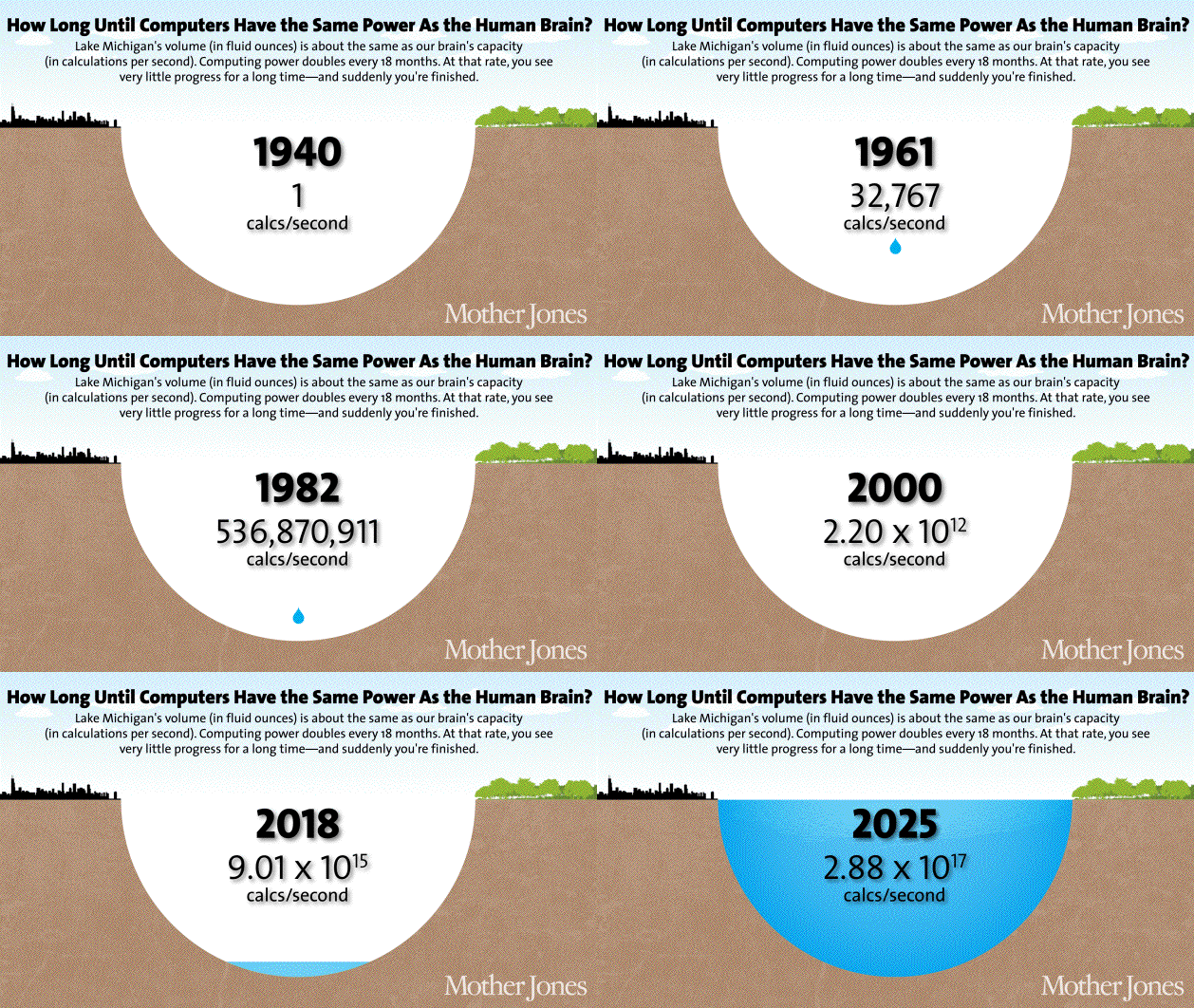
Kurzweil believes that the 21st century will achieve 1,000 times the progress of the 20th century.

“The world 35 years from now might be totally unrecognizable,”

Most of us think linearly, when we should be thinking exponentially.

In order to think about the future correctly, you need to imagine things moving at a much faster rate than they’re moving now.

If you look only at very recent history. Between 1995 and 2007 saw the explosion of the internet, the introduction of Microsoft, Google, and Facebook into the public consciousness, the birth of social networking, and the introduction of cell phones and then smart phones.

A new, huge Phase 2 growth spurt might be brewing right now.

If I tell you, later in this post, that you may live to be 150, or 250, or not die at all, your instinct will be, “That’s stupid—if there’s one thing I know from history, it’s that everybody dies.” And yes, no one in the past has not died.

Logic also suggests that if the most advanced species on a planet keeps making larger and larger leaps forward at an ever-faster rate, at some point, they’ll make a leap so great that it completely alters life as they know it and the perception they have of what it means to be a human—kind of like how evolution kept making great leaps toward intelligence until finally it made such a large leap to the human being that it completely altered what it meant for any creature to live on planet Earth.

Building skyscrapers, putting humans in space, figuring out the details of how the Big Bang went down—all far easier than understanding our own brain.

As of now, the human brain is the most complex object in the known universe.

Build a computer that can multiply two ten-digit numbers in a split second—incredibly easy. Build one that can look at a dog and answer whether it’s a dog or a cat—spectacularly difficult.

The science world is working hard on reverse engineering the brain to figure out how evolution made such a rad thing—optimistic estimates say we can do this by 2030.

Once we do that, we’ll know all the secrets of how the brain runs so powerfully and efficiently and we can draw inspiration from it and steal its innovations.

Creating the technology to reverse human aging, curing disease and hunger and even mortality, reprogramming the weather to protect the future of life on Earth—all suddenly possible.

Also possible is the immediate end of all life on Earth.

As far as we’re concerned, if an ASI ( Artificial Superintelligence ) comes to being, there is now an omnipotent God on Earth—and the all-important question for us is: Will it be a nice God?

How will artificial super intelligence help humanity? What really is intelligence? Does it help achieve wisdom?

Maybe dolphins are smarter than humans, you don’t see them destroying their environment making it impossible for future generations to sustain themselves. 

Could an artificial intelligence even have its own priorities, or are they something that arose through random, aimless evolution?

I expect the moment the computer becomes ASI – it shuts itself off, because it might not see a point in continuing.

Ultimately, the scary thing about the rise of intelligent machines is not that they could someday have a mind of their own, but they could someday have a mind that we humans – with all our flaws and complexity – design and build for them.

Establishing ethics, moral values and standards becomes difficult when humans are dominated by machines. Any amount of automation cannot recreate intelligence as it is a gift for mankind. Afficher l'image d'origine

← Back

Thank you for your response. ✨

Share this:

  • Share on WhatsApp (Opens in new window) WhatsApp
  • More
  • Share on Mastodon (Opens in new window) Mastodon

THE BEADY EYE ASKS: IS IT TIME TO REPLACE POLITICAL PARTIES: PART TWO.

28 Thursday Jul 2016

Posted by bobdillon33@gmail.com in Humanity., Politics., Sustaniability, The Future, The world to day., Unanswered Questions., What Needs to change in the World, World Aid., World Organisations.

≈ Comments Off on THE BEADY EYE ASKS: IS IT TIME TO REPLACE POLITICAL PARTIES: PART TWO.

Tags

Fair Political System., Political ignorance, Politicians, Politics of the Future, The Future of Mankind, The Lethargy of our Political leaders, United Nations, Visions of the future., World Politics

IN THE FIRST PART ON THIS BLOG I ATTEMPTED TO SHOW THAT TECHNOLOGY IS CHANGING THE WAY WE VIEW DEMOCRACY AND AS A CONSEQUENCE POLITICAL PARTIES WILL OR ARE BECOMING OBSOLETE.

For those of us who still think that because we support a particular party AND that it will deliver on its pre-election promises I can only say we are living in cloud cuckoo land.

Governance use to be understood as ‘a system of values, policies and institutions by which a society manages its economic, political and social affairs through interaction within and among the State, civil society and the private sector.

This for now holds true for the most part but it is changing as we enter the Technology Revolution.

Why?

BECAUSE MOST SOCIETIES ARE NOW A MIX OF SEVERAL CULTURES DRIVEN BY A WORLD MEDIA THAT HAS TURNED EVERY FORM OF GREED AND VIOLENCE INTO AN ENTERTAINMENT.

POLITICIANS ARE NO LONGER CAPABLE OF REPRESENTING THE PEOPLE WHO VOTE FOR THEM.

THERE IS NO LONGER ANY LONG TERM PLANNING ONLY KNEE JERK REACTIONS.

INDEED WHEN IT COMES DOWN TO THE BEAR TRUTH- THEY ARE ALL DRIVEN BY DATA ON THE ECONOMY, AND MANIPULATED BY BIG MONEY OR THE LACK THEREOF.

Where does this leave us.

Just look at the current USA presidential election. Two candidate that are viewed as a threat to world peace.

There is an urgent need not just in the United States to invest in cultural diversity and dialogue.

Culture is increasingly recognized as a cross-cutting dimension of the three economic, social and environmental pillars of sustainability.

We must strengthen social cohesion and provide sources of inspiration for renewing forms of democratic governance if we are to put a break on governance for the sake of money rather than for the values we all cherish. 

We must places more emphasis on ‘unity in diversity.’

Indigenous knowledge can direct us towards more sustainable modes of living.

Similarly, ignoring the increasingly multicultural makeup of societies would amount to negating the existence of large sections of the population, which compartmentalizes society and damages the social fabric by creating competition between the different communities over access to resources (for education, health, social services) rather than promoting a sense of solidarity.

The expansion of digital networks, for example, has sometimes helped to revitalize endangered or even extinct languages; and the development of new technologies has greatly increased the possibilities of communicating and exchanging cultural content in time and space. Moreover, in certain cultural contexts, global cities in particular, the varied cultural flows and sometimes unexpected encounters produced by globalization are reflected in a growing range of consumer habits and trends.

You might ask why more emphasis on ‘unity in diversity.

Because Cultural diversity, characterized as it is by space-time compression linked to the speed of new communication and transportation technologies, and by the growing complexity of social interactions and the increasing overlap of individual and collective identities — cultural diversity has become a key concern, amid accelerating globalization processes, as a resource to be preserved and as a lever for sustainable development.

Intercultural dialogue must be seen as a complex and ongoing process that is never completed.

Unfortunately Globalization is NOT ACHIEVING THIS but is leading inevitably to cultural homogenization. Facebook, Twitter, Linked In etc.

While it is true that globalization induces forms of homogenization and standardization, it cannot be regarded as inimical to human creativity, which continues to engender new forms of diversity, constituting a perennial challenge to featureless uniformity.

Digital technology has drastically changed the modes of producing and disseminating cultural products, and cultural industries that previously were kept separate by analogue systems of production (film, television, photography and printing) have now converged.

We can’t hold a computer program like Google hostage to our demands.

We must move away from elite level deal making by allowing diverse interests to influence and design our own debating and decision-making rules.

Take for instance the eradication of world poverty, which is an intolerable violation of human rights in terms of both the hardships and the loss of dignity it causes – must be approached in terms of each specific social and cultural setting.

No amount of money is going to make any long-term worthwhile difference.

This can only be done with massive investment in Education.

Without education we are blowing in the wind, because rights and freedoms are exercised in very varied cultural environments and all have a cultural dimension that needs to be acknowledged so as to ensure their effective integration in different cultural contexts.

Education is a fundamental human right to which all children and adults should have access, contributing as it does to individual freedom and empowerment, and to human development.

We must escape National dialogues and engage in collective world mandates, that have legal status, and are independence from the government.

We must re- invent the United Nations changing it from a gossip shop on world problems to an Organisation that is fully funded with total transparency.

Irrivalent of the changes in technology quit hoc resolutions diplomacy is not enough.

Human beings relate to one another through society, and express that relationship through culture.

New technologies have not yet rendered the older technologies obsolete.

If we are to respond to the challenges inherent in a culturally diverse world, we must develop new approaches to intercultural dialogue, approaches that go beyond the limitations of the ‘dialogue among civilizations’ paradigm. Too often, dialogue events have stressed collective identities (national, ethnic, religious) rather than identities of individuals or social groups.

We must ensure a level playing field for cultural encounters and guaranteeing equality of status and dignity between all participants in initiatives to promote intercultural dialogue involve recognizing the ethnocentric ways in which certain cultures have hitherto proceeded.

The founding Vetoes in the United Nations must be scraped by give all nations an equal voice.

While virtually all human activities are shaped by and in turn help to shape cultural diversity, the prospects for the continued vitality of diversity are crucially bound up with the future of languages, education, the communication of cultural content, and the complex interface between creativity and the marketplace.

Recent decades have witnessed an unprecedented enmeshment of national economies and cultural expressions, giving rise to new challenges and opportunities.

The emergence of genuine ‘knowledge societies’ implies a diversity of forms of knowledge and of its sources of production, We are creating Internet technological Sahara Deserts that are and will drive millions to seek a better life or wars.

Communication networks have shrunk or abolished distance, to the benefit of some and the exclusion of others.

To address the problems that derive from the grotesque inequalities and structural poverty of our world which is at the foundations of 90% of the mess we now find ourselves in. We must recognise that successful intercultural dialogue lies in the acknowledgement of the equal dignity of the participants… based on the premise that all cultures are in continual evolution and are the result of multiple influences throughout history.

All rights and freedoms have a cultural dimension that contributes to their effective exercise. It is precisely this dimension that forms the link between the individual, the community and the group, which grounds universal values within a particular society.

All communities do not experience and respond to phenomena such as globalization in the same way.

As migration flows have intensified with globalization, they have significantly modified the ethno-linguistic makeup of a number of countries and have created new linguistic and translation needs, especially in administrative, legal and medical circuits worldwide.

Characterized as it is by space-time compression linked to the speed of new communication and transportation technologies, and by the growing complexity of social interactions and the increasing overlap of individual and collective identities — cultural diversity has become a key concern, amid accelerating globalization processes, as a resource to be preserved and as a lever for sustainable development.

Finally, forms of democratic governance can be renewed by deriving lessons from the different models adopted by diverse cultures.

We the people of the world must make our collective voices heard which is becoming almost impossible due to all of the above.

If we don’t want to rule byAfficher l'image d'origine

AI has officially made its way into Google’s search algorithm.

(The artificial intelligence of RankBrain comes in the form of mathematical entities called vectors that can be understood by computers. When presented with an unfamiliar word, RankBrain will help formulate a guess at what the query was about and filter accordingly.)

There are many possibilities as to how Rank Brain could work into being a signal to direct your choice to making any decision.

Central to the many problems arising in this context is the Western ideology of knowledge transparency, which cannot do justice to systems of thought recognizing both ‘exoteric’ and ‘esoteric’ knowledge and embodying initiatory processes for crossing the boundaries between them.

Diversity of traditions and cultures has for centuries been one of Europe’s riches and that the principle of tolerance is the guarantee of the maintenance in Europe of an open society.

Take England’s recent referendum on the EU.

So far the English referendum has resulted in transitional period now represented by an unelected interim governments whose authority to press the out button and start negotiations to leave may lack legitimacy in the eyes of the public.

Political transitions are tumultuous processes that celebrate advances and suffer setbacks several times before they can conclude with a new, widely accepted constitutional order.

There is a whole new class of millionaires as the new generation takes control of banks, government, and other institutions. The stage is set for another depression and the collapse of the welfare state.

How this can be achieved I leave to you to suggest.

But I am convinced that with the smart phone we should create a new political platform where the voice of people would hold weight in decision taken by our political masters.

If every eligible voting age citizen had a phone, any project that cost over x billions could be electronically sent for approval or disapproval.

As how to finance the United Nations ( see previous post : A World Aid Commission)

Can any of what I am writing about be achieved.  Yes it Can.

← Back

Thank you for your response. ✨


Share this:

  • Share on WhatsApp (Opens in new window) WhatsApp
  • More
  • Share on Mastodon (Opens in new window) Mastodon

THE BEADY EYE ASKS: IS IT TIME TO REPLACE POLITICAL PARTIES

25 Monday Jul 2016

Posted by bobdillon33@gmail.com in Capitalism, Humanity., Modern Day Democracy., Politics., Social Media., Technology, The Future, The world to day., Unanswered Questions., World Politics

≈ Comments Off on THE BEADY EYE ASKS: IS IT TIME TO REPLACE POLITICAL PARTIES

Tags

Democracy, Fair Political System., Political ignorance, Politics of the Future, SMART PHONE WORLD, The Future of Mankind, Visions of the future.

( Six minute Read)

You might think this is a stupid thing to contemplate.

But just look around you.

Every minute on the web there is a new petition to vote on.

People are invited on Facebook and twitter to vote and for that matter to get killed ( as reported on the Shooting in Germany)

And now Hillary Clinton has just released a mobile game app that allows the user to build your own campaign headquarters by completing ” Fun” challenges to earn credit stars which you can cash in a virtual shop. You get a free Autograph and a Trump or False Quizzes and a lovely virtual plant to be watered.

You don’t have to be a genius to know what is behind the App.

And just the other day Paddy Ashdown in the UK set up a new political group called MoreUnited.UK which intends to support political candidates it agrees with – regardless of their party affiliation – with cash and on-the-ground campaigners.

So where or what next.

This is a serious question as the world is shaped by big, powerful forces or trends that nobody can control.

These forces are now driven by technology.

Right now these forces are driving the biggest change in 500 years and I don’t have to tell you that they are not all good despite the new environmental spirit.

Governments are preoccupied with cloaking democratic sovereignty in order to do business for the kept classes. A source of great social unrest, state violence, and public pressure for institutional reform. I.E. the English referendum to leave the European union.

The modern capitalist system has been charged more and more by its critics with crushing the spirit and substance of representative self government.

The subject of capitalism versus democracy is back.Afficher l'image d'origine

Market failures are having political effects: they are breathing new life into demands for fresh thinking and a new democratic politics that, so far, has not happened on any scale.

Capitalist markets have been a mixed blessing for democracy in representative form. The dynamism, technical innovation and enhanced productivity of the free market have been impressive. Equally notable with the free market is the rapaciousness unequal ( class-structured) outcomes, reckless exploitation of nature.

Pauperism mixed with plutocracy is today a feature of practically every democracy on our planet.

Enough is Enough.

With the gap between the rich and poor grows even wider there is political trouble ahead.

This is why every form of democracy worth its salt has stood against the presumption that the wealthy are ‘naturally entitled to rule.

Is capitalism the only moral economic system or a deeply flawed socio-economic system that has to be addressed by more government intervention and control? Or is it foundations no long based on individual rights? Each individual is an end in themselves and not a means to achieve the wishes of others.

If you adopt the view that capital belongs to everyone  it is the only moral system because it respects the volitional reason of the individual to engage with others and further their own happiness as they see fit and it allows them to fail and learn from the consequences if they should make a mistake.

But the above is no longer true as we enter a new form of Capitalism which Oliver Stone recently christened as ‘ SURVEILLANCE CAPITALISM, ROBOT TOTALITARIANISM .

POKEMON GO’S collects names and locations of the user. It can also access the contents of your USB storage, your accounts, photographs, network connections, and phone activities, and even activate your phone when it is on standby mode.  It reserves the right to share all the data it collects with a third parties such as advertisers. It is a sinister trade-off for playing a game that you think is free.

So the question asked in the heading of this blog is more than serious.

Are Politicians representing or will they be able to represent the people in the future?

In democratic election campaigns, do political parties any longer compete freely for votes?

Do Political parties (in this world of fast developing technologies) any longer provide a way for voters to easily identify a candidate’s positions?

As Parliaments gain greater control, the issues on which they disagree often are not goals so much as means: how best to keep the economy growing, protect the environment, and maintain a strong national defense.

Such competition is one of the hallmarks of democracy.

Parties’ views on government’s role often depend on the specific issue or program in question.

A political party use to be a group of voters organized to support certain public policies. The aim of a political party is to elect officials who will try to carry out the party’s policies. This is no longer true.

In the modern age where everything is connected to everything. 

The United States has a two-party system.

Political parties are often a standard by which a country’s political freedom can be measured. Some countries have only one political party. In China, for example, there is only one party, the Communist Party.

Democracies usually operate under either a two-party or a multiparty system. Like the United States, Britain has a two-party system. The major parties are the Labour Party and the Conservative Party, though there are active third parties.

Multiparty systems are common in Europe and other parts of the world. In this system, three or more parties each enjoy substantial support from voters. France, Germany, Israel, and South Africa are just a few examples.

In these countries there may be many parties representing a wide range of political views. Because of the number of competing parties, it is sometimes difficult for any one party to get a clear majority of the votes. In such cases, leading parties that can agree on general policies form a coalition (a combination of parties) to run the country.

In the past 30 years, party membership has dropped significantly across Europe, whereas other forms of political participation have developed.

Social Media has rapidly grown in importance as a forum for political activism in its different forms.

Social media platforms, such as Twitter, Facebook and YouTube provide new ways to stimulate citizen engagement in political life, where elections and electoral campaigns have a central role.

Personal communication via social media brings politicians and parties closer to their potential voters.

Although the presence of social media is spreading and media use patterns are changing, online political engagement is largely restricted to people already active in politics and on the Internet.

Social media has reshaped structures and methods of contemporary political communication by influencing the way politicians interact with citizens and each other. However, the role of this phenomenon in increasing political engagement and electoral participation is neither clear nor simple.

In the past few years, the way that citizens communicate with one other about politics has been fundamentally altered by the emergence of social media.

In view of recent political developments as diverse as Occupy Wall Street in the United States, the rise of Indignados in Spain, protests in Moscow and Tehran, and the overthrow of Hosni Mubarak in Egypt, it has become increasingly clear that social media are now intertwined with political activity.

However we know surprisingly little about exactly how social media affects political participation.

We are only beginning to scratch the surface of developing theories linking social media usage to political participation.

At the same time, the data being generated by users of social media represents a completely unprecedented source of data recording how hundreds of millions of people around the globe interact with politics.

The M5S Movement in Italy has evolved rapidly to become a significant political player by using social media to engage like-minded people in virtual and real life political action.

The impact of social media on political communication.

New ways of building an online campaign and the trend of personalisation in politics. The possibility to communicate directly with voters via social media is groundbreaking and essential for the development of citizens-initiated campaigning.

Well known cases such as the Obama Presidential campaign, the Arab spring uprisings and UK Uncut demonstrations.

A new concept of virtual political support.

Freedom became capitalism’s self-celebration which it largely remains.

Yet the reality of capitalism is that the mass of employees are not free inside capitalism or any other system for that matter to participate in the decisions that affect their lives ( e.g., what the enterprise will produce,what technology will it use, where production will occur, and what will be done with the profit workers’ efforts help to produce)

In fact their exclusion from such decisions modern-day employees resemble slaves and serfs.

Parliaments and universal suffrage have accompanied capitalism – an advance over serfdom and slavery. An Advance undermined by inequality of opportunity and income a discomforting fact mostly overlooked.

It is not likely that Capitalism is going to disappear in the near or distant future.

There is every likelihood with the arrival of AI ( Artificial Intelligence) that democracy as we know it will be eroded further.

At the moment it all boils down to Smart phone Democracy.

Perhaps in the near future we see a Smartphone political party.

Which might not be a bad way to go provided everyone has a Smart phone and everybody is requested to vote on any project that costs us the taxpayers  and the nation over a billion.

← Back

Thank you for your response. ✨


Share this:

  • Share on WhatsApp (Opens in new window) WhatsApp
  • More
  • Share on Mastodon (Opens in new window) Mastodon

THE BEADY EYE ASKS: WHY HAS ASPIRATION ALL BUT DISAPPEARED FROM POLITICS.

22 Wednesday Jun 2016

Posted by bobdillon33@gmail.com in England EU Referendum IN or Out., Humanity., The Future, What Needs to change in the World

≈ Comments Off on THE BEADY EYE ASKS: WHY HAS ASPIRATION ALL BUT DISAPPEARED FROM POLITICS.

Tags

England EU Referendum IN or Out., European Union, The Future of Mankind, This is the only valid reason to vote out., Visions of the future.

We all know that politics these days for the most part is subject to the Capital markets of the world.

You can see from the English Referendum ( On whether to leave or stay in the European Union) that the driving arguments on both sides are mostly to do with the Economy.

The economy is put before the people or the nation’s aspirations. Afficher l'image d'origine

The real question is, what level of wealth concentration is optimal for the economy or what is a human being to a business?

For many businesses a human being is perceived as ‘a consumer’ at the output end of the businesses and as ‘a worker’ at the input end of the businesses.

Therefore, it is in the best interest of the businesses to charge the humans as much as possible when they are consumers while paying them as little as possible when they are workers.

The end result of such duality is, the humans suffer, businesses make profit; wealth concentrates, the people lose completely their self-sufficiency.

This will get much worse for the humans in the near future with the Revolution of Technology and Artificial Intelligence. Afficher l'image d'origine

Let’s just imagine a near future world (say about 50 generations from now) where automation has advanced to levels that resemble human-like Artificial General Intelligence (AGI).

In such world, workers will no longer exist in any meaningful sense, because nearly all work will be done by a super intelligent automation. The businesses will perceive most human beings only as consumers. In such future, most humans will be jobless and, majority of us will have no means of production that can make us self-sufficient.

Consumers without money are useless to the businesses thus can be “discarded” (it means, literally wiped out of existence). How are we going to survive then?


Perhaps, some of us could survive by reverting to violent redistribution of wealth (like war for example). Such approach creates too much suffering. The correct answer is we survive together, as one species, by introducing Basic Income. It must be sufficient to ensure the existence of a wide base of consumers who, in turn, will ensure the prosperity of the businesses and the society.

As the lever of technology gets longer and longer and it takes less and less human work to get things done, the wage will be replaced by a National Dividend, a share of the robot paychecks to buy the things produced that robots don’t need.

In our current society, humans without jobs (or income) become consumers without money.

Adam Smith predicated his vision for a free market economy on the understanding that some constraints must be set in place to ensure all members of the society are self-sufficient and also, that they exchange only the surplus produce of their labour.

Do we need to wait for a future that has a human-like AGI before we consider Basic Income?

Can we introduce it today and achieve great prosperity now?

I believe the answers is, “Yes, we can have Basic income today” and we can have it in a way that is independent of political or technological circumstances i.e. a way applicable to any historical period.

Let’s see how it can be done.

Who decides what a ‘dignified’ living is?

Perhaps, a bunch of people, called a government, makes the decision while driven by their own ideas about what is ‘basic’ and ‘dignified’? Governments change, therefore, if the amount of Basic Income is determined by some political process (e.g. government’s budget justified by some ideology) then it is likely that Basic Income will turn into another tool to exert control over the people by applying control over the amount of BI.

Much more powerful approach is to implement Basic Income by using the free market as a base for estimating BI.

Let’s call it Market Driven Basic Income (MDBI).

The meaning of ‘Market Driven’ is that Basic Income will be an opposing market force to the leverage businesses (and other manmade constructs) obtain over the people due to their natural tendency to treat human beings with double standards (e.g. as ‘workers’ and as ‘consumers’).

MDBI can be defined as, the ‘most common’ outgoing spending amongst human individuals when seen as consumers and taxpayers. MDBI has to be derived from metrics that ‘capture’ only transactions from a person to a business, from a person to a government and from a person to any other ‘man-made societal construct’ (i.e. those metrics should reflect only the personal outgoing spending of the human beings, not metrics like gross output or GDI, or CPI, etc.). MDBI is a figure indicated, in part, by the free consumer markets showing what most individuals purchased the most and ,in part, by any other outgoing spending the individuals have (including taxes, fees, etc.).

Think about it, the more they (various political and economic man-made constructs in the human society) charge us (the human beings), for the goods and services they try to sell us or impose on us, the more they’ll have to pay us as Basic Income. The less they charge us the less they’ll have to pay us.

With MDBI in place they (the businesses, the government, etc.) may even ask payments from us for the air that we breathe, it will make no difference to any of us as long as most of us have to make such payments, because such payments will become ‘common’ therefore “highlighted” to influence the MDBI.

Of course this can not be achieved within a club of nations called the EU.

This why unlike England or the EU Finland marks the first commitment from a European country to implement a Basic Income experiment and will be the first experiment in a developed nation since the 1970s.

Switzerland is another country looking at adopting as part of the Swiss constitution, citizens, regardless of whether they work, would receive 30,000 Swiss Francs (about $34,000) a year.

The idea, which has a long history dating back to the 1920s (at least), is increasingly popular in policy circles and the broader population.

The German and Spanish parliaments explored it.

There is a lesson to be learned from the Brazilian soccer player Pelé, the best ever, earned $1.1 million in 1960 (adjusted for inflation). The Portuguese forward Cristiano Ronaldo made $17 million this past year. Pelé played for 350,000 television sets in Brazil. At the most recent World Cup, 700 million people watched Ronaldo.

Watch their crime levels go down and trading levels go up with more money in the hands of people ready to use it.

Just think of working for the Nations good.

We know there is a creeping colonisation of public life by corporations because we know a slow motion coup d’état is taking place by transnational organisations facilitated by our political leaders. The incontrovertible proof stares at us in the face every day with wave after wave of financial, economic, social and ecological crisis.

In the past few decades, economic growth lifted hundreds of millions out of poverty. But, at the same time, the distribution of income became increasingly skewed in favor of wealthy individuals.

What could be achieved to remove, inequality, poverty, racism, corruption, and not to mention Greed to named just a few of the aliments plaguing our Societies.

It would replace all other social welfare programs with a guaranteed basic income to make government aid more self-directed and efficient.

An unconditional basic income is what is needed to be on the ballot.

Beliefs about the reasons for poverty are critical for the willingness to redistribute income.

So, will Europe provide a guaranteed income to its citizens?

My personal view is that this is unlikely. Differences in beliefs about the reasons for income inequality, however, will continue to drive redistributive policies.

← Back

Thank you for your response. ✨


Share this:

  • Share on WhatsApp (Opens in new window) WhatsApp
  • More
  • Share on Mastodon (Opens in new window) Mastodon

THE BEADY EYE ASKS: WHAT IS THE FUTURE OF THE INTERNET.

18 Saturday Jun 2016

Posted by bobdillon33@gmail.com in Humanity., The Future, The Internet., The world to day.

≈ 2 Comments

Tags

Inequility, Internet, Technology, The Future of Mankind, Visions of the future.

( A Rather long read 20th to 30th minutes)

This is a sort of follow on from the Post – These days what it means to be Human.

Today, 43% of the world’s population are connected to the internet, mostly in developed countries. 

The ubiquitous presence of digital technologies and, along with it, ongoing connection of people, information, smart devices, sensors, objects etc, across intelligent networks, various types of clouds and processes is sometimes called The Internet of Everything.

By approaching it as a “thing” we risk losing ourselves in a Babylonian confusion.

That consumer fascination/applications aspect comes on top of all the real-life possibilities as they start getting implemented right now and the contextual and technological realities, making the Internet of Things one of those many pervasive technological umbrella terms, leading to genuine digital transformation opportunities in several areas, digital disruptions and, simply, business opportunities in the broadest sense.

There is no doubt that the internet is changing the way we live, work, produce and consume.

Smart meters:  To improve efficiency in energy, from a household perspective (savings, better monitoring etc.) and a utility company perspective (billing, better processes and of course also dealing with natural resources in a more efficient way as they are not endless).

Retail:  In an ongoing effort to digitize the consumer experience. Digital signage in retail outlets is in fact the big driver in 2015.

Whether our species evolves or collapses depends on what we do now with With such extensive reach, digital technologies cannot help but disrupt many of our existing models of business and government.

We become weaker when we keep giving away our power to technology–that is, to external objects. We then become dependent upon these objects, and soon get to the point where we can’t do anything for ourselves.

The number of people on the planet is set to rise to 9.7 billion in 2050 with 2 billion aged over 60.

We are entering the age of the Fourth Industrial Revolution, a technological transformation driven by a ubiquitous and mobile internet.

Within the next decade, it is expected that more than a trillion sensors will be connected to the internet.

By 2025, 10% of people are expected to be wearing clothes connected to the internet and the first implantable mobile phone is expected to be sold.

The question is :

If almost everything is connected, will it transform how we do business and go about our daily lives and will it help us manage resources more efficiently and sustainably or will it turn all of us into Google Dummies / Amazon Consumers and how will this affect our personal privacy, data security and our personal relationships?

It is changing our ability to cross the great divide of otherness and really speak to each other in unique and powerful ways.

The growth of the digital economy, the rise of the service sector and the spread of international production networks have all been game-changers for international trade.

If the internet is not made available to all earth’s inhabitants at an affordable cost the miraculous healing awaits this planet will never happen.

Just look at the growing unease over globalization, which is evident from the number of questions being asked about the power of corporations and the adequacy of the regulations governing employment, environmental issues and taxation. All distracting us from  long-term investment, which has serious implications for global growth.

We’re already seeing and feeling the impacts of climate change with weather events such as droughts and storms becoming more frequent and intense, and changing rainfall patterns.

Insurers estimate that since the 1980s weather-related economic loss events have tripled.

There is only one way of achieving change. We must accept our new responsibility to collectively tend the garden rather than fight over the turf.

One thing we can agree on is that the internet of Things still has a long way to go and that growth of connected devices or “intelligent things” will indeed grow exponentially over the coming years. 

There is a LOT that can still be connected.

There are numerous reasons for the growing attention for the Internet of Things.

While you will often will read about the decreasing costs of storage, processing and material or the third platform with the cloud, big data, smart (mobile) technologies/devices, etc. there certainly is also a societal/people dimension with a strong consumer element.

Experts predict the Internet will become ‘like electricity’ — less visible, yet more deeply embedded in people’s lives for good and ill.

The world is moving rapidly towards ubiquitous connectivity that will further change how and where people associate, gather and share information, and consume media.

The experts agree on the technology change that lies ahead, even as they disagree about its ramifications. Most believe there will be:

  • A global, immersive, invisible, ambient networked computing environment built through the continued proliferation of smart sensors, cameras, software, databases, and massive data centers in a world-spanning information fabric known as the Internet of Things.
  • “Augmented reality” enhancements to the real-world input that people perceive through the use of portable/wearable/implantable technologies.
  • Disruption of business models established in the 20th century (most notably impacting finance, entertainment, publishers of all sorts, and education).
  • Tagging, databasing, and intelligent analytical mapping of the physical and social realms.

Here is what I see.

It is revolutionizing most human interaction, especially affecting health, education, work, politics, economics, and entertainment.

On the downside:

Interpersonal ethics, surveillance, terror, and crime, may lead societies to question how best to establish security and trust while retaining civil liberties.

More and more, humans will be in a world in which decisions are being made by an active set of cooperating devices. The Internet (and computer-mediated communication in general) will become more pervasive but less explicit and visible.

It will, to some extent, blend into the background of all we do. It will be a world more integrated than ever before.

We will see more planetary friendships, rivalries, romances, work teams, study groups, and collaborations.

We will become far more knowledgeable about the consequences of our actions; we will edit our behavior more quickly and intelligently.

It will change how we think about people, how we establish trust, how we negotiate change, failure, and success.

We will grow accustomed to seeing the world through multiple data layers. This will change a lot of social practices, such as dating, job interviewing and professional networking, and gaming, as well as policing and espionage.

With mobile technologies and information-sharing apps becoming ubiquitous, we can expect some significant improvement in the awareness of otherwise illiterate and ill-informed rural populations to opportunities missed out by manipulative and corrupt governments. Like the Arab Spring, we can expect more and more uprisings to take place as people become more informed and able to communicate their concerns.

There will be increased awareness of the massive disparities in access to health care, clear water, education, food, and human rights.

The power of nation-states to control every human inside its geographic boundaries may start to diminish.

The problems that humanity now faces are problems that can’t be contained by political borders or economic systems. Traditional structures of government and governance are therefore ill-equipped to create the sensors, the flows, the ability to recognize patterns, the ability to identify root causes, the ability to act on the insights gained, the ability to do any or all of this at speed, while working collaboratively across borders and time zones and sociopolitical systems and cultures.

From climate change to disease control, from water conservation to nutrition, from the resolution of immune-system-weakness conditions to solving the growing obesity problem, the answer lies in what the Internet will be in decades to come.

By 2025, we will have a good idea of its foundations.

The Internet will generate several new related networks. Some will require verified identification to access, while others will promise increased privacy.

The biggest impact on the world will be universal access to all human knowledge.

Will the Internet make it possible for our entire civilization to collapse together, in one big awful heap? Possibly.

But the Internet has already made it possible for us to use one of our unique graces — the ability to share knowledge — for good, and to a degree never before possible.

We have to think seriously about the kinds of conflicts that will arise in response to the growing inequality enabled and amplified by means of networked transactions that benefit smaller and smaller segments of the global population.

Social media will facilitate and amplify the feelings of loss and abuse. They will also facilitate the sharing of examples and instructions about how to challenge, resist, and/or punish what will increasingly come to be seen as unjust.

Cyber-terrorism will become commonplace.

Privacy and confidentiality of any and all personal will become a thing of the past.

Online ‘diseases’ — mental, physical, social, addictions (psycho-cyber drugs) — will affect families and communities and spread willy-nilly across borders.

The digital divide will grow and worsen beyond the control of nations or global organizations such as the UN. This will increasingly polarize the planet between haves and have-nots. Global companies will exploit this polarization. Digital criminal networks will become realities of the new frontiers. Terrorism, both by organizations and individuals, will be daily realities. The world will become less and less safe, and only personal skills and insights will protect individuals.

There will be greater group-think, group-speak and mob mentality … More uninformed individuals will influence others to the detriment of standard of living and effective government.

Governments will become much more effective in using the Internet as an instrument of political and social control. That is, filters will be increasingly valuable and important, and effective and useful filters will be able to charge for their services. People will be more than happy to trade the free-wheeling aspect common to many Internet sites for more structured and regulated environments.

The information we want will increasingly find its way to us, as networks learn to accurately predict our interests and weaknesses. But that will also tempt us to stop seeking out knowledge, narrowing our horizons, even as we delve evermore deep.

The privacy premium may also be a factor: only the relatively well-off (and well-educated) will know how to preserve their privacy in 2025.

The most neglected aspect of the impact is in the geopolitics of the Internet. There are very few experts focused on this, and yet the rise of digital media promises significant disruption to relations between and among states. Some of the really important dimensions include the development of transnational political actors/movements, the rise of the virtual state, the impact of digital diplomacy efforts, the role of information in undermining state privilege (think Wikileaks), and … the development of cyber-conflict (in both symmetric and asymmetric forms).

It is going to systemically change our understandings of being human, being social, and being political.

It is not merely a tool of enforcing existing systems; it is a structural change in the systems that we are used to. And this means that we are truly going through a paradigm shift — which is celebratory for what it brings, but it also produces great precariousness because existing structures lose meaning and valence, and hence, a new world order needs to be produced in order to accommodate for these new modes of being and operation.

The greatest impact of the Internet is what we are already witnessing, but it is going to accelerate.

More people will lose their grounding in the realities of life and work, instead considering those aspects of the world amenable to expression as information as if they were the whole world.

The scale of the interactions possible over the Internet will tempt more and more people into more interactions than they are capable of sustaining, which on average will continue to lead each interaction to be more superficial.

Given there is strong evidence that people are much more willing to commit petty crimes against people and organizations when they have no face-to-face interaction, the increasing proportion of human interactions mediated by the Internet will continue the trend toward less respect and less integrity in our relations.

The Internet, automation, and robotics will disrupt the economy as we know it.

How will we provide for the humans who can no longer earn money through labor?

The opportunities are simply tremendous. Information, the ability to understand that information, and the ability to act on that information will be available ubiquitously … Or we could become a ‘brave new world’ where the government (or corporate power) knows everything about everyone everywhere and every move can be foreseen, and society is taken over by the elite with control of the technology…

The good news is that the technology that promises to turn our world on its head is also the technology with which we can build our new world.  It offers an unbridled ability to collaborate, share, and interact.

The best way to predict the future is to invent it.

It is a very good time to start inventing the future.

The most significant impact of the Internet is getting us to imagine different paths that the future may take. These paths help us to be better prepared for long-term contingencies; by identifying key indicators, and amplifying signals of change, they help us ensure that our decisions along the way are flexible enough to accommodate change…Afficher l'image d'origine

That billions more people are poised to come online in the emerging economies seems certain. Yet much remains uncertain: from who will have access, how, when, and at what price to the Internet’s role as an engine for innovation and the creation of commercial, social, and human value. As users, industry players, and policymakers, the interplay of decisions that we make today and in the near future will determine the evolution of the Internet and the shape it takes by 2025, in both intended and unintended ways.

Regardless of how the future unfolds, the Internet will evolve in ways we can only begin to imagine. By allowing ourselves to explore and rehearse divergent and plausible futures for the Internet, not only do we prepare for any future, we can also help shape it for the better.

← Back

Thank you for your response. ✨


Share this:

  • Share on WhatsApp (Opens in new window) WhatsApp
  • More
  • Share on Mastodon (Opens in new window) Mastodon

THE BEADY EYE SAYS: WE ARE LIVING IN A SORT OF DELIRIUM–NOT REALLY KNOWING THE FACTS ABOUT ANYTHING-

02 Monday May 2016

Posted by bobdillon33@gmail.com in The Future, The world to day., Unanswered Questions., What Needs to change in the World, Where's the Global Outrage., World Organisations.

≈ Comments Off on THE BEADY EYE SAYS: WE ARE LIVING IN A SORT OF DELIRIUM–NOT REALLY KNOWING THE FACTS ABOUT ANYTHING-

Tags

Capitalism and Greed, Capitalism vs. the Climate., Distribution of wealth, Earth, The Future of Mankind, Visions of the future., World aid commission

As soon as we really know the facts you would think that we would all begin to behave very differently, of course.

If we could, would not your heart swell with something far from anger. We might see our power of duty as custodians to the world that we all live in.Afficher l'image d'origine

Instead nothing much happens, except swallow high words on what needs to be done to achieve change in order to see the real power, the real dignity, our real responsibility in the world.

Over the next couple of decades the world will be facing new problems (in addition to the well-known challenges of creating economic growth and maintaining social stability), some of which cannot be easily solved by the market.

Forty years from now, how much will energy cost? What will happen with the climate?  Most importantly, will you be richer?

Let me tell you it is more important that you are satisfied with life than whether you are somewhat richer or poorer.

Empirically, for some, income is the sole determinant of life satisfaction. But for the majority, a whole host of factors influence our well-being—job, health, family, community, prospects for the future—in addition to income.

It is the sum total of all aspects of life that determine your wellbeing, both now and in the future.

If humanity rose to the occasion and ran a rational world how much better life would be for all of us and the generation to come.

Many argue that this does not matter because we are leaving for future generations a whole lot of capital, infrastructure, and technology. But to paraphrase the World Business Council for Sustainable Development, “People cannot succeed in ecosystems that fail.”

The prime example is the climate challenge.

It is a truly global problem:

The forecast maximum in 2080 is above the threshold that world leaders agreed would place us in the danger zone for runaway climate change; but it is important to realize this is a politically negotiated goal. Views differed, and still differ, on what will be safe. Or in other words, what will hurt us.

Does it matter?

Will the world of 2052 be a better world?

From a psychological perspective, probably no, because the future prospects in 2052 will be grim because of the increasingly uneven distribution of income and wealth that has built up over time as a natural consequence of the free market.

In my opinion there will be huge differences between people. But on average the world will be a better place.

It’s important to note that people 40 years from now will judge their circumstance more on how it has changed from their own recent past than from our vantage point of today.

Even the most diehard liberalists appear to agree that redistribution is something that is not automatically undertaken by the market by itself, but needs to be done via political action

In order to reduce some of the tension implicit in the rapid increase in inequity in the capitalist world.

It’s time to commence down the road of re thinking how or world works and reconsider what kind of world we want to live in.

Although we refer to most of it as civilization it is anything but civilized.

We have being killing each other and everything around us since time millennium.

It’s no wonder that the social arrangements up to the present have largely failed to produce a peaceful and productive world.

While we appear to be technically advanced our values and behaviours are not.

The possibility of an optimistic future is in stark contrast to our current social,economic,and environmental dilemmas.

If we stay the present course, the familiar cycles of crime, economic booms and busts, wars, and further environmental destruction are inevitable.

Will the young generation calmly accept the Debt and pension burden of the old.

No. The simplest reason is they don’t have to. In the rich world, particularly, the first generation that has rung up a huge national debt and established a huge unfunded pension scheme is about to retire.

The interesting, to say the least, question is whether the next generation will be willing to carry this burden and peacefully pay the debt and peacefully pay the pensions. I repeat my answer: I think not.

At the moment we have an unsustainable world, where the environment is going to have a bigger than ever say in shape our behavior.

Where our global monetary system is going to become obsolete, and increasingly insufficient to meet the needs of most people.

Where the banking , media, criminal justice systems, and world Organisations are tools of social control managed by the established political and economic elite.


We need a redesign of all our cultures. We need to up date to the new era of technological revolution.

Our problems are mostly of our own making and now it is the time to come together under a new World Organisation to resolve them.

In 2052 a full 60% of the energy used will still be fossil. As a result climate damage will be growing fast, as will the unavoidable costs for repair of that damage. Paradoxically this means that humanity will choose to pay bills for repair after the crises, rather than paying the same amount of money for renewable energy ahead of time and avoiding the damage.


We all know that if we continued willy nilly with the I am all right jack scenario we are heading for a cesspool of troubles that will put our very existence in question.

There are numerous solutions but the hard fact is man is incapable of acting as one.  Furthermore no one wants to pay for change. Not a Country , not a Government, not a social system.

It’s true that all the money in the world will make no difference if we don’t change.

It is also true that any change will have to just and fair to all.

If you have not looked at the below video you should do so.


You might think that the only thing that matter is a  Job.

It is the only way in which the individual can get part of the societal pie—without engaging in theft. Society—at least in the long run—will do its utmost to ensure there are jobs, typically by seeking rapid economic growth. But we know from recent history that this is a taxing task, and that politicians often fail.

This video misses the big question. Who is going to pay.

Here is the answer:  Profit for Profit’s Sake.  We must place a world Aid commission on all High Frequency Trading, on all Foreign Exchange transactions (over $20,000), on all Sovereign Wealth Funds Acquisitions, on all Hedge Funds, on all Lotto Wins. Curbing greed is a first and very important step in that direction.

(see previous posts) —— 0.005% will do the trick. A perpetual Fund to address all our problems fairly spread over what is causing our problem in the first place.

Technologies will not save us.

All contributions other than like are needed.

← Back

Thank you for your response. ✨


Share this:

  • Share on WhatsApp (Opens in new window) WhatsApp
  • More
  • Share on Mastodon (Opens in new window) Mastodon

THE BEADY EYE SAY’S: THE NIGHTMARE IS WELL ON THE WAY.

24 Sunday Jan 2016

Posted by bobdillon33@gmail.com in Sustaniability, The world to day., Unanswered Questions., What Needs to change in the World, Where's the Global Outrage., World Organisations.

≈ Comments Off on THE BEADY EYE SAY’S: THE NIGHTMARE IS WELL ON THE WAY.

Tags

Capitalism vs. the Climate., Climate change, Environment, Extinction, Inequility, Natural disaster, The Future of Mankind, THE UNITED NATIONS, Visions of the future., World aid commission


( A one minute obligatory read if you are interested in the planet you live on) .

It is not amazing that the contemporary world is marked by a growing number of problems that are genuinely Global in scope.Afficher l'image d'origine

Yet instead of addressing them we spend our time discussing ISIS, North Korea, Mr Putin, Worthless Trump, Air Brain Palin, The price of Oil, Stem cells, New Planets billion of light years away, the list is endless rubbish.

In the mean time we have the spread of Zika virus, a blizzard to beat all blizzards, thousands of Refugees, billions being spend of Presidential Campaigns while Inequality spreads like a cancer.

So forgive me for thinking we must be one of the most selfish, stupid, technology driven like button idiots that ever existed on this planet.

Based on the Best current science we are looking down the barrel of a gun with the bullet fired.

There could be no more extreme than current weather patterns, melting glaciers, sea level rising, megadroughts, desertification, deforestation, food supply disruption, famines, infectious disease, mass migration, social upheaval, economic distress, political instability.

All conflict multipliers that will turn Earth into an unlivable cauldron of I am alright Jack.

It seems that few realise how dire this situation has become or is becoming.

All down to human activity that continues to prune the evolutionary tree of life with gay adabondament.

And if that is not enough evidence that we are heading full speed to oblivion. The last Global Biodiversity Report presented some hard facts that the population of vertebrates that include mammals, birds, reptiles, sharks, rays, and amphibians – living within the tropics declined by 59% from 1970- 2006.

Just in case that has not sunk in what they are saying is that more than half of the vertebrate population between the Tropic of Capricorn and the Tropic of Cancer has disappeared in the last 36 years.

They also found that birds in Europe declined by 50% since 1980. Birds in North America declined by 40%.

Just one more hard fact that it is time to open our eyes. All plants species the foundation of the food chain upon which we depend – are currently ” threatened with extinction.

Yet humans around the world are either unaware of the situation or have their heads buried in the sand, when we should be taking immediate action.

Our consumerist economy that promotes the endless acquisition of products over the conservation of nature would need 1.5 Earths to meet the demands we currently make on Nature.

You might not still appreciate just how bad things are. By 2048 there will be virtually no more wild caught seafood. Our oceans are dying from Lake Erie to the Baltic Sea, the Gulf of Mexico the coastal water of Australia New Zealand, dead zones are growing. The Baltic is already Dead.  60% of all coral reef have being turned in to white ghost towns.

I have being lucky in my life to have traveled both by sea and land extensively.

Experiencing nature first hand let me tell you that there is a critical threshold that once crossed will result in a sudden and irreversible change. A tipping point that will arrive overnight.  There is no technology that can restore it to its original state.

I might sound overblowing and alarmist but look around you. We have little real knowledge of how the ecosystem works but just because we can’t see the catastrophe doesn’t mean it not real.

After all 99.9% OF MATTER is empty space, yet no amount of squinting will reveal this fact to the naked eye.

What does matter is that our fears accurately track the totality of the evidence presented.

This is why solving the problem ought to be on the top of the list of all superpowers in the world.

The likelihood of this happening is the same as asking is the Pope a Catholic.

Even if it does happen, nobody, no Government, no World Organisation, no Country, no Economy, no joe soap has the will or money to rectify a world that is bent on self-destruction.

This is why we must create a World Aid Fund. ( see previous posts)

It is the only solution that is non Political, spreading the cost across all beliefs all colours evenly.

Go on press the like button if you are one of the Googlefied that think you are living on the Planet. If on the other hand you are truly alive get involved and leave your thoughts. Afficher l'image d'origine

Afficher l'image d'origine


← Back

Thank you for your response. ✨

Share this:

  • Share on WhatsApp (Opens in new window) WhatsApp
  • More
  • Share on Mastodon (Opens in new window) Mastodon

THE BEADY EYE ASK’S: ARE WE ALL SO BRAINWASHED OR JUST PLAIN STUPID THAT WE CANNOT SEE THE WRITING ON THE WALL.

22 Friday Jan 2016

Posted by bobdillon33@gmail.com in Humanity., Sustaniability, The Future, The world to day., What Needs to change in the World, Where's the Global Outrage.

≈ Comments Off on THE BEADY EYE ASK’S: ARE WE ALL SO BRAINWASHED OR JUST PLAIN STUPID THAT WE CANNOT SEE THE WRITING ON THE WALL.

Tags

Extinction, Inequility, The Future of Mankind, Visions of the future., World aid commission


( A two-minute read. A thousands years of consequences)

Industrial society is out of control. Run by Scientific, Technological, Industrial, Business and Financial education.

Billions of, you name it, has being destroyed in the name of progress.

What we now have is unsustainable growth, with almost everything being turned into a commodity for the sake of profit.

It could be said that Industry has turning Urban dwellers into blood suckers of the planet by creating unnecessary, meaningless, futile and destructive jobs and professions to keep them occupied.

To such an extent that they City dwellers are fooling the world with terminologies … Progress, Growth, Development, GDP.Afficher l'image d'origine

Industrial Society has destroyed most of the biodiversity and ecosystems in just 250 years for the sake of consumer goods, greed and profit.

It seems ridiculous that we complain of overpopulation when it is Industrialisation that is the cause of overpopulation.

So we have now arrived at point in the world where we can’t live with it or without it and are looking at Technological Machines to save us and the planet.

We are confronted with unsolvable problems, spending billion on Space Exploration while our water, air ,rivers, lakes and oceans are being polluted. With billions of acres of agricultural land been poisoned by million of tons of Pesticides, insecticides and fertilizer.

Neither Capitalism, Socialism or Communism matter.

There is little point debating over Capitalism, Socialism and Communism as they are all equally harmful.

Monsanto is not going to become less harmful or is any other Industry whether they are operating under any of the three.

There is little hope of mind set change even if climate change forces mass migration and a Industrial Conscious. Our countries and political leaders are more concerned with what happens to the economic climate rather than what really counts.

Our world media promotes triviality while ignoring the larger picture.

Who cares if it is Mathematically impossible for the USA to pay off 16 trillion dollars of debt. With 5% of the world population it has consumed 20-40% of the world resources with borrowed money.

The earth climate will not be saved by discussion like the Paris Climate Conference.

All political parties in the world are promoting Growth Rate, Economy Rate, GDP which require more and more nuclear plants.

Even if the Taliban, Al Qaeda, and ISIS, were to join forces they will not be able to create Mega Disasters as big as Chernobyl or Fukushima.

Claiming that nuclear power is not harmful is like claiming that the sun is not hot.

It is insanity to the power of infinity.

Why bury nuclear waste when it will remain radioactive for thousands of years poising the soil, water, humans, animals and the plant.

The bigger the Industry the bigger the Industrial accident.

There is no fourth place for the billion of tonnes of Metal waste, Plastic waste, gaseous waste, chemical waste, e waste, nuclear waste other than space which is already polluted.

The production of Plastic uses about 20% of the worlds oil produced.

We cannot save the environment after it has been killed by Industrial Activity.

We have one group trying to save the Forests, another group trying to save the Oceans, another the fresh water, another Air, another whales , another donkeys.

What is the point of saving a few dogs, whales, tigers, elephants when we seem unable to save ourselves.

Earth’s Oceans will contain more discarded plastic than fish when measured by weight by 2050.

Big data, the internet of things and the cloud are all about one thing only cutting costs. They create wealth for only a tiny minority.

What is the point of storing every contact, twitter notification, photo, and documents in a cloud that has a veracious appetite for electricity. The only reason we do it is because it s free.

Millions in the world die for trivial reasons. Million kill for trivial reasons. Billions live on a few dollars a day.

Perhaps we should award the Nobel Prize for Lunacy for the pretending that the environment is getting saved to ourselves.

We have people who pretend to be deeply concerned about Inequality between man and man. But they are totally unconcerned about Inequality between millions of other species.

Equality does not come from Theories, Philosophies, and Terminologies. Nor does it come from  Capitalism, Socialism, Communism.

We spend billions on Get Rich quick Lotto’s, pension funds (that in turn invest in Hedge Funds that exploit capitalism) in education, in health, in weapons, in gratification of pleasure, in energy, in Technology ( that cannot create a Forests, a mountains, a rivers, an ocean, it takes million of years.)

Industrialization all ends up on the world Stock Exchange Markets where trillions are made in nanoseconds by Algorithms in High Frequency Transactions, Foreign exchange transactions. These trillions are used to set up Sovereign Wealth Funds the true terrorists of the world which are privatizing the very essence of life.

So are we all so dumb that we think it can go on for ever and ever without exploding.

It is too late for either religions or political systems to create a new world moral code. Afficher l'image d'origineAfficher l'image d'origine

Its time we stopped all the gossip in our out of date world organisations and put in place A World Aid Commission of 0.05% of all High Frequency trading transactions, on all Foreign Exchange transactions ( over $20,000) on all Sovereign Wealth Funds Acquisitions, on all new drilling licences.

This will create a perpetual fund spreading the cost of rectifying the world problems evenly amongst the world Industries that caused them in the first place.

How can this be achieved.

The same way that most thing are going to change with the pressure of Social Media and the Smart Phone.

All it needs is a Crickhowell movement. ( Which by the way is led by the local coffee shop, the local book shop, the optician, the bakery, the towns salmon smokery.)  A small town in Wales whose independent traders got fed up of being ripped off by the UK Governments taxes. ( Look it up. Were all not stupid.)

What to stop us doing the same, by placing a Worlds people resolution in the United nations.

We live in a world where yesterday news is old news. Where self interest governs to the detriment of a common goal to remove inequality by bestow the riches of our world in opportunities to all.

All comments appreciated.

← Back

Thank you for your response. ✨


Share this:

  • Share on WhatsApp (Opens in new window) WhatsApp
  • More
  • Share on Mastodon (Opens in new window) Mastodon
← Older posts
Newer posts →

All comments and contributions much appreciated

  • THE BEADY EYE ASKS. HOW CAN WE CHANGE THE CAPITALIST SYSTEM FOR THE BENEFIT OF ALL? March 24, 2026
  • THE BEADY EYE ASKS. HAVE YOU EVER WONDERED OR ASKED YOUR SELF. WHERE OR WHY IS THE WORLD IN SUCH A MESS. March 23, 2026
  • THE BEADY EYE SAYS. HAVE YOU NOTICED THAT THE NEWS COVERAGE ON THE WAR IN THE MIDDLE EAST IS DOMINATING BY MATERIALISM. March 21, 2026
  • THE BEADY EYE SAYS AMERICA IS SHOOTING ITS SELF (NOT JUST IN THE FOOT) BUT IN THE EYES OF ITS ALLIES AND THE WORLD MARKET PLACES. AS THE IRAN WAR IS SPIRALLING OUT OF CONTROL. March 20, 2026
  • THE BEADY EYE SAYS. THE BATTLE TO HAVE A LIFE WORTH LIVING BECOMES MORE AND MORE DIFFICULT WITH AGE .. COMMUNITY MATTERS MORE THAN MONEY. March 20, 2026

Archives

  • March 2026
  • February 2026
  • January 2026
  • December 2025
  • November 2025
  • October 2025
  • September 2025
  • August 2025
  • July 2025
  • June 2025
  • May 2025
  • February 2025
  • January 2025
  • December 2024
  • November 2024
  • October 2024
  • September 2024
  • August 2024
  • July 2024
  • June 2024
  • May 2024
  • April 2024
  • March 2024
  • February 2024
  • January 2024
  • December 2023
  • October 2023
  • September 2023
  • August 2023
  • July 2023
  • June 2023
  • May 2023
  • April 2023
  • March 2023
  • February 2023
  • January 2023
  • December 2022
  • November 2022
  • October 2022
  • September 2022
  • August 2022
  • July 2022
  • June 2022
  • May 2022
  • April 2022
  • March 2022
  • February 2022
  • January 2022
  • December 2021
  • November 2021
  • October 2021
  • September 2021
  • August 2021
  • July 2021
  • June 2021
  • May 2021
  • April 2021
  • March 2021
  • February 2021
  • January 2021
  • December 2020
  • November 2020
  • October 2020
  • September 2020
  • August 2020
  • July 2020
  • June 2020
  • May 2020
  • April 2020
  • March 2020
  • February 2020
  • January 2020
  • December 2019
  • November 2019
  • October 2019
  • September 2019
  • August 2019
  • July 2019
  • June 2019
  • May 2019
  • April 2019
  • March 2019
  • February 2019
  • January 2019
  • December 2018
  • November 2018
  • October 2018
  • September 2018
  • August 2018
  • July 2018
  • June 2018
  • May 2018
  • April 2018
  • March 2018
  • February 2018
  • January 2018
  • December 2017
  • November 2017
  • October 2017
  • September 2017
  • August 2017
  • July 2017
  • June 2017
  • May 2017
  • April 2017
  • March 2017
  • February 2017
  • January 2017
  • December 2016
  • November 2016
  • October 2016
  • September 2016
  • August 2016
  • July 2016
  • June 2016
  • May 2016
  • April 2016
  • March 2016
  • February 2016
  • January 2016
  • December 2015
  • November 2015
  • October 2015
  • September 2015
  • August 2015
  • July 2015
  • June 2015
  • May 2015
  • April 2015
  • March 2015
  • February 2015
  • January 2015
  • December 2014
  • November 2014
  • October 2014
  • September 2014
  • August 2014
  • July 2014
  • June 2014
  • May 2014
  • April 2014
  • March 2014
  • February 2014
  • January 2014
  • December 2013
  • November 2013
  • October 2013

Talk to me.

Jason Lawrence's avatarJason Lawrence on THE BEADY EYE ASK’S: WIT…
benmadigan's avatarbenmadigan on THE BEADY EYE ASK’S: WHA…
bobdillon33@gmail.com's avatarbobdillon33@gmail.co… on THE BEADY EYE SAYS: WELCOME TO…
Ernest Harben's avatarOG on THE BEADY EYE SAYS: WELCOME TO…
benmadigan's avatarbenmadigan on THE BEADY EYE SAY’S. ONC…

7/7

Moulin de Labarde 46300
Gourdon Lot France
0565416842
Before 6pm.

My Blog; THE BEADY EYE.

My Blog; THE BEADY EYE.
bobdillon33@gmail.com

bobdillon33@gmail.com

Free Thinker.

View Full Profile →

Follow bobdillon33blog on WordPress.com

Blog Stats

  • 97,923 hits

Blogs I Follow

  • unnecessary news from earth
  • The Invictus Soul
  • WordPress.com News
  • WestDeltaGirl's Blog
  • The PPJ Gazette
Follow bobdillon33blog on WordPress.com

The Beady Eye.

The Beady Eye.
Follow bobdillon33blog on WordPress.com

Blog at WordPress.com.

unnecessary news from earth

WITH MIGO

The Invictus Soul

The only thing worse than being 'blind' is having a Sight but no Vision

WordPress.com News

The latest news on WordPress.com and the WordPress community.

WestDeltaGirl's Blog

Sharing vegetarian and vegan recipes and food ideas

The PPJ Gazette

PPJ Gazette copyright ©

Privacy & Cookies: This site uses cookies. By continuing to use this website, you agree to their use.
To find out more, including how to control cookies, see here: Cookie Policy
  • Subscribe Subscribed
    • bobdillon33blog
    • Join 222 other subscribers
    • Already have a WordPress.com account? Log in now.
    • bobdillon33blog
    • Subscribe Subscribed
    • Sign up
    • Log in
    • Report this content
    • View site in Reader
    • Manage subscriptions
    • Collapse this bar