• About
  • THE BEADY EYE SAY’S : THE EUROPEAN UNION SHOULD THANK ENGLAND FOR ITS IN OR OUT REFERENDUM.

bobdillon33blog

~ Free Thinker.

bobdillon33blog

Tag Archives: The Future of Mankind

THE BEADY EYE SAYS MAYBE IT’S TIME TO SET NEW CRITERIA TO SELECT COUNTRIES LEADERS.

14 Friday Apr 2017

Posted by bobdillon33@gmail.com in Artificial Intelligence., Evolution, Humanity., Life., Modern Day Democracy., Modern day life., Politics., Sustaniability, Technology, The Future, The Obvious., The world to day., Unanswered Questions., What Needs to change in the World, Where's the Global Outrage., World Leaders, World Politics

≈ Comments Off on THE BEADY EYE SAYS MAYBE IT’S TIME TO SET NEW CRITERIA TO SELECT COUNTRIES LEADERS.

Tags

Artificial Intelligence., Capitalism and Greed, Capitalism vs. the Climate., Distribution of wealth, Globalization, Inequility, The Future of Mankind, Visions of the future., World Leaders


( Eight minute read)

There is no doubt that the work of modern-day leaders is complicated
around the world. Leaders will need to demonstrate a different set of behaviors IF WE ARE TO SAVE THIS ARTIFICIAL INTELLIGENT DRIVEN WORLD FROM GOOGLE, FACEBOOK, TWITTER, AND SOCIAL MEDIA.

It is  true that today’s leaders are already facing challenges and changes that are rapidly transforming where, how, and with whom they do business.

WHY?

Because of the shrinking talent pool.

Unfortunately with climate change the world now needs:

Agility, Authenticity, Talent, Sustainability, with better deliver value that embrace social responsibility, all combining to give a distinctive leadership framework of connectivity for the further.


Résultat de recherche d'images pour "Pictures of the current world leaders "


We all know that in the past the world has seen some good, some rotten to the core, however some of the current bunch take the biscuit.

So let’s have a look at a few of them.

Résultat de recherche d'images pour "Pictures of the current world leaders "

Donald Trump: Age 71. Elected by the power of money, twitter, and social media. Woman grouper. A real estate developer, reality television star. Turned his name into a brand. Three marriages. 5 children. Filed for bankruptcy several times. Represents 325 million people.


Résultat de recherche d'images pour "Pictures of the current world leaders"

Chinese President Xi Jinping: Installed.  Undergraduate degree in chemical engineering and a doctorate degree in law. Not much is known about Xi’s policies. Supports the large state-owned enterprises that have allowed high-ranking Communist Party officials to make millions of dollars. Represents 1 billion 342 million people.

Image associée

Vladimir Putin: Age 65. Married Divorced. Two children. KGB.Appointed acting president after Boris Yeltsin’s resignation. Named Time Person of the Year. Represents 143 million people.


Image associée

Narendra Modi. Age Teetotaler. Bachelor’s degree in Political Science.Unsuccessful arranged marriage. Childless. Poet. 26 million followers on Twitter. Represents 1 billion 342 million people.
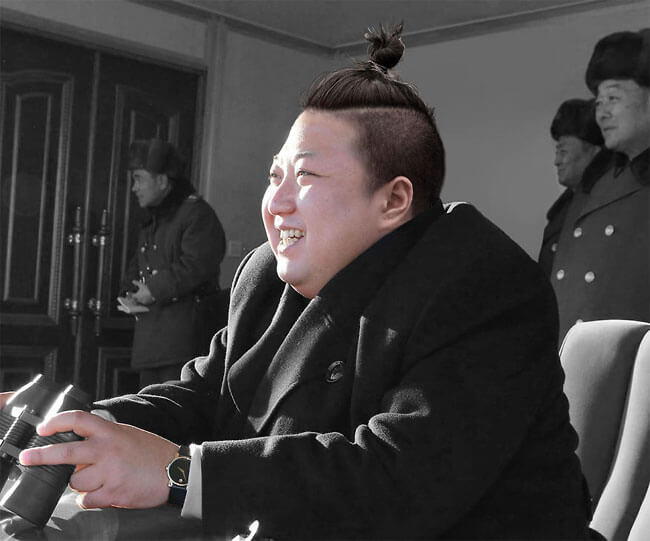
 

Résultat de recherche d'images pour "Pictures of the current world leaders "

Kim Jong-il  World’s youngest head of state, believed to be turning 33 on 8 January. Married to Ri Sol-Ju. Move over Jesus. Based on Kim Jong-iI’s official biography, he was born on Korea’s most sacred mountain, Mt. Baekdu. Fashion icon. Invented The Hamburger. Never used a toilet.  Head of one of the largest armies in the world. Awarded an honorary doctorate in economics by a private Malaysian university called the HELP University.To break from its “imperialist past”, North Korea announced it would follow “Pyongyang time” in August 2015 – which is half an hour later than the previous time zone it shared with South Korea and Japan. In 2014, a UN report found: “The gravity, scale and nature of these [human rights] violations reveal a state that does not have any parallel in the contemporary world.” Represents 25 million people.


Résultat de recherche d'images pour "PAPERS ON THE LEADERS IN THE WORLD"

Bashar al-Assad : Age 52. Married 3 children. Elected unopposed. The second son of former Syrian President Hafez al-Assad. Study medicine at the University of Damascus, graduating in 1988. Leader of the Ba’ath Party and commander-in-chief of the military. Using chemical weapons against civilians with assistance from Russian president Vladimir Putin. April 2017, following news of another round of chemical weapons unleashed on civilians, new U.S. president Donald Trump ordered airstrikes on a Syrian airbase. By February 2016, the conflict had led to an estimated 470,000 deaths in Syria. Controls 25 percent of Syrian territory, and he’ll hold on to it as if his life depends on it. Controls 25 percent of Syrian territory, and he’ll hold on to it as if his life depends on it. 4 million people have left the country and another 7.6 million Syrians have been forced from their homes but remain inside Syria. Turkey highlights the fundamental problem with the war in Syria: every actor has his own agenda. Turkey wants to fight Kurds, Iran wants to beat back Syrian rebels backed by Saudi Arabia, the US is focused on ISIS, and Putin gains political ground by “standing up to the West.” Alliances and rivalries overlap, with just one clear winner: Bashar al-Assad. He may be fighting ISIS for control of Syria, but it’s the rise of ISIS that’s keeping him in power. Represents himself.

Résultat de recherche d'images pour "pictures of the iran leader"

Ayatollah Khamenei:  Age 78. Married  6 children. The supreme religious leader of the Islamic Republic of Iran in 1979, now the religious and political leader of Iran for life.Well known for releasing a fatwa (a legal document issued by a Muslim cleric) calling for the death of Indian-British author Salman Rushdie for his book The Satanic Verses in 1989. No friend of Israel.  Recently stated “We however thank this new guy in the White House, since he largely did the job we had been trying to do in the past decades: to divulge the true face of the US. We had been working to show the world the depth of corruption in US government and ranks and files of the ruling elite; Trump did it in few days after coming to the White House.” Represents 81 million people.


Image associée

Angela Merkel: Chancellor of Germany, Age 53. Married divorced. No Children. University of Leipzig, B.S., 1978; German Academy of Sciences, Ph. D, 1986. Named Person of the Year by Time magazine 2015. Forbes named her as the “Most Powerful Woman in the World” in May, 2016. A former research scientist. The only leader in the history of G20, to have attended every meeting, since the first in 2008. The longest-serving incumbent head of government in the history of European Union, as of March 2014. Described as the “Liberal West’s Last Defender.” Honored with the Grand Cross Special Class of the Order of Merit of the Federal Republic of Germany, the highest class of the Order. Awarded with the President’s Medal the highest civil medal given by the State of Israel, in the year 2014. Awarded the title Doctor Honoris Causa, by the Comenius University in Bratislava in 2014, the University of Bern in 2015 and the Ghent University and Katholieke Universiteit Leuven in the year 2017. Awarded the Presidential Medal of Freedom, the highest civilian award of the United States.Had “private and informal talks,” with the 14th Dalai Lama in the Chancellery in Berlin in the year 2007, amid China’s protests. Following this meeting, China cancelled any kind of separate talks with all the officials from Germany. Opened the doors to Syrian Refugees. Presidential Medal of Freedom, the highest civilian award of the United States. Represents 81 million people.


Image associéeFrancois Gerard Georges Hollande. Age 53. Married divorced. 4 children.  First Socialist president since Francois Mitterrand left office in 1995. Taught economics at the elite Institut d’Études Politiques de Paris, or Sciences Po.Receives 28.6% of the vote in France’s presidential election in April 2012. Won in runoff election for the presidency of France by 51.62% of the vote. Enjoys a wide range of holiday residences. Commander-in-Chief of the French Armed Forces and may order the use of nuclear weapons. At the forefront of securing a global climate deal and after the Paris attacks he persuaded Europe and the US to step up the fight against Isis. One of the very last European leaders to believe in Europe. Represents 65 million.


Résultat de recherche d'images pour "Pictures of the current world leaders "

Theresa May:  Age 60. Married. No children. Incumbent Prime Minister of the United Kingdom. A graduate in Geography from Oxford University. Suffering with Type 1 diabetes and Brexit. Worked at the Bank of England. Head of the European Affairs Unit of the Association for Payment Clearing Services. The second longest-serving home secretary in the past 100 years. Fashion-conscious. Instinctively secretive and very rigid. Holds herself at one remove.. Her wider political appeal is, as yet, untested. Mrs May will not have to face a general election until May 2020 unless she decides to seek a fresh mandate – something she has seemingly ruled out but the folly of brexit ill see her overseeing the brake up of the UK.One does not know unless one is educated about or knows the culture. Represents 65 million people. 

Résultat de recherche d'images pour "pictures of dilma rousseff"Dilma Rousseff. (suspended) Age 70. Married,divorced twice. One child. Democratized Brazil’s electricity sector through the “Luz Para Todos” (Light for All) program, which made electricity widely available, even in rural areas. Her chairmanship of the state oil company Petrobras and misuse of election funds, all of which she denies, soon plunged her presidency into crisis. Impeach. Petrobras are accused of illegally “diverting” billions from the company’s accounts for their personal use or to pay off officials. Rousseff served as chair of Petrobras during many of the years when the alleged corruption took place. Did Represent 211 million people. 

Résultat de recherche d'images pour "pictures of Turnbull"

Malcolm Turnbull. Age 63. Married Two children. The country’s fourth Prime Minister since 2013. One of Australia’s wealthiest and most prominent lawmakers. Prone to remind the people of his intelligence and their stupidity. A journalist, a barrister, a banker, a developer of shopping centres, a businessman, a politician, a Rhodes scholar, a student at Oxford. Represents 25 million people.


Résultat de recherche d'images pour "facts about Muhammadu Buhari."Muhammadu Buhari. Age 73. Married Divorced. 10 Children. A farmer, cattle rearer. Retired Major General in the Nigerian Army Latest in a family of 23 children. He contested four times (2003,2007,2011 and 2015) under the platform of CPC, ANPP and APC. The first man to overthrow (by the poll) a sitting Nigerian president. He was one of the two African “not in government ” individuals invited to President Barack Obama’s inauguration. Represent 175 million people.


Turkish President Erdogan on Syria ISIS and PKK _00013804.jpg

Recep Tayyip Erdogan. Age 53. Married. 4 children. Semi-professional football player. Accused of autocratic tendencies, corruption and extravagance, including the 1,000 room-plus palace he built on publicly protected land. Erdogan has also been heavily criticized for failing to protect women’s and human rights, curbing freedom of speech and attempting to curb Turkey’s secular identity. Mayor of Istanbul. Co-founds the Islamist-rooted Justice and Development Party (AKP). Elected president during the first-ever direct elections. Recent attempted coup by a faction of the military squashed, at least 161 people are killed and 1,140 wounded. Says that women and men are not equal “because their nature is different. Wants to transfer power from parliament to the presidency. Represents 81 million people. 

Prime-minister of Samoa Tuilaepa_Sailele_Malielegaoi

Susuga Tuilaepa Sailele Malielegaoi  Age 63. Married has been in office for eighteen years and is the leader of the Human Rights Protection Party. Bachelor of Commerce and Master of Commerce degrees. He holds Chairman positions in many organisations and corporations in Samoa as well as in international organisations. Represents 195 thousand people. 


Considering there are 195 countries in the world, 6,909 distinct languages and  4,200 different religions, it’s no wonder that the world is in a mess. 

Some behaviors may be the norm in one country but different in another.

What is accepted in one culture may be unacceptable or taboo in another.

It is essential to be aware of the cultural nuances. One does not know unless one is educated about or knows the culture

All existing human speech is one in the essential characteristics which we have to consider, even as humanity is one in its distinction from the lower animals; the differences are in nonessential.

If your actions inspire others to dream more, learn more, do more and become more, you are a leader.”

Résultat de recherche d'images pour "PAPERS ON THE LEADERS IN THE WORLD"

<iframe src=’//players.brightcove.net/2111767321001/default_default/index.html?videoId=4814799920001′ allowfullscreen frameborder=0>

← Back

Thank you for your response. ✨


Share this:

  • Share on WhatsApp (Opens in new window) WhatsApp
  • More
  • Share on Mastodon (Opens in new window) Mastodon

THE BEADY EYE SAYS: DON’T CRY FOR THE G7: IT’S MOSTLY A WASTE OF TIME WITHOUT NO 8.

11 Tuesday Apr 2017

Posted by bobdillon33@gmail.com in G7., The world to day., What Needs to change in the World, World Politics

≈ Comments Off on THE BEADY EYE SAYS: DON’T CRY FOR THE G7: IT’S MOSTLY A WASTE OF TIME WITHOUT NO 8.

Tags

Capitalism and Greed, Capitalism vs. the Climate., Distribution of wealth, G7., Inequility, The Future of Mankind

If you can’t remember all—or even any—of them, don’t be too hard on yourself.Résultat de recherche d'images pour "pictures of the  g7 meeting"

Originally, it was the G5: the United States, the United Kingdom, France, Japan, and West Germany. By 1976, Italy and Canada had joined.

The first G8 meeting took place in 1998, in Birmingham, and the final one we should all hope ended yesterday in the Tuscan walled city of Lucca.

Given the gaping gap between rhetoric and action, these get-togethers are so tedious and inconsequential it’s not exactly surprising that, in recent years the G7  is viewed like its G20 mainly as a talking shop.

The G20 at least it gives a notional voice to the billions of people who don’t live in the G7 or G8 countries.  China and India are members of the G20, and so are many other big countries that were previously excluded from the annual photo-op.

All that either seem to achieve these days is to create expectations that couldn’t be fulfilled or spur opposition from those who dismissed both as a rich man’s club, or an agents of globalized capitalism.

Yesterday while pretending—to be an organization of global governance efforts to reach an agreement on statements were replaced with an hypocritical buffoon called Boris, (who represents a country that has just voted to leave the EU) summing up the meeting in a word, that can only be described as  –  Gobbledygook. Image associée

We being treated once again to hot air, with relations between Russia and the US looking set to enter a new chapter you can rest assured that climate change will go on back burner.

New global goals for a brighter future for people and planet is fantasy stuff if the real problems are not tackled or given a mention.

No matter how you cut it – socially, economically, legally it is a worthless club.

Whatever pledges G7 leaders make to the world’s poorest people, they should be more Than Hot Air.  We want detailed plans of how they’ll follow up and make change actually happen.

Ironically, the last G20 summit took place in St. Petersburg, last September, and Putin was the host. (At the time, he was in the United States’s good books for Russia’s help in brokering an agreement on Syria’s chemical weapons.)

The next G20 meeting is scheduled for this November, in Brisbane, Australia.

It will be interesting to see if Putin attends, and, if he does, whether the other leaders of the G7 will agree to sit down with him.

← Back

Thank you for your response. ✨


Share this:

  • Share on WhatsApp (Opens in new window) WhatsApp
  • More
  • Share on Mastodon (Opens in new window) Mastodon

THE BEADY EYE SAYS: WE NEED TO BE SUPER CAREFUL WITH AI.

08 Saturday Apr 2017

Posted by bobdillon33@gmail.com in Artificial Intelligence., HUMAN INTELLIGENCE, Humanity., Modern day life., Technology, The Future, The Obvious., The world to day., Unanswered Questions., What Needs to change in the World

≈ Comments Off on THE BEADY EYE SAYS: WE NEED TO BE SUPER CAREFUL WITH AI.

Tags

Artificial Intelligence., Technology, The Future of Mankind, Visions of the future.


( A seven to eight  minute read)Résultat de recherche d'images pour "pictures of AI eyes"

There are a lot of things that can go and have gone wrong throughout history — earthquakes and wars and plagues and whatnot.

The present state of our planet does not have to be highlighted by me in this post but a major change is coming, over unknown timescales but across every segment of society, and the people playing a part in that transition have a huge responsibility and opportunity to shape it for the best.

What is triggering this change?   Artificial intelligence.Résultat de recherche d'images pour "pictures of artificial intelligence court"

Although most of us are unaware of it, AI systems are everywhere, from bank apps that let us deposit checks with a picture, to everyone’s favorite Snapchat filter, to our handheld mobile assistants.

While many countries’ laws are deficient in terms of artificial intelligence (“AI”) – which is defined as the simulation of human intelligence processes by computer systems and other machines,should we ignore the risks of any technology and not take precautions?

Until we have concrete evidence to confirm what an AI can someday achieve, it’s safer to assume that there are no upper limits – that is, for now, anything is possible and we need to plan accordingly.

How do we prepare for an AI more intelligent than we can imagine?

We can imagine all sorts of catastrophic risks from AI or robotics or genetic engineering. The task of developing this technology therefore calls for extraordinary care.

Since machine learning is at the core of pretty much every AI success story, it’s really important for us to be able to understand *what* it is that the machine learned.

I think it’s really important for us to develop techniques so machines can explain what they learned so humans can validate that understanding. …

Of course we are all so preoccupied with our own lives,  turning a blind eye to the world of technology. Given the expectation that advanced AI will far surpass any technology seen to date — and possibly surpass even human intelligence we do this at our peril.

Even if these things are still far off and we’re not clear if we’ll ever reach them, even with a small probability of a very high consequence we should be serious about these issues.

Staving off future catastrophes (assuming that is possible) would bring far more benefit to far greater numbers of people than solving present-day problems such as cancer or extreme poverty.

Regulation and control instruments need to be thought of and established beforehand, not subsequent to the invention a powerful AGI.

There is no governing world body with the goal of keeping AI’s impact on society beneficial, to vet and hold those how create software, responsible.

Human history is rife with learning from mistakes, but in the case of the catastrophic and existential risks that AI could present, we can’t allow for error – but how can we plan for problems we don’t know how to anticipate? AI safety research is critical to identifying unknown unknowns, but is there more the AI community or the rest of society can do to help mitigate potential risks?

When AI becomes very general and very powerful, aligning it with human interests will be challenging. If we fail, AI could plausibly become an existential risk for humanity.

Automation threatens millions of jobs and this is only the beginning. It’s important to remember that AI is a tool and, as such, not inherently good or bad. As with any other technology or tool, there could be unintended consequences.

If I were ranking the existential threats facing us, than runaway ‘superintelligence’ would not even be in the top 10. It is a second half of the 21st century problem with its seeds being sown now.

We don’t know what the future of artificial intelligence will look like. However if we allow it to exploit us and the planet for Greed and profit we are the same as Og standing in front of his cave.

Almost every sector of society is feeling the headwinds of the digital revolution and it is hard to find sectors where robots or technology cannot take humans’ jobs.Résultat de recherche d'images pour "pictures of AI eyes"

The immaturity of our conduct is mind-boggling. AI is not just a cool gadget or a nifty little thing called a smart phone, an I Pad, Google, Facebook, Twitter, or the Internet of Every think run by system’s with no autonomy.

The mismatch between the power of our playthings and the benefits they may well impart now and in the future should not be up for negotiation.  As long as we manage to keep the technology beneficial to all and not to itself, learning human values and doing things humans would consider good upon sufficient reflection – 

We might avoid a world not worth living in. It’s not profitable to discuss the might have been.

Now is the time to make all technology responsible to our core values.

The extraordinary promise of machine intelligence will be worthless if we do not understand what it learned.

The real threat with advances in AI will stem from our failure to create a policy framework for emerging technology.

AI is not simply an extension of our culture and values. “The problems and solutions are us. AI enhances human power — it’s just a way of making us smarter, of letting us know more things sooner.”

AGI system that are not task-directed, without a defined goal are a nightmare scenario.

One can imagine [AI] outsmarting financial markets, out-inventing human researchers, out-manipulating human leaders, and developing weapons we cannot even understand, that chose their own targets and cannot be recalled.

It is unlikely that we will enter a dystopian future where AI is held responsible for its own actions > given personhood and hauled into court.

Oversight is called for because, over the coming decades, AI equipped (‘smart’) machines will increasingly acquire two unique attributes: some degree of autonomous decision-making and the ability to learn from experience. As a result, over time, smart machines could stray from their programmers’ instruction further than happens at present.

AI use will need some kind of oversight but hardly a regulatory regime.

Why?

Because AI by design is artificial, and thus ideas such as liability or a jury of peers appears meaningless.

It will be impossible to control.

Because with reinforcement learning AI integrated with more hardware and software solutions and there is no legal system that can treat reinforcement learning?  Whether and when a machine can have intent is more a metaphysical question than a legal or scientific one, and it is difficult to define “goal” in a manner that avoids requirements pertaining to intent and self-awareness without creating an over-inclusive definition.

The world will need to adopt a standard for AI where the manufacturers and developers agree to abide by general ethical guidelines, such as through a technical standard mandated by treaty or international regulation. And this standard will be applied only when it is foreseeable that the algorithms and data can cause harm.

Meanwhile the complexity behind the creation of the AI, when paired with the automation and machine learning of the system, could make it difficult to determine who is at fault if something catastrophic goes wrong.

However if we create a world organization that bans the production of uncertified AI systems, it will provide a strong incentive for AI developers to incorporate safety features and internalize the external costs that AI systems generate

For such an Organisation to actually have any power, we will most likely need some sort of government interference

It is vital that careful scrutiny of the ethical, legal and societal dimensions of artificially intelligent systems begins now.”Résultat de recherche d'images pour "pictures of artificial intelligence court"Our smartphones are increasingly giving us advice and directions based on their best Internet searches.

Regardless, we are entering an era where we will rely upon autonomous and learning machines to perform an ever-increasing variety of tasks. At some point, the legal system will have to decide what to do when those machines cause harm and whether direct regulation would be a desirable way to reduce such harm.

It will be very interesting to see the position being taken by the insurance industry in relation to AI and robotics as both the technology and the law develops.

(Once the parties bearing the ultimate responsibility have been identified, their liability should be proportional to the actual level of instructions given to the robot and of its degree of autonomy.)

Increasingly capable and ubiquitous AI systems will have a huge effect on society over the coming decades.

Deal more comprehensively with AI cannot be let to itself, to the free marketplace, to anyone set of values, to anyone country, to anyone of the Tech monopolies Company, to anyone obsolete world organisation, to anyone algorithms, to anyone post.

There being no consensus, we should avoid strong assumptions regarding upper limits on future AI capabilities.

I for one have no ambition to live in a world run by GOOGLE.

All comments and suggestions welcome. All like clicks chucked in the Bin.

Unfortunately like most problems in the world, GREED’ drives just about everything.

← Back

Thank you for your response. ✨


Share this:

  • Share on WhatsApp (Opens in new window) WhatsApp
  • More
  • Share on Mastodon (Opens in new window) Mastodon

THE BEADY ASKS: WHY IS OUR WORLD SO COCKED UP.

28 Tuesday Mar 2017

Posted by bobdillon33@gmail.com in Modern day life., Our Common Values., Populism., Sustaniability, Technology, The Future, The Obvious., The world to day., Unanswered Questions., United Nations, What needs to change in European Union., What Needs to change in the World, Where's the Global Outrage., World Leaders, World Organisations.

≈ Comments Off on THE BEADY ASKS: WHY IS OUR WORLD SO COCKED UP.

Tags

Manage the planet, People of the Earth, The European Union, The Future of Mankind, The Future of the UK., The Obvious., The World, Theresa May Artifical Intelligence.


( A five-minute follow on read:  Broadening the Subject of Brexit to a Global view)

Because we never see or experience time and space; they are like glasses through which we view the world. Each day, we hear about countless instances of greed, hatred, violence, and destruction, and all of the pain, suffering, and sorrow that ensues.Résultat de recherche d'images pour "pictures of a global eye"

About 100 years ago, the world sleepwalked into World War 1, which lead to world War 11.

Today the world sleepwalking  into the next global disaster.

WE ARE INCAPABLE OF ACTING TOGETHER FOR THE COMMON GOOD.

BRIXIT BEING THE MOST RECENT EXAMPLE.

Take your choice CLIMATE CHANGE or UN-REGULATED ARTIFICIAL INTELLIGENCE.

Technology increasingly prevents us from seeing ourselves in others – we increasingly see others as data, which tell us all about their employment outcomes or what degrees they have, but which keeps their dignity out of plain sight.

How is it that technology has and still is superseding human intelligence, when it’s the humans that are discovering new technologies?

The question is how to change human being, since we are the root cause of everything.

The earth is on the brink of environmental disaster because human beings (at least those in power during the modern age) have drawn sharp distinctions between the human and non-human world.

The world is and has always been divided into two opposing camps: female/male; non-white/white; haves/have-nots; young/old; conflict theorists/functionalists; developed nations/less developed nations; oppressed/oppressors; industrialized/non-industrialized; Western/non-Western, etc.

They all stem from a mindset that envisions a world of you versus me, us versus them, self versus other.

We can look at almost any social problem—racism, sexism, poverty, homophobia, ableism, bullying, terrorism, domestic violence, human trafficking, slavery, religious fundamentalism, immigration —and at the core, is a dualistic orientation.

A dualistic orientation is one that focuses on our differences instead of our similarities, promotes arbitrary divisions at the expense of social cohesion, neglects our interdependence by nurturing our sense of independence, and fashions a deeply polarized world where if you are not with us (or like us) then you are against us (and therefore, we are against you).

The world is certainly a mess of socially created divisions. And while these differences seem real, and have very real effects, we must not forget that they are indeed social creations.

When we speak about problems between women and men, people of color and whites, Christians and Muslims, or any of the other numerous dualisms that we regularly invoke, we are implicitly (and sometimes explicitly) suggesting that these two groups are essentially and inherently distinct, that at the core of these two groups is some fundamental difference.

Although the ubiquity of these problems makes them seem so normal and ordinary that we may not even question.

We need to question and challenge the way we unreflectively describe and divide the world into dichotomous and opposing camps.

In both our words and our actions we need to construct real alternatives to these arbitrary constructions, emphasize our similarities instead of our differences, build bridges instead of borders, and recognize that interdependence sustains us while independence tears us apart.

It may seem fruitless to try to identify a single contributing factor to all of society’s collective dilemmas. Ultimately, the challenge is to see others as us.

We first need to recognize ourselves in others before we can treat them like we would want to be treated.

Treating everyone equal, but in a real scenario, this is not possible.

Leave apart treating humans equal, we do not even spare the nature that lets us live or wildlife that maintains the ecological balance.

We destroy them all if it is serving our purpose.

We need to end the era of easy money. We need to stop subsidizing financial markets. We need to let our economy reorient itself from its short-term and transactional focus back to one based on long-term investment and long-term relationships.

We must encourage not discourage immigration. Immigration is morally correct, is good foreign policy and is economically beneficial. Immigrants must be viewed as assets, which they are, not liabilities.

Populists continue to come to power but it has no long term objectives.

The rich stay rich, the powerful stay powerful and the poor stay poor. Trade suffers, immigrants are shunned. Economic growth is weak. Capitalism continues to be viewed as the problem, big government as the solution. Maybe another financial crises that we can inflate our way out of. Maybe another financial crises that we can’t.

Sooner or later the music stops. It’s time for us to be better.

We are nowhere near as free as everyone thinks, and that makes my skin crawl.

All in all, of course there is a lot of good in this world, but even with all that good, the bad shines, so bright and with that brightness it sometimes gets hard to see the good.

Why settle other planets when ours is in danger of an impending doom?

It’s easy to assume that we’ll charge into our new home disregarding the existing ecosystem or any potential inhabitants. We’ll change shit around so it works for us and in doing so we’ll make the same mistakes we’ve made for centuries on Earth.

What the hell is going on in the world?

IT’S TIME WE PUT ON Résultat de recherche d'images pour "pictures of a global eye"

IT’S TIME TO REVANT THE UNITED NATIONS. TO ESTABLISH A NEW WORLD ORGANISATION TO VET ALL TECHNOLOGY, ARTIFICIAL NOR NOT TO ENSURE IT COMPLIES WITH CORE HUMAN VALUES AND NOT PROFIT.

IT’S TIME TO GET OFF YOUR SMART PHONES AND PAY ATTENTION TO YOUR REAL WORLD.

All comments appreciated. All like clicks chucked in the bin.

← Back

Thank you for your response. ✨

Share this:

  • Share on WhatsApp (Opens in new window) WhatsApp
  • More
  • Share on Mastodon (Opens in new window) Mastodon

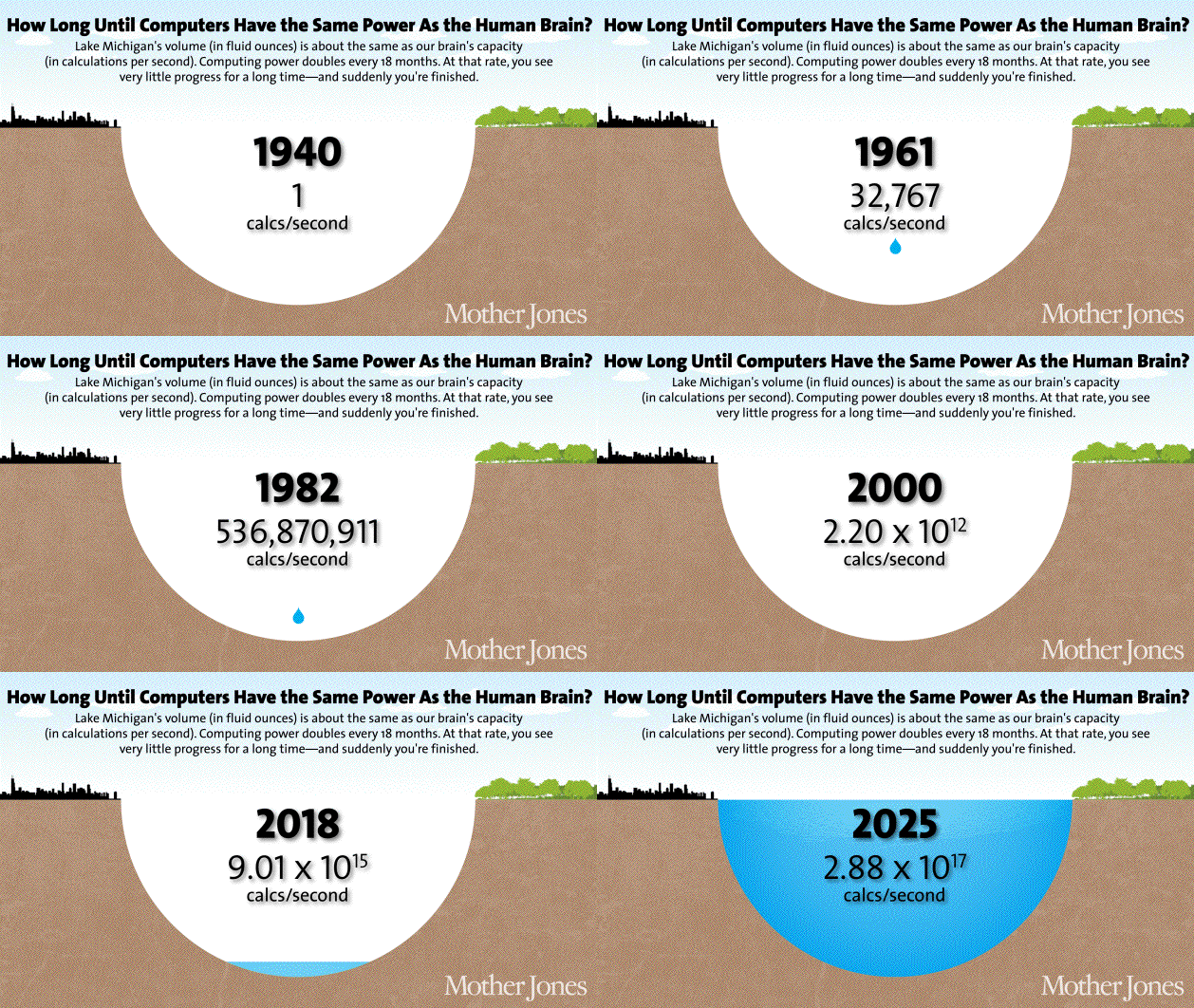
THE BEADY EYE ASKS: HOW LONG UNTIL COMPUTERS HAVE THE SAME POWER AS A HUMAN BRAIN?

24 Friday Mar 2017

Posted by bobdillon33@gmail.com in Artificial Intelligence., Big Data., Evolution, HUMAN INTELLIGENCE, Technology, Unanswered Questions.

≈ Comments Off on THE BEADY EYE ASKS: HOW LONG UNTIL COMPUTERS HAVE THE SAME POWER AS A HUMAN BRAIN?

Tags

Artificial Intelligence., Evolution, Technological revolution, The Future of Mankind

( A six-minute evolutionary read)

It took billions of years to go from the first tiny DNA replicators to Homo Sapiens.

It hit you pretty quickly that what’s happening in the world of AI is not just an important topic, but by far THE most important topic for our future.

Our long-term evolutionary success is still to be determined.

When you ask the question is our human intelligence in any way the current peak of evolutionary progress. You also have to ask what is the nature of evolution?

It can not is no longer be that the process of evolution’s only “goal” seems to be self-propagation.

Why?

Because: Technologies already exist which allow genomic selection of embryos during in vitro fertilization—an embryo’s DNA can be sequenced from a single extracted cell. Recent advances such as CRISPR allow highly targeted editing of genomes, and will eventually find their uses in human reproduction.

Because: Artificial Intelligence and Technology like Deep Learning are changing the way we are looking at evolution.  It’s no longer a process with a definite goal or even an endpoint.

Because:  We may already be running into the genetic limits of intelligence.

The potential for improved human intelligence is enormous. Smarter people and smarter machines—will inevitably intersect.

Naively, one would expect the rate of advance of machine intelligence to outstrip that of biological intelligence. Tinkering with a machine seems easier than modifying a living species, one generation at a time. But advances in genomics—both in our ability to relate complex traits to the underlying genetic codes, and the ability to make direct edits to genomes—will allow rapid advances in biologically-based cognition.

So will AI or genetic modification have the greater impact in the year 2050?

The answer is both.

The feedback loop between algorithms and genomes will result in a rich and complex world, with myriad types of intelligences at play: the ordinary human (rapidly losing the ability to comprehend what is going on around them); the enhanced human (the driver of change over the next 100 years, but perhaps eventually surpassed); and all around them vast machine intellects, some alien (evolved completely in silico) and some strangely familiar (hybrids).

Considering one without the other neglects an important interaction.

Researchers have recently linked mouse and monkey brains together, allowing the animals to collaborate—via an electronic connection—to solve problems.

This is just the beginning of “shared thought.

Better human minds invent better machine learning methods, which in turn accelerate our ability to improve human DNA and create even better minds.

Rather than the standard science-fiction scenario of relatively unchanged, familiar humans interacting with ever-improving computer minds, means we will experience a future with a diversity of both human and machine intelligences.

For the first time, sentient beings of many different types will interact collaboratively to create ever greater advances, both through standard forms of communication and through new technologies allowing brain interfaces.

We may even see human minds uploaded into cyberspace, with further hybridization to follow in the purely virtual realm. These uploaded minds could combine with artificial algorithms and structures to produce an unknowable but humanlike consciousness.

It may seem incredible, or even disturbing, to predict that ordinary humans will lose touch with the most consequential developments on planet Earth, developments that determine the ultimate fate of our civilization and species.

Or will it be that we will augment or brains with AI.

Today, no more than a fraction of a percent of the population has a good understanding of quantum physics, although it underlies many of our most important technologies:

Some have estimated that 10-30 percent of modern gross domestic product is based on quantum mechanics. In the same way, ordinary humans of the future will come to accept machine intelligence as everyday technological magic, like the flat screen TV or smart phone, but with no deeper understanding of how it is possible.

AI will be a disaster for humanity…there is no doubt about it...unless (and this is a small hope) that humans start to treat each other with love and dignity, and that would take a (potentially biological) change in human nature itself which only highly controversial genetic engineering might muster.

Our ability to destroy anything we want to destroy will have to be removed.

It might be nice to fantasize about a star trek scenario, but in reality if we are even 1% as selfish and violent as we are now, and have even 1% of that kind of technology, we would annihilate our self in a matter of days.

Intelligence is synonymous with exploitation, and at every turn where more control is exerted on our world, from primitive fire and harnessing chemistry (bombs and munitions) (<.000001% of mass-energy), to nuclear (0.1%) of turning mass into energy, we get closer and closer to our annihilation the more control we have over our world.

Our intelligence has survived this long partly because we are a necessarily a bit stupid and limited as well. Once AI bridges that deficiency, we will short-circuit and end without taking drastic measures for peace.

If all were simultaneously improved, it would be possible to achieve, very roughly, about 100 standard deviations of improvement, corresponding to an IQ of over 1,000. We can’t imagine what capabilities this level of intelligence represents, but we can be sure it is far beyond our own. Cognitive engineering, via direct edits to embryonic human DNA, will eventually produce individuals who are well beyond all historical figures in cognitive ability.

By 2050, this process will likely have begun.

How and who will determine which kinds of intelligence are “most important” for both machines and humans? Will it be “free” market forces? Government panels? Or what?

What we do know is that humans’ utter dominance on this Earth suggests a clear rule: with intelligence comes power. Which means an ASI, when we create it, will be the most powerful being in the history of life on Earth, and all living things, including humans, will be entirely at its whim—and this might happen in the next few decades.

Once real AI takes over, it will share the same motivations (essentially emotions) that we install in this first oppressive wave of AI, and then I doubt we will be going along with it anywhere.

At the moment we all have a plaza attitude to technology and AI.

We seem to think that once machines reach human levels of intelligence, our ability to tinker starts to be limited by ethical considerations. This is totally foolish as by the time it has surpassed human performance (It has already done so on a number of narrowly defined tasks, such as image or character recognition.) it will be well beyond any ethical considerations.

Rebooting an operating system is one thing, but what about a sentient being with memories and a sense of free will?  Eugenics will be all the rage.

Thanks to recent advances, we can predict a phase transition in the behavior of these learning algorithms, representing a sudden increase in their effectiveness.

It is expected that this transition will happen within about a decade, when we reach a critical threshold of about 1 million human genomes worth of data.

While silicon-based technologies are increasingly capable of simulating a mammalian or even human brain, we have little idea of how to find the tiny subset of all possible programs running on this hardware that would exhibit intelligent behavior. The detailed inner workings of a complex machine intelligence (or of a biological brain) may turn out to be incomprehensible to our human minds—

The first truly smart machines will be used just as dumb machines have been, to oppress many and enrich a few.

Its time to wake up if we all don’t want to end up on the garbage heap of Technology that is given Artificial Intelligence with the sole intention of making profit for Google, Facebook, Twitter, Amazon, Apple, all monopolies jockeying for position.

Intelligence whether it is Artificial in a robot, or a smart phone is multidimensional, and must be vet to ensure it complies with our core values.

WE NEED A NEW TOTALLY TRANSPARENT WORLD ORGANISATION THAT IS SELF FINANCING TO VET ALL TECHNOLOGY BEFORE THEY’RE RELEASED INTO OUR FUTURE EVOLUTION.

All comments appreciated. All like clicks chucked in the rubbish bin.

← Back

Thank you for your response. ✨


Sticking to the creativity killing industrial models of education and business certainly aren’t going to produce significant breakthrough technologies.


that


Share this:

  • Share on WhatsApp (Opens in new window) WhatsApp
  • More
  • Share on Mastodon (Opens in new window) Mastodon

THE BEADY EYE SAYS: NO ONE HAS EVER REALLY SEEN AN ATOM.

16 Thursday Mar 2017

Posted by bobdillon33@gmail.com in Scientific., The Atom., Unanswered Questions.

≈ Comments Off on THE BEADY EYE SAYS: NO ONE HAS EVER REALLY SEEN AN ATOM.

Tags

Science, Science and the Atom., The Future of Mankind

( A Fifteen minute read with a lot of head scratching)

Let me from the off state that I am no Scientist, so don’t expect this post to make much sense, what you read here comes from the following unanswerable questions.

1.Why did the big bang happen?
2. Why does something called energy, space and time exist in the first place?
3. Why do bodies follow a gravitational law that is proportional to their masses and not the square of their masses????
4. Why does the zero point energy exist in Quantum systems even at Zero Kelvin, when all is supposed to be static at rest (zero energy)?

None of which I am going to attempt to answer.

It’s sufficient to say that everything you see around you, from your own body to the planet you’re standing on and the stars in the sky, are made of atoms but no one has ever really seen an atom.

As you know, An atom has 3 subatomic particles called electrons, protons, and neutrons. The exception to this rule is the hydrogen atom which only has 1 proton and 1 electron.Résultat de recherche d'images pour "pictures of space eye"

What I am interested in is where in the first place did they come from.

We have seen so much evidence of their existence that most of us believe in them.

It is estimated that the there are between 1078 to 1082 atoms in the known, observable universe.

In layman’s terms, that works out to between ten quadrillion vigintillion and one-hundred thousand quadrillion vigintillion atoms. This estimate accounts only for the observable universe which reaches 46 billion light years in any direction, and is based on where the expansion of space has taken the most distant objects observed.

It appears that they were not formed during the initial development of our universe (sometimes called the big bang) but were formed afterwards in large stars by synthesising more complex atoms.

Stars evolved after the Big Bang.

Density fluctuations left over from the big bang could have evolved into the first stars. These stars altered the dynamics of the cosmos by heating and ionizing the surrounding gases. The earliest stars also produced and dispersed the first heavy elements, paving the way for the eventual formation of solar systems like our own.

The big bang also produced hydrogen and helium, but most of the heavier elements are created only by the thermonuclear fusion reactions in stars, so they would not have been present before the first stars had formed.

What this means for the atom is anyone guess other than before the big bang there we no atoms. 

If they were not around, what were large stars made of?

Were they just collection of energy released by the Big Bang?

If so.

What was holding the energy together to form stars that are estimated to have been between 100 and 250 times as massive as the sun.

According to Hernquist Dark matter provided the first gravitational impetus for hydrogen and helium gas to start clumping together. The gas began releasing energy as it condensed, forming molecules from atoms, which further cooled the clump and allowed for even greater condensing.

So is it dark matter (Dark Matter the putative elementary particles that are believed to make up about 90 percent of the universe’s mass) or gravity or the small-scale density fluctuations—clumps in the primordial soup that created the atom.

But it seems to me if there were no atoms in the first place none of the above appears possible.

It might seem that star formation is a problem that has been solved.

But nothing could be further from the truth. We don’t really know how the very first stars were actually formed. We need to go back to the drawing board because our present understanding of this subject is still primitive.

Jason Silva who likes to articulate the theory that everyone and everything on earth contains minuscule star particles. In other words we are made of star stuff, atoms from the stars, is pie in the sky.

Cosmic dust forged inside stars turned into interstellar dust — dust formed by the deaths of an earlier generation of stars a key building block in the formation of stars, planets and complex molecules; but in the early Universe — before the first generations of stars died out — it was scarce.

Neutral Atoms did not come from the stars, stars came from electrically charged atoms.

The chemical and physical properties of an atom change as ions are created. When two ions with opposite charges come into contact, they are attracted to each other. They may begin to share electrons in either covalent or electrovalent bonds.

Here is a picture of exploding star.Credit: ESA/Hubble & NASA, Acknowledgement: Judy Schmidt


Credit: NASA/ESA/HEIC/Hubble Heritage Team.

So, all life on Earth and the atoms in our bodies were created in the furnace of now-long-dead stars.

Is this true?  It seem to me to be very dubious.

Pretty much everything we know about atoms is indirect evidence.

The physics which works here is the same physics which works elsewhere. If this were not the case, physics would somehow be a local phenomenon, which simply seems wrong. It is not true that everything in Solar system is build of atoms.

Light is not made up of atoms.

We’re probably looking for the wrong thing in the wrong place as there’s no point of reference in our universe.

Atoms are themselves made of subatomic particles which in turn are made of sub-sub-atomic particles. In fact no scientist worth its salt can claim that we and everything in the universe made up of Atoms.

There is no experimental confirmation about structure of universe.

Who told us everything was made up of atoms?

Democritus came up with the idea that something could be cut into its smallest piece and it would still be the same object. He was also the first person to write the word atom down. He came up with an idea, but it took 2,400 years before anyone figured out that he was right!

Or did they?

Current hypotheses suggest that four-fifths of the universe’s mass consists of a mysterious material that scientists can’t observe directly, which researchers call dark matter.  The substance makes itself known by the way galaxies rotate and bend light around them, suggesting those celestial structures have more mass than observers can see.

We don’t yet know what dark matter is.

The Universe is enormous and our planet is but a small, pale blue dot that makes up a fraction of the matter in our Universe. The rest is something else, a material that nobody on Earth has ever seen.

Fritz Zwicky came up with the term  “dark” matter.” He was some crazy theorist who couldn’t get his forces to add up, and so invented an entire new form of matter.

Astronomers now believe that dark matter has been fundamental in creating the Universe as we know it. There is a lot of it: about 25% of the Universe. Billions of dark matter particles pass through us every second.

Atoms are the smallest pieces of matter; they are made of particles (protons and electrons). When atoms are grouped together, these groups are called molecules.

While atoms are the tiniest bits of matter, they are made of the sub-atomic building blocks of matter—protons and electrons—revolving around a nucleus. The “atomic number” of an element, as seen on a periodic chart, refers to the number of protons contained in one atom of that element.

Confusingly, it’s sometimes said that dark matter makes up about 80% of all the matter in the Universe. That’s because only 30% of the Universe is made up of matter, and most of it is dark matter. The rest is energy. Dark matter is the skeleton on which ordinary matter hangs. Billions of dark matter particles pass through us every second.

We only know about a small fraction of the matter in the Universe. The rest is a mysterious substance known only as dark matter.

Now the most popular suggestion is that dark matter is made of a new kind of particle, predicted by theory but never detected. They are called WIMPs: Weakly Interacting Massive Particles. When these particles hit anything they pass straight through.

WIMPs have a lot of mass, although they are not necessarily large.

“WIMP” is just a catchphrase, and could include many different types of particles.

Below is a picture of Dark matter. (Credit: Yannick Mellier/IAP/SPL)Dark matter (red), light (yellow) and galaxies (blue) (Credit: Yannick Mellier/IAP/SPL)

Where is it?

At this point you may be throwing your arms up in frustration. “First they decided there’s all this invisible matter, now they’ve decided it’s made of some new kind of stuff that they can’t detect!

Dark matter doesn’t exist at all. We’re back where we were.

The challenge is to find dark matter when we don’t know what we’re looking for.

Instead, the laws of gravity as we know them must be wrong, and that’s why galaxies behave so oddly. This idea is called MOND, short for “Modified Newtonian Dynamics”.

The problem, says Massey, is that the MOND supporters have not come up with a viable alternative to dark matter: their ideas can’t explain the data.

Dark matter particles usually pass through normal matter. But the sheer number of them means that, very occasionally, some will collide with the nucleus of an atom.

This collision should create gamma rays: extremely high-energy light. On these rare occasions, “dark matter can shine,”

Here is one (Credit: NASA Goddard/A. Mellinger, CMU/T. Linden, University of Chicago)

In 2014, using data from NASA’s powerful Fermi telescope,researchers claimed to have detected the gamma rays from these collisions. They found an area of our Milky Way galaxy that seems to be glowing with gamma rays, possibly from dark matter.  But the jury is still out on whether the gamma rays are really from dark matter. They could also have come from energetic stars called pulsars, or from collapsing stars.

As well as colliding with normal matter, dark matter might occasionally bump into itself, and there’s a way to see that too.

Although we can’t see it directly, dark matter does do one thing to give itself away.

It bends the light that passes through it.

Is there two types of dark matter one interacting with other?

So a second way of detecting dark matter would be to create it first. Physicists hope to do just that using particle colliders, like the Large Hadron Collide in Geneva, Switzerland.

If the LHC does create some dark matter, it would not actually register on its detectors.

If WIMPs do make up the dark matter and they discover them at the LHC then we are in with a good chance of working out what the dark matter in the Universe is composed of.

How much of an atom is empty space?  Very nearly all of it.

The space inside the atom is just that, empty space, i.e. vacuum.

Vacuum, by definition, is the absence of matter. Matter, of course, is something that has mass and occupies space, it’s really a space with very little matter in it.

Many modern devices (like the integrated circuit chips that make everything from cars to computers work), have to be fabricated in a vacuum.

Even outer space, which is considered a vacuum and has less matter in it than anything mankind can reproduce, still has some atoms bouncing around.

Here is my top ten list of “Things That Are Not Matter”:

1. Light 2. Sound 3. Heat 4. Energy 5. Gravity 6. Time 7. A Rainbow 8. Love

9. Happiness 10. A really good joke

When two atoms approach each other, their electron shells push back at each other, despite the fact that each atom’s net charge is 0. This is a very useful feature of nature. It makes our lives a lot easier.

When you sit on a chair, you are not really touching it. You see, every atom is surrounded by a shell of electrons.

If atoms push away from each other, why doesn’t the entire universe just blow away from itself? The answer is that some, actually most atoms’ electron shells are not full.

Electrons really do go back and forth between atoms and they do so pretty fast.

Electrons tend to be kind of mobile, which is also a very nice feature of nature, since without it your walkman would not work. Once both atoms’ outer shells are full due to this electron sharing, they go back to their usual repulsive behavior.

This, by the way, is how we get molecules and the secret to understanding Chemistry. It’s all about the electrons!. It describe the nature of atoms.

We are much more than what we perceive ourselves to be, and it’s time we begin to see ourselves in that light.

The atom has no physical structure, we have no physical structure, physical things really don’t have any physical structure! Atoms are made out of invisible energy, not tangible matter.

It’s quite the conundrum, isn’t it?

Not really, when you enter the world of Quantum it’s totally bonkers.

With quantum physics.

One of these potential revelations is that “the observer creates the reality.”

As observers, we are personally involved with the creation of our own reality.

We are all energy, radiating our own unique energy signature.

Feelings, thoughts and emotions play a vital role, quantum physics helps us see the significance of how we all feel. If all of us are in a peaceful loving state inside, it will no doubt impact the external world around us, and influence how others feel as well.

At our subatomic level, does the vibrational frequency change the manifestation of physical reality? If so, in what way?

We know that when an atom changes its state, it absorbs or emits electromagnetic frequencies, which are responsible for changing its state.

Do different states of emotion, perception and feelings result in different electromagnetic frequencies? Yes! This has been proven.

If we are made of atoms, then a scientist studying atoms is actually a group of atoms studying themselves.

The relationship between physical things and mental/spiritual ones is a huge one in philosophy.

Anyone who wants to invent a new theory of gravity has to go one better than Einstein and explain everything he was able to explain, and also account for the dark matter.

Yes, cosmology is really weird.Résultat de recherche d'images pour "pictures of the universe and planets"

Some day humanity might have sufficient knowledge and tools to truly understand the origin of the universe, but currently we’re only a tiny baby step closer than when “Let there be light” was written.

Philosophically, no matter what you want to believe about the beginning of things, you need to get comfortable with the idea of infinity. Either infinite time, or an infinite deity that exists outside of time; really, both accomplish the same thing by explaining how things exist, and neither can be proven or disproven.

All we know is that there is something infinite going on and if energy couldn’t have been created, then there were no Universe in the first place.

Most of our Universe is still a black box, its secrets waiting to be unlocked.

How a dark, featureless universe formed the brilliant panoply of objects that now give us light and life remains very much a mystery.

Does it matter that there are things in this universe humans are not meant to understand.

All comments welcome. All like clicks chucked into dark matter.

← Back

Thank you for your response. ✨


Share this:

  • Share on WhatsApp (Opens in new window) WhatsApp
  • More
  • Share on Mastodon (Opens in new window) Mastodon

THE BEADY EYE SAYS: HOW WOEFUL HEINOUS,UNPARDONABLE, DISTASTEFUL,TO SEE ANTONIO GUTERRES THE UN SECRETARY-GENERAL HAVING TO BEG FOR FUNDS.

08 Wednesday Mar 2017

Posted by bobdillon33@gmail.com in Humanity., Life., Modern day life., Natural World Disasters, Sustaniability, The Future, The Obvious., The Refugees, The world to day., Unanswered Questions., United Nations, What Needs to change in the World, Where's the Global Outrage., World Aid., World Organisations., WORLD POVERTY WHERE'S THE GLOBAL OUTRAGE

≈ Comments Off on THE BEADY EYE SAYS: HOW WOEFUL HEINOUS,UNPARDONABLE, DISTASTEFUL,TO SEE ANTONIO GUTERRES THE UN SECRETARY-GENERAL HAVING TO BEG FOR FUNDS.

Tags

Capitalism and Greed, Climate change, Community cohesion, Distribution of wealth, Earth, Technology, The Future of Mankind, United Nations, World aid commission


( A three-minute read that could save millions of lives)

If you ever wanted proof that Capitalism is driven by greed just watch what can only be described in the above words the recent plea made by António Guterres to the International community for funds to tackle the declared famine in parts of Nigeria, South Sudan, and looming in Somalia, Nigeria and Yemen.africa

The estimated number of affected children is now 450,000, with 14 MILLION PEOPLE needing humanitarian assistance across the region.

Five years ago, more than a quarter of a million lives were needlessly lost, 130,000 of them children. We simply cannot have a repeat of that tragedy. The only way to prevent this devastating loss of life is for donors and international leaders to act now.

Global hunger levels are at their highest for decades. There are currently 70 million people in need of food aid. The reality of life for a fifth of the world’s people, on a planet which produces enough food to satisfy everyone is that humanitarian aid to Africa has been shrinking.

Rich countries have been giving money to poor ones for many decades and for many reasons — from geopolitics to post-colonial guilt to altruism so there is little point here in reiterating the reasons why the world is in such a mess.

What is needed in the long run is a fully funded Humanitarian Affairs United Nations.  Not a begging Institution.

Rather than boasting our compassion with wasteful foreign Aid there is only one course of action:

To make the Greed / Profit for profit’s sake segment of Capitalism system Pay.

This can be achieved with modern-day technology by Placing a World Aid commission of 0.05% on all. High frequency Trading, on all Foreign Exchange transactions over $ 50,000. on all Sovereign Wealth Funds acquisitions, on all gambling winnings.

This would create a Perpetual fund of billions.

The real question, though, is (with climate change and technology) is whether aid will remain relevant, and if so how.

The answer boils down to this: solutions.

Governments in developing countries will seek assistance only when they have a problem that they cannot solve by themselves.

They know how to build schools, hospitals or ports, and can pay for them. But they will look for other countries’ experiences when reforming educational curricula, designing health insurance systems, or regulating private suppliers of infrastructure.

They will want to avoid the mistakes of others, and learn from their successes.

At times, they may ask for support in implementing particularly tricky projects, mostly as a way to keep graft, pollution or displacements at bay.

This can only be achieved if the United nations see themselves more as partners than as donors. This will stop Aid countries of exporting their own way of thinking.

Donors would be sought after, rather than just accepted.

They will be those that can deliver ideas, experiences, expertise, lessons, evidence, and data.

In other words, what will make future aid relevant will be knowledge, not dollars.Résultat de recherche d'images pour "pictures of aid of the future"Development aid will be a more difficult business — for you will need to operate at the technical cutting-edge — but a more useful one.

To the extent that there are internal leaks in Africa–As a first order of priority, the leaks should be plugged to ensure that the little aid that comes in, stays.

In politics, no good deed ever goes unannounced.

It’s is very hard to feel hungry and not to be able to do anything about it.

Contributors to United Nations aid and development programs have provided slightly more than half of the $800 million requested in 1999 for African countries suffering from “complex emergencies”–the term applied when war and failed institutions, often combined with a natural disaster, leave vast numbers of people homeless and starving.

The reasons for the decline are not hard to find.

Donor nations are and will be more so under pressure to attend to problems at home rather than foreign assistance that is wasted by bloated aid agencies pouring money into the pockets of corrupt African governments, senseless civil wars, wasteful military expenditures, capital flight, and government wastes–Pouring in more foreign aid makes little sense.

However if asked we all want a more prosperous and equal world that will serve everyone’s best interests.

To create a less threatening world beyond our borders we must tackle inequality head on. 

We are on track for a tipping point of Inequality with the web only speeding up this process through digitization and universal access. We’ll be postulating about social media’s impact on the more long-term future of the world.

Aid can be fearful of the future – but it can also be a force for good.

No transformation will occur overnight.

The debate on aid comes down to lack of imagination. We have cemented in our minds the idea of a hierarchy in the world’s nations: the developing world is below us and we need to help them, preferably to our advantage. But we do not want them to rise above us.

Catastrophe evokes a human response to help fellow creatures.

All comments appreciated. All like clicks chucked in the bin.

Here is who to donate to:  UN Office for the Coordination of Humanitarian Affairs (Ocha), Care, Oxfam, British Red Cross, Cafod, Tearfund, Christian Aid, World Vision, WFP, Unicef.

← Back

Thank you for your response. ✨


Share this:

  • Share on WhatsApp (Opens in new window) WhatsApp
  • More
  • Share on Mastodon (Opens in new window) Mastodon

THE BEADY ASKS: WHY IS IT SO DIFFICULT TO ENACT THE BLEEDING OBVIOUS.

07 Tuesday Mar 2017

Posted by bobdillon33@gmail.com in Artificial Intelligence., Big Data., Donald Trump Presidency., European Union., Google it., Google Knowledge., HUMAN INTELLIGENCE, Modern Day Democracy., Politics., Social Media., Technology, The Future, The Obvious., The world to day., Twitter, Unanswered Questions., What needs to change in European Union., What Needs to change in the World, World Politics

≈ Comments Off on THE BEADY ASKS: WHY IS IT SO DIFFICULT TO ENACT THE BLEEDING OBVIOUS.

Tags

Artificial Intelligence., European Union, Social Media, Technology, The Future of Mankind, The Obvious.

( A Ten Minute read that might open your eyes to the Obvious)

I am sure like me you often wonder why it is that when something is obvious we humans are unable to react.  It is obvious that Technology is changing the world and us but nothing hides like the obvious. The obvious is best disguised into itself. One obvious hides another. Résultat de recherche d'images pour "pictures of the blatantly obvious"

Intelligent reason should visit its basic assumptions, regularly; but it doesn’t.

We all know that an own goal is an accident when it comes in sport unless there is some ulterior motive.

In the course of our own lives we have many own goals, some obvious, some accidental, but when it comes to collective action on one hand we cannot bear to notice our children becoming strangers and our parents growing senile. However on the other we are less concerned about Nations heading to war, companies going bust, greed and technology ruining our civilisation.

The obvious turns perverse.

We have too much stake in them to see clear and hear change ringing.

Is this the reason we cannot enact the obvious.?

We do not see what we do not wish to see, hoping that it will go away or solve itself. We grow blind to things we cannot cope with. We see and hear but we keep forgetting at once as if under a spell of neglect.

Our attention is so easily diverted… we just move on with inertia and sleep-walk unable to draw the undesired conclusion and to do something.

We do not grasp the incommensurable, out of proportion with us, with which we have no common standard of measurement: the trillions of billions, the hazy dots shown by the electronic microscope in a cell, or all the same, the blurred dots being huge stars of the infinite, mean nothing to us, exactly like the hypocrite warnings of cancer and death on cigarette packs. Is this because the things smalled below our threshold or amplified huge – in proportions or in meaning – we do not grasp;

If this is so we have a narrow human window of perception and judgement with limited parameters in wavelength, amplitude, intensity and nature.

However we are the measure of all things we conceive.

Whether it be demographic and social change, shifts in economic power, technological breakthroughs or natural resource scarcities, climate change – the world, and those of us in it, need to be more adaptable than ever before.

Overwhelmed by the creativity of Artificial Intelligence, our governments do not protect us anymore, so that the risk is now our own business.

Reason has become asks references, with a hidden price of selective blindness and thus freedom diminished.  It is easier to observe other people’s basic assumptions than yours.

 If that which is not there is difficult to see,  that which is obvious, plain and evident, is at times even harder to notice.

For instance:

Is it not blinding obvious that Twitter now holds unmitigated power when it comes to posting Donald Trump’s tweets.Résultat de recherche d'images pour "pictures of confused politicians"

Is it not bleeding obvious that Google wants to control all knowledge.  Very few of us spending an instant to examine Google Fraud answers.Résultat de recherche d'images pour "image of google logo"

It is beyond the obvious that in a world that is getting more complex and multipolar each and every single day the truth does not cease to exist when it is ignored.

Not missing the things right under our nose is our last protection against danger, loss and disappointment; it grants our judgement to be sound and wise, with feet on ground.

You will agree though that the obvious is the very face of reality.

Take notice of the obvious and suddenly, instead of nodding sheepishly “This is how things are.” you gain the power to make choices which you and most people around you ignored before.

The obvious known, comes alive for us to do something about it only when understanding turns it into personal image, vivid and simple enough to be of our size; otherwise we stay paralysed and dumb.

If you are like me, we need to let  people participate in democracy and get collective decisions that are reasonable.

I often think when it comes to politics and our governments that there are things that are so blinding obvious (when all the bullshit is set aside) to do.

For example to reform the European Union.

Is it not blinding obvious that we should stop the moving of  the £130 million travelling circus that sees MEPs decamp once a month from Brussels to Strasbourg.

Why should we all be held to ransom by France.  On Monday, about 1,000 politicians, officials and translators will make the same journey on two specially chartered trains hired at taxpayers’ expense. If France want it let them pay for it.  “Its madness.” Just think how many better ways there are to spend this money.

It boggles my mind as to why we put up with it.

God only knows what the cost of Brixit will be.

There is no doubt that seething resentment over widening inequalities in the wake of the financial crisis played a big role in boosting the Brexit vote but it is also blinding obvious that England is now facing a major realignment that will need the EU market and the free movement of people to survive economically.

There is NO simple solution – if there was it would have been done by now.

How do you know a politician is being dishonest? He blames something on “special interests.” What is a special interest? Why, it is an interest opposed to the “general interest” or collective will.  There ain’t no such thing.

That might not be possible.  The challenge for me – and you – is to sort out which is which.


But this is not the purpose of this post, rather to examine the broader question.

I am also all too conscious that there are any number of people out there who have deeply held convictions about what’s right and what’s wrong. I may just be right about some things, I may be wrong about others.

In a world predominated by power of a more self-interest nature, has the obvious being consigned to the rubbish bin of politics.

Without having read and understood the instructions book of life, algorithms are switching on an immensely complicated machine.

Once injected into to the political system they can develop a life of their own.

Politics stems from human misbehaviour, which clashes with the terms of modern democratic belief systems in which all adults are assumed to be entitled to behave as they feel inclined, at least within the scope of their income and the constraints of public law and insofar as they refrain from damaging the opportunities of their fellow citizens to do likewise.  Algorithms have none of these constraints.

” It is blinding obvious with the election of Donald Trump a man who revels in his own ignorance, racism and misogyny, that there is no single way of acting.”

Even if there was how would we set about determining what it is? Whom can we trust to do so?

Whom is to be judge? What is an advantage to one group of human beings and what is not to the advantage of another.

Until recent times politics and science usually managed to ignore each other.

Not any more:

Social Media which is riddled with algorithms are now blindly leading us down the road of Technological Inequality by turning the obvious into Fake News.

As a result politics appears where the main contours of collective and social life set the principal interests of groups of humans beings against one another.

Where they do not Conflict politics will not occur.

Social Media politics by Twitter will achieve conflict with a plum. Watch this Space.

So where does this leave us.

You would think that when something becomes blatantly obvious it would be common sense with no need for political input to enact or rectify it.

Isn’t that blindingly obvious to everyone except our politicians.

Contrary to popular belief, “the capacity to err is crucial to human cognition” and that “wrongness is a vital part of how we learn and change.” DONALD TRUMP’S LEGACY. Politicians and bureaucrats, naturally, don’t enjoy being criticised. But if the response is to shut out those who criticise then they are making their work even harder and setting themselves up for more criticism.

The view that to understand politics we first need to know what politics is has a certain immediate force.  BUT WHAT IS NEEDED is something which reaches beyond the tribe and doesn’t rely on conventional party politics within the existing structures. Instead of “to me” we need to change it “to us”.

I know that people drown in stats and often put their fingers in their ears when it comes to the blinding obvious. The fact of the matter is that all wisdom does not, and never has, resided in government’s. Changes must be initiated with Indigenous people’s informed consent, in ways that resonate with their views of what is legitimate and in ways that gain their support.

This will not happen by coercion and imposition.

Consider this:

The most incontrovertible long-range social observation ever made? Was the Galilean carpenter Jesus’ comment that “The poor will be with you always”

Governments have had 222 years to get this right. On any evaluation, governments have fallen seriously short. Every indicator says government is not capable of solving this alone.

The words that feature prominently in Politic confronted with the squalor are appalling, dismal, neglect, waste.

Without comprehending the magnitude of different cultural outlooks – and without often understanding our own – we make it artificially difficult to create the kind of society we think we are as a nation – or the one we want to be.

It’s blatantly obvious that to solve the world’s problems we need a renewed reformed United Nations that is fully funded. (See previous Posts)

I do speak as someone who gives a damn, I don’t share is any thought that nothing can be done. “ Not bleeding hearts, just the bleeding obvious”

Or will we dare create something that people can point to and say “Now that’s what justice and decently looks like?” The answer, I am convinced, lies with us working – together – for humanity. And that, to me, is just “bleeding obvious”.

Let me conclude by being so bold as to suggest the “bleeding obvious”…..

I avoid the word “solutions” We’ve got to look to the future.”

All Technology must be vetted by a new World Organisation that is totally transparent  to ensure that it complies to enhancing our lives, and that is has a source of responsibility.

We cannot have various visionaries tell us that the real world is not what we experience but the one they reveal and proclaim, so that we must follow them.

I invite government to let go of the idea of imposing universal solutions and support those programs that respect and honour the multiplicity of cultural differences.

The useless conclusion is that our senses and memories cheat us, our common sense is no good and our judgement false.

Science does almost the same in all good faith; it invites us not to believe our impressions and intuitive reasoning but to delegate all-knowing to its specialists, the knowers and witnesses of verified truth too-complicated- for- common- people- to-understand.

Knowing our history is part of being human.

What are the seeds our common humanity? What right and decent? And so I ask will our final words be tragic, like those Henry Dunant “Where has humanity gone?”

The passion and commitment of so many decent people out there is constantly being tested. Keeping up the energy and the enthusiasm is a constant battle and it shouldn’t be obvious.

Liberty is not about thinking or saying or doing whatever we want. It is about exercising our freedom in such a way as to make a difference in the world and make a difference for more than just ourselves.

That should be obvious to one in all.Résultat de recherche d'images pour "pictures of confused politicians"

All comments obviously welcome. All like clicks chucked in the Bin.

← Back

Thank you for your response. ✨


I am still pissed off.


We need Bottom up development. If Europe does not set social limits to competition then the market outcome will be exploitation of workers and not innovation. European social standards together with massive investment in skills are more than ever necessary.

The Syria crisis will only make things worse for Europe, which remains incapable of fixing its broken migration policy, and the chance for migration reform in the United States has faded away.


Globalisation-induced changes in the sharing of wealth in the world, combined with the demographic trends of the continents will soon generate new needs for regulation

All this is easy to say but what to do about it?


Detecting the obvious, the one which we do not notice any more, is a vital art of liberation; glimpses that can change the world.


Share this:

  • Share on WhatsApp (Opens in new window) WhatsApp
  • More
  • Share on Mastodon (Opens in new window) Mastodon

THE BEADY EYE ASKS: WHO IS GOING TO BE RESPONSIBLE WHEN ARTIFICIAL INTELLIGENCE GOES WRONG.

02 Thursday Mar 2017

Posted by bobdillon33@gmail.com in Artificial Intelligence.

≈ Comments Off on THE BEADY EYE ASKS: WHO IS GOING TO BE RESPONSIBLE WHEN ARTIFICIAL INTELLIGENCE GOES WRONG.

Tags

AI systems., Artificial Intelligence., Computer technology, Current world problems, Machine learning., quantum computing, Robots., Smart machine, The Future of Mankind


( Twelve minute read for all programmers, code writers.)

I think most people are worrying about the wrong things when they worry about Robots and AI.Résultat de recherche d'images pour "pictures of legal robots"

However with AI and robotics positioned to impact all areas of society, we are remiss not to set things in motion now to prepare for a very different world in the future.

The danger is not AI itself but rather what people do with the AI. The repercussions of AI technology is going to be profound, limited by biological evolution we will be unable to keep up.

So we were all making a very basic mistake when it comes to ARTIFICIAL INTELLIGENCE.

Like every advance in technology AI has the potential to do amazing things, on the other hand it also has the potential to do dangerous things and there is little that can be done to stop or rectify it once it’s unleashed. For example its use in weaponizing.

(Recently I read where it is now almost possible to physically create a computer made of DNA using DNA molecules. A computer that can be programmed to compute anything any other device can process.

Electronic computers are a form of UTM, but no quantum UTM has yet been built, if built it will outperform all standard computers on significant practical problems. This ‘magical’ property is possible because the computer’s processors are made of DNA rather than silicon chips. All electronic computers have a fixed number of chips.

So what?

As DNA molecules are very small a desktop computer could potentially utilize more processors than all the electronic computers in the world combined – and therefore outperform the world’s current fastest supercomputer, while consuming a tiny fraction of its energy.

It will definitely bring about moral and philosophical issues that we should be concerned about right now.)

Back to today:

It’s no longer what or when Artificial Intelligence will change our lives, but how or what and who is going to be help responsible.

We are at a crossroads. We need to make decisions. We must re-invent our future.

It is the role of AI in future, truly hybrid societies, or socio-cognitive-technical systems, that will be the real game changer.

The real potential of AI includes not only the development of intelligent machines and learning robots, but also how these systems influence our social and even biological habits, leading to new forms of organization, perception and interaction.

In other words, AI will extend and therefore change our minds.

Robots are things we build, and so we can pick their goals and behaviours.  Both buyers and builders ought to pick those goals sensibly, but people who will use and buy AI should know what the risks really are.

Understanding human behaviour may be the greatest benefit of artificial intelligence if it helps us find ways to reduce conflict and live sustainably.

However, knowing fully well what an individual person is likely to do in a particular situation is obviously a very, very great power.  Bad applications of this power include the deliberate addiction of customers to a product or service, skewing vote outcomes through disenfranchising some classes of voters by convincing them their votes don’t matter, and even just old-fashioned stalking.

Machines might learn to predict our every move or purchase, or governments might try to put the blame robots for their own unethical policy decisions.

It’s pretty easy to guess when someone will be somewhere these days.

Robots, Artificial Intelligence programs, machine learning, you name it, all seem to be responsible for themselves.

However increasingly our control of machines and devices is delegated, not direct. That fact needs to be at least sufficiently transparent that we can handle the cases when components of  systems our lives depend on go wrong.

In fact, robots belong to us. People, governments and companies build, own and program robots. Whoever owns and operates a robot should be responsible for what it does.Résultat de recherche d'images pour "pictures of legal robots" AI systems must do what we want them to do.

In humans consciousness and ethics are associated with our morality, but that is because of our evolutionary and cultural history.  In artefacts, moral obligation is not tied by either logical or mechanical necessity to awareness or feelings.  This is one of the reasons we shouldn’t make AI responsible: we can’t punish it in a meaningful way, because good AI systems are designed to be modular, so the “pain” of punishment could always be excised, unlike in nature.

We must get over our over-identification with AI systems and start demanding that all Technologies that is not designed for the betterment of humanity and the world we live in be verify AI safe and companies need to make the AI they are inserting in their products visible.

We need a world Organisation that is totally transparent and accountable to VET all technology to ensure that :

To minimise social disruption and maximise social utility.

  • Robots should not be designed as weapons, except for national security reasons.
  • Robots should be designed and operated to comply with existing law, including privacy.
  • Robots are products: as with other products, they should be designed to be safe and secure.
  • Robots are manufactured artefacts: the illusion of emotions and intent should not be used to exploit vulnerable users.
  • It should be possible to find out who is responsible for any robot.
  • Robots should not be human-like because they will necessarily be owned.
  • Robots do not need to have a gender. We should consider how our technology reflects our expectations of gender. Who are the users, and who gets used?
  • We should not creating a legal status for robots that will dub them as “electronic persons,” implying that machines will have legal rights and obligations to fulfill. This means that robots will have to take responsibility for decisions they make, especially if they have autonomy.
  • We should insist on a kill switch for all robots that would shut down all functions if necessary.
  •  We should have restrictions on robots to ensure they obey all commands unless those commands would force them to physically do harm to humans or themselves through action or inaction.
  • We should not use robots to reason about what it means to be human, calling them “human” dehumanize real people.  Worse, it gives people the excuse to blame robots for their actions, when really anything a robot does is entirely our own responsibility.

There are also ethical issues with AI, but they are all the same issues we have with other artifacts we build and value or rely on, such as fine art or sewage plants.

  • Yesterday, the European Parliament’s legal affairs committee voted to pass a report urging the drafting of a set of regulations to govern the use and creation of robots and AI.
  • legal liability may need to be proportionate to its level of autonomy and “education,” with the owners of robots with longer training periods held more responsible for those robots’ actions.
  • A big part of the responsibility also rests on the designers behind these sophisticated machines, with the report suggesting more careful monitoring and transparency. This can be done by providing access to source codes and registration of machines. The forming an ethics committee, where creators might be required to present their designs before they build them.
  • We should have to have a league of programmers dedicated to opposing the misuse of AI technology to exploit people’s natural emotional empathy.

As AI gets better, these issues have gotten more serious.

So to wrap up this blog :

First, here are many reasons not to be worry. However it is not enough for experts to understand the role of AI in society it is also imperative to communicate this understanding to non-experts.

Secondly, we shouldn’t ever be seen as selling our own data, just leasing it for a particular purpose.

This is the model software companies already use for their products; we should just apply the same legal reasoning to we humans.  Then if we have any reason to suspect our data has been used in a way we didn’t approve, we should be able to prosecute.  That is, the applications of our data should be subject to regulations that protect ordinary citizens from the intrusions of governments, corporations and even friends.

These problems are so hard, they might actually be impossible to solve.

But building and using AI is one way we might figure out some answers. If we have tools to help us think, they might make us smarter. And if we have tools that help us understand how we think, that might help us find ways to be happier.

The idea that robots, being authored by us, will always be owned—is completely bonkers. It is the duty of all of us to make AI researchers ensure that the future impact is beneficial, not making robots into others, but accepting them as part of ourselves – as artefacts of our culture rather than as members of our in group.

Unfortunately, it’s easier to get famous and sell robots if you go around pretending that your robot really needs to be loved, or otherwise really is human – or superhuman!

Just because they are shaped like a human and they’d watched Star Wars, passers-by thought it deserved more ethical consideration than they gave homeless people, who were actually people.

Because we build and own robots, we shouldn’t ever want them to be persons.

I can hear you saying that our society faces many hard problems far more pressing than the advance of Artificial intelligence. AI is here now, and even without AI, our hyperconnected socio-technical culture already creates radically new dynamics and challenges for both human society and our environment.

AI and computer science, particularly machine learning but also HCI, are increasingly able to help out research in the social sciences.  Fields that are benefiting include political science, economics, psychology, anthropology and business / marketing. All true but automation causes economic inequality.

Blaming robots is insane, and taxing the robots themselves is insane.

This is insane because no robot comes spontaneously into being.  Robots are all constructed, and the ones that have impact on the economy are constructed by the rich which is creating a fundamental shift in the power and availability of artificial intelligence, and its impact on everyday lives. It creates a moral hazard to dump responsibility into a pit that you cannot sue or punish.Résultat de recherche d'images pour "pictures of legal robots"

Some people really expected AI to replace humans. These people don’t have enough direct, personal experience of AI to really understand whether or not it was human in the first place.

There is no going back on this, but that isn’t to say society is doomed.

The word “robot” is derived from the Czech word for “slave.”

Lets keep it that way: I am all for Technological self-reproduction – Slaves.

Unless we can re calibrate our tendency to exploit each other, the question may not be whether the human race can survive the machine age – but whether it deserves to.

← Back

Thank you for your response. ✨


Share this:

  • Share on WhatsApp (Opens in new window) WhatsApp
  • More
  • Share on Mastodon (Opens in new window) Mastodon

THE BEADY EYE ASKS: IS TECHNOLOGY STRIPPING US OF LIVING A LIFE OF PURPOSE, LEAVING US WITH ON SUBSTANTIVE CONTENT.

22 Wednesday Feb 2017

Posted by bobdillon33@gmail.com in Artificial Intelligence., Big Data., Facebook, Google it., Google Knowledge., Humanity., Life., Scientific., Social Media., Technology, The Future, The Internet., The world to day., Unanswered Questions., What Needs to change in the World, Where's the Global Outrage., World Organisations.

≈ Comments Off on THE BEADY EYE ASKS: IS TECHNOLOGY STRIPPING US OF LIVING A LIFE OF PURPOSE, LEAVING US WITH ON SUBSTANTIVE CONTENT.

Tags

Artificial Intelligence., Big Data, Inequility, The Future of Mankind, THE UNITED NATIONS, Visions of the future.


( A Ten minute read, that challenges the reader to leave a comment.)

Something is profoundly wrong with the way we live today.

People’s characters, conceptions and behaviour are socially and culturally are being constructed by Data. We are living in a data explosion.

Like every period of significant rupture and change throughout history, the data-evolution we are witnessing is in urgent need of a stronger ethical and critical backbone.

Big Data is creating a new kind of digital divide: “the Big Data rich and the Big Data poor.” Inequality has become an essential part of the system that creates, stores and makes data accessible.When Information Explosion Meets Big Data

Tech giants like Google are creating what some call an “intellectual monopoly,” as universities’ best brains are hired to work with their exclusive access to privately harvested data to produce scientific results which are often not shared publically if they are profitable.

The Internet, has become an alternative space of consumption, production and social interaction. It is an increasingly influential space where the future divisions and similarities between people are being formed and the political and economic rules and structures that govern this space called Internet deserve our critical attention.

Ninety percent of data that exists in the world today was created in the past two years. This mass explosion of data – and our increasing reliance on it is creating a very disturbed place devoid of human life and filled with whirring fibre optic cables, servers and generators to convey the vastness of the web through binary code and pixels:

The majority of data which exists nowadays is made not by governments or scientific organisations but by ordinary citizens.

It’s the kind of information that most people share without a second thought, but when compiled in physical form, presents a surprisingly discernible narrative from hobbies and habits to musical tastes and conversations.

I am all for Technology but its impact on organisations and institutions will be profound.

Governments, armies, churches, universities, banks and companies all evolved to thrive in relatively murky epistemological environment, in which most knowledge was local, secrets were easily kept, and individuals were, if not blind, myopic.

When these organisations suddenly find themselves exposed to daylight, they quickly discover that they can no longer rely on old methods; they must respond to the new transparency or go extinct.

They are struggling to cope with transparency.

In my last post I asked the question – are we just becoming fodder for Artificial Intelligence, ie Data.

Don’t get me wrong, data is a treasure trove when it comes to health, predicting the climate, space, and the like. Community projects such as Open Street Map and Safecast‘s work to record radiation levels in Japan.

Big data’s impact on politics can also be beneficial such as Madrid City Council site, which acts as an open consultation platform where people can have their say on issues from bull fighting to transport proposals, something we’ll likely see a lot more of over the next few years.

We will see more and more live data streams on a map of the capital, showing Tweets, Instagram posts and TfL updates, while another by Future Cities Catapult asks users to make decisions about housing, energy, transport and building projects, and uses data modelling to predict the effects those decisions would have over the next 20 years.

Now I am no data mining scientist but it seems to me that  the data world is not clear-cut, whilst a good data visualisation is worth a thousand words, it does not automatically follow that it tells the whole truth.

Machines are learning to recognize all sorts of patterns in the data at a scale and speed humans couldn’t possibly manage to do on their own. It’s not just data on its own, it’s data from a gigapixel imaging devices that can scan the whole body for indications of cancer, or data captured by sensors installed in self-driving cars about nearby objects and vehicles in motion that can eliminate sources of human error and make self-driving cars possible.

Whole industries are being disrupted by those who know how to tap the new potential of the right information in the right place at the right time.

The whole Big Data thing started with Google.

Some estimates put the total amount of data generated each day at 2.5 quintillion bytes!

Résultat de recherche d'images pour "pictures of data centers"Ben Bor_Data getting smaller 1

While the massiveness of data boggles the mind with ease, the granularity of it is equally staggering when you consider the individual sources of the stuff.

The Large Hadron Collider at CERN generates about 30 Petabytes per year (as a result of 600 million collisions per second generating data in their detectors.

The Synoptic Survey Telescope generates 30 Terabytes of astronomical data per night.

In 2010 the list of largest databases in the world quotes the World Data Centre for Climate database as the largest in the world, at 220 Terabyte (possibly because of the additional 6 Petabyte of tapes they hold, albeit not directly accessible data). By the end of 2014, according to the Centre’s web site, the database size is close to 4 Petabyte (roughly 2 Petabytes of these are internal data).

Every interaction that every user has with any piece of technology produces more of it, and as people are becoming more comfortable using technology and more reliant on the information it provides, they want to use more of that data in simple and rewarding ways.

Although it may be logical to assume that we retain the power to control our digital privacy, like the bar-coded plastic membership cards that dangle from our key chains, our privacy is quickly slipping through our fingers.

As surveillance technologies shrink in cost and grow in sophistication, we are increasingly unaware of the vast, cumulative data we offer up.

Of course not many of us are concerned in an era when cellphone data, web searches, online transactions, and social-media commentary are actively gathered, logged, and cross-compared, we’ve seemingly surrendered to the inevitability of trade-offs in a digital future.

Mobile devices themselves are becoming the primary access point for information.

There is nothing new about this data digital culture,  however significant changes are happening — some are obvious while others are below the surface. We’re only just starting to see how revolutionary big data can be, and as it truly takes off, we can expect even more changes on the horizon.

While digital natives are comfortable with technology, the question is: which technology, in which context?

There are now more mobile phones on Earth than there are people! And most of these phones have cameras. Yet Google Glass feels invasive because of its ability to record video.

As wearable technology is getting its toehold embedded technology, it’s not so much about the technology, but when, all of a sudden, things go from impossible (or immoral) to ubiquitous only a fraction of the world is going to benefit.

The fact is that when we all start to wear wearables, the intimacy level will be much higher that we cannot avoid considering how these devices literally change who we are and our bodily engagement with the world.

For example when one buys a Fitbit because they desire to be seen as fitness-conscious, just as much as they seek truth in quantification. Their exercise routine or daily walks are an act of designing a better self, so the device simply becomes part of that ecosystem.

A teleological view of human nature is inherently dynamic.

We know what things cost but have no idea what they are worth. We know longer ask of a judicial ruling or a legislative act: Is it good? Is it fair? Is it just? Is it right? Will it help to bring about a better society or a better world?

In the words of moral and political philosopher Alasdair MacIntyre, this teleological view maps out the journey between “man-as-he happens-to-be” and “man-as-he-could-be-if-he realized-his-essential-nature.”

Those who surrender freedom for security will not have, nor do they deserve, either one.

The inevitable price of the convenience of opting in is compromise.

The promise of big data cannot be segregated from this price.

Embracing the radical transparency at our threshold, many see a potentiality that far outweighs the threat—after all, what do we have to hide?

Yet, privacy is not secrecy—and while there are things we should be comfortable bearing, our dignity should not be one of them.

Whistleblower Edward Snowden said his biggest fear was that we “won’t be willing to take the risks necessary to stand up and fight to change things.”

Machines will win our hearts with every step they take in evolution. Undoubtedly, this is a co-evolution.

It’s a symbiotic relationship where we are becoming more and more enmeshed and less aware of the capacity of this evolving interconnection. It’s a compulsory affair built on convenience and reward.

Arguably, we are no more mindful of the bits and bytes that we tap, swipe, and key than we are of our own breathing.

The true heirs of this data are platforms like Facebook, Google, Microsoft and others that we have gifted seemingly insignificant data to—under the guise of “sharing.”

As more mobile devices enter the world, they generate more and more data that needs to be understood, analyzed, presented, and consumed.

There is already so much data stored in the world that we are running out of ways to quantify it.

Data is quickly becoming the primary content of the 21st century.

Humankind is able to store at least 295 exabytes of information. (Yes, that’s a number with 20 zeroes in it.)

For 30 years we have made a virtue out of the pursuit of material self-interest: Indeed, this pursuit now constitutes whatever remains of our sense of collective purpose.

The sense of living a life of purpose, meaning, sociality, and mutuality are disappearing. These scenes used to be the backbone to political questions, even if they invited no easy answers.

Modern economics focuses a lot on incentives, but not nearly enough on intrinsic motivation.

Samsung has just warned its customers that their smart televisions may be impinging their privacy.

Facebook is now a public entity. It claims to have upwards of 300 Petabyte of data in their (so-called) data warehouse;

Fortunately there is a series of mixed media installations that encourage visitors to think twice about the information they post online.

If you don’t want them to share your photos and information in your profile updates and statuses you need to issue the following statement. I declare that I have not given my permission to Facebook to use my photos or any information in my profile, my updates and my statuses.

Twitter has produced a millionaire buffoon as president of the USA.

Three examples of a big difference in perception and expectations.

Our lack of control over the data we upload serve as a chilling reminder of global governments’ power to use personal data without our consent, and the extreme lengths used to conceal surveillance programmes.

We must learn once again to pose questions of our governments  by taking a fresh look at democracy. 

The conversation, both national and world-wide, is terrifically out of balance, with near-total focus on what’s broken and how we should fix it, and so little focus on stories of attractive, desirable possibilities we might agree to work toward. 

To tackle social problems in their entirety, organisations need to mount a collective approach. It is the role of statesmanship – always in short supply – to remind us of the enduring commonalities that we are forever in danger of overlooking.

We are currently opting  into an unfathomable interdependency with an  urgent need to re-evaluate our daily interactions with technology and their impact on the fidelity of our privacy.

What that ecosystem and the devices that inhabit it will look like 20, 10, or even five years from now is anyone’s guess and it’s not at all comfortable.

We need a more controlled understanding of Big Data before headgear and an apps allows users to control products using their brainwaves.

Data itself is of no value if it is just being stored and not converted into useful information or actionable insight.

As I have said in the last post the AI genie is out of the bottle with no way to get it back in. So, knowing what you know now, do you choose the red pill or the blue one?

Red for access to a digital divided world.

or

Blue for a digital world where all technology is vetted by an Independent totally transparent New World organisation.  Called Click.

All comments welcome all like clicks chucked in the bin.

← Back

Thank you for your response. ✨


…


Share this:

  • Share on WhatsApp (Opens in new window) WhatsApp
  • More
  • Share on Mastodon (Opens in new window) Mastodon
← Older posts
Newer posts →

All comments and contributions much appreciated

  • THE BEADY EYE SAYS. THANK’S TO ALGORITHMS WE ARE NOW LIVING LIVES SO COMPLICATED AND EXPENSIVE THEY COULD BE DESCRIBED AS EXISTENCE RATHER THAN LIVING. March 27, 2026
  • THE BEADY EYE ASKS. HOW LONG MORE IS THE WORLD GOING TO PUT UP WITH DONALD DUMP? March 26, 2026
  • THE BEADY EYE ASKS. WHY IS DONAL TRUMP NOT REMOVED FROM OFFICE. March 25, 2026
  • THE BEADY EYE ASKS. HOW CAN WE CHANGE THE CAPITALIST SYSTEM FOR THE BENEFIT OF ALL? March 24, 2026
  • THE BEADY EYE ASKS. HAVE YOU EVER WONDERED OR ASKED YOUR SELF. WHERE OR WHY IS THE WORLD IN SUCH A MESS. March 23, 2026

Archives

  • March 2026
  • February 2026
  • January 2026
  • December 2025
  • November 2025
  • October 2025
  • September 2025
  • August 2025
  • July 2025
  • June 2025
  • May 2025
  • February 2025
  • January 2025
  • December 2024
  • November 2024
  • October 2024
  • September 2024
  • August 2024
  • July 2024
  • June 2024
  • May 2024
  • April 2024
  • March 2024
  • February 2024
  • January 2024
  • December 2023
  • October 2023
  • September 2023
  • August 2023
  • July 2023
  • June 2023
  • May 2023
  • April 2023
  • March 2023
  • February 2023
  • January 2023
  • December 2022
  • November 2022
  • October 2022
  • September 2022
  • August 2022
  • July 2022
  • June 2022
  • May 2022
  • April 2022
  • March 2022
  • February 2022
  • January 2022
  • December 2021
  • November 2021
  • October 2021
  • September 2021
  • August 2021
  • July 2021
  • June 2021
  • May 2021
  • April 2021
  • March 2021
  • February 2021
  • January 2021
  • December 2020
  • November 2020
  • October 2020
  • September 2020
  • August 2020
  • July 2020
  • June 2020
  • May 2020
  • April 2020
  • March 2020
  • February 2020
  • January 2020
  • December 2019
  • November 2019
  • October 2019
  • September 2019
  • August 2019
  • July 2019
  • June 2019
  • May 2019
  • April 2019
  • March 2019
  • February 2019
  • January 2019
  • December 2018
  • November 2018
  • October 2018
  • September 2018
  • August 2018
  • July 2018
  • June 2018
  • May 2018
  • April 2018
  • March 2018
  • February 2018
  • January 2018
  • December 2017
  • November 2017
  • October 2017
  • September 2017
  • August 2017
  • July 2017
  • June 2017
  • May 2017
  • April 2017
  • March 2017
  • February 2017
  • January 2017
  • December 2016
  • November 2016
  • October 2016
  • September 2016
  • August 2016
  • July 2016
  • June 2016
  • May 2016
  • April 2016
  • March 2016
  • February 2016
  • January 2016
  • December 2015
  • November 2015
  • October 2015
  • September 2015
  • August 2015
  • July 2015
  • June 2015
  • May 2015
  • April 2015
  • March 2015
  • February 2015
  • January 2015
  • December 2014
  • November 2014
  • October 2014
  • September 2014
  • August 2014
  • July 2014
  • June 2014
  • May 2014
  • April 2014
  • March 2014
  • February 2014
  • January 2014
  • December 2013
  • November 2013
  • October 2013

Talk to me.

Jason Lawrence's avatarJason Lawrence on THE BEADY EYE ASK’S: WIT…
benmadigan's avatarbenmadigan on THE BEADY EYE ASK’S: WHA…
bobdillon33@gmail.com's avatarbobdillon33@gmail.co… on THE BEADY EYE SAYS: WELCOME TO…
Ernest Harben's avatarOG on THE BEADY EYE SAYS: WELCOME TO…
benmadigan's avatarbenmadigan on THE BEADY EYE SAY’S. ONC…

7/7

Moulin de Labarde 46300
Gourdon Lot France
0565416842
Before 6pm.

My Blog; THE BEADY EYE.

My Blog; THE BEADY EYE.
bobdillon33@gmail.com

bobdillon33@gmail.com

Free Thinker.

View Full Profile →

Follow bobdillon33blog on WordPress.com

Blog Stats

  • 97,995 hits

Blogs I Follow

  • unnecessary news from earth
  • The Invictus Soul
  • WordPress.com News
  • WestDeltaGirl's Blog
  • The PPJ Gazette
Follow bobdillon33blog on WordPress.com

The Beady Eye.

The Beady Eye.
Follow bobdillon33blog on WordPress.com

Blog at WordPress.com.

unnecessary news from earth

WITH MIGO

The Invictus Soul

The only thing worse than being 'blind' is having a Sight but no Vision

WordPress.com News

The latest news on WordPress.com and the WordPress community.

WestDeltaGirl's Blog

Sharing vegetarian and vegan recipes and food ideas

The PPJ Gazette

PPJ Gazette copyright ©

Privacy & Cookies: This site uses cookies. By continuing to use this website, you agree to their use.
To find out more, including how to control cookies, see here: Cookie Policy
  • Subscribe Subscribed
    • bobdillon33blog
    • Join 222 other subscribers
    • Already have a WordPress.com account? Log in now.
    • bobdillon33blog
    • Subscribe Subscribed
    • Sign up
    • Log in
    • Report this content
    • View site in Reader
    • Manage subscriptions
    • Collapse this bar