• About
  • THE BEADY EYE SAY’S : THE EUROPEAN UNION SHOULD THANK ENGLAND FOR ITS IN OR OUT REFERENDUM.

bobdillon33blog

~ Free Thinker.

bobdillon33blog

Monthly Archives: November 2019

THE BEADY EYE SAY’S: WE NEED A NEW WAY TO REFLECT DEMOCRACY, WHICH IS GREATLY LAGGING BEHIND DEMOGRAPHIC, CULTURAL AND ECONOMIC SHIFTS.

10 Sunday Nov 2019

Posted by bobdillon33@gmail.com in Democracy.

≈ Comments Off on THE BEADY EYE SAY’S: WE NEED A NEW WAY TO REFLECT DEMOCRACY, WHICH IS GREATLY LAGGING BEHIND DEMOGRAPHIC, CULTURAL AND ECONOMIC SHIFTS.

Tags

Brexit v EU - Negotiations., Democracy, Inequility, Technology, The Future of Mankind, Visions of the future.


( A Fifteen-minute read)


If we are to discuss the best model for democracy we should first look at the British system as it is the longest established.

Questions arise however when you consider its relevance to the modern world.

The Houses of Parliament have long been known as ‘the mother of parliaments’ and historically form the basis for democratic government across the world. Much of the British system, however, is seen as outdated.

The UK is said to have a democracy with power resting with the people but granted to their elected representatives but this only applies to the House of Commons. The other parts of the Constitution – the Crown and the House of Lords – are hereditary and appointed.

It’s not surprising that a system so outdated, and so stilted by generations of gerrymandering and ever-increasing campaign spending, results in public policies that do little to address the fundamental interests of most citizens.

Anyone can see when looking at the referendum (that voted by a small majority to leave the European Union) that direct democracy was stimulated by stagnant wages, rising inequality and unaccountable elites benefiting from repeated government bailouts all functions of a larger and more systemic problem.

However, the current crop of populist leaders and parties may be the forerunner to even more worrying politics — but they could also be the spark for a much-needed overhaul of the basic architecture of democratic government.

So let’s ask the question why and should we be worried about democracy?

Do we need a reset button not just in the Uk but throughout the whole of the democratic world?

The turn to populism, the call for nonsensical direct democracy and the recourse to binary choices – whether in the form of referenda or general elections  – all come from the failure of party politics, which is nurtured everywhere by unrepresentative parliamentary democracy.

Representation democracy requires a filtering process and preselection of candidates by parties performed this role in today’s Elections which are geographically based for obvious practical reasons.

But people are no longer bound to – and are less inclined to – identify geographically within the borders of a nation-state.

Our institutions of democracy and government are simply not designed to deal with unfettered financial capital flows across national borders and the tolerance, if not active encouragement, of the free mass movement and migration of people.

With technology such as electronic voting the individual you want to see elected might be based in the next county or the other end of the country, and then you cannot (now) vote for them. Or your vote goes wasted because of the make-up of the constituency you are resident in.

It is now perfectly feasible, in principle, for everyone to vote for an individual they believe in, rather than for the least bad candidate, and for no vote ever to go wasted.

This is possible without recourse not just to political parties, but though citizens group-think tanks that could retain a subsidiary role to analyze what is being presented and remove social media that is clogging up the political processes with falshoods.

Let there be separate assemblies for the several grand areas of political concern. For example, a citizens assembly to address ethical concerns.  A pressure group uniting people of religion and of no-religion in dialogue.

It could handle the beginning and the end of life; the wisdom or otherwise of tolerating drug abuse; the way we treat animals; which limits we may want to place on religious freedoms and parental rights, climate change

Using secure electronic voting one selects one’s choice candidate from the many thousands standing via a search function at the polling station.

Forget party lists.

Forget proportional representation (which serves party hacks rather than strong-minded individuals).

Forget alternative votes and second rounds.

For the election, a candidate needs a predetermined number of votes.

Those falling far short of the threshold hold a political power of attorney from their supporters to transfer their contingent to a like-minded candidate closer to the threshold.

What is surprising is that the people whose interests have been so clearly neglected for so long feel they have no choice but to back candidates who are so clearly flawed or conflicted.

What is needed in our democracies is a call to manage financial and people flows in ways that do not exceed our social political and economic systems capability to evolve on an even keel.

A call to not incentivise the separation of finance from real economies, or the short term hot trade, or governments and criminal gangs who profit from people trafficking.

A call to do away with just a lip service democracy.

A call to admit from the start our fallibility as human beings, which leads us to accept that a discussion can not reach a consensus, and we should use the vote as a force.

A call to use technology not just to enrich the rich but to enhance all our lives. We cant have both.

A call to get rid of the hypocrisy of the imbalance at the centre of our political systems which those who are empowered by the current system will not change.

The only thing that can change our political system is pressure from the outside.

We are all now living in a technological digital driven world

Nowadays, democracy is unfortunately seen as inevitable; in other words, it is the political system no one dares to question and even less making it publicly.

Democracy. (noun)

1. Rule by the people, especially as a form of government; either directly or through elected representatives (representative democracy).

2. A government under the direct or representative rule of the people of its jurisdiction.

3. Belief in political freedom and equality; the “spirit of democracy”.

The term democracy comes from the Greek language and means “rule by the (simple) people”.

The essential elements of democracy: separation of powers, basic civil rights / human rights, religious liberty and separation of church and state.

Brexiters tell us that the EU is run by faceless bureaucrats.

But the truth is that all EU laws can only be passed by the democratically elected European Parliament, in concert with the Council of Ministers, that comprise the ministers of democratically elected governments of EU member states.

In the age of the internet and biometrics that we could and should be able to vote directly on policies which shape are lives.

The representative system is antiquated.

The internet can be used to inform the all citizens of the issues, and collect all the votes.

Rebuilding the political system cannot be left to politicians – the public need to have a role .In a political environment where we’re told our only role is to vote every few years, directly engaging the public in redesigning our democracy is a radical step that must be taken before democracy disappears into an algorithm. 

Twitter is alive with political chat.

We can’t afford to take a chance on an undemocratic system that has failed us so greatly and so often.

https://youtu.be/OHxRj9JWQMs

All human comments appreciated. All like clicks and abuse chucked in the bin.

Go back

Your message has been sent

Warning
Warning
Warning
Warning

Warning.

Share this:

  • Click to share on WhatsApp (Opens in new window) WhatsApp
  • More
  • Click to share on Pocket (Opens in new window) Pocket
  • Click to share on Mastodon (Opens in new window) Mastodon

THE BEADY EYE ASK’S: HAS FRIENDSHIP CHANGE. WHAT IS FRIENDSHIP THESE DAYS?

08 Friday Nov 2019

Posted by bobdillon33@gmail.com in 2019: The Year of Disconnection., Artificial Intelligence., Communication., Digital Friendship., Education, Emotions., Facebook, Happiness., Humanity., Life., Modern day life., Reality., Social Media, Technology, The Obvious., The world to day., Unanswered Questions., WHAT IS TRUTH, What Needs to change in the World

≈ Comments Off on THE BEADY EYE ASK’S: HAS FRIENDSHIP CHANGE. WHAT IS FRIENDSHIP THESE DAYS?

Tags

Artificial Intelligence., Digital friendships, Social Media, The Future of Mankind, Visions of the future.


(Twenty-minute read)

The dawning of the digital age has not just changed communication, facilitating individual and group interaction in previously unimaginable ways it has fundamentally changed human relationships, or more specifically, the establishment of fraternity amongst people?

The internet has made it so you don’t need to physically see people feel close to them.

I miss those days of pre-digital friendship.

Thirty years ago we asked what we would use computers for.

children-1149671_640

Facebook. Twitter. SecondLife. “Smart” phones. Robotic pets. Robotic lovers.

Now the question is what don’t we use them for.

Technology promises to let us do anything from anywhere with anyone and the introduction of social media platforms has changed the “friendship playing field”.

The way friendships are played out in the digital world is changing how young people express themselves, how they define ‘good’ friendships and interact with each other.

Now, through technology, we create, navigate, and perform our emotional lives.

In a surprising twist, relentless connection leads to a new solitude.

We turn to new technology to fill the void, but as technology ramps up, our emotional lives ramp down. At the threshold of “the robotic moment,” our devices prompt us to recall that we have human purposes and, perhaps, to rediscover what they are.

The huge role that technology plays in supporting young people’s friendships, with over half (55%) saying they interact online with their closest friends several times an hour and 63% saying they are closer to their friends because of the internet.

The basic components of friendship USE TO BE interdependence and voluntary participation but technology is now embedded throughout our relationships.

So the question is.  Has friendship changed because technology changed it? Or both?

The popular platforms 8-17-year-olds are using to chat to their friends on a daily basis are YouTube (41%), WhatsApp (32%), Snapchat (29%), Instagram (27%) and Facebook or Facebook Messenger (26%)

Technology provides an important way for them to support their peers who are going through difficult times with Social media providing a vehicle of self-promotion, a means of fixing an idea of yourself in the social sphere, without people actually knowing you at all.

Has it made friendship less personal, less connective, less real?

The distinction in the online world is that the effort it takes to present ourselves in a certain way is much less.

Not to mention the fact that technology has allowed us to maintain friendships that might have otherwise waned when time, distance, and the constant demands of parenting take hold.

The lines between real friendships and fleeting acquaintances have become

blurred in the virtual world, not just but also because of many Social media

users showcase more than 1000 friends on their profiles, while the realistic

maximum number of people we are able to maintain relationships with lies at

150 people.

Our brains are just not wired to cope with.

——————

True friendships are hallmarked by each member’s desire to engage with the other – it’s about a mutual interest in one another’s experiences and thoughts, as well as a sense of ‘belongingness’ and connection, there’s no telling when and where a friendship will develop.

The cornerstone of friendship isn’t the public nature of the relationship, but the private connection of it and that private uniqueness hasn’t been eliminated; it just looks different now.

The Internet is undoubtedly an invaluable link between people separated by distance. But this link must be built on a stronger foundation of intimacy and familiarity and a balance of online and offline interactions will pave the way to better relationships in the world.

We “met” through a mutual friend on Twitter.

(Posts Tagged With friendship in the digital age,

 “I wish I had stayed in touch with my friends.” is number five.)

Sexual online meetings themselves may be a replacement for deeper longings in couples. It may be an extension of particular needs not being met within the relationship.

They find that the relationship to their primary partner is more undervalued than in the past and that traditional definitions of intimacy are vaguer. They explain that couples who once experienced a secure relationship now struggle with the new –often ambiguous– rubrics surrounding agreed-upon Internet conduct.

Young people also need to be empowered to take control of their digital wellbeing, by recognising their emotions and the way that their use of digital technology can impact on their self-esteem and mood so that they are able to implement strategies to achieve a healthy relationship with technology.

Social exclusion can have just as much of a damaging impact on young
people but may not be easy to detect and manage in digital spaces.

Facebook has completely redefined the definition of a friend.

It wont be long before we could be seeing the following.

“We’d like to say a big ‘thank you’ every time you recommend a friend to us by rewarding you with a retail shopping voucher £250 will be paid for a friend.

Two in five adults (40%) first look at their phone within five minutes of waking up, climbing to 65% of those aged under 35. Similarly, 37% of adults check their phones five minutes before lights out, again rising to 60% of under-35s.

The average amount of time spent online on a smartphone is 2 hours 28 minutes a day. This rises to 3 hours 14 minutes among 18-24s.

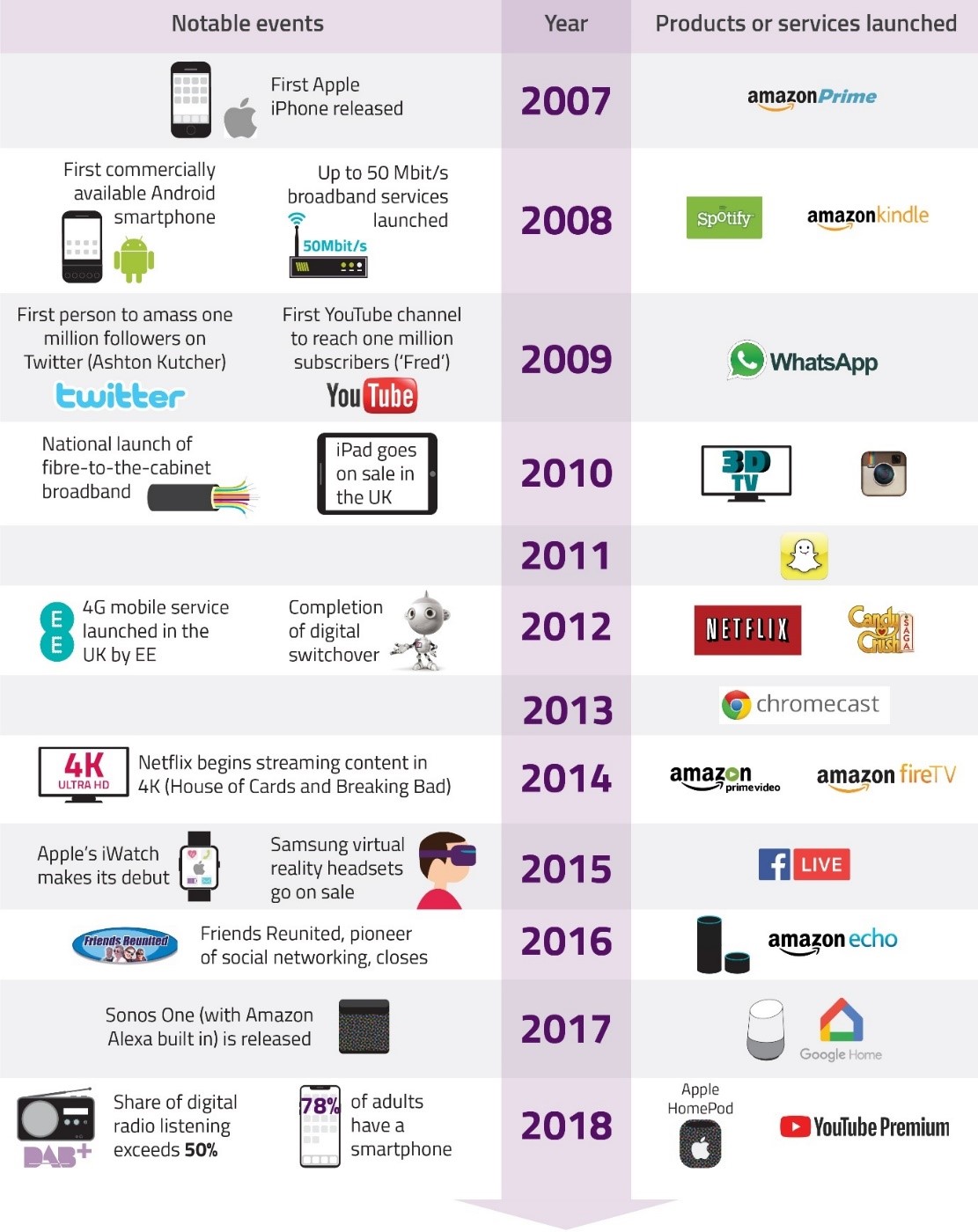
A decade of change in digital communications.

Infographic timeline showing notable events and products or services launched between 2007 and 2018. 2007: first iPhone released; Amazon Prime launched. 2008: first Android smartphone; up to 50 Mbit/s broadband launched; Spotify and Amazon Kindle launched. 2009: Ashton Kutcher becomes first person to amass one million followers; YouTubers Fred becomes first to reach one million subscribers; WhatsApp launched. 2010: National launch of fibre-to-the-cabinet broadband; iPad goes on sale in the UK; 3DTV and Instagram launched. 2011: Snapchat launched. 2012: 4G mobile service launched in UK by EE; completion of digital switchover; Netflix and Candy Crush launched. 2013: Chromecast launched. 2014: Netflix begins streaming content in 4K; Amazon Prime Video and FireTV launched. 2015: Apple iWatch makes debut; Samsung VR headsets on sale; Facebook Live launched. 2016: Friends Reunited, pioner of social networking, closes; Amazon Echo launched. 2017: Sonos (with Amazon Alexa built in) released; Google Home launched. 2018: Share of digital radio listening exceeds 50%; 78% of adults have a smartphone; Apple HomePod and YouTube Premium launched.

It is said that in the course of a normal life one is lucky to have a handfull of friends.

Now its social mobile, analytics, and cloud all want to be your friend.

When we think about social, the key is to consider why social is happening, rather than think of it as just a set of tools.

For example, Facebook, Twitter, and so on are tools, but why people use them is much more important. The same was true with the internet when we first started using that — that was a tool, but what it did to the lives of normal people in terms of access to information, increased freedom, etc., was much more important.

Mobile is a similar shape to social in that it’s the why as to why people use mobile devices as opposed to anything structural about the devices themselves.

The idea behind big data is that you can derive understanding about behaviour through statistical analysis of clumps of data. You can then take that understanding and implement some form of control to either get more of what you want, or get less of what you don’t want.

Finally, we come to the cloud.  This is really about how companies buy. There are all sorts of reasons to like outsourcing IT functions to the cloud, whether it’s just outsourcing compute power into a load of servers that you run as if they were your own, or buying functionality on an SaaS basis ( Software as a service)

Is cloud necessary for digital?

To an extent, it likely does not. However, as a fashion/trend, it’s clearly important, and a lot of the tools and services involved in digital are unlocked as part of a cloud-based approach, hence it’s likely important.

It’s a sociological change, rather than a technical one.

You can see that by the fact that this is generally all about the “why” this is happening — why are customers using social, why are they using mobile, why big data is showing the trends that it is, why are companies able to buy and use consumer products, and why is running systems in the cloud easier.

Because they all your Friend without you knowing and couldn’t care less who or how they share that friendship with or what they do with it.  Google it.

All human comments appreciated. All like clicks and abuse chucked in the bin.

Go back

Your message has been sent

Warning
Warning
Warning
Warning

Warning.


Share this:

  • Click to share on WhatsApp (Opens in new window) WhatsApp
  • More
  • Click to share on Pocket (Opens in new window) Pocket
  • Click to share on Mastodon (Opens in new window) Mastodon

THE BEADY EYE OBSERVES WHAT TECHNOLOGY IS DOING TO THE PURSUIT OF PROFIT.

05 Tuesday Nov 2019

Posted by bobdillon33@gmail.com in 2019: The Year of Disconnection., Algorithms., Artificial Intelligence., Capitalism, Climate Change., Fourth Industrial Revolution., Inequality, Modern day life., Our Common Values., Politics., Reality., Sovereign wealth fund, Technology, The common good., The pursuit of profit., The state of the World., The world to day., Unanswered Questions., Wealth., WHAT IS TRUTH, What Needs to change in the World, Where's the Global Outrage., WORLD POVERTY WHERE'S THE GLOBAL OUTRAGE

≈ Comments Off on THE BEADY EYE OBSERVES WHAT TECHNOLOGY IS DOING TO THE PURSUIT OF PROFIT.

Tags

Algorithms trade., Algorithms., Artificial Intelligence., Business and Economy, Capitalism, Capitalism and Greed, Distribution of wealth, Globalization, Inequility, Sovereign wealth fund, Technology, The Future of Mankind, Visions of the future., World aid commission


( A twenty-minute read)

The Internet is an incredibly spectacular thing, and only now — after so many years — we are understanding its power.

In spite (and many times because of) all the social media and internet news, we tend to have a skewed view of the world around us.

But there is one thing that is certain.

It has given rise to highly profitable digital platform monopolies, ‘superstar firms’ which are able to use aggregation and analysis of data to make supernormal profits which are disappearing into the cloud.

But what’s really happening in the global economy?

These multi-conglomerations dominate not just the current digital markets but future ones in artificial intelligence and machine learning, with workforces which are relatively small proportional to value-added, putting downward pressure on labour’s share of income.

It is becoming easier and cheaper to replace human work by increasingly
capable robots and artificial intelligence, this automation will accentuate existing trends in the capital and labour shares.

Whatever the future path of the global economy, with growing automation in

the economies of the world substituting capital for labour more and more

of the wealthiest fortunes are held almost exclusively in financial assets.

                                                     —-

We’re not just entering into a period of severe distress with climate change

we are also entering a period of a new uneven distribution of capital

ownership that is now the driver of inequality.

It’s a “new, harsh reality”, ( from weapons of mass destruction, water crises, large-scale involuntary migration and severe energy price shock, extreme weather events, failure of climate change mitigation and adaptation, interstate conflict with regional consequences and major natural catastrophes) that the spending power of governments is dimensioning.

Most of us haven’t quite realized there is something extraordinary happening.

Isn’t it absurd that we, 7 billion of us living on the same planet, have grown further apart from each other? Everything is going through change and that most of us are unaware of that.

What sense does it make to turn your back on the thousands, maybe millions, of people living around you in the same city on the same planet in poverty?

You might be lead to believe that the Internet is taking down mass control and the small are no longer speechless. This might well be true when it comes to the rising failure of climate change mitigation and adaptation or if you look at the Arab Spring, Brexit, and the people’s climate revolution/ pollution.

But its not true when one looks at how and by whom the economy of the world that is driven by growth at all costs.

Why?

Because the natural resources industry is owned by sovereignty wealth funds with financial instability around the world as the net result.

But don’t panic.

With Climate change and Ai, and with all of us exchanging half-truths civilisation is in for a rough ride.

However, technological crises have yet to impact economies or securities in a systemic way.

Which panic button to press?

The only category not to feature in the above harsh realities is algorithm profit from profit technological that is spreading inequalities between individuals and families, between countries, generations and genders, as well as between people from different ethnicities and class backgrounds.

Fleckenstein – David Rosenberg’s Proposal To Print Trillions Of Dollars Is Not Helicopter Money, It’s Cold Fusion

Normally revenue, as you know, is generated by profit/taxes but most revenue sources are already accounted for in government budgeting except the supernormal profits made by in no particular order – Apple, Google, Microsoft, Facebook, Cisco Systems, Intel, to mention just a few.

It’s sometimes hard to fathom the sheer scope of profits made by the world’s most profitable companies.

1. Saudi Aramco: $304.04 M daily – Earns $1 M in 4.7 minutes
2. Apple: $163.1 M daily – Earns $1 M in  8.8 minutes
3. Industrial & Commercial Bank of China: $123.29  M daily – Earns $1M in 11.7 minutes
4. Samsung Electronics: $109.3 M daily – Earns $1 M in 13.2 minutes
5. China Construction Bank: $105.48 M daily – Earns $1 M in 13.7 minutes
6. JPMorgan Chase & Co.: $88.97 M daily – Earns $1 M in 16.2 minutes
7. Alphabet: $84.21 M daily – Earns $1 M in 17.1 minutes
8. Agricultural Bank of China: $83.99 M daily – Earns $1 M in 17.1 minutes
9. Bank of America Corp.: $77.12 M daily – Earns $1 M in 18.7 minutes
10. Bank of China: $74.59 M daily – Earns $1 M in 19.3 minutes

and these are not Sovereign Wealth Funds.

They exist somewhere between the murky grey of return-maximizing, mega-cap asset managers, and clandestine government agencies quietly used to further sovereign agendas.

It is estimated that SWFs combined to hold more than $7.4 trillion in AUM, (Assets under management) representing approximately 6% of global assets under institutional management.

And you wonder with government print trillions to stimulate sagging economies why the world is and still is in a state of meltdown not just climate-wise but capitalistic wise.

We now have both the EU and the UK floating the idea of establishing Citizens wealth funds.

The trouble is that existing wealth funds have already bought up most of the world. Latecomers like THE UK/EU will have nothing to invest in other than technologies that produce profits.

The character of a sovereign wealth fund depends on its purpose and is shaped by how it is capitalised and governed, how it invests its funds and how returns are spent.

A Sovereign Wealth Fund is a state-owned investment vehicle established to channel balance of payments surpluses, official foreign currency operations, proceeds of privatizations, government transfer payments, fiscal surpluses, and/or receipts from resource exports, into global investments on behalf of sovereigns and in the advance of goals that are not transparent.

Economic theory wise, it is important to understand that SWFs form part of their respective country’s total national capital base, where total national capital is defined as the total combination of net financial assets, total physical capital stock (e.g., real estate, machines, infrastructure), unexploited environment, human capital, and unexploited natural resources.

Commodity SWFs are financed from the proceeds of non-renewable commodity exports (oil, gas, precious metals), which grow the AUM base in times of high prices but destabilize their source economies and budgets in times of low. Non-commodity funds, on the other hand, are typically financed from currency reserves or current account surpluses, driven by corporate or household saving rates.

They were once the mainstays of the global investment landscape.

Despite is name the era of neoliberalism was far from liberal.

We are now experiencing the political consequences of this great deception with the rise of popularism.

This blog has been suggesting for some time the setting up of a perpetual funded World Aid fund by applying a 0.05% commission on all profit for profit sake seeking financial activities. ( See previous posts)

All human comments appreciated. All like clicks and abuse chucked in the bin.

Go back

Your message has been sent

Warning
Warning
Warning
Warning

Warning.


Share this:

  • Click to share on WhatsApp (Opens in new window) WhatsApp
  • More
  • Click to share on Pocket (Opens in new window) Pocket
  • Click to share on Mastodon (Opens in new window) Mastodon

THE BEADY EYE ASK’S: ARE PROFIT SEEKING ALGORITHMS BUILDING A DIGITAL POORHOUSE, AUTOMATING INEQUALITY WHILE HURTING THE MOST VULNERABLE.

03 Sunday Nov 2019

Posted by bobdillon33@gmail.com in Algorithms., Artificial Intelligence., Capitalism, Fourth Industrial Revolution., Humanity., Inequality, Modern day life., Our Common Values., Poverty, Reality., Technology, The common good., The Future, The Obvious., The state of the World., The world to day., Unanswered Questions., WHAT IS TRUTH, What Needs to change in the World, Where's the Global Outrage.

≈ Comments Off on THE BEADY EYE ASK’S: ARE PROFIT SEEKING ALGORITHMS BUILDING A DIGITAL POORHOUSE, AUTOMATING INEQUALITY WHILE HURTING THE MOST VULNERABLE.

Tags

Algorithms., Artificial Intelligence., Big Data, Capitalism and Greed, Distribution of wealth, Greed, Inequility, Technology, Visions of the future.

(Twenty-minute read)

Should we worry about the rise of artificial intelligence or celebrate it?

Both is the answer.

We all inhabit this new regime of digital data but we don’t all inhabit it in the same way and the pursuit of rapid growth by way of technology won’t solve the huge challenges we face.

A more honest, humane approach is the answer.

If you believe the hype, technology is going to help us end global poverty, that’s easier said than done in a world where most product innovations are geared toward the rich.

The prospect of billions rising up from poverty with nothing more than gadgets is indeed a fanciful notion. This is because poverty is entirely a man-made creation. Capitalism is driven by greed, generating a power structure, which moves wealth disproportionately into the hands of the few.

But why are our societies becoming increasingly unequal, and what can we (or should we) do about it?A homeless man outside Victoria Station in London.

Forget where science ends and ideology begins it is the mechanisms behind the persistence of poverty that counts.

Technology cannot solve the problem of economic disparity.

We often believe that our digital decision-making tools, like algorithms or artificial intelligence or integrated databases, are more objective and more neutral than human beings.

Totally false.

We are building not just ill-conceived mathematical models now micromanage the economy, from advertising to prisons but also hiding the profit of multinational companies in the cloud.

We are building:  A DIGITAL POOR HOUSE.

Even though we live in a hyperconnected world we are watching inequality exploding as we walk past people on the street looking at our smartphones.

The spreading of these kinds of systems is now way beyond just the public service systems that they’re in now. For example, high-frequency trading algorithms that run 99.9% of the world stock exchanges are plundering not just finite resources they are jeopardising our peaceful existence.

Feel free to ignore the weight of the evidence that is now becoming crystal-clear, so stark, that the trade-off of the growth of the economy and the survival of the planet are now intertwined. So we have to go into a mode where we are first educating the people about what’s causing this inequality and acknowledging that technology is part of that cost, and then society has to decide how to proceed.

Deep cultural and political changes are needed in order to think through these technologies in order to get to better systems.

This should apply to all technology – nanotechnology, biotech.

I also really believe we need to stop using these systems to avoid some of the most pressing moral and political dilemmas of our time, which is not just poverty but racism.

Unfortunately, we have Profit-seeking Algorithms that have no moral or ethical bases.

Algorithms — a set of steps computers follow to accomplish a task — are used in our daily digital lives to do everything from making airline reservations to searching the web. They are also increasingly being used in public services, such as systems that decide which homeless person gets housing.

AI with faceless algorithms is worsening the effects and concentrating the power of the wealthy. They are likely to dramatically increase income disparity, perhaps more so than other technologies that have come about recently.

Digital innovation in the form of profit-seeking algorithms that it’s not just going to be benefitting a small fraction of the world’s population, or just a few large corporations. is reinforcing, rather than improving, inequality.

Institutions have embraced digital technologies they are outsourcing the decision to a machine to cut costs avoiding the human costs. They say, “We have this incredible overwhelming need. We don’t have enough resources, so we have to use these systems to make these incredibly difficult decisions.”

If all the resources are automated, then who actually controls the automation?

Is it every one or is it a few select people?

My great fear with these systems is we’re actually using them as a kind of empathy override, meaning that we are struggling with questions that are almost impossible for human beings to make.

We’re smuggling moral and political assumptions into them about who should share in prosperity.

There’s already an expectation that people will be forced to trade one of their human rights, like their information or their privacy, for another human right.

The economic prosperity created by AI should be shared broadly, to benefit all of humanity otherwise they will lead to an even greater disparity between the wealthy and the rest of the world.

If AI takes away people’s jobs and only leaves wealth in the hands of those people owning the robots, then that’s going to exacerbate some trends that are already happening.

People now with “predictive data” have real concerns about informed consent. About how their data is being shared, whether it’s legal and whether it’s morally right.

Why?

Because it is impossible to work out why the algorithms had gone against them, or to find a human caseworker to override the decision.

How can we change the societal mindset that currently discourages a greater sharing of wealth? Or is that even a change we should consider?

We’re using these technologies to avoid important political decisions. Exacerbating the divides between the developed and developing world, and the haves and have nots in our society.

The change will only occur when policymakers and voters understand the true scale of the problem. This is hard when we live in an era that likes to celebrate digitisation — and where the elites are usually shielded from the consequences of those algorithms.

Restoring human dignity to its central place has the potential to set off a profound rethinking of economic priorities and the ways in which societies care for their members, particularly when they are in need. If enough of us want to change the status quo for good, then with our collective creativity, with our hunger to solve really hard problems, we will find technology an incredibly powerful tool in our arsenal.

Technology can move commodities (food, jobs, wealth) from areas of surplus supply to regions with under-served markets.

Technology can only help us if we chose to make the best use of it.

Computing has long been perceived to be a culture-free zone — this needs to change.

Today more people have access to a cell phone than a toilet.

I use that metaphor specifically because I think that these systems, although we talk about them often as disruptors, are really more intensifiers and amplifiers of processes that have been with us for a long time, at least since the 1800s.

At a time of unprecedented global challenges platforms like Google Facebook, Twitter and there like must be made to use the power of their platforms to stop the DIGITAL POOR HOUSE instead of hoarding profits with profit-seeking algorithms.

If not because bias has been a historical norm, it because us the users of your platform will develop self-defence.

So, next time if you think AI is not affecting you, take out your smartphone.

If Twitter’s not your choice of poison, maybe it’s Facebook or Instagram, or Snapchat or any of the myriad of social media apps out there they are all affecting your decisions and our lifestyles every day.

They are all tailored according to what we are likely to respond to. specifically designed to attract the attention of its members – and so inevitably to confirm them in their opinions and prejudices,  with several extra bills to pay in order to remain a normal citizen. 

Its a ‘mean’ not the ultimate solution.

AI has become so successful in determining our interests and serving us ads that the global digital ad industry has crossed trillions.

artificial intelligence concept Stock Photo - 90948450

All human comments appreciated. All like clicks and abuse chucked in the bin.
Go back

Your message has been sent

Warning
Warning
Warning
Warning

Warning.


Share this:

  • Click to share on WhatsApp (Opens in new window) WhatsApp
  • More
  • Click to share on Pocket (Opens in new window) Pocket
  • Click to share on Mastodon (Opens in new window) Mastodon
Newer posts →

All comments and contributions much appreciated

  • THE BEADY EYE SAYS TRUST IS DISAPPEARING THANKS TO OUR INABILITY TO RELATE TO EACH OTHER. December 19, 2025
  • THE BEADY EYE SAYS. THE WORLD NEEDS PEOPLE GOVERNMENT NOT MONEY GOVERNMENTS. December 18, 2025
  • THE BEADY EYE ASKS WHAT ARE WE THE SAME GOING TO DO TO STOP THE WORLD BEING FUCK UP FOR PROFIT BY RIPOFF MERCHANT. December 17, 2025
  • THE BEADY EYE CHRISTMAS GREETING. December 16, 2025
  • THE BEADY EYE SAYS. TO THE NEXT GENERATION TO LIVE A LIFE WORTH WHILE YOU MUST CREATE MEMORIES. December 16, 2025

Archives

  • December 2025
  • November 2025
  • October 2025
  • September 2025
  • August 2025
  • July 2025
  • June 2025
  • May 2025
  • February 2025
  • January 2025
  • December 2024
  • November 2024
  • October 2024
  • September 2024
  • August 2024
  • July 2024
  • June 2024
  • May 2024
  • April 2024
  • March 2024
  • February 2024
  • January 2024
  • December 2023
  • October 2023
  • September 2023
  • August 2023
  • July 2023
  • June 2023
  • May 2023
  • April 2023
  • March 2023
  • February 2023
  • January 2023
  • December 2022
  • November 2022
  • October 2022
  • September 2022
  • August 2022
  • July 2022
  • June 2022
  • May 2022
  • April 2022
  • March 2022
  • February 2022
  • January 2022
  • December 2021
  • November 2021
  • October 2021
  • September 2021
  • August 2021
  • July 2021
  • June 2021
  • May 2021
  • April 2021
  • March 2021
  • February 2021
  • January 2021
  • December 2020
  • November 2020
  • October 2020
  • September 2020
  • August 2020
  • July 2020
  • June 2020
  • May 2020
  • April 2020
  • March 2020
  • February 2020
  • January 2020
  • December 2019
  • November 2019
  • October 2019
  • September 2019
  • August 2019
  • July 2019
  • June 2019
  • May 2019
  • April 2019
  • March 2019
  • February 2019
  • January 2019
  • December 2018
  • November 2018
  • October 2018
  • September 2018
  • August 2018
  • July 2018
  • June 2018
  • May 2018
  • April 2018
  • March 2018
  • February 2018
  • January 2018
  • December 2017
  • November 2017
  • October 2017
  • September 2017
  • August 2017
  • July 2017
  • June 2017
  • May 2017
  • April 2017
  • March 2017
  • February 2017
  • January 2017
  • December 2016
  • November 2016
  • October 2016
  • September 2016
  • August 2016
  • July 2016
  • June 2016
  • May 2016
  • April 2016
  • March 2016
  • February 2016
  • January 2016
  • December 2015
  • November 2015
  • October 2015
  • September 2015
  • August 2015
  • July 2015
  • June 2015
  • May 2015
  • April 2015
  • March 2015
  • February 2015
  • January 2015
  • December 2014
  • November 2014
  • October 2014
  • September 2014
  • August 2014
  • July 2014
  • June 2014
  • May 2014
  • April 2014
  • March 2014
  • February 2014
  • January 2014
  • December 2013
  • November 2013
  • October 2013

Talk to me.

Jason Lawrence's avatarJason Lawrence on THE BEADY EYE ASK’S: WIT…
benmadigan's avatarbenmadigan on THE BEADY EYE ASK’S: WHA…
bobdillon33@gmail.com's avatarbobdillon33@gmail.co… on THE BEADY EYE SAYS: WELCOME TO…
Ernest Harben's avatarOG on THE BEADY EYE SAYS: WELCOME TO…
benmadigan's avatarbenmadigan on THE BEADY EYE SAY’S. ONC…

7/7

Moulin de Labarde 46300
Gourdon Lot France
0565416842
Before 6pm.

My Blog; THE BEADY EYE.

My Blog; THE BEADY EYE.
bobdillon33@gmail.com

bobdillon33@gmail.com

Free Thinker.

View Full Profile →

Follow bobdillon33blog on WordPress.com

Blog Stats

  • 94,154 hits

Blogs I Follow

  • unnecessary news from earth
  • The Invictus Soul
  • WordPress.com News
  • WestDeltaGirl's Blog
  • The PPJ Gazette
Follow bobdillon33blog on WordPress.com

The Beady Eye.

The Beady Eye.
Follow bobdillon33blog on WordPress.com

Create a free website or blog at WordPress.com.

unnecessary news from earth

WITH MIGO

The Invictus Soul

The only thing worse than being 'blind' is having a Sight but no Vision

WordPress.com News

The latest news on WordPress.com and the WordPress community.

WestDeltaGirl's Blog

Sharing vegetarian and vegan recipes and food ideas

The PPJ Gazette

PPJ Gazette copyright ©

Privacy & Cookies: This site uses cookies. By continuing to use this website, you agree to their use.
To find out more, including how to control cookies, see here: Cookie Policy
  • Subscribe Subscribed
    • bobdillon33blog
    • Join 223 other subscribers
    • Already have a WordPress.com account? Log in now.
    • bobdillon33blog
    • Subscribe Subscribed
    • Sign up
    • Log in
    • Report this content
    • View site in Reader
    • Manage subscriptions
    • Collapse this bar