• About
  • THE BEADY EYE SAY’S : THE EUROPEAN UNION SHOULD THANK ENGLAND FOR ITS IN OR OUT REFERENDUM.

bobdillon33blog

~ Free Thinker.

bobdillon33blog

Tag Archives: Smartphones

THE BEADY EYE SAYS HUMAN FRAGILITY IS MORE THAN EVER ON SHOW FOR ALL TO SEE.

19 Wednesday Nov 2025

Posted by bobdillon33@gmail.com in 2025 Another Year of change, A Constitution for the Earth., A solution to Climate change., Algorithms., Artificial Intelligence., Capitalism, CAPITALISM IS INCOMPATIBLE IN THE FIGHT AGAINST CLIMATE CHANGE., Climate Change., Climate refugees., Collectively, CULTURES COLLIDE, Dehumanization., Digital age., DIGITAL DICTATORSHIP., Disaster Capitalism., Freedom, Freedom of Speech, Human Collective Stupidity., Human Exploration., HUMAN INTELLIGENCE, Human values., Humanity., Life, Modern day life., Modern Day Slavery., Natural World Disasters, OUR BRAINS, Our Common Values., Politics., Populism., Post - truth politics., Profiteering., Purpose of life., Reality., Social Media, Society, State of the world, Sustaniability, Technology v Humanity, Telling the truth., The common good., The Obvious., The pursuit of profit., The state of the World., The world to day., The year 2025, THIS IS THE STATE OF THE WORLD.  , Truthfulness., Unanswered Questions., What is shaping our world., WHAT IS TRUTH, What Needs to change in the World, Where's the Global Outrage.

≈ Comments Off on THE BEADY EYE SAYS HUMAN FRAGILITY IS MORE THAN EVER ON SHOW FOR ALL TO SEE.

Tags

Algorithms for Profit., Artificial Intelligence., Artificial life., Capitalism, Capitalism and Greed, Capitalism isn't working, Capitalism vs. the Climate., Climate change, Climate change and Intelligence, Current world problems, Death v Technology, Dehumanization., environmental degradation, Future Society., global climate change, Global warming, Globalization, HUMAN INTELLIGENCE, Human interaction, Human societies, Human society, Humanity, Life, Modern day life., Money and power., Our Common Values., Our world problems, Out of Date Democracy, Power of Social Media, Quality of Life, Reality of Climate Change, SMART PHONE WORLD, Smartphones, Society, State of the world, Sustainability, Technology, Technology age, Technology versus Humanity, The cost of Climate Change., The essence of our humanity., The Future of Mankind, The human race, The right to life, THE UNITED NATIONS, The World, THIS IS THE STATE OF THE WORLD.  , Truth, Visions of the future., What Needs to change in the World

( Six minute read)

The current set of problems facing the world is exposing as never before just how fragile we humans are.

We are facing three major challenges ( over which we have no control) CLIMATE CHANGE and ARTIFICIAL-INTELLIGENCE + SOCIAL MEDIA

The question is do we want to live or just exist in a world run by a few wealthy people.

These days it appears that we don’t want to hold powerful people to account.

They get a headline and thats it.

Take for example.

Prince Andrew who thought his privilege position would protect him till he became Andy.

Or

George Michel former US senator who played a critical role in Northern Ireland’s peace process once described his friendship with convicted sex offender Jeffrey Epstein as a “blessing”.

He is now an old codger, but age should not excuse his crimes.

Donald Dump has gone to great lengths to sweep the whole Epstine thing under the carpet.

Epstine died by suicide.

———————-

The fragility of humans was especially shown in the two world wars.

A prime example would be the 7th Panzer Division brutality (that should never be forgotten ) as it made its way to Normandy, massacring all that stood in its way.

Or the recent brutal force of Israel retaliation. Committing a Genocide in response to an attack that killed around 1000 it has wiped out 60,000 Palestines, as the world watched it do so with impunity.

Humanity had always been fragile and will remain so till it learns to live in peace.

In order to make any difference we have to change the way we protect our shared human values. Somehow we must place them beyond the reach of ourselves where they are protected against any technological advances, wars etc.

Ukraine Russia war which is now four years old.

This can only be achieved with universal agreement to tackle, control what is self evident.

Climate change is self evident. Humanity must choose profit or a liveable planet

Artificial intelligence is less self evident. Digital slavery or freedom.

Social Media is evidence in abundance. False information or the truth.

All human comments appreciate. All like clicks and abuse chucked in the bin.

Contact: bobdillon33@gmail.com

Share this:

  • Click to share on WhatsApp (Opens in new window) WhatsApp
  • More
  • Click to share on Pocket (Opens in new window) Pocket
  • Click to share on Mastodon (Opens in new window) Mastodon

THE BEADY EYE ASK’S: IS THE SMART PHONE A WALL AGAINST REALITY. A GREAT SOCIAL TRAP?

07 Tuesday May 2024

Posted by bobdillon33@gmail.com in Uncategorized

≈ Comments Off on THE BEADY EYE ASK’S: IS THE SMART PHONE A WALL AGAINST REALITY. A GREAT SOCIAL TRAP?

Tags

Artificial Intelligence., iphone, Smartphone., Smartphones, Social Media, Technology, The Future of Mankind, Visions of the future.

( Ten minute read)

SMART PNONES ARE NOW A PART OF THE FABRIC OF OUR CULTURE.

Virtually everyone carries a smartphone today.  these things didn’t exist until just over 15 years ago and there are now your web browser, camera and camcorder, music player, gaming console, navigation unit, step counter, flashlight, personal AI assistant, and digital wallet and makes calls, too.

As new generations grow up as digital natives, with iPads and smartphones in their hands before they can even walk, we also could be living in a world with even more screens, and smartphones may be only the beginning.

Surely our reliance on smartphones will evolve into something else. Perhaps blending into our bodies and clothing, telling us when to turn left or right, buy that, speak.

In fact, many believe screens will become even more ubiquitous, including (but not limited to) a world steeped in mixed reality, a combination of a virtual world and physical spaces, with most of us experiencing this hybrid via high-tech goggles.“

As of right now, I believe we are still going towards an era of more screens, screens everywhere, in the bathroom, on doors, and it’s already happening in cars and on fridges with these screens becoming more personalized, calling you by name, entering the era of holographic displays.

Mixed reality experiences are going to get “wild” in the coming years.

The future is already here — it’s just not evenly distributed.

Clearly, what our post-smartphone future looks like is subject to speculation — especially in an industry that not only moves at a torrential pace but could take an unexpected detour at any time.

In other words, ambient computing and mixed reality are both likely to happen, simultaneously and overlappingly.

Ten years from now, when we gaze upon the devices in our hands (or, less likely, consider the implant in our spinal columns), I expect we’re going to be telling one of those two stories again.

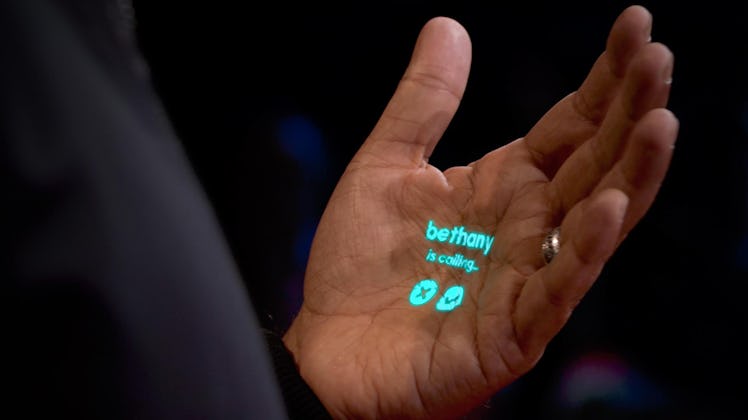
Humane’s AI Pin, for example, is a small device you can attach to your shirt or jacket, and it works as a nonphysical smartphone by projecting calls, messages, and info from apps onto a surface (like your hand).

Powered by artificial intelligence, this screen less solution will also have location data and contextual awareness. Humane's AI Pin clothing-based wearable can project smartphone-like interfaces onto surfaces such as...

we’ll also have a deeper and more self-conscious awareness of the smartphone’s place in our culture.

I could spin a tale about phones that project their displays into mid-air between your fingers. I could predict that we won’t have phones at all but, instead, high-bandwidth jacks plugged right into our brains, connecting us into a 6 or 7G network of wordless, emotive communication.

I could predict that we don’t need to store our lives in our phones — all that data can live in the cloud.

I could predict that our phones will stop consolidating into a single device and instead explode out into a mesh network of tinier, more bespoke gadgets.

I could predict that our phones could shape-shift into a size fit for the task at hand. Morph and upgrade as needed, adding on better cameras, different sensors, and surprising new capabilities.

But in 10 years, maybe the mobile industry will have evolved to a point where modular phones make a comeback.

at least relegated to our pockets more often than not — by smart eyeglasses.  Think of how often you check your phone throughout the day. No one would want to be constantly futzing with swipe and tap gestures on their glasses that frequently

a phone isn’t something we carry around with us — it’s everywhere. Every room in your home has a smart speaker, a screen, a lamp, and who knows what, that’s connected to the network and ready to do whatever you would have asked of your phone.Lucyd's Lyte ChatGPT smart glasses

Rather than face the onerous task of taking a phone out of your pocket, unlocking it, opening the right app, and typing words on its little screen, the world around us will simply be equipped to do the tedious stuff for us. There are very obvious and serious ethical problems with this scenario. Equipping the world around us to anticipate and solve our needs requires us to surrender an incredible amount of information about ourselves.

Maybe a fully ambient computing life isn’t in our future, whether it’s sight issues or vertigo and motion sickness, it’s not for everyone and will not replace a smartphone for many.

Smartphones will remain as a bedrock to our overall computing experience for a while yet, but we’ll no doubt see the technology evolve in different directions, as it always does — just not so fast.

Those born after 1995 are the first people in history to go through puberty with a portal to an alternative universe in their pockets – and the toll this has taken on their wellbeing has been devastating.

Companies that strive to maximise “engagement” by using psychological tricks to keep young people clicking are the worst offenders. They hooked children during vulnerable developmental stages, while their brains were rapidly rewiring in response to incoming stimulation. This included social media companies, which inflicted their greatest damage on girls, and video game companies and pornography sites, which sank their hooks deepest into boys.

How do we escape from these traps? Collective action problems require collective responses:

Given that AI and spatial computing (such as Apple’s new Vision Pro goggles) are about to make the virtual world far more immersive and addictive, I think we’d better start today.

Something in our culture is devastating the next generation.

The culprit is a massive, sudden switch from raising kids on play to raising kids on phones—specifically, smartphones loaded with life-sucking social media apps.

The user is not the customer—the user is the product.

This is the business model behind social media platforms, where you try to maximize the amount of time that kids and other users spend there. Children were becoming “merchandise.”

We need to have thousands of experiences every single year, every single day, to practice interacting with others in the real world, navigating conflict and struggle by finding more meaning in one’s lifetime.

I’m going to give my child a smartphone at age 9 or 10 is to destroy that life.

Perhaps its time to pass laws (just like acquiring a fire arm) restricting the acquisition of a smart phone till 18 of age is attend.  Or restriction on accessing conventional social media such as TikTok, Instagram and Snapchat until they are 18.

Tech is and will remain a fantastic tool, but it has to act in people’s service, not people being reduced to serving a product.

Algorithms that re-engage and stimulate the pleasure system and are built to avoid you losing interest in the content have a type of addictive dynamic.

All human comments appreciated. All like clicks and abuse chucked in the bin.

Contact: bobdillon33@gmail.com

Share this:

  • Click to share on WhatsApp (Opens in new window) WhatsApp
  • More
  • Click to share on Pocket (Opens in new window) Pocket
  • Click to share on Mastodon (Opens in new window) Mastodon

THE BEADY EYE ASK’S. IS THE CURRENCY AND THE ART OF THE HANDSHAKE GOING EXTINCT.

28 Tuesday Jan 2020

Posted by bobdillon33@gmail.com in Communication., Disconnection., Emotions., Enegery, Face Recognition., Facebook, Human values., Humanity., Life., Our Common Values., Reality., Social Media, The art of a handshake., The power of touch.

≈ Comments Off on THE BEADY EYE ASK’S. IS THE CURRENCY AND THE ART OF THE HANDSHAKE GOING EXTINCT.

Tags

Dehumanization., Digital emoji., Face Recognition technology., Facebook and Society., Google/Amazon/Facebook/Twitter, Handshake., Human Touch., Instagram, Smartphones, The Politician’s Handshake.


(Ten-minute read)

Remember when people use to initially judge you by your handshake. It formulated a picture of a person we were meeting for the first time.

In the span of a few seconds, it lay the foundation for how others perceive and feel about us — and we about them.

“It was wet,” “It was creepy,” ” It was firm,” It was crushing,” “It a Mormon handshake,” “It a Mason probing handshake”, enthusiastic, vigorous, prolonged, high-fives to fist-bumping.

A handshake was a globally widespread, brief greeting or parting tradition in which two people grasp one of each other like hands making impressions that have a very long shelf-life based on a brief but important meeting.

Your handshake is the business card you leave behind.

Believed by some to have originated as a gesture of peace by demonstrating that the hand holds no weapon.

It is a reassuring tactile touch that we as social animals share is essential for social interaction, social harmony, health, survival, and security, as well as for communicating our true feelings.

It serves as a means of transferring social chemical signals between the shakers.

What is even more startling is how long we remember those bad handshakes — sometimes we remember for decades.

Today we pay for items with the swipe of our phone or by inserting a small plastic card into a reader. The old handshake just doesn’t have its place anymore.

We can also spend thousands of hours clicking a mouse over a small image on a computer screen. Nothing is real, nothing is said – only ones and zeros racing around the globe in small packets of data.

The world of technology continues to tractor us into a world absent of looking at one another in the eyes the Art of the handshake is dead.

With, Social media, Face recognition, Instagram, Facebook, Smartphones, Emails etc our most valuable currency of the handshake is evaporating and being replaced by digital signatures or passwords, that are undermining our trust in each other.

It’s no wonder that so many people get something so simple as a handshake wrong. 

Take the Politician’s Handshake:Corporate-Image-Two-handed-handshake5

Two hands to cover or cup the other person’s hands twisting the other person’s hand so that yours is superior or playing hand jujitsu to let the other person know you are in charge is just rubbish.

In the real world-shaking a person’s hand allows you to establish your friendliness and accessibility. 

For example meeting your future in-laws for the first time, your first job interview.

It might be true that in the future daily and weekly media will be more and more electronic, but physical media will always exist.

Stand in front of the webcam and send a digital emoji and you could be shaking hands with the devil. 

You cannot reproduce a handshake with meaning electronically.

This is a part of the beauty and the freakiness of the internet no handshake required.

Its no wonder there is grooming.

There was a time that a person had to put on nice clothes and go out into the real world to meet a love interest.

Today, you can be “out there” without ever having to go out- online dating.

You can even engage in a virtual relationship by using email or instant messaging. It is possible to get to know a person on a relatively deep level without ever meeting at all.

Customs surrounding handshakes are specific to cultures and can offer some real benefits.  Take Brazilan negotiators they touch each other almost five times each half-hour where there is no physical contact between American negotiators. 

In postmodern society, superstitions don’t have much of a place, for most of history they have a played a huge role in shaping culture and society before the arrival of the handshake.

The internet cares not what you do. You miss out on real contact with people.

It is affecting our ability to connect with others as equals. Not being able to manage the normal tasks of adult living resulting in more and more limper handshakes. Which leads them to problems with society and unable to get along with others.

Although teens are staying in constant contact via the Internet and texting, these friendships do not foster trust and intimacy the same as face-to-face contact.

The century’s old practice to seal a deal may seem quaint but its importance in the future will tell us whether its a robot or not.

As the appreciation of small things disappears; nature loses its brilliance.

Our planet is in a tight spot lets shake hands on that.

As we know there can be no peace no universal action on anything without it. 

All the verbal diarrhoea in the world cannot replace it. 


Corporate-Image-handshake2

Corporate-Image-Finger-tip-grab-handshake3    


All human comments appreciated. All like clicks and abuse chucked in the bin. 

Go back

Your message has been sent

Warning
Warning
Warning
Warning

Warning.


Share this:

  • Click to share on WhatsApp (Opens in new window) WhatsApp
  • More
  • Click to share on Pocket (Opens in new window) Pocket
  • Click to share on Mastodon (Opens in new window) Mastodon

THE BEADY EYE SAY’S: IS IT NOT TIME WE RE EXAMINED DEMOCRACY.

30 Friday Jun 2017

Posted by bobdillon33@gmail.com in Artificial Intelligence., Big Data., Capitalism, Democracy, HUMAN INTELLIGENCE, Humanity., Modern Day Democracy., Modern day life., Our Common Values., Politics., Post - truth politics., Social Media, Technology, The Future, The Obvious., The world to day., Unanswered Questions., What Needs to change in the World

≈ Comments Off on THE BEADY EYE SAY’S: IS IT NOT TIME WE RE EXAMINED DEMOCRACY.

Tags

Artificial Intelligence., SMART PHONE WORLD, Smartphone., Smartphones, Social Media, The Future of Mankind, Visions of the future.


( A deep read of twenty minutes)

Democracy is the process by which we get ourselves organized to perform capitalism.Résultat de recherche d'images pour "pictures of smartphones"
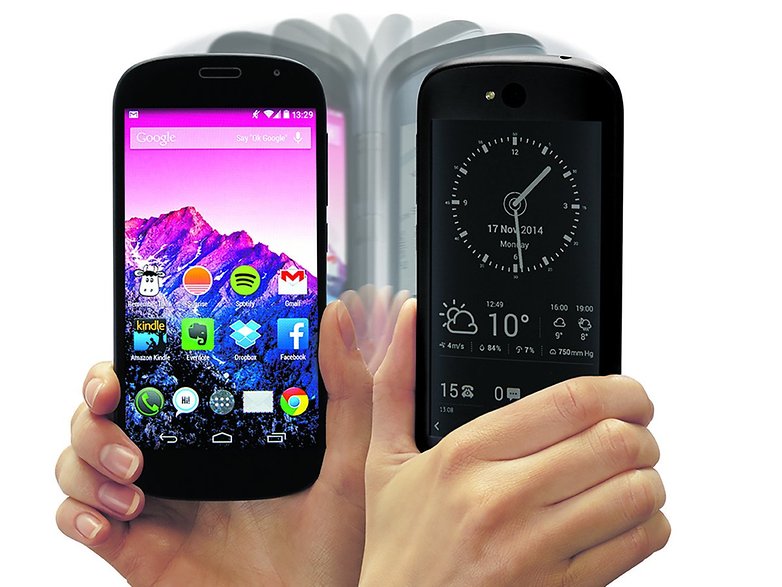
To claim back power we must turn those shiny mirrors our Smartphones into shields, passports and carriers of personal sovereignty.

The good news is that for hundred of years humankind has enjoyed a growing economy without falling prey to ecological meltdown but the margin for error is narrowing with global warming.  All the talk, all the conferences, all the summits, all the promises and protocols have so far failed to curb emissions.

Why?

Because despite all our achievements we are under constant pressure to produce more and more stuff. We risk the future on the assumption that technological will come up with a solution’s in the future.

What is the price going to be?

If every thing is for sale the connection between capitalism, democracy, and liberalism is in the process of being broken.

The new modern deal is Humanist.

Soundless revolutions, silent reformations, undreamed ideas, new religions, must not be neglected, if we would grasp the unity of history in its highest sense.…The unapparent future….bids us to consider the whole sequence up to the present moment as probably no more than the beginning of a social and psychical development, where of the end is withdrawn from our view by countless millenniums to come.

However the world does not come to an end when the nine billion names of God are uttered. Freedom of speech is not over when we have uttered a certain thing.

We are the ultimate source of meaning, and free will is therefore the highest authority of all.

This is for this reason that democratic elections give expression to the ultimate political authority the People.  It will end when we final hand our future to AI.

Whoever determines the meaning of our actions – whether they be good or evil, right or wrong, beautiful or ugly, also gains the authority to tell us what to think and how to behave.

If we are not careful (because human opinion is necessarily fragile and ephemeral) absolute truths and the meaning of life, not to mention the Universe will soon be based on some external laws from some superhuman source other than God.

Creating meaning for a meaningless world will become impossible without Artificial Intelligence (AI) in all its forms of Algorithms that will and are already affect every facet of daily life.

WE MUST DETERMINE BY OURSELVES WHAT IS GOOD, AND WHAT IS EVIL, WHAT IS RIGHT AND WHAT IS WRONG, WHAT IS BEAUTIFUL AND WHAT IS UGLY, WHAT IS IGNORANCE AND CORRUPTIBLE, WHAT IS TRUTH AND WHAT IS FALSE. NOT A MACHINE.       Knowledge = experiences x Sensitivity.

IF WE LOOSE OUR FEELING THERE IS NO POINT IN BELIEVING ANYTHING.

Résultat de recherche d'images pour "pictures of democracy"

Over the last century, capitalism has repeatedly revealed its worst tendencies: instability and inequality and its failures have turned democracy against liberalism. Across Europe, economic interventionism, nationalism, and even open racism have exerted a greater attraction for those casting their democratic votes than the causes of freedom, deregulation, and equality before the law.

Free markets have not only enlarged the gap between rich and poor, but have also reduced average incomes across the developed and developing worlds.

In turn, liberalism’s intellectual self-identity has been left in tatters.

Liberal theorists are now desperately trying to keep the ship afloat. But instead of addressing the challenges head-on they have turned to the past for solace and validation. While this new liberal historicism may have a certain rhetorical appeal, it fails to convince.

At root, liberty is a concept grounded in the individual.

It is the freedom to be all that one is, to actualize the fullness of one’s potential as a human being endowed with the capacity for creativity and the ability to make autonomous value judgments for ourselves. However surrounded by the confused, jargon-ridden babble of political commentators today, it is perhaps easy to forget that liberalism is defined by a commitment to liberty.

While each of us may wish to be free as an individual, individual freedom is dependent on us all being free; and that means that we all have to cling to our shared humanity, our shared dignity and not to be manipulated by profit seeking  un-vetted Algorithms.

The world was moving toward a politically border less and highly interdependent global economy that might have foster prosperity, international cooperation, and world peace. This is no longer true.  Now thanks to un vetted Algorithms we are witnessing a world characterized by intense economic conflict at both the domestic and international levels. Today we are returning to the huge 19th-century-sized gaps between the richest 1 percent and everyone else.

Rescuing the “disappearing middle class” has become every aspiring politician’s slogan, but this is also coming to an end with targeted Social Media Profiling, (conducted by Algorithms) that are and will produce extreme inequality that will infect all of society, as rich corporations that own these Algorithms move to protect their positions, by buying the politicians, mass media and other cultural forms that are for sale.

Capitalism is today’s version of the what and democracy is the how.

Capitalism does not say that “all men are equal”; it even has difficulty in saying that we are all “created equal.”

If we truly want to move beyond capitalism we have to break away from the employer-employee core relationships. It means no longer assigning a relatively tiny number of people inside each enterprise to the employer position of exclusively. It means that every worker has an interest in the enterprise, a share in its profits its loses and decision-making.  Résultat de recherche d'images pour "pictures capitalism"

While democracy is a consensual hallucination of people concerned with how to divide opportunity fairly or democracy is a process for ensuring that each gets an equal session with the eye while capitalism fosters a desire to keep the eye and not share it. An end in itself, not a means.

Democracy as a rule book is not intended to operate only until a particular individual or class has enough money. It is hard to govern the human heart with rules. The democracy rule book, though it hovers above our laws has not succeeded in making humans cherish democracy.

A Martian visiting earth would not be able to see democracy. It is intangible, a rule book we have agreed to which says that no-one shall be denied opportunity, freedom of speech, or the due process of the laws.

Democracy denies the Hobbesian war of all against all, (Thomas Hobbes saw people as weak and selfish, and thus in constant need of the governance that could save them from destruction) and capitalism, pretending to prophecy it, creates it and enshrines it at the center of our pantheon, as the true, the human, the only way to live.

Under the democracy rule book, we meet as the village council; our concern is how to preserve the commons for our children’s children. All right, shift paradigms: we are now under the capitalist rule book, meeting as the board of directors of the Intercontinental Sheep-Grazing Company run by Social media ruled by Algorithms owned by Google, Apple, etc. Their discussion, abruptly with technology is about how to maximize shareholder value, by extracting every last possible dollar from the commons this fiscal period.

Our grandchildren are nowhere in the conversation; they are not shareholders. Under the separation of powers implied by the two rule books, we are relieved of the necessity of thinking about the future, because it is someone else’s job.

The substantive corrupts the procedural, when the love of things corrupts the spirit of fairness.

So it not surprising that any ambitious youngster, perceiving the differences between the two rule books, will prefer to give his allegiance to capitalism, because it offers quicker personal progress than democracy. Democracy preaches incremental change, but capitalism offers overnight transformation, the opportunity to sell something a day after you bought it for ten times what you paid.

It was not healthy for our two divisions ( Capitalism versus Democracy)  to savage each other.

Cooperation is the key feature of democracy, but capitalism is usually thought of (it need not be) as a zero-sum game in which, if I have more, it is because you have less. Versions of capitalism, like the one I believe in, in which we all grow together, are less interesting to the ambitious, because they too closely resemble democracy.

Everything seemed to suggest that only liberal capitalist democracy allowed people to thrive in an increasingly globalized world, and that only the steady advance of laissez-faire economics would guarantee a future of free, democratic states, untroubled by want and oppression and living in peace and contentment.

Humanity imposes upon us the same basic needs. By virtue of our nature, we all require food, shelter, clothing, security, and a range of other basic goods necessary for sufficiency and survival.

Though deceptively simple, these implications have profound meaning when we consider how individual liberty is to be translated into a social and political construct. If the liberty of each person is to be maintained and maximized, the principles of equity and the common good must be embedded in the structure of society.

And since society is structured above all by law, the law must reflect these precepts. It is only if everyone recognizes the dignity of the human person that they will recognize the inherent value of equity and the common good, and strive to defend and preserve not only their own liberty, but also that of all others in their society using law.

It lies not in economics, or the tides of history. It lies in the recognition of the worthiness of humanity itself. Not wealth-creation which depends on the protection of private property, the “capitalist creep” will invariably demand greater legal protection for individual rights.

In a world still divided by rival national ambitions in which economic factors in effect determine the fate of nations, many conclude that international economic affairs will become increasingly filled with conflict. We are witness the tectonic plates of Nature, democracy, disappearing under automation of AI algorithms.

We make a colossal mistake taking it for granted. We mistakenly believe that capitalism begets inevitably democracy. It doesn’t. 

The last battle between democracy and capitalism will be fought on the field of political campaign contributions.

There is a solution:

It is possible to separate fully the political sphere from the economic sphere, so as to confine the democratic process fully in the political sphere, leaving the economic sphere — the corporate world, if you want — as a democracy-free zone.

The answer lies in the political choice that we shall be making collectively. It is our choice, and we’d better make it democratically because the system we have now is even worse than capitalism.  Nobody wants to leave the certainty of the devil they know, or think they know, for something that promises to be worse.

We have run out of world to commodify. And now commodification can only cannibalize its own means of existence, both natural and social.

What all of us make is intellectual property, which from its point of view is all equivalent and tradable as a commodity.

Of course it is always a tough argument to propose common interests among subordinate classes. Counter-hegemony is hard. Hackers, like workers or farmers, are distracted by particular and local interests. Class consciousness is rare among hackers. Most of us are rather reactionary — even in the nontechnical trades. But than class consciousness is always a rare and difficult thing.

Finally at the start of this post I advocated that: To claim back power we must turn those shiny mirrors our Smartphones into shields, passports and carriers of personal sovereignty.

Of course this can only be achieved if we can form a world on line pressure group, using the combined power of Smartphones to affect change.  

 Once the greatness of a nation could be judged by the way its animals are treated now its the power that moves through the smart phone that can be instrumentally conceptualized and strategically deployed, accounted for, and resisted is the driving force that judges. 

Democracy is using your social media channels to engage and provide feedback.

The perception of the public, how people view what you do, is just as important as what you do.  

I am all ears as to how we can capture the collective power of our phones to lobby the direction of democracy.  

To that end, if scholars, activists, and commentators are to contend with the political potential of devices such as the smartphone camera, then it is imperative to account for the simultaneous processes embodied in its mechanics alongside the cultural and social conditions as these devices are often celebrated for disrupting rather than unifying. 

The Gap between Democracy and Capitalism is widening.
Résultat de recherche d'images pour "pictures of democracy"

All comments appreciated. All like clicks chucked in the BIN.

Go back

Your message has been sent

Warning
Warning
Warning
Warning

Warning.

Share this:

  • Click to share on WhatsApp (Opens in new window) WhatsApp
  • More
  • Click to share on Pocket (Opens in new window) Pocket
  • Click to share on Mastodon (Opens in new window) Mastodon

THE BEADY EYE SAYS. WE ARE ENTERING THE ERA OF MASS DISTRACTION.

22 Thursday Sep 2016

Posted by bobdillon33@gmail.com in Communication., HUMAN INTELLIGENCE, Humanity., Modern Day Communication., Technology, The Future, The Internet., What Needs to change in the World, WiFi communication.

≈ Comments Off on THE BEADY EYE SAYS. WE ARE ENTERING THE ERA OF MASS DISTRACTION.

Tags

Facebook, Facebook and Society., Google/Amazon/Facebook/Twitter, SMART PHONE WORLD, Smart Phone., Smartphones

An endless bombardment of news and gossip and images is rendering us manic information addicts.

Every single minute on the planet, YouTube users upload 400 hours of video and Tinder users swipe profiles over a million times.

Each day, there are literally billions of Facebook “likes.”

Online Social media outlets are now publish exponentially more material than they once did, churning out articles at a rapid-fire pace, adding new details to the news every few minutes.

Blogs, Facebook feeds, Tumblr accounts, tweets, and propaganda outlets repurpose, borrow, and add topspin to the same output.

We are guided to these info-nuggets by myriad little interruptions on social media, all cascading at us with individually tailored relevance and accuracy.Afficher l'image d'origine

We all distracted by a constant stream of things to annoy, enlighten, or infuriate; a niche in the nerve center of the exploding global conversation; and a way to measure success — in big and beautiful data — that was a constant dopamine bath for the writerly ego.

Do not flatter yourself in thinking that you have much control over which temptations you click on.  We are all close to helpless.

Silicon Valley’s technologists and their ever-perfecting algorithms have discovered the form of bait that will have you jumping like a witless minnow. No information technology ever had this depth of knowledge of its consumers — or greater capacity to tweak their synapses to keep them engaged.

The modest mastery of our practical lives is what fulfilled us for tens of thousands of years — until technology and capitalism decided it was entirely dispensable.

By rapidly substituting virtual reality for reality, we are diminishing the scope of interaction even as we multiply the number of people with whom we interact.

We have gone from looking up and around to constantly looking down.

GPS, for example, has led to our not even seeing, let alone remembering, the details of our environment, to our not developing the accumulated memories that give us a sense of place and control over what we once called ordinary life.

New technology has seized control of around one-third young adults’ waking hours.

Afficher l'image d'origine

The result is yet to be seen and we are only beginning to get our minds around the costs, in wars, movement of people, erosion of democracy, surveillance and where to find the truth.

As we are  being methodically filled with more stimulus and noise and this new epidemic of distraction is our civilization’s specific weakness.

The amount of time we spend cruising vastly outweighs the time we may ever get to spend with the objects of our desire. Virtual living is creating a mental climate that will be maddeningly hard to manage.

Beyond mere doing, there is also being;

We are becoming each other’s “contacts,” efficient shadows of ourselves.

We hide our vulnerabilities, airbrushing our flaws and quirks; we project our fantasies onto the images before us.

Why is any of this important.

Take the smart phone for example.

When someone next to you answers the phone and starts talking loudly as if you didn’t exist, you realize that, in his or her private zone, you don’t.

They are robbing  us of a silence that was previously regarded as integral to the health of the human imagination.

The device went from unknown to indispensable in less than a decade.

Once you disappeared down a rabbit hole, but the smart phone then went and made the rabbit hole portable, inviting us to get lost in it anywhere, at any time, whatever else we might be doing.

Information soon penetrated every waking moment of our lives. All the hazards of real human interaction are being  banished.

Truly being with another person means being experientially with them, picking up countless tiny signals from the eyes and voice and body language and context, and reacting, often unconsciously, to every nuance.

These are our deepest social skills, which have been honed through the aeons. They are what make us distinctively human.

The smart phone revolution of the past decade can be seen in some ways simply as the final twist.

We are reducing our human contacts into a world that exists largely free of the sudden eruptions or encumbrances of actual human interaction.  A Facebook “friend,” an Instagram photo, a text message — in a controlled and sequestered way that makes integration of cultures impossible.  This, evolutionary psychologists will attest, is fatal. An entire universe of intimate responses is flattened to a single, distant swipe.

Walk down the street, and I’m the only person not plugged in. Or lunch where the first to person to use their phone pays the whole bill?

Here to the frazzled digital generation if they believe that $3 billion of Mark Zuckerberg Facebook profits will put an end to Disease.

Who does he think he is fooling.  Facebook is a Disease.

Go back

Your message has been sent

Warning
Warning
Warning
Warning

Warning.


Share this:

  • Click to share on WhatsApp (Opens in new window) WhatsApp
  • More
  • Click to share on Pocket (Opens in new window) Pocket
  • Click to share on Mastodon (Opens in new window) Mastodon

You Are not a Gadget. Yet!

04 Wednesday Mar 2015

Posted by bobdillon33@gmail.com in Uncategorized

≈ Comments Off on You Are not a Gadget. Yet!

Tags

Smartphones, Technology, The Internet of Things

This is what I call – A run up the flag pole post – see who salutes.

Sorry it’s also another rather long-winded post.

We can’t go anywhere, do anything without our Gadgets.

In my last post I said that Inequality was at the heart of most of our troubles in the world.

But is the Internet (which is without the qualities of Love and Tolerance) also contributing by having an effect on Society/Community and spreading discontent by highlighting these Inequalities? I would say (All technologies have their downsides) Yes.

To Say that humankind is now almost entirely connected, albeit with great levels of inequality in bandwidth, efficiency, and price, is not quite yet a reality.

There are about fifteen billion devices presently connected and there will be around forty billion devices connected by 2020.

There are about 16 million subscribers of wireless devices in the world.

In 2013 it was close to 7 billion (in a planet of 7.7 billion human beings). In 2014, nearly 75% (2.1 billion) of all internet users in the world (2.8 billion) live in the top 20 countries, sending around 114 billion e mails each day of which 68.8% are spam.

Ninety eight percent of all information existing in the planet is digitized and most of it is accessible on the Internet and other computer networks.

Think about what happens when we connect all of those unconnected devices.

We will all turn into Me-centered society.

Does anyone care other than those that have being effected that another Social relationships is being reconstructed on the basis of individual interests, values, and projects, and not on the values that are shared through out the World.

Today, social networking sites are the preferred platforms for all kinds of activities, both business and personal, and sociability has dramatically increased — but it is a different kind of sociability that conveys the best and the worse in humankind.

Technology is already a second skin for young people. 

While highlight the gaps between the Haves and Haves Nots. The Internet is on one hand desensitizing us as individuals.

It is doing this by disintermediating government and corporate control of communication.

Horizontal communication networks are creating a new landscape of social and political change. The consequences of which are not understood and will not be for some considerable time to come.

More than 50 billion ‘things’ are projected to be connected to the Internet by 2020, which, combined with advanced big data analytics, will constitute a giant, intelligent network that will change the way we govern, trade, and interact.

Technology is a material culture and the Internet is the technology of freedom that allows us to do what we wish with this material culture.

To date we are overwhelmed by it, out of sheer ignorance of its effects. It is like a Bulgarian riddle – Here I am, there I am, and yet they cannot catch me.

At the moment we are unable to access its effects and implications, so there will always be a gap between social change and its understanding. To the full understanding of the world in which we live is becoming an impossibility due to consent distraction.

So let us address some effects before virtual life becomes more social than the physical life, but it is less a virtual reality than a real virtuality.  If you get what I mean.

Community is formed through individuals’ quests for like-minded people in a process that combines online interaction with offline interaction, cyberspace, and the local space. Our social environment, how we enjoy ourselves, how we buy, what we study, how we travel,… Everything we do has changed thanks to the Internet and a host of spin-off technologies. From the alphabet to clocks and printing, every major new technology has profoundly altered the way in which humans think.

Take for instance Facebook users: They visit the site daily, and they connect on multiple dimensions, but only on the dimensions they choose.

Unquestionably this change has also reached the business world. How will the business of the future function? Big data is undoubtedly one of the key ingredients for a successful transformation that has already begun. Networks are global and know no boundaries,  but the network society is a global network society with no rules.

Many public issues and social voices are pushed to the margins of society by market values and commercial communication, making it difficult to get the attention of those living in the “walled gardens” of consumerism.

For example:

In work (entrepreneurship), in the media (the active audience), in the Internet (the creative user), in the market (the informed and proactive consumer), in education (students as informed critical thinkers, making possible the new frontier of e-learning and m-learning pedagogy), in health (the patient-centered health management system) in e-government (the informed, participatory citizen), in social movements (cultural change from the grassroots, as in feminism or environmentalism), and in politics (the independent-minded citizen able to participate in self-generated political networks).

If the dominant cultural trend in our society is the search for autonomy, and if the Internet powers this search, then we are moving toward a society of assertive individuals and perhaps cultural freedom.

Yet, the global network society is our society, and the understanding of its logic on the basis of the interaction between culture, organization, and technology, in the formation and development of social and technological networks is key to what society is going to be in the future.  For example the Intense use of the Internet increases the risk of isolation, alienation, and withdrawal from society.

Already from this Internet-based culture of autonomy here is emerging a new kind of sociability, networked sociability, and a new kind of sociopolitical practice, networked social movements and networked democracy.

Did it lend a hand in the creation of Jihad John and ISIS.

Whether it did or not the Web constitute the technological infrastructure of the global network society, yet it continues to feed the fears and the fantasies of those who are still in charge of a society that they barely understand.

The digital gadgets on which we now depend, have already begun rewiring our brains. We are offloading thinking to technology, using our phones as our extended minds.

Smartphones users Worldwide will surpass 2 billion in 2016 i.e. ¼ of the Global population and will be 3 billion by 2018. 

From a society that valued the creation of a unique storehouse of ideas in each individual, man is moving to a socially constructed mind that values speed and group approval over originality and creativity.

Some evolutionary biologists claim that the scholarly mind is a historical anomaly: that humans, like other primates, are designed to scan rapidly for danger and opportunity. If so, the net delivers this shallow, scattered mindset with a vengeance. Hyperlinks and over stimulation mean the brain must give most of its attention to short-term decisions.

The digital technology is already damaging the long-term memory consolidation that is the basis for true intelligence. 

In particular clicking, skipping, skimming—and especially on working and deep memory.                           Is Google Making Us Stupid?

Something is always lost, and something gained.

Here are a few unanswered Questions.

  • How will privacy issues impact upon the uptake of the Internet of Things in democratic institutions?
  • What is the role of Government in an age of Smart Cities and algorithmic regulation?
  • How can civil society institutions ensure that the Internet of Things is harnessed for the public good?
  • How can technologies be designed to create deeper civic engagement?
  • What are the global implications on foreign policy of connecting the unconnected?
  • How can the Internet of Things impact developing countries?
  • What is the potential impact of the Internet of Things on transnational crime?
  • Cyber crime and Cyber security.
  • How will the Internet of Things affect critical national infrastructure?
  • Hyper connected Diplomacy.
  • Encryption and Integrity.

And then you have Humor.

To what extent does the Internet function as a mediator of ‘old’ or traditional humorous forms and topics (e.g. jokes), and to what extent does it facilitate‘new’ humorous forms and topics (e.g. digitally manipulated photographs) in cyber-humor.

Since visual language can move across cultures more easily than verbal language ask yourself if the Internet has become a major actor in the production and distribution of humor.

Internet use empowers people by increasing their feelings of security, personal freedom, and influence, all feelings that have a positive effect on happiness and personal well-being.

Humor appears in many kinds of Websites, spanning personal/amateur blogs that provide funny and lighthearted commentary on events to commercial or professional Websites which often link to mass media such as newspapers (e.g. http://www.theonion.com) and television (e.g.www.comedycentral.com).

How do the new forms and topics of online humor relate to fundamental characteristics of the Internet, specifically interactivity, multimedia and global reach?

The joke might indeed be dead as an oral form since visual language can move across cultures more easily than verbal language. Jokes have been transformed to a popular Internet-based written form-home video’ and ‘media slapstick’ humor.

Why are the types of ‘home video’ and ‘media slapstick’ so popular on You Tube.

Is it because they are personal pieces that seem to reflect the bottom-up nature of the Internet as a space in which everyone, and not only professional comedians, can create humorous content. This kind of humor is not culture specific – a man who slips on a banana peel will probably be regarded as funny in many parts of the globe, by members of various age and gender groups.

How does comedy undermine or reinforce our attitudes towards race, gender, religion, class and ethnicity?

Does what makes us laugh reveal our deep social norms and taboos?

In viral Internet-based commercials, humor is an integral, almost obligatory component but violence as a means of humor in advertising is on the rise.

Viral advertisements,’  Top ten things men know about women’ or ‘Twenty excuses to miss a day of work.

Not only are the vast majority of texts in English, but they also reflect the values and priorities of Western, capitalist and youth-oriented cultures.  However, the definitions of interactivity, as well as the methods for their ope rationalization, remain in dispute.

Culture jamming argue that culture, politics, and social values have been bent by saturated commercial environments, from corporate logos on sports facilities, to television content designed solely to deliver targeted audiences to producers and sponsors. The Internet is wide open to this form of brain washing.

When it comes to humor has the Web has been corporatized?   Interactivity is perceived as an important key to understanding the social implications of the Internet.

That everything is worth making fun of, nothing should be taken seriously, not even a guy getting punched in the face until he bleeds or Hitler reacting to an incident.

Last but not least we come to the Question of Porn.

The Internet is saturated with porn that is debasing us all.

Should there be a safety door into a segregated area of the internet into which all pornographic content should be placed. Viewable only by those how supply online personal details, such as age, positive Id. It would be a step in the right direction. Not Censorship but sensible Stewardship.

If you are not already Gadgetry I would be interested to hear you views.

Go back

Your message has been sent

Warning
Warning
Warning
Warning

Warning.


Share this:

  • Click to share on WhatsApp (Opens in new window) WhatsApp
  • More
  • Click to share on Pocket (Opens in new window) Pocket
  • Click to share on Mastodon (Opens in new window) Mastodon

All comments and contributions much appreciated

  • THE BEADY EYE ASKS: HOW MUCH LONGER IS THE WORLD GOING TO TOLERATE THE PLUNDERING OF USA? January 10, 2026
  • THE BEADY EYE SAYS WARS USE TO BE MAN AGAINST MAN, NO LONGER. WAR IS NOW DRONE AGAINST DRONE. January 9, 2026
  • THE BEADY EYE SAYS. WE HAVE SURROUND THE EARTH WITH SATELLITES. HERE TO DAY GONE TO MORROW. January 9, 2026
  • THE BEADY EYE SAYS GOVERNANCE IS BECOMING MORE BY REALITY TV, ALGO January 9, 2026
  • THE BEADY EYE SAYS. DONALD TRUMP IS EXPOSING THE WEAKEST OF OUR WORLD ORGANISATIONS January 7, 2026

Archives

  • January 2026
  • December 2025
  • November 2025
  • October 2025
  • September 2025
  • August 2025
  • July 2025
  • June 2025
  • May 2025
  • February 2025
  • January 2025
  • December 2024
  • November 2024
  • October 2024
  • September 2024
  • August 2024
  • July 2024
  • June 2024
  • May 2024
  • April 2024
  • March 2024
  • February 2024
  • January 2024
  • December 2023
  • October 2023
  • September 2023
  • August 2023
  • July 2023
  • June 2023
  • May 2023
  • April 2023
  • March 2023
  • February 2023
  • January 2023
  • December 2022
  • November 2022
  • October 2022
  • September 2022
  • August 2022
  • July 2022
  • June 2022
  • May 2022
  • April 2022
  • March 2022
  • February 2022
  • January 2022
  • December 2021
  • November 2021
  • October 2021
  • September 2021
  • August 2021
  • July 2021
  • June 2021
  • May 2021
  • April 2021
  • March 2021
  • February 2021
  • January 2021
  • December 2020
  • November 2020
  • October 2020
  • September 2020
  • August 2020
  • July 2020
  • June 2020
  • May 2020
  • April 2020
  • March 2020
  • February 2020
  • January 2020
  • December 2019
  • November 2019
  • October 2019
  • September 2019
  • August 2019
  • July 2019
  • June 2019
  • May 2019
  • April 2019
  • March 2019
  • February 2019
  • January 2019
  • December 2018
  • November 2018
  • October 2018
  • September 2018
  • August 2018
  • July 2018
  • June 2018
  • May 2018
  • April 2018
  • March 2018
  • February 2018
  • January 2018
  • December 2017
  • November 2017
  • October 2017
  • September 2017
  • August 2017
  • July 2017
  • June 2017
  • May 2017
  • April 2017
  • March 2017
  • February 2017
  • January 2017
  • December 2016
  • November 2016
  • October 2016
  • September 2016
  • August 2016
  • July 2016
  • June 2016
  • May 2016
  • April 2016
  • March 2016
  • February 2016
  • January 2016
  • December 2015
  • November 2015
  • October 2015
  • September 2015
  • August 2015
  • July 2015
  • June 2015
  • May 2015
  • April 2015
  • March 2015
  • February 2015
  • January 2015
  • December 2014
  • November 2014
  • October 2014
  • September 2014
  • August 2014
  • July 2014
  • June 2014
  • May 2014
  • April 2014
  • March 2014
  • February 2014
  • January 2014
  • December 2013
  • November 2013
  • October 2013

Talk to me.

Jason Lawrence's avatarJason Lawrence on THE BEADY EYE ASK’S: WIT…
benmadigan's avatarbenmadigan on THE BEADY EYE ASK’S: WHA…
bobdillon33@gmail.com's avatarbobdillon33@gmail.co… on THE BEADY EYE SAYS: WELCOME TO…
Ernest Harben's avatarOG on THE BEADY EYE SAYS: WELCOME TO…
benmadigan's avatarbenmadigan on THE BEADY EYE SAY’S. ONC…

7/7

Moulin de Labarde 46300
Gourdon Lot France
0565416842
Before 6pm.

My Blog; THE BEADY EYE.

My Blog; THE BEADY EYE.
bobdillon33@gmail.com

bobdillon33@gmail.com

Free Thinker.

View Full Profile →

Follow bobdillon33blog on WordPress.com

Blog Stats

  • 94,526 hits

Blogs I Follow

  • unnecessary news from earth
  • The Invictus Soul
  • WordPress.com News
  • WestDeltaGirl's Blog
  • The PPJ Gazette
Follow bobdillon33blog on WordPress.com

The Beady Eye.

The Beady Eye.
Follow bobdillon33blog on WordPress.com

Blog at WordPress.com.

unnecessary news from earth

WITH MIGO

The Invictus Soul

The only thing worse than being 'blind' is having a Sight but no Vision

WordPress.com News

The latest news on WordPress.com and the WordPress community.

WestDeltaGirl's Blog

Sharing vegetarian and vegan recipes and food ideas

The PPJ Gazette

PPJ Gazette copyright ©

Privacy & Cookies: This site uses cookies. By continuing to use this website, you agree to their use.
To find out more, including how to control cookies, see here: Cookie Policy
  • Subscribe Subscribed
    • bobdillon33blog
    • Join 223 other subscribers
    • Already have a WordPress.com account? Log in now.
    • bobdillon33blog
    • Subscribe Subscribed
    • Sign up
    • Log in
    • Report this content
    • View site in Reader
    • Manage subscriptions
    • Collapse this bar