Money talks a powerful language. It is a factor in many things that happen and don’t happen. Wealth greases the gears of power and influence.
The standard most worshipped by Western society today is financial success, and many people spend their lives pursuing it. Our idiotic species–immediately respects and gives greater credence to anyone who looks rich.
Money can bring power, and power can bring money.
Which one comes first?
Modern day technology is exposing the Capitalist system for what it is worth and as a result we are beginning to see if you focus on the world that you are presented with directly the only collective wisdom we’ve come up with is money can’t buy you love.
1% of the population earns 96% of the wealth in the world, and thus explains why we have such a troubled world.
It’s a struggle between the haves vs the have-nots.
The real reason people want to be rich isn’t so they can buy stuff. It’s so they can have power over others. People want influence and respect and they see that people with money have influence and respect, so they seek money.
There’s only one problem: money does not result in influence and respect – instead, influence and respect often lead to money.
Human greed seems to have no bound.
It is said that money is a good servant an a bad master too…
In today life for people money is everything. When in fact it is only an IOU.
Money can buy material happiness for limited time.
Can it buy true happiness? No.
They don’t know that there are many things bigger than money…Our morals values these are bigger than money..
The paradox of money is that although earning more of it tends to enhance our well-being, we become happier by giving it away than by spending it on ourselves.
What matters a lot more than a big income is how people spend it.
What moves the needle in terms of happiness is not so much the amount you give, but the perceived impact of your donation. If you can see your money-making a difference in other people’s lives, it will make you happy even if the amount you gave was quite small.
Life experiences give us more lasting pleasure than material things, and yet people still often deny themselves experiences and prioritize buying material goods.
People think material purchases offer better value for the money because experiences are fleeting, and material goods last longer. They think that experiences are only going to provide temporary happiness, but they actually provide both more happiness and more lasting value.
And yet we still keep on buying material things, because they’re tangible and we think we can keep on using them.
Experiences, on the other hand, tend to meet more of our underlying psychological needs. They’re often shared with other people, giving us a greater sense of connection, and they form a bigger part of our sense of identity.
We also get more pleasure out of anticipating experiences than anticipating the acquisition of material things.
Feelings of gratitude and appreciation can be very difficult to sustain.
The first measure of happiness is “evaluative.” A sense that your life is good—you’re satisfied with your life, you’re progressing towards your life goals.”
Power is money and money is power.
There are many more examples of this now than anytime in the past.
If a man who earned a standard salary wanted to run for president, he would have almost no chance at all unless he was backed by people with money.
The more money a candidate has, the farther he can get. Although the richest competitor doesn’t always win, the president is usually a very wealthy man.
I want money because to me it represents security and independence.
Real power and influence are when you can make a substantial and lasting mark on the world.
To come to the point of this post.
Capitalism has created Inequality along with the very technologies that have led us down the road to Climate Change, not to mention the present wars and the reemergence of the Barbaric nature of humanity.
However we have power to change systems?
At present we have money starved World Organisations in need of reform.
A world media that turns, nature, wars and violence into entertainment.
There is so much information that we can only Google, Twitter, and take selfless selfies.
Long term planning is impossible or political suicide.
THE WORLD MANTRA SEEMS TO BE: i’M ALRIGHT JACK.
We are all on hedonic treadmill WHILE OUR WORLD IS FRAGMENTING.
THERE IS ONLY ONE SOLUTION.
THAT IS TO PLACE A WORLD AID COMMISSION ON ALL ACTIVITIES THAT ARE ONLY IN EXISTENCE FOR PROFIT SAKE. ( SEE PREVIOUS POSTS)
Currently we have in the region of 65 million people displaced in the world.
With the combination of climate change and inequality of opportunity this is set to grow.
It is time to address the root causeS not with Aid but with preventative action.
The analytical discussion, the comments on refugee causes still remain, sadly, unchanged. This has to change. If not we are provoking an unprecedented humanitarian crises that will plunge the world into an irreversible spiral for uncontrollable miserere for all.
The reasons why people become refugees are not necessarily due to individual persecution or fear of persecution.
We have to tackle the modern refugee problems and especially the problem on how to prevent new wars and situations arise. In an increasingly complex world, massive refugee flows will likely endanger international peace and security.
Above all there is a pressing need to change situations where refugees are exploited as a weapon in a political strife. (ie, situations in which people become refugees to serve specific strategic or political purposes.)
The states of the international community can no longer ignore the victims of specific practices (which amount to persecution and massive human rights violations) only because they are still in their countries of origin.
Take Yemen’s humanitarian situation.
It is arguably the worst humanitarian crisis in the world and the world is looking the other way. The United Nations reports that Yemen has more people — 21.2 million — in need of humanitarian aid than any other country including Syria.
The last 30 years, especially the early Cold War period, besides being directly and indirectly the cause for millions of refugees, seriously impeded effective preventive actions.
The average period of time for displacements globally has grown to 17 years.
The international community (If indeed such a thing exists) should move forcefully now, while almost global cooperation is still possible.
Now is the time for a progressive development of a global approach to the refugee problem.
The approach to prevent rather than to cure is gaining acceptance as the most desirable course of action. The preventive course is advancing towards a more proactive approach to promote human rights, democracy and peace. The call to respect human rights and humanitarian law can no longer be considered merely as lip service, but rather figures now prominently on international agendas.
It’s time to realize that we are all connected to each other and our lives are affected if terrible things happen elsewhere.
Because the United Nations is not an independently Funded World organisation we have hundreds and hundreds of UN resolutions that have all proved unworkable.
Donor fatigue is “jeopardizing its entire existing and aid programs.
“Humanitarian aid can staunch the dying, but it takes politics and money to stop the killing.”
It is obvious to all that can see that future violent conflicts will likely take the form of resource wars – which can be understood as those conflicts which are primarily waged over access to scarce resources such as rare minerals, water, or oil.
All the Aid in the world will be too late making the U.N. (if not already) powerless to further the international protection of human rights.
World politics is already going in the wrong direction.
THERE IS ONLY ONE SOLUTION. PREVENTION NOT REACTION.
To achieve prevention we must create a World Aid Commission on all transactions that are designed to create Profit for Profit sake.
A 0.005% commision on: All High Frequency Trading.
All Foreign Exchange Transactions over ($20,000)
All Sovereign Wealth Funds Acquisitions.
These three Profit for Profit (on their own) would create a perpetual Fund of billions.
They could be complemented by all World Financial Institutions issuing World Aid bonds that are tax-free.
It is easy to be cynical about United Nations or for that matter about any World Organisation.
But the Secretary-General announced the first World Humanitarian Summit will be held in early 2016 in Istanbul, Turkey takes the biscuit.
The world is facing an unprecedented displacement crisis. Today, more than 60 million people are forcibly displaced as a result of violent conflicts and natural disasters.
Turkey has as we know just done a deal with the European Union for Visa to hold fleeing Refugees from War zones so they can’t get into Europe.
As a leading humanitarian donor and key policy-setter, the European Union will play a major role at the upcoming World Humanitarian Summit in Istanbul.
The purpose of the summit is to set a forward-looking agenda for humanitarian action to collectively address future humanitarian challenges. The aim is to build a more inclusive and diverse humanitarian system committed to humanitarian principles.
It’s been almost 25 years since the last time the world came together to discuss humanitarian aid.
The European Commission provides humanitarian funding worldwide to over 200 partner organisations which implement relief actions on the ground. These include non-governmental organisations (NGOs), international organisations and United Nations agencies.
Reshaping aid at the World Humanitarian Summit to my mind seems sum what a joke and more of a NGOs nice gathering as those attending are only required to give commitments.
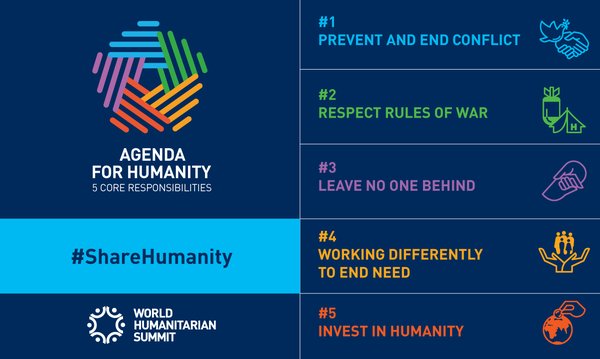
Nobody respects the rules of war, or is willing to sacrifice their young to prevent and end conflict.
Leaving no one behind, and working differently to end need, do indeed require investment in Humanity. As always there is no aspiration as to how to raise the billions required to battle these inequalities.
Like the Paris Summit on Climate Change this meeting is all about hot air, with promises that will be broken as soon as they are made.
This is not the United Nations fault but if anything worthwhile comes out of the first World Humanitarian Summit it should be the reform of itself under the last two heading on the Agenda.
Its time to understand that the interconnected world we all live in is primarily driven by self-interest and corrupt gains.
For example:
Mr Cameron is presently holding a conference on corruption. He has totally forgotten that England’s wealth was obtained by an Empire that dealt in Slavery. Plundered the world and recently had some of its elected MP fiddling expenses. Not to mention bailing out its banks with billions of taxpayers funds and is currently trying to sell bank shares back to the taxpayer how already owns them. And is now in the process of destabilizing the EU for the sake of Profit not Sovereignty.
The only way we can solve more complex innovation challenges is by tapping the global community.
The belief that anything in life is just a problem waiting to be solved, usually with the right technology fix seems to be all the rage other than watching Money electing the next USA president we are develop inequalities to represent real world situations and use them to solve problems.
There is only one commitment needed to place a World Aid Commission on all Activities that exist to generate Profit for profit sake. ( See previous posts) The cost of the refugees world crises in 2016 is 25 billion.
Certain things catch your eye, but pursue only those that capture the heart.
The world we live in and on has and will continue to face many threats from extinction to survival till its demise in 6.5 billion years from now.
We all know that most of its present day problems have being created and propagated by us humans.
Some are easy to eradicate others not so.
WHY? Because global wealth concentrates is now in fewer hands resulting in inequality destroying our attitudes to world problems.
There is little need to state that there are many form of Inequality.
It come dressed in all colors along well beaten paths.
But one form for me leads to many of the others and that is Income Inequality.
(The income from capital continues growing faster than the income from labor.)
While Economists are conditioned to believe in the optimality of the market the newest economic inequality numbers, which ran counter to the expectations of almost all experts, are frightening.
.That’s why they have been in denial for so long that change is not likely in the short run.
But we have to try, because getting this wrong means that economists promote machine-like models that suggest that it is simply some invisible mechanism (or maybe an invisible hand) that ensures that workers don’t get paid very much, that owners make high profit rates, and that the economy will be just fine under these conditions.
Market forces alone cannot determine who gets wealthy and who doesn’t.
Owners of capital seek higher returns through speculation in financial assets, in effect bidding up prices in an eternal quest for ever higher returns, returns that can’t be matched by investments in productive capital (the returns from which have been declining for decades).
Economics can no longer be accepted as a discrete, coherent discipline. It through inequality has left millions impoverished laying in its wake.
As a result there is tremendous anger, disillusionment and fear. All of which are corrosive to democracy.
Just look at the unfolding elections in the USA.
Nearly total disillusionment with established politics due to a dysfunctional government, with the Republican party now barely a political party with a candidate that has risen out of the poplar base called Trump that the establishment could not squash. The main stream spectrum of world politics is moving to the right. Neoliberal policies have led to declines and near stagnation.
You can rest assured that we are going to see a very ugly scene.
Their solutions are the same old failed tactics.
When both parties kowtow to money, the people’s needs are ignored, and
politics becomes illegitimate.
You might say that redistribution of wealth is theft. But Redistribution of investment Profit for Profit’s sake is not.
You might think that 21st century technology such as the internet is going to change everything. But it is money that is writing the laws, the behind the door trade agreements, through lobbyist undermining democracy. This is happening all over the world.
There is no clear relationship between the total value of capital and profitability.
Whether distributions of income and wealth are partly shaped by social and political relationships – class conflict if you will – or mostly by “market forces.”
The forces of technology are what they are.
Take the contemporary communication technologies it can be used for various purposes, to increase surveillance, to increase power, control or it can be used for to empower people. Technology does not care you can use it both ways.
The technological connectedness is a myth.
If there is to be a rebalancing. The current trade agreements could be designed for the people. They are not.
They are however designed for the benefits of investors. They are not trade agreements except very marginally. That is the reason that they are keep secret, not quite totally as the details are being written by corporate lawyers and lobbyist.
They are however up to now effectively secret from the population.
We can fix the problem, but it will take bold steps. It will take a combined movement not splintered movements to force change. This is highly unlikely.
There is hatred and anger about just about all institutions.
There is only one way to effect redistribution.
Place a World Aid commission on all financial and acquisition activity that are made for the sake of profit. ( See previous Posts)
It is us the tax payer that bailed out the Banks, that paid for the research to create the internet. Are we getting any return on the investment. No.
When you look at the News on your TV you hear little or nothing about one of the biggest Trade deals between the USA and The European Union.
TTIP is about a huge transfer of power from people to big business.
You would think that when you elect people to office they would represent you as a citizen and not negotiate deals that have far reaching implications for the environment and the lives of more than 800 million citizens in the EU and US.
Whether you care about environmental issues, animal welfare, labour rights or internet privacy, you should be concerned.
This deal has being going on behind closed doors for months and months (The 13th round of TTIP negotiations in New York finished this April.) and only thanks to Greenpeace Netherlands have some have some of the classified documents represent more than two-thirds of the overall TTIP text come to light.
Greenpeace identified four main issues of concern:
Long standing environmental protection is dropped
The “General Exceptions” rule, enshrined in the GATT agreement of the World Trade Organisation (WTO), is absent from the text. This nearly 70-year-old rule allows nations to restrict trade “to protect human, animal and plant life or health“, or for “the conservation of exhaustible natural resources”
No place for climate protection in TTIP
If the goals of the Paris Summit to keep temperatures increase under 1.5 degrees are to be met, trade should not be excluded from CO2 emissions reduction specifications. But nothing about climate protection can be found in the obtained texts.
Precautionary principle is forgotten
The US wants the EU to replace the EU’s hazard approach with ‘risk management’, disregarding the precautionary principle, [3] which is enshrined in the EU Treaty but is never mentioned in the consolidated text.
Open door for corporate lobbying
The leaked documents suggest that both parties consider giving corporations much wider access and participation in decision-making.
“The effects of TTIP would be initially subtle but ultimately devastating. It would lead to European laws being judged on their consequences for trade and investment – disregarding environmental protection and public health concerns.”
The negotiations about the free trade treaty TTIP take place behind closed doors. The documents about the meetings are not public. That creates mistrust. Nobody knows which positions are talked about in what way. Are citizens losing against corporate interests? Does the lobby industry undermine our democracy? What does the US and what do the European states really want to accomplish?
At the center of public concern stands the investor-state dispute settlement mechanism (ISDS). ISDS allows foreign investors to bring a claim against the government of their host State if TTIP investment protection standards are breached, for example in the event of discriminatory treatment or direct and indirect expropriation.
The EU and most of the free world is in a state of profound uncomfortable quagmire due to Capitalism Greed.
God forbid we allow or agree to a trade deal that puts profit before people.
One must note that previous attempts to establish such a mechanism have failed and that currently there seems to be little appetite for such a mechanism internationally.
As soon as we really know the facts you would think that we would all begin to behave very differently, of course.
If we could, would not your heart swell with something far from anger. We might see our power of duty as custodians to the world that we all live in.
Instead nothing much happens, except swallow high words on what needs to be done to achieve change in order to see the real power, the real dignity, our real responsibility in the world.
Over the next couple of decades the world will be facing new problems (in addition to the well-known challenges of creating economic growth and maintaining social stability), some of which cannot be easily solved by the market.
Forty years from now, how much will energy cost? What will happen with the climate? Most importantly, will you be richer?
Let me tell you it is more important that you are satisfied with life than whether you are somewhat richer or poorer.
Empirically, for some, income is the sole determinant of life satisfaction. But for the majority, a whole host of factors influence our well-being—job, health, family, community, prospects for the future—in addition to income.
It is the sum total of all aspects of life that determine your wellbeing, both now and in the future.
If humanity rose to the occasion and ran a rational world how much better life would be for all of us and the generation to come.
Many argue that this does not matter because we are leaving for future generations a whole lot of capital, infrastructure, and technology. But to paraphrase the World Business Council for Sustainable Development, “People cannot succeed in ecosystems that fail.”
The prime example is the climate challenge.
It is a truly global problem:
The forecast maximum in 2080 is above the threshold that world leaders agreed would place us in the danger zone for runaway climate change; but it is important to realize this is a politically negotiated goal. Views differed, and still differ, on what will be safe. Or in other words, what will hurt us.
Does it matter?
Will the world of 2052 be a better world?
From a psychological perspective, probably no, because the future prospects in 2052 will be grim because of the increasingly uneven distribution of income and wealth that has built up over time as a natural consequence of the free market.
In my opinion there will be huge differences between people. But on average the world will be a better place.
It’s important to note that people 40 years from now will judge their circumstance more on how it has changed from their own recent past than from our vantage point of today.
Even the most diehard liberalists appear to agree that redistribution is something that is not automatically undertaken by the market by itself, but needs to be done via political action
In order to reduce some of the tension implicit in the rapid increase in inequity in the capitalist world.
It’s time to commence down the road of re thinking how or world works and reconsider what kind of world we want to live in.
Although we refer to most of it as civilization it is anything but civilized.
We have being killing each other and everything around us since time millennium.
It’s no wonder that the social arrangements up to the present have largely failed to produce a peaceful and productive world.
While we appear to be technically advanced our values and behaviours are not.
The possibility of an optimistic future is in stark contrast to our current social,economic,and environmental dilemmas.
If we stay the present course, the familiar cycles of crime, economic booms and busts, wars, and further environmental destruction are inevitable.
Will the young generation calmly accept the Debt and pension burden of the old.
No. The simplest reason is they don’t have to. In the rich world, particularly, the first generation that has rung up a huge national debt and established a huge unfunded pension scheme is about to retire.
The interesting, to say the least, question is whether the next generation will be willing to carry this burden and peacefully pay the debt and peacefully pay the pensions. I repeat my answer: I think not.
At the moment we have an unsustainable world, where the environment is going to have a bigger than ever say in shape our behavior.
Where our global monetary system is going to become obsolete, and increasingly insufficient to meet the needs of most people.
Where the banking , media, criminal justice systems, and world Organisations are tools of social control managed by the established political and economic elite.
We need a redesign of all our cultures. We need to up date to the new era of technological revolution.
Our problems are mostly of our own making and now it is the time to come together under a new World Organisation to resolve them.
In 2052 a full 60% of the energy used will still be fossil. As a result climate damage will be growing fast, as will the unavoidable costs for repair of that damage. Paradoxically this means that humanity will choose to pay bills for repair after the crises, rather than paying the same amount of money for renewable energy ahead of time and avoiding the damage.
We all know that if we continued willy nilly with the I am all right jack scenario we are heading for a cesspool of troubles that will put our very existence in question.
There are numerous solutions but the hard fact is man is incapable of acting as one. Furthermore no one wants to pay for change. Not a Country , not a Government, not a social system.
It’s true that all the money in the world will make no difference if we don’t change.
It is also true that any change will have to just and fair to all.
If you have not looked at the below video you should do so.
You might think that the only thing that matter is a Job.
It is the only way in which the individual can get part of the societal pie—without engaging in theft. Society—at least in the long run—will do its utmost to ensure there are jobs, typically by seeking rapid economic growth. But we know from recent history that this is a taxing task, and that politicians often fail.
This video misses the big question. Who is going to pay.
Here is the answer: Profit for Profit’s Sake. We must place a world Aid commission on all High Frequency Trading, on all Foreign Exchange transactions (over $20,000), on all Sovereign Wealth Funds Acquisitions, on all Hedge Funds, on all Lotto Wins. Curbing greed is a first and very important step in that direction.
(see previous posts) —— 0.005% will do the trick. A perpetual Fund to address all our problems fairly spread over what is causing our problem in the first place.
Is it because we can’t handle the truth or is it because religious beliefs are dying in a world driven by materialism.
Most people would have a difficult time telling you, specifically, what the values are that they live by.
They have never given the matter much thought.They would probably, in the end, decide not to answer in terms of a definitive list of values.
The reason for this decision is itself one very modern-day value—their belief that every individual is so unique that the same list of values could never be applied to all, or even most, of their fellow citizens.
“I personally chose which values I want to live my own life by.”
Wrong! Because the different behaviors of a people or a culture make sense only when seen through the basic beliefs, assumptions and values of that particular group.
For example Americans firmly believe that no adult would ever want, even temporarily, to be dependent on another.
There is no arguing that values in society, has dramatically dropped over the past 20 to 30 years. If you look around it is obvious why it is happening.
Technology is reshaping our values.
All worthy things are under attack.
When you look at our current world it seems that the lessons of history count for sweet f .. k all.
Donald Trump peddling another fantasy other than the decline of the United States. ( He appears to think that the solution to everything is a deal.) Money helps but better quality of life is critical if we are to have a peaceful equitable world. Just imagine a self-made US president, a self-appointed Putin, and North Korean Dictator and ISIS making a deal.
It’s no wonder that the values in society, have dramatically dropped over the past 20 to 30 years.
It’s been proven for a long time now that you get what you give.
The world to-day has about 25% connected people. The rest are not so connected but Google Fied, Apple strapped, Facebooked with Twittered with the Internet of Everything. I am Nnot saying that the unconnected are bad or otherwise but they just do not get it through the values they were taught in Schools and Universities who educate for the sake of the Free Market, rather than managing a World that is running out of resources such as fresh water, clean air.
They will never see through the veil of smart phone and selfies to what their possibilities in life are.
It’s a really powerful time, but no one seems to know where we’re at. The majority of the media feed us unadulterated crap, sensualization, while governments pay homage to trade deals and GDP with people sleeping on the streets.
People walk around whining into their smart phones, like relentless strivers living in a gray zone of reality. While the devastation of our world continues for profit at any cost, driving us all to extremes.
This is why we must place an World Aid commission of 0.05% on all High Frequency Trading, on all Foreign Exchange transactions over 20,000$ on all Sovereign Wealth Funds Acquisitions if we have any chance of changing direction. ( See previous posts)
Planting a seed today may make many benefits in the future for someone.
The values of giving, sharing, loving, are the values that should be reflected in all you say, do or speak.
Its time to get smart.
To create a new world Organisation that has survival at its heart funded by Capitalism.
At the moment, it seems as if he had only one overriding goal:
The most unpopular French leader in postwar history.
To run for re-election in 2017 — despite everything.
He still has 18 months left to shed his reputation as the most hapless president of the Fifth Republic.
When government spending accounts for nearly 60% of the economy, the private sector goes about business in a straight jacket faithfully following rules, regulations and edicts handed down from socialist leaning politicians and professional bureaucrats.
The idea that France will crawl out of its economic coma is sheer fantasy– a virtually impossible mission.
The elite of the bureaucrats and politicians, including Mr Hollande attended the Ecole Nationale d’Administration which manufactures a ruling class with a firm political grip on the country.
About 5 million Frenchmen are now out of work,a figure that would have been much higher had the French statistics office not revised its method of calculation.
His achievement that Le Pen has managed to turn the Front from a protest party into a real political force. Instead of opposing Le Pen’s nationalism, he has continued the policies of his predecessor, Sarkozy, a policy of empty promises and hollow words.
The Front National now has twice as many seats in the European Parliament as his own Socialist Party.
In a perfect world both Hollande and Cameron will be prosecuted by the ICC for destabilizing Libya and Syria, killing 300,000 Syrians, making millions refugees, and causing the terrible refugee/migrant crisis in Europe.
By tying his reelection bid so clearly to the unemployment rate, which has risen almost uninterrupted for the past 33 months, Hollande has given himself an exit.
HERE ARE A FEW HARD FACTS WHY FRANCE IS IN SUCH A MESS.
Every year thousands of foreigners are tempted to set up a business in France. Unfortunately, what were dreams often turn into nightmares and the number of foreigners who have succeeded in business is remarkably low.
Even for the French, setting up a business is renowned to be incredibly tough.
Compared to the U.K. and the U.S. there is an enormous amount of complicated paperwork, not just to set up the company, but also to run it afterwards, never mind to close it.
The only solution is to “waste” money on lawyers and accountants in the hope that they do a good job, or do the best you can yourself.
Apart from the natural drawbacks of cultural and language differences, foreigners have an enormous disadvantage when it comes to the limited extent of their contacts:
French business thrives on personal contacts. “Most deals are done as a result of friendship rather than the quality or price of a product.”
Unfortunately, foreigners are unlikely to have networks here, so unless you have the means to recruit someone with hundreds of pals in high up places you may find it very difficult to expand the scope of your business beyond the Anglophone community.
Something else to bear in mind is that successful businessmen in France are regarded by the public with a mixture of awe, jealousy and suspicion.
This might explain why France is so short of people raring to create their own companies and so full of people dying to get careers in the civil service.
Unfortunately it also means that as an employer you’re never right. Employees who are sacked are always right, as is the “fisc” (or tax office).
If your company eventually fails, you may well end up being responsible for the liabilities, even though the structure of the company appeared to offer “limited liability.”
In spite of all this, LIVING IN FRANCE unearthed a few survivors.
“I think it’s extremely important to know French people, to have French friends who can help you to approach the system with the right attitude.” It is all about understanding the system, trying to cooperate with the authorities and filling out the forms correctly.
In France paperwork is much more important THAN EARNING A LIVING.
Without serious labor reforms and easier entry into the marketplace by French entrepreneurs and policies that make it better for them to be in France and not emigrate elsewhere for better business tax climate, he is wasting his time and the French public’s as well.
I would describe him as tactician president so well suited for internal party politics and so inadequate as a leader will avoid any meaningful reform and claim that success as his own.
He has become a joke.
He keeps making promises which have no chance of ever materializing, refuses to see reality even when it hits him in the face and his administration is the most incompetent since World War II. Piketty, the famous economist, is so disgusted with him (the way we all are here in France) that he turned down the Legion of Honor.
Pathetic president, government. The country slides further towards Greece.
France needs a President without tunnel vision.
Hell will freeze over before the French established order cedes real support to its home-grown, fledgling commercial talent/wealth creators. That’s why most leave.
Tow the line i.e. ‘do as you’re told and work for the government (social elite), or we’ll have ya’ is the French way of things. Great, if you’re one of them.
France tolerates no-one that sits outside the narrow confines of centrist power. No Second Chamber, no Religion, increasingly no EU and definitively not the lowest of the low, some maverick start up businessman with big ideas.
The climate in France is revolutionary – at least according to commentators in parts of the French media.
Polls show that there is now a general “ras l’bol” (fed-upness) in France with successive governments’ inability to solve France’s massive problems.
A beautiful country where everything is Interdire ( Prohibited)
France won’t be saved by bureaucracy nor by Le Pen (The Front National created by Jean-Marie Le Pen), which used Vichy legislation as a blueprint for its own anti-immigration programme.
Our politics have become so polarized and increasingly volatile; and our politicalinstitutions have lost the public trust.
There is (Almost) No Such Thing as the “Common Good”
We face a choice between a society where people accept modest sacrifices for a common good or a more contentious society where group selfishly protect their own benefits. Our most fundamental social problems grow out of a widespread pursuit of individual interests and greed.
Recommitting ourselves to the general welfare could solve the deepest problems the world now face.
The very idea of a common good is inconsistent with a pluralistic society like ours.
Different people have different ideas about what is worthwhile or what constitutes “the good life for human beings”, differences that have increased during the last few decades as the voices of more and more previously silenced groups, such as women and minorities, have been heard.
Given these differences, some people urge, it will be impossible for us to agree on what particular kind of social systems, institutions, and environments we will all pitch in to support.
It might seem that since all citizens benefit from the common good, we would all willingly respond to urgings that we each cooperate to establish and maintain the common good.
Examples of particular common goods or parts of the common good include an accessible and affordable public health care system, and effective system of public safety and security, peace among the nations of the world, a just legal and political system, and unpolluted natural environment, and a flourishing economic system.
Because such systems, institutions, and environments have such a powerful impact on the well-being of members of a society, it is no surprise that virtually every social problem in one way or another is linked to how well these systems and institutions are functioning.
So why is it that we are unable to act for the Common Good of humanity and the Planet?
Our culture views society as comprised of separate independent individuals who are free to pursue their own individual goals and interests without interference from others.
In this individualistic culture it is difficult, perhaps impossible, to convince people that they should sacrifice some of their freedom, some of their personal goals, and some of their self-interest, for the sake of the “common good”.
This combined with the fact that we have turned everything into a commodity to be bought or make profit on has blurred our values of the common good.
These days one might describe the common good as “certain general conditions that are…equally to everyone’s advantage”.
Even if we agreed upon what we all valued, we would certainly disagree about the relative values things have for us.
Such disagreements are bound to undercut our ability to evoke a sustained and widespread commitment to the common good.
In the face of such pluralism, efforts to bring about the common good can only lead to adopting or promoting the views of some, while excluding others, violating the principle of treating people equally.
Moreover, such efforts would force everyone to support some specific notion of the common good, violating the freedom of those who do not share in that goal, and inevitably leading to paternalism (imposing one group’s preference on others), tyranny, and oppression.
We left with cultural traditions, that in fact, reinforce the individual who thinks that she should not have to contribute to the community’s common good, but should be left free to pursue her own personal ends.
WHERE DOES ANY OF THIS LEAVE US?
A good questions but complicated because complete societies all with different laws, rules, and beliefs,(which we can call ‘polities,’ or ‘countries’) take many forms in different times and places but they always include some kind of rule ordering them to the common good.
This may well be so but the overriding self interest Resulting in a planet of Inequalities, rampant climate change, conflicts, wars, pollution on a massive scale, corruption, and profit at any cost.
Not all people live under a state, but every [complete] human community by definition is a polity.» Polities enable families, local communities (‘villages’), and associations to flourish by realizing many common goods, but polities also allow for the achievement of greater common goods.
The good news is with modern-day technology we are on the threshold of discovering a new way.
It is possible for acts of individual humans armed with powerful technologies to make decisions that may affect the future survival of the whole human race.
We can imagine the possibility of extinction (whether by our own efforts or due to some external cause), and we can agree to work together to prevent such an eventuality.
Of course, even while we work on a common goal of preserving the species, we will still all be competing to maintain a larger share of descendants within the future population, and this may still result in technological developments that threaten the extinction of everyone.
Whether one goal (survival of the species) can win out against the other goal (relative reproductive success of the individual) is not a fore-gone conclusion.
For me it consists primarily of having the social systems, institutions, and environments on which we all depend work in a manner that benefits all people.
The internet revolution is transforming the way knowledge is disseminated and how people unite over causes. ( see post: The Beady Eye asks: Are we condemned to reaction politics for the foreseeable future)
This means that our out of date world organisations need to come up to speed.
Establishing a pro active chamber of Governance with non political expert representatives, immune from lobbing, that would be concerned with the long-term view to avoid potential threats or to capitalize on potential opportunities.
This Chamber actions subject to Social Media network electronic voting by the tax paying citizens.
Placing a World Aid Commission of 0.05% ALL HIGH FREQUENCY STOCK EXCHANGE TRANSACTIONS. ON ALL FOREIGN EXCHANGE TRANSACTIONS OVER $20,000. ON ALL SOVEREIGN WEALTH FUNDS ACQUISITIONS . ON ALL NEW DRILL LICENCES.
THIS WOULD CREATE A PERPETUAL FUND FROM PROFIT FOR PROFIT SAKE TO ADDRESS CLIMATE CHANGE AND ALL OTHER WORLD PROBLEMS OF INEQUALITY.
WHY SUCH A FUND? Because appeals to the common good are confronted by the problem of an unequal sharing of burdens.
Our desire or desires are personal incapable of being satisfied because of our internal sense of imagination.
If good is the cause of desire, how can it be that people do not want what is good?
Indeed, all sense pleasures seem to be intended by nature to be connected to actions that lead toward the lower and more basic of the honorable goods such as the preservation and reproduction of life.
This is lost in large complex societies.
Is this the reason we are unable to act for the common good.
To define the good as ‘what all want’ is therefore a definition not of an effect by its cause, but just the opposite: a definition of a cause by its effect. The good is a cause. It is the final cause, the end or purpose.
If you get what I mean.
Hunger is the desire for food, but food is not good because there is hunger. Rather, there is hunger because food is good and necessary for the preservation of one’s substance.
The good is desirable as known, and therefore as long as it is unknown it is powerless to cause desire.
Many economists claim that in any free exchange each party must think that they are getting something better out of the deal.
But people are not such fools.
Whoever wins, others must lose.
Therefore, for humanity, there is no “Common Good”.
Other than the continued survival of the human race as a species.
Unless, perhaps, we can avoid the finiteness by expanding into outer space.
Historically, our darkest hours on Earth have given birth to some of our most brilliant moments—our brightest ideas and most illuminating conversations.
The challenges we’re facing can spur us towards brilliance—and prompt a course correction. We must be both far-sighted and courageous in our thinking.
Our house is on fire. What will we save?
Not the redistribution of wealth by governments Tax to create greater equality.
Especially insofar as they are only concern with interior acts power rather than the outward behavior which directly affects other people.
We must also support thinkers and leaders who can help expand our collective understanding of what’s valuable beyond the narrow one-dimensionality of a profit margin.
We may never find a truly satisfying and conclusive answer.
Maybe its the wrong question altogether. You will never really know what it is to be me and I will never really what it is to be like you. And this very unknowability of other humans beings is what is the common good.
The human common good—now understanding that phrase without restriction to the state’s or political community’s good is impossible.
It’s only right that I follow the last series of posts on what is Wrong with a post that asks the above question.
BECAUSE ITS MONEY THAT IS AT THE HEART OF THE PROBLEM.
I guess the answer to the question “What is wrong with capitalism today?” is dependent on who you ask.
Capitalism works for capitalists.
The Problem is 90 percent of us are not capitalists, we are employees.
Without us noticing, we are entering the post capitalist era.
We need to reexamine the models that have gotten us to this point.
Complete change will not happen overnight. Nor will it be built on the back of one investor or one innovative entrepreneur.
It will be something that business owners, investors, political leaders, consumers and entrepreneurs must all work together toward.
Currently, our planet is on track to fly past the 2 degrees Celsius warming that scientist have repeatedly warned marks the safe range for humans on this planet, but at the heart of further change to come is information technology, new ways of working and the sharing economy.
The old ways will take a long while to disappear but millions of people are beginning to realise they have been sold a dream at odds with what reality can deliver.
The democracy of riot squads, corrupt politicians, magnate-controlled newspapers and the surveillance state looks as phoney and fragile as East Germany did 30 years ago.
Why should we not form a picture of the ideal life, built out of abundant information, non-hierarchical work and the dissociation of work from wages?
So are we witnessing the first stage of an economy beyond capitalism?
Is technology creating a new route out or is it consolidating power into the hands of a few like Google, Microsoft and Apple?
Will its future be shaped by the emergence of a new kind of human being, reshaping the economy around new values and behaviours?
Will Capitalism as we know it be abolished by creating something more dynamic that exists, at first, almost unseen within the old system, but which will break through because of what Information technology has brought about in the past 25 years.
It is blurring the edges between work and free time and loosened the relationship between work and wages?
Or is the current wave of automation, currently stalled because our social infrastructure cannot bear the consequences, will hugely diminish the amount of work needed – not just to subsist but to provide a decent life for all.
These are all questions to be answered before we see what I call post capitalism.
The Questions are numerous, and there have been hundreds of books, papers, and talks on the subject few however with any positive suggestions.
Before I put the only suggestion that is viable lets start with what is wrong with the present state of Capitalism.
Here is way I see what is wrong;
Today capitalism isn’t about real markets and commodities with the price mechanism being fixed by competing supply and demand, now today it is about casino economics. You throw the dice and when you loose … all that global connectivity means you lose globally. We are all in this together – that is why we call it a global economy – oh apart from the 0.1% – they are the ones throwing the dice. We are just the ones picking up the tab when the bets don’t come off.
Although economics likes to think of itself as a science in reality it ignores the fundamental laws that govern science – the first two laws of thermodynamics. This isn’t a smart thing to do. There actually are limits to growth.
They told us wealth creation was a trickle down theory but in reality it is a trickle up theory. The rich really do get richer and richer and it is not down to merit. The question is what is going to stop them: war or politics?
The big problem is humans are human, both doing bad things and good things. Capitalism only works if enough of us do the right thing.
The price mechanism is faulty unless it includes the environmental cost now and in the future of our consumption. This it doesn’t done at present and we are free-loading off nature.
Often we think it is the only way to do things. It is not the only way to even do capitalism! Alternatives exist, other brands are available. There are even other ways of thinking about economics that we don’t even call capitalism; they may be a bit racy for us right now so lets start with re-imagining what a good effective form of capitalism could be like if humanity fully realized its role and impact upon the planet that sustains it.
Modern capitalism is so big and complex that who can say that really understand it.
I don’t.
But I do understand by building business models and share valuations based on the capture and privatisation of all socially produced information, Google and such firms are constructing a fragile corporate edifice at odds with the most basic need of humanity, which is to use ideas freely.
Never has humanity been better fed, lived longer, used more energy and had more stuff than today so what is wrong.
One of the fundamental faults of capitalism is the basic axiom that if everybody tries to accumulate as much property as possible the general interest of the people will be served.
All this seems to do is create exploitation.
The problem with capitalism is that it isn’t very good as what it says it is good at, spreading wealth, enabling good technological progress and helping us become more human, more free.
Adam Smith – you know him graces the back of the £20 note – founding father of modern capitalism back in the 18th century – hero of Margaret Thatcher. When he famously asserted:
“It is not from the benevolence of the butcher, the brewer, or the baker that we expect our dinner, but from their regard to their own interest.”
What Smith was talking about was the idea that self-interest – the rational underpinning of economic man – was not only good for you but for everybody else – society.
Unfortunately the line between self-interest and greed is always fine – and we are human man not economic man and we find it very easy to cross that line – or certainly some of us do – lets call them the 0.1% – the 700,000 of us who have a lot – somewhere north of $5 million each.
The consequence of this trend as it unwinds over time is that wealth progressively becomes concentrated in fewer and fewer hands.
The rich get richer – that’s that 0.1% again. Or to put it another way wealth stays with those that are born to it and the idea that merit – how good you are at something – determining your economical price in the market place, or wages as most of would say, becomes far less important than we thought.
In fact there are plenty of things wrong with capitalism.
Those that shout this apparent self-evident reality the loudest own the media, the means of communication, they own your stability through the derivative bets they hold and they are telling you don’t blink – this is the natural way of things , capitalism the way we see it, the way the 0.1% see it.
So the more we have of everything, food, power, stuff, the more energy we must use (even if we get more energy-efficient in doing things).
The nitty-gritty of it is we have fucked up the world with Capitalism idealism.
I don’t approve of Communism or Socialism either, the truth is that every system is flawed.
I think a system which is based on an assumption that man is basically piggish and therefore only fit to look after his own needs; such system impedes rather than promotes the good within each person.
Geographers have away of describing this situation it is called the IPAT equation.
Impact = population x affluence x technology. You note there is no Money in the equation.
The impact.
Physicists would call it entropy, biologists pollution and economists externalities – is of an order defined by how many of us are using how much however efficiently.
If you want impact in a nutshell it is climate change, it is salinization of soil, it is depleting geological resources , it is reducing biodiversity.
There really are limits to growth.
Capitalism is a perpetual motion machine, striving for more and more growth makes us in the long run weaker not stronger. Well, if only we were all-knowing, rational and optimal in our behavior maybe it would be so. But we are not.
In the past the trend towards greater and growing inequality has been neutered by war – nothing equalizes society more effectively than war – we do tend to be all in it together at such moments.
Today in our global economy is held together with a digital architecture that enables the reduction of wealth to so much digital code life has become one big transaction.
The most spectacular aspect of this transactional world is the derivatives markets.
(A derivative is a bet on a price changing within a market – say interest rates, or currency exchange values or a commodity price such as that for coffee. The value of all derivatives worldwide in 2013 is thought to be about $1.2 quadrillion although nobody knows exactly as, a like a lot ordinary betting the betters don’t want necessarily want to admit to it.)
So that is $1,200,000 billion laid out in bets about what may or may not happen.
Billions of transactions.
Let’s quickly remind ourselves. The global economy – the real economy – is worth about $85 trillion – that is about 7% of the notional sum bet on what that economy will do.
Now, take a deep breath and think about it.
If you don’t now believe that we could have another global economic crash in the style of 2008 – a massive bursting asset bubble – you need to think again and cast your eyes to Asia – you might be wondering where much of that quantitative easing – free money that the US and the UK created ended up. Try property speculation in Asia.
We are quickly reaching the tipping point where growth in GDP in any particular country comes at the expense of growth in GDP of another.
We do not have global organizations capable of managing these tension points nor are societies willing to curb growth and consumerism.
Capitalism as currently practiced is simply not sustainable.
Modern market capitalism has shifted recently with the emerging supremacy of money markets and the financial system over the actual trade of goods. Under this, you’ll make more money trading in derivatives than actually physically trading in commodities.
Capitalism, or the recent move into financial market dominated capitalism.
The “new capitalism” is based on mathematics rather than trade; credit default swaps over goods and services; when odds are stacked in the favor of big banks because of hedging, derivatives and CDS’s; when there is little to no penalty for market manipulation by investment banks, power brokers, Ponzi schemers … these inefficiencies in the market cause redistribution of wealth to the people in power who design the system.
The mass media is becoming more and more an opiate, an aid for living the unexamined life. replace it (capitalism)?”
Through the millions spent in lobbing reasonable controls upon business have been removed. The desire for economic success and the influence of the powerful elite have ruined the mass media.
Our political problems have deepened with the demise of unions as an effective political force, the continued growth in the belief in the desirability of pyramid economics and class structure (which has been sold by a media controlled by those at the top of the pyramid), and the dependence of our two-party system upon those at the top of the pyramid for funds to cover their election expenses.
Around the world the gains of increased productivity are wasted by this pyramid structure.
For over 40 years I have watched the gradual drift in the minds of the average person from an understanding of our political economic reality and the need for corrective actions.
Those who dominate the means for the production of ideas have served their class well.
This endless cycle of production and consumption for profit is suicide and profit is pretty pointless when we run out of things to burn and things to eat.
I would suggest a world government dedicated to seeing that: (a) everybody was properly fed, clothed, and housed; (b) everyone worked and received a fair return for their work with none receiving too much; (c) intellectual development for all to be encouraged; (d) businesses are the servant to man; (e) the production of war materials end; (f) the ending of all exploitation, including one region by another or one class by another; (g) and the ending of a press which is controlled by those who make up the ruling class.
We is needed is a project based on reason, evidence and testable designs, that cuts with the grain of history and is sustainable by the planet.
Capitalism is not and has never been designed to work in an environment dominated by market controls, regulations, artificial barriers to entry, monetary manipulation and a myriad of other government interventions.
It is Profit at any cost and having taxpayers bail it out when it goes wrong simply means the risk has shifted from corporation to state, or you and me.
Many would say that means a broken model.
Has a new model started. It all depends on what kind of capitalism we are talking about and what force will be applied either at the ballot box or on the barricades or by the Smart Phone or the Gun.
Another question raised about the proposed strategy is whether it actually adds up to the defeat of capitalism.
Do the numerous tactics described above, most of which focus on what not to do, really do the job? How will capitalism actually be defeated? It’s true that many of these recommendations are about what not to do.
this strategy calls for pulling time, energy, and resources out of capitalist civilization and putting them into building a new civilization. The image, then, is one of emptying out capitalist structures, hollowing them out, by draining wealth, power, and meaning from them until there is nothing left but shells.
To think that we could create a whole new world of decent social arrangements overnight, in the midst of a crisis, during a so-called revolution or the collapse of capitalism, is foolhardy.
Our new social world must grow within the old, and in opposition to it, until it is strong enough to dismantle and abolish capitalist relations.
Such a revolution will never happen automatically, blindly, determinable, because of the inexorable materialist laws of history.
It will happen, and only happen, because we want it to, and because we know what we’re doing and how we want to live, what obstacles have to be overcome before we can live that way, and how to distinguish between our social patterns and theirs.
To achieve change we need unlimited finance. Where can we find this? We don’t have to look far.
If a new socialist democratic system is to emerge:
We must place an World Aid Commission on all High Frequency Trading, on all Foreign Exchange Transactions over $ 20,000, on all Sovereign Wealth Funds Acquisitions. This will created a perpetual funded Fund to address the damage Greed and Profit for profit sake has done. ( See Previous Posts)
Who do we achieve this.
Our lives have been shaped by developments which most of us couldn’t have imagined a decade ago.
In effect, they are nine distinct psychological orientations toward the world that structure our perceptions, expectations, and demands whenever and wherever other human beings may be involved. These instincts represent our most basic assumptions about how the social world works, and that includes how the political world works.
With the power of our Smart phones the new political weapon of the future.
In the next decade upwards of 100 billion objects from smartphones to street lamps and our cars will be connected together via a vast ‘internet of everything’. This will impact every aspect of our lives.
The interfaces to all our devices from phones to computers, cars and home appliances will be highly intelligent and adaptive – learning from our behaviours and choices and anticipating our needs.






 They would probably, in the end, decide not to answer in terms of a definitive list of values.


 bobdillon33blog