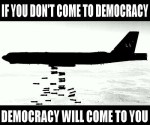
The question however is, what (if any) form is worthwhile having or is what we have worth keeping.
I ask this because we are now traveling in some of the Earth,s most unforgiving environments where consensus democracy is just beginning to take hold.
We are entering a period in the world thanks to Social Media where old grudges are arising to the surface and are now threatening to destabilize world peace.
We are also entering a biomedical and silicon society with the recombinant DNA enabling the manipulation of life as its genetic essence.
Physics and Math with the help of computer power is not only revealing how the world works but how the Universe was formed with magnificent and dangerous ways to exploit it.
Perhaps because we are the invasive species of all it’s time we have to ask ourselves is Science and the game changing technology collaborating to destroy democracy or enhance it.
Is it still true to say:
Compared to dictatorships, oligarchies, monarchies and aristocracies, in which the people have little or no say in who is elected and how the government is run, a democracy is often said to be the most challenging form of government, as input from those representing citizens determines the direction of the country. The basic definition of democracy in its purest form comes from the Greek language: The term means “rule by the people.” But democracy is defined in many ways — a fact that has caused much disagreement among those leading various democracies as to how best to run one.
Our governments have made education a chain and ball of debt that locks the mind into materialism.
Instead of looking after their citizens they put ( under the miss comprehension that growth will cure-all ) the Economy first when they should be hanging their heads in shame when one citizen through no fault of his or her own lives life and died in poverty.
There is little point in maintaining a nuclear deterrent if you have to live out you life on the bread line. What’s the point if you all but wiped out before the button is pressed.
I recently visited Singapore Zoo. The youngest zoo in the world.
It sported a simulated Rainforest, a tropical Polar Bear and hundred of school children which will never see any of the Zoo residents in the wild. I could not shake the feeling that I was looking at our feeble attempts to show what was left of values. Perhaps it is because I was seeing a generation becoming bereft of connection to nature.
The caused of our separation from all these things pervade every aspect of our lives.
The rise of personal computer in the form of smart phones solely promoting free-market capitalism rather than equality, and values that count.
Most of us in the west are crying to have our needs met, and eventually adapting to them not being met. Perhaps such an upbringing is necessary in our cultural democracy contex. We are prepared from birth for a competitive dog-eat-dog economy. That expresses itself in greed by the continuing the imperative need to convert all natural and social into money.
All aspects of our present day democratic culture conspire to strip us of our connection and belongingness.
Property rights, Surveillance, Debt based financial systems where money is scarce, religious indoctrination, a legal culture of liability, Racial, ethnic, national chauvinism, deskilling jobs hat leave us as passive helpless consumers of experiences.
An Internet of everything that most impertantly is a metaphysics that tells us that we are discrete, separate selves in a universe of others.
As this world of separation crumbles so will Democracy.
Because of the atmosphere of scarcity is everywhere everything must change.
To appreciate the sweep of change and magnitude you only have to look at Climate change (perhaps its time to put a monetary value on the sky and people will not treat it like a free dump.) and the billions being spent by the Candidates for the President of the USA.
Ted Cruz $65 million
Mareo Rubio $ 17 million
Jeb Bush $104 million
Ben Carson $39 million
Chris Christie $19 million
Donal Trump $6 Million
Hillary Clinton $100 million
Bernie Sanders $42 million
They are transforming modern-day American democracy into a form of theater and television ads. The correlation between big money has condensed democracy into buzzwords, glitz, the main currencies attracting attention on our television screens.
With the wealth of the 62 richest people in the word now standing at over $2 trillion which is the cumulative worth of the poor half of the world population we have Google, Facebook, Twitter and other Corporate giants building technologies with artificial neurons that can learn on their own.
These may in time exhibit intelligent behaviours virtually indistinguishable from those of its human masters.
The question is longer what phone should I get? It’s what ecosystem should I join if any as they could all become the same.
Privacy is going out the window.
There are vats of coli bacteria churning out medical insulin, plastic polymers and food additives that might go where they are not wanted.
Limited world resources and being snapped up by sovereign wealth funds and hedge funds.
Algorithms buy and sell share and currencies making a mockery of the stock exchange.
Fusion power is light years away.
Not everybody is happy with the high-tech changes.
The Web is weakened the foundation principles of Democracy or if not reshaping them.
Our World Organisation are out of date, setting in motion a sequence of events that will change the history of life which is one contingent tale, liable to be rerouted at anytime. ( See previous posts)
We left with the question can capitalism Democracy deliver change.
Not on its own as it is based on greed, power, corruption, non transparency, taxies, to name just a few of its ticking cogs. God forbid its is left down to this man.
There is only one way we can achieve a better world.
Scrap the United Nations which has become a begging Organisation of worthless resolutions.
Replace it with a World Aid Organisation that is financed by Capitalism with a 0.05% world aid commission on all High Frequency Trading, on all Foreign Exchange Transactions (over $20,000) and on all Sovereign Wealth Funds Acquisitions.
This would create an Organisation with genuine clout and save Democracy.
I hope this blog will awaken those who are not already conscious. All comments welcome.
It’s only right that I follow the last series of posts on what is Wrong with a post that asks the above question.
BECAUSE ITS MONEY THAT IS AT THE HEART OF THE PROBLEM.
I guess the answer to the question “What is wrong with capitalism today?” is dependent on who you ask.
Capitalism works for capitalists.
The Problem is 90 percent of us are not capitalists, we are employees.
Without us noticing, we are entering the post capitalist era.
We need to reexamine the models that have gotten us to this point.
Complete change will not happen overnight. Nor will it be built on the back of one investor or one innovative entrepreneur.
It will be something that business owners, investors, political leaders, consumers and entrepreneurs must all work together toward.
Currently, our planet is on track to fly past the 2 degrees Celsius warming that scientist have repeatedly warned marks the safe range for humans on this planet, but at the heart of further change to come is information technology, new ways of working and the sharing economy.
The old ways will take a long while to disappear but millions of people are beginning to realise they have been sold a dream at odds with what reality can deliver.
The democracy of riot squads, corrupt politicians, magnate-controlled newspapers and the surveillance state looks as phoney and fragile as East Germany did 30 years ago.
Why should we not form a picture of the ideal life, built out of abundant information, non-hierarchical work and the dissociation of work from wages?
So are we witnessing the first stage of an economy beyond capitalism?
Is technology creating a new route out or is it consolidating power into the hands of a few like Google, Microsoft and Apple?
Will its future be shaped by the emergence of a new kind of human being, reshaping the economy around new values and behaviours?
Will Capitalism as we know it be abolished by creating something more dynamic that exists, at first, almost unseen within the old system, but which will break through because of what Information technology has brought about in the past 25 years.
It is blurring the edges between work and free time and loosened the relationship between work and wages?
Or is the current wave of automation, currently stalled because our social infrastructure cannot bear the consequences, will hugely diminish the amount of work needed – not just to subsist but to provide a decent life for all.
These are all questions to be answered before we see what I call post capitalism.
The Questions are numerous, and there have been hundreds of books, papers, and talks on the subject few however with any positive suggestions.
Before I put the only suggestion that is viable lets start with what is wrong with the present state of Capitalism.
Here is way I see what is wrong;
Today capitalism isn’t about real markets and commodities with the price mechanism being fixed by competing supply and demand, now today it is about casino economics. You throw the dice and when you loose … all that global connectivity means you lose globally. We are all in this together – that is why we call it a global economy – oh apart from the 0.1% – they are the ones throwing the dice. We are just the ones picking up the tab when the bets don’t come off.
Although economics likes to think of itself as a science in reality it ignores the fundamental laws that govern science – the first two laws of thermodynamics. This isn’t a smart thing to do. There actually are limits to growth.
They told us wealth creation was a trickle down theory but in reality it is a trickle up theory. The rich really do get richer and richer and it is not down to merit. The question is what is going to stop them: war or politics?
The big problem is humans are human, both doing bad things and good things. Capitalism only works if enough of us do the right thing.
The price mechanism is faulty unless it includes the environmental cost now and in the future of our consumption. This it doesn’t done at present and we are free-loading off nature.
Often we think it is the only way to do things. It is not the only way to even do capitalism! Alternatives exist, other brands are available. There are even other ways of thinking about economics that we don’t even call capitalism; they may be a bit racy for us right now so lets start with re-imagining what a good effective form of capitalism could be like if humanity fully realized its role and impact upon the planet that sustains it.
Modern capitalism is so big and complex that who can say that really understand it.
I don’t.
But I do understand by building business models and share valuations based on the capture and privatisation of all socially produced information, Google and such firms are constructing a fragile corporate edifice at odds with the most basic need of humanity, which is to use ideas freely.
Never has humanity been better fed, lived longer, used more energy and had more stuff than today so what is wrong.
One of the fundamental faults of capitalism is the basic axiom that if everybody tries to accumulate as much property as possible the general interest of the people will be served.
All this seems to do is create exploitation.
The problem with capitalism is that it isn’t very good as what it says it is good at, spreading wealth, enabling good technological progress and helping us become more human, more free.
Adam Smith – you know him graces the back of the £20 note – founding father of modern capitalism back in the 18th century – hero of Margaret Thatcher. When he famously asserted:
“It is not from the benevolence of the butcher, the brewer, or the baker that we expect our dinner, but from their regard to their own interest.”
What Smith was talking about was the idea that self-interest – the rational underpinning of economic man – was not only good for you but for everybody else – society.
Unfortunately the line between self-interest and greed is always fine – and we are human man not economic man and we find it very easy to cross that line – or certainly some of us do – lets call them the 0.1% – the 700,000 of us who have a lot – somewhere north of $5 million each.
The consequence of this trend as it unwinds over time is that wealth progressively becomes concentrated in fewer and fewer hands.
The rich get richer – that’s that 0.1% again. Or to put it another way wealth stays with those that are born to it and the idea that merit – how good you are at something – determining your economical price in the market place, or wages as most of would say, becomes far less important than we thought.
In fact there are plenty of things wrong with capitalism.
Those that shout this apparent self-evident reality the loudest own the media, the means of communication, they own your stability through the derivative bets they hold and they are telling you don’t blink – this is the natural way of things , capitalism the way we see it, the way the 0.1% see it.
So the more we have of everything, food, power, stuff, the more energy we must use (even if we get more energy-efficient in doing things).
The nitty-gritty of it is we have fucked up the world with Capitalism idealism.
I don’t approve of Communism or Socialism either, the truth is that every system is flawed.
I think a system which is based on an assumption that man is basically piggish and therefore only fit to look after his own needs; such system impedes rather than promotes the good within each person.
Geographers have away of describing this situation it is called the IPAT equation.
Impact = population x affluence x technology. You note there is no Money in the equation.
The impact.
Physicists would call it entropy, biologists pollution and economists externalities – is of an order defined by how many of us are using how much however efficiently.
If you want impact in a nutshell it is climate change, it is salinization of soil, it is depleting geological resources , it is reducing biodiversity.
There really are limits to growth.
Capitalism is a perpetual motion machine, striving for more and more growth makes us in the long run weaker not stronger. Well, if only we were all-knowing, rational and optimal in our behavior maybe it would be so. But we are not.
In the past the trend towards greater and growing inequality has been neutered by war – nothing equalizes society more effectively than war – we do tend to be all in it together at such moments.
Today in our global economy is held together with a digital architecture that enables the reduction of wealth to so much digital code life has become one big transaction.
The most spectacular aspect of this transactional world is the derivatives markets.
(A derivative is a bet on a price changing within a market – say interest rates, or currency exchange values or a commodity price such as that for coffee. The value of all derivatives worldwide in 2013 is thought to be about $1.2 quadrillion although nobody knows exactly as, a like a lot ordinary betting the betters don’t want necessarily want to admit to it.)
So that is $1,200,000 billion laid out in bets about what may or may not happen.
Billions of transactions.
Let’s quickly remind ourselves. The global economy – the real economy – is worth about $85 trillion – that is about 7% of the notional sum bet on what that economy will do.
Now, take a deep breath and think about it.
If you don’t now believe that we could have another global economic crash in the style of 2008 – a massive bursting asset bubble – you need to think again and cast your eyes to Asia – you might be wondering where much of that quantitative easing – free money that the US and the UK created ended up. Try property speculation in Asia.
We are quickly reaching the tipping point where growth in GDP in any particular country comes at the expense of growth in GDP of another.
We do not have global organizations capable of managing these tension points nor are societies willing to curb growth and consumerism.
Capitalism as currently practiced is simply not sustainable.
Modern market capitalism has shifted recently with the emerging supremacy of money markets and the financial system over the actual trade of goods. Under this, you’ll make more money trading in derivatives than actually physically trading in commodities.
Capitalism, or the recent move into financial market dominated capitalism.
The “new capitalism” is based on mathematics rather than trade; credit default swaps over goods and services; when odds are stacked in the favor of big banks because of hedging, derivatives and CDS’s; when there is little to no penalty for market manipulation by investment banks, power brokers, Ponzi schemers … these inefficiencies in the market cause redistribution of wealth to the people in power who design the system.
The mass media is becoming more and more an opiate, an aid for living the unexamined life. replace it (capitalism)?”
Through the millions spent in lobbing reasonable controls upon business have been removed. The desire for economic success and the influence of the powerful elite have ruined the mass media.
Our political problems have deepened with the demise of unions as an effective political force, the continued growth in the belief in the desirability of pyramid economics and class structure (which has been sold by a media controlled by those at the top of the pyramid), and the dependence of our two-party system upon those at the top of the pyramid for funds to cover their election expenses.
Around the world the gains of increased productivity are wasted by this pyramid structure.
For over 40 years I have watched the gradual drift in the minds of the average person from an understanding of our political economic reality and the need for corrective actions.
Those who dominate the means for the production of ideas have served their class well.
This endless cycle of production and consumption for profit is suicide and profit is pretty pointless when we run out of things to burn and things to eat.
I would suggest a world government dedicated to seeing that: (a) everybody was properly fed, clothed, and housed; (b) everyone worked and received a fair return for their work with none receiving too much; (c) intellectual development for all to be encouraged; (d) businesses are the servant to man; (e) the production of war materials end; (f) the ending of all exploitation, including one region by another or one class by another; (g) and the ending of a press which is controlled by those who make up the ruling class.
We is needed is a project based on reason, evidence and testable designs, that cuts with the grain of history and is sustainable by the planet.
Capitalism is not and has never been designed to work in an environment dominated by market controls, regulations, artificial barriers to entry, monetary manipulation and a myriad of other government interventions.
It is Profit at any cost and having taxpayers bail it out when it goes wrong simply means the risk has shifted from corporation to state, or you and me.
Many would say that means a broken model.
Has a new model started. It all depends on what kind of capitalism we are talking about and what force will be applied either at the ballot box or on the barricades or by the Smart Phone or the Gun.
Another question raised about the proposed strategy is whether it actually adds up to the defeat of capitalism.
Do the numerous tactics described above, most of which focus on what not to do, really do the job? How will capitalism actually be defeated? It’s true that many of these recommendations are about what not to do.
this strategy calls for pulling time, energy, and resources out of capitalist civilization and putting them into building a new civilization. The image, then, is one of emptying out capitalist structures, hollowing them out, by draining wealth, power, and meaning from them until there is nothing left but shells.
To think that we could create a whole new world of decent social arrangements overnight, in the midst of a crisis, during a so-called revolution or the collapse of capitalism, is foolhardy.
Our new social world must grow within the old, and in opposition to it, until it is strong enough to dismantle and abolish capitalist relations.
Such a revolution will never happen automatically, blindly, determinable, because of the inexorable materialist laws of history.
It will happen, and only happen, because we want it to, and because we know what we’re doing and how we want to live, what obstacles have to be overcome before we can live that way, and how to distinguish between our social patterns and theirs.
To achieve change we need unlimited finance. Where can we find this? We don’t have to look far.
If a new socialist democratic system is to emerge:
We must place an World Aid Commission on all High Frequency Trading, on all Foreign Exchange Transactions over $ 20,000, on all Sovereign Wealth Funds Acquisitions. This will created a perpetual funded Fund to address the damage Greed and Profit for profit sake has done. ( See Previous Posts)
Who do we achieve this.
Our lives have been shaped by developments which most of us couldn’t have imagined a decade ago.
In effect, they are nine distinct psychological orientations toward the world that structure our perceptions, expectations, and demands whenever and wherever other human beings may be involved. These instincts represent our most basic assumptions about how the social world works, and that includes how the political world works.
With the power of our Smart phones the new political weapon of the future.
In the next decade upwards of 100 billion objects from smartphones to street lamps and our cars will be connected together via a vast ‘internet of everything’. This will impact every aspect of our lives.
The interfaces to all our devices from phones to computers, cars and home appliances will be highly intelligent and adaptive – learning from our behaviours and choices and anticipating our needs.
These days our Freedoms (which so many died for) are being eroded to the point where there is no such thing as Freedom in our Lifetime.In this post I am going to try to express what exactly personal Freedom is these days.
I am not going to exam the United Nations Declaration of Human Rights which has over 30 Articles, or what is left of free speech, or the Black freedom struggle, or woman’s struggle for freedom. Or the idea of free speech which is a view of freedom that is inseparable from the
political arena, flawed in theory and politicised in practice.
⌈ Human rights are rights inherent to all human beings, whatever our nationality, place of residence, sex, national or ethnic origin, color, religion, language, or any other status. We are all equally entitled to our human rights without discrimination. These rights are all interrelated, interdependent and indivisible.
Universal human rights are often expressed and guaranteed by law, in the forms of treaties, customary international law, general principles and other sources of international law. International human rights law lays down obligations of Governments to act in certain ways or to refrain from certain acts, in order to promote and protect human rights and fundamental freedoms of individuals or groups.⌉
All of which are impossible to implement, and has never been implemented anywhere historically – not even today, in liberal societies.
The freedoms that we once had are now dissolving because of the Internet, and the need for blanket surveillance due to fear mongering politics over terrorists plots ever since 9/11.
Our every move is tracked, we are under surveillance around the clock, our buying habits are logged, our preferences are hacked, and most of us don’t raise an eyebrow.
It is a mistake to think of a search engine as an oracle for anonymous queries they can set off a chain reaction that can have troubling consequences both online and offline. All this is because being online increasingly means being put into categories based on a socioeconomic portrait of you that’s built over time by advertisers and search engines collecting your data—a portrait that data brokers buy and sell, but that you cannot control or even see.
Our background and our relationships are becoming inescapable features of our human existence.
So what is freedom.
In the modern sense freedom is achieved by one’s individual nature, or inner voice. A sovereign self – a monological consciousness that fundamentally excludes the other.
However one can still be imprisoned by an oppressive internal forced liberation from an interior force.
So how can one reconcile two seemingly opposed senses of freedom?
One sense views freedom as bound and situated, while the other sense views freedom as liberation from such bonds.
What is required is a notion of self hood that recognizes and embraces both senses of freedom – to see the self not as an isolated and detached entity from the social world, but one that is deeply enculturated and dialogical while simultaneously liberated.
These are the limits, the boundaries, of what allow us to be free and for things to be meaningful.
So instead of viewing boundaries as something that disables our freedom, we should recognize that boundaries are what might actually enable our freedom.
The received ideas of our present-day institutions are composed of the religious, philosophical, economic, and political status quo.
The goal for each of us is to break free of these ideologies and re describe our world as a whole. This sense of freedom, which I referred to earlier as freedom-within-boundaries, is what ultimately makes possible a freedom-from-oppression.
If men wish to be free, it is precisely sovereignty they must renounce.
As Charles Taylor puts it, this sovereign and self-determining freedom characteristic of the modern individual “demands that I break the hold of all such external impositions, and decide for myself alone.
In this view, individuals could exercise their gifts and powers only by
participating in the common life.
That is to say, our freedom is contingent upon the greater public world.
Modern thought (especially evident in the political philosophy of Rousseau) externalized the source of oppression onto authoritative forces such as society, church, law, and government.
This is no longer true due to the indebtedness of the world.
At the expense of eliminating fundamental characteristics that make us human we are now confronting a world with unlimited new possibilities but having no meaningful boundaries.
Modern Social media come to see others as a part of – Us/Selfies.
Unfortunately this unchecked freedom is leading us to a void in which nothing would be worth doing, nothing would deserve to count for anything.
Life is dialogical by its very nature.
To live means to engage in dialogue, to question, to listen, to answer, to agree, to return to your own position, enriched. We need to identify with others in order to open ourselves up to new ways of being without forgetting where we come from to achieve any freedom.
In the past our background was essential to our identity. These days one’s uniqueness is maintained through continuous exposure to novelty in a consumer culture that thrives on the latest fad.
Is it this quantity of novelties that appears to take precedent over quality of relationships. So where do we turn for redescription of Freedom, to open us up to new and fresh ways of being human?
That can enable us to break free from our own pasts and increase our level of sensitivity and sympathy to those without freedom?
Is it severance from the status quo.
I fear that if you were to ignore you background, and try to break from your own past, “You would be crippled as a person, because you would be repudiating an essential part out of which you evaluate and determine the meanings of things. Our background, often times inarticulate and unformulated, carries the values and traditions that constitute who we are. This background is no longer not just our personal past and memories, but it may also be the lineage, tradition, and culture from which we have emerged.
Instead of dropping our historicity, we should be interested in owning up to the background and tradition that gives significance to our identity.
Meaningful freedom can only be achieved through enculturation.
Therefore, our freedom is bound in a sense, or situated in the environment that has shaped us, because that is likely to be the most meaningful environment to us.
Perhaps it is only in a bounded space that we can move about freely.
Fusion of horizons’ between ourselves and others..we must always have a horizon in order to be able to transpose ourselves into a situation.
Background is what initially provides persons with the possibility for understanding anything at all. Our background, or tacit knowledge of the world, is the horizon out of which things have meaning for us. It gives us our “referential context of significance.” A liberating freedom, which occurs when our world is enlarged not downloaded on to a data base.
Our identity is formed by the web of relationships that surround us. Therefore, it is precisely ourselves, which implies our background, that we must bring into the other’s situation.
The fundamental significance of language and conversation, and its ability to bring us closer to understanding one another is now rapidly diluted by technology.
We are not born precocial and fully hard-wired creatures.
Instead, we are born as incomplete beings, needing enculturation and society for healthy maturation.
Our biological need for one another requires certain physiological signals, that are not possible on the Web. Through facial expressions, infants learn to not only replicate another’s face, but to empathically feel what the face exhibits.
Biologists consider this skill of emotional matching to have been “crucial for escape from predation, foraging, hunting, and mass migrations” before spoken language entered our evolutionary history.
In spite of the modern liberating sense of freedom which may encourage isolation and detachment, we should also note that it can promote a healthy release from oppressive external forces. These forces can manifest in a variety of forms, everything from an abusive relationship to a manipulative religious group.
Emphasis on a socially dependent self can lead to passivity in daily life or submission to totalitarian regimes.
By being sympathetic we are capable of being liberated from ourselves.
On the other hand egocentrism shouldn’t be overcome at the expense of forgetting ourselves. So freedom is one that respects the boundaries of selfhood, instead of annihilating it.
Although we may be transported into the sandals of the Buddha, we still need to come back to our point of departure in order to be enriched.
Because in recognizing the necessity of one’s interpersonal relationships, social and moral commitments, culture, tradition, memories, and of course, biology as constitutive of one’s experience of liberation.
Freedom doesn’t necessarily mean fleeing to a new land. It can also mean discovering the oceanic depth of a single, bounded situation. And this entails having new eyes. Remember, “Life is immense!”
We are free to become authentic only after we accept our boundary, which is our finitude.
Death is the ultimate boundary of human existence, it is only by facing up to this limit that we are capable of becoming truly authentic Free.
Where the mind is without fear and the head is held high;
Where knowledge is free;
Where the world has not been broken up into fragments
by narrow domestic walls;
Where the words come out from the depth of truth;
Where tireless striving stretches its arms towards perfection;
Where the clear stream of reason has not lost its way
into the dreary desert sand of dead habit;
Where the mind is led forward by Thee into ever-widening
thought and action–
Into that heaven of freedom, my Father,
let my country awake.
–Guru Rabindranath Tagore
National Poet, Freedom Fighter
The Internet’s impact on culture, business, and politics is vast, for sure.
It is becoming a bigger part of our lives everyday, making life more convenient but also taking away the human element of living in the moment and making relationships more superficial.
But where actually is it take us?
To answer that question is difficult, because the Internet is not simply a set of interconnecting links and protocols connecting packet switchednetworks, but it is also a construct of imagination, an inkblot test into which everybody projects their desires, fears and fantasies. Some see enlightenment and education. Others see pornography and gambling. Some see sharing and collaboration; others see e-commerce and profit.
The purpose of this post however is not to highlight all that the Internet has achieved or all that it will achieve.
It is to ask the question is it good for a Democratic World.?
We know that it is exposing Capitalism for what it is and Communism for what it wants, along with the comity of Nations. It is making us ask what a well-functioning democratic order requires.
It is creating a world people’s voice that could be manipulated in the extreme.
You might think with all the other problems the world faces this it is of little importance. You would be wrong as it is shaping the Future.
As a result of the Internet and other technological developments, many people are increasingly engaged in a process of “personalization” that limits their exposure to topics and points of view of their own choosing.
The growing power of consumers to “filter” what they see and the servers to dish up what they want you to see is from the standpoint of democracy, a mixed blessing.
But in a heterogeneous society, such a system requires something other than free, or publicly unrestricted, individual choices. Without shared experiences, a heterogeneous society will have a more difficult time addressing social problems and understanding one another.
People should be exposed to materials that they would not have chosen in advance.
As a matter of technological feasibility, our communications market is moving rapidly toward this apparently utopian picture which is a far cry from reality.
It is happening on the Internet where private corporate interests rule, money calls the shots, and we the people are seen as mere subjects to be controlled.
We are moving into “Corporatism which is the halfway point on the road to full-blown fascism.
Consider this: It is estimated that the 2016 presidential election in the USA could cost as much a $5 billion, more than double what was spent getting Obama re-elected in 2012.
We are allowing ourselves to become fearful, controlled, pacified zombies, Screen watchers.
The internet is introducing a system of perfect individual control reducing the importance of the “public sphere” and of common spaces in general. It is increasing people’s ability to wall themselves off from topics and opinions that they would prefer to avoid.
I am sure that if new technologies diminish the number of common spaces, and reduce, for many, the number of unanticipated, unchosen exposures, something important will have been lost.
Because the Internet has changed the quantity and range of information available to citizens, it directly influences how societies evaluate government performance—in all parts of the globe.
It is Changing Democratic Attitudes throughout the World.
It is altered the informational relationship between governments and their citizens.
In how information is packaged, how that information can be physically transmitted and the networks that determine who can send and receive those transmissions. This has meant the largest decentralization in communication capacity and increase in expressive capacity that we have ever seen in human history—particularly in nations where access to political information tended to be very limited, often due to strict government censorship of traditional media.
Thus, the expansion of the Internet has significant ramifications on the amount and type of information that individuals use to evaluate their governments.
The global nature of the Internet opens a larger window for individuals to better view how governments function in other countries, particularly the advanced democracies that are most visible on the Internet. This provides users with a more realistic and globally consistent scale by which to make comparative evaluations about how well their own government functions.
As a result, the Internet is playing a central role in shaping the political evaluations and resultant satisfaction that citizens have toward their governments.
This is significant because the impetus to act politically—from day-to-day civic activities to the more extreme cases of protest and revolution—begins in the minds of men and women.
An understanding of this mix will permit us to obtain a better sense of what makes for a well-functioning system of free expression and to address the serious dangers that are hidden within the Internet.
For example the creation of perfect and splendid isolation, or a process of getting over disagreements, or the undermining our values to the detriment of the all of us.
The reasons why the Internet is supposed to strengthen democracy include the following.
1.The Internet lowers the entry barriers to political participation.
2. It strengthens political dialogue.
3. It creates community.
4. It cannot be controlled by government.
5. It increases voting participation.
6. It permits closer communication with officials.
7. It spreads democracy world-wide.
In contrast, the Internet, far from helping democracy, is a threat to it precisely because the Internet is powerful and revolutionary, it also affects, and even destroys, all traditional institutions–including–democracy.
To deny this potential is to invite a backlash when the ignored problems eventually emerge.
So why will there be problems?
Because more than half of communications traffic is data rather than voice.
Because it has been liberated from the terror of the PC as its gateway into the world of Smart Phones.
Our smartphones have become Swiss army knife–like appliances that include a dictionary, calculator, web browser, email, Game Boy, appointment calendar, voice recorder, guitar tuner, weather forecaster, GPS, texter, tweeter, Facebook updater, and flashlight.
Because a politically disenfranchised digital underclass is emerging.
Because with the commercialization of the Internet things previously unreachable are now available through our personal computers.
Because cars will be chatting with highways. Suitcases will complain to airlines. Front doors will check in with police departments. Pacemakers will talk to hospitals. Television sets will connect to video servers. Keeping this aggregated information in the cloud allows researchers and developers to examine the data and identify “digital bio markers” to inform prevention, diagnoses and treatment in a constellation of brain and mental disorders that are now mostly defined by subjective symptoms.
Because it is making Politics More Expensive and Raise Entry Barriers.
Because it is making reasoned and informed political dialog more difficult.
Because it disconnects as much as it connects.
With the increase of smartphones in recent years many have all griped about the narcissism of people who spend all their time on social networks, text messaging at a dinner table or taking photos of the food they eat.
Because it is facilitating the International Manipulation of Domestic Politics.
Because it will essentially making the world a global village with vast deserts of highly visible inequalities which would not be possible without the internet.
And this is why ubiquitous, scalable technology such as the Internet must be part of the solution if we are to avoid an information-choked societies.
Because it is creating a mental fog or scrambled thinking in a kind of weird, impersonal cyber way.
Constant multitasking is taking its toll.
Although we think we’re doing several things at once, multitasking, this is a powerful and diabolical illusion. Ironically, multitasking makes us demonstrably less efficient. The flow of information can be overwhelming and lead to “paralysis by analysis.” Chronic multi-tasking can make us less productive, not more. Increased choices and uncertainty can lead to increased stress and anxiety.
Because it is causing fragmentation, increasing cost, and declining value of “hard” information. Our brains are busier than ever before. We’re assaulted with facts, pseudo facts, jibber-jabber, and rumour, all posing as information.
Make no mistake: email-, Facebook- and Twitter-checking constitute a neural addiction.
It’s naïve to cling to the image of the early Internet – – nonprofit, cooperative, and free.
You might say that the CONTROVERSY ITSELF is superficial; as the obvious reality is the internet and technology are not only here to stay, but constantly evolving and permeating more of our lives.
The real conversation should be how we can best use the Internet in smarter ways that help us to monitor and enhance the brain, and how can we actively prepare to manage information overload.
“Big Data” applications are becoming available and capable of helping personalize brain health tools at the individual level, based on both past data and information gathered over time. This, in turn, is already changing research and preventive health practices. Tablet-based screenings can be instrumental in diagnoses of Alzheimer’s and MCI.
Mobile devices are already entering the sports world, with cognitive tests for concussions. Institutions like AAA have begun large-scale web-based assessments and cognitive training that works on driver’s cognitive skills in order to become safer (and less expensive to insure) drivers.
Now, every new technology presents a fair set of challenges. It is important to note that these are quasi-universal features of modern life, not the type of conditions of disorders that our medical system is set up to address.
There is talk about how social networks and new devices like the Google Glass visor have diluted privacy, smart phone apps “turning us into sociopaths” and the danger of turning over our daily routines to new technology like Apple’s Siri digital assistant.
The trick will be in properly preparing and guiding people to adapt to the mental demands of a modern society. Fortunately it is us, not the Internet, who have a plastic and resilient brain.
My conclusion is that information does not necessarily weaken Democracy or the state but electronic voting will not strengthen democracy as it will be manipulated by Big data.
So is the internet good for the brain?
If the analytical and collaborative power of the internet is used properly to monitor and enhance brain functionality in a cost-effective, scalable manner the answer can be a resounding “yes”
At the moment it is having a negative impact on our societies having a polarizing effect on democracies. Although it has the capacity to bring people together, too often the associations formed online comprise self-selecting groups with little diversity of opinion.
Free speech on the Internet is not enough to ensure a healthy democracy. The conception of free speech emerging in today’s communications market emphasizes “an architecture of control…by which each of us can select a [customized] free-speech package.”
Google News feed filters out the information we receive. It is a product of what information we demand.
We should create twenty-first-century equivalents of the kinds of public spaces and institutions where diverse people will congregate.
If we are to avoid western democracy being hobbled by disengagement, falling turnout, and disconnection with citizens we must counter the growing power of consumers to “filter” what they “see” will create information ghettos and isolated citizens.
The Internet changes expectations. The Avaaz 41 million-strong online internet community is a prime example.
It lowers the economic and information cost of group formation and the internet lends itself to this type of direct connection, and hence is likely to create demands for more direct forms of democracy. But the way the Internet empowers people – by giving them huge choice over the information they receive – can make them less likely to engage in a free debate of ideas.
Why?
Because there will be neither leaders nor agendas to make Governments sit down with their detractors.
Citizens can use new media to avoid, rather than embrace, new ideas or common experiences.
The Internet, as a highly democratic and participatory medium, can perform democratic wonders. But the bien pensant e-Democracy consensus is wrong and dangerous if it thinks this will happen automatically. All of these facets are critical if we are to thrive at a human.
After seven or eight post on Nuclear Weapons its back to what’s wrong with Capitalism/ Democracy.
Those of you that have been reading my blog will have already seen that I have advocated that Greed is the root problem when it comes to both the above.
I have suggested that we need to come together through Social media to stop Sovereign Wealth Funds privatizing the resources that we all rely on. To stop Computer Algorithms from plundering the Foreign Exchange, Stock Exchange, not to mention E Bay Auctions.
I have also stated that this is impossible, but that it is not impossible to place a 0.05% WORLD AID COMMISSION TO CREATE A PERPETUAL SOURCE OF FUNDS TO REMOVE INEQUALITIES IN THE WORLD.
Unfortunately to date most of my readers are to busy living their lives to engage in developing such an idea other than pressing the like button.
Not to despair. Today, we are living in the age of globalization and technological revolution.
Both have delivered much benefit to society, but have reshaped the political economy of western industrialized countries in ways that challenge the middle class and those striving to get into it.
THE TROUBLE FOR CAPITALISM IS THAT IT HAS SOMEHOW OR OTHER STOPPED SERVE THE VAST MAJORITY OF SOCIETY AND IT IS THEREFORE TURNING – DEMOCRACY INTO WORTHLESS VOTES – that are now turning to Internet Petitions and reality TV.
This sea change has been facilitated by technology that has loosened the connections between top management and ordinary workers. Corporations have become less committed to their work forces and their communities.
Institutions on all levels are deeply mistrusted by the public. However, part of that mistrust has developed precisely because both government and business have failed to offer broadly shared prosperity. Today, the ability of free-market democracies to deliver widely shared increases in prosperity is in question as never before.
So how do we create a stronger, fairer, and more sustainable economic model in which the many and not just the few benefit from rising prosperity now and into the future?
This is not just a question for governments but for companies and citizens as well.
My first contention HAS NOT CHANGED it is impossible to remove Greed but where we see profit for profit sake we should cap it.
We all know what is wrong, but just in case you are a Politician: It is the GROWING GAP BETWEEN THE HAVE AND HAVE NOT’S ( NOT MONEY BUT INEQUALITY OF OPPORTUNITY)
Confidence in government is at an all-time low, and consequently, the public resists intervention by a government it viewed as incapable of solving its problems. This forces families that could benefit from public support to face the challenges of the evolving economy on their own. It is a vicious cycle — and a cycle we can and must break by renewing confidence through a government that works effectively and efficiently for its citizens.
SO WHAT CAN BE DONE?
While some on the left seek to turn away from globalization and technology, that is not a realistic option. No country can prosper in isolation.
Those on the right who argue for a return to laissez-faire, trickle-down economics — cutting taxes at the top, stripping out regulation, and making deep cuts to public services — do not provide a viable alternative.
Developed countries cannot succeed through a race to the bottom in which companies simply compete on cost as workers see their job security erode and their living standards decline. When democratic governments and market systems cannot deliver prosperity to their citizens, the result is political alienation, a loss of social trust, and increasing conflict across the lines of race, class, and ethnicity.
HERE IS WHAT I SEE THAT NEEDS TO BE ADDRESSED.
1) There are still too many people who are unemployed.
2) Minimum wages have lost their real value.
3) Workers must benefit from increased productivity rather than seeing returns accrue primarily to shareholders.
4) Remove barriers to women’s labor-force participation, such as inflexible work environments and high-cost child care.
5) Focusing on early childhood education, increasing the quality of our schools, eliminating financial barriers to higher education, and providing support for apprenticeship programs are all critical to driving higher skill levels across economies in both tradable and non-tradable sectors.
6) Cities and regions must be given the tools to make their own local decisions to help drive growth.
7) Increasing numbers of workers find themselves in contractual relationships that do not guarantee hours worked or provide benefits such as paid vacation, sick days, or pension benefits. No hours contracts are slavery.
8) Large corporate attention has shifted to financial engineering, particularly with the goal of minimizing tax payments. Restoring the integrity of corporate taxation will require more than a simple reversal of the policies of the past 30 years. It will require governments to develop a taxation system that can withstand the pressures of a globalized economy, promote long-term investment, and provide a stable, fair, and predictable policy framework for businesses.
9) Create Profit-sharing and share-ownership schemes provide a direct way to ensure that employees have an incentive to help their company to succeed.
10) Raising skills levels.
These challenges are formidable, but they must be met, and any politician worth his privileged position would do well to take note.
These are essential for democracy itself. Advocates and apologists for anti-democratic regimes argue that the democracies are no longer capable of managing their problems or creating a sense of social dynamism. For democracies to thrive, rising prosperity must be within reach of all citizens.
The profound technological changes that brought down the cost of many goods and services are also replacing traditional middle-income jobs. It is changing balance of economic power away from domestic workers and toward mobile, international corporations.
Internet and computer technology has made cross-border business organization less costly and more efficient, it has become easier for businesses to outsource or relocate all or part of their operations to countries where wages, labor, and environmental standards are low.
In addition to unskilled labor — which has, in some cases, been squeezed by globalization and off shoring –advances in robotics and artificial intelligence have put intermediate-skill jobs at risk in what economists call a hollowing out of the labor market.
This trend is set to continue with 3-D printers, Google’s driver less cars, and Amazon’s drones. This is creating an even greater premium on higher levels of skills and qualifications, making the returns from ideas, capital, and top-class qualifications greater and greater.
Employment is less likely to be stable or long term.
Powerful forces of globalization and technological change must be navigated or inequalities will continue to widen, and for many, precarious low-skill work will increasingly become the norm. The consequence is that growth will stall.
Finally, it is essential that markets work in the public interest and for the long term rather than focusing only on short-term. Infrastructure investments deteriorating facilities, unpredictable service disruptions, congestion, and higher costs to businessesj and households is the result.
In summary, declining growth, the effects of the financial crisis, and increasing inequality have combined to put substantial economic stress on middle-and low-income families across the developed world.
Poor policy choices have only made matters worse. Concerns about financial instability, immigration, and tax avoidance are not the causes of our problems they are fruits ripening on the tree.
To ensure that all of society’s citizens have a stake in prosperity, and therefore all of citizens have a stake in the future we need new social and political institutions to make 21st century capitalism work for the many and not the few.
( If you are English reading this blog feel free to forward this post to your candidate in the forthcoming General Election.)
The global economy has fundamentally changed over the past 40 years.
As communism collapsed and countries gradually liberalized their economies, rapid reductions in poverty and increases in living standards have taken place in Asia and especially China, in South America, and in Eastern Europe, with growth increasingly taking off in Africa. Some of those countries that have produced economic growth have done so in a manner that has left most of their citizens no better off.
This is an economic problem that threatens to become a problem for the political systems of these nations — and for the idea of democracy itself.
Governments in developed countries must stay open to the world, seek new trade deals and regional partnerships, and continue their commitment to a dynamic market economy. While the economic mission of progressives is unchanging, the means of its achievement change from generation to generation as the economy evolves.
We need a smarter, and fairer society that returns to long-termism which will not only meet our fulfillment of environmental commitments, but will created a world worth living in.
Inclusive prosperity nurtures tolerance, harmony, social generosity, optimism, and international cooperation. Left to their own devices, unfettered markets and trickle-down economics will lead to increasing levels of inequality, stagnating wages, and a hollowing out of decent, middle-income jobs. This outcome is morally wrong, economically myopic, and at fundamental odds with a democracy in which everyone quite reason- ably asks for an equal chance to succeed.
understand and can respond to voters political systems restore their vitality and reclaim their ability to deliver on the promise of prosperity for all.
As far as I know I have written on this subject before.
Although Democracy may be a universal aspiration it is a culturally rooted practice.
Perhaps it time to recognize that its aspirations (especially presented by American Democracy which is for sale by lobbyists and donors) is not an expression of free speech and is causing extremism.
Here is short overview at where we at.
The Euro was introduced by technocrats in 1999 only two countries held referendums Sweden and Denmark both rejected it.
Italy and Greece have replaced democratically elected leaders with technocrats.
The European Parliament is both ignored and despised. It is a breeding ground for extreme parties such as Marine Le Pen’s National Front in France, Golden Dawn in Greece ( A Nazi Party) U KIP in England, a Raciest party hiding behind the very word Democracy. There are plenty of other examples.
Democracy is clearly suffering from serious structural problems which can be seen in its institutions that are meant to provide models for new democracies.
It has been infiltrated by big business money with voters becoming if not all ready disenfranchised.
Globalisation is and has changed national politics.
More and more power is surrendered to trade and financial flows resulting is Manifesto promises not been kept. Not surprising.
Single countries can not deal with Climate Change never mind micro powers within their boundaries which are disrupting traditional politics. (NGO’S , brake away’s such as Catalans, Scots, city mayors etc.)
The Internet is making it easier to organise and agitate while people are vetoing on reality TV. With a click of a mouse you can support a petition.
Elections are no longer the biggest challenge to Democracy the deficits are.
France and Italy have not balanced their budgets for more than thirty years.
England and America can only watch as their debt clock tick fast and faster fostering unsustainable. While Sovereign Wealth funds compete for limited resources world-wide.
In the mean time Western population are getting older and more expensive creating a future between inherited entitlements and future investment.
World wide membership of political parties is falling. (1% now compared to 20% in 1950 in England.) More than half of the votes in Europe have no trust in their Governments. 62% of English votes consider there politicians to be liars. A quarter of the votes in Italy recently voted for a party founded by a comedian. In Iceland they voted in the Best Party to run the Reykjavik’s city council a party that openly proclaimed itself to be corrupt.
Across the water President Obama can even pass a budget, paralysed by 9/11, rogue regimes and Jihadists he has no choice but to swallow the ISSI Pill and look on while Mr Putin calls the Worlds bluff.
Not good reading any of it.
So the questions is what can be done. Here a few suggestions.
Change the vote system to reflect the people and not Majoritarianism.
Put limits on the power of Governments, by written constitutions that reflect the rights and protects individual rights.
Stop Corruption by Lobbyists.
Up date our world Organisations.
Name all donors to Political parties.
Stop handing or selling off resources to profit.
Introduce Fiscal legal rules to balance the budget.
Transparency.
Introduce e Democracy to create direct democracy where the Government is obliged to consider any citizens initiative that attracts 50,000 signatures.
Cap Greed ( See previous Posts)
Democracy has always been a powerful but it has always been imperfect due to human creativity and perversity. It will remain so till we remind our leaders that they only borrow power.
With the state of the world and where it is going we are already in need of bright ideas.
This subject has vexed many a mind, and will continue to do so for yonks with no solution.
Capitalism is paraded as the indomitable system that brings prosperity and democracy, the system that would prevail unto the end of history.
Is there is no alternative to market society, or capitalism, and to democracy neither.?
If you’ve ever pondered the issues surrounding the tenuous relationship between democracy and capitalism, most likely, you’ve considered them as both foreign and abstract (much as the elite media oftendoes).
Most of the world is capitalist, and most of the world is neither prosperous nor particularly democratic. In fact, we must question the very possibility of genuine democracy in a society in which capitalism is the basic economic system real democracy is absent in both.
Democracy is now more than ever under threat from a variety of forces originating in the transnational capitalist economy.
V
Are, say, China and Russia authoritarian, capitalist or both at the same time? Can Middle Eastern countries use their sovereign wealth funds to build prosperous free-market economies while those nations also deny their citizens basic freedoms? Do transnational corporations that operateunder the aegis of repressive regimes prove that capitalism can exist wholly without democracy?
The challenge of resolving these conflicting views is perhaps the most fundamental issue facing the world apart from Climate Change which they both created in the first place and now has the potential to destroy them both.
For a quarter of a century, we have tried the approach of polite incremental change, attempting to bend the physical needs of the planet to our economic model’s need for constant growth and new profit-making opportunities. The results have been disastrous, leaving us all in a great deal more danger than when the experiment began.
Free markets were supposed to lead to free societies. Instead, today’s supercharged global economy is eroding the power of the people in democracies around the globe. Welcome to a world where the bottom line trumps the common good and government takes a back seat to big business.
The savage global capitalism we have today is already entering into crises that will create enormous social and ecological damage, some of which is already obvious. In the corporate world of “free-trade,” the number of billionaires is increasing faster than ever while the number of people living in poverty is growing at a faster rate than the world’s population.
Poverty spreads as wealth accumulates.
Finding new ways to privatize the commons and profit from disaster is what our current system is built to do; left to its own devices, it is capable of nothing else.
Taxpayer-sponsored bailouts of — and direct subsidies to — particular politically connected industries effectively employ our democracy’s public power to undermine capitalism’s notion of “creative destruction. Which leads me to wonder then, why aren’t people (like you?) who claim to align themselves with democratic ideas and ideals insisting on it at every turn and railing against all the non-democratic and anti-democratic systems and structures that stand so obviously behind this thin façade called social democracy?
In a democracy, the social contract is ours to forge and ours to live. Our freedom of thought and action to pursue happiness liberates us from a life of slavery to someone else’s ideals. But nothing comes for free, and to say yes to something we usually need to say no to something else. This leaves us with a few choices: what do we do as individuals–how can we become the change we wish to see in the world?
Democracy isn’t a difficult concept to grasp and it doesn’t require specialist knowledge or years of education to be practiced – in fact, illiterate and uneducated people can ‘do’ democracy just as well as the most scholarly…it’s a great leveler in that respect.
So why is that democracy must be diluted and subverted, smothered with disinformation and media puffery.
Perhaps it is because a populace with high expectations about its standard of living and a keen sense of entitlement, pushing for continually better social conditions, is not the plutocracy’s notion of an ideal workforce and a properly pliant polity. Corporate investors prefer poor populations. The poorer you are, the harder you will work—for less. The poorer you are, the less equipped you are to defend yourself against the abuses of wealth.
If you want an example just look at what is happening in the USA where capitalism is wedded to democracy,
It costs approximately $1 billion to become president, $10 million to become a Senator, and $1 million to become a Member of the House.
These conditions have corrupted American democracy, turning it into a system of rule that favors the wealthy and marginalized ordinary citizens. This is why corporations are now citizens, money is political speech, limits on corporate spending are a form of censorship, democracy is a free market, and political equality and democratic integrity are unconstitutional constraints on money in politics.
Don’t tell me that this is not reflected in the European Union.
Taking a step nearer home we see another fine example in the recent referendum on Scottish Independence. Where the sense of Nationhood became blurred in the face of Capitalism. Hopefully it’s knock on effect will see the replacement of the first past the post system of election in the UK which is designed to blunt the impact of popular demands. Conservative forces continue to reject more equitable electoral features such as proportional representation. They continue to create barriers to voting such as electrical boundaries while rolling back democracy’s social gains, such as public education, affordable housing, health care, befits, collective bargaining, a living wage and immigration.
We can have democracy with wealth concentrated in the hands of a few. You can have one or the other.
The case for free market capitalism is one of efficiency.
Interference is a burden and drag on performance that generates cost to all of us and thereby limits how well and how quickly we evolve.
Capitalism essence is the transformation of living nature into mountains of commodities and commodities into heaps of dead capital. When left entirely to its own devices, capitalism foist its diseconomies and toxicity upon the general public and upon the natural environment–and eventually begins to devour itself.
The immense inequality in economic power that exists in our capitalist society translates into a formidable inequality of political power, which makes it all the more difficult to impose democratic regulations.
We are subjected to power, as opposed to being the rightful and democratically empowered wielders of power… Are ‘modern societies’ necessarily democratic societies and capitalist (or: market) societies?
Take of instance the conflicts that have arisen in our societies in recent years—the backlash over globalization, the financial crisis, the European debt crisis, and many others—have parallels in history that led to global conflagration.
Worse still, the government bailouts are themselves being turned into an opportunity for pillage. Not only does the state fail to regulate, it becomes itself a source of plunder, pulling vast sums from the central bank money machine, leaving the taxpayers to bleed. We now have banks and their share holders anticipating fines, setting aside large sum.
Free-market corporate capitalism is by its nature a disaster waiting to happen.
The pressing questions are:
How or should we stop the capitalist system from devouring itself?
How can we promote a fair allocation of benefits and burdens.
How can we affect the changes in the social contract that will achieve the objective of social and economic fairness for which we can all subscribe?
How can we become the best we are capable of becoming and what changes to our economic system and our systems of governance are necessary to achieve that across society without undermining the real benefits to society of property rights and the freedom to contract?
How do we contract the in sustainability of the lack, or weakness, of comprehensive regulatory mechanisms the revival of the nation-state as the political form that created the historical possibility of inclusive collective self-determination. While remembering that together with basic human rights, property rights and the freedom to contract have done more to advance mankind than any other force in history to date.
As you see it’s almost impossible to separate one from the other. Both are contaminated by each other.
We can choose to be audacious enough to take responsibility for the entire human family. We can choose to make our love for the world be what our lives are really about. Each of us now has the opportunity, the privilege, to make a difference in creating a world that works for all of us. It will require courage, audacity, and heart. It is much more radical than a revolution – it is the beginning of a transformation in the quality of life on our planet.
Capitalism excludes workers from deciding what is produced, how it is produced, where it is produced and how profits are to be used and distributed.
Good government must be able to create strategy for where our society should be heading and plans to get there for the common good of the people, future people, and the planet – all about true sustainability.
Private companies may fill a role to provide goods and services to fulfill that strategy within the plans.
So the question is.
Will the social progress of the twentieth century be preserved as we return to the wealth disparities of the eighteenth century? And will reform be impossible – is this tyrannical system now essentially permanent?
Imagine a country where the majority of the population reaps the majority of the benefits for their hard work, creative ingenuity, and collaborative efforts. Imagine a country where corporate losses aren’t socialized, while gains are captured by an exclusive minority. Imagine a country run as a democracy, from the bottom up, not a plutocracy from the top down.
It is my belief that no matter how we address the subject mans greed will never be removed.
There is only one solution and that is to tap into profit.
This can be done by creating a World Aid Commission of 0.05% on all Foreign Exchange Transactions (Over $20,000) on all Foreign Wealth Funds Acquisitions and all High Frequency Transactions.
( Foreign Exchange Transactions are 3 Trillion a day.
Marauding Sovereign Wealth Funds are tapping directly into the money streams of the world economy itself.
High frequency trading is secretive and mysterious. It rigs the markets in favor of the big guys with data cables. )
Such a Commission would create a perpetual fund of billions to tackle the world problems.
Will the Capitalistic world or any of our Democrat world leaders adopt such a commission. Of course not. So how can it be achieved?
When I started this blog it was my mission to use the power of Mobil/Smart phones to effect change. If we were to use our phones to send the United Nations millions of Twits/e mails requesting a people resolution to implement the Commission they would eventually have to table it as their communications could be jammed ever time we flooded their Organisation with the request.
The power of the mobile phone is only in its Democratic infancy.
You have the power to fire the shot heard ‘round the world.
This site might interest you: http://www.democracyatwork.info/
As America winds up its 13-year war in Afghanistan, where do things stand?
Is it going to end up like Vietnam, won the battles, but lost the war.
That’s the take-away of the last ten years for me.
The public now have a perception that the war is over, because of the lack of media coverage which fuels the public’s perception, it’s becoming a check-back-in-and-see story.
Not too long ago the word “Afghanistan” was mentioned in the media almost every day, coverage now is that it barely make a blip on the media’s radar unless something big happens, a horrific event. The weight of media coverage has been drawn elsewhere.
This war was and is an abomination.
In addition to the thousands of US and other NATO troops who have been killed or impaired for life, physically and/or mentally, the US-led invasion/occupation of Afghanistan has resulted in a huge number of Afghan casualties, with estimates running from several hundred thousand to several million.
Afghanistan is already a distant memory for the news. It is fast becoming the all-but-forgotten war an afterthought, like Somalia, Panama, Colombia, Rwanda, Iraq after the first gulf war–countries that quickly faded from the news or hardly made the headlines in the first place.
In late February that Afghan President Hamid Karzai (at least we all remember him) came to Washington to deliver the message “Don’t forget Afghanistan.”
Afghanistan now has democracy, and the results are not altogether encouraging; nor are they likely to lead to cohesion and peace and prosperity. Many Afghans see their current government, hastily formed under US influence, as a continuation of the power and impunity of warlords rather than a reflection of true democratic participation.
Deaths among Afghan National Security Forces almost doubled from 2012 to 2013, according to RT.com. The Defense Department announced in November that the death rate among Afghans rose to above 100 per week during the peak of the summer fighting season for the first time ever. Last week, al Qaeda claimed control of Fallujah, the town in western Anbar province where scores of Americans lost their lives in house-to-house fighting in 2004.
So why are we losing interest.
Is it because the war has never being legally justified, therefore, the war in Afghanistan has never been morally justified.
Or is that our perception of the Afghan government is still corrupt and unjust has impeded long-awaited peace and well-being in Afghanistan.
Or perhaps we are being keep in the dark on purpose so as not to hand a psychological victory for an Islamist movement who will claim they defeated the U.S. like the Soviet empire.
Or it is more likely that our vital interests in Afghanistan are limited and military victory is not the key to achieving them.
The big questions remain over how much the U.S. will continue to be involved there to provide support to Afghan forces, and how stable Afghanistan is. Will it again become a threatening hive of terrorist activity? Will the years of fighting there be considered to have been worth the cost, in both human lives and the billions of dollars spent?
What is the use of waging a lengthy counterinsurgency war in Afghanistan which may well do more to aid Taliban recruiting than to dismantle the group, help spread conflict further into Pakistan, unify radical groups that might otherwise be quarreling among themselves.
When the US leave, whenever that might be, what happens if the Taliban regains control? U.S. presence hasn’t intimidated the Taliban, and when American troops leave, whether it’s 2014 or 2024, Afghan forces will inherit a huge task in trying to stabilize the country and keep the Taliban from gaining ground. Continued U.S. military presence hasn’t worked so far, it might not work in the future. And since it’s highly unlikely that American troops will remain in Afghanistan forever.
Where do we stand?
People are still dying in Afghanistan. The fighting is not over and it won’t be over once U.S. troops leave. Afghan forces will still be up against the Taliban, but they would be in a much more advantageous position if the U.S. worked to set up institutions through which the country is able to sustain itself, not just in the immediate aftermath of troop withdrawal, but well into the future.
It’s obvious to anyone that the effects of war are devastating.
If I were a betting man there is a collision coming, one-third of those Afghan Security Forces trained at fabulous expense to protect them will fight for the government (whoever that may be), one-third will fight for the opposition, and one-third will simply desert and go home. That sounds almost like the plan.
But this time there will be little or no Media coverage as the war has already displaced Afghans from their homes and from their country for over three decades creating over 5.7 million refugees.
So don’t be amazed when the US lead war has no lasting influence other than long-term ramifications for possible terrorist attacks against the U.S/UK and the spread of Islamic fundamentalism and rage, destabilizing the whole region of years to come – ISIS.
The West is a paper tiger like bin Laden said and it’s only a matter of time.
Afghanistan will not be unable to recover from 20-plus years of conflict. In order to do that they have to believe in something first and be willing to assert that.
Governments cannot really do this; only people can. This is what happens when cultures come together, like in Andalusia. It’s messy and chaotic and sometimes violent. … There is a ton of risk involved, but the payoff is huge. This is when cultures come together and new ones are created. This is the risk that Hellenization embraces—that people can engage on this level without reflexive recourse to violence. This is the how cultures engage.
“Meanwhile, in other news,”
We have not apprehend the terrorists responsible for the 9/11 attacks.
Far too big a subject to be addressed by my comparatively little brain or written about in a few hundred words. However we all know that stifling free expression is counterproductive.
So is Freedom of expression still a universal human right?
Is it the lynch pin of democracy?
The Internet is by its very nature border less, but it is still intimately connected to the physical world, and as such to the territories of sovereign nation states.
Therefore, states can significantly influence the free flow of information, expression and free speech.
An open and free Internet is a key means by which individuals can exercise their right to freedom of opinion, expression, association and assembly. However, these freedoms in our present world cannot on one hand be absolute and on the other they have to be absolute.
Freedom of information is a fundamental element of freedom of expression, with the Internet a key instrument for the exercise of the right to freedom of expression.
This is the Quandary.
Because when you turn to Google with a question, the search engine must decide, at that moment, what “answers” to give, and in what order to put those answers.
Is it commercializes something that is not commerceable? And if so is there a compelling argument that computerized decisions should be considered speech?
Computers as you know make trillions of invisible decisions each day.
Gone are the days of waiting for the evening news to present events occurring on the battlefield. Gone are the days of relying on professional journalists, or embedded reporters, to paint the day-to-day picture of the world.
Gone are the days that the Internet was merely an alternative communicative channel.
What will its impact be on free speech?
I believe in the long run it is going to be the down fall of free speech and expression.
Cyberspace today is an important part of living as a private and public individual in the modern world. It is a way of speaking and listening; an essential part of being human, but is it turning into a privatized “wild west”, where individuals’ expressions and information retrieval is not subject to arbitrary restrictions with no judicial review or democratic legitimacy.
Should non human or automated choices be granted the full protection of Free Speech?
Is it time for states to grant these expressions the same protection, which we apply to expressions in the physical world ?
Self-regulation is a dangerous path when applied to public sphere communication.
My answer is – No Cyberspace should not be allocated such a high status.
Why?
Because Extremists –often claim to speak for whole communities.
Because if we are not careful the potential result is that we get a homogenised, sanitised universal culture that either gives offense to none or is controlled by the most vocal and powerful group whatever the rest of the populace may want or believe.
In July 2011, the United Nations Human Rights Committee confirmed the central role of freedom of expression in human rights, making it clear that it can only be limited in the most exceptional circumstances, and calling for the first time for unrestricted public access to official information.
Now we all know that there cannot be a democratic society without the fundamental right to freedom of expression but the internet is allowing new means for humans to express themselves. Hong Kong as I write is expressing all over social net works its unwillingness to have Beijing puppets put up for election.
Because in today’s world, we have delegated many of our daily decisions to computers. On the drive to work, a GPS device suggests the best route; at your desk, Microsoft Word guesses at your misspellings, and Facebook recommends new friends.
In the past few years, the suggestion has been made that when computers make such choices they are “speaking,” and should enjoy the protections of the First Amendment. Free Speech.
Because the internet connectives which the internet provides to humans today makes it possible for soldiers in Iraq to post their thoughts and reflections regarding an upcoming or recently accomplished mission, to include pictures and video, on a blog in Iraq and within seconds this news from the front can be read by thousands if not millions of people world-wide.
Everyone has the right to associate freely through and on the Internet, for social, political, cultural or other purposes. There are efforts by a number of states including Russia, China and Iran to increase state control of the internet within their territories.
The Internet is a space for the promotion, protection and fulfillment of human rights and the advancement of social justice. While governments have an important obligation in protecting and furthering internet freedom, the very nature of the Internet means that civil society, the private sector and academia also need to be involved in discussions on internet governance not just Governments.
Free speech is essential to a free society because, when you deny people ‘an opportunity to act like normal political parties’, there’s nothing left for them to do but punch your lights out. Just look at what is happening with a culture like ISIS that can’t bear a dissenting word on race or religion or gender fluidity. It is a barbarous society that will cease to innovate, and then stagnate, and then decline, very fast if left alone.
Another growing causes for concern is that diverse voices of the non-religious are either not being heard or are not equally valued: Religious voices are claiming their right to freedom of expression but at the cost of non-religious voices being silenced.
The ability to freely speak your mind is widely seen as a natural right, in other words a government (or any other institution) can’t grant you this right, only take it away. A liberal society is one which is content to call ‘true’ (or ‘right’ or ‘just’) whatever the outcome of undistorted communication happens to be, whatever view wins in a free and open encounter.
If free speech is only for polite persons of mild temperament within government-policed parameters, it isn’t free at all.
We live, in ‘interesting’ times, from Islam and Israel to global warming and gay marriage.
Within the EU,internet there is no specific (foreign) policy agenda for internet freedom.
So the question I started out with might sound like a fanciful question, a matter of philosophy or science fiction but a world where real, primal, universal rights — like freedom of expression is where I want to live.
Everyone has the duty to respect the human rights of all others in the online environment.
Democracy is supposed to be rule of the people, by the people, and for the people.
But is it ?
The public often does a poor job of evaluating the political information they do know and this state of affairs has persisted despite rising education levels, increased availability of information thanks to modern technology, which is mostly the result of rational behavior, not stupidity. ( Recent Referendum In Scotland)
But it is striking that knowledge levels have risen very little, if at all, despite rising educational attainment and the increased availability of information through the internet, cable news, and other modern technologies.
Voters still overvalue anything that supports their preexisting views, and to undervalue or ignore new data that cuts against them, even to the extent of misinterpreting simple data that they could easily interpret correctly in other contexts.
Moreover, those most interested in politics are also particularly prone to discuss it only with others who agree with their views, and to follow politics only through like-minded media.
A truth-seeker should actively seek out defenders of views opposed to their own.
The results of the Scottish Referendum strengthens the case for limiting and decentralizing the power of government.
Why?
BECAUSE: When it comes to General elections without a clear choice there is a small turn out, compared to the Scottish Referendum which had a clear and precise question to be voted on TURNED OUT 85% of its population.
In General Elections most of the public has very little idea of how the basic structure of government and how it operates down to such ignorance and confusion as to which government officials are responsible for which issues.
Why?
For several reasons,
BECAUSE: Public ignorance is not limited to information about specific policies.
The problems of political ignorance and irrationality are accentuated by the enormous size and scope of modern governments.
BECAUSE: Voters routinely reward and punish political leaders for events they have little control over, particularly short-term economic trends. Incumbents also get rewarded or blamed for such things as droughts, shark attacks, and victories by local sports teams.
Some people react to data like the above by thinking that the voters must be stupid. But political ignorance is actually rational for most of the public, including most smart people.
BECAUSE: We vote with our feet in the private sector, by choosing which products to buy or which civil society organizations to join.
BECAUSE: Most people don’t precisely calculate the odds that their vote will make a difference.
BECAUSE: Moreover, political leaders and influential interest groups often use public education to indoctrinate students in their own preferred ideology rather than increase knowledge.
BECAUSE: Information shortcuts are small bits of information that we can use as proxies for larger bodies of knowledge of which we may be ignorant. The major flaws are that shortcuts often require preexisting knowledge to use effectively, and many people choose information shortcuts for reasons unrelated to truth-seeking.
BECAUSE: For most of us, it is rational to devote very little time to learning about politics, and instead focus on other activities that are more interesting or more likely to be useful.
BECAUSE: For many, it is rational to take the time to vote, but without learning much about the issues at stake.
BECAUSE: If your only reason to follow politics is to be a better voter, that turns out not be much of a reason at all. The chances OF CHANGE are very small, and act accordingly.
BECAUSE: The chances of effectively monitor more than a fraction of the activities of the modern state is all but impossible.
BECAUSE: Voters If things are looking up, they will reward the incumbents at election time. If not, you can vote the bums out, and the new set of bums will have a strong incentive to adopt better policies, lest they be voted out in turn.
BECAUSE: Voters choose their opinion leaders largely based on how entertaining they are, and whether they make us feel good about the views we already hold.
Add all the above up and it points to that the Current Democracy is too big, too complicated, too influenced by consumerism, untruest, in a state of confusion with rampant political ignorance.
There is no easy solution to the problem.
The key difference between foot voting and ballot box voting is that foot voters don’t have the same incentive to be rationally ignorant as ballot box voters do.
In fact, ballot box voters have strong incentives to seek out useful information unlike political fans, foot voters who know they will pay a real price if they do a poor job of evaluating the information they get.
So the informational advantages of foot voting over ballot box voting strengthen the case for limiting and decentralizing government.
The more decentralized government is, the more issues can be decided through foot voting.
It is usually much easier to vote with your feet against a local government than a state government, and much easier to do it against a state than against the federal government. Choosing among the former usually requires far less in the way of moving costs than choosing among the latter.
The other is choosing what state or local government to live under in a federal system – a decision often influenced by the quality of those jurisdictions’ public policy.
It is also usually easier to foot vote in the private sector than the public. A given region is likely to have far more private planned communities and other private sector organizations than local governments.
Reducing the size of government could also alleviate the problem of ignorance by making it easier for rationally ignorant voters to monitor its activities.
moving costs can be reduced by decentralizing to lower levels of government or to the private sector, and such costs are in any case declining thanks to modern technology.
For example, some large-scale issues, such as global warming, are simply too big to be effectively addressed by lower-level governments or private organizations.
A smaller, less complicated government is easier to keep track of.
Political ignorance is far from the only factor that must be considered in deciding the appropriate size, scope, and centralization of government.
Democracy and Political Ignorance is not a complete theory of the proper role of government in society. But it does suggest that the problem of political ignorance should lead us to limit and decentralize government more than we would otherwise.
The likelihood that political decentralization might harm unpopular racial and ethnic minorities is a myth the opposite is what will happen.
moving costs can be reduced by decentralizing to lower levels of government or to the private sector, and such costs are in any case declining thanks to modern technology.
There are many different forms of democracy, but what makes a democracy different from all other forms of government is the participation of the people in decision-making. Putting power and decision-making in the hands of the people, not catering to the wishes of the wealthy or repressing freedoms.
Information is the currency of Democracy not,
The Vision is the real Democracy
This is what the Scottish Referendum taught us all.


 In this post I am going to try to express what exactly personal Freedom is these days.




 V
V 


 How about You!