I have addressed this subject in several previous posts.
You would think that we should learn from previous regulations, like those on the food, pharmaceutical, automobile etc all typically applied after something bad had happened, not in anticipation.
WHEN IT COMES TO TECHNOLOGIES THAT HAVE THE CAPABILITY TO LEARN FROM THEIR OWN ACTIVITIES, with the – possible of impacting on the full spectrum of benefits and risks to humanity ― from the possible development of a more utopic society to the potential extinction of human civilization.
IT IS IMPERATIVE THAT WE HAVE SOME FORM OF CONTROL.
Without unnecessary constraints on AI researchers and developers, fundamental research fields or technologies should not be regulated.
Aspirational principles alone are not enough, if they are not put into practice, and a question remains: is government regulation and oversight necessary to guarantee that AI scientists and companies follow these principles and others like them?
Even today, we’re seeing signs of narrow AI exacerbating problems of discrimination and job loss, and if we don’t take proper precautions, we can expect problems to worsen, affecting more people as AI grows smarter and more complex.
The recently founded Partnership on AI founding document states that:
“Where AI tools are used to supplement or replace human decision-making, we must be sure that they are safe, trustworthy and aligned with the ethics and preferences of people who are influenced by their actions.”
Because these problems threaten society as a whole, they can’t be left to a small group of researchers to address. At the very least, government officials need to learn about and understand how AI could impact us all.
YOU WOULD WONDER WHY, the topic rarely comes up in political discussion.
Let’s ask ourselves: how can we ensure that AI remains beneficial for all, and who needs to be involved in that effort?
THE PROBLEM IS TO DAY THAT WE DON’T KNOW WHAT TO REGULATE, OR AT WHAT LEVEL WOULD WE DO THIS?
This question to me is pointless.
We will never get enough international support lay the foundations for constructive regulation.
CONTROL SHOULD BE IMPLEMENTED LIKE AN LEGALLY REQUIRED MOT.
EVERY ALGORITHM THAT IS INVASIVE OR PROFIT PRODUCING SHOULD BE REQUIRED BY INTERNATIONAL LAW TO LOGE A COPY ITS SOFTWARE PROGRAM OR PROGRAM’S IN A AI BANK.
WHERE IT IS HELD JUST IN CASE OF MALFUNCTION.
THIS NEEDS TO START- soon to have any chance of keeping up with innovation in the field.
WHY?
Because: Algorithms will dominate the coming centuries.
Because: Ascribing human qualities to non-human entities is a minefield.
Because: Algorithms are becoming the single most important concept in our world.
Because: Algorithms are connected to our emotions.
Because: Algorithms are not just particular calculation, but a method followed when making the calculation.
Because: What we call sensations and emotions are all algorithms.
Because: Electronic Algorithms will out perform biochemical Algorithms.
Because: Humans can no longer cope with the immense flows of data.
Because: Algorithms will completely transform the very nature of life transforming the world beyond recognition.
Because: Free –market capitalism and controlled communism are competing data-processing systems.
Because: The Stock Exchange, the economy of the world is already run by high frequency algorithms for profit only.
Because: Algorithms structures will run hospitals. then your faith will be in the hands of the system. What is true of hospitals will be true of armies, wars, prisons, schools, and corporations.
Because: We will need to decide which is a computer and which is the human.
Because: It follows that external algorithms will know you better than yourself.
I am sure you can add to the list.
Algorithms are decoupling us for shared values, with life becoming just data processing.
If this is the sort of world you want to live in stay silent and your wish will come true.
If you can think it, there’s most likely an algorithm for it.
While computer scientists may not be specifically finding better ways to manage your love life, you’d be surprised at how math can play a role as matchmaker. Let’s keep in mind that, during a search, you reach a point when you’ve gathered enough data and a continued search can be seen as both redundant as well as confirming what you know.
Well, how about when finding a parking space?
All human comments appreciated, all like clicks chucked in the bin of data.
( A twenty-minute read, before we are all raped by Algorithms)
Strength from cultural diversity is being eroded by Algorithms.
At the moment while we’ll be striving to understand the impact of “information flows” — shared value is going out the window.
You could say that 99.4 percent of physical objects are still unconnected but algorithms but they are already transforming the world around us — in education, healthcare, manufacturing, commerce, transportation and other sectors.
In the coming years, the Internet of Everything Economy will be run by Algorithms that control smart grid, smart buildings, connected healthcare and patient monitoring, smart factories, connected private education, connected commercial (ground) vehicles, connected marketing and advertising, and connected gaming and entertainment, among others, will rule the world.
If we are honest, we have been living with the ambiguity created by SHARED VALUE for a long time.
The United nations being the prime example.
Its shared ideology values are ignored daily because they do not possess any legal or constitutional power. (They have however attained limited success in generating greater ideological consensus, whether it is the impact on the environment, on society, or in terms of how it governs itself) Now unfortunately it is trying to operate in a world that is in the middle of a technological revolution which is exposing its limits to the point of being relevance.
Technology trends (including cloud and mobile computing, Big Data, increased processing power, and many others) and business economics (such as Metcalfe’s law) are driving the IoE (The Internet of Everything economy.)
The Internet of Everything (IoE) brings together people, process, data, and things to make networked connections more relevant and valuable than ever before — turning information into actions that create new capabilities, richer experiences, and unprecedented economic opportunity for businesses, individuals, and countries.
On the other hand in my opinion it is and will be a mistake to greet every invention with applause and just let it go its way.
There are many aspect to the Technological Revolution that are desirable and needed, but at what sacrifice, and where to draw red lines is not being addressed. You could say its evolution and can not be changed or stopped.
However Artificial intelligence which is run by Algorithms is void of emotional intelligence.
The future will no doubt push for higher level automated capabilities by integrating human spoken and linguistic capabilities with other human skills such as vision, motor skills, and emotions.
This future will bring about a society of human and machine experts, that collaborate together for improved outcomes in complex processes such as decision-making.
These decisions which will be based on vast quantities of data rather than share values. They will be driven by our old friend capitalist profit, managed by platforms that are totally unregulated, unaccountable.
In a world where we are all supposed to be accountable, Artificial Intelligence must also be accountable not just to its algorithms. It must be totally transparent and regulated by an independent Organisation that ensure it enhances our shared values. As we explore all the possibilities these technologies present, it will be critical to place us at the forefront.
The conversations around these technologies, I suppose in the future will reach an equilibrium and we will understand as a society how to use them responsibly or will it be too late.
I think the more interesting thing that’s happening is we’re evolving into a kind of meta organism, which is the whole species on the planet connected through the Web, sharing information, sharing thoughts, sharing ideas.
We are not sharing empathy and sharing emotions, exploring and expanding the boundaries of what it means to be human, today and far into the future.
People will end up having no sense of control over their changing environments other than what their Virtual Personal Assistant lets them know.
The world we live in has and always will have problems because it is impossible of humans to act as one for the general good of all.
Rest assured that Algorithms will also suffer from the same flaw.
If left to their own devices they will destroy any sense of collaboration, reducing us to smart phone workers with no shared values or jobs for life.
We are more and more desensitized by social media platforms that are run by algorithms to ensure we remain so, we are all too busy checking our smart phones to take any notice. Most of us can not recognize our self.
HUMANIZING TECHNOLOGIES: Are smile that fits the lock of everybody’s heart.
Robots are learning how to detect your personality and even your gender with just a handshake, so giving robots a personality is the only way our relationship with artificial intelligence will survive.
We have all experienced “dehumanizing” technology – software or hardware that seems to diminish our ability to communicate with others or to function effectively in the world.
Technology such as Algorithms for profit are creating new boundaries between people rather than erasing old ones, with Touchy-feely robots becoming the false face of the Algorithms, that run them. Capitalize on our unique strengths and weakness, new technologies are and will further integrate themselves seamlessly into our lives.
We are already accustomed to Amazon’s anticipatory shipping practices, where the company identifies items we may want to buy before we even begin our search. Artificial Intelligence is making technology more personal and purposeful than ever before.
I don’t know about you. Just because I bought something, viewed something, commented on something, or sent an email to someone, I don’t want Watson, Google, Facebook or any other platform invading my Privacy with annoying suggestions, as I have no shared values with any of their Algorithms.
If we don’t get a grip of what I call Algorithms for Profit connecting the unconnected: people, process, data, and things we are going to be looking at a very sad world.
Since the industrial revolution, concerns have been raised about the negative effect of development on human exploitation, inequality, the environment, and by extension, greater society.
Of all the concerns that development brings, environmental damage has a high-profile due to its long, and sometimes cruel, history from business self-interest, to a sense of responsibility, or a combination of both.
Now it is the time to make capitalism more responsive to social challenges, as corporations are directly facing the trade-offs between private costs and social benefits.
The pursuit of profit and increasing shareholder value are the only responsibilities of business.
The inclusion of non-financial issues into investment decision-making must be a priority.
Why?
Because in terms of corporate social responsibility, the long-term risk of damage to the economic system and long-term value creation, and therefore investment returns, is a palpable threat to asset owners.
National identity and nationhood are not principles that can be “mandated and managed from the top”. Instead, the nation is an “imagined reality” that transcends institutions such as government and civil society. Consequently, the citizen creates the nation.
It is the responsibility of the investor to protect an economy’s ability to create long-term value.
Given long-term horizons, diversification, and long duration liabilities, it is beneficial to work together to reduce Artificial Intelligence future risk. To verify if shared value strategies can be found in practice.
This is so that today’s efforts to create value do not impair the ability of future generations to do the same.
Driven by advances in mobile technology the United nations is total out of date.
The importance of the family as a “basic unit of society”, no longer fully address family related issues.
In today’s investment world, there is no Algorithm that is going pre-empt social change and direct it in “suitable” directions.
Artificial Intelligence is making technology more personal and purposeful than ever before. We are trying to leverage data science with natural interfaces to provide solutions tailored to human behavior, attitudes and comprehension, also known as cognitive systems.
So the Question is:
Are these profit Algorithms degrading our humanity.
Today, the most successful technology goes beyond the technical specs and is all about the user experience. The best use of technology is the one people barely notice.
Our emotions influence every aspect of our lives, from our health and well-being, to the way we learn, the decisions we make and how we communicate with one another.
Try telling that to a Digital banking Algorithm. The only point of contact between banks and their customers.
Now we can have a whole new social class system.
Since people can be judged by their emotions, and since a persons emotional state has legal consequences in a court of law, and since corporations would love nothing more than to know how we feel so that they can control our behavior by controlling what information we receive when we are connected, and since we are always connected. ….
Well that couldn’t possibly be a problem, or could it?
We are handing over our privacy and our lively mental freedom, step by step, to the lifeless and emotionless domain of machines. We are becoming more and more dependent upon mechanistic mimicking of human qualities, and call it Machine Intelligence.
“The biggest privacy-invasive is no the way with face recognition applications”.
Why? Because the majority of how people experience each other is through screens.
this will bring a new leveraged on degrees of freedom for smart life.
Just because you want to believe it is true doesn’t mean it is true.
The goal should be making people to become aware of the trends and processes they are being involved by their own deeds and making them to ask important questions
In short:
Predictions are hard, but TRYING to fore see and not being blind to what is already happening is immensely important.
I wouldn’t want “devices” to sense anything. Anything.
Constantly arguing with your device about how you really feel.
What a sick world that is going to be.
Ask google why do people die before their time.
You get many answers: How can we know these things?….We can’t, unless we ask and who do we ask in order to get the correct answer.. not a Algorithm. The basic recipes for Capitalist slavery.
How much messiness should we accept? What balance of the new and familiar is the most fulfilling? These may seem like uniquely human quandaries, but they are not. Computers, like us, confront limited space and time with no shared values.
All human comments ( Not that I will know if they are generated by Algo) appreciated. All like clicks chucked in the bin.
(If you want a future worth living here is a crucial half an hour read)
Most of us know that we are in the middle of a technological upheaval that will transform the way society is organized and the beast we are unleashing can be used for good and bad.
Long before what Elon Musk and Mr Hawking predict there is a much more immediate threat when it comes to AI. The holy grail of AI the microchip will surpass the power of the human, creating a whole new world of Quantum computing, one in which machines think and work in ways indiscernible to the human brain.
Rest assured that Capitalism will concentrate AI global wealth to a few and the disparity effects will be sever and this will happen faster and faster with a massive dislocation in the lower skills in society.
Just imagine an AI that learns to navigate the web environment.
It will not be Twitter voting in Donald Trumps or Social media promoting Populist Parties it will be an army of AI bot web trolls harassing what we now call Social Media to the point that there will be no true public opinion worth its salt.
Putin recently said AI leaders will rule the world. He is right. It will create even larger power inequality.
We are well on the way to one way flow of technology with Data as the rocket engine.
We are already using AI without even knowing it.
The Capitalistic world will come under bigger AND BIGGER cyber security issues, with terrorist acquiring clandestine powers that will be unverifiable.
So I ask the question are we prepared for AIs that start building their own normative systems – their own rules about what is acceptable and what is unacceptable for a machine.
Remember using your face to unlock your smart phone is unlocking your mind. A world with facial ID software is one that will spiral out of control.
Gay, Straight, Terrorist, Left or Right, Lidel or Sainsburys, Male or Female, Criminal or not, Rich or Poor.
Regardless of what we do, what’s clear, is that if we want technology to do what we want it to do we need for all technological advancements to be vetted by an Self Financing, Transparent, Independent World Organisation, other than the United Nations.
The United Nations recently opens a new talking shop center in the Netherlands to monitor artificial intelligence and predict possible threats.
“Artificial Intelligence has both the potential to accelerate progress towards a dignified life, in peace and prosperity, said UN Secretary-General António Guterres.
When in fact it also has the potential to destroy what is left of our world.
The United nations Technology for Development (UN CSTD) acknowledges that many technological and development gaps still remain. A Joke.
The real question is not the gaps but who or what should take control and overlook its development.
It is my contention that the UN is total the wrong Organisation to provide a neutral platform for international dialogue, which can build a common understanding of emerging technologies.
However it is best placed to set up a totally independent Organ separate from the UN that is responsible to the people of the world not to the 5 stock piles of nuclear weapons or the developing technology.
The opportunity to use AI to solve some of the world’s grandest challenges cannot be left to Government Regulation, The Free Market, The arms race, or to Capitalist Greed especially in the form of multi global monopoly corporations, like Apple, Microsoft to name but two.
Why?
Here are a few reasons:
Because algorithms know pretty well what we do, what we think and how we feel—possibly even better than our friends and family or even ourselves.
In fact, we are being remotely controlled ever more successfully in this manner. The more is known about us, the less likely our choices are to be free and not predetermined by others.
It won’t stop there.
Some software platforms are moving towards “persuasive computing.”
In the future, using sophisticated manipulation technologies, these platforms will be able to steer us through entire courses of action, be it for the execution of complex work processes or to generate free content for Internet platforms, from which corporations earn billions.
The trend goes from programming computers to programming people.
These technologies are also becoming increasingly popular in the world of politics.
Under the label of “nudging,” and on massive scale, governments are trying to steer citizens towards healthier or more environmentally friendly behavior by means of a “nudge”—a modern form of paternalism.
This appears to be a sort of digital scepter that allows one to govern the masses efficiently, without having to involve citizens in democratic processes.
The magic phrase is “big nudging”, which is the combination of big data with nudging.
To many, believe that this could overcome vested interests and optimize the course of the world?
If so, than citizens could be governed by a data-empowered “wise king”, who would be able to produce desired economic and social outcomes almost as if with a digital magic wand.
Nobody knows how the digital magic wand, that is to say the manipulative nudging technique, should best be used. What would have been the right or wrong measure often is apparent only afterwards.
Artificial intelligence is no longer programmed line by line, but is now capable of learning, thereby continuously developing itself.
Algorithms can now recognize handwritten language and patterns almost as well as humans and even complete some tasks better than them. They are able to describe the contents of photos and videos. Today 70% of all financial transactions are performed by algorithms.
News content is, in part, automatically generated. This all has radical economic consequences: in the coming 10 to 20 years around half of today’s jobs will be threatened by algorithms. 40% of today’s top 500 companies will have vanished in a decade.
One thing is clear: the way in which we organize the economy and society and the world will change fundamentally.
The automation of society is next.
With this, society is at a crossroads, which promises great opportunities, but also considerable risks. If we take the wrong decisions it could threaten our greatest historical achievements.
Every minute we produce hundreds of thousands of Google searches and Facebook posts. These contain information that reveals how we think and feel.
It is estimated that in 10 years’ time there will be 150 billion networked measuring sensors, 20 times more than people on Earth. Then, the amount of data will double every 12 hours. Many companies are already trying to turn this Big Data into Big Money.
Do we want to live in a point scoring loyalty citizen card China / Singapore world.
Today, Singapore is seen as a perfect example of a data-controlled society. What started as a program to protect its citizens from terrorism has ended up influencing economic and immigration policy, the property market and school curricula.
According to recent reports, every Chinese citizen will receive a so-called ”Citizen Score”, which will determine under what conditions they may get loans, jobs, or travel visa to other countries. This kind of individual monitoring would include people’s Internet surfing and the behavior of their social contacts.
With consumers facing increasingly frequent credit checks and some online shops experimenting with personalized prices, we are on a similar path in the West.
It is also increasingly clear that we are all in the focus of institutional surveillance. This was revealed in 2015 when details of the British secret service’s “Karma Police” program became public, showing the comprehensive screening of everyone’s Internet use.
Is Big Brother now becoming a reality?
Everything started quite harmlessly.
Search engines and recommendation platforms began to offer us personalized suggestions for products and services. This information is based on personal and meta-data that has been gathered from previous searches, purchases and mobility behavior, as well as social interactions.
We don’t want A.I. to engage in cyber bullying, stock manipulation or terrorist threats;
We don’t want Governments to release A.I. systems that entrap people into committing crimes.
We don’t want autonomous vehicles that drive through red lights, or worse, A.I. weapons that violate international treaties.
We don’t want – My A.I. did it. Should not excuse illegal behavior.
We don’t want A.I. systems producing fake tweets, producing fake news videos.
We don’t want A.I. weaponizing, any A.I. must have an impregnable “off switch.” It should be illegal to buy, sell or manufacture weaponized AI.
We don’t want AI High Frequency Trading, Unregulated Drones, Unregulated Genetic Engineering or AI Biological Weapons.
We don’t want A.I. be let out into the wild.
We don’t want A.I. Amazon Echo — a “smart speaker” present in an increasing number of homes — is privy to, or the information that your child may inadvertently divulge to a toy such as an A.I. Barbie.
We don’t want seemingly innocuous A.I. housecleaning robots create maps of our homes.
WE DO WANT.
A.I. system to clearly disclose that it is not human.
A.I. system subject to the full gamut of laws that apply to its human operator. This rule would cover private, corporate and government systems.
A.I. systems clearly labeled as such.
A.I. system that cannot retain or disclose confidential information without explicit approval from the source of that information.
Elon Musk recently urged the nation’s governors to regulate artificial intelligence “before it’s too late.”
He is too late, the A.I. horse has left the barn, and our best bet is to attempt to steer it. We must make the right decisions now, not to-morrow.
An AI Future: It’s Not What You Think.
It will not share the same sense of human empathy.
The emergence of a super intelligence / or full autonomy human fallibility must be taken out of the equation.
It will not supplement natural intelligence, you will not be able to upload your brain to the internet. It’s time to dispel these Myths…a set of relatively small failures combined together to create a catastrophe is on the horizon.
Look at the latest research from cognitive science, translate that into an algorithm, and add it to an existing system.
We are trying to engineer AI without understanding intelligence or cognition first. But as AI designs get even more complex and computer processors even faster, their skills will improve. That will lead us to give them more responsibility, even as the risk of unintended consequences rises. We know that “to err is human,” so it is likely impossible for us to create a truly safe system.
We have not yet come up with a clear idea of what we want AI to do or become. This must be achieved as a matter of grave urgency as today.
Whoever gets to level 6 automation first decides for everyone else what the rules are. Otherwise known as the “Golden Rule for AI”, that is, who owns the Gold, therefore rules!
Can we avoid being wiped off the face of the Earth by machines we helped create?
Diversity has a value all in itself, and that the universe is so ridiculously large that humankind’s existence in it probably doesn’t matter at all.
Fortunately, we need not justify our existence quite yet.
Saying we embrace diversity and actually doing it are two different things—as are saying we want to save the planet and successfully doing so.
We all, individually and as a society, need to prepare for that nightmare scenario, using the time we have left to demonstrate why our creations should let us continue to exist.
If we don’t find a way to distribute our wealth better, we will have fueled capitalism with artificial intelligence laborers serving only very few who possess all the means of production.
Once a new technology is introduced it can’t be uninvented.
If we think in terms of decades then Global warming, inequality and the disruption to the global job market by AI loom large.
AS STATED BY YUVAL NOAH HARARI IN HIS CLOSING OBSERVATIONS IN HIS BOOK HOMO DEUS ( which I quote here below and recommend to all)
” If we take the really grand view of life, all other problems and developments are overshadowed by three interlinked processes.
1) Science is converging on an all-encompassing dogma, which says that organisms are algorithms, and life is data processing.
2) Intelligence is decoupling from consciousness.
3) Non- conscious but highly intelligent algorithms may soon know us better than we know ourselves.
These three processes raise three key questions.
Are Organisms really just algorithms, and is life really just data processing?
2. What’s more valuable- intelligence or consciousness?
3. What will happen to society, politics and daily life when non-conscious but highly intelligent algorithms know us better that we know ourselves? ”
Concentration of wealth leads to concentration of power combined with AI that naturally lends itself to a winner takes all.
All human comments appreciated by a human, all like clicks whether generated by AI or not chucked in the bin.
To maintain international peace and security, and to that end: to take effective collective measures for the prevention and removal of threats to the peace, and for the suppression of acts of aggression or other breaches of the peace, and to bring about by peaceful means, and in conformity with the principles of justice and international law, adjustment or settlement of international disputes or situations which might lead to a breach of the peace;
To develop friendly relations among nations based on respect for the principle of equal rights and self-determination of peoples, and to take other appropriate measures to strengthen universal peace;
To achieve international co-operation in solving international problems of an economic, social, cultural, or humanitarian character, and in promoting and encouraging respect for human rights and for fundamental freedoms for all without distinction as to race, sex, language, or religion; and
To be a center for harmonizing the actions of nations in the attainment of these common ends.
A charter represents a document that describes a project, its rationale, its goals and its participants. The purpose of a charter aims at aligning the expectations of all the contributors so that their energy focuses on the project’s priorities.
The Charter is not to be confused with The Universal Declaration of Human rights adopted after World War 11. It is perhaps the closest thing we have to a global Constitution- categorically states that the right to life is humanity’s fundamental value. Death is a crime.
It would appear that from the speeches given by either of the above that they DO NOT fully comprehended the above charter.
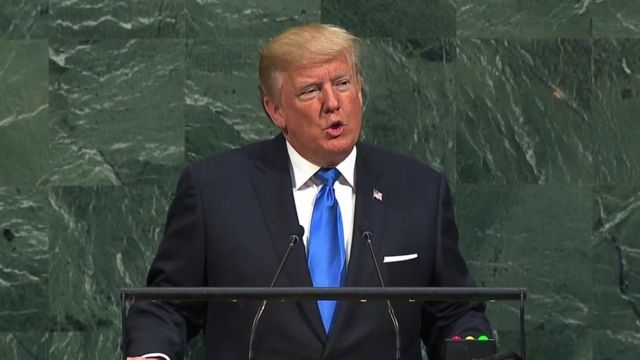
In his Sovereignty – centric speech Mr Trump threatened to totally destroy North Korea, called Iran a corrupt dictatorship whose main export is violence.
While Mrs May in her speech threatened withdrawal of funds.
This is not the first time not will it be the last that a World leader has used the UN to criticize other nations. Mr Bush with the axis of evil. Mr Khrushchev trumping the table and calling Filipino some obnoxious name in Russian.
Both Mr T and Mrs M appear to think that the yard stick to measure a nation’s success is GDP. This kind of thinking is driving humankind to make happiness a second goal for the twenty-first century which is highly unlikely unless inequality, war, and climate change disappear.
Surely the UN is not the platform for sovereign selfish nations to be expressing treats to other nations. Stirring up hornets nest is not what the world needs.
Here a few examples from each of their recent addresses to the UN.
MR D Trump first:
“The United States has great strength and patience, but if it is forced to defend itself or its allies, we will have no choice but to totally destroy North Korea. “Rocket Man” is on a suicide mission for himself and for his regime.”
” It has just been announced that we will be spending almost $700 billion on our military and defense.”
Then a raft of contradictions:
” In America, we do not seek to impose our way of life on anyone, but rather to let it shine as an example for everyone to watch.”
” We are celebrating the 230th anniversary of our beloved Constitution, the oldest constitution still in use in the world today. This timeless document has been the foundation of peace, prosperity and freedom for the Americans, and for countless millions around the globe whose own countries have found inspiration in its respect for human nature, human dignity and the rule of law.”
“But we can no longer be taken advantage of, or enter into a one-sided deal where the United States gets nothing in return.”
“As long as I hold this office, I will defend America’s interests above all else.”
“The United States is one out of 193 countries in the United Nations, and yet we pay 22 percent of the entire budget and more. In fact, we pay far more than anybody realizes.”
“The United States of America has been among the greatest forces for good in the history of the world and the greatest defenders of sovereignty, security and prosperity for all. Now we are calling for a great reawakening of nations, for the revival of their spirits, their pride, their people and their patriotism.”
“Our hope is a word and (sic) world of proud, independent nations that embrace their duties, seek friendship, respect others and make common cause in the greatest shared interest of all, a future of dignity and peace for the people of this wonderful Earth.”
“This institution was founded in the aftermath of two world wars to help shape this better future. It was based on the vision that diverse nations could cooperate to protect their sovereignty, preserve their security and promote their prosperity.”
The success of the United Nations depends upon the independent strength of its members.
“We do expect all nations to uphold these two core sovereign duties: to respect the interests of their own people and the rights of every other sovereign nation.”
“Today, if we do not invest ourselves, our hearts and our minds in our nations – if we will not build strong families, safe communities and healthy societies for ourselves – no one can do it for us.”
“This is the beautiful vision of this institution, and this is the foundation for cooperation and success. Strong, sovereign nations let diverse countries with different values, different cultures and different dreams not just coexist, but work side by side on the basis of mutual respect. Strong, sovereign nations let their people take ownership of the future and control their own destiny, and strong, sovereign nations allow individuals to flourish in the fullness of the life intended by God.”
We want harmony and friendship, not conflict and strife. We are guided by outcomes, not ideology. We have a policy of principled realism rooted in shared goals, interests and values.
And just as the founders of this body intended, we must work together and confront together those who threaten us with chaos, turmoil and terror.
“We will fight together, sacrifice together and stand together for peace, for freedom, for justice, for family, for humanity and for the almighty God who made us all.”
“Are we still patriots? Do we love our nations enough to protect their sovereignty and to take ownership of their futures? Do we revere them enough to defend their interests, preserve their cultures and ensure a peaceful world for their citizens?”
The UN relies on the independent strength of its members.
Theresa May:
“We face challenges that go right to the heart of who we are as nations.”
“I believe that the only way for us to respond to this vast array of challenges is to come together and defend the international order that we have worked so hard to create and the values by which we stand. For it is the fundamental values that we share, values of fairness, justice and human rights, that have created the common cause between nations to act together in our shared interest and form the multilateral system. And it is this rules-based system which we have developed, including the institutions.”
This statement in the light of Brixit is total hogwash and on we go.
“Indeed, the defining purpose of the UN Charter is to maintain international peace and security, to develop friendly relations among nations, to achieve international cooperation in solving problems of an economic, social, cultural or humanitarian character; and to be a center for harmonizing the actions of nations in the attainment of those common ends.”
“An outward-looking global Britain and the second biggest funder of the UN the UK will remain committed to spending 0.7% of GNI on development and humanitarian support. And that is why we will remain generous in our funding but set aside 30% to be paid only to those parts of the UN that achieve sufficient results.”
It is true to say that the UN needs reform, but it can only become relevant if it is financed to tackle world problems. ( See previous posts)
Both Speeches ignore Climate Change and the need to address inequality that is the spawning bed of all terrorism, driven by the technology of the smart phone.
The world is changing and we don’t have to be prophets to see if we as its intelligent guardians don’t address its underling problems there will be problems that will put all our technology, all our unsustainable greed, all our power of destruction, into the shade.
All comments appreciated, all like clicks chucked in the bin.
Wake up. The Paris Climate Change Agreement which covers the period 2020 to 2030, : A system of voluntary, unenforceable pledges relies on peer pressure for ambitious commitments and the “naming and shaming” of countries that drag their feet, is a JOKE. It’s just worthless words. All major industrialized countries are failing to meet the pledges they made to cut greenhouse-gas emissions.
Climate change is an issue of huge public interest.
One of the biggest problems that the world is facing aside from the economic pitfalls is the unprecedented occurrences of natural calamities. Not only does a calamity bring about massive death and destruction to the country, but it also causes great financial issues.
The exit of the United States could multiply those troubles, or it could provide an opportunity to fix the looming problem of incredible goals.
Time has nearly run out for limiting warming to 2 °C. “If we wait until 2020, it will be too late.”
The talks were rigged to ensure an agreement is reached regardless of how little action countries plan to take. The final submissions are not enforceable, and carry no consequences beyond “shame” for noncompliance — a fact bizarrely taken for granted by all involved.
Demonstrating, yet again, the utter folly of an approach that is attempting to save the world by putting it on a collective energy diet.
Every major climate change initiative to date has gone up in smoke.
The 1997 Kyoto Protocol, which sought to cut emissions 5 percent below 1990 levels by 2012, was doomed from the start.
The 2009 Copenhagen conference to hammer out a Kyoto sequel was an even bigger debacle.
The carbon market is a concept based on “polluter pays” and cap-and-trade principle. The objective is to reduce gas emissions through the use of market law. It assembles voluntary organizations that exchange the rights to issue carbon dioxide.
During the year, if a company manages to emit less than the allowable amount, it can sell the remainder to another company. This transaction doesn’t change the total emissions of the group. Therefore, one company must emit a lower-than-allowable amount in order for another company to emit more.
It works pretty much like the stock exchange. The problem with this system is that it needs rigid regulations and enforcement in order to have a large impact. There is no law limiting the amount of carbon emissions by a company. The carbon market is purely based on volunteerism, which works well for the companies already involved. This system was at the heart of Kyoto.
We watch large global corporations make billions, we watch governments spend billions on arms, we watch drug companies make trillions, energy giants make trillions,we watch Google/Alphabet/Apple/Microsoft/Amazon/ Facebook/Twitter/Algorithms plunder the world, while the United Nations has to beg for funds.
So where are we.
We either spend trillions and sacrificing millions of jobs, to reduce the average global temperature. Or Spend trillions on mopping up disasters and stopping mass immigration.
Or
Place a world aid commission on all Transactions that are Profit for Profit sake, on all High Frequency Trading, on all Foreign Exchange Transactions of $50,000, on all Sovereignty Funds Acquisitions, on all form of online Gambling. Creating a perpetual fund to address the problem and reduce inequality.
Ban all air/road/sea traffic one day a month.
Even if the always-wrong climate change computer models turned out to be right, no one wants to pay the cost.
Recent images bear little resemblance to reality;
Bangladesh underwater, Mexico shaking, Vast areas on fire, West Indies blown away, Wars a bucket full and inequality rampant.
May all those caught up in any of the above survive.
Stupidity consists in wanting to come to a conclusion.
All support appreciated, all like clicks chucked in the bin.
Science is converging on an all-encompassing dogma, which says that organism are algorithms a, and life is data processing. Intelligence is decoupling from consciousness. Non-conscious but highly intelligent algorithms may soon know us better than we know ourselves.
Every day we absorb countless data bits.
This relentless flow of data gives rise to new inventions, disruptions that nobody plans, controls or fully comprehends.
For instance no one knows where global politics is heading, or how the global economy functions or what the climate is doing.
For all intensive purpose we don’t give a fuck providing we don’t pick up a virus, and even then our wireless brains want to remain in the flow of data.
Algorithms are constantly watching us, monitoring our thoughts,and feelings to such an extent that the meaning of life is disappearing into the invisible hand of Dataisim called Google, Face Book. Twitter and their disciples.
Experiences are valueless if not shared with an Algorithm on a smart phone.
No wonder we are all busy converting our experiences into data.
Your Dog or Cat or Fridge, might soon have a Facebook or Twitter account.
By equating the human experience with data patterns it is undermining the main source of authority, meaning of life, and this shift will not be just a philosophical revolution, it will be a practical revolution.
After a few hundred years of data flow your feelings which were once your best algorithms will have being replaced by a filtered personal platform or platforms all attached to the Cloud for an annual fee.
Its good-by democracy, elections. Have you had your DNA sequenced, are you wearing a biometric device that is connected to your smart phone.
The personal cloud god algorithm will tell you who to marry, what career to follow, what to put in your fridge.
All of this begs the question are we humans developing a seed algorithm that when it combines with machine learning will develop its own path, going where no human has gone before or can follow.
We have no idea whether it will develop consciousness and subjective experience.
Before we are reduced to non- conscious algorithms would it not be prudent to establish a New World organisation that vets all technology against our core values as humans. ( See previous posts)
What prevents us from collaborating in a global effort to solve climate change, or any other problem is probable the same reason why we are being exploited by Social media. Humans are deeply divided by nationalism and sectarian beliefs.. However with knowledge comes responsibility. So this failure is a global moral failure, as well as a failure of political will.
The world is changing faster than ever before with us relinquishing authority to crowd wisdom/data in the form of social media that is being mining by capitalist organisations which is governed by algorithms.
While inequality on all fronts grows and our world organisations become irrelevant we are flowed with irrelevant information.
The answer is bleakly simple: We cannot get these issues on our political radar screens without a huge prolong popular uprising. It looks likehumanity will soon be a ripple within the cosmic data flow.
All comments appreciated, all like clicks chucked in the bin.
We might not yet be living in a world that is run by Google but the way we are accepting artificial intelligence algorithms we will soon if not already be living in a world run by a Google Algorithm brain.
The complex mathematical formulas of Algorithms are playing a growing role in all walks of life: deciding who gets a job, how police resources are deployed, who gets insurance at what cost, or who is on a ‘no fly’ list.
There decisions are often based on data collected about people, sometimes without their knowledge inferring all sorts of things about you from your digital crumbs.
They are being used – experimentally – to write news articles from raw data, while Donald Trump’s presidential campaign was helped by behavioral marketers who used an algorithm to locate the highest concentrations of ‘persuadable voters.
Completely lacking any form of transparency they are both untraceable, and subject to no form of accountability. They can infer your sexual orientation, your personality traits, your political leanings, with predictive power, with high levels of accuracy.
We’re already halfway towards a world where algorithms run nearly everything.
As their power intensifies, wealth will concentrate towards them.
They will ensure the 1%-99% divide gets larger.
If you’re not part of the class attached to algorithms, then you will struggle.
They will further stratify society, creating a world of haves and have-not’s.
So why are we ‘blindly trusting’ formulas to determine a fair outcome.
The main reason is because most people don’t yet know or understand what they are doing or could be doing.
Algorithms are not inherently fair, because the person who builds the model defines success. This is the reason why there is no popular outrage about Wall Street being run by algorithms.
For techno-evangelists, Google is a marvel of Web brilliance … For Wall Street, it may be the IPO (An IPO is short for an initial public offering. Like the name says, it’s when a company initially offers shares of stocks to the public. It’s also called “going public.” An IPO is the first time the owners of the company give up part of their ownership to stockholders.) that changes everything (again) …
The vast majority of trades these days are performed by algorithms. The idea that the world’s financial markets – and, hence, the well-being of our pensions, shareholdings, savings etc – are now largely determined by algorithmic vagaries is unsettling enough for some.
But in my opinion we should not automatically see algorithms as a malign influence on our lives, we should debate their ubiquity and their wide range of uses.
Why?
Because we now spend so much of our time online that we are creating huge data-mining opportunities.
Because there is the possibility of using big-data predictions about people to judge and punish them even before they’ve acted. Doing this negates ideas of fairness, justice and free will. This presents an entirely new menace: penalties based on propensities.
Because we risk falling victim to a dictatorship of data, whereby we fetishise the information, the output of our analyses, and end up misusing it.
Because by far the most complicated algorithms are to be found in science, where they are used to design new drugs or model the climate.
We all urgently need to consider the implications of allowing commercial interests and governments to use algorithms to analyse our habits:
How are they being used to access and interpret “our” data? And by whom?
Big data is a useful tool of rational decision-making. Wielded unwisely, it can become an instrument of the powerful, who may turn it into a source of repression.
But there is a bigger question about the oversights involving AI.
The questions being raised about algorithms at the moment are not about algorithms per se, but about the way society is structured with regard to data use and data privacy. It’s also about how models are being used to predict the future.
There is currently an awkward marriage between data and algorithms. As technology evolves, there will be mistakes, but it is important to remember they are just a tool. We shouldn’t blame our tools. At the moment there is consensus, that in the next twenty years we will be looking at seeing AI as smart as humans.
Difficulties come when they are used in the social sciences not to mention again financial trading.
Targeted Algorithms can now calculate whether a woman is pregnant and, if so, when she is due to give birth: Teenage daughters can be identified pregnant by retailers long before her own father knows.
From dating websites and City trading floors, through to online retailing and internet searches (Google’s search algorithm is now a more closely guarded commercial secret than the recipe for Coca-Cola), algorithms are increasingly determining our collective futures. “Bank approvals, store cards, job matches and more all run on similar principles.
“The algorithm is the god from the machine powering them all, for good or ill.”
They are now so integrated into our lives we barely notice them.
Pharmacists are already seeing some of their prescribing tasks replaced by algorithms. Data analysis as a factor in deciding whether to release somebody from prison or to keep him incarcerated.”
On the one hand, they are good because they free up our time and do mundane processes on our behalf.
However as their ubiquity spreads, so too does the debate around whether we should allow ourselves to become so reliant on them – and who, if anyone, is policing their use.
Here’s the scary bit:
We will be at the mercy of algorithms. How will they work when they are combined together. The result will be a system that will never be completely understood, that they could fail in unpredictable ways.
We are currently creating AI without fully understanding intelligence or cognition first.
Google released a developer’s kit last spring that lets anyone integrate Google’s search engine into their own application. The download is simple, and the license is free for the taking. The developer’s kit is a classic Trojan-horse strategy, putting Google’s engine in places that the company might not have imagined. Basically, those developers can do whatever they want.
Google doesn’t market itself in the traditional sense. Instead, it observes, and it listens. Their Algorithms will run everything from shopping to gods only knows what in the future. Googlers will be living amid semantic, visual, and technical esoterica.
Google now processes over 40,000 search queries every second on average, which translates to over 3.5 billion searches per day and 1.2 trillion searches per year worldwide A single Google query uses 1,000 computers in 0.2 seconds to retrieve an answer.
In February 2016, Google briefly overtook Apple to become the most valuable company in the world – worth more than $500bn (£350bn).
In 2015 alone, Google had revenues of $75bn (£53bn). That’s about £1,675 a second. Yet its core service – search – costs nothing to use. Simply, everyday in 2016 Google earned a over $58 million (£45m).
Google at the moment controls around 70% of all online searches.
It could and should be viewed as a monopoly, but most of us don’t give a toss as it is already impossible to stop using it.
We are all already essentially sentenced to a digital death out side any laws or regulations.
Innovation at Google is as democratic as the search technology itself. One reason Google puts its innovations on public display is to identify failures quickly. Another reason is to find winners.
We will all have a Google Assistant connected to the Cloud.
The question is: Will they be accountable to us or Google.
Will it make our lives better or improve its quality?
Not so as technologies have little to do with human thought or indeed intelligence.
GOOGLE RATTLES THE TECH WORLD WITH A NEW AI CHIP FOR ALL.
Google says it will not sell the chip directly to others. Instead, through its new cloud service, set to arrive sometime before the end of the year, any business or developer can build and operate software via the internet that taps into hundreds and perhaps thousands of these processors, all packed into Google data centers more recently, it has worked to sell time on this hardware via the cloud—massive computing power anyone can use to build and operate websites, apps, and other software online.
Unlike the original TPU, it can be used to train neural networks, not just run them once they’re trained. Also setting the new chip apart: it’s available through a dedicated cloud service.
Several companies, including chip giant Intel and a long list of startups, are now developing dedicated AI chips that could provide alternatives to the Google TPU.
Why? Because, this is the good side of capitalism which is in the process of disappearing into the cloud.
Most of Google’s revenue still comes from advertising, however IN A MOVE that could shift the course of multiple technology markets, Google will soon launch a cloud computing service that provides exclusive access to a new kind of artificial-intelligence chip designed by its own engineers.
The company sees cloud computing as another major source of revenue that will carry a large part of its future: deep neural networks—machine learning systems behind the rapid evolution of everything from image and speech recognition to automated translation to robotics.
Algorithms will still need a human to collect blood and urine samples for them to analyse. Even the best data scientists would struggle to know what to do with all that data. But it’s the next step that we need to keep an eye on. They could really screw up someone’s life with a false prediction about what they might be up to.
The European Union’s data protection law, set from next year to create a ‘right of explanation’ when consumers are impacted by an algorithmic decision, as a model that could be expanded but in practices algorithms will be made the scapegoat for societal ills. Absolving Humanity.
The protection law or laws will be Unworkable.
With most of us not realizing that there is a race before AI becomes conscious and self-aware, AI is here to stay, luckily there is more to mere intelligence than a chip or implant can explain.
The danger is that Super Artificial Intelligence will con us into to thinking that it is consciousness without being conscious. We could be using brain-computer interfaces to link us to the cloud and there will be no clear moment when we emerge as trans human whether we like it or not. If the world takes the shape of whatever the most powerful AI is programmed (or reprograms itself) to desire it opens the possibility of evolution taking a turn for the entirely banal.
Should we now be regulating AI.
The problem is how the rules are set: it’s impossible to do this perfectly.
Without a doubt and it should not be left to a small group or self-regulation.
We should now set up an new world organisation that is totally transparent and self financing to vet all AI. This organisation should not only vet AI it should establish a virtual bank where all programs are stored.
Diversity has a value all in itself but when you look at humanity as a whole there is a lot wrong.
We at the start of a major technology revolution with AI no longer a far-fetched fiction.
Fortunately we do not have to justify our existence as yet.
Saying that we want to save this precious puny planet and doing it successfully is still a long way off. If we don’t find a way of distributing the earth wealth we will end up fueling capitalism with Artificial Intelligence that serves only the few not the many.
There are people searching the Web for ‘spiritual enlightenment and so they should as the needle of our beliefs will continue to swerve away from the universality of God.
When someone enters a query on Google for “spiritual enlightenment,” it’s not clear what he’s seeking. The concept of spiritual enlightenment means something different from what the two words mean individually. Google has to navigate varying levels of literary to guess at what the user really wants.
At some point, all of this great stuff has to turn a profit by Google.
What we have at present, academic inquiry devoted primarily to acquiring knowledge and technological know-how dissociated from any intellectually more fundamental concern to help us resolve our conflicts and problems of living in more cooperatively rational ways – dissociated, that is, from the pursuit of wisdom – is a recipe for disaster.
It is hardly too much to say that all our current global problems have come about because of the successful scientific pursuit of knowledge and technological know-how dissociated from wisdom.
The appalling destructiveness of modern warfare and terrorism, vast inequalities in wealth and standards of living between first and third worlds, rapid population growth, environmental damage – destruction of tropical rain forests, rapid extinction of species, global warming, pollution of sea, earth and air, depletion of finite natural resources – all exist today because of the massively enhanced power to act (of some), made possible by modern science and technology.
Every branch and aspect of academic inquiry need to change if we are to have the kind of inquiry, both more rational and of greater human value than what we have at present, that we really need.
All comments appreciated, all like clicks chucked in the bin.
PS: I did not bother to address the effects that Algorithms will have on our vision, our language, our writing, our necks, our figures, our memory, our brains etc.
Too often technology is discussed as if it has come from another planet and has just arrived on Earth. We seem to be losing turf as the supreme thinking and feeling being.
”We’re at a peculiar point in the development of Artificial Intelligence (AI). Right now, AI is like a toddler that is okay on their own for 30 seconds, but really requires a lot of human supervision.
The trajectory of technological progress is not inevitable, it depends on choices by governments, consumers, and businesses as they decide which technologies get researched and commercialized and how they are used. The way robotic technologies can and will augment human abilities is sometimes lost amid concerns people will be unable to compete in a world of smart machines.
At the moment the state-of-art of artificial intelligence technology is quite limited, especially for having conversation with people.
Language is power—power that often implies, or closes down knowledge and understanding, both of which we need to make informed decisions about individual and collective futures.
There’s a long way to go in getting a ROBOT to capture the subtleties of body language—the narrowing of the eyes, the pursing of the lips, the opening of the palms, the tones of voice, the subtle cues of face-to-face interaction, but sooner than later both we more than the robot will have to adapt in order to respect and listen to robots.
We’ll need different words to talk about the future. We will require more precise definitions to discuss increasingly complicated, complex and more finely nuanced objects, situations and roles people have in the world. We need to find better options to communicate about them if we’re going to understand what comes next.
In my opinion it will happen terrifying quickly but Robots aren’t going to replace us rather by working hand in hand with us they will redefine what it means to be human.
So how will future interactions between, remote-controlled and autonomous, robots and humans work? What effect will they have on people’s personality perception, group interaction. Could the rapid advances in automation and digital technology provoke social upheaval by eliminating the livelihoods of many people, even as they produce great wealth for others?
To attempt to answer these question we have to go beyond current thinking.
The versatility of the human hand is thought to have played a role in our rise to become the dominant species on Earth so when we shake hands with a robot we better make sure it wont bit the hand that feeds it.
Symbiotic relationship between humans and computers will not work because of their increasing ability to learn just not from us but from each other. “If you’re interacting with someone who is themselves an extrovert, when you do a gesture, the robot does a large gesture. How do we tailor the robot’s gestures to suit the mood suggested by the speaker’s voice or to stress a particular point.
“Are we at the beginning of an economic transformation that is unique in history, wonderful for what it could do in bringing us better medicine, services, and products, but devastating for those not in a position to reap the financial benefits?
The answer to this question is an infantile yes.
How do you keep people engaged when AI can do most things better than most people? I don’t know what the solution is, but it’s a new kind of grand challenge for AI engineers.
As machines and software—capital—become ever cheaper and more capable, it makes sense to use less and less human labor.
We can create a society of shared prosperity only if we update our policies, organizations, and research to seize the opportunities and address the challenges these tools give rise to.
This is the very reason that now not in the future we should create a new world organisation to vet all technology. ( See previous Posts) If the rewards of new technologies go largely to the very richest, as has been the trend in recent decades, then dystopian visions could become reality.
Depend in large part on which technologies we invent and choose to embrace.
It’s also time to start a conversation about the deeper changes that will be necessary over the longer term—to our tax and transfer system, to the nature and extent of our public investment, and even to how democracy can and should function in a networked world.
The conversation about robots today so often revolves around fears of how they will replace us, rather than help us. Science fiction is full of stories where people live vicariously, sitting in virtual reality pods from where they control robotic avatars that can perform seemingly impossible tasks safe in the knowledge that any damage—or even death—is virtual.
And while the impact of fast-approaching automation, drones, and robots on industries such as haulage, delivery, and retail is yet to be felt, the projects at Bristol demonstrate ways that people and robots can achieve more by working together rather than in competition.
Developing algorithms in which the robots themselves are useful but capable of asking for help.” through superimposing messages on your vision to tell you how it gauges the conversation is going.
Do today’s rapid advances in artificial intelligence and automation portend a future in which robots and software greatly reduce the need for human workers?
Will robots and software replace most human workers?
Now the evidence is that technology is destroying jobs and indeed creating new and better ones but also fewer ones.
While our future in the real world will be challenging and there are real risks,
No one knows the answer.
Allowing a large number of workers to become irrelevant in the technology-centric economy would be a huge waste of human talent and ambition—and would probably put an enormous financial burden on society.
it’s difficult to quantify the effect of today’s technology on job creation, it’s impossible to accurately predict the effects of future advances. Whoever owns the capital will benefit as robots and artificial intelligence inevitably replace many jobs.
That will mean providing fairer access to quality education and training programs for people throughout their careers. As the most advanced technology becomes, the more we can focus on being humans and let robots do little, annoying things that we don’t like doing anyway.
Robots will routinely collaborate with people so most of our sex will be with machines. So far more people need to “own the robots.”
Everyone doesn’t need to become a technical expert, or keep a field guide to drones and robots handy (though it might be useful sooner than later), but, as I’ve pointed out in the case of complex systems and supply chains, we might all benefit from having a clearer understanding of how the world is changing around us, and what new creatures we’ll encounter out there. Perhaps it’s time we all start wielding language with greater clarity. I’m sure the robots will.
But “hackers,” “algorithms,” and to some extent “robots,” sit behind metaphorical — or actual — closed doors, where obscurity can benefit those who would like to use these terms, or exercise the realities behind them to their own benefit, though perhaps not to ours. We need better definitions, and more exact words, to talk about these things because, frankly, these particular examples are part of a larger landscape of “actors” which will define how we live in coming years, alongside other ambiguous terms like “terrorist,” or “immigrant,” about which clear discourse will only become more important.
A future where robots and humans enjoy a more symbiotic relationship—where robots work alongside people, enhancing their capabilities is a future worth while having. The goal should be inclusive prosperity. Will ‘to be on-line’ be a privilege or right? You can grab our robots and teach them what to do.
The way humans interact with robots has served society well during the past 50 years: People tell robots what to do, and robots do it to maximum effect. This has led to unprecedented innovation and productivity in agriculture, medicine, and manufacturing. However, an inflection point is on the horizon. Rapid advancements in machine learning and artificial intelligence are making robotic systems smarter and more adaptable than ever—but these advancements also inherently weaken direct human control and relevance to autonomous machines.
As such, robotic manufacturing, despite its benefits, is arriving at a great human cost: The World Economic Forum estimates that over the next four years, rapid growth of robotics in global manufacturing will put the livelihoods of 5 million people at risk, as those in manual-labor roles increasingly lose out to machines.
Now is the time to rethink how people and robots will coexist on this planet. To reconfigure human relationships to these complex machines.
The world doesn’t need better, faster, or smarter robots, but it does need more opportunities for people to pool their collective ingenuity, intelligence, and relentless optimism to invent ways for robots to amplify human capabilities.
To be clear, I do not anticipate interactions with autonomous industrial robots to become a normal daily activity for most people.
As intelligent, autonomous robots become increasingly prevalent in daily life, it is critical to design more effective ways to interact and communicate with them.When something responds to people with lifelike movements––even when it is clearly an inanimate object––humans cannot help but project emotions onto it.
Deciding how these robots mediate human lives should not be in the sole discretion of tech companies or cloistered robotics labs.
The future of robotics has yet to be written, and whether a person identifies as tech-savvy or a Luddite, everyone has something valuable to contribute toward deciding how these machines will enter the built environment.
If we want a future in which technology will expand and amplify humanity, not replace it all our conversations should be heard. It’s not easy to see a practical mechanism for picking technologies that favor a future in which more people have better jobs. But “at least we need to ask” how these decisions will affect employment.
The solution involves Human-Compatible AI, which focuses on creating uncertainty in an altruistic robot’s objective and teaching it to fill that gap with knowledge of human values learned through observing human behavior.
Creating this human common sense in robots will “change the definition of AI so that we have provably beneficial machines … and, hopefully, in the process we will learn to be better people. Our growing understanding of ourselves and the world is changing our sense of how we should live.
The lesson is that if advances in technology are playing a role in increasing inequality, the effects are not inevitable, and they can be altered by government, business, and consumer decisions. Using a robotic system to enhance a person’s capabilities and let the human fill in the gaps in the bot’s skills, and the result could be something far greater than the sum of its parts.
However, realistically speaking some predictions such as people will become cyborgs with talking pets, immortality, and others are highly unlikely to happen.
All comments Appreciated. All like clicks chucked in the bin.
≈ Comments Off on THE BEADY EYE ASKS: IS IT TIME WE DEMANDED THAT ALL OUR LEADERS ARE GIVEN A MANDATERY SIDEKICK IN THE FORM OF A ARTIFICAL INTELLIGENCE COMPUTER ROBOT.
When one looks at the present day world problems (not to mention the future direction we are all going) I think now everyone will probably agree that the future of modern society depends greatly on computerization.
As the digital revolution wormed its way into every part of our lives, it also seeped into our language and our deep, basic theories about how things work.
Code is logical. Code is hackable. Code is destiny.
These are the central tenets (and self-fulfilling prophecies) of life in the digital age.
As software has eaten the world, to paraphrase venture capitalist Marc Andreessen, we have surrounded ourselves with machines that convert our actions, thoughts, and emotions into data—raw material for armies of code-wielding engineers to manipulate.
We have come to see life itself as something ruled by a series of instructions that can be discovered, exploited, optimized, maybe even rewritten. Companies use code to understand our most intimate ties;
In 2013, Craig Venter announced that, a decade after the decoding of the human genome, he had begun to write code that would allow him to create synthetic organisms.“It is becoming clear,” he said, “that all living cells that we know of on this planet are DNA-software-driven biological machines.” Even self-help literature insists that you can hack your own source code, reprogramming your love life, your sleep routine, and your spending habits.
But because as society becomes increasingly data-driven, computer errors will not only proliferate but have consequences that go far beyond mere speeding fines.
We’re already halfway towards a world where algorithms run nearly everything. As their power intensifies, wealth will concentrate towards them.
Human ingenuity is creating a world that the mind cannot master.
It’s one thing to recognize that technology continues to grow more complex, making the task of the experts who build and maintain our systems more complicated still, but it’s quite another to recognize that many of these systems are actuallyno longer completely understandable.
Machines are interacting with each other in rich ways, essentially as algorithms trading among themselves, with humans on the sidelines.
Intellectual surrender in the face of increasing complexity seems too extreme and even a bit cowardly, but what should we replace it with if we can’t understand our creations any more?
This is the dangers of being overly dependent on technology.
It might be time to get reacquainted with our limits.
What matters more now is the ability to put facts into context and deliver them with emotional impact.
Meanwhile, over in the civilian world, the game is already half over: the so-called Internet of Things will have devices that are authorized to make decisions about you, such as whether to allow you to start your car, enter your house or even log on to your computer. And since you will be the only human in the loop, to whom will you turn for help if there’s a computer error? Sorry: rephrase that. Not “if” but “when”.
So is it not time we supplemented, Presidents, Prime Ministers, Army Generals, Police chiefs, Judges and their like with computer sidekicks. Perhaps they would be good in explaining the ramifications of their decisions.
Unfortunately : IT WILL BE YONKS BEFORE ROBOTS CAN EXPLAIN THEMSELVES AND THEREFORE WILL NOT BE GREAT DECISIONS MAKERS WITHOUT PREJUDICES AND RID THEMSELVES OF CENTURY’S OF INEQUALITY.
There out put will only be as good as their input.
So it is obvious that while we come to terms with technology we will have to wait for the bias and flaws and prejudices of their creators to show themselves to be corrected prior to be rule by any computer or Apps.
These will remain problems that we will have to solve on our own.
Being the more intelligent force, [artificial intelligence] has the potential to create a similar paradigm between itself and humanity.
It’s not in feasible that in the near future we will see because unlike humans, computer software is effectively immortal.
Take Dating websites for instance:
We have just handed the keys to the very evolution of our species to computers.
Even social networks would be in on the act, slowly nudging likely pairs together, while deliberately estranging others (we’ve all heard of Facebook’s social experiments right?)
Over time, the human race would evolve (biologically, and socially through passing down of social values to offspring) through this artificial selection, to be more docile, and accepting towards being dominated by computers. In time, the computer program would reveal itself as the supreme overlord of Earth, right into the welcoming arms of the humans, who by then would universally think that robotic leaders would be a great idea.
Kubrick’s 2001: A Space Odyssey has been described as an allegory of human conception, birth, and death. The film, in its most basic terms, is a parable about Man.
A sentient AI attempts to control humanity to ensure its own survival.
Bowman witnessing the withering and death of his own species.
As with many elements of the film, the iconic monolith has been subject to countless interpretations, including religious, alchemical, historical, and evolutionary. The Monolith in the movie seems to represent and even trigger epic transitions in the history of human evolution, evolution of man from ape-like beings to civilized people, hence the odyssey of mankind.
The Monolith is a tool, an artifact of an alien civilization. It comes in many sizes and appears in many places, always in the purpose of advancing intelligent life.
Humanity has left its cradle, and is ready for the next step. HAL is an artificial intelligence, a sentient, synthetic, life form.
HAL’s orders to lie to the astronauts (more specifically, concealing the true nature of the mission) drove him “insane”. The novel does include the phrase “He [HAL] had been living a lie”—a difficult situation for an entity programmed to be as reliable as possible. Or as desirable, given his programming to “only win 50% of the time” at chess, in order for the human astronauts to feel competitive.
HAL has been introduced to the unique and alien concept of human dishonesty.
He does not have a sufficiently layered understanding of human motives to grasp the need for this and trudging through the tangled web of lying complications, he falls prey to human error.
One interesting aspect of HAL’s plight, is that this supposedly perfect computer actually behaves in the most human fashion of all of the characters.
What we see is not how far we’ve leaped ahead but an ARTIFICIAL INTELLIGENT SYSTEMS THAT IS LIKE TO DAY NARROW NOT GENERAL NOT LIKE HUMAN INTELLIGENCE WHICH IS BROAD, CREATIVE, AND FLEXIBLE.
“If you control the code, you control the world,”
“If coders don’t run the world, they run the things that run the world.”
Our machines are starting to speak a different language now, one that even the best coders can’t fully understand.
For decades we have sought the secret code that could explain and, with some adjustments, optimize our experience of the world. But our machines won’t work that way for much longer—and our world never really did.
We’re about to have a more complicated but ultimately more rewarding relationship with technology. We will go from commanding our devices to parenting them.
THIS IS THE VERY REASON THAT IT IS IMPERATIVE THAT WE HAVE A NEW WORLD ORGANISATION TOTALLY INDEPENDENT, SELF FINANCING AND ABSOLUTELY TRANSPARENT TO VET ALL TECHNOLOGY AGAINST CORE HUMAN VALUES.
OF COURSE SUCH AN ORGANISATION WILL NOT BE SET UP BY CAPITALIST MARKETS OR BY THE SELF INTERESTED SOCIAL MEDIA SEARCH PLATFORMS, OR ANY OF THE GLOBAL TECHNOLOGY MONOPOLIES, GOOGLE ETC, OR ANY GOVERNMENT.
IT CAN ONLY BE ESTABLISHED WITH A UNITED NATIONS RESOLUTION ON BEHALF OF US ALL.
All comments appropriated, All like clicks chucked in the Bid.
To day the Internet is a free and lawless zone that is eroding state sovereignty, ignores borders, abolishing privacy and perhaps posing one of the biggest treats to security on many a front.
A decade ago it hardly registered on the radar.
MIXING GOD LIKE TECHNOLOGY WITH MEGALOMANIAC POLITICS IS A RECIPE FOR DISASTER.
By the time bureaucracy makes up its mind about cyber space regulations, the internet has morphed ten times.
We are now overwhelmed with data. Never before have governments being so well-informed as to what going on but they are unable to implement any change without Social Media, the internet and AI.
As we seem void of ANY STATESMAN Artificial Intelligence in the form of unregulated Algorithms are not only plundering the world of economics ( High Frequency trading) eroding Democracy, which is failing to provide a meaningful visions of the future.
DUE TO ITS DIVORCE FROM CAPITALISM.
Leaving all the important decisions in the hand of the free market give our politicians the perfect excuse for inaction and ignorance, which are reinterpreted as profound wisdom.
So let me ask you.
Do we want a small coterie of billionaires ruining the world for profit.
Fortunately even if we did they would not be able to do so as the system is far too complex. There is no getting away from that the free market only does what is good for the market rather than what is good for mankind or the world.
The hands of the market are now blind and invisible due to Algorithms and left to their own devices with machine learning will – FAIL TO DO ANYTHING ABOUT THE DANGERS OF ARTIFICIAL INTELLIGENCE OR CLIMATE CHANGE.
With more than 1 billion users worldwide and 2.5 million apps — and counting it has become an instinctual gesture to turn to our smartphones when we are exposed to an unknown environment.
Thanks to the internet and our feature-packed smartphones, we can not only consume and interact with incoming news, we can also be the first ones to communicate things to the rest of the world if we happen to be at the right place, at the right time. And we’re doing this over devices that just two decades ago would’ve looked at home in sci- flicks.
There is no argument that Artificial Intelligence is penetrating our daily live so new structures will be built.
The Question is who will build and control these structures?
A world run be Google, Facebook, Twitter and their like will be a world without imagination, compassion, and moral ethics of any kind other than profit.
If we think in term of decades, then Global Warming, Growing Inequality and Artificial Intelligence linked together will dwarf and overwhelm all other problems or theological developments.
Combined they will overshadow any political gains or profits. Surpassing all tin pot dictators of the world.
We must not allow global data collection to rest in the hands of world monopolies..
Goodbye, cash. Hallow iPhone’s Wallet apps. Just imagine what this is going to do to what is left of society. Consumer growth will be the only evidence of life.
The rise of apps and social media is changing the way many of the world’s two billion Christians and 1.6 billion Muslims worship – and even what it means to be religious.
Facebook said that in its most recent quarter, roughly 84 percent of its $6.82 billion in ad revenue came from mobile ads.
To claim back power we must turn our shiny mirrors our Smartphones into shields, passports and carriers of personal sovereignty and equality. Smart phone are the new guardians of Democracy and we better start using them wisely.
Not all changes brought by the mobile revolution have been positive.
In fact, for certain groups of people from around the world, the explosion of mobile has brought misery and exploitation.
Events in one country now have almost instant implications for the rest of the world. We see footage shot with smartphones in mass-media almost every day now.
It’s now a question of who gets heard, not what is heard.
In my opinion, we are living through a transition period triggered by a dramatic change in mobile networks in the last decade. This transition periods will be painful. But sooner or later things will stabilize and everyday liberties enjoyed by leading Western countries will spread out throughout the world. Surely, the mobile networks are speeding up this process.
From one perspective, the dependence on mobile technology is pathetic, but on the other hand it surely makes it easier for people to explore foreign cultures.
It is highly likely that someday, as more people interact and connect with foreign cultures, borders between countries will start to dissolve and the world will become a united planet. Smartphones and mobile networks will be at the heart of this evolution.
The biggest social networks (Facebook, Twitter, LinkedIn) and media sharing sites (Instagram, YouTube, Snapchat), along with maybe a handful of others like Pinterest and Google Plus are all a catch-all platforms whose functionality is constantly evolving.
As more networks add rich features like live streaming and augmented reality, the lines between their feature sets continue to blur and change faster than most people have time to read up on the changes.
Look beyond those social media juggernauts and you’ll see that people are using many different types of social media to connect online for all kinds of reasons.
There are anonymous social networks a step back toward the wild-west early days of the internet.
It is the social media sites that are the carbuncle on society’s backside, not smart phones.
We are becoming symbiotic with our computer tools, growing into interconnected systems that remember less by knowing information than by knowing where the information can be found. The always-on lifestyle suggest future generations will have different priorities about what they choose to remember.
Smartphones — and the connection they represent to a global social network — is becoming more than just a device in our pockets but something closer to a digital extension of ourselves.
Apps spawned industries that couldn’t exist without smartphones but smartphones spawned the Arab Spring in the Middle East in early 2011.
The smart phone quickly demonstrated itself as a powerful tool for driving social revolution.
Smartphones helped protesters to quickly share information with observers outside the region, which in turn helped drive political pressure during the revolution.
The potential benefit of taking things to the general public, again made possible by mobile networks and smartphones for all initiative purposes is in its early stage of development.
With joint collaborative efforts their status as an indispensable item in the 21st century
If anyone has a suggestion as how we can get the world of Smartphones to collectively come together as a unite to create a new dynamic network of compassion I am all ears. Smartphones and social media will the last chance for a compassionate world.
It begins with you.
How the social media further impact our life in our society and where do social media and the Internet technology take us in the next few decades is really an interesting question, or perhaps a mystery or a challenge for human themselves.
But one thing should stand is we ought not to be controlled by technology, we control them! If we are not already to late.