THE BEADY EYE ASK’S : WHO DO YOU THINK YOU ARE?

Tags

, , , , , ,


( Five minute read:)

How often have you heard this question.

It is mostly posed with a form of some aggression.

Not so here.

SO I SUPPOSE THE BEST PLACE TO START WITH THIS POST IS WITH WILLIAM SHAKESPEARE, AS YOU LIKE IT.

“ALL THE WORLD’S A STAGE, AND ALL THE MEN AND WOMEN MERELY PLAYERS; THEY HAVE THEIR EXITS AND THEIR ENTRANCES, AND ONE MAN IN HIS TIME PLAYS MANY PARTS.”

We all have roles to play in our lives and these change as we move through it.

Do you find yourself thrashing against the tide of human indifference and selfishness? Are you oppressed by the sense that while you care, others don’t?

That, because of humankind’s callousness, civilisation and the rest of life on Earth are basically stuffed?

Many of those who dominate public life have a peculiar fixation on fame, money and power. Their extreme self-centeredness places them in a small minority, but, because we see them everywhere, we assume that they are representative of humanity.

“It’s all about political opportunism and humanitarian posturing,”Afficher l'image d'origine

With the best will in the world it is unlikely that you will turn out as an adult with no unhelpful of unintended modifications – or what is called “conditioning”.

The true YOU is the one that finds life fulfilling in a deep sense rather than theoretically good on a purely intellectual level.

The personality is not YOU, you have a personality, so if you want your “self” to be aware of itself, you will have a long wait!

However, you, as an independent observer of your own internal processes, can become aware of what your personality is up to, how it is behaving and the impact on yourself and others.

As Fritz Perls said:

“Truth can be tolerated only if you discover it yourself because then, the pride of discovery makes the truth palatable.”

These days with technologies we hardly understand where we going never mind how we are.

It’s the culture.

Technology isn’t a section in the newspaper any more.

I think people are tired of complexity and they’re hungering for clarity, a simpler time.

The more we do things, the more they become a habit and the more that we think in the same way, the more these patterns of thought and behaviour become our identity.

The more that we depend on the masks and the safer that we feel as a result of wearing them, the greater the risk and uncertainty we feel of taking off our mask and interacting openly, honestly and authentically.

With the massive economic and cultural transformation driven by Silicon Valley are we no longer in control of who we are?

mask masks incertitude life

However if the personality is our sense of identity, but is not us, then who are we?

Our personality is like a piece of armour which is at the same time our greatest shield and also potentially our greatest prison. It enables us to deal with the outside world, but it can also insulate us from it – and from other people.

We are also not our personality, which has in large part been forged as a result of the experiences of surviving and protecting ourselves in the real world.

Take for instance, Politicians. given their image-conscious online life in the public eye  .

Most millennials still worry about attaching themselves with a click to the wrong clique or hashtag:

“It heightens the level of uncertainty, anxiety and risk aversion, to know that you’re only a bad day and half a dozen tweets from being fired.”

Smart phones are dominating our sense of identity and we will if not careful end up feeling lost when they end.

You need to find an internal source for our identity, not an external one.

The old verities of who you are now seem quaint, but many millennials are now paralyzed by all their choices.

There was a time that we understood that not everyone was destined for greatness.

If you work hard and play by the rules, you’ll lose out to those guys who can wire computers to make bets on Wall Street faster than the next guy to become instant multimillionaires.

Or losers who have soured our sturdy and spiritual DNA with too much food, too much greed, too much narcissism, too many lies, too many spies, too many fat-cat bonuses, too many cat videos on the evening news, too many Buzzfeed listicles like “33 Photos Of Corgi Butts,” and too much mindless and malevolent online chatter?

Our quiet traditional virtues bow to our noisy visceral divisions, while churning technology is swiftly remolding the national character in ways that are still a blur.

Boldness is often chased away by distraction, confusion, hesitation and fragmentation. Or are we forever smaller, stingier, dumber, less ambitious and more cynical?

Have we lost control of our not-so-manifest destiny?

Misanthropy grants a free pass to the grasping, power-mad minority who tend to dominate our political systems. If only we knew how unusual they are, we might be more inclined to shun them and seek better leaders. It contributes to the real danger we confront: not a general selfishness, but a general passivity.

We’re a little bit scared of our own shadow. And, sadly, we see ourselves as a people who can never understand one another. We’ve given up on the notion that we can cohere, by holding together people with deep differences.

We’ve broken Iraq, liberating it to be a draconian state-run on Sharia law, full of America/ English-hating jihadists who were too brutal even for Al Qaeda.

We have to re earn greatness.

But that’s going to be hard to restore in the world today.

Young people are more optimistic than their rueful elders, especially those in the technology world. They think of themselves as global citizens but are more interested in this moments of crazy opportunity.

With awareness comes freedom.

As you become aware of your fixed attitudes, beliefs and values that may no longer be useful to you and you begin to understand that there were good reasons for you to have adopted them, you can begin to see that it is neither good nor bad that this is the way life is – and the way that you are – it is just a natural consequence of living the human experience.

The authentic self is the true self underneath all the conditioning that has been acquired through life’s experiences.

Being in touch with our true selves is about getting real, not living in a fantasy of who we could or should be, but living with what is.

Life has become more complex but we hardly ever notice it because technology has made complexity simpler than ever. Who you are and where you are is tracked and sold on to ever is interested. The Private who is dead and gone.

The only knowledge we need to have is the knowledge of where to find stuff.

Humans today are like most smartphones and tablets – their ability to solve problems depends not on the knowledge they can store but on their capacity to connect to a place where they can retrieve the answer to find a solution.

Technology will continue to evolve and the gap between what can be solved with and without it will only increase. That is, we will become more and more dependent of technology and the only intellectual disadvantage will be the inability (or unwillingness) to learn to use it.

One could also imagine that this IT-overload may prove too much for some — In short, people who are able to keep up with technology will outsmart those who don’t (even more than they do now).

So perhaps there is no need to know how you are but more importantly where you are.

Too much Google, too much Face Book, Twitter, clicking from one site to another, or for that matter reading with out pause, constitutes a kind of scattering, a distraction, an agitation of the mind.

Our reliance on Google Search, is resulting in unrealistic self-confidence in our cognitive abilities.

That’s right, we are all plagiarising the internet without even realising it.

You might think that all is this is just hog wash but in a few hundred years from now most of us will not know the meaning of the word where and if we don’t know where we are from there is little chance of knowing who you are.

If we look at western Europe it appeared that we are not building anything, but merely trying to hang on to something we have inherited, but don’t necessarily value.Afficher l'image d'origine

With the immigration and refugee influx this will have to change.

What is the narrative that drives what we are building in Europe… and who is creating that narrative?  Not us.

We have derived a narrative from a century of conflict, and the received narrative is shaped around not fighting with each other. Fully understandable. But, for my children’s generation the wars of the twentieth century are as remote as the Battles of Agincourt or Waterloo.

This is why I wonder if Europe needs a new driving narrative that helps us consciously shape who and what we want Europe to become.

The old narrative of solidarity no longer applies.

We have Razor Wire replacing open frontiers. The Dutch reverting to extracting gold fillings and the Belgians wanting concentration Camps in Greece never mind what ‘solidarity’ means to young unemployed people in Greece or Spain.

So, the questions remain.

Who do we think we are and what do we want Europe to become? And who will shape the narrative for a new generation?

Billions of decent people tut and shake their heads as the world burns, immobilised by the conviction that no one else cares.

Attitudes of fear and paranoia adopted by many have led to an increasingly hostile global environment.

Cherished and treasured human values are trampled beneath a host of vitriolic “we’re better than you” convictions. Our world is sick, however, facing political and environmental disaster on an unprecedented scale.

Many of the problems plaguing us stem directly from deeply-held convictions of social differentiation and exclusion, rooted in philosophies that justify heinous acts in the service of a ‘greater good’. We are what we do. We have to start doing better.

We have to start somewhere. Why not a World Aid Commission Of 0.05%. ( see previous Post.)

In this century we have had only three brief moments when a majority of us said they were satisfied with the way things were going:

Have a go at naming them.

← Back

Thank you for your response. ✨

THE BEADY EYE SAY’S: THE NIGHTMARE IS WELL ON THE WAY.

Tags

, , , , , , , , ,


( A one minute obligatory read if you are interested in the planet you live on) .

It is not amazing that the contemporary world is marked by a growing number of problems that are genuinely Global in scope.Afficher l'image d'origine

Yet instead of addressing them we spend our time discussing ISIS, North Korea, Mr Putin, Worthless Trump, Air Brain Palin, The price of Oil, Stem cells, New Planets billion of light years away, the list is endless rubbish.

In the mean time we have the spread of Zika virus, a blizzard to beat all blizzards, thousands of Refugees, billions being spend of Presidential Campaigns while Inequality spreads like a cancer.

So forgive me for thinking we must be one of the most selfish, stupid, technology driven like button idiots that ever existed on this planet.

Based on the Best current science we are looking down the barrel of a gun with the bullet fired.

There could be no more extreme than current weather patterns, melting glaciers, sea level rising, megadroughts, desertification, deforestation, food supply disruption, famines, infectious disease, mass migration, social upheaval, economic distress, political instability.

All conflict multipliers that will turn Earth into an unlivable cauldron of I am alright Jack.

It seems that few realise how dire this situation has become or is becoming.

All down to human activity that continues to prune the evolutionary tree of life with gay adabondament.

And if that is not enough evidence that we are heading full speed to oblivion. The last Global Biodiversity Report presented some hard facts that the population of vertebrates that include mammals, birds, reptiles, sharks, rays, and amphibians – living within the tropics declined by 59% from 1970- 2006.

Just in case that has not sunk in what they are saying is that more than half of the vertebrate population between the Tropic of Capricorn and the Tropic of Cancer has disappeared in the last 36 years.

They also found that birds in Europe declined by 50% since 1980. Birds in North America declined by 40%.

Just one more hard fact that it is time to open our eyes. All plants species the foundation of the food chain upon which we depend – are currently ” threatened with extinction.

Yet humans around the world are either unaware of the situation or have their heads buried in the sand, when we should be taking immediate action.

Our consumerist economy that promotes the endless acquisition of products over the conservation of nature would need 1.5 Earths to meet the demands we currently make on Nature.

You might not still appreciate just how bad things are. By 2048 there will be virtually no more wild caught seafood. Our oceans are dying from Lake Erie to the Baltic Sea, the Gulf of Mexico the coastal water of Australia New Zealand, dead zones are growing. The Baltic is already Dead.  60% of all coral reef have being turned in to white ghost towns.

I have being lucky in my life to have traveled both by sea and land extensively.

Experiencing nature first hand let me tell you that there is a critical threshold that once crossed will result in a sudden and irreversible change. A tipping point that will arrive overnight.  There is no technology that can restore it to its original state.

I might sound overblowing and alarmist but look around you. We have little real knowledge of how the ecosystem works but just because we can’t see the catastrophe doesn’t mean it not real.

After all 99.9% OF MATTER is empty space, yet no amount of squinting will reveal this fact to the naked eye.

What does matter is that our fears accurately track the totality of the evidence presented.

This is why solving the problem ought to be on the top of the list of all superpowers in the world.

The likelihood of this happening is the same as asking is the Pope a Catholic.

Even if it does happen, nobody, no Government, no World Organisation, no Country, no Economy, no joe soap has the will or money to rectify a world that is bent on self-destruction.

This is why we must create a World Aid Fund. ( see previous posts)

It is the only solution that is non Political, spreading the cost across all beliefs all colours evenly.

Go on press the like button if you are one of the Googlefied that think you are living on the Planet. If on the other hand you are truly alive get involved and leave your thoughts. Afficher l'image d'origine

Afficher l'image d'origine


← Back

Thank you for your response. ✨

THE BEADY EYE ASK’S: ARE WE ALL SO BRAINWASHED OR JUST PLAIN STUPID THAT WE CANNOT SEE THE WRITING ON THE WALL.

Tags

, , , ,


( A two-minute read. A thousands years of consequences)

Industrial society is out of control. Run by Scientific, Technological, Industrial, Business and Financial education.

Billions of, you name it, has being destroyed in the name of progress.

What we now have is unsustainable growth, with almost everything being turned into a commodity for the sake of profit.

It could be said that Industry has turning Urban dwellers into blood suckers of the planet by creating unnecessary, meaningless, futile and destructive jobs and professions to keep them occupied.

To such an extent that they City dwellers are fooling the world with terminologies … Progress, Growth, Development, GDP.Afficher l'image d'origine

Industrial Society has destroyed most of the biodiversity and ecosystems in just 250 years for the sake of consumer goods, greed and profit.

It seems ridiculous that we complain of overpopulation when it is Industrialisation that is the cause of overpopulation.

So we have now arrived at point in the world where we can’t live with it or without it and are looking at Technological Machines to save us and the planet.

We are confronted with unsolvable problems, spending billion on Space Exploration while our water, air ,rivers, lakes and oceans are being polluted. With billions of acres of agricultural land been poisoned by million of tons of Pesticides, insecticides and fertilizer.

Neither Capitalism, Socialism or Communism matter.

There is little point debating over Capitalism, Socialism and Communism as they are all equally harmful.

Monsanto is not going to become less harmful or is any other Industry whether they are operating under any of the three.

There is little hope of mind set change even if climate change forces mass migration and a Industrial Conscious. Our countries and political leaders are more concerned with what happens to the economic climate rather than what really counts.

Our world media promotes triviality while ignoring the larger picture.

Who cares if it is Mathematically impossible for the USA to pay off 16 trillion dollars of debt. With 5% of the world population it has consumed 20-40% of the world resources with borrowed money.

The earth climate will not be saved by discussion like the Paris Climate Conference.

All political parties in the world are promoting Growth Rate, Economy Rate, GDP which require more and more nuclear plants.

Even if the Taliban, Al Qaeda, and ISIS, were to join forces they will not be able to create Mega Disasters as big as Chernobyl or Fukushima.

Claiming that nuclear power is not harmful is like claiming that the sun is not hot.

It is insanity to the power of infinity.

Why bury nuclear waste when it will remain radioactive for thousands of years poising the soil, water, humans, animals and the plant.

The bigger the Industry the bigger the Industrial accident.

There is no fourth place for the billion of tonnes of Metal waste, Plastic waste, gaseous waste, chemical waste, e waste, nuclear waste other than space which is already polluted.

The production of Plastic uses about 20% of the worlds oil produced.

We cannot save the environment after it has been killed by Industrial Activity.

We have one group trying to save the Forests, another group trying to save the Oceans, another the fresh water, another Air, another whales , another donkeys.

What is the point of saving a few dogs, whales, tigers, elephants when we seem unable to save ourselves.

Earth’s Oceans will contain more discarded plastic than fish when measured by weight by 2050.

Big data, the internet of things and the cloud are all about one thing only cutting costs. They create wealth for only a tiny minority.

What is the point of storing every contact, twitter notification, photo, and documents in a cloud that has a veracious appetite for electricity. The only reason we do it is because it s free.

Millions in the world die for trivial reasons. Million kill for trivial reasons. Billions live on a few dollars a day.

Perhaps we should award the Nobel Prize for Lunacy for the pretending that the environment is getting saved to ourselves.

We have people who pretend to be deeply concerned about Inequality between man and man. But they are totally unconcerned about Inequality between millions of other species.

Equality does not come from Theories, Philosophies, and Terminologies. Nor does it come from  Capitalism, Socialism, Communism.

We spend billions on Get Rich quick Lotto’s, pension funds (that in turn invest in Hedge Funds that exploit capitalism) in education, in health, in weapons, in gratification of pleasure, in energy, in Technology ( that cannot create a Forests, a mountains, a rivers, an ocean, it takes million of years.)

Industrialization all ends up on the world Stock Exchange Markets where trillions are made in nanoseconds by Algorithms in High Frequency Transactions, Foreign exchange transactions. These trillions are used to set up Sovereign Wealth Funds the true terrorists of the world which are privatizing the very essence of life.

So are we all so dumb that we think it can go on for ever and ever without exploding.

It is too late for either religions or political systems to create a new world moral code. Afficher l'image d'origineAfficher l'image d'origine

Its time we stopped all the gossip in our out of date world organisations and put in place A World Aid Commission of 0.05% of all High Frequency trading transactions, on all Foreign Exchange transactions ( over $20,000) on all Sovereign Wealth Funds Acquisitions, on all new drilling licences.

This will create a perpetual fund spreading the cost of rectifying the world problems evenly amongst the world Industries that caused them in the first place.

How can this be achieved.

The same way that most thing are going to change with the pressure of Social Media and the Smart Phone.

All it needs is a Crickhowell movement. ( Which by the way is led by the local coffee shop, the local book shop, the optician, the bakery, the towns salmon smokery.)  A small town in Wales whose independent traders got fed up of being ripped off by the UK Governments taxes. ( Look it up. Were all not stupid.)

What to stop us doing the same, by placing a Worlds people resolution in the United nations.

We live in a world where yesterday news is old news. Where self interest governs to the detriment of a common goal to remove inequality by bestow the riches of our world in opportunities to all.

All comments appreciated.

← Back

Thank you for your response. ✨


THE BEADY EYE ASKS CAN THE EU ACCOMMODATE ANOTHER 4 MILLION MIGRANTS.

Tags

, ,

( a one minute read)Afficher l'image d'origine

As riot police dismantle the camps of northern France, ‘forced relocation’ of people into shipping containers is brushing a humanitarian disaster under the carpet. The new accommodation on which the French have spent £20m is shipping containers, each kitted out with 12 bunk beds. There is heating and electricity BUT Humanity is bulldozed away.

The underlying political problem is never dealt with, except ironically by the refugees and migrants themselves, who have put up a sign saying “David Cameron Street” in the Jungle.

The focus of many EU governments now appears to have shifted decisively back to a default position—namely efforts aimed at preventing or discouraging people from attempting to reach EU territory, tackling smuggling networks, and rapidly deporting individuals who do not have a right to remain in the EU.

FOUR MILLION migrants expected to reach Europe by the end of 2017.

EU leadership is more important than ever to reach a Europe-wide deal on refugees.

An estimated 31,244 migrants have braved the deadly boat crossing over the Mediterranean Sea to Greece in the first 16 days of this year. This shocking statistic represents 21 times the number of migrants who crossed during the same period in January 2015, according to the International Organisation for Migration.

The IMF has predicted four million refugees will reach Europe by the end of 2017. Pictured is a migrant waiting to catch a train while wrapped in a blanket while trying to keep warm in SerbiaChancellor Angela Merkel's party has also called for Germany to declare Morocco, Algeria and Tunisia 'safe countries of origin', making it easier to reject asylum requests by its nationalsIt is expected that the number of new arrivals to Greece is likely to exceed the 853,650 migrants who crossed over to Greece by sea last year

Last year children accounted for a quarter of the one million migrants and refugees arriving across the Mediterranean in Europe.

God knows, these people need help. They are not obtruders. Every one of them is in need of protection and entitled to the rights guaranteed under the Convention on the Rights of the Child.

At the same time, there are still millions caught in situations of conflict, displacement, poverty and underdevelopment – the main causes of the crisis.

UNICEF is appealing for US$14 million to support the needs of affected children and women through 2016.Composite image showing three different lots of migrants

The rising number of people entering Europe in search of safety and in search of a better life has captured the world’s attention with scenes of heartbreaking tragedy.

JUST IMAGINE IF IT WAS YOUR FAMILY.

Travelling hundreds and thousands of miles over land and over water, from Africa, the Middle East and Asia, people are risking everything in the hope of reaching their goal, and the danger does not end at a border crossing.

Here are a few Graphics to open your eyes.

Map of arrivals

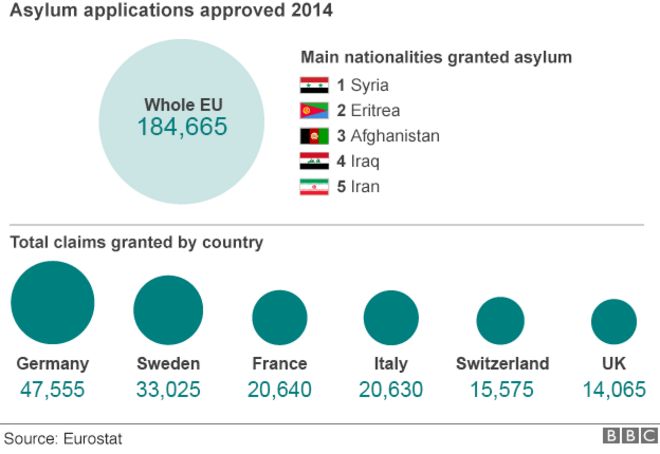
Asylum claims

In September, EU ministers voted by a majority to relocate 120,000 refugees EU-wide, but for now the plan will only apply to 66,000 who are in Italy and Greece.
chart showing number of migrants EU countries will acceptChart showing approved asylum applications


Migrant deaths in Mediterranean by month                       Syrians in neighbouring countries and Europe map


Whenever people treats others as they treat each other, then we will have no more wars.

← Back

Thank you for your response. ✨

THE BEADY EYE ASK’S: IS THE EUROPEAN UNION ALL ITS MADE OUT TO BE.

Tags

, , ,

( Five to Six minute read)

The European Union seems incapable of undertaking economic reforms and defining its place in the world.Afficher l'image d'origine

Citizens feel isolated from the institutions in Brussels and see no way to influence European level decisions.

The EU is one of the motors of capitalist globalisation, the rule that all decisions should be made on the basis of profitability alone.

Over the course of the coming year it looks like it is in for a large dose of turmoil.

The lack of fluency in financialese shouldn’t preclude anyone from understanding what is going on in Europe or what may yet happen.

So let’s have a closer look at what is means to-day to be an European Citizen with a EU passport.

Years ago I had a lovely greed passport. Now I have a wine coloured EU Irish passport.

What is the difference? Globalisation has already deeply undermined national citizenship as a bond between individuals and states.

You could say that EU citizenship provides the most vivid reminder of the radical shift in the meaning of citizenship that made it a more ethically acceptable institution. Non-discrimination on the basis of nationality – the very core of EU law – provides the litmus test for what national citizenship is really about in the EU today.

The primary value of citizenship lies in the mobility rights attached to passports.

Does this appease my lost of my Irish Passport.?  Does it make me feel European?

So in some ways the answer to the above questions is Yes.

On the other hand I come from a small Island with a long history and a culture far removed from Europe.  So I remain Irish first and European for the sake of Commerce and Peace among nations.

The problem is that the EU passport is rapidly reflecting the instrumental value of free movement rights attached to EU citizenship for the wealthy and mobile global elites.

They are willing to dish out hundreds of thousands of dollars to gain a freshly minted passport in their new “home country.”

That this demand exists is not fully surprising given that this is a world of regulated mobility and unequal opportunity, and a world where not all passports are treated equally at border crossings.

Rapid processes of market expansionism have now reached what for many is the most sacrosanct non-market good: membership in a political community.

More puzzling is the willingness of governments – our public trustees and legal guardians of citizenship – to engage in processes that come very close to, and in some cases cannot be described as anything but, the sale and barter of membership goods in exchange for a hefty bank wire transfer or large stack of cash.

Everybody knows that immigration is among the most contentious policy issues of our times, and recent years have witnessed a “restrictive turn” with respect to ordinary immigration and naturalisation applicants, such as those who enter on the basis of a family reunification claim or for humanitarian reasons.

At stake is the regulation of the most important and sensitive decision that any political community faces: how to define who belongs, or ought to belong, within its circle of members.

Not everyone knows, however, that governments are now proactively facilitating faster and smoother access to citizenship for those who can pay.

Many EU countries offer privileged access to EU citizenship to large populations outside the EU territory on grounds of distant ancestry or co-ethnic identity, obliging thereby all other Member States to admit immigrants from third countries to their territories and labour markets as EU citizens.

Consider the following examples.

Affluent foreign investors were offered citizenship in Cyprus as “compensation” for their Cypriot bank account deposit losses.

In 2012, Portugal introduced a “golden residence permit” to attract real estate and other investments by well-to-do individuals seeking a foothold in the EU.

Spain recently adopted a similar plan.

On 12 November 2013, Malta approved amendments to its Citizenship Act that put in place a new individual investor legal category that will allow high-net-worth applicants to gain a “golden passport” in return for € 650,000.

Under these cash for-passport programmes, many of the requirements that ordinarily apply to those seeking naturalisation, such as language competency, extended residency periods or renunciation of another citizenship, are waived as part of an active competition, if not an outright bidding war, to attract the ultra-rich.

Portugal, for example, offers a fast track for qualified applicants that entitles them to a 5 year permanent residence permit, visa-free travel in Schengen countries, the right to bring in their immediate family members, and ultimately the right to acquire Portuguese citizenship and with it the benefits of EU citizenship. This package comes with a hefty price tag: a capital transfer investment of € 1 million, a real estate property purchase at a value of € 500,000, or the creation of local jobs. The investment needs to remain active in Portugal for the programme’s duration.

Alas, the individual who gains the golden permit bears no similar obligation.

Simply spending 7 days in Portugal during the first year and fourteen days in the subsequent years is enough to fulfil the programme’s requirements.

This is not the only example or anything new: It is more or less wholesale around the world.

Such programmes are found in, among other places, Australia, New Zealand, Hong Kong, the United Kingdom and the United States. Both kinds of programme raise serious ethical quandaries, but the unfettered cash-for-passport programmes are far more extreme and blatant than the traditional investment programmes.

They contribute to some of the most disturbing developments in 21st century citizenship, including the emergence of new forms of inequality and stratification.

So much for the conclusion that “real and effective ties” between the individual and the state are expected to underbid the grant of citizenship.

Since EU citizenship is derived from Member State nationality and determining the latter remains an exclusive competence of Member States, EU law does not provide much leverage against either the sale of EU passports or other policies of creating new EU citizens without genuine links to any EU country.

Citizenship should be considered as the kind of good that money should not be able to buy but earned. 

Instead of offering their citizenship for money, democratic states could bestow it on persons who are threatened by persecution or who fight for democratic values as a means of protection or exit option with the provision of earning the right to residence-based naturalisation.

A global market for citizenship status is corrupting democracy by breaking down the wall the separates the spheres of money and power.

However, that monetary investment can be a way of contributing to the common good of a political community and should therefore not be summarily dismissed as a legitimate reason for acquiring citizenship.

That states have legitimate interests in “inviting the rich, the beautiful and the smart” and that investor citizenship is not essentially different from the widespread practice of offering citizenship to prominent sportsmen and –women.

Some states offer citizenship to foreigners who have served in their army or have otherwise provided exceptional service to the country.

There is a broader trend towards relinking citizenship acquisition to social class, which manifests itself, on the one hand, in offering citizenship to the rich and, on the other hand, in income and knowledge tests for ordinary naturalisations of foreign residents.

Why are states putting citizenship up for sale? And what precisely is wrong with easy-pass naturalisation along the lines of the cash-for-passport programmes? Is it the queue jumping? The attaching of a price tag to citizenship? The erosion of something foundational about political membership itself? Or, perhaps, all of the above?

Such programmes are found in, among other places, Australia, New Zealand, Hong Kong, the United Kingdom and the United States. Both kinds of programme raise serious ethical quandaries, but the unfettered cash-for-passport programmes are far more extreme and blatant than the traditional investment programmes. They contribute to some of the most disturbing developments in 21st century citizenship, including the emergence of new forms of inequality and stratification.

Indeed, if a Romanian is good enough to be embraced by British society as equal, subjecting a Moldovan to any kind of tests is utterly illogical: the arguments of the protection of culture, language, etc. are simply devoid of relevance when more than half a billion EU citizens a exempted from them.

The European bosses want to use North Africa and the other countries on the fringes of Europe as a highly exploitative, low wage sweatshop where workers have no union rights and environmental legislation is minimal.

There are two parts to this policy.

The nastiest side of the EU is on the question of migration. Here EU policy has resulted in thousands of deaths in the last decade.

Thousands have died trying to cross the borders that surround Europe.

They have drowned in the Mediterranean and suffocated in the backs of containers. Dozens have died in suspicious circumstances at the hands of immigration police. Tens of thousands more sit in prison camps across Europe, waiting to be deported. At the same time large sectors of the European economy, particularly in agriculture, cleaning and fast food are dependent on the low wage workforce the migrants who manage to cross the border provide.

So Ask me again. Is the EU passport all its made out to be.

Full belonging to a society is thus not subjected any more to an arbitrary approval, putting all the bizarre language, culture and other tests that states subject newcomers to in a very interesting perspective: the very existence of the EU disproves their validity and relevance.

They consist in nothing else but purification through humiliation: the “others’” language and culture is presumed as not good enough and social learning is dismissed, forcing people to waste their time by subjecting them to profoundly disturbing rituals.

The very success of obtaining EU citizenship by a period of probation is the strongest argument against these practices.

It’s not just an understanding of a language that makes you integrate, it’s the core belief is your country, not a Trading Block.

We all know that the EU originally was the Common Market.

Since then it has continuously evolved.

This means is that the EU wants to turn water supply, education, health and refuse collection from being social services provided to all to profit-making enterprises provided to those who can pay.

Surely, zealous free-marketeers will enthusiastically defend such programmes as freeing us from the shackles of culture, nation and tradition and moving citizenship forward to a new and more competitive global age of transactional contracting in which, as Nobel Prize laureate Gary Becker once put it, a price mechanism substitutes for the complicated criteria that now determine legal entry.

So why is it important to understand how citizenship-by-investment has come about?

Because of its large impact on an essential political institution and its success in carving out global mobility corridors through entangled states.

The UK, one of the first states to introduce Investor Visa (with a price tag of £ 1 million or a bank loan from an UK financial institution and personal assets worth 2 million) recently revised this policy as it came to its attention that investors used the capital for investment as security to back up loans and that investments were placed in offshore custody.

May be in 2016 the Flag will change to look like this.

Afficher l'image d'origine

or     Afficher l'image d'origine   orAfficher l'image d'origine


Afficher l'image d'origine

or   Afficher l'image d'origine   or    Afficher l'image d'origine

There is one thing for sure, fences or not it will have more than a few new Citizens.

All comments appreciated.

← Back

Thank you for your response. ✨

THE BEADY EYE ASK’S: IS THE LONG-HELD NOTION OF WHO WE ARE WHAT WE DO AND HOW WE BEHAVE THREATENED.

Tags

, , , , ,

(4/3 minute read)

We live in a digital age with both positive and negative influences on society.

But is the human brain, that most sensitive of organs, under threat from the modern world?

We are becoming more and more reliant on technological devices for nearly everything we do.

Unless we wake up to the damage that the gadget-filled, pharmaceutically-enhanced 21st century is doing to our brains, we could be sleepwalking towards a future in which neuro-chip technology blurs the line between living and non-living machines, and between our bodies and the outside world.

Human identity, the idea that defines each and every one of us, could be facing an unprecedented crisis.Afficher l'image d'origine

Of course, there’s nothing new about that:

Human brains have been changing, adapting and developing in response to outside stimuli for centuries.

However our brains to-day are under the influence of an ever- expanding world of new technology: multichannel television, video games, MP3 players, the internet, wireless networks, Bluetooth links, Smart Phones, – the list goes on and on.

Electronic devices and pharmaceutical drugs all have an impact on the micro- cellular structure and complex biochemistry of our brains. And that, in turn, affects our personality, our behaviour and our characteristics.

In short, the modern world could well be altering our human identity.

It is a crisis that is threatening the long-held notions of who we are, what we do and how we behave.

It goes right to the heart – or the head – of us all.

This crisis could reshape how we interact with each other, alter what makes us happy, and modify our capacity for reaching our full potential as individuals.

And it’s caused by one simple fact:

The human brain, that most sensitive of organs, is under threat from the modern world.

Already, it’s pretty clear that the screen-based, two-dimensional world that so many teenagers – and a growing number of adults – choose to inhabit is producing changes in behaviour.

Attention spans are shorter, personal communication skills are reduced and there’s a marked reduction in the ability to think abstractly.

Add that to the huge amount of personal information now stored on the internet – births, marriages, telephone numbers, credit ratings, holiday pictures – and it’s sometimes difficult to know where the boundaries of our individuality actually lie.

And could weaken further still if, and when, neurochip technology becomes more widely available. These tiny devices will take advantage of the discovery that nerve cells and silicon chips can happily co-exist, allowing an interface between the electronic world and the human body.

Then, if both devices were connected to a wireless network, we really would have arrived at the point which science fiction writers have been getting excited about for years. Mind reading! We becoming more and more immune to what we are doing to ourselves in our lives. That cherished sense of self could be diminished or even lost.

So far:

Facebook is eating away at your time. Making you into a Likeaholic.

Our Intimacy is being eroded.

We inundated with information overload to the point that only sensationalism attract our attention.

Pure’ pleasure – that is to say, activity during which you truly “let yourself go” – was part of the diverse portfolio of normal human life. Until now, that is.

Now, coinciding with the moment when technology and pharmaceutical companies are finding ever more ways to have a direct influence on the human brain, pleasure is becoming the sole be-all and end-all of many lives, especially among the young.

We could be raising a hedonistic generation who live only in the thrill of the computer-generated moment, and are in distinct danger of detaching themselves from what the rest of us would consider the real world.

In the mean time we continue polluting the planet will nilly.

But we mustn’t be too pessimistic about the future.

What if we could create an environment that would allow the brain to develop in a way that was seen to be of universal benefit?

I’m not convinced that scientists will ever find a way of manipulating the brain to make us all much cleverer (it would probably be cheaper and far more effective to manipulate the education system).

Well, that debate must start now.

Biometrics has long been put forth as the next big thing in authentication, replacing or supplementing the concept of “things that you know”—passwords, PINs, and so on—with “things that you are.”

Fortunately, there’s no shortage of qualities that are unique to each person on the planet, and which could be potentially combined to create a comprehensive picture of you that’d also be really hard to fake.

Unfortunately the challenge will be to ensure that all income growth does not end up with those who own the machines and shares. Afficher l'image d'origine

Identity, the very essence of what it is to be human, is open to change – both good and bad. Our children, and certainly our grandchildren, will not thank us if we put off discussion much longer.

Perhaps it will not matter in a few hundred years when we are all singing from the same hymn sheet

All comments appreciated.

← Back

Thank you for your response. ✨

THE BEADY EYE ASK’S: WHY IS IT WE CAN’T ACT FOR THE COMMON GOOD?

Tags

, , , , , , , ,


( A four-minute Read.)

Whatever Happened to the “Common Good”?

Our politics have become so polarized and increasingly volatile; and our political institutions have lost the public trust. 

There is (Almost) No Such Thing as the “Common Good”

We face a choice between a society where people accept modest sacrifices for a common good or a more contentious society where group selfishly protect their own benefits. Our most fundamental social problems grow out of a widespread pursuit of individual interests and greed.

Recommitting ourselves to the general welfare could solve the deepest problems the world now face.

The very idea of a common good is inconsistent with a pluralistic society like ours.

Different people have different ideas about what is worthwhile or what constitutes “the good life for human beings”, differences that have increased during the last few decades as the voices of more and more previously silenced groups, such as women and minorities, have been heard.

Given these differences, some people urge, it will be impossible for us to agree on what particular kind of social systems, institutions, and environments we will all pitch in to support.

It might seem that since all citizens benefit from the common good, we would all willingly respond to urgings that we each cooperate to establish and maintain the common good.

Examples of particular common goods or parts of the common good include an accessible and affordable public health care system, and effective system of public safety and security, peace among the nations of the world, a just legal and political system, and unpolluted natural environment, and a flourishing economic system.

Because such systems, institutions, and environments have such a powerful impact on the well-being of members of a society, it is no surprise that virtually every social problem in one way or another is linked to how well these systems and institutions are functioning.

So why is it that we are unable to act for the Common Good of humanity and the Planet?

Our culture views society as comprised of separate independent individuals who are free to pursue their own individual goals and interests without interference from others.

In this individualistic culture it is difficult, perhaps impossible, to convince people that they should sacrifice some of their freedom, some of their personal goals, and some of their self-interest, for the sake of the “common good”.

This combined with the fact that we have turned everything into a commodity to be bought or make profit on has blurred our values of the common good.

These days one might describe the common good as “certain general conditions that are…equally to everyone’s advantage”.

Even if we agreed upon what we all valued, we would certainly disagree about the relative values things have for us.

Such disagreements are bound to undercut our ability to evoke a sustained and widespread commitment to the common good.

In the face of such pluralism, efforts to bring about the common good can only lead to adopting or promoting the views of some, while excluding others, violating the principle of treating people equally.

Moreover, such efforts would force everyone to support some specific notion of the common good, violating the freedom of those who do not share in that goal, and inevitably leading to paternalism (imposing one group’s preference on others), tyranny, and oppression.

We left with cultural traditions, that in fact, reinforce the individual who thinks that she should not have to contribute to the community’s common good, but should be left free to pursue her own personal ends.

WHERE DOES ANY OF THIS LEAVE US?

A good questions but complicated because complete societies all with different laws, rules, and beliefs,(which we can call ‘polities,’ or ‘countries’) take many forms in different times and places but they always include some kind of rule ordering them to the common good.

This may well be so but the overriding self interest   Resulting in a planet of Inequalities, rampant climate change, conflicts, wars, pollution on a massive scale, corruption, and profit at any cost.

Not all people live under a state, but every [complete] human community by definition is a polity.» Polities enable families, local communities (‘villages’), and associations to flourish by realizing many common goods, but polities also allow for the achievement of greater common goods.

The good news is with modern-day technology we are on the threshold of discovering a new way.

  • It is possible for acts of individual humans armed with powerful technologies to make decisions that may affect the future survival of the whole human race.
  • We can imagine the possibility of extinction (whether by our own efforts or due to some external cause), and we can agree to work together to prevent such an eventuality.

Of course, even while we work on a common goal of preserving the species, we will still all be competing to maintain a larger share of descendants within the future population, and this may still result in technological developments that threaten the extinction of everyone.

Whether one goal (survival of the species) can win out against the other goal (relative reproductive success of the individual) is not a fore-gone conclusion.

For me it consists primarily of having the social systems, institutions, and environments on which we all depend work in a manner that benefits all people.

The internet revolution is transforming the way knowledge is disseminated and how people unite over causes. ( see post: The Beady Eye asks: Are we condemned to reaction politics for the foreseeable future)

This means that our out of date world organisations need to come up to speed.

Establishing a pro active chamber of Governance with non political expert representatives, immune from lobbing, that would be concerned with the long-term view to avoid potential threats or to capitalize on potential opportunities.

This Chamber actions subject to Social Media network electronic voting by the tax paying citizens.

Placing a World Aid Commission of 0.05% ALL HIGH FREQUENCY STOCK EXCHANGE TRANSACTIONS. ON ALL FOREIGN EXCHANGE TRANSACTIONS OVER $20,000. ON ALL SOVEREIGN WEALTH FUNDS ACQUISITIONS . ON ALL NEW DRILL LICENCES.

THIS WOULD CREATE A PERPETUAL FUND FROM PROFIT FOR PROFIT SAKE TO ADDRESS CLIMATE CHANGE AND ALL OTHER WORLD PROBLEMS OF INEQUALITY.

WHY SUCH A FUND? Because appeals to the common good are confronted by the problem of an unequal sharing of burdens.

Our desire or desires are personal incapable of being satisfied because of our internal sense of imagination.

If good is the cause of desire, how can it be that people do not want what is good?

Indeed, all sense pleasures seem to be intended by nature to be connected to actions that lead toward the lower and more basic of the honorable goods such as the preservation and reproduction of life.

This is lost in large complex societies.

Is this the reason we are unable to act for the common good.

To define the good as ‘what all want’ is therefore a definition not of an effect by its cause, but just the opposite: a definition of a cause by its effect. The good is a cause. It is the final cause, the end or purpose.

If you get what I mean.

Hunger is the desire for food, but food is not good because there is hunger. Rather, there is hunger because food is good and necessary for the preservation of one’s substance.

The good is desirable as known, and therefore as long as it is unknown it is powerless to cause desire.

Many economists claim that in any free exchange each party must think that they are getting something better out of the deal.

But people are not such fools.

Whoever wins, others must lose.

Therefore, for humanity, there is no “Common Good”.

Other than the continued survival of the human race as a species.

Unless, perhaps, we can avoid the finiteness by expanding into outer space.

Afficher l'image d'origine

Historically, our darkest hours on Earth have given birth to some of our most brilliant moments—our brightest ideas and most illuminating conversations.

The challenges we’re facing can spur us towards brilliance—and prompt a course correction. We must be both far-sighted and courageous in our thinking.

Our house is on fire. What will we save?

Not the redistribution of wealth by governments Tax to create greater equality.

Especially insofar as they are only concern with interior acts power rather than the outward behavior which directly affects other people.

We must also support thinkers and leaders who can help expand our collective understanding of what’s valuable beyond the narrow one-dimensionality of a profit margin.

We may never find a truly satisfying and conclusive answer.

Maybe its the wrong question altogether.  You will never really know what it is to be me and I will never really what it is to be like you. And this very unknowability of other humans beings is what is the common good.

The human common good—now understanding that phrase without restriction to the state’s or political community’s good is impossible.

ALL COMMENTS WELCOME.

← Back

Thank you for your response. ✨


THE BEADY EYE SAY’S: THAT THE RECENT PARIS CLIMATE CHANGE AGREEMENT WILL PROVE TO BE – JUST WORTHLESS WORDS


The human race joined in a common cause in Paris, but it’s what happens after is what really matters.Afficher l'image d'origine

That’s just it.

After a few days in the spot lights of the world media we are lead to believe that climate change has broadly improved while the wheels of Capitalism turn ever faster and more productively.

Where were the external threats of climate change to replace, Inequality, Greed,  Asylum – seekers, Wars, Water shortages, Forest fires, and the like gone.

It didn’t work and is not working.

Can you honestly imagine Africa, the Middle East and South America making any effort to meet their obligations to combat climate change?

Does anyone seriously believe that politely asking the governments of wealthy nations to protect the most vulnerable people’s from climate catastrophe will ensure their salvation?

This is like respectfully requesting that the fossil fuels industry transfer its historical profits to developing nations as reparations – a not unreasonable request, considering the millions of poor who have been devastated over decades by the industry’s depredations. 

As long as fossil fuels appear to be the cheapest fuels out there, they will be continued to be burned. Just look at the price of Oil.

It’s was all vacuous grandstanding, designed to appease the eco-fanatics and allow politicians to feel good about themselves. That is politicians that don’t having a clue what to do about the everyday problems which concern the people who pay their wages — let alone the menace of Islamist terrorism and mass migration — they disguise their impotence and indifference by diving headlong into displacement activity.

What better way than to achieve this but with agreeing to a Climate deal that undermines the rights of the world’s most vulnerable communities and has almost nothing binding to ensure a safe and liveable climate for future generations.

I don’t think for a moment that any climate scientists is buying the hype.

All the aspiration and the rhetoric will not deliver reductions in carbon dioxide emissions…

It’s outrageous that the deal being spun as a success when it merely called upon States to “pursue efforts” to limit the increase to 1.5C.

Do decades of governmental inaction give us any cause to believe that such efforts will be vigorously pursued, even though the Paris accord imposes no penalty whatsoever for failure to pursue them?

The report states: [Countries will hold] the increase in the global average temperature to well below 2C above pre-industrial levels and [pursue] efforts to limit the temperature increase to 1.5C.  Pull the other leg.

It also includes a five-year review system to increase ambition on cutting emissions as well as finance for developing countries to deal with rising temperatures.

The media has championed the Paris climate change agreement that resulted from COP21 as a ground-breaking step in the right direction – however it is the actions that take place on the ground over the next five crucial years that will determine whether or not the Paris agreement is worth the paper it’s written on.

Evidence shows that the emissions reduction pledges put forward in countries’ Intended Nationally Determined Contributions (INDCs) ahead of COP21 in Paris are not sufficiently ambitious to keep the increase in global average temperature below the internationally agreed 2°C threshold.

It can be said that Paris is a promising departure. Getting to the right destination is another matter.

Interpretive principle is not the same as a hard legal obligation. In particular, nowhere in the Paris accord are states mandated to take all steps necessary to ensure that the temperature limit is not breached.

Climate change is driven by the total stock of greenhouse gases in the atmosphere, not just by the flow of new emissions, and the world’s rich countries are mostly responsible for what’s already there.

The Copenhagen agreement also included aviation and shipping, two sectors that collectively combined are similar to the emissions from the U.K. and Germany.

These are now exempt from the current text, and they are growing very rapidly indeed.

There is no action, just promises. 

You could be forgiven for thinking that the world has entered a doldrums.

People are still wrangling about the Iraq war, whether China is or not a superpower, whether a racist will become the President of the USA, whether we all be under the rule of ISIS or whether the Civil war in Syria will spread, or whether we should welcome another million refugees.   Has anything really changed?

Of course it has our World Organisations are showing signs of rust, and with biological sense of rhythm we are all slowly preparing to transfer our allegiance to newer, shinier, clever, technologies. ( see previous post)

You may sometimes think that’s not how it is.

None of this, of course, is in any way intended to be disrespectful to the glories of the Paris Agreement. Indeed it is a massive step in the right direction. It is difficult enough to get two people to agree never mind 200 odd countries.

However the high-sounding rhetoric of the Paris accord will result in a materially different outcome.

The days of having one’s cake and eat it have ended. We have to deal with the world as it is.

The Public likes Capitalism to sound caring.

The Paris Mission Statement can only be for fudging a failure.

Unfortunately the climate problem and its solution need to be approached in a way that produces results now not in the near future.

This can only be achieved with massive financial investment.

The problem is where or who will provide this investment.

In my mind there are two paths to follow.

Make Capitalism foot the bill, by placing a World Aid Commission of 0.05% on all high frequency stock trading, on all foreign exchange transactions over $20,000, on all Sovereign Wealth Funds Acquisitions, and on all new mining drilling licences.

Then ask every citizen of the world to buy Climate Change Bonds that can be set off against future Taxations.

Only then can we really tackle the problem along with many others.

 An after thought.

How about requesting all-weather forecasting TV programs to include a Climate Change News section at least one a month.

My friends there is no getting around it with Promises of action.

We all see the results of doing nothing everyday if it not on Television it is on Social Media.

Climate change is already happening today.Afficher l'image d'origine

As with all that affects us the free media ends up as traders of news and views and like all traders they can be caught out by someone who is prepared to be original and daring,.

Afficher l'image d'origine


← Back

Thank you for your response. ✨

THE BEADY EYE ASK’S ARE WE ALL GOING TO END UP GOOGLEFIED.

Tags

, , , , ,

GOOGLE is currently the world’s most visited website but is it destroying the gymnasium of our collective minds? 

Essentially, Google has become our collective mental crutch.

Google is a publicly traded company owned by a group of shareholders.

Founders of Google, Larry Page and Sergey Brin, own most of the shares of the company.

It’s almost impossible to live without interacting with a Google product in today’s world. Google owns an incredible number of companies and, at times, was even buying a company a week!

As of 2015, Google had 75% market share in searches. People use Google to search nearly 13 billion times per month, which averages to 26 searches per person per year.

There are very few products in the world with this ubiquity and dominance.

Using complete data from the 2014 fiscal year, Google raked in revenues exceeding $66 billion.

With $64.4 billion in cash and having spent almost $5 billion on acquisitions in 2014, Google doesn’t seem to be in a hurry to slow down.

This means Google is richer than pretty much everyone, and everyone includes the majority of the world’s nations such as Iceland, the Bahamas, Guatemala, Bulgaria and Sierra Leone.

This figure does not take into account Google’s expenses for 2014, which bring the company’s total net profit down to a measly $14.44 billion. However, since the gross domestic product, or GDP, of a nation does not incorporate its debt, the revenue figure is the most accurate number to use when comparing the income of corporations to the wealth of nations.

In 2015, Google Incorporated is worth $370 billion.

(Google is not even the richest company. In fact, based on revenue alone, Google trails pretty far down the list. Wal-Mart tops the chart with revenues exceeding $485 billion, and other corporate giants such as BP, Apple (AAPL) and Bank of America (BOA) rank somewhere in between.)

Google wield astonishing power in the United States and around the world.

Google Incorporated is the third largest company, in terms of market capitalization, in the United States; Its market cap is $373.79 billion, only being edged out by Microsoft Corporation and Apple Incorporated.

With most businesses being directly or indirectly controlled by a relatively small number of global mega-companies, almost everything a consumer buys or interacts with is connected in some way to companies such as Google.

Google makes money from searches by selling promoted advertising based on search keywords.

The ads are more powerful than traditional advertising because they can be targeted by interest and geography. Advertisers like the program because they can get real-time feedback on the effectiveness and engagement of their ads. This continues to be the backbone of Google’s business and its major source of revenue.

Google Gmail today has over 425 million MONTHLY ACTIVE USERS.
Afficher l'image d'origine

THE QUESTION IS:

If the Google was a nation and declared sovereignty, issued a currency and joined the United Nations tomorrow, where would it rank on a list of the wealthiest countries?

It turns out Google’s $66 billion revenue plants it squarely at number 70 for the 2014 fiscal year.

Only 69 of the nations of the world outrank the Internet-technology giant.

While economic superpowers such as the United States and China far outstrip Google, for now, the number of countries with GDPs dwarfed by Google’s massive wealth is staggering.

The phrase “to Google” is so popular that the company is actually worried about losing trademark rights if the term becomes generic, like “escalator” and “zipper,” which were once trademarked.

It has changed our brains. Even if we aren’t conscious of it, our brains are primed to think about the Internet as soon as we start trying to recall the answer to a tough trivia question.

It has taken over our cell phones. Since the first Android phone was sold in 2008, Google’s mobile operating system has bulldozed the competition. Today it claims nearly 85% of market share, nearly doubling its hold over the last three years.

It has transformed the way we use e-mail. Gmail was invented a decade ago, before bottomless in boxes were a sine qua non. It’s hard even to remember those dark ages when storage space was sacred—and deleting emails was as tedious-but-necessary as flossing. Today our accounts serve as mausoleums, housing long-forgotten files, links, and even whole relationships. Google itself has touted alternative uses for Gmail, such as setting up a virtual time capsule for your newborn—though in practice accounts can’t be owned by anyone under 13. But even that last point is about to change.

It’s changed how we collaborate. Back in 2006, Google acquired the company behind an online word processor named Writely. With that bet, Google created a world where it’s taken for granted that people can collaborate on virtually any type of document, whether for work, play, or (literally) revolution.

It has allowed us to travel the globe from our desks. Yes, Map Quest was popular first. But Google Maps (and Earth) has become much more than a tool for measuring travel routes and times. Since Google Street View came onto the scene in 2007, it’s been possible to “visit” distant destinations, give friends a virtual tour of your hometown, plan ahead of trips, and waste even more time on the Internet.

Of course, the more popular a tool, the more useful it is to those who’d like to spy on us.

It has influenced the news we read. Ranking high in Google search results is serious business and can have a profound effect on the success of companies, media outlets, and even politicians. When I just Googled “how SEO affects journalism,” this link was at the top of my search results. How is that significant? Well, for one, that story itself has been so successfully search engine optimized that it still tops the list despite being four years old.

It has turned users into commodities. We all love free stuff, but it’s easy to forget that services offered by companies like Google and Facebook aren’t truly “free,” as data expert Bruce Schneier has pointed out. Remember that all of your data (across ALL of the services you use, and that includes Calendar, Maps, and so on) is a valuable good that Google is packaging and selling to its real customers—advertisers.

It’s changed how everyone else sees YOU. Unlike your Facebook profile, the links that turn up when potential employers (or love interests) Google you can be near-impossible to erase. Perhaps unsurprisingly, Google uses the fear of embarrassing search results to encourage people to manage their image through Google+ profiles.

Next stop:  

Self-driving cars along with a Google computer that is so artificially intelligent that it could program on its own transmitting, too Google glasses which will surely Googlefie their owners.  

Leaving little room if any for self conscious or search engines? Aren’t they all dead? —

Recent research has confirmed suspicions that 24/7 access to (near) limitless information is not only bad for human discourse— it’s also making us worse at remembering things, regardless of whether we try.

Thanks to Google we now have for lack of a better word the “wisdom of the crowd” or “social proof” (which you can “buy”) which sums up how superficial and shallow our society has really become.

Social Proofing is a phrase that applies particularly well to the large social environment created on the internet and the power of a group to come together and make a decision collectively.

(i.e. other items customers buy after viewing this item’ display or review summaries Booking.com Recommendation engines in shopping sites like Amazon.com rely on other people’s feedback to help drive sales and refer people to products they will like based on the buying behaviours of people like them.)

It doesn’t necessarily always lead to the “wisest” decision, because it can be a blind choice, made because other people made it, not necessarily based on sound rationalisation looking at the facts.

Social proof is everywhere.

Comments are indicators that enough people are paying attention to what you are writing to reply. The same can be said for things like Facebook “like” and Twitter “tweet” buttons.

We are pack animals, no matter how independent we think we are, unless you live in a cave, you are conditioned by other people around you.

Today the very nature of the Internet, being such a social environment, has resulted in social proof becoming by far the greatest force when it comes to buying decisions.

Google has recently reorganized itself into multiple companies, separating its core Internet business from several of its most ambitious projects while continuing to run all of these operations under a new umbrella company called Alphabet.

With the European Union recently beginning an investigation for monopolistic business practices, diversification might be in Google’s best interest.

Using Google to navigate the web remains the preferred method by which most people find information online. However, Google is far from a monopoly in terms of the entire gamut of Internet services. The perception of Google being a monopoly is derived from the fact it happens to have dominance in the most lucrative area of the Internet.

On the other hand.

When Google was just a start-up business in Palo Alto, Calif., it did not have enough money to pay its employees the high wages of today’s Google, so they offered them stock in place of a massive salary. Those original employees, including the head of the culinary staff, now either still own a good chunk of shares or have cashed in and enjoy a life of extreme wealth and prosperity because of Google’s explosive growth.

Google Incorporated now offers some of the best employee benefits and even death benefits. If a Google employee dies, the deceased’s spouse or partner receives half of the deceased employee’s salary for 10 years. Children of the deceased employee also receive $1,000 per month until age 19, or 23 if the children are full-time students.

It has contributed quite a bit of its income to various charities. In 2012, Google reported charitable donations exceeding $144.6 million. In addition, it gave away approximately $1 billion in free products.

Why have any concerns?

Google launched its Google Print division, now known as Google Books, which scans books into its application and website. Google intends to scan all existing books before 2020. To date, Google has scanned over 20 million books.

They are not doing this for the love of books or reading.

pirate-piracy-malware-ss-1920

Project Loon proposes to provide internet connectivity from balloons floating at a height of 20 km above the earth’s surface on a pilot basis. The idea is to connect remote areas of the country using LTE or 4G technology through the balloons, which can transmit as far as 40 km from their diameter.

If you believe that this is all they want to achieve with their Balloons you can pull my other leg.

Should we ban the wearing of Google glasses in public places.

  • As a practical act which creates areas free of surveillance or highly intrusive surveillance.
  • As a symbolic act showing concern for privacy.
  • As a way of exerting social pressure to establish norms around usage.
  • As a way of exerting market pressure to discourage people from buying and companies developing these systems.
  • Questions over machine monitored surveillance have existed for decades,

Fears over AI overlords may be groundless, but the use of machine learning to mine personal information is a worrying development, artificial intelligence experts have warned.

There is a broad consensus that technology has the potential to improve education and make it more personalized, but it is never going to come to pass if we don’t set higher standards for student and data security.”

A digital textbook is a textbook that lives on a desktop, laptop or mobile devices and is easily editable to provide educational content that is as timely and relevant as possible.

It wont challenge them to think about the knowledge, skills and abilities they’ll need to solve that problem.

But when does personalized learning get too personal?

Google researchers claim they’re working on a supercomputer that harnesses the power of quantum physics to calculate in one second problems that would take a regular machine 10,000 years to solve.

The change unlocks more computing power, allowing quantum computers to consider untold variables compared to conventional machines.

If they’re right — some people have raised questions about their claims — then the world could be at the dawn of a new age of über-powerful computers.

High-frequency trading helped cause the so-called “flash crash” of 2010, To the extent they can be speeded up even by a microsecond, it will make the problem that much worse.

On February 26th, 2015 Google’s Webmaster Central Blog announced a mobile algorithm update for April 21st, 2015. This is the first time Google has ever given an exact date for an algorithm update, so the digital world was expecting big things, dubbing the event ‘Mobilegeddon’.

Google is in such a dominant market position on mobile, that their decision to ban legitimate apps from Android amounts to Internet censorship.

The message from Google is clear, if your website is not optimised for mobile, it’s likely that your search ranking will suffer. Google cares most of all that people keep coming back to use their search engine.

The choices Google makes about what apps are banned and allowed appear in many cases to be dangerously anti-user.

The update will effectively penalise websites which Google does not deem to be mobile friendly and the impact is expected to be widespread.Google is not one to joke around so it is a definite ‘watch this space’ as the full impact of this algorithm is yet to seen…

Ethics concerns in conjunction with porn viewing and the internet cloud are presently in the news.

THINK WITH GOOGLE. 

New and expecting parents are 2.7x more likely than non-parents to use a smart phone as their primary device. So it’s not surprising  that Mobile searches related to babies and parenting have grown 25% since 2013

Searches about baby development were 72% mobile in Q1 of this year

In fact, views of parenting videos on YouTube were up 329% on mobile this year.

Is Google Making Us Stupid?

Thoughts and actions feel scripted, as if they’re following the steps of an algorithm.

We come to rely on computers to mediate our understanding of the world, it is our own intelligence that flattens into artificial intelligence.

If we fill our BRAINS  up with “content,” we will sacrifice something important not only in our selves but in our culture.

20111211-google-wordle

FALLING OUT OF LOVE WITH GOOGLE.

Understand what they’re doing, taking away time we could be using to shape our content in interesting ways.

Google’s increasingly invasive technology WILL BE IT’S DOWNFALL.

Apple’s policy is to collect no personal data, (this is of course apart from your iTunes account details allowing you to make purchases) a surprise from a huge company who aren’t exactly squeaky clean in other areas, like the working conditions for overseas workers for example.And they don’t do search – or do they? Installed on all almost 1 billion Apple devices worldwide,

Search with no ads and no data collection. So those of us with Apple devices can sidestep the issues with Google and still not have to add them to the To Sort Out list!

The fast changing pace of tech companies shows no sign of letting up and can both drive change and perhaps cause their downfall as consumers move with the tides as well.

Who would foresee Google tumbling from their great height? But perhaps this is what we are witnessing as this world of rapid changes throws up other surprises.

We are using these devices every day so we care and influence the battles outcomes.

So what we can do to get Google to re-commit to their mission of doing no evil.

We are letting the opportunity of a lifetime—of our lifetime and theirs—pass us by.

DuckDuckGo who offer search with no data collection.

They are an Open Source company who decided early in their life to offer Search with no personal tracking, no collection or sharing of your personal information. They’re a built-in search page option in Safari and Firefox, but not of course in Google Chrome!

Does any of this matter?

I suppose in the long run nothing will matter, but in the mean time Google which lives off our daily lives has a responsibility away beyond it Billions.

As humanity we will no doubt be reduced to a chip in a AI robot if we are to have any chance of escaping the planet before its demise.  ( Providing we last that long which looking at the current state of affairs it is highly unlikely.)

So perhaps it is for the best that we are all becoming Googlefied.

Google it and see.

← Back

Thank you for your response. ✨


THE BEADY EYE ASKS: ARE WE CONDEMNED TO REACTION POLITICS FOR THE FORESEEABLE FUTURE

Tags

, , , ,

When you look at the state of the Planet is it time for world Governments to have   a third level of Governance.

Our political discourse is shrinking to fit our smart phone screens.

( If we don’t open our eyes we will be governed by natural-born troll, such as MR TRUMP who is adept at issuing inflammatory bulletins at opportune moments, he’s the first candidate optimized for the Google News algorithm.)

A pro active house of power with non political representatives immune from lobbing that know what they are talking about.

Such a house would address the long-term views about family welfare, social conditions, the environment, crime and virtually every aspect of our lives that our national government policy effects.

“When you’re up to your ass in alligators, it’s difficult to remind
yourself that your initial objective was to drain the swamp.”

Our political actors can only focus on a few core issues simultaneously, the construction and selection of the problems on the agenda constitute a key phase of the policymaking process.

It is far more effective and cheaper to prevent problems from occurring than to let problems grow and then try to solve them.

A proactive approach to change is needed to avoid a potential future threat or to capitalize on a potential future opportunity.

It would not be effected by the political strategies surrounding the construction of insecurity or the currently political needs of focusing on the acquisition and retention of power.

Unfortunately, as human organizations or societies get bigger, older and more complex, “Destructive Achievers” tend to become dominant. They are promoted or elected to power because they are willing to satisfy the short-term desires of the most powerful members of the group, even at the expense of the group’s long-term health.

Every political power has to go through the media.

These days it is impossible to deny the significant role of the media in the life of societies it influence the opinions and beliefs prevailing in society through content management – which is more difficult now with social media , however, to categorically determine the nature of this impact.

While this maybe true political actors wanting to create and maintain their place in the media must comply with the policies of the mass media, based primarily on the desire to garner the greatest possible interest in the message.

Hence, politicians in their activity must adapt not only to the needs of potential voters, but also to the needs of the media, among which the most prominent ones are the sensational nature of the content and availability of the politician.

As a Result the politics presented is superficially world that is reduced to news, schemas and scandals.

A pro active Chamber may cause in the electorate the expectation of integrity, reliability, conscientiousness from their potential political leaders.

Is such a suggestion feasible or foolish?

Both the development of transmission technology and dissemination of information, increased strength and importance of the media in society. As a result political discourse is contaminated.

Reactive Vs Proactive Change 119

It would be feasible if all decisions from this house were electronically vote on by the electorate before submission too Parliament for approval.

The Internet revolution has transformed the way knowledge is disseminated and how people unite over causes.

It is now more than ever necessary to understanding some of the most influential social and political processes of our time. Social networks are playing a key.  It is and has transformed elections.

In the 1920s, radio disembodied candidates, reducing them to voices. It also made national campaigns far more intimate. In the 1960s, television gave candidates their bodies back, at least in two dimensions. Today, with the public looking to smartphones for news and entertainment, we seem to be at the start of the third big technological makeover of modern electioneering.

This shift is changing the way politicians communicate with voters, altering the tone and content of political speech. But it’s doing more than that. It’s changing what the country wants and expects from its would-be leaders.

What’s important now is not so much image as personality.

Social media favors the bitty over the meaty, the cutting over the considered.

It also prizes emotionalism over reason.

The more visceral the message, the more quickly it circulates and the longer it holds the darting public eye.

In something of a return to the pre-radio days, the fiery populist now seems more desirable, more worthy of attention, than the cool wonk.
SOCIAL MEDIA ARAB SPRING

In my eyes, social media is one of the most important global leaps forward in recent human history. It provides for self-expression and promotes a mutual understanding. It enables a rapid formation of networks and demonstrates our common humanity across cultural differences. It connects people, their ideas and values, like never before.

It is in its infancy.

Once we truly learn how to harness this new technology and these new ways of communicating, we will feel the full impacts of social media.

It is responsible for the roots of the Arab Spring in the Middle East, Twitter, YouTube, Facebook and others have played not just an important role, but also an instrumental one.

The truth is the fear that some governments have about truly empowering their citizens through these new technologies. They are afraid of power of human connections online forming communities of interest because they are self-monitoring, with their own norms and expectations.

In China, the government of President Xi Jinping has expressed concern about the real power that social media has to spread information

From the printing press to the telephone to the Internet, each of these tools has been a way to organize and activate — to give people the voice they want and deserve.

Forward-thinking governments will listen to those voices and empower them. Others will be fearful of the voice of the people and remain on the losing side of history.

Today’s society, in a similar manner to liquid, adopts various unstable forms under small amounts of pressure. They are incapable of stabilizing in a consistent form, which results in consequences to social relationships and politics.

Meanwhile, political parties, bureaucracy and institutions seem to remain firmly in the 17th Century.

Democracy has to reinvent itself in accordance with this new “liquid society” where collaboration happens between many millions of people directly.

Leadership is not vertical, as in the past, but horizontal.

There is no time and space limitation for public accountability on the Internet.

Creative commonality is standard and does not resemble the authoritarian style of the dead communist experience.

It seems that it is no longer society’s obligation to understand legislation, it is a duty for governments to be understood by their people.

More than ever, the citizen is now part of the solution. Decision-makers must take advantage of technological tools to listen to the people and raise public awareness of controversial debates. If society has logged out of the virtual world it is time for government to realistically log on in an effective way to chat with citizens.

Ultimately, the discussion is all about what government is doing to the people, as in France in 1779, Russia in 1917 and 1991, in addition to many other uprisings in past. After all, it is much easier to listen to people now.

Open government is what politics will be in the Future.

While the possibilities are promising, there is also risk and danger.

It is now evident that there is no such thing as privacy. Google is omniscient of what people search for and do. Facebook has over a billion subscribers meaning Mark Zuckerberg has personal information about one in every seven people on earth. USA, Brazil, Mexico, India and Indonesia are at the top of that list.

Companies collect and negotiate information about customers and often without permission. There have been notorious cases of non-authorized government investigations on people, from autocratic regimes to alleged democracies.

Evgeny Morozov calls for a cyber utopia of ingenuity with the perspective for digital technologies. The dark side seems closer to scenarios depicted in fiction such as 1984, A Brave New World or, more recently, the Guy Fawkes face mask borrowed by the Anonymous movement from the V for Vendetta movie that has become omnipresent throughout the latest uprisings in Turkey, Egypt, Brazil and the United States.

President Obama is the best-known politician to be exploring the possibilities of new technologies to converse with the people.

Others must follow his lead and innovate. It is inevitable.

Facebook´s average user is 22 years old and the digital world continues to evolve bringing greater potential. Soon, every protester will have a smart phone with an HD 3D camera. The ascension of mobile caused Steve Wozniak to announce the end of the personal computer, which he himself invented with Steve Jobs three decades ago.

Politics needs to adapt. Like it or unlike it.

The technology is just scratching the surface of its promise.

Smartphones are cheaper than computers and will become ubiquitous; Everyone will be connected through phones.

Afficher l'image d'origine

A major effort needs to be made to educate voters about proactive vs. reactive approaches to issues.

It’s not just about economics. Afficher l'image d'origine

We are dealing with the mechanism of the spiral of silence, which pulls individuals into a paradox of sorts: to ensure social acceptance, he or she resigns from forming own thoughts and views on certain topics, withdrawing from discussion

The culture of diversity removes any moral (good/bad) and evaluative (positive/negative) dimension that justifies the political, social and ethical associations linked to the dynamics of diversity.

Of course, I’m open to suggestion!

http://go.ted.com/Cuah

http://go.ted.com/Cuaq

http://go.ted.com/CuaH

← Back

Thank you for your response. ✨