• About
  • THE BEADY EYE SAY’S : THE EUROPEAN UNION SHOULD THANK ENGLAND FOR ITS IN OR OUT REFERENDUM.

bobdillon33blog

~ Free Thinker.

bobdillon33blog

Category Archives: WORLD POVERTY WHERE’S THE GLOBAL OUTRAGE

This blog addresses modern day poverty.

Its primary purpose is to start a movement with the power of Smart Phones to submit a peoples resolution to the UN to place a world aid commission on all stock exchange transactions world wide.

To cap Sovereign Wealth Funds activities in Privatizing the earth resources.

THE BEADY EYE SAY’S: ENDING WORLD POVERTY IS AN UNREALISTIC GOAL. l’

21 Sunday Jan 2018

Posted by bobdillon33@gmail.com in World Aid., World Leaders, World Organisations., WORLD POVERTY WHERE'S THE GLOBAL OUTRAGE

≈ Comments Off on THE BEADY EYE SAY’S: ENDING WORLD POVERTY IS AN UNREALISTIC GOAL. l’

Tags

Artificial Intelligence., Capitalism and Greed, Eradicate poverty, Inequalities of opportunity, Inequility, Poverty reduction, SMART PHONE WORLD, Solutions to Poverty, Solve World Poverty., The Future of Mankind, Visions of the future., world poverty


( A twelve-minute read that could be the answer to Poverty)

You don’t have to be Einstein to recognize that inequality in all its forms is what wrong with our world. It haunts every minute of our lives no matter who you are, however  ‘Ending world poverty is an unrealistic goal’Résultat de recherche d'images pour "pictures of poverty around the world"

It is policy not aid which matters most in today’s world.

Why?

Because the politics of inequality in the future will be as important as the economics of the Future.

Relative poverty is unpreventable without tackling inequalities. 

The aspirations of delivering a world where the quality of education, healthcare and national infrastructure available to every person is sufficient to bestow on them meaningful hope and ambition is hopefully the aim of “development”.  I emphasize the word hopeful.

In a world in which a billion people live on $1.26 a day, with climate immigration increasing and technology Algorithms blundering the world’s wealth.

We’re going to have to realize sooner than later that if we are to avoid or end violent conflicts ( That these days has inequality as their triggers) there is only one course to follow and that is to spread the wealth of the world fairly.

Poverty is a perception – it is a status which is bestowed on people who have relatively little – even in societies of plenty. Just look at the prevailing political view on aid to middle-income countries that contain hundreds of millions of desperately poor people.

We all know that the chances of ending poverty altogether are zero.

It would potentially cost some of the world’s biggest businesses billions and would need to be agreed by a group of world leaders who, if they all went out to dinner, would be sat around the table with their calculators out arguing about how to split the bill.

In a world driven by Greed, Advertising, and now more and more by filtered Social Media, we are becoming increasingly desensitized to the blight of others.

For those working in organisations that are dependent on official development assistance, it is hard to talk about ending their dependency, but the 21st century demands the challenge is not ducked.

Too much negativity and accusation of not making any progress with aid money. Comments like Shit Holes, which imply that aid is no longer necessary are undermining our Aid agencies, which are becoming an increasingly endangered species.

So if we accept that we won’t be satisfied if we overcome absolute poverty, where do we go next?

The closer we get to ending extreme poverty, the harder it is going to be to do it.

Imagine how different the world would be if the focus of aid spending was not “ending $1.25 dollar a day poverty” but “creating a fairer and more equitable world”.

Relative poverty will always exist and it should always be at the forefront of efforts to improve our world because it demands more than the bare minimum solution, or Asshole Trumps.

Decisions taken on tax regimes, remittance flows and trade concessions are now not the fastest route to assist poor countries in their development. Inequality is at the root of the reasons why.Résultat de recherche d'images pour "pictures of poverty around the world"

So in this world of inequalities is there any way of assisting development in a meaningful way.

Gadgets like tablets, smartphones and not-so-smart phones are multiplying five times faster than we are, with our population growing at a rate of about two people per second, or 1.2% annually.

The world is home to 7.2 billion gadgets, and they’re multiplying five times faster than we are.

The Mobile phone has done more for Africa than all Aid. No other technology has impacted us like the mobile phone.

The number of mobile phone users in the world is expected to pass the five billion mark by 2019. In 2016, an estimated 62.9 percent of the population worldwide already owned a mobile phone.

The mobile phone penetration is forecasted to continue to grow, rounding up to 67 percent by 2019.

By 2019, China is expected to reach almost 1.5 billion mobile connections and India almost 1.1 billion.

The number of smart phone users worldwide is expected to grow by one billion in a time span of five years.

It’s not that every person in the world has a mobile device, far from it; more than half of the population don’t have a mobile phone.

There are around 250 million machine-to-machine connections.

That may only be a fraction of the total number of mobile connections, but it was enough to knock us people off our perch in the man vs machine superiority stakes.

Just imaging what would happen if we were to equip everyone in the world (of voting age) with a mobile phone that could receive a basic income on a monthly basis.

Each phone with its unique pin.
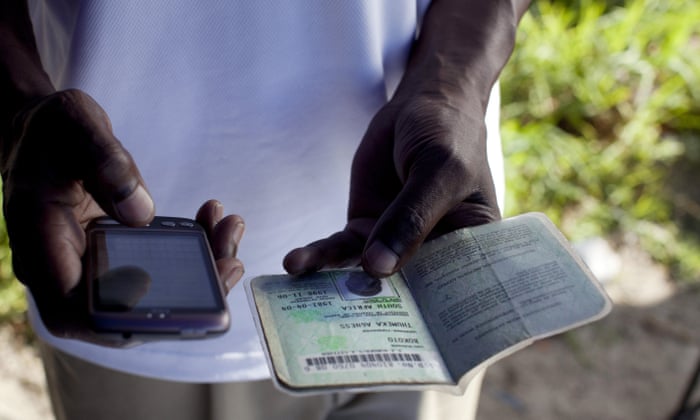
With a phone that supplies a basic income we would witnessing a transformation in the way people relate to their governments.

A game-changer.

Not just a safer way to store money, but to reduce the need for Aid, to cut out corruption, to empower the poor, to eradicate inequality, to encourage closing the digital divide with the rest of the world. To give a sense of a future, information, opportunity and choice. To lift young people are currently trapped in poverty, often exacerbated by the need to contribute to their family incomes.

Explosive growth in mobile broadband use across continents would improve transparency and give a voice to citizens.

They would have a major economic, social and political impact.

So instead of the World Bank, the IMF, the Warren Buffets, the Bill Gates, the Mark Zckerbergs, the UN, Oxfam, the WTO, technology has the potential to lift people out of poverty.

There is no reason that a mobile money basic income could not be achieved with the application of a world aid commission of 0.05%. ( See previous posts)

Applying such a commission:  (On all profit seeking Algorithms, on all High Frequency Trading, on all Foreign Exchange Transactions over $50,000, on all Sovereign Wealth Funds acquisitions, to mention just a few of the existing Capitalist instruments that are solely designed for Profit.) would create a perpetual Fund of trillions.

Traditional banking is out of reach for many people in rural areas of developing countries, but mobile is bringing people into the financial system in droves. Financial inclusion, starting with a humble savings account, enables people to start businesses, invest in education and weather bad times.

Mobile still has hurdles to jump before it can reach all the lives of people most in need of the technology: Namely, reliable, affordable energy and comprehensive network coverage.  However you can rest assured if aid was directed to placing a communication satellite in orbit to service Africa or Latin America cell, phone use could help developing the countries within these Continents to plan electrical infrastructure.

There are in the world already a enough used mobile phones to supply most of Africa ( Pop. 1,273,903, 985)

Unfortunately there seems to be a major barrier to people turning in their old phones to be recycled.

To give a couple of examples, a recent survey found that 63% of Canadians have an unused phone at home. And in the UK alone, people are holding on to an estimated 76.8 million unused phones.

If your used phone is a very recent model, you may want to consider sending it in to Fairphone’s recycling program.

So Technology presents as opportunity to articulate a broader and more sustainable vision.

It is essential that we take it.

Poverty shouldn’t be a Catch 22 but in reality, for some, it is.

All human comments and suggestions much appreciated. All like clicks chucked in the bin.

Go back

Your message has been sent

Warning
Warning
Warning
Warning

Warning.


Share this:

  • Click to share on WhatsApp (Opens in new window) WhatsApp
  • More
  • Click to share on Pocket (Opens in new window) Pocket
  • Click to share on Mastodon (Opens in new window) Mastodon

THE BEADY EYE SAYS: UNLESS EUROPE LOOKS AT ITS HOMELESS IT WILL NEVER BE UNITED.

19 Wednesday Apr 2017

Posted by bobdillon33@gmail.com in European Commission., European Union., homelessness., Humanity., Modern Day Democracy., Our Common Values., Politics., Poverty, Sleeping Rough., The Obvious., The world to day., What needs to change in European Union., WORLD POVERTY WHERE'S THE GLOBAL OUTRAGE

≈ Comments Off on THE BEADY EYE SAYS: UNLESS EUROPE LOOKS AT ITS HOMELESS IT WILL NEVER BE UNITED.

Tags

Eradicate poverty, homelessness., Poverty, Sleeping Rough.

( A THREE MINUTE READ)

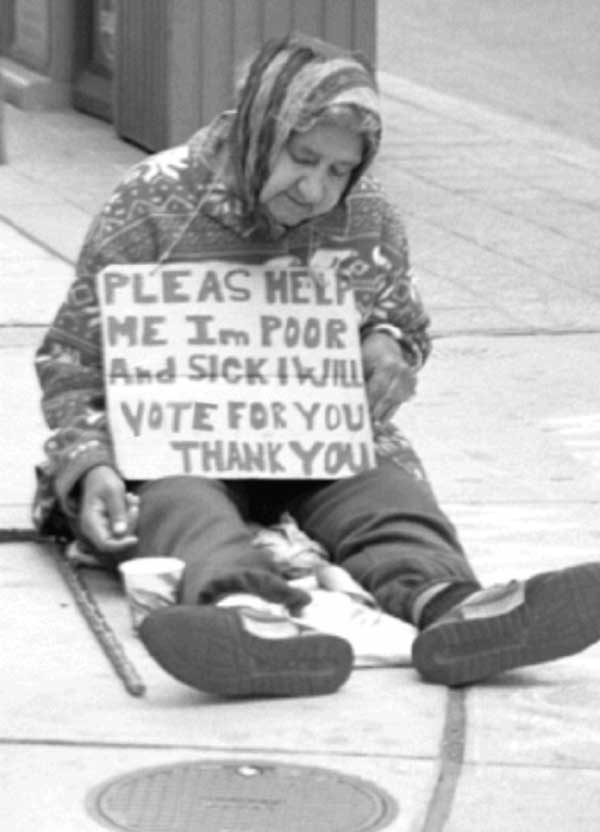
In  Europe alone, there are 3 million people on the streets.

Résultat de recherche d'images pour "pictures of homeless people"

We all know that the  Eu has many problems and is need of reform. All EU countries face major challenges in relation to finding sufficient resources to tackle social problems and it cannot be expected that one country like Germany is going to sort out other country’s homeless.

However it appears to me that homelessness is increasing across a considerable number of EU Member States.

The growing number of people in Europe facing situations of housing vulnerability due to shifting dynamics in housing and labour markets, as well as the diminishing role of states in housing provision requires policies that target different types of homelessness (temporary, long-term) with customized interventions (prevention, supported housing) that are flexible and effective at engaging individuals “where they are.”

As EU member states grapple with immigration and other social changes wrought by EU integration, globalization, and the economic crisis

We are now caught in VICIOUS circular, with the whole area in needs of a fresh approach.

Prevention of homelessness is strongest in social democratic regimes, and the weakest in Mediterranean countries and some eastern European transition nations.

Which strategies in particular are best suited to responding to homelessness, either from a preventive or remedial vantage point is debatable however the provision of housing must ultimately be seen as the primary solution to homelessness, and that, while distinct from their housing needs, the additional health and social service needs of individuals need to be addressed as well.

Housing and services should NOT be linked.

A right to housing for all homeless persons will only be successful to the extent that such a right is legally enforceable.  

Another words in the hands of courts rather than in those of elected governments.

While the numbers of people experiencing homelessness may be relatively low compared to those experiencing other social problems within the EU, the unique distress of homelessness and the potential costs for individuals, families and wider society from homelessness must never be forgotten.

Quantifying homelessness isn’t straightforward and I don’t think it would be beneficial here to list the thousands that are sleeping rough in Europe, country by country.

It is sufficient to state that Homelessness is a violation of fundamental human rights. When you walk by a homeless person it personifies whether the European Union is working or not.

In total, the United Nations Commission on Human Rights estimates that the world has 100 million homeless people.

And we wonder why we have such an unstable political world.

By comparison in Australia and Canada, hundreds of thousands of people are homeless.

There are over 9.5 million homeless people in Columbia and 24.4 million in Nigeria.
Image associée

The argument can be made for approaching homelessness as a problem that affects a set of distinct sub-groups and consequently, for tailoring solutions according to each group’s respective needs. Homeless youth, Homeless women  Homeless migrants. Homeless mentally ill.

This places homelessness interventions squarely within the broader context of poverty.

But poverty is also the inability to use the resources offered.  Poverty should be understood as not merely a problem of access to resources but also as implying a lack of ability in taking advantage of resources.

If the EU does not want social exclusion within its ranks it must address homeless with a Rooflessness subsidy, like it help the farming communities through the Common Agricultural Policy.

Homelessness in Greece has significantly increased to 20,000 homeless people in recent years.

About 50% of the homeless population roams the streets of Athens.

Measuring the scope and extent of homelessness in Europe still remains a significant obstacle along with the whole set of processes that generate homelessness and what results in different histories of homelessness.

The POOR AND HOMELESS WILL CONTINUE TO GROW, BOTH WILL UNDERMINE THE ECONOMIC GROWTH AND UNITY OF THE EU. Résultat de recherche d'images pour "pictures of homeless people"

All comments welcome, all like clicks chucked in the bin.

Go back

Your message has been sent

Warning
Warning
Warning
Warning

Warning.

Share this:

  • Click to share on WhatsApp (Opens in new window) WhatsApp
  • More
  • Click to share on Pocket (Opens in new window) Pocket
  • Click to share on Mastodon (Opens in new window) Mastodon

THE BEADY EYE SAYS: HOW WOEFUL HEINOUS,UNPARDONABLE, DISTASTEFUL,TO SEE ANTONIO GUTERRES THE UN SECRETARY-GENERAL HAVING TO BEG FOR FUNDS.

08 Wednesday Mar 2017

Posted by bobdillon33@gmail.com in Humanity., Life., Modern day life., Natural World Disasters, Sustaniability, The Future, The Obvious., The Refugees, The world to day., Unanswered Questions., United Nations, What Needs to change in the World, Where's the Global Outrage., World Aid., World Organisations., WORLD POVERTY WHERE'S THE GLOBAL OUTRAGE

≈ Comments Off on THE BEADY EYE SAYS: HOW WOEFUL HEINOUS,UNPARDONABLE, DISTASTEFUL,TO SEE ANTONIO GUTERRES THE UN SECRETARY-GENERAL HAVING TO BEG FOR FUNDS.

Tags

Capitalism and Greed, Climate change, Community cohesion, Distribution of wealth, Earth, Technology, The Future of Mankind, United Nations, World aid commission


( A three-minute read that could save millions of lives)

If you ever wanted proof that Capitalism is driven by greed just watch what can only be described in the above words the recent plea made by António Guterres to the International community for funds to tackle the declared famine in parts of Nigeria, South Sudan, and looming in Somalia, Nigeria and Yemen.africa

The estimated number of affected children is now 450,000, with 14 MILLION PEOPLE needing humanitarian assistance across the region.

Five years ago, more than a quarter of a million lives were needlessly lost, 130,000 of them children. We simply cannot have a repeat of that tragedy. The only way to prevent this devastating loss of life is for donors and international leaders to act now.

Global hunger levels are at their highest for decades. There are currently 70 million people in need of food aid. The reality of life for a fifth of the world’s people, on a planet which produces enough food to satisfy everyone is that humanitarian aid to Africa has been shrinking.

Rich countries have been giving money to poor ones for many decades and for many reasons — from geopolitics to post-colonial guilt to altruism so there is little point here in reiterating the reasons why the world is in such a mess.

What is needed in the long run is a fully funded Humanitarian Affairs United Nations.  Not a begging Institution.

Rather than boasting our compassion with wasteful foreign Aid there is only one course of action:

To make the Greed / Profit for profit’s sake segment of Capitalism system Pay.

This can be achieved with modern-day technology by Placing a World Aid commission of 0.05% on all. High frequency Trading, on all Foreign Exchange transactions over $ 50,000. on all Sovereign Wealth Funds acquisitions, on all gambling winnings.

This would create a Perpetual fund of billions.

The real question, though, is (with climate change and technology) is whether aid will remain relevant, and if so how.

The answer boils down to this: solutions.

Governments in developing countries will seek assistance only when they have a problem that they cannot solve by themselves.

They know how to build schools, hospitals or ports, and can pay for them. But they will look for other countries’ experiences when reforming educational curricula, designing health insurance systems, or regulating private suppliers of infrastructure.

They will want to avoid the mistakes of others, and learn from their successes.

At times, they may ask for support in implementing particularly tricky projects, mostly as a way to keep graft, pollution or displacements at bay.

This can only be achieved if the United nations see themselves more as partners than as donors. This will stop Aid countries of exporting their own way of thinking.

Donors would be sought after, rather than just accepted.

They will be those that can deliver ideas, experiences, expertise, lessons, evidence, and data.

In other words, what will make future aid relevant will be knowledge, not dollars.Résultat de recherche d'images pour "pictures of aid of the future"Development aid will be a more difficult business — for you will need to operate at the technical cutting-edge — but a more useful one.

To the extent that there are internal leaks in Africa–As a first order of priority, the leaks should be plugged to ensure that the little aid that comes in, stays.

In politics, no good deed ever goes unannounced.

It’s is very hard to feel hungry and not to be able to do anything about it.

Contributors to United Nations aid and development programs have provided slightly more than half of the $800 million requested in 1999 for African countries suffering from “complex emergencies”–the term applied when war and failed institutions, often combined with a natural disaster, leave vast numbers of people homeless and starving.

The reasons for the decline are not hard to find.

Donor nations are and will be more so under pressure to attend to problems at home rather than foreign assistance that is wasted by bloated aid agencies pouring money into the pockets of corrupt African governments, senseless civil wars, wasteful military expenditures, capital flight, and government wastes–Pouring in more foreign aid makes little sense.

However if asked we all want a more prosperous and equal world that will serve everyone’s best interests.

To create a less threatening world beyond our borders we must tackle inequality head on. 

We are on track for a tipping point of Inequality with the web only speeding up this process through digitization and universal access. We’ll be postulating about social media’s impact on the more long-term future of the world.

Aid can be fearful of the future – but it can also be a force for good.

No transformation will occur overnight.

The debate on aid comes down to lack of imagination. We have cemented in our minds the idea of a hierarchy in the world’s nations: the developing world is below us and we need to help them, preferably to our advantage. But we do not want them to rise above us.

Catastrophe evokes a human response to help fellow creatures.

All comments appreciated. All like clicks chucked in the bin.

Here is who to donate to:  UN Office for the Coordination of Humanitarian Affairs (Ocha), Care, Oxfam, British Red Cross, Cafod, Tearfund, Christian Aid, World Vision, WFP, Unicef.

Go back

Your message has been sent

Warning
Warning
Warning
Warning

Warning.


Share this:

  • Click to share on WhatsApp (Opens in new window) WhatsApp
  • More
  • Click to share on Pocket (Opens in new window) Pocket
  • Click to share on Mastodon (Opens in new window) Mastodon

THE BEADY EYE SAY’S ITS TIME FOR PREVENTION NOT AID.

15 Sunday May 2016

Posted by bobdillon33@gmail.com in The Refugees, Unanswered Questions., What Needs to change in the World, World Aid., World Organisations., World Politics, WORLD POVERTY WHERE'S THE GLOBAL OUTRAGE

≈ Comments Off on THE BEADY EYE SAY’S ITS TIME FOR PREVENTION NOT AID.

Tags

Capitalism and Greed, Distribution of wealth, Inequility, The Future of Mankind, United Nations, World aid commission

Currently we have in the region of 65 million people displaced in the world.

With the combination of climate change and inequality of opportunity this is set to grow.

It is time to address the root causeS not with Aid but with preventative action.Afficher l'image d'origine

The analytical discussion, the comments on refugee causes still remain, sadly, unchanged. This has to change.  If not we are provoking an unprecedented humanitarian crises that will plunge the world into an irreversible spiral for uncontrollable miserere for all.

The reasons why people become refugees are not necessarily due to individual persecution or fear of persecution.

We have to tackle the modern refugee problems and especially the problem on how to prevent new wars and situations arise. In an increasingly complex world, massive refugee flows will likely endanger international peace and security.

Above all there is a pressing need to change situations where refugees are exploited as a weapon in a political strife. (ie, situations in which people become refugees to serve specific strategic or political purposes.)

The states of the international community can no longer ignore the victims of specific practices (which amount to persecution and massive human rights violations) only because they are still in their countries of origin.

Take Yemen’s humanitarian situation.

It is arguably the worst humanitarian crisis in the world and the world is looking the other way. The United Nations reports that Yemen has more people — 21.2 million — in need of humanitarian aid than any other country including Syria.

The last 30 years, especially the early Cold War period, besides being directly and indirectly the cause for millions of refugees, seriously impeded effective preventive actions.

The average period of time for displacements globally has grown to 17 years.

The international community (If indeed such a thing exists) should move forcefully now, while almost global cooperation is still possible.

Now is the time for a progressive development of a global approach to the refugee problem.

The approach to prevent rather than to cure is gaining acceptance as the most desirable course of action.  The preventive course is advancing towards a more proactive approach to promote human rights, democracy and peace. The call to respect human rights and humanitarian law can no longer be considered merely as lip service, but rather figures now prominently on international agendas.

It’s time to realize that we are all connected to each other and our lives are affected if terrible things happen elsewhere.

Because the United Nations is not an independently Funded World organisation we have hundreds and hundreds of UN resolutions that have all proved unworkable.

Donor fatigue is “jeopardizing its entire existing and aid programs.

“Humanitarian aid can staunch the dying, but it takes politics and money to stop the killing.”

It is obvious to all that can see that future violent conflicts will likely take the form of resource wars – which can be understood as those conflicts which are primarily waged over access to scarce resources such as rare minerals, water, or oil.

All the Aid in the world will be too late making the U.N. (if not already) powerless to further the international protection of human rights.

World politics is already going in the wrong direction.

THERE IS ONLY ONE SOLUTION. PREVENTION NOT REACTION.

To achieve prevention we must create a World Aid Commission on all transactions that are designed to create Profit for Profit sake.

A 0.005% commision on:  All High Frequency Trading.

All Foreign Exchange Transactions over ($20,000)

All Sovereign Wealth Funds Acquisitions.

These three Profit for Profit (on their own) would create a perpetual Fund of billions.

They could be complemented by all World Financial Institutions issuing World Aid bonds that are tax-free.

All suggestions much appreciated.

Keep your like clicks, comments only.

Go back

Your message has been sent

Warning
Warning
Warning
Warning

Warning.


Share this:

  • Click to share on WhatsApp (Opens in new window) WhatsApp
  • More
  • Click to share on Pocket (Opens in new window) Pocket
  • Click to share on Mastodon (Opens in new window) Mastodon

THE BEADY EYE ( PART THREE) ASK’S WHY IS THE WORLD LIKE THIS.

22 Sunday Nov 2015

Posted by bobdillon33@gmail.com in Humanity., Sustaniability, The Internet., The world to day., Where's the Global Outrage., World Organisations., WORLD POVERTY WHERE'S THE GLOBAL OUTRAGE

≈ Comments Off on THE BEADY EYE ( PART THREE) ASK’S WHY IS THE WORLD LIKE THIS.

Tags

Capitalism and Greed, Distribution of wealth, Globalization, The Future of Mankind, Visions of the future.

Our painting of the world now has three elements Money, Religion and the Gun, but how do we knit them together into our modern-day canvas.

We need a large brush of Humanity. Afficher l'image d'origineWe should endeavor to apply humanity as another wash, somewhat like the magnetic field that surrounds the earth in order to give color to the voices, of Humans.

We are all attracted and attached to one another.  Money, Religion and the Gun all melt into the background when we apply Humanity.

The continuing changes in the spread, reception, interaction, sharing, and understanding of global information have altered the process of human and technological communication.

The last few decades have seen a growth in the role of the English language around the world as the lingua franca for economic, scientific, and political exchange.

Since its conception, the Internet has, so it seems,revolutionize the ways of human communication. It is the rise of computer-mediated, communication and the Internet, more than anything else, which has and is reshaping the WORLD.

It enables rich (or technology able) countries to take monopoly over the content generated on the Internet and it is becoming a form of cultural and linguistic imperialism in which western values dominate.

Which is one of the reasons why the world is like this – a Mess.

Our application of Human Language will have to be in a medium that is not permanent as you can only recognize and describe language change once it has occurred. So it will be like the Aurora communicating, untouchable, here to-day gone to-morrow.  

The Language of Globalization is a relatively recent term used to describe the changes in societies and the world economy that result from dramatically increased international trade and cultural exchange.

However, this term as a concept is being use now in a wider way to describe all aspects of global human existence – social, cultural, educational and political.

The Web/Internet is a process by which the experience of everyday life, marked by the diffusion of commodities and ideas, is becoming standardized around the world.

It has come to define a level of economic, social and cultural activities that have outgrown national borders and markets through either industrial combinations and commercial groupings that cross national frontiers, international agreements that reduce the cost of doing business in foreign countries, or cultural influences of certain societies on others.

Globalization offers huge potential profits to companies and nations but has been complicated by widely differing expectations, standards of living, cultures and values, and legal systems as well as unexpected global cause-and-effect linkages. 

In it Capitalist form it has led to the formation of terrorists groups, wars, unsuitability and poverty along with inequality, climate change, driven by outrageous individual and corporate Greed.

To put it simply, information technology has been termed as the medium of a new, and fourth revolution in human communication and cognition, matched in significance only by the prior three revolutions of language, writing, and print (Harnad, 1991).

Information technology impact on how people interact, access information, and share information akin to the Bi Sheng revolution about 900 years ago in ancient China (Song Dynasty). This impact is occur much more quickly than anticipated, leaving all of our World Organisations in need of radical overhaul. 

Globalization is believed by some to lead to an end of a cultural diversity as it imposes sameness in the countries of the world; where everyone in the world is the same when we are far from it. 

Globalization has been viewed primarily as an economic phenomenon, involving the increasing interaction, or integration of national economic systems through the growth in international trade, investment, and capital flow. However, this definition has expanded to include also cross-border social, cultural, political, and technological exchanges between nations and in particular.

It was hoped that electronic used for communication between groups who have no other language in common, would erode Inequality and take millions out of poverty. To most extent it has done this, removing the middle man, opening transparency to remove corruption.

Unfortunately it is driven by global corporations that are being dragged through Social Media to table of responsibility. While the rest of us are being turned into modern-day slaves bound together by Debt Bondage.

Despite all its apparent benefits, globalisation has some downsides which could possibly derail the world. Afficher l'image d'origine

Of course years ago none of this mattered as the great unwashed were unaware that they were being ripped off.

Giddens (2000) defined globalization as a separation of space and time, emphasizing that with instantaneous communications, knowledge, and culture could be shared around the world simultaneously.Afficher l'image d'origineAs Paolillo (1999: 1) puts it, in his introduction to a paper on the virtual speech community: ‘If we are to understand truly how the Internet might shape our language, then it is essential that we seek to understand how different varieties of language are used on the Internet.

About 85% of the world’s important film productions and markets use English and 90% of the published academic articles in several academic fields, such as linguistics, are written in English.

The Internet is bad for the future of many languages but it might be the saving grace of many others. It can also argued that the Internet must evolve its own principles and standards in order to grow and maintain as a newly emerging linguistic medium (Crystal, 2001)

It must not be transformed from a tool for information processing and display for the few to make money but become a free tool for all. Afficher l'image d'origine

It’s important to recognize, though, that it’s our nonverbal communication—our facial expressions, gestures, eye contact, posture, and tone of voice—that speak the loudest.

When your nonverbal signals match up with the words you’re saying, they increase trust, clarity, and rapport. When they don’t, they generate tension, mistrust, and confusion.

Perhaps this is the problem with modern-day communication. The way you look at someone can communicate many things, including interest, affection, hostility, or attraction. Eye contact is also important in maintaining the flow of conversation and for gauging the other person’s response.

You need physical space to communicate many different nonverbal messages, including signals of intimacy and affection, aggression or dominance.

Emotional awareness enables you to:

  • Accurately read other people, including the emotions they’re feeling and the unspoken messages they’re sending.
  • Create trust in relationships by sending nonverbal signals that match up with your words.
  • Respond in ways that show others that you understand, notice, and care.
  • Know if the relationship is meeting your emotional needs, giving you the option to either repair the relationship or move on.
  • Our body language, expressions, and words can sometimes fire different signals all at the same time.

Our task is not to make societies safe for globalization, but to make the global system safe for decent societies.

Go back

Your message has been sent

Warning
Warning
Warning
Warning

Warning.


Share this:

  • Click to share on WhatsApp (Opens in new window) WhatsApp
  • More
  • Click to share on Pocket (Opens in new window) Pocket
  • Click to share on Mastodon (Opens in new window) Mastodon

THE BEADY EYE LOOKS AT FOOD WASTE IN THE WORLD.

04 Wednesday Nov 2015

Posted by bobdillon33@gmail.com in Humanity., Life., Politics., Sustaniability, The Future, The world to day., Unanswered Questions., Uncategorized, WORLD POVERTY WHERE'S THE GLOBAL OUTRAGE

≈ 1 Comment

Tags

Capitalism and Greed, Extreme poverty, Food waste in the World, Globalization, Inequility, The Future of Mankind

Our routine practices, unfortunately, make it difficult for us to conceptualize the magnitude of global food waste.

Everyday we hear appeals and yet there are one billion starving people in the world.

40% of all the food produced in the United States is never eaten.

In Europe, we throw away 100 million tonnes of food every year.

These are shamefully shocking facts  in their own right. In a world full of hunger, volatile food prices , and social unrest, these statistics are more than just shocking when half the world’s population goes to sleep each night malnourished they are obscene.

They are environmentally, morally and economically outrageous.

Add to this that fact that obesity is rapidly growing in the western world, particularly among children, while 6 million children in the developing world die annually from undernourishment and it is a damning indictment of capitalism – the dominant ideology and economic system that has governed much of the world for the last two centuries.

The rampage of globalisation has given monopoly buying power to a few massive western multinational enterprises, who trample all over the globe sourcing farm supplies from the lowest bidders of impoverished nations.

Prices of farm produce are squeezed to such an extent that it’s more profitable to leave ‘inadequate’ quality crops in the ground to rot or to throw away than to pay the price for its air transport, storage and quality packaging to bring to western supermarkets with discerning consumers.

Today, we produce about four billion metric tonnes of food per annum. Yet due to poor practices in harvesting, storage and transportation, as well as market and consumer wastage, it is estimated that 30–50% (or 1.2–2 billion tonnes) of all food produced never reaches a human stomach.

Furthermore, this figure does not reflect the fact that large amounts of land, energy, fertilisers and water have also been lost in the production of foodstuffs which simply end up as waste. This level of wastage is a tragedy that cannot continue if we are to succeed in the challenge of sustainably meeting our future food demands.

But the  problem is bigger than we think.Afficher l'image d'origine

Here are some hard facts to swallow.

Wasting food means losing not only life-supporting nutrition but also precious resources, including land, water and energy. As a global society therefore, tackling food waste will help contribute towards addressing a number of key resource issues:

About one-third of all food produced worldwide, worth around US$1 trillion, gets lost or wasted in food production and consumption systems.

Every year, consumers in industrialized countries waste almost as much food as the entire net food production of sub-Saharan Africa (222 million vs. 230 million tons)

1.4 billion hectares of land – 28 percent of the world’s agricultural area – is used annually to produce food that is lost or wasted.

The direct economic consequences of food wastage (excluding fish and seafood) run to the tune of $750 billion annually.

The amount of food lost and wasted every year is equal to more than half of the world’s annual cereals crops (2.3 billion tons in 2009/10)

In the USA, organic waste is the second highest component of landfills, which are the largest source of methane emissions.

In the USA, 30-40% of the food supply is wasted, equaling more than 20 pounds of food per person per month.

The Food wastage’s carbon footprint is estimated at 3.3 billion tonnes of CO2 equivalent of GHG released into the atmosphere per year.

Much of it ends up in landfills, and represents a large part of municipal solid waste.

The water used to irrigate wasted crops would be enough for the daily needs of nine million people.

Wasted production contributes 10% to the greenhouse gas emissions of developed countries.

One hectare of land can, for example, produce rice or potatoes for 19–22 people per annum. The same area will produce enough lamb or beef for only one or two people.

The total volume of water used each year to produce food that is lost or wasted (250km3) is equivalent to the annual flow of Russia’s Volga River, or three times the volume of Lake Geneva.

Over the past century, fresh water abstraction for human use has increased at more than double the rate of population growth. Currently about 3.8 trillion m3 of water is used by humans per annum. About 70% of this is consumed by the global agriculture sector,

Indeed, depending on how food is produced and the validity of forecasts for demographic trends, the demand for water in food production could reach 10–13 trillion m3 annually by mid-century. This is 2.5 to 3.5 times greater than the total human use of fresh water today.

Considerable tensions are likely to emerge, as the need for food competes with demands for ecosystem preservation and biomass production as a renewable energy source.

Agriculture is responsible for a majority of threats to at-risk plant and animal species.

A low percentage of all food wastage is composted:

What can be done about it?

Part of the problem is poor shopping habits, but the confusion many consumers have with “use by” and “best before” food labels is also a factor. “Use by” refers to food that becomes unsafe to eat after the date, while “best before” is less stringent and refers more to deteriorating quality.

Consumer households need to be informed and change the behavior which causes the current high levels of food waste. Instead of buying packets of vegetables buy loose veg.

Boycott Supermarkets that don’t accept imperfections and nicks. There’s nothing wrong with a deformed Veg. It’s fine to eat.

Support redistribution urban food programmes.

UK supermarket chain Waitrose is attacking food waste in all parts of its business. The upmarket grocery chain cuts prices in order to sell goods that are close to their “sell by” date, donates leftovers to charity and sends other food waste to bio-plants for electricity generation.

The idea is for Waitrose to earn “zero landfill” status.

Home composting can potentially divert up to 150 kg of food waste per household per year from local collection authorities.

Buy local produced food items not those produced, transformed and consumed in very different parts of the world.

Considering that food security is a major concern in large parts of the developing world. Conflicts around the world mean there is “donor fatigue.

Food crises don’t just affect the countries where people go hungry. It’s a global challenge. Recent data shows the number of hungry in the world has fallen but still stands at 842 million people.

World Food Programme WFP operations in and around Syria are costing around $31 million a week.

Hidden Hunger is a weapon of mass destruction.

Hidden hunger weakens the immune system, stunts physical and intellectual growth, and can lead to death. It wreaks economic havoc as well, locking countries into cycles of poor nutrition, lost productivity, poverty, and reduced economic growth.

Investing in nutrition is one of the smartest development investments we can make.

Go back

Your message has been sent

Warning
Warning
Warning
Warning

Warning.

Afficher l'image d'origine

Afficher l'image d'origine

Share this:

  • Click to share on WhatsApp (Opens in new window) WhatsApp
  • More
  • Click to share on Pocket (Opens in new window) Pocket
  • Click to share on Mastodon (Opens in new window) Mastodon

THE BEADY EYE ASK’S WHAT HAS CAPITALISM ACHIEVED

07 Monday Sep 2015

Posted by bobdillon33@gmail.com in Capitalism, Humanity., Unanswered Questions., WORLD POVERTY WHERE'S THE GLOBAL OUTRAGE

≈ 6 Comments

Tags

Capitalism and Greed, Capitalism vs. the Climate., Community cohesion, Distribution of wealth, Globalization, Inequility, World aid commission

To understand the role of capitalism in modern economic times you must understand the word Growth.

Growth at any cost.  Which we are just coming to apprentice thanks to the Internet.

For a long time nothing much happened till Wheat conned humans into growing it.

It is not my intention here to address Money and Power. It is sufficient to say that money leads to power and corruption and that all three intermingle in the notoriously subject of Economics.

What I want you to do is to look at Capitalism that founded states and ruined them, opened up new horizons and enslaved millions, moved the wheels of Industry and drove hundreds of species of plants and animals into extinction, plundered the earth resources for profit, promoted science, all to the dethronement of a sustainable planet and ask yourself is it easier to imagine the end of the world than the end of capitalism.

There can be no doubt without some system the human race would descend into barbarism based on nothing but self-interest.

Our cultural output throbs with this notion of self-interest. Just look at the present Refugee problem facing the European Union.

So would the collapse of Capitalism lead to misery?

Capitalism in all its credulity and inequality reflects mans barbarous nature. Indeed the horrors of ISIS are trumpeted so vehemently by the western press precisely because they fill this narrative.

However a dog eat dog world with which capitalism and the state justify themselves is in part a fallacy.

In fact nature teems with co-operation – both between animals, between species and within the ecosystem as a whole.

We are the same, but it is no coincidence that where we do co-operate these areas are dominated by capital and constructed in a way that systematically reward the uglier sides of our common nature.

We know that the world in unfair where the few have too much and the most have too little.

The feeling that Capitalism, inequality, and injustice are inevitable and the idea that to struggle for a better world is naive is coming to an end.

If we could only entrench the cooperative compassionate and empathetic sides of our nature as dominant values in society we would redesign our Capitalist world – to a world worth while living in.

The current state of our planet is affording all of us this opportunity.

How can we tackle the world problems ?

A good place to start would be to get Capitalism to pay for it.

By placing a World Aid Commission on all High Frequency Trading, on all Foreign Exchange Transactions over ($20,000) on all Sovereign Wealth Funds Acquisitions, on all Drilling Wells.  This would create a perpetual pot out of Profit for Profit sake that could fund the inevitable cost of climate change.

In doing so we would redistribute the world’s wealth from the whole of the world. ( see previous Posts)

Sooner than later we are going to exhaust the raw materials and energy of the planet Earth. What will happen then?

Which is why, whenever the opportunity arises, we must be prepared to seize it.

Go back

Your message has been sent

Warning
Warning
Warning
Warning

Warning.


Share this:

  • Click to share on WhatsApp (Opens in new window) WhatsApp
  • More
  • Click to share on Pocket (Opens in new window) Pocket
  • Click to share on Mastodon (Opens in new window) Mastodon

The Trans-Pacific Partnership.

10 Sunday May 2015

Posted by bobdillon33@gmail.com in Privatization, Sustaniability, WORLD POVERTY WHERE'S THE GLOBAL OUTRAGE

≈ Comments Off on The Trans-Pacific Partnership.

Tags

Capitalism, Investor-state., Multinational agreements., Privatisation, TPP.

A new word in the English language has recently been coined: investor-state.

The term refers to corporations who have the power to sue nations before a jurisdictional tribunal for infringements on their commercial interest.

Phillip Morris, for example, has sued Australia over that country’s rules requiring hazardous warning labels on cigarette packaging.

Now they say that there is nothing so useful to man in general, nor so beneficial to particular societies and individuals, as trade.

This however is a step to far by Capitalism. The notion that an agreement is clothed with a public interest and has been devoted to the public use is little than fiction intended to beautify what is disagreeable to the sufferers. US

The TPP is a far-reaching proposed multinational agreement among a dozen Pacific Rim countries (but not including China) designed to lower or eliminate tariff and trade barriers among the subscribing nations.

The pact deals with monetary tariffs, intellectual property rights, trade regulations and quotas imposed by the signatory nations with a goal of reducing those to a minimum to allow trade to flow freely among countries.

The countries involved include Brunei, Chile, New Zealand, Singapore, the U.S., Australia, Peru, Vietnam, Malaysia, Mexico, Canada and Japan.

Advocates note that domestic markets alone aren’t sufficient to create the sales, the return on investment and the innovation needed to advance the production of goods and services efficiently among Pacific Rim nations.

The trade agreement has been characterized as “NAFTA on steroids,”

A deal that will easily allow foreign competitors in low-wage nations or multinational companies with overseas operations to pay extremely low wages to workers and to ignore pollution and worker and consumer safety rules that prevail in the more developed countries when producing goods in less-regulated environments.

What particularly alarms ( in the USA)  is that TPP critics on both sides of the political aisle is that the  TTP partnership’s advocates are pushing for Congress to give the president fast-track authority to finish negotiating the deal, to limit debate on the pact’s provisions and prohibit Congress from amending the deal, giving elected representatives the power only to reject or approve the deal as a package.

The TPP is a back-room secret trade deal that will have a huge negative impact on FOOD SAFETY, internet freedom, environmental protection, national sovereignty, intellectual property and more. It is basically a permanent power grab by corporations and financial companies that will make it impossible for the citizens of countries joining the TPP to choose what laws and rules they want to live under.

The TPP is a massive giveaway to multi-national corporations like Chevron and Monsanto and Phillip Morris.

If TPP is signed it’s here forever.

Read more here: http://www.thenewstribune.com/2015/02/22/3648823_the-trans-pacific-partnership.html?rh=1#storylink=cpy

So who are these investor-states?

Well, besides , Monsanto, the Bank of America, Chevron and Exxon Mobil are among them and they’ve been granted their power though a negotiated agreement known as the Trans-Pacific Partnership (TPP).

Ironically, only 5 of the 29 measures in this agreement speak directly to trade issues. The other 24 reach into areas previously unthinkable.

It restricts, for example, a sovereign nation’s ability to support local produce within its borders and proposes sweeping changes with regard to the internet. The United States government rejected SOPA, the bill that would have instituted rigid copyright laws on intellectual property, but those same rules are proposed under TPP.

To say that the negotiations underway lack transparency is an understatement. So far, the measures have been kept under lock and key. Even members of Congress are beginning to complain about the lack of information.

All signatory countries will be required to conform their domestic laws and policies to the provisions of the Agreement.

Why should you be concerned?

Because the,

TPP raises significant concerns about citizens’ freedom of expression, due process, innovation, the future of the Internet’s global infrastructure, and the right of sovereign nations to develop policies and laws that best meet their domestic priorities.

Because the,

TPP will affect countries beyond the 11 that are currently involved in negotiations. Like ACTA, the TPP Agreement is a plurilateral agreement that will be used to create new heightened global IP enforcement norms. Countries that are not parties to the negotiation will likely be asked to accede to the TPP as a condition of bilateral trade agreements with the US and other TPP members.

Because we must,

truly address the secrecy or the private-industry-dominated process.

In sum, the TPP puts at risk some of the most fundamental rights that enable access to knowledge for the world’s citizens.

Below is a 10 minute clip from Democracy Now which speaks to the issue:

http://www.democracynow.org/2013/10/4/a_corporate_trojan_horse_obama_pushes

In the World we have seen the consequences of giving corporations the same right to free speech as individuals.

Giving them nation status is an idea that should keep everyone awake at night.

Don’t just read this. Wake up and do something, even a comment might help or pass it on.

Go back

Your message has been sent

Warning
Warning
Warning
Warning

Warning.

Share this:

  • Click to share on WhatsApp (Opens in new window) WhatsApp
  • More
  • Click to share on Pocket (Opens in new window) Pocket
  • Click to share on Mastodon (Opens in new window) Mastodon

The clock is ticking for: A new world DISASTER AID REACTION Organisation.

03 Sunday May 2015

Posted by bobdillon33@gmail.com in Natural World Disasters, WORLD POVERTY WHERE'S THE GLOBAL OUTRAGE

≈ 2 Comments

Tags

Aid, “Forgotten” disasters, Climate change, Natural disaster, United Nations

On January 12, 2010, a 7.0-magnitude earthquake struck Haiti, affecting more than 3 million people — one of every three. The quake killed 222,570 people and injured more than 300,000. More than 1 million people were left homeless and vulnerable.

On August, 2005, Hurricane Katrina hit the Gulf of Mexico and various Southern regions of the United States. A 100,000 people were displaced. 10,000 originally feared dead — revised down by government.

On March 11, 2011, a tsunami some 40 meters (133 feet) high hit northeast coast of Japan.15,000 people were killed, 300,000 were evacuated, and 3,100 people are still unaccounted for. A nuclear emergency was triggered in the Fukushima area.

On April 25,2015 a 7.8-magnitude earthquake rocked the south-central Asian country of Nepal. 8 million people have been affected by the quake. To date the death toll is above 6,000.

Extreme disasters catch the public eye, often resulting in massive infusions of aid that affect not just individual well-being but the fabric of societies.

What I want to address here is  (with the predicted effects of Climate Change we are going to witness a massive increase in natural disaster world-wide) how if any of our various UN organizations are in a position to meet the challenges that lie ahead: (World Food Program, World Health Organisation, Relief Web, UNICEF, Oxfam International, International Federation of Red Cross, Red Crescent Societies, International Rescue Committee, Medicins Sans Frontiers, Doctors Without Boards) to mention just a few.

And the question I want an answered to is:  How do we evaluate their efficacy.

Understanding and analyzing the organization of aid delivery is essential to evaluating aid efficacy. Disaster relief projects involve multiple parties in different organizational configurations delivering in-kind aid, where each party has distinct objectives.

The behavior of an aid agency that operates on the ground is a composite outcome of the organizational structure of the donating and implementing arms.

Depending on how that organization is set up, the quality of hard aid and the delivery of social agendas may vary considerably within the same disaster area. Donors face potential trade-offs between higher quality aid, pursuit of certain social agendas, and paying the cost to do their own implementation.

In a nutshell, industry and private donations are feel-good, short-term interventions and no substitute for the vastly larger, and essentially political, task of bringing aid to poor people in need.

It is the long-term Recovery phase of disaster which places the most severe financial strain on local or state.

The needs of the poor don’t get met because the poor have little money or political power with which to make their needs known and they cannot hold anyone accountable to meet those needs. They are stuck with Planners. The … tragedy [of failed foreign aid] continues.

A big part of the problem originates with the rich-country governments who set the mandates of the aid agencies. ( See previous post: Roughly half of global aid – is phantom aid or The Clock is ticking for a New World Aid Organisation)

I hardly think your/our measly donations to charity are worth talking about;

Media coverage of natural disasters seems to vary a lot depending on the disaster. Is it selective?

An Example is the Present Nepal Disaster lasted three days on the top of the BBC news.

It was replaced by a Royal princess presented to world. One new life against thousands lost.

If you compare what the new born Royal can expect from life to the 360,000 other children all born on the same day elsewhere in the world.

〈 While the Duke of Cambridge does not receive money directly from the Sovereign Grant ( that’s £35.7m the taxpayer gives to the Royal Family each year), he does receive from the Queens Grant-in-Aid fund and the Duchy of Cornwall (the tax-exempt estate valued at £763m in 2013 with an annual income of £19m, bestowed on the family in 1337) , the surplus of which traditionally goes to the eldest son ( i.e. Prince William). If you break that £19m down into a a weekly rate, the Duke and Duchess of Cambridge can expect a share of £365,384.61, compared to the £34.40 ( combined Child Benefit for two babies) for the average family in the UK. 〉 

There is certainly no need for any Aid.

It does not take long in this days media world for Disasters to become Forgotten

 “Forgotten” disasters are often chronic and diffuse, changing little day by day. Unlikely to qualify as news, such crises may feature as current affairs stories – especially on the websites of news organizations.

It is more than obvious that if we are to manage the pending Disasters ( And there will be many).

We need one Organisation under one roof to handle all aspects.

Examine the whole process/system/operation of providing relief supplies in a disaster scenario. Think of total packaging re-use of all materials and containers from the shipping/air container onwards.

This can be achieved by all the world aid organisations assembling at a World Response Aid conference to form a One World Response/Reaction Team.

This conference should present the UNITED NATIONS WITH A RESOLUTION TO PLACE: a 0.05% AID COMMISSION ON ALL HIGH FREQUENCY STOCK EXCHANGE TRANSACTIONS ON ALL FOREIGN EXCHANGE TRANSACTIONS (OVER $20,000) AND ON ALL SOVEREIGN WEALTH FUNDS ACQUISITIONS)

This resolution could be adopted by a its veto members without lost of power.

Instead of holding aid agencies individually responsible for what they own program achieve, we would have Instead of letting different agencies specialize in different areas we would have Capitalism for once WOULD contributing to the world by creating a perpetual fund, giving the reaction team total independence.

IT WOULD ONLY TAKE A COMPUTER PROGRAM TO COLLECT THE FUNDS.

We would have global goals. Instead of letting different agencies specialize in different areas we would have coordination.

Instead of wasting aid and relief to victims of natural disasters there would be a professional action PLAN IN PLACE THAT COULD BE ACTIVATED NOT TO SET UP BY A BEGGING BOWL.

  ‘How did the rich countries really become rich?’

The short answer to this question is that the developed countries did not get to where they are now through the policies and the institutions that they recommend to developing countries today.

  • In 1970, rich countries of the OECD agreed at the United Nations (Resolution 2626) to give 0.7% of their GNP (now GNI) as aid to the developing countries.
  • Known as ODA, this aid would be for long-term development.
  • Over 40 years on, most of the 20 or so rich OECD countries have never reached that figure, or come close.

Annually, the global foreign aid shortfall is high.

Although rich countries have given an enormous $3.62 trillion dollars in aid since 1970, the accumulated total shortfall in their aid since 1970 (when the target of 0.7% was set) amounts to $4.98 trillion (at 2012 prices).

Don’t tell me that it is not time for change INORDER to save lives when the next natural disaster strikes.

Go back

Your message has been sent

Warning
Warning
Warning
Warning

Warning.

Share this:

  • Click to share on WhatsApp (Opens in new window) WhatsApp
  • More
  • Click to share on Pocket (Opens in new window) Pocket
  • Click to share on Mastodon (Opens in new window) Mastodon

It seems to happen at a disturbingly frequent rate.

28 Tuesday Apr 2015

Posted by bobdillon33@gmail.com in Uncategorized, WORLD POVERTY WHERE'S THE GLOBAL OUTRAGE

≈ Comments Off on It seems to happen at a disturbingly frequent rate.

Tags

0.05% Aid Commission, disaster relief, disaster relief are logistical, Mobile phones, Natural disaster, Nepal, not financial., relief efforts, Universities, WORLD VISION INTERNATIONAL

A 7.8-magnitude earthquake rocked the south-central Asian country of Nepal last Saturday, causing an estimated 5,000 deaths and widespread devastation.

More than 90 percent of natural disaster-related deaths occur in developing countries, where poverty and lack of resources exacerbate the suffering.

The biggest obstacles for charities working in Disaster areas is : Roads and other infrastructure are often destroyed, so charities can’t get supplies to those in need, even with your donations.

This is why you should not trash your old Mobile phone. Send them to ( See Below)

The power of mobile devices to coordinate is paramount.

fulfillment.http://go.ted.com/bFYJ

The media show heart-wrenching images of disaster beyond anything most people have seen or could even begin to imagine. People want to help; it is human nature to want to help. And many aid agencies offer just that opportunity as they fundraising for relief efforts. But if we give to them, does it actually make a difference?

The answer is yes, but disaster relief is notably less effective than many other forms of aid. ( See previous posts)

https://youtu.be/cHETjX5VkNU

Are you not ashamed to see the head of the U.N. Disaster Relief Organization appealed for food, medical supplies every time there is a natural disaster.

Why not establish Swat life boat centers around the world. Fully equipped fully funded. Recent Disasters have shown the need for an international system to coordinate major rescue and relief efforts.

Whenever a disaster strikes, it seems that the job of relief and reconstruction goes to some agency run by someone well-connected politically and staffed by well-meaning people with little formal knowledge in the field of disaster relief.

Universities should have a discipline known as disaster relief and reconstruction.

Experts would teach courses in evacuation, emergency healthcare, debris removable, providing temporary shelter and other phases of disaster relief.

The emotional and sensationalized climate of disaster response has prevented the adoption of a cost-effectiveness approach in decision-making. It requires putting the needs of others ahead of your own emotional needs.

When catastrophe strikes, people rush to donate to help the victims. But disaster relief is rarely cost-effective.

What would be cost-effective is a 0.05% Aid Commission on all High Frequency Trading, on all Foreign Exchange Transactions (over $20,000) and on all Sovereign Wealth Funds Acquisitions.

This would create a perpetual fund of billions.

It would be Capitalism biggest glorious moment in its history:  To assist man kind and the planet we all live on. ( See Previous Posts)

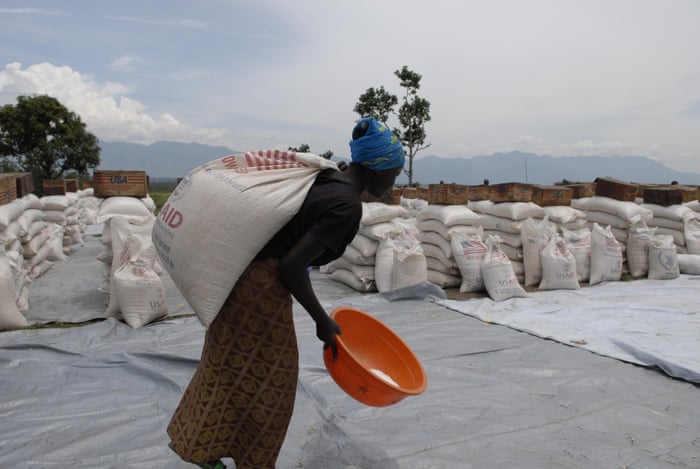
Displaced people raise their hands as they wait for food distribution in central Africa.

International Offices

WORLD VISION INTERNATIONAL EXECUTIVE OFFICE

1 Roundwood Avenue Stockley Park Uxbridge, Middlesex UB11 1FG, UK

WORLD VISION BRUSSELS AND EUROPEAN UNION REPRESENTATION IVZW

18, Square de Meeûs 1st floor, Box 2 B-1050, Brussels Belgium EULO-info@wvi.org

WORLD VISION INTERNATIONAL GENEVA AND UNITED NATIONS LIAISON OFFICE

Chemin de Balexert 7-9 Case Postale 545 CH-1219 Châtelaine Switzerland geneva@wvi.org

WORLD VISION INTERNATIONAL NEW YORK AND UNITED NATIONS LIAISON OFFICE

919 2nd Avenue, 2nd Floor New York, NY 10017  USA wvun_offices@wvi.org

If you DON’T have a phone a laptop or i pad will do.

Thanks.

Go back

Your message has been sent

Warning
Warning
Warning
Warning

Warning.

Share this:

  • Click to share on WhatsApp (Opens in new window) WhatsApp
  • More
  • Click to share on Pocket (Opens in new window) Pocket
  • Click to share on Mastodon (Opens in new window) Mastodon
← Older posts
Newer posts →

All comments and contributions much appreciated

  • THE BEADY EYE SAYS WARS USE TO BE MAN AGAINST MAN, NO LONGER. WAR IS NOW DRONE AGAINST DRONE. January 9, 2026
  • THE BEADY EYE SAYS. WE HAVE SURROUND THE EARTH WITH SATELLITES. HERE TO DAY GONE TO MORROW. January 9, 2026
  • THE BEADY EYE SAYS GOVERNANCE IS BECOMING MORE BY REALITY TV, ALGO January 9, 2026
  • THE BEADY EYE SAYS. DONALD TRUMP IS EXPOSING THE WEAKEST OF OUR WORLD ORGANISATIONS January 7, 2026
  • THE BEADY EYE SAYS. MADURO ADDUCTION SHOWS THAT INTERNATIONAL LAW IS A JOKE. January 4, 2026

Archives

  • January 2026
  • December 2025
  • November 2025
  • October 2025
  • September 2025
  • August 2025
  • July 2025
  • June 2025
  • May 2025
  • February 2025
  • January 2025
  • December 2024
  • November 2024
  • October 2024
  • September 2024
  • August 2024
  • July 2024
  • June 2024
  • May 2024
  • April 2024
  • March 2024
  • February 2024
  • January 2024
  • December 2023
  • October 2023
  • September 2023
  • August 2023
  • July 2023
  • June 2023
  • May 2023
  • April 2023
  • March 2023
  • February 2023
  • January 2023
  • December 2022
  • November 2022
  • October 2022
  • September 2022
  • August 2022
  • July 2022
  • June 2022
  • May 2022
  • April 2022
  • March 2022
  • February 2022
  • January 2022
  • December 2021
  • November 2021
  • October 2021
  • September 2021
  • August 2021
  • July 2021
  • June 2021
  • May 2021
  • April 2021
  • March 2021
  • February 2021
  • January 2021
  • December 2020
  • November 2020
  • October 2020
  • September 2020
  • August 2020
  • July 2020
  • June 2020
  • May 2020
  • April 2020
  • March 2020
  • February 2020
  • January 2020
  • December 2019
  • November 2019
  • October 2019
  • September 2019
  • August 2019
  • July 2019
  • June 2019
  • May 2019
  • April 2019
  • March 2019
  • February 2019
  • January 2019
  • December 2018
  • November 2018
  • October 2018
  • September 2018
  • August 2018
  • July 2018
  • June 2018
  • May 2018
  • April 2018
  • March 2018
  • February 2018
  • January 2018
  • December 2017
  • November 2017
  • October 2017
  • September 2017
  • August 2017
  • July 2017
  • June 2017
  • May 2017
  • April 2017
  • March 2017
  • February 2017
  • January 2017
  • December 2016
  • November 2016
  • October 2016
  • September 2016
  • August 2016
  • July 2016
  • June 2016
  • May 2016
  • April 2016
  • March 2016
  • February 2016
  • January 2016
  • December 2015
  • November 2015
  • October 2015
  • September 2015
  • August 2015
  • July 2015
  • June 2015
  • May 2015
  • April 2015
  • March 2015
  • February 2015
  • January 2015
  • December 2014
  • November 2014
  • October 2014
  • September 2014
  • August 2014
  • July 2014
  • June 2014
  • May 2014
  • April 2014
  • March 2014
  • February 2014
  • January 2014
  • December 2013
  • November 2013
  • October 2013

Talk to me.

Jason Lawrence's avatarJason Lawrence on THE BEADY EYE ASK’S: WIT…
benmadigan's avatarbenmadigan on THE BEADY EYE ASK’S: WHA…
bobdillon33@gmail.com's avatarbobdillon33@gmail.co… on THE BEADY EYE SAYS: WELCOME TO…
Ernest Harben's avatarOG on THE BEADY EYE SAYS: WELCOME TO…
benmadigan's avatarbenmadigan on THE BEADY EYE SAY’S. ONC…

7/7

Moulin de Labarde 46300
Gourdon Lot France
0565416842
Before 6pm.

My Blog; THE BEADY EYE.

My Blog; THE BEADY EYE.
bobdillon33@gmail.com

bobdillon33@gmail.com

Free Thinker.

View Full Profile →

Follow bobdillon33blog on WordPress.com

Blog Stats

  • 94,463 hits

Blogs I Follow

  • unnecessary news from earth
  • The Invictus Soul
  • WordPress.com News
  • WestDeltaGirl's Blog
  • The PPJ Gazette
Follow bobdillon33blog on WordPress.com

The Beady Eye.

The Beady Eye.
Follow bobdillon33blog on WordPress.com

Blog at WordPress.com.

unnecessary news from earth

WITH MIGO

The Invictus Soul

The only thing worse than being 'blind' is having a Sight but no Vision

WordPress.com News

The latest news on WordPress.com and the WordPress community.

WestDeltaGirl's Blog

Sharing vegetarian and vegan recipes and food ideas

The PPJ Gazette

PPJ Gazette copyright ©

Privacy & Cookies: This site uses cookies. By continuing to use this website, you agree to their use.
To find out more, including how to control cookies, see here: Cookie Policy
  • Subscribe Subscribed
    • bobdillon33blog
    • Join 223 other subscribers
    • Already have a WordPress.com account? Log in now.
    • bobdillon33blog
    • Subscribe Subscribed
    • Sign up
    • Log in
    • Report this content
    • View site in Reader
    • Manage subscriptions
    • Collapse this bar