Of course, some argue that we have better things to worry about. Climate Change, Wars, Sustainability etc, but Superhuman, might finally create a joke so funny that everyone on Earth dies laughing.
The fact is that there are a lot of unquestioned assumptions when it comes to AI, learning in ways far beyond that of humans.
We can’t really predict what might happen next because superintelligent A.I. may not just think faster than humans, but in ways that are completely different. It may have motivations — feelings, even — that we cannot fathom. It could rapidly solve the problems of aging, of human conflict, of space travel. We might see a dawning utopia.
There is one thing for sure it has been set in motion and now we are waiting for the results.
In the meantime, there is something unpleasant about A.I. and that is Humanity is already losing control of artificial intelligence which could have catastrophic consequences for civilization.
For example “Deep learning”, is a powerful tool for solving problems. It helps us tag our friends on Facebook, provides assistance on our smartphones using Siri, Cortana or Google.
Deep learning has helped computers get better at recognizing objects than a person.
The military is pouring millions into the technology so it can be used to steer ships, control drones and destroy targets.
And there’s hope it will be able to diagnose deadly diseases, make traders billionaires by reading the stock market and totally transform the world we live in.
Indeed whether you call it Deep learning, it could be the last invention that humanity will ever need to make.
If they can’t figure out how the algorithms (the formulas which keep computers performing the tasks we ask them to do) work, they won’t be able to predict when they fail.
The Question is are we going to rely on a Google AI ethics board or we agree on a World Technological Strong Room where all AI programs are stored and available to everyone.
It’s now or never.
All human comments appriciated. All like clicks chucked in the bin.
The vast majority of us now live in cities far removed from nature, walking around with our faces in smartphones connected to the cloud by algorithms sporting fancy names like Twitter, Facebook etc.
I am sure you have read or hear that we are now connected more than ever in our history, but most of this connectivity is false. As amazing as this seems, this is just the beginning of what we can expect.
Mobile technology has seen a meteoric rise in adoption since the debut of the first iPhone in 2007. Seven years have given us significant advancements in mobile technology, but relative to the span of recorded human history, seven years is still a short time.
We’re barely skimming the surface of what we can expect from technology.
This very moment we live in a world in which news is broken in under 140 characters and people are more driven by bouncing icons on their mobile phones than what can be experienced outside of their 3.5” screen.
Google attempts to understand our behaviors to deliver more relevant information and content to better connect with users through their various services.
As connected as we are now, there is still a fundamental disconnect between people and the companies that attempt to reach them through these technologies.
We may one day reach a point where true conversations can happen between man and machine, but for now, it is still up to the people, the marketers and brand ambassadors of the world, to drive this human connection.
So what does all of this mean?
The world used to be really small. People were limited to what happened in their city or village and every now and then, if the event was truly important, the news spread far enough. They wrote letters that would take months to reach their final destination if ever at all. The information was kept by few. You would hear from countries directly involved in the recent history of yours and you would barely ever make it very far from home. And even if you did, it was not an everyday thing or an everyday decision for anyone.
This was the life less than 100 years ago.
And to put things in perspective, humans have been on earth for around 200.000 years and the Earth herself is 4.543 billion years old.
So we can agree that the way we live now is fairly recent.
“We are now so disconnected” with the madness being amplified year after year with so much information it leaves us with 3 choices:
You will listen to it as if this had nothing to do with you what so ever.
Or
You hide under your blankets. Forever. And deny it. Live in the bubble. Proclaim that all is well. Refuse to see the disconnection to the point that you are unable to move or function.
Or
We can take a stand, and make a choice.
We can listen enough to know and make an informed choice and then we can choose to do something about it.
This is where the greatness is found.
There are no absolutes in science but we have to begin to trust the science of climate change.
Why?
Because it is untestable that this is the best planet we know, and it is clear beyond any doubt that the risk to us all is climate change.
The move beyond the land and our disconnection from nature are impressive… but it is also one of the main threats facing us all.
With or without the Paris climate agreements: We are still pumping 70 million tons of CO2 into our atmosphere a day.
Rest assure that climate change will not all happen at once.
It must now be treated as a continual threat with no debate.
We exist by nature consent not the other way around and the sooner we learn it the better.
It is the time that we put sustainability on all Education syllabus.
It is the time for all of us to demand that all-weather forecasting slots on our televisions screens at least once every three months addressed climate change.
All human comments appreciated. All like clicks chucked in the bin.
Do you ever stop to ask yourself why you should trust the information or decisions that algorithms produce?
AI smartphones will soon be standard, using machine learning from the cloud and sooner than later smartphones will have personalized algorithms that will run even when offline.
These algorithms will be own by the companies that both sell and manufacture the phone and will, therefore, carry inbuilt biases depending on which platforms they are attached to.
Imagine a cheap little device that can compute as much data as all the brains in the world. It will have a deep and irreversible affect on everyone and there is no way of predicting what exactly will happen as the developers of such a device will have no idea what it is doing.
How far do we want to go- Robots that obey no matter what with us blind human as their allies.
Today the world faces a number of hugely complex challenges, from global warming to conflicts to nuclear weapons to rampant inequality. But one the real seismic change is how we are going to respond to each other when we all trusting algorithms to make decisions on our behalf.
Now is it the time to put in place world standards and regulations that govern the use of all biological data.
THERE IS NO DOUBT THAT THE WORLD IS GOING TO NEEDS AS MUCH COMPUTER POWER POSSIBLE TO TACKLE ITS PENDING PROBLEMS.
HOWEVER, IT SHOULD BE A HUMAN RIGHT TO INSPECT THE SOURCE CODES OF ANY TECHNOLOGY THAT HAS BIOLOGICAL DATA IN ITS TARGETED SOFTWARE ALGORITHMS.
IT IS OBVIOUS THAT THE COST OF POWER/ENERGY WILL DRIVE THE USE OF TECHNOLOGY AND ITS SYSTEMS IN THE WORKPLACE AND COMMERCIAL WORLD MARKETS NOT TO MENTION SURVEILLANCE EITHER BY GOVERNMENTS OR OTHER ORGANISATIONS.
NOW IS THE TIME TO START DEMANDING STANDARDS.
All human comments appreciated. All like clicks chucked in the bin.
≈ Comments Off on THE BEADY EYE ASK’S: WHAT IS THE STANDING OF DEMOCRACY IN THE WORLD TO DAY AND IS IT SOCIAL MEDIA THAT IS ALIENATING US FROM THE VOTE.
Democracy has many strengths, including the capacity for self-correction, but the question is can it survive social media.
The word ‘democracy’ has its origins in the Greek language. It combines two shorter words: ‘demos’ meaning whole citizen living within a particular city-state and ‘kratos’ meaning power or rule.
Democracy of sorts had existed for centuries but there is no absolute definition of democracy. The term is elastic and expands and contracts according to the time, place and circumstances of its use.
Meaningful democracy only arrived at a national level in 1906, when Finland became the first country to abolish race and gender requirements for both voting and for serving in government.
Even in established democracies, flaws in the system have become worryingly visible and disillusion with politics is rife. Yet just a few years ago democracy looked as though it would dominate the world. The combination of globalization and the digital revolution has made some of democracy’s most cherished institutions look outdated.
It is far short of the settled, comfortable state of maturity that many of its early adherents expected (or at least hoped) it would be able to claim after decades of effort.
Just a few years ago, Facebook and Twitter were hailed as tools for democracy activists, enabling movements like the Arab Spring to flourish.
Today, the tables have turned as fears grow over how social media may have been manipulated to disrupt the US election, and over how authoritarian governments are using the networks to clamp down on dissent.
They are fast becoming tools for social control.
So has democracy’s global advance come to a halt, and may even be in reverse.
The notion that winning an election entitles the majority to do whatever it pleases no longer holds water.
Since the dawn of the modern democratic era in the late 19th century, democracy has expressed itself through nation-states and national parliaments. People elect representatives who pull the levers of national power for a fixed period. But this arrangement is now under assault from both above and below.
From above, globalization has changed national politics profoundly.
From below Modern technology is implementing a new modern version with national politicians surrendering more and more power to Social Media.
For example over trade and financial flows, to global markets and supranational bodies, and may thus find that they are unable to keep promises they have made to voters.
International organizations such as the International Monetary Fund, the World Trade Organisation, and the European Union might have extended their influence, but they no longer have the power to implement what they preach.
There is a compelling logic too much of this:
The fragility of the United Nations influence elsewhere has become increasingly apparent with the state of the world.
How can anyone Organisation or a single country deal with problems like climate change or tax evasion?
National politicians have also responded to globalization by limiting their discretion and handing power to unelected technocrats in some areas. The number of countries with independent central banks, for example, has increased from about 20 in 1980 to more than 160 today.
So is the power now in the hands of multi Clongormentts like Apple, Facebook, Twitter, Mircosoft etc.
Certainly, the perception that democracy in decline has become more widespread than at any time during the past quarter-century. Erosion of freedom over the past few years, adopting smarter methods for m of subversion
There are four main sorts of Democracy.
Direct democracy
Representative democracy
Constitutional democracy
Monitory democracy
A liberal democracy (that is, one that champions the development and well-being of the individual) is organised in such a way as to define and limit power so as to promote legitimate government within a framework of justice and freedom.
Social media is a double-edged sword it allows us to speak truth to power but on the other hand, it allows power to manipulate public opinion and polarize the electorate.
Citizens use it to speak truth to power, and authoritarian governments use it to spread misinformation.
Twitter users got more misinformation, polarizing and conspiratorial content than professionally produced news.”
They fake petition signatures. They skew poll results and recommendation engines.
Rather than a complete totalitarianism based on fear and the blocking of information, the newer methods include demonizing online media and mobilizing armies of supporters or paid employees who muddy the online waters with misinformation, information overload, doubt, confusion, harassment, and distraction.”
And yes, governments are increasing their efforts to censor the internet, but that’s because they recognize that the internet poses a threat to their control.
Every authoritarian regime has social media campaigns targeting their own populations.
If the liberal world order is indeed coming apart under pressure from
the authoritarians, the future of democracy will be deeply affected.
Social media firms are “largely immune from responsibility” in the legal sense, but that “in the court of public opinion it is a different matter, and future US/EU legislation seems likely if they don’t address these issues in a meaningful way.
So what is the answer?
Is social media basically good, or does it have a “negative impact on society”
There are no gatekeepers when you publish via your social profile, (outside of each platform’s terms of use) – you can write anything and anyone has the chance to view it.
Social Media has truly democratized media and given everyone a medium through which to be heard.
It has also opened the system up to those who would exploit it to push their own agendas. The platforms are now looking to police this, but it’ll likely always play a part.
To make democracy work, we must be participants, not simply observers.
One who does not vote has no right to complain.
Here are a few questions to mull over.
What can be done to fight citizens’ political alienation and distrust?
Are representative democracy and greater public participation the answer or do we need to think beyond current practices?
How can the cultural and historical factors involved and reflected in present developments help us look into the future?
What knowledge is needed to understand and inform decision-making in the future?
Which values are and which values must be at the base of decision-making?
If we are indeed heading for a Smartphone Algorithms Democracy:Who, or What will be in control.
The algorithms behind social media platforms convert popularity into legitimacy, creating echo chambers, overwhelming the public square with multiple, conflicting assertions.
Today, social media acts as an accelerant, and an at-scale content platform and distribution channel, for both viral “dis”-information (the deliberate creation and sharing of information known to be false) and “mis”-information.
“Populist” leaders use these platforms, often aided by trolls, “hackers for hire” and bots, on open networks such as Twitter and YouTube.
Sometimes they are seeking to communicate directly with their electorate. In using such platforms, they subvert established protocol, shut down dissent, marginalize minority voices, project soft power across borders, normalize hateful views, showcase false momentum for their views, or create the impression of tacit approval of their appeals to extremism.
And they are not the only actors attempting to use these platforms to manipulate political opinion — such activity is now acknowledged by governments of democratic countries.
In addition, advanced methods for capturing personal data have led to sophisticated psychographic analysis, behavioral profiling, and micro-targeting of individuals to influence their actions via so-called “dark ads.” to self-censor or opt out of participating in public discourse.
Currently, there are few options for redress. At the same time, platforms are faced with complex legal and operational challenges with respect to determining how they will manage speech, a task made all the more difficult since norms vary widely by geographic and cultural context.
Every democracy needs its justice system, so we must “catch up with the modern world”, to cope with the social media.
In reality, old power structures still have power, they just have it in new spaces.
All human comments appreciated. All like clicks chucked in the Bin.
How much stuff do we really need to lead a normal life?
Not as much as you might think.
Automation, digital platforms, and other innovations are changing the fundamental nature of work.
You could say that: The world of work is in a state of flux.
There is growing polarization of labor-market opportunities between high- and low-skill jobs, unemployment and underemployment especially among young people, stagnating incomes for a large proportion of households, and income inequality.
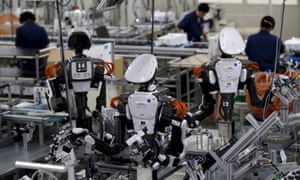
However the field of robotics promises to be the most profoundly disruptive technological shift since the industrial revolution.
The development of automation enabled by technologies including robotics and artificial intelligence brings the promise of higher productivity (and with productivity, economic growth), increased efficiencies, safety, and convenience. But these technologies also raise difficult questions about the broader impact of automation on jobs, skills, wages, and the nature of work itself.
Somehow, we believe our livelihoods will be safe. They’re not:
Every commercial sector will be affected by robotic automation in the next several years. We have yet to reach the full potential of digitization across the global economy.
More than half the world’s population is still offline.
Greater interaction will raise productivity but require different and often higher skills, new technology interfaces, different wage models in some cases, and different types of investments by businesses and workers to acquire skills.
In a recent report, the World Economic Forum predicted that robotic automation will result in the net loss of more than 5m jobs across 15 developed nations by 2020, a conservative estimate. 40–50% of all jobs will be taken by robots in the next twenty years.
By 2025, average salaries in the robotics sector will increase by at least 60% – yet more than one-third of the available jobs in robotics will remain vacant due to shortages of skilled workers.
Developments in motion control, sensor technologies, and artificial intelligence will inevitably give rise to an entirely new class of robots aimed primarily at consumer markets. For example “Create Your Taste” kiosk – an automated touch-screen system that allows customers to create their own burgers without interacting with another human being.
The thing is: we’ve heard this all before. Time and time again, we underestimate capitalism’s extraordinary ability to come up with new meaningless jobs. (It’s 37% in the UK right now, but it could be 50%, 60% or even 100% in the future.)
Unless we update our ideas about what ‘work’ even is. The rise in the total of those employed is governed by Parkinson’s Law, and much the same whether the volume of work, were to increase, diminish or even disappear.
Labor which was once the capital of working men will be longer true.
Again: it’s not about the technology, it’s about the choices we make as a society.
When it comes to universal basic income: we don’t have to wait for the robots. We are more than rich enough to do it right now – in fact, we should have done it forty years ago!
Technology is not destiny, education is.
Everything depends on the choices that we make as a society.
If history is any precedent, we already know the answer.
MOST OF US ARE NOW SURROUNDED WITH A PORTION- DISTORTED EMBARRASSMENT OF NOT JUST FOOD BUT GOVERNMENT SIZE.
It’s time for taxpayers to remind themselves just how much the cost of government to run us is..
Let’s take the cost of running the UK as an example.
The House of Commons with 650 Mbps at £76,000 pa costing the tax payer £156 million a year.
Add in the £6.4m pa given to opposition parties (Short Money), and support items like IT, and the overall total for each MP goes up to £242,000 pa.
But that’s only part of the bill: we also need to add in the costs of running the Commons itself. According to the HoC Administration Resource Accounts 2006-07, those costs total £210m, which is a further £325,000 per MP.
Oops I nearly forgot the gold-plated final salary pension guaranteed by taxpayers.
The official cost of MPs’ pensions is under 12 per cent of their salary, after 11 per cent contributions from MPs themselves. This adds up to total pay and pension for an MP of £85,000 (their £76,000 salary and £9,000 pension).
So with 650 MPs, that means each one costs us £85,000 pa in salary, pension contributions and employment taxes. Those troublesome “staffing allowances” cost us an additional £57.9m pa- £90,000 for each MP. Then there’s incidental expenses, additional cost allowances, and travel expenses, totaling a further £30.7m (£48,000 each).
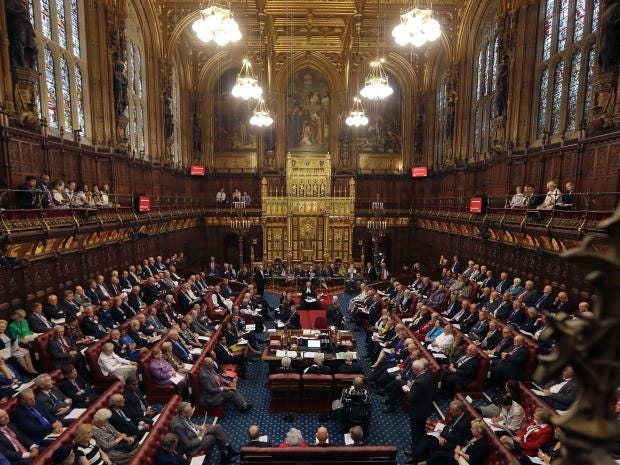
Then you have 814 unelected Peers in the House of Lords at £83,000 pa. Costing the tax payer £67,932,000 a year plus £462,510 in tax-free expenses. Members can claim £300 or £150 for every day they attend the House and undertake parliamentary work. The dining rooms and bars are all subsidised by the taxpayer.
Baroness Smith of Gilmorehill, who has claimed £220,000 of expenses over her 27 year career on the red benches, has never spoken in a debate.
The total cost of members’ allowances and travel is around £20 million per annum.
So reducing the size of the House by about 250 members would represent a significant saving to the taxpayer.
Then you have the Civil Service 418,343, (316,792 full-time and 101,551 part-time.) Gross annual earnings (excluding overtime or one-off bonuses) for Civil Service employees is around £25,350, pa.
You dont have to ask why people are lying on the floors of hospital corridors.
————————————————————————————————-
‘What do you do when there is nothing left to do?’
What should a government faced with an unmanageable level of unemployment do when conventional policy has failed to resolve the issue?’
Perhaps then a seemingly radical solution, such as universal basic income (UBI), becomes plausible. Universal Basic Income (UBI), a form of social security paid to individuals, not households. It is paid to everyone.
It would give individuals the freedom to say ‘yes’ to jobs. Individuals will not have to do that which they do not wish to do. Fewer people will engage in menial and unsatisfying work. Employers may be forced to increase the wages for underpaid or unpaid jobs.
UBI creates a floor (minimum level) on the income distribution curve, alleviates poverty, and gives bargaining power to the ones who have it least.
Forgetting about work for a moment (if you can), think about what you should do when your physiological needs are no longer a concern. If you’ve had a passion at the back of your mind then you might finally pursue it. If, on the other hand, you’ve passed life going from one kind of busy to another, then you might have missed opportunities to reflect and figure out what you would like to be doing. The cost of failure may have been too high if it meant putting you or your family’s livelihood at risk.
Assuming UBI ensures a basic livelihood for everyone in a community, do these citizens have a duty to give back by working? Do individuals have a duty to accept paid, available employment?
I would say Yes: Individuals should have a duty to do something, providing it is socially beneficial. There was something about people helping each other for its own sake that makes for a good society. A society is not well-functioning if it’s members are not interested in actively improving each other’s well-being.
Caring for the those who cannot care for themselves (such as the elderly, children and disabled). One could volunteer for various causes they care about, whether they be social, environmental, tech-related or so on.
Your recognition that you have alleviated the suffering of others might make you feel like you have done something meaningful.
UBI provides the opportunity for you to try contributing to your community in different ways. This freedom lets you find a way to contribute that is most satisfying for yourself.
It would remove fear replacing it with dignity.
UBI would also reduce the cost of citizens relying on the state for assistance.
There are many pending environmental crises hanging over us, but human wastefulness can be avoided. Can you imagine a world of 7.6 billion people no longer struggling for food or shelter and now focused on bettering the world for their children? That’s universal basic income. That’s a legacy we can all leave.
So why is it not being done?
Because it would downsize our consumerism lifestyle and remove inequality.
There is nothing more powerful than an idea whose time has come.
I can hear you saying where will the money come from?
Vat, Negative Interest rates, Earnings from investments, Decreasing militry spending, Sovereign wealth funds, etc.
It would ensure that the distribution of the fruits of technology advancement are distributed fairly.
As Jeremy Howard said: ” In a post-scarcity world , why hold back wealth from people just because they can’t provide labor inputs just to create wealth.”
All human comments and suggestions appreciated. All like clicks chucked in the bin>
The internet has loosened our collective grasp on the truth.
It is a fact of the internet that ( with a new social media user, every 15 seconds,) every click, every view and every sign-up is recorded somewhere.
So what exactly is Social Media:
Is it a term relating to gatherings of people that prefer to exist in groups?
Or
Is it the dustbin of idle world gossip.
Not on your Nelly> With billions of people glued to Facebook, Whats App, We Chat, Instagram, Twitter, Weibo and other popular services, social media has become an increasingly powerful cultural and political force, to the point that its effects are now beginning to alter the course of global events.
This is what it is to-day:
Social networks earned an estimated $8.3 billion from advertising in 2015.
A 2011 study by AOL/Nielsen showed that 27 million pieces of content were shared every day, and today 3.2 billion images are shared each day.
On WordPress alone, 91.8 million blog posts are published every month.
It’s estimated that video will account for 74% of all online traffic in 2017.
Google processes 100 billion searches a month.
91.47% of all internet searches are carried out by Google.
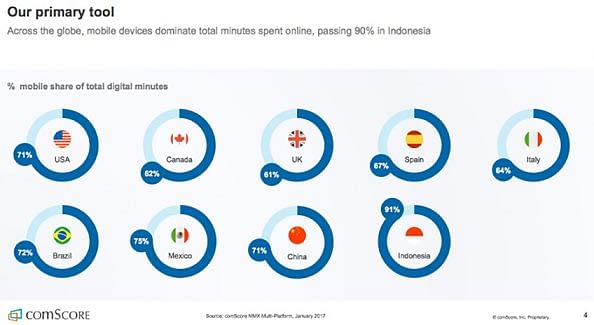
60% of Google’s searches come from mobile devices.
To carry out all these searches, Google’s data centre uses 0.01% of worldwide electricity, although it hopes to cut its energy use by 15% using AI.
By 2014, Google had indexed over 130,000,000,000,000 (130 trillion) web pages.
Facebook statistics
Facebook adds 500,000 new users every day; 6 new profiles every second.
79% of all online US adults use Facebook.
76% of Facebook users check it every day.
The average (mean) number of friends is 155.
Half of internet users who do not use Facebook themselves live with someone who does.
Of those, 24% say that they look at posts or photos on that person’s account.
There are an estimated 270 million fake Facebook profiles.
The most popular page is Facebook’s main page with 204.7m likes. The most liked non-Facebook owned page is Christiano Ronaldo’s with 122.6m.
There are 60 million active business pages on Facebook.
Facebook has 5 million active advertisers on the platform.
Facebook accounts for 53.1% of social logins made by consumers to sign into the apps and websites of publishers and brands.
Twitter statistics
500 million people visit Twitter each month without logging in.
There is a total of 1.3 billion accounts, but only 328 million are active,
Of those, 44% made an account and left before ever sending a Tweet.
The average Twitter user has 707 followers.
But 391 million accounts have no followers at all.
There are 500 million Tweets sent each day. That’s 6,000 Tweets every second.
Twitter’s top 5 markets (countries) account for 50% of all Tweets.
It took 3 years, 2 months and 1 day to go from the first Tweet to the billionth.
65.8% of US companies with 100+ employees use Twitter for marketing.
77% of Twitter users feel more positive about a brand when their Tweet has been replied to.
You tube statistics
300 hours of video are uploaded to You tube every minute.
People now watch 1 billion hours of YouTube videos every day.
More than half of YouTube views come from mobile devices.
The average mobile viewing session lasts more than 40 minutes.
The user submitted video with the most views is the video for Luis Fonsi’s song ‘Despacito’ with 4.36 billion views.
YouTube sees around 1,148bn mobile video views per day.
In 2014, the most searched term was music. The second was Minecraft.
9% of U.S small businesses use Youtube.
You can navigate YouTube in a total of 76 different languages (covering 95% of the Internet population).
Instagram statistics
There are 800 million Monthly Active Users on Instagram.
Over 95 million photos are uploaded each day.
There are 4.2 billion Instagram Likes per day.
More than 40 billion photos have been shared so far.
90 percent of Instagram users are younger than 35.
When Instagram introduced videos, more than 5 million were shared in 24 hours.
Pizza is the most popular Instagrammed food, behind sushi and steak.
24% of US teens cite Instagram as their favourite social network.
Pinterest statistics
Pinterest has 200 million active users each month.
31% of all online US citizens use the platform.
67% of Pinterest users are under 40-years-old.
The best time to Pin is Saturday from 8pm-11pm.
In 2014, male audience grew 41% and their average time spent on Pinterest tripled to more than 75 minutes per visitor.
LinkedIn statistics
LinkedIn has 500 million members.
106 million of those access the site on a monthly basis.
More than 1 million members have published content on LinkedIn.
The average CEO has 930 LinkedIn connections.
Over 3 million companies have created LinkedIn accounts.
But only 17% of US small businesses use LinkedIn.
Snapchat Statistics
Snapchat has 178m active daily users.
60% of them are under 25.
In 2016, $90m was spent on Snapchat ads.
47% of US teens think it’s better than Facebook, while 24% think it’s better than Instagram.
That’s your fill of social media statistics for now, with just a tiny fraction of the weird and wonderful stats and facts available out there.
It’s easy to get dragged into the drama and other negative aspects of social media.
Social media is built for polarisation and extremes.
The basic engagement mechanisms of popular social media sites like Facebook drive people to think and communicate in ever more extreme ways.
Social media is a collective term for all the websites and online services that are erasing national borders and distances.
Social networks are helping to fundamentally rewire human society.
They are used to spread information about dramatic events or to warn others about risky routes. When refugees reach a new country, they can also use social media to contact their fellow countrymen who are already there and find out about things like permits, authorities they can turn to or what things cost.
They have subsumed and gutted mainstream media.
They have undone traditional political advantages like fund-raising and access to advertising.
They are destabilizing and replacing old-line institutions and established ways of doing things, including political parties, transnational organizations and longstanding, unspoken social prohibitions against blatant expressions of racism and xenophobia.
They are helping to create surprisingly influential social organizations among once-marginalized groups. For Example : Brexiters in Britain to ISIS in the Middle East to the hacker collectives of Eastern Europe and Russia.
Each network in its own way is now wielding previously unthinkable power, resulting in unpredictable, sometimes destabilizing geopolitical spasms.
Through this new technology, people are now empowered to express their grievances and to follow people they see as echoing their grievances.
THE QUESTION IS:
IS SOCIAL MEDIA NOW THE JUDGE AND JURY AND THOSE THAT RUN ITS ALGORITHMS ARE NOW THE REAL WORLD POWER BROKERS.
If it wasn’t for social media, I don’t see TRUMP AS PRESIDENT OF THE US.
This has to be the scariest ACHIEVEMENT about Facebook/ Twitter.
Not that Facebook may be full of lies (a problem that could potentially be fixed), but that its scope gives it real power to change history in bold, unpredictable ways.
But that’s where we are.
It’s time to start recognizing that social networks actually are becoming the world-shattering forces that their boosters long promised they would be — and to be unnerved, rather than exhilarated, by the huge social changes they could uncork.
This should come as no surprise.
Facebook and Twitter have become the new TV, where businesses can’t control their messaging as they once were able to do with TV ads.
In a way, we are now living through a kind of bizarro version of the utopia that some in tech once envisioned would be unleashed by social media.
Online campaigns directed at GOVERNMENTS OR FOR THAT MATTER AGAINST BRANDS can be a lot more effective than writing. Pay-to-play strategy by letting posts run and gain organic traction before boosting them.
Efforts to fight this dismaying trend are obviously worth pursuing, but is it time to give our due to the new political activism – Social Media. The king of communication.
As it becomes increasingly commercialised there is a risk that people – particularly young people – will see social media content as being politically and commercially independent.
What it means to get caught in a Twitter storm. Facts tell, but stories sell.
In actual fact, the very opposite is true.
When you sign up for Facebook, you also accept a business model that can use information about what you do and how you feel, for example in marketing.
One terrifying example is how the terrorist group ISIS uses social media to recruit new supporters. Potential ISIS fighters can be invited to join private Facebook groups where they are put into contact with individuals who are active in Syria.
However if used in a responsible manner it s also a new tool for democracy.
More people can express their views and form opinions. There are also examples of individuals who have quickly succeeded in raising large sums of money for those in need.
The Impotence of Social Media is in its nucleus accumbens.
People tend to follow the behavior of the group.” If other people have liked a post, new viewers will be more likely to like it too. And that popularity can feed on itself, changing their behavior to try to get social approval, respond to headlines without any in-debt knowledge of what the headline refers to.
A single ‘like’ can make a social-media post more popular.
Many social media sites share more of the higher-ranked — or more popular — posts. As a result, “people are more likely to see what others have positively rated,” what’s in those photos is socially acceptable.
Skip pictures with few likes.
Likes can have a subtle but significant effect on how teens interact with friends online.
The important take-home message here, is that Social media shapes how we perceive the world around us.
When people express themselves through social media, they communicate collectively.
Members of social media communities direct raw emotions into particular interests. These audiences show their interest and approval by liking, sharing and commenting. And those mechanisms drive future social media behavior all driven by algorithms that drive participation and attention-getting in social media, the addictive “gamification” aspects such as likes and shares, invariably favoured the odd and unusual.
What are the results?
How polarised and divided nations are becoming.
The smartphones and web applications were increasing people’s
passions while also driving them to polarising extremes.
Political figures around the world are more polarised.
Language is more crude.
Sharing is becoming competitive, pushing participants to one-up each other.
Where Facebook or Twitter (viewed on mobile devices) has become for many people the sole source of news. Article will have a MUCH higher chance of converting to a sale!
You’ve engaged them, you’ve educated them, you’ve entertained them with social networks. (Communities of people (or animals) that are interrelated owing to the way they relate to each other.)
In humans, this can involve sharing details of their life and interests on Twitter or Facebook, or perhaps belonging to the same sports team, religious group or school.
I rest my case.
The functions of social media have transformed into something we have never anticipated.
Social media has transformed into political tools, increased global awareness, and offered a quicker way to spread information.
People have the power to abuse social platforms like Facebook and Twitter to promote radical ideas. So what.
Once you gag people’s right to speak freely, you place a mental shackle on the subconscious mind.
If you want to influence others to act upon what you have to say, treat social media communications with the same degree of importance as those that are face-to-face.
Social media to a great extent is a reflection of life. Without education for the sake acquiring knowledge the mind looks for it else where.
All human comments appreciated. All like clicks chucked in the bin.
I have posted on this subject before with little reaction.
There is often an implicit connection between discourses of the future and notions of technology, so that if we see a television programme with a title such as Click or Tomorrow’s World we expect that the topic will be technology.
The single most astonishing point about technologies is that they can move from being emblematic of an almost unreachable future to becoming so taken for granted that it feels like a personal slight when they do not work.
In this way technology in and of itself becomes a symbol of being modern is one of the reasons it becomes expressive of, rather than distinct from, cultural values.
Perhaps this is the reason that the relationship between social media and the conceptualisation of the future is still blurred and will remain so.
New technology does not just change the manner in which people go about their everyday lives: It also facilitates our imagination of the future.
All the above speak to a new, imagined future that strives towards idealism. However within the vast field of technology the consequences of AI there are a few devices and algorithms that will battle it out over the next twenty odd years for supremacy.
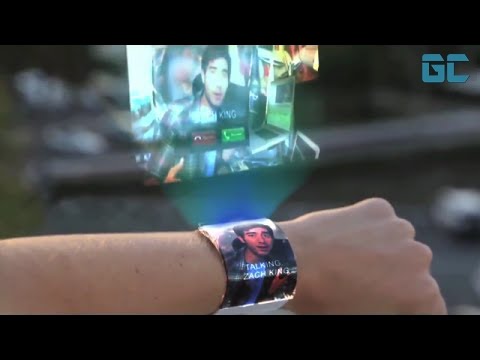
Will it be Smartphones, or Smart Wearable or Cryptocurrency that will augment reality.
All need software in the form of algorithms to run.
AI algorithms will make the physical and digital world interchangeable.
Practically every non- iPhone smartphone relies on an Android operating system?
One way or the other we are entering an age where life stops giving us things and starts taking them away.
Not surprising.
So it’s not Social media technology platforms like Facebook or Twitter and the others ( that talks a lot about connectivity but not accountability) that will change the world but the power of ever where at once.
That requires total knowledge on all aspects of life.
Google or should I say the Google Cloud is trying to achieve this.
Which is possibly both the best and the worst thing that could happen.
So let’s look at a few of the top combats in the world of technology in no particular order.
( Obviously it would take page after page to give a comprehensive insight so I am only going to give a few lines to each.)
Microsoft Corporation:(LinkedIn -Skype – Mojang – Yammer- Hotmail)
It operates through the following segments:
Productivity and Business Processes, Intelligent Cloud, and More Personal Computing.
Market Cap As of May 2017
$507.5 Billion
Microsoft could be worth $1 trillion by 2020 — if not sooner. It is moving further and further into a digital landscape for everything from movies, music, books, games and software.
Twitter: Owned mostly by Venture Capitalist:
An online breaking news and social networking service. Using Twitter bots, (live streaming video.) With 450 million monthly active users it is ranked the eleventh most visited website. It has mobile apps for iPhone, iPad, Android, Windows 10, Windows Phone,BlackBerry, and Nokia S40.
Capable of influencing public opinion about culture, products and political agendas by automatically generating mass amounts of tweets through imitating human communication. World leaders and their diplomats have taken note of Twitter’s rapid expansion and have been increasingly utilizing Twitter diplomacy. Television programs use it to amplify their programs.
It could become the emergency communication system for track epidemics or sensor for automatic response to natural disasters.
Amazon:
The largest Internet retailer in the world. The company is now worth more than $560 billion. Electronic commerce and cloud computing company.
Amazon announced that it would acquire Whole Foods, a high-end supermarket chain with over 400 stores, for $13.4 billion.
eBay Inc: (PayPal)
There are now literally millions of items bought and sold every day on eBay, all over the world. For every $100 spent online worldwide, it is estimated that $14 is spent on eBay. What’s more, eBay doesn’t care who you are, where you live, or what you look like:
The race is on to control mobile payments and the upside remains enormous:
Apple:(Shazam – Emagic- Siri – Beats Electronics – Next Inc.- Novauris-PrimeSense -The Bottom Line – Invest in Yourself.)
Quarterly revenue of $52.6 billion 2017.
Today, Apple leads the world in innovation with iPhone, iPad, Mac, Apple Watch and Apple TV. Apple’s four software platforms — iOS, macOS, watchOS and tvOS.
Facebook:(Whats App and Instagram Oculus VR.)
A publicly traded company worth more than $500 billion.
More than two billion monthly users. It is developing a new social platform in virtual reality called Facebook Spaces, which it believes will form the foundation for the future of communication.
Tencent and Alibaba: aren’t far from the half-trillion dollar mark either.
These are the main contenders as we know them to-day
—————————————————————————————
So the Question is:
Which one if any of the above will be the top dog by 2025.
Will it be : ( All knowledge, All Gossip, All purchases, All Apps/ Software)
At this point you will have noticed that I have left out the company mentioned in Title of this posting.
While in the future devices may be more ubiquitous in all corners
of the globe, inequality will therefore remain in terms of the services
available in certain locations and the lack of attention paid to the needs
and desires of certain populations.
Companies like Amazon and Google will be fighting to lock you into one voice ecosystem. You may have to declare your allegiance for Alexa, Siri, Cortana or Google Assistant.
One could say that:
Amazon represents de-socialising of commerce. Face book represents self ego. Twitter represents myths and gossip. Apple represents profit. E bay represents selling and buying of stuff, Google represents doming down.
All are represented on Social Media which is being used in ways that shape politics, business, world culture, education, careers, innovation, and more.
Social media applications such as Facebook, Twitter and YouTube have increasingly been adopted by politicians, political activists and social movements as a means to engage, organize and communicate with citizens.
So is the power and the winner going to be Social Media which is owned by the Internet.
I think Not.
In short, one consequence of this prediction is that the very idea of ‘social media’ might gradually disappear; instead we simply have an increasingly diverse set of media and increasingly sophisticated exploitation of the possibilities these media have created, including other trends such as obtaining information, sharing information or making communication more visual.
Social media is slowly killing real activism and replacing it with ‘slacktivism, and we all know where that might lead us. Awareness is not translating into real change. Support is limited to pressing the ‘Like’ button or sharing content which absolve them from responsibility to act.
The role of social media as symbolic of the future may already be in decline.
“The election of Donald J. Trump is perhaps the starkest illustration yet that across the planet, social networks are helping to fundamentally rewire human society.”
The one I left out, with 65% of all online searches – is Google.
Google has expanded far beyond its original claim to fame as a search engine.
Google and their competitor platforms are programming the world for profit. The reach of this technology giant is so vast it is hard to imagine an area of modern life it has not touched.
Alphabet owns Google, as well as many other companies. However, Google itself owns companies.
Google has reorganized itself into multiple companies, separating its core Internet business from several of its most ambitious projects while continuing to run all of these operations under a new umbrella company called Alphabet.
Google owns more than 200 companies, including those involved in robotics, mapping, video broadcasting, telecommunications and advertising.
Simply put, the company has been visionary in recognizing the income potential for information products.
Their profit seeking algorithms ensuring that every recommendation, from whether you should buy this or that, stay here or there, fly or drive, connect to this or that, live or die, will earn them a few cents.
By 2025 all will be connected to the Cloud. With one winner.
The Google Monopoly.
Once a Google client always a Google client.
How do you stop using Google?
Already impossible.
Move and your G Mail becomes blocked mail.
Say anything on you website that smacks about google, you site gets flooded with google ads.
It is becoming more and more difficult for anyone to extricate themselves from the clutches of any of its platforms as deactivating means little or nothing.
Social media apps ensure you are still engaged and if they don’t work your friends and family smartphones are searching for you nonstop supplying little hits of dopamine. ( Someone likes you photo or you are mentioned in their contact. It’s a social validation feedback loop..exploiting a vulnerability in humans psychology.)
Will Social Media destroy or rain back Google dominance?
The whole Social media thing is turning into an addictive cancer effecting our brains and tearing our emotions and attentiveness a sunder which in turn is encouraging self-segregation and exacerbating social divides.
Every facet of our life is touched or being integrated by the social media today.
In this sense social media has become an instrument of democratic renewal.
On the other hand it is evident that this uncensored and unmonitored medium of communication is exposing us all to a gradual breakdown of social cohesion and the destruction of our traditional value systems.
Though the advantages of social media are emphasized quite often, as opposed to its negative aspects which are very rarely discussed.
I feel that this will change in the coming years.
All said, social media is here to stay. The power of social media is exponential. Numbers tell the story.
Just as difficult as forecasting the future is knowing the present.
After all not everything moves over time to become more functional
or efficient.
It is obviously going to be hard to predict the future for something as
dynamic as social media. How can we know what social media has already become for oil workers in Alaska, tribal people in Amazonia and the nouveau riche of Moscow?
Unless we take responsibility to ensure that our understanding of social media and its impacts are constantly evaluated with what’s happening in the world. Once we appreciate that knowing social media is not an exercise in delineating the properties of a set of platforms, but rather of acknowledging what the world has already turned these into, by way of content, the immensity of the problem is revealed.
So it will be important to continue monitoring and exploring the extent to which collective action is individualised through social media use.
= Can the use of social media for campaigning help to bring about genuine and lasting empowerment; or does it serve largely to re-inforce pre-existing relationships?
= Is social media a means of building dialogue and consensus in diverse communities or does its use encourage increased fragmentation or, alternatively, a homogeneity of interests?
= Can meaningful impact measures be developed that can be used by small, under-resourced organisations at local level (or indeed within larger voluntary organisations)?
Social media is seen in much of the literature as a means of promoting dialogue beyond the mainstream media. Voluntary and community groups have been criticized, however, for using social media as little more than a means of broadcasting.
Why might this be the case – and does it matter?
Social media expands our capacity but, it does not change our
essential humanity.
It is used to repair the rupture sustained by separated transnational families or for overcoming previously frustrated desires to share photographs more easily.
It allows couples living in different countries who ‘sort of’ live together online;
Soon, however, things move on to new realms.
Should a clear relationship be expected between the (apparently empowering) use of social media in mobilizing large national and global movements, and its use at the micro-political neighborhood level.
An increasing number of social media platforms can be aligned with the diversity of the social groups to which we might want to relate.
Social media however has little impact on the overall outcomes in terms of empowerment, equalities or social justice.
However powerful and important the advent of social media has become, it would be hard to place it ahead of the impact and significance of smartphones, within which social media platforms may often be seen as just another kind of app.
It is smartphones that facilitate social media’s importance as a mix of polymedia, making clear the range of media possibilities as they lie side by side within one easily accessible device.
It is the Smartphone that drives social media input and out put.
Will that will be the One Winner, changing our sense of collective memory, creating a new form or combination of internal and external faculties for retaining information.
As Smartphones become smarter, they may well accelerate the dissolving of social media into this wider array of communicative possibilities.
The increasing ubiquity of the smart phone is the catalyst for more general usage of social media. Recognizing that this may not necessarily impact on any other aspect of inequality should not prevent us from recognizing that there is in one aspect an increasing and significant equality:
The more individuals live within culturally imposed constraints on communication, the more a new technology may mean that what was previously forbidden now becomes possible.
This fluid mix of communicative forms suits the way users flow between activities such as talking, gaming, texting, masturbating, learning and purchasing. The social connection is more important than how well a platform meets their needs.
Comparative anthropology creates particular varieties of knowledge of both breadth and depth. What makes these essential within the context of our complex modern world, however, is that these are forms of understanding based on empathy.
Merely having a smart phone provides a significant change with respect to the capacities of its owner.
——
What happens to our online materials at death.
Finally: Capitalism can never be ethical.
There are no laws requiring Google to be fair.
If we don’t open our eyes soon technology ( whether it’s Google, Twitter, Facebook, Amazon Inc or some equivalent service) is going to F—k us all from some Cloud or other that is just over the horizon.
Just look at the annual release of new smartphones.
Of course there are other things in the long tall grass waiting to caught us by the short and hairy and most have being around for yonks. War, Natural Disasters, Greed, Inequality and the like.
My advice is to beware of the man with a smartphone. Because knowledge is not knowledge until someone else knows that one knows.
Google it.
All human comments much appreciated. All like clicks chucked in the bin.
” Anyone who thinks that you can have infinite growth on a finite planet is either a madman or an economist” I would add technology in the form of profit seeking Algorithms.
Infinite growth might have seemed possible when Captain Cook was around, unfortunately it no longer holds.
However we are all still lead to believe that GDP marks human progress.
Our world is rapidly changing. Markedly defined by the Internet.
We are now standing on the threshold of divorce between Money and State with natural systems under enormous pressure which I am sure I don’t have to high light here.
With the planet groaning, ever trade deal is a new frontier of accumulation a form of World GDP exploitation that was and still is promoted by the help of the World Bank, and the IMF.
We are now at a stage where GDP growth is beginning to create more poverty, and inequality than it eliminates.
Unfortunately the resources of the world have been exploited both for debt and profit rather than sustainability, and as long as GDP growth remains the main objective of Globalization we will see more and more countries going into irreversible debt, and war over freshwater, air, and energy.
These profound changes are emboldened by the evident failures on both levels of political control: Technological Regulations/ Laws and the growing power of monopoly platforms like Facebook, Twitter, Google, Microsoft, the Cloud etc.
Don’t worry say’s technology we can decouple sustainability and material throughput.
A beguiling vision of a future lightweight economy.
Facebook and the Cloud are gathering an unprecedented amount of power and allowing their business practices to be a disruptive force for democracy.
All pointers signaling the widespread decay of the economic and political frameworks in which our institutions operate.
With profit seeking algorithms rich countries are in fact increasing consumption, still producing stuff and by 2030 it will be in the 100 billion tons.
There is also a growing belief as we convert to renewable energies and begin to use negative – emissions technologies that we can change the damage to the climate.
However if we continue to ignore that energy use is only part of the problem.
It is what we are doing with it is the problem.
Polluting our sea, chopping down our forests, producing cement, creating land fills with waste, eroding our land, all contributing more and more greenhouse gases. Switching to clean energy will do nothing to slow this down.
The problem is much deeper than we are willing to admit.
We need a new consciousness for a different world.
Our crucial first step would be to get rid of GDP as a measure of economic growth/progress and well-being.
We need to have an open discussion about what we really value.
We are all aware of the individual problems, but the main problem remains the same – Inequality due to the distribution and exploitation of the world’s wealth.
Any rich country that has food banks, people sleeping on the street, is for me a failed state.
I have written many a post with a solution that to date has fallen on deaf ears.
it is my conviction that at this point and time its impossible to correct the imbalances of Capitalism. We can only ensure that Capitalism pays for the damage by introducing a World Aid Commission.
0.05%
On all High Frequency trading, on all Sovereign Wealth Fund Accusations,on all Foreign exchange transactions over $50,000, on all Social Media platforms postings, on all Bitcoin’s, and other digital currency transactions.
This fund would be a perpetual source of money.
It could replace the begging Organisations.Re Establish the United Nations an effective world organisation that could address and react to world needs, where ever, when ever.
It could be managed under the UN umbrella, provided it was totally independent/ transparent of any lobbing and political veto interference.
Its funds could be granted with no repayments requirements.
It would change the world for the better, by spreading its wealth where it is needed most.
Of course the problem remains as to how we get our Capitalist Master to implement such a course of action.
Perhaps Bitcoin’s ability to promote the divorce between Money and State, might be a place to start.
All suggestions appreciated.
All human comments appreciated. All Like clicks chucked in the bin.
We live in a world that is being connected and disconnected at the same time.
Two related facts.
But don’t worry we now have Algorithms that both filter and recommend.
All our final decisions are made in a state of mind that is not going to last.
The reality is that there’s no way of knowing where our generation is going in terms of technology and our reliance on it.
The year 2018 will be the year in which human interaction decreases the more technology increases. While social media fosters an environment of connectedness and belonging in the digital world, it also forces a disconnect between people in the real world.
With false news and social media, words are on their last legs, with print for the high jump, we will have more arse holes 2018 twittering shaping the world.
Where two or three words gather together there is a great danger that thought might be present. However we once again don’t have to worry because we have the option to log off and unplug anytime we want, so it’s up to us to decide if we want to engage with the actual world or the virtual one.
Technology may well be is a societal advancement that has enabled our generation to do things previous generations never would have thought possible.
However:
The biggest problem we have is accepting each other’s differences.
“Technology makes us forget what we know about life.”
82 per cent of smart phone users said they rarely (if ever) powered off their phones last year, while less than 43 per cent of 13- to 18-year-olds saw any value in ever going unplugged.
Why?
This is the Eternal Question to which there is no answer, and yet the only one that has to be asked.
Take a look around you.
Every day we becoming more and more desensitized. Save this Save that while saving the planet is being left to technology.
Rapid progress in machine learning has raised the prospect that algorithms will one day be able to do most or all of the mental tasks currently performed by humans.
But the real problem is how one might design a highly intelligent machine to pursue realistic human goals safely.
This is very poorly understood.
Even if advanced machine intelligence does not get ‘out of control’, it is likely to be very socially disruptive and it is more likely it could be used as a destabilizing weapon of war.
It seems that most of us are in a mental wasteland inhabited by those upon whom the portcullis ( A sudden blotting out of all normal thought) has fallen.
How did we get to a place where the content on our phones is more interesting than the world around us?
In today’s society, scrolling through Facebook, Twitter, or Instagram has taken precedence over the real events scrolling through our daily lives.
Being “connected” to machinery 24/7 is affecting our ability to connect with our lives and the people around us.
Mechanical devices bait us into a make-believe life, as we are slowly being pulled away from a sense of who we are and what really matters.
Modern life is making us lonelier.
It’s not the technology that’s the problem; it’s us for abusing it.
We’ve become more and more antisocial by relying on technology too heavily.
Maybe if we look up and away from the flashing images and colors on our most recent Safari search, we will actually enjoy the company of those around us. So instead of counting the number of likes, count the memories in your life, because at the end of the day, that’s all that matters.
For the foreseeable future, it won’t be possible to take people out of the decision-making process, but the year 2018 will with the power of Profit Seeking Algorithms push us further down the road of hypnotic trance.
Technology is a valuable tool when used correctly. However, the law has to catch up with privacy and safety issues, not mention profit seeking algorithms.
We’ve all heard about the power of algorithms—but Algorithms to Live is in my book to be avoided at all costs, if we are to value what is vital to us all.
They are creating a world of such inequality that the scariest thing is the immense possibilities of these unregulated Algorithms will turn us and all that is necessary for a sustainable life into commodities to be exploited.
What can be done:
Education, Education is the only solution.
By this I mean education not for the market place but for the foundation of knowledge. Not just a narrow streamlined pipeline of mundane thoughts which doesn’t let you think outside the box and do things on your own.
Psychology, Anthropology, Sociology, Ecology, to name a few.
Dramatic changes are inevitable, we need to accept the fact on ground level that our education models are broken and paralyzed.
Perhaps we might well need computer algorithms to select the best candidate?
There’s no magic formula, freedom and dignity will not be found on social media, nor computed by algorithms.
There are too many parts of today’s conversations that can not be translated through technology.
Tearing apart the nation states and the world with ALGORITHMS is a
Disaster waiting to happen. No Robot with a brain full of algorithms is
going to have the the ability of an artist to have human empathy and an
appreciation of history; while also having the savvy self-awareness to
understand that their work merely takes its place in a greater culture
at large. Such art brings comfort in our modern secular world: where
spirituality seems to live in a foreign universe of yesteryear.
You’re more than a number.
how the mythical and quotidian usually overlap to
the point where the two become indistinguishable.
So join a club and organizations to make real friends.
Happy New year.
All human comments appreciated. All like clicks chucked in the bin.
We all urgently need to consider the implications of allowing commercial interests and governments to use algorithms to analyse our habits: Not because they are becoming all-powerful, that might turn into a source of repression, but because they are exploiting us all for profit.
They make decisions about us and on our behalf.
They are now integrated into our lives. We’re already halfway towards a world where algorithms run nearly everything. As their power intensifies, wealth will concentrate towards them. They will ensure the 1 per cent-99 per cent divide gets larger.
If you’re not part of the class attached to algorithms, then you will struggle.
On the one hand, they are good because they free up our time and do mundane processes on our behalf, but the problem is that when we outsource thinking to machines we are really outsourcing thinking to the organizations that run the machines.
At the moment ignoring the fact that they are driving the cost of living up it is not about algorithms per se, but about the way society is structured with regard to data use and data privacy.
As technology evolves, everything is going up in price.
Raw materiel’s are going up leap and bounds because of a dictatorship of data, that is concentrating on how to generate the most profit.
As profit seeking algorithms power intensifies, wealth will concentrate towards them.
They do so not out of the goodness of their little algorithmic hearts, but rather because they earn a “fee” for this service.
There are many different types of algorithms at play, with different intentions and impacts, however there is one thing that is becoming quite clear day by day that they are driving the human market makers out of business by being smarter and faster.
They are upending the nature of business, how government works and the way we live, from healthcare to education.
We should not allow ourselves to become so reliant on them – and who, if anyone, is policing their use. It’s impossible to do this perfectly. How are they being used to access and interpret “our” data? And by whom?
It won’t be long before big data denies us a bank loan or considers us unfit for a surgical operation, but we can’t learn the explicit reasons because the variables that went in programming them were so myriad and complex?
There is currently an awkward marriage between data and algorithms.
Big data is even change how we think about the world and our place in it. (Penalizing people based on what they are predicted to do, not what the have done.)
Taken in the widest sense, algorithms OWNED BY MONOPOLIES are now responsible for the vast majority of activity on modern stock markets.
The well-being of our pensions, shareholdings, savings etc – are now largely determined by algorithmic vagaries.
Retail algorithms don’t scare me as we still have free will. However Algorithms are increasingly determining our collective futures.
Wherever we use computers, we rely on algorithms: With so much data around, and the ability to process it, big data is the bedrock of new companies profit.
Can we regulate them? I think not.
If you were leader of your country, what would you do?
I would have, Science, technology and inclusive innovation through education, on the national agenda. Education free and equal for all.
Unfortunately this will not happen. Even if it did Profit seeking Algorithms will still be exploiting every weakness.
There is only one defense.
WE MUST RE NATIONALIZE OUR SOCIAL SERVICES, SO ALL BENEFIT NOT JUST THE FEW. Nationalize what is important, Health, Power, Water, Education.
The key outcome of nationalization is the redirection of revenues to the country’s government instead of private operators who may export funds with no benefit to the host country.
All human comments appreciated. All like clicks chucked in the bin.




 So reducing the size of the House by about 250 members would represent a significant saving to the taxpayer.








 bobdillon33blog
You must be logged in to post a comment.