• About
  • THE BEADY EYE SAY’S : THE EUROPEAN UNION SHOULD THANK ENGLAND FOR ITS IN OR OUT REFERENDUM.

bobdillon33blog

~ Free Thinker.

bobdillon33blog

Category Archives: Scientific.

THE BEADY EYE ASKS. DID DARK MATTER CREATE GRAVITY OR IS IT THE OTHER WAY AROUND.

13 Saturday Nov 2021

Posted by bobdillon33@gmail.com in #whatif.com, Dark Matter., Gravity., Scientific., Space.

≈ Comments Off on THE BEADY EYE ASKS. DID DARK MATTER CREATE GRAVITY OR IS IT THE OTHER WAY AROUND.

Tags

Dark Matter., Gravity.


(Fifteen-minute read) 

This question has been asked before. 

I am no scientist but as far as I am aware so far dark matter has never been observed directly—hence the name.

You can point at where it is, say how much is there, and even talk about what it’s doing, however, it is estimated that dark energy makes up approximately 68% of the universe.

As far as anyone can tell, it is incredibly non-interacting and according to mathematical models, it makes up three-quarters of all the matter in the universe.

If that is so, is it not logical to assume that gravity must have been present before the formation of matter as no matter whether it be dark or otherwise could form without some sort of paste to clump them together.

We know that dark matter is a repulsive force that does not interact with electromagnetic energy, that it does not absorb, reflect, or emit light, making it extremely hard to spot. However, it’s said to interact with light and visible matter only through gravity giving the universe its overall structure. solar system


Like Dark matter we can’t see, feel, or directly observe gravitational forces.

So we have two unobservable forces. 

One is called gravity made of quantum particles, called gravitons which need an atmosphere and air to exist.  The other is a hypothetical form of matter not containing baryons—that is, without protons or neutrons. 

Obviously, there is a very close relationship between the contributions of dark matter and those of ordinary matter, as predicted in Verlinde’s theory of emergent gravity and an alternative model called Modified Newtonian Dynamics.

But if matter gives rise to gravity, then the standard model is wrong. 

(According to the standard model, gravity existed before matter did and if that’s the case, where did the gravity come from with no matter to initiate its presence?)

Perhaps we are wrong about how gravity works?

                                      ————————–

Both gravity and all matter are intertwined, interacting with each other with their forces diminishing the further away they are, eventually dissolving into dark matter that has no force till it meets gravity once more. 

Why?

Because dark matter doesn’t interact with itself it is bound to our world only by gravity and tugs on other things that also possess gravity.

Gravity is a force pulling together all matter (which is anything you can physically touch)

I believe that Gravity and Matter are the same things, so why do we give them different names?

                            ——————————–

All human beings are born on Earth, an environment perpetually under the influence of gravity.

A man wasn’t born with the biological ability to defy gravity.

Gravity is the weakest of the fundamental forces in Physics but has the greatest effect.

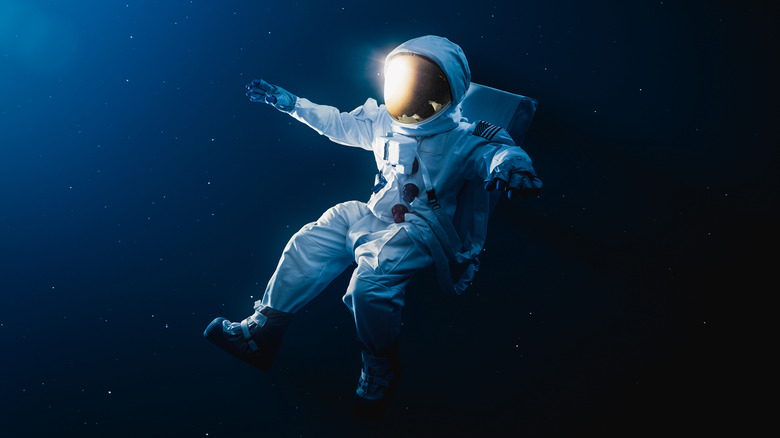
Take away gravity for an extended period, and that mechanical strain on the body goes away. As a result, the body forms fewer osteoblasts (bone-building cells), leading to a loss of bone mass and greater susceptibility to fractures.astronaut drifting in outer space

Astronauts in orbit around the earth are not experiencing “no gravity”. They are experiencing almost all of earth’s gravity, but with nothing to stop them.

The body’s development is greatly affected by gravity’s constant downward pull. That means it’s under constant stress, and our muscles and bones develop specifically to withstand that stress.

The amount of effort your heart exerts takes gravitational force into consideration.

Gravity has a strong connection to sleep patterns and the quality of sleep a person gets.

Gravity is measured by the acceleration that it gives to freely falling objects.

The word “gravity” is used historically to mean any acceleration and not just gravity.

We know that starlight from far away galaxies are bent by gravity on their way to our telescopes. But the distribution of gravity is not unformed throughout the universe, as it is the weight of what is on the dark matter that dictates its strength.

Without a doubt, all of these effects are caused by gravity, but the question is: are we genuinely observing additional gravity, caused by invisible matter, or are the laws of gravity themselves the thing that we haven’t fully understood yet?

If we find there is no dark matter might gravity only exist?

                                            ———————-Animation of apple falliing from tree

So is gravity actually created by dark matter or is it the other way around?

Perhaps what we perceive as dark matter is really just the gravitation from matter in another nearby universe. 

We know that it is not a form of matter and we have a gravitational equation that says that the force of gravity is proportional to the product of the two masses (m1 and m2), and inversely proportional to the square of the distance (r) between their centers of mass.  Mathematically speaking, F=Gm1m2 / r2

Nature defines zero-gravity as “a state of weightlessness.

We know that it is the Sun’s gravity that keeps the Earth in its orbit! and the Moon’s gravity is responsible for the ocean tides on Earth.

It’s the glue that keeps the Earth’s layers – the inner core, outer core, mantle, and crust — intact as it rotates on its axis and revolves around the Sun.gamma-ray bursts

We know that gravity from a black hole bends light rays.

But black holes are really just the evolutionary endpoints of massive stars they don’t have any surface or atmosphere to create a gravitational pull so their center of gravity must be outside or another mass or at the exit of the hole that produces dark matter. 

Black holes are among the oddest objects believed to populate the universe a million to a billion times the mass of the sun. 

We know that it’s the force that is critical for life on Earth to continue.

We know that without an atmosphere, there is no gravity, and if it disappeared, so will the Moon and all of us.

But we don’t really know what it is other than it is a force whose effects extend from each object out into space in all directions, and for an infinite distance that never goes completely away.

No science says that gravity control is impossible.

Artificial gravity can be created using a centripetal force. Because an electromagnetic field contains energy, momentum, and so on, magnets will produce a gravitational field of their own.

Gases such as Co2 and methane *are* held close to the surface of the earth because of gravity.  

The only way to change the planet’s gravity would be to change the planet’s mass.

Galaxies with a different shape and history can have a different amount of ‘apparent dark matter.

All human comments are appreciated. All like clicks and abuse chucked in the bin.

Go back

Your message has been sent

Warning
Warning
Warning
Warning

Warning.

Share this:

  • Click to share on WhatsApp (Opens in new window) WhatsApp
  • More
  • Click to share on Pocket (Opens in new window) Pocket
  • Click to share on Mastodon (Opens in new window) Mastodon

THE BEADY EYE ASK,S. WHICH CAME INTO EXISTENCE FIRST – TEMPERATURE-GRAVITY- PROTONS- ELECTRONS – ATOMS – MOLECULES- MATTER- LIGHT- TIME.

01 Friday Feb 2019

Posted by bobdillon33@gmail.com in Enegery, Evolution, Scientific., The Atom., The Obvious., THE ORIGINS OF THE UNIVERSE., Unanswered Questions., WHAT IS TRUTH

≈ Comments Off on THE BEADY EYE ASK,S. WHICH CAME INTO EXISTENCE FIRST – TEMPERATURE-GRAVITY- PROTONS- ELECTRONS – ATOMS – MOLECULES- MATTER- LIGHT- TIME.

Tags

The Future of Mankind, THE ORIGINS OF THE UNIVERSE., THE UNIVERSE.

( A HALF AN HOUR CONFUSING READ.)

Theoretical Science has endeavoured to explain what the universe is made up of with some success until it comes to the vast emptiness of spaces.

Perhaps some logical thinking is needed to enable us to understand how the universe began.

It requires developing a better theory of how space, time, and matter are related.

Every single second of every single day, you are being bombarded by trillions upon trillions of subatomic particles, showering down from the depths of space. They blow through you with the strength of a cosmic hurricane, blasting in at nearly the speed of light. They’re coming from all over the sky, at all times of the day and night. They penetrate the Earth’s magnetic field and our protective atmosphere like so much butter.

These tiny little bullets are called neutrinos.  Neutrinos have this annoying habit of changing character as they travel. That’s right, as a neutrino travels in flight, it can switch masks among the three flavours.

Although many subatomic particles break down into other particles, so far no one has caught the decay of protons or neutrons, which make up the nuclei of atoms.

Neutrinos continually challenge everything we know about physics.

Neutrinos are the ghosts of the subatomic world. Interacting via only the weak nuclear force, they can pass through matter without interacting nearly at all.

The visible universe—including Earth, the sun, other stars, and galaxies—is made of protons, neutrons, and electrons bundled together into atoms.

(Protons and neutrons are particles called baryons, and baryogenesis means the creation of baryons. (Understanding this requires more brain power than I have.)

The rest of the universe appears to be made of a mysterious, invisible substance called dark matter (25 per cent) and a force that repels gravity known as dark energy (70 per cent).

Perhaps one of the most surprising discoveries of the 20th century was that ordinary, or baryonic, matter makes up less than 5 per cent of the mass of the universe.

Although astronomers understand what the universe was like just a few seconds after the Big Bang, no one yet knows what happened at the instant of the Big Bang – or what came before.

The key assumption of this model is that just before the Big Bang, space was filled with an unstable form of energy, whose nature is not yet known. 

Energy comes in different forms:

  • Heat (thermal)
  • Light (radiant)
  • Motion (kinetic)
  • Electrical
  • Chemical
  • Nuclear energy
  • Gravitational
  • Energy sources are divided into two groups: Renewable / Nonrenewable.

In fact, all the matter in the universe could have arisen from a bit of primordial energy weighing no more than a pea.  At some instant, this energy was transformed into the fundamental particles from which arose all the matter we observe today.

This energy in the form of light comes in discrete packets called photons.

All the results, the origin of space and time rest with the Big Bang.

This leaves us with the question what caused the big bang, what was there before.

According to the Big Bang model, the Big Bang took place everywhere in space (not just at a point).

The Big Bang could have been triggered when our own universe collided with a “parallel universe”  which set off tiny gravity waves in motion.

After the Big Bang, all of space was filled with matter so hot that it glowed -In fact, a steady stream of this light is continuously arriving at Earth, from distant regions of space, having travelled for billions of years to get here.

So the afterglow of the Big Bang IS still filling the universe today- with cosmic microwaves.

This is where it starts to get complicated.

Light is being distorted and magnified by massive, invisible clouds of dark matter in the foreground-a phenomenon known as gravitational lensing.

The inflationary model predicts that Big Bangs are continually taking place in other regions of space – and string theory suggests that these other mini-verses may be so different from our own that even the laws of nature and the number of dimensions of space may be different.

The inflation model makes several testable predictions. One of the most important is that the primordial energy would have been “lumpy” – i.e., unevenly spread out in space – due to a kind of quantum noise that arose when the universe was extremely small.

However, there is not enough mass to support a universe that is closed so it expands forever.  New space is continuously coming into existence between galaxies. Thus, the creation of the universe – or at least of the space in the universe – is a continuous process that is still taking place.

If there is enough mass, the gravity attracting all the pieces to each other will eventually stop the expansion and pull all the pieces of the universe back together in a big crunch. The universe would then be closed universe made up of dark matter, dark energy, and antimatter.

An international team of astronomers using the NASA/ESA Hubble Space Telescope has discovered a ghostly ring of dark matter that was formed long ago during a titanic collision between two massive galaxy clusters. It is the first time that a dark matter distribution has been found that differs substantially from the distribution of ordinary matter. This image shows the galaxy cluster Cl 0024+17 (ZwCl 0024+1652) as seen by Hubble's Advanced Camera for Surveys. The image displays faint faraway background galaxies that had their light bent by the cluster's strong gravitational field. By mapping the distorted light and using it to deduce how dark matter is distributed in the cluster, astronomers spotted the ring of dark matter. One of the background galaxies is located about two times further away than the yellow cluster galaxies in the foreground, and has been multiple-imaged into five separate arc-shaped components, seen in blue.

For something that supposedly takes up 80 per cent of the total mass of the universe, we don’t know a whole lot about dark matter, antimatter, or dark energy.

There is little or no evidence supporting their existence.

We are yet observed dark matter directly, however, scientists are confident it exists because of the gravitational effects it appears to have on galaxies and galaxy clusters.

If this is so dark matter came into existence before gravity.

However, if dark matter and dark energy are interchangeable, the same thing and do not absorb or emit light and interacts with visible matter through gravity, Gravity came first for it to be able to interact in the first place.

Is dark matter even real? And if it’s not, then is everything we know about gravity wrong?

One leading hypothesis is that dark matter consists of exotic particles that don’t interact with normal matter or light but that still exert a gravitational pull but there are multiple forms of gravity and all are attractive forces irreverent of their strength.

According to another idea, dark energy is a fifth and previously unknown type of fundamental force called quintessence, which fills the universe like a fluid. A  repulsive force that counteracts gravity, keeping the universe from collapsing in on itself.

I ask why the strange force exists in the first place.

For example, why is the speed of light not faster than it is?

Why are electrons so much lighter than the protons they orbit in atoms?

Why are the constants and laws of nature just so, and not different?

If there was nothing, to begin with, then where did the laws of nature come from?

How did the universe “know” how to proceed?

And why do the laws of nature produce a universe that is so hospitable to life?

What we do know is that if these fundamental laws and constants were even slightly different from what is observed, then life as we know it would not exist.

If the universe is expanding what is it expanding into?

If the universe is infinitely big, then the answer is simply that it isn’t expanding into anything; instead, what is happening is that every region of the universe, every distance between every pair of galaxies, is being “stretched”, but the overall size of the universe was infinitely big, to begin with, and continues to remain infinitely big as time goes on, so the universe’s size doesn’t change, and therefore it doesn’t expand into anything.

The answer is that we really don’t know what, if anything, the universe is expanding into. The space between the galaxies “stretches”, so we have no way to see “outside”  to get a sense of the entire shape and figure out where the centre is.

So we don’t think there is any way to observe or measure what is beyond unless it had some effect on us that we currently don’t know about. It would be really weird to imagine reaching the “end” of space.

What would it look like, for example?

If the universe is indeed infinite, it doesn’t have anything to expand into.

So the total size of the universe is the same!

You and I aren’t expanding, the Earth isn’t expanding, the sun isn’t expanding, even the entire Milky Way galaxy isn’t expanding.

That’s because, on these relatively small scales, the effect of the universe’s stretching is completely overwhelmed by other forces (i.e. the galaxy’s gravity, the sun’s gravity, the Earth’s gravity, and the atomic forces which hold people’s bodies together).

It is only when we look across far enough distances in the universe that the effect of the universe’s stretching becomes noticeable above the effects of local gravity and other forces which tend to hold things together.

Massive collisions are produced as pairs of black holes or neutron stars — both incredibly dense objects left behind after a star explodes — draw close to one another.

As they dance, they cause gravitational waves to ripple outward until the objects eventually collide. This explosion is more than just a pretty sight; it is the main source of the elements that make up our planets and all the other objects in the night sky.

So how are the elements that make up matter created in the first place?

From what element are all other elements made?

Elements are subdivided into several categories based on where they originated from: The Big Bang, Cosmic Rays, Large Stars, Small Stars, Supernovae, and Man-Made labs.

Everything is made starting with hydrogen. But where did the hydrogen in the universe come from? From a proton and an electron.

So maybe it is particles that came first.

Where do those fundamental particles, and their even more fundamental particles come from? No one knows because it would require knowing exactly how the universe began, and where all matter in it originated from.

Humans will never know that.

When particles of both collide, heat would naturally move from the warmer body to the colder one, causing the warmer body to cool ever so slightly.

Humans and their galaxy have about 97 per cent of the same kind of atoms.

A new element is discovered, by smashing atoms together to see what happens.

Each element emits distinct wavelengths of light from within a star they are substances that cannot be broken down further.

There are several ways to consider the composition of the human body, including the elements, the type of molecule, or type of cells.

Some 60 chemical elements are found in the body, but what all of them are doing there is still unknown. Roughly 96 per cent of the mass of the human body is made up of just four elements: oxygen, carbon, hydrogen and nitrogen, with a lot of that in the form of water. For now, we can only say for certain what 20 or so elements are doing.

Although humans share most elements with the stars, the proportions of those elements differ between humans and stars. For example, humans are about 65 per cent oxygen by mass, whereas oxygen makes up less than 1 per cent of all elements measured in space.

So here are my logical conclusions:

The assumption here is that “before the big bang” actually means something.

The standard cosmological model is based on time and space both being countable numbers in natural units. This assumes we have a meaningful definition of void and exist without our universe being around.

Our model does not provide these definitions, so our assumptions rely on some false hypothesis premises.

I’m not going to say there was emptiness or nothingness before, at least not in the sense you mean them.

Nothing does not indicate emptiness (where there is no matter) but indicates the  NOT existence.

Only with Quantum Mechanics is it hypothesized that even in nothing can be created with quantum fluctuations the Universe. I have not understood how it is possible but it seems that there are Physicists who imagine this possible.

Why is there something, instead of nothing?

Go one step back and remember that before vacuum, you have to have space and before space, you have to have a dimensionality.

Nothing was Fluctuating.

The WHOLE UNIVERSE (and then some) is a Cold Black Hole.

Currently, we consider Black Holes to be gravitationally induced space deformations where not even light can escape.

THIS IS A FALSE LOGICAL FLAW SINCE BLACK HOLES ARE MADE UP BY MATTER AGGREGATES.

THEY PRODUCE TIME SPACE DARK ENERGY DARK MATTER ECT AND THE BIG BANG.

SO BLACK HOLES CAME FIRST. 

HOWEVER, Without time, we and THE UNIVERSE  wouldn’t be here.

SO TIME CAME FIRST AND WILL EXIST EVEN IF THERE IS NOTHING.

Even physicists agree that time is one of the most difficult properties of our universe to understand. … In the sciences generally, time is usually defined by its measurement:

The indefinite continued progress of existence and events in the past, present and future regarded as a whole.

Clearly, time is not an object or substance we can touch or see.

It may be considered as potentially infinite. We remember the past but we don’t remember the future. There are irreversible processes.

Even in empty space, time and space still exist.

So there’s an infinite number of universes behind us and an infinite number of universes coming ahead of us.

All human comments appreciated. All like clicks and abuse chucked into the black hole.

Go back

Your message has been sent

Warning
Warning
Warning
Warning

Warning.


Share this:

  • Click to share on WhatsApp (Opens in new window) WhatsApp
  • More
  • Click to share on Pocket (Opens in new window) Pocket
  • Click to share on Mastodon (Opens in new window) Mastodon

THE BEADY EYE SAYS: IT WILL NOT BE LONG BEFORE HUMAN LIFE IS NOT THE MOST SACRED THING IN THE UNIVERSE.

05 Friday May 2017

Posted by bobdillon33@gmail.com in Artificial Intelligence., Humanity., Life., Scientific., Technology, The Future, The Obvious., Unanswered Questions.

≈ Comments Off on THE BEADY EYE SAYS: IT WILL NOT BE LONG BEFORE HUMAN LIFE IS NOT THE MOST SACRED THING IN THE UNIVERSE.


( A Five minute read)

Since death violates the right to life we ought to wage war against it.Résultat de recherche d'images pour "images of life and death"

Death and attendant matters have been seminal topics of reflection, disputatious debate, and other modes of social discourse since the dawn of civilization and, presumably, also among the people who predate civilization.

Philosophers and non-philosophers stand on a level of equality with respect to death.

There are no experts on death, for there is nothing to know about it. Not even those who study the death process have an edge on the rest of us. We are all equals in thinking about death, and we all begin and end thinking about it from a position of ignorance.

The concept of death has a use for the living, while death itself has no use for anything.

Whether we think of death as a wall or a door, we cannot avoid using one metaphor or another. We often say that a person who dies is relieved of suffering. However, if death is real, then it is metaphorical even to say that the dead do not suffer, as though something of them remains not to suffer.

Death is always described from the perspective of the living. All we see when we look at death is a reflection of our own lives. The concept of death is absolutely without any object whatsoever. There is no method for getting to know death better, because death cannot be known at all.

Birth and death are the bookends of our lives.

The young have an intellectual understanding that death comes to us all, but their mortality has not become real to them. Ignoring death leaves us and them with a false sense of life’s permanence and perhaps encourages us to lose ourselves in the minutiae of daily of life.

In the twenty-first century, death and dying will be more visible, more omnipresent, more seminal topics of social concern, and a much more pressing economic reality.

All this had and is still having an impact on our culture and our social lives.

In short, in the future people can be aided to die slowly instead of dropping dead or dying quickly. More persons will be dying slowly, and more attention will be given to dying.

We are now entering an age where the tolerance of death is no longer a one way ticket to afterlife. It is a technical problem to be overcome, that can and should be overcome.

The Flagship of Science and technology is to defeat death.

The human declaration to life has no expiry date.

Google company called Calico state mission is to solve death. “We’re tackling aging, one of life’s greatest mysteries.” Calico is a research and development company whose mission is to harness advanced technologies to increase our understanding of the biology that controls lifespan.

Image associée

There are less and fewer reasons to accept death.  A world without death could well put pay to religion as we know it.

The writing’s on the wall:

Equality is out – immortality is in.  Upgrades or are we on the way that will make our lives as a young person only a distant memory.

The big question is with humanity destined becoming a ripple in the cosmic data flow will it make any difference?

Not really if we have destroyed the planet.

Long life will definitely trigger bitter political conflicts and wars as it will cause misery not happiness.

We might well conquer the pain of death  but misery is another matter.

Like most things, death has both a good side and a bad one.” Life and death depend on each other.  You can’t have one without the other, and if you think life is a good thing, you have to see death as desirable as well.

However if death did not exist, life would continue by definition.

Death might be necessary for uncontrolled procreation under constrained resources, but it is not “absolutely necessary for the continuance of life.”

In truth mortality will be still with us:

Once gone, gone forever or maybe not. If the normal lifespan were a thousand years, death at 80 would be a tragedy. As things are, it may just be a more widespread tragedy. If there is no limit to the amount of life that it would be good to have, then it may be that a bad end is in store for us all.

Each one of us will die, yet the individual’s death is merely a part of the human continuum.

So death is only an unknown, unperceivable or experienceable idea of consciousness. Death of consciousness can’t be perceived by itself. However, if the Consciousness is unfragmented, there is no conditioning and hence no fear at all, and hence the need of coming to terms with death also doesn’t arise.

Greek philosopher Epicurus:

So death, the most terrifying of ills, is nothing to us, since so long as we exist, death is not with us; but when death comes, then we do not exist. It does not then concern either the living or the dead, since for the former, it is not, and the latter are no more.

It is useful to think about death only to the point that it frees us to live fully immersed in the life we have yet to live. 

I certainly don’t want to die any time soon, and you probably don’t either. This is not merely because we can’t see the future. Death deprives us of many futures, good, bad, and middling.

One might argue, future lives could benefit from the knowledge, but why should that matter to us?

For the dead, death is nothing. The best thing about death is that you don’t know you’re dead.

Perhaps it will all come down too: Within this urn my ashes dwell add H20 and stir them well. A pinch of salt perhaps and then I’ll walk upon this earth again.

All comments appreciated. All like clicks chucked in the Bin.

Go back

Your message has been sent

Warning
Warning
Warning
Warning

Warning.


Share this:

  • Click to share on WhatsApp (Opens in new window) WhatsApp
  • More
  • Click to share on Pocket (Opens in new window) Pocket
  • Click to share on Mastodon (Opens in new window) Mastodon

THE BEADY EYE SAYS: DEMOCRACY IS RAPIDLY BECOMING OUT OF DATE.

19 Sunday Mar 2017

Posted by bobdillon33@gmail.com in Artificial Intelligence., Big Data., Google Knowledge., HUMAN INTELLIGENCE, Humanity., Modern Day Democracy., Modern day life., Our Common Values., Populism., Scientific., Technology, The Future, The Obvious., The world to day., Unanswered Questions., What Needs to change in the World, Where's the Global Outrage.

≈ Comments Off on THE BEADY EYE SAYS: DEMOCRACY IS RAPIDLY BECOMING OUT OF DATE.

Tags

Algorithms trade., Artificial Intelligence., Big Data, Computer technology, Technology, Technology age, Technology versus Humanity


( Four to Five minute read.)

Technology is transferring society and the way it is organised.

The Internet and social media have ended the monopoly of information previously enjoyed by authoritarian governments.

In 2017, over half of humanity will be online – one of the biggest societal shifts in history. Citizens expect their governments, political parties and civic groups to keep up.

The amount of data we produce doubles every year revealing how we think and feel. In another ten years there will be sensors measuring everything and the amount of data will double every 12 hours.Résultat de recherche d'images pour "pictures of democracy in ancient greece"

Hope disease will be all that is left.

To day 70% of all financial transactions are performed by Algorithms.

News content is more and more automatically generated.

Half of to days jobs are threatened to disappear.

It is beyond a doubt that the world economy and society will change fundamentally.

Smart artificial intelligence is learning to recognize patterns.

Take the wrong decisions now and we are all Fucked.

To day Algorithms know pretty well what we do and what we think and how we feel with the resulting decisions feeling like they were our own.

We are on the threshold of being remotely controlled.

Individual monitoring will lead to citizen score.

And it won’t stop there.

Mark my words:

Persuasive computing is just around the corner. Data – empowered  “Wise Kings” with manipulation technologies used by Google Facebook Twitter Amazon Snapshot and the like will be nudging us and our governments without Democracy to do things in their opinions and not ours.

We already have a world where Hope disease is rampant and by the time technology can win elections it will be too late for a vaccine.

Manipulation will be the rage and undesirable side effects can be expected.

Social polarization is only just beginning destroying social cohesion.

Brexit- Donald Trump.

The question is:  Why are we and our elected representatives so blind to this come age.

The reason is because it is happening at a pace of digital slavery. Slowly enough that there is little resistance from the population, who are loosing their freedom and fast enough to be unstoppable.

Its time to sit up and pay attention.

The right of individual self-development can only be exercised by those who have control over their lives. A democracy cannot work unless these rights are respected.  If constrained, this undermines our society and the power state.

The current collecting and processing of personal data is certainly not compatible with the application data laws.

A single click to confirm that we agree with the contents of a hundred page ” terms of use” agreement is woefully inadequate.

Without transparency, legal responsibility and ethical constraints Algorithms for profit are replacing thinking of all citizens. Computer cluster will control our lives.

This is to be avoided at all costs.

But there is little outcry that decisions by powerful algorithms are undermining the basis of ” Collective intelligence” Big Data, artificial intelligence, cybernetics, and behavioral economics are shaping our society for better or worse.

If we do not put in place a New World Organisation that exams all technology to be fit for purpose, to be compatible with society’s core values we will be living in a digital prison, under a digital dictatorship that sooner than later will cause extensive damage.

An automated society with totalitarian features owned by Google and its Tech buddies.

Collective intelligence requires a high degree of diversity.Image associée

The current moment confronts us with a paradox.

The unprecedented advance of technologies that facilitate individual empowerment and the overall lack of advance of democracy worldwide?

Many democracies, both long-established ones and newer ones, are experiencing serious institutional debilities and weak public confidence.

The next decade or two may well produce a different overall picture of global democratic change as technology-enabled patterns of political innovation spread to high-density urban environments, making mayors and local councils the spearhead of broader democratic change.

Moreover, new technologies are empowering individuals in many facets of their lives not directly related to politics, for example by giving the poor access to previously unattainable banking services and helping map the property rights of the poorest communities.

These slow-burn socioeconomic forms of empowerment will likely also have significant larger political effects in the years immediately ahead.

Facebook and Twitter exchanges will not automatically create a democracy or an economy.

Ask yourself why with all the technological development of recent years, which seemed to promise all sorts of economic leaps and bounds, has coincided with economic slow growth and rising inequality, especially in the countries most enjoying this technology.

It’s because of Hope Disease.

All comments appreciated. All Like clicks chucked in the Bin.

Go back

Your message has been sent

Warning
Warning
Warning
Warning

Warning.


Share this:

  • Click to share on WhatsApp (Opens in new window) WhatsApp
  • More
  • Click to share on Pocket (Opens in new window) Pocket
  • Click to share on Mastodon (Opens in new window) Mastodon

THE BEADY EYE SAYS: NO ONE HAS EVER REALLY SEEN AN ATOM.

16 Thursday Mar 2017

Posted by bobdillon33@gmail.com in Scientific., The Atom., Unanswered Questions.

≈ Comments Off on THE BEADY EYE SAYS: NO ONE HAS EVER REALLY SEEN AN ATOM.

Tags

Science, Science and the Atom., The Future of Mankind

( A Fifteen minute read with a lot of head scratching)

Let me from the off state that I am no Scientist, so don’t expect this post to make much sense, what you read here comes from the following unanswerable questions.

1.Why did the big bang happen?
2. Why does something called energy, space and time exist in the first place?
3. Why do bodies follow a gravitational law that is proportional to their masses and not the square of their masses????
4. Why does the zero point energy exist in Quantum systems even at Zero Kelvin, when all is supposed to be static at rest (zero energy)?

None of which I am going to attempt to answer.

It’s sufficient to say that everything you see around you, from your own body to the planet you’re standing on and the stars in the sky, are made of atoms but no one has ever really seen an atom.

As you know, An atom has 3 subatomic particles called electrons, protons, and neutrons. The exception to this rule is the hydrogen atom which only has 1 proton and 1 electron.Résultat de recherche d'images pour "pictures of space eye"
What I am interested in is where in the first place did they come from.

We have seen so much evidence of their existence that most of us believe in them.

It is estimated that the there are between 1078 to 1082 atoms in the known, observable universe.

In layman’s terms, that works out to between ten quadrillion vigintillion and one-hundred thousand quadrillion vigintillion atoms. This estimate accounts only for the observable universe which reaches 46 billion light years in any direction, and is based on where the expansion of space has taken the most distant objects observed.

It appears that they were not formed during the initial development of our universe (sometimes called the big bang) but were formed afterwards in large stars by synthesising more complex atoms.

Stars evolved after the Big Bang.

Density fluctuations left over from the big bang could have evolved into the first stars. These stars altered the dynamics of the cosmos by heating and ionizing the surrounding gases. The earliest stars also produced and dispersed the first heavy elements, paving the way for the eventual formation of solar systems like our own.

The big bang also produced hydrogen and helium, but most of the heavier elements are created only by the thermonuclear fusion reactions in stars, so they would not have been present before the first stars had formed.

What this means for the atom is anyone guess other than before the big bang there we no atoms. 

If they were not around, what were large stars made of?

Were they just collection of energy released by the Big Bang?

If so.

What was holding the energy together to form stars that are estimated to have been between 100 and 250 times as massive as the sun.

According to Hernquist Dark matter provided the first gravitational impetus for hydrogen and helium gas to start clumping together. The gas began releasing energy as it condensed, forming molecules from atoms, which further cooled the clump and allowed for even greater condensing.

So is it dark matter (Dark Matter the putative elementary particles that are believed to make up about 90 percent of the universe’s mass) or gravity or the small-scale density fluctuations—clumps in the primordial soup that created the atom.

But it seems to me if there were no atoms in the first place none of the above appears possible.

It might seem that star formation is a problem that has been solved.

But nothing could be further from the truth. We don’t really know how the very first stars were actually formed. We need to go back to the drawing board because our present understanding of this subject is still primitive.

Jason Silva who likes to articulate the theory that everyone and everything on earth contains minuscule star particles. In other words we are made of star stuff, atoms from the stars, is pie in the sky.

Cosmic dust forged inside stars turned into interstellar dust — dust formed by the deaths of an earlier generation of stars a key building block in the formation of stars, planets and complex molecules; but in the early Universe — before the first generations of stars died out — it was scarce.

Neutral Atoms did not come from the stars, stars came from electrically charged atoms.

The chemical and physical properties of an atom change as ions are created. When two ions with opposite charges come into contact, they are attracted to each other. They may begin to share electrons in either covalent or electrovalent bonds.

Here is a picture of exploding star.Credit: ESA/Hubble & NASA, Acknowledgement: Judy Schmidt


Credit: NASA/ESA/HEIC/Hubble Heritage Team.

So, all life on Earth and the atoms in our bodies were created in the furnace of now-long-dead stars.

Is this true?  It seem to me to be very dubious.

Pretty much everything we know about atoms is indirect evidence.

The physics which works here is the same physics which works elsewhere. If this were not the case, physics would somehow be a local phenomenon, which simply seems wrong. It is not true that everything in Solar system is build of atoms.

Light is not made up of atoms.

We’re probably looking for the wrong thing in the wrong place as there’s no point of reference in our universe.

Atoms are themselves made of subatomic particles which in turn are made of sub-sub-atomic particles. In fact no scientist worth its salt can claim that we and everything in the universe made up of Atoms.

There is no experimental confirmation about structure of universe.

Who told us everything was made up of atoms?

Democritus came up with the idea that something could be cut into its smallest piece and it would still be the same object. He was also the first person to write the word atom down. He came up with an idea, but it took 2,400 years before anyone figured out that he was right!

Or did they?

Current hypotheses suggest that four-fifths of the universe’s mass consists of a mysterious material that scientists can’t observe directly, which researchers call dark matter.  The substance makes itself known by the way galaxies rotate and bend light around them, suggesting those celestial structures have more mass than observers can see.

We don’t yet know what dark matter is.

The Universe is enormous and our planet is but a small, pale blue dot that makes up a fraction of the matter in our Universe. The rest is something else, a material that nobody on Earth has ever seen.

Fritz Zwicky came up with the term  “dark” matter.” He was some crazy theorist who couldn’t get his forces to add up, and so invented an entire new form of matter.

Astronomers now believe that dark matter has been fundamental in creating the Universe as we know it. There is a lot of it: about 25% of the Universe. Billions of dark matter particles pass through us every second.

Atoms are the smallest pieces of matter; they are made of particles (protons and electrons). When atoms are grouped together, these groups are called molecules.

While atoms are the tiniest bits of matter, they are made of the sub-atomic building blocks of matter—protons and electrons—revolving around a nucleus. The “atomic number” of an element, as seen on a periodic chart, refers to the number of protons contained in one atom of that element.

Confusingly, it’s sometimes said that dark matter makes up about 80% of all the matter in the Universe. That’s because only 30% of the Universe is made up of matter, and most of it is dark matter. The rest is energy. Dark matter is the skeleton on which ordinary matter hangs. Billions of dark matter particles pass through us every second.

We only know about a small fraction of the matter in the Universe. The rest is a mysterious substance known only as dark matter.

Now the most popular suggestion is that dark matter is made of a new kind of particle, predicted by theory but never detected. They are called WIMPs: Weakly Interacting Massive Particles. When these particles hit anything they pass straight through.

WIMPs have a lot of mass, although they are not necessarily large.

“WIMP” is just a catchphrase, and could include many different types of particles.

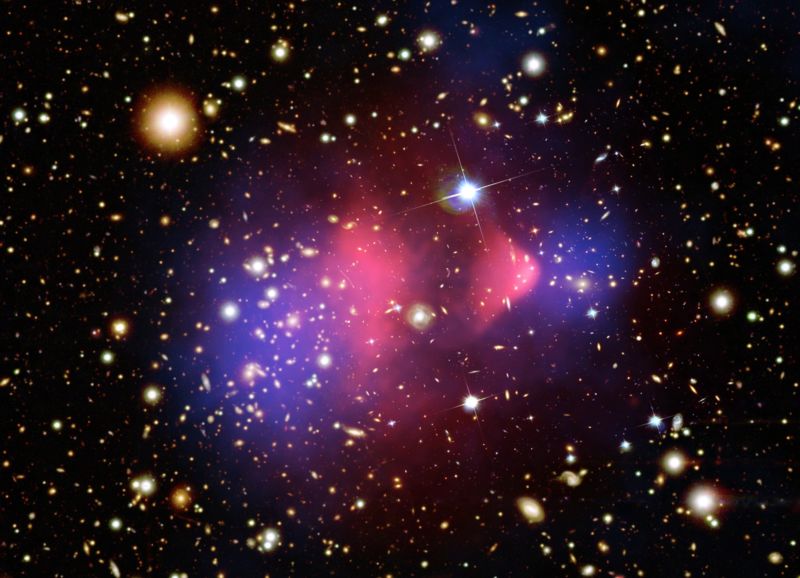
Below is a picture of Dark matter. (Credit: Yannick Mellier/IAP/SPL)Dark matter (red), light (yellow) and galaxies (blue) (Credit: Yannick Mellier/IAP/SPL)

Where is it?

At this point you may be throwing your arms up in frustration. “First they decided there’s all this invisible matter, now they’ve decided it’s made of some new kind of stuff that they can’t detect!

Dark matter doesn’t exist at all. We’re back where we were.

The challenge is to find dark matter when we don’t know what we’re looking for.

Instead, the laws of gravity as we know them must be wrong, and that’s why galaxies behave so oddly. This idea is called MOND, short for “Modified Newtonian Dynamics”.

The problem, says Massey, is that the MOND supporters have not come up with a viable alternative to dark matter: their ideas can’t explain the data.

Dark matter particles usually pass through normal matter. But the sheer number of them means that, very occasionally, some will collide with the nucleus of an atom.

This collision should create gamma rays: extremely high-energy light. On these rare occasions, “dark matter can shine,”

Here is one (Credit: NASA Goddard/A. Mellinger, CMU/T. Linden, University of Chicago)

In 2014, using data from NASA’s powerful Fermi telescope,researchers claimed to have detected the gamma rays from these collisions. They found an area of our Milky Way galaxy that seems to be glowing with gamma rays, possibly from dark matter.  But the jury is still out on whether the gamma rays are really from dark matter. They could also have come from energetic stars called pulsars, or from collapsing stars.

As well as colliding with normal matter, dark matter might occasionally bump into itself, and there’s a way to see that too.

Although we can’t see it directly, dark matter does do one thing to give itself away.

It bends the light that passes through it.

Is there two types of dark matter one interacting with other?

So a second way of detecting dark matter would be to create it first. Physicists hope to do just that using particle colliders, like the Large Hadron Collide in Geneva, Switzerland.

If the LHC does create some dark matter, it would not actually register on its detectors.

If WIMPs do make up the dark matter and they discover them at the LHC then we are in with a good chance of working out what the dark matter in the Universe is composed of.

How much of an atom is empty space?  Very nearly all of it.

The space inside the atom is just that, empty space, i.e. vacuum.

Vacuum, by definition, is the absence of matter. Matter, of course, is something that has mass and occupies space, it’s really a space with very little matter in it.

Many modern devices (like the integrated circuit chips that make everything from cars to computers work), have to be fabricated in a vacuum.

Even outer space, which is considered a vacuum and has less matter in it than anything mankind can reproduce, still has some atoms bouncing around.

Here is my top ten list of “Things That Are Not Matter”:

1. Light 2. Sound 3. Heat 4. Energy 5. Gravity 6. Time 7. A Rainbow 8. Love

9. Happiness 10. A really good joke

When two atoms approach each other, their electron shells push back at each other, despite the fact that each atom’s net charge is 0. This is a very useful feature of nature. It makes our lives a lot easier.

When you sit on a chair, you are not really touching it. You see, every atom is surrounded by a shell of electrons.

If atoms push away from each other, why doesn’t the entire universe just blow away from itself? The answer is that some, actually most atoms’ electron shells are not full.

Electrons really do go back and forth between atoms and they do so pretty fast.

Electrons tend to be kind of mobile, which is also a very nice feature of nature, since without it your walkman would not work. Once both atoms’ outer shells are full due to this electron sharing, they go back to their usual repulsive behavior.

This, by the way, is how we get molecules and the secret to understanding Chemistry. It’s all about the electrons!. It describe the nature of atoms.

We are much more than what we perceive ourselves to be, and it’s time we begin to see ourselves in that light.

The atom has no physical structure, we have no physical structure, physical things really don’t have any physical structure! Atoms are made out of invisible energy, not tangible matter.

It’s quite the conundrum, isn’t it?

Not really, when you enter the world of Quantum it’s totally bonkers.

With quantum physics.

One of these potential revelations is that “the observer creates the reality.”

As observers, we are personally involved with the creation of our own reality.

We are all energy, radiating our own unique energy signature.

Feelings, thoughts and emotions play a vital role, quantum physics helps us see the significance of how we all feel. If all of us are in a peaceful loving state inside, it will no doubt impact the external world around us, and influence how others feel as well.

At our subatomic level, does the vibrational frequency change the manifestation of physical reality? If so, in what way?

We know that when an atom changes its state, it absorbs or emits electromagnetic frequencies, which are responsible for changing its state.

Do different states of emotion, perception and feelings result in different electromagnetic frequencies? Yes! This has been proven.

If we are made of atoms, then a scientist studying atoms is actually a group of atoms studying themselves.

The relationship between physical things and mental/spiritual ones is a huge one in philosophy.

Anyone who wants to invent a new theory of gravity has to go one better than Einstein and explain everything he was able to explain, and also account for the dark matter.

Yes, cosmology is really weird.Résultat de recherche d'images pour "pictures of the universe and planets"

Some day humanity might have sufficient knowledge and tools to truly understand the origin of the universe, but currently we’re only a tiny baby step closer than when “Let there be light” was written.

Philosophically, no matter what you want to believe about the beginning of things, you need to get comfortable with the idea of infinity. Either infinite time, or an infinite deity that exists outside of time; really, both accomplish the same thing by explaining how things exist, and neither can be proven or disproven.

All we know is that there is something infinite going on and if energy couldn’t have been created, then there were no Universe in the first place.

Most of our Universe is still a black box, its secrets waiting to be unlocked.

How a dark, featureless universe formed the brilliant panoply of objects that now give us light and life remains very much a mystery.

Does it matter that there are things in this universe humans are not meant to understand.

All comments welcome. All like clicks chucked into dark matter.

Go back

Your message has been sent

Warning
Warning
Warning
Warning

Warning.


Share this:

  • Click to share on WhatsApp (Opens in new window) WhatsApp
  • More
  • Click to share on Pocket (Opens in new window) Pocket
  • Click to share on Mastodon (Opens in new window) Mastodon

THE BEADY EYE ASKS: IS TECHNOLOGY STRIPPING US OF LIVING A LIFE OF PURPOSE, LEAVING US WITH ON SUBSTANTIVE CONTENT.

22 Wednesday Feb 2017

Posted by bobdillon33@gmail.com in Artificial Intelligence., Big Data., Facebook, Google it., Google Knowledge., Humanity., Life., Scientific., Social Media., Technology, The Future, The Internet., The world to day., Unanswered Questions., What Needs to change in the World, Where's the Global Outrage., World Organisations.

≈ Comments Off on THE BEADY EYE ASKS: IS TECHNOLOGY STRIPPING US OF LIVING A LIFE OF PURPOSE, LEAVING US WITH ON SUBSTANTIVE CONTENT.

Tags

Artificial Intelligence., Big Data, Inequility, The Future of Mankind, THE UNITED NATIONS, Visions of the future.


( A Ten minute read, that challenges the reader to leave a comment.)

Something is profoundly wrong with the way we live today.

People’s characters, conceptions and behaviour are socially and culturally are being constructed by Data. We are living in a data explosion.

Like every period of significant rupture and change throughout history, the data-evolution we are witnessing is in urgent need of a stronger ethical and critical backbone.

Big Data is creating a new kind of digital divide: “the Big Data rich and the Big Data poor.” Inequality has become an essential part of the system that creates, stores and makes data accessible.When Information Explosion Meets Big Data

Tech giants like Google are creating what some call an “intellectual monopoly,” as universities’ best brains are hired to work with their exclusive access to privately harvested data to produce scientific results which are often not shared publically if they are profitable.

The Internet, has become an alternative space of consumption, production and social interaction. It is an increasingly influential space where the future divisions and similarities between people are being formed and the political and economic rules and structures that govern this space called Internet deserve our critical attention.

Ninety percent of data that exists in the world today was created in the past two years. This mass explosion of data – and our increasing reliance on it is creating a very disturbed place devoid of human life and filled with whirring fibre optic cables, servers and generators to convey the vastness of the web through binary code and pixels:

The majority of data which exists nowadays is made not by governments or scientific organisations but by ordinary citizens.

It’s the kind of information that most people share without a second thought, but when compiled in physical form, presents a surprisingly discernible narrative from hobbies and habits to musical tastes and conversations.

I am all for Technology but its impact on organisations and institutions will be profound.

Governments, armies, churches, universities, banks and companies all evolved to thrive in relatively murky epistemological environment, in which most knowledge was local, secrets were easily kept, and individuals were, if not blind, myopic.

When these organisations suddenly find themselves exposed to daylight, they quickly discover that they can no longer rely on old methods; they must respond to the new transparency or go extinct.

They are struggling to cope with transparency.

In my last post I asked the question – are we just becoming fodder for Artificial Intelligence, ie Data.

Don’t get me wrong, data is a treasure trove when it comes to health, predicting the climate, space, and the like. Community projects such as Open Street Map and Safecast‘s work to record radiation levels in Japan.

Big data’s impact on politics can also be beneficial such as Madrid City Council site, which acts as an open consultation platform where people can have their say on issues from bull fighting to transport proposals, something we’ll likely see a lot more of over the next few years.

We will see more and more live data streams on a map of the capital, showing Tweets, Instagram posts and TfL updates, while another by Future Cities Catapult asks users to make decisions about housing, energy, transport and building projects, and uses data modelling to predict the effects those decisions would have over the next 20 years.

Now I am no data mining scientist but it seems to me that  the data world is not clear-cut, whilst a good data visualisation is worth a thousand words, it does not automatically follow that it tells the whole truth.

Machines are learning to recognize all sorts of patterns in the data at a scale and speed humans couldn’t possibly manage to do on their own. It’s not just data on its own, it’s data from a gigapixel imaging devices that can scan the whole body for indications of cancer, or data captured by sensors installed in self-driving cars about nearby objects and vehicles in motion that can eliminate sources of human error and make self-driving cars possible.

Whole industries are being disrupted by those who know how to tap the new potential of the right information in the right place at the right time.

The whole Big Data thing started with Google.

Some estimates put the total amount of data generated each day at 2.5 quintillion bytes!

Résultat de recherche d'images pour "pictures of data centers"Ben Bor_Data getting smaller 1

While the massiveness of data boggles the mind with ease, the granularity of it is equally staggering when you consider the individual sources of the stuff.

The Large Hadron Collider at CERN generates about 30 Petabytes per year (as a result of 600 million collisions per second generating data in their detectors.

The Synoptic Survey Telescope generates 30 Terabytes of astronomical data per night.

In 2010 the list of largest databases in the world quotes the World Data Centre for Climate database as the largest in the world, at 220 Terabyte (possibly because of the additional 6 Petabyte of tapes they hold, albeit not directly accessible data). By the end of 2014, according to the Centre’s web site, the database size is close to 4 Petabyte (roughly 2 Petabytes of these are internal data).

Every interaction that every user has with any piece of technology produces more of it, and as people are becoming more comfortable using technology and more reliant on the information it provides, they want to use more of that data in simple and rewarding ways.

Although it may be logical to assume that we retain the power to control our digital privacy, like the bar-coded plastic membership cards that dangle from our key chains, our privacy is quickly slipping through our fingers.

As surveillance technologies shrink in cost and grow in sophistication, we are increasingly unaware of the vast, cumulative data we offer up.

Of course not many of us are concerned in an era when cellphone data, web searches, online transactions, and social-media commentary are actively gathered, logged, and cross-compared, we’ve seemingly surrendered to the inevitability of trade-offs in a digital future.

Mobile devices themselves are becoming the primary access point for information.

There is nothing new about this data digital culture,  however significant changes are happening — some are obvious while others are below the surface. We’re only just starting to see how revolutionary big data can be, and as it truly takes off, we can expect even more changes on the horizon.

While digital natives are comfortable with technology, the question is: which technology, in which context?

There are now more mobile phones on Earth than there are people! And most of these phones have cameras. Yet Google Glass feels invasive because of its ability to record video.

As wearable technology is getting its toehold embedded technology, it’s not so much about the technology, but when, all of a sudden, things go from impossible (or immoral) to ubiquitous only a fraction of the world is going to benefit.

The fact is that when we all start to wear wearables, the intimacy level will be much higher that we cannot avoid considering how these devices literally change who we are and our bodily engagement with the world.

For example when one buys a Fitbit because they desire to be seen as fitness-conscious, just as much as they seek truth in quantification. Their exercise routine or daily walks are an act of designing a better self, so the device simply becomes part of that ecosystem.

A teleological view of human nature is inherently dynamic.

We know what things cost but have no idea what they are worth. We know longer ask of a judicial ruling or a legislative act: Is it good? Is it fair? Is it just? Is it right? Will it help to bring about a better society or a better world?

In the words of moral and political philosopher Alasdair MacIntyre, this teleological view maps out the journey between “man-as-he happens-to-be” and “man-as-he-could-be-if-he realized-his-essential-nature.”

Those who surrender freedom for security will not have, nor do they deserve, either one.

The inevitable price of the convenience of opting in is compromise.

The promise of big data cannot be segregated from this price.

Embracing the radical transparency at our threshold, many see a potentiality that far outweighs the threat—after all, what do we have to hide?

Yet, privacy is not secrecy—and while there are things we should be comfortable bearing, our dignity should not be one of them.

Whistleblower Edward Snowden said his biggest fear was that we “won’t be willing to take the risks necessary to stand up and fight to change things.”

Machines will win our hearts with every step they take in evolution. Undoubtedly, this is a co-evolution.

It’s a symbiotic relationship where we are becoming more and more enmeshed and less aware of the capacity of this evolving interconnection. It’s a compulsory affair built on convenience and reward.

Arguably, we are no more mindful of the bits and bytes that we tap, swipe, and key than we are of our own breathing.

The true heirs of this data are platforms like Facebook, Google, Microsoft and others that we have gifted seemingly insignificant data to—under the guise of “sharing.”

As more mobile devices enter the world, they generate more and more data that needs to be understood, analyzed, presented, and consumed.

There is already so much data stored in the world that we are running out of ways to quantify it.

Data is quickly becoming the primary content of the 21st century.

Humankind is able to store at least 295 exabytes of information. (Yes, that’s a number with 20 zeroes in it.)

For 30 years we have made a virtue out of the pursuit of material self-interest: Indeed, this pursuit now constitutes whatever remains of our sense of collective purpose.

The sense of living a life of purpose, meaning, sociality, and mutuality are disappearing. These scenes used to be the backbone to political questions, even if they invited no easy answers.

Modern economics focuses a lot on incentives, but not nearly enough on intrinsic motivation.

Samsung has just warned its customers that their smart televisions may be impinging their privacy.

Facebook is now a public entity. It claims to have upwards of 300 Petabyte of data in their (so-called) data warehouse;

Fortunately there is a series of mixed media installations that encourage visitors to think twice about the information they post online.

If you don’t want them to share your photos and information in your profile updates and statuses you need to issue the following statement. I declare that I have not given my permission to Facebook to use my photos or any information in my profile, my updates and my statuses.

Twitter has produced a millionaire buffoon as president of the USA.

Three examples of a big difference in perception and expectations.

Our lack of control over the data we upload serve as a chilling reminder of global governments’ power to use personal data without our consent, and the extreme lengths used to conceal surveillance programmes.

We must learn once again to pose questions of our governments  by taking a fresh look at democracy. 

The conversation, both national and world-wide, is terrifically out of balance, with near-total focus on what’s broken and how we should fix it, and so little focus on stories of attractive, desirable possibilities we might agree to work toward. 

To tackle social problems in their entirety, organisations need to mount a collective approach. It is the role of statesmanship – always in short supply – to remind us of the enduring commonalities that we are forever in danger of overlooking.

We are currently opting  into an unfathomable interdependency with an  urgent need to re-evaluate our daily interactions with technology and their impact on the fidelity of our privacy.

What that ecosystem and the devices that inhabit it will look like 20, 10, or even five years from now is anyone’s guess and it’s not at all comfortable.

We need a more controlled understanding of Big Data before headgear and an apps allows users to control products using their brainwaves.

Data itself is of no value if it is just being stored and not converted into useful information or actionable insight.

As I have said in the last post the AI genie is out of the bottle with no way to get it back in. So, knowing what you know now, do you choose the red pill or the blue one?

Red for access to a digital divided world.

or

Blue for a digital world where all technology is vetted by an Independent totally transparent New World organisation.  Called Click.

All comments welcome all like clicks chucked in the bin.

Go back

Your message has been sent

Warning
Warning
Warning
Warning

Warning.


…


Share this:

  • Click to share on WhatsApp (Opens in new window) WhatsApp
  • More
  • Click to share on Pocket (Opens in new window) Pocket
  • Click to share on Mastodon (Opens in new window) Mastodon

All comments and contributions much appreciated

  • THE BEADY EYE SAYS TRUST IS DISAPPEARING THANKS TO OUR INABILITY TO RELATE TO EACH OTHER. December 19, 2025
  • THE BEADY EYE SAYS. THE WORLD NEEDS PEOPLE GOVERNMENT NOT MONEY GOVERNMENTS. December 18, 2025
  • THE BEADY EYE ASKS WHAT ARE WE THE SAME GOING TO DO TO STOP THE WORLD BEING FUCK UP FOR PROFIT BY RIPOFF MERCHANT. December 17, 2025
  • THE BEADY EYE CHRISTMAS GREETING. December 16, 2025
  • THE BEADY EYE SAYS. TO THE NEXT GENERATION TO LIVE A LIFE WORTH WHILE YOU MUST CREATE MEMORIES. December 16, 2025

Archives

  • December 2025
  • November 2025
  • October 2025
  • September 2025
  • August 2025
  • July 2025
  • June 2025
  • May 2025
  • February 2025
  • January 2025
  • December 2024
  • November 2024
  • October 2024
  • September 2024
  • August 2024
  • July 2024
  • June 2024
  • May 2024
  • April 2024
  • March 2024
  • February 2024
  • January 2024
  • December 2023
  • October 2023
  • September 2023
  • August 2023
  • July 2023
  • June 2023
  • May 2023
  • April 2023
  • March 2023
  • February 2023
  • January 2023
  • December 2022
  • November 2022
  • October 2022
  • September 2022
  • August 2022
  • July 2022
  • June 2022
  • May 2022
  • April 2022
  • March 2022
  • February 2022
  • January 2022
  • December 2021
  • November 2021
  • October 2021
  • September 2021
  • August 2021
  • July 2021
  • June 2021
  • May 2021
  • April 2021
  • March 2021
  • February 2021
  • January 2021
  • December 2020
  • November 2020
  • October 2020
  • September 2020
  • August 2020
  • July 2020
  • June 2020
  • May 2020
  • April 2020
  • March 2020
  • February 2020
  • January 2020
  • December 2019
  • November 2019
  • October 2019
  • September 2019
  • August 2019
  • July 2019
  • June 2019
  • May 2019
  • April 2019
  • March 2019
  • February 2019
  • January 2019
  • December 2018
  • November 2018
  • October 2018
  • September 2018
  • August 2018
  • July 2018
  • June 2018
  • May 2018
  • April 2018
  • March 2018
  • February 2018
  • January 2018
  • December 2017
  • November 2017
  • October 2017
  • September 2017
  • August 2017
  • July 2017
  • June 2017
  • May 2017
  • April 2017
  • March 2017
  • February 2017
  • January 2017
  • December 2016
  • November 2016
  • October 2016
  • September 2016
  • August 2016
  • July 2016
  • June 2016
  • May 2016
  • April 2016
  • March 2016
  • February 2016
  • January 2016
  • December 2015
  • November 2015
  • October 2015
  • September 2015
  • August 2015
  • July 2015
  • June 2015
  • May 2015
  • April 2015
  • March 2015
  • February 2015
  • January 2015
  • December 2014
  • November 2014
  • October 2014
  • September 2014
  • August 2014
  • July 2014
  • June 2014
  • May 2014
  • April 2014
  • March 2014
  • February 2014
  • January 2014
  • December 2013
  • November 2013
  • October 2013

Talk to me.

Jason Lawrence's avatarJason Lawrence on THE BEADY EYE ASK’S: WIT…
benmadigan's avatarbenmadigan on THE BEADY EYE ASK’S: WHA…
bobdillon33@gmail.com's avatarbobdillon33@gmail.co… on THE BEADY EYE SAYS: WELCOME TO…
Ernest Harben's avatarOG on THE BEADY EYE SAYS: WELCOME TO…
benmadigan's avatarbenmadigan on THE BEADY EYE SAY’S. ONC…

7/7

Moulin de Labarde 46300
Gourdon Lot France
0565416842
Before 6pm.

My Blog; THE BEADY EYE.

My Blog; THE BEADY EYE.
bobdillon33@gmail.com

bobdillon33@gmail.com

Free Thinker.

View Full Profile →

Follow bobdillon33blog on WordPress.com

Blog Stats

  • 94,156 hits

Blogs I Follow

  • unnecessary news from earth
  • The Invictus Soul
  • WordPress.com News
  • WestDeltaGirl's Blog
  • The PPJ Gazette
Follow bobdillon33blog on WordPress.com

The Beady Eye.

The Beady Eye.
Follow bobdillon33blog on WordPress.com

Blog at WordPress.com.

unnecessary news from earth

WITH MIGO

The Invictus Soul

The only thing worse than being 'blind' is having a Sight but no Vision

WordPress.com News

The latest news on WordPress.com and the WordPress community.

WestDeltaGirl's Blog

Sharing vegetarian and vegan recipes and food ideas

The PPJ Gazette

PPJ Gazette copyright ©

Privacy & Cookies: This site uses cookies. By continuing to use this website, you agree to their use.
To find out more, including how to control cookies, see here: Cookie Policy
  • Subscribe Subscribed
    • bobdillon33blog
    • Join 223 other subscribers
    • Already have a WordPress.com account? Log in now.
    • bobdillon33blog
    • Subscribe Subscribed
    • Sign up
    • Log in
    • Report this content
    • View site in Reader
    • Manage subscriptions
    • Collapse this bar