• About
  • THE BEADY EYE SAY’S : THE EUROPEAN UNION SHOULD THANK ENGLAND FOR ITS IN OR OUT REFERENDUM.

bobdillon33blog

~ Free Thinker.

bobdillon33blog

Category Archives: Politics.

THE BEADY EYE SAYS: SINCE SHE ARRIVED AT NUMBER 10 MRS MAY HAS COST ENGLAND BILLIONS.

29 Saturday Oct 2016

Posted by bobdillon33@gmail.com in Brexit., European Union., HUMAN INTELLIGENCE, Politics., Unanswered Questions.

≈ Comments Off on THE BEADY EYE SAYS: SINCE SHE ARRIVED AT NUMBER 10 MRS MAY HAS COST ENGLAND BILLIONS.

Tags

Brexit., England., Theresa May Artifical Intelligence.

(A three-minute read)

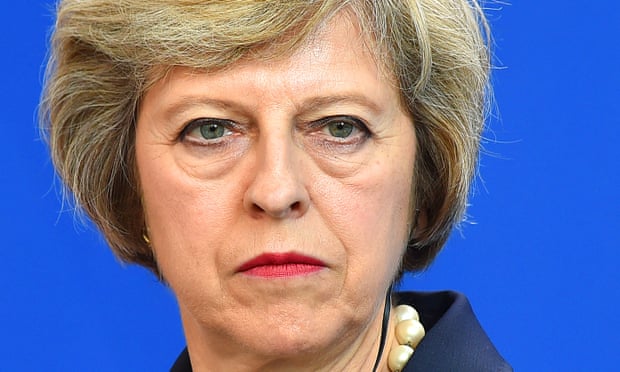
She has so far defined herself more in words than deeds.Afficher l'image d'origine

She has – at least in words, we will see about the reality – junked the austerity agenda.

Mrs May has had just over 100 unelected days in Number 10, during which she has done a deft job of obscuring her vulnerabilities by projecting herself as a fresh yet solid leader serenely stepping in to take charge.

Lunch with Theresa May?  That will be £3,150.  Value for money.

Let’s look at it using the background of  Britain’s record national debt, which just surpassed £1.8 trillion, (The truth however is much worse, factoring in all liabilities including state and public sector pensions, the real national debt is closer to £4.8 trillion,) some £78,000 for every person in the UK.

If you lay £5 notes on top of each other they would make a pile 253,568 km, or 157,560 miles high!

Interest per Year  £41,230,597,671

Interest per Second£1,307

Debt as % of GDP 83.49%

The budget deficit already stands at approximately 4% of GDP and, at that level; any fiscal expansion could cause a fall in international confidence.

Hinkley Point:

In 2013 the English Government guaranteeing the EDF it would be paid £92.50 per megawatt-hour for the electricity generated by Hinkley Point over a 35-year contract due to run between 2025 and 2060. This is more than double the current annualised rate for wholesale electricity prices. It means that Hinkley Point should generate between £100bn and £160bn of revenue in cash terms for EDF and CGN over 35 years. The £92.50 figure is based on 2012 prices but it rises each year in line with inflation.

EDF is funding two-thirds of the project, which will create more than 25,000 jobs, with China investing the remaining £6bn for 7% of Britain’s electricity needs.

The government will also take a special or “golden share” in all future new nuclear projects. This will ensure that significant stakes cannot be sold without the government’s knowledge or consent.

The plan to build the two EPR units for £18bn (€21bn, $24bn) at Hinkley Point was hit with an unexpected delay in July as the new UK government decided to hold another review only hours after EDF – the project’s state-owned French developer – had given it the go-ahead.

EDF executives told the British government that it would have to take a stake of up to £6bn in the Hinkley Point nuclear power station to avoid a “disaster” if the Chinese decide to withdraw from the project who warning that if the plug was pulled on Hinkley Point it would damage the relationship between England and China.

If the state-backed company manages to build the power station and get it running by the target date of 2025, EDF and its Chinese partner stand to generate a profit of tens of billions of pounds on the £18bn project when it start operations in 10 years time.

The UK government says it will have control over foreign investment in “critical infrastructure”. So far £2.5bn  has being spent on site preparatory work.

Her first ( G20 summit) changed any doubts she had.

Bonkers.

Replacing Trident:  

Will cost at least £205bn.

£205 billion of public money is a huge amount. Pouring it into a nuclear weapons system that experts say could be rendered obsolete by new technology is hardly a wise choice. Far better to spend it on industrial regeneration, building homes, tackling climate change or meeting our defence needs in usable ways.

The cost of disposing the existing Trident fleet would be at least £13bn in today’s prices.

 Two new aircraft carriers.

HMS Queen Elizabeth was launched in July — are the most expensive items of military kit in the British armoury, at a cost of £3.1bn each, considerably more than originally budgeted for.

Their usefulness will also depend on a host of other additional spending commitments, such as the number of new F35 jets that will be flown off them or the number of other Royal Navy ships that can be deployed to protect them.

So far eight of the F-35B Lightning jets EACH plane costs £100 million have being ordered and if sterling weakens price will go up.

The overall order is for 48 of the jump jet F-35Bs by 2023 and will eventually go on to buy a fleet of 138.

The US-built F35s have spiralled in cost and have been beset by serious technical problems in development.

Bonkers.

Next:

HS2:

The zombie train that refuses to die, a project born of political vanity not rooted in commercial reality or value for tax payers money.

The UK currently has just 113 km of high-speed rail line.

It will mark the start of the most extravagant infrastructure project in Britain’s history: High Speed 2, a railway line running 335 miles from London to Birmingham, Manchester, Sheffield and Leeds. The line is budgeted at £55bn, although late last year its cost was widely reported to be closer to £70bn.

The whole concept of HS2 came out of intense political lobbying from the construction industry who want to build it. Those same firms have since been hired to produce the designs and budgets, and this has made sure HS2 has been gold-plated right from the start. HS2 is just one big gravy train for advocates with massive vested interests.

If it is built, HS2 would be the most expensive railway in the history of the world, surely sucking up the entire rail infrastructure budget for decades to come, and squeezing out more deserving, cheaper and cost-effective projects.

The UK’s cost per km is the highest among any of the major high-speed rail countries – with HS1 costing £51.3m per km and HS2 estimated to cost £78.5m per km.

High Speed Two (HS2) Limited is the company responsible for developing and promoting the UK’s new high-speed rail network. It is funded by grant-in-aid from the government.

HS2 ‘abysmal value for money’ at 10 times the cost of high-speed rail in Europe.

HS2 is the most expensive high-speed project in existence, according to new analysis undertaken by The Telegraph.

The current £42.6bn budget makes it more than ten times the cost per kilometre of some global counterparts.

Bonkers. 

Next:

Third runway Heathrow:

£17.6bn

This is how much the airports commission said the new runway would cost, but Heathrow has been asked to reduce it. It is apparently working on revised plans. Gatwick estimates its new runway would cost £7.4bn, while the Airports Commission says it would cost £9.3bn.

A second runway at Gatwick will cost £9.3billion, much lower than the two proposals to expand Heathrow, which cost £13.5billion and £18.6billion respectively.

The Prime Minister’s local council, Windsor and Maidenhead, said it will spend a lot of money to challenge the Heathrow decision. That brings the total for the four councils in the area – Hillingdon, Richmond and Wandsworth – to a whopping £200,000.

It is estimated that ‘between 105 2025 and 2050, airlines would pay £40billion less in aeronautical charges than they would under the Heathrow options,’

£5.7 billion would have to be spent on works such as tunnelling the M25 motorway under the runway and widening the M4.

MPs will take a vote on the airport decision in a year or so.

Last but not least: 

The Sunderland plant has been a point of pride for May’s Conservative Party since then-Prime Minister Margaret Thatcher lured Nissan to open it in 1986, beginning a recovery in British car making that had nearly collapsed in the 1970s.

Britain’s big carmakers are nearly all foreign-owned and ship more than half of their exports to the other 27 countries in the European Union, making the industry’s future one of the big question marks hanging over Britain’s plan to quit the bloc.

Japanese carmaker Nissan (7201.T) will build two new models in Britain despite the vote to quit the EU, giving Prime Minister Theresa May her most important corporate endorsement since the Brexit referendum in June.

Obviously Nisan was offered reassurances that conditions would remain competitive, but was not given explicit promises to compensate for any tariffs that might be imposed once the country leaves the bloc.

Such a step could potentially open the floodgates to ultimatums from other companies.

No country can develop by itself behind closed doors.

Politicians and civil servants find it hard to reverse poor decisions, even when their initial rationale has slipped into distant memory.Afficher l'image d'origineShe has ruled out an early election. But, where is the public outrage.

Brexit:

It Seems to me that England’s difficulty is the European Union opportunity.

All comments welcome.

← Back

Thank you for your response. ✨


Share this:

  • Share on WhatsApp (Opens in new window) WhatsApp
  • More
  • Share on Mastodon (Opens in new window) Mastodon

THE BEADY EYE SAYS IT’S TIME TO STOP THE BREXIT SHADOW BOXING.

16 Sunday Oct 2016

Posted by bobdillon33@gmail.com in England EU Referendum IN or Out., European Commission., European Union., HUMAN INTELLIGENCE, Modern Day Democracy., Politics., The Future, Unanswered Questions.

≈ Comments Off on THE BEADY EYE SAYS IT’S TIME TO STOP THE BREXIT SHADOW BOXING.

Tags

Brexit., European Union


( A four-minute read: Dedicated to the Sacrificial youth of England.)

Neither the UK nor the continuing members of the EU can escape their geographical interdependencies. Both have a stake in economic and political stability in Europe. All of Europe, including Britain, will suffer from the loss of the common market and the loss of common values that the EU was designed to protect.

Whatever happens the process of Brexit is sure to be fraught with further uncertainty and political risk, because what is at stake was never only some real or imaginary advantage for Britain, but the very survival of the European project.

The lack of a written constitution in England could well be critical, because the very absence of a clear pathway means that much is possible.

A British exit – or Brexit – undoubtedly will change the future of the UK and the European Union.Afficher l'image d'origine

It is impossible here to cover all the consequences that will rumble on and on for years and years to come.

No matter whether England now negotiates, a Soft or Hard Brexit it will continue to be a thorn. Ever since England joined the European Union it has been a thorn in its side. During its 43 years of European Adventure, London has often been seen as reluctant to any further deepening of the European Union and further integration. Voluntarily outside the euro area and Schenghen space, the country has regularly criticized the European institutions and undermined its contribution to the EU budget.

It’s hard to know what Britain wants and, more importantly, can plausibly expect from a new deal with its erstwhile EU partners.

Britain. I believe, had the best of all possible deals with the European Union, being a member of the common market without belonging to the euro and having secured a number of other opt-outs from EU rules. And yet that was not enough to stop the United Kingdom’s electorate from voting to leave.

Why?

Because the European migration crisis and the Brexit debate fed on each other.

Because the European authorities delayed important decisions on refugee policy in order to avoid a negative effect on the British referendum vote, thereby perpetuating scenes of chaos like the one in Calais and Greece.

Admittedly, the EU is a flawed construction but will Brexit be the catalyst for an unravelling of the European integration project, or, with the removal of a member that has long been the awkward partner, be an opportunity to move forwards.

I fear that the EU’s response to Brexit could well prove to be another pitfall.

European leaders, eager to deter other member states from following suit, may be in no mood to offer the UK terms – particularly concerning access to Europe’s single market.

After Brexit, all of us in the European Union who believe in the values and principles that the EU was designed to uphold must band together to save it by thoroughly reconstructing it.

The challenges can be framed in stark terms:

The European Union is headed for a disorderly disintegration, and can only be saved if it is reconstructed to satisfy citizens’ needs and aspirations.

In the increasingly unstable interim there is a third option.

A Clean EU Brexit or a rerun of the Referendum.

If England wants leave the European Union by March 2019. Leave means Leave.

So is it time to stop the “shadow boxing” and save billions.

Any other option will result in the collapse of the Union.  Any cherry picking is bound to end up with Europe holding a pole.

At the moment paradoxes abound in the Brexit decision.

The UK economy has achieved something of a turnaround since joining in 1973, with the implication that membership has been good for the economy.

A further paradox is that areas which have benefitted from EU membership – including the parts of Wales and England in receipt of the highest flows from EU Cohesion Policy – have proved to be hostile.

Yet another paradox is the hostility to migrants. 

Migrants crowd-out locals in accessing public services and are blamed for depressing wages at the bottom end of the wage distribution, yet public services will collapse without migrants, as for wages it was not the EU that introduces No hours contracts. 

These phenomena are strong negatives for those who see themselves as losers from globalisation/economic integration. In an increasingly volatile world, neither the EU nor the UK have an interest in a divorce that diminishes their influence as the balance of economic power shifts away from the North-Atlantic world.

The unprecedentedly rapid anointment of Theresa May enforces only the uncertainty of the consequences of Brexit is certain. 

Leaving the EU in its current form is unprecedented and EU law only outlines rough exit procedures. The conditions and results of the leaving agreement negotiations will depend on the judgements of the European Council as well as the European Parliament not the House of Commons.

There is no formula that can calculate the outcome of a Brexit on its security and most importantly, even if there was a formula, there would be too many unknown variables to resolve it.

The UK itself may not survive. Scotland, which voted overwhelmingly to remain in the EU, can be expected to make another attempt to gain its independence, and some officials in Northern Ireland, where voters also backed Remain, have already called for unification with the Republic of Ireland.

Having a major world economy disentangle itself from a powerful geopolitical trading bloc is unprecedented.

The UK will have to answer the question of whether it wants to continue to maintain close economic cooperation with the EU and whether it wants to maintain and potentially even strengthen its engagement in security and, conceivably, defence matters.

This is ultimately a political choice that must be spelled out unambiguously.

However, lower public revenues and higher demands on public spending, not just in Britain but also in the EU, suggesting a plausible lose-lose economic scenario, dominating the direct effects of EU budget changes.

In 2014, the UK exported a total of £515.2bn in goods and services. The share of the total UK exports sold to the listed trade partners or groups of trade partners are as follows: EU (44%); US (17%); China (including Hong Kong) (5%); Switzerland (4%); Japan (2%); Rest of the world (28%).

The UK now imports almost half its energy, more than at any time in history.

The UK is currently importing over 50% of its food and feed, whereas 70% and

64% of the associated cropland and greenhouse gas impacts, respectively, are

located abroad.

A quarter of their food from the EU, and that’s a problem.

In 2015, the UK£38.5 billion it spent to import food and drink.

Now, it will have to re-negotiate its trade and policy relationships with each EU member state. That’s going to be a critical process for the country, which sends 70% of its food and agricultural products to EU nations.

And that just the tip of the iceberg.

The London Stock Exchange is the entry point into Europe for American investors and many other countries. With Brexit, it may lose this status: the European Union may question the “financial passport” London and position the Paris Stock Exchange or the Frankfurt to be the new entry point for investors in Europe.

London is: 20% of country’s GDP.

There is no such thing as Sovereignty in a world that is operating more and more on Artificial Intelligence.  The ‘federal Europe’ project was yesterday’s and it is more probable that the Union of the future will increasingly take the form of differentiated integration.

There are 3.6 million citizens of other countries in the EU currently living in the UK.

This may be the true legacy of Brexit.

Numerically, 17.4 million people have spoken for Brexit and 16.1 million to remain within the EU.Afficher l'image d'origine

It is thought that more than 70% of young voters chose to remain in the EU.

The current price for a British passport on the black market at 2,800 pounds (3,100 euros)  Europe’s trade in forged and stolen passports is so out of control it has doubled in five years. A whole travel package, including an EU passport, can cost up to €10,000.

← Back

Thank you for your response. ✨


Share this:

  • Share on WhatsApp (Opens in new window) WhatsApp
  • More
  • Share on Mastodon (Opens in new window) Mastodon

THE BEADY EYE: CAN WE BE PROUD -SERIES OF POSTS – NO 2. THE EUROPEAN UNION.

12 Wednesday Oct 2016

Posted by bobdillon33@gmail.com in European Commission., European Union., HUMAN INTELLIGENCE, Politics., The Refugees, The world to day., Unanswered Questions., What Needs to change in the World, Where's the Global Outrage.

≈ Comments Off on THE BEADY EYE: CAN WE BE PROUD -SERIES OF POSTS – NO 2. THE EUROPEAN UNION.

Tags

European Union, Inequility

( Sorry:  If you want to know what is wrong with the EU this is a good fifteen minute read.)

In the coming century, we face huge challenges, as a people, as a continent and as a global community.

How to deal with climate change. How to address the overweening power of global corporations and ensure they pay fair taxes. How to tackle cyber-crime and terrorism. How to ensure we trade fairly and protect jobs and pay in an era of globalisation. How to address the causes of the huge refugee movements across the world, and how we adapt to a world where people everywhere move more frequently to live, work and retire.Afficher l'image d'origine

Collective international action through the European Union is clearly going to be vital to meeting these challenges.

The EU comes in for a lot of criticism – often this criticism is entirely justified, often it serves as a convenient cover for domestic failings and incompetence.

No matter.  The alliance made between France and Germany which gave birth to the European Coal and Steel Community, a forerunner of the EU is the biggest peacemaking institution ever created in human history.

The ECSC was first conceived by Robert Schuman, the French foreign minister in 1950 “to make war not only unthinkable but materially impossible”.

And it has worked despite the long years of the Troubles in Northern Ireland, the Basque insurgency, say, in Spain, or the continued partition of Cyprus, no two EU member states have ever gone to war against one another.

It’s a peace that may too often be taken for granted.16202337168_e49b249194_o 870x370

Unfortunately the EU remains incapable of expressing a shared vision of a common future, which is exactly what is needed at a time when Europe seems on the brink of falling apart, when Europeans are taking to the streets to express their wrath towards other partners in the union and when mainstream politicians in the UK are looking for a way out of the club.

—-

The single market is probably the EU’s single biggest achievement.

Europe’s history has been shaped by migration. Millions emigrated from Europe, first to the colonies and later to the Americas and the Antipodes.

Europe to-day should have revised its internal arrangements for dealing with migration flows. But frightened of the political backlash which any reform in immigration procedures entailed, EU government stuck to the old rules, which decree that each European state is responsible for dealing with refugees landed on its soil.

The result was a disgraceful “pass the parcel” game, in which each European country would turn a blind eye to illegal immigrants, provided they moved on to another European country. This has sparked a crisis with countries struggled to cope with the influx, and has created division in the EU over how best to deal with resettling people.

The European Commission and most EU governments are now under huge public pressure to ease the migrant crisis which has to be said is somewhat ironic as the EU accounts for half of all global aid.

Last year, it donated €53.1bn (£42.8bn). Aid constitutes about 9% of the EU budget.

Brussels sets standards of human rights, democracy and the rule of law to which countries must adhere if they want to be part of the European Union. In practical terms these guidelines have had a particular impact on the countries of southern, central and eastern Europe, which joined after they emerged from dictatorships with often underdeveloped civil societies.

More than a million migrants and refugees crossed into Europe in 2015 compared with just 280,000 the year before. (more than 1,011,700 migrants arrived by sea in 2015, and almost 34,900 by land. More than 3,770 migrants were reported to have died trying to cross the Mediterranean in 2015.  More than 1,250 unnamed men, women and children have been buried in unmarked graves in 70 sites in Turkey, Greece and Italy since 2014.

As a result the Schengen agreement to abandon border posts so as to make it  possible to travel freely and easily is now under attack.

Germany received the highest number of new asylum applications in 2015, with more than 476,000.

Faced with a huge influx of people, Hungary was the first to try to block their route with a razor-wire fence. The 175km (110-mile) barrier was widely condemned when it went up along the Serbia border, but other countries such as Slovenia and Bulgaria have erected similar obstacles. Although Germany has had the most asylum applications in 2015, Hungary had the highest in proportion to its population, despite having closed its border with Croatia in an attempt to stop the flow in October. Nearly 1,800 refugees per 100,000 of Hungary’s local population claimed asylum in 2015. It had 177,130 applications by the end of December.

Sweden followed close behind with 1,667 per 100,000.

The figure for Germany was 587 and for the UK it was 60 applications for every 100,000 residents. The EU average was 260.

In September, EU ministers voted by a majority to relocate 160,000 refugees EU-wide, but for now the plan will only apply to those who are in Italy and Greece. Another 54,000 were to be moved from Hungary, but the Hungarian government rejected this plan and will instead receive more migrants from Italy and Greece as part of the relocation scheme.

The UK has opted out of any plans for a quota system but, according to Home Office figures, 1,000 Syrian refugees were resettled under the Vulnerable Persons Relocation scheme in 2015.

Prime Minister David Cameron has said the UK will accept up to 20,000 refugees from Syria over the next five years which is now never going to happen.

Austria has placed a cap on the number of people allowed into its borders. And several Balkan countries, including Macedonia, have also decided only to allow Syrian and Iraqi migrants across their frontiers.

Norway is erecting a controversial steel fence along its border post with Russia following a surge in migrant arrivals last year.

As a result, thousands of migrants have been stranded in makeshift camps in cash-strapped Greece, which has asked the European Commission for nearly €500m in humanitarian aid.

The US has taken just 12,000.

In the same year, more than a million migrants applied for asylum – although applying for asylum can be a lengthy procedure so many of those given refugee status may have applied in previous years.

Clearly, Europe cannot go on accepting more and more migrants.

For not only is the pressure straining existing resources, but the inflow of asylum-seekers is also imperilling all other European achievements. The so-called Schengen agreements under which all controls at the internal borders between most European countries have been abolished is now threatened: barbed wires and border police are re appearing everywhere.

A total of 3.8 million people immigrated to one of the EU-28 Member States during 2014, while at least 2.8 million emigrants were reported to have left an EU Member State.

No Syrian refugees have been resettled by China, Russia or any Gulf states.

By comparison, Jordan, which has a GDP just 1.2% the size of the UK’s, hosts nearly 655,000 Syrian refugees.

With more than 2.7 million refugees in total, Jordan is sheltering more than any other nation. Turkey has taken in more than 2.5 million people; Pakistan 1.6 million; Lebanon more than 1.5 million.

Meanwhile between 2,000 and 5,000 migrants are camped at the French port of Calais in the hope of crossing over to the UK.

There have been two major elements to the effort by the European Union against illegal immigration.

The first is the European Union’s deal with Turkey.

In February the bloc approved €3bn ($3.3bn; £2.2bn) in funding for the country to help it cope with record numbers of Syrian migrants it is already hosting. In return for billions of euros, a promise of visa-free travel and a new legitimate scheme for resettling people who have fled Syria, Turkey agreed to clamp down on the people smugglers as well as accepting migrants caught and deported from Greece.

If the European Commission makes the recommendation that Turks be granted visa-free travel in Europe’s Schengen area as whispers from well-placed EU sources suggest, then it will do so holding its nose and its breath.

The freedom of speech, the right to a fair trial and revising terrorism legislation to better protect minority rights – these are just some of the criteria demanded by the EU of countries before it lifts visa requirements – even for short-term travel.

It’s hard to see how Turkey could be described as meeting those conditions. Ankara increasingly cracks down on its critics in a manner more autocratic than democratic.

In fact, Turkey has not fulfilled quite a number of the criteria required by the EU.

But these are desperate times.

There are currently over 10 million illegal immigrants living in the United States.

Most people think about the asylum issue in domestic terms.

The current surge in migration to the European Union (EU) is rapidly becoming the largest and most complex facing Europe since the Second World War.

Syria in 2011 has killed 250,000 people as well as created an estimated four million refugees. Initially, most of these refugees fled to Syria’s immediate neighbouring states: Turkey took in about half of the total, Lebanon admitted 1.2 million, and Jordan accepted a further million.

The EU urgently needs to put in place a coherent, long-term and comprehensive strategy that maximises the benefits of migration and minimises its human and economic costs, included as part of a wider international effort to manage global migration.

But the stress everywhere has been on reducing the flow, while trying to distinguish genuine asylum-seekers from purely “economic” migrants.

It is obviously beyond the immediate power of the EU to eradicate the root causes of all migration and it is also obvious that the EU has absolutely no solution to this latest migration crisis. We are at an impasse.

Practically every European country thinks about either deporting migrants, making the asylum laws more difficult, or simply shutting the borders:

Every country in Europe is willing, at most, to be the transit point for migrants; none is willing to be the point of settlement.

Thus everybody tries to pass the hot potato of migrants to its neighbor.

Perhaps it might seem odd to an impartial observer that rich Europe of more than 1/2 billion people is unable to cope with one hundred thousand migrants and refugees while much poorer Turkey has accepted 1.7 million refugees from Syria and Pakistan and Iran have accepted several hundred thousand from respectively Afghanistan and Iraq.

In 2015, EU countries offered asylum to 292,540 refugees.

In 2001 the UK had only 169,370 officially recognized refugees living within its borders compared to Germany’s 988,500, Iran’s 1.9 million or Pakistan’s 2.2 million?

But should European states even try to stop economic migration?

No one knows what is really happening now; one reputable estimate puts the number of illegal migrants smuggled into the EU each year as 400,000.,

Permanent factors that are unlikely to abate any time soon. These factors are political chaos in the Middle East and, more importantly, the extraordinarily huge income gaps between Europe and Africa. With globalization, the knowledge of these gaps as well as the practical means to bridge them by migrating to a rich country are more known and affordable than ever.

These trends look even more unmanageable for Europe when one takes a longer-term view and realizes that sub-Saharan African population which is currently only slightly greater than that of all of Europe is expected to be almost six times greater by 2100. Thus, economic migration will, if anything, increase.

Europe’s immigration problem is one which genuinely has no obvious solutions, an emergency which is only containable with partial answers, but there has to be some sort of amnesty, especially for the children of illegal immigrants.

The 2012 Nobel peace prize was awarded to the EU.


As Europeans, we owe it to ourselves and to the world to help them.

One thing is clear:

The response so far does not meet the standards that Europe must set for itself. We must therefore pursue a European asylum, refugee and migration policy that is founded on the principle of solidarity and our shared values of humanity.

We must guarantee a common European code of asylum, so that asylum status is valid throughout the EU and the conditions for receiving it are stable across member states.

Can we be proud. I think not.

I suppose it depends on how one views his fellow human beings.

Immigration is reflecting the complexity of contemporary national and global relations. These include issues of nationalism, sovereignty, racism, demography, human rights, arms sales, war, refugee health, economic policy and moral responsibility.

What do the media have to say about the fact that the UK has recently sold arms to all five countries of origin topping the UK list of asylum applicants in 2001? This, despite the fact that, in each case, violent military conflict remains the dominant root cause of refugee flight.

We must therefore reform the Dublin Convention immediately, and find a way of creating binding and objective refugee quotas which take into account the ability of all member states to bear them.

We must provide immediate assistance to the EU countries that are currently under particular strain.

We cannot stand idly by and watch people risk their lives trying to get to us. The Mediterranean Sea cannot be a mass grave for desperate refugees. Europe’s humanitarian legacy, indeed our European view of humanity, are hanging in the balance. 

Survival has thus become the primary impetus for unauthorized immigration flows. When persons cannot find employment in their country of origin to support themselves and their families, they have a right to find work elsewhere in order to survive. Sovereign nations should provide ways to accommodate this right.

The world – including Europe – will simply go on without you, and it will leave you behind. Like it or loathe it, it’s globalisation. We can’t go back to 1960.

Europe’s preference for debt over shares, must change.

Worldwide, there is an estimated 191 million immigrants;  The world’s wealthiest nations of shirking responsibility towards refugees. Ten countries which account for just 2.5% of the global GDP are sheltering more than half the world’s 21 million refugees.


Given the current economic ailment that Europe is suffering from, EU governments urgently need to recalibrate the economy for entrepreneurs and most of these will be the new Immigrants. It’s just a part of globalism that cannot be resisted.

Not a penny in welfare for immigrants. It really is not that simple.

What is needed in any proposals is to control our borders and that requires tamper-proof identification, and some level of physical border control.

UK’s current process means that the prison-like asylum centers house people who may be waiting up to seven years before their case can be heard.

The European Union is going into unchartered territory.

Championing the rights of poor migrants is difficult as the economic climate is still gloomy, many Europeans are unemployed and wary of foreign workers, and EU countries are divided over how to share the refugee burden.

Let’s hope that the growing inequality is not defining issue of our time. Such inequality is bound to get worse. Not only are the rich seemingly getting richer and the poor poorer, but middle-income earners appear to be gradually disappearing.

Every genuine refugee that has the door slammed in his or hers face is tomorrow’s enemy.

In 2016 so far, around 29,000 have arrived in Italy and they continue to do so at the rate of roughly 1,500 a week – that’s about one-fifth to one-sixth of the traffic that was going via Greece before the EU-Turkey deal came into effect.

What the last few months have shown us is that many governments (notably in central and eastern Europe) are far more interested in preventing illegal migration than they are in living up to refugee quotas. Some have also made clear that they are prepared to use their armed forces to protect their borders if they have to.

Whatever happens EU members, will have to re-evaluate what the Union really means and what should be done to rescue it from its current crisis of illegitimacy, as well as the institutional and political mess so evident today.

The communist government claimed in 1961 that it had to build a wall around the portion of Berlin it controlled to keep the population safe from the evil capitalist wreckers and saboteurs. It didn’t take long for the world to realize that the real threat to the East German leaders was that the people trapped in East Berlin would try to get out.

If the European Union does not reform it will not be just the UK handing in its membership card.

Britain joined what was then the European Economic Community in 1973 as the sick man of Europe it remains so to day sacrificing its young who voted with an overwhelming majority to remain in the European Union.

For years the EU has been struggling to harmonise asylum policy. That is difficult with 28 member states, each with their own police force and judiciary.

It’s a big problem but it’s a very solvable problem.

Eliminate incentives for those who would come here to live off the rest of us, and make it easier and more rational for those who wish to come here legally to contribute to our economy. No walls, no government databases, no biometric national ID cards.

Not the putting up of new procedural and administrative walls risks transforming the immense advantage of being a European into a bureaucratic nightmare, not only for the UK but also for the rest of the EU.

Greece has tottered on the verge of financial bankruptcy throughout this decade why don’t we write off its debt by giving the Olympics Games a permanent home in Greece.

Its time that the EU stops kicking the can down the road and operating like a sort of osmosis.

Of course this leaves the question, where will the funds to achieve change come from. How will pay? 

The answer is personified Capitalist Greed caused the problem in the first place.

If we just share the the responsibility out, say 60 to 90 countries we could be in a very different situation which in this world of I’am alright Jack is impossible leaves only one viable solution.

By placing an World Aid Commission of 0.05% on all High Frequency Trading, on all Foreign Exchange Transactions over $20,000, on all Sovereign Wealth Funds Acquisitions we would create a perpetual fund.  ( see previous posts)

← Back

Thank you for your response. ✨

Perhaps some of the funds could also be found by placing an EU Aid commission on

Defence spending by Europe’s Nato states is set to rise for the first time in nearly a decade, figures show, as fears over Russian aggression and the migrant crisis in the Mediterranean stoke anxiety over security across the continent.

Last year, Nato’s European allies spent $253bn on defence compared with a US spend of $618bn. According to Nato European countries should be spending an additional $100bn annually on their militaries. The current spend is equivalent to around 1.43 per cent of gross domestic product.

On the largest lottery activity in the EU comprised of draw based games with brand names like Lotto, EuroMillions and Joker. This category of game, offered in all 27 EU member states, had sales of €50.9bn.

In Europe, some 22% of people aged between 15 and 24 are not in employment, education or training.

On the Common Agricultural Policy was set up in the 1950s to make Europe more self sufficient. The system ensure farmers in Europe can continue to produce food even when the market conditions are not right, therefore maintaining land and jobs. At €55 billion the CAP accounts for 42 percent of the EU budget, making it the largest agricultural aid programme in the world.  The system is expensive to the whole EU bloc, causing tension among voters.

And there is one other thing.

THE farcical travelling circus which sees the European Parliament move between Brussels and Strasbourg every month which has already seen more than an estimated £2 BILLION pounds poured down the drain.The EU parliament in Strasbourg

Before I leave the subject credit where credit is due.

The EU liberalised the telecommunications markets.

EU via legislation to improve the quality of rivers, seas and beaches, and reduce acid rain and sulphur emissions.

Of course the EU needs some reforms to make it more efficient and more accountable.

We must move away from the European Council acting by consensus – which means that everybody has a veto right bringing constant blockage and no interest in common solutions – and behind closed doors, or the EU will sooner or later slip into irrelevance.

All comments welcome.


.


Share this:

  • Share on WhatsApp (Opens in new window) WhatsApp
  • More
  • Share on Mastodon (Opens in new window) Mastodon

THE BEADY EYE ASKS: IS IT TIME TO REPLACE POLITICAL PARTIES. PART THREE.

29 Friday Jul 2016

Posted by bobdillon33@gmail.com in Modern Day Democracy., Politics., Social Media., Technology, The Future, The world to day., Unanswered Questions.

≈ Comments Off on THE BEADY EYE ASKS: IS IT TIME TO REPLACE POLITICAL PARTIES. PART THREE.

Tags

Fair Political System., Inequalities of opportunity, Political leaders, Politicians, politics, Politics of the Future

I can’t help but to return to the fascinating question.Afficher l'image d'origine

WHY?

Because DIVERSITY is absolutely necessary to justice.

Because Biometric E-Voting is on the horizon with a new paradigm in political communications. Look at your desktop, and you’ll see the ways the new media are changing the political scene from the bottom up.

Because of the outmoded ways we allow politicians to make decisions on our behalf.

Because candidates who would have had no chance before the Internet can now overcome huge odds.

Because we are becoming aware of what today’s Capitalism is doing to culture.  A top-down, big-money view of politics while the unresolved tensions between morals and markets are getting worse.

Because of corporate funds in political which are devastating to the public interest.

Because more and more of the new Generation want to balance individual autonomy with civic virtue. New social media are already changing the way organizations attract supporters.

Because we need a balanced society without turning persons into clients, cogs or worse. Facebook addicts. The potential mobile universe of grassroots text messagers is now over 136 million.

Because most social mayhem now arising around us is driven by seduction and stresses of public decay under a capitalism that’s no longer tempered.

Because with today’s casino like, predatory, intensively degrading capitalism is ruining social equality.

Because if we don’t want the curtain to drop on Sapiens history we have to answer the question. What do we want to become?

Do we want a digital existence. With hundreds of cable TV channels and satellite radio stations, millions of bloggers, and literally billions of Web pages all pouring out trillions of unadulterated verbal and written diarrhea that nobody gives a shit about.

The media today are more diffuse and chaotic than ever.

Because there are thousands of other reasons but it is naive to think or imagine that we might hit the brakes and stop scientific project that are upgrading Homo sapiens into a different kind of being, or a computer with a mind inside. ( Nobody is willing to argue such a proposition as the answer is we are doing it to cure diseases and save human lives.)

So I suppose we are left with the real question that is not what we want to become, but what do we want to want?

It is obvious that we all want to live, but up to now we have not given the question of living enough thought.

In my mind no political power should have the power to declare war without asking its people first, never mind getting a United Resolution it is the Young of a country that dies.

If you don’t agree with me here have a look at what happens.

The 20th century is described as the “bloodiest”, with an estimated 187 million deaths due to the various wars combined.

The death tolls for various conflicts throughout history, the best estimates put the total death toll due to all wars at 341.7 million people.

The United States most likely has been responsible since WWII for the deaths of between 20 and 30 million people in wars and conflicts scattered over the world.

The wars in Iraq, Afghanistan, and Pakistan have taken a tremendous human toll on those countries. As of March 2015, approximately 210,000 civilians have died violent deaths as a result of the wars. The number of displaced people exceeded 50 million in 2013.

Our subjective well-being is not determined by external parameters such as wars, salary, social relations or political rights. Biologists hold that our mental and emotional world is governed by biochemical mechanisms shaped by million of years of evolution.

Any decision that has a direct effects should be put to the nation as a whole not delegated to those that happen to be in power at any given time.

So here is my suggestion.

In this age of instant communication there should be a Free Government App (for argument sake called Vote Now.)

Afficher l'image d'origineThis App delegates an unique password to all.

When any political party in power want to commit a country to any project that will cost the nation let’s say over 6 billion.

We the people of the country are asked to approve or disapprove the project within a given number of days, weeks or whatever.

The app provides all relevant information connected to the project.

The E-voting system using biometric enables a voter to cast his vote using internet without additionally registering himself for voting in advance and going to a polling place. Why not an App.

This App will stop governments from sell of the country’s natural resources to Sovereign Wealth Funds and cut out lobbyist and any form of corruption.

Here are a few recent UK decisions that should have been put to the people.

For examples 300 odd sitting Conservative MP under the leadership of a Prime Minister Theresa May (a Prime Minister that has no mandate) recently voted in favour of spending over £31bn over the lifetime of the programme, including adjustment for inflation over that period, and an additional £10bn as a “contingency” to renew four worthless submarines carrying Trident nuclear missiles.

It’s no wonder they got cold feet on the total lifetime cost of the planned Hinkley Point C nuclear power plant which could be as high as £37bn. Which is was to be funded by the EDF and a Chines Sovereign Fund against 35 years of guarantee returns at twice the present cost of power.

The two new carriers that has attracted criticism over its £6.2bn cost.

Maybe I am nive but I would not let elected or non elected people sell my future.

All views and suggestions welcome.

← Back

Thank you for your response. ✨


Share this:

  • Share on WhatsApp (Opens in new window) WhatsApp
  • More
  • Share on Mastodon (Opens in new window) Mastodon

THE BEADY EYE ASKS: IS IT TIME TO REPLACE POLITICAL PARTIES: PART TWO.

28 Thursday Jul 2016

Posted by bobdillon33@gmail.com in Humanity., Politics., Sustaniability, The Future, The world to day., Unanswered Questions., What Needs to change in the World, World Aid., World Organisations.

≈ Comments Off on THE BEADY EYE ASKS: IS IT TIME TO REPLACE POLITICAL PARTIES: PART TWO.

Tags

Fair Political System., Political ignorance, Politicians, Politics of the Future, The Future of Mankind, The Lethargy of our Political leaders, United Nations, Visions of the future., World Politics

IN THE FIRST PART ON THIS BLOG I ATTEMPTED TO SHOW THAT TECHNOLOGY IS CHANGING THE WAY WE VIEW DEMOCRACY AND AS A CONSEQUENCE POLITICAL PARTIES WILL OR ARE BECOMING OBSOLETE.

For those of us who still think that because we support a particular party AND that it will deliver on its pre-election promises I can only say we are living in cloud cuckoo land.

Governance use to be understood as ‘a system of values, policies and institutions by which a society manages its economic, political and social affairs through interaction within and among the State, civil society and the private sector.

This for now holds true for the most part but it is changing as we enter the Technology Revolution.

Why?

BECAUSE MOST SOCIETIES ARE NOW A MIX OF SEVERAL CULTURES DRIVEN BY A WORLD MEDIA THAT HAS TURNED EVERY FORM OF GREED AND VIOLENCE INTO AN ENTERTAINMENT.

POLITICIANS ARE NO LONGER CAPABLE OF REPRESENTING THE PEOPLE WHO VOTE FOR THEM.

THERE IS NO LONGER ANY LONG TERM PLANNING ONLY KNEE JERK REACTIONS.

INDEED WHEN IT COMES DOWN TO THE BEAR TRUTH- THEY ARE ALL DRIVEN BY DATA ON THE ECONOMY, AND MANIPULATED BY BIG MONEY OR THE LACK THEREOF.

Where does this leave us.

Just look at the current USA presidential election. Two candidate that are viewed as a threat to world peace.

There is an urgent need not just in the United States to invest in cultural diversity and dialogue.

Culture is increasingly recognized as a cross-cutting dimension of the three economic, social and environmental pillars of sustainability.

We must strengthen social cohesion and provide sources of inspiration for renewing forms of democratic governance if we are to put a break on governance for the sake of money rather than for the values we all cherish. 

We must places more emphasis on ‘unity in diversity.’

Indigenous knowledge can direct us towards more sustainable modes of living.

Similarly, ignoring the increasingly multicultural makeup of societies would amount to negating the existence of large sections of the population, which compartmentalizes society and damages the social fabric by creating competition between the different communities over access to resources (for education, health, social services) rather than promoting a sense of solidarity.

The expansion of digital networks, for example, has sometimes helped to revitalize endangered or even extinct languages; and the development of new technologies has greatly increased the possibilities of communicating and exchanging cultural content in time and space. Moreover, in certain cultural contexts, global cities in particular, the varied cultural flows and sometimes unexpected encounters produced by globalization are reflected in a growing range of consumer habits and trends.

You might ask why more emphasis on ‘unity in diversity.

Because Cultural diversity, characterized as it is by space-time compression linked to the speed of new communication and transportation technologies, and by the growing complexity of social interactions and the increasing overlap of individual and collective identities — cultural diversity has become a key concern, amid accelerating globalization processes, as a resource to be preserved and as a lever for sustainable development.

Intercultural dialogue must be seen as a complex and ongoing process that is never completed.

Unfortunately Globalization is NOT ACHIEVING THIS but is leading inevitably to cultural homogenization. Facebook, Twitter, Linked In etc.

While it is true that globalization induces forms of homogenization and standardization, it cannot be regarded as inimical to human creativity, which continues to engender new forms of diversity, constituting a perennial challenge to featureless uniformity.

Digital technology has drastically changed the modes of producing and disseminating cultural products, and cultural industries that previously were kept separate by analogue systems of production (film, television, photography and printing) have now converged.

We can’t hold a computer program like Google hostage to our demands.

We must move away from elite level deal making by allowing diverse interests to influence and design our own debating and decision-making rules.

Take for instance the eradication of world poverty, which is an intolerable violation of human rights in terms of both the hardships and the loss of dignity it causes – must be approached in terms of each specific social and cultural setting.

No amount of money is going to make any long-term worthwhile difference.

This can only be done with massive investment in Education.

Without education we are blowing in the wind, because rights and freedoms are exercised in very varied cultural environments and all have a cultural dimension that needs to be acknowledged so as to ensure their effective integration in different cultural contexts.

Education is a fundamental human right to which all children and adults should have access, contributing as it does to individual freedom and empowerment, and to human development.

We must escape National dialogues and engage in collective world mandates, that have legal status, and are independence from the government.

We must re- invent the United Nations changing it from a gossip shop on world problems to an Organisation that is fully funded with total transparency.

Irrivalent of the changes in technology quit hoc resolutions diplomacy is not enough.

Human beings relate to one another through society, and express that relationship through culture.

New technologies have not yet rendered the older technologies obsolete.

If we are to respond to the challenges inherent in a culturally diverse world, we must develop new approaches to intercultural dialogue, approaches that go beyond the limitations of the ‘dialogue among civilizations’ paradigm. Too often, dialogue events have stressed collective identities (national, ethnic, religious) rather than identities of individuals or social groups.

We must ensure a level playing field for cultural encounters and guaranteeing equality of status and dignity between all participants in initiatives to promote intercultural dialogue involve recognizing the ethnocentric ways in which certain cultures have hitherto proceeded.

The founding Vetoes in the United Nations must be scraped by give all nations an equal voice.

While virtually all human activities are shaped by and in turn help to shape cultural diversity, the prospects for the continued vitality of diversity are crucially bound up with the future of languages, education, the communication of cultural content, and the complex interface between creativity and the marketplace.

Recent decades have witnessed an unprecedented enmeshment of national economies and cultural expressions, giving rise to new challenges and opportunities.

The emergence of genuine ‘knowledge societies’ implies a diversity of forms of knowledge and of its sources of production, We are creating Internet technological Sahara Deserts that are and will drive millions to seek a better life or wars.

Communication networks have shrunk or abolished distance, to the benefit of some and the exclusion of others.

To address the problems that derive from the grotesque inequalities and structural poverty of our world which is at the foundations of 90% of the mess we now find ourselves in. We must recognise that successful intercultural dialogue lies in the acknowledgement of the equal dignity of the participants… based on the premise that all cultures are in continual evolution and are the result of multiple influences throughout history.

All rights and freedoms have a cultural dimension that contributes to their effective exercise. It is precisely this dimension that forms the link between the individual, the community and the group, which grounds universal values within a particular society.

All communities do not experience and respond to phenomena such as globalization in the same way.

As migration flows have intensified with globalization, they have significantly modified the ethno-linguistic makeup of a number of countries and have created new linguistic and translation needs, especially in administrative, legal and medical circuits worldwide.

Characterized as it is by space-time compression linked to the speed of new communication and transportation technologies, and by the growing complexity of social interactions and the increasing overlap of individual and collective identities — cultural diversity has become a key concern, amid accelerating globalization processes, as a resource to be preserved and as a lever for sustainable development.

Finally, forms of democratic governance can be renewed by deriving lessons from the different models adopted by diverse cultures.

We the people of the world must make our collective voices heard which is becoming almost impossible due to all of the above.

If we don’t want to rule byAfficher l'image d'origine

AI has officially made its way into Google’s search algorithm.

(The artificial intelligence of RankBrain comes in the form of mathematical entities called vectors that can be understood by computers. When presented with an unfamiliar word, RankBrain will help formulate a guess at what the query was about and filter accordingly.)

There are many possibilities as to how Rank Brain could work into being a signal to direct your choice to making any decision.

Central to the many problems arising in this context is the Western ideology of knowledge transparency, which cannot do justice to systems of thought recognizing both ‘exoteric’ and ‘esoteric’ knowledge and embodying initiatory processes for crossing the boundaries between them.

Diversity of traditions and cultures has for centuries been one of Europe’s riches and that the principle of tolerance is the guarantee of the maintenance in Europe of an open society.

Take England’s recent referendum on the EU.

So far the English referendum has resulted in transitional period now represented by an unelected interim governments whose authority to press the out button and start negotiations to leave may lack legitimacy in the eyes of the public.

Political transitions are tumultuous processes that celebrate advances and suffer setbacks several times before they can conclude with a new, widely accepted constitutional order.

There is a whole new class of millionaires as the new generation takes control of banks, government, and other institutions. The stage is set for another depression and the collapse of the welfare state.

How this can be achieved I leave to you to suggest.

But I am convinced that with the smart phone we should create a new political platform where the voice of people would hold weight in decision taken by our political masters.

If every eligible voting age citizen had a phone, any project that cost over x billions could be electronically sent for approval or disapproval.

As how to finance the United Nations ( see previous post : A World Aid Commission)

Can any of what I am writing about be achieved.  Yes it Can.

← Back

Thank you for your response. ✨


Share this:

  • Share on WhatsApp (Opens in new window) WhatsApp
  • More
  • Share on Mastodon (Opens in new window) Mastodon

THE BEADY EYE ASKS: IS IT TIME TO REPLACE POLITICAL PARTIES

25 Monday Jul 2016

Posted by bobdillon33@gmail.com in Capitalism, Humanity., Modern Day Democracy., Politics., Social Media., Technology, The Future, The world to day., Unanswered Questions., World Politics

≈ Comments Off on THE BEADY EYE ASKS: IS IT TIME TO REPLACE POLITICAL PARTIES

Tags

Democracy, Fair Political System., Political ignorance, Politics of the Future, SMART PHONE WORLD, The Future of Mankind, Visions of the future.

( Six minute Read)

You might think this is a stupid thing to contemplate.

But just look around you.

Every minute on the web there is a new petition to vote on.

People are invited on Facebook and twitter to vote and for that matter to get killed ( as reported on the Shooting in Germany)

And now Hillary Clinton has just released a mobile game app that allows the user to build your own campaign headquarters by completing ” Fun” challenges to earn credit stars which you can cash in a virtual shop. You get a free Autograph and a Trump or False Quizzes and a lovely virtual plant to be watered.

You don’t have to be a genius to know what is behind the App.

And just the other day Paddy Ashdown in the UK set up a new political group called MoreUnited.UK which intends to support political candidates it agrees with – regardless of their party affiliation – with cash and on-the-ground campaigners.

So where or what next.

This is a serious question as the world is shaped by big, powerful forces or trends that nobody can control.

These forces are now driven by technology.

Right now these forces are driving the biggest change in 500 years and I don’t have to tell you that they are not all good despite the new environmental spirit.

Governments are preoccupied with cloaking democratic sovereignty in order to do business for the kept classes. A source of great social unrest, state violence, and public pressure for institutional reform. I.E. the English referendum to leave the European union.

The modern capitalist system has been charged more and more by its critics with crushing the spirit and substance of representative self government.

The subject of capitalism versus democracy is back.Afficher l'image d'origine

Market failures are having political effects: they are breathing new life into demands for fresh thinking and a new democratic politics that, so far, has not happened on any scale.

Capitalist markets have been a mixed blessing for democracy in representative form. The dynamism, technical innovation and enhanced productivity of the free market have been impressive. Equally notable with the free market is the rapaciousness unequal ( class-structured) outcomes, reckless exploitation of nature.

Pauperism mixed with plutocracy is today a feature of practically every democracy on our planet.

Enough is Enough.

With the gap between the rich and poor grows even wider there is political trouble ahead.

This is why every form of democracy worth its salt has stood against the presumption that the wealthy are ‘naturally entitled to rule.

Is capitalism the only moral economic system or a deeply flawed socio-economic system that has to be addressed by more government intervention and control? Or is it foundations no long based on individual rights? Each individual is an end in themselves and not a means to achieve the wishes of others.

If you adopt the view that capital belongs to everyone  it is the only moral system because it respects the volitional reason of the individual to engage with others and further their own happiness as they see fit and it allows them to fail and learn from the consequences if they should make a mistake.

But the above is no longer true as we enter a new form of Capitalism which Oliver Stone recently christened as ‘ SURVEILLANCE CAPITALISM, ROBOT TOTALITARIANISM .

POKEMON GO’S collects names and locations of the user. It can also access the contents of your USB storage, your accounts, photographs, network connections, and phone activities, and even activate your phone when it is on standby mode.  It reserves the right to share all the data it collects with a third parties such as advertisers. It is a sinister trade-off for playing a game that you think is free.

So the question asked in the heading of this blog is more than serious.

Are Politicians representing or will they be able to represent the people in the future?

In democratic election campaigns, do political parties any longer compete freely for votes?

Do Political parties (in this world of fast developing technologies) any longer provide a way for voters to easily identify a candidate’s positions?

As Parliaments gain greater control, the issues on which they disagree often are not goals so much as means: how best to keep the economy growing, protect the environment, and maintain a strong national defense.

Such competition is one of the hallmarks of democracy.

Parties’ views on government’s role often depend on the specific issue or program in question.

A political party use to be a group of voters organized to support certain public policies. The aim of a political party is to elect officials who will try to carry out the party’s policies. This is no longer true.

In the modern age where everything is connected to everything. 

The United States has a two-party system.

Political parties are often a standard by which a country’s political freedom can be measured. Some countries have only one political party. In China, for example, there is only one party, the Communist Party.

Democracies usually operate under either a two-party or a multiparty system. Like the United States, Britain has a two-party system. The major parties are the Labour Party and the Conservative Party, though there are active third parties.

Multiparty systems are common in Europe and other parts of the world. In this system, three or more parties each enjoy substantial support from voters. France, Germany, Israel, and South Africa are just a few examples.

In these countries there may be many parties representing a wide range of political views. Because of the number of competing parties, it is sometimes difficult for any one party to get a clear majority of the votes. In such cases, leading parties that can agree on general policies form a coalition (a combination of parties) to run the country.

In the past 30 years, party membership has dropped significantly across Europe, whereas other forms of political participation have developed.

Social Media has rapidly grown in importance as a forum for political activism in its different forms.

Social media platforms, such as Twitter, Facebook and YouTube provide new ways to stimulate citizen engagement in political life, where elections and electoral campaigns have a central role.

Personal communication via social media brings politicians and parties closer to their potential voters.

Although the presence of social media is spreading and media use patterns are changing, online political engagement is largely restricted to people already active in politics and on the Internet.

Social media has reshaped structures and methods of contemporary political communication by influencing the way politicians interact with citizens and each other. However, the role of this phenomenon in increasing political engagement and electoral participation is neither clear nor simple.

In the past few years, the way that citizens communicate with one other about politics has been fundamentally altered by the emergence of social media.

In view of recent political developments as diverse as Occupy Wall Street in the United States, the rise of Indignados in Spain, protests in Moscow and Tehran, and the overthrow of Hosni Mubarak in Egypt, it has become increasingly clear that social media are now intertwined with political activity.

However we know surprisingly little about exactly how social media affects political participation.

We are only beginning to scratch the surface of developing theories linking social media usage to political participation.

At the same time, the data being generated by users of social media represents a completely unprecedented source of data recording how hundreds of millions of people around the globe interact with politics.

The M5S Movement in Italy has evolved rapidly to become a significant political player by using social media to engage like-minded people in virtual and real life political action.

The impact of social media on political communication.

New ways of building an online campaign and the trend of personalisation in politics. The possibility to communicate directly with voters via social media is groundbreaking and essential for the development of citizens-initiated campaigning.

Well known cases such as the Obama Presidential campaign, the Arab spring uprisings and UK Uncut demonstrations.

A new concept of virtual political support.

Freedom became capitalism’s self-celebration which it largely remains.

Yet the reality of capitalism is that the mass of employees are not free inside capitalism or any other system for that matter to participate in the decisions that affect their lives ( e.g., what the enterprise will produce,what technology will it use, where production will occur, and what will be done with the profit workers’ efforts help to produce)

In fact their exclusion from such decisions modern-day employees resemble slaves and serfs.

Parliaments and universal suffrage have accompanied capitalism – an advance over serfdom and slavery. An Advance undermined by inequality of opportunity and income a discomforting fact mostly overlooked.

It is not likely that Capitalism is going to disappear in the near or distant future.

There is every likelihood with the arrival of AI ( Artificial Intelligence) that democracy as we know it will be eroded further.

At the moment it all boils down to Smart phone Democracy.

Perhaps in the near future we see a Smartphone political party.

Which might not be a bad way to go provided everyone has a Smart phone and everybody is requested to vote on any project that costs us the taxpayers  and the nation over a billion.

← Back

Thank you for your response. ✨


Share this:

  • Share on WhatsApp (Opens in new window) WhatsApp
  • More
  • Share on Mastodon (Opens in new window) Mastodon

THE BEADY EYE ASKS. IS THERE NOW ANY POINT TO THE COMMONWEALTH.

07 Thursday Jul 2016

Posted by bobdillon33@gmail.com in England EU Referendum IN or Out., European Union., Politics., The Future, The world to day.

≈ Comments Off on THE BEADY EYE ASKS. IS THERE NOW ANY POINT TO THE COMMONWEALTH.

Tags

COMMONWEALTH, THE COMMONWEALTH


(TWO MINUTE READ)

The commonwealth has all but being dead for the last ten years.Afficher l'image d'origine

Now that England has vote to leave the European Union perhaps it might come to life or should the Commonwealth, a transnational institution, which pre-dates the United Nations, call it a day and withdraw from the international scene?

It is now the time and it is politically correct to debate Britain’s role in the Commonwealth.Afficher l'image d'origine

No longer can the United Kingdom claim the sole paternity for success stories in the Commonwealth.

The European Union is on a much higher level of importance than the Commonwealth or even the United Nations.

Membership of the Commonwealth is a historic fact. Like your parents, you do not get to choose them. Most countries did not actively choose to become members of the Commonwealth. Instead, membership was seen as almost a diplomatic obligation.

On the other hand, joining the European Union equates to marriage. It is a choice about your future and not a statement about your past.

Central to the enhanced value of the European Union are its shared values, common rules and their direct economic benefits. Countries do not become Members because of their history, but because they show commitment and resilience in achieving the convergence which would see them qualify for the benefits of freedom of movement of goods, services, capital and people.

Adjustment and restructuring are painful and come at a cost which is not only economic but also social and political. It takes years and is not completed upon membership. Instead, the process is ongoing.

There are countries that are geographically and historically European, but until now do not qualify to become members because they do not have the democratic and political commitment to deliver the necessary reforms. Part of these reforms have to do with sharing or even ceding responsibilities to supra-national institutions. That takes a lot of courage, and sometimes something more than that.

This is supplemented by the fact that the various institutions have the power to decide. Decisions are not on statements of intent, but rather actions that affect the everyday life of people from Copenhagen to Valletta, from Lisbon to Warsaw.

Back to the Commonwealth.

Very few know much about it.

Most Jamaicans think that Barack Obama is the head of the Commonwealth rather than Queen Elizabeth.

Those it have any purpose other than a club as commonwealth values have never being precisely defined.

It was formed partly by India to stay friends with their British colonial rulers on Independence in 1949.

Every two-year the heads of Governments of the 53 countries that make up the Commonwealth meet for a pow-wow.

It now could be mortally wounded if India and some of its larger countries walk out because of the recent Brixit Vote.

It might be a network of disparate people, bound by an imperial history that seems, even among former subjects people’s, to inspire nostalgia as well as resentment.

The only thing holding it together is Queen Elizabeth, who is approaching her nineties.

It would not surprise me over the coming years to see Australia and Canada replace the Queen as their head of state.

I  personally cannot contemplate the idea of being a colony or of having a foreigner as a Head of State.

If the Commonwealth is to survive it should be about commitment rather than history.

It should be about the future rather than the past.

Perhaps now is the time for England to commence disbanding the Commonwealth as it is today and regrouping, setting out updated guidelines and Charter of Values to which participants must strictly abide.

Whether or not one opts for such a model, the idea of further opening up Commonwealth membership to other countries near and far, and also allowing for consensual withdrawals from the organisation without acrimony, should be duly examined.

Staring at a decaying organisation and hoping that its fortunes might suddenly turn around is delusional.

It can opt to remain as it is and sink in total irrelevance within the next decade or so, or have the courage to make changes, by starting to tackle them at least in piecemeal fashion.

Having history as our sole bond is clearly not enough in today’s world.

In order to be relevant, the Commonwealth should be about people rather than diplomats. It should be about economic growth rather than bureaucracy. It should be about the future rather than the past.

All comments appreciated.

← Back

Thank you for your response. ✨


Share this:

  • Share on WhatsApp (Opens in new window) WhatsApp
  • More
  • Share on Mastodon (Opens in new window) Mastodon

THE BEADY EYE ASKS. ENGLAND. WHO DO YOU THINK YOU ARE ?

28 Tuesday Jun 2016

Posted by bobdillon33@gmail.com in England EU Referendum IN or Out., European Union., Politics., Unanswered Questions., World Politics

≈ Comments Off on THE BEADY EYE ASKS. ENGLAND. WHO DO YOU THINK YOU ARE ?

Tags

England EU Referendum IN or Out.

(Six minute Read)

Up to now the continued sharing of genetic materials has maintained all of humankind as a single species.

As if you could not noticed this is changing with results that are going to be both good and bad.

The result of UK Referendum poses some deep question other than those connected to the Single Market.

The question of Identity?

What a great shame that England with all its smartphones has not recognize this.

The technology changes taking place in the World is eroding individuality identity which can only be protected by acting in the common good of all.Afficher l'image d'origine

How we are seen and how we see others affects various domains of our lives and the lives of others; from the types of jobs we have, the amount of money we make, the kind of friends we make, the places we live, the foods we eat, the schools we go to, etc…

The entire social structure we inhabit is affected by at least one social construction, race.

Gone are the days of Imperialism, or Isolation.  

Unfortunately from  the very beginning we get ideas of who will succeed and who won’t by the racial categories we belong to.

Race is used as an indicator of difference, there is no denying that.

In the case of immigration it is used to index a group of people who have ties to some geographic location and specific phenotypic features.

However there is nothing absolute or real about social constructions in the same way as there is something absolute and real about rocks, rivers, mountains, and in general the objects examined by physics.

If race is defined by the dominant group in society “politically, economically, sociocultural, and historically”, and this definition holds up due to collective agreement, racism is very much alive and well within the structure of our society.

A mountain will exist regardless of people thinking, agreeing or accepting that it does exist. Unlike a mountain, the existence of race requires that people collectively agree and accept that it does exist.

Also there is nothing biologically real about race. It is conceptually unstable but exists in real life.

Furthermore there is nothing that we have identified as race that exists apart from our collective agreement, acceptance, and imposition of its existence.

Additionally, race does not identify differences in culture and is always loosely connected to biology.

Race is a marker of status that includes or excludes one from broader social constructs and enables or disables certain powers.

White people are often blind to racism and do not see the privileges they have due to their skin color. Many individuals may claim they are not racist while tacitly accept the dominant racist ideology by way of reaping the benefits offered to them.

The dominant group in society imposed the boundaries of group membership by defining race in terms of biology.

A large portion of the English vote to leave the European Union can be attributed to the fear of losing hegemonic control which was spread through the white population due to control of Immigration.

Race is an indicator but an indicator of what kind of difference.

There are no biological differences between different “races”.

Let us summarize what we have said about what race is so far. First, race is a social construct contingent on collective acceptance, agreement, and imposition. Second, race has always been defined by the dominant group in society. Third, race indicates differences in status. The status indicated by which race you are, either includes or excludes one from broader social constructs, and disables or enables certain powers.

People are learning to deal with race and other races simply because they have to. And in all honesty, races are redefining what their race can do achieve, or not achieve.

The question we have to ask is whether those differences are so great that it explains every disparity we see in society.

It would then not be that easy to eradicate by removing the “racial lens” because this lens is not just over our eyes, but is a part of the very foundations of society.

So, abandoning the notion of race altogether may not be possible, but perhaps becoming aware of race and understanding it will get us a little closer to seeing how it does not apply, thus abandoning the current negative view associated with race differences.

We have no clue on how to embrace our “differences”

Why would a majority group may feel the necessity to accept minority group’s culture ? Do they need to ? Not really. Why?

We cannot simply get rid of the notion of race. Rather, a different understanding of race should be developed. This is the biggest challenge to the European Union. How to accommodate the indelible identity of its members.

Is a “Jewish race.”

Not only is that patently ridiculous (just as a notion of a Catholic race or a Muslim or Buddhist “race” would be) — they are also supporting and promoting a tool of their oppression.

One can only hope that we can learn to handle group differences in humans as intelligently and humanely.

The human race has no unified goal or plan.

Our shortsighted dependence on fossil fuels has brought great wealth to the countries that exploit them, but the overall effect is damaging to humanity as a whole.

One-Third Of The Human Race Has To Die For Civilization To Be Sustainable.

The goals of individual states and nations are such that conflicts inevitably arise with other states and nations and as a result we have wars.

This world is in the throes of a cock measuring contest bloody and rapey till a clear winner suffocates on unbreathable air.

Should the European Union accept the recent UK Remain or Leave Referendum Results?

Not on your nanny.Afficher l'image d'origine

There is too much at stake.

An Organisation that has peace at its heart. Its founding aspiration, (even if it is in need massive reform) to allow a vote that was misinformed to adversely affect (even it is driven by single Market) such a noble and worthwhile CAUSE.

The European Union must reform and work to build vibrant and tolerant democracies whose governments are accountable and open to the participation of all people.

The European Union must make its own workings more transparent to its citizens and more connected with their national politics.

The European Parliament election must be taken that seriously, it is too easy for people use their vote as a protest, voting against their national government and sometimes for anti-establishment parties.

Member states need to stop blaming Brussels for everything. They go to Brussels knowing that they have to make decisions on hard issues, but they don’t want to take the political costs themselves.

There is not adequate democracy in the EU.

Correcting this perception and encouraging citizens to engage with the EU is one of the big challenges facing the Union in the future.

It should pass a law to abolish most of the regulations that exist—a huge simplification of the approach.

By the end of this year there will be a Capital Markets Union and the Digital Single Market. These are two elements that can make European companies more competitive and bring more financial resources to startups.

It should issue euro bonds to finance the migrant crisis.

It should issue euro bonds for growth—euro bonds targeted for human capital, infrastructure, and research and development. These euro bonds can be a European issuance of debt up to five percent of European GDP, which means 700 billion euros that you can inject into the European economy and show that European institutions are doing something concrete to create jobs.

European leaders should decide to increase the European budget from the current one percent of GDP to three percent of GDP.

It should scrap the physical movement of Parliament establish a permanent home.

The EU has to recognize that it has many issues that it needs to face.

There is much dissatisfaction in many countries with policies coming out of Brussels and with the level of transparency with which Brussels operates.

One way or the other, the EU has to gain the confidence of the populace.

← Back

Thank you for your response. ✨


Share this:

  • Share on WhatsApp (Opens in new window) WhatsApp
  • More
  • Share on Mastodon (Opens in new window) Mastodon

THE BEADY EYE SAYS: IF WE NOT CAREFUL DONALD TRUMP PRESIDENCY IS JUST A MARKED X AWAY.

28 Saturday May 2016

Posted by bobdillon33@gmail.com in Politics., The USA., The world to day., Unanswered Questions., Uncategorized, Where's the Global Outrage.

≈ Comments Off on THE BEADY EYE SAYS: IF WE NOT CAREFUL DONALD TRUMP PRESIDENCY IS JUST A MARKED X AWAY.

Tags

Next USA President., The Future of Mankind


On January 20, 2017, if Trump is sworn in as the 45th president, he would suddenly gain control of the world’s most powerful military force.Afficher l'image d'origine

This is not just an American problem. Donald Trump is a threat to the entire planet.

It’s probably time to stop laughing. Trump is an authentic American and he represents the face of authentic America. It’s gone from funny to, wow, this is really scary. But nobody is losing too much sleep:

Such an event could not be happening at a better time. The world is still feeling the effects of the capitalist mainframe gone haywire. Trump has been ranked the sixth greatest threat to the global economy, putting him level with jihadi terrorism.

We, all of us, have underestimated Trump every step of the way.

The bottom line now regardless is that voters have a chance to elect Donald Trump in November. “That’s how Mussolini got in, that’s how Hitler got in.”

Money, Money, Money, it’s all about money.  He is apparently worth an estimated 8.7-10 billion dollars.

Sounds hard to believe doesn’t it?

A nation that elected its first black president just eight years ago will now rush to embrace a man who has offended Mexicans, Muslims and others. The possibility that Trump might actually win fills great swaths of the planet with dread – with the apparent and notable exception of Vladimir Putin’s Russia – with concerns over everything from trade to the nuclear trigger.

Donald Trump, the man who calls Mexicans rapists, promises to ban Muslims from entering the country, considers women little more than objects, refuses to reveal his tax returns, has never even heard of America’s nuclear deterrent, and calls for an end to the minimum wage, is doing so well that some already have him beating one of the best-known and more qualified politicians on Earth.

On top of his notorious pledge to ban Muslims, the candidate suggested that America would stop buying Saudi oil unless Riyadh provided troops to fight Isis he promised on Thursday to pull the United states out of the UN global climate accord. and to approve the Keystone XL oil pipeline from Canada. He received loud applause from the Oil Executives.

If it was not for the Constitution you would define America as a sick sick country and by historical definition the United States today is a tyranny where a swaggering billionaire is taking advantage of a “naive America”making an important contribution to anti-American sentiment around the world.

If another American president would invade Panama, would invade North Korea, would invade Vietnam, that would give China superpower status because America would weaken itself. During the election campaign, Trump has repeatedly bashed China.

If he does win he will be different surrounded by advisers telling him what to do.

First thing he should do is pull down the Statue of Liberty and erect a Selfie. Afficher l'image d'origineStatue of Liberty Inscription


And replace the Plaque with:     Gone to lunch.

It’s a huff choice. Afficher l'image d'origine


But you can rest assured you have seen nothing yet.

← Back

Thank you for your response. ✨


Share this:

  • Share on WhatsApp (Opens in new window) WhatsApp
  • More
  • Share on Mastodon (Opens in new window) Mastodon

THE BEADY ASKS; IS THIS ANOTHER WORTHLESS MEETING FOR DO GOODERS.

14 Saturday May 2016

Posted by bobdillon33@gmail.com in Humanity., Politics., The world to day., Where's the Global Outrage., World Organisations., World Politics

≈ Comments Off on THE BEADY ASKS; IS THIS ANOTHER WORTHLESS MEETING FOR DO GOODERS.

Tags

Capitalism and Greed, Distribution of wealth, European Union, High - Frequency Trading, Inequility, The Future of Mankind, THE UNITED NATIONS


It is easy to be cynical about United Nations or for that matter about any World Organisation.

But the Secretary-General announced the first World Humanitarian Summit will be held in early 2016 in Istanbul, Turkey takes the biscuit.

The world is facing an unprecedented displacement crisis. Today, more than 60 million people are forcibly displaced as a result of violent conflicts and natural disasters.

Turkey has as we know just done a deal with the European Union for Visa to hold fleeing Refugees from War zones so they can’t get into Europe.

As a leading humanitarian donor and key policy-setter, the European Union will play a major role at the upcoming World Humanitarian Summit in Istanbul.

The purpose of the summit is to set a forward-looking agenda for humanitarian action to collectively address future humanitarian challenges. The aim is to build a more inclusive and diverse humanitarian system committed to humanitarian principles.

It’s been almost 25 years since the last time the world came together to discuss humanitarian aid.

 The European Commission provides humanitarian funding worldwide to over 200 partner organisations which implement relief actions on the ground. These include non-governmental organisations (NGOs), international organisations and United Nations agencies.
Reshaping aid at the World Humanitarian Summit to my mind seems sum what a joke and more of a NGOs nice gathering as those attending are only required to give commitments. 
Nobody respects the rules of war, or is willing to sacrifice their young to prevent and end conflict.
Leaving no one behind, and working differently to end need, do indeed require investment in Humanity. As always there is no aspiration as to how to raise the billions required to battle these inequalities.
Like the Paris Summit on Climate Change this meeting is all about hot air, with promises that will be broken as soon as they are made.
This is not the United Nations fault but if anything worthwhile comes out of the first World Humanitarian Summit it should be the reform of itself under the last two heading on the Agenda.
Its time to understand that the interconnected world we all live in is primarily driven by self-interest and corrupt gains.
For example:
Mr Cameron is presently holding a conference on corruption.  He has totally forgotten that England’s wealth was obtained by an Empire that dealt in Slavery. Plundered the world and recently had some of its elected MP fiddling expenses. Not to mention bailing out its banks with billions of taxpayers funds and is currently trying to sell bank shares back to the taxpayer how already owns them. And is now in the process of destabilizing the EU for the sake of Profit not Sovereignty.
The only way we can solve more complex innovation challenges is by tapping the global community.
The belief that anything in life is just a problem waiting to be solved, usually with the right technology fix seems to be all the rage other than watching Money electing the next USA president we are develop inequalities to represent real world situations and use them to solve problems.
There is only one commitment needed to place a World Aid Commission on all Activities that exist to generate Profit for profit sake. ( See previous posts)  The cost of the refugees world crises in 2016 is 25 billion.
Certain things catch your eye, but pursue only those that capture the heart.  Afficher l'image d'origine

← Back

Thank you for your response. ✨

Share this:

  • Share on WhatsApp (Opens in new window) WhatsApp
  • More
  • Share on Mastodon (Opens in new window) Mastodon
← Older posts
Newer posts →

All comments and contributions much appreciated

  • THE BEADY EYE SAYS., NONE OF US UNDERSTAND WHAT IS COMING WITH ARTIFICIAL INTELLIGENCE. February 19, 2026
  • THE BEADY EYE ASKS WHAT HAPPENS WHEN PEOPLE NO LONGER MAKE DECISIONS. February 18, 2026
  • THE BEADY EYE: ASK WHY IS IT IMPOSSIBLE FOR HUMANS TO GET ALONG WITH EACH OTHER? February 17, 2026
  • THE BEADY EYE SAYS. AT 130 THOUSAND OF TAX PAYERS MONEY ITS TIME TO RETIRE THE ROYAL FAMILY. THE EPSTEIN FILES CAST A SPOT LIGHT ON THEIR WORTH. February 17, 2026
  • THE BEADY EYE SAYS. WITH THE EPSTEIN FILES IT IS BECOMING CLEAR THAT THE TRAFFICKING OF YOUNG WOMEN IS LESS REPULSIVE WHEN THE WEALTHY ARE INVOLVED. February 12, 2026

Archives

  • February 2026
  • January 2026
  • December 2025
  • November 2025
  • October 2025
  • September 2025
  • August 2025
  • July 2025
  • June 2025
  • May 2025
  • February 2025
  • January 2025
  • December 2024
  • November 2024
  • October 2024
  • September 2024
  • August 2024
  • July 2024
  • June 2024
  • May 2024
  • April 2024
  • March 2024
  • February 2024
  • January 2024
  • December 2023
  • October 2023
  • September 2023
  • August 2023
  • July 2023
  • June 2023
  • May 2023
  • April 2023
  • March 2023
  • February 2023
  • January 2023
  • December 2022
  • November 2022
  • October 2022
  • September 2022
  • August 2022
  • July 2022
  • June 2022
  • May 2022
  • April 2022
  • March 2022
  • February 2022
  • January 2022
  • December 2021
  • November 2021
  • October 2021
  • September 2021
  • August 2021
  • July 2021
  • June 2021
  • May 2021
  • April 2021
  • March 2021
  • February 2021
  • January 2021
  • December 2020
  • November 2020
  • October 2020
  • September 2020
  • August 2020
  • July 2020
  • June 2020
  • May 2020
  • April 2020
  • March 2020
  • February 2020
  • January 2020
  • December 2019
  • November 2019
  • October 2019
  • September 2019
  • August 2019
  • July 2019
  • June 2019
  • May 2019
  • April 2019
  • March 2019
  • February 2019
  • January 2019
  • December 2018
  • November 2018
  • October 2018
  • September 2018
  • August 2018
  • July 2018
  • June 2018
  • May 2018
  • April 2018
  • March 2018
  • February 2018
  • January 2018
  • December 2017
  • November 2017
  • October 2017
  • September 2017
  • August 2017
  • July 2017
  • June 2017
  • May 2017
  • April 2017
  • March 2017
  • February 2017
  • January 2017
  • December 2016
  • November 2016
  • October 2016
  • September 2016
  • August 2016
  • July 2016
  • June 2016
  • May 2016
  • April 2016
  • March 2016
  • February 2016
  • January 2016
  • December 2015
  • November 2015
  • October 2015
  • September 2015
  • August 2015
  • July 2015
  • June 2015
  • May 2015
  • April 2015
  • March 2015
  • February 2015
  • January 2015
  • December 2014
  • November 2014
  • October 2014
  • September 2014
  • August 2014
  • July 2014
  • June 2014
  • May 2014
  • April 2014
  • March 2014
  • February 2014
  • January 2014
  • December 2013
  • November 2013
  • October 2013

Talk to me.

Jason Lawrence's avatarJason Lawrence on THE BEADY EYE ASK’S: WIT…
benmadigan's avatarbenmadigan on THE BEADY EYE ASK’S: WHA…
bobdillon33@gmail.com's avatarbobdillon33@gmail.co… on THE BEADY EYE SAYS: WELCOME TO…
Ernest Harben's avatarOG on THE BEADY EYE SAYS: WELCOME TO…
benmadigan's avatarbenmadigan on THE BEADY EYE SAY’S. ONC…

7/7

Moulin de Labarde 46300
Gourdon Lot France
0565416842
Before 6pm.

My Blog; THE BEADY EYE.

My Blog; THE BEADY EYE.
bobdillon33@gmail.com

bobdillon33@gmail.com

Free Thinker.

View Full Profile →

Follow bobdillon33blog on WordPress.com

Blog Stats

  • 97,420 hits

Blogs I Follow

  • unnecessary news from earth
  • The Invictus Soul
  • WordPress.com News
  • WestDeltaGirl's Blog
  • The PPJ Gazette
Follow bobdillon33blog on WordPress.com

The Beady Eye.

The Beady Eye.
Follow bobdillon33blog on WordPress.com

Blog at WordPress.com.

unnecessary news from earth

WITH MIGO

The Invictus Soul

The only thing worse than being 'blind' is having a Sight but no Vision

WordPress.com News

The latest news on WordPress.com and the WordPress community.

WestDeltaGirl's Blog

Sharing vegetarian and vegan recipes and food ideas

The PPJ Gazette

PPJ Gazette copyright ©

Privacy & Cookies: This site uses cookies. By continuing to use this website, you agree to their use.
To find out more, including how to control cookies, see here: Cookie Policy
  • Subscribe Subscribed
    • bobdillon33blog
    • Join 222 other subscribers
    • Already have a WordPress.com account? Log in now.
    • bobdillon33blog
    • Subscribe Subscribed
    • Sign up
    • Log in
    • Report this content
    • View site in Reader
    • Manage subscriptions
    • Collapse this bar