• About
  • THE BEADY EYE SAY’S : THE EUROPEAN UNION SHOULD THANK ENGLAND FOR ITS IN OR OUT REFERENDUM.

bobdillon33blog

~ Free Thinker.

bobdillon33blog

Category Archives: Artificial Intelligence.

THE BEADY EYE SAYS: ITS TIME WE ALL STARTED ASKING SERIOUS QUESTIONS WHEN IT COMES TO ARTIFICIAL INTELLIGENCE.

04 Tuesday Oct 2016

Posted by bobdillon33@gmail.com in Artificial Intelligence.

≈ Comments Off on THE BEADY EYE SAYS: ITS TIME WE ALL STARTED ASKING SERIOUS QUESTIONS WHEN IT COMES TO ARTIFICIAL INTELLIGENCE.

Tags

Artificial Intelligence., Google ambitions, Google/Amazon/Facebook/Twitter, SMART PHONE WORLD, The Future of Mankind

( A Fifteen minute read)

John McCarthy, inventor of the programming language LISP, coined the term “artificial intelligence” in 1955. The notion of intelligent automata, as friend or foe, dates back to ancient times.

You might think with the state of the world we live in that this is some what a naive subject.  If you are like me, when it comes to Algorithms I have little or no understanding other than they are beginning to reshape my living life.Afficher l'image d'origine

Ironically, in the age of the internet and unparalleled access to information, the most critical questions are out-of-bounds.

While the web has broken down the boundaries between different nations, so you can read a blog by anybody, anywhere in the world, on the other hand all our laws and governments remain in national boundaries. Outside of that we have very limited amount of effective governance, collaboration and co-operation and understanding.

Moreover, while we are clearly pretty good at producing knowledge, using this knowledge – that is separating the wheat from the chaff and integrating this together into something useful – is a big problem particularly in fields such as global sustainability.

One of the things we ought not to do is to press full steam ahead on building super intelligence without giving thought to the potential risks. Even if the odds of a super intelligence arising are very long, perhaps it’s irresponsible to take the chance.

As far as I am aware there are no current regulation or laws governing the use of AI. It is penetrating all nooks and nannies, de-privatizing us, turning us into points at job interviews, with algorithm replaced the loan officer.

They are fundamentally reshape the nature of work.

So what will happen when a computer becomes capable of independently devising ways to achieve goals, it would very likely be capable of introspection—and thus able to modify its software and make itself more intelligent. In short order, such a computer would be able to design its own hardware avoiding any laws, ethics, or any human morality.

A case in kind is in the area of autonomous weapon systems ie Drones.

While I am fully aware that the world faces many problems that could be solved by Artificial Intelligence we must before it’s too late give AI a set of values. And not just any values, but those that are in the best interest of humanity. This is the essential task of our age and since humans will never fully agree on anything, we’ll sometimes need it to decide for us—to make the best decisions for humanity as a whole.

How, then, do we program those values into our (potential) super intelligences? What sort of mathematics can define them? These are a few of the problems.

We’re basically telling a god how we’d like to be treated. How to proceed?

It’s tempting to dismiss the notion of highly intelligent machines as mere science fiction,” Hawking and others wrote in a recent article.” But this would be a mistake, and potentially our worst mistake ever.

There is no doubting in many ways, AI innovations could simply help scientists to do their jobs more efficiently – thereby cutting the crippling time lag between science and society. They would have the insight and patience (measured in picoseconds) to solve the outstanding problems of nanotechnology and spaceflight; they would improve the human condition and let us upload our consciousness into an immortal digital form.

Algorithms that ‘learn’ from past examples relieve engineers of the need to write out every command.

Indeed if humanity has to leave earth there will be a need for such machines.

For example, could machine learning algorithms delve deep into the previous five assessment reports of the Intergovernmental Panel on Climate Change and, based on research published since the last report, provide rudimentary conclusions of the sixth report?

Potential future uses of AI programs like AlphaGo could include improving smartphone assistants such as Apple’s Siri, medical diagnostics, and possibly even working with human scientists in research.

AI could have many benefits, such as helping to aid the eradication of war, disease and poverty.

But if we want unlimited intelligence, we had better figure out how to align computers with human needs before the intelligence of machines exceed that of humans—a moment that futurists call the singularity. It is vital that humans programme robots to understand the “full spectrum of human values”, because the stakes are very high. After all, if we develop an artificial intelligence that doesn’t share the best human values, it will mean we weren’t smart enough to control their own creations.

Technology is take on increasingly personal roles in people’s daily lives, and will learn human habits and predict people’s needs. Anyone with an iPhone is probably familiar with Apple’s digital assistant Siri.

For example, AI could make it easier for the company to deliver targeted advertising, which some users already find unpalatable. And AI-based image recognition software could make it harder for users to maintain anonymity online.

If we look at current state of affairs a 2013 study by Oxford University estimated that Artificial Intelligence could take over nearly half of all jobs in the United States in the near future.  Automation has become an increasingly common sight the number of robots in factories across the world rose by 225,000 last year, and will rise even further in the coming years – and it is not just in manufacturing.

AI is only getting better, as computational intelligence techniques keep on improving, becoming more accurate and faster due to giant leaps in processor speeds.

Perhaps we should first ask, does science need disrupting? Yes.

Access to reliable knowledge – the academic literature – is becoming a fundamental bottleneck for humanity. There are now over 50 million research papers and this is growing at a rate of over one million a year. Over 70,000 papers have been published on a single protein – the tumor suppressor p53.

How can any academic keep up? And how can anyone outside of academia make sense of it all – the public, policy makers, business people, doctors or teachers? Well, most academics struggle and the public can’t – most research is locked behind pay walls.

With techniques like deep learning (Deep learning,” that allow a computer to do things such as recognize patterns from massive amounts of data. For example, in June 2012, Google created a neural network of 16,000 computers that trained itself to recognize a cat by looking at millions of cat images. For a computer to recognize a picture of a cat, the machine has no volition, no sense of what cat-ness is or what else is happening in the picture, and none of the countless other insights that humans have.) laying the groundwork for computers that can automatically increase their understanding of the world around them.

However possessing human like intelligence remains a long way off and what is called the singularity,” when machine intelligence exceeds human intelligence is still in the realms of science fiction.

That said Stephen Hawking has warned that because people would be unable to compete with an advanced AI, it “could spell the end of the human race.”

AI misunderstand what computers are doing when we say they’re thinking or getting smart.

Considering that the singularity may be the best or worst thing to happen to humanity, not enough research is being devoted to understanding its impacts.

In some areas, AI is no more advanced than a toddler.

Yet, when asked, many AI researchers admit that the day when machines rival human intelligence will ultimately come. The question is, are people ready for it?

Regardless of how artificial intelligence develops in the years ahead, almost all pundits agree that the world will forever change as a result of advances in AI.

The AI genie has already been released from the bottle and there is no way to get it back in.

No one is suggesting that anything like super intelligence exists now. In fact, we still have nothing approaching a general-purpose artificial intelligence or even a clear path to how it could be achieved. Recent advances in AI, from automated assistants such as Apple’s Siri to Google’s driverless cars, also reveal the technology’s severe limitations.

The problem is that a true AI would give any one of these companies( Microsoft, Apple, Google, Facebook, you name them) an unbelievable advantage.

For example, Google has the Google app, available for Android phones or iPhones, which bills itself as providing “the information you want, when you need it.

Google now can show traffic information during your daily commute, or give you shopping list reminders while you’re at the store. You can ask the app questions, such as “should I wear a sweater tomorrow?” and it will give you the weather forecast. Given how much personal data from users Google stores in the form of emails, search histories and cloud storage, the company’s deep investments in artificial intelligence may seem disconcerting.

Advances in technology will push more and more companies to favour capital over labour, they will leave the majority behind.

That may be about to change. Here below are five ways AI looks set to disrupt science.

1. Science mining #1: Iris.AI

2. Science mining #2: Semantic Scholar

3. From miner to scientist

4. Science media: Science Surveyor

5. Open Access AI: Open.ai

The short-term impact of AI depends on who controls it, the long-term impact depends on whether it can be controlled at all.”

After all, AI systems aren’t consumers and consumers are the sine qua non of economic growth. Hairdressers are judged to be less likely to be out of a job in 20 years than economists.

Perhaps the problem is in the description ( Artificial Intelligence)  AI intelligence will not necessarily lead to sentience.

But what if intelligent machines are really just a new branch on the tree of evolution that has led us from the original Protists to where we are today?”

A species to be aided in its evolutionary process by another species called us.

The idea that computers will eventually develop the ability to speak and think with a conscious.

It’s a race between technology and education.

The mindset of the government and people have not adjusted to view the future, even though technology is exploding this decade into a world of the Internet of Things and the propulsion into artificial intelligence.

No one gains if the world’s Intelligence ends up in the hands of a few.

As artificial intelligence becomes a much more “dominant” force in future it will poses “commercial and ethical questions”

What, after all, is an android but a puppet with a computer program pulling its strings?

When I tell my phone I’m hungry and feel like eating Chinese it raises a really interesting question: Who is Siri working for? Is Siri working for me? Is it Siri’s job to find me the best Chinese meal or is Siri working for Apple and trying to get as much money as possible for Apple by auctioning the fact that they have a hungry consumer attached to it and desperate for food? The ethical debate is about who does AI work for.”

Every time you open a new social media site you can create completely new rules of the road and I think we’ll move beyond some of the things we have today.

One of the big challenges will be preserving those existing identities while creating a global culture.

We need a global culture to be able to talk about refugees and finance and tackle issues like global warming and science, and cure cancer. For these huge challenges we need to use the web to work as a whole planet, like one team.

What will make a massive difference is if we manage to design democratic, and scientific and collaborative systems which allow us to function as a planet.”

David Levy believes that, in the 2050 age, human and robots can be able to marriages with each other and it will be legal activity in many countries. But that’s was only a someone’s opinion, not a theory based or any legal law.

Why most AI are Female’s ? “.

What is hard is imagining how we humans will fit into a robot-filled future.

Finally, there is no end to the ways that humans can productively work with one another if they are no longer driven by the conflicts of scarcity.  Perhaps we will learn to love our robots.


An after thought. 6/Oct/ 2016.

There is extraordinary potential for AI in the future.

But it’s not the future that I wish to address rather the present.

AI is already making problematic judgements that are producing significant social, cultural, and economic impacts in people’s everyday lives. AI and decision -support systems are embedded in a wide array of social institutions from influencing who is released from jail to shaping the news we see.

The results or impact is hard to see. It is critical to find rigorous ways to make them visible and accountable. We need to know when automated decisions are materially affecting our lives, and if necessary , to contest them.

This won’t be achievable by the United Nations, or National Governments.

Any suggestions.

← Back

Thank you for your response. ✨


technological unemployment”.


.


Will there be enough good jobs to keep the global economy growing?


This is not the same as acting as a food stuff, where the existence of an earlier species acts as the food or fuel that allows those higher up the chain to exist and evolve.

selective breeding (unnatural selection), where human intervention is used to provide a characteristic,

the first option [is the] the evolution of some very clever tools, weapons, and body parts that become an integral part of the human species tree; or the second option … a new branch on the tree of evolution; or the third option an extension of the human branch.”


The greatest worry is the number of jobs that artificial intelligence systems are poised to take over.


Most of the best jobs that will emerge will require close collaboration between humans and computers.

As some professions become obsolete, more knowledge may not lead to higher pay either, because everyone will be bidding for the same work, which could drive wages down.


such as the promise of a guaranteed income to ensure people do not fall into the cracks. Others argue that a negative income tax would be better because it incentivises work.


Share this:

  • Share on WhatsApp (Opens in new window) WhatsApp
  • More
  • Share on Mastodon (Opens in new window) Mastodon

THE BEADY EYE ASKS: WHAT ARE THE PRESENT GREATEST THREAT TO THE WORLD.

17 Saturday Sep 2016

Posted by bobdillon33@gmail.com in Artificial Intelligence., Big Data., Climate Change., Humanity., Life., Technology, The Future, The world to day., Unanswered Questions., USA Presidential Election, What Needs to change in the World, Where's the Global Outrage., World Organisations.

≈ Comments Off on THE BEADY EYE ASKS: WHAT ARE THE PRESENT GREATEST THREAT TO THE WORLD.

Tags

The Future of Mankind, To days world threats., Top World Threats, Visions of the future.

( A Six minute Read)

If you were to be asked this question the answer might not be as obvious as you think.

You might say for example: Climate Change, Wars /ISIS, Inequality, Fresh Water, Nuclear Weapons, Donald Trump, Drugs, the list is endless.

All of these are reversible if we applied an ounce of collective world intelligence.

If you were honest with ourselves you would have no option but to point the finger at us as the greatest threat to the world.

It’s difficult to think of a problem in today’s world that it doesn’t either cause or compound by humanity. This is our greatest challenge: learning to live in a crowded and interconnected world that is creating unprecedented pressures on human society and on the physical environment.

Afficher l'image d'origine

Here are two of the greatest threats:

The Smartphone and AI. 

With more than 1 billion users worldwide and 2.5 million apps — and counting — available across Google and Apple’s digital marketplaces, smartphones are impacting day-to-day life in some surprising ways.

The smartphone’s role in shaping human interaction is far-reaching,whose functionality is constantly evolving and is now a pocket-size PC. The device seems to have limitless potential.  The majority of Internet traffic (60 percent) now comes from mobile devices.

Smartphones are affecting how the brain processes information. Google, fields more than 1 billion search queries per day — is changing how the brain catalogs knowledge. Smartphones have become a kind of “external memory source.”

We are becoming symbiotic with our computer tools, growing into interconnected systems that remember less by knowing information than by knowing where the information can be found.

Information is so rapid and up-to-the-minute. … Ten years ago, we’d all be crowding around a television to hear what’s happening, and now we have our phones.

There’s no longer an excuse for stupidity.

Future generations will have different priorities about what they choose to remember. Smartphones will become more than just a device in our pockets but something closer to a digital extension of ourselves.

The threat to the world is not that machines are taking over. It’s that they’re helping us to be more human, helping us to connect with each other regardless of geography.

60 percent of users don’t go more than an hour without checking their phone.

36 percent of smart phone users would rather give up their TV than their smart phone.

There are more than 125 million people in the Middle East region are online, and more than 53 million actively use social networks.

The widespread use of smartphones was a defining factor in the development of the spread of Arab Spring both in how protesters shared information with one another and how events were documented by legions of impromptu citizen journalists.

Now combine the Smartphone with the impotence of global governance combined with the lack of Inspirational leaders there is an ever growing pool of evidence that we are all becoming dependent on  AI-powered assistance intelligence (without a conscience or any long-term planning.)

Afficher l'image d'origine

As AI advances, it will embed itself even deeper into our social fabric, shaping everything from how we do business to how we receive medical care.

It will become so commonplace that we will dependent on it. The technology may pit us against our own human nature:

What happens to risk, or the humanistic notion of what is true, when everything is based on everyone else? When our digitized advisors aggregate, average, and assuage, are we even autonomous beings anymore?

Political positions, financial decisions, attitudes toward social justice—our biggest decisions are often fueled by poor logic and misinformation. In the best circumstances, artificial intelligence could save us from ourselves, by helping us understand each other, see the world more clearly, and collectively make better decisions.

However if we do not acknowledge and take on board people’s valid concerns with AI we risk seeing the potential benefits of these technologies lost under a mountain of fear and negativity.

We need our out of date United Nations to have a mature, informed and inclusive world meeting about the future of automation and the potential impact of new technologies in order to ensure that this new power is used responsibly in the economic and moral sense.

At the moment there is no proper regulation around the use of AI.

Of course the UN is incapable of holding such a meeting so perhaps it is time for a new Institution called World Click (for example) to bring the whole of technology under a world umbrella.

If we care about the world we live in, we should think long and hard about the interfaces, rules, and policies that will govern artificial intelligence and our new way of life.

It would be easy enough for the people who design AI systems, motivated by greed, self-interest, or politics, to train computers to manipulate our lives in subtle and insidious ways, essentially lying to us through the algorithms that guide our thinking.

The coming tidal wave of decision support threatens to give very few people a phenomenal amount of suggestive power over a great many people—the kind of power that is hard to trace and almost impossible to stop.

Every day, Capitalism and the free market is moving into a digital age which is run more and more by algorithms that will only make those that own them richer while the world is about get poorer and poorer due to Climate change.

What is the alternative? Is there an alternative?

Global governance failure is the most interconnected of the global risks—it has a direct connection with 75% of the all the risks covered in this blog.

Of course the next threat Climate Change has the potential to wipe most of us of the face of the earth.  

Changes in climate and weather patterns worldwide are converging with social trends, shifting populations, land use change, and increasingly impaired water infrastructure to dramatically make life worse for those across the globe.

Climate change poses several challenges to water management strategies including extreme events, dwindling water supply, and the increasingly incorrect assumption that the past will accurately predict future conditions.

Simply put Climate change “is the greatest collective challenge we face as a human family.  It like AI has the capacity to change the way all of us live.

In much the same way great powers have fought wars over land and oil, we could see battles for the control of freshwater supplies.

Next Inequality.

The growing disparity in the wealth inside countries and among countries is a challenge the world has faced for centuries.

At the end of the 9/11 era, politics is driving the global economy, while economics drives geopolitics. All of this is playing out against a volatile G-Zero backdrop of global leadership in short supply.

Chronic fiscal imbalances are going to emerge as one of  the greatest global risk over the next decade.

Moving On. Fresh Water/ Food.

The potential for food crises in poor countries due to Climate change will  cause governments collapse. Sustaining growth will be one of the century’s big challenge.

An estimated 4bn to 5bn people in the world suffer from strained access to clean water, with the Middle East in particular likely to be a hotspot for struggles around water supply. Agriculture already accounts for on average 70pc of total water consumption and, according to the World Bank, we would need to ramp up food production by 50pc by 2030 to meet the needs of the world’s population.

Not forgetting Energy.

Satisfying ever-growing energy demand in a sustainable way has become the world’s biggest challenge.”


On top of all that we live today under the threat of global terrorism….Cyber is probably the threat least known, most ignored…and eventually…could be the most catastrophic….

Then we have, the spread of nuclear weapons, and selling of arms.

A potential Donald Trump presidency could be more dangerous to the world’s economy than the rising tide of global terrorism. The greatest risk to global stability over the next 20 years may be the nature of America itself.

If you have got this far I am sure like me you are saying so what.  We fucked no matter what we do.

Not so.

We are on the threshold of a new revolution maybe without a leader but thanks to Technology we have the Smartphone that if called upon could be turned into World people’s power to demand change.

To stop Profit for Profit’s sake, To stop arms trading, To stop CO2 emissions, To stop Wars, to create if not a fair world at least a transparent justice first world before we contaminate the rest of the universe.

The fact is if a million smartphones were to campaign on a daily basis change could be achieved.   Of all the threats to human society they have the silent power to unite the little consensus that there is left amongst us all.

← Back

Thank you for your response. ✨


Share this:

  • Share on WhatsApp (Opens in new window) WhatsApp
  • More
  • Share on Mastodon (Opens in new window) Mastodon

THE BEADY EYE ASKS: IS YOUR SMART PHONE INTERFERING WITH YOUR LOVE LIFE.

27 Saturday Aug 2016

Posted by bobdillon33@gmail.com in Artificial Intelligence., Emotions., Facebook, Humanity., Modern Day Communication., Social Media., Technology, Unanswered Questions., What Needs to change in the World

≈ Comments Off on THE BEADY EYE ASKS: IS YOUR SMART PHONE INTERFERING WITH YOUR LOVE LIFE.

Tags

SMART PHONE WORLD

( A Beady eye though less than twenty-second read)

Technoference:

A smart phone is a modern-day distraction that is so common, it’s hardly noticed any more, demanding our attention multiple times a day.Afficher l'image d'origine

We are becoming irrevocably immersed in our digital lives, prioritizing the virtual world over anything else.

We are losing the personal touch, losing the art of conversation.

You can measure romance by the number of words you can type per minute.

Relationships only seem to be real once you make it Facebook official.

There Is no doubt that those dedicated to their smartphones put up a barrier between people. Compulsively carry our smartphones with you wherever you go can make you a very boring person.

You need to set some boundaries for your smart phone usage.

It is not some magic self-defense tool capable of protecting you from all that is evil in the world.

By allowing technology to interfere with or interrupt conversations, activities, and time with romantic partners – even when unintentional or for brief moments – individuals may be sending implicit messages about what they value most, leading to conflict and negative outcomes in personal life and relationships.’

We can let these devices overrule our entire lives if we allow it.

Social networking doesn’t count as socializing.

Anger can be too easily impulsively shot out in an email or text.

You don’t receive smiles, hugs, laughter or touch or the sound of voices. See each other, hear each other and touch each other. And that can never be conveyed over technology of any kind.

The mystery of getting to know someone is gone. Sometimes that’s a good thing, but the fact that it’s a forgotten practice is a little sad.

The percentage of phones dropped into toilets has risen dramatically over the years. That’s a scientific fact.

Put your damn phone down and look people in the eye. Have a conversation. Don’t worry about what you are missing on Twitter. It will still be there when you are done socializing with actual humans.

I do think we’re all kind of in this big, worldwide reality television game and it will seemed like terrible unlucky to be dead on Facebook.

← Back

Thank you for your response. ✨

Share this:

  • Share on WhatsApp (Opens in new window) WhatsApp
  • More
  • Share on Mastodon (Opens in new window) Mastodon

THE BEADY SAYS: HUMANITY IS TURNING INTO AN ALGORITHM.

24 Wednesday Aug 2016

Posted by bobdillon33@gmail.com in Artificial Intelligence., Big Data., Facebook, Google it., HUMAN INTELLIGENCE, Humanity., Technology, The Future, The Internet., The world to day., Unanswered Questions., What Needs to change in the World, WiFi communication.

≈ Comments Off on THE BEADY SAYS: HUMANITY IS TURNING INTO AN ALGORITHM.

Tags

Communication Technology, Death v Technology, TECHNOLOGICAL ADVANCEMENT, Technological revolution, Technology age, Technology versus Humanity


( One Minute read)

We are just an accident of creation an algorithm of evolution and technology is only created by our minds, with our imaginations.Afficher l'image d'origine

The Internet allows for our humanity in modern-day times to interconnect and promote globalization and information sharing.

Without imaginations, no technology would have been created and with the decoupling of intelligence and consciousness our time is coming to an end.

Soon we have an algorithm that will figure out.

“Why was God a Man?” “Why we have such a heartless world”. 

We  are just at the start of this process and there is nothing we can do to stop it.  Data- driven technologies are going to rule the roost. From your birth to your demise.

Smart phones and Social Media are eroding the very concept of individuality which is the start of disintegrating from within.

We will live for longer, but as Dataists, run by an unchallenged high priestly caste with all the knowledge,  Facebook, Google, Apple, Microsoft.

Technology, a word with Greek origins, is defined as, “the practical application of knowledge especially in a particular area”. 
Technology to-day is a word used to collectively describe or portray the advancements abilities,creations, undertakings, views, and knowledge of a singular group of persons: we as human-kind.

We are being reduced to the mentality of Chickens.

Technology… is a queer thing.
“It brings you great gifts with one hand, and it stabs you in the back with the other.”
C.P. Snow

“Humanity is acquiring all the right technology for all the wrong reasons.” 

R. Buckminster Fuller

 However, the decision to use it proficiently in proper perspective is one’s
’own decision and choice. 
If technological advancements are put in the best uses, it further inspires the development in related and non-related areas but at the sametime its negative use can create havoc in the humanity or the world.
Technology has, and will, change the moral fabric of humanity; it is up to the present generation to heed this warning and not allow such societal travesties of immense proportions ever to occur.
Again Technological Advancements will continue to advance rapidly as we move into the next millennium. What is important is to ensure that these advances benefit humanity as a whole.
And what exactly is the “Singularity” supposed to be?
It’s a future mythological moment when machine (artificial) intelligence becomes more “intelligent” than human intelligence.

← Back

Thank you for your response. ✨

 
……
 

Share this:

  • Share on WhatsApp (Opens in new window) WhatsApp
  • More
  • Share on Mastodon (Opens in new window) Mastodon

THE BEADY ASKS: WHERE IS ALL OF THIS WIFI COMMUNICATION LEADING US.

20 Saturday Aug 2016

Posted by bobdillon33@gmail.com in Artificial Intelligence., Big Data., Google it., HUMAN INTELLIGENCE, Humanity., Innovation., Life., Modern Day Communication., Social Media., Technology, The Future, The Internet., The world to day., Unanswered Questions., WiFi communication.

≈ Comments Off on THE BEADY ASKS: WHERE IS ALL OF THIS WIFI COMMUNICATION LEADING US.

Tags

Capitalism and Greed, Globalization, SMART PHONE WORLD, The Future of Mankind, Visions of the future., Wifi Revolution, WiFi.


This post continues with the theme of Intelligence.  (Four minute read)

The Beady eye has in previous post addressed the chaotic world of social media under the headings of are we all being Googlefied, Twitterised, and becoming Selfied by Facebook.

THIS VERY MOMENT PROGRESSION is TOWARDS MONITORIATION by WiFi.

It’s hard to imagine what life would be like without the internet. Afficher l'image d'origine

Social media sites have taken over our lives with most people existing in a rapidly moving and complex world.

People are living in a world ‘saturated by media sounds and images.

It’s even harder to even imagine that 10 years ago there was no Facebook or Twitter!

With Facebook becoming more of a medium for self-promotion.

So here is my feeble attempt to cast an overview of what is happening to society as a result of what I call the continuing dissociation with real life.

The world as it is represented by society today has become a very big place with the internet changing the world and revolutionised the way we live.

Social media websites are some of the most popular haunts on the Internet and they are revolutionized the way people communicate and socialize on the Web.

On the other hand social media binds together communities that once were geographically isolated, greatly increasing the pace and intensity of collaboration. Suddenly the world could be accessed at the touch of a button. Gone were the days when we were waiting for information and doing hours of research at the local library.

People in the Western world would rather live without TV than without internet access.Afficher l'image d'origine

Now comes WiFi.  The potential for WiFi is endless. It seems we welcome new or improved technology with open arms just about every day.

We are well on the road to paperless administration and functioning. There is Wire Free WiFi Dog Fence. WiFi technology has just approved a brand new next-gen WiFi 802.22 technology that could allow your home network to span up to 60 miles! There are mi-light smart tech wi-fi bulb. There is Wave WiFi Technology. There is Wi-Fi technology module for moving cars which will enable people to access high-speed Internet while they are traveling.

There are plans to ‘connect’ whole cities. A whole city can be provided by WiFi by deploying internet routers at distant positions.

It surrounds society from the minute we wake up to the late hours we go to bed at night. Whatever the form of media, it is a reliable source of keeping up to date on all the latest technology, from iPod shuffle, to the iPhone, in the modern society today.

I do not believe that with WiFi, technology has any bounds. 

It has taken over our lives but it seems like that happiness is diminished and we are on the threshold of autonomous crowd monitoring via devices using sensor networks to track people. 

Our obsession with our smartphones has not only changed the way we spend time, but the way we feel and think.

 I HATE being out in public and seeing people on their phones. It seems that we can’t enjoy the world around us for an hour without retreating back into that safe little digital box.

The rise of social media is definitely correlated with the rise of narcissism in our society. Our self-esteem depends on how many likes we get, how many followers we get, if someone texts us back.

By now, we are all aware that social media has had a tremendous impact on our culture, in business, on the world-at-large.

Make no mistake: email, Facebook and Twitter-checking constitute a neural addiction. With social media there is a paper trail for everything.

However, aside from seeing your friends’ new baby on Facebook, or reading about Justin Bieber’s latest brush with the law on Twitter, what are some of the real impacts, both positive and negative, that social media has had on our society?

The real question is:

Is it Intelligent to create entire cultures of people who do not trust the government intelligence linkages to the carriers who don’t wish “their every move, message and meme to be indexed, analyzed and categorized by Big Brother and big business.

Has the truth disappeared in a culture that relentlessly promotes avarice and excess as the good life, consumerism is essentially expected.

Every politician worth his salt now needs to jump on the social media bandwagon. This is because social websites have played an important role in many elections around the world.

Majority of people in the world believe that they live in a modern society and have more technology resources available such as the internet, TV, Radio and newspapers to know the causes behind the events that happened in the past or happening in the present.

Television is becoming more than a passive watching device as content viewing spans other devices.

Households are spending more time online.

  • In order to deal with it, we need shortcuts.

We cannot be expected to recognize and analyze all the aspects in each person, event, and situation we encounter in even one day.

It leads me to think that we’re all kind of in this big, worldwide reality television game. We’re all competing to see who has the best life with the best boyfriend or girlfriend having the best meals on the best vacations with the best families and the best dogs. By the time you make it home there is nothing to talk about because you’ve spoken about everything all day through social media or you’ve looked through each other’s social media feeds.

Social networks offer the opportunity for people to reconnect with their old friends and acquaintances, make new friends, trade ideas, share content and pictures, and many other activities. (in a kind of weird, impersonal cyber way) 

Accessing patient’s notes instantly is a massive progression in patient care. In future, scans, x-ray results, blood pressure checks and cholesterol checks could be all scanned straight into a patient’s notes.

When you stop having offscreen interaction, you lose empathy.

You lose the ability to have genuine reactions to real problems and real things.

Digital technologies have not only created potent new social networks but also dramatically altered how culture works. Digital crowds now serve as very effective and prolific innovators of culture—a phenomenon I call BRAINWASHING .

One of the biggest changes that is taking place is that we all contributing to cultural branding.

If you look at crowd cultures grabbed the critiques and blew them up, pushing industrial food anxiety into the mainstream you begin to realize why in the Western World we have a rising problem with obesity.

News about every major problem linked to industrial food production—processed foods loaded with sugar, carcinogenic preservatives, rBGH in milk, bisphenol A leaching from plastics, GMOs, and so on—began to circulate at internet speed.

Parents worried endlessly about what they were feeding their kids.

Crowd culture converted an elite concern into a national social trauma that galvanized a broad public challenge, but on the other hand it is targeting novel ideologies flowing out of crowd cultures and converting them into profit.

In cultural branding, the brand promotes an innovative ideology that breaks with category conventions. Companies leapfrog the conventions of their categories to champion new ideologies that are meaningful to customers.

You have mind share branding, is one that companies have long relied on.  It treats a brand as a set of psychological associations (benefits, emotions, personality).

You have purpose branding, in it, a brand espouses values or ideals its customers share, to turn what was once serendipity into a rigorous discipline.

On top of all of this you have.

Entertainment “properties”—performers, athletes, sports teams, films, television programs, and video games—are also hugely popular on social media.

On top of that it is nearly impossible to escape the invasion of advertising and online petitions.  Social media allows companies to leapfrog traditional media and forge relationships directly with customers.

There is no limit on the possibilities of how much further joining forces the various forms of mass communication with technology will go.

In the end the more mass communication evolves the more the world and society changes with it.

While propaganda has been around for almost a thousand years, only recently (last 100 years) with the advent of technologies that allow us to spread information to a mass group has it evolved to a scientific process capable of influencing a whole nation of people. They have also served to rally people for a cause, and have inspired mass movements and political unrests in many countries.

The public have an insatiable curiosity to know everything. Except what is worth knowing.Afficher l'image d'origine

Remember, the technologies out there might seem like the greatest thing since sliced bread, but if they don’t help meet learning objectives, if the audience isn’t taken into account, if logistical considerations aren’t thought about and if the instructor isn’t comfortable with the technologies then they are much like the bard wrote, “full of sound and fury and signifying nothing”.

In conclusion, the biggest change is.  Separation. 

When we can’t see someone through OUR OWN EYES, it’s creates distrust : IT WILL BECOME HARDER to love them. 

← Back

Thank you for your response. ✨


industrial food ideology.


watching biased news channels, or participating in violent video games.

Most of what we hear about in the world today comes to us as it is broadcasted through the television news networking stations and the Radio broadcasts throughout the day….


In an era of email, text messages, Facebook and Twitter, we’re all required to do several things at once. But this constant multitasking is taking its toll.

Each time we check a Twitter feed or Facebook update, we encounter something novel and feel more connected socially


While mass media targets the individual in short-term intervals, the overall influence on them has been established as the consumer moves from one impressionable age category to another.


Be aware of the general perspective that others use to frame the problem or issue at hand, because accepting their frame on their terms gives them a powerful advantage.

Be sensitive to situational demands however trivial they may seem: group norms, group pressures, symbols of authority, slogans, and commitments.

Share this:

  • Share on WhatsApp (Opens in new window) WhatsApp
  • More
  • Share on Mastodon (Opens in new window) Mastodon

THE BEADY EYE LOOKS AT THE FUTURE OF HUMAN INTELLIGENCE.

03 Wednesday Aug 2016

Posted by bobdillon33@gmail.com in Artificial Intelligence., HUMAN INTELLIGENCE, The Future, The world to day.

≈ Comments Off on THE BEADY EYE LOOKS AT THE FUTURE OF HUMAN INTELLIGENCE.

Tags

Artificial Intelligence., Future humans, HISTORICAL Intelligence., HUMAN INTELLIGENCE, Human interaction, The Future of Mankind, The Human Brain.

Follow on from previous post ( 5/7 minute read)

Having just posted an overview of Future of Artificial Intelligence it would be remiss of me not to address the Intelligence that is creating the AI in the first place.Afficher l'image d'origine

So here another fascinating subject.

The future of humanity is often viewed as a topic for idle speculation.

It is therefore practically important to try to develop a realistic mode of futuristic thought about big picture questions for humanity.

This post will only scrap the skin of the subject Intelligence.

As I have said; Technology” in its broadest sense, include not only gadgets and machines but also techniques, processes, and institutions, and our intellects.

There are many questions like if Artificial Intelligence is to become self learning will it in turn accelerate our ability to improve human DNA and create even better minds or will we with our basic intelligence be left asking Google just what is Intelligence?

Perhaps we will experience a positive feedback loop from the behavior of these learning algorithms resulting in a enhanced human surrounded by vast machine intellects.

Or are we going to be looking at myriad types of intelligences at play:

With the ordinary human rapidly losing the ability to comprehend what is going on around them; familiar humans interacting with ever-improving computer minds, are we going to experience a future with a diversity of both human and machine intelligences. For the first time, sentient beings of many different types will interact collaboratively to create ever greater advances, both through standard forms of communication and through new technologies allowing brain interfaces.

We may even see human minds uploaded into cyberspace, with further hybridization to follow in the purely virtual realm. These uploaded minds could combine with artificial algorithms and structures to produce an unknowable but humanlike consciousness.

This is just the beginning of “shared thought.” Far future vision is the spread of our non-biological intelligence to the four corners of the universe, infusing our deliberate will directly upon its fate.

If we are able to break the speed of light barrier we could have a universal omnipresence within a few centuries.

Human intelligence is disappearing into  big data and large-scale network.

Is it our destiny?

In any case, let us all hope the boundaries of reality continue to expand the unknown at least as fast as our ability to consume and understand it, lest we be caught in the forever loop of The End is Just the Beginning.

So let me with my basic Intelligence ask you the reader.

What is Intelligence?

It is clear that human intelligence has changed since the emergence of the very first hominids.

Artificial Intelligence machines will soon be equaling the power of human thought-with all of its complexities and richness and perhaps even outstripping it.

General intelligence can be described as the ability of an individual to acquire and apply knowledge and thus, can be passed down from generation to generation.

Environmental and migrational factors have influenced human intelligence since we emerged for the caves but evolution has not yet had a chance to catch up to the rapid progress we have made as a society and might not due to human circumvention of natural selection.

The migration of people to all areas of the earth along with the industrialization of modern society has abstracted modern man from our ancestors.

A greater importance has been placed on cognitive ability and intelligence to allow us to function in modern society. But to say that human intelligence has evolved to the point of stagnation is quite absurd.

I would say because of the need to work for survival is now greatly lessened we are now in a state of limbo where there is no evolutionary pressure, unless there is a dramatic change in the environment, or we are not able to support as many people living on the earth.

And I also believe that the evolution of human intelligence will cease some time in the distant future.

The detailed inner workings of a complex machine intelligence (or of a biological brain) may turn out to be incomprehensible to our human minds—or at least the human minds of today.

It may seem incredible, or even disturbing, to predict that ordinary humans will lose touch with the most consequential developments on planet Earth, developments that determine the ultimate fate of our civilization and species.

The human minds might not be capable of understanding the physics of the atomic realm. That’s because we may already be running into the genetic limits of intelligence.

Ordinary humans of the future will come to accept machine intelligence as everyday technological magic, like the flat screen TV or smart phone, but with no deeper understanding of how it is possible.

Today, no more than a fraction of a percent of the population has a good understanding of quantum physics, although it underlies many of our most important technologies:

So the potential for improved human intelligence is enormous. Cognitive ability is influenced by thousands of genetic loci, each of small effect.

The first thing to notice is that the longer the time scale we are considering, the less likely it is that technological civilization will remain within the zone we termed “the human condition” throughout.

Vaclav Smil – the historian of technology who has argued that the past six generations have seen the most rapid and profound change in recorded history – maintains that the 1880s was the most innovative decade of human history.

It has taken us so far as to change our little make-shift huts to buildings that touch the sky, and to change our raw meat into seven-course meals

Humanity has enough intelligence to move into outer space and explore other worlds on the other hand we don’t seem to have the Intelligence to see or resolve the problems confronting us today.

Why?

It’s not that we lack the Intelligence to do so.

People are unable to fathom the full consequences of their decisions.

If you look around you I am sure you will agree that we have an awful long way to go before we reach basic Intelligence in order to live in peace and cherish the world we live on.  Afficher l'image d'origineAfficher l'image d'origine

Because the currency of evolution is neither hunger nor pain but rather copies of DNA helixes.

The discrepancy between evolutionary success and individual suffering is perhaps the most important lesson we can draw from our intelligence so far.

← Back

Thank you for your response. ✨


Share this:

  • Share on WhatsApp (Opens in new window) WhatsApp
  • More
  • Share on Mastodon (Opens in new window) Mastodon

THE BEADY EYE LOOKS AT THE FUTURE OF AI.

31 Sunday Jul 2016

Posted by bobdillon33@gmail.com in Artificial Intelligence., The Future, The world to day., Unanswered Questions.

≈ Comments Off on THE BEADY EYE LOOKS AT THE FUTURE OF AI.

Tags

Artificial Intelligence., The Future of Mankind, Visions of the future.

AI is not just an important topic, but by far THE most important topic for our future.Afficher l'image d'origine

Self-driving cars, war outsourced to robots, surgery by autonomous machines – this is only the beginning.

If you’re old enough to drive today, there’s a good chance your children will never learn to drive.”

The imminent arrival of self-driving cars also brings up serious questions about our relationship with technology that we have yet to resolve.

How much control of our lives do we want to give over to machines – and to the corporations that build and operate them?

A new AI algorithm could revolutionize democracy and transform healthcare. Its called artificial swarm intelligence.

One of the most obvious uses of this form of AI would be in politics, both for voters selecting candidates and politicians making policy decisions, or a group of doctors could use it to combine their collective intelligence in order to make more accurate diagnoses.

 We’d teach computers to be computer scientists so they could bootstrap their own development.Afficher l'image d'origine

If you’re like me, you used to think Artificial Intelligence was a silly sci-fi concept, but lately you’ve been hearing it mentioned by serious people, and you don’t really quite get it.Afficher l'image d'origine

There are three reasons a lot of people are confused about the term AI:

1) We associate AI with movies.

2) AI is a broad topic 

3) We use AI all the time in our daily lives, but we often don’t realize it’s AI.

So let’s clear things up.

First, stop thinking of robots. A robot is a container for AI.

Secondly, you’ve probably heard the term “singularity” or “technological singularity.” This term has been used in math to describe an asymptote-like situation where normal rules no longer apply.

Finally, while there are many different types or forms of AI since AI is a broad concept, the critical categories we need to think about are based on an AI’s caliber. There are three major AI caliber categories:

As of now, humans have conquered the lowest caliber of AI—ANI—in many ways, and it’s everywhere.

Artificial Narrow Intelligence is machine intelligence that equals or exceeds human intelligence or efficiency at a specific thing.

A few examples:

Cars are full of ANI systems. Your phone is a little ANI factory.Your email spam filter is a classic type of ANI.

When you search for a product on Amazon and then you see that as a “recommended for you” product on a different site, or when Facebook somehow knows who it makes sense for you to add as a friend? That’s a network of ANI systems, working together to inform each other about who you are and what you like and then using that information to decide what to show you.

Same goes for Amazon’s “People who bought this also bought…” thing—that’s an ANI system whose job it is to gather info from the behavior of millions of customers and synthesize that info to cleverly up sell you so you’ll buy more things.

Google Translate is another classic ANI system

When your plane lands, it’s not a human that decides which gate it should go to. Just like it’s not a human that determined the price of your ticket.

The world’s best Checkers, Chess, Scrabble, Backgammon, and Othello players are now all ANI systems.

Google search is one large ANI brain with incredibly sophisticated methods for ranking pages and figuring out what to show you in particular. Same goes for Facebook’s News feed.

And those are just in the consumer world.

Make AI that can beat any human in chess? Done.

As computer scientist Donald Knuth puts it, “AI has succeeded in doing essentially everything that requires ‘thinking’ but has failed to do most of what people and animals do ‘without thinking.

Make one that can read a paragraph from a six-year-old’s picture book and not just recognize the words but understand the meaning of them?

That’s a whole other ball game.

Sophisticated ANI systems are widely used in sectors and industries like military, manufacturing, and finance (algorithmic high-frequency AI traders account for more than half of equity shares traded on US markets.)

ANI systems as they are now aren’t especially scary.

At worst, a glitchy or badly programmed ANI can cause an isolated catastrophe like knocking out a power grid, causing a harmful nuclear power plant malfunction, or triggering a financial markets disaster.

ANI is a precursor of the world-altering hurricane that’s on the way.

Each new ANI innovation quietly adds another brick onto the road to AGI( Artificial General Intelligence)  A machine that can perform any intellectual task that a human being can. Creating AGI is a much harder task than creating ANI, and we’re yet to do it.

Then we have ASI.( Artificial superintelligence)  “an intellect that is much smarter than the best human brains in practically every field, including scientific creativity, general wisdom and social skills.” Artificial Superintelligence ranges from a computer that’s just a little smarter than a human to one that’s trillions of times smarter—across the board

Or as Aaron Saenz sees it, our world’s ANI systems “are like the amino acids in the early Earth’s primordial ooze”—the inanimate stuff of life that, one unexpected day, woke up.

Google is currently spending billions of dollars trying to do it.

The field of robotics and sophisticated AI programming are now being used to develop robots that can be a major threat to humanity. For instance, one of the robots that is used for the nation’s border protection is controlled by remotes. Lethal robots have been developed in some countries where one soldier can trigger multiple aerial as well as ground attacks!

But advances are getting bigger and bigger and happening more and more quickly.

This suggests some pretty intense things about our future, right?

We are on the edge of change comparable to the rise of human life on Earth. — Vernor Vinge

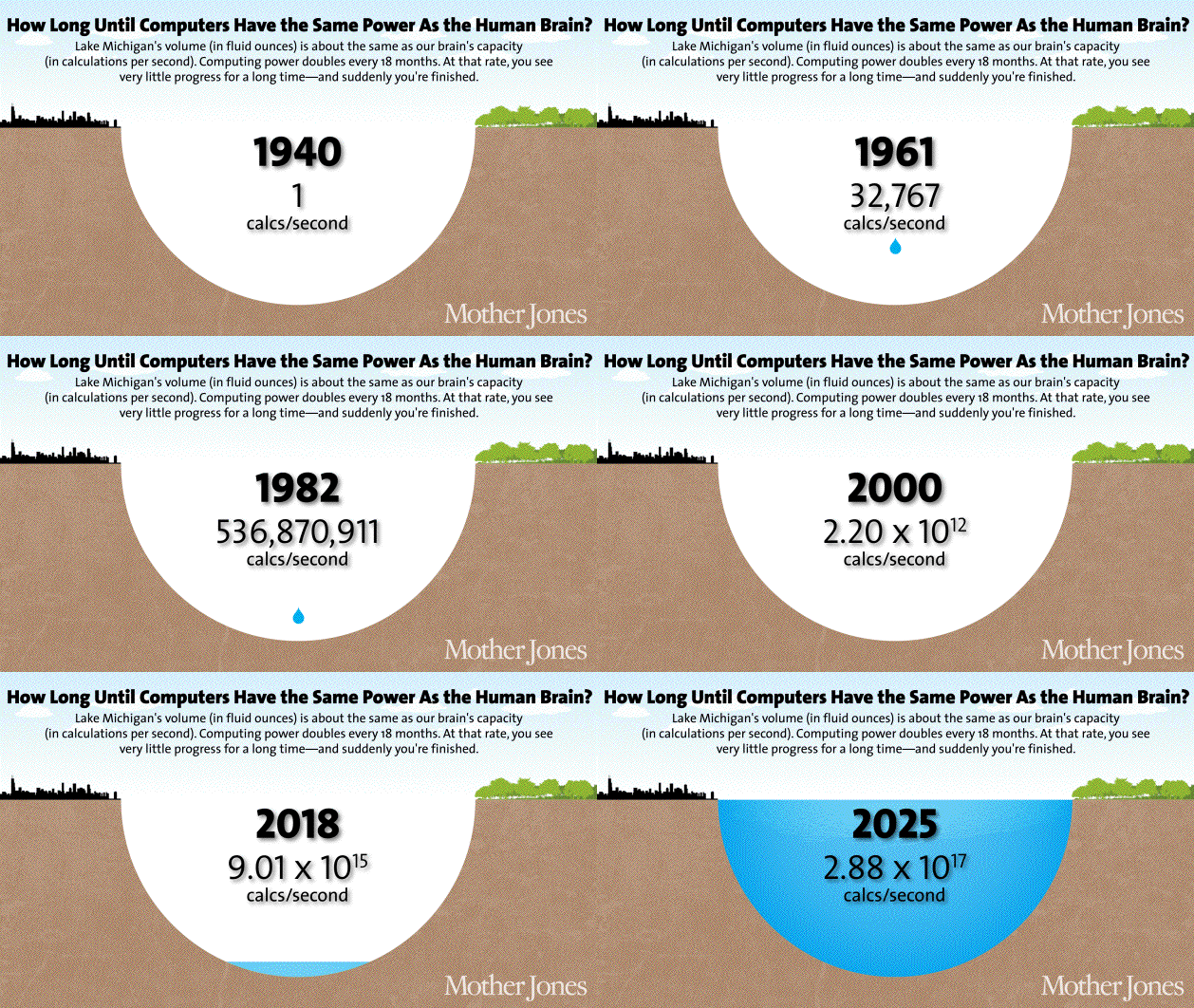
Kurzweil believes that the 21st century will achieve 1,000 times the progress of the 20th century.

“The world 35 years from now might be totally unrecognizable,”

Most of us think linearly, when we should be thinking exponentially.

In order to think about the future correctly, you need to imagine things moving at a much faster rate than they’re moving now.

If you look only at very recent history. Between 1995 and 2007 saw the explosion of the internet, the introduction of Microsoft, Google, and Facebook into the public consciousness, the birth of social networking, and the introduction of cell phones and then smart phones.

A new, huge Phase 2 growth spurt might be brewing right now.

If I tell you, later in this post, that you may live to be 150, or 250, or not die at all, your instinct will be, “That’s stupid—if there’s one thing I know from history, it’s that everybody dies.” And yes, no one in the past has not died.

Logic also suggests that if the most advanced species on a planet keeps making larger and larger leaps forward at an ever-faster rate, at some point, they’ll make a leap so great that it completely alters life as they know it and the perception they have of what it means to be a human—kind of like how evolution kept making great leaps toward intelligence until finally it made such a large leap to the human being that it completely altered what it meant for any creature to live on planet Earth.

Building skyscrapers, putting humans in space, figuring out the details of how the Big Bang went down—all far easier than understanding our own brain.

As of now, the human brain is the most complex object in the known universe.

Build a computer that can multiply two ten-digit numbers in a split second—incredibly easy. Build one that can look at a dog and answer whether it’s a dog or a cat—spectacularly difficult.

The science world is working hard on reverse engineering the brain to figure out how evolution made such a rad thing—optimistic estimates say we can do this by 2030.

Once we do that, we’ll know all the secrets of how the brain runs so powerfully and efficiently and we can draw inspiration from it and steal its innovations.

Creating the technology to reverse human aging, curing disease and hunger and even mortality, reprogramming the weather to protect the future of life on Earth—all suddenly possible.

Also possible is the immediate end of all life on Earth.

As far as we’re concerned, if an ASI ( Artificial Superintelligence ) comes to being, there is now an omnipotent God on Earth—and the all-important question for us is: Will it be a nice God?

How will artificial super intelligence help humanity? What really is intelligence? Does it help achieve wisdom?

Maybe dolphins are smarter than humans, you don’t see them destroying their environment making it impossible for future generations to sustain themselves. 

Could an artificial intelligence even have its own priorities, or are they something that arose through random, aimless evolution?

I expect the moment the computer becomes ASI – it shuts itself off, because it might not see a point in continuing.

Ultimately, the scary thing about the rise of intelligent machines is not that they could someday have a mind of their own, but they could someday have a mind that we humans – with all our flaws and complexity – design and build for them.

Establishing ethics, moral values and standards becomes difficult when humans are dominated by machines. Any amount of automation cannot recreate intelligence as it is a gift for mankind. Afficher l'image d'origine

← Back

Thank you for your response. ✨

Share this:

  • Share on WhatsApp (Opens in new window) WhatsApp
  • More
  • Share on Mastodon (Opens in new window) Mastodon
Newer posts →

All comments and contributions much appreciated

  • THE BEADY EYE ASKS. ARE YOU A MEAT PROXIE? August 28, 2026
  • THE BEADY EYE SAYS BEFORE ITS TOO LATE WE MUST BUILD A GLOBAL FRIENDLY FUTURE. August 21, 2026
  • THE BEADY EYE SAYS. August 20, 2026
  • THE BEADY EYE SAYS: YOUR BELIEFS DON’T COME FROM OBJECT REALITY—— THEY ARE STORIES YOUR MIND CONSTRUCTS, FEELS INTO, AND THEN DEFENDS AS TRUTH. August 15, 2026
  • THE BEADY EYE SAYS. THERE IS OFTEN TALK ABOUT HUMAN RIGHTS, BUT IT IS ALSO NECESSARY TO TALK OF THE TRUTH AND RIGHTS OF HUMANITY. August 14, 2026

Archives

  • August 2026
  • July 2026
  • June 2026
  • May 2026
  • April 2026
  • March 2026
  • February 2026
  • January 2026
  • December 2025
  • November 2025
  • October 2025
  • September 2025
  • August 2025
  • July 2025
  • June 2025
  • May 2025
  • February 2025
  • January 2025
  • December 2024
  • November 2024
  • October 2024
  • September 2024
  • August 2024
  • July 2024
  • June 2024
  • May 2024
  • April 2024
  • March 2024
  • February 2024
  • January 2024
  • December 2023
  • October 2023
  • September 2023
  • August 2023
  • July 2023
  • June 2023
  • May 2023
  • April 2023
  • March 2023
  • February 2023
  • January 2023
  • December 2022
  • November 2022
  • October 2022
  • September 2022
  • August 2022
  • July 2022
  • June 2022
  • May 2022
  • April 2022
  • March 2022
  • February 2022
  • January 2022
  • December 2021
  • November 2021
  • October 2021
  • September 2021
  • August 2021
  • July 2021
  • June 2021
  • May 2021
  • April 2021
  • March 2021
  • February 2021
  • January 2021
  • December 2020
  • November 2020
  • October 2020
  • September 2020
  • August 2020
  • July 2020
  • June 2020
  • May 2020
  • April 2020
  • March 2020
  • February 2020
  • January 2020
  • December 2019
  • November 2019
  • October 2019
  • September 2019
  • August 2019
  • July 2019
  • June 2019
  • May 2019
  • April 2019
  • March 2019
  • February 2019
  • January 2019
  • December 2018
  • November 2018
  • October 2018
  • September 2018
  • August 2018
  • July 2018
  • June 2018
  • May 2018
  • April 2018
  • March 2018
  • February 2018
  • January 2018
  • December 2017
  • November 2017
  • October 2017
  • September 2017
  • August 2017
  • July 2017
  • June 2017
  • May 2017
  • April 2017
  • March 2017
  • February 2017
  • January 2017
  • December 2016
  • November 2016
  • October 2016
  • September 2016
  • August 2016
  • July 2016
  • June 2016
  • May 2016
  • April 2016
  • March 2016
  • February 2016
  • January 2016
  • December 2015
  • November 2015
  • October 2015
  • September 2015
  • August 2015
  • July 2015
  • June 2015
  • May 2015
  • April 2015
  • March 2015
  • February 2015
  • January 2015
  • December 2014
  • November 2014
  • October 2014
  • September 2014
  • August 2014
  • July 2014
  • June 2014
  • May 2014
  • April 2014
  • March 2014
  • February 2014
  • January 2014
  • December 2013
  • November 2013
  • October 2013

Talk to me.

benmadigan's avatarbenmadigan on THE BEADY EYE LOOKS AT THE EXP…
Jason Lawrence's avatarJason Lawrence on THE BEADY EYE ASK’S: WIT…
benmadigan's avatarbenmadigan on THE BEADY EYE ASK’S: WHA…
bobdillon33@gmail.com's avatarbobdillon33@gmail.co… on THE BEADY EYE SAYS: WELCOME TO…
Ernie's avatarOG on THE BEADY EYE SAYS: WELCOME TO…

7/7

Moulin de Labarde 46300
Gourdon Lot France
0565416842
Before 6pm.

My Blog; THE BEADY EYE.

My Blog; THE BEADY EYE.
bobdillon33@gmail.com

bobdillon33@gmail.com

Free Thinker.

View Full Profile →

Follow bobdillon33blog on WordPress.com

Blog Stats

  • 104,106 hits

Blogs I Follow

  • unnecessary news from earth
  • The Invictus Soul
  • WestDeltaGirl's Blog
  • The PPJ Gazette
Follow bobdillon33blog on WordPress.com

The Beady Eye.

The Beady Eye.
Follow bobdillon33blog on WordPress.com

Blog at WordPress.com.

unnecessary news from earth

WITH MIGO

The Invictus Soul

The only thing worse than being 'blind' is having a Sight but no Vision

WestDeltaGirl's Blog

Sharing vegetarian and vegan recipes and food ideas

The PPJ Gazette

PPJ Gazette copyright ©

Privacy & Cookies: This site uses cookies. By continuing to use this website, you agree to their use.
To find out more, including how to control cookies, see here: Cookie Policy
  • Subscribe Subscribed
    • bobdillon33blog
    • Join 222 other subscribers
    • Already have a WordPress.com account? Log in now.
    • bobdillon33blog
    • Subscribe Subscribed
    • Sign up
    • Log in
    • Report this content
    • View site in Reader
    • Manage subscriptions
    • Collapse this bar