
( Twenty minute read)
In the beginning, there was an infinitely dense, tiny ball of matter. Then, it all went bang, giving rise to the atoms, molecules, stars and galaxies we see today. Even earlier, this thinking goes, at some point our entire universe — all the stars, all the galaxies, all the everything — was the size of a peach and had a temperature of over a quadrillion degrees. For decades this explanation, the amazingly fantastical story, holds up of the creation of the Universe and to all current observations.
The problem is that the physics that we use to understand the early universe (a wonderfully complicated mishmash of general relativity and high-energy particle physics) can take us only so far before breaking down.
Taken at face value,
This tells us that at one point, the universe was crammed into an infinitely tiny, infinitely dense point. This is obviously absurd, and what it really tells us is that we need new physics to solve this problem — our current toolkit just isn’t good enough. We need some new physics, something that is capable of handling gravity and the other forces, combined, at ultrahigh energies.
What we know as the Big Bang was sparked by something else happening before it — the Big Bang was not a beginning, but one part of a larger process. In other words, the complicated (and, admittedly, poorly understood) physics of this critical epoch may indeed allow for a radically revised view of our time and place in the cosmos.
—————–
I am neither a Scientist or a Quantum professor so what follows is what I have learned while researching this post. It is for some Einstein out there to answer the questions.
It is quite obvious that the Universe has not existed forever. It was born. Out of time. An entity cannot appear out of nothing and time has no entity while space and light do, even if they are expanding or traveling. A God as an entity is an other matter.
A universe popping into existence out of nothing is so bonkers. A detonation occurs in one place and shrapnel flies into the void.
In the Big Bang, there was no centre and no pre-existing void, so it didn’t happen at any ‘location’. Space itself popped into existence and began expanding everywhere at once, before time was invented.
But what is time? Does it exist? is the past present and the future all one and the same.?
——————-
Time is familiar to everyone, yet it’s hard to define and understand.
Science, philosophy, religion, and the arts have different definitions of time, but the system of measuring it is relatively consistent. It is not something we can see, touch, or taste, but we can measure its passage. But if a system is unchanging, it is not timeless.
The question of why time is irreversible is one of the biggest unresolved questions in science.
As far as the universe is concerned, time had a beginning. The starting point was 13.799 billion years ago when the Big Bang occurred.
If the universe is considered to be an isolated system, its entropy (degree of disorder) can never decrease. In other words, the universe cannot return to exactly the same state in which it was at an earlier point.
Time cannot move backward.
The “grandfather paradox” is a classic example. According to the paradox, if you travel back in time and kill your grandfather before your mother or father was born, you could prevent your own birth.
Many physicists believe time travel to the past is impossible, but there are solutions to a temporal paradox, such as traveling between parallel universes or branch points.
Will time end?
The answer to this question is unknown. Time does not actually exist. “Time is just an illusion.” Is this really true? Is time just a figment of our imagination?
It makes no appearance in physical science except…” What does that mean?
Indeed, this question borders the realm of metaphysics and ontology (the philosophy of existence) as much as it does on the strictly empirical questions about time that physics is well-equipped to address.
Time is all over the place in physics.
Is it a ‘quantum’ thing?
Quantum things are fundamentally unpredictable, appearing randomly, all over the inflationary vacuum, parts of it ‘decayed’ into ordinary, everyday vacuum. Think of tiny bubbles forming in a vast ocean.
In each bubble, the inflationary vacuum disappeared, but its enormous energy had to go somewhere.
It went into creating matter and heating it. It went into creating a Big Bang. Our Big Bang Universe is merely one such bubble among a possible infinity of other Big Bang universes in the ever-expanding inflationary vacuum!
————–
The twin pillars of modern physics are Einstein’s General Relativity and Quantum theory.
The laws of quantum theory permit this to pop into existence out of nothing.
The former reigns supreme in the large-scale Universe, while the latter orchestrates the small-scale world of atoms and their constituents. They have resisted a merger, which is a problem because, in the Big Bang, the Universe was small.
It is essential to unite Einstein’s theory with quantum theory.
- And there’s another phenomenon called quantum superposition. This principle of quantum mechanics suggests that particles can exist in two separate locations at once. This really hinges on what is meant by “to be in two positions”.
- According to standard QM, when a particle is observed to be in a particular place, it is there and nowhere else. Before the observation, however, the particle’s position may not be definite, i.e., it’s not at a particular place at all.
———————
There isn’t any wave particle duality because an electron isn’t a particle and it isn’t a wave. Instead it’s an excitation in a quantum field. The electron field can interact in ways that look like a particle and it can interact in ways that look like a wave, but that doesn’t mean it is a particle or is a wave.
The fundamental basis of QM is assuming that energy comes in discrete quantities rather than a continuum. There’s no obvious, intuitive reason for this, necessarily… but the results that come out of QM are spectacular- in that they are extremely well supported by experiments.
“Why is energy discrete rather than continuous?”
Physics is a parallel world of tricky mathematical models, fine tuned in order to reproduce the behaviour of reality, but it is not the reality itself. It may sound obvious, but for many people it isn’t so.
Nobody really knows what an electron is completely.
What an electron is and what an electron can behave are different concepts to be clarified.
It’s my opinion! By the way particle is point, but wave is a function to describe all the possible locations of the particle. Electron particle cannot appear at two different points but you can find it through your interaction experiment setup.
Particles can be in two (or more) places at the same time.
This is not yet a proof that quantum mechanics hold for large objects.
For example, there is not yet a quantum mechanical theory of gravity.
In 2005, the Hubble Space Telescope revealed more than 10,000 galaxies and led astronomers to estimate there must be 200 billion galaxies in the observable universe, and 50 billion trillion stars.
Where did it all come from?
The religious explanation is that a supernatural causal agent call God brought all matter, energy, space and time into existence? God who was speaking spoke from outside of time.
If the universe has a beginning, that means there’s got to be some kind of beginner; It’s a beginner beyond space and time, and that looks too much like the God of the Bible.
In the beginning God created the heavens and the earth” accurately describe what science has discovered?
Why is that proof that God created everything, first of all that God exists and that then he actually created all of this?
The Big Bang model is the idea that the universe is traceable back to a beginning.
Not just a beginning of matter and energy, but a beginning of matter, energy, space and time. And how the universe continuously expands from that beginning, and expands at the just right rate to make life possible and even advanced life possible at this moment in the universe.
This flash called the Big Bang is generated by the sudden annihilation of all anti-matter in the universe.
A delicate balance of a billion and one particles to every billion anti-particles guarantees the existence of matter in the later universe. And it also guarantees the possibility of life.
From the creation event, protons, neutrons, anti-protons, anti-neutrons decompose into even more fundamental particles called quarks.
But the universe is too hot and too dense even for quarks to exist and too compressed for light to be possible.
After the creation event the universe was too hot for atoms to exist. Electrons could not orbit around nuclei. Because the universe was nothing but charged particles, an amorphous glow is all that appears. The universe would be so hot that protons and neutrons can’t stick together. All atomic nuclei fall apart.
——————-
The universe therefore must have a beginning and, hence, a beginner beyond space and time; there must be an actual beginning of time; That means no matter what you speculate about the universe, as long as it expands on average you are stuck with this beginner beyond matter, energy, space and time.
—————
We’ve got two easy proofs that any lay person can appreciate that the universe indeed must have this singular beginning of matter, energy, space and time.
So what are we to make of all the observations that the entire universe appears to have been meticulously designed for humans?
And astronomer George Greenstein in his book, The Symbiotic Universe, expressed these thoughts:
“As we survey all the evidence, the thought insistently arises that some supernatural agency must be involved. Is it possible that suddenly, without intending to, we have stumbled upon scientific proof of the existence of a Supreme Being? Was it God who stepped in and so providentially crafted the cosmos for our benefit?”
Stephen Hawking concedes, “It would be very difficult to explain why the universe should have begun in just this way except as the act of a God who intended to create beings like us.”
The probability of all these known parameters randomly coming together would be one chance in 10215, a probably so incredibly tiny that statistically speaking, it’s impossible. And this probability is becoming even more remote with every new scientific discovery.
Such a high degree of design demonstrates that this entity of a god must be a personal being with an amazing creativity, wisdom, power, care and love to a degree far beyond human capabilities. He has fine tuned the Milky Way galaxy, the solar system, and planet earth so that spiritual life can be fused with physical life in this one small place for one brief span on our time line.
Millions of galaxy clusters fill the universe, each containing thousands of galaxies, adding up to ten billion trillion stars. That’s ten with 21 zeros after it.
We needed all of those stars for some reasons, alright?
This enormity is essential to life’s existence. If the number of stars in the observable universe were any greater or any fewer, life would be impossible. If there were fewer stars in the observable cosmos, nuclear fusion would be so inefficient that the only elements to form would be hydrogen and helium. With more stars in the universe, all the elements would be heavier than iron. No carbon, no nitrogen, no oxygen.
Only in a cosmos with a finely-tuned mass of stars can the life-essential elements be produced.
So it turns out, the vast reaches of the cosmos are not a big waste of space, energy, matter and time.
If energy cannot be created or destroyed, where does it come from?
Many scientists believe that the total energy of the universe is zero. Hence, no energy needed to be “created” when the universe came into existence.
As Stephen Hawking explained, when you pull two objects apart, you need to expend energy to overcome the gravity that pulls them together. As it takes positive energy to separate them, gravity must be negative energy. If that theory is correct, then there was never any need to create energy or matter – they cancel each other out. That implies that the big bang could have started as a simple statistical fluctuation.
Additionally, many galaxies appear to lack sufficient mass to be held together by gravity and should have been torn apart long ago.
So, what is causing these unknown phenomena? Dark matter, which makes up 85% of total matter in the universe, is a hypothetical type of matter that responsible for the way galaxies are organized.
Our universe is therefore the result of a quantum fluctuation. Particles routinely pop into and out of existence.
Take the sun as an example.
Its nuclear fusion reactions turn matter (think of it as concentrated energy) into visible sunlight and other forms of energy. The sunlight hits a green leaf on Earth and the solar energy is now transferred into a chemical energy store as oxygen is separated from carbon dioxide and water, leaving carbohydrate in the leaf.
We eat the leaf and breathe in the oxygen.
The respiration reaction in our muscle cells allows the energy to be used to move our arm as we hammer in a nail. The arm, nail, hammer and the air absorb the sound, get hot and radiate infrared heat to outer space.
So the energy concentrated in the original hydrogen atoms in the sun is now scattered into the universe. Low-grade and almost useless, but still the same amount we started with.
Finally my conclusion’s.
For some thing to come into existence from nothing is impossible even a black hole has to start with some thing and disappear into some thing. What that is Space time In physics, spacetime is any mathematical model that fuses the three dimensions of space and the one dimension of time into a single four-dimensional continuum. From Wikipedia.
According to the best of current physical theories, space-time explains the unusual relativistic effects that arise from traveling near the speed of light as well as the motion of massive objects in the universe.
So its some thing that travel’s faster than the speed of light depended on its state of motion – warped spacetime!
Light was known to be an electromagnetic phenomenon, but it did not obey the same laws of mechanics as matter.
Henceforth space by itself, and time by itself, are doomed to fade away into mere shadows, and only a kind of union of the two will preserve an independent reality.
Weight arises due to the warping of time, rather than space. What this means in practice is that gravity on earth is “equivalent” to acceleration mostly in the sense that clocks on the surface run more slowly than clocks in outer space.
If one goes beyond classical physics and into modern quantum field theory, then questions of absolute versus relational spacetime are rendered anachronistic by the fact that even “empty space” is populated by matter in the form of virtual particles, zero-point fields and more.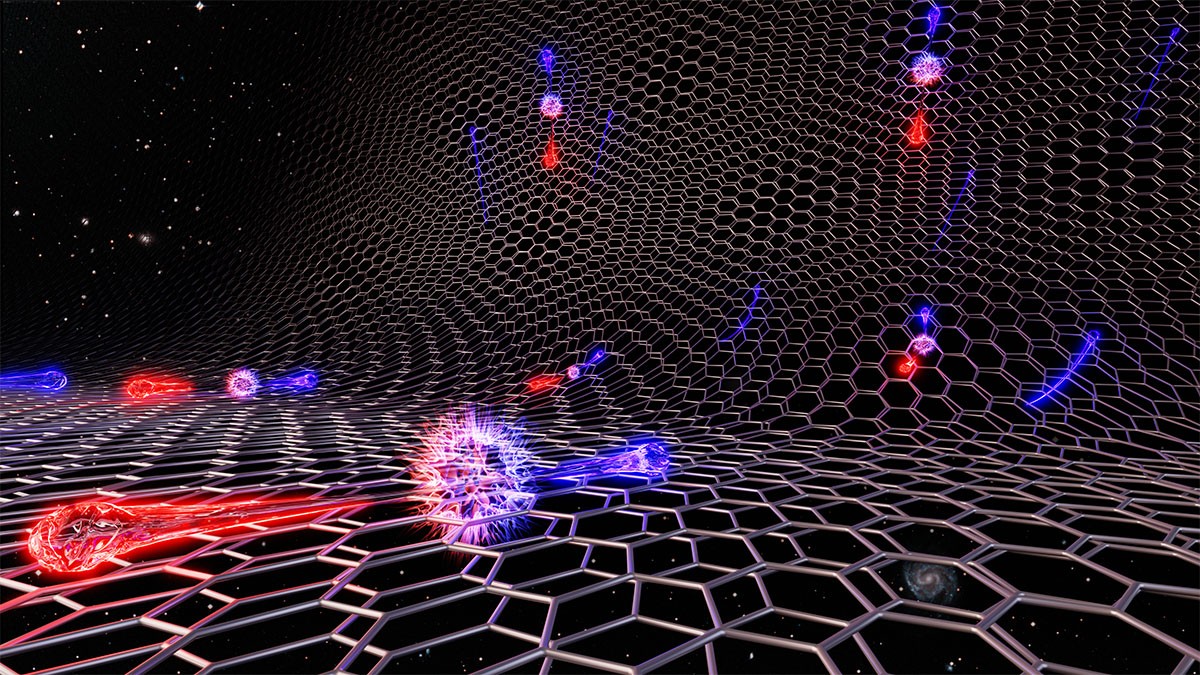
You can’t get something for nothing. In the quantum realm, something really can emerge from nothing.
As long as you have empty space — the ultimate in physical nothingness — simply manipulating it in the right way will inevitably cause something to emerge. Take a meson and try to rip the quark away from the antiquark, and a new set of particle-antiparticle pairs will get pulled out of the empty space between them an electromagnetic fields where many properties of all physical systems are conserved: where things cannot be created or destroyed. In theory, a strong enough electromagnetic field can rip particles and antiparticles out of the vacuum itself, even without any initial particles or antiparticles at all.
In early 2022, strong enough electric fields were created in a simple laboratory setup leveraging the unique properties of graphene, enabling the spontaneous creation of particle-antiparticle pairs from nothing at all. The prediction that this should be possible is 70 years old: dating back to one of the founders of quantum field theory.
In the Universe we inhabit, it’s truly impossible to create “nothing” in any sort of satisfactory way. Everything that exists, down at a fundamental level, can be decomposed into individual entities — quanta — that cannot be broken down further. If you take all of them away, however, the “empty space” that remains isn’t quite empty in many physical senses the quantum fields remain. Just as we cannot take the laws of physics away from the Universe, we cannot take the quantum fields that permeate the Universe away from it. No matter how far away we move any sources of matter, there are two long-range forces whose effects will still remain: electromagnetism and gravitation. Even if you create a perfect vacuum, devoid of all particles and antiparticles of all types, where the electric and magnetic fields are zero, there’s clearly something that’s present in this region of what a physicist might call, from a physical perspective, “maximum nothingness.”
Space cannot be “entirely emptied” As to where is came from. Clearly, we exist, as do the stars and galaxies we see, so something must have created more matter than antimatter, making the Universe we know possible. It seems like an impossibility. On one hand, there is no known way, given the particles and their interactions in the Universe, to make more matter than antimatter. On the other hand, everything we see is definitely made of matter and not antimatter.
Doesn’t it matter. The fact that we exist and are made of matter is indisputable; the question of why our Universe contains something (matter) instead of nothing (from an equal mix of matter and antimatter) is one that must have an answer.
When it does, one of the greatest mysteries in all of existence will finally have a solution.
Therefore as Max Beerbolm said: ” Besides Dr Einstein there are only two men who can claim to have grasped the Theory of Relativity I cannot claim to be either of these. The attempt to conceive Infinity has always been quite arduous enough for me. But to imagine the absence of it ; to feel perhaps we and all the stars beyond or ken are somehow cosily ( thought awfully) closed in by curtain curves beyond which is nothing; and to convince myself, by the way, that this exterior is not ( in virtue of being nothing) something and there fore …. but I lose the thread.”
All human comments appreciated. All like clicks and abuse chucked in the bin.
Contact: bobdillon33@gmail.com


 bobdillon33blog