• About
  • THE BEADY EYE SAY’S : THE EUROPEAN UNION SHOULD THANK ENGLAND FOR ITS IN OR OUT REFERENDUM.

bobdillon33blog

~ Free Thinker.

bobdillon33blog

Tag Archives: European Union

THE BEADY EYE ASKS : WILL ENGLAND IN THE FORTHCOMING REFERENDUM ON IN OR OUT OF THE EU SHOOT ITSELF IN THE FOOT

06 Saturday Feb 2016

Posted by bobdillon33@gmail.com in England EU Referendum IN or Out., European Union.

≈ Comments Off on THE BEADY EYE ASKS : WILL ENGLAND IN THE FORTHCOMING REFERENDUM ON IN OR OUT OF THE EU SHOOT ITSELF IN THE FOOT

Tags

European Union, The English in or out EU Referendum


We all know that there is going to be untold verbal and written diarrhea before the forthcoming Uk Referendum on the question of England staying or leaving the EU.

The debate has gone on so far as if there is a clear vision for what a “leave” vote might mean, which is total hogwash as there is no clear vision of what an EU exit would mean.

The outcome is highly uncertain as there are many unknowns including the timing of the vote and the outcome of the renegotiation.

The last time London broke away from Europe it was because of a fight with Rome. Henry VIII wanted to marry Anne Boleyn so broke off relations with the Pope, who opposed it.Afficher l'image d'origine

There is one thing for sure it will be a long and protracted process.

Quantifying the precise effects of leaving the EU is difficult but here are a few indisputable hard facts whether the vote goes one way or the other.

If there is a vote to exit the UK government has two years to negotiate the terms of withdrawal under Article 50 of the EU Treaty.

So if the referendum is in 2017 it will not be till 2019 that the UK formally exits the EU, but this is not the end of the process.

The UK must pursue a number of third-party negotiations to replace treaties that no longer apply, such as FTAs.
               David Cameron passes an exit signAs with any divorce, no-one              can be sure whether it will                  be amicable or hostile.


An exit would mean recasting not only future trade relations with the remaining members of the EU, but also those with the rest of the world, many of which are the result of the EU negotiating as a bloc.

Regulatory divergence would increase over time, affecting trade volumes and reducing the attractiveness of the UK for investment.

The EU is currently negotiating a major new FTA with the United States (the TTIP) – as well as an ‘economic partnership agreement’ (EPA) with Japan. If the UK leaves the EU, it will not benefit from these and other free trade agreements negotiated by the EU in future.

Non-EU members like Norway and Switzerland pay to be part of the European single market.

So retaining access to the single market means accepting all the rules decided by ‘Brussels’ and voted on by full members of the EU.

Those countries, like Norway, Switzerland and Iceland, who want the market access, but stop short of seeking full membership, just have to accept whatever the EU decides.

A British exit from the EU would diminish rather than enhance the country’s standing and influence.

Reduced integration with EU countries is likely to cost the UK economy far more than is gained from lower contributions to the EU budget, the value of pound will fall worldwide.

The EU is seen as a major power in the world.

To say that Britain would somehow regain a unique and resonant voice in world affairs once it breaks away from a collective European identity is somewhat naive.

On the other hand the lost of the Uk to the EU would diminish its power standing in the world as a military power.

Britain’s exit would have far-reaching political ramifications for the rest of Europe. The ‘proof of concept’ of leaving the EU could liberate disintegrative, centrifugal forces elsewhere. Member states most exposed to Brexit are the Netherlands, Ireland and Cyprus. Each has very strong trade, investment and financial links with the UK and in the cases of the Netherlands and Ireland are closely aligned in policy terms.

The economic consequences for the UK from leaving the EU are complex.

However both the break with the EU and the uncertainty associated with it would be bad for business and damaging to the UK economy.

Being part of the EU does not restrict UK companies’ ability to trade with the rest of the world.

Beyond all the simple choice of ‘stay or leave’ there is a broader question that has, hitherto, been curiously neglected.

This is what not being a member of the EU would really mean: what, in short, is the most likely alternative to EU membership?

What is the reason after 43-year membership in the European Union the question is:  Why is the Uk is holding a referendum.

Is it because the population was never given an opportunity to say Yes or No.

Or is it because David Cameron won the 2015 general election on a pledge to hold an in-out vote on the UK’s membership of the European Union no later than the end of 2017.

Is it because the English Political phych is still stuck in its history of Empire.

Is U.K. ‘now holding a Gun’ to EU.

Should the EU be allowing Britain to set the terms of the future direction of the EU.

Britain’s relationship with the EU, troubled by decades of anxiety over waning national power, the euro area’s threat to London’s financial clout, subsidies to French farmers and, more recently, mass migration which is spiraling out of control.

Is it to secure a better deal for Britain’s relationship with the EU? while it has refused to go along with more integrationist policies like the single currency and the removal of border checks. Abolishing the U.K.’s obligation to “ever closer union.

Is it because it wants to limit access to welfare payments for non-British EU citizens in the U.K.

That has proved most contentious with governments in countries such as Poland and Hungary. They have sent thousands of people to set up home in the U.K. and say the move would make their countrymen and women second-class citizens in a club where everyone is supposed to be equal.Afficher l'image d'origine

The vital question is whether the U.K. will continue to have access to the single market.

There is little point howling from a distance.

In my opinion the European Union will not be shaped by England or for that matter any of its existing members. Current world events will shape its future.

← Back

Thank you for your response. ✨

Share this:

  • Share on WhatsApp (Opens in new window) WhatsApp
  • More
  • Share on Pocket (Opens in new window) Pocket
  • Share on Mastodon (Opens in new window) Mastodon

THE BEADY EYE ASK’S : WHO DO YOU THINK YOU ARE?

28 Thursday Jan 2016

Posted by bobdillon33@gmail.com in European Union., Humanity., Life., The world to day., Unanswered Questions., What Needs to change in the World

≈ Comments Off on THE BEADY EYE ASK’S : WHO DO YOU THINK YOU ARE?

Tags

Community cohesion, European identities., European leaders, European Union, Identity, The Future of Mankind, World aid commission


( Five minute read:)

How often have you heard this question.

It is mostly posed with a form of some aggression.

Not so here.

SO I SUPPOSE THE BEST PLACE TO START WITH THIS POST IS WITH WILLIAM SHAKESPEARE, AS YOU LIKE IT.

“ALL THE WORLD’S A STAGE, AND ALL THE MEN AND WOMEN MERELY PLAYERS; THEY HAVE THEIR EXITS AND THEIR ENTRANCES, AND ONE MAN IN HIS TIME PLAYS MANY PARTS.”

We all have roles to play in our lives and these change as we move through it.

Do you find yourself thrashing against the tide of human indifference and selfishness? Are you oppressed by the sense that while you care, others don’t?

That, because of humankind’s callousness, civilisation and the rest of life on Earth are basically stuffed?

Many of those who dominate public life have a peculiar fixation on fame, money and power. Their extreme self-centeredness places them in a small minority, but, because we see them everywhere, we assume that they are representative of humanity.

“It’s all about political opportunism and humanitarian posturing,”Afficher l'image d'origine

With the best will in the world it is unlikely that you will turn out as an adult with no unhelpful of unintended modifications – or what is called “conditioning”.

The true YOU is the one that finds life fulfilling in a deep sense rather than theoretically good on a purely intellectual level.

The personality is not YOU, you have a personality, so if you want your “self” to be aware of itself, you will have a long wait!

However, you, as an independent observer of your own internal processes, can become aware of what your personality is up to, how it is behaving and the impact on yourself and others.

As Fritz Perls said:

“Truth can be tolerated only if you discover it yourself because then, the pride of discovery makes the truth palatable.”

These days with technologies we hardly understand where we going never mind how we are.

It’s the culture.

Technology isn’t a section in the newspaper any more.

I think people are tired of complexity and they’re hungering for clarity, a simpler time.

The more we do things, the more they become a habit and the more that we think in the same way, the more these patterns of thought and behaviour become our identity.

The more that we depend on the masks and the safer that we feel as a result of wearing them, the greater the risk and uncertainty we feel of taking off our mask and interacting openly, honestly and authentically.

With the massive economic and cultural transformation driven by Silicon Valley are we no longer in control of who we are?

mask masks incertitude life

However if the personality is our sense of identity, but is not us, then who are we?

Our personality is like a piece of armour which is at the same time our greatest shield and also potentially our greatest prison. It enables us to deal with the outside world, but it can also insulate us from it – and from other people.

We are also not our personality, which has in large part been forged as a result of the experiences of surviving and protecting ourselves in the real world.

Take for instance, Politicians. given their image-conscious online life in the public eye  .

Most millennials still worry about attaching themselves with a click to the wrong clique or hashtag:

“It heightens the level of uncertainty, anxiety and risk aversion, to know that you’re only a bad day and half a dozen tweets from being fired.”

Smart phones are dominating our sense of identity and we will if not careful end up feeling lost when they end.

You need to find an internal source for our identity, not an external one.

The old verities of who you are now seem quaint, but many millennials are now paralyzed by all their choices.

There was a time that we understood that not everyone was destined for greatness.

If you work hard and play by the rules, you’ll lose out to those guys who can wire computers to make bets on Wall Street faster than the next guy to become instant multimillionaires.

Or losers who have soured our sturdy and spiritual DNA with too much food, too much greed, too much narcissism, too many lies, too many spies, too many fat-cat bonuses, too many cat videos on the evening news, too many Buzzfeed listicles like “33 Photos Of Corgi Butts,” and too much mindless and malevolent online chatter?

Our quiet traditional virtues bow to our noisy visceral divisions, while churning technology is swiftly remolding the national character in ways that are still a blur.

Boldness is often chased away by distraction, confusion, hesitation and fragmentation. Or are we forever smaller, stingier, dumber, less ambitious and more cynical?

Have we lost control of our not-so-manifest destiny?

Misanthropy grants a free pass to the grasping, power-mad minority who tend to dominate our political systems. If only we knew how unusual they are, we might be more inclined to shun them and seek better leaders. It contributes to the real danger we confront: not a general selfishness, but a general passivity.

We’re a little bit scared of our own shadow. And, sadly, we see ourselves as a people who can never understand one another. We’ve given up on the notion that we can cohere, by holding together people with deep differences.

We’ve broken Iraq, liberating it to be a draconian state-run on Sharia law, full of America/ English-hating jihadists who were too brutal even for Al Qaeda.

We have to re earn greatness.

But that’s going to be hard to restore in the world today.

Young people are more optimistic than their rueful elders, especially those in the technology world. They think of themselves as global citizens but are more interested in this moments of crazy opportunity.

With awareness comes freedom.

As you become aware of your fixed attitudes, beliefs and values that may no longer be useful to you and you begin to understand that there were good reasons for you to have adopted them, you can begin to see that it is neither good nor bad that this is the way life is – and the way that you are – it is just a natural consequence of living the human experience.

The authentic self is the true self underneath all the conditioning that has been acquired through life’s experiences.

Being in touch with our true selves is about getting real, not living in a fantasy of who we could or should be, but living with what is.

Life has become more complex but we hardly ever notice it because technology has made complexity simpler than ever. Who you are and where you are is tracked and sold on to ever is interested. The Private who is dead and gone.

The only knowledge we need to have is the knowledge of where to find stuff.

Humans today are like most smartphones and tablets – their ability to solve problems depends not on the knowledge they can store but on their capacity to connect to a place where they can retrieve the answer to find a solution.

Technology will continue to evolve and the gap between what can be solved with and without it will only increase. That is, we will become more and more dependent of technology and the only intellectual disadvantage will be the inability (or unwillingness) to learn to use it.

One could also imagine that this IT-overload may prove too much for some — In short, people who are able to keep up with technology will outsmart those who don’t (even more than they do now).

So perhaps there is no need to know how you are but more importantly where you are.

Too much Google, too much Face Book, Twitter, clicking from one site to another, or for that matter reading with out pause, constitutes a kind of scattering, a distraction, an agitation of the mind.

Our reliance on Google Search, is resulting in unrealistic self-confidence in our cognitive abilities.

That’s right, we are all plagiarising the internet without even realising it.

You might think that all is this is just hog wash but in a few hundred years from now most of us will not know the meaning of the word where and if we don’t know where we are from there is little chance of knowing who you are.

If we look at western Europe it appeared that we are not building anything, but merely trying to hang on to something we have inherited, but don’t necessarily value.Afficher l'image d'origine

With the immigration and refugee influx this will have to change.

What is the narrative that drives what we are building in Europe… and who is creating that narrative?  Not us.

We have derived a narrative from a century of conflict, and the received narrative is shaped around not fighting with each other. Fully understandable. But, for my children’s generation the wars of the twentieth century are as remote as the Battles of Agincourt or Waterloo.

This is why I wonder if Europe needs a new driving narrative that helps us consciously shape who and what we want Europe to become.

The old narrative of solidarity no longer applies.

We have Razor Wire replacing open frontiers. The Dutch reverting to extracting gold fillings and the Belgians wanting concentration Camps in Greece never mind what ‘solidarity’ means to young unemployed people in Greece or Spain.

So, the questions remain.

Who do we think we are and what do we want Europe to become? And who will shape the narrative for a new generation?

Billions of decent people tut and shake their heads as the world burns, immobilised by the conviction that no one else cares.

Attitudes of fear and paranoia adopted by many have led to an increasingly hostile global environment.

Cherished and treasured human values are trampled beneath a host of vitriolic “we’re better than you” convictions. Our world is sick, however, facing political and environmental disaster on an unprecedented scale.

Many of the problems plaguing us stem directly from deeply-held convictions of social differentiation and exclusion, rooted in philosophies that justify heinous acts in the service of a ‘greater good’. We are what we do. We have to start doing better.

We have to start somewhere. Why not a World Aid Commission Of 0.05%. ( see previous Post.)

In this century we have had only three brief moments when a majority of us said they were satisfied with the way things were going:

Have a go at naming them.

← Back

Thank you for your response. ✨

Share this:

  • Share on WhatsApp (Opens in new window) WhatsApp
  • More
  • Share on Pocket (Opens in new window) Pocket
  • Share on Mastodon (Opens in new window) Mastodon

THE BEADY EYE ASKS CAN THE EU ACCOMMODATE ANOTHER 4 MILLION MIGRANTS.

20 Wednesday Jan 2016

Posted by bobdillon33@gmail.com in European Union., Humanity., Politics., The new year 2016., Unanswered Questions., Where's the Global Outrage.

≈ Comments Off on THE BEADY EYE ASKS CAN THE EU ACCOMMODATE ANOTHER 4 MILLION MIGRANTS.

Tags

European Union, Inequility, Migrants/Refugees.

( a one minute read)Afficher l'image d'origine

As riot police dismantle the camps of northern France, ‘forced relocation’ of people into shipping containers is brushing a humanitarian disaster under the carpet. The new accommodation on which the French have spent £20m is shipping containers, each kitted out with 12 bunk beds. There is heating and electricity BUT Humanity is bulldozed away.

The underlying political problem is never dealt with, except ironically by the refugees and migrants themselves, who have put up a sign saying “David Cameron Street” in the Jungle.

The focus of many EU governments now appears to have shifted decisively back to a default position—namely efforts aimed at preventing or discouraging people from attempting to reach EU territory, tackling smuggling networks, and rapidly deporting individuals who do not have a right to remain in the EU.

FOUR MILLION migrants expected to reach Europe by the end of 2017.

EU leadership is more important than ever to reach a Europe-wide deal on refugees.

An estimated 31,244 migrants have braved the deadly boat crossing over the Mediterranean Sea to Greece in the first 16 days of this year. This shocking statistic represents 21 times the number of migrants who crossed during the same period in January 2015, according to the International Organisation for Migration.

The IMF has predicted four million refugees will reach Europe by the end of 2017. Pictured is a migrant waiting to catch a train while wrapped in a blanket while trying to keep warm in SerbiaChancellor Angela Merkel's party has also called for Germany to declare Morocco, Algeria and Tunisia 'safe countries of origin', making it easier to reject asylum requests by its nationalsIt is expected that the number of new arrivals to Greece is likely to exceed the 853,650 migrants who crossed over to Greece by sea last year

Last year children accounted for a quarter of the one million migrants and refugees arriving across the Mediterranean in Europe.

God knows, these people need help. They are not obtruders. Every one of them is in need of protection and entitled to the rights guaranteed under the Convention on the Rights of the Child.

At the same time, there are still millions caught in situations of conflict, displacement, poverty and underdevelopment – the main causes of the crisis.

UNICEF is appealing for US$14 million to support the needs of affected children and women through 2016.Composite image showing three different lots of migrants

The rising number of people entering Europe in search of safety and in search of a better life has captured the world’s attention with scenes of heartbreaking tragedy.

JUST IMAGINE IF IT WAS YOUR FAMILY.

Travelling hundreds and thousands of miles over land and over water, from Africa, the Middle East and Asia, people are risking everything in the hope of reaching their goal, and the danger does not end at a border crossing.

Here are a few Graphics to open your eyes.

Map of arrivals

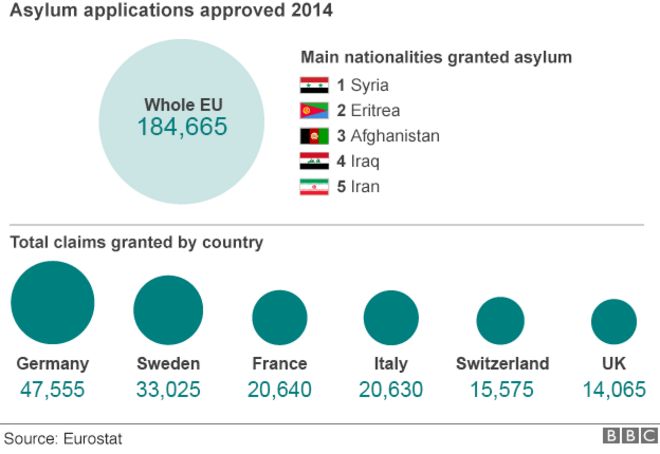
Asylum claims

In September, EU ministers voted by a majority to relocate 120,000 refugees EU-wide, but for now the plan will only apply to 66,000 who are in Italy and Greece.
chart showing number of migrants EU countries will acceptChart showing approved asylum applications


Migrant deaths in Mediterranean by month                       Syrians in neighbouring countries and Europe map


Whenever people treats others as they treat each other, then we will have no more wars.

http://video.dailymail.co.uk/video/mol/2016/01/15/7104883562965414529/640x360_7104883562965414529.mp4

← Back

Thank you for your response. ✨

Share this:

  • Share on WhatsApp (Opens in new window) WhatsApp
  • More
  • Share on Pocket (Opens in new window) Pocket
  • Share on Mastodon (Opens in new window) Mastodon

THE BEADY EYE LOOK AT WORLD ORGANISATIONS. PART TWO- IS NATO RELEVANT.

14 Wednesday Oct 2015

Posted by bobdillon33@gmail.com in Climate Change., Environment, European Union., Politics., The Future, The world to day., Unanswered Questions., War, World Organisations.

≈ Comments Off on THE BEADY EYE LOOK AT WORLD ORGANISATIONS. PART TWO- IS NATO RELEVANT.

Tags

European Union, Nato, UN, Visions of the future., World Organisations.

In the past 60 plus years, many changes have taken place with society, technology and governments but world peace is for the most part pie in the sky.

It is true that their have been no major global conflicts in the latter half of the twentieth century and into the twenty-first.

So is Nato still relevant?  Or is it just a pension club for the military old boys.

Since 1999 Nato has struggled in performing ever mission it has launched- Bosnia, Kosova, Afghanistan.

When Estonians pulled the Nato emergency chain on a cyber attack it was left with a lukewarm response raising the question what constitutes an attack on a country that Nato will react to.

What would happen if a war started, or the market crashed? I don’t think that NATO would fight a war together ( Including USA and Canada there are currently 28 member states) to be honest.

The conflicting priorities of Europe and the USA and the absence of a common foe all point to the need for Nato to be refilled into either a new European defense force or into the United Nations as a total peaceful organisation. Since the end of the cold war, NATO and the UN have become nearly interchangeable.

However some still say that the North Atlantic Treaty Organization (Nato) is more relevant than it has been for years even if many of its members are moving further away from meeting their defense spending obligations.An Italian sailor from the frigate "Alieso" removes a cover from a cannon in the Black Sea port of Varna, Bulgaria, March 9, 2015.

The end of the Cold War and, consequently, the absence of the Soviet threat, did not render NATO ( The North Atlantic Treaty Organisation) obsolete. There is no Warsaw Pact anymore, so why is there NATO?

The Alliance is now expanding like crazy. Faster than EU itself.

This means they either feel their power is crumbling and need more power, more allies, or the simple fact NATO has no more meaning.

It is the last surviving relic of the Cold War and is now the centerpiece of US-European relations. It has served as an integrating mechanism for Europe for more than sixty-five years.Afficher l'image d'origine

Here what it cost to-day.

Nato                         2014 Actual         2014                2015              2015

  • Member State        Expenditure       % of GDP      Project Exp        % of GDP
  1. Bulgaria              $604 million              1.3           $565 million        1.16
  2. Canada              $14.3 billion              1             $12.2 billion          null
  3. Estonia               $430 million              2             $461 million          2.05
  4. France                $40.90 billion            1.5          $41.2 billion          1.5
  5. Germany             $44.3 billion             1.14         $41.72 billion        1.09
  6. Hungary              $1.03 billion             0.79          $0.79 billion          0.75
  7. Italy                    $17.3 billion             1.2            $16.3 billion         null
  8. Latvia                  $252 million            0.9            $283 million          1
  9. Lithuania             $359 million             0.78            $474 million        1.11
  10. Netherlands         $8.7 billion             1                $9 billion              null
  11. Norway                $5.8 billion              1.58           $6.8 billion           1.6
  12. Poland                  $10.4 billion           1.9             $10.4 billion         1.95
  13. Romania               $2 billion                1.4         Not yet announced   1.7
  14. UK                        $55 billion              2.07            $54 billion           1.88
  15. US                       $582.4 billion          3.6              $585 billion          3.1
  16. Turkey                   Not known
  17. Albania                         “
  18. Czech Rep                    “
  19. Denmark                      “
  20. Greece                         “
  21. Iceland                        “
  22. Luxembourg                 “
  23. Poland                          “
  24. Slovakia                       “
  25. Slovenia                       “
  26. Portugal                       “
  27. Spain                           “
  28. Belgium                         “

Unfortunately the US funding of  Nato has it wrapped around its finger. It funds between one-fifth and one-quarter of Nato’s budget.

The civil budget for 2015 is € 200 million. The civil budget provides funds for personnel expenses, operating costs, and capital and programme expenditure of the International Staff at NATO Headquarters.

The military budget for 2015 is €1.2 billion. This budget covers the operating and maintenance costs of the NATO Command Structure. It is composed of over 50 separate budgets, which are financed with contributions from Allies’ national defence budgets (in most countries) according to agreed cost-shares.

While there is stagnation in military expenditure from the larger military powers in NATO — the UK, France, Germany, and Canada — that has led to several smaller NATO states to increase their funding. Not coincidentally, some of them would be front line states in a future military conflict between Russia and the NATO alliance.

NATO was founded to promote democratic values and encourage cooperation on defense and security issues. What started as a good idea that was backed by powerful nations, now is not the case.

With Russia involvement in Syria not to mention the Ukraine the real question is: Do we need what I see as a duplication Organisation that appears determined, for the first time in its history, to intervene beyond its borders.

Operational partnerships, such as the one Nato established with Australia in Afghanistan, are an additional source of personnel and resources for Nato-led operations.

Even militarily it does not make sense to have an European Union relining on an Organisation that has as its linchpin of the alliance Article 5 of the North Atlantic Treaty, which states that “an armed attack against one or more of them [NATO members] in Europe or North America shall be considered an attack against them all” and that all members are obliged to assist the state(s) under attack.

Article 5 has been invoked only once in NATO’s history, after the terrorist attacks against the US homeland on September 11, 2001.

It says it committed to the peaceful resolution of disputes.

NATO provides security to the world because of their rules and regulations that prevent war. Considering those FACTS it is foolish to say that NATO is not relevant.

No wars have taken place in any country that is part of NATO after they joined.

It is supposed to act under resolutions that are carried out under Article 5 of the Washington Treaty – NATO’s founding treaty – or under a UN mandate, alone or in cooperation with other countries and international organizations.

So tell me what irresolution was passed about ring fencing Russia with rockets.

NATO’s incessant push to the east is an attempt to reinstate a Berlin Wall that spans the entire western border of Russia. This has no place in a peaceful world.

It’s no wonder that Russia is worries about that, as well as the new identity and tasks that NATO has awarded itself.

Russia opposes expansion mainly because she fears that the West is trying to isolate her in the corner of Europe, deprive her of her privileged relationship with her former satellites and undermine her national interests. This is why she is so fiercely opposing enlargement to include the Baltic States and Ukraine. NATO is viewed by Russia as nothing more than the club wielded by capitalist sharks.

Without a unified military force Europe (an area of the world that for many centuries was the most warlike on the globe) relies on the Nato. The dissolution of which without a replacement would leave the Continent without the existence of a military option to ensure stability within in its borders.

There is one thing for sure in light of NATO’s character as a political forum of democratic nations, expansion to incorporate those states that had authoritatively been excluded from it and pushed into the arms of the Soviet Union seems a logical consequence.

It can no longer be seen merely as a military Alliance with a defensive character, but as a political one as well, gathering the nations that share common democratic values and respect for human rights and the rule of law. However this is a new world where NATO seems confrontational and counter productive with limited capability to undertake even crisis management operations.

One of the major problems with the preceding league of nations, was the lack of ‘teeth’.

Instead of focusing on the rapidly declining interstate conflicts (as a result of interdependence), maybe Nato should be focusing more on threats such as cyber warfare, terrorism, and piracy, and vetting refugees.

It would be impossible to think a couple of decades ago that the Americans and the Russians might sit at the same table and plan common military operations.

You would think that Nato which is deeply involved in the Syrian war and the United Nations would be encouraging such a move to avoid Turkey being dragged into the War.

Instead Jens Stoltenberg, the Nato secretary-general, said that the organisation intended to “send a clear message” to show that the world’s most powerful military alliance was prepared to act in defence of its citizens. “Nato will defend you, Nato is on the ground, Nato is ready,” he said.

Nato says it is prepared to send troops to Turkey to defend its ally after violations of Turkish airspace by Russian jets,

Then all hell breaks loose as if this was the ultimate pretext for a NATO-Russia war.

But wait; NATO is actually too busy to go to war. The priority, until at least November, is the epic Trident Juncture 2015; 36,000 troops from 30 states, more than 60 warships, around 200 aircraft, all are seriously practicing how to defend from the proverbial “The Russians are Coming!”

Russia’s spectacular entry into the war theater threw all these elaborate plans into disarray.

Surely, there are differences between the US and Russia, but these can be overcome step by step with constructive dialogue and mutual understanding. They are no longer afraid of each other. They do have their differences, as it is natural that they should.

As events in the Ukraine, Syria and now Turkey are tragically demonstrating Nato could become a source of potential danger for the entire world.

The World has enough problems this is not a time for Nato saber-rattling.

Finally it is otter stupidity to think that if a nuclear device designed to emit an EMP (Electro Magnetic Pulse) were detonated about 300 miles over EUROPE ( most of Europe as we now know it would be gone) that Nato or the USA would do anything other than issue wet wipes.

Also one may wonder why Turkey — a country that is about 2,000 miles to the east of the Atlantic Ocean — finds itself in an entity called the “North Atlantic Treaty Organization. The answer is the roots of accepting non-North Atlantic nations into NATO, mainly Greece and Turkey lies at the heart of the Truman Doctrine — extending military and economic aid to states vulnerable to Soviet threat / expansion. NATO membership should guarantee, in essence, that Turkey would not become a Soviet ally.

Moving forward means dissolving what does not work and finding what will work.

The next two decades will make or break humanity.

Perhaps Nato should stand down as a military force and take up the mantel of fighting Climate Change.

Finally how can we have an ordered world where Russia and China are excluded from the police force?

If Nato is to be relevant it could start by building a world environmental police force.

← Back

Thank you for your response. ✨


Share this:

  • Share on WhatsApp (Opens in new window) WhatsApp
  • More
  • Share on Pocket (Opens in new window) Pocket
  • Share on Mastodon (Opens in new window) Mastodon

THE BEADY EYE LOOKS AT WHO IS A REFUGEE?

25 Tuesday Aug 2015

Posted by bobdillon33@gmail.com in European Union., Humanity., Politics., Where's the Global Outrage.

≈ Comments Off on THE BEADY EYE LOOKS AT WHO IS A REFUGEE?

Tags

Capitalism vs. the Climate., European identities., European leaders, European Union, Migrants/Refugees.

Understanding the problems confronting refugees—and those striving to protect them—depends on grasping precise legal definitions.

The core definition of a “refugee” is contained in the 1951 United Nations Convention relating to the Status of Refugees and its 1967 Protocol relating to the Status of Refugees, which define a refugee as an individual who: “owing to a well-founded fear of being persecuted for reasons of race, religion, nationality, membership of a particular social group or political opinion, is outside the country of his nationality, and is unable or unwilling to avail himself of the protection of that country.”

With biggest driving force for change still to manifest itself: It seem to me that the definition is long over due a revamp.

Climate Change will like the Internet have a profound effect on the world.

The Internet alone has assisted the creation of wars, by highlighting the inequalities that exist between the have and have not’s. It is exposing Capitalism and the free Market for what it real is. It is unveiling corruption, challenging the mass media and assisting mass immigration by generating sizeable networks to deal with the any obstacles set in their paths.

Climate change will change any definition of undocumented aliens asylum seekers. It will displace millions, impacting on the economy, by having a positive affecting on some groups and negatively others.

Trade agreements like the TTPI will weaken the case of those who would venture a rigid and single-factor comparison between “political” immigration and “economic” immigration.

We can expect the migratory issue to become increasingly political. A more rational approach would be to consider who the illegal immigrants are, before making immigration laws.

Much of Europe’s brewing migration debate carries a polarized tone of certainty, and migrants themselves are often slotted into neat “political” and “economic” categories.

You can see this at the moment as the EU struggles to establish who are political refugees and illegal immigration, on the role of economic versus non-economic factors. The definition Refugee has and is being ignored.

Is it possible to distinguish between the poverty of “condition” and the poverty of “position”?

Poverty, while a commonly cited factor “pushing” migration, is difficult to define.

In the former situation, the two main factors are a lack of employment and steady income, which prompt a feeling of having “nothing to lose.”Their biggest concern and expectation is to improve their physical well-being, something they regard as impossible at home.

This element has also got a growing home-grown element of poverty due to unemployment, no hours contracts, and exploration of the vulnerable within the EU.

Poverty of position, in contrast, involves migrants who use emigration as a way of more rapidly climbing the social ladder. These migrants feel that their income and position in their home country will never match their social capital (for example, their level of formal education or training). They move to places where they believe they can realize their aspirations.

Theses generic terms therefore covers a wide range of facts but Violence and Conflict are the leading causes of the current wave of migration [to Europe]

It is rooted in the crazy [U.S.] idea to launch an intervention in Iraq, which allegedly had weapons of mass destruction, but nothing was found.” A disaster that destabilized the Middle East giving rise of terrorism that we now see to-day.

However some of the blame for many asylum seekers is not wars.

For example, persecution is not necessarily imposed by the government or other official institutions in their country of origin. Some may face violence at the hands of mafia networks, armed groups, or a dominant majority group in connection with factors that are not directly political, such as ethnicity.

Others may be threatened for having a lifestyle that involves a socially unacceptable choice of spouse, sexual orientation, etc. As a result, some people are threatened and persecuted without fully meeting the demands of the 1951 United Nations Convention relating to the Status of Refugees.

The long the short and tall of it is that Northern Africa today can no longer defend Europe from the immense masses of people on the move.

As Europe turns its back, these are refugees, not migrants, are arriving in their thousands on Greek shores .

The number thought to be in the UK could be as high as 863,000 – larger than the population of Leeds. By comparison, Italy was thought to have up to 461,000, Germany had 457,000, France’s top estimate was 400,000 and Spain had 354,000. Greece, it is estimated that about 100.000-150.000 undocumented refugees and migrants enter Greece each year, among them maybe around 10.000 unaccompanied minors.

Refugees and other vulnerable people deserve the protection and assistance to which they are entitled under international law. Rather then the inhumane treatment seen in the below:

http://www.aljazeera.com/news/2015/08/streams-refugees-flow-macedonia-greece-150823072040825.html

In a wide range of countries, attitudes toward immigrants appear to be related to labor-market concerns, security and cultural considerations, as well as individual feelings toward political refugees and illegal immigration.

Are attitudes toward foreigners influenced by economic considerations or are they driven exclusively by non-economic issues?

At what point do we as citizens of the EU conclude that these people have already suffered enough and deserve to be aided in their flight to safety?

Without legal alternative routes for refugees to enter other European countries, people fleeing conflicts in the Middle East, Africa and elsewhere have taken matters into their own hands

The future of Europe, will be determined by its ability to confront the issue of immigration. Whatever the attitude of the government, population pressure will be immense on Europe and there is no chance to prevent such migration.

On the one hand, the Fortress Europe concept essentially focuses on the role of external border controls and neglects the entry and settlement of clandestine immigrants and undocumented aliens. At the same time, border controls, deportations, mass arrests, and internment of migrants in closed centers and prisons invalidate the thesis of Europe as a sieve.

Europe, which is neighbor to many war zones takes in more than 1.5 million legal migrants.

Overall, forced displacement numbers in Europe totalled 6.7 million at the end of the year, compared to 4.4 million at the end of 2013, and with the largest proportion of this being Syrians in Turkey and Ukrainians in the Russian Federation. Syria’s ongoing war, with 7.6 million people displaced internally, and 3.88 million people displaced into the surrounding region and beyond as refugees, has alone made the Middle East the world’s largest producer and host of forced displacement. Adding to the high totals from Syria was a new displacement of least 2.6 million people in Iraq and 309,000 newly displaced in Libya.

Today, Libya, between 500,000 and one million people aspire to come to Europe.

With population growth of 7% or 8% in Africa, against just over 1% here, migratory pressure is mechanical.

It is not possible or desirable that Europe opens its doors to every tom dick and harry. On the other hand it not possible to address the situation with 4-meter (13-foot) high fence on its borders like Hungary, or We need to build a wall, we need to keep illegals out,” Donald Trump said at last Thursday’s GOP debate.

I for one do not want to be represented by Israeli or Berlin wall.

It needs policies that better serve the interests of both nations and immigrants.

It is beyond me that we cannot move FRONTEX (It coordinates EU States’ actions in the implementation of EU border management measures.) from Warsaw (Poland) to some where useful.  So far this year, more than 180,000 migrants have reached Greece and Italy by sea (others come from Turkey via the land border with Bulgaria).

In the first four months of this year, more than a quarter of a million people claimed asylum in a European Union member state.

Where is the big deal in setting up humanitarian corridors for asylum seekers. To putting up initial reception center. To agreeing to a binding quota system for distributing refugees among all European countries.

I am sure if an appeal was made to all European Citizens the majority of the 509 million would not begrudge 10 Euros a month.

Let us hope that Europe can respond intelligently by rejecting generalisations and simplistic discourse by being true to its values, notably in terms of asylum and yet be more effective.

I leave you with the words of  Ahmed Satuf, another refugee from Idlib in Syria, told Al Jazeera he didn’t want anything from Macedonia, except for being allowed to cross its borders.

“I’m not a terrorist. We are humans. Where’s the humanity? Where’s the world? Everyone here, they are families,” he said.

“We don’t need anything. We don’t need money. Let us cross. I want to go to Germany.”

Europe above all places in the world born of integrationist ideals yet undermined by participants’ unwillingness to share costs as well as benefits, has a chance to shine.

“For us, today Europe is at stake” 

said Orban Viktor the president of Hungary,  “The survival, disappearance or, more precisely, the transformation beyond recognition of the European citizen’s lifestyle, European values and the European nations.”

He knows where he can stick that finger of his.

← Back

Thank you for your response. ✨


Share this:

  • Share on WhatsApp (Opens in new window) WhatsApp
  • More
  • Share on Pocket (Opens in new window) Pocket
  • Share on Mastodon (Opens in new window) Mastodon

The Beady eye looks at what is wrong with the European Union.

11 Saturday Jul 2015

Posted by bobdillon33@gmail.com in European Union.

≈ 1 Comment

Tags

EU, European identities., European leaders, European Union, The Euro zone., UK’s membership of the EU.


In the next few months and for years to come perhaps you will be reading a lot of bull shit on this subject.Résultat de recherche d'images pour "pictures of human eyes"

Where is the European Union going or has gone wrong.

Well you don’t have to wait to know why.

It is the deformed structure of globalisation, which favors the owners of capital and concentrates of wealth that is the culprit.

(Add the demographic tipping point across the Pacific Rim and central Europe, and you have a portrait of worldwide “secular stagnation”.)

The current Greece crises in the Euro Zone is shining a light on a technocrat dictatorship which is beyond democratic control if ever attempted.

The euro zone is least able to respond to the Greek crises because it is a dysfunctional construct.

∑ The European Union with 751 Members and 24 official working languages costs , € 1,756 billion (2014) of which 35% is for staff expenses, mainly salaries for the 6000 officials working in the General Secretariat and in the Political Groups. Moreover, this expenditure covers interpretation costs, the costs of external translation and staff mission expenses.

Another words about 27% (of the 2014 budget) is dedicated to MEPs’ expenses, including salaries, costs for travel, offices and the pay of personal assistants.

Expenditure on Parliament’s buildings accounts for 11% (2014)

Information policy and administrative expenditure such as IT and telecommunications account for 21% (2014)

Political Group activities account for a further 6% ( 2014) ∑

What’s wrong then?

More to the point what can be done?

The first is the recognition of sharing a common history, which usually means sharing episodes of violence, pain, suffering, and, yes, achievement.

Next there is no meaningful representative democracy without taxation.

Citizens and voters pay attention when they are taxed.

A European tax that replaces government approved transfers of funds could do wonders for getting Europeans interested in Europe.

(The willingness to transfer significant spending and taxing powers to European institutions is very limited.)

The European project needs anchor figures chosen directly by Europeans.

A presidential figure elected through the rule “one European, one vote” would be a good start. A figure to love and to hate, that could engage Europeans with the legitimacy of the vote and (why not?) have an important say in the dying and the paying issues that can promote a new citizenship and a new polity.

We all know that the founding aspiration of the European Union was born out of War and that is where it is going if it does not represent the people of Europe not the Free market with its proxy behind the doors trade agreements.

And we all know that once money enters any equation aspirations go out the window. What follows is the erosion of the common good, democracy and in comes – I am all right Jack.

The regulation of money creation is, essentially, a undemocratic economic policy and there is no better example of this than the current Greek crises.

Indeed the greatest risk for the survival of the Euro zone today is the risk emanating from social and political upheavals in countries that are forced into a deflationary spiral. 

The euro zone has let it happen in Greece.

Europe’s authorities have so mismanaged monetary and fiscal strategy that the whole currency bloc has tipped into deflation.

The ideas of Europeanism, federalism, and even “post-material” politics appeal, albeit in different ways, to new possibilities for political, cultural, and
social cohesion will force Europe to think deeper about its first motivation for establishing a common economic market: attaining a long-lasting peace in Europe.

The means to create and pass on a similar European narrative to a wide mass of individuals is now open to question.

We ought to know by now, economic fluctuations hit different jurisdictions differently.  If these economic fluctuations are relatively synchronous or resources sufficiently mobile, monetary policy is an appropriate instrument, and the area to which it is applied is a so-called “optimal currency area”.

The problem is that we are still, evidently, in the process of making Europe, but may be well advised to start making Europeans at the same time.

It can be sum up in one word.  Diversity.

Often seen not as a liability it is the core fact that allows for change and progress. The “unity in diversity” motto is but a starting point, which urgently needs new incarnations.

http://business.financ€35bn to help the economy” ialpost.com/news/economy/drachma-diplomacy-what-would-life-after-the-eu-look-like-for-greece

The question is:

Is Tsipras really looking for a deal with Europe?

The Greek government now accounts for about 60% of the country’s entire GDP.  Leaving the euro zone could cost the Greek economy up to 36% of its GDP over the next few years.

If Greece switches currency, any euros left in Greek bank accounts would depreciate by 50% to 60% in a matter of days.

The recent decision by the ECB to act a lender of last resort is a major regime change for the Euro zone. It is not sufficient, however, to guarantee the survival of the monetary union. 

Perhaps Debt pooling would ties the hands of the member countries of the Euro zone and shows that they are serious in their intentions to stick together.

Where did all the Quantitative Easing go ? Not to Greece – 60 billion a month till Sep 2016.

When the one size of the single monetary policy does not fit all, supplementary, possibly coordinated, national fiscal policies should also be activated – where national fiscal policies are tightly constrained and loosely coordinated, especially so in the countries where the QE impact will be smaller.

The result may eventually be dim.

It is the case with any monetary policy instrument in a monetary union, QE in the EZ is fraught with the heterogeneity problem of the recipients of monetary policy. The institutional strictures and pressures under which the ECB operates will make the task harder. Of course, easier monetary conditions will help the EZ economies.

The endogenous dynamics of booms and busts that are endemic in capitalism continued to work at the national level in the Euro zone and that the monetary union in no way disciplined these into a union-wide dynamics.

The monetary union probably exacerbated these national booms and busts.

The existing stabilizers that existed at the national level prior to the start of the union were stripped away from the member-states without being transposed at the monetary union level. This left the member states “naked” and fragile, unable to deal with the coming national disturbances.

Even if Greece signs up to the package of tax and spending reforms demanded the most likely outcome – is that Greece’s debt would still be 118% of GDP in 2030.

← Back

Thank you for your response. ✨

Share this:

  • Share on WhatsApp (Opens in new window) WhatsApp
  • More
  • Share on Pocket (Opens in new window) Pocket
  • Share on Mastodon (Opens in new window) Mastodon

EU Agricultural Subsidies – The Common Agricultural Policy (CAP)

22 Friday May 2015

Posted by bobdillon33@gmail.com in Environment, European Union., Politics., Sustaniability

≈ Comments Off on EU Agricultural Subsidies – The Common Agricultural Policy (CAP)

Tags

European leaders, European Union, Europeans, The Common Agricultural Policy (CAP)

Its going to be a turbulent year for the EU with Greece going broke, the UK looking to opt out and immigrants arriving by the thousands.

The economic down turn of recent years exposed fundamental problems and unsustainable trends in many European countries. It also made clear just how interdependent the EU’s economies are.

Over the past decade, Member States have experienced divergent economic trends, which have, exacerbated competitiveness gaps and led to macro-economic imbalances within the EU.

The question now is are we looking at stronger political union or a repatriation of powers to National Sovereign Nations within the EU.  

One way or the other the EU needs to look beyond the current crisis.

The EU is already under pressure from competitors and demographic change.

Any reforms within the Members seems to take for ever to implement.

Take for instance the reforms to the Common Agricultural Policy (CAP) which was one of the original pillars of the European Community, comprising France, Germany, Italy, Netherlands, Belgium and Luxembourg. In negotiations on the creation of a Common Market, France insisted on a system of agricultural subsidies as its price for agreeing to free trade in industrial goods.

The treaty of Rome set out its basic principle and objectives:

  1. To increase productivity, by promoting technical progress and ensuring the optimum use of the factors of production, in particular labour.
  2. To ensure a fair standard of living for the agricultural Community.
  3. To stabilise markets.
  4. To secure availability of supplies.
  5. To provide consumers with food at reasonable prices.

Those objectives were written in 1958 and have never been amended.

The main purposes of EU agriculture should be:

• Provision of a safe, healthy choice of food, at transparent and affordable prices.

• Ensuring sustainable use of the land.

• Activities that sustain rural communities and the countryside.

So what is the Common Agricultural Policy (CAP)?

For more than twenty years, starting in 1992, the CAP has been through successive reforms. In June 2013 ministers reached a deal with Euro MPs and the European Commission, though the reform package has not yet been agreed in full.

The CAP began operating in 1962, with the Community intervening to buy farm output when the market price fell below an agreed target level. In 1970, when food production was heavily subsidised, it accounted for 87% of the budget.

The CAP has been steadily falling as a proportion of the total EU budget for many years.

The plan then was that total spending should peak in 2008/9 and then decline until 2013, when the next major revision was due. In 2013 the budget for direct farm payments (subsidies) and rural development – the twin “pillars” of the CAP – was 57.5bn euros (£49bn), out of a total EU budget of 132.8bn euros (that is 43% of the total).

Owing to the way in which the common agricultural policy has developed and to the use of ‘historical references’, the level of aid may vary considerably from one farm to another, from one member country to another or from one region to another.

Today’s CAP is more market-oriented.

Under the new CAP, farmers still receive direct income payments to maintain income stability, but the link to production has been severed. In addition, farmers have to respect environmental, food safety, phytosanitary and animal welfare standards.

For the EU’s new member states, in Central and Eastern Europe, direct payments to farmers are being phased in gradually.

France is – and always has been – the largest recipient of CAP funds (20% of the total in 2006), with Spain, Germany, Italy and the UK all also receiving significant amounts (two-thirds of the total between these five countries). Although getting smaller absolute amounts, Greece and Ireland receive the largest per capita payments.

France is the biggest agricultural producer, accounting for some 18% of EU farm output.

France receives around €11 billion each year from the EU in agricultural support, but very little of it actually goes to those who do the farming.

With over 500,000 recipients of EU farming subsidies in France, over 80% of the funds actually goes to large industrial food processing businesses and charitable organisations. The largest recipient is the chicken production conglomerate Doux, who received a whopping €62.8 million in aid between October 2007 and October 2008. In the year 2008 the group had a turnover of nearly €2 billion.

The average annual subsidy per farm is about 12,200 euros (£10,374). About 80% of farm aid goes to about a quarter of EU farmers – those with the largest holdings. Major beneficiaries include rich landowners such as the British royal family and European aristocrats with big inherited estates.

The CAP does not cover commercial forestry.

The Commission proposed to cap at 300,000 euros the total subsidy a large farm could receive – but that appears unlikely to get into the final deal.

Across the whole EU, it is the bigger farmers who are the greatest beneficiaries, with 20% of farmers estimated to receive 74% of funding.

The idea was to combat large payments going to aristocratic landowners and wealthy agri-businesses, but it ran up against powerful lobby groups.

To day the CAP costs each EU citizen around 30 euro cents a day. CAP expenditure actually makes up less than 1% of all public expenditure in all the EU’s member countries. In addition to the direct cost, it is estimated that European consumers pay approximately €50 bn more in higher food costs.

Over 77% of the EU’s territory is classified as rural (47% is farm land and 30% forest) and is home to around half its population (farming communities and other residents). Europe has 12 million farmers and an average farm size of about 15 hectares (by way of comparison, the US has 2 million farmers and an average farm size of 180 hectares). The eastward enlargement increased the EU’s agricultural land by 40% and added seven million farmers to the existing six million.

Agriculture is a sector which is supported almost exclusively at European level, unlike most other sectors, which are governed by national policies.

Supporting farmers’ incomes ensures that food continues to be produced throughout the EU and pays for the provision of public benefits which have no market value: environmental protection, animal welfare, safe, high-quality food, etc.

The EU already funds numerous programmes that can be channeled towards these goals. For example, between 2007 and 2013, over €50bn is available for R&D projects, over €3bn for competitiveness and innovation and nearly €7bn for lifelong learning. This is all in addition to €277bn worth of regional funding for the same period through the Structural Funds.

As climate change makes itself ever more felt, the cost of sustainable farming can only continue to rise.

The EU budget is in turn mainly financed out of its ‘own resources’: customs duties, levies, VAT and resources based on member countries’ gross national income (GNI). The CAP represents over 40% of EU budget expenditure and is the most expensive of EU policies.

Regional aid – known as “cohesion” funds – is the next biggest item in the EU budget, getting 47bn euros.

The CAP budget for Rural Development (which seeks to safeguard the vitality of the countryside) 2014-20 for all 28 member countries will total €95 billion (at current prices).

The last reform was implemented in 1994

Today, the Budget amounts to €150bn (£117bn), which is paid for by the 28 members of the EU, and is also used to pay administration costs incurred by Brussels, such as salaries.

Farm subsidies are expected to account for around 38pc of the EU budget between 2014 and 2020, or around €363bn of the €960bn total.

A total of €8.7bn was spent last year in administration costs alone, although the European Commission highlights in its Myths and Facts FAQ, that this amounts to less than 6pc of the total budget.

However, the CAP continues to face a number of challenges, particularly in addressing biodiversity decline, water pollution, soil degradation, accelerating climate change and the steady growth in demand for food, fuel and energy.

Here are the Challenges:

  • How to make the Single Payment Scheme more effective, efficient and simple by continuing the move to full decoupling..
  • How to adapt market support instruments originally designed for six, to a larger system of twenty-seven states in a more globalised world.
  • How to master challenges in areas such as climate change, biodiversity and water management and adapt to new risks and opportunities.

The questions are:

  • Why do we need a European Common Agricultural Policy?
  • What are society’s objectives for agriculture in all its diversity?
  • Why should we reform the CAP and how can we make it meet society’s expectations?
  • What tools do we need for tomorrow’s CAP?

The answers are:

The European Union needs a common EU policy to ensure a level playing field within the EU, guaranteeing fair competition conditions. To maintain diversified farming systems across Europe.

  • To insure that no GMOs or pesticides are used. To ensure EU agriculture respect the environment. Give greater importance to non-market items, such as environment, quality and health standards, sustainability.

•  To Respond to the effects of climate change. To Protect the environment and biodiversity, conserve the countryside, sustain the rural economy and preserve/create rural jobs, mitigate climate change. To decrease its impact on global warming and maintain biodiversity, water resources etc.

•  To take into account the various higher expectations from consumers, for example with regard to the origin of foodstuffs, guarantees of quality etc.

•  To Strengthen the competitiveness of European agriculture. To Transform market intervention into a modern risk- and crisis-management tool. To Recognize that the market cannot (or will not) pay for the provision of public goods and benefits. This is where public action has to offset market failure.

•  To Ensure better coordination with other EU policies applying to rural areas.To Bear in mind that the correct payment to farmers for the delivery of public goods and services will be a key element in a reformed CAP. To Rethink the structure of the two support pillars and clarify the relationship between them; make adequate resources available for successful rural development. To Create fair competition conditions between domestic and imported products.

  • To Provide employment in rural areas. To Implement a fairer CAP – fairer to small farmers, to less-favoured regions, to new member states.
  • To Avoid damaging the economies or food production capacities of developing countries; help in the fight against world hunger.
  •  To giving more importance to innovation and dissemination of research.
  •  To link agricultural production, and farmers’ compensation, more closely to the delivery of public goods such as environmental services.
    • To Introduce transparency along the food chain, with a greater say for producers.

Industrial agriculture should have little place in the CAP, its support being more appropriately directed to more deserving recipients.

Serious questions are being raised about the reasons for the current levels of spending, the efficiency and the extent to which it provides genuine EU added-value. In recent years, farms’ energy bills have increased by 223% and the price of fertilisers by 163%. Agricultural prices have increased by 50% on average.

It must take a strategic approach to CAP reform. Go for total, not partial, solutions taking account of CAP challenges on the one hand and the interplay between the CAP and other internal and external EU policies on the other hand.

Can any of this be done?

The EU has no shortage of crises on its borders and beyond.

It is hard to see that EU will succeed in galvanizing European governments into a more coherent policy. EU states will certainly not be willing to increase the overall size of the budget, it is clear that it will have to dedicate a much smaller share of the budget to the CAP. The budget cannot keep increasing in the midst of an economic crisis.

Keeping EU farm spending level until 2020 is impossible and there are suggesting that EU funding for issues such as research and development provide better EU added-value.

Believe it or not, the thing that could change farming isn’t the climate or a new piece of equipment. A microbe in the soil could be the key to helping farmers grow more crops.

Only 5.4% of EU’s population works on farms, and the farming sector is responsible for 1.6% of the GDP of the EU (2005). The number of European farmers is decreasing every year by 2%. Additionally, most Europeans live in cities, towns, and suburbs, not rural areas. However, their opponents argue that the subsidies are crucial to preserve the rural environment, and that some EU member states would have aided their farmers, anyway.

When many people saw the first stunning photos of the fragile Blue Marbel of Earth from space, it changed their outlook of humanity. It was a singular moment in time when people around the world were watching and looking toward the future.

When it comes to people like all of us the EU has a long way to go before we all see a common future.

There is no security on this earth: there is only opportunity.

← Back

Thank you for your response. ✨


Share this:

  • Share on WhatsApp (Opens in new window) WhatsApp
  • More
  • Share on Pocket (Opens in new window) Pocket
  • Share on Mastodon (Opens in new window) Mastodon

At Long Last a World Figure Speaking the Truth:

27 Thursday Nov 2014

Posted by bobdillon33@gmail.com in Uncategorized

≈ Comments Off on At Long Last a World Figure Speaking the Truth:

Tags

Climate change, European Union, Pope Francis, Syria, Tony Blair

The other day Pope Francis addressed the Strasbourg Parliament.

Pope Francis addresses the European Parliament

In his speech he referred to the European Union as an Institution/ Organisation run by aloof and opulent leaders that treat their citizens as cogs in a machine. ” They have forgotten how to talk about anything but economics, and treat people as humans beings”

He went on to Call the Europe a ” Barren Grandmother” run by bureaucratic technicalities of Institutions.

How right he is.

When technology is allowed to take over there is a confusion between ends and means. This can be seen in all aspects of present day life. The inevitable consequence of throwaway culture and uncontrolled consumerism.

He believes that people of faith must build bridges from one community to another, and from the present to a future of peace, tolerance and goodwill.

Another words prosperity and dignity for all in a world where humankind lives in harmony with nature. He is not the first or will he be the last to have this aspiration.

Never before has man had such capacity to control his own environment: to end thirst and hunger; to conquer poverty and disease, to banish illiteracy and massive human misery. We have the power to make this the best generation of mankind in the history of the world—or to make it the last.”

What we have is a world faces multiple crises with most if not all of our world organisations out of date and in dire need of reform. ( See previous Posts.)

Conflict continues to rage in Syria, Iraq and beyond. The Ebola virus continues its deadly grip on West Africa. Threats such as drug trafficking, transnational crime and terrorism are growing in intensity and feeding off each other.

Today’s pre-eminent powers seem to have forgotten that they are elected by the people for the people not the Economy. They need to go back to Basics before we all forced to do business in a new way.

Climate change is the defining issue of our time. We can no longer afford to burn our way to prosperity and we cannot eradicate extreme poverty without fighting climate change. We must all act – as individuals, communities, businesses and governments – individually and together to transform our world. Lives of innocent people are being claimed in unacceptable numbers from Syria to Iraq, from Ukraine to the Central African Republic and South Sudan. Children are being drawn into conflict and kidnapped simply for wanting to learn to read and write.

There is no good in verbalizing these challenges we must surmount them, or together we will suffer the consequences of inaction. We need change in mindset from one of arguing over dividing the work, to one where we all do the maximum that we can, always asking, What more can we do.

The first concrete commitment of any Government be to ensure that any economy gains are inclusive of all its people not the Privatization of its peoples rights to clean water, to clean sustainable energy, to affordable health, education, and public transport. Not to manufacturing arms, bailing out Banks.

Multinational corporations search the globe for the lowest possible labor costs and weakest environmental safeguards. It is not unusual for them to get help from governments that compete in the global marketplace by refusing to protect their citizens from environmental degradation and workplace abuse—ranging from below-survival wages to physical attacks.

Take Immigration as an example.  View by the economy as useful only to grow the economy. A form of modern-day slavery labor that leads to social tensions, as you can see in Great Britain.

Global economy is the exchange of goods and services integrated into a huge single global market that ignores and is blind to the unheard voices.

Copernicus the father of modern-day Astronomy taught the Vatican that the center of the Universe was not earth. Pope Francis has just discovered that the Ten Commandants have to be voiced to be heard.

When you boil down all the valiant words they all fall on deaf ears, and will continue doing so till you and I learn to vote with our wallets, and demand change with our Smart phones.( see post;  what a 0.05% aid commission on all High frequency trading, Sovereign wealth funds and foreign exchange transactions could achieve.) We deserve to do more than just survive.

He did not mention the Hippocratic disease that is spreading throughout our world leaders. Sell arms with one hand and give aid with the other.

This Disease now seems to have spread to a world charity Save the Children how recently awarded Mr Blair a Legacy award.

The Iraq war, George W Bush and Tony Blair – est killed – 500,000. The Syria’s civil war more than doubled in the past year to at least 191,000.

They say that Sarcasm is the lowest for of wit. For such a well supported Charity that does excellent work you would think that with the sadness they see in the world they could pick some one deserving of a Legacy.

Here is a list of some well known people that perhaps they might consider giving a retrospective legacy award too >

Mao Ze Dong         –  killed – 49 – 78,000,000

Adolf Hitler           –  killed   12,000,000

Stalin                   –  killed   7,000,000

Lenin                    – killed       30,000

Pol Pot                  –  killed   1,700,000

IDI Amin                – killed        300,000

Castro                   – killed       30,000                   (All to depressing.)

Milosevic                – killed      100,000

Saddam Hussein   – killed       600,000

Mugaba                  – killed       20,000

Bin Laden               – killed         3,300

 If you want to get a grip of what humanity is have a look the below Videos.. which you might not have viewed. 

Marshallese poet Kathy Jetnil-Kijiner speaks on behalf of civil society during the opening ceremony of the UN Climate Leaders Summit in New York City. Check out this high-quality version of Kathy’s poem with footage of climate action around the world: https://www.youtube.com/watch?v=DJuRj…

http://youtu.be/L4fdxXo4tnY

 http://youtu.be/DIIrrPyK0eU

Shanghai   The best cruises for 2014

Aerial night view of Liverpool Street on August 6, 2007 in London.    Tokyo at night

← Back

Thank you for your response. ✨

Share this:

  • Share on WhatsApp (Opens in new window) WhatsApp
  • More
  • Share on Pocket (Opens in new window) Pocket
  • Share on Mastodon (Opens in new window) Mastodon

The democratic crisis of capitalism: Can capitalism and democracy even coexist?

12 Wednesday Nov 2014

Posted by bobdillon33@gmail.com in Uncategorized

≈ 1 Comment

Tags

American democracy, Capitalism, Capitalism and Greed, Democracy, European Union, Foreign Exchange, Foreign Wealth Funds, Free market capitalism, High Frequency Transactions., UK, World aid commission

This subject has vexed many a mind, and will continue to do so for yonks with no solution.

Capitalism is paraded as the indomitable system that brings prosperity and democracy, the system that would prevail unto the end of history.

Is there is no alternative to market society, or capitalism, and to democracy neither.?

If you’ve ever pondered the issues surrounding the tenuous relationship between democracy and capitalism, most likely, you’ve considered them as both foreign and abstract (much as the elite media often does).

Most of the world is capitalist, and most of the world is neither prosperous nor particularly democratic. In fact, we must question the very possibility of genuine democracy in a society in which capitalism is the basic economic system real democracy is absent in both.

Democracy is now more than ever under threat from a variety of forces originating in the transnational capitalist economy.

              V                       


Are, say, China and Russia authoritarian, capitalist or both at the same time? Can Middle Eastern countries use their sovereign wealth funds to build prosperous free-market economies while those nations also deny their citizens basic freedoms? Do transnational corporations that operate under the aegis of repressive regimes prove that capitalism can exist wholly without democracy?

The challenge of resolving these conflicting views is perhaps the most fundamental issue facing the world apart from Climate Change which they both created in the first place and now has the potential to destroy them both.

For a quarter of a century, we have tried the approach of polite incremental change, attempting to bend the physical needs of the planet to our economic model’s need for constant growth and new profit-making opportunities. The results have been disastrous, leaving us all in a great deal more danger than when the experiment began.

Free markets were supposed to lead to free societies. Instead, today’s supercharged global economy is eroding the power of the people in democracies around the globe. Welcome to a world where the bottom line trumps the common good and government takes a back seat to big business.

The savage global capitalism we have today is already entering into crises that will create enormous social and ecological damage, some of which is already obvious.  In the corporate world of “free-trade,” the number of billionaires is increasing faster than ever while the number of people living in poverty is growing at a faster rate than the world’s population.

Poverty spreads as wealth accumulates.

Finding new ways to privatize the commons and profit from disaster is what our current system is built to do; left to its own devices, it is capable of nothing else.

Taxpayer-sponsored bailouts of — and direct subsidies to — particular politically connected industries effectively employ our democracy’s public power to undermine capitalism’s notion of “creative destruction. Which leads me to wonder then, why aren’t people (like you?) who claim to align themselves with democratic ideas and ideals insisting on it at every turn and railing against all the non-democratic and anti-democratic systems and structures that stand so obviously behind this thin façade called social democracy?

In a democracy, the social contract is ours to forge and ours to live. Our freedom of thought and action to pursue happiness liberates us from a life of slavery to someone else’s ideals. But nothing comes for free, and to say yes to something we usually need to say no to something else. This leaves us with a few choices: what do we do as individuals–how can we become the change we wish to see in the world?

Democracy isn’t a difficult concept to grasp and it doesn’t require specialist knowledge or years of education to be practiced – in fact, illiterate and uneducated people can ‘do’ democracy just as well as the most scholarly…it’s a great leveler in that respect.

So why is that democracy must be diluted and subverted, smothered with disinformation and media puffery.

Perhaps it is because a  populace with high expectations about its standard of living and a keen sense of entitlement, pushing for continually better social conditions, is not the plutocracy’s notion of an ideal workforce and a properly pliant polity. Corporate investors prefer poor populations. The poorer you are, the harder you will work—for less. The poorer you are, the less equipped you are to defend yourself against the abuses of wealth.

If you want an example just look at what is happening in the USA where capitalism is wedded to democracy,

It costs approximately $1 billion to become president, $10 million to become a Senator, and $1 million to become a Member of the House.

These conditions have corrupted American democracy, turning it into a system of rule that favors the wealthy and marginalized ordinary citizens. This is why corporations are now citizens, money is political speech, limits on corporate spending are a form of censorship, democracy is a free market, and political equality and democratic integrity are unconstitutional constraints on money in politics.

Don’t tell me that this is not reflected in the European Union.

Taking a step nearer home we see another fine example in the recent referendum on Scottish Independence. Where the sense of Nationhood became blurred in the face of Capitalism. Hopefully it’s knock on effect will see the replacement of the first past the post system of election in the UK which is designed to blunt the impact of popular demands. Conservative forces continue to reject more equitable electoral features such as proportional representation. They continue to create barriers to voting such as electrical boundaries while rolling back democracy’s social gains, such as public education, affordable housing, health care, befits,  collective bargaining, a living wage and immigration.

We can have democracy with wealth concentrated in the hands of a few. You can have one or the other.

The case for free market capitalism is one of efficiency.

Interference is a burden and drag on performance that generates cost to all of us and thereby limits how well and how quickly we evolve.

Capitalism essence is the transformation of living nature into mountains of commodities and commodities into heaps of dead capital. When left entirely to its own devices, capitalism foist its diseconomies and toxicity upon the general public and upon the natural environment–and eventually begins to devour itself.

The immense inequality in economic power that exists in our capitalist society translates into a formidable inequality of political power, which makes it all the more difficult to impose democratic regulations.

We are subjected to power, as opposed to being the rightful and democratically empowered wielders of power… Are ‘modern societies’ necessarily democratic societies and capitalist (or: market) societies?

Take of instance the conflicts that have arisen in our societies in recent years—the backlash over globalization, the financial crisis, the European debt crisis, and many others—have parallels in history that led to global conflagration.

Worse still, the government bailouts are themselves being turned into an opportunity for pillage. Not only does the state fail to regulate, it becomes itself a source of plunder, pulling vast sums from the central bank money machine, leaving the taxpayers to bleed. We now have banks and their share holders anticipating fines, setting aside large sum.

Free-market corporate capitalism is by its nature a disaster waiting to happen.

The pressing questions are:

How or should we stop the capitalist system from devouring itself?

How can we promote a fair allocation of benefits and burdens.

How can we affect the changes in the social contract that will achieve the objective of social and economic fairness for which we can all subscribe?

How can we become the best we are capable of becoming and what changes to our economic system and our systems of governance are necessary to achieve that across society without undermining the real benefits to society of property rights and the freedom to contract?

How do we contract the in sustainability of the lack, or weakness, of comprehensive regulatory mechanisms the revival of the nation-state as the political form that created the historical possibility of inclusive collective self-determination.  While remembering that together with basic human rights, property rights and the freedom to contract have done more to advance mankind than any other force in history to date.

As you see it’s almost impossible to separate one from the other. Both are contaminated by each other.

We can choose to be audacious enough to take responsibility for the entire human family. We can choose to make our love for the world be what our lives are really about. Each of us now has the opportunity, the privilege, to make a difference in creating a world that works for all of us. It will require courage, audacity, and heart. It is much more radical than a revolution – it is the beginning of a transformation in the quality of life on our planet.

Capitalism excludes workers from deciding what is produced, how it is produced, where it is produced and how profits are to be used and distributed.

Good government must be able to create strategy for where our society should be heading and plans to get there for the common good of the people, future people, and the planet – all about true sustainability.

Private companies may fill a role to provide goods and services to fulfill that strategy within the plans.

So the question is.

Will the social progress of the twentieth century be preserved as we return to the wealth disparities of the eighteenth century? And will reform be impossible – is this tyrannical system now essentially permanent?

Imagine a country where the majority of the population reaps the majority of the benefits for their hard work, creative ingenuity, and collaborative efforts. Imagine a country where corporate losses aren’t socialized, while gains are captured by an exclusive minority. Imagine a country run as a democracy, from the bottom up, not a plutocracy from the top down.

It is my belief that no matter how we address the subject mans greed will never be removed.

There is only one solution and that is to tap into profit.

This can be done by creating a World Aid Commission  of 0.05% on all Foreign Exchange Transactions (Over $20,000) on all Foreign Wealth Funds Acquisitions and all High Frequency Transactions.

( Foreign Exchange Transactions are 3 Trillion a day.

Marauding Sovereign Wealth Funds are tapping directly into the money streams of the  world economy itself.

High frequency trading is secretive and mysterious. It rigs the markets in favor of the big guys with data cables. )

Such a Commission would create a perpetual fund of billions to tackle the world problems.

Will the Capitalistic world or any of our Democrat world leaders adopt such a commission. Of course not. So how can it be achieved?

When I started this blog it was my mission to use the power of Mobil/Smart phones to effect change. If we were to use our phones to send the United Nations millions of Twits/e mails requesting a people resolution to implement the Commission they would eventually have to table it as their communications could be jammed ever time we flooded their Organisation with the request.

The power of the mobile phone is only in its Democratic infancy.

You have the power to fire the shot heard ‘round the world.

This site might interest you: http://www.democracyatwork.info/

← Back

Thank you for your response. ✨


.


Share this:

  • Share on WhatsApp (Opens in new window) WhatsApp
  • More
  • Share on Pocket (Opens in new window) Pocket
  • Share on Mastodon (Opens in new window) Mastodon

WHY NATO ?

06 Saturday Sep 2014

Posted by bobdillon33@gmail.com in Uncategorized

≈ Comments Off on WHY NATO ?

Tags

Earth, European Union, Nato, Peace, THE UNITED NATIONS, Ukraine

Is NATO a nuclear-armed alliance that since the end of the Cold War has been in search of a mission.

This might seem like an innocent question.

However we are now faces a world marked by accelerating change, in which everyone is connected but nobody is in charge.

The end of the Cold War, the dissolution of the Warsaw Pact, and the collapse of the Soviet Union led the Allies to establish the North Atlantic Cooperation Council in 1991 and the Partnership for Peace in 1994.

Since then the  Alliance has been unable to formulate a concerted strategy of engagement with other international organizations owing in large part to disagreements among the NATO Allies. Intractable obstacles to cooperation rooted in national policies have generally been surmounted only under the compulsion of events like now.

This situation cannot be expected to change owing to their perceptions of the Alliance as a Cold War military organization composed of wealthy “northern” countries and dominated by the United States. It may be impossible to depoliticize firmly held national differences or to avoid stalemate.

According to the UN Charter, the UN Security Council has, primary responsibility for the maintenance of international peace and security. But as we all know it is an organisation now paralyzed by lack of funds, handcuffed by its permanent members, turned into a  gossip shop for its 192 members and god knows how many attracted specialized Agencies.

So knowing that NATO is primarily composed of American muscle, is Putin correctly reading their signals not to do anything of great significance.

The strategy of “kicking Putin in the cronies” is not causing many Russians to reach for the vodka bottle so far.

NATO in its recent meeting agreed in principle to a rapid reaction force and agree to reverse the trend of declining defense budgets and aim to increase defense expenditure in real terms as GDP grows;  ” we will direct our defense budgets as efficiently and effectively as possible; we will aim to move towards the existing NATO guideline of spending 2% of GDP on defense within a decade.”   Wow !

The Crimea crisis reveals the complete failure of NATO, the EU and Russia to find a path toward defense and security cooperation in the post-Cold War era.

IS’s successive victories in northern Iraq and their unchecked brutality continue to draw fighters to their ranks from throughout the Middle East, as well as from Western countries like Britain and the U.S.

There is no longer a clear enemy.

The overstepping of any mandate received by NATO may have a negative effect on the credibility of the responsibility to protect in future gross human rights violations.

There is no doubt that prior to Russia’s annexation of Crimea the Wales Summit would have been little more than a glorified photo-op.

It appears reactive, a kind of military tit-for-tat, that in the long run does nothing to reverse Ukraine’s dismemberment.

NATO remains a self destructing nuclear-armed alliance in which all states must accept the principle of nuclear deterrence and being part of the NATO nuclear command and control system.

In light of this the Alliance poses no threat to any country is blowing hot and cold air,  “should the security of any Ally be threatened we will act together and decisively. ”

What it is doing is helping the creation of the Islamic State on NATO’s strategic doorstep and the steady march of the Islamist anti-state, Iran and its nuclear ambitions will continue. It was not just a question of changing weapons, but also changing bureaucracies.

NATO has to work out how it needs to be restructured for the current world.

Nations today use computer network operations to defend sovereignty
and to project power, and cyber conflicts may soon become the rule rather than
the exception. Cyber security will require an international solution.

With Russia’s invasion of Ukraine, the rapid rise of strategic China, proliferation of destructive technologies across the world and a range of other potential threats it is clear that such self-deluding dogma of NATO must be challenged.

International relations in cyberspace seem closer to Pandemonium than Paradise. European Union and NATO, as the largest and most cohesive political and military alliances in the world, might be the best places to start.

Perhaps bring back the notation of a new European peace force would fit into NATO’S command structure and not the other way around.

At least the image could reflect Peace rather than seeing world leaders on a golf course craning their necks to watch Fighter jets surrounded by Military vehicles.

The US invests roughly €76,000 per soldier per annum, Europeans on average invest only €18,000.

The Disillusionment that we have some privileged position on Earth are challenged by such Alliances.

If you don’t believe me have a look at the below video.

http://www.upworthy.com/it-might-be-the-most-mind-boggling-photograph-humanity-has-ever-taken?c=gasan1

Share this:

  • Share on WhatsApp (Opens in new window) WhatsApp
  • More
  • Share on Pocket (Opens in new window) Pocket
  • Share on Mastodon (Opens in new window) Mastodon
Newer posts →

All comments and contributions much appreciated

  • THE BEADY EYE SAYS. ANY OTHER PERSON WOULD BE ARRESTED. February 1, 2026
  • THE BEADY EYE SAYS FROM THE RESURRECTION OF JESUS TO THE PRESENT DAY THE HISTORICAL RECORD OF OUR WORLD IS MORE THAN HORRIBLE. February 1, 2026
  • THE BEADY EYE SAYS: THE WORLD WE LIVE IN IS BECOMING MORE AND MORE UNKNOWN. January 31, 2026
  • THE BEADY ASK. IN THIS WORLD OF FRICTIONS IS THERE ANY DECENCY LEFT ? January 29, 2026
  • THE BEADY EYE ASKS ARE WE WITH ARTIFICIAL INTELLIGENCE LOOSING THE MEANING OF OUR LIVES? January 27, 2026

Archives

  • February 2026
  • January 2026
  • December 2025
  • November 2025
  • October 2025
  • September 2025
  • August 2025
  • July 2025
  • June 2025
  • May 2025
  • February 2025
  • January 2025
  • December 2024
  • November 2024
  • October 2024
  • September 2024
  • August 2024
  • July 2024
  • June 2024
  • May 2024
  • April 2024
  • March 2024
  • February 2024
  • January 2024
  • December 2023
  • October 2023
  • September 2023
  • August 2023
  • July 2023
  • June 2023
  • May 2023
  • April 2023
  • March 2023
  • February 2023
  • January 2023
  • December 2022
  • November 2022
  • October 2022
  • September 2022
  • August 2022
  • July 2022
  • June 2022
  • May 2022
  • April 2022
  • March 2022
  • February 2022
  • January 2022
  • December 2021
  • November 2021
  • October 2021
  • September 2021
  • August 2021
  • July 2021
  • June 2021
  • May 2021
  • April 2021
  • March 2021
  • February 2021
  • January 2021
  • December 2020
  • November 2020
  • October 2020
  • September 2020
  • August 2020
  • July 2020
  • June 2020
  • May 2020
  • April 2020
  • March 2020
  • February 2020
  • January 2020
  • December 2019
  • November 2019
  • October 2019
  • September 2019
  • August 2019
  • July 2019
  • June 2019
  • May 2019
  • April 2019
  • March 2019
  • February 2019
  • January 2019
  • December 2018
  • November 2018
  • October 2018
  • September 2018
  • August 2018
  • July 2018
  • June 2018
  • May 2018
  • April 2018
  • March 2018
  • February 2018
  • January 2018
  • December 2017
  • November 2017
  • October 2017
  • September 2017
  • August 2017
  • July 2017
  • June 2017
  • May 2017
  • April 2017
  • March 2017
  • February 2017
  • January 2017
  • December 2016
  • November 2016
  • October 2016
  • September 2016
  • August 2016
  • July 2016
  • June 2016
  • May 2016
  • April 2016
  • March 2016
  • February 2016
  • January 2016
  • December 2015
  • November 2015
  • October 2015
  • September 2015
  • August 2015
  • July 2015
  • June 2015
  • May 2015
  • April 2015
  • March 2015
  • February 2015
  • January 2015
  • December 2014
  • November 2014
  • October 2014
  • September 2014
  • August 2014
  • July 2014
  • June 2014
  • May 2014
  • April 2014
  • March 2014
  • February 2014
  • January 2014
  • December 2013
  • November 2013
  • October 2013

Talk to me.

Jason Lawrence's avatarJason Lawrence on THE BEADY EYE ASK’S: WIT…
benmadigan's avatarbenmadigan on THE BEADY EYE ASK’S: WHA…
bobdillon33@gmail.com's avatarbobdillon33@gmail.co… on THE BEADY EYE SAYS: WELCOME TO…
Ernest Harben's avatarOG on THE BEADY EYE SAYS: WELCOME TO…
benmadigan's avatarbenmadigan on THE BEADY EYE SAY’S. ONC…

7/7

Moulin de Labarde 46300
Gourdon Lot France
0565416842
Before 6pm.

My Blog; THE BEADY EYE.

My Blog; THE BEADY EYE.
bobdillon33@gmail.com

bobdillon33@gmail.com

Free Thinker.

View Full Profile →

Follow bobdillon33blog on WordPress.com

Blog Stats

  • 95,090 hits

Blogs I Follow

  • unnecessary news from earth
  • The Invictus Soul
  • WordPress.com News
  • WestDeltaGirl's Blog
  • The PPJ Gazette
Follow bobdillon33blog on WordPress.com

The Beady Eye.

The Beady Eye.
Follow bobdillon33blog on WordPress.com

Create a free website or blog at WordPress.com.

unnecessary news from earth

WITH MIGO

The Invictus Soul

The only thing worse than being 'blind' is having a Sight but no Vision

WordPress.com News

The latest news on WordPress.com and the WordPress community.

WestDeltaGirl's Blog

Sharing vegetarian and vegan recipes and food ideas

The PPJ Gazette

PPJ Gazette copyright ©

Privacy & Cookies: This site uses cookies. By continuing to use this website, you agree to their use.
To find out more, including how to control cookies, see here: Cookie Policy
  • Subscribe Subscribed
    • bobdillon33blog
    • Join 222 other subscribers
    • Already have a WordPress.com account? Log in now.
    • bobdillon33blog
    • Subscribe Subscribed
    • Sign up
    • Log in
    • Report this content
    • View site in Reader
    • Manage subscriptions
    • Collapse this bar