• About
  • THE BEADY EYE SAY’S : THE EUROPEAN UNION SHOULD THANK ENGLAND FOR ITS IN OR OUT REFERENDUM.

bobdillon33blog

~ Free Thinker.

bobdillon33blog

Tag Archives: Brexit.

THE BEADY EYE SAYS: IS IT NOT TIME TO CALL A SPADE A SPADE WHEN IT COMES TO ENGLAND DEPARTURE FROM THE EU.

23 Saturday Sep 2017

Posted by bobdillon33@gmail.com in Articular 50., Brexit v EU - Negotiations.

≈ Comments Off on THE BEADY EYE SAYS: IS IT NOT TIME TO CALL A SPADE A SPADE WHEN IT COMES TO ENGLAND DEPARTURE FROM THE EU.

Tags

Brexit v EU - Negotiations., Brexit., European Union, Forthcoming Brexit Negotiations.

( A ten minute read)

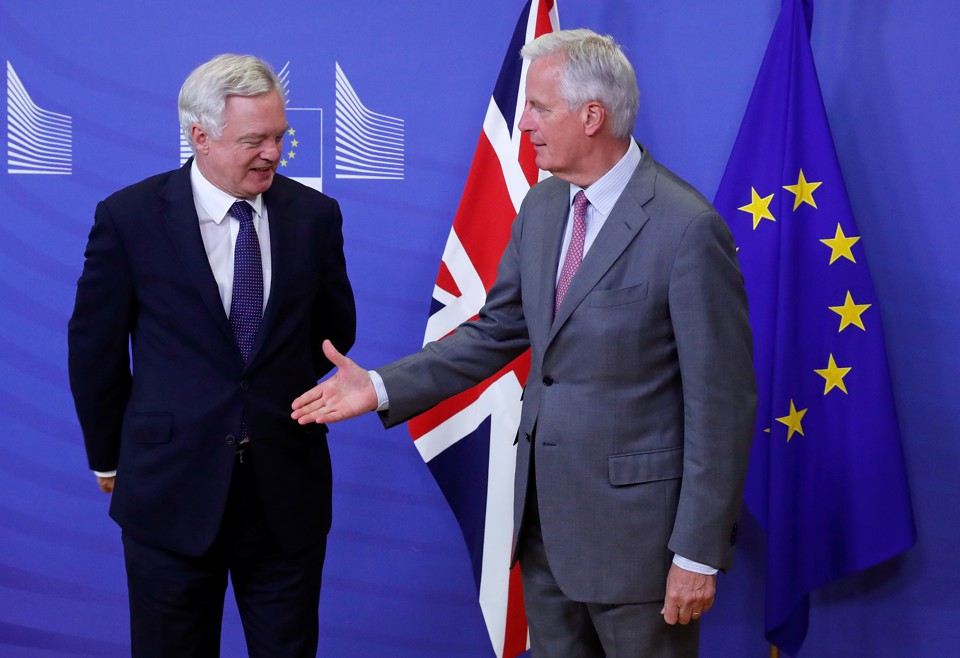
Should the EU agreed to a transit exit period of two years? Which ultimately kicks Brexit down the road.Résultat de recherche d'images pour "pictures of the uk negoiators re brexit"

Should a time-limited prolongation of Union acquis be considered, this would require existing Union regulatory, budgetary, supervisory, judiciary and enforcement instruments and structures to apply.

For the most part there is a shared interest in continuing arrangements, since many nations will not want to lose preferential access terms to the UK.

So yes the EU should grant more time provided the UK continues to meet its obligations.

It is obvious that a clean break without any transit arrangements would be better for both. God forbid we start going down the road of one set of rules for the transit and another set to leave. 

Why ?

Because without England clearly identifying what it wants it to do we are opening a Pandora box.

It is the UK that wants to leave the EU not the other way around.

As I have already said in previous posts only the Lawyers will make hay, never mind the terms for the fish.  They will love a transit period with Tax payers money on both sides flowing into their coffers.  The longer the better.

The EU has it hands tied when it comes to any negotiation because it must reflect the fact that the advantages of EU membership are not available to outsiders.

It may be possible for the EU and UK to collaborate on finding a smooth transition at the WTO. But it will require consensus at some point, a vulnerability open to exploitation. Britain’s most important external agreements — nuclear, airline access, fisheries and financial services are either entirely, or in large part, handled by the EU.

Even if England creates a new trade department, the task of negotiating new free-trade deals and maintaining existing ones will require a huge amount of money and manpower. The civil service and ministers are not even close to being ready to negotiate, let alone implement, new global trading relationships.

The nearest precedent you can think of is a cessation of a country.

Britain will find itself at the diplomatic starting line, with the status quo upended and all sides reassessing their interests. After Brexit the UK will lose more than 750 international arrangements.  Even if it were simple to renegotiate these arrangements, it will open a bureaucratic vortex, sapping energy and resources, creating a huge legal tangle.

The big question is, how will the UK’s political system react once the realization has sunk in about how little the EU will ultimately offer?

What Mrs May really wants is an association agreement.

There is a strong political case for such an association agreement, also from an EU perspective. But I fear that the idea is time-inconsistent. There is no Goldilocks “creative solution”, or a sector-by-sector approach.

Therea

There is no way that the EU will agree freedom of movement for aircraft, for example, but not for passengers.

Businesses need to prepare. Two more years before having to move key employees to European capitals.

The EU only knows a very limited number of external relationships. There is the European Economic Area, the so-called Norway option full EU access in exchange for accepting all EU rules. It’s a member of the European Economic Area (EEA), which means full access to the single market but being under all EU rules.

The other is a customs union agreement — the Turkey option.

The EU will not offer the UK the “Swiss option”. It regrets having offered it to Switzerland.  Then there is the Canada option – It took hundreds of skilled negotiators, dozens of video conferences and seemingly endless days in Brussels to produce the 1,600-page text. Some seven years after Canada and the EU began negotiating a trade deal, the future of the agreement remains shrouded in doubt. The agreement – which has yet to be ratified.

This leaves a single option: a free-trade agreement.

On top of all this the EU is only just starting to talk about institutional reform.

And how can they deal seriously with a government in which the foreign secretary might at any moment move to topple the prime minister to further his own career?

To continental ears, Mrs May’s call for a unique economic partnership sounds suspiciously like another, albeit subtler, attempt for Britain to have its cake and eat it — to retain the privileges but not the responsibilities of EU membership.

The British now believe they have made reassuring noises on money, security and citizens’ rights. But the insistence that the UK will leave the customs union means that it will be hard to point to progress on another issue that the EU deems critical: the Irish border.

The future relationship will need to be based on a balance of rights and obligations. It will need to respect the integrity of the Union’s legal order and the autonomy of its decision-making.

History has the habit of repeating itself,  Britain has been a torn in the side of the EU ever since it joined and English treaties have proven themselves over its history to be not worth the paper they are written on.

Get rid of the Nigel Farage’s, Renew your membership, i.e. stay and fight your quarter, otherwise a Clean Brake would be best for all. Résultat de recherche d'images pour "pictures of eu democracy"

All comments appreciated all like clicks chucked in the bin.

← Back

Thank you for your response. ✨

Share this:

  • Share on WhatsApp (Opens in new window) WhatsApp
  • More
  • Share on Pocket (Opens in new window) Pocket
  • Share on Mastodon (Opens in new window) Mastodon

THE BEADY EYE SAYS: ROLL UP ROLL UP WE ARE ABOUT TO WITNESS THE BIGGEST MONEY FIGHT EVER SEEN. BREXIT IS EUROPE’S LAST CHANCE.

01 Thursday Jun 2017

Posted by bobdillon33@gmail.com in Brexit v EU - Negotiations., Brexit., Elections/ Voting, ENGLAND'S SNAP ELECTION, England., European Commission., European Union., Politics., Post - truth politics., Social Media., The Obvious., Unanswered Questions., What needs to change in European Union.

≈ Comments Off on THE BEADY EYE SAYS: ROLL UP ROLL UP WE ARE ABOUT TO WITNESS THE BIGGEST MONEY FIGHT EVER SEEN. BREXIT IS EUROPE’S LAST CHANCE.

Tags

Brexit v EU - Negotiations., Brexit., ENGLAND'S SNAP ELECTION, European Union, What needs to change in European Union.

( This is a good thirty minute read.)

The weigh in:

In the blue corner we have England wearing sterling.  In the green corner we have the EU wearing euro.

Regardless of whether you like the sport this fight will be contested across social media keeping the audience at a safe distance while making sure that the fighters don’t withdraw/run away from the fight before it is finished.

Round One:

Put simply, Article 50 gives the 27 continuing member states predominant power.

That comes partly from the fact that, according to Paragraph 4 of Article 50, the withdrawing state no longer counts as a member of the European Council for the purpose of the negotiations.  But mainly it comes from the guillotine imposed by the two-year deadline and the requirement for unanimity to extend that deadline.

Clause 4 says that after a country has decided to leave, the other EU members will decide the terms—and the country leaving cannot be in the ring in those discussions.

Britain depends on the EU for half of its exports, while Britain accounts for only one-sixth of Europe’s.  For Britain, this means any deal would be better than none at all. Keeping substantial access to the single market and having strict immigration controls are mutually exclusive for the EU: achieving both is highly unrealistic.

After a lot of shadow boxing T May with a reduced mandate and new shoes dances around the ring avoiding the total financial obligations, which are understood by the EU to be around €100 billion gross, according to an FT estimate.

But add on the negotiations fees etc and Britain is facing a £140 billion (7.5% of GDP) or the equivalent of £300 million a week over eight years.

May said repeatedly that Britain could walk away without a deal and be fine. Instead, a painless exit without a cliff-like effect on trade is only possible with a transitional arrangement. To obtain that, the UK will likely have to pay the €60 billion it owes from its past years of membership, as well as a membership fee for access to the single market.

The EU knows that  the UK is economically more dependent on the EU; 44% of its exports go there and 48% of its foreign investment comes from them.

This is not to mention the potential damage from a loss of passporting rights to the services sector, which makes up for around 79% of UK GDP.

Hence  the UK may try to act tough at the start of fight but eventually will have to compromise to avoid bigger economic fall-outs.

Round Two:

The EU Commission said citizens in the process of acquiring EU rights (such as permanent residency in another country in the bloc) should be allowed to finish doing so, and that the U.K. will be liable for certain financial payments, such as the salaries of British teachers at schools for the children of EU officials, until 2021.

Round Three:

The U.K. remains under the jurisdiction of the European Court of Justice while all pending cases are completed, and the U.K. would not immediately receive upon departure all the capital it has supplied to the European Investment Bank.

The U.K. is a 16 percent shareholder in the EIB and has €39.2 billion locked up in the institution, which often funds projects with a 20- to 30-year timeline. The U.K.’s liabilities should be “decreased in line with the amortization of the EIB portfolio outstanding at the time of United Kingdom withdrawal,” the Commission said.

Round Four:

Any cherry-picking punches are totally against the rules.  “Until it leaves the Union, the United Kingdom remains a full member of the EU, subject to all rights and obligations set out in the Treaties and under EU law.

Round Five:

United Kingdom will be kept separate from ongoing Union business, and shall not interfere with its progress.

The Council states that an agreement on a future relationship between the EU and the UK can only be concluded once the UK effectively leaves the EU and becomes a third country. When the United Kingdom officially leaves the European Union in March 2019, it will still be entangled in the EU’s financial and legal systems for years.

While the terms of divorce can be agreed with a majority vote, the terms of future EU-UK trade relations are very likely to need a unanimous vote.

The deal must be agreed by all 27 remaining countries in the EU. Individual countries can’t veto a treaty governing the UK’s withdrawal from the EU, but could veto a treaty establishing Britain’s new relationship with the EU. It would go ahead if it were approved by 20 of the 27 remaining EU countries, so long as they also represent 65% of the EU population.

Most of the EU’s free trade agreements require a unanimous vote of all EU governments and ratification by all member countries. That’s because they tend to be ‘mixed agreements’, meaning that they cover some ground that the EU doesn’t have power over. That said, it’s possible for the EU to negotiate a trade agreement that can’t be vetoed, depending on what’s in it.

That implies two major agreements: one on the logistics of divorce, and another on trade. (More treaties might be necessary on other issues, like security.)

Round Six:

Compulsory standing count.

Theresa May’s vision is blurred. Polarizing public opinion against the EU and immigration and away from domestic issues was an easy political win.

An independent and truly global United Kingdom without a new customs agreement. Agreements between the EU and third countries or international organisations, for example on trade, would also cease to apply to the withdrawing state, and it would thus need to negotiate alternative arrangements.

Round Seven:

The UK could change its mind about withdrawing from the EU even after triggering the formal process of leaving under Article 50.

Article 50 doesn’t say whether or not a country can change its mind, so it’s arguable either way. Some eminent lawyers think that it can, but there are also those – especially within the EU itself – who argue that once a country has triggered Article 50 it can’t then abort the process without permission.

It would be perfectly possible for the UK to revoke its decision to quit. That Article 50 is silent on the matter of revocation does not mean that a change of direction would be illegal under EU law.

The place this point might be argued, and ultimately resolved, is the EU court in Luxembourg. It’s possible that the UK courts will refer the question to EU judges as part of the ongoing litigation over the role of Parliament in triggering Article 50.

Round eight:

If there’s no turning back from an EU exit once Article 50 is triggered, there would be no point in voting on the terms of a new agreement verses continued membership.

The choice would instead be to take the deal on offer, or reject it and exit with no long-term deal at all.

Round ten:

In the end while us tax payers lose billions, the Lawyers win hands down.

Round eleven:

No deal:

Round twelve:

In their attempt to create a fairer and more equal country, Britons sought to sever ties from what they saw as a weakened partner. The reality is that Brexit will likely make Britain weaker and, ironically, is making the EU stronger.

The irony is that by running away from a European Union they thought was about to fall apart, Brexiteers have instead made it stronger.

Voters in France and the Netherlands are rejecting populism, and politicians in Brussels and Berlin have switched gears towards reforms and pro-EU spending measures.

Round thirteen:

The composition of the EU institutions changes as of the day the withdrawal takes effect, with members from the withdrawing state losing their seats in the various institutions and bodies, although transitional arrangements might be required for the period immediately after that date.

Review of the fight by social media: 

The debts accumulated by the governments of the U.S., Japan, Europe and dozens of other countries constitute a gigantic mortgage on the next two or three generations, as yet unborn.

The Euro corner>Résultat de recherche d'images pour "pictures of the euro"

As it marks its 60th birthday, the European Union is in poor shape. It needs more flexibility to rejuvenate itself.

However, citizens’ trust in the EU has decreased in line with that for national authorities. Around a third of citizens trust the EU today, when about half of Europeans did so ten years ago.

The latest economic and political developments in Europe are a wake-up call for our political leaders to take swifter action in order to strengthen the foundations of our Union.

The deteriorating geopolitical environment makes matters worse. Turmoil and war across the Middle East and in north Africa were one big cause of the surge in migrant inflows.

It is dying financially, with all the debt bankrupting governments, businesses and individuals. It is sinking economically, weighted down with stifling regulations and taxes. It is being strangled demographically, with birth rates far below replacement and the refugee crisis, which saw 1.2 million people coming to Europe in 2015 will only worsen with climate change and current conflicts.

Given the challenges facing the union, the one-size-fits-all model muddling through may no longer be the safest option. Brexit could yet be copied by another member, leading to the slow collapse of the union. A multi-speed Europe or multi-tier Europe could begin to undo the EU.

Few of the 27 EU member countries that will remain after Brexit favour much deeper political and economic integration.

These 27 are integrated into the EU in many different ways: all are in the single market, 26 in the banking union, 21 in Schengen, a different 21 in NATO and 19 in the euro, to list just few examples.

The European continent is home not just to the 28 EU members but 48 countries in all. Those outside the EU aspire to special relations with the club, and some belong to bits of it already.

To cap it all, America’s new president, Donald Trump, has shown himself hostile not just to multilateral free trade and Muslim immigrants but intermittently to the EU, praising Britain’s decision to leave and urging others to follow.

Turkey’s president, Recep Tayyip Erdogan, is turning his back on a club that seems to have rejected his membership aspirations, and is spurning its democratic values as well.

By 2018, around a third of the world’s population will be use social media networks. These trends will only accelerate and continue to change the way democracy works and the way the EU evolves.

A big reason for this is the politics in EU member countries which make it doubly important for Europe to gets to grips with a profound digitisation of society. The EU covers four million square kilometres in which there are 500 million citizens. It is the world’s largest single market with second most used currency. However Europe’s place in the world is shrinking, as other parts of the world grow.

In 1900, Europe accounted for around 25% of global population. By 2060, it will account for less than 5%.

Europe’s economic power is also expected to wane in relative terms, accounting for much less than 20% of the world’s GDP in 2030, down from around 22% today.

Too often, the discussion on Europe’s future has been boiled down to a binary choice between more or less Europe. New global powers are emerging as old ones face new realities and there is none older than England that has voted to leave.

There is also a mismatch between expectations and the EU’s capacity to meet them. The EU approach is misleading and simplistic, for too many> the EU fell short of their expectations as it struggled with its worst financial, economic and social crisis in post-war history. If it is to survive the EU must embrace greater differentiation not closer union or face potential disintegration.

That leaves the second type of response, which is to muddle through. After all, the euro and migration crises seem to be past their worst. Excessive austerity may have done great harm, but outside Greece it is largely over. The single market, perhaps the union’s greatest achievement, has survived the financial crisis and can surely weather Brexit. Domestic security co-operation on terrorism and crime is closer than ever. In foreign policy, EU countries have displayed commendable unity over sanctions on Russia, and have been vital in striking a nuclear deal with Iran.

At the moment more than 80% support the EU’s four founding freedoms.

These might have being the foundations to the EU but there is no getting away from the fact that money was in more ways than one crucial from the very start of the European project.

70% of euro area citizens support the common currency.

The euro zone is now a partial banking union, with a centralised bail-out fund and a European Central Bank (ECB) prepared to act as a lender of last resort.

As economies improve and this year’s tricky elections are negotiated, the union will somehow manage to keep going. If EU leaders want to negotiate revised membership (and all do say they want the UK to stay in), they could do so.

Sterling corner>Résultat de recherche d'images pour "pictures of the pound"

Britain’s richest and privately educated citizens account for 7% of the population yet makes up two-thirds of judges and around half of journalists and members of parliament, according to a government report. Meanwhile, the Child Poverty Action Group estimates that 3.9 million children live in poverty.

The UK ranks second in the developed world for inequality, after the US.

Brexit will not change that, nor will it make Britain more united:

The English patient was sick long before the divorce from Europe.

With an economy focused on finance and services, and highly dependent on foreign investment, the idea of creating a “truly global Britain” isolated from its closest trading partner is economic la-la land.

Brexit is a symptom of Britain’s deeply rooted economic imbalances: a growth model too concentrated on finance and services and dependent on foreign goods, human and financial capital; record-high social and wealth inequality; a lack of investment in infrastructure and education; and monetary and fiscal policies that have helped create a property bubble and excess household debt.

Brexit will not fix the shortfalls of the Anglo-American growth engine, which ran on credit and rising asset prices over the past few decades, disregarding rising inequality, a lack of inclusive access to education and declining social mobility.

General observations :

Article 50 makes life very difficult for any country wishing to withdraw from EU membership.  You might think this deliberate and take it as yet another symptom of perfidious Brussels.  But we should remember that the English Government and parliament signed up to it.

However the design of the euro suffered from two big defects that still haunt the single currency. The euro, in short, remains a troubled currency, with question-marks over both its membership and its direction. There is general agreement that it needs further integration, but disagreement about how to go about it.

The EU’s Institutions, built up over six decades, are not ideally suited to responding flexibly to challenges such as the single currency, migration or foreign and security policy. The European Parliament needs greater legitimacy to influence the European Commission is much more than a civil service; it is the guardian of the treaties, the originator of almost all legislation and the sole executor of the EU’s budget while suffering from having too many commissioners. (28, one per member country)

Terrorist attacks have struck at the heart of cities in the EU last year and will continue to do so while NATO continues to provide hard security for most EU countries.

Europe cannot be naïve and has to take care of its own security. There is no point any longer being a “soft power.

Finally:

The Horizon 2020, in Europe is the world’s biggest multinational research programme.

Maybe there are some things that could be done for the people of Europe that are not directly related to selling stuff?. Real efficiency comes from rethinking systems of bureaucracy from the ground up, not just using less paper.

The greatest task today is to consolidate the free world around Western values, not just interests,””digitizing” and “decarbonising” the economy.

Perhaps the idea of a Continental Partnership.  Might suit the UK.

Such a partnership could offer non-EU countries partial membership of the single market without full free movement of labour, and also create a system of decision-making that gave them an informal say (but no formal vote) in rule-making.

Perhaps this is the winning blow.

In all fights the promoters set the venue not the result.

England would do well to remember that it is not the EU who promoted this fight.

All comments appreciated. All like clicks chucked out of the ring.

Résultat de recherche d'images pour "pictures of boxing gloves"

← Back

Thank you for your response. ✨


Share this:

  • Share on WhatsApp (Opens in new window) WhatsApp
  • More
  • Share on Pocket (Opens in new window) Pocket
  • Share on Mastodon (Opens in new window) Mastodon

THE BEADY EYES OPEN LETTER: CALLING ON THE YOUTH OF ENGLAND AND THE EU.

04 Tuesday Apr 2017

Posted by bobdillon33@gmail.com in Brexit., England., European Union., Modern Day Democracy., Politics., Populism., Social Media., The Obvious., The world to day., Unanswered Questions., What needs to change in European Union.

≈ Comments Off on THE BEADY EYES OPEN LETTER: CALLING ON THE YOUTH OF ENGLAND AND THE EU.

Tags

Brexit., Forthcoming Brexit Negotiations., The European Union, What needs to change in the European union

( A five minute read)

Where are your voices?

The decision to leave the EU affects your future more than anyone, so tell me why you are now so silent.

Luckily the responsibility for the outcome of the next two years negotiations still rests on the shoulders of the British people—and specifically, on the young English people.

Do young Englanders really want to isolate their Island even more from the rest of Europe?

It is now imperative you make your young voices heard on the final deal, if any.

If you do not there is little point sitting on you behinds, chastising older Brits, when less of you voted in the referendum than those who did not.

The 51.9 percent to 48.1 percent was so close – if the rest of you had voted, the outcome could have been very different, and if 16-and 17-year-olds were given the chance to have their say in this momentous decision England would not now be clinging on to its colonial history.

(It seems ludicrous that 16 and 17-year-olds weren’t allowed to vote in the referendum that was going to define much of their future. Truly idiotic.)

There is no such thing as a perfect future or for that matter a correct past but the coming decisions will pitted rich against poor like no other.

So here is my plea to the Youth of England and the Youth of the EU.

If you look at the sign at the entrance of your town and you’ll spot a phrase that goes something like this: “Twinned with.

(Town twinning, as an official relationship-builder, started in Europe after the second world war. The idea was simple: repair damaged relationships between France, Germany and the UK.)

You and your twin share something. A history, some DNA.

You’re twinned for a reason and that reason will be positive if you now twin your efforts to have a final say and vote on the final result.

We have seen in Greece the rise of a far-left government. In Spain, there is a similar upsurge. In France, Marine Le Pen and the Front National are closer to power than at any time previously. In Britain, the anger of the ‘have-nots’ has so far been contained — probably because unemployment has been kept down. But it would only take mismanagement of welfare benefits and an excessively high national living wage to change that.

Clearly not everyone who voted Leave is a racist thicko, just like not every immigrant is a jihadi. There are legitimate concerns on both sides of the debate, but I do not see how it is helpful to characterise millions of people in this way.

It can seem like a language that the privileged use to sneer at the poor: a kind of moral snobbery. A striking social division has been exposed in this vote.

I dont know about you but I’m ashamed that the world of ever-closer union among countries which for centuries would kill each other by the million—came to a shattering end on Thursday.

I am also embarrassed and disappointed that your country has been manipulated by the xenophobic, racist and above all incorrect facts that have been spread by a vocal minority of U.K. citizens.

Business and government officials have long grumbled about EU rules and regulations but the 2008 financial crisis, subsequent economic turmoil, rise of immigration and terrorism and general European malaise accelerated concerns about the relative merits of EU membership, particularly on the political right

British advocates of Brexit argue that issues of sovereignty and self-government should override economic ones but as a generation that is digitally connected to other young people across the world, you should be the generation which understands what the European Union is about more than any other, because you have grown up as European citizens.

So clearly, this all comes down to whether life is better or worse separate from the EU.

It is difficult to foresee any tangible benefits in leaving – economic, political or security –  that would outweigh remaining and helping to reform the EU, unless the EU disintegrates. 

Whatever the outcome of the British and EU negotiations, afterwards Europe will not be able to shy away from a few much-needed debates and significant reforms.

WE ALL KNOW:  WHETHER YOUR ENGLISH, SPANISH, FRENCH OR FROM ONE OF THE OTHER COUNTRIES CURRENTLY IN THE EU, BLACK OR WHITE- MUSLIM OR WHAT EVER RELIGION, THAT THE WORLD WE ALL LIVING IN IS IN A MESS IN MORE WAYS THAN ONE.

Theresa May explains how her government will balance seeking control of immigration and access to the single market

The picture above is not the world. The picture below is the world.Frontiers of Intercultural Clash and Dialogue - Armenia - abroadship.org

We are better together and celebrating our multi-cultural, immigration-shaped society.

This isn’t about saying whether young people in England were right and wrong, but it’s clear that they see themselves as citizens of Europe, and quite possibly the world, rather than the UK.

Is there a future for the European Union?

If so, what is it necessary to do, to give a future to this European Union?

More specifically, what is the role of new generations in the rescue operations and in ensuring continuity to the European project?

In the world we live in, acting alone is neither possible nor desirable.

Total independence from others is not possible, even outside the context of the European project, because in a global world we are all deeply connected. Thus, when dealing with issues that go beyond any single state’s borders, it is in every country’s interests to be able to participate in the international regulation and decision-making process.

Europe is obviously much more than a market, after all; it is a cultural space, simultaneously bemusing and splendidly diverse, complementary and enriching.

Europe is more than “Brussels”.

And Europe is not a bureaucratic monster, not a tribe of petty-minded technocrats making the lives of decent citizens a misery with their rules and regulations, but it will never be possible to preserve all the things we value about Europe without a European political framework.

Capitalism, we should not forget, is still capitalism.

Anyone who believes that the blessings of the market can spare us the hard work of solving political, social and ecological problems, who thinks that a single nation alone can triumph in the arena of global financial capitalism, is making a terrible mistake.

Such a fragile cultural entity as Europe can only survive in today’s world of conflict if it is politically strong and – whatever the differences – fundamentally united.

Is it too much to hope that a continent that has succeeded since 1945 – after two horrific wars – in turning enemies into neighbours and mistrustful neighbours into cooperative partners and sometimes even friends might turn out to be a reliable force for peace in the turmoil of the twenty-first century, a bastion of freedom and democracy, a promoter of fruitful communication with other influential regions?

The political Europe was never the great leveler, and never will be. Its raison d’être is its diversity, its vital energy, its obstinacy.

Europe is not the navel of the world, not the yardstick by which all other regions of the world are to be judged.

Europe is a historic continent, perhaps the historic continent par excellence. What singles Europe out most of all is that all the greatest crimes and mistakes have already been made here, and we Europeans have felt the punishment.

None of our problems can be solved by isolating ourselves or expanding into supposedly empty lands. We cannot just “go west!” Unlike the Americans, we know – even if we sometimes appear to forget it – that we can only live in peace if we also pay heed to the other side’s interests.

Don’t let anyone persuade you that we – the rest of Europe – want to take away your different-ness, your obstinacy, your trouble-making.

We need you in Europe precisely because you are so different from us. And you?

Would it be impertinent to suggest that you need us too, if you are to fulfil your potential? And if that is true – or at least not completely false – would it not be a rather poor idea to abandon Project Europe? I think so.

Of course, if the United Kingdom were to leave the EU, it would still be a member of NATO – and it is noteworthy that precisely its most significant partner in the alliance has stated its preference for a strong and united European Union that can act decisively in matters of security and defence.

Now is not the time to turn inwards.

It is obvious, therefore, that the Eurozone project is not solely a matter of a technical-parametric economic optimum calculation, but primarily a political issue.

So what is ultimately at stake in the Brexit debate?

It is only partially about Britain. A British exit would return the UK to its pre-modern constitution. For the EU, Brexit could favour a rebalancing of EU law in favour of social and environmental rights. But it is more likely that the neoliberal turn in EU law would continue as there are many factors now driving it, separately from British influence.

The EU, as much as the UK, is in need of a constitutional settlement which addresses the risks posed by market fundamentalism.

The notion of regaining sovereignty as a solution to the problems we face as Europeans, and Britons, is an oversimplification on the part of those who believe that it is possible to live in a world that no longer exists.

I am certain that the British do not really want to turn their backs on us continental Europeans after all we have been through together.

Europe is above all an ever-changing cultural cosmos that can only flourish if all its parts are permitted to be themselves. Anything else is codswallop.

If you get any group in society that doesn’t have a voice, they’re always going to feel nervous and out of control for the future.

Its time for the Youth of England with the support of Young Europeans to combine in a movement to be heard.

If not should I comfort myself with the thought that national egotisms and separatists are proliferating in many other European countries too.

Never. I deeply love the world, but it would be nothing without its people. Résultat de recherche d'images pour "pictures of beautiful eyes with tears"

All the selfies, or social media won’t make you a better person, or help you with a fantastic opportunity to engage with politics and have your opinions heard.

Let’s call it Smart by not leaving it to Money, Profit, Arms Sales and I am all right Jacks to shape our lives.

← Back

Thank you for your response. ✨


Share this:

  • Share on WhatsApp (Opens in new window) WhatsApp
  • More
  • Share on Pocket (Opens in new window) Pocket
  • Share on Mastodon (Opens in new window) Mastodon

THE BEADY EYE ASKS: CAN ENGLAND BE PROUD AS IT EXITED THE EUROPEAN UNION.

27 Monday Mar 2017

Posted by bobdillon33@gmail.com in Brexit.

≈ Comments Off on THE BEADY EYE ASKS: CAN ENGLAND BE PROUD AS IT EXITED THE EUROPEAN UNION.

Tags

Brexit., Forthcoming Brexit Negotiations.

( A three minute read)


Résultat de recherche d'images pour "pictures of the uk brexit negotiator"

To morrow is yet another day in the history of England and there are many of them that it can be proud of.

However I am sure that there will be many a brave world war two soldier moaning in their Normandy grave, not forgetting the 22 million Russians and 4 hundred thousand Americans, a mere 48,231,700 approx in total. 

Peace and freedom in Europe is what they sacrificed their young lives for.

Theresa May may well represent THE 3.8%  majority of I am all right Jack that voted to leave and of course we are all entitled to think what we want about the EU as an Institution that is just 60 years in the making.

Of course during the next two years we will be treated every day 7/7 with the spectacle of both sides washing their dirty linen on Social Media and the altar of economics.

We will be told the UK is not leaving Europe but reestablishing itself as a nation.

Which is true but not united.

O Yes there are lots of problems with The EU and the reality is far from the idea of Peace, as the idea has being kidnapped by a political class that has long-lost touch with the very people THEY ARE SUPPOSED TO REPRESENT  but there is little point in listing them all here, because Brexit will no doubt shine a spotlight on all of them.

Will Brexit make any difference, I doubt it will.

You could be cynical and say that Wars other than in Europe happen anyway, but without some Unity there will never be peace in the world.

We can only build a future with common core values, not with Artificial Intelligence, not with globalisation, not with capitalist greed, not with arms sales, not with inequality of opportunity, not with trade barriers, not with segregation, not with religion, not with corruption, not with un elected government officials, not with loans, not with austerity, not with growth at all costs, not with the loss of identity, not with people sleeping rough, not with unfair taxes, not with no dignity in death and illness, not with past history or 48,231,700 and certainly not with an Island full of I am alright Jacks.

WE ALL KNOW THIS:

My advice would have been to stay and fight, even with all that is and will be wrong with the EU in the future.

The question now is: Who is really taking control.

Germany will “win the peace” in Europe as a result of Brexit.

England will see a power grab.

“Henry VIII clause” giving ministers sweeping powers to decide what to keep, without normal parliamentary scrutiny – named after a 1539 Act handing the king power to legislate by proclamation.

The devil will be in the detail

EU’s enormous untapped potential. It marks a new stage in the Europe’s evolution – a denial of understatement in favor of inspiration and engagement.

All comments appreciated. All like clicks chucked in the bin>

← Back

Thank you for your response. ✨

Share this:

  • Share on WhatsApp (Opens in new window) WhatsApp
  • More
  • Share on Pocket (Opens in new window) Pocket
  • Share on Mastodon (Opens in new window) Mastodon

THE BEADY EYE ASKS: WHO IS GOING TO PAY FOR BREXIT.

17 Friday Mar 2017

Posted by bobdillon33@gmail.com in Brexit., England., European Union.

≈ Comments Off on THE BEADY EYE ASKS: WHO IS GOING TO PAY FOR BREXIT.

Tags

Brexit., European Union


( A TWO MINUTE READ: THAT WILL SAVE THE EUROPEAN UNION BILLIONS)

Button 50 might not be nuclear but it will have collateral damage to revile one.

It is the greatest disaster to befall the European Union in its 59-year history.

Theresa May vows if EU tries to ‘punish’ Britain we will walk away WITHOUT a Brexit deal (Photo: Getty)

The economic consequences for the UK from leaving the EU are complex.

You don’t have to be a genius to recognise THAT to unscramble 40 years of European integration is going to cost sheds loads of loot – euros and sterling. 

The total bill kicked around at the moment is estimated to be between €40 billion (£34 billion) and €60 billion (£52 billion).

We all know what happens with estimates.

All 28 member states have to unanimously agree to the terms of a deal meaning the negotiations could take years.

In the meantime Britain is still bound by the obligations and responsibilities of EU membership.

ARE THEY INDEED.

Theoretically, there is nothing to stop a British Government unilaterally withdrawing from the EU by simply repealing the 1972 European Communities Act. Article 50 compels only the EU to seek a negotiation, not the withdrawing member state.

Triggering Article 50, formally notifying the intention to withdraw, starts the clock running. After that, the Treaties that govern membership no longer apply to Britain.

At a glance | What is Article 50?

  • Article 50 of the Treaty of Lisbon gives any EU member the right to quit unilaterally, and outlines the procedure for doing so
  • There was no way to legally leave the EU before the Treaty was signed in 2007
  • It gives the leaving country two years to negotiate an exit deal
  • Once set in motion, it cannot be stopped except by unanimous consent of all member states
  • Any deal must be approved by a “qualified majority” of EU member states and can be vetoed by the European Parliament
  • In November 2016, the High Court ruled that the Government cannot trigger Article 50 without MPs voting on the matter first. The Supreme Court upheld the ruling in January 2017

Under the Vienna Convention, the termination of a treaty “releases the parties from any obligation further to perform the treaty”.

Furthermore under EU’s own laws mean there is no “legal obligation” to cough up any cash if no deal is struck.

THERESA MAY can walk away from the EU without paying a penny of the Brussels’ £50-£60 billion divorce bill.

European Union and the Union flag sit on top of a sand castle

The EU will lose more than just economic and political strength — it will also see billions of euros disappear from its budget. Net revenues that flow into the EU from Britain each year range from 14 to 21 billion euros. If you subtract the money Britain gets back from Brussels, the EU budget would shrink by up to 10 billion euros per year.

Of course, there is a lot of money at stake.

HOWEVER THERE IS ONE THING THAT IS FOR SURE.

THE EU MOST INSURE THAT IF THE UK LEAVES OR NOT, ENGLAND MUST FOOT ALL THE BILLS THAT ARE DIRECTLY INVOLVED WITH THE PENDING NEGOTIATIONS. 

AFTER ALL: NONE OF THE COST INVOLVED ARE A RESULT OF ACTIONS TAKEN BY THE EU.

Not to demand so would be act of calamitous self-harm.

Ongoing spending commitments -Being without legal precedent, there is no simple answer to whether the EU Treaty, to which all members are signatories, or the secondary legislation arising from it, would apply to a state that is leaving.

 Legally, the UK’s obligation to these payments or others is unclear.

IN THE MEANTIME IT IS THE DUTY OF THE EUROPEAN PARLIAMENT TO PROTECT THE INTERESTS OF THE CITIZENS OF THE EU.

We all know that the EU is in need of radical change.

ONCE MRS MAY ENACTS ARTICLE 50 BEFORE ANY NEGOTIATIONS OR TRANSITION DEAL THE EU MUST PUT IN PLACE A TOTALLY TRANSPARENT COSTING AND REMUNERATION PACKET.

Agreement on this WILL be needed before talks over trade deal negotiations begin.

The member states will be forced to negotiate the bloc’s finances at the same time they begin Brexit negotiations. But how will Brussels be able to determine its budget without knowing how much the British government will be paying into it?

Britain needs to define its position concerning the direct costs before any kind of future relationship the British will seek with the EU.

That, though, will determine the price of future ties NOT THE COSTS OF SEPARATION.

The main thing, in my opinion, is that Brexit is an opportunity to reform the Union in a way which will make it more effective and stop countries wanting to break away.

On March 25, 2017, European leaders will mark the sixtieth anniversary of the signing of the Treaty of Rome, the EU’s founding document. It will be a fraught celebration.

The EU Treaties would also need to be amended to reflect the UK’s departure. In effect, this means that the final deal at the end of a negotiated UK exit from the EU would need to be ratified by EU leaders via a qualified majority vote, a majority in the European Parliament and by the remaining 27 national parliaments across the EU.

Life goes on,

EU and GB flag face paint kiss

It is almost certain that we will end up with no deal.

All comments appreciated. All like clicks chucked in the bin.

← Back

Thank you for your response. ✨

Share this:

  • Share on WhatsApp (Opens in new window) WhatsApp
  • More
  • Share on Pocket (Opens in new window) Pocket
  • Share on Mastodon (Opens in new window) Mastodon

THE BEADY EYE ASKS: WHAT ARE OR WILL BE THE HARD FACTS RE BRIXIT.

17 Tuesday Jan 2017

Posted by bobdillon33@gmail.com in England EU Referendum IN or Out., England., European Union., Modern Day Democracy., Politics., Social Media., The New year 2017, Unanswered Questions.

≈ Comments Off on THE BEADY EYE ASKS: WHAT ARE OR WILL BE THE HARD FACTS RE BRIXIT.

Tags

Brexit., Britain., European Union

( A troubling seven minute read)

Afficher l'image d'origine


Since ancient times, philosophers have tried to devise systems to try to balance the strengths of majority rule against the need to ensure that informed parties get a larger say in critical decisions, not to mention that minority voices are heard.

The Brixit vote is a case in kind.

Originally the European Community was supposed to be a trade agreement to ease all the tariffs and taxes, lower the cost of goods and improve the efficiency of the European member’s economies.  The British voted overwhelmingly voted yes by 67.2% (historic high) for this in 1975.

The real lunacy of the United Kingdom’s vote to leave the European Union was not that British leaders dared to ask their populace to weigh the benefits of membership against the immigration pressures it presents. Rather, it was the absurdly low bar for exit, requiring only a simple majority. Given voter turnout of 70%, this meant that the leave campaign won with only 36% of eligible voters backing it.Prime Minister Theresa May plans to trigger article 50 by the end of March.

Does the vote have to be repeated after a year to be sure? No.

A parliamentary petition for a second referendum has attracted more than one million.

Does a majority in Parliament have to support Brexit? Apparently not.

Did the UK’s population really know what they were voting on?

Absolutely not. Indeed, no one has any idea of the consequences, both for the UK in the global trading system, or the effect on domestic political stability.

This isn’t democracy;

Mrs May’s phrase “Brexit means Brexit” has become a tired cliché.

What exactly, is a fair, democratic process for making irreversible, nation-defining decisions?

Is it really enough to get 52% to vote for breakup, in a country that has three devolved parliaments that voted to stay in.

The idea that somehow any decision reached anytime by majority rule is necessarily “democratic” is a perversion of the term.

Modern democracies have evolved systems of checks and balances to protect the interests of minorities and to avoid making uninformed decisions with catastrophic consequences. The greater and more lasting the decision, the higher the hurdles.

The current international standard for breaking up a country is arguably less demanding than a vote for lowering the drinking age.

What we do know is that, in practice, most countries require a “supermajority” for nation-defining decisions, not a mere 51%. There is no universal figure like 60%, but the general principle is that, at a bare minimum this would be the required percentage.

Brexit should have required, say, two popular votes spaced out over at least two years, followed by a 60% vote in the House of Commons.

In this way if Brexit still prevailed, at least we could know it was not just a one-time snapshot of a fragment of the population.

The current norm of simple majority rule is, as we have just seen on TV with her speech on what Britain wants in the upcoming negotiations is a formula for chaos.

I am afraid it is not going to be a pretty picture.

Talks on Britain’s political divorce from the EU and a possible free trade agreement are going to be complex, lengthy and difficult.

So difficult that there will be no agreement that will satisfy both sides.

You don’t have to blind and deaf to realize that The European Union is an economic and political union between 28 member countries that covers more than four million square kilometres.  It spans countries with more than 508 million citizens, which means it has the third largest population in the world after China and India.

Turkey and the Balkan states of Macedonia, Montenegro, Serbia and Albania are now the next in line to join the EU. In addition, Kosovo and Bosnia and Herzegovina have also been promised the prospect of joining when they are ready to. Turkey, alone would add an additional 75 million EU citizens.

The new unelected Prime Minister Theresa May plans to trigger Article 50 – the step that starts the timer on two years of Brexit talks – by the end of March 2017.

Britain, I believe, had the best of all possible deals with the European Union, being a member of the common market without belonging to the euro and having secured a number of other opt-outs from EU rules. And yet that was not enough to stop the United Kingdom’s electorate from voting to leave. Why?

There is no doubt many in England feel the EU is a “bureaucratic monstrosity”, But what exactly do they mean by this? But most of these relate to the terms of UK membership of the Single European Market, where standardisation is needed to ensure a level playing field for trading nations.

None of these, it seems to me, are reasons to go to war with Europe, and deny the benefits of the single market which has undoubtedly boosted prosperity. Trade within Europe has doubled since 1992, thanks to the abolition of tariffs and barriers to the free movement of goods and services in Europe.

What has changed?

European Union (EU) has remained at heart undemocratic, protectionist, centralist and over-bureaucratic.  The EU launched a single currency and the organization now acts as a parliament passing regulations and laws while maintaining an overblown and expensive bureaucracy.

Simply put, unless there was uniformity across all member countries, the aspiration of a single currency and economy, could never hope to be realised.

Here are some hard facts:

What happens if Britain votes for Brexit?

On the day of Brexit, the Great Repeal Bill will come into force and end the supremacy of EU law over Britain’s own legislation.

SNP leader Nicola Sturgeon has raised the prospect of a second Scottish independence referendum because most Scots voted to remain in the EU.

Spain’s Government has also called for joint control of Gibraltar and Sinn Fein has demanded a vote to unite Ireland and Northern Ireland.

There is ongoing uncertainty over what will happen once Britain leaves the EU because it has to make new trade agreements with the rest of the world. Under EU rules the UK cannot negotiate a trade deal until after it leaves the bloc.

The Brexit vote has led to higher import costs but was good news for exporters who had struggled with the high value of the pound.

Now Britain has voted to leave the EU, it will no longer have to contribute billions of pounds a year towards the European Union’s budget.

Britain is now free to take back control of its borders in order to curb immigration and increase security. The UK will no longer have to accept ‘free movement of people’ from Europe if this country leaves the EU’s single market.

Companies based in the UK may decide to relocate if they can no longer access the single market.

Eurosceptic populist parties across the Continent have delightedly seized on Brexit in an attempt to further their own campaigns for independence.

Scare tactics and rumours will intensify from both sides and it will be hard to find clarity.

As a result Brexit negotiations will be made more difficult because EU bosses will want to discourage other countries from following suit.

It looks just as likely Scotland Wales and Norther Ireland that voted to stay could find themselves out of the EU by staying in the UK.

The EU has said that Britain will have to allow the free movement of EU workers if it decides to stay in the internal market. Mrs May looks set to take Britain out of the EU’s single market in order to end the free movement of EU workers that goes with it.

There will be a saving ( depending on which contribution figures you believe of about £136m a week. This equates to  less than 40% of the amount splashed on the battlebus.

MAP

You may rest assured no matter what way these negotiations go they will be very expensive (both politically and economically)  and they will  “mostly amount to hot air”, rather than concrete plans for the future of the European Union or the United Kingdom’s.

“Whatever the UK vote is in the end , we must take long hard look on the future of the European Union.

The election of Donald Trump as the next US President means that Britain is now at the “front of the queue” for an US trade deal. If you believe that

june-in-review-3.jpg

May also said that “no deal for Britain is better than a bad deal for Britain.”

Making threats to the rest of Europe and cozying up to Trump (I hope she wears a cricket box for that first meeting).

It’s the sheer arrogance of the current government to say it’s all about taking back control of our borders and laws.’

Having her cake and eating it. Not on your nanny.

There will be what the EU want and you can bet your life they have their demands.

And if she isn’t going to have her own way – and for the ‘no deal is better than a bad deal’ yeah – try to get those FTA’s if they know you’ll walk out of them when your toys thrown out of the pram – that means anything she signs isn’t worth the paper it’s written on.

Ignoring the fact that, schools and hospitals struggling with budget cuts , a pound worth 20% less than it was in June 2016 and a Scotland that would appear to be now set yet again on the road to independence.

I think the cleaner the break the better.

Change hurts and change is happening at a faster rate than ever before.

In effect you are being sold down the river. Your lives have now been designated as “negotiation capital”. Britannia does not rule the waves. Afficher l'image d'origine

← Back

Thank you for your response. ✨


Share this:

  • Share on WhatsApp (Opens in new window) WhatsApp
  • More
  • Share on Pocket (Opens in new window) Pocket
  • Share on Mastodon (Opens in new window) Mastodon

THE BEADY EYE SAYS: IN FIVE YEARS, THERE WILL NO LONGER BE A ROYAL FAMILY OR UNITED KINGDOM.

09 Monday Jan 2017

Posted by bobdillon33@gmail.com in Brexit., England., European Union., Modern Day Democracy., The New year 2017, What Needs to change in the World

≈ Comments Off on THE BEADY EYE SAYS: IN FIVE YEARS, THERE WILL NO LONGER BE A ROYAL FAMILY OR UNITED KINGDOM.

Tags

Brexit., Britain., England EU Referendum IN or Out., Royal Family

( A three-minute read)

The UK anthem got me thinking…

If you were starting a 21st-century democracy from scratch you wouldn’t

dream of having a hereditary head of state.

These days this is undoubtedly true, it is also true that the history of the past 50 years ago shows that starting democracies from scratch is very hard.

“Is there any point in the Royal family?”

The Royals represent and reiterate that the class system is still firmly in place in the UK.

If the monarchy is to continue in modern Britain they will have to adapt and change. The modern Royal Family must continue to live more in touch with their subjects if they are to survive as an institution in a democratic 21st Century Britain.

Leaving the EU won’t affect the Royals it will however change the Brit culture and add much-needed collective synergy aspiring for common aims.

So is a Royal Family still relevant today, it’s all about equality, and right now, so are they just a parasitic anarchic family blessed with vast riches, or are they essential to a country with no written constitution.

It is hard to shake off the debilitating tag when the head of state and her hangers-on attain their positions not through popularity, talent, or industry, but by the mere fact of their birth.

Presently England is recognized as a monarchy…BRITS ARE SUBJECTS OF THE MONARCH. Ultimately the Parliament and the army are under the control of her highness.

The Royal family aren’t elected, which can be seen as undemocratic.

They inherit their status and for this to apply to a nation that’s so heavy on encouraging democracy it may be seen as hypocritical.

They cost the taxpayer approximately 52p each year

Queen Elizabeth II, is the legal owner of about 6,600 million acres. The value of her landholding. £17,600,000,000,000 (approx). She is the only person on earth who owns whole countries, and who owns countries that are not her own domestic territory.

The Queen may be a constitutional monarch, in which her roles as the head of the state are mostly just symbolic, as she occasionally represents Britain in her state visits – so her holidays are covered as well?

Royalists will say that having a Monarchy makes no difference to the validity of democracy. Just so long as the Monarchy doesn’t interfere with the democratic process of the nation then they are nothing more than national figureheads with no real power or influence.

This may well be so.

Yet in theory, at least, she has considerable powers: to wage war, sign treaties, dissolve Parliament, and more.

They will also say that the monarchy is needed for tourism and the economy. That’s NOT what it’s there for. It’s there for political reasons.

To keep Britain’s monarchy does not entail keeping it in its current form. Britain would be a lot stronger if its head of state were elected.

Why?

Because its entangled history of democracy and monarchy has left Britain with a highly centralized constitution that locates the nation’s sovereignty in “the king in parliament”—a situation that gives the leader of the majority party in the legislature a disturbingly large part of the power that was once vested entirely in the monarchy.

This situation could be remedied quite easily by keeping the crown but changing its constitutional basis to one along the lines of that most excellent of countries, Belgium.

Belgium is a popular monarchy. Its constitution makes clear that sovereignty rests in the people; the King (or Queen, though it has yet to have one)—who is King of the Belgians, a people, not Belgium, a territory— becomes monarch not by right, but by taking an oath to uphold the people’s constitution.

Without a written constitution the question is: Who elected the royal family, they are self-made, what makes them royal? After all, basically, they are German immigrants.

I have nothing against them personally, as I am a humanist at heart and these people are simply other human beings born into their roles.

Britain has a class system which, to be honest, is going to rip that country apart and the royal family is a symbol of that class system and the divide will ultimately dissolve.

All that says;

They are just some human beings, related to every other living organism on our Earth in some way. The fact that a monarchy is not intellectually justifiable does not mean that it does not have a stabilizing role.

To have a real sovereign Nation you need to be free of the monarchy in order to be truly free. To bow down and call somebody ‘your highness?’ It doesn’t make sense to me.

The case against hereditary appointments in public life is straightforward: they are incompatible with democracy and meritocracy.

The second pitfall is subtler: in the belief that the monarchy forms some kind of constitutional backstop against an over-mighty Parliament, Britain is strangely relaxed about the lack of serious checks on its government.

Because it has no written constitution; the current government has plans to repeal a law implementing the European Convention on Human Rights, which many Britons recklessly consider a nuisance rather than a safeguard.

A change to the British constitution which made the kingdom’s various people’s sovereign and the head of state the guardian of that sovereignty, not the source of it, would be a welcome plank in the more general program of reform that the British state clearly needs. The trouble with hereditary succession and leaving the European Union is that you never know quite who or what you’re going to get.

The fourth verse of the UK anthem reads “rebellious Scot to crush” just thought that’s worth mentioning! The Royal family was the most ruthless biggest crooks at some point.

Pressing Articular 50 to disconnect from the EU in a world that is all about connectivity to my mind is Artificial Intelligence personified.

← Back

Thank you for your response. ✨

Share this:

  • Share on WhatsApp (Opens in new window) WhatsApp
  • More
  • Share on Pocket (Opens in new window) Pocket
  • Share on Mastodon (Opens in new window) Mastodon

THE BEADY EYE ASKS: IS THE EU GOING TO FIND IT CHALLENGING TO PRESENT A UNITED FRONT TOWARDS THE UK EXIT NEGOTIATIONS.

04 Wednesday Jan 2017

Posted by bobdillon33@gmail.com in Articular 50., Brexit., England EU Referendum IN or Out., European Commission., European Union., Modern Day Democracy., The New year 2017, The world to day., Unanswered Questions.

≈ Comments Off on THE BEADY EYE ASKS: IS THE EU GOING TO FIND IT CHALLENGING TO PRESENT A UNITED FRONT TOWARDS THE UK EXIT NEGOTIATIONS.

Tags

Brexit., European Union

( A six-minute read)
It’s not long now before we are going to witness two events that will shape the future.Afficher l'image d'origineI am not talking about climate change or Artificial Intelligence rather the arrival of Donald Trump and the beginning of the UK negotiations to leave the EU.

There is little point in addressing the Donald Trump scenario.

A stupid, crass, vile racist, unintelligent, thug that is the laughing-stock of the world will be the US President with his finger on the red button.

What to expect is anyone guess.

If you ask me about 30%+ of Americans live in an alternate, non-fact based reality in which Right-Wing Propaganda is FACT, Lies = Truth.

“My Twitter has become so powerful that I can actually make my enemies tell the truth.” or  “I’ve said if Ivanka weren’t my daughter, perhaps I’d be dating her.

In a weird way both events are connected by Artificial Intelligence/ Money.Afficher l'image d'origineAfficher l'image d'origine

One elected with False Twitter News and the other Nigel Farage fooled the English electorate to vote out of the EU with a pack lies.

Anyway back to the Question:

Until its official withdrawal, the UK will remain a fully fledged member state. However, UK involvement in EU decision-making will quickly become marginal.

UK officials in top management positions will likely have to leave.

(1,126 British nationals are employed in the European Commission (3.8% of the total. 73 British MEPs sit in the Parliament (out of 751 in total). Three EP committees have British chairs: Development; Internal Market and Consumer Protection; and Civil Liberties, Justice and Home Affairs.)

Of course the EU is going to find it, if not impossible to negotiate with the UK.

Because the meaning of Brexit is yet to become clear to the Uk and the EU.

The UK wants to keep the trade relationship with EU members as it is today (free trade) but significantly change the rules surrounding the free movement of people between the EU and the UK.

The real problem, however, is that when you think about the interests and constraints of both sides, it becomes hard to envision any deal that all parties can accept — unless UK negotiators are able to go back to their constituents and sell a deal that falls well short of what was initially promised.

On the EU side, Brexit will change how EU institutions operate not just during the withdrawal period, but also afterwards. It will affect the balance of power among member states and therefore the policies that the EU would pursue.

Depend on the answers, the Union finds to its current crises – stabilising the euro, finding a common line in refugee policy, stemming the surge in Euroscepticism – and on its economic recovery.

Hardening European attitudes is that they do not want to encourage copy-cat referenda in their own countries.

If an agreement is reached, the treaties that currently govern the relationship between the EU and the UK (as a member state) will expire. If no agreement is reached, the treaties will automatically expire two years from when Article 50 was invoked.

 How will the UK and EU negotiate their split?
Afficher l'image d'origine

It’s important to remember that:

The British referendum is not legally binding: The UK government must initiate “Brexit” by invoking Article 50 of the Treaty on European Union.

It’s also important to understand:

That any agreement will need to be ratified by the parliament of every member state, which means every EU country would have a veto. From a negotiation perspective, this not only increases the amount of time needed to reach a comprehensive agreement but also lessens the likelihood of a deal. At least 65% of the population of the EU, must vote in favor of the agreement.

The most immediate and important challenge is to reach a new agreement covering economic relations with the EU. In addition, as a member of the EU, the UK participates in the EU’s trade agreements with non-EU countries: leaving the EU may force the UK to renegotiate these agreements. The EU may not prevent the UK negotiating and entering into such treaties providing that they will not come into force until the UK withdraws from the EU.

There’s an infinite number of potential outcomes in a negotiation like this.

There is also an option of extending negotiations beyond the two-year time limit, but it requires the consent of all countries in the EU.

The UK will have to ask for what it wants in ways that allow the EU to make concessions without setting dangerous precedents.

If no agreement is reached within two years and the EU treaties expire, the default is that the UK and EU would trade according to World Trade Organization rules. Notably, these rules cover only trade, not the many other issues the two sides need to negotiate.

As there is no precedent it is important to bear in mind that the internal process on the EU’s side of the table is itself being negotiated.

No matter what it means the UK is starting from a weak bargaining position.

The UK is due to hold the EU’s rotating presidency from July to December 2017.This will become not only politically untenable. Article 50 disqualifies the UK ‘from chairing any Council meetings on the withdrawal negotiations.

Since the UK joined the EU in 1973, trade policy has played a minor role in UK politics. Now its on the top of its negotiations to leave the EU.

I find it hard to believe that back channel conversations are not under way.

The UK needs to reach some kind of deal with the EU before Brexit happens and puts it in a weak bargaining position.

Brexit could or will alter the balance of power within the EU in other ways too. It could strengthen Germany’s position, shift alliances, and potentially either strengthen or weaken smaller states.

It will result in an increased regulatory burden on EU businesses weaker copyright protection in the EU. A smaller EU budget as a whole, with increased member-state contributions A stronger push for tax harmonisation and higher taxation of financial transactions A less support for nuclear and unconventional energy sources (e.g. shale gas).

The EU is based on the idea of a single market, characterized by four freedoms. They are the free movement, across borders, of goods, services, capital, and people.

( It is estimated that there are currently 2.9 million EU nationals resident in the UK.)
The actual position of such individuals is underpinned by the Human Rights Act and will depend on length of residence and other factors, but Government intentions for both UK and EU citizens remain far from clear.

Brexit could have a domino effect whereby Eurosceptic forces in countries such as Denmark, Austria and Sweden follow the UK and hold their own referenda,

eventually leading to the EU’s disintegration. Should Britain thrive post Brexit,
while the EU stagnates economically, such centrifugal forces would be strengthened.

Given the fact that a “no deal” is possible and that a deal might disappoint UK voters anyway, might there not be a path toward reversing Brexit? There may come a time when the only outcome that allows all parties to declare victory entails no Brexit.

Other member states will find any UK attempt to push a specific policy agenda unacceptable and would be unwilling to accommodate UK interests.

And of course there is the question of how do you do a deal when there remains the question of whether the UK has a prime minister with a mandate. Will a general election will be required prior to any agreement?

The UK is one of the leading Member States in securing funding for research and innovation and various other projects, with a typical aggregate value of £1-1.5 billion per year.

European Agricultural Guarantee Fund: The UK has been allocated €22.5 billion for the period 2014-20.

European Structural and Investment Funds: The bulk of UK funding via this channel comes through the European Regional Development Fund (ERDF), which has been allocated €5.8 billion of EU funds and the European Social Fund (ESF) with an allocation of €4.9 billion.

There is one thing for certain: We are going to witness opportunists counting their fingers after shaking hands with another opportunists.

All comments welcome. All likes chucked in the bin.

← Back

Thank you for your response. ✨


Share this:

  • Share on WhatsApp (Opens in new window) WhatsApp
  • More
  • Share on Pocket (Opens in new window) Pocket
  • Share on Mastodon (Opens in new window) Mastodon

THE BEADY EYE SAYS: SINCE SHE ARRIVED AT NUMBER 10 MRS MAY HAS COST ENGLAND BILLIONS.

29 Saturday Oct 2016

Posted by bobdillon33@gmail.com in Brexit., European Union., HUMAN INTELLIGENCE, Politics., Unanswered Questions.

≈ Comments Off on THE BEADY EYE SAYS: SINCE SHE ARRIVED AT NUMBER 10 MRS MAY HAS COST ENGLAND BILLIONS.

Tags

Brexit., England., Theresa May Artifical Intelligence.

(A three-minute read)

She has so far defined herself more in words than deeds.Afficher l'image d'origine

She has – at least in words, we will see about the reality – junked the austerity agenda.

Mrs May has had just over 100 unelected days in Number 10, during which she has done a deft job of obscuring her vulnerabilities by projecting herself as a fresh yet solid leader serenely stepping in to take charge.

Lunch with Theresa May?  That will be £3,150.  Value for money.

Let’s look at it using the background of  Britain’s record national debt, which just surpassed £1.8 trillion, (The truth however is much worse, factoring in all liabilities including state and public sector pensions, the real national debt is closer to £4.8 trillion,) some £78,000 for every person in the UK.

If you lay £5 notes on top of each other they would make a pile 253,568 km, or 157,560 miles high!

Interest per Year  £41,230,597,671

Interest per Second£1,307

Debt as % of GDP 83.49%

The budget deficit already stands at approximately 4% of GDP and, at that level; any fiscal expansion could cause a fall in international confidence.

Hinkley Point:

In 2013 the English Government guaranteeing the EDF it would be paid £92.50 per megawatt-hour for the electricity generated by Hinkley Point over a 35-year contract due to run between 2025 and 2060. This is more than double the current annualised rate for wholesale electricity prices. It means that Hinkley Point should generate between £100bn and £160bn of revenue in cash terms for EDF and CGN over 35 years. The £92.50 figure is based on 2012 prices but it rises each year in line with inflation.

EDF is funding two-thirds of the project, which will create more than 25,000 jobs, with China investing the remaining £6bn for 7% of Britain’s electricity needs.

The government will also take a special or “golden share” in all future new nuclear projects. This will ensure that significant stakes cannot be sold without the government’s knowledge or consent.

The plan to build the two EPR units for £18bn (€21bn, $24bn) at Hinkley Point was hit with an unexpected delay in July as the new UK government decided to hold another review only hours after EDF – the project’s state-owned French developer – had given it the go-ahead.

EDF executives told the British government that it would have to take a stake of up to £6bn in the Hinkley Point nuclear power station to avoid a “disaster” if the Chinese decide to withdraw from the project who warning that if the plug was pulled on Hinkley Point it would damage the relationship between England and China.

If the state-backed company manages to build the power station and get it running by the target date of 2025, EDF and its Chinese partner stand to generate a profit of tens of billions of pounds on the £18bn project when it start operations in 10 years time.

The UK government says it will have control over foreign investment in “critical infrastructure”. So far £2.5bn  has being spent on site preparatory work.

Her first ( G20 summit) changed any doubts she had.

Bonkers.

Replacing Trident:  

Will cost at least £205bn.

£205 billion of public money is a huge amount. Pouring it into a nuclear weapons system that experts say could be rendered obsolete by new technology is hardly a wise choice. Far better to spend it on industrial regeneration, building homes, tackling climate change or meeting our defence needs in usable ways.

The cost of disposing the existing Trident fleet would be at least £13bn in today’s prices.

 Two new aircraft carriers.

HMS Queen Elizabeth was launched in July — are the most expensive items of military kit in the British armoury, at a cost of £3.1bn each, considerably more than originally budgeted for.

Their usefulness will also depend on a host of other additional spending commitments, such as the number of new F35 jets that will be flown off them or the number of other Royal Navy ships that can be deployed to protect them.

So far eight of the F-35B Lightning jets EACH plane costs £100 million have being ordered and if sterling weakens price will go up.

The overall order is for 48 of the jump jet F-35Bs by 2023 and will eventually go on to buy a fleet of 138.

The US-built F35s have spiralled in cost and have been beset by serious technical problems in development.

Bonkers.

Next:

HS2:

The zombie train that refuses to die, a project born of political vanity not rooted in commercial reality or value for tax payers money.

The UK currently has just 113 km of high-speed rail line.

It will mark the start of the most extravagant infrastructure project in Britain’s history: High Speed 2, a railway line running 335 miles from London to Birmingham, Manchester, Sheffield and Leeds. The line is budgeted at £55bn, although late last year its cost was widely reported to be closer to £70bn.

The whole concept of HS2 came out of intense political lobbying from the construction industry who want to build it. Those same firms have since been hired to produce the designs and budgets, and this has made sure HS2 has been gold-plated right from the start. HS2 is just one big gravy train for advocates with massive vested interests.

If it is built, HS2 would be the most expensive railway in the history of the world, surely sucking up the entire rail infrastructure budget for decades to come, and squeezing out more deserving, cheaper and cost-effective projects.

The UK’s cost per km is the highest among any of the major high-speed rail countries – with HS1 costing £51.3m per km and HS2 estimated to cost £78.5m per km.

High Speed Two (HS2) Limited is the company responsible for developing and promoting the UK’s new high-speed rail network. It is funded by grant-in-aid from the government.

HS2 ‘abysmal value for money’ at 10 times the cost of high-speed rail in Europe.

HS2 is the most expensive high-speed project in existence, according to new analysis undertaken by The Telegraph.

The current £42.6bn budget makes it more than ten times the cost per kilometre of some global counterparts.

Bonkers. 

Next:

Third runway Heathrow:

£17.6bn

This is how much the airports commission said the new runway would cost, but Heathrow has been asked to reduce it. It is apparently working on revised plans. Gatwick estimates its new runway would cost £7.4bn, while the Airports Commission says it would cost £9.3bn.

A second runway at Gatwick will cost £9.3billion, much lower than the two proposals to expand Heathrow, which cost £13.5billion and £18.6billion respectively.

The Prime Minister’s local council, Windsor and Maidenhead, said it will spend a lot of money to challenge the Heathrow decision. That brings the total for the four councils in the area – Hillingdon, Richmond and Wandsworth – to a whopping £200,000.

It is estimated that ‘between 105 2025 and 2050, airlines would pay £40billion less in aeronautical charges than they would under the Heathrow options,’

£5.7 billion would have to be spent on works such as tunnelling the M25 motorway under the runway and widening the M4.

MPs will take a vote on the airport decision in a year or so.

Last but not least: 

The Sunderland plant has been a point of pride for May’s Conservative Party since then-Prime Minister Margaret Thatcher lured Nissan to open it in 1986, beginning a recovery in British car making that had nearly collapsed in the 1970s.

Britain’s big carmakers are nearly all foreign-owned and ship more than half of their exports to the other 27 countries in the European Union, making the industry’s future one of the big question marks hanging over Britain’s plan to quit the bloc.

Japanese carmaker Nissan (7201.T) will build two new models in Britain despite the vote to quit the EU, giving Prime Minister Theresa May her most important corporate endorsement since the Brexit referendum in June.

Obviously Nisan was offered reassurances that conditions would remain competitive, but was not given explicit promises to compensate for any tariffs that might be imposed once the country leaves the bloc.

Such a step could potentially open the floodgates to ultimatums from other companies.

No country can develop by itself behind closed doors.

Politicians and civil servants find it hard to reverse poor decisions, even when their initial rationale has slipped into distant memory.Afficher l'image d'origineShe has ruled out an early election. But, where is the public outrage.

Brexit:

It Seems to me that England’s difficulty is the European Union opportunity.

All comments welcome.

← Back

Thank you for your response. ✨


Share this:

  • Share on WhatsApp (Opens in new window) WhatsApp
  • More
  • Share on Pocket (Opens in new window) Pocket
  • Share on Mastodon (Opens in new window) Mastodon

THE BEADY EYE SAYS IT’S TIME TO STOP THE BREXIT SHADOW BOXING.

16 Sunday Oct 2016

Posted by bobdillon33@gmail.com in England EU Referendum IN or Out., European Commission., European Union., HUMAN INTELLIGENCE, Modern Day Democracy., Politics., The Future, Unanswered Questions.

≈ Comments Off on THE BEADY EYE SAYS IT’S TIME TO STOP THE BREXIT SHADOW BOXING.

Tags

Brexit., European Union


( A four-minute read: Dedicated to the Sacrificial youth of England.)

Neither the UK nor the continuing members of the EU can escape their geographical interdependencies. Both have a stake in economic and political stability in Europe. All of Europe, including Britain, will suffer from the loss of the common market and the loss of common values that the EU was designed to protect.

Whatever happens the process of Brexit is sure to be fraught with further uncertainty and political risk, because what is at stake was never only some real or imaginary advantage for Britain, but the very survival of the European project.

The lack of a written constitution in England could well be critical, because the very absence of a clear pathway means that much is possible.

A British exit – or Brexit – undoubtedly will change the future of the UK and the European Union.Afficher l'image d'origine

It is impossible here to cover all the consequences that will rumble on and on for years and years to come.

No matter whether England now negotiates, a Soft or Hard Brexit it will continue to be a thorn. Ever since England joined the European Union it has been a thorn in its side. During its 43 years of European Adventure, London has often been seen as reluctant to any further deepening of the European Union and further integration. Voluntarily outside the euro area and Schenghen space, the country has regularly criticized the European institutions and undermined its contribution to the EU budget.

It’s hard to know what Britain wants and, more importantly, can plausibly expect from a new deal with its erstwhile EU partners.

Britain. I believe, had the best of all possible deals with the European Union, being a member of the common market without belonging to the euro and having secured a number of other opt-outs from EU rules. And yet that was not enough to stop the United Kingdom’s electorate from voting to leave.

Why?

Because the European migration crisis and the Brexit debate fed on each other.

Because the European authorities delayed important decisions on refugee policy in order to avoid a negative effect on the British referendum vote, thereby perpetuating scenes of chaos like the one in Calais and Greece.

Admittedly, the EU is a flawed construction but will Brexit be the catalyst for an unravelling of the European integration project, or, with the removal of a member that has long been the awkward partner, be an opportunity to move forwards.

I fear that the EU’s response to Brexit could well prove to be another pitfall.

European leaders, eager to deter other member states from following suit, may be in no mood to offer the UK terms – particularly concerning access to Europe’s single market.

After Brexit, all of us in the European Union who believe in the values and principles that the EU was designed to uphold must band together to save it by thoroughly reconstructing it.

The challenges can be framed in stark terms:

The European Union is headed for a disorderly disintegration, and can only be saved if it is reconstructed to satisfy citizens’ needs and aspirations.

In the increasingly unstable interim there is a third option.

A Clean EU Brexit or a rerun of the Referendum.

If England wants leave the European Union by March 2019. Leave means Leave.

So is it time to stop the “shadow boxing” and save billions.

Any other option will result in the collapse of the Union.  Any cherry picking is bound to end up with Europe holding a pole.

At the moment paradoxes abound in the Brexit decision.

The UK economy has achieved something of a turnaround since joining in 1973, with the implication that membership has been good for the economy.

A further paradox is that areas which have benefitted from EU membership – including the parts of Wales and England in receipt of the highest flows from EU Cohesion Policy – have proved to be hostile.

Yet another paradox is the hostility to migrants. 

Migrants crowd-out locals in accessing public services and are blamed for depressing wages at the bottom end of the wage distribution, yet public services will collapse without migrants, as for wages it was not the EU that introduces No hours contracts. 

These phenomena are strong negatives for those who see themselves as losers from globalisation/economic integration. In an increasingly volatile world, neither the EU nor the UK have an interest in a divorce that diminishes their influence as the balance of economic power shifts away from the North-Atlantic world.

The unprecedentedly rapid anointment of Theresa May enforces only the uncertainty of the consequences of Brexit is certain. 

Leaving the EU in its current form is unprecedented and EU law only outlines rough exit procedures. The conditions and results of the leaving agreement negotiations will depend on the judgements of the European Council as well as the European Parliament not the House of Commons.

There is no formula that can calculate the outcome of a Brexit on its security and most importantly, even if there was a formula, there would be too many unknown variables to resolve it.

The UK itself may not survive. Scotland, which voted overwhelmingly to remain in the EU, can be expected to make another attempt to gain its independence, and some officials in Northern Ireland, where voters also backed Remain, have already called for unification with the Republic of Ireland.

Having a major world economy disentangle itself from a powerful geopolitical trading bloc is unprecedented.

The UK will have to answer the question of whether it wants to continue to maintain close economic cooperation with the EU and whether it wants to maintain and potentially even strengthen its engagement in security and, conceivably, defence matters.

This is ultimately a political choice that must be spelled out unambiguously.

However, lower public revenues and higher demands on public spending, not just in Britain but also in the EU, suggesting a plausible lose-lose economic scenario, dominating the direct effects of EU budget changes.

In 2014, the UK exported a total of £515.2bn in goods and services. The share of the total UK exports sold to the listed trade partners or groups of trade partners are as follows: EU (44%); US (17%); China (including Hong Kong) (5%); Switzerland (4%); Japan (2%); Rest of the world (28%).

The UK now imports almost half its energy, more than at any time in history.

The UK is currently importing over 50% of its food and feed, whereas 70% and

64% of the associated cropland and greenhouse gas impacts, respectively, are

located abroad.

A quarter of their food from the EU, and that’s a problem.

In 2015, the UK£38.5 billion it spent to import food and drink.

Now, it will have to re-negotiate its trade and policy relationships with each EU member state. That’s going to be a critical process for the country, which sends 70% of its food and agricultural products to EU nations.

And that just the tip of the iceberg.

The London Stock Exchange is the entry point into Europe for American investors and many other countries. With Brexit, it may lose this status: the European Union may question the “financial passport” London and position the Paris Stock Exchange or the Frankfurt to be the new entry point for investors in Europe.

London is: 20% of country’s GDP.

There is no such thing as Sovereignty in a world that is operating more and more on Artificial Intelligence.  The ‘federal Europe’ project was yesterday’s and it is more probable that the Union of the future will increasingly take the form of differentiated integration.

There are 3.6 million citizens of other countries in the EU currently living in the UK.

This may be the true legacy of Brexit.

Numerically, 17.4 million people have spoken for Brexit and 16.1 million to remain within the EU.Afficher l'image d'origine

It is thought that more than 70% of young voters chose to remain in the EU.

The current price for a British passport on the black market at 2,800 pounds (3,100 euros)  Europe’s trade in forged and stolen passports is so out of control it has doubled in five years. A whole travel package, including an EU passport, can cost up to €10,000.

← Back

Thank you for your response. ✨


Share this:

  • Share on WhatsApp (Opens in new window) WhatsApp
  • More
  • Share on Pocket (Opens in new window) Pocket
  • Share on Mastodon (Opens in new window) Mastodon
Newer posts →

All comments and contributions much appreciated

  • THE BEADY EYE SAYS. ANY OTHER PERSON WOULD BE ARRESTED. February 1, 2026
  • THE BEADY EYE SAYS FROM THE RESURRECTION OF JESUS TO THE PRESENT DAY THE HISTORICAL RECORD OF OUR WORLD IS MORE THAN HORRIBLE. February 1, 2026
  • THE BEADY EYE SAYS: THE WORLD WE LIVE IN IS BECOMING MORE AND MORE UNKNOWN. January 31, 2026
  • THE BEADY ASK. IN THIS WORLD OF FRICTIONS IS THERE ANY DECENCY LEFT ? January 29, 2026
  • THE BEADY EYE ASKS ARE WE WITH ARTIFICIAL INTELLIGENCE LOOSING THE MEANING OF OUR LIVES? January 27, 2026

Archives

  • February 2026
  • January 2026
  • December 2025
  • November 2025
  • October 2025
  • September 2025
  • August 2025
  • July 2025
  • June 2025
  • May 2025
  • February 2025
  • January 2025
  • December 2024
  • November 2024
  • October 2024
  • September 2024
  • August 2024
  • July 2024
  • June 2024
  • May 2024
  • April 2024
  • March 2024
  • February 2024
  • January 2024
  • December 2023
  • October 2023
  • September 2023
  • August 2023
  • July 2023
  • June 2023
  • May 2023
  • April 2023
  • March 2023
  • February 2023
  • January 2023
  • December 2022
  • November 2022
  • October 2022
  • September 2022
  • August 2022
  • July 2022
  • June 2022
  • May 2022
  • April 2022
  • March 2022
  • February 2022
  • January 2022
  • December 2021
  • November 2021
  • October 2021
  • September 2021
  • August 2021
  • July 2021
  • June 2021
  • May 2021
  • April 2021
  • March 2021
  • February 2021
  • January 2021
  • December 2020
  • November 2020
  • October 2020
  • September 2020
  • August 2020
  • July 2020
  • June 2020
  • May 2020
  • April 2020
  • March 2020
  • February 2020
  • January 2020
  • December 2019
  • November 2019
  • October 2019
  • September 2019
  • August 2019
  • July 2019
  • June 2019
  • May 2019
  • April 2019
  • March 2019
  • February 2019
  • January 2019
  • December 2018
  • November 2018
  • October 2018
  • September 2018
  • August 2018
  • July 2018
  • June 2018
  • May 2018
  • April 2018
  • March 2018
  • February 2018
  • January 2018
  • December 2017
  • November 2017
  • October 2017
  • September 2017
  • August 2017
  • July 2017
  • June 2017
  • May 2017
  • April 2017
  • March 2017
  • February 2017
  • January 2017
  • December 2016
  • November 2016
  • October 2016
  • September 2016
  • August 2016
  • July 2016
  • June 2016
  • May 2016
  • April 2016
  • March 2016
  • February 2016
  • January 2016
  • December 2015
  • November 2015
  • October 2015
  • September 2015
  • August 2015
  • July 2015
  • June 2015
  • May 2015
  • April 2015
  • March 2015
  • February 2015
  • January 2015
  • December 2014
  • November 2014
  • October 2014
  • September 2014
  • August 2014
  • July 2014
  • June 2014
  • May 2014
  • April 2014
  • March 2014
  • February 2014
  • January 2014
  • December 2013
  • November 2013
  • October 2013

Talk to me.

Jason Lawrence's avatarJason Lawrence on THE BEADY EYE ASK’S: WIT…
benmadigan's avatarbenmadigan on THE BEADY EYE ASK’S: WHA…
bobdillon33@gmail.com's avatarbobdillon33@gmail.co… on THE BEADY EYE SAYS: WELCOME TO…
Ernest Harben's avatarOG on THE BEADY EYE SAYS: WELCOME TO…
benmadigan's avatarbenmadigan on THE BEADY EYE SAY’S. ONC…

7/7

Moulin de Labarde 46300
Gourdon Lot France
0565416842
Before 6pm.

My Blog; THE BEADY EYE.

My Blog; THE BEADY EYE.
bobdillon33@gmail.com

bobdillon33@gmail.com

Free Thinker.

View Full Profile →

Follow bobdillon33blog on WordPress.com

Blog Stats

  • 95,082 hits

Blogs I Follow

  • unnecessary news from earth
  • The Invictus Soul
  • WordPress.com News
  • WestDeltaGirl's Blog
  • The PPJ Gazette
Follow bobdillon33blog on WordPress.com

The Beady Eye.

The Beady Eye.
Follow bobdillon33blog on WordPress.com

Blog at WordPress.com.

unnecessary news from earth

WITH MIGO

The Invictus Soul

The only thing worse than being 'blind' is having a Sight but no Vision

WordPress.com News

The latest news on WordPress.com and the WordPress community.

WestDeltaGirl's Blog

Sharing vegetarian and vegan recipes and food ideas

The PPJ Gazette

PPJ Gazette copyright ©

Privacy & Cookies: This site uses cookies. By continuing to use this website, you agree to their use.
To find out more, including how to control cookies, see here: Cookie Policy
  • Subscribe Subscribed
    • bobdillon33blog
    • Join 222 other subscribers
    • Already have a WordPress.com account? Log in now.
    • bobdillon33blog
    • Subscribe Subscribed
    • Sign up
    • Log in
    • Report this content
    • View site in Reader
    • Manage subscriptions
    • Collapse this bar