• About
  • THE BEADY EYE SAY’S : THE EUROPEAN UNION SHOULD THANK ENGLAND FOR ITS IN OR OUT REFERENDUM.

bobdillon33blog

~ Free Thinker.

bobdillon33blog

Tag Archives: Artificial Intelligence.

THE BEADY EYE ASKS: IS THE IDEOLOGICAL CORE OF OUR CIVILIZATION HOLLOWING OUT.

21 Friday Oct 2016

Posted by bobdillon33@gmail.com in Artificial Intelligence., Big Data., Communication., Facebook, Google Knowledge., HUMAN INTELLIGENCE, Humanity., Innovation., Life., Social Media., Sustaniability, Technology, The Future, The Internet., The world to day., Unanswered Questions., What Needs to change in the World

≈ Comments Off on THE BEADY EYE ASKS: IS THE IDEOLOGICAL CORE OF OUR CIVILIZATION HOLLOWING OUT.

Tags

Artificial Intelligence., Big Data, Globalization, Inequility, The Future of Mankind, Visions of the future.


The ideological core of our civilization is hollowing out due to technology.

We are living on the parentheses of a new era. Unfortunately most of us don’t know or don’t care, or perhaps its fortunate that it so.

However, I think – WE ARE AT A CHOICE POINT OF A PLANETARY SOCIETY THAT IS GOING TO BE BASED ON INDIVIDUAL CULTURE.

These are the times we were created for and we need to act at this juncture, for the sake of our children’s lives, we must confront hard data and scientific projections that are dire, harrowing to contemplate.

AS LEONARDO DE vINCI SAID ” Learn how to see. Realize that everything connects to everything else”

The Great Grief

Who wants to live in a world governed by algorithms, owned by Google, Facebook, Twitter, Microsoft or Apple.  A smart world run on dumbing down technology such as smart phones.

I don’t.

Our present Science will only be 5% OF SCIENCE IN 2024.

Human nature is shifting to racial empathy which is going to shake the foundations of everything.

History used to take hundreds of years to develop now it is our life time. The maps no longer fit the territory of interactive, the stage of radical history.

We are not quite at the beginning of the new age because we are still haunted by the spectrum of the past but the reset button of history has being hit.

The larger question is how we redirect the collective activity of our species on the planet — if this is even possible.

Collectively, our actions in the next decade may well determine the future of our world.

What does this future actually look like? How do we communicate? How does it function? How is it powered? What value system is it based on? What does it feel like to participate in? What are we eating?

When we consider the short timeframe in which humanity must reckon with the ecological crisis, not to mention the unintended consequences of AI that we have unleashed, we do not have time for chaos and incoherence — for a slow-motion breakdown, the rise of Right Wing despotism, or the political vacuum created by Brexit and the winner of forthcoming US Presidential election.

Pretty soon, people may reach a tipping point, a collective realisation that our social structures — our political and economic system — must be reinvented.  As that realisation dawns, an alternative must be ready with a plan of action, and working prototypes.

To ensure our continuity, we must distribute wealth and resources more equitably across the human community, as a whole.

The last few hundred years, since the Industrial Revolution, were a telescoped process.

During this time, humanity overcame local boundaries and became a globally interconnected species — in a sense, a super-organism. We continuously transform our physical environment to satisfy our needs and desires. Imperialism, colonialism, neoliberalism, capitalism, industrialisation, and even communism are all transitional systems. They meshed humanity together, crudely and brutally, connecting the entire species through networks of communication and infrastructure.

As difficult as it is to imagine, we must overcome the blind spots in our ideologies and belief systems. We must find the path that leads to a harmonic, peaceful unification of humanity.

This requires defining a new form of political economy that supports the restoration or regeneration of the Earth’s ecosystems, while allowing every human being to live decently.

It also means defining a new relationship to technology and innovation.

This relationship requires a New Institution in order to ensure that we address Artificial Intelligence. It must question the capacity of an aggregate of self-interested nation-states, as well as self-interested multi-national corporations, and a tiny coterie of the super-wealthy (the 85 individuals who control more capital than half of the world’s 7 billion people), to make the necessary course correction.

We may well be approach the threshold of ecological catastrophe that will force us to reinvent human society for collective benefit — for the benefit of humanity as a whole, as well as the other species that share this living world. This may seem farfetched , but all current indicators are telling us to do so.

Technology has a crucial role to play in this transition, but its power must be harnessed and mastered for ecological restoration and social evolution not for profit.

To build a regenerative society will require that we supersede the current global financial system, based on debt and compound interest, and use our social technologies to devise an economic system that supports healthy lifestyles and patterns of behavior.

How do we transform our social system to create a resilient or regenerative global society? What kinds of changes will be necessary? These questions must be asked, even as they shake the very foundation of our society…precisely, because they do.

For example, we must ask whether we want to reformed capitalism by enforcing it to become a “conscious capitalism.” By placing a World Aid Commission on all High Frequency Trading, on all Sovereign Wealth Funds Acquisitions, on all Foreign Exchange Transactions over ( 20, 000 $), on all Arms sales. ( See previous posts) Transitioning

Humanity has overlaid roads, train tracks, fiber optics, urban and suburban sprawl, across the surface of the planet. We have also constructed a global communication infrastructure, like a planetary nervous system, that allows humanity to communicate instantly, from anywhere across the globe.

If we can marshal our resources to confront the ecological mega-crisis, we can define a path beyond it that integrates cradle-to-cradle principles, biomimicry, and other principles that are symbiotic with nature, eventually producing abundance for all, while enhancing the health of the biosphere.

What sustainability seeks to sustain, above all, is some version of our current way of life, even though the evidence is totally overwhelming that it cannot continue.

Living processes, generally, don’t just endure or persevere. Life either flourishes and blooms, evolves and transforms, or it stagnates and dies. The rhetoric of sustainability tends to support the belief that our current form of post-industrial capitalism can be reformed — that it can persist, in something close to its present order.

If you take the time to look closer on today’s situation, through the veil of ignorance, it becomes apparent that most of our worldviews are still based on lies and that fear and lies are the prominent method of control today.

We are shortly going to witness the election of a new US president in a country where military expenditures dwarf the rest of the world but 1 in 5 U.S. children go hungry every night.

What do we see:  A rich blowhard running for president. Tech-bro execs hoping to splinter off into their own anything-goes fiefdoms.

Afficher l'image d'origine

Technology has been the leading engine of change for the past 100 years and will continue to do so.  The battle for the living room is currently in a full-out war between the leading tech companies – Microsoft, Apple, Google, Facebook, Netflix.

Facebook has surpassed the country of India, making it now the second largest country in the world.

This is creating a world where people think that they are engaged. A social and virtual world that is now just a marketing tool.

Sustainability.

In my view, the current language around climate change and its solutions is totally inadequate.

To motivate us to start the change we need to understand the root of today’s problems and see the ruling structures for what they are, and see how we all are a part of that structure.

Around the world, millions of children are trapped in an intergenerational cycle of disadvantage.

Is it time to abandon the concept altogether, or can we find an accurate way to measure sustainability? If so, how can we achieve it? And if not, how can we best prepare for the coming ecological decline?

The main difference of today’s way of manipulating the society is that the controlling powers choose to be hidden and are no longer showing their glory to the people. Instead they have made an illusion that the power is located in the hands of the democratically elected governments.

Afficher l'image d'origine

With so much labeled as sustainable, the term has become  essentially sustainababble, at best indicating a practice or product slightly less damaging than the conventional alternative.
Inequity

We are in dire need of a large dose of Empathy and honesty:

Empathy transcends all the properties of the esoteric power structures.

Empathy means to try to understand and listen to the feelings and needs of ourselves and others.

Sustainable development is development that meets the needs of the present without compromising the ability of future generations to meet their own needs.Regenerative

← Back

Thank you for your response. ✨

Share this:

  • Share on WhatsApp (Opens in new window) WhatsApp
  • More
  • Share on Mastodon (Opens in new window) Mastodon

THE BEADY EYE SAYS: IT’S NOT LONG NOW BEFORE ONE ROBOT SAYS TO ANOTHER ” YOUR MOTHER WAS A TOASTER.”

17 Monday Oct 2016

Posted by bobdillon33@gmail.com in Artificial Intelligence., Big Data., Google it., Google Knowledge., HUMAN INTELLIGENCE, Humanity., Privatization, Sustaniability, The Future, Unanswered Questions., WiFi communication.

≈ Comments Off on THE BEADY EYE SAYS: IT’S NOT LONG NOW BEFORE ONE ROBOT SAYS TO ANOTHER ” YOUR MOTHER WAS A TOASTER.”

Tags

Artificial Intelligence.


( Two to three-minute read)

When people think of artificial intelligence (AI) — the study of the design of intelligent systems and machines that make people’s lives easier — from software that can recognize objects and animals, to digital assistants that cater to, and even anticipate, their owners’ needs and desires. They are wrong.Afficher l'image d'origine

Because.

Artificial intelligence is a broad and active area of research, but it’s no longer the sole province of academics; increasingly, companies are incorporating AI into their products. From Honda to Google, scientists at companies across the world are working diligently to make real-life robots an actual thing.

Since the field of AI was officially founded in the mid-1950s, people have been predicting the rise of conscious machines. It seems as though not a week passes without yet another AI system overcoming an unprecedented hurdle or outperforming humans.

Based on the exponential growth of technology according to Moore’s Law (which states that computing processing power doubles approximately every two years), Kurzweil has predicted the singularity will occur by 2045.

Humanity is not doing enough to prepare for the rise of artificial general intelligence, if and when it does occur.

It is humanity’s “biggest existential threat.”

It time that all machine-learning algorithms are vetted prior to use, by an independent transparent world body that has humanity , sustainability, and inequality along with monopoly as it brief.

Given how much personal data from users Google stores in the form of emails, search histories and cloud storage, the company’s deep investments in artificial intelligence may seem disconcerting.

For example, AI could make it easier for the company to deliver targeted advertising, which some users already find unpalatable. And AI-based image recognition software could make it harder for users to maintain anonymity online.

“Whereas the short-term impact of AI depends on who controls it, the long-term impact depends on whether it can be controlled at all.”

Who cares what happens to humanity?! If AI doesn’t kill us we will do it to ourselves anyways.

I say AI is our only real shot of leaving something meaningful behind.

The one consistency about predicting the future or warnings about future technology is how wrong people almost always are about the impact of that technology. The first man to split uranium didn’t do it to kill humanity wither, but here we are now.

Artificial intelligence can solve problems, but currently only real intelligence can think up new ones.

We will be inferior already. After all why fight a species that is already killing thousands of its own kind. We are our own damnation because of our “intelligence”

Unless the AI becomes aware, notwithstanding a superior intelligence, it will be no more a threat than the keyboard upon which I’m now typing this.

Once these contraptions got self-awareness it was good riddens. We are doomed to be at the mercy of these computers. The age of efficiency has begun. RoBoHon is a smart phone disguised as a robot. Heartless

I won’t be the last person to write on this subject.

The generation that is born into AI will I am sure develop relationships with robots.

They would do well to remember that the cortex of their brains records every conscious aspect of their personality, every sensation, thought, and memory of their lifetimes.  Not Google

← Back

Thank you for your response. ✨

Share this:

  • Share on WhatsApp (Opens in new window) WhatsApp
  • More
  • Share on Mastodon (Opens in new window) Mastodon

THE BEADY EYE SAYS: Human Intelligence Needs Artificial Intelligence.

14 Friday Oct 2016

Posted by bobdillon33@gmail.com in Artificial Intelligence., Humanity., Technology, The Future, The world to day., Unanswered Questions., WiFi communication.

≈ Comments Off on THE BEADY EYE SAYS: Human Intelligence Needs Artificial Intelligence.

Tags

Artificial Intelligence., Visions of the future.

( A seven minute read, dedicated to my friend Bill)

As we rapidly move towards a human centric intelligent Society – a network of data, artificial intelligence that is mimicking the human brain on more and more levels, with the thinking being done for us by machine learning.

Intelligence is becoming more and more redundant, altering the structures of our societies.

Like ourselves deep learning Algorithms start out clueless, moving to a higher level, learning from mistakes.

As technology expands in its capabilities and applications we’ll be confronted with massive social change.

It will have sweeping implications for all our cultures far beyond a smart phone or a little cylinder that can order more cereal or play music on demand.

Luckily you don’t need much intelligence to know that AI is being developed because it can make big money, but there are going to be many unintended consequences to AI.

There will come a day when Governments will be consulting AI on the impact of certain policy decisions if it is not already happening.

The surprising thing about all this intelligence is, to this day how we exactly define intelligence is still debatable.

It is difficult to argue that there is an objective sense in which one definition could be considered to be the correct one.

I have always held that Intelligence is found in the bottom of a bottle of Whiskey.

Nasa could save themselves yonks of dollars if they realised this.  Searching for Intelligent Life in the Universe ( when we don’t know what it is) seems somewhat pointless.

There is a wide range of conceptions of intelligence.

With the arrival of the Smartphone it now seems that we are all suffering from Trump dum-dum fever. This has led some to believe that intelligence may be approximately described by pressing the like button, but cannot be fully defined.

Afficher l'image d'origine

The use of Autonomous Machines, further challenges our thinking as it raises questions as to the relationship between humans and machines. These questions may become increasingly prominent as technology advances and AI becomes an integral part of our surroundings.

The development of self-learning and independent computers raises challenging questions as to the future of the human race and the control, or lack of it, humans would exert over machines.

The detachment between the algorithm and its operators also reveals
a potential failure to deter as algorithms are not susceptible to traditional
deterrents, such as jail, monetary fines, and shaming. In a digitalised universe in which the law’s moral fabric is inapplicable, any game theories are constantly modelled until a rational and predictable outcome has been identified.

Sophisticated computers are now central to the competitiveness of present and future markets. With the accelerating development of AI, they are set to change the competitive landscape and the nature of competition restraints.

Computer algorithms are transformed the way we trade and will continue
to do so in an increasing pace. The creation of fast-moving digitalised markets
yields many benefits, yet it also changes the dynamics of competition and
may limit it. Given the transparent nature of these markets, algorithms may change the market dynamics and facilitate tacit collusion, higher prices, and greater wealth inequality.

In such a reality, firms may have a distinct incentive to shift pricing decisions from humans to algorithms.

Humans will more likely wash themselves of any moral concerns, in denying any relationship and responsibilities between them and the computer.

If we don’t have AI we will all end up as a bunch of Apple /Google buffoons.

Isn’t it about time we defined Intelligence.Afficher l'image d'origine

Here are a few current definitions.

Robert Sternberg. Sternberg’s (1985) theory of intelligence contains three subtheories, one about context, one about experience, and one about the cognitive components of information processing.

Howard Gardner.

Proposes a theory of multiple intelligences in which he claims there are seven relatively independent intelligences. Those intelligences are logical-mathematical, linguistic, musical, spatial, bodily-kinesthetic, interpersonal, and intrapersonal.

John Horn.

Along with his advisor, Raymond B. Cattell, has developed a theory of intelligence that specifies two broad factors, fluid abilities and crystallized abilities, along with numerous specific factors that support the general ones.

Fluid intelligence represents one’s ability to reason and solve problems in novel or unfamiliar situations. Crystallized intelligence, on the other hand, indicates the extent to which an individual has attained the knowledge of a culture.

The ability to use memory, knowledge, experience, understanding, reasoning, imagination and judgement in order to solve problems and adapt to new situations.

The capacity to acquire and apply knowledge.

Individuals differ from one another in their ability to understand complex ideas, to adapt effectively to the environment, to learn from experience, to engage in various forms of reasoning, to overcome obstacles by taking thought.

The ability to learn, understand and make judgments or have opinions that are based on reason.

Intelligence is a very general mental capability that, among other things, involves the ability to reason, plan, solve problems, think abstractly, comprehend complex ideas, learn quickly and learn from experience.

The ability to learn facts and skills and apply them, especially when this ability is highly developed.

The ability to adapt effectively to the environment, either by making a change in oneself or by changing the environment or finding a new one . . . intelligence is not a single mental process, but rather a combination of many mental processes directed toward effective adaptation to the environment.

The general mental ability involved in calculating, reasoning, perceiving relationships and analogies, learning quickly, storing and retrieving information, using language fluently, classifying, generalizing, and adjusting to new situations.

The Capacity for learning, reasoning, understanding, and similar forms of mental activity; aptitude in grasping truths, relationships, facts, meanings, etc.

The ability to learn or understand or to deal with new or trying situations : . . . the skilled use of reason (2) : the ability to apply knowledge to manipulate one’s environment or to think abstractly as measured by objective criteria (as tests)

Intelligence is not a single, unitary ability, but rather a composite of several functions. The term denotes that combination of abilities required for survival and advancement within a particular culture.

In its lowest terms intelligence is present where the individual animal, or human being, is aware, however dimly, of the relevance of his behaviour to an objective.

Sensory capacity, capacity for perceptual recognition, quickness, range or flexibility or association, facility and imagination, span of attention, quickness or alertness in response.

So is there such a thing as universal intelligence.

If you look at the present state of our world, our home, it would be hard to agree that there is any Intelligence that is Universal other than madness. We now have a world that is running out of control largely ( but not solely) because of information technology and what AI is making possible.

But the ability to accurately assess the intelligence of other persons finds its place in everyday social interaction which is being replaced  and will have important evolutionary consequences.

I dont think so.

I believe that individuals’ intellectual performance varies depending on the situation in which they find themselves. Because of the vast array of different talents that people have there are different levels of intelligence and each individual has a different measure of intelligence.

‘Fluid intelligence is the capacity to logically solve problems independent of acquired knowledge.

Figurative intelligence describes the ability to handle objects such as images, patterns and shapes.

Are they independent of each other.

So if  there is no such thing as one intelligence what is the nature of intelligence.

What is needed for better understanding of the nature of intelligence is to give more attention to diverse approaches to intelligence. This is needed because, “in a field where so many issues are unresolved and so many questions unanswered, the confident tone that has characterized most of the debate on these topics is clearly out-of-place.

The brain as a major physical determinant of intelligence, without it we have artificial intelligence. The processing speed posing as the root for intelligence.

There are seven different areas of the brain.

Is the correlation between reaction time and IQ. The speed of information transmission.

Can the complexities of the human mind and its processes be reduced to a single factor, defined as intelligence?

Is there a single factor that determines intelligence, or are there multiple intelligences?

They are linguistic, musical, spatial, bodily, interpersonal, intrapersonal and logico-mathematical. Not forgetting other facets of intelligent behavior such as athleticism, musical talent, and social awareness.

Artificial intelligence is the intelligence exhibited by machines or software. It is the science of automating intelligent behaviours currently achievable by humans.

The ability of a system to act appropriately in an uncertain environment, where appropriate action is that which increases the probability of success, and success is the achievement of behavioral subgoals that support the system’s ultimate goal.”

Any system . . . that generates adaptive behaviour to meet goals in a range of environments can be said to be intelligent.

Intelligent systems are expected to work, and work well, in many different environments. Their property of intelligence allows them to maximize the probability of success even if full knowledge of the situation is not available. Functioning of intelligent systems cannot be considered separately from the environment and the concrete situation including the goal but they do remove intelligent apart from biological reasons for intelligence.

Those abilities analytic or practical that the individual uses in order to survive and succeed in society. Threat Intelligence Takes Many Forms

One may find it hard to imagine life without the power of computers.Image result for pictures of intelligenceLet’s hope as we move towards this human centric intelligent society – a network of data, when everything is intelligence – nothing is intelligence, that the final machine is docile enough to tell us how to keep it under control. 

At least some aspects of our intellectual abilities depend heavily on our experiential histories.

“The only thing that exists is the present.
It has no beginning and no end.
The future is…
Now!”

Gone are the days that Intelligence measures an agent’s ability to achieve goals in a wide range of environments.

All intelligent comments welcome.

← Back

Thank you for your response. ✨

Share this:

  • Share on WhatsApp (Opens in new window) WhatsApp
  • More
  • Share on Mastodon (Opens in new window) Mastodon

THE BEADY EYE SAYS: ITS TIME WE ALL STARTED ASKING SERIOUS QUESTIONS WHEN IT COMES TO ARTIFICIAL INTELLIGENCE.

04 Tuesday Oct 2016

Posted by bobdillon33@gmail.com in Artificial Intelligence.

≈ Comments Off on THE BEADY EYE SAYS: ITS TIME WE ALL STARTED ASKING SERIOUS QUESTIONS WHEN IT COMES TO ARTIFICIAL INTELLIGENCE.

Tags

Artificial Intelligence., Google ambitions, Google/Amazon/Facebook/Twitter, SMART PHONE WORLD, The Future of Mankind

( A Fifteen minute read)

John McCarthy, inventor of the programming language LISP, coined the term “artificial intelligence” in 1955. The notion of intelligent automata, as friend or foe, dates back to ancient times.

You might think with the state of the world we live in that this is some what a naive subject.  If you are like me, when it comes to Algorithms I have little or no understanding other than they are beginning to reshape my living life.Afficher l'image d'origine

Ironically, in the age of the internet and unparalleled access to information, the most critical questions are out-of-bounds.

While the web has broken down the boundaries between different nations, so you can read a blog by anybody, anywhere in the world, on the other hand all our laws and governments remain in national boundaries. Outside of that we have very limited amount of effective governance, collaboration and co-operation and understanding.

Moreover, while we are clearly pretty good at producing knowledge, using this knowledge – that is separating the wheat from the chaff and integrating this together into something useful – is a big problem particularly in fields such as global sustainability.

One of the things we ought not to do is to press full steam ahead on building super intelligence without giving thought to the potential risks. Even if the odds of a super intelligence arising are very long, perhaps it’s irresponsible to take the chance.

As far as I am aware there are no current regulation or laws governing the use of AI. It is penetrating all nooks and nannies, de-privatizing us, turning us into points at job interviews, with algorithm replaced the loan officer.

They are fundamentally reshape the nature of work.

So what will happen when a computer becomes capable of independently devising ways to achieve goals, it would very likely be capable of introspection—and thus able to modify its software and make itself more intelligent. In short order, such a computer would be able to design its own hardware avoiding any laws, ethics, or any human morality.

A case in kind is in the area of autonomous weapon systems ie Drones.

While I am fully aware that the world faces many problems that could be solved by Artificial Intelligence we must before it’s too late give AI a set of values. And not just any values, but those that are in the best interest of humanity. This is the essential task of our age and since humans will never fully agree on anything, we’ll sometimes need it to decide for us—to make the best decisions for humanity as a whole.

How, then, do we program those values into our (potential) super intelligences? What sort of mathematics can define them? These are a few of the problems.

We’re basically telling a god how we’d like to be treated. How to proceed?

It’s tempting to dismiss the notion of highly intelligent machines as mere science fiction,” Hawking and others wrote in a recent article.” But this would be a mistake, and potentially our worst mistake ever.

There is no doubting in many ways, AI innovations could simply help scientists to do their jobs more efficiently – thereby cutting the crippling time lag between science and society. They would have the insight and patience (measured in picoseconds) to solve the outstanding problems of nanotechnology and spaceflight; they would improve the human condition and let us upload our consciousness into an immortal digital form.

Algorithms that ‘learn’ from past examples relieve engineers of the need to write out every command.

Indeed if humanity has to leave earth there will be a need for such machines.

For example, could machine learning algorithms delve deep into the previous five assessment reports of the Intergovernmental Panel on Climate Change and, based on research published since the last report, provide rudimentary conclusions of the sixth report?

Potential future uses of AI programs like AlphaGo could include improving smartphone assistants such as Apple’s Siri, medical diagnostics, and possibly even working with human scientists in research.

AI could have many benefits, such as helping to aid the eradication of war, disease and poverty.

But if we want unlimited intelligence, we had better figure out how to align computers with human needs before the intelligence of machines exceed that of humans—a moment that futurists call the singularity. It is vital that humans programme robots to understand the “full spectrum of human values”, because the stakes are very high. After all, if we develop an artificial intelligence that doesn’t share the best human values, it will mean we weren’t smart enough to control their own creations.

Technology is take on increasingly personal roles in people’s daily lives, and will learn human habits and predict people’s needs. Anyone with an iPhone is probably familiar with Apple’s digital assistant Siri.

For example, AI could make it easier for the company to deliver targeted advertising, which some users already find unpalatable. And AI-based image recognition software could make it harder for users to maintain anonymity online.

If we look at current state of affairs a 2013 study by Oxford University estimated that Artificial Intelligence could take over nearly half of all jobs in the United States in the near future.  Automation has become an increasingly common sight the number of robots in factories across the world rose by 225,000 last year, and will rise even further in the coming years – and it is not just in manufacturing.

AI is only getting better, as computational intelligence techniques keep on improving, becoming more accurate and faster due to giant leaps in processor speeds.

Perhaps we should first ask, does science need disrupting? Yes.

Access to reliable knowledge – the academic literature – is becoming a fundamental bottleneck for humanity. There are now over 50 million research papers and this is growing at a rate of over one million a year. Over 70,000 papers have been published on a single protein – the tumor suppressor p53.

How can any academic keep up? And how can anyone outside of academia make sense of it all – the public, policy makers, business people, doctors or teachers? Well, most academics struggle and the public can’t – most research is locked behind pay walls.

With techniques like deep learning (Deep learning,” that allow a computer to do things such as recognize patterns from massive amounts of data. For example, in June 2012, Google created a neural network of 16,000 computers that trained itself to recognize a cat by looking at millions of cat images. For a computer to recognize a picture of a cat, the machine has no volition, no sense of what cat-ness is or what else is happening in the picture, and none of the countless other insights that humans have.) laying the groundwork for computers that can automatically increase their understanding of the world around them.

However possessing human like intelligence remains a long way off and what is called the singularity,” when machine intelligence exceeds human intelligence is still in the realms of science fiction.

That said Stephen Hawking has warned that because people would be unable to compete with an advanced AI, it “could spell the end of the human race.”

AI misunderstand what computers are doing when we say they’re thinking or getting smart.

Considering that the singularity may be the best or worst thing to happen to humanity, not enough research is being devoted to understanding its impacts.

In some areas, AI is no more advanced than a toddler.

Yet, when asked, many AI researchers admit that the day when machines rival human intelligence will ultimately come. The question is, are people ready for it?

Regardless of how artificial intelligence develops in the years ahead, almost all pundits agree that the world will forever change as a result of advances in AI.

The AI genie has already been released from the bottle and there is no way to get it back in.

No one is suggesting that anything like super intelligence exists now. In fact, we still have nothing approaching a general-purpose artificial intelligence or even a clear path to how it could be achieved. Recent advances in AI, from automated assistants such as Apple’s Siri to Google’s driverless cars, also reveal the technology’s severe limitations.

The problem is that a true AI would give any one of these companies( Microsoft, Apple, Google, Facebook, you name them) an unbelievable advantage.

For example, Google has the Google app, available for Android phones or iPhones, which bills itself as providing “the information you want, when you need it.

Google now can show traffic information during your daily commute, or give you shopping list reminders while you’re at the store. You can ask the app questions, such as “should I wear a sweater tomorrow?” and it will give you the weather forecast. Given how much personal data from users Google stores in the form of emails, search histories and cloud storage, the company’s deep investments in artificial intelligence may seem disconcerting.

Advances in technology will push more and more companies to favour capital over labour, they will leave the majority behind.

That may be about to change. Here below are five ways AI looks set to disrupt science.

1. Science mining #1: Iris.AI

2. Science mining #2: Semantic Scholar

3. From miner to scientist

4. Science media: Science Surveyor

5. Open Access AI: Open.ai

The short-term impact of AI depends on who controls it, the long-term impact depends on whether it can be controlled at all.”

After all, AI systems aren’t consumers and consumers are the sine qua non of economic growth. Hairdressers are judged to be less likely to be out of a job in 20 years than economists.

Perhaps the problem is in the description ( Artificial Intelligence)  AI intelligence will not necessarily lead to sentience.

But what if intelligent machines are really just a new branch on the tree of evolution that has led us from the original Protists to where we are today?”

A species to be aided in its evolutionary process by another species called us.

The idea that computers will eventually develop the ability to speak and think with a conscious.

It’s a race between technology and education.

The mindset of the government and people have not adjusted to view the future, even though technology is exploding this decade into a world of the Internet of Things and the propulsion into artificial intelligence.

No one gains if the world’s Intelligence ends up in the hands of a few.

As artificial intelligence becomes a much more “dominant” force in future it will poses “commercial and ethical questions”

What, after all, is an android but a puppet with a computer program pulling its strings?

When I tell my phone I’m hungry and feel like eating Chinese it raises a really interesting question: Who is Siri working for? Is Siri working for me? Is it Siri’s job to find me the best Chinese meal or is Siri working for Apple and trying to get as much money as possible for Apple by auctioning the fact that they have a hungry consumer attached to it and desperate for food? The ethical debate is about who does AI work for.”

Every time you open a new social media site you can create completely new rules of the road and I think we’ll move beyond some of the things we have today.

One of the big challenges will be preserving those existing identities while creating a global culture.

We need a global culture to be able to talk about refugees and finance and tackle issues like global warming and science, and cure cancer. For these huge challenges we need to use the web to work as a whole planet, like one team.

What will make a massive difference is if we manage to design democratic, and scientific and collaborative systems which allow us to function as a planet.”

David Levy believes that, in the 2050 age, human and robots can be able to marriages with each other and it will be legal activity in many countries. But that’s was only a someone’s opinion, not a theory based or any legal law.

Why most AI are Female’s ? “.

What is hard is imagining how we humans will fit into a robot-filled future.

Finally, there is no end to the ways that humans can productively work with one another if they are no longer driven by the conflicts of scarcity.  Perhaps we will learn to love our robots.


An after thought. 6/Oct/ 2016.

There is extraordinary potential for AI in the future.

But it’s not the future that I wish to address rather the present.

AI is already making problematic judgements that are producing significant social, cultural, and economic impacts in people’s everyday lives. AI and decision -support systems are embedded in a wide array of social institutions from influencing who is released from jail to shaping the news we see.

The results or impact is hard to see. It is critical to find rigorous ways to make them visible and accountable. We need to know when automated decisions are materially affecting our lives, and if necessary , to contest them.

This won’t be achievable by the United Nations, or National Governments.

Any suggestions.

← Back

Thank you for your response. ✨


technological unemployment”.


.


Will there be enough good jobs to keep the global economy growing?


This is not the same as acting as a food stuff, where the existence of an earlier species acts as the food or fuel that allows those higher up the chain to exist and evolve.

selective breeding (unnatural selection), where human intervention is used to provide a characteristic,

the first option [is the] the evolution of some very clever tools, weapons, and body parts that become an integral part of the human species tree; or the second option … a new branch on the tree of evolution; or the third option an extension of the human branch.”


The greatest worry is the number of jobs that artificial intelligence systems are poised to take over.


Most of the best jobs that will emerge will require close collaboration between humans and computers.

As some professions become obsolete, more knowledge may not lead to higher pay either, because everyone will be bidding for the same work, which could drive wages down.


such as the promise of a guaranteed income to ensure people do not fall into the cracks. Others argue that a negative income tax would be better because it incentivises work.


Share this:

  • Share on WhatsApp (Opens in new window) WhatsApp
  • More
  • Share on Mastodon (Opens in new window) Mastodon

THE BEADY EYE LOOKS AT THE FUTURE OF HUMAN INTELLIGENCE.

03 Wednesday Aug 2016

Posted by bobdillon33@gmail.com in Artificial Intelligence., HUMAN INTELLIGENCE, The Future, The world to day.

≈ Comments Off on THE BEADY EYE LOOKS AT THE FUTURE OF HUMAN INTELLIGENCE.

Tags

Artificial Intelligence., Future humans, HISTORICAL Intelligence., HUMAN INTELLIGENCE, Human interaction, The Future of Mankind, The Human Brain.

Follow on from previous post ( 5/7 minute read)

Having just posted an overview of Future of Artificial Intelligence it would be remiss of me not to address the Intelligence that is creating the AI in the first place.Afficher l'image d'origine

So here another fascinating subject.

The future of humanity is often viewed as a topic for idle speculation.

It is therefore practically important to try to develop a realistic mode of futuristic thought about big picture questions for humanity.

This post will only scrap the skin of the subject Intelligence.

As I have said; Technology” in its broadest sense, include not only gadgets and machines but also techniques, processes, and institutions, and our intellects.

There are many questions like if Artificial Intelligence is to become self learning will it in turn accelerate our ability to improve human DNA and create even better minds or will we with our basic intelligence be left asking Google just what is Intelligence?

Perhaps we will experience a positive feedback loop from the behavior of these learning algorithms resulting in a enhanced human surrounded by vast machine intellects.

Or are we going to be looking at myriad types of intelligences at play:

With the ordinary human rapidly losing the ability to comprehend what is going on around them; familiar humans interacting with ever-improving computer minds, are we going to experience a future with a diversity of both human and machine intelligences. For the first time, sentient beings of many different types will interact collaboratively to create ever greater advances, both through standard forms of communication and through new technologies allowing brain interfaces.

We may even see human minds uploaded into cyberspace, with further hybridization to follow in the purely virtual realm. These uploaded minds could combine with artificial algorithms and structures to produce an unknowable but humanlike consciousness.

This is just the beginning of “shared thought.” Far future vision is the spread of our non-biological intelligence to the four corners of the universe, infusing our deliberate will directly upon its fate.

If we are able to break the speed of light barrier we could have a universal omnipresence within a few centuries.

Human intelligence is disappearing into  big data and large-scale network.

Is it our destiny?

In any case, let us all hope the boundaries of reality continue to expand the unknown at least as fast as our ability to consume and understand it, lest we be caught in the forever loop of The End is Just the Beginning.

So let me with my basic Intelligence ask you the reader.

What is Intelligence?

It is clear that human intelligence has changed since the emergence of the very first hominids.

Artificial Intelligence machines will soon be equaling the power of human thought-with all of its complexities and richness and perhaps even outstripping it.

General intelligence can be described as the ability of an individual to acquire and apply knowledge and thus, can be passed down from generation to generation.

Environmental and migrational factors have influenced human intelligence since we emerged for the caves but evolution has not yet had a chance to catch up to the rapid progress we have made as a society and might not due to human circumvention of natural selection.

The migration of people to all areas of the earth along with the industrialization of modern society has abstracted modern man from our ancestors.

A greater importance has been placed on cognitive ability and intelligence to allow us to function in modern society. But to say that human intelligence has evolved to the point of stagnation is quite absurd.

I would say because of the need to work for survival is now greatly lessened we are now in a state of limbo where there is no evolutionary pressure, unless there is a dramatic change in the environment, or we are not able to support as many people living on the earth.

And I also believe that the evolution of human intelligence will cease some time in the distant future.

The detailed inner workings of a complex machine intelligence (or of a biological brain) may turn out to be incomprehensible to our human minds—or at least the human minds of today.

It may seem incredible, or even disturbing, to predict that ordinary humans will lose touch with the most consequential developments on planet Earth, developments that determine the ultimate fate of our civilization and species.

The human minds might not be capable of understanding the physics of the atomic realm. That’s because we may already be running into the genetic limits of intelligence.

Ordinary humans of the future will come to accept machine intelligence as everyday technological magic, like the flat screen TV or smart phone, but with no deeper understanding of how it is possible.

Today, no more than a fraction of a percent of the population has a good understanding of quantum physics, although it underlies many of our most important technologies:

So the potential for improved human intelligence is enormous. Cognitive ability is influenced by thousands of genetic loci, each of small effect.

The first thing to notice is that the longer the time scale we are considering, the less likely it is that technological civilization will remain within the zone we termed “the human condition” throughout.

Vaclav Smil – the historian of technology who has argued that the past six generations have seen the most rapid and profound change in recorded history – maintains that the 1880s was the most innovative decade of human history.

It has taken us so far as to change our little make-shift huts to buildings that touch the sky, and to change our raw meat into seven-course meals

Humanity has enough intelligence to move into outer space and explore other worlds on the other hand we don’t seem to have the Intelligence to see or resolve the problems confronting us today.

Why?

It’s not that we lack the Intelligence to do so.

People are unable to fathom the full consequences of their decisions.

If you look around you I am sure you will agree that we have an awful long way to go before we reach basic Intelligence in order to live in peace and cherish the world we live on.  Afficher l'image d'origineAfficher l'image d'origine

Because the currency of evolution is neither hunger nor pain but rather copies of DNA helixes.

The discrepancy between evolutionary success and individual suffering is perhaps the most important lesson we can draw from our intelligence so far.

← Back

Thank you for your response. ✨


Share this:

  • Share on WhatsApp (Opens in new window) WhatsApp
  • More
  • Share on Mastodon (Opens in new window) Mastodon

THE BEADY EYE LOOKS AT THE FUTURE OF AI.

31 Sunday Jul 2016

Posted by bobdillon33@gmail.com in Artificial Intelligence., The Future, The world to day., Unanswered Questions.

≈ Comments Off on THE BEADY EYE LOOKS AT THE FUTURE OF AI.

Tags

Artificial Intelligence., The Future of Mankind, Visions of the future.

AI is not just an important topic, but by far THE most important topic for our future.Afficher l'image d'origine

Self-driving cars, war outsourced to robots, surgery by autonomous machines – this is only the beginning.

If you’re old enough to drive today, there’s a good chance your children will never learn to drive.”

The imminent arrival of self-driving cars also brings up serious questions about our relationship with technology that we have yet to resolve.

How much control of our lives do we want to give over to machines – and to the corporations that build and operate them?

A new AI algorithm could revolutionize democracy and transform healthcare. Its called artificial swarm intelligence.

One of the most obvious uses of this form of AI would be in politics, both for voters selecting candidates and politicians making policy decisions, or a group of doctors could use it to combine their collective intelligence in order to make more accurate diagnoses.

 We’d teach computers to be computer scientists so they could bootstrap their own development.Afficher l'image d'origine

If you’re like me, you used to think Artificial Intelligence was a silly sci-fi concept, but lately you’ve been hearing it mentioned by serious people, and you don’t really quite get it.Afficher l'image d'origine

There are three reasons a lot of people are confused about the term AI:

1) We associate AI with movies.

2) AI is a broad topic 

3) We use AI all the time in our daily lives, but we often don’t realize it’s AI.

So let’s clear things up.

First, stop thinking of robots. A robot is a container for AI.

Secondly, you’ve probably heard the term “singularity” or “technological singularity.” This term has been used in math to describe an asymptote-like situation where normal rules no longer apply.

Finally, while there are many different types or forms of AI since AI is a broad concept, the critical categories we need to think about are based on an AI’s caliber. There are three major AI caliber categories:

As of now, humans have conquered the lowest caliber of AI—ANI—in many ways, and it’s everywhere.

Artificial Narrow Intelligence is machine intelligence that equals or exceeds human intelligence or efficiency at a specific thing.

A few examples:

Cars are full of ANI systems. Your phone is a little ANI factory.Your email spam filter is a classic type of ANI.

When you search for a product on Amazon and then you see that as a “recommended for you” product on a different site, or when Facebook somehow knows who it makes sense for you to add as a friend? That’s a network of ANI systems, working together to inform each other about who you are and what you like and then using that information to decide what to show you.

Same goes for Amazon’s “People who bought this also bought…” thing—that’s an ANI system whose job it is to gather info from the behavior of millions of customers and synthesize that info to cleverly up sell you so you’ll buy more things.

Google Translate is another classic ANI system

When your plane lands, it’s not a human that decides which gate it should go to. Just like it’s not a human that determined the price of your ticket.

The world’s best Checkers, Chess, Scrabble, Backgammon, and Othello players are now all ANI systems.

Google search is one large ANI brain with incredibly sophisticated methods for ranking pages and figuring out what to show you in particular. Same goes for Facebook’s News feed.

And those are just in the consumer world.

Make AI that can beat any human in chess? Done.

As computer scientist Donald Knuth puts it, “AI has succeeded in doing essentially everything that requires ‘thinking’ but has failed to do most of what people and animals do ‘without thinking.

Make one that can read a paragraph from a six-year-old’s picture book and not just recognize the words but understand the meaning of them?

That’s a whole other ball game.

Sophisticated ANI systems are widely used in sectors and industries like military, manufacturing, and finance (algorithmic high-frequency AI traders account for more than half of equity shares traded on US markets.)

ANI systems as they are now aren’t especially scary.

At worst, a glitchy or badly programmed ANI can cause an isolated catastrophe like knocking out a power grid, causing a harmful nuclear power plant malfunction, or triggering a financial markets disaster.

ANI is a precursor of the world-altering hurricane that’s on the way.

Each new ANI innovation quietly adds another brick onto the road to AGI( Artificial General Intelligence)  A machine that can perform any intellectual task that a human being can. Creating AGI is a much harder task than creating ANI, and we’re yet to do it.

Then we have ASI.( Artificial superintelligence)  “an intellect that is much smarter than the best human brains in practically every field, including scientific creativity, general wisdom and social skills.” Artificial Superintelligence ranges from a computer that’s just a little smarter than a human to one that’s trillions of times smarter—across the board

Or as Aaron Saenz sees it, our world’s ANI systems “are like the amino acids in the early Earth’s primordial ooze”—the inanimate stuff of life that, one unexpected day, woke up.

Google is currently spending billions of dollars trying to do it.

The field of robotics and sophisticated AI programming are now being used to develop robots that can be a major threat to humanity. For instance, one of the robots that is used for the nation’s border protection is controlled by remotes. Lethal robots have been developed in some countries where one soldier can trigger multiple aerial as well as ground attacks!

But advances are getting bigger and bigger and happening more and more quickly.

This suggests some pretty intense things about our future, right?

We are on the edge of change comparable to the rise of human life on Earth. — Vernor Vinge

Kurzweil believes that the 21st century will achieve 1,000 times the progress of the 20th century.

“The world 35 years from now might be totally unrecognizable,”

Most of us think linearly, when we should be thinking exponentially.

In order to think about the future correctly, you need to imagine things moving at a much faster rate than they’re moving now.

If you look only at very recent history. Between 1995 and 2007 saw the explosion of the internet, the introduction of Microsoft, Google, and Facebook into the public consciousness, the birth of social networking, and the introduction of cell phones and then smart phones.

A new, huge Phase 2 growth spurt might be brewing right now.

If I tell you, later in this post, that you may live to be 150, or 250, or not die at all, your instinct will be, “That’s stupid—if there’s one thing I know from history, it’s that everybody dies.” And yes, no one in the past has not died.

Logic also suggests that if the most advanced species on a planet keeps making larger and larger leaps forward at an ever-faster rate, at some point, they’ll make a leap so great that it completely alters life as they know it and the perception they have of what it means to be a human—kind of like how evolution kept making great leaps toward intelligence until finally it made such a large leap to the human being that it completely altered what it meant for any creature to live on planet Earth.

Building skyscrapers, putting humans in space, figuring out the details of how the Big Bang went down—all far easier than understanding our own brain.

As of now, the human brain is the most complex object in the known universe.

Build a computer that can multiply two ten-digit numbers in a split second—incredibly easy. Build one that can look at a dog and answer whether it’s a dog or a cat—spectacularly difficult.

The science world is working hard on reverse engineering the brain to figure out how evolution made such a rad thing—optimistic estimates say we can do this by 2030.

Once we do that, we’ll know all the secrets of how the brain runs so powerfully and efficiently and we can draw inspiration from it and steal its innovations.

Creating the technology to reverse human aging, curing disease and hunger and even mortality, reprogramming the weather to protect the future of life on Earth—all suddenly possible.

Also possible is the immediate end of all life on Earth.

As far as we’re concerned, if an ASI ( Artificial Superintelligence ) comes to being, there is now an omnipotent God on Earth—and the all-important question for us is: Will it be a nice God?

How will artificial super intelligence help humanity? What really is intelligence? Does it help achieve wisdom?

Maybe dolphins are smarter than humans, you don’t see them destroying their environment making it impossible for future generations to sustain themselves. 

Could an artificial intelligence even have its own priorities, or are they something that arose through random, aimless evolution?

I expect the moment the computer becomes ASI – it shuts itself off, because it might not see a point in continuing.

Ultimately, the scary thing about the rise of intelligent machines is not that they could someday have a mind of their own, but they could someday have a mind that we humans – with all our flaws and complexity – design and build for them.

Establishing ethics, moral values and standards becomes difficult when humans are dominated by machines. Any amount of automation cannot recreate intelligence as it is a gift for mankind. Afficher l'image d'origine

← Back

Thank you for your response. ✨

Share this:

  • Share on WhatsApp (Opens in new window) WhatsApp
  • More
  • Share on Mastodon (Opens in new window) Mastodon

The Beady Eye looks at Big Data.

30 Tuesday Jun 2015

Posted by bobdillon33@gmail.com in Big Data., Politics., Privatization, Technology, The Future

≈ Comments Off on The Beady Eye looks at Big Data.

Tags

Artificial Intelligence., Big Brother., Big Data, Distribution of wealth, Drones., Globalization, Inequility, Technological revolution

Is our world along with humanity disappearing into the Cloud.?

We as individuals are turning into “walking data generators”  ” App Material”

The Beady eye is only going to look a the most contentious realms of Big Data. Technologies that drive the explosion of growth of digital information such as the information collected.

Big Data is disseminated from trillions of devices such as smartphones and embedded sensors.

Huge quantities of digital trace data are collected through digitized devices (captured, for example, via social networks, online shopping, blogs, Apps, ATM withdrawals and the like) and through in-built sensors. The latter technologies include those that are equipped with GPS systems (e.g., smartphones and other surveillance and monitoring devices) and thus have the ability to identify a user’s location.

Ever since the dawn of life with language man has been collecting information. Not until written letters or symbols arrived was this information stored for future generations.

It is now being collected to replace us all with AI.

Knowledge was and still is the power that split the world into cultures- the rich in information and the poor with illiteracy – Slave or Master.

To day data is money and it is re splintering the world into the have and have not’s.

A next-generation retailer will be able to track the behavior of individual customers from Internet click streams, update their preferences, and model their likely behavior in real-time. Traditional advertising is shifting rapidly into the realm of personalized and highly targeted online and mobile ads—the realm of data driven marketing. Big Data and Advertising Case Study

Across all industries, including government, healthcare, media, energy, among others, data is becoming central to business operations. Every business is a digital company; and, every customer or employee is a content producer.

Today’s organizations use a plethora of information systems to support their business processes.

Advances in technologies and the increasing amount of information are transforming how business is conducted in many industries, including government.

Every business sector now collects data of one form or another, and the future marketplace will have even more computing power at their fingertips to mine customer behavior. Someone from every major industry is looking at the impact of being able to glean data from multiple data sources, structured and unstructured, from Healthcare to agriculture and more.

Businesses are using the power of insights provided by big data to instantaneously establish who did what, when and where.

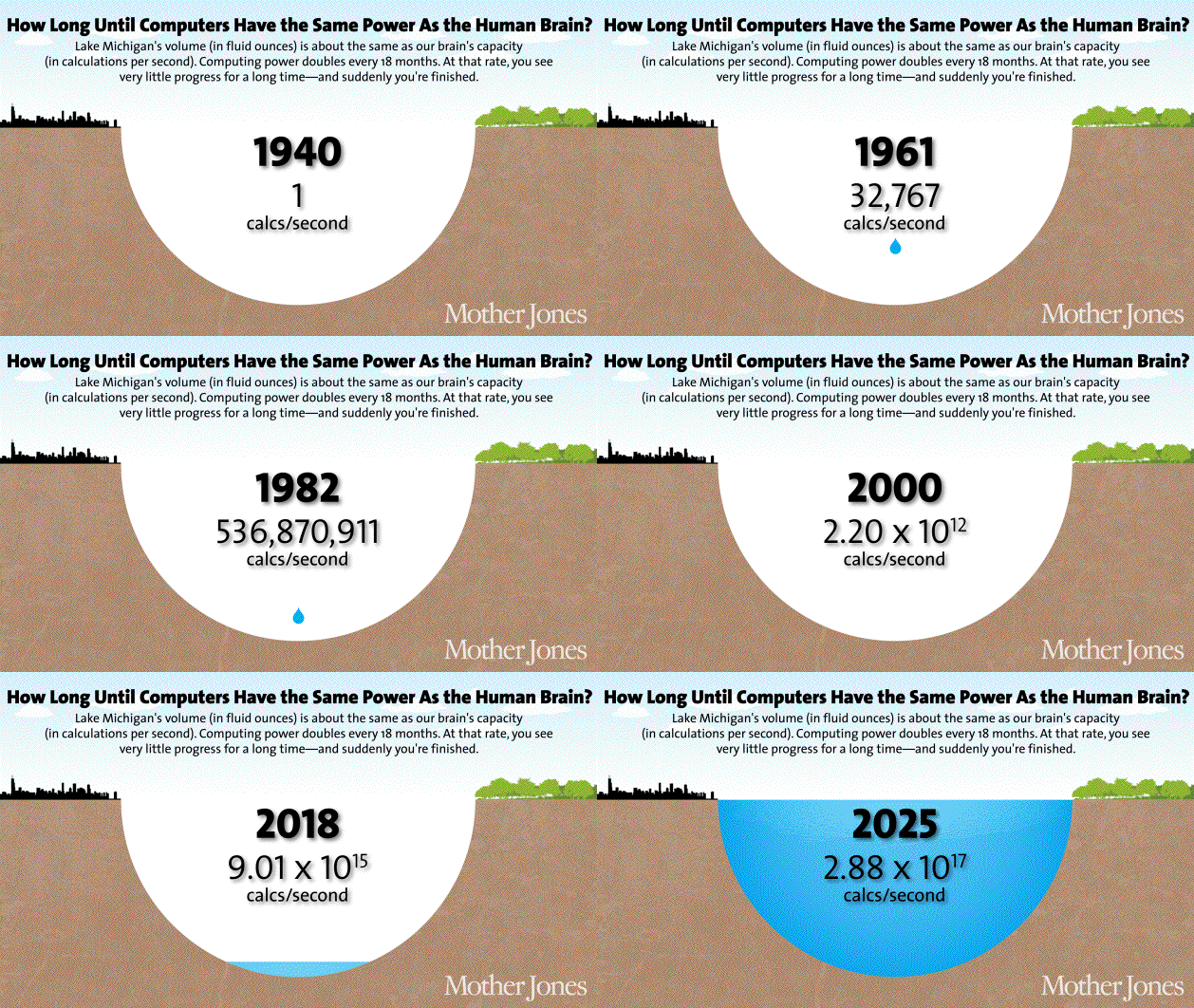
The world’s volume of data doubles every 18 month.

In all forms it will grow 650 percent over the next five years.

Despite feeling overwhelmed, there’s an insatiable desire for more data.

The information overload is real and causing problems.

There is little or no regulations governing every time you click on a website, post on social media, use a mobile app and comment via email or to call centers, your data is collected for future use.

In my opinion, the world needs proper regulations about how and what kind of data should be collected.

My bigger concerns are related to unsanctioned organizations using my data and inferences about my interests, passions, affiliations and associations for borderline uses about my political, religious, sexual, etc. preferences. Just because a company can collect all kinds of personal information on consumers, it doesn’t mean they should use it willy nilly.

The more is better” philosophy.  There in lies the trouble.

Tracking customer preferences and purchases can reveal all kinds of private information, like illnesses, financial problems, even pregnancy.

For example a father recently discovered that his daughter was expecting a baby only because of Target’s TGT – 0.5% customer advertising technology. It analyzing his daughter shopping patterns so the store started to send her coupons for baby products which alerted the father.

Data gathering is not going away.

This should have us concerned, not just about targeted marketing but about what can be inferred about all of us every time we “like” something on FACEBOOK or post a snarky tweet on TWITTER.

From what I can tell, what Big Data does best is spy on individuals and collect useless data that helps people develop false and inaccurate assumptions.

Big Data may have wonderful potential, but we’re still going to have to get better at data exchange and integration before it’s going to have its biggest impact. We’ve spent decades digitizing everything, we should be able to analyze it. The problem is, that’s really hard – and it always has been.

THE BIG QUESTION REMAINS: Who does it belong to, and who should have access to it?
Human Face of Big Data

Big Data will let us watch flu outbreaks bloom and direct scarce vaccines to the most critical area’s. Schools are collecting more data than ever on how children are doing. Companies and nonprofits, meanwhile, are racing to put that data to use in the classroom.

Today, we’re at the convergence of these innovations—biotechnology, the ability to remote monitor and sensor, and now Big Data—which puts an augmented reality at our disposal.

However there is an undercurrent of concern about who owns big data and who has the right to access it.

Big Data technologies are at the heart of the intelligent economy and the solutions that enable it.

Big Data technologies are analyzing massive data sets, in science and research as well as mine data to prevent bad actors from committing acts of terror and/or to prevent waste, fraud, and abuse.

Government data generation and digital archiving rates are on the rise due to the rapid growth of mobile devices and applications, smart sensors and devices, cloud computing solutions, and citizen-facing portals.

As digital information expands and becomes more complex, information management, processing, storage, security, and disposition become more complex.

Information is a strategic asset, and government needs to protect, leverage, and analyze both structured and unstructured information to better serve and meet mission requirements.

New technology brings new challenges, and they should be properly educated to use it wisely and critically. It is used to study employee performance and retention.

The younger generations are not always aware of the challenges and dangers that come with big data.

Privacy here is a key issue to consider.

I sometimes get frightened to see what younger generations publish on their social media, without being aware how they expose themselves to the outside world. Just think about recommender systems.

When you want to buy a product or service from an online retailer, you are often frustrated because of the many choices and configurations possible. Thanks to an intelligent, analytical recommender system, purchases (and their customer feedback) are continuously monitored to better tailor future recommendations to customers.

Credit card fraud detection system.

In fact, thanks to credit risk analytics, our savings money is now efficiently safeguarded since every bank is obliged (via the Basel III capital accord) to analytically estimate credit losses and make sure it has enough provisions or equity buffers for worst-case scenarios.

Big Data is being used to detect social security fraud, to detect tax evasion fraud, to employ and fire people.

New data stores have emerged increasing the distribution of data and the complexity of securing and protecting that data along with it. It is now harder to protect sensitive data as it may move around between different transactional and analytical data stores as companies create new analytical workloads.

While there is more to do to wrestle big data to the ground. Defense (DOD) is investing approximately $60 million annually for new projects that will harness and utilize massive data in new ways and bring together sensing, perception, and decision support to make truly autonomous systems that can learn from experience, maneuver and make decisions on their own, and understand the limits of their knowledge.

Governments are facing more and more challenges in managing the life cycle of Big Data as government’s traditional silo approach hinders sharing knowledge and working across organizational boundaries.

While emails, instant messages, data files, document files, and scanned images are all driving the growth of Big Data, managing and storing this information — and its growth — are not trivial tasks. It has raised red flags about privacy, which remain unresolved.

The only way to make data totally safe is to not ever use it or keep it. Big Data Discriminates.

Our currents Laws cannot adequately handle the issues raised by Big data.

Just look at the legal complications created by systems using data and algorithms to include and exclude people from various programs.

What we have are porous laws on how this new technology changes previous understandings of civil liberties, not to mention data analysis, machine learning and the work scientists have been doing on non-discriminatory data mining models.

Individuals should be granted meaningful opportunities to challenge adverse decisions based on scores miscategorizing them.

Where data goes in and a decision comes out it’s unclear, or certainly opaque, just how that decision was arrived at. There is no way to trace why a decision was made.

With programmers doing real-life damage without even knowing it. The question is:  How do we update our understanding of due process for the 21st century?

These black box issues such as credit-scoring systems should be legal required to make their Systems Transparent.

If you take Google’s search algorithms for instance no one knows how it chooses the direction of its search. Perhaps it directs your search only to its profit.  It’s not  just about the quality of the user experience.HUNGARY–DPA Requesting a Flyby

Drones are becoming more widespread globally, the non military use of drones will add a further deluge of big data:

Cameras, heat and motion sensors, GPS, Bluetooth, Wi-Fi signals, facial recognition and bio metric scanners allow for the growing use of drones in the industrial, agricultural, transportation and retail areas.

The use of drones—theoretically—should only be possible upon individual permit irrespective of the drone’s starting point and final destination.

However enforcement may be difficult.

The only way is a world license that creates an official record of the individuals operating/using drones for a commercial purpose.

In practice, the widespread use of drones for private purposes may result in unreasonable administration in connection with the above, drone users and operators may also be reluctant to provide so detailed information on their activities for confidentiality reasons.

If the drone records flight details for aviation safety considerations, personal data captured but not relevant for this purpose should be anonymised and stored separately or should be made unidentifiable, unrecognizable and inaccessible by the controller immediately after the drone finished flying.

Data should be stored on the drones only temporarily.

For example, during the security surveillance of a property, the drone may record pedestrians’ faces, movements, body-temperature etc., and the devices should be configured in a way which prevents them from this kind of processing. Drones should solely be able to signal the location and fact of an allegedly unauthorized attempt at entry onto the premises.

In practice, this principle should be assessed on a case-by-case basis, as the actual use of the drone may require more extended data processing than envisaged at the beginning. The drone may locate a trespasser who needs to be identified (to ensure to security surveillance purpose), and, in such a case, privacy-by-default settings should not prevent the enforcement of the drone operator’s legitimate interests.

For example, a recording of an agricultural land cannot be used for the surveillance of agricultural workers.

Given the amount of data governments store on citizens and the sensitivity of some of that data, it makes sense for state budgets to carve out funds for someone to shepherd how that data is collected, treated and stored.

Should there be a meaningful data life cycle amidst the sea of data.

In fact , big data may ultimately be a key factor in how nations, not just companies , compete and prosper . Algorithmic decision-making:

In a nutshell, the problem with ‘datification’ is that somebody else may … use the data thus produced – often with purposes different from those originally intended.

Make no mistake about it:

Our future, the future of humanity and the planet hangs in the balance.

Do we have what it takes to disrupt what is…in order to create what can be?

Big data as a high concept will never fully define itself it’s just a big scam. Surveillance programs. High Frequency Stock Trading. Electronic Currency Trading. Dooming us all down to rely on Google.

I hope it die’s a miserable death.

← Back

Thank you for your response. ✨

Share this:

  • Share on WhatsApp (Opens in new window) WhatsApp
  • More
  • Share on Mastodon (Opens in new window) Mastodon

The future impact of AI (Artificial Intelligence)

20 Friday Mar 2015

Posted by bobdillon33@gmail.com in Technology

≈ Comments Off on The future impact of AI (Artificial Intelligence)

Tags

Artificial Intelligence., Future Society., investments in science and technology.

I was told the other day that I had not addressing the last and perhaps the most important issue concerning the effects of Technology that the human race will ever faced. The dire warnings that machines run by Artificial Intelligence will one day take over from humans.

What better day to post my views an diamond eclipse. The last time it happened was in 1935 and the next time is 2206.  

Now don’t get me wrong I like being human! I want humans to retain autonomy over machines! Judgments of virtue are judgments of a whole life rather than of one isolated action. The development of moral character may take a whole lifetime. But once it is firmly established, one will act consistently, predictably and appropriately in a variety of situations.

However we will need a new set of practices for value creation; where data slaves dare to stand up and call for a revolution … But it will be very difficult to turn back the wheel that has already been set in motion several decades ago.

What is artificial intelligence and what is the media talking about? What ever it is it is a long way off before Machines turn on us never mind emulating human behavior to the point of mimicking communication.

Are these technologies beneficial to our society or mere novelties among business and marketing professionals?

Medical facilities, police departments, and manufacturing plants have all been changed by AI but how?

So far this bond has been one-sided because the ability to generate, recognize and express emotions are a unique prerogative of living human beings, but if this intelligence or abstract attribute could be taught to machines, it would re-conceptualize the perception of machines.

So in this post should I focus on the truly remarkable achievements of the technology or dwell on the dangers of what could happen if machines reach a level of Sentient AI, in which self-aware machines reach human level intelligence.

Let’s start with present day.  Do you believe that if all computers are stopped for a day, complete civilization comes to a halt!

Fifty years ago, this might have been a science fiction, but today it is a reality.

We cannot predict because of the great potential of AI what we might achieve when this intelligence is magnified by the tools AI (may provide) however the eradication of disease and poverty are not unfathomable.

So it is valuable to investigate how to reap its benefits while avoiding potential pitfalls.

The potential benefits are huge, since everything that civilization has to offer is a product of human intelligence.

Presently, applications in advanced robotic appeared so real that one can believe a humanoid robot will be capable to interact or work side by side with people in a near future.

If so are we ready for the bio mechanical future revolution. ( Or as I would call it synthetic intelligence implants, because it is not natural intelligence.)

For the sake of the length of this post I will stick with AI.

This questions;  Will AI be a reality and many others are and should be the concern of the general public.

A time will soon come (brought about by the lack of education concerning rapidly advancing computer technology) when this question will need to be answered.  On the ethical use of such technology and its impact on intimate human relationships and society.

When is the best time to discuss the ethical uses of these technologies?  NOW.

If robots are ready to plug safely into society the question is no longer a questions for future generations to sort through, it must be decided, and soon.

As technology rapidly improves, it is inevitable that it should begin to take on elements of its creator and believe me there are many routes that Artificial intelligence can go. 

Its impact on society is only likely to increase.

For instance: Once we begin to mesh technology more closely with ourselves as humans we can begin to accept it as a part of ourselves and as a part of our society. Some say it could be curtain for Society.

memories-maya

As I have said in previous posts Technology is transforming our social, economic, and political institutions; our understanding of what it means to be human; and the distribution of power in the world.


The threat of AI equipped computer systems and machinery taking jobs away from humans is becoming a harsh reality. When and in what order should we expect various jobs to become automated ?

How will this affect the wages of less skilled workers, creatives, and different kinds of information workers? Some have argued that AI is likely to greatly increase the overall wealth of humanity as a whole. This is a total misconception as the rich will own the Data. Increased automation may push income distribution further towards a power law and the resulting disparity may fall disproportionately along lines of race, class, and gender.

Research anticipating the economic and societal impact of such disparity could be useful to start asking the questions.

How should the ability of AI systems to interpret the data obtained from surveillance cameras, phone lines, emails, etc., interact with the right to privacy?

How will privacy risks interact with cyber security and cyber warfare?

We already have drones and it will not be long before we have a weapon that does everything on its own without human help.  These weapons will be a threat to civilians?  Can lethal autonomous weapons be made to comply with humanitarian law. No.

Sophisticated remote-controlled military robots are already in use with no tractability, that fire a weapon to AI algorithms is that not something to fear. We are programming them. If that’s not scary enough put a nuclear war head on one.

Smart weapons raises many questions on the price paid to develop these weapons; money which could be used to solve most of the world’s social problems such as poverty, hunger, etc.

http://www.military.com:80/video/ammunition-and-explosives/projectiles/iran-unveils-new-smart-weapons-system/1427781968001/

Of course none of this is going to change anything as we are incapable of making war against Poverty or Inequality. Why? Because human intelligence can be viewed as being as diverse as its population. However this type of analysis of Intelligence leads us to the individual and becomes useless.

Over the last decade, electronic tiny minuscule signals have fundamentally revolutionized the way we live. People are spending more hours per day with machines than humans and in the future, computers will evolve quicker than the human race.

Sorry I am diversifying.  Back to AI

An amazing a human-machine relationship is developing.

Fortuitously for us so far the possession of knowledge alone does not make a being or machine intelligent.

This is the problem when it comes to computer scientists and engineers understanding just how their work affects humans and human values.

So what role should computer scientists play in the law and ethics of AI development and use?  None. They are focus on getting software products to market, regardless of whether they instantiated interesting principles of intelligent systems that could also illuminate the human mind.

How should lawyers, ethicists, and policymakers engage the public on these issues?  Should such trade-offs be the subject of national standards?

Significant parts of the economy, including finance, insurance, actuarial, and many consumer markets, are already susceptible to disruption through the use of AI techniques to learn, model, and predict agent actions. These markets are identified by a combination of high complexity and high rewards for navigating that complexity. Artificial intelligence techniques can be applied to financial investing, especially in the areas of credit risk assessment and stock valuation.

In the future, we can expect that the techniques of artificial intelligence will be integrated into systems that simultaneously address investing activities.

The successes of industrial applications of AI, from manufacturing to information services, demonstrate a growing impact on the economy, although there is disagreement about the exact nature of this impact and on how to distinguish between the effects of AI and those of other information technologies.

Many economists and computer scientists agree that there is valuable research to be done on how to maximize the economic benefits of AI while mitigating adverse effects, which could include increased inequality and unemployment.

All that said; Artificial intelligence certainly has a place in the future of humanity.

The danger of machines taking over too much of human interaction and work, the human mind, is to far-fetched to my thinking.

There is no doubt that computers are being embedded in all of our life accessories like mobiles,watches, cars, even our bodies and brains.

These subsets of AI, such as data mining, neural networks, speech recognition and lip-reading, behavior recognition, and face recognition, to name a few, are becoming increasingly powerful—and indispensable—to human organizations.

The question of whether a human brain is necessary for thinking remains in Science Fiction Hollywood.  

No one has agreed on a concrete definition of artificial intelligence, largely because there is insignificant understanding as to what comprises intelligence.

Professor Jefferson’s Lister Oration for 1949, from which I quote sums up the problem for me.

“Not until a machine can write a sonnet or compose a concerto because of thoughts and emotions felt, and not by the chance fall of symbols, could we agree that machine equals brain-that is, not only write it but know that it had written it. No mechanism could feel (and not merely artificially signal, an easy contrivance) pleasure at its successes, grief when its valves fuse, be warmed by flattery, be made miserable by its mistakes, be charmed by sex, be angry or depressed when it cannot get what it wants.

Or a  machine which is under interrogation”What do you think of Picasso?” Be kind, resourceful, beautiful, friendly, have initiative, have a sense of humor, tell right from wrong, make mistakes, fall in love, enjoy strawberries and cream, make some one fall in love with it, learn from experience, use words properly, be the subject of its own thought, have as much diversity of behavior as a man, do something really new.

AI will remain valuable regardless of whether we’re able to build fully- functioning robots or human-esque brains.

AI, the harnessing of intelligence on the computer, will turn complex thought processes into fast computer simulations; it will be used to analyze past events and predict the future.

The ability of these systems to explain the reasoning process through back-traces and to handle levels of confidence and uncertainty provides an additional feature that conventional programming can’t handle.

Intelligence is defined as the ability to achieve goals through computational process. Although intelligence is only studied in humans, is it possible that machines may be more “intelligent” than those who created the machines in the first place?

Will computers reach human intelligence someday. They have already surpassed our calculation abilities and our speed of processing information.

There is no indication that microchip speed will not be multiplied in the future.

As with every innovative technology there are positive and negative externalities involved.

The Intelligent Robot-  Will Artificial Intelligence Replace Mankind?

No. This dream will remain elusive until machines attain the basic human virtue of common sense.

Our ability to take full advantage of the synergy between AI and big data will depend in part on our ability to manage and preserve privacy.

How we can ensure humans will be able to control AI once it achieves human-level intelligence? I would prefer humans maintain autonomy over technologies that could achieve sentience.

It is tempting to wonder what would happen if we spent more time focusing on helping each other directly, versus relying on machines to essentially grow brains for us.

We need to develop a science for understanding advanced Artificial Intelligence before we develop it further.

It’s just common sense. Intelligent machines won’t love you any more than your toaster does. Giving people a device that enhances intelligence may not be a terrific idea. What happens when a machine breaks the law?

Our AI systems must do what we want them to do. We ourselves don’t reason with precise truths. We don’t yet know really what consciousness is, what drives consciousness?

Why do we attend to only a portion of what we see and hear? It is obvious that given an event, observed by many, we each perceive it differently, and we take in differently. Do we each have individual filters that have to do with our own stories? Probably. But I think pondering this goes deeper. Is consciousness itself, somehow, directed? God forbid a machine is directing it.

John Cleese, Monty Python and the Holy Grail. Describes AI

Being human, has to have a component of humanity to it. The nature of the mind and of memory, and how intelligence can be manifested in physical form is a joke when it comes to a Machine.

For the robots or technology that may surpass our intelligence in the near future, observe my fleshy middle-digit and hear me cry: “I wave my private parts at your Auntie! Your mother was a hamster and your father smells of elderberry!” —

Tell me how do you model thought?  Give me a machine that can read a simple children’s book, understand what the story is about, and explain it in its own words or ask reasonable questions about it.

That is it. I have tried artificial intelligence and I don’t like it.

Artificial Intelligence Technology is learning by itself. The claim that a machine cannot be the subject of its own thought can of course only be answered if it can be shown that the machine has some thought with some subject matter.

Where is this technology going to be? No one knows for sure, what we can only say for certainty is that this Artificial intelligence, and Machine Learning will transform all software and hardware, all industries and businesses. Roads, bridges, Cars, Homes, will be connected to it.

While today we do not possess the technology to achieve a truly sentient machine we cannot because of that speculate too deeply as to the results of such an achievement.

Only if intelligence ceases to be a sacred mystery to us, and we can control our destructive nature should any of us accept an Apple from the Adam of AI. 

One thing is for sure; We will sure need some kind of global governance in the interest of the individual. 

We are just in the beginning in terms of where these technologies will take us.  Mars and back.

← Back

Thank you for your response. ✨

Share this:

  • Share on WhatsApp (Opens in new window) WhatsApp
  • More
  • Share on Mastodon (Opens in new window) Mastodon

WHERE DO WE GET OUR Thought’s FROM:

08 Monday Dec 2014

Posted by bobdillon33@gmail.com in Uncategorized

≈ Comments Off on WHERE DO WE GET OUR Thought’s FROM:

Tags

Artificial Intelligence., conceptual thinking, global climate change, positive thinking

Increasingly today, we are being asked to analyze environmental projects or activities whose effects will be spread out over hundreds of years. Prominent examples include: global climate change, radioactive waste disposal, loss of biodiversity, thinning of stratospheric ozone, groundwater pollution, minerals depletion, and many others.

Recently I posted some thoughts on Artificial Intelligence and the changes that technology will bring to our existence.

Now before I go any further perhaps this post should carry a warning that you might end up confused.

WHERE DO WE GET OUR THOUGHT FROM.

Here I am not talking about what frames our thoughts.  Like your present circumstances or your culture, your education, and the like. What I am interested in is exploring the source of thoughts.

You might ask why.  The answer is that there is not much mental shelf space left in the world to tackle its problems as we are all attracted by anything that commands our attention.

So lets hope the following commands your attention.

I suppose the first thought is that Human beings require language in order to become conscious of a thought. Language is indispensable for us in order to get access to thought. On the other hand, language – because of its sensible character – obscures thought (which by itself is insensible).

Perhaps Artificial Intelligence will be able to circumvent the obstacle of language and access concepts and thoughts directly.

Now there is a thought for you.

There are multiple versions of reality science but very few of them address or make comments on the purpose of the universe or the reason for life.

You are today where your thoughts have brought you; you will be tomorrow where your thoughts take you. – James Allen (author of As a Man Thinketh)

THAT LEADS ME TO THE GREATEST THOUGHT OF ALL:  Creation itself must have been an act of thought.

Long before the Big Bang which is mathematically indescribable there had to be a thought that brought the BIG BANG into consciousness?

From where did it come?  Not the Big Bang, but the thought to create it in the first place.

These things are not explained by science. Consciousness does not come from a combination of chemicals as it is a non-material energy.

So we must ask ourselves just how we can convey a certain piece of information to someone else if we are not able to represent this information to ourselves in conscious thought.

The Big Bang as a single point or particle falls well short of supplying any conceptual thought of what caused it in the first place.

For years, we’ve heard about the power of positive thinking, but without the ability to communication of one’s own thoughts to another which appears to be entirely dependent on representing and recording one’s own thoughts to yourself we can never raise ourselves to the level of specifically conceptual thinking.

If we disregard how thinking occurs in the consciousness of an individual, and attend instead to the true nature of thinking, we shall not be able to equate it with speaking.

Power of thinking denote a special mental capacity.

First, language is used to assist memory, or the representation and recording of one’s own thoughts; and second, it is used as a required vehicle of communication of one’s own thoughts to other people human. Language is needed to develop and/or employ our faculty of reasoning, on the one hand, but at the same time reason has to be presupposed to a certain degree in order for language to be possible.

But then again language is not required to grasp or become aware of thoughts about invisible things – does not by itself imply that the thoughts themselves could not be without language. Like the slips of the tongue, a blush full face, or mere movements of a face muscle, can only too well convey information about the thoughts or attitudes of the conveyor, and even indirectly about what these thoughts and attitudes are about.

Therefore thought depends in certain ways on language, or on symbols in general.

If you consider it we cannot find a convincing reason for the indispensability of language for thought.

However sense-impressions determine almost by themselves the course of our ideas, as is the case in animals.

So is it going to be possible for Artificial Intelligence to invented language without reason? Through symbols that we use to memorize ideas in such a way that we can call them up more or less at will.

So where does that leave us.

Without senses we would never think of them. So does it mean that language constitutes thought, so that the latter could not be without the former?

The power of pure thinking can set the stage for some inspiring change.

O! Just in case you have had a thought don’t blame me.  Shut down the left hemisphere of your brain that controls speech and thought and perhaps you will have discovered Artificial Intelligence.  As positive thinking changes the brain in a physical way, pure thinking can do the same.


Let’s have your THOUGHTS.


← Back

Thank you for your response. ✨


people generally discount the future

there are that the universe consists of pure thought


When you understand how the brain works somewhat better, you can use that information to literally enhance your own perspective, broaden your own sense of your capacities and, with that awareness, learn to focus on other things knowing that if you focus on other things consistently you can change what’s there. You can change the way that real estate is used.

”When you understand how the brain works somewhat better, you can use that information to literally enhance your own perspective, broaden your own sense of your capacities and, with that awareness, learn to focus on other things knowing that if you focus on other things consistently you can change what’s there.

You can change the way that real estate is used.”

how to reboot our brains in a positive, pure direction


Or does it merely mean that we could not become aware of our thoughts or could not grasp them without language?


A new perception would let these images sink into darkness and allow others to emerge. without symbols we would scarcely lift ourselves to conceptual thinking.concept is first gained by symbolizing it; without symbols we could not become aware of things that are physically absent or insensible.


Share this:

  • Share on WhatsApp (Opens in new window) WhatsApp
  • More
  • Share on Mastodon (Opens in new window) Mastodon

Perhaps the next century—we all be in a permanent identity crisis, constantly asking ourselves what humans are for.

03 Wednesday Dec 2014

Posted by bobdillon33@gmail.com in Uncategorized

≈ Comments Off on Perhaps the next century—we all be in a permanent identity crisis, constantly asking ourselves what humans are for.

Tags

Artificial Intelligence., Google, Steven Hawkins

You no doubt heard Steven Hawkins recently prediction that the human race as we know it will come to and end with the creation of a Super Artificial Intelligence.


He could be right.

Over the past 60 years, we have seen mechanical processes replicated behaviors and talents we thought were unique to humans,

We are not just redefining what we mean by AI—we are redefining what it means to be human. ( Greed v Poverty.  Muslim v Christian. Wealth v Benefits. Black v White. War v Peace. Health v Consumerism. Life v Death. Gratification v Pain. Space v Sustainability, Climate Change v Profit. To mention just a few)

It will be long before we’ve have to change our minds about what sets us apart. (ISIS v The Rest.)

Every day we are being forced to surrender more of what is supposedly unique about humans and we will spend the next decades doing so.

Indeed, the grandest irony of all, the greatest benefit of an everyday, utilitarian AI will not be increased productivity or an economics of abundance or a new way of doing science—although all those will happen.

The greatest benefit of the arrival of artificial intelligence is that AIs will help define humanity. We need AIs to tell us who we are.

In order to appreciate this we are we going to need a large dose of artificial smartness. Smartness is focused, measurable, specific.

If you think about it, much of the technology humans interact with is about putting you in a particular bucket. This is exactly what Online marketing is about. Making finer and finer distinctions as to which bucket you belong in.

The long-term scientific goal of artificial intelligence is human-level intelligence as it Artificial immortality is to the goals of modern medicine.

AI has attracted more than $17 billion in investments since 2009. Last year alone more than $2 billion was invested in 322 companies with AI-like technology.

Every time you type a query, click on a search-generated link, or create a link on the web, you are training the Google AI.

Each of the 12.1 billion queries that Google’s 1.2 billion searchers conduct each day tutor the deep-learning AI over and over again. With another 10 years of steady improvements to its AI algorithms, plus a thousand-fold more data and 100 times more computing resources, Google will have an unrivaled AI.

At first glance, you might think that Google is beefing up its AI portfolio to improve its search capabilities, since search contributes 80 percent of its revenue. But I think that’s backward. Rather than use AI to make its search better, Google is using search to make its AI better.

My prediction: By 2024, Google’s main product will not be search but AI.( See My Flip board ” Silent Wittiness to Google Ambitions.)

Where are we at the moment?

Parallel computation, bigger data, and deeper algorithms generated the 60-years-in-the-making overnight success of AI. As these technological trends continue—and there’s no reason to think they won’t—AI will keep improving. The smarter it gets, the more people use it. The more people that use it, the smarter it gets.

Our AI future is likely to be ruled by an oligarchy of two or three large, general-purpose cloud-based commercial intelligences offering more like IQ as you want but no more than you need.

It is transforming the Internet, the global economy, and civilization. It is enliven inert objects, much as electricity did more than a century ago.

There is almost nothing we can think of that cannot be made new, different, or interesting by infusing it with some extra IQ.

Non-Inheritable Neural Architecture intelligent machines will increasingly replace knowledge workers in the near future.

Many knowledge workers today get paid to do things that computers will soon be able to do. AI will increasingly move up the skill ladder to replace the middle-class workers.

There’s no way a human can keep on top of all possible financial instruments in the world or is it possible for doctors and nurses to stay on top of medical innovations.

Every success in AI redefines it.

A child born today will rarely need to see a doctor to get a diagnosis by the time they are an adult.  Computer Medical diagnostics is a potential “game changer,”

At this very moment it is possible to have you DNA sequence read by 23 and Me (for a fee.)

Curious.  Go on try it.

Find out if you are a suitable partner, what you are most likely to died from, WHETHER YOU ARE going to win the lotto – sorry not true.

We are still a ways off from equaling the processing power of the human brain.

An AI program may be able to write code to manipulate the stock exchange but not the lotto draw. It is still not able to “solve the problem of common sense, of endowing a computer with the knowledge that every 5-year-old is still a few years off.

Representations are the fruits of perception. Recognizing the centrality of perceptual processes makes artificial intelligence more difficult, but it also makes it more interesting, for the two types of process are inextricably intertwined.

As AIs develop, we might have to engineer ways to prevent consciousness in them—and our most premium AI services will likely be advertised as consciousness-free.

In fact, the business plans of the next 10,000 start ups are easy to forecast: Take X and add AI. 

So Is he Right.

New utilitarian AI will also augment us individually as people (deepening our memory, speeding our recognition) and collectively as a species.

Will it replace us.

Rather you than I too comeback in a few hundred years.

Food will differently be different. manufacturing materials  will differently be different, clothes, money, or any branch of science and art will have changed beyond recognition.

Concepts without precepts are empty. The essence of human perception lies in the ability of the mind to hew order from chaos. Perception goes on at many levels.

AI perception will be rigid, inflexible, and unable to adapt to the
problems provided by many different contexts.

Cognition is infused with perception.  If there is none neither human or non human will know which is which. Therefore there will be no interaction between humans and artificially intelligent beings other than war. 

So he is right.


Share this:

  • Share on WhatsApp (Opens in new window) WhatsApp
  • More
  • Share on Mastodon (Opens in new window) Mastodon
Newer posts →

All comments and contributions much appreciated

  • THE BEADY EYE ASKS. HAVE YOU EVER WONDERED OR ASKED YOUR SELF. WHERE OR WHY IS THE WORLD IN SUCH A MESS. March 23, 2026
  • THE BEADY EYE SAYS. HAVE YOU NOTICED THAT THE NEWS COVERAGE ON THE WAR IN THE MIDDLE EAST IS DOMINATING BY MATERIALISM. March 21, 2026
  • THE BEADY EYE SAYS AMERICA IS SHOOTING ITS SELF (NOT JUST IN THE FOOT) BUT IN THE EYES OF ITS ALLIES AND THE WORLD MARKET PLACES. AS THE IRAN WAR IS SPIRALLING OUT OF CONTROL. March 20, 2026
  • THE BEADY EYE SAYS. THE BATTLE TO HAVE A LIFE WORTH LIVING BECOMES MORE AND MORE DIFFICULT WITH AGE .. COMMUNITY MATTERS MORE THAN MONEY. March 20, 2026
  • THE BEADY EYE SAYS. EQUALITY, FAIRNESS, JUSTICE ARE INDIVISIBLE CONCEPTS IF ARE ANYTHING. March 18, 2026

Archives

  • March 2026
  • February 2026
  • January 2026
  • December 2025
  • November 2025
  • October 2025
  • September 2025
  • August 2025
  • July 2025
  • June 2025
  • May 2025
  • February 2025
  • January 2025
  • December 2024
  • November 2024
  • October 2024
  • September 2024
  • August 2024
  • July 2024
  • June 2024
  • May 2024
  • April 2024
  • March 2024
  • February 2024
  • January 2024
  • December 2023
  • October 2023
  • September 2023
  • August 2023
  • July 2023
  • June 2023
  • May 2023
  • April 2023
  • March 2023
  • February 2023
  • January 2023
  • December 2022
  • November 2022
  • October 2022
  • September 2022
  • August 2022
  • July 2022
  • June 2022
  • May 2022
  • April 2022
  • March 2022
  • February 2022
  • January 2022
  • December 2021
  • November 2021
  • October 2021
  • September 2021
  • August 2021
  • July 2021
  • June 2021
  • May 2021
  • April 2021
  • March 2021
  • February 2021
  • January 2021
  • December 2020
  • November 2020
  • October 2020
  • September 2020
  • August 2020
  • July 2020
  • June 2020
  • May 2020
  • April 2020
  • March 2020
  • February 2020
  • January 2020
  • December 2019
  • November 2019
  • October 2019
  • September 2019
  • August 2019
  • July 2019
  • June 2019
  • May 2019
  • April 2019
  • March 2019
  • February 2019
  • January 2019
  • December 2018
  • November 2018
  • October 2018
  • September 2018
  • August 2018
  • July 2018
  • June 2018
  • May 2018
  • April 2018
  • March 2018
  • February 2018
  • January 2018
  • December 2017
  • November 2017
  • October 2017
  • September 2017
  • August 2017
  • July 2017
  • June 2017
  • May 2017
  • April 2017
  • March 2017
  • February 2017
  • January 2017
  • December 2016
  • November 2016
  • October 2016
  • September 2016
  • August 2016
  • July 2016
  • June 2016
  • May 2016
  • April 2016
  • March 2016
  • February 2016
  • January 2016
  • December 2015
  • November 2015
  • October 2015
  • September 2015
  • August 2015
  • July 2015
  • June 2015
  • May 2015
  • April 2015
  • March 2015
  • February 2015
  • January 2015
  • December 2014
  • November 2014
  • October 2014
  • September 2014
  • August 2014
  • July 2014
  • June 2014
  • May 2014
  • April 2014
  • March 2014
  • February 2014
  • January 2014
  • December 2013
  • November 2013
  • October 2013

Talk to me.

Jason Lawrence's avatarJason Lawrence on THE BEADY EYE ASK’S: WIT…
benmadigan's avatarbenmadigan on THE BEADY EYE ASK’S: WHA…
bobdillon33@gmail.com's avatarbobdillon33@gmail.co… on THE BEADY EYE SAYS: WELCOME TO…
Ernest Harben's avatarOG on THE BEADY EYE SAYS: WELCOME TO…
benmadigan's avatarbenmadigan on THE BEADY EYE SAY’S. ONC…

7/7

Moulin de Labarde 46300
Gourdon Lot France
0565416842
Before 6pm.

My Blog; THE BEADY EYE.

My Blog; THE BEADY EYE.
bobdillon33@gmail.com

bobdillon33@gmail.com

Free Thinker.

View Full Profile →

Follow bobdillon33blog on WordPress.com

Blog Stats

  • 97,912 hits

Blogs I Follow

  • unnecessary news from earth
  • The Invictus Soul
  • WordPress.com News
  • WestDeltaGirl's Blog
  • The PPJ Gazette
Follow bobdillon33blog on WordPress.com

The Beady Eye.

The Beady Eye.
Follow bobdillon33blog on WordPress.com

Blog at WordPress.com.

unnecessary news from earth

WITH MIGO

The Invictus Soul

The only thing worse than being 'blind' is having a Sight but no Vision

WordPress.com News

The latest news on WordPress.com and the WordPress community.

WestDeltaGirl's Blog

Sharing vegetarian and vegan recipes and food ideas

The PPJ Gazette

PPJ Gazette copyright ©

Privacy & Cookies: This site uses cookies. By continuing to use this website, you agree to their use.
To find out more, including how to control cookies, see here: Cookie Policy
  • Subscribe Subscribed
    • bobdillon33blog
    • Join 222 other subscribers
    • Already have a WordPress.com account? Log in now.
    • bobdillon33blog
    • Subscribe Subscribed
    • Sign up
    • Log in
    • Report this content
    • View site in Reader
    • Manage subscriptions
    • Collapse this bar