• About
  • THE BEADY EYE SAY’S : THE EUROPEAN UNION SHOULD THANK ENGLAND FOR ITS IN OR OUT REFERENDUM.

bobdillon33blog

~ Free Thinker.

bobdillon33blog

Tag Archives: Artificial Intelligence.

THE BEADY EYE SAY’S. EUREKA! ARE WE ALL FOOLS TO THINK THAT A PLATFORM IS HELD RESPONSIBLE FOR ITS USERS.

22 Thursday Mar 2018

Posted by bobdillon33@gmail.com in Algorithms., Artificial Intelligence., Facebook, Freedom, Google, Modern Day Democracy., Social Media, Technology, The Internet., Twitter, Unanswered Questions., What Needs to change in the World, Where's the Global Outrage.

≈ Comments Off on THE BEADY EYE SAY’S. EUREKA! ARE WE ALL FOOLS TO THINK THAT A PLATFORM IS HELD RESPONSIBLE FOR ITS USERS.

Tags

Algorithms Democracy., Algorithms for Profit., Algorithms trade., Algorithms., Artificial Intelligence., Big Data, Capitalism and Greed, SMART PHONE WORLD, Social Media, Technology, Visions of the future.


( A six-minute read)

Facebook is simply a platform and will never be held responsible for its users.

We can’t blame tech makers for making their products so good we want to use them. We are in control. But are we?

Facebook like all other platforms has been distorted by the fortunes they have been able to earn through advertising.

Why?

Because the techniques these companies use are not always generic: they are algorithmically tailored to each person.

There can be no ethics when it comes to technological manipulation that can be sold to the highest bidder.

The problem is that there is nothing the companies can do to address the harm unless they abandon their current advertising models. Thay have little incentive to deviate from the mantra that their companies are making the world a better place.

But how can Google and Facebook or ANY PLATFORM for that matter be forced to abandon the business models that have transformed them into the most profitable companies on the planet?

Notification technology enables hundred unsolicited interruptions into millions of lives, accelerating the arms race for people’s attention. Facebook’s headquarters in Menlo Park, California. The company’s famous ‘likes’ feature has been described by its creator as ‘bright dings of pseudo-pleasure’.

When you consider that the total size of all global data hit 20 zettabytes in 2017.

This probably means nothing so picture this: If every 64 – gigabyte I Phone were a brick, we could build 80 Great walls of China with the I Phones needed to store all the above data.

It’s growing every second and completely out of any control.

All of our minds are being hijacked.

Our choices are not as free as we think they are. The technologies we use have turned into compulsions, if not full-fledged addictions.

Billions of people have little choice over whether they use these now ubiquitous technologies, and are largely unaware of the invisible ways in which a small number of people in Silicon Valley are shaping their lives.

We now have an internet-shaped around the demands of an advertising economy with technology platforms contributing toward so-called “continuous partial attention.

Manipulating people into habitual use of their products or platforms with rewards or short-term social affirmations, while harvested valuable data about the preferences of users that could be sold to advertisers.

So what if anything can be done.

It is very common, for humans to develop things with the best of intentions and for them to have unintended, negative consequences.

We’ve truly reached a new level of technological time wasting, with the young generation unable to communicate.

If we the adult world cannot wean ourselves free a good starting point would be if we are to exercise our freedom by banning,  iPhones, iPads, laptops and mobile phones from places of education.

They will become a real problem if you don’t, as they are ridiculous thing to be addicted to. It just something to use when you’re procrastinating or is it a procrastination-trap, a slate of tools destined to get you addicted.

We have to learn to deal more effectively with our emotions if we want to procrastinate less.

Such as varying the rewards people receive to create a craving, or exploiting negative emotions that can act as triggers. It makes them look like they have a life.

Social media and other addictive technologies have and are creating an attention economy, which is severely limiting people’s ability to focus, and is possibly lowering IQ.

One reason I think it is particularly important for us to talk about this now is that we may be the last generation that can remember life before the Internet.

Drawing a straight line between addiction to social media and political earthquakes like Brexit and the rise of Donald Trump, digital forces have completely upended the political system and, left unchecked, could even render democracy as we know it obsolete.

The mere presence of smartphones damages cognitive capacity – even when the device is turned off. Everyone is distracted, all of the time.

Feelings of boredom, loneliness, frustration, confusion, and indecisiveness often instigate a slight pain or irritation and prompt an almost instantaneous and often mindless action to quell the negative sensation by looking at your I Phone, I Pad

If the people who built these technologies are taking such radical steps to wean themselves free, can the rest of us reasonably be expected to

”Chrome extension, called DF YouTube, “which scrubs out a lot of those external triggers” an app called Pocket Points that “rewards you for staying off your phone when you need to focus”

Get a life and use one.

All human comments appreciated. All like clicks chucked in the bin.

← Back

Thank you for your response. ✨

https://embed.ted.com/talks/tristan_harris_the_manipulative_tricks_tech_companies_use_to_capture_your_attention

Share this:

  • Share on WhatsApp (Opens in new window) WhatsApp
  • More
  • Share on Mastodon (Opens in new window) Mastodon

THE BEADY EYE SAY’S; THERE IS ONLY ONE WAY TO REGULATE ARTIFICIAL INTELLIGENCE AND ITS SOFTWARE ALGORITHM’S

16 Friday Mar 2018

Posted by bobdillon33@gmail.com in Algorithms., Artificial Intelligence., Fourth Industrial Revolution., Humanity., Our Common Values., Robot citizenship., Technology, The common good., The essence of our humanity., The Obvious., The world to day., United Nations, What Needs to change in the World, Where's the Global Outrage.

≈ Comments Off on THE BEADY EYE SAY’S; THERE IS ONLY ONE WAY TO REGULATE ARTIFICIAL INTELLIGENCE AND ITS SOFTWARE ALGORITHM’S

Tags

Algorithms for Profit., Algorithms trade., Algorithms., Artificial Intelligence., Big Data, The Future of Mankind, Visions of the future.

( A three-minute read)

I AM SURE THERE IS NO NEED HERE FOR ME TO REMIND YOU THAT TECHNOLOGY IS NOT ONLY CHANGING THE WAY WE CONDUCT OUR LIVES BUT THE WAY WE WILL EXIST IN THE FUTURE. 

There is a wonderful aspiration by the writer Isaac Asimov introduced in 1942:

A robot may not injure a human being or, through inaction, allow a human being to come to harm; a robot must obey the orders given it by human beings, except when such orders would conflict with the previous law; and a robot must protect its own existence as long as such protection does not conflict with the previous two laws.

I call the above an aspiration because as we all know that this will never happen.

We now have AI learning from AI, engage in cyberbullying, stock manipulation or terrorist threats. We also have AI surveillance, both private and public collecting data with or without permission.

A.I. systems don’t just produce fake tweets; they also produce fake news videos.

What, exactly, constitutes harm when it comes to A.I.?  No one knows.

AI systems, are already no longer limited to a single set of tasks.

On the other hand, we need AI to tackle world future problems, such as climate change, threats from space, immigration, and sustainability itself.

There is no argument that regulation of what I call essential AI should be avoided.

However, my A.I. for profit or exploitation did it should not excuse illegal behavior.

A.I. system must clearly disclose that it is not human. As we have seen in the case of bots — computer programs that can engage in increasingly sophisticated dialogue with real people — society needs assurances that A.I. systems are clearly labeled as such.

We must ensure that people know when a bot is impersonating someone.

We must ensure that A.I. system cannot retain or disclose confidential information without explicit approval from the source of that information. Because of their exceptional ability to automatically elicit, record and analyze information, A.I. systems are in a prime position to acquire confidential information.

We must ensure that an A.I. system must be subject to the full gamut of laws that apply to its human operator. This rule would cover private, corporate and government systems.

Unfortunately none of the above is possible.

This is why I favor ( In the interest of caution)  that we establish A World Technological Strong Room, just like the World seed bank where all software programmes are held and available to everyone.

Of course, it would be totally naive to think that all AI should be subject to scrutiny.

It’s not military nor intelligence AI that I am talking about, it is AI that is created for exploitation for profit.

Rather than regulating what AI systems can and can’t do that make it more expensive to develop AIs the strong room would hold the founding programme.

Because Artificial intelligence systems are now learning from each other and have the potential to change how humans do just about everything. We must ensure all AI has an impregnable “off switch.”

How can this achieve? and by whom.

This is where I am open to suggestions.

It could be A United Nations Cloud Strongroom, run by a world people algorithm that copies all existing software and Algorithms.

Companies making and selling AI software will need to be held responsible for potential harm caused by “unreasonable practices” Any sufficiently transformative technology is going to require new laws and New legislation that isn’t imminent.

All human comments appreciated

← Back

Thank you for your response. ✨

. All like clicks chucked in the bin.


Share this:

  • Share on WhatsApp (Opens in new window) WhatsApp
  • More
  • Share on Mastodon (Opens in new window) Mastodon

THE BEADY EYE ASK’S : IN THIS AGE OF TECHNOLOGY ARE WE REALLY TALKING TO ONE ANOTHER?

13 Tuesday Mar 2018

Posted by bobdillon33@gmail.com in Algorithms., Technology., The cloud., The Future, The Internet., Unanswered Questions., What Needs to change in the World, Where's the Global Outrage.

≈ 1 Comment

Tags

Algorithms trade., Artificial Intelligence., The Future of Mankind, Visions of the future.


( A twenty-minute read)

Today’s atomizing forces are brand new and far less tangible: ubiquitous Internet access, constant email and social-media updates, all distracting us from our surroundings, loved ones and other people around us.

Are we indeed socially hobbled by our little screens?

If matters have gotten worse, how would we know?

We’re disengaged.’ Compared to what?

If the new technologies are to fulfill their promise, it is necessary to direct attention towards the costs and concerns that come with the globalization of technology.

Although information technology and increased knowledge can empower everyone on an individual level, the limitations of the existing structures within the job market, socioeconomics, and governmental sovereignty are hard to cast away; an underlying irony has yet to be eliminated.

We are only just beginning to replacing vague theories with some hard data and the overarching effects so far point to the disruptive nature of technology.

So here are a few facts explaining how digital-age technologies have already transformed our world, for better and for worse.

Wealth boosted by technology has not been equally distributed.

By 2020, it is estimated that the 1 percent will own 54 percent of global wealth.

Thanks to technology, we can vent our frustration in increasingly visible ways.

Jobs will be computerized in the next 10-20 years.

With the rise of websites like WebMD, LegalZoom, and E*Trade, even white-collar professionals like lawyers, doctors, and financial middlemen are under threat from technology. Are any jobs safe? For the time being, positions that require empathy—say, nurses over doctors—are better positioned to withstand the technological blow.

Furthermore, governmental programs do not provide the assistance needed to help workers transition to the technological age, further wedging the gap between rural and urban. This disparity is also magnified within the stratification of international systems: The digital divide that exists among developed and developing countries is obvious and the high cost of bringing broadband and technology to third-world countries is an issue that needs to be solved.

Health will be run by algorithms attached to the cloud.

To put this in perspective, a full human genome sequence cost $100 million in 2002. Today, it can be done for $1,000; by 2020 it may cost less than a cup of coffee.

Technology can be a double-edged sword, but at least when it comes to our health (if not necessarily our medical professionals), it has largely been a force for good but just imagine what is going to happen to Health Insurance when your health is monitored by the Cloud.

Education.

Today, there are more than 80,000 education apps available for download through Apple’s App Store; 72 percent of those are aimed at toddlers and preschoolers. But while parents and app developers have obviously embraced the tech education revolution, the link between technology and educational performance is murky at best.

Technology can help save the planet…

The World Bank estimates that climate change may push more than 100 million people into extreme poverty by 2030.

Of course, technology has played a role in our current predicament. The shale revolution—which at its core is a technological revolution—has given a new lease on life to the oil and gas era. That may be good for falling oil prices, but it’s horrible for our environment.

But what makes the difference is that the global economy grew by 3 percent in 2014 while world emissions remained flat.

People are not willing to fundamentally change their lives for problems far off in the future, even ones as potentially catastrophic as climate change. To avoid the worst effects of climate change, alternative energies need to become as cheap and reliable as their carbon-emitting counterparts, and quickly.

Cheaper alternative energy is the best hope the world has left.

Global Security:

Technology has also created a whole new set of global security concerns.

The thoroughly modern phenomenon of cybercrime and economic espionage is estimated to cost the world more than $445 billion every year. That’s roughly 1 percent of global income. And while it hasn’t happened yet, the fear that cyber attacks can spill over and trigger real-world conflicts remains an ongoing concern.

Technology has also changed the face of modern warfare. A decade ago, the Pentagon had a stockpile of fewer than 50 drones; today it has an arsenal of about 7,000. The Pentagon estimates that China will build nearly 42,000 drones by 2023. Others will follow suit. Yet another possible complication.

But the most worrisome development?

Technology has given terrorist groups like ISIS an unparalleled platform to spread their messages of hate. The knowledge needed to build bombs in the comfort of your own home is now just a few short clicks away. Technology is capable of empowering every single individual in the world, even the worst of us.

Finance and the world economy.

It is quite obvious that money in the form of cash is going to disappear.

World stock market is now run by high-frequency trading algorithms. Personal credit lines are governed by algorithms. World trade is reverting to protectionism. Inequality is widening.

Communication:

We are all talking on our cell phones. Public spaces aren’t communal anymore. No one interacts in public spaces.

On the other hand, access to the wealth of information and opinion available on the internet is exposing people of all ages to views, lifestyles, and knowledge they might never have encountered otherwise, potentially generating greater compassion and understanding both within local communities and for people on the other side of the world.

In the next few years, virtual reality could offer a further means of breaking down geographic and social barriers.

Project Syria, for instance, uses virtual-reality goggles to place people inside the meticulously researched world of a Syrian citizen caught in the Syrian conflict, cutting through the ‘empathy fatigue’ often brought about by constant access to global news.

THEN THERE IS:

CRIME:

WHAT LAWS SHOULD APPLY TO AI.

SHOULD THEIR CREATORS BE HELD RESPONSIBLE FOR ITS ACTIONS?

An AI programme could be an innocent agent with either the software programmer or the user being held to be the perpetrator-vi another.

Does the programmer know that if the machine is used in a certain way that a certain outcome is inevitable?

Who or what should be punished if for an offense of which an AI system is directly liable.

Is Ai a service or a product. The legal implications will be profound.

PRIVACY: 

Nothing is private any longer. Whether you like it or not everything is data.

Should AI platforms Pay us for the Data?

FALSE NEWS:

There is no longer a source of Facts. Campaigns to manipulate public opinion through false or misleading social media postings have become standard political practice across much of the world.

Exploiting every social media platform — Facebook, Twitter, Instagram and beyond — and relying on human users and computerized “bots” that can dramatically amplify the power of disinformation campaigns by automating the process of preparing and delivering posts. Bots interact with human users and also with other bots. They generate so much content — and they share each other’s content — that it’s hard to disaggregate the networks.

The impact goes beyond electoral politics to hot-button issues such as climate change and the safety of vaccines.

So should we put aside these value judgments and focus on how technology will simply make the world different going forward. 65 percent of children entering primary school today will end up working in jobs that don’t even exist yet. Our time is better spent figuring out how to live in this new world rather than lamenting the old one.

Unfortunately, by the time we get around to waking up to Algorithms, we will be owned by one.

History also advises that the measures taken must be developed through close consultation between governments, private sector experts, and stakeholders and citizens. Experience with previous technologies suggests that prudent policies can help us effectively manage the risks associated with new technologies without harm to their benefits. But can we say that this is honestly true with Algorithms that are learning from each other or driven by profit, filtering platforms in order to supply personalized information?

The result is having corrosive effects across the whole political arena worldwide.

Whether you are techno-utopians or techno-skeptics technology is changing our lives and the world we all live in and on IN MORE WAYS THAN WE YET OR WILL EVER BE CAPABLE OF COMPREHENDiING.

This is why I advocate a strong room for technology. Where all software is stored and available to all. (See the previous post)

If we are not careful the very thing that we all cherish Freedom will become the sole prerogative of the Algorithms world OF APPLE, MICROSOFT, FACEBOOK, TWITTER, AND THEIR LIKE.Résultat de recherche d'images pour "pictures of technology"

All human comments appreciated. All like clicks chucked in the bin.

← Back

Thank you for your response. ✨


revolutionary.

What was still missing from the research, he decided, was historical perspective.


Share this:

  • Share on WhatsApp (Opens in new window) WhatsApp
  • More
  • Share on Mastodon (Opens in new window) Mastodon

THE BEADY EYE SAY’S. WORLD MAINSTREAM POLITICS IS TURNING A BLIND EYE TO WHAT TECHNOLOGY IS DOING TO THE WORLD.

11 Sunday Mar 2018

Posted by bobdillon33@gmail.com in Algorithms., Capitalism, Climate Change., Energy, Environment, Humanity., Life., Politics., Post - truth politics., Sustaniability, Technology, The Future, The world to day., Unanswered Questions., United Nations, Wealth., What Needs to change in the World

≈ Comments Off on THE BEADY EYE SAY’S. WORLD MAINSTREAM POLITICS IS TURNING A BLIND EYE TO WHAT TECHNOLOGY IS DOING TO THE WORLD.

Tags

Artificial Intelligence., Capitalism vs. the Climate., Distribution of wealth, Environment, Extinction, Inequility, Sovereign wealth fund, The Future of Mankind, Visions of the future.


( A six-minute read)

Algorithms are shifting authority.

Surely its time for all of us to stop acting as though we are all independent of Life.

To see the future first you have to be able to imagine it.

People might be beginning to understand but the clock is running out faster and faster which is being signaled by nature year after year while banks are commercializing its very existence.

Including us, none of the worlds in the universe are immune to natural limits.

If we and our politicians are still dragging our feet in another ten, twenty, thirty years we will have degrees of climate change that we will simply not be able to manage.  The whole world will be in trouble.Résultat de recherche d'images pour "pictures of political movements"

As all the bad things re climate change are coming true assisted by the inertia of AI which is getting build into the system this time  we will not be able to rely on coal to generate energy,

The chances of Technology (In the form of Algorithms) tackling inequality or driving sustainability are dismal in the extreme.  (See previous postings)

The coming global problems that are going to be created by technology are obvious to see, lack of meaningful employment with the resulting immigration causing civil unrest and a return to Nationalism.

Just look at the results of Paris Climate Agreements being adhered too.

A complete allusion due to the rise of Nationalism.

Why?

Because of nationalism, we are now beginning to address the world problems on all the wrong levels.

We need to be looking forward not backward.  Make America great, or Brexit Britain the two current prime examples.

We are now all living with technology and no government can control it.

Now more than ever the global capitalistic economy with national politics does not work.

Basic human needs are changing and even if we manage to establish a Basic Wage for all it will not solve who lives or dies.

Human stupidity or violence should never be underestimated. There is no post-truth fake news it has been with us for thousands of years.

No one has the time to analyze all the information that AI is producing other than another machine to make a judgment.

( I often feel that we should all be changing Facebook, Twitter, Google and the like for the information we are supplying them with.)

We have out of date Organisations that are incapable of making anything stick.

So I hear you saying what can be done.

First and for most, we must apply a World  Aid Commission on all Profit-seeking Algorithms, on all high-frequency trading, on all sovereign wealth funds acquisitions, on all foreign exchange transaction over $50,00, on all world Lotto prize money etc. (See previous postings)

Then we must create a technology storm room where all programmes relating to technology in all its forms are held with access to all in sundry.

Of course, this is pie in the sky as it will never happen.

Since the dawn of history, the human has not been able to share for the common good of all, but there is one thing that might focus our minds sooner than extinction and that is the price of oil as it runs out.

New media such as Social Media seems to be driving a return to a more pluralistic communication System and Social movement activists may be seen as consumers of these new media, and for this very reason find attention for their demands.

But this, in fact, is open to différent types of interprétation.

So where are we?

As F.M. Powicke said: ” Political and social history are in my view aspects of the same process. Social Life loses half its interest, and political movements lose most of their meaning if they are considered separately”

Social media with its networks and its rules petitions and false news that go beyond democratic representation and is achieving exactly what Powicke rightly identified.

Social left politics is in disarray, Right-wing politics on the rise, Liberal politics in the pockets of Economic growth and the technologic revolution.

It is, therefore, time for in-depth research on the interactions between movement organizations and the society of social media that goes beyond the analysis of media bias.

In course of constructing the political landscape of these movements, if there is going to be any chance.  We must not allow the world to be governed by the altar of profit, whether its Apple, Microsoft or some other monopoly platform.

All human comments appreciated. All like clicks chucked in the bin.

← Back

Thank you for your response. ✨


Share this:

  • Share on WhatsApp (Opens in new window) WhatsApp
  • More
  • Share on Mastodon (Opens in new window) Mastodon

THE BEADY EYE SAY’S: IT IS TIME TO CREATE A WORLD TECHNOLOGICAL STRONG ROOM.

07 Wednesday Mar 2018

Posted by bobdillon33@gmail.com in Algorithms., Artificial Intelligence., Google, HUMAN INTELLIGENCE, Humanity., Our Common Values., Technology, The common good., The Future, The world to day., Unanswered Questions., What Needs to change in the World

≈ Comments Off on THE BEADY EYE SAY’S: IT IS TIME TO CREATE A WORLD TECHNOLOGICAL STRONG ROOM.

Tags

Artificial Intelligence., Deep Learning, Machine intelligence, The Future of Mankind, Visions of the future.


( A two-minute read)

Of course, some argue that we have better things to worry about. Climate Change, Wars, Sustainability etc, but Superhuman, might finally create a joke so funny that everyone on Earth dies laughing. Artificial Intelligence is becoming is becoming incredibly sophisticated and scientists aren't sure how

The fact is that there are a lot of unquestioned assumptions when it comes to AI, learning in ways far beyond that of humans.

We can’t really predict what might happen next because superintelligent A.I. may not just think faster than humans, but in ways that are completely different. It may have motivations — feelings, even — that we cannot fathom. It could rapidly solve the problems of aging, of human conflict, of space travel. We might see a dawning utopia.

There is one thing for sure it has been set in motion and now we are waiting for the results.

In the meantime, there is something unpleasant about A.I. and that is Humanity is already losing control of artificial intelligence which could have catastrophic consequences for civilization.

For example “Deep learning”, is a powerful tool for solving problems. It helps us tag our friends on Facebook, provides assistance on our smartphones using Siri, Cortana or Google.

Deep learning has helped computers get better at recognizing objects than a person.

The military is pouring millions into the technology so it can be used to steer ships, control drones and destroy targets.

And there’s hope it will be able to diagnose deadly diseases, make traders billionaires by reading the stock market and totally transform the world we live in.

Indeed whether you call it Deep learning, it could be the last invention that humanity will ever need to make.

If they can’t figure out how the algorithms (the formulas which keep computers performing the tasks we ask them to do) work, they won’t be able to predict when they fail.

The Question is are we going to rely on a Google AI ethics board or we agree on a World Technological Strong Room where all AI programs are stored and available to everyone.

It’s now or never.

All human comments appriciated. All like clicks chucked in the bin.

← Back

Thank you for your response. ✨


Share this:

  • Share on WhatsApp (Opens in new window) WhatsApp
  • More
  • Share on Mastodon (Opens in new window) Mastodon

THE BEADY LOOK AT THE POSSIBILITY OF CONSCIOUS MACHINES.

27 Tuesday Feb 2018

Posted by bobdillon33@gmail.com in Artificial Intelligence.

≈ Comments Off on THE BEADY LOOK AT THE POSSIBILITY OF CONSCIOUS MACHINES.

Tags

Artificial Intelligence., Technology, The Future of Mankind, Visions of the future.


( A five-minute read)

There is little doubt that future A.I. will be capable of doing significant damage.

In the near future, we may indeed need a very new perspective on the nature of consciousness, as quantum mechanics is proving with a narrative of the self-interacting with the world.

Even if we manage through technology to artificially create some kind of limited consciousness it does not mean we understand it as it is an emergent property of very complex neuronal patterns.

It is easy to imagine an unconstrained software application that spreads throughout the Internet, severely mucking up our most efficient and relied upon medium for global exchange.

However, the question is will we see a machine that is aware of itself and its surroundings. That could take in and process massive amounts of data in real time?

This will require intentional behavior from an A.I. Therefore it would have a mind, as intentionality can only arise when something possesses its own beliefs, desires, and motivations.

Though computers and robots are more advanced than ever, they’re still just tools. They are unaware of their own existence and can only perform tasks for which they were programmed.

But what if they could think for themselves?

Brains and computers work very differently. Both compute, but only one understands.

A strict symbol-processing machine can never be a symbol-understanding machine

Conscious machines would raise troubling legal and ethical problems.

Would a conscious machine be a “person” under the law?

Should “conscious” be thought of in the way we think of humans, and even some animals?

IE:  Information received through any of the six senses: sight, sound, smell, taste, touch, or feeling.

Your conscious mind is continually observing and categorizing what is going on around you. It has no memory, and it can only hold one thought at a time and deal with it either positively or negatively, “yes” or “no.”

Is consciousness the accepting new information, storing and retrieving old information and cognitive processing of it all into perceptions and actions.

If that’s right, then one day machines will indeed be the ultimate consciousness.

They’ll be able to gather more information than a human, store more than many libraries, access vast databases in milliseconds and compute all of it into decisions more complex, and yet more logical, than any person ever could.

So where are we?

Is consciousness more about human behavior that cannot be computed by a machine. Creativity, for example, and the sense of freedom people possess don’t appear to come from logic or calculations.

Then again consciousness and the physical world are complementary aspects of the same reality.

When a person observes, or experiments on, some aspect of the physical world, that person’s conscious interaction causes discernible change.

Although it requires brains to become real is consciousness a thing that exists by itself –  there had to be something before the Big bang perhaps space had or has a conscious.

Consciousness alone, however, cannot make physical changes to the world, but dreams or visions can. After all, we experience the world subjectively.

If a computer can’t be conscious, then how can a brain?” A simulation of a brain is still not a physical brain. After all, it is a purely physical object that works according to physical law. It even uses electrical activity to process information, just like a computer.

Some of these questions have to do with technology; others have to do with what consciousness actually is.

We left with the possibility that new biological structures that are, or could become, conscious are yet to be discovered.

The most accurate of brain simulations will not yield minds, nor will software programs produce consciousness. Therefore we will not have machines with what we call consciousness.

Human brainpower transplanted into a mechanical robot–is a quite a leap.

However, we could be confronted with this kind of technology so don’t lose your mind too soon.

All conscious human comments appreciated. All like clicks chucked in the bin.

← Back

Thank you for your response. ✨


Share this:

  • Share on WhatsApp (Opens in new window) WhatsApp
  • More
  • Share on Mastodon (Opens in new window) Mastodon

THE BEADY EYE ASK’S: SHOULD WE TRUST ALGORITHMS.

15 Thursday Feb 2018

Posted by bobdillon33@gmail.com in Algorithms., Artificial Intelligence., Big Data., Fourth Industrial Revolution., Humanity., Innovation., Our Common Values., Social Media, Technology, The cloud., The common good., The Future, The Obvious., The world to day., Unanswered Questions., United Nations, What Needs to change in the World, Where's the Global Outrage.

≈ Comments Off on THE BEADY EYE ASK’S: SHOULD WE TRUST ALGORITHMS.

Tags

Algorithms trade., Algorithms., Artificial Intelligence., Technology, The Future of Mankind, Visions of the future.


( A two-minute read) Résultat de recherche d'images pour "pictures of computer algorithms"

Do you ever stop to ask yourself why you should trust the information or decisions that algorithms produce?

AI smartphones will soon be standard, using machine learning from the cloud and sooner than later smartphones will have personalized algorithms that will run even when offline.

These algorithms will be own by the companies that both sell and manufacture the phone and will, therefore, carry inbuilt biases depending on which platforms they are attached to.Résultat de recherche d'images pour "pictures of computer algorithms"

Imagine a cheap little device that can compute as much data as all the brains in the world. It will have a deep and irreversible affect on everyone and there is no way of predicting what exactly will happen as the developers of such a device will have no idea what it is doing.

How far do we want to go- Robots that obey no matter what with us blind human as their allies.

Today the world faces a number of hugely complex challenges, from global warming to conflicts to nuclear weapons to rampant inequality. But one the real seismic change is how we are going to respond to each other when we all trusting algorithms to make decisions on our behalf.

Now is it the time to put in place world standards and regulations that govern the use of all biological data.

THERE IS NO DOUBT THAT THE WORLD IS GOING TO NEEDS AS MUCH COMPUTER POWER POSSIBLE TO TACKLE ITS PENDING PROBLEMS.

HOWEVER, IT SHOULD BE A HUMAN RIGHT TO INSPECT THE SOURCE CODES OF ANY TECHNOLOGY THAT HAS BIOLOGICAL DATA IN ITS TARGETED SOFTWARE ALGORITHMS. 

IT IS OBVIOUS THAT THE COST OF POWER/ENERGY WILL DRIVE THE USE OF TECHNOLOGY AND ITS SYSTEMS IN THE WORKPLACE AND COMMERCIAL WORLD MARKETS NOT TO MENTION SURVEILLANCE EITHER BY GOVERNMENTS OR OTHER ORGANISATIONS.

NOW IS THE TIME TO START DEMANDING STANDARDS.

All human comments appreciated. All like clicks chucked in the bin.

← Back

Thank you for your response. ✨

Share this:

  • Share on WhatsApp (Opens in new window) WhatsApp
  • More
  • Share on Mastodon (Opens in new window) Mastodon

THE BEADY EYE SAY’S: SOON THERE WILL BE NO NEED TO WAIT FOR THE RETURN OF JESUS

11 Sunday Feb 2018

Posted by bobdillon33@gmail.com in Algorithms.

≈ Comments Off on THE BEADY EYE SAY’S: SOON THERE WILL BE NO NEED TO WAIT FOR THE RETURN OF JESUS

Tags

Algorithms Democracy., Algorithms for Profit., Algorithms., Artificial Intelligence., Artificial life., Inequility, Technology, The Future of Mankind


( A four-minute read)

If you look at the direction the world is going in life itself is about to break out of organic life into to nonorganic life.

If you were expecting some kind of warning when computers finally get smarter than us, then think again.(filistimlyanin/iStock.com)

In reality, our electronic overlords are already taking control, and they are doing it in a far more subtle way than science fiction would have us believe.

Another word we will have different biological classes of people with new types of gods with new tec religions that produce new bodies, brains, and minds.

There will be no more going to heaven.

It is these invisible computations that increasingly control how we interact with our electronic world. There will be new stories, new thinking to match the new technologies.

Algorithms will be the new form of Communism.

These days we die not because it is in our DNA or Genes but because of Techo problems.

Calico a Google subsidiary is a research and development company whose mission is to harness advanced technologies to increase our understanding of the biology that controls lifespan.

Its ambition is to solve the problem of human health/death.

It’s all being done right before our eyes.

Algorithms can now detect personalities via human language conversation.

What’s next? Will WW3 be launched via algorithm?

Perhaps not but inequality will be the norm with Fundamentalism gone.

The power of algorithms has spread far beyond Wall Street and now touches all of us–starting with today’s young innovators.

Algorithms are doing a lot more than automating stock trades.

Most people don’t know that there are algorithms that decide how customer service calls get routed or how customer service requests will be treated. When people call these big companies like their health insurer or telecom company, they’re actually being categorized, sliced, diced and parsed by a bot.

It’s incredible to think that the words someone chooses on a given morning will forever change how that company treats him or her.

These algorithms don’t just affect people involved in computer science.

No-one would doubt that Google system has made searching a whole lot easier, but at what price? As algorithms spread their influence beyond machines to shape the raw landscape around them, it might be time to work out exactly how much they know and whether we still have time to tame them.

Algorithm change because they know they’re getting gamed.

Algorithms are aimed at optimizing everything.

They can save lives, make things easier and conquer chaos but are they putting too much control in the hands of corporations and governments, perpetuate bias, create filter bubbles, cut choices, creativity, and serendipity, and could result in greater unemployment.

How far Google’s data-crunching algorithm go in harvesting our personal data and shaping the web will be the Story of the Future and because our brains are becoming more and more reliant on the internet for memory

The Google story could well be the god of the future.

All human comments appreciated. All like clicks chucked in the bin.

← Back

Thank you for your response. ✨


Share this:

  • Share on WhatsApp (Opens in new window) WhatsApp
  • More
  • Share on Mastodon (Opens in new window) Mastodon

THE BEADY EYE SAY’S: ENDING WORLD POVERTY IS AN UNREALISTIC GOAL. l’

21 Sunday Jan 2018

Posted by bobdillon33@gmail.com in World Aid., World Leaders, World Organisations., WORLD POVERTY WHERE'S THE GLOBAL OUTRAGE

≈ Comments Off on THE BEADY EYE SAY’S: ENDING WORLD POVERTY IS AN UNREALISTIC GOAL. l’

Tags

Artificial Intelligence., Capitalism and Greed, Eradicate poverty, Inequalities of opportunity, Inequility, Poverty reduction, SMART PHONE WORLD, Solutions to Poverty, Solve World Poverty., The Future of Mankind, Visions of the future., world poverty


( A twelve-minute read that could be the answer to Poverty)

You don’t have to be Einstein to recognize that inequality in all its forms is what wrong with our world. It haunts every minute of our lives no matter who you are, however  ‘Ending world poverty is an unrealistic goal’Résultat de recherche d'images pour "pictures of poverty around the world"

It is policy not aid which matters most in today’s world.

Why?

Because the politics of inequality in the future will be as important as the economics of the Future.

Relative poverty is unpreventable without tackling inequalities. 

The aspirations of delivering a world where the quality of education, healthcare and national infrastructure available to every person is sufficient to bestow on them meaningful hope and ambition is hopefully the aim of “development”.  I emphasize the word hopeful.

In a world in which a billion people live on $1.26 a day, with climate immigration increasing and technology Algorithms blundering the world’s wealth.

We’re going to have to realize sooner than later that if we are to avoid or end violent conflicts ( That these days has inequality as their triggers) there is only one course to follow and that is to spread the wealth of the world fairly.

Poverty is a perception – it is a status which is bestowed on people who have relatively little – even in societies of plenty. Just look at the prevailing political view on aid to middle-income countries that contain hundreds of millions of desperately poor people.

We all know that the chances of ending poverty altogether are zero.

It would potentially cost some of the world’s biggest businesses billions and would need to be agreed by a group of world leaders who, if they all went out to dinner, would be sat around the table with their calculators out arguing about how to split the bill.

In a world driven by Greed, Advertising, and now more and more by filtered Social Media, we are becoming increasingly desensitized to the blight of others.

For those working in organisations that are dependent on official development assistance, it is hard to talk about ending their dependency, but the 21st century demands the challenge is not ducked.

Too much negativity and accusation of not making any progress with aid money. Comments like Shit Holes, which imply that aid is no longer necessary are undermining our Aid agencies, which are becoming an increasingly endangered species.

So if we accept that we won’t be satisfied if we overcome absolute poverty, where do we go next?

The closer we get to ending extreme poverty, the harder it is going to be to do it.

Imagine how different the world would be if the focus of aid spending was not “ending $1.25 dollar a day poverty” but “creating a fairer and more equitable world”.

Relative poverty will always exist and it should always be at the forefront of efforts to improve our world because it demands more than the bare minimum solution, or Asshole Trumps.

Decisions taken on tax regimes, remittance flows and trade concessions are now not the fastest route to assist poor countries in their development. Inequality is at the root of the reasons why.Résultat de recherche d'images pour "pictures of poverty around the world"

So in this world of inequalities is there any way of assisting development in a meaningful way.

Gadgets like tablets, smartphones and not-so-smart phones are multiplying five times faster than we are, with our population growing at a rate of about two people per second, or 1.2% annually.

The world is home to 7.2 billion gadgets, and they’re multiplying five times faster than we are.

The Mobile phone has done more for Africa than all Aid. No other technology has impacted us like the mobile phone.

The number of mobile phone users in the world is expected to pass the five billion mark by 2019. In 2016, an estimated 62.9 percent of the population worldwide already owned a mobile phone.

The mobile phone penetration is forecasted to continue to grow, rounding up to 67 percent by 2019.

By 2019, China is expected to reach almost 1.5 billion mobile connections and India almost 1.1 billion.

The number of smart phone users worldwide is expected to grow by one billion in a time span of five years.

It’s not that every person in the world has a mobile device, far from it; more than half of the population don’t have a mobile phone.

There are around 250 million machine-to-machine connections.

That may only be a fraction of the total number of mobile connections, but it was enough to knock us people off our perch in the man vs machine superiority stakes.

Just imaging what would happen if we were to equip everyone in the world (of voting age) with a mobile phone that could receive a basic income on a monthly basis.

Each phone with its unique pin.

With a phone that supplies a basic income we would witnessing a transformation in the way people relate to their governments.

A game-changer.

Not just a safer way to store money, but to reduce the need for Aid, to cut out corruption, to empower the poor, to eradicate inequality, to encourage closing the digital divide with the rest of the world. To give a sense of a future, information, opportunity and choice. To lift young people are currently trapped in poverty, often exacerbated by the need to contribute to their family incomes.

Explosive growth in mobile broadband use across continents would improve transparency and give a voice to citizens.

They would have a major economic, social and political impact.

So instead of the World Bank, the IMF, the Warren Buffets, the Bill Gates, the Mark Zckerbergs, the UN, Oxfam, the WTO, technology has the potential to lift people out of poverty.

There is no reason that a mobile money basic income could not be achieved with the application of a world aid commission of 0.05%. ( See previous posts)

Applying such a commission:  (On all profit seeking Algorithms, on all High Frequency Trading, on all Foreign Exchange Transactions over $50,000, on all Sovereign Wealth Funds acquisitions, to mention just a few of the existing Capitalist instruments that are solely designed for Profit.) would create a perpetual Fund of trillions.

Traditional banking is out of reach for many people in rural areas of developing countries, but mobile is bringing people into the financial system in droves. Financial inclusion, starting with a humble savings account, enables people to start businesses, invest in education and weather bad times.

Mobile still has hurdles to jump before it can reach all the lives of people most in need of the technology: Namely, reliable, affordable energy and comprehensive network coverage.  However you can rest assured if aid was directed to placing a communication satellite in orbit to service Africa or Latin America cell, phone use could help developing the countries within these Continents to plan electrical infrastructure.

There are in the world already a enough used mobile phones to supply most of Africa ( Pop. 1,273,903, 985)

Unfortunately there seems to be a major barrier to people turning in their old phones to be recycled.

To give a couple of examples, a recent survey found that 63% of Canadians have an unused phone at home. And in the UK alone, people are holding on to an estimated 76.8 million unused phones.

If your used phone is a very recent model, you may want to consider sending it in to Fairphone’s recycling program.

So Technology presents as opportunity to articulate a broader and more sustainable vision.

It is essential that we take it.

Poverty shouldn’t be a Catch 22 but in reality, for some, it is.

All human comments and suggestions much appreciated. All like clicks chucked in the bin.

← Back

Thank you for your response. ✨


Share this:

  • Share on WhatsApp (Opens in new window) WhatsApp
  • More
  • Share on Mastodon (Opens in new window) Mastodon

THE BEADY EYE SAYS: THE WORLD OF WORK IS IN A STATE OF FLUX.

14 Sunday Jan 2018

Posted by bobdillon33@gmail.com in 2018: The Year of Disconnection., Capitalism, Democracy, Freedom, Happiness., Innovation., Life., Modern Day Democracy., Our Common Values., Politics., Sustaniability, Technology, The common good., The essence of our humanity., The Future, The Obvious., The world to day., Wealth., What Needs to change in the World, Where's the Global Outrage., World Leaders, World Politics

≈ Comments Off on THE BEADY EYE SAYS: THE WORLD OF WORK IS IN A STATE OF FLUX.

Tags

Artificial Intelligence., Business and Economy, Capitalism, Distribution of wealth, Greed, Inequility, Visions of the future.


( A Sixteen minute read)

How much stuff do we really need to lead a normal life?

Not as much as you might think.

Automation, digital platforms, and other innovations are changing the fundamental nature of work.

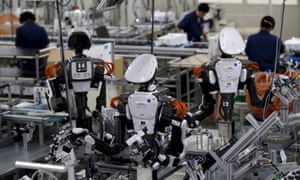
You could say that: The world of work is in a state of flux.Humanoid robots work side by side with employees in the assembly line at a factory in Kazo, Japan.

There is growing polarization of labor-market opportunities between high- and low-skill jobs, unemployment and underemployment especially among young people, stagnating incomes for a large proportion of households, and income inequality.

However the field of robotics promises to be the most profoundly disruptive technological shift since the industrial revolution.

The development of automation enabled by technologies including robotics and artificial intelligence brings the promise of higher productivity (and with productivity, economic growth), increased efficiencies, safety, and convenience. But these technologies also raise difficult questions about the broader impact of automation on jobs, skills, wages, and the nature of work itself.

Somehow, we believe our livelihoods will be safe. They’re not:

Every commercial sector will be affected by robotic automation in the next several years. We have yet to reach the full potential of digitization across the global economy.

More than half the world’s population is still offline.

Greater interaction will raise productivity but require different and often higher skills, new technology interfaces, different wage models in some cases, and different types of investments by businesses and workers to acquire skills.

In a recent report, the World Economic Forum predicted that robotic automation will result in the net loss of more than 5m jobs across 15 developed nations by 2020, a conservative estimate. 40–50% of all jobs will be taken by robots in the next twenty years.

By 2025, average salaries in the robotics sector will increase by at least 60% – yet more than one-third of the available jobs in robotics will remain vacant due to shortages of skilled workers.

Developments in motion control, sensor technologies, and artificial intelligence will inevitably give rise to an entirely new class of robots aimed primarily at consumer markets. For example  “Create Your Taste” kiosk – an automated touch-screen system that allows customers to create their own burgers without interacting with another human being.

The thing is: we’ve heard this all before. Time and time again, we underestimate capitalism’s extraordinary ability to come up with new meaningless jobs. (It’s 37% in the UK right now, but it could be 50%, 60% or even 100% in the future.)

Unless we update our ideas about what ‘work’ even is. The rise in the total of those employed is governed by Parkinson’s Law, and much the same whether the volume of work, were to increase, diminish or even disappear.

Labor which was once the capital of working men will be longer true.

Again: it’s not about the technology, it’s about the choices we make as a society.

When it comes to universal basic income: we don’t have to wait for the robots. We are more than rich enough to do it right now – in fact, we should have done it forty years ago!

Technology is not destiny, education is.

Everything depends on the choices that we make as a society.

If history is any precedent, we already know the answer.

MOST OF US ARE NOW SURROUNDED WITH A PORTION- DISTORTED EMBARRASSMENT OF NOT JUST FOOD BUT GOVERNMENT SIZE.

Guest Blog: Downsizing for Public Health

It’s time for taxpayers to remind themselves just how much the cost of government to run us is..

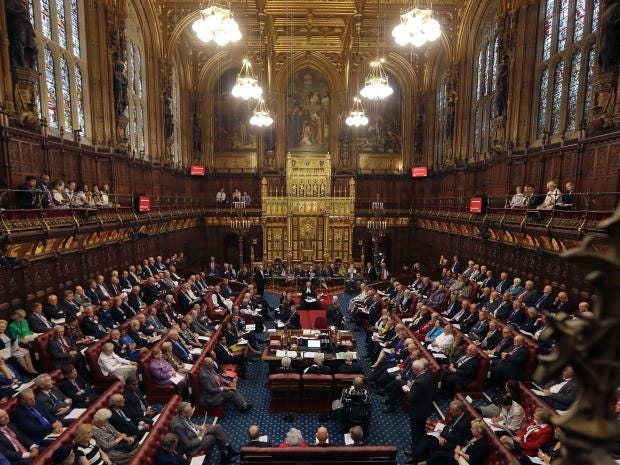
Let’s take the cost of running the UK as an example.Résultat de recherche d'images pour "pictures of house of parliament in london"

The House of Commons with 650 Mbps at £76,000 pa costing the tax payer £156 million a year.

Add in the £6.4m pa given to opposition parties (Short Money), and support items like IT, and the overall total for each MP goes up to £242,000 pa.

But that’s only part of the bill: we also need to add in the costs of running the Commons itself.  According to the HoC Administration Resource Accounts 2006-07, those costs total £210m, which is a further £325,000 per MP.

Oops I nearly forgot the gold-plated final salary pension guaranteed by taxpayers.

The official cost of MPs’ pensions is under 12 per cent of their salary, after 11 per cent contributions from MPs themselves. This adds up to total pay and pension for an MP of £85,000 (their £76,000 salary and £9,000 pension).

So with 650 MPs, that means each one costs us £85,000 pa in salary, pension contributions and employment taxes. Those troublesome “staffing allowances” cost us an additional £57.9m pa- £90,000 for each MP. Then there’s incidental expenses, additional cost allowances, and travel expenses, totaling a further £30.7m (£48,000 each).

Then you have 814 unelected Peers in the House of Lords at £83,000 pa. Costing the tax payer £67,932,000 a year plus £462,510 in tax-free expenses. Members can claim £300 or £150 for every day they attend the House and undertake parliamentary work. The dining rooms and bars are all subsidised by the taxpayer.

Baroness Smith of Gilmorehill, who has claimed £220,000 of expenses over her 27 year career on the red benches, has never spoken in a debate.

The total cost of members’ allowances and travel is around £20 million per annum.

So reducing the size of the House by about 250 members would represent a significant saving to the taxpayer.

Then you have the Civil Service 418,343, (316,792 full-time and 101,551 part-time.)  Gross annual earnings (excluding overtime or one-off bonuses) for Civil Service employees is around £25,350, pa.

You dont have to ask why people are lying on the floors of hospital corridors.

————————————————————————————————-

‘What do you do when there is nothing left to do?’

What should a government faced with an unmanageable level of unemployment do when conventional policy has failed to resolve the issue?’

Perhaps then a seemingly radical solution, such as universal basic income (UBI), becomes plausible. Universal Basic Income (UBI), a form of social security paid to individuals, not households. It is paid to everyone.

It would give individuals the freedom to say ‘yes’ to jobs. Individuals will not have to do that which they do not wish to do. Fewer people will engage in menial and unsatisfying work. Employers may be forced to increase the wages for underpaid or unpaid jobs.

UBI creates a floor (minimum level) on the income distribution curve, alleviates poverty, and gives bargaining power to the ones who have it least.

Forgetting about work for a moment (if you can), think about what you should do when your physiological needs are no longer a concern. If you’ve had a passion at the back of your mind then you might finally pursue it. If, on the other hand, you’ve passed life going from one kind of busy to another, then you might have missed opportunities to reflect and figure out what you would like to be doing. The cost of failure may have been too high if it meant putting you or your family’s livelihood at risk.

Assuming UBI ensures a basic livelihood for everyone in a community, do these citizens have a duty to give back by working? Do individuals have a duty to accept paid, available employment?

I would say Yes: Individuals should have a duty to do something, providing it is socially beneficial. There was something about people helping each other for its own sake that makes for a good society. A society is not well-functioning if it’s members are not interested in actively improving each other’s well-being.

Caring for the those who cannot care for themselves (such as the elderly, children and disabled). One could volunteer for various causes they care about, whether they be social, environmental, tech-related or so on.

Your recognition that you have alleviated the suffering of others might make you feel like you have done something meaningful.

UBI provides the opportunity for you to try contributing to your community in different ways. This freedom lets you find a way to contribute that is most satisfying for yourself.

It would remove fear replacing it with dignity.

UBI would also reduce the cost of citizens relying on the state for assistance.

There are many pending environmental crises hanging over us, but human wastefulness can be avoided. Can you imagine a world of 7.6 billion people no longer struggling for food or shelter and now focused on bettering the world for their children? That’s universal basic income. That’s a legacy we can all leave.

So why is it not being done?

Because it would downsize our consumerism lifestyle and remove inequality.

There is nothing more powerful than an idea whose time has come.

I can hear you saying where will the money come from?

Vat, Negative Interest rates, Earnings from investments, Decreasing militry spending, Sovereign wealth funds, etc.

It would ensure that the distribution of the fruits of technology advancement are distributed fairly. 

As Jeremy Howard said: ” In a post-scarcity world , why hold back wealth from people just because they can’t provide labor inputs just to create wealth.”

All human comments and suggestions appreciated. All like clicks chucked in the bin>

← Back

Thank you for your response. ✨


Share this:

  • Share on WhatsApp (Opens in new window) WhatsApp
  • More
  • Share on Mastodon (Opens in new window) Mastodon
← Older posts
Newer posts →

All comments and contributions much appreciated

  • THE BEADY EYE SAYS. EQUALITY, FAIRNESS, JUSTICE ARE INDIVISIBLE CONCEPTS IF ARE ANYTHING. March 18, 2026
  • THE BEADY EYE SAYS. IT DOES MATTER WHAT YOU THINK ABOUT WAR WHETHER ITS JUSTIFIED OR NOT. March 17, 2026
  • THE BEADY EYE ASKS HOW ARE WE TO MAINTAIN HUMAN DIGNITY IN A WORLD DOMINATED BY TECHNOLOGY. March 15, 2026
  • THE BEADY EYE SAYS THANKS TO CURRENT TECHNOLOGIES WE ARE UNABLE TO BELIEVE ANYTHING WE SEE OR HEAR? March 15, 2026
  • THE BEADY EYE SAYS LET’S PUT THE IRAN/ ISRAEL/ USA WAR IN CONTEX. March 12, 2026

Archives

  • March 2026
  • February 2026
  • January 2026
  • December 2025
  • November 2025
  • October 2025
  • September 2025
  • August 2025
  • July 2025
  • June 2025
  • May 2025
  • February 2025
  • January 2025
  • December 2024
  • November 2024
  • October 2024
  • September 2024
  • August 2024
  • July 2024
  • June 2024
  • May 2024
  • April 2024
  • March 2024
  • February 2024
  • January 2024
  • December 2023
  • October 2023
  • September 2023
  • August 2023
  • July 2023
  • June 2023
  • May 2023
  • April 2023
  • March 2023
  • February 2023
  • January 2023
  • December 2022
  • November 2022
  • October 2022
  • September 2022
  • August 2022
  • July 2022
  • June 2022
  • May 2022
  • April 2022
  • March 2022
  • February 2022
  • January 2022
  • December 2021
  • November 2021
  • October 2021
  • September 2021
  • August 2021
  • July 2021
  • June 2021
  • May 2021
  • April 2021
  • March 2021
  • February 2021
  • January 2021
  • December 2020
  • November 2020
  • October 2020
  • September 2020
  • August 2020
  • July 2020
  • June 2020
  • May 2020
  • April 2020
  • March 2020
  • February 2020
  • January 2020
  • December 2019
  • November 2019
  • October 2019
  • September 2019
  • August 2019
  • July 2019
  • June 2019
  • May 2019
  • April 2019
  • March 2019
  • February 2019
  • January 2019
  • December 2018
  • November 2018
  • October 2018
  • September 2018
  • August 2018
  • July 2018
  • June 2018
  • May 2018
  • April 2018
  • March 2018
  • February 2018
  • January 2018
  • December 2017
  • November 2017
  • October 2017
  • September 2017
  • August 2017
  • July 2017
  • June 2017
  • May 2017
  • April 2017
  • March 2017
  • February 2017
  • January 2017
  • December 2016
  • November 2016
  • October 2016
  • September 2016
  • August 2016
  • July 2016
  • June 2016
  • May 2016
  • April 2016
  • March 2016
  • February 2016
  • January 2016
  • December 2015
  • November 2015
  • October 2015
  • September 2015
  • August 2015
  • July 2015
  • June 2015
  • May 2015
  • April 2015
  • March 2015
  • February 2015
  • January 2015
  • December 2014
  • November 2014
  • October 2014
  • September 2014
  • August 2014
  • July 2014
  • June 2014
  • May 2014
  • April 2014
  • March 2014
  • February 2014
  • January 2014
  • December 2013
  • November 2013
  • October 2013

Talk to me.

Jason Lawrence's avatarJason Lawrence on THE BEADY EYE ASK’S: WIT…
benmadigan's avatarbenmadigan on THE BEADY EYE ASK’S: WHA…
bobdillon33@gmail.com's avatarbobdillon33@gmail.co… on THE BEADY EYE SAYS: WELCOME TO…
Ernest Harben's avatarOG on THE BEADY EYE SAYS: WELCOME TO…
benmadigan's avatarbenmadigan on THE BEADY EYE SAY’S. ONC…

7/7

Moulin de Labarde 46300
Gourdon Lot France
0565416842
Before 6pm.

My Blog; THE BEADY EYE.

My Blog; THE BEADY EYE.
bobdillon33@gmail.com

bobdillon33@gmail.com

Free Thinker.

View Full Profile →

Follow bobdillon33blog on WordPress.com

Blog Stats

  • 97,813 hits

Blogs I Follow

  • unnecessary news from earth
  • The Invictus Soul
  • WordPress.com News
  • WestDeltaGirl's Blog
  • The PPJ Gazette
Follow bobdillon33blog on WordPress.com

The Beady Eye.

The Beady Eye.
Follow bobdillon33blog on WordPress.com

Create a free website or blog at WordPress.com.

unnecessary news from earth

WITH MIGO

The Invictus Soul

The only thing worse than being 'blind' is having a Sight but no Vision

WordPress.com News

The latest news on WordPress.com and the WordPress community.

WestDeltaGirl's Blog

Sharing vegetarian and vegan recipes and food ideas

The PPJ Gazette

PPJ Gazette copyright ©

Privacy & Cookies: This site uses cookies. By continuing to use this website, you agree to their use.
To find out more, including how to control cookies, see here: Cookie Policy
  • Subscribe Subscribed
    • bobdillon33blog
    • Join 222 other subscribers
    • Already have a WordPress.com account? Log in now.
    • bobdillon33blog
    • Subscribe Subscribed
    • Sign up
    • Log in
    • Report this content
    • View site in Reader
    • Manage subscriptions
    • Collapse this bar