THE BEADY EYE ASKS: WHO WANTS TO LIVE IN A WORLD RUN BY GOOGLE .

Tags

, , , , , , , ,


( A Twenty minute read)

We might not yet be living in a world  that is run by Google but the way we are accepting artificial intelligence algorithms we will soon if not already be living in a world run by a Google Algorithm brain.

Algorithm, complex mathematical formulas, are playing a growing role in all walks of life: from health, to shopping, and jobs

The complex mathematical formulas of Algorithms are playing a growing role in all walks of life: deciding who gets a job, how police resources are deployed, who gets insurance at what cost, or who is on a ‘no fly’ list.

There decisions are often based on data collected about people, sometimes without their knowledge inferring all sorts of things about you from your digital crumbs.

They are being used – experimentally – to write news articles from raw data, while Donald Trump’s presidential campaign was helped by behavioral marketers who used an algorithm to locate the highest concentrations of ‘persuadable voters.

Completely lacking any form of transparency they are both untraceable, and subject to no form of accountability. They can infer your sexual orientation, your personality traits, your political leanings, with predictive power, with high levels of accuracy.

We’re already halfway towards a world where algorithms run nearly everything.

As their power intensifies, wealth will concentrate towards them.

They will ensure the 1%-99% divide gets larger.

If you’re not part of the class attached to algorithms, then you will struggle.

They will further stratify society, creating a world of haves and have-not’s.

So why are we ‘blindly trusting’ formulas to determine a fair outcome.

The main reason is because most people don’t yet know or understand what they are doing or could be doing.

Algorithms are not inherently fair, because the person who builds the model defines success. This is the reason why there is no popular outrage about Wall Street being run by algorithms.

For techno-evangelists, Google is a marvel of Web brilliance … For Wall Street, it may be the IPO (An IPO is short for an initial public offering. Like the name says, it’s when a company initially offers shares of stocks to the public. It’s also called “going public.” An IPO is the first time the owners of the company give up part of their ownership to stockholders.) that changes everything (again) …

The vast majority of trades these days are performed by algorithms. The idea that the world’s financial markets – and, hence, the well-being of our pensions, shareholdings, savings etc – are now largely determined by algorithmic vagaries is unsettling enough for some.

But in my opinion we should not automatically see algorithms as a malign influence on our lives, we should debate their ubiquity and their wide range of uses.

The online gallery reveal the interior of eight of Google's secretive server farms around the globe, from Finland to Iowa

wonderful attention to detail.

Why?

Because we now spend so much of our time online that we are creating huge data-mining opportunities.

Because there is the possibility of using big-data predictions about people to judge and punish them even before they’ve acted. Doing this negates ideas of fairness, justice and free will. This presents an entirely new menace: penalties based on propensities.

Because we risk falling victim to a dictatorship of data, whereby we fetishise the information, the output of our analyses, and end up misusing it.

Because by far the most complicated algorithms are to be found in science, where they are used to design new drugs or model the climate.

We all urgently need to consider the implications of allowing commercial interests and governments to use algorithms to analyse our habits:

How are they being used to access and interpret “our” data? And by whom?

Big data is a useful tool of rational decision-making. Wielded unwisely, it can become an instrument of the powerful, who may turn it into a source of repression.

But there is a bigger question about the oversights involving AI.

The questions being raised about algorithms at the moment are not about algorithms per se, but about the way society is structured with regard to data use and data privacy. It’s also about how models are being used to predict the future.

There is currently an awkward marriage between data and algorithms. As technology evolves, there will be mistakes, but it is important to remember they are just a tool. We shouldn’t blame our tools. At the moment there is consensus, that in the next twenty years we will be looking at seeing AI as smart as humans.

Difficulties come when they are used in the social sciences not to mention again financial trading.

Targeted Algorithms can now calculate whether a woman is pregnant and, if so, when she is due to give birth: Teenage daughters can be identified pregnant by retailers long before her own father knows.

From dating websites and City trading floors, through to online retailing and internet searches (Google’s search algorithm is now a more closely guarded commercial secret than the recipe for Coca-Cola), algorithms are increasingly determining our collective futures. “Bank approvals, store cards, job matches and more all run on similar principles.

“The algorithm is the god from the machine powering them all, for good or ill.”

They are now so integrated into our lives we barely notice them.

Pharmacists are already seeing some of their prescribing tasks replaced by algorithms. Data analysis as a factor in deciding whether to release somebody from prison or to keep him incarcerated.”

On the one hand, they are good because they free up our time and do mundane processes on our behalf.

However as their ubiquity spreads, so too does the debate around whether we should allow ourselves to become so reliant on them – and who, if anyone, is policing their use.

Here’s the scary bit:

We will be at the mercy of algorithms. How will they work when they are combined together. The result will be a system that will never be completely understood, that they could fail in unpredictable ways.

We are currently creating AI without fully understanding intelligence or cognition first.

Google released a developer’s kit last spring that lets anyone integrate Google’s search engine into their own application. The download is simple, and the license is free for the taking. The developer’s kit is a classic Trojan-horse strategy, putting Google’s engine in places that the company might not have imagined. Basically, those developers can do whatever they want.

Google doesn’t market itself in the traditional sense. Instead, it observes, and it listens. Their Algorithms will run everything from shopping to gods only knows what in the future. Googlers will be living amid semantic, visual, and technical esoterica.

Google now processes over 40,000 search queries every second on average, which translates to over 3.5 billion searches per day and 1.2 trillion searches per year worldwide A single Google query uses 1,000 computers in 0.2 seconds to retrieve an answer.

In February 2016, Google briefly overtook Apple to become the most valuable company in the world – worth more than $500bn (£350bn).

In 2015 alone, Google had revenues of $75bn (£53bn). That’s about £1,675 a second. Yet its core service – search – costs nothing to use. Simply, everyday in 2016 Google earned a over $58 million (£45m).

Google at the moment controls around 70% of all online searches.How much does Google make a day?

It could and should be viewed as a monopoly, but most of us don’t give a toss as it is already impossible to stop using it.

We are all already essentially sentenced to a digital death out side any laws or regulations.

Innovation at Google is as democratic as the search technology itself. One reason Google puts its innovations on public display is to identify failures quickly. Another reason is to find winners.

We will all have a Google Assistant connected to the Cloud.

The question is: Will they be accountable to us or Google.

Will it make our lives better or improve its quality?

Not so as technologies have little to do with human thought or indeed intelligence.

GOOGLE RATTLES THE TECH WORLD WITH A NEW AI CHIP FOR ALL.

Google says it will not sell the chip directly to others. Instead, through its new cloud service, set to arrive sometime before the end of the year, any business or developer can build and operate software via the internet that taps into hundreds and perhaps thousands of these processors, all packed into Google data centers more recently, it has worked to sell time on this hardware via the cloud—massive computing power anyone can use to build and operate websites, apps, and other software online.

Unlike the original TPU, it can be used to train neural networks, not just run them once they’re trained. Also setting the new chip apart: it’s available through a dedicated cloud service.

Several companies, including chip giant Intel and a long list of startups, are now developing dedicated AI chips that could provide alternatives to the Google TPU.

Why?  Because, this is the good side of capitalism which is in the process of disappearing into the cloud.

Most of Google’s revenue still comes from advertising, however IN A MOVE that could shift the course of multiple technology markets, Google will soon launch a cloud computing service that provides exclusive access to a new kind of artificial-intelligence chip designed by its own engineers.

The company sees cloud computing as another major source of revenue that will carry a large part of its future: deep neural networks—machine learning systems behind the rapid evolution of everything from image and speech recognition to automated translation to robotics.

Algorithms will still need a human to collect blood and urine samples for them to analyse. Even the best data scientists would struggle to know what to do with all that data. But it’s the next step that we need to keep an eye on. They could really screw up someone’s life with a false prediction about what they might be up to.

The European Union’s data protection law, set from next year to create a ‘right of explanation’ when consumers are impacted by an algorithmic decision, as a model that could be expanded but in practices algorithms will be made the scapegoat for societal ills. Absolving Humanity.

The protection law or laws will be Unworkable.

With most of us not realizing that there is a race before AI becomes conscious and self-aware, AI is here to stay, luckily there is more to mere intelligence than a chip or implant can explain.

The danger is that Super Artificial Intelligence will con us into to thinking that it is consciousness without being conscious. We could be using brain-computer interfaces to link us to the cloud and there will be no clear moment when we emerge as trans human whether we like it or not. If the world takes the shape of whatever the most powerful AI is programmed (or reprograms itself) to desire it opens the possibility of evolution taking a turn for the entirely banal.

Should we now be regulating AI.

The problem is how the rules are set: it’s impossible to do this perfectly.

Without a doubt and it should not be left to a small group or self-regulation.

We should now set up an new world organisation that is totally transparent and self financing to vet all AI.  This organisation should not only vet AI it should establish a virtual bank where all programs are stored.The Iowa campus network room, where routers and switches allow data centers to talk to each other. The fiber cables run along the yellow cable trays near the ceiling.


Each server rack has four switches, connected by a different coloured cable. Colours are kept the same throughout data centres so staff know which one to replace in case of failure.


Diversity has a value all in itself but when you look at humanity as a whole there is a lot wrong.

We at the start of a major technology revolution with AI no longer a far-fetched fiction.

Fortunately we do not have to justify our existence as yet.

Saying that we want to save this precious puny planet and doing it successfully is still a long way off. If we don’t find a way of distributing the earth wealth we will end up fueling capitalism with Artificial Intelligence that serves only the few not the many.

There are people searching the Web for ‘spiritual enlightenment and so they should as the needle of our beliefs will continue to swerve away from the universality of God.

When someone enters a query on Google for “spiritual enlightenment,” it’s not clear what he’s seeking. The concept of spiritual enlightenment means something different from what the two words mean individually. Google has to navigate varying levels of literary to guess at what the user really wants.

At some point, all of this great stuff has to turn a profit by Google.

What we have at present, academic inquiry devoted primarily to acquiring knowledge and technological know-how dissociated from any intellectually more fundamental concern to help us resolve our conflicts and problems of living in more cooperatively rational ways – dissociated, that is, from the pursuit of wisdom – is a recipe for disaster.

It is hardly too much to say that all our current global problems have come about because of the successful scientific pursuit of knowledge and technological know-how dissociated from wisdom.

The appalling destructiveness of modern warfare and terrorism, vast inequalities in wealth and standards of living between first and third worlds, rapid population growth, environmental damage – destruction of tropical rain forests, rapid extinction of species, global warming, pollution of sea, earth and air, depletion of finite natural resources – all exist today because of the massively enhanced power to act (of some), made possible by modern science and technology.

Every branch and aspect of academic inquiry need to change if we are to have the kind of inquiry, both more rational and of greater human value than what we have at present, that we really need.

All comments appreciated, all like clicks chucked in the bin.

PS: I did not bother to address the effects that Algorithms will have on our vision, our language, our writing, our necks, our figures, our memory, our brains etc.

← Back

Thank you for your response. ✨


THE BEADY EYE SAYS: THE EUROPEAN UNION (EU) AND ITS 27 MEMBERS FACE FUNDAMENTAL CHANGES OVER THE COMING 5-10 YEARS.

Tags

( A twenty-minute read)

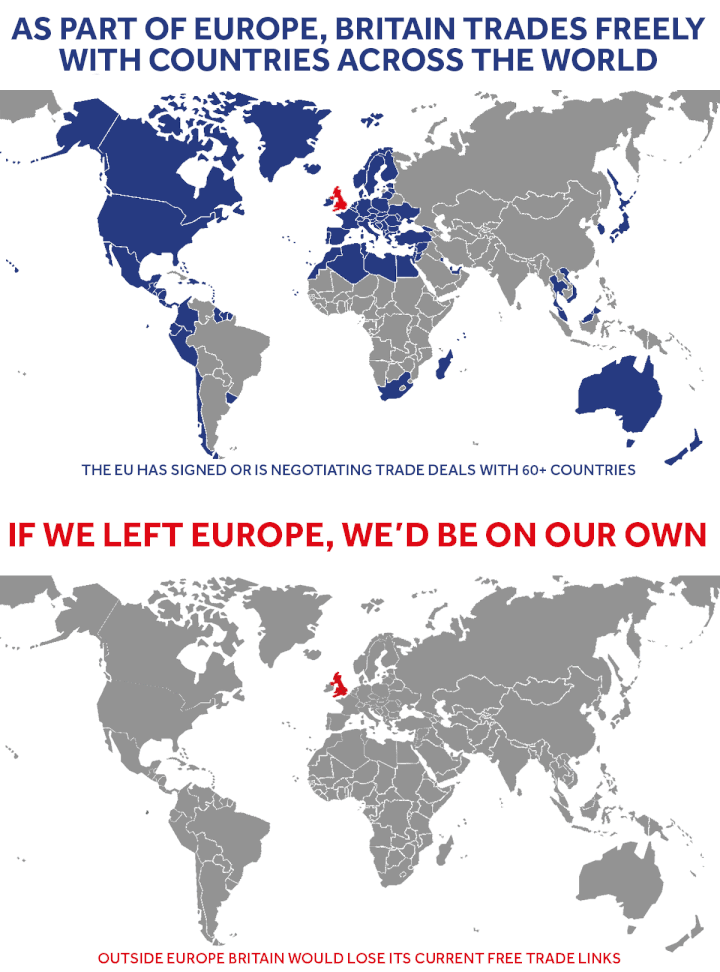
While Britain selfie sleep walks to its exit to become a free trade satellite off the shores of the European Continent a revision of the structure — institutionally and functionally — becomes inevitable for the EU.Résultat de recherche d'images pour "pictures of Britain as a free trade country"

My recent post highlighted that the EU project suffers from not having any real democratic legitimacy – without constitutional accountability, it is heading for trouble. ( see previous posts: THE BEADY EYE SAYS: IT IS TIME TO PUT PAY TO THE TRAVELING EU CIRCUS COSTING £9/10 BILLION TAX PAYERS MONEY.) However the Euro zone ends up it is the only place in the world trying to combine social welfare with a competitive economic structure.

The Europeans took a while to discover that killing each other and pursuing imperialistic and colonial policies are not in accordance with European values. Atrocities and crimes were committed, now it has a chance to create a remarkable political maturity of consensus, cooperation, and compromises.

Global governance sounds good, but out of reach for either the EU or Britain.

The digital age implies that a global opinion exists but the game now is about shaping perceptions of that opinion. Perhaps the EU is going to be forced by Social Media to go down the road to a form of Direct Democracy.

A new political system with another balance between centralized power and decision-making closer to the citizen spearheaded by Europe would be a revelation. 

Solidarity looks fine on paper and in declarations, but is much tougher to deal with in practice. Rebooting Europe’s economic model to combine welfare and competition and introduce a much higher awareness of resource scarcities will be no mean achievement. It strives hard to remain faithful to all that Europe stands for purified by the purgatory over centuries.

But is any of this realistic in light of England’s Departure.

The disturbing factor is the absence of confronting the issues among European politicians.

So what is in store and where is it going to go in the next ten or more years.

In reality there were two groups of Euro members: Strong countries mainly in Northern Europe and weak countries primarily in Southern Europe.

The fact that the EU’s politics will be devoted to tackle self-created problem sideling other pressing matters are an appalling thought. Confusion, non-transparency, peculiarity even queer ways obscured by meetings and personalities may rule the headlines.

Politically the consequences are much more severe and next to impossible to foresee.

As of 2015 the Euro zone morphs itself into a genuine Economic and Monetary Union with a common economic structure and a common economic policy underpinned by a fiscal union and a banking union. This was bound to happen and it can only be regretted that it had to be done as a response to a debt crisis making the process laborious and burdensome.

As of now 19 countries out of 28 EU member states have joined the Euro.

Europeans may not fully trust each other, but mutual trust is stronger and deeper than in any other political conglomerate around the world.

One its greatest challenges is that Europe is not multicultural, but the world is.

The Union is founded on the values of respect for human dignity, freedom, democracy, equality, the rule of law and respect for human rights, including the rights of persons belonging to minorities. These values are common to the Member States in a society in which pluralism, non-discrimination, tolerance, justice, solidarity and equality between women and men prevail.

This core element is now in question with the influx of migrants not sharing the same cultural identity, causing internal pressure which is why migration/refugees are an existential challenge.

This is why the solution can only be to allow migrants/refugees getting into Europe, to do so with two provisos:  That they do not be allowed to disrupt the existing societal structure and they are educated to adapt to European norms and values. A European citizen approaching the authorities feel that if the roles were reversed the decision would be the same.

In doing so Europe can solve its demographic problem number wise by remaining opening for immigration, to vetted people wanting and ready to enter Europe — actually more than ready as they are banging on the door — do not share cultural identity with the Europeans.

Britain should have accepted that for the EU-27, the idea of free movement is not just political posturing, but an essential part of the single market.  The EU is unlikely to agree on major changes to free movement rules in the next few years.

The core demand for new terms tabled by the incumbent conservative government is to roll back the situation to 1992 and get guarantees that EU social provisions (broadly speaking) do not apply to Britain. This festered till the in or out vote now giving rise to the question of what economic and societal model Britain wants and the answer is a different one from what is found on the continent.

Psychologically the British people may be uneasy companions of former enemies like Germany, France, Spain, and Italy. Links with the Commonwealth fade which probably is regretted by many Britons. The Anglo-American partnership that has for decades given Britain a privileged role is judged by some politicians and part of the public to be closer outside the EU than inside despite American statements to the contrary.

Because of the Franco-German axis which is firmly in control of the EU, Britain has never felt comfortable and probable never will.

However access to the market of the 27 member states weighs heavier for Britain than access to the British market for the rest of the EU.

The tricky part is that the treaty provisions cease to apply to the member in question when such agreement is reached or in case of failing to agree within two years from the decision to secede.

Everybody will try to rescue what can be rescued from this shipwreck, but obviously the 27 remaining member states will take the view that Britain has decided to leave so leave you do.

The main argument apparently falling on a lot of deaf ears in Britain is that inside or outside the EU, economic transactions require compliance with EU norms, standards, and various rules. Those rules are shaped by the member countries promoting own interests. Britain outside will not participate in this sometimes laborious process resulting in British interests not being fed into the legislative process.

The two-year clause strengthens the EU hand, as they better than Britain can live without free movement of goods, services, capital and labor.

The Euro zone countries will tend to share views and interests to a much larger degree keeping EU member states not inside the Euro with a different economic structure on the sidelines.

It is true that no EU citizen has a fundamental, unlimited right to move freely across the EU. To be lawfully resident in another member-state, EU citizens need to be working, studying, or able to prove that they are self-sufficient. Otherwise, they can be kicked out. It is also true that free movement of persons was introduced after the free movement of goods, capital and services.

It is difficult to estimate how strong the negative impact will be.

As seen in many cases it is the long-term effect that matters and continuous lower growth will in the long run add up to a substantial loss even if England reduces corporation and personal taxes.

While EU free movement rules have been a toxic political issue in Britain for years, many on the Continent consider them a core achievement of the EU.

So could there be a free trade agreement between the UK and the European Union that allows the UK to limit freedom of movement.

My answer is no. Out is Out.

The conclusion to draw is a sentiment among the majority of member states and in particular the original six ones that either you are member of the EU, committed to solidarity, coherence, common decision-making, and common policies or you are not.

Résultat de recherche d'images pour "pictures of Britain as a free trade country"

Britannia will “survive” without a post-Brexit free-trade deal with the EU.

The process of Brexit is likely to be a series of humiliating meetings in which the country is forced to accept a procession of ruinous trade deal terms – ruinous, at least, for the majority of the population.  In reality, the UK has never stood alone in the global free trade environment as we understand it today;

It may all end in disaster. But it does show consistency by the British. The EU can be replaced by countries full of fond memories of the empire. The UK has a long history of hypocritically claiming to want only trade in its international relations.

The British Empire stood by and watched one million Irish die of famine just 150 years ago while it continued to export pork and ham and lots of other produce to England. One million Irish! Has there been a word of regret about that genocide ever from the British State? Not one word.

“The British Empire was a great and glorious thing that did much good(such as ending slavery) ”

Such statements are totally untrue.

It was an evil kleptocracy and extortion racket. Imperialism is the geo-political equivalent of rape. There can be no defense for it. To call it “glorious” is nothing short of sick. It certainly wasn’t the empire which ended slavery. The empire not only fought tooth and nail to retain it, it actually managed to extort compensation for the vermin who had profited from it. It was the entire foundation of Britain’s wealth – or rather the wealth of Britain’s ruling class.

Far from benefiting from “free trade”, Britain got rich by imposing tariffs on imports and sending gunboats or troops to deal with anyone who presented problems.

If Britain is expecting to encounter fond sentiments from x colonial countries in free trade agreements it is about to be bitterly disappointed.

Britain did not make its fortune by trading freely.

The wealth of the UK was EXPLICITLY derived from its military domination of overseas territories, control of cheap inputs (such as cotton) and export markets that were enforced. So, the ludicrous idea of the Brexiteers that the UK can compete in the global economy does not stand up to scrutiny even historically.

In the contemporary world, it is nothing other than laughable. In the context of a highly open economy, dependent on imports of almost everything, the only effect of a devalued currency is inflationary pressure and an increased trade deficit. This policy approach almost qualifies as a definition of insanity.

We don’t need to wait to judge Brexit, because any clear-thinking and informed person can see outright what a disaster this is almost certain to be.Résultat de recherche d'images pour "pictures of Britain as a free trade country"

The ECHR is an international human rights treaty that is independent of the EU and predates it. If the UK denounces the ECHR as well as leaving the EU it is setting itself up as another North Korea. Every single country in Europe — including Russia and Turkey — is in the ECHR. Write your own laws!

We are living at a moment when an old economic settlement is in crisis, but a new settlement has yet to be formed.

Unless the US and Europe can find common ground the prospect of chaos and infighting is too high for comfort as no other country or group of countries are waiting in the wings with ideas and economic power to lead. Some decades down the road the US and Europe will still account for more than 1/3 of global Gross Domestic Product — maybe more.

The politics of the future will belong to those leaders both in Europe and Britain who are prepared to face up to our present problems and future challenges.

Britain’s future is a nostalgic past that never really existed.

Yes, this is the way forward for “Poverty UK” — back to the 1950s! Résultat de recherche d'images pour "pictures of Britain as a free trade country"

← Back

Thank you for your response. ✨


THE BEADY EYE SAYS: THAT THE DECISION/POLICY MAKERS DO NOT APPRECIATE THE GRAVITY OF THE SITUATION.

Tags

, , ,


( A Disturbing Twelve minute read)

With a world that is in a categorical state of chaos ignoring the fact the climate is already altered can not continue.Résultat de recherche d'images pour "pictures of climate change effects"

It is certainly too late to stop all climate change.

Climate change is not an on-off switch. It is a continuing process. Emitting greenhouse gases is a lot like overflowing a bathtub. Even a slow trickle will eventually flood the room.

By continuing to delay significant reductions in greenhouse gas emissions, we risk handing both an impossible financial and technological burden to future generations.

They have to realize that every decision they make now impacts all species’ chances, and by not acting – by allowing the status quo to continue – we will not only lose nature’s ability to rapidly adapt in future but our also.

Our children and grandchildren may be unable to understand how we negotiated such an arrangement on their behalf.

The era of top-down carbon markets, unlimited unit supply and rising domestic emissions has ended. Right now, only governments can purchase international emissions reductions.

We cannot and must not rely on international markets to set our future domestic emission price with carbon credits. Nor can we rely on International agreements such as the Paris Climate deal and the Kyoto Protocol, they are only having a marginal effect. 

Despite the avoidance of millions of tons of carbon dioxide emissions through use of renewable energy, increased efficiency and conservation efforts, the rate of increase of carbon dioxide in the atmosphere remains high.

True climate sensitivity will only become manifest on a time scale of centuries, due to effects that researchers call “slow climate feedbacks.”

Why?

Because climate change is unlikely to proceed in a linear way.

Because it is not just scientists fear “tipping points” in the climate system. There is also tipping points in social, economic and political systems.

This is where we are to-day.

So far we have experienced about 1.1℃ of average global warming since the Industrial Revolution. Over this time atmospheric CO₂ levels have risen from 280ppm to 410ppm – and the equivalent of more than 450ppm after factoring in the effects of all the other greenhouse gases besides CO₂.

While wildfires radical shifting forest habitats we looking at a greening globe as plants grow faster in response to rising carbon dioxide.

We are looking at rising sea levels, submerging  low-lying island nations. We are already seeing wars over water, and we will be seeing millions of climate refugees.

There is little understanding that electric vehicles will be in the main pollution shifters- from the tail pipe to power generation stations.

If we can convince people that climate change is real and important, then surely they will act:

No they will not.

Critically, if people thought acting on climate change would improve society it would matter if they believed it was happening or not, or whether it was important. And it would not also matter what political ideology they held.

You might think if action on climate change reduces pollution or stimulates economic development, people who value clean air or economic growth might support climate change action, even if they are unconvinced or unconcerned about climate change itself. Issues like pollution and poor health being commonly invoked as co-benefits of addressing climate change, reducing pollution, poverty and disease are the weakest motivator of climate change action.

Although mitigating climate change will produce these health and pollution benefits, these don’t appear to strongly motivate people’s willingness to act. In addition there is the possibility of unknown effects –- those that are hard to predict because the planet’s climate is such a complex system where strong regional variability is the norm.

Making society more caring is a strong motivator for action across the globe, whereas promoting development varied in its effects across countries. Developing countries are already being paid in cash and technology for not using ozone-destroying chemicals in refrigerators and air-conditioning systems.

If we stopped emitting greenhouse gases right now, would we stop climate change?

In order to stop the accumulation of heat, we would have to eliminate not just carbon dioxide emissions, but all greenhouse gases, such as methane and nitrous oxide. So if we stop emitting carbon dioxide from burning fossil fuels today, it’s not the end of the story for global warming. In any event, it’s not possible to stop emitting carbon dioxide right now. Despite significant advances in renewable energy sources, total demand for energy accelerates.

The importance of climate change as a public issue has been slipping in countries such as the United States, and is given a relatively low priority across the world.

Future emissions may be dominated by large developing countries like China and India. While neither can be blamed for climate change so far, they clearly have to be part of the solution.

Humans have pumped over 1.5 trillion tonnes of CO₂ into the atmosphere since 1750. It is not just the amount, but the rate at which this CO₂ has been added.

The industrialized nations have already emitted enough carbon dioxide and humanity cannot afford for the developing world to take the same path.

With MR Dump in the USA denying that US alone is responsible this is now probably the biggest challenge.

So a deal has to be done that is binding fair and achievable not just verbal rhetoric.

It will require large flows of technology and cash to the developing world.

Ecosystems are altered by natural and human-made occurrences. As they recover, it will be in a different climate from that in which they evolved. The climate in which they recover will not be stable; it will be continuing to warm. There will be no new normal, only more change.

We won’t go back to the past. Rather than trying to recover the past, we need to be thinking about best possible futures.

Communicate climate change to the public in more convincing ways:

The real key is to ensure that climate change initiatives directly benefit the pocket of the individual.

How can this be achieved?

Firstly:

Place a blanket World Aid Commission of 0.05% on all stock exchange transactions. On all High Frequency Trading. On all Sovereignty Wealth Funds Acquisitions. On all Foreign Exchange Transactions over lets say $50,000.

Secondarily:

Establish a new World Aid Organisation totally transparent and free of United Nations Veto to manage this perpetually funded.

Thirdly:

This organisation uses Capitalist Greed for profit by issuing Green Bonds with a guaranteed return. It authorities non repayable loans to all projects that tackles climate change. Subsidizes Solar panels production to reduce costs. Helps re-settlement.

While these costs will be spread over 80 years, this will also be a period in which the global population will increase from seven billion to perhaps 11 billion and beyond.  Humanity will need to grow enough crops to feed these billions while fueling BECCS schemes (Bio-energy with carbon capture and storage)  at a time when climate change will already be impacting food production.

Could this be achieved:

In politics, most things can be done if there is the will.

The more big investors and companies report on the impacts of climate change, the more information will be available for everyone. You and I will be able to better understand what role our retirement savings are playing in tackling climate change.

It  less obvious how climate change policies could help create communities where people care more for each other.“Top-down” policies such as a carbon tax or emissions trading aren’t traditionally the stuff that helps build communities.

However, policies that support “bottom-up” initiatives have this potential, such as engaging local communities in climate change activities that build friendships and strengthen networks. People will be motivated to act on climate change when they think it would lead to scientific and economic advances (development), and when it will help create a society where people cared more for each other (benevolence).

Lastly:

The New World Organisation should have its own TV Channel. What gets measured gets managed, including climate change.

Blocking out the sun to reduce global warming – an idea still in the making as is the hope that Artificial intelligence will come to or rescue.

All comments or suggestions welcome. All like clicks chucked in the bin.

← Back

Thank you for your response. ✨


THE BEADY EYE ASKS: WHAT DO YOU THINK WILL START THE NEXT WORLD WAR ?

( A Ten Minute Read)

What will Sparks’ it?

Will artificial intelligence bring us utopia or destruction?

Some of hypotheses are undeniably hysterical, for sure, but the consequences will be more terrifying, and indefensible, than we have ever seen before.

It’s always tempting to predict death and destruction, because you’ll be at least a little bit right and no one will fault you if you’re wrong.

So will it be a clash of civilizations, severe climate change resulting in climate mitigation; resource depletion, a populist uprising. The development of robotic soldiers with the ability to wage war without putting troops on the front line. Computer glitches causing corporations wars; or diplomatic misunderstandings, all of which can lead to war. Terrorism, inequality, and internal political or civil strife can also create the pressure for war.

In the immediate aftermath of 9/11, there were only a few hundred Islamist fighters in the Hindu Kush mountains. Fast forward through 16 years of the war on terror costing some $4,000bn (£3,300bn) and leaving 1.3 million dead, and the number of terrorists is currently about 100,000. Even on its own terms, the war on terror has been an abysmal failure. How on earth did this happen?

If civilization conflicts are not the least of our worries there are indeed a vast verity of triggers.

The Trump transition is likely to exacerbate US-China tensions. Trump has threatened a trade war with China. Kim Jong Un decides to attack his neighbors in the South Pacific and Trump decides to fire back.

The Ukrainian crisis was preceded by two decades of NATO expansionism up to the borders of Russia and now it is widely recognized that Russia is waging a campaign of covert political manipulation across the United States, Europe and the Middle East.

The original post-war European Union project was based around peace, social justice and harmony. The unraveling of this project might be Brexit accompanied by rising nationalism, which is likely to exacerbate the dangers of war on a continent with a fraught history of bloody conflict.

The Middle East cauldron centered around Isis and the Syrian war.

The Syrian war has seen allies – Saudi Arabia, Qatar and Turkey – arming and funding radical Jihadist groups, such as the al-Nusra front. The terrorist attacks in Europe have demonstrated the difficulty in containing the spill-over. The Syrian war has seen the return of great-power politics with the involvement of Russia. This contamination has the potential for a wider conflict in which western countries could be drawn in.

India and Pakistan could go to war Article Image

Take your pick.

Mine is in keeping with the default operational mode of capitalism.

One might even argue that capitalism often resolves systemic economic crises through war. After all, a war economy with militarization, mobilization, full employment and jingoism can be viewed as the ultimate solution to economic woes and social unrest.

We are now at the beginning of Technology that is overseeing an extraordinary re-distribution of wealth that is tilting society off its axis.

The richest 1 percent have almost 40 percent of our worlds wealth, while the bottom 90 percent have 73 percent of the debt.

This is largely the result of technology.

And just wait until the work force is truly affected by the rise of robots and automation.

You don’t have to look too far back into history to see that when the marginalized have had it with the system, it doesn’t take a lot to set flame to tinder.

The emerging technologies like industrial robots, artificial intelligence, and machine learning are advancing at a rapid pace, but there has been little attention to their impact on employment and public policy. So technology is likely to be at the center of the next major geopolitical battle.

The anti-immigration, anti-one percent, anti-capitalism and anti-everything else we’re seeing right now isn’t just going to go away in a society where people feel their voices are not being heard.

The next major war, wouldn’t be fought with bombs, men, or even robots. It wouldn’t be waged on a battlefield or in the sky.Résultat de recherche d'images pour "PICTURES OF COMPUTER WARS"

Instead, it will be a silent war.

During the past couple of decades, most of the world’s private and public infrastructure had become predominantly digital.

The next major war will decimate that infrastructure.

Water-treatment facilities, oil pipelines, dams, electrical grids, telecommunications platforms, food shipments, public and private transportation, traffic lights, prisons, every single drip of media—and a long, long list of other things we need for survival but take for granted—will all be vulnerable.

Our smartphones and computers will be black rectangles. The Internet: poof! Water infrastructure will stop working, power plants will go offline. Crops, which are now operated by digital irrigation systems, will die.

And that will all be in the first few hours.

Imagine what will happen in the coming days, weeks, and months. We will essentially be sent back centuries. Computer hackers—possibly from an adversarial country—taking down power plants, water systems, the Internet, or private infrastructure. Real cyber warfare could destroy actual machines.

The first technology revolution caused World War I. The second technology revolution caused World War II. This is the third technology revolution.

So could it in fact trigger a Third World War.

As soon as 2025, large parts of the world will experience perennial water shortages, by 2050, the world’s populations will be a third to a half again as large as today. Put rising population and rising incomes together and, experts tell us, by 2050 global food needs will double, with water requirements going up accordingly.

[It takes 2,400 liters to produce a hamburger, common in many middle-income diets, it takes about 40 liters of water to produce a slice of bread, a staple of low-income diets.] On a humanitarian level, the possibilities are devastating.

Climate change requiring a shift in the way we think about the global distribution of resources.

Some will say that technology will help to get us out of the sustainability jam, but it will be nothing more than a quick fix to the vast graveyards of abject inequality created by algorithms for profit.

This is why we must now create a new World Organisation to vet all technology. (See previous posts)

World leaders have a duty to educate people to prevent the pain caused by a rapid rise in automation and artificial intelligence.

Instead we see the transition of Western democracy to oligarchy and the descent into soft fascism is under way. Citizens will need to participate actively, rather than as passive consumers, to demand an end to this cycle of violence from governments and to defend the assault on democratic processes which are already having its foundations rocked by Social Media filtered platforms that have profit as their mantra.

In today’s ultra-globalized and ultra-specialized economy? The level of economic adaptation — even for large countries like Russia and the United States with lots of land and natural resources — required to adapt to a world war would be crushing, and huge numbers of business and livelihoods would be wiped out. War could break out in a number of places, drawing in combatants in unpredictable ways. Combatants very rarely start a global war on purpose; the leaders of the world’s most powerful nations need to be vigilant about the threat of crisis escalation.

The spread of internet technology and social media has brought the world much closer together. Today, people from enemy countries can come together in cyberspace and find out that the “enemy” is not so different.

YouTube and Facebook makes it much more difficult for governments to carry out large-scale military aggression’s, but on the other hand all it took during World War I was one shot. Maybe all it will take for World War III is one line of code.

We shouldn’t scoff at the warnings that something like this could happen one day.

Statesmanship must go beyond diplomacy, in particular to championing new agricultural technologies. Without growing more food with less water (land, too) the water-war surprises will come, perhaps not in one year, perhaps not in four, but soon, and long into the future. Even the big threats—nuclear warfare or an ecological catastrophe, perhaps following from climate change—aren’t existential in the sense that they would wipe us out entirely. And the current bugaboo, in which our electronic progeny exceed us and decide they can live without us, can be avoided by unplugging them.

The new technologies may be self-accelerating, but they are not self-determining. I would say that the odds are good for our survival, providing that AI does not acquire the ability not just to think like us but to self-replicate.

The revolutionary potential of future technologies is to change Homo sapiens itself, including our bodies and our minds, and not merely our vehicles and weapons. The most amazing thing about the future won’t be the spaceships, but the beings flying them. 

The truth is that from the standpoint of morality, like many other standpoints, we are hardly adapted to the world in which we live.

Technology will be the result of ever renegotiated agreement with society. Because they are so potent, their paths may undergo wild oscillations, but I think the trend will be toward the dynamic middle: much slower than the optimists expect, much faster than the pessimists think humanity can bear.

However the cold war may be over, but the Doomsday Machine that came out of the confrontation with the Soviets is still with us—and on a hair-trigger.

As global conflicts grow increasingly messy, narratives spun by propagandists and troll factories will wreak havoc via social media, state news organs and even the global free press.

All comments appreciated. All like clicks chucked in the bin.

← Back

Thank you for your response. ✨


THE BEADY EYE SAYS: IT IS TIME TO PUT PAY TO THE TRAVELING EU CIRCUS COSTING £9/10 BILLION TAX PAYERS MONEY.

Tags

,

( A ten minute read)

The EU project suffers from not having any real democratic legitimacy – without constitutional accountability, it is heading for trouble.

The unaccountable nature of the EU, coupled with the hardship caused by the “austerity for some, gravy trains for others” policies and the failure to either deal with the still-mounting debt crisis, and the real problems caused by all this and the lack of support for any further social, economic and political integration, it’s debatable whether the EU will even survive for long… just wait till the next crisis hits.

A self-created bubble for the MEP’s where their loyalty to the EU above the people is assured by massive wages, expenses and pensions and if kicked out by the electorate in elections they’ll get other jobs in the Commission or the wider EU structure.

On top of all this we have Strasbourg a symbol of waste and stupidity – the perfect example of all that is wrong with the EU. True democracy at work. No one gets a vote on it.European Parliament strasbourg

Approximately 10 per cent of the Parliament’s annual budget, between €156 and €204 million is spent to sustain this traveling circus.

The annual CO2 emissions associated with the transfers to and from the three working locations – Brussels, Luxembourg and Strasbourg – is estimated to be between 11,000 and 19,000 tonnes. That is the equivalent of 12,000 cars driving around the circumference of the world. (Is it not ironic that the European Parliament voted to reduce CO2 emissions by 2030?)

Between 3,500 and 4,000 people every month set out for Strasbourg – this includes MEPs, assistants, political group staff, parliament staff, interpreters and translators. This is done by trains, by air and by road. In order to transport the 2,500 trunks and all the equipment required for the plenary session a large convey of trucks travel the 409 kilometers from Brussels to Strasbourg. This is then reversed four days later.

Among the costs are £250,000 a year to transport the plastic boxes containing documents, diaries and other items from Brussels to Strasbourg and back again.

£2.5 million bill for relocating freelance translators from Brussels to Strasbourg and back again, including costs of travel, accommodation and other expenses.

Depending on how you read it, you might find the E.U.’s tendency to translate nearly everything it does into all 24 of its official languages a testimony to its internationalist glory or a wasteful use of resources. By E.U. custom, all public E.U. documents are translated into every language. All high-level E.U. meetings are the same way. The European Commission says it employs 1,750 linguists, 600 full-time interpreters and 3,000 freelancers.

In Strasbourg, extra money is needed for computers and IT support and for maintenance and security of the sleek parliament building, which was completed in 1999. In total, the cost of looking after the French buildings and infrastructure and other charges comes to about £50 million a year.

About 100 people are employed in Strasbourg full-time, even though the European Parliament meets for 12 sessions, each lasting four days, a total of only 48 days each year.

Hotels in Strasbourg typically double their rates when the EU comes to stay. Last week, the Hilton Hotel in Strasbourg was offering rooms at £82 for Sunday night, but this rose to a cheapest rate of £161 a night for Monday, when the sessions begin.

Naturally, the French are totally opposed to ANY CHANGE not only because of the €20 Million it provides to the Strasbourg economy each year but also because it is an important European symbol within France.

Why does the European parliament move from Brussels to Strasbourg once a month?

It is a disgrace that €9.5 million is wasted in this way every month.

Strasbourg is the official seat of the European Parliament, so the EU treaties would have to be changed if that were no longer the case. A final decision would rest with the member countries.

The so-called traveling circus that sees MEPs and staff decamp from Brussels to Strasbourg once a month has long been a bone of contention. It costs the institution some €114 million a year to make the trip.

In a November 2013 resolution, MEPs called for a treaty change to allow Parliament to decide where it sits.

Over three-quarters, of MEPS from across the political spectrum, want to abolish this practice but they have no power to change it. Under the Lisbon Treaty the parliament is legally bound to meet 12 times a year in Strasbourg. A session takes place every month – except in August but a second session in September or October replaces it. This can only be changed if unanimous agreement on the issue is reached at a European Council Summit – a meeting of heads of Governments of each Member State.

The EU’s national governments unanimously decided in 1992 to fix the seats of the EU institutions permanently. This decision also affected the working arrangements for the Parliament: its official seat and the venue for most of the plenary sessions would be Strasbourg; parliamentary committees would have their meetings in Brussels; and Parliament’s Secretariat (its staff) would be based in Luxembourg. In 1997 this whole arrangement was incorporated into the EU treaty.

Any change in the current system would need to be part of a new treaty, agreed unanimously by all 28 member states and ratified by each of their national parliaments. However only with a workable alternative for Strasbourg could a French veto be avoided.

I can fully appreciate that if you move an existing institution, the member state which currently houses it will also have to be compensated, setting off a chain reaction. So you have to give proper consideration to all of the links in the chain before you come up with a proposal.

But will it change?

For the foreseeable future, I honestly don’t think so. Unfortunately, France will never agree, which holds a veto.

The continuation of the monthly migration between Brussels and Strasbourg has for most EU citizens become a symbolic, negative issue (…), especially at a time when the financial crisis has led to serious and painful expenditure cuts in the member states”, said the resolution, which was approved by 483 votes to 141, with 34 abstentions.

France and Germany got everything they wanted and everyone else got shafted.. French MEPs could quit the largest political group in the European Parliament if their colleagues support a plan to scrap the assembly’s base in Strasbourg. It’s up to us with the power of Social Media to demand a stop to this blatant waste of our hard-earned money.

How can we achieve this:

There is only one way and that is by bombarding Emmanuel Macron the new French President through Social Media with the following message.Résultat de recherche d'images pour "pictures of the new french president"

Not a one day bombardment but a sustained bombardment.

 [Palais de L’Élysée

55 Rue du Faubourg Saint-Honoré

75008 Paris, France.

Your Excellency,

The Strasbourg-Brussels merry-go-round has gone on long enough, it’s deeds, not words, that count.  With due respect The European Parliament’s travelling circus represents all that is wrong about the EU in the eyes of electorates across Europe: A useless and huge cost for our European community. 

A recent study by the European Parliament shows that €103 million (£85 million) could be saved each year if all European Parliament operations were transferred from Strasbourg to Brussels.

As a taxpayer I have no objection to maintaining the status quo, providing the total costs are financed by the French Tax payer.  

They say the definition of madness is doing the same thing repeatedly and expecting different results. The unnecessary waste and the political stalemate that perpetuates it must stop. This craziness has to stop.

Yours sincerely:    ………………………………….  ]  EU Citizen.

Optional PS:

Why not give everyone a smart phone with a voice recognition app. Press Translate. A saving of £2.5 million. ( 750 linguists, 600 full-time interpreters and 3,000 freelancers.)

← Back

Thank you for your response. ✨


THE BEADY EYE SAYS: WE ARE NOW IN A PERIOD OF HISTORY WITHOUT ANYONE UNDERSTANDING WHAT IS HAPPENING AND WHERE WE RUSHING.

Tags

( A Ten minute read)

These day’s bashing free-market capitalism is high on the agenda and its no wonder as we indeed need to understand its shortcomings. Yet criticizing capitalism should not blind us to its advantages and attainments.

If we ignore the potential ecological meltdown and measure success by production and growth we could say with some degree of accuracy that perpetual growth and cooperation has to a great extent being achieved.

We’re surfing a technology tsunami!

New technologies are changing the way the world operates, the way people live, and the way we do business. Nothing will ever be the same, as customers take control of relationships. But the connectivity explosion has also created a global trust crisis. Who do we trust – the local pharmacy, or Google? Our local politicians, or a stranger we have never met on Facebook?

Power is shifting – moving from institutions, from governments and big companies, into the hands of connected individuals. This is completely reshaping societies, economics, politics and business. And this is giving rise to a generation of new, nimble, innovative competitors across the entire business market, who are challenging the existing players with different models and new rules.

The world as you know it is rapidly changing: AI, Robotics, Drones, Block chain, 3 D printers, Self-Driving Cars, Unlimited energy, the list goes on and on.

If on an almost daily basis, there is a sense that the world is moving faster, it’s because we are! Entire industries will be rocked to the core and some will be destroyed overnight, while others will be created.

But at what price.

The new modern deal with Artificial Intelligence Algorithms and the coming automation is demanding that we give up meaning as the free-market cloaked in Algorithms is making Capitalism blind and invisible.

We humans remain as fickle as the wind.

Who ever determines the meaning of our actions, whether they be good or bad, right or wrong, beautiful or ugly, will have the authority to tell us what to think and how to behave.

Our source of meaning and authority is now being relocated into filtered wireless platforms which are in the process of reshaping logic that has no sensitivity or experience.  Indeed we are heading to a new form of living that is taking no measure of feelings that can be turned into wisdom. Unfortunately it remains impossible to take into account the experiences of all to weight them against each other in a fair way. If we want a fair and just world it will be only achieved by common action.  It is impossible to argue that all human experiences are equally valuable.

To the  best of our scientific understanding, determinism and randomness have divided the entire cake between them.

Our feelings as you know provide meaning not only for our privater lives , but also for social and political processes.

In the past world history was shape by small number of forward thinking people not by the masses. To day we are all carrying brain scanners call smartphones all of which are in the business of predicting people’s desires and making decisions well before we become aware of them.Résultat de recherche d'images pour "pictures of the future world"

Lacking freewill is the main aim of every un vetted algorithm and app that are designed to generate profit.

With direct brain stimulation becoming the new scientific world, with its technologies translating into everyday activities and economic structures we will need new religious beliefs and new political institutions.

Many inventions are born in the lab and never make it into the consumer market, while others evolve beyond the pace of putting good regulations on their use. For example Twitter Periscope app being used to groom children.  Or facial recognition apps that will soon be enforcing open air prisons turning us all into second class Google citizens.     

We have the technology to put computers almost anywhere and in almost anything surely its time we create a New World Organisation which is self financing and totally transparent to vet all technology. ( see previous posts) 

Machines could soon have access to our innermost thoughts.

Our thoughts and actions could actually be hijacked by a form of media that makes us think we’re getting what we want, when really, we’re going for something our brains may only think is supposed to be good.

Data and the machines and algorithms used to manage and make sense of it could largely replace independent decision-making — either large or small — and it is happening at such a speed that it’s sometimes hard to remember the data isn’t in control.

People still control the data, but just who has this control and what they do with it will become an ongoing challenge.

Will there be a day when you say “I can’t read your mind, you know!” and the reply will be “Oh, stop it — of course you can!”?

Picture a tiny bit of a thing on an already minuscule computer chip. Something microscopic with the power to think like a computer without the need of complex circuitry and capable of being moved by light or sound: That is quantum technology simplified.

Lack of opportunity and lack of hope for the youth are practically boiling over — or, at least, are simmering and ready to explode.

Maybe you aren’t comfortable with all of the futurist predictions and even the current rate of technological advance, and that’s OK. You can be yourself and interact in the world in a fairly low-tech way while allowing a surrogate, avatar or robot to live your online and tech life for you.Résultat de recherche d'images pour "pictures of the future world"

How wants a faceless world without understanding intelligence or cognition first.

We need to be concerned about the unintended consequences in the types of AI that are no being developed before they are trusted.

Being a scientist doesn’t absolve you from humanity.

We need a clear idea of what we want AI to do or become. There is little point in automation pushing people out of jobs, making people who own the machines richer and every one else poorer.

We are now looking down the barrel of Colliding Worlds: 

Linear vs. Exponential. Physical vs. Virtual. People vs. Machines. Ownership vs. Access. Limits vs. Abundance, and so much more.

This is not a scientific issue; it’s a political and socioeconomic problem that we as society must solve.

The conservation of all forms of life is a shared responsibility.

The big question will be why should super intelligence keep us around.

If we don’t find a way of distributing our wealth in all forms better we will fuel capitalism with artificial intelligence serving very few.

A gloomy underworld of tech-savvy ne’-er-do-wells using their genius for profit.

Three recent breakthroughs moved artificial intelligence from the trivial days to where we are today. Cheap parallel computing, Big Data, Better algorithms.

Taken together, these three developments created the ideal conditions for AI to evolve.Résultat de recherche d'images pour "pictures of AI"

All comments Appreciated. All like clicks chucked in the bin.

← Back

Thank you for your response. ✨


THE BEADY EYE: SOCIAL MEDIA WASHING LINE : LOOKS AT THE EU GRAVY TRAIN.

( A thirteen minute read)

THE European Union (EU) is “unified only in name” and faces the “danger of disintegration” if it does not tackle the obvious reforms needed. Résultat de recherche d'images pour "pictures of the eu gravy train"

The 2008 financial meltdown and subsequent sovereign debt crisis and then the 2015 migrant crisis demonstrated that the EU is unified only in name. Brexit and the idea of sovereignty it symbolizes is a mighty catalyst for all member states’ citizens to rethink their idea of Europe and national sovereignty.

While the majority of us scrape a living i have always held that if you want an organisation to operate you must attract the best by paying above the odds. The EU has repeatedly attracted controversy over the hugely lavish pay and perks it affords to its staff, which are in stark contrast to the experience of workers across the continent who have suffered years of pay freezes.

THOUSANDS of pounds of European Union (EU) taxpayers’ money are going straight into politicians’ coffers as MEPs are not using office allowances. As well as the £3,783 handed to them by the EU for an office space, MEPs are paid £7,392 a month – £88,704 annually – and get £21,057 to spend on office staff.Résultat de recherche d'images pour "pictures of the eu gravy train"

Surely its time that we the tax payer on social media demand a stop to the EU Gravy train loop holes by demanding that all expenses, payments are transparent and subject to scrutiny. 

The complete lack of transparency in the EU means that eurocrats think they can get away with living the high life at our expense. 

EUROPEAN Union bureaucrats put a staggering £85 million on credit cards issued to pay for meals and hotels – in just one year.

Polish Prime Minister Donald Tusk, was offered a salary five times higher than his pay in Warsaw.

A whopping £94 m is proposed to be spent on “information and communication” in the 2018 budget, including £28 m on promoting the next European elections.

On top of that the EU’s burgeoning fleet of electric cars is to be expanded by a third, from 60 to 90, and an eye-watering £3 m would be spent on making Irish an official language in Brussels.

A total of 249 offices out of the potential 748 do not exist or could not be found.

Only 133 current MEPs across the 28 member states revealed to the team what they pay in office rent. 249 said they either have no offices or refused to reveal their addresses, or their locations could not be found, while 19 said they work from home.

The European Parliament also does not keep a record of politicians’ offices in their home countries.

MEPs are also sub-renting offices from their own local political party branches, with 38 confirming their offices were in that situation.

 “The EU Commission has to revise its Code of Conduct completely and put in place a credible, impartial, ethics body to stop the gravy train.

More than £17.4 million of EU taxpayers’ money has been blown on giving people bargain getaways to Brussels and Strasbourg, an official report into the extravagance of the European Parliament has revealed.

 As well as not having to declare spending, there also does not appear to be a definitive set of rules as to how allowances should be spent, with MEPs interpreting how to use the cash differently.

Some used the entire office allowance for office equipment, internet subscriptions and other work-related costs. Others used their “general expenditure” on travel expenses for visitors, charity donations and national party payments. Some politicians transfer their entire EU allowance to their national party – which under Brussels rules is not allowed.

 Nick Aiossa, EU policy officer at Transparency International, said: “I could never imagine MEPs giving out 40 million a year to member states for cohesion policy, without one receipt.“There is a level of hypocrisy on the financial management score that we find is quite astounding.
While Brexit will shed billions from the EU coffers the Brussels gravy train continues full speed ahead.

The European Parliament is a great source of income both before and after political tenure

MORE than thirty per cent of the EU’s ex-MEPs have been re-hired as lobbyists.

Donald Tusk earns £22,000-a-month as an EU commissioner plus pension and benefits.

MEPs spent £1 million in one year on jollies around the world including trips to Mauritius, New York, Mexico and Cambodia.

Interpreters employed full-time by the Parliament earn the equivalent of up to €500 an hour because they have so little work to do.

More than £700,000 was lavished on an award ceremony for European cinema modeled on the Oscars.

The Parliament spent £1 million promoting itself on Facebook and £3.9 million on an online TV channel watched only 9.9 million times.

Concerns have been raised that a £40 million new museum to ‘promote awareness of European identity’ will replicate exhibitions in an existing visitor center.

Another scam they have is to buy a cheap ticket to fly to Brussels and then put in the expenses for first class ticket £277.80 each way first class £45 each way cheap flight.

The above I am sure IF WE LOOKED AT EU PENSIONS is just a drop in the ocean of fiddles.

← Back

Thank you for your response. ✨

THE BEADY EYE ASKS: IS SOCIAL MEDIA PULLING THE WORLD ASUNDER.

There is a generation of kids coming up who can’t even conceive of a world without smart phones and social networking. It has officially embedded itself in our culture.

Résultat de recherche d'images pour "pictures of social media"

The question is what exactly are the effects of social media?

This blog is the first to be posted on my new Flip Board Magazine named ( # Silent Witness To The Beady Eye Social Media Washing Line.)

It is my hoped that the Magazine will provide a platform to enable Social Media to present a unified voice to effect change.

Its purpose is to promote and aid communication. 

We now have truly globalized voices. What a privilege!

But is it such a privilege.

Hashtags have grown into a phenomenon of their own.

By providing us with global reach for our voices, social networks enable businesses across the world to amplify their message in a way never thought possible only a decade or two ago. Given all the consolidation of media companies it is pretty easy to question whether the news we get from the major media is the full story or not.

Do you think the world is better or worse off with social networks?

As all social media platforms are subject to algorithms it cannot become our main form of communication and interaction. If we stop making our own choices than we’ve lost what it means to live and be human. 

This type of technology might be doing more harm than good. 

With so much being blogged and written, then curated and shared proactively, the volume of content has grown exponentially but is anyone listing.

What is really happening in the world.

Let’s look at ways that social media improves our life experience, and also a few ways that it uncovers a few of the more unsightly parts of humanity.

Social media are very helpful for expanding our sources of content as a whole.

It’s less important to have a news team interpret it on our behalf.

Today, all you have to do is login to our platform of choice where you can rant, rave, kumbaya, tell jokes, share images, and generally mix and mingle to your heart’s content. You can create a new blog and start putting our thoughts into words. Those thoughts could grow legs of their own once the social sphere grabs hold of them.

Are these voices now ripping the world apart?

In any case, social media is providing a means to have a voice on par with the big dogs for everyone but it is no longer grounded in reality plagued with the narcissistic selfie in front of everything from natural disasters to a sign with a political or social message on it, and a new hashtag of course.

When it comes to politics, religion, or any other very personal area of life, discussion gets contentious almost immediately. Regardless of how those with the other opinion are depicted by the media. Social media is meant to be social, not a boxing ring.

It’s amazing to see how people behave when their true identity is masked.

Facebook is crawling with people ready to go to social media war with anyone on a topic they care about, but what else are they doing to fix the problem?

Venting on social media doesn’t fix a thing; it just stirs the pot.

The ugly underbelly of ignorance is easy to ignore while you’re going about your everyday life but on Twitter, it’s all over the place.

If we are to avoid a world driven by Social Media confusion, with no source of truth we must air our free will and collective voices to effect change.

We must expose and resist Algorithms that are supplying a world of short-term pleasure for profit.

So If you have a genuine point of view, feel free to hang it out on the washing line and see what reaction it gets.Résultat de recherche d'images pour "pictures of social media"

← Back

Thank you for your response. ✨

THE BEADY ASKS YOU THIS QUESTION : ARE WE MISSING THE UNDERLYING CAUSE OF THE WORLD PRESENT PROBLEMS.


( A two-minute read)

What is now becoming clear with technology is that Capitalism is programmed to subordinate life to the imperative of profit. ( Capitalist Algorithms are making profit all but invisible)Image associée

Ever since David chucked a stone we have glorified war, selling trillions in arms rather than eradication of inequality.

We were and still are griped by a logic that has given us everything from slavery to the smart phone, to oil spills, to child labor, to terrorists, to Donald Trump with pending ecological collapse and climate change.Image associée

GDP and now smartphones measures everything except that which makes life worthwhile.

Surely no matter who or where you were born on earth you want to live in balance with your environment on which you depend for your survival.

Nature has the right to exist, persist, maintain and regenerate its vital cycles.

Our TV screens recently passively report one of the largest Icebergs ever to brake off the Antarctic. Not good enough.

One dimensional capitalism has to go.  We can carry on with the status quo.

If we carry on dishing out inequality the choice is staring us stark in the face.

There will be no Future with or without technology.Résultat de recherche d'images pour "pictures of politics of the future"

I am sure there are many like me blogging, twittering, their views on Social media, but we have to grow out the logic of social media algorithms.  If we do not we are going to pay a heft price. If our current trajectory continues, democracy as you know it will be ruined. Social Media is in the process of rendering our votes worthless and unfit for purpose.

The world is now full of misinformation that is debunking people’s attitudes.

Facebook algorithms along with a clatter of others, are a form of manipulation making us all, more and more polarized from the world we live in.Image associée

Its time for a reboot. It wouldn’t turn out the way you want it. We need to do some thing about it quickly. ( Read my previous blogs.) Let’s face it; you’ve probably tried to imagine the typical daily life in the distant future. Technology will, indeed, play a pivotal role in our lives in 34 years.  We are told that the primary purpose of all robots and incredibly advanced technology will be to allow men to have a relaxed and calmer lifestyle.

There will be little point if our worlds is falling asunder and watched over by a United Nations without a unity people.

Digital technology will not simply intensify prevailing cultural trends but also provide resources for reinterpreting its meaning. We must grasp the opportunities it presents us, by coming together in a united world voice to change the core human cry from growth for the sake of profit to sustainability.

All comments Appreciated. All like clicks chucked in the bin.

← Back

Thank you for your response. ✨


THE BEADY EYE ASKS: HOW ARE WE GOING TO HOLD CONVERSATIONS WITH ROBOTS.

Tags


(A twelve-minute read)

Too often technology is discussed as if it has come from another planet and has just arrived on Earth. We seem to be losing turf as the supreme thinking and feeling being.

”We’re at a peculiar point in the development of Artificial Intelligence (AI). Right now, AI is like a toddler that is okay on their own for 30 seconds, but really requires a lot of human supervision.Résultat de recherche d'images pour "papers on how we are going to talk to robots"

The trajectory of technological progress is not inevitable, it depends on choices by governments, consumers, and businesses as they decide which technologies get researched and commercialized and how they are used. The way robotic technologies can and will augment human abilities is sometimes lost amid concerns people will be unable to compete in a world of smart machines.

At the moment the state-of-art of artificial intelligence technology is quite limited, especially for having conversation with people.

Language is power—power that often implies, or closes down knowledge and understanding, both of which we need to make informed decisions about individual and collective futures.

There’s a long way to go in getting a ROBOT to capture the subtleties of body language—the narrowing of the eyes, the pursing of the lips, the opening of the palms, the tones of voice, the subtle cues of face-to-face interaction, but sooner than later both we more than the robot will have to adapt in order to respect and listen to robots.

We’ll need different words to talk about the future. We will require more precise definitions to discuss increasingly complicated, complex and more finely nuanced objects, situations and roles people have in the world. We need to find better options to communicate about them if we’re going to understand what comes next.

In my opinion it will happen terrifying quickly but Robots aren’t going to replace us rather by working hand in hand with us they will redefine what it means to be human.

So how will future interactions between, remote-controlled and autonomous, robots and humans work? What effect will they have on people’s personality perception, group interaction. Could the rapid advances in automation and digital technology provoke social upheaval by eliminating the livelihoods of many people, even as they produce great wealth for others?

To attempt to answer these question we have to go beyond current thinking.

The versatility of the human hand is thought to have played a role in our rise to become the dominant species on Earth so when we shake hands with a robot we better make sure it wont bit the hand that feeds it.

Symbiotic relationship between humans and computers will not work because of their increasing ability to learn just not from us but from each other. “If you’re interacting with someone who is themselves an extrovert, when you do a gesture, the robot does a large gesture. How do we  tailor the robot’s gestures to suit the mood suggested by the speaker’s voice or to stress a particular point.

“Are we at the beginning of an economic transformation that is unique in history, wonderful for what it could do in bringing us better medicine, services, and products, but devastating for those not in a position to reap the financial benefits?

The answer to this question is an infantile yes.

How do you keep people engaged when AI can do most things better than most people? I don’t know what the solution is, but it’s a new kind of grand challenge for AI engineers.

As machines and software—capital—become ever cheaper and more capable, it makes sense to use less and less human labor.

We can create a society of shared prosperity only if we update our policies, organizations, and research to seize the opportunities and address the challenges these tools give rise to.

This is the very reason that now not in the future we should create a new world organisation to vet all technology. ( See previous Posts)  If the rewards of new technologies go largely to the very richest, as has been the trend in recent decades, then dystopian visions could become reality.

Depend in large part on which technologies we invent and choose to embrace.

It’s also time to start a conversation about the deeper changes that will be necessary over the longer term—to our tax and transfer system, to the nature and extent of our public investment, and even to how democracy can and should function in a networked world.

The conversation about robots today so often revolves around fears of how they will replace us, rather than help us. Science fiction is full of stories where people live vicariously, sitting in virtual reality pods from where they control robotic avatars that can perform seemingly impossible tasks safe in the knowledge that any damage—or even death—is virtual.

And while the impact of fast-approaching automation, drones, and robots on industries such as haulage, delivery, and retail is yet to be felt, the projects at Bristol demonstrate ways that people and robots can achieve more by working together rather than in competition.

Developing algorithms in which the robots themselves are useful but capable of asking for help.” through superimposing messages on your vision to tell you how it gauges the conversation is going.

Résultat de recherche d'images pour "papers on how we are going to talk to robots"

Do today’s rapid advances in artificial intelligence and automation portend a future in which robots and software greatly reduce the need for human workers?

Will robots and software replace most human workers?

Now the evidence is that technology is destroying jobs and indeed creating new and better ones but also fewer ones.

While our future in the real world will be challenging and there are real risks,

No one knows the answer.

Allowing a large number of workers to become irrelevant in the technology-centric economy would be a huge waste of human talent and ambition—and would probably put an enormous financial burden on society.

it’s difficult to quantify the effect of today’s technology on job creation, it’s impossible to accurately predict the effects of future advances. Whoever owns the capital will benefit as robots and artificial intelligence inevitably replace many jobs.

That will mean providing fairer access to quality education and training programs for people throughout their careers. As the most advanced technology becomes, the more we can focus on being humans and let robots do little, annoying things that we don’t like doing anyway.

Robots will routinely collaborate with people so most of our sex will be with machines. So far more people need to “own the robots.”Who we are going to love? Laptops, Apps?

Everyone doesn’t need to become a technical expert, or keep a field guide to drones and robots handy (though it might be useful sooner than later), but, as I’ve pointed out in the case of complex systems and supply chains, we might all benefit from having a clearer understanding of how the world is changing around us, and what new creatures we’ll encounter out there. Perhaps it’s time we all start wielding language with greater clarity. I’m sure the robots will.

But “hackers,” “algorithms,” and to some extent “robots,” sit behind metaphorical — or actual — closed doors, where obscurity can benefit those who would like to use these terms, or exercise the realities behind them to their own benefit, though perhaps not to ours. We need better definitions, and more exact words, to talk about these things because, frankly, these particular examples are part of a larger landscape of “actors” which will define how we live in coming years, alongside other ambiguous terms like “terrorist,” or “immigrant,” about which clear discourse will only become more important.

A future where robots and humans enjoy a more symbiotic relationship—where robots work alongside people, enhancing their capabilities is a future worth while having. The goal should be inclusive prosperity. Will ‘to be on-line’ be a privilege or right? You can grab our robots and teach them what to do.

The way humans interact with robots has served society well during the past 50 years: People tell robots what to do, and robots do it to maximum effect. This has led to unprecedented innovation and productivity in agriculture, medicine, and manufacturing. However, an inflection point is on the horizon. Rapid advancements in machine learning and artificial intelligence are making robotic systems smarter and more adaptable than ever—but these advancements also inherently weaken direct human control and relevance to autonomous machines.

As such, robotic manufacturing, despite its benefits, is arriving at a great human cost: The World Economic Forum estimates that over the next four years, rapid growth of robotics in global manufacturing will put the livelihoods of 5 million people at risk, as those in manual-labor roles increasingly lose out to machines.

Now is the time to rethink how people and robots will coexist on this planet. To reconfigure human relationships to these complex machines.

The world doesn’t need better, faster, or smarter robots, but it does need more opportunities for people to pool their collective ingenuity, intelligence, and relentless optimism to invent ways for robots to amplify human capabilities.

To be clear, I do not anticipate interactions with autonomous industrial robots to become a normal daily activity for most people.

As intelligent, autonomous robots become increasingly prevalent in daily life, it is critical to design more effective ways to interact and communicate with them.When something responds to people with lifelike movements––even when it is clearly an inanimate object––humans cannot help but project emotions onto it.

Deciding how these robots mediate human lives should not be in the sole discretion of tech companies or cloistered robotics labs.

The future of robotics has yet to be written, and whether a person identifies as tech-savvy or a Luddite, everyone has something valuable to contribute toward deciding how these machines will enter the built environment.

If we want a future in which technology will expand and amplify humanity, not replace it all our conversations should be heard. It’s not easy to see a practical mechanism for picking technologies that favor a future in which more people have better jobs. But “at least we need to ask” how these decisions will affect employment.

The solution involves Human-Compatible AI, which focuses on creating uncertainty in an altruistic robot’s objective and teaching it to fill that gap with knowledge of human values learned through observing human behavior.

Creating this human common sense in robots will “change the definition of AI so that we have provably beneficial machines … and, hopefully, in the process we will learn to be better people. Our growing understanding of ourselves and the world is changing our sense of how we should live.

The lesson is that if advances in technology are playing a role in increasing inequality, the effects are not inevitable, and they can be altered by government, business, and consumer decisions. Using a robotic system to enhance a person’s capabilities and let the human fill in the gaps in the bot’s skills, and the result could be something far greater than the sum of its parts.But how do we live now?

However, realistically speaking some predictions such as people will become cyborgs with talking pets, immortality, and others are highly unlikely to happen.

All comments Appreciated. All like clicks chucked in the bin.

← Back

Thank you for your response. ✨

blob:https%3A//www.ted.com/bdc21fe8-af06-47aa-bfcb-541899e325b9

blob:https%3A//www.ted.com/e4c499fa-c1a4-4299-b28d-e02f443ef57e

blob:https%3A//www.ted.com/488682d7-8dcf-45bc-ad9b-abaa0c78120d

https://www.google.fr/url?sa=i&rct=j&q=&esrc=s&source=images&cd=&cad=rja&uact=8&ved=0ahUKEwi2oJf_gYLVAhVFSBQKHfhTALEQjRwIBw&url=http%3A%2F%2Fblog.ted.com%2Four-robotic-overlords-the-talks-of-session-2-of-ted2017%2F&psig=AFQjCNE6TzHNe7hOfEhuabeo807F4KKpOw&ust=1499889511311603