• About
  • THE BEADY EYE SAY’S : THE EUROPEAN UNION SHOULD THANK ENGLAND FOR ITS IN OR OUT REFERENDUM.

bobdillon33blog

~ Free Thinker.

bobdillon33blog

Category Archives: World Organisations.

THE BEADY ASKS: FROM NAKED APE TO ROBOT – WILL IT BE WORTH IT?

08 Friday Dec 2017

Posted by bobdillon33@gmail.com in Artificial Intelligence., Evolution., Fourth Industrial Revolution., HUMAN INTELLIGENCE, Sustaniability, Technology., The essence of our humanity., The Future, The Internet., The world to day., Unanswered Questions., What Needs to change in the World, Where's the Global Outrage., World Leaders, World Organisations., World Politics

≈ Comments Off on THE BEADY ASKS: FROM NAKED APE TO ROBOT – WILL IT BE WORTH IT?

Tags

Artificial Intelligence., Evolution, Extinction, Technological revolution, The Future of Mankind, Visions of the future., Wifi Revolution

 ( A Fifteen minute read)

We are becoming less and less effective in the face of enormous but slow-moving crises such as the loss of biodiversity or climate change. Deforestation, Freshwater Species Extinctions, Climate Change and Destruction of Natural Resources, Large-scale Wars and Religious Conflicts.

“human cost” of the current system:

Not to  Mention Technology.

What we prioritize, the way we shape our lives, affects the evolutionary future of our species, so we would do well to start asking some simple question about the untended consequences of technology? 

Is it likely that in the near future humans are going to speciate? ( Humans one species and robots another. )

If you can’t explain Artificial intelligence/ Machine learning stored in the cloud and what it is doing to the public, there’s a good chance it doesn’t merit doing.

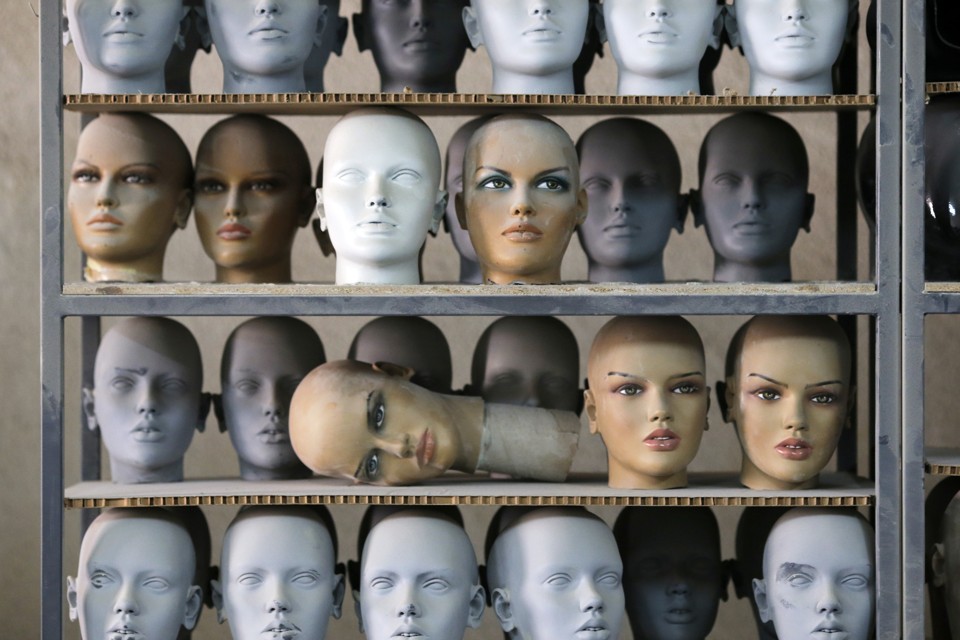
Mannequin heads sitting on a shelf in a factory The number of people on the planet is set to rise to 9.7 billion in 2050 with 2 billion aged over 60.

 That is only 30 odd year away.

We are entering the age of the Fourth Industrial Revolution, a technological transformation that is robbing us of the essence of our humanity.

Driven by a ubiquitous and mobile internet, we are perhaps witnessing the end of human evolution as we know it.

Up to now human evolution proceeded extremely slowly and within historical memory, man has exhibited aggressive territorial behavior. Even as we bask smugly in the comforts of our smart phones natural selection to-day still ensured that only the fittest survived.

However it may not be long before computers are hooked up to the human brain with genetic trade-offs till we can’t be improved any further,

Then evolution will really have come to a stop for us. We will be the only species to have put a halt to natural selection, of its own free will, as it were.

Stopping natural selection is not as important, or as depressing, as it might sound — because our evolutionary process will then be cultural.

One way or the other by the time we get there our current social, political and economic systems will have driven inequalities with profit seeking algorithms off the map, rather than reducing them.

The challenge is to manage this seismic change in a way that promotes the long-term health and stability of the planet.

The writing has been on the wall for some time.Homo floresiensis

So where do we stand:

Since 1992 CO2 emissions have jumper 62% and the global temperature is up 29%. Fresh water is down 26%. Ocean dead zones up 76% . Forestland down 300 million acres. People up 35%.

You would think that we the biggest dimwit on the planet looking at this evidence would conclude that there is something very wrong. If you dont know what it is, we have evolved beyond our needs, trampling other species in the process.

We are now at a turning point we can either push ahead on our path to destruction or we can reshape our place in nature and prosper or we can face a humongous environmental crisis.

You would think that with everything connected by the internet, it would transform how we do business and help us manage resources more efficiently and sustainable.

As you can see this is not the result.

On the contrary the way we’ve set up corporations, world organisations, where even a majority vote cannot demand that a corporation’s or world organisation policies reflect the public good or preserve the environment for future use.

That’s because profit is the one and only motive.

It’s up to government and it’s up to people to protect the public interest. Corporations and world organisations are simply not allowed to.

Within the next decade, it is expected that more than a trillion sensors will be connected to the internet. By 2025, 10% of people are expected to be wearing clothes connected to the internet and the first implantable mobile phone is expected to be sold.

However today, 43% of the world’s population are connected to the internet, mostly in developed countries.

In a world driven by short-term profit, the connectivity theory is and will remain so far off the mark it can only be believed by artificial intelligence.

Growing unease over globalization, which is evident from the number of questions being asked about the power of corporations and the adequacy of the regulations governing employment, environmental issues and taxation, is causing economic and social ills, ranging from low consumption to social and political unrest, and is damaging to any future.

There is no need for me to tell you that we are living in turbulent times.

It is clear that the old stories are dying and if we continue to poison ourselves and the planet by self-interest, fragmentation and profit for profit sake there will be no point to the age of technology other than becoming slaves.

However evolution is going on invisibly all the time. Species evolve in response to whatever environment they encounter. No despots have ever set out to select for increased or decreased longevity in the populations they control.

By 2050, the world must feed 9 billion people. Yet the demand for food will be 60% greater than it is today.

The scale of the employment challenge is vast. Rapid progress in machine learning has raised the prospect that algorithms will one day be able to do most or all of the mental tasks currently performed by humans. These advances could lead to extremely positive developments, presenting solutions to now-intractable global problems, but they also pose severe risks.

This might be the most important transition of the next century – either ushering in an unprecedented era of wealth and progress, or heralding disaster.

But it’s also an area that’s highly neglected: while billions are spent making AI more powerful. The problem of how one might design a highly intelligent machine to pursue realistic human goals safely is very poorly understood. It is estimated that there are fewer than 100 people in the world working on how to make AI safe.

If AI research continues to advance without enough work going into the research problem of controlling such machines, catastrophic accidents are much more likely to occur.

It’s generally agreed that, among the forces that led to the immense sophistication of the human brain, the most powerful was a kind of feedback loop between the growing complexity of our ancestors’ physical and social environment and the ability of our ancestors to adapt to it. But why, you may ask, has the enormous increase in complexity of our recent technological environment not had a measurable physical impact on our brains?

The rate at which we are changing our environment now has outstripped even the fastest biological evolution.

However the ineluctable laws of evolution will continue to operate, probably even more strongly, in the overcrowded, ecologically damaged world of the future. And if things get really bad, the evolutionary consequences could be extreme. Any survivors of a nuclear holocaust or an ecological catastrophe are likely to be a small and highly selected subset of today’s population.

If, for example, destruction were so widespread that people could not form viable social groups, the evolution of our descendants would inevitably be driven in the direction of brutishness.

If our technologies fail to protect us against these forces of nature our genetic heritage could fail us too, meaning human evolution will return with a vengeance.

Then again if everyone had exactly the same set of genes controlling the brain’s development, there would be no genetic differences among people on which natural selection could act–and evolution really would come to a stop!

War then would be the strong life; it is life in extremism; war taxes are the only ones men never hesitate to pay, as the budgets of all nations show us.

There is no doubting the force of [the] arguments above, call me back in 3 million years time, because I may well be wrong on that one.

All human comments appreciated. All like clicks chucked in the bin.

← Back

Thank you for your response. ✨


Share this:

  • Share on WhatsApp (Opens in new window) WhatsApp
  • More
  • Share on Pocket (Opens in new window) Pocket
  • Share on Mastodon (Opens in new window) Mastodon

THE BEADY EYE LOOKS AT THE TYRANNY OF GROWTH.

02 Saturday Dec 2017

Posted by bobdillon33@gmail.com in Algorithms., G7., GDP., Happiness., HUMAN INTELLIGENCE, Humanity., Life., Modern day life., Social Media, Sustaniability, Technology, The cloud., The Future, The world to day., Unanswered Questions., United Nations, What Needs to change in the World, Where's the Global Outrage., World Leaders, World Organisations.

≈ Comments Off on THE BEADY EYE LOOKS AT THE TYRANNY OF GROWTH.

Tags

Advertising industry, Algorithms for Profit., Algorithms trade., Algorithms., Artificial Intelligence., Capitalist World., Current world problems, Economic Growth, GDP., Our world problems, Profit at all Costs.


( A Twenty minute read)

They say we have free will, but there are many types of tyrannies in our world.

You could describe our hand-held devices which are keeping us connected to anything, anytime, anywhere as one. 

We now use our hand-held devices for almost everything. More importantly, they use us for everything.

The extreme availability of information has not led to a more enlightened population, but to more confusion.

Connectivity is both a blessing and a curse.

It has become the pathway for almost all we do as we have become helpless without technology and the need for immediate data at our fingertips. But this is taking its toll.

The number of times we look at our phones daily would shock you: some studies say 50 times, others as many as 75 to 150 times. Most of our e mails are reactionary.Tyranny of the Should

Information technology is all-pervasive in production and consumption.

Each time we look at the phone, we look away from what we should be or were focused on. Our collective ability to stay focused on anything is destroyed.

How does this connect to Growth.

It is too simplistic to attribute all of our economic problems to government: indeed, that sort of reasoning is counterproductive: it absolves everyone else responsibility.

Although part of the responsibility lies with forces that are outside a government, a significant share rests with the attitudes, preoccupations, we have to Artificial Intelligence that is now analyzing our every movement to the extent that advertising is becoming personalized.

I’m not saying that growth is bad but growth that destroys value just for profit is cancer that is driving inequality with a tendency to cluster around the short-term, issues while ignoring reality is going to bite us all.

I want to begin by touching on a crucial economy-wide factor
in the erosion of our economic strength which fosters short-term
thinking.Résultat de recherche d'images pour "pictures of social media advertising"

Advertising:

 It is a major driver of unnecessary consumption.

This hasn’t always been the problem. Advertising use to inform you of the useful qualities of an object. Now it manipulates your emotions like anxiety and promises to improve social acceptance or class distinction.

It is now with a frenzy of social media advertising attaching its self to saving the world  that is driving consumption to new dizzying heights.

Growth for growth’s sake, is an ugly word with even uglier connotations when it is using social media in the form of algorithms FOR PROFIT, regardless of the cost.

So what is driving it:

In the information age, time is compressed and events are squeezed into ever-decreasing periods.

We have governments encouraging a restless, fleeting mode of being, and a superficial, hurried culture, which is inimical to fundamental values.

They encourage growth programs, the benefits of which are available   immediately, but the costs of which appear only at a later stage. They are less interested in public investments that have to be financed now but do not payoff adequately before the next election.

It’s as if human progress depends on economic progress.

At minimum, the kind of short-term oriented cycle in which we find ourselves behaves as though tomorrow is forever. And, in fact, a series of tomorrows will create a forever — a very predictable one — and not a very desirable or promising one.

Rewards which are heavily focused on short-term results, even if they make some financial sense, often do not deliver the economic promise or the synergy which is anticipated.

Perhaps it is true that the landmarks in human progress — in the arts, science, government, or elsewhere — have rarely been reached in societies in which the economy was unable to free most of its members from a daily obsession with subsistence needs.

On the contrary, wherever the economy is feeble or stagnant for
a prolonged period, where most people see their basic material
needs as unfulfilled and the prospects for improvement as
unlikely, the result is almost invariably either a dull fatalism
or political upheaval, neither of which is likely to be favorable
to liberty and freedom.

However we are now looking at a unremitting focus on economic growth. The drive to achieve growth at practically any cost and to the exclusion of all other measures of prosperity.

This focus on GDP growth as the prime measure of economic success is out of date. It’s not how big it is that counts, it’s what you do with it.

The distance to the future – is no longer the next election, it will be how much you are willing to pay the Cloud for information. The cumulative effects of almost five decades of constantly accelerating reliance on government regulation to address social inequities and problems is coming to an end.Résultat de recherche d'images pour "pictures of social media advertising"

The linkage between ownership and participation is changing.

Social Media is not just eroding the meaning of democracy but effecting our critical thinking skills. Polluted with consumption advertising it is adding to global inequality.

While there are hundreds of different marketing strategies, only one can bring in consistent sales from day one. Social media advertising. This is why global social ad spending doubled from $16 billion in 2014 to $31 billion in 2016 and is projected to increase another 26% in 2017.

One of the fascinating things about social advertising is that there is virtually no limit to your ability to scale.You don’t have to wait for someone to search for your targeted keywords. You don’t have to wait for someone to run your promotion or read your blog.

( For Instance:

With more than 2 billion monthly users, Facebook hosts over a quarter of the world’s population, providing advertisers with an unparalleled opportunity to reach virtually anyone and everyone. It provides free lead magnet like:

  • Whitepapers
  • Ebooks
  • Product coupons
  • Sitewide discounts
  • Limited-time offers
  • Giveaways
  • Free shipping

These leads can then be nurtured with a targeted autoresponder. Offering free products, download-ables and predictable discounts and coupons for her audience. Doing so has earned Facebook more than $1,000,000 in annual sales in just 2 years. Facebook allows more advanced targeting than any other advertising platform on earth. Advertisers can target by location (within a 5-mile radius), job description, interests, past activity, and many other incredibly valuable criteria.

Instagram now boasts more than 500 million monthly active users and commands one of the highest audience engagement rates in social media, 58% higher than Facebook and 2000% higher than Twitter.

Twitter with 328 million monthly active users, it remains one of the most popular social media platforms. Brands don’t need to pay in order to reach their followers, which enhances the platform’s value even when running paid ads.

Pinterest: With 175 million monthly users is highly targeted toward women with an 81% female user base.

LinkedIn : Where you tend to find the highest average disposable income, has an estimated 227 million monthly active users.

Snapchat Advertising:    310 million users.   

All Social advertising is incredibly measurable.)

(You can, in fact, control when you choose to look at your hand-held device.)

In light of this one easy solution to over-consumption would be to ban advertising- at least in pubic places and on Social Media where Profit seeking Algorithms are used.

Much of’ the crippling of our economic systems can find its roots in Algorithms for profit. (see previous posts)

The consequences of elected government’s short-range perspective are not difficult to understand. They are seen as having succeeded in undermining the economy through overbearing regulation, tolerance of inflation, indifference to the cost of environmental and social programs, and a pervasive anti-business attitude.

Government thus diminishes the private sector’s sense of responsibility —
both in economic and ethical terms — for its own conduct and for its own performance.

While I appreciate that degrowth will not happen as quickly as we need it to do and it will take generations to move our collective consciousness on most issue, we don’t have that kind of time any longer.

Technology that ostensibly should help people save time, has instead led to a situation where time is scarcer than ever.

When an exponential growth curve becomes vertical, time has ceased to exist as duration.”life stands still at a tremendous speed”, with serious consequences for culture, intellectual life and the very fabric of society.

What we do not know today is what it will take to send us to
the pumps.

The struggle now concerns the right to be unavailable, the right to live and think more slowly.

Choosing to live according to one’s own self-made conception of reality, human nature, and happiness is a recipe for tyranny.

It is about time that we ask what wireless communications and the Internet are preconditions for. They are problems need to be understood well, in order to be dealt with the political upheaval that is around the corner.

Relying on averages generate by computers is worsening inequality

within countries, and the world as a whole.

So is there anything that can be done legitimately that will have a positive effect.

Becoming more grounded in ones own true feelings and perceptions is a primary indication that one has begun to free himself from the “tyranny of the should.”

Assuring that investment in future profitability is not sacrificed on
the altar of quarterly earnings growth. Refocusing our approach to economic decision-making, to benefit all not the few.

Willingness to pay the price today for the health and vitality of the country tomorrow is the ultimate test of stewardship. To live with a view to the regime should not be supposed to be slavery, but preservation.

Finally, it is as we all know easy to point the finger, however we are the will in any form or symbol and we are identifiable as water.  

However if we are to address any of our world problems and stop the self-perpetuating downward cycle, with all the suction of a whirlpool, from which there will be no escape we cannot and should not rely on technology to bail us out.

There is only one solution. Make Greed pay a World Aid commission of 0.05% ( See previous post)

Technology, if it has not yet become the de fac~o

decision- — . . . maker in the production process, has

certainly become a participant who cannot be

ignored.

All human comments appreciated. All like clicks chucked in the bin.
 

← Back

Thank you for your response. ✨

 https://youtu.be/cV_D2hC50Kk


Share this:

  • Share on WhatsApp (Opens in new window) WhatsApp
  • More
  • Share on Pocket (Opens in new window) Pocket
  • Share on Mastodon (Opens in new window) Mastodon

THE BEADY EYE SAYS: WE ARE ALL HEADING FOR THE CLOUD.

27 Monday Nov 2017

Posted by bobdillon33@gmail.com in Algorithms., Artificial Intelligence., Big Data., Democracy, Humanity., Life., Our Common Values., Robot citizenship., Technology, The cloud., The world to day., Unanswered Questions., Where's the Global Outrage., World Leaders, World Organisations., World Politics

≈ Comments Off on THE BEADY EYE SAYS: WE ARE ALL HEADING FOR THE CLOUD.

Tags

Artificial Intelligence., Big Data, Capitalism and Greed, Distribution of wealth, Inequility, Technology, The cloud., The Future of Mankind


( A six minute read)

It would be fair to say that most of us live in a cloud of our own importance.

However that cloud is disappearing into any other cloud which we are all creating with little or no control.

Our Ideology of normative beliefs, conscious and unconscious ideas, that are individual, group or society are under attack by this cloud. The reality is that temporary outages and slower-speed broadband that are a minor nuisance today can and will become a critical issue.Image associée

It represents the consummate disruptor to structure; a pervasive social and economic network that will soon connect and define more of the world than any other political, social, or economic.

It is the first mega trend of the twenty-first century, one that will shape the way we will address virtually every challenge we face for at least the next 100 years.

It is where we will all live, work, and play in the coming decades.

The Cloud is where your kids go to dive into online play. It’s where you meet and make friends in social networks. It’s where companies find the next big idea. It’s where political campaigns are won and lost.

You might think that this is all hog wash.

( But it appears that New Zealand does not have any politicians with brains of their own that they can rely on.

It has just recently appointed the worlds first AI virtual politician with the wonderful name of SAM. “Sam your man ” with a memory of an elephant he never forgets. ” Sam considers everyone’s position when making decisions.”

Well F… me Nick Gerristen ( The creator of Sam) there is a lot of bias in the cloud and AI algorithms are riddled with it.

You say “SAM is an enabler.” I agree.  Make sure you feed it as no doubt Google will want to buy it. I see you love BIG ideas, so perhaps you should introduce Sam to Sophia and you might have a bunch of little Samson’s.

Make sure he knows all about NXT Fuels, and by all means give him a bash. I am sure the Maori would be delighted. By the way, being a politician I would have named it, Ākina.  ( A Māori word meaning a call for bold action. It also conveys a spirit of watchful and active encouragement, helping others to identify pathways through their challenges.)

Back to the more serious subject:

It is time that we started to recognize some of the risks associated with this cloud technology, so as to avoid the possibility of future issues being decided by Sam and his like, who are servants of the hardware and software resources made available on the Internet as managed third-party services.

The world and us who live on it are becoming highly dependent on our Internet providers, so much so that it wont be long before we will have a fully cloud-based world.

Since no proper standards for cloud computing are set yet, it becomes almost impossible for anyone to ascertain the quality of services they have been provided with. So in the near future we will not be able to make wise decisions while choosing your personal service provider.

This, in turn, enables providers to charge customers fees proportional to their network, storage, and processing utilization.

Most issues start from the fact that the user loses control of his or her data, because it is stored on a computer belonging to someone else.

Many cloud providers can share information with third parties if necessary for purposes of law and order even without a warrant.

Although cloud computing enhances content accessibility, this access is “increasingly grounded in the virtually monopolistic privatization of the cloud which provides this access”.

This access, necessarily mediated through a handful of companies, ensures a progressive privatization of global cyberspace.

So we must ask the question why are we and our governments sustaining the quasi-monopolies that filter what we see depending on commercial and ideological interests they have.

The legal and regulatory landscape around cloud computing is by no means static. There are new laws being proposed that could change the responsibilities of both cloud computing tenants and providers.This creates new challenges in understanding how laws apply to a wide variety of information management scenarios.

As with all things surrounding profit it’s inevitable that some could will burst or simply stop providing the service if they deem it isn’t profitable for them. Often, large companies will enter the market but leave it once the expected profit doesn’t materialize. If this is the core business of the cloud supplier, it might be willing to continue operating for longer with a smaller profit.

Surely if we use a cloud infrastructure sourced from a cloud services provider, we must impose all legal or regulatory requirements that apply to any enterprise.

THIS WITH SELF LEARNING ALGORITHMS IS NOT POSSIBLE.

THERE IS ONLY ONE WAY OF ACHIEVING ANY CONTROL:

All technology must be vetted to ensure it complies to humanity core values.

It should be compulsory for it to carry a ATR World Certificate.

Accountable, Transparent, Reversible. Image associée

If we are to have any hope of tackling  any of Social, Political, Economic and Environmental Issues That Affect Us we need a beanie Cloud not a cloud for profit.

All human comments appreciated. All like clicks chucked in the bin.

← Back

Thank you for your response. ✨

Share this:

  • Share on WhatsApp (Opens in new window) WhatsApp
  • More
  • Share on Pocket (Opens in new window) Pocket
  • Share on Mastodon (Opens in new window) Mastodon

THE BEADY EYE LOOKS AT THE FUTURE OF FRESH WATER.

26 Thursday Oct 2017

Posted by bobdillon33@gmail.com in Environment, Fresh Water., HUMAN INTELLIGENCE, Humanity., Life., Politics., Sustaniability, Technology, The Future, The Obvious., The world to day., Unanswered Questions., United Nations, What Needs to change in the World, Where's the Global Outrage., World Leaders, World Organisations.

≈ Comments Off on THE BEADY EYE LOOKS AT THE FUTURE OF FRESH WATER.

Tags

Capitalism and Greed, Climate change, Environment, Freshwater., Sustainability, The Future of Mankind

( Seven minute read)

Fresh water is emerging as the most critical resource issue facing humanity.

No technology can double the flow of any River, or enhance other surface and ground water resources. It would indeed be a wonderful achievement to see these technologists produce crops without water!

At first glance, human health seems unrelated to natural resources.

Historically, decisions to protect the environment have been based on isolated crises and are usually made only when catastrophes strike. By 2050 almost 40 per cent of the world population will live in areas of high water stress.

The human carrying capacity of the world will not be addressed until the situation becomes intolerable or, possibly, irreversible.

There is no need for me to remind you that water is a finite resource, that is essential to human existence. “There’s not an infinite supply of water nor will there be.

Résultat de recherche d'images pour "pictures of freshwater"

Our climate — whether you want to call it global warming or climate change — is different from it was 50 years ago.

New NASA data show how the world is running out of water. 

The world’s largest underground aquifers – a source of fresh water for hundreds of millions of people — are being depleted at alarming rates, according to NASA satellite data.

Twenty-one of the world’s 37 largest aquifers have passed their sustainability tipping points, meaning more water was removed than replaced during the decade-long study period. Water demand will outstrip supply by 2030.

Water scarcity will become such an issue that it will hinder economic growth, spurs migration and sparks conflict, creating large and uneven consequences across the globe.

What’s at stake

Water shortages will be the catalyst of future conflicts.

There are 276 transboundary lake and river basins in the world, fewer than half of which are covered by treaties. Some 148 countries include territory within such basins, which account for an estimated 60 per cent of global freshwater flow.

Combine water scarcity with political instability, increasing resource demands and climate change, and the ‘perfect storm’ for conflict can be created.

What if anything can be done? 

There is no global government in relation to the environmental agenda.

All of our basic resources, such as land, water, energy, and biota, are inherently limited. The biological resources determine the current and future status of the support services for human life.

The chances of reorienting globalization to the aims of a sustainable society is all but impossible

Because consumerism collides with ecological issues over environmental ones.

Because of the transnational character of environmental degradation.

Because the current world order is not suited do dealing with global environmental problems.

Because there is an absence of responsibility of political leaders ( Mr Trump) towards adverse effects on the environment.

Because the importance of water to life means that providing for water needs and demands will never be free of politics.

There is no easy answer. 

Along with increased urbanization, world population  — and economic growth, all of which demand and consume larger and larger amounts of water.

Other than we must avoid letting humans numbers continue to increase to the limit of the Earth’s natural resources and forcing natural forces to control our numbers by disease, malnutrition, and violent conflicts over resources.

The water problem is daunting.

With more than 99% of human food coming from the terrestrial environment -One of the biggest competitors for water is agriculture. Some 70 percent of global water use is tied to the industry.

As the supply becomes more erratic with climate change that continues unabated. Food price will spike caused by droughts inflaming latent conflicts and driving migration.

We can no longer avoided the effects of a world water shortage it will have life-threatening and global economic consequences.

It’s almost taken for granted that we will have water, but we can’t do that anymore. Global warming has already begun to show how it can impact the world’s water.

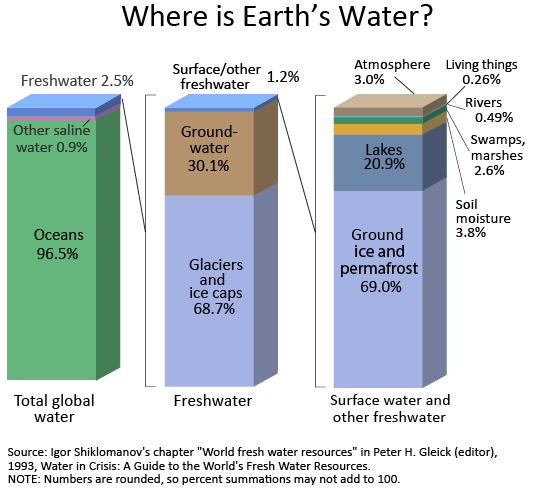
( The picture below depicts the amount of freshwater on the globe.)

Earth's water

Here are a few ideas that might help.

We need major education about the use of water.

We need to get our heads together on how we manage groundwater.

We need to putting a sensible price on water to invite investment and encourage conservation, increasing the availability of information and doubling down on innovation can go a long way toward solving the problem.

We need to install smart meters nation WIDE TO ALLOW a restructure of the price of consuming fresh water.

So that the first few gallons per person per day are cheap or free, with escalating costs beyond that. Water for necessities such as drinking, cooking and hygiene should be affordable.

Beyond that, water for lawns, filling swimming pools, washing cars and other uses should be more expensive.

We need to decide as a society whether green lawns and landscaping, golf courses, swimming pools and unnecessary agriculture (like tobacco and coffee) are worth the use of water.”

While our planet as a whole may never run out of water, it’s important to remember that clean freshwater is not always available where and when humans need it.

By the year 2025, 48 countries will be affected by water stress or scarcity – affecting around 35% of the projected global population in that year. Population growth alone will push an estimated  a further 17 countries, with a projected population of 2.1 billion, into water-short categories within the next 30 years.

Only 64 of the world’s 177 large rivers (1,000km and longer) remain free-flowing, unimpeded by dams or other barriers.

There are more than 45,000 large dams in over 150 countries with about 1,500 more currently under construction.

At the moment 780 million people lack access to clean water and 2.5 billion lack adequate sanitation services; most of these people live in the poorest countries.

The world needs nothing less than a Blue Revolution if not Fresh Water will ultimately affect everyone and everything on this blue planet.

Once we realize that we live in an interdependent world, we will hopefully refrain from making decisions that are short-sighted. Instead, we will look at the long-term gains of peaceful cooperation.

Unfortunately with the Technological Revolution decoupling us from the environment there is little chance of any peaceful cooperation.

There is only on solution – make profit for profit sake pay a World Aid Commission of 0.001%. ( see previous posts)

Saogal fada cugat.

Image associée

All human comments appreciated all like clicks chucked in the bin.

← Back

Thank you for your response. ✨

Share this:

  • Share on WhatsApp (Opens in new window) WhatsApp
  • More
  • Share on Pocket (Opens in new window) Pocket
  • Share on Mastodon (Opens in new window) Mastodon

THE BEADY EYE: LOOKS AT THE TREATMENT OF REFUGEES.

10 Tuesday Oct 2017

Posted by bobdillon33@gmail.com in Humanity., Refugees., The Obvious., The world to day., Unanswered Questions., United Nations, What Needs to change in the World, Where's the Global Outrage., World Leaders, World Organisations.

≈ Comments Off on THE BEADY EYE: LOOKS AT THE TREATMENT OF REFUGEES.

Tags

Capitalism and Greed, Mediterranean refugee crisis., Migrants/Refugees., The Future of Mankind, THE UNITED NATIONS

( A shameful read of twenty minutes)

One of this century’s greatest tragedies.Résultat de recherche d'images pour "papers on refugees"

This is an issue that is long on rhetoric, as newspaper and TV news reports testify. The number of people forcibly displaced from their homes due to conflict and war continues to increase at a staggering rate and will soon be overshadow by Global warming climate change migration.

This post attempts to look at where we have been, and where we are likely to go, in coping with this worlds endless stream of refugees. The refugee problems and crises are far from over and will continue to require urgent international cooperative treatment.Résultat de recherche d'images pour "papers on refugees"

Half of all current refugees have been displaced for over ten years.

At the moment most displaced people stay in their own country this will not be so with climate change.

We all know what causes refugee displacements and asylum flows, but the effects of conflict, political upheaval and economic incentives to migrate, are going to be dwarfed by climate migration.

Universal Declaration of Human Rights, adopted by the United Nations General Assembly resolution 217A (III), on the 10 December 1948 will be out of date. 

“All human beings are born free and equal in dignity and rights.”

This may well represents the first global international expression of rights to which all human beings are inherently entitled but Artificial Intelligence, and technology combined with global warming is going to create a different kind of refugee or migrant.

The right to life is humanity’s most fundamental value.   Résultat de recherche d'images pour "papers on refugees"

More than 65 million people are today, asylum seekers, internally displaced persons (IDPs) or refugees, illegal immigrants, to put a label on them.

The distinction between an economic migrant and a refugee is simple:

Are you running from or to? all are escaping.

Half of the world’s refugees are children under 18 years of age. The average length of time a refugee spends in exile is about 20 years, which is more than an entire childhood, and represents a significant portion of a person’s productive working years.

So let’s try to comprehend ( not that it is possible to do so with written or spoken words)  what refugees have to face.

What is a camp?  What characterizes a camp and how camps affect the lives of those who are placed in them.

On a global scale, millions of refugees are contained in camps of one sort or another.

Life goes on in camps—albeit a life that is affected by the camp.

They are places where the depoliticization of life takes place, due to humanitarian government, paradoxically they also produces a hyper-politicized space where nothing is taken for granted and everything is contested.

They are places of social dissolution, of new beginnings where sociability is remolded in new ways.

They are places with little or no human rights, dignity strippers, with no education, they are terrorist recruitment centers.

Camps are defined along two dimensions: spatially and temporally.

Temporally, refugee camps are meant to be temporary, while in practice this temporariness are becoming permanent.

Temporary are legal anomalies, in which the administration of justice is virtually in the hands of the humanitarian agencies that exercise this function either directly, or by delegating it to community leaders.

In reality temporary camp are exceptional space put in place to deal with populations that disturb the national order of things, while spatially, camps always have boundaries the fact is that in despite of ubiquitous images of sprawling refugee camps the majority of refugees are no longer confined to camps they now live in cities or towns.

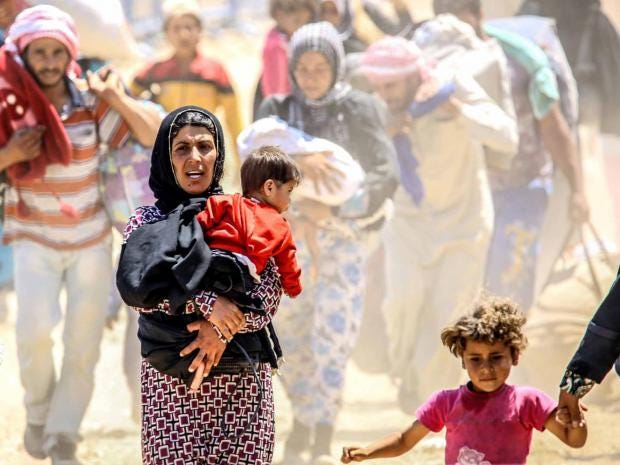
So try to imagine yourself in Zaatari a Jordanian Camp set on a lump of desert.A Syrian refugee woman walks in Zattari Syrian refugee camp, Mafraq city, Jordan

It has a current population of over 100,000 souls,( Equivalent to the population of Exeter Uk or  Reykjavík  Iceland.) of which 70% are woman and children.

People are reduced to ants in this dystopian, chronically parched science – fiction setting in Jordan.

A population that is utterly poverty-stricken and powerless, reduced to de facto prisoners with no hope no food no running water, imagine the toilets. Anger blooms, mothers sell their daughters, gangs roam, children go feral:

(Non of this can be blamed on Jordan who have contributed over £500 million against contributions from other countries of around £150 million. With 14,000 new arrivals a week a half a million will only keep the camp open for a few months.)

Or

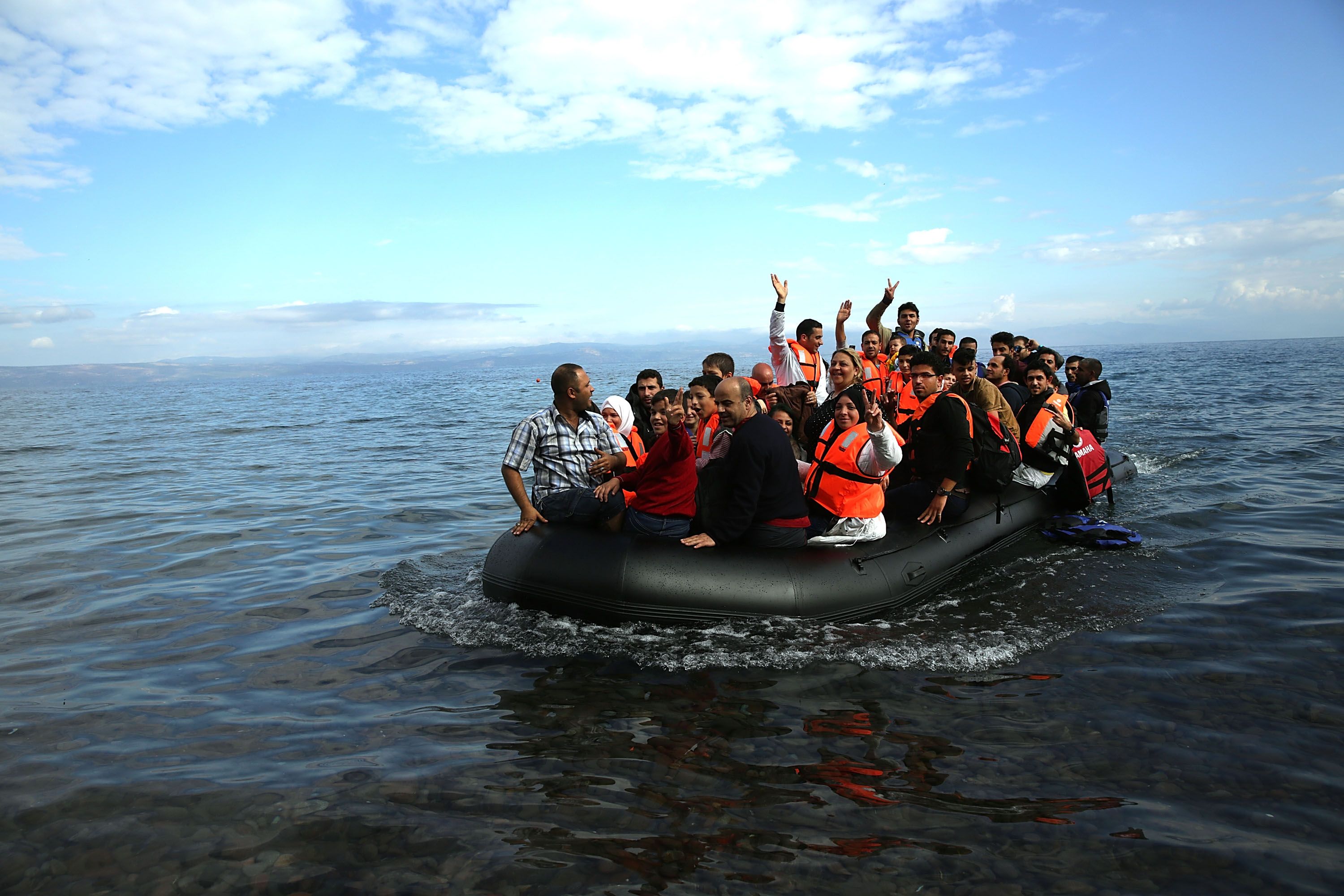
Imagine you are on a disposable barque approaching Lampedusa with 500 passenger packed like sardines having paid traffickers $ 1000 to $1600. ( Newspapers headlines constantly refer to these people as illegal immigrants. They’er not, they’er refugees. ) You have survived crossing of the Sahara, the violence in Libya and all told your family have raised $6000 for you to make the journey in the likelihood that they will never see you again.

Anyway lets say you don’t drown, now add the screaming and crying ringing in your ears as you scramble the shore to be warped in a tinfoil, and bused to a reception camp, fingerprinted though you are not a criminal.

Your only option is to vanish to continue your journey in the hands of traffickers and gangs who exploit, enslave, rape and bully.

The EU Dublin convention stipulates that people political asylum must remain in the first safe country you land in. There is no picking and choosing.

According to the 1951 UN Refugee Convention and the EU Charter of Fundamental Rights, European countries have the obligation to provide asylum to those who seek it. This is not the matter of politics and economy, but of basic human rights. There is no person that should live in fear for their life and the lives of their close ones.

Its only by not looking, by turning or backs that we can sail away and think that this is sad, but it is not our sadness.

Refugees are not spread evenly across the world.

Seven countries – Syria, Iran, Pakistan, Lebanon, Turkey, Palestine and Jordan – host more than 50% of all refugees. Many countries, including some of the richest and most developed countries like the US, UK and Australia, are not fully living up to their responsibility under the Refugee Convention.

At the moment, there are over 9 million refugees seeking asylum.

If all refugees were distributed evenly across all the countries in the world, each country would host 100,000 refugees.

By mid-2015, the World Bank’s estimated cost of the Syrian war for the Middle Eastern countries is $35 billion.

Current funding models for displacement are no sustainable.

Whether greater international coordination could produce better outcomes for refugee-receiving countries and for the refugees themselves is of course governed by funds.

The United Nations’ annual appeal for international aid has risen 500% in 10 years due to the “new norm” of multiple humanitarian crises. Only 26% of the money needed has been committed, to enable the UN to provide assistance to 78.9 million people in 37 countries.

To quote António Guterres: The UN high commissioner for refugees. “Today’s needs are at unprecedented levels and without more support there simply is no way to respond to the humanitarian situations we’re seeing in region after region and in conflict after conflict.”

It has been widely suggested that more resources should be devoted to providing aid to refugees closer to home. “80% of our emergency response is to man-made crises which are now “apocalyptic” with displacement of people the highest since the second world war and multiple crises being the “new norm”.

On average, around 100 million people are affected by natural disasters per year and disasters now cost more than $100bn in economic damages. The number of displaced people has also increased, with 65 million people displaced at the close of 2015 compared with 33.3 million in 2013.

While donors give more generously every year, the gap between funds needed and funds provided continues to widen.

This raises questions about our ability to continue to meet affected people’s needs.

Then there is the question whether to devote resources directly to repatriation and reintegration programs, or simply to provide some form of economic incentive to return.

Neither will stem the flow of long-distance illegal migrants, once such flows have become established.

The best option by far is to find ways of preventing civil wars or to stop them recurring. Civil wars suggest that the causes are chiefly economic rather than political.

To really help displaced people, aid agencies must better understand how people are helping themselves, to figure out how to support these initiatives and advocate on behalf of refugees to overcome the barriers.

Education is to be seen as key to contributing to long-term solutions for refugees, ensuring that displaced generations are equipped to rebuild their lives and communities − either in the country of asylum or upon
their return home.

Résultat de recherche d'images pour "papers on refugees"

We need to fix the system – not for today, but to be ready for what the situation will be like five years from now never mind 20 or 30 years in the future.

It’s no wonder that we are living in disturbed times.

It is now time to unite and provide a new home for those who need it the most. What is needed, therefore, is a comprehensive, fully funded global program.

The world can’t keep pretending the refugee catastrophe is a European problem. The brunt of the crisis has fallen on the Turks, the Egyptians, the Jordanians, the Iraqis and the Lebanese.

All the goodwill, all the technology, all the appeals, all the solutions will not stop people fleeing wars, or climate change.

A smart phone can be a lifeline if you’ve had to leave everything else behind, because when you take to the roads, to the boats and to the trains, all our political leaders can think of is fences, barbed wire and more police.

There is only one way to help:

And that is to get Profit for Profit sake to contribute.

By placing a world Aid Commission on all High Frequency Trading, on all Foreign Exchange Transactions over $50,000, on all Sovereign Wealth funds Acquisitions. Combined this with a 0.00005% charge on all tweets, and all online purchases, on all google inquires, on all Facebook postings, etc.

Will create a permanent self funding resource of funds doing away with begging for resources.

Mr António Guterres should call a world summit of all Industrial world leaders not countries with a view to passing a people resolution to implement such a World Aid commission.

Then we might have some hope of a more peacefully world for all.

All suggestions and comments appreciate. All like clicks chucked in the bin.

← Back

Thank you for your response. ✨


Share this:

  • Share on WhatsApp (Opens in new window) WhatsApp
  • More
  • Share on Pocket (Opens in new window) Pocket
  • Share on Mastodon (Opens in new window) Mastodon

THE BEADY EYE ASKS: WHY DOES THE UNITED NATIONS TOLERATE SPEECHES THAT ARE IN BREECH OF ITS CHARTER.

22 Friday Sep 2017

Posted by bobdillon33@gmail.com in Artificial Intelligence., Climate Change., HUMAN INTELLIGENCE, Nuclear power., The Future, The world to day., Unanswered Questions., United Nations, What Needs to change in the World, Where's the Global Outrage., World Leaders, World Organisations., World Politics

≈ Comments Off on THE BEADY EYE ASKS: WHY DOES THE UNITED NATIONS TOLERATE SPEECHES THAT ARE IN BREECH OF ITS CHARTER.

Tags

Artificial Intelligence., Climate change, Greed, Inequility, The Future of Mankind, THE UNITED NATIONS, United Nations, Visions of the future.


 HomeUNITED NATIONS CHARTER.

Chapter I

                            PURPOSES AND PRINCIPLES

  • To maintain international peace and security, and to that end: to take effective collective measures for the prevention and removal of threats to the peace, and for the suppression of acts of aggression or other breaches of the peace, and to bring about by peaceful means, and in conformity with the principles of justice and international law, adjustment or settlement of international disputes or situations which might lead to a breach of the peace;
  • To develop friendly relations among nations based on respect for the principle of equal rights and self-determination of peoples, and to take other appropriate measures to strengthen universal peace;
  • To achieve international co-operation in solving international problems of an economic, social, cultural, or humanitarian character, and in promoting and encouraging respect for human rights and for fundamental freedoms for all without distinction as to race, sex, language, or religion; and
  • To be a center for harmonizing the actions of nations in the attainment of these common ends.

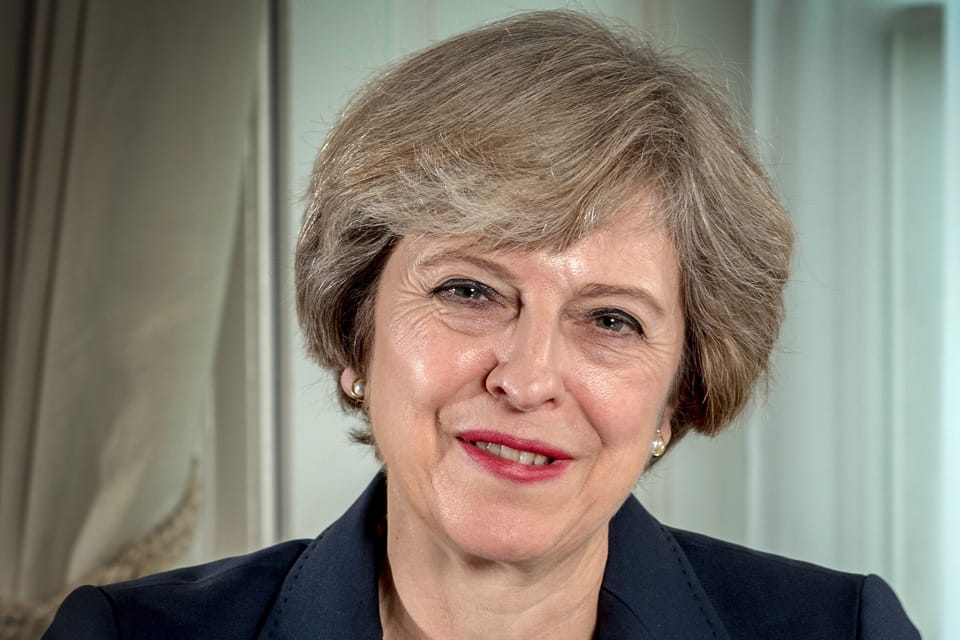
The Rt Hon Theresa May MPRésultat de recherche d'images pour "Donald trump recent speech at the un"

A charter represents a document that describes a project, its rationale, its goals and its participants. The purpose of a charter aims at aligning the expectations of all the contributors so that their energy focuses on the project’s priorities.

The Charter is not to be confused with The Universal Declaration of Human rights adopted after World War 11. It is perhaps the closest thing we have to a global Constitution- categorically states that the right to life is humanity’s fundamental value. Death is a crime.

It would appear that from the speeches given by either of the above that they DO NOT fully comprehended the above charter.

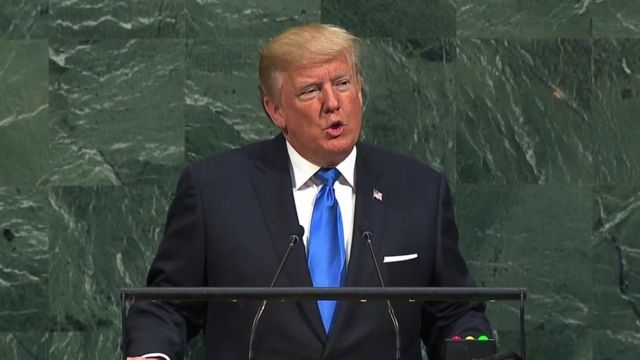
In his Sovereignty – centric speech Mr Trump threatened to totally destroy North Korea, called Iran a corrupt dictatorship whose main export is violence.

While Mrs May in her speech threatened withdrawal of funds.

This is not the first time not will it be the last that a World leader has used the UN to criticize other nations. Mr Bush with the axis of evil. Mr Khrushchev trumping the table and calling Filipino some obnoxious name in Russian.

Both Mr T and Mrs M appear to think that the yard stick to measure a nation’s success is GDP. This kind of thinking is driving humankind to make happiness a second goal for the twenty-first century which is highly unlikely unless inequality, war, and climate change disappear.

Surely the UN is not the platform for sovereign selfish nations to be expressing treats to other nations. Stirring up hornets nest is not what the world needs.

Here a few examples from each of their recent addresses to the UN.

MR D Trump first:

“The United States has great strength and patience, but if it is forced to defend itself or its allies, we will have no choice but to totally destroy North Korea. “Rocket Man” is on a suicide mission for himself and for his regime.”

” It has just been announced that we will be spending almost $700 billion on our military and defense.”

Then a raft of contradictions:

” In America, we do not seek to impose our way of life on anyone, but rather to let it shine as an example for everyone to watch.”

” We are celebrating the 230th anniversary of our beloved Constitution, the oldest constitution still in use in the world today. This timeless document has been the foundation of peace, prosperity and freedom for the Americans, and for countless millions around the globe whose own countries have found inspiration in its respect for human nature, human dignity and the rule of law.”

“But we can no longer be taken advantage of, or enter into a one-sided deal where the United States gets nothing in return.”

“As long as I hold this office, I will defend America’s interests above all else.”

“The United States is one out of 193 countries in the United Nations, and yet we pay 22 percent of the entire budget and more. In fact, we pay far more than anybody realizes.”

“The United States of America has been among the greatest forces for good in the history of the world and the greatest defenders of sovereignty, security and prosperity for all. Now we are calling for a great reawakening of nations, for the revival of their spirits, their pride, their people and their patriotism.”

“Our hope is a word and (sic) world of proud, independent nations that embrace their duties, seek friendship, respect others and make common cause in the greatest shared interest of all, a future of dignity and peace for the people of this wonderful Earth.”

“This institution was founded in the aftermath of two world wars to help shape this better future. It was based on the vision that diverse nations could cooperate to protect their sovereignty, preserve their security and promote their prosperity.”

The success of the United Nations depends upon the independent strength of its members.

“We do expect all nations to uphold these two core sovereign duties: to respect the interests of their own people and the rights of every other sovereign nation.”

“Today, if we do not invest ourselves, our hearts and our minds in our nations – if we will not build strong families, safe communities and healthy societies for ourselves – no one can do it for us.”

“This is the beautiful vision of this institution, and this is the foundation for cooperation and success. Strong, sovereign nations let diverse countries with different values, different cultures and different dreams not just coexist, but work side by side on the basis of mutual respect. Strong, sovereign nations let their people take ownership of the future and control their own destiny, and strong, sovereign nations allow individuals to flourish in the fullness of the life intended by God.”

We want harmony and friendship, not conflict and strife. We are guided by outcomes, not ideology. We have a policy of principled realism rooted in shared goals, interests and values.

And just as the founders of this body intended, we must work together and confront together those who threaten us with chaos, turmoil and terror.

“We will fight together, sacrifice together and stand together for peace, for freedom, for justice, for family, for humanity and for the almighty God who made us all.”

“Are we still patriots? Do we love our nations enough to protect their sovereignty and to take ownership of their futures? Do we revere them enough to defend their interests, preserve their cultures and ensure a peaceful world for their citizens?”

The UN relies on the independent strength of its members.

Theresa May:

“We face challenges that go right to the heart of who we are as nations.”

“I believe that the only way for us to respond to this vast array of challenges is to come together and defend the international order that we have worked so hard to create and the values by which we stand. For it is the fundamental values that we share, values of fairness, justice and human rights, that have created the common cause between nations to act together in our shared interest and form the multilateral system. And it is this rules-based system which we have developed, including the institutions.”

This statement in the light of Brixit is total hogwash and on we go.

“Indeed, the defining purpose of the UN Charter is to maintain international peace and security, to develop friendly relations among nations, to achieve international cooperation in solving problems of an economic, social, cultural or humanitarian character; and to be a center for harmonizing the actions of nations in the attainment of those common ends.”

“An outward-looking global Britain and the second biggest funder of the UN the UK will remain committed to spending 0.7% of GNI on development and humanitarian support. And that is why we will remain generous in our funding but set aside 30% to be paid only to those parts of the UN that achieve sufficient results.”

It is true to say that the UN needs reform, but it can only become relevant if it is financed to tackle world problems. ( See previous posts)

Both Speeches ignore Climate Change and the need to address inequality that is the spawning bed of all terrorism, driven by the technology of the smart phone.

The world is changing and we don’t have to be prophets to see if we as its intelligent guardians don’t address its underling problems there will be problems that will put all our technology, all our unsustainable greed, all our power of destruction, into the shade.

All comments appreciated, all like clicks chucked in the bin.

← Back

Thank you for your response. ✨

Share this:

  • Share on WhatsApp (Opens in new window) WhatsApp
  • More
  • Share on Pocket (Opens in new window) Pocket
  • Share on Mastodon (Opens in new window) Mastodon

THE BEADY EYE SHINES A LIGHT ON A WORLD WHERE NEARLY 20 PEOPLE ARE FORCIBLY DISPLACED EVERY MINUTE.

16 Saturday Sep 2017

Posted by bobdillon33@gmail.com in Humanity., Natural World Disasters, Our Common Values., Post - truth politics., Refugees., The world to day., Unanswered Questions., United Nations, What Needs to change in the World, Where's the Global Outrage., World Aid., World Leaders, World Organisations., World Politics

≈ 3 Comments

Tags

Migrants/Refugees., UNHCR

(A shameful twelve minute read)

We got it all wrong when it comes to helping Refugees.

They are not invisible people.

Camps are the wrong way to help today’s refugees.

We cannot turn our backs on the ten million people who have been forced to flee their homes. Every decent society knows this and knows that it’s our moral duty to come up with a workable way of helping the refugees.

So here’s the crucial question: what, beyond safety itself, are the critical elements of normality for any refugee?

The entire international refugee support system has presumed that the answer is food and shelter.

But is this really the right response in 2017?

The system was designed to cope with the displaced of post-war central Europe, many of them Germans who had fled the Russians, or Jews freed from the concentration camps.

Refugees nowadays do not have the luxury of a short-term solution. The problems they are fleeing are likely to last for a very long time. Imagine yourself in their position, displaced with your family. Would you really resign yourself to years in a refugee camp, living off food tokens, housed in a converted container?

UNHCR, and its penumbra of similar organisations, are designed for care.

Like all welfare programmes, theirs treats people as passive recipients. Inadvertently, it infantilises.

That so many refugees forgo this care, preferring the struggle of earning a living beneath the official radar of regulations that prohibit it, is testimony to the heroism of the human spirit. We shouldn’t, even with the best intentions, crush that spirit. We should do what we can to make autonomy less grim.

The key confusion has been to conflate refugees with migrants.

Refugees, by definition, are people who didn’t choose to be migrants: they wanted to live at home but their home became unsafe. Migrants are people who seek a better life. Migrants go to honeypots — dream locations can readily be ranked by their desirability.

Refugees do not go to dream locations; they are seeking proximate havens. All of the top ten destinations for refugees are themselves countries of emigration. All are poor countries in disorderly neighborhoods.

So this is the real answer for refugees, not tents and food but autonomy and community. It’s what you would want in their position.

In asking the development agencies to scale-up and integrate the new mechanisms for generating jobs for refugees with those for speeding post-conflict recovery, it would at last become possible to meet our true international duty of rescue. In the process we should free ourselves from the lazy trap of fitting the present into the past.

But try telling that to the current wave of some 65.6 million people around the world that have been forced from home from today’s wars and conflict zones. 65.3 million people on the run – most are now crammed into often squalid and unsafe camps as they wait in increasing desperation for a home, somewhere.

65.6 million is according to the UNHCR the latest figures (which should be taken with a dose of salt as many nations are not equipped with refugee registers or effective data collection procedures. It excluded people who were displaced by natural disasters such as floods and earthquakes, which separately uprooted at least 19 million people in 2015.

To put this number into perspective, one in about every 113 people in the world is currently a refugee. This means that of the 7 billion people on earth, over 65 million of them are living as refugees –– forced to leave their homes. The numbers are so breathtaking that they take a while to settle into the mind.  This is the largest number ever recorded – and a testament to massive failures of both the international community and the United States in dealing with this crisis.

(There are also 10 million stateless people who have been denied a nationality and access to basic rights such as education, healthcare, employment and freedom of movement.)

I say the US, because it is the worst offender. It led the invasion of Iraq in 2003 without a legitimate casus belli. It set in motion the events that produced the Arab Spring resulting in immense forcible displacement in the region.

Just compare this 65 million with one of the greatest humanitarian crises in history — when a shattered Europe at the end of the Second World War had to resettle a staggering 16 million displaced persons.

A horrifying number certainly, but only a third as many as we have now.

The fact that the average amount of time people worldwide are living in displacement is now a staggering 17 years suggest that something is going terribly wrong in how we’re dealing with this issue.

In this climate, it is not surprising that there is animosity towards refugees by so many people.  There has been a perceptible rise in racist and xenophobic acts in many nations, sometimes fueled by politicians and the media. The political reality suggests most countries will remain reluctant to house all but a very small minority of those displaced by violence.

We now live in a world where nearly 20 people are forcibly displaced every minute and we have seen anything yet. Wait till uninhabitable regions due to climate change then we will have millions turning into billions.

Combined this with the violence in the Middle East and North Africa, with nine civil wars now going on in Islamic countries between Pakistan and Nigeria and half of the 23 million population of Syria been forced from their homes, plus 2.6 million Iraqis displaced by Islamic State – Isis – and 1.5 million people displaced in South Sudan.

Religious, ethnic and separatist conflicts are tearing countries apart.

Nationalism and socialism no longer provide the ideological glue to hold together secular states or to motivate people to fight.

Wars are currently being waged in Afghanistan, Iraq, Syria, south-east Turkey,Yemen, Libya, Somalia, Sudan and north-east Nigeria and none of them show any sign of ending. sanliurfa-syrians-getty.jpg

Europeans were jolted by pictures of the little drowned body of Alyan Kurdi lying on a beach in Turkey and half-starved Syrians crammed into Hungarian trains.

What is to be done to stop these horrors? Perhaps the first question is how we can prevent them from getting worse, keeping in mind that five out of the nine wars have begun since 2011.

Let me begin by attempting to demonstrate why the refugee question must be addressed:

The waves of refugees now are just the leading edge of a global catastrophe, just watch as global warming takes its toll in the coming years.

The core problem remains the amount of violence we have in too many areas of the world. Until we figure out how to isolate wars and cut off their oxygen — as was done eventually in the Balkans in the 1990s — we will only delude ourselves in thinking our era grows less violent.

There is a danger that by attributing mass flight to too many diverse causes, including climate change, political leaders responsible for these disasters get off the hook and are free of public pressure to act effectively to bring them to an end.

Not an easy delusion to maintain as 48 million people call out to us from refugee camps that now seem as much prisons as safe havens. 

It is better first to be informed and draw an opinion, rather than only to be opinionated. Half of refugees worldwide are children.

But why has this topic been so often ignored, or if mentioned, referred to as a “taboo”?

The fact is that world media in all its forms is dissenting us all to the point that refugees from war-torn countries are considered collateral damage, making good news footage.

World leaders can no longer watch passively as so many lives are needlessly lost.

We must be smart about finding solutions to help refugees.

We must find humane and dignified means to ensure refugees don’t risk their lives and those of their families by resorting to ruthless traffickers.

We must open designated channels of entry and offer tagged shelter under repatriation once its is safe to do so.

We must stop the world media spreading a climate of xenophobia.”

We must stop the growing resistance from nations to providing asylum for refugees.

We must stop spreading (due to political rhetoric) painting refugees as terrorists or beggars. “Refugees… don’t bring danger” but “flee from dangerous places.


The world governments will resist doing anything until such time as it is profitable to do so. This will be too late.

One of the more comforting claims in recent years is that the world is a less violent place than the blood-soaked centuries gone by. Bull shit.

The modicum of UNHCR support before abandonment, puts a spotlight of Shame on our world!

I have this awful feeling of deja vu. One begging UN resolution after another.

However there are the beginnings of an awakening about all this. In October the World Bank approved its first refugee loan — for job generation for Syrian refugees in Jordan.

Perhaps if the top five Tech Conglomerations were to charge a cent on all like clicks, on all shared photos, on all sales, all up loads, on all searches, on all tweets, on all e mails, on all Skype calls, they could save the world from melt down.  This combined with a 0.05% world aid commission,( See previous posts) would create a perpetual fund of trillions to address inequality that leads to all our troubles.

In just a single minute on the web 216,000 photos are shared on Instagram, a total of £54,000 ($83,000) sales take place on Amazon, there are 1.8 million likes on Facebook and three days worth of video is uploaded to YouTube.

All suggestions and comments appreciated. All like click chucked in the bin till they are chargeable.

← Back

Thank you for your response. ✨


Share this:

  • Share on WhatsApp (Opens in new window) WhatsApp
  • More
  • Share on Pocket (Opens in new window) Pocket
  • Share on Mastodon (Opens in new window) Mastodon

THE BEADY EYE SAYS: WE LIVE IN A WORLD OF LIP SERVICE.

08 Friday Sep 2017

Posted by bobdillon33@gmail.com in Capitalism, Climate Change., Environment, Evolution, Google, Humanity., Life., Natural World Disasters, Our Common Values., Social Media, Sustaniability, Technology, The Obvious., The world to day., Unanswered Questions., United Nations, What Needs to change in the World, Where's the Global Outrage., World Organisations.

≈ Comments Off on THE BEADY EYE SAYS: WE LIVE IN A WORLD OF LIP SERVICE.

Tags

Capitalism and Greed, Climate change, Distribution of wealth, Inequility, Natural disaster, The Future of Mankind, Visions of the future.

( A three-minute read)

We live in a world where turning on the news every day means getting updated on the latest tragedy and not just finding out what the weather will be like tomorrow.Résultat de recherche d'images pour "pictures of the living world"

2017 is a year of unrelenting misery and fear. We live in a world where people feel more afraid of someone with a gun than protected.

We live in a world where text messages surpass face to face conversations.

Image associée

We live in a world run by Algorithms. In a world where if you didn’t snap chat it or post it to Facebook, “it didn’t happen”.

We live in a world that has so many people without the words, “thank you” in their vocabulary.

We live in a world where people would rather sit in the comfort of their anguish and anxiety than take a small step to a better life.

What happened to the world where everyone minded their own damn business?

What happened to the world where people actually knew their neighbors, and didn’t fear them? What happened to the world where people got together and lost track of time because they didn’t have their phone attached to their hip?

What happened to the world where people could voice their opinion without getting hate mail? What happened to the world as one nation?

We live in a world where our self-esteem is managed by the amount of “likes” on our selfies and statuses.

I don’t need to tell you world news is pretty grim right now – if you use social media, it’s nigh on impossible to avoid articles about bubbling permafrost, drug-resistant gonorrhoea, and deadly obesity treatments.

And that’s just the science headlines.

We live in a world with rampant inequality due to capitalist greed, void of any common values.

We live in a world with global environmental changes locked into our future, with hidden threats to sustainability,not just because of migration that is just beginning due to lack of fresh water.

Stop, take a step back and think.

Isn’t it absurd that we, 7 billion of us living in the same planet, have grown further apart from each other? What sense does it make to turn your back on the thousands, maybe millions, of people living around you.

If we want wars we have all the ingredients.

We live in a world where our i pads and cell phones get thinner and our bodies get thicker.

We live in a world where people pass each other on the street and can’t even smile back.

We live in a world where people dish hatred out on a serving platter.

We live in a world where our world organisation called the United nations s just a gossip shop that has to beg for funds. Unable to cuts through the rhetoric because of

We live in a world where people take more than they give. We live in a world where people have completely forgotten what they were given knees for.

What happened to our world?

Most of us haven’t quite realized there is something extraordinary happening. I want to see it through a child’s eyes again.

Why is the world-changing?

We live in a world where  because we are too afraid of hurting kid’s feelings instead of teaching them the value of hard work. You get a participation trophy for merely showing up.3278764814_4d666f44ee_o-crop

We live in a world of lip service.

We are reaching our limits. It’s time for people to switch on the blender, stirring events in the non-human part of the world into their everyday lives, and see what happens.

Google might knows our names but it knows Sweet Fanny Adam about the natural world. The rest of the living world can get along without us, but we can’t get along without them.

Perhaps all living things comprise one biological entity, one large functioning ecosystem (life-force) with planet Earth as skeleton if so we had better learn quick that a skeleton earth whether it is due to Climate change, Nuclear war, or Algorithms will be worthless.

We are not isolated from the world around us by the boundaries of our bodies. Modern science has blurred the lines of the individual by shedding light on how interdependent life is. We are dependent on microbes. In essence, all life is connected to other life because we all exist in the same space.  If you don’t like bacteria, you’re on the wrong planet.”

When it comes to making sense of the incomprehensible we can only place our trust in tales of the imagination.Résultat de recherche d'images pour "videos of the living world"

The problem is that no one is will to bear the cost not even earth so why not make Greed pay. ( See previous Posts)

All comments appreciated all like clicks chucked in the bin.

← Back

Thank you for your response. ✨


Share this:

  • Share on WhatsApp (Opens in new window) WhatsApp
  • More
  • Share on Pocket (Opens in new window) Pocket
  • Share on Mastodon (Opens in new window) Mastodon

THE BEADY EYE ASKS: WHO WANTS TO LIVE IN A WORLD RUN BY GOOGLE .

11 Friday Aug 2017

Posted by bobdillon33@gmail.com in Artificial Intelligence., Big Data., Capitalism, Google, Humanity., Innovation., Technology, Wealth., What Needs to change in the World, World Organisations.

≈ Comments Off on THE BEADY EYE ASKS: WHO WANTS TO LIVE IN A WORLD RUN BY GOOGLE .

Tags

Artificial Intelligence., Big Data, Capitalism and Greed, Distribution of wealth, Elon Musk: take note., Inequility, Technology, The Future of Mankind, Visions of the future.


( A Twenty minute read)

We might not yet be living in a world  that is run by Google but the way we are accepting artificial intelligence algorithms we will soon if not already be living in a world run by a Google Algorithm brain.

Algorithm, complex mathematical formulas, are playing a growing role in all walks of life: from health, to shopping, and jobs

The complex mathematical formulas of Algorithms are playing a growing role in all walks of life: deciding who gets a job, how police resources are deployed, who gets insurance at what cost, or who is on a ‘no fly’ list.

There decisions are often based on data collected about people, sometimes without their knowledge inferring all sorts of things about you from your digital crumbs.

They are being used – experimentally – to write news articles from raw data, while Donald Trump’s presidential campaign was helped by behavioral marketers who used an algorithm to locate the highest concentrations of ‘persuadable voters.

Completely lacking any form of transparency they are both untraceable, and subject to no form of accountability. They can infer your sexual orientation, your personality traits, your political leanings, with predictive power, with high levels of accuracy.

We’re already halfway towards a world where algorithms run nearly everything.

As their power intensifies, wealth will concentrate towards them.

They will ensure the 1%-99% divide gets larger.

If you’re not part of the class attached to algorithms, then you will struggle.

They will further stratify society, creating a world of haves and have-not’s.

So why are we ‘blindly trusting’ formulas to determine a fair outcome.

The main reason is because most people don’t yet know or understand what they are doing or could be doing.

Algorithms are not inherently fair, because the person who builds the model defines success. This is the reason why there is no popular outrage about Wall Street being run by algorithms.

For techno-evangelists, Google is a marvel of Web brilliance … For Wall Street, it may be the IPO (An IPO is short for an initial public offering. Like the name says, it’s when a company initially offers shares of stocks to the public. It’s also called “going public.” An IPO is the first time the owners of the company give up part of their ownership to stockholders.) that changes everything (again) …

The vast majority of trades these days are performed by algorithms. The idea that the world’s financial markets – and, hence, the well-being of our pensions, shareholdings, savings etc – are now largely determined by algorithmic vagaries is unsettling enough for some.

But in my opinion we should not automatically see algorithms as a malign influence on our lives, we should debate their ubiquity and their wide range of uses.

The online gallery reveal the interior of eight of Google's secretive server farms around the globe, from Finland to Iowa

wonderful attention to detail.

Why?

Because we now spend so much of our time online that we are creating huge data-mining opportunities.

Because there is the possibility of using big-data predictions about people to judge and punish them even before they’ve acted. Doing this negates ideas of fairness, justice and free will. This presents an entirely new menace: penalties based on propensities.

Because we risk falling victim to a dictatorship of data, whereby we fetishise the information, the output of our analyses, and end up misusing it.

Because by far the most complicated algorithms are to be found in science, where they are used to design new drugs or model the climate.

We all urgently need to consider the implications of allowing commercial interests and governments to use algorithms to analyse our habits:

How are they being used to access and interpret “our” data? And by whom?

Big data is a useful tool of rational decision-making. Wielded unwisely, it can become an instrument of the powerful, who may turn it into a source of repression.

But there is a bigger question about the oversights involving AI.

The questions being raised about algorithms at the moment are not about algorithms per se, but about the way society is structured with regard to data use and data privacy. It’s also about how models are being used to predict the future.

There is currently an awkward marriage between data and algorithms. As technology evolves, there will be mistakes, but it is important to remember they are just a tool. We shouldn’t blame our tools. At the moment there is consensus, that in the next twenty years we will be looking at seeing AI as smart as humans.

Difficulties come when they are used in the social sciences not to mention again financial trading.

Targeted Algorithms can now calculate whether a woman is pregnant and, if so, when she is due to give birth: Teenage daughters can be identified pregnant by retailers long before her own father knows.

From dating websites and City trading floors, through to online retailing and internet searches (Google’s search algorithm is now a more closely guarded commercial secret than the recipe for Coca-Cola), algorithms are increasingly determining our collective futures. “Bank approvals, store cards, job matches and more all run on similar principles.

“The algorithm is the god from the machine powering them all, for good or ill.”

They are now so integrated into our lives we barely notice them.

Pharmacists are already seeing some of their prescribing tasks replaced by algorithms. Data analysis as a factor in deciding whether to release somebody from prison or to keep him incarcerated.”

On the one hand, they are good because they free up our time and do mundane processes on our behalf.

However as their ubiquity spreads, so too does the debate around whether we should allow ourselves to become so reliant on them – and who, if anyone, is policing their use.

Here’s the scary bit:

We will be at the mercy of algorithms. How will they work when they are combined together. The result will be a system that will never be completely understood, that they could fail in unpredictable ways.

We are currently creating AI without fully understanding intelligence or cognition first.

Google released a developer’s kit last spring that lets anyone integrate Google’s search engine into their own application. The download is simple, and the license is free for the taking. The developer’s kit is a classic Trojan-horse strategy, putting Google’s engine in places that the company might not have imagined. Basically, those developers can do whatever they want.

Google doesn’t market itself in the traditional sense. Instead, it observes, and it listens. Their Algorithms will run everything from shopping to gods only knows what in the future. Googlers will be living amid semantic, visual, and technical esoterica.

Google now processes over 40,000 search queries every second on average, which translates to over 3.5 billion searches per day and 1.2 trillion searches per year worldwide A single Google query uses 1,000 computers in 0.2 seconds to retrieve an answer.

In February 2016, Google briefly overtook Apple to become the most valuable company in the world – worth more than $500bn (£350bn).

In 2015 alone, Google had revenues of $75bn (£53bn). That’s about £1,675 a second. Yet its core service – search – costs nothing to use. Simply, everyday in 2016 Google earned a over $58 million (£45m).

Google at the moment controls around 70% of all online searches.How much does Google make a day?

It could and should be viewed as a monopoly, but most of us don’t give a toss as it is already impossible to stop using it.

We are all already essentially sentenced to a digital death out side any laws or regulations.

Innovation at Google is as democratic as the search technology itself. One reason Google puts its innovations on public display is to identify failures quickly. Another reason is to find winners.

We will all have a Google Assistant connected to the Cloud.

The question is: Will they be accountable to us or Google.

Will it make our lives better or improve its quality?

Not so as technologies have little to do with human thought or indeed intelligence.

GOOGLE RATTLES THE TECH WORLD WITH A NEW AI CHIP FOR ALL.

Google says it will not sell the chip directly to others. Instead, through its new cloud service, set to arrive sometime before the end of the year, any business or developer can build and operate software via the internet that taps into hundreds and perhaps thousands of these processors, all packed into Google data centers more recently, it has worked to sell time on this hardware via the cloud—massive computing power anyone can use to build and operate websites, apps, and other software online.

Unlike the original TPU, it can be used to train neural networks, not just run them once they’re trained. Also setting the new chip apart: it’s available through a dedicated cloud service.

Several companies, including chip giant Intel and a long list of startups, are now developing dedicated AI chips that could provide alternatives to the Google TPU.

Why?  Because, this is the good side of capitalism which is in the process of disappearing into the cloud.

Most of Google’s revenue still comes from advertising, however IN A MOVE that could shift the course of multiple technology markets, Google will soon launch a cloud computing service that provides exclusive access to a new kind of artificial-intelligence chip designed by its own engineers.

The company sees cloud computing as another major source of revenue that will carry a large part of its future: deep neural networks—machine learning systems behind the rapid evolution of everything from image and speech recognition to automated translation to robotics.

Algorithms will still need a human to collect blood and urine samples for them to analyse. Even the best data scientists would struggle to know what to do with all that data. But it’s the next step that we need to keep an eye on. They could really screw up someone’s life with a false prediction about what they might be up to.

The European Union’s data protection law, set from next year to create a ‘right of explanation’ when consumers are impacted by an algorithmic decision, as a model that could be expanded but in practices algorithms will be made the scapegoat for societal ills. Absolving Humanity.

The protection law or laws will be Unworkable.

With most of us not realizing that there is a race before AI becomes conscious and self-aware, AI is here to stay, luckily there is more to mere intelligence than a chip or implant can explain.

The danger is that Super Artificial Intelligence will con us into to thinking that it is consciousness without being conscious. We could be using brain-computer interfaces to link us to the cloud and there will be no clear moment when we emerge as trans human whether we like it or not. If the world takes the shape of whatever the most powerful AI is programmed (or reprograms itself) to desire it opens the possibility of evolution taking a turn for the entirely banal.

Should we now be regulating AI.

The problem is how the rules are set: it’s impossible to do this perfectly.

Without a doubt and it should not be left to a small group or self-regulation.

We should now set up an new world organisation that is totally transparent and self financing to vet all AI.  This organisation should not only vet AI it should establish a virtual bank where all programs are stored.The Iowa campus network room, where routers and switches allow data centers to talk to each other. The fiber cables run along the yellow cable trays near the ceiling.


Each server rack has four switches, connected by a different coloured cable. Colours are kept the same throughout data centres so staff know which one to replace in case of failure.


Diversity has a value all in itself but when you look at humanity as a whole there is a lot wrong.

We at the start of a major technology revolution with AI no longer a far-fetched fiction.

Fortunately we do not have to justify our existence as yet.

Saying that we want to save this precious puny planet and doing it successfully is still a long way off. If we don’t find a way of distributing the earth wealth we will end up fueling capitalism with Artificial Intelligence that serves only the few not the many.

There are people searching the Web for ‘spiritual enlightenment and so they should as the needle of our beliefs will continue to swerve away from the universality of God.

When someone enters a query on Google for “spiritual enlightenment,” it’s not clear what he’s seeking. The concept of spiritual enlightenment means something different from what the two words mean individually. Google has to navigate varying levels of literary to guess at what the user really wants.

At some point, all of this great stuff has to turn a profit by Google.

What we have at present, academic inquiry devoted primarily to acquiring knowledge and technological know-how dissociated from any intellectually more fundamental concern to help us resolve our conflicts and problems of living in more cooperatively rational ways – dissociated, that is, from the pursuit of wisdom – is a recipe for disaster.

It is hardly too much to say that all our current global problems have come about because of the successful scientific pursuit of knowledge and technological know-how dissociated from wisdom.

The appalling destructiveness of modern warfare and terrorism, vast inequalities in wealth and standards of living between first and third worlds, rapid population growth, environmental damage – destruction of tropical rain forests, rapid extinction of species, global warming, pollution of sea, earth and air, depletion of finite natural resources – all exist today because of the massively enhanced power to act (of some), made possible by modern science and technology.

Every branch and aspect of academic inquiry need to change if we are to have the kind of inquiry, both more rational and of greater human value than what we have at present, that we really need.

All comments appreciated, all like clicks chucked in the bin.

PS: I did not bother to address the effects that Algorithms will have on our vision, our language, our writing, our necks, our figures, our memory, our brains etc.

← Back

Thank you for your response. ✨


Share this:

  • Share on WhatsApp (Opens in new window) WhatsApp
  • More
  • Share on Pocket (Opens in new window) Pocket
  • Share on Mastodon (Opens in new window) Mastodon

THE BEADY EYE SAYS: GOVERNMENTS ARE BECOMING MERE ADMINISTRATIONS.

03 Monday Jul 2017

Posted by bobdillon33@gmail.com in Artificial Intelligence., Democracy, HUMAN INTELLIGENCE, Humanity., Modern Day Communication., Modern Day Democracy., Modern day life., Our Common Values., Politics., Post - truth politics., Social Media, Technology, The Internet., The world to day., Unanswered Questions., What Needs to change in the World, World Leaders, World Organisations., World Politics

≈ Comments Off on THE BEADY EYE SAYS: GOVERNMENTS ARE BECOMING MERE ADMINISTRATIONS.

Tags

Artificial Intelligence., Big Data, Capitalism and Greed, Inequility, SMART PHONE WORLD, The Future of Mankind, Visions of the future.


( A Five-minute read)

Did we ever vote about the shape of Cyberspace?

To day the Internet is a free and lawless zone that is eroding state sovereignty, ignores borders, abolishing privacy and perhaps posing one of the biggest treats to security on many a front.

A decade ago it hardly registered on the radar.Résultat de recherche d'images pour "pictures of megalomaniac politics"

MIXING GOD LIKE TECHNOLOGY WITH MEGALOMANIAC POLITICS IS A RECIPE FOR DISASTER.

By the time bureaucracy makes up its mind about cyber space regulations, the internet has morphed ten times.

We are now overwhelmed with data. Never before have governments being so well-informed as to what going on but they are unable to implement any change without Social Media, the internet and AI.

As we seem void of ANY STATESMAN Artificial Intelligence in the form of unregulated Algorithms are not only plundering the world of economics ( High Frequency trading) eroding Democracy, which is failing to provide a meaningful visions of the future.

DUE TO ITS DIVORCE FROM CAPITALISM.

Leaving all the important decisions in the hand of the free market give our politicians the perfect excuse for inaction and ignorance, which are reinterpreted as profound wisdom.

So let me ask you.

Do we want a small coterie of billionaires ruining the world for profit.

Fortunately even if we did they would not be able to do so as the system is far too complex. There is no getting away from that the free market only does what is good for the market rather than what is good for mankind or the world. 

The hands of the market are now blind and invisible due to Algorithms and left to their own devices with machine learning will – FAIL TO DO ANYTHING ABOUT THE DANGERS OF ARTIFICIAL INTELLIGENCE OR CLIMATE CHANGE.

With more than 1 billion users worldwide and 2.5 million apps — and counting it has become an instinctual gesture to turn to our smartphones when we are exposed to an unknown environment.

Thanks to the internet and our feature-packed smartphones, we can not only consume and interact with incoming news, we can also be the first ones to communicate things to the rest of the world if we happen to be at the right place, at the right time.  And we’re doing this over devices that just two decades ago would’ve looked at home in sci- flicks.

There is no argument that Artificial Intelligence is penetrating our daily live so new structures will be built.

The Question is who will build and control these structures?Image associée

A world run be Google, Facebook, Twitter and their like will be a world without imagination, compassion, and moral ethics of any kind other than profit.

If we think in term of decades, then Global Warming, Growing Inequality and Artificial Intelligence linked together will dwarf and overwhelm all other problems or theological developments.

Combined they will overshadow any political gains or profits. Surpassing all tin pot dictators of the world.

We must not allow global data collection to rest in the hands of world monopolies..

Goodbye, cash. Hallow iPhone’s Wallet apps. Just imagine what this is going to do to what is left of society. Consumer growth will be the only evidence of life.

The rise of apps and social media is changing the way many of the world’s two billion Christians and 1.6 billion Muslims worship – and even what it means to be religious.

Facebook said that in its most recent quarter, roughly 84 percent of its $6.82 billion in ad revenue came from mobile ads.

Smartphones - Global Connectivity

To claim back power we must turn our shiny mirrors our Smartphones into shields, passports and carriers of personal sovereignty and equality. Smart phone are the new guardians of Democracy and we better start using them wisely.

Not all changes brought by the mobile revolution have been positive.

In fact, for certain groups of people from around the world, the explosion of mobile has brought misery and exploitation.

Events in one country now have almost instant implications for the rest of the world. We see footage shot with smartphones in mass-media almost every day now.

It’s now a question of who gets heard, not what is heard.

In my opinion, we are living through a transition period triggered by a dramatic change in mobile networks in the last decade. This transition periods will be painful. But sooner or later things will stabilize and everyday liberties enjoyed by leading Western countries will spread out throughout the world.  Surely, the mobile networks are speeding up this process.

From one perspective, the dependence on mobile technology is pathetic, but on the other hand it surely makes it easier for people to explore foreign cultures.

It is highly likely that someday, as more people interact and connect with foreign cultures, borders between countries will start to dissolve and the world will become a united planet. Smartphones and mobile networks will be at the heart of this evolution.

The biggest social networks (Facebook, Twitter, LinkedIn) and media sharing sites (Instagram, YouTube, Snapchat), along with maybe a handful of others like Pinterest and Google Plus are all a catch-all platforms whose functionality is constantly evolving.

As more networks add rich features like live streaming and augmented reality, the lines between their feature sets continue to blur and change faster than most people have time to read up on the changes.

Look beyond those social media juggernauts and you’ll see that people are using many different types of social media to connect online for all kinds of reasons.

There are anonymous social networks a step back toward the wild-west early days of the internet.

It is the social media sites that are the carbuncle on society’s backside, not smart phones.

We are becoming symbiotic with our computer tools, growing into interconnected systems that remember less by knowing information than by knowing where the information can be found. The always-on lifestyle suggest future generations will have different priorities about what they choose to remember.Résultat de recherche d'images pour "pictures of megalomaniac politics"

Smartphones — and the connection they represent to a global social network — is becoming more than just a device in our pockets but something closer to a digital extension of ourselves.

Apps spawned industries that couldn’t exist without smartphones but smartphones spawned the Arab Spring in the Middle East in early 2011.

The smart phone quickly demonstrated itself as a powerful tool for driving social revolution.

Smartphones helped protesters to quickly share information with observers outside the region, which in turn helped drive political pressure during the revolution.

The potential benefit of taking things to the general public, again made possible by mobile networks and smartphones for all initiative purposes is in its early stage of development.

With joint collaborative efforts their status as an indispensable item in the 21st century

If anyone has a suggestion as how we can get the world of Smartphones to collectively come together as a unite to create a new dynamic network of compassion I am all ears.  Smartphones and social media will the last chance for a compassionate world.

It begins with you.

How the social media further impact our life in our society and where do social media and the Internet technology take us in the next few decades is really an interesting question, or perhaps a mystery or a challenge for human themselves.

But one thing should stand is we ought not to be controlled by technology, we control them! If we are not already to late.

Résultat de recherche d'images pour "ppers on how smartphone are change the world"

Our Mobile Planet.

← Back

Thank you for your response. ✨


Share this:

  • Share on WhatsApp (Opens in new window) WhatsApp
  • More
  • Share on Pocket (Opens in new window) Pocket
  • Share on Mastodon (Opens in new window) Mastodon
← Older posts
Newer posts →

All comments and contributions much appreciated

  • THE BEADY EYE SAYS. ANY OTHER PERSON WOULD BE ARRESTED. February 1, 2026
  • THE BEADY EYE SAYS FROM THE RESURRECTION OF JESUS TO THE PRESENT DAY THE HISTORICAL RECORD OF OUR WORLD IS MORE THAN HORRIBLE. February 1, 2026
  • THE BEADY EYE SAYS: THE WORLD WE LIVE IN IS BECOMING MORE AND MORE UNKNOWN. January 31, 2026
  • THE BEADY ASK. IN THIS WORLD OF FRICTIONS IS THERE ANY DECENCY LEFT ? January 29, 2026
  • THE BEADY EYE ASKS ARE WE WITH ARTIFICIAL INTELLIGENCE LOOSING THE MEANING OF OUR LIVES? January 27, 2026

Archives

  • February 2026
  • January 2026
  • December 2025
  • November 2025
  • October 2025
  • September 2025
  • August 2025
  • July 2025
  • June 2025
  • May 2025
  • February 2025
  • January 2025
  • December 2024
  • November 2024
  • October 2024
  • September 2024
  • August 2024
  • July 2024
  • June 2024
  • May 2024
  • April 2024
  • March 2024
  • February 2024
  • January 2024
  • December 2023
  • October 2023
  • September 2023
  • August 2023
  • July 2023
  • June 2023
  • May 2023
  • April 2023
  • March 2023
  • February 2023
  • January 2023
  • December 2022
  • November 2022
  • October 2022
  • September 2022
  • August 2022
  • July 2022
  • June 2022
  • May 2022
  • April 2022
  • March 2022
  • February 2022
  • January 2022
  • December 2021
  • November 2021
  • October 2021
  • September 2021
  • August 2021
  • July 2021
  • June 2021
  • May 2021
  • April 2021
  • March 2021
  • February 2021
  • January 2021
  • December 2020
  • November 2020
  • October 2020
  • September 2020
  • August 2020
  • July 2020
  • June 2020
  • May 2020
  • April 2020
  • March 2020
  • February 2020
  • January 2020
  • December 2019
  • November 2019
  • October 2019
  • September 2019
  • August 2019
  • July 2019
  • June 2019
  • May 2019
  • April 2019
  • March 2019
  • February 2019
  • January 2019
  • December 2018
  • November 2018
  • October 2018
  • September 2018
  • August 2018
  • July 2018
  • June 2018
  • May 2018
  • April 2018
  • March 2018
  • February 2018
  • January 2018
  • December 2017
  • November 2017
  • October 2017
  • September 2017
  • August 2017
  • July 2017
  • June 2017
  • May 2017
  • April 2017
  • March 2017
  • February 2017
  • January 2017
  • December 2016
  • November 2016
  • October 2016
  • September 2016
  • August 2016
  • July 2016
  • June 2016
  • May 2016
  • April 2016
  • March 2016
  • February 2016
  • January 2016
  • December 2015
  • November 2015
  • October 2015
  • September 2015
  • August 2015
  • July 2015
  • June 2015
  • May 2015
  • April 2015
  • March 2015
  • February 2015
  • January 2015
  • December 2014
  • November 2014
  • October 2014
  • September 2014
  • August 2014
  • July 2014
  • June 2014
  • May 2014
  • April 2014
  • March 2014
  • February 2014
  • January 2014
  • December 2013
  • November 2013
  • October 2013

Talk to me.

Jason Lawrence's avatarJason Lawrence on THE BEADY EYE ASK’S: WIT…
benmadigan's avatarbenmadigan on THE BEADY EYE ASK’S: WHA…
bobdillon33@gmail.com's avatarbobdillon33@gmail.co… on THE BEADY EYE SAYS: WELCOME TO…
Ernest Harben's avatarOG on THE BEADY EYE SAYS: WELCOME TO…
benmadigan's avatarbenmadigan on THE BEADY EYE SAY’S. ONC…

7/7

Moulin de Labarde 46300
Gourdon Lot France
0565416842
Before 6pm.

My Blog; THE BEADY EYE.

My Blog; THE BEADY EYE.
bobdillon33@gmail.com

bobdillon33@gmail.com

Free Thinker.

View Full Profile →

Follow bobdillon33blog on WordPress.com

Blog Stats

  • 95,090 hits

Blogs I Follow

  • unnecessary news from earth
  • The Invictus Soul
  • WordPress.com News
  • WestDeltaGirl's Blog
  • The PPJ Gazette
Follow bobdillon33blog on WordPress.com

The Beady Eye.

The Beady Eye.
Follow bobdillon33blog on WordPress.com

Create a free website or blog at WordPress.com.

unnecessary news from earth

WITH MIGO

The Invictus Soul

The only thing worse than being 'blind' is having a Sight but no Vision

WordPress.com News

The latest news on WordPress.com and the WordPress community.

WestDeltaGirl's Blog

Sharing vegetarian and vegan recipes and food ideas

The PPJ Gazette

PPJ Gazette copyright ©

Privacy & Cookies: This site uses cookies. By continuing to use this website, you agree to their use.
To find out more, including how to control cookies, see here: Cookie Policy
  • Subscribe Subscribed
    • bobdillon33blog
    • Join 222 other subscribers
    • Already have a WordPress.com account? Log in now.
    • bobdillon33blog
    • Subscribe Subscribed
    • Sign up
    • Log in
    • Report this content
    • View site in Reader
    • Manage subscriptions
    • Collapse this bar